EP1384708A1 - Process for the manufacture of form I of nolomirole hydrochloride - Google Patents
Process for the manufacture of form I of nolomirole hydrochloride Download PDFInfo
- Publication number
- EP1384708A1 EP1384708A1 EP02016726A EP02016726A EP1384708A1 EP 1384708 A1 EP1384708 A1 EP 1384708A1 EP 02016726 A EP02016726 A EP 02016726A EP 02016726 A EP02016726 A EP 02016726A EP 1384708 A1 EP1384708 A1 EP 1384708A1
- Authority
- EP
- European Patent Office
- Prior art keywords
- nolomirole
- hydrochloride
- solvent
- process according
- ether
- Prior art date
- Legal status (The legal status is an assumption and is not a legal conclusion. Google has not performed a legal analysis and makes no representation as to the accuracy of the status listed.)
- Withdrawn
Links
- 238000000034 method Methods 0.000 title claims abstract description 40
- TWTMQRXNAZGSCE-UHFFFAOYSA-N hydron;[6-(methylamino)-1-(2-methylpropanoyloxy)-5,6,7,8-tetrahydronaphthalen-2-yl] 2-methylpropanoate;chloride Chemical compound Cl.C1=CC(OC(=O)C(C)C)=C(OC(=O)C(C)C)C2=C1CC(NC)CC2 TWTMQRXNAZGSCE-UHFFFAOYSA-N 0.000 title claims description 59
- 238000004519 manufacturing process Methods 0.000 title claims description 8
- 238000002360 preparation method Methods 0.000 claims abstract description 15
- 206010007559 Cardiac failure congestive Diseases 0.000 claims abstract description 10
- 208000024172 Cardiovascular disease Diseases 0.000 claims abstract description 6
- 206010019280 Heart failures Diseases 0.000 claims abstract description 5
- 206010020772 Hypertension Diseases 0.000 claims abstract description 4
- 239000002904 solvent Substances 0.000 claims description 43
- CSCPPACGZOOCGX-UHFFFAOYSA-N Acetone Chemical compound CC(C)=O CSCPPACGZOOCGX-UHFFFAOYSA-N 0.000 claims description 42
- VEXZGXHMUGYJMC-UHFFFAOYSA-N Hydrochloric acid Chemical compound Cl VEXZGXHMUGYJMC-UHFFFAOYSA-N 0.000 claims description 24
- 239000000047 product Substances 0.000 claims description 24
- RTZKZFJDLAIYFH-UHFFFAOYSA-N Diethyl ether Chemical compound CCOCC RTZKZFJDLAIYFH-UHFFFAOYSA-N 0.000 claims description 22
- MIMDMPWWTWVHFK-UHFFFAOYSA-N 6-(methylamino)-5,6,7,8-tetrahydronaphthalene-1,2-diol;hydrochloride Chemical compound Cl.C1=CC(O)=C(O)C2=C1CC(NC)CC2 MIMDMPWWTWVHFK-UHFFFAOYSA-N 0.000 claims description 21
- 239000000126 substance Substances 0.000 claims description 20
- OMMYLOLVPCCZQZ-UHFFFAOYSA-N [6-(methylamino)-1-(2-methylpropanoyloxy)-5,6,7,8-tetrahydronaphthalen-2-yl] 2-methylpropanoate Chemical compound C1=CC(OC(=O)C(C)C)=C(OC(=O)C(C)C)C2=C1CC(NC)CC2 OMMYLOLVPCCZQZ-UHFFFAOYSA-N 0.000 claims description 19
- 229950004349 nolomirole Drugs 0.000 claims description 19
- 230000001476 alcoholic effect Effects 0.000 claims description 15
- 239000000203 mixture Substances 0.000 claims description 14
- YXFVVABEGXRONW-UHFFFAOYSA-N Toluene Chemical compound CC1=CC=CC=C1 YXFVVABEGXRONW-UHFFFAOYSA-N 0.000 claims description 12
- ZAFNJMIOTHYJRJ-UHFFFAOYSA-N Diisopropyl ether Chemical compound CC(C)OC(C)C ZAFNJMIOTHYJRJ-UHFFFAOYSA-N 0.000 claims description 9
- 239000004480 active ingredient Substances 0.000 claims description 9
- 238000009835 boiling Methods 0.000 claims description 9
- 238000001816 cooling Methods 0.000 claims description 9
- 239000013078 crystal Substances 0.000 claims description 7
- DTQVDTLACAAQTR-UHFFFAOYSA-N Trifluoroacetic acid Chemical compound OC(=O)C(F)(F)F DTQVDTLACAAQTR-UHFFFAOYSA-N 0.000 claims description 6
- 239000000725 suspension Substances 0.000 claims description 6
- DGMOBVGABMBZSB-UHFFFAOYSA-N 2-methylpropanoyl chloride Chemical compound CC(C)C(Cl)=O DGMOBVGABMBZSB-UHFFFAOYSA-N 0.000 claims description 5
- 239000003960 organic solvent Substances 0.000 claims description 5
- 239000008194 pharmaceutical composition Substances 0.000 claims description 5
- 230000005587 bubbling Effects 0.000 claims description 4
- 238000001914 filtration Methods 0.000 claims description 4
- 238000006460 hydrolysis reaction Methods 0.000 claims description 4
- 238000003756 stirring Methods 0.000 claims description 4
- QCQCHGYLTSGIGX-GHXANHINSA-N 4-[[(3ar,5ar,5br,7ar,9s,11ar,11br,13as)-5a,5b,8,8,11a-pentamethyl-3a-[(5-methylpyridine-3-carbonyl)amino]-2-oxo-1-propan-2-yl-4,5,6,7,7a,9,10,11,11b,12,13,13a-dodecahydro-3h-cyclopenta[a]chrysen-9-yl]oxy]-2,2-dimethyl-4-oxobutanoic acid Chemical compound N([C@@]12CC[C@@]3(C)[C@]4(C)CC[C@H]5C(C)(C)[C@@H](OC(=O)CC(C)(C)C(O)=O)CC[C@]5(C)[C@H]4CC[C@@H]3C1=C(C(C2)=O)C(C)C)C(=O)C1=CN=CC(C)=C1 QCQCHGYLTSGIGX-GHXANHINSA-N 0.000 claims description 3
- 230000002378 acidificating effect Effects 0.000 claims description 3
- 230000007062 hydrolysis Effects 0.000 claims description 3
- XLYOFNOQVPJJNP-UHFFFAOYSA-N water Substances O XLYOFNOQVPJJNP-UHFFFAOYSA-N 0.000 claims description 3
- RYHBNJHYFVUHQT-UHFFFAOYSA-N 1,4-Dioxane Chemical compound C1COCCO1 RYHBNJHYFVUHQT-UHFFFAOYSA-N 0.000 claims description 2
- RRQYJINTUHWNHW-UHFFFAOYSA-N 1-ethoxy-2-(2-ethoxyethoxy)ethane Chemical compound CCOCCOCCOCC RRQYJINTUHWNHW-UHFFFAOYSA-N 0.000 claims description 2
- WYURNTSHIVDZCO-UHFFFAOYSA-N Tetrahydrofuran Chemical compound C1CCOC1 WYURNTSHIVDZCO-UHFFFAOYSA-N 0.000 claims description 2
- 239000007795 chemical reaction product Substances 0.000 claims description 2
- SBZXBUIDTXKZTM-UHFFFAOYSA-N diglyme Chemical compound COCCOCCOC SBZXBUIDTXKZTM-UHFFFAOYSA-N 0.000 claims description 2
- 239000000546 pharmaceutical excipient Substances 0.000 claims description 2
- 230000001376 precipitating effect Effects 0.000 claims description 2
- 238000010992 reflux Methods 0.000 claims description 2
- 238000002955 isolation Methods 0.000 abstract description 6
- 239000000825 pharmaceutical preparation Substances 0.000 abstract description 5
- -1 chemical compound nolomirole hydrochloride Chemical class 0.000 abstract description 2
- OKKJLVBELUTLKV-UHFFFAOYSA-N Methanol Chemical compound OC OKKJLVBELUTLKV-UHFFFAOYSA-N 0.000 description 18
- 238000002425 crystallisation Methods 0.000 description 16
- ZWEHNKRNPOVVGH-UHFFFAOYSA-N 2-Butanone Chemical compound CCC(C)=O ZWEHNKRNPOVVGH-UHFFFAOYSA-N 0.000 description 15
- LFQSCWFLJHTTHZ-UHFFFAOYSA-N Ethanol Chemical compound CCO LFQSCWFLJHTTHZ-UHFFFAOYSA-N 0.000 description 10
- 238000006243 chemical reaction Methods 0.000 description 7
- 239000002245 particle Substances 0.000 description 7
- BZLVMXJERCGZMT-UHFFFAOYSA-N Methyl tert-butyl ether Chemical compound COC(C)(C)C BZLVMXJERCGZMT-UHFFFAOYSA-N 0.000 description 6
- 230000008025 crystallization Effects 0.000 description 5
- 229940032007 methylethyl ketone Drugs 0.000 description 5
- 238000000634 powder X-ray diffraction Methods 0.000 description 5
- CXWXQJXEFPUFDZ-UHFFFAOYSA-N tetralin Chemical compound C1=CC=C2CCCCC2=C1 CXWXQJXEFPUFDZ-UHFFFAOYSA-N 0.000 description 5
- 230000015572 biosynthetic process Effects 0.000 description 4
- 239000007857 degradation product Substances 0.000 description 4
- 239000012535 impurity Substances 0.000 description 4
- 150000001875 compounds Chemical class 0.000 description 3
- 238000004128 high performance liquid chromatography Methods 0.000 description 3
- 238000001953 recrystallisation Methods 0.000 description 3
- 239000007787 solid Substances 0.000 description 3
- 238000003860 storage Methods 0.000 description 3
- 238000003786 synthesis reaction Methods 0.000 description 3
- 238000005809 transesterification reaction Methods 0.000 description 3
- 238000005160 1H NMR spectroscopy Methods 0.000 description 2
- BHDFPNRSDABMPW-UHFFFAOYSA-N 6-(methylamino)-5,6,7,8-tetrahydronaphthalene-1,2-diol Chemical compound C1=CC(O)=C(O)C2=C1CC(NC)CC2 BHDFPNRSDABMPW-UHFFFAOYSA-N 0.000 description 2
- HEDRZPFGACZZDS-UHFFFAOYSA-N Chloroform Chemical compound ClC(Cl)Cl HEDRZPFGACZZDS-UHFFFAOYSA-N 0.000 description 2
- CPELXLSAUQHCOX-UHFFFAOYSA-N Hydrogen bromide Chemical class Br CPELXLSAUQHCOX-UHFFFAOYSA-N 0.000 description 2
- 238000001237 Raman spectrum Methods 0.000 description 2
- 230000015556 catabolic process Effects 0.000 description 2
- 238000004040 coloring Methods 0.000 description 2
- 238000006731 degradation reaction Methods 0.000 description 2
- 230000008030 elimination Effects 0.000 description 2
- 238000003379 elimination reaction Methods 0.000 description 2
- 230000000977 initiatory effect Effects 0.000 description 2
- 238000002844 melting Methods 0.000 description 2
- 230000008018 melting Effects 0.000 description 2
- 238000012856 packing Methods 0.000 description 2
- 229940127557 pharmaceutical product Drugs 0.000 description 2
- 239000000843 powder Substances 0.000 description 2
- 238000001556 precipitation Methods 0.000 description 2
- 239000000651 prodrug Substances 0.000 description 2
- 229940002612 prodrug Drugs 0.000 description 2
- 238000000746 purification Methods 0.000 description 2
- 239000007790 solid phase Substances 0.000 description 2
- 238000010561 standard procedure Methods 0.000 description 2
- JRZGPXSSNPTNMA-UHFFFAOYSA-N 1,2,3,4-tetrahydronaphthalen-1-amine Chemical class C1=CC=C2C(N)CCCC2=C1 JRZGPXSSNPTNMA-UHFFFAOYSA-N 0.000 description 1
- IPVYMXZYXFFDGW-UHFFFAOYSA-N 1-methylpiperidin-4-ol;hydrochloride Chemical compound Cl.CN1CCC(O)CC1 IPVYMXZYXFFDGW-UHFFFAOYSA-N 0.000 description 1
- 238000001644 13C nuclear magnetic resonance spectroscopy Methods 0.000 description 1
- YQTCQNIPQMJNTI-UHFFFAOYSA-N 2,2-dimethylpropan-1-one Chemical group CC(C)(C)[C]=O YQTCQNIPQMJNTI-UHFFFAOYSA-N 0.000 description 1
- BDHOUGWYKHSPIX-UHFFFAOYSA-N 5,6-dimethoxy-1,2,3,4-tetrahydronaphthalen-2-amine Chemical compound C1C(N)CCC2=C(OC)C(OC)=CC=C21 BDHOUGWYKHSPIX-UHFFFAOYSA-N 0.000 description 1
- FSMRTTIHBZCVJG-UHFFFAOYSA-N 6-amino-5,6,7,8-tetrahydronaphthalene-1,2-diol Chemical class C1=CC(O)=C(O)C2=C1CC(N)CC2 FSMRTTIHBZCVJG-UHFFFAOYSA-N 0.000 description 1
- HBAQYPYDRFILMT-UHFFFAOYSA-N 8-[3-(1-cyclopropylpyrazol-4-yl)-1H-pyrazolo[4,3-d]pyrimidin-5-yl]-3-methyl-3,8-diazabicyclo[3.2.1]octan-2-one Chemical class C1(CC1)N1N=CC(=C1)C1=NNC2=C1N=C(N=C2)N1C2C(N(CC1CC2)C)=O HBAQYPYDRFILMT-UHFFFAOYSA-N 0.000 description 1
- 108090000371 Esterases Proteins 0.000 description 1
- 238000005079 FT-Raman Methods 0.000 description 1
- 238000001069 Raman spectroscopy Methods 0.000 description 1
- 238000002441 X-ray diffraction Methods 0.000 description 1
- 238000010521 absorption reaction Methods 0.000 description 1
- 125000000218 acetic acid group Chemical class C(C)(=O)* 0.000 description 1
- 125000002252 acyl group Chemical group 0.000 description 1
- 239000000384 adrenergic alpha-2 receptor agonist Substances 0.000 description 1
- 230000002562 anti-bronchospastic effect Effects 0.000 description 1
- 238000003556 assay Methods 0.000 description 1
- 239000003795 chemical substances by application Substances 0.000 description 1
- 238000007906 compression Methods 0.000 description 1
- 230000006835 compression Effects 0.000 description 1
- 238000010908 decantation Methods 0.000 description 1
- 230000001627 detrimental effect Effects 0.000 description 1
- 238000004090 dissolution Methods 0.000 description 1
- 238000004821 distillation Methods 0.000 description 1
- 238000009826 distribution Methods 0.000 description 1
- 230000003291 dopaminomimetic effect Effects 0.000 description 1
- 238000001035 drying Methods 0.000 description 1
- 230000000694 effects Effects 0.000 description 1
- 230000007613 environmental effect Effects 0.000 description 1
- 239000004210 ether based solvent Substances 0.000 description 1
- 239000000706 filtrate Substances 0.000 description 1
- 239000012467 final product Substances 0.000 description 1
- 238000009472 formulation Methods 0.000 description 1
- 239000000543 intermediate Substances 0.000 description 1
- 210000004347 intestinal mucosa Anatomy 0.000 description 1
- 230000007774 longterm Effects 0.000 description 1
- 239000000463 material Substances 0.000 description 1
- 238000003801 milling Methods 0.000 description 1
- 238000002156 mixing Methods 0.000 description 1
- 238000000655 nuclear magnetic resonance spectrum Methods 0.000 description 1
- 230000001590 oxidative effect Effects 0.000 description 1
- 230000003071 parasitic effect Effects 0.000 description 1
- 239000003208 petroleum Substances 0.000 description 1
- 238000011170 pharmaceutical development Methods 0.000 description 1
- 230000000704 physical effect Effects 0.000 description 1
- 238000001144 powder X-ray diffraction data Methods 0.000 description 1
- 239000002244 precipitate Substances 0.000 description 1
- 239000002994 raw material Substances 0.000 description 1
- 229920006395 saturated elastomer Polymers 0.000 description 1
- 238000010583 slow cooling Methods 0.000 description 1
- 238000004611 spectroscopical analysis Methods 0.000 description 1
- 238000001228 spectrum Methods 0.000 description 1
- 239000007858 starting material Substances 0.000 description 1
- 230000001225 therapeutic effect Effects 0.000 description 1
- 238000002076 thermal analysis method Methods 0.000 description 1
- 230000009466 transformation Effects 0.000 description 1
- 238000010792 warming Methods 0.000 description 1
Images

Classifications
-
- C—CHEMISTRY; METALLURGY
- C07—ORGANIC CHEMISTRY
- C07C—ACYCLIC OR CARBOCYCLIC COMPOUNDS
- C07C213/00—Preparation of compounds containing amino and hydroxy, amino and etherified hydroxy or amino and esterified hydroxy groups bound to the same carbon skeleton
- C07C213/06—Preparation of compounds containing amino and hydroxy, amino and etherified hydroxy or amino and esterified hydroxy groups bound to the same carbon skeleton from hydroxy amines by reactions involving the etherification or esterification of hydroxy groups
-
- A—HUMAN NECESSITIES
- A61—MEDICAL OR VETERINARY SCIENCE; HYGIENE
- A61P—SPECIFIC THERAPEUTIC ACTIVITY OF CHEMICAL COMPOUNDS OR MEDICINAL PREPARATIONS
- A61P9/00—Drugs for disorders of the cardiovascular system
- A61P9/12—Antihypertensives
-
- C—CHEMISTRY; METALLURGY
- C07—ORGANIC CHEMISTRY
- C07C—ACYCLIC OR CARBOCYCLIC COMPOUNDS
- C07C2602/00—Systems containing two condensed rings
- C07C2602/02—Systems containing two condensed rings the rings having only two atoms in common
- C07C2602/04—One of the condensed rings being a six-membered aromatic ring
- C07C2602/10—One of the condensed rings being a six-membered aromatic ring the other ring being six-membered, e.g. tetraline
Definitions
- the present invention relates to the pharmaceutical chemical compound nolomirole hydrochloride in a highly purified crystalline Form I, to the process for its preparation and isolation as well as to pharmaceutical preparations thereof for the treatment of patients suffering of cardiovascular diseases such as congestive heart failure and hypertension.
- the present invention relates to a crystalline composition having a content of nolomirole hydrochloride Form I of at least 97% by weight of the active ingredient, preferably higher or equal than 98% and at least 90% w/w polymorphic purity, to the process for its preparation and isolation as well as to pharmaceutical preparations thereof for the treatment of patients suffering of cardiovascular diseases such as congestive heart failure.
- Nolomirole is conveniently formulated in tablets for oral administration.
- the hydrochloride salt is particularly suitable for the preparation of tablets.
- the daily dosage is comprised between 2.5 and 20 mg.
- Nolomirole is a pro-drug which, after oral administration, is rapidly and completely converted, during absorption, by the esterases contained in the intestinal mucosa into its desesterified form, namely ( ⁇ )-5,6-dihydroxy-2-methylaminotetralin, indicated hereinafter with the experimental code CHF 1024.
- CHF 1024 also turned out to be one of the main occurring impurities and degradation products. Although the CHF 1024 is the active moiety, it is nevertheless important for pharmaceutical and therapeutic purposes that the active ingredient is present as pro-drug (nolomirole) with the highest as possible chemical purity.
- Nolomirole has been first described as hydrobromide salt in GB 2,123,410 among a series of aminotetralin derivatives (tetralin is another name for 1,2,3,4-tetrahydro-naphthalene) disclosed as potential antibronchospastic agents.
- tetralin is another name for 1,2,3,4-tetrahydro-naphthalene
- potential antibronchospastic agents an indication for the preparation of the hydrobromide on a laboratory scale is provided in analogy to the pivaloyl derivative. Said procedure envisions precipitation from a mixture of ethyl ether and petroleum ether.
- the product has been characterised in terms of NMR spectrum in solution and melting point. The solvents used for its preparation cannot be utilised on an industrial scale; moreover, although it is reported that the product is obtained as a white crystalline powder, once moving on a bigger scale, a significant percentage of amorphous is obtained.
- EP 788472 in the name of the applicant and EP 534536 in the name of Zambon refer, respectively, to processes for the preparation of 5,6 dihydroxy-2-amino-tetralins and N-alkyl derivatives thereof and 5,6-dimethoxy-2-amino-tetralin as intermediates useful for obtaining pharmacologically active chemical compounds. In none of them processes for the preparation and isolation of acyl derivatives such as nolomirole are mentioned.
- Recrystallizations have been performed on a laboratory scale according to the following procedures: 10 ml of the solvent under examination were saturated with the product, holding the temperature slightly below the boiling point. The hot suspension was then rapidly filtered into a flask maintained at room temperature (RT) or ice-cooled (IC). In all cases the filtrate was allowed to reach spontaneously RT and to equilibrate overnight.
- RT room temperature
- IC ice-cooled
- Form I can be obtained from ethanol and methanol or acetone at room temperature, Form II from methylethylketone and Form III from acetone ice cooling.
- Form II and Form III have not the desirable characteristics with respect both of their manufacturing process and their pharmaceutical utilisation since they are obtained as extremely fine crystals associated with partially amorphous particles. During isolation, fine crystals are indeed hardly filtered off to detriment of the product yield; moreover, due to this characteristic, said forms strongly retain the solvent(s) of crystallisation so they cannot easily be dried.
- the disadvantages of having products at least partially amorphous have already been discussed above.
- Form III is also a metastable form as it undergoes a transformation into Form I within 24 hours either in acetone or methylethylketone.
- nolomirole hydrochloride suitable for pharmaceutical development is Form I. Accordingly, there is a need of a process for preparing a nolomirole hydrochloride able to give rise to the Form I with high polymorphic purity in order to fulfil the requirements described above.
- the main occurring impurities are the monoester 5(6)-isobutyroyloxy-2-methylamino-1,2,3,4-tetrahydro-naphthalene (CHF 2101) and the starting material, i.e. the free cathecol derivative (CHF 1024) which, during storage, is easily oxidized to quinonic derivatives as evidenced by the slight coloring of the product.
- CHF 2101 monoester 5(6)-isobutyroyloxy-2-methylamino-1,2,3,4-tetrahydro-naphthalene
- CHF 1024 free cathecol derivative
- impurities should be kept as lowest as possible as they could be detrimental to the potency of the active ingredient and they could also be responsible of unwanted side effects.
- High crystallinity is another important issue as amorphous or prevalently amorphous compounds are not suitable for pharmaceutical use due to the fact that potential crystallisation during handling and storage is always present. Such crystallization, in turn, can be responsible for phenomena such as post- compression hardening of tablets (Elamin et al Int J Pharm 1994, 108, 729-752). Moreover amorphous or partially amorphous materials absorb water in larger amounts than crystalline ones (Hancock et al. J. Pharm. Sci.
- Polymorphic purity is a further important issue since different polymorphs have different physical properties which in turn can affect both stability and bioavailability.
- different physical forms e.g. polymorphs
- can have different hydrolysis and rate profiles Waterman K et al Pharm Dev Tech 2002, 7, 113-146) so that the stability of molecules such as nolomirole hydrochloride could be dramatically affected by the polymorphic purity.
- nolomirole hydrochloride also needs to be one suitable for operating on an industrial scale and that the solvent(s) for crystallization should be readily and almost completely removable. Moreover, the product should be in a form that is readily filtered off and easily dried. Finally, since the content of nolomirole hydrochloride per unitary composition is relatively low (2.5-5 mg), it would be highly advantageous to obtain a product with a particle size less than 300 m, preferably between 100 and 300 m. Said particle size is optimal for having either good flowability characteristics and an homogenous distribution of the active ingredient in the tablets.
- nolomirole hydrochloride of at least 95% chemical purity. It is a further object of the invention to provide nolomirole hydrochloride Form I of at least 97% chemical purity, preferably of at least 98%.
- nolomirole hydrochloride Form I of at least 97% chemical purity, preferably of at least 98% containing an amount equal or less than 0.3% by weight of 5,6-dihydroxy-2-methylamino-1,2,3,4-tetrahydro-naphthalene hydrochloride (CHF 1024) and/or a content of 5(6)-isobutyroyloxy-2-methylamino-1,2,3,4-tetrahydro-naphthalene (CHF 2101) which is less or equal than 1.0% by weight.
- CHF 1024 5,6-dihydroxy-2-methylamino-1,2,3,4-tetrahydro-naphthalene hydrochloride
- CHF 2101 5(6)-isobutyroyloxy-2-methylamino-1,2,3,4-tetrahydro-naphthalene
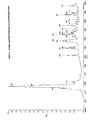
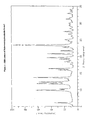
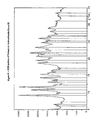
- Form I and Form II according to the present invention are identified from the Raman spectra and the powder X-ray diffraction pattern reported in Figures 2,3,4,5 respectively.
- Another object of the present invention is to provide a manufacturing process, which can be applied on an industrial scale for preparing nolomirole hydrochloride of at least 95% chemical purity.
- a further object of the invention is a purification process of nolomirole hydrochloride to obtain the Form I characterized by high crystallinity as well as high chemical and polymorphic purity, by at the same time fulfilling the other desirable features described above.
- a process for the (re)-crystallization of nolomirole hydrochloride by dissolving the product in a non alcoholic solvent with a boiling point lower than 70°C, preferably lower than 60°C, then cooling the solution to a temperature lower than 20°C, preferably equal or lower than 5°C at a speed higher than 1°C/min.
- nolomirole hydrochloride is effected by the conversion of CHF 1024 hydrochloride into the final product by reaction with isobutyroyl chloride, using a suitable solvent.
- the elimination of the solvent excess from the reaction raw product leads to the formation of an oily mass.
- the process for the preparation of nolomirole hydrochloride needs to be suitable for operating on an industrial scale. In particular it would be desirable that the hydrochloride should be prepared with gaseous hydrochloric acid.
- nolomirole could be precipitated as hydrochloride from its oily mass by addition of gaseous hydrochloric acid in the presence of ether solvents. It has also been even more surprisingly found that, among them, isopropyl ether is the most suitable since in the presence of another widely used ether solvent, i.e methyl- tert -butyl ether, nolomirole might experience a significant degradation to monoester (CHF 2101) and free cathecol (CHF 1024) derivatives.
- CHF 2101 monoester
- CHF 1024 free cathecol
- raw nolomirole hydrochloride is further subjected to a purification step by crystallization, nevertheless the amount of the above mentioned impurities should be maintained as low as possible since they are difficult to be completely eliminated from the finished product due to their close structural similarity.
- nolomirole hydrochloride Form I can only be obtained using a non alcoholic solvent with a boiling point lower than 70°C, preferably lower than 60°C and after cooling the solution of raw nolomirole to a temperature lower than 20°C, preferably equal or lower than 5°C at a speed higher than 1°C/min.
- the preferred non alcoholic solvent is acetone. Contrary to what reported in Giordano et al, when the crystallization of nolomirole hydrochloride from acetone is carried out at room temperature (higher than 20°C), it predominantly gives rise to the form II, which is unsuitable for pharmaceutical utilization.
- nolomirole hydrochloride as polymorphic pure Form I can be obtained from ethanol and methanol as well, such solvents, as reported above, are not suitable as they give rise to trans-esterification reactions and thus to significant amounts of the de-esterified degradation products mentioned above, namely CHF 2101 and CHF 1024.
- the (re)-crystallization process of the invention instead, allows to obtain predominantly polymorph I of nolomirole hydrochloride (polymorphic purity higher than 90%) in a highly crystalline form with a very high chemical purity (higher than 97%).
- the particles of the active ingredient are uniformly incorporated in the mixture before tabletting by simple mixing so avoiding any further treatment such as milling which may disturb their crystallinity.
- the present invention also provides a process for the conversion of Form II of nolomirole hydrochloride to Form I.
- Form II is dissolved in a non alcoholic solvent having a boiling point lower than 70°C, preferably lower than 60°C, such as acetone, by warming, followed by cooling at a temperature lower than 20°C, preferably lower than 15°C till complete crystallisation.
- a non alcoholic solvent having a boiling point lower than 70°C, preferably lower than 60°C, such as acetone, by warming, followed by cooling at a temperature lower than 20°C, preferably lower than 15°C till complete crystallisation.
- the solution may be seeded with few crystals of Form I prior to the initiation of product crystallisation.
- the process can be carried out by: i) suspending Form II in a non alcoholic solvent having a boiling point lower than 70 °C, preferably lower than 60°C, such as acetone, in the presence of at least few crystal of Form I; ii) keeping the suspension under stirring at a temperature lower than 20°C, preferably 10°C for at least one hour, preferably more than two hours, more preferably for eight hours; filtering the resulting product.
- Another object of the present invention refers to the use of nolomirole hydrochloride Form I of at least 97% chemical purity for the preparation of pharmaceutical compositions for the treatment of patients suffering form cardiovascular diseases such as hypertension and congestive hearth failure.
- a further object of the present invention are pharmaceutical compositions, preferably tablets for oral administration, further comprising pharmaceutically acceptable excipients, advantageously containing between 2.5 mg and 10 mg of the active ingredient per unit dose, preferably between 2.5 mg and 5 mg.
- the last step during the synthesis of nolomirole hydrochloride is the conversion of 5,6-dihydroxy-2-methylamino-1,2,3,4-tetrahydro-naphthalene hydrochloride into the product by reaction with isobutyryl chloride, using a suitable solvent, followed by the elimination of the solvent excess from the reaction raw product till an oily mixture is obtained.
- suitable solvent means any volatile polar acidic solvent, preferably halogenated acetic acid. The preferred one is trifluoroacetic acid.
- nolomirole is precipitated as hydrochloride from the oily mixture by bubbling gaseous hydrochloric acid in the presence of an ether solvent.
- gaseous hydrochloric acid is bubbled for at least 15 minutes, more preferably for 60 minutes keeping the temperature under 20°C, more preferably at 5°C.
- isopropyl ether, ethyl ether, dioxane, tetrahydrofurane, 2-methoxyethyl ether and 2-ethoxyethyl ether can be advantageously used.
- isopropyl ether or mixtures thereof with other non alcoholic solvents such as acetone and toluene, preferably in a ratio comprised between 10:1 to 3:1 v/v are used. More preferably, a mixture of isopropyl ether: acetone in a ratio 5:1 is used.
- methyl tert-butyl ether can also be utilized.
- the process of (re)-crystallization for the preparation of nolomirole hydrochloride Form I starting from either raw nolomirole hydrocholoride or nolomirole hydrocholoride Form II is carried out as follows: i) dissolving in a suitable flask the product in a non alcoholic solvent having a boiling point lower than 70°C, preferably lower than 60°C such as acetone at a temperature from about 30°C to reflux temperature, preferably at 50°C; ii) cooling the solution, preferably under stirring, by standard methods and/or by concentration under vacuum to a temperature lower than 20°C, preferably lower than 15°C, even more preferably lower or equal to 5°C at a speed higher than 1°C/min, preferably equal or higher than 2°C/min.
- halogenated solvents such as chloroform could be theoretically used.
- the amount of solvent is at least 3 part by volume per part of product. Higher amounts of solvents and generally up to 10 parts by volume can be used. Amounts higher than 10 volumes are not useful from an economical point of view because large size apparatus would be necessary.
- the most preferred solvent is acetone.
- the flask will be advantageously maintained at 5°C and the precipitation will typically be accomplished within 5 hours. However the time required will vary depending on such factors such as total volume of solution, size of batch and presence or absence of stirring. Methods known in the art may be used to enhance any aspect of the process. For example, as reported above for crystallization of Form I starting from Form II, the solution may be seeded with few crystals of Form I prior to the initiation of product crystallisation.
- nolomirole hydrochloride Form I can be collected by any standard method known in the art such as by filtration, filtration under vacuum, or decantation and drying.
- nolomirole hydrochloride Form I obtained by the process of the invention has a chemical purity, as determined by HPLC of at least 97% by weight of the active ingredient, preferably higher or equal than 98%, with a content of CHF 1024 which is less or equal than 0.3% by weight and/or a content of CHF 2101 which is less or equal than 1.0% by weight.
- the polymorphic purity and the degree of crystallinity are both higher than 90% by weight, preferably higher than 95% as determined by powder X-ray diffraction.
- at least 95% of the particles has a diameter equal or lower than 300 ⁇ m, preferably comprised between 100 and 300 m, as determined by laser diffraction (Malvern).
- Form I of nolomirole hydrochloride produced according to the process of the invention can be characterised by its Raman spectrum and its X-ray powder diffraction (XRD) pattern (Figs 1 and 2).
- Figures 3 and 4 show the Raman and XRD fingerprints of Form II.
- Example 1 Process for obtaining ( ⁇ )-5,6-diisobutyroyloxy-2-methylamino-tetralin hydrochloride (nolomirole hydrochloride) starting from ( ⁇ ) 5,6-dihydroxy-2-methylamino-1,2,3,4-tetrahydro-naphthalene (CHF 1024) hydrochloride.
- Raw nolomirole hydrochloride precipitates as a white crystalline solid and the suspension is kept at 10 ⁇ 2°C for three hours, then at 5 ⁇ 3°C for further five hours and finally centrifuged. The obtained raw nolomirole hydrochloride is dried under vacuum at 60 ⁇ 2°C.
- the purity of the compound obtained is about 95% both upon 1 H NMR and HPLC analysis.
- Example 2 Process for obtaining nolomirole hydrochloride Form I starting from raw nolomirole hydrochloride
- Raw nolomirole hydrochloride is purified by crystallisation on acetone.
- the solid substance is dissolved in 10 volumes of solvent at 50°C, filtered, then the limpid solution is cooled to a temperature of 5°C upon concentration under vacuum at a speed of 2°C/min. The temperature is kept for five hours at 5 ⁇ 2°C, then centrifuged. The solid is dried under vacuum, at 60 ⁇ 2°C.
Landscapes
- Chemical & Material Sciences (AREA)
- Organic Chemistry (AREA)
- Health & Medical Sciences (AREA)
- Chemical Kinetics & Catalysis (AREA)
- Medicinal Chemistry (AREA)
- Pharmacology & Pharmacy (AREA)
- Cardiology (AREA)
- General Chemical & Material Sciences (AREA)
- Bioinformatics & Cheminformatics (AREA)
- Nuclear Medicine, Radiotherapy & Molecular Imaging (AREA)
- Engineering & Computer Science (AREA)
- Heart & Thoracic Surgery (AREA)
- Life Sciences & Earth Sciences (AREA)
- Animal Behavior & Ethology (AREA)
- General Health & Medical Sciences (AREA)
- Public Health (AREA)
- Veterinary Medicine (AREA)
- Organic Low-Molecular-Weight Compounds And Preparation Thereof (AREA)
- Pharmaceuticals Containing Other Organic And Inorganic Compounds (AREA)
Abstract
Description
- The present invention relates to the pharmaceutical chemical compound nolomirole hydrochloride in a highly purified crystalline Form I, to the process for its preparation and isolation as well as to pharmaceutical preparations thereof for the treatment of patients suffering of cardiovascular diseases such as congestive heart failure and hypertension.
- In particular the present invention relates to a crystalline composition having a content of nolomirole hydrochloride Form I of at least 97% by weight of the active ingredient, preferably higher or equal than 98% and at least 90% w/w polymorphic purity, to the process for its preparation and isolation as well as to pharmaceutical preparations thereof for the treatment of patients suffering of cardiovascular diseases such as congestive heart failure.
- (±)-5,6-diisobutyroyloxy-2-methylamino-1,2,3,4-tetrahydronaphthalene hydrochloride, (hereinafter indicated with its approved INN nolomirole hydrochloride) is a DA2 dopaminergic receptor/α2-adrenoceptor agonist, which has been claimed to be useful for the treatment of cardiovascular diseases (WO 96/29065) and in particular for the treatment of congestive heart failure.
- Nolomirole is conveniently formulated in tablets for oral administration. The hydrochloride salt is particularly suitable for the preparation of tablets.
- The daily dosage is comprised between 2.5 and 20 mg.
- Nolomirole is a pro-drug which, after oral administration, is rapidly and completely converted, during absorption, by the esterases contained in the intestinal mucosa into its desesterified form, namely (±)-5,6-dihydroxy-2-methylaminotetralin, indicated hereinafter with the experimental code CHF 1024.
- CHF 1024 also turned out to be one of the main occurring impurities and degradation products. Although the CHF 1024 is the active moiety, it is nevertheless important for pharmaceutical and therapeutic purposes that the active ingredient is present as pro-drug (nolomirole) with the highest as possible chemical purity.
- Nolomirole has been first described as hydrobromide salt in GB 2,123,410 among a series of aminotetralin derivatives (tetralin is another name for 1,2,3,4-tetrahydro-naphthalene) disclosed as potential antibronchospastic agents. In the description, an indication for the preparation of the hydrobromide on a laboratory scale is provided in analogy to the pivaloyl derivative. Said procedure envisions precipitation from a mixture of ethyl ether and petroleum ether. The product has been characterised in terms of NMR spectrum in solution and melting point. The solvents used for its preparation cannot be utilised on an industrial scale; moreover, although it is reported that the product is obtained as a white crystalline powder, once moving on a bigger scale, a significant percentage of amorphous is obtained.
- EP 788472 in the name of the applicant and EP 534536 in the name of Zambon refer, respectively, to processes for the preparation of 5,6 dihydroxy-2-amino-tetralins and N-alkyl derivatives thereof and 5,6-dimethoxy-2-amino-tetralin as intermediates useful for obtaining pharmacologically active chemical compounds. In none of them processes for the preparation and isolation of acyl derivatives such as nolomirole are mentioned.
- In a study presented as a poster at the XXth National Congress of AICAT (Rome, December 14-18, 1998), mainly aimed at investigating the thermal behaviour of nolomirole hydrochloride racemate (quoted with its experimental code CHF 1035) and its enantiomers, preliminary results about its polymorphism were disclosed. In the poster it is stated that Form I can be obtained from acetone and ethanol after fast cooling, Form II from acetone after slow cooling and from III from methyl-ethyl-ketone. No details about the crystallisation conditions are reported nor on the process of preparation of nolomirole hydrochloride.
- In Giordano et al (J Pharm Sci 2001, 90(8), 1154-1163), the polymorphism of nolomirole hydrochloride has been thoroughly investigated. Thermal, spectroscopic, and X-ray diffraction analysis confirms that three differing crystal forms by recrystallization procedures from common organic solvents can be obtained.
- Recrystallizations have been performed on a laboratory scale according to the following procedures: 10 ml of the solvent under examination were saturated with the product, holding the temperature slightly below the boiling point. The hot suspension was then rapidly filtered into a flask maintained at room temperature (RT) or ice-cooled (IC). In all cases the filtrate was allowed to reach spontaneously RT and to equilibrate overnight.
- From ethanol and methanol as well as from methylethylketone, a single solid phase has been obtained whatever recrystallisation procedure is used; on the contrary, from acetone two solid phases were obtained depending on the suspension was maintained at RT or IC. According to Giordano, Form I can be obtained from ethanol and methanol or acetone at room temperature, Form II from methylethylketone and Form III from acetone ice cooling.
- On the contrary, we have found that:
- Form I cannot be prepared from ethanol/methanol in a highly chemical pure form since such solvents can give rise to trans-esterification reactions and thus to significant amounts of the de-esterified degradation products; it can be prepared from acetone by ice cooling;
- Form II can be obtained from acetone at RT;
- Form III is obtained from methylethylketone.
- Moreover it has been found that Form II and Form III have not the desirable characteristics with respect both of their manufacturing process and their pharmaceutical utilisation since they are obtained as extremely fine crystals associated with partially amorphous particles. During isolation, fine crystals are indeed hardly filtered off to detriment of the product yield; moreover, due to this characteristic, said forms strongly retain the solvent(s) of crystallisation so they cannot easily be dried. The disadvantages of having products at least partially amorphous have already been discussed above. Form III is also a metastable form as it undergoes a transformation into Form I within 24 hours either in acetone or methylethylketone.
- In view of these findings, it appears that the only form of nolomirole hydrochloride suitable for pharmaceutical development is Form I. Accordingly, there is a need of a process for preparing a nolomirole hydrochloride able to give rise to the Form I with high polymorphic purity in order to fulfil the requirements described above.
- There is thus a need of a nolomirole hydrochloride in as chemically pure and as highly crystalline condition as possible in order to fulfil pharmaceutical requirements and of a process for its preparation.
- In general terms, chemical purity is a very important issue for pharmaceutical products.
- In the case of the product of the invention, the main occurring impurities are the monoester 5(6)-isobutyroyloxy-2-methylamino-1,2,3,4-tetrahydro-naphthalene (CHF 2101) and the starting material, i.e. the free cathecol derivative (CHF 1024) which, during storage, is easily oxidized to quinonic derivatives as evidenced by the slight coloring of the product.
- In general terms, in a pharmaceutical product impurities should be kept as lowest as possible as they could be detrimental to the potency of the active ingredient and they could also be responsible of unwanted side effects.
- In this particular case the presence of oxidative products gives also rise to a colouring of the raw material.
- High crystallinity is another important issue as amorphous or prevalently amorphous compounds are not suitable for pharmaceutical use due to the fact that potential crystallisation during handling and storage is always present. Such crystallization, in turn, can be responsible for phenomena such as post- compression hardening of tablets (Elamin et al Int J Pharm 1994, 108, 729-752). Moreover amorphous or partially amorphous materials absorb water in larger amounts than crystalline ones (Hancock et al. J. Pharm. Sci. 1997, 86, 1-12); so formulations containing active ingredients such as nolomirole hydrochloride, whose chemical stability is particularly sensitive to the humidity content due to the presence of ester bonds which can be subjected to hydrolysis reactions, could face stability problems during long term storage.
- Polymorphic purity is a further important issue since different polymorphs have different physical properties which in turn can affect both stability and bioavailability. Among others, it has been reported that different physical forms (e.g. polymorphs) can have different hydrolysis and rate profiles (Waterman K et al Pharm Dev Tech 2002, 7, 113-146) so that the stability of molecules such as nolomirole hydrochloride could be dramatically affected by the polymorphic purity.
- The process for the preparation of nolomirole hydrochloride also needs to be one suitable for operating on an industrial scale and that the solvent(s) for crystallization should be readily and almost completely removable. Moreover, the product should be in a form that is readily filtered off and easily dried. Finally, since the content of nolomirole hydrochloride per unitary composition is relatively low (2.5-5 mg), it would be highly advantageous to obtain a product with a particle size less than 300 m, preferably between 100 and 300 m. Said particle size is optimal for having either good flowability characteristics and an homogenous distribution of the active ingredient in the tablets.
- It is a first object of the invention to provide nolomirole hydrochloride of at least 95% chemical purity. It is a further object of the invention to provide nolomirole hydrochloride Form I of at least 97% chemical purity, preferably of at least 98%. In a preferred embodiment of the invention it is provided nolomirole hydrochloride Form I of at least 97% chemical purity, preferably of at least 98% containing an amount equal or less than 0.3% by weight of 5,6-dihydroxy-2-methylamino-1,2,3,4-tetrahydro-naphthalene hydrochloride (CHF 1024) and/or a content of 5(6)-isobutyroyloxy-2-methylamino-1,2,3,4-tetrahydro-naphthalene (CHF 2101) which is less or equal than 1.0% by weight.
- Form I and Form II according to the present invention are identified from the Raman spectra and the powder X-ray diffraction pattern reported in Figures 2,3,4,5 respectively.
- Another object of the present invention is to provide a manufacturing process, which can be applied on an industrial scale for preparing nolomirole hydrochloride of at least 95% chemical purity. A further object of the invention is a purification process of nolomirole hydrochloride to obtain the Form I characterized by high crystallinity as well as high chemical and polymorphic purity, by at the same time fulfilling the other desirable features described above.
- According to a first embodiment there is provided a process which comprises the steps of:
- i) reacting (±) 5,6-dihydroxy-2-methylamino- 1,2,3,4-tetrahydro-naphthalene hydrochloride (CHF 1024) with isobutyroyl chloride optionally in the presence of a suitable solvent to yield raw nolomirole;
- ii) removing any volatile substance from the raw reaction product and dissolving the oily residue with an organic solvent;
- iii) precipitating nolomirole as hydrochloride salt from the solution by adding hydrochloric acid; wherein the organic solvent of step ii) is an ether solvent, preferably isopropyl ether or mixtures thereof with non-alcoholic solvents and step iii) is carried out by bubbling gaseous hydrochloric acid to avoid the use of water which might favour the hydrolysis of the ester bonds.
-
- According to a second embodiment there is provided a process for the (re)-crystallization of nolomirole hydrochloride by dissolving the product in a non alcoholic solvent with a boiling point lower than 70°C, preferably lower than 60°C, then cooling the solution to a temperature lower than 20°C, preferably equal or lower than 5°C at a speed higher than 1°C/min.
- As said before, the synthesis of 5,6-dihydroxy-2-methylamino-1,2,3,4-tetrahydro-naphthalene hydrochloride (CHF 1024) is described in EP 788472.
- The synthesis of nolomirole hydrochloride is effected by the conversion of CHF 1024 hydrochloride into the final product by reaction with isobutyroyl chloride, using a suitable solvent. The elimination of the solvent excess from the reaction raw product leads to the formation of an oily mass. As reported above, the process for the preparation of nolomirole hydrochloride needs to be suitable for operating on an industrial scale. In particular it would be desirable that the hydrochloride should be prepared with gaseous hydrochloric acid.
- It has been found that nolomirole could be precipitated as hydrochloride from its oily mass by addition of gaseous hydrochloric acid in the presence of ether solvents. It has also been even more surprisingly found that, among them, isopropyl ether is the most suitable since in the presence of another widely used ether solvent, i.e methyl-tert-butyl ether, nolomirole might experience a significant degradation to monoester (CHF 2101) and free cathecol (CHF 1024) derivatives. We have indeed found that methanol can form due to the degradation of methyl tert-butyl ether in acidic environment; without being limited by the theory, we have hypothesized that the formed methanol reacts with nolomirole by parasitic trans-esterification giving rise to the two aforementioned degradation products (vide supra).
- Although raw nolomirole hydrochloride is further subjected to a purification step by crystallization, nevertheless the amount of the above mentioned impurities should be maintained as low as possible since they are difficult to be completely eliminated from the finished product due to their close structural similarity.
- It has also been found that a highly chemical and polymorphic purified, crystalline composition of nolomirole hydrochloride Form I can only be obtained using a non alcoholic solvent with a boiling point lower than 70°C, preferably lower than 60°C and after cooling the solution of raw nolomirole to a temperature lower than 20°C, preferably equal or lower than 5°C at a speed higher than 1°C/min.
- The preferred non alcoholic solvent is acetone. Contrary to what reported in Giordano et al, when the crystallization of nolomirole hydrochloride from acetone is carried out at room temperature (higher than 20°C), it predominantly gives rise to the form II, which is unsuitable for pharmaceutical utilization.
- Moreover, although nolomirole hydrochloride as polymorphic pure Form I can be obtained from ethanol and methanol as well, such solvents, as reported above, are not suitable as they give rise to trans-esterification reactions and thus to significant amounts of the de-esterified degradation products mentioned above, namely CHF 2101 and CHF 1024.
- The (re)-crystallization process of the invention, instead, allows to obtain predominantly polymorph I of nolomirole hydrochloride (polymorphic purity higher than 90%) in a highly crystalline form with a very high chemical purity (higher than 97%).
- Advantageously, it also gives rise to particles with an inherent particle size optimal for nolomirole hydrochloride to be conveniently formulated in tablets for oral administration. The particles of the active ingredient are uniformly incorporated in the mixture before tabletting by simple mixing so avoiding any further treatment such as milling which may disturb their crystallinity.
- The present invention also provides a process for the conversion of Form II of nolomirole hydrochloride to Form I.
- The process can be carried out using similar conditions of (re)crystallisation as those described above which give purified Form I. According to this way, Form II is dissolved in a non alcoholic solvent having a boiling point lower than 70°C, preferably lower than 60°C, such as acetone, by warming, followed by cooling at a temperature lower than 20°C, preferably lower than 15°C till complete crystallisation. In order to speed up the process, the solution may be seeded with few crystals of Form I prior to the initiation of product crystallisation. Alternatively, the process can be carried out by: i) suspending Form II in a non alcoholic solvent having a boiling point lower than 70 °C, preferably lower than 60°C, such as acetone, in the presence of at least few crystal of Form I; ii) keeping the suspension under stirring at a temperature lower than 20°C, preferably 10°C for at least one hour, preferably more than two hours, more preferably for eight hours; filtering the resulting product.
- Another object of the present invention refers to the use of nolomirole hydrochloride Form I of at least 97% chemical purity for the preparation of pharmaceutical compositions for the treatment of patients suffering form cardiovascular diseases such as hypertension and congestive hearth failure.
- A further object of the present invention are pharmaceutical compositions, preferably tablets for oral administration, further comprising pharmaceutically acceptable excipients, advantageously containing between 2.5 mg and 10 mg of the active ingredient per unit dose, preferably between 2.5 mg and 5 mg.
- The characteristics of the process of the invention for preparing nolomirole hydrochloride and nolomirole hydrochloride Form I and the features of the product obtained will be more apparent from the following detailed description.
- Generally, the last step during the synthesis of nolomirole hydrochloride is the conversion of 5,6-dihydroxy-2-methylamino-1,2,3,4-tetrahydro-naphthalene hydrochloride into the product by reaction with isobutyryl chloride, using a suitable solvent, followed by the elimination of the solvent excess from the reaction raw product till an oily mixture is obtained. The term suitable solvent means any volatile polar acidic solvent, preferably halogenated acetic acid. The preferred one is trifluoroacetic acid.
- Advantageously, nolomirole is precipitated as hydrochloride from the oily mixture by bubbling gaseous hydrochloric acid in the presence of an ether solvent. Preferably, gaseous hydrochloric acid is bubbled for at least 15 minutes, more preferably for 60 minutes keeping the temperature under 20°C, more preferably at 5°C.
- As an ether solvent, isopropyl ether, ethyl ether, dioxane, tetrahydrofurane, 2-methoxyethyl ether and 2-ethoxyethyl ether can be advantageously used. Preferably, pure isopropyl ether or mixtures thereof with other non alcoholic solvents such as acetone and toluene, preferably in a ratio comprised between 10:1 to 3:1 v/v are used. More preferably, a mixture of isopropyl ether: acetone in a ratio 5:1 is used. Although is not preferred, methyl tert-butyl ether can also be utilized.
- Advantageously the process of (re)-crystallization for the preparation of nolomirole hydrochloride Form I starting from either raw nolomirole hydrocholoride or nolomirole hydrocholoride Form II is carried out as follows: i) dissolving in a suitable flask the product in a non alcoholic solvent having a boiling point lower than 70°C, preferably lower than 60°C such as acetone at a temperature from about 30°C to reflux temperature, preferably at 50°C; ii) cooling the solution, preferably under stirring, by standard methods and/or by concentration under vacuum to a temperature lower than 20°C, preferably lower than 15°C, even more preferably lower or equal to 5°C at a speed higher than 1°C/min, preferably equal or higher than 2°C/min. Although they are not advisable for environmental reasons, halogenated solvents such as chloroform could be theoretically used.
- The amount of solvent is at least 3 part by volume per part of product. Higher amounts of solvents and generally up to 10 parts by volume can be used. Amounts higher than 10 volumes are not useful from an economical point of view because large size apparatus would be necessary. The most preferred solvent is acetone.
- The flask will be advantageously maintained at 5°C and the precipitation will typically be accomplished within 5 hours. However the time required will vary depending on such factors such as total volume of solution, size of batch and presence or absence of stirring. Methods known in the art may be used to enhance any aspect of the process. For example, as reported above for crystallization of Form I starting from Form II, the solution may be seeded with few crystals of Form I prior to the initiation of product crystallisation.
- Generally, nolomirole hydrochloride Form I can be collected by any standard method known in the art such as by filtration, filtration under vacuum, or decantation and drying.
- Normally, nolomirole hydrochloride Form I obtained by the process of the invention has a chemical purity, as determined by HPLC of at least 97% by weight of the active ingredient, preferably higher or equal than 98%, with a content of CHF 1024 which is less or equal than 0.3% by weight and/or a content of CHF 2101 which is less or equal than 1.0% by weight.
- Advantageously, the polymorphic purity and the degree of crystallinity are both higher than 90% by weight, preferably higher than 95% as determined by powder X-ray diffraction. After isolation of the finished product, advantageously, at least 95% of the particles has a diameter equal or lower than 300 µm, preferably comprised between 100 and 300 m, as determined by laser diffraction (Malvern).
- Form I of nolomirole hydrochloride produced according to the process of the invention can be characterised by its Raman spectrum and its X-ray powder diffraction (XRD) pattern (Figs 1 and 2). The FT-Raman spectrum, obtained by simply packing the powder into a cup, shows the following main peaks in the 3500-700 cm-1 range (accuracy ± 1 cm-1):
2937 cm-1 (vs); 1771 (s); 1614 (s); 1588 (s); 1446 (s); 1426 (s); 1302 (s);1274 (m); 1225 (m); 1221 (m); 1098 (br, m); 1009 (w); 966 (w); 856 (s); 818 (m)
Legend: vs = very strong; s = strong; m = medium; w = weak; br = broad - The interplanar distances and relative peak intensities (in brackets) of the powder XRD pattern are reported as follows (depending on the packing conditions, the relative intensities can change):
- 14.35 d/Å (64); 8.93 (18); 8.63 (6); 7.46 (34); 7.19 (100); 7.13 (5); 7.04 (3); 6.46 (19); 5.55 (6); 5.40 (12); 4.82 (4); 4.66 (3); 4.62 (7); 4.52 (11); 4.27 (18); 4.07 (5); 3.90 (3); 3.80 (28); 3.60 (6); 3.55 (3); 3.24 (4); 2.86 (3).
-
- For comparison Figures 3 and 4 show the Raman and XRD fingerprints of Form II.
- The following examples better illustrate the invention.
- Example 1 - Process for obtaining (±)-5,6-diisobutyroyloxy-2-methylamino-tetralin hydrochloride (nolomirole hydrochloride) starting from (±) 5,6-dihydroxy-2-methylamino-1,2,3,4-tetrahydro-naphthalene (CHF 1024) hydrochloride.
- Slowly add, in 2 hours, a molar excess of isobutyryl chloride to a suspension of CHF 1024 in trifluoroacetic acid, always keeping temperature at 25±2°C.
- Then heat the solution to 85 ± 2°C for 1 hour, thus obtaining a full dissolution.
- Cool to 50 ± 5°C, distil the maximum part of trifluoracetic acid under vacuum and add toluene to the oily residue: then, distil again to oil.
- Repeat three times both addition and distillation of toluene, then dissolve the oily residue in a mixture of isopropyl ether: acetone 5:1 v/v. Let gaseous hydrochloric acid bubbling for 60 minutes keeping temperature under 20°C.
- Raw nolomirole hydrochloride precipitates as a white crystalline solid and the suspension is kept at 10±2°C for three hours, then at 5±3°C for further five hours and finally centrifuged. The obtained raw nolomirole hydrochloride is dried under vacuum at 60 ± 2°C.
- The purity of the compound obtained is about 95% both upon 1H NMR and HPLC analysis.
- 1H NMR (CH3OH-d4, ppm): 1.28 (d, 6H); 1.35 (2 x d, 6H); 1.82 (m, 1H), 2.30 (m, 1H); 2.6-3.0 (m, 5H); 2.80 (s, 3H); 3.30 (dd, 1H); 3.48 (m, 1H), 7.0-7.2 (AB syst, 2H).
- 13C NMR (CH3OH-d4, ppm): 19.3; 19.4; 22.9; 25.6; 30.9; 32.2; 35.0; 55.9; 122.5; 128.2; 130.5; 132.4; 141.6; 142.5; 175.5; 176.6.
- Legend: d = doublet; dd= doublets of doublet; m = mutiplet; s = single
- Raw nolomirole hydrochloride is purified by crystallisation on acetone. The solid substance is dissolved in 10 volumes of solvent at 50°C, filtered, then the limpid solution is cooled to a temperature of 5°C upon concentration under vacuum at a speed of 2°C/min. The temperature is kept for five hours at 5 ± 2°C, then centrifuged. The solid is dried under vacuum, at 60 ± 2°C.
- Assay = 99.1% (HPLC); melting range = 199-202°C (DSC).
Claims (22)
- A process for preparing (±)-5,6-diisobutyroyloxy-2-methylamino-tetralin (nolomirole) hydrochloride which comprises the steps of:wherein the organic solvent of step ii) is an ether solvent, preferably isopropyl ether or mixtures thereof with non-alcoholic solvents and step iii) is carried out by bubbling gaseous hydrochloric acid to avoid the use of water which might favour the hydrolysis of the ester bonds.i) reacting (±) 5,6-dihydroxy-2-methylamino-1,2,3,4-tetrahydronaphthalene hydrochloride (CHF 1024) with isobutyroyl chloride optionally in the presence of a suitable solvent to yield raw nolomirole;ii) removing any volatile substance from the raw reaction product and dissolving the oily residue with an organic solvent;iii) precipitating nolomirole as hydrochloride salt from the solution by adding hydrochloric acid;
- A process according to claim 1 wherein the step i) is carried out in the presence of a volatile polar acidic solvent such as trifluoracetic acid.
- A process according to claims 1-2 wherein the ether solvent is selected from isopropyl ether, ethyl ether, dioxane, tetrahydrofurane, 2-methoxyethyl ether and 2-ethoxyethyl ether.
- A process according to claim 3 wherein the ether solvent is isopropyl ether or mixtures thereof with non-alcoholic solvents such acetone or toluene.
- A process according to any of preceding claims wherein nolomirole hydrochloride is of at least 95% chemical purity.
- A process for preparing crystalline nolomirole hydrochloride Form I by dissolving nolomirole hydrochloride in a non alcoholic solvent with a boiling point lower than 70°C then cooling the solution to a temperature lower than 20°C at a speed higher than 10C/min.
- A process according to claim 6 wherein the non alcoholic solvent is acetone and the product is dissolved in said solvent at a temperature from about 30°C to reflux temperature.
- A process according to claims 6-7 wherein the solution is cooled at a temperature lower than 15°C.
- A process according to claims 7-8 wherein the solution is cooled at a temperature lower than 5°C at a speed equal or higher than 2°C/min.
- A process for preparing a crystalline nolomirole hydrochloride Form I which comprises the step of dissolving nolomirole hydrochloride Form II in a non alcoholic solvent with a boiling point lower than 70°C then cooling the solution at a temperature lower than 20°C.
- A process for preparing a crystalline nolomirole hydrochloride Form I which comprises the steps of: i) suspending nolomirole hydrochloride Form II in a non alcoholic solvent having a boiling point lower than 70°C in the presence of at least few crystal of Form I; ii) keeping the suspension under stirring at a temperature lower than 20°C, preferably 10°C for at least one hour, preferably more than two hours, more preferably eight hours; filtering the resulting product.
- A process according to claims 10-11 wherein the non alcoholic solvent is acetone.
- A process according to claims 6-12 for preparing crystalline nolomirole hydrochloride Form I of at least 97% by weight chemical purity.
- A process according to claim 13 wherein the amount of 5,6-dihydroxy-2-methylamino-1,2,3,4-tetrahydro-naphthalene hydrochloride is equal or less than 0.3% by weight and/or the amount of 5(6)-isobutyroyloxy-2-methylamino- 1,2,3,4-tetrahydro-naphthalene is less or equal than 1.0% by weight.
- A process according to claims 6-14 wherein the polymorphic purity and the crystallinity are higher than 90% by weight.
- Crystalline nolomirole hydrochloride Form I of at least 97% by weight chemical purity.
- Crystalline nolomirole according to claim 16 wherein the amount of 5,6-dihydroxy-2-methylamino- 1,2,3,4-tetrahydro-naphthalene hydrochloride is equal or less than 0.3% by weight and/or the amount of 5(6)-isobutyrroyloxy- 2-methylamino-1,2,3,4-tetrahydro-naphthalene is less or equal than 1.0% by weight.
- Crystalline nolomirole according to claims 16 and 17 wherein the polymorphic purity and the crystallinity are higher than 90% by weight.
- Nolomirole hydrochloride of at least 95% by weight chemical purity as an intermediate for preparing crystalline nolomirole hydrochloride Form I
- A pharmaceutical composition comprising nolomirole hydrochloride of claims 16-18 as active ingredient in combination with at least one pharmaceutical acceptable excipient.
- A pharmaceutical composition according to claim 20 in the form of tablet for oral administration containing between 2.5 and 5 mg of nolomirole hydrochloride per unit dose.
- Use of nolomirole hydrochloride of claims 16-18 for the preparation of pharmaceutical compositions for the treatment of patients suffering from cardiovascular diseases such as hypertension and congestive heart failure.
Priority Applications (3)
| Application Number | Priority Date | Filing Date | Title |
|---|---|---|---|
| EP02016726A EP1384708A1 (en) | 2002-07-26 | 2002-07-26 | Process for the manufacture of form I of nolomirole hydrochloride |
| AU2003260322A AU2003260322A1 (en) | 2002-07-26 | 2003-07-23 | Nolomirole hydrochloride form i |
| PCT/EP2003/008078 WO2004013083A1 (en) | 2002-07-26 | 2003-07-23 | Nolomirole hydrochloride form i |
Applications Claiming Priority (1)
| Application Number | Priority Date | Filing Date | Title |
|---|---|---|---|
| EP02016726A EP1384708A1 (en) | 2002-07-26 | 2002-07-26 | Process for the manufacture of form I of nolomirole hydrochloride |
Publications (1)
| Publication Number | Publication Date |
|---|---|
| EP1384708A1 true EP1384708A1 (en) | 2004-01-28 |
Family
ID=29797189
Family Applications (1)
| Application Number | Title | Priority Date | Filing Date |
|---|---|---|---|
| EP02016726A Withdrawn EP1384708A1 (en) | 2002-07-26 | 2002-07-26 | Process for the manufacture of form I of nolomirole hydrochloride |
Country Status (3)
| Country | Link |
|---|---|
| EP (1) | EP1384708A1 (en) |
| AU (1) | AU2003260322A1 (en) |
| WO (1) | WO2004013083A1 (en) |
Families Citing this family (1)
| Publication number | Priority date | Publication date | Assignee | Title |
|---|---|---|---|---|
| WO2017110317A1 (en) * | 2015-12-21 | 2017-06-29 | 昭和電工株式会社 | Nicotinamide mononucleotide derivative, salt thereof, production method therefor, dermatological topical agent, cosmetic, and food additive |
Citations (3)
| Publication number | Priority date | Publication date | Assignee | Title |
|---|---|---|---|---|
| GB2123410A (en) * | 1982-06-10 | 1984-02-01 | Chiesi Farma Spa | New derivatives of 1,2,3,4-tetrahydronaphthalene, process for their preparation and associated pharmaceutical compositions |
| WO1996029065A2 (en) * | 1995-03-17 | 1996-09-26 | Chiesi Farmaceutici S.P.A. | Aminotetralin derivative for the therapy of cardiovascular diseases |
| WO2001085668A1 (en) * | 2000-05-12 | 2001-11-15 | Chiesi Farmaceutici S.P.A. | Optically active 2-aminotetralin derivatives, the processes for the preparation thereof and the therapeutical use of pharmaceutical compositions containing them |
-
2002
- 2002-07-26 EP EP02016726A patent/EP1384708A1/en not_active Withdrawn
-
2003
- 2003-07-23 AU AU2003260322A patent/AU2003260322A1/en not_active Abandoned
- 2003-07-23 WO PCT/EP2003/008078 patent/WO2004013083A1/en not_active Ceased
Patent Citations (3)
| Publication number | Priority date | Publication date | Assignee | Title |
|---|---|---|---|---|
| GB2123410A (en) * | 1982-06-10 | 1984-02-01 | Chiesi Farma Spa | New derivatives of 1,2,3,4-tetrahydronaphthalene, process for their preparation and associated pharmaceutical compositions |
| WO1996029065A2 (en) * | 1995-03-17 | 1996-09-26 | Chiesi Farmaceutici S.P.A. | Aminotetralin derivative for the therapy of cardiovascular diseases |
| WO2001085668A1 (en) * | 2000-05-12 | 2001-11-15 | Chiesi Farmaceutici S.P.A. | Optically active 2-aminotetralin derivatives, the processes for the preparation thereof and the therapeutical use of pharmaceutical compositions containing them |
Non-Patent Citations (3)
| Title |
|---|
| GIORDANO, FERDINANDO ET AL: "Polymorphism of rac-5,6-diisobutyryloxy-2-methylamino-1,2,3,4-tetrahydro- naphthalene hydrochloride ( CHF 1035 ). I. Thermal, spectroscopic, and X-ray diffraction properties", JOURNAL OF PHARMACEUTICAL SCIENCES (2001), 90(8), 1154-1163, XP002223546 * |
| MEALY, N. E. ET AL: "Nolomirole hydrochloride: treatment of heart failure dopamine D2 agonist.alpha.2-adrenoreceptor agonist CHF - 1035", DRUGS OF THE FUTURE (2001), 26(11), 1046-1051, XP009002202 * |
| TADDEI, PAOLA ET AL: "Vibrational study of polymorphism of tetralin derivative for treatment of cardiovascular diseases", BIOPOLYMERS (2002), VOLUME DATE 2001-2002, 61(3), 289-293, XP009002199 * |
Also Published As
| Publication number | Publication date |
|---|---|
| AU2003260322A1 (en) | 2004-02-23 |
| WO2004013083A1 (en) | 2004-02-12 |
Similar Documents
| Publication | Publication Date | Title |
|---|---|---|
| JP3493341B2 (en) | Crystal Form of EtO2C-CH2- (R) Cgl-Aze-Pab-OH | |
| US5354760A (en) | Crystalline Tiagabine monohydrate, its preparation and use | |
| JP6594917B2 (en) | Optimal synthesis of pure nonpolymorphic crystalline bile acids with a given particle size | |
| EP2468750A1 (en) | Polymorphic forms of asenapine maleate and processes for their preparation | |
| EP0703915B1 (en) | Xamoneline tartrate | |
| FR2753970A1 (en) | N- (BENZOTHIAZOL-2-YL) PIPERIDINE-1-ETHANAMINE DERIVATIVES, THEIR PREPARATION AND THEIR THERAPEUTIC USE | |
| US20240239791A1 (en) | Processes for the synthesis of valbenazine | |
| WO2004013083A1 (en) | Nolomirole hydrochloride form i | |
| EP2899193A1 (en) | Crystalline form of abacavir that is essentially free of solvent | |
| JP3001975B2 (en) | Crystalline tiagabine hydrochloride monohydrate, production method and use thereof | |
| HU215594B (en) | Cyclohexadiene derivatives, pharmaceutical compositions containing them, and a process for preparing the compounds | |
| HK1187351B (en) | Optimized synthesis of pure, non-polymorphic, crystalline bile acids with defined particle size | |
| JPS63146857A (en) | Pyroglutamide derivative and production thereof | |
| WO2003042161A1 (en) | Venlafaxine hydrochloride polymorphs |
Legal Events
| Date | Code | Title | Description |
|---|---|---|---|
| PUAI | Public reference made under article 153(3) epc to a published international application that has entered the european phase |
Free format text: ORIGINAL CODE: 0009012 |
|
| AK | Designated contracting states |
Kind code of ref document: A1 Designated state(s): AT BE BG CH CY CZ DE DK EE ES FI FR GB GR IE IT LI LU MC NL PT SE SK TR |
|
| AX | Request for extension of the european patent |
Extension state: AL LT LV MK RO SI |
|
| 17P | Request for examination filed |
Effective date: 20040715 |
|
| AKX | Designation fees paid |
Designated state(s): AT BE BG CH CY CZ DE DK EE ES FI FR GB GR IE IT LI LU MC NL PT SE SK TR |
|
| AXX | Extension fees paid |
Extension state: SI Payment date: 20040715 Extension state: RO Payment date: 20040715 Extension state: MK Payment date: 20040715 Extension state: LV Payment date: 20040715 Extension state: LT Payment date: 20040715 Extension state: AL Payment date: 20040715 |
|
| 17Q | First examination report despatched |
Effective date: 20050509 |
|
| GRAP | Despatch of communication of intention to grant a patent |
Free format text: ORIGINAL CODE: EPIDOSNIGR1 |
|
| RIC1 | Information provided on ipc code assigned before grant |
Ipc: C07C 215/64 20060101ALI20060322BHEP Ipc: C07C 213/00 20060101ALI20060322BHEP Ipc: C07C 213/10 20060101AFI20060322BHEP |
|
| RTI1 | Title (correction) |
Free format text: PROCESS FOR THE MANUFACTURE OF NOLOMIROLE HYDROCHLORIDE |
|
| STAA | Information on the status of an ep patent application or granted ep patent |
Free format text: STATUS: THE APPLICATION IS DEEMED TO BE WITHDRAWN |
|
| 18D | Application deemed to be withdrawn |
Effective date: 20060909 |