EP1382905A1 - Determining an input material mix for a kiln - Google Patents
Determining an input material mix for a kiln Download PDFInfo
- Publication number
- EP1382905A1 EP1382905A1 EP02405630A EP02405630A EP1382905A1 EP 1382905 A1 EP1382905 A1 EP 1382905A1 EP 02405630 A EP02405630 A EP 02405630A EP 02405630 A EP02405630 A EP 02405630A EP 1382905 A1 EP1382905 A1 EP 1382905A1
- Authority
- EP
- European Patent Office
- Prior art keywords
- waste
- kiln
- fuel
- raw material
- determining
- Prior art date
- Legal status (The legal status is an assumption and is not a legal conclusion. Google has not performed a legal analysis and makes no representation as to the accuracy of the status listed.)
- Granted
Links
Images
Classifications
-
- C—CHEMISTRY; METALLURGY
- C04—CEMENTS; CONCRETE; ARTIFICIAL STONE; CERAMICS; REFRACTORIES
- C04B—LIME, MAGNESIA; SLAG; CEMENTS; COMPOSITIONS THEREOF, e.g. MORTARS, CONCRETE OR LIKE BUILDING MATERIALS; ARTIFICIAL STONE; CERAMICS; REFRACTORIES; TREATMENT OF NATURAL STONE
- C04B7/00—Hydraulic cements
- C04B7/36—Manufacture of hydraulic cements in general
- C04B7/361—Condition or time responsive control in hydraulic cement manufacturing processes
-
- F—MECHANICAL ENGINEERING; LIGHTING; HEATING; WEAPONS; BLASTING
- F23—COMBUSTION APPARATUS; COMBUSTION PROCESSES
- F23G—CREMATION FURNACES; CONSUMING WASTE PRODUCTS BY COMBUSTION
- F23G5/00—Incineration of waste; Incinerator constructions; Details, accessories or control therefor
- F23G5/44—Details; Accessories
- F23G5/46—Recuperation of heat
-
- F—MECHANICAL ENGINEERING; LIGHTING; HEATING; WEAPONS; BLASTING
- F23—COMBUSTION APPARATUS; COMBUSTION PROCESSES
- F23G—CREMATION FURNACES; CONSUMING WASTE PRODUCTS BY COMBUSTION
- F23G5/00—Incineration of waste; Incinerator constructions; Details, accessories or control therefor
- F23G5/50—Control or safety arrangements
-
- F—MECHANICAL ENGINEERING; LIGHTING; HEATING; WEAPONS; BLASTING
- F23—COMBUSTION APPARATUS; COMBUSTION PROCESSES
- F23G—CREMATION FURNACES; CONSUMING WASTE PRODUCTS BY COMBUSTION
- F23G2207/00—Control
- F23G2207/20—Waste supply
-
- F—MECHANICAL ENGINEERING; LIGHTING; HEATING; WEAPONS; BLASTING
- F23—COMBUSTION APPARATUS; COMBUSTION PROCESSES
- F23G—CREMATION FURNACES; CONSUMING WASTE PRODUCTS BY COMBUSTION
- F23G2900/00—Special features of, or arrangements for incinerators
- F23G2900/55—Controlling; Monitoring or measuring
- F23G2900/55006—Measuring material flow rates
-
- F—MECHANICAL ENGINEERING; LIGHTING; HEATING; WEAPONS; BLASTING
- F27—FURNACES; KILNS; OVENS; RETORTS
- F27D—DETAILS OR ACCESSORIES OF FURNACES, KILNS, OVENS OR RETORTS, IN SO FAR AS THEY ARE OF KINDS OCCURRING IN MORE THAN ONE KIND OF FURNACE
- F27D19/00—Arrangements of controlling devices
-
- Y—GENERAL TAGGING OF NEW TECHNOLOGICAL DEVELOPMENTS; GENERAL TAGGING OF CROSS-SECTIONAL TECHNOLOGIES SPANNING OVER SEVERAL SECTIONS OF THE IPC; TECHNICAL SUBJECTS COVERED BY FORMER USPC CROSS-REFERENCE ART COLLECTIONS [XRACs] AND DIGESTS
- Y02—TECHNOLOGIES OR APPLICATIONS FOR MITIGATION OR ADAPTATION AGAINST CLIMATE CHANGE
- Y02P—CLIMATE CHANGE MITIGATION TECHNOLOGIES IN THE PRODUCTION OR PROCESSING OF GOODS
- Y02P10/00—Technologies related to metal processing
- Y02P10/10—Reduction of greenhouse gas [GHG] emissions
- Y02P10/143—Reduction of greenhouse gas [GHG] emissions of methane [CH4]
Definitions
- the invention relates to the field of process control, in particular to a method, computer program and apparatus for determining an input material mix for a kiln as described in the preamble of claim 1, 10 and 11, respectively.
- cement producers are driven to produce different grades of cement at the lowest possible cost within continuously changing economical, environmental and technological constraints.
- the cement process is complex and requires high-level control to achieve long periods of stability and good performance. There are obvious benefits if the process is achieved in the most economic way.
- Example of this is the overall economic optimisation of the kiln process, optimisation of the raw mix preparation process and the management of alternative fuels: Cement producers are paid for burning alternative fuels or wastes, and there is a strong interest in extending this practice as much as possible.
- traditional fuels coal, oil and natural gas
- the ashes from the combustion go directly into the cement clinker, and since the chemical composition of the alternative fuels is variable, constraints on the final cement composition can only be satisfied if traditional fuels serve to compensate for these variations.
- legislation on pollutants, prices and costs of fuels and wastes, technological constraints like high temperatures, ramp constraints, etc. make decisions regarding "raw meal to fuel to waste" ratios very difficult.
- US 5,888,256 describes a method for producing a fuel that is to be burned in a cement kiln: a chemical composition of different waste materials is determined, and said waste materials are blended in order to obtain a fuel that satisfies certain requirements specified by a fuel consumer.
- Requirements include e.g. a specified energy value and an ash residue with a specified chemical composition.
- the inventive method for determining an input material mix for a kiln, where the kiln is fed with input materials, and said input materials are classifiable as raw material, fuel and waste, and where a product produced by operating the kiln comprises ashes from burning the fuel and waste, comprises the steps of
- the invention therefore allows determining a mix of input materials that minimizes a total cost of kiln operation, i.e. maximizes a profit, over a given period of time.
- said cost functional further includes costs of emissions. This allows accounting for taxes or penalties incurred by the production of unwanted gases or dust.
- the computer program for determining an input material mix for a kiln according to the invention is loadable into an internal memory of a digital computer, and comprises computer program code means to make, when said computer program code means is loaded in the computer, the computer execute the method according to the invention.
- a computer program product comprises a computer readable medium, having the computer program code means recorded thereon.
- the apparatus for determining an input material mix for a kiln comprises a data processor, a memory coupled to the processor and computer program code means stored in said memory, where said computer program code means, when executed by the processor, causes the method according to the invention to be executed.
- the inventive method, computer program and apparatus are preferably applied to a cement kiln, the raw material being raw meal, which is a mixture of limestone and other components, and the product being clinker.
- the invention is applied to a lime kiln, the raw material being limestone and the product being lime, or to an alumina kiln, the raw material comprising bauxite and the product being alumina.
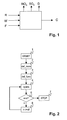
- FIG. 1 schematically shows input and output variables of a cement kiln process.
- R denotes an inflow of raw material, which for a cement kiln is called raw meal
- W an inflow of waste material
- F an inflow of conventional fuel such as gas or oil.
- C is an outflow of a product, which for cement kiln is clinker.
- NO x , SO 2 and D denote outflows of undesired materials.
- the kiln is fed from a silo filled with raw meal, i.e. essentially ground or powdered limestone.
- the forecasted hc raw_meal is constant, but under some circumstances can vary, for instance, when a new clinker type should be produced.
- This is a simplification made by modelling kiln operation as a discrete-time process. In reality, said amounts are of course continuously fed into the kiln over a sampling interval or discretisation interval dt.
- Each of the amounts, e.g. M coal is proportional to a corresponding feed rate, e.g. M coal / dt .
- the sampling interval dt may have a value between e.g. 5 minutes and one hour. In a preferred embodiment of the invention, the sampling interval dt remains constant. In another embodiment of the invention, the sampling interval dt is changed during operation of the kiln.
- the "waste cost" p waste is a negative number.
- the cost functional is not an affine function of M coal (.), M waste (.), M raw_meal (.), but a general non-linear function.
- the cost functional can and must be adapted to each situation, e.g. when costs change in a non-linear manner according contracts related to prices of energy, waste material, clinker etc.
- Cumulative emission limit For each relevant pollutant, the emission over a given period of time, e.g. over one day should not exceed a given threshold.
- the cost functional is minimised, subject to one or more constraints, including but not limited to the ones depicted above. If the cost functional and constraints are linear, then well-known linear programming methods may be applied.
- the coefficients used in the constraints and the optimisation functional are estimated and adjusted using Extended Kalman Filters, Neural Networks, System Identification Procedures or the like. For example, heat capacity of the waste and raw meal properties may change, rain may make it more difficult to burn, actual emissions as measured may differ from expected ones. In particular changes in ambient conditions can make retuning of the coefficients necessary.
- the linear relationships in the cost functional and/or one or more constraint equations are replaced by general non-linear relationships defined via mathematical models based on physical first principles, or identified "black box” models like neural networks, etc. Accordingly, corresponding algorithms for non-linear optimisation are used. Such algorithms are well known from e.g. non-linear model predictive control theory.
- a computer program according to the invention implements the steps of the inventive method according to the flow diagram of Figure 2:
- step 1 the program execution is started.
- constraints are defined, e.g. from user input or by loading stored data or program code that specifies one or more constraint equations and/or parameters related to the actual plant that is to be controlled.
- the cost functional is defined, e.g. from user input or by loading data or program code that specifies the cost functional and/or its parameters.
- the optimal feed rates or amounts of input materials are determined.
- the optimal feed rate or amount trajectories are either stored for later use in controlling the kiln, and program execution branches 5 to the end of the program execution 7.
- program execution branches 5 to step 6 where the kiln is controlled on-line according to the inventive method:
- a first set of values M coal ( t ), M waste ( t ) M raw_meal ( t ) of the optimal trajectories is used to control the flow of fuel, waste and raw meal to the kiln, e.g. by modifying corresponding set points of low level controllers.
- parameters used in the functional and/or constraints that are related to kiln operation and fuel or waste properties are updated from measurements and/or estimation results.
- Program execution continues with the optimisation step 4 based on the updated parameters. The loop consisting of steps 4 and 6 is repeated until the kiln is shut down or until the program is terminated through branch 5 for other reasons.
- This strategy enforces optimal reactions to changing conditions in fuel, waste, raw meal quality, and not less importantly, satisfaction of both environmental and technical constraints.
- the strategy can also be used to prepare optimal raw meal materials in the silos, in order to make easier the extended use of alternative fuels.
Landscapes
- Engineering & Computer Science (AREA)
- Chemical & Material Sciences (AREA)
- Ceramic Engineering (AREA)
- Mechanical Engineering (AREA)
- General Engineering & Computer Science (AREA)
- Materials Engineering (AREA)
- Structural Engineering (AREA)
- Organic Chemistry (AREA)
- Curing Cements, Concrete, And Artificial Stone (AREA)
- Muffle Furnaces And Rotary Kilns (AREA)
- Feeding, Discharge, Calcimining, Fusing, And Gas-Generation Devices (AREA)
- Incineration Of Waste (AREA)
Abstract
- determining constraints on the operation of the kiln and expressing said constraints as functions of feed rates for the raw material, fuel and waste;
- determining a cost functional that represents total operating costs of the kiln over a given period of time and as a function of the feed rates for the raw material, fuel and waste, said cost functional including costs of raw material, costs of fuel, costs of waste and revenues from the product; and
- determining trajectories of the feed rates for the raw material, fuel and waste that minimize the cost functional and satisfy said constraints.
Description
- The invention relates to the field of process control, in particular to a method, computer program and apparatus for determining an input material mix for a kiln as described in the preamble of
claim 1, 10 and 11, respectively. - Cement producers are driven to produce different grades of cement at the lowest possible cost within continuously changing economical, environmental and technological constraints. The cement process is complex and requires high-level control to achieve long periods of stability and good performance. There are obvious benefits if the process is achieved in the most economic way.
- Example of this is the overall economic optimisation of the kiln process, optimisation of the raw mix preparation process and the management of alternative fuels: Cement producers are paid for burning alternative fuels or wastes, and there is a strong interest in extending this practice as much as possible. On the other hand, traditional fuels (coal, oil and natural gas) cannot be eliminated. There are several reasons for that. For instance, the ashes from the combustion go directly into the cement clinker, and since the chemical composition of the alternative fuels is variable, constraints on the final cement composition can only be satisfied if traditional fuels serve to compensate for these variations. Moreover, legislation on pollutants, prices and costs of fuels and wastes, technological constraints like high temperatures, ramp constraints, etc. make decisions regarding "raw meal to fuel to waste" ratios very difficult. Nowadays, the determination of "raw meal to fuel to waste" ratios is done mostly manually, based on operator experience and in a very conservative way. The same problems occur in other kilns, e.g. for lime or alumina production, in which the product comprises ashes from burning the fuel and waste
- US 5,888,256 describes a method for producing a fuel that is to be burned in a cement kiln: a chemical composition of different waste materials is determined, and said waste materials are blended in order to obtain a fuel that satisfies certain requirements specified by a fuel consumer. Requirements include e.g. a specified energy value and an ash residue with a specified chemical composition. However, it is not specified how the requirements are determined and how they relate to an overall economic performance of the process that involves burning the fuel in the kiln.
- It is therefore an object of the invention to create a method, computer program and apparatus for determining an input material mix for a kiln of the type mentioned initially, which accounts for economic aspects of kiln operation.
- These objects are achieved by a method, computer program and apparatus for determining an input material mix for a kiln according to the
claims 1, 10 and 11. - The inventive method, for determining an input material mix for a kiln, where the kiln is fed with input materials, and said input materials are classifiable as raw material, fuel and waste, and where a product produced by operating the kiln comprises ashes from burning the fuel and waste, comprises the steps of
- determining constraints on the operation of the kiln and expressing said constraints as functions of feed rates for the raw material, fuels and wastes;
- determining a cost functional that represents total operating costs of the kiln over a given period of time and as a function of the feed rates for the raw material, fuel and waste, said cost functional including costs of raw material, costs of fuels, costs (often negative!) of wastes and revenues from the product; and
- determining time trajectories of the feed rates for the raw material, fuel and waste that minimize the cost functional and satisfy said constraints.
- The invention therefore allows determining a mix of input materials that minimizes a total cost of kiln operation, i.e. maximizes a profit, over a given period of time.
- In a preferred variant of the invention, said cost functional further includes costs of emissions. This allows accounting for taxes or penalties incurred by the production of unwanted gases or dust.
- The computer program for determining an input material mix for a kiln according to the invention is loadable into an internal memory of a digital computer, and comprises computer program code means to make, when said computer program code means is loaded in the computer, the computer execute the method according to the invention. In a preferred embodiment of the invention, a computer program product comprises a computer readable medium, having the computer program code means recorded thereon.
- The apparatus for determining an input material mix for a kiln according to the invention comprises a data processor, a memory coupled to the processor and computer program code means stored in said memory, where said computer program code means, when executed by the processor, causes the method according to the invention to be executed.
- The inventive method, computer program and apparatus are preferably applied to a cement kiln, the raw material being raw meal, which is a mixture of limestone and other components, and the product being clinker. In another embodiment, the invention is applied to a lime kiln, the raw material being limestone and the product being lime, or to an alumina kiln, the raw material comprising bauxite and the product being alumina.
- Further preferred embodiments are evident from the dependent patent claims.
- The subject matter of the invention will be explained in more detail in the following text with reference to preferred exemplary embodiments, which are illustrated in the attached drawings, in which
- Figure 1
- schematically shows input and output variables of a cement kiln process; and
- Figure 2
- shows a flow diagram of a computer program according to the invention
- The inventive method is explained in terms of a cement kiln, it is however obvious to one versed in the art to apply the invention to any kiln process in which a product produced by operating the kiln comprises ashes from burning fuel and waste.
- Figure 1 schematically shows input and output variables of a cement kiln process. R denotes an inflow of raw material, which for a cement kiln is called raw meal, W an inflow of waste material, and F an inflow of conventional fuel such as gas or oil. C is an outflow of a product, which for cement kiln is clinker. NOx, SO2 and D (dust) denote outflows of undesired materials.
- In order to optimise cement kiln operation according to the invention, a number of parameters characterising the process and its context are required:
- The kiln is fed from a silo filled with raw meal, i.e. essentially ground or powdered limestone. The raw meal is characterised by a function
- Due to environmental considerations and regulations, a number of emission types are considered. In a preferred embodiment of the invention, these are "NOx", "S02", and "Dust", and legislation regarding these emissions are represented by:
- 1. daily emission limit drNOx, drSO2,drDust
- 2. instant emission limit hrNox,hrSO2,hrDust
- 3. taxes or penalties to be paid per unit of emission pNOx,pSO2,pDust .
-
- In the kiln, traditional fuel is burned, typically coal or oil. For the purpose of this explanation, parameters related to the traditional fuel are labelled as "fuel" or "coal". In addition, an alternative type of fuel is burned, which shall be called "waste". Fuel and waste are characterized by the following magnitudes.
- 1. pcoal,pwaste : fuel cost ($/ton). In case of "waste", the cost is negative, i.e. the plant operator is paid for burning the waste.
- 2. hcoal, hcwaste: heat calorific value, i.e. useful thermal energy per unit of mass (MJ/ton). It is either estimated from history data or kiln operation data, or measured continuously or batch-wise, depending on the type of fuel and waste.
- 3. eNOx_coal ,e SO2_coal ,eNOx_waste ,e SO2_waste , emission rates (in appropriate units) per ton of fuel burnt.
-
- Finally there are also parameters related to the kiln, the plant and the product
- 1. Rcoal,Rwaste : maximal rate at which a given fuel can be burnt (ton/hr).
- 2. MaxFeedRate: maximal kiln throughput at stable conditions (ton/hr).
- 3. MinFeedRate: minimal kiln throughput at stable conditions (ton/hr).
- 4. MaxFeedRateChange: maximal change of throughput per sampling time (ton/hr). Important for stability.
- 5. edust : dust emission rate per ton of raw meal.
-
- Let Mcoal(t),Mwaste(t),Mraw_meal(t) denote amounts of "coal", "waste" and "raw meal", respectively, which are fed into the kiln at times t = 0,dt,2dt,..,tf . This is a simplification made by modelling kiln operation as a discrete-time process. In reality, said amounts are of course continuously fed into the kiln over a sampling interval or discretisation interval dt. Each of the amounts, e.g. Mcoal, is proportional to a corresponding feed rate, e.g. Mcoal /dt. The sampling interval dt may have a value between e.g. 5 minutes and one hour. In a preferred embodiment of the invention, the sampling interval dt remains constant. In another embodiment of the invention, the sampling interval dt is changed during operation of the kiln.
- According to the invention, for each sampling time t = 0,dt,2dt,..,tf , the magnitudes Mcoal(τ),Mwaste(τ),Mraw_meal(τ) τ = t:t + dt,...,tf, which minimize a cost minus revenue functional, while meeting problem constraints, are computed. In a preferred embodiment of the invention, the cost functional is:where

- The constraints to be satisfied are of a variety of kinds. The most important ones are heat balance, emission limits, output limits and input limits: Heat balance: At each moment of time τ = t,t + dt,...,tf the amount of heat produced must be at least the heat needed for converting the raw meal into clinker.Instant emission limit: At each moment of time τ = t,t + dt,...,tf the emission per time unit, or the emission rate, should not exceed given thresholds.

- Cumulative emission limit: For each relevant pollutant, the emission over a given period of time, e.g. over one day should not exceed a given threshold.

 where, when the inventive method is applied on-line during kiln operation, current values of the magnitudes NOxAlreadyEmitted, SO2AlreadyEmitted, and DustAlreadyEmitted, introduced above are taken from real measurements or model based sensors. If the inventive method is applied off-line, then the "already emitted" magnitudes are computed via mathematical models, using previous values of the kiln parameters, ambient conditions, etc
- Maximum and minimum constraints: For technical reasons Mcoal (τ),Mwaste (τ),Mraw_meal (τ) must always be between some limits.
- Ramp constraints: Over a given time, the feed rate Mcoal (τ),Mwaste (τ),Mraw_meal (τ) cannot change by more than a given amount.
- Chemical composition constraints: The product "clinker" is defined by law in terms of several relationships that the concentrations of its chemical components must satisfy. For instance,
- In other preferred embodiments of the invention, one or more of the following further constraints are also considered:
- 1. Minimal values of ash concentration, important for cement quality.
- 2. Other pollutants like heavy metals, hydrocarbons, etc...
- 3. Requirements on the chemical composition of the final product: All the ashes also go into the cement clinker while the chemical composition of the waste i.e. alternative fuel varies with time.
- 4. Operative constraints on fuel and waste consumption.
- 5. Separate consideration of combustion process in the precalciner and the kiln.
- 6. Contracts to be satisfied at any cost or with given penalties.
- 7. Cost of electricity consumption.
-
- According to the invention, the cost functional is minimised, subject to one or more constraints, including but not limited to the ones depicted above. If the cost functional and constraints are linear, then well-known linear programming methods may be applied.
- The result of these computations is a trajectory over time of the three feed rates, i.e. of the magnitudes Mcoal (τ),Mwaste (τ),Mraw_meal (τ), τ = t,t + dt,...,tf of fuel, waste and raw meal, respectively. Of these values, only the one corresponding to τ = t is to be input to the kiln during the interval from t to t+dt. At time t+dt new values are measured or generated for the magnitudes NOxAlreadyemitted, SO2AlreadyEmitted, and DustAlreadyEmitted, as well as for the forecast on raw meal heat capacity, and preferably also for the coefficients and constants entering the equations above. The optimisation procedure is then repeated for the next time step. In a preferred embodiment of the invention, the coefficients used in the constraints and the optimisation functional are estimated and adjusted using Extended Kalman Filters, Neural Networks, System Identification Procedures or the like. For example, heat capacity of the waste and raw meal properties may change, rain may make it more difficult to burn, actual emissions as measured may differ from expected ones. In particular changes in ambient conditions can make retuning of the coefficients necessary.
- The validity of the method has been demonstrated by a Matlab™ implementation of this problem, using a standard linear programming algorithm.
- In a further preferred embodiment of the invention, the linear relationships in the cost functional and/or one or more constraint equations are replaced by general non-linear relationships defined via mathematical models based on physical first principles, or identified "black box" models like neural networks, etc. Accordingly, corresponding algorithms for non-linear optimisation are used. Such algorithms are well known from e.g. non-linear model predictive control theory.
- A computer program according to the invention implements the steps of the inventive method according to the flow diagram of Figure 2: In
step 1, the program execution is started. Instep 2, constraints are defined, e.g. from user input or by loading stored data or program code that specifies one or more constraint equations and/or parameters related to the actual plant that is to be controlled. Instep 3, the cost functional is defined, e.g. from user input or by loading data or program code that specifies the cost functional and/or its parameters. Instep 4, the optimal feed rates or amounts of input materials are determined. In a first variant of the inventive method, the optimal feed rate or amount trajectories are either stored for later use in controlling the kiln, andprogram execution branches 5 to the end of theprogram execution 7. In a second preferred variant,program execution branches 5 to step 6 where the kiln is controlled on-line according to the inventive method: A first set of values Mcoal (t),Mwaste (t)Mraw_meal (t) of the optimal trajectories is used to control the flow of fuel, waste and raw meal to the kiln, e.g. by modifying corresponding set points of low level controllers. If necessary, parameters used in the functional and/or constraints that are related to kiln operation and fuel or waste properties are updated from measurements and/or estimation results. Program execution continues with theoptimisation step 4 based on the updated parameters. The loop consisting ofsteps branch 5 for other reasons. - This strategy enforces optimal reactions to changing conditions in fuel, waste, raw meal quality, and not less importantly, satisfaction of both environmental and technical constraints. The strategy can also be used to prepare optimal raw meal materials in the silos, in order to make easier the extended use of alternative fuels.
- The invention has been explained with reference to specific fuel and emission types as well as optimisation algorithms. However, it is obvious for those versed in the art to generalise the invention to apply to other materials and optimisation procedures. For example, other emission substances and respective penalties and/or related boundary conditions may be incorporated. Emission limits may vary over time on a daily or yearly basis in order to account for different climatic conditions. Methods from model predictive control and optimisation may be used to determine input material trajectories and for controlling the kiln based on the functional according to the invention.
-
- R
- raw meal
- W
- waste
- F
- fuel
- C
- clinker
- SO2
- SO2
- NOx
- NOx
- D
- dust
- 1
- START, start of program
- 2
- def_cons, define constraints
- 3
- def_func, define functional
- 4
- optim, optimisation
- 5
- end?, check for termination of program
- 6
- advance to next step in time
- 7
- STOP, end of program
Claims (11)
- A method for determining an input material mix for a kiln, where the kiln is fed with input materials, said input materials being classifiable as raw material, fuel and waste, and where a product produced by operating the kiln comprises ashes from burning the fuel and waste, characterized in that the method comprises the steps ofdetermining constraints on the operation of the kiln and expressing said constraints as functions of respective feed rates for the raw material, fuel and waste;determining a cost functional that represents total operating costs of the kiln over a given period of time and as a function of the feed rates for the raw material, fuel and waste, said cost functional including costs of raw material, costs of fuel, costs of waste and revenues from the product; anddetermining trajectories of the feed rates for the raw material, fuel and waste that minimize the cost functional and satisfy said constraints.
- Method according to claim 1, where said cost functional further includes costs of emissions.
- Method according to one of the preceding claims, where said constraints include a requirement that an amount of heat produced by combustion must exceed or be equal to the amount of heat absorbed by converting the raw material into the product.
- Method according to one of the preceding claims, where said constraints include instantaneous emission rate limits that may not be exceeded.
- Method according to one of the preceding claims, where said constraints include cumulative emission limits that may not be exceeded over a given period of time.
- Method according to one of the preceding claims, where said constraints include upper and lower bounds on at least one of the feed rates for the raw material, fuel and waste.
- Method according to one of the preceding claims, where said constraints include upper and lower bounds on changes of at least one of the feed rates for the raw material, fuel and waste.
- Method according to one of the preceding claims, where the constraints on the operation and the cost functional are linear expressions of the feed rates for the raw material, fuel and waste and where the trajectories of feed rates are determined by linear programming.
- Method according to one of the preceding claims, comprising the step of controlling operation of the kiln in accordance with at least part of the determined trajectories of feed rates for the raw material, fuel and waste.
- Computer program for determining an input material mix for a kiln which is loadable and executable on a data processing unit and which computer program, when being executed, performs the steps according to one of claims 1 to 8.
- Apparatus for determining an input material mix for a kiln, comprising a data processor, a memory coupled to the processor and computer program code means stored in said memory, where said computer program code means, when executed by the processor, performs the steps according to one of claims 1 to 8.
Priority Applications (3)
| Application Number | Priority Date | Filing Date | Title |
|---|---|---|---|
| DE60220041T DE60220041T2 (en) | 2002-07-19 | 2002-07-19 | Determination of the composition of a mixture for feeding into an oven |
| EP02405630A EP1382905B1 (en) | 2002-07-19 | 2002-07-19 | Determining an input material mix for a kiln |
| AT02405630T ATE362080T1 (en) | 2002-07-19 | 2002-07-19 | DETERMINATION OF THE COMPOSITION OF A MIXTURE OF SUBSTANCES FOR FEEDING INTO AN OVEN |
Applications Claiming Priority (1)
| Application Number | Priority Date | Filing Date | Title |
|---|---|---|---|
| EP02405630A EP1382905B1 (en) | 2002-07-19 | 2002-07-19 | Determining an input material mix for a kiln |
Publications (2)
| Publication Number | Publication Date |
|---|---|
| EP1382905A1 true EP1382905A1 (en) | 2004-01-21 |
| EP1382905B1 EP1382905B1 (en) | 2007-05-09 |
Family
ID=29762755
Family Applications (1)
| Application Number | Title | Priority Date | Filing Date |
|---|---|---|---|
| EP02405630A Expired - Lifetime EP1382905B1 (en) | 2002-07-19 | 2002-07-19 | Determining an input material mix for a kiln |
Country Status (3)
| Country | Link |
|---|---|
| EP (1) | EP1382905B1 (en) |
| AT (1) | ATE362080T1 (en) |
| DE (1) | DE60220041T2 (en) |
Cited By (12)
| Publication number | Priority date | Publication date | Assignee | Title |
|---|---|---|---|---|
| EP1589283A1 (en) * | 2004-04-23 | 2005-10-26 | Abb Research Ltd. | Model and control of a waste combustion process |
| WO2006026060A1 (en) * | 2004-08-27 | 2006-03-09 | Alstom Technology Ltd | Cascaded control of an average value of a process parameter to a desired value |
| WO2006026059A1 (en) * | 2004-08-27 | 2006-03-09 | Alstom Technology Ltd | Model predictive control of air pollution control processes |
| WO2006026047A1 (en) * | 2004-08-27 | 2006-03-09 | Alstom Technology Ltd. | Optimized air pollution control |
| EP1760418A1 (en) * | 2005-09-02 | 2007-03-07 | ABB Research Ltd | Model for a cement kiln process |
| EP1832809A1 (en) * | 2006-03-09 | 2007-09-12 | ABB Technology AG | Controlling a waste combustion process |
| US7323036B2 (en) | 2004-08-27 | 2008-01-29 | Alstom Technology Ltd | Maximizing regulatory credits in controlling air pollution |
| US7551982B2 (en) * | 2005-09-20 | 2009-06-23 | Holcim (Us) Inc. | System and method of optimizing raw material and fuel rates for cement kiln |
| US7634417B2 (en) | 2004-08-27 | 2009-12-15 | Alstom Technology Ltd. | Cost based control of air pollution control |
| US8442688B2 (en) | 2010-01-28 | 2013-05-14 | Holcim (US), Inc. | System for monitoring plant equipment |
| US9910413B2 (en) | 2013-09-10 | 2018-03-06 | General Electric Technology Gmbh | Automatic tuning control system for air pollution control systems |
| US11254611B2 (en) | 2018-11-02 | 2022-02-22 | Gcp Applied Technologies Inc. | Cement production |
Families Citing this family (2)
| Publication number | Priority date | Publication date | Assignee | Title |
|---|---|---|---|---|
| DE102023126823A1 (en) * | 2023-10-02 | 2025-04-03 | E.On Energy Projects Gmbh | Device and system for determining solid fuel mixtures |
| CN118298957A (en) * | 2024-04-30 | 2024-07-05 | 中国建筑材料科学研究总院有限公司 | A method and device for predicting direct carbon emissions from cement production |
Citations (6)
| Publication number | Priority date | Publication date | Assignee | Title |
|---|---|---|---|---|
| EP0183990A1 (en) * | 1984-11-13 | 1986-06-11 | Programmelectronic Engineering AG | Method for diagnosing the condition of a heating installation and apparatus therefor |
| US5339751A (en) * | 1992-09-01 | 1994-08-23 | Ash Grove Cement Company | Apparatus and method for charging combustible solids into a rotary kiln |
| US5888256A (en) | 1996-09-11 | 1999-03-30 | Morrison; Garrett L. | Managed composition of waste-derived fuel |
| EP0974561A1 (en) * | 1998-07-24 | 2000-01-26 | Wolfgang Hinkel | Process and apparatus for processing waste |
| WO2002022246A1 (en) * | 2000-09-11 | 2002-03-21 | Thermo Gamma-Metrics | System and method for mixture optimization |
| US6395237B1 (en) * | 2000-02-13 | 2002-05-28 | The Babcock & Wilcox Company | Circulating fluidized bed reactor with selective catalytic reduction |
-
2002
- 2002-07-19 AT AT02405630T patent/ATE362080T1/en not_active IP Right Cessation
- 2002-07-19 DE DE60220041T patent/DE60220041T2/en not_active Expired - Lifetime
- 2002-07-19 EP EP02405630A patent/EP1382905B1/en not_active Expired - Lifetime
Patent Citations (6)
| Publication number | Priority date | Publication date | Assignee | Title |
|---|---|---|---|---|
| EP0183990A1 (en) * | 1984-11-13 | 1986-06-11 | Programmelectronic Engineering AG | Method for diagnosing the condition of a heating installation and apparatus therefor |
| US5339751A (en) * | 1992-09-01 | 1994-08-23 | Ash Grove Cement Company | Apparatus and method for charging combustible solids into a rotary kiln |
| US5888256A (en) | 1996-09-11 | 1999-03-30 | Morrison; Garrett L. | Managed composition of waste-derived fuel |
| EP0974561A1 (en) * | 1998-07-24 | 2000-01-26 | Wolfgang Hinkel | Process and apparatus for processing waste |
| US6395237B1 (en) * | 2000-02-13 | 2002-05-28 | The Babcock & Wilcox Company | Circulating fluidized bed reactor with selective catalytic reduction |
| WO2002022246A1 (en) * | 2000-09-11 | 2002-03-21 | Thermo Gamma-Metrics | System and method for mixture optimization |
Non-Patent Citations (3)
| Title |
|---|
| "CHEMICAL ABSTRACTS + INDEXES, AMERICAN CHEMICAL SOCIETY. COLUMBUS, US", CHEMICAL ABSTRACTS + INDEXES, AMERICAN CHEMICAL SOCIETY. COLUMBUS, US, ISSN: 0009-2258, XP000661658 * |
| BEITZ W, KÜTNNER K H: "Dubbel, Taschenbuch für den Maschinenbau", 1981, SPRINGER VERLAG, BERLIN, XP002225229, 14 * |
| KRINGS L ET AL: "LINKMAN IN CEMENT PRODUCTION: OPTIMIZATION BEYOND TRADITIONAL CONTROL", ABB REVIEW, ABB ASEA BROWN BOVERI, ZURICH, CH, no. 6/7, 1995, pages 32 - 38, XP000529665, ISSN: 1013-3119 * |
Cited By (45)
| Publication number | Priority date | Publication date | Assignee | Title |
|---|---|---|---|---|
| JP2007533947A (en) * | 2004-04-23 | 2007-11-22 | アーベーベー・リサーチ・リミテッド | Waste burning process model and control |
| WO2005103565A3 (en) * | 2004-04-23 | 2006-01-26 | Abb Research Ltd | Model and control of a waste combustion process |
| EP1589283A1 (en) * | 2004-04-23 | 2005-10-26 | Abb Research Ltd. | Model and control of a waste combustion process |
| CN100468238C (en) * | 2004-04-23 | 2009-03-11 | Abb研究有限公司 | Simulation and Control of Waste Combustion Process |
| RU2379736C2 (en) * | 2004-08-27 | 2010-01-20 | Альстом Текнолоджи Лтд | Model forecasting control of processes of regulating air pollution |
| US7698004B2 (en) | 2004-08-27 | 2010-04-13 | Alstom Technology Ltd. | APC process control when process parameters are inaccurately measured |
| EP2290482B1 (en) * | 2004-08-27 | 2015-12-02 | Alstom Technology Ltd | Model predictive control of air pollution control processes |
| NO335836B1 (en) * | 2004-08-27 | 2015-03-02 | Alstom Technology Ltd | Cascade control of an average value of a process parameter to a desired value |
| NO333425B1 (en) * | 2004-08-27 | 2013-06-03 | Alstom Technology Ltd | Predictive management of air pollution control process |
| WO2006026047A1 (en) * | 2004-08-27 | 2006-03-09 | Alstom Technology Ltd. | Optimized air pollution control |
| US7323036B2 (en) | 2004-08-27 | 2008-01-29 | Alstom Technology Ltd | Maximizing regulatory credits in controlling air pollution |
| RU2343525C2 (en) * | 2004-08-27 | 2009-01-10 | Альстом Текнолоджи Лтд | Cascade control for setting of required average value of process parameter |
| KR100879234B1 (en) * | 2004-08-27 | 2009-01-20 | 알스톰 테크놀러지 리미티드 | Continuous control of the mean value of the process parameters to the desired value |
| WO2006026059A1 (en) * | 2004-08-27 | 2006-03-09 | Alstom Technology Ltd | Model predictive control of air pollution control processes |
| US7522963B2 (en) | 2004-08-27 | 2009-04-21 | Alstom Technology Ltd | Optimized air pollution control |
| US7536232B2 (en) | 2004-08-27 | 2009-05-19 | Alstom Technology Ltd | Model predictive control of air pollution control processes |
| NO332740B1 (en) * | 2004-08-27 | 2012-12-27 | Alstom Technology Ltd | Controls to direct operation of an air pollution control system |
| AU2005280477B2 (en) * | 2004-08-27 | 2009-08-13 | General Electric Technology Gmbh | Cascaded control of an average value of a process parameter to a desired value |
| AU2005280464B2 (en) * | 2004-08-27 | 2009-12-03 | General Electric Technology Gmbh | Optimized air pollution control |
| US7634417B2 (en) | 2004-08-27 | 2009-12-15 | Alstom Technology Ltd. | Cost based control of air pollution control |
| KR100932858B1 (en) * | 2004-08-27 | 2009-12-21 | 알스톰 테크놀러지 리미티드 | Optimized Air Pollution Control |
| US7640067B2 (en) | 2004-08-27 | 2009-12-29 | Alstom Technology Ltd. | Estimated parameter based control of a process for controlling emission of a pollutant into the air |
| WO2006026060A1 (en) * | 2004-08-27 | 2006-03-09 | Alstom Technology Ltd | Cascaded control of an average value of a process parameter to a desired value |
| KR100938774B1 (en) * | 2004-08-27 | 2010-01-27 | 알스톰 테크놀러지 리미티드 | Optimized air pollution control |
| US7117046B2 (en) | 2004-08-27 | 2006-10-03 | Alstom Technology Ltd. | Cascaded control of an average value of a process parameter to a desired value |
| US7702519B2 (en) | 2004-08-27 | 2010-04-20 | Alstom Technology Ltd. | Estimating an economic parameter related to a process for controlling emission of a pollutant into the air |
| AU2005280476B2 (en) * | 2004-08-27 | 2010-03-04 | General Electric Technology Gmbh | Model predictive control of air pollution control processes |
| CN101052926B (en) * | 2004-08-27 | 2010-05-05 | 阿尔斯托姆科技有限公司 | Model Predictive Control for Air Pollution Control Processes |
| KR100969174B1 (en) * | 2004-08-27 | 2010-07-14 | 알스톰 테크놀러지 리미티드 | Model predictive control of air pollution control processes |
| US8197753B2 (en) | 2004-08-27 | 2012-06-12 | Alstom Technology Ltd. | APC process parameter estimation |
| US7860586B2 (en) | 2004-08-27 | 2010-12-28 | Alstom Technology Ltd. | Process parameter estimation in controlling emission of a non-particulate pollutant into the air |
| US7862771B2 (en) | 2004-08-27 | 2011-01-04 | Alstom Technology Ltd. | APC process parameter estimation |
| EP2290485A3 (en) * | 2004-08-27 | 2011-03-09 | Alstom Technology Ltd | Model predictive control of air pollution control processes |
| CN101048710B (en) * | 2004-08-27 | 2011-06-08 | 阿尔斯托姆科技有限公司 | Cascaded control of an average value of a process parameter to a desired value |
| WO2007025406A1 (en) * | 2005-09-02 | 2007-03-08 | Abb Research Ltd | Model for a cement kiln process |
| EP1760418A1 (en) * | 2005-09-02 | 2007-03-07 | ABB Research Ltd | Model for a cement kiln process |
| US7551982B2 (en) * | 2005-09-20 | 2009-06-23 | Holcim (Us) Inc. | System and method of optimizing raw material and fuel rates for cement kiln |
| CN101033846B (en) * | 2006-03-09 | 2010-10-27 | Abb技术有限公司 | Method of controlling waste combustion process |
| EP1832809A1 (en) * | 2006-03-09 | 2007-09-12 | ABB Technology AG | Controlling a waste combustion process |
| US8442688B2 (en) | 2010-01-28 | 2013-05-14 | Holcim (US), Inc. | System for monitoring plant equipment |
| US8868242B2 (en) | 2010-01-28 | 2014-10-21 | Holcim (US), Inc. | System for monitoring plant equipment |
| US9910413B2 (en) | 2013-09-10 | 2018-03-06 | General Electric Technology Gmbh | Automatic tuning control system for air pollution control systems |
| US11254611B2 (en) | 2018-11-02 | 2022-02-22 | Gcp Applied Technologies Inc. | Cement production |
| US12448327B2 (en) | 2018-11-02 | 2025-10-21 | Gcp Applied Technologies Inc. | Cement production |
| US12509393B2 (en) | 2018-11-02 | 2025-12-30 | Gcp Applied Technologies Inc. | Cement production |
Also Published As
| Publication number | Publication date |
|---|---|
| DE60220041T2 (en) | 2008-02-07 |
| EP1382905B1 (en) | 2007-05-09 |
| ATE362080T1 (en) | 2007-06-15 |
| DE60220041D1 (en) | 2007-06-21 |
Similar Documents
| Publication | Publication Date | Title |
|---|---|---|
| EP1382905B1 (en) | Determining an input material mix for a kiln | |
| Nisbet et al. | Environmental life cycle inventory of Portland cement and concrete | |
| EP1228016B1 (en) | Kiln plant control system | |
| US7149590B2 (en) | Kiln control and upset recovery using a model predictive control in series with forward chaining | |
| US6839599B2 (en) | Kiln/cooler control and upset recovery using a combination of model predictive control and expert systems | |
| US20040059441A1 (en) | Kiln thermal and combustion control | |
| CN112986491A (en) | Mixture water detection value correction method based on feedback adaptive prediction model | |
| Chen | Application of machine learning boosting and bagging methods to predict compressive and flexural strength of marble cement mortar | |
| CN112226563B (en) | A method and system for controlling the source of sulfur dioxide emissions from flue gas in ironmaking hot blast furnaces | |
| CN115461478A (en) | Method for adjusting the permeability of a sintered material | |
| Sathaye | Bottom-up representation of industrial energy efficiency technologies in integrated assessment models for the cement sector | |
| Beguedou et al. | Alternative Fuels Substitution in Cement Industries for Improved Energy Efficiency and Sustainability. Energies 2023, 16, 3533 | |
| Sahasrabudhe et al. | Control and optimization in cement plants | |
| US7551982B2 (en) | System and method of optimizing raw material and fuel rates for cement kiln | |
| JP7791382B1 (en) | Method for predicting quality of ready-mixed concrete, quality prediction program, manufacturing method of ready-mixed concrete, device for predicting quality of ready-mixed concrete, and manufacturing system of ready-mixed concrete | |
| JP2004198017A (en) | Coal ash quality simulator in silo | |
| Smith et al. | The implications of model complexity for environmental management | |
| Hermansson | Standardization and optimization of index for 28 day strength for cement made from standard clinker | |
| Monarch et al. | Priorities for new source performance standards under the Clean Air Act amendments of 1977 | |
| Majumder et al. | Case Studies and Industry Examples | |
| CN120911281A (en) | Automatic coal blending control method and device based on true coal price calculation | |
| Saarela et al. | Expert system for taphole plugging in a blast furnace | |
| Cement | Intelligent and Sustainable Cement Production | |
| KUNCHE | COMPUTER SIMULATION AS A DECISION-SUPPORT TOOL FOR SELECTING CO2 EMISSION REDUCTION STRATEGIES IN THE CEMENT INDUSTRY | |
| Batzias | Rotary Cement kiln control for reducing NOx emissions to atmosphere |
Legal Events
| Date | Code | Title | Description |
|---|---|---|---|
| PUAI | Public reference made under article 153(3) epc to a published international application that has entered the european phase |
Free format text: ORIGINAL CODE: 0009012 |
|
| AK | Designated contracting states |
Kind code of ref document: A1 Designated state(s): AT BE BG CH CY CZ DE DK EE ES FI FR GB GR IE IT LI LU MC NL PT SE SK TR |
|
| AX | Request for extension of the european patent |
Extension state: AL LT LV MK RO SI |
|
| 17P | Request for examination filed |
Effective date: 20040716 |
|
| AKX | Designation fees paid |
Designated state(s): AT BE BG CH CY CZ DE DK EE ES FI FR GB GR IE IT LI LU MC NL PT SE SK TR |
|
| 17Q | First examination report despatched |
Effective date: 20060630 |
|
| GRAP | Despatch of communication of intention to grant a patent |
Free format text: ORIGINAL CODE: EPIDOSNIGR1 |
|
| GRAS | Grant fee paid |
Free format text: ORIGINAL CODE: EPIDOSNIGR3 |
|
| GRAA | (expected) grant |
Free format text: ORIGINAL CODE: 0009210 |
|
| AK | Designated contracting states |
Kind code of ref document: B1 Designated state(s): AT BE BG CH CY CZ DE DK EE ES FI FR GB GR IE IT LI LU MC NL PT SE SK TR |
|
| PG25 | Lapsed in a contracting state [announced via postgrant information from national office to epo] |
Ref country code: FI Free format text: LAPSE BECAUSE OF FAILURE TO SUBMIT A TRANSLATION OF THE DESCRIPTION OR TO PAY THE FEE WITHIN THE PRESCRIBED TIME-LIMIT Effective date: 20070509 |
|
| REG | Reference to a national code |
Ref country code: GB Ref legal event code: FG4D |
|
| REG | Reference to a national code |
Ref country code: CH Ref legal event code: EP |
|
| REG | Reference to a national code |
Ref country code: IE Ref legal event code: FG4D |
|
| REF | Corresponds to: |
Ref document number: 60220041 Country of ref document: DE Date of ref document: 20070621 Kind code of ref document: P |
|
| PG25 | Lapsed in a contracting state [announced via postgrant information from national office to epo] |
Ref country code: SE Free format text: LAPSE BECAUSE OF FAILURE TO SUBMIT A TRANSLATION OF THE DESCRIPTION OR TO PAY THE FEE WITHIN THE PRESCRIBED TIME-LIMIT Effective date: 20070809 |
|
| PG25 | Lapsed in a contracting state [announced via postgrant information from national office to epo] |
Ref country code: ES Free format text: LAPSE BECAUSE OF FAILURE TO SUBMIT A TRANSLATION OF THE DESCRIPTION OR TO PAY THE FEE WITHIN THE PRESCRIBED TIME-LIMIT Effective date: 20070820 |
|
| NLV1 | Nl: lapsed or annulled due to failure to fulfill the requirements of art. 29p and 29m of the patents act | ||
| PG25 | Lapsed in a contracting state [announced via postgrant information from national office to epo] |
Ref country code: AT Free format text: LAPSE BECAUSE OF FAILURE TO SUBMIT A TRANSLATION OF THE DESCRIPTION OR TO PAY THE FEE WITHIN THE PRESCRIBED TIME-LIMIT Effective date: 20070509 |
|
| PG25 | Lapsed in a contracting state [announced via postgrant information from national office to epo] |
Ref country code: BE Free format text: LAPSE BECAUSE OF FAILURE TO SUBMIT A TRANSLATION OF THE DESCRIPTION OR TO PAY THE FEE WITHIN THE PRESCRIBED TIME-LIMIT Effective date: 20070509 |
|
| EN | Fr: translation not filed | ||
| PG25 | Lapsed in a contracting state [announced via postgrant information from national office to epo] |
Ref country code: BG Free format text: LAPSE BECAUSE OF FAILURE TO SUBMIT A TRANSLATION OF THE DESCRIPTION OR TO PAY THE FEE WITHIN THE PRESCRIBED TIME-LIMIT Effective date: 20070809 Ref country code: NL Free format text: LAPSE BECAUSE OF FAILURE TO SUBMIT A TRANSLATION OF THE DESCRIPTION OR TO PAY THE FEE WITHIN THE PRESCRIBED TIME-LIMIT Effective date: 20070509 Ref country code: PT Free format text: LAPSE BECAUSE OF FAILURE TO SUBMIT A TRANSLATION OF THE DESCRIPTION OR TO PAY THE FEE WITHIN THE PRESCRIBED TIME-LIMIT Effective date: 20071009 Ref country code: DK Free format text: LAPSE BECAUSE OF FAILURE TO SUBMIT A TRANSLATION OF THE DESCRIPTION OR TO PAY THE FEE WITHIN THE PRESCRIBED TIME-LIMIT Effective date: 20070509 Ref country code: CZ Free format text: LAPSE BECAUSE OF FAILURE TO SUBMIT A TRANSLATION OF THE DESCRIPTION OR TO PAY THE FEE WITHIN THE PRESCRIBED TIME-LIMIT Effective date: 20070509 |
|
| PG25 | Lapsed in a contracting state [announced via postgrant information from national office to epo] |
Ref country code: SK Free format text: LAPSE BECAUSE OF FAILURE TO SUBMIT A TRANSLATION OF THE DESCRIPTION OR TO PAY THE FEE WITHIN THE PRESCRIBED TIME-LIMIT Effective date: 20070509 |
|
| PLBE | No opposition filed within time limit |
Free format text: ORIGINAL CODE: 0009261 |
|
| STAA | Information on the status of an ep patent application or granted ep patent |
Free format text: STATUS: NO OPPOSITION FILED WITHIN TIME LIMIT |
|
| 26N | No opposition filed |
Effective date: 20080212 |
|
| GBPC | Gb: european patent ceased through non-payment of renewal fee |
Effective date: 20070809 |
|
| PG25 | Lapsed in a contracting state [announced via postgrant information from national office to epo] |
Ref country code: GR Free format text: LAPSE BECAUSE OF FAILURE TO SUBMIT A TRANSLATION OF THE DESCRIPTION OR TO PAY THE FEE WITHIN THE PRESCRIBED TIME-LIMIT Effective date: 20070810 Ref country code: MC Free format text: LAPSE BECAUSE OF NON-PAYMENT OF DUE FEES Effective date: 20070731 |
|
| PG25 | Lapsed in a contracting state [announced via postgrant information from national office to epo] |
Ref country code: FR Free format text: LAPSE BECAUSE OF FAILURE TO SUBMIT A TRANSLATION OF THE DESCRIPTION OR TO PAY THE FEE WITHIN THE PRESCRIBED TIME-LIMIT Effective date: 20080104 |
|
| PG25 | Lapsed in a contracting state [announced via postgrant information from national office to epo] |
Ref country code: IE Free format text: LAPSE BECAUSE OF NON-PAYMENT OF DUE FEES Effective date: 20070719 |
|
| PG25 | Lapsed in a contracting state [announced via postgrant information from national office to epo] |
Ref country code: GB Free format text: LAPSE BECAUSE OF NON-PAYMENT OF DUE FEES Effective date: 20070809 |
|
| PG25 | Lapsed in a contracting state [announced via postgrant information from national office to epo] |
Ref country code: EE Free format text: LAPSE BECAUSE OF FAILURE TO SUBMIT A TRANSLATION OF THE DESCRIPTION OR TO PAY THE FEE WITHIN THE PRESCRIBED TIME-LIMIT Effective date: 20070509 |
|
| PG25 | Lapsed in a contracting state [announced via postgrant information from national office to epo] |
Ref country code: CY Free format text: LAPSE BECAUSE OF FAILURE TO SUBMIT A TRANSLATION OF THE DESCRIPTION OR TO PAY THE FEE WITHIN THE PRESCRIBED TIME-LIMIT Effective date: 20070509 |
|
| PG25 | Lapsed in a contracting state [announced via postgrant information from national office to epo] |
Ref country code: LU Free format text: LAPSE BECAUSE OF NON-PAYMENT OF DUE FEES Effective date: 20070719 |
|
| REG | Reference to a national code |
Ref country code: CH Ref legal event code: PFUS Owner name: ABB SCHWEIZ AG, CH Free format text: FORMER OWNER: ABB RESEARCH LTD., CH |
|
| REG | Reference to a national code |
Ref country code: DE Ref legal event code: R082 Ref document number: 60220041 Country of ref document: DE Representative=s name: ZIMMERMANN & PARTNER PATENTANWAELTE MBB, DE Ref country code: DE Ref legal event code: R081 Ref document number: 60220041 Country of ref document: DE Owner name: ABB SCHWEIZ AG, CH Free format text: FORMER OWNER: ABB RESEARCH LTD., ZUERICH, CH |
|
| PGFP | Annual fee paid to national office [announced via postgrant information from national office to epo] |
Ref country code: IT Payment date: 20210727 Year of fee payment: 20 |
|
| PGFP | Annual fee paid to national office [announced via postgrant information from national office to epo] |
Ref country code: DE Payment date: 20210721 Year of fee payment: 20 Ref country code: CH Payment date: 20210721 Year of fee payment: 20 Ref country code: TR Payment date: 20210716 Year of fee payment: 20 |
|
| REG | Reference to a national code |
Ref country code: DE Ref legal event code: R071 Ref document number: 60220041 Country of ref document: DE |
|
| REG | Reference to a national code |
Ref country code: CH Ref legal event code: PL |