EP1382837A2 - Fuel injector with directly controlled highly efficient nozzle assembly and fuel system using same - Google Patents
Fuel injector with directly controlled highly efficient nozzle assembly and fuel system using same Download PDFInfo
- Publication number
- EP1382837A2 EP1382837A2 EP03011803A EP03011803A EP1382837A2 EP 1382837 A2 EP1382837 A2 EP 1382837A2 EP 03011803 A EP03011803 A EP 03011803A EP 03011803 A EP03011803 A EP 03011803A EP 1382837 A2 EP1382837 A2 EP 1382837A2
- Authority
- EP
- European Patent Office
- Prior art keywords
- needle
- fuel
- valve member
- control
- passage
- Prior art date
- Legal status (The legal status is an assumption and is not a legal conclusion. Google has not performed a legal analysis and makes no representation as to the accuracy of the status listed.)
- Withdrawn
Links
Images






Classifications
-
- F—MECHANICAL ENGINEERING; LIGHTING; HEATING; WEAPONS; BLASTING
- F02—COMBUSTION ENGINES; HOT-GAS OR COMBUSTION-PRODUCT ENGINE PLANTS
- F02M—SUPPLYING COMBUSTION ENGINES IN GENERAL WITH COMBUSTIBLE MIXTURES OR CONSTITUENTS THEREOF
- F02M63/00—Other fuel-injection apparatus having pertinent characteristics not provided for in groups F02M39/00 - F02M57/00 or F02M67/00; Details, component parts, or accessories of fuel-injection apparatus, not provided for in, or of interest apart from, the apparatus of groups F02M39/00 - F02M61/00 or F02M67/00; Combination of fuel pump with other devices, e.g. lubricating oil pump
- F02M63/02—Fuel-injection apparatus having several injectors fed by a common pumping element, or having several pumping elements feeding a common injector; Fuel-injection apparatus having provisions for cutting-out pumps, pumping elements, or injectors; Fuel-injection apparatus having provisions for variably interconnecting pumping elements and injectors alternatively
- F02M63/0225—Fuel-injection apparatus having a common rail feeding several injectors ; Means for varying pressure in common rails; Pumps feeding common rails
-
- F—MECHANICAL ENGINEERING; LIGHTING; HEATING; WEAPONS; BLASTING
- F02—COMBUSTION ENGINES; HOT-GAS OR COMBUSTION-PRODUCT ENGINE PLANTS
- F02M—SUPPLYING COMBUSTION ENGINES IN GENERAL WITH COMBUSTIBLE MIXTURES OR CONSTITUENTS THEREOF
- F02M47/00—Fuel-injection apparatus operated cyclically with fuel-injection valves actuated by fluid pressure
- F02M47/02—Fuel-injection apparatus operated cyclically with fuel-injection valves actuated by fluid pressure of accumulator-injector type, i.e. having fuel pressure of accumulator tending to open, and fuel pressure in other chamber tending to close, injection valves and having means for periodically releasing that closing pressure
- F02M47/027—Electrically actuated valves draining the chamber to release the closing pressure
-
- F—MECHANICAL ENGINEERING; LIGHTING; HEATING; WEAPONS; BLASTING
- F02—COMBUSTION ENGINES; HOT-GAS OR COMBUSTION-PRODUCT ENGINE PLANTS
- F02M—SUPPLYING COMBUSTION ENGINES IN GENERAL WITH COMBUSTIBLE MIXTURES OR CONSTITUENTS THEREOF
- F02M63/00—Other fuel-injection apparatus having pertinent characteristics not provided for in groups F02M39/00 - F02M57/00 or F02M67/00; Details, component parts, or accessories of fuel-injection apparatus, not provided for in, or of interest apart from, the apparatus of groups F02M39/00 - F02M61/00 or F02M67/00; Combination of fuel pump with other devices, e.g. lubricating oil pump
- F02M63/0012—Valves
- F02M63/0031—Valves characterized by the type of valves, e.g. special valve member details, valve seat details, valve housing details
- F02M63/0045—Three-way valves
Definitions
- the present invention relates generally to fuel injection systems, and more particularly to fuel injectors with direct control needle valves.
- a direct control needle valve includes a needle valve member with a closing hydraulic surface that can be exposed to either high pressure or low pressure, independent of engine speed and load.
- This innovation permits fuel to be injected at timings and in quantities that are electronically controlled independent of engine speed and load. This capability has allowed engineers to tailor engine operation to achieve certain goals, such as a reduction in undesirable emissions from the engine across its operating range.
- Efficiency relates generally to the amount of engine horsepower directed to powering the fuel injection system.
- One area in which efficiency problems can be revealed relates to the quantity of fluid pressurized by the fuel injection system which but leaked back for recirculation to a low pressure area.
- energy is ideally wasted whenever fluid, be it fuel or a hydraulic actuation fluid, is pressurized by an engine operated pump, but leaked back to tank without being used.
- fluid be it fuel or a hydraulic actuation fluid
- an engine operated pump but leaked back to tank without being used.
- two major static leakage sources exist, the needle guide and the needle push rod guide. During injector off time, both of these guides are exposed to injection rail pressure on one end with vent to tank pressure on the other end. Extreme measures are often employed to minimize the guide clearance(s) to reduce the static leakage.
- the present invention is directed problems associated with effectively combining performance and efficiency in fuel injection systems.
- a fuel injector has an injector body that includes a nozzle supply passage in fluid communication with a spring chamber, and a needle control chamber in fluid communication with the nozzle supply passage at least in part via a pressure balancing passage.
- a direct control needle valve member is moveably positioned in the injector body, and includes a closing hydraulic surface exposed to fluid pressure in the needle control chamber.
- a spring is operably positioned in the spring chamber to bias the direct control needle valve member toward a closed position.
- a needle control valve is attached to the injector body and is operable in an off position to expose the closing hydraulic surface to high pressure fuel in the needle control chamber, and operable in an on position to expose the closing hydraulic surface to low pressure fuel in the needle control chamber.
- a fuel injection system in another aspect, includes a plurality of fuel injectors fluidly connected to a common rail containing high pressure fuel.
- Each of the fuel injectors includes a needle control valve, a direct control needle valve member with a closing hydraulic surface, a spring chamber in fluid communication with a high pressure fuel inlet, and a spring operably positioned in the spring chamber to bias the direct control needle valve member toward a closed position.
- the needle control valve is moveable between a first position at which the closing hydraulic surface is exposed to high pressure and a second position at which the closing hydraulic surface is exposed to low pressure.
- a method of reducing leakage in a common rail fuel injection system includes a step of biasing a needle control valve toward a position that exposes a closing hydraulic surface of a direct control needle valve member to high pressure fuel from a common rail.
- the direct control needle valve member is biased toward a closed position at least in part by positioning a spring in a spring chamber.
- the spring chamber is fluidly connected to the common rail.
- an engine 10 includes a fuel injection system 12, which in the illustrated example is a common rail fuel injection system. Nevertheless, those skilled in the art will appreciate that some aspects of the present invention are applicable to virtually any kind of fuel injection system, including but not limited to hydraulically actuated fuel injection systems, pump and line systems, and cam actuated fuel injection systems.
- Common rail fuel injection system 12 includes a high pressure common rail 14 containing pressurized fuel, which is connected to a plurality of fuel injectors 16 via separate branch passages 23.
- Common rail 14 receives pressurized fuel from a high pressure pump 20, which is supplied with low pressure fuel via a supply passage 25. Fuel is circulated to high pressure pump 20 by a transfer pump 18, which draws fuel from fuel tank 15 and filters the fuel in filter 17.
- the operation of fuel injection system 12 is controlled by a conventional electronic control module 19, which is in communication with fuel injector 16 via communication lines 22 (only one of which is shown) and high pressure pump 20 via a communication line 21.
- a conventional electronic control module 19 which is in communication with fuel injector 16 via communication lines 22 (only one of which is shown) and high pressure pump 20 via a communication line 21.
- the pressure in common rail 14 could be controlled in a number of different manners apart from controlling the output of high pressure pump 20 as in the illustrated embodiment.
- pressure in common rail 14 could be controlled by controllably spilling fuel from common rail 14 back to tank 15 in a manner that maintains fuel in rail 14 at some desired pressure commanded by electronic control module 19.
- pump 20 is controlled by matching pump capacity to flow demand requirements.
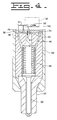
- each fuel injector 16 can be thought of as having an injector body 30 that includes an upper portion 31, a middle portion 32 and a lower portion 33.
- Upper portion 31 includes an electrical connector 44, to which the communication line 22 of Figure 1 is attached in a conventional manner.
- Current arriving at injector 16 is carried from connector 44 to the middle portion 32 via an electrical extension extending through injector body 30.
- the electrical extension includes a male or female electrical connector for connection of the same to an electrical actuator 75 located in middle portion 32.
- Middle portion 32 includes a needle control group 34, which includes electrical actuator 75 operably coupled to a needle control valve 36.
- Nozzle group 35 is located in lower portion 33.
- Direct control needle valve member 60 is a portion of a nozzle group 35 which is located in lower portion 33 of fuel injector 16.
- Nozzle group 35 includes direct control needle valve 37, which includes a direct control needle valve member 60 that moves into and out of contact with a nozzle seat 69.
- direct control needle valve member 60 When direct control needle valve member 60 is in contact nozzle seat 69, nozzle supply passage 46 is closed to nozzle outlet 47.
- direct control needle valve member 60 is out of contact with nozzle seat 69, nozzle supply passage 46 is open to nozzle outlet 47, such that fuel can spray into the combustion space.
- Direct control needle valve member 60 is normally biased downward to a closed position by a biasing spring 49, which is located in a spring chamber 48.
- spring chamber 48 actually is a portion of nozzle supply passage 46, whereas in some of the other embodiments illustrated, and described infra, spring chamber 48 is separated from, but fluidly connected to, nozzle supply passage 46.
- Direct control needle valve member 60 includes a first opening hydraulic surface 62 exposed to fluid pressure in spring chamber 48, and a second opening hydraulic surface 63, a portion of which is located below nozzle seat 69. This entire surface acts as an opening hydraulic surface when direct control needle valve member 60 is in its upward open position.
- needle control chamber 50 is separated from spring chamber 48 by a guide bore 98.
- direct control needle valve member 60 includes a single guide portion 65 that is located with a relatively close diametrical guide clearance in guide bore 98.
- direct control needle valve member 60 is formed to include a spring perch 64 against which biasing spring 49 bears.
- Fuel injector 16 preferably has a conventional structure in that it includes an injector stack 95 including a plurality of components stacked and compressed on top of one another by the threaded mating of upper body component 83 to casing 96 in a conventional manner.
- the injector stack 95 includes a carrier assembly 87, an air gap spacer 88, an upper seat component 86, a valve lift spacer 89, a lower seat component 90, a passage component 91, a pressure transfer component 92, a spring cage 93 and a tip 97.
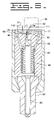
- Figure 3 is useful in illustrating the various components and passageways that are included as portions of the needle control group 34, which includes needle control valve 36.
- needle control valve 36 is a three way valve 39. Nevertheless, those skilled in the art will appreciate that different aspects of the present invention are compatible with a two way valve, such as that shown in one or more of the succeeding embodiments.
- Needle control valve 36 includes a control valve member 74 that is trapped to move between a first seat 72 and a second seat 73.
- Control valve member 74 is operably coupled to an electrical actuator 75, in a conventional manner.
- actuator 75 is a solenoid 76, although other actuators could be substituted, including but not limited to voice coils, piezo stacks or benders, etc.
- control valve member 74 is attached to armature 78, which is separated from a stator assembly 77 by an air gap determined by the thickness of air gap spacer 88.
- Control valve member 74 is biased downward to a position in contact with first seat 72 by a biasing spring 80.
- the area around armature 78 is preferably vented to low pressure fuel outlet 45 (Fig.
- control valve member 74 is dictated by a thickness of valve lift spacer 89, which is preferably category thickness part like air gap spacer 88. In other words, these two parts preferably come in a range of thicknesses that allow the solenoid air gap and the valve travel distance, respectively, to be adjusted during assembly in order to provide uniformity in these geometrical features from one fuel injector to another.
- Connection passage 51 and low pressure passage 52 preferably include respective flow restrictions 110 and 111, which are preferably located in valve lift spacer 89 for ease of manufacture. Flow restrictions 110 and 111 are preferably restrictive to flow relative to a flow area across seats 73 and 72, respectively.
- flow restriction 111 in low pressure passage 52 is preferably smaller than flow restriction 110 so that the opening rate of direct control needle valve member 60 can be slowed. This is accomplished since fluid in needle control chamber 50 must be displaced through flow restriction 111 when it lifts upward toward its open position.
- Needle control chamber 50 is always, in this embodiment, connected to nozzle supply passage 46 via a separate pressure balancing passage 70 that includes still another flow restriction 112.
- needle control chamber 50 is fluidly connected to nozzle supply passage 46 via pressure balancing passage 70 and via control passage 71.
- needle control chamber 50 is fluidly connected to nozzle supply passage 46 via pressure balancing passage 70, and also connected to low pressure fuel drain outlet 45 (Fig. 2) via control passage 71 and low pressure passage 52.
- flow restriction 112 is preferably more restrictive to flow than flow restriction 111.
- Flow restriction 112 is more restrictive than flow restriction 111, which is more restrictive than flow restriction 110.
- Flow restrictions 110 and 111 are more restrictive to flow across seats 73 and 72, respectively.
- control valve member 74 includes a relatively long guide portion 84 separating the high pressure fluid in the region around seat 73 from the low pressure surrounding armature 78.
- control valve member 74 is guided in upper seat component 30 via guide portion 84, which is elongated in order to substantially seal against fuel migration into the area around armature 78.
- Control valve member 74 also includes a relatively short guide portion 85 that is guided in lower seat component 90. This portion is shorter than guide portion 84 because, between injection events, there is no large pressure gradient between the area below seat 72 and the region underneath control valve member 74, which is vented to drain via a passage not shown.
- control passage 71 preferably opens into needle control chamber 50 in a way that can interact with the movement of direct control needle valve member 60 to produce a hydraulic stop, and illustrated in Figure 5.
- this embodiment shows a hydraulic stop for direct control needle valve member 60
- the present invention also finds applicability to direct control needle valve members with a mechanical stop, such as that shown in one or more of the succeeding embodiments.
- gap 113 is about 665 micrometers when direct control needle valve member 60 is in its downward closed position as shown in Figure 4, but about 15 micrometers when in its open position as shown in Figure 5, such that member 60 has a lift distance on the order of about 650 micrometers, in the illustrated embodiment.
- a fuel injector 116 is substantially similar to fuel injector 16 described earlier except that it includes a needle control chamber 150 that is defined at least in part by a sleeve 100, against which spring 49 bears. Otherwise, fuel injector 116 is substantially identical to that of the earlier embodiment. This embodiment also differs in that it includes a mechanical stop verses the hydraulic stop of the previous embodiment. In particular, when direct control needle valve 60 lifts to its open position, spring perch 64 comes in contact with a stop surface 101 on sleeve 100. When direct control needle valve member 60 is in its downward closed position, spring perch 64 is out of contact with stop surface 101 of sleeve 100.
- Direct control needle valve member 260 is shown in its downward closed position such that gap 213 is relatively large.
- a needle control chamber 250 is connectable to either high or low pressure via a connection passage 271, but is always fluidly connected to a nozzle supply passage (not shown) via a pressure balancing passage 270, which in this embodiment is located through direct control needle valve member 260.
- direct control needle valve member 260 includes a closing hydraulic surface 261 exposed to fluid pressure in needle control chamber 250.
- pressure balancing passage 270 includes a flow restriction 212, which is preferably more restrictive than any flow restriction located in control passage 271 or either of its high or low pressure connection passages.
- a flow restriction 212 which is preferably more restrictive than any flow restriction located in control passage 271 or either of its high or low pressure connection passages.
- control needle valve 336 is a two way valve, which either closes control passage 371 or opens the same to a low pressure passage 352.
- flow restrictions 311 and 312 are sized such that pressure drops in needle control chamber 350 when connection passage 371 is connected to low pressure passage 352.
- control pressure passage 371 and/or pressure balancing passage 370 open into needle control chamber 350 with a geometry that produces the hydraulic stop phenomenon illustrated with respect to the embodiment shown in Figures 2-5 and Figure 7.
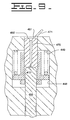
- FIG. 9 still another embodiment of the present invention shows a direct control needle valve member 460 that includes two components that are not attached to one another.
- spring chamber 448 is fluidly connected to, but separated from, a nozzle supply passage (not shown).
- pressure balancing passage 470 is defined by a portion of direct control needle valve member 460, and includes a flow restriction 412 as in the previous embodiments.
- needle control chamber 450 is preferably always fluidly connected to the high pressure rail via spring chamber 448 and pressure balancing passage 470. Needle control chamber 450 can also be fluidly connected to either high or low pressure via a three way valve (not shown) via control passage 471.
- pressure balancing passage 470 and/or control passage 471 open into needle control chamber 450 in a way that movement of direct control needle valve member 460 has a valving effect in order to produce the hydraulic stop phenomenon described previously.
- FIG. 10 an embodiment is illustrated that is substantially identical to the embodiments shown in Figures 2-5 except that the three way control valve 39 of Figures 2-5 has been replaced with a two way valve 537.
- the needle control chamber 550 is fluidly connected to nozzle supply passage 546 via pressure balancing passage 570, which includes flow restriction 512.
- pressure balancing passage 570 which includes flow restriction 512.
- needle control chamber 550 is fluidly connected to drain via control passage 571 and low pressure passage 552. Because flow restriction 512 is more restrictive to flow than flow restriction 511, pressure can drop in needle control chamber 550 to allow direct control needle valve member 560 to move upward toward its open position as shown in Figure 11.
- This embodiment also includes the hydraulic stop features of the earlier embodiments.
- each injection event begins by energizing electrical actuator 75 to move the needle control valve 36, 336 from an off position to an on position.
- the needle control valve 36, 336 was in its biased off position that exposed closing hydraulic surface 61, 161, 261, 361, 461 of direct control needle valve member 60, 160, 260, 360, 460, 560 to high pressure fuel in the needle control chamber 50, 150, 250, 350, 450, 550.
- closing hydraulic surface 61, 161, 261, 361, 461 is exposed to low pressure fuel in needle control chamber 50, 150, 250, 350, 450, 550.
- Each injection event is ended by deenergizing electrical actuator 75, allowing needle control valve 36 to move to its off position that closes low pressure passage 52 to needle control chamber 50. When this occurs, pressure rapidly rises in needle control chamber 50 causing direct control needle valve member 60 to move downward to its closed position to end the injection event.
- the present invention preferably includes a pressure balanced direct control needle valve member 60.
- the term pressure balanced is intended to mean that the effective area of closing hydraulic surface 61 is about equal to the combined effective area of first opening hydraulic surface 62 and second opening hydraulic surface 63.
- This pressure balancing strategy is easily accomplished in the preferred embodiment by including a single guide region 65 on direct control needle valve member 60 that has a uniform diameter, resulting in equal effective surface areas above and below guide portion 65.
- a pressure balanced direct control needle valve member 60 By utilizing a pressure balanced direct control needle valve member 60, various other features are more easily sized in order to cause fuel injector 16 to perform as desired. For instance, the preload on spring 49 determines the rate at which direct control needle valve 35 will close. Those skilled in the art will appreciate that, although desirable, a pressure balanced direct control needle valve member is not necessary for the present invention. In other words, non pressure balanced direct control needle valve members could fall within the intended scope of the present invention.
- both of these guides are exposed to injection rail pressure on one end with a vent to tank fuel pressure on the other end, which is typically located in a spring chamber that contains the spring biases the needle valve member toward its closed position.
- Extreme measures are often employed to minimize the clearance to reduce static leakage. As the desired operating pressure levels are increased, the leakage problem becomes more and more severe, as pressure induced deflections in the guide bores add to an already difficult situation.
- the present invention addresses this problem by fluidly connecting the spring chamber to rail pressure so that no large pressure gradients exist across any guide regions associated with the direct control needle valve member. This avoids any need to take extreme measures in providing overly tight clearances in the guide region(s) for the direct control needle valve member, and also boosts efficiency by avoiding any substantial fuel leakage back to tank over the relatively long duration between injection events when the injector is off but remains fully pressurized.
- a three way control valve is used so that the closure rate of direct control needle valve member 60 can be hastened over that likely possible with a two way control valve as illustrated in relation to the embodiment shown in Figure 8 and Figures 10 and 11.
- needle control chamber 50 In the case of the two way control valve, needle control chamber 50 must be repressurized by fuel passing through flow restriction 312, 512, which inherently must be more restrictive than the flow restriction in the low pressure drain passage. In the case of the three way valve, the needle control chamber 50 can be repressurized via both control passage 71 and pressure balancing passage 70.
- both two way and three way needle control valves are compatible with the present invention, some static fuel leakage issues around the needle control valve should be addressed. In most instances, it is desirable that the area around the electrical actuator coupled to the needle control valve not be continuously exposed to high pressure fuel. The consequence being that both ends of a needle control valve member 74 are always exposed to low pressure. This potential static leakage has been addressed in the present invention by lengthening the guide portion 84 that separates electrical actuator 75 from the high pressure fluid adjacent seat 73.
- the present invention finds potential application in direct control needle valves that include either a hydraulic stop or a mechanical stop.
- the present invention finds preferred application in common rail systems in which the fuel injector remains pressurized between injection events, it could find potential application in virtually any type of fuel injector, including but not limited to hydraulically actuated fuel injectors, pump and line fuel injection systems and cam actuated fuel injectors.
- static fuel leakage is ordinarily not a substantial problem due to the fact that the injectors are generally at low pressure between injection events.
- the present invention preferably reduces static leakage around the direct control needle valve member by surrounding the member above the nozzle seat with high pressure fuel from the common rail between injection events.
- the present invention preferably, but not necessarily, utilizes a hydraulic stop, which inevitably leads to some fuel leakage during each injection event.
- a hydraulic stop is employed, the rail is connected directly to the low pressure drain through the needle control chamber during the injection event.
- This leakage for the purposes of the control function is managed by the inclusion of a flow restriction that reduces the amount of fuel leakage or spillage necessary to perform the direct control needle valve hydraulic stop function.
- This type of leakage during injection events could be substantially reduced or eliminated by employing a mechanical stop.
- the direct control needle valve member comes in contact with a stop, the fluid pressure forces acting on the needle can become less predictable because the mechanical stop contact area can alter the expected pressure forces acting on the direct control needle valve member.
Landscapes
- Engineering & Computer Science (AREA)
- Chemical & Material Sciences (AREA)
- Combustion & Propulsion (AREA)
- Mechanical Engineering (AREA)
- General Engineering & Computer Science (AREA)
- Physics & Mathematics (AREA)
- Fluid Mechanics (AREA)
- Fuel-Injection Apparatus (AREA)
Abstract
Description
Claims (9)
- A fuel injector (16, 116) comprising:an injector body (30) including a nozzle supply passage (46) in fluid communication with a spring chamber (48), and a needle control chamber (50, 150, 250, 350, 450, 550) in fluid communication with said nozzle supply passage (46) at least in part via a pressure balancing passage (70, 270, 370, 470, 570);a direct control needle valve member (60, 260, 360, 460, 560) movably positioned in said injector body (30), and including a closing hydraulic surface (61, 161, 261, 361, 461) exposed to fluid pressure in said needle control chamber (50, 150, 250, 350, 450, 550);a spring (49) operably positioned in said spring chamber (48) to bias said direct control needle valve member (60, 260, 360, 460, 560) toward a closed position; anda needle control valve (37, 337, 537) attached to said injector body (30) and being operable in an off position to expose said closing hydraulic surface (61, 161, 261, 361, 461) to high pressure fuel in said needle control chamber (50, 150, 250, 350, 450, 550), and operable in an on position to expose said closing hydraulic surface (61, 161, 261, 361, 461) to low pressure fuel in said needle control chamber (50, 150, 250, 350, 450, 550).
- The fuel injector (116) of claim 1 wherein said needle control chamber (150, 250) is defined at least in part by a sleeve (100, 200) biased into contact with an injector stack component by said spring (49, 249).
- The fuel injector (16) of claim 1 wherein said direct control needle valve member (60) includes at least one opening hydraulic surface (62, 63), when in an open position, with an effective area about equal to said closing hydraulic surface (61).
- The fuel injector (16) of claim 1 wherein said needle control valve (37) is a three way valve (39) with a fluid passage (51, 52) having at least one flow restriction (110, 111) relative to a flow area past a valve seat (72, 73); and
wherein said three way valve (39) is movable between a first position in which said needle control chamber (50) is fluidly connected to said nozzle supply passage (46) via a control passage (71), and a second position in which said needle control chamber (50) is fluidly connected to a drain passage (45). - A fuel injection system (12) comprising:a common rail (14) containing high pressure fuel;a plurality of fuel injectors (16, 116) fluidly connected to said common rail (14);each of said fuel injectors (16, 116) including a needle control valve (37, 337, 537), a direct control needle valve member (60, 260, 360, 460, 560) with a closing hydraulic surface (61, 161, 261, 361, 461), a spring chamber (48) in fluid communication with a high pressure fuel inlet (38), and a spring (49) operably positioned in said spring chamber (48) to bias said direct control needle valve member (60, 260, 360, 460, 560) toward a closed position; andsaid needle control valve (37, 337, 537) being movable between a first position at which said closing hydraulic surface (61, 161, 261, 361, 461) is exposed to high pressure fuel and a second position at which said closing hydraulic surface (61, 161, 261, 361, 461) is exposed to low pressure fuel.
- The system (12) of claim 5 wherein said spring chamber (48) is fluidly connected to said needle control chamber (50, 150, 250, 350, 450, 550) at least in part via a pressure balancing passage (71, 271, 371, 471, 571).
- The system of claim 5 wherein said needle control valve (36) is a three way valve (39) with a fluid passage (51, 52) having at least one flow restriction (110, 111) relative to a flow area past a valve seat (72, 73).
- A method of reducing leakage in a common rail fuel injection system (12), comprising the steps of:biasing a needle control valve (37, 337, 537) toward a position that exposes a closing hydraulic surface (61, 161, 261, 361, 461) of a direct control needle valve member (60, 260, 360, 460, 560) to high pressure fuel from a common rail (14);biasing the direct control needle valve member (60, 260, 360, 460, 560) toward a closed position at least in part by positioning a spring (48) in a spring chamber (48); andfluidly connecting the spring chamber (48) to the common rail (14).
- The method of claim 8 including a step of hydraulically stopping the direct control needle valve member (60) in a open position at least in part by fluidly connecting a nozzle supply passage (46) to a needle control chamber (50) via a pressure balancing passage (70).
Applications Claiming Priority (2)
| Application Number | Priority Date | Filing Date | Title |
|---|---|---|---|
| US195863 | 2002-07-15 | ||
| US10/195,863 US7331329B2 (en) | 2002-07-15 | 2002-07-15 | Fuel injector with directly controlled highly efficient nozzle assembly and fuel system using same |
Publications (2)
| Publication Number | Publication Date |
|---|---|
| EP1382837A2 true EP1382837A2 (en) | 2004-01-21 |
| EP1382837A3 EP1382837A3 (en) | 2008-04-02 |
Family
ID=29780173
Family Applications (1)
| Application Number | Title | Priority Date | Filing Date |
|---|---|---|---|
| EP03011803A Withdrawn EP1382837A3 (en) | 2002-07-15 | 2003-05-26 | Fuel injector with directly controlled highly efficient nozzle assembly and fuel system using same |
Country Status (2)
| Country | Link |
|---|---|
| US (1) | US7331329B2 (en) |
| EP (1) | EP1382837A3 (en) |
Cited By (3)
| Publication number | Priority date | Publication date | Assignee | Title |
|---|---|---|---|---|
| EP1657435A1 (en) * | 2004-11-12 | 2006-05-17 | C.R.F. Società Consortile per Azioni | A fuel injector for an internal-combustion engine |
| WO2008125377A1 (en) * | 2007-04-11 | 2008-10-23 | Robert Bosch Gmbh | Fuel injector |
| EP2541037B1 (en) * | 2011-06-27 | 2018-04-25 | MAN Diesel & Turbo, filal af MAN Diesel & Turbo SE, Tyskland | A fuel valve for large turbocharged two stroke diesel engines |
Families Citing this family (17)
| Publication number | Priority date | Publication date | Assignee | Title |
|---|---|---|---|---|
| US6955114B2 (en) * | 2003-12-05 | 2005-10-18 | Caterpillar Inc | Three way valve and electro-hydraulic actuator using same |
| US7510127B2 (en) * | 2004-02-04 | 2009-03-31 | Caterpillar Inc. | Variable flow rate valve and method of reducing wear on same |
| US20080296412A1 (en) * | 2007-06-01 | 2008-12-04 | Caterpillar Inc. | Fuel injector having a flow passage insert |
| US7963464B2 (en) * | 2008-01-23 | 2011-06-21 | Caterpillar Inc. | Fuel injector and method of assembly therefor |
| US7950593B2 (en) * | 2008-06-20 | 2011-05-31 | Caterpillar Inc. | Z orifice feature for mechanically actuated fuel injector |
| US8459577B2 (en) * | 2008-07-08 | 2013-06-11 | Caterpillar Inc. | Decoupled valve assembly and fuel injector using same |
| US9163597B2 (en) * | 2008-10-01 | 2015-10-20 | Caterpillar Inc. | High-pressure containment sleeve for nozzle assembly and fuel injector using same |
| US7849836B2 (en) * | 2008-10-07 | 2010-12-14 | Caterpillar Inc | Cooling feature for fuel injector and fuel system using same |
| US9683739B2 (en) * | 2009-11-09 | 2017-06-20 | Woodward, Inc. | Variable-area fuel injector with improved circumferential spray uniformity |
| US8201754B2 (en) * | 2009-12-03 | 2012-06-19 | Caterpillar Inc. | Fluid injector with thermal load control |
| US8448878B2 (en) | 2010-11-08 | 2013-05-28 | Caterpillar Inc. | Fuel injector with needle control system that includes F, A, Z and E orifices |
| US8690075B2 (en) | 2011-11-07 | 2014-04-08 | Caterpillar Inc. | Fuel injector with needle control system that includes F, A, Z and E orifices |
| US20140353705A1 (en) * | 2012-03-23 | 2014-12-04 | Sharp Kabushiki Kaisha | Semiconductor light emitting element, method of manufacturing semiconductor light emitting element, semiconductor light emitting device and substrate |
| US9228550B2 (en) | 2013-03-11 | 2016-01-05 | Stanadyne Llc | Common rail injector with regulated pressure chamber |
| US20150008271A1 (en) | 2013-07-02 | 2015-01-08 | Caterpillar Inc. | Injector Orifice Plate Filter |
| CN104033299B (en) * | 2014-06-19 | 2016-05-11 | 中国第一汽车股份有限公司无锡油泵油嘴研究所 | A kind of common-rail injector |
| GB2573522B (en) * | 2018-05-08 | 2020-08-19 | Delphi Tech Ip Ltd | Method of identifying faults in the operation of hydraulic fuel injectors having accelerometers |
Family Cites Families (29)
| Publication number | Priority date | Publication date | Assignee | Title |
|---|---|---|---|---|
| DE3767260D1 (en) * | 1986-09-25 | 1991-02-14 | Ganser Hydromag | FUEL INJECTION VALVE. |
| IT1232026B (en) * | 1989-02-28 | 1992-01-23 | Weber Srl | ELECTRIC MAGNETIC FUEL INJECTION DEVICE FOR DIESEL CYCLE ENGINES |
| US5156132A (en) * | 1989-04-17 | 1992-10-20 | Nippondenso Co., Ltd. | Fuel injection device for diesel engines |
| DE4243665C2 (en) * | 1992-12-23 | 2003-11-13 | Bosch Gmbh Robert | Fuel injection device, in particular pump nozzle for internal combustion engines |
| GB2289313B (en) | 1994-05-13 | 1998-09-30 | Caterpillar Inc | Fluid injector system |
| JP2885076B2 (en) * | 1994-07-08 | 1999-04-19 | 三菱自動車工業株式会社 | Accumulator type fuel injection device |
| US5697342A (en) | 1994-07-29 | 1997-12-16 | Caterpillar Inc. | Hydraulically-actuated fuel injector with direct control needle valve |
| US5463996A (en) | 1994-07-29 | 1995-11-07 | Caterpillar Inc. | Hydraulically-actuated fluid injector having pre-injection pressurizable fluid storage chamber and direct-operated check |
| US6012644A (en) | 1997-04-15 | 2000-01-11 | Sturman Industries, Inc. | Fuel injector and method using two, two-way valve control valves |
| JP3575124B2 (en) | 1995-08-09 | 2004-10-13 | 株式会社デンソー | Fuel supply device for internal combustion engine |
| DE19640826B4 (en) | 1995-10-03 | 2004-11-25 | Nippon Soken, Inc., Nishio | Storage fuel injection device and pressure control device therefor |
| GB9606803D0 (en) | 1996-03-30 | 1996-06-05 | Lucas Ind Plc | Injection nozzle |
| DE19624001A1 (en) * | 1996-06-15 | 1997-12-18 | Bosch Gmbh Robert | Fuel injection device for internal combustion engines |
| JP3834918B2 (en) | 1997-03-04 | 2006-10-18 | いすゞ自動車株式会社 | Engine fuel injection method and apparatus |
| US5860597A (en) | 1997-03-24 | 1999-01-19 | Cummins Engine Company, Inc. | Injection rate shaping nozzle assembly for a fuel injector |
| DE29708369U1 (en) * | 1997-05-09 | 1997-07-10 | FEV Motorentechnik GmbH & Co. KG, 52078 Aachen | Controllable injection valve for fuel injection on internal combustion engines |
| US5899389A (en) * | 1997-06-02 | 1999-05-04 | Cummins Engine Company, Inc. | Two stage fuel injector nozzle assembly |
| DE19827267A1 (en) * | 1998-06-18 | 1999-12-23 | Bosch Gmbh Robert | Fuel injection valve for high pressure injection with improved control of the fuel supply |
| DE59906995D1 (en) | 1998-07-31 | 2003-10-23 | Siemens Ag | Injector with a servo valve |
| DE19936668A1 (en) * | 1999-08-04 | 2001-02-22 | Bosch Gmbh Robert | Common rail injector |
| DE19949528A1 (en) * | 1999-10-14 | 2001-04-19 | Bosch Gmbh Robert | Double-switching control valve for an injector of a fuel injection system for internal combustion engines with hydraulic amplification of the actuator |
| JP4048699B2 (en) | 1999-11-10 | 2008-02-20 | 株式会社デンソー | Fuel injection valve |
| US6293254B1 (en) * | 2000-01-07 | 2001-09-25 | Cummins Engine Company, Inc. | Fuel injector with floating sleeve control chamber |
| IT1319986B1 (en) * | 2000-03-21 | 2003-11-12 | Fiat Ricerche | FUEL INJECTOR FOR AN ERELATIVE INTERNAL COMBUSTION ENGINE CLASSIFICATION AND SELECTION METHOD OF A SERIES OF |
| US6499467B1 (en) * | 2000-03-31 | 2002-12-31 | Cummins Inc. | Closed nozzle fuel injector with improved controllabilty |
| DE10024702A1 (en) * | 2000-05-18 | 2001-11-22 | Bosch Gmbh Robert | Fuel injector for storage injection system includes bypass channel injecting into outlet path at valve chamber |
| DE10024703A1 (en) * | 2000-05-18 | 2001-11-22 | Bosch Gmbh Robert | Injection arrangement for fuel storage injection system has valve unit blocking auxiliary channel and outlet path in alternation |
| DE10031579A1 (en) * | 2000-06-29 | 2002-01-17 | Bosch Gmbh Robert | Pressure controlled injector with vario register injector |
| US20030201344A1 (en) * | 2002-04-15 | 2003-10-30 | Christopher Wark | Nozzle assembly for injecting fuel at multiple angles |
-
2002
- 2002-07-15 US US10/195,863 patent/US7331329B2/en not_active Expired - Lifetime
-
2003
- 2003-05-26 EP EP03011803A patent/EP1382837A3/en not_active Withdrawn
Cited By (5)
| Publication number | Priority date | Publication date | Assignee | Title |
|---|---|---|---|---|
| EP1657435A1 (en) * | 2004-11-12 | 2006-05-17 | C.R.F. Società Consortile per Azioni | A fuel injector for an internal-combustion engine |
| US7255289B2 (en) | 2004-11-12 | 2007-08-14 | C.R.F. Societe Consortile Per Azioni | Fuel injector for an internal-combustion engine |
| WO2008125377A1 (en) * | 2007-04-11 | 2008-10-23 | Robert Bosch Gmbh | Fuel injector |
| EP2541037B1 (en) * | 2011-06-27 | 2018-04-25 | MAN Diesel & Turbo, filal af MAN Diesel & Turbo SE, Tyskland | A fuel valve for large turbocharged two stroke diesel engines |
| EP3406891B1 (en) * | 2011-06-27 | 2021-11-03 | MAN Energy Solutions, filial af MAN Energy Solutions SE, Tyskland | A fuel valve for large turbocharged two stroke diesel engines |
Also Published As
| Publication number | Publication date |
|---|---|
| US7331329B2 (en) | 2008-02-19 |
| EP1382837A3 (en) | 2008-04-02 |
| US20040007210A1 (en) | 2004-01-15 |
Similar Documents
| Publication | Publication Date | Title |
|---|---|---|
| US7331329B2 (en) | Fuel injector with directly controlled highly efficient nozzle assembly and fuel system using same | |
| EP0994248B1 (en) | Fuel injector with rate shaping control through piezoelectric nozzle lift | |
| EP0967383B1 (en) | Fuel injector | |
| US5860597A (en) | Injection rate shaping nozzle assembly for a fuel injector | |
| US6499467B1 (en) | Closed nozzle fuel injector with improved controllabilty | |
| US6557779B2 (en) | Variable spray hole fuel injector with dual actuators | |
| US7059301B2 (en) | End of injection rate shaping | |
| US6199533B1 (en) | Pilot valve controlled three-way fuel injection control valve assembly | |
| US5878720A (en) | Hydraulically actuated fuel injector with proportional control | |
| EP0174083A1 (en) | Electromagnetic unit fuel injector | |
| US6145492A (en) | Control valve for a fuel injection valve | |
| US6279840B1 (en) | Fuel injector | |
| EP1851427B1 (en) | Common rail injector with active needle closing device | |
| EP1053397B1 (en) | Hydraulically actuated fuel injector with seated pin actuator | |
| US20040124277A1 (en) | Pressure control valve for controlling operation of fuel injector | |
| EP1163440B1 (en) | Fuel injector | |
| CN100507258C (en) | Mechanically actuated and electronically controlled fuel injection system | |
| US6935580B2 (en) | Valve assembly having multiple rate shaping capabilities and fuel injector using same | |
| CN101253324A (en) | Single-fluid injector with rate-shaping properties | |
| EP1227241B1 (en) | Fuel injector assembly and internal combustion engine including same | |
| JPH08218967A (en) | Fuel injection device | |
| CN115288901B (en) | Multi-mode injection electric control fuel injector with variable oil return rate | |
| JP2002514709A (en) | Fuel injection system with intermittent spray from nozzle | |
| JP2004518881A (en) | 3 port 2 position valve | |
| JPH07109182B2 (en) | Fuel injection device for internal combustion engine |
Legal Events
| Date | Code | Title | Description |
|---|---|---|---|
| PUAI | Public reference made under article 153(3) epc to a published international application that has entered the european phase |
Free format text: ORIGINAL CODE: 0009012 |
|
| AK | Designated contracting states |
Kind code of ref document: A2 Designated state(s): AT BE BG CH CY CZ DE DK EE ES FI FR GB GR HU IE IT LI LU MC NL PT RO SE SI SK TR |
|
| AX | Request for extension of the european patent |
Extension state: AL LT LV MK |
|
| PUAL | Search report despatched |
Free format text: ORIGINAL CODE: 0009013 |
|
| AK | Designated contracting states |
Kind code of ref document: A3 Designated state(s): AT BE BG CH CY CZ DE DK EE ES FI FR GB GR HU IE IT LI LU MC NL PT RO SE SI SK TR |
|
| AX | Request for extension of the european patent |
Extension state: AL LT LV MK |
|
| 17P | Request for examination filed |
Effective date: 20081002 |
|
| 17Q | First examination report despatched |
Effective date: 20081106 |
|
| AKX | Designation fees paid |
Designated state(s): DE GB |
|
| STAA | Information on the status of an ep patent application or granted ep patent |
Free format text: STATUS: THE APPLICATION IS DEEMED TO BE WITHDRAWN |
|
| 18D | Application deemed to be withdrawn |
Effective date: 20090307 |