EP1382591A1 - Novel atisane compound and use thereof - Google Patents
Novel atisane compound and use thereof Download PDFInfo
- Publication number
- EP1382591A1 EP1382591A1 EP02720602A EP02720602A EP1382591A1 EP 1382591 A1 EP1382591 A1 EP 1382591A1 EP 02720602 A EP02720602 A EP 02720602A EP 02720602 A EP02720602 A EP 02720602A EP 1382591 A1 EP1382591 A1 EP 1382591A1
- Authority
- EP
- European Patent Office
- Prior art keywords
- group
- optionally substituted
- atisane
- ent
- hydrate
- Prior art date
- Legal status (The legal status is an assumption and is not a legal conclusion. Google has not performed a legal analysis and makes no representation as to the accuracy of the status listed.)
- Withdrawn
Links
- -1 atisane compound Chemical class 0.000 title claims description 141
- 229930014459 atisane Natural products 0.000 title description 3
- 150000001875 compounds Chemical class 0.000 claims abstract description 269
- 150000003839 salts Chemical class 0.000 claims abstract description 72
- 206010029350 Neurotoxicity Diseases 0.000 claims abstract description 30
- 206010044221 Toxic encephalopathy Diseases 0.000 claims abstract description 30
- 230000007135 neurotoxicity Effects 0.000 claims abstract description 30
- 231100000228 neurotoxicity Toxicity 0.000 claims abstract description 30
- WHUUTDBJXJRKMK-VKHMYHEASA-N L-glutamic acid Chemical compound OC(=O)[C@@H](N)CCC(O)=O WHUUTDBJXJRKMK-VKHMYHEASA-N 0.000 claims abstract description 25
- 229930195712 glutamate Natural products 0.000 claims abstract description 20
- 125000001424 substituent group Chemical group 0.000 claims abstract description 18
- 125000003178 carboxy group Chemical group [H]OC(*)=O 0.000 claims abstract description 14
- 230000005779 cell damage Effects 0.000 claims abstract description 11
- 208000037887 cell injury Diseases 0.000 claims abstract description 11
- 125000004432 carbon atom Chemical group C* 0.000 claims abstract description 8
- 125000000962 organic group Chemical group 0.000 claims abstract description 7
- 125000002496 methyl group Chemical group [H]C([H])([H])* 0.000 claims description 162
- 125000004169 (C1-C6) alkyl group Chemical group 0.000 claims description 54
- 125000004435 hydrogen atom Chemical group [H]* 0.000 claims description 52
- 208000037265 diseases, disorders, signs and symptoms Diseases 0.000 claims description 44
- 125000002887 hydroxy group Chemical group [H]O* 0.000 claims description 41
- 125000000882 C2-C6 alkenyl group Chemical group 0.000 claims description 31
- 125000003601 C2-C6 alkynyl group Chemical group 0.000 claims description 31
- 239000003795 chemical substances by application Substances 0.000 claims description 31
- 125000005843 halogen group Chemical group 0.000 claims description 29
- 201000010099 disease Diseases 0.000 claims description 28
- 125000004093 cyano group Chemical group *C#N 0.000 claims description 25
- 125000004191 (C1-C6) alkoxy group Chemical group 0.000 claims description 21
- 125000004739 (C1-C6) alkylsulfonyl group Chemical group 0.000 claims description 21
- 125000002252 acyl group Chemical group 0.000 claims description 19
- 238000000034 method Methods 0.000 claims description 17
- 125000006615 aromatic heterocyclic group Chemical group 0.000 claims description 15
- 206010002026 amyotrophic lateral sclerosis Diseases 0.000 claims description 14
- 125000002915 carbonyl group Chemical group [*:2]C([*:1])=O 0.000 claims description 14
- 208000017520 skin disease Diseases 0.000 claims description 14
- 239000003814 drug Substances 0.000 claims description 11
- 125000001495 ethyl group Chemical group [H]C([H])([H])C([H])([H])* 0.000 claims description 10
- 125000001570 methylene group Chemical group [H]C([H])([*:1])[*:2] 0.000 claims description 10
- 206010012689 Diabetic retinopathy Diseases 0.000 claims description 9
- 208000010412 Glaucoma Diseases 0.000 claims description 9
- 208000016621 Hearing disease Diseases 0.000 claims description 9
- 206010038933 Retinopathy of prematurity Diseases 0.000 claims description 9
- 208000002780 macular degeneration Diseases 0.000 claims description 9
- 125000003161 (C1-C6) alkylene group Chemical group 0.000 claims description 7
- 208000024827 Alzheimer disease Diseases 0.000 claims description 7
- 208000018737 Parkinson disease Diseases 0.000 claims description 7
- 201000006417 multiple sclerosis Diseases 0.000 claims description 7
- 201000006474 Brain Ischemia Diseases 0.000 claims description 6
- 206010008120 Cerebral ischaemia Diseases 0.000 claims description 6
- 206010008118 cerebral infarction Diseases 0.000 claims description 6
- 208000035475 disorder Diseases 0.000 claims description 6
- 125000002485 formyl group Chemical group [H]C(*)=O 0.000 claims description 6
- 125000004029 hydroxymethyl group Chemical group [H]OC([H])([H])* 0.000 claims description 6
- 206010012438 Dermatitis atopic Diseases 0.000 claims description 5
- 206010012442 Dermatitis contact Diseases 0.000 claims description 5
- 208000035154 Hyperesthesia Diseases 0.000 claims description 5
- 201000008937 atopic dermatitis Diseases 0.000 claims description 5
- 208000010247 contact dermatitis Diseases 0.000 claims description 5
- 239000003112 inhibitor Substances 0.000 claims description 5
- 125000001449 isopropyl group Chemical group [H]C([H])([H])C([H])(*)C([H])([H])[H] 0.000 claims description 4
- 125000004123 n-propyl group Chemical group [H]C([H])([H])C([H])([H])C([H])([H])* 0.000 claims description 4
- 150000004677 hydrates Chemical class 0.000 claims description 3
- 125000004430 oxygen atom Chemical group O* 0.000 claims description 3
- 239000008194 pharmaceutical composition Substances 0.000 claims description 3
- 125000004453 alkoxycarbonyl group Chemical group 0.000 claims description 2
- 229910052799 carbon Inorganic materials 0.000 abstract description 5
- 230000000694 effects Effects 0.000 abstract description 4
- 230000002964 excitative effect Effects 0.000 abstract description 4
- 230000001747 exhibiting effect Effects 0.000 abstract description 2
- HEDRZPFGACZZDS-MICDWDOJSA-N Trichloro(2H)methane Chemical compound [2H]C(Cl)(Cl)Cl HEDRZPFGACZZDS-MICDWDOJSA-N 0.000 description 166
- XEKOWRVHYACXOJ-UHFFFAOYSA-N Ethyl acetate Chemical compound CCOC(C)=O XEKOWRVHYACXOJ-UHFFFAOYSA-N 0.000 description 138
- 239000002253 acid Substances 0.000 description 128
- 238000005160 1H NMR spectroscopy Methods 0.000 description 127
- 238000006243 chemical reaction Methods 0.000 description 124
- 238000003756 stirring Methods 0.000 description 123
- OKKJLVBELUTLKV-MZCSYVLQSA-N Deuterated methanol Chemical compound [2H]OC([2H])([2H])[2H] OKKJLVBELUTLKV-MZCSYVLQSA-N 0.000 description 114
- CSNNHWWHGAXBCP-UHFFFAOYSA-L Magnesium sulfate Chemical compound [Mg+2].[O-][S+2]([O-])([O-])[O-] CSNNHWWHGAXBCP-UHFFFAOYSA-L 0.000 description 92
- WYURNTSHIVDZCO-UHFFFAOYSA-N Tetrahydrofuran Chemical compound C1CCOC1 WYURNTSHIVDZCO-UHFFFAOYSA-N 0.000 description 91
- RTZKZFJDLAIYFH-UHFFFAOYSA-N Diethyl ether Chemical compound CCOCC RTZKZFJDLAIYFH-UHFFFAOYSA-N 0.000 description 88
- XLYOFNOQVPJJNP-UHFFFAOYSA-N water Substances O XLYOFNOQVPJJNP-UHFFFAOYSA-N 0.000 description 79
- YMWUJEATGCHHMB-UHFFFAOYSA-N Dichloromethane Chemical compound ClCCl YMWUJEATGCHHMB-UHFFFAOYSA-N 0.000 description 72
- 239000000243 solution Substances 0.000 description 71
- 238000002330 electrospray ionisation mass spectrometry Methods 0.000 description 70
- 239000000203 mixture Substances 0.000 description 58
- LFQSCWFLJHTTHZ-UHFFFAOYSA-N Ethanol Chemical compound CCO LFQSCWFLJHTTHZ-UHFFFAOYSA-N 0.000 description 57
- ZMXDDKWLCZADIW-UHFFFAOYSA-N N,N-Dimethylformamide Chemical compound CN(C)C=O ZMXDDKWLCZADIW-UHFFFAOYSA-N 0.000 description 51
- YLQBMQCUIZJEEH-UHFFFAOYSA-N Furan Chemical compound C=1C=COC=1 YLQBMQCUIZJEEH-UHFFFAOYSA-N 0.000 description 47
- ZMANZCXQSJIPKH-UHFFFAOYSA-N Triethylamine Chemical class CCN(CC)CC ZMANZCXQSJIPKH-UHFFFAOYSA-N 0.000 description 46
- 229910052943 magnesium sulfate Inorganic materials 0.000 description 46
- 235000019341 magnesium sulphate Nutrition 0.000 description 46
- UHOVQNZJYSORNB-UHFFFAOYSA-N Benzene Chemical compound C1=CC=CC=C1 UHOVQNZJYSORNB-UHFFFAOYSA-N 0.000 description 45
- OKKJLVBELUTLKV-UHFFFAOYSA-N Methanol Chemical compound OC OKKJLVBELUTLKV-UHFFFAOYSA-N 0.000 description 45
- 239000013078 crystal Substances 0.000 description 44
- 238000010898 silica gel chromatography Methods 0.000 description 44
- YXFVVABEGXRONW-UHFFFAOYSA-N Toluene Chemical compound CC1=CC=CC=C1 YXFVVABEGXRONW-UHFFFAOYSA-N 0.000 description 43
- HPALAKNZSZLMCH-UHFFFAOYSA-M sodium;chloride;hydrate Chemical class O.[Na+].[Cl-] HPALAKNZSZLMCH-UHFFFAOYSA-M 0.000 description 43
- 239000012044 organic layer Substances 0.000 description 41
- VEXZGXHMUGYJMC-UHFFFAOYSA-N Hydrochloric acid Chemical compound Cl VEXZGXHMUGYJMC-UHFFFAOYSA-N 0.000 description 34
- 239000007810 chemical reaction solvent Substances 0.000 description 33
- 239000003153 chemical reaction reagent Substances 0.000 description 31
- 229960004132 diethyl ether Drugs 0.000 description 30
- 238000004519 manufacturing process Methods 0.000 description 28
- HEMHJVSKTPXQMS-UHFFFAOYSA-M Sodium hydroxide Chemical compound [OH-].[Na+] HEMHJVSKTPXQMS-UHFFFAOYSA-M 0.000 description 27
- 238000010992 reflux Methods 0.000 description 27
- 210000004027 cell Anatomy 0.000 description 26
- WEVYAHXRMPXWCK-UHFFFAOYSA-N Acetonitrile Chemical compound CC#N WEVYAHXRMPXWCK-UHFFFAOYSA-N 0.000 description 25
- 238000010438 heat treatment Methods 0.000 description 25
- 125000001820 oxy group Chemical group [*:1]O[*:2] 0.000 description 25
- 238000007254 oxidation reaction Methods 0.000 description 24
- 125000004184 methoxymethyl group Chemical group [H]C([H])([H])OC([H])([H])* 0.000 description 23
- 239000011734 sodium Substances 0.000 description 22
- 0 CCC(C)*1(CC)C*CC1 Chemical compound CCC(C)*1(CC)C*CC1 0.000 description 21
- QTBSBXVTEAMEQO-UHFFFAOYSA-N Acetic acid Natural products CC(O)=O QTBSBXVTEAMEQO-UHFFFAOYSA-N 0.000 description 20
- JUJWROOIHBZHMG-UHFFFAOYSA-N Pyridine Chemical compound C1=CC=NC=C1 JUJWROOIHBZHMG-UHFFFAOYSA-N 0.000 description 20
- 239000002585 base Substances 0.000 description 20
- 239000011541 reaction mixture Substances 0.000 description 20
- 238000001816 cooling Methods 0.000 description 19
- 239000010410 layer Substances 0.000 description 18
- CSCPPACGZOOCGX-UHFFFAOYSA-N Acetone Chemical compound CC(C)=O CSCPPACGZOOCGX-UHFFFAOYSA-N 0.000 description 17
- NLXLAEXVIDQMFP-UHFFFAOYSA-N Ammonia chloride Chemical compound [NH4+].[Cl-] NLXLAEXVIDQMFP-UHFFFAOYSA-N 0.000 description 17
- 125000002924 primary amino group Chemical group [H]N([H])* 0.000 description 16
- 125000002816 methylsulfanyl group Chemical group [H]C([H])([H])S[*] 0.000 description 15
- 239000002904 solvent Substances 0.000 description 15
- 239000012299 nitrogen atmosphere Substances 0.000 description 14
- 230000003647 oxidation Effects 0.000 description 14
- 229920006395 saturated elastomer Polymers 0.000 description 14
- UIIMBOGNXHQVGW-UHFFFAOYSA-M Sodium bicarbonate Chemical compound [Na+].OC([O-])=O UIIMBOGNXHQVGW-UHFFFAOYSA-M 0.000 description 13
- 239000003638 chemical reducing agent Substances 0.000 description 13
- IAZDPXIOMUYVGZ-UHFFFAOYSA-N Dimethylsulphoxide Chemical compound CS(C)=O IAZDPXIOMUYVGZ-UHFFFAOYSA-N 0.000 description 12
- DKGAVHZHDRPRBM-UHFFFAOYSA-N Tert-Butanol Chemical compound CC(C)(C)O DKGAVHZHDRPRBM-UHFFFAOYSA-N 0.000 description 12
- VLKZOEOYAKHREP-UHFFFAOYSA-N n-Hexane Chemical compound CCCCCC VLKZOEOYAKHREP-UHFFFAOYSA-N 0.000 description 12
- 239000012434 nucleophilic reagent Substances 0.000 description 12
- 239000012071 phase Substances 0.000 description 12
- 238000006722 reduction reaction Methods 0.000 description 12
- DTQVDTLACAAQTR-UHFFFAOYSA-N trifluoroacetic acid Substances OC(=O)C(F)(F)F DTQVDTLACAAQTR-UHFFFAOYSA-N 0.000 description 11
- DLFVBJFMPXGRIB-UHFFFAOYSA-N Acetamide Chemical compound CC(N)=O DLFVBJFMPXGRIB-UHFFFAOYSA-N 0.000 description 10
- MHAJPDPJQMAIIY-UHFFFAOYSA-N Hydrogen peroxide Chemical compound OO MHAJPDPJQMAIIY-UHFFFAOYSA-N 0.000 description 10
- PXIPVTKHYLBLMZ-UHFFFAOYSA-N Sodium azide Chemical compound [Na+].[N-]=[N+]=[N-] PXIPVTKHYLBLMZ-UHFFFAOYSA-N 0.000 description 10
- PSHKMPUSSFXUIA-UHFFFAOYSA-N n,n-dimethylpyridin-2-amine Chemical compound CN(C)C1=CC=CC=N1 PSHKMPUSSFXUIA-UHFFFAOYSA-N 0.000 description 10
- 239000007800 oxidant agent Substances 0.000 description 10
- 239000000843 powder Substances 0.000 description 10
- UMJSCPRVCHMLSP-UHFFFAOYSA-N pyridine Natural products COC1=CC=CN=C1 UMJSCPRVCHMLSP-UHFFFAOYSA-N 0.000 description 10
- QMMFVYPAHWMCMS-UHFFFAOYSA-N Dimethyl sulfide Chemical compound CSC QMMFVYPAHWMCMS-UHFFFAOYSA-N 0.000 description 9
- KWYUFKZDYYNOTN-UHFFFAOYSA-M Potassium hydroxide Chemical compound [OH-].[K+] KWYUFKZDYYNOTN-UHFFFAOYSA-M 0.000 description 9
- VYPSYNLAJGMNEJ-UHFFFAOYSA-N Silicium dioxide Chemical group O=[Si]=O VYPSYNLAJGMNEJ-UHFFFAOYSA-N 0.000 description 9
- 125000003277 amino group Chemical group 0.000 description 9
- 150000003254 radicals Chemical class 0.000 description 9
- 239000000126 substance Substances 0.000 description 9
- 238000012360 testing method Methods 0.000 description 9
- OZAIFHULBGXAKX-UHFFFAOYSA-N 2-(2-cyanopropan-2-yldiazenyl)-2-methylpropanenitrile Chemical compound N#CC(C)(C)N=NC(C)(C)C#N OZAIFHULBGXAKX-UHFFFAOYSA-N 0.000 description 8
- HEDRZPFGACZZDS-UHFFFAOYSA-N Chloroform Chemical compound ClC(Cl)Cl HEDRZPFGACZZDS-UHFFFAOYSA-N 0.000 description 8
- QOSSAOTZNIDXMA-UHFFFAOYSA-N Dicylcohexylcarbodiimide Chemical compound C1CCCCC1N=C=NC1CCCCC1 QOSSAOTZNIDXMA-UHFFFAOYSA-N 0.000 description 8
- JGFZNNIVVJXRND-UHFFFAOYSA-N N,N-Diisopropylethylamine (DIPEA) Chemical compound CCN(C(C)C)C(C)C JGFZNNIVVJXRND-UHFFFAOYSA-N 0.000 description 8
- BDAGIHXWWSANSR-UHFFFAOYSA-N methanoic acid Natural products OC=O BDAGIHXWWSANSR-UHFFFAOYSA-N 0.000 description 8
- CTSLXHKWHWQRSH-UHFFFAOYSA-N oxalyl chloride Chemical compound ClC(=O)C(Cl)=O CTSLXHKWHWQRSH-UHFFFAOYSA-N 0.000 description 8
- 230000009467 reduction Effects 0.000 description 8
- JPJALAQPGMAKDF-UHFFFAOYSA-N selenium dioxide Chemical compound O=[Se]=O JPJALAQPGMAKDF-UHFFFAOYSA-N 0.000 description 8
- FYSNRJHAOHDILO-UHFFFAOYSA-N thionyl chloride Chemical compound ClS(Cl)=O FYSNRJHAOHDILO-UHFFFAOYSA-N 0.000 description 8
- 235000019270 ammonium chloride Nutrition 0.000 description 7
- GNOIPBMMFNIUFM-UHFFFAOYSA-N hexamethylphosphoric triamide Chemical compound CN(C)P(=O)(N(C)C)N(C)C GNOIPBMMFNIUFM-UHFFFAOYSA-N 0.000 description 7
- 239000007858 starting material Substances 0.000 description 7
- 230000004083 survival effect Effects 0.000 description 7
- 125000000999 tert-butyl group Chemical group [H]C([H])([H])C(*)(C([H])([H])[H])C([H])([H])[H] 0.000 description 7
- RIOQSEWOXXDEQQ-UHFFFAOYSA-N triphenylphosphine Chemical compound C1=CC=CC=C1P(C=1C=CC=CC=1)C1=CC=CC=C1 RIOQSEWOXXDEQQ-UHFFFAOYSA-N 0.000 description 7
- KXDHJXZQYSOELW-UHFFFAOYSA-M Carbamate Chemical compound NC([O-])=O KXDHJXZQYSOELW-UHFFFAOYSA-M 0.000 description 6
- XOWVFANEOZMPKG-REOHCLBHSA-N S-nitroso-L-cysteine Chemical compound OC(=O)[C@@H](N)CSN=O XOWVFANEOZMPKG-REOHCLBHSA-N 0.000 description 6
- KEAYESYHFKHZAL-UHFFFAOYSA-N Sodium Chemical compound [Na] KEAYESYHFKHZAL-UHFFFAOYSA-N 0.000 description 6
- CDBYLPFSWZWCQE-UHFFFAOYSA-L Sodium Carbonate Chemical compound [Na+].[Na+].[O-]C([O-])=O CDBYLPFSWZWCQE-UHFFFAOYSA-L 0.000 description 6
- 230000001154 acute effect Effects 0.000 description 6
- 150000004630 atisane derivatives Chemical class 0.000 description 6
- 230000015572 biosynthetic process Effects 0.000 description 6
- 230000001684 chronic effect Effects 0.000 description 6
- 238000004992 fast atom bombardment mass spectroscopy Methods 0.000 description 6
- 150000004820 halides Chemical class 0.000 description 6
- RAXXELZNTBOGNW-UHFFFAOYSA-N imidazole Natural products C1=CNC=N1 RAXXELZNTBOGNW-UHFFFAOYSA-N 0.000 description 6
- 239000012280 lithium aluminium hydride Substances 0.000 description 6
- 229910052751 metal Inorganic materials 0.000 description 6
- 239000002184 metal Substances 0.000 description 6
- 125000004170 methylsulfonyl group Chemical group [H]C([H])([H])S(*)(=O)=O 0.000 description 6
- 230000004770 neurodegeneration Effects 0.000 description 6
- 208000015122 neurodegenerative disease Diseases 0.000 description 6
- 208000033808 peripheral neuropathy Diseases 0.000 description 6
- BWHMMNNQKKPAPP-UHFFFAOYSA-L potassium carbonate Chemical compound [K+].[K+].[O-]C([O-])=O BWHMMNNQKKPAPP-UHFFFAOYSA-L 0.000 description 6
- 238000002360 preparation method Methods 0.000 description 6
- RSTMEZAVUUMLEO-TYFKICDJSA-N serofendic acid a Chemical compound C([C@@]12CC[C@@H](C[C@H]11)[C@@H]([C@H]2O)C[S@@](=O)C)C[C@H]2[C@@]1(C)CCC[C@]2(C)C(O)=O RSTMEZAVUUMLEO-TYFKICDJSA-N 0.000 description 6
- RSTMEZAVUUMLEO-DALYSIRASA-N serofendic acid b Chemical compound C([C@@]12CC[C@@H](C[C@H]11)[C@@H]([C@H]2O)C[S@](=O)C)C[C@H]2[C@@]1(C)CCC[C@]2(C)C(O)=O RSTMEZAVUUMLEO-DALYSIRASA-N 0.000 description 6
- 229910000030 sodium bicarbonate Inorganic materials 0.000 description 6
- 239000012312 sodium hydride Substances 0.000 description 6
- 229910000104 sodium hydride Inorganic materials 0.000 description 6
- JQWHASGSAFIOCM-UHFFFAOYSA-M sodium periodate Chemical compound [Na+].[O-]I(=O)(=O)=O JQWHASGSAFIOCM-UHFFFAOYSA-M 0.000 description 6
- AKHNMLFCWUSKQB-UHFFFAOYSA-L sodium thiosulfate Chemical compound [Na+].[Na+].[O-]S([O-])(=O)=S AKHNMLFCWUSKQB-UHFFFAOYSA-L 0.000 description 6
- 238000003786 synthesis reaction Methods 0.000 description 6
- 239000006188 syrup Substances 0.000 description 6
- 235000020357 syrup Nutrition 0.000 description 6
- FPGGTKZVZWFYPV-UHFFFAOYSA-M tetrabutylammonium fluoride Chemical compound [F-].CCCC[N+](CCCC)(CCCC)CCCC FPGGTKZVZWFYPV-UHFFFAOYSA-M 0.000 description 6
- VZGDMQKNWNREIO-UHFFFAOYSA-N tetrachloromethane Chemical compound ClC(Cl)(Cl)Cl VZGDMQKNWNREIO-UHFFFAOYSA-N 0.000 description 6
- 125000004454 (C1-C6) alkoxycarbonyl group Chemical group 0.000 description 5
- QGZKDVFQNNGYKY-UHFFFAOYSA-N Ammonia Chemical compound N QGZKDVFQNNGYKY-UHFFFAOYSA-N 0.000 description 5
- WHUUTDBJXJRKMK-UHFFFAOYSA-N Glutamic acid Natural products OC(=O)C(N)CCC(O)=O WHUUTDBJXJRKMK-UHFFFAOYSA-N 0.000 description 5
- KFZMGEQAYNKOFK-UHFFFAOYSA-N Isopropanol Chemical compound CC(C)O KFZMGEQAYNKOFK-UHFFFAOYSA-N 0.000 description 5
- GLNADSQYFUSGOU-GPTZEZBUSA-J Trypan blue Chemical compound [Na+].[Na+].[Na+].[Na+].C1=C(S([O-])(=O)=O)C=C2C=C(S([O-])(=O)=O)C(/N=N/C3=CC=C(C=C3C)C=3C=C(C(=CC=3)\N=N\C=3C(=CC4=CC(=CC(N)=C4C=3O)S([O-])(=O)=O)S([O-])(=O)=O)C)=C(O)C2=C1N GLNADSQYFUSGOU-GPTZEZBUSA-J 0.000 description 5
- 150000008065 acid anhydrides Chemical class 0.000 description 5
- 150000007513 acids Chemical class 0.000 description 5
- 150000001732 carboxylic acid derivatives Chemical class 0.000 description 5
- 125000004122 cyclic group Chemical group 0.000 description 5
- 235000014113 dietary fatty acids Nutrition 0.000 description 5
- 229940079593 drug Drugs 0.000 description 5
- 239000000194 fatty acid Substances 0.000 description 5
- 229930195729 fatty acid Natural products 0.000 description 5
- 235000013922 glutamic acid Nutrition 0.000 description 5
- 239000004220 glutamic acid Substances 0.000 description 5
- 229910052739 hydrogen Inorganic materials 0.000 description 5
- 238000006460 hydrolysis reaction Methods 0.000 description 5
- 238000002156 mixing Methods 0.000 description 5
- 210000005036 nerve Anatomy 0.000 description 5
- 239000003921 oil Substances 0.000 description 5
- 235000019198 oils Nutrition 0.000 description 5
- 229910052762 osmium Inorganic materials 0.000 description 5
- SYQBFIAQOQZEGI-UHFFFAOYSA-N osmium atom Chemical compound [Os] SYQBFIAQOQZEGI-UHFFFAOYSA-N 0.000 description 5
- 125000001997 phenyl group Chemical group [H]C1=C([H])C([H])=C(*)C([H])=C1[H] 0.000 description 5
- 230000008569 process Effects 0.000 description 5
- 230000001681 protective effect Effects 0.000 description 5
- 238000000425 proton nuclear magnetic resonance spectrum Methods 0.000 description 5
- 210000002966 serum Anatomy 0.000 description 5
- 239000012279 sodium borohydride Substances 0.000 description 5
- 229910000033 sodium borohydride Inorganic materials 0.000 description 5
- 235000019345 sodium thiosulphate Nutrition 0.000 description 5
- QAOWNCQODCNURD-UHFFFAOYSA-N sulfuric acid Substances OS(O)(=O)=O QAOWNCQODCNURD-UHFFFAOYSA-N 0.000 description 5
- 125000006552 (C3-C8) cycloalkyl group Chemical group 0.000 description 4
- LMDZBCPBFSXMTL-UHFFFAOYSA-N 1-ethyl-3-(3-dimethylaminopropyl)carbodiimide Chemical compound CCN=C=NCCCN(C)C LMDZBCPBFSXMTL-UHFFFAOYSA-N 0.000 description 4
- OSWFIVFLDKOXQC-UHFFFAOYSA-N 4-(3-methoxyphenyl)aniline Chemical compound COC1=CC=CC(C=2C=CC(N)=CC=2)=C1 OSWFIVFLDKOXQC-UHFFFAOYSA-N 0.000 description 4
- YYROPELSRYBVMQ-UHFFFAOYSA-N 4-toluenesulfonyl chloride Chemical compound CC1=CC=C(S(Cl)(=O)=O)C=C1 YYROPELSRYBVMQ-UHFFFAOYSA-N 0.000 description 4
- FEJUGLKDZJDVFY-UHFFFAOYSA-N 9-borabicyclo(3.3.1)nonane Chemical compound C1CCC2CCCC1B2 FEJUGLKDZJDVFY-UHFFFAOYSA-N 0.000 description 4
- LSNNMFCWUKXFEE-UHFFFAOYSA-M Bisulfite Chemical compound OS([O-])=O LSNNMFCWUKXFEE-UHFFFAOYSA-M 0.000 description 4
- 125000005915 C6-C14 aryl group Chemical group 0.000 description 4
- VTYYLEPIZMXCLO-UHFFFAOYSA-L Calcium carbonate Chemical compound [Ca+2].[O-]C([O-])=O VTYYLEPIZMXCLO-UHFFFAOYSA-L 0.000 description 4
- ROSDSFDQCJNGOL-UHFFFAOYSA-N Dimethylamine Chemical compound CNC ROSDSFDQCJNGOL-UHFFFAOYSA-N 0.000 description 4
- WSFSSNUMVMOOMR-UHFFFAOYSA-N Formaldehyde Chemical compound O=C WSFSSNUMVMOOMR-UHFFFAOYSA-N 0.000 description 4
- WQZGKKKJIJFFOK-GASJEMHNSA-N Glucose Natural products OC[C@H]1OC(O)[C@H](O)[C@@H](O)[C@@H]1O WQZGKKKJIJFFOK-GASJEMHNSA-N 0.000 description 4
- 238000006546 Horner-Wadsworth-Emmons reaction Methods 0.000 description 4
- 206010021143 Hypoxia Diseases 0.000 description 4
- PCLIMKBDDGJMGD-UHFFFAOYSA-N N-bromosuccinimide Chemical compound BrN1C(=O)CCC1=O PCLIMKBDDGJMGD-UHFFFAOYSA-N 0.000 description 4
- CBENFWSGALASAD-UHFFFAOYSA-N Ozone Chemical compound [O-][O+]=O CBENFWSGALASAD-UHFFFAOYSA-N 0.000 description 4
- XYFCBTPGUUZFHI-UHFFFAOYSA-N Phosphine Natural products P XYFCBTPGUUZFHI-UHFFFAOYSA-N 0.000 description 4
- XSQUKJJJFZCRTK-UHFFFAOYSA-N Urea Chemical group NC(N)=O XSQUKJJJFZCRTK-UHFFFAOYSA-N 0.000 description 4
- 150000001336 alkenes Chemical class 0.000 description 4
- 125000000217 alkyl group Chemical group 0.000 description 4
- 239000007864 aqueous solution Substances 0.000 description 4
- 239000012298 atmosphere Substances 0.000 description 4
- UORVGPXVDQYIDP-UHFFFAOYSA-N borane Chemical compound B UORVGPXVDQYIDP-UHFFFAOYSA-N 0.000 description 4
- 210000003710 cerebral cortex Anatomy 0.000 description 4
- 229910052801 chlorine Inorganic materials 0.000 description 4
- 239000003086 colorant Substances 0.000 description 4
- 238000007796 conventional method Methods 0.000 description 4
- 238000000354 decomposition reaction Methods 0.000 description 4
- 239000006185 dispersion Substances 0.000 description 4
- 238000005886 esterification reaction Methods 0.000 description 4
- 150000002148 esters Chemical class 0.000 description 4
- RIFGWPKJUGCATF-UHFFFAOYSA-N ethyl chloroformate Chemical compound CCOC(Cl)=O RIFGWPKJUGCATF-UHFFFAOYSA-N 0.000 description 4
- 235000019253 formic acid Nutrition 0.000 description 4
- 239000008103 glucose Substances 0.000 description 4
- 235000001727 glucose Nutrition 0.000 description 4
- 239000008187 granular material Substances 0.000 description 4
- 230000026030 halogenation Effects 0.000 description 4
- 238000005658 halogenation reaction Methods 0.000 description 4
- 125000000623 heterocyclic group Chemical group 0.000 description 4
- 230000007954 hypoxia Effects 0.000 description 4
- 150000002466 imines Chemical class 0.000 description 4
- 239000007924 injection Substances 0.000 description 4
- 238000002347 injection Methods 0.000 description 4
- 150000002576 ketones Chemical class 0.000 description 4
- ZCSHNCUQKCANBX-UHFFFAOYSA-N lithium diisopropylamide Chemical compound [Li+].CC(C)[N-]C(C)C ZCSHNCUQKCANBX-UHFFFAOYSA-N 0.000 description 4
- 239000000463 material Substances 0.000 description 4
- GBMDVOWEEQVZKZ-UHFFFAOYSA-N methanol;hydrate Chemical compound O.OC GBMDVOWEEQVZKZ-UHFFFAOYSA-N 0.000 description 4
- 125000006216 methylsulfinyl group Chemical group [H]C([H])([H])S(*)=O 0.000 description 4
- 239000002480 mineral oil Substances 0.000 description 4
- 239000002858 neurotransmitter agent Substances 0.000 description 4
- 125000002560 nitrile group Chemical group 0.000 description 4
- 229910000073 phosphorus hydride Inorganic materials 0.000 description 4
- RSTMEZAVUUMLEO-OTPBFAOLSA-N serofendic acid Chemical class C([C@@]12CC[C@@H](C[C@H]11)[C@@H]([C@H]2O)C[S+]([O-])C)C[C@H]2[C@@]1(C)CCC[C@@]2(C)C(O)=O RSTMEZAVUUMLEO-OTPBFAOLSA-N 0.000 description 4
- NDVLTYZPCACLMA-UHFFFAOYSA-N silver oxide Chemical compound [O-2].[Ag+].[Ag+] NDVLTYZPCACLMA-UHFFFAOYSA-N 0.000 description 4
- 235000017557 sodium bicarbonate Nutrition 0.000 description 4
- RMBAVIFYHOYIFM-UHFFFAOYSA-M sodium methanethiolate Chemical compound [Na+].[S-]C RMBAVIFYHOYIFM-UHFFFAOYSA-M 0.000 description 4
- 150000003462 sulfoxides Chemical class 0.000 description 4
- 239000003826 tablet Substances 0.000 description 4
- UEWINXFENVHYDF-UHFFFAOYSA-N 2-butylheptanoic acid Chemical compound CCCCCC(C(O)=O)CCCC UEWINXFENVHYDF-UHFFFAOYSA-N 0.000 description 3
- CYJRNFFLTBEQSQ-UHFFFAOYSA-N 8-(3-methyl-1-benzothiophen-5-yl)-N-(4-methylsulfonylpyridin-3-yl)quinoxalin-6-amine Chemical compound CS(=O)(=O)C1=C(C=NC=C1)NC=1C=C2N=CC=NC2=C(C=1)C=1C=CC2=C(C(=CS2)C)C=1 CYJRNFFLTBEQSQ-UHFFFAOYSA-N 0.000 description 3
- QTBSBXVTEAMEQO-UHFFFAOYSA-M Acetate Chemical compound CC([O-])=O QTBSBXVTEAMEQO-UHFFFAOYSA-M 0.000 description 3
- WFDIJRYMOXRFFG-UHFFFAOYSA-N Acetic anhydride Chemical compound CC(=O)OC(C)=O WFDIJRYMOXRFFG-UHFFFAOYSA-N 0.000 description 3
- 208000019901 Anxiety disease Diseases 0.000 description 3
- WVDDGKGOMKODPV-UHFFFAOYSA-N Benzyl alcohol Chemical compound OCC1=CC=CC=C1 WVDDGKGOMKODPV-UHFFFAOYSA-N 0.000 description 3
- XXQLWEDTPZCJDA-BOALVRJDSA-N C([C@@]12CC[C@@](C[C@H]11)(C([C@H]2OCOC)=O)[H])C[C@H]2[C@@]1(C)CCC[C@@]2(C)C(=O)OC Chemical compound C([C@@]12CC[C@@](C[C@H]11)(C([C@H]2OCOC)=O)[H])C[C@H]2[C@@]1(C)CCC[C@@]2(C)C(=O)OC XXQLWEDTPZCJDA-BOALVRJDSA-N 0.000 description 3
- QGJOPFRUJISHPQ-UHFFFAOYSA-N Carbon disulfide Chemical compound S=C=S QGJOPFRUJISHPQ-UHFFFAOYSA-N 0.000 description 3
- 206010008025 Cerebellar ataxia Diseases 0.000 description 3
- XDTMQSROBMDMFD-UHFFFAOYSA-N Cyclohexane Chemical compound C1CCCCC1 XDTMQSROBMDMFD-UHFFFAOYSA-N 0.000 description 3
- LYCAIKOWRPUZTN-UHFFFAOYSA-N Ethylene glycol Chemical compound OCCO LYCAIKOWRPUZTN-UHFFFAOYSA-N 0.000 description 3
- 206010016952 Food poisoning Diseases 0.000 description 3
- 208000019331 Foodborne disease Diseases 0.000 description 3
- PEDCQBHIVMGVHV-UHFFFAOYSA-N Glycerol Natural products OCC(O)CO PEDCQBHIVMGVHV-UHFFFAOYSA-N 0.000 description 3
- 206010019196 Head injury Diseases 0.000 description 3
- 208000023105 Huntington disease Diseases 0.000 description 3
- UFHFLCQGNIYNRP-UHFFFAOYSA-N Hydrogen Chemical compound [H][H] UFHFLCQGNIYNRP-UHFFFAOYSA-N 0.000 description 3
- 208000013016 Hypoglycemia Diseases 0.000 description 3
- 238000006751 Mitsunobu reaction Methods 0.000 description 3
- SJRJJKPEHAURKC-UHFFFAOYSA-N N-Methylmorpholine Chemical compound CN1CCOCC1 SJRJJKPEHAURKC-UHFFFAOYSA-N 0.000 description 3
- 206010028813 Nausea Diseases 0.000 description 3
- 208000012902 Nervous system disease Diseases 0.000 description 3
- 208000002193 Pain Diseases 0.000 description 3
- 206010034010 Parkinsonism Diseases 0.000 description 3
- 229920003171 Poly (ethylene oxide) Polymers 0.000 description 3
- DNIAPMSPPWPWGF-UHFFFAOYSA-N Propylene glycol Chemical compound CC(O)CO DNIAPMSPPWPWGF-UHFFFAOYSA-N 0.000 description 3
- 206010041415 Spastic paralysis Diseases 0.000 description 3
- 208000010112 Spinocerebellar Degenerations Diseases 0.000 description 3
- 208000032851 Subarachnoid Hemorrhage Diseases 0.000 description 3
- 208000028938 Urination disease Diseases 0.000 description 3
- 206010047700 Vomiting Diseases 0.000 description 3
- 230000002378 acidificating effect Effects 0.000 description 3
- 150000001298 alcohols Chemical class 0.000 description 3
- 125000003342 alkenyl group Chemical group 0.000 description 3
- 150000001345 alkine derivatives Chemical class 0.000 description 3
- 125000005115 alkyl carbamoyl group Chemical group 0.000 description 3
- 125000000304 alkynyl group Chemical group 0.000 description 3
- 150000001412 amines Chemical class 0.000 description 3
- 150000008064 anhydrides Chemical class 0.000 description 3
- 239000003242 anti bacterial agent Substances 0.000 description 3
- 229940088710 antibiotic agent Drugs 0.000 description 3
- 230000036506 anxiety Effects 0.000 description 3
- 125000003118 aryl group Chemical group 0.000 description 3
- 125000004429 atom Chemical group 0.000 description 3
- 239000011230 binding agent Substances 0.000 description 3
- 230000000975 bioactive effect Effects 0.000 description 3
- 239000002775 capsule Substances 0.000 description 3
- 150000001721 carbon Chemical group 0.000 description 3
- 208000026106 cerebrovascular disease Diseases 0.000 description 3
- 125000001309 chloro group Chemical group Cl* 0.000 description 3
- 238000003776 cleavage reaction Methods 0.000 description 3
- 239000010949 copper Substances 0.000 description 3
- 239000012024 dehydrating agents Substances 0.000 description 3
- MTHSVFCYNBDYFN-UHFFFAOYSA-N diethylene glycol Chemical compound OCCOCCO MTHSVFCYNBDYFN-UHFFFAOYSA-N 0.000 description 3
- 206010013663 drug dependence Diseases 0.000 description 3
- 206010015037 epilepsy Diseases 0.000 description 3
- 230000032050 esterification Effects 0.000 description 3
- 239000002024 ethyl acetate extract Substances 0.000 description 3
- 239000000945 filler Substances 0.000 description 3
- 239000000706 filtrate Substances 0.000 description 3
- 239000000796 flavoring agent Substances 0.000 description 3
- 238000003682 fluorination reaction Methods 0.000 description 3
- 235000013355 food flavoring agent Nutrition 0.000 description 3
- 208000007386 hepatic encephalopathy Diseases 0.000 description 3
- DCAYPVUWAIABOU-UHFFFAOYSA-N hexadecane Chemical compound CCCCCCCCCCCCCCCC DCAYPVUWAIABOU-UHFFFAOYSA-N 0.000 description 3
- 239000001257 hydrogen Substances 0.000 description 3
- 230000007062 hydrolysis Effects 0.000 description 3
- 230000002218 hypoglycaemic effect Effects 0.000 description 3
- 239000007788 liquid Substances 0.000 description 3
- 238000004895 liquid chromatography mass spectrometry Methods 0.000 description 3
- 239000000314 lubricant Substances 0.000 description 3
- UKVIEHSSVKSQBA-UHFFFAOYSA-N methane;palladium Chemical compound C.[Pd] UKVIEHSSVKSQBA-UHFFFAOYSA-N 0.000 description 3
- DVSDBMFJEQPWNO-UHFFFAOYSA-N methyllithium Chemical compound C[Li] DVSDBMFJEQPWNO-UHFFFAOYSA-N 0.000 description 3
- 235000010446 mineral oil Nutrition 0.000 description 3
- 230000008693 nausea Effects 0.000 description 3
- 208000004296 neuralgia Diseases 0.000 description 3
- 201000001119 neuropathy Diseases 0.000 description 3
- 230000007823 neuropathy Effects 0.000 description 3
- 230000001590 oxidative effect Effects 0.000 description 3
- 150000002978 peroxides Chemical class 0.000 description 3
- 229910000027 potassium carbonate Inorganic materials 0.000 description 3
- 239000008213 purified water Substances 0.000 description 3
- XSCHRSMBECNVNS-UHFFFAOYSA-N quinoxaline Chemical compound N1=CC=NC2=CC=CC=C21 XSCHRSMBECNVNS-UHFFFAOYSA-N 0.000 description 3
- 238000006462 rearrangement reaction Methods 0.000 description 3
- 102000005962 receptors Human genes 0.000 description 3
- 108020003175 receptors Proteins 0.000 description 3
- 230000002829 reductive effect Effects 0.000 description 3
- 229910000029 sodium carbonate Inorganic materials 0.000 description 3
- 208000020431 spinal cord injury Diseases 0.000 description 3
- 238000010186 staining Methods 0.000 description 3
- 208000011117 substance-related disease Diseases 0.000 description 3
- 125000002130 sulfonic acid ester group Chemical group 0.000 description 3
- YBBRCQOCSYXUOC-UHFFFAOYSA-N sulfuryl dichloride Chemical compound ClS(Cl)(=O)=O YBBRCQOCSYXUOC-UHFFFAOYSA-N 0.000 description 3
- 239000004094 surface-active agent Substances 0.000 description 3
- OSBSFAARYOCBHB-UHFFFAOYSA-N tetrapropylammonium Chemical compound CCC[N+](CCC)(CCC)CCC OSBSFAARYOCBHB-UHFFFAOYSA-N 0.000 description 3
- RMVRSNDYEFQCLF-UHFFFAOYSA-N thiophenol Chemical compound SC1=CC=CC=C1 RMVRSNDYEFQCLF-UHFFFAOYSA-N 0.000 description 3
- 208000029257 vision disease Diseases 0.000 description 3
- 230000008673 vomiting Effects 0.000 description 3
- VCGRFBXVSFAGGA-UHFFFAOYSA-N (1,1-dioxo-1,4-thiazinan-4-yl)-[6-[[3-(4-fluorophenyl)-5-methyl-1,2-oxazol-4-yl]methoxy]pyridin-3-yl]methanone Chemical compound CC=1ON=C(C=2C=CC(F)=CC=2)C=1COC(N=C1)=CC=C1C(=O)N1CCS(=O)(=O)CC1 VCGRFBXVSFAGGA-UHFFFAOYSA-N 0.000 description 2
- 125000004738 (C1-C6) alkyl sulfinyl group Chemical group 0.000 description 2
- 125000004916 (C1-C6) alkylcarbonyl group Chemical group 0.000 description 2
- WSLDOOZREJYCGB-UHFFFAOYSA-N 1,2-Dichloroethane Chemical compound ClCCCl WSLDOOZREJYCGB-UHFFFAOYSA-N 0.000 description 2
- FCEHBMOGCRZNNI-UHFFFAOYSA-N 1-benzothiophene Chemical compound C1=CC=C2SC=CC2=C1 FCEHBMOGCRZNNI-UHFFFAOYSA-N 0.000 description 2
- 125000001637 1-naphthyl group Chemical group [H]C1=C([H])C([H])=C2C(*)=C([H])C([H])=C([H])C2=C1[H] 0.000 description 2
- 238000001644 13C nuclear magnetic resonance spectroscopy Methods 0.000 description 2
- MKHGVMIXRPGHOO-UHFFFAOYSA-N 2-(benzenesulfonyl)-3-phenyloxaziridine Chemical compound C=1C=CC=CC=1S(=O)(=O)N1OC1C1=CC=CC=C1 MKHGVMIXRPGHOO-UHFFFAOYSA-N 0.000 description 2
- JKMHFZQWWAIEOD-UHFFFAOYSA-N 2-[4-(2-hydroxyethyl)piperazin-1-yl]ethanesulfonic acid Chemical compound OCC[NH+]1CCN(CCS([O-])(=O)=O)CC1 JKMHFZQWWAIEOD-UHFFFAOYSA-N 0.000 description 2
- 125000001622 2-naphthyl group Chemical group [H]C1=C([H])C([H])=C2C([H])=C(*)C([H])=C([H])C2=C1[H] 0.000 description 2
- ZRXHLJNBNWVNIM-UHFFFAOYSA-N 3-methyl-1-benzofuran Chemical compound C1=CC=C2C(C)=COC2=C1 ZRXHLJNBNWVNIM-UHFFFAOYSA-N 0.000 description 2
- VHYFNPMBLIVWCW-UHFFFAOYSA-N 4-Dimethylaminopyridine Chemical compound CN(C)C1=CC=NC=C1 VHYFNPMBLIVWCW-UHFFFAOYSA-N 0.000 description 2
- KDCGOANMDULRCW-UHFFFAOYSA-N 7H-purine Chemical compound N1=CNC2=NC=NC2=C1 KDCGOANMDULRCW-UHFFFAOYSA-N 0.000 description 2
- RZVAJINKPMORJF-UHFFFAOYSA-N Acetaminophen Chemical compound CC(=O)NC1=CC=C(O)C=C1 RZVAJINKPMORJF-UHFFFAOYSA-N 0.000 description 2
- USFZMSVCRYTOJT-UHFFFAOYSA-N Ammonium acetate Chemical compound N.CC(O)=O USFZMSVCRYTOJT-UHFFFAOYSA-N 0.000 description 2
- 239000005695 Ammonium acetate Substances 0.000 description 2
- VHUUQVKOLVNVRT-UHFFFAOYSA-N Ammonium hydroxide Chemical compound [NH4+].[OH-] VHUUQVKOLVNVRT-UHFFFAOYSA-N 0.000 description 2
- IJGRMHOSHXDMSA-UHFFFAOYSA-N Atomic nitrogen Chemical compound N#N IJGRMHOSHXDMSA-UHFFFAOYSA-N 0.000 description 2
- WKBOTKDWSSQWDR-UHFFFAOYSA-N Bromine atom Chemical group [Br] WKBOTKDWSSQWDR-UHFFFAOYSA-N 0.000 description 2
- WVLCBYAKNWZGSW-FJWBBSKMSA-N C[C@]([C@H]1CC2)(N)CCC[C@]1(C)[C@H]1[C@@]2([C@H](O)[C@@H]2CS(C)=O)CC[C@]2([H])C1 Chemical compound C[C@]([C@H]1CC2)(N)CCC[C@]1(C)[C@H]1[C@@]2([C@H](O)[C@@H]2CS(C)=O)CC[C@]2([H])C1 WVLCBYAKNWZGSW-FJWBBSKMSA-N 0.000 description 2
- RYGMFSIKBFXOCR-UHFFFAOYSA-N Copper Chemical compound [Cu] RYGMFSIKBFXOCR-UHFFFAOYSA-N 0.000 description 2
- 239000007818 Grignard reagent Substances 0.000 description 2
- 239000007995 HEPES buffer Substances 0.000 description 2
- OAKJQQAXSVQMHS-UHFFFAOYSA-N Hydrazine Chemical compound NN OAKJQQAXSVQMHS-UHFFFAOYSA-N 0.000 description 2
- SIKJAQJRHWYJAI-UHFFFAOYSA-N Indole Chemical compound C1=CC=C2NC=CC2=C1 SIKJAQJRHWYJAI-UHFFFAOYSA-N 0.000 description 2
- WHXSMMKQMYFTQS-UHFFFAOYSA-N Lithium Chemical compound [Li] WHXSMMKQMYFTQS-UHFFFAOYSA-N 0.000 description 2
- 241001465754 Metazoa Species 0.000 description 2
- 239000012359 Methanesulfonyl chloride Substances 0.000 description 2
- FPQWVXMEZDPZIB-UHFFFAOYSA-N N#[C-].CCOP(O)(=O)OCC Chemical compound N#[C-].CCOP(O)(=O)OCC FPQWVXMEZDPZIB-UHFFFAOYSA-N 0.000 description 2
- MZRVEZGGRBJDDB-UHFFFAOYSA-N N-Butyllithium Chemical compound [Li]CCCC MZRVEZGGRBJDDB-UHFFFAOYSA-N 0.000 description 2
- HOKKHZGPKSLGJE-GSVOUGTGSA-N N-Methyl-D-aspartic acid Chemical compound CN[C@@H](C(O)=O)CC(O)=O HOKKHZGPKSLGJE-GSVOUGTGSA-N 0.000 description 2
- AYCPARAPKDAOEN-LJQANCHMSA-N N-[(1S)-2-(dimethylamino)-1-phenylethyl]-6,6-dimethyl-3-[(2-methyl-4-thieno[3,2-d]pyrimidinyl)amino]-1,4-dihydropyrrolo[3,4-c]pyrazole-5-carboxamide Chemical compound C1([C@H](NC(=O)N2C(C=3NN=C(NC=4C=5SC=CC=5N=C(C)N=4)C=3C2)(C)C)CN(C)C)=CC=CC=C1 AYCPARAPKDAOEN-LJQANCHMSA-N 0.000 description 2
- 238000007126 N-alkylation reaction Methods 0.000 description 2
- JRNVZBWKYDBUCA-UHFFFAOYSA-N N-chlorosuccinimide Chemical compound ClN1C(=O)CCC1=O JRNVZBWKYDBUCA-UHFFFAOYSA-N 0.000 description 2
- LFTLOKWAGJYHHR-UHFFFAOYSA-N N-methylmorpholine N-oxide Chemical compound CN1(=O)CCOCC1 LFTLOKWAGJYHHR-UHFFFAOYSA-N 0.000 description 2
- MWUXSHHQAYIFBG-UHFFFAOYSA-N Nitric oxide Chemical compound O=[N] MWUXSHHQAYIFBG-UHFFFAOYSA-N 0.000 description 2
- KFSLWBXXFJQRDL-UHFFFAOYSA-N Peracetic acid Chemical compound CC(=O)OO KFSLWBXXFJQRDL-UHFFFAOYSA-N 0.000 description 2
- 239000002202 Polyethylene glycol Substances 0.000 description 2
- KYQCOXFCLRTKLS-UHFFFAOYSA-N Pyrazine Chemical compound C1=CN=CC=N1 KYQCOXFCLRTKLS-UHFFFAOYSA-N 0.000 description 2
- KAESVJOAVNADME-UHFFFAOYSA-N Pyrrole Chemical compound C=1C=CNC=1 KAESVJOAVNADME-UHFFFAOYSA-N 0.000 description 2
- SMWDFEZZVXVKRB-UHFFFAOYSA-N Quinoline Chemical compound N1=CC=CC2=CC=CC=C21 SMWDFEZZVXVKRB-UHFFFAOYSA-N 0.000 description 2
- BUGBHKTXTAQXES-UHFFFAOYSA-N Selenium Chemical compound [Se] BUGBHKTXTAQXES-UHFFFAOYSA-N 0.000 description 2
- XUIMIQQOPSSXEZ-UHFFFAOYSA-N Silicon Chemical compound [Si] XUIMIQQOPSSXEZ-UHFFFAOYSA-N 0.000 description 2
- FAPWRFPIFSIZLT-UHFFFAOYSA-M Sodium chloride Chemical compound [Na+].[Cl-] FAPWRFPIFSIZLT-UHFFFAOYSA-M 0.000 description 2
- WQDUMFSSJAZKTM-UHFFFAOYSA-N Sodium methoxide Chemical compound [Na+].[O-]C WQDUMFSSJAZKTM-UHFFFAOYSA-N 0.000 description 2
- 229920002125 Sokalan® Polymers 0.000 description 2
- CZMRCDWAGMRECN-UGDNZRGBSA-N Sucrose Chemical compound O[C@H]1[C@H](O)[C@@H](CO)O[C@@]1(CO)O[C@@H]1[C@H](O)[C@@H](O)[C@H](O)[C@@H](CO)O1 CZMRCDWAGMRECN-UGDNZRGBSA-N 0.000 description 2
- 229930006000 Sucrose Natural products 0.000 description 2
- UCKMPCXJQFINFW-UHFFFAOYSA-N Sulphide Chemical compound [S-2] UCKMPCXJQFINFW-UHFFFAOYSA-N 0.000 description 2
- YTPLMLYBLZKORZ-UHFFFAOYSA-N Thiophene Chemical compound C=1C=CSC=1 YTPLMLYBLZKORZ-UHFFFAOYSA-N 0.000 description 2
- YKTSYUJCYHOUJP-UHFFFAOYSA-N [O--].[Al+3].[Al+3].[O-][Si]([O-])([O-])[O-] Chemical compound [O--].[Al+3].[Al+3].[O-][Si]([O-])([O-])[O-] YKTSYUJCYHOUJP-UHFFFAOYSA-N 0.000 description 2
- SORGEQQSQGNZFI-UHFFFAOYSA-N [azido(phenoxy)phosphoryl]oxybenzene Chemical compound C=1C=CC=CC=1OP(=O)(N=[N+]=[N-])OC1=CC=CC=C1 SORGEQQSQGNZFI-UHFFFAOYSA-N 0.000 description 2
- 125000002777 acetyl group Chemical group [H]C([H])([H])C(*)=O 0.000 description 2
- YKIOKAURTKXMSB-UHFFFAOYSA-N adams's catalyst Chemical compound O=[Pt]=O YKIOKAURTKXMSB-UHFFFAOYSA-N 0.000 description 2
- 150000001299 aldehydes Chemical class 0.000 description 2
- 125000005196 alkyl carbonyloxy group Chemical group 0.000 description 2
- 150000001356 alkyl thiols Chemical class 0.000 description 2
- VSCWAEJMTAWNJL-UHFFFAOYSA-K aluminium trichloride Chemical compound Cl[Al](Cl)Cl VSCWAEJMTAWNJL-UHFFFAOYSA-K 0.000 description 2
- 125000003368 amide group Chemical group 0.000 description 2
- 150000001408 amides Chemical class 0.000 description 2
- 238000005576 amination reaction Methods 0.000 description 2
- 235000001014 amino acid Nutrition 0.000 description 2
- 229940024606 amino acid Drugs 0.000 description 2
- 235000019257 ammonium acetate Nutrition 0.000 description 2
- 229940043376 ammonium acetate Drugs 0.000 description 2
- 239000010775 animal oil Substances 0.000 description 2
- 239000003963 antioxidant agent Substances 0.000 description 2
- 235000006708 antioxidants Nutrition 0.000 description 2
- QVQLCTNNEUAWMS-UHFFFAOYSA-N barium oxide Chemical compound [Ba]=O QVQLCTNNEUAWMS-UHFFFAOYSA-N 0.000 description 2
- WPYMKLBDIGXBTP-UHFFFAOYSA-N benzoic acid Chemical compound OC(=O)C1=CC=CC=C1 WPYMKLBDIGXBTP-UHFFFAOYSA-N 0.000 description 2
- IOJUPLGTWVMSFF-UHFFFAOYSA-N benzothiazole Chemical compound C1=CC=C2SC=NC2=C1 IOJUPLGTWVMSFF-UHFFFAOYSA-N 0.000 description 2
- WQZGKKKJIJFFOK-VFUOTHLCSA-N beta-D-glucose Chemical compound OC[C@H]1O[C@@H](O)[C@H](O)[C@@H](O)[C@@H]1O WQZGKKKJIJFFOK-VFUOTHLCSA-N 0.000 description 2
- 238000004166 bioassay Methods 0.000 description 2
- SIPUZPBQZHNSDW-UHFFFAOYSA-N bis(2-methylpropyl)aluminum Chemical compound CC(C)C[Al]CC(C)C SIPUZPBQZHNSDW-UHFFFAOYSA-N 0.000 description 2
- 229910000085 borane Inorganic materials 0.000 description 2
- 229910000019 calcium carbonate Inorganic materials 0.000 description 2
- 235000010216 calcium carbonate Nutrition 0.000 description 2
- 239000001913 cellulose Substances 0.000 description 2
- 229920002678 cellulose Polymers 0.000 description 2
- 235000010980 cellulose Nutrition 0.000 description 2
- KXZJHVJKXJLBKO-UHFFFAOYSA-N chembl1408157 Chemical compound N=1C2=CC=CC=C2C(C(=O)O)=CC=1C1=CC=C(O)C=C1 KXZJHVJKXJLBKO-UHFFFAOYSA-N 0.000 description 2
- 239000007809 chemical reaction catalyst Substances 0.000 description 2
- MVPPADPHJFYWMZ-UHFFFAOYSA-N chlorobenzene Chemical compound ClC1=CC=CC=C1 MVPPADPHJFYWMZ-UHFFFAOYSA-N 0.000 description 2
- 239000011248 coating agent Substances 0.000 description 2
- 238000000576 coating method Methods 0.000 description 2
- 239000012230 colorless oil Substances 0.000 description 2
- 229910052802 copper Inorganic materials 0.000 description 2
- 239000000287 crude extract Substances 0.000 description 2
- 239000010779 crude oil Substances 0.000 description 2
- 239000012043 crude product Substances 0.000 description 2
- 125000000000 cycloalkoxy group Chemical group 0.000 description 2
- FAMRKDQNMBBFBR-BQYQJAHWSA-N diethyl azodicarboxylate Substances CCOC(=O)\N=N\C(=O)OCC FAMRKDQNMBBFBR-BQYQJAHWSA-N 0.000 description 2
- CSJLBAMHHLJAAS-UHFFFAOYSA-N diethylaminosulfur trifluoride Chemical compound CCN(CC)S(F)(F)F CSJLBAMHHLJAAS-UHFFFAOYSA-N 0.000 description 2
- RBKDUTRFUGAOAG-UHFFFAOYSA-L disodium hydrogen sulfite bromate Chemical compound [Na+].[Na+].OS([O-])=O.[O-]Br(=O)=O RBKDUTRFUGAOAG-UHFFFAOYSA-L 0.000 description 2
- 238000006073 displacement reaction Methods 0.000 description 2
- NOPFSRXAKWQILS-UHFFFAOYSA-N docosan-1-ol Chemical compound CCCCCCCCCCCCCCCCCCCCCCO NOPFSRXAKWQILS-UHFFFAOYSA-N 0.000 description 2
- 239000002552 dosage form Substances 0.000 description 2
- 239000003221 ear drop Substances 0.000 description 2
- 125000004185 ester group Chemical group 0.000 description 2
- 239000010696 ester oil Substances 0.000 description 2
- 125000001033 ether group Chemical group 0.000 description 2
- FAMRKDQNMBBFBR-UHFFFAOYSA-N ethyl n-ethoxycarbonyliminocarbamate Chemical compound CCOC(=O)N=NC(=O)OCC FAMRKDQNMBBFBR-UHFFFAOYSA-N 0.000 description 2
- 125000000816 ethylene group Chemical group [H]C([H])([*:1])C([H])([H])[*:2] 0.000 description 2
- 239000003889 eye drop Substances 0.000 description 2
- 239000003885 eye ointment Substances 0.000 description 2
- 239000004503 fine granule Substances 0.000 description 2
- 229910052731 fluorine Inorganic materials 0.000 description 2
- 125000001153 fluoro group Chemical group F* 0.000 description 2
- 238000009472 formulation Methods 0.000 description 2
- 230000006870 function Effects 0.000 description 2
- 229920000159 gelatin Polymers 0.000 description 2
- 235000019322 gelatine Nutrition 0.000 description 2
- 235000011187 glycerol Nutrition 0.000 description 2
- 150000004795 grignard reagents Chemical class 0.000 description 2
- 238000004128 high performance liquid chromatography Methods 0.000 description 2
- 230000001939 inductive effect Effects 0.000 description 2
- INQOMBQAUSQDDS-UHFFFAOYSA-N iodomethane Chemical compound IC INQOMBQAUSQDDS-UHFFFAOYSA-N 0.000 description 2
- 238000000752 ionisation method Methods 0.000 description 2
- 238000002955 isolation Methods 0.000 description 2
- AWJUIBRHMBBTKR-UHFFFAOYSA-N isoquinoline Chemical compound C1=NC=CC2=CC=CC=C21 AWJUIBRHMBBTKR-UHFFFAOYSA-N 0.000 description 2
- 239000011981 lindlar catalyst Substances 0.000 description 2
- 229910052744 lithium Inorganic materials 0.000 description 2
- AMXOYNBUYSYVKV-UHFFFAOYSA-M lithium bromide Chemical class [Li+].[Br-] AMXOYNBUYSYVKV-UHFFFAOYSA-M 0.000 description 2
- KWGKDLIKAYFUFQ-UHFFFAOYSA-M lithium chloride Chemical compound [Li+].[Cl-] KWGKDLIKAYFUFQ-UHFFFAOYSA-M 0.000 description 2
- HSZCZNFXUDYRKD-UHFFFAOYSA-M lithium iodide Chemical class [Li+].[I-] HSZCZNFXUDYRKD-UHFFFAOYSA-M 0.000 description 2
- 239000006210 lotion Substances 0.000 description 2
- OTCKOJUMXQWKQG-UHFFFAOYSA-L magnesium bromide Chemical compound [Mg+2].[Br-].[Br-] OTCKOJUMXQWKQG-UHFFFAOYSA-L 0.000 description 2
- 229910001623 magnesium bromide Inorganic materials 0.000 description 2
- HQKMJHAJHXVSDF-UHFFFAOYSA-L magnesium stearate Chemical compound [Mg+2].CCCCCCCCCCCCCCCCCC([O-])=O.CCCCCCCCCCCCCCCCCC([O-])=O HQKMJHAJHXVSDF-UHFFFAOYSA-L 0.000 description 2
- NUJOXMJBOLGQSY-UHFFFAOYSA-N manganese dioxide Chemical compound O=[Mn]=O NUJOXMJBOLGQSY-UHFFFAOYSA-N 0.000 description 2
- QARBMVPHQWIHKH-UHFFFAOYSA-N methanesulfonyl chloride Chemical compound CS(Cl)(=O)=O QARBMVPHQWIHKH-UHFFFAOYSA-N 0.000 description 2
- 125000000956 methoxy group Chemical group [H]C([H])([H])O* 0.000 description 2
- 125000001160 methoxycarbonyl group Chemical group [H]C([H])([H])OC(*)=O 0.000 description 2
- 229920000609 methyl cellulose Polymers 0.000 description 2
- BJAYKFMSRRFYLE-UHFFFAOYSA-N methylatisenoate Natural products C1CC2CC3C4(C)CCCC(C(=O)OC)(C)C4CCC31CC2=C BJAYKFMSRRFYLE-UHFFFAOYSA-N 0.000 description 2
- 239000001923 methylcellulose Substances 0.000 description 2
- 235000010981 methylcellulose Nutrition 0.000 description 2
- 239000011259 mixed solution Substances 0.000 description 2
- 239000002808 molecular sieve Substances 0.000 description 2
- 238000012544 monitoring process Methods 0.000 description 2
- SYSQUGFVNFXIIT-UHFFFAOYSA-N n-[4-(1,3-benzoxazol-2-yl)phenyl]-4-nitrobenzenesulfonamide Chemical class C1=CC([N+](=O)[O-])=CC=C1S(=O)(=O)NC1=CC=C(C=2OC3=CC=CC=C3N=2)C=C1 SYSQUGFVNFXIIT-UHFFFAOYSA-N 0.000 description 2
- 239000007923 nasal drop Substances 0.000 description 2
- 230000001537 neural effect Effects 0.000 description 2
- 230000007935 neutral effect Effects 0.000 description 2
- HVFSJXUIRWUHRG-UHFFFAOYSA-N oic acid Natural products C1CC2C3CC=C4CC(OC5C(C(O)C(O)C(CO)O5)O)CC(O)C4(C)C3CCC2(C)C1C(C)C(O)CC(C)=C(C)C(=O)OC1OC(COC(C)=O)C(O)C(O)C1OC(C(C1O)O)OC(COC(C)=O)C1OC1OC(CO)C(O)C(O)C1O HVFSJXUIRWUHRG-UHFFFAOYSA-N 0.000 description 2
- 239000002674 ointment Substances 0.000 description 2
- 239000003960 organic solvent Substances 0.000 description 2
- 229910000487 osmium oxide Inorganic materials 0.000 description 2
- 239000003002 pH adjusting agent Substances 0.000 description 2
- UHZYTMXLRWXGPK-UHFFFAOYSA-N phosphorus pentachloride Chemical compound ClP(Cl)(Cl)(Cl)Cl UHZYTMXLRWXGPK-UHFFFAOYSA-N 0.000 description 2
- 229920001223 polyethylene glycol Polymers 0.000 description 2
- 239000001267 polyvinylpyrrolidone Substances 0.000 description 2
- 229920000036 polyvinylpyrrolidone Polymers 0.000 description 2
- 235000013855 polyvinylpyrrolidone Nutrition 0.000 description 2
- NNFCIKHAZHQZJG-UHFFFAOYSA-N potassium cyanide Chemical compound [K+].N#[C-] NNFCIKHAZHQZJG-UHFFFAOYSA-N 0.000 description 2
- NROKBHXJSPEDAR-UHFFFAOYSA-M potassium fluoride Chemical compound [F-].[K+] NROKBHXJSPEDAR-UHFFFAOYSA-M 0.000 description 2
- VVWRJUBEIPHGQF-UHFFFAOYSA-N propan-2-yl n-propan-2-yloxycarbonyliminocarbamate Chemical compound CC(C)OC(=O)N=NC(=O)OC(C)C VVWRJUBEIPHGQF-UHFFFAOYSA-N 0.000 description 2
- SUVIGLJNEAMWEG-UHFFFAOYSA-N propane-1-thiol Chemical compound CCCS SUVIGLJNEAMWEG-UHFFFAOYSA-N 0.000 description 2
- 125000004805 propylene group Chemical group [H]C([H])([H])C([H])([*:1])C([H])([H])[*:2] 0.000 description 2
- LEHBURLTIWGHEM-UHFFFAOYSA-N pyridinium chlorochromate Chemical compound [O-][Cr](Cl)(=O)=O.C1=CC=[NH+]C=C1 LEHBURLTIWGHEM-UHFFFAOYSA-N 0.000 description 2
- 239000002994 raw material Substances 0.000 description 2
- 229910052711 selenium Inorganic materials 0.000 description 2
- 239000011669 selenium Substances 0.000 description 2
- 230000035945 sensitivity Effects 0.000 description 2
- 238000000926 separation method Methods 0.000 description 2
- 239000000741 silica gel Substances 0.000 description 2
- 229910002027 silica gel Inorganic materials 0.000 description 2
- 229910052710 silicon Inorganic materials 0.000 description 2
- 239000010703 silicon Substances 0.000 description 2
- 239000000377 silicon dioxide Substances 0.000 description 2
- 229910001923 silver oxide Inorganic materials 0.000 description 2
- URGAHOPLAPQHLN-UHFFFAOYSA-N sodium aluminosilicate Chemical compound [Na+].[Al+3].[O-][Si]([O-])=O.[O-][Si]([O-])=O URGAHOPLAPQHLN-UHFFFAOYSA-N 0.000 description 2
- JHJLBTNAGRQEKS-UHFFFAOYSA-M sodium bromide Chemical compound [Na+].[Br-] JHJLBTNAGRQEKS-UHFFFAOYSA-M 0.000 description 2
- 239000011780 sodium chloride Substances 0.000 description 2
- 239000012321 sodium triacetoxyborohydride Substances 0.000 description 2
- 239000007787 solid Substances 0.000 description 2
- PRAKJMSDJKAYCZ-UHFFFAOYSA-N squalane Chemical compound CC(C)CCCC(C)CCCC(C)CCCCC(C)CCCC(C)CCCC(C)C PRAKJMSDJKAYCZ-UHFFFAOYSA-N 0.000 description 2
- 239000003381 stabilizer Substances 0.000 description 2
- 229960004793 sucrose Drugs 0.000 description 2
- 235000000346 sugar Nutrition 0.000 description 2
- 150000005846 sugar alcohols Polymers 0.000 description 2
- 239000000829 suppository Substances 0.000 description 2
- 208000024891 symptom Diseases 0.000 description 2
- HJUGFYREWKUQJT-UHFFFAOYSA-N tetrabromomethane Chemical compound BrC(Br)(Br)Br HJUGFYREWKUQJT-UHFFFAOYSA-N 0.000 description 2
- 125000000383 tetramethylene group Chemical group [H]C([H])([*:1])C([H])([H])C([H])([H])C([H])([H])[*:2] 0.000 description 2
- 125000002813 thiocarbonyl group Chemical group *C(*)=S 0.000 description 2
- 125000003396 thiol group Chemical group [H]S* 0.000 description 2
- UMGDCJDMYOKAJW-UHFFFAOYSA-N thiourea Chemical compound NC(N)=S UMGDCJDMYOKAJW-UHFFFAOYSA-N 0.000 description 2
- TUQOTMZNTHZOKS-UHFFFAOYSA-N tributylphosphine Chemical compound CCCCP(CCCC)CCCC TUQOTMZNTHZOKS-UHFFFAOYSA-N 0.000 description 2
- WJKHJLXJJJATHN-UHFFFAOYSA-N triflic anhydride Chemical compound FC(F)(F)S(=O)(=O)OS(=O)(=O)C(F)(F)F WJKHJLXJJJATHN-UHFFFAOYSA-N 0.000 description 2
- 125000002023 trifluoromethyl group Chemical group FC(F)(F)* 0.000 description 2
- ONDSBJMLAHVLMI-UHFFFAOYSA-N trimethylsilyldiazomethane Chemical compound C[Si](C)(C)[CH-][N+]#N ONDSBJMLAHVLMI-UHFFFAOYSA-N 0.000 description 2
- 235000015112 vegetable and seed oil Nutrition 0.000 description 2
- 239000008158 vegetable oil Substances 0.000 description 2
- 229920003169 water-soluble polymer Polymers 0.000 description 2
- NOOLISFMXDJSKH-UTLUCORTSA-N (+)-Neomenthol Chemical compound CC(C)[C@@H]1CC[C@@H](C)C[C@@H]1O NOOLISFMXDJSKH-UTLUCORTSA-N 0.000 description 1
- DTGKSKDOIYIVQL-WEDXCCLWSA-N (+)-borneol Chemical compound C1C[C@@]2(C)[C@@H](O)C[C@@H]1C2(C)C DTGKSKDOIYIVQL-WEDXCCLWSA-N 0.000 description 1
- REPVLJRCJUVQFA-UHFFFAOYSA-N (-)-isopinocampheol Natural products C1C(O)C(C)C2C(C)(C)C1C2 REPVLJRCJUVQFA-UHFFFAOYSA-N 0.000 description 1
- MLIWQXBKMZNZNF-KUHOPJCQSA-N (2e)-2,6-bis[(4-azidophenyl)methylidene]-4-methylcyclohexan-1-one Chemical compound O=C1\C(=C\C=2C=CC(=CC=2)N=[N+]=[N-])CC(C)CC1=CC1=CC=C(N=[N+]=[N-])C=C1 MLIWQXBKMZNZNF-KUHOPJCQSA-N 0.000 description 1
- 125000006700 (C1-C6) alkylthio group Chemical group 0.000 description 1
- UUDAMDVQRQNNHZ-UHFFFAOYSA-N (S)-AMPA Chemical compound CC=1ONC(=O)C=1CC(N)C(O)=O UUDAMDVQRQNNHZ-UHFFFAOYSA-N 0.000 description 1
- 125000004814 1,1-dimethylethylene group Chemical group [H]C([H])([H])C([*:1])(C([H])([H])[H])C([H])([H])[*:2] 0.000 description 1
- 125000005927 1,2,2-trimethylpropyloxy group Chemical group 0.000 description 1
- FNQJDLTXOVEEFB-UHFFFAOYSA-N 1,2,3-benzothiadiazole Chemical compound C1=CC=C2SN=NC2=C1 FNQJDLTXOVEEFB-UHFFFAOYSA-N 0.000 description 1
- 125000005926 1,2-dimethylbutyloxy group Chemical group 0.000 description 1
- 125000004815 1,2-dimethylethylene group Chemical group [H]C([H])([H])C([H])([*:1])C([H])([*:2])C([H])([H])[H] 0.000 description 1
- 125000005923 1,2-dimethylpropyloxy group Chemical group 0.000 description 1
- BCMCBBGGLRIHSE-UHFFFAOYSA-N 1,3-benzoxazole Chemical compound C1=CC=C2OC=NC2=C1 BCMCBBGGLRIHSE-UHFFFAOYSA-N 0.000 description 1
- RYHBNJHYFVUHQT-UHFFFAOYSA-N 1,4-Dioxane Chemical compound C1COCCO1 RYHBNJHYFVUHQT-UHFFFAOYSA-N 0.000 description 1
- OAUQCHJPXDQODC-UHFFFAOYSA-N 1-methyl-1,3-dihydropyrrolizin-2-one Chemical compound C1=CC=C2C(C)C(=O)CN21 OAUQCHJPXDQODC-UHFFFAOYSA-N 0.000 description 1
- 125000006017 1-propenyl group Chemical group 0.000 description 1
- 125000000530 1-propynyl group Chemical group [H]C([H])([H])C#C* 0.000 description 1
- GBBJBUGPGFNISJ-KAHWVJTKSA-N 104322-63-6 Chemical compound C1S(=O)(=O)N2O[C@@]32C[C@H]2C(C)(C)[C@@]13CC2 GBBJBUGPGFNISJ-KAHWVJTKSA-N 0.000 description 1
- HYZJCKYKOHLVJF-UHFFFAOYSA-N 1H-benzimidazole Chemical compound C1=CC=C2NC=NC2=C1 HYZJCKYKOHLVJF-UHFFFAOYSA-N 0.000 description 1
- BAXOFTOLAUCFNW-UHFFFAOYSA-N 1H-indazole Chemical compound C1=CC=C2C=NNC2=C1 BAXOFTOLAUCFNW-UHFFFAOYSA-N 0.000 description 1
- XWIYUCRMWCHYJR-UHFFFAOYSA-N 1h-pyrrolo[3,2-b]pyridine Chemical compound C1=CC=C2NC=CC2=N1 XWIYUCRMWCHYJR-UHFFFAOYSA-N 0.000 description 1
- JYWKEVKEKOTYEX-UHFFFAOYSA-N 2,6-dibromo-4-chloroiminocyclohexa-2,5-dien-1-one Chemical compound ClN=C1C=C(Br)C(=O)C(Br)=C1 JYWKEVKEKOTYEX-UHFFFAOYSA-N 0.000 description 1
- NGNBDVOYPDDBFK-UHFFFAOYSA-N 2-[2,4-di(pentan-2-yl)phenoxy]acetyl chloride Chemical compound CCCC(C)C1=CC=C(OCC(Cl)=O)C(C(C)CCC)=C1 NGNBDVOYPDDBFK-UHFFFAOYSA-N 0.000 description 1
- 125000003858 2-ethylbutoxy group Chemical group [H]C([H])([H])C([H])([H])C([H])(C([H])([H])O*)C([H])([H])C([H])([H])[H] 0.000 description 1
- 125000006176 2-ethylbutyl group Chemical group [H]C([H])([H])C([H])([H])C([H])(C([H])([H])*)C([H])([H])C([H])([H])[H] 0.000 description 1
- 125000004493 2-methylbut-1-yl group Chemical group CC(C*)CC 0.000 description 1
- 125000005916 2-methylpentyl group Chemical group 0.000 description 1
- 125000005924 2-methylpentyloxy group Chemical group 0.000 description 1
- BGRXBNZMPMGLQI-UHFFFAOYSA-N 2-octyldodecyl tetradecanoate Chemical compound CCCCCCCCCCCCCC(=O)OCC(CCCCCCCC)CCCCCCCCCC BGRXBNZMPMGLQI-UHFFFAOYSA-N 0.000 description 1
- 125000003903 2-propenyl group Chemical group [H]C([*])([H])C([H])=C([H])[H] 0.000 description 1
- 125000001494 2-propynyl group Chemical group [H]C#CC([H])([H])* 0.000 description 1
- VHMICKWLTGFITH-UHFFFAOYSA-N 2H-isoindole Chemical compound C1=CC=CC2=CNC=C21 VHMICKWLTGFITH-UHFFFAOYSA-N 0.000 description 1
- UMZCLZPXPCNKML-UHFFFAOYSA-N 2h-imidazo[4,5-d][1,3]thiazole Chemical compound C1=NC2=NCSC2=N1 UMZCLZPXPCNKML-UHFFFAOYSA-N 0.000 description 1
- NHQDETIJWKXCTC-UHFFFAOYSA-N 3-chloroperbenzoic acid Chemical compound OOC(=O)C1=CC=CC(Cl)=C1 NHQDETIJWKXCTC-UHFFFAOYSA-N 0.000 description 1
- 125000005917 3-methylpentyl group Chemical group 0.000 description 1
- 125000005925 3-methylpentyloxy group Chemical group 0.000 description 1
- KVCQTKNUUQOELD-UHFFFAOYSA-N 4-amino-n-[1-(3-chloro-2-fluoroanilino)-6-methylisoquinolin-5-yl]thieno[3,2-d]pyrimidine-7-carboxamide Chemical compound N=1C=CC2=C(NC(=O)C=3C4=NC=NC(N)=C4SC=3)C(C)=CC=C2C=1NC1=CC=CC(Cl)=C1F KVCQTKNUUQOELD-UHFFFAOYSA-N 0.000 description 1
- GAMYYCRTACQSBR-UHFFFAOYSA-N 4-azabenzimidazole Chemical compound C1=CC=C2NC=NC2=N1 GAMYYCRTACQSBR-UHFFFAOYSA-N 0.000 description 1
- HIQIXEFWDLTDED-UHFFFAOYSA-N 4-hydroxy-1-piperidin-4-ylpyrrolidin-2-one Chemical compound O=C1CC(O)CN1C1CCNCC1 HIQIXEFWDLTDED-UHFFFAOYSA-N 0.000 description 1
- IZZYABADQVQHLC-UHFFFAOYSA-N 4-methylbenzenesulfonyl fluoride Chemical compound CC1=CC=C(S(F)(=O)=O)C=C1 IZZYABADQVQHLC-UHFFFAOYSA-N 0.000 description 1
- KDOPAZIWBAHVJB-UHFFFAOYSA-N 5h-pyrrolo[3,2-d]pyrimidine Chemical compound C1=NC=C2NC=CC2=N1 KDOPAZIWBAHVJB-UHFFFAOYSA-N 0.000 description 1
- ZCYVEMRRCGMTRW-UHFFFAOYSA-N 7553-56-2 Chemical group [I] ZCYVEMRRCGMTRW-UHFFFAOYSA-N 0.000 description 1
- JRLTTZUODKEYDH-UHFFFAOYSA-N 8-methylquinoline Chemical group C1=CN=C2C(C)=CC=CC2=C1 JRLTTZUODKEYDH-UHFFFAOYSA-N 0.000 description 1
- 244000215068 Acacia senegal Species 0.000 description 1
- 229920001817 Agar Polymers 0.000 description 1
- QGZKDVFQNNGYKY-UHFFFAOYSA-O Ammonium Chemical compound [NH4+] QGZKDVFQNNGYKY-UHFFFAOYSA-O 0.000 description 1
- 241000416162 Astragalus gummifer Species 0.000 description 1
- 238000006584 Barton reaction Methods 0.000 description 1
- 239000005711 Benzoic acid Substances 0.000 description 1
- 239000004342 Benzoyl peroxide Substances 0.000 description 1
- OMPJBNCRMGITSC-UHFFFAOYSA-N Benzoylperoxide Chemical compound C=1C=CC=CC=1C(=O)OOC(=O)C1=CC=CC=C1 OMPJBNCRMGITSC-UHFFFAOYSA-N 0.000 description 1
- BVKZGUZCCUSVTD-UHFFFAOYSA-M Bicarbonate Chemical class OC([O-])=O BVKZGUZCCUSVTD-UHFFFAOYSA-M 0.000 description 1
- 108091003079 Bovine Serum Albumin Proteins 0.000 description 1
- 125000003320 C2-C6 alkenyloxy group Chemical group 0.000 description 1
- LWIZMQAOLANVFM-HZFQQVEYSA-N CC[C@](CC1)([C@@H](CC[C@@H]2CC(C)=O)[C@](C)(CCC3)[C@H]1[C@]3(C)C(O)=O)[C@@H]2O Chemical compound CC[C@](CC1)([C@@H](CC[C@@H]2CC(C)=O)[C@](C)(CCC3)[C@H]1[C@]3(C)C(O)=O)[C@@H]2O LWIZMQAOLANVFM-HZFQQVEYSA-N 0.000 description 1
- KCSOPOZZMNHBPX-DJQWEKKZSA-N C[C@@H](C[C@H]([C@](C)(CC1)C2)[C@@]3(C)[C@H]1[C@](C)(CO)CCC3)[C@@]2(C)O Chemical compound C[C@@H](C[C@H]([C@](C)(CC1)C2)[C@@]3(C)[C@H]1[C@](C)(CO)CCC3)[C@@]2(C)O KCSOPOZZMNHBPX-DJQWEKKZSA-N 0.000 description 1
- BAUSQKCIBHLKDY-ZSASWZKGSA-N C[C@@](CCC1)([C@H](CC2)[C@]1(C)C(O)=O)[C@H](CC[C@@H]1CF)[C@@]2(CC#C)[C@@H]1O Chemical compound C[C@@](CCC1)([C@H](CC2)[C@]1(C)C(O)=O)[C@H](CC[C@@H]1CF)[C@@]2(CC#C)[C@@H]1O BAUSQKCIBHLKDY-ZSASWZKGSA-N 0.000 description 1
- 101100087530 Caenorhabditis elegans rom-1 gene Proteins 0.000 description 1
- OKTJSMMVPCPJKN-UHFFFAOYSA-N Carbon Chemical compound [C] OKTJSMMVPCPJKN-UHFFFAOYSA-N 0.000 description 1
- UGFAIRIUMAVXCW-UHFFFAOYSA-N Carbon monoxide Chemical compound [O+]#[C-] UGFAIRIUMAVXCW-UHFFFAOYSA-N 0.000 description 1
- VEXZGXHMUGYJMC-UHFFFAOYSA-M Chloride anion Chemical compound [Cl-] VEXZGXHMUGYJMC-UHFFFAOYSA-M 0.000 description 1
- ZAMOUSCENKQFHK-UHFFFAOYSA-N Chlorine atom Chemical compound [Cl] ZAMOUSCENKQFHK-UHFFFAOYSA-N 0.000 description 1
- XJUZRXYOEPSWMB-UHFFFAOYSA-N Chloromethyl methyl ether Chemical compound COCCl XJUZRXYOEPSWMB-UHFFFAOYSA-N 0.000 description 1
- 244000223760 Cinnamomum zeylanicum Species 0.000 description 1
- 229920002261 Corn starch Polymers 0.000 description 1
- 208000019736 Cranial nerve disease Diseases 0.000 description 1
- 238000006969 Curtius rearrangement reaction Methods 0.000 description 1
- FBPFZTCFMRRESA-FSIIMWSLSA-N D-Glucitol Natural products OC[C@H](O)[C@H](O)[C@@H](O)[C@H](O)CO FBPFZTCFMRRESA-FSIIMWSLSA-N 0.000 description 1
- FBPFZTCFMRRESA-KVTDHHQDSA-N D-Mannitol Chemical compound OC[C@@H](O)[C@@H](O)[C@H](O)[C@H](O)CO FBPFZTCFMRRESA-KVTDHHQDSA-N 0.000 description 1
- FBPFZTCFMRRESA-JGWLITMVSA-N D-glucitol Chemical compound OC[C@H](O)[C@@H](O)[C@H](O)[C@H](O)CO FBPFZTCFMRRESA-JGWLITMVSA-N 0.000 description 1
- NOOLISFMXDJSKH-UHFFFAOYSA-N DL-menthol Natural products CC(C)C1CCC(C)CC1O NOOLISFMXDJSKH-UHFFFAOYSA-N 0.000 description 1
- 238000006646 Dess-Martin oxidation reaction Methods 0.000 description 1
- 229920001353 Dextrin Polymers 0.000 description 1
- 239000004375 Dextrin Substances 0.000 description 1
- YXHKONLOYHBTNS-UHFFFAOYSA-N Diazomethane Chemical compound C=[N+]=[N-] YXHKONLOYHBTNS-UHFFFAOYSA-N 0.000 description 1
- LCGLNKUTAGEVQW-UHFFFAOYSA-N Dimethyl ether Chemical group COC LCGLNKUTAGEVQW-UHFFFAOYSA-N 0.000 description 1
- MYMOFIZGZYHOMD-UHFFFAOYSA-N Dioxygen Chemical compound O=O MYMOFIZGZYHOMD-UHFFFAOYSA-N 0.000 description 1
- 239000001856 Ethyl cellulose Substances 0.000 description 1
- ZZSNKZQZMQGXPY-UHFFFAOYSA-N Ethyl cellulose Chemical compound CCOCC1OC(OC)C(OCC)C(OCC)C1OC1C(O)C(O)C(OC)C(CO)O1 ZZSNKZQZMQGXPY-UHFFFAOYSA-N 0.000 description 1
- KRHYYFGTRYWZRS-UHFFFAOYSA-N Fluorane Chemical class F KRHYYFGTRYWZRS-UHFFFAOYSA-N 0.000 description 1
- 108010010803 Gelatin Proteins 0.000 description 1
- 239000001828 Gelatine Substances 0.000 description 1
- 102000018899 Glutamate Receptors Human genes 0.000 description 1
- 108010027915 Glutamate Receptors Proteins 0.000 description 1
- 229920000084 Gum arabic Polymers 0.000 description 1
- 238000007167 Hofmann rearrangement reaction Methods 0.000 description 1
- CPELXLSAUQHCOX-UHFFFAOYSA-N Hydrogen bromide Chemical class Br CPELXLSAUQHCOX-UHFFFAOYSA-N 0.000 description 1
- 239000004354 Hydroxyethyl cellulose Substances 0.000 description 1
- 229920000663 Hydroxyethyl cellulose Polymers 0.000 description 1
- 229920002153 Hydroxypropyl cellulose Polymers 0.000 description 1
- NHTMVDHEPJAVLT-UHFFFAOYSA-N Isooctane Chemical compound CC(C)CC(C)(C)C NHTMVDHEPJAVLT-UHFFFAOYSA-N 0.000 description 1
- 108010076876 Keratins Proteins 0.000 description 1
- 102000011782 Keratins Human genes 0.000 description 1
- CKLJMWTZIZZHCS-REOHCLBHSA-N L-aspartic acid Chemical compound OC(=O)[C@@H](N)CC(O)=O CKLJMWTZIZZHCS-REOHCLBHSA-N 0.000 description 1
- ZDXPYRJPNDTMRX-VKHMYHEASA-N L-glutamine Chemical compound OC(=O)[C@@H](N)CCC(N)=O ZDXPYRJPNDTMRX-VKHMYHEASA-N 0.000 description 1
- 229930182816 L-glutamine Natural products 0.000 description 1
- GUBGYTABKSRVRQ-QKKXKWKRSA-N Lactose Natural products OC[C@H]1O[C@@H](O[C@H]2[C@H](O)[C@@H](O)C(O)O[C@@H]2CO)[C@H](O)[C@@H](O)[C@H]1O GUBGYTABKSRVRQ-QKKXKWKRSA-N 0.000 description 1
- 238000006644 Lossen rearrangement reaction Methods 0.000 description 1
- 241001124569 Lycaenidae Species 0.000 description 1
- FYYHWMGAXLPEAU-UHFFFAOYSA-N Magnesium Chemical compound [Mg] FYYHWMGAXLPEAU-UHFFFAOYSA-N 0.000 description 1
- 229930195725 Mannitol Natural products 0.000 description 1
- 235000014435 Mentha Nutrition 0.000 description 1
- 241001072983 Mentha Species 0.000 description 1
- AFVFQIVMOAPDHO-UHFFFAOYSA-N Methanesulfonic acid Chemical compound CS(O)(=O)=O AFVFQIVMOAPDHO-UHFFFAOYSA-N 0.000 description 1
- 238000006845 Michael addition reaction Methods 0.000 description 1
- 239000004909 Moisturizer Substances 0.000 description 1
- 101100305983 Mus musculus Rom1 gene Proteins 0.000 description 1
- HSHXDCVZWHOWCS-UHFFFAOYSA-N N'-hexadecylthiophene-2-carbohydrazide Chemical compound CCCCCCCCCCCCCCCCNNC(=O)c1cccs1 HSHXDCVZWHOWCS-UHFFFAOYSA-N 0.000 description 1
- MBBZMMPHUWSWHV-BDVNFPICSA-N N-methylglucamine Chemical compound CNC[C@H](O)[C@@H](O)[C@H](O)[C@H](O)CO MBBZMMPHUWSWHV-BDVNFPICSA-N 0.000 description 1
- 229910020889 NaBH3 Inorganic materials 0.000 description 1
- CTQNGGLPUBDAKN-UHFFFAOYSA-N O-Xylene Chemical compound CC1=CC=CC=C1C CTQNGGLPUBDAKN-UHFFFAOYSA-N 0.000 description 1
- 239000012425 OXONE® Substances 0.000 description 1
- ZCQWOFVYLHDMMC-UHFFFAOYSA-N Oxazole Chemical compound C1=COC=N1 ZCQWOFVYLHDMMC-UHFFFAOYSA-N 0.000 description 1
- 229910019142 PO4 Inorganic materials 0.000 description 1
- PCNDJXKNXGMECE-UHFFFAOYSA-N Phenazine Natural products C1=CC=CC2=NC3=CC=CC=C3N=C21 PCNDJXKNXGMECE-UHFFFAOYSA-N 0.000 description 1
- 239000004743 Polypropylene Substances 0.000 description 1
- 229920001214 Polysorbate 60 Polymers 0.000 description 1
- 239000004372 Polyvinyl alcohol Substances 0.000 description 1
- WTKZEGDFNFYCGP-UHFFFAOYSA-N Pyrazole Chemical compound C=1C=NNC=1 WTKZEGDFNFYCGP-UHFFFAOYSA-N 0.000 description 1
- CZPWVGJYEJSRLH-UHFFFAOYSA-N Pyrimidine Chemical compound C1=CN=CN=C1 CZPWVGJYEJSRLH-UHFFFAOYSA-N 0.000 description 1
- 238000006923 Schmidt rearrangement reaction Methods 0.000 description 1
- 229920001800 Shellac Polymers 0.000 description 1
- PMZURENOXWZQFD-UHFFFAOYSA-L Sodium Sulfate Chemical compound [Na+].[Na+].[O-]S([O-])(=O)=O PMZURENOXWZQFD-UHFFFAOYSA-L 0.000 description 1
- DWAQJAXMDSEUJJ-UHFFFAOYSA-M Sodium bisulfite Chemical compound [Na+].OS([O-])=O DWAQJAXMDSEUJJ-UHFFFAOYSA-M 0.000 description 1
- 239000005708 Sodium hypochlorite Substances 0.000 description 1
- 229920002472 Starch Polymers 0.000 description 1
- 244000299461 Theobroma cacao Species 0.000 description 1
- 235000009470 Theobroma cacao Nutrition 0.000 description 1
- FZWLAAWBMGSTSO-UHFFFAOYSA-N Thiazole Chemical compound C1=CSC=N1 FZWLAAWBMGSTSO-UHFFFAOYSA-N 0.000 description 1
- ATJFFYVFTNAWJD-UHFFFAOYSA-N Tin Chemical compound [Sn] ATJFFYVFTNAWJD-UHFFFAOYSA-N 0.000 description 1
- 229920001615 Tragacanth Polymers 0.000 description 1
- OKJPEAGHQZHRQV-UHFFFAOYSA-N Triiodomethane Natural products IC(I)I OKJPEAGHQZHRQV-UHFFFAOYSA-N 0.000 description 1
- 238000006044 Wolff rearrangement reaction Methods 0.000 description 1
- 238000005644 Wolff-Kishner reduction reaction Methods 0.000 description 1
- FJTCAIKPYPYXNP-UHFFFAOYSA-N [Na].C(C)(=O)O[B] Chemical class [Na].C(C)(=O)O[B] FJTCAIKPYPYXNP-UHFFFAOYSA-N 0.000 description 1
- 229940124532 absorption promoter Drugs 0.000 description 1
- 235000010489 acacia gum Nutrition 0.000 description 1
- 239000000205 acacia gum Substances 0.000 description 1
- 125000004054 acenaphthylenyl group Chemical group C1(=CC2=CC=CC3=CC=CC1=C23)* 0.000 description 1
- 150000001242 acetic acid derivatives Chemical class 0.000 description 1
- 125000000218 acetic acid group Chemical group C(C)(=O)* 0.000 description 1
- DBJUEJCZPKMDPA-UHFFFAOYSA-N acetic acid;zinc Chemical compound [Zn].CC(O)=O DBJUEJCZPKMDPA-UHFFFAOYSA-N 0.000 description 1
- 125000004442 acylamino group Chemical group 0.000 description 1
- 125000004423 acyloxy group Chemical group 0.000 description 1
- 238000007259 addition reaction Methods 0.000 description 1
- 239000000654 additive Substances 0.000 description 1
- 230000000996 additive effect Effects 0.000 description 1
- 239000008272 agar Substances 0.000 description 1
- 235000010419 agar Nutrition 0.000 description 1
- 125000001931 aliphatic group Chemical group 0.000 description 1
- 229910052784 alkaline earth metal Inorganic materials 0.000 description 1
- 125000005108 alkenylthio group Chemical group 0.000 description 1
- 150000004703 alkoxides Chemical class 0.000 description 1
- 150000001350 alkyl halides Chemical class 0.000 description 1
- 230000029936 alkylation Effects 0.000 description 1
- 238000005804 alkylation reaction Methods 0.000 description 1
- 125000005530 alkylenedioxy group Chemical group 0.000 description 1
- 125000005133 alkynyloxy group Chemical group 0.000 description 1
- 125000005109 alkynylthio group Chemical group 0.000 description 1
- 150000001413 amino acids Chemical class 0.000 description 1
- WGQKYBSKWIADBV-UHFFFAOYSA-N aminomethyl benzene Natural products NCC1=CC=CC=C1 WGQKYBSKWIADBV-UHFFFAOYSA-N 0.000 description 1
- 229910021529 ammonia Inorganic materials 0.000 description 1
- HOPRXXXSABQWAV-UHFFFAOYSA-N anhydrous collidine Natural products CC1=CC=NC(C)=C1C HOPRXXXSABQWAV-UHFFFAOYSA-N 0.000 description 1
- 230000000844 anti-bacterial effect Effects 0.000 description 1
- 229940121363 anti-inflammatory agent Drugs 0.000 description 1
- 239000002260 anti-inflammatory agent Substances 0.000 description 1
- 230000003064 anti-oxidating effect Effects 0.000 description 1
- 230000002421 anti-septic effect Effects 0.000 description 1
- 230000003078 antioxidant effect Effects 0.000 description 1
- 229940064004 antiseptic throat preparations Drugs 0.000 description 1
- 239000000010 aprotic solvent Substances 0.000 description 1
- 239000008346 aqueous phase Substances 0.000 description 1
- 125000002908 as-indacenyl group Chemical group C1(=CC=C2C=CC3=CC=CC3=C12)* 0.000 description 1
- 229940009098 aspartate Drugs 0.000 description 1
- CKLJMWTZIZZHCS-REOHCLBHSA-L aspartate group Chemical class N[C@@H](CC(=O)[O-])C(=O)[O-] CKLJMWTZIZZHCS-REOHCLBHSA-L 0.000 description 1
- 125000000852 azido group Chemical group *N=[N+]=[N-] 0.000 description 1
- 239000003899 bactericide agent Substances 0.000 description 1
- RQPZNWPYLFFXCP-UHFFFAOYSA-L barium dihydroxide Chemical compound [OH-].[OH-].[Ba+2] RQPZNWPYLFFXCP-UHFFFAOYSA-L 0.000 description 1
- 229910001863 barium hydroxide Inorganic materials 0.000 description 1
- 235000015278 beef Nutrition 0.000 description 1
- RFRXIWQYSOIBDI-UHFFFAOYSA-N benzarone Chemical compound CCC=1OC2=CC=CC=C2C=1C(=O)C1=CC=C(O)C=C1 RFRXIWQYSOIBDI-UHFFFAOYSA-N 0.000 description 1
- SRSXLGNVWSONIS-UHFFFAOYSA-N benzenesulfonic acid Chemical class OS(=O)(=O)C1=CC=CC=C1 SRSXLGNVWSONIS-UHFFFAOYSA-N 0.000 description 1
- 235000010233 benzoic acid Nutrition 0.000 description 1
- 235000019400 benzoyl peroxide Nutrition 0.000 description 1
- 235000019445 benzyl alcohol Nutrition 0.000 description 1
- 229960004217 benzyl alcohol Drugs 0.000 description 1
- 125000001584 benzyloxycarbonyl group Chemical group C(=O)(OCC1=CC=CC=C1)* 0.000 description 1
- 229920001400 block copolymer Polymers 0.000 description 1
- 230000017531 blood circulation Effects 0.000 description 1
- 230000037396 body weight Effects 0.000 description 1
- CKDOCTFBFTVPSN-UHFFFAOYSA-N borneol Natural products C1CC2(C)C(C)CC1C2(C)C CKDOCTFBFTVPSN-UHFFFAOYSA-N 0.000 description 1
- 229940116229 borneol Drugs 0.000 description 1
- MCQRPQCQMGVWIQ-UHFFFAOYSA-N boron;methylsulfanylmethane Chemical compound [B].CSC MCQRPQCQMGVWIQ-UHFFFAOYSA-N 0.000 description 1
- UWTDFICHZKXYAC-UHFFFAOYSA-N boron;oxolane Chemical compound [B].C1CCOC1 UWTDFICHZKXYAC-UHFFFAOYSA-N 0.000 description 1
- 230000031709 bromination Effects 0.000 description 1
- 238000005893 bromination reaction Methods 0.000 description 1
- GDTBXPJZTBHREO-UHFFFAOYSA-N bromine Substances BrBr GDTBXPJZTBHREO-UHFFFAOYSA-N 0.000 description 1
- 229910052794 bromium Inorganic materials 0.000 description 1
- ODWXUNBKCRECNW-UHFFFAOYSA-M bromocopper(1+) Chemical compound Br[Cu+] ODWXUNBKCRECNW-UHFFFAOYSA-M 0.000 description 1
- 125000000480 butynyl group Chemical group [*]C#CC([H])([H])C([H])([H])[H] 0.000 description 1
- 125000004063 butyryl group Chemical group O=C([*])C([H])([H])C([H])([H])C([H])([H])[H] 0.000 description 1
- FNAQSUUGMSOBHW-UHFFFAOYSA-H calcium citrate Chemical compound [Ca+2].[Ca+2].[Ca+2].[O-]C(=O)CC(O)(CC([O-])=O)C([O-])=O.[O-]C(=O)CC(O)(CC([O-])=O)C([O-])=O FNAQSUUGMSOBHW-UHFFFAOYSA-H 0.000 description 1
- 239000001354 calcium citrate Substances 0.000 description 1
- 159000000007 calcium salts Chemical class 0.000 description 1
- MIOPJNTWMNEORI-UHFFFAOYSA-N camphorsulfonic acid Chemical class C1CC2(CS(O)(=O)=O)C(=O)CC1C2(C)C MIOPJNTWMNEORI-UHFFFAOYSA-N 0.000 description 1
- 239000004202 carbamide Substances 0.000 description 1
- 235000013877 carbamide Nutrition 0.000 description 1
- 150000004649 carbonic acid derivatives Chemical class 0.000 description 1
- 150000007942 carboxylates Chemical class 0.000 description 1
- 229940084030 carboxymethylcellulose calcium Drugs 0.000 description 1
- 239000004359 castor oil Substances 0.000 description 1
- 235000019438 castor oil Nutrition 0.000 description 1
- 239000003054 catalyst Substances 0.000 description 1
- 230000003197 catalytic effect Effects 0.000 description 1
- 238000010531 catalytic reduction reaction Methods 0.000 description 1
- 230000030833 cell death Effects 0.000 description 1
- 229940082500 cetostearyl alcohol Drugs 0.000 description 1
- 239000002738 chelating agent Substances 0.000 description 1
- 238000005660 chlorination reaction Methods 0.000 description 1
- 239000000460 chlorine Substances 0.000 description 1
- 238000004587 chromatography analysis Methods 0.000 description 1
- QZHPTGXQGDFGEN-UHFFFAOYSA-N chromene Chemical compound C1=CC=C2C=C[CH]OC2=C1 QZHPTGXQGDFGEN-UHFFFAOYSA-N 0.000 description 1
- 235000017803 cinnamon Nutrition 0.000 description 1
- WCZVZNOTHYJIEI-UHFFFAOYSA-N cinnoline Chemical compound N1=NC=CC2=CC=CC=C21 WCZVZNOTHYJIEI-UHFFFAOYSA-N 0.000 description 1
- 239000002734 clay mineral Substances 0.000 description 1
- UTBIMNXEDGNJFE-UHFFFAOYSA-N collidine Natural products CC1=CC=C(C)C(C)=N1 UTBIMNXEDGNJFE-UHFFFAOYSA-N 0.000 description 1
- 235000014987 copper Nutrition 0.000 description 1
- OPHUWKNKFYBPDR-UHFFFAOYSA-N copper lithium Chemical compound [Li].[Cu] OPHUWKNKFYBPDR-UHFFFAOYSA-N 0.000 description 1
- DOBRDRYODQBAMW-UHFFFAOYSA-N copper(i) cyanide Chemical compound [Cu+].N#[C-] DOBRDRYODQBAMW-UHFFFAOYSA-N 0.000 description 1
- GBRBMTNGQBKBQE-UHFFFAOYSA-L copper;diiodide Chemical compound I[Cu]I GBRBMTNGQBKBQE-UHFFFAOYSA-L 0.000 description 1
- 239000008120 corn starch Substances 0.000 description 1
- 239000002537 cosmetic Substances 0.000 description 1
- 208000014826 cranial nerve neuropathy Diseases 0.000 description 1
- XLJMAIOERFSOGZ-UHFFFAOYSA-M cyanate group Chemical group [O-]C#N XLJMAIOERFSOGZ-UHFFFAOYSA-M 0.000 description 1
- OAOPDYUHWPBJCW-UHFFFAOYSA-N cyanoboron;sodium Chemical class [Na].[B]C#N OAOPDYUHWPBJCW-UHFFFAOYSA-N 0.000 description 1
- 125000005366 cycloalkylthio group Chemical group 0.000 description 1
- 125000001047 cyclobutenyl group Chemical group C1(=CCC1)* 0.000 description 1
- 125000001995 cyclobutyl group Chemical group [H]C1([H])C([H])([H])C([H])(*)C1([H])[H] 0.000 description 1
- 125000001162 cycloheptenyl group Chemical group C1(=CCCCCC1)* 0.000 description 1
- 125000000582 cycloheptyl group Chemical group [H]C1([H])C([H])([H])C([H])([H])C([H])([H])C([H])(*)C([H])([H])C1([H])[H] 0.000 description 1
- 125000000596 cyclohexenyl group Chemical group C1(=CCCCC1)* 0.000 description 1
- 125000000113 cyclohexyl group Chemical group [H]C1([H])C([H])([H])C([H])([H])C([H])(*)C([H])([H])C1([H])[H] 0.000 description 1
- 125000002433 cyclopentenyl group Chemical group C1(=CCCC1)* 0.000 description 1
- 125000001511 cyclopentyl group Chemical group [H]C1([H])C([H])([H])C([H])([H])C([H])(*)C1([H])[H] 0.000 description 1
- 125000000298 cyclopropenyl group Chemical group [H]C1=C([H])C1([H])* 0.000 description 1
- 125000001559 cyclopropyl group Chemical group [H]C1([H])C([H])([H])C1([H])* 0.000 description 1
- NKLCNNUWBJBICK-UHFFFAOYSA-N dess–martin periodinane Chemical compound C1=CC=C2I(OC(=O)C)(OC(C)=O)(OC(C)=O)OC(=O)C2=C1 NKLCNNUWBJBICK-UHFFFAOYSA-N 0.000 description 1
- 235000019425 dextrin Nutrition 0.000 description 1
- RAFNCPHFRHZCPS-UHFFFAOYSA-N di(imidazol-1-yl)methanethione Chemical compound C1=CN=CN1C(=S)N1C=CN=C1 RAFNCPHFRHZCPS-UHFFFAOYSA-N 0.000 description 1
- AQEFLFZSWDEAIP-UHFFFAOYSA-N di-tert-butyl ether Chemical compound CC(C)(C)OC(C)(C)C AQEFLFZSWDEAIP-UHFFFAOYSA-N 0.000 description 1
- SWXVUIWOUIDPGS-UHFFFAOYSA-N diacetone alcohol Natural products CC(=O)CC(C)(C)O SWXVUIWOUIDPGS-UHFFFAOYSA-N 0.000 description 1
- 125000004663 dialkyl amino group Chemical group 0.000 description 1
- XLQDQRMFMXYSQS-UHFFFAOYSA-N dichloromethane;hydrochloride Chemical compound Cl.ClCCl XLQDQRMFMXYSQS-UHFFFAOYSA-N 0.000 description 1
- 235000013681 dietary sucrose Nutrition 0.000 description 1
- 230000004069 differentiation Effects 0.000 description 1
- SBZXBUIDTXKZTM-UHFFFAOYSA-N diglyme Chemical compound COCCOCCOC SBZXBUIDTXKZTM-UHFFFAOYSA-N 0.000 description 1
- KPVWDKBJLIDKEP-UHFFFAOYSA-L dihydroxy(dioxo)chromium;sulfuric acid Chemical compound OS(O)(=O)=O.O[Cr](O)(=O)=O KPVWDKBJLIDKEP-UHFFFAOYSA-L 0.000 description 1
- 238000005906 dihydroxylation reaction Methods 0.000 description 1
- JVSWJIKNEAIKJW-UHFFFAOYSA-N dimethyl-hexane Natural products CCCCCC(C)C JVSWJIKNEAIKJW-UHFFFAOYSA-N 0.000 description 1
- 229910001882 dioxygen Inorganic materials 0.000 description 1
- FOBPTJZYDGNHLR-UHFFFAOYSA-N diphosphorus Chemical compound P#P FOBPTJZYDGNHLR-UHFFFAOYSA-N 0.000 description 1
- SZXQTJUDPRGNJN-UHFFFAOYSA-N dipropylene glycol Chemical compound OCCCOCCCO SZXQTJUDPRGNJN-UHFFFAOYSA-N 0.000 description 1
- 229940042400 direct acting antivirals phosphonic acid derivative Drugs 0.000 description 1
- 238000004821 distillation Methods 0.000 description 1
- DTGKSKDOIYIVQL-UHFFFAOYSA-N dl-isoborneol Natural products C1CC2(C)C(O)CC1C2(C)C DTGKSKDOIYIVQL-UHFFFAOYSA-N 0.000 description 1
- 229960000735 docosanol Drugs 0.000 description 1
- 229940047652 ear drops Drugs 0.000 description 1
- 238000003379 elimination reaction Methods 0.000 description 1
- 239000003995 emulsifying agent Substances 0.000 description 1
- 238000010931 ester hydrolysis Methods 0.000 description 1
- CCIVGXIOQKPBKL-UHFFFAOYSA-N ethanesulfonic acid Chemical class CCS(O)(=O)=O CCIVGXIOQKPBKL-UHFFFAOYSA-N 0.000 description 1
- 150000002168 ethanoic acid esters Chemical class 0.000 description 1
- 239000012259 ether extract Substances 0.000 description 1
- 150000002170 ethers Chemical class 0.000 description 1
- 229940052303 ethers for general anesthesia Drugs 0.000 description 1
- 125000001301 ethoxy group Chemical group [H]C([H])([H])C([H])([H])O* 0.000 description 1
- 125000003754 ethoxycarbonyl group Chemical group C(=O)(OCC)* 0.000 description 1
- PUSKHXMZPOMNTQ-UHFFFAOYSA-N ethyl 2,1,3-benzoselenadiazole-5-carboxylate Chemical compound CCOC(=O)C1=CC=C2N=[Se]=NC2=C1 PUSKHXMZPOMNTQ-UHFFFAOYSA-N 0.000 description 1
- 235000019325 ethyl cellulose Nutrition 0.000 description 1
- 229920001249 ethyl cellulose Polymers 0.000 description 1
- 125000002534 ethynyl group Chemical group [H]C#C* 0.000 description 1
- 150000004665 fatty acids Chemical class 0.000 description 1
- 239000012894 fetal calf serum Substances 0.000 description 1
- 238000001914 filtration Methods 0.000 description 1
- 239000006260 foam Substances 0.000 description 1
- VZCYOOQTPOCHFL-OWOJBTEDSA-L fumarate(2-) Chemical class [O-]C(=O)\C=C\C([O-])=O VZCYOOQTPOCHFL-OWOJBTEDSA-L 0.000 description 1
- 239000000417 fungicide Substances 0.000 description 1
- JKFAIQOWCVVSKC-UHFFFAOYSA-N furazan Chemical compound C=1C=NON=1 JKFAIQOWCVVSKC-UHFFFAOYSA-N 0.000 description 1
- 239000008273 gelatin Substances 0.000 description 1
- 235000011852 gelatine desserts Nutrition 0.000 description 1
- 150000002306 glutamic acid derivatives Chemical class 0.000 description 1
- 125000005456 glyceride group Chemical group 0.000 description 1
- ZEMPKEQAKRGZGQ-XOQCFJPHSA-N glycerol triricinoleate Natural products CCCCCC[C@@H](O)CC=CCCCCCCCC(=O)OC[C@@H](COC(=O)CCCCCCCC=CC[C@@H](O)CCCCCC)OC(=O)CCCCCCCC=CC[C@H](O)CCCCCC ZEMPKEQAKRGZGQ-XOQCFJPHSA-N 0.000 description 1
- 125000002795 guanidino group Chemical group C(N)(=N)N* 0.000 description 1
- 125000005842 heteroatom Chemical group 0.000 description 1
- UBHWBODXJBSFLH-UHFFFAOYSA-N hexadecan-1-ol;octadecan-1-ol Chemical compound CCCCCCCCCCCCCCCCO.CCCCCCCCCCCCCCCCCCO UBHWBODXJBSFLH-UHFFFAOYSA-N 0.000 description 1
- 125000004836 hexamethylene group Chemical group [H]C([H])([*:2])C([H])([H])C([H])([H])C([H])([H])C([H])([H])C([H])([H])[*:1] 0.000 description 1
- 125000005980 hexynyl group Chemical group 0.000 description 1
- 125000000717 hydrazino group Chemical group [H]N([*])N([H])[H] 0.000 description 1
- 238000006197 hydroboration reaction Methods 0.000 description 1
- 229930195733 hydrocarbon Natural products 0.000 description 1
- 150000002430 hydrocarbons Chemical class 0.000 description 1
- 150000003840 hydrochlorides Chemical class 0.000 description 1
- IXCSERBJSXMMFS-UHFFFAOYSA-N hydrogen chloride Substances Cl.Cl IXCSERBJSXMMFS-UHFFFAOYSA-N 0.000 description 1
- 229910000041 hydrogen chloride Inorganic materials 0.000 description 1
- 239000008172 hydrogenated vegetable oil Substances 0.000 description 1
- USZLCYNVCCDPLQ-UHFFFAOYSA-N hydron;n-methoxymethanamine;chloride Chemical compound Cl.CNOC USZLCYNVCCDPLQ-UHFFFAOYSA-N 0.000 description 1
- 235000019447 hydroxyethyl cellulose Nutrition 0.000 description 1
- 239000001863 hydroxypropyl cellulose Substances 0.000 description 1
- 235000010977 hydroxypropyl cellulose Nutrition 0.000 description 1
- 239000001866 hydroxypropyl methyl cellulose Substances 0.000 description 1
- 235000010979 hydroxypropyl methyl cellulose Nutrition 0.000 description 1
- 229920003088 hydroxypropyl methyl cellulose Polymers 0.000 description 1
- SYCQBMFPHBTFLK-UHFFFAOYSA-N imidazol-2-ylidenemethanethione Chemical compound S=C=C1N=CC=N1 SYCQBMFPHBTFLK-UHFFFAOYSA-N 0.000 description 1
- PZOUSPYUWWUPPK-UHFFFAOYSA-N indole Natural products CC1=CC=CC2=C1C=CN2 PZOUSPYUWWUPPK-UHFFFAOYSA-N 0.000 description 1
- RKJUIXBNRJVNHR-UHFFFAOYSA-N indolenine Natural products C1=CC=C2CC=NC2=C1 RKJUIXBNRJVNHR-UHFFFAOYSA-N 0.000 description 1
- 239000000411 inducer Substances 0.000 description 1
- 239000004615 ingredient Substances 0.000 description 1
- 239000003999 initiator Substances 0.000 description 1
- 229910052740 iodine Inorganic materials 0.000 description 1
- PNDPGZBMCMUPRI-UHFFFAOYSA-N iodine Chemical compound II PNDPGZBMCMUPRI-UHFFFAOYSA-N 0.000 description 1
- 125000000959 isobutyl group Chemical group [H]C([H])([H])C([H])(C([H])([H])[H])C([H])([H])* 0.000 description 1
- IQPQWNKOIGAROB-UHFFFAOYSA-N isocyanate group Chemical group [N-]=C=O IQPQWNKOIGAROB-UHFFFAOYSA-N 0.000 description 1
- 125000002462 isocyano group Chemical group *[N+]#[C-] 0.000 description 1
- DEGPIRUPAKWDBU-UHFFFAOYSA-N isoindole-1,3-dione;sodium Chemical compound [Na].C1=CC=C2C(=O)NC(=O)C2=C1 DEGPIRUPAKWDBU-UHFFFAOYSA-N 0.000 description 1
- 125000000555 isopropenyl group Chemical group [H]\C([H])=C(\*)C([H])([H])[H] 0.000 description 1
- ZLTPDFXIESTBQG-UHFFFAOYSA-N isothiazole Chemical compound C=1C=NSC=1 ZLTPDFXIESTBQG-UHFFFAOYSA-N 0.000 description 1
- ZBKFYXZXZJPWNQ-UHFFFAOYSA-N isothiocyanate group Chemical group [N-]=C=S ZBKFYXZXZJPWNQ-UHFFFAOYSA-N 0.000 description 1
- CTAPFRYPJLPFDF-UHFFFAOYSA-N isoxazole Chemical compound C=1C=NOC=1 CTAPFRYPJLPFDF-UHFFFAOYSA-N 0.000 description 1
- 125000000468 ketone group Chemical group 0.000 description 1
- 239000008101 lactose Substances 0.000 description 1
- ACKFDYCQCBEDNU-UHFFFAOYSA-J lead(2+);tetraacetate Chemical compound [Pb+2].CC([O-])=O.CC([O-])=O.CC([O-])=O.CC([O-])=O ACKFDYCQCBEDNU-UHFFFAOYSA-J 0.000 description 1
- 229940057995 liquid paraffin Drugs 0.000 description 1
- YNESATAKKCNGOF-UHFFFAOYSA-N lithium bis(trimethylsilyl)amide Chemical compound [Li+].C[Si](C)(C)[N-][Si](C)(C)C YNESATAKKCNGOF-UHFFFAOYSA-N 0.000 description 1
- JPSNJFMTQIIVFG-UHFFFAOYSA-M lithium;ethanethiolate Chemical compound [Li+].CC[S-] JPSNJFMTQIIVFG-UHFFFAOYSA-M 0.000 description 1
- KQHGHZZWMCVHEY-UHFFFAOYSA-M lithium;methanethiolate Chemical compound [Li+].[S-]C KQHGHZZWMCVHEY-UHFFFAOYSA-M 0.000 description 1
- HPSHEKVARRIWLU-UHFFFAOYSA-M lithium;propane-1-thiolate Chemical compound [Li+].CCC[S-] HPSHEKVARRIWLU-UHFFFAOYSA-M 0.000 description 1
- 239000011777 magnesium Substances 0.000 description 1
- 229910052749 magnesium Inorganic materials 0.000 description 1
- 159000000003 magnesium salts Chemical class 0.000 description 1
- 235000019359 magnesium stearate Nutrition 0.000 description 1
- 230000014759 maintenance of location Effects 0.000 description 1
- 150000002688 maleic acid derivatives Chemical class 0.000 description 1
- 239000000594 mannitol Substances 0.000 description 1
- 235000010355 mannitol Nutrition 0.000 description 1
- 229960003194 meglumine Drugs 0.000 description 1
- 230000028161 membrane depolarization Effects 0.000 description 1
- 229940041616 menthol Drugs 0.000 description 1
- AFVFQIVMOAPDHO-UHFFFAOYSA-M methanesulfonate group Chemical class CS(=O)(=O)[O-] AFVFQIVMOAPDHO-UHFFFAOYSA-M 0.000 description 1
- IZDROVVXIHRYMH-UHFFFAOYSA-N methanesulfonic anhydride Chemical compound CS(=O)(=O)OS(C)(=O)=O IZDROVVXIHRYMH-UHFFFAOYSA-N 0.000 description 1
- 125000001434 methanylylidene group Chemical group [H]C#[*] 0.000 description 1
- OIRDBPQYVWXNSJ-UHFFFAOYSA-N methyl trifluoromethansulfonate Chemical compound COS(=O)(=O)C(F)(F)F OIRDBPQYVWXNSJ-UHFFFAOYSA-N 0.000 description 1
- 239000012046 mixed solvent Substances 0.000 description 1
- 230000001333 moisturizer Effects 0.000 description 1
- LFMTUFVYMCDPGY-UHFFFAOYSA-N n,n-diethylethanamine oxide Chemical compound CC[N+]([O-])(CC)CC LFMTUFVYMCDPGY-UHFFFAOYSA-N 0.000 description 1
- JXTPJDDICSTXJX-UHFFFAOYSA-N n-Triacontane Natural products CCCCCCCCCCCCCCCCCCCCCCCCCCCCCC JXTPJDDICSTXJX-UHFFFAOYSA-N 0.000 description 1
- IFYDWYVPVAMGRO-UHFFFAOYSA-N n-[3-(dimethylamino)propyl]tetradecanamide Chemical compound CCCCCCCCCCCCCC(=O)NCCCN(C)C IFYDWYVPVAMGRO-UHFFFAOYSA-N 0.000 description 1
- 125000006606 n-butoxy group Chemical group 0.000 description 1
- 125000004108 n-butyl group Chemical group [H]C([H])([H])C([H])([H])C([H])([H])C([H])([H])* 0.000 description 1
- 125000001298 n-hexoxy group Chemical group [H]C([H])([H])C([H])([H])C([H])([H])C([H])([H])C([H])([H])C([H])([H])O* 0.000 description 1
- 125000001280 n-hexyl group Chemical group C(CCCCC)* 0.000 description 1
- 125000003935 n-pentoxy group Chemical group [H]C([H])([H])C([H])([H])C([H])([H])C([H])([H])C([H])([H])O* 0.000 description 1
- 125000000740 n-pentyl group Chemical group [H]C([H])([H])C([H])([H])C([H])([H])C([H])([H])C([H])([H])* 0.000 description 1
- 125000003506 n-propoxy group Chemical group [H]C([H])([H])C([H])([H])C([H])([H])O* 0.000 description 1
- 125000005484 neopentoxy group Chemical group 0.000 description 1
- 125000001971 neopentyl group Chemical group [H]C([*])([H])C(C([H])([H])[H])(C([H])([H])[H])C([H])([H])[H] 0.000 description 1
- 230000007658 neurological function Effects 0.000 description 1
- 210000002569 neuron Anatomy 0.000 description 1
- 230000000324 neuroprotective effect Effects 0.000 description 1
- 150000002823 nitrates Chemical class 0.000 description 1
- 150000002825 nitriles Chemical class 0.000 description 1
- 125000000449 nitro group Chemical group [O-][N+](*)=O 0.000 description 1
- 229910052757 nitrogen Inorganic materials 0.000 description 1
- QJGQUHMNIGDVPM-UHFFFAOYSA-N nitrogen group Chemical group [N] QJGQUHMNIGDVPM-UHFFFAOYSA-N 0.000 description 1
- 125000000018 nitroso group Chemical group N(=O)* 0.000 description 1
- 230000000269 nucleophilic effect Effects 0.000 description 1
- 229940073665 octyldodecyl myristate Drugs 0.000 description 1
- JRZJOMJEPLMPRA-UHFFFAOYSA-N olefin Natural products CCCCCCCC=C JRZJOMJEPLMPRA-UHFFFAOYSA-N 0.000 description 1
- 230000003287 optical effect Effects 0.000 description 1
- 229910000489 osmium tetroxide Inorganic materials 0.000 description 1
- WCPAKWJPBJAGKN-UHFFFAOYSA-N oxadiazole Chemical compound C1=CON=N1 WCPAKWJPBJAGKN-UHFFFAOYSA-N 0.000 description 1
- 150000003901 oxalic acid esters Chemical class 0.000 description 1
- SJGALSBBFTYSBA-UHFFFAOYSA-N oxaziridine Chemical compound C1NO1 SJGALSBBFTYSBA-UHFFFAOYSA-N 0.000 description 1
- 125000004043 oxo group Chemical group O=* 0.000 description 1
- JIWAALDUIFCBLV-UHFFFAOYSA-N oxoosmium Chemical compound [Os]=O JIWAALDUIFCBLV-UHFFFAOYSA-N 0.000 description 1
- WURFKUQACINBSI-UHFFFAOYSA-M ozonide Chemical compound [O]O[O-] WURFKUQACINBSI-UHFFFAOYSA-M 0.000 description 1
- 239000012188 paraffin wax Substances 0.000 description 1
- 239000001814 pectin Substances 0.000 description 1
- 235000010987 pectin Nutrition 0.000 description 1
- 229920001277 pectin Polymers 0.000 description 1
- 125000004817 pentamethylene group Chemical group [H]C([H])([*:2])C([H])([H])C([H])([H])C([H])([H])C([H])([H])[*:1] 0.000 description 1
- 125000005981 pentynyl group Chemical group 0.000 description 1
- VLTRZXGMWDSKGL-UHFFFAOYSA-N perchloric acid Chemical class OCl(=O)(=O)=O VLTRZXGMWDSKGL-UHFFFAOYSA-N 0.000 description 1
- 239000002304 perfume Substances 0.000 description 1
- 235000021317 phosphate Nutrition 0.000 description 1
- 150000003904 phospholipids Chemical class 0.000 description 1
- 150000003007 phosphonic acid derivatives Chemical class 0.000 description 1
- 150000003013 phosphoric acid derivatives Chemical class 0.000 description 1
- QRKVRHZNLKTPGF-UHFFFAOYSA-N phosphorus pentabromide Chemical compound BrP(Br)(Br)(Br)Br QRKVRHZNLKTPGF-UHFFFAOYSA-N 0.000 description 1
- IPNPIHIZVLFAFP-UHFFFAOYSA-N phosphorus tribromide Chemical compound BrP(Br)Br IPNPIHIZVLFAFP-UHFFFAOYSA-N 0.000 description 1
- FAIAAWCVCHQXDN-UHFFFAOYSA-N phosphorus trichloride Chemical compound ClP(Cl)Cl FAIAAWCVCHQXDN-UHFFFAOYSA-N 0.000 description 1
- XHXFXVLFKHQFAL-UHFFFAOYSA-N phosphoryl trichloride Chemical compound ClP(Cl)(Cl)=O XHXFXVLFKHQFAL-UHFFFAOYSA-N 0.000 description 1
- LFSXCDWNBUNEEM-UHFFFAOYSA-N phthalazine Chemical compound C1=NN=CC2=CC=CC=C21 LFSXCDWNBUNEEM-UHFFFAOYSA-N 0.000 description 1
- XKJCHHZQLQNZHY-UHFFFAOYSA-N phthalimide Chemical compound C1=CC=C2C(=O)NC(=O)C2=C1 XKJCHHZQLQNZHY-UHFFFAOYSA-N 0.000 description 1
- 239000004584 polyacrylic acid Substances 0.000 description 1
- 229920000642 polymer Polymers 0.000 description 1
- 229920002503 polyoxyethylene-polyoxypropylene Polymers 0.000 description 1
- 229920001155 polypropylene Polymers 0.000 description 1
- 229920002451 polyvinyl alcohol Polymers 0.000 description 1
- 229920001289 polyvinyl ether Polymers 0.000 description 1
- GKKCIDNWFBPDBW-UHFFFAOYSA-M potassium cyanate Chemical compound [K]OC#N GKKCIDNWFBPDBW-UHFFFAOYSA-M 0.000 description 1
- 239000011698 potassium fluoride Substances 0.000 description 1
- 235000003270 potassium fluoride Nutrition 0.000 description 1
- OKBMCNHOEMXPTM-UHFFFAOYSA-M potassium peroxymonosulfate Chemical compound [K+].OOS([O-])(=O)=O OKBMCNHOEMXPTM-UHFFFAOYSA-M 0.000 description 1
- 159000000001 potassium salts Chemical class 0.000 description 1
- LPNYRYFBWFDTMA-UHFFFAOYSA-N potassium tert-butoxide Chemical compound [K+].CC(C)(C)[O-] LPNYRYFBWFDTMA-UHFFFAOYSA-N 0.000 description 1
- 239000003755 preservative agent Substances 0.000 description 1
- 230000002335 preservative effect Effects 0.000 description 1
- 230000002265 prevention Effects 0.000 description 1
- 150000003141 primary amines Chemical class 0.000 description 1
- MFDFERRIHVXMIY-UHFFFAOYSA-N procaine Chemical class CCN(CC)CCOC(=O)C1=CC=C(N)C=C1 MFDFERRIHVXMIY-UHFFFAOYSA-N 0.000 description 1
- 238000012545 processing Methods 0.000 description 1
- 239000000047 product Substances 0.000 description 1
- 230000001737 promoting effect Effects 0.000 description 1
- 125000001501 propionyl group Chemical group O=C([*])C([H])([H])C([H])([H])[H] 0.000 description 1
- 239000003223 protective agent Substances 0.000 description 1
- CPNGPNLZQNNVQM-UHFFFAOYSA-N pteridine Chemical compound N1=CN=CC2=NC=CN=C21 CPNGPNLZQNNVQM-UHFFFAOYSA-N 0.000 description 1
- 238000000746 purification Methods 0.000 description 1
- KOUKXHPPRFNWPP-UHFFFAOYSA-N pyrazine-2,5-dicarboxylic acid;hydrate Chemical compound O.OC(=O)C1=CN=C(C(O)=O)C=N1 KOUKXHPPRFNWPP-UHFFFAOYSA-N 0.000 description 1
- PBMFSQRYOILNGV-UHFFFAOYSA-N pyridazine Chemical compound C1=CC=NN=C1 PBMFSQRYOILNGV-UHFFFAOYSA-N 0.000 description 1
- 150000003222 pyridines Chemical class 0.000 description 1
- BWESROVQGZSBRX-UHFFFAOYSA-N pyrido[3,2-d]pyrimidine Chemical compound C1=NC=NC2=CC=CN=C21 BWESROVQGZSBRX-UHFFFAOYSA-N 0.000 description 1
- JWVCLYRUEFBMGU-UHFFFAOYSA-N quinazoline Chemical compound N1=CN=CC2=CC=CC=C21 JWVCLYRUEFBMGU-UHFFFAOYSA-N 0.000 description 1
- 238000001953 recrystallisation Methods 0.000 description 1
- 230000001105 regulatory effect Effects 0.000 description 1
- 238000011160 research Methods 0.000 description 1
- 239000011347 resin Substances 0.000 description 1
- 229920005989 resin Polymers 0.000 description 1
- HBEFYGYBMKPNSZ-UHFFFAOYSA-N s-phenyl chloromethanethioate Chemical compound ClC(=O)SC1=CC=CC=C1 HBEFYGYBMKPNSZ-UHFFFAOYSA-N 0.000 description 1
- 125000005920 sec-butoxy group Chemical group 0.000 description 1
- 125000002914 sec-butyl group Chemical group [H]C([H])([H])C([H])([H])C([H])(*)C([H])([H])[H] 0.000 description 1
- 125000005930 sec-butyloxycarbonyl group Chemical group [H]C([H])([H])C([H])([H])C([H])(OC(*)=O)C([H])([H])[H] 0.000 description 1
- 125000003548 sec-pentyl group Chemical group [H]C([H])([H])C([H])([H])C([H])([H])C([H])(*)C([H])([H])[H] 0.000 description 1
- 150000003335 secondary amines Chemical class 0.000 description 1
- 230000035807 sensation Effects 0.000 description 1
- 239000004208 shellac Substances 0.000 description 1
- ZLGIYFNHBLSMPS-ATJNOEHPSA-N shellac Chemical compound OCCCCCC(O)C(O)CCCCCCCC(O)=O.C1C23[C@H](C(O)=O)CCC2[C@](C)(CO)[C@@H]1C(C(O)=O)=C[C@@H]3O ZLGIYFNHBLSMPS-ATJNOEHPSA-N 0.000 description 1
- 235000013874 shellac Nutrition 0.000 description 1
- 229940113147 shellac Drugs 0.000 description 1
- 235000012239 silicon dioxide Nutrition 0.000 description 1
- 229920002545 silicone oil Polymers 0.000 description 1
- CLDWGXZGFUNWKB-UHFFFAOYSA-M silver;benzoate Chemical compound [Ag+].[O-]C(=O)C1=CC=CC=C1 CLDWGXZGFUNWKB-UHFFFAOYSA-M 0.000 description 1
- XGVXKJKTISMIOW-ZDUSSCGKSA-N simurosertib Chemical compound N1N=CC(C=2SC=3C(=O)NC(=NC=3C=2)[C@H]2N3CCC(CC3)C2)=C1C XGVXKJKTISMIOW-ZDUSSCGKSA-N 0.000 description 1
- 229910052708 sodium Inorganic materials 0.000 description 1
- WRIKHQLVHPKCJU-UHFFFAOYSA-N sodium bis(trimethylsilyl)amide Chemical compound C[Si](C)(C)N([Na])[Si](C)(C)C WRIKHQLVHPKCJU-UHFFFAOYSA-N 0.000 description 1
- XUXNAKZDHHEHPC-UHFFFAOYSA-M sodium bromate Chemical compound [Na+].[O-]Br(=O)=O XUXNAKZDHHEHPC-UHFFFAOYSA-M 0.000 description 1
- QDRKDTQENPPHOJ-UHFFFAOYSA-N sodium ethoxide Chemical compound [Na+].CC[O-] QDRKDTQENPPHOJ-UHFFFAOYSA-N 0.000 description 1
- 229940079827 sodium hydrogen sulfite Drugs 0.000 description 1
- 235000010267 sodium hydrogen sulphite Nutrition 0.000 description 1
- SUKJFIGYRHOWBL-UHFFFAOYSA-N sodium hypochlorite Chemical compound [Na+].Cl[O-] SUKJFIGYRHOWBL-UHFFFAOYSA-N 0.000 description 1
- 159000000000 sodium salts Chemical class 0.000 description 1
- 229910052938 sodium sulfate Inorganic materials 0.000 description 1
- 235000011152 sodium sulphate Nutrition 0.000 description 1
- QJDUDPQVDAASMV-UHFFFAOYSA-M sodium;ethanethiolate Chemical compound [Na+].CC[S-] QJDUDPQVDAASMV-UHFFFAOYSA-M 0.000 description 1
- XVSFHIIADLZQJP-UHFFFAOYSA-M sodium;propane-1-thiolate Chemical compound [Na+].CCC[S-] XVSFHIIADLZQJP-UHFFFAOYSA-M 0.000 description 1
- 230000003381 solubilizing effect Effects 0.000 description 1
- 239000000600 sorbitol Substances 0.000 description 1
- 235000012424 soybean oil Nutrition 0.000 description 1
- 239000003549 soybean oil Substances 0.000 description 1
- 229940032094 squalane Drugs 0.000 description 1
- 235000019698 starch Nutrition 0.000 description 1
- 239000008107 starch Substances 0.000 description 1
- 238000006467 substitution reaction Methods 0.000 description 1
- 239000005720 sucrose Substances 0.000 description 1
- 150000008163 sugars Chemical class 0.000 description 1
- 229940124530 sulfonamide Drugs 0.000 description 1
- 150000003456 sulfonamides Chemical class 0.000 description 1
- 150000003871 sulfonates Chemical class 0.000 description 1
- 150000003459 sulfonic acid esters Chemical class 0.000 description 1
- 125000006296 sulfonyl amino group Chemical group [H]N(*)S(*)(=O)=O 0.000 description 1
- 125000000472 sulfonyl group Chemical group *S(*)(=O)=O 0.000 description 1
- 229910052717 sulfur Inorganic materials 0.000 description 1
- 125000004434 sulfur atom Chemical group 0.000 description 1
- QHMQWEPBXSHHLH-UHFFFAOYSA-N sulfur tetrafluoride Chemical compound FS(F)(F)F QHMQWEPBXSHHLH-UHFFFAOYSA-N 0.000 description 1
- 150000003467 sulfuric acid derivatives Chemical class 0.000 description 1
- 239000000725 suspension Substances 0.000 description 1
- GFYHSKONPJXCDE-UHFFFAOYSA-N sym-collidine Natural products CC1=CN=C(C)C(C)=C1 GFYHSKONPJXCDE-UHFFFAOYSA-N 0.000 description 1
- 230000002194 synthesizing effect Effects 0.000 description 1
- 239000000454 talc Substances 0.000 description 1
- 229910052623 talc Inorganic materials 0.000 description 1
- 239000003760 tallow Substances 0.000 description 1
- 150000003899 tartaric acid esters Chemical class 0.000 description 1
- DYHSDKLCOJIUFX-UHFFFAOYSA-N tert-butoxycarbonyl anhydride Chemical compound CC(C)(C)OC(=O)OC(=O)OC(C)(C)C DYHSDKLCOJIUFX-UHFFFAOYSA-N 0.000 description 1
- XCAQIUOFDMREBA-UHFFFAOYSA-N tert-butyl n-[(2-methylpropan-2-yl)oxycarbonyl]carbamate Chemical compound CC(C)(C)OC(=O)NC(=O)OC(C)(C)C XCAQIUOFDMREBA-UHFFFAOYSA-N 0.000 description 1
- 150000003512 tertiary amines Chemical class 0.000 description 1
- CIHOLLKRGTVIJN-UHFFFAOYSA-N tert‐butyl hydroperoxide Chemical compound CC(C)(C)OO CIHOLLKRGTVIJN-UHFFFAOYSA-N 0.000 description 1
- DPKBAXPHAYBPRL-UHFFFAOYSA-M tetrabutylazanium;iodide Chemical compound [I-].CCCC[N+](CCCC)(CCCC)CCCC DPKBAXPHAYBPRL-UHFFFAOYSA-M 0.000 description 1
- QEMXHQIAXOOASZ-UHFFFAOYSA-N tetramethylammonium Chemical compound C[N+](C)(C)C QEMXHQIAXOOASZ-UHFFFAOYSA-N 0.000 description 1
- OULAJFUGPPVRBK-UHFFFAOYSA-N tetratriacontyl alcohol Natural products CCCCCCCCCCCCCCCCCCCCCCCCCCCCCCCCCCO OULAJFUGPPVRBK-UHFFFAOYSA-N 0.000 description 1
- VLLMWSRANPNYQX-UHFFFAOYSA-N thiadiazole Chemical compound C1=CSN=N1.C1=CSN=N1 VLLMWSRANPNYQX-UHFFFAOYSA-N 0.000 description 1
- ONCNIMLKGZSAJT-UHFFFAOYSA-N thieno[3,2-b]furan Chemical compound S1C=CC2=C1C=CO2 ONCNIMLKGZSAJT-UHFFFAOYSA-N 0.000 description 1
- 238000005936 thiocarbonylation reaction Methods 0.000 description 1
- ZMZDMBWJUHKJPS-UHFFFAOYSA-M thiocyanate group Chemical group [S-]C#N ZMZDMBWJUHKJPS-UHFFFAOYSA-M 0.000 description 1
- 125000000101 thioether group Chemical group 0.000 description 1
- 229930192474 thiophene Natural products 0.000 description 1
- JOXIMZWYDAKGHI-UHFFFAOYSA-M toluene-4-sulfonate Chemical compound CC1=CC=C(S([O-])(=O)=O)C=C1 JOXIMZWYDAKGHI-UHFFFAOYSA-M 0.000 description 1
- LBLYYCQCTBFVLH-UHFFFAOYSA-M toluenesulfonate group Chemical class C=1(C(=CC=CC1)S(=O)(=O)[O-])C LBLYYCQCTBFVLH-UHFFFAOYSA-M 0.000 description 1
- 150000003852 triazoles Chemical class 0.000 description 1
- DBGVGMSCBYYSLD-UHFFFAOYSA-N tributylstannane Chemical compound CCCC[SnH](CCCC)CCCC DBGVGMSCBYYSLD-UHFFFAOYSA-N 0.000 description 1
- 235000013337 tricalcium citrate Nutrition 0.000 description 1
- CYRMSUTZVYGINF-UHFFFAOYSA-N trichlorofluoromethane Chemical compound FC(Cl)(Cl)Cl CYRMSUTZVYGINF-UHFFFAOYSA-N 0.000 description 1
- BDZBKCUKTQZUTL-UHFFFAOYSA-N triethyl phosphite Chemical compound CCOP(OCC)OCC BDZBKCUKTQZUTL-UHFFFAOYSA-N 0.000 description 1
- GGUBFICZYGKNTD-UHFFFAOYSA-N triethyl phosphonoacetate Chemical compound CCOC(=O)CP(=O)(OCC)OCC GGUBFICZYGKNTD-UHFFFAOYSA-N 0.000 description 1
- 125000002827 triflate group Chemical class FC(S(=O)(=O)O*)(F)F 0.000 description 1
- UFXIRMVZNARBDL-UHFFFAOYSA-N trifluoro(morpholin-4-yl)-$l^{4}-sulfane Chemical compound FS(F)(F)N1CCOCC1 UFXIRMVZNARBDL-UHFFFAOYSA-N 0.000 description 1
- MPMSZXWCZKCHLQ-UHFFFAOYSA-N trihydridoiodine Chemical compound [H]I([H])[H] MPMSZXWCZKCHLQ-UHFFFAOYSA-N 0.000 description 1
- GETQZCLCWQTVFV-UHFFFAOYSA-N trimethylamine Chemical class CN(C)C GETQZCLCWQTVFV-UHFFFAOYSA-N 0.000 description 1
- 125000003258 trimethylene group Chemical group [H]C([H])([*:2])C([H])([H])C([H])([H])[*:1] 0.000 description 1
- IARSSOVWSJAVSZ-UHFFFAOYSA-N tris(dimethylamino)sulfanium Chemical compound CN(C)[S+](N(C)C)N(C)C IARSSOVWSJAVSZ-UHFFFAOYSA-N 0.000 description 1
- 125000000391 vinyl group Chemical group [H]C([*])=C([H])[H] 0.000 description 1
- 229940088594 vitamin Drugs 0.000 description 1
- 235000013343 vitamin Nutrition 0.000 description 1
- 239000011782 vitamin Substances 0.000 description 1
- 229930003231 vitamin Natural products 0.000 description 1
- 239000001993 wax Substances 0.000 description 1
- 239000008096 xylene Substances 0.000 description 1
Images

Classifications
-
- C—CHEMISTRY; METALLURGY
- C07—ORGANIC CHEMISTRY
- C07C—ACYCLIC OR CARBOCYCLIC COMPOUNDS
- C07C69/00—Esters of carboxylic acids; Esters of carbonic or haloformic acids
- C07C69/74—Esters of carboxylic acids having an esterified carboxyl group bound to a carbon atom of a ring other than a six-membered aromatic ring
- C07C69/757—Esters of carboxylic acids having an esterified carboxyl group bound to a carbon atom of a ring other than a six-membered aromatic ring having any of the groups OH, O—metal, —CHO, keto, ether, acyloxy, groups, groups, or in the acid moiety
-
- A—HUMAN NECESSITIES
- A61—MEDICAL OR VETERINARY SCIENCE; HYGIENE
- A61P—SPECIFIC THERAPEUTIC ACTIVITY OF CHEMICAL COMPOUNDS OR MEDICINAL PREPARATIONS
- A61P17/00—Drugs for dermatological disorders
-
- A—HUMAN NECESSITIES
- A61—MEDICAL OR VETERINARY SCIENCE; HYGIENE
- A61P—SPECIFIC THERAPEUTIC ACTIVITY OF CHEMICAL COMPOUNDS OR MEDICINAL PREPARATIONS
- A61P21/00—Drugs for disorders of the muscular or neuromuscular system
-
- A—HUMAN NECESSITIES
- A61—MEDICAL OR VETERINARY SCIENCE; HYGIENE
- A61P—SPECIFIC THERAPEUTIC ACTIVITY OF CHEMICAL COMPOUNDS OR MEDICINAL PREPARATIONS
- A61P25/00—Drugs for disorders of the nervous system
-
- A—HUMAN NECESSITIES
- A61—MEDICAL OR VETERINARY SCIENCE; HYGIENE
- A61P—SPECIFIC THERAPEUTIC ACTIVITY OF CHEMICAL COMPOUNDS OR MEDICINAL PREPARATIONS
- A61P25/00—Drugs for disorders of the nervous system
- A61P25/14—Drugs for disorders of the nervous system for treating abnormal movements, e.g. chorea, dyskinesia
- A61P25/16—Anti-Parkinson drugs
-
- A—HUMAN NECESSITIES
- A61—MEDICAL OR VETERINARY SCIENCE; HYGIENE
- A61P—SPECIFIC THERAPEUTIC ACTIVITY OF CHEMICAL COMPOUNDS OR MEDICINAL PREPARATIONS
- A61P25/00—Drugs for disorders of the nervous system
- A61P25/28—Drugs for disorders of the nervous system for treating neurodegenerative disorders of the central nervous system, e.g. nootropic agents, cognition enhancers, drugs for treating Alzheimer's disease or other forms of dementia
-
- A—HUMAN NECESSITIES
- A61—MEDICAL OR VETERINARY SCIENCE; HYGIENE
- A61P—SPECIFIC THERAPEUTIC ACTIVITY OF CHEMICAL COMPOUNDS OR MEDICINAL PREPARATIONS
- A61P27/00—Drugs for disorders of the senses
- A61P27/02—Ophthalmic agents
-
- A—HUMAN NECESSITIES
- A61—MEDICAL OR VETERINARY SCIENCE; HYGIENE
- A61P—SPECIFIC THERAPEUTIC ACTIVITY OF CHEMICAL COMPOUNDS OR MEDICINAL PREPARATIONS
- A61P27/00—Drugs for disorders of the senses
- A61P27/02—Ophthalmic agents
- A61P27/06—Antiglaucoma agents or miotics
-
- A—HUMAN NECESSITIES
- A61—MEDICAL OR VETERINARY SCIENCE; HYGIENE
- A61P—SPECIFIC THERAPEUTIC ACTIVITY OF CHEMICAL COMPOUNDS OR MEDICINAL PREPARATIONS
- A61P27/00—Drugs for disorders of the senses
- A61P27/16—Otologicals
-
- A—HUMAN NECESSITIES
- A61—MEDICAL OR VETERINARY SCIENCE; HYGIENE
- A61P—SPECIFIC THERAPEUTIC ACTIVITY OF CHEMICAL COMPOUNDS OR MEDICINAL PREPARATIONS
- A61P37/00—Drugs for immunological or allergic disorders
- A61P37/08—Antiallergic agents
-
- A—HUMAN NECESSITIES
- A61—MEDICAL OR VETERINARY SCIENCE; HYGIENE
- A61P—SPECIFIC THERAPEUTIC ACTIVITY OF CHEMICAL COMPOUNDS OR MEDICINAL PREPARATIONS
- A61P39/00—General protective or antinoxious agents
-
- A—HUMAN NECESSITIES
- A61—MEDICAL OR VETERINARY SCIENCE; HYGIENE
- A61P—SPECIFIC THERAPEUTIC ACTIVITY OF CHEMICAL COMPOUNDS OR MEDICINAL PREPARATIONS
- A61P39/00—General protective or antinoxious agents
- A61P39/02—Antidotes
-
- A—HUMAN NECESSITIES
- A61—MEDICAL OR VETERINARY SCIENCE; HYGIENE
- A61P—SPECIFIC THERAPEUTIC ACTIVITY OF CHEMICAL COMPOUNDS OR MEDICINAL PREPARATIONS
- A61P39/00—General protective or antinoxious agents
- A61P39/06—Free radical scavengers or antioxidants
-
- A—HUMAN NECESSITIES
- A61—MEDICAL OR VETERINARY SCIENCE; HYGIENE
- A61P—SPECIFIC THERAPEUTIC ACTIVITY OF CHEMICAL COMPOUNDS OR MEDICINAL PREPARATIONS
- A61P43/00—Drugs for specific purposes, not provided for in groups A61P1/00-A61P41/00
-
- C—CHEMISTRY; METALLURGY
- C07—ORGANIC CHEMISTRY
- C07C—ACYCLIC OR CARBOCYCLIC COMPOUNDS
- C07C229/00—Compounds containing amino and carboxyl groups bound to the same carbon skeleton
- C07C229/46—Compounds containing amino and carboxyl groups bound to the same carbon skeleton having amino or carboxyl groups bound to carbon atoms of rings other than six-membered aromatic rings of the same carbon skeleton
-
- C—CHEMISTRY; METALLURGY
- C07—ORGANIC CHEMISTRY
- C07C—ACYCLIC OR CARBOCYCLIC COMPOUNDS
- C07C235/00—Carboxylic acid amides, the carbon skeleton of the acid part being further substituted by oxygen atoms
- C07C235/02—Carboxylic acid amides, the carbon skeleton of the acid part being further substituted by oxygen atoms having carbon atoms of carboxamide groups bound to acyclic carbon atoms and singly-bound oxygen atoms bound to the same carbon skeleton
- C07C235/26—Carboxylic acid amides, the carbon skeleton of the acid part being further substituted by oxygen atoms having carbon atoms of carboxamide groups bound to acyclic carbon atoms and singly-bound oxygen atoms bound to the same carbon skeleton the carbon skeleton being saturated and containing rings
-
- C—CHEMISTRY; METALLURGY
- C07—ORGANIC CHEMISTRY
- C07C—ACYCLIC OR CARBOCYCLIC COMPOUNDS
- C07C247/00—Compounds containing azido groups
- C07C247/02—Compounds containing azido groups with azido groups bound to acyclic carbon atoms of a carbon skeleton
- C07C247/12—Compounds containing azido groups with azido groups bound to acyclic carbon atoms of a carbon skeleton being further substituted by carboxyl groups
-
- C—CHEMISTRY; METALLURGY
- C07—ORGANIC CHEMISTRY
- C07C—ACYCLIC OR CARBOCYCLIC COMPOUNDS
- C07C255/00—Carboxylic acid nitriles
- C07C255/01—Carboxylic acid nitriles having cyano groups bound to acyclic carbon atoms
- C07C255/31—Carboxylic acid nitriles having cyano groups bound to acyclic carbon atoms having cyano groups bound to acyclic carbon atoms of a carbon skeleton containing rings other than six-membered aromatic rings
-
- C—CHEMISTRY; METALLURGY
- C07—ORGANIC CHEMISTRY
- C07C—ACYCLIC OR CARBOCYCLIC COMPOUNDS
- C07C271/00—Derivatives of carbamic acids, i.e. compounds containing any of the groups, the nitrogen atom not being part of nitro or nitroso groups
- C07C271/06—Esters of carbamic acids
- C07C271/08—Esters of carbamic acids having oxygen atoms of carbamate groups bound to acyclic carbon atoms
- C07C271/10—Esters of carbamic acids having oxygen atoms of carbamate groups bound to acyclic carbon atoms with the nitrogen atoms of the carbamate groups bound to hydrogen atoms or to acyclic carbon atoms
- C07C271/22—Esters of carbamic acids having oxygen atoms of carbamate groups bound to acyclic carbon atoms with the nitrogen atoms of the carbamate groups bound to hydrogen atoms or to acyclic carbon atoms to carbon atoms of hydrocarbon radicals substituted by carboxyl groups
-
- C—CHEMISTRY; METALLURGY
- C07—ORGANIC CHEMISTRY
- C07C—ACYCLIC OR CARBOCYCLIC COMPOUNDS
- C07C309/00—Sulfonic acids; Halides, esters, or anhydrides thereof
- C07C309/63—Esters of sulfonic acids
- C07C309/64—Esters of sulfonic acids having sulfur atoms of esterified sulfo groups bound to acyclic carbon atoms
- C07C309/65—Esters of sulfonic acids having sulfur atoms of esterified sulfo groups bound to acyclic carbon atoms of a saturated carbon skeleton
- C07C309/66—Methanesulfonates
-
- C—CHEMISTRY; METALLURGY
- C07—ORGANIC CHEMISTRY
- C07C—ACYCLIC OR CARBOCYCLIC COMPOUNDS
- C07C309/00—Sulfonic acids; Halides, esters, or anhydrides thereof
- C07C309/63—Esters of sulfonic acids
- C07C309/72—Esters of sulfonic acids having sulfur atoms of esterified sulfo groups bound to carbon atoms of six-membered aromatic rings of a carbon skeleton
- C07C309/73—Esters of sulfonic acids having sulfur atoms of esterified sulfo groups bound to carbon atoms of six-membered aromatic rings of a carbon skeleton to carbon atoms of non-condensed six-membered aromatic rings
-
- C—CHEMISTRY; METALLURGY
- C07—ORGANIC CHEMISTRY
- C07C—ACYCLIC OR CARBOCYCLIC COMPOUNDS
- C07C317/00—Sulfones; Sulfoxides
- C07C317/16—Sulfones; Sulfoxides having sulfone or sulfoxide groups and singly-bound oxygen atoms bound to the same carbon skeleton
- C07C317/18—Sulfones; Sulfoxides having sulfone or sulfoxide groups and singly-bound oxygen atoms bound to the same carbon skeleton with sulfone or sulfoxide groups bound to acyclic carbon atoms of the carbon skeleton
-
- C—CHEMISTRY; METALLURGY
- C07—ORGANIC CHEMISTRY
- C07C—ACYCLIC OR CARBOCYCLIC COMPOUNDS
- C07C317/00—Sulfones; Sulfoxides
- C07C317/24—Sulfones; Sulfoxides having sulfone or sulfoxide groups and doubly-bound oxygen atoms bound to the same carbon skeleton
-
- C—CHEMISTRY; METALLURGY
- C07—ORGANIC CHEMISTRY
- C07C—ACYCLIC OR CARBOCYCLIC COMPOUNDS
- C07C317/00—Sulfones; Sulfoxides
- C07C317/26—Sulfones; Sulfoxides having sulfone or sulfoxide groups and nitrogen atoms, not being part of nitro or nitroso groups, bound to the same carbon skeleton
- C07C317/28—Sulfones; Sulfoxides having sulfone or sulfoxide groups and nitrogen atoms, not being part of nitro or nitroso groups, bound to the same carbon skeleton with sulfone or sulfoxide groups bound to acyclic carbon atoms of the carbon skeleton
-
- C—CHEMISTRY; METALLURGY
- C07—ORGANIC CHEMISTRY
- C07C—ACYCLIC OR CARBOCYCLIC COMPOUNDS
- C07C317/00—Sulfones; Sulfoxides
- C07C317/44—Sulfones; Sulfoxides having sulfone or sulfoxide groups and carboxyl groups bound to the same carbon skeleton
-
- C—CHEMISTRY; METALLURGY
- C07—ORGANIC CHEMISTRY
- C07C—ACYCLIC OR CARBOCYCLIC COMPOUNDS
- C07C317/00—Sulfones; Sulfoxides
- C07C317/44—Sulfones; Sulfoxides having sulfone or sulfoxide groups and carboxyl groups bound to the same carbon skeleton
- C07C317/46—Sulfones; Sulfoxides having sulfone or sulfoxide groups and carboxyl groups bound to the same carbon skeleton the carbon skeleton being further substituted by singly-bound oxygen atoms
-
- C—CHEMISTRY; METALLURGY
- C07—ORGANIC CHEMISTRY
- C07C—ACYCLIC OR CARBOCYCLIC COMPOUNDS
- C07C317/00—Sulfones; Sulfoxides
- C07C317/44—Sulfones; Sulfoxides having sulfone or sulfoxide groups and carboxyl groups bound to the same carbon skeleton
- C07C317/48—Sulfones; Sulfoxides having sulfone or sulfoxide groups and carboxyl groups bound to the same carbon skeleton the carbon skeleton being further substituted by singly-bound nitrogen atoms, not being part of nitro or nitroso groups
-
- C—CHEMISTRY; METALLURGY
- C07—ORGANIC CHEMISTRY
- C07C—ACYCLIC OR CARBOCYCLIC COMPOUNDS
- C07C317/00—Sulfones; Sulfoxides
- C07C317/44—Sulfones; Sulfoxides having sulfone or sulfoxide groups and carboxyl groups bound to the same carbon skeleton
- C07C317/48—Sulfones; Sulfoxides having sulfone or sulfoxide groups and carboxyl groups bound to the same carbon skeleton the carbon skeleton being further substituted by singly-bound nitrogen atoms, not being part of nitro or nitroso groups
- C07C317/50—Sulfones; Sulfoxides having sulfone or sulfoxide groups and carboxyl groups bound to the same carbon skeleton the carbon skeleton being further substituted by singly-bound nitrogen atoms, not being part of nitro or nitroso groups at least one of the nitrogen atoms being part of any of the groups, X being a hetero atom, Y being any atom
-
- C—CHEMISTRY; METALLURGY
- C07—ORGANIC CHEMISTRY
- C07C—ACYCLIC OR CARBOCYCLIC COMPOUNDS
- C07C323/00—Thiols, sulfides, hydropolysulfides or polysulfides substituted by halogen, oxygen or nitrogen atoms, or by sulfur atoms not being part of thio groups
- C07C323/10—Thiols, sulfides, hydropolysulfides or polysulfides substituted by halogen, oxygen or nitrogen atoms, or by sulfur atoms not being part of thio groups containing thio groups and singly-bound oxygen atoms bound to the same carbon skeleton
- C07C323/11—Thiols, sulfides, hydropolysulfides or polysulfides substituted by halogen, oxygen or nitrogen atoms, or by sulfur atoms not being part of thio groups containing thio groups and singly-bound oxygen atoms bound to the same carbon skeleton having the sulfur atoms of the thio groups bound to acyclic carbon atoms of the carbon skeleton
- C07C323/13—Thiols, sulfides, hydropolysulfides or polysulfides substituted by halogen, oxygen or nitrogen atoms, or by sulfur atoms not being part of thio groups containing thio groups and singly-bound oxygen atoms bound to the same carbon skeleton having the sulfur atoms of the thio groups bound to acyclic carbon atoms of the carbon skeleton the carbon skeleton being saturated and containing rings
-
- C—CHEMISTRY; METALLURGY
- C07—ORGANIC CHEMISTRY
- C07C—ACYCLIC OR CARBOCYCLIC COMPOUNDS
- C07C323/00—Thiols, sulfides, hydropolysulfides or polysulfides substituted by halogen, oxygen or nitrogen atoms, or by sulfur atoms not being part of thio groups
- C07C323/22—Thiols, sulfides, hydropolysulfides or polysulfides substituted by halogen, oxygen or nitrogen atoms, or by sulfur atoms not being part of thio groups containing thio groups and doubly-bound oxygen atoms bound to the same carbon skeleton
-
- C—CHEMISTRY; METALLURGY
- C07—ORGANIC CHEMISTRY
- C07C—ACYCLIC OR CARBOCYCLIC COMPOUNDS
- C07C323/00—Thiols, sulfides, hydropolysulfides or polysulfides substituted by halogen, oxygen or nitrogen atoms, or by sulfur atoms not being part of thio groups
- C07C323/23—Thiols, sulfides, hydropolysulfides or polysulfides substituted by halogen, oxygen or nitrogen atoms, or by sulfur atoms not being part of thio groups containing thio groups and nitrogen atoms, not being part of nitro or nitroso groups, bound to the same carbon skeleton
- C07C323/24—Thiols, sulfides, hydropolysulfides or polysulfides substituted by halogen, oxygen or nitrogen atoms, or by sulfur atoms not being part of thio groups containing thio groups and nitrogen atoms, not being part of nitro or nitroso groups, bound to the same carbon skeleton having the sulfur atoms of the thio groups bound to acyclic carbon atoms of the carbon skeleton
- C07C323/26—Thiols, sulfides, hydropolysulfides or polysulfides substituted by halogen, oxygen or nitrogen atoms, or by sulfur atoms not being part of thio groups containing thio groups and nitrogen atoms, not being part of nitro or nitroso groups, bound to the same carbon skeleton having the sulfur atoms of the thio groups bound to acyclic carbon atoms of the carbon skeleton the carbon skeleton being saturated and containing rings
-
- C—CHEMISTRY; METALLURGY
- C07—ORGANIC CHEMISTRY
- C07C—ACYCLIC OR CARBOCYCLIC COMPOUNDS
- C07C323/00—Thiols, sulfides, hydropolysulfides or polysulfides substituted by halogen, oxygen or nitrogen atoms, or by sulfur atoms not being part of thio groups
- C07C323/23—Thiols, sulfides, hydropolysulfides or polysulfides substituted by halogen, oxygen or nitrogen atoms, or by sulfur atoms not being part of thio groups containing thio groups and nitrogen atoms, not being part of nitro or nitroso groups, bound to the same carbon skeleton
- C07C323/39—Thiols, sulfides, hydropolysulfides or polysulfides substituted by halogen, oxygen or nitrogen atoms, or by sulfur atoms not being part of thio groups containing thio groups and nitrogen atoms, not being part of nitro or nitroso groups, bound to the same carbon skeleton at least one of the nitrogen atoms being part of any of the groups, X being a hetero atom, Y being any atom
- C07C323/43—Y being a hetero atom
-
- C—CHEMISTRY; METALLURGY
- C07—ORGANIC CHEMISTRY
- C07C—ACYCLIC OR CARBOCYCLIC COMPOUNDS
- C07C323/00—Thiols, sulfides, hydropolysulfides or polysulfides substituted by halogen, oxygen or nitrogen atoms, or by sulfur atoms not being part of thio groups
- C07C323/50—Thiols, sulfides, hydropolysulfides or polysulfides substituted by halogen, oxygen or nitrogen atoms, or by sulfur atoms not being part of thio groups containing thio groups and carboxyl groups bound to the same carbon skeleton
- C07C323/51—Thiols, sulfides, hydropolysulfides or polysulfides substituted by halogen, oxygen or nitrogen atoms, or by sulfur atoms not being part of thio groups containing thio groups and carboxyl groups bound to the same carbon skeleton having the sulfur atoms of the thio groups bound to acyclic carbon atoms of the carbon skeleton
- C07C323/53—Thiols, sulfides, hydropolysulfides or polysulfides substituted by halogen, oxygen or nitrogen atoms, or by sulfur atoms not being part of thio groups containing thio groups and carboxyl groups bound to the same carbon skeleton having the sulfur atoms of the thio groups bound to acyclic carbon atoms of the carbon skeleton the carbon skeleton being saturated and containing rings
-
- C—CHEMISTRY; METALLURGY
- C07—ORGANIC CHEMISTRY
- C07C—ACYCLIC OR CARBOCYCLIC COMPOUNDS
- C07C323/00—Thiols, sulfides, hydropolysulfides or polysulfides substituted by halogen, oxygen or nitrogen atoms, or by sulfur atoms not being part of thio groups
- C07C323/50—Thiols, sulfides, hydropolysulfides or polysulfides substituted by halogen, oxygen or nitrogen atoms, or by sulfur atoms not being part of thio groups containing thio groups and carboxyl groups bound to the same carbon skeleton
- C07C323/51—Thiols, sulfides, hydropolysulfides or polysulfides substituted by halogen, oxygen or nitrogen atoms, or by sulfur atoms not being part of thio groups containing thio groups and carboxyl groups bound to the same carbon skeleton having the sulfur atoms of the thio groups bound to acyclic carbon atoms of the carbon skeleton
- C07C323/55—Thiols, sulfides, hydropolysulfides or polysulfides substituted by halogen, oxygen or nitrogen atoms, or by sulfur atoms not being part of thio groups containing thio groups and carboxyl groups bound to the same carbon skeleton having the sulfur atoms of the thio groups bound to acyclic carbon atoms of the carbon skeleton the carbon skeleton being unsaturated and containing rings other than six-membered aromatic rings
-
- C—CHEMISTRY; METALLURGY
- C07—ORGANIC CHEMISTRY
- C07C—ACYCLIC OR CARBOCYCLIC COMPOUNDS
- C07C323/00—Thiols, sulfides, hydropolysulfides or polysulfides substituted by halogen, oxygen or nitrogen atoms, or by sulfur atoms not being part of thio groups
- C07C323/50—Thiols, sulfides, hydropolysulfides or polysulfides substituted by halogen, oxygen or nitrogen atoms, or by sulfur atoms not being part of thio groups containing thio groups and carboxyl groups bound to the same carbon skeleton
- C07C323/51—Thiols, sulfides, hydropolysulfides or polysulfides substituted by halogen, oxygen or nitrogen atoms, or by sulfur atoms not being part of thio groups containing thio groups and carboxyl groups bound to the same carbon skeleton having the sulfur atoms of the thio groups bound to acyclic carbon atoms of the carbon skeleton
- C07C323/57—Thiols, sulfides, hydropolysulfides or polysulfides substituted by halogen, oxygen or nitrogen atoms, or by sulfur atoms not being part of thio groups containing thio groups and carboxyl groups bound to the same carbon skeleton having the sulfur atoms of the thio groups bound to acyclic carbon atoms of the carbon skeleton the carbon skeleton being further substituted by nitrogen atoms, not being part of nitro or nitroso groups
- C07C323/58—Thiols, sulfides, hydropolysulfides or polysulfides substituted by halogen, oxygen or nitrogen atoms, or by sulfur atoms not being part of thio groups containing thio groups and carboxyl groups bound to the same carbon skeleton having the sulfur atoms of the thio groups bound to acyclic carbon atoms of the carbon skeleton the carbon skeleton being further substituted by nitrogen atoms, not being part of nitro or nitroso groups with amino groups bound to the carbon skeleton
-
- C—CHEMISTRY; METALLURGY
- C07—ORGANIC CHEMISTRY
- C07C—ACYCLIC OR CARBOCYCLIC COMPOUNDS
- C07C323/00—Thiols, sulfides, hydropolysulfides or polysulfides substituted by halogen, oxygen or nitrogen atoms, or by sulfur atoms not being part of thio groups
- C07C323/50—Thiols, sulfides, hydropolysulfides or polysulfides substituted by halogen, oxygen or nitrogen atoms, or by sulfur atoms not being part of thio groups containing thio groups and carboxyl groups bound to the same carbon skeleton
- C07C323/51—Thiols, sulfides, hydropolysulfides or polysulfides substituted by halogen, oxygen or nitrogen atoms, or by sulfur atoms not being part of thio groups containing thio groups and carboxyl groups bound to the same carbon skeleton having the sulfur atoms of the thio groups bound to acyclic carbon atoms of the carbon skeleton
- C07C323/60—Thiols, sulfides, hydropolysulfides or polysulfides substituted by halogen, oxygen or nitrogen atoms, or by sulfur atoms not being part of thio groups containing thio groups and carboxyl groups bound to the same carbon skeleton having the sulfur atoms of the thio groups bound to acyclic carbon atoms of the carbon skeleton with the carbon atom of at least one of the carboxyl groups bound to nitrogen atoms
-
- C—CHEMISTRY; METALLURGY
- C07—ORGANIC CHEMISTRY
- C07C—ACYCLIC OR CARBOCYCLIC COMPOUNDS
- C07C327/00—Thiocarboxylic acids
- C07C327/20—Esters of monothiocarboxylic acids
- C07C327/32—Esters of monothiocarboxylic acids having sulfur atoms of esterified thiocarboxyl groups bound to carbon atoms of hydrocarbon radicals substituted by carboxyl groups
-
- C—CHEMISTRY; METALLURGY
- C07—ORGANIC CHEMISTRY
- C07C—ACYCLIC OR CARBOCYCLIC COMPOUNDS
- C07C43/00—Ethers; Compounds having groups, groups or groups
- C07C43/02—Ethers
- C07C43/03—Ethers having all ether-oxygen atoms bound to acyclic carbon atoms
- C07C43/04—Saturated ethers
- C07C43/13—Saturated ethers containing hydroxy or O-metal groups
-
- C—CHEMISTRY; METALLURGY
- C07—ORGANIC CHEMISTRY
- C07C—ACYCLIC OR CARBOCYCLIC COMPOUNDS
- C07C43/00—Ethers; Compounds having groups, groups or groups
- C07C43/30—Compounds having groups
- C07C43/315—Compounds having groups containing oxygen atoms singly bound to carbon atoms not being acetal carbon atoms
-
- C—CHEMISTRY; METALLURGY
- C07—ORGANIC CHEMISTRY
- C07C—ACYCLIC OR CARBOCYCLIC COMPOUNDS
- C07C47/00—Compounds having —CHO groups
- C07C47/28—Saturated compounds having —CHO groups bound to carbon atoms of rings other than six—membered aromatic rings
- C07C47/36—Saturated compounds having —CHO groups bound to carbon atoms of rings other than six—membered aromatic rings containing hydroxy groups
-
- C—CHEMISTRY; METALLURGY
- C07—ORGANIC CHEMISTRY
- C07C—ACYCLIC OR CARBOCYCLIC COMPOUNDS
- C07C47/00—Compounds having —CHO groups
- C07C47/28—Saturated compounds having —CHO groups bound to carbon atoms of rings other than six—membered aromatic rings
- C07C47/37—Saturated compounds having —CHO groups bound to carbon atoms of rings other than six—membered aromatic rings containing ether groups, groups, groups, or groups
-
- C—CHEMISTRY; METALLURGY
- C07—ORGANIC CHEMISTRY
- C07C—ACYCLIC OR CARBOCYCLIC COMPOUNDS
- C07C47/00—Compounds having —CHO groups
- C07C47/38—Unsaturated compounds having —CHO groups bound to carbon atoms of rings other than six—membered aromatic rings
- C07C47/46—Unsaturated compounds having —CHO groups bound to carbon atoms of rings other than six—membered aromatic rings containing hydroxy groups
-
- C—CHEMISTRY; METALLURGY
- C07—ORGANIC CHEMISTRY
- C07C—ACYCLIC OR CARBOCYCLIC COMPOUNDS
- C07C62/00—Compounds having carboxyl groups bound to carbon atoms of rings other than six—membered aromatic rings and containing any of the groups OH, O—metal, —CHO, keto, ether, groups, groups, or groups
- C07C62/02—Saturated compounds containing hydroxy or O-metal groups
- C07C62/06—Saturated compounds containing hydroxy or O-metal groups polycyclic
-
- C—CHEMISTRY; METALLURGY
- C07—ORGANIC CHEMISTRY
- C07C—ACYCLIC OR CARBOCYCLIC COMPOUNDS
- C07C62/00—Compounds having carboxyl groups bound to carbon atoms of rings other than six—membered aromatic rings and containing any of the groups OH, O—metal, —CHO, keto, ether, groups, groups, or groups
- C07C62/08—Saturated compounds containing ether groups, groups, groups, or groups
- C07C62/12—Saturated compounds containing ether groups, groups, groups, or groups polycyclic
- C07C62/14—Saturated compounds containing ether groups, groups, groups, or groups polycyclic having a carboxyl group on a condensed ring system
-
- C—CHEMISTRY; METALLURGY
- C07—ORGANIC CHEMISTRY
- C07C—ACYCLIC OR CARBOCYCLIC COMPOUNDS
- C07C2603/00—Systems containing at least three condensed rings
- C07C2603/56—Ring systems containing bridged rings
- C07C2603/90—Ring systems containing bridged rings containing more than four rings
-
- C—CHEMISTRY; METALLURGY
- C07—ORGANIC CHEMISTRY
- C07C—ACYCLIC OR CARBOCYCLIC COMPOUNDS
- C07C2603/00—Systems containing at least three condensed rings
- C07C2603/93—Spiro compounds
- C07C2603/95—Spiro compounds containing "not free" spiro atoms
Definitions
- the present invention relates to a novel atisane compound and a pharmaceutical thereof.
- Excitatory neurotransmitters such as glutamate and aspartate interact with their specific receptors to play critical roles in developing neurological function such as recognition, anamnesis, movement, sensation and so on. On the other hand, it is widely known that they may cause some types of neurologic disease by inducing neurotoxicity.
- glutamate interacts with N-methyl-D-aspartate (NMDA) receptor, ⁇ -amino-3-hydroxy-5-metyl-4-isoxazolepropionic acid (AMPA) receptor and so on to cause nerve cell death by promoting release of Ca 2+ and production of nitric monoxide (NO), and thus is the most significant curse to develop a number of nerve diseases such as cranial nerve disorder due to hypoxia (Choi DW, Trends Neurosci 11, 465-469 (1988), Meldrum B and Garthwaite J, Trends Pharmacol Sci 11, 379-387 (1990)).
- NMDA N-methyl-D-aspartate
- AMPA ⁇ -amino-3-hydroxy-5-metyl-4-isoxazolepropionic acid
- NO nitric monoxide
- nerve diseases include acute neurodegenerative diseases such as subarachnoid hemorrhage, cerebrovascular disorder acute stage, head injury, spinal cord injury, or neuropathy due to hypoxia or hypoglycemia, chronic neurodegenerative diseases such as Alzheimer's disease, Parkinson's disease, Huntington's chorea, amyotrophic lateral sclerosis (ALS), multiple sclerosis or spinocerebellar degeneration, chronic intractable disease, epilepsy, hepatic encephalopathy, peripheral neuropathy, Parkinson syndrome, spastic paralysis, pain, neuralgia, anxiety, drug dependence, nausea, vomiting, urination disorder, visual disorder due to glaucoma, retinopathy of prematurity, diabetic retinopathy, macular degeneration, hearing disorder by antibiotics, food poisoning and the like. It is suggested that depolarization of nerves, excess releaseof glutamate, changes in characteristic and developing pattern of glutamate receptor and the like are involved in increasing the sensitivity to neural glutamate.
- acute neurodegenerative diseases such as sub
- ether extract of fetal calf serum (hereinafter referred to as "EE-FCS”) significantly inhibits neurotoxicity due to glutamate or S-nitrosocystaine which is a NO inducer (Jpn. J. Pharmacol. 73, 371-374 (1997)), but have not isolated bioactive substance involved in EE-FCS yet.
- Atisane compound 16,19-atisane diol, (Phytochemistry, 1991, 30, 2413) represented by the formula: and 15-hydroxy-16-atisane-19-oic acid (J.Nat. Prod., 1986, 49, 334) represented by the formula: and the like are known, but other types of atisane compounds represented by the formula (I) of the present invention have not been known as for now.
- the present inventors made intensive research for isolating and characterizing bioactive substances involved in EE-FCS, and finally succeeded in isolating and characterizing the novel atisane derivatives represented by the formula: and found that the atisane derivatives exhibit a protective effect against cell injury due to radicals while exerting an excellent neural protective effect against neurotoxicity induced by glutamate or the like. Based on these findings, they succeeded in synthesizing novel atisane compounds, and found that such compounds, a salt thereof and a hydrate of them exhibit protective effects against cell injury due to radicals, while are very useful as inhibitors of neurotoxicity induced by excitatory neurotransmitters such as glutamate and the like, and accomplished the present invention.
- the present invention relates to:
- the present invention provides a method for treating or preventing a disease to which a protection against cell injury due to radicals is efficacious, a disease to which glutamate-induced neurotoxicity relates, a disease to which NO-induced neurotoxicity relates, a nervous disease, glaucoma, retinopathy of prematurity, diabetic retinopathy, macular degeneration, hearing disorder or a skin disease, by administering a pharmacologically effective amount of the compound according to the above ⁇ 1> or ⁇ 2>, a salt thereof or a hydrate of them to a patient.
- the present invention also provides use of the compound according to the above ⁇ 1> or ⁇ 2>, a salt thereof or a hydrate of them, for producing an agent for treating or preventing a disease to which a protection against cell injury due to radicals is efficacious, a disease to which glutamate-induced neurotoxicity relates, a disease to which NO-induced neurotoxicity relates, a nervous disease, glaucoma, retinopathy of prematurity, diabetic retinopathy, macular degeneration, hearing disorder or a skin disease.
- the structural formula of the compound represents a certain isomer for convenience in some cases, but the present invention includes all isomers such as geometrical isomer, optical isomer based on an asymmetrical carbon, stereoisomer, tautomer and the like which occur structurally and an isomer mixture and is not limited to the description of the formula for convenience, and may be any one of isomer or a mixture. Therefore, an asymmetrical carbon atom may be present in the molecule and an optically active compound and a racemic compound may be present, but the present invention is not limited to them and includes any one.
- a crystal polymorphism may be present but is not limiting, but any crystal form may be single or a crystal form mixture, or an anhydride or hydrate.
- C 1-6 alkyl group refers to linear or branched alkyl groups of f rom 1 to 6 carbon atom (s), and concrete examples thereof include methyl group, ethyl group, n-propyl group, i-propyl group, n-butyl group, i-butylgroup, tert-butyl group, n-pentyl group, i-pentyl group, neopentyl group, n-hexyl group, 1-methylpropyl group, 1,2-dimethylpropylgroup, 2-ethyl propyl group, 1-methyl-2-ethyl propyl group, 1-ethyl-2-methylpropyl group, 1,1,2-trimethylpropyl group, 1-methylbutyl group, 2-methylbutyl group, 1,1-dimethylbutyl group, 2,2-dimethylbutyl group, 2-ethylbutyl group, 1,3-dimethylbutyl group, 2-methylpent
- C 1-6 alkylene group used in the present description refers to bivalent groups derived f rom "C 1-6 alkyl group” def ined above by removing one hydrogen atom, and concrete examples thereof include methylene group, ethylene group, methylethylene group, propylene group, ethylethylene group, 1,1-dimethylethylene group, 1,2-dimethylethylene group, trimethylene group, 1-methyltrimethylene group, 1-ethyltrimethylene group, 2-methyltrimethylene group, 1,1-dimethyltrimethylene group, tetramethylene group, pentamethylene group, hexamethylene group and the like, and preferably methyl ene group, 1,2-ethylene group, 1,3-propylene group and so on, more preferably methylene group.
- C 2-6 alkenyl group refers to linear or branched alkenyl groups of from 2 to 6 carbons, and concrete examples thereof include vinyl group, allyl group, 1-propenyl group, isopropenyl group, 1-buten-1-yl group, 1-buten-2-yl group, 1-buten-3-yl group, 2-buten-1-yl group, 2-buten-2-yl group and the like.
- C 2-6 alkynyl group refers to linear or branched alkynyl group of from 2 to 6 carbons, and concrete examples thereof include ethynyl group, 1-propynyl group, 2-propynyl group, butynyl group, pentynyl group, hexynyl group and the like.
- C 6-14 aromatic hydrocarbon cyclic group refers to aromatic cyclic groups of from 6 to 14 carbons, and concrete examples thereof include phenyl group, 1-naphthyl group, 2-naphthyl group, as-indacenyl group, s-indacenyl group, acenaphthylenyl group and so on, and preferably phenyl group, 1-naphthyl group and 2-naphthyl group.
- "from 5- to 14-membered aromatic heterocyclic group” refers to aromatic cyclic groups wherein the number of atoms constituting the cyclic group is from 5 to 14, and the kind of atoms constituting the cyclic group is a carbon atom or a hetero atom
- concrete examples include pyridine, thiophene, furan, pyrrole, oxazole, isoxazole, thiazole, isothiazole, imidazole, triazole, pyrazole, furazan, thiadiazole, oxadiazole, pyridazine, pyrimidine, pyrazine, indole, isoindole, indazole, chromene, quinoline, isoquinoline, cinnoline, quinazoline, quinoxaline, naphthylidene, phthalazine, purine, pteridine, thienofuran, imidazothiazole, benzo
- C 3-8 cycloalkyl group refers to cyclic aliphatic hydrocarbon groups of from 3 to 8 carbons, and concrete examples include cyclopropyl group, cyclobutyl group, cyclopentyl group, cyclohexyl group, cycloheptyl group, cyclopropenyl group, cyclobutenyl group, cyclopentenyl group, cyclohexenyl group, cycloheptenyl group and the like.
- halogen atom refers to fluorine atom, chlorine atom, bromine atom or iodine atom.
- C 1-6 alkoxy group refers to oxy groups to which "C 1-6 alkyl group” as defined above is bound, and concrete examples include methoxy group, ethoxy group, n-propoxy group, i-propoxy group, n-butoxy group, i-butoxy group, sec-butoxy group, t-butoxy group, n-pentyloxy group, i-pentyloxy group, sec-pentyloxy group, t-pentyloxy group, neopentyloxy group, 1-methylbutoxy group, 2-methylbutoxy group, 1,1-dimethylpropoxy group, 1,2-dimethylpropoxy group, n-hexyloxy group, i-hexyloxy group, 1-methylpentyloxy group, 2-methylpentyloxy group, 3-methylpentyloxy group, 1,1-dimethylbutoxy group, 1,2-dimethylbutoxy group, 2,2-dimethylbutoxy group, 1,3-dimethylbut
- C 2-7 acyl group refers to carbonyl groups to which "C 1-6 alkyl group” defined above is bound, and concrete examples include acetyl group, propionyl group, butyryl group, isobutyryl group and the like.
- C 1-6 alkoxycarbonyl group refers to carbonyl groups to which "C 1-6 alkoxy group” as defined above is bound, and concrete examples include methoxycarbonyl group, ethoxycarbonyl group, n-propoxycarbonyl group, i-propoxycarbonyl group, n-butoxycarbonyl group, i-butoxycarbonyl group, sec-butoxycarbonyl group, t-butoxycarbonyl group and the like.
- C 1-6 alkylsulfonyl group refers to sulfonyl groups to which "C 1-6 alkyl group” as defined above is bound, and concrete examples include methylsulfonyl group, propylsulfonyl group and the like.
- an optionally substituted used in the present description is synonymous with "which may have one or more substituents in any combination at a site where such substitution is possible". Concrete examples of such substituents include:
- Z represents a bivalent organic group of from 2 to 3 carbon atoms, provided that Z may have one or two group(s) selected from the group consisting of the following formulae: (wherein A 1 , X 1 , X 2 , R 4a , R 4b and R 4c have the same meanings as defined in the above definitions) with the exception that Z is 1,2-ethylene group not having a substituent or 1,2-vinyl ene group not having a substituent.
- bivalent organic group of from 2 to 3 carbon atoms refers to bivalent organic groups optionally containing one oxygen atom as a carbonyl group and comprising from 2 to 3 carbon atoms wherein the atom involving in constituting the ring in Z is methylene group, methine group, carbon atoms or carbonyl group, and concrete examples include the groups represented by the following formulae:
- the "bivalent organic group of from 2 to 3 carbon atoms” is preferably 1,2-ethylene group, 1,2-vinylene group, ethanone-1,2-ylene group or 1-propene-2,3-ylene group and the like, more preferably the groups represented by the following formulae: still preferably the groups represented by the following formulae: and most preferably the groups represented by the following formulae:
- the formula: (wherein Q 1 and Q 2 have the same meanings as defined above) represents groups containing from 1 to 4 group (s) selected from the group consisting of: (wherein Q 1 and Q 2 have the same meanings as defined above) at any ratio, and preferably the group represented by the above (Q-1a), (Q-1b), (Q-1c) or (Q-1d).
- Q 1 represents groups containing from 1 to 2 group (s) selected from the group consisting of: (wherein Q 1 has the same meaning as defined above) at any ratio, preferably the group represented by the above (Q-2a) or (Q-2b), more preferably the group represented by the above (Q-2a) , and still preferably the group represented by the above (Q-2b).
- the formula: (wherein Q 1 and Q 2 have the same meanings as defined above) represents groups containing from 1 to 2 group (s) selected from the group consisting of: (wherein Q 1 and Q 2 have the same meanings as defined above) at any ratio, preferably the group represented by the above (Q-3a) or (Q-3b), more preferably the group represented by the above (Q-3a), and still preferably the group represented by the above (Q-3b).
- Z represents preferably the group represented by the formula: (wherein Q 1 and Q 2 have the same meanings as defined above), more preferably the group represented by the formula: (wherein Q 1 and Q 2 have the same meanings as defined above), still preferably the group represented by the formula: (wherein Q 1 and Q 2 have the same meanings as defined above), and most preferably the group represented by the formula: wherein Q 1 and Q 2 have the same meanings as defined above.
- the formula "-R 3a -R 3b " represents the group as def ined above, preferably a carboxyl group, C 1-6 alkoxycarbonyl group, C 1-6 alkyl group, cyano group, groups represented by the formula -CO-NR 5a R 5b (wherein R 5a and R 5b have the same meanings as defined above) or the formula -CH 2 -R 30b (wherein R 30b represents C 1-6 alkoxy group or halogen atom), more preferably a carboxyl group, C 1-6 alkoxycarbonyl group, C 1-6 alkyl group, cyano group or groups represented by the formula -CO-NR 5a R 5b (wherein R 5a and R 5b have the same meanings as defined above) , still preferably a carboxyl group, methoxycarbonyl group, methyl group or cyano group, and most preferably a carboxyl group.
- Q 2 represents the group as defined above, preferably a hydroxyl group, C 1-6 alkoxy group, halogen atom or groups represented by the formula -NR 4b R 4c (wherein R 4b and R 4c have the same meanings as defined above) , more preferably a hydroxyl group, halogen atom or -NH 2 , and still preferably a hydroxyl group.
- Q 2a represents a hydrogen atom, halogen atom, optionally substituted C 1-6 alkyl group, optionally substituted C 2-6 alkenyl group, optionally substituted C 2-6 alkynyl group, optionally substituted C 1-6 alkoxy group, hydroxyl group, or groups represented by the formula -NR 6a R 6b (wherein R 6a and R 6b are independent of each other and each represents hydrogen atom, optionally substituted C 1-6 alkyl group, optionally substituted C 2-6 alkenyl group, optionally substituted C 2-6 alkynyl group, optionally substituted C 2-7 acyl group or optionally substituted C 1-6 alkylsulfonyl group).
- the above Q 2a is preferably a halogen atom, optionally substituted C 1-6 alkyl group, optionally substituted C 1-6 alkoxy group, hydroxyl grouporgroups representedby the formula -NR 6a R 6b (wherein R 6a and R 6b are independent of each other and each represents a hydrogen atom, optionally substituted C 1-6 alkyl group, optionally substituted C 2-7 acyl group or optionally substituted C 1-6 alkylsulfonyl group) , more preferably a halogen atom, C 1-6 alkoxy group, hydroxyl group or -NH 2 , and still preferably a hydroxyl group.
- Q 2b represents a hydrogen atom or optionally substituted C 1-6 alkyl group, preferably a hydrogen atom or methyl group, and more preferably a hydrogen atom.
- Q 1 represents groups represented by the formula -A 10 -X 10 (wherein A 10 represents an optionally substituted C 1-6 alkylene group or single bond, and X 10 represents -X 1 , -X 2 -R 4a or -X 2 -NR 4b R 4c (wherein X 1 , X 2 , R 4a , R 4b and R 4c have the same meanings as described above).
- a 10 is preferably a C 1-6 alkylene group or single bond, more preferably groups represented by the formula - (CH 2 ) s - (wherein s represents an integer from 0 to 6) , more preferably a single bond, methylene group or ethylene group, and most preferably a methylene group.
- X 10 is preferably a halogen atom, cyano group or groups represented by the formula: (wherein m, R 4a , R 4b and R 4c have the same meanings as defined above), more preferably groups represented by the formula: (wherein m, R 4a , R 4b and R 4c have the same meanings as defined above) , and still preferably groups represented by the formula -S(O) -R 4a (wherein R 4b has the same meaning as defined above).
- R 4a represents the group as defined above, preferably a hydrogen atom, optionally substituted C 1-6 alkyl group, optionally substituted C 6-14 aromatic hydrocarbon cyclic group or optionally substituted from 5- to 14-membered aromatic heterocyclic group, more preferably a hydrogen atom, C 1-6 alkyl group or C 6-14 aromatic hydrocarbon cyclic group, still preferably a methyl group, ethyl group, n-propyl group or i-propyl group, and most preferably a methyl group.
- R 4b and R 4c each represent the group as defined above, preferably a hydrogen atom, optionally substituted C 1-6 alkyl group, optionally substituted C 6-14 aromatic hydrocarbon cyclic group, optionally substituted from 5- to 14-membered aromatic heterocyclic group, optionally substituted C 2-7 acyl group or optionally substituted C 1-6 alkylsulfonyl group, more preferably a hydrogen atom, C 1-6 alkyl group, C 6-14 aromatic hydrocarbon cyclic group, C 2-7 acyl group or C 1-6 alkylsulfonyl group, still preferably a hydrogen atom, C 1-6 alkyl group or C 1-6 alkylsulfonyl group, and most preferably a hydrogen atom, methyl group or ethyl group.
- Salts used in the present invention refer to any pharmaceutically acceptable salts insofar as they form additive salts with the compound of the present invention, and preferred examples include hydrohalides such as hydrofluorides, hydrochlorides, hydrobromides or hydriodides; inorganic acid salts such as sulfates, nitrates, perchlorates, phosphates, carbonates or bicarbonates; organic carboxylates such as acetates, oxalates, maleates, tartrates or fumarates; organic sulfonates such as methane sulfonates, trifluoromethane sulfonates, ethane sulfonates, benzene sulfonates, toluene sulfonates or camphor sulfonates; amino acid salts such as aspartates or glutamates; salts with amines such as trimethylamine salts, triethylamine salts, procaine salts, pyridine
- a salt or a hydrates of the compound of the present invention are preferably those pharmaceutically acceptable.
- R 3 represents the formula -R 3a -R 3b (wherein, R 3a and R 3b have the same meanings as defined above); and X and X a are as defined for the above Q 1 .
- selenium dioxide or silica gel bearing selenium dioxide can be used, and selenium dioxide is used in an amount of several equivalents to 0.005 equivalent with respect to raw materials, and a peroxide may be added to the reaction system.
- the peroxide include hydrogen peroxide aqueous solution, t-buthylhydroperoxide aqueous solution and the like, and the peroxide is added in an amount of 1 to 5 equivalent(s).
- a reaction solvent methylene chloride, hexane, ethanol, water and the like can be used, and the reaction temperature may be from ice cooling temperature to room temperature.
- borane reagent for use in the hydroboration examples include borane-tetrahydrofuran complex, borane-dimethylsulfide complex, 9-borabicyclo[3.3.1]nonane (9-BBN) and the like, andas a reaction solvent forhydroboration, tetrahydrofuran and the like can be used, and the reaction temperature is from 0°C to heating reflux temperature.
- an oxidizing agent such as hydrogen peroxide aqueous solution is used.
- an aqueous sodium hydroxide is added.
- the oxidation reaction is conducted by using an appropriate combination of tetrahydrofuran, water, ethanol and the like as a reaction solvent, and the reaction temperature is from the ice-cooling temperature to room temperature.
- R 3 , R 4a , Q 1 , Q 2 and X a are as def ined above; and U represents a halogen atom or sulfonic acid ester group.
- sulfonic acid esterification reagent examples include sulfonic halides such as mesyl chloride, tosyl chloride or tosyl fluoride, sulfonic anhydrides such as methanesulfonic anhydride, tosylic anhydride or trifluoromethanesulfonic anhydride and the like. And, it is desirably used in the presence of nitrogen-containing bases such as triethylamine or N-methylmorpholine or pyridine as a base.
- nitrogen-containing bases such as triethylamine or N-methylmorpholine or pyridine
- esters such as acetone or ethyl acetate, ethers such as tetrahydrofuran or t-butyl ether, lower nitriles such as acetonitrile, aprotic solvents suchas dimethylformamide, dimethyl sulfoxide or toluene can be usually used.
- the reaction temperature is from -20°C to room temperature. Halogenation (chlorination, bromination, iodization) reaction
- a halogenated form compound in the presence of triphenylphosphine, by reacting a halogenation agent such as carbon tetrachloride, N-chlorosuccinimide, phosphorous oxychloride, thionyl chloride, carbon tetrabromide, N-bromosuccinimide, bromine, phosphorous tribromide, phosphoric bromide or iodine, a halogenated form compound can be obtained.
- Bases such as triethylamine, imidazole or dimethylaminopyridine may be added to the reaction mixture.
- the reaction is conducted in an organic solvent such as carbon tetrachloride, dichloromethane, benzene or toluene at a temperature from room temperature to heating reflux temperature.
- the halogenated form compound can be obtained by reacting the aforementioned sulfonic acid ester compound such as tosylate or mesylate obtainable from a hydroxyl group by the aforementioned sulfonic acid esterification with lithium chloride, sodium bromide and the like.
- the reaction is conducted in an organic solvent such as dichloromethane, benzene, toluene or dimethylformamide at a temperature from room temperature to heating reflux temperature.
- fluorination reagent examples include diethylaminosulphur trifluoride (DAST), sulphur tetrafluoride, morpholino sulfur trifluoride and the like.
- DAST diethylaminosulphur trifluoride
- sulphur tetrafluoride morpholino sulfur trifluoride
- morpholino sulfur trifluoride examples include diethylaminosulphur trifluoride (DAST), sulphur tetrafluoride, morpholino sulfur trifluoride and the like.
- a reaction solvent methylene chloride, diglyme, isooctane, monof luorotrichloromethane and the like is used, and the reaction temperature is from -80°C to room temperature.
- Step of introducing various substituents by reaction of Compound (2b) with a nucleophilic reagent Step of introducing various substituents by reaction of Compound (2b) with a nucleophilic reagent.
- reaction solvent tetrahydrofuran, diethyl ether, dimethylformamide, dimethylsulfoxide, toluene, ethanol and the like can be used, and the reaction temperature is from room temperature to the reflux temperature.
- Copper bromide, copper iodide, copper cyanide and the like may be added to the reaction system.
- Examples of the amination reagent include phthalimide.
- Examples of the phosphine compound include triphenylphosphine and tributylphosphine, and examples of the azodicarboxylate compound include diethyl azodicarboxylate and diisopropyl azodicarboxylate.
- the reaction is conducted in a solvent such as tetrahydrofuran at room temperature.
- Compound (1b) is reacted with an alkylation reagent (alkyl halide, alkylsulfonic acid ester and the like) in the presence of a base, and thereby Compound (4b) can be obtained.
- an alkylation reagent alkyl halide, alkylsulfonic acid ester and the like
- a base examples include calcium carbonate, sodium hydroxide, potassium hydroxide, barium hydroxide, silver oxide and barium oxide.
- the reaction solvent dimethylformamide, ethanol, acetonitrile, benzene and the like can be used, and the reaction temperature is from room temperature to heating reflux temperature.
- the thiocarbonyl derivative is radical-cleaved, to obtain Compound (5b).
- Thiocarbonylation can be conducted using a combination of carbon disulfide and methyl iodide, phenyl chlorothioformate, thiocarbonyl imidazole and the like.
- the reaction solvent tetrahydrofuran, acetonitrile, dimethylformamide, 1, 2- dichloroethane and the like can be used, and the reaction temperature is from room temperature to heating reflux temperature.
- the radical cleavage reaction is conducted by allowing hydrogenated trialkyl tin to react in the presence of a radical initiator such as azobisisobutyronitrile.
- a radical initiator such as azobisisobutyronitrile.
- the reaction solvent toluene, xylene and the like can be used, and the reaction temperature is from room temperature to heating reflux temperature.
- R 3 and Q 2 are as defined above.
- reaction solvent tetrahydrofuran, diethyl ether, dimethylformamide, dimethylsulfoxide, toluene,ethanoland the like
- reaction temperature is from room temperature to heating reflux temperature.
- bases such as potassium carbonate and sodium carbonate may be added.
- reaction solvents methanol, ethanol, formic acid, toluene, benzene and the like can be used as the reaction solvents.
- a dehydrating agent such as sodium sulfate and molecular sieve may added, and a dehydrating apparatus such as Dean-Stark dehydrating apparatus may be attached to conduct the reaction.
- the reactiontemperature isfrom room temperature to heating reflux temperature.
- Reduction reaction of imine form compound is conducted by adding a reducing agent to the reaction solution of the imine forming reaction or to a solution obtainable by distilling off the reaction solution and replacing the solvent with methanol or ethanol.
- a reducing agent sodium borohydride (NaBH 4 ), hydrogenated sodium acetoxyboron (NaBH(OAc) 3 ), hydrogenated sodium cyanoboron (NaBH 3 CN) or formic acid is used.
- the reaction temperature is from room temperature to heating reflux temperature.
- a condensing agent and a base may be added.
- the condensing agent include N,N'-dicyclohexylcarbodiimide (DCC), 1-ethyl-3-(3'-dimethylaminopropyl)carbodiimide (WSC) and diethyl phosphate cyanide (DEPC).
- dimethylaminopyridine DMAP
- pyridine diisopropylethylamine
- triethylamine triethylamine
- reaction solvent tetrahydrofuran, acetone, ethyl acetate, dimethylformamide, benzene, dichloromethane and the like
- the reaction temperature is from 0°C to heating reflux temperature, and preferably from 0°C to room temperature.
- Step of oxidizing a sulfide form compound to produce a sulfoxide form compound or a sulfonic form compound As the oxidizing agent, reagents that are commonly used for oxidization of sulfur atom can be used. Examples of preferred oxidizing agents include sodium periodate, potassium peroxymonosulfate (CAS NO.37222-66-5), camphoursulfonyl oxaziridine (CAS NO.104322-63-6) etc., m-chloroperbenzoic acid and peracetic acid. As the reaction solvent, chloroform, dichloromethane, tetrahydrofuran and the like can be used. The reaction temperature is from 0°C to room temperature.
- a sulfonyl chloride can be synthesized from a thiol form compound.
- Preferred reaction solvent is acetic acid, and the reaction is conducted at a temperature from ice-cooling to room temperature.
- the sulfonyl chloride thus obtained is reacted with an appropriate amine inpyridine or the like solvent at a temperature from ice-cooling to room temperature, thereby obtaining a sulfonic amide.
- reaction solvent diethylether, tetrahydrofuran and the like can be used, and the reaction temperature is from room temperature to heating reflux temperature.
- reaction solvent hexane, dichlrormethane, toluene and the like can be used, and the reaction temperature is from -78°C to room temperature, preferably from -78°C to 0°C.
- Compound (2c) By reacting Compound (1c) with a halogenation reagent, it is possible to obtain Compound (2c) in which G 2 is a chlorocarbonyl group.
- a halogenation reagent thionyl chloride, oxalyl chloride, phosphorus pentachloride, phosphorus trichloride and the like can be used.
- the reaction is conducted in the absence of solvent, or in the presence of benzene, dichloromethane, chloroform, dimethylformamide and the like.
- the reaction is conducted at a temperature from room temperature to heating reflux temperature.
- reaction solvent acetone, dimethylformamide, dimethyl sulfoxides and the like can be used, and as the base, triethylamine and the like canbe used.
- the reaction temperature is from -10°C to room temperature.
- a condensing agent or a base may be added.
- the condensing agent include N,N'-dicyclohexylcarbodiimide (DCC), 1-ethyl-3-(3'dimethylaminopropyl) carbodiimide (WSC) and diethyl phosphate cyanide (DEPC).
- dimethylaminopyridine DMAP
- pyridine diisopropylethylamine
- triethylamine triethylamine
- reaction solvent tetrahydrofuran, acetone, ethyl acetate, dimethylformamide, benzene, dichloromethane and the like
- the reaction temperature is from 0°C to heating reflux temperature, preferably from 0°C to room temperature.
- diphosphorus pentaoxide P 2 O 5
- phosphorus pentachloride phosphorus pentachloride
- thionylchloride thionylchloride
- the reaction may be conducted in the absence of solvent, or in the presence of benzene, chlorobenzene and the like solvent .
- the reaction temperature is from room temperature to heating reflux temperature.
- the reducing agent to be used is reagents commonly used for reduction of carboxylic acid and ester such as lithium aluminum hydride and borane.
- the reaction solvent tetrahydrofuran, diethylether or the like is used, and the reaction temperature is from room temperature to heating reflux temperature.
- the reaction condition is as same as that generally used in Wolff rearrangement reaction.
- Oxidation step from a hydroxyl group to a carbonyl group Oxidation step from a hydroxyl group to a carbonyl group.
- manganese dioxide manganese dioxide
- oxidizing agent generally used in Swan oxidation and reagents which are used in usual alcohol oxidation such as pyridinium chlorochromate, tetrapropyl ammonium perruthenate and sodium bromate-sodium hydrogensulfite are preferred.
- reaction solvent dichloromethane, toluene, benzene and the like can be used.
- the reaction temperature is from -78°C to heating reflux temperature, and preferably in the range of -78°C to 0°C.
- Step of Horner-Emmons reaction or Wittig reaction By reacting Compound (1c) in which G 1 is a formyl group with a Horner-Emmons reagent or a Wittig reagent, it is possible to obtain an alkene or an alkyne.
- a base such as sodium hydroxide, triethylamine, sodium ethoxide, n-butyl lithium, methyl lithium, lithium diisopropylamide (LDA), sodium hydride, potassium-t-butoxide, lithiumbistrimethylsilyl amide, sodium bistrimethylsilyl amide, lithium 2,2,6,6-tetramethylpiperido (LTMP) or the like is added.
- the Horner-Emmons reagent or the Wittig reagent triphenylphosphonium derivatives or phosphonic acid derivatives are used. More specifically, it means reagents represented by the following formula: wherein R and R' are independent of each other and each represents a hydrogen atom, a halogen atom or a substituent having the same meaning as Q 2 ; and X c represents a halogen atom.
- the reaction solvent tetrahydrofuran, ethanol, diethylether, dimethyl sulfoxides and the like can be used. The reaction temperature is from -78°C to 50°C.
- the reaction is conducted in a hydrogen atmosphere at one to several atmosphere(s).
- platinum dioxide (PtO 2 ) palladium-carbon (Pd-C) and the like can be used.
- Pd-C palladium-carbon
- the reaction solvent ethanol, t-butanol, acetic acid ester, acetic acid or the like is used.
- the reaction temperature is from room temperature to 50°C.
- Step of Michael addition reaction which is a nucleophilic reagent addition reaction to an ⁇ , ⁇ -unsaturated ketone.
- a nucleophilic reagent By making a nucleophilic reagent react on Compound (2d), it is possible to obtain Compound (3d).
- the nucleophilic reagent the nucleophilic reagents recited in the Production method B can be used, for example.
- reaction solvent benzene, tetrahydrofuran, acetonitrile, dimethylformamide, dimethyl sulfoxide, ethanol and the like can be used.
- the reaction temperature is from room temperature to heating reflux temperature.
- Reduction step from a carbonyl group to a hydroxyl group By reacting Compound (3d) with a reducing agent, it is possible to obtain Compound (4d).
- the reducing agent to be used is a reducing agent commonly used in reduction of ketone, and sodium borohydride, lithium aluminum hydride and the like can be exemplified.
- reaction solvent diethylether, tetrahydrofuran, ethanol, methanol and the like can be used as the reaction solvent.
- the reaction temperature is from room temperature to heating reflux temperature.
- oxidation cleavage reaction As the oxidation cleavage reaction,
- an oxidative process or a reductive process is conducted to obtain Compound (6d).
- the reaction solvent dichloromethane, ethyl acetate, methanol and the like can be used, and the reaction is conducted at a temperature from - 78°C to room temperature.
- nitrogen displacement, removal of solvent by distillation, addition of solvent and the like are conducted appropriately without isolating the generated ozonide.
- an oxidizing agent or a reducing agent is added to the reaction mixture to allow reaction, thereby obtaining Compound (6d).
- the oxidizing agent hydrogen peroxide, chromic acid-sulfuric acid or the like is used as the oxidizing agent.
- the reaction solvent sulfuric acid, acetic acid or the like is used.
- the reaction temperature is from room temperature to the reflux temperature.
- dimethylsulfide, zinc-acetic acid, triethylphosphite or the like is used as the reducing agent.
- the reaction temperature is from -78°C to room temperature.
- osmium oxide As the oxidizing agent for the osmium oxidation, 1 to 0.1 equivalent of osmium oxide (OsO 4 ) is used. During the osmium oxidation reaction, as a reoxidizing agent, N-methylmorpholine N-oxide or triethylamine oxide may be added to the reaction. As the reaction solvent, acetonitrile, water, acetone and t-butyl alcohol are used in appropriate combination. The reaction temperature is from 0°C to room temperature.
- sodiumperiodate, potassium periodate or lead tetraacetate can be used as the oxidizing agent for decomposition.
- reaction solvent benzene, diethylether, water, acetic acid and the like are used in appropriate combination.
- the reaction temperature is from 0°C to room temperature.
- a base such as potassium carbonate may be added.
- Reduction step from a carbonyl group to a hydroxyl group By reacting Compound (6d) which is similar to the above (D-3) with a reducing agent, it is possible to obtain Compound (7d).
- a reducing agent is reducing agents used in usual ketone reduction, such as sodium borohydride, lithium aluminum hydride and the like.
- R 3 and Q 1 are as defined above.
- reagent to be used in the subsequent reduction reaction for example, sodium triacetoxy borohydride, tetramethyl ammonium triacetoxy borohydride and sodium borohydride can be recited.
- X, R 3 , Q 1 , Q 2 and R are as defined above, and X b represents a cyano group, amide group, amino group, acylamino group, sulfonyl amino group or the like.
- R 3c represents a substituent having the same meaning as Q 2 .
- a nucleophilic reagent such as alkaline metal salts of alkylthiol, lithium iodide, lithium bromide, lithium cyanide, sodium cyanide or potassium cyanide
- reaction solvent 1-methyl-2-pyrrolizinone (NMP), dimethylformamide, pyridine, collidine, hexamethylphosphoramide (HMPA) and the like can be used.
- alkaline metal slats of alkylthiol sodium thiomethoxide, sodium thioethoxide, sodium thiopropoxide, lithium thiomethoxide, lithium thioethoxide, lithium thiopropoxide and the like can be exemplified.
- the reaction temperature is from room temperature to the reflux temperature.
- Compound (10f) can be obtained from Compound (8f) or Compound (9f).
- the brominating reagent N-bromosuccinimide and the like can be used.
- benzoyl peroxide, azobisisobutyronitrile (AIBN) and the like may be added at 0.1 to 3% amousnt.
- AIBN azobisisobutyronitrile
- the reaction solvent carbon tetrachloride, cyclohexane, benzene and the like is used.
- the reaction temperature is in the range of 0 to 100°C.
- the reaction may be achieved by ultraviolet irradiation.
- skin disease used in the present description includes atopic dermatitis, contact dermatitis and hyperesthesia.
- neurodegenerative diseases such as disorder by cerebral ischemia, subarachnoid hemorrhage, cerebrovascular disorder acute stage, head injury, spinal cord injury, or neuropathy due to hypoxia or hypoglycemia, chronic neurodegenerative diseases such as Alzheimer disease, Parkinson disease, Huntington chorea, amyotrophic lateral sclerosis (ALS), multiple sclerosis or spinocerebellar degeneration, chronic intractable disease, epilepsy, hepatic encephalopathy, peripheral neuropathy, Parkinson syndrome, spastic paralysis, pain, neuralgia, anxiety, drug dependence, nausea, vomiting, urination disorder, visual disorder due to glaucoma, retinopathy of prematurity, diabetic retinopathy, macular degeneration, hearing disorder by antibiotics, food poisoning and the like.
- acute neurodegenerative diseases such as disorder by cerebral ischemia, subarachnoid hemorrhage, cerebrovascular disorder acute stage, head injury, spinal cord injury, or neuropathy due to hypoxia or hypoglycemia
- the compound according to the present invention, a salt thereof or a hydrate of them can be prepared in the forms of tablet, powder, fine granule, granule, coating tablet, capsule, syrup, troche, inhalant, suppository, injection, ointment, eye ointment, eye drop, nasal drop, ear drops, cataplasm, lotion agent and the like by means of commonly used methods.
- preparation generallyused filler, binder, lubricant, colorant, flavoring agent, as well as stabilizer, emulsifying agent, absorption promoter, surfactant, pH adjusting agent, preservative, anti-oxidant and the like can be used as necessary, and preparation is achieved by means of conventional methods while blending components that are generally used as raw materials of pharmaceutical formulation.
- the mixture is formed into powder, fine granule, granule, tablet, coating tablet, capsule and the like in a conventional method.
- Examples of the above components include animal and vegetable oils such as soybean oil, beef tallow or synthesis glyceride; hydrocarbons such as liquid paraffin, squalane or solid paraffin; ester oils such as octyldodecyl myristate or isopropyl myristate; higher alcohols such as ceto-stearyl alcohol or behenyl alcohol; silicon resin; silicon oil; surfactants such as polyoxyethylene fatty acid esters, sorbitan fatty acid esters, glycerine fatty acid esters, polyoxyethylene sorbitan fatty acid esters, polyoxyethylene hardened castor oil or polyoxyethylene-polyoxypropylene block copolymer; water-soluble polymers such as hydroxyethyl cellulose, polyacrylic acid, carboxy vinyl polymer, polyethylene glycol, polyvinylpyrrolidone or methyl cellulose; lower alcohols such as ethanol or isopropanol; polyhydric alcohols such as glycerin, propylene
- Examples of the filler include lactose, corn starch, saccharose, glucose, mannitol, sorbit, crystalline cellulose or silicon dioxide;
- examples of the binder include polyvinyl alcohol, polyvinyl ether, methyl cellulose, ethyl cellulose, gum arabic, gum tragacanth, gelatine, shellac, hydroxypropylmethyl cellulose, hydroxypropyl cellulose, polyvinylpyrrolidone, polypropylene glycol-polyoxyethylene block polymer or meglumine;
- examples of the disintegrating agent include starch, agar, gelatin, crystalline cellulose, calcium carbonate, sodium hydrogen carbonate, calcium citrate, dextrin, pectin or carboxymethyl cellulose calcium;
- examples of the lubricant include magnesium stearate, talc, polyethylene glycol, silica or hydrogenated vegetable oil;
- examples of the colorant include those accepted to be added to pharmaceuticals; and examples of the flavoring agent include cocoa powder
- Liquid agents such as syrup or injection formulation may produced by blending the compound according to the present invention or a pharmaceutically acceptable salt thereof with pH regulating agents, a solubilizer, an isotonizing agent, etc., optionally together with solubilizing aids, stabilizers, etc. and processing the resultant blends into preparations by the conventional methods.
- External preparations may be produced by the conventional methods without restriction.
- As the bases therefore, use can be made of various materials commonly used in drugs, quasi drugs, cosmetics, etc.
- the base materials include animal and vegetableoils, mineral oils, esteroils, waxes, higheralcohols, fatty acids, silicone oils, surfactants, phospholipids, alcohols, polyhydric alcohols, water-soluble polymers, clay minerals andpurified water. If needed, it is possible to further add pH adjusting agents, antioxidants, chelating agents, antiseptics, fungicides, coloring agents, perfumes, etc., though the materials usable as the base in the external preparations of the present invention are not restricted thereto.
- ком ⁇ онентs such as a component having a differentiation-inducing action, blood flow promoter, bactericide, anti-inflammatory agent, cellactivator, vitamins, amino acid, moisturizer or keratin solubilizing agent.
- a component having a differentiation-inducing action such as blood flow promoter, bactericide, anti-inflammatory agent, cellactivator, vitamins, amino acid, moisturizer or keratin solubilizing agent.
- the above materials may be added in such amounts as to give the concentrations thereof commonly employed in the production of external preparations.
- the dosage form is not particularly limited, and they may be administered orally or parenterally by conventionally used manners. They may be formulated and administered in the form of, for example, tablet, powder, granule, capsule, syrup, troche, inhalant, suppository, injection, ointment, eye ointment, eye drop, nasal drop, ear drop, cataplasm, lotion and the like.
- the dosage amount of the pharmaceutical according to the present invention can be appropriately selected in accordance with severity of symptom, age, sex, body weight, dosage form, type of the salt, particular type of the disease.
- the dosage varies greatly depending on the kind of disease and the severity of symptom, age, sex and sensitivity to drug of the patient, and generally, these compounds are administered to an adult in a dose of about 0.03 to 1000 mg, preferably from 0.1 to 500 mg and still preferably from 0.1 to 100 mg, per day once or several times a day.
- a dose of about 0.03 to 1000 mg preferably from 0.1 to 500 mg and still preferably from 0.1 to 100 mg, per day once or several times a day.
- generally about 1 ⁇ g/kg to 3000 ⁇ g/kg, and preferably about 3 ⁇ g/kg to 1000 ⁇ g/kg is administered.
- Me denotes a methyl group
- Ph denotes a phenyl group
- Ts denotes a p-toluenesulfonyl group
- Ms denotes a methanesulfonyl group
- Ac denotes an acetyl group
- Boc denotes a t-butoxycarbonyl group
- MOM denotes a methoxymethyl group.
- the present invention can provide a novel compound which exhibits a protective effect against cell injury due to radical while exhibiting an excellent nerve protective effect by efficiently suppressing neurotoxicity induced by excitatory neurotransmitters.
- the compound of the present invention represented by the above formula (I) is particularly useful as an agent for treating or preventing a disease to which glutamate-induced neurotoxicity relates and a disease to which NO-induced neurotoxicity relates, and is useful as an agent for treating or preventing, for exmaple, acute neurodegenerative diseases such as subarachnoid hemorrhage, cerebrovascular disorder acute stage, head injury, disorder by cerebral ischemia, spinal cord injury, or neuropathy due to hypoxia or hypoglycemia, chronic neurodegenerative diseases such as Alzheimer disease, Parkinson disease, Huntington chorea, amyotrophic lateral sclerosis (ALS), multiple sclerosis or spinocerebellar degeneration, chronic intractable disease, epilepsy, hepatic encephalopathy, peripheral neuropathy, Parkinson syndrome, spastic paralysis, pain, neuralgi
- Methyl ent -15 ⁇ ,17-dihydroxy-16 ⁇ -atisane-19-oate (1.95 g, 5.6 mmol) and sodium bromate (2.03 g, 13.5 mmol) were dissolved in acetonitrile (22.4 mL) and water (6.7 mL) and a solution of sodium hydrogensulfite (1.64 g, 13.5 mmol) in water (13.4 mL) was added thereto under stirring on ice. After stirring at room temperature for 2 hours, diethyl ether was added, and the mixture was washed with water, saturated aqueous sodium thiosulfate and saturated brine, dried over magnesium sulfate and then evaporated, to give the title compound (1.79 g).
- methyl ent -15 ⁇ -hydroxy-17-tosyloxy-16 ⁇ -atisane-19-oate 44 mg, 0.0827 mmol
- sodium thiomethoxide 12 mg, 0.171 mmol
- a saturated ammonium chloride solution was added, and the mixture was extracted twice with diethyl ether.
- the resulting organic layer was washed with saturated brine, dried over magnesium sulfate and then evaporated, to give methyl ent -15 ⁇ -hydroxy-17-methylthio-16 ⁇ -atisane-19-oate (34 mg, pale yellow crude crystals).
- Methyl ent -15 ⁇ -hydroxy-17-tosyloxy-16 ⁇ -atisane-19-oate (10.67 mg, 0.021 mmol) obtained in Example 4 was dissolved in a solution of dimethylamine in a 2M tetrahydrofuran. After stirring for 34 hours at 140°C in a sealed tube, methylene chloride was added thereto. The mixture was washed with a 1N aqueous sodium hydroxide and saturated brine, dried over magnesium sulfate and evaporated. The resulting residue was purified by silica gel column chromatography, to give methyl ent -17-dimethylamino-15 ⁇ -hydroxy-16 ⁇ -atisane-19-oate (5.1 mg).
- Example 83 ent -17- ⁇ (t-Butoxycarbonyl)amino ⁇ -15 ⁇ -hydroxy-16 ⁇ -atisa ne-19-oic acid (1.92 mg, 0.0044 mmol) obtained in Example 83 was dissolved in a solution of 3N hydrogen chloride in ethyl acetate (1 mL), followed by stirring for 1 hour at room temperature. Then, the mixture was evaporated, to give ent -17-amino-15 ⁇ -hydroxy-16 ⁇ -atisane-19-oic acid-hydrochloric acid (1.98 mg).
- ESI-MS:m/z 336 (M+H) + 1 H NMR (CD 3 OD) ; ⁇ (ppm) 0. 64-0. 74 (1H, m), 0. 79-1.
- Methyl ent -15 ⁇ -hydroxy-17-tosyloxy-16 ⁇ -atisane-19-oate (7.52 mg, 0.0149 mmol) obtained in Example 4 was dissolved in 1M tetrabutyl ammonium fluoride in tetrahydrofuran (1 mL), followed by stirring for 17 hours at 50°C. Then, water was added, and extracted twice with diethyl ether. The resulting organic layer was washed once with saturated brine, dried over magnesium sulfate and evaporated. The resulting residue was purified by silica gel column chromatography, to give methyl ent -17-fluoro-15 ⁇ -hydroxy-16 ⁇ -atisane-19-oate (2.0 mg).
- Methyl ent -15 ⁇ -(methoxymethyl)oxy-16-atisene-19-oate (35.0 mg, 0.093 mmol) obtained in Example 111 was dissolved in a 1:1 tetrahydrofuran :water mixed solvent (6 mL) and a 2.5% solution of osmium tetraoxide in t-butanol (0.1 mL, 0.008 mmol) was added thereto, followed by stirring at room temperature for 30 minutes. Then, sodium periodate (69.9 mg, 0.327 mmol) was added and stirred at room temperature for 25 hours.
- position in the above Tables 1 and 2 refers to the nomenclatural position in the particular compound, and the footnote “Recorded in CD 3 OD at 30°C. Chemical shifts were referenced to internal peaks ⁇ H 3.35 for CD 2 HOD and ⁇ c 49.0 for CD 3 OD” means "measured in a solvent of CD 3 OD at 30°C. Chemical shifts were referenced to internal peaks ⁇ H 3.35 ppm for CD 2 HOD and ⁇ c 49. 0 ppm for CD 3 OD".
- Example 1 The compound of the present invention obtained in Example 1 significantly suppressed the neurotoxicity induced by 500 ⁇ M glutamic acid, at a concentration of 10 ⁇ M as shown in Table 3. Survival of cell s.e.m sham 88.7928716 0.616460 Glutamic acid 500 ⁇ M 26.7155018 0.838002 Glutamic acid 500 ⁇ M + Serofendic acid isomers (1), (2) (approx. 1:2) mixture 10 ⁇ M 65.9232298 1.269272
Landscapes
- Chemical & Material Sciences (AREA)
- Organic Chemistry (AREA)
- Health & Medical Sciences (AREA)
- Life Sciences & Earth Sciences (AREA)
- General Chemical & Material Sciences (AREA)
- Animal Behavior & Ethology (AREA)
- Medicinal Chemistry (AREA)
- Nuclear Medicine, Radiotherapy & Molecular Imaging (AREA)
- Chemical Kinetics & Catalysis (AREA)
- Pharmacology & Pharmacy (AREA)
- Veterinary Medicine (AREA)
- Public Health (AREA)
- General Health & Medical Sciences (AREA)
- Bioinformatics & Cheminformatics (AREA)
- Engineering & Computer Science (AREA)
- Neurology (AREA)
- Biomedical Technology (AREA)
- Neurosurgery (AREA)
- Toxicology (AREA)
- Ophthalmology & Optometry (AREA)
- Pulmonology (AREA)
- Biochemistry (AREA)
- Immunology (AREA)
- Hospice & Palliative Care (AREA)
- Psychiatry (AREA)
- Psychology (AREA)
- Orthopedic Medicine & Surgery (AREA)
- Physical Education & Sports Medicine (AREA)
- Dermatology (AREA)
- Pharmaceuticals Containing Other Organic And Inorganic Compounds (AREA)
- Acyclic And Carbocyclic Compounds In Medicinal Compositions (AREA)
- Organic Low-Molecular-Weight Compounds And Preparation Thereof (AREA)
Abstract

Description
- The present invention relates to a novel atisane compound and a pharmaceutical thereof.
- Excitatory neurotransmitters such as glutamate and aspartate interact with their specific receptors to play critical roles in developing neurological function such as recognition, anamnesis, movement, sensation and so on. On the other hand, it is widely known that they may cause some types of neurologic disease by inducing neurotoxicity. For example, according to a previously report, glutamate interacts with N-methyl-D-aspartate (NMDA) receptor, α-amino-3-hydroxy-5-metyl-4-isoxazolepropionic acid (AMPA) receptor and so on to cause nerve cell death by promoting release of Ca2+ and production of nitric monoxide (NO), and thus is the most significant curse to develop a number of nerve diseases such as cranial nerve disorder due to hypoxia (Choi DW, Trends Neurosci 11, 465-469 (1988), Meldrum B and Garthwaite J, Trends Pharmacol Sci 11, 379-387 (1990)). A great many reports have identified nerve diseases that are considered to result from neurotoxicity induced by neurotransmitters such as glutamate. Examples of such nerve diseases include acute neurodegenerative diseases such as subarachnoid hemorrhage, cerebrovascular disorder acute stage, head injury, spinal cord injury, or neuropathy due to hypoxia or hypoglycemia, chronic neurodegenerative diseases such as Alzheimer's disease, Parkinson's disease, Huntington's chorea, amyotrophic lateral sclerosis (ALS), multiple sclerosis or spinocerebellar degeneration, chronic intractable disease, epilepsy, hepatic encephalopathy, peripheral neuropathy, Parkinson syndrome, spastic paralysis, pain, neuralgia, anxiety, drug dependence, nausea, vomiting, urination disorder, visual disorder due to glaucoma, retinopathy of prematurity, diabetic retinopathy, macular degeneration, hearing disorder by antibiotics, food poisoning and the like. It is suggested that depolarization of nerves, excess releaseof glutamate, changes in characteristic and developing pattern of glutamate receptor and the like are involved in increasing the sensitivity to neural glutamate.
- For treatment and prevention of the aforementioned neurologic diseases, pharmaceuticals having neuroprotective functions and pharmaceuticals which are usuful for cell injury due to radicals would be especially effective. However, compound which effectively suppress the neurotoxicity of glutamate and the like or exhibit antioxidation function, while exerting utility as pharmaceuticals have not been found heretofore. Meanwhile, the present inventors previously found and reported that ether extract of fetal calf serum (hereinafter referred to as "EE-FCS") significantly inhibits neurotoxicity due to glutamate or S-nitrosocystaine which is a NO inducer (Jpn. J. Pharmacol. 73, 371-374 (1997)), but have not isolated bioactive substance involved in EE-FCS yet.
- As an atisane compound, 16,19-atisane diol, (Phytochemistry, 1991, 30, 2413) represented by the formula:and 15-hydroxy-16-atisane-19-oic acid (J.Nat. Prod., 1986, 49, 334) represented by the formula:
 and the like are known, but other types of atisane compounds represented by the formula (I) of the present invention have not been known as for now.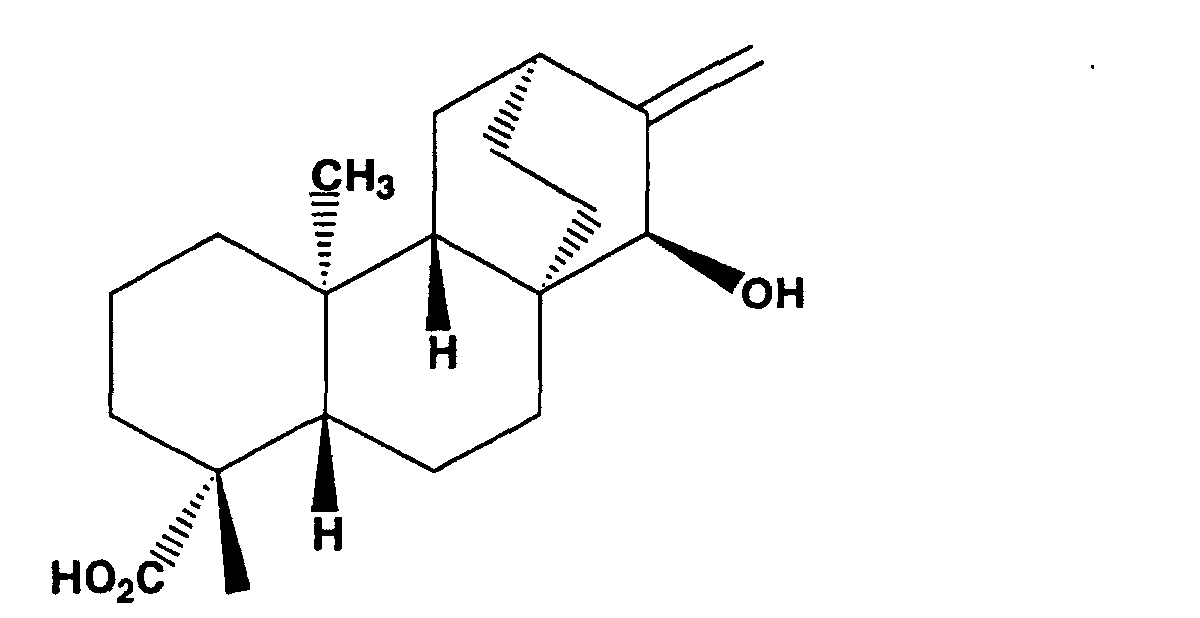
- In view of the above circumstances, the present inventors made intensive research for isolating and characterizing bioactive substances involved in EE-FCS, and finally succeeded in isolating and characterizing the novel atisane derivatives represented by the formula:and found that the atisane derivatives exhibit a protective effect against cell injury due to radicals while exerting an excellent neural protective effect against neurotoxicity induced by glutamate or the like. Based on these findings, they succeeded in synthesizing novel atisane compounds, and found that such compounds, a salt thereof and a hydrate of them exhibit protective effects against cell injury due to radicals, while are very useful as inhibitors of neurotoxicity induced by excitatory neurotransmitters such as glutamate and the like, and accomplished the present invention.
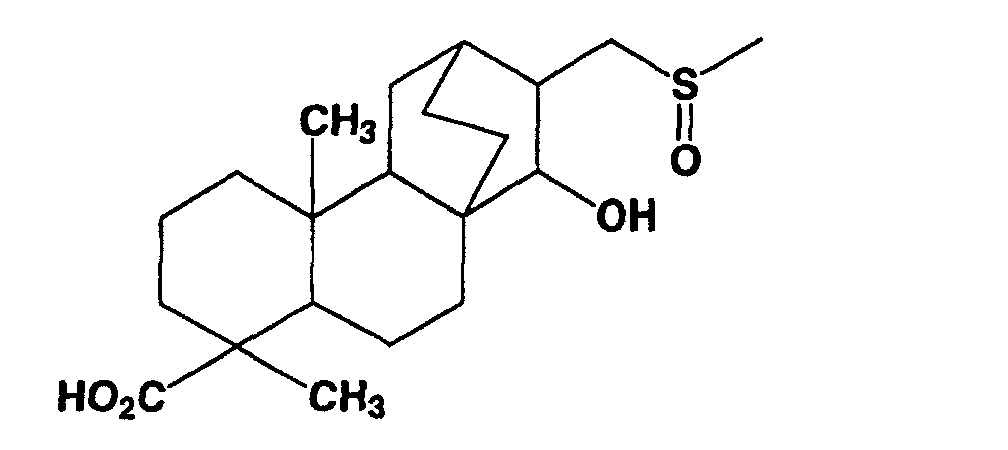
- Specifically, the present invention relates to:
- <1> a compound represented by the following formula:
(wherein Z represents a bivalent organic group of from 2 to 3 carbon atoms, provided that Z may have one or two group (s) selected from the group consisting of those represented by the following formula:
 (wherein A1 represents an optionally substituted C1-6 alkylene group or a single bond; X1 represents a halogen atom or a cyano group; X2 represents the formula -S(O)m- (wherein m is an integer of 0,1 or 2), an oxygen atom, a carbonyl group or a single bond; R4a represents a hydrogen atom, an optionally substituted C1-6 alkyl group, an optionally substituted C2-6 alkenyl group, an optionally substituted C2-6 alkynyl group, an optionally substituted C6-14 aromatic hydrocarbon cyclic group, an optionally substituted from 5- to 14-membered aromatic heterocyclic group, an optionally substituted C1-6 alkoxy group or a hydroxyl group; and R4b and R4c are independent of each other and each represents a hydrogen atom, an optionally substituted C1-6 alkyl group, an optionally substituted C2-6 alkenyl group, an optionally substituted C2-6 alkynyl group, an optionally substituted C6-14 aromatic hydrocarbon cyclic group, an optionally substituted from 5- to 14-membered aromatic heterocyclic group, an optionally substituted C2-7 acyl group or an optionally substituted C1-6 alkylsulfonyl group) , and the case where Z is a 1,2-ethylene group not having a substituent or a 1,2-vinylene group not having a substituent is excluded;
R3a represents a carbonyl group, a methylene group or a single bond; and
R3b represents a hydrogen atom, a halogen atom, an optionally substituted C1-6 alkyl group, an optionally substituted C2-6 alkenyl group, an optionally substituted C2-6 alkynyl group, an optionally substituted C1-6 alkoxy group, a hydroxyl group, a cyano group or a group represented by the formula -NR5aR5b (wherein, R5a and R5b are independent of each other and each represents a hydrogen atom, an optionally substituted C1-6 alkyl group, an optionally substituted C2-6 alkenyl group, an optionally substituted C2-6 alkynyl group, an optionally substituted C6-14 aromatic hydrocarbon cyclic group, an optionally substituted from 5 - to 14 - membered aromatic heterocyclic group, anoptionally substituted C2-7 acyl group or an optionally substituted C1-6 alkylsulfonyl group), provided that the following cases (1) to (3) are excluded: - (1) Z represents a 1,2-dicarboxyethane-1,2-yl group or a 1,2-dimethoxycarbonylethane-1,2-yl group, and the formula -R3a-R3b represents a hydroxymethyl group or an acetoxymethyl group;
- (2) Z represents a 1-i-propylethane-1,2-yl group and the formula -R3a-R3b represents a hydrogen atom; and
- (3) the formula -R3a-R3b represents a methyl group, and Z
represents the formula:
(wherein R11 represents a hydrogen atom or a methyl group, and R12 represents a hydroxyl group, a methyl group or a tetrahydropyran-2H-pyran-2-yl-oxy group)), a salt thereof or a hydrate of them;
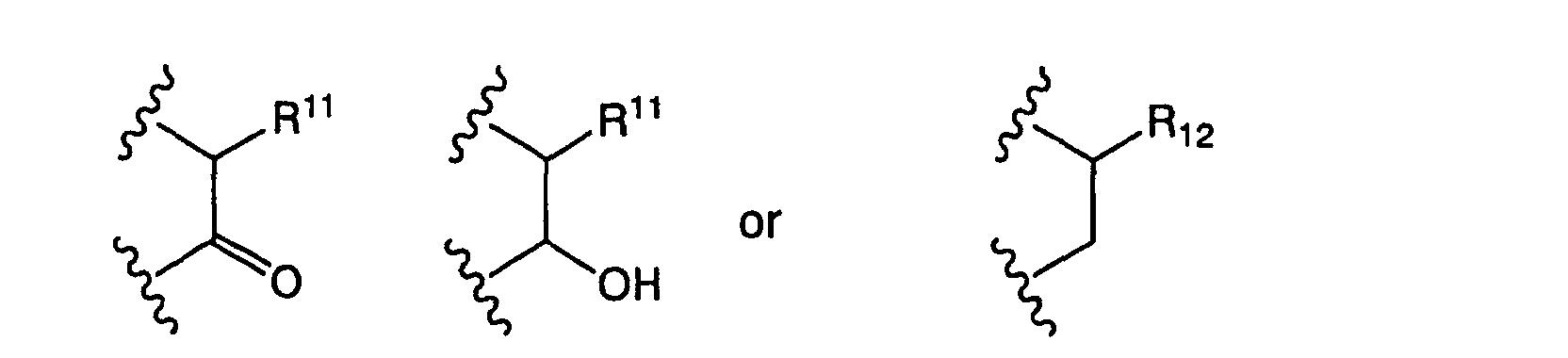
- <2> a compound represented by the following formula:
(wherein Z, R3a and R3b respectively represent those defined for the above Z, R3a and R3b in claim 1, provided that the following cases (1) to (3) are excluded:

- (1) Z represents a 1,2-dicarboxyethane-1,2-yl group or a 1,2-dimethoxycarbonylethane-1,2-yl group, and the formula -R3a-R3b represents a hydroxymethyl group or an acetoxymethyl group;
- (2) Z represents a 1-i-propylethane-1,2-yl group and the formula -R3a-R3b represents a hydrogen atom; and
- (3) the formula -R3a-R3b represents a methyl group, and Z
represents the formula:
(wherein R11 represents a hydrogen atom or a methyl group, and R12 represents a hydroxyl group, a methyl group or a tetrahydropyran-2H-pyran-2-yl-oxy group)), a salt thereof or a hydrate of them;

the compound according to the above <1> or <2>, a sal t thereof or a hydrates thereof, wherein Z is a group represented by the formula:(wherein Q1 and Q2 are independent of each other and each represents a group represented by the formula: (wherein A1, X1, X2, R4a, R4b and R4c respectively represent those defined for A1, X1, X2, R4a, R4b and R4c in the above <1>));
- <4> the compound according to the above <1> or <2>, a salt
thereof or a hydrate of them, wherein Z is a group represented
by the formula:
(wherein Q1 is as defined for Q1 in

claim 3; and Q2a represents a hydrogen atom, a halogen atom, an optionally substituted C1-6 alkyl group, an optionally substituted C2-6 alkenyl group, an optionally substituted C2-6 alkynyl group, an optionally substituted C1-6 alkoxy group, a hydroxyl group or a group represented by the formula -NR6aR6b (wherein R6a and R6b are independent of each other and each represents a hydrogen atom, an optionally substituted C1-6 alkyl group, an optionally substituted C2-6 alkenyl group, an optionally substituted C2-6 alkynyl group, an optionally substituted C2-7 acyl group or an optionally substituted C1-6 alkylsulfonyl group)); - <5> the compound according to the above <1> or <2>, a salt
thereof or a hydrate of them, wherein Z is a group represented
by the formula:
(wherein Q1 is as defined for Q1 in the above <3>; and Q2a is as defined for Q2a in the above <4>) ;

- <6> the compound according to the above <1> or <2>, a salt
thereof or a hydrate of them, wherein Z is a group represented
by the formula:
(wherein Q1 is as defined for Q1 in the above <3>; and Q2b represents a hydrogen atom or an optionally substituted C1-6 alkyl group) ;

- <7> the compound according to the above <1> or <2>, a salt
thereof or a hydrate of them, wherein Z is a group represented
by the formula:
(wherein Q1 is as defined for Q1 in the above <3>);

- <8> the compound according to the above <1> or <2>, a salt
thereof or a hydrate of them, wherein Z is a group represented
by the formula:
(wherein Q1 is as defined for Q1 in the above <3>; and Q2c represents a hydrogen atom, a cyano group, a formyl group, a carboxyl group, an optionally substituted C1-6 alkyl group, an optionally substituted C2-7 acyl group, an optionally substituted C2-7 alkoxycarbonyl group or a group represented by the formula:
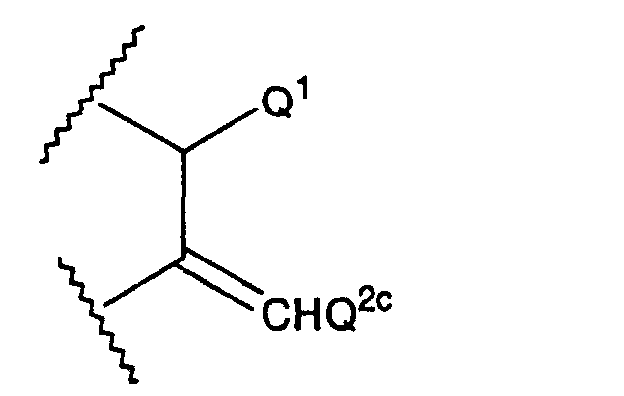 (wherein Q3a and Q3b are independent of each other and each represents a hydrogen atom, an optionally substituted C1-6 alkyl group, an optionally substituted C2-6 alkenyl group or an optionally substituted C2-6 alkynyl group));
- <9> the compound according to any one of the above <1> to <8>, a salt thereof or a hydrate of them, wherein R3a is a carbonyl group;
- <10> the compound according to any one of the above <1> to <9>, a salt thereof or a hydrate of them, wherein R3b is a hydroxyl group;
- <11> the compound according to any one of the above <4>, <5>, <9> and <10>, a salt thereof or a hydrate of them, wherein Q2a is a hydroxyl group;
- <12> the compound according to any one of the above <3> to <11>, a slat thereof or a hydrate of them, wherein Q1 is a group represented by the formula -A1-S(O)m-R4a (wherein A1, m and R4a are respectively as defined for A1, m and R4a in the above <1>);
- <13> the compound according to any one of the above <1> to <12>, a salt thereof or a hydrate of them, wherein R4a is an optionally substituted methyl group, an optionally substituted ethyl group, an optionally substituted n-propyl group or an optionally substituted i-propyl group;
- <14> the compound according to any one of the above <1> to <13>, a salt thereof or a hydrate of them, wherein A1 is a methylene group;
- <15> the compound according to any one of the above <1> to <14>, a salt thereof or a hydrate of them, wherein m is 1;
- <16> the compound according to any one of the above <1> to <8>, a salt thereof or a hydrate of them, wherein A1 represents a C1-6 alkylene group or a single bond; R4a represents a hydrogen atom, a C1-6 alkyl group, a C2-6 alkenyl group, a C2-6 alkynyl group, a C6-14 aromatic hydrocarbon cyclic group, a 5- to 14-membered aromatic heterocyclic group, a C1-6 alkoxy group or a hydroxyl group; R4b and R4c are independent of each other and each represents a hydrogen atom, a C1-6 alkyl group, a C2-6 alkenyl group, a C2-6 alkynyl group, a C6-14 aromatic hydrocarbon cyclic group, a 5-to 14-membered aromatic heterocyclic group, a C2-7 acyl group or a C1-6 alkylsulfonyl group; and R3b represents a hydrogen atom, a halogen atom, a C1-6 alkyl group, a C2-6 alkenyl group, a C2-6 alkynyl group, a C1-6 alkoxy group, a hydroxyl group, a cyano group or a group represented by the formula -NR5aR5b (wherein R5a and R5b are independent of each other and each represents a hydrogen atom, a C1-6 alkyl group, a C2-6 alkenyl group, a C2-6 alkynyl group, a C6-14 aromatic hydrocarbon cyclic group, a 5-to 14-membered aromatic heterocyclic group, a C2-7 acyl group or a C1-6 alkylsulfonyl group);
- <17> the compound according to the above <4> or <5>, a salt thereof or a hydrate of them, wherein Q2a represents a hydrogen atom, a halogen atom, a C1-6 alkyl group, a C2-6 alkenyl group, a C2-6 alkynyl group, a C1-6 alkoxy group, a hydroxyl group or a group represented by the formula -NR6aR6b (wherein R6a and R6b are independent of each other and each represents a hydrogen atom, a C1-6 alkyl group, a C2-6 alkenyl group, a C2-6 alkynyl group, a C2-7 acyl group or a C1-6 alkylsulfonyl group);
- <18> a medicament comprising the compound according to the above <1> or <2>, a salt thereof or a hydrate of them;
- <19> a pharmaceutical composition comprising the compound according to the above <1> or <2>, a salt thereof or a hydrate of them;
- <20> a protective agent against cell injury due to radicals, comprising the compound according to the above <1> or <2>, a salt thereof or a hydrate of them;
- <21> an inhibitor of glutamate-induced neurotoxicity, comprising the compound according to the above <1> or <2>, a salt thereof or a hydrate of them;
- <22> an inhibitor of NO-induced neurotoxicity, comprising the compound according to the above <1> or <2>, a salt thereof or a hydrate of them;
- <23> an agent for treating or preventing a disease to which glutamate-induced neurotoxicity relates, which comprises the compound according to the above <1> or <2>, a salt thereof or a hydrate of them;
- <24> an agent for treating or preventing a disease to which NO-induced neurotoxicity relates, which comprises the compound according to the above <1> or <2>, a salt thereof or a hydrate of them;
- <25> an agent for treating or preventing nervous disease, which comprises the compound according to the above <1> or <2>, a salt thereof or a hydrate of them;
- <26> the agent for treating or preventing nervous disease according to the above <25>, wherein the nervous disease is disorder by cerebral ischemia, Parkinson disease, Alzheimer disease, amyotrophic lateral sclerosis (ALS) or multiple sclerosis;
- <27> an agent for treating or preventing glaucoma, retinopathy of prematurity, diabetic retinopathy, macular degeneration or hearing disorder, which comprises the compound according to the above <1> or <2>, a salt thereof or a hydrate of them;
- <28> an agent for treating or preventing skin disease, which comprises the compound according to the above <1> or <2>, a salt thereof or a hydrate of them; and
- <29> the agent for treating or preventing skin disease according to the above <28>, wherein the skin disease is atopic dermatitis, contact dermatitis or hyperesthesia.
-
- The present invention provides a method for treating or preventing a disease to which a protection against cell injury due to radicals is efficacious, a disease to which glutamate-induced neurotoxicity relates, a disease to which NO-induced neurotoxicity relates, a nervous disease, glaucoma, retinopathy of prematurity, diabetic retinopathy, macular degeneration, hearing disorder or a skin disease, by administering a pharmacologically effective amount of the compound according to the above <1> or <2>, a salt thereof or a hydrate of them to a patient. The present invention also provides use of the compound according to the above <1> or <2>, a salt thereof or a hydrate of them, for producing an agent for treating or preventing a disease to which a protection against cell injury due to radicals is efficacious, a disease to which glutamate-induced neurotoxicity relates, a disease to which NO-induced neurotoxicity relates, a nervous disease, glaucoma, retinopathy of prematurity, diabetic retinopathy, macular degeneration, hearing disorder or a skin disease.
- Hereinafter, definition for terms, symbols and the like used in the present description will be made, and detailed explanation on the present invention will be made.
- In the present specification, the structural formula of the compound represents a certain isomer for convenience in some cases, but the present invention includes all isomers such as geometrical isomer, optical isomer based on an asymmetrical carbon, stereoisomer, tautomer and the like which occur structurally and an isomer mixture and is not limited to the description of the formula for convenience, and may be any one of isomer or a mixture. Therefore, an asymmetrical carbon atom may be present in the molecule and an optically active compound and a racemic compound may be present, but the present invention is not limited to them and includes any one. In addition, a crystal polymorphism may be present but is not limiting, but any crystal form may be single or a crystal form mixture, or an anhydride or hydrate.
- In this description, "C1-6 alkyl group" refers to linear or branched alkyl groups of f rom 1 to 6 carbon atom (s), and concrete examples thereof include methyl group, ethyl group, n-propyl group, i-propyl group, n-butyl group, i-butylgroup, tert-butyl group, n-pentyl group, i-pentyl group, neopentyl group, n-hexyl group, 1-methylpropyl group, 1,2-dimethylpropylgroup, 2-ethyl propyl group, 1-methyl-2-ethyl propyl group, 1-ethyl-2-methylpropyl group, 1,1,2-trimethylpropyl group, 1-methylbutyl group, 2-methylbutyl group, 1,1-dimethylbutyl group, 2,2-dimethylbutyl group, 2-ethylbutyl group, 1,3-dimethylbutyl group, 2-methylpentyl group, 3-methylpentyl group and so on.
- "C1-6 alkylene group" used in the present description refers to bivalent groups derived f rom "C1-6 alkyl group" def ined above by removing one hydrogen atom, and concrete examples thereof include methylene group, ethylene group, methylethylene group, propylene group, ethylethylene group, 1,1-dimethylethylene group, 1,2-dimethylethylene group, trimethylene group, 1-methyltrimethylene group, 1-ethyltrimethylene group, 2-methyltrimethylene group, 1,1-dimethyltrimethylene group, tetramethylene group, pentamethylene group, hexamethylene group and the like, and preferably methyl ene group, 1,2-ethylene group, 1,3-propylene group and so on, more preferably methylene group.
- In the present description, "C2-6 alkenyl group" refers to linear or branched alkenyl groups of from 2 to 6 carbons, and concrete examples thereof include vinyl group, allyl group, 1-propenyl group, isopropenyl group, 1-buten-1-yl group, 1-buten-2-yl group, 1-buten-3-yl group, 2-buten-1-yl group, 2-buten-2-yl group and the like.
- In the present description, "C2-6 alkynyl group" refers to linear or branched alkynyl group of from 2 to 6 carbons, and concrete examples thereof include ethynyl group, 1-propynyl group, 2-propynyl group, butynyl group, pentynyl group, hexynyl group and the like.
- In the present description, "C6-14 aromatic hydrocarbon cyclic group" refers to aromatic cyclic groups of from 6 to 14 carbons, and concrete examples thereof include phenyl group, 1-naphthyl group, 2-naphthyl group, as-indacenyl group, s-indacenyl group, acenaphthylenyl group and so on, and preferably phenyl group, 1-naphthyl group and 2-naphthyl group.
- In the present description, "from 5- to 14-membered aromatic heterocyclic group" refers to aromatic cyclic groups wherein the number of atoms constituting the cyclic group is from 5 to 14, and the kind of atoms constituting the cyclic group is a carbon atom or a hetero atom, and concrete examples include pyridine, thiophene, furan, pyrrole, oxazole, isoxazole, thiazole, isothiazole, imidazole, triazole, pyrazole, furazan, thiadiazole, oxadiazole, pyridazine, pyrimidine, pyrazine, indole, isoindole, indazole, chromene, quinoline, isoquinoline, cinnoline, quinazoline, quinoxaline, naphthylidene, phthalazine, purine, pteridine, thienofuran, imidazothiazole, benzofuran, benzothiophene, benzoxazole, benzthiazole, benzthiadiazole, benzimidazole, imidazopyridine, pyrrolopyridine, pyrrolopyrimidine, pyridopyrimidine and the like.
- In the present description, "C3-8 cycloalkyl group" refers to cyclic aliphatic hydrocarbon groups of from 3 to 8 carbons, and concrete examples include cyclopropyl group, cyclobutyl group, cyclopentyl group, cyclohexyl group, cycloheptyl group, cyclopropenyl group, cyclobutenyl group, cyclopentenyl group, cyclohexenyl group, cycloheptenyl group and the like.
- In the present description, "halogen atom" refers to fluorine atom, chlorine atom, bromine atom or iodine atom.
- In the present description, "C1-6 alkoxy group" refers to oxy groups to which "C1-6 alkyl group" as defined above is bound, and concrete examples include methoxy group, ethoxy group, n-propoxy group, i-propoxy group, n-butoxy group, i-butoxy group, sec-butoxy group, t-butoxy group, n-pentyloxy group, i-pentyloxy group, sec-pentyloxy group, t-pentyloxy group, neopentyloxy group, 1-methylbutoxy group, 2-methylbutoxy group, 1,1-dimethylpropoxy group, 1,2-dimethylpropoxy group, n-hexyloxy group, i-hexyloxy group, 1-methylpentyloxy group, 2-methylpentyloxy group, 3-methylpentyloxy group, 1,1-dimethylbutoxy group, 1,2-dimethylbutoxy group, 2,2-dimethylbutoxy group, 1,3-dimethylbutoxy group, 2,3-dimethylbutoxy group, 3,3-dimethylbutoxy group, 1-ethylbutoxy group, 2-ethylbutoxy group, 1,1,2-trimethylpropoxy group, 1,2,2-trimethylpropoxy group, 1-ethyl-1-methylpropoxy group, 1-ethyl-2-methylpropoxy group and the like.
- In the present description, "C2-7 acyl group" refers to carbonyl groups to which "C1-6 alkyl group" defined above is bound, and concrete examples include acetyl group, propionyl group, butyryl group, isobutyryl group and the like.
- In the present description, "C1-6 alkoxycarbonyl group" refers to carbonyl groups to which "C1-6 alkoxy group" as defined above is bound, and concrete examples include methoxycarbonyl group, ethoxycarbonyl group, n-propoxycarbonyl group, i-propoxycarbonyl group, n-butoxycarbonyl group, i-butoxycarbonyl group, sec-butoxycarbonyl group, t-butoxycarbonyl group and the like.
- In the present description, "C1-6 alkylsulfonyl group" refers to sulfonyl groups to which "C1-6 alkyl group" as defined above is bound, and concrete examples include methylsulfonyl group, propylsulfonyl group and the like.
- The term "an optionally substituted" used in the present description is synonymous with "which may have one or more substituents in any combination at a site where such substitution is possible". Concrete examples of such substituents include:
- (1) halogen atom,
- (2) hydroxyl group,
- (3) thiol group,
- (4) nitro group,
- (5) nitrile group,
- (6) oxo group,
- (7) azido group,
- (8) guanidino group,
- (9) hydrazino group,
- (10) isocyano group,
- (11) cyanate group,
- (12) isocyanate group,
- (13) thiocyanate group,
- (14) isothiocyanate group,
- (15) nitroso group,
- (16) carbamide group
- (17) formyl group,
- (18) C1-6 imidoyl group,
- (19) C1-6 alkyl group, C2-6 alkenyl group, C2-6 alkynyl group, C3-8 cycloalkyl group, C1-6 alkoxy group, C2-6 alkenyloxy group, C2-6 alkynyloxy group, C3-6 cycloalkyloxy group, C1-6 alkylthio group, C2-6 alkenylthio group, C2-6 alkynylthio group, C3-6 cycloalkylthio group or C1-6 alkylenedioxy group, each of which may be substituted with from 1 to 3 halogen atom(s) or hydroxyl group(s),
- (20) C6-14 aryl group,
- (21) from 5- to 14-membered heterocyclic group,
- (22) carboxyl group,
- (23) trifluoromethyl group,
- (24) C6-14 aryl C1-6 alkyl group,
- (25) from 5- to 14-membered heterocyclic C1-6 alkyl group,
- (26) C1-6 alkylcarbamoyl group,
- (27) C1-6 alkoxycarbonyl group,
- (28) C1-6 alkylcarbonyl group,
- (29) C1-6 alkylcarbonyloxy group,
- (30) C1-6 alkylsulfonyl group,
- (31) C1-6 alkylsulfinyl group, and the like substituents, and among these substituents,
- (1) halogen atom,
- (2) hydroxyl group,
- (5) nitrile group,
- (16) carbamide group,
- (19) C1-6 alkyl group, C2-6 alkenyl group, C2-6 alkynyl group, C3-8 cycloalkyl group, C1-6 alkoxy group or C3-6 cycloalkyloxy group, each of which may be substituted with from 1 to 3 halogen atom (s) or hydroxyl group(s),
- (20) C6-14 aryl group,
- (21) from 5- to 14-membered heterocyclic group,
- (22) carboxyl group,
- (23) trifluoromethyl group,
- (24) C6-14 aryl C1-6 alkyl group,
- (25) from 5- to 14-membered heterocyclic C1-6 alkyl group,
- (26) C1-6 alkylcarbamoyl group,
- (27) C1-6 alkoxycarbonyl group,
- (28) C1-6 alkylcarbonyl group,
- (29) C1-6 alkylcarbonyloxy group,
- (30) C1-6 alkylsulfonyl group,
- (31) C1-6 alkylsulfinyl group
- (1a) halogen atom,
- (2a) hydroxyl group,
- (3a) nitrile group,
- (4a) C1-6 alkyl group,
- (5a) C3-8 cycloalkyl group,
- (6a) C1-6 alkoxy group,
- (7a) phenyl group,
- (8a) carboxyl group,
- (9a) C1-6 alkylcarbamoyl group,
- (10a) C1-6 alkylsulfonyl group
-
- Z represents a bivalent organic group of from 2 to 3 carbon atoms, provided that Z may have one or two group(s) selected from the group consisting of the following formulae:(wherein A1, X1, X2, R4a, R4b and R4c have the same meanings as defined in the above definitions) with the exception that Z is 1,2-ethylene group not having a substituent or 1,2-vinyl ene group not having a substituent.

- The term "bivalent organic group of from 2 to 3 carbon atoms" refers to bivalent organic groups optionally containing one oxygen atom as a carbonyl group and comprising from 2 to 3 carbon atoms wherein the atom involving in constituting the ring in Z is methylene group, methine group, carbon atoms or carbonyl group, and concrete examples include the groups represented by the following formulae:


- The "bivalent organic group of from 2 to 3 carbon atoms" is preferably 1,2-ethylene group, 1,2-vinylene group, ethanone-1,2-ylene group or 1-propene-2,3-ylene group and the like, more preferably the groups represented by the following formulae:still preferably the groups represented by the following formulae:
 and most preferably the groups represented by the following formulae:
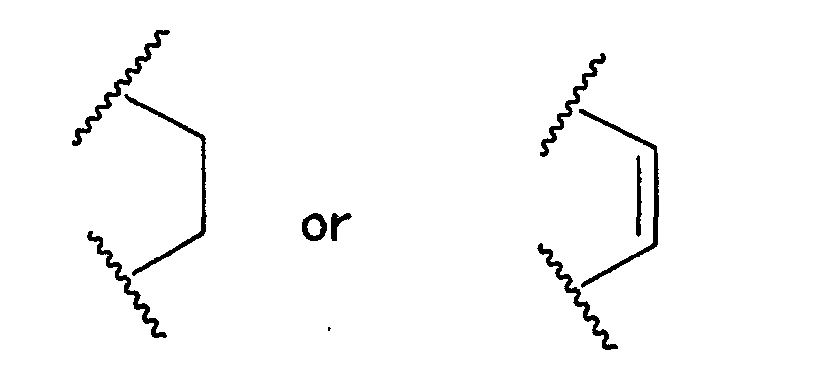
- The formula:(wherein Q1 and Q2 have the same meanings as defined above) represents groups containing from 1 to 4 group (s) selected from the group consisting of:
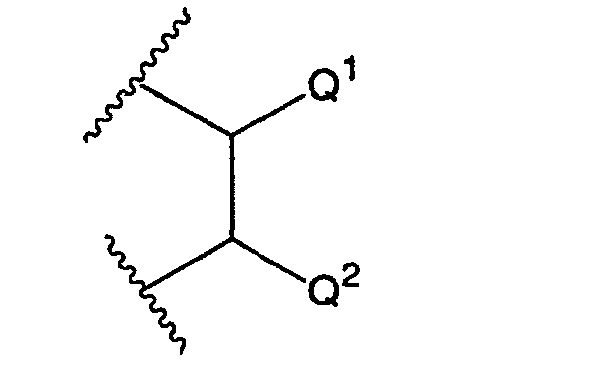 (wherein Q1 and Q2 have the same meanings as defined above) at any ratio, and preferably the group represented by the above (Q-1a), (Q-1b), (Q-1c) or (Q-1d).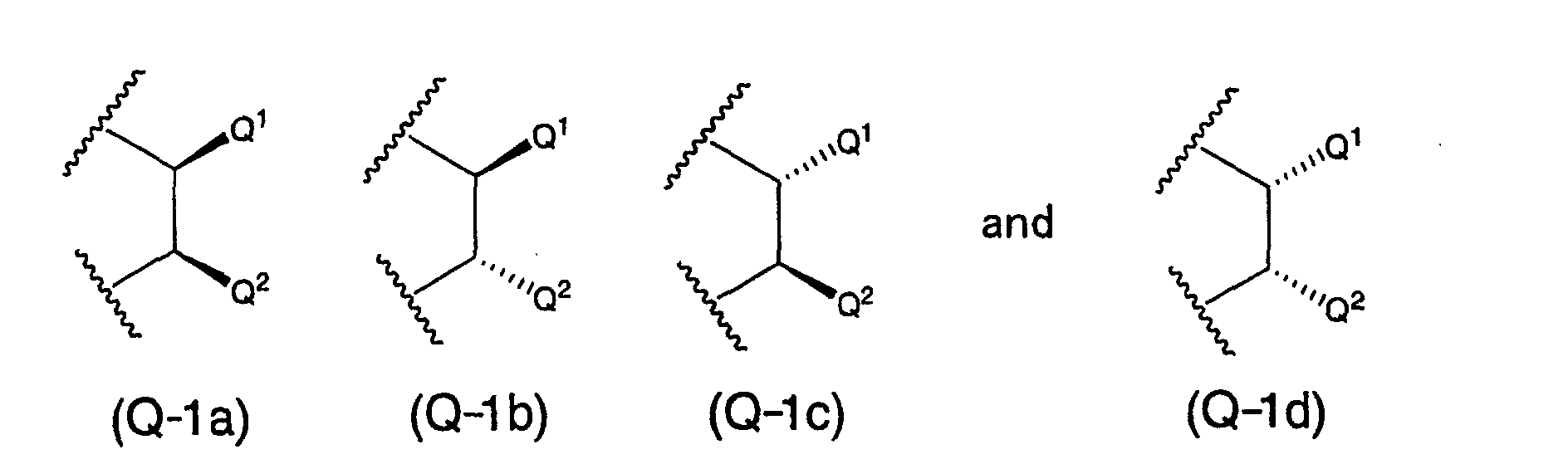
- The formula:(wherein Q1 has the same meaning as defined above) represents groups containing from 1 to 2 group (s) selected from the group consisting of:
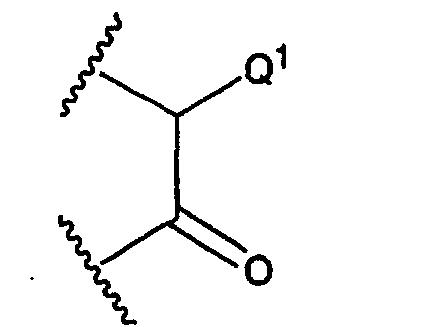 (wherein Q1 has the same meaning as defined above) at any ratio, preferably the group represented by the above (Q-2a) or (Q-2b), more preferably the group represented by the above (Q-2a) , and still preferably the group represented by the above (Q-2b).
- The formula:(wherein Q1 and Q2 have the same meanings as defined above) represents groups containing from 1 to 2 group (s) selected from the group consisting of:
 (wherein Q1 and Q2 have the same meanings as defined above) at any ratio, preferably the group represented by the above (Q-3a) or (Q-3b), more preferably the group represented by the above (Q-3a), and still preferably the group represented by the above (Q-3b).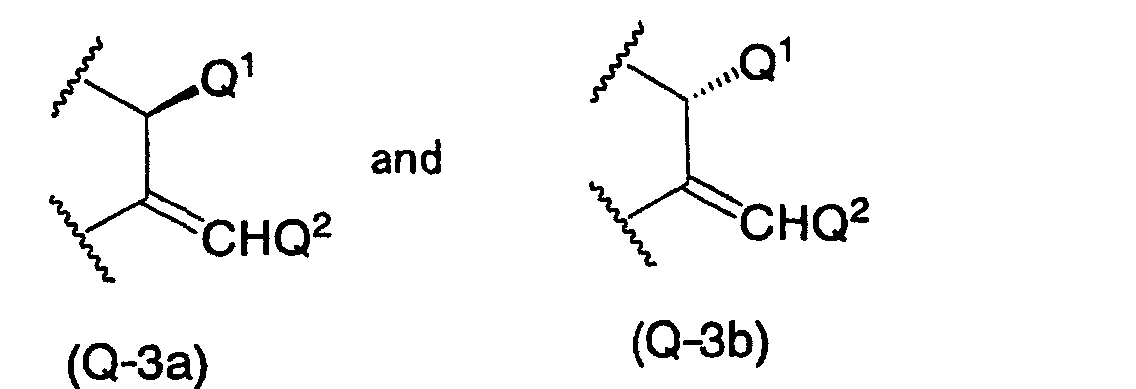
- In the above compound (I), "Z is a group represented by the formula:(wherein Q1 and Q2 have the same meanings as defined above)" represents that the above compound (I) is represented by the formula:

 wherein Q1, Q2, R3a and R3b have the same meanings as defined above.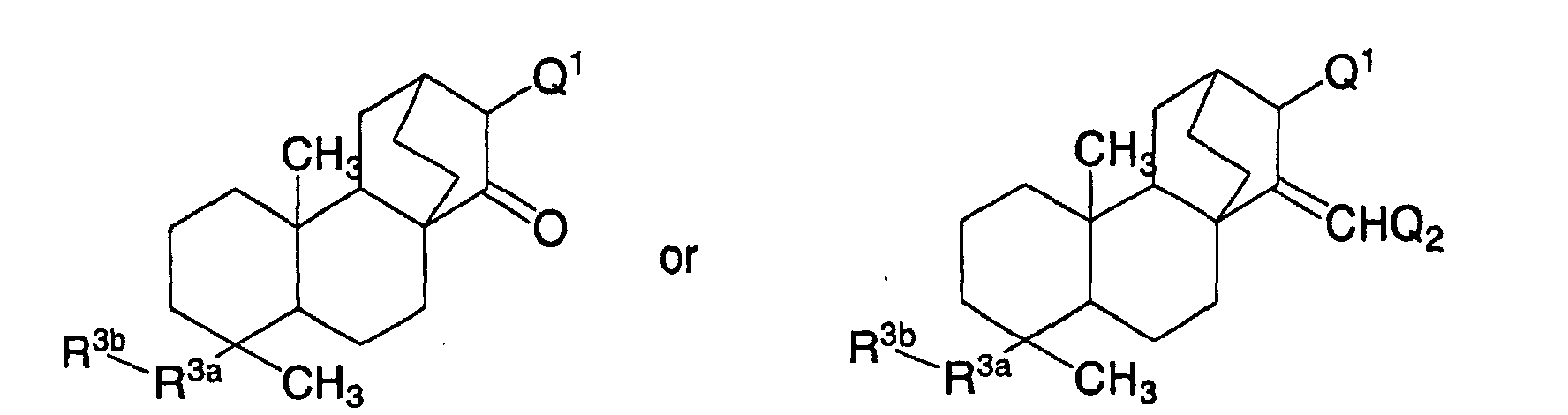
- Z represents preferably the group represented by the formula:(wherein Q1 and Q2 have the same meanings as defined above), more preferably the group represented by the formula:
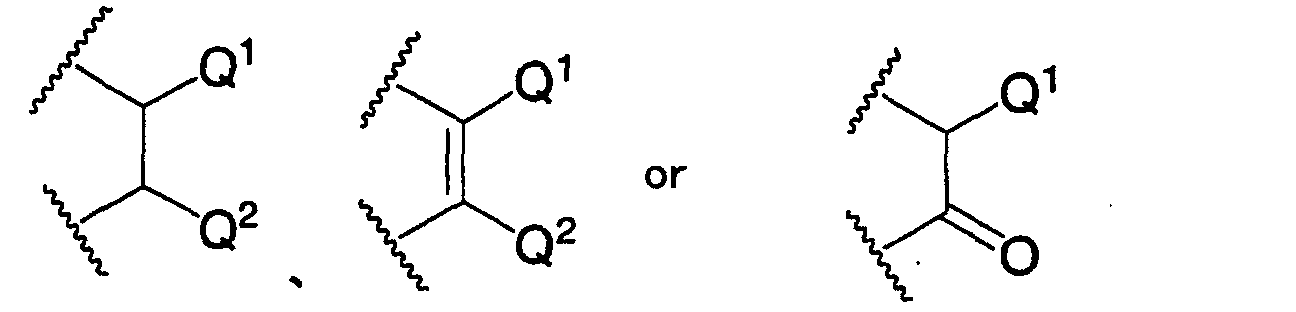 (wherein Q1 and Q2 have the same meanings as defined above), still preferably the group represented by the formula:
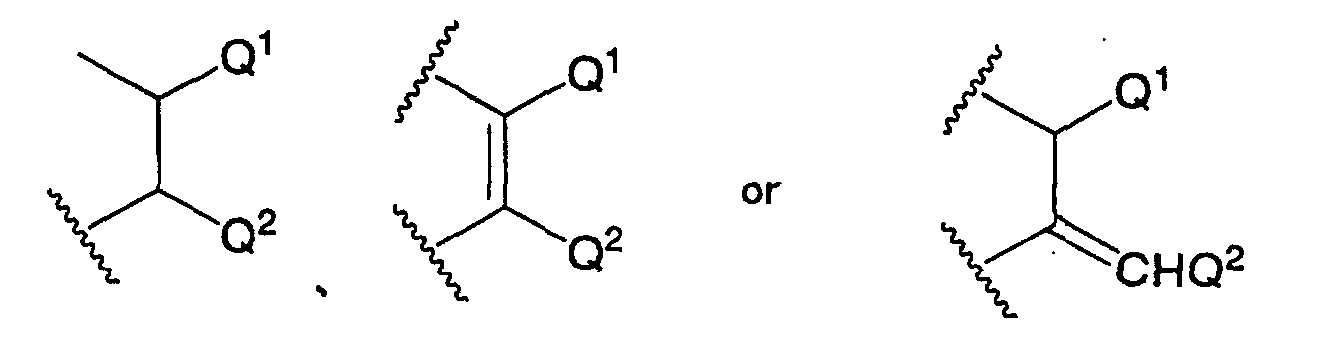 (wherein Q1 and Q2 have the same meanings as defined above), and most preferably the group represented by the formula:
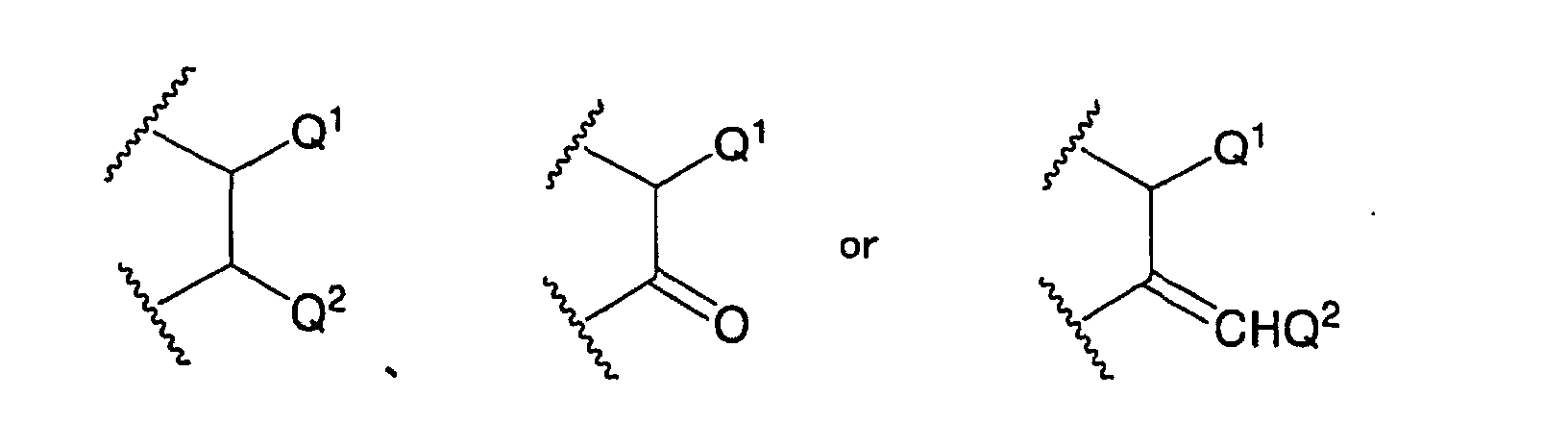 wherein Q1 and Q2 have the same meanings as defined above.
- The formula "-R3a-R3b" represents the group as def ined above, preferably a carboxyl group, C1-6 alkoxycarbonyl group, C1-6 alkyl group, cyano group, groups represented by the formula -CO-NR5aR5b (wherein R5a and R5b have the same meanings as defined above) or the formula -CH2-R30b (wherein R30b represents C1-6 alkoxy group or halogen atom), more preferably a carboxyl group, C1-6 alkoxycarbonyl group, C1-6 alkyl group, cyano group or groups represented by the formula -CO-NR5aR5b (wherein R5a and R5b have the same meanings as defined above) , still preferably a carboxyl group, methoxycarbonyl group, methyl group or cyano group, and most preferably a carboxyl group.
- Q2 represents the group as defined above, preferably a hydroxyl group, C1-6 alkoxy group, halogen atom or groups represented by the formula -NR4bR4c (wherein R4b and R4c have the same meanings as defined above) , more preferably a hydroxyl group, halogen atom or -NH2, and still preferably a hydroxyl group.
- Q2a represents a hydrogen atom, halogen atom, optionally substituted C1-6 alkyl group, optionally substituted C2-6 alkenyl group, optionally substituted C2-6 alkynyl group, optionally substituted C1-6 alkoxy group, hydroxyl group, or groups represented by the formula -NR6aR6b (wherein R6a and R6b are independent of each other and each represents hydrogen atom, optionally substituted C1-6 alkyl group, optionally substituted C2-6 alkenyl group, optionally substituted C2-6 alkynyl group, optionally substituted C2-7 acyl group or optionally substituted C1-6 alkylsulfonyl group).
- The above Q2a is preferably a halogen atom, optionally substituted C1-6 alkyl group, optionally substituted C1-6 alkoxy group, hydroxyl grouporgroups representedby the formula -NR6aR6b (wherein R6a and R6b are independent of each other and each represents a hydrogen atom, optionally substituted C1-6 alkyl group, optionally substituted C2-7 acyl group or optionally substituted C1-6 alkylsulfonyl group) , more preferably a halogen atom, C1-6 alkoxy group, hydroxyl group or -NH2, and still preferably a hydroxyl group.
- Q2b represents a hydrogen atom or optionally substituted C1-6 alkyl group, preferably a hydrogen atom or methyl group, and more preferably a hydrogen atom.
- Q1 represents groups represented by the formula -A10-X10 (wherein A10 represents an optionally substituted C1-6 alkylene group or single bond, and X10 represents -X1, -X2-R4a or -X2-NR4bR4c (wherein X1, X2, R4a, R4b and R4c have the same meanings as described above).
- A10 is preferably a C1-6 alkylene group or single bond, more preferably groups represented by the formula - (CH2)s- (wherein s represents an integer from 0 to 6) , more preferably a single bond, methylene group or ethylene group, and most preferably a methylene group.
- X10 is preferably a halogen atom, cyano group or groups represented by the formula:
 (wherein m, R4a, R4b and R4c have the same meanings as defined above), more preferably groups represented by the formula:
 (wherein m, R4a, R4b and R4c have the same meanings as defined above) , and still preferably groups represented by the formula -S(O) -R4a (wherein R4b has the same meaning as defined above).
- R4a represents the group as defined above, preferably a hydrogen atom, optionally substituted C1-6 alkyl group, optionally substituted C6-14 aromatic hydrocarbon cyclic group or optionally substituted from 5- to 14-membered aromatic heterocyclic group, more preferably a hydrogen atom, C1-6 alkyl group or C6-14 aromatic hydrocarbon cyclic group, still preferably a methyl group, ethyl group, n-propyl group or i-propyl group, and most preferably a methyl group.
- R4b and R4c each represent the group as defined above, preferably a hydrogen atom, optionally substituted C1-6 alkyl group, optionally substituted C6-14 aromatic hydrocarbon cyclic group, optionally substituted from 5- to 14-membered aromatic heterocyclic group, optionally substituted C2-7 acyl group or optionally substituted C1-6 alkylsulfonyl group, more preferably a hydrogen atom, C1-6 alkyl group, C6-14 aromatic hydrocarbon cyclic group, C2-7 acyl group or C1-6 alkylsulfonyl group, still preferably a hydrogen atom, C1-6 alkyl group or C1-6 alkylsulfonyl group, and most preferably a hydrogen atom, methyl group or ethyl group.
- It goes without saying that the present invention is not limited to these compounds, and preferred embodiments can be obtained by appropriately combining preferred examples of each reference symbol in the above formula (I).
- "Salts" used in the present invention refer to any pharmaceutically acceptable salts insofar as they form additive salts with the compound of the present invention, and preferred examples include hydrohalides such as hydrofluorides, hydrochlorides, hydrobromides or hydriodides; inorganic acid salts such as sulfates, nitrates, perchlorates, phosphates, carbonates or bicarbonates; organic carboxylates such as acetates, oxalates, maleates, tartrates or fumarates; organic sulfonates such as methane sulfonates, trifluoromethane sulfonates, ethane sulfonates, benzene sulfonates, toluene sulfonates or camphor sulfonates; amino acid salts such as aspartates or glutamates; salts with amines such as trimethylamine salts, triethylamine salts, procaine salts, pyridine salts or phenethyl benzyl amine salts; alkaline metal salts such as sodium salts or potassium salts; and alkaline earth metal salts such as magnesium salts or calcium salts.
- A salt or a hydrates of the compound of the present invention are preferably those pharmaceutically acceptable.
- A typical production method of the compound represented by the above formula (I) according to the present invention will be described below. In the present specification, R3 represents the formula -R3a-R3b (wherein, R3a and R3b have the same meanings as defined above); and X and Xa are as defined for the above Q1.
-


- Oxidation step of Compound (1a) (J. Org. Chem., Vol.36, No.18, 1971, 2625-2631). By allowing a selenium reagent and Compound (1a) to react with each other, a mixture of Compounds (2a), (3a) and (4a) can be obtained.
- As the selenium reagent, selenium dioxide or silica gel bearing selenium dioxide can be used, and selenium dioxide is used in an amount of several equivalents to 0.005 equivalent with respect to raw materials, and a peroxide may be added to the reaction system. Examples of the peroxide include hydrogen peroxide aqueous solution, t-buthylhydroperoxide aqueous solution and the like, and the peroxide is added in an amount of 1 to 5 equivalent(s). As a reaction solvent, methylene chloride, hexane, ethanol, water and the like can be used, and the reaction temperature may be from ice cooling temperature to room temperature.
- Production step of Compound (5a) which is an alcohol from Compound (2a) or (3a) bymeans of hydroboration-oxidation method.
- Conditions commonly used for conversion from olefin to alcohol by the hydroboration-oxidation method can be used.
- Concrete examples of borane reagent for use in the hydroboration include borane-tetrahydrofuran complex, borane-dimethylsulfide complex, 9-borabicyclo[3.3.1]nonane (9-BBN) and the like, andas a reaction solvent forhydroboration, tetrahydrofuran and the like can be used, and the reaction temperature is from 0°C to heating reflux temperature.
- For the oxidation reaction, an oxidizing agent such as hydrogen peroxide aqueous solution is used. During the reaction, an aqueous sodium hydroxide is added. The oxidation reaction is conducted by using an appropriate combination of tetrahydrofuran, water, ethanol and the like as a reaction solvent, and the reaction temperature is from the ice-cooling temperature to room temperature.
- wherein R3, R4a, Q1, Q2 and Xa are as def ined above; and U represents a halogen atom or sulfonic acid ester group.

- As Compound (1b) which is a starting material, compounds whichcan synthesize the aforementioned Compound (5a) or Compound (5a) byappropriatelyusing the reactions described in Production methods E and F can be used.
- Step of converting a hydroxyl group into a halogen atom or a sulfonic acid ester group such as methane sulfonyl group or p-toluene sulfonyl group.
- By allowing Compound (1b) and a sulfonic acid esterif ication reagent to react with each other, Compound (2b) in which U is a sulfonic acid ester group can be obtained.
- Examples of the sulfonic acid esterification reagent that can be used include sulfonic halides such as mesyl chloride, tosyl chloride or tosyl fluoride, sulfonic anhydrides such as methanesulfonic anhydride, tosylic anhydride or trifluoromethanesulfonic anhydride and the like. And, it is desirably used in the presence of nitrogen-containing bases such as triethylamine or N-methylmorpholine or pyridine as a base. As the reaction solvent, esters such as acetone or ethyl acetate, ethers such as tetrahydrofuran or t-butyl ether, lower nitriles such as acetonitrile, aprotic solvents suchas dimethylformamide, dimethyl sulfoxide or toluene can be usually used. The reaction temperature is from -20°C to room temperature. Halogenation (chlorination, bromination, iodization) reaction
- By allowing Compound (1b) and a haloganation reagent to react with each other, Compound (2b) in which U is a halogen atom can be obtained.
- In the presence of triphenylphosphine, by reacting a halogenation agent such as carbon tetrachloride, N-chlorosuccinimide, phosphorous oxychloride, thionyl chloride, carbon tetrabromide, N-bromosuccinimide, bromine, phosphorous tribromide, phosphoric bromide or iodine, a halogenated form compound can be obtained. Bases such as triethylamine, imidazole or dimethylaminopyridine may be added to the reaction mixture. The reaction is conducted in an organic solvent such as carbon tetrachloride, dichloromethane, benzene or toluene at a temperature from room temperature to heating reflux temperature.
- The halogenated form compound can be obtained by reacting the aforementioned sulfonic acid ester compound such as tosylate or mesylate obtainable from a hydroxyl group by the aforementioned sulfonic acid esterification with lithium chloride, sodium bromide and the like. The reaction is conducted in an organic solvent such as dichloromethane, benzene, toluene or dimethylformamide at a temperature from room temperature to heating reflux temperature.
- By allowing Compound (1b) and a fluorination reagent to react with each other, a fluorinated form compound can be synthesized.
- Concrete examples of the fluorination reagent that can be used include diethylaminosulphur trifluoride (DAST), sulphur tetrafluoride, morpholino sulfur trifluoride and the like. As a reaction solvent, methylene chloride, diglyme, isooctane, monof luorotrichloromethane and the like is used, and the reaction temperature is from -80°C to room temperature.
- Step of introducing various substituents by reaction of Compound (2b) with a nucleophilic reagent.
- As a reaction solvent, tetrahydrofuran, diethyl ether, dimethylformamide, dimethylsulfoxide, toluene, ethanol and the like can be used, and the reaction temperature is from room temperature to the reflux temperature.
- 1) Reaction with a nucleophilic reagent selected from alkaline metal salts of alkoxide, alkaline metal salts of thioalkoxide, ammonia, primary amines, secondary amines, lithium cyanide, sodium cyanide, potassium cyanide, tris(dimethylamino)sulfonium difluorotrimethylsilicate (TASF) , potassium fluoride, tetrabutylammonium fluoride (TBAF) and the like can afford Compound (3b) in which Xa is a sulfide group, ether group, nitrile group, amino group, fluorine atom or the like.
- 2) Reaction with a nucleophilic reagent selected from sodium azide, sodium di-t-butylimino dicarboxylate (NaN(Boc)2), sodium phthalimide or the like, followed by reduction, deprotecting and the like reactions, can afford Compound (3b) in which Xa is an amino group.
- 3) Reaction with a nucleophilic reagent selected from potassium thioacetate (CH3C(O)S-K) and thiourea, followed by an appropriate reaction, can afford Compound (3b) in which Xa is a thiol group.
- 4) Reaction with a nucleophilic reagent selected from an organic magnesium bromide reagent (Grignard reagent) , organic copper reagent and the like can afford Compound (3b) in which Xa in Compound (2b) is an alkyl group, alkynyl group, alkenyl group, phenyl group or the like. Examples of the organic copper reagent include alkyl coppers (RCu), lithium dialkylcuprate (RR'CuLi) and hetero copper complex reagents (R2Cu(CN)Li2).
-
- Copper bromide, copper iodide, copper cyanide and the like may be added to the reaction system.
- Starting from Compound (1b), Mitsunobu reaction and the subsequent deprotecting make it possible to convert Compound (1b) into Compound (3b) in which Xa is an amino group. In the reaction, a phosphine compound and an azodicarboxylate compound are used in combination with an amination reagent.
- Examples of the amination reagent include phthalimide. Examples of the phosphine compound include triphenylphosphine and tributylphosphine, and examples of the azodicarboxylate compound include diethyl azodicarboxylate and diisopropyl azodicarboxylate. The reaction is conducted in a solvent such as tetrahydrofuran at room temperature.
- Converting reaction from a hydroxyl group to an ether group.
- Compound (1b) is reacted with an alkylation reagent (alkyl halide, alkylsulfonic acid ester and the like) in the presence of a base, and thereby Compound (4b) can be obtained. Examples of the base that can be used include calcium carbonate, sodium hydroxide, potassium hydroxide, barium hydroxide, silver oxide and barium oxide. As the reaction solvent, dimethylformamide, ethanol, acetonitrile, benzene and the like can be used, and the reaction temperature is from room temperature to heating reflux temperature.
- Step of Barton reaction which is a dehydroxylation reaction.
- After converting Compound (1b) into a thiocarbonyl derivative, the thiocarbonyl derivative is radical-cleaved, to obtain Compound (5b). Thiocarbonylation can be conducted using a combination of carbon disulfide and methyl iodide, phenyl chlorothioformate, thiocarbonyl imidazole and the like. As the reaction solvent, tetrahydrofuran, acetonitrile, dimethylformamide, 1, 2- dichloroethane and the like can be used, and the reaction temperature is from room temperature to heating reflux temperature. The radical cleavage reaction is conducted by allowing hydrogenated trialkyl tin to react in the presence of a radical initiator such as azobisisobutyronitrile. As the reaction solvent, toluene, xylene and the like can be used, and the reaction temperature is from room temperature to heating reflux temperature.
- wherein R3 and Q2 are as defined above.

- As Compound (1c) which is a starting material, the aforementioned Compound (3b) or a compound that can synthesize the aforementioned Compound (3b) by appropriately using reactions described in the production methods C, D, E and F as necessary can be used.
- By reacting Compound (1c) in which G1 is an amino group with a halogenated alkyl derivative or a sulfonic acid ester derivative, a monoalkylamino group or a dialkylamino group can be obtained.
- As the reaction solvent, tetrahydrofuran, diethyl ether, dimethylformamide, dimethylsulfoxide, toluene,ethanoland the like can be used, and the reaction temperature is from room temperature to heating reflux temperature. In this reaction, bases such as potassium carbonate and sodium carbonate may be added.
- Compound (1c) in which G1 is an amino group is reacted with a ketone compound such as ketone derivatives and aldehyde derivatives to form an imine form compound, and the imine form compound is then reacted with a reducing agent to obtain an alkylated form compound.
- In the imine forming reaction, methanol, ethanol, formic acid, toluene, benzene and the like can be used as the reaction solvents. Further, a dehydrating agent such as sodium sulfate and molecular sieve may added, and a dehydrating apparatus such as Dean-Stark dehydrating apparatus may be attached to conduct the reaction. The reactiontemperatureisfrom room temperature to heating reflux temperature.
- Reduction reaction of imine form compound is conducted by adding a reducing agent to the reaction solution of the imine forming reaction or to a solution obtainable by distilling off the reaction solution and replacing the solvent with methanol or ethanol. As the reducing agent, sodium borohydride (NaBH4), hydrogenated sodium acetoxyboron (NaBH(OAc)3), hydrogenated sodium cyanoboron (NaBH3CN) or formic acid is used. The reaction temperature is from room temperature to heating reflux temperature. By initially adding the reducing agent, it is possible to simultaneously conduct the imine forming reaction and the reduction of the imine.
- By reacting Compound (1c) in which G1 is an amino group with an acid halide, acid anhydride, sulfonyl chloride or carboxylic acid, an amide form compound, sulfonylamide form compound, ester form compound or the like can be obtained.
- In the reaction, a condensing agent and a base may be added. Examples of the condensing agent include N,N'-dicyclohexylcarbodiimide (DCC), 1-ethyl-3-(3'-dimethylaminopropyl)carbodiimide (WSC) and diethyl phosphate cyanide (DEPC).
- As the base, dimethylaminopyridine (DMAP), pyridine, diisopropylethylamine, triethylamine and the like, and as the reaction solvent, tetrahydrofuran, acetone, ethyl acetate, dimethylformamide, benzene, dichloromethane and the like can be used. The reaction temperature is from 0°C to heating reflux temperature, and preferably from 0°C to room temperature.
- Step of oxidizing a sulfide form compound to produce a sulfoxide form compound or a sulfonic form compound. As the oxidizing agent, reagents that are commonly used for oxidization of sulfur atom can be used. Examples of preferred oxidizing agents include sodium periodate, potassium peroxymonosulfate (CAS NO.37222-66-5), camphoursulfonyl oxaziridine (CAS NO.104322-63-6) etc., m-chloroperbenzoic acid and peracetic acid. As the reaction solvent, chloroform, dichloromethane, tetrahydrofuran and the like can be used. The reaction temperature is from 0°C to room temperature.
- Using chlorine and the like, a sulfonyl chloride can be synthesized from a thiol form compound. Preferred reaction solvent is acetic acid, and the reaction is conducted at a temperature from ice-cooling to room temperature.
- The sulfonyl chloride thus obtained is reacted with an appropriate amine inpyridine or the like solvent at a temperature from ice-cooling to room temperature, thereby obtaining a sulfonic amide.
- By reacting Compound (1c) in which G1 is a cyano group with an organic metal reagent such as organic magnesium bromide reagent (Grignard reagent), a ketone form compound can be produced.
- As the reaction solvent, diethylether, tetrahydrofuran and the like can be used, and the reaction temperature is from room temperature to heating reflux temperature.
- By reducing Compound (1c) in which G1 is a cyano group by diisobutyl aluminumhydride or the like, it is possible to convert the cyano group to a formyl group.
- As the reaction solvent, hexane, dichlrormethane, toluene and the like can be used, and the reaction temperature is from -78°C to room temperature, preferably from -78°C to 0°C.
- By hydrolysis of Compound (1c) in which G1 is a cyano group, it can be converted into Compound (2c) in which G1 is a carboxylic group. The reaction is conducted under acidic condition or alkaline condition.
- 1) Under acidic condition, the reaction is conducted in the presence of concentrated sulfuric acid, diluted sulfuric acid, concentrated hydrochloric acid, diluted hydrochloric acid, acetic acid or formic acid. The reaction temperature is from room temperature to heating reflux temperature.
- 2) Under alkaline condition, a base such as potassium hydroxide, sodium hydroxide, potassium carbonate, sodium carbonate and the like is used. As the solvent, water, ethanol, tetrahydrofuran, ethylene glycol and the like are used in appropriate combination. The reaction temperature is from room temperature to heating reflux temperature.
-
- By reacting Compound (1c) with a halogenation reagent, it is possible to obtain Compound (2c) in which G2 is a chlorocarbonyl group. As the halogenation reagent, thionyl chloride, oxalyl chloride, phosphorus pentachloride, phosphorus trichloride and the like can be used. The reaction is conducted in the absence of solvent, or in the presence of benzene, dichloromethane, chloroform, dimethylformamide and the like. The reaction is conducted at a temperature from room temperature to heating reflux temperature.
- By reacting Compound (1c) with acid chloride such as ethyl chloroformate, it is possible to obtain Compound (2c) in which G2 is an ethoxycarbonyloxy group. As the base, dimethylaminopyridine (DMAP), pyridine, diisopropylethylamine, triethylamine and the like can be used. As the reaction solvent, tetrahydrofuran, acetone, ethyl acetate, dimethylformaide, benzene, dichloromethane and the like can be used. The reaction is conducted at a temperature from -10°C to room temperature.
- By reacting Compound (1c) with sodium azide, it is possible to obtain Compound (2c) in which G2 is -CON3. An acid halide or a mixed acid anhydride is reacted with sodium azide.
- As the reaction solvent, acetone, dimethylformamide, dimethyl sulfoxides and the like can be used, and as the base, triethylamine and the like canbe used. The reaction temperature is from -10°C to room temperature.
- By reacting Compound (1c) which is an acid halide, mixed acid anhydride or a carboxylic acid with an amine or an alcohol, an amide form compound or an ester form compound can be obtained.
- In the reaction, a condensing agent or a base may be added. Examples of the condensing agent include N,N'-dicyclohexylcarbodiimide (DCC), 1-ethyl-3-(3'dimethylaminopropyl) carbodiimide (WSC) and diethyl phosphate cyanide (DEPC).
- As the base, dimethylaminopyridine (DMAP), pyridine, diisopropylethylamine, triethylamine and the like can be used, and as the reaction solvent, tetrahydrofuran, acetone, ethyl acetate, dimethylformamide, benzene, dichloromethane and the like can be used. The reaction temperature is from 0°C to heating reflux temperature, preferably from 0°C to room temperature. (C-10) Converting reaction from Compound (1c) in which G1 is - CONH2 to Compound (2c) in which G2 is -CN
- By reacting Compound (1c) in which G1 is -CONH2 with a dehydrating agent, it is possible to produce Compound (2c) in which G2 is a cyano group.
- As the dehydrating agent, diphosphorus pentaoxide (P2O5), phosphorus pentachloride, thionylchloride and the like can be used. The reaction may be conducted in the absence of solvent, or in the presence of benzene, chlorobenzene and the like solvent . The reaction temperature is from room temperature to heating reflux temperature.
- By Schmidt rearrangement reaction or Lossen rearrangement reaction of Compound (1c) in which G1 is a carboxylic group or Hofmann rearrangement reaction of Compound (1c) in which G1 is - CONH2, it is possible to obtain Compound (2c) in which G2 is an amino group.
- By Curtius rearrangement reaction of Compound (1c) in which G1 is -CON3 or a carboxylic group, it is possible to obtain Compound (2c) in which G2 is an amino group.
- 1) By hydrolysis or deprotecting reaction af ter heating Compound (1c) in which G1 is -CON3 at a reaction temperature in the range of 50 to 120°C, preferably in the range of 70 to 90°C, it is possible to obtain an amine form compound. As the solvent, benzene, toluene, t-butanol, benzylalcohol and the like can be used. The hydrolysis reaction is conducted at a temperature of 50 to 120°C in the presence of an acid such as hydrochloric acid. The deprotecting reaction can be conducted in a commonly used method for elimination reaction of t-butoxycarbonyl group and benzyloxycarbonyl group.
- 2) In the case where G1 is a carboxylic group, the reaction is conducted in benzene or t-butanol in the presence of diphenyl azidophosphate and a base. The reaction temperature is from 50°C to heating reflux temperature, and preferably from 70 to 90°C. Thereafter as described in the above (C-9), hydrolysis or deprotecting reaction is conducted in appropriate to obtain an amine form compound.
-
- By reduction reaction of Compound (1c) in which G1 is a carboxylic group or an ester group, it is possible to convert the carboxylic group in Compound (1c) into a hydroxymethyl group. The reducing agent to be used is reagents commonly used for reduction of carboxylic acid and ester such as lithium aluminum hydride and borane. As the reaction solvent, tetrahydrofuran, diethylether or the like is used, and the reaction temperature is from room temperature to heating reflux temperature.
- To Compound (1c) in which G1 is ahydroxymethyl group, various substituents can be introduced under the similar condition in each reaction described in the production method B or C.
- As for Compound (1c) in which G1 is a cyanomethyl group, the cyano group in Compound (1c) can be converted into a ketone group, formyl group, carboxylic group, ester group or amide group in the similar conditions described in the above (C-5) to (C-9). (C-15) Converting reaction from Compound (1c) in which G1=-COUb to Compound (2c) in which G2=-CH2CO2R4a (wherein Ub represents a leaving group such as a chlorine atom or an acyloxy group, and R4a is as defined above)
- The reaction condition is as same as that generally used in Wolff rearrangement reaction.
- By reacting Compound (1c) in which G1 is an acid halide or an acid anhydride with diazomethane or trimethylsilyl diazomethane, it is possible to obtain Compound (2c) in which G2 is -COCH2N2. In the reaction, tertiary amines such as triethylamine is added. As the reaction solvent, diethylether, tetrahydrofuran and the like can be used, and the reaction temperature is in the range of -30°C to 0°C.
- By reacting Compound (1c) in which G1 is -COCH2N2 with a rearrangement reaction catalyst, it is possible to obtain a carboxylic acid or an ester form compound in which G2 is -CH2COOR4a. In the reaction, a base such as triethylamine and sodium carbonate may be added. As the rearrangement reaction catalyst, silver oxide, silver benzoate and sodium thiosulfate are used in appropriate combination. As the reaction solvent, water, ethanol, dioxane and the like can be used, and the reaction temperature is from 0°C to heating reflux temperature.
- Oxidation step from a hydroxyl group to a carbonyl group.
- As the oxidizing agent to be used, manganese dioxide, oxidizing agent generally used in Swan oxidation, and reagents which are used in usual alcohol oxidation such as pyridinium chlorochromate, tetrapropyl ammonium perruthenate and sodium bromate-sodium hydrogensulfite are preferred.
- As the reaction solvent, dichloromethane, toluene, benzene and the like can be used. The reaction temperature is from -78°C to heating reflux temperature, and preferably in the range of -78°C to 0°C.
- By Wolff-Kishner reduction, Compound (2c) in which G2=-CH3 can be synthesized. As a reagent, a combination of hydrazine and sodium hydroxide can be used, and the reaction is conducted in a solvent such as diethylene glycol at heating reflux temperature.
- Step of Horner-Emmons reaction or Wittig reaction. By reacting Compound (1c) in which G1 is a formyl group with a Horner-Emmons reagent or a Wittig reagent, it is possible to obtain an alkene or an alkyne. In the reaction, a base such as sodium hydroxide, triethylamine, sodium ethoxide, n-butyl lithium, methyl lithium, lithium diisopropylamide (LDA), sodium hydride, potassium-t-butoxide, lithiumbistrimethylsilyl amide, sodium bistrimethylsilyl amide,
lithium - As the Horner-Emmons reagent or the Wittig reagent, triphenylphosphonium derivatives or phosphonic acid derivatives are used. More specifically, it means reagents represented by the following formula:wherein R and R' are independent of each other and each represents a hydrogen atom, a halogen atom or a substituent having the same meaning as Q2; and Xc represents a halogen atom. As the reaction solvent, tetrahydrofuran, ethanol, diethylether, dimethyl sulfoxides and the like can be used. The reaction temperature is from -78°C to 50°C.

- The reaction is conducted in a hydrogen atmosphere at one to several atmosphere(s). As the catalyst, platinum dioxide (PtO2), palladium-carbon (Pd-C) and the like can be used. As the reaction solvent, ethanol, t-butanol, acetic acid ester, acetic acid or the like is used. The reaction temperature is from room temperature to 50°C.
-
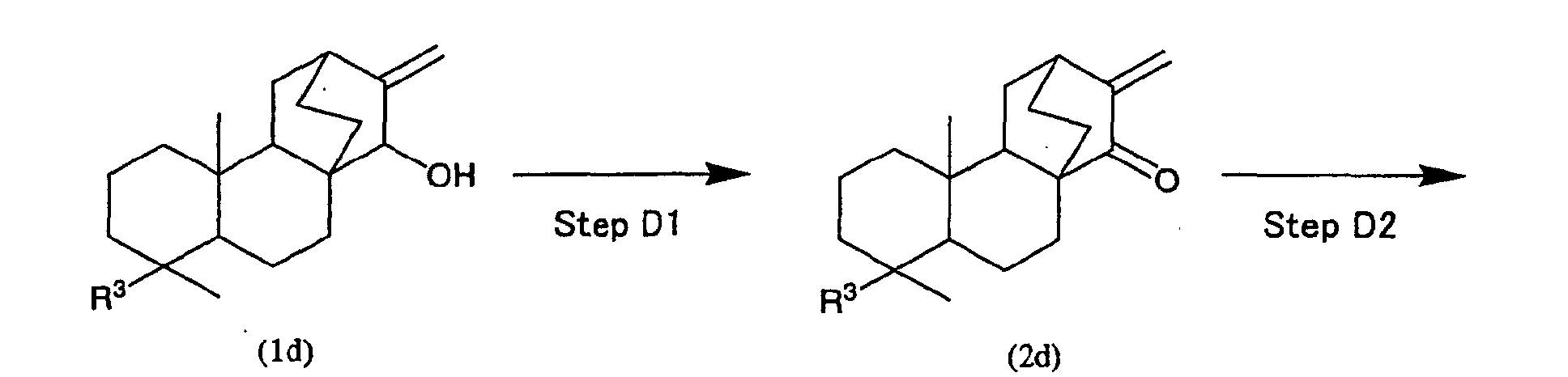 wherein X and R3 are as defined above.
- As Compound (1d) which is a starting material, the aforementioned Compound (2a) or a compound that can synthesize the aforementioned Compound (2a) by appropriately using reactions described in the production method F as necessary can be used.
- Oxidation step from a hydroxyl group to a carbonyl group. Compound (2d) can be obtained in the similar condition as in the above (C-16).
- Step of Michael addition reaction which is a nucleophilic reagent addition reaction to an α,β-unsaturated ketone. By making a nucleophilic reagent react on Compound (2d), it is possible to obtain Compound (3d). As the nucleophilic reagent, the nucleophilic reagents recited in the Production method B can be used, for example.
- As the reaction solvent, benzene, tetrahydrofuran, acetonitrile, dimethylformamide, dimethyl sulfoxide, ethanol and the like can be used. The reaction temperature is from room temperature to heating reflux temperature.
- Reduction step from a carbonyl group to a hydroxyl group. By reacting Compound (3d) with a reducing agent, it is possible to obtain Compound (4d). The reducing agent to be used is a reducing agent commonly used in reduction of ketone, and sodium borohydride, lithium aluminum hydride and the like can be exemplified.
- As the reaction solvent, diethylether, tetrahydrofuran, ethanol, methanol and the like can be used. The reaction temperature is from room temperature to heating reflux temperature.
 wherein X, R3 and Q2 are as defined above.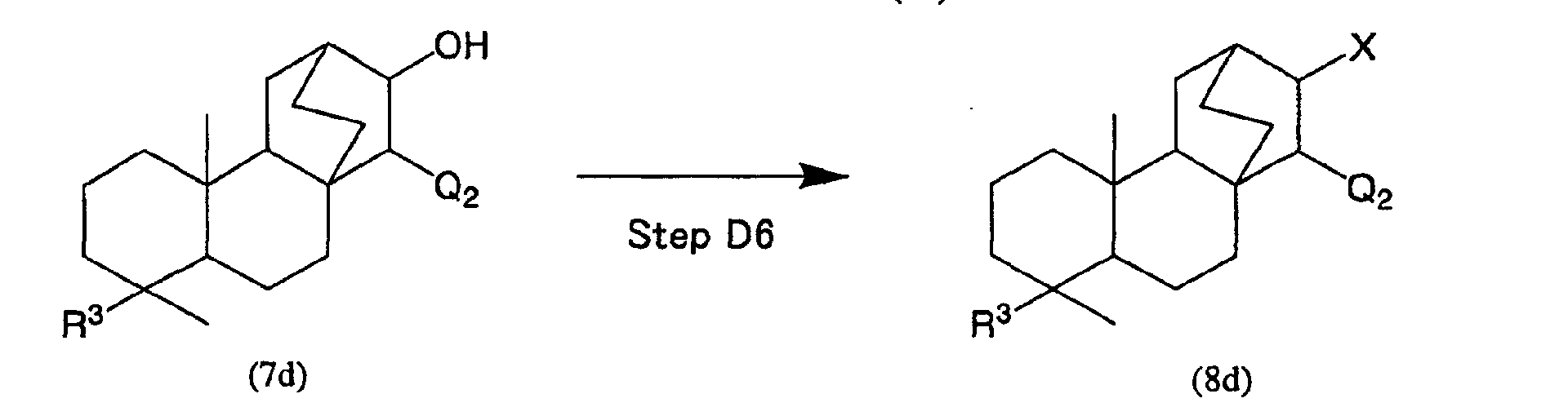
- As Compound (5d) which is a starting material, the aforementioned Compound (2a) or a compound that can synthesize the aforementioned Compound (2a) by appropriately using reactions described in the productionmethods E and F as necessary can be used.
- Step of obtaining Compound (6d) by oxidation cleavage reaction of Compound (5d). As the oxidation cleavage reaction,
- After allowing Compound (5d) to react under oxygen gas flow containing several % of ozone, an oxidative process or a reductive process is conducted to obtain Compound (6d). As the reaction solvent, dichloromethane, ethyl acetate, methanol and the like can be used, and the reaction is conducted at a temperature from - 78°C to room temperature. Following the ozone oxidation reaction, nitrogen displacement, removal of solvent by distillation, addition of solvent and the like are conducted appropriately without isolating the generated ozonide. Then an oxidizing agent or a reducing agent is added to the reaction mixture to allow reaction, thereby obtaining Compound (6d).
- In the case of the oxidative process, hydrogen peroxide, chromic acid-sulfuric acid or the like is used as the oxidizing agent. As the reaction solvent, sulfuric acid, acetic acid or the like is used. The reaction temperature is from room temperature to the reflux temperature.
- In the case of the reductive process, dimethylsulfide, zinc-acetic acid, triethylphosphite or the like is used as the reducing agent. The reaction temperature is from -78°C to room temperature.
- By subjecting Compound (5d) to a decomposition reaction by an oxidizing agent after completion of an osmium oxidation, it is possible to obtain Compound (6d).
- As the oxidizing agent for the osmium oxidation, 1 to 0.1 equivalent of osmium oxide (OsO4) is used. During the osmium oxidation reaction, as a reoxidizing agent, N-methylmorpholine N-oxide or triethylamine oxide may be added to the reaction. As the reaction solvent, acetonitrile, water, acetone and t-butyl alcohol are used in appropriate combination. The reaction temperature is from 0°C to room temperature.
- As the oxidizing agent for decomposition, sodiumperiodate, potassium periodate or lead tetraacetate can be used. As the reaction solvent, benzene, diethylether, water, acetic acid and the like are used in appropriate combination. The reaction temperature is from 0°C to room temperature. In the reaction, a base such as potassium carbonate may be added.
- Reduction step from a carbonyl group to a hydroxyl group. By reacting Compound (6d) which is similar to the above (D-3) with a reducing agent, it is possible to obtain Compound (7d). Examples of the reducing agent to be used is reducing agents used in usual ketone reduction, such as sodium borohydride, lithium aluminum hydride and the like.
- To Compound (1c) in which G1 is a hydroxymethyl group, various substituents can be introduced in the condition similar to that of each reaction described in the above Production method B or C.
-
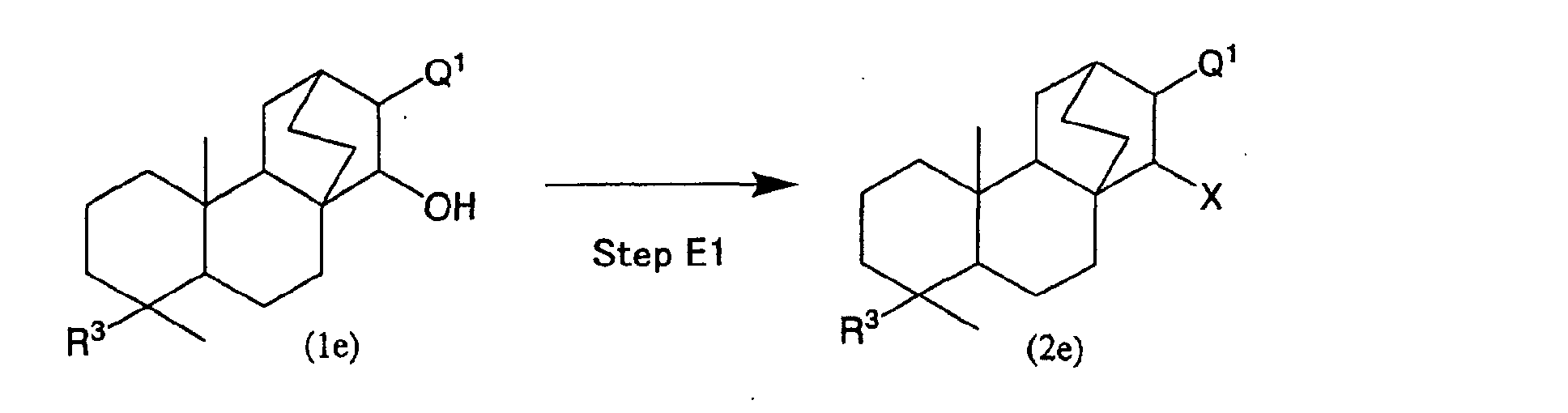
 wherein X, R3, Q1 and Q2 are as defined above.
- As Compound (1e) which is a starting material, the , aforementioned Compound (5a) or a compound that can synthesize the aforementioned Compound (5a) by appropriately using reactions described in the production methods B, C, D and F as necessary can be used.
- Using a condition similar to that of each reaction described in the above Production method B or C, it is possible to obtain Compound (2e).
- Using a condition similar to that of the Production method D1, it is possible to obtain Compound (4e).
- Using a condition similar to that described in (C-18), it is possible to obtain Compound (5e) from Compound (4e).
- Using a condition similar to that described in (C-19) , it is possible to obtain Compound (6e) from Compound (5e).
- wherein R3 and Q1 are as defined above.
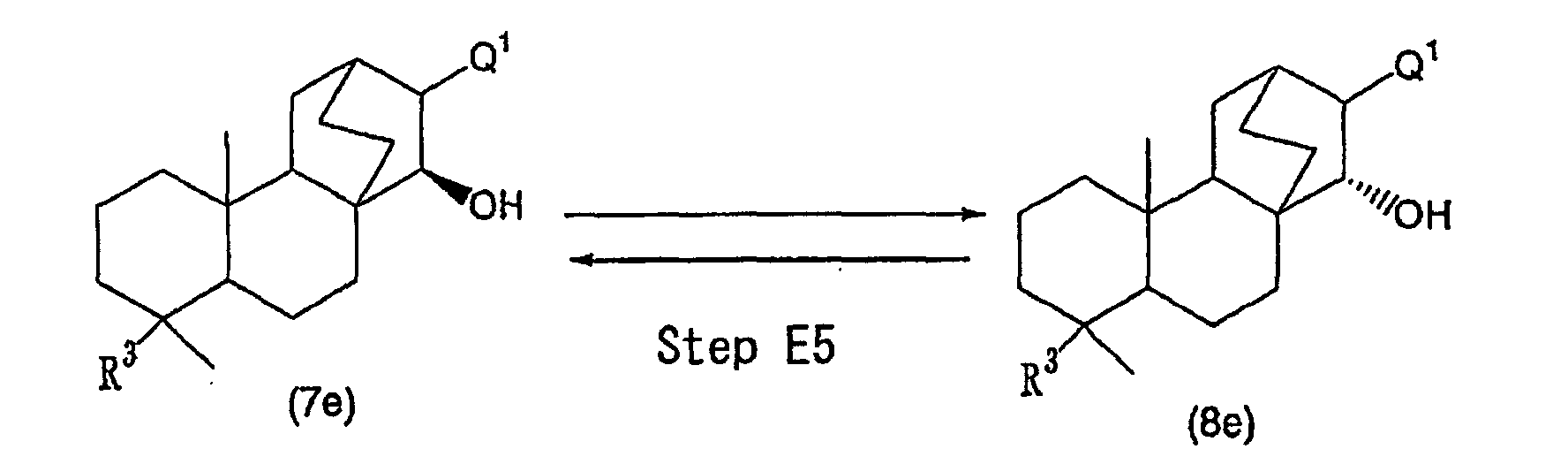
- As Compound (7e) and Compound (8e), the aforementioned Compound (5a) or a compound that can synthesize the aforementioned Compound (5a) by appropriately using reactions described in the production methods B, C, D and F as necessary can be used.
- Inversion of configuration of a hydroxyl group. By reducing Compound (7e) following Mitsunobu reaction or alcohol oxidation, it is possible to obtain Compound (8e) , and also it is possible to obtain Compound (7e) from Compound (8e) in the same manner.
- 1) In the Mitsunobu reaction, a combination of phosphine compound, azodicarboxylate compound and nucleophilic reagent is used. Examples of the phosphine compound include triphenylphosphine and tributylphosphine, and examples of the azodicarboxylate compound include diethylazodicarboxylate and diisopropylazodicarboxylate. Examples of the nucleophilic reagent include formic acid and benzoic acid. The reaction is conducted in a solvent such as tetrahydrofuran at room temperature.
- 2) Concrete examples of the reagents used in the oxidation reaction include, Swan oxidation, sodium hypochlorite, sodium bromate-sodium hydrogensulfite, tetrapropyl ammonium perruthenate and the like.
-
- As the reagent to be used in the subsequent reduction reaction, for example, sodium triacetoxy borohydride, tetramethyl ammonium triacetoxy borohydride and sodium borohydride can be recited.
-
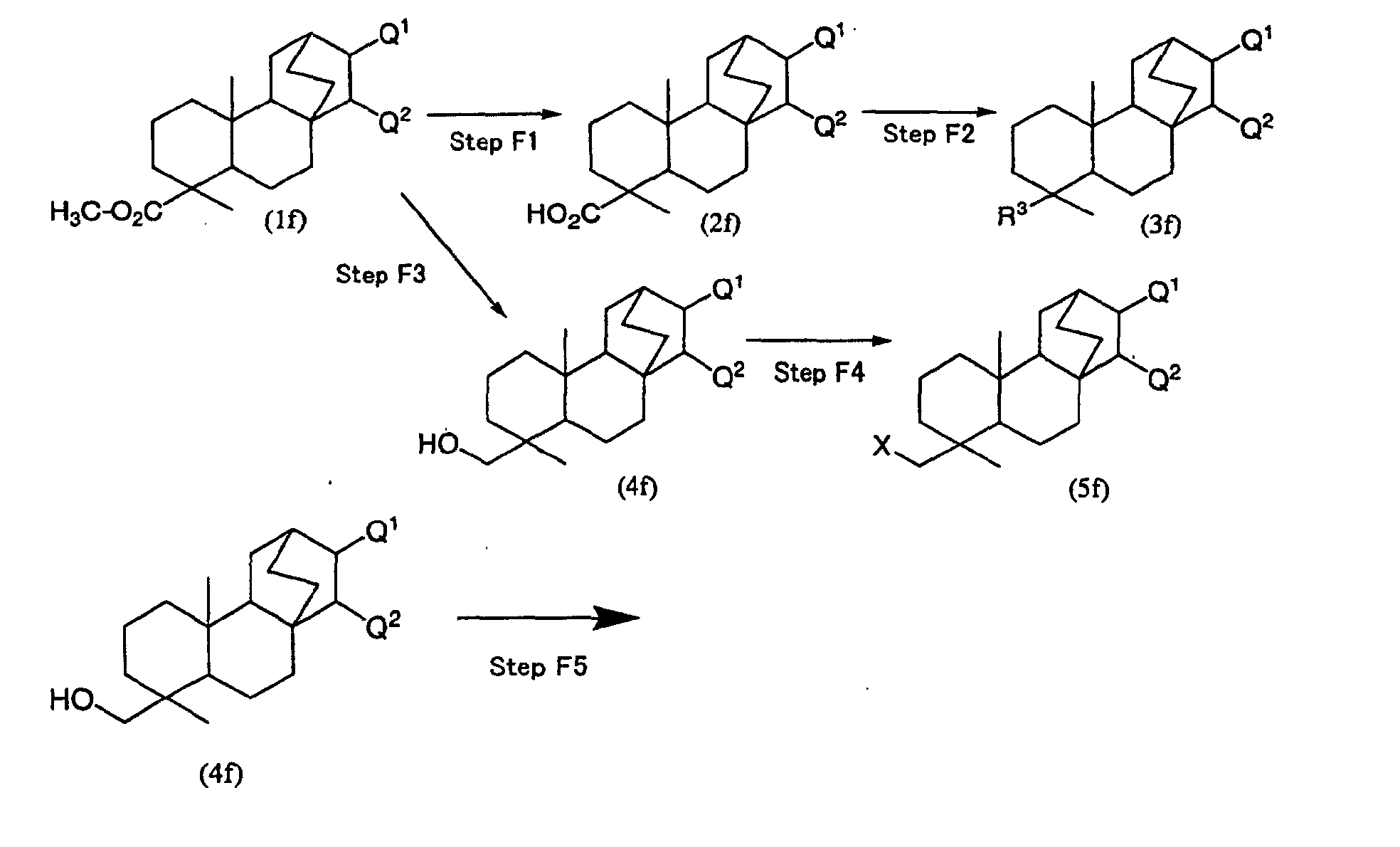 wherein X, R3, Q1, Q2 and R are as defined above, and Xb represents a cyano group, amide group, amino group, acylamino group, sulfonyl amino group or the like. R3c represents a substituent having the same meaning as Q2.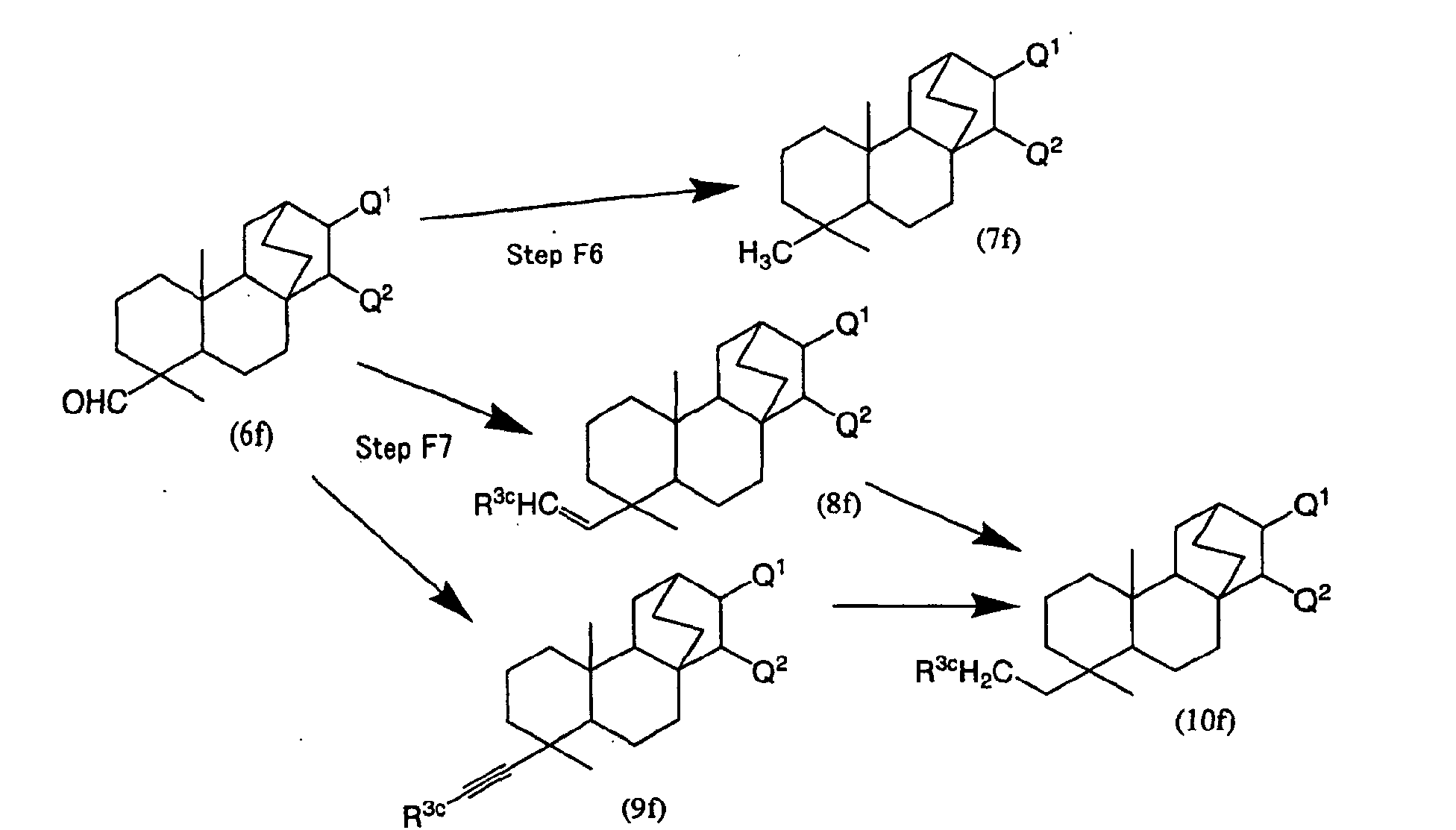
- As Compound (1f) which is a starting material, the aforementioned Compound (5a) or a compound that can synthesize the aforementioned Compound (5a) by appropriately using reactions described in the production methods B, C, D and E as necessary can be used.
- Hydrolysis reaction step from ester to carboxylic acid. Conditions that are used in usual ester hydrolysis can be employed.
- Specifically, by reacting a nucleophilic reagent such as alkaline metal salts of alkylthiol, lithium iodide, lithium bromide, lithium cyanide, sodium cyanide or potassium cyanide on Compound (1f), it is possible to obtain Compound (2f). As the reaction solvent, 1-methyl-2-pyrrolizinone (NMP), dimethylformamide, pyridine, collidine, hexamethylphosphoramide (HMPA) and the like can be used.
- As the alkaline metal slats of alkylthiol, sodium thiomethoxide, sodium thioethoxide, sodium thiopropoxide, lithium thiomethoxide, lithium thioethoxide, lithium thiopropoxide and the like can be exemplified. The reaction temperature is from room temperature to the reflux temperature.
- Using the similar conditions to those in the methods described in the above (C-1), (C-2), (C-8) to (C-11), Compound (3f) can be obtained from Compound (2f).
- Using a condition similar to that of the above (C-12), Compound (4f) can be obtained from Compound (1f).
- Using a condition similar to that of the above (C-13), Compound (5f) can be obtained from Compound (4f).
- Using a condition similar to that of the above (C-16), Compound (6f) can be obtained from Compound (4f).
- Using a condition similar to that of the above (C-17), Compound (7f) can be obtained from Compound (6f).
- Using a condition similar to that of the above (C-18), Compound (8f) or Compound (9f) can be obtained from Compound (6f).
- Using a condition similar to that of the above (C-19), Compound (10f) can be obtained from Compound (8f) or Compound (9f).
-

- Using a condition similar to that of each reaction described in the above Production method B or C, Compound (2g) can be obtained from Compound (1g).
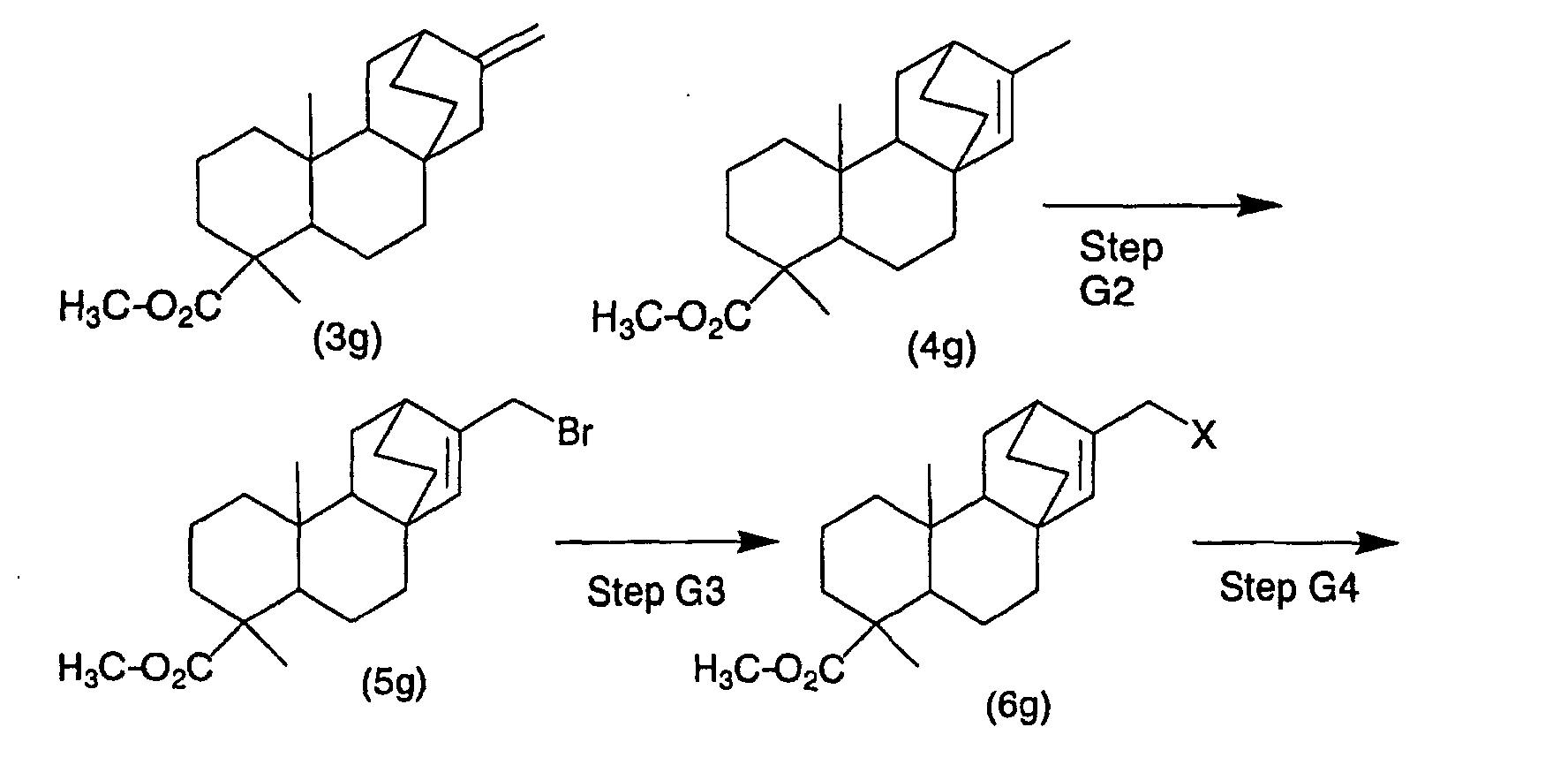 wherein X and R3 are as defined above.
- Step of brominating reaction of Compound (3g) or Compound (4g) to obtain Compound (5g). As the brominating reagent, N-bromosuccinimide and the like can be used.
- In the reaction, benzoyl peroxide, azobisisobutyronitrile (AIBN) and the like may be added at 0.1 to 3% amousnt. As the reaction solvent, carbon tetrachloride, cyclohexane, benzene and the like is used. The reaction temperature is in the range of 0 to 100°C. The reaction may be achieved by ultraviolet irradiation.
- Using the similar condition of each reaction described in the above Production method B or C, Compound (6g) can be obtained from Compound (5g).
- Using the similar condition of each reaction described in the above Production method F, Compound (7g) can be obtained from Compound (6g).
- By appropriately using the reaction conditions described in the above Production methods A to G and using as a starting material Compounds represented by the formulae:

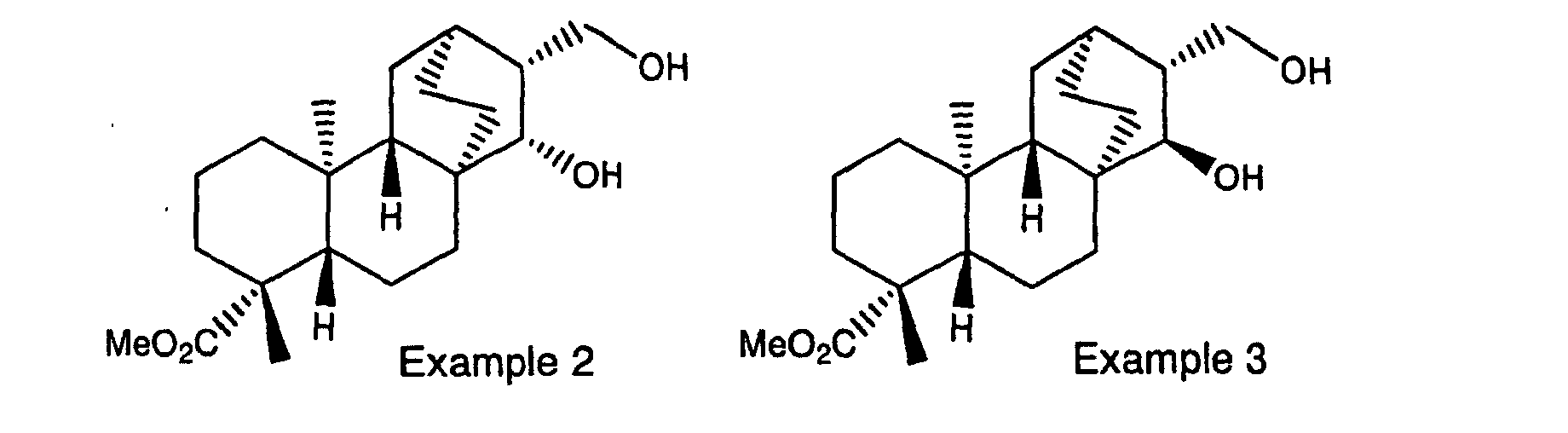 described in Example 1((S1-1), (S1-2), (S1-3)), Example 2, Example 3 or Example 70 , Compound represented by the above formula (Ia) according to the present invention can be produced.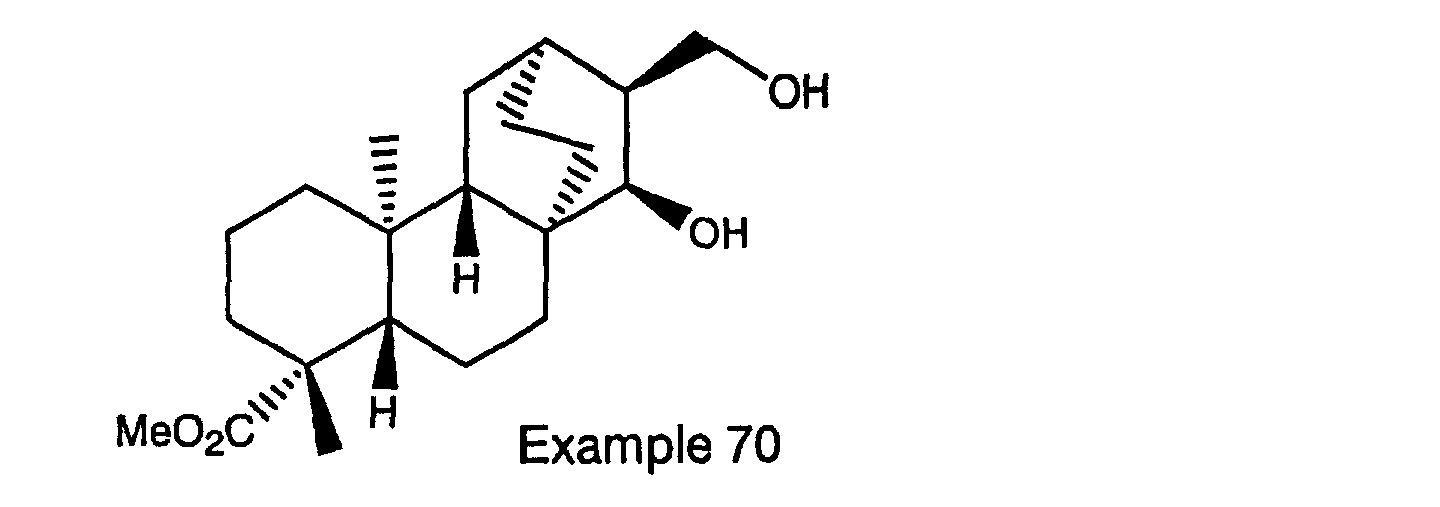
- Various isomers that are obtainable for Compound represented by the above formula (I) can be purified and isolated by means of usual separation means (for example, recrystallization and chromatography).
- The term "skin disease" used in the present description includes atopic dermatitis, contact dermatitis and hyperesthesia.
- The term "neurological disorder" used in the present description include acute neurodegenerative diseases such as disorder by cerebral ischemia, subarachnoid hemorrhage, cerebrovascular disorder acute stage, head injury, spinal cord injury, or neuropathy due to hypoxia or hypoglycemia, chronic neurodegenerative diseases such as Alzheimer disease, Parkinson disease, Huntington chorea, amyotrophic lateral sclerosis (ALS), multiple sclerosis or spinocerebellar degeneration, chronic intractable disease, epilepsy, hepatic encephalopathy, peripheral neuropathy, Parkinson syndrome, spastic paralysis, pain, neuralgia, anxiety, drug dependence, nausea, vomiting, urination disorder, visual disorder due to glaucoma, retinopathy of prematurity, diabetic retinopathy, macular degeneration, hearing disorder by antibiotics, food poisoning and the like.
- The compound according to the present invention, a salt thereof or a hydrate of them can be prepared in the forms of tablet, powder, fine granule, granule, coating tablet, capsule, syrup, troche, inhalant, suppository, injection, ointment, eye ointment, eye drop, nasal drop, ear drops, cataplasm, lotion agent and the like by means of commonly used methods. In preparation, generallyused filler, binder, lubricant, colorant, flavoring agent, as well as stabilizer, emulsifying agent, absorption promoter, surfactant, pH adjusting agent, preservative, anti-oxidant and the like can be used as necessary, and preparation is achieved by means of conventional methods while blending components that are generally used as raw materials of pharmaceutical formulation. For example, in preparing oral formulations, after blending the compound according to the present invention or a pharmaceutically acceptable salt thereof and a filler, as well as a binder, disintegrating agent, lubricant, colorant, flavoring agent and the like as necessary, the mixture is formed into powder, fine granule, granule, tablet, coating tablet, capsule and the like in a conventional method. Examples of the above components include animal and vegetable oils such as soybean oil, beef tallow or synthesis glyceride; hydrocarbons such as liquid paraffin, squalane or solid paraffin; ester oils such as octyldodecyl myristate or isopropyl myristate; higher alcohols such as ceto-stearyl alcohol or behenyl alcohol; silicon resin; silicon oil; surfactants such as polyoxyethylene fatty acid esters, sorbitan fatty acid esters, glycerine fatty acid esters, polyoxyethylene sorbitan fatty acid esters, polyoxyethylene hardened castor oil or polyoxyethylene-polyoxypropylene block copolymer; water-soluble polymers such as hydroxyethyl cellulose, polyacrylic acid, carboxy vinyl polymer, polyethylene glycol, polyvinylpyrrolidone or methyl cellulose; lower alcohols such as ethanol or isopropanol; polyhydric alcohols such as glycerin, propylene glycol, dipropylene glycol or sorbitol; sugars such as glucose or sucrose; inorganic powders such as silicic anhydride, aluminum silicate magnesium or aluminum silicate; and purified water. Examples of the filler include lactose, corn starch, saccharose, glucose, mannitol, sorbit, crystalline cellulose or silicon dioxide; examples of the binder include polyvinyl alcohol, polyvinyl ether, methyl cellulose, ethyl cellulose, gum arabic, gum tragacanth, gelatine, shellac, hydroxypropylmethyl cellulose, hydroxypropyl cellulose, polyvinylpyrrolidone, polypropylene glycol-polyoxyethylene block polymer or meglumine; examples of the disintegrating agent include starch, agar, gelatin, crystalline cellulose, calcium carbonate, sodium hydrogen carbonate, calcium citrate, dextrin, pectin or carboxymethyl cellulose calcium; examples of the lubricant include magnesium stearate, talc, polyethylene glycol, silica or hydrogenated vegetable oil; examples of the colorant include those accepted to be added to pharmaceuticals; and examples of the flavoring agent include cocoa powder, menthol, aromatic powder, mentha oil, borneol and cinnamon powder. It goes without saying that these tablets and granules maybe appropriately coated with sugar, etc. , if necessary. Liquid agents such as syrup or injection formulation may produced by blending the compound according to the present invention or a pharmaceutically acceptable salt thereof with pH regulating agents, a solubilizer, an isotonizing agent, etc., optionally together with solubilizing aids, stabilizers, etc. and processing the resultant blends into preparations by the conventional methods. External preparations may be produced by the conventional methods without restriction. As the bases, therefore, use can be made of various materials commonly used in drugs, quasi drugs, cosmetics, etc. Particular examples of the base materials include animal and vegetableoils, mineral oils, esteroils, waxes, higheralcohols, fatty acids, silicone oils, surfactants, phospholipids, alcohols, polyhydric alcohols, water-soluble polymers, clay minerals andpurified water. If needed, it is possible to further add pH adjusting agents, antioxidants, chelating agents, antiseptics, fungicides, coloring agents, perfumes, etc., though the materials usable as the base in the external preparations of the present invention are not restricted thereto. If necessary, it is also possible to furthermore add other ingredients such as a component having a differentiation-inducing action, blood flow promoter, bactericide, anti-inflammatory agent, cellactivator, vitamins, amino acid, moisturizer or keratin solubilizing agent. The above materials may be added in such amounts as to give the concentrations thereof commonly employed in the production of external preparations.
- In administering the compound according to the present invention, a salt thereof or a hydrate of them, the dosage form is not particularly limited, and they may be administered orally or parenterally by conventionally used manners. They may be formulated and administered in the form of, for example, tablet, powder, granule, capsule, syrup, troche, inhalant, suppository, injection, ointment, eye ointment, eye drop, nasal drop, ear drop, cataplasm, lotion and the like. The dosage amount of the pharmaceutical according to the present invention can be appropriately selected in accordance with severity of symptom, age, sex, body weight, dosage form, type of the salt, particular type of the disease.
- The dosage varies greatly depending on the kind of disease and the severity of symptom, age, sex and sensitivity to drug of the patient, and generally, these compounds are administered to an adult in a dose of about 0.03 to 1000 mg, preferably from 0.1 to 500 mg and still preferably from 0.1 to 100 mg, per day once or several times a day. In the case of injection, generally about 1 µg/kg to 3000 µg/kg, and preferably about 3 µg/kg to 1000 µg/kg is administered.
- In the present description, "Me" denotes a methyl group, "Ph" denotes a phenyl group, "Ts" denotes a p-toluenesulfonyl group, "Ms" denotes a methanesulfonyl group, "Ac" denotes an acetyl group, "Boc" denotes a t-butoxycarbonyl group, and "MOM" denotes a methoxymethyl group.
- The present invention can provide a novel compound which exhibits a protective effect against cell injury due to radical while exhibiting an excellent nerve protective effect by efficiently suppressing neurotoxicity induced by excitatory neurotransmitters. The compound of the present invention represented by the above formula (I) is particularly useful as an agent for treating or preventing a disease to which glutamate-induced neurotoxicity relates and a disease to which NO-induced neurotoxicity relates, and is useful as an agent for treating or preventing, for exmaple, acute neurodegenerative diseases such as subarachnoid hemorrhage, cerebrovascular disorder acute stage, head injury, disorder by cerebral ischemia, spinal cord injury, or neuropathy due to hypoxia or hypoglycemia, chronic neurodegenerative diseases such as Alzheimer disease, Parkinson disease, Huntington chorea, amyotrophic lateral sclerosis (ALS), multiple sclerosis or spinocerebellar degeneration, chronic intractable disease, epilepsy, hepatic encephalopathy, peripheral neuropathy, Parkinson syndrome, spastic paralysis, pain, neuralgia, anxiety, drug dependence, nausea, vomiting, urination disorder, visual disorder due to glaucoma, retinopathy of prematurity, diabetic retinopathy, macular degeneration, hearing disorder by antibiotics, food poisoning and various skin diseases.
-
- Fig . 1 is a view showing the proton NMR spectrum (500 MHz : ppm in CD3OD) of the substance obtained in Example 2 (Serofendic acid A (isomer 1)).

- Fig. 2 is a view showing the proton NMR spectrum (500 MHz : ppm in CD3OD) of the substance obtained in Example 2 (Serofendic acid B (isomer 2)).

-
- Compounds according to the present invention can be produced by the methods described in the following Examples. However, these Examples are given exemplification, and the compounds according to the present invention are not anyway limited to these concrete examples.
- Methyl ent-15α-hydroxy-16-atisene-19-oate (S1-1)
Methyl ent-15β-hydroxy-16-atisene-19-oate (S1-2)
Methyl ent-17-hydroxy-15-atisene-19-oate (S1-3)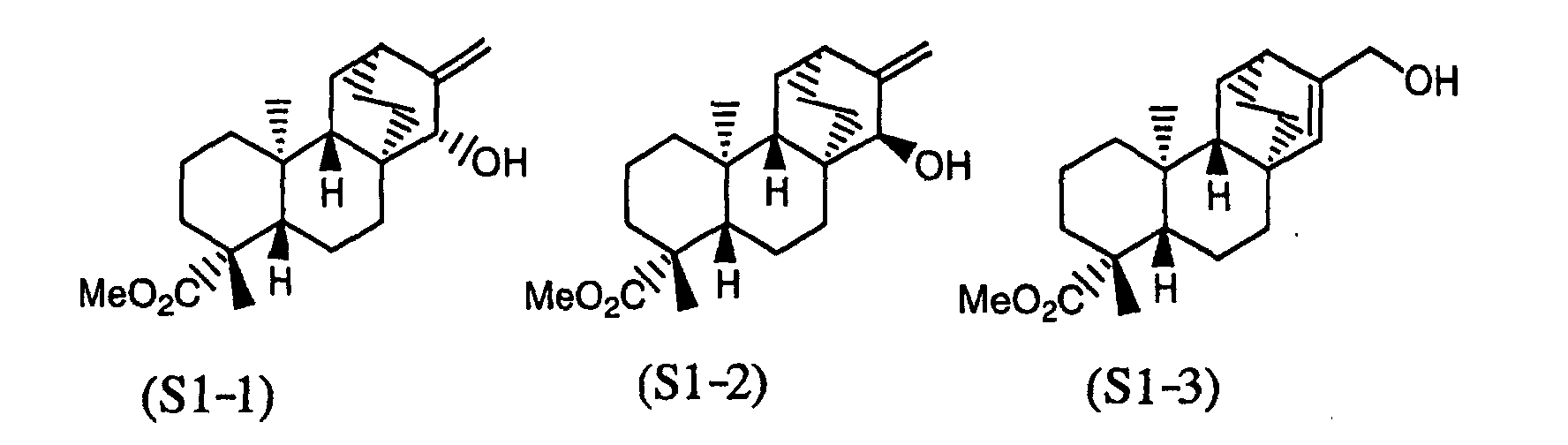
- To a solution of silica gel bearing selenium dioxide (4.76%) (0. 86 g, 0.369 mmol) in dichloromethane (21.2 mL) was added a 70% aqueous t-butyl hydroperoxide (0.44 mL, 3.18 mmol) was added at room temperature under stirring, followed by stirring at room temperature for 20 minutes. A 10 mL solution of an approx. 4:1 mixture (336 mg, 1. 06 mmol) of methyl ent-16-atisene-19-oate and methyl ent-15-atisene-19-oate mixture in dichloromethane (10 mL) (J. Org. Chem., Vol. 36, No. 18, 1971, 2625-2631) was added thereto, followed by stirring at room temperature for 2.5 hours. Then saturated aqueous sodium thiosulfate was added, and the mixture was extracted twice with diethyl ether. The resulting organic layer was washed with saturated brine, dried over magnesium sulfate and evaporated. The resulting residue was purified by silica gel column chromatography, to give methyl ent-15α-hydroxy-16-atisene-19-oate (S1-1) (92mg, white crystals), methyl ent-15β-hydroxy-16-atisene-19-oate (S1-2) (84 mg, white crystals) and methyl ent-17-hydroxy-15-atisene-19-oate (S1-3) (18mg, white crystals).
(S1-1) FAB-MS:m/z=333 (M+H)+
1H NMR (CDCl3) ; δ (ppm) 0. 76-1. 91 (17H, m) , 0. 83 (3H, s), 1. 19 (3H, s), 2. 17 (1H, d, J=12. 8Hz) , 2. 27-2. 32 (1H, m), 3. 60 (1H, d, J=2. 0Hz), 3. 65 (3H, s), 4. 99 (1H, t, J=1. 6Hz), 5. 06 (1H, t, J=1. 6Hz).
(S1-2) FAB-MS:m/z=333 (M+H)+
1H NMR (CDCl3) ; δ (ppm)
0. 78-1. 92 (16H, m), 0. 82 (3H, s), 1. 19 (3H, s), 1. 98-2. 08 (1H, m) , 2. 17 (1H, d, J=13. 2Hz), 2. 29-2. 33 (1H, m), 3. 58-3. 62 (1H, m) , 3. 66 (3H, s) , 5. 02 (1H, t, J=1. 6Hz), 5. 0 8 (1H, t, J=1. 6Hz)
(S1-3) FAB-MS:m/z=333 (M-m)+
1H NMR (CDCl3) ; δ
(ppm) 0. 78-1. 93 (16H, m), 0. 80 (3H, s) , 1. 19 (3H, s), 2. 00 (1H, ddd, J=12. 8, 9. 6, 3. 2Hz) , 2. 11-2. 21 (1H, m) , 2. 43-2. 48 (1H, m) 3. 65 (3H, s) , 4. 13 (2H, s) , 5. 84 (1H, d, J=1. 6Hz) -

- To a solution of methyl ent-15α-hydroxy-16-atisene-19-oate (2.68 g, 8.1 mmol) in tetrahydrofuran (162 mL) was addeda solution of 1. 0 Mborane-tetrahydrofuran complex in tetrahydrofuran (24.3 mL, 24.3 mmol) under stirring on ice, followed by stirring at room temperature for 14 hours. Under stirring on ice, water (11.3 mL), a 3N aqueous sodium hydroxide (22.7 mL) and a 30% aqueous hydrogen peroxide (22.7 mL) were added thereto, followed by stirring at room temperature for 1 hour and 40 minutes. Water was added thereto, and the mixture was extracted twice with ethyl acetate. The resulting organic layer was washed with saturated brine, dried on magnesium sulfate and then evaporated. The resulting residue was purified by silica gel column chromatography, to give methyl ent-15α,17-dihydroxy-16α-atisane-19-oate (2.47 g, white crystals).
FAB-MS:m/z=351(M+H)+
1H NMR (CDCl3) ; δ (ppm)
0. 78-1. 91 (18H, m), 0. 82 (3H, s), 1. 18 (3H, s), 2. 04-2. 13 (1H, m), 2. 17 (1H, d=13. 6H z), 3. 52 (1H, d, J=9. 6Hz), 3. 56 (1H, dd, J=10. 6, 4. 6Hz), 3. 65 (3H, s), 4. 03 (1H, t, J= 10. 6Hz). -

- Methyl ent-15α,17-dihydroxy-16α-atisane-19-oate (1.95 g, 5.6 mmol) and sodium bromate (2.03 g, 13.5 mmol) were dissolved in acetonitrile (22.4 mL) and water (6.7 mL) and a solution of sodium hydrogensulfite (1.64 g, 13.5 mmol) in water (13.4 mL) was added thereto under stirring on ice. After stirring at room temperature for 2 hours, diethyl ether was added, and the mixture was washed with water, saturated aqueous sodium thiosulfate and saturated brine, dried over magnesium sulfate and then evaporated, to give the title compound (1.79 g).
1H NMR (CDCl3) ; δ (ppm) 0. 81-2. 39 (20H, m), 0. 89 (3H, s), 1. 19 (3H, s), 2.85 (1H, broad , J=9. 6Hz), 3. 61-3. 70 (1H, m), 3. 66 (3H, s), 3. 89 (1H, t, J=9.6Hz). -
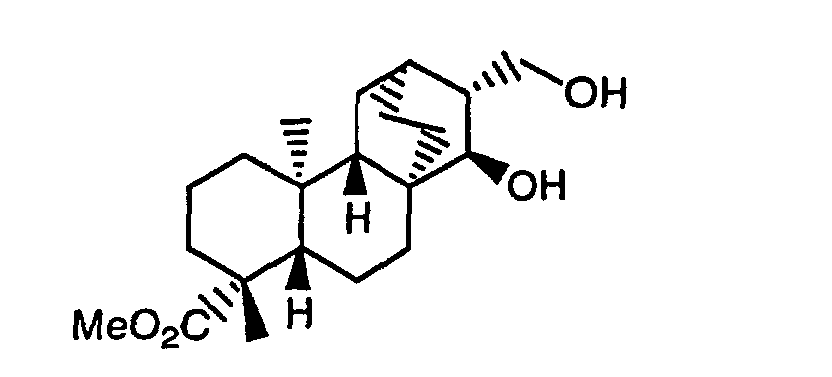
- To a solution of sodium triacetoxy borohydride (5.62 g, 26.5 mmol) in acetonitrile (53 mL) was added acetic acid (3.03 mL, 53 mmol) under stirring on ice. Under stirring on ice, a solution of methyl ent-17-hydroxy-15-oxo-16α-atisane-19-oate (1.84 g) in acetonitrile (25 mL) was added thereto, followed by stirring for 5 hours by keeping ice-cooling. Under stirring on ice, water was added thereto and the mixture was extracted twice with ethyl acetate . The resulting organic layer was washed with saturated brine, dried over magnesium sulfate and evaporated. The resulting residue was purified by silica gel column chromatography, to give methyl ent-15β,17-dihydroxy-16α-atisane-19-oate(1.64 g, white foam). ESI-MS:m/z=373 (M+Na)+
1H NMR (CDCl3) ; δ (ppm) 0. 69-1. 90 (18H, m), 0. 80 (3H, s), 1. 18 (3H, s) 1. 98 (1H, ddd, J=14. 4 and 11. 4 and 3. 2Hz), 2. 17 (1H, d, J=13. 6Hz) 2. 96 (1H, d. J=4. 0Hz), 3. 58-3. 72 (2H, m) , 3. 65 (3H, s) -

- To a solution of methyl ent-15β,17-dihydroxy-16α-atisane-19-oate (72 mg, 0.205 mmol) in pyridine (4.1 mL) were added dimethylaminopyridine (75 mg, 0. 614 mmol) and tosyl chloride (234 mg, 1.23 mmol) under stirring on ice. After stirring at room temperature for 17 hours, water was added under ice-cooling and the mixture was extracted twice with diethyl ether. The resulting organic layer was washed with saturated brine, dried over magnesium sulfate and then evaporated. The resulting residue was purified by silica gel column chromatography, to give methyl ent-15β-hydroxy-17-tosyloxy-16α-atisane-19-oate (99 mg pale yellow crystals).
1H NMR (CDCl3) ; δ (ppm) 0. 68-1. 99 (19H, m), 0. 77 (3H, s), 1. 17 (3H, s) 2. 16 (1H, d, J=12. 8Hz), 2. 46 (3H, s), 2. 78-2. 83 (1H, m) , 3. 64 (3H, s) 3. 97 (1H, t, J=8. 8Hz), 4. 06 (1H, dd, J=8. 8and8. 2Hz), 7. 35 (2H, d, J=8. 4Hz), 7. 81 (2 H, d, J=8. 4Hz) -
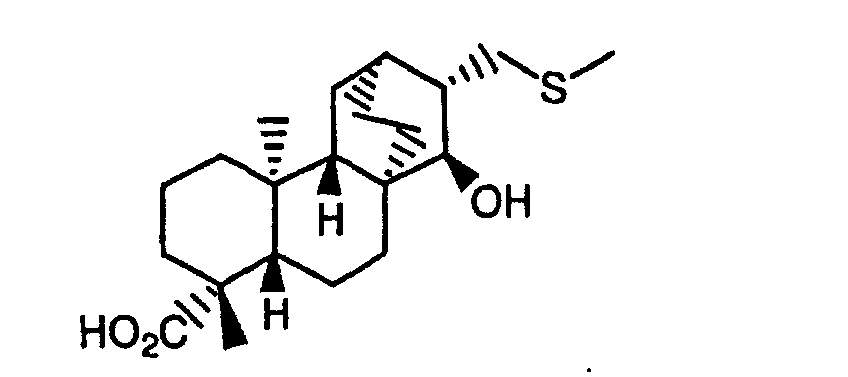
- To a solution of methyl ent-15β-hydroxy-17-tosyloxy-16α-atisane-19-oate (1.66 g, 3.3 mmol) in hexamethylphosphoramide (16.5 mL) was added sodium thiomethoxide (1.16 g, 16.6 mmol) under stirring at room temperature, followed by stirring at 90°C in nitrogen atmosphere for 43 hours. The reaction mixture was recovered to room temperature, saturated aqueous ammonium chloride was added thereto, and the mixture was extracted twice with ethyl acetate. The resulting organic layer was washed with saturated brine, dried over magnesium sulfate and evaporated. The resulting residue was purified by silica gel column chromatography, to give ent-15β-hydroxy-17-methylthio-16α-atisane-19-oic acid (923 mg, pale yellow crystals).
ESI-MS:m/z= 365 (M-H)-
1H NMR (CDCl3) ; δ (ppm) 0. 75 (1H, dt, J=13. 0 and 6. 6Hz), 0. 92 (3H, s) 0. 94-1. 92 (18H, m), 1. 25 (3H, s), 1. 97 (1H, ddd, J=14. 4 and 11. 4 and 3. 0Hz), 2. 15 (3H, s), 2. 51-2. 56 (2H, m), 2. 96 (1H, d, J=4. 4Hz) -
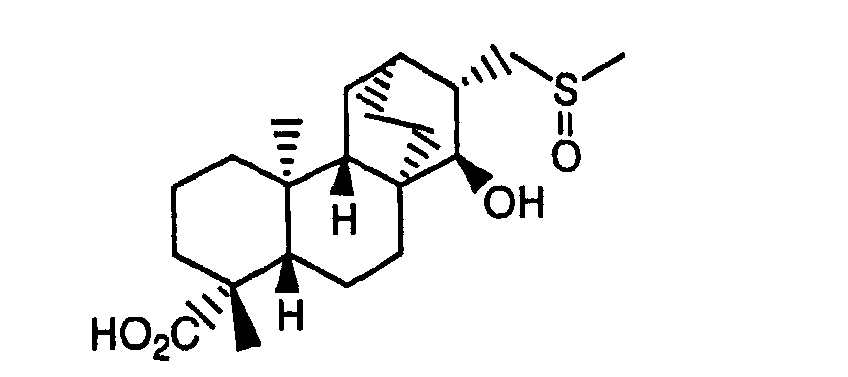
- To a solution of ent 15β-hydroxy-17-methylthio-16α-atisane-19-oic acid (93 mg, 0.254 mmol) in chloroform (2.54 mL) was added 2-(phenylsulfonyl)-3-phenyloxaaziridine (86 mg, 0.329 mmol) (J. Am. Chem. Soc. , 102, 2000 (1980)) under stirring on ice, followed by stirring for 2 hours. Dimethylsulfide (0.1 mL) was added and the mixture was evaporated. The resulting residue was purified by silica gel column chromatography. Further, 2 isomers are separated based on the configuration of sulfoxide by HPLC, to give isomer 1 (23.7 mg, white crystals) and isomer 2 (44.6 mg, white crystals). Serofendic acid A (isomer (1))
ESI-MS:m/z=405 (M+Na)+
1H NMR (CD3OD) ; δ (ppm) 0. 76-0. 87 (1H, m), 0. 901. 09 (4H, m) , 0. 94 (3H, s) 1. 19 (3H, s), 1. 32-1. 44 (3H, m), 1. 51-2. 06 (11H, m), 2. 12 (1H, d, J=14. 0Hz), 2. 67 (3 H, s), 2. 82 (1H, dd, J=13. 2 and 6. 0Hz), 2. 90-2. 98 (2H, m)
Serofendic acid B (isomer (2))
ESI-MS:m/z=405 (M+Na)+
1H NMR (CD3OD) ; δ (ppm)
0. 76-0. 87 (1H, m), 0. 91-1. 11 (4H, m), 0. 95 (3H, s), 1. 19 (3H, s) , 1. 33-1. 48 (3H, m), 1. 52-2. 08 (11H, m), 2. 13 (1H, d, J=13. 6Hz), 2. 69 (3H, s), 2. 87 (1H, dd, J=13. 0 and 9. 0Hz), 2. 91 (1H, d, J=4. 0Hz), 2. 99 (1H, dd, J=13. 0 and 7. 0Hz) -
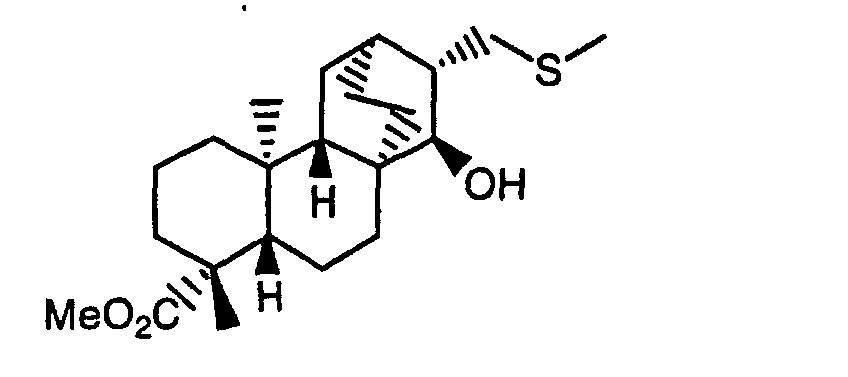
- To a solution of methyl ent-15β-hydroxy-17-tosyloxy-16α-atisane-19-oate (44 mg, 0.0827 mmol) in dimethylformamide (1.75 mL) was added sodium thiomethoxide (12 mg, 0.171 mmol) under stirring at room temperature, followed by stirring for 80 minutes at room temperature. A saturated ammonium chloride solution was added, and the mixture was extracted twice with diethyl ether. The resulting organic layer was washed with saturated brine, dried over magnesium sulfate and then evaporated, to give methyl ent-15β-hydroxy-17-methylthio-16α-atisane-19-oate (34 mg, pale yellow crude crystals).
1H NMR (CDCl3) ; δ (ppm)
0. 69-0. 79 (1H, m), 0. 80 (3H, s), 0. 89-2. 02 (19H, m), 1. 18 (3H, s), 2. 15 (3H, s), 2.51 -2. 56 (2H, m) , 2. 93-2. 97 (1H, m), 3. 65 (3H, s) -
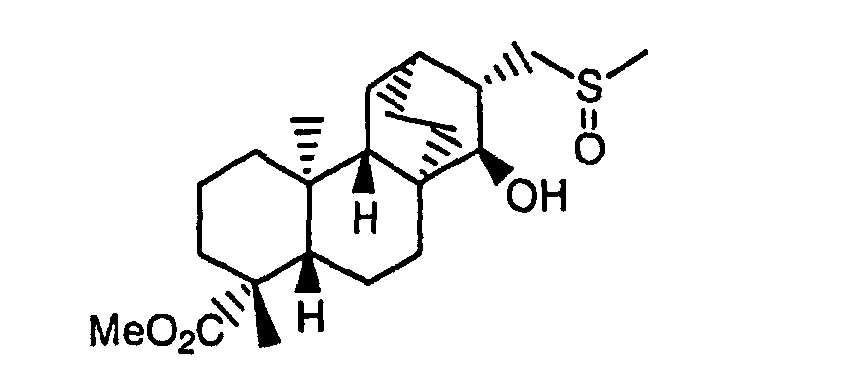
- To a solution of methyl ent-15β-hydroxy-17-methylthio-16α-atisane-19-oate (34 mg, 0.0893 mmol) in chloroform (1.5 mL) was added 2-(phenylsulfonyl)-3-phenyloxaaziridine (34.2 mg, 0.131 mmol) under stirring on ice, followed by stirring for 40 minutes. Dimethylsulfide (0.1 mL) was added, and the mixture was evaporated. The resulting residue was purified by silica gel column chromatography, to give methyl ent-15β-hydroxy-17-methylsulfinyl-16α-atisane-19-oate (31.6 mg white crystals).
1H NMR (CD3OD) ; δ (ppm)
0. 76-2. 04 (19H, m), 0. 83 (3H, s) , 1. 17 (3H, s), 2. 14 (1H, d, J=13. 9Hz), 2. 67 and 2. 69 (3H, s × 2) , 2. 78-3. 03 (3H, m), 3. 28 (3H, s) -

- To a solution of ent-15β-hydroxy-17-methylthio-16α-atisane-19-oic acid (27mg, 0.0737 mmol) in acetic acid (0.74 mL) was added a 30% aqueous hydrogen peroxide under stirring at room temperature. After stirring at 50°C for 1 hour, the mixture was allowed to cool to room temperature, and saturated sodium thiosulfate was added and extracted twice with ethyl acetate. The resulting organic layer was washed with saturated brine, dried over magnesium sulfate and evaporated. The resulting residue was purified by silica gel column chromatography, to give ent-15β-hydroxy-17-methylsulfonyl-16α-atisane-19-oic acid (11 mg, white crystals).
FAB-MS:m/z=397 (M-H)-
1H NMR (CD3OD) ; δ (ppm)
0. 75-0. 86 (1H, m), 0. 87-2. 09 (18H, M), 0. 94 (3H, s), 1. 18 (3H, s), 2. 13 (1H, d, J=12. 8Hz), 2. 936 (1H, d, J=4. 0Hz), 3. 025 (3H, s) , 3. 17 (1H, dd, J=14. 0 and 7. 2Hz) -

- From ent-15β-hydroxy-16-atisene-19-oate obtained in Example 1, methyl ent-15α-hydroxy-17-tosyloxy-16β-atisane-19-oate was obtained in the same manners as described in Examples 2, 3 and 4.
1H NMR (CDCl3) ; δ (ppm) 0. 70-1. 88 (19H, m), 0. 80 (3H, s), 1. 17 (3H, s)
2. 17 (1H, d, J = 13.6Hz), 2. 46 (3H, s), 2. 77 (1H, broad s) , 3. 64 (3H, s) 3. 95 (1H, t, J=9. 2Hz), 4. 04 (1H, dd, J=9. 2 and 7. 0Hz), 7. 35 (2H, d, J=8. 4Hz), 7. 80 (2H, d, 1=8. 4Hz) -

- From methyl ent-15α-hydroxy-17-tosyloxy-16β-atisane-19-oate (157 mg, 0.311 mmol) obtained in Example 10, ent-15α-hydroxy-17-methylthio-16β-atisane-19-oic acid (39 mg, pale yellow syrup) was obtained in the same manner as described in Example 5.
ESI-MS:m/z=365 (M-H)-
1H NMR (CDCl3) ; δ (ppm) 0. 93 (3H, s), 1. 25 (3H, s), 2. 14 (3H, s), 2. 14-2. 21 (1H, m) 2. 50-2. 56 (2H, m), 2. 91-2. 95 (1H, m) -

- From ent-15α-hydroxy-17-methylthio-16β-atisane-19-oic acid (39 mg, 0.106 mmol) obtained in Example 11, ent-15α-hydroxy-17-methylsulfinyl-16β-atisane-19-oic acid (27 mg, white crystals) was obtained in the same manner as described in Example 6.
ESI-MS:m/z=381 (M-H)-
1H HMR (CD3OD) : δ (ppm) 0.80-1.98 (19H, m), 0.96 (3H, s), 1.18 (3H, s) 2. 13 (1H, d, J=13. 6Hz) , 2. 67 and 2. 69 (3H, s×2), 2. 79-3. 00 (3H, m) -
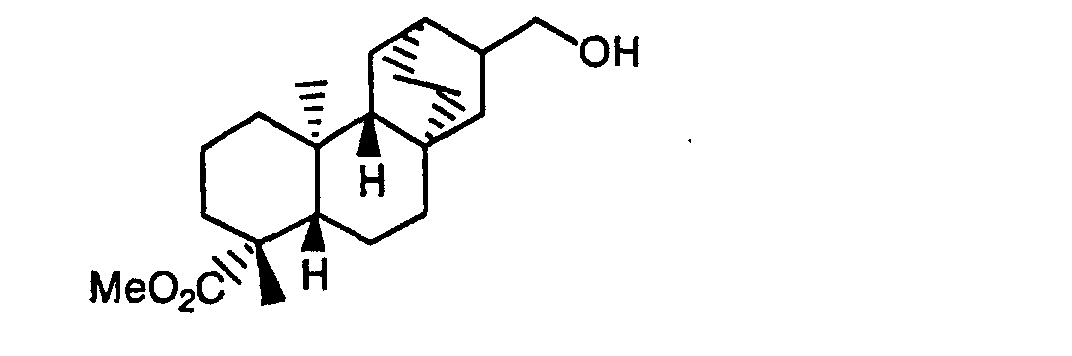
- From methyl ent-16-atisene-19-oate (J. Org. Chem., Vol. 36, No. 18, 1971, 2625-2631) (115 mg, 0.363 mmol), methyl ent-17-hydroxy-16α,β-atisane-19-oate (76.2 mg, colorless amorphous) was obtained in the same manner as described in Example 2.
1H NMR (CDCl3) ; δ (ppm) 0. 53-1. 94 (21H, m), 0. 768 and 0. 774 (3H, s × 2) 1. 163 and 1. 169 (3H, s×2), 2. 161 (1H, d, J=12. 8Hz), 3. 47-3. 56 (2H, m) 3. 640 and 3. 642 (3H, s × 2) -
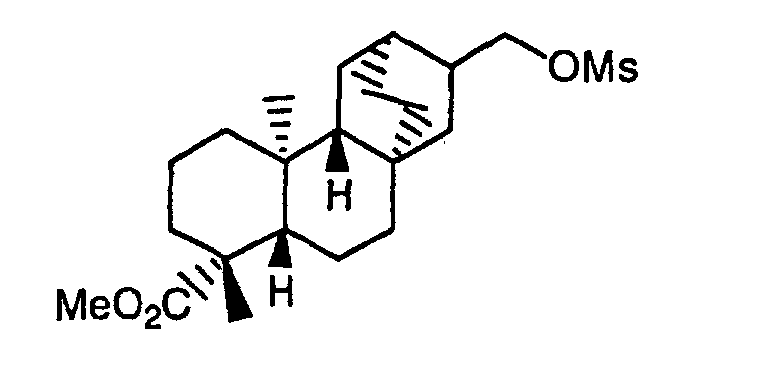
- To a solution of methyl ent-17-hydroxy-16α,β-atisane-19-oate obtained in Example 13 (76.2 mg, 0.228 mmol) in dichloromethane (2.28 mL) were added triethylamine (0.159mL, 1.14 mmol) andmethanesulfonylchloride (0.053 mL, 0.685 mmol) under stirring on ice. After stirring on ice for 2 hours, diethyl ether was added, and the mixture was washed with water and saturated brine, dried over magnesium sulfate and then evaporated, to give methyl ent-17-mesyloxy-16α,β-atisane-19-oate (94 mg).
1H NMR (CDCl3); δ (ppm) 0. 766 and 0. 772 (3H, s×2), 1. 167 and 1. 171 (3H, s×2) 3. 006 and 3. 007 (3H, s × 2), 3. 642 (3H, s), 4. 06-4. 15 (2H, m) -
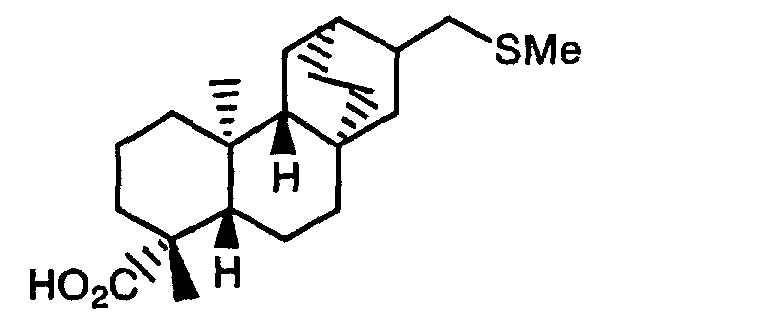
- To a solution of methyl ent-17-mesyloxy-16α,β-atisane-19-oate (94 mg, 0.228 mmol) obtained in Example 14 in dimethylformamide (5 mL) was added sodium thiomethoxide (64 mg, 0.913 mmol) under stirring at room temperature. After stirring at 60°C for 5 hours, the reaction mixture was allowed to cool to room temperature. Saturated aqueous ammonium chloride was added thereto, and the mixture was extracted twice with ethyl acetate. The resulting organic layer was washed with saturated brine, dried over magnesium sulfate and evaporated. The resulting residue was purified by silica gel column chromatography, to give ent-17-methylthio-16α,β-atisane-19-oic acid (44.3 mg, white crystals).
ESI-MS:m/z=349 (M-H)-
1H NMR (CDCl3) ; δ (ppm) 0. 68-1. 93 (21H, m), 0. 881 and 0. 887 (3H, s × 2), 1. 231 and 1. 235 (3H, s × 2), 2. 091 (3H, s), 2. 12-2. 19 (1H, m), 2. 42-2. 56 (2H, m) -

- From ent-17-methylthio-16α,β-atisane-19-oic acid (21.8 mg, 0.0622 mmol) obtained in Example 15, ent-17-methylsulfinyl-16α,β-atisane-19-oic acid (19.2 mg, colorless amorphous) was obtained in the same manner as described in Example 6.
ESI-MS:m/z=365 (M-H)-
1H NMR (CD3OD) ; δ (ppm) 0. 80-2. 00 (20H, m), 0. 923 and 0. 928 (3H, s × 2) 1. 176 and 1. 179 (3H, s × 2), 2. 120 (1H, d, J=13. 2Hz), 2. 15-2. 27 (1H, m) 2. 629-2. 661 (3H, m), 2. 74-2. 93 (2H, m) -

- To a solution of ent-15β-hydroxy-17-methylthio-16α-atisane-19-oic acid (110 mg, 0.300 mmol) obtained in Example 5 in pyridine (1 mL) was added acetic anhydride (0.1 mL) under stirring on ice, followed by stirring at room temperature for 5 hours. The reaction mixture was ice-cooled, water was added, and the mixture was extracted twice with ethyl acetate . The resulting organic layer was washed withsaturatedbrine, driedovermagnesiumsulfateandevaporated. The resulting residue was purified by silica gel column chromatography, to give ent-15β-acetoxy-17-methylthio-16α-atisane-19-oic acid (112 mg, pale yellow crystals).
1H NMR (CDCl3) ; δ (ppm) 0. 80-2. 10 (19H, m), 0. 91 (3H, s), 1. 25 (3H, s), 2. 08 (3H, s) 2. 11 (3H, s), 2. 13-2. 21 (1H, m), 2. 50 (1H, dd, J=12. 4 and 10. 4Hz) 2. 84 (1H, dd, J=12. 4 and 6. 2Hz), 4. 18 (1H, d, J=4. 0Hz) -
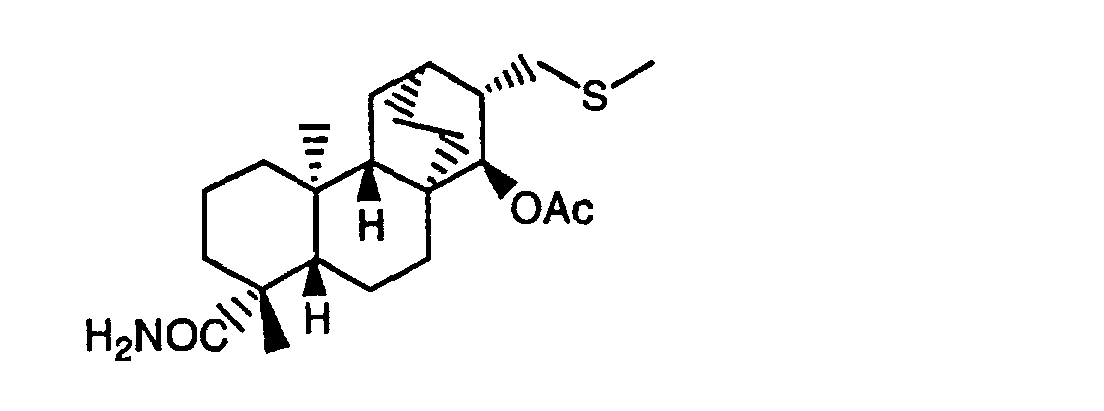
- To a solution of ent-15β-acetoxy-17-methylthio-16α-atisane-19-oic acid (22mg, 0. 054 mmol) obtained by Example 17 in dichloromethane (2.1 mL) was added oxalyl chloride (14 µl, 0.160 mmol) under stirring on ice. After stirring at room temperature for 1 hour, ammonia gas was blown into the reaction mixture for 30 seconds. Water was added, and the mixture was extracted twice with ethyl acetate. The resulting organic layer was washed with saturated brine, dried over magnesium sulfate and evaporated, to give ent-15β-acetoxy-17-methylthio-16α-atisane-19-amide (28 mg, pale yellow crystals).
1H NMR (CDCl3) ; δ (ppm) 0. 79-2. 10 (20H, m), 0. 96 (3H, s), 1. 20 (3Hs), 2. 08 (3H, s) 2. 11 (3H, s), 2. 50 (1H, dd, J=12. 4 and 10. 4Hz), 2. 831 (1H, dd, J=12. 4 and 6. 0Hz) 4. 18 (1H, d, J=4. 0Hz), 5. 35 (1H, broad s), 5. 575 (1H, broad s) -
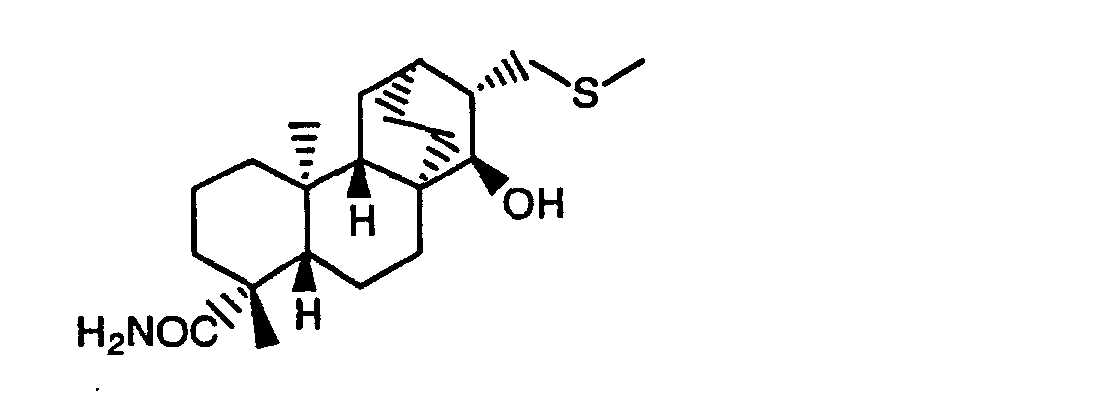
- To a solution of ent-15β-acetoxy-17-methylthio-16α-atisane-19-amide (10.1 mg, 0.0248 mmol) obtained in Example 18 in ethanol (0.5 mL) was added sodium hydroxide (40 mg, 1.00 mmol) under stirring at room temperature, followed by stirring for 14 hours at room temperature. Water was added and the mixture was extracted twice with ethyl acetate. The resulting organic layer was washed with saturated brine, dried over magnesium sulfate and evaporated, to give ent-15β-hydroxy-17-methylthio-16α-atisane-19-amide (8.1 mg).
1H NMR (CDCl3) ; δ (ppm) 0. 66-2. 12 (20H, m), 0. 96 (3H, s), 1. 21 (3h, s), 2. 15 (3H, s) 2. 48-2. 56 (2H, m) 2. 96 (1H, d, J=4. 0Hz), 5. 39 (1H, broad s), 5. 59 (1H, broad s) -

- From ent-15β-hydroxy-17-methylthio-16α-atisane-19-amide obtained in Example 19 (8.1 mg, 0.0222 mmol), ent-15β-hydroxy-17-methylsulfinyl-16a-atisane-19-amide (7.0 mg) was obtained in the same manner as described in Example 6. ESI-MS:m/z=404 (M+Na)+
1H NMR (CD3OD) ; δ (ppm) 0. 75-2. 13 (20H, m), 0. 97 (3H, s), 1. 18 (3H, s) 2.67and 2. 69 (3H, s × 2), 2. 78-3. 03 (3H, m) -
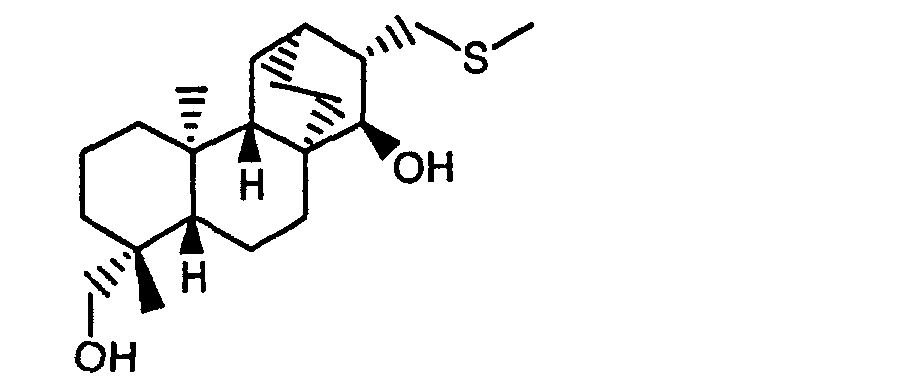
- To a solution of ent-15β-hydroxy-17-methylsulfinyl-16α-atisane-19-oic acid (270 mg, 0.707 mmol) obtained in Example 6 in tetrahydrofuran (14.1 mL) was added lithium aluminum hydride (537 mg, 14.2 mmol) under stirring on ice. After heating under reflux for 4 hours, the reaction mixture was ice-cooled, and water and 1N hydrochloric acid was added. The reaction was extracted twice with ethyl acetate, and the resulting organic layer was washed with saturated brine, dried over magnesium sulfate and evaporated. The resulting residue was purified by silica gel column chromatography, to give ent-15β,19-dihydroxy-17-methylthio-16α-atisane (252 mg, white crystals).
1H NMR (CDCl3) ; δ (ppm) 0. 66-0. 77 (1H, m) , 0. 79-1. 95 (20H, m), 0. 95 (3H, s)
0. 97 (3H, s) , 2. 14 (3H, s), 2. 48-2. 56 (2H, m) , 2. 92 (1H, d, J=4. 0Hz) 3. 47 (1H, d, J=10. 8Hz), 3. 75 (1H, d, J=10. 8Hz) -

- From ent-15β,19-dihydroxy-17-methylthio-16α-atisane (16 mg, 0.0454 mmol) obtained in Example 21, ent-15β,19-dihydroxy-17-methylsulfinyl-16α-atisane (10.5 mg) was obtained in the same manner as described in Example 6.
ESI-MS:m/z=391 (M+Na)+
1H NMR (CD3OD) ; δ (ppm) 0. 73-2. 00 (20H, m), 0. 93 (3H, s), 0. 99 (3H, s)
2. 67 and 2. 68 (3H, s × 2), 2. 78-3. 03 (3H, m) , 3. 32-3. 38 (1H, m) 3. 73 (1H, d, J=11. 2Hz) -

- To a solution of ent-15β-acetoxy-17-methylthio-16α-atisane-19-amide (28 mg, 0.0687 mmol) obtained in Example 18 in toluene (1.37 mL) was added thionyl chloride (0.125 mL, 1.71 mL) under stirring at room temperature, followedby stirring for 4 hours at 65°C. Under ice-cooling, water was added and the mixture was extracted twice with diethyl ether. The resulting organic layer was washed with saturated brine, dried over magnesium sulfate and evaporated. The resulting residue was purified by silica gel column chromatography, to give ent-15β-acetoxy-17-methylthio-16α-atisane-19-nitrile (16.8 mg).
1H NMR (CDCl3) ; δ (ppm) 0. 79-2. 14 (20H, m), 1. 21 (3H, s), 1. 36 (3H, s), 2. 08 (3H, s) 2. 10 (3H, s), 2. 51 (1H, dd, J=12. 8 and 10. 4Hz), 2. 85 (1H, dd, J=12. 8 and 6. 0Hz) 4. 18 (1H, d, J=3. 6Hz) -

- From ent-15β-acetoxy-17-methylthio-16α-atisane-19-nitrile (16.8 mg, 0.0431 mmol) obtained in Example 23, ent-15β-hydroxy-17-methylsulfinyl-16α-atisane-19-nitrile (3.68 mg, colorless amorphous) was obtained in the same manners as described in Example 19 and Example 6.
ESI-MS:m/z=386 (M+Na)+
1H NMR (CD3OD) ; δ (ppm) 0. 80-2. 49 (20H, m), 1. 22 (3H, s), 1. 35 (3H, s) 2. 67 and 2. 69 (3H, s × 2), 2. 79-3. 03 (3H, m) -

- To a solution of ent-15β-acetoxy-17-methylthio-16α-atisane-19-oic acid (22.8 mg,0.0559 mmol) obtained in Example 17 in dichloromethane (1 mL) was added oxalyl chloride (0.015 mL, 0.172 mmol) under stirring on ice, followed by stirring for 3 hours at room temperature. Under ice-cooling, a solution of 2.0 M dimethylamine in tetrahydrofuran (0.28 mL, 0.56 mmol) was added thereto, followed by stirring at room temperature for 5 minutes. Then, water was added thereto and the mixture was extracted twice with ethyl acetate. The resulting organic layer was washed with saturated brine, dried over magnesium sulfate and evaporated, to give ent-15β-acetoxy-17-methylthio-16α-atisane-19-dimethylamide (20 mg).
1H NMR (CDCl3) ; δ (ppm) 0. 78-2. 49 (19H, m), 0. 93 (3H, s), 1. 26 (3H, s), 2. 07 (3H, s) 2. 10 (3H, s), 2. 50 (1H, dd, J=12. 8 and 10. 4Hz), 2. 84 (1H, dd, J=12. 8 and 5. 6Hz) 3. 00 (6H, s), 4. 17 (1H, d, J=4. 0Hz) -
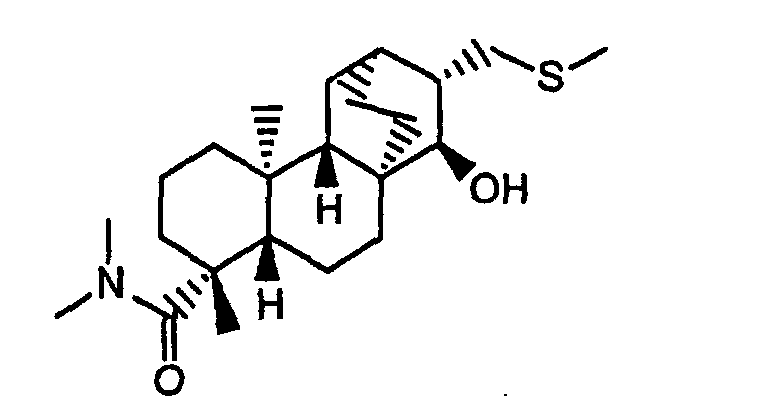
- From ent-15β-acetoxy-17-methylthio-16α-atisane-19-dimethylamide obtained in Example 25 (20 mg, 0.0459mmol), ent-15β-hydroxy-17-methylthio-16α-atisane-19-dimethylamide (15.2 mg, pale yellow crystals) was obtained in the same manner as described in Example 19.
1H NMR (CDCl3) ; δ (ppm) 0. 66-0. 79 (1H, m), 0. 82-2. 29 (18H, m), 0. 94 (3H, s) 1. 26 (3H, s), 2. 14 (3H, s), 2. 43 (1H, d, J=14. 4Hz), 2. 50-2. 57 (2H, m) 2. 91-2. 96 (1H, m), 3. 01 (6H, s) -
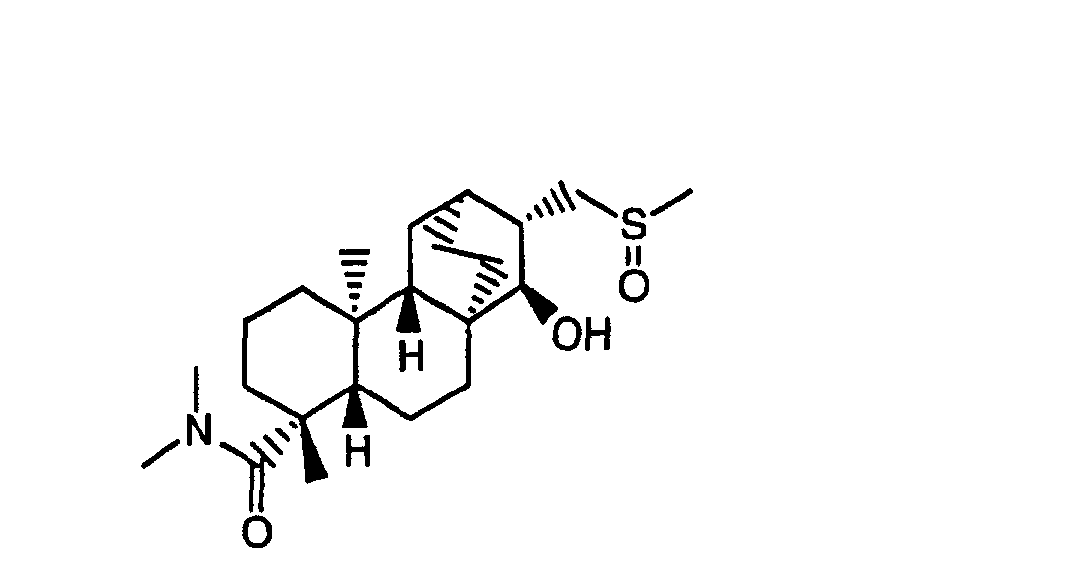
- From ent-15β-hydroxy-17-methylthio-16α-atisane-19-dimethylamide obtained in Example 26 (3.2 mg, 0.0081 mmol), ent-15β-hydroxy-17-methylsulfinyl-16α-atisane-19-dimethylam ide (2.75 mg) was obtained in the same manner as described in Example 6.
1H NMR (CD3OD) ; δ (ppm) 0. 76-0. 86 (1H, m), 0. 86-2. 24 (18H, m), 0. 94 (3H, s) 1. 26 (3H, s), 2. 52 (1H, d, J=14. 4Hz), 2. 67 and 2. 69 (3H, s × 2), 2. 78-3. 07 (3H, m) 3. 02 (6H, s) -

- From ent-15β,19-dihydroxy-17-methylthio-16α-atisane (54 mg, 0.153 mmol) obtained in Example 21, ent-15β-hydroxy-17-methylthio-19-tosyloxy-16α-atisane (81 mg) was obtained in the same manner as described in Example 4. 1H NMR (CDCl3) ; δ (ppm) 0. 65-0. 76 (1H, m), 0. 76-1. 94 (19H, m), 0. 82 (3H, s) 0. 91 (3H, s), 2. 13 (3H, s), 2. 46 (3H, s), 2. 48-2. 54 (2H, m) , 2. 91 (1H, d, J=4. 0Hz) 3. 83 (1H, d, J=9. 2Hz), 4. 14 (1H, d, J=9. 2Hz), 7. 35 (1H, d, J=8. 4Hz) 7. 79 (1H, d, J=8. 4Hz)
-
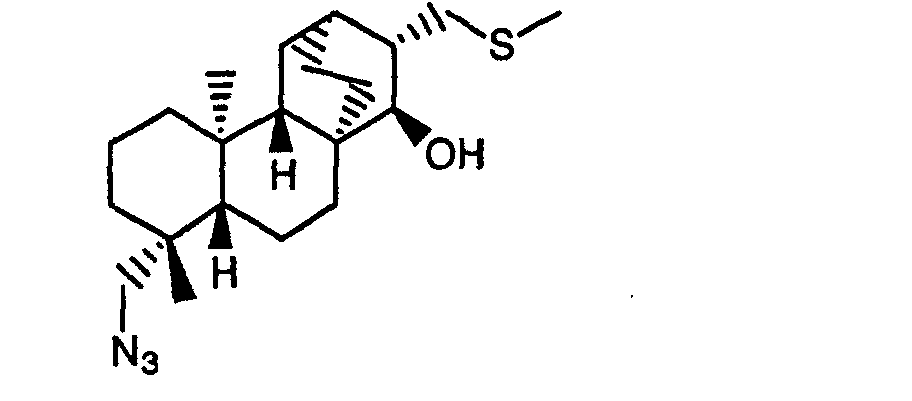
- To a solution of ent-15β-hydroxy-17-methylthio-19-tosyloxy-16α-atisane obtained in Example 28 (28 mg, 0.0553 mmol) in hexamethylphosphoramide (1 mL) were added tetrabutylammonium iodide (2.04 mg, 0. 00553 mmol) and sodium azide (10.8 mg, 0.0213 mmol) under stirring at room temperature, followed by stirring for 3 hours at 140°C. After recovering the reaction mixture to room temperature, saturated ammonium chloride was added thereto and the mixture was extracted twice with diethyl ether. The resulting organic layer was washed with saturated brine, dried over magnesium sulfate and evaporated. The resulting residue was purified by silica gel column chromatography, to give ent-19-azido-15β-hydroxy-17-methylthio-16α-atisane (8.9 mg).
1H NMR (CDCl3) ; δ (ppm) 0. 67-0. 79 (1H, m), 0. 84-1. 98 (19H, m), 0. 963 (6H, s) 2. 14 (3H, s), 2. 512. 56 (2H, m), 2. 93 (1H, s), 3. 16 (1H, d, J=12. 0Hz) 3. 53 (1H, d, J=12. 0Hz) -
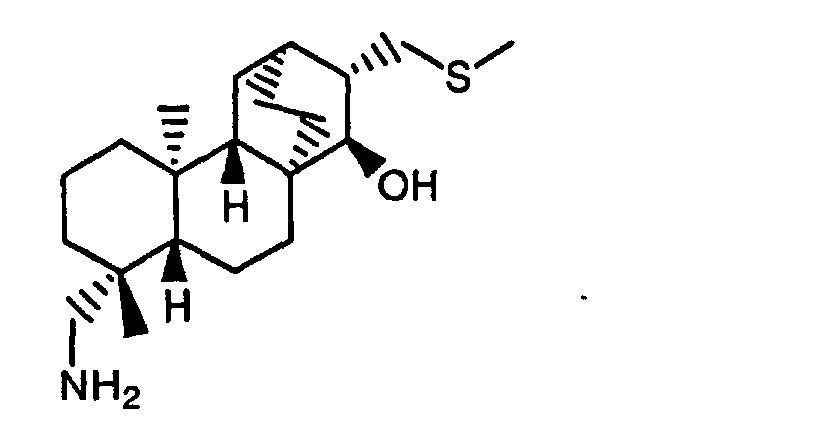
- To a solution of ent-19-azido-15β-hydroxy-17-methylthip-16α-atisane obtained in Example 29 (6.6 mg, 0.0168 mmol) in tetrahydrofuran (1 mL) was added lithium aluminum halide (1.27 mg, 0.0335 mmol) under stirring at room temperature, followed by stirring for 90 minutes at room temperature. After adding a small amount of a 27% aqueous ammonia, the mixture was filtered. Thefiltrate wasevaporated, to give ent-19-amino-15β-hydroxy-17-methylthio-16α-atisane (21 mg, crude product).
ESI-MS:m/z=352 (M+Na)+ -

- To a solution of ent-19-amino-15β-hydroxy-17-methylthio-16α-atisane (21 mg) in tetrahydrofuran (2 mL) were added di-t-butyl dicarbonate (39 mg, 0.179 mmol), triethylamine (0.042 mL, 0.299 mmol) and 4-dimethylamino pyridine (7.3 mg, 0.0598 mmol) under stirring at room temperature, followed by stirring for 2 hour at room temperature. After adding water, the reaction mixture was extracted twice with diethyl ether. The resulting organiclayer was washed with saturated brine, dried over magnesium sulfate and evaporated. The resulting residue was purified by silica gel column chromatography, to give ent-N-(t-butoxycarbonyl)-19-amino-15β-hydroxy-17-methylthio -16α-atisane (4.4 mg).
1H NMR (CDCl3) ; δ (ppm) 0. 65-0. 78 (1H, m), 0. 80-1. 98 (19H, m), 1. 44 (9H, s) 2. 14 (3H, s), 2. 49-2. 56 (2H, m) , 2. 84-2. 96 (2H, m) , 3. 48 (1H, dd, J=13. 6 and 7. 6Hz) -

- From ent-N-(t-butoxycarbonyl)-19-aminio-15β-hydroxy-17-methylthi o-16α-atisane (4.4 mg) obtained in Example 30, ent-N-(t-butoxycarbonyl)-19-amino-15β-hydroxy-17-methylsulf inyl-16α-atisane (2.2 mg) was obtained in the same manner as described in Example 6.
ESI-MS:m/z=490 (M+Na)+
1H NMR (CD3OD) ; δ (ppm) 0. 74-2. 04 (20H, m), 0. 85 (3H, s), 1. 06 (3H, s), 1. 43 (9H, s) 2. 67 and 2. 69 (3H, s × 2) -
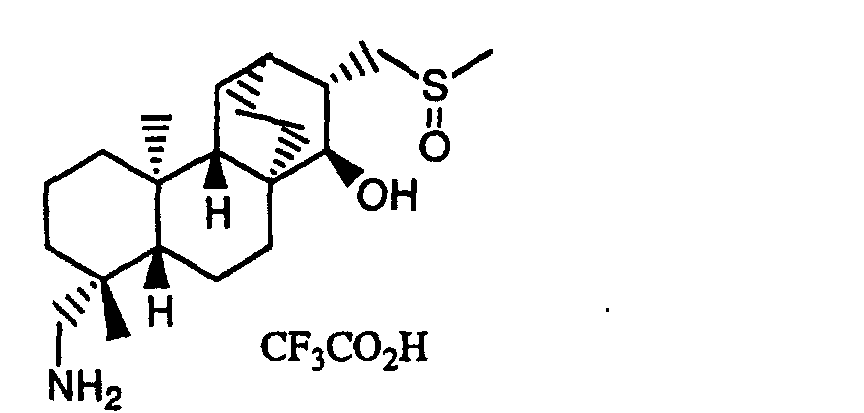
- To a solution of ent-N-(t-butoxycarbonyl)-19-amino-15β-hydroxy-17-methylsulf inyl-16α-atisane obtained in Example 31 (1.8 mg, 0.00385 mmol) in dichloromethane (1 mL) was added trifluoroacetic acid (1 mL) under stirring on ice, followed by stirring for 5 hours at room temperature. Then, the mixture was evaporated, to give ent-19-amino-15β-hydroxy-17-methylsulfinyl-16α-atisane-trif luoroacetic acid (1.59 mg).
ESI-MS:m/z=368 (M+H)+
1H NMR (CD3OD) ; δ (ppm) 0. 66-1. 96 (20H, m), 0. 92 (3H, s) , 0. 93 (3H, s) 2. 58 and 2. 59 (3H, s×2) -

- To a solution of methyl ent-15β,17-dihydroxy-16α-atisane-19-oate obtained in Example 3 (197 mg, 0.562 mmol) in dichloromethane (11.2 mL) were added methoxymethyl chloride (0.427 mL, 5.62 mmol) and diisopropyl ethylamine (1.47 mL, 8.44 mmol) under stirring on ice, followed by stirring for 16 hours at room temperature. Under ice-cooling, water was added thereto and the mixture was extracted twice with diethyl ether. The resulting organic layer was washed with saturated brine, dried over magnesium sulfate and evaporated, to give methyl ent-15β,17-bis{(methoxymethyl)oxy}-16α-atisane-19-oate (260 mg, pale yellow crude syrup).
1H NMR (CDCl3) ; δ (ppm)
0. 64-1. 89 (18H, m), 0. 79 (3H, s), 1. 18 (3H, s) 1. 90-1. 99 (1H, m), 2. 16 (1H, d, J=13. 2 Hz), 2. 64 (1H, d, J=3. 2Hz), 3. 36 (3H, s) 3. 37-3. 43 (1H, m), 3. 40 (3H, s), 3. 59-3. 69 ( 1H, m), 3.65 (3H, s), 4. 56 (1H, d, J=6. 4Hz) 4. 62 (1H, d, J=6. 4Hz), 4. 65 (1H, d, J=6. 4H z) , 4. 81 (1H, d, J=6. 4Hz) -

- To a solution of ent-15β,17-bis{(methoxymethyl)oxy}-16α-atisane-19-oate obtained in Example 33 in tetrahydrofuran (11.9 mL) was added lithium aluminum hydride (67.5 mg, 1.78 mmol) under stirring on ice, followed by stirring for 4 hours at room temperature. Under ice-cooling, water and a 5N aqueous sodium hydroxide were added thereto, and the mixture was extracted twice with ethyl acetate. The resulting organic layer was washed with saturated brine, dried over magnesium sulfate and evaporated, to give ent-19-hydroxy-15β,17-bis{(methoxymethyl)oxy}-16α-atisane (228 mg, colorless crude syrup).
1H NMR (CDCl3) ; δ (ppm) 0. 64-0. 75 (1H, m), 0. 82-1. 92 (19H, m), 0. 95 (3H, s) 0. 97 (3H, s), 2. 61 (1H, d, J=3. 6Hz), 3. 36 (3H, s), 3. 36-3. 43 (1H, m), 3. 39 (3H, s) 3. 47 (1H, d, J=10. 8Hz), 3. 64 (1H, dd, J=9. 6 and 5. 2Hz), 3. 76 (1H, d, J=10. 8Hz) 4. 56 (1H, d, J=6. 8Hz), 4. 62 (1H, d, J=6. 4Hz), 4. 65 (1H, d, J=6. 4Hz) 4. 81 (1H, d, J=6. 8Hz) -
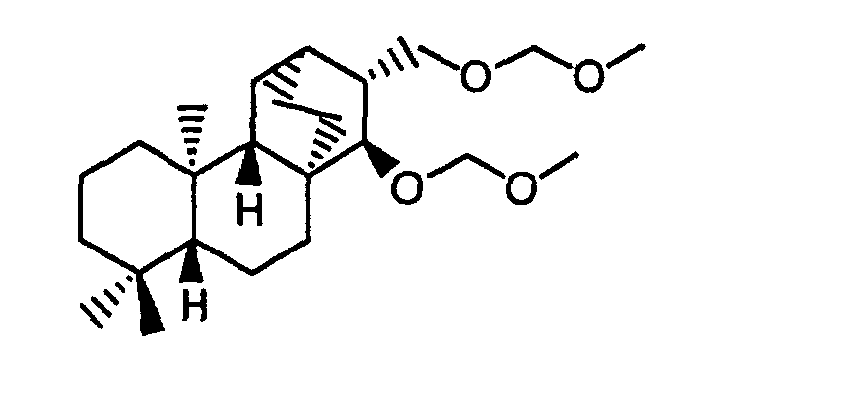
- To a solution of ent-19-hydroxy-15β,17-bis{(methoxymethyl)oxy}-16α-atisane obtained in Example 34 (9.6 mg, 0.0234 mmol) in 1, 2-dichloroethane (1 mL) was added 1,1'-thiocarbonyldiimidazole (12.5 mg, 0.0701 mmol) under stirring at room temperature, followed by stirring for 19 hours at room temperature. After adding 0.5N hydrochloric acid, the mixture was stirred for 20 hours at room temperature and then extracted with diethyl ether. The resulting organic layer was washed with saturated sodium hydrogen carbonate and saturated brine, dried over magnesium sulfate and evaporated. The resulting residue was dissolved in toluene (1 mL), and 2,2'-azobisisobutyronitrile (0.8 mg, 0.00487 mmol) and tributyl tin hydride (8.0 µl, 0.02 97 mmol) were added thereto under stirring at room temperature, followed by stirring for 1 hour at 70°C. The reaction mixture was recovered to room temperature and evaporated. The resulting residue was purified by silica gel column chromatography, to give ent-15β,17-bis{(methoxymethyl)oxy}-16α-atisane (4.8 mg).
1H NMR (CDCl3) ; δ (ppm) 0. 64-0. 76 (1H, m), 0. 76-1. 97 (19H, m), 0. 82 (3H, s) 0. 86 (3H, s), 0. 97 (3H, s), 2. 61 (1H, d, J=3. 2Hz), 3. 36 (3H, s), 3. 39 (3H, s) 3. 37-3. 44 (1H, m), 3. 60-3. 67 (1H, m), 4. 56 (1H, d, J=6. 6Hz), 4. 62 (1H, d, J=6. 4Hz) 4. 65 (1H, d, J=6. 4Hz), 4. 81 (1H, d, J=6. 6Hz) -

- To a solution of ent-15β,17-bis{(methoxymethyl)oxy}-16α-atisane (4.8 mg, 0.0123mmol) obtained in Example 35 in tetrahydrofuran (1 mL) was added 7.5N hydrochloric acid was added under stirring on ice. After stirring at room temperature for 3 hours, water was added and the mixture was extracted twice with ethyl acetate. The resulting organic layer was washed with saturated aqueous sodium hydrogen carbonate and saturated brine, dried over magnesium sulfate and evaporated. The resulting residue was purified on silica gel column chromatography, to give ent-15β,17-dihydroxy-16α-atisane (1.4 mg).
1H NMR (CDCl3) ; δ (ppm) 0. 65-1. 82 (19H, m), 0. 82 (3H, s), 0. 86 (3H, s), 0. 97 (3H, s) 1. 89-1. 99 (1H, m), 2. 94 (1H, d, J=4. 4Hz), 3. 62 (1H, dd, J=10. 0 and 7. 6Hz) 3. 65-3. 73 (1H, m) -
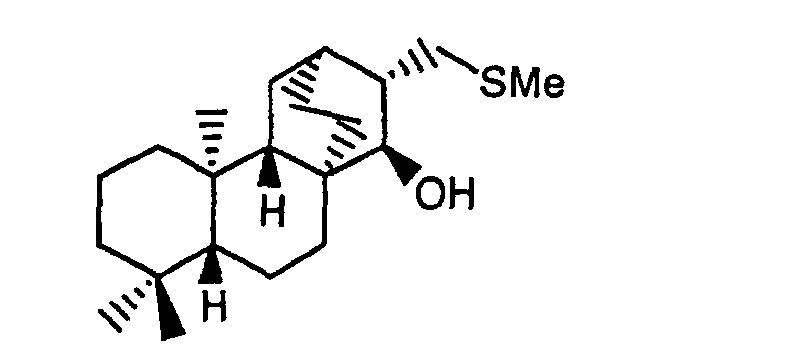
- From ent-15β,17-dihydroxy-16α-atisane (5.3 mg, 0.0173 mmol) obtained in Example 36, ent-15β-hydroxy-17-methylthio-16α-atisane (3.5 mg) was obtained in the same manners as described in Example 4 and Example 7.
1H NMR (CDCl3) ; δ (ppm) 0. 65-1. 98 (20H, m), 0. 821 (3H, s), 0. 86 (3H, s), 0. 97 (3H, s) 2. 14 (3H, s), 2. 49-2. 57 (2H, m), 2. 89-2. 95 (1H, m) -

- From ent-15β-hydroxy-17-methylthio-16α-atisane (2.8 mg, 0.0083 mmol) obtained in Example 37, ent-15β-hydroxy-17-methylsulfinyl-16α-atisane (1.46mg) was obtained in the same manner as described in Example 6.
ESI-MS:m/z=375 (M+Na)+
1H NMR (CD3OD) ; δ (ppm) 0. 74-2. 05 (20H, m), 0. 85 (3H, s) , 0. 87 (3H, s) , 1. 02 (3H, s) 2. 67 and 2. 69 (3H, s×2), 2. 78-3. 03 (3H, m) -
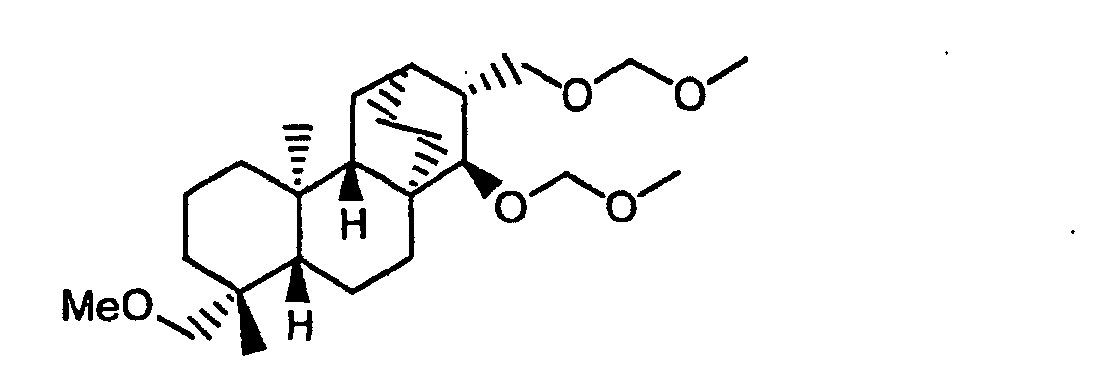
- To a solution of ent-19-hydroxy-15β,17-bis{(methoxymethyl)oxy}-16α-atisane (14 mg, 0.0341 mmol) obtained in Example 34 in hexamethylphosphoramide (1 mL) were added sodium hydride (60% dispersion inmineral oil) (7 mg, 0.175 mmol) and methyl triflate (39 µl, 0.344 mmol) under stirring at room temperature. After stirring for 25 hours at room temperature, the reaction mixture was ice-cooled, and water was added, and the mixture was extracted twice with ethyl acetate. The resulting organic layerwas washed with saturated brine, dried over magnesium sulfate and evaporated. The resulting residue was purified by silica gel column chromatography, to give ent-19-methoxy-15β,17-bis{(methoxymethyl)oxy}-16α-atisane (6.1 mg).
1H NMR (CDCl3) ; δ
(ppm) 0. 61-0. 76 (1H, m), 0. 83-1. 94 (19H, m), 0. 95 (3H, s), 0. 96 (3H, s), 2. 56 (1H, d, J=3. 6Hz), 3. 18 (1H, d, J=9. 2Hz), 3. 30 (3H, s), 3. 36 (3H, s), 3. 36-3. 43 (1H, m), 3. 39 (3H, s), 3. 43 (1H, d, J=9. 2Hz), 3. 64 (1H, dd, J=9. 8, 5. 4Hz), 4. 56 (1H, d, J=6. 8Hz), 4 . 61 (1H, d, J=6. 6Hz), 4. 64 (1H, d, J=6. 6Hz), 4. 80 (1H, d, J=6. 8Hz) -
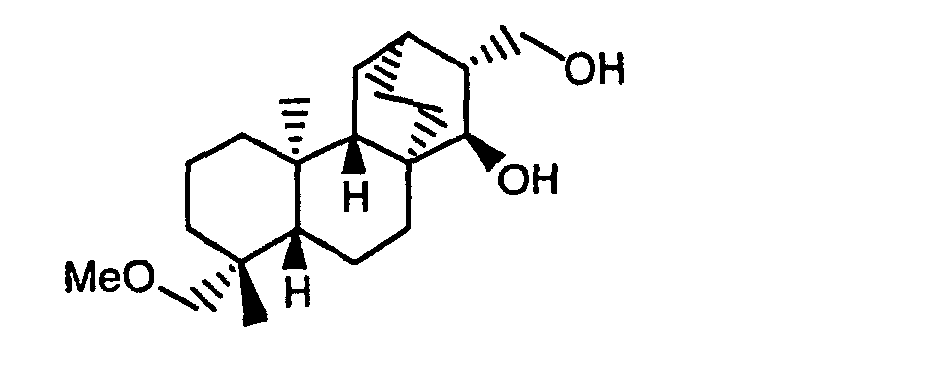
- From ent-19-methoxy-15β,17-bis{(methoxymethyl)oxy}-16α-atisane (12.8 mg, 0.0302 mmol) obtained in Example 39, ent-15β,17-dihydroxy-19-methoxy-16α-atisane (14 mg) was obtained in the same manner as described in Example 36.
1H NMR (CDCl3) ; δ (ppm) 0. 66-0. 77 (1H, m), 0. 78-1. 81 (18H, m), 0. 95 (3H, s) 0. 97 (3H, s), 1. 84-1. 96 (1H, m), 2. 94 (1H, d, J=4. 4Hz), 3. 18 (1H, d, J=9. 2Hz) 3. 30 (3H, s), 3. 42 (1H, d, J=9. 2Hz), 3. 62 (1H, dd, J=10. 0 and 7. 2Hz) 3. 68 (1H, dd, J=10. 0 and 8. 2Hz) -

- From ent-15β,17-dihydroxy-19-methoxy-16α-atisane (14 mg) obtained in Example 40, ent-15β-hydroxy-19-methoxy-17-methylthio-16α-atisane (6.4 mg) was obtained in the same manners as described in Example 4 and Example 7.
1H NMR (CDCl3) ; δ (ppm) 0.65-0.77 (1H, m), 0. 84-1. 98 (19H, m), 0. 95 (3H, s) 0. 96 (3H, s), 2. 14 (3H, s), 2. 50-2. 57 (2H, m), 2. 92 (1H, d, J=4. 0Hz) 3. 18 (1H, d, J=8. 8Hz), 3. 30 (3H, s), 3. 42 (1H, d, J=8. 8Hz) -

- From ent-15β-hydroxy-19-methoxy-17-methylthio-16α-atisane (4.3 mg) obtained in Example 41, ent-15β-hydroxy-19-methoxy-17-methylsulfinyl-16α-atisane ( 3 . 2 mg) was obtained in the same manner as described in Example 6.
ESI-MS:m/z=405 (M+Na)+
1H NMR (CD3OD) ; δ (ppm) 0. 73-2. 01 (20H, m), 0. 94 (3H, s), 1. 01 (3H, s) 2. 67 and 2. 69 (3H, s × 2), 2. 78-3. 03 (3H, m), 3. 21 (1H, d, J=9. 2Hz), 3. 28 (3H, s) 3. 46 (1H, d, J=9. 2Hz) -

- To a solution of ent-19-hydroxy-15β,17-bis{(methoxymethyl)oxy}-16α-atisane (9.2 mg, 0.0224 mmol) obtained in Example 34 in dichloromethane ( 0 . 5 mL) were added tetrapropyl ammonium perruthenate (0.4 mg, 0.0011 mmol), N-methylmorpholine-N-oxide (3.9 mg, 0.033 mmol) and 4A molecular sieve (powder) (11.2 mg) under stirring at room temperature. After stirring at room temperature for 1 hour, isopropyl alcohol (0.05 mL) was added thereto. The mixture was stirred at room temperature for 10 minutes and then evaporated. The resulting residue was purified by silica gel column chromatography, to give ent-15β,17-bis{(methoxymethyl)oxy}-19-oxo-16α-atisane (11.7 mg, colorless oil).
1H NMR (CDCl3) ; δ (ppm) 0. 68-1. 99 (19H, m), 0. 84 (3H, s), 1. 01 (3H, s) 2. 08-2. 17 (1H, m), 2. 66 (1H, d, J=3. 2Hz), 3. 36 (3H, s), 3. 37-3. 44 (1H, m), 3. 40 (3H, s) 3. 60-3. 66 (1H, m), 4. 57 (1H, d, J=6. 8Hz), 4. 62 (1H, d, J=6. 6Hz), 4. 65 (1H, d, J=6. 6H z) 4. 82 (1H, d, J=6. 8Hz), 9. 78 (1H, s) -
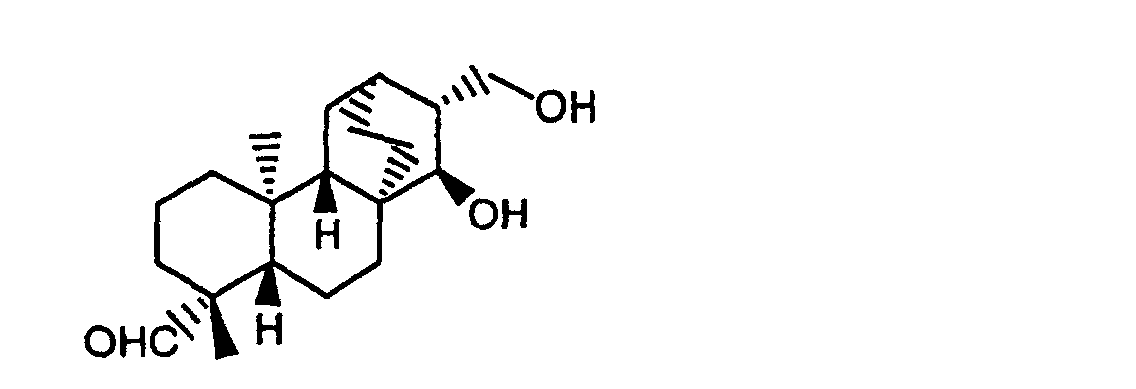
- From ent-15β,17-bis{(methoxymethyl)oxy}-19-oxo-16α-atisane (11.7 mg, 0.0287 mmol) obtained in Example 43, ent-15β,17-dihydroxy-19-oxo-16α-atisane (13.1 mg, pale yellow crude oil) was obtained in the same manner as described in Example 36.
1H NMR (CDCl3) ; δ (ppm) 0. 71-1. 90 (18H, m), 0. 85 (3H, s), 1. 01 (3H, s) 1. 91-2. 01 (1H, m), 2. 09-2. 17 (1H, m), 2. 99 (1H, d, J=4. 4Hz), 3. 56-3. 73 (2H, m) 9. 77 (1H, s) -
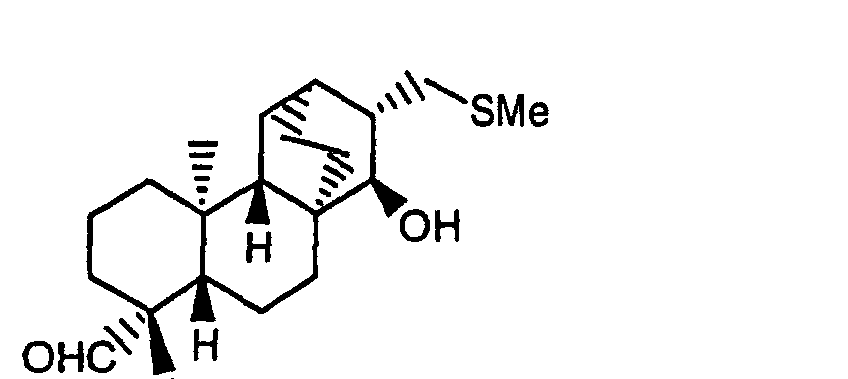
- From ent-15β,17-dihydroxy-19-oxo-16α-atisane (13.1 mg, 0.0409 mmol) obtained in Example 44, ent-15β-hydroxy-17-methylthio-19-oxo-16α-atisane (6.4 mg, pale yellow amorphous) was obtained in the same manners as described in Example 4 and Example 7.
1H NMR (CDCl3) ; δ (ppm) 0. 71-2. 17 (20H, m), 0. 843 (3H, s) , 1. 014 (3H, s) 2. 147 (3H, s), 2. 531 (2H, d, J=8. 0Hz), 2. 965 (1H, d, J=4. 0Hz), 9. 77 (1H, s) -

- From ent-15β-hydroxy-17-methylthio-19-oxo-16α-atisane (2.0 mg, 0.0057 mmol) obtained in Example 45, ent-15β-hydroxy-17-methylsulfinyl-19-oxo-16α-atisane (2.19 mg) was obtained in the same manner as described in Example 6. ESI-MS:m/z=389 (M+Na)+
1H NMR (CD3OD) ; δ (ppm) 0. 79-2. 14 (20H, m), 0. 87 (3H, s), 1. 00 (3H, s) 2. 67 and 2. 69 (3H, s×2), 2. 79-3. 03 (3H, m), 9. 77 (1H, s) -
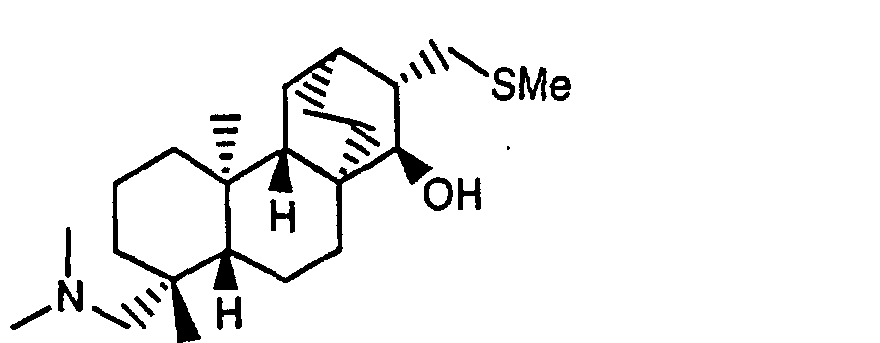
- To a suspension of lithium aluminum hydride (14.7mg, 0.387 mmol) in tetrahydrofuran (2.0 mL) was added aluminum chloride (51.6 mg, 0.387 mmol) under stirring at room temperature. After stirring at room temperature for 20 minutes, the reaction mixture was ice-cooled. A solution of ent-15β-hydroxy-17-methylthio-16α-atisane-19-dimethylamide obtainedby Example 26 (15.2 mg, 0.0387 mmol) in tetrahydrofuran (1.5 mL) was added thereto, followed by stirring for 2 hours at room temperature. The reaction mixture was again ice-cooled and a 27% aqueous ammonium was added thereto, followed by stirring for 5 minutes at room temperature. Then, the resulting solid was filtered off through Celite, and the filtrate was evaporated. The resulting residue was purified by silica gel column chromatography, to give ent-19-dimethylamino-15β-hydroxy-17-methylthio-16α-atisane (22 mg, colorless oil).
ESI-MS:m/z=380 (M+H)+
1H NMR (CD3OD) ; δ (ppm) 0. 68-0. 80 (1H, m), 0. 84-1. 95 (19H, m), 1. 02 (3H, s) 1. 13 (3H, s), 2. 08 (3H, s), 2. 48 (1H, dd, J=13. 0 amd 9. 4Hz) 2. 64 (1H, dd, J=13. 0 and 6. 8Hz), 2. 68-2. 90 (7H, m) -

- From hydrochloride of ent-19-dimethylamino-15β-hydroxy-17-methylthio-16α-atisane (7.9 mg, 0.019 mmol) obtained in Example 47, ent-19-dimethylamino-15β-hydroxy-17-methylsulfinyl-16α-atis ane (3.1 mg) was obtained in the same manner as described in Example 6.
ESI-MS:m/z=396 (M+H)+
1H NMR (CD3OD) ; δ (ppm) 0. 74-2. 20 (20H, m), 0. 98 (3H, s), 1. 02 (3H, s), 2. 30 (6H, s) 2. 67 and 2. 68 (3H, s × 2) , 2. 78-3. 03 (3H, m) -

- To a solution of ent-15β-acetoxy-17-methylthio-16α-atisane-19-oic acid (27.8mg, 0.0682mmol) obtained in Example 17 in toluene (1.36 mL) were added diphenylphosphoryl azide (22 µl, 0.102 mmol) and triethylamine (14.3 µl, 0.103 mmol) were added under stirring at room temperature, followed by stirring for 7 hours at 90°C. After recovered to room temperature, the reaction mixture was diluted with ethyl acetate, washed with saturated brine, dried over magnesium sulfate and evaporated. The resulting residue was purified by silica gel column chromatography, to give (1R,4S,5S,9S,10S,12R,13R,14R)-5-isocyanate-5,9-dimethyl-13-{(methylsulfanyl)methyl}tetracyclo[10.2.2.01,10.04,9]hexadecy -14-yl acetate (17.8 mg).
1H NMR (CDCl3) ; δ (ppm) 0. 80-2. 12 (20H, m), 1. 12 (3H, s), 136 (3H, s), 2. 08 (3H, s) 2. 10 (3H, s), 2. 51 (1H, dd, J=12. 8 and 10. 4Hz), 2. 84 (1H, dd, 1=12. 8 and 5. 8Hz) 4. 17 (1H, d, J=4. 0Hz) -

- (1R,4S,5S,9S,10S,12R,13R,14R)-5-isocyanate-5,9-dimethy 1-13-{(methylsulfanyl)methyl}tetracyclo[10.2.2.01,10.04,9]hex adecy-14-yl acetate (8.2 mg, 0.0202 mmol) obtained in Example 49 was dissolved in 0. 025N hydrochloric acid-dichloromethane (1 mL). Under stirring at room temperature, t-butylalcohol (40 µl, 0.418 mmol) was added thereto, followed by stirring at room temperature for 6 hours. Then, water was added thereto and the mixture was extracted twice with diethyl ether. The resulting organic layer was washed with saturated brine, dried over magnesium sulfate and evaporated. The resulting residue was purified by silica gel column chromatography, to give (1R,4S,5S,9S,10S,12R,13R,14R)-5-{(t-butoxycarbonyl)amino}-5 ,9-dimethyl-13-{(methylsulfanyl)methyl}tetracyclo[10.2.2.01 ,10.04,9]hexadecy-14-yl acetate (6.8 mg).
1H NMR (CDCl3) ; δ (ppm) 0. 78-2. 04 (19H, m), 1. 10 (3H, s), 1. 25 (3H, s), 1. 42 (9H, s) 2. 07 (3H, s), 2. 11 (3H, s), 2. 45 (1H, dd, J=12. 6 and 10. 6Hz), 2. 55-2. 65 (1H, m) 2. 85 (1H, dd, J=12. 6 and 5. 8Hz), 4. 16 (1H, d, J=4. 0Hz), 4. 41 (1H, broad s) -
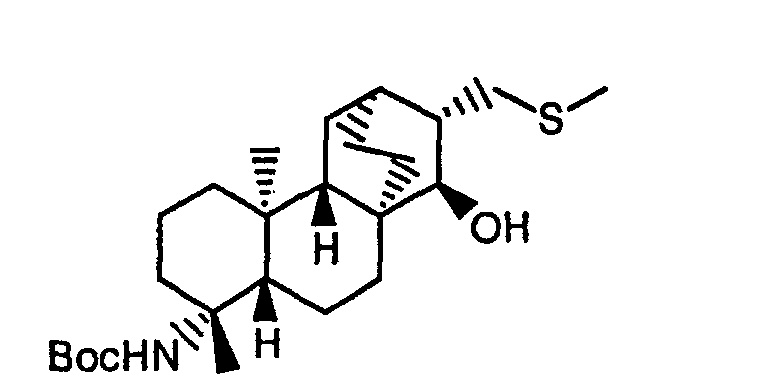
- From (1R,4S,5S,9S,10S,12R,13R,14R)-5-{(t-butoxycarbonyl)amino}-5 ,9-dimethyl-13-{(methylsulfanyl)methyl}tetracyclo[10.2.2.01 ,10.04,9]hexadecy-14-yl acetate (6.8 mg, 0.0141 mmol) obtained in Example 50, t-butyl N-(1R,4S,5S,9R,10S,12R,13R,14R)-14-hydroxy-5,9-dimethyl-13-{(methylsulfanil)methyl}tetracyclo[10.2.2.01,10.04,9]hexadecy - 14-yl carbamate (4.9 mg, colorless amorphous) was obtained in the same manner as described in Example 19.
1H NMR (CDCl3) ; δ (ppm) 0. 66-2. 04 (19H, m) , 1. 10 (3H, s) , 1. 25 (3H, s), 1. 42 (9H, s) 2. 14 (3H, s) , 2. 53 (2H, d, J=8. 0Hz), 2. 55-2. 65 (1H, m), 2. 95 (1H, d, J=4. 0Hz), 4. 43 (1H, broad s) -

- From t-butyl N-(1R,4S,5S,9R,10S,12R,13R,14R)-14-hydroxy-5,9-dimethyl-13-{(methylsulfanyl)methyl}tetracyclo[10.2.2.01,10.04,9]hexadecy - 14-yl carbamate (4.9 mg, 0.0112 mmol) obtained in Example 51, t-butyl N-(1R,4S,5S,9R,10S,12R,13R,14R)-14-hydroxy-5,9-dimethyl-13-{(methylsulfanyl)methyl}tetracyclo[10.2.2.01,10.04,9]hexadecy - 5-yl carbamate (3.9 mg) was produced in the same manner as described in Example 6.
ESI-MS:m/z=454(M+H)+
1H NMR (CD3OD) ; δ (ppm) 0. 77-2. 09 (19H, m), 1. 13 (3H, s), 1. 32 (3H, s), 1. 42 (9H, s) 2. 50-2. 60 (1H, m), 2. 67 and 2. 69 (3H, s x 2), 2. 78-3. 04 (3H, m) -

- To a solution of t-butyl N-(1R,4S,5S,9R,10S,12R,13R,14R)-14-hydroxy-5,9-dimethyl-13-{(methylsulfanyl)methyl}tetracyclo[10.2.2.01,10.04,9]hexadecy - 5-yl carbamate (3.9 mg, 0.00860 mmol) obtained in Example 52 in dichloromethane (1 mL) was added trifluoroacetic acid (1 mL) under stirring at room temperature. After stirring at room temperature for 5 hours, the mixture was evaporated. The resulting residue was purified by NH-silica gel column chromatography, to give (1R,4S,5S,9R,10S,12R,13R,14R)-5-amino-5,9-dimethyl-13-{(met hylsulfinyl)methyl}tetracyclo[10.2.2.01,10.04,9]hexadecane-14 - ol (1.11 mg).
ESI-MS:m/z=354 (M+H)+
1H NMR (CD3OD) ; δ (ppm) 0. 78-2. 04 (20H, m), 1. 11 (3H, s), 1. 14 (3H, s) 2. 67 and 2. 69 (3H, s × 2), 2. 78-3. 03 (3H, m) -

- To a mixed solution of
isomers 1 and 2 of ent-15β-hydroxy-17-methylsulfinyl-16α-atisane-19-oic acid (18.7 mg, 0.0490 mmol) obtained in Example 6 in dimethylformamide (1 mL) were added sodium hydride (60% dispersion in mineral oil) (9.8 mg, 0.245 mmol) and iodomethane (15 µl, 0.24 mmol) under stirring on ice, followed by stirring for 3 hours at room temperature. After addingsaturated aqueousammonium chloride, the mixture was extracted twice with ethyl acetate. The resulting organic layer was washed with saturated brine, dried over magnesium sulfate and evaporated. The resulting residue was purif ied by silica gel column chromatography, to give methyl ent-15β-methoxy-17-methylsulfinyl-16α-atisane-19-oate (18.1 mg, pale yellow oil).
ESI-MS:m/z=433 (M+Na)+
1H NMR (CD3OD) ; δ (ppm) 0. 77-2. 18 (20H, m), 0. 81 (3H, s), 1. 17 (3H, s) 2. 50 (0. 5H, d, J=4. 0Hz), 2. 55 (0. 5H, d, J=4. 0Hz), 2. 67 and 2. 69 (3H, s×2) 2. 78-3. 01 (2H, m), 3. 40 and 3. 45 (3H, s×2), 3. 63 (3H, s) -
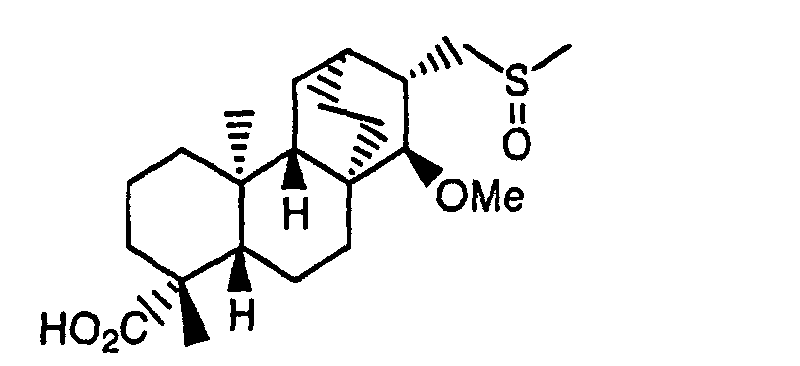
- From methyl ent-15β-methoxy-17-methylsulfinyl-16α-atisane-19-oate (18.1 mg, 0.0441 mmol) obtained in Example 54, ent-15β-methoxy-17-methylsulfinyl-16α-atisane-19-oic acid (10.9 mg, pale yellow crystals) was obtained in the same manner as described in Example 7.
ESI-MS:m/z=419 (M+Na)+
1H NMR (CD3OD) ; δ (ppm) 0. 66-2. 25 (20H, m), 0. 84 (3H, s), 1. 09 (3H, s) 2. 40 (0. 5H, d, J=3. 2Hz), 2. 45 (1H, d, J=2. 8Hz), 2. 58 and 2. 59 (3H, s × 2) 2. 69-2. 93 (2H, m), 3. 31 and 3. 36 (3H, s × 2) -

- To a mixed solution of
isomers 1 and 2 of ent-15β-hydroxy-17-methylsulfinyl-16α-atisane-19-oic acid (8.56 mg, 0.0224 mmol) obtained in Example 6 in dichloromethane (1 mL) was added Dess-Martin iodinane (19.2 mg, 0.0448 mmol) under stirring on ice, followed by stirring for 4 hours under ice-cooling. Then, saturated aqueous sodium thiosulfate was added thereto and the mixture was extracted twice with ethyl acetate. The resulting organic layer was washed with saturated brine, dried over magnesium sulfate and evaporated. The resulting residue was purified by silica gel column chromatography, to give ent-17-methylsulfinyl-15-oxo-16α-atisane-19-oic acid (4.35 mg).
ESI-MS:m/z=403 (M+Na)+
1H NMR (CD3OD) ; δ (ppm) 0. 95 and 0. 96 (3H, s × 2), 1. 11 (3H, s) 2. 58 and 2. 59 (3H, s × 2) , 2. 74 (0. 5H, dd, J=13. 4 and 7. 0Hz) 2. 85 (0. 5H, dd, J=13. 4 and 10. 8Hz), 3. 00-3. 10 (1H, m) -
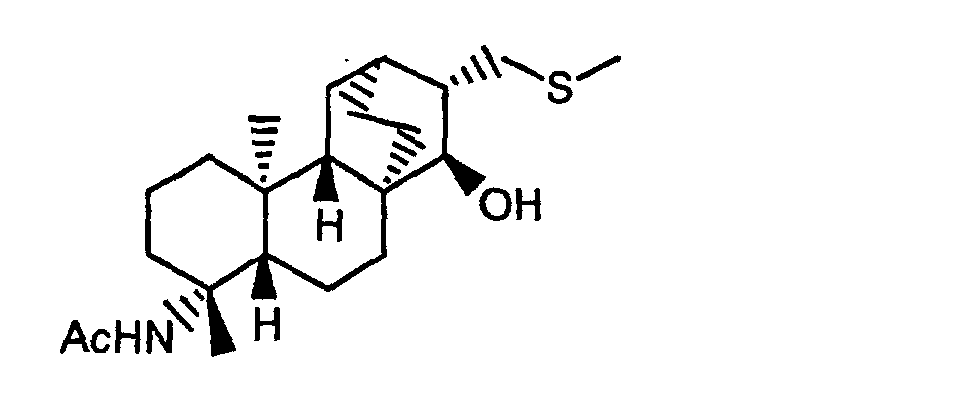
- To a solution of (1R,4S,5S,9S,10S,12R,13R,14R)-5-isocyanate-5,9-dimethyl-13-{(methylsulfanyl)methyl}tetracyclo[10.2.2.01,10.04,9]hexadecy - 14-yl acetate (17.8 mg, 0.0440 mmol) obtained in Example 49 in diethyl ether (1.5 mL) was added 1.03M methyl lithium diethyl ether solution (0.13 mL, 0.134 mmol) under stirring on ice, followed by stirring for 3 hours at room temperature. After adding saturated ammonium chloride aqueous solution, the mixture was extracted twice with ethyl acetate. The resulting organic layer was washed with saturated brine, dried over magnesium sulfate and evaporated. The resulting residue was purified by silica gel column chromatography, to give N1-(1R,4S,5S,9S,10S,12R,13R,14R)-14-hydroxy-5,9-dimethyl-13 - {(methylsulfanyl)methyl}tetracyclo [10.2.2.01,10.04,9]hexadec y-5-yl acetamide (12.4 mg).
1H NMR (CDCl3) ; δ (ppm) 0. 73-2. 10 (19H, m), 1. 11 (3H, s) , 1. 40 (3H, s), 1. 93 (3H, s) 2. 15 (3H, s), 2. 53 (2H, d, J=8. 0Hz), 2. 72-2. 82 (1H, m), 2. 95 (1H, d, J=4. 0Hz) 5.25(1H,broad s) -
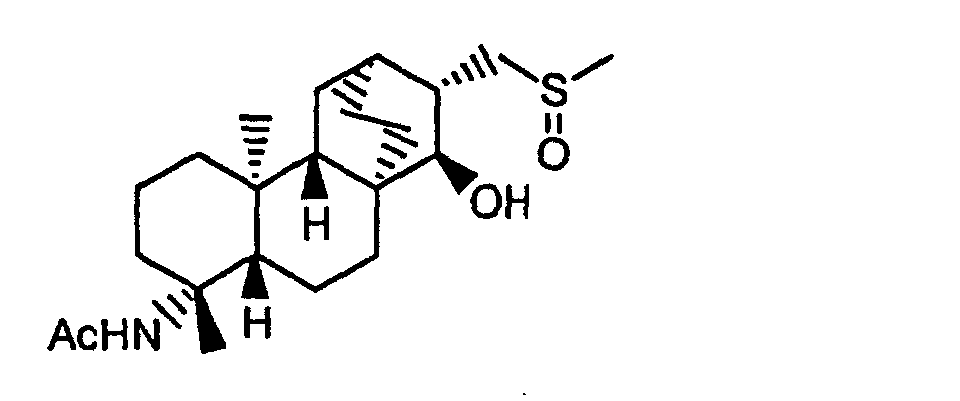
- From N1-(1R,4S,5S,9R,10S,12R,13R,14R)-14-hydroxy-5,9-dimethyl-13 -{(methylsulfanyl)methyl}tetracyclo[10.2.2.01,10.04,9]hexadec y-5-yl acetamide (8.99 mg, 0.0237 mmol) obtained in Example 57, N1-(1R,4S,5S,9R,10S,12R,13R,14R)-14-hydroxy-5,9-dimethyl-13 -{(methylsulfinyl)methyl}tetracyclo[10.2.2.01,10.04,9]hexadec y-5-yl acetamide (8.2 mg, colorless amorphous) was obtained in the same manner as described in Example 7.
ESI-MS:m/z=418(M+Na)+
1H NMR (CD3OD) ; δ (ppm) 1. 14 (3H, s), 1. 37 (3H, s), 2. 67 and 2. 69 (3H, s × 2) 2. 78-3. 30 (3H, m) -

- To a solution of ent-15β-acetoxy-17-methylthio-16α-atisane-19-oic acid (21.3 mg, 0.0523 mmol) obtained in Example 17 in dichloromethane (1 mL) was added oxalyl chloride (14 µl, 0.16 mmol) was added under stirring on ice. After stirring at room temperature for 2 hours, the reaction mixture was ice-cooled, and N,O-dimethylhydroxy-amine hydrochloride (25.5 mg, 0.261 mmol), pyridine (0.5mL) and dimethylaminopyridine (19.1mg, 0.157mmol) were added, followed by stirring for 4 hours at room temperature. After adding ethyl acetate, the mixture was washed with 1N hydrochloric acid, saturated aqueous sodium hydrogen carbonate and saturated brine, dried over magnesium sulfate and evaporated, to give N-methoxy-N-methyl ent-15β-acetoxy-17-methylthio-16α-atisane-19-amide (34.0 mg, pale yellow crude oil).
1H NMR (CDCl3) ; δ (ppm) 0. 80-2. 17 (20H, m), 0. 92 (3H, s), 1. 25 (3H, s), 2. 08 (3H, s) 2. 11 (3H, s), 2. 45-2. 88 (2H, m), 3.12 (3H, s), 3. 65 (3H, s), 4. 16 (1H, 3. 6Hz) -

- To a solution of N-methoxy-N-methyl ent-15β-acetoxy-17-methylthio-16α-atisane-19-amide (34.0 mg, 0.0753 mmol) obtained in Example 59 in tetrahydrofuran (2 mL) was added 1.03M methyl lithium diethyl ether solution (0.231 mL, 0.238 mmol) under stirring on ice. After stirring at 50°C for 3 hours, the mixture was ice-cooled. 1N hydrochloric acid was added, and themixturewas extracted twice with ethyl acetate. The resulting organic layer was washed with saturated aqueous sodium hydrogen carbonate and saturated brine, dried over magnesium sulfate and evaporated. The resulting residue was purified by silica gel column chromatography, to give 1-(1R,4S,5S,9R,10S,12R,13R,14R)-14-hydroxy-5,9-dimethyl-13-{(methylsulfanil)methyl}tetracyclo[10.2.2.01,10.04,9]hexadecy - 5-yl-1-ethanone (3.35 mg).
1H NMR (CDCl3) ; δ (ppm) 0. 70-2. 20 (20H, m), 0. 77 (3H, s) , 1. 11 (3H, s), 2. 15 (3H, s) 2. 18 (3H, s), 2.51-2.56 (2H, m), 2. 96 (1H, d, J=3. 6Hz) -

- From 1-(1R,4S,5S,9R,10S,12R,13R,14R)-14-hydroxy-5,9-dimethyl-13-{(methylsulfanyl)methyl}tetracyclo[10.2.2.01,10.04,9]hexadecy - 5-yl-1-ethanone (3.35 mg, 0.00919 mmol) obtained in Example 60, 1-(1R,4S,5S,9R,10S,12R,13R,14R)-14-hydroxy-5,9-dimethyl-13-{(methylsulfinyl)methyl}tetracyclo[10.2.2.01,10.04,9]hexadecy - 5-yl-1-ethanone (1. 63mg) was obtained in the same manner as described in Example 6.
ESI-MS:m/z=403 (M+Na)+
1H NMR (CD3OD) ; δ (ppm) 0. 64-2. 12 (20H, m), 0. 72 (3H, s), 1. 03 (3H, s), 2. 10 (3H, s) 2. 58 and 2. 59 (3H, s×2), 2. 69-2. 94 (3H, m) -
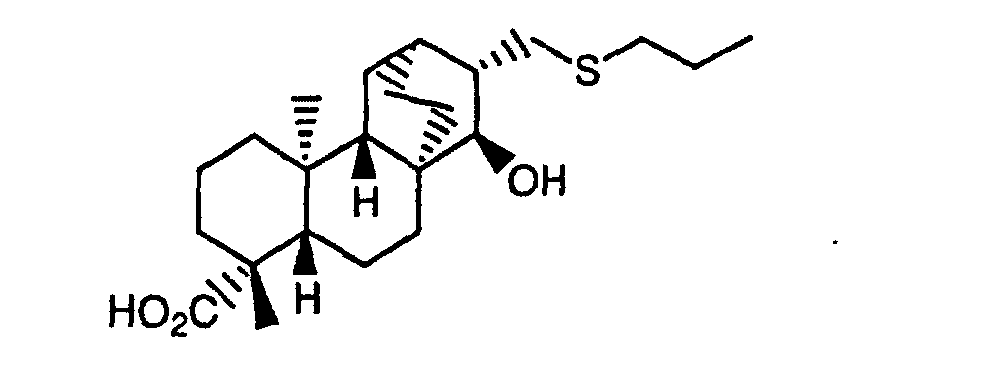
- To a solution of propanethiol (72 µl, 0.80 mmol) in hexamethylphosphoramide (3 mL) was added sodium hydride (60% dispersion in mineral oil) (32 mg, 0.80 mmol) under stirring at room temperature, followed by stirring at room temperature for 10 minutes. Then, methyl ent-15β-hydroxy-17-tosyloxy-16α-atisane-19-oate (40.0 mg, 0.0793 mmol) obtained in Example 4 was added thereto, followed by stirring for 2 hours at 50°C in nitrogen atmosphere. The reaction was recovered to room temperature, and saturated aqueous ammonium chloride was added, and the mixture was extracted twice with ethyl acetate. The resulting organic layer was washed with saturated brine, dried over magnesium sulfate and evaporated. The resulting residue was purified by silica gel column chromatography, to give ent-15β-hydroxy-17-propylthio-16α-atisane-19-oic acid (32.0 mg, pale yellow oil).
ESI-MS:m/z=393 (M-H)-
1H NMR (CDCl3) ; δ (ppm) 0. 68-0. 80 (1H, m), 0. 91 (3H, s), 1. 00 (3H, t, J=7. 6Hz) 0. 88-1. 92 (19H, m), 1. 93-2. 04 (1H, m), 2. 15 (1H, d, J=14. 0Hz), 2. 48-2. 59 (4H, m) 2. 95 (1H, d, J=4. 0Hz) -

- From ent-15β-hydroxy-17-propylthio-16α-atisane-19-oic acid (30.6 mg, 0.0777 mmol) obtained in Example 62, ent-15β-hydroxy-17-propylsulfinyl-16α-atisane-19-oic acid (21. 8 mg) was obtained in the same manner as described in Example 6.
ESI-MS:m/z=433 (M+Na)+
1H NMR (CD3OD) ; δ (ppm) 0. 75-0. 87 (1H, m), 0. 87-1. 96 (22H, m) , 0. 95 (3H, s) 1. 19 (3H, s) , 1. 96-2. 07 (1H, m), 2. 08-2. 17 (1H, m), 2. 72-3. 00 (5H, m) -
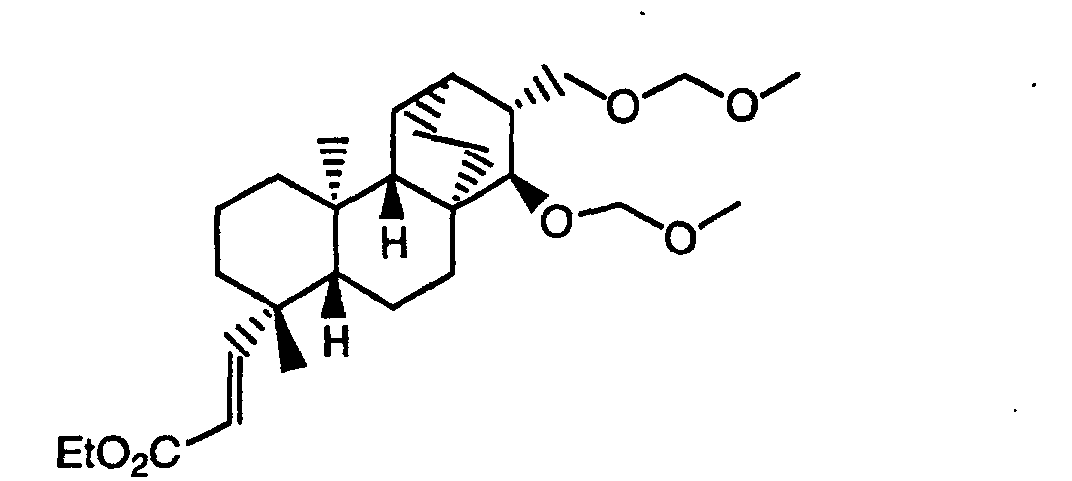
- To a solution of triethylphosphonoacetate (82 µl, 0.413 mmol) in tetrahydrofuran (2 mL) was added sodium hydride (60% dispersion in mineral oil) (16.6 mg, 0.415 mmol) under stirring on ice, followed by stirring for 1 hour at room temperature. Under ice-cooling, ent-15β,17-bis{(methoxymethyl)oxy}-19-oxo-16α-atisane (33.9 mg, 0.0831 mmol) obtained in Example 43 in tetrahydrofuran (2 mL) was added, followed by stirring for 15 hours at room temperature. Saturated aqueous ammonium chloride was added, and the mixture was extracted twice with ethyl acetate. The resulting organic layer was washed with saturated brine, dried over magnesium sulfate and evaporated. The resulting residue was purified by silica gel column chromatography, to give ethyl (ent-15β,17-bis{(methoxymethyl)oxy)-16α-atisane-19-ylidene) acetate (21.0 mg).
1H NMR (CDCl3) ; δ (ppm) 0. 66-0. 78 (1H, m), 0. 80-1. 98 (19H, m), 0. 85 (3H, s) 1. 00 (3H, s), 1. 30 (3H, t, J=7. 2Hz), 2. 64 (1H, d, J=3. 2Hz), 3. 36 (3H, s), 3. 39 (3H, s) 3. 63 (1H, dd, J=9. 4 and 5. 4Hz), 4. 19 (2H, q, J=7. 2Hz), 4. 56 (1H, d, J=6. 4Hz) 4. 61 (1H, d, J=6. 4Hz), 4. 64 (1H, d, J=6. 4Hz), 4. 81 (1H, d, J=6. 4Hz) 5. 75 (1H, d. J=15. 8Hz), 7. 16 (1H, d, J=15. 8Hz) -
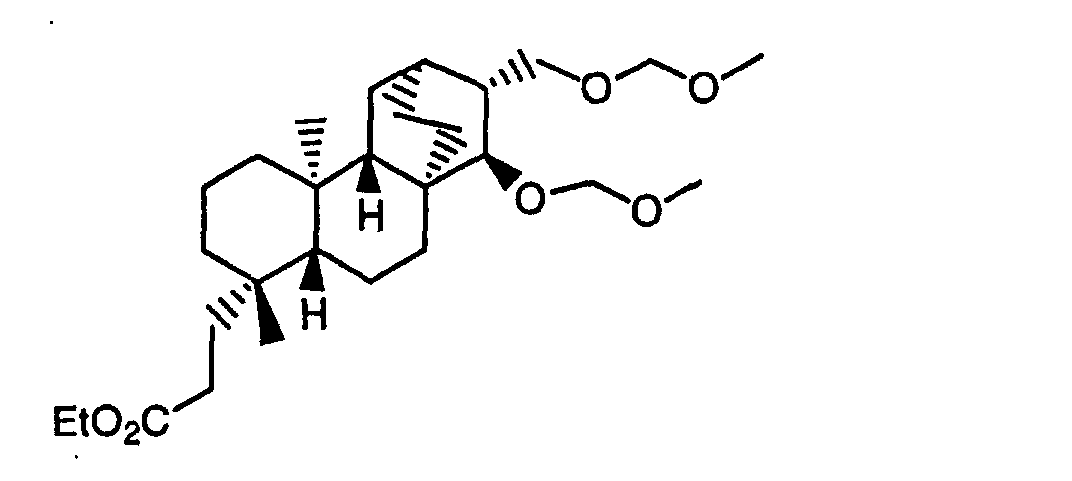
- To a solution of ethyl (ent-15β,17-bis{(methoxymethyl)oxy}-16α-atisane-19-ylidene) acetate (21 mg, 0.044 mmol) obtained in Example 64 in ethanol (2 mL) was added 10% palladium carbon (containing 50% water) (21 mg), followed by conducting catalytic hydrogen reduction at normal temperature and normal pressure for 19 hours. The reaction solution was filtrated through Celite and the filtrate was evaporated, to give ethyl (ent-15β,17-bis{(methoxymethyl)oxy}-16α-atisane-19-yl)aceta te (25 mg).
1H NMR (CDCl3) ; δ (ppm) 0. 64-0. 75 (1H, m), 0. 84 (3H, s), 1. 02 (3H, s) 1. 26 (3H, t, J=7. 2Hz), 2. 61 (1H, d, J=3. 2Hz), 3. 36 (3H, s), 3. 39 (3H, s) 3. 60-3. 66 (1H, m), 4. 12 (1H, q, J=7. 2Hz), 4. 45 (1H, d, J=6. 8Hz), 4. 61 (1H, d, J=6. 8H z)
4. 64 (1H, d, J=6. 8Hz), 4. 80 (1H, d, J=6. 8Hz) -

- From methyl ent-17-hydroxy-15-atisene-19-oate (11 mg, 0.033 mmol) obtained in Example 1, methyl ent-17-mesyloxy-15-atisene-19-oate (13.2 mg) was obtained in the same manner as described in Example 14.
1H NMR (CDCl3) ; δ (ppm) 0. 60-2. 58 (19H, m), 0. 80 (3H, s) , 1. 18 (3H, s) 3. 10 (3H, s) , 3. 65 (3H, s), 4. 69 (2H, s), 5. 96 (1H, s) -
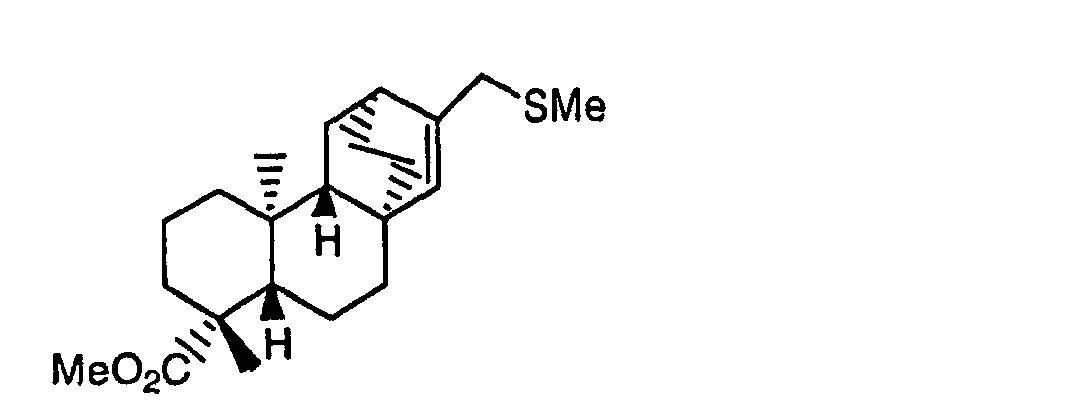
- From methyl ent-17-mesyloxy-15-atisene-19-oate (13.2 mg, 0.032 mmol) obtained in Example 66, methyl ent-17-methylthio-15-atisene-19-oate (5.5 mg) was obtained in the same manner as described in Example 7.
1H NMR (CDCl3) ; δ (ppm) 0. 76-2. 03 (17H, m) , 0. 80 (3H, s), 1. 19 (3H, s), 1. 95 (3H, s), 2. 15 (1H, d, J=16. 8Hz), 2. 50 (1H, bs), 3. 11 (2H, s) , 3. 65 (3H, s), 5. 74 (1H, s) -

- From methyl ent-17-methylthio-15-atisene-19-oate (5.5mg, 0.015 mmol) obtained in Example 67, ent-17-methylthio-15-atisene-19-oic acid (2.1 mg) was obtained in the same manner as described in Example 5.
1H NMR (CDCl3) ; δ (ppm) 0. 81-1. 09 (16H, m) , 0. 92 (3H, s), 1. 26 (3H, s), 1. 95 (3H, s) , 2. 14 (1H, d, J=14. 8Hz), 2. 51 (1H, bs), 3. 11 (2H, s), 5. 74 (1H, s) -

- From ent-17-methylthio-15-atisene-19-oic acid (2.1 mg, 0.006 mmol) obtained in Example 68, ent-17-methylsulfinyl-15-atisene-19-oic acid (3.24 mg) was obtained in the same manner as described in Example 6.
ESI-MS:m/z=387 (M+Na)+
1H NMR (CDCl3) ; δ (ppm) 0. 73-2. 18 (18H, m), 0. 92 (3H, s), 1. 25 (3H, s), 2. 53 (1H, s), 2. 549, 2. 553 (3H, s×2), 3. 45-3. 61 (2H, m), 6. 01 (1H, s) -
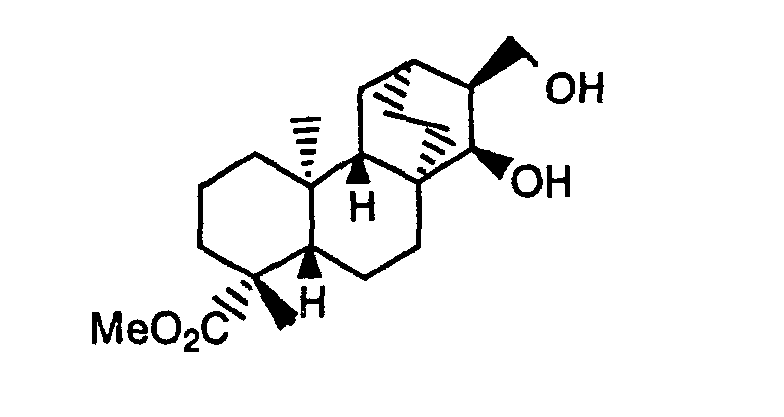
- From methyl ent-15β-hydroxy-16-atisene-19-oate obtained by Example 1 (100 mg, 0.30 mmol), methyl ent-15β,17-dihydroxy-16β-atisane-19-oate (85 mg, white crystals) was obtained in the same manner as described in Example 2.
1H NMR (CDCl3) ; δ (ppm) 0. 79 (3H, s), 0. 85-2. 11 (17H, m), 1. 18 (3H, s) , 2. 14-2. 19 (1H, m), 2. 30-2. 32 (1H, m), 2. 50 (1H, d, J=4. 2Hz), 3. 51-3. 53 (1H, m), 3. 60-3. 65 (1H, m), 3. 65 (3H, s), 3. 97-4. 04 (1H, m) -
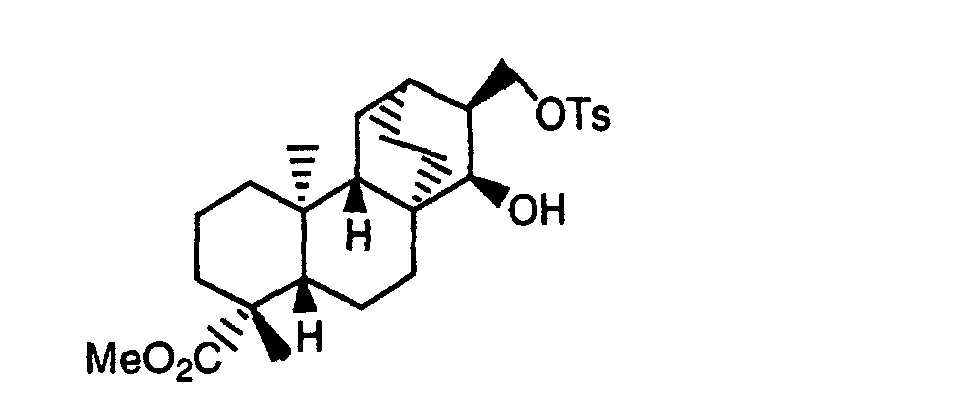
- From methyl ent-15β,17-dihydroxy-16β-atisane-19-oate (85 mg, 0.24 mmol) obtained in Example 70, methyl ent-15β-hydroxy-17-tosyloxy-16β-atisane-19-oate (85mg, white crystals) was obtained in the same manner as described in Example 4.
1H NMR (CDCl3) ; δ (ppm) 0. 76 (3H, s), 0. 81-1. 82 (17H, m), 1. 16 (3H, s) 1. 92 (1H, m), 2. 16 (2H, m), 2. 45 (3H, s), 3. 42 (1H, dd, J=5. 0, 9. 2 Hz), 3. 49 (1H, d, J=5. 0 Hz), 3. 64 (3H, s), 4. 03 (1H, dd, J=8. 0, 9. 2 Hz), 4. 40 (1H, dd, J=8. 0, 10. 0 Hz), 7. 35 (2H, d, J=6. 8Hz), 7. 80 (2H, d, J=6. 8 Hz) -
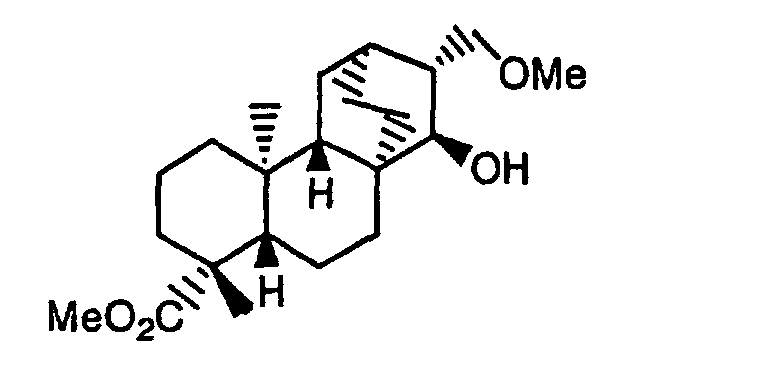
- From methyl ent-15β,17-dihydroxy-16α-atisane-19-oate (29.3 mg, 0.084 mmol) obtained in Example 3, methyl ent-15β-hydroxy-17-methoxy-16α-atisane-19-oate (24.1 mg, white crystals) was obtained in the same manner as described in Example 39.
1H NMR (CDCl3) ; δ (ppm)
0. 70-1. 84 (18H, m), 0. 80 (3H, s), 1. 18 (3H, m), 1. 93-2. 00 (1H, m), 2. 15 (1H, d, J=13. 2 Hz), 2. 93 (1H, d, J=4. 0 Hz), 3. 37 (2H, m), 3. 37 (3H, s), 3. 64 (3H, s) -

- From methyl ent-15β-hydroxy-17-methoxy-16α-atisane-19-oate (9.1 mg, 0.025 mmol) obtained in Example 72, ent-15β-hydroxy-17-methoxy-16α-atisane-19-oic acid (8.4 mg, white crystals) was obtained in the same manner as described in Example 5.
ESI-MS:m/z=349 (M-H)+
1H NMR (CDCl3) ; δ (ppm)
0. 70-2. 02 (18H, m), 0. 91 (3H, s) , 1. 24 (3H, s) , 1. 95-2. 02 (1H, m), 2. 16 (1H, d, J=4. 0 Hz) , 2. 94 (1H, d, J=4. 0 Hz), 3. 37 (3H, s) , 3. 36-3. 38 (2H, m) -
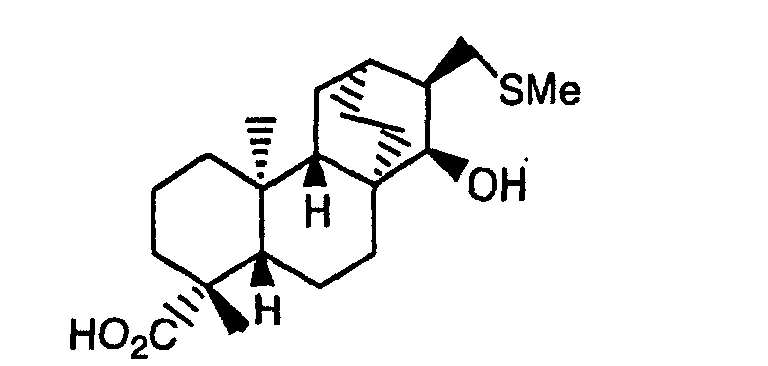
- From methyl ent-15β-hydroxy-17-tosyloxy-16β-atisane-19-oate (85 mg, 0.17 mmol) obtained in Example 71, ent-15β-hydroxy-17-methylthio-16α-atisane-19-oic acid (49.1 mg, white crystals) was obtained in the same manner as described in Example 5.
ESI-MS:m/z=365 (M-H)+
1H NMR (CDCl3) ; δ (ppm) 0. 85-2. 17 (20H, m), 0. 91 (3H, s), 1. 24 (3H, s), 2. 15 (3H, s) , 2. 52 (1H, dd, J=4. 8, 12. 0 Hz), 2. 87 (1H, dd, J=11. 6, 12. 0 Hz), 3. 46 (1H, d, J=8. 4 Hz) -

- From ent-15β-hydroxy-17-methylthio-16α-atisane-19-oic acid (31.7 mg, 0.086 mmol) obtained in Example 74, ent-15β-hydroxy-17-methylsulfinyl-16β-atisane-19-oic acid was obtained in the same manner as described in Example 6. Furthermore, two isomers are separated according to the configuration of sulfoxides by means of silica gel column chromatography, to give isomer 1 (13.5 mg, white crystals) and isomer 2 (13.9 mg, white crystals).
(isomer1)
ESI-MS:m/z=381 (M-H)+
1H NMR (CDCl3) ; δ (ppm) 0. 88-2. 41 (23H, m), 0. 91 (3H, m), 1. 24 (3H, s) , 2. 64 (3H, s) , 3. 44 (1H, d, J=8. 4 Hz) , 3. 69 (1H, dd, J=12. 2, 12. 4 Hz)
(isomer2)
ESI-MS:m/z=381 (M-H)+
1H NMR (CDCl3) ; δ (ppm) 0. 89-2. 17 (18H, m), 0. 92 (3H, s), 1. 24 (3H, s) , 2. 15 (1H, d, J=13. 2 Hz), 2. 29 (1H, dd, J=12. 8, 13. 6 Hz), 2. 44-2. 49 (1H, m), 2. 59 (3H, s) , 3. 45 (1H, d, J=8. 8 Hz), 3. 65 (1H, dd, J=12. 8, 12. 8 Hz) -
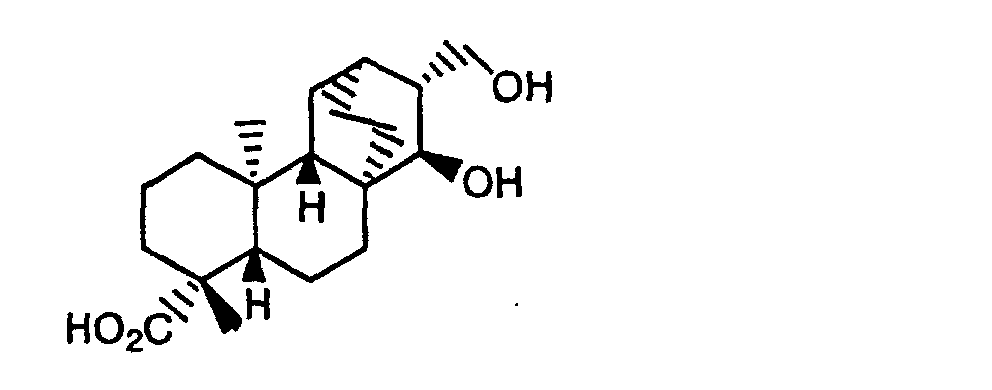
- From methyl ent-15β,17-dihydroxy-16α-atisane-19-oate (29.6 mg, 0.084 mmol) obtained in Example 3, ent-15β,17-dihydroxy-16α-atisane-19-oic acid (22.1 mg, white crystals) was obtained in the same manner as described in Example 5.
ESI-MS:m/z=335(M-H)+
1H NMR (CDCl3) ; δ (ppm) 0. 65-0. 73 (1H, m), 0. 90-2. 00 (18H, m), 0. 94 (3H, s), 1. 18 (3H, s), 2. 12 (1H, d, J=13. 6 Hz), 2. 62 (1H, d, J=4. 4 Hz), 3. 39-3. 45 (1H, m), 3. 62-3. 66 (1H, m) -

- From ent-15β,17-dihydroxy-16α-atisane-19-oic acid (19.8 mg, 0.059 mmol) obtained in Example 76, ent-15β-hydroxy-17-tosyloxy-16α-atisane-19-oic acid (10.4 mg, white crystals) was obtained in the same manner as described in Example 4.
1H NMR (CDCl3) ; δ (ppm) 0. 60-1. 99 (19H, m), 0. 88 (3H, s) , 1. 23 (3H, m) , 2. 15 (1H, d, J=12. 4 Hz), 2. 46 (3H, s), 2. 81 (1H, d, J=4. 4 Hz), 3. 96 (1H, dd, J=9. 2, 9. 6 Hz), 4. 05 (1H, dd, J=7. 6, 9. 6 Hz), 7. 35 (2H, d, J=8. 0 Hz), 7. 80 (2H, d, J=8. 0 Hz) -

- To a solution of ent-15β-hydroxy-17-tosyloxy-16α-atisane-19-oic acid (10.4 mg, 0.021 mmol) obtained in Example 77 in dimethylsulfoxide (2 mL) was added potassium cyanate (4.5 mg, 0. 069 mmol) , followed by stirring for 14 hours at 80°C in nitrogen atmosphere. Then, the mixture was ice-cooled and water was added thereto. The mixture was extracted twice wi th ethyl acetate, and the resulting organic layer was washed with saturated brine, dried over magnesium sulfate and evaporated. The resulting residue was purified by silica gel column chromatography, to give ent-17-cyano-15β-hydroxy-16α-atisane-19-oic acid (1.3 mg).
ESI-MS:m/z=344 (M-H)+
1H NMR (CDCl3) ; δ (ppm) 0. 71-0. 79 (1H, m) , 0. 88-1. 90 (17H, m) , 0. 92 (3H, s) , 1. 25 (3H, s) , 2. 00-2. 07 (1H, m) , 2. 17 (1H, d, J=12. 4 Hz), 2. 34 (1H, dd, J=8. 8, 16. 6 Hz), 2. 52 (1H, dd, J=7. 6, 16. 6 Hz), 2. 90 (1H, d, J=4 Hz) -
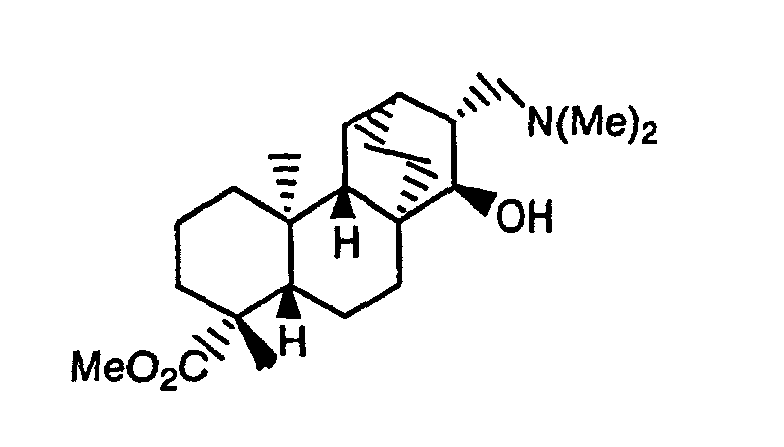
- Methyl ent-15β-hydroxy-17-tosyloxy-16α-atisane-19-oate (10.67 mg, 0.021 mmol) obtained in Example 4 was dissolved in a solution of dimethylamine in a 2M tetrahydrofuran. After stirring for 34 hours at 140°C in a sealed tube, methylene chloride was added thereto. The mixture was washed with a 1N aqueous sodium hydroxide and saturated brine, dried over magnesium sulfate and evaporated. The resulting residue was purified by silica gel column chromatography, to give methyl ent-17-dimethylamino-15β-hydroxy-16α-atisane-19-oate (5.1 mg).
ESI-MS:m/z=378 (M+H)+
1H NMR (CDCl3) ; δ (ppm)
0. 79 (3H, s), 0. 81-1. 87 (18H, m), 1. 18 (3H, s), 1. 96-2. 03 (1H, m), 2. 47-2. 52 (1H, m) , 2. 62 (6H, s), 2. 76-2. 82 (1H, m), 3. 20 (1H, d, J=4. 8 Hz), 3. 64 (3H, s) -

- To a solution of methyl ent-15β-hydroxy-17-tosyloxy-16α-atisane-19-oate obtained in Example 4 (25.5 mg, 0.051 mmol) in dimethylformamide (1.5 mL) was added sodium azide (12.7 mg, 0.19 mmol) under stirring at room temperature, followed by stirring for 21 hours at 60°C. After recovering to room temperature, saturated aqueous ammonium chloride was added and the mixture was extracted twice with diethyl ether. The resulting organic layer was washed with saturated brine, dried over magnesium sulfate and evaporated. The resulting residue was purified by silica gel column chromatography, to give methyl ent-17-azido-15β-hydroxy-16α-atisane-19-oate (16.3 mg).
1H NMR (CDCl3) ; δ (ppm) 0. 68-2. 02 (19H, m), 0. 80 (3H, s), 1. 18 (3H, s), 2. 16 (1H, d, J=14. 4Hz), 2. 88 (1H, m), 3. 28 (1H, dd, J=8. 0, 12. 0 Hz), 3. 40 (1H, dd, J=8. 0, 12. 0 Hz), 3. 65 (3H, S) -
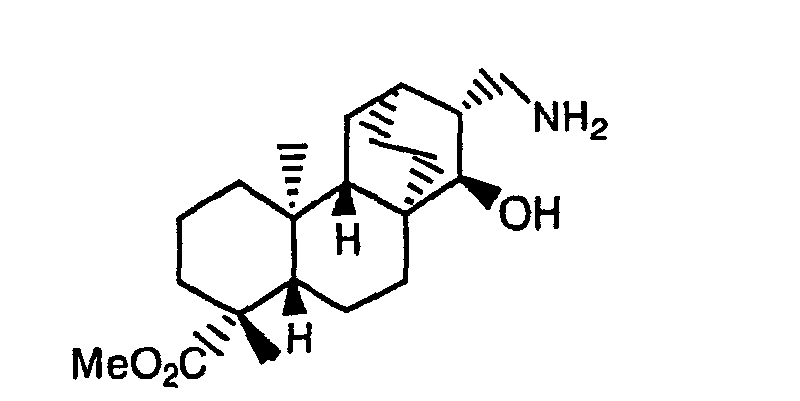
- To a solution of methyl ent-17-azido-15β-hydroxy-16α-atisane-19-oate obtained by Example 80 (16.3 mg, 0.043 mmol) in ethanol (2 mL) was added Lindlar catalyst (6. 52 mg), followed by stirring for 14 hours and 30 minutes in hydrogen atmosphere. After removing the Lindlar catalyst by filtration, the filtrate was evaporated, to give methyl ent-17-amino-15β-hydroxy-16α-atisane-19-oate (18.7 mg).
ESI-MS:m/z=350 (M+H)+
1H NMR (CD3OD) ; δ (ppm) 0. 66-1. 98 (19H, m), 0. 82 (3H, s), 1. 17 (3H, m), 2. 14 (1H, d, J=13. 6 Hz), 2. 56-2. 78 (3H, m), 3. 63 (3H, s) -
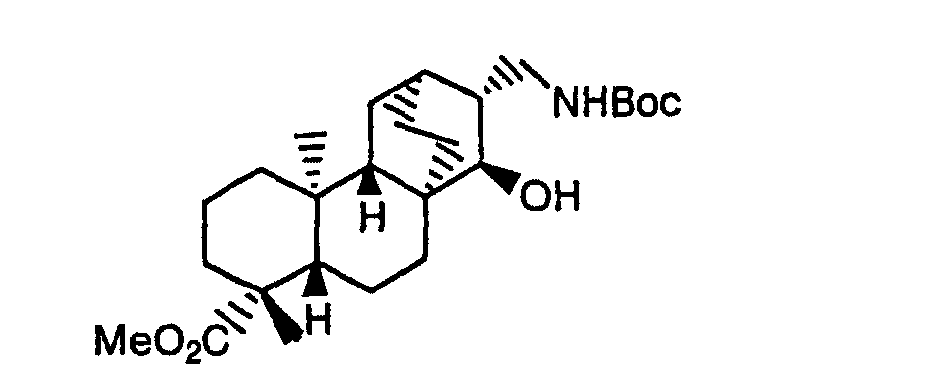
- From methyl ent-17-amino-15β-hydroxy-16α-atisane-19-oate obtained by Example 81 (16.7 mg, 0.048 mmol), methyl ent-17-{(t-butoxycarbonyl)amino}-15β-hydroxy-16α-atisane-19 - oate (21.6 mg) was obtained in the same manner as described in Example 30(2).
1H NMR (CDCl3) ; δ (ppm) 0. 70-1. 87 (18H, m), 0. 79 (3H, s), 1. 18 (3H, s), 1. 45 (9H, s), 1. 93-2. 00 (1H, m), 2. 16 (1H, d, J=14. 4Hz), 2. 89 (1H, d, J=3. 2 Hz), 3. 06-3. 12 (1H, m), 3. 17-3. 23 (1H, m), 3. 65 (3H, S), 4. 75 (1H, bs) -
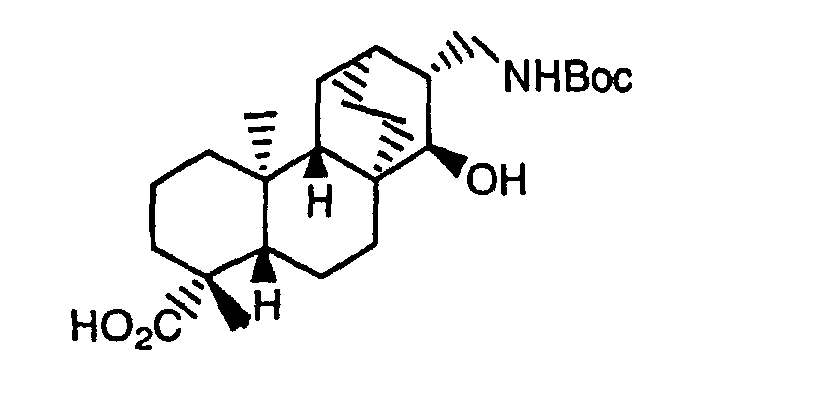
- From methyl ent-17-{(t-butoxycarbonyl)amino}-15β-hydroxy-16α-atisane-19 - oate (9.8 mg, 0.022 mmol) obtained in Example 82, ent-17-{(t-butoxycarbonyl)amino}-15β-hydroxy-16α-atisane-19 - oic acid (3.06 mg) was obtained in the same manner as described in Example 5.
ESI-MS:m/z=434 (M-H)-
1H NMR (CDCl3) ; δ (ppm) 0. 71-0. 79 (1H, m), 0. 86-1.87 (17H, m), 0.91 (3H, s), 1. 24 (3H, m), 1. 45 (9H, s), 1. 95-2. 02 (1H, m) , 2. 16 (1H, d, J=13. 6 Hz), 2. 90 (1H, d, J=4 Hz), 3. 05-3. 12 (1H, m), 3. 17- 3. 24 (1H, m), 4. 76 (1H, bs) -

- ent-17-{(t-Butoxycarbonyl)amino}-15β-hydroxy-16α-atisa ne-19-oic acid (1.92 mg, 0.0044 mmol) obtained in Example 83 was dissolved in a solution of 3N hydrogen chloride in ethyl acetate (1 mL), followed by stirring for 1 hour at room temperature. Then, the mixture was evaporated, to give ent-17-amino-15β-hydroxy-16α-atisane-19-oic acid-hydrochloric acid (1.98 mg).
ESI-MS:m/z=336 (M+H)+
1H NMR (CD3OD) ; δ (ppm) 0. 64-0. 74 (1H, m), 0. 79-1. 82 (17H, m), 0. 86 (3H, s), 1. 10 (3H, m), 1. 89-1. 97 (1H, m), 2. 04 (1H, d, J=12. 4 Hz), 2. 68 (1H, d, J=4. 4 Hz), 2. 79-2. 84 (1H, m), 2. 95 (1H, dd, J=6. 4, 16. 0 Hz) -

- To a solution of methyl ent-15β-hydroxy-17-tosyloxy-16α-atisane-19-oate (13.2 mg, 0.026 mmol) obtained in Example 4 in dimethylformamide (1.5 mL) were added thioacetic acid (9.4 µl, 0. 13 mmol) and sodium hydride (5.1 mg, 0 . 21 mmol), followed by stirring in nitrogen atmosphere at 80°C for 4 hours. Then,
water was added thereto under ice-cooling, and the mixture was extracted twice with diethyl ether . The resulting organic layer was washed with saturated brine, dried over magnesium sulfate and evaporated. The resulting residue was purified by silica gel column chromatography, to give methyl ent-17-acetylthio-15β-hydroxy-16α-atisane-19-oate (11.2 mg). 1H NMR (CDCl3) ; δ (ppm)
0. 72-1. 87 (18H, m), 0. 79 (3H, s), 1. 17 (3H, m), 1. 93-2. 00 (1H, m), 2. 15 (1H, d, J=13. 2 Hz), 2. 35 (3H, s) , 2. 85-2. 90 (2H, m), 3. 04 (1H, dd, J=8. 0, 13. 2 Hz), 3. 64 (3H, s) -

- To a solution of methyl ent-17-acetylthio-15β-hydroxy-16α-atisane-19-oate (5.6 mg, 0.014 mmol) obtained in Example 85 in methanol (1.8 mL) was added a solution of sodium methoxide (10.8 mg, 0.2 mmol) in methanol (0.2 mL) at 0°C in nitrogen atmosphere, followed by stirring f or 2 hours and 3 0 minutes a t 0°C in ni trogen atmosphere. Then, saturated aqueous ammonium chloride was added thereto under ice-cooling and the mixture was extracted twice with diethyl ether. The resulting organic layer was washed with saturated brine, dried over magnesium sulfate and evaporated, to give di{2-[(1S,4S,5R,9S,10S,12S,13S,14R)-14-hydroxy-5-(methoxyca rbonyl)-5,9-dimethyltetracyclo[10.2.2.01,10.04,9]hexadecy-13-yl]}disulfide (8.13 mg).
FAB-MS:m/z=753 (M+Na)+
1H NMR (CDCl3) ; δ (ppm) 0. 70-0. 75 (2H, m), 0. 86-1. 83 (34H, m), 0. 80 (6H, s), 1. 18 (6H, m), 1. 92-1. 99 (2H, m), 2. 16 (2H, d, J=12. 8 Hz) , 2. 71 (2H, dd, J=7. 2, 13. 2 Hz), 2. 85 (2H, dd, J=8. 0, 13. 2 Hz), 2. 97 (2H, d, J=4 Hz), 3. 65 (6H, s) -

- From di{2-[(1S,4S,5R,9S,10S,12S,13S,14R)-14-hydroxy-5-(methoxyca rbonyl)-5,9-dimethyltetracyclo[10.2.2.01,10.04,9]hexadecy-13-yl]}disulfide (7.7 mg, 0.011 mmol) obtained in Example 86, ent-15β-hydroxy-17-methyldisulfanil-16α-atisane-19-oic acid (1. 98 mg) was obtained in the same manner as described in Example 5.
ESI-MS:m/z=397 (M-H)-
1H NMR (CDCl3) ; δ (ppm) 0. 70-0. 78 (1H, m), 0. 87-1. 90 (17H, m), 0. 92 (3H, s), 1. 25 (3H, m), 1. 96-2. 03 (1H, m), 2. 12-2. 18 (1H, m), 2. 44 (3H, s), 2. 75-2. 79 (2H, m), 2. 95 (1H, d, J=4 Hz) -

- To a solution of methyl ent-15β-hydroxy-17-tosyloxy-16α-atisane-19-oate (14.1 mg, 0.028 mmol) obtained by Example 4 in hexamethylphosphoramide (1. 5 mL) was added thiophenol (28. 8 pl, 0.28 mmol) under stirring at room temperature, followed by stirring for 43 hours at 80°C in nitrogen atmosphere. Then, the reaction was recovered to room temperature, saturated aqueous ammonium chloride was added, and extracted twice with diethyl ether. The resulting organic layer was washed with saturated brine, dried over magnesium sulfate and evaporated. The resulting residue was purified by silica gel column chromatography, to give ent-15β-hydroxy-17-phenylthio-16α-atisane-19-oic acid (11.4 mg, white crystals).
ESI-MS:m/z=427 (M-H)-
1H NMR (CDCl3) ; δ (ppm) 0. 72-0. 81 (1H, m), 0. 88-1. 89 (17H, m), 0. 91 (3H, s), 1. 24 (3H, m), 1. 96-2. 04 (1H, m), 2. 14 (1H, d, J=12. 8 Hz), 2. 96-2. 98 (2H, m), 3. 02 (1H, d, J=4 Hz), 7. 16-7. 20 (1H, m), 7. 27-7. 31 (2H, m), 7. 35-7. 38 (2H, m) -
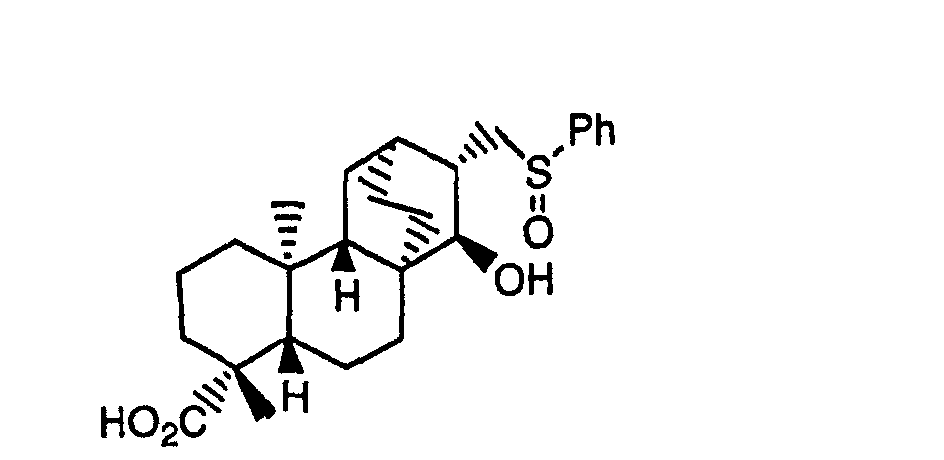
- From ent-15β-hydroxy-17-phenylthio-16α-atisane-19-oic acid (5 mg, 0.0117 mmol) obtained in Example 88, ent-15β-hydrsoxy-17-phenylsulfinyl-16α-atisane-19-oic acid (7.2 mg) was obtained in the same manner as described in Example 6.
ESI-MS : m/z=443 (M-H)-
1H NMR (CD3OD) ; δ (ppm) 0. 78-0. 86 (1H, m), 0. 98-1. 90 (17H, m), 0. 94 (3H, s), 1. 18 (3H, m), 1. 98-2. 04 (1H, m), 2. 12 (1H, d, J=12. 8 Hz), 2. 87-3. 00 (2H, m), 3. 07-3. 12 (1H, dd, J=6. 6, 14. 0 Hz), 7. 51-7. 61 (2H, m), 7. 70-7. 76 (1H, m), 7. 89-7. 91 (2H, m) -

- From ent-15β-hydroxy-17-tosyloxy-16α-atisane-19-oic acid obtained in Example 77, ent-17-dimethylamino-15β-hydroxy-16α-atisane-19-oic acid (3.1 mg) was obtained in the same manner as described in Example 79.
ESI-MS:m/z=364 (M+H)+
1H NMR (CD3OD) ; δ (ppm) 0. 69-0. 77 (1H, m), 0. 87-2. 04 (18H, m), 0. 97 (3H, s), 1. 15 (3H, s), 2. 13 (1H, d, J=13. 6 Hz), 2. 43 (6H, s), 2. 53 (1H, dd, J=6. 6, 12. 4 Hz), 2. 61 (1H, dd, J=8. 8, 12. 4 Hz), 2. 74 (1H, d, J=4. 0 Hz) -
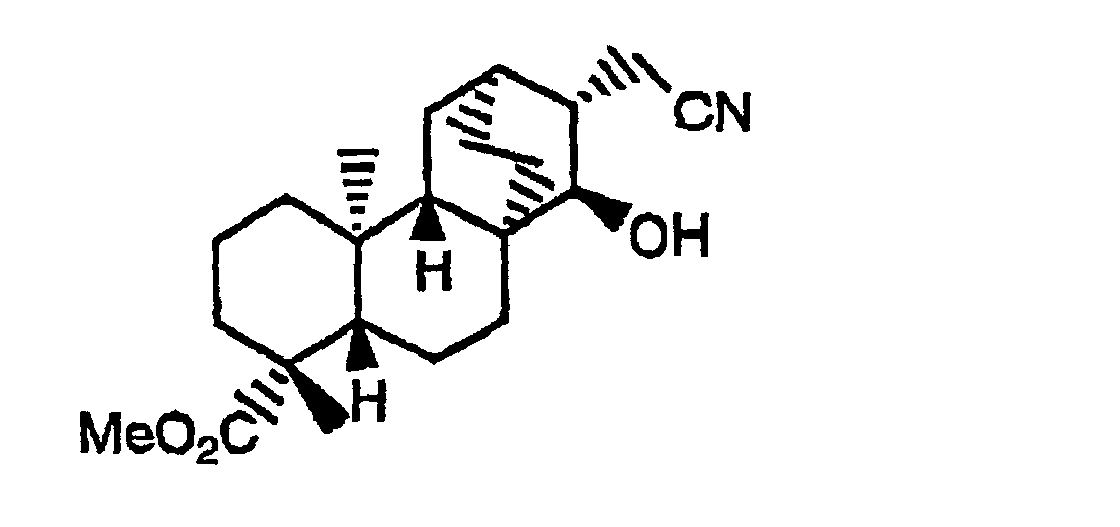
- From methyl ent-15β-hydroxy-17-tosyloxy-16α-atisane-19-oate (124.7 mg, 0.247 mmol) obtained in Example 4, methyl ent-17-cyano-15β-hydroxy-16α-atisane-19-oate (89.7 mg, white crystals) was obtained in the same manner as described in Example 78.
1H NMR (CDCl3) ; δ (ppm) 0. 70-1. 86 (18H, m), 0. 80 (3H, s) , 1. 18 (3H, s) , 1. 99-2. 05 (1H, m), 2. 17 (1H, d, J=13. 2 Hz), 2. 34 (1H, dd, J=8. 8, 16. 0 Hz), 2. 52 (1H, dd, J=7. 4, 16. 0 Hz), 2. 89 (1H, m), 3. 65 (3H, s) -

- To a solution of methyl ent-17-cyano-15β-hydroxy-16α-atisane-19-oate (36 mg, 0.1 mmol) obtained in Example 91 in ethanol (20 mL) was added potassium hydroxide (6 g, 0.107 mol), followed by stirring at 50°C for 10 hours in nitrogen atmosphere. Then, the reaction mixture was neutralized with 5N hydrochloric acid under ice-cooling, and extracted twice with diethyl ether. The resulting organic layer was then washed with saturated brine, dried over magnesium sulfate and evaporated. The resulting residue was purified by silica gel column chromatography, to give methyl ent-17-carbamoyl-15β-hydroxy-16α-atisane-19-oate (10.1 mg, white crystals) and methyl ent-17-carboxyl-15β-hydroxy-16α-atisane-19-oate (22.2 mg, white crystals).
(S92-1) ESI-MS:m/z=377 (M-H)-
1H NMR (CDCl3) ; δ (ppm) 0. 71-1. 85 (18H, m), 0. 79 (3H, s), 1. 18 (3H, s), 1. 95-2. 02 (1H, m), 2. 15 (1H, d, J=12. 8 Hz), 2. 41-2. 56 (2H, m), 2. 93 (1H, d, J=4 Hz), 3. 65 (3H, s)
(S92-2) ESI-MS:m/z=400 (M+Na)+
1H NMR (CDCl3) ; δ (ppm)
0. 71-1. 87 (18H, m) , 0. 79 (3H, s), 1. 18 (3H, m), 1. 96-2. 02 (1H, m) , 2. 15 (1H, d, J=12. 0 Hz), 2. 31-2. 46 (2H, m) , 2. 94 (1H, d, J=4 Hz), 3. 64 (3H, m), 5. 49 (1H, bs), 5. 84 (1H, bs) -
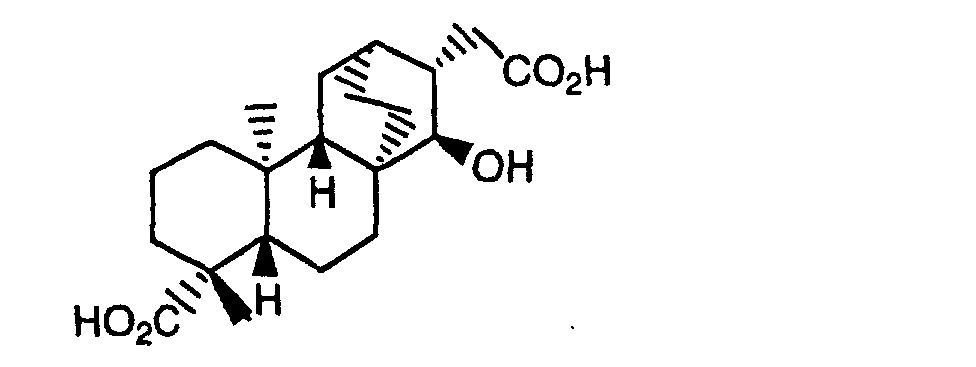
- From methyl ent-17-carboxyl-15β-hydroxy-16α-atisane-19-oate (22.2 mg, 0.059 mmol) obtained in Example 92, ent-17-carboxyl-15β-hydroxy-16α-atisane-19-oic acid (16.0 mg, white crystals) was obtained in the same manner as described in Example 5.
ESI-MS:m/z=363(M-H)-
1H NMR (CD3OD) ; δ (ppm) 0. 71-0. 79 (1H, m), 0. 87-2. 01 (18H, m), 0. 93 (3H, s), 1. 18 (3H, s), 2. 11 (1H, d, J=13. 2 Hz), 2. 30 (1H, dd, J=9. 2, 15. 0 Hz), 2. 49 (1H, dd, J=6. 6, 15. 0 Hz), 2. 78 (1H, d, J=4. 0 Hz) -
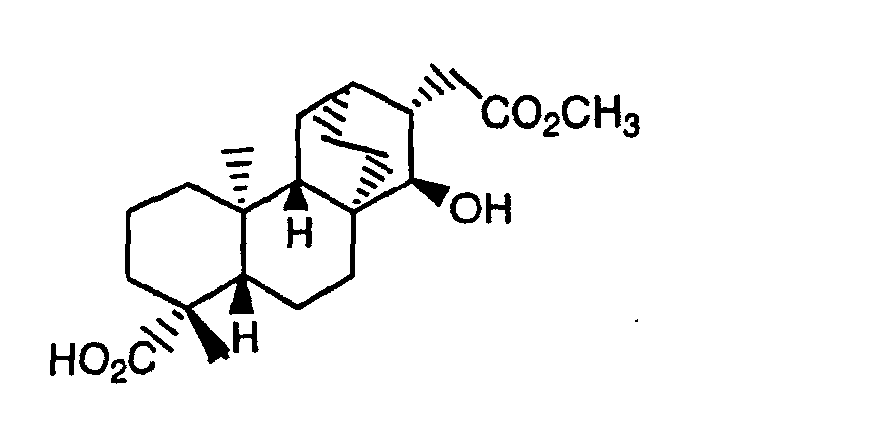
- To a solution of ent-17-carboxyl-15β-hydroxy-16α-atisane-19-oic acid (3.0 mg, 0.0082 mmol) obtained in Example 93 in tetrahydrofuran (1 mL) were added ethyl chloroformate (2.0 µl, 0.021 mmol) and triethylamine (7.0 µl, 0.05 mmol) under stirring on ice in nitrogen atmosphere, followed by further stirring for 50 minutes under stirring on ice in nitrogen atmosphere. Then, methanol (0.4 mL) was introduced and stirred for 4 hours at room temperature. Then, 1N hydrochloric acid was added, and the mixture was extracted twice with ethyl acetate. The resulting organic layer was dried over magnesium sulfate and evaporated. The resulting residue was purified by silica gel column chromatography, to give ent-15β-hydroxy-17-methoxycarbonyl-16α-atisane-19-oic acid (0.82 mg).
ESI-MS:m/z=377 (M-H)-
1H NMR (CDCl3) ; δ (ppm)
0. 71-2. 21 (20H, m), 0. 92 (3H, s), 1. 25 (3H, s), 2. 37-2. 52 (2H, m), 2. 88-2. 91 (1H, m) , 3. 72 (3H, s) -
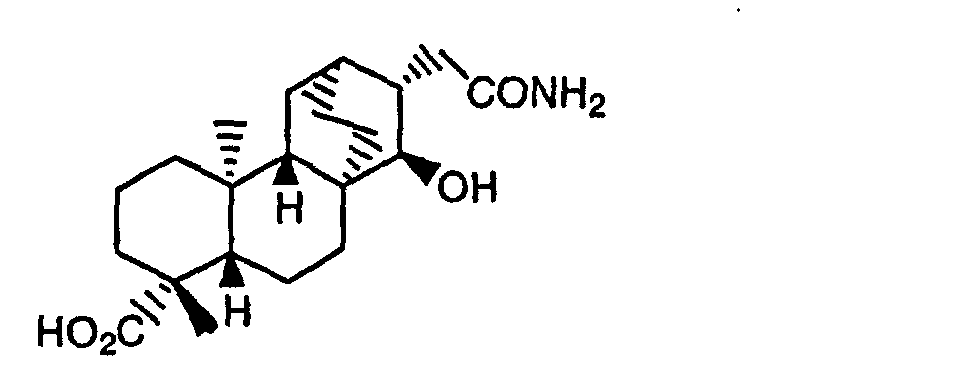
- To a solution of ent-17-carboxyl-15β-hydroxy-16α-atisane-19-oic acid (3.0 mg, 0.0082 mmol) obtained in Example 93 in tetrahydrofuran (1 mL) were added ethyl chloroformate (2.0 µl, 0.021 mmol) and triethylamine (7.0 µl, 0.05 mmol) under stirring on ice in nitrogen atmosphere, followed by stirring for 25 minutes under stirring on ice in nitrogen atmosphere. Then, 28% aqueous ammonia (0.5 mL) was added, followed by stirring for another 4 hours. Thereafter, 1N hydrochloric acid was added, and extracted twice with a 1:1 mixture of ethyl acetate and tetrahydrofuran. The resulting organic layer was washed once with saturated brine, dried over magnesium sulfate and evaporated. The resulting residue was purified by silica gel column chromatography, to give ent-17-carbamoyl-15β-hydroxy-16α-atisane-19-oic acid (2.34 mg).
ESI-MS:m/z=362 (M-H)-
1H NMR (CD3OD) ; δ (ppm) 0. 73-0. 81 (1H, m), 0. 89-1. 90 (17H, m), 0. 94 (3H, s) , 1. 19 (3H, s), 1. 95-2. 02 (1H, m), 2. 12 (1H, d, J=13. 2 Hz), 2. 23 (1H, dd, J=8, 4, 14. 6 Hz), 2. 41 (1H, dd, J=7. 6, 14. 6 Hz), 2. 80 (1H, d, J=4. 4 Hz) -

- To a solution of ent-17-carboxyl-15β-hydroxy-16α-atisane-19-oic acid (3.0 mg, 0.0082 mmol) obtained in Example 93 in tetrahydrofuran (1 mL) were added ethyl chloroformate (2.0 µl, 0.021 mmol) and triethylamine (7.0 µl, 0.05 mmol) under stirring on ice in nitrogen atmosphere, followed by stirring for 25 minutes under ice-cooling in nitrogen atmosphere. Then, 2M dimethylamine solution in tetrahydrofuran (0.5 mL) was added, followed by stirring for another 4 hours. Then, 1N hydrochloric acid was added, and the reaction mixture was extracted twice with a 1:1 mixture of ethyl acetate and tetrahydrofuran. The resulting organic layer was washed once with saturated brine, dried over magnesium sulfate and evaporated. The resulting residue was purified by silica gel column chromatography, to give ent-17-dimethylcarbamoyl-15β-hydroxy-16α-atisane-19-oic acid (1.61 mg).
ESI-MS:m/z=390 (M-H)-
1H NMR (CD3OD) ; δ (ppm) 0. 74-0. 82 (1H, m) , 0. 88-2. 03 (17H, m) , 0. 94 (3H, s), 1. 18 (3H, s), 2. 12 (1H, d, J= 14. 0), 2. 46 (1H, dd, J=7. 2, 15. 2 Hz), 2. 54 (1H, dd, J=8. 2, 15. 2 Hz), 2. 82 (1H, d, J=4. 4 Hz), 2. 93 (3H, s), 3. 08 (3H, s) -
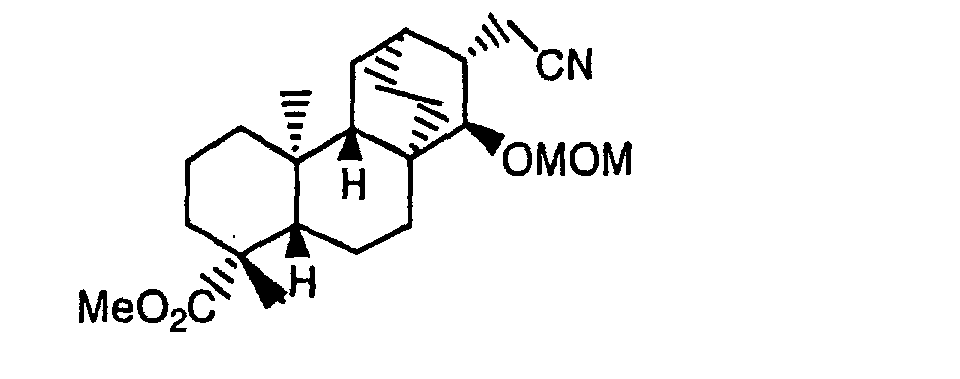
- From methyl ent-17-cyano-15β-hydroxy-16α-atisane-19-oate (15.4 mg, 0.043 mmol) obtained in Example 91, methyl ent-17-cyano-15β-(methoxymethyl)oxy-16α-atisane-19-oate (16.8 mg, white crystals) was obtained in the same manner as described in Example 33.
1H NMR (CDCl3) ; δ (ppm) 0. 68-0. 76 (1H, m), 0. 90-1. 90 (17H, m), 0. 79 (3H, s), 1. 18 (3H, s), 1. 97-2. 04 (1H, m), 2. 16 (1H, d, J=14. 8 Hz), 2. 26 (1H, dd, J=12. 0, 16. 8 Hz), 2. 53 (1H, d, J=4. 0 Hz), 2. 76 (1H, dd, J=4. 4, 16. 8 Hz), 3. 40 (3H, s), 3. 65 (3H, s), 4. 55 (1H, d, J=6. 8 Hz), 4. 71 (1H, d, J=6. 8 Hz) -

- From methyl ent-17-cyano-15β-(methoxymethyl)oxy-16α-atisane-19-oate (7.0 mg, 0.0173 mmol) obtained in Example 97, ent-17-cyano-15β-(methoxymethyl)oxy-16α-atisane-19-oic acid (7 mg) was obtained in the manner as described in Example 5.
1H NMR (CDCl3) ; δ (ppm) 0. 69-0. 77 (1H, m), 0. 91 (3H, s), 0. 94-1. 91 (17H, m), 1. 25 (3H, s), 1. 99-2. 06 (1H, m), 2. 16 (1H, d, J=13. 6 Hz), 2. 26 (1H, d, J=11. 4, 17. 0 Hz), 2. 53 (1H, d, J=3. 6 Hz), 2. 77 (1H, dd, J=3. 8, 17. 0 Hz), 3. 40 (3H, s), 4. 56 (1H, d, J=7. 0 Hz), 4. 72 (1H, d, J=7. 0 Hz) -
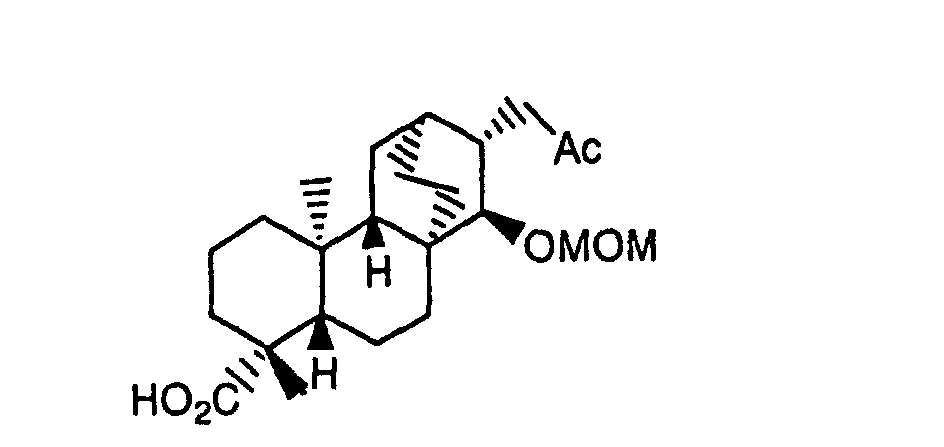
- From ent-17-cyano-15β-(methoxymethyl)oxy-16α-atisane-19-oic acid (3.5 mg, 0.009 mmol) obtained in Example 98, ent-17-acetyl-15β-(methoxymethyl)oxy-16α-atisane-19-oic acid (1.35 mg) was obtained in the same manner as described in Example 60.
ESI-MS:m/z=405 (M-H)-
1H NMR (CDCl3) ; δ (ppm) 0. 68-2. 17 (20H, m), 0. 89 (3H, s), 1. 24 (3H, m), 2. 14 (3H, s), 2. 47 (1H, dd, J = 11. 2, 16. 2 Hz), 2. 61 (1H, d, J=3. 6 Hz), 2. 71 (1H, dd, J=3. 6, 16. 2 Hz), 3. 37 (3H, s), 4. 55 (1H, d, J=6. 6 Hz), 4. 72 (1H, d, J=6. 6 Hz) -

- From ent-17-acetyl-15β-(methoxymethyl)oxy-16α-atisane-19-oic acid (1.35 mg, 0.00332 mmol) obtained in Example 99, ent-17-acetyl-15β-hydroxy-16α-atisane-19-oic acid (1.17mg) was obtained in the same manner as described in Example 36. ESI-MS:m/z=361 (M-H)-
1H NMR (CD3OD) ; δ (ppm) 0. 70-0. 78 (1H, m), 0. 88-2. 01 (18H, m), 0. 94 (3H, s), 1. 17 (3H, s), 2. 12 (1H, d, J=13. 2 Hz), 2. 17 (3H, s), 2. 56-2. 59 (2H, m), 2. 74 (1H, d, J=4. 0 Hz) -
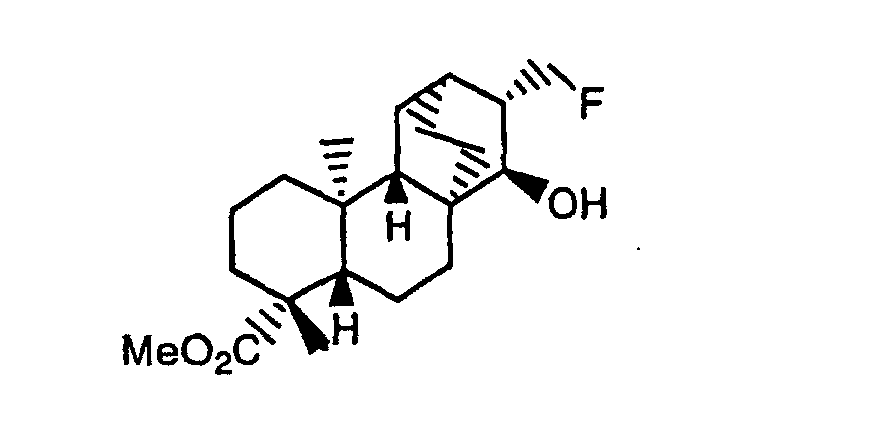
- Methyl ent-15β-hydroxy-17-tosyloxy-16α-atisane-19-oate (7.52 mg, 0.0149 mmol) obtained in Example 4 was dissolved in 1M tetrabutyl ammonium fluoride in tetrahydrofuran (1 mL), followed by stirring for 17 hours at 50°C. Then, water was added, and extracted twice with diethyl ether. The resulting organic layer was washed once with saturated brine, dried over magnesium sulfate and evaporated. The resulting residue was purified by silica gel column chromatography, to give methyl ent-17-fluoro-15β-hydroxy-16α-atisane-19-oate (2.0 mg).
1H NMR (CDCl3) ; δ (ppm) 0. 69-0. 78 (1H, m), 0. 80 (3H, s), 0. 85-1. 88 (17H, m), 1. 18 (3H, s), 1. 95-2. 02 (1H, m), 2. 14-2. 19 (1H, m), 2. 95 (1H, d, J=3. 6 Hz), 3. 65 (3H, s), 4. 32-4. 55 (2H, m) -

- From methyl ent-17-fluoro-15β-hydroxy-16α-atisane-19-oate (2.0mg, 0.0057 mmol) obtained by Example 101, ent-17-fluoro-15β-hydroxy-16α-atisane-19-oic acid (1.81 mg) was obtained in the same manner as described in Example 5. ESI-MS:m/z=337 (M-H)-
1H NMR (CD3OD) ; δ (ppm)
0. 68-0. 76 (1H, m), 0. 88-1. 91 (17H, m), 0. 94 (3H, m), 1. 19 (3H, s), 1. 94-2. 02 (1H, m) , 2. 12 (1H, d, J=13. 2 Hz), 2. 75 (1H, d, J=4. 4 Hz), 4. 26-4. 52 (2H, m) -

- To a solution of methyl ent-17-carboxyl-15β-hydroxy-16α-atisane-19-oate (29.3 mg, 0.0774 mmol) obtained in Example 92 in tetrahydrofuran (5 mL) was added 1.0M boran tetrahydrofuran complex in tetrahydrofuran (0.387 mL, 0.387 mmol) under stirring on ice in nitrogen atmosphere, followed by stirring for 2 hours and 20 minutes at room temperature. Then, water was added under ice-cooling, followed by stirring for another 30 minutes. Then, 2N hydrochloric acid was added to make the reaction mixture acidic, followed by extracting twice with ethyl acetate. The resulting organic layer was washed with saturated brine, dried over magnesium sulfate and evaporated, to give methyl ent-15β-hydroxy-17-hydroxy-methyl-16α-atisane-19-oate (29.26 mg, white crystals).
1H NMR (CD3OD) ; δ (ppm) 0. 71-1. 98 (21H, m), 0. 82 (3H, s), 1. 17 (3H, s), 2. 13 (1H, d, J=13. 2 Hz), 2. 76 (1H, d, J=4. 0 Hz), 3. 62-3. 66 (5H, m) -
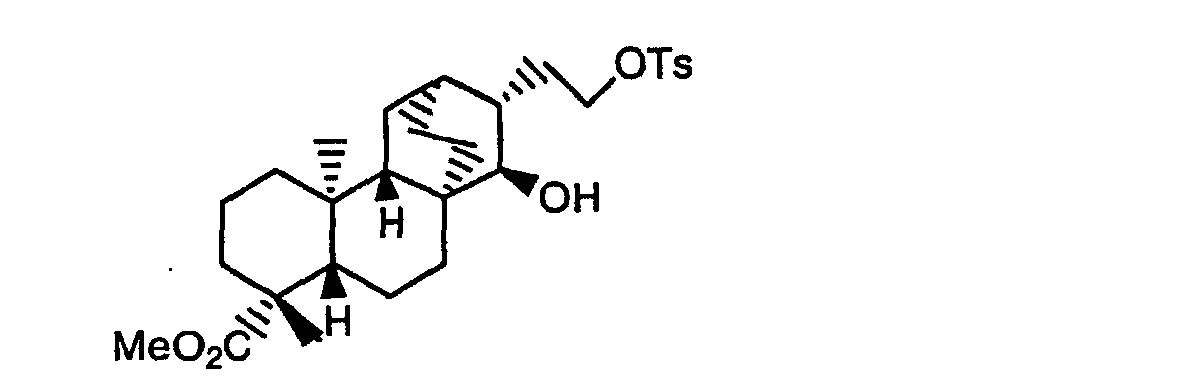
- From methyl ent-15β-hydroxy-17-hydroxy-methyl-16α-atisane-19-oate (35.2 mg, 0.0965 mmol) obtained in Example 105, methyl ent-15β-hydroxy-17-tosyloxymethyl-16α-atisane-19-oate (20.02 mg, white crystals) was obtained in the same manner as described in Example 4.
1H NMR (CDCl3) ; δ (ppm)
0. 63-1. 82 (20H, m), 0. 77 (3H, s) , 1. 17 (3H, s), 1. 90-1. 96 (1H, m) , 2. 16 (1H, d, J=13. 2 Hz), 2. 45 (3H, s), 2. 77-2. 79 (1H, m) , 3. 64 (3H, s), 4. 10-4. 22 (2H, m) , 7. 35 (2H, d, J=8. 6 Hz), 7. 80 (2H, d, J=8. 6 Hz) -
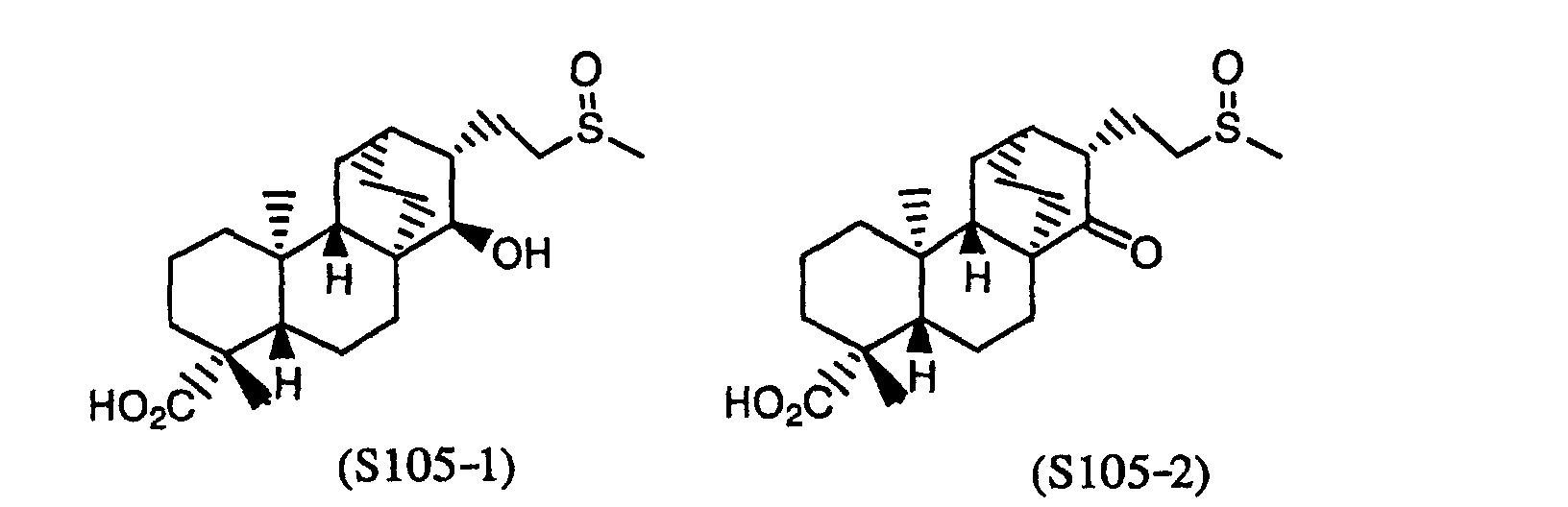
- From methyl ent-15β-hydroxy-17-tosyloxymethyl-16α-atisane-19-oate (16.64 mg, 0.0321 mmol) obtained in Example 104, ent-15β-hydroxy-17-(methylsulfinyl)methyl-16α-atisane-19-oi c acid (4.3 mg) was obtained in the same manner as described in Example 5 and by additional oxidation of sulfide under such a condition. Furthermore, oxidation of alcohol occurred, to give ent-17-(methylsulfinyl)methyl-15-oxo-16α-atisane-19-oic acid (4.2 mg).
(S105-1) ESI-MS:m/z=395 (M-H)-
1H NMR (CD3OD) ; δ (ppm) 0. 74-0. 82 (1H, m), 0. 89-2. 01 (20H, m), 0. 94 (3H, m) , 1. 19 (3H, s), 2. 12 (1H, d, J=13. 2 Hz), 2. 640 and 2. 644 (3H, s ×2), 2. 78 (1H, d, J=4. 0 Hz), 2. 81-2. 92 (2H, m)
(S105-2) ESI-MS:m/z=393 (M-H)-
1H NMR (CD3OD) ; δ (ppm) 0. 88-0. 95 (1H, m) , 0. 98-2. 28 (21H, m), 1. 04 (3H, s) , 1. 20 (3H, s), 2. 648 and 2. 649 (3H, s × 2), 2. 84-3. 07 (2H, m) -
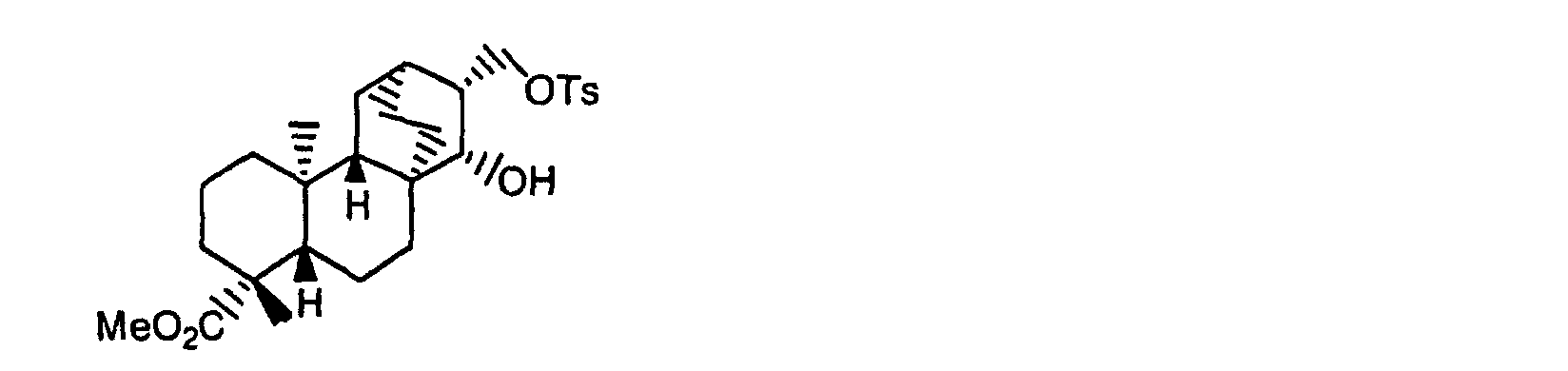
- From methyl ent-15α,17-dihydroxy-16α-atisane-19-oate (200 mg, 0.57 mmol) obtained in Example 2, methyl ent-15α-hydroxy-17-tosyloxy-16α-atisane-19-oate (220.31 mg, white crystals) was obtained in the same manner as described in Example 4.
1H NMR (CDCl3) ; δ (ppm)
0. 76-1. 83 (18H, m), 0. 79 (3H, s), 1. 17 (3H, s), 2. 15-2. 20 (2H, m), 2. 45 (3H, s), 3. 39 - 3. 42 (1H, m), 3. 63 (3H, s), 4. 04 (1H, dd, J=8. 4, 9. 8 Hz), 4. 39 (1H, dd, J=7. 0, 9. 8 Hz), 7. 34 (2H, d, J=8. 2 Hz), 7. 80 (2H, d, J=8. 2 Hz) -
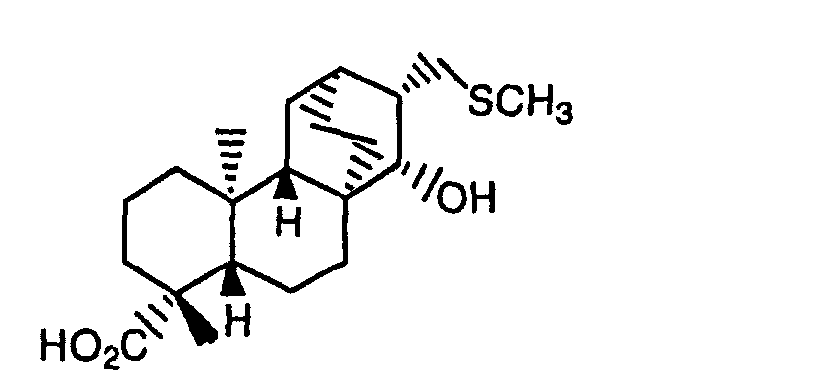
- From methyl ent-15α-hydroxy-17-tosyloxy-16α-atisane-19-oate (220.3 mg, 0.437 mmol) obtained in Example 106, ent-15α-hydroxy-17-methylthio-16α-atisane-19-oic acid (133.9 mg, white crystals) was obtained in the same manner as described in Example 5.
ESI-MS:m/z=365 (M-H)-
1H NMR (CDCl3) ; δ (ppm) 0. 84-2.20 (20H, m), 0. 94 (3H, s), 1. 25 (3H, s), 2. 15 (3H, s), 2. 51 (1H, dd, J=5. 4, 11. 8 Hz) , 2. 89 (1H, dd, J=10. 8, 11. 8 Hz), 3. 45 (1H, d, J=8. 4 Hz) -
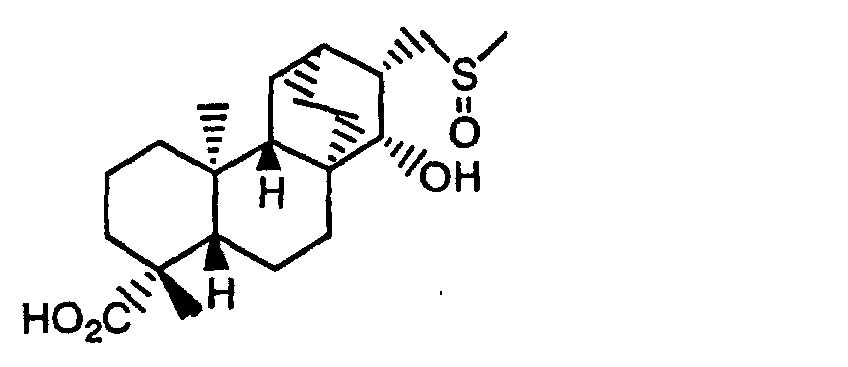
- From ent-15α-hydroxy-17-methylthio-16α-atisane-19-oic acid (10.3 mg, 0.028 mmol) obtained in Example 107, ent-15α-hydroxy-17-methylsulfinyl-16α-atisane-19-oic acid was obtained in the same manner as described in Example 6. Furthermore, by means of silica gel column chromatography, two isomers are separated based on the configuration of sulfoxides, to give isomer 1 (5. 86 mg) and isomer 2 (5.28mg, white crystals).
(isomer1)
ESI-MS:m/z=381(M-H)+
1H NMR (CD3OD) ; δ (ppm) 0. 89-1. 95 (18H, m), 0. 97 (3H, s), 1. 19 (3H, s), 2. 13 (1H, d, J=13. 2 Hz), 2. 29-2. 35 (1H, m), 2. 66 (3H, s), 2. 78 (1H, dd, J=7. 6, 13. 2 Hz), 3. 25-3. 30 (1H, m), 3. 35 (1H, d, J=8. 8 Hz)
(isomer2)
ESI-MS:m/z=381 (M-H)+
1H NMR (CD3OD) ; δ (ppm) 0. 89-1. 95 (18H, m), 0. 97 (3H, s), 1. 19 (3H, s), 2. 13 (1H, d, J=14. 0 Hz), 2. 39-2. 45 (1H, m), 2. 54 (1H, dd, J=4. 2, 13. 2 Hz), 2. 65 (3H, s), 3. 36-3. 42 (2H, m) -

- To a solution of ent-15α-hydroxy-17-methylthio-16α-atisane-19-oic acid (33.0 mg, 0. 09 mmol) obtained in Example 107 in pyridine (3.0 mL) were added dimethylaminopyridine (1.1 mg, 0.009 mmol) and mesyl chloride (61.8 µl, 0.81 mmol) under stirring on ice. After stirring at room temperature for 69 hours, 1N hydrochloric acid was added under ice-cooling and extracted twice with ethyl acetate. The resulting organic layer was washed with 1N hydrochloric acid, dried over magnesium sulfate and evaporated. The resulting residue was purified by silica gel column chromatography, to give ent-15α-mesyloxy-17-methylthio-16α-atisane-19-oic acid (18.2 mg, white crystals).
1H NMR (CD3OD) ; δ (ppm) 0. 90-2. 23 (20H, m), 0. 98 (3H, s), 1. 19 (3H, s), 2. 06 (3H, s), 2. 58 (1H, dd, J=12. 4, 12. 8 Hz), 2. 87 (1H, dd, J=4. 4, 12. 8 Hz), 3. 10 (3H, s), 4. 49 (1H, d, J=8. 8 Hz) -
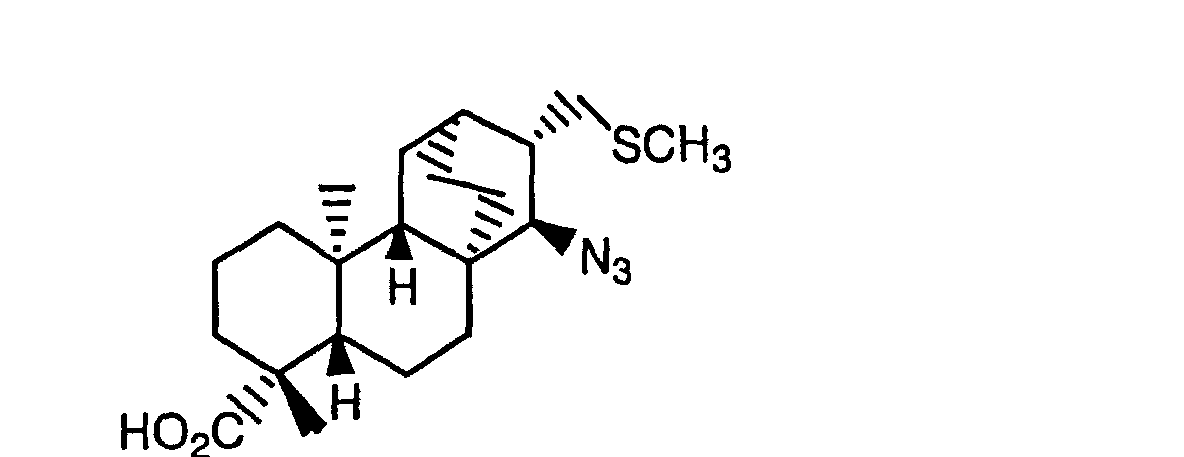
- From ent-15α-mesyloxy-17-methylthio-16α-atisane-19-oic acid (9.3 mg, 0.021 mmol) obtained in Example 109, ent-15β-azido-17-methylthio-16α-atisane-19-oic acid (3.75mg) was obtained in the same manner as described in Example 80. ESI-MS:m/z=390 (M-H)+
1H NMR (CDCl3) ; δ (ppm) 0. 79-2. 18 (20H, m), 0. 89 (3H, s) , 1. 26 (3H, s) , 2. 14 (3H, s), 2. 50 (1H, dd, J=9. 0, 13. 2 Hz), 2. 58 (1H, dd, J=7. 2, 13. 2 Hz), 2. 80 (1H, d, J=4. 0 Hz) -
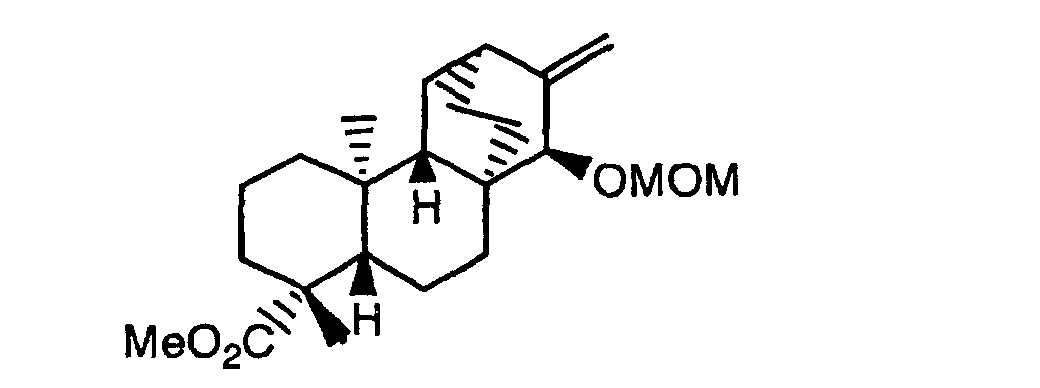
- From methyl ent-15β-hydroxy-16-atisene-19-oate (91.9 mg, 0.276 mmol) obtained in Example 1, methyl ent-15β-(methoxymethyl)oxy-16-atisene-19-oate (101.1 mg, white crystals) was obtained in the same manner as described in Example 33.
1H NMR (CDCl3) ; δ (ppm)
0. 83-2. 03 (17H, m), 0. 80 (3H, s), 1. 19 (3H, s), 2. 14-2. 18 (1H, m), 2. 29-2. 32 (1H, m) , 3. 44 (3H, s), 3. 53-3. 54 (1H, m), 3. 65 (3H, s), 4. 70 (1H, d, J=6. 8 Hz), 4. 86 (1H, d, J=6. 8 Hz), 4. 98-4. 99 (1H, m), 5. 04-5. 05 (1H, m) -
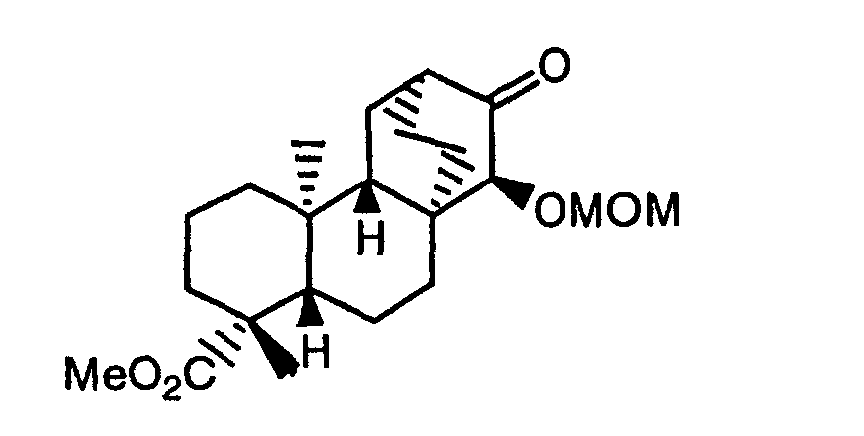
- Methyl ent-15β-(methoxymethyl)oxy-16-atisene-19-oate (35.0 mg, 0.093 mmol) obtained in Example 111 was dissolved in a 1:1 tetrahydrofuran :water mixed solvent (6 mL) and a 2.5% solution of osmium tetraoxide in t-butanol (0.1 mL, 0.008 mmol) was added thereto, followed by stirring at room temperature for 30 minutes. Then, sodium periodate (69.9 mg, 0.327 mmol) was added and stirred at room temperature for 25 hours. Then saturated aqueous sodium thiosulfate was added, stirred for 30 minutes, and then the reaction mixture was extracted twice with diethyl ether. The resulting organic layer was washed with 1N hydrochloric acid, dried over magnesium sulfate and evaporated. The resulting residue was purified by silica gel column chromatography, to give methyl (1R,4S,5R,9S,10S,12S,14S)-14-(methoxymethoxy)-5,9-dimethyl-13-oxotetracyclo[10.2.2.01,10.04,9]hexadecane-5-carboxylate (19.6 mg, white crystals).
ESI-MS:m/z=402 (M+Na)+
1H NMR (CDCl3) ; δ (ppm) 0. 85-2. 34 (19H, m), 0. 86 (3H, s), 1.20 (3H, s), 3. 26 (1H, s), 3. 48 (3H, s) , 3. 67 (3H, s), 4. 72 (1H, d, J=6. 4 Hz), 5. 10 (1H, d, J=6. 4 Hz) -
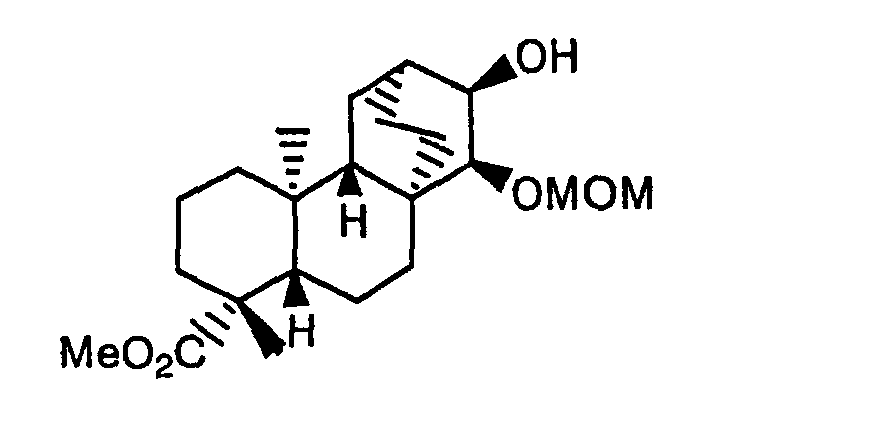
- To a solution of methyl (1R,4S,5R,9S,10S,12S,14S)-14-(methoxymethoxy)-5,9-dimethyl-13-oxotetracyclo[10.2.2.01,10.04,9]hexadecane-5-carboxylate (13.0 mg, 0.0343 mmol) obtained in Example 112 in dichloromethane (1.5 mL) was added 1.5M diisobutyl aluminum hydride in toluene (34 µl, 0.0515 mmol) under stirring at -78°C, followedby stirring at -78°C for 4 hours and 40 minutes. Under ice-cooling, water was added and the mixture was extracted twice with diethylether. The resulting organic layer was washed with saturated brine, dried over magnesium sulfate and evaporated. The resulting residue was purified by silica gel column chromatography, to give methyl (1R,4S,5R,9S,10S,12S,13R,14S)-13-hydroxy-14-(methoxymethoxy )-5,9-dimethyltetracyclo[10.2.2.01,10.04,9]hexadecane-5-carbo xylate (7.5 mg).
1H NMR (CDCl3) ; δ (ppm) 0. 77-1. 88 (17H, m), 0. 79 (3H, s), 1. 18 (3H, s), 1. 94-2. 01 (1H, m), 2. 16 (1H, d, J=14. 0 Hz) , 3. 15 (1H, d, J=4. 8 Hz), 3. 19 (1H, d, J=8. 4 Hz), 3. 48 (3H, s) , 3. 65 (3H, s), 3. 85-3. 89 (1H, m), 4. 64 (1H, d, J=6. 4 Hz), 4. 82 (1H, d, J=6. 4 Hz) -
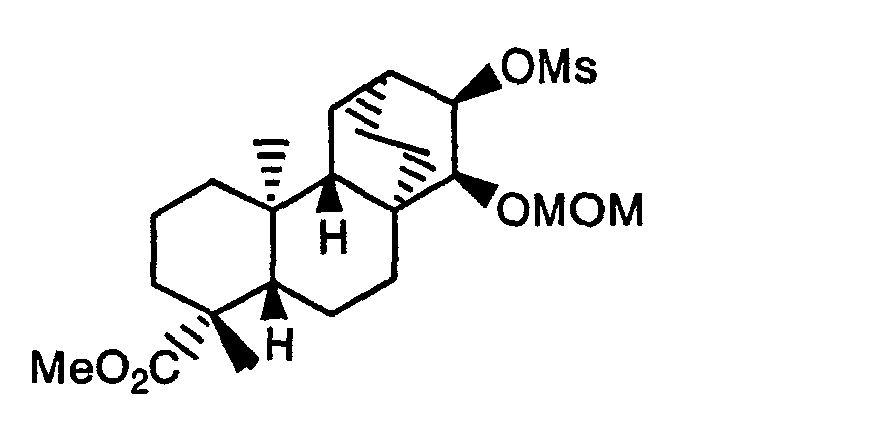
- From methyl (1R,4S,5R,9S,10S,12S,13R,14S)-13-hydroxy-14-(methoxymethoxy ) -5,9-dimethyltetracyclo[10.2.2.01,10.04,9]hexadecane-5-carbo xylate (7.5 mg, 0.0196 mmol) obtained in Example 113, methyl (1R,4S,5R,9S,10S,12S,13R,14S)-14-(methoxymethoxy)-5,9-dimet hyl-13-[(methylsulfonyl)oxy]tetracyclo[10.2.2.01,10.04,9]hexa decane-5-carboxylate (8.3 mg) was obtained in the same manner as described in Example 109.
1H NMR (CDCl3) ; δ (ppm) 0.77-2. 10 (18H, m), 0. 79 (3H, s), 1. 18 (3H, s), 2. 16 (1H, d, J=13. 6 Hz), 3. 05 (3H, s), 3. 38 (1H, d, J=8. 4 Hz), 3. 45 (3H, s), 3. 65 (3H, s), 4. 67 (1H, d, J=6. 6 Hz), 4. 77 (1H, d, J=6. 6 Hz), 4. 90-4. 93 (1H, m) -
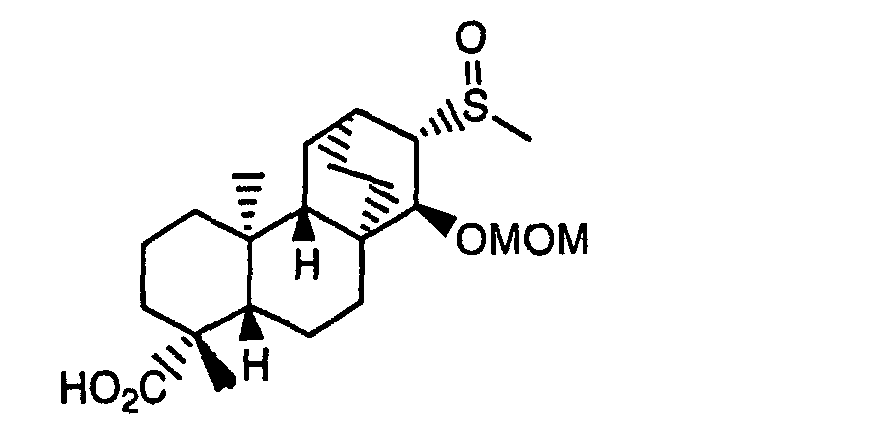
- From methyl (1R,4S,5R,9S,10S,12S,13R,14S)-14-(methoxymethoxy)-5,9-dimet hyl-13-[(methylsulfonyl)oxy]tetracyclo[10.2.2.01,10.04,9]hexa decane-5-carboxylate (8.3 mg, 0.018 mmol) obtained in Example 114, (1R,4S,5R,9S,10S,12S,13S,14S)-14-(methoxymethoxy)-5,9-dimet hyl-13-(methylsulfinyl)tetracyclo[10.2.2.01,10.04,9]hexadecan e-5-carboxylic acid (8.2 mg) was obtained in the same manner as described in Example 5 and by oxidation of sulfide occurring in such a condition.
ESI-MS:m/z=413 (M+H)+
1H NMR (CD3OD) ; δ (ppm) 0. 90-2. 29 (19H, m), 0. 94 and 0. 96 (3H, S ×2), 1. 19 and 1. 20 (3H, S ×2), 2. 70 and 2. 82 (3H, S ×2), 2. 83-2. 86 (1H, m), 2. 99 (0. 5H, d, J=2. 4 Hz), 3. 38 and 3. 39 (3H, S ×2), 3. 55 (0. 5H, d, J=0. 2 Hz), 4. 63 (0. 5H, d, J=6. 6 Hz), 4. 67 (0. 5H, d, J=7. 2 Hz), 4. 77 (0. 5H, d, J=7. 2 Hz), 4. 92 (0. 5H, d, J=6. 6 Hz) -
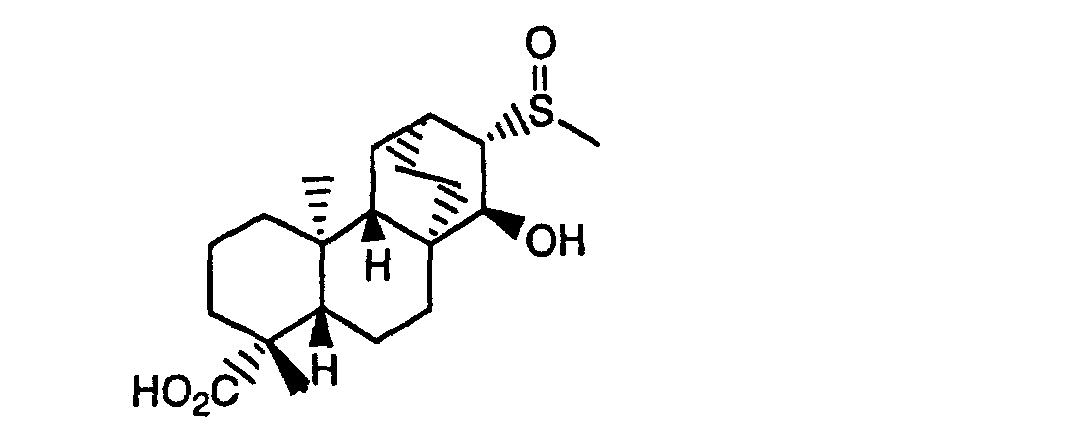
- To a solution of (1R,4S,5R,9S,10S,12S,13S,14S)-14-(methoxymethoxy)-5,9-dimet hyl-13-(methylsulfinyl)tetracyclo[10.2.2.01,10.04,9]hexadecan e-5-carboxylic acid (4.1 mg, 0.0099mmol) obtained in Example 115 in tetrahydrofuran (2 mL) was added trifluoroacetic acid (2 mL) under stirring on ice. After stirring at 50°C for 29 hours, the reaction mixture was evaporated, to give (1R,4S,5R,9S,10S,12S,13S,14S)-14-hydroxy-5,9-dimethyl-13-(m ethylsulfinyl)tetracyclo[10.2.2.01,10.04,9]hexadecane-5-carbo xylic acid. This product was further purified by silica gel column chromatography so as to separate two isomers based on the configuration of sulfoxide, to give isomer 1 (0.71 mg) and isomer 2 (1.01 mg).
(isomer1)
ESI-MS:m/z=367 (M-H)+
1H NMR (CD3OD) ; δ (ppm) 0. 83-2. 08 (18H, m), 0. 94 (3H, m), 1. 20 (3H, s) , 2. 14 (1H, d, J=13. 2 Hz), 2. 54-2. 58 (1H, m), 2. 65 (3H, s), 3. 70 (1H, d, J=4. 4 Hz)
(isomer2)
ESI-MS:m/z=367 (M-H)+
1H NMR (CD3OD) ; δ (ppm)
0. 75-2. 20 (19H, m), 0. 96 (3H, s) , 1. 19 (3H, s) , 2. 64-2. 73 (2H, m), 2. 71 (3H, s), -
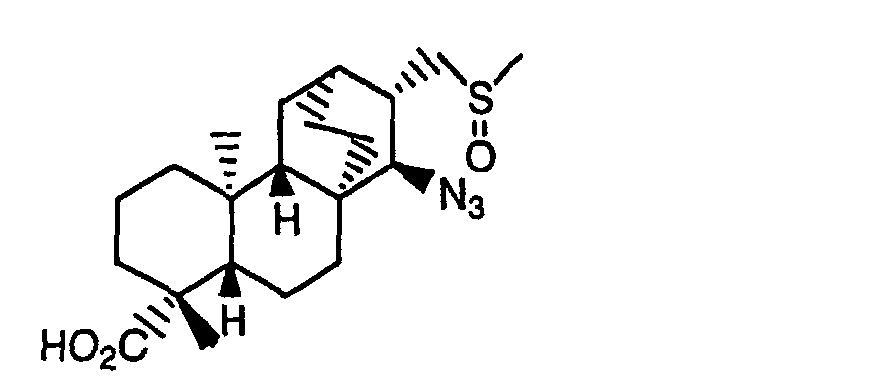
- From ent-15β-azido-17-methylthio-16α-atisane-19-oic acid (3.8 mg, 0.0096 mmol) obtained in Example 110, ent-15β-azido-17-methylsulfinyl-16β-atisane-19-oic acid (3.84 mg) was obtained in the same manner as described in Example 6.
ESI-MS:m/z=406 (M-H)+
1H NMR (CD3OD) ; δ (ppm) 0. 86-2. 15 (20H, m), 0. 94 (3H, s), 1. 21 (3H, s), 2. 70 and 2. 71 (3H, s × 2), 2. 79-3. 03 (3H, m) -

- From ent-15β-azido-17-methylthio-16α-atisane-19-oic acid (7.3 mg, 0.019 mmol) obtained in Example 110, ent-15β-amino-17-methylthio-16α-atisane-19-oic acid (crude product) was obtained in the same manner as described in Example 21.
ESI-MS:m/z=366 (M+H)+ - From ent-15β-amino-17-methylthio-16α-atisane-19-oic acid, ent-15β-{(t-butoxycarbonyl)amino}-17-methylthio-16α-atisane - 19-oic acid (1.1 mg) was obtained in the same manner as described in Example 30(2).
ESI-MS:m/z=464 (M-H)+
1H NMR (CDCl3) ; δ (ppm) 0. 86-2. 19 (20H, m), 0. 96 (3H, s), 1. 25 (3H, s), 1. 47 (9H, s), 2. 09 (3H, s), 2. 55 (1H, t, J=10. 4 Hz), 2. 73 (1H, dd, J=5. 2, 12. 8 Hz), 2. 88-2. 95 (1H, m), 4. 45 (1H, d, J=10. 4 Hz) -
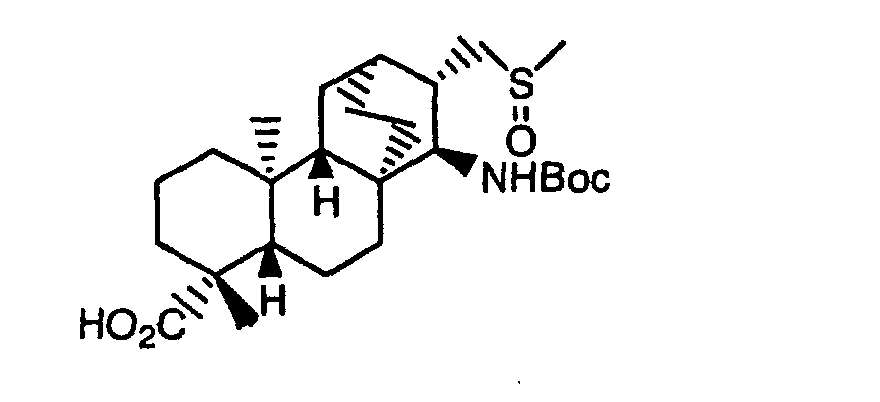
- From ent-15β-{(t-butoxycarbonyl)amino}-17-methylthio-16α-atisane - 19-oic acid (1.1 mg, 0.0024 mmol) obtained by Example 118, ent-15β-{(t-butoxycarbonyl)amino}-17-methylsulfinyl-16α-ati sane-19-oic acid (1.6 mg) was obtained in the same manner as described in Example 6.
1H NMR (CD3OD) ; δ (ppm) 0. 90-2. 14 (20H, m), 0. 93 and 0. 94 (3H, s × 2), 1. 19 (3H, s), 1. 46 (9H, s), 2. 64 and 2. 66 (3H, s ×2) , 2. 76-3. 01 (3H, m) -

- From ent-15β-{(t-butoxycarbonyl)amino}-17-methylsulfinyl-16α-ati sane-19-oic acid (1.6 mg, 0.0033 mmol) obtained in Example 119, ent-15β-amino-17-methylsulfinyl-16α-atisane-19-oic acid-trifluoroacetic acid (2.31 mg) was obtained in the same manner as described in Example 32.
ESI-MS:m/z=382 (M+H)+
Isolation of Serofendic acids A and B - (1) Serofendic acids A and B were prepared from 250 L of serum (FCS). First, each separating funnel was charged with 2 L of inactivated serum (heat-inactivated FCS), and then 2 L, an equivalent amount to the serum, of ethyl acetate was added, and thoroughlystirred. Then, the upper layer (ethyl acetate layer) was collected while taking care that the lower layer (aqueous layer) did not to get mixed into the upper layer. After adding to this lower layer 2L of ethyl acetate and stirring, the ethyl acetate layer was collected. This series of operations was repeated a total of 125 times, and f inally extracted with ethyl acetate (500 L) of twice the original amount of serum.
- (2) From the ethyl acetate extract obtained in the above (1) , ethyl acetate was evaporated using an evaporator on a water bath at 45°C. At this time, the ethyl acetate extract was divided into quarters, and each 125 L portions were evaporated. To each quarter of the evaporated ethyl acetate extract were added 2 L of n-hexane and 90% methanol water and poured into a separating funnel and stirred. Then, the lower layer (90% methanol aqueous layer) was collected. To the upper layer (n-hexane layer) was further added 90% methanol water (2 L) and stirred, and then 90% methanol aqueous layer was collected. This series of operations was repeated 4 times, and finally separated into two phases using 8 L of n-hexane and 16 L of 90% methanol water.
- (3) From each quarter of the 90% methanol aqueous layer obtained in the above (2), 90% methanol water was evaporated by means of an evaporator on an water bath at 45°C. To the evaporated 90% methanol aqueous phase were added 2 L of ethyl acetate and 2 L of water, and poured into a separating funnel and stirred. Then, the upper layer (ethyl acetate layer) was collected. To the lower phase (aqueous layer) was further added ethyl acetate (2 L) and stirred, and then the ethyl acetate layer was collected. This series of operations was repeated 4 times to finally achieve diphase separation using 16 L of ethyl acetate and 8 L of water.
- (4) From the ethyl acetate layer obtained in the above (3) , ethyl acetate was evaporated by means of an evaporator on a water bath at 45°C. In this manner, from 250 L of serum, a crude extract fraction containing Serofendic acids A and B were purified.
- (5) The crude extract fraction was fractionated using
High-performance liquid chromatography (HPLC) in the following
conditions:
- (a) Column: YMC-pack ODS-AM (250 nm x 20 mm i.d., YMC);
- (b) Mobile phase: H2O/CH3CN/TFA (mobile phase A=990:10:1, mobile phase B=10:990:1); and
- (c) Gradient program (B conc. %) : 0 min. (10%) → 50 min. (80%) → 60 min. (80%) → 60.01 min. (10%) → 70 min. (stop)
- (6) Each eluted fraction sample thus obtained was subjected to
LCMS to analyze contents of Serofendic acids A and B. In the
LCMS analysis, the following conditions were employed.
- (a) Column: Inertsil ODS-3 (150 mm x 1.5 mm i.d., GL-Science) ;
- (b) Mobile phase: H2O/MeOH containing 2 mM ammonium acetate (mobile phase A=900:100, mobile phase B=10:990) ;
- (c) Gradient program (B conc. %) : 0 min. (60%) → 10 min. (90%) → 10.01 min. (60%) → 15 min. (stop);
- (d) Ionization method: ESI (+); and
- (e) Monitoring method: SIM mode (m/z 383)
- (7) Fractions containing Serofendic acids A and B (retention
time: about 12 to 25 min.) were taken together, and the mobile
phase was evaporated by means of an evaporator. The obtained
fraction was subjected to final purification by LCMS in the
following conditions.
- (a) Column: YMC-pack ODS-AM (250 nm x 10 mm i.d., YMC);
- (b) Mobile phase: H2O/MeOH (moving phase A=900:100, moving phase B=100:900) containing 5 mM ammonium acetate;
- (c) Gradient program (B conc. %): 0 min.(45%) → 30 min. (60%) → 35 min. (90%) → 40 min. (90%) → 40.01 min. (45%) → 50 min. (stop);
- (d) Ionization method: ESI (+); and
- (e) Monitoring method: SIM mode (m/z 383)
-
- The obtained eluted fraction sample was dried by an evaporator (end of isolation process). Physicochemical data of the bioactive substances (the title compounds) obtained from that fraction sample are as follows.
serofendic acid A ESI-MS: m/z=383 (M+H)+
serofendic acid B ESI-MS: m/z=383 (M+H)+
Serofendic acid A (isomer (1), PR46)ESI-MS: m/z=383 (M+H)+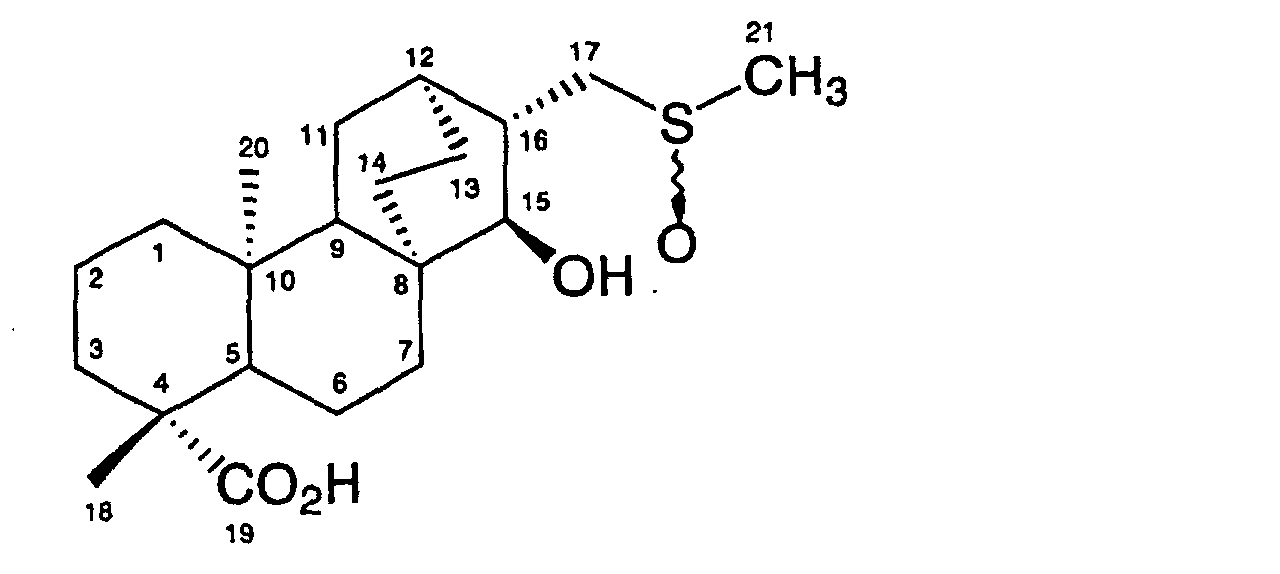
Proton NMR data and carbon NMR data of Serofendic acid A (isomer 1, PR46) are shown in Table 1.position σc σH 1 41.2 1.66 (m), 1.00 (m) 2 20 . 0 1.93 (m), 1.42 (m) 3 39.3 2.17 (brd, 14.2), 1.07 (m) 4 44.7 5 57.8 1.07 (m) 6 20.9 1.90 (m), 1.84 (m) 7 34.3 1.74 (ddd, 13.2, 13.2, 4.5) 1.10 (ddd, 13.2, 2.9, 2.9) 8 37.7 9 42.8 1.62 (m) 10 39.2 11 30.0 1.64 (m), 1.45 (m) 12 32.2 1.70 (m) 13 22 . 2 1.68 (m) , 1.42 (m) 14 28.2 2.06 (ddd, 14.2, 11.7, 2.9), 0.87 (m) 15 81.3 2.97 (d, 2.9) 16 44.5 1.95 (m) 17 60.9 2.99 (dd, 13.0, 9.3), 2.87 (dd, 13.0, 6.1) 18 29.5 1.23 (s) 19 181.7 20 13.4 0.99 (s) 21 38.8 2.72 (s) * Recorded in CD3OD at 30°C. Chemical shifts were referenced to internal peaks σH 3.35 for CD2HOD and σc 49.0 for CD3OD. Serofendic acid B (isomer (2) PR47)* ESI-MS: m/z=383 (M+H)+ Proton NMR data and carbon NMR data of Serofendic acid B (
isomer 2, PR47) * are shown in Table 2, and proton NMR spectrum (measured in CD3OD, 500 MHz: δ ppm in CD3OD) is shown in Fig. 2.position σc σH 1 41.3 1.66 (m), 1.00 (m) 2 20.1 1.96 (m), 1.42 (m) 3 39.4 2.18 (brd, 13.2), 1.06 (m) 4 44.8 5 57.9 1.06 (m) 6 21.0 1.90 (m), 1.83 (m) 7 34.3 1.73 (ddd, 13.2, 13.2, 4.4) 1.10 (ddd, 13.2, 2.9, 2.9) 8 37.7 9 42.9 1.62 (m) 10 39.2 11 29.9 1.63 (m), 1.46 (m) 12 30.8 1.79 (m) 13 21.9 1.66 (m), 1.44 (m) 14 28.4 2.08 (ddd, 14.0, 11.7, 3.0) 0.86 (ddd, 14.0, 12.2, 6.5) 15 81.2 2.95 (d, 4.4) 16 44.3 1.92 (m) 17 59.8 3.04 (dd, 13.2, 6.8), 2.91 (dd, 13.2, 9.0) 18 29.6 1.23 (s) 19 181.0 20 13.5 0.99 (s) 21 38.3 2.73 (s) * Recorded in CD3OD at 30°C. Chemical shifts were referenced to internal peaks σH 3.35 for CD2HOD and σc 49.0 for CD3OD. - "position" in the above Tables 1 and 2 refers to the nomenclatural position in the particular compound, and the footnote "Recorded in CD3OD at 30°C. Chemical shifts were referenced to internal peaks σH 3.35 for CD2HOD and σc 49.0 for CD3OD" means "measured in a solvent of CD3OD at 30°C. Chemical shifts were referenced to internal peaks σH 3.35 ppm for CD2HOD and σc 49. 0 ppm for CD3OD".
- Effects of the compounds according to the present invention on survival of cells were studied in the following manners.
- (1) After dissolving the compound according to the present invention (test compound) in a small amount of methanol, 2.0 mL serum-free normal medium (Eagle's MEM medium raw powder 9.4 g; NaHCO3 2.0 g; L-glutamine 0.29 g; glucose 1.0 g; and HEPES 2.38 g are dissolved in purified water so that the final volume is 1000 mL) was added so as to make the concentration at 10 µM. Af ter mixing well by vortex, the sample was used for the following bioassay.
- (2) In Eagle liquid at 37°C, cultured cerebral cortex cells were incubated in the medium containing the test sample (1) for 1 hour, and glutamic acid was added to the medium. After incubating for another 1 hour, the culture was stained with 1.5% trypan blue solution for 10 minutes. After completion of the staining, cells were fixed in ice-cooled 10% neutral-buffered formalin solution, and rinsed with saline. In the trypan blue staining, living cells having an ability to reject trypan blue are not stained, whereas cells that are severely damaged lose the rejecting ability so that they are stained. Using this property, in the present test, the number of cells were counted while determining the cells not having stained by trypan blue as living cells and the cells not having stained as dead cells. The test was conducted using 5 cover slips for every drug treatment, and one group contained 5 cases. More than 200 cells were counted per one cover slip, and a percentage of number of living cells with respect to the total number of counted cells was calculated as survival.
-
- The compound of the present invention obtained in Example 1 significantly suppressed the neurotoxicity induced by 500 µM glutamic acid, at a concentration of 10 µM as shown in Table 3.
Survival of cell s.e.m sham 88.7928716 0.616460 Glutamic acid 500 µM 26.7155018 0.838002 Glutamic acid 500 µM + Serofendic acid isomers (1), (2) (approx. 1:2) mixture 10 µM 65.9232298 1.269272 - In Table 3, "sham" means "cell survival in the case treated with neither glutamic acid nor Serofendic acid" and "s.e.m" is an abbreviation for "standard error of the mean" and means "standard error".
-
- (1) After dissolving the compound according to the present invention (test compound) in a small amount of methanol, 2.0 mL serum-free normal medium (Eagle' s MEM medium raw powder 9 . 4 g; NaHCO3 2.0 g; S-nitrosocysteine 100-300 µM; glucose 1.0 g; and HEPES 2.38 g are dissolved in purified water so that the final volume is 1000 mL) was added to make the concentration at 10 µM. After mixing well by vortex, the sample was used for the following bioassay.
- (2) In Eagle liquid at 37°C, cultured cerebral cortex cells were incubated in the medium containing S-nitrosocysteine for 1 hour. At this time, the test sample (1) was treated simultaneously with S-nitrosocysteine. After incubating for another 1 hour, the culture was stained with 1.5% trypan blue solution for 10 minutes. After completion of the staining, cells were fixed in ice-cooled 10% neutral-buffered formalin solution, rinsed with saline, and numbers of living cells and dead cells were counted. The test was conducted using 5 cover slips for every drug treatment, and one group contained 5 cases. More than 200 cells were counted per one cover slip, and a percentage of number of living cells with respect to the total number of counted cells was calculated as survival.
- (3) Results
The compound of the present invention significantly
suppressed the neurotoxicity induced by NO, at a concentration
of 10 µM as shown in Table 4.
Survival of cell s.e.m sham 91.9230109 0.249936 S-nitrosocysteine 100 µM 17.3029439 0.745891 S-nitrosocysteine 1.00 µM + Serofendic acid isomers (1), (2) (approx. 1:2) mixture 10 µM 76.0222324 1.7224187 -
- In Table 4, "sham" means "cell survival in the case treated with neither S-nitrosocysteine nor Serofendic acid" and "s.e.m" is an abbreviation for "standard error of the mean" and means "standard error".
Claims (35)
- A compound represented by the following formula:(wherein Z represents a bivalent organic group of from 2 to 3 carbon atoms, provided that Zmayhave one or two group (s) selected from the group consisting of those represented by the following formula:
 (wherein A1 represents an optionally substituted C1-6 alkylene group or a single bond; X1 represents a halogen atom or a cyano group; X2 represents the formula -S (O)m- (wherein m is an integer of 0, 1 or 2) , an oxygen atom, a carbonyl group or a single bond; R4a represents a hydrogen atom, an optionally substituted C1-6 alkyl group, an optionally substituted C2-6 alkenyl group, an optionally substituted C2-6 alkynyl group, an optionally substituted C6-14 aromatic hydrocarbon cyclic group, an optionally substituted from 5- to 14-membered aromatic heterocyclic group, an optionally substituted C1-6 alkoxy group or a hydroxyl group; and R4b and R4c are independent of each other and each represents a hydrogen atom, an optionally substituted C1-6 alkyl group, an optionally substituted C2-6 alkenyl group, an optionally substituted C2-6 alkynyl group, an optionally substituted C6-14 aromatic hydrocarbon cyclic group, an optionally substituted from 5- to 14-membered aromatic heterocyclic group, an optionally substituted C2-7 acyl group or an optionally substituted C1-6 alkylsulfonyl group) , and the case where Z is a 1,2-ethylene group not having a substituent or a 1, 2-vinylene group not having a substituent is excluded;
R3a represents a carbonyl group, amethylene group or a single bond; and
R3b represents a hydrogen atom, a halogen atom, an optionally substituted C1-6 alkyl group, an optionally substituted C2-6 alkenyl group, an optionally substituted C2-6 alkynyl group, an optionally substituted C1-6 alkoxy group, a hydroxyl group, a cyano group or a group represented by the formula -NR5aR5b (wherein, R5a and R5b are independent of each other and each represents a hydrogen atom, an optionally substituted C1-6 alkyl group, an optionally substituted C2-6 alkenyl group, an optionally substituted C2-6 alkynyl group, an optionally substituted C6-14 aromatic hydrocarbon cyclic group, an optionally substituted from5- to 14-membered aromatic heterocyclic group, anoptionally substituted C2-7 acyl group or an optionally substituted C1-6 alkylsulfonyl group) , provided that the following cases (1) to (3) are excluded:(1) Z represents a 1,2-dicarboxyethane-1,2-yl group or a 1,2-dimethoxycarbonylethane-1,2-yl group, and the formula -R3a-R3b represents a hydroxymethyl group or an acetoxymethyl group;(2) Z represents a 1-i-propylethane-1,2-yl group and the formula -R3a-R3b represents a hydrogen atom; and(3) the formula -R3a-R3b represents a methyl group, and Z represents the formula:(wherein R11 represents a hydrogen atom or a methyl group, and R12 represents a hydroxyl group, a methyl group or a tetrahydropyran-2H-pyran-2-yl-oxy group)), a salt thereof or a hydrate of them.
- A compound represented by the following formula:(wherein Z, R3a and R3b respectively represent those defined for the above Z, R3a and R3b in claim 1, provided that the following cases (1) to (3) are excluded:
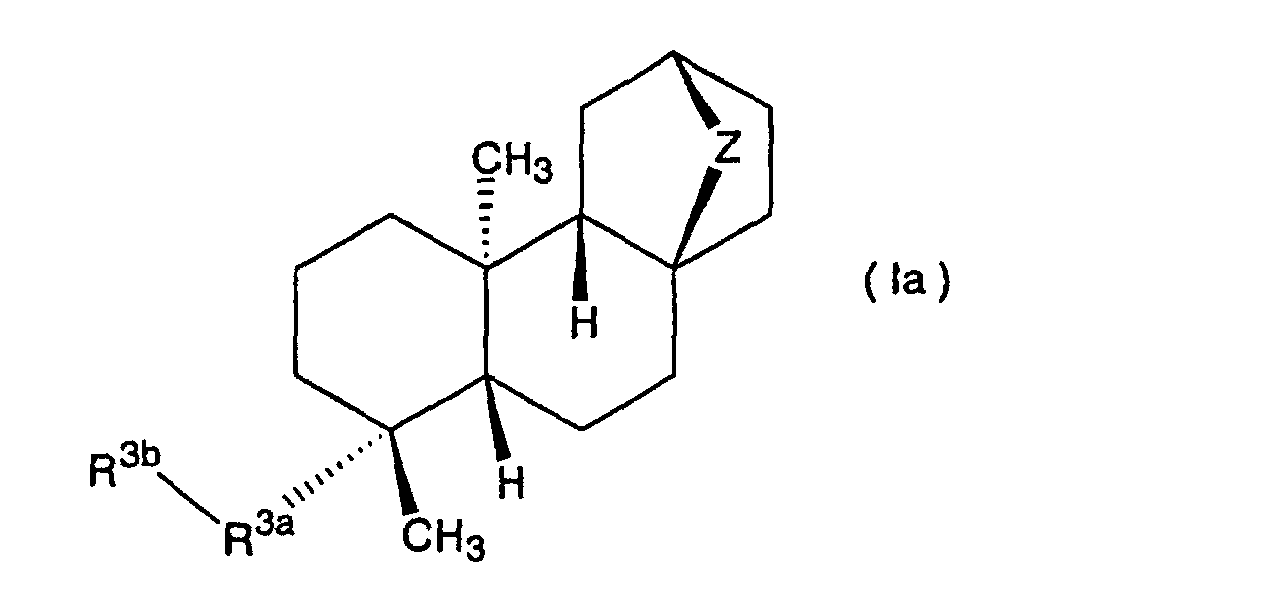 (1) Z represents a 2,2-dicarboxyethane-1,2-yl group or a 1,2-dimethoxycarbonylethane-1,2-yl group, and the formula -R3a-R3b represents a hydroxymethyl group or an acetoxymethyl group;(2) Z represents a 1-i-propylethane-1,2-yl group and the formula -R3a-R3b represents a hydrogen atom; and(3) the formula -R3a-R3b represents a methyl group, and Z represents the formula:(wherein R11 represents a hydrogen atom or a methyl group, and R12 represents a hydroxyl group, a methyl group or a tetrahydropyran-2H-pyran-2-yl-oxy group)), a salt thereof or a hydrate of them.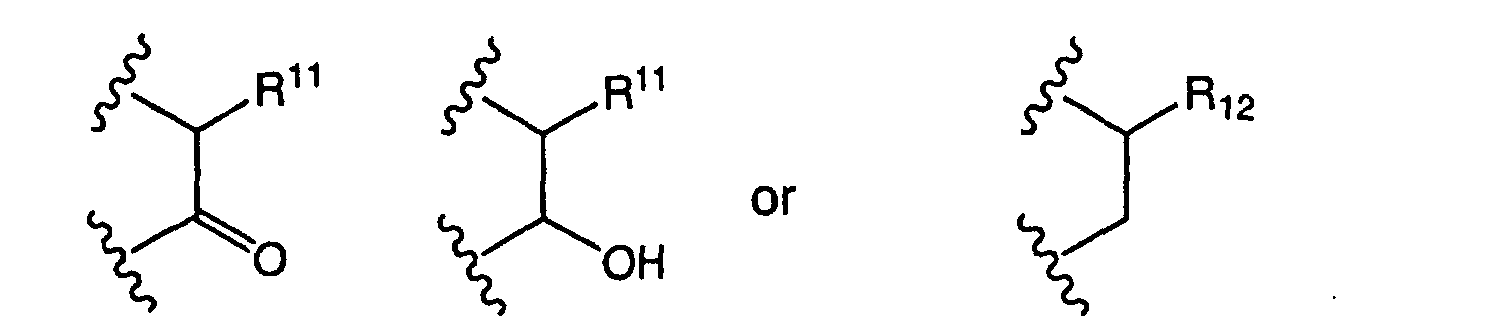
- The compound according to claim 1 or 2, a salt thereof or a hydrates thereof, wherein Z is a group represented by the formula:wherein Q1 and Q2 are independent of each other and each represents a group represented by the formula:
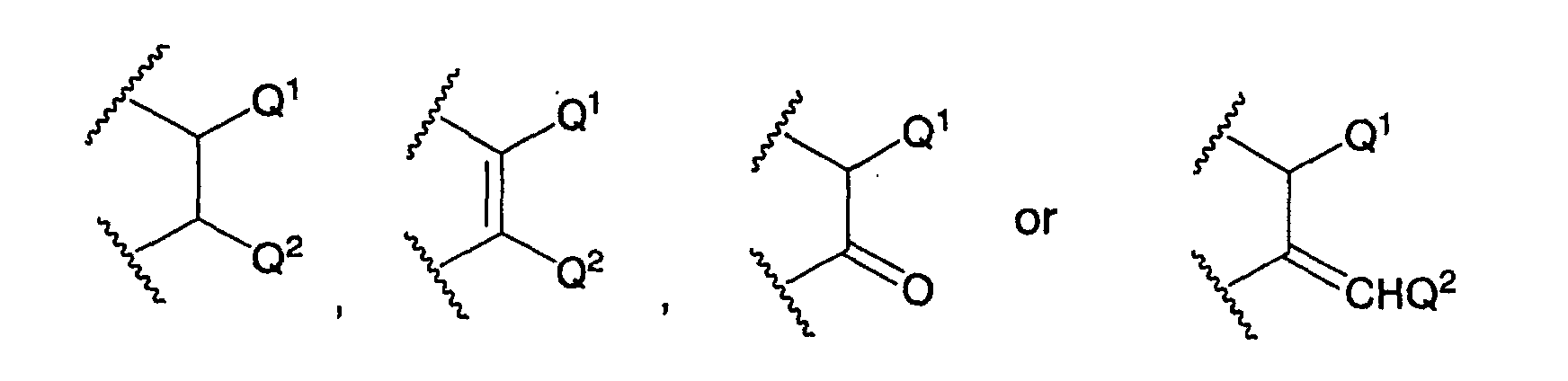 (wherein A1, X1, X2, R4a, R4b and R4c respectively represent those defined for A1, X1, X2, R4a, R4b and R4c in claim 1).
- The compound according to claim 1 or 2, a salt thereof or a hydrate of them, wherein Z is a group represented by the formula:wherein Q1 is as defined for Q1 in claim 3; and Q2a represents a hydrogen atom, a halogen atom, an optionally substituted C1-6 alkyl group, an optionally substituted C2-6 alkenyl group, an optionally substituted C2-6 alkynyl group, an optionally substituted C1-6 alkoxy group, a hydroxyl group or a group represented by the formula -NR6aR6b (wherein R6a and R6b are independent of each other and each represents a hydrogen atom, an optionally substituted C1-6 alkyl group, an optionally substituted C2-6 alkenyl group, an optionally substituted C2-6 alkynyl group, an optionally substituted C2-7 acyl group or an optionally substituted C1-6 alkylsulfonyl group).
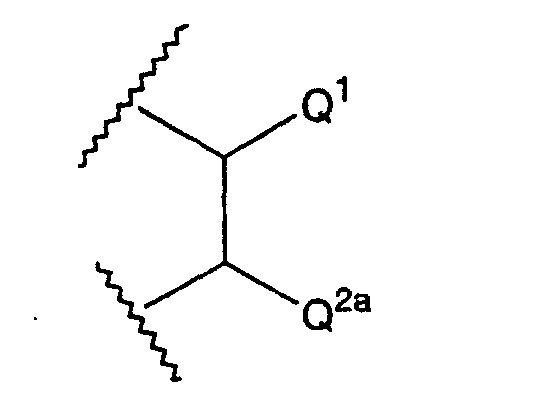
- The compound according to claim 1 or 2, a salt thereof or a hydrate of them, wherein Z is a group represented by the formula:wherein Q1 is as defined for Q1 in claim 3; and Q2a is as defined for Q2a in claim 4.
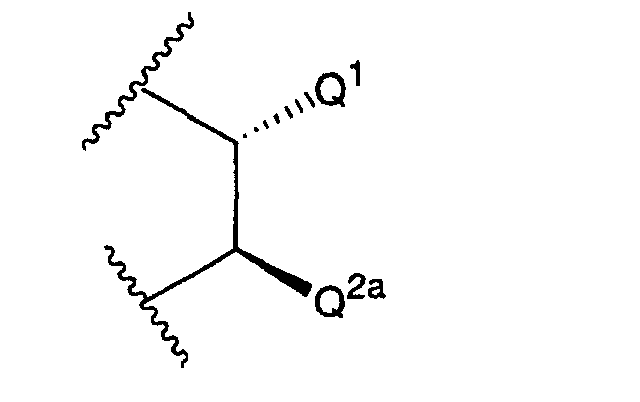
- The compound according to claim 1 or 2, a salt thereof or a hydrate of them, wherein Z is a group represented by the formula:wherein Q1 is as defined for Q1 in claim 3; and Q2b represents a hydrogen atom or an optionally substituted C1-6 alkyl group.

- The compound according to claim 1 or 2, a salt thereof or a hydrate of them, wherein Z is a group represented by the formula:wherein Q1 is as defined for Q1 in claim 3.
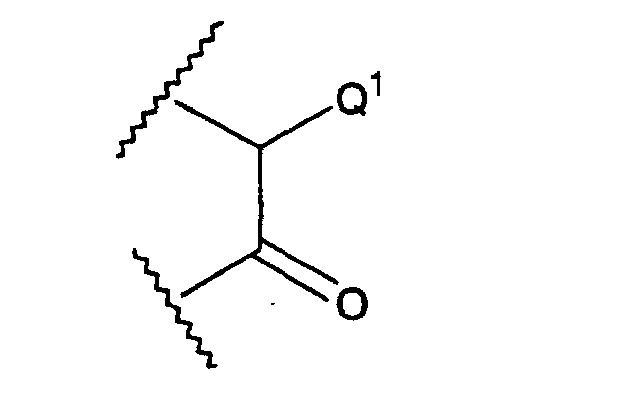
- The compound according to claim 1 or 2, a salt thereof or a hydrate of them, wherein Z is a group represented by the formula:wherein Q1 is as defined for Q1 in claim 3 ; and Q2c represents a hydrogen atom, a cyano group, a formyl group, a carboxyl group, an optionally substituted C1-6 alkyl group, an optionally substituted C2-7 acyl group, an optionally substituted C2-7 alkoxycarbonyl group or a group represented by the formula:
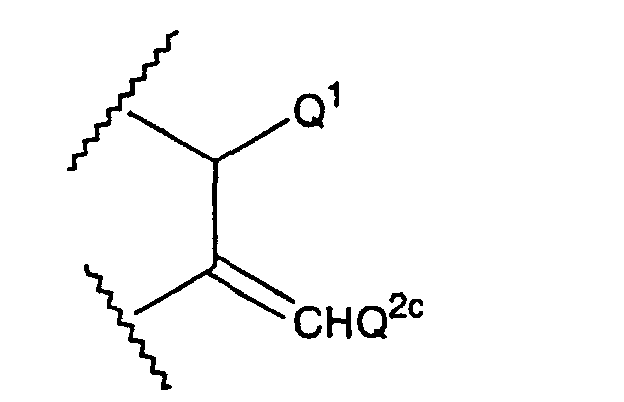 (wherein Q3a and Q3b are independent of each other and each represents a hydrogen atom, an optionally substituted C1-6 alkyl group, an optionally substituted C2-6 alkenyl group or an optionally substituted C2-6 alkynyl group).
- The compound according to any one of claims 1 to 8, a salt thereof or a hydrate of them, wherein R3a is a carbonyl group.
- The compound according to any one of claims 1 to 9, a salt thereof or a hydrate of them, wherein R3b is a hydroxyl group.
- The compound according to any one of claims 4, 5, 9 and 10, a salt thereof or a hydrate of them, wherein Q2a is a hydroxyl group.
- The compound according to any one of claims 3 to 11, a slat thereof or a hydrate of them, wherein Q1 is a group represented by the formula -A1-S(O)m-R4a (wherein A1, m and R4a are respectively as defined for A1, m and R4a in claim 1).
- The compound according to any one of claims 1 to 12, a salt thereof or a hydrate of them, wherein R4a is an optionally substituted methyl group, an optionally substituted ethyl group, an optionally substituted n-propyl group or an optionally substituted i-propyl group.
- The compound according to any one of claims 1 to 13, a salt thereof or a hydrate of them, wherein A1 is a methylene group.
- The compound according to any one of claims 1 to 14, a salt thereof or a hydrate of them, wherein m is 1.
- The compound according to any one of claims 1 to 8, a salt thereof or a hydrate of them, wherein A1 represents a C1-6 alkylene group or a single bond; R4a represents a hydrogen atom, a C1-6 alkyl group, a C2-6 alkenyl group, a C2-6 alkynyl group, a C6-14 aromatic hydrocarbon cyclic group, a 5- to 14-membered aromatic heterocyclic group, a C1-6 alkoxy group or a hydroxyl group; R4b and R4c are independent of each other and each represents a hydrogen atom, a C1-6 alkyl group, a C2-6 alkenyl group, a C2-6 alkynyl group, a C6-14 aromatic hydrocarbon cyclic group, a 5-to 14-membered aromatic heterocyclic group, a C2-7 acyl group or a C1-6 alkylsulfonyl group; and R3b represents a hydrogen atom, a halogen atom, a C1-6 alkyl group, a C2-6 alkenyl group, a C2-6 alkynyl group, a C1-6 alkoxy group, a hydroxyl group, a cyano group or a group represented by the formula -NR5aR5b (wherein R5a and R5b are independent of each other and each represents a hydrogen atom, a C1-6 alkyl group, a C2-6 alkenyl group, a C2-6 alkynyl group, a C6-14 aromatic hydrocarbon cyclic group, a 5-to 14-membered aromatic heterocyclic group, a C2-7 acyl group or a C1-6 alkylsulfonyl group).
- The compound according to claim 4 or 5, a salt thereof or a hydrate of them, wherein Q2a represents a hydrogen atom, a halogen atom, a C1-6 alkyl group, a C2-6 alkenyl group, a C2-6 alkynyl group, a C1-6 alkoxy group, a hydroxyl group or a group represented by the formula -NR6aR6b (wherein R6a and R6b are independent of each other and each represents a hydrogen atom, a C1-6 alkyl group, a C2-6 alkenyl group, a C2-6 alkynyl group, a C2-7 acyl group or a C1-6 alkylsulfonyl group).
- A medicament comprising the compound according to claim 1 or 2, a salt thereof or a hydrate of them.
- A pharmaceutical composition comprising the compound according to claim 1 or 2, a salt thereof or a hydrate of them.
- Aprotective agent against cell injury due to radicals, comprising the compound according to claim 1 or 2, a salt thereof or a hydrate of them.
- An inhibitor of glutamate-induced neurotoxicity, comprising the compound according to claim 1 or 2, a salt thereof or a hydrate of them.
- An inhibitor of NO-induced neurotoxicity, comprising the compound according to claim 1 or 2, a salt thereof or a hydrate of them.
- An agent for treating or preventing a disease to which glutamate-induced neurotoxicity relates, which comprises the compound according to claim 1 or 2, a salt thereof or a hydrate of them.
- An agent for treating or preventing a disease to which NO-induced neurotoxicity relates, which comprises the compound according to claim 1 or 2, a salt thereof or a hydrate of them.
- An agent for treating or preventing nervous disease, which comprises the compound according to claim 1 or 2, a salt thereof or a hydrate of them.
- The agent for treating or preventing nervous disease according to claim 25, wherein the nervous disease is disorder by cerebral ischemia, Parkinson disease, Alzheimer disease, amyotrophic lateral sclerosis (ALS) or multiple sclerosis.
- An agent for treating or preventing glaucoma, retinopathy of prematurity, diabetic retinopathy, macular degeneration or hearing disorder, which comprises the compound according to claim 1 or 2, a salt thereof or a hydrate of them.
- An agent for treating or preventing skin disease, which comprises the compound according to claim 1 or 2, a salt thereof or a hydrate of them.
- The agent for treating or preventing skin disease according to claim 28, wherein the skin disease is atopic dermatitis, contact dermatitis or hyperesthesia.
- A method for treating or preventing a disease to which a protection against cell injury due to radicals is efficacious, a disease to which glutamate-induced neurotoxicity relates, a disease to which NO-induced neurotoxicity relates, a nervous disease, glaucoma, retinopathy of prematurity, diabetic retinopathy, macular degeneration, hearing disorder or a skin disease, by administering a pharmacologically effective amount of the compound according to claim 1 or 2, a salt thereof or a hydrate of them to a patient.
- The method according to claim 30, wherein the skin disease is atopic dermatitis, contact dermatitis or hyperesthesia.
- The method according to claim 30, wherein the neurvous disease is disorder by cerebral ischemia, Parkinson disease, Alzheimer disease, amyotrophic lateral sclerosis (ALS) or multiple sclerosis.
- Use of the compound according to claim 1 or 2, a salt thereof or a hydrate of them, for producing an agent for treating or preventing a disease to which a protection against cell injury due to radicals is efficacious, a disease to which glutamate-induced neurotoxicity relates, a disease to which NO-induced neurotoxicity relates, a nervous disease, glaucoma, retinopathy of prematurity, diabetic retinopathy, macular degeneration, hearing disorder or a skin disease.
- The use according to claim 33, wherein the skin disease is atopic dermatitis, contact dermatitis or hyperesthesia.
- The use according to claim 33, wherein the neurvous disease is disorder by cerebral ischemia, Parkinson disease, Alzheimer disease, amyotrophic lateral sclerosis (ALS) or multiple sclerosis.
Applications Claiming Priority (3)
| Application Number | Priority Date | Filing Date | Title |
|---|---|---|---|
| JP2001133209 | 2001-04-27 | ||
| JP2001133209 | 2001-04-27 | ||
| PCT/JP2002/004155 WO2002088061A1 (en) | 2001-04-27 | 2002-04-25 | Novel atisane compound and use thereof |
Publications (2)
| Publication Number | Publication Date |
|---|---|
| EP1382591A1 true EP1382591A1 (en) | 2004-01-21 |
| EP1382591A4 EP1382591A4 (en) | 2006-01-18 |
Family
ID=18981105
Family Applications (1)
| Application Number | Title | Priority Date | Filing Date |
|---|---|---|---|
| EP02720602A Withdrawn EP1382591A4 (en) | 2001-04-27 | 2002-04-25 | Novel atisane compound and use thereof |
Country Status (8)
| Country | Link |
|---|---|
| US (1) | US7211589B2 (en) |
| EP (1) | EP1382591A4 (en) |
| JP (1) | JP4157770B2 (en) |
| KR (1) | KR100888002B1 (en) |
| CN (1) | CN100482626C (en) |
| AU (1) | AU2002251543B2 (en) |
| CA (1) | CA2443456C (en) |
| WO (1) | WO2002088061A1 (en) |
Families Citing this family (4)
| Publication number | Priority date | Publication date | Assignee | Title |
|---|---|---|---|---|
| JPWO2007029889A1 (en) * | 2005-09-08 | 2009-03-19 | エーザイ・アール・アンド・ディー・マネジメント株式会社 | Protective effect of serofendic acid on myocardium |
| CN105541631B (en) * | 2015-10-26 | 2017-09-05 | 云南西力生物技术股份有限公司 | Raw element A (spiratisanin A) of meadow sweet Ah Ti and preparation method thereof and the application on medicine |
| WO2018067683A1 (en) | 2016-10-04 | 2018-04-12 | The Coca-Cola Company | Diterpene glycosides containing an ent-atisene core, compositions and methods |
| CN108440292B (en) * | 2018-04-03 | 2021-02-12 | 中国科学院昆明植物研究所 | Sapium sebiferum element A-H, pharmaceutical composition and application thereof |
-
2002
- 2002-04-25 EP EP02720602A patent/EP1382591A4/en not_active Withdrawn
- 2002-04-25 US US10/471,025 patent/US7211589B2/en not_active Expired - Fee Related
- 2002-04-25 KR KR1020037012164A patent/KR100888002B1/en not_active Expired - Fee Related
- 2002-04-25 JP JP2002585365A patent/JP4157770B2/en not_active Expired - Fee Related
- 2002-04-25 WO PCT/JP2002/004155 patent/WO2002088061A1/en not_active Ceased
- 2002-04-25 CN CNB028089693A patent/CN100482626C/en not_active Expired - Fee Related
- 2002-04-25 AU AU2002251543A patent/AU2002251543B2/en not_active Ceased
- 2002-04-25 CA CA2443456A patent/CA2443456C/en not_active Expired - Fee Related
Non-Patent Citations (10)
| Title |
|---|
| BAKER K.M. ET AL: "Diterpenes. Part X. Some transformations of Phyllocladene and Isophyllocladene" JOURNAL OF THE CHEMICAL SOCIETY, PERKIN TRANSACTIONS 1., 1972, pages 190-194, XP008056031 GBCHEMICAL SOCIETY. LETCHWORTH. * |
| BEALE MICHAEL H. ET AL: "Diterpene acids from helianthus species and their microbiological conversion by gibberella fujikuroi, mutant B1-41a" PHYTOCHEMISTRY., vol. 22, no. 4, 1983, pages 875-881, XP002355229 GBPERGAMON PRESS. * |
| BELL, RUSSELL A. ET AL: "Construction of the C/D ring system present in the diterpenoid alkaloids atisine and garryfoline" TETRAHEDRON LETTERS 269-73 CODEN: TELEAY; ISSN: 0040-4039, 1963, XP002355227 * |
| COATES, ROBERT M. ET AL: "Structural modifications of isosteviol . Partial synthesis of atiserene and isoatiserene" JOURNAL OF ORGANIC CHEMISTRY , 36(18), 2625-31 CODEN: JOCEAH; ISSN: 0022-3263, 1971, XP002355228 * |
| HUGEL, GEORGETTE ET AL: "Diterpènes de trachylobium. III. Réactions des dérivés trachylobaniques" BULLETIN DE LA SOCIETE CHIMIQUE DE FRANCE., 1965, pages 2894-2902, XP008056034 FRSOCIETE FRANCAISE DE CHIMIE. PARIS. * |
| IHARA, MASATAKA ET AL: "An enantioselective total synthesis of (+)- atisirene by intramolecular double Michael reaction" JOURNAL OF THE CHEMICAL SOCIETY, PERKIN TRANSACTIONS 1: ORGANIC AND BIO-ORGANIC CHEMISTRY (1972-1999) , (12), 2151-61 CODEN: JCPRB4; ISSN: 0300-922X, 1986, XP008056035 * |
| KUME, TOSHIAKI ET AL: "Isolation of a diterpenoid substance with potent neuroprotective activity from fetal calf serum" PROCEEDINGS OF THE NATIONAL ACADEMY OF SCIENCES OF THE UNITED STATES OF AMERICA , 99(5), 3288-3293 CODEN: PNASA6; ISSN: 0027-8424, 2002, XP002355226 * |
| PELLETIER, S. W. ET AL: "The total synthesis of (+-)-perhydro-1,1,12- trimethylphenanthrene -6,14-dicarboxylic acid" CHEMICAL COMMUNICATIONS (LONDON) , NO. 15, 830-1 CODEN: CCOMA8; ISSN: 0009-241X, 1968, XP008056000 * |
| See also references of WO02088061A1 * |
| ZALKOW, L. H. ET AL: "Terpenes. XIII. The oxidative decarboxylation of maleopimaric and fumaropimaric acids" J. CHEM. SOC., SUPPL. , NO. 1, 5497-5503, 1964, XP008056033 * |
Also Published As
| Publication number | Publication date |
|---|---|
| US20040180930A1 (en) | 2004-09-16 |
| US7211589B2 (en) | 2007-05-01 |
| WO2002088061A1 (en) | 2002-11-07 |
| AU2002251543B2 (en) | 2007-07-05 |
| JP4157770B2 (en) | 2008-10-01 |
| EP1382591A4 (en) | 2006-01-18 |
| KR20040008141A (en) | 2004-01-28 |
| CN100482626C (en) | 2009-04-29 |
| JPWO2002088061A1 (en) | 2004-08-12 |
| KR100888002B1 (en) | 2009-03-09 |
| CA2443456C (en) | 2010-06-01 |
| CN1505601A (en) | 2004-06-16 |
| CA2443456A1 (en) | 2002-11-07 |
Similar Documents
| Publication | Publication Date | Title |
|---|---|---|
| US20230331720A1 (en) | Medium- or macro-cyclic benzyl-substituted heterocycle derivatives and their uses as orexin-2 receptor agonists | |
| AU779177B2 (en) | Novel compounds and compositions as protease inhibitors | |
| EP2040688B1 (en) | New cxcr2 inhibitors | |
| EP3891157A1 (en) | 4-amino or 4-alkoxy-substituted aryl sulfonamide compounds with selective activity in voltage-gated sodium channels | |
| RU2640416C2 (en) | Bicyclic compound | |
| US10988433B2 (en) | Cyclohexyl GPR40 agonists for the treatment of type II diabetes | |
| JP7042804B2 (en) | Piperazine carbamate, and how to make and use it | |
| JPH04506965A (en) | Novel vitamin D analogs | |
| KR100250922B1 (en) | Ethanolamine derivatives having sympathomimetic and anti-pollakiuria activities | |
| IE64526B1 (en) | 19-nor vitamin d compounds | |
| JP2014144953A (en) | Pai-1 inhibitor | |
| CN105189516A (en) | Oxabicyclo [2.2.2] acid gpr120 modulators | |
| JPWO2005044780A1 (en) | Aminocarboxylic acid derivatives and their addition salts and S1P receptor modulators | |
| IE914304A1 (en) | Anti-atherosclerotic aryl compounds | |
| WO2018093947A1 (en) | Magl inhibitors | |
| EP0658539A1 (en) | Excitatory amino acid receptor antagonists | |
| WO2023167865A1 (en) | Bicyclic-heterocycle derivatives and related uses | |
| CA2443456C (en) | Novel atisane compounds and use thereof | |
| JP2024510778A (en) | 1,3-substituted cyclobutyl derivatives and uses thereof | |
| WO2013072896A1 (en) | Structural variants of mycolactones for use in modulating inflammation, immunity and pain | |
| US20190330138A1 (en) | Spirofuranone compounds, derivatives thereof and processes for their preparation | |
| CN100522910C (en) | Fluorocombretastatin and derivatives thereof | |
| EP2655379A1 (en) | Derivatives of englerin for the treatment of cancer | |
| CN121752259A (en) | Hydroxy epoxy analogues, methods of preparation, uses and methods thereof | |
| WO2006029075A2 (en) | Fibrate compounds having ppar agonist activity |
Legal Events
| Date | Code | Title | Description |
|---|---|---|---|
| PUAI | Public reference made under article 153(3) epc to a published international application that has entered the european phase |
Free format text: ORIGINAL CODE: 0009012 |
|
| 17P | Request for examination filed |
Effective date: 20030924 |
|
| AK | Designated contracting states |
Kind code of ref document: A1 Designated state(s): AT BE CH CY DE DK ES FI FR GB GR IE IT LI LU MC NL PT SE TR |
|
| AX | Request for extension of the european patent |
Extension state: AL LT LV MK RO SI |
|
| A4 | Supplementary search report drawn up and despatched |
Effective date: 20051202 |
|
| RAP1 | Party data changed (applicant data changed or rights of an application transferred) |
Owner name: EISAI R&D MANAGEMENT CO., LTD. |
|
| 17Q | First examination report despatched |
Effective date: 20091130 |
|
| STAA | Information on the status of an ep patent application or granted ep patent |
Free format text: STATUS: THE APPLICATION IS DEEMED TO BE WITHDRAWN |
|
| 18D | Application deemed to be withdrawn |
Effective date: 20121101 |