EP1382426A2 - Reflective tires and a method for molding the same - Google Patents
Reflective tires and a method for molding the same Download PDFInfo
- Publication number
- EP1382426A2 EP1382426A2 EP03101633A EP03101633A EP1382426A2 EP 1382426 A2 EP1382426 A2 EP 1382426A2 EP 03101633 A EP03101633 A EP 03101633A EP 03101633 A EP03101633 A EP 03101633A EP 1382426 A2 EP1382426 A2 EP 1382426A2
- Authority
- EP
- European Patent Office
- Prior art keywords
- tire
- sidewall
- mold
- finish
- tires
- Prior art date
- Legal status (The legal status is an assumption and is not a legal conclusion. Google has not performed a legal analysis and makes no representation as to the accuracy of the status listed.)
- Granted
Links
- 238000000034 method Methods 0.000 title claims description 15
- 238000000465 moulding Methods 0.000 title description 8
- 230000005012 migration Effects 0.000 claims description 6
- 238000013508 migration Methods 0.000 claims description 6
- 238000007747 plating Methods 0.000 claims description 5
- 238000004519 manufacturing process Methods 0.000 claims description 4
- 239000004809 Teflon Substances 0.000 claims description 2
- 229920006362 Teflon® Polymers 0.000 claims description 2
- 238000005498 polishing Methods 0.000 claims description 2
- 229920001221 xylan Polymers 0.000 claims description 2
- 150000004823 xylans Chemical class 0.000 claims description 2
- 230000003064 anti-oxidating effect Effects 0.000 claims 1
- 239000011248 coating agent Substances 0.000 claims 1
- 238000000576 coating method Methods 0.000 claims 1
- 229920001971 elastomer Polymers 0.000 description 12
- 239000005060 rubber Substances 0.000 description 12
- 230000000007 visual effect Effects 0.000 description 9
- 239000003963 antioxidant agent Substances 0.000 description 8
- 239000000463 material Substances 0.000 description 7
- 238000010998 test method Methods 0.000 description 7
- VYZAMTAEIAYCRO-UHFFFAOYSA-N Chromium Chemical compound [Cr] VYZAMTAEIAYCRO-UHFFFAOYSA-N 0.000 description 4
- 229910000831 Steel Inorganic materials 0.000 description 4
- 239000000654 additive Substances 0.000 description 4
- 230000009286 beneficial effect Effects 0.000 description 4
- 150000001875 compounds Chemical class 0.000 description 4
- 239000010959 steel Substances 0.000 description 4
- 230000008859 change Effects 0.000 description 3
- 239000000314 lubricant Substances 0.000 description 3
- 238000005259 measurement Methods 0.000 description 3
- 230000008569 process Effects 0.000 description 3
- 239000000126 substance Substances 0.000 description 3
- 238000012360 testing method Methods 0.000 description 3
- VYPSYNLAJGMNEJ-UHFFFAOYSA-N Silicium dioxide Chemical compound O=[Si]=O VYPSYNLAJGMNEJ-UHFFFAOYSA-N 0.000 description 2
- NINIDFKCEFEMDL-UHFFFAOYSA-N Sulfur Chemical compound [S] NINIDFKCEFEMDL-UHFFFAOYSA-N 0.000 description 2
- 239000011324 bead Substances 0.000 description 2
- 230000008901 benefit Effects 0.000 description 2
- 229910052804 chromium Inorganic materials 0.000 description 2
- 239000011651 chromium Substances 0.000 description 2
- 238000004140 cleaning Methods 0.000 description 2
- 230000000295 complement effect Effects 0.000 description 2
- 238000005336 cracking Methods 0.000 description 2
- 230000004907 flux Effects 0.000 description 2
- 239000011521 glass Substances 0.000 description 2
- 229910052717 sulfur Inorganic materials 0.000 description 2
- 239000011593 sulfur Substances 0.000 description 2
- 230000003746 surface roughness Effects 0.000 description 2
- CURLTUGMZLYLDI-UHFFFAOYSA-N Carbon dioxide Chemical compound O=C=O CURLTUGMZLYLDI-UHFFFAOYSA-N 0.000 description 1
- 239000001825 Polyoxyethene (8) stearate Substances 0.000 description 1
- 230000032683 aging Effects 0.000 description 1
- 230000004075 alteration Effects 0.000 description 1
- XAGFODPZIPBFFR-UHFFFAOYSA-N aluminium Chemical compound [Al] XAGFODPZIPBFFR-UHFFFAOYSA-N 0.000 description 1
- 229910052782 aluminium Inorganic materials 0.000 description 1
- 239000006229 carbon black Substances 0.000 description 1
- 235000011089 carbon dioxide Nutrition 0.000 description 1
- 239000003795 chemical substances by application Substances 0.000 description 1
- 230000002860 competitive effect Effects 0.000 description 1
- 230000000694 effects Effects 0.000 description 1
- 238000011156 evaluation Methods 0.000 description 1
- 230000001747 exhibiting effect Effects 0.000 description 1
- 239000010408 film Substances 0.000 description 1
- JEIPFZHSYJVQDO-UHFFFAOYSA-N iron(III) oxide Inorganic materials O=[Fe]O[Fe]=O JEIPFZHSYJVQDO-UHFFFAOYSA-N 0.000 description 1
- 239000010410 layer Substances 0.000 description 1
- 238000003754 machining Methods 0.000 description 1
- 239000000203 mixture Substances 0.000 description 1
- 229920003052 natural elastomer Polymers 0.000 description 1
- 229920001194 natural rubber Polymers 0.000 description 1
- 230000036961 partial effect Effects 0.000 description 1
- 239000003755 preservative agent Substances 0.000 description 1
- 238000003825 pressing Methods 0.000 description 1
- 230000002035 prolonged effect Effects 0.000 description 1
- 230000001681 protective effect Effects 0.000 description 1
- 230000009467 reduction Effects 0.000 description 1
- 230000002829 reductive effect Effects 0.000 description 1
- 238000002310 reflectometry Methods 0.000 description 1
- 230000002441 reversible effect Effects 0.000 description 1
- 238000005488 sandblasting Methods 0.000 description 1
- 239000000377 silicon dioxide Substances 0.000 description 1
- 238000007655 standard test method Methods 0.000 description 1
- 239000002344 surface layer Substances 0.000 description 1
- 229920003051 synthetic elastomer Polymers 0.000 description 1
- 239000005061 synthetic rubber Substances 0.000 description 1
- 239000010409 thin film Substances 0.000 description 1
- 238000004073 vulcanization Methods 0.000 description 1
Images




Classifications
-
- B—PERFORMING OPERATIONS; TRANSPORTING
- B29—WORKING OF PLASTICS; WORKING OF SUBSTANCES IN A PLASTIC STATE IN GENERAL
- B29C—SHAPING OR JOINING OF PLASTICS; SHAPING OF MATERIAL IN A PLASTIC STATE, NOT OTHERWISE PROVIDED FOR; AFTER-TREATMENT OF THE SHAPED PRODUCTS, e.g. REPAIRING
- B29C35/00—Heating, cooling or curing, e.g. crosslinking or vulcanising; Apparatus therefor
- B29C35/02—Heating or curing, e.g. crosslinking or vulcanizing during moulding, e.g. in a mould
-
- B—PERFORMING OPERATIONS; TRANSPORTING
- B29—WORKING OF PLASTICS; WORKING OF SUBSTANCES IN A PLASTIC STATE IN GENERAL
- B29C—SHAPING OR JOINING OF PLASTICS; SHAPING OF MATERIAL IN A PLASTIC STATE, NOT OTHERWISE PROVIDED FOR; AFTER-TREATMENT OF THE SHAPED PRODUCTS, e.g. REPAIRING
- B29C33/00—Moulds or cores; Details thereof or accessories therefor
- B29C33/42—Moulds or cores; Details thereof or accessories therefor characterised by the shape of the moulding surface, e.g. ribs or grooves
- B29C33/424—Moulding surfaces provided with means for marking or patterning
-
- B—PERFORMING OPERATIONS; TRANSPORTING
- B29—WORKING OF PLASTICS; WORKING OF SUBSTANCES IN A PLASTIC STATE IN GENERAL
- B29D—PRODUCING PARTICULAR ARTICLES FROM PLASTICS OR FROM SUBSTANCES IN A PLASTIC STATE
- B29D30/00—Producing pneumatic or solid tyres or parts thereof
- B29D30/06—Pneumatic tyres or parts thereof (e.g. produced by casting, moulding, compression moulding, injection moulding, centrifugal casting)
- B29D30/0601—Vulcanising tyres; Vulcanising presses for tyres
- B29D30/0606—Vulcanising moulds not integral with vulcanising presses
-
- B—PERFORMING OPERATIONS; TRANSPORTING
- B29—WORKING OF PLASTICS; WORKING OF SUBSTANCES IN A PLASTIC STATE IN GENERAL
- B29D—PRODUCING PARTICULAR ARTICLES FROM PLASTICS OR FROM SUBSTANCES IN A PLASTIC STATE
- B29D30/00—Producing pneumatic or solid tyres or parts thereof
- B29D30/06—Pneumatic tyres or parts thereof (e.g. produced by casting, moulding, compression moulding, injection moulding, centrifugal casting)
- B29D30/72—Side-walls
-
- B—PERFORMING OPERATIONS; TRANSPORTING
- B60—VEHICLES IN GENERAL
- B60C—VEHICLE TYRES; TYRE INFLATION; TYRE CHANGING; CONNECTING VALVES TO INFLATABLE ELASTIC BODIES IN GENERAL; DEVICES OR ARRANGEMENTS RELATED TO TYRES
- B60C13/00—Tyre sidewalls; Protecting, decorating, marking, or the like, thereof
-
- B—PERFORMING OPERATIONS; TRANSPORTING
- B29—WORKING OF PLASTICS; WORKING OF SUBSTANCES IN A PLASTIC STATE IN GENERAL
- B29K—INDEXING SCHEME ASSOCIATED WITH SUBCLASSES B29B, B29C OR B29D, RELATING TO MOULDING MATERIALS OR TO MATERIALS FOR MOULDS, REINFORCEMENTS, FILLERS OR PREFORMED PARTS, e.g. INSERTS
- B29K2995/00—Properties of moulding materials, reinforcements, fillers, preformed parts or moulds
- B29K2995/0018—Properties of moulding materials, reinforcements, fillers, preformed parts or moulds having particular optical properties, e.g. fluorescent or phosphorescent
- B29K2995/003—Reflective
-
- Y—GENERAL TAGGING OF NEW TECHNOLOGICAL DEVELOPMENTS; GENERAL TAGGING OF CROSS-SECTIONAL TECHNOLOGIES SPANNING OVER SEVERAL SECTIONS OF THE IPC; TECHNICAL SUBJECTS COVERED BY FORMER USPC CROSS-REFERENCE ART COLLECTIONS [XRACs] AND DIGESTS
- Y10—TECHNICAL SUBJECTS COVERED BY FORMER USPC
- Y10T—TECHNICAL SUBJECTS COVERED BY FORMER US CLASSIFICATION
- Y10T29/00—Metal working
- Y10T29/49—Method of mechanical manufacture
- Y10T29/4998—Combined manufacture including applying or shaping of fluent material
- Y10T29/49982—Coating
-
- Y—GENERAL TAGGING OF NEW TECHNOLOGICAL DEVELOPMENTS; GENERAL TAGGING OF CROSS-SECTIONAL TECHNOLOGIES SPANNING OVER SEVERAL SECTIONS OF THE IPC; TECHNICAL SUBJECTS COVERED BY FORMER USPC CROSS-REFERENCE ART COLLECTIONS [XRACs] AND DIGESTS
- Y10—TECHNICAL SUBJECTS COVERED BY FORMER USPC
- Y10T—TECHNICAL SUBJECTS COVERED BY FORMER US CLASSIFICATION
- Y10T29/00—Metal working
- Y10T29/49—Method of mechanical manufacture
- Y10T29/4998—Combined manufacture including applying or shaping of fluent material
- Y10T29/49982—Coating
- Y10T29/49986—Subsequent to metal working
Definitions
- This invention relates to tires generally. More particularly it relates to methods to manufacture light reflection surfaces along the outer surfaces of tires.
- Tires are produced using a variety of materials including steel synthetic cords and a variety of natural and synthetic rubbers with a blend of other materials such as sulfur, carbon black, silica and various curing agents and antioxidants.
- the tires are assembled using a variety of techniques which results in a finished product commonly referred to as a "green” or uncured tire.
- This green or uncured assemblage of tire components is then placed in a mold and cured under pressure and elevated temperatures in a process commonly referred to as vulcanization.
- the rubber components create bonds at the molecular level linking in a non-reversible way to a cured state resulting in a product having rubber set in a particular shape as dictated by the mold cavity.
- the mold cavity has a radially outer crown area for forming the tread.
- This crown area has a plurality of ribs and blades for forming grooves. Interspersed between these groove forming ribs, the tread elements of the tire are formed.
- the manufacturer's name and associated trademarks are displayed in these sidewall surfaces.
- the sidewalls are formed as a singular annular ring on each side of the tire.
- the shape of ridges can be altered to change the light reflecting quality of black sidewall tires.
- Michel Clementz of The Goodyear Tire & Rubber Company patented a unique way of aligning ridges to create an appearance of light reflecting surfaces and light absorbing surfaces depending on the observer's relative position as he observed the tire's sidewall.
- This invention described in US-A- 5,303,758, created a relatively economical way to achieve a visually striking contrast on an otherwise all black tire surface.
- the present invention achieves a highly light reflective surface on a tire sidewall in a novel way.
- the resultant tire has highly light reflective surfaces achieved in a way that is clearly recognizable regardless of the observer's relative position.
- the present invention achieves a higher reflective surface on a black sidewall tire or any colored surface using a highly cost efficient method of manufacture.
- the present invention requires no alteration of present manufacturing and is compatible with the curing processes as they currently exist.
- the resultant tires achieve a shiny tire appearance that is permanently molded to form a skin-like surface. Unlike commercially available additives that are rubbed onto a tire, the present invention's shiny surface lasts. Lubricants used to achieve this purpose simply last a few days before the lubricant either is absorbed by the rubber or washes off. These lubricants actually can age tires by accelerating the migration of antioxidants to the tire's surface. Prolonged use results in the potential of sidewall cracking.
- the present invention actually retards the migration of the interior protective chemicals and therefore the rubber actually can be maintained in a fresher, more pliable state improving the crack resistance of the tire's rubber surfaces.
- a tire mold has radially inner surfaces for forming a tread and a pair of sidewalls, the tire mold having at least one sidewall forming portion having a surface finish of less than 15 micro inches, preferably less than 10 micro inches.
- a tire produced in a tire mold has at least one sidewall having a surface gloss greater than 10 as measured using a 60-degree gloss reading per ASTM Designation D523-89.
- the tire of the present invention has a surface finish formed by a mold that is polished or otherwise smoothed to less than 24 micro inches.
- the tire surface gloss is greater than 10 when the molding surface is less than 15 micro inches.
- the resultant tire surface is highly light reflective and the cured surface of the tire has a skin like surface layer that retards the migration of antioxidants from the interior to the surface.
- tires typically have a surface roughness that is open or porous which enables antioxidants to have a surface roughness that is open or porous which enables antioxidants to migrate to the surface.
- the resultant prior art tires quickly appear brownish to rust in color from the original dull black light absorbing color when freshly molded.
- the present invention achieves a light reflective surface finish that is so tight that the migration of antioxidants to the surface is retarded.
- the tires of the present invention stay shiny black in appearance for many months due to this unique molding technique.
- Angle of Incidence means the angle formed by a line from a ray of light falling surface and a plane perpendicular to that surface arising from the point of incidence.
- “Circumferential” means lines or directions extending along the perimeter of the surface of the annular tread perpendicular to the axial direction.
- Light deflection means that as light strikes a surface, the reflected light is angularly directed relative to the angle of incidence of the light source yielding what appears to be a light absorbing characteristic to an observer who is positioned in general alignment with the angle of incidence.
- Light reflection means that as light strikes an object, the reflected light is generally aligned with the angle of incidence yielding what appears to be a shiny or reflective characteristic to an observer who is positioned in general alignment with the angle of incidence.
- Ring and radially mean directions radially toward or away from the axis of rotation of the tire.
- “Sidewall” means that portion of a tire between the tread and the bead.
- Thread means that portion of the tire that comes into contact with the road under normal inflation and load.
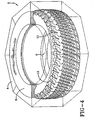
- a tire mold 2 having a tread forming crown portion 4 and a pair of annular sidewall rings 6, 8. These portions of the mold 2 form the tread 22 and the tire sidewalls 24 of the tire 20, as illustrated in Figure 3.
- FIG. 1 a cross-sectional exploded perspective view of a segment mold 2 according to the invention is shown.
- the mold 2 when in the open position has the segments 4 expanded radially outwardly and spaced from the lower sidewall forming annular ring 6.
- the upper sidewall-forming ring 8 is tilted away from the segments 4.
- the cured tire 20 can be removed form the mold 2.
- the segments 4 preferably are moved radially inward abutting the lower sidewall ring 6. Then the green tire 20 is placed in the mold 2 with an inflatable curing bladder (not illustrated) inserted in the air chamber of the tire 20.
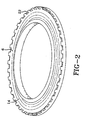
- top sidewall forming the upper ring 8 is closed into abutting relation with the segments 4 as shown in Fig. 2.
- the tire 20 is then cured by applying heat and pressure to the inside of the mold 2.
- the curing bladder (not illustrated) is inflated and expands pressing the tire 20 firmly against the tread forming segments 4 and the sidewall forming rings 6, 8.
- the segments 4 of the exemplary mold 2 and the upper and lower sidewall forming annular rings 6, 8 are fabricated in such a way that in the process of molding the tire 20 the read 22 is formed with a sidewall 24 having complementary lug extensions 30 circumferentially aligned with the axially outer portion 42 of the traction lugs 40 as illustrated in Figs. 3, 7 and 8 of the drawings of the exemplary tire 20.
- these sidewall lug extensions 30 extend radially inward a substantial distance into the sidewall indicia band 50 as shown.
- the ridges 25 forming the radially outer portion of the indicia band 50 may be used at the radially outermost extreme of the annular rings 6, 8 of the mold 2 as shown in Figures 5, 6 and 7.
- the band 50 of ridges 25 of Figures 6 and 7 as shown can have a radial height (h) and an angle between adjacent surfaces.
- the mold rings 6 and 8 form the ridges 25 with a complementary band of ridges 52 on the sidewall surface 12.
- the tread elements 40 are formed in the cavities 11 of the tread forming portion of a segment 4, each cavity 11 being defined by ribs 9 that form the tread grooves.
- cutouts 12 are shown to provide lug extensions 30. These features are used primarily on light truck tires.
- the sidewall forming surface 14 may be smooth with indicia or lettering or may include bands of ridges 25. These ridges 25 ideally should be highly polished as well as the rest of the tire's sidewall as will be discussed.
- Such molds 2 have these portions of the molds made of aluminum or steel. While the selection of the base material of the mold can be any number of suitable materials, it is believed beneficial that the surfaces, for forming a highly reflective tire finish, should be hard or hardened. Testing indicates that a surface hardness of 64 Rockwell C or greater is sufficiently hard to survive the rigors of tire molding, although lesser hardness may be used.
- Mold fouling is a residual surface build-up on tire molding surfaces. Sulfur and other chemical residue attach to the molding surface and the surface finish of the tire is limited to the clean lines of the mold.
- New molds sometimes have a few shiny tires but after a handful of tires are produced the tires all look uniformly dull. New molds have a surface finish generally for rougher than 24 micro inches. This is mostly due to the limitations on automated surface polishing and machining techniques in making molds.
- the tires all have a surface gloss reading of less than 5.
- the Michelin Pilot achieves a 3.5 rating.
- the tires with the highest rating looked blacker and somewhat shinier. It is important to note these tires were randomly selected or purchased with the results being a very small sample that has no statistical significance other than to show what is typical of such tires.
- the inventors decided to see how shiny they could make a tire appear. They attempted to deliberately create a very shiny tire.
- the inventors then proceeded to evaluate several plating techniques to achieve a higher surface finish on test sidewall rings.
- chrome plating achieved a very high hardness but the chromium plating simply followed the contour of the underlying sidewall plate.
- a 24 micro inch polished steel sidewall plate yielded a 24 micro inch chromium surface.
- the plating when used to a proper thickness achieved no real benefit but simply mirrored the underlying surfaces. Additional layers of chrome run the risk of flaking and brittle fracture and thus were considered less desirable.
- the inventors also tested 24 micro inch sidewalls plated or coated with Magnaplate High Mirror Finish (HMF) Magnaplate Nedox SF-2R, Xylan 8840, a Teflon from Whitford. Of all these the Magnaplate HMF appeared to actually smooth the underlying 24 micro inch surface to a higher polish of less than 15 micro inches.
- HMF Magnaplate High Mirror Finish
- Ablative sandblasting and other cleaning techniques preferably should be avoided as that accelerates mold wear at the surface.
- the present invention is directly adaptable to any tire and requires no special materials or compound. Although, as noted above, the use of modified materials can be contemplated to enhance the mold life or to reduce the amount of costly additives currently required to preserve the rubber in tires.
- the tread 22 can be provided with a similar highly reflective surface but the usefulness is quickly lost as the tire wears. Nevertheless many may want the entire tire to have this reflective finish for overall appearance in the salesroom.
- the inventive principles also work for this purpose to give each tire that overall reflective appearance should one desire to do so.
- Gloss is associated with the capacity of a surface to reflect more light in some directions than in others.
- the directions associated with mirror (or specular) reflection normally have the highest reflectance. Measurements by this test method correlate with visual observations of surface shininess made at roughly the corresponding angles.
- Measured gloss ratings by this test method are obtained by comparing the specular reflectance from the specimen to that from a black glass standard. Since specular reflectance depends also on the surface refractive index of the specimen, the measured gloss ratings change as the surface refractive index changes. In obtaining the visual gloss ratings, however, it is customary to compare the specular reflectances of two specimens, having similar surface refractive indices. Since the instrumental ratings are affected more than the visual ratings by changes in surface refractive index, non-agreement between visual and instrumental gloss ratings can occur when high gloss specimen surfaces differing in refractive index are compared.
- Test Method E 430 includes techniques for the measurement of both distinctness of image gloss and reflection haze.
- Test method D 4039 provides an alternative procedure for measuring reflection haze.
Landscapes
- Engineering & Computer Science (AREA)
- Mechanical Engineering (AREA)
- Physics & Mathematics (AREA)
- Health & Medical Sciences (AREA)
- Oral & Maxillofacial Surgery (AREA)
- Thermal Sciences (AREA)
- Tires In General (AREA)
- Moulds For Moulding Plastics Or The Like (AREA)
- Heating, Cooling, Or Curing Plastics Or The Like In General (AREA)
Abstract
Description
| 60 Degree Gloss Readings for Goodyear Tires and Competitive Tire | ||
| Tire Description | 60 Degree Gloss | Tire made in |
| Goodyear Eagle LS | 1.1 | USA |
| Goodyear Eagle F1 | 2.2 | Germany |
| Michelin X-One | 2.3 | Spain |
| Michelin Pilot | 3.5 | USA |
| Michelin 4x4 Synchrone | 3.3 | USA |
| Goodrich Comp T/A | 1.1 | USA |
| Bridgestone Potenza | 3.0 | Thailand |
| Bridgestone Eager | 1.7 | USA |
| Firestone Affinity | 3.2 | USA |
| Pirelli P7 | 3.2 | Italy |
specular gloss - the relative luminous reflectance factor of a specimen in the mirror direction.
Claims (10)
- A tire mold having a radially inner surface for forming a tread (22) and a pair of sidewalls (24), the tire mold (2) characterized by at least one sidewall forming surface (6, 8) having a surface finish of less than 15 micro inches.
- The tire mold of claim 1 wherein the at least one sidewall forming surface (6, 8) has a surface finish of less than 10 micro inches.
- The tire mold of claim 1 or 2 wherein the at least one sidewall formingsurface (6, 8) is plated with Magnaplate High Mirror Finish.
- The tire mold of claim 2 wherein the at least one sidewall forming surface (6, 8) has an 8 micro inch polish.
- The tire mold of any of the preceding claims wherein the at least one sidewall forming surface (6, 8) has a hardness of at least 64 Rockwell C.
- A tire cured in a mold having a tread (22) and a pair of sidewalls (24), the tire (20) being characterized by at least one sidewall (24) having a surface gloss of greater than 10, as measured using a 60° gloss reading per ASTM designation D 523-89.
- The tire of claim 6 wherein the tire (20) has been molded in a tire mold (2) having a surface finish of less than 24 micro inches, especially less than 15 micro inches, and the surface finish of the tire (20) is highly light reflective.
- The tire of claim 6 or 7 wherein the at least one sidewall (24) having a gloss reading of greater than 10 has a surface skin layer that retards migration of antioxidation and is shiny black in appearance.
- A method of manufacturing a tire mold (2) characterized by polishing thesidewall forming surfaces (6, 8) to a finish of less than 20 micro inches, especially less than 15 micro inches.
- The method of claim 9 further characterized by coating or plating the polished surfaces (6, 8) with either Magnaplate High Mirror Finish (HMF), Magnaplate Nedox SF-2R, Xylan 8840, or Teflon from Whitford.
Applications Claiming Priority (2)
| Application Number | Priority Date | Filing Date | Title |
|---|---|---|---|
| US38899502P | 2002-06-14 | 2002-06-14 | |
| US388995P | 2002-06-14 |
Publications (3)
| Publication Number | Publication Date |
|---|---|
| EP1382426A2 true EP1382426A2 (en) | 2004-01-21 |
| EP1382426A3 EP1382426A3 (en) | 2005-04-06 |
| EP1382426B1 EP1382426B1 (en) | 2007-02-28 |
Family
ID=29780522
Family Applications (1)
| Application Number | Title | Priority Date | Filing Date |
|---|---|---|---|
| EP03101633A Expired - Lifetime EP1382426B1 (en) | 2002-06-14 | 2003-06-05 | Tire mold for reflective tires and tire |
Country Status (10)
| Country | Link |
|---|---|
| US (1) | US20030230370A1 (en) |
| EP (1) | EP1382426B1 (en) |
| JP (1) | JP2004017964A (en) |
| KR (1) | KR20030096084A (en) |
| CN (1) | CN1301841C (en) |
| BR (1) | BR0302018A (en) |
| CA (1) | CA2427513A1 (en) |
| DE (1) | DE60312081D1 (en) |
| MY (1) | MY144962A (en) |
| SG (1) | SG120932A1 (en) |
Families Citing this family (16)
| Publication number | Priority date | Publication date | Assignee | Title |
|---|---|---|---|---|
| CN100443278C (en) * | 2004-09-01 | 2008-12-17 | 象山巨象机模有限公司 | Tire mold and manufacturing method thereof |
| FR2892336B1 (en) * | 2005-10-21 | 2009-10-09 | Michelin Soc Tech | MARKING PROVIDES IMPROVED VISIBILITY AND MARKING METHOD. |
| US20080283169A1 (en) | 2007-02-22 | 2008-11-20 | Toyo Tire & Rubber Co., Ltd. | Pneumatic Tire |
| JP5112777B2 (en) * | 2007-08-01 | 2013-01-09 | 東洋ゴム工業株式会社 | Pneumatic tire and manufacturing method thereof |
| JP5095293B2 (en) | 2007-08-01 | 2012-12-12 | 東洋ゴム工業株式会社 | Pneumatic tire and manufacturing method thereof |
| JP5154161B2 (en) * | 2007-08-01 | 2013-02-27 | 東洋ゴム工業株式会社 | Pneumatic tire and manufacturing method thereof |
| JP5112778B2 (en) * | 2007-08-01 | 2013-01-09 | 東洋ゴム工業株式会社 | Pneumatic tire and manufacturing method thereof |
| JP6068139B2 (en) | 2010-03-26 | 2017-01-25 | 株式会社ブリヂストン | Tire and method for manufacturing tire vulcanizing mold |
| US8177538B1 (en) | 2011-03-21 | 2012-05-15 | Bridgestone Americas Tire Operations, Llc | Tire mold having sidewall structure |
| US9604423B2 (en) | 2013-06-28 | 2017-03-28 | Compagnie Generale Des Etablissements Michelin | Tire mold with improved durability |
| EP3016809B1 (en) | 2013-07-01 | 2019-08-21 | Bridgestone Americas Tire Operations, LLC | Methods and apparatuses for creating a visual effect on a rubber article |
| JP6913574B2 (en) * | 2017-09-08 | 2021-08-04 | Toyo Tire株式会社 | Pneumatic tires |
| JP7176408B2 (en) | 2018-12-27 | 2022-11-22 | 横浜ゴム株式会社 | conveyor belt |
| DE102019207908A1 (en) * | 2019-05-29 | 2020-12-03 | Continental Reifen Deutschland Gmbh | Pneumatic vehicle tires |
| JP7535901B2 (en) * | 2020-09-30 | 2024-08-19 | Toyo Tire株式会社 | Pneumatic tires |
| DE102023213008A1 (en) | 2023-12-20 | 2025-06-26 | Continental Reifen Deutschland Gmbh | Vulcanization form and vulcanized vehicle tires |
Family Cites Families (13)
| Publication number | Priority date | Publication date | Assignee | Title |
|---|---|---|---|---|
| US1776145A (en) * | 1929-05-06 | 1930-09-16 | Aluminum Co Of America | Method of producing tire molds |
| US3151360A (en) * | 1962-02-15 | 1964-10-06 | Us Rubber Co | Polar microinch finish vented mold |
| US3177558A (en) * | 1962-08-20 | 1965-04-13 | Du Pont | Metal articles having smooth hemispheroidal indentations |
| GB2010755B (en) * | 1977-12-23 | 1982-06-16 | Dunlop Ltd | Shallow relief patterns on tyre sidewalls |
| US4492554A (en) * | 1980-08-26 | 1985-01-08 | Corn States Metal Fabricators, Inc. | Valve unit for a mold vent |
| US4444713A (en) * | 1982-08-09 | 1984-04-24 | The Goodyear Tire & Rubber Company | Decorative ornamentation for a rubber article and method of making same |
| JPS63151410A (en) * | 1986-12-15 | 1988-06-24 | Toyo Tire & Rubber Co Ltd | Mold for vulcanizing and molding tire |
| JPH0617018B2 (en) * | 1989-07-20 | 1994-03-09 | 住友ゴム工業株式会社 | Tire forming vulcanization mold |
| US5303758A (en) * | 1992-06-15 | 1994-04-19 | The Goodyear Tire & Rubber Company | Tire sidewall design patterns |
| US5952017A (en) * | 1994-12-16 | 1999-09-14 | Taisei Kako Co., Ltd. | Pressure roll, and molding apparatus using the pressure roll |
| JP3616512B2 (en) * | 1997-12-10 | 2005-02-02 | 住友ゴム工業株式会社 | Mold for manufacturing amorphous alloys |
| JP2000142026A (en) * | 1998-11-10 | 2000-05-23 | Yokohama Rubber Co Ltd:The | Pneumatic tire, manufacture thereof and metal mold for molding tire |
| DE60003629T2 (en) * | 1999-07-12 | 2004-06-03 | Société de Technologie Michelin | TIRES WHOSE SIDEWALLS CONTAIN GLAZED FILM |
-
2003
- 2003-03-26 US US10/400,325 patent/US20030230370A1/en not_active Abandoned
- 2003-04-30 MY MYPI20031644A patent/MY144962A/en unknown
- 2003-05-01 CA CA002427513A patent/CA2427513A1/en not_active Abandoned
- 2003-06-02 BR BR0302018-5A patent/BR0302018A/en not_active IP Right Cessation
- 2003-06-05 EP EP03101633A patent/EP1382426B1/en not_active Expired - Lifetime
- 2003-06-05 DE DE60312081T patent/DE60312081D1/en not_active Expired - Lifetime
- 2003-06-13 CN CNB031410790A patent/CN1301841C/en not_active Expired - Fee Related
- 2003-06-13 KR KR10-2003-0038225A patent/KR20030096084A/en not_active Ceased
- 2003-06-14 SG SG200303385A patent/SG120932A1/en unknown
- 2003-06-16 JP JP2003170767A patent/JP2004017964A/en active Pending
Also Published As
| Publication number | Publication date |
|---|---|
| BR0302018A (en) | 2004-08-24 |
| MY144962A (en) | 2011-11-30 |
| EP1382426B1 (en) | 2007-02-28 |
| HK1061826A1 (en) | 2004-10-08 |
| CN1467070A (en) | 2004-01-14 |
| CA2427513A1 (en) | 2003-12-14 |
| US20030230370A1 (en) | 2003-12-18 |
| SG120932A1 (en) | 2006-04-26 |
| CN1301841C (en) | 2007-02-28 |
| EP1382426A3 (en) | 2005-04-06 |
| DE60312081D1 (en) | 2007-04-12 |
| KR20030096084A (en) | 2003-12-24 |
| JP2004017964A (en) | 2004-01-22 |
Similar Documents
| Publication | Publication Date | Title |
|---|---|---|
| EP1382426B1 (en) | Tire mold for reflective tires and tire | |
| US2761489A (en) | Method of manufacture of a pneumatic tire | |
| EP0101399B1 (en) | Decorative ornamentation for a rubber article and method of making same | |
| JP7204655B2 (en) | Tire with textured sidewalls | |
| RU2246409C2 (en) | Tread with pattern | |
| US20100282387A1 (en) | Tire vulcanizing mold and tire produced with the tire vulcanizing mold | |
| FI96403B (en) | Shaped interchangeable wear surface | |
| CN110520236B (en) | Method and software for laser engraving a mold element of a tire mold | |
| US11707899B2 (en) | Vulcanization mold for tire and method for manufacturing tire | |
| US4279286A (en) | Pneumatic tires having ornamented sidewalls, and to their manufacture | |
| US20250010666A1 (en) | Pneumatic tire with a textured surface, method of manufacturing, and textured mold | |
| US6955782B1 (en) | Method of molding a tire and mold therefor | |
| US3769123A (en) | Method of making non-cracking decorative sidewalls of tires | |
| US20070006954A1 (en) | Pneumatic tire and mold for the tire | |
| JP3422715B2 (en) | Pneumatic tire | |
| HK1061826B (en) | Reflective tires and a method for molding | |
| JP6911425B2 (en) | Pneumatic tires and their manufacturing methods | |
| JPH09225945A (en) | Tire mold | |
| JP2006519120A (en) | Tire mold and tread | |
| JP2011020508A (en) | Tire, base tire, and tread | |
| CN121113763B (en) | Method for detecting wear resistance of glaze and application | |
| JPH0617018B2 (en) | Tire forming vulcanization mold | |
| GB2210576A (en) | Moulds | |
| US12030270B2 (en) | Tire molding die and pneumatic tire | |
| JP2024082400A (en) | Tires and tire moulds |
Legal Events
| Date | Code | Title | Description |
|---|---|---|---|
| PUAI | Public reference made under article 153(3) epc to a published international application that has entered the european phase |
Free format text: ORIGINAL CODE: 0009012 |
|
| AK | Designated contracting states |
Kind code of ref document: A2 Designated state(s): AT BE BG CH CY CZ DE DK EE ES FI FR GB GR HU IE IT LI LU MC NL PT RO SE SI SK TR |
|
| AX | Request for extension of the european patent |
Extension state: AL LT LV MK |
|
| PUAL | Search report despatched |
Free format text: ORIGINAL CODE: 0009013 |
|
| RIC1 | Information provided on ipc code assigned before grant |
Ipc: 7B 29D 30/06 B Ipc: 7B 29L 30:00 Z Ipc: 7B 60C 13/00 B Ipc: 7B 29C 33/42 A |
|
| AK | Designated contracting states |
Kind code of ref document: A3 Designated state(s): AT BE BG CH CY CZ DE DK EE ES FI FR GB GR HU IE IT LI LU MC NL PT RO SE SI SK TR |
|
| AX | Request for extension of the european patent |
Extension state: AL LT LV MK |
|
| 17P | Request for examination filed |
Effective date: 20051006 |
|
| AKX | Designation fees paid |
Designated state(s): DE ES FR GB IT |
|
| GRAP | Despatch of communication of intention to grant a patent |
Free format text: ORIGINAL CODE: EPIDOSNIGR1 |
|
| RIC1 | Information provided on ipc code assigned before grant |
Ipc: B60C 13/00 20060101ALI20060725BHEP Ipc: B29L 30/00 20060101ALN20060725BHEP Ipc: B29D 30/72 20060101ALI20060725BHEP Ipc: B29C 33/42 20060101AFI20060725BHEP Ipc: B29D 30/06 20060101ALI20060725BHEP |
|
| RTI1 | Title (correction) |
Free format text: TIRE MOLD FOR REFLECTIVE TIRES AND TIRE |
|
| GRAS | Grant fee paid |
Free format text: ORIGINAL CODE: EPIDOSNIGR3 |
|
| GRAA | (expected) grant |
Free format text: ORIGINAL CODE: 0009210 |
|
| AK | Designated contracting states |
Kind code of ref document: B1 Designated state(s): DE ES FR GB IT |
|
| REG | Reference to a national code |
Ref country code: GB Ref legal event code: FG4D |
|
| REF | Corresponds to: |
Ref document number: 60312081 Country of ref document: DE Date of ref document: 20070412 Kind code of ref document: P |
|
| PG25 | Lapsed in a contracting state [announced via postgrant information from national office to epo] |
Ref country code: DE Free format text: LAPSE BECAUSE OF FAILURE TO SUBMIT A TRANSLATION OF THE DESCRIPTION OR TO PAY THE FEE WITHIN THE PRESCRIBED TIME-LIMIT Effective date: 20070530 |
|
| PG25 | Lapsed in a contracting state [announced via postgrant information from national office to epo] |
Ref country code: ES Free format text: LAPSE BECAUSE OF FAILURE TO SUBMIT A TRANSLATION OF THE DESCRIPTION OR TO PAY THE FEE WITHIN THE PRESCRIBED TIME-LIMIT Effective date: 20070608 |
|
| ET | Fr: translation filed | ||
| PLBE | No opposition filed within time limit |
Free format text: ORIGINAL CODE: 0009261 |
|
| STAA | Information on the status of an ep patent application or granted ep patent |
Free format text: STATUS: NO OPPOSITION FILED WITHIN TIME LIMIT |
|
| 26N | No opposition filed |
Effective date: 20071129 |
|
| PG25 | Lapsed in a contracting state [announced via postgrant information from national office to epo] |
Ref country code: IT Free format text: LAPSE BECAUSE OF FAILURE TO SUBMIT A TRANSLATION OF THE DESCRIPTION OR TO PAY THE FEE WITHIN THE PRESCRIBED TIME-LIMIT Effective date: 20070228 |
|
| PGFP | Annual fee paid to national office [announced via postgrant information from national office to epo] |
Ref country code: GB Payment date: 20080506 Year of fee payment: 6 |
|
| PGFP | Annual fee paid to national office [announced via postgrant information from national office to epo] |
Ref country code: FR Payment date: 20090605 Year of fee payment: 7 |
|
| GBPC | Gb: european patent ceased through non-payment of renewal fee |
Effective date: 20090605 |
|
| PG25 | Lapsed in a contracting state [announced via postgrant information from national office to epo] |
Ref country code: GB Free format text: LAPSE BECAUSE OF NON-PAYMENT OF DUE FEES Effective date: 20090605 |
|
| REG | Reference to a national code |
Ref country code: FR Ref legal event code: ST Effective date: 20110228 |
|
| PG25 | Lapsed in a contracting state [announced via postgrant information from national office to epo] |
Ref country code: FR Free format text: LAPSE BECAUSE OF NON-PAYMENT OF DUE FEES Effective date: 20100630 |