EP1382385A1 - Microcapsule and process for manufacturing the same - Google Patents
Microcapsule and process for manufacturing the same Download PDFInfo
- Publication number
- EP1382385A1 EP1382385A1 EP03254434A EP03254434A EP1382385A1 EP 1382385 A1 EP1382385 A1 EP 1382385A1 EP 03254434 A EP03254434 A EP 03254434A EP 03254434 A EP03254434 A EP 03254434A EP 1382385 A1 EP1382385 A1 EP 1382385A1
- Authority
- EP
- European Patent Office
- Prior art keywords
- microcapsule
- molecule
- compound
- polymer
- dendritic branching
- Prior art date
- Legal status (The legal status is an assumption and is not a legal conclusion. Google has not performed a legal analysis and makes no representation as to the accuracy of the status listed.)
- Granted
Links
- 239000003094 microcapsule Substances 0.000 title claims abstract description 91
- 238000000034 method Methods 0.000 title claims abstract description 33
- 230000008569 process Effects 0.000 title claims abstract description 25
- 238000004519 manufacturing process Methods 0.000 title claims abstract description 19
- -1 isocyanate compound Chemical class 0.000 claims abstract description 60
- 239000002775 capsule Substances 0.000 claims abstract description 42
- 239000012948 isocyanate Substances 0.000 claims abstract description 39
- 150000001875 compounds Chemical class 0.000 claims abstract description 37
- 125000002887 hydroxy group Chemical group [H]O* 0.000 claims abstract description 27
- 229920000642 polymer Polymers 0.000 claims abstract description 26
- 125000004435 hydrogen atom Chemical group [H]* 0.000 claims abstract description 17
- 230000000379 polymerizing effect Effects 0.000 claims abstract description 8
- 239000000463 material Substances 0.000 claims description 36
- 239000012954 diazonium Substances 0.000 claims description 34
- 239000000412 dendrimer Substances 0.000 claims description 33
- 150000001989 diazonium salts Chemical class 0.000 claims description 33
- 229920000736 dendritic polymer Polymers 0.000 claims description 28
- 125000003277 amino group Chemical group 0.000 claims description 18
- 239000002243 precursor Substances 0.000 claims description 15
- 239000002245 particle Substances 0.000 claims description 10
- 229920000587 hyperbranched polymer Polymers 0.000 claims description 8
- 229920005862 polyol Polymers 0.000 claims description 8
- 239000004814 polyurethane Substances 0.000 claims description 8
- 229920002635 polyurethane Polymers 0.000 claims description 7
- 229920002396 Polyurea Polymers 0.000 claims description 3
- 239000000243 solution Substances 0.000 description 33
- 239000000839 emulsion Substances 0.000 description 20
- 239000010410 layer Substances 0.000 description 18
- XEKOWRVHYACXOJ-UHFFFAOYSA-N Ethyl acetate Chemical compound CCOC(C)=O XEKOWRVHYACXOJ-UHFFFAOYSA-N 0.000 description 16
- 239000011248 coating agent Substances 0.000 description 15
- 238000000576 coating method Methods 0.000 description 15
- 239000006185 dispersion Substances 0.000 description 13
- 150000002513 isocyanates Chemical class 0.000 description 13
- 239000002904 solvent Substances 0.000 description 12
- 238000006243 chemical reaction Methods 0.000 description 11
- 239000003960 organic solvent Substances 0.000 description 11
- 150000003141 primary amines Chemical group 0.000 description 11
- 230000000052 comparative effect Effects 0.000 description 10
- 239000007864 aqueous solution Substances 0.000 description 9
- 230000004044 response Effects 0.000 description 9
- XLYOFNOQVPJJNP-UHFFFAOYSA-N water Substances O XLYOFNOQVPJJNP-UHFFFAOYSA-N 0.000 description 9
- QGZKDVFQNNGYKY-UHFFFAOYSA-N Ammonia Chemical compound N QGZKDVFQNNGYKY-UHFFFAOYSA-N 0.000 description 8
- WSFSSNUMVMOOMR-UHFFFAOYSA-N Formaldehyde Chemical compound O=C WSFSSNUMVMOOMR-UHFFFAOYSA-N 0.000 description 8
- ZJCCRDAZUWHFQH-UHFFFAOYSA-N Trimethylolpropane Chemical compound CCC(CO)(CO)CO ZJCCRDAZUWHFQH-UHFFFAOYSA-N 0.000 description 8
- 239000008346 aqueous phase Substances 0.000 description 8
- 230000001588 bifunctional effect Effects 0.000 description 8
- 238000009835 boiling Methods 0.000 description 8
- 238000004040 coloring Methods 0.000 description 8
- 150000001450 anions Chemical class 0.000 description 7
- 150000007514 bases Chemical class 0.000 description 7
- 230000015572 biosynthetic process Effects 0.000 description 7
- 238000010438 heat treatment Methods 0.000 description 7
- 239000000047 product Substances 0.000 description 7
- 239000007858 starting material Substances 0.000 description 7
- 239000004094 surface-active agent Substances 0.000 description 7
- 239000004952 Polyamide Substances 0.000 description 6
- 239000002253 acid Substances 0.000 description 6
- 239000003456 ion exchange resin Substances 0.000 description 6
- 229920003303 ion-exchange polymer Polymers 0.000 description 6
- IQPQWNKOIGAROB-UHFFFAOYSA-N isocyanate group Chemical group [N-]=C=O IQPQWNKOIGAROB-UHFFFAOYSA-N 0.000 description 6
- 239000012071 phase Substances 0.000 description 6
- 229920002647 polyamide Polymers 0.000 description 6
- 239000011241 protective layer Substances 0.000 description 6
- RMVRSNDYEFQCLF-UHFFFAOYSA-N thiophenol Chemical compound SC1=CC=CC=C1 RMVRSNDYEFQCLF-UHFFFAOYSA-N 0.000 description 6
- LYCAIKOWRPUZTN-UHFFFAOYSA-N Ethylene glycol Chemical compound OCCO LYCAIKOWRPUZTN-UHFFFAOYSA-N 0.000 description 5
- 150000001412 amines Chemical class 0.000 description 5
- 239000003054 catalyst Substances 0.000 description 5
- 238000004132 cross linking Methods 0.000 description 5
- 229920000162 poly(ureaurethane) Polymers 0.000 description 5
- 238000003756 stirring Methods 0.000 description 5
- 238000003786 synthesis reaction Methods 0.000 description 5
- DVKJHBMWWAPEIU-UHFFFAOYSA-N toluene 2,4-diisocyanate Chemical compound CC1=CC=C(N=C=O)C=C1N=C=O DVKJHBMWWAPEIU-UHFFFAOYSA-N 0.000 description 5
- 238000011282 treatment Methods 0.000 description 5
- NWUYHJFMYQTDRP-UHFFFAOYSA-N 1,2-bis(ethenyl)benzene;1-ethenyl-2-ethylbenzene;styrene Chemical compound C=CC1=CC=CC=C1.CCC1=CC=CC=C1C=C.C=CC1=CC=CC=C1C=C NWUYHJFMYQTDRP-UHFFFAOYSA-N 0.000 description 4
- BAPJBEWLBFYGME-UHFFFAOYSA-N Methyl acrylate Chemical compound COC(=O)C=C BAPJBEWLBFYGME-UHFFFAOYSA-N 0.000 description 4
- ISWSIDIOOBJBQZ-UHFFFAOYSA-N Phenol Chemical compound OC1=CC=CC=C1 ISWSIDIOOBJBQZ-UHFFFAOYSA-N 0.000 description 4
- XSQUKJJJFZCRTK-UHFFFAOYSA-N Urea Chemical compound NC(N)=O XSQUKJJJFZCRTK-UHFFFAOYSA-N 0.000 description 4
- 229910021529 ammonia Inorganic materials 0.000 description 4
- 125000000524 functional group Chemical group 0.000 description 4
- 239000003921 oil Substances 0.000 description 4
- 238000002360 preparation method Methods 0.000 description 4
- 239000007787 solid Substances 0.000 description 4
- 238000003860 storage Methods 0.000 description 4
- UMGDCJDMYOKAJW-UHFFFAOYSA-N thiourea Chemical compound NC(N)=S UMGDCJDMYOKAJW-UHFFFAOYSA-N 0.000 description 4
- 229920003169 water-soluble polymer Polymers 0.000 description 4
- RTTZISZSHSCFRH-UHFFFAOYSA-N 1,3-bis(isocyanatomethyl)benzene Chemical compound O=C=NCC1=CC=CC(CN=C=O)=C1 RTTZISZSHSCFRH-UHFFFAOYSA-N 0.000 description 3
- CSCPPACGZOOCGX-UHFFFAOYSA-N Acetone Chemical compound CC(C)=O CSCPPACGZOOCGX-UHFFFAOYSA-N 0.000 description 3
- 241000284156 Clerodendrum quadriloculare Species 0.000 description 3
- YMWUJEATGCHHMB-UHFFFAOYSA-N Dichloromethane Chemical compound ClCCl YMWUJEATGCHHMB-UHFFFAOYSA-N 0.000 description 3
- PEDCQBHIVMGVHV-UHFFFAOYSA-N Glycerine Chemical compound OCC(O)CO PEDCQBHIVMGVHV-UHFFFAOYSA-N 0.000 description 3
- 239000005057 Hexamethylene diisocyanate Substances 0.000 description 3
- 239000013065 commercial product Substances 0.000 description 3
- MTHSVFCYNBDYFN-UHFFFAOYSA-N diethylene glycol Chemical compound OCCOCCO MTHSVFCYNBDYFN-UHFFFAOYSA-N 0.000 description 3
- 229920000159 gelatin Polymers 0.000 description 3
- RRAMGCGOFNQTLD-UHFFFAOYSA-N hexamethylene diisocyanate Chemical compound O=C=NCCCCCCN=C=O RRAMGCGOFNQTLD-UHFFFAOYSA-N 0.000 description 3
- 150000004677 hydrates Chemical class 0.000 description 3
- RAXXELZNTBOGNW-UHFFFAOYSA-N imidazole Natural products C1=CNC=N1 RAXXELZNTBOGNW-UHFFFAOYSA-N 0.000 description 3
- 239000000203 mixture Substances 0.000 description 3
- 229920000962 poly(amidoamine) Polymers 0.000 description 3
- 239000007962 solid dispersion Substances 0.000 description 3
- NQRYJNQNLNOLGT-UHFFFAOYSA-N tetrahydropyridine hydrochloride Natural products C1CCNCC1 NQRYJNQNLNOLGT-UHFFFAOYSA-N 0.000 description 3
- 239000008096 xylene Substances 0.000 description 3
- JIAARYAFYJHUJI-UHFFFAOYSA-L zinc dichloride Chemical compound [Cl-].[Cl-].[Zn+2] JIAARYAFYJHUJI-UHFFFAOYSA-L 0.000 description 3
- PUPZLCDOIYMWBV-UHFFFAOYSA-N (+/-)-1,3-Butanediol Chemical compound CC(O)CCO PUPZLCDOIYMWBV-UHFFFAOYSA-N 0.000 description 2
- DPEYHNFHDIXMNV-UHFFFAOYSA-N (9-amino-3-bicyclo[3.3.1]nonanyl)-(4-benzyl-5-methyl-1,4-diazepan-1-yl)methanone dihydrochloride Chemical compound Cl.Cl.CC1CCN(CCN1Cc1ccccc1)C(=O)C1CC2CCCC(C1)C2N DPEYHNFHDIXMNV-UHFFFAOYSA-N 0.000 description 2
- FUPAJKKAHDLPAZ-UHFFFAOYSA-N 1,2,3-triphenylguanidine Chemical compound C=1C=CC=CC=1NC(=NC=1C=CC=CC=1)NC1=CC=CC=C1 FUPAJKKAHDLPAZ-UHFFFAOYSA-N 0.000 description 2
- KWVGIHKZDCUPEU-UHFFFAOYSA-N 2,2-dimethoxy-2-phenylacetophenone Chemical compound C=1C=CC=CC=1C(OC)(OC)C(=O)C1=CC=CC=C1 KWVGIHKZDCUPEU-UHFFFAOYSA-N 0.000 description 2
- WNZQDUSMALZDQF-UHFFFAOYSA-N 2-benzofuran-1(3H)-one Chemical compound C1=CC=C2C(=O)OCC2=C1 WNZQDUSMALZDQF-UHFFFAOYSA-N 0.000 description 2
- IJGRMHOSHXDMSA-UHFFFAOYSA-N Atomic nitrogen Chemical compound N#N IJGRMHOSHXDMSA-UHFFFAOYSA-N 0.000 description 2
- 206010068516 Encapsulation reaction Diseases 0.000 description 2
- LFQSCWFLJHTTHZ-UHFFFAOYSA-N Ethanol Chemical compound CCO LFQSCWFLJHTTHZ-UHFFFAOYSA-N 0.000 description 2
- 239000001828 Gelatine Substances 0.000 description 2
- ZRALSGWEFCBTJO-UHFFFAOYSA-N Guanidine Chemical compound NC(N)=N ZRALSGWEFCBTJO-UHFFFAOYSA-N 0.000 description 2
- UFHFLCQGNIYNRP-UHFFFAOYSA-N Hydrogen Chemical compound [H][H] UFHFLCQGNIYNRP-UHFFFAOYSA-N 0.000 description 2
- QIGBRXMKCJKVMJ-UHFFFAOYSA-N Hydroquinone Chemical compound OC1=CC=C(O)C=C1 QIGBRXMKCJKVMJ-UHFFFAOYSA-N 0.000 description 2
- SIKJAQJRHWYJAI-UHFFFAOYSA-N Indole Chemical compound C1=CC=C2NC=CC2=C1 SIKJAQJRHWYJAI-UHFFFAOYSA-N 0.000 description 2
- YNAVUWVOSKDBBP-UHFFFAOYSA-N Morpholine Chemical compound C1COCCN1 YNAVUWVOSKDBBP-UHFFFAOYSA-N 0.000 description 2
- FZERHIULMFGESH-UHFFFAOYSA-N N-phenylacetamide Chemical compound CC(=O)NC1=CC=CC=C1 FZERHIULMFGESH-UHFFFAOYSA-N 0.000 description 2
- KDLHZDBZIXYQEI-UHFFFAOYSA-N Palladium Chemical compound [Pd] KDLHZDBZIXYQEI-UHFFFAOYSA-N 0.000 description 2
- GLUUGHFHXGJENI-UHFFFAOYSA-N Piperazine Chemical compound C1CNCCN1 GLUUGHFHXGJENI-UHFFFAOYSA-N 0.000 description 2
- JUJWROOIHBZHMG-UHFFFAOYSA-N Pyridine Chemical compound C1=CC=NC=C1 JUJWROOIHBZHMG-UHFFFAOYSA-N 0.000 description 2
- KAESVJOAVNADME-UHFFFAOYSA-N Pyrrole Chemical compound C=1C=CNC=1 KAESVJOAVNADME-UHFFFAOYSA-N 0.000 description 2
- YSMRWXYRXBRSND-UHFFFAOYSA-N TOTP Chemical compound CC1=CC=CC=C1OP(=O)(OC=1C(=CC=CC=1)C)OC1=CC=CC=C1C YSMRWXYRXBRSND-UHFFFAOYSA-N 0.000 description 2
- WYURNTSHIVDZCO-UHFFFAOYSA-N Tetrahydrofuran Chemical compound C1CCOC1 WYURNTSHIVDZCO-UHFFFAOYSA-N 0.000 description 2
- 125000003118 aryl group Chemical group 0.000 description 2
- OHJMTUPIZMNBFR-UHFFFAOYSA-N biuret Chemical compound NC(=O)NC(N)=O OHJMTUPIZMNBFR-UHFFFAOYSA-N 0.000 description 2
- WERYXYBDKMZEQL-UHFFFAOYSA-N butane-1,4-diol Chemical compound OCCCCO WERYXYBDKMZEQL-UHFFFAOYSA-N 0.000 description 2
- 150000001768 cations Chemical class 0.000 description 2
- 229920001429 chelating resin Polymers 0.000 description 2
- 238000007278 cyanoethylation reaction Methods 0.000 description 2
- PFURGBBHAOXLIO-UHFFFAOYSA-N cyclohexane-1,2-diol Chemical compound OC1CCCCC1O PFURGBBHAOXLIO-UHFFFAOYSA-N 0.000 description 2
- 238000000354 decomposition reaction Methods 0.000 description 2
- 238000000502 dialysis Methods 0.000 description 2
- GHLKSLMMWAKNBM-UHFFFAOYSA-N dodecane-1,12-diol Chemical compound OCCCCCCCCCCCCO GHLKSLMMWAKNBM-UHFFFAOYSA-N 0.000 description 2
- 238000001035 drying Methods 0.000 description 2
- 230000000694 effects Effects 0.000 description 2
- 230000001804 emulsifying effect Effects 0.000 description 2
- 238000011156 evaluation Methods 0.000 description 2
- 239000010419 fine particle Substances 0.000 description 2
- 239000001257 hydrogen Substances 0.000 description 2
- 229910052739 hydrogen Inorganic materials 0.000 description 2
- 230000002209 hydrophobic effect Effects 0.000 description 2
- 238000005342 ion exchange Methods 0.000 description 2
- 150000003951 lactams Chemical class 0.000 description 2
- QDLAGTHXVHQKRE-UHFFFAOYSA-N lichenxanthone Natural products COC1=CC(O)=C2C(=O)C3=C(C)C=C(OC)C=C3OC2=C1 QDLAGTHXVHQKRE-UHFFFAOYSA-N 0.000 description 2
- 229920002521 macromolecule Polymers 0.000 description 2
- 150000004702 methyl esters Chemical class 0.000 description 2
- 125000001570 methylene group Chemical group [H]C([H])([*:1])[*:2] 0.000 description 2
- 150000002989 phenols Chemical class 0.000 description 2
- IVDFJHOHABJVEH-UHFFFAOYSA-N pinacol Chemical compound CC(C)(O)C(C)(C)O IVDFJHOHABJVEH-UHFFFAOYSA-N 0.000 description 2
- 238000006116 polymerization reaction Methods 0.000 description 2
- 150000003077 polyols Chemical class 0.000 description 2
- 238000001454 recorded image Methods 0.000 description 2
- 238000001223 reverse osmosis Methods 0.000 description 2
- 150000003335 secondary amines Chemical class 0.000 description 2
- 239000000126 substance Substances 0.000 description 2
- 150000003573 thiols Chemical class 0.000 description 2
- KSBAEPSJVUENNK-UHFFFAOYSA-L tin(ii) 2-ethylhexanoate Chemical compound [Sn+2].CCCCC(CC)C([O-])=O.CCCCC(CC)C([O-])=O KSBAEPSJVUENNK-UHFFFAOYSA-L 0.000 description 2
- RUELTTOHQODFPA-UHFFFAOYSA-N toluene 2,6-diisocyanate Chemical compound CC1=C(N=C=O)C=CC=C1N=C=O RUELTTOHQODFPA-UHFFFAOYSA-N 0.000 description 2
- 239000013638 trimer Substances 0.000 description 2
- 238000000108 ultra-filtration Methods 0.000 description 2
- 239000011592 zinc chloride Substances 0.000 description 2
- DNIAPMSPPWPWGF-VKHMYHEASA-N (+)-propylene glycol Chemical compound C[C@H](O)CO DNIAPMSPPWPWGF-VKHMYHEASA-N 0.000 description 1
- TXUICONDJPYNPY-UHFFFAOYSA-N (1,10,13-trimethyl-3-oxo-4,5,6,7,8,9,11,12,14,15,16,17-dodecahydrocyclopenta[a]phenanthren-17-yl) heptanoate Chemical compound C1CC2CC(=O)C=C(C)C2(C)C2C1C1CCC(OC(=O)CCCCCC)C1(C)CC2 TXUICONDJPYNPY-UHFFFAOYSA-N 0.000 description 1
- LIZLYZVAYZQVPG-UHFFFAOYSA-N (3-bromo-2-fluorophenyl)methanol Chemical compound OCC1=CC=CC(Br)=C1F LIZLYZVAYZQVPG-UHFFFAOYSA-N 0.000 description 1
- DNIAPMSPPWPWGF-GSVOUGTGSA-N (R)-(-)-Propylene glycol Chemical compound C[C@@H](O)CO DNIAPMSPPWPWGF-GSVOUGTGSA-N 0.000 description 1
- POFMQEVZKZVAPQ-UHFFFAOYSA-N 1,1,1',1'-tetramethyl-3,3'-spirobi[2h-indene]-5,5',6,6'-tetrol Chemical compound C12=CC(O)=C(O)C=C2C(C)(C)CC11C2=CC(O)=C(O)C=C2C(C)(C)C1 POFMQEVZKZVAPQ-UHFFFAOYSA-N 0.000 description 1
- FTWMCSGJSZWKCR-UHFFFAOYSA-N 1,2,3-tricyclohexylguanidine Chemical compound C1CCCCC1NC(NC1CCCCC1)=NC1CCCCC1 FTWMCSGJSZWKCR-UHFFFAOYSA-N 0.000 description 1
- FKTHNVSLHLHISI-UHFFFAOYSA-N 1,2-bis(isocyanatomethyl)benzene Chemical compound O=C=NCC1=CC=CC=C1CN=C=O FKTHNVSLHLHISI-UHFFFAOYSA-N 0.000 description 1
- MPUAUPQFSLHOHQ-UHFFFAOYSA-N 1,2-dicyclohexylguanidine Chemical compound C1CCCCC1NC(=N)NC1CCCCC1 MPUAUPQFSLHOHQ-UHFFFAOYSA-N 0.000 description 1
- XSCLFFBWRKTMTE-UHFFFAOYSA-N 1,3-bis(isocyanatomethyl)cyclohexane Chemical compound O=C=NCC1CCCC(CN=C=O)C1 XSCLFFBWRKTMTE-UHFFFAOYSA-N 0.000 description 1
- VGHSXKTVMPXHNG-UHFFFAOYSA-N 1,3-diisocyanatobenzene Chemical compound O=C=NC1=CC=CC(N=C=O)=C1 VGHSXKTVMPXHNG-UHFFFAOYSA-N 0.000 description 1
- IKYNWXNXXHWHLL-UHFFFAOYSA-N 1,3-diisocyanatopropane Chemical compound O=C=NCCCN=C=O IKYNWXNXXHWHLL-UHFFFAOYSA-N 0.000 description 1
- YPFDHNVEDLHUCE-UHFFFAOYSA-N 1,3-propanediol Substances OCCCO YPFDHNVEDLHUCE-UHFFFAOYSA-N 0.000 description 1
- ALQLPWJFHRMHIU-UHFFFAOYSA-N 1,4-diisocyanatobenzene Chemical compound O=C=NC1=CC=C(N=C=O)C=C1 ALQLPWJFHRMHIU-UHFFFAOYSA-N 0.000 description 1
- SIZPGZFVROGOIR-UHFFFAOYSA-N 1,4-diisocyanatonaphthalene Chemical compound C1=CC=C2C(N=C=O)=CC=C(N=C=O)C2=C1 SIZPGZFVROGOIR-UHFFFAOYSA-N 0.000 description 1
- FRASJONUBLZVQX-UHFFFAOYSA-N 1,4-dioxonaphthalene Natural products C1=CC=C2C(=O)C=CC(=O)C2=C1 FRASJONUBLZVQX-UHFFFAOYSA-N 0.000 description 1
- BOKGTLAJQHTOKE-UHFFFAOYSA-N 1,5-dihydroxynaphthalene Chemical compound C1=CC=C2C(O)=CC=CC2=C1O BOKGTLAJQHTOKE-UHFFFAOYSA-N 0.000 description 1
- YZSFOGREZGJZJR-UHFFFAOYSA-N 1-hydroxynaphthalene-2-carboxylic acid N-propylmorpholin-4-amine Chemical compound CCCNN1CCOCC1.C1=CC=CC2=C(O)C(C(=O)O)=CC=C21 YZSFOGREZGJZJR-UHFFFAOYSA-N 0.000 description 1
- DTZHXCBUWSTOPO-UHFFFAOYSA-N 1-isocyanato-4-[(4-isocyanato-3-methylphenyl)methyl]-2-methylbenzene Chemical compound C1=C(N=C=O)C(C)=CC(CC=2C=C(C)C(N=C=O)=CC=2)=C1 DTZHXCBUWSTOPO-UHFFFAOYSA-N 0.000 description 1
- HKTCLPBBJDIBGF-UHFFFAOYSA-N 1-phenyl-2-propan-2-ylbenzene Chemical group CC(C)C1=CC=CC=C1C1=CC=CC=C1 HKTCLPBBJDIBGF-UHFFFAOYSA-N 0.000 description 1
- VWGVUCWHPBULRD-UHFFFAOYSA-N 2,4,5-tris(furan-2-yl)-4,5-dihydro-1h-imidazole Chemical compound N1C(C=2OC=CC=2)C(C=2OC=CC=2)N=C1C1=CC=CO1 VWGVUCWHPBULRD-UHFFFAOYSA-N 0.000 description 1
- DWQVOVJJRDMRNH-UHFFFAOYSA-N 2,5-dibutoxy-4-[4-(2-ethylhexanoyl)piperazin-1-yl]benzenediazonium Chemical compound C1=C([N+]#N)C(OCCCC)=CC(N2CCN(CC2)C(=O)C(CC)CCCC)=C1OCCCC DWQVOVJJRDMRNH-UHFFFAOYSA-N 0.000 description 1
- NJLLALPCADBTIS-UHFFFAOYSA-N 2,5-dibutoxy-4-morpholin-4-ylbenzenediazonium Chemical compound C1=C([N+]#N)C(OCCCC)=CC(N2CCOCC2)=C1OCCCC NJLLALPCADBTIS-UHFFFAOYSA-N 0.000 description 1
- OROJJKXBSFBTNN-UHFFFAOYSA-N 2-(2,5-dibutoxy-4-methylphenyl)sulfanylbenzenediazonium Chemical compound C1=C(C)C(OCCCC)=CC(SC=2C(=CC=CC=2)[N+]#N)=C1OCCCC OROJJKXBSFBTNN-UHFFFAOYSA-N 0.000 description 1
- TXBCBTDQIULDIA-UHFFFAOYSA-N 2-[[3-hydroxy-2,2-bis(hydroxymethyl)propoxy]methyl]-2-(hydroxymethyl)propane-1,3-diol Chemical compound OCC(CO)(CO)COCC(CO)(CO)CO TXBCBTDQIULDIA-UHFFFAOYSA-N 0.000 description 1
- UUNIOFWUJYBVGQ-UHFFFAOYSA-N 2-amino-4-(3,4-dimethoxyphenyl)-10-fluoro-4,5,6,7-tetrahydrobenzo[1,2]cyclohepta[6,7-d]pyran-3-carbonitrile Chemical compound C1=C(OC)C(OC)=CC=C1C1C(C#N)=C(N)OC2=C1CCCC1=CC=C(F)C=C12 UUNIOFWUJYBVGQ-UHFFFAOYSA-N 0.000 description 1
- UHGULLIUJBCTEF-UHFFFAOYSA-N 2-aminobenzothiazole Chemical compound C1=CC=C2SC(N)=NC2=C1 UHGULLIUJBCTEF-UHFFFAOYSA-N 0.000 description 1
- NAPDOWNULRULLI-UHFFFAOYSA-N 2-benzyl-1h-imidazole Chemical compound C=1C=CC=CC=1CC1=NC=CN1 NAPDOWNULRULLI-UHFFFAOYSA-N 0.000 description 1
- QWGRWMMWNDWRQN-UHFFFAOYSA-N 2-methylpropane-1,3-diol Chemical compound OCC(C)CO QWGRWMMWNDWRQN-UHFFFAOYSA-N 0.000 description 1
- BKCCAYLNRIRKDJ-UHFFFAOYSA-N 2-phenyl-4,5-dihydro-1h-imidazole Chemical compound N1CCN=C1C1=CC=CC=C1 BKCCAYLNRIRKDJ-UHFFFAOYSA-N 0.000 description 1
- FQHUDZKKDCTQET-UHFFFAOYSA-N 2-undecyl-4,5-dihydro-1h-imidazole Chemical compound CCCCCCCCCCCC1=NCCN1 FQHUDZKKDCTQET-UHFFFAOYSA-N 0.000 description 1
- ITSYQWGKQSKHLM-UHFFFAOYSA-N 3-[4-(dimethylamino)-2-methylphenyl]-3-(2-methyl-1h-indol-3-yl)-2-benzofuran-1-one Chemical compound CC1=CC(N(C)C)=CC=C1C1(C=2C3=CC=CC=C3NC=2C)C2=CC=CC=C2C(=O)O1 ITSYQWGKQSKHLM-UHFFFAOYSA-N 0.000 description 1
- FFXPOZNUNSROLU-UHFFFAOYSA-N 3-[4-(dimethylamino)phenyl]-3-(1,3-dimethyl-2h-indol-3-yl)-2-benzofuran-1-one Chemical compound C1=CC(N(C)C)=CC=C1C1(C2(C)C3=CC=CC=C3N(C)C2)C2=CC=CC=C2C(=O)O1 FFXPOZNUNSROLU-UHFFFAOYSA-N 0.000 description 1
- ZKUWHPNJONEJEE-UHFFFAOYSA-N 3-[4-(dimethylamino)phenyl]-3-(2-methyl-1h-indol-3-yl)-2-benzofuran-1-one Chemical compound C1=CC(N(C)C)=CC=C1C1(C=2C3=CC=CC=C3NC=2C)C2=CC=CC=C2C(=O)O1 ZKUWHPNJONEJEE-UHFFFAOYSA-N 0.000 description 1
- VYHNSPUVKZPCDZ-UHFFFAOYSA-N 3-hydroxy-n-(2-hydroxyethyl)naphthalene-2-carboxamide Chemical compound C1=CC=C2C=C(O)C(C(=O)NCCO)=CC2=C1 VYHNSPUVKZPCDZ-UHFFFAOYSA-N 0.000 description 1
- ZEXOUWIPNHYOBO-UHFFFAOYSA-N 3-hydroxy-n-octylnaphthalene-2-carboxamide Chemical compound C1=CC=C2C=C(O)C(C(=O)NCCCCCCCC)=CC2=C1 ZEXOUWIPNHYOBO-UHFFFAOYSA-N 0.000 description 1
- JFGQHAHJWJBOPD-UHFFFAOYSA-N 3-hydroxy-n-phenylnaphthalene-2-carboxamide Chemical compound OC1=CC2=CC=CC=C2C=C1C(=O)NC1=CC=CC=C1 JFGQHAHJWJBOPD-UHFFFAOYSA-N 0.000 description 1
- FEHMRWVXXGFLDM-UHFFFAOYSA-N 3-hydroxy-n-tetradecylnaphthalene-2-carboxamide Chemical compound C1=CC=C2C=C(O)C(C(=O)NCCCCCCCCCCCCCC)=CC2=C1 FEHMRWVXXGFLDM-UHFFFAOYSA-N 0.000 description 1
- XRZDIHADHZSFBB-UHFFFAOYSA-N 3-oxo-n,3-diphenylpropanamide Chemical compound C=1C=CC=CC=1NC(=O)CC(=O)C1=CC=CC=C1 XRZDIHADHZSFBB-UHFFFAOYSA-N 0.000 description 1
- UPMLOUAZCHDJJD-UHFFFAOYSA-N 4,4'-Diphenylmethane Diisocyanate Chemical compound C1=CC(N=C=O)=CC=C1CC1=CC=C(N=C=O)C=C1 UPMLOUAZCHDJJD-UHFFFAOYSA-N 0.000 description 1
- HLBZWYXLQJQBKU-UHFFFAOYSA-N 4-(morpholin-4-yldisulfanyl)morpholine Chemical compound C1COCCN1SSN1CCOCC1 HLBZWYXLQJQBKU-UHFFFAOYSA-N 0.000 description 1
- QOOPMAVHPHNCII-UHFFFAOYSA-N 4-morpholin-4-yl-3-(2-octoxyethoxy)benzenediazonium Chemical compound CCCCCCCCOCCOC1=CC([N+]#N)=CC=C1N1CCOCC1 QOOPMAVHPHNCII-UHFFFAOYSA-N 0.000 description 1
- CBNFYVIXCBIFSQ-UHFFFAOYSA-N 5,5-dimethyl-2,3-diphenyl-4h-imidazole Chemical compound N=1C(C)(C)CN(C=2C=CC=CC=2)C=1C1=CC=CC=C1 CBNFYVIXCBIFSQ-UHFFFAOYSA-N 0.000 description 1
- KSSDKYWQXLISBC-UHFFFAOYSA-N 5-(2-dodecoxyphenyl)cyclohexane-1,3-dione Chemical compound CCCCCCCCCCCCOC1=CC=CC=C1C1CC(=O)CC(=O)C1 KSSDKYWQXLISBC-UHFFFAOYSA-N 0.000 description 1
- RIPONQCLCSLSSB-UHFFFAOYSA-N 5-anilino-2-(2,4,6-trichlorophenyl)-4h-pyrazol-3-one Chemical compound ClC1=CC(Cl)=CC(Cl)=C1N1C(=O)CC(NC=2C=CC=CC=2)=N1 RIPONQCLCSLSSB-UHFFFAOYSA-N 0.000 description 1
- HTKIZIQFMHVTRJ-UHFFFAOYSA-N 5-butyl-1,3-diazinane-2,4,6-trione Chemical compound CCCCC1C(=O)NC(=O)NC1=O HTKIZIQFMHVTRJ-UHFFFAOYSA-N 0.000 description 1
- PQOVCILLNSCVBV-UHFFFAOYSA-N 5-methyl-2-(2-octylphenyl)-4h-pyrazol-3-one Chemical compound CCCCCCCCC1=CC=CC=C1N1C(=O)CC(C)=N1 PQOVCILLNSCVBV-UHFFFAOYSA-N 0.000 description 1
- TYOXIFXYEIILLY-UHFFFAOYSA-N 5-methyl-2-phenyl-1h-imidazole Chemical compound N1C(C)=CN=C1C1=CC=CC=C1 TYOXIFXYEIILLY-UHFFFAOYSA-N 0.000 description 1
- XHLKOHSAWQPOFO-UHFFFAOYSA-N 5-phenyl-1h-imidazole Chemical compound N1C=NC=C1C1=CC=CC=C1 XHLKOHSAWQPOFO-UHFFFAOYSA-N 0.000 description 1
- DNASWSWCKBRRQN-UHFFFAOYSA-N 6,7-dihydroxy-1H-naphthalene-2-thione Chemical compound OC1=CC=2C=CC(CC2C=C1O)=S DNASWSWCKBRRQN-UHFFFAOYSA-N 0.000 description 1
- FHVDTGUDJYJELY-UHFFFAOYSA-N 6-{[2-carboxy-4,5-dihydroxy-6-(phosphanyloxy)oxan-3-yl]oxy}-4,5-dihydroxy-3-phosphanyloxane-2-carboxylic acid Chemical compound O1C(C(O)=O)C(P)C(O)C(O)C1OC1C(C(O)=O)OC(OP)C(O)C1O FHVDTGUDJYJELY-UHFFFAOYSA-N 0.000 description 1
- PXSDVROEZJOMEH-UHFFFAOYSA-N 8-chloro-3-oxo-n-phenyl-5-propylnonanamide Chemical compound CC(Cl)CCC(CCC)CC(=O)CC(=O)NC1=CC=CC=C1 PXSDVROEZJOMEH-UHFFFAOYSA-N 0.000 description 1
- NLHHRLWOUZZQLW-UHFFFAOYSA-N Acrylonitrile Chemical compound C=CC#N NLHHRLWOUZZQLW-UHFFFAOYSA-N 0.000 description 1
- LSNNMFCWUKXFEE-UHFFFAOYSA-M Bisulfite Chemical compound OS([O-])=O LSNNMFCWUKXFEE-UHFFFAOYSA-M 0.000 description 1
- DKPFZGUDAPQIHT-UHFFFAOYSA-N Butyl acetate Natural products CCCCOC(C)=O DKPFZGUDAPQIHT-UHFFFAOYSA-N 0.000 description 1
- 0 C*(CCCN(CCCN)CCCN)ICCN(CCC*)CCC* Chemical compound C*(CCCN(CCCN)CCCN)ICCN(CCC*)CCC* 0.000 description 1
- KMBPCQSCMCEPMU-UHFFFAOYSA-N CN(CCCN)CCCN Chemical compound CN(CCCN)CCCN KMBPCQSCMCEPMU-UHFFFAOYSA-N 0.000 description 1
- OKTJSMMVPCPJKN-UHFFFAOYSA-N Carbon Chemical compound [C] OKTJSMMVPCPJKN-UHFFFAOYSA-N 0.000 description 1
- IPAJDLMMTVZVPP-UHFFFAOYSA-N Crystal violet lactone Chemical compound C1=CC(N(C)C)=CC=C1C1(C=2C=CC(=CC=2)N(C)C)C2=CC=C(N(C)C)C=C2C(=O)O1 IPAJDLMMTVZVPP-UHFFFAOYSA-N 0.000 description 1
- XDTMQSROBMDMFD-UHFFFAOYSA-N Cyclohexane Chemical compound C1CCCCC1 XDTMQSROBMDMFD-UHFFFAOYSA-N 0.000 description 1
- IEPRKVQEAMIZSS-UHFFFAOYSA-N Di-Et ester-Fumaric acid Natural products CCOC(=O)C=CC(=O)OCC IEPRKVQEAMIZSS-UHFFFAOYSA-N 0.000 description 1
- IEPRKVQEAMIZSS-WAYWQWQTSA-N Diethyl maleate Chemical compound CCOC(=O)\C=C/C(=O)OCC IEPRKVQEAMIZSS-WAYWQWQTSA-N 0.000 description 1
- RPNUMPOLZDHAAY-UHFFFAOYSA-N Diethylenetriamine Chemical compound NCCNCCN RPNUMPOLZDHAAY-UHFFFAOYSA-N 0.000 description 1
- PIICEJLVQHRZGT-UHFFFAOYSA-N Ethylenediamine Chemical compound NCCN PIICEJLVQHRZGT-UHFFFAOYSA-N 0.000 description 1
- PDQAZBWRQCGBEV-UHFFFAOYSA-N Ethylenethiourea Chemical compound S=C1NCCN1 PDQAZBWRQCGBEV-UHFFFAOYSA-N 0.000 description 1
- 239000005058 Isophorone diisocyanate Substances 0.000 description 1
- 229920000877 Melamine resin Polymers 0.000 description 1
- 239000004640 Melamine resin Substances 0.000 description 1
- 238000006845 Michael addition reaction Methods 0.000 description 1
- KQJQICVXLJTWQD-UHFFFAOYSA-N N-Methylthiourea Chemical compound CNC(N)=S KQJQICVXLJTWQD-UHFFFAOYSA-N 0.000 description 1
- CHJJGSNFBQVOTG-UHFFFAOYSA-N N-methyl-guanidine Natural products CNC(N)=N CHJJGSNFBQVOTG-UHFFFAOYSA-N 0.000 description 1
- IMYJBPVLTJBMPO-UHFFFAOYSA-N N=C=O.N=C=O.COC1=CC=CC(C=2C=C(OC)C=CC=2)=C1 Chemical compound N=C=O.N=C=O.COC1=CC=CC(C=2C=C(OC)C=CC=2)=C1 IMYJBPVLTJBMPO-UHFFFAOYSA-N 0.000 description 1
- 239000004677 Nylon Substances 0.000 description 1
- REYJJPSVUYRZGE-UHFFFAOYSA-N Octadecylamine Chemical compound CCCCCCCCCCCCCCCCCCN REYJJPSVUYRZGE-UHFFFAOYSA-N 0.000 description 1
- 229910019142 PO4 Inorganic materials 0.000 description 1
- 206010034972 Photosensitivity reaction Diseases 0.000 description 1
- 239000002202 Polyethylene glycol Substances 0.000 description 1
- 239000004372 Polyvinyl alcohol Substances 0.000 description 1
- CZPWVGJYEJSRLH-UHFFFAOYSA-N Pyrimidine Chemical compound C1=CN=CN=C1 CZPWVGJYEJSRLH-UHFFFAOYSA-N 0.000 description 1
- DWAQJAXMDSEUJJ-UHFFFAOYSA-M Sodium bisulfite Chemical compound [Na+].OS([O-])=O DWAQJAXMDSEUJJ-UHFFFAOYSA-M 0.000 description 1
- FZWLAAWBMGSTSO-UHFFFAOYSA-N Thiazole Chemical compound C1=CSC=N1 FZWLAAWBMGSTSO-UHFFFAOYSA-N 0.000 description 1
- 229910021626 Tin(II) chloride Inorganic materials 0.000 description 1
- ISAKRJDGNUQOIC-UHFFFAOYSA-N Uracil Natural products O=C1C=CNC(=O)N1 ISAKRJDGNUQOIC-UHFFFAOYSA-N 0.000 description 1
- AZFNGPAYDKGCRB-XCPIVNJJSA-M [(1s,2s)-2-amino-1,2-diphenylethyl]-(4-methylphenyl)sulfonylazanide;chlororuthenium(1+);1-methyl-4-propan-2-ylbenzene Chemical compound [Ru+]Cl.CC(C)C1=CC=C(C)C=C1.C1=CC(C)=CC=C1S(=O)(=O)[N-][C@@H](C=1C=CC=CC=1)[C@@H](N)C1=CC=CC=C1 AZFNGPAYDKGCRB-XCPIVNJJSA-M 0.000 description 1
- XDODWINGEHBYRT-UHFFFAOYSA-N [2-(hydroxymethyl)cyclohexyl]methanol Chemical compound OCC1CCCCC1CO XDODWINGEHBYRT-UHFFFAOYSA-N 0.000 description 1
- ZKURGBYDCVNWKH-UHFFFAOYSA-N [3,7-bis(dimethylamino)phenothiazin-10-yl]-phenylmethanone Chemical compound C12=CC=C(N(C)C)C=C2SC2=CC(N(C)C)=CC=C2N1C(=O)C1=CC=CC=C1 ZKURGBYDCVNWKH-UHFFFAOYSA-N 0.000 description 1
- YIMQCDZDWXUDCA-UHFFFAOYSA-N [4-(hydroxymethyl)cyclohexyl]methanol Chemical compound OCC1CCC(CO)CC1 YIMQCDZDWXUDCA-UHFFFAOYSA-N 0.000 description 1
- BWVAOONFBYYRHY-UHFFFAOYSA-N [4-(hydroxymethyl)phenyl]methanol Chemical compound OCC1=CC=C(CO)C=C1 BWVAOONFBYYRHY-UHFFFAOYSA-N 0.000 description 1
- 238000010521 absorption reaction Methods 0.000 description 1
- 229960001413 acetanilide Drugs 0.000 description 1
- DYRDKSSFIWVSNM-UHFFFAOYSA-N acetoacetanilide Chemical compound CC(=O)CC(=O)NC1=CC=CC=C1 DYRDKSSFIWVSNM-UHFFFAOYSA-N 0.000 description 1
- 239000000654 additive Substances 0.000 description 1
- 230000000996 additive effect Effects 0.000 description 1
- 150000001278 adipic acid derivatives Chemical class 0.000 description 1
- 229940072056 alginate Drugs 0.000 description 1
- 229920000615 alginic acid Polymers 0.000 description 1
- 235000010443 alginic acid Nutrition 0.000 description 1
- 229910052783 alkali metal Inorganic materials 0.000 description 1
- 150000004996 alkyl benzenes Chemical class 0.000 description 1
- HTKFORQRBXIQHD-UHFFFAOYSA-N allylthiourea Chemical compound NC(=S)NCC=C HTKFORQRBXIQHD-UHFFFAOYSA-N 0.000 description 1
- 229960001748 allylthiourea Drugs 0.000 description 1
- 150000001408 amides Chemical class 0.000 description 1
- 150000001409 amidines Chemical class 0.000 description 1
- 150000003863 ammonium salts Chemical class 0.000 description 1
- JXLHNMVSKXFWAO-UHFFFAOYSA-N azane;7-fluoro-2,1,3-benzoxadiazole-4-sulfonic acid Chemical compound N.OS(=O)(=O)C1=CC=C(F)C2=NON=C12 JXLHNMVSKXFWAO-UHFFFAOYSA-N 0.000 description 1
- HONIICLYMWZJFZ-UHFFFAOYSA-N azetidine Chemical group C1CNC1 HONIICLYMWZJFZ-UHFFFAOYSA-N 0.000 description 1
- 239000011324 bead Substances 0.000 description 1
- 230000008901 benefit Effects 0.000 description 1
- OADNRFNXACMWMJ-UHFFFAOYSA-N benzene;isocyanic acid Chemical compound N=C=O.C1=CC=CC=C1 OADNRFNXACMWMJ-UHFFFAOYSA-N 0.000 description 1
- CIZVQWNPBGYCGK-UHFFFAOYSA-N benzenediazonium Chemical compound N#[N+]C1=CC=CC=C1 CIZVQWNPBGYCGK-UHFFFAOYSA-N 0.000 description 1
- WPYMKLBDIGXBTP-UHFFFAOYSA-N benzoic acid Chemical class OC(=O)C1=CC=CC=C1 WPYMKLBDIGXBTP-UHFFFAOYSA-N 0.000 description 1
- BMRWNKZVCUKKSR-UHFFFAOYSA-N butane-1,2-diol Chemical compound CCC(O)CO BMRWNKZVCUKKSR-UHFFFAOYSA-N 0.000 description 1
- OWBTYPJTUOEWEK-UHFFFAOYSA-N butane-2,3-diol Chemical compound CC(O)C(C)O OWBTYPJTUOEWEK-UHFFFAOYSA-N 0.000 description 1
- 239000004202 carbamide Substances 0.000 description 1
- 229910052799 carbon Inorganic materials 0.000 description 1
- 125000003178 carboxy group Chemical group [H]OC(*)=O 0.000 description 1
- 239000001913 cellulose Substances 0.000 description 1
- 229920002678 cellulose Polymers 0.000 description 1
- 235000010980 cellulose Nutrition 0.000 description 1
- 230000008859 change Effects 0.000 description 1
- 238000004587 chromatography analysis Methods 0.000 description 1
- PMMYEEVYMWASQN-IMJSIDKUSA-N cis-4-Hydroxy-L-proline Chemical compound O[C@@H]1CN[C@H](C(O)=O)C1 PMMYEEVYMWASQN-IMJSIDKUSA-N 0.000 description 1
- 239000003086 colorant Substances 0.000 description 1
- 238000005859 coupling reaction Methods 0.000 description 1
- 150000001923 cyclic compounds Chemical class 0.000 description 1
- FSDSKERRNURGGO-UHFFFAOYSA-N cyclohexane-1,3,5-triol Chemical compound OC1CC(O)CC(O)C1 FSDSKERRNURGGO-UHFFFAOYSA-N 0.000 description 1
- RLMGYIOTPQVQJR-UHFFFAOYSA-N cyclohexane-1,3-diol Chemical compound OC1CCCC(O)C1 RLMGYIOTPQVQJR-UHFFFAOYSA-N 0.000 description 1
- 238000003745 diagnosis Methods 0.000 description 1
- 125000000664 diazo group Chemical group [N-]=[N+]=[*] 0.000 description 1
- MHDVGSVTJDSBDK-UHFFFAOYSA-N dibenzyl ether Chemical compound C=1C=CC=CC=1COCC1=CC=CC=C1 MHDVGSVTJDSBDK-UHFFFAOYSA-N 0.000 description 1
- YPUGLZQRXQQCSX-UHFFFAOYSA-N dibenzylpiperazine Chemical compound C=1C=CC=CC=1CN(CC1)CCN1CC1=CC=CC=C1 YPUGLZQRXQQCSX-UHFFFAOYSA-N 0.000 description 1
- LMEDOLJKVASKTP-UHFFFAOYSA-N dibutyl sulfate Chemical compound CCCCOS(=O)(=O)OCCCC LMEDOLJKVASKTP-UHFFFAOYSA-N 0.000 description 1
- KORSJDCBLAPZEQ-UHFFFAOYSA-N dicyclohexylmethane-4,4'-diisocyanate Chemical compound C1CC(N=C=O)CCC1CC1CCC(N=C=O)CC1 KORSJDCBLAPZEQ-UHFFFAOYSA-N 0.000 description 1
- 125000002147 dimethylamino group Chemical group [H]C([H])([H])N(*)C([H])([H])[H] 0.000 description 1
- SWSQBOPZIKWTGO-UHFFFAOYSA-N dimethylaminoamidine Natural products CN(C)C(N)=N SWSQBOPZIKWTGO-UHFFFAOYSA-N 0.000 description 1
- SZXQTJUDPRGNJN-UHFFFAOYSA-N dipropylene glycol Chemical compound OCCCOCCCO SZXQTJUDPRGNJN-UHFFFAOYSA-N 0.000 description 1
- ZITKDVFRMRXIJQ-UHFFFAOYSA-N dodecane-1,2-diol Chemical compound CCCCCCCCCCC(O)CO ZITKDVFRMRXIJQ-UHFFFAOYSA-N 0.000 description 1
- QELUYTUMUWHWMC-UHFFFAOYSA-N edaravone Chemical compound O=C1CC(C)=NN1C1=CC=CC=C1 QELUYTUMUWHWMC-UHFFFAOYSA-N 0.000 description 1
- 238000001962 electrophoresis Methods 0.000 description 1
- 238000004945 emulsification Methods 0.000 description 1
- 238000005538 encapsulation Methods 0.000 description 1
- 150000002148 esters Chemical class 0.000 description 1
- YMBNBZFZTXCWDV-UHFFFAOYSA-N ethane-1,2-diol;propane-1,2,3-triol Chemical compound OCCO.OCC(O)CO YMBNBZFZTXCWDV-UHFFFAOYSA-N 0.000 description 1
- WUDNUHPRLBTKOJ-UHFFFAOYSA-N ethyl isocyanate Chemical compound CCN=C=O WUDNUHPRLBTKOJ-UHFFFAOYSA-N 0.000 description 1
- 238000001914 filtration Methods 0.000 description 1
- 239000008273 gelatin Substances 0.000 description 1
- 235000019322 gelatine Nutrition 0.000 description 1
- 238000002523 gelfiltration Methods 0.000 description 1
- 230000009477 glass transition Effects 0.000 description 1
- CZLCEPVHPYKDPJ-UHFFFAOYSA-N guanidine;2,2,2-trichloroacetic acid Chemical class NC(N)=N.OC(=O)C(Cl)(Cl)Cl CZLCEPVHPYKDPJ-UHFFFAOYSA-N 0.000 description 1
- XXMIOPMDWAUFGU-UHFFFAOYSA-N hexane-1,6-diol Chemical compound OCCCCCCO XXMIOPMDWAUFGU-UHFFFAOYSA-N 0.000 description 1
- FUZZWVXGSFPDMH-UHFFFAOYSA-N hexanoic acid Chemical compound CCCCCC(O)=O FUZZWVXGSFPDMH-UHFFFAOYSA-N 0.000 description 1
- 125000001165 hydrophobic group Chemical group 0.000 description 1
- WGCNASOHLSPBMP-UHFFFAOYSA-N hydroxyacetaldehyde Natural products OCC=O WGCNASOHLSPBMP-UHFFFAOYSA-N 0.000 description 1
- MTNDZQHUAFNZQY-UHFFFAOYSA-N imidazoline Chemical compound C1CN=CN1 MTNDZQHUAFNZQY-UHFFFAOYSA-N 0.000 description 1
- PZOUSPYUWWUPPK-UHFFFAOYSA-N indole Natural products CC1=CC=CC2=C1C=CN2 PZOUSPYUWWUPPK-UHFFFAOYSA-N 0.000 description 1
- RKJUIXBNRJVNHR-UHFFFAOYSA-N indolenine Natural products C1=CC=C2CC=NC2=C1 RKJUIXBNRJVNHR-UHFFFAOYSA-N 0.000 description 1
- 238000010030 laminating Methods 0.000 description 1
- 150000002688 maleic acid derivatives Chemical class 0.000 description 1
- 239000012567 medical material Substances 0.000 description 1
- 239000011259 mixed solution Substances 0.000 description 1
- 239000000178 monomer Substances 0.000 description 1
- DNIAPMSPPWPWGF-UHFFFAOYSA-N monopropylene glycol Natural products CC(O)CO DNIAPMSPPWPWGF-UHFFFAOYSA-N 0.000 description 1
- CLWJIABBMNILFU-UHFFFAOYSA-N morpholine;2,2,2-trichloroacetic acid Chemical class C1COCC[NH2+]1.[O-]C(=O)C(Cl)(Cl)Cl CLWJIABBMNILFU-UHFFFAOYSA-N 0.000 description 1
- QTSGTSAWTPAMRU-UHFFFAOYSA-N n'-(1,3-benzothiazol-2-yl)benzohydrazide Chemical compound N=1C2=CC=CC=C2SC=1NNC(=O)C1=CC=CC=C1 QTSGTSAWTPAMRU-UHFFFAOYSA-N 0.000 description 1
- MXHTZQSKTCCMFG-UHFFFAOYSA-N n,n-dibenzyl-1-phenylmethanamine Chemical compound C=1C=CC=CC=1CN(CC=1C=CC=CC=1)CC1=CC=CC=C1 MXHTZQSKTCCMFG-UHFFFAOYSA-N 0.000 description 1
- FRQONEWDWWHIPM-UHFFFAOYSA-N n,n-dicyclohexylcyclohexanamine Chemical compound C1CCCCC1N(C1CCCCC1)C1CCCCC1 FRQONEWDWWHIPM-UHFFFAOYSA-N 0.000 description 1
- JSGBYRDSFDPXFC-UHFFFAOYSA-N n-[5-[(fluoroamino)methyl]-2-methylcyclohexyl]aniline Chemical compound CC1CCC(CNF)CC1NC1=CC=CC=C1 JSGBYRDSFDPXFC-UHFFFAOYSA-N 0.000 description 1
- OALZJIBCZVVPBY-UHFFFAOYSA-N n-benzyloctadecan-1-amine Chemical compound CCCCCCCCCCCCCCCCCCNCC1=CC=CC=C1 OALZJIBCZVVPBY-UHFFFAOYSA-N 0.000 description 1
- JRNGUTKWMSBIBF-UHFFFAOYSA-N naphthalene-2,3-diol Chemical compound C1=CC=C2C=C(O)C(O)=CC2=C1 JRNGUTKWMSBIBF-UHFFFAOYSA-N 0.000 description 1
- UFWIBTONFRDIAS-UHFFFAOYSA-N naphthalene-acid Natural products C1=CC=CC2=CC=CC=C21 UFWIBTONFRDIAS-UHFFFAOYSA-N 0.000 description 1
- SLCVBVWXLSEKPL-UHFFFAOYSA-N neopentyl glycol Chemical compound OCC(C)(C)CO SLCVBVWXLSEKPL-UHFFFAOYSA-N 0.000 description 1
- 125000002560 nitrile group Chemical group 0.000 description 1
- 229910052757 nitrogen Inorganic materials 0.000 description 1
- 230000000269 nucleophilic effect Effects 0.000 description 1
- 229920001778 nylon Polymers 0.000 description 1
- 235000014593 oils and fats Nutrition 0.000 description 1
- 230000003287 optical effect Effects 0.000 description 1
- 239000012074 organic phase Substances 0.000 description 1
- 229910052763 palladium Inorganic materials 0.000 description 1
- 239000012188 paraffin wax Substances 0.000 description 1
- WXZMFSXDPGVJKK-UHFFFAOYSA-N pentaerythritol Chemical compound OCC(CO)(CO)CO WXZMFSXDPGVJKK-UHFFFAOYSA-N 0.000 description 1
- 125000001997 phenyl group Chemical group [H]C1=C([H])C([H])=C(*)C([H])=C1[H] 0.000 description 1
- QCDYQQDYXPDABM-UHFFFAOYSA-N phloroglucinol Chemical compound OC1=CC(O)=CC(O)=C1 QCDYQQDYXPDABM-UHFFFAOYSA-N 0.000 description 1
- 229960001553 phloroglucinol Drugs 0.000 description 1
- NBIIXXVUZAFLBC-UHFFFAOYSA-K phosphate Chemical compound [O-]P([O-])([O-])=O NBIIXXVUZAFLBC-UHFFFAOYSA-K 0.000 description 1
- 239000010452 phosphate Substances 0.000 description 1
- ACVYVLVWPXVTIT-UHFFFAOYSA-N phosphinic acid Chemical compound O[PH2]=O ACVYVLVWPXVTIT-UHFFFAOYSA-N 0.000 description 1
- 150000003013 phosphoric acid derivatives Chemical class 0.000 description 1
- 230000036211 photosensitivity Effects 0.000 description 1
- 239000000049 pigment Substances 0.000 description 1
- 229920000333 poly(propyleneimine) Polymers 0.000 description 1
- 229920001223 polyethylene glycol Polymers 0.000 description 1
- 229920013716 polyethylene resin Polymers 0.000 description 1
- 229920001451 polypropylene glycol Polymers 0.000 description 1
- 229920000166 polytrimethylene carbonate Polymers 0.000 description 1
- 229920005749 polyurethane resin Polymers 0.000 description 1
- 229920003226 polyurethane urea Polymers 0.000 description 1
- 229920002451 polyvinyl alcohol Polymers 0.000 description 1
- 235000010289 potassium nitrite Nutrition 0.000 description 1
- 239000004304 potassium nitrite Substances 0.000 description 1
- VPJDULFXCAQHRC-UHFFFAOYSA-N prop-2-enylurea Chemical compound NC(=O)NCC=C VPJDULFXCAQHRC-UHFFFAOYSA-N 0.000 description 1
- 235000013772 propylene glycol Nutrition 0.000 description 1
- UMJSCPRVCHMLSP-UHFFFAOYSA-N pyridine Natural products COC1=CC=CN=C1 UMJSCPRVCHMLSP-UHFFFAOYSA-N 0.000 description 1
- 230000005855 radiation Effects 0.000 description 1
- 230000009467 reduction Effects 0.000 description 1
- GHMLBKRAJCXXBS-UHFFFAOYSA-N resorcinol Chemical compound OC1=CC=CC(O)=C1 GHMLBKRAJCXXBS-UHFFFAOYSA-N 0.000 description 1
- 229960001755 resorcinol Drugs 0.000 description 1
- PYWVYCXTNDRMGF-UHFFFAOYSA-N rhodamine B Chemical compound [Cl-].C=12C=CC(=[N+](CC)CC)C=C2OC2=CC(N(CC)CC)=CC=C2C=1C1=CC=CC=C1C(O)=O PYWVYCXTNDRMGF-UHFFFAOYSA-N 0.000 description 1
- 238000007151 ring opening polymerisation reaction Methods 0.000 description 1
- 229910052708 sodium Inorganic materials 0.000 description 1
- 239000011734 sodium Substances 0.000 description 1
- 239000004289 sodium hydrogen sulphite Substances 0.000 description 1
- 235000010267 sodium hydrogen sulphite Nutrition 0.000 description 1
- 239000001119 stannous chloride Substances 0.000 description 1
- 235000011150 stannous chloride Nutrition 0.000 description 1
- 150000005846 sugar alcohols Polymers 0.000 description 1
- BDHFUVZGWQCTTF-UHFFFAOYSA-M sulfonate Chemical compound [O-]S(=O)=O BDHFUVZGWQCTTF-UHFFFAOYSA-M 0.000 description 1
- 239000000725 suspension Substances 0.000 description 1
- YLQBMQCUIZJEEH-UHFFFAOYSA-N tetrahydrofuran Natural products C=1C=COC=1 YLQBMQCUIZJEEH-UHFFFAOYSA-N 0.000 description 1
- HPGGPRDJHPYFRM-UHFFFAOYSA-J tin(iv) chloride Chemical compound Cl[Sn](Cl)(Cl)Cl HPGGPRDJHPYFRM-UHFFFAOYSA-J 0.000 description 1
- 238000007056 transamidation reaction Methods 0.000 description 1
- 150000003852 triazoles Chemical class 0.000 description 1
- ZIBGPFATKBEMQZ-UHFFFAOYSA-N triethylene glycol Chemical compound OCCOCCOCCO ZIBGPFATKBEMQZ-UHFFFAOYSA-N 0.000 description 1
- 238000002604 ultrasonography Methods 0.000 description 1
- 229940035893 uracil Drugs 0.000 description 1
- 235000005074 zinc chloride Nutrition 0.000 description 1
Images

Classifications
-
- C—CHEMISTRY; METALLURGY
- C08—ORGANIC MACROMOLECULAR COMPOUNDS; THEIR PREPARATION OR CHEMICAL WORKING-UP; COMPOSITIONS BASED THEREON
- C08G—MACROMOLECULAR COMPOUNDS OBTAINED OTHERWISE THAN BY REACTIONS ONLY INVOLVING UNSATURATED CARBON-TO-CARBON BONDS
- C08G18/00—Polymeric products of isocyanates or isothiocyanates
- C08G18/06—Polymeric products of isocyanates or isothiocyanates with compounds having active hydrogen
- C08G18/70—Polymeric products of isocyanates or isothiocyanates with compounds having active hydrogen characterised by the isocyanates or isothiocyanates used
- C08G18/72—Polyisocyanates or polyisothiocyanates
- C08G18/74—Polyisocyanates or polyisothiocyanates cyclic
- C08G18/76—Polyisocyanates or polyisothiocyanates cyclic aromatic
- C08G18/7614—Polyisocyanates or polyisothiocyanates cyclic aromatic containing only one aromatic ring
- C08G18/7628—Polyisocyanates or polyisothiocyanates cyclic aromatic containing only one aromatic ring containing at least one isocyanate or isothiocyanate group linked to the aromatic ring by means of an aliphatic group
- C08G18/7642—Polyisocyanates or polyisothiocyanates cyclic aromatic containing only one aromatic ring containing at least one isocyanate or isothiocyanate group linked to the aromatic ring by means of an aliphatic group containing at least two isocyanate or isothiocyanate groups linked to the aromatic ring by means of an aliphatic group having a primary carbon atom next to the isocyanate or isothiocyanate groups, e.g. xylylene diisocyanate or homologues substituted on the aromatic ring
-
- B—PERFORMING OPERATIONS; TRANSPORTING
- B01—PHYSICAL OR CHEMICAL PROCESSES OR APPARATUS IN GENERAL
- B01J—CHEMICAL OR PHYSICAL PROCESSES, e.g. CATALYSIS OR COLLOID CHEMISTRY; THEIR RELEVANT APPARATUS
- B01J13/00—Colloid chemistry, e.g. the production of colloidal materials or their solutions, not otherwise provided for; Making microcapsules or microballoons
- B01J13/02—Making microcapsules or microballoons
- B01J13/06—Making microcapsules or microballoons by phase separation
- B01J13/14—Polymerisation; cross-linking
-
- C—CHEMISTRY; METALLURGY
- C08—ORGANIC MACROMOLECULAR COMPOUNDS; THEIR PREPARATION OR CHEMICAL WORKING-UP; COMPOSITIONS BASED THEREON
- C08G—MACROMOLECULAR COMPOUNDS OBTAINED OTHERWISE THAN BY REACTIONS ONLY INVOLVING UNSATURATED CARBON-TO-CARBON BONDS
- C08G18/00—Polymeric products of isocyanates or isothiocyanates
- C08G18/06—Polymeric products of isocyanates or isothiocyanates with compounds having active hydrogen
- C08G18/28—Polymeric products of isocyanates or isothiocyanates with compounds having active hydrogen characterised by the compounds used containing active hydrogen
- C08G18/30—Low-molecular-weight compounds
- C08G18/32—Polyhydroxy compounds; Polyamines; Hydroxyamines
- C08G18/3203—Polyhydroxy compounds
- C08G18/3206—Polyhydroxy compounds aliphatic
-
- C—CHEMISTRY; METALLURGY
- C08—ORGANIC MACROMOLECULAR COMPOUNDS; THEIR PREPARATION OR CHEMICAL WORKING-UP; COMPOSITIONS BASED THEREON
- C08G—MACROMOLECULAR COMPOUNDS OBTAINED OTHERWISE THAN BY REACTIONS ONLY INVOLVING UNSATURATED CARBON-TO-CARBON BONDS
- C08G18/00—Polymeric products of isocyanates or isothiocyanates
- C08G18/06—Polymeric products of isocyanates or isothiocyanates with compounds having active hydrogen
- C08G18/28—Polymeric products of isocyanates or isothiocyanates with compounds having active hydrogen characterised by the compounds used containing active hydrogen
- C08G18/40—High-molecular-weight compounds
- C08G18/60—Polyamides or polyester-amides
-
- C—CHEMISTRY; METALLURGY
- C08—ORGANIC MACROMOLECULAR COMPOUNDS; THEIR PREPARATION OR CHEMICAL WORKING-UP; COMPOSITIONS BASED THEREON
- C08G—MACROMOLECULAR COMPOUNDS OBTAINED OTHERWISE THAN BY REACTIONS ONLY INVOLVING UNSATURATED CARBON-TO-CARBON BONDS
- C08G83/00—Macromolecular compounds not provided for in groups C08G2/00 - C08G81/00
- C08G83/002—Dendritic macromolecules
- C08G83/003—Dendrimers
-
- G—PHYSICS
- G03—PHOTOGRAPHY; CINEMATOGRAPHY; ANALOGOUS TECHNIQUES USING WAVES OTHER THAN OPTICAL WAVES; ELECTROGRAPHY; HOLOGRAPHY
- G03C—PHOTOSENSITIVE MATERIALS FOR PHOTOGRAPHIC PURPOSES; PHOTOGRAPHIC PROCESSES, e.g. CINE, X-RAY, COLOUR, STEREO-PHOTOGRAPHIC PROCESSES; AUXILIARY PROCESSES IN PHOTOGRAPHY
- G03C1/00—Photosensitive materials
- G03C1/002—Photosensitive materials containing microcapsules
-
- Y—GENERAL TAGGING OF NEW TECHNOLOGICAL DEVELOPMENTS; GENERAL TAGGING OF CROSS-SECTIONAL TECHNOLOGIES SPANNING OVER SEVERAL SECTIONS OF THE IPC; TECHNICAL SUBJECTS COVERED BY FORMER USPC CROSS-REFERENCE ART COLLECTIONS [XRACs] AND DIGESTS
- Y10—TECHNICAL SUBJECTS COVERED BY FORMER USPC
- Y10T—TECHNICAL SUBJECTS COVERED BY FORMER US CLASSIFICATION
- Y10T428/00—Stock material or miscellaneous articles
- Y10T428/29—Coated or structually defined flake, particle, cell, strand, strand portion, rod, filament, macroscopic fiber or mass thereof
- Y10T428/2982—Particulate matter [e.g., sphere, flake, etc.]
-
- Y—GENERAL TAGGING OF NEW TECHNOLOGICAL DEVELOPMENTS; GENERAL TAGGING OF CROSS-SECTIONAL TECHNOLOGIES SPANNING OVER SEVERAL SECTIONS OF THE IPC; TECHNICAL SUBJECTS COVERED BY FORMER USPC CROSS-REFERENCE ART COLLECTIONS [XRACs] AND DIGESTS
- Y10—TECHNICAL SUBJECTS COVERED BY FORMER USPC
- Y10T—TECHNICAL SUBJECTS COVERED BY FORMER US CLASSIFICATION
- Y10T428/00—Stock material or miscellaneous articles
- Y10T428/29—Coated or structually defined flake, particle, cell, strand, strand portion, rod, filament, macroscopic fiber or mass thereof
- Y10T428/2982—Particulate matter [e.g., sphere, flake, etc.]
- Y10T428/2984—Microcapsule with fluid core [includes liposome]
- Y10T428/2985—Solid-walled microcapsule from synthetic polymer
-
- Y—GENERAL TAGGING OF NEW TECHNOLOGICAL DEVELOPMENTS; GENERAL TAGGING OF CROSS-SECTIONAL TECHNOLOGIES SPANNING OVER SEVERAL SECTIONS OF THE IPC; TECHNICAL SUBJECTS COVERED BY FORMER USPC CROSS-REFERENCE ART COLLECTIONS [XRACs] AND DIGESTS
- Y10—TECHNICAL SUBJECTS COVERED BY FORMER USPC
- Y10T—TECHNICAL SUBJECTS COVERED BY FORMER US CLASSIFICATION
- Y10T428/00—Stock material or miscellaneous articles
- Y10T428/29—Coated or structually defined flake, particle, cell, strand, strand portion, rod, filament, macroscopic fiber or mass thereof
- Y10T428/2982—Particulate matter [e.g., sphere, flake, etc.]
- Y10T428/2989—Microcapsule with solid core [includes liposome]
Definitions
- the present invention relates to microcapsules wherein the crosslinking density of the capsule wall can be controlled, particularly to microcapsules suitable as a thermosensitive recording material, and to a process for manufacturing the microcapsule.
- thermosensitive recording materials that are now commonly used as recording media in facsimile machines and printers are mainly obtained by coating and drying a solid dispersion of an electron donor dye precursor on a support. Recording methods using such electron donor dye precursors have the advantage that the materials are easy to obtain, and offer a high coloring density and coloring speed.
- thermosensitive recording materials examples include so-called diazo thermosensitive recording materials using diazonium salts.
- a diazonium salt reacts with a phenol derivative or a compound having an active methylene group (coupler) to form a dye (a basic compound is usually used as a reaction accelerator), and it also has photosensitivity and loses its activity by irradiation with light.
- This principle has been applied also to thermosensitive recording materials.
- An optical fixing thermosensitive recording material has been disclosed in which a diazonium salt and a coupler are reacted by heat to form an image, and the image is then fixed by light irradiation (Koji Sato et al. (1982) Institute of Image Electronics Engineers of Japan Vol. 11th, No. 4, pp. 290-296).
- thermosensitive recording materials using diazonium salts are highly chemically active, even at low temperature, there is a problem that the diazonium salt and coupler gradually react in storage, and shelf life is short.
- the diazonium salt is enclosed in a microcapsule to isolate it from the coupler, water and the basic compound (Tomomasa Usami et al. (1987) Society of Electrophotography of Japan, Vol. 26, Part 2, pp. 115-125).
- Multicolor thermosensitive recording materials have attracted attention, as applying thermosensitive recording materials. In this case, reproduction of the multicolor image by thermosensitive recording is said to be difficult, compared with an electrophotographic recording method or an ink-jet method.
- Multicolor thermosensitive recording materials are obtained by laminating, on a support, two or more thermosensensitive colored layers which contain an electron donor dye precursor enclosed in microcapsules and a developer as main components, or a diazonium salt enclosed in microcapsules and a coupler which colors by reacting with the diazonium salt on heating.
- thermosensensitive colored layers which contain an electron donor dye precursor enclosed in microcapsules and a developer as main components, or a diazonium salt enclosed in microcapsules and a coupler which colors by reacting with the diazonium salt on heating.
- emulsion dispersion is generally used.
- these compounds are dissolved in an organic solvent (oil phase), and the compounds dissolved in the organic solvent, is then added to emulsion dispersion in an aqueous solution (aqueous phase) of a water-soluble polymer, so as to be subjected to emulsion dispersion.
- a process for microcapsuling in which the monomer or prepolymer used as a capsule wall of the microcapsule material is added to one of the organic solvent phase and the aqueous phase, so as to form a capsule wall of polymer at the interface of the organic solvent phase (refer to, for example, Asaji Kondo. Microcapsules. (1970) Nikkan Kogyo Shinbun Ltd.; and Kondo et al. Microcapsules (1977) Sankyo Publishing Co., Ltd.).
- the material for a capsule wall of a microcapsule are gelatine, alginate, cellulose, polyurea, polyurethane, melamine resin and polyamide (nylon).
- polyurea and polyurethane have a glass transition temperature (Tg) within the range of room temperature to 200°C, so the material for a capsule wall of a microcapsule obtained shows a heat response and they are suited to form thermosensitive recording materials.
- Tg glass transition temperature
- a diazonium salt or an electron donor dye precursor are first dissolved in an organic solvent, a multivalent isocyanate compound is added thereto, and the organic phase solution is emulsified in an aqueous solution of a water-soluble polymer. Thereafter, a catalyst is added to accelerate a polymerization reaction in the aqueous phase, or the temperature of the emulsion is raised to polymerize the multivalent isocyanate compound with a compound having an active hydrogen such as water, so as to form the capsule wall.
- Examples of the multivalent isocyanate compound forming the capsule wall of polyurea or polyurethane are the adduct of 2,4-tolylene diisocyanate and trimethylol propane, the adduct of xylene diisocyanate and trimethylol propane, and the like (refer to, for example, Japanese Patent Application Laid-Open (JP-A) No. 62-212190).
- thermosensitive recording material cyan, magenta and yellow thermosensitive recording layers are provided. Since these thermosensitive recording layers are printed at different heating temperatures, a superior heat response to that of the thermosensitive recording layer formed of an ordinary thermosensitive recording material is required. However, the polyurea or polyurethane capsule wall in the related art has not fully satisfied this demand.
- the present invention solves the problems in the related art, and is aimed to achieve the following object.
- An object of the present invention is to provide a microcapsule that exhibits excellent heat response.
- the microcapsule is also capable of controlling crosslinking density of a capsule wall of the microcapsule.
- the microcapsule of the present invention is particularly suitable for a thermosensitive recording material.
- the present invention also provides a process for manufacturing the microcapsule.
- the microcapsule of the present invention of a first aspect comprises a polymer as a capsule wall of the microcapsule, in which the polymer is obtained by polymerizing a dendritic branching molecule having a hydroxyl group in a terminal thereof, an isocyanate compound, and a compound having two or more active hydrogen atoms in a molecule thereof.
- the microcapsule of the present invention of a second aspect comprises a polymer as a capsule wall of the microcapsule, in which the polymer is obtained by reacting a polyol compound, an isocyanate compound, and a dendritic branching molecule having an amino group in a terminal thereof.
- the dendritic branching molecules of the first and second aspects each have a number of amino groups and hydroxyl groups in a terminal thereof.
- the amino groups and the hydroxyl groups become a crosslinking point.
- the crosslinking density therefore becomes high, and bonding portion of hydrogen atoms become more.
- the heat response of the microcapsule can be improved, and water resistance and solvent resistance also can be improved.
- the process for manufacturing a microcapsule of the present invention comprises the step of polymerizing an isocyanate compound, a dendritic branching molecule having a hydroxyl group in a terminal thereof, and a compound having two or more active hydrogen atoms in a molecule thereof, so as to form a capsule wall of the microcapsule.
- the heat response of the microcapsule can be improved, and water resistance and solvent resistance also can be improved.
- the present invention provides a process for manufacturing a microcapsule comprising the step of reacting a polyol compound, an isocyanate compound and a dendritic branching molecule having an amino group in a terminal thereof, so as to form a capsule wall of the microcapsule.
- FIG. 1 is a graph showing an example of a change in color concentration of magenta to the printing energy, in Example 1, Example 2, Example 3, and Comparative Example 1.
- a capsule wall of the microcapsule is formed from a polymer (at least one of polyurea and polyurethane) obtained by polymerizing a dendritic branching molecule having a hydroxyl group in a terminal thereof, an isocyanate compound and a compound having two or more active hydrogen atoms in a molecule thereof.
- the microcapsule of the present invention of a second aspect comprises a polymer as a capsule wall of the microcapsule.
- the polymer is obtained by reacting a polyol compound, an isocyanate compound, and a dendritic branching molecule having an amino group in a terminal thereof.
- the dendritic branching molecule having a hydroxyl group in a terminal thereof is not particularly limited provided that it has a hydroxyl group in a terminal thereof, and may be selected according to the purpose.
- Examples of the three-like branch molecule are the dendritic branching polymers, dendrons, and the like.
- dendritic branching polymers examples include hyperbranched polymers, dendrimers which branch off in an orderly manner from a core located at the center of the branches, and the like.
- the dendrons are structures having regularly ordered branches, while remaining ubstituents without branches in the core.
- the dendrimers and the number of generations of dendrons are not particularly limited. However, 1 to 6 generations are usually preferred from the viewpoint of synthesis, and 1 to 4 generations (which may be referred to as G1 to G4) are more preferred.
- the mass average molecular weight of the dendritic branching molecule is not limited, and can be selected according to the purpose.
- the mass average molecular weight is preferably 200 to 1,000,000, and more preferably 500 to 500,000.
- the average particle diameter of the dendritic branching molecule is not particularly limited, and may be selected according to the purpose.
- the average particle diameter is preferably 1nm to 100nm, and more preferably 1nm to 50nm.
- the dendritic branching molecule may be a molecule having tree-like branches in a portion of its structure.
- it may be a molecule in which some functional groups on the surface of a dendritic branching polymer are bonded to a polymer or other material.
- it may be a molecule having a dendritic branching polymer as a portion of its structure, namely it may be a molecule in which the dendrimer surface is bonded with a polymer main chain, or a molecule in which the center of the dendron branches are bonded to the polymer main chain.
- dendrimers can be found in G. R. Newkome, C. N. Moorefield and F. Figtree: Dendrimers and Dendrons (2001) published by WILEY-VCH; C. J. Hawker et al: J. Chem. Soc., Commun., (1990) p. 1010; D. A. Tomalia et al: Angew (1990) Chem. Int. Ed. Engl., Vol. 29, p. 138; C. J. Hawker et al: J. Am. Chem. Soc (1990) Vol. 112, p. 7638, and J. M. J. Frechet: Science (1994) Vol. 263, p. 1710.
- the dendrimer having a hydroxyl group in a terminal thereof is not particularly limited, and may be selected according to the purpose. Examples of the dendrimer are the following (1) to (4) shown below.
- dendrimers may be synthesized, or can be obtained from commercial products.
- the amount of the dendritic branching molecule having a hydroxyl group in a terminal thereof to be blended is preferably 0.01% by mass to 30 % by mass, and more preferably 0.5% by mass to 20 % by mass, in terms of solid concentration in a capsule wall of the microcapsule.
- polyol compounds can be blended if necessary in addition to the dendritic branching molecule having a hydroxyl group in a terminal thereof.
- polyol compounds are water, ethylene glycol, 1,3-propanediol, 1,2-propanediol, 2-methyl-1,3-propanediol, 2,2-dimethyl-1,3-propanediol, 1,4-butanediol, 1,3-butanediol, 1,2-butanediol, 2,3-butanediol, pinacol, 1,6-hexane diol, 1,2-dodecane diol, 1,12-dodecane diol, diethylene glycol, triethylene glycol, polyethylene glycol, dipropylene glycol, polypropylene glycol, polytetramethylene glycol, 1,2-cyclohexane diol, 1,3-cyclohexane diol, 1,4-cyclohexane diol, 1,2-cyclohexanedimethanol, 1,4-cyclohexane dimethanol, 1,3,5-cyclohe
- the isocyanate compound is not particularly limited provided that it forms an adduct by reaction with the dendritic branching molecule having a hydroxyl group in a terminal thereof, and may be selected according to the purpose.
- the isocyanate compound is preferably a bifunctional isocyanate having two isocyanate groups in the molecule.
- bifunctional isocyanate having two isocyanate groups in the molecule are aromatic isocyanate compound, aliphatic isocyanate compound, and the like. Of these, the aromatic isocyanate compound is particularly preferred.
- bifunctional isocyanate having two isocyanate groups in the molecule are m-phenylene diisocyanate, p-phenylene diisocyanate, 2,6-tolylene diisocyanate, 2,4-tolylene diisocyanate, naphthalene-1,4-diisocyanate, diphenylmethane-4,4'-diisocyanate, 3,3'-dimethoxy-biphenyldiisocyanate, 3,3'-dimethyl diphenylmethane-4,4'-diisocyanate, xylelene-1,4-diisocyanate, xylelene-1,3-diisocyanate, 4-chloroxylelene-1,3-diisocyanate, 2-methylxylelene-1,3-diisocyanate, 4,4'-diphenylpropane diisocyanate, 4,4'-diphenylhexafluoropropaned
- 2,4-tolylene diisocyanate, 2,6-tolylene diisocyanate, xylelene-1,4-diisocyanate and xylelene-1,3-diisocyanate are preferred, and xylelene-1,4-diisocyanate, xylelene-1,3-diisocyanate are particularly preferred.
- the adduct of the dendritic branching molecule having a hydroxyl group in a terminal thereof and the bifunctional isocyanate having two isocyanate groups in the molecule may be obtained for example by heating the dendrimer having a terminal hydroxyl group with the bifunctional isocyanate in an organic solvent while stirring (50°C to 100°C), or by heating at a relatively low temperature (40°C to 70°C) while adding stannous octoate as catalyst.
- 0.8 times to 1.5 times the molar proportion of bifunctional isocyanate as the molar proportion of hydroxyl groups of the dendritic branching molecule having a hydroxyl group in a terminal thereof is used.
- Polyfunctional isocyanate compounds which have two or more isocyanate groups in the molecule can be used in combination, as the isocyanate compound which is starting material of the microcapsule.
- polyfunctional isocyanate compounds having two or more isocyanate groups in the molecule known in the art are compounds such as xylene diisocyanate or its hydrates, hexamethylene diisocyanate, tolylene diisocyanate or its hydrates isophorone diisocyanate, and the like. Trimers thereof (biuret or isocyanate) having these compounds as main starting materials, polyfunctional adducts of polyols such as trimethylolpropane and the formalin condensate of benzene isocyanate can also be used.
- trimers thereof having xylene diisocyanate and its hydrates, hexamethylene diisocyanate or tolylene diisocyanate and its hydrates as main starting materials, and polyfunctional adducts of trimethylol propane, are preferred.
- the compound having two or more active hydrogen atoms in a molecule thereof is not particularly limited.
- functional groups containing active hydrogens are hydroxyl groups, amino groups, carboxyl groups, and the like. Of these, amino groups are preferred, and a dendritic branching molecule having an amino group in a terminal thereof is suitable.
- This dendritic branching molecule having such an amino group in a terminal thereof may conveniently be one of a hyperbranched polymer, a dendrimer and a dendron.
- the dendrimer having an amino group in a terminal thereof is not particularly limited, and may be selected according to the purpose, examples being the following dendrimers (5) to (13) shown below.
- the dendrimer may be suitably synthesized, or may be a commercial product.
- the hyperbranched polymer having the aforesaid amino group in a terminal thereof is not particularly limited, and may be selected according to the purpose.
- Examples of the hyperbranched polymer are the following hyperbranched polymers (1) and (2) shown below.
- the hyperbranched polymer may be suitably synthesized, or may be a commercial product.
- the dendron having the aforesaid amino group in a terminal thereof is not particularly limited, and may be selected according to the purposes.
- Examples of the dendron are the following dendrons (1) and (2) shown below.
- the dendron may be synthesized, or may be a commercial product.
- polyamide amine type dendrimers (Formulae (9), (10), and (12)) and polypropyleneimine dendrimers (Formulae (5), (6), (11), and (13)) are preferred from the viewpoint of improving heat resistance of the capsule wall.
- the process for manufacturing the dendrimer containing a trimethyleneimine skeleton is not particularly limited, and may be selected according to the purpose. However, the following processes may be mentioned.
- a compound containing ammonia and two or more primary amine groups is taken as starting material.
- the compound is reacted with acrylonitrile in a cyanoethylation reaction, the nitrile groups are reduced to primary groups using hydrogen or ammonia (G1) in the presence of a catalyst. Thereafter, the cyanoethylation and reduction to primary amine groups are repeated three times (G2 ⁇ G3 ⁇ G4).
- G1 to G4 each express the first to fourth generations.
- a compound containing at least one functional group selected from primary amine, alcohol, phenol, thiol, thiophenol and secondary amine may be used.
- the process for manufacturing the dendrimer containing an amidoamine skeleton is not particularly limited, and may be selected according to the purpose. Examples of the process are shown below.
- a compound containing a primary amine group is used as starting material, two equivalents of methylacrylate are reacted with this primary amine group (Michael addition reaction) to give a bifunctional methyl ester compound having a nitrogen branch part, then one of the primary amine groups of a diamine compound is reacted with the methylester (ester/transamidation), and the other primary amine group is left (G1). Thereafter, by reacting with two equivalents of methylacrylate, the reaction of one of the primary amine groups of the diamine compound with the methylester leaving the other primary amine group, is repeated three times (G2 ⁇ G3 ⁇ G4) (refer to, for example., JP-B No. 07-2840, JP-B No. 07-57735, JP-B No. 07-57736, JP-A No. 07-267879 and JP-A No. 11-140180).
- a compound containing at least one functional group selected from primary amine, alcohol, phenol, thiol, thiophenol and secondary amine may be used.
- the process for manufacturing the aforesaid hyperbranched polymer may for example be synthesis by a ring-opening polymerization of a cyclic compound using a primary amine as a nucleophilic component and using a palladium catalyst, as described in M. Suzuki et al: Macromolecules. (1992). Vol. 25, p. 7071 and Macromolecules. (1998). Vol. 31, p. 1716.
- dendritic branching molecule having the aforesaid amino group in a terminal thereof, other compounds having two or more active hydrogen atoms in the molecule may be used in combination.
- Examples of these compounds are water; polyhydric alcohols such as ethylene glycol glycerol, or the like; multivalent amine compounds such as ethylenediamine, diethylenetriamine, or the like.
- the amount of the compound having two or more active hydrogen atoms in a molecule thereof to be blended in the capsule wall is preferably 0.01% by mass to 30 % by mass, and more preferably 0.5% by mass to 20 % by mass, in solid concentration.
- the electron donor dye precursor is not particularly limited, and may be selected according to the purpose.
- Examples of the electron donor dye precursor are a triarylmethane compound, a diphenylmethane compound, a thiazine compound, a xanthene compound a spiropyrane compound, and the like. Of these, the triarylmethane compound and the xanthene compound have high coloring densities and are therefore preferred.
- the above electron donor dye precursor is not particularly limited, and may be selected according to the purpose.
- the electron donor dye precursor are 3,3-bis(p-dimethylaminophenyl)-6-dimethylamino phthalide (i.e., crystal violet lactone), 3,3-bis (p-dimethylamino) phthalide, 3-(p-dimethylaminophenyl)-3-(1,3-dimethylindole-3-yl) phthalide, 3-(p-dimethylaminophenyl)-3-(2-methylindole-3-yl) phthalide, 3-(o-methyl-p-dimethylaminophenyl)-3-(2-methylindole-3-yl) phthalide, 4,4'-bis (dimethylamino) benzhydrin benzyl ether, N-halophenyl leucoauramine, N-2,4,5-trichlorophenylleucoauramine, rhodamine-B
- the aforesaid diazonium salt is not particularly limited, and may be selected according to the purpose.
- the diazonium salt is preferably a compound expressed by the general formula of: ArN 2 X - (where, in the general formula, "Ar” expresses aryl group and X expresses an acid anion)
- the above diazonium salt loses its activity by reacting with a phenolic compound or a compound having active methylene to form a so-called dye, by then being decomposed by light (generally, ultra-violet light) exposure, and by denitrating.
- the diazonium salt is not particularly limited, and may be selected according to the purpose.
- Examples of the diazonium salt are 2,5-dibutoxy-4-morpholino benzenediazonium, 2,5-octoxy-4-morpholino benzenediazonium, 2,5-dibutoxy-4-(N-(2-ethyl hexanoyl) piperazino)benzenediazonium, 2,5-diethoxy-4-(N-(2-(2,4-di-tert-amylphenoxy)butyryl)pip erazino) benzenediazonium, 2,5-dibutoxy-4-tolylthiobenzenediazonium, 2,5-dibutoxy-4-chlorobenzenethiodiazonium, 3-(2-octyloxyethoxy)-4-morpholino benzenediazonium, 4-N,N-dihexylamino-2-hexyloxy benzenediazonium, 4-N-hexyl-
- Examples of the acid anion of the above diazonium salts are acid anions such as hexafluorophosphate, tetrafluoroborate, 1,5-naphthalenesulfonate, perfluoroalkylcarbonate, perfluoroalkylsulfonate, zinc chloride, tin chloride, and the like.
- the acid anions such as hexafluorophosphate, tetrafluoroborate and 1,5-naphthalenesulfonate are suitable from the viewpoint of having low solubility in water and solubility in organic solvents.
- the coupler which forms a pigment by reaction with the diazonium salt is used as fine particles obtained by at least one of emulsion dispersion and solid dispersion.
- the coupler is not particularly limited, and may be selected according to the purpose.
- Examples of the coupler are resorcin, phloroglucin, 2,3-dihydroxynaphthalene-6-sodium sulphonate, 1-hydroxy-2-naphthoic acid morpholino propyl amide, 1,5-dihydroxynaphthalene, 2,3-dihydroxynaphthalene, 2,3-dihydroxy-6-sulphenylnaphthalene, 2-hydroxy-3-naphthoic acid anilide, 2-hydroxy-3-naphthoic acid ethanol amide, 2-hydroxy-3-naphthoic acid octyl amide, 2-hydroxy-3-naphthoic acid-N-dodecyloxypuramide, 2-hydroxy-3-naphthoic acid tetradecylamide, acetanilide, acetoacetanilide, benzoyl acetanilide,
- basic compounds are generally added in the form of fine particles obtained by at least one of emulsion dispersion and solid dispersion, so as to promote the pigment-forming reaction.
- the above basic compounds may be inorganic or organic. Alternatively, the basic compounds may liberates alkaline substances by decomposition on heating.
- the basic compound are a nitrogen-containing compound such as organic ammonium salt, organic amine, amide, urea, thiourea and derivatives thereof, thiazole, pyrrole, pyrimidine, piperazine, guanidine, indole, imidazole, imidazoline, triazole, morpholine, piperidine, amidine, formazine, pyridine, and the like.
- the basic compound are tricyclohexylamine, tribenzylamine, octadecyl benzylamine, stearylamine, allylcarbamide, thiourea, methylthiourea, allyl thiourea, ethylenethiourea, 2-benzylimidazole, 4-phenylimidazole, 2-phenyl-4-methylimidazole, 2-undecyl imidazoline, 2,4,5-trifuryl-2-imidazoline, 1,2-diphenyl-4,4-dimethyl-2-imidazoline, 2-phenyl-2-imidazoline, 1,2,3-triphenyl guanidine, 1,2-dicyclohexyl guanidine, 1,2,3-tricyclohexyl guanidine, guanidine trichloroacetic acid salts, N,N'-dibenzylpiperazine, 4,4'-dithio morpholine, morpholinium
- the average particle diameter of the microcapsule of the present invention may be selected according to the purpose.
- the average particle diameter is preferably 0.05 ⁇ m to 50 ⁇ m, and more preferably 0.1 ⁇ m to 20 ⁇ m.
- the process for manufacturing a microcapsule of the present invention comprises the step of polymerizing an isocyanate compound, a dendritic branching molecule having a hydroxyl group in a terminal thereof, and a compound having two or more active hydrogen atoms in a molecule thereof, so as to form a capsule wall of the microcapsule.
- the process of manufacturing the microcapsule may also comprise other steps if necessary.
- the compound having two or more active hydrogen atoms in a molecule thereof is preferably a dendritic branching molecule having an amino group in a terminal thereof.
- the hydrophobic solvent which forms the core of the microcapsule is preferably an organic solvent having a boiling point of 100°C to 300°C.
- the organic solvents are alkyl naphthalene, alkyl diphenylethane, alkyl diphenylmethane, diphenylethane alkyl adduct, alkylbiphenyl, chlorinated paraffin, phosphoric acid derivatives such as tricresyl phosphate or the like; maleic acid esters such as maleic acid-di-2-ethylhexyl, or the like; adipic acid esters, and the like.
- a solvent having a low boiling point may be used in combination.
- the solvent having a low boiling point is preferably an organic solvent having a boiling point of 40°C to 100°C.
- Example of the solvent having a low boiling point are ethyl acetate, butyl acetate, methylene chloride, tetrahydrofuran, acetone, and the like. These may be used in combination of two or more.
- the solvent having a low boiling point (of about 100°C or less) was only used for a core of the microcapsule, the solvent vaporizes, and easily leads to the formation of a "coreless capsule,” which has only the capsule wall, the diazonium salt and the electron donor dye precursor.
- the diazonium salt may move into the aqueous phase in the microencapsulation reaction.
- an acid anion may be added to the water-soluble polymer solution beforehand as required.
- Examples of the acid anion are PF 6 , B(-Ph) 4 (where, Ph expresses phenyl], ZnCl 2 , - C n H 2n+1 COO - (where, "n” expresses an integer of 1 to 9), C p F 2p+1 SO 3 - (where, "p” expresses an integer of 1 to 9).
- a surfactant may be added to the oil phase or aqueous phase. Having a low solubility in the organic solvent, it is more easily added to the aqueous phase.
- the amount of the surfactant to be added is preferably 0.1 % by mass to 5 % by mass, and more preferably 0.5 % by mass to 2 % by mass, relative to the mass of the oil phase.
- surfactants having a relatively long chain hydrophobic group are generally excellent.
- examples of the surfactant are alkali metal salts of an alkyl sulfonic acid, alkylbenzene sulfonic acid, or the like.
- the surfactant may be a compound such as a formalin condensate of an aromatic sulfonate, a formalin condensate of an aromatic carboxylic acid salt, or the like.
- the mixture (oil phase) of the aqueous solution comprising a diazonium salt (or electron donor dye precursor), the solvent having a high boiling point, with the polyfunctional isocyanate compound (adduct) of the present invention is added to the aqueous solution (aqueous phase) comprising the surfactant and a water-soluble polymer.
- the addition is performed while the aqueous solution is stirred in a high shear stirrer such as a homogenizer or the like, so as to manufacture an emulsion dispersion.
- a catalyst is added to catalyze polymerization of the isocyanate compound or the temperature of the emulsion is raised to perform a capsule wall-forming reaction.
- a coupling reaction quencher may be added to the microcapsule solution containing the diazonium salt if necessary.
- the reaction quencher are hydroquinone, sodium bisulphite, potassium nitrite, hypophosphorous acid, stannous chloride and formalin. These compounds can be found in JP-A No. 60-214992.
- the diazonium salt is often eluted into the aqueous phase. It may be removed by processes such as filtration, ion-exchange treatment, electrophoresis, chromatography, gel filtration, reverse osmosis, ultrafiltration, dialysis or active carbon treatment. Of these, ion-exchange treatment, reverse osmosis, ultrafiltration and dialysis are preferred. Cation exchanger treatment or a combination of cation exchanger and anion exchanger treatment are more preferred. These processes can be found in JP-A No. 61-219688.
- microcapsule of the present invention can be used for various purposes.
- the microcapsule of the present invention can be suitably used for a thermosensitive recording material, for example being contained in a thermosensitive recording layer.
- thermosensitive recording material has a wide variety of applications such as in black and white or color photography and printing material, lithographic plates, X-ray material, medical material (for example, ultrasound diagnosis apparatus CRT photographic material), computer graphics hard copy material, copier material, or the like.
- a solution of microcapsules having an average particle diameter of 0.69 ⁇ m was manufactured in the same way as in Example 1, except that 0.5mM of a dendrimer [Starburst (product name) (polyamide amine dendrimer (PAMAM): available from Aldrich, fourth generation, having 64 OH groups on its surface)] was replaced with 644.0g (4.8M) of trimethylol propane.
- a dendrimer Starburst (product name) (polyamide amine dendrimer (PAMAM): available from Aldrich, fourth generation, having 64 OH groups on its surface
- Example 1 Using the thus obtained microcapsules of Example 1 and Comparative Example 1, coating solutions for printing evaluation were prepared, and the printing evaluation was carried out as follows.
- thermosensitive recording layer which was formed by applying and drying the thus prepared coating solution for a thermosensitive recording layer, worked as a magenta thermosensitive recording layer.
- thermosensitive recording layer An undercoat was provided on to a surface of the coating raw paper, which served as a support, on which the thermosensitive recording layer was to be disposed.
- the coating raw paper had polyethylene resin layers on both surfaces thereof.
- the coating solution for a thermosensitive recording layer and the coating solution for a protective layer were applied using a sliding hopper type bead coat applicator and dried so as to prepare the thermosensitive recording material.
- the coating solution for a thermosensitive recording layer was applied, so as to have solids of 7.8g/m 2 after dried.
- the coating solution for a protective layer was applied, so as to have solids of 2.0g/m 2 after dried.
- thermosensitive recording material A magenta image was formed on the thus obtained thermosensitive recording material, so as to have a concentration of the magenta image of 0.5 when measured by a Macbeth densitometer, using the thermal head (KST-type: available from Kyocera Corporation), and controlling heat energy for printing, power for printing, and pulse width of the thermal head.
- KST-type available from Kyocera Corporation
- thermosensitive recording layer was subjected to flash-fixing, providing the thermosensitive recording material under an ultraviolet radiation lamp having a luminescence center wavelength of 365nm and output of 40W. A monochromic image of magenta was thereby obtained.
- the energy for printing was changed, and color concentration of magenta was measured.
- the results are shown in FIG. 1.
- the microcapsule of Example 1 which contains a dendrimer, had higher color concentration with lower energy for printing, than the microcapsule of Comparative Example 1.
- the microcapsule of Example 1 also had a narrower range of a coloring energy, compared with that of Comparative Example 1. Therefore, it was found out that the heat response was improved for the microcapsule of Example 1.
- Example 2 The same procedure as that of Example 1 was carried out, except that the (3) Microencapsulation reaction was changed to the followings, to prepare a microcapsule solution having an average particle diameter of 0.70 ⁇ m.
- thermosensitive recording layer Coating solutions for a thermosensitive recording layer and a protective layer were prepared in the same way as in Example 1, and printing was evaluated. The results are shown in FIG. 2.
- the microcapsule of Example 2 although slightly more deteriorated than the microcapsule of Example 1, had a higher color concentration with lower energy for printing, than the microcapsule of Comparative Example 1.
- the microcapsule of Example 2 also had a narrower range of a coloring energy, compared with that of Comparative Example 1. Therefore, it was found out that the heat response was improved for the microcapsule of Example 2.
- Example 2 The same procedure as that of Example 2 was carried out to prepare a capsule solution having an average particle diameter of 0.63 ⁇ m, except that 0.5mM of a dendrimer [Starburst (product name) (polyamide amine dendrimer (PAMAM): available from Aldrich, fourth generation, having 64 OH groups on its surface)] was replaced with 644.0g (4.8M) of trimethylol propane.
- a dendrimer Starburst (product name) (polyamide amine dendrimer (PAMAM): available from Aldrich, fourth generation, having 64 OH groups on its surface
- thermosensitive recording layer Coating solutions for a thermosensitive recording layer and a protective layer were prepared in the same way as in Example 1, and printing was evaluated. The results are shown in FIG. 3.
- the microcapsule of Example 3 had a higher color concentration with lower energy for printing, than the microcapsule of Comparative Example 1.
- the microcapsule of Example 3 also had a narrower range of a coloring energy, compared with that of Comparative Example 1. Therefore, it was found out that the heat response was improved for the microcapsule of Example 3.
- the present invention can provide a microcapsule that exhibits excellent heat response.
- the microcapsule of the present invention is also capable of controlling crosslinking density of a capsule wall of the microcapsule.
- the microcapsule of the present invention is particularly suitable for a thermosensitive recording material.
Landscapes
- Chemical & Material Sciences (AREA)
- Organic Chemistry (AREA)
- Chemical Kinetics & Catalysis (AREA)
- Health & Medical Sciences (AREA)
- Medicinal Chemistry (AREA)
- Polymers & Plastics (AREA)
- Physics & Mathematics (AREA)
- General Physics & Mathematics (AREA)
- Materials Engineering (AREA)
- Engineering & Computer Science (AREA)
- Dispersion Chemistry (AREA)
- Manufacturing Of Micro-Capsules (AREA)
- Heat Sensitive Colour Forming Recording (AREA)
Abstract
Description
- The present invention relates to microcapsules wherein the crosslinking density of the capsule wall can be controlled, particularly to microcapsules suitable as a thermosensitive recording material, and to a process for manufacturing the microcapsule.
- The thermosensitive recording materials that are now commonly used as recording media in facsimile machines and printers are mainly obtained by coating and drying a solid dispersion of an electron donor dye precursor on a support. Recording methods using such electron donor dye precursors have the advantage that the materials are easy to obtain, and offer a high coloring density and coloring speed. However, there were storage difficulties after recording. Due to adhesion as a result of heating or solvents, they tended to become discolored, and with the problems regarding storage properties and reliability of recorded images, many methods of improving them have been studied.
- There is a proposal of a process for improving the storage of recorded images, in which the electron donor dye precursor in microcapsules is enclosed, and thereby the developer and dye precursor in the recording layer are separated. According to this process, enhanced color properties and image stability are obtained.
- Examples of other thermosensitive recording materials are so-called diazo thermosensitive recording materials using diazonium salts. A diazonium salt reacts with a phenol derivative or a compound having an active methylene group (coupler) to form a dye (a basic compound is usually used as a reaction accelerator), and it also has photosensitivity and loses its activity by irradiation with light. Recently, this principle has been applied also to thermosensitive recording materials. An optical fixing thermosensitive recording material has been disclosed in which a diazonium salt and a coupler are reacted by heat to form an image, and the image is then fixed by light irradiation (Koji Sato et al. (1982) Institute of Image Electronics Engineers of Japan Vol. 11th, No. 4, pp. 290-296).
- However, as thermosensitive recording materials using diazonium salts are highly chemically active, even at low temperature, there is a problem that the diazonium salt and coupler gradually react in storage, and shelf life is short. In one process for dealing with this, the diazonium salt is enclosed in a microcapsule to isolate it from the coupler, water and the basic compound (Tomomasa Usami et al. (1987) Society of Electrophotography of Japan, Vol. 26,
Part 2, pp. 115-125). - Multicolor thermosensitive recording materials have attracted attention, as applying thermosensitive recording materials. In this case, reproduction of the multicolor image by thermosensitive recording is said to be difficult, compared with an electrophotographic recording method or an ink-jet method. Multicolor thermosensitive recording materials are obtained by laminating, on a support, two or more thermosensensitive colored layers which contain an electron donor dye precursor enclosed in microcapsules and a developer as main components, or a diazonium salt enclosed in microcapsules and a coupler which colors by reacting with the diazonium salt on heating. In these multicolor thermosensitive recording materials, in order to obtain outstanding color reproduction compared with a monochromatic thermosensitive recording material, it is required that the heat coloring properties of the microcapsules be rigorously controlled.
- In the related art, to enclose an electron donor dye precursor or a diazonium salt compound in microcapsules, emulsion dispersion is generally used. In this enclosing procedure, these compounds are dissolved in an organic solvent (oil phase), and the compounds dissolved in the organic solvent, is then added to emulsion dispersion in an aqueous solution (aqueous phase) of a water-soluble polymer, so as to be subjected to emulsion dispersion. In this regard, a process for microcapsuling has been disclosed, in which the monomer or prepolymer used as a capsule wall of the microcapsule material is added to one of the organic solvent phase and the aqueous phase, so as to form a capsule wall of polymer at the interface of the organic solvent phase (refer to, for example, Asaji Kondo. Microcapsules. (1970) Nikkan Kogyo Shinbun Ltd.; and Kondo et al. Microcapsules (1977) Sankyo Publishing Co., Ltd.). Examples of the material for a capsule wall of a microcapsule are gelatine, alginate, cellulose, polyurea, polyurethane, melamine resin and polyamide (nylon). Of these, polyurea and polyurethane have a glass transition temperature (Tg) within the range of room temperature to 200°C, so the material for a capsule wall of a microcapsule obtained shows a heat response and they are suited to form thermosensitive recording materials.
- In the process for manufacturing microcapsules having a capsule wall of polyurethane or polyurea, a diazonium salt or an electron donor dye precursor are first dissolved in an organic solvent, a multivalent isocyanate compound is added thereto, and the organic phase solution is emulsified in an aqueous solution of a water-soluble polymer. Thereafter, a catalyst is added to accelerate a polymerization reaction in the aqueous phase, or the temperature of the emulsion is raised to polymerize the multivalent isocyanate compound with a compound having an active hydrogen such as water, so as to form the capsule wall. Examples of the multivalent isocyanate compound forming the capsule wall of polyurea or polyurethane, are the adduct of 2,4-tolylene diisocyanate and trimethylol propane, the adduct of xylene diisocyanate and trimethylol propane, and the like (refer to, for example, Japanese Patent Application Laid-Open (JP-A) No. 62-212190).
- However, even in the case of a polyurea or polyurethane capsule wall using this multivalent isocyanate compound, the problem of the short shelf life when using the aforesaid diazonium salt has not been fully improved. Namely, in the case of a thermosensitive recording material whose shelf life is not sufficiently long, if it was stored for example under high temperature, high humidity conditions after manufacture until it was used, a background coloration known as "fogging" appears, and the visibility of the printed image declined. Therefore, it has been desired to further increase shelf life while maintaining high coloring properties.
- In the aforesaid multicolor thermosensitive recording material, cyan, magenta and yellow thermosensitive recording layers are provided. Since these thermosensitive recording layers are printed at different heating temperatures, a superior heat response to that of the thermosensitive recording layer formed of an ordinary thermosensitive recording material is required. However, the polyurea or polyurethane capsule wall in the related art has not fully satisfied this demand.
- The present invention solves the problems in the related art, and is aimed to achieve the following object.
- An object of the present invention is to provide a microcapsule that exhibits excellent heat response. The microcapsule is also capable of controlling crosslinking density of a capsule wall of the microcapsule. The microcapsule of the present invention is particularly suitable for a thermosensitive recording material. The present invention also provides a process for manufacturing the microcapsule.
- The microcapsule of the present invention of a first aspect comprises a polymer as a capsule wall of the microcapsule, in which the polymer is obtained by polymerizing a dendritic branching molecule having a hydroxyl group in a terminal thereof, an isocyanate compound, and a compound having two or more active hydrogen atoms in a molecule thereof. The microcapsule of the present invention of a second aspect comprises a polymer as a capsule wall of the microcapsule, in which the polymer is obtained by reacting a polyol compound, an isocyanate compound, and a dendritic branching molecule having an amino group in a terminal thereof. The dendritic branching molecules of the first and second aspects each have a number of amino groups and hydroxyl groups in a terminal thereof. The amino groups and the hydroxyl groups become a crosslinking point. The crosslinking density therefore becomes high, and bonding portion of hydrogen atoms become more. The heat response of the microcapsule can be improved, and water resistance and solvent resistance also can be improved.
- The process for manufacturing a microcapsule of the present invention comprises the step of polymerizing an isocyanate compound, a dendritic branching molecule having a hydroxyl group in a terminal thereof, and a compound having two or more active hydrogen atoms in a molecule thereof, so as to form a capsule wall of the microcapsule. As a result, the heat response of the microcapsule can be improved, and water resistance and solvent resistance also can be improved.
- In a further aspect, the present invention provides a process for manufacturing a microcapsule comprising the step of reacting a polyol compound, an isocyanate compound and a dendritic branching molecule having an amino group in a terminal thereof, so as to form a capsule wall of the microcapsule.
- FIG. 1 is a graph showing an example of a change in color concentration of magenta to the printing energy, in Example 1, Example 2, Example 3, and Comparative Example 1.
- In the microcapsule of the present invention of a first aspect, a capsule wall of the microcapsule is formed from a polymer (at least one of polyurea and polyurethane) obtained by polymerizing a dendritic branching molecule having a hydroxyl group in a terminal thereof, an isocyanate compound and a compound having two or more active hydrogen atoms in a molecule thereof. The microcapsule of the present invention of a second aspect comprises a polymer as a capsule wall of the microcapsule. In the microcapsule of the second aspect, the polymer is obtained by reacting a polyol compound, an isocyanate compound, and a dendritic branching molecule having an amino group in a terminal thereof.
- The dendritic branching molecule having a hydroxyl group in a terminal thereof, is not particularly limited provided that it has a hydroxyl group in a terminal thereof, and may be selected according to the purpose. Examples of the three-like branch molecule are the dendritic branching polymers, dendrons, and the like.
- Examples of the dendritic branching polymers are hyperbranched polymers, dendrimers which branch off in an orderly manner from a core located at the center of the branches, and the like.
- The dendrons are structures having regularly ordered branches, while remaining ubstituents without branches in the core.
- The dendrimers and the number of generations of dendrons are not particularly limited. However, 1 to 6 generations are usually preferred from the viewpoint of synthesis, and 1 to 4 generations (which may be referred to as G1 to G4) are more preferred.
- The mass average molecular weight of the dendritic branching molecule is not limited, and can be selected according to the purpose. The mass average molecular weight is preferably 200 to 1,000,000, and more preferably 500 to 500,000. The average particle diameter of the dendritic branching molecule is not particularly limited, and may be selected according to the purpose. The average particle diameter is preferably 1nm to 100nm, and more preferably 1nm to 50nm.
- The dendritic branching molecule may be a molecule having tree-like branches in a portion of its structure. For example, it may be a molecule in which some functional groups on the surface of a dendritic branching polymer are bonded to a polymer or other material. Alternatively, it may be a molecule having a dendritic branching polymer as a portion of its structure, namely it may be a molecule in which the dendrimer surface is bonded with a polymer main chain, or a molecule in which the center of the dendron branches are bonded to the polymer main chain.
- Examples of dendrimers can be found in G. R. Newkome, C. N. Moorefield and F. Figtree: Dendrimers and Dendrons (2001) published by WILEY-VCH; C. J. Hawker et al: J. Chem. Soc., Commun., (1990) p. 1010; D. A. Tomalia et al: Angew (1990) Chem. Int. Ed. Engl., Vol. 29, p. 138; C. J. Hawker et al: J. Am. Chem. Soc (1990) Vol. 112, p. 7638, and J. M. J. Frechet: Science (1994) Vol. 263, p. 1710.
- The dendrimer having a hydroxyl group in a terminal thereof is not particularly limited, and may be selected according to the purpose. Examples of the dendrimer are the following (1) to (4) shown below.


- These dendrimers may be synthesized, or can be obtained from commercial products.
- The amount of the dendritic branching molecule having a hydroxyl group in a terminal thereof to be blended, is preferably 0.01% by mass to 30 % by mass, and more preferably 0.5% by mass to 20 % by mass, in terms of solid concentration in a capsule wall of the microcapsule.
- In the present invention, other polyol compounds can be blended if necessary in addition to the dendritic branching molecule having a hydroxyl group in a terminal thereof.
- Examples of the polyol compounds are water, ethylene glycol, 1,3-propanediol, 1,2-propanediol, 2-methyl-1,3-propanediol, 2,2-dimethyl-1,3-propanediol, 1,4-butanediol, 1,3-butanediol, 1,2-butanediol, 2,3-butanediol, pinacol, 1,6-hexane diol, 1,2-dodecane diol, 1,12-dodecane diol, diethylene glycol, triethylene glycol, polyethylene glycol, dipropylene glycol, polypropylene glycol, polytetramethylene glycol, 1,2-cyclohexane diol, 1,3-cyclohexane diol, 1,4-cyclohexane diol, 1,2-cyclohexanedimethanol, 1,4-cyclohexane dimethanol, 1,3,5-cyclohexanetriol, trimethylolpropane, glycerol, pentaerythritol, dipentaerythritol, 1,4-benzene dimethanol, 3,3,3',3'-tetramethyl-1,1'-spirobisindane-5,5',6,6'-tetrol, and the like.
- These may be used alone, or two or more may be used in combination.
- The isocyanate compound is not particularly limited provided that it forms an adduct by reaction with the dendritic branching molecule having a hydroxyl group in a terminal thereof, and may be selected according to the purpose. The isocyanate compound is preferably a bifunctional isocyanate having two isocyanate groups in the molecule.
- Examples of the bifunctional isocyanate having two isocyanate groups in the molecule, are aromatic isocyanate compound, aliphatic isocyanate compound, and the like. Of these, the aromatic isocyanate compound is particularly preferred.
- Specific examples of the bifunctional isocyanate having two isocyanate groups in the molecule, are m-phenylene diisocyanate, p-phenylene diisocyanate, 2,6-tolylene diisocyanate, 2,4-tolylene diisocyanate, naphthalene-1,4-diisocyanate, diphenylmethane-4,4'-diisocyanate, 3,3'-dimethoxy-biphenyldiisocyanate, 3,3'-dimethyl diphenylmethane-4,4'-diisocyanate, xylelene-1,4-diisocyanate, xylelene-1,3-diisocyanate, 4-chloroxylelene-1,3-diisocyanate, 2-methylxylelene-1,3-diisocyanate, 4,4'-diphenylpropane diisocyanate, 4,4'-diphenylhexafluoropropanediisocyanate, trimethylene diisocyanate, hexamethylene diisocyanate, propylene-1,2-diisocyanate, butylene-1,2-diisocyanate, cyclohexylene-1,2-diisocyanate, cyclohexylene-1,3-diisocyanate, cyclohexylene-1,4-diisocyanate, dicyclohexylmethane-4,4'-diisocyanate, 1,4-bis(ethyl isocyanate)cyclohexane, 1,3-bis(methyl isocyanate)cyclohexane, and the like.
- Of these, 2,4-tolylene diisocyanate, 2,6-tolylene diisocyanate, xylelene-1,4-diisocyanate and xylelene-1,3-diisocyanate are preferred, and xylelene-1,4-diisocyanate, xylelene-1,3-diisocyanate are particularly preferred.
- These may be used alone, or two or more may be used in combination.
- The adduct of the dendritic branching molecule having a hydroxyl group in a terminal thereof and the bifunctional isocyanate having two isocyanate groups in the molecule may be obtained for example by heating the dendrimer having a terminal hydroxyl group with the bifunctional isocyanate in an organic solvent while stirring (50°C to 100°C), or by heating at a relatively low temperature (40°C to 70°C) while adding stannous octoate as catalyst. In general, 0.8 times to 1.5 times the molar proportion of bifunctional isocyanate as the molar proportion of hydroxyl groups of the dendritic branching molecule having a hydroxyl group in a terminal thereof, is used.
- In general, 0.8 times to 1.5 times the molar proportion of bifunctional isocyanate as the molar proportion of hydroxyl groups of the dendritic branching molecule having a hydroxyl group in a terminal thereof and other polyols, is used.
- Polyfunctional isocyanate compounds which have two or more isocyanate groups in the molecule can be used in combination, as the isocyanate compound which is starting material of the microcapsule.
- Examples of the polyfunctional isocyanate compounds having two or more isocyanate groups in the molecule known in the art, are compounds such as xylene diisocyanate or its hydrates, hexamethylene diisocyanate, tolylene diisocyanate or its hydrates isophorone diisocyanate, and the like. Trimers thereof (biuret or isocyanate) having these compounds as main starting materials, polyfunctional adducts of polyols such as trimethylolpropane and the formalin condensate of benzene isocyanate can also be used. In particular, trimers thereof (biuret or isocyanate) having xylene diisocyanate and its hydrates, hexamethylene diisocyanate or tolylene diisocyanate and its hydrates as main starting materials, and polyfunctional adducts of trimethylol propane, are preferred.
- These compounds are disclosed in Polyurethane Resin Handbook (1987) (edited by Keiji Iwata, published by Nikkan Kogyo Shinbun).
- The compound having two or more active hydrogen atoms in a molecule thereof is not particularly limited. Examples of functional groups containing active hydrogens are hydroxyl groups, amino groups, carboxyl groups, and the like. Of these, amino groups are preferred, and a dendritic branching molecule having an amino group in a terminal thereof is suitable.
- This dendritic branching molecule having such an amino group in a terminal thereof may conveniently be one of a hyperbranched polymer, a dendrimer and a dendron.
- The dendrimer having an amino group in a terminal thereof is not particularly limited, and may be selected according to the purpose, examples being the following dendrimers (5) to (13) shown below.

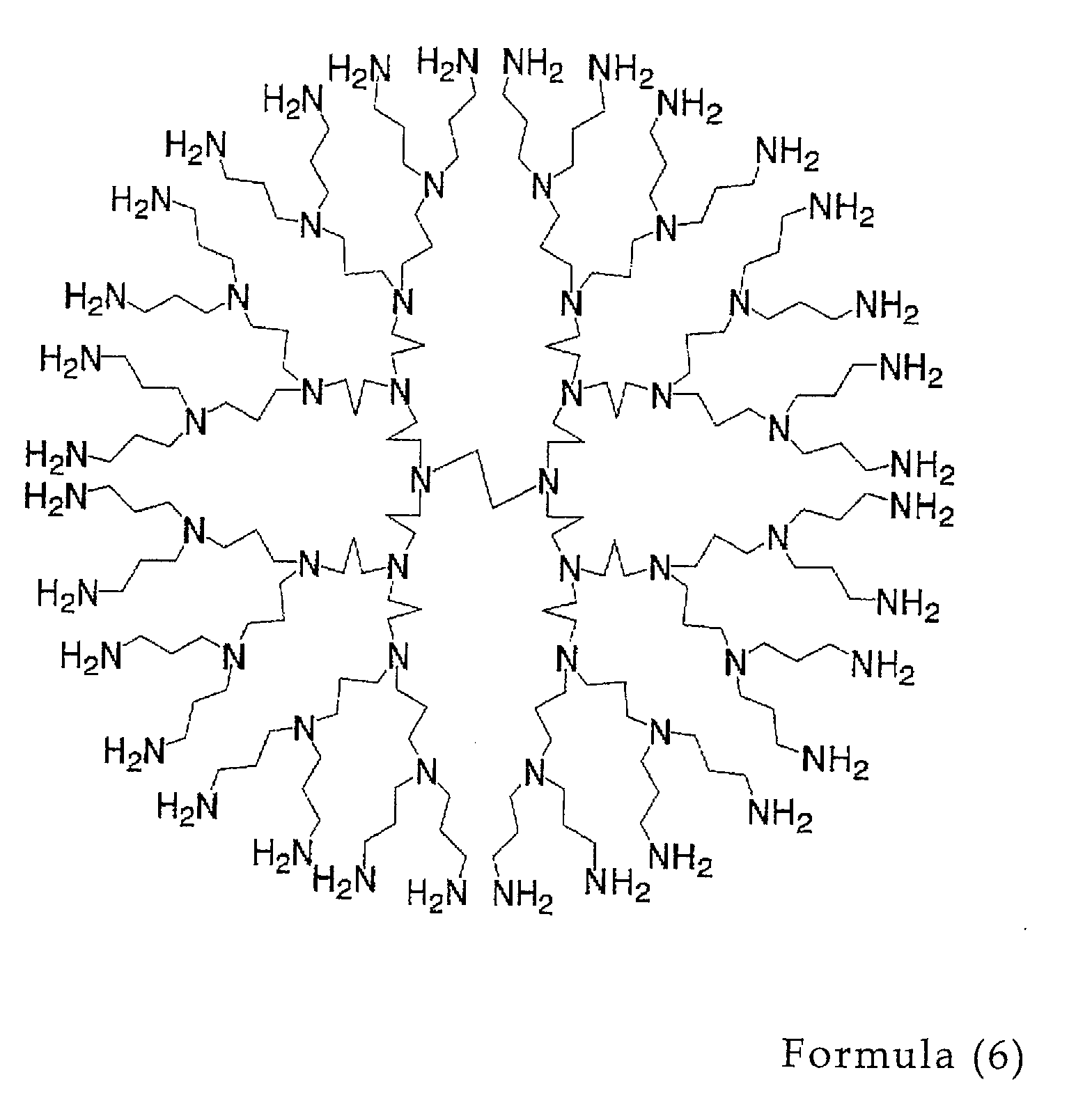


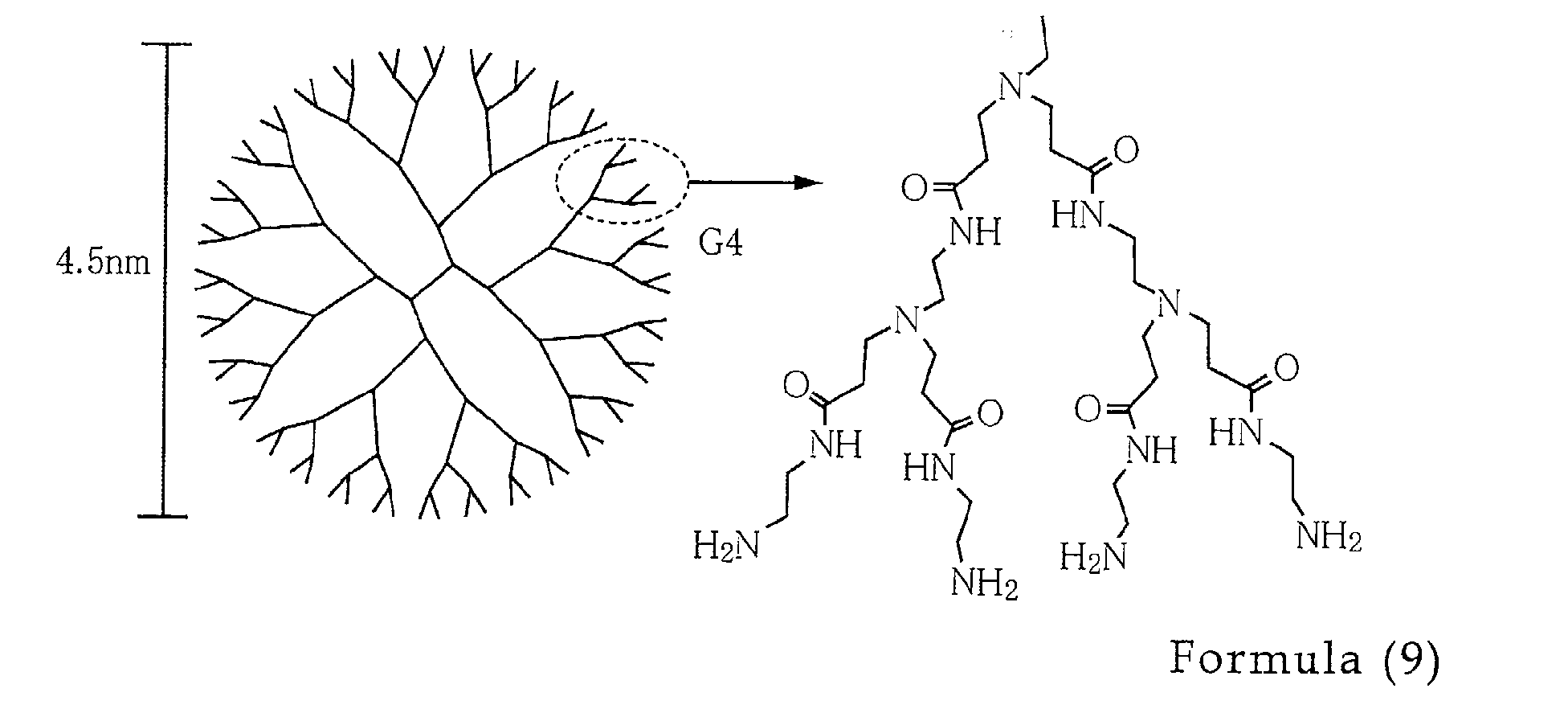

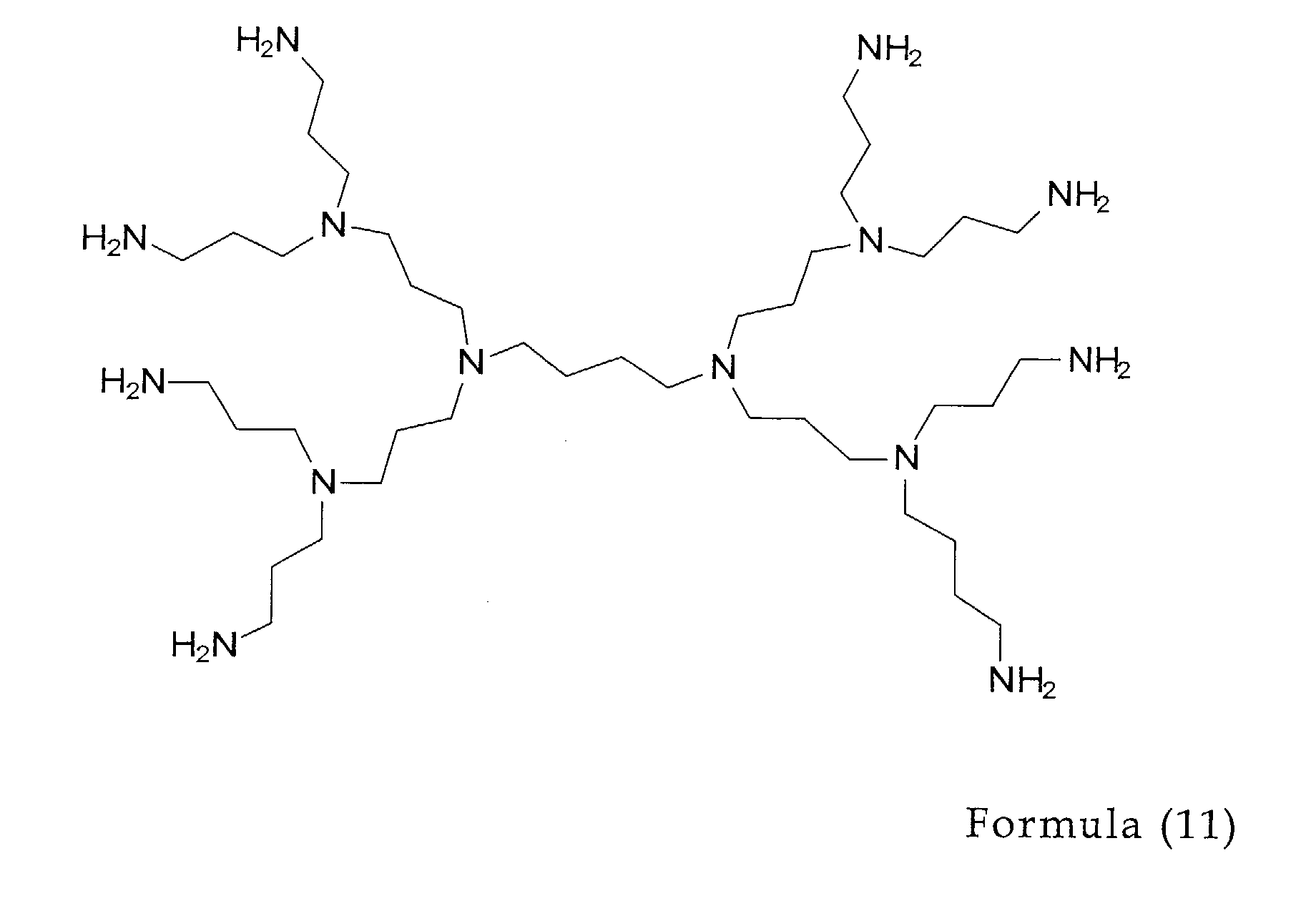

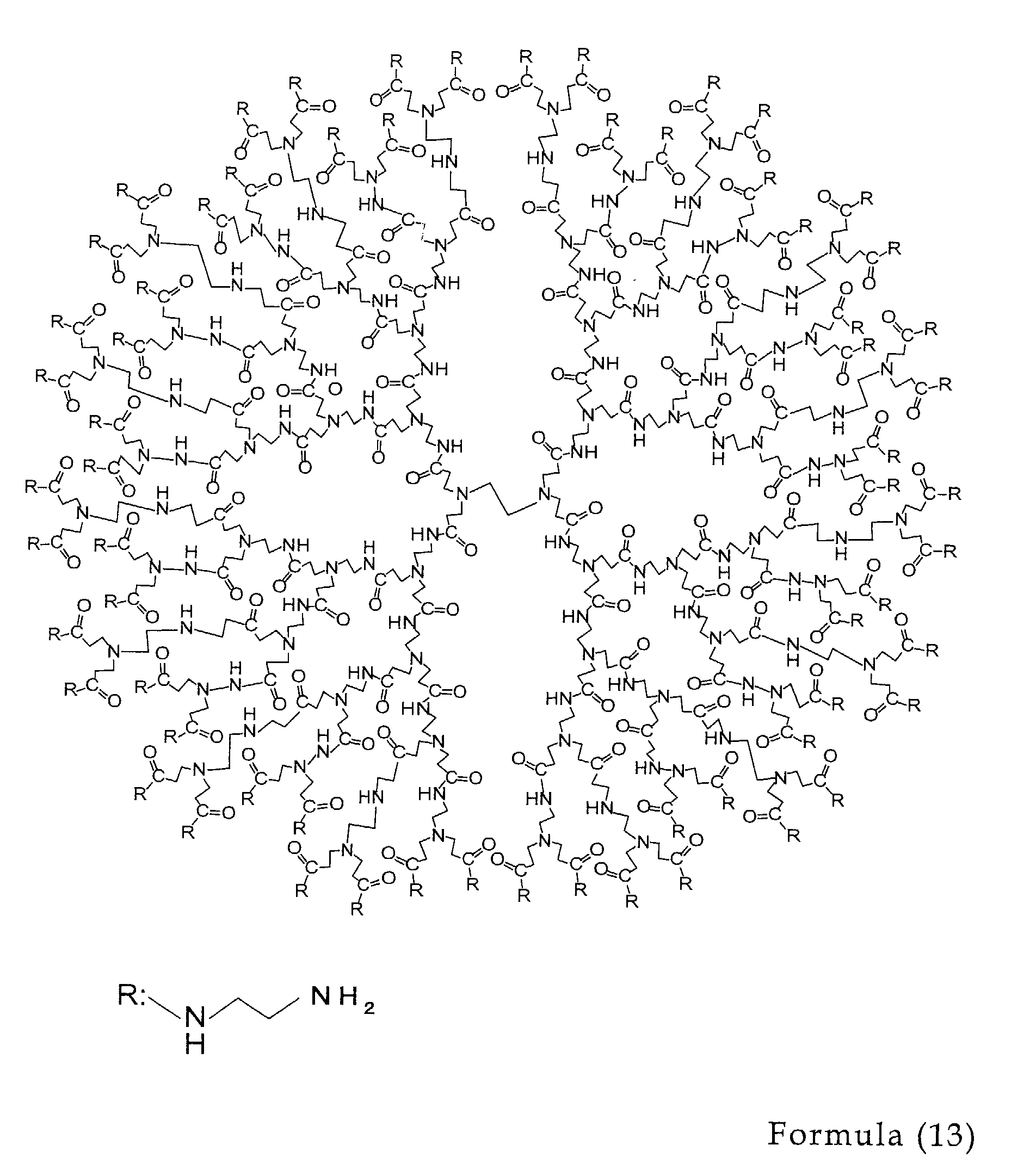
- The dendrimer may be suitably synthesized, or may be a commercial product.
- The hyperbranched polymer having the aforesaid amino group in a terminal thereof is not particularly limited, and may be selected according to the purpose. Examples of the hyperbranched polymer are the following hyperbranched polymers (1) and (2) shown below.


- The hyperbranched polymer may be suitably synthesized, or may be a commercial product.
- The dendron having the aforesaid amino group in a terminal thereof is not particularly limited, and may be selected according to the purposes. Examples of the dendron are the following dendrons (1) and (2) shown below.
- The dendron may be synthesized, or may be a commercial product.
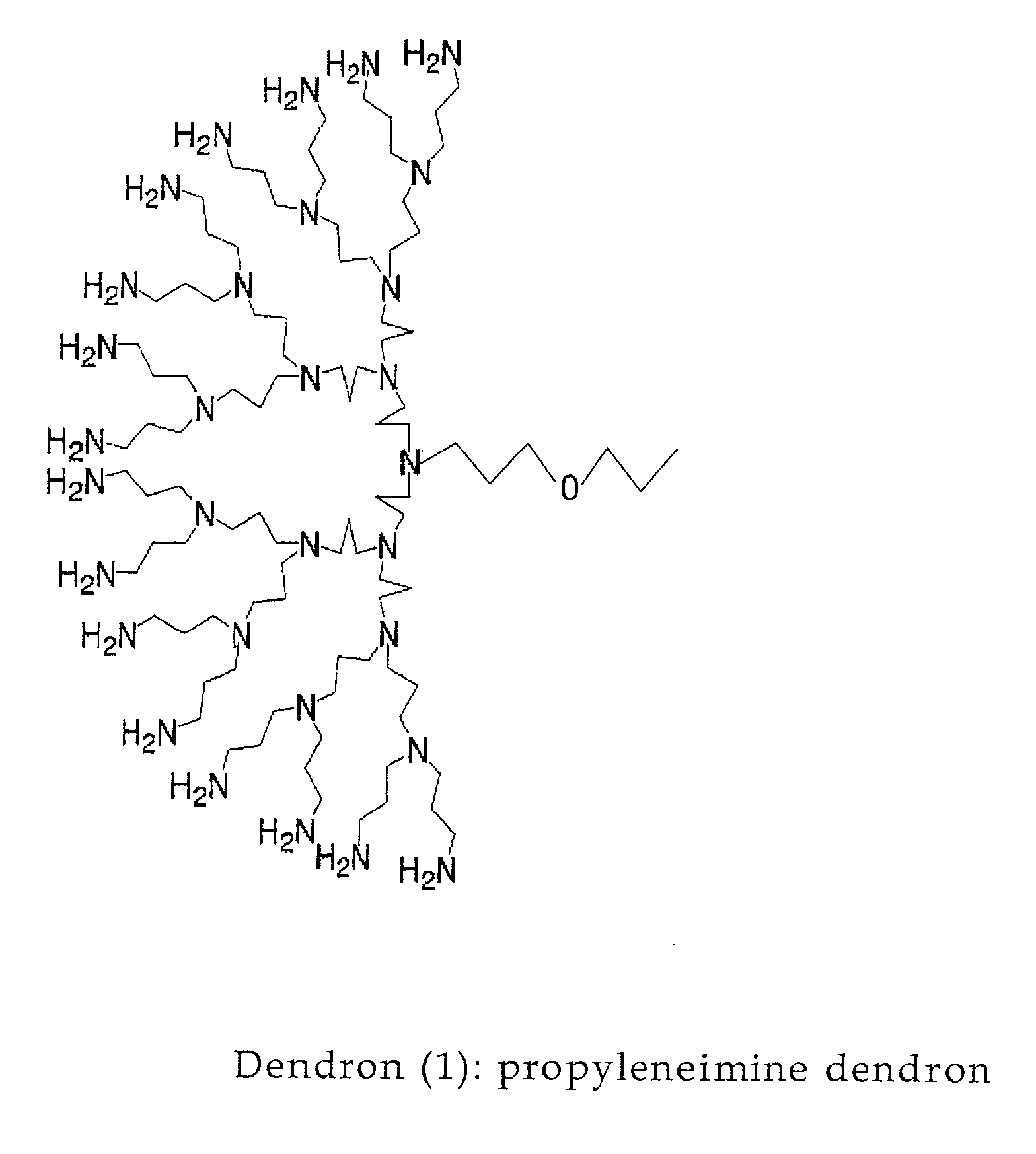
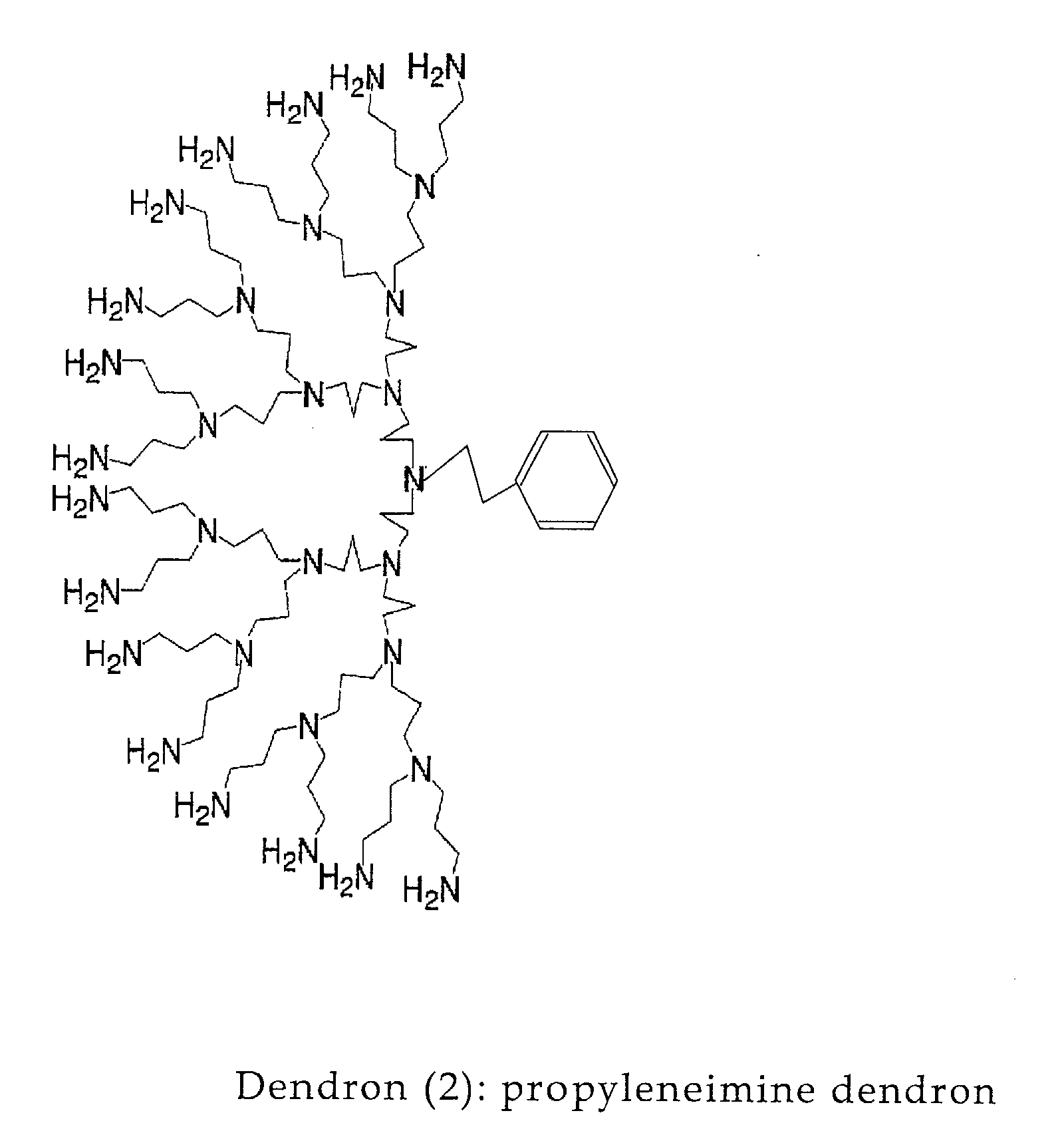
- Of these, polyamide amine type dendrimers (Formulae (9), (10), and (12)) and polypropyleneimine dendrimers (Formulae (5), (6), (11), and (13)) are preferred from the viewpoint of improving heat resistance of the capsule wall.
- Of these dendrimers, the process for manufacturing the dendrimer containing a trimethyleneimine skeleton is not particularly limited, and may be selected according to the purpose. However, the following processes may be mentioned.
- For example, as disclosed in International Patent (WO-A) No. 9314147 and International Patent (WO-A) No. 9502008, in the synthesis, a compound containing ammonia and two or more primary amine groups is taken as starting material. The compound is reacted with acrylonitrile in a cyanoethylation reaction, the nitrile groups are reduced to primary groups using hydrogen or ammonia (G1) in the presence of a catalyst. Thereafter, the cyanoethylation and reduction to primary amine groups are repeated three times (G2→G3→G4). Here, G1 to G4 each express the first to fourth generations.
- In the process for manufacturing, as starting material, in addition to ammonia, a compound containing at least one functional group selected from primary amine, alcohol, phenol, thiol, thiophenol and secondary amine may be used.
- Of these dendrimers, the process for manufacturing the dendrimer containing an amidoamine skeleton is not particularly limited, and may be selected according to the purpose. Examples of the process are shown below.
- For example, in the synthesis, a compound containing a primary amine group is used as starting material, two equivalents of methylacrylate are reacted with this primary amine group (Michael addition reaction) to give a bifunctional methyl ester compound having a nitrogen branch part, then one of the primary amine groups of a diamine compound is reacted with the methylester (ester/transamidation), and the other primary amine group is left (G1). Thereafter, by reacting with two equivalents of methylacrylate, the reaction of one of the primary amine groups of the diamine compound with the methylester leaving the other primary amine group, is repeated three times (G2→G3→G4) (refer to, for example., JP-B No. 07-2840, JP-B No. 07-57735, JP-B No. 07-57736, JP-A No. 07-267879 and JP-A No. 11-140180).
- In the aforesaid process for manufacturing, as starting material, in addition to ammonia, a compound containing at least one functional group selected from primary amine, alcohol, phenol, thiol, thiophenol and secondary amine may be used.
- The process for manufacturing the aforesaid hyperbranched polymer may for example be synthesis by a ring-opening polymerization of a cyclic compound using a primary amine as a nucleophilic component and using a palladium catalyst, as described in M. Suzuki et al: Macromolecules. (1992). Vol. 25, p. 7071 and Macromolecules. (1998). Vol. 31, p. 1716.
- In addition to the dendritic branching molecule having the aforesaid amino group in a terminal thereof, other compounds having two or more active hydrogen atoms in the molecule may be used in combination.
- Examples of these compounds are water; polyhydric alcohols such as ethylene glycol glycerol, or the like; multivalent amine compounds such as ethylenediamine, diethylenetriamine, or the like.
- The amount of the compound having two or more active hydrogen atoms in a molecule thereof to be blended in the capsule wall is preferably 0.01% by mass to 30 % by mass, and more preferably 0.5% by mass to 20 % by mass, in solid concentration.
- The electron donor dye precursor is not particularly limited, and may be selected according to the purpose. Examples of the electron donor dye precursor are a triarylmethane compound, a diphenylmethane compound, a thiazine compound, a xanthene compound a spiropyrane compound, and the like. Of these, the triarylmethane compound and the xanthene compound have high coloring densities and are therefore preferred.
- The above electron donor dye precursor is not particularly limited, and may be selected according to the purpose. Examples of the electron donor dye precursor are 3,3-bis(p-dimethylaminophenyl)-6-dimethylamino phthalide (i.e., crystal violet lactone), 3,3-bis (p-dimethylamino) phthalide, 3-(p-dimethylaminophenyl)-3-(1,3-dimethylindole-3-yl) phthalide, 3-(p-dimethylaminophenyl)-3-(2-methylindole-3-yl) phthalide, 3-(o-methyl-p-dimethylaminophenyl)-3-(2-methylindole-3-yl) phthalide, 4,4'-bis (dimethylamino) benzhydrin benzyl ether, N-halophenyl leucoauramine, N-2,4,5-trichlorophenylleucoauramine, rhodamine-B-anilino lactam, rhodamine (p-nitroanilino) lactam, rhodamine-B-(p-chloroanilino)lactam, 2-benzylamino-6-diethylaminofluorane, 2-anilino-6-diethylaminofluorane, 2-anilino-3-methyl-6-diethylaminofluorane, 2-anilino-3-methyl-6-cyclohexylmethyl aminofluorane, 2-anilino-3-methyl-6-isoamyl ethylaminofluorane, 2-(o-chloroanilino)-6-diethylaminofluorane, 2-octyl amino-6-diethylaminofluorane, 2-ethoxyethyl amino-3-chloro-2-diethylaminofluorane, 2-anilino-3-chloro-6-diethylaminofluorane, benzoyl leucomethylene blue, p-nitrobenzyl leucomethylene blue, 3-methyl-spiro-dinaphtho pyrane, 3-ethyl-spiro-dinaphthopyrane, 3,3'-dichloro-spiro-dinaphthopyrane, 3-benzylpyrodinaphthopyrane, 3-propyl-spiro-dibenzopyrane, and the like.
- These may be used alone, or in combination of two or more.
- The aforesaid diazonium salt is not particularly limited, and may be selected according to the purpose. The diazonium salt is preferably a compound expressed by the general formula of: ArN2X- (where, in the general formula, "Ar" expresses aryl group and X expresses an acid anion)
- The above diazonium salt loses its activity by reacting with a phenolic compound or a compound having active methylene to form a so-called dye, by then being decomposed by light (generally, ultra-violet light) exposure, and by denitrating.
- The diazonium salt is not particularly limited, and may be selected according to the purpose. Examples of the diazonium salt are 2,5-dibutoxy-4-morpholino benzenediazonium, 2,5-octoxy-4-morpholino benzenediazonium, 2,5-dibutoxy-4-(N-(2-ethyl hexanoyl) piperazino)benzenediazonium, 2,5-diethoxy-4-(N-(2-(2,4-di-tert-amylphenoxy)butyryl)pip erazino) benzenediazonium, 2,5-dibutoxy-4-tolylthiobenzenediazonium, 2,5-dibutoxy-4-chlorobenzenethiodiazonium, 3-(2-octyloxyethoxy)-4-morpholino benzenediazonium, 4-N,N-dihexylamino-2-hexyloxy benzenediazonium, 4-N-hexyl-N-tolylamino-2-hexyloxy benzenediazonium salts, and the like.
- These may be used alone, or in combination of two or more.
- Examples of the acid anion of the above diazonium salts are acid anions such as hexafluorophosphate, tetrafluoroborate, 1,5-naphthalenesulfonate, perfluoroalkylcarbonate, perfluoroalkylsulfonate, zinc chloride, tin chloride, and the like. Of these, the acid anions such as hexafluorophosphate, tetrafluoroborate and 1,5-naphthalenesulfonate are suitable from the viewpoint of having low solubility in water and solubility in organic solvents.
- The coupler which forms a pigment by reaction with the diazonium salt is used as fine particles obtained by at least one of emulsion dispersion and solid dispersion.
- The coupler is not particularly limited, and may be selected according to the purpose. Examples of the coupler are resorcin, phloroglucin, 2,3-dihydroxynaphthalene-6-sodium sulphonate, 1-hydroxy-2-naphthoic acid morpholino propyl amide, 1,5-dihydroxynaphthalene, 2,3-dihydroxynaphthalene, 2,3-dihydroxy-6-sulphenylnaphthalene, 2-hydroxy-3-naphthoic acid anilide, 2-hydroxy-3-naphthoic acid ethanol amide, 2-hydroxy-3-naphthoic acid octyl amide, 2-hydroxy-3-naphthoic acid-N-dodecyloxypurpuramide, 2-hydroxy-3-naphthoic acid tetradecylamide, acetanilide, acetoacetanilide, benzoyl acetanilide, 2-chloro-5-octyl acetoacetanilide, 1-phenyl-3-methyl-5-pyrazolone, 1 -(2'-octylphenyl)-3-methyl-5-pyrazolone, 1 -(2',4',6'-trichlorophenyl)-3-benzamide-5-pyrazolone, 1-(2',4',6'-trichlorophenyl)-3-anilino-5-pyrazolone, 1-phenyl-3-phenylacetamide-5-pyrazolone, 1-(2-dodecyloxyphenyl)-2-methyl carbonate cyclohexane-3,5-dione, 1-(2-dodecyloxyphenyl) cyclohexane-3,5-dione, N-phenyl-N-dodecyl barbituric acid, N-phenyl-N-(3-stearyloxy)butyl barbituric acid, and the like.
- These may be used alone, or in combination of two or more.
- In addition, basic compounds are generally added in the form of fine particles obtained by at least one of emulsion dispersion and solid dispersion, so as to promote the pigment-forming reaction.
- The above basic compounds may be inorganic or organic. Alternatively, the basic compounds may liberates alkaline substances by decomposition on heating. Examples of the basic compound are a nitrogen-containing compound such as organic ammonium salt, organic amine, amide, urea, thiourea and derivatives thereof, thiazole, pyrrole, pyrimidine, piperazine, guanidine, indole, imidazole, imidazoline, triazole, morpholine, piperidine, amidine, formazine, pyridine, and the like.
- Specific examples of the basic compound are tricyclohexylamine, tribenzylamine, octadecyl benzylamine, stearylamine, allylcarbamide, thiourea, methylthiourea, allyl thiourea, ethylenethiourea, 2-benzylimidazole, 4-phenylimidazole, 2-phenyl-4-methylimidazole, 2-undecyl imidazoline, 2,4,5-trifuryl-2-imidazoline, 1,2-diphenyl-4,4-dimethyl-2-imidazoline, 2-phenyl-2-imidazoline, 1,2,3-triphenyl guanidine, 1,2-dicyclohexyl guanidine, 1,2,3-tricyclohexyl guanidine, guanidine trichloroacetic acid salts, N,N'-dibenzylpiperazine, 4,4'-dithio morpholine, morpholinium trichloroacetic acid salts, 2-aminobenzothiazole, 2-benzoyl hydrazinobenzothiazole, and the like.
- These may be used alone, or in combination of two or more.
- The average particle diameter of the microcapsule of the present invention may be selected according to the purpose. The average particle diameter is preferably 0.05 µm to 50 µm, and more preferably 0.1 µm to 20 µm.
- The process for manufacturing a microcapsule of the present invention comprises the step of polymerizing an isocyanate compound, a dendritic branching molecule having a hydroxyl group in a terminal thereof, and a compound having two or more active hydrogen atoms in a molecule thereof, so as to form a capsule wall of the microcapsule. The process of manufacturing the microcapsule may also comprise other steps if necessary.
- The compound having two or more active hydrogen atoms in a molecule thereof is preferably a dendritic branching molecule having an amino group in a terminal thereof.
- The hydrophobic solvent which forms the core of the microcapsule is preferably an organic solvent having a boiling point of 100°C to 300°C. Examples of the organic solvents are alkyl naphthalene, alkyl diphenylethane, alkyl diphenylmethane, diphenylethane alkyl adduct, alkylbiphenyl, chlorinated paraffin, phosphoric acid derivatives such as tricresyl phosphate or the like; maleic acid esters such as maleic acid-di-2-ethylhexyl, or the like; adipic acid esters, and the like.
- These may be used alone, or in combination of two or more.
- When the above diazonium salt or electron donor dye precursor is not sufficiently soluble in these hydrophobic solvents, a solvent having a low boiling point may be used in combination. The solvent having a low boiling point is preferably an organic solvent having a boiling point of 40°C to 100°C. Example of the solvent having a low boiling point are ethyl acetate, butyl acetate, methylene chloride, tetrahydrofuran, acetone, and the like. These may be used in combination of two or more.
- If the solvent having a low boiling point (of about 100°C or less) was only used for a core of the microcapsule, the solvent vaporizes, and easily leads to the formation of a "coreless capsule," which has only the capsule wall, the diazonium salt and the electron donor dye precursor.
- Depending on the type, the diazonium salt may move into the aqueous phase in the microencapsulation reaction. To suppress this, an acid anion may be added to the water-soluble polymer solution beforehand as required.
- Examples of the acid anion are PF6 , B(-Ph)4 (where, Ph expresses phenyl], ZnCl2,- CnH2n+1COO-(where, "n" expresses an integer of 1 to 9), CpF2p+1SO3 - (where, "p" expresses an integer of 1 to 9).
- In the microencapsulation, a surfactant may be added to the oil phase or aqueous phase. Having a low solubility in the organic solvent, it is more easily added to the aqueous phase.
- The amount of the surfactant to be added is preferably 0.1 % by mass to 5 % by mass, and more preferably 0.5 % by mass to 2 % by mass, relative to the mass of the oil phase. As the surfactant used for emulsion dispersion, surfactants having a relatively long chain hydrophobic group are generally excellent. Examples of the surfactant are alkali metal salts of an alkyl sulfonic acid, alkylbenzene sulfonic acid, or the like.
- The surfactant (emulsifying additive) may be a compound such as a formalin condensate of an aromatic sulfonate, a formalin condensate of an aromatic carboxylic acid salt, or the like.
- The mixture (oil phase) of the aqueous solution comprising a diazonium salt (or electron donor dye precursor), the solvent having a high boiling point, with the polyfunctional isocyanate compound (adduct) of the present invention, is added to the aqueous solution (aqueous phase) comprising the surfactant and a water-soluble polymer. The addition is performed while the aqueous solution is stirred in a high shear stirrer such as a homogenizer or the like, so as to manufacture an emulsion dispersion. After emulsifying, a catalyst is added to catalyze polymerization of the isocyanate compound or the temperature of the emulsion is raised to perform a capsule wall-forming reaction.
- A coupling reaction quencher may be added to the microcapsule solution containing the diazonium salt if necessary. Examples of the reaction quencher are hydroquinone, sodium bisulphite, potassium nitrite, hypophosphorous acid, stannous chloride and formalin. These compounds can be found in JP-A No. 60-214992.
- During the encapsulation procedure, the diazonium salt is often eluted into the aqueous phase. It may be removed by processes such as filtration, ion-exchange treatment, electrophoresis, chromatography, gel filtration, reverse osmosis, ultrafiltration, dialysis or active carbon treatment. Of these, ion-exchange treatment, reverse osmosis, ultrafiltration and dialysis are preferred. Cation exchanger treatment or a combination of cation exchanger and anion exchanger treatment are more preferred. These processes can be found in JP-A No. 61-219688.
- The microcapsule of the present invention can be used for various purposes. In particular, the microcapsule of the present invention can be suitably used for a thermosensitive recording material, for example being contained in a thermosensitive recording layer.
- The thermosensitive recording material has a wide variety of applications such as in black and white or color photography and printing material, lithographic plates, X-ray material, medical material (for example, ultrasound diagnosis apparatus CRT photographic material), computer graphics hard copy material, copier material, or the like.
- The present invention will now be described referring to the following Examples and Comparative Example. It should be understood that the present invention is not limited to these examples.
- A solution, in which 471mg of stannous octoate (Stanoct: available from Yoshitomi Pharmaceutical Industries, Ltd.) were dissolved in 10g of ethyl acetate, was dripped into an ethyl acetate suspension (470.7g) comprised of 301.1g (1.60 mol) of m-xylylene diisocyanate (m-XDI) and 0.5mM of a dendrimer [Starburst (product name) (polyamide amine dendrimer (PAMAM): available from Aldrich, fourth generation, having 64 OH groups on its surface)] for 1 hour while stirring. After dripping completely, stirring was continued for 2 hours. Thereafter, the solution was stirred at 50°C for 3 hours. In this way, a solution (50 % by mass) of an isocyanate adduct (1) was manufactured.
- 2.8 parts by mass of the compound expressed by the following Formula (A) having a maximum decomposition absorption wavelength at 365nm, as the diazonium salt, 2.8 parts by mass of dibutyl sulfate and 0.56 parts by mass of 2,2-dimethoxy-1,2-diphenylethane-1-one (IRGACURE 651: available from Ciba-Geigy Co., Ltd.) were dissolved in 10.0 parts by mass of ethyl acetate. 5.9 parts by mass of isopropyl biphenyl as a solvent having a high boiling point, and 2.5 parts by mass of tricresyl phosphate were added to the solution, and mixed uniformly with heating.
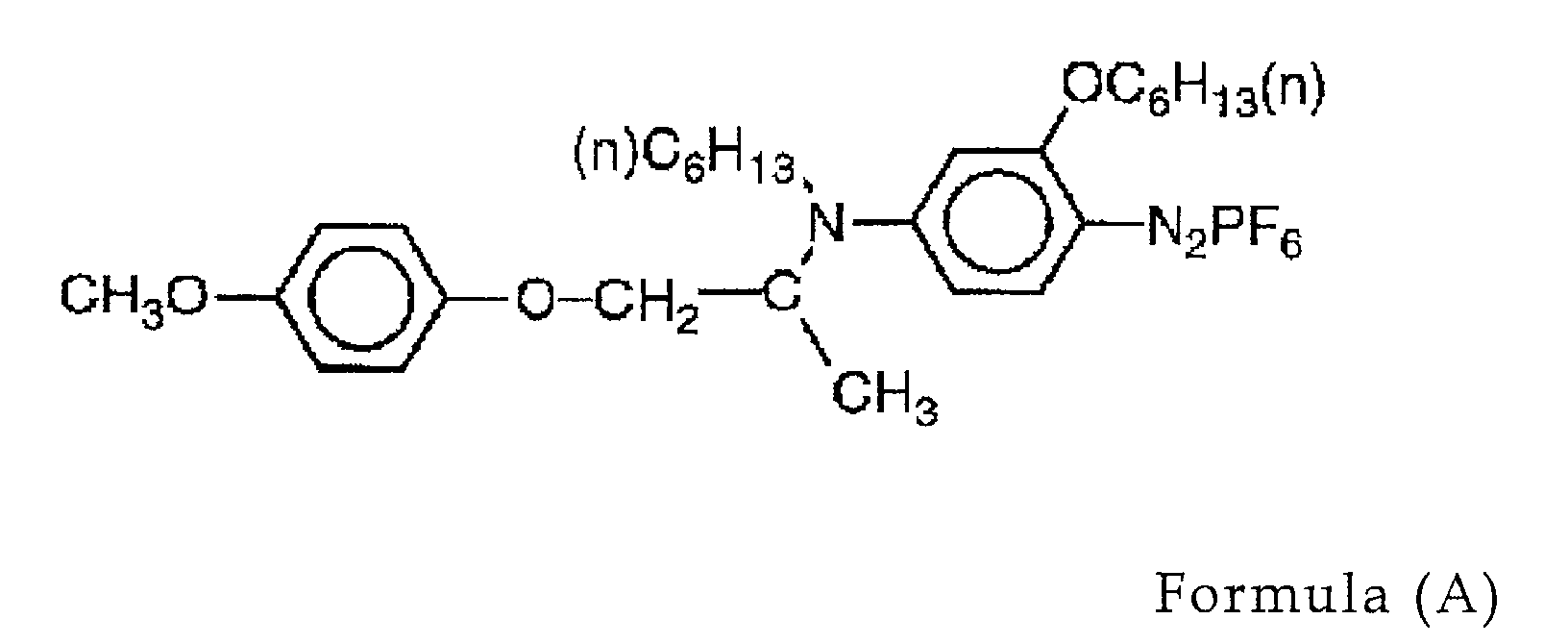
- 5.7 parts by mass of the aforesaid isocyanate adduct (1) and 3.8 parts by mass of a 75 % by mass-ethyl acetate solution of xylylene diisocyanate/ trimethylolpropane adduct (Takenate D110N: available from Takeda Chemical Industries, Ltd.) as the capsule wall-forming material were then added to the above solution, and stirred uniformly. Apart from that, 64 parts by mass of an aqueous solution of 6 % by mass-gelatine (MGP-9066: available from Nippi, Incorporated) to which 2.0 parts by mass of 10% by mass-sodium dodecyl sulfonate aqueous solution had been added, was prepared. The above diazonium salt solution was added and was subjected to emulsion dispersion in a homogenizer.
- In this way, a diazonium salt capsule emulsion was manufactured.
- 20 parts by mass of water was added to the diazonium salt capsule emulsion thus obtained, and reacted at 40°C for 30 minutes while stirring. The temperature was raised to 60°C, and an encapsulation reaction was performed for 3 hours. The temperature of the solution was lowered to 35°C. 6.5 parts by mass of the ion exchange resin, AMBERLITE IRA68 (available from ORGANO CORPORATION), and 13 parts by mass of the ion exchange resin, AMBERLITE IRC50 (available from ORGANO CORPORATION) were added, and the mixture stirred for 1 hour. The ion exchange resins were then filtered, and a solution of capsules having an average particle diameter of 0.64 µm was thereby manufactured.
- A solution of microcapsules having an average particle diameter of 0.69µm was manufactured in the same way as in Example 1, except that 0.5mM of a dendrimer [Starburst (product name) (polyamide amine dendrimer (PAMAM): available from Aldrich, fourth generation, having 64 OH groups on its surface)] was replaced with 644.0g (4.8M) of trimethylol propane.
- Using the thus obtained microcapsules of Example 1 and Comparative Example 1, coating solutions for printing evaluation were prepared, and the printing evaluation was carried out as follows.
- 2 parts by mass of the uracil compound expressed by the following Formula, 2 parts by mass of 1,2,3-triphenyl guanidine, 0.3 parts by mass of cresil phosphate, 0.1 part by mass of diethyl maleate, and 10 parts by mass of ethyl acetate, were mixed, and a solution was thereby prepared. The solution thus prepared was added to an aqueous solution in which 50g of 6% by mass-gelatin solution and 2g of 2% by mass-sodium dodecyl sulfonate were dissolved, and was subjected to emulsification for 10 minutes using a homogenizer. The coupler emulsion dispersion was thereby prepared.

- The diazonium salt capsule emulsion and the coupler emulsion dispersion were mixed so as to have a mass ratio of 2:3. The coating solution for a thermosensitive recording layer was thereby prepared. A thermosensitive recording layer, which was formed by applying and drying the thus prepared coating solution for a thermosensitive recording layer, worked as a magenta thermosensitive recording layer.
- 100g of 6% by mass-itaconic acid-modified polyvinyl alcohol solution (KL-318 (product name): available from Kurarey Co., Ltd.) and 10g of 30% by mass-epoxy-modified polyamide dispersion (FL-71 (product name): available from Toho Kagaku Kabushiki Kaisha), were mixed. 15 g of 40% by mass-zinc stearate dispersion (Hydrin Z (product name): available from Chukyo Oils and Fats) was added to the mixed solution. The coating solution for a protective layer was thus prepared.
- An undercoat was provided on to a surface of the coating raw paper, which served as a support, on which the thermosensitive recording layer was to be disposed. Here, the coating raw paper had polyethylene resin layers on both surfaces thereof. The coating solution for a thermosensitive recording layer and the coating solution for a protective layer were applied using a sliding hopper type bead coat applicator and dried so as to prepare the thermosensitive recording material. The coating solution for a thermosensitive recording layer was applied, so as to have solids of 7.8g/m2 after dried. The coating solution for a protective layer was applied, so as to have solids of 2.0g/m2 after dried.
- A magenta image was formed on the thus obtained thermosensitive recording material, so as to have a concentration of the magenta image of 0.5 when measured by a Macbeth densitometer, using the thermal head (KST-type: available from Kyocera Corporation), and controlling heat energy for printing, power for printing, and pulse width of the thermal head.
- Thereafter, the thermosensitive recording layer was subjected to flash-fixing, providing the thermosensitive recording material under an ultraviolet radiation lamp having a luminescence center wavelength of 365nm and output of 40W. A monochromic image of magenta was thereby obtained.
- The energy for printing was changed, and color concentration of magenta was measured. The results are shown in FIG. 1. As understood from FIG. 1, the microcapsule of Example 1, which contains a dendrimer, had higher color concentration with lower energy for printing, than the microcapsule of Comparative Example 1. The microcapsule of Example 1 also had a narrower range of a coloring energy, compared with that of Comparative Example 1. Therefore, it was found out that the heat response was improved for the microcapsule of Example 1.
- The same procedure as that of Example 1 was carried out, except that the (3) Microencapsulation reaction was changed to the followings, to prepare a microcapsule solution having an average particle diameter of 0.70µm.
- 10 parts by mass of water was added to the diazonium salt capsule emulsion thus obtained to uniformize, and 10.0 g of 2.0% by mass aqueous solution which contains a dendrimer having an amino group in a terminal thereof expressed by the following Formula (5), was added to the diazonium salt capsule emulsion. The diazonium salt capsule emulsion was reacted at 40°C for 30 minutes while stirring. The temperature was raised to 60°C, and an encapsulation reaction was performed for 3 hours. The temperature of the solution was lowered to 35°C. 6.5 parts by mass of the ion exchange resin, AMBERLITE IRA68 (available from ORGANO CORPORATION), and 13 parts by mass of the ion exchange resin, AMBERLITE IRC50 (available from ORGANO CORPORATION) were added, and the mixture was stirred for 1 hour. The ion exchange resins were then filtered, and a solution of capsules having an average particle diameter of 0.85 µm was thereby manufactured.
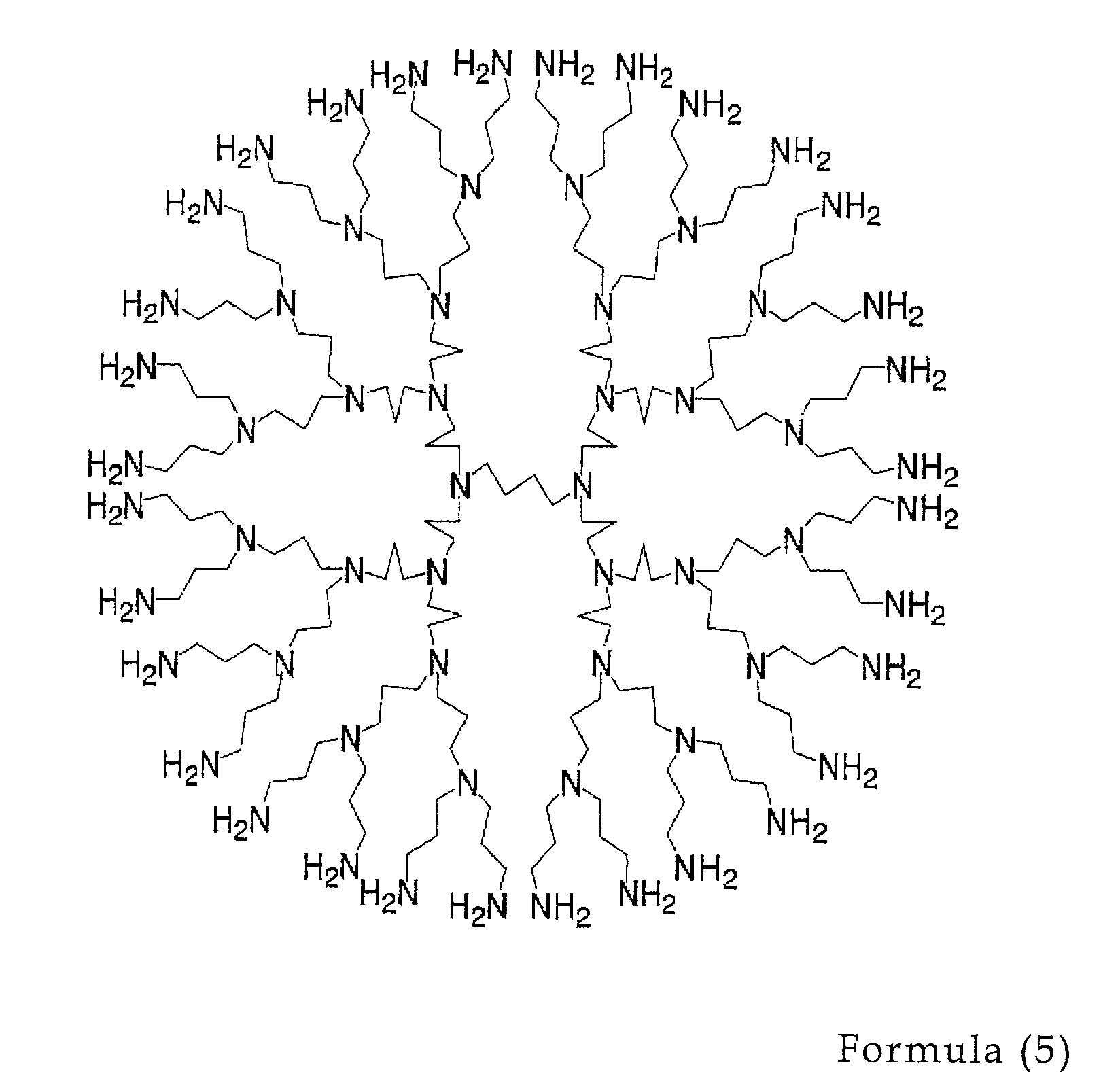
- Coating solutions for a thermosensitive recording layer and a protective layer were prepared in the same way as in Example 1, and printing was evaluated. The results are shown in FIG. 2.
- As understood from FIG. 2, the microcapsule of Example 2, although slightly more deteriorated than the microcapsule of Example 1, had a higher color concentration with lower energy for printing, than the microcapsule of Comparative Example 1. The microcapsule of Example 2 also had a narrower range of a coloring energy, compared with that of Comparative Example 1. Therefore, it was found out that the heat response was improved for the microcapsule of Example 2.
- The same procedure as that of Example 2 was carried out to prepare a capsule solution having an average particle diameter of 0.63 µm, except that 0.5mM of a dendrimer [Starburst (product name) (polyamide amine dendrimer (PAMAM): available from Aldrich, fourth generation, having 64 OH groups on its surface)] was replaced with 644.0g (4.8M) of trimethylol propane.
- Coating solutions for a thermosensitive recording layer and a protective layer were prepared in the same way as in Example 1, and printing was evaluated. The results are shown in FIG. 3.
- As understood from FIG. 3, the microcapsule of Example 3, had a higher color concentration with lower energy for printing, than the microcapsule of Comparative Example 1. The microcapsule of Example 3 also had a narrower range of a coloring energy, compared with that of Comparative Example 1. Therefore, it was found out that the heat response was improved for the microcapsule of Example 3.
- The present invention can provide a microcapsule that exhibits excellent heat response. The microcapsule of the present invention is also capable of controlling crosslinking density of a capsule wall of the microcapsule. The microcapsule of the present invention is particularly suitable for a thermosensitive recording material.
Claims (12)
- A microcapsule comprising:wherein the polymer is obtainable by polymerizing a dendritic branching molecule having a hydroxyl group in a terminal thereof, an isocyanate compound, and a compound having two or more active hydrogen atoms in a molecule thereof.a polymer as a capsule wall of the microcapsule,
- A microcapsule according to Claim 1, wherein the compound having two or more active hydrogen atoms in a molecule thereof is a dendritic branching molecule having an amino group in a terminal thereof.
- A microcapsule comprising:wherein the polymer is obtainable by reacting a polyol compound, an isocyanate compound, and a dendritic branching molecule having an amino group in a terminal thereof.a polymer as a capsule wall of the microcapsule,
- A microcapsule according to any one of Claims 1 to 3, wherein the dendritic branching molecule is selected from a dendritic branching polymer and a dendron.
- A microcapsule according to Claim 4, wherein the dendritic branching polymer is a dendrimer.
- A microcapsule according to Claim 4, wherein the dendritic branching polymer is a hyperbranched polymer.
- A microcapsule according to any one of Claims 1 to 6, wherein the microcapsule has an average particle diameter of 0.05µm to 50µm.
- A microcapsule according to any one of Claims 1 to 7, wherein the microcapsule encapsulates at least one of diazonium salts and electron donor dye precursors.
- A microcapsule according to any one of Claims 1 to 8,
wherein the capsule wall comprises one of a polymer of polyurethane and a polymer of polyurea. - A microcapsule according to any one of Claims 1 to 9, wherein the microcapsule is used for a thermosensitive recording material.
- A process for manufacturing a microcapsule comprising the step of polymerizing an isocyanate compound, a dendritic branching molecule having a hydroxyl group in a terminal thereof, and a compound having two or more active hydrogen atoms in a molecule thereof, so as to form a capsule wall of the microcapsule.
- A process for manufacturing a microcapsule according to Claim 11, wherein the compound having two or more active hydrogen atoms in a molecule thereof is a dendritic branching molecule having an amino group in a terminal thereof.
Applications Claiming Priority (2)
| Application Number | Priority Date | Filing Date | Title |
|---|---|---|---|
| JP2002205177 | 2002-07-15 | ||
| JP2002205177 | 2002-07-15 |
Publications (2)
| Publication Number | Publication Date |
|---|---|
| EP1382385A1 true EP1382385A1 (en) | 2004-01-21 |
| EP1382385B1 EP1382385B1 (en) | 2007-03-21 |
Family
ID=29774582
Family Applications (1)
| Application Number | Title | Priority Date | Filing Date |
|---|---|---|---|
| EP03254434A Expired - Lifetime EP1382385B1 (en) | 2002-07-15 | 2003-07-14 | Microcapsule and process for manufacturing the same |
Country Status (3)
| Country | Link |
|---|---|
| US (1) | US6881810B2 (en) |
| EP (1) | EP1382385B1 (en) |
| DE (1) | DE60312603T2 (en) |
Cited By (2)
| Publication number | Priority date | Publication date | Assignee | Title |
|---|---|---|---|---|
| WO2006018295A2 (en) | 2004-08-17 | 2006-02-23 | Universität Dortmund | Nanotransport system having a dendritic architecture |
| CN110294831A (en) * | 2019-07-04 | 2019-10-01 | 南京大学 | It is a kind of for the elastic thermochromism material preparation method and its product of intelligent window and application |
Families Citing this family (19)
| Publication number | Priority date | Publication date | Assignee | Title |
|---|---|---|---|---|
| CN101289299A (en) * | 2008-05-20 | 2008-10-22 | 深圳大学 | Self-healing concrete using polyurea resin polymer microcapsules and manufacturing method thereof |
| US8097657B2 (en) * | 2008-08-19 | 2012-01-17 | Dic Corporation | Organic polymer porous material and method for producing the same |
| ES2645692T3 (en) | 2008-11-11 | 2017-12-07 | The Board Of Regents,The University Of Texas System | Rapamycin microcapsules and their use for cancer treatment |
| US10226405B2 (en) | 2009-09-18 | 2019-03-12 | International Flavors & Fragrances Inc. | Purified polyurea capsules, methods of preparation, and products containing the same |
| US9687424B2 (en) | 2009-09-18 | 2017-06-27 | International Flavors & Fragrances | Polyurea capsules prepared with aliphatic isocyanates and amines |
| US10085925B2 (en) | 2009-09-18 | 2018-10-02 | International Flavors & Fragrances Inc. | Polyurea capsule compositions |
| US11311467B2 (en) | 2009-09-18 | 2022-04-26 | International Flavors & Fragrances Inc. | Polyurea capsules prepared with a polyisocyanate and cross-linking agent |
| US9816059B2 (en) | 2009-09-18 | 2017-11-14 | International Flavors & Fragrances | Stabilized capsule compositions |
| US9283211B1 (en) | 2009-11-11 | 2016-03-15 | Rapamycin Holdings, Llc | Oral rapamycin preparation and use for stomatitis |
| US9222015B2 (en) * | 2009-11-24 | 2015-12-29 | Swift River Properties, Llc | Thermochromic coating and method of manufacturing thereof |
| US8945513B2 (en) * | 2011-03-18 | 2015-02-03 | International Business Machines Corporation | Star polymer nanoshells and methods of preparation thereof |
| WO2014160328A1 (en) | 2013-03-13 | 2014-10-02 | The Board Of Regents Of The University Of Texas System | Mtor inhibitors for prevention of intestinal polyp growth |
| US9700544B2 (en) | 2013-12-31 | 2017-07-11 | Neal K Vail | Oral rapamycin nanoparticle preparations |
| EP3089737B1 (en) | 2013-12-31 | 2021-11-03 | Rapamycin Holdings, LLC | Oral rapamycin nanoparticle preparations and use |
| CA2972613C (en) | 2015-01-06 | 2023-08-01 | Lawter, Inc. | Polyamide resins for coating of sand or ceramic proppants used in hydraulic fracturing |
| US12048755B2 (en) | 2018-12-18 | 2024-07-30 | International Flavors & Fragrances Inc. | Microcapsule compositions prepared from polysaccharides |
| US12303856B2 (en) | 2018-12-18 | 2025-05-20 | International Flavors & Fragrances Inc. | Hydroxyethyl cellulose microcapsules |
| CN112675794B (en) * | 2020-12-20 | 2022-06-17 | 武汉中科先进技术研究院有限公司 | Liquid crystal microcapsule and preparation method thereof |
| CN116603465B (en) * | 2023-06-09 | 2025-12-23 | 兰州理工大学 | Preparation method of high-heat-resistance high-strength self-lubricating polyimide microcapsule |
Citations (2)
| Publication number | Priority date | Publication date | Assignee | Title |
|---|---|---|---|---|
| US4840933A (en) * | 1986-05-26 | 1989-06-20 | Fuji Photo Film Co., Ltd. | Heat sensitive recording material |
| EP1034839A1 (en) * | 1999-03-02 | 2000-09-13 | L'oreal | Nanocapsules based on dendritic polymers |
Family Cites Families (2)
| Publication number | Priority date | Publication date | Assignee | Title |
|---|---|---|---|---|
| JPS62212190A (en) | 1986-03-13 | 1987-09-18 | Kanzaki Paper Mfg Co Ltd | Thermal recording material |
| US5433953A (en) * | 1994-01-10 | 1995-07-18 | Minnesota Mining And Manufacturing | Microcapsules and methods for making same |
-
2003
- 2003-07-11 US US10/616,949 patent/US6881810B2/en not_active Expired - Fee Related
- 2003-07-14 EP EP03254434A patent/EP1382385B1/en not_active Expired - Lifetime
- 2003-07-14 DE DE60312603T patent/DE60312603T2/en not_active Expired - Lifetime
Patent Citations (2)
| Publication number | Priority date | Publication date | Assignee | Title |
|---|---|---|---|---|
| US4840933A (en) * | 1986-05-26 | 1989-06-20 | Fuji Photo Film Co., Ltd. | Heat sensitive recording material |
| EP1034839A1 (en) * | 1999-03-02 | 2000-09-13 | L'oreal | Nanocapsules based on dendritic polymers |
Cited By (3)
| Publication number | Priority date | Publication date | Assignee | Title |
|---|---|---|---|---|
| WO2006018295A2 (en) | 2004-08-17 | 2006-02-23 | Universität Dortmund | Nanotransport system having a dendritic architecture |
| WO2006018295A3 (en) * | 2004-08-17 | 2006-06-01 | Univ Dortmund | Nanotransport system having a dendritic architecture |
| CN110294831A (en) * | 2019-07-04 | 2019-10-01 | 南京大学 | It is a kind of for the elastic thermochromism material preparation method and its product of intelligent window and application |
Also Published As
| Publication number | Publication date |
|---|---|
| US6881810B2 (en) | 2005-04-19 |
| DE60312603D1 (en) | 2007-05-03 |
| EP1382385B1 (en) | 2007-03-21 |
| US20040121155A1 (en) | 2004-06-24 |
| DE60312603T2 (en) | 2007-12-06 |
Similar Documents
| Publication | Publication Date | Title |
|---|---|---|
| EP1382385B1 (en) | Microcapsule and process for manufacturing the same | |
| DE60218084T2 (en) | marking particles | |
| US7270928B2 (en) | Isocyanate composition, microcapsule and production method thereof, and recording material | |
| JP3734897B2 (en) | Thermoresponsive microcapsules, and heat-sensitive recording materials and multicolor heat-sensitive recording materials using the same | |
| DE3630693A1 (en) | PHOTOCHEMICALLY DEGRADABLE MICROCAPSULES | |
| JP3554626B2 (en) | Thermoresponsive microcapsules, and thermosensitive recording materials and multicolor thermosensitive recording materials using the same | |
| US6830861B2 (en) | Photopolymerizable composition and recording material | |
| US20020051926A1 (en) | Cyanine-based organic dyes, photopolymerizable compositions, and recording materials | |
| JP2004098052A (en) | Microcapsule and production method for the same | |
| JP2005305872A (en) | New microcapsule and its manufacturing method, recording material, and thermal recording material | |
| US5492789A (en) | Process for producing microcapsules containing a diazonium salt compound and a photofixation thermal recording material employing the same | |
| US20040091810A1 (en) | Microcapsule, and heat-sensitive recording material and multicolor heat-sensitive recording material using the same | |
| JP3131720B2 (en) | Method for producing microcapsules containing diazonium salt compound and light and heat sensitive recording material using the same | |
| US20010019806A1 (en) | Azomethine dye precursor, image-forming material, and image-forming method | |
| JP2004148245A (en) | Novel microcapsule and thermosensitive recording material using the same | |
| DE10011299B4 (en) | Microcapsule toner | |
| US20050186504A1 (en) | Photopolymerizable composition and recording material using the same | |
| JPH06297856A (en) | Manufacture of diazonium salt compound-containing microcapsule and fixing type heat-sensitive recording material using said microcapsule | |
| JPS62187080A (en) | Thermal recording material | |
| CN113544220A (en) | Microcapsule, microcapsule composition, ink composition, coating material, and resin composition | |
| JP2005230686A (en) | Production method for microcapsule, microcapsule and thermosensitive recording material | |
| JPH11550A (en) | Thermoresponsive microcapsule, and thermosensitive recording material and multicolored thermosensitive recording material using that | |
| JP4159176B2 (en) | Color recording medium and recording method therefor | |
| JPH02153352A (en) | Manufacture of photosensitive composition allowing formation of full-color image | |
| JP3508953B2 (en) | Heat-developable copy material |
Legal Events
| Date | Code | Title | Description |
|---|---|---|---|
| PUAI | Public reference made under article 153(3) epc to a published international application that has entered the european phase |
Free format text: ORIGINAL CODE: 0009012 |
|
| AK | Designated contracting states |
Kind code of ref document: A1 Designated state(s): AT BE BG CH CY CZ DE DK EE ES FI FR GB GR HU IE IT LI LU MC NL PT RO SE SI SK TR |
|
| AX | Request for extension of the european patent |
Extension state: AL LT LV MK |
|
| 17P | Request for examination filed |
Effective date: 20040712 |
|
| AKX | Designation fees paid |
Designated state(s): DE FR GB |
|
| GRAP | Despatch of communication of intention to grant a patent |
Free format text: ORIGINAL CODE: EPIDOSNIGR1 |
|
| GRAS | Grant fee paid |
Free format text: ORIGINAL CODE: EPIDOSNIGR3 |
|
| GRAA | (expected) grant |
Free format text: ORIGINAL CODE: 0009210 |
|
| RAP1 | Party data changed (applicant data changed or rights of an application transferred) |
Owner name: FUJIFILM CORPORATION |
|
| AK | Designated contracting states |
Kind code of ref document: B1 Designated state(s): DE FR GB |
|
| REG | Reference to a national code |
Ref country code: GB Ref legal event code: FG4D |
|
| REF | Corresponds to: |
Ref document number: 60312603 Country of ref document: DE Date of ref document: 20070503 Kind code of ref document: P |
|
| PLBE | No opposition filed within time limit |
Free format text: ORIGINAL CODE: 0009261 |
|
| STAA | Information on the status of an ep patent application or granted ep patent |
Free format text: STATUS: NO OPPOSITION FILED WITHIN TIME LIMIT |
|
| 26N | No opposition filed |
Effective date: 20071227 |
|
| REG | Reference to a national code |
Ref country code: FR Ref legal event code: PLFP Year of fee payment: 13 |
|
| PGFP | Annual fee paid to national office [announced via postgrant information from national office to epo] |
Ref country code: DE Payment date: 20150707 Year of fee payment: 13 Ref country code: GB Payment date: 20150708 Year of fee payment: 13 |
|
| PGFP | Annual fee paid to national office [announced via postgrant information from national office to epo] |
Ref country code: FR Payment date: 20150629 Year of fee payment: 13 |
|
| REG | Reference to a national code |
Ref country code: DE Ref legal event code: R119 Ref document number: 60312603 Country of ref document: DE |
|
| GBPC | Gb: european patent ceased through non-payment of renewal fee |
Effective date: 20160714 |
|
| PG25 | Lapsed in a contracting state [announced via postgrant information from national office to epo] |
Ref country code: FR Free format text: LAPSE BECAUSE OF NON-PAYMENT OF DUE FEES Effective date: 20160801 Ref country code: DE Free format text: LAPSE BECAUSE OF NON-PAYMENT OF DUE FEES Effective date: 20170201 |
|
| REG | Reference to a national code |
Ref country code: FR Ref legal event code: ST Effective date: 20170331 |
|
| PG25 | Lapsed in a contracting state [announced via postgrant information from national office to epo] |
Ref country code: GB Free format text: LAPSE BECAUSE OF NON-PAYMENT OF DUE FEES Effective date: 20160714 |