EP1381734B1 - The use of the paper for die cutting - Google Patents
The use of the paper for die cutting Download PDFInfo
- Publication number
- EP1381734B1 EP1381734B1 EP02721777A EP02721777A EP1381734B1 EP 1381734 B1 EP1381734 B1 EP 1381734B1 EP 02721777 A EP02721777 A EP 02721777A EP 02721777 A EP02721777 A EP 02721777A EP 1381734 B1 EP1381734 B1 EP 1381734B1
- Authority
- EP
- European Patent Office
- Prior art keywords
- paper
- web
- microspheres
- paper web
- cutting
- Prior art date
- Legal status (The legal status is an assumption and is not a legal conclusion. Google has not performed a legal analysis and makes no representation as to the accuracy of the status listed.)
- Expired - Lifetime
Links
- 238000005520 cutting process Methods 0.000 title claims description 50
- 239000000835 fiber Substances 0.000 claims abstract description 29
- 239000000463 material Substances 0.000 claims abstract description 24
- 239000004005 microsphere Substances 0.000 claims description 45
- 238000012360 testing method Methods 0.000 claims description 15
- 239000011121 hardwood Substances 0.000 claims description 9
- 239000011122 softwood Substances 0.000 claims description 9
- OEPOKWHJYJXUGD-UHFFFAOYSA-N 2-(3-phenylmethoxyphenyl)-1,3-thiazole-4-carbaldehyde Chemical compound O=CC1=CSC(C=2C=C(OCC=3C=CC=CC=3)C=CC=2)=N1 OEPOKWHJYJXUGD-UHFFFAOYSA-N 0.000 claims description 5
- NLHHRLWOUZZQLW-UHFFFAOYSA-N Acrylonitrile Chemical compound C=CC#N NLHHRLWOUZZQLW-UHFFFAOYSA-N 0.000 claims description 5
- VVQNEPGJFQJSBK-UHFFFAOYSA-N Methyl methacrylate Chemical compound COC(=O)C(C)=C VVQNEPGJFQJSBK-UHFFFAOYSA-N 0.000 claims description 4
- SLBOQBILGNEPEB-UHFFFAOYSA-N 1-chloroprop-2-enylbenzene Chemical compound C=CC(Cl)C1=CC=CC=C1 SLBOQBILGNEPEB-UHFFFAOYSA-N 0.000 claims description 3
- QEDJMOONZLUIMC-UHFFFAOYSA-N 1-tert-butyl-4-ethenylbenzene Chemical compound CC(C)(C)C1=CC=C(C=C)C=C1 QEDJMOONZLUIMC-UHFFFAOYSA-N 0.000 claims description 3
- ISRGONDNXBCDBM-UHFFFAOYSA-N 2-chlorostyrene Chemical compound ClC1=CC=CC=C1C=C ISRGONDNXBCDBM-UHFFFAOYSA-N 0.000 claims description 3
- VEXZGXHMUGYJMC-UHFFFAOYSA-M Chloride anion Chemical compound [Cl-] VEXZGXHMUGYJMC-UHFFFAOYSA-M 0.000 claims description 3
- CERQOIWHTDAKMF-UHFFFAOYSA-N Methacrylic acid Chemical compound CC(=C)C(O)=O CERQOIWHTDAKMF-UHFFFAOYSA-N 0.000 claims description 3
- XTXRWKRVRITETP-UHFFFAOYSA-N Vinyl acetate Chemical compound CC(=O)OC=C XTXRWKRVRITETP-UHFFFAOYSA-N 0.000 claims description 3
- 241000009298 Trigla lyra Species 0.000 claims 1
- TUZBYYLVVXPEMA-UHFFFAOYSA-N butyl prop-2-enoate;styrene Chemical compound C=CC1=CC=CC=C1.CCCCOC(=O)C=C TUZBYYLVVXPEMA-UHFFFAOYSA-N 0.000 claims 1
- 239000000123 paper Substances 0.000 abstract description 133
- 238000000034 method Methods 0.000 abstract description 11
- 238000003490 calendering Methods 0.000 abstract description 9
- 229920000103 Expandable microsphere Polymers 0.000 abstract description 6
- 238000001035 drying Methods 0.000 abstract description 6
- 239000011087 paperboard Substances 0.000 abstract description 3
- 229920000126 latex Polymers 0.000 description 12
- 239000004816 latex Substances 0.000 description 12
- 239000000654 additive Substances 0.000 description 8
- 238000004061 bleaching Methods 0.000 description 8
- 239000000203 mixture Substances 0.000 description 8
- 230000009467 reduction Effects 0.000 description 8
- 239000000945 filler Substances 0.000 description 6
- 239000002245 particle Substances 0.000 description 6
- 229920001131 Pulp (paper) Polymers 0.000 description 5
- 230000003247 decreasing effect Effects 0.000 description 5
- 238000004519 manufacturing process Methods 0.000 description 5
- 229920001084 poly(chloroprene) Polymers 0.000 description 5
- 230000000694 effects Effects 0.000 description 4
- 230000014759 maintenance of location Effects 0.000 description 4
- 229920002472 Starch Polymers 0.000 description 3
- 239000003795 chemical substances by application Substances 0.000 description 3
- -1 for example Substances 0.000 description 3
- 239000007788 liquid Substances 0.000 description 3
- 238000001000 micrograph Methods 0.000 description 3
- 235000019698 starch Nutrition 0.000 description 3
- VTYYLEPIZMXCLO-UHFFFAOYSA-L Calcium carbonate Chemical compound [Ca+2].[O-]C([O-])=O VTYYLEPIZMXCLO-UHFFFAOYSA-L 0.000 description 2
- 244000025254 Cannabis sativa Species 0.000 description 2
- 235000012766 Cannabis sativa ssp. sativa var. sativa Nutrition 0.000 description 2
- 235000012765 Cannabis sativa ssp. sativa var. spontanea Nutrition 0.000 description 2
- PPBRXRYQALVLMV-UHFFFAOYSA-N Styrene Chemical compound C=CC1=CC=CC=C1 PPBRXRYQALVLMV-UHFFFAOYSA-N 0.000 description 2
- CQEYYJKEWSMYFG-UHFFFAOYSA-N butyl acrylate Chemical compound CCCCOC(=O)C=C CQEYYJKEWSMYFG-UHFFFAOYSA-N 0.000 description 2
- 235000009120 camo Nutrition 0.000 description 2
- 235000005607 chanvre indien Nutrition 0.000 description 2
- 230000003750 conditioning effect Effects 0.000 description 2
- 230000006378 damage Effects 0.000 description 2
- OSVXSBDYLRYLIG-UHFFFAOYSA-N dioxidochlorine(.) Chemical compound O=Cl=O OSVXSBDYLRYLIG-UHFFFAOYSA-N 0.000 description 2
- 238000010981 drying operation Methods 0.000 description 2
- 239000004088 foaming agent Substances 0.000 description 2
- 239000011487 hemp Substances 0.000 description 2
- 230000001788 irregular Effects 0.000 description 2
- NNPPMTNAJDCUHE-UHFFFAOYSA-N isobutane Chemical group CC(C)C NNPPMTNAJDCUHE-UHFFFAOYSA-N 0.000 description 2
- 239000002655 kraft paper Substances 0.000 description 2
- 238000004806 packaging method and process Methods 0.000 description 2
- 229920000642 polymer Polymers 0.000 description 2
- 238000007670 refining Methods 0.000 description 2
- 238000004513 sizing Methods 0.000 description 2
- 239000008107 starch Substances 0.000 description 2
- 238000011282 treatment Methods 0.000 description 2
- 239000011800 void material Substances 0.000 description 2
- RSWGJHLUYNHPMX-UHFFFAOYSA-N Abietic-Saeure Natural products C12CCC(C(C)C)=CC2=CCC2C1(C)CCCC2(C)C(O)=O RSWGJHLUYNHPMX-UHFFFAOYSA-N 0.000 description 1
- 244000198134 Agave sisalana Species 0.000 description 1
- 239000005995 Aluminium silicate Substances 0.000 description 1
- ZAMOUSCENKQFHK-UHFFFAOYSA-N Chlorine atom Chemical compound [Cl] ZAMOUSCENKQFHK-UHFFFAOYSA-N 0.000 description 1
- 239000004155 Chlorine dioxide Substances 0.000 description 1
- 240000000491 Corchorus aestuans Species 0.000 description 1
- 235000011777 Corchorus aestuans Nutrition 0.000 description 1
- 235000010862 Corchorus capsularis Nutrition 0.000 description 1
- 241000196324 Embryophyta Species 0.000 description 1
- 240000000797 Hibiscus cannabinus Species 0.000 description 1
- 240000006240 Linum usitatissimum Species 0.000 description 1
- 235000004431 Linum usitatissimum Nutrition 0.000 description 1
- 241000422980 Marietta Species 0.000 description 1
- 240000000907 Musa textilis Species 0.000 description 1
- 239000004793 Polystyrene Substances 0.000 description 1
- KHPCPRHQVVSZAH-HUOMCSJISA-N Rosin Natural products O(C/C=C/c1ccccc1)[C@H]1[C@H](O)[C@@H](O)[C@@H](O)[C@@H](CO)O1 KHPCPRHQVVSZAH-HUOMCSJISA-N 0.000 description 1
- 239000004783 Serene Substances 0.000 description 1
- 229910000831 Steel Inorganic materials 0.000 description 1
- LSNNMFCWUKXFEE-UHFFFAOYSA-N Sulfurous acid Chemical compound OS(O)=O LSNNMFCWUKXFEE-UHFFFAOYSA-N 0.000 description 1
- 229920002522 Wood fibre Polymers 0.000 description 1
- 208000027418 Wounds and injury Diseases 0.000 description 1
- 238000005299 abrasion Methods 0.000 description 1
- 230000009471 action Effects 0.000 description 1
- 230000000996 additive effect Effects 0.000 description 1
- 235000012211 aluminium silicate Nutrition 0.000 description 1
- 125000000129 anionic group Chemical group 0.000 description 1
- 210000000988 bone and bone Anatomy 0.000 description 1
- 229910000019 calcium carbonate Inorganic materials 0.000 description 1
- 125000002091 cationic group Chemical group 0.000 description 1
- 239000000460 chlorine Substances 0.000 description 1
- 229910052801 chlorine Inorganic materials 0.000 description 1
- 235000019398 chlorine dioxide Nutrition 0.000 description 1
- 239000011248 coating agent Substances 0.000 description 1
- 238000000576 coating method Methods 0.000 description 1
- 238000007596 consolidation process Methods 0.000 description 1
- 230000007423 decrease Effects 0.000 description 1
- 230000029087 digestion Effects 0.000 description 1
- 238000002474 experimental method Methods 0.000 description 1
- 239000012530 fluid Substances 0.000 description 1
- 238000010438 heat treatment Methods 0.000 description 1
- 230000006872 improvement Effects 0.000 description 1
- 208000014674 injury Diseases 0.000 description 1
- 229910052500 inorganic mineral Inorganic materials 0.000 description 1
- 239000001023 inorganic pigment Substances 0.000 description 1
- 239000001282 iso-butane Substances 0.000 description 1
- NLYAJNPCOHFWQQ-UHFFFAOYSA-N kaolin Chemical compound O.O.O=[Al]O[Si](=O)O[Si](=O)O[Al]=O NLYAJNPCOHFWQQ-UHFFFAOYSA-N 0.000 description 1
- 229920005610 lignin Polymers 0.000 description 1
- 229910052751 metal Inorganic materials 0.000 description 1
- 239000002184 metal Substances 0.000 description 1
- 239000011707 mineral Substances 0.000 description 1
- 239000012764 mineral filler Substances 0.000 description 1
- 210000003205 muscle Anatomy 0.000 description 1
- 210000001640 nerve ending Anatomy 0.000 description 1
- 239000012860 organic pigment Substances 0.000 description 1
- 239000000049 pigment Substances 0.000 description 1
- 229920003023 plastic Polymers 0.000 description 1
- 239000004033 plastic Substances 0.000 description 1
- 229920003229 poly(methyl methacrylate) Polymers 0.000 description 1
- 239000002952 polymeric resin Substances 0.000 description 1
- 239000004926 polymethyl methacrylate Substances 0.000 description 1
- 229920002223 polystyrene Polymers 0.000 description 1
- 238000003825 pressing Methods 0.000 description 1
- 230000008569 process Effects 0.000 description 1
- 230000000717 retained effect Effects 0.000 description 1
- MTCFGRXMJLQNBG-UHFFFAOYSA-N serine Chemical compound OCC(N)C(O)=O MTCFGRXMJLQNBG-UHFFFAOYSA-N 0.000 description 1
- 210000003491 skin Anatomy 0.000 description 1
- 239000002002 slurry Substances 0.000 description 1
- 239000002904 solvent Substances 0.000 description 1
- 239000010959 steel Substances 0.000 description 1
- 238000005728 strengthening Methods 0.000 description 1
- 239000000126 substance Substances 0.000 description 1
- 229940014800 succinic anhydride Drugs 0.000 description 1
- 230000002195 synergetic effect Effects 0.000 description 1
- 229920003002 synthetic resin Polymers 0.000 description 1
- 239000000454 talc Substances 0.000 description 1
- 229910052623 talc Inorganic materials 0.000 description 1
- 238000012956 testing procedure Methods 0.000 description 1
- 229920005992 thermoplastic resin Polymers 0.000 description 1
- 210000001519 tissue Anatomy 0.000 description 1
- KHPCPRHQVVSZAH-UHFFFAOYSA-N trans-cinnamyl beta-D-glucopyranoside Natural products OC1C(O)C(O)C(CO)OC1OCC=CC1=CC=CC=C1 KHPCPRHQVVSZAH-UHFFFAOYSA-N 0.000 description 1
- 239000002025 wood fiber Substances 0.000 description 1
Images




Classifications
-
- D—TEXTILES; PAPER
- D21—PAPER-MAKING; PRODUCTION OF CELLULOSE
- D21H—PULP COMPOSITIONS; PREPARATION THEREOF NOT COVERED BY SUBCLASSES D21C OR D21D; IMPREGNATING OR COATING OF PAPER; TREATMENT OF FINISHED PAPER NOT COVERED BY CLASS B31 OR SUBCLASS D21G; PAPER NOT OTHERWISE PROVIDED FOR
- D21H21/00—Non-fibrous material added to the pulp, characterised by its function, form or properties; Paper-impregnating or coating material, characterised by its function, form or properties
- D21H21/50—Non-fibrous material added to the pulp, characterised by its function, form or properties; Paper-impregnating or coating material, characterised by its function, form or properties characterised by form
- D21H21/52—Additives of definite length or shape
- D21H21/54—Additives of definite length or shape being spherical, e.g. microcapsules, beads
Definitions
- the invention relates to the papermaking arts and, in particular, to the manufacture of paper products such as file folders and the like made of relatively heavy weight paper a/k/a paperboard for use in office and clerical environments.
- the contemporary work office uses a myriad of paper products including, but not limited to, writing papers, notepads, and file folders and / or jackets to organize and store various paperwork.
- Such file folders and / or jackets (hereinafter referred to collectively as "folders") are typically made using a paper material which is rather stiff and durable so as to protect the contents of the file and to stand upright or remain relatively flat and self-supporting.
- Such products also typically have edges which have a tendency to inflict so called "paper cuts” upon personnel handling the files. While rarely presenting a case of serious injury, paper cuts are nonetheless an inconvenience and may cause considerable discomfort as such cuts are often jagged and irregular and formed across the highly sensitive nerve endings of the fingers.
- US-A-3 293 114 discloses a paper containing gaseous filled spheres of thermoplastic resins.
- the present invention provides the use of a paper material as defined in present claim 1 in a method for making a paper material having a reduced tendency to cut human skin and tissue.
- the method includes providing a papermaking furnish including cellulosic fibers, from about 0.5 to about 5.0 wt% by weight dry basis expanded or expandable microspheres, and, optionally, conventional furnish additives including fillers, retention aids, and the like, forming a fibrous web from the papermaking furnish, drying the web, and calendaring the web to a caliper of from (0.279 to 0.457 mm 11.0 to 18.0 mils) and a density ranging from (0.449 to 0.70 to 0.77 g/cm 3 7.0 to 12.0 lb/3000ft 2 /mil).
- the paper material is used in the manufacture ofpaper articles such as file folders.
- the paper material includes a paper web including cellulosic fibers and expanded microspheres dispersed within the fibers and, optionally, conventional paper additives including one or more fillers and starches.
- the paper web has a density of from (0.449 to 0.77 g/cm 3 7.0 to 12.0lb/3000ft 2 /mil) and a caliper of from (0.279 to 0.457 mm 11.0 to 18.0 mils).
- the paper web has edges which exhibit an improved resistance to inflicting cuts upon human skin.
- the inventive use provides a file folder or jacket.
- the file folder of jacket comprises a paper web including wood fibers and expanded microspheres dispersed within the fibers.
- the paper web has a density of from (0.449 to 0.77 g/cm 3 7.0 to 12.0 lb/3000ft 2 /mil) and a caliper of from (0.279 to 0.457 mm 11.0 to 18.0 mils).
- the paper web is die cut to provide exposed edges on the folder or jacket that exhibit improved resistance to inflicting cuts upon human skin.
- the paper web has a density of from (0.482 to 0.578 g/cm 3 7.5lb/3000ft 2 /mil to 0.356 to 0.406 mm 9.0 lb/300ft 2 /mil). It is also preferred that the paper web have a caliper of 0.356 to 0.406 mm 14.0 to 16.0 mils).
- the basis weight of the web is typically from (0.013 to 80 1b/3000ft 2 to 0.049 g/cm 2 300 lb/300ft 2 ), more preferably from (0.02 to 0.025 g/cm 2 120 lb/3000ft 2 to 150 lb/3000ft 2 )
- the microspheres in the paper web comprise synthetic polymeric microspheres and comprise from about 0.5 to about 5.0 wt.% of the total weight of the web on a dry basis, more preferably from about 1.0 wt % to about 2.0 wt % of the total weight of the web on a dry basis.
- the microspheres comprise microspheres made from a polymeric material selected from the group consisting of methyl methacrylate, ortho-chlorostyrene, polyortho-chlorostyrene, polyvinylbenzyl chloride, acrylonitrile, vinylidene chloride, para-tert-butyl styrene, vinyl acetate, butyl acrylate, serene, methacrylic acid, vinylbenzyl chloride and combinations of two or more of the foregoing.
- the microspheres have a preferred expanded diameter of from 30 to 60 micrometer.
- the cellulosic fibers of the web may be provided from hardwoods, softwoods, or a mixture of the two.
- the fibers in the paper web include from about 30% to about 100 % by weight dry basis softwood fibers and from about 70% to about 0% by weight dry basis hardwood fibers.
- paper refers to and includes both paper and paperboard unless otherwise noted.
- the paper is provided as a web containing cellulosic pulp fibers such as fiber derived from hardwood trees, softwood trees, or a combination of hardwood and softwood trees prepared for use in a papermaking furnish by any known suitable digestion, refining, and bleaching operations.
- the cellulosic fibers in the paper include from about 30% to about 100 % by weight dry basis softwood fibers and from about 70% to about 0% by weight dry basis hardwood fibers.
- the fibers may be provided from non-woody herbaceous plants including, but not limited to, kenaf, hemp, jute, flax, sisal, or abaca although legal restrictions and other considerations may make the utilization of hemp and other fiber sources impractical or impossible.
- the paper may also include other conventional additives such as, for example, starch, mineral fillers, sizing agents, retention aids, and strengthening polymers.
- the fillers that may be used are organic and inorganic pigments such as, by way of example, polymeric particles such as polystyrene latexes and polymethylmethacrylate, and minerals such as calcium carbonate, kaolin, and talc.
- the paper material also includes dispersed within the fibers and any other components from about 0.5 to about 5.0 wt % by dry weight expanded microspheres. More preferably the paper includes from about 1.0 to about 2.0 wt % expanded microspheres. Suitable microspheres include synthetic resinous particles having a generally spherical liquid-containing center.
- the resinous particles may be made from methyl methacrylate, methyl methacrylate, ortho-chlorostyrene, polyortho-chlorostyrene, polyvinylbenzyl chloride, acrylonitrile, vinylidene chloride, para-tert-butyl styrene, vinyl acetate, butyl acrylate, styrene, methacrylic acid, vinylbenzyl chloride and combinations of two or more of the foregoing.
- Preferred resinous particles comprise a polymer containing from about 65 to about 90 percent by weight vinylidene chloride, preferably from about 65 to about 75 percent by weight vinylidene chloride, and from about 35 to about 10 percent by weight acrylonitrile, preferably from about 25 to about 35 percent by weight acrylonitrile.
- the microspheres preferably subsist in the paper web in an "expanded" state, having undergone expansion in diameter in the order of from about 300 to about 600 % from an "unexpanded” state in the original papermaking furnish from which the web is derived.
- the center of the expandable microspheres may include a volatile fluid foaming agent to promote and maintain the desired volumetric expansion.
- the agent is not a solvent for the polymer resin.
- a particularly preferred foaming agent is isobutane, which may be present in an amount ranging from about 10 to about 25 percent by weight of the total weight of the resinous particles.
- the resinous particles Upon heating to a temperature in the range of from about 80 to about 190°C in the dryer unit of a papermaking machine, the resinous particles expand to a diameter ranging from 30 to 60 micrometer.
- Suitable expandable microspheres are available from Akzo Nobel of Marietta, Georgia under the tradename EXPANCEL. Expandable microspheres and their usage in paper materials are described in more detail in copending application Serial No. 09/770,340 filed January 26, 2001 , the contents of which are incorporated by reference.
- Papers formed according to the present invention preferably have a final caliper, after calendering of the paper, and any nipping or pressing such as may be associated with subsequent coating of from (0.279 to 0.457 mm 11.0 to 18.0 mils), more preferably from (0.356 to 0.406 mm 14. mils to 16.0 mils).
- Papers formed according to the invention also typically exhibit basis weights of from (0.013 to 0.049 g/cm 2 80 lb/3000ft 2 ), to 300 lb/3000ft 2 ), more preferably from (0.02 to 0.025 g/cm 2 120 lb/3000ft 2 to 150 lb/3000ft 2 )
- the final density of the papers that is, the basis weight divided by the caliper, is typically from (0.449 to 0.77 g/cm 3 7.0 lb/3000f 2 /mil to 12.0 lb/3000ft 2 /mil) and more preferably from (0.482 to 0.578 g/cm 3 7.5 lb/3000ft 2 /mil to 9.0 lb/3000ft 2 /mil).
- the paper has a relatively larger caliper in relation to its weight compared to conventional papers.
- the reduction in basis weight versus caliper is believed to be attributable at least in part to the large number of tiny voids in the paper associated with the expanded microspheres interspersed in the fibers with the microspheres causing, especially during the expansion process, a significant increase in the void volume in the material.
- the paper after drying operations is calendered sufficient to achieve the final desired calipers discussed herein along with any desired surface conditioning of the web associated with the calendering operation.
- the impartation of a significantly increased void volume along with a relatively high caliper also has the effect of reducing the density of the paper while retaining good stiffness and other properties important for use as stock for file folders and the like.
- the method of forming the paper materials according to the inventive use includes providing an initial paper furnish.
- the cellulosic fibrous component ofthe furnish is suitably of the chemically pulped variety, such as a bleached kraft pulp, although the invention is not believed to be limited to kraft pulps, and may also be used with good effect with other chemical pulps such as sulfite pulps, mechanical pulps such as ground wood pulps, and other pulp varieties and mixtures thereof such as chemical-mechanical and thermo-mechanical pulps.
- the pulp is preferably bleached to remove lignins and to achieve a desired pulp brightness according to one or more bleaching treatments known in the art including, for example, elemental chlorine-based bleaching sequences, chlorine dioxide-based bleaching sequences, chlorine-free bleaching sequences, elemental chlorine-free bleaching sequences, and combinations or variations ofstages of any of the foregoing and other bleaching related sequences and stages.
- bleaching treatments known in the art including, for example, elemental chlorine-based bleaching sequences, chlorine dioxide-based bleaching sequences, chlorine-free bleaching sequences, elemental chlorine-free bleaching sequences, and combinations or variations ofstages of any of the foregoing and other bleaching related sequences and stages.
- the pulp is washed and screened, it is generally subjected to one or more refining steps. Thereafter, the refined pulp is passed to a blend chest where it is mixed with various additives and fillers typically incorporated into a papermaking furnish as well as other pulps such as unbleached pulps and/or recycled or post-consumer pulps.
- the additives may include so-called "internal sizing" agents used primarily to increase the contact angle of polar liquids contacting the surface of the paper such as alkenyl succinic anhydride (ASA), alkyl ketene dimer (AKD), and rosin sizes.
- Retention aids may also be added at this stage. Cationic retention aids are preferred; however, anionic aids may also be employed in the furnish.
- microspheres are added to the pulp furnish mixture.
- the microspheres are added in an amount of from about 0.5% to about 5.0% based on the total dry weight ofthe furnish.
- the microspheres may bepreexpanded or in substantially their final dimension prior to inclusion in the furnish mixture.
- it is preferred that the microspheres are initially added to the furnish in a substantially unexpanded state and then caused to expand as the paper web is formed and dried as described hereinafter. It will be appreciated that this expansion has the effect of enabling an increased caliper and reduced density in the final paper product.
- microspheres that are already substantially in their final dimensional state
- the furnish is formed into a single or multi-ply web on a papermaking machine such as a Fourdrinier machine or any other suitable papermaking machine known in the art, as well as those which may become known in the future.
- a papermaking machine such as a Fourdrinier machine or any other suitable papermaking machine known in the art, as well as those which may become known in the future.
- the basic methodologies involved in making paper on various papermaking machine configurations are well-known to those of ordinary skill in the art and accordingly will not be described in detail herein.
- a so-called "slice" of furnish consisting of a relatively low consistency aqueous slurry of the pulp fibers (typically about 0.1 to about 1.0%) along with the microspheres and various additives and fillers dispersed therein is ejected from a headbox onto a porous endless moving forming sheet or wire where the liquid is gradually drained through small openings in the wire until a mat ofpulp fibers and the other materials is formed on the wire.
- the still-wet mat or web is transferred from the wire to a wet press where more fiber-to-fiber consolidation occurs and the moisture is further decreased.
- the web is then passed to an initial dryer section to remove most of the retained moisture and further consolidate the fibers in the web.
- the heat of the drying section also promotes expansion of unexpanded microspheres contained in the web.
- the web may be further treated using a size press wherein additional starch, pigments, and other additives may be applied to the web and incorporated therein by the action of the press.
- the paper After treatment in the size press and subsequent drying, the paper is calendered to achieve the desired final caliper as discussed above to improve the smoothness and other properties of the web.
- the calendering may be accomplished by steel-steel calendaring at nip pressures sufficient to provide a desired caliper. It will be appreciated that the ultimate caliper of the paper ply will be largely determined by the selection of the nip pressure.
- Paper materials formed according to the invention may be utilized in a variety of office or clerical applications.
- the inventive papers are advantageously used in forming Bristol board file folder or jackets for storing and organizing materials in the office workplace.
- the manufacture of such folders from paper webs is well known to those in the paper converting arts and consists in general of cutting appropriately sized and shaped blanks from the paper web, typically by "reverse” die cutting, and then folding the blanks into the appropriate folder shape followed by stacking and packaging steps.
- the blanks may also be scored beforehand if desired to facilitate folding.
- the scoring, cutting, folding, stacking, and packaging operations are ordinarily carried out using automated machinery well-known to those of ordinary skill on a substantially continuous basis from rolls of the web material fed to the machinery from an unwind stand.
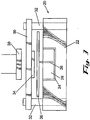
- FIG. 3 A typical apparatus for "reverse" die cutting is illustrated diagrammatically in Fig. 3 .
- Such die cutting is in contrast to so-called “guillotine” cutting ofpaper.
- guillotine cutting a paper to be cut is supported by a flat, fixed surface underneath the paper, and the paper is cut by the lowering of a movable cutting blade down through the thickness of the paper and into a slot in the fixed surface dimensioned to receive the cutting blade.
- Guillotine cutting typically produces relatively smooth paper edges; however, guillotine cutting is generally impractical for high speed, large volume cutting applications.
- a cutting blade In reverse die cutting, a cutting blade is fixed in an upright position protruding from a housing located beneath the paper to be cut. With the blade fixed and the paper in a cutting position above the blade, a contact plate is lowered against the top of the paper and presses the paper against the edge of the cutting blade causing the blade to cut the paper.
- the papers and the folders and other die cut articles formed therefrom, having exposed edges have been observed to exhibit a significantly reduced tendency to cut the skin of persons handling the folders as compared to prior art-papers and die cut paper articles such as folders. That is, the edges of the papers are less likely to cause cutting or abrasion of the skin if the fingers or other portions of the body are inadvertently drawn against an exposed edge of the material.
- folder blanks are typically die cut.
- the die blade initially creates a clean cut through a portion ofthe thickness ofthe paper.
- the remainder of the paper thickness "bursts" or fractures in a relatively jagged and irregular manner.
- the resultant edge of the folder is jagged and includes a large number of very small, but very sharp paper shards. Contact with these small jagged sharp edges and shards is believed to be a primary cause of paper cut incidents.
- Fig. 1 illustrates four samples of a conventional paper which have been cut by different techniques.
- the foremost sample in the micrograph is a paper which has been guillotine cut.
- the two samples depicted in the center of the micrograph are cut by a lab bench die cutter described in further detail hereinafter.
- the final sample, in the background of the micrograph is cut by a conventional, production scale die cutter.
- the die cut conventional papers exhibit considerable roughness about the edges of the paper samples.
- paper according to the invention having a relatively high caliper and relatively low density has a considerably reduced tendency to fracture or burst prematurely when being die cut.
- the die blade is apparently allowed to complete a clean cut through the paper thickness and, consequently, the resultant edge exhibits significantly fewer jagged irregularities and shards which produce paper cuts. Therefore, folders for example made according to the invention exhibit a significantly reduced tendency to cause paper cuts as they are being handled.
- Fig. 2 depicts on the right a die-cut edge ofpaper formed according to the invention and to the left a die-cut edge of a conventional paper of substantially the same basis weight.
- the inventive paper includes about 2 wt% expanded microspheres and has a caliper of about 0.381 mm (15 mils) and a density of about 0.559 g/cm 3 (8.7 lb/3000 ft 2 /mil).
- the conventional paper does not include any microspheres and has a caliper of about 0.279 mm (11 mils) and a density of about 0.726 g/cm 3 (11.3 lb/3000ft 2 /mil). It may be seen that the edge of the paper according to the inventive use is significantly smoother in appearance and has a more beveled corner profile. It is believed that these differences account for the reduction in cutting tendency.
- a series of papers were formed from a mixture of about 40% softwood pulp and about 60% hardwood pulp and having a Canadian Standard Freeness of about 450 and incorporating amounts of expandable microspheres and being calendered to a variety of differing calipers.
- the resultant papers containing the expanded microspheres were then tested to determine the likelihood of an edge cutting a person's fingers while being handled. In place of actual human skin, the tests were performed using a rubberized finger covered by a latex glove material which served as an artificial "skin".
- the samples for examination were die cut using a laboratory die cutter 20 illustrated in Fig. 3 .
- the cutter includes a bottom housing 22 having a recess 24.
- a cutting blade 26 is mounted in a supporting block 28 and the block is fixed in the recess 24 so that the cutting blade projects upward.
- the die cutter 20 also includes an upper housing 30 which is held in alignment with the lower housing by a plurality of bolts or rods 32 which are received in a corresponding plurality of holes in the upper housing 30.
- the upper housing Over the cutting blade 26, the upper housing includes a contact surface 34.
- the paper sample 36 to be cut is placed in the gap between the cutting blade 26 and the contact surface 34.
- the contact surface 34 is then pressed downward by a hydraulic ram 38 or by other suitable driving means so that the paper sample 36 is pressed against the cutting blade and cut / burst in two.
- the cutting tendencies of the edges of the paper samples were evaluated in a testing procedure referred to hereinafter as the "Cutting Index 30" test (with "30" indicating the number of replicates of the test performed).
- the Cutting Index 30 test uses an apparatus similar to that depicted diagrammatically in Figs. 4 and 5 .
- the testing apparatus 50 includes a frame 52 which supports a paper sample clamping device 54 and suspends the clamping device 54 from above.
- the clamping device 54 is suspended about a pivot point 56 which allows the angle of the clamping device 54 to vary relative to horizontal. In this manner, the paper may be contacted against the simulated finger at different contact angles.
- the paper sample 60 to be tested is held in the clamping device 54 in a substantially upright position.
- the testing apparatus 50 also includes a simulated finger 62 which may be drawn against the edge of the paper sample 60 in the apparatus.
- the finger 62 may be removably affixed to a movable base 64 which slides along a rail or track 66 by means of hydraulic actuation so that the finger 62 is drawn into contact with the edge of the paper sample 60.
- the latex is examined to determine if a cut is produced and the cuts are then characterized according to size.
- the simulated finger is preferably formed from an inner rod of metal or stiff plastic, which is covered by a somewhat flexible material such a neoprene rubber and the neoprene layer is preferably covered by a latex layer such as a finger from a latex glove.
- a relatively high incidence of cuts in this structure will generally correlate to a relatively high incidence of cuts in an actual finger and a relatively low incidence of cuts in this structure will generally correlate to a relatively low incidence of cuts in an actual finger.
- neoprene rubber layer employed has a hardness of about Shore A 50
- the latex "skin" is about 0.102 mm (0.004 inches) thick
- the latex skin is attached to the neoprene using double-sided tape.
- the latex is also allowed to condition by exposure to an elevated temperature of about 125°C for a period of about 6 hours prior to testing. Because latex is a naturally occurring substance, latexes and products produced therefrom exhibit some degree ofvariation from batch to batch with respect to certain properties such as moisture content. It was found that by conditioning the latex at the elevated temperature for about 6 hours, the resultant latex skins exhibited a more uniform set of properties and accordingly the reproducibility of test results improved.
- the paper samples employed are cut to a size of about 1 inch by six inches and a die cut edge is aligned in the bottom of the clamping device to contact the finger.
- the simulated finger is then drawn against the paper edge, then stopped and the latex skin is examined to determine if a cut has occurred and if so, the magnitude or size of the cut.
- sample 6A - 6C the paper density was held approximately constant at about 0.803 g/cm 3 (12.5 lb/3000ft 2 /mil) while the caliper of the papers was varied.
- the results demonstrate a clear correlation between increasing caliper and decreasing cuts and cut severity in a paper containing the microspheres.
- a similar set of tests were conducted using a series of papers formed from a second pulp furnish, again formed from a mixture of about 40% softwood pulp and about 60% hardwood pulp and having a Canadian Standard Freeness of about 450.
- two sets of papers were produced, with each set of papers having approximately the same basis weight.
- the basis weight was on the order of about 0.021 g/cm 2 (130 lb/3000 ft 2 ) and for the second group, the basis weight was about 0.025 g/cm 2 (150 lb/3000ft 2 ).
- various amounts of microspheres were added and the resultant paper caliper varied. Again, 30 replicates of each sample were tested for cutting tendency. The results are shown in Tables III and IV.
- the papers containing expanded microspheres were produced to provide a target basis weight of about 0.02 g/cm 2 (124 lb/3000 ft 2 ) and compared to two controls formed with no microspheres and having basis weights of 0.02 g/cm 2 (124 lb/3000 ft 2 ) and (0.023 g/cm 2 (143 lb/3000ft 2 ) respectively.
- the expanded microsphere samples again showed dramatic reductions in cutting tendency as compared to the control papers. The total number of cuts was reduced by about 50% or more in each case and the reductions in average weighted cuts was reduced further still.
Landscapes
- Paper (AREA)
- Sheet Holders (AREA)
Abstract
Description
- The invention relates to the papermaking arts and, in particular, to the manufacture of paper products such as file folders and the like made of relatively heavy weight paper a/k/a paperboard for use in office and clerical environments.
- The contemporary work office uses a myriad of paper products including, but not limited to, writing papers, notepads, and file folders and / or jackets to organize and store various paperwork. Such file folders and / or jackets (hereinafter referred to collectively as "folders") are typically made using a paper material which is rather stiff and durable so as to protect the contents of the file and to stand upright or remain relatively flat and self-supporting. Unfortunately, such products also typically have edges which have a tendency to inflict so called "paper cuts" upon personnel handling the files. While rarely presenting a case of serious injury, paper cuts are nonetheless an inconvenience and may cause considerable discomfort as such cuts are often jagged and irregular and formed across the highly sensitive nerve endings of the fingers.
-
US-A-3 293 114 discloses a paper containing gaseous filled spheres of thermoplastic resins. - Accordingly, there exists a need for improved paper products, and inparticular paper based file folders, which reduce or eliminate paper cuts.
- With regard to the foregoing and other objects and advantages, the present invention provides the use of a paper material as defined in present claim 1 in a method for making a paper material having a reduced tendency to cut human skin and tissue. The method includes providing a papermaking furnish including cellulosic fibers, from about 0.5 to about 5.0 wt% by weight dry basis expanded or expandable microspheres, and, optionally, conventional furnish additives including fillers, retention aids, and the like, forming a fibrous web from the papermaking furnish, drying the web, and calendaring the web to a caliper of from (0.279 to 0.457 mm 11.0 to 18.0 mils) and a density ranging from (0.449 to 0.70 to 0.77 g/cm3 7.0 to 12.0 lb/3000ft2/mil).
- The paper material is used in the manufacture ofpaper articles such as file folders. The paper material includes a paper web including cellulosic fibers and expanded microspheres dispersed within the fibers and, optionally, conventional paper additives including one or more fillers and starches. The paper web has a density of from (0.449 to 0.77 g/cm3 7.0 to 12.0lb/3000ft2/mil) and a caliper of from (0.279 to 0.457 mm 11.0 to 18.0 mils). In addition, the paper web has edges which exhibit an improved resistance to inflicting cuts upon human skin.
- The inventive use provides a file folder or jacket. The file folder of jacket comprises a paper web including wood fibers and expanded microspheres dispersed within the fibers. The paper web has a density of from (0.449 to 0.77 g/cm3 7.0 to 12.0 lb/3000ft2/mil) and a caliper of from (0.279 to 0.457 mm 11.0 to 18.0 mils). The paper web is die cut to provide exposed edges on the folder or jacket that exhibit improved resistance to inflicting cuts upon human skin.
- In accordance with one preferred embodiment of the invention, the paper web has a density of from (0.482 to 0.578 g/cm3 7.5lb/3000ft2/mil to 0.356 to 0.406 mm 9.0 lb/300ft2/mil). It is also preferred that the paper web have a caliper of 0.356 to 0.406 mm 14.0 to 16.0 mils). The basis weight of the web is typically from (0.013 to 80 1b/3000ft2 to 0.049 g/cm2 300 lb/300ft2), more preferably from (0.02 to 0.025 g/cm2 120 lb/3000ft2 to 150 lb/3000ft2)
- Typically the microspheres in the paper web comprise synthetic polymeric microspheres and comprise from about 0.5 to about 5.0 wt.% of the total weight of the web on a dry basis, more preferably from about 1.0 wt % to about 2.0 wt % of the total weight of the web on a dry basis. It is particularly preferred that the microspheres comprise microspheres made from a polymeric material selected from the group consisting of methyl methacrylate, ortho-chlorostyrene, polyortho-chlorostyrene, polyvinylbenzyl chloride, acrylonitrile, vinylidene chloride, para-tert-butyl styrene, vinyl acetate, butyl acrylate, serene, methacrylic acid, vinylbenzyl chloride and combinations of two or more of the foregoing. The microspheres have a preferred expanded diameter of from 30 to 60 micrometer. In addition, it may be preferred in some cases to initially disperse the microspheres in the furnish in an unexpanded state and subsequently expand the microspheres as the paper web dries.
- The cellulosic fibers of the web may be provided from hardwoods, softwoods, or a mixture of the two. Preferably, the fibers in the paper web include from about 30% to about 100 % by weight dry basis softwood fibers and from about 70% to about 0% by weight dry basis hardwood fibers.
- The above and other aspects and advantages of the invention will now be further described in conjunction with the accompanying drawings in which:
-
Fig. 1 is photomicrograph illustrating edges of conventional papers after being cut by various paper cutting techniques; -
Fig. 2 is another photomicrograph comparing a die cut conventional paper and a die cut paper according to one embodiment of the present invention; -
Fig. 3 is a side elevational view illustrating diagrammatically a paper die cutting apparatus for use in reverse die cutting paper samples; -
Fig. 4 is a side elevational view illustrating diagrammatically a testing apparatus for simulating paper cuts upon a finger; and -
Fig. 5 is a perspective view illustrating certain aspects of the testing apparatus ofFig. 4 . - The invention use provides a paper material having an improved cut resistance, i.e., the edges of the paper have a reduced tendency to cut, abrade, or damage human skin. As used herein, "paper" refers to and includes both paper and paperboard unless otherwise noted.
- The paper is provided as a web containing cellulosic pulp fibers such as fiber derived from hardwood trees, softwood trees, or a combination of hardwood and softwood trees prepared for use in a papermaking furnish by any known suitable digestion, refining, and bleaching operations. In a preferred embodiment; the cellulosic fibers in the paper include from about 30% to about 100 % by weight dry basis softwood fibers and from about 70% to about 0% by weight dry basis hardwood fibers. In certain embodiments, at least a portion of the fibers may be provided from non-woody herbaceous plants including, but not limited to, kenaf, hemp, jute, flax, sisal, or abaca although legal restrictions and other considerations may make the utilization of hemp and other fiber sources impractical or impossible. The paper may also include other conventional additives such as, for example, starch, mineral fillers, sizing agents, retention aids, and strengthening polymers. Among the fillers that may be used are organic and inorganic pigments such as, by way of example, polymeric particles such as polystyrene latexes and polymethylmethacrylate, and minerals such as calcium carbonate, kaolin, and talc. In addition to pulp fibers and fillers, the paper material also includes dispersed within the fibers and any other components from about 0.5 to about 5.0 wt % by dry weight expanded microspheres. More preferably the paper includes from about 1.0 to about 2.0 wt % expanded microspheres. Suitable microspheres include synthetic resinous particles having a generally spherical liquid-containing center. The resinous particles may be made from methyl methacrylate, methyl methacrylate, ortho-chlorostyrene, polyortho-chlorostyrene, polyvinylbenzyl chloride, acrylonitrile, vinylidene chloride, para-tert-butyl styrene, vinyl acetate, butyl acrylate, styrene, methacrylic acid, vinylbenzyl chloride and combinations of two or more of the foregoing. Preferred resinous particles comprise a polymer containing from about 65 to about 90 percent by weight vinylidene chloride, preferably from about 65 to about 75 percent by weight vinylidene chloride, and from about 35 to about 10 percent by weight acrylonitrile, preferably from about 25 to about 35 percent by weight acrylonitrile.
- The microspheres preferably subsist in the paper web in an "expanded" state, having undergone expansion in diameter in the order of from about 300 to about 600 % from an "unexpanded" state in the original papermaking furnish from which the web is derived. In their original unexpanded state, the center of the expandable microspheres may include a volatile fluid foaming agent to promote and maintain the desired volumetric expansion. Preferably, the agent is not a solvent for the polymer resin. A particularly preferred foaming agent is isobutane, which may be present in an amount ranging from about 10 to about 25 percent by weight of the total weight of the resinous particles. Upon heating to a temperature in the range of from about 80 to about 190°C in the dryer unit of a papermaking machine, the resinous particles expand to a diameter ranging from 30 to 60 micrometer. Suitable expandable microspheres are available from Akzo Nobel of Marietta, Georgia under the tradename EXPANCEL. Expandable microspheres and their usage in paper materials are described in more detail in copending application Serial No.
09/770,340 filed January 26, 2001 - Papers formed according to the present invention preferably have a final caliper, after calendering of the paper, and any nipping or pressing such as may be associated with subsequent coating of from (0.279 to 0.457 mm 11.0 to 18.0 mils), more preferably from (0.356 to 0.406 mm 14. mils to 16.0 mils). Papers formed according to the invention also typically exhibit basis weights of from (0.013 to 0.049 g/cm2 80 lb/3000ft2), to 300 lb/3000ft2), more preferably from (0.02 to 0.025 g/cm2 120 lb/3000ft 2 to 150 lb/3000ft2) The final density of the papers, that is, the basis weight divided by the caliper, is typically from (0.449 to 0.77 g/cm3 7.0 lb/3000f2/mil to 12.0 lb/3000ft2/mil) and more preferably from (0.482 to 0.578 g/cm3 7.5 lb/3000ft2/mil to 9.0 lb/3000ft2/mil). Thus, the paper has a relatively larger caliper in relation to its weight compared to conventional papers.
- The reduction in basis weight versus caliper is believed to be attributable at least in part to the large number of tiny voids in the paper associated with the expanded microspheres interspersed in the fibers with the microspheres causing, especially during the expansion process, a significant increase in the void volume in the material. In addition, the paper after drying operations is calendered sufficient to achieve the final desired calipers discussed herein along with any desired surface conditioning of the web associated with the calendering operation. The impartation of a significantly increased void volume along with a relatively high caliper also has the effect of reducing the density of the paper while retaining good stiffness and other properties important for use as stock for file folders and the like.
- The method of forming the paper materials according to the inventive use includes providing an initial paper furnish. The cellulosic fibrous component ofthe furnish is suitably of the chemically pulped variety, such as a bleached kraft pulp, although the invention is not believed to be limited to kraft pulps, and may also be used with good effect with other chemical pulps such as sulfite pulps, mechanical pulps such as ground wood pulps, and other pulp varieties and mixtures thereof such as chemical-mechanical and thermo-mechanical pulps.
- While not essential to the invention, the pulp is preferably bleached to remove lignins and to achieve a desired pulp brightness according to one or more bleaching treatments known in the art including, for example, elemental chlorine-based bleaching sequences, chlorine dioxide-based bleaching sequences, chlorine-free bleaching sequences, elemental chlorine-free bleaching sequences, and combinations or variations ofstages of any of the foregoing and other bleaching related sequences and stages.
- After bleaching is completed and the pulp is washed and screened, it is generally subjected to one or more refining steps. Thereafter, the refined pulp is passed to a blend chest where it is mixed with various additives and fillers typically incorporated into a papermaking furnish as well as other pulps such as unbleached pulps and/or recycled or post-consumer pulps. The additives may include so-called "internal sizing" agents used primarily to increase the contact angle of polar liquids contacting the surface of the paper such as alkenyl succinic anhydride (ASA), alkyl ketene dimer (AKD), and rosin sizes. Retention aids may also be added at this stage. Cationic retention aids are preferred; however, anionic aids may also be employed in the furnish.
- In addition, and prior to providing the furnish to the headbox of a papermaking machine, polymeric microspheres are added to the pulp furnish mixture. As noted above, the microspheres are added in an amount of from about 0.5% to about 5.0% based on the total dry weight ofthe furnish. The microspheres may bepreexpanded or in substantially their final dimension prior to inclusion in the furnish mixture. However, it is preferred that the microspheres are initially added to the furnish in a substantially unexpanded state and then caused to expand as the paper web is formed and dried as described hereinafter. It will be appreciated that this expansion has the effect of enabling an increased caliper and reduced density in the final paper product. It is also within the scope of the invention to include mixtures ofexpandable and already-expanded microspheres (or microspheres that are already substantially in their final dimensional state) in the papermaking furnish so that a portion of the microspheres will expand to a substantial degree in drying operations while the balance will remain in substantially the same overall dimensions during drying.
- Once prepared, the furnish is formed into a single or multi-ply web on a papermaking machine such as a Fourdrinier machine or any other suitable papermaking machine known in the art, as well as those which may become known in the future. The basic methodologies involved in making paper on various papermaking machine configurations are well-known to those of ordinary skill in the art and accordingly will not be described in detail herein. In general, a so-called "slice" of furnish consisting of a relatively low consistency aqueous slurry of the pulp fibers (typically about 0.1 to about 1.0%) along with the microspheres and various additives and fillers dispersed therein is ejected from a headbox onto a porous endless moving forming sheet or wire where the liquid is gradually drained through small openings in the wire until a mat ofpulp fibers and the other materials is formed on the wire. The still-wet mat or web is transferred from the wire to a wet press where more fiber-to-fiber consolidation occurs and the moisture is further decreased. The web is then passed to an initial dryer section to remove most of the retained moisture and further consolidate the fibers in the web. The heat of the drying section also promotes expansion of unexpanded microspheres contained in the web..
- After initial drying, the web may be further treated using a size press wherein additional starch, pigments, and other additives may be applied to the web and incorporated therein by the action of the press.
- After treatment in the size press and subsequent drying, the paper is calendered to achieve the desired final caliper as discussed above to improve the smoothness and other properties of the web. The calendering may be accomplished by steel-steel calendaring at nip pressures sufficient to provide a desired caliper. It will be appreciated that the ultimate caliper of the paper ply will be largely determined by the selection of the nip pressure.
- Paper materials formed according to the invention may be utilized in a variety of office or clerical applications. In particular, the inventive papers are advantageously used in forming Bristol board file folder or jackets for storing and organizing materials in the office workplace. The manufacture of such folders from paper webs is well known to those in the paper converting arts and consists in general of cutting appropriately sized and shaped blanks from the paper web, typically by "reverse" die cutting, and then folding the blanks into the appropriate folder shape followed by stacking and packaging steps. The blanks may also be scored beforehand if desired to facilitate folding. The scoring, cutting, folding, stacking, and packaging operations are ordinarily carried out using automated machinery well-known to those of ordinary skill on a substantially continuous basis from rolls of the web material fed to the machinery from an unwind stand.
- A typical apparatus for "reverse" die cutting is illustrated diagrammatically in
Fig. 3 . Such die cutting is in contrast to so-called "guillotine" cutting ofpaper. In guillotine cutting, a paper to be cut is supported by a flat, fixed surface underneath the paper, and the paper is cut by the lowering of a movable cutting blade down through the thickness of the paper and into a slot in the fixed surface dimensioned to receive the cutting blade. Guillotine cutting typically produces relatively smooth paper edges; however, guillotine cutting is generally impractical for high speed, large volume cutting applications. - In reverse die cutting, a cutting blade is fixed in an upright position protruding from a housing located beneath the paper to be cut. With the blade fixed and the paper in a cutting position above the blade, a contact plate is lowered against the top of the paper and presses the paper against the edge of the cutting blade causing the blade to cut the paper.
- The papers and the folders and other die cut articles formed therefrom, having exposed edges have been observed to exhibit a significantly reduced tendency to cut the skin of persons handling the folders as compared to prior art-papers and die cut paper articles such as folders. That is, the edges of the papers are less likely to cause cutting or abrasion of the skin if the fingers or other portions of the body are inadvertently drawn against an exposed edge of the material.
- Without being bound by theory, it is believed the improvement in cut resistance derives from the combination of an increased caliper and a decreased density as compared to prior art papers and the effect of these attributes on how the paper reacts to cutting operations. As noted above, folder blanks are typically die cut. When die cutting blanks for conventional folders from prior art papers having a relatively small caliper and a relatively high density, it is believed that the die blade initially creates a clean cut through a portion ofthe thickness ofthe paper. However, before the die blade can complete a clean cut through the paper, the remainder of the paper thickness "bursts" or fractures in a relatively jagged and irregular manner. As a consequence, the resultant edge of the folder is jagged and includes a large number of very small, but very sharp paper shards. Contact with these small jagged sharp edges and shards is believed to be a primary cause of paper cut incidents.
- While the resultant paper edges from die cutting are more rough and jagged than from, say, guillotine cutting, die cutting techniques are more easily implemented in large-scale, high speed manufacturing, and are therefore favored greatly in modern practice.
-
Fig. 1 illustrates four samples of a conventional paper which have been cut by different techniques. The foremost sample in the micrograph is a paper which has been guillotine cut. The two samples depicted in the center of the micrograph are cut by a lab bench die cutter described in further detail hereinafter. The final sample, in the background of the micrograph, is cut by a conventional, production scale die cutter. As may be seen, the die cut conventional papers exhibit considerable roughness about the edges of the paper samples. - However, it has been determined that paper according to the invention having a relatively high caliper and relatively low density has a considerably reduced tendency to fracture or burst prematurely when being die cut. The die blade is apparently allowed to complete a clean cut through the paper thickness and, consequently, the resultant edge exhibits significantly fewer jagged irregularities and shards which produce paper cuts. Therefore, folders for example made according to the invention exhibit a significantly reduced tendency to cause paper cuts as they are being handled.
- The differences in the resultant die cut paper edges is dramatically illustrated in
Fig. 2 which depicts on the right a die-cut edge ofpaper formed according to the invention and to the left a die-cut edge of a conventional paper of substantially the same basis weight. The inventive paper includes about 2 wt% expanded microspheres and has a caliper of about 0.381 mm (15 mils) and a density of about 0.559 g/cm3 (8.7 lb/3000 ft2/mil). The conventional paper does not include any microspheres and has a caliper of about 0.279 mm (11 mils) and a density of about 0.726 g/cm3 (11.3 lb/3000ft2 /mil). It may be seen that the edge of the paper according to the inventive use is significantly smoother in appearance and has a more beveled corner profile. It is believed that these differences account for the reduction in cutting tendency. - The following nonlimiting examples illustrate various additional aspects of the invention. Unless otherwise indicated, temperatures are in degrees Celsius, percentages are by weight and the percent of any pulp additive or moisture is based on the oven-dry weight of the total amount of material.
- A series of papers were formed from a mixture of about 40% softwood pulp and about 60% hardwood pulp and having a Canadian Standard Freeness of about 450 and incorporating amounts of expandable microspheres and being calendered to a variety of differing calipers. The resultant papers containing the expanded microspheres were then tested to determine the likelihood of an edge cutting a person's fingers while being handled. In place of actual human skin, the tests were performed using a rubberized finger covered by a latex glove material which served as an artificial "skin".
- The samples for examination were die cut using a
laboratory die cutter 20 illustrated inFig. 3 . The cutter includes abottom housing 22 having arecess 24. Acutting blade 26 is mounted in a supportingblock 28 and the block is fixed in therecess 24 so that the cutting blade projects upward. - The
die cutter 20 also includes anupper housing 30 which is held in alignment with the lower housing by a plurality of bolts orrods 32 which are received in a corresponding plurality of holes in theupper housing 30. Over thecutting blade 26, the upper housing includes acontact surface 34. Thepaper sample 36 to be cut is placed in the gap between the cuttingblade 26 and thecontact surface 34. Thecontact surface 34 is then pressed downward by ahydraulic ram 38 or by other suitable driving means so that thepaper sample 36 is pressed against the cutting blade and cut / burst in two. - The cutting tendencies of the edges of the paper samples were evaluated in a testing procedure referred to hereinafter as the "
Cutting Index 30" test (with "30" indicating the number of replicates of the test performed). TheCutting Index 30 test uses an apparatus similar to that depicted diagrammatically inFigs. 4 and5 . Thetesting apparatus 50 includes aframe 52 which supports a papersample clamping device 54 and suspends theclamping device 54 from above. The clampingdevice 54 is suspended about apivot point 56 which allows the angle of theclamping device 54 to vary relative to horizontal. In this manner, the paper may be contacted against the simulated finger at different contact angles. Thepaper sample 60 to be tested is held in theclamping device 54 in a substantially upright position. - The
testing apparatus 50 also includes asimulated finger 62 which may be drawn against the edge of thepaper sample 60 in the apparatus. For instance, thefinger 62 may be removably affixed to amovable base 64 which slides along a rail or track 66 by means of hydraulic actuation so that thefinger 62 is drawn into contact with the edge of thepaper sample 60. After the sample contacts the finger, the latex is examined to determine if a cut is produced and the cuts are then characterized according to size. - The simulated finger is preferably formed from an inner rod of metal or stiff plastic, which is covered by a somewhat flexible material such a neoprene rubber and the neoprene layer is preferably covered by a latex layer such as a finger from a latex glove. In this manner, the finger roughly simulates the bone, muscle, and skin layers of an actual finger. While the latex and neoprene structure does not exhibit the exact some tendency to be cut as an actual finger, it is believed that a relatively high incidence of cuts in this structure will generally correlate to a relatively high incidence of cuts in an actual finger and a relatively low incidence of cuts in this structure will generally correlate to a relatively low incidence of cuts in an actual finger.
- In the experiments described herein, neoprene rubber layer employed has a hardness of about
Shore A 50, the latex "skin" is about 0.102 mm (0.004 inches) thick, and the latex skin is attached to the neoprene using double-sided tape. In order to better simulate skin, the latex is also allowed to condition by exposure to an elevated temperature of about 125°C for a period of about 6 hours prior to testing. Because latex is a naturally occurring substance, latexes and products produced therefrom exhibit some degree ofvariation from batch to batch with respect to certain properties such as moisture content. It was found that by conditioning the latex at the elevated temperature for about 6 hours, the resultant latex skins exhibited a more uniform set of properties and accordingly the reproducibility of test results improved. - The paper samples employed are cut to a size of about 1 inch by six inches and a die cut edge is aligned in the bottom of the clamping device to contact the finger. The simulated finger is then drawn against the paper edge, then stopped and the latex skin is examined to determine if a cut has occurred and if so, the magnitude or size of the cut.
- A total of 30 replicates were performed for each paper sample. The results were as follows:
Table I Sample ID (WMCF) % Expancel (Wt %) Basis weight (lb/3000ft2) g/cm2 Final Caliper (mils) mm Density (lb/3000ft2/mil) g/cm3 Total Cuts Cutting Index 1A 0 (127) 0.021 (11.9) 0.302 (10.7) 0.687 19 45 2 2 (108) 0. 018 (12.0) 0.305 (9.0) 0.578 15 34 3 3 (108) 0. 018 (12.7) 0.325 (8.5) 0.546 17 29 6A 0 (148) 0.024 (12.1) 0.307 (12.3) 0.79 22 56 6B 0 (182) 0.03 (14.5) 0.368 (12.6) 0.809 18 30 6C 0 (200) 0.033 (16.2) 0.412 (12.4) 0.796 13 16 124 2 (131) 0021 (15.8) 0.401 (8.3) 0.533 7 15 143 2 (143) 0.023 (17.0) 0.432 (8.4) 0.539 3 5 - In addition to measuring the number of cuts (out of 30 replicates), the size of each cut was characterized on a 1 to 5 scale with 1 being "very small" and 5 being "large". Using this data, a "Cutting Index" was determined by summing the products of the number of cuts in each size category by the severity of the cut on the 1 to 5 scale. These results are shown in Table II:
Table II Sample ID Total Cuts Large (5) Med+ (4) Med (3) Small (2) V. Small (1) Cutting Index 1A 19 0 3 5 7 4 45 2 15 0 1 3 10 1 34 3 17 0 0 1 10 6 29 6A 22 0 4 8 6 4 56 6B 18 0 0 6 0 12 30 6C 13 0 0 0 3 10 16 124 7 0 0 3 2 2 15 143 3 0 0 0 2 1 5 - As may be seen in samples 1- 3 and 6A, the density of the papers was varied by addition of varying amounts of expanded microspheres while the paper calipers were held approximately constant at about 0.305 mm (12 mils). These samples demonstrate that a reduction of density associated with inclusion of microspheres leads to a corresponding reduction in the number and severity of cuts produced by the paper.
- In sample 6A - 6C, the paper density was held approximately constant at about 0.803 g/cm3 (12.5 lb/3000ft2/mil) while the caliper of the papers was varied. The results demonstrate a clear correlation between increasing caliper and decreasing cuts and cut severity in a paper containing the microspheres.
- Finally, in samples 124 and 143, papers were produced containing microspheres and employing both a reduced density and a high caliper at the same time. The results were quite dramatic with number of cuts and the weight average cuts both being reduced to extremely low levels. Thus, it appears that while both caliper increase and density reduction in association with addition of microspheres may individually reduce cutting to some degree, the combination of the two appears to provide a synergistic reduction in cutting which is surprising and quite unexpected.
- A similar set of tests were conducted using a series of papers formed from a second pulp furnish, again formed from a mixture of about 40% softwood pulp and about 60% hardwood pulp and having a Canadian Standard Freeness of about 450. In these tests, two sets of papers were produced, with each set of papers having approximately the same basis weight. For one group of papers, the basis weight was on the order of about 0.021 g/cm2 (130 lb/3000 ft2) and for the second group, the basis weight was about 0.025 g/cm2 (150 lb/3000ft2). Within each group, various amounts of microspheres were added and the resultant paper caliper varied. Again, 30 replicates of each sample were tested for cutting tendency. The results are shown in Tables III and IV.
Table III Sample ID % Expancel (Wt%) Basis weight (lb/3000ft2) g/cm2 Final Caliper (Mils) mm Density (lb/3000fl2/mil) g/cm3 Total Cuts Cutting Index 1 0 (129) 0.021 (12.1) 0.307 (10.7) 0.687 21 77 3 2 (133) 0.022 (15.5) 0.394 (8.58) 0.551 15 34 4 3 (128) 0.021 (17.2) 0.437 (7.46) 0.479 10 16 5 0 (153) 0.025 (13.8) 0.351 (11.1) 0.713 25 80 7 2 (149) 0.024 (14.6) 0.371 (10.2) 0.655 16 36 8 3 (150) 0.025 (18.4) 0.467 (8.15) 0.523 7 12 - These results show a clear trend toward decreases in total cuts as well as the weighted average cuts with increasing amount of microspheres where the basis weight is held about the same. It is seen that increasing the amount ofmicrospheres while holding the basis weight the same can be said to result in an increased caliper, decreased density, and decreased number and severity of cuts.
Table IV Sample ID Total Cuts Large (5) Med+ (4) Med (3) Small (2) V. Small (1) Cutting Index 1 21 7 5 5 3 1 77 3 15 0 2 1 8 3 34 4 10 0 0 0 6 4 16 5 25 2 9 6 8 0 80 7 16 0 0 4 12 0 36 8 7 0 0 0 5 2 12 - A similar set of tests were conducted using a series of papers formed from a third pulp furnish including about 35% softwood fibers and about 65% hardwood fibers. Again, 30 replicates of each sample were tested for cutting tendency. The results are shown in Tables V.
Table V Sample ID % Expancel (Wt. %) Basis weight (lb/3000ft2) g/cm2 Final Caliper (Mils)m/m Density (lb/3000ft2/mil) g/cm3 Total Cuts Cutting Index 124 lb control 0 (129) 0.021 (11.39) 0.289 (11.34) 0.728 28 116 143 lb control 0 (148) 0.024 (11.57) 0.294 (12.76) 0.819 30 95 4 2 (128) 0.021 (14.83) 0.377 (8.61) 0.553 15 21 6 2 (125) 0.02 (15.21) 0.386 (8.22) 0.528 7 9 7 2 (124) 0.02 (14.94) 0.38 (8.28) 0.532 5 5 8 2 (125) 0.02 (15.08) 0.383 (8.27) 0.531 15 15 9 2 (125) 0.02 (14.56) 0.37 (8.62) 0.553 8 9 - In these tests, the papers containing expanded microspheres were produced to provide a target basis weight of about 0.02 g/cm2 (124 lb/3000 ft2) and compared to two controls formed with no microspheres and having basis weights of 0.02 g/cm2 (124 lb/3000 ft2) and (0.023 g/cm2 (143 lb/3000ft2) respectively. The expanded microsphere samples again showed dramatic reductions in cutting tendency as compared to the control papers. The total number of cuts was reduced by about 50% or more in each case and the reductions in average weighted cuts was reduced further still.
Claims (12)
- Use of a paper material comprising a paper web including cellulosic fibers and expanded microspheres, the paper web having a density of from (0.449 to 0.778/cm3 (7.0 to 12.0 lb/30002/mil) and a caliper after caleridering of from 0.279 to 0.457 mm (11.0 to 18.0 mils) wherein the microapheres have an expanded diameter of from 30 to 60 micrometer for reverse die cutting the web to provide at least one edge having a reduced tendency to cut human skin.
- The use of Claim 1 wherein the paper web has a density of from 0.481 to 0.5788/cm3 (7.5 to 90.0lb/3000ft2/mil)
- The use of Claim 1 wherein the paper web has a caliper of 0.356 to 0.406 mm (14.0 to 16.0 mils )
- The use of Claim 1 wherein the expanded microspheres in the papers web comprise synthetic polymeric microspheres and comprise from 0.5 to 5.0 wt. % of the total weight of the web on a dry basis.
- The use of Claim 1 wherein the expanded microspheres in the piper web comprise synthetic polymeric microspheres and comprise from 1.0 to 2.0 wt. % of the total weight of the web on a dry basis.
- The use of Claim 1 wherein the paper web has a basis weight of from 0.013 to 0.049/cm2 80lb/3000ft2 to 300lb/3000ft2
- The use of Claim 1 wherein the paper web has a basis weight of from 0.02 to 0.025/cm2 (120lb/3000ft2 to 150lb/3000ft2)
- The use of Claim 1 wherein the expanded microspheres in the paper web comprise microspheres made from a material selected from the group consisting of methyl methacrylate, ortho-chlorostyrene, polyortho-chlorostyrene, polyvinbenzyl chloride, acrylonitrile, vinylidene chloride, para-tert-butyl styrene, vinyl acetate, butyl acrylate styrene, methacrylic acid, vinylbenzyl chloride and combinations of two or more of the foregoing.
- The use of Claim 1 wherein the fibers in the paper web comprise from 30 to 100 % by weight dry basis softwood fibers and from 70 to 0% by weight dry basis hardwood fibers.
- The use of Claim 1 wherein the microspheres are dispersed within the furnish in an unexpanded state and subsequently expand as the paper web dries.
- The use of Claim 1 wherein the paper material exhibits a Cutting Index of less than 40 when analyzed according to the Cutting Index 30 test.
- The use of any one of the preceding claims wherein the paper material is a file folder or jacket.
Priority Applications (1)
| Application Number | Priority Date | Filing Date | Title |
|---|---|---|---|
| EP07014530A EP1852552A1 (en) | 2001-04-11 | 2002-04-11 | Cut resistant paper and paper articles and method for making same |
Applications Claiming Priority (3)
| Application Number | Priority Date | Filing Date | Title |
|---|---|---|---|
| US28298301P | 2001-04-11 | 2001-04-11 | |
| PCT/US2002/012264 WO2002084026A1 (en) | 2001-04-11 | 2002-04-11 | Cut resistant paper and paper articles and method for making same |
| US282983P | 2010-05-03 |
Related Child Applications (2)
| Application Number | Title | Priority Date | Filing Date |
|---|---|---|---|
| EP07014530A Division EP1852552A1 (en) | 2001-04-11 | 2002-04-11 | Cut resistant paper and paper articles and method for making same |
| EP07014530.5 Division-Into | 2007-07-24 |
Publications (3)
| Publication Number | Publication Date |
|---|---|
| EP1381734A1 EP1381734A1 (en) | 2004-01-21 |
| EP1381734A4 EP1381734A4 (en) | 2004-12-15 |
| EP1381734B1 true EP1381734B1 (en) | 2012-04-11 |
Family
ID=23083982
Family Applications (1)
| Application Number | Title | Priority Date | Filing Date |
|---|---|---|---|
| EP02721777A Expired - Lifetime EP1381734B1 (en) | 2001-04-11 | 2002-04-11 | The use of the paper for die cutting |
Country Status (11)
| Country | Link |
|---|---|
| EP (1) | EP1381734B1 (en) |
| JP (1) | JP4197253B2 (en) |
| CN (2) | CN1265055C (en) |
| AT (1) | ATE553251T1 (en) |
| AU (1) | AU2002252689B2 (en) |
| BR (1) | BR0208882A (en) |
| CA (1) | CA2443904C (en) |
| ES (1) | ES2384957T3 (en) |
| MX (1) | MXPA03009308A (en) |
| NZ (1) | NZ528925A (en) |
| WO (1) | WO2002084026A1 (en) |
Families Citing this family (10)
| Publication number | Priority date | Publication date | Assignee | Title |
|---|---|---|---|---|
| AU2001233066B2 (en) | 2000-01-26 | 2005-04-21 | International Paper Company | Low density paperboard articles |
| US6866906B2 (en) | 2000-01-26 | 2005-03-15 | International Paper Company | Cut resistant paper and paper articles and method for making same |
| US20060231227A1 (en) * | 2000-01-26 | 2006-10-19 | Williams Richard C | Paper and paper articles and method for making same |
| US7279071B2 (en) | 2001-04-11 | 2007-10-09 | International Paper Company | Paper articles exhibiting water resistance and method for making same |
| PT1381476E (en) | 2001-04-11 | 2010-06-04 | Int Paper Co | Paper articles exhibiting long term storageability |
| AU2004236484B2 (en) * | 2003-05-06 | 2008-03-06 | International Paper Company | A process for preparing sized paper and paperboard |
| CN1813105A (en) * | 2003-06-26 | 2006-08-02 | 阿克佐诺贝尔公司 | Microspheres |
| CN106398256B (en) * | 2016-08-31 | 2019-04-05 | 西能化工科技(上海)有限公司 | A kind of lightweight paper material and preparation method thereof comprising microspheres |
| CN106835785B (en) * | 2016-12-19 | 2019-03-22 | 西能化工科技(上海)有限公司 | The preparation method of paper pulp comprising expandable microspheres and its purposes in speciality paper |
| CA3111172C (en) | 2018-10-19 | 2024-01-02 | Cascades Canada Ulc | Cupstock with rim-formation index and associated methods and rimmed cup products |
Family Cites Families (14)
| Publication number | Priority date | Publication date | Assignee | Title |
|---|---|---|---|---|
| BE661981A (en) | 1964-04-03 | |||
| US3533908A (en) * | 1967-05-19 | 1970-10-13 | Brown Co | Porous paperboard sheet having plastic microspheres therein |
| BE758373A (en) * | 1967-11-27 | 1971-05-03 | Dow Chemical Co | PAPER MANUFACTURING PROCESS |
| US4179546A (en) * | 1972-08-28 | 1979-12-18 | The Dow Chemical Company | Method for expanding microspheres and expandable composition |
| US4133688A (en) * | 1975-01-24 | 1979-01-09 | Felix Schoeller, Jr. | Photographic carrier material containing thermoplastic microspheres |
| US4324753A (en) * | 1980-11-03 | 1982-04-13 | Gill Robert A | Method of producing an air laid paper web utilizing microencapsulated hydrogen bond promoting material |
| SE8204595L (en) * | 1982-08-05 | 1984-02-06 | Kema Nord Ab | PROCEDURE FOR THE PREPARATION OF HEART-IMPREGNATED FIBER COMPOSITION MATERIAL |
| SE453206B (en) * | 1983-10-21 | 1988-01-18 | Valmet Paper Machinery Inc | HYGIENE PAPER COAT, PROCEDURE FOR PREPARING THEREOF AND USING EXPANDABLE MICROSPHERES OF THERMOPLASTIC IN PREPARING HYGIENE PAPER COAT |
| US5125996A (en) * | 1990-08-27 | 1992-06-30 | Eastman Kodak Company | Three dimensional imaging paper |
| JP2611612B2 (en) * | 1992-11-18 | 1997-05-21 | 王子製紙株式会社 | Cushioned paper tube |
| US5342649A (en) * | 1993-01-15 | 1994-08-30 | International Paper Company | Coated base paper for use in the manufacture of low heat thermal printing paper |
| GB2307487B (en) * | 1995-11-22 | 1999-03-17 | Portals Ltd | Process for producing security paper |
| US6379497B1 (en) * | 1996-09-20 | 2002-04-30 | Fort James Corporation | Bulk enhanced paperboard and shaped products made therefrom |
| AU2001233066B2 (en) * | 2000-01-26 | 2005-04-21 | International Paper Company | Low density paperboard articles |
-
2002
- 2002-04-11 CN CN02809521.9A patent/CN1265055C/en not_active Expired - Lifetime
- 2002-04-11 CA CA002443904A patent/CA2443904C/en not_active Expired - Lifetime
- 2002-04-11 CN CN2006100898532A patent/CN1861902B/en not_active Expired - Lifetime
- 2002-04-11 AU AU2002252689A patent/AU2002252689B2/en not_active Expired
- 2002-04-11 MX MXPA03009308A patent/MXPA03009308A/en active IP Right Grant
- 2002-04-11 AT AT02721777T patent/ATE553251T1/en active
- 2002-04-11 JP JP2002581754A patent/JP4197253B2/en not_active Expired - Fee Related
- 2002-04-11 EP EP02721777A patent/EP1381734B1/en not_active Expired - Lifetime
- 2002-04-11 BR BR0208882-7A patent/BR0208882A/en not_active Application Discontinuation
- 2002-04-11 WO PCT/US2002/012264 patent/WO2002084026A1/en not_active Ceased
- 2002-04-11 ES ES02721777T patent/ES2384957T3/en not_active Expired - Lifetime
- 2002-04-11 NZ NZ528925A patent/NZ528925A/en not_active IP Right Cessation
Also Published As
| Publication number | Publication date |
|---|---|
| EP1381734A1 (en) | 2004-01-21 |
| EP1381734A4 (en) | 2004-12-15 |
| JP4197253B2 (en) | 2008-12-17 |
| CN1507519A (en) | 2004-06-23 |
| NZ528925A (en) | 2005-05-27 |
| ATE553251T1 (en) | 2012-04-15 |
| AU2002252689B2 (en) | 2006-10-19 |
| CN1861902B (en) | 2012-08-22 |
| BR0208882A (en) | 2004-06-29 |
| ES2384957T3 (en) | 2012-07-16 |
| CA2443904A1 (en) | 2002-10-24 |
| WO2002084026A1 (en) | 2002-10-24 |
| CA2443904C (en) | 2009-04-07 |
| CN1265055C (en) | 2006-07-19 |
| MXPA03009308A (en) | 2005-07-01 |
| JP2004536973A (en) | 2004-12-09 |
| CN1861902A (en) | 2006-11-15 |
Similar Documents
| Publication | Publication Date | Title |
|---|---|---|
| US8317976B2 (en) | Cut resistant paper and paper articles and method for making same | |
| DE60112841T3 (en) | Paper for use in compression molding | |
| US20040221976A1 (en) | Paper articles exhibiting water resistance and method for making same | |
| US20060231227A1 (en) | Paper and paper articles and method for making same | |
| CA2443904C (en) | Cut resistant paper and paper articles and method for making same | |
| AU2002252689A1 (en) | Cut resistant paper and paper articles and method for making same | |
| DE60120749T2 (en) | SOFT TISSUE PAPER WITH IMPROVED RESISTANCE TO FLUSES AND OTHER EXHAUSTED MATERIALS | |
| Vishtal | Formability of paper and its improvement | |
| WO2019148287A1 (en) | High stretch paper and method of producing the same | |
| EP1852552A1 (en) | Cut resistant paper and paper articles and method for making same | |
| AU2007200259A1 (en) | Cut resistant paper and paper articles and method for making same | |
| JP2004536973A5 (en) | ||
| US20060254736A1 (en) | Paper articles exhibiting water resistance and method for making same | |
| JP3997713B2 (en) | Formed base paper | |
| Khakalo et al. | Super-stretchable paper-based materials for 3D forming | |
| AU2004236484B2 (en) | A process for preparing sized paper and paperboard | |
| JPH10219585A (en) | Water resistant low density structure | |
| JP2007002347A (en) | Processing stock paper for impregnation and impregnated paper for processing | |
| AU2008202481A1 (en) | A process for preparing sized paper and paperboard |
Legal Events
| Date | Code | Title | Description |
|---|---|---|---|
| PUAI | Public reference made under article 153(3) epc to a published international application that has entered the european phase |
Free format text: ORIGINAL CODE: 0009012 |
|
| 17P | Request for examination filed |
Effective date: 20031024 |
|
| AK | Designated contracting states |
Kind code of ref document: A1 Designated state(s): AT BE CH CY DE DK ES FI FR GB GR IE IT LI LU MC NL PT SE TR |
|
| AX | Request for extension of the european patent |
Extension state: AL LT LV MK RO SI |
|
| REG | Reference to a national code |
Ref country code: HK Ref legal event code: DE Ref document number: 1062464 Country of ref document: HK |
|
| A4 | Supplementary search report drawn up and despatched |
Effective date: 20041103 |
|
| 17Q | First examination report despatched |
Effective date: 20051111 |
|
| RTI1 | Title (correction) |
Free format text: THE USE OF THE PAPER FOR DIE CUTTING |
|
| GRAP | Despatch of communication of intention to grant a patent |
Free format text: ORIGINAL CODE: EPIDOSNIGR1 |
|
| GRAS | Grant fee paid |
Free format text: ORIGINAL CODE: EPIDOSNIGR3 |
|
| GRAA | (expected) grant |
Free format text: ORIGINAL CODE: 0009210 |
|
| AK | Designated contracting states |
Kind code of ref document: B1 Designated state(s): AT BE CH CY DE DK ES FI FR GB GR IE IT LI LU MC NL PT SE TR |
|
| RAP1 | Party data changed (applicant data changed or rights of an application transferred) |
Owner name: INTERNATIONAL PAPER COMPANY |
|
| REG | Reference to a national code |
Ref country code: GB Ref legal event code: FG4D |
|
| REG | Reference to a national code |
Ref country code: CH Ref legal event code: EP |
|
| REG | Reference to a national code |
Ref country code: AT Ref legal event code: REF Ref document number: 553251 Country of ref document: AT Kind code of ref document: T Effective date: 20120415 |
|
| REG | Reference to a national code |
Ref country code: IE Ref legal event code: FG4D |
|
| REG | Reference to a national code |
Ref country code: DE Ref legal event code: R096 Ref document number: 60242627 Country of ref document: DE Effective date: 20120606 |
|
| REG | Reference to a national code |
Ref country code: ES Ref legal event code: FG2A Ref document number: 2384957 Country of ref document: ES Kind code of ref document: T3 Effective date: 20120716 |
|
| REG | Reference to a national code |
Ref country code: NL Ref legal event code: VDEP Effective date: 20120411 |
|
| REG | Reference to a national code |
Ref country code: AT Ref legal event code: MK05 Ref document number: 553251 Country of ref document: AT Kind code of ref document: T Effective date: 20120411 |
|
| PG25 | Lapsed in a contracting state [announced via postgrant information from national office to epo] |
Ref country code: FI Free format text: LAPSE BECAUSE OF FAILURE TO SUBMIT A TRANSLATION OF THE DESCRIPTION OR TO PAY THE FEE WITHIN THE PRESCRIBED TIME-LIMIT Effective date: 20120411 Ref country code: SE Free format text: LAPSE BECAUSE OF FAILURE TO SUBMIT A TRANSLATION OF THE DESCRIPTION OR TO PAY THE FEE WITHIN THE PRESCRIBED TIME-LIMIT Effective date: 20120411 Ref country code: CY Free format text: LAPSE BECAUSE OF FAILURE TO SUBMIT A TRANSLATION OF THE DESCRIPTION OR TO PAY THE FEE WITHIN THE PRESCRIBED TIME-LIMIT Effective date: 20120411 |
|
| PG25 | Lapsed in a contracting state [announced via postgrant information from national office to epo] |
Ref country code: GR Free format text: LAPSE BECAUSE OF FAILURE TO SUBMIT A TRANSLATION OF THE DESCRIPTION OR TO PAY THE FEE WITHIN THE PRESCRIBED TIME-LIMIT Effective date: 20120712 Ref country code: PT Free format text: LAPSE BECAUSE OF FAILURE TO SUBMIT A TRANSLATION OF THE DESCRIPTION OR TO PAY THE FEE WITHIN THE PRESCRIBED TIME-LIMIT Effective date: 20120813 Ref country code: MC Free format text: LAPSE BECAUSE OF NON-PAYMENT OF DUE FEES Effective date: 20120430 |
|
| REG | Reference to a national code |
Ref country code: CH Ref legal event code: PL |
|
| PG25 | Lapsed in a contracting state [announced via postgrant information from national office to epo] |
Ref country code: BE Free format text: LAPSE BECAUSE OF FAILURE TO SUBMIT A TRANSLATION OF THE DESCRIPTION OR TO PAY THE FEE WITHIN THE PRESCRIBED TIME-LIMIT Effective date: 20120411 |
|
| REG | Reference to a national code |
Ref country code: IE Ref legal event code: MM4A |
|
| PG25 | Lapsed in a contracting state [announced via postgrant information from national office to epo] |
Ref country code: CH Free format text: LAPSE BECAUSE OF NON-PAYMENT OF DUE FEES Effective date: 20120430 Ref country code: DK Free format text: LAPSE BECAUSE OF FAILURE TO SUBMIT A TRANSLATION OF THE DESCRIPTION OR TO PAY THE FEE WITHIN THE PRESCRIBED TIME-LIMIT Effective date: 20120411 Ref country code: IE Free format text: LAPSE BECAUSE OF NON-PAYMENT OF DUE FEES Effective date: 20120411 Ref country code: LI Free format text: LAPSE BECAUSE OF NON-PAYMENT OF DUE FEES Effective date: 20120430 Ref country code: AT Free format text: LAPSE BECAUSE OF FAILURE TO SUBMIT A TRANSLATION OF THE DESCRIPTION OR TO PAY THE FEE WITHIN THE PRESCRIBED TIME-LIMIT Effective date: 20120411 Ref country code: NL Free format text: LAPSE BECAUSE OF FAILURE TO SUBMIT A TRANSLATION OF THE DESCRIPTION OR TO PAY THE FEE WITHIN THE PRESCRIBED TIME-LIMIT Effective date: 20120411 |
|
| PLBE | No opposition filed within time limit |
Free format text: ORIGINAL CODE: 0009261 |
|
| STAA | Information on the status of an ep patent application or granted ep patent |
Free format text: STATUS: NO OPPOSITION FILED WITHIN TIME LIMIT |
|
| 26N | No opposition filed |
Effective date: 20130114 |
|
| REG | Reference to a national code |
Ref country code: DE Ref legal event code: R097 Ref document number: 60242627 Country of ref document: DE Effective date: 20130114 |
|
| REG | Reference to a national code |
Ref country code: HK Ref legal event code: WD Ref document number: 1062464 Country of ref document: HK |
|
| PG25 | Lapsed in a contracting state [announced via postgrant information from national office to epo] |
Ref country code: TR Free format text: LAPSE BECAUSE OF FAILURE TO SUBMIT A TRANSLATION OF THE DESCRIPTION OR TO PAY THE FEE WITHIN THE PRESCRIBED TIME-LIMIT Effective date: 20120411 |
|
| PG25 | Lapsed in a contracting state [announced via postgrant information from national office to epo] |
Ref country code: LU Free format text: LAPSE BECAUSE OF NON-PAYMENT OF DUE FEES Effective date: 20120411 |
|
| REG | Reference to a national code |
Ref country code: FR Ref legal event code: PLFP Year of fee payment: 15 |
|
| REG | Reference to a national code |
Ref country code: FR Ref legal event code: PLFP Year of fee payment: 16 |
|
| REG | Reference to a national code |
Ref country code: FR Ref legal event code: PLFP Year of fee payment: 17 |
|
| PGFP | Annual fee paid to national office [announced via postgrant information from national office to epo] |
Ref country code: FR Payment date: 20210323 Year of fee payment: 20 Ref country code: IT Payment date: 20210323 Year of fee payment: 20 |
|
| PGFP | Annual fee paid to national office [announced via postgrant information from national office to epo] |
Ref country code: GB Payment date: 20210324 Year of fee payment: 20 |
|
| PGFP | Annual fee paid to national office [announced via postgrant information from national office to epo] |
Ref country code: DE Payment date: 20210323 Year of fee payment: 20 |
|
| PGFP | Annual fee paid to national office [announced via postgrant information from national office to epo] |
Ref country code: ES Payment date: 20210503 Year of fee payment: 20 |
|
| REG | Reference to a national code |
Ref country code: DE Ref legal event code: R071 Ref document number: 60242627 Country of ref document: DE |
|
| REG | Reference to a national code |
Ref country code: GB Ref legal event code: PE20 Expiry date: 20220410 |
|
| PG25 | Lapsed in a contracting state [announced via postgrant information from national office to epo] |
Ref country code: GB Free format text: LAPSE BECAUSE OF EXPIRATION OF PROTECTION Effective date: 20220410 |
|
| REG | Reference to a national code |
Ref country code: ES Ref legal event code: FD2A Effective date: 20220902 |
|
| PG25 | Lapsed in a contracting state [announced via postgrant information from national office to epo] |
Ref country code: ES Free format text: LAPSE BECAUSE OF EXPIRATION OF PROTECTION Effective date: 20220412 |