EP1381574B1 - Disintegration of anaerobically digested sewage sludge - Google Patents
Disintegration of anaerobically digested sewage sludge Download PDFInfo
- Publication number
- EP1381574B1 EP1381574B1 EP02727546.0A EP02727546A EP1381574B1 EP 1381574 B1 EP1381574 B1 EP 1381574B1 EP 02727546 A EP02727546 A EP 02727546A EP 1381574 B1 EP1381574 B1 EP 1381574B1
- Authority
- EP
- European Patent Office
- Prior art keywords
- sludge
- waste
- thickening
- disintegrated
- disintegrating
- Prior art date
- Legal status (The legal status is an assumption and is not a legal conclusion. Google has not performed a legal analysis and makes no representation as to the accuracy of the status listed.)
- Expired - Lifetime
Links
Images
Classifications
-
- C—CHEMISTRY; METALLURGY
- C02—TREATMENT OF WATER, WASTE WATER, SEWAGE, OR SLUDGE
- C02F—TREATMENT OF WATER, WASTE WATER, SEWAGE, OR SLUDGE
- C02F3/00—Biological treatment of water, waste water, or sewage
- C02F3/02—Aerobic processes
- C02F3/12—Activated sludge processes
- C02F3/1205—Particular type of activated sludge processes
- C02F3/1221—Particular type of activated sludge processes comprising treatment of the recirculated sludge
-
- C—CHEMISTRY; METALLURGY
- C02—TREATMENT OF WATER, WASTE WATER, SEWAGE, OR SLUDGE
- C02F—TREATMENT OF WATER, WASTE WATER, SEWAGE, OR SLUDGE
- C02F11/00—Treatment of sludge; Devices therefor
- C02F11/02—Biological treatment
- C02F11/04—Anaerobic treatment; Production of methane by such processes
-
- C—CHEMISTRY; METALLURGY
- C02—TREATMENT OF WATER, WASTE WATER, SEWAGE, OR SLUDGE
- C02F—TREATMENT OF WATER, WASTE WATER, SEWAGE, OR SLUDGE
- C02F1/00—Treatment of water, waste water, or sewage
- C02F1/72—Treatment of water, waste water, or sewage by oxidation
- C02F1/78—Treatment of water, waste water, or sewage by oxidation with ozone
-
- Y—GENERAL TAGGING OF NEW TECHNOLOGICAL DEVELOPMENTS; GENERAL TAGGING OF CROSS-SECTIONAL TECHNOLOGIES SPANNING OVER SEVERAL SECTIONS OF THE IPC; TECHNICAL SUBJECTS COVERED BY FORMER USPC CROSS-REFERENCE ART COLLECTIONS [XRACs] AND DIGESTS
- Y02—TECHNOLOGIES OR APPLICATIONS FOR MITIGATION OR ADAPTATION AGAINST CLIMATE CHANGE
- Y02W—CLIMATE CHANGE MITIGATION TECHNOLOGIES RELATED TO WASTEWATER TREATMENT OR WASTE MANAGEMENT
- Y02W10/00—Technologies for wastewater treatment
- Y02W10/10—Biological treatment of water, waste water, or sewage
Definitions
- the present invention relates to a method for treatment of aqueous organic waste according to the introduction of claim 1 and to a corresponding apparatus according to the introduction of claim 3.
- the disintegration process is accomplished by the application of physical or chemical methods to break down cell walls.
- cell walls are fragmented and intracellular compounds are released.
- the product can be utilized both as a substrate in aerobic and anaerobic biological processes.
- the document JP 10249376 for example describes a process where the organic sewage is separated into solid and liquid phases. Whereas the liquid phase is treated in the aeration tank, the solids are withdrawn as sludge and subjected to anaerobic digestion. The residual digested sludge is supplied to the aeration tank. The effluent from aeration tank is treated in the final sedimentation tank. After sedimentation sludge is recycled to the aeration tank. Part of the return sludge is extracted and supplied to ozonization. The resulting disintegrated sludge is recycled to the aeration tank, where it is degraded biologically.
- One object of the present invention is to further reduce the residual sludge quantity.
- the object is achieved by a process according to claim 1.
- a respective apparatus for treatment of aqueous organic waste is presented in claim 3.
- ozone for disintegration has some advantages: In comparison with mechanical or thermal disintegration technologies, the oxidation processes have one main advantage in common. Refractory COD (complex organic structures) is oxidised and converted to BOD (biodegradable low-molecular compounds, e.g. formic acid or acidic acid). Conversely, as opposed to other oxidation processes (such as wet-oxidation), ozonization does not demand an additional chemical dosage. As a result, effluent post-treatment is not required downstream of the process. The only by-product of the ozonization process is molecular oxygen, which can be positively reused for aerobic biological degradation processes.
- ozone is a highly reactive oxidation agent and therefore, only small amounts of gas (0.1-0.15 g O3/g SS) have to be injected, in order to carry out sludge disintegration.
- the ozonization unit is rather small.
- further developments in the fields of (a) ozone generation, (b) gas injection system and (c) reaction tank design will lead to increased process efficiency.
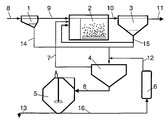
- the present invention shall be described by an example according to the schematic figure, which shows a wastewater and sludge treatment system according to the invention.
- the wastewater 9 purified in primary sedimentation 1 is fed to the wastewater treatment unit 2, the liquid 10 further purified in the wastewater treatment unit 2 is fed to the settlement tank 3 and the liquid further purified in settlement tank 3 is withdrawn as purified water 11.
- Excess sludge is withdrawn from primary sedimentation 1, which is fed with wastewater 8, as primary sludge 14 and from settlement tank 3 subsequent to the wastewater treatment unit, here the biological purification unit 2, as surplus activated sludge 15.
- Both sludge types 14,15 are subjected to pre-thickening 4 and subsequently (reference numeral 8) to anaerobic digestion 5.
- the digested sludge (100-300% of digester volume) 16 is continuously fed into the sludge disintegration unit 6, which unit is using ozone.
- the ozone supply of the sludge disintegration unit 6 consists mainly of an ozone generator and a gas injection system, which feeds ozone to a reaction tank of the sludge disintegration unit 6. After a certain reaction time (approx. 30 min, dependant on the efficiency of the gas injection system), the treated sludge 12 is released from the disintegration unit 6 and recycled to the thickening facility 4.
- Thickening is a procedure to increase the solids content of sludge by removing a portion of the liquid fraction. For example, if surplus activated sludge, which is typically pumped from secondary settlement tanks with a content of 0.8% dry substance, can be thickened to a content of 4% dry substance, then a five-fold decrease in sludge volume is achieved. Thickening is generally accomplished by physical means including gravity settling, flotation or centrifugation.
- anaerobic digestion depends on the microbiological degradation of the proteins, carbohydrates, lipids and other degradable organic matter present in raw sewage sludge and their conversion into biogas, comprised of methane and carbon dioxide in the absence of air. These metabolic processes result in some bacterial growth, but the cell yield from anaerobic biosynthesis is much smaller than that occurring in aerobic processes and the production of new solids in anaerobic systems is of immaterial significance.
- the liquid phase 7 contains dissolved organic compounds (such as amino acids, nucleic acids and fatty acids) which are released with the cytoplasm. It can be utilized as a carbon source to balance the additional carbon demand in the denitrification process during periods of high nitrogen loading rates.
- the solid phase 8 contains cell fragments (biosolids), which also represent a good substrate for biodegradation, as the refractory COD was converted into BOD.
- the recycling of disrupted and disintegrated biosolids 12 to anaerobic digestion 5 has a number of attractive aspects, which are described in the following section.
- the anaerobic digestion 5 of disintegrated biosolids enables advanced sludge stabilization due to the enhanced reduction of organic matter. Moreover, the residual sludge quantity can be slashed by another 30-40% (total sludge reduction up to 60%).
- the rate-limiting step of the AD-process is the initial lysis phase. When sludge disintegration is employed, this reaction is accelerated. Hence, the sludge retention time in the AD reactor 5 can be cut from the standard 15-20 days to below 10 days. As a consequence, the digester volume can be reduced, which leads to savings in investment and operating costs.
- the operating costs are influenced in two respects, (a) lower demand on reactor heating and (b) the conversion of refractory COD to BOD, providing higher biogas yields and hence increased electricity generation from biogas. Finally, due to the destruction of filamentous flocs (responsible for water retention in the sludge) during disintegration, the dewatering properties of the residual sludge are improved.
- the process according to the invention can be applied to the conventional wastewater treatment system, consisting of mechanical pretreatment, biological purification and chemical precipitation. It suites for all types of wastewater treatment processes (single-stage-, two-stage activated sludge-, Sequencing Batch Reactor (SBR) process etc.).
- the design of the main structures of a sludge treatment plant for a conventional wastewater treatment plant with a capacity of 20,000m 3 /day would be as follows: Anaerobic Digester: Sludge Retention Time, t R ... 10 [days] Volumetric Loading ... 3 - 5 [kg/m 3 day] Digester Volume ... 1,500 [m 3 ] Disintegration Unit: Reaction Time ... approx. 30 [min] Reaction Tank Volume ... 3 - 5 [m 3 ] Specific Ozone Demand ... 0.1 - 0.15 [kg O 3 /kg SS] Capacity of Ozone Generator ... 20 [kg O 3 /h]
Landscapes
- Life Sciences & Earth Sciences (AREA)
- Engineering & Computer Science (AREA)
- Chemical & Material Sciences (AREA)
- Organic Chemistry (AREA)
- Hydrology & Water Resources (AREA)
- Environmental & Geological Engineering (AREA)
- Water Supply & Treatment (AREA)
- Microbiology (AREA)
- Biodiversity & Conservation Biology (AREA)
- Chemical Kinetics & Catalysis (AREA)
- General Chemical & Material Sciences (AREA)
- Oil, Petroleum & Natural Gas (AREA)
- Health & Medical Sciences (AREA)
- Molecular Biology (AREA)
- Treatment Of Sludge (AREA)
- Purification Treatments By Anaerobic Or Anaerobic And Aerobic Bacteria Or Animals (AREA)
Description
- The present invention relates to a method for treatment of aqueous organic waste according to the introduction of
claim 1 and to a corresponding apparatus according to the introduction ofclaim 3. - Sludge treatment and disposal systems are entering a period of dramatic change, driven mainly by environmental legislation. Due to the construction of new sewage treatment plants and an increase in the number of sewerage connections, the total production of municipal sewage sludge will rise considerably. Consequently, the quantities of sludge requiring disposal will also multiply.
- Most countries recognise that landfill disposal will not be sustainable at present or projected levels far into the future, because of the increasing competition for landfill space, higher costs, more stringent environmental standards and the implementation of policies to promote recycling. The majority of states have formal or practical limits on the physical nature of sludge to be landfilled and have introduced measures to limit the amount of organic matter deposited. Such restrictions are considered necessary, in order to promote the recycling of organic wastes wherever possible.
- The growing quantities of sludge generated in urban areas require innovative treatment processes that are capable of achieving significant cuts in mass and volume. Technologies that combine efficient sludge mass and volume reductions with the production of reusable sludge products at competitive costs represent the most desirable solutions. The integration of disintegration technology into the sludge treatment process leads to reduced sludge quantities and markedly improved sludge quality.
- Basically, the disintegration process is accomplished by the application of physical or chemical methods to break down cell walls. Thus, cell walls are fragmented and intracellular compounds are released. The product can be utilized both as a substrate in aerobic and anaerobic biological processes.
- The document
JP 10249376 EP-A-0 645 347 andWO 99/09327 claim 1. A respective apparatus for treatment of aqueous organic waste is presented inclaim 3. - By feeding back the disintegrated matters to the thickening stage the liquid of the disintegrated matters is drawn off and the solids are subjected to anaerobic digestion. Thus the volume of the sludge is reduced, whereas according to the state of the art disintegrated sludge is recycled into the aeration tank without antecedent solid-liquid phase separation. Although the English abstract of document
JP 59 096000 A - Favourable implementations of the invention are presented in claims 2.
- For example using ozone for disintegration has some advantages: In comparison with mechanical or thermal disintegration technologies, the oxidation processes have one main advantage in common. Refractory COD (complex organic structures) is oxidised and converted to BOD (biodegradable low-molecular compounds, e.g. formic acid or acidic acid). Conversely, as opposed to other oxidation processes (such as wet-oxidation), ozonization does not demand an additional chemical dosage. As a result, effluent post-treatment is not required downstream of the process. The only by-product of the ozonization process is molecular oxygen, which can be positively reused for aerobic biological degradation processes.
- Furthermore, ozone is a highly reactive oxidation agent and therefore, only small amounts of gas (0.1-0.15 g O3/g SS) have to be injected, in order to carry out sludge disintegration. As compared with other types of municipal wastewater and sludge treatment plants, the ozonization unit is rather small. Moreover, further developments in the fields of (a) ozone generation, (b) gas injection system and (c) reaction tank design will lead to increased process efficiency.
- The present invention shall be described by an example according to the schematic figure, which shows a wastewater and sludge treatment system according to the invention.
- The
wastewater 9 purified inprimary sedimentation 1 is fed to the wastewater treatment unit 2, theliquid 10 further purified in the wastewater treatment unit 2 is fed to thesettlement tank 3 and the liquid further purified insettlement tank 3 is withdrawn as purifiedwater 11. Excess sludge is withdrawn fromprimary sedimentation 1, which is fed withwastewater 8, asprimary sludge 14 and fromsettlement tank 3 subsequent to the wastewater treatment unit, here the biological purification unit 2, as surplus activatedsludge 15. - Both
sludge types anaerobic digestion 5. The digested sludge (100-300% of digester volume) 16 is continuously fed into thesludge disintegration unit 6, which unit is using ozone. The ozone supply of thesludge disintegration unit 6 consists mainly of an ozone generator and a gas injection system, which feeds ozone to a reaction tank of thesludge disintegration unit 6. After a certain reaction time (approx. 30 min, dependant on the efficiency of the gas injection system), the treatedsludge 12 is released from thedisintegration unit 6 and recycled to thethickening facility 4. At that process stage a solid-liquid phase separation of all three sludge types (a)primary sludge 14, (b) surplus activatedsludge 15 and (c) disintegrated digestedsludge 12 is accomplished. The supernatant liquid phase 7 is recycled to the wastewater treatment unit 2, whereas the thickenedsolid phase 8 is fed into theanaerobic digestion tank 5. The residual sludge (80-90% inorganic compounds) 13 is discharged. - Thickening is a procedure to increase the solids content of sludge by removing a portion of the liquid fraction. For example, if surplus activated sludge, which is typically pumped from secondary settlement tanks with a content of 0.8% dry substance, can be thickened to a content of 4% dry substance, then a five-fold decrease in sludge volume is achieved. Thickening is generally accomplished by physical means including gravity settling, flotation or centrifugation.
- The process of anaerobic digestion depends on the microbiological degradation of the proteins, carbohydrates, lipids and other degradable organic matter present in raw sewage sludge and their conversion into biogas, comprised of methane and carbon dioxide in the absence of air. These metabolic processes result in some bacterial growth, but the cell yield from anaerobic biosynthesis is much smaller than that occurring in aerobic processes and the production of new solids in anaerobic systems is of immaterial significance.
- Typically, only about 50% of the organic matter in sludge is readily susceptible to anaerobic biodegradation into a gas, the other half of the organic material being more recalcitrant (e.g. ligno-cellulosic material) and degrading only very slowly. Sludge which is anaerobic digested is biologically stable (no longer has the propensity to ferment).
- The liquid phase 7 contains dissolved organic compounds (such as amino acids, nucleic acids and fatty acids) which are released with the cytoplasm. It can be utilized as a carbon source to balance the additional carbon demand in the denitrification process during periods of high nitrogen loading rates. On the other hand, the
solid phase 8 contains cell fragments (biosolids), which also represent a good substrate for biodegradation, as the refractory COD was converted into BOD. The recycling of disrupted and disintegratedbiosolids 12 toanaerobic digestion 5 has a number of attractive aspects, which are described in the following section. - The
anaerobic digestion 5 of disintegrated biosolids enables advanced sludge stabilization due to the enhanced reduction of organic matter. Moreover, the residual sludge quantity can be slashed by another 30-40% (total sludge reduction up to 60%). The rate-limiting step of the AD-process is the initial lysis phase. When sludge disintegration is employed, this reaction is accelerated. Hence, the sludge retention time in theAD reactor 5 can be cut from the standard 15-20 days to below 10 days. As a consequence, the digester volume can be reduced, which leads to savings in investment and operating costs. The operating costs are influenced in two respects, (a) lower demand on reactor heating and (b) the conversion of refractory COD to BOD, providing higher biogas yields and hence increased electricity generation from biogas. Finally, due to the destruction of filamentous flocs (responsible for water retention in the sludge) during disintegration, the dewatering properties of the residual sludge are improved. - The process according to the invention can be applied to the conventional wastewater treatment system, consisting of mechanical pretreatment, biological purification and chemical precipitation. It suites for all types of wastewater treatment processes (single-stage-, two-stage activated sludge-, Sequencing Batch Reactor (SBR) process etc.).
- For example, according to the described invention the design of the main structures of a sludge treatment plant for a conventional wastewater treatment plant with a capacity of 20,000m3 /day would be as follows:
Anaerobic Digester: Sludge Retention Time, tR ... 10 [days] Volumetric Loading ... 3 - 5 [kg/m3day] Digester Volume ... 1,500 [m3] Disintegration Unit: Reaction Time ... approx. 30 [min] Reaction Tank Volume ... 3 - 5 [m3] Specific Ozone Demand ... 0.1 - 0.15 [kg O3/kg SS] Capacity of Ozone Generator ... 20 [kg O3/h]
Claims (4)
- Method for treatment of aqueous organic waste, namely sewage sludge, comprising the stages of thickening the waste, comprising primary sludge from a primary sedimentation unit (1) and comprising activated sludge from a biological purification unit (2), in a means (4) for thickening the waste, anaerobically digesting the thickened waste and disintegrating the digested residue by cell wall destruction, characterized in that disrupted and disintegrated biosolids from cell wall destruction are fed back to the means (4) for thickening the waste, so that in the thickening stage a solid-liquid phase separation of all three sludge types primary sludge (14), surplus activated sludge (15) and disintegrated digested sludge (12) is accomplished, and in that the liquid phase separated in the means (4) for thickening the waste is fed back to the biological purification unit (2).
- Method according to claim 1, characterized in that ozone is used in the disintegration stage.
- Apparatus for treatment of aqueous organic waste, namely sewage sludge, comprising means (4) for thickening the waste, means (5) for anaerobically digesting the thickened waste and means (6) for disintegrating the digested residue by cell wall destruction, characterized in that- the means (6) for disintegrating is connected to the means (4) for thickening the waste for the purpose of feeding back disrupted and disintegrated biosolids (12) from the means (6) for disintegrating the digested residue by cell wall destruction to the means (4) for thickening the waste,- the means (4) for thickening the waste comprise means for feeding primary sludge (14) from a primary sedimentation unit (1) to the means (4) for thickening the waste,- the means (4) for thickening the waste comprise means for feeding activated sludge (15) from a biological purification unit (2) to the means (4) for thickening the waste,- so that in the thickening stage a solid-liquid phase separation of all three sludge types primary sludge (14), surplus activated sludge (15) and disintegrated digested sludge (12) is accomplished,- the means (4) for thickening the waste comprise means for feeding the separated liquid phase (7) back to the biological purification unit (2).
- Apparatus according to claim 3, characterized in that the means (6) for disintegrating has an ozone supply.
Priority Applications (1)
| Application Number | Priority Date | Filing Date | Title |
|---|---|---|---|
| EP02727546.0A EP1381574B1 (en) | 2001-04-27 | 2002-04-09 | Disintegration of anaerobically digested sewage sludge |
Applications Claiming Priority (4)
| Application Number | Priority Date | Filing Date | Title |
|---|---|---|---|
| EP01110513 | 2001-04-27 | ||
| EP01110513A EP1254865A1 (en) | 2001-04-27 | 2001-04-27 | Disintegration of Anaerobically digested sewage sludge |
| PCT/EP2002/003940 WO2002088034A1 (en) | 2001-04-27 | 2002-04-09 | Disintegration of anaerobically digested sewage sludge |
| EP02727546.0A EP1381574B1 (en) | 2001-04-27 | 2002-04-09 | Disintegration of anaerobically digested sewage sludge |
Publications (2)
| Publication Number | Publication Date |
|---|---|
| EP1381574A1 EP1381574A1 (en) | 2004-01-21 |
| EP1381574B1 true EP1381574B1 (en) | 2016-07-13 |
Family
ID=8177276
Family Applications (2)
| Application Number | Title | Priority Date | Filing Date |
|---|---|---|---|
| EP01110513A Withdrawn EP1254865A1 (en) | 2001-04-27 | 2001-04-27 | Disintegration of Anaerobically digested sewage sludge |
| EP02727546.0A Expired - Lifetime EP1381574B1 (en) | 2001-04-27 | 2002-04-09 | Disintegration of anaerobically digested sewage sludge |
Family Applications Before (1)
| Application Number | Title | Priority Date | Filing Date |
|---|---|---|---|
| EP01110513A Withdrawn EP1254865A1 (en) | 2001-04-27 | 2001-04-27 | Disintegration of Anaerobically digested sewage sludge |
Country Status (5)
| Country | Link |
|---|---|
| EP (2) | EP1254865A1 (en) |
| CN (1) | CN1281526C (en) |
| CZ (1) | CZ304843B6 (en) |
| HR (1) | HRP20030843B1 (en) |
| WO (1) | WO2002088034A1 (en) |
Families Citing this family (7)
| Publication number | Priority date | Publication date | Assignee | Title |
|---|---|---|---|---|
| FR2844785B1 (en) * | 2002-09-25 | 2005-07-08 | Ondeo Degremont | METHOD AND DEVICE FOR REDUCING SLUDGE PRODUCTION OF WASTEWATER TREATMENT STATIONS BY FIXED BIOLOGICAL CROPS |
| FR2844786B1 (en) * | 2002-09-25 | 2005-06-03 | Ondeo Degremont | METHOD AND DEVICE FOR REDUCING SLUDGE PRODUCTION OF WASTEWATER TREATMENT STATIONS BY FIXED BIOLOGICAL CROPS |
| EP1522528B1 (en) * | 2003-10-07 | 2015-05-20 | VA TECH WABAG GmbH | Disintegration of anaerobically digested sewage sludge |
| DE102004029539A1 (en) | 2004-06-18 | 2006-01-12 | Bayer Healthcare Ag | Method and apparatus for continuous control of denitrification with fluctuating nitrogen loads in wastewater |
| KR20100136989A (en) * | 2008-03-28 | 2010-12-29 | 지멘스 워터 테크놀로지스 코포레이션 | Aerobic and Anaerobic Hybrid Wastewater and Sludge Treatment Systems and Methods |
| ITRM20130477A1 (en) * | 2013-08-14 | 2015-02-15 | Enea Agenzia Naz Per Le Nuo Ve Tecnologie | PROCEDURE FOR REMOVAL OF AMMONIACAL AND TOTAL NITROGEN, STABILIZATION AND IMPROVEMENT OF THE FILTRABILITY CHARACTERISTICS OF AN ANAEROBIC DIGESTATE USING THE USE OF OZONE. |
| CN107721111A (en) * | 2017-11-10 | 2018-02-23 | 北京宜清源科技有限公司 | A kind of system and method for mud decrement processing |
Family Cites Families (7)
| Publication number | Priority date | Publication date | Assignee | Title |
|---|---|---|---|---|
| JPS558835A (en) * | 1978-07-04 | 1980-01-22 | Shinryo Air Conditioning Co Ltd | Treatment of surplus sludge |
| JPS5996000A (en) * | 1982-11-22 | 1984-06-02 | Mitsubishi Heavy Ind Ltd | Dehydrating method of sludge |
| JP3351047B2 (en) | 1993-09-27 | 2002-11-25 | 栗田工業株式会社 | Treatment method of biological sludge |
| DE19502856C2 (en) * | 1995-01-30 | 1997-08-07 | Vit Robert | Clarifier, thickening centrifuge and process to reduce sludge production in clarifiers |
| JP3172965B2 (en) * | 1995-10-30 | 2001-06-04 | 株式会社荏原製作所 | Sewage treatment method |
| EA001307B1 (en) | 1997-08-19 | 2000-12-25 | Стенли Сеней | Load indicating fastener systems method and apparatus. |
| DE19800900A1 (en) * | 1998-01-13 | 1999-07-15 | Bsbg Bremer Sonderabfall Berat | Treatment of biogenic residue and waste, e.g. sewage sludge, fermentation residue or fruit, vegetable and kitchen waste |
-
2001
- 2001-04-27 EP EP01110513A patent/EP1254865A1/en not_active Withdrawn
-
2002
- 2002-04-09 CN CNB028087860A patent/CN1281526C/en not_active Expired - Fee Related
- 2002-04-09 CZ CZ2003-2928A patent/CZ304843B6/en not_active IP Right Cessation
- 2002-04-09 HR HRP20030843AA patent/HRP20030843B1/en not_active IP Right Cessation
- 2002-04-09 WO PCT/EP2002/003940 patent/WO2002088034A1/en not_active Ceased
- 2002-04-09 EP EP02727546.0A patent/EP1381574B1/en not_active Expired - Lifetime
Also Published As
| Publication number | Publication date |
|---|---|
| EP1381574A1 (en) | 2004-01-21 |
| HRP20030843A2 (en) | 2005-08-31 |
| CZ20032928A3 (en) | 2004-05-12 |
| CN1505595A (en) | 2004-06-16 |
| HRP20030843B1 (en) | 2017-12-29 |
| CN1281526C (en) | 2006-10-25 |
| EP1254865A1 (en) | 2002-11-06 |
| WO2002088034A1 (en) | 2002-11-07 |
| CZ304843B6 (en) | 2014-12-03 |
Similar Documents
| Publication | Publication Date | Title |
|---|---|---|
| US5492624A (en) | Waste treatment process employing oxidation | |
| US5500123A (en) | Two-phase anaerobic digestion of carbonaceous organic materials | |
| US7309435B2 (en) | Biological process for waste treatment and energy production | |
| US4915840A (en) | Process for sludge reduction in an aerobic sludge generating waste treatment system | |
| Hai-Lou et al. | A hybrid anaerobic solid-liquid bioreactor for food waste digestion | |
| Weemaes et al. | Ozonation of sewage sludge prior to anaerobic digestion | |
| EP1254865A1 (en) | Disintegration of Anaerobically digested sewage sludge | |
| KR100770626B1 (en) | Biogas recovery device for organic waste | |
| KR100274534B1 (en) | Nitrogen and phosphorus removal method using fermentation waste | |
| EP1522528B1 (en) | Disintegration of anaerobically digested sewage sludge | |
| KR100962215B1 (en) | Method for treating waste water and waste materials | |
| CN108455812B (en) | Method for treating organic matters in excess sludge | |
| Blonskaja et al. | Possibilities of using ozone for the treatment of wastewater from the yeast industry. | |
| EP1400569A3 (en) | Process to obtain biodegradable polymers from waste and enriched activated sludge | |
| KR20020075635A (en) | Process and apparatus for treating sewage or waste water without emitting excess sludge | |
| EP1559688A1 (en) | A method for the degradation of organic sludge | |
| KR20020075637A (en) | Method and apparatus for treating excess sludge produced from processes for biological treatment of sewage or waste water | |
| KR100500188B1 (en) | Treatment System for Food Waste and Food Scrap | |
| KR100310480B1 (en) | Garbage Disposal System and Method Linked With Sewage Disposal Plant | |
| JPH0788495A (en) | Aerobic treatment of organic wastewater | |
| EP4644525A1 (en) | Biogas production by anaerobic fermentation | |
| US11420890B2 (en) | Method of treatment of partially hydrolyzed biosolids | |
| KR100962213B1 (en) | Apparatus for treating waste water and waste materials | |
| Machnicka et al. | THE INTENSIFICATION OF SEWAGE SLUDGE ANAEROBIC DIGESTION BY PARTIAL DISINTEGRATION OF SURPLUS ACTIVATED SLUDGE AND FOAM. | |
| HK1073294B (en) | Method and apparatus for treatment of the aqueous organic waste and sewage sludge |
Legal Events
| Date | Code | Title | Description |
|---|---|---|---|
| PUAI | Public reference made under article 153(3) epc to a published international application that has entered the european phase |
Free format text: ORIGINAL CODE: 0009012 |
|
| 17P | Request for examination filed |
Effective date: 20030926 |
|
| AK | Designated contracting states |
Kind code of ref document: A1 Designated state(s): AT BE CH CY DE DK ES FI FR GB GR IE IT LI LU MC NL PT SE TR |
|
| AX | Request for extension of the european patent |
Extension state: RO |
|
| 17Q | First examination report despatched |
Effective date: 20100812 |
|
| GRAP | Despatch of communication of intention to grant a patent |
Free format text: ORIGINAL CODE: EPIDOSNIGR1 |
|
| INTG | Intention to grant announced |
Effective date: 20160104 |
|
| GRAS | Grant fee paid |
Free format text: ORIGINAL CODE: EPIDOSNIGR3 |
|
| RAP1 | Party data changed (applicant data changed or rights of an application transferred) |
Owner name: VA TECH WABAG GMBH |
|
| GRAA | (expected) grant |
Free format text: ORIGINAL CODE: 0009210 |
|
| AK | Designated contracting states |
Kind code of ref document: B1 Designated state(s): AT BE CH CY DE DK ES FI FR GB GR IE IT LI LU MC NL PT SE TR |
|
| AX | Request for extension of the european patent |
Extension state: RO |
|
| REG | Reference to a national code |
Ref country code: GB Ref legal event code: FG4D |
|
| REG | Reference to a national code |
Ref country code: AT Ref legal event code: REF Ref document number: 812150 Country of ref document: AT Kind code of ref document: T Effective date: 20160715 Ref country code: CH Ref legal event code: EP |
|
| REG | Reference to a national code |
Ref country code: IE Ref legal event code: FG4D |
|
| REG | Reference to a national code |
Ref country code: DE Ref legal event code: R096 Ref document number: 60248195 Country of ref document: DE |
|
| REG | Reference to a national code |
Ref country code: NL Ref legal event code: MP Effective date: 20160713 |
|
| PG25 | Lapsed in a contracting state [announced via postgrant information from national office to epo] |
Ref country code: NL Free format text: LAPSE BECAUSE OF FAILURE TO SUBMIT A TRANSLATION OF THE DESCRIPTION OR TO PAY THE FEE WITHIN THE PRESCRIBED TIME-LIMIT Effective date: 20160713 Ref country code: IT Free format text: LAPSE BECAUSE OF FAILURE TO SUBMIT A TRANSLATION OF THE DESCRIPTION OR TO PAY THE FEE WITHIN THE PRESCRIBED TIME-LIMIT Effective date: 20160713 Ref country code: FI Free format text: LAPSE BECAUSE OF FAILURE TO SUBMIT A TRANSLATION OF THE DESCRIPTION OR TO PAY THE FEE WITHIN THE PRESCRIBED TIME-LIMIT Effective date: 20160713 |
|
| REG | Reference to a national code |
Ref country code: CH Ref legal event code: NV Representative=s name: PATENTANWAELTE SCHAAD, BALASS, MENZL AND PARTN, CH |
|
| PG25 | Lapsed in a contracting state [announced via postgrant information from national office to epo] |
Ref country code: SE Free format text: LAPSE BECAUSE OF FAILURE TO SUBMIT A TRANSLATION OF THE DESCRIPTION OR TO PAY THE FEE WITHIN THE PRESCRIBED TIME-LIMIT Effective date: 20160713 Ref country code: PT Free format text: LAPSE BECAUSE OF FAILURE TO SUBMIT A TRANSLATION OF THE DESCRIPTION OR TO PAY THE FEE WITHIN THE PRESCRIBED TIME-LIMIT Effective date: 20161114 Ref country code: GR Free format text: LAPSE BECAUSE OF FAILURE TO SUBMIT A TRANSLATION OF THE DESCRIPTION OR TO PAY THE FEE WITHIN THE PRESCRIBED TIME-LIMIT Effective date: 20161014 Ref country code: BE Free format text: LAPSE BECAUSE OF FAILURE TO SUBMIT A TRANSLATION OF THE DESCRIPTION OR TO PAY THE FEE WITHIN THE PRESCRIBED TIME-LIMIT Effective date: 20160713 Ref country code: ES Free format text: LAPSE BECAUSE OF FAILURE TO SUBMIT A TRANSLATION OF THE DESCRIPTION OR TO PAY THE FEE WITHIN THE PRESCRIBED TIME-LIMIT Effective date: 20160713 |
|
| REG | Reference to a national code |
Ref country code: FR Ref legal event code: PLFP Year of fee payment: 16 |
|
| REG | Reference to a national code |
Ref country code: DE Ref legal event code: R097 Ref document number: 60248195 Country of ref document: DE |
|
| PLBE | No opposition filed within time limit |
Free format text: ORIGINAL CODE: 0009261 |
|
| STAA | Information on the status of an ep patent application or granted ep patent |
Free format text: STATUS: NO OPPOSITION FILED WITHIN TIME LIMIT |
|
| PG25 | Lapsed in a contracting state [announced via postgrant information from national office to epo] |
Ref country code: DK Free format text: LAPSE BECAUSE OF FAILURE TO SUBMIT A TRANSLATION OF THE DESCRIPTION OR TO PAY THE FEE WITHIN THE PRESCRIBED TIME-LIMIT Effective date: 20160713 |
|
| 26N | No opposition filed |
Effective date: 20170418 |
|
| GBPC | Gb: european patent ceased through non-payment of renewal fee |
Effective date: 20170409 |
|
| REG | Reference to a national code |
Ref country code: IE Ref legal event code: MM4A |
|
| PG25 | Lapsed in a contracting state [announced via postgrant information from national office to epo] |
Ref country code: MC Free format text: LAPSE BECAUSE OF FAILURE TO SUBMIT A TRANSLATION OF THE DESCRIPTION OR TO PAY THE FEE WITHIN THE PRESCRIBED TIME-LIMIT Effective date: 20160713 |
|
| PG25 | Lapsed in a contracting state [announced via postgrant information from national office to epo] |
Ref country code: LU Free format text: LAPSE BECAUSE OF NON-PAYMENT OF DUE FEES Effective date: 20170409 Ref country code: GB Free format text: LAPSE BECAUSE OF NON-PAYMENT OF DUE FEES Effective date: 20170409 |
|
| REG | Reference to a national code |
Ref country code: FR Ref legal event code: PLFP Year of fee payment: 17 |
|
| PG25 | Lapsed in a contracting state [announced via postgrant information from national office to epo] |
Ref country code: IE Free format text: LAPSE BECAUSE OF NON-PAYMENT OF DUE FEES Effective date: 20170409 |
|
| PGFP | Annual fee paid to national office [announced via postgrant information from national office to epo] |
Ref country code: DE Payment date: 20180425 Year of fee payment: 17 Ref country code: CH Payment date: 20180426 Year of fee payment: 17 |
|
| PGFP | Annual fee paid to national office [announced via postgrant information from national office to epo] |
Ref country code: FR Payment date: 20180413 Year of fee payment: 17 Ref country code: AT Payment date: 20180426 Year of fee payment: 17 Ref country code: TR Payment date: 20180402 Year of fee payment: 17 |
|
| REG | Reference to a national code |
Ref country code: AT Ref legal event code: UEP Ref document number: 812150 Country of ref document: AT Kind code of ref document: T Effective date: 20160713 |
|
| PG25 | Lapsed in a contracting state [announced via postgrant information from national office to epo] |
Ref country code: CY Free format text: LAPSE BECAUSE OF NON-PAYMENT OF DUE FEES Effective date: 20160713 |
|
| REG | Reference to a national code |
Ref country code: DE Ref legal event code: R119 Ref document number: 60248195 Country of ref document: DE |
|
| REG | Reference to a national code |
Ref country code: CH Ref legal event code: PL |
|
| REG | Reference to a national code |
Ref country code: AT Ref legal event code: MM01 Ref document number: 812150 Country of ref document: AT Kind code of ref document: T Effective date: 20190409 |
|
| PG25 | Lapsed in a contracting state [announced via postgrant information from national office to epo] |
Ref country code: AT Free format text: LAPSE BECAUSE OF NON-PAYMENT OF DUE FEES Effective date: 20190409 Ref country code: CH Free format text: LAPSE BECAUSE OF NON-PAYMENT OF DUE FEES Effective date: 20190430 Ref country code: LI Free format text: LAPSE BECAUSE OF NON-PAYMENT OF DUE FEES Effective date: 20190430 Ref country code: DE Free format text: LAPSE BECAUSE OF NON-PAYMENT OF DUE FEES Effective date: 20191101 |
|
| PG25 | Lapsed in a contracting state [announced via postgrant information from national office to epo] |
Ref country code: FR Free format text: LAPSE BECAUSE OF NON-PAYMENT OF DUE FEES Effective date: 20190430 |
|
| PG25 | Lapsed in a contracting state [announced via postgrant information from national office to epo] |
Ref country code: TR Free format text: LAPSE BECAUSE OF NON-PAYMENT OF DUE FEES Effective date: 20190409 |