EP1380893A2 - Colour photographic print material - Google Patents
Colour photographic print material Download PDFInfo
- Publication number
- EP1380893A2 EP1380893A2 EP03101465A EP03101465A EP1380893A2 EP 1380893 A2 EP1380893 A2 EP 1380893A2 EP 03101465 A EP03101465 A EP 03101465A EP 03101465 A EP03101465 A EP 03101465A EP 1380893 A2 EP1380893 A2 EP 1380893A2
- Authority
- EP
- European Patent Office
- Prior art keywords
- methacrylate
- print material
- acrylate
- acid
- coupler
- Prior art date
- Legal status (The legal status is an assumption and is not a legal conclusion. Google has not performed a legal analysis and makes no representation as to the accuracy of the status listed.)
- Withdrawn
Links
Classifications
-
- G—PHYSICS
- G03—PHOTOGRAPHY; CINEMATOGRAPHY; ANALOGOUS TECHNIQUES USING WAVES OTHER THAN OPTICAL WAVES; ELECTROGRAPHY; HOLOGRAPHY
- G03C—PHOTOSENSITIVE MATERIALS FOR PHOTOGRAPHIC PURPOSES; PHOTOGRAPHIC PROCESSES, e.g. CINE, X-RAY, COLOUR, STEREO-PHOTOGRAPHIC PROCESSES; AUXILIARY PROCESSES IN PHOTOGRAPHY
- G03C7/00—Multicolour photographic processes or agents therefor; Regeneration of such processing agents; Photosensitive materials for multicolour processes
- G03C7/30—Colour processes using colour-coupling substances; Materials therefor; Preparing or processing such materials
- G03C7/32—Colour coupling substances
- G03C7/34—Couplers containing phenols
- G03C7/346—Phenolic couplers
-
- G—PHYSICS
- G03—PHOTOGRAPHY; CINEMATOGRAPHY; ANALOGOUS TECHNIQUES USING WAVES OTHER THAN OPTICAL WAVES; ELECTROGRAPHY; HOLOGRAPHY
- G03C—PHOTOSENSITIVE MATERIALS FOR PHOTOGRAPHIC PURPOSES; PHOTOGRAPHIC PROCESSES, e.g. CINE, X-RAY, COLOUR, STEREO-PHOTOGRAPHIC PROCESSES; AUXILIARY PROCESSES IN PHOTOGRAPHY
- G03C1/00—Photosensitive materials
- G03C1/005—Silver halide emulsions; Preparation thereof; Physical treatment thereof; Incorporation of additives therein
- G03C1/035—Silver halide emulsions; Preparation thereof; Physical treatment thereof; Incorporation of additives therein characterised by the crystal form or composition, e.g. mixed grain
- G03C2001/03517—Chloride content
-
- G—PHYSICS
- G03—PHOTOGRAPHY; CINEMATOGRAPHY; ANALOGOUS TECHNIQUES USING WAVES OTHER THAN OPTICAL WAVES; ELECTROGRAPHY; HOLOGRAPHY
- G03C—PHOTOSENSITIVE MATERIALS FOR PHOTOGRAPHIC PURPOSES; PHOTOGRAPHIC PROCESSES, e.g. CINE, X-RAY, COLOUR, STEREO-PHOTOGRAPHIC PROCESSES; AUXILIARY PROCESSES IN PHOTOGRAPHY
- G03C2200/00—Details
- G03C2200/19—Colour negative
-
- G—PHYSICS
- G03—PHOTOGRAPHY; CINEMATOGRAPHY; ANALOGOUS TECHNIQUES USING WAVES OTHER THAN OPTICAL WAVES; ELECTROGRAPHY; HOLOGRAPHY
- G03C—PHOTOSENSITIVE MATERIALS FOR PHOTOGRAPHIC PURPOSES; PHOTOGRAPHIC PROCESSES, e.g. CINE, X-RAY, COLOUR, STEREO-PHOTOGRAPHIC PROCESSES; AUXILIARY PROCESSES IN PHOTOGRAPHY
- G03C5/00—Photographic processes or agents therefor; Regeneration of such processing agents
- G03C5/04—Photo-taking processes
-
- G—PHYSICS
- G03—PHOTOGRAPHY; CINEMATOGRAPHY; ANALOGOUS TECHNIQUES USING WAVES OTHER THAN OPTICAL WAVES; ELECTROGRAPHY; HOLOGRAPHY
- G03C—PHOTOSENSITIVE MATERIALS FOR PHOTOGRAPHIC PURPOSES; PHOTOGRAPHIC PROCESSES, e.g. CINE, X-RAY, COLOUR, STEREO-PHOTOGRAPHIC PROCESSES; AUXILIARY PROCESSES IN PHOTOGRAPHY
- G03C7/00—Multicolour photographic processes or agents therefor; Regeneration of such processing agents; Photosensitive materials for multicolour processes
- G03C7/30—Colour processes using colour-coupling substances; Materials therefor; Preparing or processing such materials
-
- G—PHYSICS
- G03—PHOTOGRAPHY; CINEMATOGRAPHY; ANALOGOUS TECHNIQUES USING WAVES OTHER THAN OPTICAL WAVES; ELECTROGRAPHY; HOLOGRAPHY
- G03C—PHOTOSENSITIVE MATERIALS FOR PHOTOGRAPHIC PURPOSES; PHOTOGRAPHIC PROCESSES, e.g. CINE, X-RAY, COLOUR, STEREO-PHOTOGRAPHIC PROCESSES; AUXILIARY PROCESSES IN PHOTOGRAPHY
- G03C7/00—Multicolour photographic processes or agents therefor; Regeneration of such processing agents; Photosensitive materials for multicolour processes
- G03C7/30—Colour processes using colour-coupling substances; Materials therefor; Preparing or processing such materials
- G03C7/3022—Materials with specific emulsion characteristics, e.g. thickness of the layers, silver content, shape of AgX grains
-
- G—PHYSICS
- G03—PHOTOGRAPHY; CINEMATOGRAPHY; ANALOGOUS TECHNIQUES USING WAVES OTHER THAN OPTICAL WAVES; ELECTROGRAPHY; HOLOGRAPHY
- G03C—PHOTOSENSITIVE MATERIALS FOR PHOTOGRAPHIC PURPOSES; PHOTOGRAPHIC PROCESSES, e.g. CINE, X-RAY, COLOUR, STEREO-PHOTOGRAPHIC PROCESSES; AUXILIARY PROCESSES IN PHOTOGRAPHY
- G03C7/00—Multicolour photographic processes or agents therefor; Regeneration of such processing agents; Photosensitive materials for multicolour processes
- G03C7/30—Colour processes using colour-coupling substances; Materials therefor; Preparing or processing such materials
- G03C7/388—Processes for the incorporation in the emulsion of substances liberating photographically active agents or colour-coupling substances; Solvents therefor
- G03C7/3882—Processes for the incorporation in the emulsion of substances liberating photographically active agents or colour-coupling substances; Solvents therefor characterised by the use of a specific polymer or latex
-
- G—PHYSICS
- G03—PHOTOGRAPHY; CINEMATOGRAPHY; ANALOGOUS TECHNIQUES USING WAVES OTHER THAN OPTICAL WAVES; ELECTROGRAPHY; HOLOGRAPHY
- G03C—PHOTOSENSITIVE MATERIALS FOR PHOTOGRAPHIC PURPOSES; PHOTOGRAPHIC PROCESSES, e.g. CINE, X-RAY, COLOUR, STEREO-PHOTOGRAPHIC PROCESSES; AUXILIARY PROCESSES IN PHOTOGRAPHY
- G03C7/00—Multicolour photographic processes or agents therefor; Regeneration of such processing agents; Photosensitive materials for multicolour processes
- G03C7/30—Colour processes using colour-coupling substances; Materials therefor; Preparing or processing such materials
- G03C7/388—Processes for the incorporation in the emulsion of substances liberating photographically active agents or colour-coupling substances; Solvents therefor
- G03C7/3885—Processes for the incorporation in the emulsion of substances liberating photographically active agents or colour-coupling substances; Solvents therefor characterised by the use of a specific solvent
Definitions
- This invention relates to a colour photographic print material having a novel cyan coupler.
- Colour photographic print materials are in particular materials for reflection prints or displays, which most usually exhibit a positive image. They are thus not a recording material like colour photographic films. They predominantly comprise negative-working materials.
- Colour photographic print materials conventionally contain at least one red-sensitive silver halide emulsion layer containing at least one cyan coupler, at least one green-sensitive silver halide emulsion layer containing at least one magenta coupler and at least one blue-sensitive silver halide emulsion layer containing at least one yellow coupler.
- US 5 686 235 disclosed cyan couplers which, once developed with the standard paper developer CD3, yield cyan dyes which are distinguished by good light and dark stability.
- the couplers have a 2-acylamino-5-phenylsulfonylmethylcarbonylaminophenol structure and may be substituted on the methyl group by alkyl and on the phenyl residue by various groups.
- the object of the invention was to overcome the above-stated disadvantage. This is surprisingly achieved with the novel cyan couplers defined below, while retaining the advantages of the prior art coupler.
- a further object of the invention was accordingly to eliminate this disadvantage too. This is surprisingly achieved with the novel cyan coupler defined below if it is used together with a small quantity of an oil former.
- the present invention accordingly provides a print material having a support, at least one red-sensitive silver halide emulsion layer containing at least one cyan coupler, at least one green-sensitive silver halide emulsion layer containing at least one magenta coupler and at least one blue-sensitive silver halide emulsion layer containing at least one yellow coupler, characterised in that the red-sensitive layer contains at least one oil former, the cyan coupler is of the formula in which
- the oil former according to the invention may comprise a high-boiling organic solvent and/or a polymer.
- the cyan coupler is particularly preferably of the formula in which
- the alkyl groups can be straight chain, branched or cyclic and the alkyl, aryl and hetaryl groups can be substituted, for example, by alkyl, alkenyl, alkyne, alkylene, aryl, heterocyclyl, hydroxy, carboxy, halogen, alkoxy, aryloxy, heterocyclyloxy, alkylthio, arylthio, heterocyclylthio, alkylseleno, arylseleno, heterocyclylseleno, acyl, acyloxy, acylamino, cyano, nitro, amino, thio or mercapto groups, wherein a heterocyclyl represents a saturated, unsaturated or aromatic heterocyclic radical and an acyl represents the radical of an aliphatic, olefinic or aromatic carboxylic, carbamic, carbonic, sulphonic, amidosulphonic, phosphoric, phosphonic, phosphorous, phosphinic
- the alkyl groups can be substituted, for example, by alkyl, alkylene, hydroxy, alkoxy or acyloxy groups and most preferably by hydroxy or alkoxy groups.
- Preferred substituents for aryl and hetarylgroups are halogen, in particular Cl and F, alkyl, fluorinated alkyl, cyano, acyl, acylamino or carboxy groups.
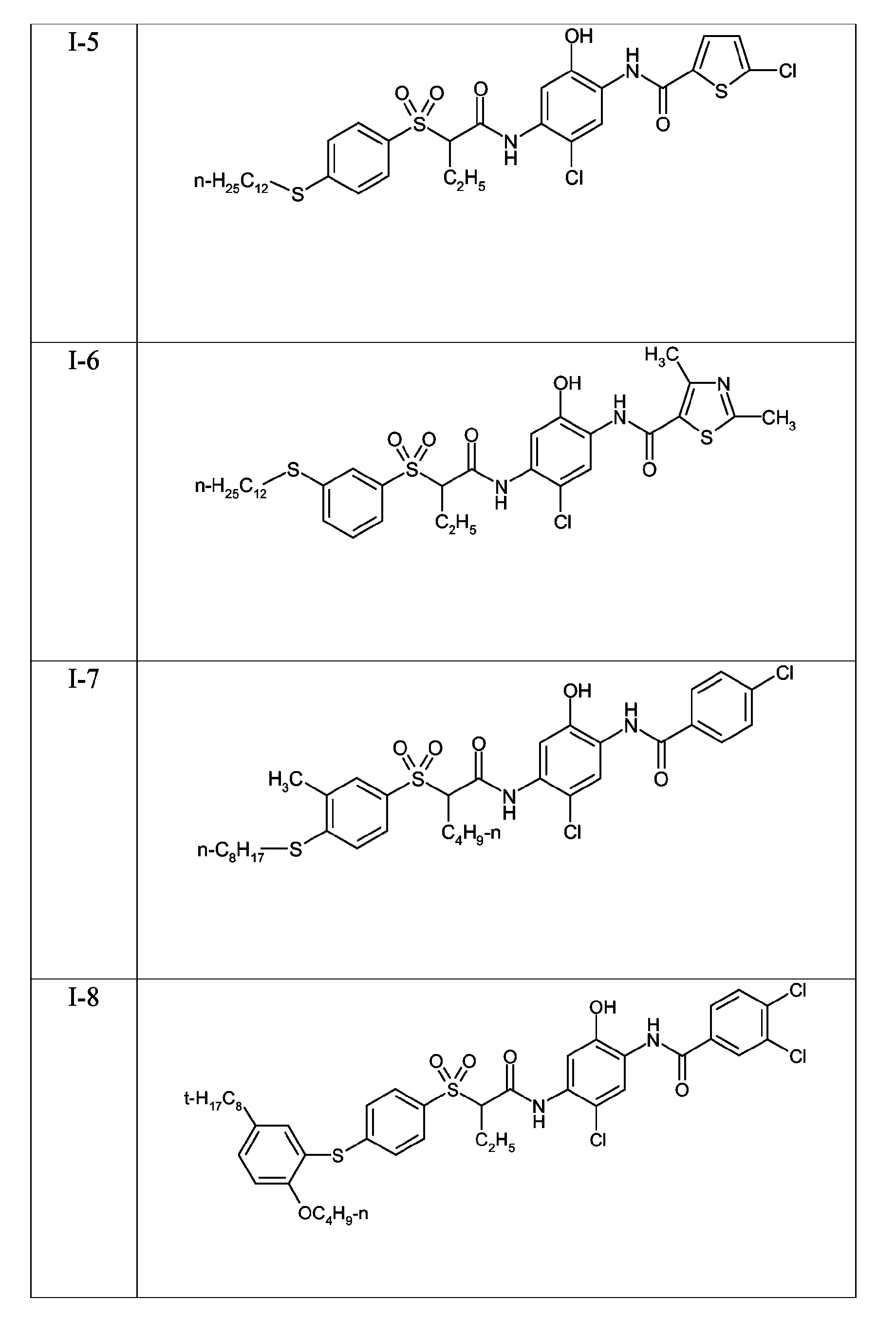
- Suitable cyan couplers are:
- the red-sensitive layer preferably contains silver halide crystals with a chloride content of at least 95 mol%, wherein they in particular comprise silver chloride, silver chloride-bromide, silver chloride-iodide or silver chloride-bromide-iodide crystals.
- the emulsions particularly preferably comprise silver chloride-bromide emulsions with a chloride content of at least 95 mol% and particularly preferably of at least 97 mol%.
- the silver halide crystals of the print material according to the invention and in particular those of the red-sensitive layer are preferably doped with iridium.
- the iridium may be incorporated into the crystals in any known manner. It is preferably added as a complex salt in dissolved form at any desired point during emulsion production, in particular before completion of crystal formation.
- iridium(III) and/or iridium(IV) complexes are used, wherein complexes comprising chloro ligands are preferred. Hexachloroiridium(III) and hexachloroiridium(IV) complexes are particularly preferred.
- the counterions optionally required to offset the charge of the iridium complex ions have no influence on the action according to the invention and may be selected at will.
- the ratio by weight of oil former to cyan coupler is preferably greater than 0.05:1 (0.05 g of oil former per 1 g of cyan coupler), in particular between 0.2:1 and 0.9:1 and particularly preferably between 0.3:1 and 0.8:1.
- the oil former comprises a high-boiling organic solvent.
- Suitable high-boiling, organic solvents are for example phthalic acid alkyl esters, phosphonic acid esters, phosphoric acid esters, citric acid esters, benzoic acid esters, amides, fatty acid esters, trimesic acid esters, alcohols, phenols, aniline derivatives and hydrocarbons.
- Examples of particularly suitable high-boiling, organic solvents are dibutyl phthalate, dicyclohexyl phthalate, di-2-ethylhexyl phthalate, decyl phthalate, triphenyl phosphate, tricresyl phosphate, 2-ethylhexyldiphenyl phosphate, tricyclohexyl phosphate, tri-2-ethylhexyl phosphate, tridecyl phosphate, tributoxyethyl phosphate, trichloropropyl phosphate, di-2-ethylhexylphenyl phosphate, 2-ethylhexyl benzoate, dodecyl benzoate, 2-ethylhexyl p-hydroxybenzoate, diethyldodecanamide, N-tetradecyclpyrrolidone, isostearyl alcohol, 2,4-di-t-amylphenol, dioct
- the oil former comprises a homo- or copolymer, hereinafter also simply designated “the polymer”, which is insoluble in water and soluble in organic solvents.
- the polymer preferably contains no acidic groups, which are also designated acid groups.
- Acid groups should be taken to mean substituents such as carboxylic acid groups, sulfonic acid groups or acidic phenol groups which have a pKa value of less than or equal to 10.
- the homo- or copolymer which is insoluble in water and soluble in organic solvents in particular comprises a vinyl polymer or a polyester.
- Vinyl polymers may in particular contain the following monomer units:
- copolymers according to the invention contain two or more different monomers, for example those stated above, by means of the selection of which it is possible to influence polymer properties, for example the coupler dissolving power thereof.
- the copolymers may also contain monomers with acidic groups, providing that the copolymer does not consequently become water-soluble.
- Suitable monomers with acidic groups are, for example, acrylic acid, methacrylic acid, itaconic acid, maleic acid; monoalkyl itaconic acid salts such as monomethyl itaconate, monoethyl itaconate, monobutyl itaconate; monoalkyl maleic acid salts such as monomethyl maleate, monoethyl maleate, monobutyl maleate; citraconic acid, styrenesulfonic acid, vinylbenzylsulfonic acid, vinylsulfonic acid; acryloyloxyalkylsulfonic acids such as acryloyloxymethylsulfonic acid, acryloyloxyethylsulfonic acid, acryloyloxypropylsulfonic acid; methacryloyloxyalkylsulfonic acids such as methacryloyloxymethylsulfonic acid, methacryloyloxyethylsulfonic acid, methacryloyloxypropyls
- the proportion of water-soluble monomers in the polymer is preferably at most 40 mol%, in particular at most 20 mol% and particularly preferably at most 10 mol%.
- methacrylic acid esters and acrylamides and in particular alkylacrylamides are particularly preferred.
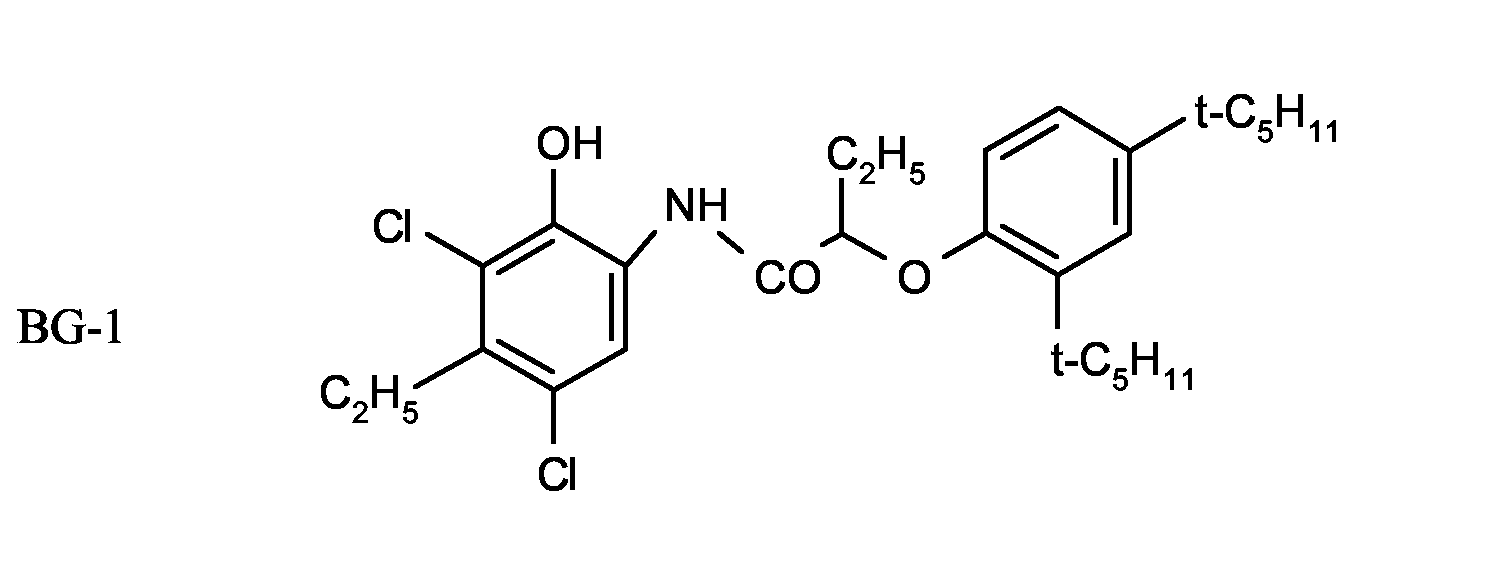
- the polymer comprises a polyalkylacrylamide.
- the polyester according to the invention may be obtained by condensation of a polyhydroxy alcohol with a polycarboxylic acid or a polycarboxylic acid derivative.
- Polyhydroxy alcohols which may be considered are, for example, polyalkylene glycols of the structure HO-R 1 -OH, wherein R 1 denotes a hydrocarbon chain, in particular an alkylene chain with 2 to approx. 12 carbon atoms, while polycarboxylic acids which may be considered are, for example, compounds of the structure HOOC-R 2 -COOH and the derivatives thereof, wherein R 2 denotes a single bond or a hydrocarbon chain with 1 to approx. 12 carbon atoms.
- polyhydroxy alcohols are, for example, ethylene glycol, diethylene glycol, triethylene glycol, 1,2-propylene glycol, 1,3-propylene glycol, trimethylolpropane, 1,4-butanediol, isobutylene, 1,5-pentanediol, neopentyl glycol, 1,6-hexanediol, 1,7-heptanediol, 1,8-octanediol, 1,9-nonanediol, 1,10-decanediol, 1,11-undecanediol, 1,12-dodecanediol, 1,13-tridecanediol, glycerol, diglycerol, triglycerol, 1-methylglycerol, erythritol, mannitol and sorbitol.
- polycarboxylic acids are, for example, oxalic acid, succinic acid, glutaric acid, adipic acid, pimelic acid, suberic acid, azelaic acid, sebacic acid, nonanoic acid, decanedicarboxylic acid, undecanedicarboxylic acid, dodecanedicarboxylic acid, fumaric acid, maleic acid, itaconic acid, citraconic acid, phthalic acid, isophthalic acid, terephthalic acid, tetrachlorophthalic acid, metaconic acid, isopimelic acid, cyclopentadiene/maleic anhydride adduct and rosin/maleic anhydride adduct.
- the molecular weight of the polymer according to the invention is preferably between 1,000,000 and 2,000, in particular between 400,000 and 5,000 and particularly preferably between 150,000 and 10,000.
- Suitable polymers according to the invention are listed below. In the case of copolymers, the molar proportions of the various monomers are stated. If no proportion is stated, the monomers are present in equal proportions.
- the cyan coupler is preferably emulsified with the polymer and the emulsified mixture is added to the red-sensitive layer.
- the red-sensitive layer contains a high-boiling organic solvent and the polymer.
- the ratio by weight of solvent to polymer may be varied over broad range; it is preferably between 0.02 g of solvent: 1 g of polymer to 100 g of solvent : 1 g of polymer, in particular between 0.5 g of solvent: 1 g of polymer to 3 g of solvent: 1 g of polymer.
- the cyan coupler is emulsified with the polymer and the high-boiling organic solvent and the emulsified mixture is added to the red-sensitive layer.
- the cyan coupler according to the invention is dissolved or dispersed in the oil former. These solutions or dispersions are then emulsified into an aqueous binder solution, conventionally a gelatine solution, and, after they have been incorporated into the photographic layers and the layers have dried, are present as fine droplets of a diameter of 0.05 to 0.8 ⁇ m, in the layers. Further methods for the production of the emulsified mixtures are stated in Research Disclosure 37254, part 6 (1995), page 292.
- the present invention also provides a process for the production of a positive reflection print from a colour negative, wherein the image information is exposed onto a print material and the material is subsequently processed in a manner corresponding to its type, which process is characterised in that the above-described print material according to the invention is used.
- the colour negative is digitised and exposure is performed with a scanning printer, particular preferably with a laser film recorder.
- exposure is performed with an analogue printer, particularly preferably with a printer capable of exposing in excess of 1000 prints per hour.
- colour photographic print materials are colour photographic paper, colour reversal photographic paper, semi-transparent display material and colour photographic materials with a deformable substrate, for example made from PVC.
- a review may be found in Research Disclosure 37038 (1995), Research Disclosure 38957 (1996) and Research Disclosure 40145 (1997).
- Photographic print materials consist of a support, onto which at least one photosensitive silver halide emulsion layer is applied.
- Suitable supports are in particular thin films and sheets.
- a review of support materials and auxiliary layers applied to the front and reverse sides thereof is given in Research Disclosure 37254, part 1 (1995), page 285 and in Research Disclosure 38957, part XV (1996), page 627.
- the colour photographic print materials conventionally contain at least one red-sensitive, one green-sensitive and one blue-sensitive silver halide emulsion layer, optionally together with interlayers and protective layers.
- these layers may be differently arranged. This is demonstrated for the most important products:
- Colour photographic paper and colour photographic display material conventionally have on the support, in the stated sequence, one blue-sensitive, yellow-coupling silver halide emulsion layer, one green-sensitive, magenta-coupling silver halide emulsion layer and one red-sensitive, cyan-coupling silver halide emulsion layer; a yellow filter layer is not necessary.
- Colour papers may also contain differently sensitised interlayers, by means of which gradation may be influenced.
- the substantial constituents of the photographic emulsion layers are binder, silver halide grains and colour couplers.
- red sensitisers which may be considered for the red-sensitive layer are pentamethinecyanines having naphthothiazole, naphthoxazole or benzothiazole as basic end groups, which may be substituted with halogen, methyl or methoxy groups and may be bridged by 9,11-alkylene, in particular 9,11-neopentylene.
- the N,N' substituents may be C 4 -C 8 alkyl groups.
- the methine chain may additionally also bear substituents.
- Pentamethines having only one methyl group on the cyclohexene ring may also be used.
- the red sensitiser may be supersensitised and stabilised by the addition of heterocyclic mercapto compounds.
- the red-sensitive layer may additionally be spectrally sensitised between 390 and 590 nm, preferably at 500 nm, in order to bring about improved differentiation of red tones.
- the spectral sensitisers may be added to the photographic emulsion in dissolved form or as a dispersion. Both the solution and dispersion may contain additives such as wetting agents or buffers.
- the spectral sensitiser or a combination of spectral sensitisers may be added before, during or after preparation of the emulsion.
- Photographic print materials contain either silver chloride-bromide emulsions containing up to 80 mol% of AgBr or silver chloride-bromide emulsions containing above 95 mol% of AgCl.
- the maximum absorption of the dyes formed from the couplers and the colour developer oxidation product is preferably within the following ranges: yellow coupler 440 to 450 nm, magenta coupler 540 to 560 nm, cyan coupler 625 to 670 nm.
- the yellow couplers associated with a blue-sensitive layer in print materials are almost always two-equivalent couplers of the pivaloylacetanilide and cyclopropylcarbonylacetanilide series.
- magenta couplers conventional in print materials are almost always those from the series of anilinopyrazolones, pyrazolo[5,1-c](1,2,4)triazoles or pyrazolo[1,5-b](1,2,4)triazoles.
- the non-photosensitive interlayers generally arranged between layers of different spectral sensitivity may contain agents which prevent an undesirable diffusion of developer oxidation products from one photosensitive layer into another photosensitive layer with a different spectral sensitisation.
- Suitable compounds may be found in Research Disclosure 37254, part 7 (1995), page 292, in Research Disclosure 37038, part III (1995), page 84 and in Research Disclosure 38957, part X.D (1996), pages 621 et seq..
- the photographic material may also contain UV light absorbing compounds, optical brighteners, spacers, filter dyes, formalin scavengers, light stabilisers, antioxidants, D min dyes, plasticisers (latices), biocides and additives to improve coupler and dye stability, to reduce colour fogging and to reduce yellowing, and others.
- Suitable compounds may be found in Research Disclosure 37254, part 8 (1995), page 292, in Research Disclosure 37038, parts IV, V, VI, VII, X, XI and XIII (1995), pages 84 et seq. and in Research Disclosure 38957, parts VI, VIII, IX and X (1996), pages 607 and 610 et seq..
- the layers of colour photographic materials are conventionally hardened, i.e. the binder used, preferably gelatine, is crosslinked by appropriate chemical methods.
- Suitable hardener substances may be found in Research Disclosure 37254, part 9 (1995), page 294, in Research Disclosure 37038, part XII (1995), page 86 and in Research Disclosure 38957, part II.B (1996), page 599.
- mice Micrate emulsion (EmM1) (undoped micrate emulsion)
- Solutions 02 and 03 are simultaneously added with vigorous stirring to solution 01 at 40°C over the course of 30 minutes with a constant feed rate at pAg 7.7 and pH 5.3.
- the pAg value is held constant by apportioning an NaCl solution and the pH value by apportioning H 2 SO 4 to the precipitation tank.
- An AgCl emulsion having an average particle diameter of 0.09 ⁇ m is obtained.
- the gelatine/AgNO 3 weight ratio is 0.14.
- the emulsion is ultrafiltered at 50°C, washed and redispersed with such a quantity of gelatine and water that the gelatine/AgNO 3 weight ratio is 0.3 and each kg of the emulsion contains 200 g of AgCl. After redispersion, the grain size is 0.13 ⁇ m.
- Solution 11 1100 g water 136 g gelatine 1 g n-decanol 4 g NaCl 195 g EmM1 Solution 12 1860 g water 360 g NaCl 56 ⁇ g K 2 IrCl 6 Solution 13 1800 g water 1000 g AgNO 3
- Solutions 12 and 13 are simultaneously added with vigorous stirring to solution 11, which has initially been introduced into the precipitation tank, at 40°C over the course of 75 minutes at a pAg of 7.7.
- the pAg and pH values are controlled as during precipitation of emulsion EmM1.
- Feed is adjusted such that, over the first 50 minutes, the feed rate of solutions 12 and 13 rises in a linear manner from 4 ml/min to 36 ml/min and in the remaining 25 minutes is held at a constant feed rate of 40 ml/min.
- An AgCl emulsion having an average particle diameter of 0.48 ⁇ m is obtained.
- the quantity of AgCl in the emulsion is hereinafter converted to AgNO 3 .
- the gelatine/AgNO 3 weight ratio is 0.14.
- the emulsion is ultrafiltered, washed and redispersed with such a quantity of gelatine and water that the gelatine/AgNO 3 weight ratio is 0.56 and each kg of the emul
- the emulsion is chemically ripened at a pH of 5.0 with an optimum quantity of gold(III) chloride and Na 2 S 2 O 3 for 2 hours at a temperature of 75°C. After chemical ripening, the emulsion is spectrally sensitised at 40°C with 75 ⁇ mol of compound (RS-1) per mol of AgCl and stabilised with 2.5 mmol of (ST-1) per mol of AgNO 3 . 3 mmol of KBr are then added.
- Precipitation, salt removal and redispersion proceed as for the red-sensitive emulsion EmR1.
- the emulsion is optimally ripened at a pH of 5.0 with gold(III) chloride and Na 2 S 2 O 3 for 2 hours at a temperature of 60°C.
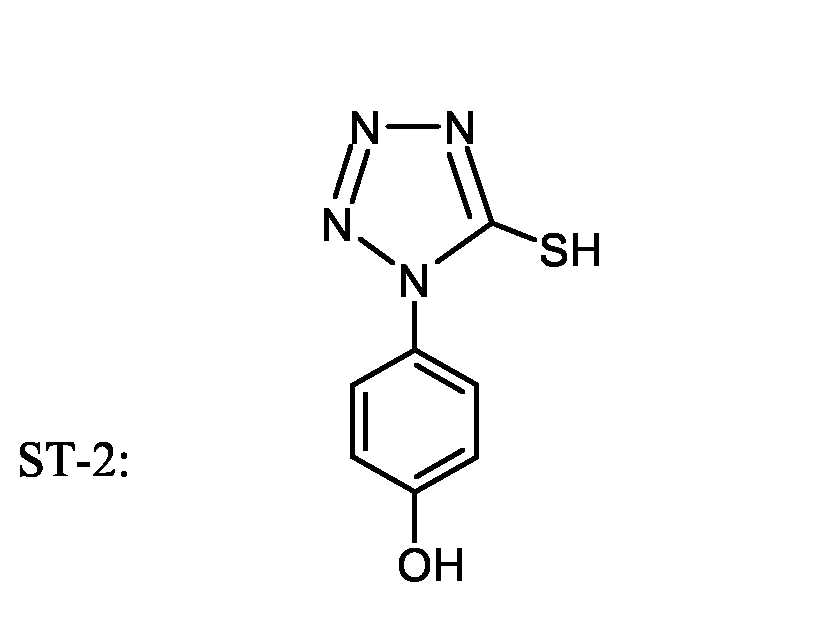
- the emulsion is spectrally sensitised at 50°C with 0.6 mmol of compound (GS-1), stabilised with 1.2 mmol of compound (ST-2) and then combined with 1 mmol of KBr.
- Solution 21 5500 g water 680 g gelatine 5 g n-decanol 20 g NaCl 180 g EmM1 Solution 22 9300 g water 1800 g NaCl Solution 23 9000 g water 5000 g AgNO 3
- Solutions 22 and 23 are simultaneously added with vigorous stirring to solution 21, which has initially been introduced into the precipitation tank, at 50°C over the course of 150 minutes at a pAg of 7.7.
- the pAg and pH values are controlled as during precipitation of emulsion EmM1.
- Feed is adjusted such that, over the first 100 minutes, the feed rate of solutions 22 and 23 rises in a linear manner from 10 ml/min to 90 ml/min and in the remaining 50 minutes is held at a constant feed rate of 100 ml/min.
- An AgCl emulsion having an average particle diameter of 0.85 ⁇ m is obtained.
- the gelatine/AgNO 3 weight ratio is 0.14.
- the emulsion is ultrafiltered, washed and redispersed with such a quantity of gelatine and water that the gelatine/AgNO 3 weight ratio is 0.56 and each kg of the emulsion contains 200 g of AgNO 3 .
- the emulsion is ripened at a pH of 5.0 with an optimum quantity of gold(III) chloride and Na 2 S 2 O 3 for 2 hours at a temperature of 50°C. After chemical ripening, for each mol of AgCl, the emulsion is spectrally sensitised at 40°C with 0.3 mmol of compound BS-1, stabilised with 0.5 mmol of compound (ST-3) and then combined with 0.6 mmol of KBr.
- a colour photographic recording material suitable for rapid processing was produced by applying the following layers in the stated sequence onto a layer support of paper coated on both sides with polyethylene. Quantities are stated in each case per 1 m 2 . The silver halide application rate is stated as the corresponding quantities of AgNO 3 .
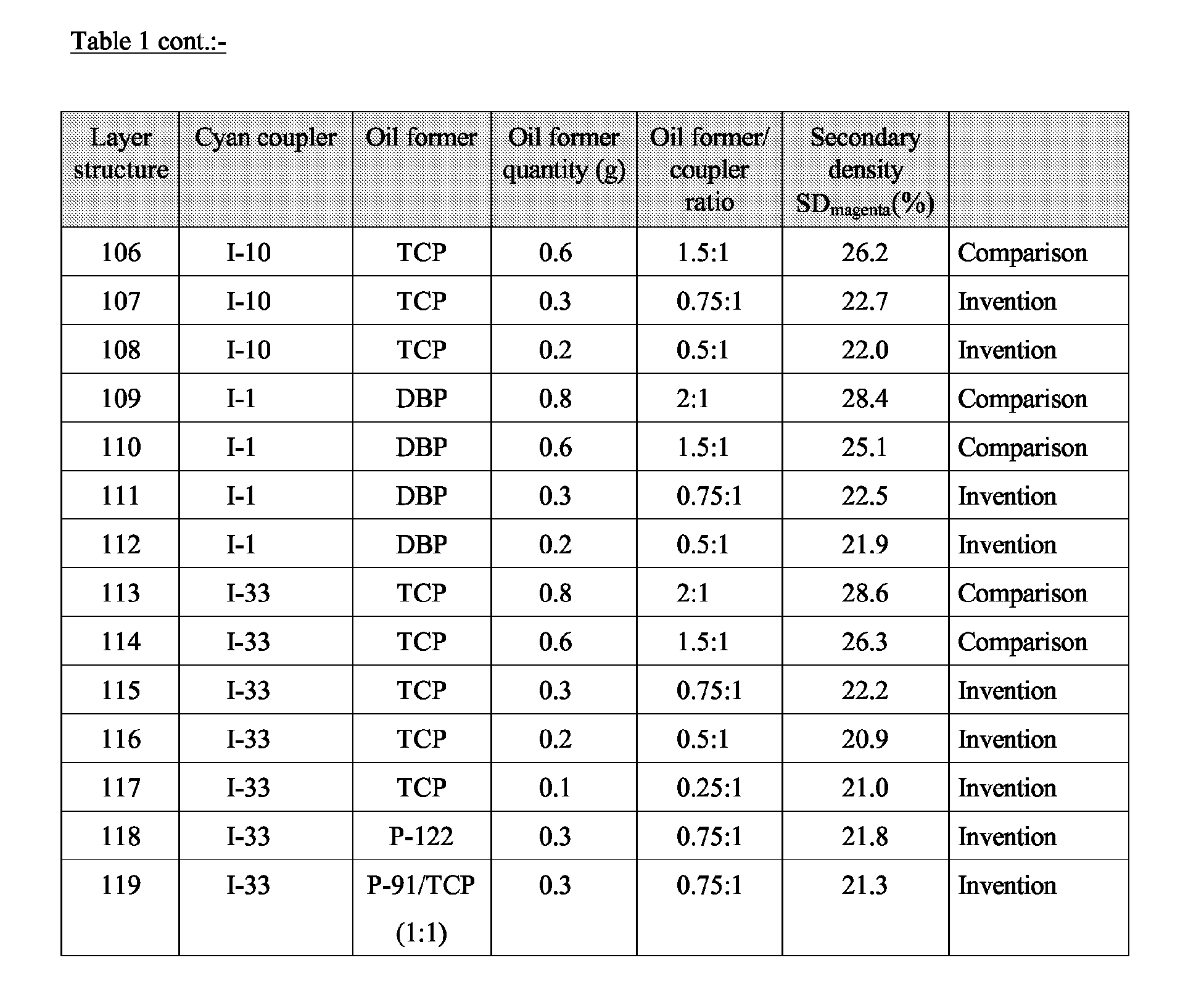
- the other layer structures differ from 101 with regard to the cyan couplers, oil formers and quantities of oil formers for layer 6 stated in Table 1.
- Table 1 summarises the results of the tests described below which were carried out on these layer structures.
- the oil former named "DBP" in the Table is dibutyl phthalate.
Landscapes
- Physics & Mathematics (AREA)
- General Physics & Mathematics (AREA)
- Silver Salt Photography Or Processing Solution Therefor (AREA)
Abstract
Description
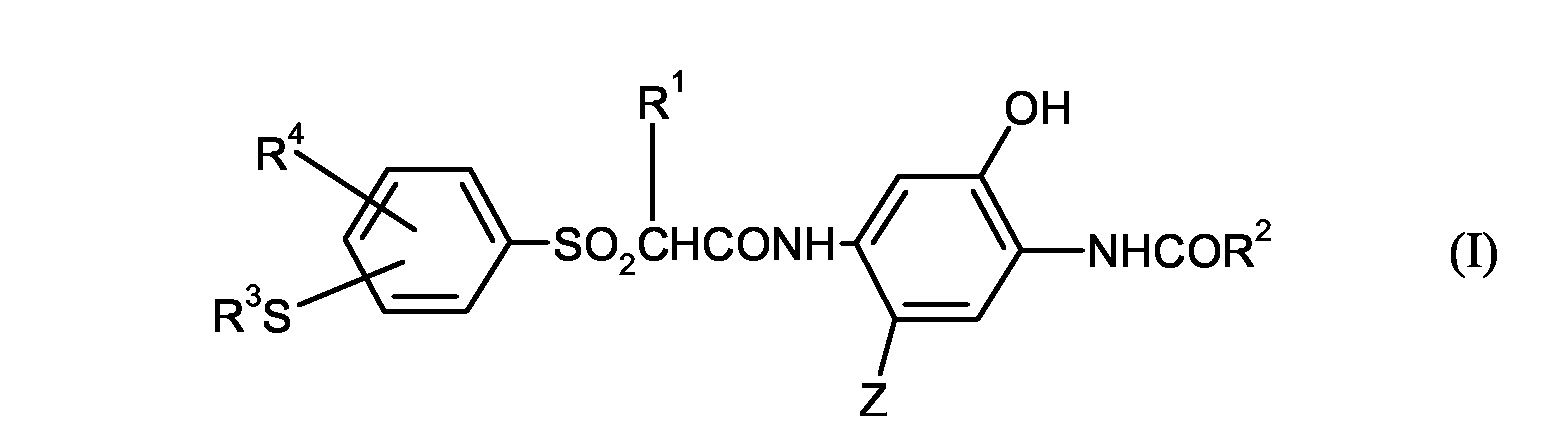
- R1
- means a hydrogen atom or an alkyl group,
- R2
- means an alkyl, aryl or hetaryl group,
- R3
- means an alkyl or aryl group,
- R4
- means an alkyl, alkenyl, alkoxy, aryloxy, acyloxy, acylamino, sulfonyloxy, sulfamoylamino, sulfonamido, ureido, hydroxycarbonyl, hydroxycarbonylamino, carbamoyl, alkylthio, arylthio, alkylamino or arylamino group or a hydrogen atom and
- Z
- means a hydrogen atom or a group eliminable under the conditions of chromogenic development,
- R1
- = an alkyl group;
- R2
- = unsubstituted or substituted phenyl, thienyl or thiazolyl group;
- R3
- = alkyl group;
- R4
- = hydrogen atom;
- Z
- = Cl.

- R5
- means a hydrogen atom or an alkyl group,
- R6
- means OR7 or NR8R9,
- R7
- means an unsubstituted or substituted alkyl group with 1 to 6 C atoms,
- R8
- means an unsubstituted or substituted alkyl group with 1 to 6 C atoms,
- R9
- means a hydrogen atom or an unsubstituted or substituted alkyl group with 1 to 6 C atoms,
- R10
- means an unsubstituted or substituted alkyl group and
- Z
- means a hydrogen atom or a group eliminable under the conditions of chromogenic development
wherein a heterocyclyl represents a saturated, unsaturated or aromatic heterocyclic radical and an acyl represents the radical of an aliphatic, olefinic or aromatic carboxylic, carbamic, carbonic, sulphonic, amidosulphonic, phosphoric, phosphonic, phosphorous, phosphinic or sulphinic acid.



Yield 310 g (98%) of 3
Yield 270 g (95%) of 4

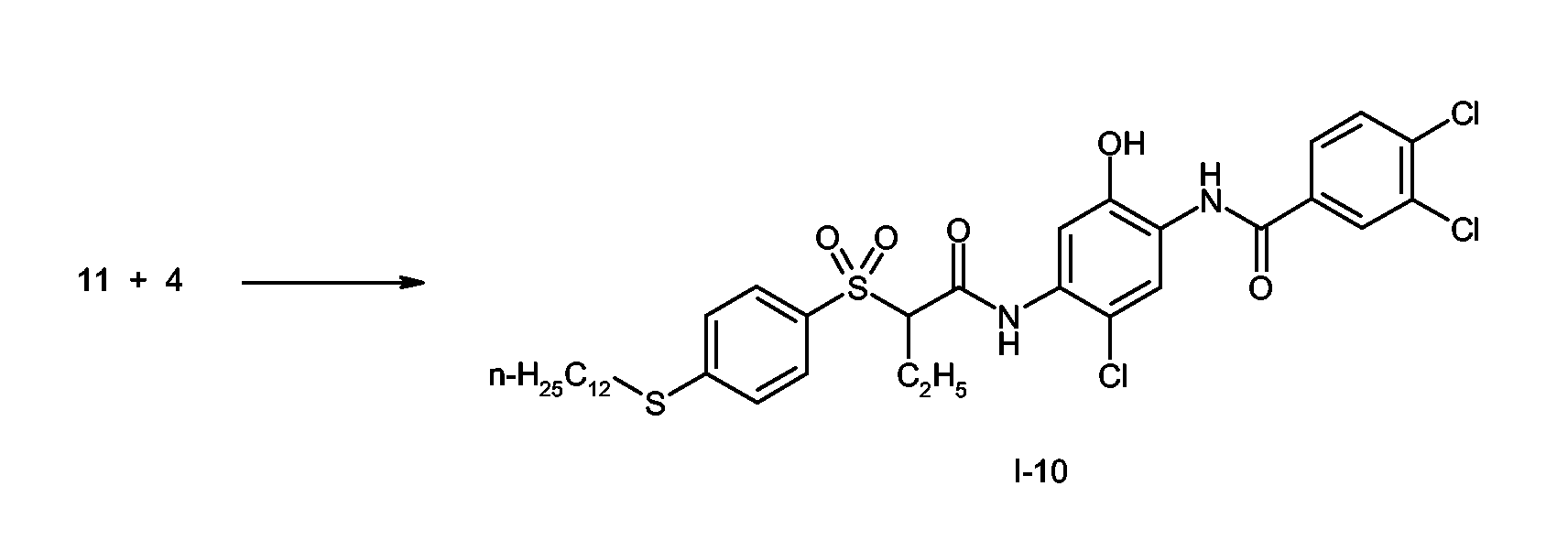
Yield: 120 g (81%) of I-10
- P-1
- polyvinyl acetate
- P-2
- polyvinyl propionate
- P-3
- polymethyl methacrylate
- P-4
- polyethyl methacrylate
- P-5
- polyethyl acrylate
- P-6
- polyheptyl acrylate
- P-7
- polybutyl acrylate
- P-8
- polybutyl methacrylate
- P-9
- polyisobutyl methacrylate
- P-10
- polyisopropyl methacrylate
- P-11
- polyoctyl acrylate
- P-12
- polyhexadecyl acrylate
- P-13
- polyhexyl acrylate
- P-14
- polyisobutyl acrylate
- P-15
- polyisopropyl acrylate
- P-16
- poly-3-methoxybutyl acrylate
- P-17
- poly-2-methoxyethyl acrylate
- P-18
- poly-4-methoxyphenyl acrylate
- P-19
- poly-3-methoxypropyl acrylate
- P-20
- polymethyl acrylate
- P-21
- polydecyl methacrylate
- P-22
- polydodecyl methacrylate
- P-23
- polydiethylaminoethyl methacrylate
- P-24
- polyethyl methacrylate
- P-25
- polyhexadecyl methacrylate
- P-26
- polyhexyl methacrylate
- P-27
- polydimethylaminoethyl methacrylate
- P-28
- poly-3,3-dimethylbutyl methacrylate
- P-29
- poly-3,3-dimethyl-2-butyl methacrylate
- P-30
- poly-3,5,5-trimethylhexyl methacrylate
- P-31
- polyoctadecyl methacrylate
- P-32
- polytetradecyl methacrylate
- P-33
- polypentyl acrylate
- P-34
- polypentyl methacrylate
- P-35
- polyethylethoxycarbonyl methacrylate
- P-36
- poly-N-sec-butylacrylamide
- P-37
- poly-N-tert-butylacrylamide
- P-38
- polyethyl ethacrylate
- P-39
- polycyclohexyl methacrylate
- P-40
- poly-tert-butyl methacrylate
- P-41
- poly-iso-butyl chloroacrylate
- P-42
- poly-N-tert-butylmethacrylamide
- P-43
- polymethylphenyl acrylate
- P-44
- polybenzyl acrylate
- P-45
- poly-sec-butyl acrylate
- P-46
- poly-tert-butyl acrylate
- P-47
- poly-2-tert-butylphenyl acrylate
- P-48
- poly-4-tert-butylphenyl acrylate
- P-49
- poly-2-methylbutyl acrylate
- P-50
- poly-3-methylbutyl acrylate
- P-51
- poly-1,3-dimethylbutyl acrylate
- P-52
- poly-2-methylpentyl acrylate
- P-53
- polyphenyl acrylate
- P-54
- polypropyl acrylate
- P-55
- poly-m-toluoyl acrylate
- P-56
- poly-o-toluoyl acrylate
- P-57
- poly-p-toluoyl acrylate
- P-58
- poly-N-butylacrylamide
- P-59
- poly-N,N-dibutylacrylamide
- P-60
- poly-N-iso-hexylacrylamide
- P-61
- poly-N-iso-octylacrylamide
- P-62
- poly-N-methyl-N-phenylacrylamide
- P-63
- polybenzyl methacrylate
- P-64
- poly-2-N-tert-butylaminoethyl methacrylate
- P-65
- poly-sec-butyl methacrylate
- P-66
- ethylene glycol/sebacic acid polyester
- P-67
- vinyl acetate/vinyl alcohol copolymer (95/5)
- P-68
- butyl acrylate/acrylamide copolymer (95/5)
- P-69
- stearyl methacrylate/acrylic acid copolymer (90/10)
- P-70
- methyl methacrylate/styrene copolymer (90/10)
- P-71
- methyl methacrylate/ethyl acrylate copolymer (50/50)
- P-72
- butyl methacrylate/methyl methacrylate/styrene copolymer (50/30/20)
- P-73:
- vinyl acetate/acrylamide copolymer (85/15)
- P-74
- diacetoneacrylamide/methyl methacrylate copolymer (50/50)
- P-75
- methyl vinyl ketone/iso-butyl methacrylate copolymer (55/45)
- P-76
- ethyl methacrylate/butyl acrylate (70/30)
- P-77
- diacetoneacrylamide/butyl acrylate copolymer (60/40)
- P-78
- methyl methacrylate/styrene/diacetoneacrylamide copolymer (40/40/20)
- P-79
- butyl acrylate/styrene/diacetoneacrylamide copolymer (70/20/10)
- P-80
- methyl methacrylate/styrene/vinylsulfonamide copolymer (70/20/10)
- P-81
- butyl acrylate/methyl methacrylate/butyl methacrylate copolymer (35/35/30)
- P-82
- methyl methacrylate/butyl methacrylate/iso-butyl methacrylate/acrylic acid copolymer (37/29/25/9)
- P-83
- butyl methacrylate/acrylic acid copolymer (95/5)
- P-84
- methyl methacrylate/acrylic acid copolymer (95/5)
- P-85
- butyl methacrylate/methyl methacrylate/benzyl methacrylate/acrylic acid copolymer (35/35/25/5)
- P-86
- cyclohexyl methacrylate/methyl methacrylate/propyl methacrylate copolymer (37/29/34)
- P-87
- methyl methacrylate/butyl methacrylate copolymer (65/35)
- P-88
- vinyl acetate/vinyl propionate copolymer (75/25)
- P-89
- butyl methacrylate/styrene copolymer (90/10)
- P-90
- N-tert-butylacrylamide/methyl methacrylate copolymer (60/40)
- P-91
- N-tert-butylacrylamide/ethyl acrylate copolymer (50/50)
- P-92
- methyl methacrylate/hexyl methacrylate copolymer (70/30)
- P-93
- poly-N-(1,1-dimethyl-3-oxobutyl)acrylamide
- P-94
- poly-N-octylmethacrylamide
- P-95
- N,N-diethylacrylamide/butyl acrylate copolymer (40/60)
- P-96
- N,N-diethylacrylamide/2-butoxyethyl acrylate copolymer (65/35)
- P-97
- N-tert-butylacrylamide/butyl acrylate copolymer (60/40)
- P-98
- N-tert-octylacrylamide/2-ethylhexyl acrylate copolymer (65/35)
- P-99
- N,N-dibutylacrylamide/dibutylmaleic acid copolymer (75/25)
- P-100
- N-tert-butylacrylamide/butyl acrylate copolymer (45/55)
- P-101
- N-octyl-N-ethylacrylamide/ethyl acrylate copolymer (45/55)
- P-102
- N-butylmethacrylamide/2-ethylhexyl acrylate copolymer (90/10)
- P-103
- N,N-dibutylmethacrylamide/propyl acrylate copolymer (80/20)
- P-104
- N-(2-phenylethyl)acrylamide/butyl acrylate copolymer (25/75)
- P-105
- N-acryloylmorpholine/2-ethoxyethyl acrylate copolymer (40/60)
- P-106
- N-methyl-N'-acryloylpiperazine/butyl acrylate copolymer (15/85)
- P-107
- N-acryloylpiperidine/2-butoxyethyl acrylate copolymer (40/60)
- P-108
- N-(1,1-dimethyl-3-hydroxybutyl)acrylamide/2-ethylhexyl ethacrylate copolymer (75/25)
- P-109
- N-acryloylpiperidine/butyl acrylate copolymer (50/50)
- P-110
- N-(p-hydroxyphenyl)acrylamide/butyl acrylate copolymer (25/75)
- P-111
- N-[3-(dimethylamino)propyl]acrylamide/butyl acrylate copolymer (35/65)
- P-112
- N-methyl-N'-methacryloylpiperazine/2-ethoxyethyl acrylate copolymer (40/60)
- P-113
- N-tert-butylacrylamide/butyl acrylate/2-ethoxyethyl acrylate copolymer (55/25/20)
- P-114
- 1,6-hexanediol/ascorbic acid/sebacic acid polyester
- P-115
- diethylene glycol/adipic acid polyester
- P-116
- trimethylolpropane/adipic acid/phthalic acid polyester
- P-117
- diethylene glycol/trimethylolpropane/adipic acid polyester
- P-118
- ethylene glycol/adipic acid polyester
- P-119
- ethylene glycol/1,4-butanediol/adipic acid polyester
- P-120
- 1,4-bis(β-hydroxyethoxy)benzene/sebacic acid polyester
- P-121
- ethylene glycol/azelaic acid polyester
- P-122
- 1,4-butanediol/adipic acid polyester
| Solution 01 | 5500 g | water |
| 700 g | gelatine | |
| 5 g | n-decanol | |
| 20 g | NaCl | |
| Solution 02 | 9300 g | water |
| 1800 g | NaCl | |
| Solution 03 | 9000 g | water |
| 5000 g | AgNO3 |
| Solution 11 | 1100 g | water |
| 136 g | gelatine | |
| 1 g | n-decanol | |
| 4 g | NaCl | |
| 195 g | EmM1 | |
| Solution 12 | 1860 g | water |
| 360 g | NaCl | |
| 56 µg | K2IrCl6 | |
| Solution 13 | 1800 g | water |
| 1000 g | AgNO3 |


| Solution 21 | 5500 g | water |
| 680 g | gelatine | |
| 5 g | n-decanol | |
| 20 g | NaCl | |
| 180 g | EmM1 | |
| Solution 22 | 9300 g | water |
| 1800 g | NaCl | |
| Solution 23 | 9000 g | water |
| 5000 g | AgNO3 |


- Layer 1:
- (Substrate layer)
0.10 g of gelatine - Layer 2:
- (Blue-sensitive layer)
Blue-sensitive silver halide emulsion EmB1 (99.94 mol% chloride, 0.06 mol% bromide, average grain diameter 0.85 µm) prepared from 0.4 g of AgNO3.
1.25 g of gelatine
0.30 g of yellow coupler GB-1
0.20 g of yellow coupler GB-2
0.30 g of tricresyl phosphate (TCP)
0.10 g of stabiliser ST-4 - Layer 3:
- (Interlayer)
0.10 g of gelatine
0.06 g of DOP scavenger SC-1
0.06 g of DOP scavenger SC-2
0.12 g of TCP - Layer 4:
- (Green-sensitive layer)
Green-sensitive silver halide emulsion EmG1 (99.9 mol% chloride, 0.1 mol% bromide, average grain diameter 0.48 µm) prepared from 0.2 g of AgNO3.
1.10 g of gelatine
0.05 g of magenta coupler PP-1
0.10 g of magenta coupler PP-2
0.15 g of stabiliser ST-5
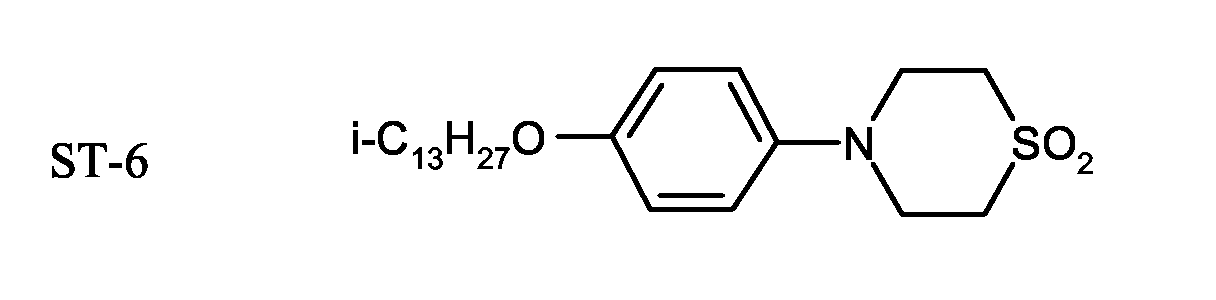
0.20 g of stabiliser ST-6
0.40 g of TCP - Layer 5:
- (UV protective layer)
1.05 g of gelatine
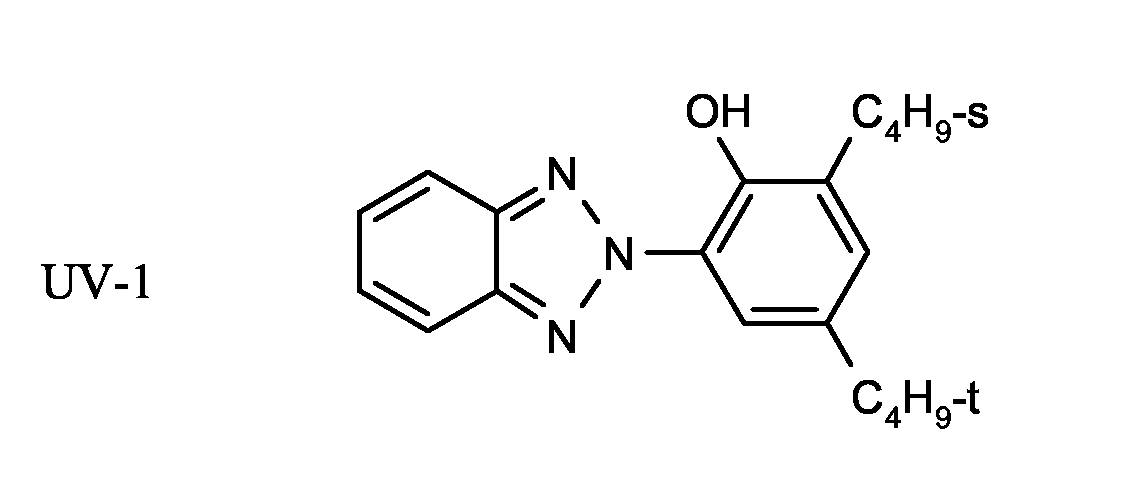
0.35 g of UV absorber UV-1
0.10 g of UV absorber UV-2
0.05 g of UV absorber UV-3
0.06 g of DOP scavenger SC-1
0.06 g of DOP scavenger SC-2
0.25 g of TCP - Layer 6:
- (Red-sensitive layer)
Red-sensitive silver halide emulsion EmR1 (99.7 mol% chloride, 0.3 mol% bromide, average grain diameter 0.48 µm) prepared from 0.28 g of AgNO3.
1.00 g of gelatine
0.40 g of cyan coupler according to Table 1
0.40 g of oil former according to Table 1 - Layer 7:
- (UV protective layer)
1.05 g of gelatine
0.35 g of UV absorber UV-1
0.10 g of UV absorber UV-2
0.05 g of UV absorber UV-3
0.15 g of TCP - Layer 8:
- (Protective layer)
0.90 g of gelatine
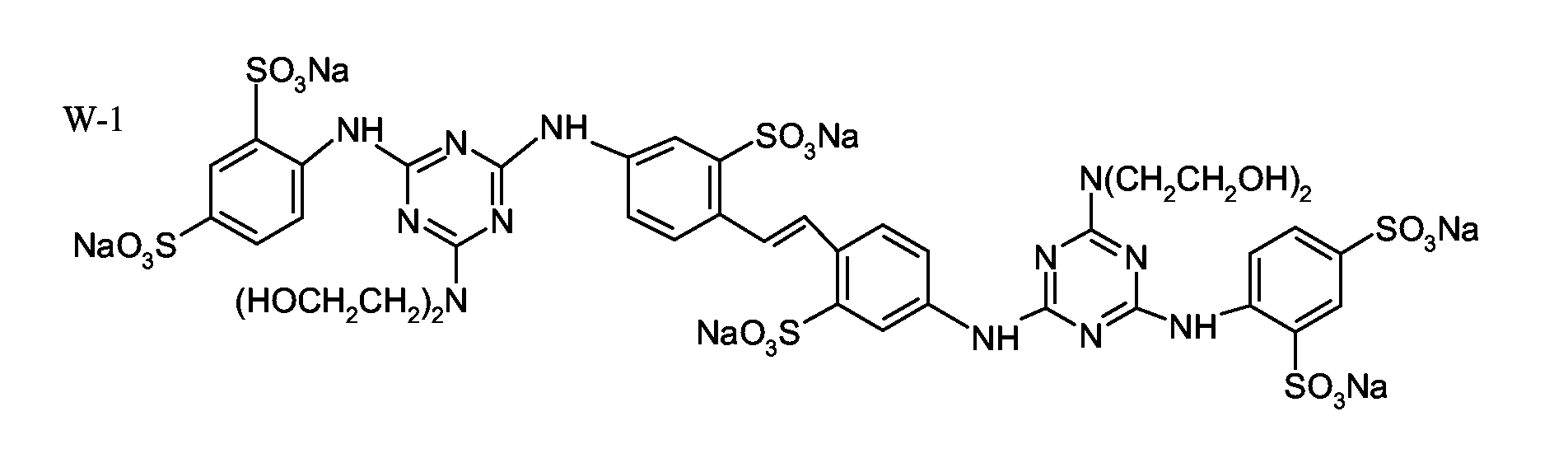
0.05 g of optical brightener W-1
0.07 g of polyvinylpyrrolidone
1.20 ml of silicone oil
2.50 mg of polymethyl methacrylate spacers, average particle size 0.8 µm
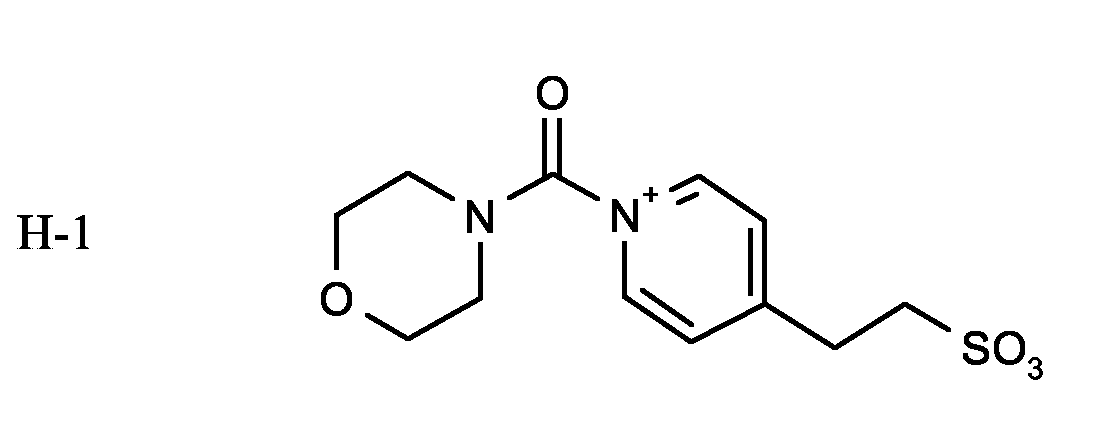
0.30 g of instant hardener H-1
| Triethanolamine | 9.0 g |
| N,N-Diethylhydroxylamine | 4.0 g |
| Diethylene glycol | 0.05 g |
| 3 -Methyl-4-amino-N-ethyl-N-methanesulfonamidoethylaniline sulfate | 5.0 g |
| Potassium sulfite | 0.2 g |
| Triethylene glycol | 0.05 g |
| Potassium carbonate | 22 g |
| Potassium hydroxide | 0.4 g |
| Ethylenediaminetetraacetic acid, disodium salt | 2.2 g |
| Potassium chloride | 2.5 g |
| 1,2-Dihydroxybenzene-3,4,6-trisulfonic acid trisodium salt | 0.3 g |
| make up with water to 1000 ml; pH 10.0 |
| Ammonium thiosulfate | 75 g |
| Sodium hydrogen sulfite | 13.5 g |
| Ammonium acetate | 2.0 g |
| Ethylenediaminetetraacetic acid (iron/ammonium salt) | 57 g |
| Ammonia, 25% make up with acetic acid to 1000 ml; pH 5.5 | 9.5 g |









Claims (11)
- A print material having a support, at least one red-sensitive silver halide emulsion layer containing at least one cyan coupler, at least one green-sensitive silver halide emulsion layer containing at least one magenta coupler and at least one blue-sensitive silver halide emulsion layer containing at least one yellow coupler, characterised in that the red-sensitive layer contains at least one oil former, the cyan coupler is of the formulain which
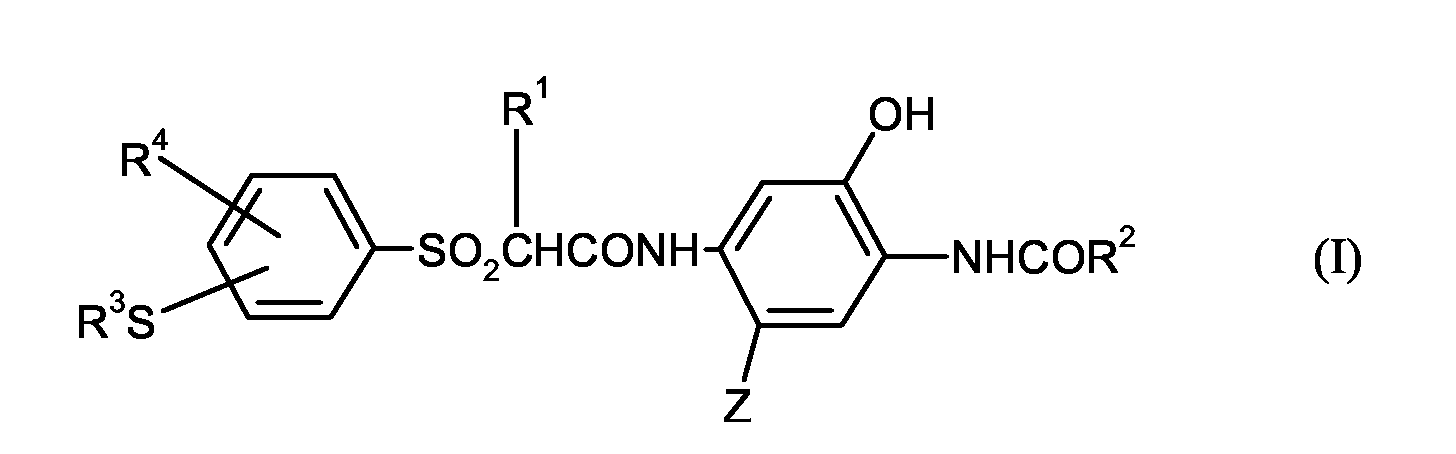
- R1
- means a hydrogen atom or an alkyl group,
- R2
- means an alkyl, aryl or hetaryl group,
- R3
- means an alkyl or aryl group,
- R4
- means an alkyl, alkenyl, alkoxy, aryloxy, acyloxy, acylamino, sulfonyloxy, sulfamoylamino, sulfonamido, ureido, hydroxycarbonyl, hydroxycarbonylamino, carbamoyl, alkylthio, arylthio, alkylamino or arylamino group or a hydrogen atom and
- Z
- means a hydrogen atom or a group eliminable under the conditions of chromogenic development,
- A print material according to claim 1, characterised in that it is a colour negative material.
- A print material according to one of claims 1 or 2, characterised in that the cyan coupler is of the formulain which
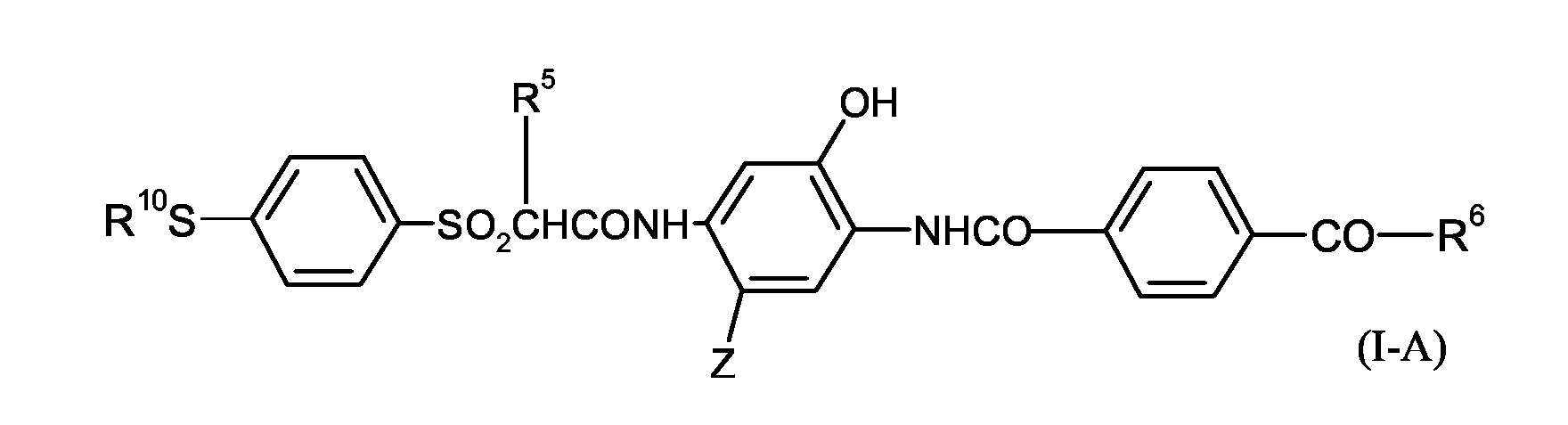
- R5
- means a hydrogen atom or an alkyl group,
- R6
- means OR7 or NR8R9,
- R7
- means an unsubstituted or substituted alkyl group with 1 to 6 C atoms,
- R8
- means an unsubstituted or substituted alkyl group with 1 to 6 C atoms,
- R9
- means a hydrogen atom or an unsubstituted or substituted alkyl group with 1 to 6 C atoms,
- R10
- means an unsubstituted or substituted alkyl group and
- Z
- means a hydrogen atom or a group eliminable under the conditions of chromogenic development,
- A print material according to any one of claims 1 to 3, characterised in that the oil former comprises a high-boiling organic solvent and/or a polymer.
- A print material according to one of claims 1 to 4, characterised in that the ratio by weight of oil former : cyan coupler is at least 0.05:1.
- A print material according to any one of claims 1 to 5, characterised in that the oil former is a high-boiling organic solvent.
- A print material according to one of claims 4 to 5, characterised in that the polymer comprises a homo- or copolymer, which is insoluble in water and soluble in organic solvents.
- A print material according to any one of claims 1 to 7, characterised in that the silver halide crystals of the red-sensitive layer have a chloride content of at least 95 mol%.
- A process for the production of a positive reflection print from a colour negative, wherein the image information is exposed onto a print material and the material is subsequently processed in a manner appropriate to its type, which process is characterised in that the above-described print material according to one of claims 1 to 8 is used.
- A process according to claim 9, characterised in that the colour negative is digitised and exposure is performed with a scanning printer.
- A process according to claim 9, characterised in that the exposure is performed with an analogue printer.
Applications Claiming Priority (2)
| Application Number | Priority Date | Filing Date | Title |
|---|---|---|---|
| DE10230978 | 2002-07-10 | ||
| DE10230978A DE10230978A1 (en) | 2002-07-10 | 2002-07-10 | Color photographic copy material |
Publications (2)
| Publication Number | Publication Date |
|---|---|
| EP1380893A2 true EP1380893A2 (en) | 2004-01-14 |
| EP1380893A3 EP1380893A3 (en) | 2004-01-28 |
Family
ID=29723811
Family Applications (1)
| Application Number | Title | Priority Date | Filing Date |
|---|---|---|---|
| EP03101465A Withdrawn EP1380893A3 (en) | 2002-07-10 | 2003-05-22 | Colour photographic print material |
Country Status (4)
| Country | Link |
|---|---|
| US (1) | US6806042B2 (en) |
| EP (1) | EP1380893A3 (en) |
| JP (1) | JP2004038182A (en) |
| DE (1) | DE10230978A1 (en) |
Families Citing this family (5)
| Publication number | Priority date | Publication date | Assignee | Title |
|---|---|---|---|---|
| DE10354547B4 (en) * | 2003-11-21 | 2005-10-20 | Agfa Gevaert Ag | Color photographic copy material |
| KR101680557B1 (en) * | 2012-05-22 | 2016-11-29 | 가부시끼가이샤 히다치 세이사꾸쇼 | Thermoelectric conversion module |
| KR102141164B1 (en) * | 2013-09-06 | 2020-08-04 | 엘지이노텍 주식회사 | Cooling thermoelectric moudule and device using the same |
| EP3634350B1 (en) | 2017-06-05 | 2021-10-06 | The Procter & Gamble Company | Configurable absorbent articles having improved bodily exudate visualization |
| JP7308276B2 (en) | 2019-02-21 | 2023-07-13 | ザ プロクター アンド ギャンブル カンパニー | Absorbent article with fully removable fastening members |
Family Cites Families (10)
| Publication number | Priority date | Publication date | Assignee | Title |
|---|---|---|---|---|
| JP2670943B2 (en) | 1992-05-26 | 1997-10-29 | 富士写真フイルム株式会社 | Photographic coupler and silver halide color photographic light-sensitive material |
| US5888716A (en) | 1996-08-20 | 1999-03-30 | Eastman Kodak Company | Photographic element containing improved coupler set |
| DE19646855A1 (en) * | 1996-11-13 | 1998-05-14 | Agfa Gevaert Ag | Improving sensitivity of photographic emulsions using cyanine dyes |
| US6251575B1 (en) * | 1999-12-28 | 2001-06-26 | Eastman Kodak Company | Photographic element, compound, and process |
| US6207363B1 (en) * | 1999-12-28 | 2001-03-27 | Eastman Kodak Company | Photographic element, compound, and process |
| US6197492B1 (en) * | 1999-12-28 | 2001-03-06 | Eastman Kodak Company | Photographic element, compound, and process |
| DE10055094A1 (en) * | 2000-11-07 | 2002-05-29 | Agfa Gevaert Ag | Silver halide material used in digital film, comprises silver halide emulsions containing a magenta, a cyan and a yellow coupler, and a light-sensitive silver halide layer |
| DE10101222A1 (en) * | 2001-01-12 | 2002-07-25 | Agfa Gevaert Ag | Color photographic material especially used as a print material contains a 2-acylamino-5-phenylsulfonylmethylcarbonylamino-phenol cyan coupler and 2,4,6-triphenyl-triazine UV absorber |
| DE10101221A1 (en) * | 2001-01-12 | 2002-07-25 | Agfa Gevaert Ag | Photographic copying material used for e.g. photographic paper and color reversal paper, contains a 2-acylamino-5-phenylsulfonylmethylcarbonylamino-phenol cyan coupler |
| DE10221125B3 (en) * | 2002-05-13 | 2004-02-05 | Agfa-Gevaert Ag | Color photographic copy material |
-
2002
- 2002-07-10 DE DE10230978A patent/DE10230978A1/en not_active Withdrawn
-
2003
- 2003-05-22 EP EP03101465A patent/EP1380893A3/en not_active Withdrawn
- 2003-07-02 US US10/612,132 patent/US6806042B2/en not_active Expired - Fee Related
- 2003-07-09 JP JP2003272351A patent/JP2004038182A/en not_active Ceased
Also Published As
| Publication number | Publication date |
|---|---|
| EP1380893A3 (en) | 2004-01-28 |
| US20040023171A1 (en) | 2004-02-05 |
| US6806042B2 (en) | 2004-10-19 |
| JP2004038182A (en) | 2004-02-05 |
| DE10230978A1 (en) | 2004-01-29 |
Similar Documents
| Publication | Publication Date | Title |
|---|---|---|
| US5001045A (en) | Silver halide color photographic material containing sparingly water soluble epoxy compound and organic soluble polymer | |
| EP0256531B1 (en) | Silver halide color photographic material | |
| US5006453A (en) | Silver halide color photographic material having improved dye image stability | |
| JPH0823677B2 (en) | Silver halide color photographic light-sensitive material | |
| JP2717883B2 (en) | Silver halide color photographic materials | |
| US6806042B2 (en) | Color photographic print material | |
| EP0382444B1 (en) | Silver halide photographic light-sensitive material | |
| EP0353714B1 (en) | Silver halide photographic photosensitive materials | |
| US5474882A (en) | Silver halide color photographic materials | |
| JP2631466B2 (en) | Silver halide color photographic materials | |
| JP2665614B2 (en) | Silver halide color photographic light-sensitive material | |
| US5310638A (en) | Silver halide color photographic material comprising at least one DIR-hydroquinone compound, and having a total silver content of less than 1.0 g/m2 | |
| JP2896437B2 (en) | Silver halide color photosensitive material | |
| JP2618728B2 (en) | Silver halide photographic material | |
| DE10230979B3 (en) | Color photographic copying material, for making positive print from color negative with scanning or analogue copier, uses 2-acylamino-5-(organylthio-phenylsulfonyl)-alkylcarbonylamino)-phenol as cyan coupler with solvent-soluble polymer | |
| EP0481333B1 (en) | A silver halide color photographic material | |
| JP2952854B2 (en) | Silver halide color photosensitive material | |
| JPH0823675B2 (en) | Silver halide color photographic light-sensitive material | |
| JP2933400B2 (en) | Silver halide photographic material | |
| JP2779644B2 (en) | Silver halide photographic material | |
| JPH0823678B2 (en) | Silver halide color photographic light-sensitive material | |
| JPH087422B2 (en) | Image forming method | |
| JP2001133945A (en) | Silver halide color photographic sensitive material | |
| JPH05216189A (en) | Silver halide color photographic material and formation of color photographic image | |
| JPH0823676B2 (en) | Silver halide color photographic light-sensitive material |
Legal Events
| Date | Code | Title | Description |
|---|---|---|---|
| PUAI | Public reference made under article 153(3) epc to a published international application that has entered the european phase |
Free format text: ORIGINAL CODE: 0009012 |
|
| PUAL | Search report despatched |
Free format text: ORIGINAL CODE: 0009013 |
|
| AK | Designated contracting states |
Kind code of ref document: A2 Designated state(s): AT BE BG CH CY CZ DE DK EE ES FI FR GB GR HU IE IT LI LU MC NL PT RO SE SI SK TR |
|
| AX | Request for extension of the european patent |
Extension state: AL LT LV MK |
|
| AK | Designated contracting states |
Kind code of ref document: A3 Designated state(s): AT BE BG CH CY CZ DE DK EE ES FI FR GB GR HU IE IT LI LU MC NL PT RO SE SI SK TR |
|
| AX | Request for extension of the european patent |
Extension state: AL LT LV MK |
|
| RIC1 | Information provided on ipc code assigned before grant |
Ipc: 7G 03C 7/388 B Ipc: 7G 03C 7/34 A |
|
| 17P | Request for examination filed |
Effective date: 20040728 |
|
| AKX | Designation fees paid |
Designated state(s): DE NL |
|
| RAP1 | Party data changed (applicant data changed or rights of an application transferred) |
Owner name: AGFAPHOTO GMBH |
|
| 17Q | First examination report despatched |
Effective date: 20050520 |
|
| 19U | Interruption of proceedings before grant |
Effective date: 20060101 |
|
| 19W | Proceedings resumed before grant after interruption of proceedings |
Effective date: 20100401 |
|
| STAA | Information on the status of an ep patent application or granted ep patent |
Free format text: STATUS: THE APPLICATION IS DEEMED TO BE WITHDRAWN |
|
| 18D | Application deemed to be withdrawn |
Effective date: 20101002 |