EP1380567A1 - Chiral compounds as dopants for liquid crystals - Google Patents
Chiral compounds as dopants for liquid crystals Download PDFInfo
- Publication number
- EP1380567A1 EP1380567A1 EP03014549A EP03014549A EP1380567A1 EP 1380567 A1 EP1380567 A1 EP 1380567A1 EP 03014549 A EP03014549 A EP 03014549A EP 03014549 A EP03014549 A EP 03014549A EP 1380567 A1 EP1380567 A1 EP 1380567A1
- Authority
- EP
- European Patent Office
- Prior art keywords
- ooc
- coo
- liquid crystal
- optically active
- active compound
- Prior art date
- Legal status (The legal status is an assumption and is not a legal conclusion. Google has not performed a legal analysis and makes no representation as to the accuracy of the status listed.)
- Withdrawn
Links
- 150000001875 compounds Chemical class 0.000 title claims abstract description 64
- 239000002019 doping agent Substances 0.000 title claims abstract description 43
- 239000004973 liquid crystal related substance Substances 0.000 title claims description 34
- 239000000203 mixture Substances 0.000 claims abstract description 48
- 239000004988 Nematic liquid crystal Substances 0.000 claims abstract description 21
- 230000007423 decrease Effects 0.000 claims abstract description 8
- 229910052799 carbon Inorganic materials 0.000 claims abstract description 5
- 125000001140 1,4-phenylene group Chemical group [H]C1=C([H])C([*:2])=C([H])C([H])=C1[*:1] 0.000 claims abstract description 4
- 125000004959 2,6-naphthylene group Chemical group [H]C1=C([H])C2=C([H])C([*:1])=C([H])C([H])=C2C([H])=C1[*:2] 0.000 claims abstract description 4
- 125000005407 trans-1,4-cyclohexylene group Chemical group [H]C1([H])C([H])([H])[C@]([H])([*:2])C([H])([H])C([H])([H])[C@@]1([H])[*:1] 0.000 claims abstract description 4
- OKTJSMMVPCPJKN-UHFFFAOYSA-N Carbon Chemical compound [C] OKTJSMMVPCPJKN-UHFFFAOYSA-N 0.000 claims abstract description 3
- 239000000758 substrate Substances 0.000 claims description 7
- 239000012044 organic layer Substances 0.000 description 20
- HEMHJVSKTPXQMS-UHFFFAOYSA-M Sodium hydroxide Chemical compound [OH-].[Na+] HEMHJVSKTPXQMS-UHFFFAOYSA-M 0.000 description 18
- VEXZGXHMUGYJMC-UHFFFAOYSA-N Hydrochloric acid Chemical compound Cl VEXZGXHMUGYJMC-UHFFFAOYSA-N 0.000 description 16
- XLYOFNOQVPJJNP-UHFFFAOYSA-N water Substances O XLYOFNOQVPJJNP-UHFFFAOYSA-N 0.000 description 16
- 230000015572 biosynthetic process Effects 0.000 description 13
- 238000003786 synthesis reaction Methods 0.000 description 13
- JUJWROOIHBZHMG-UHFFFAOYSA-N Pyridine Chemical compound C1=CC=NC=C1 JUJWROOIHBZHMG-UHFFFAOYSA-N 0.000 description 12
- YXFVVABEGXRONW-UHFFFAOYSA-N Toluene Chemical compound CC1=CC=CC=C1 YXFVVABEGXRONW-UHFFFAOYSA-N 0.000 description 12
- 239000000243 solution Substances 0.000 description 11
- FYSNRJHAOHDILO-UHFFFAOYSA-N thionyl chloride Chemical compound ClS(Cl)=O FYSNRJHAOHDILO-UHFFFAOYSA-N 0.000 description 10
- PMZURENOXWZQFD-UHFFFAOYSA-L Sodium Sulfate Chemical compound [Na+].[Na+].[O-]S([O-])(=O)=O PMZURENOXWZQFD-UHFFFAOYSA-L 0.000 description 8
- 238000006243 chemical reaction Methods 0.000 description 8
- 239000002904 solvent Substances 0.000 description 8
- PMTBQTYJEWXXLR-JWQCQUIFSA-N 3-[4-[(2R)-4-ethylhexan-2-yl]oxycarbonylphenyl]-4-[4-[(2R)-heptan-2-yl]oxycarbonylphenyl]benzoic acid Chemical compound C1=CC(C(=O)O[C@H](C)CCCCC)=CC=C1C1=CC=C(C(O)=O)C=C1C1=CC=C(C(=O)O[C@H](C)CC(CC)CC)C=C1 PMTBQTYJEWXXLR-JWQCQUIFSA-N 0.000 description 7
- 239000005262 ferroelectric liquid crystals (FLCs) Substances 0.000 description 7
- 239000007788 liquid Substances 0.000 description 7
- ALAPJJMGVQNJIU-SSDOTTSWSA-N (2r)-4-ethylhexan-2-ol Chemical compound CCC(CC)C[C@@H](C)O ALAPJJMGVQNJIU-SSDOTTSWSA-N 0.000 description 6
- WFDIJRYMOXRFFG-UHFFFAOYSA-N Acetic anhydride Chemical compound CC(=O)OC(C)=O WFDIJRYMOXRFFG-UHFFFAOYSA-N 0.000 description 6
- OKKJLVBELUTLKV-UHFFFAOYSA-N Methanol Chemical compound OC OKKJLVBELUTLKV-UHFFFAOYSA-N 0.000 description 6
- 239000007864 aqueous solution Substances 0.000 description 6
- UMJSCPRVCHMLSP-UHFFFAOYSA-N pyridine Natural products COC1=CC=CN=C1 UMJSCPRVCHMLSP-UHFFFAOYSA-N 0.000 description 6
- 210000004027 cell Anatomy 0.000 description 5
- 238000000034 method Methods 0.000 description 5
- 239000004986 Cholesteric liquid crystals (ChLC) Substances 0.000 description 4
- YMWUJEATGCHHMB-UHFFFAOYSA-N Dichloromethane Chemical class ClCCl YMWUJEATGCHHMB-UHFFFAOYSA-N 0.000 description 4
- CETWDUZRCINIHU-SSDOTTSWSA-N Heptan-2R-ol Chemical compound CCCCC[C@@H](C)O CETWDUZRCINIHU-SSDOTTSWSA-N 0.000 description 4
- BAVYZALUXZFZLV-UHFFFAOYSA-N Methylamine Chemical compound NC BAVYZALUXZFZLV-UHFFFAOYSA-N 0.000 description 4
- 230000006399 behavior Effects 0.000 description 4
- WPYMKLBDIGXBTP-UHFFFAOYSA-N benzoic acid Chemical compound OC(=O)C1=CC=CC=C1 WPYMKLBDIGXBTP-UHFFFAOYSA-N 0.000 description 4
- 239000012043 crude product Substances 0.000 description 4
- 238000002425 crystallisation Methods 0.000 description 4
- 230000008025 crystallization Effects 0.000 description 4
- CETWDUZRCINIHU-UHFFFAOYSA-N methyl-n-amyl-carbinol Natural products CCCCCC(C)O CETWDUZRCINIHU-UHFFFAOYSA-N 0.000 description 4
- 238000002360 preparation method Methods 0.000 description 4
- 238000010898 silica gel chromatography Methods 0.000 description 4
- QTBSBXVTEAMEQO-UHFFFAOYSA-N Acetic acid Chemical compound CC(O)=O QTBSBXVTEAMEQO-UHFFFAOYSA-N 0.000 description 3
- 230000015556 catabolic process Effects 0.000 description 3
- 238000006731 degradation reaction Methods 0.000 description 3
- 230000014509 gene expression Effects 0.000 description 3
- 239000011159 matrix material Substances 0.000 description 3
- 230000003287 optical effect Effects 0.000 description 3
- 125000001424 substituent group Chemical group 0.000 description 3
- CGEOYYBCLBIBLG-UHFFFAOYSA-N (4-carbonochloridoylphenyl) acetate Chemical compound CC(=O)OC1=CC=C(C(Cl)=O)C=C1 CGEOYYBCLBIBLG-UHFFFAOYSA-N 0.000 description 2
- XCIRVDISZPDLCO-CQSZACIVSA-N 3-[(2R)-4-ethylhexan-2-yl]-4-(4-hydroxyphenyl)benzoic acid Chemical compound CCC(CC)C[C@@H](C)C1=C(C=CC(=C1)C(=O)O)C2=CC=C(C=C2)O XCIRVDISZPDLCO-CQSZACIVSA-N 0.000 description 2
- QULSGAZEIPNKRY-OAHLLOKOSA-N 4-(4-acetyloxyphenyl)-3-[(2R)-4-ethylhexan-2-yl]benzoic acid Chemical compound CCC(CC)C[C@@H](C)C1=C(C=CC(=C1)C(=O)O)C2=CC=C(C=C2)OC(=O)C QULSGAZEIPNKRY-OAHLLOKOSA-N 0.000 description 2
- IHTQUKBUJJKNFQ-UHFFFAOYSA-N 4-(4-acetyloxyphenyl)benzoic acid Chemical compound C1=CC(OC(=O)C)=CC=C1C1=CC=C(C(O)=O)C=C1 IHTQUKBUJJKNFQ-UHFFFAOYSA-N 0.000 description 2
- QDBOAKPEXMMQFO-UHFFFAOYSA-N 4-(4-carbonochloridoylphenyl)benzoyl chloride Chemical compound C1=CC(C(=O)Cl)=CC=C1C1=CC=C(C(Cl)=O)C=C1 QDBOAKPEXMMQFO-UHFFFAOYSA-N 0.000 description 2
- GHTDSHKNBDQXKA-JWQCQUIFSA-N 4-[4-[(2R)-4-ethylhexan-2-yl]oxycarbonylphenyl]-3-[4-[(2R)-heptan-2-yl]oxycarbonylphenyl]benzoic acid Chemical compound C1=CC(C(=O)O[C@H](C)CCCCC)=CC=C1C1=CC(C(O)=O)=CC=C1C1=CC=C(C(=O)O[C@H](C)CC(CC)CC)C=C1 GHTDSHKNBDQXKA-JWQCQUIFSA-N 0.000 description 2
- IFHBWCJJUMWPNV-GFCCVEGCSA-N [(2r)-4-ethylhexan-2-yl] 4-acetyloxybenzoate Chemical compound CCC(CC)C[C@@H](C)OC(=O)C1=CC=C(OC(C)=O)C=C1 IFHBWCJJUMWPNV-GFCCVEGCSA-N 0.000 description 2
- SZMNRJYJKKNTNY-LLVKDONJSA-N [(2r)-4-ethylhexan-2-yl] 4-hydroxybenzoate Chemical compound CCC(CC)C[C@@H](C)OC(=O)C1=CC=C(O)C=C1 SZMNRJYJKKNTNY-LLVKDONJSA-N 0.000 description 2
- VNEQZXWAINGMGB-LLVKDONJSA-N [(2r)-heptan-2-yl] 4-hydroxybenzoate Chemical compound CCCCC[C@@H](C)OC(=O)C1=CC=C(O)C=C1 VNEQZXWAINGMGB-LLVKDONJSA-N 0.000 description 2
- DVZXBSMBMDKMPP-UHFFFAOYSA-N [4-(4-carbonochloridoylphenyl)phenyl] acetate Chemical compound C1=CC(OC(=O)C)=CC=C1C1=CC=C(C(Cl)=O)C=C1 DVZXBSMBMDKMPP-UHFFFAOYSA-N 0.000 description 2
- 230000000052 comparative effect Effects 0.000 description 2
- 210000002858 crystal cell Anatomy 0.000 description 2
- 230000003247 decreasing effect Effects 0.000 description 2
- 230000001939 inductive effect Effects 0.000 description 2
- LXEJRKJRKIFVNY-UHFFFAOYSA-N terephthaloyl chloride Chemical compound ClC(=O)C1=CC=C(C(Cl)=O)C=C1 LXEJRKJRKIFVNY-UHFFFAOYSA-N 0.000 description 2
- 150000003613 toluenes Chemical class 0.000 description 2
- 238000005160 1H NMR spectroscopy Methods 0.000 description 1
- JTGCXYYDAVPSFD-UHFFFAOYSA-N 4-(4-hydroxyphenyl)benzoic acid Chemical compound C1=CC(C(=O)O)=CC=C1C1=CC=C(O)C=C1 JTGCXYYDAVPSFD-UHFFFAOYSA-N 0.000 description 1
- GDBUZIKSJGRBJP-UHFFFAOYSA-N 4-acetoxy benzoic acid Chemical compound CC(=O)OC1=CC=C(C(O)=O)C=C1 GDBUZIKSJGRBJP-UHFFFAOYSA-N 0.000 description 1
- FHAWLSBXZSVBAD-OAHLLOKOSA-N [(2r)-heptan-2-yl] 4-(4-hydroxyphenyl)benzoate Chemical compound C1=CC(C(=O)O[C@H](C)CCCCC)=CC=C1C1=CC=C(O)C=C1 FHAWLSBXZSVBAD-OAHLLOKOSA-N 0.000 description 1
- 239000000654 additive Substances 0.000 description 1
- 230000000996 additive effect Effects 0.000 description 1
- 230000005540 biological transmission Effects 0.000 description 1
- 239000013078 crystal Substances 0.000 description 1
- 238000004821 distillation Methods 0.000 description 1
- 230000000694 effects Effects 0.000 description 1
- 238000001914 filtration Methods 0.000 description 1
- 230000020169 heat generation Effects 0.000 description 1
- 238000005259 measurement Methods 0.000 description 1
- 230000010287 polarization Effects 0.000 description 1
- 239000007787 solid Substances 0.000 description 1
- 230000002269 spontaneous effect Effects 0.000 description 1
- 238000003756 stirring Methods 0.000 description 1
- QAOWNCQODCNURD-UHFFFAOYSA-N sulfuric acid Substances OS(O)(=O)=O QAOWNCQODCNURD-UHFFFAOYSA-N 0.000 description 1
- 230000007704 transition Effects 0.000 description 1
Images
Classifications
-
- C—CHEMISTRY; METALLURGY
- C09—DYES; PAINTS; POLISHES; NATURAL RESINS; ADHESIVES; COMPOSITIONS NOT OTHERWISE PROVIDED FOR; APPLICATIONS OF MATERIALS NOT OTHERWISE PROVIDED FOR
- C09K—MATERIALS FOR MISCELLANEOUS APPLICATIONS, NOT PROVIDED FOR ELSEWHERE
- C09K19/00—Liquid crystal materials
- C09K19/52—Liquid crystal materials characterised by components which are not liquid crystals, e.g. additives with special physical aspect: solvents, solid particles
- C09K19/58—Dopants or charge transfer agents
- C09K19/586—Optically active dopants; chiral dopants
-
- C—CHEMISTRY; METALLURGY
- C07—ORGANIC CHEMISTRY
- C07C—ACYCLIC OR CARBOCYCLIC COMPOUNDS
- C07C69/00—Esters of carboxylic acids; Esters of carbonic or haloformic acids
- C07C69/76—Esters of carboxylic acids having a carboxyl group bound to a carbon atom of a six-membered aromatic ring
- C07C69/94—Esters of carboxylic acids having a carboxyl group bound to a carbon atom of a six-membered aromatic ring of polycyclic hydroxy carboxylic acids, the hydroxy groups and the carboxyl groups of which are bound to carbon atoms of six-membered aromatic rings
-
- C—CHEMISTRY; METALLURGY
- C09—DYES; PAINTS; POLISHES; NATURAL RESINS; ADHESIVES; COMPOSITIONS NOT OTHERWISE PROVIDED FOR; APPLICATIONS OF MATERIALS NOT OTHERWISE PROVIDED FOR
- C09K—MATERIALS FOR MISCELLANEOUS APPLICATIONS, NOT PROVIDED FOR ELSEWHERE
- C09K2323/00—Functional layers of liquid crystal optical display excluding electroactive liquid crystal layer characterised by chemical composition
Definitions
- the present invention relates to a novel optically active compound useful as a chiral dopant, a liquid crystal composition containing the compound, and a liquid crystal display device to which the liquid crystal composition is applied. More specifically, it relates to a chiral dopant having a helical twisting power (HTP) of at least 10 and having the property of its induced helical pitch decreasing in length with an increase in temperature, and a use thereof.
- HTP helical twisting power
- the mode that requires the control of the helical pitch of a liquid crystal includes the following modes.
- TN mode twisted nematic mode
- STN mode super twisted nematic mode
- liquid crystal molecules are aligned so as to twist 90 degrees between an upper substrate and a lower substrate, and a 1/4 pitch of a helix is formed in a cell.
- liquid crystal molecules are aligned so as to twist approximately 220 degrees between an upper substrate and a lower substrate, and an approximately 3/5 pitch of a helix is formed in a cell.
- the TN mode is employed in a simple matrix driving liquid crystal display device and an active matrix driving liquid crystal display device
- the STN mode is employed in a simple matrix driving liquid crystal display device.
- a selective reflection (SR) mode of a chiral nematic liquid crystal as another mode in addition to the above TN mode and STN mode.
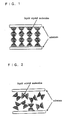
- SR mode as shown in Figs. 1 and 2, a liquid crystal has a planar alignment state in which helical axes are perpendicular to substrates (Fig. 1) and a focal-conic alignment state in which directions of helical axes are at random (Fig. 2). These two states are switched from one to the other with voltage pulse.
- the planar alignment state light having a wavelength corresponding to a helical pitch is reflected, and in the focal-conic alignment state, light is transmitted through a device.
- a reflection state is used as "bright” and when a transmission state is used as "dark", a display can be materialized.
- liquid crystal means a composition containing a plurality of liquid crystal compounds unless it is specified to be a specific compound.
- a “chiral dopant” means an optical compound that induces a helical structure or a mixture of such a compound.
- a “base liquid crystal” means a nematic liquid crystal containing no chiral dopant.
- an optically active compound that induces a helical structure is generally called "chiral dopant”.
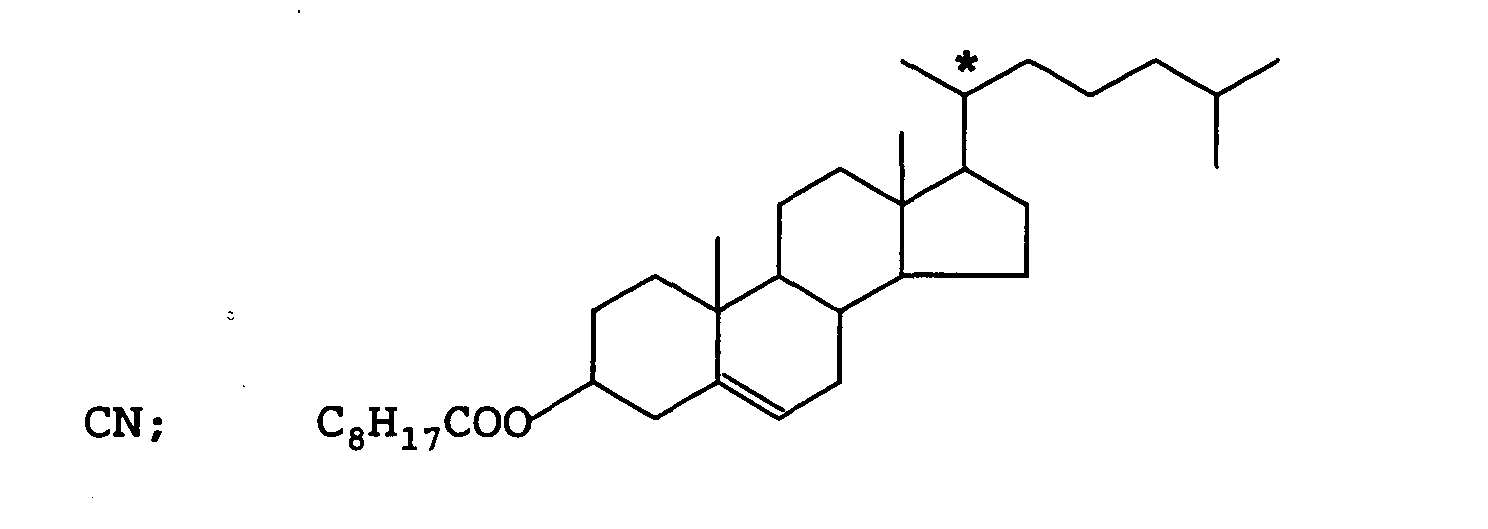
- Many chiral dopants have been synthesized, and typical compounds thereof are compounds having the following structures.
- chiral dopants themselves exhibit no liquid crystallinity, and most of them have large molecular weights.
- a large amount of a chiral dopant is added to a base liquid crystal, it degrades various performances in many cases.
- the degradation of the performances includes a decrease in temperature for phase transition from an isotropic phase to a nematic phase, an increase in viscosity of a liquid crystal and an easy occurrence of crystallization.
- a chiral dopant having large helical twisting power serves to prevent the degradation of the various performances, since a desired helical pitch can be obtained by adding a small amount of such a chiral dopant to a base liquid crystal.
- the SR mode further has a problem that the helical pitch depends upon temperatures. That is, in the SR mode, a liquid crystal reflects (selectively reflects) light corresponding to a helical pitch to generate a bright state.
- the helical pitch increases in length with an increase in temperature, so that there is caused a problem that reflected light changes in color.
- wavelength shift A change in wavelength of selectively reflected light with an increase in temperature is referred to as "wavelength shift".
- An increase in wavelength of selectively reflected light caused by an increase in temperature is defined to be plus wavelength shift, and a decrease in wavelength of selectively reflected light is defined to be minus wavelength shift.
- JP-A-02-227489 and JP-A-5-17405 disclose compounds having similar skeleton structures and having molecules containing optically active groups on both of their terminals.
- the compounds disclosed in these JP Publications have a characteristic feature in a molecular structure. That is, a polar substituent is introduced into their skeleton portions.
- a chiral dopant for a ferroelectric liquid crystal and a chiral dopant for a nematic liquid crystal greatly differ in performances that they are required to achieve, and the chiral dopant for a ferroelectric liquid crystal cannot be used as a chiral dopant for a nematic liquid crystal.
- the chiral dopant for a ferroelectric liquid crystal plays a main role in introducing asymmetry to a liquid crystal composition (generating a ferroelectric property) and inducing spontaneous polarization. Almost polarizing polar substituent (F-, HO-, etc.,) are therefore introduced into its molecule.
- a ferroelectric liquid crystal the addition of a chiral dopant forms a helical structure secondarily, and it is desirable that the length of the helical pitch should be as large as possible.
- the optically active portion of the chiral dopant is therefore designed so that the power of the chiral dopant to induce a helix is as small as possible.
- a chiral dopant having a polar substituent decreases the upper limit temperature of a nematic phase to a great extent.
- great importance is attached to the power to induce a helix.
- a chiral dopant for a ferroelectric liquid crystal is insufficient since it has small helix-inducing power.
- HTP helical twisting power
- an optically active compound of the general formula (1) useful as a chiral dopant, wherein n is an integer of 4 to 8, X is -Ph-COO-Ph-Ph-, -Ph-Ph-COO-Ph-, -Ph-OOC-Ph-Ph-, -Ph-Ph-OOC-Ph-, -Ph-Ph-Ph-, -Cy-COO-Ph-Ph-, -Ph-Ph-OOC-Cy-, -Ph-OOC-Ph-COO-Ph-, -Ph-OOC-Cy-COO-Ph-, -Ph-OOC-Np-COO-Ph-, -Np-OOC-Ph- or -Ph-COO-Np- in which -Ph- is a 1,4-phenylene group, -Cy- is a trans-1,4-cycl
- the optically active compound of the above general formula (1) has excellent properties as a chiral dopant.
- the above optically active compound is therefore used as an additive to a nematic liquid crystal. That is, at least one member of the above optically active compound is used as a component for a nematic liquid crystal composition.
- the above nematic liquid crystal composition is used in a liquid crystal device in which the nematic liquid crystal composition is interposed between substrates having electrodes.
- n is an integer of 4 to 8, and n is preferably 5 or 7.
- X is -Ph-COO-Ph-Ph-. -Ph-Ph-COO-Ph-, -Ph-OOC-Ph-Ph-, -Ph-Ph-OOC-Ph-, -Ph-Ph-Ph-, -Cy-COO-Ph-Ph-, -Ph-Ph-OOC-Cy-, -Ph-OOC-Ph-COO-Ph-, -Ph-OOC-Cy-COO-Ph-, -Ph-OOC-Np-COO-Ph-, -Np-OOC-Ph- or -Ph-COO-Np- in which -Ph- is a 1,4-phenylene group, -Cy- is a trans-1,4-cyclohexylene group and -Np- is a
- X is preferably -Ph-COO-Ph-Ph-, -Ph-Ph-COO-Ph-, -Ph-OOC-Ph-Ph- or -Ph-Ph-OOC-Ph-.
- the optically active compound of the above general formula (1) has a helical twisting power (HTP) of 10 or more, and more advantageously, it has an HTP of 14 or more.
- HTP helical twisting power
- the optically active compound of the general formula (1) has a property that the pitch of an induced helix decreases in length with an increase in temperature.
- the optically active compound of the present invention has two optically active carbons on the left and right sides as shown in the above general formula (1).
- the optically active compound therefore includes four optical isomers such as R-R configuration, R-S configuration, S-R configuration and S-S configuration isomers based on the optically active carbons.
- R-R configuration and S-S configuration isomers have excellent properties as chiral dopants.
- the R-R configuration isomer and the S-S configuration isomer differ from each other in twisting direction (right-handed twisting or left-handed twisting) of the helical structure induced.
- twisting direction right-handed twisting or left-handed twisting
- members of the compound of the general formula (1) they can be therefore selected by taking account of the twisting direction of a chiral dopant to be used in combination.
- the resultant composition having some combination may undergo crystallization at room temperature. In this case, however, the crystallization can be easily avoided by using other chiral dopant in combination.
- the amount of the optically active compound based on the nematic liquid crystal to which the optically active compound is added is generally in the range of 0.1 to 30 % by weight, preferably 0.1 to 20 % by weight.
- the above amount ratio is preferably determined to be in the above range on the basis of values of helical twisting power (HTP), the crystallinity of the optically active compound and the type of a nematic liquid crystal.
- the present invention provides a chiral dopant having a remarkably large HTP of 10 or more, preferably 14 or more, and having a property that the helical pitch induced decreases in length with an increase in temperature.
- the helical pitch can be adjusted by only adding a small amount of the chiral dopant of the present invention, so that the degradation of performances of a base liquid crystal can be suppressed.
- a chiral dopant that induces a plus wavelength shift and the optically active compound of the present invention are used in combination, whereby there can be obtained a liquid crystal composition free of a change that occurs in helical pitch depending upon temperatures.
- a reactor was charged with 50 g (234 mmol) of 4'-hydroxybiphenyl-4-carboxylic acid and 238 g (2.34 mol) of acetic anhydride, and 0.1 g of concentrated sulfuric acid was added with stirring. A mixture was stirred until heat generation ceased, and the mixture was further stirred under heat at 80°C for 4 hours. Then, the mixture was gradually cooled to room temperature.
- a reactor was charged with 59.8 g (233.4 mmol) of 4'-acetoxybiphenyl-4-carboxylic acid and 278 g (2.33 mol) of purified thionyl chloride, and a mixture was refluxed under heat for 4 hours.
- a reactor was charged with 18.6 g (6.7.6 mmol) of 4'-acetoxybiphenyl-4-carbonyl chloride, 8.0 g (61.4 mmol) of (R)-4-ethyl-2-hexanol and 140 ml of toluene, 9.7 g (122.9 mmol) of pyridine was dropwise added thereto, and a mixture was stirred at room temperature for 3 hours.
- a reactor was charged with 49 g (0.246 mol) of 4-acetoxybenzoyl chloride, 29 g (0.222 mol) of (R)-4-ethyl-2-hexanol and 750 ml of dehydrated toluene, 35 g (0.442 mol) of pyridine was dropwise added thereto, and a mixture was stirred at room temperature for 15 hours.
- To a reaction solution was added 300 ml of water, a mixture was stirred at room temperature for 1 hour, and then, a liquid of an organic layer was separated. The organic layer was washed with 2N hydrochloric acid, with a 1N sodium hydroxide aqueous solution and with water.
- a reactor was charged with 3.1 g (12.3 mmol) of (R)-4-hydroxy-1-(1-methyl-3-ethylpentyloxycarbonyl)benzene, 3.1 g (11.1 mmol) of 4,4'-biphenyldicarbonyl chloride and 100 ml of dehydrated dichloromethane, 4 g (48 mmol) of pyridine was dropwise added, and a mixture was stirred at room temperature for 6 hours. To the mixture was further added 1.3 g (11.5 mmol) of (R)-2-heptanol, and the mixture was stirred at room temperature for 18 hours.
- reaction solution 50 ml of water, and a mixture was stirred at room temperature for 2 hours. Then, a liquid of an organic layer was separated. The organic layer was washed with 2N hydrochloric acid, with a 1N sodium hydroxide aqueous solution and then with water, and the washed organic layer was dried over anhydrous sodium sulfate and filtered. Then, the solvent was distilled off.
- a reactor was charged with 2.9 g (12.3 mmol) of (R)-4-hydroxy-1- (1-methylhexyloxycarbonyl)benzene, 3.1 g (11.1 mmol) of 4,4'-biphenyldicarbonyl chloride and 100 ml of dehydrated dichloromethane, 4 g (48 mmol) of pyridine was dropwise added, and a mixture was stirred at room temperature for 6 hours. To the mixture was further added 1.5 g (11.5 mmol) of (R)-4-ethyl-2-hexanol, and the mixture was stirred at room temperature for 18 hours. To the thus-obtained reaction solution was added 50 ml of water, and a mixture was stirred at room temperature for 2 hours.
- optically active compounds (E1 to E4) obtained in the above Examples 1 to 4 were measured for thermal properties by DSC (temperature elevation). The results were as below.
- parenthesized values show phase transfer temperatures (°C), Iso stands for an isotropic phase, and Cry stands for a crystal phase.
- optically active compounds (E1 to E4) were measured for helical twisting powers (HTP) and wavelength shifts.
- nematic liquid crystal ZLI-1565 supplied by Merck & Co., Inc.
- 10 % by weight based on a composition, of the optically active compound (E1) obtained in Example 1, to prepare a chiral nematic (N*) liquid crystal composition.
- the thus-prepared liquid crystal composition was measured for an upper-limit temperature of its N* phase and selective reflection behaviors, and its helical twisting power (HTP) was determined on the basis of the selective reflection behaviors.
- HTP helical twisting power
- the upper-limit temperature of the N* phase was determined by observation through a polarizing microscope.
- a liquid crystal cell with ITO electrodes (cell thickness 10 ⁇ m) was charged with the above-prepared liquid crystal composition in an isotropic state.
- the cell was adjusted to 60°C, a rectangular wave voltage of ⁇ 60 V was applied for approximately 1 minute, and the cell was rapidly cooled to room temperature to attain planar alignment.
- HTPs at 25°C and 60°C were calculated on the basis of the following expressions.
- HTP ( ⁇ m -1 ) n/( ⁇ 25 x C/100)
- HTP ( ⁇ m -1 ) n/( ⁇ 6o x C/100)
- n is a refractive index of the chiral nematic liquid crystal
- ⁇ 25 is a selective reflection wavelength ( ⁇ m) at 25°C
- ⁇ 60 is a selective reflection wavelength ( ⁇ m) at 60°C
- C is a concentration (wt%) of the optically active compound.
- n a refractive index n, there was employed a value of 1.6 that ZLI-1565 as a base liquid crystal had.
- Wavelength shift (nm) ⁇ 60 *- ⁇ 25 * wherein ⁇ 60 * is a selective reflection wavelength (nm) at 60°C and ⁇ 25 * is a selective reflection wavelength (nm) at 25°C.
- the optically active compound (E1) of Example 1 had a large HTP of 10 or more and had a property that the induced helical pitch decreased in length with an increase in temperature.
- optically active compounds (E2 to E4) obtained in Examples 2 to 4 were measured for upper-limit temperatures of their N* phases, HTPs and wavelength shifts in the same manner as above. Table 2 shows the results.
Landscapes
- Chemical & Material Sciences (AREA)
- Organic Chemistry (AREA)
- Crystallography & Structural Chemistry (AREA)
- Engineering & Computer Science (AREA)
- Materials Engineering (AREA)
- Liquid Crystal Substances (AREA)
- Organic Low-Molecular-Weight Compounds And Preparation Thereof (AREA)
Abstract

and a nematic liquid crystal composition containing the above optically active compound.
Description
- The present invention relates to a novel optically active compound useful as a chiral dopant, a liquid crystal composition containing the compound, and a liquid crystal display device to which the liquid crystal composition is applied. More specifically, it relates to a chiral dopant having a helical twisting power (HTP) of at least 10 and having the property of its induced helical pitch decreasing in length with an increase in temperature, and a use thereof.
- Various modes are known as display modes of liquid crystal display devices, and in most of such display modes, it is required to control the helical pitch of a liquid crystal. The mode that requires the control of the helical pitch of a liquid crystal includes the following modes.
- The modes that have been practically and widely used are a twisted nematic mode (TN mode) and a super twisted nematic mode (STN mode) both using a nematic liquid crystal.
- In the TN mode, liquid crystal molecules are aligned so as to twist 90 degrees between an upper substrate and a lower substrate, and a 1/4 pitch of a helix is formed in a cell.
- In the STN mode, liquid crystal molecules are aligned so as to twist approximately 220 degrees between an upper substrate and a lower substrate, and an approximately 3/5 pitch of a helix is formed in a cell.
- The TN mode is employed in a simple matrix driving liquid crystal display device and an active matrix driving liquid crystal display device, and the STN mode is employed in a simple matrix driving liquid crystal display device.
-
- Fig. 1 is a schematic drawing showing a planar alignment state of a chiral nematic liquid crystal.
- Fig. 2 is a schematic drawing showing a focal-conic alignment state of a chiral nematic liquid crystal.
-
- Further, there is also a selective reflection (SR) mode of a chiral nematic liquid crystal as another mode in addition to the above TN mode and STN mode. In the SR mode, as shown in Figs. 1 and 2, a liquid crystal has a planar alignment state in which helical axes are perpendicular to substrates (Fig. 1) and a focal-conic alignment state in which directions of helical axes are at random (Fig. 2). These two states are switched from one to the other with voltage pulse. In the planar alignment state, light having a wavelength corresponding to a helical pitch is reflected, and in the focal-conic alignment state, light is transmitted through a device. When a reflection state is used as "bright" and when a transmission state is used as "dark", a display can be materialized.
- In the present specification, a "liquid crystal" means a composition containing a plurality of liquid crystal compounds unless it is specified to be a specific compound. Further, a "chiral dopant" means an optical compound that induces a helical structure or a mixture of such a compound. Further, a "base liquid crystal" means a nematic liquid crystal containing no chiral dopant.
- As described above, an optically active compound that induces a helical structure is generally called "chiral dopant". Many chiral dopants have been synthesized, and typical compounds thereof are compounds having the following structures.


- The most essential performance that is required of a chiral dopant is to have large helical twisting power. The helical twisting power (HTP) refers to a physical quantity defined by the following expression.
- Generally, chiral dopants themselves exhibit no liquid crystallinity, and most of them have large molecular weights. When a large amount of a chiral dopant is added to a base liquid crystal, it degrades various performances in many cases. The degradation of the performances includes a decrease in temperature for phase transition from an isotropic phase to a nematic phase, an increase in viscosity of a liquid crystal and an easy occurrence of crystallization. A chiral dopant having large helical twisting power serves to prevent the degradation of the various performances, since a desired helical pitch can be obtained by adding a small amount of such a chiral dopant to a base liquid crystal.
- In addition to the above problems, the SR mode further has a problem that the helical pitch depends upon temperatures. That is, in the SR mode, a liquid crystal reflects (selectively reflects) light corresponding to a helical pitch to generate a bright state. However, when chiral dopants that have been already developed are used, the helical pitch increases in length with an increase in temperature, so that there is caused a problem that reflected light changes in color.
- A change in wavelength of selectively reflected light with an increase in temperature is referred to as "wavelength shift". An increase in wavelength of selectively reflected light caused by an increase in temperature is defined to be plus wavelength shift, and a decrease in wavelength of selectively reflected light is defined to be minus wavelength shift.
- For removing the dependency of wavelength of selectively reflected light upon temperatures, it has been attempted to combine a chiral dopant that shows a plus wavelength shift and a chiral dopant that shows a minus wavelength shift. However, there are very few chiral dopants that show a minus wavelength shift, and there are reported only four chiral dopants having a helical twisting power (HTP) of at least 9, as are disclosed in U.S. Patent 6217792, JP-A-62-195347 and JP-A-2-053768. Those compounds that have been so far disclosed are not satisfactory, since these compounds exhibit small shift amounts and have a problem that they are liable to cause crystallization even when added in a small amount.
- Further, JP-A-02-227489 and JP-A-5-17405 disclose compounds having similar skeleton structures and having molecules containing optically active groups on both of their terminals. The compounds disclosed in these JP Publications have a characteristic feature in a molecular structure. That is, a polar substituent is introduced into their skeleton portions.
- The above compounds disclosed have been developed as chiral dopants for a ferroelectric liquid crystal. A chiral dopant for a ferroelectric liquid crystal and a chiral dopant for a nematic liquid crystal greatly differ in performances that they are required to achieve, and the chiral dopant for a ferroelectric liquid crystal cannot be used as a chiral dopant for a nematic liquid crystal.
- That is, the chiral dopant for a ferroelectric liquid crystal plays a main role in introducing asymmetry to a liquid crystal composition (generating a ferroelectric property) and inducing spontaneous polarization. Easily polarizing polar substituent (F-, HO-, etc.,) are therefore introduced into its molecule. In a ferroelectric liquid crystal, the addition of a chiral dopant forms a helical structure secondarily, and it is desirable that the length of the helical pitch should be as large as possible. The optically active portion of the chiral dopant is therefore designed so that the power of the chiral dopant to induce a helix is as small as possible.
- When the chiral dopant for a ferroelectric liquid crystal, which is designed from the above viewpoint, is used for a nematic liquid crystal, the following problems are caused.
- That is, a chiral dopant having a polar substituent decreases the upper limit temperature of a nematic phase to a great extent. In a nematic liquid crystal, further, great importance is attached to the power to induce a helix. A chiral dopant for a ferroelectric liquid crystal is insufficient since it has small helix-inducing power.
- It is an object of the present invention to provide a chiral dopant having a remarkably large helical twisting power (HTP) of as large as 10 or more and having a property that the pitch of a helix to be induced decreases in length with an increase in temperature.
- According to the present invention, there is provided an optically active compound of the general formula (1) useful as a chiral dopant,wherein n is an integer of 4 to 8, X is -Ph-COO-Ph-Ph-, -Ph-Ph-COO-Ph-, -Ph-OOC-Ph-Ph-, -Ph-Ph-OOC-Ph-, -Ph-Ph-Ph-, -Cy-COO-Ph-Ph-, -Ph-Ph-OOC-Cy-, -Ph-OOC-Ph-COO-Ph-, -Ph-OOC-Cy-COO-Ph-, -Ph-OOC-Np-COO-Ph-, -Np-OOC-Ph- or -Ph-COO-Np- in which -Ph- is a 1,4-phenylene group, -Cy- is a trans-1,4-cyclohexylene group and -Np-is a 2,6-naphthylene group, and C* is an asymmetric carbon.

- The optically active compound of the above general formula (1) has excellent properties as a chiral dopant. The above optically active compound is therefore used as an additive to a nematic liquid crystal. That is, at least one member of the above optically active compound is used as a component for a nematic liquid crystal composition.
- The above nematic liquid crystal composition is used in a liquid crystal device in which the nematic liquid crystal composition is interposed between substrates having electrodes.
- In the above general formula (1), n is an integer of 4 to 8, and n is preferably 5 or 7. Further, X is -Ph-COO-Ph-Ph-. -Ph-Ph-COO-Ph-, -Ph-OOC-Ph-Ph-, -Ph-Ph-OOC-Ph-, -Ph-Ph-Ph-, -Cy-COO-Ph-Ph-, -Ph-Ph-OOC-Cy-, -Ph-OOC-Ph-COO-Ph-, -Ph-OOC-Cy-COO-Ph-, -Ph-OOC-Np-COO-Ph-, -Np-OOC-Ph- or -Ph-COO-Np- in which -Ph- is a 1,4-phenylene group, -Cy- is a trans-1,4-cyclohexylene group and -Np- is a 2,6-naphthylene group. X is preferably -Ph-COO-Ph-Ph-, -Ph-Ph-COO-Ph-, -Ph-OOC-Ph-Ph- or -Ph-Ph-OOC-Ph-.
- Further, advantageously, the optically active compound of the above general formula (1) has a helical twisting power (HTP) of 10 or more, and more advantageously, it has an HTP of 14 or more. Preferably, further, the optically active compound of the general formula (1) has a property that the pitch of an induced helix decreases in length with an increase in temperature.
- The optically active compound of the present invention has two optically active carbons on the left and right sides as shown in the above general formula (1). The optically active compound therefore includes four optical isomers such as R-R configuration, R-S configuration, S-R configuration and S-S configuration isomers based on the optically active carbons.
- Of these optical isomers, R-R configuration and S-S configuration isomers have excellent properties as chiral dopants. The R-R configuration isomer and the S-S configuration isomer differ from each other in twisting direction (right-handed twisting or left-handed twisting) of the helical structure induced. When members of the compound of the general formula (1) are used, they can be therefore selected by taking account of the twisting direction of a chiral dopant to be used in combination.
- When a large amount of the optically active compound of the present invention is solely added to a nematic liquid crystal as a base liquid crystal, the resultant composition having some combination may undergo crystallization at room temperature. In this case, however, the crystallization can be easily avoided by using other chiral dopant in combination.
- When the optically active compound of the present invention is used as a chiral dopant, the amount of the optically active compound based on the nematic liquid crystal to which the optically active compound is added is generally in the range of 0.1 to 30 % by weight, preferably 0.1 to 20 % by weight. The above amount ratio is preferably determined to be in the above range on the basis of values of helical twisting power (HTP), the crystallinity of the optically active compound and the type of a nematic liquid crystal.
- The present invention provides a chiral dopant having a remarkably large HTP of 10 or more, preferably 14 or more, and having a property that the helical pitch induced decreases in length with an increase in temperature. In liquid crystals for use in TN mode or STN mode, therefore, the helical pitch can be adjusted by only adding a small amount of the chiral dopant of the present invention, so that the degradation of performances of a base liquid crystal can be suppressed. In a liquid crystal operated in SR mode, a chiral dopant that induces a plus wavelength shift and the optically active compound of the present invention are used in combination, whereby there can be obtained a liquid crystal composition free of a change that occurs in helical pitch depending upon temperatures.
- The present invention will be more specifically explained with reference to Examples and Comparative Examples hereinafter, while the present invention shall not be limited to these.
- A reactor was charged with 50 g (234 mmol) of 4'-hydroxybiphenyl-4-carboxylic acid and 238 g (2.34 mol) of acetic anhydride, and 0.1 g of concentrated sulfuric acid was added with stirring. A mixture was stirred until heat generation ceased, and the mixture was further stirred under heat at 80°C for 4 hours. Then, the mixture was gradually cooled to room temperature.
- While the above mixture was cooled with an ice bath, 500 g of water was gradually added, and a mixture was stirred at room temperature for 3 hours, to allow unreacted acetic anhydride to be extinct. A precipitated white solid was recovered by filtration, washed with water to remove acetic acid and dried with a vacuum dryer, to give 59.8 g (yield 99 %) of an end compound.
- A reactor was charged with 59.8 g (233.4 mmol) of 4'-acetoxybiphenyl-4-carboxylic acid and 278 g (2.33 mol) of purified thionyl chloride, and a mixture was refluxed under heat for 4 hours.
- Then, thionyl chloride was distilled off under atmospheric pressure, 150 ml of toluene was added to a remainder, and toluene and thionyl chloride were distilled off under reduced pressure, to give 63 g (yield 98 %) of an end compound.
- A reactor was charged with 18.6 g (6.7.6 mmol) of 4'-acetoxybiphenyl-4-carbonyl chloride, 8.0 g (61.4 mmol) of (R)-4-ethyl-2-hexanol and 140 ml of toluene, 9.7 g (122.9 mmol) of pyridine was dropwise added thereto, and a mixture was stirred at room temperature for 3 hours.
- To a reaction solution was added 40 ml of water, a mixture was stirred at room temperature for 30 minutes, and then, a liquid of an organic layer was separated.
- The organic layer was washed with 2N hydrochloric acid, with a 1N sodium hydroxide aqueous solution and with water, and the washed organic layer was dried over anhydrous sodium sulfate and filtered. Then, the solvent was distilled off, to give 22 g (yield 97 %) of an end compound.
- A reactor was charged with 22 g (59.7 mmol) of (R)-1-methyl-3-ethylpentyl-4'-acetoxybiphenyl-4-carboxylate and 390 ml of toluene, a methanol solution containing 40 % methylamine was dropwise added, and a mixture was stirred at room temperature for 3 hours.
- A reaction solution was washed with 2N hydrochloric acid and with water, to separate the solution, and an organic layer was dried over anhydrous sodium sulfate and filtered. Then, the solvent was distilled off, to give 19 g (yield 97 %) of an end compound.
- A reactor was charged with 2.0 g (6.12 mmol) of (R)-1-methyl-3-ethylpentyl-4'-hydroxybiphenyl-4-carboxylate, 1.8 g (8.86 mmol) of terephthalyl dichloride and 150 ml of dehydrated dichloromethane, 3 g (37 mmol) of pyridine was dropwise added, and a mixture was stirred at room temperature for 6 hours. To the mixture was further added 1.3 g (11.5 mmol) of (R)-2-heptanol, and the mixture was stirred at room temperature for 18 hours. To the thus-obtained reaction solution was added 50 ml of water, and a mixture was stirred at room temperature for 2 hours. Then, a liquid of an organic layer was separated. The organic layer was washed with 2N hydrochloric acid, with a 1N sodium hydroxide aqueous solution and then with water, and the washed organic layer was dried over anhydrous sodium sulfate and filtered. Then, the solvent was distilled off.
- The thus-obtained crude product was purified by silica gel chromatography, to give 1.6 g (2.75 mmol, yield 31 %) of an end compound.
- The above end compound was obtained in the same manner as in the procedures (1) to (4) of Example 1 except that (R)-4-ethyl-2-hexanol was replaced with (R)-2-heptanol in the procedure of (3) of Example 1.
- A reactor was charged with 1.9 g (6.12 mmol) of (R)-1-methylhexyl-4'-hydroxybiphenyl-4-carboxylate, 1.8 g (8.86 mmol) of terephthalyl dichloride and 150 ml of dehydrated dichloromethane, 3 g (37 mmol) of pyridine was dropwise added, and a mixture was stirred at room temperature for 6 hours. To the mixture was further added 1.5 g (11.5 mmol) of (R)-4-ethyl-2-hexanol, and the mixture was stirred at room temperature for 18 hours. To the thus-obtained reaction solution was added 50 ml of water, and a mixture was stirred at room temperature for 2 hours. Then, a liquid of an organic layer was separated. The organic layer was washed with 2N hydrochloric acid, with a 1N sodium hydroxide aqueous solution and then with water, and the washed organic layer was dried over anhydrous sodium sulfate and filtered. Then, the solvent was distilled off.
- The thus-obtained crude product was purified by silica gel chromatography, to give 1.4 g (2.48 mmol, yield 28 %) of an end compound.
- 100 g (0.555 mol) of 4-acetoxybenzoic acid was added to 400 g (3.36 mol) of thionyl chloride, and a mixture was refluxed under heat for 4 hours. Then, excess thionyl chloride was distilled off, and a remainder was purified by distillation under reduced pressure (4 mmHg, 116°C), to give 99 g (0.498 mol, yield 90 %) of an end compound.
- A reactor was charged with 49 g (0.246 mol) of 4-acetoxybenzoyl chloride, 29 g (0.222 mol) of (R)-4-ethyl-2-hexanol and 750 ml of dehydrated toluene, 35 g (0.442 mol) of pyridine was dropwise added thereto, and a mixture was stirred at room temperature for 15 hours. To a reaction solution was added 300 ml of water, a mixture was stirred at room temperature for 1 hour, and then, a liquid of an organic layer was separated. The organic layer was washed with 2N hydrochloric acid, with a 1N sodium hydroxide aqueous solution and with water.
- The washed organic layer was dried over anhydrous sodium sulfate and filtered. Then, the solvent was distilled off, to give 63 g (0.215 mol, yield 97 %) of an end compound.
- 63 g (0.215 mol) of (R)-4-acetoxy-1-(1-methyl-3-ethylpentyloxycarbonyl)benzene was dissolved in 900 ml of dehydrated toluene, 25 g of a methanol solution containing 40 % of methylamine was dropwise added thereto, and a mixture was stirred at room temperature for 5 hours. A reaction solution was washed with 2N hydrochloric acid and with water. An organic layer was dried over anhydrous sodium sulfate and filtered, and then the solvent was distilled off, to give 49 g (0.195 mol, yield 91 %) of an end compound.
- A reactor was charged with 3.1 g (12.3 mmol) of (R)-4-hydroxy-1-(1-methyl-3-ethylpentyloxycarbonyl)benzene, 3.1 g (11.1 mmol) of 4,4'-biphenyldicarbonyl chloride and 100 ml of dehydrated dichloromethane, 4 g (48 mmol) of pyridine was dropwise added, and a mixture was stirred at room temperature for 6 hours. To the mixture was further added 1.3 g (11.5 mmol) of (R)-2-heptanol, and the mixture was stirred at room temperature for 18 hours. To the thus-obtained reaction solution was added 50 ml of water, and a mixture was stirred at room temperature for 2 hours. Then, a liquid of an organic layer was separated. The organic layer was washed with 2N hydrochloric acid, with a 1N sodium hydroxide aqueous solution and then with water, and the washed organic layer was dried over anhydrous sodium sulfate and filtered. Then, the solvent was distilled off.
- The thus-obtained crude product was purified by silica gel chromatography, to give 1.9 g (3.34 mmol, yield 30 %) of an end compound.
- The above end compound was obtained in the same manner as in the procedures (1) to (3) of Example 3 except that (R)-4-ethyl-2-hexanol was replaced with (R)-2-heptanol in the procedure (2) of Example 3.
- A reactor was charged with 2.9 g (12.3 mmol) of (R)-4-hydroxy-1- (1-methylhexyloxycarbonyl)benzene, 3.1 g (11.1 mmol) of 4,4'-biphenyldicarbonyl chloride and 100 ml of dehydrated dichloromethane, 4 g (48 mmol) of pyridine was dropwise added, and a mixture was stirred at room temperature for 6 hours. To the mixture was further added 1.5 g (11.5 mmol) of (R)-4-ethyl-2-hexanol, and the mixture was stirred at room temperature for 18 hours. To the thus-obtained reaction solution was added 50 ml of water, and a mixture was stirred at room temperature for 2 hours. Then, a liquid of an organic layer was separated. The organic layer was washed with 2N hydrochloric acid, with a 1N sodium hydroxide aqueous solution and then with water, and the washed organic layer was dried over anhydrous sodium sulfate and filtered. Then, the solvent was distilled off.
- The thus-obtained crude product was purified by silica gel chromatography, to give 2.1 g (3.66 mmol, yield 33 %) of an end compound.
- The optically active compounds (E1 to E4) obtained in the above Examples 1 to 4 were measured for thermal properties by DSC (temperature elevation). The results were as below.

- In the above results, parenthesized values show phase transfer temperatures (°C), Iso stands for an isotropic phase, and Cry stands for a crystal phase.
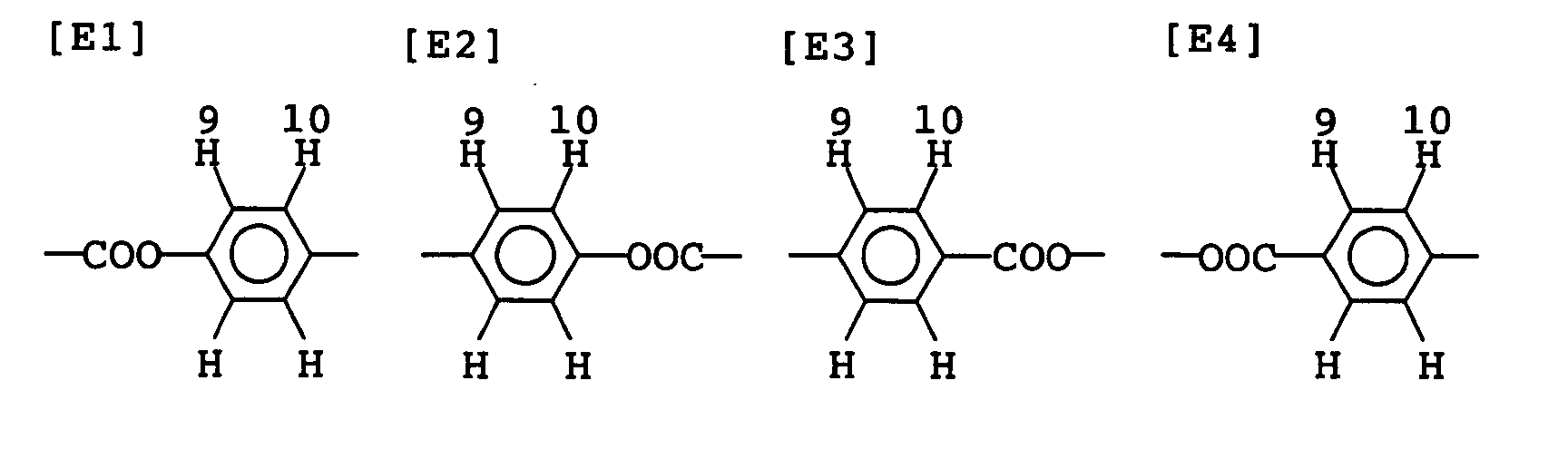
- Structural formulae of common portion and characteristic portions (A portion) of the optically active compounds (E1 to E4) are shown below. Table 1 shows 1H-NMR measurement results of these compounds.
-

-

- The above-prepared optically active compounds (E1 to E4) were measured for helical twisting powers (HTP) and wavelength shifts.
- To a nematic liquid crystal (ZLI-1565) supplied by Merck & Co., Inc., was added 10 % by weight, based on a composition, of the optically active compound (E1) obtained in Example 1, to prepare a chiral nematic (N*) liquid crystal composition.
- The thus-prepared liquid crystal composition was measured for an upper-limit temperature of its N* phase and selective reflection behaviors, and its helical twisting power (HTP) was determined on the basis of the selective reflection behaviors.
- The upper-limit temperature of the N* phase was determined by observation through a polarizing microscope.
- Further, the selective reflection behaviors were measured according to the following procedures.
- A liquid crystal cell with ITO electrodes (cell thickness 10 µm) was charged with the above-prepared liquid crystal composition in an isotropic state. The cell was adjusted to 60°C, a rectangular wave voltage of ±60 V was applied for approximately 1 minute, and the cell was rapidly cooled to room temperature to attain planar alignment.
- The above liquid crystal cell was evaluated for selective reflection behaviors at 25°C and 60°C with an automatic spectrophotometer. HTPs at 25°C and 60°C were calculated on the basis of the following expressions.
- The wavelength shift was determined on the basis of the following expression.
- Table 2 shows the results. The optically active compound (E1) of Example 1 had a large HTP of 10 or more and had a property that the induced helical pitch decreased in length with an increase in temperature.
- The optically active compounds (E2 to E4) obtained in Examples 2 to 4 were measured for upper-limit temperatures of their N* phases, HTPs and wavelength shifts in the same manner as above. Table 2 shows the results.
- Those known optically active compounds CB15, S811 and CN explained in the description of Prior Art were measured for upper-limit temperatures of their N* phases, HTPs and wavelength shifts in the same manner as in Example 5.
- CB15 and S811 were added in an amount of 15 % by weight each on the basis of the nematic liquid crystal, CN was added in an amount of 30 % by weight on the same basis, and the resultant compositions were measured for helical twisting powers (HTP). Table 2 shows the results.
Compound Iso-N(°C) HTP(1/µm) Wavelength shift(nm) E1 82 15.2 -108 E2 82 15.4 -109 E3 82 16.0 -84 E4 81 15.6 -100 CB15 74 7.9 +193 S811 73 10.1 +7 CN 82 5.2 +34
Claims (9)
- An optically active compound of the general formula (1),wherein n is an integer of 4 to 8, X is -Ph-COO-Ph-Ph-, -Ph-Ph-COO-Ph-, -Ph-OOC-Ph-Ph-, -Ph-Ph-OOC-Ph-, -Ph-Ph-Ph-, -Cy-COO-Ph-Ph-, -Ph-Ph-OOC-Cy-, -Ph-OOC-Ph-COO-Ph-, -Ph-OOC-Cy-COO-Ph-, -Ph-OOC-Np-COO-Ph-, -Np-OOC-Ph- or -Ph-COO-Np- in which -Ph- is a 1,4-phenylene group, -Cy- is a trans-1,4-cyclohexylene group and -Np-is a 2,6-naphthylene group, and C* is an asymmetric carbon.

- The optically active compound of claim 1, which has the general formula (1) in which n is 5 or 7.
- The optically active compound of claim 1, which has the general formula (1) in which X is -Ph-COO-Ph-Ph-, -Ph-Ph-COO-Ph-, -Ph-OOC-Ph-Ph- or -Ph-Ph-OOC-Ph-.
- The optically active compound of claim 1, which has a helical twisting power (HTP) of 10 or more.
- The optically active compound of claim 1, which induces a helical pitch and has a property that the induced helical pitch decreases in length with an increase in temperature.
- The optically active compound of claim 1, wherein two asymmetric carbons shown in the general formula (1) are R-configuration isomers together or S-configuration isomers together.
- A chiral dopant of the general formula (1) in claim 1 for a nematic liquid crystal.
- A nematic liquid crystal composition containing at least one member compound of the optically active compound of the general formula (1) in claim 1.
- A liquid crystal display device having the nematic liquid crystal composition recited in claim 8 interposed between substrates having an electrode each.
Applications Claiming Priority (2)
| Application Number | Priority Date | Filing Date | Title |
|---|---|---|---|
| JP2002198697 | 2002-07-08 | ||
| JP2002198697A JP2004035525A (en) | 2002-07-08 | 2002-07-08 | Optically active compound and liquid crystal composition containing the same |
Publications (1)
| Publication Number | Publication Date |
|---|---|
| EP1380567A1 true EP1380567A1 (en) | 2004-01-14 |
Family
ID=29728414
Family Applications (1)
| Application Number | Title | Priority Date | Filing Date |
|---|---|---|---|
| EP03014549A Withdrawn EP1380567A1 (en) | 2002-07-08 | 2003-07-07 | Chiral compounds as dopants for liquid crystals |
Country Status (3)
| Country | Link |
|---|---|
| US (1) | US20050260358A1 (en) |
| EP (1) | EP1380567A1 (en) |
| JP (1) | JP2004035525A (en) |
Cited By (1)
| Publication number | Priority date | Publication date | Assignee | Title |
|---|---|---|---|---|
| CN107109230A (en) * | 2014-12-29 | 2017-08-29 | 默克专利股份有限公司 | Liquid crystal media and the high frequency assembly comprising it |
Citations (5)
| Publication number | Priority date | Publication date | Assignee | Title |
|---|---|---|---|---|
| JPH02227489A (en) * | 1989-02-28 | 1990-09-10 | Dainippon Ink & Chem Inc | Ferroelectric liquid crystalline composition |
| JPH0517405A (en) * | 1991-07-02 | 1993-01-26 | Kanebo Ltd | Optically active compound and chiral smectic liquid crystalline composition using the same compound |
| JPH0525085A (en) * | 1991-07-23 | 1993-02-02 | Kashima Sekiyu Kk | Optically active compound |
| EP1249484A1 (en) * | 2001-04-13 | 2002-10-16 | Mitsubishi Gas Chemical Company, Inc. | Optically active compound and liquid crystal composition containing the compound |
| EP1270542A1 (en) * | 2001-06-26 | 2003-01-02 | Mitsubishi Gas Chemical Company, Inc. | Optically active compound and liquid crystal composition containing the compound |
Family Cites Families (1)
| Publication number | Priority date | Publication date | Assignee | Title |
|---|---|---|---|---|
| US6805921B2 (en) * | 2001-08-09 | 2004-10-19 | Mitsubishi Gas Chemical Co., Inc. | Optically active compound and nematic liquid crystal composition containing the compound |
-
2002
- 2002-07-08 JP JP2002198697A patent/JP2004035525A/en not_active Withdrawn
-
2003
- 2003-07-07 EP EP03014549A patent/EP1380567A1/en not_active Withdrawn
- 2003-07-08 US US10/614,296 patent/US20050260358A1/en not_active Abandoned
Patent Citations (5)
| Publication number | Priority date | Publication date | Assignee | Title |
|---|---|---|---|---|
| JPH02227489A (en) * | 1989-02-28 | 1990-09-10 | Dainippon Ink & Chem Inc | Ferroelectric liquid crystalline composition |
| JPH0517405A (en) * | 1991-07-02 | 1993-01-26 | Kanebo Ltd | Optically active compound and chiral smectic liquid crystalline composition using the same compound |
| JPH0525085A (en) * | 1991-07-23 | 1993-02-02 | Kashima Sekiyu Kk | Optically active compound |
| EP1249484A1 (en) * | 2001-04-13 | 2002-10-16 | Mitsubishi Gas Chemical Company, Inc. | Optically active compound and liquid crystal composition containing the compound |
| EP1270542A1 (en) * | 2001-06-26 | 2003-01-02 | Mitsubishi Gas Chemical Company, Inc. | Optically active compound and liquid crystal composition containing the compound |
Non-Patent Citations (4)
| Title |
|---|
| NAKAUCHI J ET AL: "FERROELECTRIC LIQUID CRYSTAL MIXTURES DOPED WITH COMPOUNDS HAVING CHIRAL GROUPS AT BOTH ENDS OF THE CORE", JAPANESE JOURNAL OF APPLIED PHYSICS, PUBLICATION OFFICE JAPANESE JOURNAL OF APPLIED PHYSICS. TOKYO, JP, vol. 28, no. 2, 1 February 1989 (1989-02-01), pages L272 - 274, XP000098738, ISSN: 0021-4922 * |
| PATENT ABSTRACTS OF JAPAN vol. 014, no. 539 (C - 0782) 28 November 1990 (1990-11-28) * |
| PATENT ABSTRACTS OF JAPAN vol. 017, no. 291 (C - 1067) 4 June 1993 (1993-06-04) * |
| PATENT ABSTRACTS OF JAPAN vol. 017, no. 309 (C - 1070) 14 June 1993 (1993-06-14) * |
Cited By (2)
| Publication number | Priority date | Publication date | Assignee | Title |
|---|---|---|---|---|
| CN107109230A (en) * | 2014-12-29 | 2017-08-29 | 默克专利股份有限公司 | Liquid crystal media and the high frequency assembly comprising it |
| CN107109230B (en) * | 2014-12-29 | 2021-03-05 | 默克专利股份有限公司 | Liquid-crystalline medium and high-frequency module comprising same |
Also Published As
| Publication number | Publication date |
|---|---|
| US20050260358A1 (en) | 2005-11-24 |
| JP2004035525A (en) | 2004-02-05 |
Similar Documents
| Publication | Publication Date | Title |
|---|---|---|
| EP0110299B1 (en) | Smectic liquid crystal compounds and liquid crystal compositions | |
| Sadashiva et al. | Biaxial smectic A phase in homologous series of compounds composed of highly polar unsymmetrically substituted bent-core molecules | |
| US5110497A (en) | Component for liquid crystal composition and liquid crystal composition containing the same | |
| EP1249484B1 (en) | Optically active compound and liquid crystal composition containing the compound | |
| US6699532B2 (en) | Optically active compound and liquid crystal composition containing the compound | |
| JPH0416454B2 (en) | ||
| EP1225212B1 (en) | Optically active compound and liquid crystal composition containing the compound | |
| US6821581B2 (en) | Optically active compound and liquid crystal composition containing the compound | |
| US6835427B2 (en) | Optically active compound and liquid crystal composition containing the compound | |
| US20050260358A1 (en) | Optically active compound and liquid crystal composition containing the compound | |
| JPH0578543B2 (en) | ||
| US6805921B2 (en) | Optically active compound and nematic liquid crystal composition containing the compound | |
| KR20190006531A (en) | Bymesogenic compound and mesogenic medium | |
| JPS63175095A (en) | Optically active liquid crystal compound | |
| JP2002212145A (en) | Optically active compound and liquid crystal composition containing the same | |
| JP2002308833A (en) | Optically active compound and liquid crystal composition containing the same | |
| JP2004059467A (en) | Optically active compound and liquid crystal composition containing the same | |
| JP2004099556A (en) | Optically active compound and liquid crystal composition containing the same | |
| JP2004099555A (en) | Optically active compound and liquid crystal composition containing the same | |
| JPS60248789A (en) | Ferroelectric liquid crystal composition | |
| JP2002322135A (en) | Optically active compound and liquid crystal composition containing the same | |
| Iwashita et al. | 33.3: Applications of New Fluorinated Liquid Crystals of Fused Ring Systems for Active Matrix LCD | |
| JP2002338527A (en) | Optically active compound and liquid crystal composition containing the same | |
| JP2003081918A (en) | Optically active compound and liquid crystal composition containing the same | |
| JP2002338526A (en) | Optically active compound and liquid crystal composition comprising the same |
Legal Events
| Date | Code | Title | Description |
|---|---|---|---|
| PUAI | Public reference made under article 153(3) epc to a published international application that has entered the european phase |
Free format text: ORIGINAL CODE: 0009012 |
|
| AK | Designated contracting states |
Kind code of ref document: A1 Designated state(s): AT BE BG CH CY CZ DE DK EE ES FI FR GB GR HU IE IT LI LU MC NL PT RO SE SI SK TR |
|
| AX | Request for extension of the european patent |
Extension state: AL LT LV MK |
|
| 17P | Request for examination filed |
Effective date: 20040121 |
|
| AKX | Designation fees paid |
Designated state(s): DE |
|
| GRAP | Despatch of communication of intention to grant a patent |
Free format text: ORIGINAL CODE: EPIDOSNIGR1 |
|
| STAA | Information on the status of an ep patent application or granted ep patent |
Free format text: STATUS: THE APPLICATION IS DEEMED TO BE WITHDRAWN |
|
| 18D | Application deemed to be withdrawn |
Effective date: 20060619 |