EP1380559A1 - Ethers of 2,2,4-trimethylpentane-1, 3-diol as fragrance materials - Google Patents
Ethers of 2,2,4-trimethylpentane-1, 3-diol as fragrance materials Download PDFInfo
- Publication number
- EP1380559A1 EP1380559A1 EP03291711A EP03291711A EP1380559A1 EP 1380559 A1 EP1380559 A1 EP 1380559A1 EP 03291711 A EP03291711 A EP 03291711A EP 03291711 A EP03291711 A EP 03291711A EP 1380559 A1 EP1380559 A1 EP 1380559A1
- Authority
- EP
- European Patent Office
- Prior art keywords
- saturated
- branched
- straight
- alkyl group
- acyclic
- Prior art date
- Legal status (The legal status is an assumption and is not a legal conclusion. Google has not performed a legal analysis and makes no representation as to the accuracy of the status listed.)
- Granted
Links
- 239000003205 fragrance Substances 0.000 title claims abstract description 37
- 239000000463 material Substances 0.000 title claims abstract description 24
- JCTXKRPTIMZBJT-UHFFFAOYSA-N 2,2,4-trimethylpentane-1,3-diol Chemical compound CC(C)C(O)C(C)(C)CO JCTXKRPTIMZBJT-UHFFFAOYSA-N 0.000 title description 19
- 150000002170 ethers Chemical class 0.000 title description 11
- 150000001875 compounds Chemical class 0.000 claims abstract description 34
- 125000002015 acyclic group Chemical group 0.000 claims abstract description 19
- 229920006395 saturated elastomer Polymers 0.000 claims abstract description 18
- 239000007844 bleaching agent Substances 0.000 claims abstract description 14
- 125000006165 cyclic alkyl group Chemical group 0.000 claims abstract description 13
- 239000002537 cosmetic Substances 0.000 claims abstract description 10
- 125000000217 alkyl group Chemical group 0.000 claims abstract description 9
- 239000002304 perfume Substances 0.000 claims abstract description 7
- 239000000203 mixture Substances 0.000 claims description 26
- HEMHJVSKTPXQMS-UHFFFAOYSA-M Sodium hydroxide Chemical compound [OH-].[Na+] HEMHJVSKTPXQMS-UHFFFAOYSA-M 0.000 claims description 12
- 238000000034 method Methods 0.000 claims description 12
- -1 conditioner Substances 0.000 claims description 7
- 238000006243 chemical reaction Methods 0.000 claims description 6
- 239000012459 cleaning agent Substances 0.000 claims description 6
- 125000001495 ethyl group Chemical group [H]C([H])([H])C([H])([H])* 0.000 claims description 5
- 125000000959 isobutyl group Chemical group [H]C([H])([H])C([H])(C([H])([H])[H])C([H])([H])* 0.000 claims description 5
- 239000011541 reaction mixture Substances 0.000 claims description 5
- 239000003599 detergent Substances 0.000 claims description 4
- 125000003903 2-propenyl group Chemical group [H]C([*])([H])C([H])=C([H])[H] 0.000 claims description 2
- 239000003899 bactericide agent Substances 0.000 claims description 2
- 239000003795 chemical substances by application Substances 0.000 claims description 2
- 239000006071 cream Substances 0.000 claims description 2
- 230000001877 deodorizing effect Effects 0.000 claims description 2
- 239000000645 desinfectant Substances 0.000 claims description 2
- 230000000249 desinfective effect Effects 0.000 claims description 2
- 238000004851 dishwashing Methods 0.000 claims description 2
- 229940079593 drug Drugs 0.000 claims description 2
- 239000003814 drug Substances 0.000 claims description 2
- 239000002324 mouth wash Substances 0.000 claims description 2
- 229940051866 mouthwash Drugs 0.000 claims description 2
- 239000002453 shampoo Substances 0.000 claims description 2
- 239000000344 soap Substances 0.000 claims description 2
- 239000004094 surface-active agent Substances 0.000 claims description 2
- 229940034610 toothpaste Drugs 0.000 claims description 2
- 239000000606 toothpaste Substances 0.000 claims description 2
- BKOOMYPCSUNDGP-UHFFFAOYSA-N 2-methylbut-2-ene Chemical compound CC=C(C)C BKOOMYPCSUNDGP-UHFFFAOYSA-N 0.000 claims 6
- VQTUBCCKSQIDNK-UHFFFAOYSA-N Isobutene Chemical compound CC(C)=C VQTUBCCKSQIDNK-UHFFFAOYSA-N 0.000 claims 6
- 125000005210 alkyl ammonium group Chemical group 0.000 claims 1
- 229910052736 halogen Inorganic materials 0.000 claims 1
- 125000005843 halogen group Chemical group 0.000 claims 1
- RTZKZFJDLAIYFH-UHFFFAOYSA-N Diethyl ether Chemical compound CCOCC RTZKZFJDLAIYFH-UHFFFAOYSA-N 0.000 abstract description 4
- HEDRZPFGACZZDS-MICDWDOJSA-N Trichloro(2H)methane Chemical compound [2H]C(Cl)(Cl)Cl HEDRZPFGACZZDS-MICDWDOJSA-N 0.000 description 8
- 238000002360 preparation method Methods 0.000 description 8
- YXFVVABEGXRONW-UHFFFAOYSA-N Toluene Chemical compound CC1=CC=CC=C1 YXFVVABEGXRONW-UHFFFAOYSA-N 0.000 description 6
- 239000000460 chlorine Substances 0.000 description 6
- 150000002430 hydrocarbons Chemical group 0.000 description 6
- 238000012360 testing method Methods 0.000 description 6
- 238000005160 1H NMR spectroscopy Methods 0.000 description 4
- 125000004122 cyclic group Chemical group 0.000 description 4
- GNVAISZHADZKJR-UHFFFAOYSA-N 2,2,4-trimethyl-1-(2-methylprop-2-enoxy)pentan-3-ol Chemical compound CC(C)C(O)C(C)(C)COCC(C)=C GNVAISZHADZKJR-UHFFFAOYSA-N 0.000 description 3
- OKKJLVBELUTLKV-UHFFFAOYSA-N Methanol Chemical compound OC OKKJLVBELUTLKV-UHFFFAOYSA-N 0.000 description 3
- 238000005804 alkylation reaction Methods 0.000 description 3
- 229930195734 saturated hydrocarbon Natural products 0.000 description 3
- JRMUNVKIHCOMHV-UHFFFAOYSA-M tetrabutylammonium bromide Chemical compound [Br-].CCCC[N+](CCCC)(CCCC)CCCC JRMUNVKIHCOMHV-UHFFFAOYSA-M 0.000 description 3
- 229930195735 unsaturated hydrocarbon Natural products 0.000 description 3
- XLYOFNOQVPJJNP-UHFFFAOYSA-N water Substances O XLYOFNOQVPJJNP-UHFFFAOYSA-N 0.000 description 3
- 125000006701 (C1-C7) alkyl group Chemical group 0.000 description 2
- OVAZXTQJHBIYJI-UHFFFAOYSA-N 1-ethoxy-2,2,4-trimethylpentan-3-ol Chemical compound CCOCC(C)(C)C(O)C(C)C OVAZXTQJHBIYJI-UHFFFAOYSA-N 0.000 description 2
- XXKKKLCZFUPZNT-UHFFFAOYSA-N 2,2,4-trimethyl-1-(2-methylpropoxy)pentan-3-ol Chemical compound CC(C)COCC(C)(C)C(O)C(C)C XXKKKLCZFUPZNT-UHFFFAOYSA-N 0.000 description 2
- MHAJPDPJQMAIIY-UHFFFAOYSA-N Hydrogen peroxide Chemical compound OO MHAJPDPJQMAIIY-UHFFFAOYSA-N 0.000 description 2
- FAPWRFPIFSIZLT-UHFFFAOYSA-M Sodium chloride Chemical class [Na+].[Cl-] FAPWRFPIFSIZLT-UHFFFAOYSA-M 0.000 description 2
- 229910052801 chlorine Inorganic materials 0.000 description 2
- HGCIXCUEYOPUTN-UHFFFAOYSA-N cyclohexene Chemical compound C1CCC=CC1 HGCIXCUEYOPUTN-UHFFFAOYSA-N 0.000 description 2
- 230000007062 hydrolysis Effects 0.000 description 2
- 238000006460 hydrolysis reaction Methods 0.000 description 2
- 230000000873 masking effect Effects 0.000 description 2
- 239000012044 organic layer Substances 0.000 description 2
- SUKJFIGYRHOWBL-UHFFFAOYSA-N sodium hypochlorite Chemical compound [Na+].Cl[O-] SUKJFIGYRHOWBL-UHFFFAOYSA-N 0.000 description 2
- 239000000243 solution Substances 0.000 description 2
- FINOAUDUYKVGDS-UHFFFAOYSA-N (2-tert-butylcyclohexyl) acetate Chemical compound CC(=O)OC1CCCCC1C(C)(C)C FINOAUDUYKVGDS-UHFFFAOYSA-N 0.000 description 1
- DAFHKNAQFPVRKR-UHFFFAOYSA-N (3-hydroxy-2,2,4-trimethylpentyl) 2-methylpropanoate Chemical compound CC(C)C(O)C(C)(C)COC(=O)C(C)C DAFHKNAQFPVRKR-UHFFFAOYSA-N 0.000 description 1
- 125000004169 (C1-C6) alkyl group Chemical group 0.000 description 1
- HLVFKOKELQSXIQ-UHFFFAOYSA-N 1-bromo-2-methylpropane Chemical compound CC(C)CBr HLVFKOKELQSXIQ-UHFFFAOYSA-N 0.000 description 1
- JKXQKGNGJVZKFA-UHFFFAOYSA-N 1-chloro-3-methylbut-2-ene Chemical compound CC(C)=CCCl JKXQKGNGJVZKFA-UHFFFAOYSA-N 0.000 description 1
- MVOSYKNQRRHGKX-UHFFFAOYSA-N 11-Undecanolactone Chemical compound O=C1CCCCCCCCCCO1 MVOSYKNQRRHGKX-UHFFFAOYSA-N 0.000 description 1
- YXWUUMFEFKZBOB-UHFFFAOYSA-N 2,2,4-trimethyl-1-(3-methylbut-2-enoxy)pentan-3-ol Chemical compound CC(C)C(O)C(C)(C)COCC=C(C)C YXWUUMFEFKZBOB-UHFFFAOYSA-N 0.000 description 1
- VVUMWAHNKOLVSN-UHFFFAOYSA-N 2-(4-ethoxyanilino)-n-propylpropanamide Chemical compound CCCNC(=O)C(C)NC1=CC=C(OCC)C=C1 VVUMWAHNKOLVSN-UHFFFAOYSA-N 0.000 description 1
- MJTPMXWJHPOWGH-UHFFFAOYSA-N 2-Phenoxyethyl isobutyrate Chemical compound CC(C)C(=O)OCCOC1=CC=CC=C1 MJTPMXWJHPOWGH-UHFFFAOYSA-N 0.000 description 1
- VPJOGDPLXNTKAZ-UHFFFAOYSA-N 2-methylpropanoic acid;2,2,4-trimethylpentane-1,3-diol Chemical compound CC(C)C(O)=O.CC(C)C(O)C(C)(C)CO VPJOGDPLXNTKAZ-UHFFFAOYSA-N 0.000 description 1
- BJLRAKFWOUAROE-UHFFFAOYSA-N 2500-83-6 Chemical compound C12C=CCC2C2CC(OC(=O)C)C1C2 BJLRAKFWOUAROE-UHFFFAOYSA-N 0.000 description 1
- OHXAOPZTJOUYKM-UHFFFAOYSA-N 3-Chloro-2-methylpropene Chemical compound CC(=C)CCl OHXAOPZTJOUYKM-UHFFFAOYSA-N 0.000 description 1
- VAJVDSVGBWFCLW-UHFFFAOYSA-N 3-Phenyl-1-propanol Chemical compound OCCCC1=CC=CC=C1 VAJVDSVGBWFCLW-UHFFFAOYSA-N 0.000 description 1
- NLXLAEXVIDQMFP-UHFFFAOYSA-N Ammonia chloride Chemical class [NH4+].[Cl-] NLXLAEXVIDQMFP-UHFFFAOYSA-N 0.000 description 1
- WKBOTKDWSSQWDR-UHFFFAOYSA-N Bromine atom Chemical group [Br] WKBOTKDWSSQWDR-UHFFFAOYSA-N 0.000 description 1
- FERIUCNNQQJTOY-UHFFFAOYSA-M Butyrate Chemical compound CCCC([O-])=O FERIUCNNQQJTOY-UHFFFAOYSA-M 0.000 description 1
- FERIUCNNQQJTOY-UHFFFAOYSA-N Butyric acid Natural products CCCC(O)=O FERIUCNNQQJTOY-UHFFFAOYSA-N 0.000 description 1
- 125000000882 C2-C6 alkenyl group Chemical group 0.000 description 1
- KZBUYRJDOAKODT-UHFFFAOYSA-N Chlorine Chemical compound ClCl KZBUYRJDOAKODT-UHFFFAOYSA-N 0.000 description 1
- ZAMOUSCENKQFHK-UHFFFAOYSA-N Chlorine atom Chemical compound [Cl] ZAMOUSCENKQFHK-UHFFFAOYSA-N 0.000 description 1
- KBEBGUQPQBELIU-CMDGGOBGSA-N Ethyl cinnamate Chemical compound CCOC(=O)\C=C\C1=CC=CC=C1 KBEBGUQPQBELIU-CMDGGOBGSA-N 0.000 description 1
- IAYPIBMASNFSPL-UHFFFAOYSA-N Ethylene oxide Chemical compound C1CO1 IAYPIBMASNFSPL-UHFFFAOYSA-N 0.000 description 1
- DYUQAZSOFZSPHD-UHFFFAOYSA-N Phenylpropyl alcohol Natural products CCC(O)C1=CC=CC=C1 DYUQAZSOFZSPHD-UHFFFAOYSA-N 0.000 description 1
- 239000004698 Polyethylene Substances 0.000 description 1
- 239000000654 additive Substances 0.000 description 1
- 125000002877 alkyl aryl group Chemical group 0.000 description 1
- 150000005215 alkyl ethers Chemical class 0.000 description 1
- GUUHFMWKWLOQMM-NTCAYCPXSA-N alpha-hexylcinnamaldehyde Chemical compound CCCCCC\C(C=O)=C/C1=CC=CC=C1 GUUHFMWKWLOQMM-NTCAYCPXSA-N 0.000 description 1
- GUUHFMWKWLOQMM-UHFFFAOYSA-N alpha-n-hexylcinnamic aldehyde Natural products CCCCCCC(C=O)=CC1=CC=CC=C1 GUUHFMWKWLOQMM-UHFFFAOYSA-N 0.000 description 1
- 230000003466 anti-cipated effect Effects 0.000 description 1
- 235000019568 aromas Nutrition 0.000 description 1
- 238000004061 bleaching Methods 0.000 description 1
- RDHPKYGYEGBMSE-UHFFFAOYSA-N bromoethane Chemical compound CCBr RDHPKYGYEGBMSE-UHFFFAOYSA-N 0.000 description 1
- 125000000484 butyl group Chemical group [H]C([*])([H])C([H])([H])C([H])([H])C([H])([H])[H] 0.000 description 1
- KBEBGUQPQBELIU-UHFFFAOYSA-N cinnamic acid ethyl ester Natural products CCOC(=O)C=CC1=CC=CC=C1 KBEBGUQPQBELIU-UHFFFAOYSA-N 0.000 description 1
- 238000000576 coating method Methods 0.000 description 1
- 125000000753 cycloalkyl group Chemical group 0.000 description 1
- 238000000354 decomposition reaction Methods 0.000 description 1
- GYZLOYUZLJXAJU-UHFFFAOYSA-N diglycidyl ether Chemical compound C1OC1COCC1CO1 GYZLOYUZLJXAJU-UHFFFAOYSA-N 0.000 description 1
- 239000003085 diluting agent Substances 0.000 description 1
- 238000004821 distillation Methods 0.000 description 1
- 230000000694 effects Effects 0.000 description 1
- 238000011156 evaluation Methods 0.000 description 1
- 239000000796 flavoring agent Substances 0.000 description 1
- 235000019634 flavors Nutrition 0.000 description 1
- 238000009472 formulation Methods 0.000 description 1
- FQMZVFJYMPNUCT-UHFFFAOYSA-N geraniol formate Natural products CC(C)=CCCC(C)=CCOC=O FQMZVFJYMPNUCT-UHFFFAOYSA-N 0.000 description 1
- 150000004820 halides Chemical class 0.000 description 1
- WQYVRQLZKVEZGA-UHFFFAOYSA-N hypochlorite Chemical class Cl[O-] WQYVRQLZKVEZGA-UHFFFAOYSA-N 0.000 description 1
- 238000010348 incorporation Methods 0.000 description 1
- 239000004615 ingredient Substances 0.000 description 1
- 239000000543 intermediate Substances 0.000 description 1
- 125000001449 isopropyl group Chemical group [H]C([H])([H])C([H])(*)C([H])([H])[H] 0.000 description 1
- 238000004519 manufacturing process Methods 0.000 description 1
- 125000005394 methallyl group Chemical group 0.000 description 1
- 125000002496 methyl group Chemical group [H]C([H])([H])* 0.000 description 1
- UAEPNZWRGJTJPN-UHFFFAOYSA-N methylcyclohexane Chemical compound CC1CCCCC1 UAEPNZWRGJTJPN-UHFFFAOYSA-N 0.000 description 1
- 230000004048 modification Effects 0.000 description 1
- 238000012986 modification Methods 0.000 description 1
- DUNCVNHORHNONW-UHFFFAOYSA-N myrcenol Chemical compound CC(C)(O)CCCC(=C)C=C DUNCVNHORHNONW-UHFFFAOYSA-N 0.000 description 1
- 229930008383 myrcenol Natural products 0.000 description 1
- 125000001971 neopentyl group Chemical group [H]C([*])([H])C(C([H])([H])[H])(C([H])([H])[H])C([H])([H])[H] 0.000 description 1
- 229920000573 polyethylene Polymers 0.000 description 1
- 125000001844 prenyl group Chemical group [H]C([*])([H])C([H])=C(C([H])([H])[H])C([H])([H])[H] 0.000 description 1
- 125000001436 propyl group Chemical group [H]C([*])([H])C([H])([H])C([H])([H])[H] 0.000 description 1
- 238000010992 reflux Methods 0.000 description 1
- MWNQXXOSWHCCOZ-UHFFFAOYSA-L sodium;oxido carbonate Chemical compound [Na+].[O-]OC([O-])=O MWNQXXOSWHCCOZ-UHFFFAOYSA-L 0.000 description 1
- 238000013112 stability test Methods 0.000 description 1
- 239000003381 stabilizer Substances 0.000 description 1
- 239000000126 substance Substances 0.000 description 1
- 238000010189 synthetic method Methods 0.000 description 1
- 125000000999 tert-butyl group Chemical group [H]C([H])([H])C(*)(C([H])([H])[H])C([H])([H])[H] 0.000 description 1
Classifications
-
- C—CHEMISTRY; METALLURGY
- C07—ORGANIC CHEMISTRY
- C07C—ACYCLIC OR CARBOCYCLIC COMPOUNDS
- C07C43/00—Ethers; Compounds having groups, groups or groups
- C07C43/02—Ethers
- C07C43/03—Ethers having all ether-oxygen atoms bound to acyclic carbon atoms
- C07C43/04—Saturated ethers
- C07C43/13—Saturated ethers containing hydroxy or O-metal groups
-
- C—CHEMISTRY; METALLURGY
- C07—ORGANIC CHEMISTRY
- C07C—ACYCLIC OR CARBOCYCLIC COMPOUNDS
- C07C43/00—Ethers; Compounds having groups, groups or groups
- C07C43/02—Ethers
- C07C43/03—Ethers having all ether-oxygen atoms bound to acyclic carbon atoms
- C07C43/14—Unsaturated ethers
- C07C43/178—Unsaturated ethers containing hydroxy or O-metal groups
-
- C—CHEMISTRY; METALLURGY
- C11—ANIMAL OR VEGETABLE OILS, FATS, FATTY SUBSTANCES OR WAXES; FATTY ACIDS THEREFROM; DETERGENTS; CANDLES
- C11B—PRODUCING, e.g. BY PRESSING RAW MATERIALS OR BY EXTRACTION FROM WASTE MATERIALS, REFINING OR PRESERVING FATS, FATTY SUBSTANCES, e.g. LANOLIN, FATTY OILS OR WAXES; ESSENTIAL OILS; PERFUMES
- C11B9/00—Essential oils; Perfumes
- C11B9/0007—Aliphatic compounds
- C11B9/0015—Aliphatic compounds containing oxygen as the only heteroatom
-
- C—CHEMISTRY; METALLURGY
- C11—ANIMAL OR VEGETABLE OILS, FATS, FATTY SUBSTANCES OR WAXES; FATTY ACIDS THEREFROM; DETERGENTS; CANDLES
- C11D—DETERGENT COMPOSITIONS; USE OF SINGLE SUBSTANCES AS DETERGENTS; SOAP OR SOAP-MAKING; RESIN SOAPS; RECOVERY OF GLYCEROL
- C11D3/00—Other compounding ingredients of detergent compositions covered in group C11D1/00
- C11D3/50—Perfumes
-
- D—TEXTILES; PAPER
- D06—TREATMENT OF TEXTILES OR THE LIKE; LAUNDERING; FLEXIBLE MATERIALS NOT OTHERWISE PROVIDED FOR
- D06L—DRY-CLEANING, WASHING OR BLEACHING FIBRES, FILAMENTS, THREADS, YARNS, FABRICS, FEATHERS OR MADE-UP FIBROUS GOODS; BLEACHING LEATHER OR FURS
- D06L4/00—Bleaching fibres, filaments, threads, yarns, fabrics, feathers or made-up fibrous goods; Bleaching leather or furs
- D06L4/20—Bleaching fibres, filaments, threads, yarns, fabrics, feathers or made-up fibrous goods; Bleaching leather or furs using agents which contain halogen
- D06L4/21—Bleaching fibres, filaments, threads, yarns, fabrics, feathers or made-up fibrous goods; Bleaching leather or furs using agents which contain halogen combined with specific additives
-
- D—TEXTILES; PAPER
- D06—TREATMENT OF TEXTILES OR THE LIKE; LAUNDERING; FLEXIBLE MATERIALS NOT OTHERWISE PROVIDED FOR
- D06L—DRY-CLEANING, WASHING OR BLEACHING FIBRES, FILAMENTS, THREADS, YARNS, FABRICS, FEATHERS OR MADE-UP FIBROUS GOODS; BLEACHING LEATHER OR FURS
- D06L4/00—Bleaching fibres, filaments, threads, yarns, fabrics, feathers or made-up fibrous goods; Bleaching leather or furs
- D06L4/20—Bleaching fibres, filaments, threads, yarns, fabrics, feathers or made-up fibrous goods; Bleaching leather or furs using agents which contain halogen
- D06L4/22—Bleaching fibres, filaments, threads, yarns, fabrics, feathers or made-up fibrous goods; Bleaching leather or furs using agents which contain halogen using inorganic agents
- D06L4/23—Bleaching fibres, filaments, threads, yarns, fabrics, feathers or made-up fibrous goods; Bleaching leather or furs using agents which contain halogen using inorganic agents using hypohalogenites
-
- D—TEXTILES; PAPER
- D06—TREATMENT OF TEXTILES OR THE LIKE; LAUNDERING; FLEXIBLE MATERIALS NOT OTHERWISE PROVIDED FOR
- D06L—DRY-CLEANING, WASHING OR BLEACHING FIBRES, FILAMENTS, THREADS, YARNS, FABRICS, FEATHERS OR MADE-UP FIBROUS GOODS; BLEACHING LEATHER OR FURS
- D06L4/00—Bleaching fibres, filaments, threads, yarns, fabrics, feathers or made-up fibrous goods; Bleaching leather or furs
- D06L4/20—Bleaching fibres, filaments, threads, yarns, fabrics, feathers or made-up fibrous goods; Bleaching leather or furs using agents which contain halogen
- D06L4/22—Bleaching fibres, filaments, threads, yarns, fabrics, feathers or made-up fibrous goods; Bleaching leather or furs using agents which contain halogen using inorganic agents
- D06L4/24—Bleaching fibres, filaments, threads, yarns, fabrics, feathers or made-up fibrous goods; Bleaching leather or furs using agents which contain halogen using inorganic agents using chlorites or chlorine dioxide
- D06L4/26—Bleaching fibres, filaments, threads, yarns, fabrics, feathers or made-up fibrous goods; Bleaching leather or furs using agents which contain halogen using inorganic agents using chlorites or chlorine dioxide combined with specific additives
Definitions
- the present invention relates to novel alkyl ethers of 2,2,4-trimethylpentane-1,3-diol.
- the present invention further relates to the use of these compounds as fragrance materials or as fragrance composition additives in perfumes, cosmetics, consumer products, and the like.
- WO 95/21606 discloses 2,2,4-trimethyl-penten-1-yl ester compounds useful as fragrance and flavor compositions.
- the generic structure of these compounds are shown in general formulas (1) and (2) below. wherein R is H, or a substituted or unsubstituted C 1 -C 6 alkyl, C 2 -C 6 alkenyl, C 6 -C 12 aryl, or C 7 -C 18 alkylaryl.
- U.S. Patent Number 4,150,007 relates to the use of an adduct of ethylene oxide and 2,2,4-trimethylpentane-1,3-diol as a reactive diluent in water-bourne coatings.
- the diol-ethylene oxide adducts are a mixture of components having the general formula (3) wherein x is an integer from 0 to 3.
- U.S. Patent Number 5,763,144 discloses a glycidyl ether having formula (4) as shown below.
- Synthetic chemical compounds which are able to provide a desirable aroma are of great importance to the fragrance industry. Many of the natural materials which impart such aromas to fragrance compositions are often expensive and of variable quality. Furthermore, such materials are often times unavailable. Accordingly, efforts have been made to find synthetic substitutes for these natural materials. Many of these efforts, however, have resulted in compounds which possess only a small degree of fragrance character, or contribute an undesired odor to the fragrance composition.
- the present invention provides an alkyl gycol ether having the following formula wherein R is a C 1 -C 7 saturated, unsaturated, straight-chain or branched, acyclic or cyclic alkyl group, is useful as a fragrance material in perfumes, cosmetics, consumer products, and the like.
- R is a saturated, straight-chain or branched, acyclic or cyclic alkyl group
- these compounds are especially stable when used as fragrance materials in bleach containing products.
- R is a C 1 -C 7 saturated, unsaturated, straight-chain or branched, acyclic or cyclic alkyl group, provided that R is not a 2-propenyl group.
- a fragrance composition comprising a compound having the formula wherein R is a C 1 -C 7 saturated, unsaturated, straight-chain or branched, acyclic or cyclic alkyl group, and a suitable carrier.
- a method of adding fragrance to a composition comprising adding a suitable amount of a compound having the formula wherein R is a C 1 -C 7 saturated, unsaturated, straight-chain or branched, acyclic or cyclic alkyl group to a composition in need thereof.
- a method for making a compound having the formula comprising contacting a 2,2,4-trimethyl-1,3-diol with a compound having the formula R - X, wherein X is any suitable leaving group, in the presence of a base at a temperature suitable to cause a reaction therebetween.
- 2,2,4-trimethylpentane-1,3-diol compounds of the present invention include compounds of the following formula (6) wherein R is a C 1 -C 7 alkyl group.
- alkyl group is defined as being a saturated, unsaturated, straight-chained or branched, acyclic or cyclic hydrocarbon moiety.
- Specific examples of an “alkyl group” include straight-chained, saturated hydrocarbon groups, such as methyl, ethyl, propyl, and butyl; branched, saturated hydrocarbon groups, such as isobutyl, isopropyl, t-butyl, and neopentyl; straight-chained unsaturated hydrocarbon groups such as n-pentyl-3-ene; branched unsaturated hydrocarbon groups, such as prenyl, 2-methylbutyl-2-ene; cyclic saturated hydrocarbon groups, such as 1-methyl cyclohexane; and cyclic unsaturated hydrocarbon groups, such as 1-methyl, cyclohexene.
- R is a saturated cyclic or acyclic alkyl group
- these materials are particularly useful for fragrancing bleach containing products.
- Such compounds have been shown to be adequately chemically stable in a bleach stability test.
- X is any suitable leaving group, preferably a halide, even more preferably a chlorine or bromine atom, R is a C 1 -C 7 alkyl group, as previously defined, and TBAB is tetrabutyl ammonium bromide.
- the ethers of 2,2,4-trimethylpentane-1,3-diol represented by the general formula (6) of the present invention can be used alone as a scent component, or one or more can be used in combination. Furthermore, one or more of the ethers of 2,2,4-trimethylpentane-1,3-diol of the present invention represented by the general formula (6) and one or more fragrance materials that are known to those skilled in the art can be mixed and used as a fragrance composition.
- ethers of 2,2,4-trimethylpentane-1,3-diol represented by the general formula (6) are normally incorporated at from about 0.01 to about 50 weight %, and preferably from about 0.1 to about 20 weight %, in said fragrance composition; the exact incorporation level being dependant upon the olfactive objective or fragrance type desired.
- the ethers of 2,2,4-trimethylpentane-1,3-diol o f the present invention represented by the general formula (6) are used in various perfume products and sanitation products that require the addition of fragrances. Not only does the present invention show high stability in ordinal base materials, but the saturated ethers of 2,2,4-trimethylpentane-1,3-diol of the present invention represented by the general formula (6) can be added a) without resulting in the loss of the activity of bleaching components, such as hypochlorites, percarbonate, perborate, hydrogen peroxide, and, the like, and b) without resulting in decomposition of the ethers of 2,2,4-trimethylpentane-1,3-diol of the present invention.
- bleaching components such as hypochlorites, percarbonate, perborate, hydrogen peroxide, and, the like
- the present invention can be used widely in shampoos, conditioners, perfumes, colognes, hair creams, pomades, hair cosmetic materials, other cosmetic materials or cosmetic cleansers, room fragrance, soaps, dishwashing detergents, laundry detergent, softeners, disinfecting cleaning agents, deodorizing cleaning agents, furniture care materials, disinfectants, bactericidal agents, repellants, bleaching agents, and other sanitation cleaning agents, toothpaste, mouthwash, toilet paper, odor giving agents to aid in the taking of medication, and the like. It is anticipated that the addition of the fragrance composition of the present invention will increase the value of these products.”
- R group of formula (6) is a saturated cyclic or acyclic alkyl group
- these materials are particularly useful for fragrancing bleach containing products.
- Fragrance formula using a compound of the present invention Ingredient Amount (wt. %) ambretone 4.5 tricyclodecenyl butyrate 0.4 tricyclodecenyl acetate 0.3 DH myrcenol 0.4 ethyl cinnamate 0.4
Landscapes
- Chemical & Material Sciences (AREA)
- Organic Chemistry (AREA)
- Engineering & Computer Science (AREA)
- Textile Engineering (AREA)
- Chemical Kinetics & Catalysis (AREA)
- Life Sciences & Earth Sciences (AREA)
- Inorganic Chemistry (AREA)
- Oil, Petroleum & Natural Gas (AREA)
- Wood Science & Technology (AREA)
- Organic Low-Molecular-Weight Compounds And Preparation Thereof (AREA)
- Fats And Perfumes (AREA)
- Cosmetics (AREA)
- Detergent Compositions (AREA)
Abstract

Description
- The present invention relates to novel alkyl ethers of 2,2,4-trimethylpentane-1,3-diol. The present invention further relates to the use of these compounds as fragrance materials or as fragrance composition additives in perfumes, cosmetics, consumer products, and the like.
- International Publication Number WO 95/21606 discloses 2,2,4-trimethyl-penten-1-yl ester compounds useful as fragrance and flavor compositions. The generic structure of these compounds are shown in general formulas (1) and (2) below.
 wherein R is H, or a substituted or unsubstituted C1-C6 alkyl, C2-C6 alkenyl, C6-C12 aryl, or C7-C18 alkylaryl.
- U.S. Patent Number 4,150,007 relates to the use of an adduct of ethylene oxide and 2,2,4-trimethylpentane-1,3-diol as a reactive diluent in water-bourne coatings. The diol-ethylene oxide adducts are a mixture of components having the general formula (3)wherein x is an integer from 0 to 3.

- U.S. Patent Number 5,763,144 discloses a glycidyl ether having formula (4) as shown below.
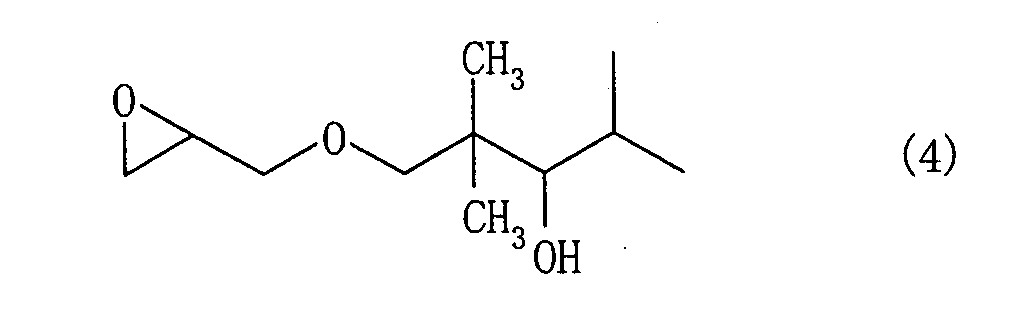
- These compounds are useful as intermediates in the preparation of photographic stabilizers.
- The reaction of ROTiCl3 with R1CH(OR2)2 is disclosed in C.R. Acad. Sci., Ser. C (P. Mastagli, D. Gibert, vol. 227, no. 9, pages 347-249, 1973). One specific product of this reaction is CAS Registry No. [50598-30-6], identified below in formula (5).
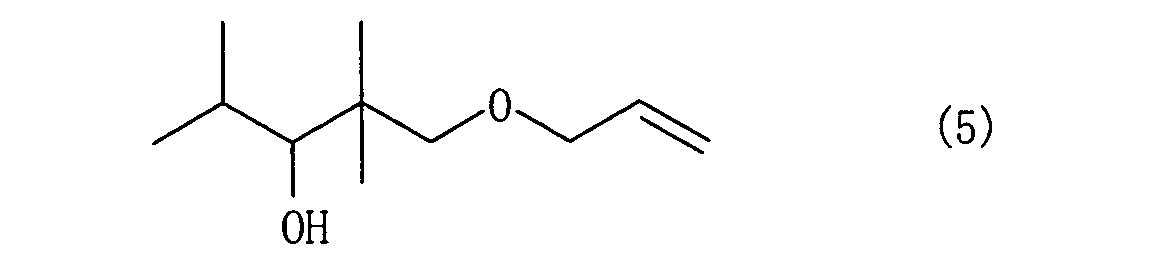
- This report discusses only the preparation of this material as an example of the utility of the synthetic method studied. No further utility is disclosed.
- Synthetic chemical compounds which are able to provide a desirable aroma are of great importance to the fragrance industry. Many of the natural materials which impart such aromas to fragrance compositions are often expensive and of variable quality. Furthermore, such materials are often times unavailable. Accordingly, efforts have been made to find synthetic substitutes for these natural materials. Many of these efforts, however, have resulted in compounds which possess only a small degree of fragrance character, or contribute an undesired odor to the fragrance composition.
- It is an object of the present invention to provide novel ethers of 2,2,4-trimethylpentane-1,3-diol.
- It is a further object of the present invention to provide a fragrance composition having ethers of 2,2,4-trimethylpentane-1,3-diol.
- It is another object of the present invention to provide a method of using ethers of 2,2,4-trimethylpentane-1,3-diol as fragrance materials.
- It is still a further object of the present invention to provide a method of making novel ethers of 2,2,4-trimethylpentane-1,3-diol.
- Briefly stated, the present invention provides an alkyl gycol ether having the following formulawherein R is a C1-C7 saturated, unsaturated, straight-chain or branched, acyclic or cyclic alkyl group, is useful as a fragrance material in perfumes, cosmetics, consumer products, and the like. When R is a saturated, straight-chain or branched, acyclic or cyclic alkyl group, these compounds are especially stable when used as fragrance materials in bleach containing products.
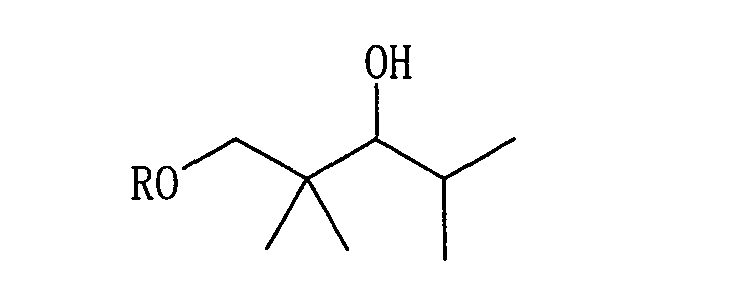
- According to an embodiment of the present invention, there is provided a compound having the formulawherein R is a C1-C7 saturated, unsaturated, straight-chain or branched, acyclic or cyclic alkyl group, provided that R is not a 2-propenyl group.

- According to a further embodiment of the present invention, there is provided a fragrance composition comprising a compound having the formulawherein R is a C1-C7 saturated, unsaturated, straight-chain or branched, acyclic or cyclic alkyl group, and a suitable carrier.

- According to another embodiment of the present invention, there is provided a method of adding fragrance to a composition, comprising adding a suitable amount of a compound having the formulawherein R is a C1-C7 saturated, unsaturated, straight-chain or branched, acyclic or cyclic alkyl group to a composition in need thereof.

- According to another feature of the present invention, there is provided a method for making a compound having the formulacomprising contacting a 2,2,4-trimethyl-1,3-diol with a compound having the formula R - X, wherein X is any suitable leaving group, in the presence of a base at a temperature suitable to cause a reaction therebetween.
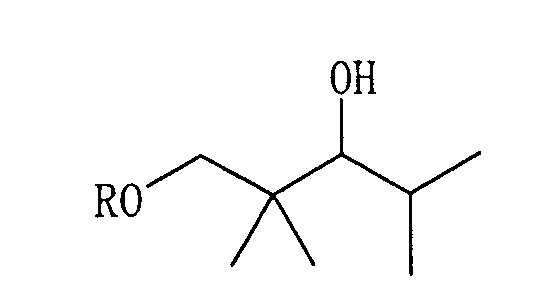
- As noted above, the 2,2,4-trimethylpentane-1,3-diol compounds of the present invention include compounds of the following formula (6)wherein R is a C1-C7 alkyl group.
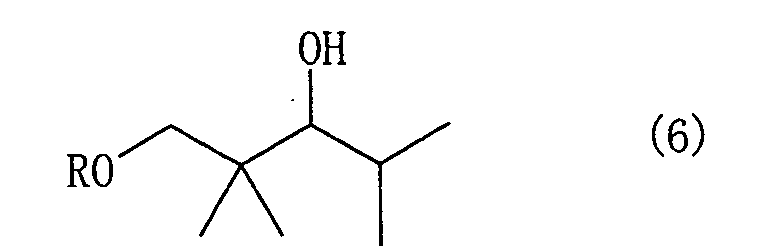
- An "alkyl group" is defined as being a saturated, unsaturated, straight-chained or branched, acyclic or cyclic hydrocarbon moiety. Specific examples of an "alkyl group" include straight-chained, saturated hydrocarbon groups, such as methyl, ethyl, propyl, and butyl; branched, saturated hydrocarbon groups, such as isobutyl, isopropyl, t-butyl, and neopentyl; straight-chained unsaturated hydrocarbon groups such as n-pentyl-3-ene; branched unsaturated hydrocarbon groups, such as prenyl, 2-methylbutyl-2-ene; cyclic saturated hydrocarbon groups, such as 1-methyl cyclohexane; and cyclic unsaturated hydrocarbon groups, such as 1-methyl, cyclohexene.
- Specific examples of compounds useful as fragrance materials according to the present invention include formulas (7), (8), (9), and (10) as shown below.


- The above compounds are useful in creating fragrances in a wide range of perfume, cosmetic and consumer products. When R is a saturated cyclic or acyclic alkyl group, these materials are particularly useful for fragrancing bleach containing products. Such compounds have been shown to be adequately chemically stable in a bleach stability test.
- The compounds of the present invention are made according to method of the following Scheme 1.

- In Scheme I, X is any suitable leaving group, preferably a halide, even more preferably a chlorine or bromine atom, R is a C1-C7 alkyl group, as previously defined, and TBAB is tetrabutyl ammonium bromide.
- While not limited to the following, the present invention is illustrated by the following examples.
- The ethers of 2,2,4-trimethylpentane-1,3-diol represented by the general formula (6) of the present invention can be used alone as a scent component, or one or more can be used in combination. Furthermore, one or more of the ethers of 2,2,4-trimethylpentane-1,3-diol of the present invention represented by the general formula (6) and one or more fragrance materials that are known to those skilled in the art can be mixed and used as a fragrance composition. When preparing a fragrance composition, the compounds of the present invention, ethers of 2,2,4-trimethylpentane-1,3-diol represented by the general formula (6), are normally incorporated at from about 0.01 to about 50 weight %, and preferably from about 0.1 to about 20 weight %, in said fragrance composition; the exact incorporation level being dependant upon the olfactive objective or fragrance type desired.
- The ethers of 2,2,4-trimethylpentane-1,3-diol o f the present invention represented by the general formula (6) are used in various perfume products and sanitation products that require the addition of fragrances. Not only does the present invention show high stability in ordinal base materials, but the saturated ethers of 2,2,4-trimethylpentane-1,3-diol of the present invention represented by the general formula (6) can be added a) without resulting in the loss of the activity of bleaching components, such as hypochlorites, percarbonate, perborate, hydrogen peroxide, and, the like, and b) without resulting in decomposition of the ethers of 2,2,4-trimethylpentane-1,3-diol of the present invention.
- Stated more specifically, the present invention can be used widely in shampoos, conditioners, perfumes, colognes, hair creams, pomades, hair cosmetic materials, other cosmetic materials or cosmetic cleansers, room fragrance, soaps, dishwashing detergents, laundry detergent, softeners, disinfecting cleaning agents, deodorizing cleaning agents, furniture care materials, disinfectants, bactericidal agents, repellants, bleaching agents, and other sanitation cleaning agents, toothpaste, mouthwash, toilet paper, odor giving agents to aid in the taking of medication, and the like. It is anticipated that the addition of the fragrance composition of the present invention will increase the value of these products."
- To a 500 ml flask equipped with a condenser and a thermometer, was added 216.3g (1.0mol) of 2,2,4-trimethylpentan-1,3-diol monoisobutyrate and 3ml of methanol. To this solution was added, drop-wise over 40 minutes, 88g (1.1mol) of 50% aqueous NaOH keeping the temperature of the exothermic reaction below 50°C. After an additional 30 minutes the hydrolysis was complete and the reaction mixture was poured into 300ml of water and extracted with 200ml of toluene. The organic layer was washed with 30ml of saturated sodium chloride and evaporated to give 148.1g of 2,2,4-trimethylpentan-1,3-diol.
- To a 1L flask equipped with a reflux condenser and a thermometer, was added 292.5g (2.0mol) of 2,2,4-trimethylpentan-1,3-diol, 352.0g (4.4mol) of 50% aqueous NaOH, and 6.45g (20mmol) of tetrabutyl ammonium bromide. This mixture was heated in an oil bath and when the reaction mixture reached 50°C, 199.2g (2.2mol) of methallyl chloride was added drop-wise over 50 minutes. During the addition, the oil bath temperature was gradually raised to 100°C and the reaction was continued for an additional 3 hours at 100°C. The reaction mixture was cooled, quenched with 400ml of water, and extracted twice with 100ml of toluene. The combined organic layers were washed with 50ml of saturated ammonium chloride and 50ml of saturated sodium chloride and evaporated to give 408g of crude 1-(2-methyl-2-propenyloxy)-2,2,4-trimethylpentan-3-ol. After reduced pressure distillation (71-80°C, 3mmHg), 377.1g (yield 94.1%) of 1-(2-methyl-2-propenyloxy)-2,2,4-trimethylpentan-3-ol was obtained.
1H-NMR (500MHz, CDCl3, δ) ppm: 0.93 (d, J=6.8Hz, 3H), 0.95 (s, 3H), 0.96 (s, 3H), 1.02 (d, J=6.9Hz, 3H), 1.74 (s, 3H), 1.85-1.94 (m, 1H), 3.13 (d, J=3.8Hz, 1H), 3.19 (d, J=8.7Hz, 1H), 3.38-3.43 (m, 2H), 3.85 (s, 2H), 4.88 (s, 1H), 4.91 (s, 1H).
IR (film) cm-1 : 3501, 3077, 2961, 2873, 1657, 1472, 1455, 1414, 1369, 1259, 1171, 1093, 1032, 992, 899.
MS (m/e): 200 (M+), 183, 167, 157, 145, 128, 110, 95, 85, 83, 73, 55, 43, 29. - Treatment of 2,2,4-trimethylpentan-1,3-diol with ethyl bromide employing the alkylation reaction conditions described above provided 1-ethoxy-2,2,4-trimethylpentan-3-ol in 90.0 % yield (313.2 g, b.p. = 79-80 C/ 3.2 mmHg).
1H NMR (500MHz, CDCl3, δ) ppm : 0.93 (d, J=6.7 Hz, 3H), 0.94 (s, 3H), 0.95 (s, 3H), 1.02 (d, J=7.0 Hz, 3H), 1.19 (t, J=7.0 Hz, 3H), 1.83-1.93 (m, 1H), 3.21 (d, J=8.8 Hz, 1H), 3.25 (br. 1H), 3.30 (d, J=2.3 Hz, 1H), 3.34 (d, J=8.8 Hz, 1H), 3.40-3.48 (m, 2H).
IR (film) cm-1 : 3500, 2960, 2870, 1470, 1385, 1110, 990.
MS (m/e): 141 (M-43), 131, 113, 83, 73, 56, 43, 29. - Treatment of 2,2,4-trimethylpentan-1,3-diol with isobutyl bromide employing the alkylation reaction conditions described above provided 1-(2-methylpropyloxy)-2,2,4-trimethylpentan-3-ol in 88.0 % yield (355.5 g, b.p. = 81-82 C/ 2.5 mmHg).
1H NMR (500MHz, CDCl3, δ) ppm : 0.90 (br.d. J=6.8 Hz, 6H), 0.93 (d, J=6.7 Hz, 3H), 0.94 (s, 3H), 0.96 (s, 3H), 1.02 (d, J=6.9 Hz, 3H), 1.80-1.93 (m, 2H), 3.05 (br. 1H), 3.12-3.19 (m, 2H), 3.20 (d, J=8.8 Hz, 1H), 3.30 (d, J=2.3 Hz, 1H), 3.33 (d, J=8.8 Hz, 1H).
IR (film) cm-1 : 3500, 2960, 2870, 1470, 1385, 1110, 990.
MS (m/e) : 159 (M-43), 147, 113, 103, 83, 73, 57, 41, 29. - Treatment of 2,2,4-trimethylpentan-1,3-diol with prenyl chloride employing the alkylation reaction conditions described above provided 1-(3-methyl-2-butenyloxy)-2,2,4-trimethylpentan-3-ol in 92.0 % yield (393.8 g, b.p. = 82-84 C/ 0.8 mmHg).
1H NMR (500MHz, CDCl3, δ) ppm : 0.93 (d, J=6.9 Hz, 3H), 0.94 (s, 3H), 0.95 (s, 3H), 1.01 (d, J=6.9 Hz, 3H), 1.65 (s, 3H), 1.73 (s, 3H), 1.83-1.92 (m, 1H), 3.19 (d, J=8.8 Hz, 1H), 3.25 (br. 1H), 3.30 (d, J=2.3 Hz, 1H), 3.33 (d, J=8.8 Hz, 1H), 3.93 (d, J=6.8 Hz, 2H), 5.77-5.83 (m, 1H).
IR (film) cm-1 : 3500, 2960, 2870, 1675, 1470, 1385, 1080, 990.
MS (m/e) : 181 (M-33), 154, 145, 131, 112, 103, 85, 69, 55, 41, 27.shows the olfactive descriptions for the compounds obtained in Examples 1 - 4 above Example Odor 1 floral, fruity, green 2 camphoraceous, rosy 3 floral, woody 4 floral, fruity - When the R group of formula (6) is a saturated cyclic or acyclic alkyl group, these materials are particularly useful for fragrancing bleach containing products.
- The bleach stability of saturated ether alcohols were determined as follows. A small amount of the test materials (compounds of the present invention) were added to the "bleach test formula" (see formula below for details) and kept at 40 °C for 4 weeks in a polyethylene vessel. In addition, a blank control is run containing the "bleach test formula" without an aromachemical. Following treatment the samples were evaluated as follows: a) residual NaClO content was analytically determined, and b) olfactive evaluation of the test formula was conducted to determine o lfactive stability ("masking effect") of the aromachemical under test.
below indicates the results obtained. Residual Cl% = 100 x (residual Cl of sample)/(residual Cl of blank). Sample Residual Cl% Masking effect Example #2 (compound 6, R = ethyl) 99.0 very good Example #3 (compound 6, R = isobutyl) 98.3 very good Bleach test formula: Component Wt% NaClO solution 5.0 (as available chlorine) NaOH 1.0 Surfactant 3.0 Aroma chemical 0.3 stilled water Q.S. Total 100.0 -
Fragrance formula using a compound of the present invention: Ingredient Amount (wt. %) ambretone 4.5 tricyclodecenyl butyrate 0.4 tricyclodecenyl acetate 0.3 DH myrcenol 0.4 ethyl cinnamate 0.4 Example #1 (compound 6, R = methallyl) 12.5 geranyl formate 0.3 hexyl cinnamic aldehyde 3.5 Musk T 40.0 Phenyl propyl alcohol 0.2 phenoxy ethyl isobutyrate 2.0 undecalactone, gamma 10.5 2-tert-butylcyclohexyl acetate 25.0 - Having described preferred embodiments of the invention with reference to the accompanying drawings, it is to be understood that the invention is not limited to those precise embodiments, and that various changes and modifications may be effected therein by one skilled in the art without departing from the scope or spirit of the invention as defined in the appended claims.
Claims (19)
- A compound having the formulawherein R is a C1-C7 saturated, unsaturated, straight-chain or branched, acyclic or cyclic alkyl group, provided that R is not a 2-propenyl group.

- The compound according to claim 1, wherein R is a C1-C7 saturated, unsaturated, straight-chained or branched, acyclic alkyl group.
- The compound according to claim 2, wherein R is selected from the group consisting of 2-methyl-2-propene, ethyl, 2-methylpropyl, and 3-methyl-2-butene.
- The compound according to claim 1, wherein R is a C1-C7 saturated, straight-chained or branched, acyclic or cyclic alkyl group.
- A fragrance composition comprising:wherein R is a C1-C7 saturated, unsaturated, straight-chain or branched, acyclic or cyclic alkyl group; anda compound having the formula
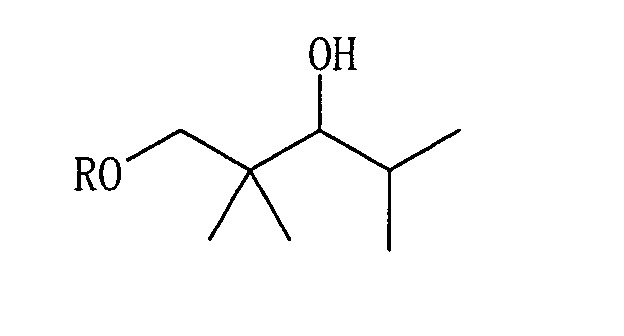
a suitable carrier. - The fragrance composition according to claim 5, wherein R is a C1-C7 saturated, unsaturated, straight-chained or branched, acyclic alkyl group.
- The fragrance composition according to claim 6, wherein R is selected from the group consisting of 2-methyl-2-propene, ethyl, 2-methylpropyl, and 3-methyl-2-butene.
- The fragrance composition according to claim 5, wherein R is a C1-C7 saturated, straight-chained or branched, acyclic or cyclic alkyl group.
- The fragrance composition according to claim 8, wherein said suitable carrier includes bleach.
- A method of adding fragrance to a composition, comprising:wherein R is a C1-C7 saturated, unsaturated, straight-chain or branched, acyclic or cyclic alkyl group to a composition in need thereof.adding a suitable amount of a compound having the formula

- The method according to claim 10, wherein R is a C1-C7 saturated, unsaturated, straight-chained or branched, acyclic alkyl group.
- The method according to claim 11, wherein R is selected from the group consisting of 2-methyl-2-propene, ethyl, 2-methylpropyl, and 3-methyl-2-butene.
- The method according to claim 10, wherein R is a C1-C7 saturated, straight-chained or branched, acyclic or cyclic alkyl group.
- The method according to claim 13, wherein said composition in need thereof includes bleach.
- A method for making a compound according to any one of claims 1 to 4, comprising:contacting a 2,2,4-trimethyl-1,3-diol with a compound having the formula R - X, wherein X is any suitable leaving group, in the presence of a base at a temperature suitable to cause a reaction in the resulting reaction mixture.
- The method according to claim 15, wherein:said base is aqueous NaOH;said temperature is at least 50°C; andX is a halogen.
- The method according to claim 15 or 16, further comprising:adding an alkylammonium salt to said reaction mixture.
- A fragrance composition, comprising: a compound of claim 1 in combination with at least one of a carrier and additional perfumery material.
- The fragrance composition, according to any one of claims 5 to 9 and 18, further comprising a surfactant to form a product, whereby said product is effective to act as at least one of a shampoo, conditioner, perfume, cologne, hair cream, pomade, hair cosmetic material, other cosmetic materials or cosmetic cleansers, room fragrance, soap, dishwashing detergent, laundry detergent, softener, disinfecting cleaning agent, deodorizing cleaning agent, furniture care material, disinfectant, bactericidal agent, repellant, bleaching agent, and other sanitation cleaning agents, toothpaste, mouthwash, toilet paper and odor giving agents to aid in the taking of medication.
Applications Claiming Priority (2)
| Application Number | Priority Date | Filing Date | Title |
|---|---|---|---|
| US10/193,024 US7132391B2 (en) | 2002-07-10 | 2002-07-10 | Ethers of 2,2,4-trimethylpentane-1,3-diol as fragrance materials |
| US193024 | 2002-07-10 |
Publications (2)
| Publication Number | Publication Date |
|---|---|
| EP1380559A1 true EP1380559A1 (en) | 2004-01-14 |
| EP1380559B1 EP1380559B1 (en) | 2009-12-23 |
Family
ID=29735322
Family Applications (1)
| Application Number | Title | Priority Date | Filing Date |
|---|---|---|---|
| EP03291711A Expired - Lifetime EP1380559B1 (en) | 2002-07-10 | 2003-07-09 | Ethers of 2,2,4-trimethylpentane-1, 3-diol as fragrance materials |
Country Status (5)
| Country | Link |
|---|---|
| US (1) | US7132391B2 (en) |
| EP (1) | EP1380559B1 (en) |
| JP (1) | JP4069031B2 (en) |
| DE (1) | DE60330629D1 (en) |
| ES (1) | ES2338643T3 (en) |
Cited By (1)
| Publication number | Priority date | Publication date | Assignee | Title |
|---|---|---|---|---|
| EP2133102A1 (en) * | 2008-03-19 | 2009-12-16 | Symrise GmbH & Co. KG | Odor reducers |
Families Citing this family (5)
| Publication number | Priority date | Publication date | Assignee | Title |
|---|---|---|---|---|
| US7757340B2 (en) * | 2005-03-25 | 2010-07-20 | S.C. Johnson & Son, Inc. | Soft-surface remediation device and method of using same |
| JP2006282627A (en) * | 2005-04-04 | 2006-10-19 | Takasago Internatl Corp | Stable composition for hair dye |
| US20060288516A1 (en) * | 2005-06-23 | 2006-12-28 | Sawalski Michael M | Handheld mechanical soft-surface remediation (SSR) device and method of using same |
| US20060288495A1 (en) * | 2005-06-28 | 2006-12-28 | Sawalski Michael M | System for and method of soft surface remediation |
| US10465557B2 (en) * | 2015-09-01 | 2019-11-05 | Rolls-Royce North American Technologies, Inc. | Magnetic squeeze film damper system for a gas turbine engine |
Citations (4)
| Publication number | Priority date | Publication date | Assignee | Title |
|---|---|---|---|---|
| US3287420A (en) * | 1963-04-26 | 1966-11-22 | Eastman Kodak Co | Glycol monovinyl ether |
| US3409657A (en) * | 1965-01-08 | 1968-11-05 | Eastman Kodak Co | Esters and ethers of trimethyl pentyl sulfates and their preparation |
| WO1995021606A1 (en) * | 1994-02-08 | 1995-08-17 | Union Camp Corporation | 2,2,4-trimethyl-penten-1-yl compounds, fragrance and flavor compositions |
| JP2001271087A (en) * | 2000-03-27 | 2001-10-02 | Takasago Internatl Corp | Fragrance composition containing 2,4-dimethyl-3-pentanone derivative and bleach composition containing the same |
-
2002
- 2002-07-10 US US10/193,024 patent/US7132391B2/en not_active Expired - Lifetime
-
2003
- 2003-07-09 ES ES03291711T patent/ES2338643T3/en not_active Expired - Lifetime
- 2003-07-09 EP EP03291711A patent/EP1380559B1/en not_active Expired - Lifetime
- 2003-07-09 DE DE60330629T patent/DE60330629D1/en not_active Expired - Lifetime
- 2003-07-09 JP JP2003272297A patent/JP4069031B2/en not_active Expired - Lifetime
Patent Citations (4)
| Publication number | Priority date | Publication date | Assignee | Title |
|---|---|---|---|---|
| US3287420A (en) * | 1963-04-26 | 1966-11-22 | Eastman Kodak Co | Glycol monovinyl ether |
| US3409657A (en) * | 1965-01-08 | 1968-11-05 | Eastman Kodak Co | Esters and ethers of trimethyl pentyl sulfates and their preparation |
| WO1995021606A1 (en) * | 1994-02-08 | 1995-08-17 | Union Camp Corporation | 2,2,4-trimethyl-penten-1-yl compounds, fragrance and flavor compositions |
| JP2001271087A (en) * | 2000-03-27 | 2001-10-02 | Takasago Internatl Corp | Fragrance composition containing 2,4-dimethyl-3-pentanone derivative and bleach composition containing the same |
Non-Patent Citations (1)
| Title |
|---|
| JUNG, MICHAEL E. ET AL: "Oxidation of ethers via hydride abstraction: a new procedure for selective oxidation of primary, secondary diols at the secondary position", JOURNAL OF THE AMERICAN CHEMICAL SOCIETY (1976), 98(24), 7882-4, XP002255478 * |
Cited By (1)
| Publication number | Priority date | Publication date | Assignee | Title |
|---|---|---|---|---|
| EP2133102A1 (en) * | 2008-03-19 | 2009-12-16 | Symrise GmbH & Co. KG | Odor reducers |
Also Published As
| Publication number | Publication date |
|---|---|
| US20040014633A1 (en) | 2004-01-22 |
| ES2338643T3 (en) | 2010-05-11 |
| DE60330629D1 (en) | 2010-02-04 |
| JP2004035564A (en) | 2004-02-05 |
| US7132391B2 (en) | 2006-11-07 |
| EP1380559B1 (en) | 2009-12-23 |
| JP4069031B2 (en) | 2008-03-26 |
Similar Documents
| Publication | Publication Date | Title |
|---|---|---|
| JP5453402B2 (en) | Fruit-like odorant | |
| US8557262B2 (en) | Divinyl ether derivatives capable of releasing active aldehydes and ketones and methods of use for perfuming surfaces | |
| CN112661622A (en) | Improvements in or relating to organic compounds | |
| EP1398366B1 (en) | Fruity musk compositions | |
| US7015189B2 (en) | Oxime methyl ethers | |
| EP1108703B1 (en) | Fragance composition | |
| CN113025426A (en) | 1-isopropoxy-1-oxopropan-2-yl pivalate as perfuming ingredient | |
| US7132391B2 (en) | Ethers of 2,2,4-trimethylpentane-1,3-diol as fragrance materials | |
| JPH0688926B2 (en) | Ketone isomer mixture, process for producing the same and composition thereof | |
| JP4008645B2 (en) | Method for imparting, improving, enhancing or modifying scent properties, fragrance compositions, scented products, and novel aliphatic esters | |
| JP4138403B2 (en) | Use of tertiary alcohols or esters as perfume ingredients | |
| CN100509749C (en) | Fragrance compound | |
| EP1762565B1 (en) | Alkyl substituted octennitrile derivatives | |
| JP4280655B2 (en) | Novel 3,4-epoxyalkanoic acid esters, fragrance ingredients, fragrance products containing them and use of these compounds | |
| US5939368A (en) | Use of 1-methoxy-2-methyl-3-phenylpropane, 1-(2-methoxypropyl)-4-methylbenzene and 3-methoxy-2,2,3-trimethyl-1-phenylbutane in perfumery | |
| WO2021108472A2 (en) | Novel organoleptic compounds | |
| JP4976285B2 (en) | Acyclic hindered ketones as perfuming ingredients | |
| EP0170265B1 (en) | 4-alkylphenyl-2'-alkoxyethyl ethers and fragrance compositions containing same | |
| US4051076A (en) | Aroma chemicals | |
| JP5150627B2 (en) | Oxathian derivatives as aromatic components | |
| US7838487B2 (en) | Macrocyclic musk | |
| US7531696B2 (en) | Substituted cyclopentenone derivatives and their use in perfume compositions | |
| JPH0324198A (en) | Perfume composition and bleaching agent composition | |
| EP0456932A1 (en) | Propanol derivatives and perfumes containing the same | |
| JP2021534313A (en) | Fragrance composition containing norbornene derivative |
Legal Events
| Date | Code | Title | Description |
|---|---|---|---|
| PUAI | Public reference made under article 153(3) epc to a published international application that has entered the european phase |
Free format text: ORIGINAL CODE: 0009012 |
|
| AK | Designated contracting states |
Kind code of ref document: A1 Designated state(s): AT BE BG CH CY CZ DE DK EE ES FI FR GB GR HU IE IT LI LU MC NL PT RO SE SI SK TR |
|
| AX | Request for extension of the european patent |
Extension state: AL LT LV MK |
|
| 17P | Request for examination filed |
Effective date: 20040714 |
|
| AKX | Designation fees paid |
Designated state(s): DE ES FR GB IT |
|
| 17Q | First examination report despatched |
Effective date: 20070703 |
|
| GRAP | Despatch of communication of intention to grant a patent |
Free format text: ORIGINAL CODE: EPIDOSNIGR1 |
|
| GRAS | Grant fee paid |
Free format text: ORIGINAL CODE: EPIDOSNIGR3 |
|
| GRAA | (expected) grant |
Free format text: ORIGINAL CODE: 0009210 |
|
| AK | Designated contracting states |
Kind code of ref document: B1 Designated state(s): DE ES FR GB IT |
|
| REG | Reference to a national code |
Ref country code: GB Ref legal event code: FG4D |
|
| RIC2 | Information provided on ipc code assigned after grant |
Ipc: C07C 43/13 20060101ALI20091130BHEP Ipc: C07C 41/01 20060101AFI20091130BHEP Ipc: A61Q 13/00 20060101ALI20091130BHEP Ipc: C07C 43/196 20060101ALI20091130BHEP Ipc: C07C 43/178 20060101ALI20091130BHEP |
|
| REF | Corresponds to: |
Ref document number: 60330629 Country of ref document: DE Date of ref document: 20100204 Kind code of ref document: P |
|
| REG | Reference to a national code |
Ref country code: ES Ref legal event code: FG2A Ref document number: 2338643 Country of ref document: ES Kind code of ref document: T3 |
|
| PLBE | No opposition filed within time limit |
Free format text: ORIGINAL CODE: 0009261 |
|
| STAA | Information on the status of an ep patent application or granted ep patent |
Free format text: STATUS: NO OPPOSITION FILED WITHIN TIME LIMIT |
|
| 26N | No opposition filed |
Effective date: 20100924 |
|
| PG25 | Lapsed in a contracting state [announced via postgrant information from national office to epo] |
Ref country code: IT Free format text: LAPSE BECAUSE OF FAILURE TO SUBMIT A TRANSLATION OF THE DESCRIPTION OR TO PAY THE FEE WITHIN THE PRESCRIBED TIME-LIMIT Effective date: 20091223 |
|
| PGFP | Annual fee paid to national office [announced via postgrant information from national office to epo] |
Ref country code: ES Payment date: 20130628 Year of fee payment: 11 |
|
| PGFP | Annual fee paid to national office [announced via postgrant information from national office to epo] |
Ref country code: DE Payment date: 20140702 Year of fee payment: 12 |
|
| PGFP | Annual fee paid to national office [announced via postgrant information from national office to epo] |
Ref country code: GB Payment date: 20140709 Year of fee payment: 12 |
|
| REG | Reference to a national code |
Ref country code: ES Ref legal event code: FD2A Effective date: 20150827 |
|
| PG25 | Lapsed in a contracting state [announced via postgrant information from national office to epo] |
Ref country code: ES Free format text: LAPSE BECAUSE OF NON-PAYMENT OF DUE FEES Effective date: 20140710 |
|
| REG | Reference to a national code |
Ref country code: DE Ref legal event code: R119 Ref document number: 60330629 Country of ref document: DE |
|
| GBPC | Gb: european patent ceased through non-payment of renewal fee |
Effective date: 20150709 |
|
| PG25 | Lapsed in a contracting state [announced via postgrant information from national office to epo] |
Ref country code: DE Free format text: LAPSE BECAUSE OF NON-PAYMENT OF DUE FEES Effective date: 20160202 Ref country code: GB Free format text: LAPSE BECAUSE OF NON-PAYMENT OF DUE FEES Effective date: 20150709 |
|
| REG | Reference to a national code |
Ref country code: FR Ref legal event code: PLFP Year of fee payment: 14 |
|
| REG | Reference to a national code |
Ref country code: FR Ref legal event code: PLFP Year of fee payment: 15 |
|
| REG | Reference to a national code |
Ref country code: FR Ref legal event code: PLFP Year of fee payment: 16 |
|
| PGFP | Annual fee paid to national office [announced via postgrant information from national office to epo] |
Ref country code: FR Payment date: 20190619 Year of fee payment: 17 |
|
| PG25 | Lapsed in a contracting state [announced via postgrant information from national office to epo] |
Ref country code: FR Free format text: LAPSE BECAUSE OF NON-PAYMENT OF DUE FEES Effective date: 20200731 |