EP1379527B1 - Epindolidione pigments - Google Patents
Epindolidione pigments Download PDFInfo
- Publication number
- EP1379527B1 EP1379527B1 EP02710233A EP02710233A EP1379527B1 EP 1379527 B1 EP1379527 B1 EP 1379527B1 EP 02710233 A EP02710233 A EP 02710233A EP 02710233 A EP02710233 A EP 02710233A EP 1379527 B1 EP1379527 B1 EP 1379527B1
- Authority
- EP
- European Patent Office
- Prior art keywords
- alkyl
- formula
- compounds
- phenyl
- colorants
- Prior art date
- Legal status (The legal status is an assumption and is not a legal conclusion. Google has not performed a legal analysis and makes no representation as to the accuracy of the status listed.)
- Expired - Lifetime
Links
- 239000000049 pigment Substances 0.000 title claims abstract description 20
- NUJGNDIAVBGFHG-UHFFFAOYSA-N 5,11-dihydroquinolino[3,2-b]quinoline-6,12-dione Chemical compound N1C2=CC=CC=C2C(=O)C2=C1C(=O)C1=CC=CC=C1N2 NUJGNDIAVBGFHG-UHFFFAOYSA-N 0.000 title claims abstract description 18
- 239000000203 mixture Substances 0.000 claims abstract description 25
- 239000003086 colorant Substances 0.000 claims abstract description 15
- 238000000576 coating method Methods 0.000 claims abstract description 7
- 239000000976 ink Substances 0.000 claims abstract description 7
- 238000004519 manufacturing process Methods 0.000 claims abstract description 6
- 238000004040 coloring Methods 0.000 claims abstract description 5
- 239000004753 textile Substances 0.000 claims abstract description 4
- 229920001131 Pulp (paper) Polymers 0.000 claims abstract description 3
- 239000002537 cosmetic Substances 0.000 claims abstract description 3
- 229920000642 polymer Polymers 0.000 claims abstract description 3
- 150000001875 compounds Chemical class 0.000 claims description 36
- 125000004209 (C1-C8) alkyl group Chemical group 0.000 claims description 27
- 125000001997 phenyl group Chemical group [H]C1=C([H])C([H])=C(*)C([H])=C1[H] 0.000 claims description 20
- 238000006243 chemical reaction Methods 0.000 claims description 17
- 229910052739 hydrogen Inorganic materials 0.000 claims description 13
- 239000001257 hydrogen Substances 0.000 claims description 13
- 238000000034 method Methods 0.000 claims description 12
- 150000002431 hydrogen Chemical class 0.000 claims description 11
- 229910052736 halogen Inorganic materials 0.000 claims description 9
- 150000002367 halogens Chemical class 0.000 claims description 9
- 125000000449 nitro group Chemical group [O-][N+](*)=O 0.000 claims description 7
- 238000002360 preparation method Methods 0.000 claims description 7
- 125000006704 (C5-C6) cycloalkyl group Chemical group 0.000 claims description 6
- ZVSKZLHKADLHSD-UHFFFAOYSA-N benzanilide Chemical compound C=1C=CC=CC=1C(=O)NC1=CC=CC=C1 ZVSKZLHKADLHSD-UHFFFAOYSA-N 0.000 claims description 6
- 125000001797 benzyl group Chemical group [H]C1=C([H])C([H])=C(C([H])=C1[H])C([H])([H])* 0.000 claims description 6
- 230000000295 complement effect Effects 0.000 claims description 6
- 125000001624 naphthyl group Chemical group 0.000 claims description 6
- 229920000137 polyphosphoric acid Polymers 0.000 claims description 6
- QAOWNCQODCNURD-UHFFFAOYSA-N sulfuric acid Substances OS(O)(=O)=O QAOWNCQODCNURD-UHFFFAOYSA-N 0.000 claims description 6
- ZAMOUSCENKQFHK-UHFFFAOYSA-N Chlorine atom Chemical compound [Cl] ZAMOUSCENKQFHK-UHFFFAOYSA-N 0.000 claims description 5
- 239000000460 chlorine Substances 0.000 claims description 5
- 229910052801 chlorine Inorganic materials 0.000 claims description 5
- 125000004400 (C1-C12) alkyl group Chemical group 0.000 claims description 3
- 125000003118 aryl group Chemical group 0.000 claims description 3
- 239000002904 solvent Substances 0.000 abstract description 12
- 230000005012 migration Effects 0.000 abstract description 5
- 238000013508 migration Methods 0.000 abstract description 5
- LFQSCWFLJHTTHZ-UHFFFAOYSA-N Ethanol Chemical compound CCO LFQSCWFLJHTTHZ-UHFFFAOYSA-N 0.000 description 31
- YXFVVABEGXRONW-UHFFFAOYSA-N Toluene Chemical compound CC1=CC=CC=C1 YXFVVABEGXRONW-UHFFFAOYSA-N 0.000 description 24
- -1 benzanilide radical Chemical class 0.000 description 19
- 239000000047 product Substances 0.000 description 19
- XLYOFNOQVPJJNP-UHFFFAOYSA-N water Substances O XLYOFNOQVPJJNP-UHFFFAOYSA-N 0.000 description 17
- 0 *N(c(c(C1=O)c2)cc(N3)c2NC3=O)C2=C1N(*)c(cc(c(N1)c3)NC1=O)c3C2=O Chemical compound *N(c(c(C1=O)c2)cc(N3)c2NC3=O)C2=C1N(*)c(cc(c(N1)c3)NC1=O)c3C2=O 0.000 description 16
- 239000000843 powder Substances 0.000 description 11
- QTBSBXVTEAMEQO-UHFFFAOYSA-N Acetic acid Chemical compound CC(O)=O QTBSBXVTEAMEQO-UHFFFAOYSA-N 0.000 description 9
- 239000011541 reaction mixture Substances 0.000 description 8
- MHCVCKDNQYMGEX-UHFFFAOYSA-N 1,1'-biphenyl;phenoxybenzene Chemical compound C1=CC=CC=C1C1=CC=CC=C1.C=1C=CC=CC=1OC1=CC=CC=C1 MHCVCKDNQYMGEX-UHFFFAOYSA-N 0.000 description 7
- MSXVEPNJUHWQHW-UHFFFAOYSA-N 2-methylbutan-2-ol Chemical compound CCC(C)(C)O MSXVEPNJUHWQHW-UHFFFAOYSA-N 0.000 description 7
- OKKJLVBELUTLKV-UHFFFAOYSA-N Methanol Chemical compound OC OKKJLVBELUTLKV-UHFFFAOYSA-N 0.000 description 6
- USIUVYZYUHIAEV-UHFFFAOYSA-N diphenyl ether Chemical compound C=1C=CC=CC=1OC1=CC=CC=C1 USIUVYZYUHIAEV-UHFFFAOYSA-N 0.000 description 6
- PAYRUJLWNCNPSJ-UHFFFAOYSA-N Aniline Chemical compound NC1=CC=CC=C1 PAYRUJLWNCNPSJ-UHFFFAOYSA-N 0.000 description 5
- 239000011248 coating agent Substances 0.000 description 5
- 150000003254 radicals Chemical group 0.000 description 5
- 239000000725 suspension Substances 0.000 description 5
- VEXZGXHMUGYJMC-UHFFFAOYSA-N Hydrochloric acid Chemical compound Cl VEXZGXHMUGYJMC-UHFFFAOYSA-N 0.000 description 4
- DGAQECJNVWCQMB-PUAWFVPOSA-M Ilexoside XXIX Chemical compound C[C@@H]1CC[C@@]2(CC[C@@]3(C(=CC[C@H]4[C@]3(CC[C@@H]5[C@@]4(CC[C@@H](C5(C)C)OS(=O)(=O)[O-])C)C)[C@@H]2[C@]1(C)O)C)C(=O)O[C@H]6[C@@H]([C@H]([C@@H]([C@H](O6)CO)O)O)O.[Na+] DGAQECJNVWCQMB-PUAWFVPOSA-M 0.000 description 4
- 238000009835 boiling Methods 0.000 description 4
- ZUOUZKKEUPVFJK-UHFFFAOYSA-N diphenyl Chemical compound C1=CC=CC=C1C1=CC=CC=C1 ZUOUZKKEUPVFJK-UHFFFAOYSA-N 0.000 description 4
- 238000001035 drying Methods 0.000 description 4
- 239000000463 material Substances 0.000 description 4
- 239000004800 polyvinyl chloride Substances 0.000 description 4
- 229920000915 polyvinyl chloride Polymers 0.000 description 4
- 229920005989 resin Polymers 0.000 description 4
- 239000011347 resin Substances 0.000 description 4
- 125000004178 (C1-C4) alkyl group Chemical group 0.000 description 3
- ZMXDDKWLCZADIW-UHFFFAOYSA-N N,N-Dimethylformamide Chemical compound CN(C)C=O ZMXDDKWLCZADIW-UHFFFAOYSA-N 0.000 description 3
- CTQNGGLPUBDAKN-UHFFFAOYSA-N O-Xylene Chemical compound CC1=CC=CC=C1C CTQNGGLPUBDAKN-UHFFFAOYSA-N 0.000 description 3
- KWYUFKZDYYNOTN-UHFFFAOYSA-M Potassium hydroxide Chemical compound [OH-].[K+] KWYUFKZDYYNOTN-UHFFFAOYSA-M 0.000 description 3
- ZMANZCXQSJIPKH-UHFFFAOYSA-N Triethylamine Chemical compound CCN(CC)CC ZMANZCXQSJIPKH-UHFFFAOYSA-N 0.000 description 3
- CIUQDSCDWFSTQR-UHFFFAOYSA-N [C]1=CC=CC=C1 Chemical class [C]1=CC=CC=C1 CIUQDSCDWFSTQR-UHFFFAOYSA-N 0.000 description 3
- 125000005907 alkyl ester group Chemical group 0.000 description 3
- 239000004305 biphenyl Substances 0.000 description 3
- 235000010290 biphenyl Nutrition 0.000 description 3
- 239000003822 epoxy resin Substances 0.000 description 3
- 239000000543 intermediate Substances 0.000 description 3
- VLKZOEOYAKHREP-UHFFFAOYSA-N n-Hexane Chemical compound CCCCCC VLKZOEOYAKHREP-UHFFFAOYSA-N 0.000 description 3
- 229920003023 plastic Polymers 0.000 description 3
- 239000004033 plastic Substances 0.000 description 3
- 229920000647 polyepoxide Polymers 0.000 description 3
- 239000002244 precipitate Substances 0.000 description 3
- 238000010992 reflux Methods 0.000 description 3
- 239000011734 sodium Substances 0.000 description 3
- QDRKDTQENPPHOJ-UHFFFAOYSA-N sodium ethoxide Chemical compound [Na+].CC[O-] QDRKDTQENPPHOJ-UHFFFAOYSA-N 0.000 description 3
- 239000008096 xylene Substances 0.000 description 3
- ULOIAOPTGWSNHU-UHFFFAOYSA-N 2-butyl radical Chemical compound C[CH]CC ULOIAOPTGWSNHU-UHFFFAOYSA-N 0.000 description 2
- IIVWHGMLFGNMOW-UHFFFAOYSA-N 2-methylpropane Chemical compound C[C](C)C IIVWHGMLFGNMOW-UHFFFAOYSA-N 0.000 description 2
- VEXZGXHMUGYJMC-UHFFFAOYSA-M Chloride anion Chemical compound [Cl-] VEXZGXHMUGYJMC-UHFFFAOYSA-M 0.000 description 2
- XDTMQSROBMDMFD-UHFFFAOYSA-N Cyclohexane Chemical compound C1CCCCC1 XDTMQSROBMDMFD-UHFFFAOYSA-N 0.000 description 2
- RTZKZFJDLAIYFH-UHFFFAOYSA-N Diethyl ether Chemical compound CCOCC RTZKZFJDLAIYFH-UHFFFAOYSA-N 0.000 description 2
- UFHFLCQGNIYNRP-UHFFFAOYSA-N Hydrogen Chemical compound [H][H] UFHFLCQGNIYNRP-UHFFFAOYSA-N 0.000 description 2
- 229920000877 Melamine resin Polymers 0.000 description 2
- LRHPLDYGYMQRHN-UHFFFAOYSA-N N-Butanol Chemical compound CCCCO LRHPLDYGYMQRHN-UHFFFAOYSA-N 0.000 description 2
- MUBZPKHOEPUJKR-UHFFFAOYSA-N Oxalic acid Chemical compound OC(=O)C(O)=O MUBZPKHOEPUJKR-UHFFFAOYSA-N 0.000 description 2
- NBIIXXVUZAFLBC-UHFFFAOYSA-N Phosphoric acid Chemical compound OP(O)(O)=O NBIIXXVUZAFLBC-UHFFFAOYSA-N 0.000 description 2
- 239000004698 Polyethylene Substances 0.000 description 2
- ZLMJMSJWJFRBEC-UHFFFAOYSA-N Potassium Chemical compound [K] ZLMJMSJWJFRBEC-UHFFFAOYSA-N 0.000 description 2
- CDBYLPFSWZWCQE-UHFFFAOYSA-L Sodium Carbonate Chemical compound [Na+].[Na+].[O-]C([O-])=O CDBYLPFSWZWCQE-UHFFFAOYSA-L 0.000 description 2
- PPBRXRYQALVLMV-UHFFFAOYSA-N Styrene Chemical compound C=CC1=CC=CC=C1 PPBRXRYQALVLMV-UHFFFAOYSA-N 0.000 description 2
- GWEVSGVZZGPLCZ-UHFFFAOYSA-N Titan oxide Chemical compound O=[Ti]=O GWEVSGVZZGPLCZ-UHFFFAOYSA-N 0.000 description 2
- 239000002253 acid Substances 0.000 description 2
- 150000001412 amines Chemical class 0.000 description 2
- 150000001448 anilines Chemical class 0.000 description 2
- 239000008346 aqueous phase Substances 0.000 description 2
- 150000004982 aromatic amines Chemical class 0.000 description 2
- ZCILODAAHLISPY-UHFFFAOYSA-N biphenyl ether Natural products C1=C(CC=C)C(O)=CC(OC=2C(=CC(CC=C)=CC=2)O)=C1 ZCILODAAHLISPY-UHFFFAOYSA-N 0.000 description 2
- MVPPADPHJFYWMZ-UHFFFAOYSA-N chlorobenzene Chemical compound ClC1=CC=CC=C1 MVPPADPHJFYWMZ-UHFFFAOYSA-N 0.000 description 2
- 230000007423 decrease Effects 0.000 description 2
- DOIRQSBPFJWKBE-UHFFFAOYSA-N dibutyl phthalate Chemical compound CCCCOC(=O)C1=CC=CC=C1C(=O)OCCCC DOIRQSBPFJWKBE-UHFFFAOYSA-N 0.000 description 2
- WYACBZDAHNBPPB-UHFFFAOYSA-N diethyl oxalate Chemical compound CCOC(=O)C(=O)OCC WYACBZDAHNBPPB-UHFFFAOYSA-N 0.000 description 2
- HMPNVUONVWQKFY-ONEGZZNKSA-N dimethyl (e)-2,3-dihydroxybut-2-enedioate Chemical compound COC(=O)C(\O)=C(/O)C(=O)OC HMPNVUONVWQKFY-ONEGZZNKSA-N 0.000 description 2
- 229920001971 elastomer Polymers 0.000 description 2
- QUPDWYMUPZLYJZ-UHFFFAOYSA-N ethyl Chemical compound C[CH2] QUPDWYMUPZLYJZ-UHFFFAOYSA-N 0.000 description 2
- VEUUMBGHMNQHGO-UHFFFAOYSA-N ethyl chloroacetate Chemical compound CCOC(=O)CCl VEUUMBGHMNQHGO-UHFFFAOYSA-N 0.000 description 2
- LNEPOXFFQSENCJ-UHFFFAOYSA-N haloperidol Chemical compound C1CC(O)(C=2C=CC(Cl)=CC=2)CCN1CCCC(=O)C1=CC=C(F)C=C1 LNEPOXFFQSENCJ-UHFFFAOYSA-N 0.000 description 2
- 238000010438 heat treatment Methods 0.000 description 2
- IXCSERBJSXMMFS-UHFFFAOYSA-N hydrogen chloride Substances Cl.Cl IXCSERBJSXMMFS-UHFFFAOYSA-N 0.000 description 2
- 229910000041 hydrogen chloride Inorganic materials 0.000 description 2
- 125000002887 hydroxy group Chemical group [H]O* 0.000 description 2
- 239000005457 ice water Substances 0.000 description 2
- 125000000959 isobutyl group Chemical group [H]C([H])([H])C([H])(C([H])([H])[H])C([H])([H])* 0.000 description 2
- 125000001449 isopropyl group Chemical group [H]C([H])([H])C([H])(*)C([H])([H])[H] 0.000 description 2
- 238000002844 melting Methods 0.000 description 2
- 230000008018 melting Effects 0.000 description 2
- 229910052751 metal Inorganic materials 0.000 description 2
- 239000002184 metal Substances 0.000 description 2
- WCYWZMWISLQXQU-UHFFFAOYSA-N methyl Chemical compound [CH3] WCYWZMWISLQXQU-UHFFFAOYSA-N 0.000 description 2
- 125000004108 n-butyl group Chemical group [H]C([H])([H])C([H])([H])C([H])([H])C([H])([H])* 0.000 description 2
- 125000004123 n-propyl group Chemical group [H]C([H])([H])C([H])([H])C([H])([H])* 0.000 description 2
- LQNUZADURLCDLV-UHFFFAOYSA-N nitrobenzene Chemical compound [O-][N+](=O)C1=CC=CC=C1 LQNUZADURLCDLV-UHFFFAOYSA-N 0.000 description 2
- 239000003921 oil Substances 0.000 description 2
- 235000019198 oils Nutrition 0.000 description 2
- 239000012074 organic phase Substances 0.000 description 2
- 239000012071 phase Substances 0.000 description 2
- 229920001225 polyester resin Polymers 0.000 description 2
- 239000004645 polyester resin Substances 0.000 description 2
- 229920000573 polyethylene Polymers 0.000 description 2
- 239000004848 polyfunctional curative Substances 0.000 description 2
- 229910052700 potassium Inorganic materials 0.000 description 2
- 239000011591 potassium Substances 0.000 description 2
- 238000000746 purification Methods 0.000 description 2
- 239000005060 rubber Substances 0.000 description 2
- 229910052708 sodium Inorganic materials 0.000 description 2
- HEMHJVSKTPXQMS-UHFFFAOYSA-M sodium hydroxide Inorganic materials [OH-].[Na+] HEMHJVSKTPXQMS-UHFFFAOYSA-M 0.000 description 2
- MFRIHAYPQRLWNB-UHFFFAOYSA-N sodium tert-butoxide Chemical compound [Na+].CC(C)(C)[O-] MFRIHAYPQRLWNB-UHFFFAOYSA-N 0.000 description 2
- 239000012265 solid product Substances 0.000 description 2
- 238000003756 stirring Methods 0.000 description 2
- 125000001424 substituent group Chemical group 0.000 description 2
- 238000003786 synthesis reaction Methods 0.000 description 2
- NJVOHKFLBKQLIZ-UHFFFAOYSA-N (2-ethenylphenyl) prop-2-enoate Chemical compound C=CC(=O)OC1=CC=CC=C1C=C NJVOHKFLBKQLIZ-UHFFFAOYSA-N 0.000 description 1
- AZUYLZMQTIKGSC-UHFFFAOYSA-N 1-[6-[4-(5-chloro-6-methyl-1H-indazol-4-yl)-5-methyl-3-(1-methylindazol-5-yl)pyrazol-1-yl]-2-azaspiro[3.3]heptan-2-yl]prop-2-en-1-one Chemical compound ClC=1C(=C2C=NNC2=CC=1C)C=1C(=NN(C=1C)C1CC2(CN(C2)C(C=C)=O)C1)C=1C=C2C=NN(C2=CC=1)C AZUYLZMQTIKGSC-UHFFFAOYSA-N 0.000 description 1
- RUFPHBVGCFYCNW-UHFFFAOYSA-N 1-naphthylamine Chemical class C1=CC=C2C(N)=CC=CC2=C1 RUFPHBVGCFYCNW-UHFFFAOYSA-N 0.000 description 1
- ZNQVEEAIQZEUHB-UHFFFAOYSA-N 2-ethoxyethanol Chemical compound CCOCCO ZNQVEEAIQZEUHB-UHFFFAOYSA-N 0.000 description 1
- QSNSCYSYFYORTR-UHFFFAOYSA-N 4-chloroaniline Chemical compound NC1=CC=C(Cl)C=C1 QSNSCYSYFYORTR-UHFFFAOYSA-N 0.000 description 1
- NIXOWILDQLNWCW-UHFFFAOYSA-M Acrylate Chemical compound [O-]C(=O)C=C NIXOWILDQLNWCW-UHFFFAOYSA-M 0.000 description 1
- 239000004925 Acrylic resin Substances 0.000 description 1
- 229920000178 Acrylic resin Polymers 0.000 description 1
- CPELXLSAUQHCOX-UHFFFAOYSA-M Bromide Chemical compound [Br-] CPELXLSAUQHCOX-UHFFFAOYSA-M 0.000 description 1
- ZGZBFCZIACAMDJ-UHFFFAOYSA-N CCN(c(cc(c(NC(C(c1c2)=O)=C3Nc1ccc2Cl)c1)C3=O)c1N1)C1=O Chemical compound CCN(c(cc(c(NC(C(c1c2)=O)=C3Nc1ccc2Cl)c1)C3=O)c1N1)C1=O ZGZBFCZIACAMDJ-UHFFFAOYSA-N 0.000 description 1
- CTCHXZUMFHNSHM-UHFFFAOYSA-N Cc(cc1N2)ccc1NC2=O Chemical compound Cc(cc1N2)ccc1NC2=O CTCHXZUMFHNSHM-UHFFFAOYSA-N 0.000 description 1
- MQIUGAXCHLFZKX-UHFFFAOYSA-N Di-n-octyl phthalate Natural products CCCCCCCCOC(=O)C1=CC=CC=C1C(=O)OCCCCCCCC MQIUGAXCHLFZKX-UHFFFAOYSA-N 0.000 description 1
- 239000004640 Melamine resin Substances 0.000 description 1
- FXHOOIRPVKKKFG-UHFFFAOYSA-N N,N-Dimethylacetamide Chemical compound CN(C)C(C)=O FXHOOIRPVKKKFG-UHFFFAOYSA-N 0.000 description 1
- SECXISVLQFMRJM-UHFFFAOYSA-N N-Methylpyrrolidone Chemical compound CN1CCCC1=O SECXISVLQFMRJM-UHFFFAOYSA-N 0.000 description 1
- VYJLXJCBTIFELQ-UHFFFAOYSA-N Nc(cc1)cc(OC2=O)c1N2I Chemical compound Nc(cc1)cc(OC2=O)c1N2I VYJLXJCBTIFELQ-UHFFFAOYSA-N 0.000 description 1
- 235000019502 Orange oil Nutrition 0.000 description 1
- 239000004952 Polyamide Substances 0.000 description 1
- 239000004743 Polypropylene Substances 0.000 description 1
- 239000004793 Polystyrene Substances 0.000 description 1
- 229920000297 Rayon Polymers 0.000 description 1
- VMHLLURERBWHNL-UHFFFAOYSA-M Sodium acetate Chemical compound [Na+].CC([O-])=O VMHLLURERBWHNL-UHFFFAOYSA-M 0.000 description 1
- 239000002174 Styrene-butadiene Substances 0.000 description 1
- YUDRVAHLXDBKSR-UHFFFAOYSA-N [CH]1CCCCC1 Chemical compound [CH]1CCCCC1 YUDRVAHLXDBKSR-UHFFFAOYSA-N 0.000 description 1
- 150000008065 acid anhydrides Chemical class 0.000 description 1
- 150000007513 acids Chemical class 0.000 description 1
- 238000012644 addition polymerization Methods 0.000 description 1
- 150000001298 alcohols Chemical class 0.000 description 1
- 125000003545 alkoxy group Chemical group 0.000 description 1
- 239000004411 aluminium Substances 0.000 description 1
- 229910052782 aluminium Inorganic materials 0.000 description 1
- XAGFODPZIPBFFR-UHFFFAOYSA-N aluminium Chemical compound [Al] XAGFODPZIPBFFR-UHFFFAOYSA-N 0.000 description 1
- 239000011230 binding agent Substances 0.000 description 1
- BJQHLKABXJIVAM-UHFFFAOYSA-N bis(2-ethylhexyl) phthalate Chemical compound CCCCC(CC)COC(=O)C1=CC=CC=C1C(=O)OCC(CC)CCCC BJQHLKABXJIVAM-UHFFFAOYSA-N 0.000 description 1
- 230000000740 bleeding effect Effects 0.000 description 1
- MTAZNLWOLGHBHU-UHFFFAOYSA-N butadiene-styrene rubber Chemical compound C=CC=C.C=CC1=CC=CC=C1 MTAZNLWOLGHBHU-UHFFFAOYSA-N 0.000 description 1
- 229920002301 cellulose acetate Polymers 0.000 description 1
- 239000000919 ceramic Substances 0.000 description 1
- 239000003795 chemical substances by application Substances 0.000 description 1
- 229940089960 chloroacetate Drugs 0.000 description 1
- 239000004567 concrete Substances 0.000 description 1
- 238000002425 crystallisation Methods 0.000 description 1
- 230000008025 crystallization Effects 0.000 description 1
- 150000001991 dicarboxylic acids Chemical class 0.000 description 1
- QGBSISYHAICWAH-UHFFFAOYSA-N dicyandiamide Chemical compound NC(N)=NC#N QGBSISYHAICWAH-UHFFFAOYSA-N 0.000 description 1
- 125000001891 dimethoxy group Chemical group [H]C([H])([H])O* 0.000 description 1
- 239000006185 dispersion Substances 0.000 description 1
- 238000004043 dyeing Methods 0.000 description 1
- 125000001495 ethyl group Chemical group [H]C([H])([H])C([H])([H])* 0.000 description 1
- 239000011521 glass Substances 0.000 description 1
- 125000005843 halogen group Chemical group 0.000 description 1
- 239000012943 hotmelt Substances 0.000 description 1
- CPELXLSAUQHCOX-UHFFFAOYSA-N hydrogen bromide Substances Br CPELXLSAUQHCOX-UHFFFAOYSA-N 0.000 description 1
- 229910000042 hydrogen bromide Inorganic materials 0.000 description 1
- 150000002460 imidazoles Chemical class 0.000 description 1
- 239000004615 ingredient Substances 0.000 description 1
- 239000012948 isocyanate Substances 0.000 description 1
- 150000002513 isocyanates Chemical class 0.000 description 1
- 238000004898 kneading Methods 0.000 description 1
- 239000004922 lacquer Substances 0.000 description 1
- 239000002649 leather substitute Substances 0.000 description 1
- 239000007788 liquid Substances 0.000 description 1
- 125000000956 methoxy group Chemical group [H]C([H])([H])O* 0.000 description 1
- 125000002496 methyl group Chemical group [H]C([H])([H])* 0.000 description 1
- 238000003801 milling Methods 0.000 description 1
- 150000005002 naphthylamines Chemical class 0.000 description 1
- 239000010502 orange oil Substances 0.000 description 1
- 150000007524 organic acids Chemical class 0.000 description 1
- 150000007530 organic bases Chemical class 0.000 description 1
- 239000003960 organic solvent Substances 0.000 description 1
- 150000002918 oxazolines Chemical class 0.000 description 1
- 125000000636 p-nitrophenyl group Chemical group [H]C1=C([H])C(=C([H])C([H])=C1*)[N+]([O-])=O 0.000 description 1
- 239000003973 paint Substances 0.000 description 1
- 239000000123 paper Substances 0.000 description 1
- ISWSIDIOOBJBQZ-UHFFFAOYSA-N phenol group Chemical group C1(=CC=CC=C1)O ISWSIDIOOBJBQZ-UHFFFAOYSA-N 0.000 description 1
- 229920001568 phenolic resin Polymers 0.000 description 1
- 230000000485 pigmenting effect Effects 0.000 description 1
- 239000004014 plasticizer Substances 0.000 description 1
- 229920002492 poly(sulfone) Polymers 0.000 description 1
- 229920002647 polyamide Polymers 0.000 description 1
- 238000006068 polycondensation reaction Methods 0.000 description 1
- 229920000728 polyester Polymers 0.000 description 1
- 238000006116 polymerization reaction Methods 0.000 description 1
- 229920000098 polyolefin Polymers 0.000 description 1
- 229920001155 polypropylene Polymers 0.000 description 1
- 229920002223 polystyrene Polymers 0.000 description 1
- 229920002635 polyurethane Polymers 0.000 description 1
- 239000004814 polyurethane Substances 0.000 description 1
- 229920005749 polyurethane resin Polymers 0.000 description 1
- NTTOTNSKUYCDAV-UHFFFAOYSA-N potassium hydride Chemical compound [KH] NTTOTNSKUYCDAV-UHFFFAOYSA-N 0.000 description 1
- 229910000105 potassium hydride Inorganic materials 0.000 description 1
- 125000001436 propyl group Chemical group [H]C([*])([H])C([H])([H])C([H])([H])[H] 0.000 description 1
- 239000002516 radical scavenger Substances 0.000 description 1
- 239000001054 red pigment Substances 0.000 description 1
- 238000007363 ring formation reaction Methods 0.000 description 1
- 239000001632 sodium acetate Substances 0.000 description 1
- 235000017281 sodium acetate Nutrition 0.000 description 1
- 229910000029 sodium carbonate Inorganic materials 0.000 description 1
- 229910000104 sodium hydride Inorganic materials 0.000 description 1
- CGRKYEALWSRNJS-UHFFFAOYSA-N sodium;2-methylbutan-2-olate Chemical compound [Na+].CCC(C)(C)[O-] CGRKYEALWSRNJS-UHFFFAOYSA-N 0.000 description 1
- 239000011115 styrene butadiene Substances 0.000 description 1
- 229920003048 styrene butadiene rubber Polymers 0.000 description 1
- 239000000126 substance Substances 0.000 description 1
- 229920003002 synthetic resin Polymers 0.000 description 1
- 239000000057 synthetic resin Substances 0.000 description 1
- 125000003698 tetramethyl group Chemical group [H]C([H])([H])* 0.000 description 1
- 239000004408 titanium dioxide Substances 0.000 description 1
- JOXIMZWYDAKGHI-UHFFFAOYSA-N toluene-4-sulfonic acid Chemical compound CC1=CC=C(S(O)(=O)=O)C=C1 JOXIMZWYDAKGHI-UHFFFAOYSA-N 0.000 description 1
- 239000002966 varnish Substances 0.000 description 1
- 239000001993 wax Substances 0.000 description 1
- 239000012463 white pigment Substances 0.000 description 1
- 239000002023 wood Substances 0.000 description 1
Classifications
-
- C—CHEMISTRY; METALLURGY
- C07—ORGANIC CHEMISTRY
- C07D—HETEROCYCLIC COMPOUNDS
- C07D403/00—Heterocyclic compounds containing two or more hetero rings, having nitrogen atoms as the only ring hetero atoms, not provided for by group C07D401/00
- C07D403/02—Heterocyclic compounds containing two or more hetero rings, having nitrogen atoms as the only ring hetero atoms, not provided for by group C07D401/00 containing two hetero rings
- C07D403/12—Heterocyclic compounds containing two or more hetero rings, having nitrogen atoms as the only ring hetero atoms, not provided for by group C07D401/00 containing two hetero rings linked by a chain containing hetero atoms as chain links
-
- C—CHEMISTRY; METALLURGY
- C07—ORGANIC CHEMISTRY
- C07D—HETEROCYCLIC COMPOUNDS
- C07D235/00—Heterocyclic compounds containing 1,3-diazole or hydrogenated 1,3-diazole rings, condensed with other rings
- C07D235/02—Heterocyclic compounds containing 1,3-diazole or hydrogenated 1,3-diazole rings, condensed with other rings condensed with carbocyclic rings or ring systems
- C07D235/04—Benzimidazoles; Hydrogenated benzimidazoles
- C07D235/24—Benzimidazoles; Hydrogenated benzimidazoles with hetero atoms or with carbon atoms having three bonds to hetero atoms with at the most one bond to halogen, e.g. ester or nitrile radicals, directly attached in position 2
- C07D235/26—Oxygen atoms
-
- C—CHEMISTRY; METALLURGY
- C07—ORGANIC CHEMISTRY
- C07D—HETEROCYCLIC COMPOUNDS
- C07D471/00—Heterocyclic compounds containing nitrogen atoms as the only ring hetero atoms in the condensed system, at least one ring being a six-membered ring with one nitrogen atom, not provided for by groups C07D451/00 - C07D463/00
- C07D471/02—Heterocyclic compounds containing nitrogen atoms as the only ring hetero atoms in the condensed system, at least one ring being a six-membered ring with one nitrogen atom, not provided for by groups C07D451/00 - C07D463/00 in which the condensed system contains two hetero rings
- C07D471/04—Ortho-condensed systems
-
- C—CHEMISTRY; METALLURGY
- C07—ORGANIC CHEMISTRY
- C07D—HETEROCYCLIC COMPOUNDS
- C07D471/00—Heterocyclic compounds containing nitrogen atoms as the only ring hetero atoms in the condensed system, at least one ring being a six-membered ring with one nitrogen atom, not provided for by groups C07D451/00 - C07D463/00
- C07D471/12—Heterocyclic compounds containing nitrogen atoms as the only ring hetero atoms in the condensed system, at least one ring being a six-membered ring with one nitrogen atom, not provided for by groups C07D451/00 - C07D463/00 in which the condensed system contains three hetero rings
- C07D471/14—Ortho-condensed systems
-
- C—CHEMISTRY; METALLURGY
- C09—DYES; PAINTS; POLISHES; NATURAL RESINS; ADHESIVES; COMPOSITIONS NOT OTHERWISE PROVIDED FOR; APPLICATIONS OF MATERIALS NOT OTHERWISE PROVIDED FOR
- C09B—ORGANIC DYES OR CLOSELY-RELATED COMPOUNDS FOR PRODUCING DYES, e.g. PIGMENTS; MORDANTS; LAKES
- C09B15/00—Acridine dyes
-
- C—CHEMISTRY; METALLURGY
- C09—DYES; PAINTS; POLISHES; NATURAL RESINS; ADHESIVES; COMPOSITIONS NOT OTHERWISE PROVIDED FOR; APPLICATIONS OF MATERIALS NOT OTHERWISE PROVIDED FOR
- C09B—ORGANIC DYES OR CLOSELY-RELATED COMPOUNDS FOR PRODUCING DYES, e.g. PIGMENTS; MORDANTS; LAKES
- C09B57/00—Other synthetic dyes of known constitution
Definitions
- the invention relates to novel dibenzo[b,g][1,5]naphthyridine-6,12(5H,11H)dione compounds, also called epindolidione compounds, and to their use as pigments.
- the invention also relates to a particularly advantageous process for preparing these epindolidione compounds.
- Another object of the invention is to provide a process by which the novel pigments are obtainable and which starts from readily available intermediates.
- the present invention provides compounds of the general formula (I) in which A' represents a substituted or unsubstituted aromatic ring or an annelated heteroaromatic ring system, A represents an annelated heteroaromatic ring system and both R 2 are hydrogen, C 1-12 alkyl, phenyl or -COOR, with R being C 1-8 alkyl.
- the nucleus designated A comprises an annelated ring which is fused on linearly, in 2,3-position, or angularly, in 1,2- or in 3,4-position, to feature the complementary members of the moieties (1) to (11) wherein R 3 and R 4 are, independently, hydrogen, C 1-8 alkyl, C 5-6 cycloalkyl, benzyl, benzanilide or naphthyl whereby phenyl groups can be mono- or poly-substituted by radicals selected from the group consisting of halogen, nitro groups, C 1-8 alkyl, phenyl, -COOR and C 1-2 alkoxy, preferably chlorine, C 1-4 alkyl, phenyl or -COOR, with R being C 1-8 alkyl; or R 3 and/or R 4 are a radical of formula (a) For A' representing an annelated heteroaromatic ring system, the nucleus designated A' comprises an annelated ring which is fused on linearly, in
- the present invention provides compounds of the general formula (I') wherein R 2 , A and A' are defined as above with the exception that R 3 ' and R 4 ' in A' are not hydrogen.
- Preferred compounds of formula (I) are those with formulae (Ia), (IIa), (IIIa) and (IIIb) in which A', R 2 , R 3 and R 4 are defined as above.
- More preferred compounds are those of formula (Ib) and (IIb) in which R 2 , R 3 , R 4 , R' 3 and R' 4 are defined as above.
- R 2 , R 3 and R 4 are defined as above and R 1 is hydrogen, halogen or C 1-8 alkyl.
- the substituents R 3 and R 4 are preferably hydrogen, a methyl radical, an ethyl radical, an n- or i-propyl radical, an n-, i-, sec- or tert-butyl radical, a cyclohexyl radical, a substituted or unsubstituted benzanilide radical, a naphthyl radical, a radical of the formula (a) an unsubstituted phenyl radical, a phenyl radical substituted one or more times by halogen, preferably chlorine or nitro groups, phenyl, C 1-8 alkyl, preferably C 1-4 alkyl and C 1-2 alkoxy.
- the abovementioned substituted phenyl radical in the definition of R 3 or R 4 is preferably selected from the group consisting of o-, m-, p-methyl-, ethyl-, chloro-, methoxyphenyl, 2,4- and 3,5-dimethylphenyl, 2,5-dichloro-, dimethoxy-, diethoxyphenyl, m-, p-nitrophenyl, 2,5-di-chloro-, 2,5-diethoxy-4-nitrophenyl, 2-methoxy-4-nitrophenyl, 3-chloro-4-methyl-, 3-chloro-4-methoxyphenyl and p-ethoxyphenyl.
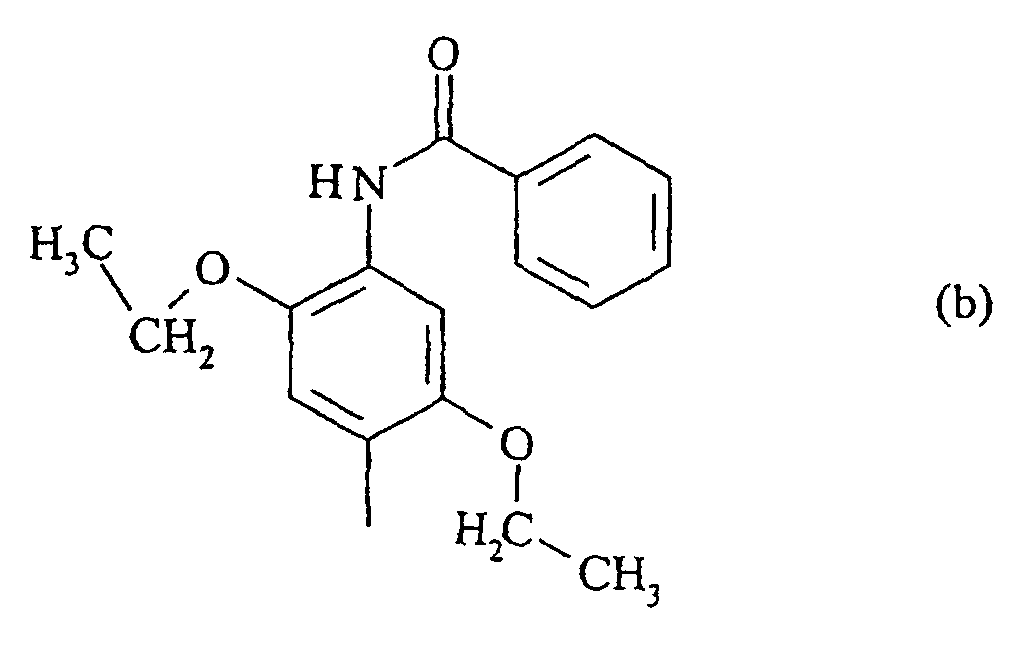
- substituted benzanilide radical in the definition of R 3 or R 4 is preferably selected from the group consisting of radicals of the formulae (b) and (c)
- the substituents R' 3 and R' 4 are preferably a methyl radical, an ethyl radical, an n- or i-propyl radical, an n-, i-, sec- or tert-butyl radical.
- Preferred epindolidione compounds are those for which R 2 and R 4 are hydrogen and R 3 is a methyl, ethyl, propyl or butyl substituent.
- Preferred symmetrically tetrasubstituted compounds are the tetramethyl-, tetraethyl-, tetrapropyl (n- or i-) and tetrabutyl (n-, i-, sec- or tert-) substituted compounds.
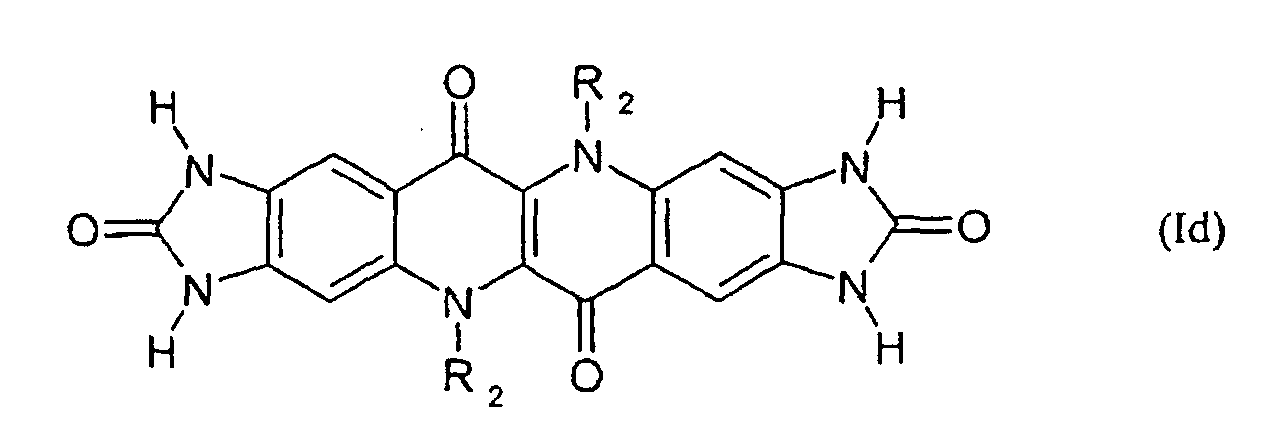
- Another preferred tetrasubstituted compound is the one of formula (Id) wherein R 2 is defined as above.
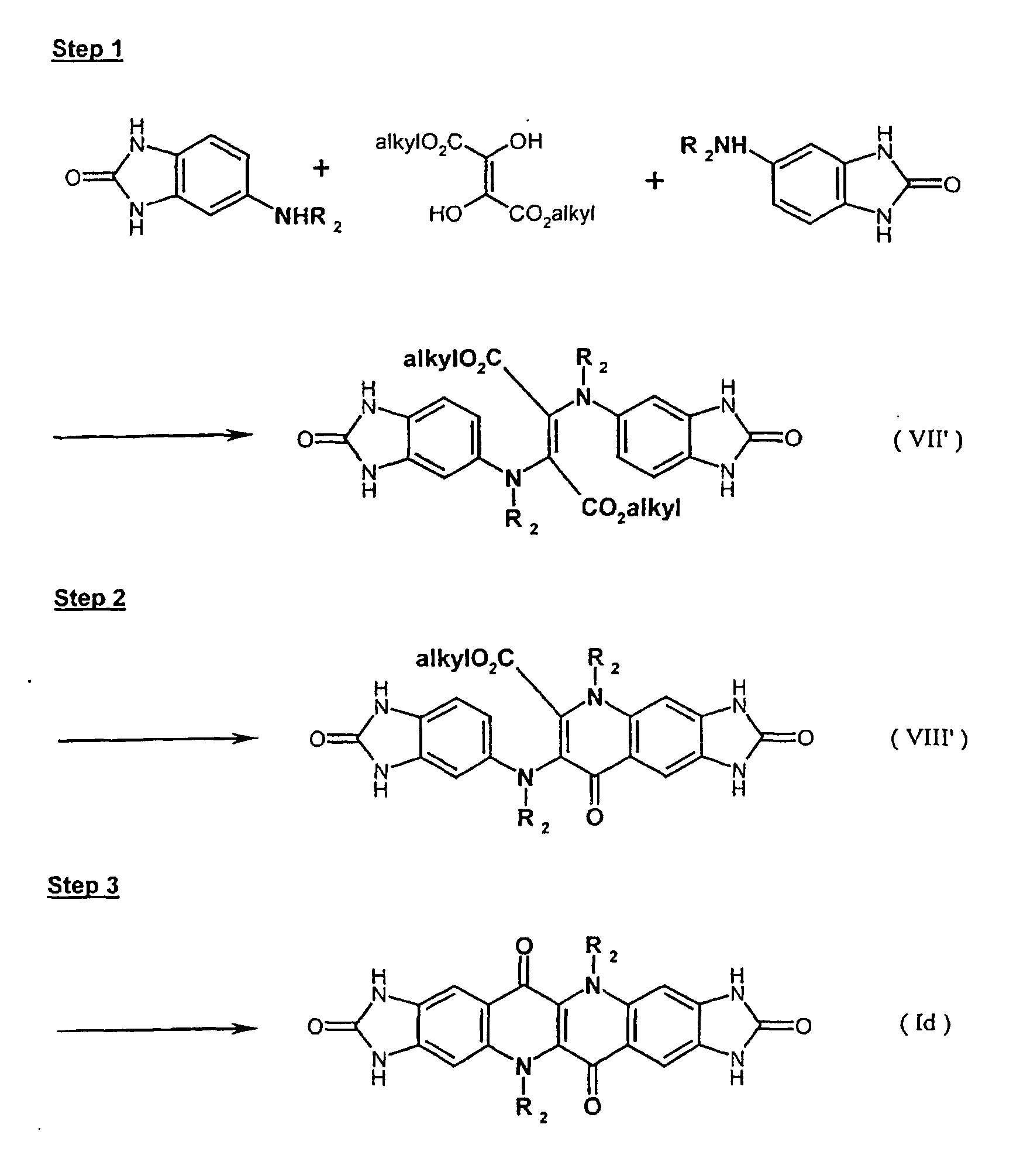
- the invention provides a process for preparing epindolidione compounds of the formula (Id) as defined above, characterized by the following reaction path
- the invention further provides a process for the preparation of epindolidione compounds of the formula (I) as described above by the cyclization in polyphosphoric acid or concentrated sulfuric acid of compounds of the formula (VIII) in which A', R 2 and A have the meanings given above.
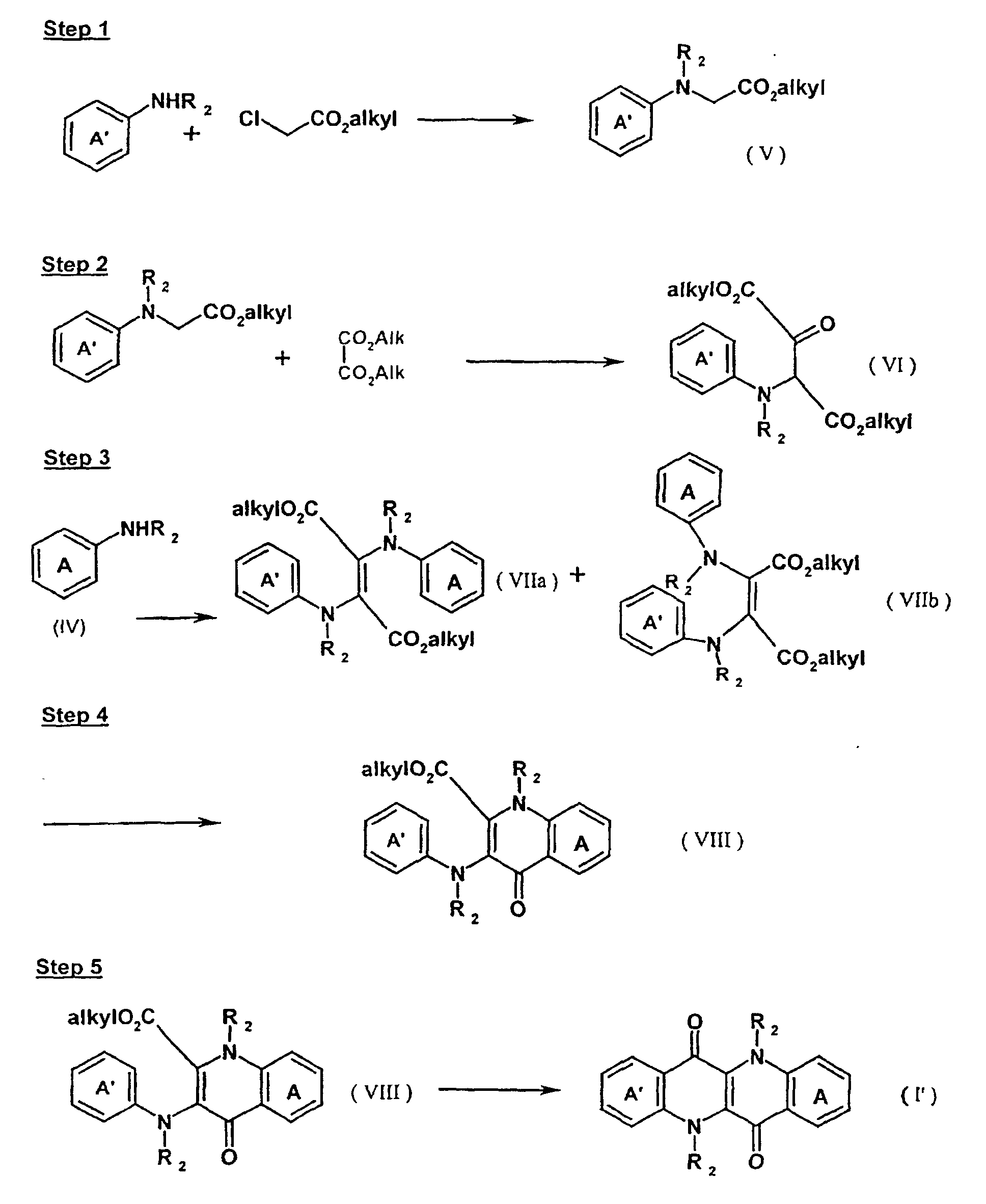
- the invention provides a process for preparing the epindolidione compounds of formula (I') in which in a first step, an arylamine is condensed with an alkyl chloroacetate or an alkyl bromoacetate in a solvent, in the presence or not of a base acting as a hydrogen chloride or bromide scavenger.
- the process is carried out in a solvent, e.g. alcohols, toluene, xylene or a xylene mixture, nitrobenzene, chlorobenzene, dimethylformamide, or dimethylacetamide, or N-methylpyrrolidone.
- the reaction is preferably carried out in ethanol, tert-amyl alcohol or toluene.
- the reaction temperature is preferably of the order of 10 to 150°C.
- the base is an inorganic or an organic base selected from common bases used in organic synthesis like sodium acetate, sodium carbonate, sodium or potassium hydroxide or triethylamine
- the arylamine is a compound of the general formula (IV') in which the nucleus designated A' is defined as above.
- Preferred compounds of formula (IV') are aniline or substituted aniline, naphthylamine or substituted naphthylamine or those of formulae (IV'a) to (IV'd) wherein R' 3 and R' 4 have the meaning as defined above.
- the N-arylglycine alkyl ester is condensed with a dialkyl oxalate in a solvent, in the presence of a strong base.
- the process is carried out in the same type of solvent as the first step.
- the reaction is preferably carried out in ethanol, tert-amyl alcohol or toluene.
- the reaction temperature is preferably of the order of 10 to 150°C.
- the strong base can be sodium or potassium alcoholate, sodium or potassium hydride, sodium or potassium dialkylamide, or other strong base commonly used in order to prepare carbanions.
- the strong base is preferably sodium ethoxide, sodium tert-butoxide or sodium tert-amylate.
- the amount of base is from 1 to 200 mol% based on the N-arylglycine alkyl ester.
- the molar ratio of the N-arylglycine alkyl ester and the dialkyl oxalate is 1:1.
- step 2 the product obtained in step 2 is condensed in a solvent with a compound of the general formula (IV) in which the nucleus designated A is defined as above.
- Preferred compounds of formula (IV) are those of formulae (IVa) to (IVd) where R 3 and R 4 have the meaning as defined above.
- the reaction is preferably carried out in ethanol, tert. amyl alcohol or toluene.
- the reaction temperature is preferably of the order of 10 to 200°C.
- the acid is an inorganic or an organic acid selected from common acids used in organic synthesis such as sulfuric acid, hydrochloric acid, acetic acid or para-toluene sulfonic acid.
- the products (VIIa) and (VIIb) obtained in step 3 are cyclized by heating in an inert high boiling point solvent, in order to give the intermediate (VIII) shown in the flow chart below.
- the process is carried out in a high boiling point solvent, e.g. diphenyl oxide, mixture of biphenyl and diphenyl oxides also called Dowtherm A or any solvent with a boiling point above 240°C.
- the reaction temperature is preferably of the order of 200 to 280°C.
- step 4 the monocyclized product obtained in step 4 is further cyclized to the epindolidione compound by heating in polyphosphoric acid or conc. sulfuric acid.
- the reaction temperature is preferably of the order of 100 to 180°C.
- a major advantage of this process is that it is possible to easily prepare asymmetrical epindolidione compounds.
- the crude pigments can be treated in organic solvents at elevated temperatures, for example at from 60 to 200°C, especially from 70 to 150°C and preferably from 75 to 100°C. Such finishing treatment is preferably combined with a milling or kneading operation.
- a further aspect of the invention are the intermediate compounds of formulae (VIIa), (VIIb) and of formula (VIII) as shown in the reaction scheme above.
- Epindolidione compounds of the formula (I) according to the invention are in particular useful as pigments.
- the pigments according to the invention are suitable for the colouring of polymer compositions, by which are meant solvent-free and solvent-containing compositions comprising plastics or synthetic resins (in oil-based or water-based paints, in coating materials of various kinds, for the spin dyeing of viscose or cellulose acetate, or for pigmenting plastics, such as polyamide, polyethylene, polystyrene, polyvinyl chloride, rubber and artificial leather). They can also be used in printing inks for the graphical industry, for the colouring of paper pulps, for the coating of textile or for pigment printing.
- solvent-free and solvent-containing compositions comprising plastics or synthetic resins (in oil-based or water-based paints, in coating materials of various kinds, for the spin dyeing of viscose or cellulose acetate, or for pigmenting plastics, such as polyamide, polyethylene, polystyrene, polyvinyl chloride, rubber and artificial leather). They can also be used in printing inks for the graphical industry, for the colouring
- the resulting colorations are notable for their outstanding heat, light and weather fastness, chemical resistance, colour strength and very good applications properties, examples being their crystallization fastness and dispersing fastness, and in particular for their fastness to migration, bleeding, overcoating and solvents.
- the pigments of the invention are also suitable as colorants in electrophotographic toners and developers, such as one- or two-component powder toners (also known as one- or two-component developers), magnetic toners, liquid toners, polymerization toners and further speciality toners.
- electrophotographic toners and developers such as one- or two-component powder toners (also known as one- or two-component developers), magnetic toners, liquid toners, polymerization toners and further speciality toners.
- Typical toner binders are addition polymerization, polyaddition and polycondensation resins, such as styrene, styrene-acrylate, styrene-butadiene, acrylate, polyester and phenolic-epoxy resins, polysulphones, polyurethanes, individually or in combination, and also polyethylene and polypropylene, in or to which further ingredients, such as charge control agents, waxes or flow assistants may be present or may be added subsequently.
- polyaddition and polycondensation resins such as styrene, styrene-acrylate, styrene-butadiene, acrylate, polyester and phenolic-epoxy resins, polysulphones, polyurethanes, individually or in combination, and also polyethylene and polypropylene, in or to which further ingredients, such as charge control agents, waxes or flow assistants may be present or may be added subsequently.
- a further area of application of pigments of the invention is their use as colorants in powders and powder coating materials, especially triboelectrically or electrokinetically sprayed powder coating materials, which are used to coat the surfaces of articles made, for example, from metal, wood, plastic, glass, ceramic, concrete, textile material, paper or rubber.
- Powder coating resins employed are typically epoxy resins, carboxyl- and hydroxyl-containing polyester resins, polyurethane resins and acrylic resins, together with customary hardeners. Combinations of resins are also used. For example, epoxy resins are frequently employed in combination with carboxyl- and hydroxyl-containing polyester resins. Examples of typical hardener components (depending on the resin system) are acid anhydrides, imidazoles and dicyandiamide and derivatives thereof, blocked isocyanates, bisacylurethanes, phenolic and melamine resins, triglycidyl. isocyanurates, oxazolines and dicarboxylic acids.
- the pigments of the invention are suitable, moreover, as colorants in ink-jet inks, both aqueous and non-aqueous, and in those inks which operate in accordance with the hot-melt process.
- the pigments of the invention are also suitable for cosmetics, such as nail varnishes or make-up.
- the resulting dispersion is sprayed onto sheet aluminium, left to dry in air for 30 minutes and then baked at 120°C for 30 minutes.
- the result is a film of the colour specified in the table below, with very good migration fastness and also good light and weathering stability.
- Example of the preparation of a 0.1% coloured PVC film (blend of colour pigment to white pigment 1:5): 16.5 parts of a plasticizer mixture consisting of equal parts of dioctyl phthalate and dibutyl phthalate are mixed with 0.05 parts of the pigment set out in the table below and with 0.25 parts of titanium dioxide. Then 33.5 parts of polyvinyl chloride are added.
Landscapes
- Organic Chemistry (AREA)
- Chemical & Material Sciences (AREA)
- Nitrogen Condensed Heterocyclic Rings (AREA)
- Inks, Pencil-Leads, Or Crayons (AREA)
- Paints Or Removers (AREA)
- Ink Jet (AREA)
- Ink Jet Recording Methods And Recording Media Thereof (AREA)
- Developing Agents For Electrophotography (AREA)
- Plural Heterocyclic Compounds (AREA)
- Indole Compounds (AREA)
- Addition Polymer Or Copolymer, Post-Treatments, Or Chemical Modifications (AREA)
- Compositions Of Macromolecular Compounds (AREA)
- Organic Low-Molecular-Weight Compounds And Preparation Thereof (AREA)
Abstract
Description
- The invention relates to novel dibenzo[b,g][1,5]naphthyridine-6,12(5H,11H)dione compounds, also called epindolidione compounds, and to their use as pigments. The invention also relates to a particularly advantageous process for preparing these epindolidione compounds.
- US 3,334,102 describes the preparation of epindolidione compounds of the following general formulawhere the rings labelled A carry halogen atoms or methoxy groups.

- The preparation process disclosed in US 3,334,102 or in J. Org. Chem., 33(11), 4004 (1968), starts from dimethyl dihydroxyfumarate and simple anilines. The pigments disclosed in US 3,334,102 provide a greenish yellow to reddish yellow shade when applied in polyolefins and lacquers.
- It is an object of the invention to provide new orange to red pigments possessing high fastness to solvents, migration and light, which have good thermal stabilities, a high tinting power and are easily dispersible.
- Another object of the invention is to provide a process by which the novel pigments are obtainable and which starts from readily available intermediates. In one of its aspects the present invention provides compounds of the general formula (I)in which A' represents a substituted or unsubstituted aromatic ring or an annelated heteroaromatic ring system, A represents an annelated heteroaromatic ring system and both R2 are hydrogen, C1-12alkyl, phenyl or -COOR, with R being C1-8alkyl.
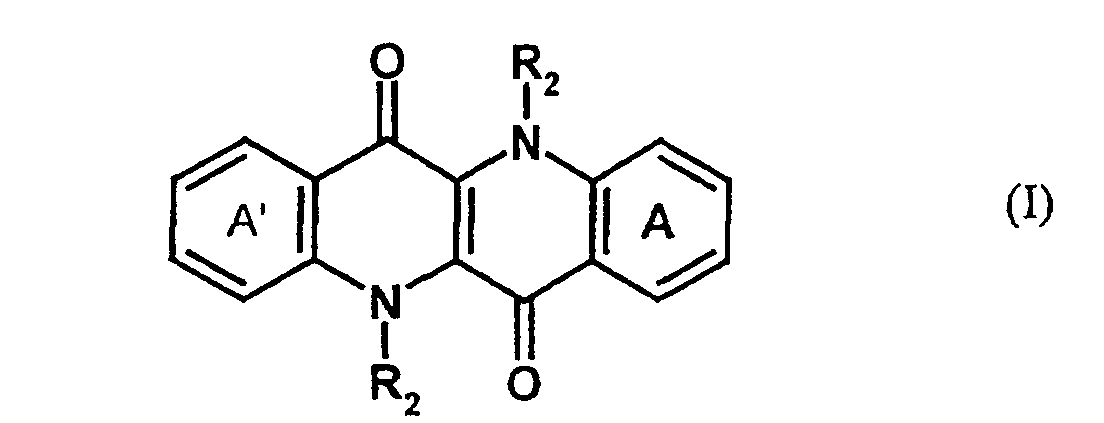
- The nucleus designated A comprises an annelated ring which is fused on linearly, in 2,3-position, or angularly, in 1,2- or in 3,4-position, to feature the complementary members of the moieties (1) to (11)
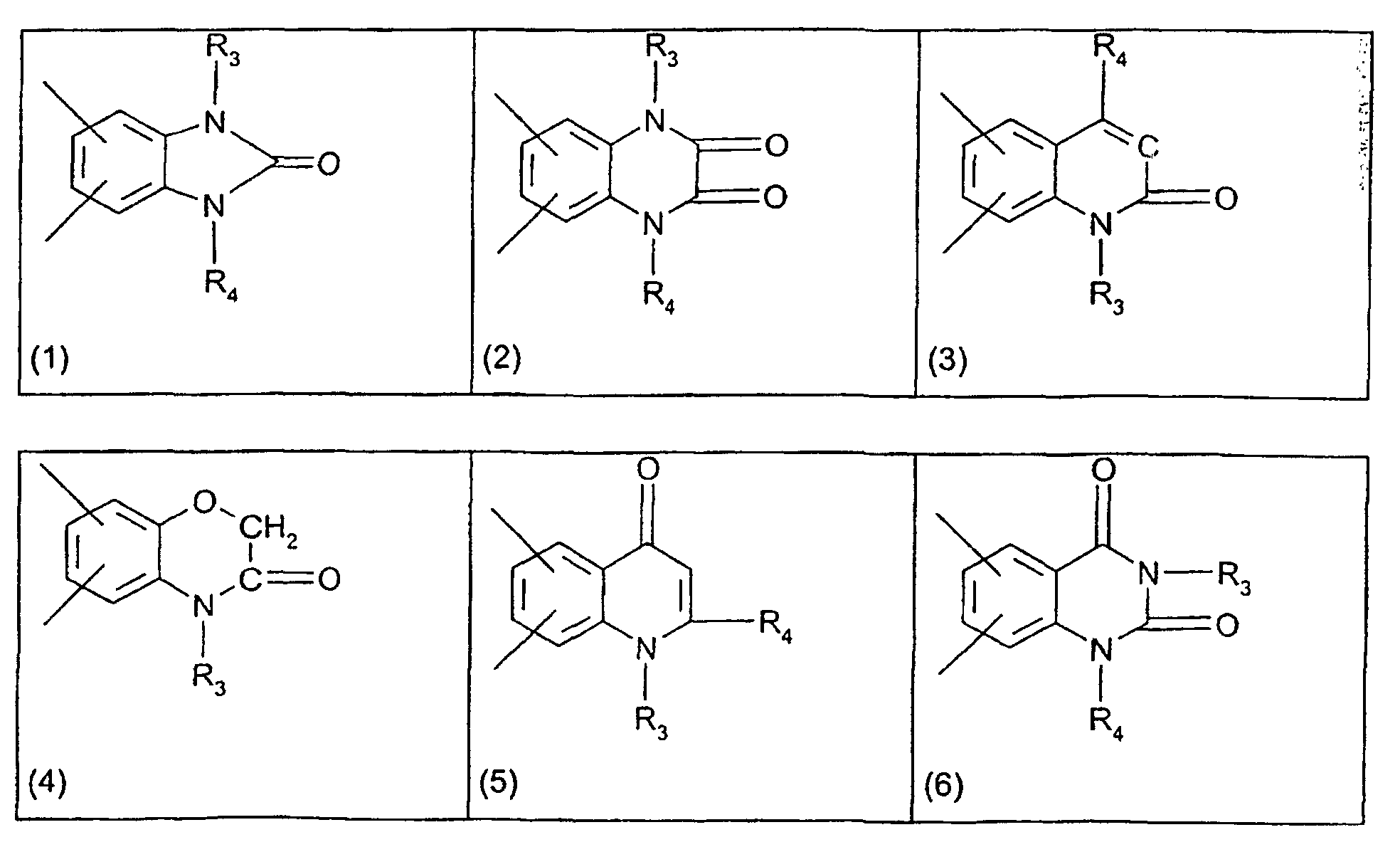 wherein
R3 and R4 are, independently, hydrogen, C1-8alkyl, C5-6cycloalkyl, benzyl, benzanilide or naphthyl whereby phenyl groups can be mono- or poly-substituted by radicals selected from the group consisting of halogen, nitro groups, C1-8alkyl, phenyl, -COOR and C1-2 alkoxy, preferably chlorine, C1-4alkyl, phenyl or -COOR, with R being C1-8alkyl; or
R3 and/or R4 are a radical of formula (a)For A' representing an annelated heteroaromatic ring system, the nucleus designated A' comprises an annelated ring which is fused on linearly, in 2,3-position, or angularly, in 1,2- or in 3,4-position, to feature the complementary members of the moieties (12) to (22)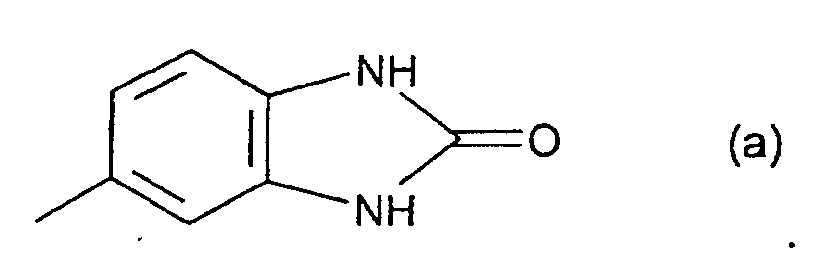 wherein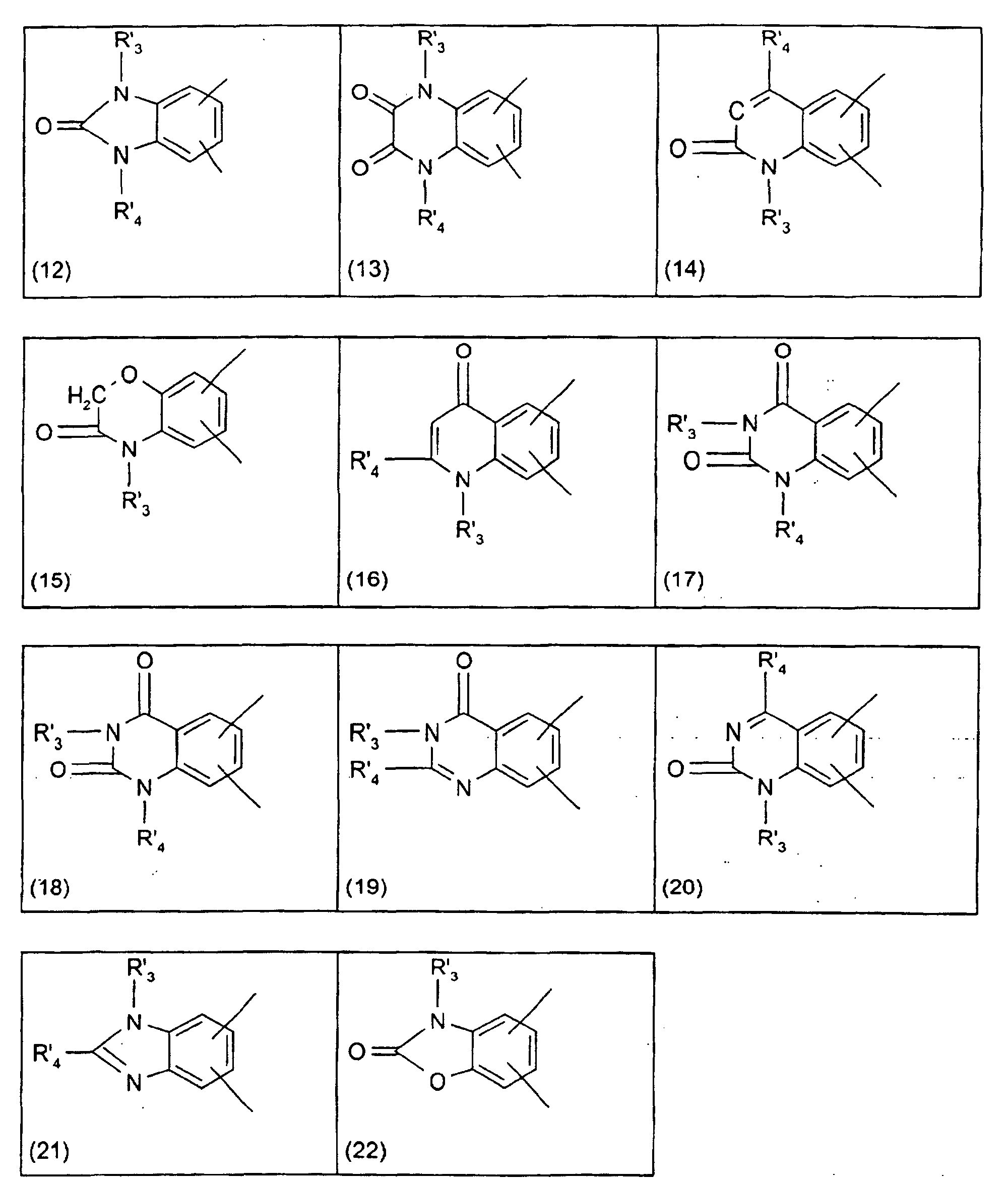
R'3 and R'4 are, independently, hydrogen, C1-8alkyl, C5-6cycloalkyl, benzyl, benzanilide or naphthyl whereby phenyl groups can be mono- or poly-substituted by radicals selected from the group consisting of halogen, nitro groups, C1-8alkyl, phenyl, -COOR with R being C1-8alkyl, and C1-2alkoxy, preferably chlorine, C1-4alkyl, phenyl or -COOR, with R being C1-8alkyl. - In another aspect the present invention provides compounds of the general formula (I')wherein R2, A and A' are defined as above with the exception that R3' and R4' in A' are not hydrogen.

- Preferred compounds of formula (I) are those with formulae (Ia), (IIa), (IIIa) and (IIIb)


 in which A', R2, R3 and R4 are defined as above.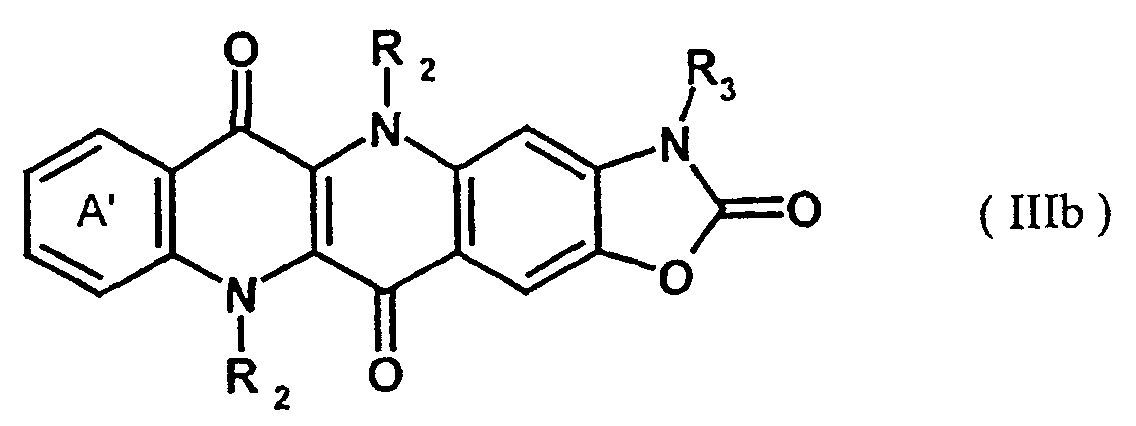
- More preferred compounds are those of formula (Ib) and (IIb)
 in which R2, R3, R4, R'3 and R'4 are defined as above.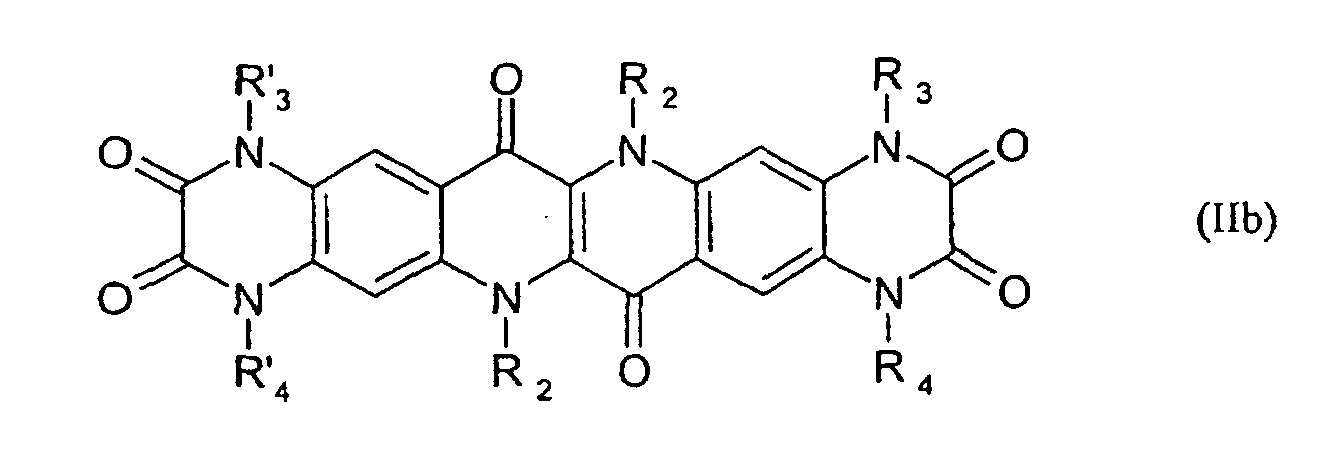
- Other more preferred compounds are those of formula (Ic)wherein R2, R3 and R4 are defined as above and R1 is hydrogen, halogen or C1-8alkyl.
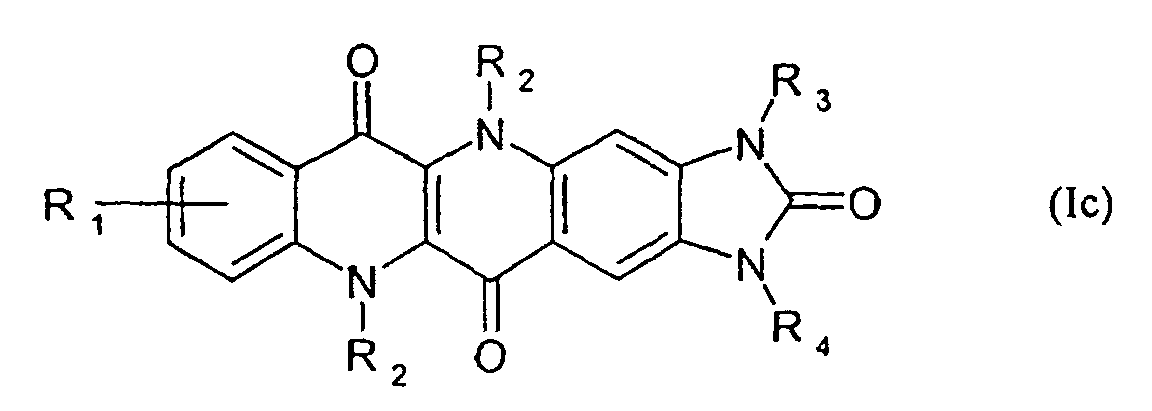
- The substituents R3 and R4, independently of one another, are preferably hydrogen, a methyl radical, an ethyl radical, an n- or i-propyl radical, an n-, i-, sec- or tert-butyl radical, a cyclohexyl radical, a substituted or unsubstituted benzanilide radical, a naphthyl radical, a radical of the formula (a)an unsubstituted phenyl radical, a phenyl radical substituted one or more times by halogen, preferably chlorine or nitro groups, phenyl, C1-8alkyl, preferably C1-4alkyl and C1-2alkoxy.
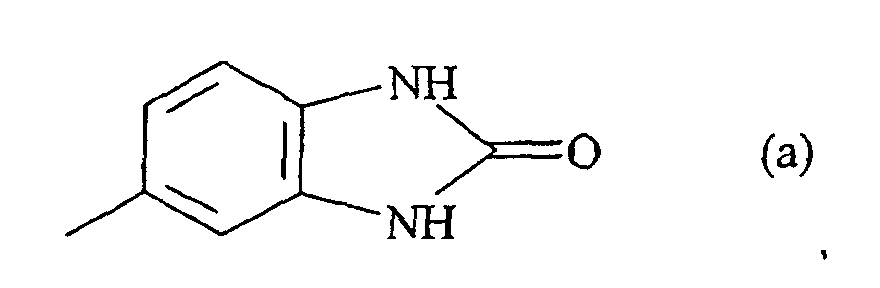
- The abovementioned substituted phenyl radical in the definition of R3 or R4 is preferably selected from the group consisting of o-, m-, p-methyl-, ethyl-, chloro-, methoxyphenyl, 2,4- and 3,5-dimethylphenyl, 2,5-dichloro-, dimethoxy-, diethoxyphenyl, m-, p-nitrophenyl, 2,5-di-chloro-, 2,5-diethoxy-4-nitrophenyl, 2-methoxy-4-nitrophenyl, 3-chloro-4-methyl-, 3-chloro-4-methoxyphenyl and p-ethoxyphenyl.
- The abovementioned substituted benzanilide radical in the definition of R3 or R4 is preferably selected from the group consisting of radicals of the formulae (b) and (c)

- The substituents R'3 and R'4, independently of one another, are preferably a methyl radical, an ethyl radical, an n- or i-propyl radical, an n-, i-, sec- or tert-butyl radical.
- Preferred epindolidione compounds are those for which R2 and R4 are hydrogen and R3 is a methyl, ethyl, propyl or butyl substituent.
- Preferred symmetrically tetrasubstituted compounds are the tetramethyl-, tetraethyl-, tetrapropyl (n- or i-) and tetrabutyl (n-, i-, sec- or tert-) substituted compounds.
- Another preferred tetrasubstituted compound is the one of formula (Id)wherein R2 is defined as above.
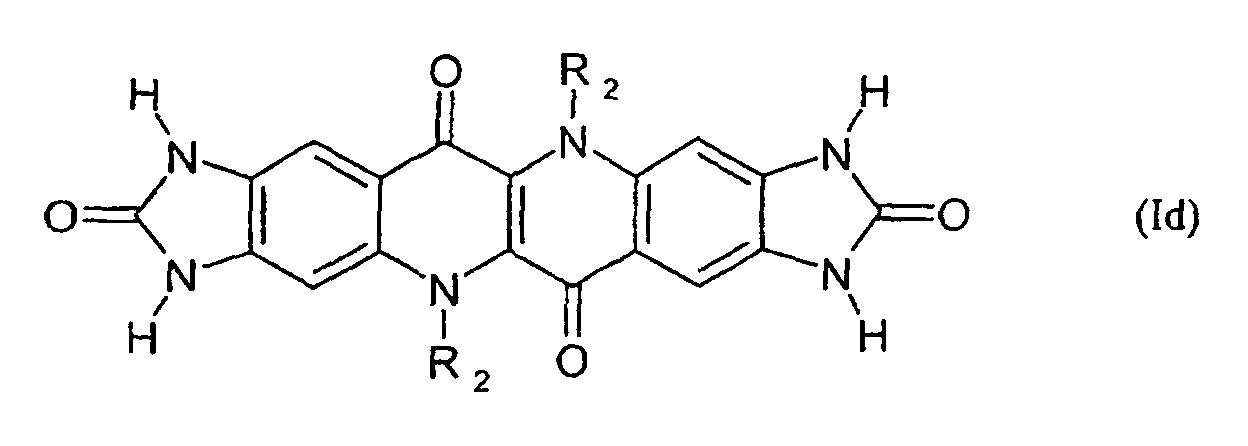
- In one aspect, the invention provides a process for preparing epindolidione compounds of the formula (Id) as defined above, characterized by the following reaction path

- The invention further provides a process for the preparation of epindolidione compounds of the formula (I) as described above by the cyclization in polyphosphoric acid or concentrated sulfuric acid of compounds of the formula (VIII)in which A', R2 and A have the meanings given above.
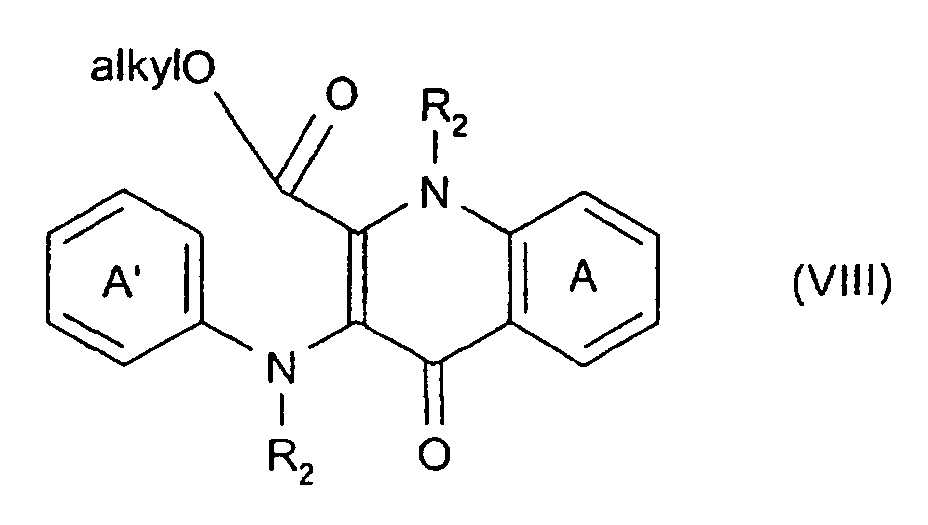
- In another aspect the invention provides a process for preparing the epindolidione compounds of formula (I') in which in a first step, an arylamine is condensed with an alkyl chloroacetate or an alkyl bromoacetate in a solvent, in the presence or not of a base acting as a hydrogen chloride or bromide scavenger. The process is carried out in a solvent, e.g. alcohols, toluene, xylene or a xylene mixture, nitrobenzene, chlorobenzene, dimethylformamide, or dimethylacetamide, or N-methylpyrrolidone. The reaction is preferably carried out in ethanol, tert-amyl alcohol or toluene. The reaction temperature is preferably of the order of 10 to 150°C. The base is an inorganic or an organic base selected from common bases used in organic synthesis like sodium acetate, sodium carbonate, sodium or potassium hydroxide or triethylamine.
- The arylamine is a compound of the general formula (IV')in which the nucleus designated A' is defined as above.

- Preferred compounds of formula (IV') are aniline or substituted aniline, naphthylamine or substituted naphthylamine or those of formulae (IV'a) to (IV'd)

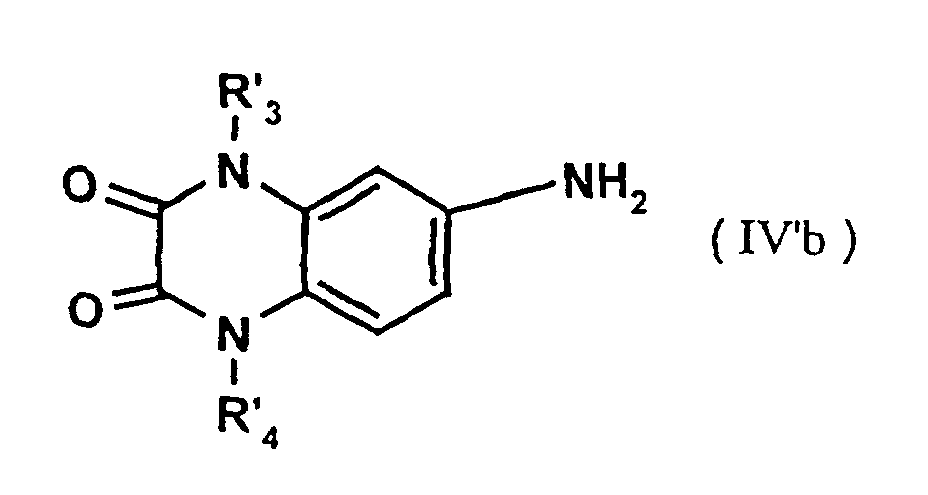
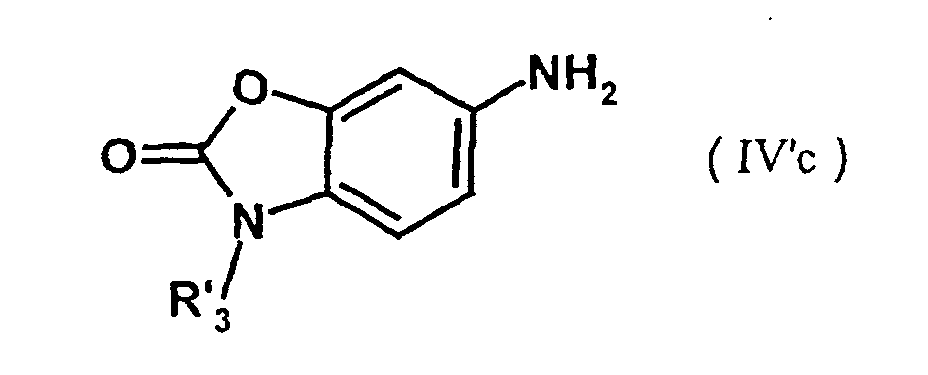 wherein R'3 and R'4 have the meaning as defined above.
- The preparation of the compounds of formula (IV'), in particular of formulae (IV'a) to (IV'd), is described in EP 0911337 A.
- In a second step of the process, the N-arylglycine alkyl ester is condensed with a dialkyl oxalate in a solvent, in the presence of a strong base. The process is carried out in the same type of solvent as the first step. The reaction is preferably carried out in ethanol, tert-amyl alcohol or toluene. The reaction temperature is preferably of the order of 10 to 150°C. The strong base can be sodium or potassium alcoholate, sodium or potassium hydride, sodium or potassium dialkylamide, or other strong base commonly used in order to prepare carbanions. The strong base is preferably sodium ethoxide, sodium tert-butoxide or sodium tert-amylate. The amount of base is from 1 to 200 mol% based on the N-arylglycine alkyl ester.
- Preferably the molar ratio of the N-arylglycine alkyl ester and the dialkyl oxalate is 1:1.
- In a third step of the process, the product obtained in step 2 is condensed in a solvent with a compound of the general formula (IV)in which the nucleus designated A is defined as above. Preferred compounds of formula (IV) are those of formulae (IVa) to (IVd)

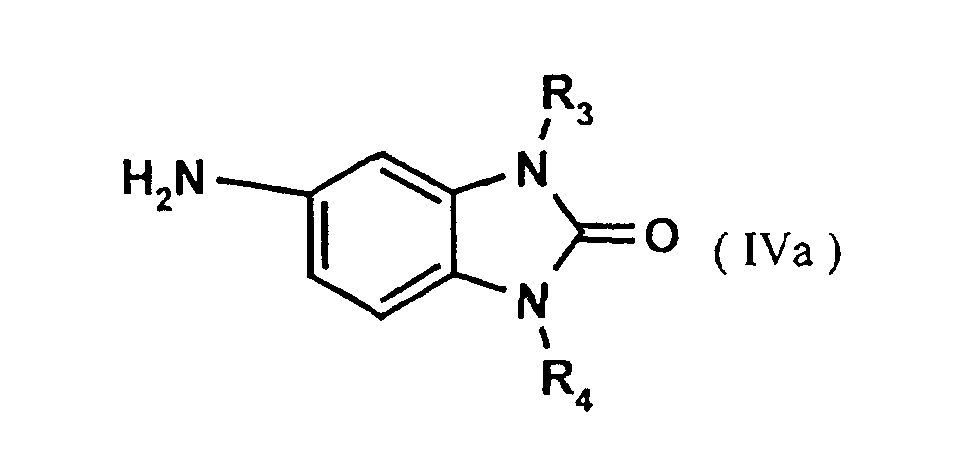

 where R3 and R4 have the meaning as defined above.
- The preparation of the compounds of formula (IV), in particular of formulae (IV'a) to (IV'd), is described in EP 0911337 A.
- The reaction is preferably carried out in ethanol, tert. amyl alcohol or toluene. The reaction temperature is preferably of the order of 10 to 200°C. The acid is an inorganic or an organic acid selected from common acids used in organic synthesis such as sulfuric acid, hydrochloric acid, acetic acid or para-toluene sulfonic acid.
- In a fourth step of the process, the products (VIIa) and (VIIb) obtained in step 3 are cyclized by heating in an inert high boiling point solvent, in order to give the intermediate (VIII) shown in the flow chart below. The process is carried out in a high boiling point solvent, e.g. diphenyl oxide, mixture of biphenyl and diphenyl oxides also called Dowtherm A or any solvent with a boiling point above 240°C. The reaction temperature is preferably of the order of 200 to 280°C.
- Finally, in a fifth step the monocyclized product obtained in step 4 is further cyclized to the epindolidione compound by heating in polyphosphoric acid or conc. sulfuric acid. The reaction temperature is preferably of the order of 100 to 180°C.
- A major advantage of this process is that it is possible to easily prepare asymmetrical epindolidione compounds.
- The following reaction scheme illustrates the steps of the above described process.


- To further improve the pigment properties, the crude pigments can be treated in organic solvents at elevated temperatures, for example at from 60 to 200°C, especially from 70 to 150°C and preferably from 75 to 100°C. Such finishing treatment is preferably combined with a milling or kneading operation.
- A further aspect of the invention are the intermediate compounds of formulae (VIIa), (VIIb) and of formula (VIII) as shown in the reaction scheme above.
- Epindolidione compounds of the formula (I) according to the invention are in particular useful as pigments.
- The pigments according to the invention are suitable for the colouring of polymer compositions, by which are meant solvent-free and solvent-containing compositions comprising plastics or synthetic resins (in oil-based or water-based paints, in coating materials of various kinds, for the spin dyeing of viscose or cellulose acetate, or for pigmenting plastics, such as polyamide, polyethylene, polystyrene, polyvinyl chloride, rubber and artificial leather). They can also be used in printing inks for the graphical industry, for the colouring of paper pulps, for the coating of textile or for pigment printing.
- The resulting colorations are notable for their outstanding heat, light and weather fastness, chemical resistance, colour strength and very good applications properties, examples being their crystallization fastness and dispersing fastness, and in particular for their fastness to migration, bleeding, overcoating and solvents.
- In addition, the pigments of the invention are also suitable as colorants in electrophotographic toners and developers, such as one- or two-component powder toners (also known as one- or two-component developers), magnetic toners, liquid toners, polymerization toners and further speciality toners.
- Typical toner binders are addition polymerization, polyaddition and polycondensation resins, such as styrene, styrene-acrylate, styrene-butadiene, acrylate, polyester and phenolic-epoxy resins, polysulphones, polyurethanes, individually or in combination, and also polyethylene and polypropylene, in or to which further ingredients, such as charge control agents, waxes or flow assistants may be present or may be added subsequently.
- A further area of application of pigments of the invention is their use as colorants in powders and powder coating materials, especially triboelectrically or electrokinetically sprayed powder coating materials, which are used to coat the surfaces of articles made, for example, from metal, wood, plastic, glass, ceramic, concrete, textile material, paper or rubber.
- Powder coating resins employed are typically epoxy resins, carboxyl- and hydroxyl-containing polyester resins, polyurethane resins and acrylic resins, together with customary hardeners. Combinations of resins are also used. For example, epoxy resins are frequently employed in combination with carboxyl- and hydroxyl-containing polyester resins. Examples of typical hardener components (depending on the resin system) are acid anhydrides, imidazoles and dicyandiamide and derivatives thereof, blocked isocyanates, bisacylurethanes, phenolic and melamine resins, triglycidyl. isocyanurates, oxazolines and dicarboxylic acids.
- The pigments of the invention are suitable, moreover, as colorants in ink-jet inks, both aqueous and non-aqueous, and in those inks which operate in accordance with the hot-melt process.
- The pigments of the invention are also suitable for cosmetics, such as nail varnishes or make-up.
- In the following examples the parts and percentages are by weight. The temperatures are indicated in degrees Celsius. One part by volume corresponds to the volume of one part by weight of water.
- 525 parts of aniline are charged in a reactor containing 349 parts of ethyl chloroacetate. The mixture is heated to 80°C. After 20 minutes the reaction starts and the temperature reaches 120°C within one hour. The temperature decreases slowly and stabilizes to 90°C after 30 minutes. The reaction mixture is further stirred at 90°C for 3 hours and then cooled to 50°C and poured into 875 parts of water. The suspension is filtered, and the solid product is washed with 1000 parts of an alcohol/water (1/9) mixture. It is then washed with water until free of chloride. The product is recrystallized from cyclohexane and dried under reduced pressure at 20°C to give 310 parts of white cristals of a compound of the following formulaYield:62%
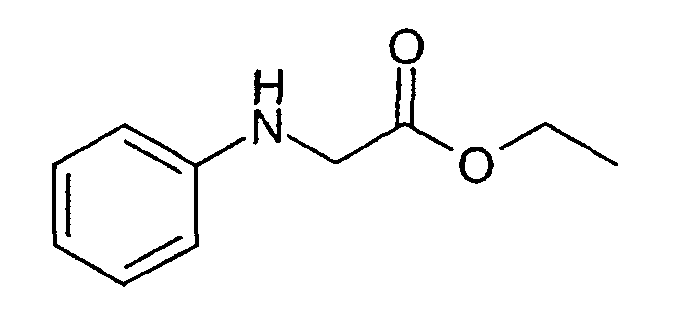
Melting point: 54.5-55.5°C - 35.3 parts of sodium ethoxide are dissolved in 235 parts of ethanol. 69.3 parts of diethyl oxalate are introduced in the reactor and then 84 parts of the product prepared in the example 1a. The mixture is subsequently stirred at 25°C for 24 hours. The ethanol is then distilled off under vacuum. 352 parts of water and 33 parts of acetic acid are added to the residue under vigorous stirring. 282 parts of toluene are added in order to extract the product. The organic phase is separated from the aqueous phase and washed again with 282 parts of water. The toluene phase, is evaporated to give 118.7 parts of a red oil, which is used without further purification in the next step.

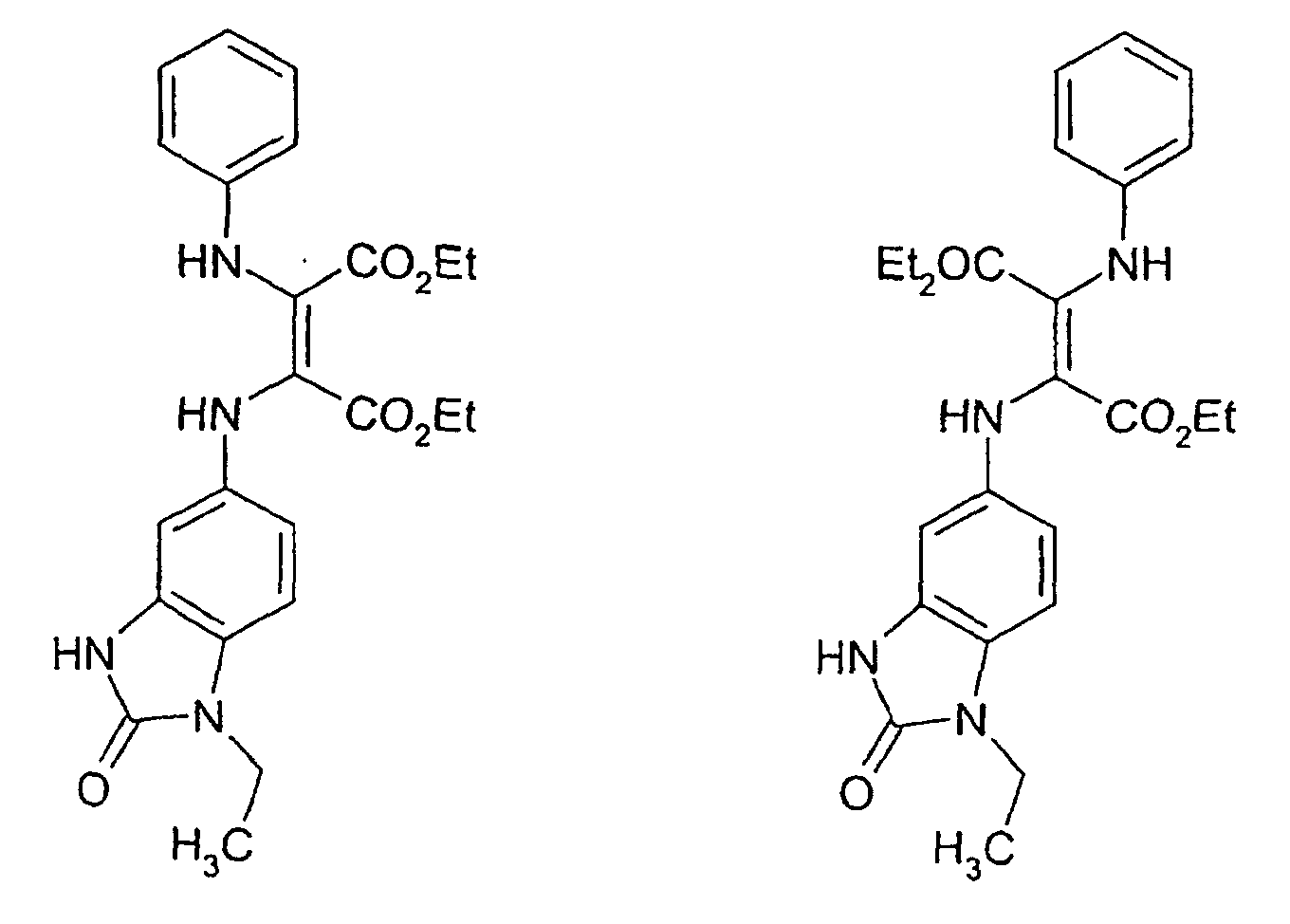
- 110 parts of the product prepared in the example 1b are dissolved in 335 parts of ethanol. 71.4 parts of the following amineare added to the solution, which is then heated at reflux for 6 hours. The reaction mixture is then cooled to 0°C with an ice-water bath, filtered and washed with 50 parts of cold ethanol. Drying under reduced pressure at 40°C gives 44.2 parts of grey powder as a mixture of compounds of the following formula
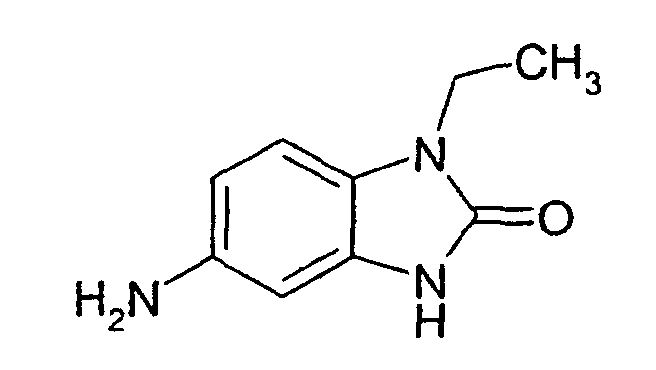
- 22.6 parts of the product prepared in the example 1 c are suspended in 30 parts of Dowtherm A and heated at 85°C to get a solution. This solution is added within 15 minutes to another reactor already charged with 70 parts of Dowtherm A and preheated at 258°C. The ethanol formed during the reaction is distilled off. The reaction mixture is heated at 250°C for 15 minutes after the end of the addition and then allowed to cool to 25°C. The precipitated product is filtered, washed with 50 parts of Dowtherm A then 700 parts of hexane and dried under reduced pressure at 80°C. This gives 16.6 parts of a brown powder of a mixture of compounds of the following formula

- 16 parts of polyphosphoric acid (85% of H3PO4 content) and 1.6 part of the product isolated in the example 1d are mixed in a reactor and gradually heated to 150°C and stirred at this temperature for 4 hours. Then the reaction mixture is cooled to 60°C and 235 parts of water are added. The suspension is filtered and washed with water. Drying under reduced pressure at 80°C gives 1.2 part of an orange powder of a compound of the following formula

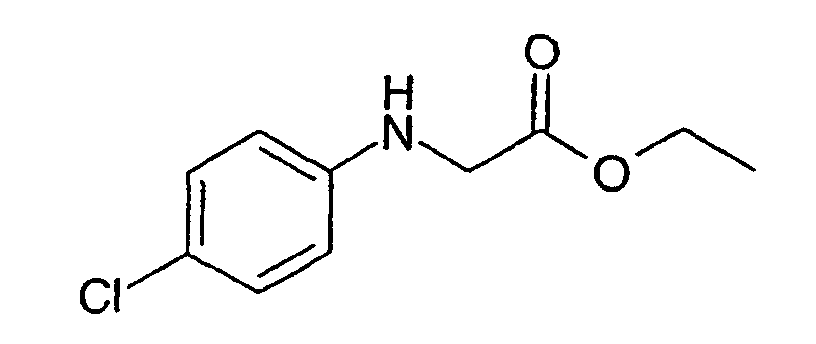
- 639.4 parts of p-chloroaniline are charged in a reactor containing 304 parts of ethyl chloroacetate. The mixture is heated to 80°C. After 20 minutes the reaction starts and the temperature reaches 115°C within one hour. The temperature decreases slowly and stabilizes to 90°C after 30 minutes. The reaction mixture is further stirred at 90°C for 3 hours and then cooled to 50°C and poured into 300 parts of water and 400 parts of ice. The suspension is filtered, and the solid product is washed with 5000 parts water. It is then washed with water until free of chloride. The product is recrystallized from cyclohexane and dried under reduced pressure at 20°C to give 346.4 parts of white cristals of a compound of the following formulaYield:67%
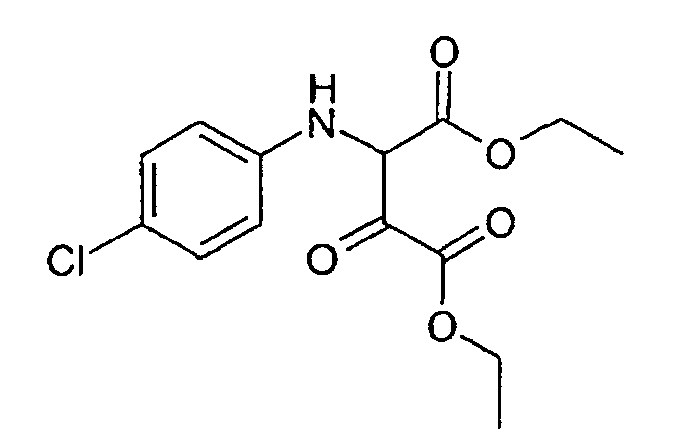
Melting point: 94-95°C - 119.3 parts of sodium ethoxide are dissolved in 800 parts of ethanol. 236 parts of diethyl oxalate are introduced in the reactor and then 341.6 parts of the product prepared in the example 2a. The mixture is subsequently stirred at 25°C for 24 hours. The ethanol is then distilled off under vacuum. 1200 parts of water and 112 parts of acetic acid are added to the residue under vigorous stirring. 960 parts of toluene are added in order to extract the product. The organic phase is separated from the aqueous phase and washed again with 320 parts of water. The toluene phase is evaporated to give 500 parts of an orange oil, which is used without further purification in the next step.
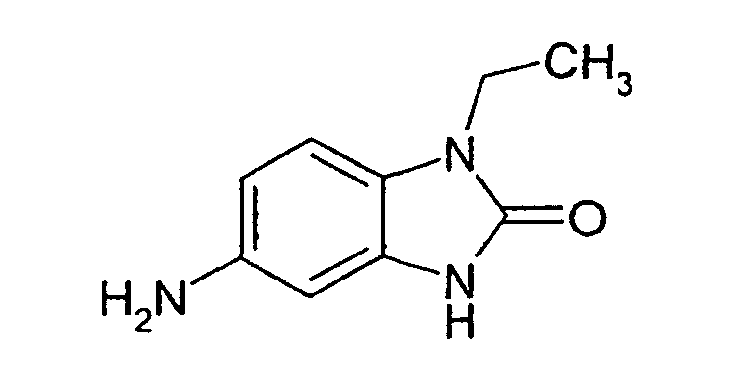
- 487.1 parts of the product prepared in the example 2b are dissolved in 1325 parts of ethanol. 281.4 parts of the following amineare added to the solution, which is then heated at reflux for 6 hours. The reaction mixture is then cooled to 0°C with an ice-water bath, filtered and washed with 1000 parts of cold ethanol. Drying under reduced pressure at 40°C gives 284.6 parts of grey powder as a mixture of compounds of the following formula
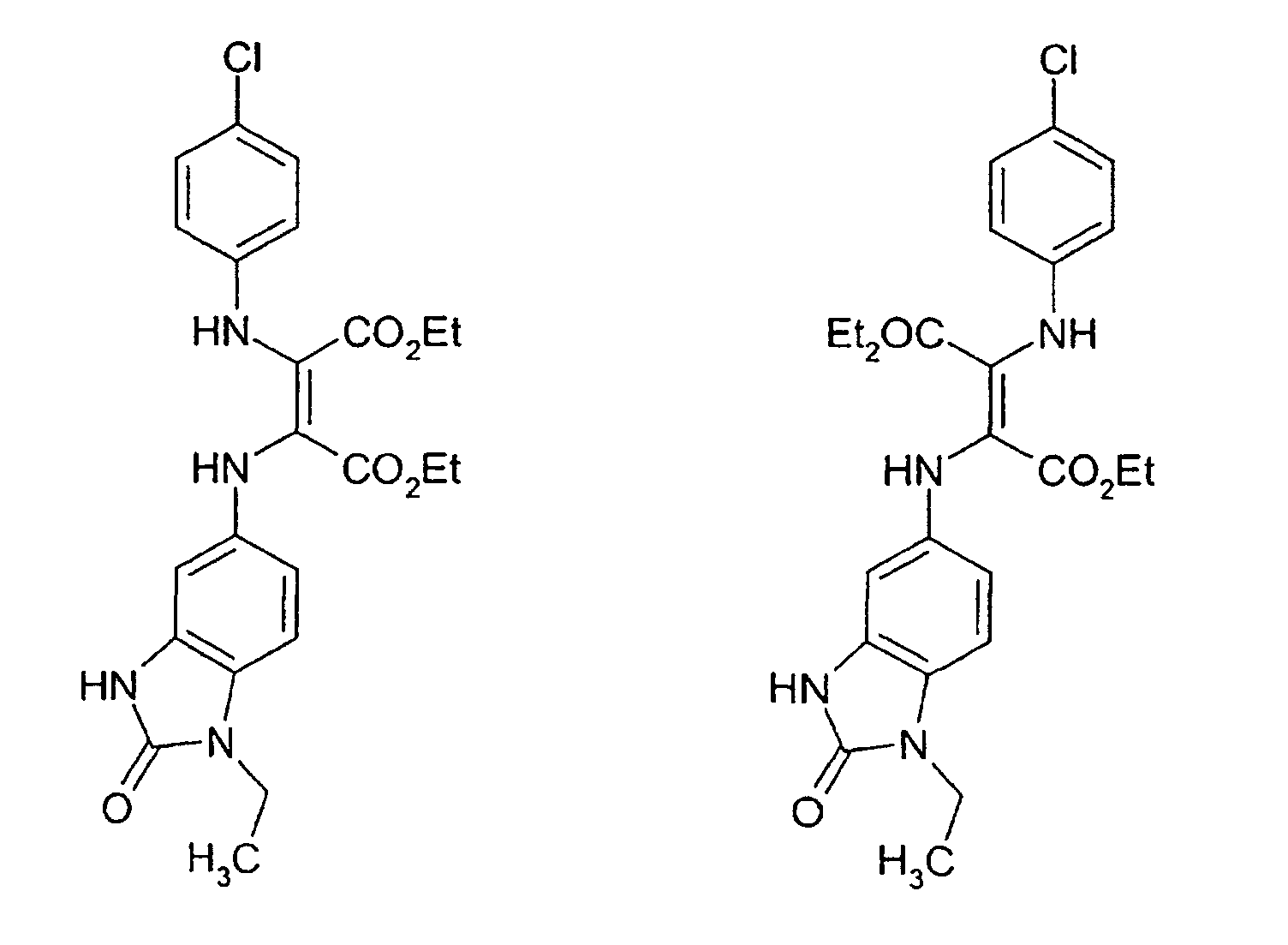
- 100 parts of the product prepared in the example 2c are suspended in 1050 parts of Dowtherm A and heated at 150°C. This solution is added within 15 minutes to another reactor already charged with 787 parts of Dowtherm A and preheated at 258°C. The ethanol formed during the reaction is distilled off. The reaction mixture is heated at 250°C for 15 minutes after the end of the addition and then allowed to cool to 25°C. The precipitated product is filtered, washed with 150 parts of Dowtherm A then 800 parts of ethanol and dried under reduced pressure at 80°C. This gives 64 parts of a brown powder of a mixture of compounds of the following formula
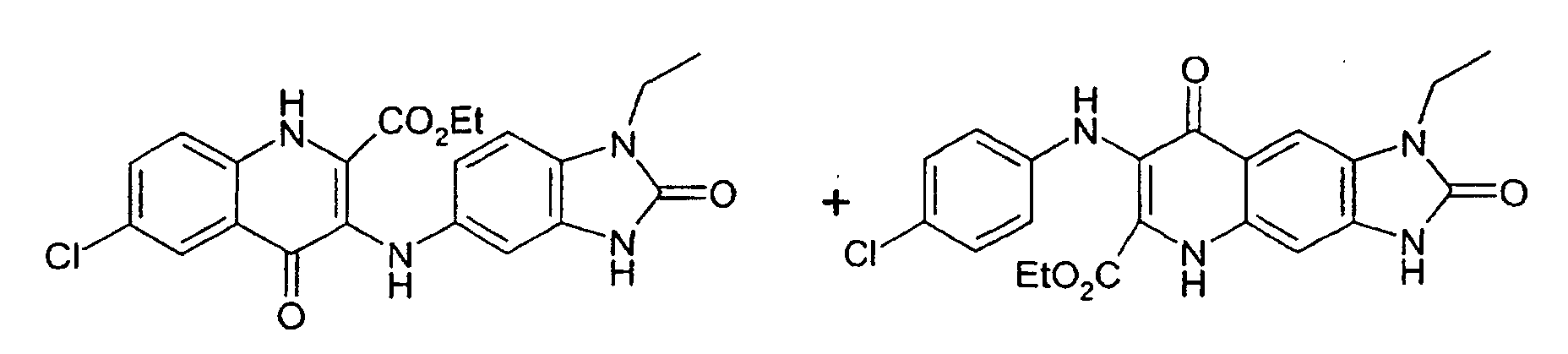
- 470 parts of polyphosphoric acid ( 85% of H3PO4 content) and 47 parts of the product isolated in the example 1d are mixed in a reactor and gradually heated to 150°C and stirred at this temperature for 4 hours. Then the reaction mixture is cooled to 60°C and are added to 235 parts of wate. The suspension is filtered and washed with water. Drying under reduced pressure at 80°C gives 41.6 parts of an orange powder of a compound of the following formula
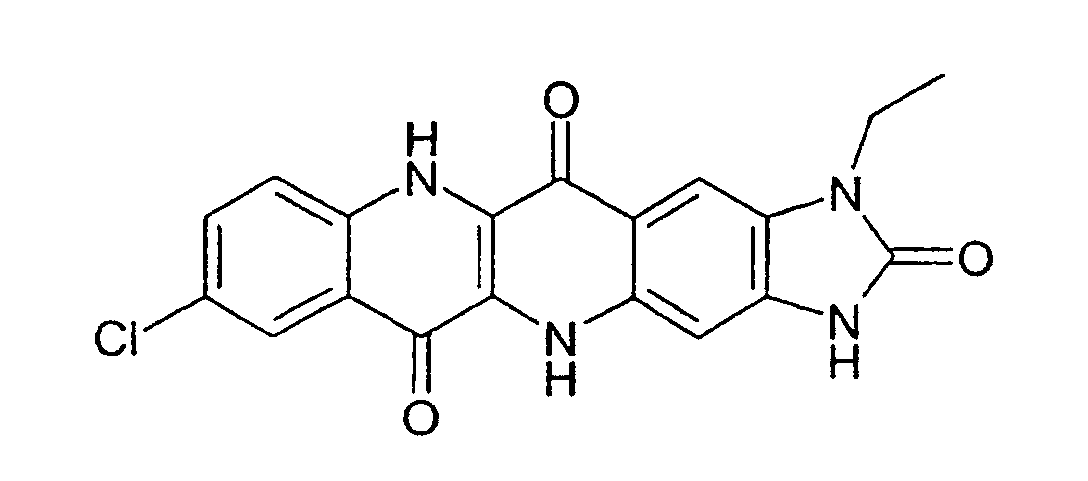
- 103.1 parts of 2,3-dihydroxyfumaric acid dimethylester are suspended in 371 parts of methanol. 192.1 parts of 5-amino-benzimidazolo-2-one and 5 parts of concentrated HCl are added. The mixture is heated to reflux for 6 hours. The suspension is cooled to 5°C, and the precipitate is filtered off, washed with methanol and dried in vacuo at 60°C to give 93.1 parts of a compound of the following formula

- 278 parts of a mixture of biphenyl and diphenylether are heated to boiling, and a solution of 93.1 parts of the product of example 3a in 693 parts of a mixture of biphenyl and diphenylether at 130°C are added within 30 minutes. The mixture is heated to 255°C within 30 minutes , and cooled down to 50°C. The precipitate is filtered off, washed with petrol ether and dried in vacuo at 60°C to give 73.7 parts of a compound of the following formula

- 73.7 parts of the product of example 3b are added to 535 parts of polyphosphoric acid at 145 to 150°C and maintaine at 145 to 150°C for 2 hours. The mixture was poured into 2500 parts of water at 0°C. The precipitate is filtered off, washed with water, and dried in vacuo at 60°C to give 54.6 parts of a compound of the following formula
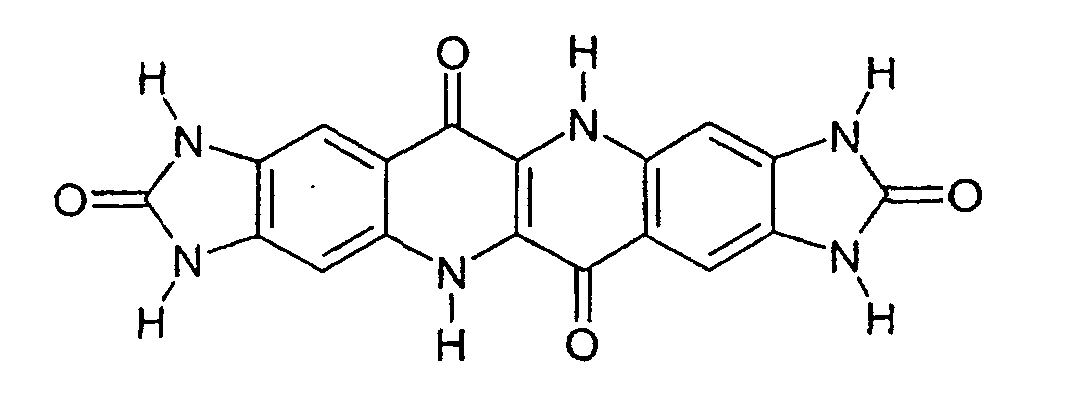
-
4 parts of the pigment set out in the table below are milled in a ball mill with 96 parts of a mixture of 50 parts of a 60 per cent strength solution of co-aldehyde-melamine resin solution in butanol, 10 parts of xylene and 10 parts of ethylene glycol monoethyl ether for 24 hours. - The resulting dispersion is sprayed onto sheet aluminium, left to dry in air for 30 minutes and then baked at 120°C for 30 minutes. The result is a film of the colour specified in the table below, with very good migration fastness and also good light and weathering stability.
- Example of the preparation of a 0.1% coloured PVC film (blend of colour pigment to white pigment 1:5):
16.5 parts of a plasticizer mixture consisting of equal parts of dioctyl phthalate and dibutyl phthalate are mixed with 0.05 parts of the pigment set out in the table below and with 0.25 parts of titanium dioxide. Then 33.5 parts of polyvinyl chloride are added. - The mixture is friction-rolled on a double-roll mill for 10 minutes, the resulting sheet being continually cut with a spatula and rolled together. In the roll mill, one roll is held at a temperature of 40° and the other at a temperature of 140°. The mixture is subsequently taken off in sheet form and pressed between two polished metal plates at 160° for 5 minutes. This gives a coloured PVC film of high brightness and very good migration and light fastness.
Pigment of Example Colour in Use Example 1 Colour in Use Example 2 1 e orange orange 2e orange orange
Claims (13)
- Epindolidione compounds of the general formula (I)in which the nucleus designated A represents an annelated heteroaromatic ring system comprising an annelated ring which is fused on linearly, in 2,3-position, or angularly, in 1,2- or in 3,4-position, to feature the complementary members selected from the group consisting of the moieties (1) to (11)

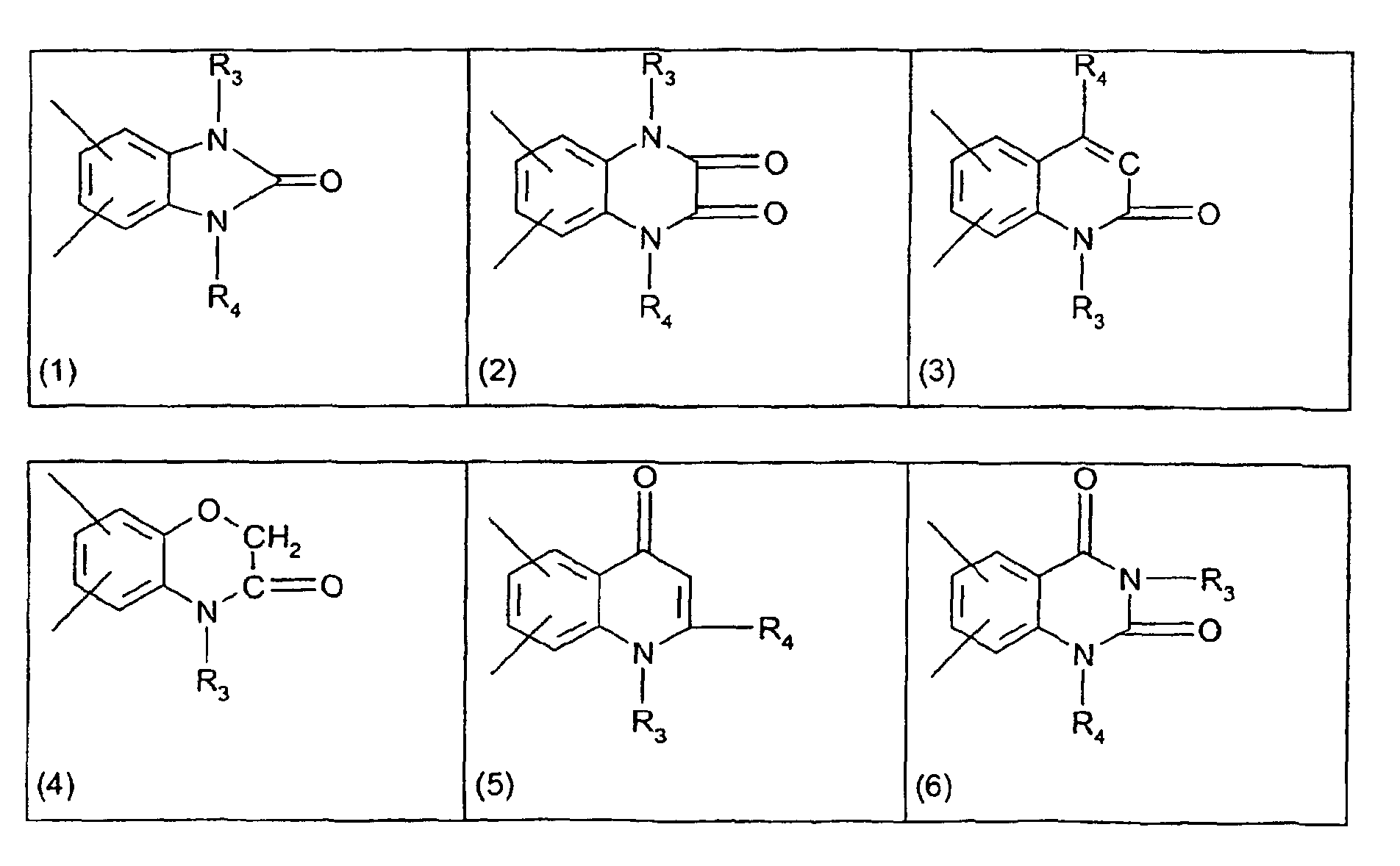 wherein
R3 and R4 are, independently, hydrogen, C1-8alkyl, C5-6cycloalkyl, benzyl, benzanilide or naphthyl whereby phenyl groups can be mono- or poly-substituted by radicals selected from the group consisting of halogen, nitro groups, C1-8alkyl, phenyl, -COOR, with R being C1-8alkyl and C1-2alkoxy, preferably chlorine, C1. 4alkyl, phenyl or -COOR, with R being C1-8alkyl; or
R3 and/or R4 are a radical of formula (a)the nucleus A' represents a substituted or unsubstituted aromatic ring or an annotated heteroaromatic ring system comprising an annotated ring which is fused on linearly, in 2,3-position, or angularly, in 1,2- or in 3,4-position, to feature the complementary members of the moieties (12) to (22)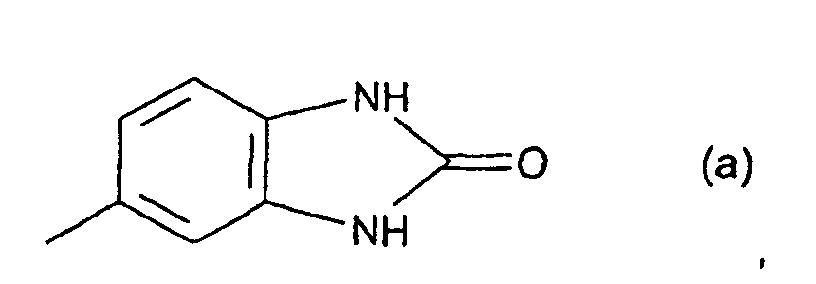 wherein R'3 and R'4 are, independently, hydrogen, C1-8alkyl, C5-6cycloalkyl, benzyl, benzanilide or naphthyl whereby phenyl groups can be mono- or poly-substituted by radicals selected from the group consisting of halogen, nitro groups, C1-8alkyl, phenyl, -COOR with R being C1-8alkyl, and C1-2alkoxy, and R2 is hydrogen, C1-12alkyl or phenyl or -COOR, with R being C1-8alkyl,
- Epindolidione compounds of the general formula (I')in which the nucleus designated A represents an annelated heteroaromatic ring system comprising an annelated ring which is fused on linearly, in 2,3-position, or angularly, in 1,2- or in 3,4-position, to feature the complementary members selected from the group consisting of the moieties (1) to (11)

 wherein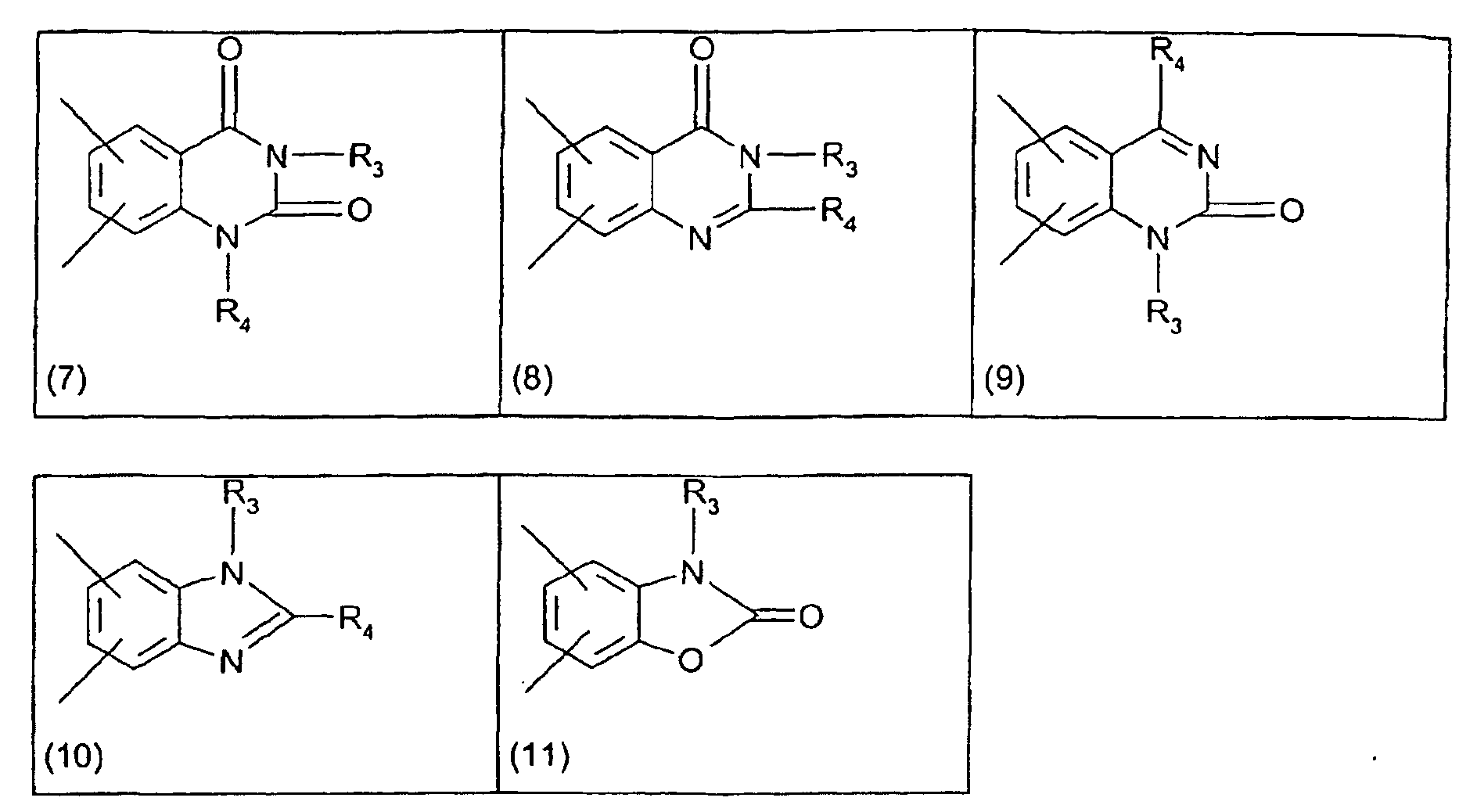
R3 and R4 are, independently, hydrogen, C1-8alkyl, C5-6cycloalkyl, benzyl, benzanilide or naphthyl whereby phenyl groups can be mono- or poly-substituted by radicals selected from the group consisting of halogen, nitro groups, C1-8alkyl, phenyl, -COOR, with R being C1-8alkyl and C1-2alkoxy, preferably chlorine, C1. 4alkyl, phenyl or -COOR, with R being C1-8alkyl.; or
R3 and/or R4 are a radical of formula (a)the nucleus A' represents a substituted or unsubstituted aromatic ring or an annelated heteroaromatic ring system comprising an annelated ring which is fused on linearly, in 2,3-position, or angularly, in 1,2- or in 3,4-position, to feature the complementary members of the moieties (12) to (22)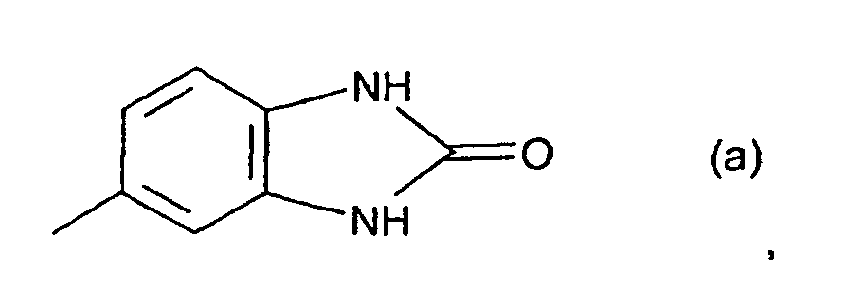 wherein R'3 and R'4 are, independently, C1-8alkyl, C5-6cycloalkyl, benzyl, benzanilide or naphthyl whereby phenyl groups can be mono- or poly-substituted by radicals selected from the group consisting of halogen, nitro groups, C1-8alkyl, phenyl, -COOR with R being C1-8alkyl, and C1-2alkoxy, and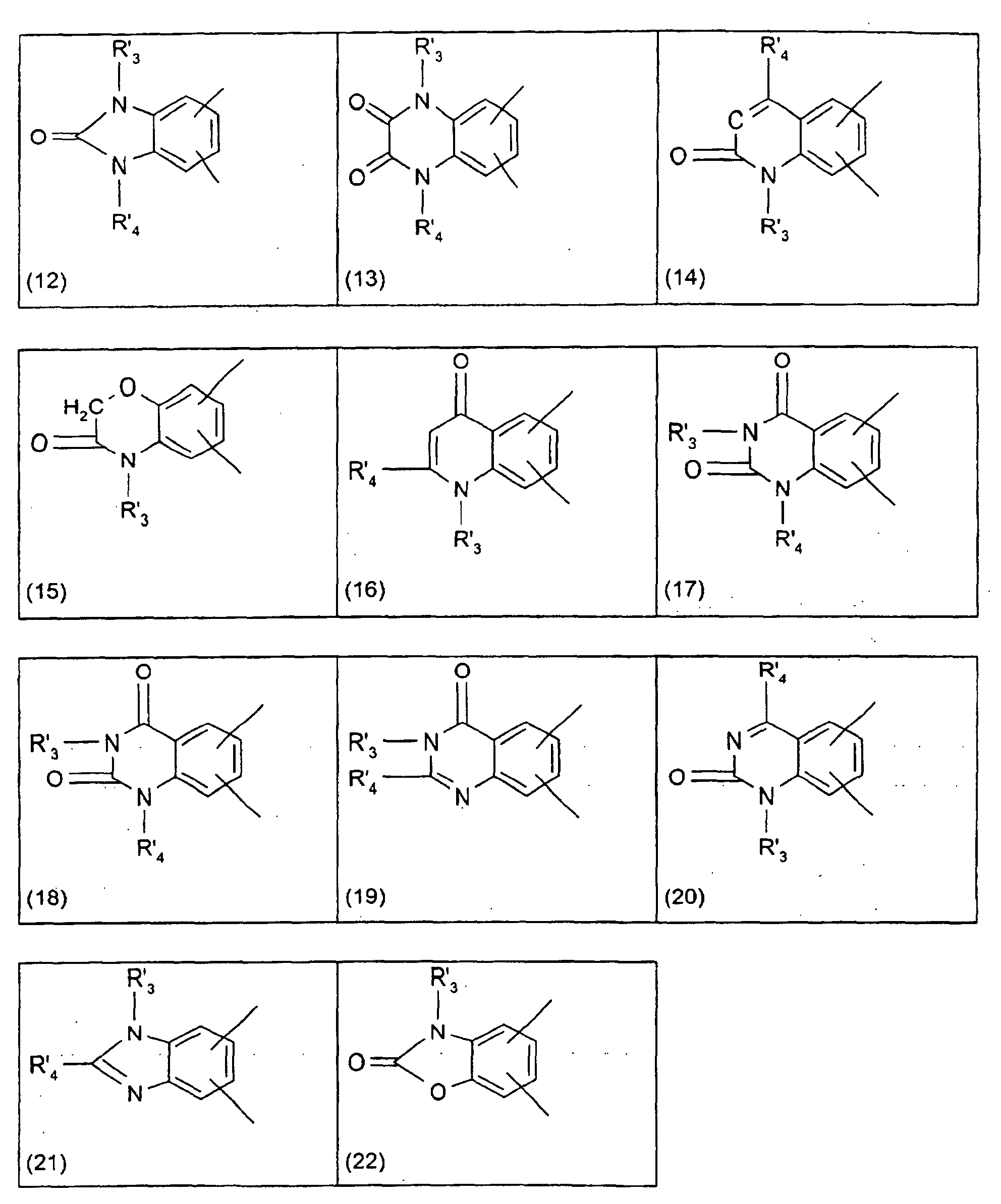
R2 is hydrogen, C1-12alkyl or phenyl or-COOR, with R being C1-8alkyl. - Compounds according to claim 2 of the formulae (Ia), (IIa), (IIIa) and (IIIb)
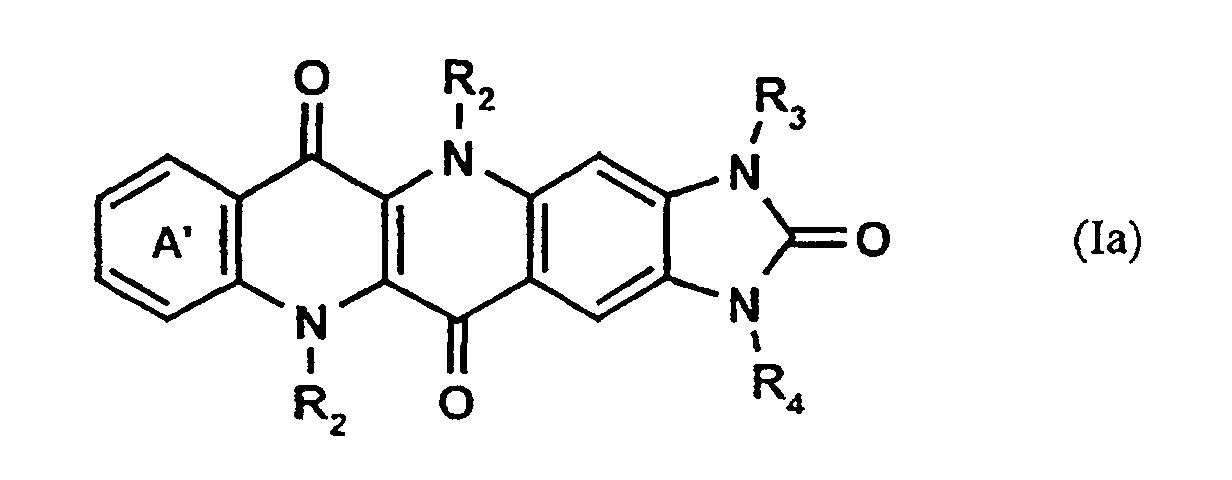

 in which A', R3 and R4 are defined as in claim 2.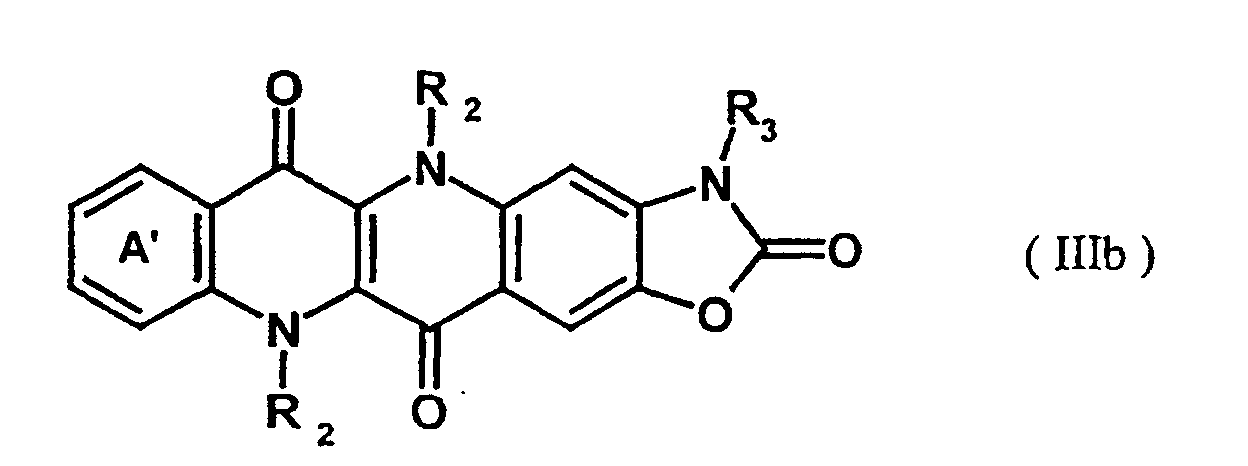
- Compounds according to claim 3 of formula (Ib) and (IIb)
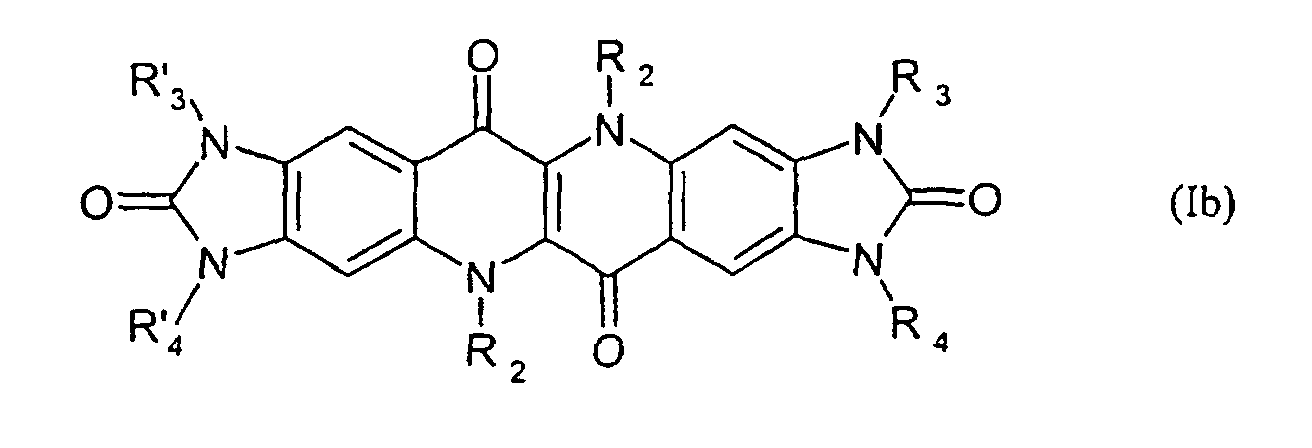 in which R3, R4, R'3 and R'4 are defined as in claim 2.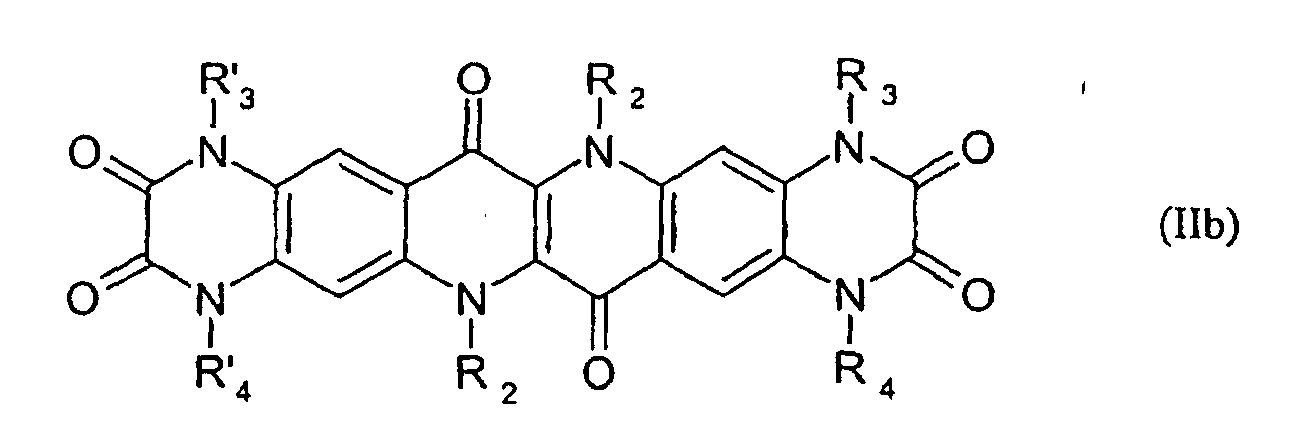
- Compounds according to claim 3 of formula (Ic)wherein R2, R3 and R4 are defined as in claim 2 and R1 is hydrogen, halogen or C1-8alkyl.

- Compounds according to claim 1 of formula (Id)wherein R2 is defined as in claim 1.
- Process for the preparation of epindolidione compounds of the formula (I) according to claim 1 comprising the step of cyclising a compound of the formula (VIII)wherein A', R2 and A have the meanings given in claim 1,

in polyphosphoric acid or concentrated sulfuric acid. - Process for preparing epindolidione compounds of the formula (I') according to claim 2, characterized by the following reaction pathwhereby the nucleus A and A' have the meaning given in claim 2.
- Process for preparing epindolidione compounds of the formula (Id) according to claim 6, characterized by the following reaction path
- Intermediate compounds according to the formulae (VIIa) and (VIIb)
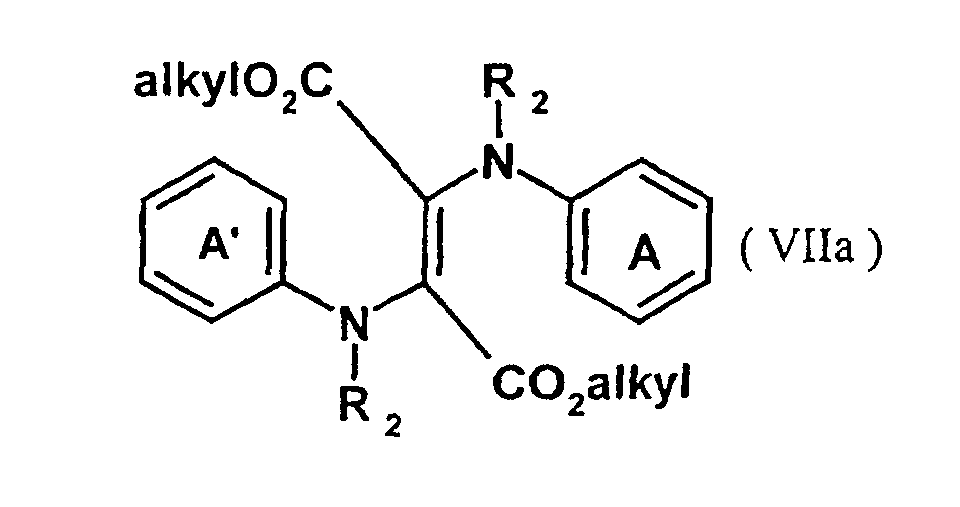 wherein R2, A and A' are defined as in claim 1.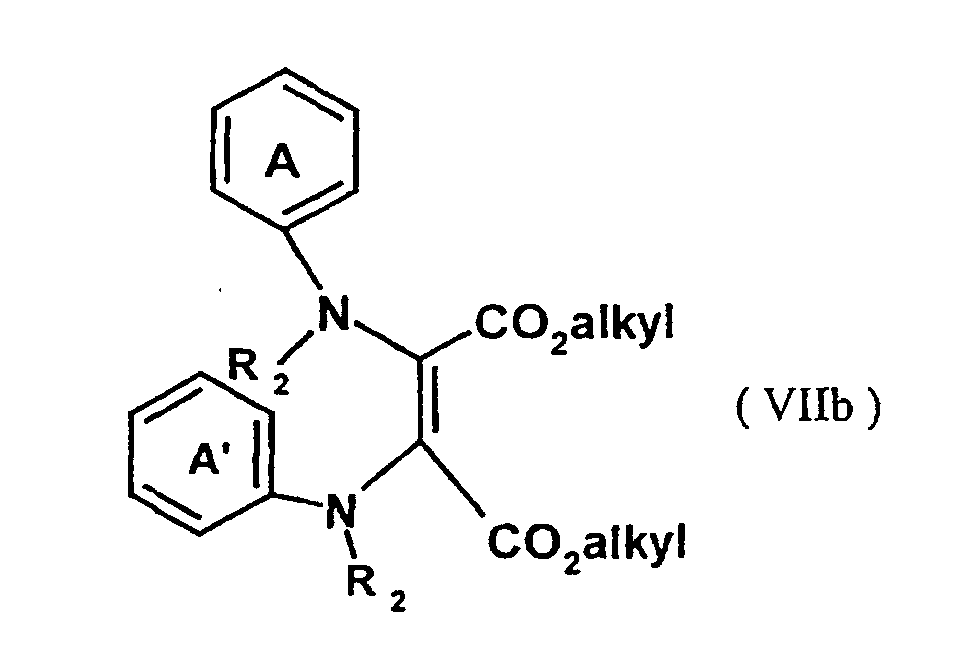
- Intermediate compounds according to the formula (VIII)wherein R2, A and A' are defined as in claim 1.

- Use of the compounds of the formula (I) according to claim 1 as pigments.
- Use of the compounds of the formula (I) according to claim 1 as colorants for colouring polymer compositions or paper pulps, as colorants in electrophotographic toners and developers, as colorants in ink-jet inks, as colorants in the coatings industry, as colorants for textile printing or as a printing ink in the graphical industry, as colorants in cosmetics.
Applications Claiming Priority (3)
| Application Number | Priority Date | Filing Date | Title |
|---|---|---|---|
| GB0103011 | 2001-02-07 | ||
| GBGB0103011.3A GB0103011D0 (en) | 2001-02-07 | 2001-02-07 | Improvements in or relating to chemical compounds |
| PCT/IB2002/000369 WO2002062796A1 (en) | 2001-02-07 | 2002-02-06 | Epindolidione pigments |
Publications (2)
| Publication Number | Publication Date |
|---|---|
| EP1379527A1 EP1379527A1 (en) | 2004-01-14 |
| EP1379527B1 true EP1379527B1 (en) | 2004-09-22 |
Family
ID=9908274
Family Applications (1)
| Application Number | Title | Priority Date | Filing Date |
|---|---|---|---|
| EP02710233A Expired - Lifetime EP1379527B1 (en) | 2001-02-07 | 2002-02-06 | Epindolidione pigments |
Country Status (9)
| Country | Link |
|---|---|
| US (1) | US7307170B2 (en) |
| EP (1) | EP1379527B1 (en) |
| JP (1) | JP4173004B2 (en) |
| KR (1) | KR20030072401A (en) |
| CN (1) | CN1491226A (en) |
| AT (1) | ATE277047T1 (en) |
| DE (1) | DE60201345T2 (en) |
| GB (1) | GB0103011D0 (en) |
| WO (1) | WO2002062796A1 (en) |
Families Citing this family (7)
| Publication number | Priority date | Publication date | Assignee | Title |
|---|---|---|---|---|
| CN100384626C (en) * | 2005-01-28 | 2008-04-30 | 浙江凯喜雅国际股份有限公司 | A Digital Jet Printing Process for Flat Knitting Sweaters |
| BRPI0609727A2 (en) * | 2005-03-24 | 2010-04-20 | Cabot Corp | modified yellow pigment, inkjet ink composition, inkjet ink set, aqueous composition and composition |
| US7691197B2 (en) * | 2005-10-21 | 2010-04-06 | Cabot Corporation | Method of preparing yellow pigments |
| CN103159762B (en) * | 2013-03-25 | 2015-04-15 | 华东理工大学 | Epindolidione derivative and application thereof |
| CN103145708B (en) * | 2013-03-25 | 2015-04-15 | 百合花集团股份有限公司 | Process for preparing epindolidiones and derivatives thereof |
| AT513830B1 (en) | 2013-08-14 | 2014-08-15 | Universität Linz | Method of applying an epindolidium-based organic semiconductor layer to a support |
| KR101766379B1 (en) * | 2016-05-04 | 2017-08-08 | 정문교 | OLED comprising Epindolidione Derivatives and Dopant |
Family Cites Families (10)
| Publication number | Priority date | Publication date | Assignee | Title |
|---|---|---|---|---|
| US4142890A (en) * | 1977-05-20 | 1979-03-06 | Eastman Kodak Company | Photosensitive trans-epindolidione pigment for migration imaging processes |
| DE3144180A1 (en) * | 1980-11-10 | 1982-06-24 | Eastman Kodak Co., 14650 Rochester, N.Y. | ELECTRICALLY PHOTOSENSITIVE PIGMENT AND USE THEREOF |
| FR2706475B1 (en) | 1993-06-16 | 1997-08-29 | Sandoz Sa | Bulk dyeing of synthetic polymers. |
| EP0766498B1 (en) * | 1995-09-29 | 2001-01-24 | Eastman Kodak Company | Organic electroluminescent devices with high operational stability |
| JP3206457B2 (en) * | 1996-10-28 | 2001-09-10 | 東洋インキ製造株式会社 | Inkjet ink and inkjet ink set |
| JPH10189246A (en) * | 1996-10-31 | 1998-07-21 | Mitsui Chem Inc | Organic electroluminescent element |
| JPH11130972A (en) * | 1997-09-01 | 1999-05-18 | Toyo Ink Mfg Co Ltd | Organic pigment |
| JP3775904B2 (en) * | 1997-09-24 | 2006-05-17 | 三井化学株式会社 | Organic electroluminescence device |
| GB9824314D0 (en) | 1998-11-06 | 1998-12-30 | Clariant Int Ltd | New hetercyclic compounds |
| GB0002966D0 (en) | 2000-02-10 | 2000-03-29 | Clariant Int Ltd | New triphendioxazine pigments |
-
2001
- 2001-02-07 GB GBGB0103011.3A patent/GB0103011D0/en not_active Ceased
-
2002
- 2002-02-06 KR KR10-2003-7010363A patent/KR20030072401A/en not_active Withdrawn
- 2002-02-06 US US10/467,041 patent/US7307170B2/en not_active Expired - Fee Related
- 2002-02-06 WO PCT/IB2002/000369 patent/WO2002062796A1/en not_active Ceased
- 2002-02-06 CN CNA02804651XA patent/CN1491226A/en active Pending
- 2002-02-06 EP EP02710233A patent/EP1379527B1/en not_active Expired - Lifetime
- 2002-02-06 DE DE60201345T patent/DE60201345T2/en not_active Expired - Fee Related
- 2002-02-06 JP JP2002563149A patent/JP4173004B2/en not_active Expired - Fee Related
- 2002-02-06 AT AT02710233T patent/ATE277047T1/en not_active IP Right Cessation
Also Published As
| Publication number | Publication date |
|---|---|
| DE60201345D1 (en) | 2004-10-28 |
| EP1379527A1 (en) | 2004-01-14 |
| WO2002062796A8 (en) | 2002-09-26 |
| CN1491226A (en) | 2004-04-21 |
| US20040138451A1 (en) | 2004-07-15 |
| US7307170B2 (en) | 2007-12-11 |
| WO2002062796A1 (en) | 2002-08-15 |
| JP2004525215A (en) | 2004-08-19 |
| ATE277047T1 (en) | 2004-10-15 |
| GB0103011D0 (en) | 2001-03-21 |
| JP4173004B2 (en) | 2008-10-29 |
| DE60201345T2 (en) | 2005-02-24 |
| KR20030072401A (en) | 2003-09-13 |
Similar Documents
| Publication | Publication Date | Title |
|---|---|---|
| US7326793B2 (en) | Process for the preparation of diketopyrrolopyrroles | |
| US6162261A (en) | Triphendioxazine | |
| US6255482B1 (en) | Triphendioxazine compounds | |
| US7307170B2 (en) | Epindolidione pigments | |
| EP1046680B1 (en) | Pigments, the process of their manufacture and their use | |
| US3979386A (en) | Iminoisoindoline pigments and processes for the preparation thereof | |
| EP1046681A2 (en) | Hybrid pigments | |
| US6762299B2 (en) | Mixed crystals of benzimidazolonedioxazine compounds | |
| US6472527B1 (en) | Process for the preparation of thiazine-indigo compounds and of new intermediates therefor | |
| KR100416015B1 (en) | Aminoquinazolinedione-insoluble azo colorant | |
| US20060199882A1 (en) | Heterocyclic dyes based on benzodipyrroles | |
| US6617453B1 (en) | Triphendioxazine compounds | |
| US4070367A (en) | Isoindolinone pigments and process for their manufacture | |
| US5868828A (en) | Heterocyclic-substituted quinacridone pigments | |
| US8133997B2 (en) | 2,4-dioxopyrimidine-based mesoionic pigments | |
| US3994921A (en) | Iminoisoindolenine pigments, process for their manufacture and their use | |
| US7524953B2 (en) | Triphendioxazine pigments | |
| US4153800A (en) | Isoindolinone pigments | |
| CN100560652C (en) | Heterocyclic colorants based on diazabenzisoindole | |
| US5095103A (en) | Polycyclic aromatic azacyclic compounds useful in dyeing |
Legal Events
| Date | Code | Title | Description |
|---|---|---|---|
| PUAI | Public reference made under article 153(3) epc to a published international application that has entered the european phase |
Free format text: ORIGINAL CODE: 0009012 |
|
| 17P | Request for examination filed |
Effective date: 20030908 |
|
| AK | Designated contracting states |
Kind code of ref document: A1 Designated state(s): AT BE CH CY DE DK ES FI FR GB GR IE IT LI LU MC NL PT SE TR |
|
| AX | Request for extension of the european patent |
Extension state: AL LT LV MK RO SI |
|
| GRAP | Despatch of communication of intention to grant a patent |
Free format text: ORIGINAL CODE: EPIDOSNIGR1 |
|
| GRAS | Grant fee paid |
Free format text: ORIGINAL CODE: EPIDOSNIGR3 |
|
| GRAA | (expected) grant |
Free format text: ORIGINAL CODE: 0009210 |
|
| AK | Designated contracting states |
Kind code of ref document: B1 Designated state(s): AT BE CH CY DE DK ES FI FR GB GR IE IT LI LU MC NL PT SE TR |
|
| PG25 | Lapsed in a contracting state [announced via postgrant information from national office to epo] |
Ref country code: IT Free format text: LAPSE BECAUSE OF FAILURE TO SUBMIT A TRANSLATION OF THE DESCRIPTION OR TO PAY THE FEE WITHIN THE PRESCRIBED TIME-LIMIT;WARNING: LAPSES OF ITALIAN PATENTS WITH EFFECTIVE DATE BEFORE 2007 MAY HAVE OCCURRED AT ANY TIME BEFORE 2007. THE CORRECT EFFECTIVE DATE MAY BE DIFFERENT FROM THE ONE RECORDED. Effective date: 20040922 Ref country code: TR Free format text: LAPSE BECAUSE OF FAILURE TO SUBMIT A TRANSLATION OF THE DESCRIPTION OR TO PAY THE FEE WITHIN THE PRESCRIBED TIME-LIMIT Effective date: 20040922 Ref country code: NL Free format text: LAPSE BECAUSE OF FAILURE TO SUBMIT A TRANSLATION OF THE DESCRIPTION OR TO PAY THE FEE WITHIN THE PRESCRIBED TIME-LIMIT Effective date: 20040922 Ref country code: FI Free format text: LAPSE BECAUSE OF FAILURE TO SUBMIT A TRANSLATION OF THE DESCRIPTION OR TO PAY THE FEE WITHIN THE PRESCRIBED TIME-LIMIT Effective date: 20040922 Ref country code: AT Free format text: LAPSE BECAUSE OF FAILURE TO SUBMIT A TRANSLATION OF THE DESCRIPTION OR TO PAY THE FEE WITHIN THE PRESCRIBED TIME-LIMIT Effective date: 20040922 Ref country code: BE Free format text: LAPSE BECAUSE OF FAILURE TO SUBMIT A TRANSLATION OF THE DESCRIPTION OR TO PAY THE FEE WITHIN THE PRESCRIBED TIME-LIMIT Effective date: 20040922 |
|
| REG | Reference to a national code |
Ref country code: GB Ref legal event code: FG4D |
|
| REG | Reference to a national code |
Ref country code: CH Ref legal event code: NV Representative=s name: CLARIANT INTERNATIONAL LTD. Ref country code: CH Ref legal event code: EP |
|
| REG | Reference to a national code |
Ref country code: IE Ref legal event code: FG4D |
|
| REF | Corresponds to: |
Ref document number: 60201345 Country of ref document: DE Date of ref document: 20041028 Kind code of ref document: P |
|
| PG25 | Lapsed in a contracting state [announced via postgrant information from national office to epo] |
Ref country code: SE Free format text: LAPSE BECAUSE OF FAILURE TO SUBMIT A TRANSLATION OF THE DESCRIPTION OR TO PAY THE FEE WITHIN THE PRESCRIBED TIME-LIMIT Effective date: 20041222 Ref country code: GR Free format text: LAPSE BECAUSE OF FAILURE TO SUBMIT A TRANSLATION OF THE DESCRIPTION OR TO PAY THE FEE WITHIN THE PRESCRIBED TIME-LIMIT Effective date: 20041222 Ref country code: DK Free format text: LAPSE BECAUSE OF FAILURE TO SUBMIT A TRANSLATION OF THE DESCRIPTION OR TO PAY THE FEE WITHIN THE PRESCRIBED TIME-LIMIT Effective date: 20041222 |
|
| PG25 | Lapsed in a contracting state [announced via postgrant information from national office to epo] |
Ref country code: ES Free format text: LAPSE BECAUSE OF FAILURE TO SUBMIT A TRANSLATION OF THE DESCRIPTION OR TO PAY THE FEE WITHIN THE PRESCRIBED TIME-LIMIT Effective date: 20050102 |
|
| PG25 | Lapsed in a contracting state [announced via postgrant information from national office to epo] |
Ref country code: LU Free format text: LAPSE BECAUSE OF NON-PAYMENT OF DUE FEES Effective date: 20050206 Ref country code: CY Free format text: LAPSE BECAUSE OF FAILURE TO SUBMIT A TRANSLATION OF THE DESCRIPTION OR TO PAY THE FEE WITHIN THE PRESCRIBED TIME-LIMIT Effective date: 20050206 |
|
| PG25 | Lapsed in a contracting state [announced via postgrant information from national office to epo] |
Ref country code: IE Free format text: LAPSE BECAUSE OF NON-PAYMENT OF DUE FEES Effective date: 20050207 |
|
| LTIE | Lt: invalidation of european patent or patent extension |
Effective date: 20040922 |
|
| PG25 | Lapsed in a contracting state [announced via postgrant information from national office to epo] |
Ref country code: MC Free format text: LAPSE BECAUSE OF NON-PAYMENT OF DUE FEES Effective date: 20050228 |
|
| ET | Fr: translation filed | ||
| NLV1 | Nl: lapsed or annulled due to failure to fulfill the requirements of art. 29p and 29m of the patents act | ||
| PLBE | No opposition filed within time limit |
Free format text: ORIGINAL CODE: 0009261 |
|
| STAA | Information on the status of an ep patent application or granted ep patent |
Free format text: STATUS: NO OPPOSITION FILED WITHIN TIME LIMIT |
|
| 26N | No opposition filed |
Effective date: 20050623 |
|
| REG | Reference to a national code |
Ref country code: IE Ref legal event code: MM4A |
|
| PG25 | Lapsed in a contracting state [announced via postgrant information from national office to epo] |
Ref country code: PT Free format text: LAPSE BECAUSE OF NON-PAYMENT OF DUE FEES Effective date: 20050222 |
|
| PGFP | Annual fee paid to national office [announced via postgrant information from national office to epo] |
Ref country code: CH Payment date: 20071210 Year of fee payment: 7 |
|
| PGFP | Annual fee paid to national office [announced via postgrant information from national office to epo] |
Ref country code: DE Payment date: 20071128 Year of fee payment: 7 Ref country code: GB Payment date: 20080125 Year of fee payment: 7 |
|
| PGFP | Annual fee paid to national office [announced via postgrant information from national office to epo] |
Ref country code: FR Payment date: 20071214 Year of fee payment: 7 |
|
| REG | Reference to a national code |
Ref country code: CH Ref legal event code: PL |
|
| GBPC | Gb: european patent ceased through non-payment of renewal fee |
Effective date: 20090206 |
|
| PG25 | Lapsed in a contracting state [announced via postgrant information from national office to epo] |
Ref country code: CH Free format text: LAPSE BECAUSE OF NON-PAYMENT OF DUE FEES Effective date: 20090228 Ref country code: LI Free format text: LAPSE BECAUSE OF NON-PAYMENT OF DUE FEES Effective date: 20090228 |
|
| REG | Reference to a national code |
Ref country code: FR Ref legal event code: ST Effective date: 20091030 |
|
| PG25 | Lapsed in a contracting state [announced via postgrant information from national office to epo] |
Ref country code: DE Free format text: LAPSE BECAUSE OF NON-PAYMENT OF DUE FEES Effective date: 20090901 |
|
| PG25 | Lapsed in a contracting state [announced via postgrant information from national office to epo] |
Ref country code: GB Free format text: LAPSE BECAUSE OF NON-PAYMENT OF DUE FEES Effective date: 20090206 Ref country code: FR Free format text: LAPSE BECAUSE OF NON-PAYMENT OF DUE FEES Effective date: 20090302 |