EP1379505B1 - Inhibition of raf kinase using quinolyl, isoquinolyl or pyridyl ureas - Google Patents
Inhibition of raf kinase using quinolyl, isoquinolyl or pyridyl ureas Download PDFInfo
- Publication number
- EP1379505B1 EP1379505B1 EP02725710A EP02725710A EP1379505B1 EP 1379505 B1 EP1379505 B1 EP 1379505B1 EP 02725710 A EP02725710 A EP 02725710A EP 02725710 A EP02725710 A EP 02725710A EP 1379505 B1 EP1379505 B1 EP 1379505B1
- Authority
- EP
- European Patent Office
- Prior art keywords
- substituted
- group
- alkoxy
- acid
- alkyl
- Prior art date
- Legal status (The legal status is an assumption and is not a legal conclusion. Google has not performed a legal analysis and makes no representation as to the accuracy of the status listed.)
- Expired - Lifetime
Links
- -1 pyridyl ureas Chemical class 0.000 title claims abstract description 81
- 108010077182 raf Kinases Proteins 0.000 title claims description 22
- 102000009929 raf Kinases Human genes 0.000 title claims description 22
- 230000005764 inhibitory process Effects 0.000 title claims description 7
- 235000013877 carbamide Nutrition 0.000 title abstract description 35
- 125000005956 isoquinolyl group Chemical group 0.000 title abstract description 3
- 125000005493 quinolyl group Chemical group 0.000 title abstract description 3
- 230000001404 mediated effect Effects 0.000 claims abstract description 11
- 239000008194 pharmaceutical composition Substances 0.000 claims abstract description 10
- 208000037265 diseases, disorders, signs and symptoms Diseases 0.000 claims abstract description 6
- 150000001875 compounds Chemical class 0.000 claims description 70
- 125000000027 (C1-C10) alkoxy group Chemical group 0.000 claims description 47
- 125000000008 (C1-C10) alkyl group Chemical group 0.000 claims description 45
- 125000005842 heteroatom Chemical group 0.000 claims description 43
- 229910052757 nitrogen Inorganic materials 0.000 claims description 43
- 229910052736 halogen Inorganic materials 0.000 claims description 40
- 150000002367 halogens Chemical class 0.000 claims description 40
- 125000005843 halogen group Chemical group 0.000 claims description 39
- 229910052717 sulfur Inorganic materials 0.000 claims description 37
- 229910052760 oxygen Inorganic materials 0.000 claims description 36
- 125000001424 substituent group Chemical group 0.000 claims description 36
- 239000007787 solid Substances 0.000 claims description 32
- 125000001997 phenyl group Chemical group [H]C1=C([H])C([H])=C(*)C([H])=C1[H] 0.000 claims description 28
- 125000004122 cyclic group Chemical group 0.000 claims description 27
- 125000004076 pyridyl group Chemical group 0.000 claims description 24
- 125000000217 alkyl group Chemical group 0.000 claims description 22
- 125000003118 aryl group Chemical group 0.000 claims description 22
- 125000000449 nitro group Chemical group [O-][N+](*)=O 0.000 claims description 22
- 125000006374 C2-C10 alkenyl group Chemical group 0.000 claims description 21
- 125000001072 heteroaryl group Chemical group 0.000 claims description 21
- 125000002183 isoquinolinyl group Chemical group C1(=NC=CC2=CC=CC=C12)* 0.000 claims description 21
- QTBSBXVTEAMEQO-UHFFFAOYSA-N Acetic acid Chemical compound CC(O)=O QTBSBXVTEAMEQO-UHFFFAOYSA-N 0.000 claims description 20
- IJGRMHOSHXDMSA-UHFFFAOYSA-N Atomic nitrogen Chemical compound N#N IJGRMHOSHXDMSA-UHFFFAOYSA-N 0.000 claims description 20
- 206010028980 Neoplasm Diseases 0.000 claims description 19
- 125000002943 quinolinyl group Chemical group N1=C(C=CC2=CC=CC=C12)* 0.000 claims description 16
- 150000003839 salts Chemical class 0.000 claims description 15
- 125000006376 (C3-C10) cycloalkyl group Chemical group 0.000 claims description 14
- KRKNYBCHXYNGOX-UHFFFAOYSA-N citric acid Chemical compound OC(=O)CC(O)(C(O)=O)CC(O)=O KRKNYBCHXYNGOX-UHFFFAOYSA-N 0.000 claims description 12
- 125000001475 halogen functional group Chemical group 0.000 claims description 11
- 239000001257 hydrogen Substances 0.000 claims description 11
- 229910052739 hydrogen Inorganic materials 0.000 claims description 11
- 238000002360 preparation method Methods 0.000 claims description 11
- 125000000714 pyrimidinyl group Chemical group 0.000 claims description 11
- 125000002877 alkyl aryl group Chemical group 0.000 claims description 10
- MUBZPKHOEPUJKR-UHFFFAOYSA-N Oxalic acid Chemical compound OC(=O)C(O)=O MUBZPKHOEPUJKR-UHFFFAOYSA-N 0.000 claims description 9
- 239000002253 acid Substances 0.000 claims description 9
- QVGXLLKOCUKJST-UHFFFAOYSA-N atomic oxygen Chemical compound [O] QVGXLLKOCUKJST-UHFFFAOYSA-N 0.000 claims description 9
- 239000001301 oxygen Substances 0.000 claims description 9
- VEXZGXHMUGYJMC-UHFFFAOYSA-N Hydrochloric acid Chemical compound Cl VEXZGXHMUGYJMC-UHFFFAOYSA-N 0.000 claims description 8
- NBIIXXVUZAFLBC-UHFFFAOYSA-N Phosphoric acid Chemical compound OP(O)(O)=O NBIIXXVUZAFLBC-UHFFFAOYSA-N 0.000 claims description 8
- NINIDFKCEFEMDL-UHFFFAOYSA-N Sulfur Chemical compound [S] NINIDFKCEFEMDL-UHFFFAOYSA-N 0.000 claims description 8
- 150000001768 cations Chemical class 0.000 claims description 8
- 239000011593 sulfur Substances 0.000 claims description 8
- 229910052799 carbon Inorganic materials 0.000 claims description 7
- OKTJSMMVPCPJKN-UHFFFAOYSA-N Carbon Chemical compound [C] OKTJSMMVPCPJKN-UHFFFAOYSA-N 0.000 claims description 6
- VZCYOOQTPOCHFL-OWOJBTEDSA-N Fumaric acid Chemical compound OC(=O)\C=C\C(O)=O VZCYOOQTPOCHFL-OWOJBTEDSA-N 0.000 claims description 6
- DTQVDTLACAAQTR-UHFFFAOYSA-N Trifluoroacetic acid Chemical compound OC(=O)C(F)(F)F DTQVDTLACAAQTR-UHFFFAOYSA-N 0.000 claims description 6
- WPYMKLBDIGXBTP-UHFFFAOYSA-N benzoic acid Chemical compound OC(=O)C1=CC=CC=C1 WPYMKLBDIGXBTP-UHFFFAOYSA-N 0.000 claims description 6
- 125000004432 carbon atom Chemical group C* 0.000 claims description 6
- 239000003814 drug Substances 0.000 claims description 6
- JVTAAEKCZFNVCJ-UHFFFAOYSA-N lactic acid Chemical compound CC(O)C(O)=O JVTAAEKCZFNVCJ-UHFFFAOYSA-N 0.000 claims description 6
- 229910052701 rubidium Inorganic materials 0.000 claims description 6
- YGSDEFSMJLZEOE-UHFFFAOYSA-N salicylic acid Chemical compound OC(=O)C1=CC=CC=C1O YGSDEFSMJLZEOE-UHFFFAOYSA-N 0.000 claims description 6
- JOXIMZWYDAKGHI-UHFFFAOYSA-N toluene-4-sulfonic acid Chemical compound CC1=CC=C(S(O)(=O)=O)C=C1 JOXIMZWYDAKGHI-UHFFFAOYSA-N 0.000 claims description 6
- VZCYOOQTPOCHFL-UHFFFAOYSA-N trans-butenedioic acid Natural products OC(=O)C=CC(O)=O VZCYOOQTPOCHFL-UHFFFAOYSA-N 0.000 claims description 6
- UFHFLCQGNIYNRP-UHFFFAOYSA-N Hydrogen Chemical compound [H][H] UFHFLCQGNIYNRP-UHFFFAOYSA-N 0.000 claims description 5
- QAOWNCQODCNURD-UHFFFAOYSA-N Sulfuric acid Chemical compound OS(O)(=O)=O QAOWNCQODCNURD-UHFFFAOYSA-N 0.000 claims description 5
- 125000003710 aryl alkyl group Chemical group 0.000 claims description 5
- 201000011510 cancer Diseases 0.000 claims description 5
- 230000010261 cell growth Effects 0.000 claims description 5
- AFVFQIVMOAPDHO-UHFFFAOYSA-N Methanesulfonic acid Chemical compound CS(O)(=O)=O AFVFQIVMOAPDHO-UHFFFAOYSA-N 0.000 claims description 4
- 229910003827 NRaRb Inorganic materials 0.000 claims description 4
- YTPLMLYBLZKORZ-UHFFFAOYSA-N Thiophene Chemical compound C=1C=CSC=1 YTPLMLYBLZKORZ-UHFFFAOYSA-N 0.000 claims description 4
- 229910000147 aluminium phosphate Inorganic materials 0.000 claims description 4
- 235000015165 citric acid Nutrition 0.000 claims description 4
- 125000000753 cycloalkyl group Chemical group 0.000 claims description 4
- 125000000623 heterocyclic group Chemical group 0.000 claims description 4
- KVBGVZZKJNLNJU-UHFFFAOYSA-N naphthalene-2-sulfonic acid Chemical compound C1=CC=CC2=CC(S(=O)(=O)O)=CC=C21 KVBGVZZKJNLNJU-UHFFFAOYSA-N 0.000 claims description 4
- 230000037361 pathway Effects 0.000 claims description 4
- LMBFAGIMSUYTBN-MPZNNTNKSA-N teixobactin Chemical compound C([C@H](C(=O)N[C@@H]([C@@H](C)CC)C(=O)N[C@@H](CO)C(=O)N[C@H](CCC(N)=O)C(=O)N[C@H]([C@@H](C)CC)C(=O)N[C@@H]([C@@H](C)CC)C(=O)N[C@@H](CO)C(=O)N[C@H]1C(N[C@@H](C)C(=O)N[C@@H](C[C@@H]2NC(=N)NC2)C(=O)N[C@H](C(=O)O[C@H]1C)[C@@H](C)CC)=O)NC)C1=CC=CC=C1 LMBFAGIMSUYTBN-MPZNNTNKSA-N 0.000 claims description 4
- QBYIENPQHBMVBV-HFEGYEGKSA-N (2R)-2-hydroxy-2-phenylacetic acid Chemical compound O[C@@H](C(O)=O)c1ccccc1.O[C@@H](C(O)=O)c1ccccc1 QBYIENPQHBMVBV-HFEGYEGKSA-N 0.000 claims description 3
- BJEPYKJPYRNKOW-REOHCLBHSA-N (S)-malic acid Chemical compound OC(=O)[C@@H](O)CC(O)=O BJEPYKJPYRNKOW-REOHCLBHSA-N 0.000 claims description 3
- WLJVXDMOQOGPHL-PPJXEINESA-N 2-phenylacetic acid Chemical compound O[14C](=O)CC1=CC=CC=C1 WLJVXDMOQOGPHL-PPJXEINESA-N 0.000 claims description 3
- BMYNFMYTOJXKLE-UHFFFAOYSA-N 3-azaniumyl-2-hydroxypropanoate Chemical compound NCC(O)C(O)=O BMYNFMYTOJXKLE-UHFFFAOYSA-N 0.000 claims description 3
- QGZKDVFQNNGYKY-UHFFFAOYSA-O Ammonium Chemical group [NH4+] QGZKDVFQNNGYKY-UHFFFAOYSA-O 0.000 claims description 3
- 239000005711 Benzoic acid Substances 0.000 claims description 3
- 125000005915 C6-C14 aryl group Chemical group 0.000 claims description 3
- FEWJPZIEWOKRBE-JCYAYHJZSA-N Dextrotartaric acid Chemical compound OC(=O)[C@H](O)[C@@H](O)C(O)=O FEWJPZIEWOKRBE-JCYAYHJZSA-N 0.000 claims description 3
- OFOBLEOULBTSOW-UHFFFAOYSA-N Propanedioic acid Natural products OC(=O)CC(O)=O OFOBLEOULBTSOW-UHFFFAOYSA-N 0.000 claims description 3
- IWYDHOAUDWTVEP-UHFFFAOYSA-N R-2-phenyl-2-hydroxyacetic acid Natural products OC(=O)C(O)C1=CC=CC=C1 IWYDHOAUDWTVEP-UHFFFAOYSA-N 0.000 claims description 3
- KDYFGRWQOYBRFD-UHFFFAOYSA-N Succinic acid Natural products OC(=O)CCC(O)=O KDYFGRWQOYBRFD-UHFFFAOYSA-N 0.000 claims description 3
- FEWJPZIEWOKRBE-UHFFFAOYSA-N Tartaric acid Natural products [H+].[H+].[O-]C(=O)C(O)C(O)C([O-])=O FEWJPZIEWOKRBE-UHFFFAOYSA-N 0.000 claims description 3
- 125000001931 aliphatic group Chemical group 0.000 claims description 3
- 150000001447 alkali salts Chemical class 0.000 claims description 3
- BJEPYKJPYRNKOW-UHFFFAOYSA-N alpha-hydroxysuccinic acid Natural products OC(=O)C(O)CC(O)=O BJEPYKJPYRNKOW-UHFFFAOYSA-N 0.000 claims description 3
- 235000010233 benzoic acid Nutrition 0.000 claims description 3
- KDYFGRWQOYBRFD-NUQCWPJISA-N butanedioic acid Chemical compound O[14C](=O)CC[14C](O)=O KDYFGRWQOYBRFD-NUQCWPJISA-N 0.000 claims description 3
- 210000001072 colon Anatomy 0.000 claims description 3
- 239000001530 fumaric acid Substances 0.000 claims description 3
- 235000011087 fumaric acid Nutrition 0.000 claims description 3
- 150000007529 inorganic bases Chemical class 0.000 claims description 3
- 239000004310 lactic acid Substances 0.000 claims description 3
- 235000014655 lactic acid Nutrition 0.000 claims description 3
- VZCYOOQTPOCHFL-UPHRSURJSA-N maleic acid Chemical compound OC(=O)\C=C/C(O)=O VZCYOOQTPOCHFL-UPHRSURJSA-N 0.000 claims description 3
- 239000011976 maleic acid Substances 0.000 claims description 3
- 239000001630 malic acid Substances 0.000 claims description 3
- 235000011090 malic acid Nutrition 0.000 claims description 3
- 229960002510 mandelic acid Drugs 0.000 claims description 3
- 150000007522 mineralic acids Chemical class 0.000 claims description 3
- 150000007524 organic acids Chemical class 0.000 claims description 3
- 235000005985 organic acids Nutrition 0.000 claims description 3
- 150000007530 organic bases Chemical class 0.000 claims description 3
- 235000006408 oxalic acid Nutrition 0.000 claims description 3
- FJKROLUGYXJWQN-UHFFFAOYSA-N papa-hydroxy-benzoic acid Natural products OC(=O)C1=CC=C(O)C=C1 FJKROLUGYXJWQN-UHFFFAOYSA-N 0.000 claims description 3
- 229960004889 salicylic acid Drugs 0.000 claims description 3
- 239000011975 tartaric acid Substances 0.000 claims description 3
- 235000002906 tartaric acid Nutrition 0.000 claims description 3
- 208000003200 Adenoma Diseases 0.000 claims description 2
- 201000009030 Carcinoma Diseases 0.000 claims description 2
- 241001529936 Murinae Species 0.000 claims description 2
- SRSXLGNVWSONIS-UHFFFAOYSA-N benzenesulfonic acid Chemical compound OS(=O)(=O)C1=CC=CC=C1 SRSXLGNVWSONIS-UHFFFAOYSA-N 0.000 claims description 2
- 210000004072 lung Anatomy 0.000 claims description 2
- 208000025113 myeloid leukemia Diseases 0.000 claims description 2
- 210000000496 pancreas Anatomy 0.000 claims description 2
- 125000003107 substituted aryl group Chemical group 0.000 claims description 2
- 239000001117 sulphuric acid Substances 0.000 claims description 2
- 235000011149 sulphuric acid Nutrition 0.000 claims description 2
- 229930192474 thiophene Natural products 0.000 claims description 2
- 210000001685 thyroid gland Anatomy 0.000 claims description 2
- 210000003932 urinary bladder Anatomy 0.000 claims description 2
- 125000004093 cyano group Chemical group *C#N 0.000 claims 25
- 125000006274 (C1-C3)alkoxy group Chemical group 0.000 claims 8
- 125000002887 hydroxy group Chemical group [H]O* 0.000 claims 6
- 150000002431 hydrogen Chemical class 0.000 claims 4
- LSNNMFCWUKXFEE-UHFFFAOYSA-M Bisulfite Chemical compound OS([O-])=O LSNNMFCWUKXFEE-UHFFFAOYSA-M 0.000 claims 3
- 125000006559 (C1-C3) alkylamino group Chemical group 0.000 claims 2
- 125000006619 (C1-C6) dialkylamino group Chemical group 0.000 claims 2
- 125000001188 haloalkyl group Chemical group 0.000 claims 2
- 125000004191 (C1-C6) alkoxy group Chemical group 0.000 claims 1
- UMKXCVNDMBXXGT-UHFFFAOYSA-N 1-[1-(4-methylpiperazin-1-yl)isoquinolin-3-yl]-3-(4-pyridin-4-yloxyphenyl)urea Chemical compound C1CN(C)CCN1C1=NC(NC(=O)NC=2C=CC(OC=3C=CN=CC=3)=CC=2)=CC2=CC=CC=C12 UMKXCVNDMBXXGT-UHFFFAOYSA-N 0.000 claims 1
- RYVMVNVXUBVRSV-UHFFFAOYSA-N 1-isoquinolin-3-yl-3-(4-pyridin-4-yloxyphenyl)urea Chemical compound C=1C2=CC=CC=C2C=NC=1NC(=O)NC(C=C1)=CC=C1OC1=CC=NC=C1 RYVMVNVXUBVRSV-UHFFFAOYSA-N 0.000 claims 1
- SGPGESCZOCHFCL-UHFFFAOYSA-N Tilisolol hydrochloride Chemical compound [Cl-].C1=CC=C2C(=O)N(C)C=C(OCC(O)C[NH2+]C(C)(C)C)C2=C1 SGPGESCZOCHFCL-UHFFFAOYSA-N 0.000 claims 1
- 125000005037 alkyl phenyl group Chemical group 0.000 claims 1
- 229940092714 benzenesulfonic acid Drugs 0.000 claims 1
- 229940098779 methanesulfonic acid Drugs 0.000 claims 1
- 125000001624 naphthyl group Chemical group 0.000 claims 1
- 201000010099 disease Diseases 0.000 abstract description 4
- 238000002560 therapeutic procedure Methods 0.000 abstract description 4
- 150000003672 ureas Chemical class 0.000 abstract description 4
- XEKOWRVHYACXOJ-UHFFFAOYSA-N Ethyl acetate Chemical compound CCOC(C)=O XEKOWRVHYACXOJ-UHFFFAOYSA-N 0.000 description 188
- VLKZOEOYAKHREP-UHFFFAOYSA-N n-Hexane Chemical compound CCCCCC VLKZOEOYAKHREP-UHFFFAOYSA-N 0.000 description 142
- 239000000243 solution Substances 0.000 description 103
- 235000019439 ethyl acetate Nutrition 0.000 description 93
- 239000000203 mixture Substances 0.000 description 72
- 238000000034 method Methods 0.000 description 53
- XLYOFNOQVPJJNP-UHFFFAOYSA-N water Substances O XLYOFNOQVPJJNP-UHFFFAOYSA-N 0.000 description 52
- CSNNHWWHGAXBCP-UHFFFAOYSA-L Magnesium sulfate Chemical compound [Mg+2].[O-][S+2]([O-])([O-])[O-] CSNNHWWHGAXBCP-UHFFFAOYSA-L 0.000 description 46
- PAYRUJLWNCNPSJ-UHFFFAOYSA-N N-phenyl amine Natural products NC1=CC=CC=C1 PAYRUJLWNCNPSJ-UHFFFAOYSA-N 0.000 description 44
- XSQUKJJJFZCRTK-UHFFFAOYSA-N Urea Chemical compound NC(N)=O XSQUKJJJFZCRTK-UHFFFAOYSA-N 0.000 description 42
- YMWUJEATGCHHMB-UHFFFAOYSA-N Dichloromethane Chemical compound ClCCl YMWUJEATGCHHMB-UHFFFAOYSA-N 0.000 description 41
- 230000015572 biosynthetic process Effects 0.000 description 41
- 238000006243 chemical reaction Methods 0.000 description 35
- 230000002829 reductive effect Effects 0.000 description 35
- ZMXDDKWLCZADIW-UHFFFAOYSA-N N,N-Dimethylformamide Chemical compound CN(C)C=O ZMXDDKWLCZADIW-UHFFFAOYSA-N 0.000 description 34
- OKKJLVBELUTLKV-UHFFFAOYSA-N Methanol Chemical compound OC OKKJLVBELUTLKV-UHFFFAOYSA-N 0.000 description 33
- 238000004809 thin layer chromatography Methods 0.000 description 33
- 238000005755 formation reaction Methods 0.000 description 30
- RTZKZFJDLAIYFH-UHFFFAOYSA-N Diethyl ether Chemical compound CCOCC RTZKZFJDLAIYFH-UHFFFAOYSA-N 0.000 description 28
- VYPSYNLAJGMNEJ-UHFFFAOYSA-N Silicium dioxide Chemical compound O=[Si]=O VYPSYNLAJGMNEJ-UHFFFAOYSA-N 0.000 description 28
- 150000001448 anilines Chemical class 0.000 description 28
- HEMHJVSKTPXQMS-UHFFFAOYSA-M Sodium hydroxide Chemical compound [OH-].[Na+] HEMHJVSKTPXQMS-UHFFFAOYSA-M 0.000 description 27
- BWHMMNNQKKPAPP-UHFFFAOYSA-L potassium carbonate Chemical compound [K+].[K+].[O-]C([O-])=O BWHMMNNQKKPAPP-UHFFFAOYSA-L 0.000 description 27
- FAPWRFPIFSIZLT-UHFFFAOYSA-M Sodium chloride Chemical class [Na+].[Cl-] FAPWRFPIFSIZLT-UHFFFAOYSA-M 0.000 description 26
- 238000007429 general method Methods 0.000 description 25
- XKRFYHLGVUSROY-UHFFFAOYSA-N Argon Chemical compound [Ar] XKRFYHLGVUSROY-UHFFFAOYSA-N 0.000 description 24
- PFKFTWBEEFSNDU-UHFFFAOYSA-N carbonyldiimidazole Chemical compound C1=CN=CN1C(=O)N1C=CN=C1 PFKFTWBEEFSNDU-UHFFFAOYSA-N 0.000 description 23
- 229910052943 magnesium sulfate Inorganic materials 0.000 description 23
- 239000012044 organic layer Substances 0.000 description 23
- 239000000047 product Substances 0.000 description 22
- 239000004202 carbamide Substances 0.000 description 21
- 239000011541 reaction mixture Substances 0.000 description 21
- IAZDPXIOMUYVGZ-WFGJKAKNSA-N Dimethyl sulfoxide Chemical compound [2H]C([2H])([2H])S(=O)C([2H])([2H])[2H] IAZDPXIOMUYVGZ-WFGJKAKNSA-N 0.000 description 20
- 239000003921 oil Substances 0.000 description 20
- 235000019198 oils Nutrition 0.000 description 20
- 230000009467 reduction Effects 0.000 description 20
- 238000003756 stirring Methods 0.000 description 18
- LFQSCWFLJHTTHZ-UHFFFAOYSA-N Ethanol Chemical compound CCO LFQSCWFLJHTTHZ-UHFFFAOYSA-N 0.000 description 16
- 238000005160 1H NMR spectroscopy Methods 0.000 description 15
- 238000007339 nucleophilic aromatic substitution reaction Methods 0.000 description 15
- 238000003786 synthesis reaction Methods 0.000 description 14
- 238000010265 fast atom bombardment Methods 0.000 description 13
- 229910000027 potassium carbonate Inorganic materials 0.000 description 13
- HEDRZPFGACZZDS-MICDWDOJSA-N Trichloro(2H)methane Chemical compound [2H]C(Cl)(Cl)Cl HEDRZPFGACZZDS-MICDWDOJSA-N 0.000 description 12
- 229910052786 argon Inorganic materials 0.000 description 12
- 125000004999 nitroaryl group Chemical group 0.000 description 12
- 210000004027 cell Anatomy 0.000 description 11
- 238000004128 high performance liquid chromatography Methods 0.000 description 11
- 239000000463 material Substances 0.000 description 11
- 239000002904 solvent Substances 0.000 description 11
- 238000001819 mass spectrum Methods 0.000 description 10
- 238000010992 reflux Methods 0.000 description 10
- CSCPPACGZOOCGX-UHFFFAOYSA-N Acetone Chemical compound CC(C)=O CSCPPACGZOOCGX-UHFFFAOYSA-N 0.000 description 9
- YXFVVABEGXRONW-UHFFFAOYSA-N Toluene Chemical compound CC1=CC=CC=C1 YXFVVABEGXRONW-UHFFFAOYSA-N 0.000 description 9
- 230000037396 body weight Effects 0.000 description 9
- KDLHZDBZIXYQEI-UHFFFAOYSA-N palladium Substances [Pd] KDLHZDBZIXYQEI-UHFFFAOYSA-N 0.000 description 9
- INBYYMGULYXPNC-UHFFFAOYSA-N 2-methoxyquinolin-3-amine Chemical compound C1=CC=C2C=C(N)C(OC)=NC2=C1 INBYYMGULYXPNC-UHFFFAOYSA-N 0.000 description 8
- IHAFMSZIVGDZTC-UHFFFAOYSA-N 4-pyridin-4-yloxyaniline Chemical compound C1=CC(N)=CC=C1OC1=CC=NC=C1 IHAFMSZIVGDZTC-UHFFFAOYSA-N 0.000 description 8
- LLQPELYFCPYKRR-UHFFFAOYSA-N 4-tert-butylpyridin-2-amine Chemical compound CC(C)(C)C1=CC=NC(N)=C1 LLQPELYFCPYKRR-UHFFFAOYSA-N 0.000 description 8
- WYURNTSHIVDZCO-UHFFFAOYSA-N Tetrahydrofuran Chemical compound C1CCOC1 WYURNTSHIVDZCO-UHFFFAOYSA-N 0.000 description 8
- 239000012298 atmosphere Substances 0.000 description 8
- 238000004992 fast atom bombardment mass spectroscopy Methods 0.000 description 8
- 230000012010 growth Effects 0.000 description 8
- 229920006395 saturated elastomer Polymers 0.000 description 8
- 239000000741 silica gel Substances 0.000 description 8
- 229910002027 silica gel Inorganic materials 0.000 description 8
- WFQDTOYDVUWQMS-UHFFFAOYSA-N 1-fluoro-4-nitrobenzene Chemical compound [O-][N+](=O)C1=CC=C(F)C=C1 WFQDTOYDVUWQMS-UHFFFAOYSA-N 0.000 description 7
- 150000002148 esters Chemical class 0.000 description 7
- 239000000725 suspension Substances 0.000 description 7
- IAZDPXIOMUYVGZ-UHFFFAOYSA-N Dimethylsulphoxide Chemical compound CS(C)=O IAZDPXIOMUYVGZ-UHFFFAOYSA-N 0.000 description 6
- DNIAPMSPPWPWGF-UHFFFAOYSA-N Propylene glycol Chemical compound CC(O)CO DNIAPMSPPWPWGF-UHFFFAOYSA-N 0.000 description 6
- JUJWROOIHBZHMG-UHFFFAOYSA-N Pyridine Chemical compound C1=CC=NC=C1 JUJWROOIHBZHMG-UHFFFAOYSA-N 0.000 description 6
- 239000004480 active ingredient Substances 0.000 description 6
- 235000014113 dietary fatty acids Nutrition 0.000 description 6
- 230000000694 effects Effects 0.000 description 6
- 239000000194 fatty acid Substances 0.000 description 6
- 229930195729 fatty acid Natural products 0.000 description 6
- 150000004665 fatty acids Chemical class 0.000 description 6
- 239000000796 flavoring agent Substances 0.000 description 6
- 238000002347 injection Methods 0.000 description 6
- 239000007924 injection Substances 0.000 description 6
- 239000000546 pharmaceutical excipient Substances 0.000 description 6
- 238000000746 purification Methods 0.000 description 6
- 108010014186 ras Proteins Proteins 0.000 description 6
- 102000016914 ras Proteins Human genes 0.000 description 6
- 239000000377 silicon dioxide Substances 0.000 description 6
- 239000002002 slurry Substances 0.000 description 6
- 239000003765 sweetening agent Substances 0.000 description 6
- 238000003820 Medium-pressure liquid chromatography Methods 0.000 description 5
- 150000004982 aromatic amines Chemical class 0.000 description 5
- 238000000170 chemical ionisation mass spectrum Methods 0.000 description 5
- 238000004440 column chromatography Methods 0.000 description 5
- 239000007859 condensation product Substances 0.000 description 5
- 238000002330 electrospray ionisation mass spectrometry Methods 0.000 description 5
- 235000003599 food sweetener Nutrition 0.000 description 5
- 230000002401 inhibitory effect Effects 0.000 description 5
- 239000012948 isocyanate Substances 0.000 description 5
- 125000002496 methyl group Chemical group [H]C([H])([H])* 0.000 description 5
- FWIROFMBWVMWLB-UHFFFAOYSA-N 1-bromo-3-nitrobenzene Chemical compound [O-][N+](=O)C1=CC=CC(Br)=C1 FWIROFMBWVMWLB-UHFFFAOYSA-N 0.000 description 4
- GQHTUMJGOHRCHB-UHFFFAOYSA-N 2,3,4,6,7,8,9,10-octahydropyrimido[1,2-a]azepine Chemical compound C1CCCCN2CCCN=C21 GQHTUMJGOHRCHB-UHFFFAOYSA-N 0.000 description 4
- VRQNRLPWNGSFAN-UHFFFAOYSA-N 3-pyridin-4-ylsulfanylaniline Chemical compound NC1=CC=CC(SC=2C=CN=CC=2)=C1 VRQNRLPWNGSFAN-UHFFFAOYSA-N 0.000 description 4
- PLIKAWJENQZMHA-UHFFFAOYSA-N 4-aminophenol Chemical compound NC1=CC=C(O)C=C1 PLIKAWJENQZMHA-UHFFFAOYSA-N 0.000 description 4
- XGAFCCUNHIMIRV-UHFFFAOYSA-N 4-chloropyridine;hydron;chloride Chemical compound Cl.ClC1=CC=NC=C1 XGAFCCUNHIMIRV-UHFFFAOYSA-N 0.000 description 4
- GCNTZFIIOFTKIY-UHFFFAOYSA-N 4-hydroxypyridine Chemical compound OC1=CC=NC=C1 GCNTZFIIOFTKIY-UHFFFAOYSA-N 0.000 description 4
- VTYYLEPIZMXCLO-UHFFFAOYSA-L Calcium carbonate Chemical compound [Ca+2].[O-]C([O-])=O VTYYLEPIZMXCLO-UHFFFAOYSA-L 0.000 description 4
- HEDRZPFGACZZDS-UHFFFAOYSA-N Chloroform Chemical compound ClC(Cl)Cl HEDRZPFGACZZDS-UHFFFAOYSA-N 0.000 description 4
- IAYPIBMASNFSPL-UHFFFAOYSA-N Ethylene oxide Chemical compound C1CO1 IAYPIBMASNFSPL-UHFFFAOYSA-N 0.000 description 4
- ISWSIDIOOBJBQZ-UHFFFAOYSA-N Phenol Chemical compound OC1=CC=CC=C1 ISWSIDIOOBJBQZ-UHFFFAOYSA-N 0.000 description 4
- YGYAWVDWMABLBF-UHFFFAOYSA-N Phosgene Chemical compound ClC(Cl)=O YGYAWVDWMABLBF-UHFFFAOYSA-N 0.000 description 4
- WFDIJRYMOXRFFG-UHFFFAOYSA-N acetic anhydride Substances CC(=O)OC(C)=O WFDIJRYMOXRFFG-UHFFFAOYSA-N 0.000 description 4
- 150000001298 alcohols Chemical class 0.000 description 4
- 239000007900 aqueous suspension Substances 0.000 description 4
- 229910052681 coesite Inorganic materials 0.000 description 4
- 239000003086 colorant Substances 0.000 description 4
- 229910052906 cristobalite Inorganic materials 0.000 description 4
- MKRTXPORKIRPDG-UHFFFAOYSA-N diphenylphosphoryl azide Chemical compound C=1C=CC=CC=1P(=O)(N=[N+]=[N-])C1=CC=CC=C1 MKRTXPORKIRPDG-UHFFFAOYSA-N 0.000 description 4
- GUVUOGQBMYCBQP-UHFFFAOYSA-N dmpu Chemical compound CN1CCCN(C)C1=O GUVUOGQBMYCBQP-UHFFFAOYSA-N 0.000 description 4
- 150000002170 ethers Chemical class 0.000 description 4
- 238000003818 flash chromatography Methods 0.000 description 4
- 235000013355 food flavoring agent Nutrition 0.000 description 4
- 238000009472 formulation Methods 0.000 description 4
- BXWNKGSJHAJOGX-UHFFFAOYSA-N hexadecan-1-ol Chemical compound CCCCCCCCCCCCCCCCO BXWNKGSJHAJOGX-UHFFFAOYSA-N 0.000 description 4
- 238000000338 in vitro Methods 0.000 description 4
- 150000002500 ions Chemical class 0.000 description 4
- 150000002576 ketones Chemical class 0.000 description 4
- 239000010410 layer Substances 0.000 description 4
- 238000004949 mass spectrometry Methods 0.000 description 4
- SPDMXSGGASSBLX-UHFFFAOYSA-N n-methyl-n-(4-nitrophenyl)pyridin-4-amine Chemical compound C=1C=C([N+]([O-])=O)C=CC=1N(C)C1=CC=NC=C1 SPDMXSGGASSBLX-UHFFFAOYSA-N 0.000 description 4
- 230000036961 partial effect Effects 0.000 description 4
- 239000003755 preservative agent Substances 0.000 description 4
- 239000000523 sample Substances 0.000 description 4
- 229910052682 stishovite Inorganic materials 0.000 description 4
- 238000006467 substitution reaction Methods 0.000 description 4
- DYHSDKLCOJIUFX-UHFFFAOYSA-N tert-butoxycarbonyl anhydride Chemical compound CC(C)(C)OC(=O)OC(=O)OC(C)(C)C DYHSDKLCOJIUFX-UHFFFAOYSA-N 0.000 description 4
- 229910052905 tridymite Inorganic materials 0.000 description 4
- NBCQLWNLTLMGCB-UHFFFAOYSA-N 1-(4-methoxyphenoxy)-4-nitrobenzene Chemical compound C1=CC(OC)=CC=C1OC1=CC=C([N+]([O-])=O)C=C1 NBCQLWNLTLMGCB-UHFFFAOYSA-N 0.000 description 3
- GQDMKXWXQJKEAD-UHFFFAOYSA-N 1-(4-methylsulfonylphenoxy)-4-nitrobenzene Chemical compound C1=CC(S(=O)(=O)C)=CC=C1OC1=CC=C([N+]([O-])=O)C=C1 GQDMKXWXQJKEAD-UHFFFAOYSA-N 0.000 description 3
- GWLKRFUKJINIIE-UHFFFAOYSA-N 1-(4-tert-butylpyridin-2-yl)-3-[4-(4-chlorophenoxy)phenyl]urea Chemical compound CC(C)(C)C1=CC=NC(NC(=O)NC=2C=CC(OC=3C=CC(Cl)=CC=3)=CC=2)=C1 GWLKRFUKJINIIE-UHFFFAOYSA-N 0.000 description 3
- IIZPXYDJLKNOIY-JXPKJXOSSA-N 1-palmitoyl-2-arachidonoyl-sn-glycero-3-phosphocholine Chemical compound CCCCCCCCCCCCCCCC(=O)OC[C@H](COP([O-])(=O)OCC[N+](C)(C)C)OC(=O)CCC\C=C/C\C=C/C\C=C/C\C=C/CCCCC IIZPXYDJLKNOIY-JXPKJXOSSA-N 0.000 description 3
- VBUVTWGKRZNLEN-UHFFFAOYSA-N 3-[(4-nitrophenyl)methyl]pyridine Chemical compound C1=CC([N+](=O)[O-])=CC=C1CC1=CC=CN=C1 VBUVTWGKRZNLEN-UHFFFAOYSA-N 0.000 description 3
- NHQDETIJWKXCTC-UHFFFAOYSA-N 3-chloroperbenzoic acid Chemical compound OOC(=O)C1=CC=CC(Cl)=C1 NHQDETIJWKXCTC-UHFFFAOYSA-N 0.000 description 3
- YVDOXGRENHZTNM-UHFFFAOYSA-N 3-methyl-5-(3-nitrophenoxy)pyridine Chemical compound CC1=CN=CC(OC=2C=C(C=CC=2)[N+]([O-])=O)=C1 YVDOXGRENHZTNM-UHFFFAOYSA-N 0.000 description 3
- WZXYYQHVDJMIFF-UHFFFAOYSA-N 4-(pyridin-4-ylmethyl)aniline Chemical compound C1=CC(N)=CC=C1CC1=CC=NC=C1 WZXYYQHVDJMIFF-UHFFFAOYSA-N 0.000 description 3
- LGTDDOPEJJQEME-UHFFFAOYSA-N 4-pyridin-4-ylsulfanyl-3-(trifluoromethyl)aniline Chemical compound FC(F)(F)C1=CC(N)=CC=C1SC1=CC=NC=C1 LGTDDOPEJJQEME-UHFFFAOYSA-N 0.000 description 3
- DYOBZIUDPDIPKN-UHFFFAOYSA-N 4-pyridin-4-ylsulfanylaniline Chemical compound C1=CC(N)=CC=C1SC1=CC=NC=C1 DYOBZIUDPDIPKN-UHFFFAOYSA-N 0.000 description 3
- WEVYAHXRMPXWCK-UHFFFAOYSA-N Acetonitrile Chemical compound CC#N WEVYAHXRMPXWCK-UHFFFAOYSA-N 0.000 description 3
- QGZKDVFQNNGYKY-UHFFFAOYSA-N Ammonia Chemical compound N QGZKDVFQNNGYKY-UHFFFAOYSA-N 0.000 description 3
- UHOVQNZJYSORNB-UHFFFAOYSA-N Benzene Chemical compound C1=CC=CC=C1 UHOVQNZJYSORNB-UHFFFAOYSA-N 0.000 description 3
- 0 Cc1c(*)[s@](C)c(cccc2)c2c1 Chemical compound Cc1c(*)[s@](C)c(cccc2)c2c1 0.000 description 3
- QPLDLSVMHZLSFG-UHFFFAOYSA-N Copper oxide Chemical compound [Cu]=O QPLDLSVMHZLSFG-UHFFFAOYSA-N 0.000 description 3
- PEDCQBHIVMGVHV-UHFFFAOYSA-N Glycerine Chemical compound OCC(O)CO PEDCQBHIVMGVHV-UHFFFAOYSA-N 0.000 description 3
- KFZMGEQAYNKOFK-UHFFFAOYSA-N Isopropanol Chemical compound CC(C)O KFZMGEQAYNKOFK-UHFFFAOYSA-N 0.000 description 3
- 239000006146 Roswell Park Memorial Institute medium Substances 0.000 description 3
- UIIMBOGNXHQVGW-UHFFFAOYSA-M Sodium bicarbonate Chemical class [Na+].OC([O-])=O UIIMBOGNXHQVGW-UHFFFAOYSA-M 0.000 description 3
- 235000021355 Stearic acid Nutrition 0.000 description 3
- ZMANZCXQSJIPKH-UHFFFAOYSA-N Triethylamine Chemical compound CCN(CC)CC ZMANZCXQSJIPKH-UHFFFAOYSA-N 0.000 description 3
- 230000002378 acidificating effect Effects 0.000 description 3
- 239000000654 additive Substances 0.000 description 3
- 239000003153 chemical reaction reagent Substances 0.000 description 3
- 239000003795 chemical substances by application Substances 0.000 description 3
- 238000004587 chromatography analysis Methods 0.000 description 3
- 230000000875 corresponding effect Effects 0.000 description 3
- 230000001419 dependent effect Effects 0.000 description 3
- 239000002270 dispersing agent Substances 0.000 description 3
- 229940079593 drug Drugs 0.000 description 3
- 230000002708 enhancing effect Effects 0.000 description 3
- 125000001495 ethyl group Chemical group [H]C([H])([H])C([H])([H])* 0.000 description 3
- 239000000706 filtrate Substances 0.000 description 3
- 239000007789 gas Substances 0.000 description 3
- 150000005748 halopyridines Chemical class 0.000 description 3
- 238000010438 heat treatment Methods 0.000 description 3
- 125000004435 hydrogen atom Chemical class [H]* 0.000 description 3
- RAXXELZNTBOGNW-UHFFFAOYSA-N imidazole Natural products C1=CNC=N1 RAXXELZNTBOGNW-UHFFFAOYSA-N 0.000 description 3
- 238000007654 immersion Methods 0.000 description 3
- XEEYBQQBJWHFJM-UHFFFAOYSA-N iron Substances [Fe] XEEYBQQBJWHFJM-UHFFFAOYSA-N 0.000 description 3
- 235000010445 lecithin Nutrition 0.000 description 3
- 239000000787 lecithin Substances 0.000 description 3
- 229940067606 lecithin Drugs 0.000 description 3
- 239000007788 liquid Substances 0.000 description 3
- 229940057995 liquid paraffin Drugs 0.000 description 3
- 238000004519 manufacturing process Methods 0.000 description 3
- 239000011159 matrix material Substances 0.000 description 3
- 238000002844 melting Methods 0.000 description 3
- 230000008018 melting Effects 0.000 description 3
- 229910052751 metal Inorganic materials 0.000 description 3
- 239000002184 metal Substances 0.000 description 3
- UGAHDGXZZCHDDB-UHFFFAOYSA-N methyl 2-methoxy-5-(4-nitrophenoxy)benzoate Chemical compound C1=C(OC)C(C(=O)OC)=CC(OC=2C=CC(=CC=2)[N+]([O-])=O)=C1 UGAHDGXZZCHDDB-UHFFFAOYSA-N 0.000 description 3
- 239000002480 mineral oil Substances 0.000 description 3
- 235000010446 mineral oil Nutrition 0.000 description 3
- QIQXTHQIDYTFRH-UHFFFAOYSA-N octadecanoic acid Chemical compound CCCCCCCCCCCCCCCCCC(O)=O QIQXTHQIDYTFRH-UHFFFAOYSA-N 0.000 description 3
- OQCDKBAXFALNLD-UHFFFAOYSA-N octadecanoic acid Natural products CCCCCCCC(C)CCCCCCCCC(O)=O OQCDKBAXFALNLD-UHFFFAOYSA-N 0.000 description 3
- 239000004006 olive oil Substances 0.000 description 3
- 235000008390 olive oil Nutrition 0.000 description 3
- 230000035515 penetration Effects 0.000 description 3
- 102000004169 proteins and genes Human genes 0.000 description 3
- 108090000623 proteins and genes Proteins 0.000 description 3
- UMJSCPRVCHMLSP-UHFFFAOYSA-N pyridine Natural products COC1=CC=CN=C1 UMJSCPRVCHMLSP-UHFFFAOYSA-N 0.000 description 3
- 230000008707 rearrangement Effects 0.000 description 3
- 230000019491 signal transduction Effects 0.000 description 3
- 238000010898 silica gel chromatography Methods 0.000 description 3
- 238000001228 spectrum Methods 0.000 description 3
- 239000007858 starting material Substances 0.000 description 3
- 239000008117 stearic acid Substances 0.000 description 3
- 239000000375 suspending agent Substances 0.000 description 3
- 125000000335 thiazolyl group Chemical group 0.000 description 3
- 230000037317 transdermal delivery Effects 0.000 description 3
- 239000000080 wetting agent Substances 0.000 description 3
- FFVZARAUVKUVRN-UHFFFAOYSA-N (4-aminophenyl)-pyridin-4-ylmethanone Chemical compound C1=CC(N)=CC=C1C(=O)C1=CC=NC=C1 FFVZARAUVKUVRN-UHFFFAOYSA-N 0.000 description 2
- ZORQXIQZAOLNGE-UHFFFAOYSA-N 1,1-difluorocyclohexane Chemical compound FC1(F)CCCCC1 ZORQXIQZAOLNGE-UHFFFAOYSA-N 0.000 description 2
- LHHXGEJHEIZTBR-UHFFFAOYSA-N 1,2-dimethoxy-4-(4-nitrophenoxy)benzene Chemical compound C1=C(OC)C(OC)=CC=C1OC1=CC=C([N+]([O-])=O)C=C1 LHHXGEJHEIZTBR-UHFFFAOYSA-N 0.000 description 2
- SGUVLZREKBPKCE-UHFFFAOYSA-N 1,5-diazabicyclo[4.3.0]-non-5-ene Chemical compound C1CCN=C2CCCN21 SGUVLZREKBPKCE-UHFFFAOYSA-N 0.000 description 2
- HPBXLRFQIYLFHD-UHFFFAOYSA-N 1-(4-butoxyphenyl)sulfanyl-4-nitrobenzene Chemical compound C1=CC(OCCCC)=CC=C1SC1=CC=C([N+]([O-])=O)C=C1 HPBXLRFQIYLFHD-UHFFFAOYSA-N 0.000 description 2
- JUCGKLKPWQLEBV-UHFFFAOYSA-N 1-(4-methylpiperazin-1-yl)isoquinolin-3-amine Chemical compound C1CN(C)CCN1C1=NC(N)=CC2=CC=CC=C12 JUCGKLKPWQLEBV-UHFFFAOYSA-N 0.000 description 2
- DTJURXHEFUZKAI-UHFFFAOYSA-N 1-(4-tert-butylpyridin-2-yl)-3-(2,3-dichlorophenyl)urea Chemical compound CC(C)(C)C1=CC=NC(NC(=O)NC=2C(=C(Cl)C=CC=2)Cl)=C1 DTJURXHEFUZKAI-UHFFFAOYSA-N 0.000 description 2
- VBICKXHEKHSIBG-UHFFFAOYSA-N 1-monostearoylglycerol Chemical compound CCCCCCCCCCCCCCCCCC(=O)OCC(O)CO VBICKXHEKHSIBG-UHFFFAOYSA-N 0.000 description 2
- CGXFQHOURRTVKH-UHFFFAOYSA-N 2-[(4-nitrophenyl)methyl]-1h-imidazole Chemical compound C1=CC([N+](=O)[O-])=CC=C1CC1=NC=CN1 CGXFQHOURRTVKH-UHFFFAOYSA-N 0.000 description 2
- QKNYBSVHEMOAJP-UHFFFAOYSA-N 2-amino-2-(hydroxymethyl)propane-1,3-diol;hydron;chloride Chemical compound Cl.OCC(N)(CO)CO QKNYBSVHEMOAJP-UHFFFAOYSA-N 0.000 description 2
- IZHVBANLECCAGF-UHFFFAOYSA-N 2-hydroxy-3-(octadecanoyloxy)propyl octadecanoate Chemical compound CCCCCCCCCCCCCCCCCC(=O)OCC(O)COC(=O)CCCCCCCCCCCCCCCCC IZHVBANLECCAGF-UHFFFAOYSA-N 0.000 description 2
- UHPIQIWWKDEWGO-UHFFFAOYSA-N 2-methoxy-5-(4-nitrophenoxy)benzoic acid Chemical compound C1=C(C(O)=O)C(OC)=CC=C1OC1=CC=C([N+]([O-])=O)C=C1 UHPIQIWWKDEWGO-UHFFFAOYSA-N 0.000 description 2
- 125000000175 2-thienyl group Chemical group S1C([*])=C([H])C([H])=C1[H] 0.000 description 2
- SMFFZOQLHYIRDA-UHFFFAOYSA-N 3,4-dimethoxyphenol Chemical compound COC1=CC=C(O)C=C1OC SMFFZOQLHYIRDA-UHFFFAOYSA-N 0.000 description 2
- ZGLWTQDQUDFCNO-UHFFFAOYSA-N 3-(3-nitrophenoxy)pyridine Chemical compound [O-][N+](=O)C1=CC=CC(OC=2C=NC=CC=2)=C1 ZGLWTQDQUDFCNO-UHFFFAOYSA-N 0.000 description 2
- VHFCSBJVCIQJKC-UHFFFAOYSA-N 3-(4-nitrophenyl)sulfanylthiophene Chemical compound C1=CC([N+](=O)[O-])=CC=C1SC1=CSC=C1 VHFCSBJVCIQJKC-UHFFFAOYSA-N 0.000 description 2
- VSYORICKBNTAHP-UHFFFAOYSA-N 3-(pyridin-4-ylmethyl)aniline Chemical compound NC1=CC=CC(CC=2C=CN=CC=2)=C1 VSYORICKBNTAHP-UHFFFAOYSA-N 0.000 description 2
- GRFNBEZIAWKNCO-UHFFFAOYSA-N 3-pyridinol Chemical compound OC1=CC=CN=C1 GRFNBEZIAWKNCO-UHFFFAOYSA-N 0.000 description 2
- 125000001541 3-thienyl group Chemical group S1C([H])=C([*])C([H])=C1[H] 0.000 description 2
- 238000010600 3H thymidine incorporation assay Methods 0.000 description 2
- YBRVSVVVWCFQMG-UHFFFAOYSA-N 4,4'-diaminodiphenylmethane Chemical compound C1=CC(N)=CC=C1CC1=CC=C(N)C=C1 YBRVSVVVWCFQMG-UHFFFAOYSA-N 0.000 description 2
- KOZSKYWQXWPXOD-UHFFFAOYSA-N 4-(4-butoxyphenyl)sulfanylaniline Chemical compound C1=CC(OCCCC)=CC=C1SC1=CC=C(N)C=C1 KOZSKYWQXWPXOD-UHFFFAOYSA-N 0.000 description 2
- YTISFYMPVILQRL-UHFFFAOYSA-N 4-(4-chlorophenoxy)aniline Chemical compound C1=CC(N)=CC=C1OC1=CC=C(Cl)C=C1 YTISFYMPVILQRL-UHFFFAOYSA-N 0.000 description 2
- VPCGOYHSWIYEMO-UHFFFAOYSA-N 4-(4-methylphenoxy)aniline Chemical compound C1=CC(C)=CC=C1OC1=CC=C(N)C=C1 VPCGOYHSWIYEMO-UHFFFAOYSA-N 0.000 description 2
- VEZQBTAGVFNOEX-UHFFFAOYSA-N 4-(6-methylpyridin-3-yl)oxyaniline Chemical compound C1=NC(C)=CC=C1OC1=CC=C(N)C=C1 VEZQBTAGVFNOEX-UHFFFAOYSA-N 0.000 description 2
- MNHKUCBXXMFQDM-UHFFFAOYSA-N 4-[(4-nitrophenyl)methyl]pyridine Chemical compound C1=CC([N+](=O)[O-])=CC=C1CC1=CC=NC=C1 MNHKUCBXXMFQDM-UHFFFAOYSA-N 0.000 description 2
- WCDSVWRUXWCYFN-UHFFFAOYSA-N 4-aminobenzenethiol Chemical compound NC1=CC=C(S)C=C1 WCDSVWRUXWCYFN-UHFFFAOYSA-N 0.000 description 2
- BGVBBMZMEKXUTR-UHFFFAOYSA-N 4-chloro-n-methylpyridine-2-carboxamide Chemical compound CNC(=O)C1=CC(Cl)=CC=N1 BGVBBMZMEKXUTR-UHFFFAOYSA-N 0.000 description 2
- NKTUAJLXRHKKSV-UHFFFAOYSA-N 4-n-[(4-methoxyphenyl)methyl]benzene-1,4-diamine Chemical compound C1=CC(OC)=CC=C1CNC1=CC=C(N)C=C1 NKTUAJLXRHKKSV-UHFFFAOYSA-N 0.000 description 2
- WOYZXEVUWXQVNV-UHFFFAOYSA-N 4-phenoxyaniline Chemical compound C1=CC(N)=CC=C1OC1=CC=CC=C1 WOYZXEVUWXQVNV-UHFFFAOYSA-N 0.000 description 2
- RSGVKIIEIXOMPY-UHFFFAOYSA-N 5-(trifluoromethyl)pyridin-2-amine Chemical compound NC1=CC=C(C(F)(F)F)C=N1 RSGVKIIEIXOMPY-UHFFFAOYSA-N 0.000 description 2
- XADICJHFELMBGX-UHFFFAOYSA-N 5-bromo-2-methoxypyridine Chemical compound COC1=CC=C(Br)C=N1 XADICJHFELMBGX-UHFFFAOYSA-N 0.000 description 2
- RYJNCIGFPWGVPA-UHFFFAOYSA-N 5-methylpyridin-3-ol Chemical compound CC1=CN=CC(O)=C1 RYJNCIGFPWGVPA-UHFFFAOYSA-N 0.000 description 2
- CWDWFSXUQODZGW-UHFFFAOYSA-N 5-thiazolyl Chemical group [C]1=CN=CS1 CWDWFSXUQODZGW-UHFFFAOYSA-N 0.000 description 2
- LKBKDKVMHWPZDB-UHFFFAOYSA-N 6-methoxypyridin-3-ol Chemical compound COC1=CC=C(O)C=N1 LKBKDKVMHWPZDB-UHFFFAOYSA-N 0.000 description 2
- DHLUJPLHLZJUBW-UHFFFAOYSA-N 6-methylpyridin-3-ol Chemical compound CC1=CC=C(O)C=N1 DHLUJPLHLZJUBW-UHFFFAOYSA-N 0.000 description 2
- 244000215068 Acacia senegal Species 0.000 description 2
- 235000006491 Acacia senegal Nutrition 0.000 description 2
- 229920001817 Agar Polymers 0.000 description 2
- 235000003911 Arachis Nutrition 0.000 description 2
- 244000105624 Arachis hypogaea Species 0.000 description 2
- CIWBSHSKHKDKBQ-JLAZNSOCSA-N Ascorbic acid Chemical compound OC[C@H](O)[C@H]1OC(=O)C(O)=C1O CIWBSHSKHKDKBQ-JLAZNSOCSA-N 0.000 description 2
- 241000416162 Astragalus gummifer Species 0.000 description 2
- 108091003079 Bovine Serum Albumin Proteins 0.000 description 2
- VEXZGXHMUGYJMC-UHFFFAOYSA-M Chloride anion Chemical compound [Cl-] VEXZGXHMUGYJMC-UHFFFAOYSA-M 0.000 description 2
- KRHYYFGTRYWZRS-UHFFFAOYSA-M Fluoride anion Chemical compound [F-] KRHYYFGTRYWZRS-UHFFFAOYSA-M 0.000 description 2
- 108091006109 GTPases Proteins 0.000 description 2
- 102000034348 GTPases Human genes 0.000 description 2
- 229920000084 Gum arabic Polymers 0.000 description 2
- TWRXJAOTZQYOKJ-UHFFFAOYSA-L Magnesium chloride Chemical compound [Mg+2].[Cl-].[Cl-] TWRXJAOTZQYOKJ-UHFFFAOYSA-L 0.000 description 2
- 241001465754 Metazoa Species 0.000 description 2
- 241000699670 Mus sp. Species 0.000 description 2
- MZRVEZGGRBJDDB-UHFFFAOYSA-N N-Butyllithium Chemical compound [Li]CCCC MZRVEZGGRBJDDB-UHFFFAOYSA-N 0.000 description 2
- ATHHXGZTWNVVOU-UHFFFAOYSA-N N-methylformamide Chemical compound CNC=O ATHHXGZTWNVVOU-UHFFFAOYSA-N 0.000 description 2
- 238000005481 NMR spectroscopy Methods 0.000 description 2
- GRYLNZFGIOXLOG-UHFFFAOYSA-N Nitric acid Chemical compound O[N+]([O-])=O GRYLNZFGIOXLOG-UHFFFAOYSA-N 0.000 description 2
- 108700020796 Oncogene Proteins 0.000 description 2
- 235000019483 Peanut oil Nutrition 0.000 description 2
- 108091000080 Phosphotransferase Proteins 0.000 description 2
- 239000004698 Polyethylene Substances 0.000 description 2
- CDBYLPFSWZWCQE-UHFFFAOYSA-L Sodium Carbonate Chemical compound [Na+].[Na+].[O-]C([O-])=O CDBYLPFSWZWCQE-UHFFFAOYSA-L 0.000 description 2
- WQDUMFSSJAZKTM-UHFFFAOYSA-N Sodium methoxide Chemical compound [Na+].[O-]C WQDUMFSSJAZKTM-UHFFFAOYSA-N 0.000 description 2
- CZMRCDWAGMRECN-UGDNZRGBSA-N Sucrose Chemical compound O[C@H]1[C@H](O)[C@@H](CO)O[C@@]1(CO)O[C@@H]1[C@H](O)[C@@H](O)[C@H](O)[C@@H](CO)O1 CZMRCDWAGMRECN-UGDNZRGBSA-N 0.000 description 2
- 229930006000 Sucrose Natural products 0.000 description 2
- 229920001615 Tragacanth Polymers 0.000 description 2
- 235000010489 acacia gum Nutrition 0.000 description 2
- 239000008272 agar Substances 0.000 description 2
- 150000001408 amides Chemical class 0.000 description 2
- 150000003927 aminopyridines Chemical class 0.000 description 2
- 229940058934 aminoquinoline antimalarials Drugs 0.000 description 2
- 150000005010 aminoquinolines Chemical class 0.000 description 2
- 238000003556 assay Methods 0.000 description 2
- 125000004429 atom Chemical group 0.000 description 2
- 230000027455 binding Effects 0.000 description 2
- 229910052794 bromium Inorganic materials 0.000 description 2
- KMGBZBJJOKUPIA-UHFFFAOYSA-N butyl iodide Chemical compound CCCCI KMGBZBJJOKUPIA-UHFFFAOYSA-N 0.000 description 2
- 229910000019 calcium carbonate Inorganic materials 0.000 description 2
- 239000001506 calcium phosphate Substances 0.000 description 2
- 229910000389 calcium phosphate Inorganic materials 0.000 description 2
- 235000011010 calcium phosphates Nutrition 0.000 description 2
- 150000001732 carboxylic acid derivatives Chemical class 0.000 description 2
- 150000001733 carboxylic acid esters Chemical class 0.000 description 2
- 238000001516 cell proliferation assay Methods 0.000 description 2
- 229960000541 cetyl alcohol Drugs 0.000 description 2
- 238000000451 chemical ionisation Methods 0.000 description 2
- 229910052801 chlorine Inorganic materials 0.000 description 2
- 238000006880 cross-coupling reaction Methods 0.000 description 2
- 239000013078 crystal Substances 0.000 description 2
- MGNZXYYWBUKAII-UHFFFAOYSA-N cyclohexa-1,3-diene Chemical compound C1CC=CC=C1 MGNZXYYWBUKAII-UHFFFAOYSA-N 0.000 description 2
- 238000003795 desorption Methods 0.000 description 2
- 150000001991 dicarboxylic acids Chemical class 0.000 description 2
- 150000005690 diesters Chemical class 0.000 description 2
- 239000003085 diluting agent Substances 0.000 description 2
- 238000010790 dilution Methods 0.000 description 2
- 239000012895 dilution Substances 0.000 description 2
- HCUYBXPSSCRKRF-UHFFFAOYSA-N diphosgene Chemical compound ClC(=O)OC(Cl)(Cl)Cl HCUYBXPSSCRKRF-UHFFFAOYSA-N 0.000 description 2
- POULHZVOKOAJMA-UHFFFAOYSA-N dodecanoic acid Chemical compound CCCCCCCCCCCC(O)=O POULHZVOKOAJMA-UHFFFAOYSA-N 0.000 description 2
- 239000012636 effector Substances 0.000 description 2
- 238000000921 elemental analysis Methods 0.000 description 2
- 239000003995 emulsifying agent Substances 0.000 description 2
- 239000000839 emulsion Substances 0.000 description 2
- 239000000284 extract Substances 0.000 description 2
- 150000002191 fatty alcohols Chemical class 0.000 description 2
- 150000002194 fatty esters Chemical class 0.000 description 2
- 230000035611 feeding Effects 0.000 description 2
- 239000012091 fetal bovine serum Substances 0.000 description 2
- 229910052731 fluorine Inorganic materials 0.000 description 2
- 239000000499 gel Substances 0.000 description 2
- 239000007903 gelatin capsule Substances 0.000 description 2
- 229920000591 gum Polymers 0.000 description 2
- 150000008282 halocarbons Chemical class 0.000 description 2
- 238000003306 harvesting Methods 0.000 description 2
- IPCSVZSSVZVIGE-UHFFFAOYSA-N hexadecanoic acid Chemical compound CCCCCCCCCCCCCCCC(O)=O IPCSVZSSVZVIGE-UHFFFAOYSA-N 0.000 description 2
- 229930195733 hydrocarbon Natural products 0.000 description 2
- 150000002430 hydrocarbons Chemical class 0.000 description 2
- 238000005984 hydrogenation reaction Methods 0.000 description 2
- 238000003384 imaging method Methods 0.000 description 2
- 238000001727 in vivo Methods 0.000 description 2
- 238000005462 in vivo assay Methods 0.000 description 2
- 238000001802 infusion Methods 0.000 description 2
- 239000003112 inhibitor Substances 0.000 description 2
- 238000007918 intramuscular administration Methods 0.000 description 2
- 238000001990 intravenous administration Methods 0.000 description 2
- 150000002513 isocyanates Chemical class 0.000 description 2
- 125000001449 isopropyl group Chemical group [H]C([H])([H])C([H])(*)C([H])([H])[H] 0.000 description 2
- OSILBMSORKFRTB-UHFFFAOYSA-N isoquinolin-1-amine Chemical class C1=CC=C2C(N)=NC=CC2=C1 OSILBMSORKFRTB-UHFFFAOYSA-N 0.000 description 2
- VYCKDIRCVDCQAE-UHFFFAOYSA-N isoquinolin-3-amine Chemical compound C1=CC=C2C=NC(N)=CC2=C1 VYCKDIRCVDCQAE-UHFFFAOYSA-N 0.000 description 2
- 238000000021 kinase assay Methods 0.000 description 2
- HQKMJHAJHXVSDF-UHFFFAOYSA-L magnesium stearate Chemical compound [Mg+2].CCCCCCCCCCCCCCCCCC([O-])=O.CCCCCCCCCCCCCCCCCC([O-])=O HQKMJHAJHXVSDF-UHFFFAOYSA-L 0.000 description 2
- VNWKTOKETHGBQD-UHFFFAOYSA-N methane Chemical compound C VNWKTOKETHGBQD-UHFFFAOYSA-N 0.000 description 2
- 239000001788 mono and diglycerides of fatty acids Substances 0.000 description 2
- 229910017604 nitric acid Inorganic materials 0.000 description 2
- 231100000252 nontoxic Toxicity 0.000 description 2
- 230000003000 nontoxic effect Effects 0.000 description 2
- 238000000655 nuclear magnetic resonance spectrum Methods 0.000 description 2
- 239000012038 nucleophile Substances 0.000 description 2
- IWDCLRJOBJJRNH-UHFFFAOYSA-N p-cresol Chemical compound CC1=CC=C(O)C=C1 IWDCLRJOBJJRNH-UHFFFAOYSA-N 0.000 description 2
- NWVVVBRKAWDGAB-UHFFFAOYSA-N p-methoxyphenol Chemical compound COC1=CC=C(O)C=C1 NWVVVBRKAWDGAB-UHFFFAOYSA-N 0.000 description 2
- 229910052763 palladium Inorganic materials 0.000 description 2
- 239000000312 peanut oil Substances 0.000 description 2
- 125000001095 phosphatidyl group Chemical group 0.000 description 2
- 230000026731 phosphorylation Effects 0.000 description 2
- 238000006366 phosphorylation reaction Methods 0.000 description 2
- 102000020233 phosphotransferase Human genes 0.000 description 2
- BASFCYQUMIYNBI-UHFFFAOYSA-N platinum Substances [Pt] BASFCYQUMIYNBI-UHFFFAOYSA-N 0.000 description 2
- 229920000573 polyethylene Polymers 0.000 description 2
- 229920001296 polysiloxane Polymers 0.000 description 2
- 239000000843 powder Substances 0.000 description 2
- 239000002244 precipitate Substances 0.000 description 2
- 125000001436 propyl group Chemical group [H]C([*])([H])C([H])([H])C([H])([H])[H] 0.000 description 2
- 125000005554 pyridyloxy group Chemical group 0.000 description 2
- 238000001953 recrystallisation Methods 0.000 description 2
- 239000011780 sodium chloride Substances 0.000 description 2
- 235000011069 sorbitan monooleate Nutrition 0.000 description 2
- 239000001593 sorbitan monooleate Substances 0.000 description 2
- 229940035049 sorbitan monooleate Drugs 0.000 description 2
- 238000010561 standard procedure Methods 0.000 description 2
- 238000007920 subcutaneous administration Methods 0.000 description 2
- 239000005720 sucrose Substances 0.000 description 2
- 150000003457 sulfones Chemical class 0.000 description 2
- YBBRCQOCSYXUOC-UHFFFAOYSA-N sulfuryl dichloride Chemical compound ClS(Cl)(=O)=O YBBRCQOCSYXUOC-UHFFFAOYSA-N 0.000 description 2
- OBTWBSRJZRCYQV-UHFFFAOYSA-N sulfuryl difluoride Chemical compound FS(F)(=O)=O OBTWBSRJZRCYQV-UHFFFAOYSA-N 0.000 description 2
- 150000003505 terpenes Chemical class 0.000 description 2
- 235000007586 terpenes Nutrition 0.000 description 2
- 230000000699 topical effect Effects 0.000 description 2
- 230000009466 transformation Effects 0.000 description 2
- 238000000844 transformation Methods 0.000 description 2
- QORWJWZARLRLPR-UHFFFAOYSA-H tricalcium bis(phosphate) Chemical compound [Ca+2].[Ca+2].[Ca+2].[O-]P([O-])([O-])=O.[O-]P([O-])([O-])=O QORWJWZARLRLPR-UHFFFAOYSA-H 0.000 description 2
- UCPYLLCMEDAXFR-UHFFFAOYSA-N triphosgene Chemical compound ClC(Cl)(Cl)OC(=O)OC(Cl)(Cl)Cl UCPYLLCMEDAXFR-UHFFFAOYSA-N 0.000 description 2
- 210000004881 tumor cell Anatomy 0.000 description 2
- 235000015112 vegetable and seed oil Nutrition 0.000 description 2
- 239000008158 vegetable oil Substances 0.000 description 2
- DGVVWUTYPXICAM-UHFFFAOYSA-N β‐Mercaptoethanol Chemical compound OCCS DGVVWUTYPXICAM-UHFFFAOYSA-N 0.000 description 2
- LNAZSHAWQACDHT-XIYTZBAFSA-N (2r,3r,4s,5r,6s)-4,5-dimethoxy-2-(methoxymethyl)-3-[(2s,3r,4s,5r,6r)-3,4,5-trimethoxy-6-(methoxymethyl)oxan-2-yl]oxy-6-[(2r,3r,4s,5r,6r)-4,5,6-trimethoxy-2-(methoxymethyl)oxan-3-yl]oxyoxane Chemical compound CO[C@@H]1[C@@H](OC)[C@H](OC)[C@@H](COC)O[C@H]1O[C@H]1[C@H](OC)[C@@H](OC)[C@H](O[C@H]2[C@@H]([C@@H](OC)[C@H](OC)O[C@@H]2COC)OC)O[C@@H]1COC LNAZSHAWQACDHT-XIYTZBAFSA-N 0.000 description 1
- 125000004178 (C1-C4) alkyl group Chemical group 0.000 description 1
- BOSAWIQFTJIYIS-UHFFFAOYSA-N 1,1,1-trichloro-2,2,2-trifluoroethane Chemical compound FC(F)(F)C(Cl)(Cl)Cl BOSAWIQFTJIYIS-UHFFFAOYSA-N 0.000 description 1
- ZXUJWPHOPHHZLR-UHFFFAOYSA-N 1,1,1-trichloro-2-fluoroethane Chemical compound FCC(Cl)(Cl)Cl ZXUJWPHOPHHZLR-UHFFFAOYSA-N 0.000 description 1
- FYWJWWMKCARWQG-UHFFFAOYSA-N 1,2-dichloro-3-isocyanatobenzene Chemical compound ClC1=CC=CC(N=C=O)=C1Cl FYWJWWMKCARWQG-UHFFFAOYSA-N 0.000 description 1
- 125000004520 1,3,4-thiadiazolyl group Chemical group 0.000 description 1
- KEQGZUUPPQEDPF-UHFFFAOYSA-N 1,3-dichloro-5,5-dimethylimidazolidine-2,4-dione Chemical compound CC1(C)N(Cl)C(=O)N(Cl)C1=O KEQGZUUPPQEDPF-UHFFFAOYSA-N 0.000 description 1
- LMDZBCPBFSXMTL-UHFFFAOYSA-N 1-Ethyl-3-(3-dimethylaminopropyl)carbodiimide Substances CCN=C=NCCCN(C)C LMDZBCPBFSXMTL-UHFFFAOYSA-N 0.000 description 1
- NBJZEUQTGLSUOB-UHFFFAOYSA-N 1-chloro-4-isocyanato-2-(trifluoromethyl)benzene Chemical compound FC(F)(F)C1=CC(N=C=O)=CC=C1Cl NBJZEUQTGLSUOB-UHFFFAOYSA-N 0.000 description 1
- DNTHMWUMRGOJRY-UHFFFAOYSA-N 1-fluoro-4-nitro-2-(trifluoromethyl)benzene Chemical compound [O-][N+](=O)C1=CC=C(F)C(C(F)(F)F)=C1 DNTHMWUMRGOJRY-UHFFFAOYSA-N 0.000 description 1
- DFPYXQYWILNVAU-UHFFFAOYSA-N 1-hydroxybenzotriazole Chemical compound C1=CC=C2N(O)N=NC2=C1.C1=CC=C2N(O)N=NC2=C1 DFPYXQYWILNVAU-UHFFFAOYSA-N 0.000 description 1
- IXPNQXFRVYWDDI-UHFFFAOYSA-N 1-methyl-2,4-dioxo-1,3-diazinane-5-carboximidamide Chemical compound CN1CC(C(N)=N)C(=O)NC1=O IXPNQXFRVYWDDI-UHFFFAOYSA-N 0.000 description 1
- 125000001637 1-naphthyl group Chemical group [H]C1=C([H])C([H])=C2C(*)=C([H])C([H])=C([H])C2=C1[H] 0.000 description 1
- 125000001462 1-pyrrolyl group Chemical group [*]N1C([H])=C([H])C([H])=C1[H] 0.000 description 1
- XCRZAUANPRGEST-UHFFFAOYSA-N 1-tert-butyl-3-isocyanatobenzene Chemical compound CC(C)(C)C1=CC=CC(N=C=O)=C1 XCRZAUANPRGEST-UHFFFAOYSA-N 0.000 description 1
- FHTDDANQIMVWKZ-UHFFFAOYSA-N 1h-pyridine-4-thione Chemical compound SC1=CC=NC=C1 FHTDDANQIMVWKZ-UHFFFAOYSA-N 0.000 description 1
- HORQAOAYAYGIBM-UHFFFAOYSA-N 2,4-dinitrophenylhydrazine Chemical compound NNC1=CC=C([N+]([O-])=O)C=C1[N+]([O-])=O HORQAOAYAYGIBM-UHFFFAOYSA-N 0.000 description 1
- ZHXUWDPHUQHFOV-UHFFFAOYSA-N 2,5-dibromopyridine Chemical compound BrC1=CC=C(Br)N=C1 ZHXUWDPHUQHFOV-UHFFFAOYSA-N 0.000 description 1
- ONTZDECKXDXHIZ-UHFFFAOYSA-N 2-(4-methylphenoxy)-5-nitropyridine Chemical compound C1=CC(C)=CC=C1OC1=CC=C([N+]([O-])=O)C=N1 ONTZDECKXDXHIZ-UHFFFAOYSA-N 0.000 description 1
- HOPZSPAIKGULRS-UHFFFAOYSA-N 2-(4-nitrophenyl)sulfanylpyridine Chemical compound C1=CC([N+](=O)[O-])=CC=C1SC1=CC=CC=N1 HOPZSPAIKGULRS-UHFFFAOYSA-N 0.000 description 1
- CFWRDBDJAOHXSH-SECBINFHSA-N 2-azaniumylethyl [(2r)-2,3-diacetyloxypropyl] phosphate Chemical compound CC(=O)OC[C@@H](OC(C)=O)COP(O)(=O)OCCN CFWRDBDJAOHXSH-SECBINFHSA-N 0.000 description 1
- BAZVFQBTJPBRTJ-UHFFFAOYSA-N 2-chloro-5-nitropyridine Chemical compound [O-][N+](=O)C1=CC=C(Cl)N=C1 BAZVFQBTJPBRTJ-UHFFFAOYSA-N 0.000 description 1
- 125000002941 2-furyl group Chemical group O1C([*])=C([H])C([H])=C1[H] 0.000 description 1
- YMQVJIXUIXHEGG-UHFFFAOYSA-N 2-isocyanato-1-methoxy-4-(trifluoromethyl)benzene Chemical compound COC1=CC=C(C(F)(F)F)C=C1N=C=O YMQVJIXUIXHEGG-UHFFFAOYSA-N 0.000 description 1
- CEOQHPBLFQNPAH-UHFFFAOYSA-N 2-methyl-5-(4-nitrophenoxy)pyridine Chemical compound C1=NC(C)=CC=C1OC1=CC=C([N+]([O-])=O)C=C1 CEOQHPBLFQNPAH-UHFFFAOYSA-N 0.000 description 1
- 125000001622 2-naphthyl group Chemical group [H]C1=C([H])C([H])=C2C([H])=C(*)C([H])=C([H])C2=C1[H] 0.000 description 1
- 125000004105 2-pyridyl group Chemical group N1=C([*])C([H])=C([H])C([H])=C1[H] 0.000 description 1
- 125000000389 2-pyrrolyl group Chemical group [H]N1C([*])=C([H])C([H])=C1[H] 0.000 description 1
- HPRWCWGBYMQISR-UHFFFAOYSA-N 3-(4-nitrophenoxy)benzamide Chemical compound NC(=O)C1=CC=CC(OC=2C=CC(=CC=2)[N+]([O-])=O)=C1 HPRWCWGBYMQISR-UHFFFAOYSA-N 0.000 description 1
- FPQQSJJWHUJYPU-UHFFFAOYSA-N 3-(dimethylamino)propyliminomethylidene-ethylazanium;chloride Chemical compound Cl.CCN=C=NCCCN(C)C FPQQSJJWHUJYPU-UHFFFAOYSA-N 0.000 description 1
- KFFUEVDMVNIOHA-UHFFFAOYSA-N 3-aminobenzenethiol Chemical compound NC1=CC=CC(S)=C1 KFFUEVDMVNIOHA-UHFFFAOYSA-N 0.000 description 1
- UUCLVSDUMKMBSM-UHFFFAOYSA-N 3-benzylpyridine Chemical compound C=1C=CN=CC=1CC1=CC=CC=C1 UUCLVSDUMKMBSM-UHFFFAOYSA-N 0.000 description 1
- XCMISAPCWHTVNG-UHFFFAOYSA-N 3-bromothiophene Chemical compound BrC=1C=CSC=1 XCMISAPCWHTVNG-UHFFFAOYSA-N 0.000 description 1
- 125000003682 3-furyl group Chemical group O1C([H])=C([*])C([H])=C1[H] 0.000 description 1
- 125000003349 3-pyridyl group Chemical group N1=C([H])C([*])=C([H])C([H])=C1[H] 0.000 description 1
- 125000001397 3-pyrrolyl group Chemical group [H]N1C([H])=C([*])C([H])=C1[H] 0.000 description 1
- ICNFHJVPAJKPHW-UHFFFAOYSA-N 4,4'-Thiodianiline Chemical compound C1=CC(N)=CC=C1SC1=CC=C(N)C=C1 ICNFHJVPAJKPHW-UHFFFAOYSA-N 0.000 description 1
- FUTUMJDCMILZFM-UHFFFAOYSA-N 4-(2-methylpyridin-4-yl)oxyaniline Chemical compound C1=NC(C)=CC(OC=2C=CC(N)=CC=2)=C1 FUTUMJDCMILZFM-UHFFFAOYSA-N 0.000 description 1
- VTYZDTAGEMAJMM-UHFFFAOYSA-N 4-(4-methoxyphenoxy)aniline Chemical compound C1=CC(OC)=CC=C1OC1=CC=C(N)C=C1 VTYZDTAGEMAJMM-UHFFFAOYSA-N 0.000 description 1
- OZKBCXNJYCRMLD-UHFFFAOYSA-N 4-(4-nitrophenyl)sulfanylphenol Chemical compound C1=CC(O)=CC=C1SC1=CC=C([N+]([O-])=O)C=C1 OZKBCXNJYCRMLD-UHFFFAOYSA-N 0.000 description 1
- DGHAOTHIDTUSJY-UHFFFAOYSA-N 4-(imidazol-1-ylmethyl)aniline Chemical compound C1=CC(N)=CC=C1CN1C=NC=C1 DGHAOTHIDTUSJY-UHFFFAOYSA-N 0.000 description 1
- BGQHHHBPNHJHRE-UHFFFAOYSA-N 4-[(4-aminophenyl)methyl]-n-[(2-methylpropan-2-yl)oxy]benzamide Chemical compound C1=CC(C(=O)NOC(C)(C)C)=CC=C1CC1=CC=C(N)C=C1 BGQHHHBPNHJHRE-UHFFFAOYSA-N 0.000 description 1
- QVLKOKZVAUMOJH-UHFFFAOYSA-N 4-[4-nitro-2-(trifluoromethyl)phenyl]sulfanylpyridine Chemical compound FC(F)(F)C1=CC([N+](=O)[O-])=CC=C1SC1=CC=NC=C1 QVLKOKZVAUMOJH-UHFFFAOYSA-N 0.000 description 1
- DAOZBJCTEPJGES-UHFFFAOYSA-N 4-chloro-2-methylpyridine Chemical compound CC1=CC(Cl)=CC=N1 DAOZBJCTEPJGES-UHFFFAOYSA-N 0.000 description 1
- HBTAOSGHCXUEKI-UHFFFAOYSA-N 4-chloro-n,n-dimethyl-3-nitrobenzenesulfonamide Chemical compound CN(C)S(=O)(=O)C1=CC=C(Cl)C([N+]([O-])=O)=C1 HBTAOSGHCXUEKI-UHFFFAOYSA-N 0.000 description 1
- PVMNPAUTCMBOMO-UHFFFAOYSA-N 4-chloropyridine Chemical compound ClC1=CC=NC=C1 PVMNPAUTCMBOMO-UHFFFAOYSA-N 0.000 description 1
- JVVRCYWZTJLJSG-UHFFFAOYSA-N 4-dimethylaminophenol Chemical compound CN(C)C1=CC=C(O)C=C1 JVVRCYWZTJLJSG-UHFFFAOYSA-N 0.000 description 1
- 229960000549 4-dimethylaminophenol Drugs 0.000 description 1
- VHYFNPMBLIVWCW-UHFFFAOYSA-N 4-dimethylaminopyridine Substances CN(C)C1=CC=NC=C1 VHYFNPMBLIVWCW-UHFFFAOYSA-N 0.000 description 1
- FJKROLUGYXJWQN-UHFFFAOYSA-M 4-hydroxybenzoate Chemical compound OC1=CC=C(C([O-])=O)C=C1 FJKROLUGYXJWQN-UHFFFAOYSA-M 0.000 description 1
- 125000000590 4-methylphenyl group Chemical group [H]C1=C([H])C(=C([H])C([H])=C1*)C([H])([H])[H] 0.000 description 1
- CQOXJJMNEPQCMZ-UHFFFAOYSA-N 4-n-methyl-4-n-pyridin-4-ylbenzene-1,4-diamine Chemical compound C=1C=C(N)C=CC=1N(C)C1=CC=NC=C1 CQOXJJMNEPQCMZ-UHFFFAOYSA-N 0.000 description 1
- VOLRSQPSJGXRNJ-UHFFFAOYSA-N 4-nitrobenzyl bromide Chemical compound [O-][N+](=O)C1=CC=C(CBr)C=C1 VOLRSQPSJGXRNJ-UHFFFAOYSA-N 0.000 description 1
- AXBVSRMHOPMXBA-UHFFFAOYSA-N 4-nitrothiophenol Chemical compound [O-][N+](=O)C1=CC=C(S)C=C1 AXBVSRMHOPMXBA-UHFFFAOYSA-N 0.000 description 1
- CYCKHTAVNBPQDB-UHFFFAOYSA-N 4-phenyl-3H-thiazole-2-thione Chemical compound S1C(S)=NC(C=2C=CC=CC=2)=C1 CYCKHTAVNBPQDB-UHFFFAOYSA-N 0.000 description 1
- RZQCPVGWFDJQMU-UHFFFAOYSA-N 4-pyridin-2-ylsulfanylaniline Chemical compound C1=CC(N)=CC=C1SC1=CC=CC=N1 RZQCPVGWFDJQMU-UHFFFAOYSA-N 0.000 description 1
- 125000000339 4-pyridyl group Chemical group N1=C([H])C([H])=C([*])C([H])=C1[H] 0.000 description 1
- KDDQRKBRJSGMQE-UHFFFAOYSA-N 4-thiazolyl Chemical compound [C]1=CSC=N1 KDDQRKBRJSGMQE-UHFFFAOYSA-N 0.000 description 1
- IUCBZTFFZPEXMB-UHFFFAOYSA-N 4-thiophen-3-ylsulfanylaniline Chemical compound C1=CC(N)=CC=C1SC1=CSC=C1 IUCBZTFFZPEXMB-UHFFFAOYSA-N 0.000 description 1
- 125000004539 5-benzimidazolyl group Chemical group N1=CNC2=C1C=CC(=C2)* 0.000 description 1
- GYCPLYCTMDTEPU-UHFFFAOYSA-N 5-bromopyrimidine Chemical compound BrC1=CN=CN=C1 GYCPLYCTMDTEPU-UHFFFAOYSA-N 0.000 description 1
- OVDXRZXJQQQPSD-UHFFFAOYSA-N 6-(4-methylphenoxy)pyridin-3-amine;dihydrochloride Chemical compound Cl.Cl.C1=CC(C)=CC=C1OC1=CC=C(N)C=N1 OVDXRZXJQQQPSD-UHFFFAOYSA-N 0.000 description 1
- ZCYVEMRRCGMTRW-UHFFFAOYSA-N 7553-56-2 Chemical compound [I] ZCYVEMRRCGMTRW-UHFFFAOYSA-N 0.000 description 1
- 229920000936 Agarose Polymers 0.000 description 1
- GUBGYTABKSRVRQ-XLOQQCSPSA-N Alpha-Lactose Chemical compound O[C@@H]1[C@@H](O)[C@@H](O)[C@@H](CO)O[C@H]1O[C@@H]1[C@@H](CO)O[C@H](O)[C@H](O)[C@H]1O GUBGYTABKSRVRQ-XLOQQCSPSA-N 0.000 description 1
- 239000005995 Aluminium silicate Substances 0.000 description 1
- 108020005544 Antisense RNA Proteins 0.000 description 1
- 241000283725 Bos Species 0.000 description 1
- QNYGWALIQOEQKZ-UHFFFAOYSA-N CC1(C=CC(N(C)c2ccc(C)cc2)=CC1)OC Chemical compound CC1(C=CC(N(C)c2ccc(C)cc2)=CC1)OC QNYGWALIQOEQKZ-UHFFFAOYSA-N 0.000 description 1
- VOPWNXZWBYDODV-UHFFFAOYSA-N Chlorodifluoromethane Chemical compound FC(F)Cl VOPWNXZWBYDODV-UHFFFAOYSA-N 0.000 description 1
- 206010048832 Colon adenoma Diseases 0.000 description 1
- 229910021589 Copper(I) bromide Inorganic materials 0.000 description 1
- 229910021595 Copper(I) iodide Inorganic materials 0.000 description 1
- 229920002261 Corn starch Polymers 0.000 description 1
- XDTMQSROBMDMFD-UHFFFAOYSA-N Cyclohexane Chemical compound C1CCCCC1 XDTMQSROBMDMFD-UHFFFAOYSA-N 0.000 description 1
- FBPFZTCFMRRESA-FSIIMWSLSA-N D-Glucitol Natural products OC[C@H](O)[C@H](O)[C@@H](O)[C@H](O)CO FBPFZTCFMRRESA-FSIIMWSLSA-N 0.000 description 1
- FBPFZTCFMRRESA-JGWLITMVSA-N D-glucitol Chemical compound OC[C@H](O)[C@@H](O)[C@H](O)[C@H](O)CO FBPFZTCFMRRESA-JGWLITMVSA-N 0.000 description 1
- 108020004414 DNA Proteins 0.000 description 1
- XBPCUCUWBYBCDP-UHFFFAOYSA-N Dicyclohexylamine Chemical compound C1CCCCC1NC1CCCCC1 XBPCUCUWBYBCDP-UHFFFAOYSA-N 0.000 description 1
- RDOFJDLLWVCMRU-UHFFFAOYSA-N Diisobutyl adipate Chemical compound CC(C)COC(=O)CCCCC(=O)OCC(C)C RDOFJDLLWVCMRU-UHFFFAOYSA-N 0.000 description 1
- 238000002965 ELISA Methods 0.000 description 1
- 102000004190 Enzymes Human genes 0.000 description 1
- 108090000790 Enzymes Proteins 0.000 description 1
- BDAGIHXWWSANSR-UHFFFAOYSA-M Formate Chemical compound [O-]C=O BDAGIHXWWSANSR-UHFFFAOYSA-M 0.000 description 1
- 238000005033 Fourier transform infrared spectroscopy Methods 0.000 description 1
- 102000034286 G proteins Human genes 0.000 description 1
- 108091006027 G proteins Proteins 0.000 description 1
- 244000068988 Glycine max Species 0.000 description 1
- 235000010469 Glycine max Nutrition 0.000 description 1
- 102000009465 Growth Factor Receptors Human genes 0.000 description 1
- 108010009202 Growth Factor Receptors Proteins 0.000 description 1
- 241000282412 Homo Species 0.000 description 1
- MHAJPDPJQMAIIY-UHFFFAOYSA-N Hydrogen peroxide Chemical compound OO MHAJPDPJQMAIIY-UHFFFAOYSA-N 0.000 description 1
- KDXKERNSBIXSRK-YFKPBYRVSA-N L-lysine Chemical compound NCCCC[C@H](N)C(O)=O KDXKERNSBIXSRK-YFKPBYRVSA-N 0.000 description 1
- GUBGYTABKSRVRQ-QKKXKWKRSA-N Lactose Natural products OC[C@H]1O[C@@H](O[C@H]2[C@H](O)[C@@H](O)C(O)O[C@@H]2CO)[C@H](O)[C@@H](O)[C@H]1O GUBGYTABKSRVRQ-QKKXKWKRSA-N 0.000 description 1
- 239000012741 Laemmli sample buffer Substances 0.000 description 1
- 239000005639 Lauric acid Substances 0.000 description 1
- 229910010084 LiAlH4 Inorganic materials 0.000 description 1
- 239000004472 Lysine Substances 0.000 description 1
- KDXKERNSBIXSRK-UHFFFAOYSA-N Lysine Natural products NCCCCC(N)C(O)=O KDXKERNSBIXSRK-UHFFFAOYSA-N 0.000 description 1
- 241000124008 Mammalia Species 0.000 description 1
- HSHXDCVZWHOWCS-UHFFFAOYSA-N N'-hexadecylthiophene-2-carbohydrazide Chemical compound CCCCCCCCCCCCCCCCNNC(=O)c1cccs1 HSHXDCVZWHOWCS-UHFFFAOYSA-N 0.000 description 1
- ZKGNPQKYVKXMGJ-UHFFFAOYSA-N N,N-dimethylacetamide Chemical compound CN(C)C(C)=O.CN(C)C(C)=O ZKGNPQKYVKXMGJ-UHFFFAOYSA-N 0.000 description 1
- AFBPFSWMIHJQDM-UHFFFAOYSA-N N-methylaniline Chemical compound CNC1=CC=CC=C1 AFBPFSWMIHJQDM-UHFFFAOYSA-N 0.000 description 1
- 238000006411 Negishi coupling reaction Methods 0.000 description 1
- 102000043276 Oncogene Human genes 0.000 description 1
- 235000021314 Palmitic acid Nutrition 0.000 description 1
- 229920003171 Poly (ethylene oxide) Polymers 0.000 description 1
- 102100025803 Progesterone receptor Human genes 0.000 description 1
- BQCADISMDOOEFD-UHFFFAOYSA-N Silver Chemical compound [Ag] BQCADISMDOOEFD-UHFFFAOYSA-N 0.000 description 1
- DWAQJAXMDSEUJJ-UHFFFAOYSA-M Sodium bisulfite Chemical compound [Na+].OS([O-])=O DWAQJAXMDSEUJJ-UHFFFAOYSA-M 0.000 description 1
- 238000006619 Stille reaction Methods 0.000 description 1
- 239000002174 Styrene-butadiene Substances 0.000 description 1
- 238000006069 Suzuki reaction reaction Methods 0.000 description 1
- IQFYYKKMVGJFEH-XLPZGREQSA-N Thymidine Chemical compound O=C1NC(=O)C(C)=CN1[C@@H]1O[C@H](CO)[C@@H](O)C1 IQFYYKKMVGJFEH-XLPZGREQSA-N 0.000 description 1
- 235000010724 Wisteria floribunda Nutrition 0.000 description 1
- HCHKCACWOHOZIP-UHFFFAOYSA-N Zinc Chemical compound [Zn] HCHKCACWOHOZIP-UHFFFAOYSA-N 0.000 description 1
- WERKSKAQRVDLDW-ANOHMWSOSA-N [(2s,3r,4r,5r)-2,3,4,5,6-pentahydroxyhexyl] (z)-octadec-9-enoate Chemical compound CCCCCCCC\C=C/CCCCCCCC(=O)OC[C@H](O)[C@@H](O)[C@H](O)[C@H](O)CO WERKSKAQRVDLDW-ANOHMWSOSA-N 0.000 description 1
- DPXJVFZANSGRMM-UHFFFAOYSA-N acetic acid;2,3,4,5,6-pentahydroxyhexanal;sodium Chemical compound [Na].CC(O)=O.OCC(O)C(O)C(O)C(O)C=O DPXJVFZANSGRMM-UHFFFAOYSA-N 0.000 description 1
- YBCVMFKXIKNREZ-UHFFFAOYSA-N acoh acetic acid Chemical compound CC(O)=O.CC(O)=O YBCVMFKXIKNREZ-UHFFFAOYSA-N 0.000 description 1
- 239000011149 active material Substances 0.000 description 1
- 230000010933 acylation Effects 0.000 description 1
- 238000005917 acylation reaction Methods 0.000 description 1
- 235000010443 alginic acid Nutrition 0.000 description 1
- 239000000783 alginic acid Substances 0.000 description 1
- 229920000615 alginic acid Polymers 0.000 description 1
- 229960001126 alginic acid Drugs 0.000 description 1
- 150000004781 alginic acids Chemical class 0.000 description 1
- 125000003545 alkoxy group Chemical group 0.000 description 1
- 230000029936 alkylation Effects 0.000 description 1
- 238000005804 alkylation reaction Methods 0.000 description 1
- 125000002947 alkylene group Chemical group 0.000 description 1
- 235000012211 aluminium silicate Nutrition 0.000 description 1
- 150000001412 amines Chemical class 0.000 description 1
- 229910021529 ammonia Inorganic materials 0.000 description 1
- 150000003863 ammonium salts Chemical class 0.000 description 1
- 150000008064 anhydrides Chemical class 0.000 description 1
- MGPPKMAAEPNXLS-UHFFFAOYSA-N anilinomethanol Chemical class OCNC1=CC=CC=C1 MGPPKMAAEPNXLS-UHFFFAOYSA-N 0.000 description 1
- 230000000692 anti-sense effect Effects 0.000 description 1
- 239000003963 antioxidant agent Substances 0.000 description 1
- 230000003078 antioxidant effect Effects 0.000 description 1
- 235000006708 antioxidants Nutrition 0.000 description 1
- 239000008346 aqueous phase Substances 0.000 description 1
- 239000007864 aqueous solution Substances 0.000 description 1
- 238000006172 aromatic nitration reaction Methods 0.000 description 1
- 150000001543 aryl boronic acids Chemical class 0.000 description 1
- 125000005362 aryl sulfone group Chemical group 0.000 description 1
- 235000010323 ascorbic acid Nutrition 0.000 description 1
- 229960005070 ascorbic acid Drugs 0.000 description 1
- 239000011668 ascorbic acid Substances 0.000 description 1
- 150000001540 azides Chemical class 0.000 description 1
- 239000003899 bactericide agent Substances 0.000 description 1
- 235000013871 bee wax Nutrition 0.000 description 1
- 239000012166 beeswax Substances 0.000 description 1
- 150000005347 biaryls Chemical group 0.000 description 1
- 239000011230 binding agent Substances 0.000 description 1
- 238000009835 boiling Methods 0.000 description 1
- 230000005587 bubbling Effects 0.000 description 1
- MTAZNLWOLGHBHU-UHFFFAOYSA-N butadiene-styrene rubber Chemical compound C=CC=C.C=CC1=CC=CC=C1 MTAZNLWOLGHBHU-UHFFFAOYSA-N 0.000 description 1
- 125000000484 butyl group Chemical group [H]C([*])([H])C([H])([H])C([H])([H])C([H])([H])[H] 0.000 description 1
- 229910052792 caesium Inorganic materials 0.000 description 1
- 239000011575 calcium Substances 0.000 description 1
- 229910052791 calcium Inorganic materials 0.000 description 1
- 235000010216 calcium carbonate Nutrition 0.000 description 1
- 150000001718 carbodiimides Chemical class 0.000 description 1
- 150000001721 carbon Chemical group 0.000 description 1
- 239000001768 carboxy methyl cellulose Substances 0.000 description 1
- 239000003054 catalyst Substances 0.000 description 1
- 238000000423 cell based assay Methods 0.000 description 1
- 238000004113 cell culture Methods 0.000 description 1
- 239000006143 cell culture medium Substances 0.000 description 1
- 230000004663 cell proliferation Effects 0.000 description 1
- 229920003086 cellulose ether Polymers 0.000 description 1
- OZECDDHOAMNMQI-UHFFFAOYSA-H cerium(3+);trisulfate Chemical compound [Ce+3].[Ce+3].[O-]S([O-])(=O)=O.[O-]S([O-])(=O)=O.[O-]S([O-])(=O)=O OZECDDHOAMNMQI-UHFFFAOYSA-H 0.000 description 1
- XTHPWXDJESJLNJ-UHFFFAOYSA-N chlorosulfonic acid Substances OS(Cl)(=O)=O XTHPWXDJESJLNJ-UHFFFAOYSA-N 0.000 description 1
- 230000004186 co-expression Effects 0.000 description 1
- 239000011248 coating agent Substances 0.000 description 1
- 238000000576 coating method Methods 0.000 description 1
- 229940110456 cocoa butter Drugs 0.000 description 1
- 235000019868 cocoa butter Nutrition 0.000 description 1
- 201000010897 colon adenocarcinoma Diseases 0.000 description 1
- 208000029742 colonic neoplasm Diseases 0.000 description 1
- 230000005757 colony formation Effects 0.000 description 1
- 238000007398 colorimetric assay Methods 0.000 description 1
- 239000003184 complementary RNA Substances 0.000 description 1
- NKNDPYCGAZPOFS-UHFFFAOYSA-M copper(i) bromide Chemical compound Br[Cu] NKNDPYCGAZPOFS-UHFFFAOYSA-M 0.000 description 1
- LSXDOTMGLUJQCM-UHFFFAOYSA-M copper(i) iodide Chemical compound I[Cu] LSXDOTMGLUJQCM-UHFFFAOYSA-M 0.000 description 1
- 239000008120 corn starch Substances 0.000 description 1
- 230000002596 correlated effect Effects 0.000 description 1
- 238000005859 coupling reaction Methods 0.000 description 1
- 239000012043 crude product Substances 0.000 description 1
- 230000001351 cycling effect Effects 0.000 description 1
- 125000001995 cyclobutyl group Chemical group [H]C1([H])C([H])([H])C([H])(*)C1([H])[H] 0.000 description 1
- 125000001559 cyclopropyl group Chemical group [H]C1([H])C([H])([H])C1([H])* 0.000 description 1
- 238000000354 decomposition reaction Methods 0.000 description 1
- 238000011161 development Methods 0.000 description 1
- 239000012973 diazabicyclooctane Substances 0.000 description 1
- 235000005911 diet Nutrition 0.000 description 1
- 230000037213 diet Effects 0.000 description 1
- HPNMFZURTQLUMO-UHFFFAOYSA-N diethylamine Chemical compound CCNCC HPNMFZURTQLUMO-UHFFFAOYSA-N 0.000 description 1
- XXJWXESWEXIICW-UHFFFAOYSA-N diethylene glycol monoethyl ether Chemical compound CCOCCOCCO XXJWXESWEXIICW-UHFFFAOYSA-N 0.000 description 1
- 229940075557 diethylene glycol monoethyl ether Drugs 0.000 description 1
- KLJYQOSMCTZTGU-UHFFFAOYSA-N difluoromethanethiol Chemical compound FC(F)S KLJYQOSMCTZTGU-UHFFFAOYSA-N 0.000 description 1
- 229940031769 diisobutyl adipate Drugs 0.000 description 1
- 229940031578 diisopropyl adipate Drugs 0.000 description 1
- 229940031569 diisopropyl sebacate Drugs 0.000 description 1
- 125000000118 dimethyl group Chemical group [H]C([H])([H])* 0.000 description 1
- VAYGXNSJCAHWJZ-UHFFFAOYSA-N dimethyl sulfate Chemical compound COS(=O)(=O)OC VAYGXNSJCAHWJZ-UHFFFAOYSA-N 0.000 description 1
- UXGNZZKBCMGWAZ-UHFFFAOYSA-N dimethylformamide dmf Chemical compound CN(C)C=O.CN(C)C=O UXGNZZKBCMGWAZ-UHFFFAOYSA-N 0.000 description 1
- FNMTVMWFISHPEV-AATRIKPKSA-N dipropan-2-yl (e)-but-2-enedioate Chemical compound CC(C)OC(=O)\C=C\C(=O)OC(C)C FNMTVMWFISHPEV-AATRIKPKSA-N 0.000 description 1
- FNMTVMWFISHPEV-WAYWQWQTSA-N dipropan-2-yl (z)-but-2-enedioate Chemical compound CC(C)OC(=O)\C=C/C(=O)OC(C)C FNMTVMWFISHPEV-WAYWQWQTSA-N 0.000 description 1
- XFKBBSZEQRFVSL-UHFFFAOYSA-N dipropan-2-yl decanedioate Chemical compound CC(C)OC(=O)CCCCCCCCC(=O)OC(C)C XFKBBSZEQRFVSL-UHFFFAOYSA-N 0.000 description 1
- 239000012153 distilled water Substances 0.000 description 1
- CETRZFQIITUQQL-UHFFFAOYSA-N dmso dimethylsulfoxide Chemical compound CS(C)=O.CS(C)=O CETRZFQIITUQQL-UHFFFAOYSA-N 0.000 description 1
- LQZZUXJYWNFBMV-UHFFFAOYSA-N dodecan-1-ol Chemical compound CCCCCCCCCCCCO LQZZUXJYWNFBMV-UHFFFAOYSA-N 0.000 description 1
- 239000002552 dosage form Substances 0.000 description 1
- 239000003937 drug carrier Substances 0.000 description 1
- 239000000890 drug combination Substances 0.000 description 1
- 230000002500 effect on skin Effects 0.000 description 1
- 229920001971 elastomer Polymers 0.000 description 1
- 239000012039 electrophile Substances 0.000 description 1
- 238000001962 electrophoresis Methods 0.000 description 1
- 238000000132 electrospray ionisation Methods 0.000 description 1
- 239000003974 emollient agent Substances 0.000 description 1
- 238000005516 engineering process Methods 0.000 description 1
- OLAMWIPURJGSKE-UHFFFAOYSA-N et2o diethylether Chemical compound CCOCC.CCOCC OLAMWIPURJGSKE-UHFFFAOYSA-N 0.000 description 1
- LHWWETDBWVTKJO-UHFFFAOYSA-N et3n triethylamine Chemical compound CCN(CC)CC.CCN(CC)CC LHWWETDBWVTKJO-UHFFFAOYSA-N 0.000 description 1
- OCLXJTCGWSSVOE-UHFFFAOYSA-N ethanol etoh Chemical compound CCO.CCO OCLXJTCGWSSVOE-UHFFFAOYSA-N 0.000 description 1
- CFEPCPHKICBCJV-UHFFFAOYSA-N ethyl 4-isocyanatobenzoate Chemical compound CCOC(=O)C1=CC=C(N=C=O)C=C1 CFEPCPHKICBCJV-UHFFFAOYSA-N 0.000 description 1
- OJCSPXHYDFONPU-UHFFFAOYSA-N etoac etoac Chemical compound CCOC(C)=O.CCOC(C)=O OJCSPXHYDFONPU-UHFFFAOYSA-N 0.000 description 1
- 230000029142 excretion Effects 0.000 description 1
- 238000002474 experimental method Methods 0.000 description 1
- 239000002360 explosive Substances 0.000 description 1
- 238000005187 foaming Methods 0.000 description 1
- 239000012737 fresh medium Substances 0.000 description 1
- 238000004817 gas chromatography Methods 0.000 description 1
- 238000002290 gas chromatography-mass spectrometry Methods 0.000 description 1
- 210000001035 gastrointestinal tract Anatomy 0.000 description 1
- 230000014509 gene expression Effects 0.000 description 1
- 102000034356 gene-regulatory proteins Human genes 0.000 description 1
- 108091006104 gene-regulatory proteins Proteins 0.000 description 1
- 239000003365 glass fiber Substances 0.000 description 1
- ZDXPYRJPNDTMRX-UHFFFAOYSA-N glutamine Natural products OC(=O)C(N)CCC(N)=O ZDXPYRJPNDTMRX-UHFFFAOYSA-N 0.000 description 1
- 229940074045 glyceryl distearate Drugs 0.000 description 1
- 229940075507 glyceryl monostearate Drugs 0.000 description 1
- 239000008187 granular material Substances 0.000 description 1
- 229940093915 gynecological organic acid Drugs 0.000 description 1
- 150000004820 halides Chemical class 0.000 description 1
- 231100001261 hazardous Toxicity 0.000 description 1
- 230000036541 health Effects 0.000 description 1
- 125000005241 heteroarylamino group Chemical group 0.000 description 1
- FBPFZTCFMRRESA-UHFFFAOYSA-N hexane-1,2,3,4,5,6-hexol Chemical compound OCC(O)C(O)C(O)C(O)CO FBPFZTCFMRRESA-UHFFFAOYSA-N 0.000 description 1
- FUZZWVXGSFPDMH-UHFFFAOYSA-N hexanoic acid Chemical compound CCCCCC(O)=O FUZZWVXGSFPDMH-UHFFFAOYSA-N 0.000 description 1
- 238000013537 high throughput screening Methods 0.000 description 1
- 238000007871 hydride transfer reaction Methods 0.000 description 1
- 150000004678 hydrides Chemical class 0.000 description 1
- 235000010979 hydroxypropyl methyl cellulose Nutrition 0.000 description 1
- 239000001866 hydroxypropyl methyl cellulose Substances 0.000 description 1
- 229920003088 hydroxypropyl methyl cellulose Polymers 0.000 description 1
- 239000005457 ice water Substances 0.000 description 1
- 238000005286 illumination Methods 0.000 description 1
- 238000010348 incorporation Methods 0.000 description 1
- 239000003701 inert diluent Substances 0.000 description 1
- 238000003780 insertion Methods 0.000 description 1
- 230000037431 insertion Effects 0.000 description 1
- 150000004694 iodide salts Chemical class 0.000 description 1
- 229910052740 iodine Inorganic materials 0.000 description 1
- 239000011630 iodine Substances 0.000 description 1
- 238000005040 ion trap Methods 0.000 description 1
- 229910052742 iron Inorganic materials 0.000 description 1
- 125000000959 isobutyl group Chemical group [H]C([H])([H])C([H])(C([H])([H])[H])C([H])([H])* 0.000 description 1
- NLYAJNPCOHFWQQ-UHFFFAOYSA-N kaolin Chemical compound O.O.O=[Al]O[Si](=O)O[Si](=O)O[Al]=O NLYAJNPCOHFWQQ-UHFFFAOYSA-N 0.000 description 1
- 239000008101 lactose Substances 0.000 description 1
- 239000012669 liquid formulation Substances 0.000 description 1
- 238000005567 liquid scintillation counting Methods 0.000 description 1
- 239000012280 lithium aluminium hydride Substances 0.000 description 1
- 230000007774 longterm Effects 0.000 description 1
- 239000006210 lotion Substances 0.000 description 1
- 229910001629 magnesium chloride Inorganic materials 0.000 description 1
- 235000019359 magnesium stearate Nutrition 0.000 description 1
- 235000019341 magnesium sulphate Nutrition 0.000 description 1
- 239000002609 medium Substances 0.000 description 1
- 229910052603 melanterite Inorganic materials 0.000 description 1
- 239000012528 membrane Substances 0.000 description 1
- COTNUBDHGSIOTA-UHFFFAOYSA-N meoh methanol Chemical compound OC.OC COTNUBDHGSIOTA-UHFFFAOYSA-N 0.000 description 1
- 230000002503 metabolic effect Effects 0.000 description 1
- 229920000609 methyl cellulose Polymers 0.000 description 1
- 235000010981 methylcellulose Nutrition 0.000 description 1
- 239000001923 methylcellulose Substances 0.000 description 1
- 238000002156 mixing Methods 0.000 description 1
- 230000004048 modification Effects 0.000 description 1
- 238000012986 modification Methods 0.000 description 1
- PSHKMPUSSFXUIA-UHFFFAOYSA-N n,n-dimethylpyridin-2-amine Chemical compound CN(C)C1=CC=CC=N1 PSHKMPUSSFXUIA-UHFFFAOYSA-N 0.000 description 1
- WQEPLUUGTLDZJY-UHFFFAOYSA-N n-Pentadecanoic acid Natural products CCCCCCCCCCCCCCC(O)=O WQEPLUUGTLDZJY-UHFFFAOYSA-N 0.000 description 1
- JZXSRXVLXWDVNZ-UHFFFAOYSA-N n-[4-chloro-2-methoxy-5-(trifluoromethyl)phenyl]acetamide Chemical compound COC1=CC(Cl)=C(C(F)(F)F)C=C1NC(C)=O JZXSRXVLXWDVNZ-UHFFFAOYSA-N 0.000 description 1
- 125000004108 n-butyl group Chemical group [H]C([H])([H])C([H])([H])C([H])([H])C([H])([H])* 0.000 description 1
- XIFJZJPMHNUGRA-UHFFFAOYSA-N n-methyl-4-nitroaniline Chemical compound CNC1=CC=C([N+]([O-])=O)C=C1 XIFJZJPMHNUGRA-UHFFFAOYSA-N 0.000 description 1
- HXXAUIXTYRHFNO-UHFFFAOYSA-N n-methylpyridine-2-carboxamide Chemical class CNC(=O)C1=CC=CC=N1 HXXAUIXTYRHFNO-UHFFFAOYSA-N 0.000 description 1
- 125000004123 n-propyl group Chemical group [H]C([H])([H])C([H])([H])C([H])([H])* 0.000 description 1
- PSZYNBSKGUBXEH-UHFFFAOYSA-N naphthalene-1-sulfonic acid Chemical compound C1=CC=C2C(S(=O)(=O)O)=CC=CC2=C1 PSZYNBSKGUBXEH-UHFFFAOYSA-N 0.000 description 1
- 229920003052 natural elastomer Polymers 0.000 description 1
- 229920001194 natural rubber Polymers 0.000 description 1
- 229910052759 nickel Inorganic materials 0.000 description 1
- 238000006396 nitration reaction Methods 0.000 description 1
- 125000006502 nitrobenzyl group Chemical group 0.000 description 1
- 229910000069 nitrogen hydride Inorganic materials 0.000 description 1
- 231100000344 non-irritating Toxicity 0.000 description 1
- TVMXDCGIABBOFY-UHFFFAOYSA-N octane Chemical compound CCCCCCCC TVMXDCGIABBOFY-UHFFFAOYSA-N 0.000 description 1
- 239000002674 ointment Substances 0.000 description 1
- 229940046166 oligodeoxynucleotide Drugs 0.000 description 1
- 231100000590 oncogenic Toxicity 0.000 description 1
- 230000002246 oncogenic effect Effects 0.000 description 1
- 239000007800 oxidant agent Substances 0.000 description 1
- 230000003647 oxidation Effects 0.000 description 1
- 238000007254 oxidation reaction Methods 0.000 description 1
- 239000012188 paraffin wax Substances 0.000 description 1
- 239000003961 penetration enhancing agent Substances 0.000 description 1
- 239000003208 petroleum Substances 0.000 description 1
- 239000012071 phase Substances 0.000 description 1
- ISWSIDIOOBJBQZ-UHFFFAOYSA-M phenolate Chemical compound [O-]C1=CC=CC=C1 ISWSIDIOOBJBQZ-UHFFFAOYSA-M 0.000 description 1
- WVDDGKGOMKODPV-ZQBYOMGUSA-N phenyl(114C)methanol Chemical compound O[14CH2]C1=CC=CC=C1 WVDDGKGOMKODPV-ZQBYOMGUSA-N 0.000 description 1
- 229940080469 phosphocellulose Drugs 0.000 description 1
- DHRLEVQXOMLTIM-UHFFFAOYSA-N phosphoric acid;trioxomolybdenum Chemical compound O=[Mo](=O)=O.O=[Mo](=O)=O.O=[Mo](=O)=O.O=[Mo](=O)=O.O=[Mo](=O)=O.O=[Mo](=O)=O.O=[Mo](=O)=O.O=[Mo](=O)=O.O=[Mo](=O)=O.O=[Mo](=O)=O.O=[Mo](=O)=O.O=[Mo](=O)=O.OP(O)(O)=O DHRLEVQXOMLTIM-UHFFFAOYSA-N 0.000 description 1
- 239000004033 plastic Substances 0.000 description 1
- 229920003023 plastic Polymers 0.000 description 1
- 229920000058 polyacrylate Polymers 0.000 description 1
- 229920001223 polyethylene glycol Polymers 0.000 description 1
- 229920000642 polymer Polymers 0.000 description 1
- 235000010482 polyoxyethylene sorbitan monooleate Nutrition 0.000 description 1
- 239000000244 polyoxyethylene sorbitan monooleate Substances 0.000 description 1
- 229920000053 polysorbate 80 Polymers 0.000 description 1
- 229920002635 polyurethane Polymers 0.000 description 1
- 239000004814 polyurethane Substances 0.000 description 1
- 239000001267 polyvinylpyrrolidone Substances 0.000 description 1
- 235000013855 polyvinylpyrrolidone Nutrition 0.000 description 1
- 229920000036 polyvinylpyrrolidone Polymers 0.000 description 1
- LPNYRYFBWFDTMA-UHFFFAOYSA-N potassium tert-butoxide Chemical compound [K+].CC(C)(C)[O-] LPNYRYFBWFDTMA-UHFFFAOYSA-N 0.000 description 1
- 230000002335 preservative effect Effects 0.000 description 1
- 238000012545 processing Methods 0.000 description 1
- 108090000468 progesterone receptors Proteins 0.000 description 1
- 230000035755 proliferation Effects 0.000 description 1
- 239000012460 protein solution Substances 0.000 description 1
- 230000005588 protonation Effects 0.000 description 1
- 125000003373 pyrazinyl group Chemical group 0.000 description 1
- 125000002206 pyridazin-3-yl group Chemical group [H]C1=C([H])C([H])=C(*)N=N1 0.000 description 1
- 125000004940 pyridazin-4-yl group Chemical group N1=NC=C(C=C1)* 0.000 description 1
- 125000000246 pyrimidin-2-yl group Chemical group [H]C1=NC(*)=NC([H])=C1[H] 0.000 description 1
- 125000004527 pyrimidin-4-yl group Chemical group N1=CN=C(C=C1)* 0.000 description 1
- 125000004528 pyrimidin-5-yl group Chemical group N1=CN=CC(=C1)* 0.000 description 1
- 125000004943 pyrimidin-6-yl group Chemical group N1=CN=CC=C1* 0.000 description 1
- 108700042226 ras Genes Proteins 0.000 description 1
- 239000000376 reactant Substances 0.000 description 1
- 210000000664 rectum Anatomy 0.000 description 1
- 239000011347 resin Substances 0.000 description 1
- 229920005989 resin Polymers 0.000 description 1
- 230000000284 resting effect Effects 0.000 description 1
- 239000005060 rubber Substances 0.000 description 1
- CVHZOJJKTDOEJC-UHFFFAOYSA-N saccharin Chemical compound C1=CC=C2C(=O)NS(=O)(=O)C2=C1 CVHZOJJKTDOEJC-UHFFFAOYSA-N 0.000 description 1
- 229940081974 saccharin Drugs 0.000 description 1
- 235000019204 saccharin Nutrition 0.000 description 1
- 239000000901 saccharin and its Na,K and Ca salt Substances 0.000 description 1
- 125000002914 sec-butyl group Chemical group [H]C([H])([H])C([H])([H])C([H])(*)C([H])([H])[H] 0.000 description 1
- 238000000926 separation method Methods 0.000 description 1
- 239000008159 sesame oil Substances 0.000 description 1
- 235000011803 sesame oil Nutrition 0.000 description 1
- 150000004760 silicates Chemical class 0.000 description 1
- 235000010413 sodium alginate Nutrition 0.000 description 1
- 239000000661 sodium alginate Substances 0.000 description 1
- 229940005550 sodium alginate Drugs 0.000 description 1
- 229910001467 sodium calcium phosphate Inorganic materials 0.000 description 1
- 229910000029 sodium carbonate Inorganic materials 0.000 description 1
- 235000019812 sodium carboxymethyl cellulose Nutrition 0.000 description 1
- 229920001027 sodium carboxymethylcellulose Polymers 0.000 description 1
- 239000001488 sodium phosphate Substances 0.000 description 1
- 239000000600 sorbitol Substances 0.000 description 1
- 238000001179 sorption measurement Methods 0.000 description 1
- 239000007921 spray Substances 0.000 description 1
- 230000001954 sterilising effect Effects 0.000 description 1
- 238000004659 sterilization and disinfection Methods 0.000 description 1
- 239000011550 stock solution Substances 0.000 description 1
- 239000011115 styrene butadiene Substances 0.000 description 1
- 229920003048 styrene butadiene rubber Polymers 0.000 description 1
- 239000000758 substrate Substances 0.000 description 1
- 125000004434 sulfur atom Chemical group 0.000 description 1
- 239000000829 suppository Substances 0.000 description 1
- 230000002459 sustained effect Effects 0.000 description 1
- 230000002194 synthesizing effect Effects 0.000 description 1
- 229920003051 synthetic elastomer Polymers 0.000 description 1
- 239000005061 synthetic rubber Substances 0.000 description 1
- 235000020357 syrup Nutrition 0.000 description 1
- 239000006188 syrup Substances 0.000 description 1
- 229940126703 systemic medication Drugs 0.000 description 1
- 239000000454 talc Substances 0.000 description 1
- 235000012222 talc Nutrition 0.000 description 1
- 229910052623 talc Inorganic materials 0.000 description 1
- 125000000999 tert-butyl group Chemical group [H]C([H])([H])C(*)(C([H])([H])[H])C([H])([H])[H] 0.000 description 1
- 125000005931 tert-butyloxycarbonyl group Chemical group [H]C([H])([H])C(OC(*)=O)(C([H])([H])[H])C([H])([H])[H] 0.000 description 1
- 238000012360 testing method Methods 0.000 description 1
- YLQBMQCUIZJEEH-UHFFFAOYSA-N tetrahydrofuran Natural products C=1C=COC=1 YLQBMQCUIZJEEH-UHFFFAOYSA-N 0.000 description 1
- WHRNULOCNSKMGB-UHFFFAOYSA-N tetrahydrofuran thf Chemical compound C1CCOC1.C1CCOC1 WHRNULOCNSKMGB-UHFFFAOYSA-N 0.000 description 1
- CZDYPVPMEAXLPK-UHFFFAOYSA-N tetramethylsilane Chemical compound C[Si](C)(C)C CZDYPVPMEAXLPK-UHFFFAOYSA-N 0.000 description 1
- WROMPOXWARCANT-UHFFFAOYSA-N tfa trifluoroacetic acid Chemical compound OC(=O)C(F)(F)F.OC(=O)C(F)(F)F WROMPOXWARCANT-UHFFFAOYSA-N 0.000 description 1
- 239000002562 thickening agent Substances 0.000 description 1
- 150000007944 thiolates Chemical class 0.000 description 1
- 150000003573 thiols Chemical class 0.000 description 1
- 229910052718 tin Inorganic materials 0.000 description 1
- 239000011135 tin Substances 0.000 description 1
- 229910052723 transition metal Inorganic materials 0.000 description 1
- 150000003624 transition metals Chemical class 0.000 description 1
- IMNIMPAHZVJRPE-UHFFFAOYSA-N triethylenediamine Chemical compound C1CN2CCN1CC2 IMNIMPAHZVJRPE-UHFFFAOYSA-N 0.000 description 1
- 150000008648 triflates Chemical class 0.000 description 1
- ITMCEJHCFYSIIV-UHFFFAOYSA-N triflic acid Chemical compound OS(=O)(=O)C(F)(F)F ITMCEJHCFYSIIV-UHFFFAOYSA-N 0.000 description 1
- AEXDMFVPDVVSQJ-UHFFFAOYSA-N trifluoro(trifluoromethylsulfonyl)methane Chemical compound FC(F)(F)S(=O)(=O)C(F)(F)F AEXDMFVPDVVSQJ-UHFFFAOYSA-N 0.000 description 1
- MWKJTNBSKNUMFN-UHFFFAOYSA-N trifluoromethyltrimethylsilane Chemical compound C[Si](C)(C)C(F)(F)F MWKJTNBSKNUMFN-UHFFFAOYSA-N 0.000 description 1
- 125000001889 triflyl group Chemical group FC(F)(F)S(*)(=O)=O 0.000 description 1
- WRECIMRULFAWHA-UHFFFAOYSA-N trimethyl borate Chemical compound COB(OC)OC WRECIMRULFAWHA-UHFFFAOYSA-N 0.000 description 1
- IARSSOVWSJAVSZ-UHFFFAOYSA-N tris(dimethylamino)sulfanium Chemical compound CN(C)[S+](N(C)C)N(C)C IARSSOVWSJAVSZ-UHFFFAOYSA-N 0.000 description 1
- RYFMWSXOAZQYPI-UHFFFAOYSA-K trisodium phosphate Chemical compound [Na+].[Na+].[Na+].[O-]P([O-])([O-])=O RYFMWSXOAZQYPI-UHFFFAOYSA-K 0.000 description 1
- 238000001665 trituration Methods 0.000 description 1
- 210000001215 vagina Anatomy 0.000 description 1
- 238000012800 visualization Methods 0.000 description 1
- 239000000341 volatile oil Substances 0.000 description 1
- 238000005406 washing Methods 0.000 description 1
- 230000003442 weekly effect Effects 0.000 description 1
- 229910052725 zinc Inorganic materials 0.000 description 1
- 239000011701 zinc Substances 0.000 description 1
Classifications
-
- C—CHEMISTRY; METALLURGY
- C07—ORGANIC CHEMISTRY
- C07D—HETEROCYCLIC COMPOUNDS
- C07D213/00—Heterocyclic compounds containing six-membered rings, not condensed with other rings, with one nitrogen atom as the only ring hetero atom and three or more double bonds between ring members or between ring members and non-ring members
- C07D213/02—Heterocyclic compounds containing six-membered rings, not condensed with other rings, with one nitrogen atom as the only ring hetero atom and three or more double bonds between ring members or between ring members and non-ring members having three double bonds between ring members or between ring members and non-ring members
- C07D213/04—Heterocyclic compounds containing six-membered rings, not condensed with other rings, with one nitrogen atom as the only ring hetero atom and three or more double bonds between ring members or between ring members and non-ring members having three double bonds between ring members or between ring members and non-ring members having no bond between the ring nitrogen atom and a non-ring member or having only hydrogen or carbon atoms directly attached to the ring nitrogen atom
- C07D213/24—Heterocyclic compounds containing six-membered rings, not condensed with other rings, with one nitrogen atom as the only ring hetero atom and three or more double bonds between ring members or between ring members and non-ring members having three double bonds between ring members or between ring members and non-ring members having no bond between the ring nitrogen atom and a non-ring member or having only hydrogen or carbon atoms directly attached to the ring nitrogen atom with substituted hydrocarbon radicals attached to ring carbon atoms
- C07D213/36—Radicals substituted by singly-bound nitrogen atoms
- C07D213/40—Acylated substituent nitrogen atom
-
- A—HUMAN NECESSITIES
- A61—MEDICAL OR VETERINARY SCIENCE; HYGIENE
- A61P—SPECIFIC THERAPEUTIC ACTIVITY OF CHEMICAL COMPOUNDS OR MEDICINAL PREPARATIONS
- A61P35/00—Antineoplastic agents
-
- A—HUMAN NECESSITIES
- A61—MEDICAL OR VETERINARY SCIENCE; HYGIENE
- A61P—SPECIFIC THERAPEUTIC ACTIVITY OF CHEMICAL COMPOUNDS OR MEDICINAL PREPARATIONS
- A61P43/00—Drugs for specific purposes, not provided for in groups A61P1/00-A61P41/00
-
- C—CHEMISTRY; METALLURGY
- C07—ORGANIC CHEMISTRY
- C07D—HETEROCYCLIC COMPOUNDS
- C07D215/00—Heterocyclic compounds containing quinoline or hydrogenated quinoline ring systems
- C07D215/02—Heterocyclic compounds containing quinoline or hydrogenated quinoline ring systems having no bond between the ring nitrogen atom and a non-ring member or having only hydrogen atoms or carbon atoms directly attached to the ring nitrogen atom
- C07D215/16—Heterocyclic compounds containing quinoline or hydrogenated quinoline ring systems having no bond between the ring nitrogen atom and a non-ring member or having only hydrogen atoms or carbon atoms directly attached to the ring nitrogen atom with hetero atoms or with carbon atoms having three bonds to hetero atoms with at the most one bond to halogen, e.g. ester or nitrile radicals, directly attached to ring carbon atoms
- C07D215/38—Nitrogen atoms
-
- C—CHEMISTRY; METALLURGY
- C07—ORGANIC CHEMISTRY
- C07D—HETEROCYCLIC COMPOUNDS
- C07D401/00—Heterocyclic compounds containing two or more hetero rings, having nitrogen atoms as the only ring hetero atoms, at least one ring being a six-membered ring with only one nitrogen atom
- C07D401/02—Heterocyclic compounds containing two or more hetero rings, having nitrogen atoms as the only ring hetero atoms, at least one ring being a six-membered ring with only one nitrogen atom containing two hetero rings
- C07D401/12—Heterocyclic compounds containing two or more hetero rings, having nitrogen atoms as the only ring hetero atoms, at least one ring being a six-membered ring with only one nitrogen atom containing two hetero rings linked by a chain containing hetero atoms as chain links
Definitions
- This invention relates to the use of a group of aryl ureas in treating raf mediated diseases, and pharmaceutical compositions for use in such therapy.
- the p21 ras oncogene is a major contributor to the development and progression of human solid cancers and is mutated in 30% of all human cancers (Bolton et al. Ann. Rep. Med. Chem. 1994 , 29, 165-74; Bos. Cancer Res. 1989 , 49, 4682-9).
- the ras protein In its normal, unmutated form, the ras protein is a key element of the signal transduction cascade directed by growth factor receptors in almost all tissues (Avruch et al. Trends Biochem. Sci. 1994 , 19, 279-83).
- ras is a guanine nucleotide binding protein, and cycling between a GTP-bound activated and a GDP-bound resting form is strictly controlled by ras' endogenous GTPase activity and other regulatory proteins.
- the endogenous GTPase activity is alleviated and, therefore, the protein delivers constitutive growth signals to downstream effectors such as the enzyme raf kinase. This leads to the cancerous growth of the cells which carry these mutants (Magnuson et al. Semin. Cancer Biol . 1994, 5 , 247-53).
- WO 99/32436, WO 99/32106 and WO 0042012 teach the use of a group of aryl ureas in treating raf mediated diseases and pharmaceutical compositions for use in such therapy.
- none of these documents is directed to the specific class of aryl ureas of formula II herein having an unsubstituted isoquinolinyl or quinolinyl or substituted isoquinolinyl group and a bridged cyclic structure and no example is directed to such specific compounds which are useful for the treatment of a condition where inhibition of the raf kinase pathway is needed.
- the present invention provides compounds which are inhibitors of the enzyme raf kinase. Since the enzyme is a downstream effector of p21 ras , the instant inhibitors are useful in pharmaceutical compositions for human or veterinary use where inhibition of the raf kinase pathway is indicated, e.g., in the treatment of tumors and/or cancerous cell growth mediated by raf kinase. In particular, the compounds are useful in the treatment of human or animal, e.g., murine cancer, since the progression of these cancers is dependent upon the ras protein signal transduction cascade and therefore susceptible to treatment by interruption of the cascade, i.e., by inhibiting raf kinase.
- the compounds of the invention are useful in treating solid cancers, such as, for example, carcinomas (e.g., of the lungs, pancreas, thyroid, bladder or colon, myeloid disorders (e.g., myeloid leukemia) or adenomas (e.g., villous colon adenoma).
- solid cancers such as, for example, carcinomas (e.g., of the lungs, pancreas, thyroid, bladder or colon, myeloid disorders (e.g., myeloid leukemia) or adenomas (e.g., villous colon adenoma).
- the present invention therefore, provides compounds generally described as aryl ureas, including both aryl and heteroaryl analogues, which inhibit the raf pathway.
- the invention also provides a method for treating a raf mediated disease state in humans or mammals.
- the invention is directed to compounds which inhibit the enzyme RAF kinase and also to compounds, compositions and methods for the treatment of cancerous cell growth mediated by raf kinase wherein a compound of the formula II or a pharmaceutically acceptable salt thereof, is administered.
- A' - D - B' (II) In formula II,
- the substituted isoquinolinyl groups of A' are selected from the group consisting of halogen, up to per-halo, and Wn, where n is 0-3 and each W is independently selected from the group consisting of C 1-10 alkyl, C 1-10 alkoxy, at least a five membered C 3-10 cycloalkyl having 0-3 heteroatoms, C 2-10 alkenyl, C 1-10 alkenoyl, substituted C 1-10 alkyl, substituted C 1-10 alkoxy, a substituted C 3-10 cycloalkyl having at least 5 cyclic members and 0-3 heteroatoms selected from N, S and O; C 6 -C 14 aryl, C 7 -C 24 alkaryl, C 7 -C 24 aralkyl, C 3 -C 12 heteroaryl having 1-3 heteroatoms selected from O, N and S, C 4 -C 23 alkheteroaryl having 1-3 heteroatoms selected from O, N and S, up to per halo
- the substituents are selected from the group consisting of halogen, up to per-halo, and Jn, where n is 0-3 and each J is independently selected from the group consisting of -CN, -CO 2 R 7 , -C(O)NR 7 R 7' , -C(O)-R 7 , -NO 2 , -OR 7 , -SR 7 , -NR 7 R 7' , -NR 7 C(O)OR 7' , -NR 7 C(O)R 7' , C 1-10 alkyl, C 1-10 alkoxy, C 3-10 cycloalkyl having at least five cyclic members and 0-3 heteroatoms, C 2-10 alkenyl, C 1-10 alkenoyl, C 6-12 aryl, C 3-12 hetaryl having at least five cyclic members and 1-3 heteroatoms selected from N, S and O, C 7-24 aralkyl, C 7-24 alkaryl, substituted C 1
- R a and R b are preferably C 1-10 alkyl, C 1-10 alkoxy, C 3-10 cycloalkyl having 0-3 heteroatoms, C 2-10 alkenyl, C 1-10 alkenoyl, C 6-12 aryl, C 3-12 hetaryl having 1-3 heteroatoms selected from N, S and O, C 7-24 aralkyl, C 7-24 alkaryl, substituted C 1-10 alkyl, substituted C 1-10 alkoxy, substituted C 3-10 cycloalkyl having 0-3 heteroatoms selected from N, S and O, substituted C 6 -C 14 aryl, substituted C 3-12 hetaryl having 1-3 heteroatoms selected from N, S and O, substituted C 7-24 alkaryl or substituted C 7 -C 24 aralkyl, where R a is a substituted group, it is substituted by halogen up to per halo.
- J is a substituted group, it is substituted by halogen, up to per halo, or by one or more substituents independently selected from the group consisting of -CN, -CO 2 R 7 , -OR 7 , -SR 7 , -NR 7 R 7' , -NO 2 , -NR 7 C(O)R 7' , -NR 7 C(O)OR 7' ; with each R 7 and R 7' independently as defined above.
- Ar is a 5- or 6-member aromatic structure. This aromatic structure of Ar
- the moieties L and L 1 in the formula -L-(ML 1 ) q for B' are typically each, independently, a substituted aryl moiety having at least 6 cyclic members, a substituted hetaryl moiety having at least 5 cyclic members, an unsubstituted aryl moiety having at least 6 cyclic members or an unsubstituted hetaryl moiety having at least 5 cyclic members.
- the hetaryl moietes for L and L' typically have 1 to 4 members selected from the group of hetaryl atoms consisting of nitrogen, oxygen and sulfur with the balance of the hetaryl moiety being carbon.
- More typical moieties for L 1 and L are selected from the group consisting of thiophene, phenyl, substituted phenyl, pyridinyl, substituted pyridinyl, pyrimidinyl substituted pyrimidinyl, quinolyl, substituted quinolyl isoquinolyl, substituted isoquinolyl, napthyl and substituted napthyl.
- the substituted isoquinolinyls of A' preferably have 1-3 substituents selected from the group consisting of C 1-10 alkyl, up to per halo substituted C 1-10 alkyl, -CN, -OH, halogen, C 1-10 alkoxy, up to per halo substituted C 1-10 alkoxy and C3-C10 heterocyclic moieties comprising 1 to 2 heteroatoms selected from the group of consisting of nitrogen, oxygen and sulfur.
- suitable hetaryl groups include, but are not limited to, 5-12 carbon-atom aromatic rings or ring systems containing 1-3 rings, at least one of which is aromatic, in which one or more, e.g., 1-4 carbon atoms in one or more of the rings can be replaced by oxygen, nitrogen or sulfur atoms.
- Each ring typically has 3-7 atoms.
- B can be 2- or 3-furyl, 2- or 3-thienyl, 2- or 4-triazinyl, 1-, 2- or 3-pyrrolyl, 1-, 2-, 4- or 5-imidazolyl, 1-, 3-, 4- or 5-pyrazolyl, 2-, 4- or 5-oxazolyl, 3-, 4- or 5-isoxazolyl, 2-, 4- or 5-thiazolyl, 3-, 4- or 5-isothiazolyl, 2-, 3- or 4-pyridyl, 2-, 4-, 5- or 6-pyrimidinyl, 1,2,3-triazol-1-, -4- or -5-yl, 1,2,4-triazol-1-, -3- or -5-yl, 1- or 5-tetrazolyl, 1,2,3-oxadiazol-4- or-5-yl, 1,2,4-oxadiazol-3- or -5-yl, 1,3,4-thiadiazol-2- or -5-yl, 1,2,4-oxadiazol-3- or -5-yl, 1,3,4-thiadiazol
- B can be 4-methyl-phenyl, 5-methyl-2-thienyl, 4-methyl-2-thienyl, 1-methyl-3-pyrryl, 1-methyl-3-pyrazolyl, 5-methyl-2-thiazolyl or 5-methyl-1,2,4-thiadiazol-2-yl.
- Suitable alkyl groups and alkyl portions of groups, e.g., alkoxy, etc. throughout include methyl, ethyl, propyl, butyl, etc., including all straight-chain and branched isomers such as isopropyl, isobutyl, sec -butyl, tert -butyl, etc.
- Suitable aryl groups which do not contain heteroatoms include, for example, phenyl and 1- and 2-naphthyl.
- cycloalkyl refers to cyclic structures with or without alkyl substituents such that, for example, “C 4 cycloalkyl” includes methyl substituted cyclopropyl groups as well as cyclobutyl groups.
- cycloalkyl as used herein also includes saturated heterocyclic groups.
- Suitable halogen groups include F, Cl, Br, and/or I, from one to per-substitution (i.e. all H atoms on a group replaced by a halogen atom) being possible where an alkyl group is substituted by halogen, mixed substitution of halogen atom types also being possible on a given moiety.
- the invention also relates to compounds per se, of formula II.
- Suitable pharmaceutically acceptable salts are well known to those skilled in the art and include basic salts of inorganic and organic acids, such as hydrochloric acid, hydrobromic acid, sulphuric acid, phosphoric acid, methanesulphonic acid, trifluoromethanesulfonic acid, benzenesulphonic acid, p -toluenesulfonic acid, 1-naphthalenesulfonic acid, 2-naphthalenesulfonic acid, acetic acid, trifluoroacetic acid, malic acid, tartaric acid, citric acid, lactic acid, oxalic acid, succinic acid, fumaric acid, maleic acid, benzoic acid, salicylic acid, phenylacetic acid, and mandelic acid.
- basic salts of inorganic and organic acids such as hydrochloric acid, hydrobromic acid, sulphuric acid, phosphoric acid, methanesulphonic acid, trifluoromethanesulfonic acid,
- pharmaceutically acceptable salts include acid salts of inorganic bases, such as salts containing alkaline cations (e.g., Li + Na + or K + ), alkaline earth cations (e.g., Mg +2 , Ca +2 or Ba +2 ), the ammonium cation, as well as acid salts of organic bases, including aliphatic and aromatic substituted ammonium, and quaternary ammonium cations, such as those arising from protonation or peralkylation of triethylamine, N,N -diethylamine, N,N -dicyclohexylamine, lysine, pyridine, N,N -dimethylaminopyridine (DMAP), 1,4-diazabiclo[2.2.2]octane (DABCO), 1,5-diazabicyclo[4.3.0]non-5-ene (DBN) and 1,8-diazabicyclo[5.4.0]undec-7-en
- a number of the compounds of Formula II possess asymmetric carbons and can therefore exist in racemic and optically active forms. Methods of separation of enantiomeric and diastereomeric mixtures are well known to one skilled in the art.
- the present invention encompasses any racemic or optically active form of compounds described in Formula II which possess progesterone receptor binding activity.
- the compounds of Formula II may be prepared by the use of known chemical reactions and procedures, some from starting materials which are commercially available. Nevertheless, general preparative methods are provided below to aid one skilled in the art in synthesizing these compounds, with more detailed examples being provided in the Experimental section which follows.
- Substituted and unsubstituted aminoquinolines, aminoisoquinolines and aminopyridines may be prepared using standard methods (see, for example: A.R. Katritzky et al. (Eds.). Comprehensive Heterocyclic Chemistry II, Vol. 5. M.H. Palmer. Heterocyclic Compounds; Arnold Ltd., London (1967). C.K. Esser et al. WO 96/18616. C.J. Donahue et al. Inorg. Chem. 30, 1991, 1588. E. Cho et al. WO 98/00402. A. Cordi et al. Bioorg. Med. Chem.. 3, 1995 , 129). In addition, many aminoquinolines, aminoisoquinolines and aminopyridines are commercially available.
- aryl amines are commonly synthesized by reduction of nitroaryls using a metal catalyst, such as Ni, Pd, or Pt, and H 2 or a hydride transfer agent, such as formate, cyclohexadiene, or a borohydride (Rylander. Hydrogenation Methods.; Academic Press: London, UK (1985)). Nitroaryls may also be directly reduced using a strong hydride source, such as LiAlH 4 (Seyden-Penne.
- Nitroaryls are commonly formed by electrophilic aromatic nitration using HNO 3 , or an alternative NO 2 + source. Nitroaryls may be further elaborated prior to reduction. Thus, nitroaryls substituted with potential leaving groups (eg. F, Cl, Br, etc.) may undergo substitution reactions on treatment with nucleophiles, such as thiolate (exemplified in Scheme II) or phenoxide. Nitroaryls may also undergo Ullman-type coupling reactions (Scheme II).
- potential leaving groups eg. F, Cl, Br, etc.
- nucleophiles such as thiolate (exemplified in Scheme II) or phenoxide. Nitroaryls may also undergo Ullman-type coupling reactions (Scheme II).
- Nitroaryls may also undergo transition metal mediated cross coupling reactions.
- nitroaryl electrophiles such as nitroaryl bromides, iodides or triflates
- palladium mediated cross coupling reactions with aryl nucleophiles, such as arylboronic acids (Suzuki reactions, exemplified below), aryltins (Stille reactions) or arylzincs (Negishi reaction) to afford the biaryl (5) .
- aryl nucleophiles such as arylboronic acids (Suzuki reactions, exemplified below), aryltins (Stille reactions) or arylzincs (Negishi reaction) to afford the biaryl (5) .
- Either nitroaryls or anilines may be converted into the corresponding arenesulfonyl chloride (7) on treatment with chlorosulfonic acid.
- non-symmetrical urea formation may involve reaction of an aryl isocyanate (14) with an aryl amine (13) .
- the heteroaryl isocyanate may be synthesized from a heteroaryl amine by treatment with phosgene or a phosgene equivalent, such as trichloromethyl chloroformate (diphosgene), bis(trichloromethyl) carbonate (triphosgene), or N,N' -carbonyldiimidazole (CDI).
- the isocyanate may also be derived from a heterocyclic carboxylic acid derivative, such as an ester, an acid halide or an anhydride by a Curtius-type rearrangement.
- reaction of acid derivative 16 with an azide source, followed by rearrangement affords the isocyanate.
- the corresponding carboxylic acid (17) may also be subjected to Curtius-type rearrangements using diphenylphosphoryl azide (DPPA) or a similar reagent.
- DPPA diphenylphosphoryl azide
- ureas may be further manipulated using methods familiar to those skilled in the art.
- the invention also includes pharmaceutical compositions including at least one compound of Formula I, II or III and a physiologically acceptable carrier.
- the compounds may be administered orally, dermally, parenterally, by injection, by inhalation or spray, or sublingually, rectally or vaginally in dosage unit formulations.
- administration includes intravenous, intraarticular, intramuscular, subcutaneous and parenteral injections, as well as use of infusion techniques.
- Dermal administration may include topical application or transdermal administration.
- One or more compounds may be present in association with one or more non-toxic pharmaceutically acceptable carriers and if desired other active ingredients.
- compositions intended for oral use may be prepared according to any suitable method known to the art for the manufacture of pharmaceutical compositions.
- Such compositions may contain one or more agents selected from the group consisting of diluents, sweetening agents, flavoring agents, coloring agents and preserving agents in order to provide palatable preparations.
- Tablets contain the active ingredient in admixture with non-toxic pharmaceutically acceptable excipients which are suitable for the manufacture of tablets.
- excipients may be, for example, inert diluents, such as calcium carbonate, sodium carbonate, lactose, calcium phosphate or sodium phosphate; granulating and disintegrating agents, for example, corn starch, or alginic acid; and binding agents, for example magnesium stearate, stearic acid or talc.
- the tablets may be uncoated or they may be coated by known techniques to delay disintegration and adsorption in the gastrointestinal tract and thereby provide a sustained action over a longer period.
- a time delay material such as glyceryl monostearate or glyceryl distearate may be employed.
- These compounds may also be prepared in solid, rapidly released form.
- Formulations for oral use may also be presented as hard gelatin capsules wherein the active ingredient is mixed with an inert solid diluent, for example, calcium carbonate, calcium phosphate or kaolin, or as soft gelatin capsules wherein the active ingredient is mixed with water or an oil medium, for example peanut oil, liquid paraffin or olive oil.
- an inert solid diluent for example, calcium carbonate, calcium phosphate or kaolin
- water or an oil medium for example peanut oil, liquid paraffin or olive oil.
- Aqueous suspensions containing the active materials in admixture with excipients suitable for the manufacture of aqueous suspensions may also be used.
- excipients are suspending agents, for example sodium carboxymethylcellulose, methylcellulose, hydroxypropyl-methylcellulose, sodium alginate, polyvinylpyrrolidone, gum tragacanth and gum acacia; dispersing or wetting agents may be a naturally-occurring phosphatide, for example, lecithin, or condensation products of an alkylene oxide with fatty acids, for example polyoxyethylene stearate, or condensation products of ethylene oxide with long chain aliphatic alcohols, for example heptadecaethyleneoxycetanol, or condensation products of ethylene oxide with partial esters derived from fatty acids and hexitol such as polyoxyethylene sorbitol monooleate, or condensation products of ethylene oxide with partial esters derived from fatty acids and hexitol anhydrides, for example polyethylene sorbit
- the aqueous suspensions may also contain one or more preservatives, for example ethyl, or n -propyl, p -hydroxybenzoate, one or more coloring agents, one or more flavoring agents, and one or more sweetening agents, such as sucrose or saccharin.
- preservatives for example ethyl, or n -propyl, p -hydroxybenzoate, one or more coloring agents, one or more flavoring agents, and one or more sweetening agents, such as sucrose or saccharin.
- Dispersible powders and granules suitable for preparation of an aqueous suspension by the addition of water provide the active ingredient in admixture with a dispersing or wetting agent, suspending agent and one or more preservatives.
- a dispersing or wetting agent e.g., talc, kaolin, kaolin, kaolin, kaolin, kaolin, kaolin, kaolin, kaolin, kaolin, kaolin, kaolin, kaolin, kaolin, kaolin, kaolin, sorbitol, sorbitol, sorbitol, sorbitol, sorbitol, sorbitol, sorbitol, sorbitol, sorbitol, sorbitol, sorbitol, mannitol, mannitol, mannitol, mannitol, mannitol, mannitol, mannitol, mannitol,
- the compounds may also be in the form of non-aqueous liquid formulations, e.g., oily suspensions which may be formulated by suspending the active ingredients in a vegetable oil, for example arachis oil, olive oil, sesame oil or peanut oil, or in a mineral oil such as liquid paraffin.
- oily suspensions may contain a thickening agent, for example beeswax, hard paraffin or cetyl alcohol. Sweetening agents such as those set forth above, and flavoring agents may be added to provide palatable oral preparations. These compositions may be preserved by the addition of an anti-oxidant such as ascorbic acid.
- compositions of the invention may also be in the form of oil-in-water emulsions.
- the oil phase may be a vegetable oil, for example olive oil or arachis oil, or a mineral oil, for example liquid paraffin or mixtures of these.
- Suitable emulsifying agents may be naturally-occurring gums, for example gum acacia or gum tragacanth, naturally-occurring phosphatides, for example soy bean, lecithin, and esters or partial esters derived from fatty acids and hexitol anhydrides, for example sorbitan monooleate, and condensation products of the said partial esters with ethylene oxide, for example polyoxyethylene sorbitan monooleate.
- the emulsions may also contain sweetening and flavoring agents.
- Syrups and elixirs may be formulated with sweetening agents, for example glycerol, propylene glycol, sorbitol or sucrose. Such formulations may also contain a demulcent, a preservative and flavoring and coloring agents.
- sweetening agents for example glycerol, propylene glycol, sorbitol or sucrose.
- Such formulations may also contain a demulcent, a preservative and flavoring and coloring agents.
- the compounds may also be administered in the form of suppositories for rectal or vaginal administration of the drug.
- suppositories for rectal or vaginal administration of the drug.
- These compositions can be prepared by mixing the drug with a suitable non-irritating excipient which is solid at ordinary temperatures but liquid at the rectal or vaginal temperature and will therefore melt in the rectum or vagina to release the drug.
- suitable non-irritating excipient which is solid at ordinary temperatures but liquid at the rectal or vaginal temperature and will therefore melt in the rectum or vagina to release the drug.
- Such materials include cocoa butter and polyethylene glycols.
- Compounds of the invention may also be administered transdermally using methods known to those skilled in the art (see, for example: Chien; “Transdermal Controlled Systemic Medications”; Marcel Dekker, Inc.; 1987. Lipp et al. WO94/04157 3Mar94).
- a solution or suspension of a compound of Formula I in a suitable volatile solvent optionally containing penetration enhancing agents can be combined with additional additives known to those skilled in the art, such as matrix materials and bacteriocides. After sterilization, the resulting mixture can be formulated following known procedures into dosage forms.
- a solution or suspension of a compound of Formula II may be formulated into a lotion or salve.
- Suitable solvents for processing transdermal delivery systems are known to those skilled in the art, and include lower alcohols such as ethanol or isopropyl alcohol, lower ketones such as acetone, lower carboxylic acid esters such as ethyl acetate, polar ethers such as tetrahydrofuran, lower hydrocarbons such as hexane, cyclohexane or benzene, or halogenated hydrocarbons such as dichloromethane, chloroform, trichlorotrifluoroethane, or trichlorofluoroethane.
- Suitable solvents may also include mixtures one or more materials selected from lower alcohols, lower ketones , lower carboxylic acid esters, polar ethers, lower hydrocarbons, halogenated hydrocarbons.
- Suitable penetration enhancing materials for transdermal delivery systems include, for example, monohydroxy or polyhydroxy alcohols such as ethanol, propylene glycol or benzyl alcohol, saturated or unsaturated C 8 -C 18 fatty alcohols such as lauryl alcohol or cetyl alcohol, saturated or unsaturated C 8 -C 18 fatty acids such as stearic acid, saturated or unsaturated fatty esters with up to 24 carbons such as methyl, ethyl, propyl, isopropyl, n -butyl, sec -butyl isobutyl tert -butyl or monoglycerin esters of acetic acid, capronic acid, lauric acid, myristinic acid, stearic acid, or palmitic acid, or diesters of saturated or unsaturated dicarboxylic acids with a total of up to 24 carbons such as diisopropyl adipate, diisobutyl adipate, di
- Additional penetration enhancing materials include phosphatidyl derivatives such as lecithin or cephalin, terpenes, amides, ketones, ureas and their derivatives, and ethers such as dimethyl isosorbid and diethyleneglycol monoethyl ether.
- Suitable penetration enhancing formulations may also include mixtures one or more materials selected from monohydroxy or polyhydroxy alcohols, saturated or unsaturated C 8 -C 18 fatty alcohols, saturated or unsaturated C 8 -C 18 fatty acids, saturated or unsaturated fatty esters with up to 24 carbons, diesters of saturated or unsaturated dicarboxylic acids with a total of up to 24 carbons, phosphatidyl derivatives, terpenes, amides, ketones, ureas and their derivatives, and ethers.
- Suitable binding materials for transdermal delivery systems include polyacrylates, silicones, polyurethanes, block polymers, styrene-butadiene coploymers, and natural and synthetic rubbers.
- Cellulose ethers, derivatized polyethylenes, and silicates may also be used as matrix components. Additional additives, such as viscous resins or oils may be added to increase the viscosity of the matrix.
- the daily oral dosage regimen will preferably be from 0.01 to 200 mg/Kg of total body weight.
- the daily dosage for administration by injection including intravenous, intramuscular, subcutaneous and parenteral injections, and use of infusion techniques will preferably be from 0.01 to 200 mg/Kg of total body weight.
- the daily rectal dosage regimen will preferably be from 0.01 to 200 mg/Kg of total body weight.
- the daily vaginal dosage regimen will preferably be from 0.01 to 200 mg/Kg of total body weight.
- the daily dosages for oral administration, administration by injection, rectal administration and vaginal administration can be achieved by multiple administrations per day or by administration as infrequently as once every 14 days.
- the long term dosage can range from 100-800 mg/Kg of total body weight, more preferably 200-600 mg/Kg of total body weight.
- the daily topical dosage regimen will preferably be from 0.1 to 200 mg administered between one to four times daily.
- the transdermal concentration will preferably be that required to maintain a daily dose of from 0.01 to 200 mg/Kg of total body weight.
- the daily inhalation dosage regimen will preferably be from 0.01 to 10 mg/Kg of total body weight.
- the particular method of administration will depend on a variety of factors, all of which are considered routinely when administering therapeutics. It will also be understood, however, that the specific dose level for any given patient will depend upon a variety of factors, including, but not limited to the activity of the specific compound employed, the age of the patient, the body weight of the patient, the general health of the patient, the gender of the patient, the diet of the patient, time of administration, route of administration, rate of excretion, drug combinations, and the severity of the condition undergoing therapy.
- the optimal course of treatment ie., the mode of treatment and the daily or weekly number of doses of a compound of Formula II, or a pharmaceutically acceptable salt thereof given for a defined number of days, can be ascertained by those skilled in the art using conventional treatment tests.
- the compounds of Formula II are producible from known compounds (or from starting materials which, in turn, are producible from known compounds), e.g., through the general preparative methods shown below.
- the activity of a given compound to inhibit raf kinase can be routinely assayed, e.g., according to procedures disclosed below.
- the following examples are for illustrative purposes only and are not intended, nor should they be construed to limit the invention in any way.
- N- cyclohexyl- N '-(methylpolystyrene)carbodiimide was purchased from Calbiochem-Novabiochem Corp. 5-(Trifluoromethyl)-2-aminopyridine, 3-aminoqunioline, 3-aminoisoquinoline, 1-(4-methylpiperazinyl)-3-aminoisoquinoline, ethyl 4-isocyanatobenzoate, N -acetyl-4-chloro-2-methoxy-5-(trifluoromethyl)aniline, 4-(4-nitrobenzyl)pyridine, 4-phenoxyaniline, 4-(4-methylphenoxy)aniline, 4-(4-chlorophenoxy)aniline and 4-chloro-3-(trifluoromethyl)phenyl isocyanate were purchased and used without further purification.
- Thin-layer chromatography was performed using Whatman ® pre-coated glass-backed silica gel 60A F-254 250 ⁇ m plates. Visualization of plates was effected by one or more of the following techniques: (a) ultraviolet illumination, (b) exposure to iodine vapor, (c) immersion of the plate in a 10% solution of phosphomolybdic acid in ethanol followed by heating, (d) immersion of the plate in a cerium sulfate solution followed by heating, and/or (e) immersion of the plate in an acidic ethanol solution of 2,4-dinitrophenylhydrazine followed by heating. Column chromatography (flash chromatography) was performed using 230-400 mesh EM Science ® silica gel.
- Electron impact ionization was performed with electron energy of 70 eV and a trap current of 300 ⁇ A.
- Liquid-cesium secondary ion mass spectra FAB-MS
- FAB-MS Liquid-cesium secondary ion mass spectra
- CI-MS Chemical ionization mass spectra
- the direct insertion desorption chemical ionization (DCI) probe (Vaccumetrics, Inc.) was ramped from 0-1.5 amps in 10 sec and held at 10 amps until all traces of the sample disappeared ( ⁇ 1-2 min). Spectra were scanned from 50-800 amu at 2 sec per scan.
- HPLC - electrospray mass spectra (HPLC ES-MS) were obtained using a Hewlett-Packard 1100 HPLC equipped with a quaternary pump, a variable wavelength detector, a C-18 column, and a Finnigan LCQ ion trap mass spectrometer with electrospray ionization. Spectra were scanned from 120-800 amu using a variable ion time according to the number of ions in the source.
- GC-MS Gas chromatography - ion selective mass spectra
- Step 1 1-Methoxy-4-(4-nitrophenoxy)benzene: To a suspension of NaH (95%, 1.50 g, 59 mmol) in DMF (100 mL) at room temp. was added dropwise a solution of 4-methoxyphenol (7.39 g, 59 mmol) in DMF (50 mL). The reaction was stirred 1 h, then a solution of 1-fluoro-4-nitrobenzene (7.0 g, 49 mmol) in DMF (50 mL) was added dropwise to form a dark green solution. The reaction was heated at 95 °C overnight, then cooled to room temp., quenched with H 2 O, and concentrated in vacuo.
- Step 2 4-(4-Methoxyphenoxy)aniline: To a solution of 1-methoxy-4-(4-nitrophenoxy)benzene (12.0 g, 49 mmol) in EtOAc (250 mL) was added 5% Pt/C (1.5 g) and the resulting slurry was shaken under a H 2 atmosphere (50 psi) for 18 h.
- Step 1 3-(Trifluoromethyl)-4-(4-pyridinylthio)nitrosenzene: A solution of 4-mercaptopyridine (2.8 g, 24 mmoles), 2-fluoro-5-nitrobenzotrifluoride (5 g, 23.5 mmoles), and potassium carbonate (6.1 g, 44.3 mmoles) in anhydrous DMF (80 mL) was stirred at room temperature and under argon overnight. TLC showed complete reaction. The mixture was diluted with Et 2 O (100 mL) and water (100 mL) and the aqueous layer was back-extracted with Et 2 O (2 x 100 mL).
- Step 2 3-(Trifluoromethyl)-4-(4-pyridinylthio)aniline: A slurry of 3-trifluoromethyl-4-(4-pyridinylthio)nitrobenzene (3.8 g, 12.7 mmol), iron powder (4.0 g, 71.6 mmol), acetic acid (100 mL), and water (1 mL) were stirred at room temp. for 4 h. The mixture was diluted with Et 2 O (100 mL) and water (100 mL). The aqueous phase was adjusted to pH 4 with a 4 N NaOH solution. The combined organic layers were washed with a saturated NaCl solution (100 mL), dried (MgSO 4 ), and concentrated under reduced pressure.
- Step 1 4-(2-(4-Phenyl)thiazolyl)thio-1-nitrobenzene: A solution of 2-mercapto-4-phenylthiazole (4.0 g, 20.7 mmoles) in DMF (40 mL) was treated with 1-fluoro-4-nitrobenzene (2.3 mL, 21.7 mmoles) followed by K 2 CO 3 (3.18 g, 23 mmol), and the mixture was heated at approximately 65 °C overnight. The reaction mixture was then diluted with EtOAc (100 mL), sequentially washed with water (100 mL) and a saturated NaCl solution (100 mL), dried (MgSO 4 ) and concentrated under reduced pressure.
- EtOAc 100 mL
- Step 2 4-(2-(4-Phenyl)thiazolyl)thioaniline: 4-(2-(4-Phenyl)thiazolyl)thio-1-nitrobenzene was reduced in a manner analagous to that used in the preparation of 3-(trifluoromethyl)-4-(4-pyridinylthio)aniline: TLC (25% EtOAc/75% hexane) R f 0.18; 1 H-NMR (CDCl 3 ) ⁇ 3.89 (br s, 2H), 6.72-6.77 (m, 2H), 7.26-7.53 (m, 6H), 7.85-7.89 (m, 2H).
- Step 1 4-(6-Methyl-3-pyridinylory)-1-nitrobenzene: To a solution of 5-hydroxy-2-methylpyridine (5.0 g, 45.8 mmol) and 1-fluoro-4-nitrobenzene (6.5 g, 45.8 mmol) in anh DMF (50 mL) was added K 2 CO 3 (13.0 g, 91.6 mmol) in one portion. The mixture was heated at the reflux temp. with stirring for 18 h and then allowed to cool to room temp. The resulting mixture was poured into water (200 mL) and extracted with EtOAc (3 x 150 mL).
- Step 2 4-(6-Methyl-3-pyridinyloxy)aniline: A solution of 4-(6-methyl-3-pyridinyloxy)-1-nitrobenzene (4.0 g, 17.3 mmol) in EtOAc (150 mL) was added to 10% Pd/C (0.500 g, 0.47 mmol) and the resulting mixture was placed under a H 2 atmosphere (balloon) and was allowed to stir for 18 h at room temp. The mixture was then filtered through a pad of Celite ® and concentrated in vacuo to afford the desired product as a tan solid (3.2 g, 92%): EI-MS m / z 200 (M + ).
- Step 1 4-(3,4-Dimethoxyphenoxy)-1-nitrobenzene: To a solution of 3,4-dimethoxyphenol (1.0 g, 6.4 mmol) and 1-fluoro-4-nitrobenzene (700 ⁇ L, 6.4 mmol) in anh DMF (20 mL) was added K 2 CO 3 (1.8 g, 12.9 mmol) in one portion. The mixture was heated at the reflux temp with stirring for 18 h and then allowed to cool to room temp. The mixture was then poured into water (100 mL) and extracted with EtOAc (3 x 100 mL).
- Step 2 4-(3,4-Dimethoryphenoxy)aniline: A solution of 4-(3,4-dimethoxy-phenoxy)-1-nitrobenzene (0.8 g, 3.2 mmol) in EtOAc (50 mL) was added to 10% Pd/C (0.100 g) and the resulting mixture was placed under a H 2 atmosphere (balloon) and was allowed to stir for 18 h at room temp. The mixture was then filtered through a pad of Celite ® and concentrated in vacuo to afford the desired product as a white solid (0.6 g, 75%): EI-MS m / z 245 (M + ).
- Step 1 3-(3-Pyridinyloxy)-1-nitrobenzene: To a solution of 3-hydroxypyridine (2.8 g, 29.0 mmol), 1-bromo-3-nitrobenzene (5.9 g, 29:0 mmol) and copper(I) bromide (5.0 g, 34.8 mmol) in anh DMF (50 mL) was added K 2 CO 3 (8.0 g, 58.1 mmol) in one portion. The resulting mixture was heated at the reflux temp. with stirring for 18 h and then allowed to cool to room temp. The mixture was then poured into water (200 mL) and extracted with EtOAc (3 x 150 mL).
- Step 1 3-(5-Methyl-3-pyridinyloxy)-1-nitrobenzene: To a solution of 3-hydroxy-5-methylpyridine (5.0 g, 45.8 mmol), 1-bromo-3-nitrobenzene (12.0 g, 59.6 mmol) and copper(I) iodide (10.0 g, 73.3 mmol) in anh DMF (50 mL) was added K 2 CO 3 (13.0 g, 91.6 mmol) in one portion. The mixture was heated at the reflux temp. with stirring for 18 h and then allowed to cool to room temp. The mixture was then poured into water (200 mL) and extracted with EtOAc (3 x 150 mL).
- Step 2 3-(5-Methyl-3-pyridinyloxy)-1-nitrobenzene: A solution of 3-(5-methyl-3-pyridinyloxy)-1-nitrobenzene (1.2 g, 5.2 mmol) in EtOAc (50 mL) was added to 10% Pd/C (0.100 g) and the resulting mixture was placed under a H 2 atmosphere (balloon) and was allowed to stir for 18 h at room temp. The mixture was then filtered through a pad of Celite ® and concentrated in vacuo to afford the desired product as a red oil (0.9 g, 86%): CI-MS m/z 201 ((M+H) + ).
- Step 1 5-Nitro-2-(4-methylphenory)pyridine: To a solution of 2-chloro-5-nitropyridine (6.34 g, 40 mmol) in DMF (200 mL) were added of 4-methylphenol (5.4 g, 50 mmol, 1.25 equiv) and K 2 CO 3 (8.28 g, 60 mmol, 1.5 equiv). The mixture was stirred overnight at room temp. The resulting mixture was treated with water (600 mL) to generate a precipitate.
- Step 2 5-Amino-2-(4-methylphenoxy)pyridine Dihydrochloride: A solution 5-nitro-2-(4-methylphenoxy)pyridine (6.94 g, 30 mmol, 1 eq) and EtOH (10 mL) in EtOAc (190 mL) was purged with argon then treated with 10% Pd/C (0.60 g). The reaction mixture was then placed under a H 2 atmosphere and was vigorously stirred for 2.5 h. The reaction mixture was filtered through a pad of Celite ® . A solution of HCl in Et 2 O was added to the filtrate was added dropwise.
- Step 1 4-(3-Thienylthio)-1-nitrobenzene: To a solution of 4-nitrothiophenol (80%pure; 1.2 g, 6.1 mmol), 3-bromothiophene (1.0 g, 6.1 mmol) and copper(II) oxide (0.5 g, 3.7 mmol) in anhydrous DMF (20 mL) was added KOH (0.3 g, 6.1 mmol), and the resulting mixture was heated at 130 °C with stirring for 42 h and then allowed to cool to room temp. The reaction mixture was then poured into a mixture of ice and a 6N HCl solution (200 mL) and the resulting aqueous mixture was extracted with EtOAc (3 x 100 mL).
- Step 2 4-(3-Thienylthio)aniline: 4-(3-Thienylthio)-1-nitrobenzene was reduced to the aniline in a manner analogous to that described in Method A1.
- 4-(5-Pyrimininyloxy)aniline 4-Aminophenol (1.0 g, 9.2 mmol) was dissolved in DMF (20 mL) then 5-bromopyrimidine (1.46 g, 9.2 mmol) and K 2 CO 3 (1.9 g, 13.7 mmol) were added. The mixture was heated to 100 °C for 18 h and at 130 °C for 48 h at which GC-MS analysis indicated some remaining starting material. The reaction mixture was cooled to room temp. and diluted with water (50 mL). The resulting solution was extracted with EtOAc (100 mL).
- Step 1 5-Bromo-2-methoxypyridine: A mixture of 2,5-dibromopyridine (5.5 g, 23.2 mmol) and NaOMe (3.76g, 69.6 mmol) in MeOH (60 mL) was heated at 70 °C in a sealed reaction vessel for 42 h, then allowed to cool to room temp. The reaction mixture was treated with water (50 mL) and extracted with EtOAc (2 x 100 mL). The combined organic layers were dried (Na 2 SO 4 ) and concentrated under reduced pressure to give a pale yellow, volatile oil (4.1g, 95% yield): TLC (10% EtOAc / 90% hexane) R f 0.57.
- Step 2 5-Hydroxy-2-methoxypyridine: To a stirred solution of 5-bromo-2-methoxypyridine (8.9 g, 47.9 mmol) in THF (175 mL) at -78 °C was added an n-butyllithium solution (2.5 M in hexane; 28.7 mL, 71.8 mmol) dropwise and the resulting mixture was allowed to stir at -78 °C for 45 min. Trimethyl borate (7.06 mL, 62.2 mmol) was added via syringe and the resulting mixture was stirred for an additional 2 h.
- Trimethyl borate 7.06 mL, 62.2 mmol
- the bright orange reaction mixture was warmed to 0 °C and was treated with a mixture of a 3 N NaOH solution (25 mL, 71.77 mmol) and a hydrogen peroxide solution (30%; approx. 50 mL).
- the resulting yellow and slightly turbid reaction mixture was warmed to room temp. for 30 min and then heated to the reflux temp. for 1 h.
- the reaction mixture was then allowed to cool to room temp.
- the aqueous layer was neutralized with a 1N HCl solution then extracted with Et 2 O (2 x 100 mL).
- the combined organic layers were dried (Na 2 SO 4 ) and concentrated under reduced pressure to give a viscous yellow oil (3.5g, 60%).
- Step 3 4-(5-(2-Methoxy)pyridyl)oxy-1-nitrobenzene: To a stirred slurry of NaH (97%, 1.0 g, 42 mmol) in anh DMF (100 mL) was added a solution of 5-hydroxy-2-methoxypyridine (3.5g, 28 mmol) in DMF (100 mL). The resulting mixture was allowed to stir at room temp. for 1 h, 4-fluoronitrobenzene (3 mL, 28 mmol) was added via syringe. The reaction mixture was heated to 95 °C overnight, then treated with water (25 mL) and extracted with EtOAc (2 x 75 mL). The organic layer was dried (MgSO 4 ) and concentrated under reduced pressure. The residual brown oil was crystalized EtOAc/hexane) to afford yellow crystals (5.23 g, 75%).
- Step 4 4-(5-(2-Methoxy)pyridyl)oryaniline: 4-(5-(2-Methoxy)pyridyl)oxy-1-nitrobenzene was reduced to the aniline in a manner analogous to that described in Method A3d, Step2.
- 3-(4-Pyridinylthio)aniline To a solution of 3-aminothiophenol (3.8 mL, 34 mmoles) in anh DMF (90mL) was added 4-chloropyridine hydrochloride (5.4 g, 35.6 mmoles) followed by K 2 CO 3 (16.7 g, 121 mmoles). The reaction mixture was stirred at room temp. for 1.5 h, then diluted with EtOAc (100 mL) and water (100mL). The aqueous layer was back-extracted with EtOAc (2 x 100 mL). The combined organic layers were washed with a saturated NaCl solution (100 mL), dried (MgSO 4 ), and concentrated under reduced pressure.
- Step 1 Methyl(4-nitrophenyl)-4-pyridylamine: To a suspension of N -methyl-4-nitroaniline (2.0 g, 13.2 mmol) and K 2 CO 3 (7.2 g, 52.2 mmol) in DMPU (30mL) was added 4-chloropyridine hydrochloride (2.36 g, 15.77 mmol). The reaction mixture was heated at 90 °C for 20 h, then cooled to room temperature. The resulting mixture was diluted with water (100 mL) and extracted with EtOAc (100 mL). The organic layer was washed with water (100 mL), dried (Na 2 SO 4 ) and concentrated under reduced pressure.
- Step 2 Methyl(4-aminophenyl)-4-pyridylamine: Methyl(4-nitrophenyl)-4-pyridylamine was reduced in a manner analogous to that described in Method A1.
- Step 1 4-(4-Butoxyphenyl)thio-1-nitrobenzene: To a solution of 4-(4-nitrophenylthio)phenol (1.50 g, 6.07 mmol) in anh DMF (75 ml) at 0 °C was added NaH (60% in mineral oil, 0.267 g, 6.67 mmol). The brown suspension was stirred at 0 °C until gas evolution stopped (15 min), then a solution of iodobutane (1.12 g, .690 ml, 6.07 mmol) in anh DMF (20 mL) was added dropwise over 15 min at 0 °C. The reaction was stirred at room temp.
- Step 2 4-(4-Butoxyphenyl)thioaniline: 4-(4-Butoxyphenyl)thio-1-nitrobenzene was reduced to the aniline in a manner analagous to that used in the preparation of 3-(trifluoromethyl)-4-(4-pyridinylthio)aniline (Method A3b, Step 2): TLC (33% EtOAc/77% hexane) R f 0.38.
- Step 1 3-(4-Nitrobenzyl)pyridine: A solution of 3-benzylpyridine (4.0 g, 23.6 mmol) and 70% nitric acid (30 mL) was heated overnight at 50 °C. The resulting mixture was allowed to cool to room temp. then poured into ice water (350 mL). The aqueous mixture then made basic with a 1N NaOH solution, then extracted with Et 2 O (4 x 100 mL). The combined extracts were sequentially washed with water (3 x 100 mL) and a saturated NaCl solution (2 x 100 mL), dried (Na 2 SO 4 ), and concentrated in vacuo .
- Step 2 3-(4-Pyridinyl)methylaniline: 3-(4-Nitrobenzyl)pyridine was reduced to the aniline in a manner analogous to that described in Method A1.
- Step 1 4-(1-Imidazolylmethyl)-1-nitrobenzene: To a solution of imidazole (0.5 g, 7.3 mmol) and 4-nitrobenzyl bromide (1.6 g, 7.3 mmol) in anh acetonitrile (30 mL) was added K 2 CO 3 (1.0 g, 7.3 mmol). The resulting mixture was stirred at room temp. for 18 h and then poured into water (200 mL) and the resulting aqueous solution was extracted with EtOAc (3 x 50 mL). The combined organic layers were sequentially washed with water (3 x 50 mL) and a saturated NaCl solution (2 x 50 mL), dried (MgSO 4 ), and concentrated in vacuo. The residual oil was purified by MPLC (silica gel; 25% EtOAc/75% hexane) to afford the desired product (1.0 g, 91%): EI-MS m / z 203 (M + ).
- Step 2 4-(1-Imidazolylmethyl)aniline: 4-(1-Imidazolylmethyl)-1-nitrobenzene was reduced to the aniline in a manner analogous to that described in Method A2.
- Step 1 4-(1-Hydroxy-1-(4-pyridyl)methyl-1-nitrobenzene: To a stirred solution of 3-(4-nitrobenzyl)pyridine (6.0 g, 28 mmol) in CH 2 Cl 2 (90 mL) was added m -CPBA (5.80 g, 33.6 mmol) at 10 °C, and the mixture was stirred at room temp. overnight. The reaction mixture was successively washed with a 10% NaHSO 3 solution (50 mL), a saturated K 2 CO 3 solution (50 mL) and a saturated NaCl solution (50 mL), dried (MgSO 4 ) and concentrated under reduced pressure.
- m CPBA 5.80 g, 33.6 mmol
- Step 2 4-(1-Hydroxy-1-(4-pyridyl)methylaniline: 4-(1-Hydroxy-1-(4-pyridyl)-methyl-1-nitrobenzene was reduced to the aniline in a manner analogous to that described in Method A3d, Step2.
- the opaque brown solution was diluted with H2O (700 mL) followed by a 10% NaOH solution (250 mL).
- the aqueous mixture was extracted with EtOAc (3 x 500 mL) and the organic layers were washed separately with a saturated NaCl solution (3 x 150 mL.
- the combined organics were dried (MgSO 4 ) and filtered through a pad of silica gel eluting with EtOAc.
- the solvent was removed in vacuo and the brown residue was purified by silica gel chromatography (gradient from 50% EtOAc/ 50% hexane to 80% EtOAc / 20% hexane).
- Step 1 4-(4-Methylsulfonylphenoxy)-1-nitrobenzene: To a solution of 4-(4-methylthiophenoxy)-1-ntirobenzene (2 g, 7.66 mmol) in CH 2 Cl 2 (75 mL) at 0 °C was slowly added m CPBA (57-86%, 4 g), and the reaction mixture was stirred at room temperature for 5 h. The reaction mixture was treated with a 1 N NaOH solution (25 mL).
- Step 2 4-(4-Methylsulfonylphenoxy)-1-aniline: 4-(4-Methylsulfonylphenoxy)-1-nitrobenzene was reduced to the aniline in a manner anaologous to that described in Method A3d, step 2.
- Step 1 4-(3-Methoxycarbonyl-4-methoxyphenoxy)-1-nitrobenzene: To a solution of ⁇ -(3-carboxy-4-hydroxyphenoxy)-1-nitrobenzene (prepared in a manner analogous to that described in Method A3a, step 1, 12 mmol) in acetone (50 mL) was added K 2 CO 3 (5 g) and dimethyl sulfate (3.5 mL). The resulting mixture was heated at the reflux temperature overnight, then cooled to room temperature and filtered through a pad of Celite ® .
- Step 2 4-(3-Carboxy-4-methoxyphenoxy)-1-nitrobenzene: A mixture of 4-(3-methoxycarbonyl-4-methoxyphenoxy)-1-nitrobenzene (1.2 g), KOH (0.33 g),and water (5 mL) in MeOH (45 mL) was stirred at room temperature overnight and then heated at the reflux temperature for 4 h. The resulting mixture was cooled to room temperature and concentrated under reduced pressure. The residue was dissolved in water (50 mL), and the aqueous mixture was made acidic with a 1N HCl solution. The resulting mixture was extracted with EtOAc (50 mL). The organic layer was dried (MgSO 4 ) and concentrated under reduced pressure to give 4-(3-carboxy-4-methoxyphenoxy)-1-nitrobenzene (1.04 g).
- N -(4- tert -butylpyridyl)- N' -(2,3-dichlorophenyl) urea A solution of 2-amino-4- tert- butylpyridine (192 mg) and 2,3-dichlorophenyl isocyanate (240 mg) in anh. toluene (15 mL) was heated at 70 °C under argon for 24 h. The resulting mixture was diluted with EtOAc (200 mL) then washed with water (125 mL). The organic layer was dried (MgSO 4 ) and concentrated under reduced pressure to give a gum.
- N -(4- tert -butylpyridyl)- N' -(4-(4-pyridinylmethyl)phenyl urea To a stirring solution of 4- tert -butyl-2-aminopyridine (192 mg) in anh. CH 2 Cl 2 (15 mL) under argon at 0 °C was added CDI (207 mg). The resulting solution was allowed to warm to ambient temp over 2 h. To this mixture was added 4-(4-pyridylmethyl)aniline (prepared according to Method A1, 235 mg). The resulting solution was stirred at room temperature for 24 h, then was quenched with water (125 mL). The resulting mixture was extracted with EtOAc (200 mL).
- N,N' -(Bis(3-(2-methoxyquinolinyl)) urea) To a stirring solution of 3-amino-2-methoxyquinoline (138 mg) in anh. CH 2 Cl 2 (15 mL) under argon at 0 °C was added CDI (128 mg). The resulting solution was warmed to ambient temp over 1 h. After 16 h 4-(2- N -Methylcarbamyl-4-pyridyloxy)aniline (175 mg) was added and the resulting yellow solution was stirred at room temperature under argon for 72 h. The solution was treated with water (125 mL) and the resulting mixture was extracted with EtOAc (2 x 150 mL).
- N -(4- tert -Butylpyridyl)- N' -(4-(4-chlorophenoxy)phenyl) urea A solution of 4- tert- butyl-2-aminopyridine (0.177 g, 1.18 mmol, 1 equiv.) in 1.2 mL of anh. CH 2 Cl 2 (1.2 mL) was added to CDI (0.200 g, 1.24 mmol, 1.05 equiv) and the mixture was allowed to stir under argon at room temperature 1 d. To the resulting solution was added 4-(4-chlorophenoxy)aniline (0.259 g, 1.18 mmol, 1 equiv.) in one portion.
- the resulting mixture was stirred at room temperature for 1 d, then was treated with a 10% citric acid solution (2 mL) and allowed to stir for 1 h.
- the resulting organic layer was extracted with EtOAc (3 x 5 mL).
- the combined organic layers were dried (MgSO 4 ) and concentrated in vacuo.
- the resultant residue was treated with CH 2 Cl 2 (10 mL) and a 1 N aqueous NaOH solution. This mixture was allowed to stir overnight.
- the resulting organic layer was extracted with CH 2 Cl 2 (3 x 5 mL).
- the combined organic layers were (MgSO 4 ) and concentrated in vacuo.
- the resultant solids were suspended in diethyl ether (10 mL) and sonicated for 15 minutes.
- N -(2-(5-trifluoromethyl)pyridyloxy)- N' -(3-(4-pyridylthio)phenyl) urea A solution of 3-(4-pyridylthio)aniline (300 mg, 1.48 mmoles) in CH 2 Cl 2 (12 mL) was treated with CDI (253 mg, 1.56 mmoles). The solution was stirred at room temperature and under argon for 2 h. The resulting mixture was treated.with 2-amino-5-(trifluoromethyl)pyridine (238 mg, 1.47 mmoles) and heated at 40 °C overnight.
- N -(3-(2-methoxyquinolinyl)- N' -(4-(4-(2- N -Methylcarbamyl-4-pyridyloxy)phenyl) urea To a stirring solution of phosgene (20% in toluene, 1.38 mL) in anh. CH 2 Cl 2 (20 ml) at 0 °C under argon was added anh. pyridine (207 mg) followed by 3-amino-2-methoxyquinoline (456 mg). The resulting solution was warmed to ambient temperature over 1 h, then concentrated in vacuo at ambient temperature to give a white solid. The solid was dried under vacuum for 15 min then suspended in anh toluene (20 mL).
- raf was incubated with MEK in 20 mM Tris-HCl, pH 8.2 containing 2 mM 2-mercaptoethanol and 100 mM NaCl.
- This protein solution (20 ⁇ L) was mixed with water (5 ⁇ L) or with compounds diluted with distilled water from 10 mM stock solutions of compounds dissolved in DMSO.
- the kinase reaction was initiated by adding 25 ⁇ L [ ⁇ - 33 P]ATP (1000-3000 dpm/pmol) in 80 mM Tris-HCl, pH 7.5, 120 mM NaCl, 1.6 mM DTT, 16 mM MgCl 2 .
- the reaction mixtures were incubated at 32 °C, usually for 22 min. Incorporation of 33 P into protein was assayed by harvesting the reaction onto phosphocellulose mats, washing away free counts with a 1% phosphoric acid solution and quantitating phosphorylation by liquid scintillation counting. For high throughput screening, 10 ⁇ M ATP and 0.4 ⁇ M MEK was used. In some experiments, the kinase reaction was stopped by adding an equal amount of Laemmli sample buffer. Samples were boiled 3 min and the proteins resolved by electrophoresis on 7.5% Laemmli gels. Gels were fixed, dried and exposed to an imaging plate (Fuji). Phosphorylation was. analyzed using a Fujix Bio-Imaging Analyzer System.
- human tumor cell lines including but not limited to HCT116 and DLD-1, containing mutated K-ras genes were used in standard proliferation assays for anchorage dependent growth on plastic or anchorage independent growth in soft - agar.
- Human tumor cell lines were obtained from ATCC (Rockville MD) and maintained in RPMI with 10% heat inactivated fetal bovine serum and 200 mM glutamine.
- Cell culture media and additives were obtained from Gibco/BRL (Gaithersburg, MD) except for fetal bovine serum (JRH Biosciences, Lenexa, KS).
- 3 X 10 3 cells were seeded into 96-well tissue culture plates and allowed to attach overnight at 37 °C in a 5% CO 2 incubator. Compounds were titrated in media in dilution series and added to 96-well cell cultures. Cells were allowed to grow 5 days typically with a feeding of fresh compound containing media on day three.
- Proliferation was monitored by measuring metabolic activity with standard XTT colorimetric assay (Boehringer Mannheim) measured by standard ELISA plate reader at OD 490/560, or by measuring 3 H-thymidine incorporation into DNA following an 8 h culture with 1 ⁇ Cu 3 H-thymidine, harvesting the cells onto glass fiber mats using a cell harvester and measuring 3 H-thymidine incorporation by liquid scintillant counting.
- standard XTT colorimetric assay Boehringer Mannheim
- cells were plated at 1 x 10 3 to 3 x 10 3 in 0.4% Seaplaque agarose in RPMI complete media, overlaying a bottom layer containing only 0.64% agar in RPMI complete media in 24-well tissue culture plates. Complete media plus dilution series of compounds were added to wells and incubated at 37 °C in a 5% CO 2 incubator for 10-14 days with repeated feedings of fresh media containing compound at 3-4 day intervals. Colony formation was monitored and total cell mass, average colony size and number of colonies were quantitated using image capture technology and image analysis software (Image Pro Plus, media Cybernetics).
- An in vivo assay of the inhibitory effect of the compounds on tumors (e.g., solid cancers) mediated by raf kinase can be performed as follows:
- CDI nu/nu mice (6-8 weeks old) are injected subcutaneously into the flank at 1 x 10 6 cells with human colon adenocarcinoma cell line. The mice are dosed i.p., i.v. or p.o. at 10, 30, 100, or 300 mg/Kg beginning on approximately day 10, when tumor size is between 50-100 mg. Animals are dosed for 14 consecutive days once a day; tumor size was monitored with calipers twice a week.
- the inhibitory effect of the compounds on raf kinase and therefore on tumors (e.g., solid cancers) mediated by raf kinase can further be demonstrated in vivo according to the technique of Monia et al. ( Nat. Med. 1996 , 2, 668-75).
Landscapes
- Chemical & Material Sciences (AREA)
- Organic Chemistry (AREA)
- Health & Medical Sciences (AREA)
- Life Sciences & Earth Sciences (AREA)
- Public Health (AREA)
- General Chemical & Material Sciences (AREA)
- Medicinal Chemistry (AREA)
- Nuclear Medicine, Radiotherapy & Molecular Imaging (AREA)
- Chemical Kinetics & Catalysis (AREA)
- Pharmacology & Pharmacy (AREA)
- Veterinary Medicine (AREA)
- Animal Behavior & Ethology (AREA)
- General Health & Medical Sciences (AREA)
- Bioinformatics & Cheminformatics (AREA)
- Engineering & Computer Science (AREA)
- Pharmaceuticals Containing Other Organic And Inorganic Compounds (AREA)
- Pyridine Compounds (AREA)
- Quinoline Compounds (AREA)
- Plural Heterocyclic Compounds (AREA)
- Agricultural Chemicals And Associated Chemicals (AREA)
Abstract
Description
- This invention relates to the use of a group of aryl ureas in treating raf mediated diseases, and pharmaceutical compositions for use in such therapy.
- The p21ras oncogene is a major contributor to the development and progression of human solid cancers and is mutated in 30% of all human cancers (Bolton et al. Ann. Rep. Med. Chem. 1994, 29, 165-74; Bos. Cancer Res. 1989, 49, 4682-9). In its normal, unmutated form, the ras protein is a key element of the signal transduction cascade directed by growth factor receptors in almost all tissues (Avruch et al. Trends Biochem. Sci. 1994, 19, 279-83). Biochemically, ras is a guanine nucleotide binding protein, and cycling between a GTP-bound activated and a GDP-bound resting form is strictly controlled by ras' endogenous GTPase activity and other regulatory proteins. In the ras mutants in cancer cells, the endogenous GTPase activity is alleviated and, therefore, the protein delivers constitutive growth signals to downstream effectors such as the enzyme raf kinase. This leads to the cancerous growth of the cells which carry these mutants (Magnuson et al. Semin. Cancer Biol. 1994, 5, 247-53). It has been shown that inhibiting the effect of active ras by inhibiting the raf kinase signaling pathway by administration of deactivating antibodies to raf kinase or by co-expression of dominant negative raf kinase or dominant negative MEK, the substrate of raf kinase, leads to the reversion of transformed cells to the normal growth phenotype (see: Daum et al. Trends Biochem. Sci. 1994, 19, 474-80; Fridman et al. J. Biol. Chem. 1994, 269, 30105-8. Kolch et al. (Nature 1991, 349, 426-28) have further indicated that inhibition of raf expression by antisense RNA blocks cell proliferation in membrane-associated oncogenes. Similarly, inhibition of raf kinase (by antisense oligodeoxynucleotides) has been correlated in vitro and in vivo with inhibition of the growth of a variety of human tumor types (Monia et al., Nat. Med. 1996, 2, 668-75).
- WO 99/32436, WO 99/32106 and WO 0042012 teach the use of a group of aryl ureas in treating raf mediated diseases and pharmaceutical compositions for use in such therapy. However, none of these documents is directed to the specific class of aryl ureas of formula II herein having an unsubstituted isoquinolinyl or quinolinyl or substituted isoquinolinyl group and a bridged cyclic structure and no example is directed to such specific compounds which are useful for the treatment of a condition where inhibition of the raf kinase pathway is needed.
- The present invention provides compounds which are inhibitors of the enzyme raf kinase. Since the enzyme is a downstream effector of p21ras, the instant inhibitors are useful in pharmaceutical compositions for human or veterinary use where inhibition of the raf kinase pathway is indicated, e.g., in the treatment of tumors and/or cancerous cell growth mediated by raf kinase. In particular, the compounds are useful in the treatment of human or animal, e.g., murine cancer, since the progression of these cancers is dependent upon the ras protein signal transduction cascade and therefore susceptible to treatment by interruption of the cascade, i.e., by inhibiting raf kinase. Accordingly, the compounds of the invention are useful in treating solid cancers, such as, for example, carcinomas (e.g., of the lungs, pancreas, thyroid, bladder or colon, myeloid disorders (e.g., myeloid leukemia) or adenomas (e.g., villous colon adenoma).
- The present invention, therefore, provides compounds generally described as aryl ureas, including both aryl and heteroaryl analogues, which inhibit the raf pathway. The invention also provides a method for treating a raf mediated disease state in humans or mammals. Thus, the invention is directed to compounds which inhibit the enzyme RAF kinase and also to compounds, compositions and methods for the treatment of cancerous cell growth mediated by raf kinase wherein a compound of the formula II or a pharmaceutically acceptable salt thereof, is administered.
A' - D - B' (II)
In formula II, - D is -NH-C(O)-NH-,
- A' is a substituted isoquinolinyl group or unsubstituted isoquinolinyl group or an unsubstituted quinolinyl group,
- B' is a substituted or unsubstituted bridged cyclic structure of up to 30 carbon atoms of the formula -L-(ML1)q wherein L comprises a cyclic moiety having at least 5 members and is bound directly to D, L1 comprises a cyclic moiety having at least 5 members, M is a bridging group having at least one atom, q is an integer of from 1-3, and each cyclic structure of L and L1 contains 0-4 members of the group consisting of nitrogen, oxygen and sulfur,
- B' is not

- The substituted isoquinolinyl groups of A' are selected from the group consisting of halogen, up to per-halo, and Wn, where n is 0-3 and each W is independently selected from the group consisting of C1-10 alkyl, C1-10 alkoxy, at least a five membered C3-10 cycloalkyl having 0-3 heteroatoms, C2-10 alkenyl, C1-10 alkenoyl, substituted C1-10 alkyl, substituted C1-10 alkoxy, a substituted C3-10 cycloalkyl having at least 5 cyclic members and 0-3 heteroatoms selected from N, S and O; C6-C14 aryl, C7-C24 alkaryl, C7 -C24 aralkyl, C3-C12 heteroaryl having 1-3 heteroatoms selected from O, N and S, C4-C23 alkheteroaryl having 1-3 heteroatoms selected from O, N and S, up to per halo substituted C6-C12 aryl, up to per halo substituted C3-C12 hetaryl having at least 5 members and 1-3 heteroatoms selected from O, N and S, up to per halo substituted C7-C24 aralkyl, up to per halo substituted C7-C24 alkaryl, up to per halo substituted C4-C23 alkheteroaryl having at least 5 cyclic members and 1-3 heteroatoms selected from O, N and S, -CN, -CO2R7, -C(O)NR7R7', -C(O)-R7, -NO2, -OR7, -SR7, -NR7R7', -NR7C(O)OR7', -NR7C(O)R7', with each R7 and R7' independently selected from hydrogen, C1-10 alkyl, C1-10 alkoxy, C2-10 alkenyl, C1-10 alkenoyl, up to per halosubstituted C1-10 alkyl, up to per halosubstituted C1-10 alkoxy, up to per halosubstituted C2-10 alkenyl and up to per halosubstituted C1-10 alkenoyl.
- Where B' is substituted, the substituents are selected from the group consisting of halogen, up to per-halo, and Jn, where n is 0-3 and each J is independently selected from the group consisting of -CN, -CO2R7, -C(O)NR7R7', -C(O)-R7, -NO2, -OR7, -SR7, -NR7R7', -NR7C(O)OR7', -NR7C(O)R7', C1-10 alkyl, C1-10 alkoxy, C3-10 cycloalkyl having at least five cyclic members and 0-3 heteroatoms, C2-10 alkenyl, C1-10 alkenoyl, C6-12 aryl, C3-12 hetaryl having at least five cyclic members and 1-3 heteroatoms selected from N, S and O, C7-24 aralkyl, C7-24 alkaryl, substituted C1-10 alkyl, substituted C1-10 alkoxy, substituted C3-10 cycloalkyl having at least five cyclic members and 0-3 heteroatoms selected from N, S and O, substituted C6 -C14 aryl, substituted C3-12 hetaryl having at least five cyclic members and 1-3 heteroatoms selected from N, S and O, substituted C7-24 alkaryl , substituted C7-C24 aralkyl and -Q-Ar, subject to the proviso that where is -L(ML1)q, L1 is not substituted by the substituents -C(O)Ra, -C(NR2)Rb, -C(O)NRaRb and -SO2Ra wherein Ra and Rb are each, independently, hydrogen or a carbon based moiety of up to 24 carbon atoms, optionally containing heteroatoms selected from N, S and O.
- Ra and Rb are preferably C1-10 alkyl, C1-10 alkoxy, C3-10 cycloalkyl having 0-3 heteroatoms, C2-10 alkenyl, C1-10 alkenoyl, C6-12 aryl, C3-12 hetaryl having 1-3 heteroatoms selected from N, S and O, C7-24 aralkyl, C7-24 alkaryl, substituted C1-10 alkyl, substituted C1-10 alkoxy, substituted C3-10 cycloalkyl having 0-3 heteroatoms selected from N, S and O, substituted C6 -C14 aryl, substituted C3-12 hetaryl having 1-3 heteroatoms selected from N, S and O, substituted C7-24 alkaryl or substituted C7-C24 aralkyl, where Ra is a substituted group, it is substituted by halogen up to per halo.
- Where J is a substituted group, it is substituted by halogen, up to per halo, or by one or more substituents independently selected from the group consisting of -CN, -CO2R7, -OR7, -SR7, -NR7R7', -NO2, -NR7C(O)R7', -NR7C(O)OR7'; with each R7 and R7' independently as defined above.
- Where the substituents for B' are -Q-Ar, Q is -O-, -S-, -N(R7)-, -(CH2)m-, -C(O)-, -O-[C(R9)(R9')]m-, -CH(OH)-, -(CH2)mO-, -(CH2)mS-, -(CH2)mN(R7)-, -O(CH2)m- ,-CHXa-, -CXa 2-, -S-(CH2)m- and -N(R7)(CH2)m-, where m= 1-3, R9 and R9' are each, independently, hydrogen, C1-C4 alkyl and halogen, and Xa is halogen and each R7 is as defined above, and
- Ar is a 5- or 6-member aromatic structure. This aromatic structure of Ar
- a) contains 0-2 members selected from the group consisting of nitrogen, oxygen and sulfur,
- b) is free of the substituents -C(O)Ra, -C(NRa)Rb, -C(O)NRaRb, and -SO2Ra, wherein Ra and Rb are as defined above;
- c) is optionally substituted by halogen, up to per-halo, and
- d) is optionally substituted by Mp, wherein p is 0 to 3 and each M is independently selected from the group consisting of -CN, -NO2, -OR7, - SR7, -NR7R7', -NR7C(O)OR7', -NR7C(O)R7', with each R7 and R7' independently as defined above, C1-10 alkyl, C1-10 alkoxy, C2-10 alkenyl and C1-10 alkenoyl halo substituted C1-10 alkyl up to per halo, halo substituted C1-10 alkoxy up to per halo, halosubstituted C2-10 alkenyl up to per halo and halosubstituted C1-10 alkenoyl up to per halo.
- The bridging group M in the formula -L-(ML1)q, for is selected from the group consisting of -O-, -S-, -N(R7)-, -(CH2)m-, -C(O)-, -CH(OH)-, -(CH2)mO-, -(CH2)mS-, -( CH2)m N(R7)-, -O(CH2)m- CHXa-, -CXa 2-, -S-(CH2)m- and -N(R7)(CH2)m-, where m=1-3, Xa is hydrogen and R7 is as defined above and q is 1. More preferably, M is -O-, -CH2-, -S-, -NH-, -C(O)-, -O-CH2- and -CH2-O-.
- The moieties L and L1 in the formula -L-(ML1)q for B' are typically each, independently, a substituted aryl moiety having at least 6 cyclic members, a substituted hetaryl moiety having at least 5 cyclic members, an unsubstituted aryl moiety having at least 6 cyclic members or an unsubstituted hetaryl moiety having at least 5 cyclic members. The hetaryl moietes for L and L' typically have 1 to 4 members selected from the group of hetaryl atoms consisting of nitrogen, oxygen and sulfur with the balance of the hetaryl moiety being carbon. More typical moieties for L1 and L are selected from the group consisting of thiophene, phenyl, substituted phenyl, pyridinyl, substituted pyridinyl, pyrimidinyl substituted pyrimidinyl, quinolyl, substituted quinolyl isoquinolyl, substituted isoquinolyl, napthyl and substituted napthyl.
- The substituted isoquinolinyls of A' preferably have 1-3 substituents selected from the group consisting of C1-10 alkyl, up to per halo substituted C1-10 alkyl, -CN, -OH, halogen, C1-10 alkoxy, up to per halo substituted C1-10 alkoxy and C3-C10 heterocyclic moieties comprising 1 to 2 heteroatoms selected from the group of consisting of nitrogen, oxygen and sulfur.
- In Formula II suitable hetaryl groups include, but are not limited to, 5-12 carbon-atom aromatic rings or ring systems containing 1-3 rings, at least one of which is aromatic, in which one or more, e.g., 1-4 carbon atoms in one or more of the rings can be replaced by oxygen, nitrogen or sulfur atoms. Each ring typically has 3-7 atoms. For example, B can be 2- or 3-furyl, 2- or 3-thienyl, 2- or 4-triazinyl, 1-, 2- or 3-pyrrolyl, 1-, 2-, 4- or 5-imidazolyl, 1-, 3-, 4- or 5-pyrazolyl, 2-, 4- or 5-oxazolyl, 3-, 4- or 5-isoxazolyl, 2-, 4- or 5-thiazolyl, 3-, 4- or 5-isothiazolyl, 2-, 3- or 4-pyridyl, 2-, 4-, 5- or 6-pyrimidinyl, 1,2,3-triazol-1-, -4- or -5-yl, 1,2,4-triazol-1-, -3- or -5-yl, 1- or 5-tetrazolyl, 1,2,3-oxadiazol-4- or-5-yl, 1,2,4-oxadiazol-3- or -5-yl, 1,3,4-thiadiazol-2- or -5-yl, 1,2,4-oxadiazol-3- or -5-yl, 1,3,4-thiadiazol-2- or -5-yl, 1,3,4-thiadiazol-3- or -5-yl, 1,2,3-thiadiazol-4- or -5-yl, 2-, 3-, 4-, 5- or 6-2H-thiopyranyl, 2-, 3- or 4-4H-thiopyranyl, 3- or 4-pyridazinyl, pyrazinyl, 2-, 3-, 4-, 5-, 6- or 7-benzofuryl, 2-, 3-, 4-, 5-, 6- or 7-benzothienyl, 1-, 2-, 3-, 4-, 5-, 6- or 7-indolyl, 1-, 2-, 4- or 5-benzimidazolyl, 1-, 3-, 4-, 5-, 6- or 7-benzopyrazolyl, 2-, 4-, 5-, 6- or 7-benzoxazolyl, 3-, 4-, 5- 6- or 7-benzisoxazolyl, 1-, 3-, 4-, 5-, 6- or 7-benzothiazolyl, 2-, 4-, 5-, 6- or 7-benzisothiazolyl, 2-, 4-, 5-, 6- or 7-benz-1,3-oxadiazolyl, 2-, 3-, 4-, 5-, 6-, 7- or 8-quinolinyl, 1-, 3-, 4-, 5-, 6-, 7-, 8-isoquinolinyl, 1-, 2-, 3-, 4- or 9-carbazolyl, 1-, 2-, 3-, 4-, 5-, 6-, 7-, 8- or 9-acridinyl, or 2-, 4-, 5-, 6-, 7- or 8-quinazolinyl, or additionally optionally substituted phenyl, 2- or 3-thienyl, 1,3,4-thiadiazolyl, 3-pyrryl, 3-pyrazolyl, 2-thiazolyl or 5-thiazolyl, etc. For example, B can be 4-methyl-phenyl, 5-methyl-2-thienyl, 4-methyl-2-thienyl, 1-methyl-3-pyrryl, 1-methyl-3-pyrazolyl, 5-methyl-2-thiazolyl or 5-methyl-1,2,4-thiadiazol-2-yl.
- Suitable alkyl groups and alkyl portions of groups, e.g., alkoxy, etc. throughout include methyl, ethyl, propyl, butyl, etc., including all straight-chain and branched isomers such as isopropyl, isobutyl, sec-butyl, tert-butyl, etc.
- Suitable aryl groups which do not contain heteroatoms include, for example, phenyl and 1- and 2-naphthyl.
- The term "cycloalkyl", as used herein, refers to cyclic structures with or without alkyl substituents such that, for example, "C4 cycloalkyl" includes methyl substituted cyclopropyl groups as well as cyclobutyl groups. The term "cycloalkyl", as used herein also includes saturated heterocyclic groups.
- Suitable halogen groups include F, Cl, Br, and/or I, from one to per-substitution (i.e. all H atoms on a group replaced by a halogen atom) being possible where an alkyl group is substituted by halogen, mixed substitution of halogen atom types also being possible on a given moiety.
- The invention also relates to compounds per se, of formula II.
- The present invention is also directed to pharmaceutically acceptable salts of formula II. Suitable pharmaceutically acceptable salts are well known to those skilled in the art and include basic salts of inorganic and organic acids, such as hydrochloric acid, hydrobromic acid, sulphuric acid, phosphoric acid, methanesulphonic acid, trifluoromethanesulfonic acid, benzenesulphonic acid, p-toluenesulfonic acid, 1-naphthalenesulfonic acid, 2-naphthalenesulfonic acid, acetic acid, trifluoroacetic acid, malic acid, tartaric acid, citric acid, lactic acid, oxalic acid, succinic acid, fumaric acid, maleic acid, benzoic acid, salicylic acid, phenylacetic acid, and mandelic acid. In addition, pharmaceutically acceptable salts include acid salts of inorganic bases, such as salts containing alkaline cations (e.g., Li+ Na+ or K+), alkaline earth cations (e.g., Mg+2 , Ca+2 or Ba+2), the ammonium cation, as well as acid salts of organic bases, including aliphatic and aromatic substituted ammonium, and quaternary ammonium cations, such as those arising from protonation or peralkylation of triethylamine, N,N-diethylamine, N,N-dicyclohexylamine, lysine, pyridine, N,N-dimethylaminopyridine (DMAP), 1,4-diazabiclo[2.2.2]octane (DABCO), 1,5-diazabicyclo[4.3.0]non-5-ene (DBN) and 1,8-diazabicyclo[5.4.0]undec-7-ene (DBU).
- A number of the compounds of Formula II possess asymmetric carbons and can therefore exist in racemic and optically active forms. Methods of separation of enantiomeric and diastereomeric mixtures are well known to one skilled in the art. The present invention encompasses any racemic or optically active form of compounds described in Formula II which possess progesterone receptor binding activity.
- The compounds of Formula II may be prepared by the use of known chemical reactions and procedures, some from starting materials which are commercially available. Nevertheless, general preparative methods are provided below to aid one skilled in the art in synthesizing these compounds, with more detailed examples being provided in the Experimental section which follows.
- Substituted and unsubstituted aminoquinolines, aminoisoquinolines and aminopyridines may be prepared using standard methods (see, for example: A.R. Katritzky et al. (Eds.). Comprehensive Heterocyclic Chemistry II, Vol. 5. M.H. Palmer. Heterocyclic Compounds; Arnold Ltd., London (1967). C.K. Esser et al. WO 96/18616. C.J. Donahue et al. Inorg. Chem. 30, 1991, 1588. E. Cho et al. WO 98/00402. A. Cordi et al. Bioorg. Med. Chem.. 3, 1995, 129). In addition, many aminoquinolines, aminoisoquinolines and aminopyridines are commercially available.
- Substituted anilines may be generated using standard methods (March. Advanced Organic Chemistry, 3rd Ed.; John Wiley: New York (1985). Larock. Comprehensive Organic Transformations; VCH Publishers: New York (1989)). As shown in Scheme I, aryl amines are commonly synthesized by reduction of nitroaryls using a metal catalyst, such as Ni, Pd, or Pt, and H2 or a hydride transfer agent, such as formate, cyclohexadiene, or a borohydride (Rylander. Hydrogenation Methods.; Academic Press: London, UK (1985)). Nitroaryls may also be directly reduced using a strong hydride source, such as LiAlH4 (Seyden-Penne. Reductions by the Alumino- and Borohydrides in Organic Synthesis; VCH Publishers: New York (1991)), or using a zero valent metal, such as Fe, Sn or Ca, often in acidic media. Many methods exist for the synthesis of nitroaryls (March. Advanced Organic Chemistry, 3rd Ed.; John Wiley: New York (1985). Larock. Comprehensive Organic Transformations; VCH Publishers: New York (1989)).

- Nitroaryls are commonly formed by electrophilic aromatic nitration using HNO3, or an alternative NO2 + source. Nitroaryls may be further elaborated prior to reduction. Thus, nitroaryls substituted with


- Nitroaryls may also undergo transition metal mediated cross coupling reactions. For example, nitroaryl electrophiles, such as nitroaryl bromides, iodides or triflates, undergo palladium mediated cross coupling reactions with aryl nucleophiles, such as arylboronic acids (Suzuki reactions, exemplified below), aryltins (Stille reactions) or arylzincs (Negishi reaction) to afford the biaryl (5).


- As shown in Scheme IV, non-symmetrical urea formation may involve reaction of an aryl isocyanate (14) with an aryl amine (13). The heteroaryl isocyanate may be synthesized from a heteroaryl amine by treatment with phosgene or a phosgene equivalent, such as trichloromethyl chloroformate (diphosgene), bis(trichloromethyl) carbonate (triphosgene), or N,N'-carbonyldiimidazole (CDI). The isocyanate may also be derived from a heterocyclic carboxylic acid derivative, such as an ester, an acid halide or an anhydride by a Curtius-type rearrangement. Thus, reaction of acid derivative 16 with an azide source, followed by rearrangement affords the isocyanate. The corresponding carboxylic acid (17) may also be subjected to Curtius-type rearrangements using diphenylphosphoryl azide (DPPA) or a similar reagent.

- Finally, ureas may be further manipulated using methods familiar to those skilled in the art.
- The invention also includes pharmaceutical compositions including at least one compound of Formula I, II or III and a physiologically acceptable carrier.
- The compounds may be administered orally, dermally, parenterally, by injection, by inhalation or spray, or sublingually, rectally or vaginally in dosage unit formulations. The term 'administration by injection' includes intravenous, intraarticular, intramuscular, subcutaneous and parenteral injections, as well as use of infusion techniques. Dermal administration may include topical application or transdermal administration. One or more compounds may be present in association with one or more non-toxic pharmaceutically acceptable carriers and if desired other active ingredients.
- Compositions intended for oral use may be prepared according to any suitable method known to the art for the manufacture of pharmaceutical compositions. Such compositions may contain one or more agents selected from the group consisting of diluents, sweetening agents, flavoring agents, coloring agents and preserving agents in order to provide palatable preparations. Tablets contain the active ingredient in admixture with non-toxic pharmaceutically acceptable excipients which are suitable for the manufacture of tablets. These excipients may be, for example, inert diluents, such as calcium carbonate, sodium carbonate, lactose, calcium phosphate or sodium phosphate; granulating and disintegrating agents, for example, corn starch, or alginic acid; and binding agents, for example magnesium stearate, stearic acid or talc. The tablets may be uncoated or they may be coated by known techniques to delay disintegration and adsorption in the gastrointestinal tract and thereby provide a sustained action over a longer period. For example, a time delay material such as glyceryl monostearate or glyceryl distearate may be employed. These compounds may also be prepared in solid, rapidly released form.
- Formulations for oral use may also be presented as hard gelatin capsules wherein the active ingredient is mixed with an inert solid diluent, for example, calcium carbonate, calcium phosphate or kaolin, or as soft gelatin capsules wherein the active ingredient is mixed with water or an oil medium, for example peanut oil, liquid paraffin or olive oil.
- Aqueous suspensions containing the active materials in admixture with excipients suitable for the manufacture of aqueous suspensions may also be used. Such excipients are suspending agents, for example sodium carboxymethylcellulose, methylcellulose, hydroxypropyl-methylcellulose, sodium alginate, polyvinylpyrrolidone, gum tragacanth and gum acacia; dispersing or wetting agents may be a naturally-occurring phosphatide, for example, lecithin, or condensation products of an alkylene oxide with fatty acids, for example polyoxyethylene stearate, or condensation products of ethylene oxide with long chain aliphatic alcohols, for example heptadecaethyleneoxycetanol, or condensation products of ethylene oxide with partial esters derived from fatty acids and hexitol such as polyoxyethylene sorbitol monooleate, or condensation products of ethylene oxide with partial esters derived from fatty acids and hexitol anhydrides, for example polyethylene sorbitan monooleate. The aqueous suspensions may also contain one or more preservatives, for example ethyl, or n-propyl, p-hydroxybenzoate, one or more coloring agents, one or more flavoring agents, and one or more sweetening agents, such as sucrose or saccharin.
- Dispersible powders and granules suitable for preparation of an aqueous suspension by the addition of water provide the active ingredient in admixture with a dispersing or wetting agent, suspending agent and one or more preservatives. Suitable dispersing or wetting agents and suspending agents are exemplified by those already mentioned above. Additional excipients, for example, sweetening, flavoring and coloring agents, may also be present.
- The compounds may also be in the form of non-aqueous liquid formulations, e.g., oily suspensions which may be formulated by suspending the active ingredients in a vegetable oil, for example arachis oil, olive oil, sesame oil or peanut oil, or in a mineral oil such as liquid paraffin. The oily suspensions may contain a thickening agent, for example beeswax, hard paraffin or cetyl alcohol. Sweetening agents such as those set forth above, and flavoring agents may be added to provide palatable oral preparations. These compositions may be preserved by the addition of an anti-oxidant such as ascorbic acid.
- Pharmaceutical compositions of the invention may also be in the form of oil-in-water emulsions. The oil phase may be a vegetable oil, for example olive oil or arachis oil, or a mineral oil, for example liquid paraffin or mixtures of these. Suitable emulsifying agents may be naturally-occurring gums, for example gum acacia or gum tragacanth, naturally-occurring phosphatides, for example soy bean, lecithin, and esters or partial esters derived from fatty acids and hexitol anhydrides, for example sorbitan monooleate, and condensation products of the said partial esters with ethylene oxide, for example polyoxyethylene sorbitan monooleate. The emulsions may also contain sweetening and flavoring agents.
- Syrups and elixirs may be formulated with sweetening agents, for example glycerol, propylene glycol, sorbitol or sucrose. Such formulations may also contain a demulcent, a preservative and flavoring and coloring agents.
- The compounds may also be administered in the form of suppositories for rectal or vaginal administration of the drug. These compositions can be prepared by mixing the drug with a suitable non-irritating excipient which is solid at ordinary temperatures but liquid at the rectal or vaginal temperature and will therefore melt in the rectum or vagina to release the drug. Such materials include cocoa butter and polyethylene glycols.
- Compounds of the invention may also be administered transdermally using methods known to those skilled in the art (see, for example: Chien; "Transdermal Controlled Systemic Medications"; Marcel Dekker, Inc.; 1987. Lipp et al. WO94/04157 3Mar94). For example, a solution or suspension of a compound of Formula I in a suitable volatile solvent optionally containing penetration enhancing agents can be combined with additional additives known to those skilled in the art, such as matrix materials and bacteriocides. After sterilization, the resulting mixture can be formulated following known procedures into dosage forms. In addition, on treatment with emulsifying agents and water, a solution or suspension of a compound of Formula II may be formulated into a lotion or salve.
- Suitable solvents for processing transdermal delivery systems are known to those skilled in the art, and include lower alcohols such as ethanol or isopropyl alcohol, lower ketones such as acetone, lower carboxylic acid esters such as ethyl acetate, polar ethers such as tetrahydrofuran, lower hydrocarbons such as hexane, cyclohexane or benzene, or halogenated hydrocarbons such as dichloromethane, chloroform, trichlorotrifluoroethane, or trichlorofluoroethane. Suitable solvents may also include mixtures one or more materials selected from lower alcohols, lower ketones , lower carboxylic acid esters, polar ethers, lower hydrocarbons, halogenated hydrocarbons.
- Suitable penetration enhancing materials for transdermal delivery systems are known to those skilled in the art, and include, for example, monohydroxy or polyhydroxy alcohols such as ethanol, propylene glycol or benzyl alcohol, saturated or unsaturated C8-C18 fatty alcohols such as lauryl alcohol or cetyl alcohol, saturated or unsaturated C8-C18 fatty acids such as stearic acid, saturated or unsaturated fatty esters with up to 24 carbons such as methyl, ethyl, propyl, isopropyl, n-butyl, sec-butyl isobutyl tert-butyl or monoglycerin esters of acetic acid, capronic acid, lauric acid, myristinic acid, stearic acid, or palmitic acid, or diesters of saturated or unsaturated dicarboxylic acids with a total of up to 24 carbons such as diisopropyl adipate, diisobutyl adipate, diisopropyl sebacate, diisopropyl maleate, or diisopropyl fumarate. Additional penetration enhancing materials include phosphatidyl derivatives such as lecithin or cephalin, terpenes, amides, ketones, ureas and their derivatives, and ethers such as dimethyl isosorbid and diethyleneglycol monoethyl ether. Suitable penetration enhancing formulations may also include mixtures one or more materials selected from monohydroxy or polyhydroxy alcohols, saturated or unsaturated C8-C18 fatty alcohols, saturated or unsaturated C8-C18 fatty acids, saturated or unsaturated fatty esters with up to 24 carbons, diesters of saturated or unsaturated dicarboxylic acids with a total of up to 24 carbons, phosphatidyl derivatives, terpenes, amides, ketones, ureas and their derivatives, and ethers.
- Suitable binding materials for transdermal delivery systems are known to those skilled in the art and include polyacrylates, silicones, polyurethanes, block polymers, styrene-butadiene coploymers, and natural and synthetic rubbers. Cellulose ethers, derivatized polyethylenes, and silicates may also be used as matrix components. Additional additives, such as viscous resins or oils may be added to increase the viscosity of the matrix.
- For all regimens of use disclosed herein for compounds of Formula II, the daily oral dosage regimen will preferably be from 0.01 to 200 mg/Kg of total body weight. The daily dosage for administration by injection, including intravenous, intramuscular, subcutaneous and parenteral injections, and use of infusion techniques will preferably be from 0.01 to 200 mg/Kg of total body weight. The daily rectal dosage regimen will preferably be from 0.01 to 200 mg/Kg of total body weight. The daily vaginal dosage regimen will preferably be from 0.01 to 200 mg/Kg of total body weight. The daily dosages for oral administration, administration by injection, rectal administration and vaginal administration can be achieved by multiple administrations per day or by administration as infrequently as once every 14 days. The long term dosage, can range from 100-800 mg/Kg of total body weight, more preferably 200-600 mg/Kg of total body weight. The daily topical dosage regimen will preferably be from 0.1 to 200 mg administered between one to four times daily. The transdermal concentration will preferably be that required to maintain a daily dose of from 0.01 to 200 mg/Kg of total body weight. The daily inhalation dosage regimen will preferably be from 0.01 to 10 mg/Kg of total body weight.
- It will be appreciated by those skilled in the art that the particular method of administration will depend on a variety of factors, all of which are considered routinely when administering therapeutics. It will also be understood, however, that the specific dose level for any given patient will depend upon a variety of factors, including, but not limited to the activity of the specific compound employed, the age of the patient, the body weight of the patient, the general health of the patient, the gender of the patient, the diet of the patient, time of administration, route of administration, rate of excretion, drug combinations, and the severity of the condition undergoing therapy. It will be further appreciated by one skilled in the art that the optimal course of treatment, ie., the mode of treatment and the daily or weekly number of doses of a compound of Formula II, or a pharmaceutically acceptable salt thereof given for a defined number of days, can be ascertained by those skilled in the art using conventional treatment tests.
- The entire disclosure of all applications, patents and publications cited above and below are hereby incorporated by reference.
- The compounds of Formula II are producible from known compounds (or from starting materials which, in turn, are producible from known compounds), e.g., through the general preparative methods shown below. The activity of a given compound to inhibit raf kinase can be routinely assayed, e.g., according to procedures disclosed below. The following examples are for illustrative purposes only and are not intended, nor should they be construed to limit the invention in any way.
- All reactions were performed in flame-dried or oven-dried glassware under a positive pressure of dry argon or dry nitrogen, and were stirred magnetically unless otherwise indicated. Sensitive liquids and solutions were transferred via syringe or cannula, and introduced into reaction vessels through rubber septa. Unless otherwise stated, the term 'concentration under reduced pressure' refers to use of a Buchi rotary evaporator at approximately 15 mmHg. Unless otherwise-stated, the term 'under high vacuum' refers to a vacuum of 0.4 - 1.0 mmHg.
- All temperatures are reported uncorrected in degrees Celsius (°C). Unless otherwise indicated, all parts and percentages are by weight.
- Commercial grade reagents and solvents were used without further purification. N-cyclohexyl-N'-(methylpolystyrene)carbodiimide was purchased from Calbiochem-Novabiochem Corp. 5-(Trifluoromethyl)-2-aminopyridine, 3-aminoqunioline, 3-aminoisoquinoline, 1-(4-methylpiperazinyl)-3-aminoisoquinoline, ethyl 4-isocyanatobenzoate, N-acetyl-4-chloro-2-methoxy-5-(trifluoromethyl)aniline, 4-(4-nitrobenzyl)pyridine, 4-phenoxyaniline, 4-(4-methylphenoxy)aniline, 4-(4-chlorophenoxy)aniline and 4-chloro-3-(trifluoromethyl)phenyl isocyanate were purchased and used without further purification. Syntheses of 2-amino-4-tert-butylpyridine (C.K. Esser et al. WO 96/18616; C.J. Donahue et al. Inorg. Chem. 30, 1991, 1588), 3-amino-2-methoxyquinoline (E. Cho et al. WO 98/00402; A. Cordi et al. EP 542,609; IBID Bioorg. Med. Chem.. 3, 1995, 129), 4-(3-carbamoylphenoxy)-1-nitrobenzene (K. Ikawa Yakugaku Zasshi 79, 1959, 760; Chem. Abstr. 53, 1959, 12761b), 4-[(4-methoxyphenyl)methylamino]aniline (P. Brenneisen et al. US 3,755,406; IBID US 3,839,582; IBID DE 1,935,388), 4-(4-pyridylcarbonyl)aniline (M.L. Carmello et al. Pestic. Sci. 45, 1995, 227), 3-tert-butylphenyl isocyanate (O. Rohr et al. DE 2,436,108) and 2-methoxy-5-(trifluoromethyl)phenyl isocyanate (K. Inukai et al. JP 42,025,067; IBID Kogyo Kagaku Zasshi 70, 1967, 491) have previously been described.
- Thin-layer chromatography (TLC) was performed using Whatman® pre-coated glass-backed silica gel 60A F-254 250 µm plates. Visualization of plates was effected by one or more of the following techniques: (a) ultraviolet illumination, (b) exposure to iodine vapor, (c) immersion of the plate in a 10% solution of phosphomolybdic acid in ethanol followed by heating, (d) immersion of the plate in a cerium sulfate solution followed by heating, and/or (e) immersion of the plate in an acidic ethanol solution of 2,4-dinitrophenylhydrazine followed by heating. Column chromatography (flash chromatography) was performed using 230-400 mesh EM Science® silica gel.
- Melting points (mp) were determined using a Thomas-Hoover melting point apparatus or a Mettler FP66 automated melting point apparatus and are uncorrected. Fourier transform infrared sprectra were obtained using a Mattson 4020 Galaxy Series spectrophotometer. Proton (1H) nuclear magnetic resonance (NMR) spectra were measured with a General Electric GN-Omega 300 (300 MHz) spectrometer with either Me4Si (δ 0.00) or residual protonated solvent (CHCl3 δ 7.26; MeOH δ 3:30; DMSO δ 2.49) as standard. Carbon (13C) NMR spectra were measured with a General Electric GN-Omega 300 (75 MHz) spectrometer with solvent (CDCl3 δ 77.0; MeOD-d3; δ 49.0; DMSO-d6 δ 39.5) as standard. Low resolution mass spectra (MS) and high resolution mass spectra (HRMS) were either obtained as electron impact (EI) mass spectra or as fast atom bombardment (FAB) mass spectra. Electron impact mass spectra (EI-MS) were obtained with a Hewlett Packard 5989A mass spectrometer equipped with a Vacumetrics Desorption Chemical Ionization Probe for sample introduction. The ion source was maintained at 250°C. Electron impact ionization was performed with electron energy of 70 eV and a trap current of 300 µA. Liquid-cesium secondary ion mass spectra (FAB-MS), an updated version of fast atom bombardment were obtained using a Kratos Concept 1-H spectrometer.. Chemical ionization mass spectra (CI-MS) were obtained using a Hewlett Packard MS-Engine (5989A) with methane or ammonia as the reagent gas (1x10⁻⁴ torr to 2.5x10⁻⁴ torr). The direct insertion desorption chemical ionization (DCI) probe (Vaccumetrics, Inc.) was ramped from 0-1.5 amps in 10 sec and held at 10 amps until all traces of the sample disappeared (~1-2 min). Spectra were scanned from 50-800 amu at 2 sec per scan. HPLC - electrospray mass spectra (HPLC ES-MS) were obtained using a Hewlett-Packard 1100 HPLC equipped with a quaternary pump, a variable wavelength detector, a C-18 column, and a Finnigan LCQ ion trap mass spectrometer with electrospray ionization. Spectra were scanned from 120-800 amu using a variable ion time according to the number of ions in the source. Gas chromatography - ion selective mass spectra (GC-MS) were obtained with a Hewlett Packard 5890 gas chromatograph equipped with an HP-1 methyl silicone column (0.33 mM coating; 25 m x 0.2 mm) and a Hewlett Packard 5971 Mass Selective Detector (ionization energy 70 eV). Elemental analyses were conducted by Robertson Microlit Labs, Madison NJ.
- All compounds displayed NMR spectra, LRMS and either elemental analysis or HRMS consistant with assigned structures.
-
- AcOH
- acetic acid
- anh
- anhydrous
- atm
- atmosphere(s)
- BOC
- tert-butoxycarbonyl
- CDI
- 1,1'-carbonyl diimidazole
- conc
- concentrated
- dec
- decomposition
- DMAC
- N,N-dimethylacetamide
- DMPU
- 1,3-dimethyl-3,4,5,6-tetrahydro-2(1H)-pyrimidinone
- DMF
- N,N-dimethylformamide
- DMSO
- dimethylsulfoxide
- DPPA
- diphenylphosphoryl azide
- EDCI
- 1-(3-dimethylaminopropyl)-3-ethytcarbodiimide
- EtOAc
- ethyl acetate
- EtOH
- ethanol (100%)
- Et2O
- diethyl ether
- Et3N
- triethylamine
- HOBT
- 1-hydroxybenzotriazole
- m-CPBA
- 3-chloroperoxybenzoic acid
- MeOH
- methanol
- pet. ether
- petroleum ether (boiling range 30-60 °C)
- THF
- tetrahydrofuran
- TFA
- trifluoroacetic acid
- Tf
- trifluoromethanesulfonyl
-

- 4-(4-Pyridinylmethyl)aniline: To a solution of 4-(4-nitrobenzyl)pyridine (7.0 g, 32.68 mmol) in EtOH (200 mL) was added 10% Pd/C (0.7 g) and the resulting slurry was shaken under a H2 atmosphere (50 psi) using a Parr shaker. After 1 h, TLC and 1H-NMR of an aliquot indicated complete reaction. The mixture was filtered through a short pad of Celite®. The filtrate was concentrated in vacuo to afford a white solid (5.4 g, 90%): 1H-NMR (DMSO-d6) δ 3.74 (s, 2H), 4.91 (br s, 2H), 6.48 (d, J=8.46 Hz, 2H), 6.86 (d, J=8.09 Hz, 2H), 7.16 (d, J=5.88 Hz, 2H), 8.40 (d, J=5.88 Hz, 2H); EI-MS m/z 184 (M+). This material was used in urea formation reactions without further purification.
-

- 4-(2-Pyridinylthio)aniline: To a solution of 4-(2-pyridinylthio)-1-nitrobenzene (Menai ST 3355A; 0.220 g, 0.95 mmol) and H2O (0.5 mL) in AcOH (5 mL) was added iron powder (0.317 g, 5.68 mmol) and the resulting slurry stirred for 16 h at room temp. The reaction mixture was diluted with EtOAc (75 mL) and H2O (50 mL), basified to pH 10 by adding solid K2CO3 in portions (Caution: foaming). The organic layer was washed with a saturated NaCl solution, dried (MgSO4), concentrated in vacuo. The residual solid was purified by MPLC (30% EtOAc/70% hexane) to give the desired product as a thick oil (0.135 g, 70%): TLC (30% EtOAc/70% hexanes) R f 0.20.
-

- Step 1. 1-Methoxy-4-(4-nitrophenoxy)benzene: To a suspension of NaH (95%, 1.50 g, 59 mmol) in DMF (100 mL) at room temp. was added dropwise a solution of 4-methoxyphenol (7.39 g, 59 mmol) in DMF (50 mL). The reaction was stirred 1 h, then a solution of 1-fluoro-4-nitrobenzene (7.0 g, 49 mmol) in DMF (50 mL) was added dropwise to form a dark green solution. The reaction was heated at 95 °C overnight, then cooled to room temp., quenched with H2O, and concentrated in vacuo. The residue was partitioned between EtOAc (200 mL) and H2O (200 mL). The organic layer was sequentially washed with H2O (2 x 200 mL), a saturated NaHCO3 solution (200 mL), and a saturated NaCl solution (200 mL), dried (Na2SO4), and concentrated in vacuo. The residue was triturated (Et2O/hexane) to afford 1-methoxy-4-(4-nitrophenoxy)benzene (12.2 g, 100%): 1H-NMR (CDCl3) δ 3.83 (s, 3H), 6.93-7.04 (m, 6H), 8.18 (d, J=9.2 Hz, 2H); EI-MS m/z 245 (M+).

- Step 2. 4-(4-Methoxyphenoxy)aniline: To a solution of 1-methoxy-4-(4-nitrophenoxy)benzene (12.0 g, 49 mmol) in EtOAc (250 mL) was added 5% Pt/C (1.5 g) and the resulting slurry was shaken under a H2 atmosphere (50 psi) for 18 h. The reaction mixture was filtered through a pad of Celite® with the aid of EtOAc and concentrated in vacuo to give an oil which slowly solidified (10.6 g, 100%): 1H-NMR (CDCl3) δ 3.54 (br s, 2H), 3.78 (s, 3H), 6.65 (d, J=8.8 Hz, 2H), 6.79-6.92 (m, 6H); EI-MS m/z 215 (M+).
-

- Step 1. 3-(Trifluoromethyl)-4-(4-pyridinylthio)nitrosenzene: A solution of 4-mercaptopyridine (2.8 g, 24 mmoles), 2-fluoro-5-nitrobenzotrifluoride (5 g, 23.5 mmoles), and potassium carbonate (6.1 g, 44.3 mmoles) in anhydrous DMF (80 mL) was stirred at room temperature and under argon overnight. TLC showed complete reaction. The mixture was diluted with Et2O (100 mL) and water (100 mL) and the aqueous layer was back-extracted with Et2O (2 x 100 mL). The organic layers were washed with a saturated NaCl solution (100 mL), dried (MgSO4), and concentrated under reduced pressure. The solid residue was triturated with Et2O to afford the desired product as a tan solid (3.8 g, 54%): TLC (30% EtOAc/70% hexane) R f 0.06; 1H-NMR (DMSO-d6) δ 7.33 (dd, J=1.2, 4.2 Hz, 2H), 7.78 (d, J=8.7 Hz, 1H), 8.46 (dd, J=2.4, 8.7Hz, 1H), 8.54-8.56 (m, 3H).

- Step 2. 3-(Trifluoromethyl)-4-(4-pyridinylthio)aniline: A slurry of 3-trifluoromethyl-4-(4-pyridinylthio)nitrobenzene (3.8 g, 12.7 mmol), iron powder (4.0 g, 71.6 mmol), acetic acid (100 mL), and water (1 mL) were stirred at room temp. for 4 h. The mixture was diluted with Et2O (100 mL) and water (100 mL). The aqueous phase was adjusted to pH 4 with a 4 N NaOH solution. The combined organic layers were washed with a saturated NaCl solution (100 mL), dried (MgSO4), and concentrated under reduced pressure. The residue was filtered through a pad of silica (gradient from 50% EtOAc/50% hexane to 60% EtOAc/40% hexane) to afford the desired product (3.3 g): TLC (50% EtOAc/50% hexane) R f 0.10; 1H-NMR (DMSO-d6) δ 6.21 (s, 2H), 6.84-6.87 (m, 3H), 7.10 (d, J=2.4 Hz, 1H), 7.39 (d, J=8.4 Hz, 1H), 8.29 (d, J=6.3 Hz, 2H).
-

- Step 1. 4-(2-(4-Phenyl)thiazolyl)thio-1-nitrobenzene: A solution of 2-mercapto-4-phenylthiazole (4.0 g, 20.7 mmoles) in DMF (40 mL) was treated with 1-fluoro-4-nitrobenzene (2.3 mL, 21.7 mmoles) followed by K2CO3 (3.18 g, 23 mmol), and the mixture was heated at approximately 65 °C overnight. The reaction mixture was then diluted with EtOAc (100 mL), sequentially washed with water (100 mL) and a saturated NaCl solution (100 mL), dried (MgSO4) and concentrated under reduced pressure. The solid residue was triturated with a Et2O/hexane solution to afford the desired product (6.1 g): TLC (25% EtOAc/75% hexane) R f 0.49; 1H-NMR (CDCl3) δ 7.35-7.47 (m, 3H), 7.58-7.63 (m, 3H), 7.90 (d, J=6.9 Hz, 2H), 8.19 (d, J=9.0 Hz, 2H).

- Step 2. 4-(2-(4-Phenyl)thiazolyl)thioaniline: 4-(2-(4-Phenyl)thiazolyl)thio-1-nitrobenzene was reduced in a manner analagous to that used in the preparation of 3-(trifluoromethyl)-4-(4-pyridinylthio)aniline: TLC (25% EtOAc/75% hexane) R f 0.18; 1H-NMR (CDCl3) δ 3.89 (br s, 2H), 6.72-6.77 (m, 2H), 7.26-7.53 (m, 6H), 7.85-7.89 (m, 2H).
-

- Step 1. 4-(6-Methyl-3-pyridinylory)-1-nitrobenzene: To a solution of 5-hydroxy-2-methylpyridine (5.0 g, 45.8 mmol) and 1-fluoro-4-nitrobenzene (6.5 g, 45.8 mmol) in anh DMF (50 mL) was added K2CO3 (13.0 g, 91.6 mmol) in one portion. The mixture was heated at the reflux temp. with stirring for 18 h and then allowed to cool to room temp. The resulting mixture was poured into water (200 mL) and extracted with EtOAc (3 x 150 mL). The combined organics were sequentially washed with water (3 x 100 mL) and a saturated NaCl solution (2 x 100 mL), dried (Na2SO4), and concentrated in vacuo to afford the desired product (8.7 g, 83%). This material was carried to the next step without further purification.

- Step 2. 4-(6-Methyl-3-pyridinyloxy)aniline: A solution of 4-(6-methyl-3-pyridinyloxy)-1-nitrobenzene (4.0 g, 17.3 mmol) in EtOAc (150 mL) was added to 10% Pd/C (0.500 g, 0.47 mmol) and the resulting mixture was placed under a H2 atmosphere (balloon) and was allowed to stir for 18 h at room temp. The mixture was then filtered through a pad of Celite® and concentrated in vacuo to afford the desired product as a tan solid (3.2 g, 92%): EI-MS m/z 200 (M+).
-

- Step 1. 4-(3,4-Dimethoxyphenoxy)-1-nitrobenzene: To a solution of 3,4-dimethoxyphenol (1.0 g, 6.4 mmol) and 1-fluoro-4-nitrobenzene (700 µL, 6.4 mmol) in anh DMF (20 mL) was added K2CO3 (1.8 g, 12.9 mmol) in one portion. The mixture was heated at the reflux temp with stirring for 18 h and then allowed to cool to room temp. The mixture was then poured into water (100 mL) and extracted with EtOAc (3 x 100 mL). The combined organics were sequentially washed with water (3 x 50 mL) and a saturated NaCl solution (2 x 50 mL), dried (Na2SO4), and concentrated in vacuo to afford the desired product (0.8 g, 54%). The crude product was carried to the next step without further purification.
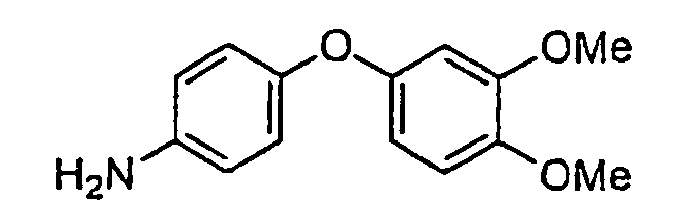
- Step 2. 4-(3,4-Dimethoryphenoxy)aniline: A solution of 4-(3,4-dimethoxy-phenoxy)-1-nitrobenzene (0.8 g, 3.2 mmol) in EtOAc (50 mL) was added to 10% Pd/C (0.100 g) and the resulting mixture was placed under a H2 atmosphere (balloon) and was allowed to stir for 18 h at room temp. The mixture was then filtered through a pad of Celite® and concentrated in vacuo to afford the desired product as a white solid (0.6 g, 75%): EI-MS m/z 245 (M+).
-

- Step 1. 3-(3-Pyridinyloxy)-1-nitrobenzene: To a solution of 3-hydroxypyridine (2.8 g, 29.0 mmol), 1-bromo-3-nitrobenzene (5.9 g, 29:0 mmol) and copper(I) bromide (5.0 g, 34.8 mmol) in anh DMF (50 mL) was added K2CO3 (8.0 g, 58.1 mmol) in one portion. The resulting mixture was heated at the reflux temp. with stirring for 18 h and then allowed to cool to room temp. The mixture was then poured into water (200 mL) and extracted with EtOAc (3 x 150 mL). The combined organics were sequentially washed with water (3 x 100 mL) and a saturated NaCl solution (2 x 100 mL), dried (Na2SO4), and concentrated in vacuo. The resulting oil was purified by flash chromatography (30% EtOAc/70% hexane) to afford the desired product (2.0 g, 32 %). This material was used in the next step without further purification.

- Step 2. 3-(3-Pyridinyloay)aniline: A solution of 3-(3-pyridinyloxy)-1-nitrobenzene (2.0 g, 9.2 mmol) in EtOAc (100 mL) was added to 10% Pd/C (0.200 g) and the resulting mixture was placed under a H2 atmosphere (balloon) and was allowed to stir for 18 h at room temp. The mixture was then filtered through a pad of Celite® and concentrated in vacuo to afford the desired product as a red oil (1.6 g, 94%): EI-MS m/z 186 (M+).
-

- Step 1. 3-(5-Methyl-3-pyridinyloxy)-1-nitrobenzene: To a solution of 3-hydroxy-5-methylpyridine (5.0 g, 45.8 mmol), 1-bromo-3-nitrobenzene (12.0 g, 59.6 mmol) and copper(I) iodide (10.0 g, 73.3 mmol) in anh DMF (50 mL) was added K2CO3 (13.0 g, 91.6 mmol) in one portion. The mixture was heated at the reflux temp. with stirring for 18 h and then allowed to cool to room temp. The mixture was then poured into water (200 mL) and extracted with EtOAc (3 x 150 mL). The combined organics were sequentially washed with water (3 x 100 mL) and a saturated NaCl solution (2 x 100 mL), dried (Na2SO4), and concentrated in vacuo. The resulting oil was purified by flash chromatography (30% EtOAc/70% hexane) to afford the desired product (1.2 g, 13%).

- Step 2. 3-(5-Methyl-3-pyridinyloxy)-1-nitrobenzene: A solution of 3-(5-methyl-3-pyridinyloxy)-1-nitrobenzene (1.2 g, 5.2 mmol) in EtOAc (50 mL) was added to 10% Pd/C (0.100 g) and the resulting mixture was placed under a H2 atmosphere (balloon) and was allowed to stir for 18 h at room temp. The mixture was then filtered through a pad of Celite® and concentrated in vacuo to afford the desired product as a red oil (0.9 g, 86%): CI-MS m/z 201 ((M+H)+).
-

- Step 1. 5-Nitro-2-(4-methylphenory)pyridine: To a solution of 2-chloro-5-nitropyridine (6.34 g, 40 mmol) in DMF (200 mL) were added of 4-methylphenol (5.4 g, 50 mmol, 1.25 equiv) and K2CO3 (8.28 g, 60 mmol, 1.5 equiv). The mixture was stirred overnight at room temp. The resulting mixture was treated with water (600 mL) to generate a precipitate. This mixture was stirred for 1 h, and the solids were separated and sequentially washed with a 1 N NaOH solution (25 mL), water (25 mL) and pet ether (25 mL) to give the desired product (7.05 g, 76%): mp 80-82 °C; TLC (30% EtOAc/70% pet ether) R f 0.79; 1H-NMR (DMSO-d6) δ 2.31 (s, 3H), 7.08 (d, J=8.46 Hz, 2H), 7.19 (d, J=9.20 Hz, 1H), 7.24 (d, J=8.09 Hz, 2H), 8.58 (dd, J=2.94, 8.82 Hz, 1H), 8.99 (d, J=2.95 Hz, 1H); FAB-MS m/z (rel abundance) 231 ((M+H)+), 100%).

- Step 2. 5-Amino-2-(4-methylphenoxy)pyridine Dihydrochloride: A solution 5-nitro-2-(4-methylphenoxy)pyridine (6.94 g, 30 mmol, 1 eq) and EtOH (10 mL) in EtOAc (190 mL) was purged with argon then treated with 10% Pd/C (0.60 g). The reaction mixture was then placed under a H2 atmosphere and was vigorously stirred for 2.5 h. The reaction mixture was filtered through a pad of Celite®. A solution of HCl in Et2O was added to the filtrate was added dropwise. The resulting precipitate was separated and washed with EtOAc to give the desired product (7.56 g, 92%): mp 208-210 °C (dec); TLC (50% - EtOAc/50% pet ether) R f 0.42; 1H-NMR (DMSO-d6) δ 2.25 (s, 3H), 6.98 (d, J=8.45 Hz, 2H), 7.04 (d, J=8.82 Hz, 1H), 7.19 (d, J=8.09 Hz, 2H), 8.46 (dd, J=2.57, 8.46 Hz, 1H), 8.63 (d, J=2.57 Hz, 1H); EI-MS m/z (rel abundance) (M+, 100%).
-

- Step 1. 4-(3-Thienylthio)-1-nitrobenzene: To a solution of 4-nitrothiophenol (80%pure; 1.2 g, 6.1 mmol), 3-bromothiophene (1.0 g, 6.1 mmol) and copper(II) oxide (0.5 g, 3.7 mmol) in anhydrous DMF (20 mL) was added KOH (0.3 g, 6.1 mmol), and the resulting mixture was heated at 130 °C with stirring for 42 h and then allowed to cool to room temp. The reaction mixture was then poured into a mixture of ice and a 6N HCl solution (200 mL) and the resulting aqueous mixture was extracted with EtOAc (3 x 100 mL). The combined organic layers were sequentially washed with a 1M NaOH solution (2 x 100 mL) and a saturated NaCl solution (2 x 100 mL), dried (MgSO4), and concentrated in vacuo. The residual oil was purified by MPLC (silica gel; gradient from 10% EtOAc/90% hexane to 5% EtOAc/95% hexane) to afford of the desired product (0.5 g, 34%). GC-MS m/z 237 (M+).

- Step 2. 4-(3-Thienylthio)aniline: 4-(3-Thienylthio)-1-nitrobenzene was reduced to the aniline in a manner analogous to that described in Method A1.
-

- 4-(5-Pyrimininyloxy)aniline: 4-Aminophenol (1.0 g, 9.2 mmol) was dissolved in DMF (20 mL) then 5-bromopyrimidine (1.46 g, 9.2 mmol) and K2CO3 (1.9 g, 13.7 mmol) were added. The mixture was heated to 100 °C for 18 h and at 130 °C for 48 h at which GC-MS analysis indicated some remaining starting material. The reaction mixture was cooled to room temp. and diluted with water (50 mL). The resulting solution was extracted with EtOAc (100 mL). The organic layer was washed with a saturated NaCl solution (2 x 5.0 mL), dried (MgSO4), and concentrated in vacuo. The residual solids were purified by MPLC (50% EtOAc/50% hexanes) to give the desired amine (0.650 g, 38%).
-

- Step 1. 5-Bromo-2-methoxypyridine: A mixture of 2,5-dibromopyridine (5.5 g, 23.2 mmol) and NaOMe (3.76g, 69.6 mmol) in MeOH (60 mL) was heated at 70 °C in a sealed reaction vessel for 42 h, then allowed to cool to room temp. The reaction mixture was treated with water (50 mL) and extracted with EtOAc (2 x 100 mL). The combined organic layers were dried (Na2SO4) and concentrated under reduced pressure to give a pale yellow, volatile oil (4.1g, 95% yield): TLC (10% EtOAc / 90% hexane) R f 0.57.

- Step 2. 5-Hydroxy-2-methoxypyridine: To a stirred solution of 5-bromo-2-methoxypyridine (8.9 g, 47.9 mmol) in THF (175 mL) at -78 °C was added an n-butyllithium solution (2.5 M in hexane; 28.7 mL, 71.8 mmol) dropwise and the resulting mixture was allowed to stir at -78 °C for 45 min. Trimethyl borate (7.06 mL, 62.2 mmol) was added via syringe and the resulting mixture was stirred for an additional 2 h. The bright orange reaction mixture was warmed to 0 °C and was treated with a mixture of a 3 N NaOH solution (25 mL, 71.77 mmol) and a hydrogen peroxide solution (30%; approx. 50 mL). The resulting yellow and slightly turbid reaction mixture was warmed to room temp. for 30 min and then heated to the reflux temp. for 1 h. The reaction mixture was then allowed to cool to room temp. The aqueous layer was neutralized with a 1N HCl solution then extracted with Et2O (2 x 100 mL). The combined organic layers were dried (Na2SO4) and concentrated under reduced pressure to give a viscous yellow oil (3.5g, 60%).

- Step 3. 4-(5-(2-Methoxy)pyridyl)oxy-1-nitrobenzene: To a stirred slurry of NaH (97%, 1.0 g, 42 mmol) in anh DMF (100 mL) was added a solution of 5-hydroxy-2-methoxypyridine (3.5g, 28 mmol) in DMF (100 mL). The resulting mixture was allowed to stir at room temp. for 1 h, 4-fluoronitrobenzene (3 mL, 28 mmol) was added via syringe. The reaction mixture was heated to 95 °C overnight, then treated with water (25 mL) and extracted with EtOAc (2 x 75 mL). The organic layer was dried (MgSO4) and concentrated under reduced pressure. The residual brown oil was crystalized EtOAc/hexane) to afford yellow crystals (5.23 g, 75%).

- Step 4. 4-(5-(2-Methoxy)pyridyl)oryaniline: 4-(5-(2-Methoxy)pyridyl)oxy-1-nitrobenzene was reduced to the aniline in a manner analogous to that described in Method A3d, Step2.
-

- 3-(4-Pyridinylthio)aniline: To a solution of 3-aminothiophenol (3.8 mL, 34 mmoles) in anh DMF (90mL) was added 4-chloropyridine hydrochloride (5.4 g, 35.6 mmoles) followed by K2CO3 (16.7 g, 121 mmoles). The reaction mixture was stirred at room temp. for 1.5 h, then diluted with EtOAc (100 mL) and water (100mL). The aqueous layer was back-extracted with EtOAc (2 x 100 mL). The combined organic layers were washed with a saturated NaCl solution (100 mL), dried (MgSO4), and concentrated under reduced pressure. The residue was filtered through a pad of silica (gradient from 50% EtOAc/50% hexane to 70% EtOAc/30% hexane) and the resulting material was triturated with a Et2O/hexane solution to afford the desired product (4.6 g, 66%): TLC (100 % ethyl acetate) R f 0.29; 1H-NMR (DMSO-d6) δ 5.41 (s, 2H), 6.64-6.74 (m, 3H), 7.01 (d, J=4.8, 2H), 7.14 (t, J=7.8 Hz, 1H), 8.32 (d, J=4.8, 2H).
-
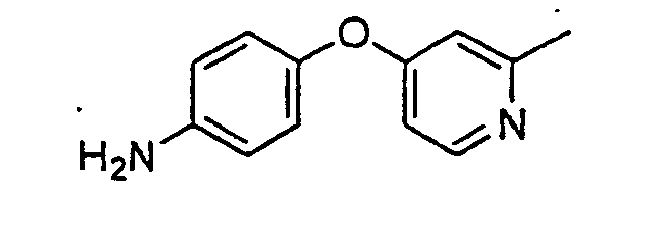
- 4-(2-Methyl-4-pyridinyloxy)aniline: To a solution of 4-aminophenol (3.6 g, 32.8 mmol) and 4-chloropicoline (5.0 g, 39.3 mmol) in anh DMPU (50 mL) was added potassium tert-butoxide (7.4 g, 65.6 mmol) in one portion. The reaction mixture was heated at 100 °C with stirring for 18 h, then was allowed to cool to room temp. The resulting mixture was poured into water (200 mL) and extracted with EtOAc (3 x 150 mL). The combined extracts were sequentially washed with water (3 x 100 mL) and a saturated NaCl solution (2 x 100 mL), dried (Na2SO4), and concentrated in vacuo. The resulting oil was purified by flash chromatography (50 % EtOAc/50% hexane) to afford the desired product as a yellow oil (0.7 g, 9%): CI-MS m/z 201 ((M+H)+).
-

- Step 1. Methyl(4-nitrophenyl)-4-pyridylamine: To a suspension of N-methyl-4-nitroaniline (2.0 g, 13.2 mmol) and K2CO3 (7.2 g, 52.2 mmol) in DMPU (30mL) was added 4-chloropyridine hydrochloride (2.36 g, 15.77 mmol). The reaction mixture was heated at 90 °C for 20 h, then cooled to room temperature. The resulting mixture was diluted with water (100 mL) and extracted with EtOAc (100 mL). The organic layer was washed with water (100 mL), dried (Na2SO4) and concentrated under reduced pressure. The residue was purified by column chromatography (silica gel, gradient from 80% EtOAc /26% hexanes to 100% EtOAc) to afford methyl(4-nitrophenyl)-4-pyridylamine (0.42 g) -
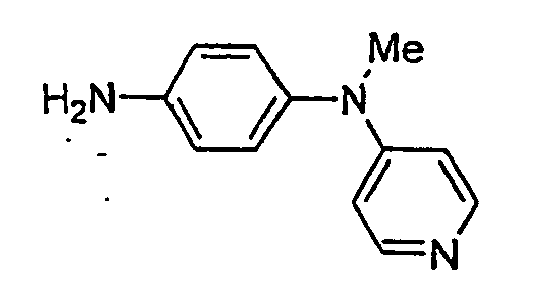
- Step 2. Methyl(4-aminophenyl)-4-pyridylamine: Methyl(4-nitrophenyl)-4-pyridylamine was reduced in a manner analogous to that described in Method A1.
-

- Step 1. 4-(4-Butoxyphenyl)thio-1-nitrobenzene: To a solution of 4-(4-nitrophenylthio)phenol (1.50 g, 6.07 mmol) in anh DMF (75 ml) at 0 °C was added NaH (60% in mineral oil, 0.267 g, 6.67 mmol). The brown suspension was stirred at 0 °C until gas evolution stopped (15 min), then a solution of iodobutane (1.12 g, .690 ml, 6.07 mmol) in anh DMF (20 mL) was added dropwise over 15 min at 0 °C. The reaction was stirred at room temp. for 18 h at which time TLC indicated the presence of unreacted phenol, and additional iodobutane (56 mg, 0.035 mL, 0.303 mmol, 0.05 equiv) and NaH (13 mg, 0.334 mmol) were added. The reaction was stirred an additional 6 h at room temp., then was quenched by the addition of water (400 mL). The resulting mixture was extracted with Et2O (2 x 500 mL). The combined organics were washed with water (2 x 400 mL), dried (MgSO4), and concentrated under reduced pressure to give a clear yellow oil, which was purified by silica gel chromatography (gradient from 20% EtOAc/80% hexane to 50% EtOAc/50% hexane) to give the product as a yellow solid (1.24 g, 67%): TLC (20% EtOAc/80% hexane) R f 0.75; 1H-NMR (DMSO-d6) δ 0.92 (t, J= 7.5 Hz, 3H), 1.42 (app hex, J=7.5 Hz, 2H), 1.70 (m, 2H), 4.01. (t, J= 6.6 Hz, 2H), 7.08 (d, J=8.7 Hz, 2H), 7.17 (d, J=9 Hz, 2H), 7.51 (d, J= 8.7 Hz, 2H), 8.09 (d, J= 9 Hz, 2H).

- Step 2. 4-(4-Butoxyphenyl)thioaniline: 4-(4-Butoxyphenyl)thio-1-nitrobenzene was reduced to the aniline in a manner analagous to that used in the preparation of 3-(trifluoromethyl)-4-(4-pyridinylthio)aniline (Method A3b, Step 2): TLC (33% EtOAc/77% hexane) R f 0.38.
-

- 4-(4-tert-Butoxycarbamoylbenzyl)aniline: To a solution of 4,4'-methylenedianiline (3.00 g, 15.1 mmol) in anh THF (50 mL) at room temp was added a solution of di-tert-butyl dicarbonate (3.30 g, 15.1 mmol) in anh THF (10 mL). The reaction mixture was heated at the reflux temp. for 3 h, at which time TLC indicated the presence of unreacted methylenedianiline. Additional di-tert-butyl dicarbonate (0.664 g, 3.03 mmol, 0.02 equiv) was added and the reaction stirred at the reflux temp. for 16 h. The resulting mixture was diluted with Et2O (200 mL), sequentially washed with a saturated NaHCO3 solution (100 ml), water (100 mL) and a saturated NaCl solution (50 mL), dried (MgSO4), and concentrated under reduced pressure. The resulting white solid was purified by silica gel chromatography (gradient from 33% EtOAc/67% hexane to 50% EtOAc/50% hexane) to afford the desired product as a white solid (2.09 g, 46%): TLC (50% EtOAc/50% hexane) R f 0.45; 1H-NMR (DMSO-d6) δ 1.43 (s, 9H), 3.63 (s, 2H), 4.85 (br s, 2H), 6.44 (d, J=8.4 Hz, 2H), 6.80 (d, J=8.1 Hz, 2H), 7.00 (d, J=8.4 Hz, 2H), 7.28 (d, J=8.1 Hz, 2H), 9.18 (br s, 1H); FAB-MS m/z 298 (M+).
-

- Step 1. 3-(4-Nitrobenzyl)pyridine: A solution of 3-benzylpyridine (4.0 g, 23.6 mmol) and 70% nitric acid (30 mL) was heated overnight at 50 °C. The resulting mixture was allowed to cool to room temp. then poured into ice water (350 mL). The aqueous mixture then made basic with a 1N NaOH solution, then extracted with Et2O (4 x 100 mL). The combined extracts were sequentially washed with water (3 x 100 mL) and a saturated NaCl solution (2 x 100 mL), dried (Na2SO4), and concentrated in vacuo. The residual oil was purified by MPLC (silica gel; 50 % EtOAc/50% hexane) then recrystallization (EtOAc/hexane) to afford the desired product (1.0 g, 22%): GC-MS m/z 214 (M+).

- Step 2. 3-(4-Pyridinyl)methylaniline: 3-(4-Nitrobenzyl)pyridine was reduced to the aniline in a manner analogous to that described in Method A1.
-

- Step 1. 4-(1-Imidazolylmethyl)-1-nitrobenzene: To a solution of imidazole (0.5 g, 7.3 mmol) and 4-nitrobenzyl bromide (1.6 g, 7.3 mmol) in anh acetonitrile (30 mL) was added K2CO3 (1.0 g, 7.3 mmol). The resulting mixture was stirred at room temp. for 18 h and then poured into water (200 mL) and the resulting aqueous solution was extracted with EtOAc (3 x 50 mL). The combined organic layers were sequentially washed with water (3 x 50 mL) and a saturated NaCl solution (2 x 50 mL), dried (MgSO4), and concentrated in vacuo. The residual oil was purified by MPLC (silica gel; 25% EtOAc/75% hexane) to afford the desired product (1.0 g, 91%): EI-MS m/z 203 (M+).

- Step 2. 4-(1-Imidazolylmethyl)aniline: 4-(1-Imidazolylmethyl)-1-nitrobenzene was reduced to the aniline in a manner analogous to that described in Method A2.
-

- Step 1. 4-(1-Hydroxy-1-(4-pyridyl)methyl-1-nitrobenzene: To a stirred solution of 3-(4-nitrobenzyl)pyridine (6.0 g, 28 mmol) in CH2Cl2 (90 mL) was added m-CPBA (5.80 g, 33.6 mmol) at 10 °C, and the mixture was stirred at room temp. overnight. The reaction mixture was successively washed with a 10% NaHSO3 solution (50 mL), a saturated K2CO3 solution (50 mL) and a saturated NaCl solution (50 mL), dried (MgSO4) and concentrated under reduced pressure. The resulting yellow solid (2.68 g) was dissolved in anh acetic anhydride (30 mL) and heated at the reflux temperature overnight. The mixture was concentrated under reduced pressure. The residue was dissolved in MeOH (25 mL) and treated with a 20% aqueous NH3 solution (30 mL). The mixture was stirred at room temp. for 1 h, then was concentrated under reduced pressure. The residue was poured into a mixture of water (50 mL) and CH2Cl2 (50 mL). The organic layer was dried (MgSO4), concentrated under reduced pressure, and purified by column chromatography (80% EtOAc/20% hexane) to afford the desired product as a white solid. (0.53 g, 8%): mp 110-118 °C; TLC (80% EtOAc/20% hexane) R f 0.12; FAB-MS m/z 367 ((M+H)+, 100%).

- Step 2. 4-(1-Hydroxy-1-(4-pyridyl)methylaniline: 4-(1-Hydroxy-1-(4-pyridyl)-methyl-1-nitrobenzene was reduced to the aniline in a manner analogous to that described in Method A3d, Step2.
-

- Step 1. 2-(N-methylcarbamoyl)-4-chloropyridine. (Caution: this is a highly hazardous, potentially explosive reaction.) To a solution of 4-chloropyridine (10.0 g) in N-methylformamide (250 mL) under argon at ambient temp was added conc. H2SO4 (3.55 mL) (exotherm). To this was added H2O2 (17 mL, 30% wt in H2O) followed by FeSO4·7H2O (0.55 g) to produce an exotherm. The reaction was stirred in the dark at ambient temp for 1h then was heated slowly over 4 h at 45 °C. When bubbling subsided,the reaction was heated at 60 °C for 16 h. The opaque brown solution was diluted with H2O (700 mL) followed by a 10% NaOH solution (250 mL). The aqueous mixture was extracted with EtOAc (3 x 500 mL) and the organic layers were washed separately with a saturated NaCl solution (3 x 150 mL. The combined organics were dried (MgSO4) and filtered through a pad of silica gel eluting with EtOAc. The solvent was removed in vacuo and the brown residue was purified by silica gel chromatography (gradient from 50% EtOAc/ 50% hexane to 80% EtOAc / 20% hexane). The resulting yellow oil crystallized at 0 °C over 72 h to give 2-(N-methylcarbamoyl)-4-chloropyridine in yield (0.61 g, 5.3%): TLC (50% EtOAc/50% hexane) R f 0.50; MS; 1H NMR (CDCl3): δd 8.44 (d, 1 H, J = 5.1 Hz, CHN), 8.21 (s, 1H, CHCCO), 7.96 (b s, 1H, NH), 7.43 (dd, 1H, J = 2.4, 5.4 Hz, ClCHCN), 3.04 (d, 3H, J = 5.1 Hz, methyl); CI-MS m/z 171 1 ((M+H)+).
-

- Step 1. 4-(4-Methylsulfonylphenoxy)-1-nitrobenzene: To a solution of 4-(4-methylthiophenoxy)-1-ntirobenzene (2 g, 7.66 mmol) in CH2Cl2 (75 mL) at 0 °C was slowly added mCPBA (57-86%, 4 g), and the reaction mixture was stirred at room temperature for 5 h. The reaction mixture was treated with a 1 N NaOH solution (25 mL). The organic layer was sequentially washed with a 1N NaOH solution (25 mL), water (25 mL) and a saturated NaCl solution (25 mL), dried (MgSO4), and concentrated under reduced pressure to give 4-(4-methylsulfonylphenoxy)-1-nitrobenzene as a solid (2.1 g).
- Step 2. 4-(4-Methylsulfonylphenoxy)-1-aniline: 4-(4-Methylsulfonylphenoxy)-1-nitrobenzene was reduced to the aniline in a manner anaologous to that described in Method A3d, step 2.
-

- Step 1. 4-(3-Methoxycarbonyl-4-methoxyphenoxy)-1-nitrobenzene: To a solution of δ-(3-carboxy-4-hydroxyphenoxy)-1-nitrobenzene (prepared in a manner analogous to that described in Method A3a, step 1, 12 mmol) in acetone (50 mL) was added K2CO3 (5 g) and dimethyl sulfate (3.5 mL). The resulting mixture was heated at the reflux temperature overnight, then cooled to room temperature and filtered through a pad of Celite®. The resulting solution was concentrated under reduced pressure, absorbed onto silica gel, and purified by column chromatography (50% EtOAc / 50% hexane) to give 4-(3-methoxycarbonyl-4-methoxyphenoxy)-1-nitrobenzene as a yellow powder (3 g): mp 115 - 118 °C.

- Step 2. 4-(3-Carboxy-4-methoxyphenoxy)-1-nitrobenzene: A mixture of 4-(3-methoxycarbonyl-4-methoxyphenoxy)-1-nitrobenzene (1.2 g), KOH (0.33 g),and water (5 mL) in MeOH (45 mL) was stirred at room temperature overnight and then heated at the reflux temperature for 4 h. The resulting mixture was cooled to room temperature and concentrated under reduced pressure. The residue was dissolved in water (50 mL), and the aqueous mixture was made acidic with a 1N HCl solution. The resulting mixture was extracted with EtOAc (50 mL). The organic layer was dried (MgSO4) and concentrated under reduced pressure to give 4-(3-carboxy-4-methoxyphenoxy)-1-nitrobenzene (1.04 g).
-

- N-(4-tert-butylpyridyl)-N'-(2,3-dichlorophenyl) urea: A solution of 2-amino-4-tert-butylpyridine (192 mg) and 2,3-dichlorophenyl isocyanate (240 mg) in anh. toluene (15 mL) was heated at 70 °C under argon for 24 h. The resulting mixture was diluted with EtOAc (200 mL) then washed with water (125 mL). The organic layer was dried (MgSO4) and concentrated under reduced pressure to give a gum. Trituration of the gum with hexanes afforded N-(4-tert-butylpyridyl)-N'-(2,3-dichlorophenyl) urea as a white solid (394 mg, 91%): TLC (2:1 hexanes/ethyl acetate) R f 0.40; FAB-MS m/z 338 ((M+H)+).
-

- N-(4-tert-butylpyridyl)-N'-(4-(4-pyridinylmethyl)phenyl urea: To a stirring solution of 4-tert-butyl-2-aminopyridine (192 mg) in anh. CH2Cl2 (15 mL) under argon at 0 °C was added CDI (207 mg). The resulting solution was allowed to warm to ambient temp over 2 h. To this mixture was added 4-(4-pyridylmethyl)aniline (prepared according to Method A1, 235 mg). The resulting solution was stirred at room temperature for 24 h, then was quenched with water (125 mL). The resulting mixture was extracted with EtOAc (200 mL). The organic layer was washed with water (100 mL), dried (MgSO4) and concentrated under reduced pressure. The residue was purified by chromatography (SiO2, EtOAc) to afford N-(4-tert-butylpyridyl)-N'-(4-(4-pyridinylmethyl)phenyl urea as a white solid (200 mg, 43%): TLC (EtOAc) R f 0.47; FAB-MS m/z 361 ((M+H)+).
-
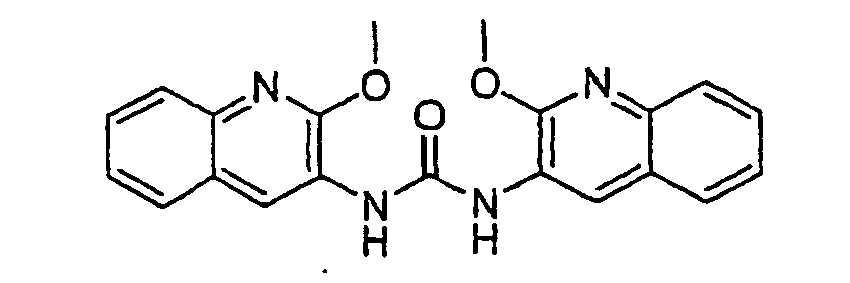
- N,N'-(Bis(3-(2-methoxyquinolinyl)) urea): To a stirring solution of 3-amino-2-methoxyquinoline (138 mg) in anh. CH2Cl2 (15 mL) under argon at 0 °C was added CDI (128 mg). The resulting solution was warmed to ambient temp over 1 h. After 16 h 4-(2-N-Methylcarbamyl-4-pyridyloxy)aniline (175 mg) was added and the resulting yellow solution was stirred at room temperature under argon for 72 h. The solution was treated with water (125 mL) and the resulting mixture was extracted with EtOAc (2 x 150 mL). The combined organics were washed with a saturated NaCl solution (100 mL), dried (MgSO4) and concentrated under reduced pressure. The residue was triturated with a 10% hexane/90% EtOAc solution. The resulting white crystals were washed with EtOAc. The resulting filtrate was purified by chromatography (SiO2, 50% EtOAc/50% hexane) to give N,N'-(bis(3-(2-methoxyquinolinyl)) urea) (30 mg, 20% yield): TLC (50% EtOAc/50% hexane) R f 0.45; HPLC ES-MS m/z 375 ((M+H)+).
-

- N-(4-tert-Butylpyridyl)-N'-(4-(4-chlorophenoxy)phenyl) urea: A solution of 4-tert-butyl-2-aminopyridine (0.177 g, 1.18 mmol, 1 equiv.) in 1.2 mL of anh. CH2Cl2 (1.2 mL) was added to CDI (0.200 g, 1.24 mmol, 1.05 equiv) and the mixture was allowed to stir under argon at room temperature 1 d. To the resulting solution was added 4-(4-chlorophenoxy)aniline (0.259 g, 1.18 mmol, 1 equiv.) in one portion. The resulting mixture was stirred at room temperature for 1 d, then was treated with a 10% citric acid solution (2 mL) and allowed to stir for 1 h. The resulting organic layer was extracted with EtOAc (3 x 5 mL). The combined organic layers were dried (MgSO4) and concentrated in vacuo. The resultant residue was treated with CH2Cl2 (10 mL) and a 1 N aqueous NaOH solution. This mixture was allowed to stir overnight. The resulting organic layer was extracted with CH2Cl2 (3 x 5 mL). The combined organic layers were (MgSO4) and concentrated in vacuo. The resultant solids were suspended in diethyl ether (10 mL) and sonicated for 15 minutes. The resulting white solids were dried to give N-(4-tert-butylpyridyl)-N'-(4-(4-chlorophenoxy)phenyl) urea (42 mg, 9%): mp 193-199 °C.
-

- N-(2-(5-trifluoromethyl)pyridyloxy)-N'-(3-(4-pyridylthio)phenyl) urea: A solution of 3-(4-pyridylthio)aniline (300 mg, 1.48 mmoles) in CH2Cl2 (12 mL) was treated with CDI (253 mg, 1.56 mmoles). The solution was stirred at room temperature and under argon for 2 h. The resulting mixture was treated.with 2-amino-5-(trifluoromethyl)pyridine (238 mg, 1.47 mmoles) and heated at 40 °C overnight. The reaction mixture was then diluted with EtOAc (25 mL), washed with water (10 mL) and a saturated NaCl solution m(25 mL), dried (MgSO4), and concentrated under reduced pressure. The residue was purified by column chromatography (SiO2; gradient from 70% EtOAc/30% CH2Cl2 to 100% EtOAc to give N-(2-(5-trifluoromethyl)pyridyloxy)-N'-(3-(4-pyridylthio)phenyl) urea (103 mg): TLC (50% EtOAc/50% CH2Cl2) R f 0.33; 1H-NMR (DMSO-d6) δ 6.06 (d, J=6Hz, 2H), 7.25 (dt, J=1.2,7.8 Hz, 1H), 7.48 (t, J=8.1 Hz, 1H), 7.59-7.63 (m, 1H), 7.77 (d, J=8.7 Hz, 1H), 7.86 (t, J=1.8 Hz, 1H), 8.12 (dd, J=2.7,9.3 Hz, 1H), 8.37 (d, J=6.3 Hz, 2H), 8.67 (bs, 1H), 9.88 (s, 1H), 10.26 (s, 1 H); FAB-MS m/z 391 ((M+H)+).
-

- N-(3-(2-methoxyquinolinyl)-N'-(4-(4-(2-N-Methylcarbamyl-4-pyridyloxy)phenyl) urea: To a stirring solution of phosgene (20% in toluene, 1.38 mL) in anh. CH2Cl2 (20 ml) at 0 °C under argon was added anh. pyridine (207 mg) followed by 3-amino-2-methoxyquinoline (456 mg). The resulting solution was warmed to ambient temperature over 1 h, then concentrated in vacuo at ambient temperature to give a white solid. The solid was dried under vacuum for 15 min then suspended in anh toluene (20 mL). To the resulting slurry was added 4-(4-(2-(methylcarbamoyl)pyridyloxy)aniline (prepared according to Method A2, 300 mg) and the reaction heated under argon at 80 °C for 20 h. The resulting mixture was diluted with water (200 mL), then treated with a saturated NaHCO3 solution (10 mL) and extracted with EtOAc (2 x 300 mL). The combined organic layers were washed with a saturated NaCl solution (100 mL), dried (MgSO4) and concentrated under reduced pressure. The solid yellow residue was purified by chromatography (SiO2, gradient from 50% EtOAc/50% hexane to 100% EtOAc), followed by recrystallization from diethyl ether and hexane to give N-(3-(2-methoxyquinolinyl)-N'-(4-(4-(2-N-Methylcarbamyl-4-pyridyloxy)phenyl) urea as a white solid (140 mg, 25%): TLC (EtOAc) R f 0.52; FAB-MS m/z 430 ((M+H)+).
- Descriptions of the detailed preparative steps used to prepare the specific compounds listed in Tables 1-4 are provided below. Many of the compounds listed in the Tables can be synthesized following a variety of methods. The specific examples below are therefore provided by way of illustration only and should not be construed to limit the scope of the invention in any way.
- Entry 5: N-(4-tert-Butylpyridyl)-N'-(4-(4-pyridinylmethyl)phenyl urea was prepared according to Method B2a.
- Entry 6: 4-tert-Butyl-2-aminopyridine was reacted with 4-phenoxyaniline according to Method B2c to afford the urea.
- Entry 7: 4-tert-Butyl-2-aminopyridine was reacted with 4-(4-methylphenoxy)aniline according to Method B2c to afford the urea.
- Entry 8: N-(4-tert-Butylpyridyl)-N'-(4-(4-chlorophenoxy)phenyl) urea was prepared according to Method B2c.
- Entry 10: 4-(4-Aminophenoxy)pyridine was prepared starting from 4-hydroxypyridine and 1-bromo-3-nitrobenzene according to Method A3F. 4-tert-Butyl-2-aminopyridine was reacted with 4-(4-aminophenoxy)pyridine according to Method B2a to afford the urea.
- Entry 11: 4-(4-Pyridylthio)aniline was prepared starting from 4-aminothiophenol and 4-chloropyridine hydrochloride according to Method A4a. 4-tert-Butyl-2-arninopyridine was reacted with 4-(4-pyridylthio)aniline according to Method B2c to afford the urea.
- Entry 12: 4-(4-Pyridylthio)aniline was prepared starting from 4-aminothiophenol and 4-chloropyridine hydrochloride according to Method A4a. 4-tert-Butyl-2-aminopyridine was reacted with 3-(4-pyridylthio)aniline according to Method B2c to afford the urea.
- Entry 20: 4-(4-Aminophenoxy)pyridine was prepared starting from 4-hydroxypyridine and 1-bromo-3-nitrobenzene according to Method A3f. 3-Aminoisoquinoline was reacted with 4-(4-aminophenoxy)pyridine according to Method B2a to afford the urea.
- Entry 22: N,N'-(Bis(3-(2-methoxyquinolinyl)) urea) was prepared according to Method B2b.
- Entry 23: 3-Amino-2-methoxyquinoline and 4-(4-pyridylmethyl)aniline were reacted according to Method B3 to afford the urea.
- Entry 24: 3-Amino-2-methoxyquinoline was reacted with 4-(4-pyridylcarbonyl)aniline according to Method B4 to afford the urea.
- Entry 25: 4-(4-Pyridyloxy)aniline was prepared starting from 4-hydroxypyridine and 1-fluoro-4-nitrobenzene according to Method A3d. 3-Amino-2-methoxyquinoline was reacted with 4-(4-pyridyloxy)aniline according to Method B2c to afford the urea.
- Entry 26: 3-Amino-2-methoxyquinoline was reacted with 4-((4-methoxyphenyl)methylamino)aniline according to Method B4 to afford the urea.
- Entry 27: 3-(4-Pyridylthio)aniline was prepared according to Method A4a. 3-Amino-2-methoxyquinoline and 3-(4-pyridylmethyl)aniline were reacted according to Method B3 to afford the urea.
- Entry 28: 4-(4-Pyridyloxy)aniline was prepared starting from 4-hydroxypyridine and 1-fluoro-4-nitrobenzene according to Method A3d. 1-(4-Methylpiperazinyl)-3-aminoisoquinoline was reacted with 4-(4-aminophenoxy)pyridine according to Method B2a to afford the urea.
- The following compounds have been synthesized according to the General Methods listed above:
Table 1. 4-tert-Butyl-2-pyridyl Ureas 
Entry R mp (°C) HPLC (min.) TLC R f TLC Solvent System Mass Spec. [Source] 5 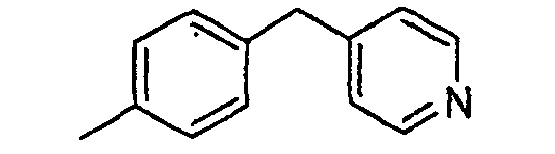
0.47 100% EtOAc 361 (M+H)+ (FAB) 6 
179 - 180 0.58 5% MeOH / 95% CH2Cl2 362 (M+H)+ (FAB) 7 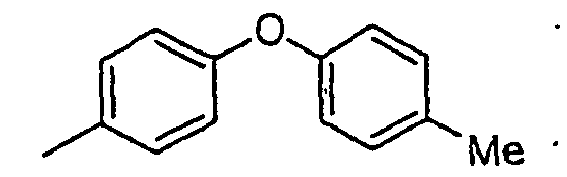
190 - 191 0.46 5% MeOH / 95% CH2Cl2 376 (M+H)+ (FAB) 8 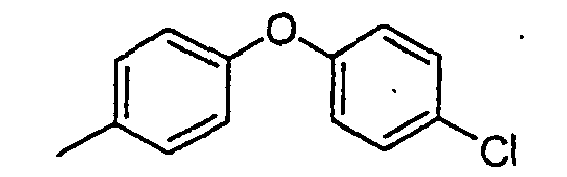
198 - 199 0.76 5% MeOH / 95% CH2Cl2 396 (M+H)+ (FAB) 10 
0.40 100% EtOAc 363 (M+H)+ (FAB) 11 
208 - 212 0.39 5% MeOH / 95% CH2Cl2 379 (M+H)+ (HPLC ES-MS) 12 
196 - 197 0.37 5% MeOH / 95% CH2Cl2 379 (M+H)+ (FAB) Table 2. 3-Isoquinolyl Ureas 
Entry R mp (°C) HPLC (min.) TLC R f TLC Solvent System Mass Spec. [Source] 20 
0.27 100% EtOAc 357 (M+H)+ (FAB) Table 3. 2-Methoxy-3-quinolyl Ureas 
Entry R mp (°C) HPLC (min.) TLC R f TLC Solvent System Mass Spec. [Source] 22 
- 0.45 50% EtOAc / 50% hexane 375 (N+H)+ (HPLC ES-MS) 23 
0.56 50% EtOAc / 50% hexane 385 (M+H)+ (FAB) 24 
0.45 100% EtOAc 399 (M+H)+ (FAB) 25 
207 - 208 0.24 5% MeOH / 95% CH2Cl2 387 (M+H)+ (FAB) 26 
126 - 130 27 
0.39 50% acetone / 50% CH2Cl2 403 (M+H)+ (FAB) Table 4. 3-Quinolyl Ureas 
Entry R mp (°C) HPLC (min.) TLC R f TLC Solvent System Mass Spec. [Source] 28 
0.20 30% MeOH / 70% EtOAc 455 (M+H)+ (HPLC ES-MS) - In an in vitro kinase assay, raf was incubated with MEK in 20 mM Tris-HCl, pH 8.2 containing 2 mM 2-mercaptoethanol and 100 mM NaCl. This protein solution (20 µL) was mixed with water (5 µL) or with compounds diluted with distilled water from 10 mM stock solutions of compounds dissolved in DMSO. The kinase reaction was initiated by adding 25 µL [λ-33P]ATP (1000-3000 dpm/pmol) in 80 mM Tris-HCl, pH 7.5, 120 mM NaCl, 1.6 mM DTT, 16 mM MgCl2. The reaction mixtures were incubated at 32 °C, usually for 22 min. Incorporation of 33P into protein was assayed by harvesting the reaction onto phosphocellulose mats, washing away free counts with a 1% phosphoric acid solution and quantitating phosphorylation by liquid scintillation counting. For high throughput screening, 10 µM ATP and 0.4 µM MEK was used. In some experiments, the kinase reaction was stopped by adding an equal amount of Laemmli sample buffer. Samples were boiled 3 min and the proteins resolved by electrophoresis on 7.5% Laemmli gels. Gels were fixed, dried and exposed to an imaging plate (Fuji). Phosphorylation was. analyzed using a Fujix Bio-Imaging Analyzer System.
- All compounds exemplified displayed IC50s of between 10 nM and 10 µM.
- For in vitro growth assay, human tumor cell lines, including but not limited to HCT116 and DLD-1, containing mutated K-ras genes were used in standard proliferation assays for anchorage dependent growth on plastic or anchorage independent growth in soft - agar. Human tumor cell lines were obtained from ATCC (Rockville MD) and maintained in RPMI with 10% heat inactivated fetal bovine serum and 200 mM glutamine. Cell culture media and additives were obtained from Gibco/BRL (Gaithersburg, MD) except for fetal bovine serum (JRH Biosciences, Lenexa, KS). In a standard proliferation assay for anchorage dependent growth, 3 X 10³ cells were seeded into 96-well tissue culture plates and allowed to attach overnight at 37 °C in a 5% CO2 incubator. Compounds were titrated in media in dilution series and added to 96-well cell cultures. Cells were allowed to grow 5 days typically with a feeding of fresh compound containing media on day three. Proliferation was monitored by measuring metabolic activity with standard XTT colorimetric assay (Boehringer Mannheim) measured by standard ELISA plate reader at OD 490/560, or by measuring 3H-thymidine incorporation into DNA following an 8 h culture with 1 µCu 3H-thymidine, harvesting the cells onto glass fiber mats using a cell harvester and measuring 3H-thymidine incorporation by liquid scintillant counting.
- For anchorage independent cell growth, cells were plated at 1 x 10³ to 3 x 10³ in 0.4% Seaplaque agarose in RPMI complete media, overlaying a bottom layer containing only 0.64% agar in RPMI complete media in 24-well tissue culture plates. Complete media plus dilution series of compounds were added to wells and incubated at 37 °C in a 5% CO2 incubator for 10-14 days with repeated feedings of fresh media containing compound at 3-4 day intervals. Colony formation was monitored and total cell mass, average colony size and number of colonies were quantitated using image capture technology and image analysis software (Image Pro Plus, media Cybernetics).
- These assays established that the compounds of formula I are active to inhibit raf kinase activity and to inhibit oncogenic cell growth.
- An in vivo assay of the inhibitory effect of the compounds on tumors (e.g., solid cancers) mediated by raf kinase can be performed as follows:
- CDI nu/nu mice (6-8 weeks old) are injected subcutaneously into the flank at 1 x 10⁶ cells with human colon adenocarcinoma cell line. The mice are dosed i.p., i.v. or p.o. at 10, 30, 100, or 300 mg/Kg beginning on approximately day 10, when tumor size is between 50-100 mg. Animals are dosed for 14 consecutive days once a day; tumor size was monitored with calipers twice a week.
- The inhibitory effect of the compounds on raf kinase and therefore on tumors (e.g., solid cancers) mediated by raf kinase can further be demonstrated in vivo according to the technique of Monia et al. (Nat. Med. 1996, 2, 668-75).
- The preceding examples can be repeated with similar success by substituting the generically or specifically described reactants and/or operating conditions of this invention for those used in the preceding examples.
- From the foregoing description, one skilled in the art can easily ascertain the essential characteristics of this invention and, without departing from the spirit and scope thereof, can make various changes and modifications of the invention to adapt it to.various usages and conditions.
Claims (29)
- A compound of the following formula :
A'-D-B' (II)
or a pharmaceutically acceptable salt thereof, whereinD is -NH-C(O)-NH-,A' is a substituted isoquinolinyl group or unsubstituted isoquinolinyl group or an unsubstituted quinolinyl group,B' is a substituted or unsubstituted bridged cyclic structure of up to 30 carbon atoms of the formula -L-(ML1)q wherein L comprises a cyclic moiety having at least 5 members and is bound directly to D, L' comprises a cyclic moiety having at least 5 members, M is selected from the group consisting of -O-, -S-, -N(R7)-, -(CH2)m-, -C(O)-, -CH(OH)-, -(CH2)mO-, -(CH2)mS-, -(CH2)m N(R7)-, -O(CH2)m- ; -CHXa-, -CXa 2-, -S-(CH2)m- and -N(R7)(CH2)m-, where m=1-3, Xa is halogen, and R7 is as defined below, q is an integer of from 1-3, and each cyclic structure of L and L1 contains 0-4 members of the group consisting of nitrogen, oxygen and sulfur, subject to the proviso that B' is notwherein the substituents for the substituted isoquinolinyl groups of A' are selected from the group consisting of halogen, up to per-halo, and Wn, where n is 0-3 and each W is independently selected from the group consisting of C1-10 alkyl, C1-10 alkoxy, at least a five membered C3-10 cycloalkyl having 0-3 heteroatoms, C2-10 alkenyl, C1-10 alkenoyl, substituted C1-10 alkyl, substituted C1-10 alkoxy, at least a five-membered substituted C3-10 cycloalkyl having 0-3 heteroatoms selected from N, S and O; -CN, up to per halo substituted C6-C14 aryl, up to per halo substituted C7-C24 alkaryl, up to per halo substituted C7-C24 aralkyl, up to per halo substituted C3-C12 heteroaryl having at least 5 members and 1-3 heteratoms selected from O, N and 5, up to per halo substituted C4-C24 alkheteroaryl having at least 5 members and 1-3 heteroatoms selected from O, N and S, C6-C14 aryl, C1-C24 alkaryl, C1-C24 aralkyl, C3-C12 heteroaryl having at least 5 cyclic members and 1-3 heteroatoms selected from O, N and S, C4-C24 alkheteroaryl having at least 5 cyclic members and 1-3 heteroatoms selected from O, N and S; -CO2R7, -C(O)NR7R7', -C(O)-R7, -NO2, -OR7, -SR7, -NR7R7', -NR7C(O)OR7', -NR7C(O)R7', with each R7 and R7' independently selected from hydrogen, C1-10 alkyl, C1-10 alkoxy, C2-10 alkenyl, C1-10 alkenoyl, up to per halosubstituted C1-10 alkyl, up to per halosubstituted C1-10 alkoxy, up to per halosubstltuted C2-10 alkenyl and up to per halosubstituted C1-10 alkenoyl;
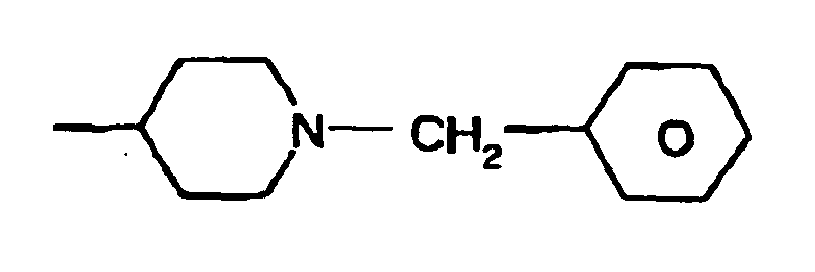
where B' is substituted, the substituents are selected from the group consisting of halogen, up to per-halo, and In, where n is 0-3 and each J is independently selected from the group consisting of -CN, -CO2R7, -C(O)NR7R7', -C(O)-R7, -NO2, -OR7, -SR7, -NR7R7', -NR7C(O)OR7', -NR7C(O) R7', with each R7 and R7' independently as defined above for W, C1-10 alkyl, C1-10 alkoxy, at least a five-membered C3-C10 cycloalkyl having 0-3 heteroatoms, C2-C10 alkenyl, C1-C10 alkenoyl, C6-12 aryl, at least a five-membered C3-12 hetaryl having 1-3 heteroatoms selected from N, S and O, C7-24 aralkyl, C7-24 alkaryl, substituted C1-10 alkyl, substituted C1-10 alkoxy, at least a five-membered substituted C3-10 cydoalkyl having 0-3 heteroatoms selected from N, S and O, substituted C6 - C14 aryl, at least a J-membered substituted C3-12 hetaryl having 1-3 heteroatoms selected from N, S and O, substituted C7-24 alkaryl and substituted C7-C24 aralkyl,
subject to the proviso that where B' is -L(ML1)q, L1 is not substituted by the substituents -C(O)Ra, -C(NRa)Rb, -C(O)NRaRb and -SO2Ra wherein each Ra and Rb are independently hydrogen or a carbon based moiety of up to 24 carbon atoms, optionally containing heteroatoms selected from N, S and O,
where J is a substituted group, it is substituted by halogen, up to per halo, or by one or more substituents independently selected from the group consisting of -CN, -CO2R7, -OR7, -SR7, -NR7R7', -NO2, -NR7C(O)R7' and -NR7C(O)OR7' ; with each R7 and R7' independently as defined above for W. - A compound as in dalm 1, wherein :Ra and Rb are, independently, C1-10 alkyl, C1-10 alkoxy, C3-10 cycloalkyl having 0-3 heteroatoms, C2-10 alkenyl, C1-10 alkenoyl, C6-12 aryl, C3-12 hetaryl having 1-3 heteroatoms selected from N, S and O, C7-24 aralkyl, C7-24 alkaryl, substituted C1-10 alkyl, substituted C1-10 alkoxy, substituted C3-10 cycloalkyl having 0-3 heteroatoms selected from N, S and 0, substituted C6 -C14 aryl, substituted C3-12 hetaryl having 1-3 heteroatoms selected from N, S and O, substituted C7-24 alkaryl or substituted C7-C24 aralkyl, where Ra is a substituted group, it is substituted by halogen up to per halo.
- A compound of daim 1 or 2, wherein L in the formula -L-(ML1)q for B' is a substituted 6 member cyclic aryl moiety, a substituted 5-6 member cyclic hetaryl moiety, an unsubstituted 6 member cyclic aryl moiety, or an unsubstituted 5-6 member cyclic hetaryl moiety, and L1 in the formula -L-(ML1)q of B' is a substituted aryl moiety having at least six cyclic members, an unsubstituted aryl moiety having at least six cyclic members, a substituted hetaryl moiety having at least 5 cyclic members or an unsubstituted hetaryl moiety having at least 5 cydic members, said hetaryl moieties having 1 to 4 members selected from the group of hetero atoms consisting of nitrogen, oxygen and sulfur with the balance of the hetaryl moiety being carbon.
- A compound of any one of claims 1 to 3, wherein L and L' are each Independently selected from the group consisting of thiophene, phenyl, substituted phenyl, pyridinyl, substituted pyridinyl, pyrimidinyl, substituted pyrimidinyl, napthyl, substituted napthyl, quinolinyl, substituted quinolinyl, isoquinodiyl and substituted isoquinodiyl.
- A compound of any one of claims 1 to 4, wherein B' is a substituted group, it is substituted by -CN, halogen, C1-10 alkyl, C1-10 alkoxy, -OH, up to per halo substituted C1-10 alkyl, up to per halo substituted C1-10 alkoxy, -O(R7), -SR7, -NR7R7' or -NO2, wherein each R7 and R7' are independendy selected from hydrogen, C1-10 alkyl, C1-10 alkoxy, C2-10 alkenyl, C1-10 alkenoyl, up to per halosubstituted C1-10 alkyl, up to per halosubstituted C1-10 alkoxy, up to per halosubstituted C2-10 alkenyl and up to per halosubstituted C1-10 alkenoyl,
- A compound of any one of claims 1 to 5, wherein M in the formula -L-(ML1) for B' is -O-, -CH2-, -S-, -NH-, -C(O)-, -O-CH2 or -CH2-O-.
- A compound of the formula A'-D-B', or a pharmaceutically acceptable salt thereof, wherein D is -NH-C(O)-NH-A' is a substituted isoquinolinyl group or unsubstituted isoquinolinyl group or an unsubstituted quinolinyl group,B' is of the formula -L-(ML1)q, wherein L is phenyl or substituted phenyl and L1 is phenyl, substituted phenyl, pyridinyl or substituted pyridinyl, q is an integer of from 1-2 and M is selected from the group consisting of -O-, -S-, -N(R7)-, -(CH2)m-, -C(O)-, -CH(OH)-, -(CH2)mO-, -(CH2)mS-, -(CH2)mN(R7)-, -O(CH2)m- ; -CHXa-, -CXa 2-, -S-(CH2)m- and -N(R7)(CH2)m-, where m=1-3, Xa is halogen, and R7 is as defined below, subject to the proviso that B' is notwherein the substituents for the substituted isoquinolinyl groups of A' are selected from the group consisting of halogen, up to per-halo, and wn,
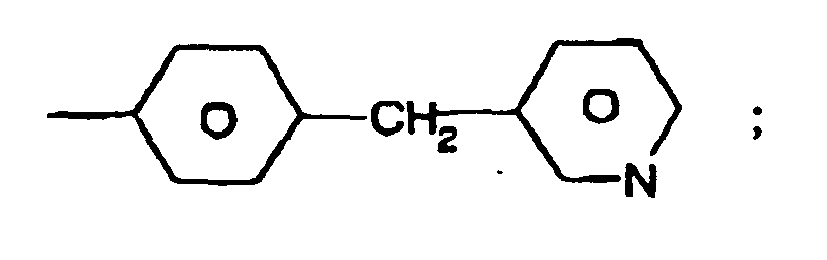
where n is 0-3 and each W is independently selected from the group consisting of C1-10 alkyl, C1-10 alkoxy, at least a five membered C3-10 cycloalkyl having 0-3 heteroatoms, C2-10 alkenyl, C1-10 alkenoyl, substituted C1-10 alkyl, substituted C1-10 alkoxy, at least a five membered substituted C3-10 cycloalkyl having 0-3 heteroatoms selected from N, S and O; -CN, -CO2R7, -C(O)NR7R7', -C(O)-R7, -NO2, -OR7, -SR7, -NR7R7', -NR7C(O)OR7', -NR7C(O)R7', with each R7 and R7' independently selected from hydrogen, C1-10 alkyl, C1-10 alkoxy, C2-10 alkenyl, C1-10 alkenoyl, up to per halosubstituted C1-10 alkyl, up to per halusubstituted C1-10 alkoxy, up to per halosubstituted C2-10 alkenyl and up to per halosubstituted C1-10 alkenoyl;
wherein B' is substituted, the substituents are selected from the group consisting of halogen, up to per-halo, and Jn, where n is 0-3 and each J is independently selected from the group consisting of -CN, -NO2, -OR7, -SR7, -NR7R7', -NR7C(O)OR7', -NR7C(O)R7', with each R7 and R7' independently as defined above for W, C1-10 alkyl, C1-10 alkoxy, at least a five membered C3-10 cycloalkyl having 0-3 heteroatoms, C2-10 alkenyl, C1-10 alkenoyl, C6-12 aryl, at least a five membered C3-12 hetaryl having 1-3 heteroatoms selected from N, S and O, C7-24 aralkyl, C7-24 alkaryl, substituted C1-10 alkyl, substituted C1-10 alkoxy, at least a five membered substituted C3-10 cycloalkyl having 0-3 heteroatoms selected from N, S and O, substituted C6 -C14 aryl, at least a five membered substituted C3-12 hetaryl having 1-3 heteroatoms selected from N, S and O, substituted C7-24 alkaryl and substituted C7-C24 aralkyl,
subject to the proviso that L1 is not substituted by the substituents -C(O)Ra, -C(NRa)Rb, -C(O)NRaRb and -SO2Ra wherein Ra and Rb are each independently, hydrogen or a carbon based moiety of up to 24 carbon atoms, optionally containing heteroatoms selected from N, 5 and O. - A compound of claim 7, wherein the substituents for B' are selected from the group consisting of -CN, halogen, C1-10 alkyl, C1-10 alkoxy, -OH, up to per halo substituted C1-10 alkyl, and up to per halo substituted C1-10 alkoxy.
- A compound of any one of claims 1 to 8, wherein the substituted isoquinolinyls of A' have 1-3 substituents selected from the group consisting of C1-10 alkyl, up to per halo substituted C1-10 alkyl, -CN, -OH, halogen, C1-10 alkoxy, up to per halo substituted C1-10 alkoxy and at least five-membered C3-C10 heterocyclic moieties comprising 1 to 2 heteroatoms selected from the group of consisting of nitrogen, oxygen and sulfur.
- A compound of claim 7 or 8, wherein the substituted Isoquinolinyls of A' have 1-3 substituents selected from the group consisting of C1-10 alkyl, up to per halo substituted C1-10 alkyl, -CN, -OH, halogen, C1-10 alkoxy, up to per halo substituted C1-10 alkoxy and at least a five membered C3-10 neterocyclic moieties comprising 1 to 2 heteroatoms selected from the group of consisting of nitrogen, oxygen and sulfur.
- A compound of any one of claims 1 to 10, wherein L and L1 are independently phenyl, substituted phenyl, pyridinyl, substituted pyridinyl, pyrimidinyl or substituted pyrimidinyl.
- A compound of any one of claims 1 to 11, wherein L1 is substituted 1 to 3 times by one or more substituents selected from the group consisting of C1-C10 alkyl, up to per halo substituted C1-C10 alkyl, -CN, -OH, halogen, C1-C10 alkoxy and up to per halo substituted C1-C10 alkoxy.
- A compound of any one of claims 7, 8 and 10, wherein L1 is substituted 1 to 3 times by one or more substituents selected from the group consisting of C1-C10 alkyl, up to per halo substituted C1-C10 alkyl, -CN, -OH, halogen, C1-C10 alkoxy and up to per halo substituted C1-C10 alkoxy.
- A compound of claim 1 wherein each substituent J is independently selected from the group consisting of C1-C10 alkyl, up to per halo substituted C1-C10 alkyl, -CN, -OH, halogen, C1-C10 alkoxy , up to per halo substituted C1-C10 alkoxy, -CN, -CO2 R7, -C(O)N R7 R7', -C(O)- R7, -NO2, -O R7, -S R7, -N R7 R7', -N R7C(O)O R7' and -N R7C(O) R7', where R7 and R7' are each, independently, as defined for W in claim 1,
M is -0-, -S-, -N(R7)-, -(CH2)m-, -C(O)-, -CH(OH)-, -(CH2)mO- and -O(CH2)m-, where m= 1-3; and
L1 is phenyl, pyridinyl, pyrimidinyl, substituted phenyl, substituted pyridinyl and substituted pyrimidinyl, with substituents selected from the group consisting of -CN; -OH; halogen up to per-halo; C1-C10 alkoxy and halosubstituted C1-C10 alkoxy, up to per-halo. - A compound of any one of daims 1 to 14, which is a pharmaceutically acceptable salt of a compound of formula II selected from the group consisting ofa) basic salts of organic acids and inorganic acids selected from the group consisting of hydrochloric add, hydrobromic acid, sulfuric acid, phosphoric acid, methanesulfonic acid, trifluorosulfonic acid, benzenesulfonic add, p-toluene sulfonic acid (tosylate salt), 1-napthalene sulfonic acid, 2-napthalene sulfonic acid, acetic acid, sulfonic acid, 2-napthalene sulfonic acid, acetic acid, trifluoroacetic acid, malic acid, tartaric acid, citric acid, lactic acid, oxalic acid, succinic acid, fumaric acid, maleic acid, benzoic acid, salicylic acid, phenylacetic acid, and mandelic acid; andb) acid salts of organic and inorganic bases containing cations selected from the group consisting of alkaline cations, alkaline earth cations, the ammonium cation, aliphatic substituted ammonium cations and aromatic substituted ammonium cations.
- A compound of claim 7 which is a pharmaceutically acceptable salt of a compound of formula II selected from the group consisting ofa) basic salts of organic acids and inorganic acids selected from the group consisting of hydrochloric acid, hydrobromic acid, sulphuric acid, phosphoric acid, methanesulphonic acid, trifluorosulphonic acid, benzenesulfonic acid, p-toluene sulfonic acid (tosylate salt), 1-napthalene sulfonic acid, 2-napthalene sulfonic acid, acetic acid, trifluoroacetic acid, malic acid, tartaric acid, citric acid, lactic acid, oxalic acid, succinic acid, fumaric acid, maleic acid, benzoic acid, salicylic acid, phenylacetic acid, and mandelic acid; andb) acid salts of organic and inorganic bases containing cations selected from the group consisting of alkaline cations, alkaline earth cations, the ammonium cation, aliphatic substituted ammonium cations and aromatic substituted ammonium cations.
- A pharmaceutical composition comprising a compound of claim 1 and a physiologically acceptable carrier.
- A pharmaceutical composition comprising a compound of claim 7 and a physiologically acceptable carrier.
- A compound selected from the group consisting of :N-(3-isoquinolinyl)-N'-(4-(4-pyridinyloxy)phenyl) urea;N-(1-(4-methylpiperazinyl)-3-isoquinolinyl)-N' (4-(4-pyridinyloxy)phenyl) urea;or a pharmaceutically acceptable salt thereof.
- A pharmaceutical composition comprising a compound of claim 19 and a physiologically acceptable carrier.
- A compound of claim 1 of one of the following formulae


- A compound of claim 1, wherein L is :(i) phenyl, optionally substituted with 1-3 substituents independently selected from the group consisting of R7, OR7, NR7R7', C(O)R7, C(O)OR7, C(O)NR7R7', NR7C(O)R7', NR7C(O)OR7', halogen, cyano and nitro; or(ii) pyridyl, optionally substituted with 1-3 substituents Independently selected from the group consisting of R7, OR7, NR7R7', C(O)R7, C(O)OR7, C(O)NR7R7', NR7C(O)R7', NR7C(O)OR7', halogen, cyano, and nitro; or(ii) pyrimidinyl, optionally substituted with 1-3 substituents independently selected from the group consisting of R7, OR7, NR7R7', C(O)R7, C(O)OR7, C(O)NR7R7', NR7C(O)R7', NR7C(O)OR7', halogen, cyano and nitro,
- A compound of claim 1, wherein L1 is phenyl, pyridinyl or pyrimidinyl.
- A compound of claim 1
where L is(I) phenyl, optionally substituted with 1-3 substituents independently selected from the group consisting of C1-C5 linear or branched alkyl, C1-C5 linear or branched haloalkyl, C1-C3 alkoxy, hydroxy, amino, C1-C3 alkylamino, C1-C6 dialkylamino, halogen, cyano, and nitro; or(II) pyridyl, optionally substituted with 1-3 substituents Independently selected from the group consisting of C1-C5 linear or branched alkyl, C1-C5 linear or branched haloalkyl, C1-C3 alkoxy, hydroxy, amino, C1-C3 alkylamino, C1-C6 dialkylamino, halogen, cyano, and nitro; andL1 comprises a cyclic moiety selected from the group consisting of:(ii) naphthyl, optionally substituted with 1-3 substituents independently selected from the group consisting of R7, OR7, NR7R7', NR7C(O)R7', NR7C(O)OR7', halogen, cyano and nitro;(iii) pyridyl, optionally substituted with 1-3 substituents independently selected from the group consisting of R7, OR7, NR7R7', NR7C(O)R7', NR7C(O)OR7', halogen, cyano and nitro;(iv) pyrimidinyl, optionally substituted with 1-3 substituents independently selected from the group consisting of R7, OR7, NR7R7', NR7C(O)R7', NR7C(O)OR7', halogen, cyano and nitro;(v) quinolinyl optionally substituted with 1-3 substituents independently selected from the group consisting of R7, OR7, NR7R7', NR7C(O)R7', NR7C(O)OR7', halogen, cyano and nitro;(vi) isoquinolinyl optionally substituted with 1-3 substituents independently selected from the group consisting of R7, OR7, NR7R7', NR7C(O)R7', NR7C(O)OR7', halogen, cyano and nitro; and each R7 and R7' is independently(a) hydrogen,(b) C1-C6 linear, branched, or cyclic alkyl, optionally substituted with 1-3 substituents independently selected from the group consisting of C1-C5 linear or branched alkyl, up to perhalo substituted C1-C5 linear or branched alkyl, C1-C3 alkoxy and hydroxy;(c) C1-C6 alkoxy, optionally substituted with 1-3 substituents independently selected from the group consisting of C1-C5 linear or branched alkyl, up to perhalo substituted C1-C5 linear or branched alkyl, C1-C3 alkoxy, hydroxy and halogen;(d) phenyl, optionally substituted with 1-3 substituents independently selected from the group consisting of C1-C5 linear or branched alkyl, up to perhalo substituted C1-C5 linear or branched alkyl, C1-C3 alkoxy, hydroxy and halogen, '(e) 5-6 membered monocydic heteroaryl having 1-4 heteroatoms selected from the group consisting of 0, N and S or 8-10 membered bicyclic heteroaryl having 1-6 heteroatoms selected from the group consisting of 0, N and S, optionally substituted with 1-3 substituents independently selected from the group consisting of C1-C5 linear or branched alkyl, up to perhalo substituted C1-C5 linear or branched alkyl, C1-C3 alkoxy, hydroxy and halogen,(f) C1-C3 alkyl-phenyl, optionally substituted with 1-3 substituents independently selected from the group consisting of C1-C5 linear or branched alkyl, up to perhalo substituted C1-C5 linear or branched alkyl, C1-C3 alkoxy, hydroxy and halogen; and(g) up to per-halo substituted C1-C5 linear, branched or cyclic alkyl, and where not per-halo substituted, optionally substituted with 1-3 substituents independently selected from the group consisting of C1-C5 linear or branched alkyl, up to perhalo substituted C1-C5 linear or branched alkyl, C1-C3 alkoxy and hydroxy. - a compound as in claim 1 wherein A', L and L1 follow one of the following of combinations:A'= isoquinolinyl, L=phenyl and L1 is phenyl, pyridinyl, quinolinyl or isoquinolinyl,A'= quinolinyl, L=phenyl and L1 is phenyl, pyridinyl, quinolinyl or isoquinolinyl,A'= quinolinyl, L=pyridinyll and L1 is phenyl, pyridinyl, quinolinyl or isoquinolinyl,A'= substituted quinolinyl, L=phenyl and L1= is phenyl, pyridinyl, quinolinyl or isoquinolinyl, orA'= substituted quinolinyl, L=pyridinyl and L1= is phenyl, pyridinyl, quinolinyl or isoquinolinyl.
- A compound of claim 1 wherein L1 is pyridyl.
- Use of a compound according to any one of claims 1 to 26 for the preparation of a medicament for the treatment of a condition where inhibition of the raf kinase pathway is needed.
- Use of a compound according to any one of claims 1 to 26, for the preparation of a medicament for the treatment of tumors and/or cancerous cell growth mediated by raf kinase.
- Use according ti claim 27 or 28, wherein said condition is a murine cancer, solid cancers, such as, for example, carcinomas, for example of the lungs, pancreas, thyroid, bladder or colon, myeloid disorders, for example myeloid leukaemia, or adenomas, for example villous colon adanoma.
Applications Claiming Priority (3)
| Application Number | Priority Date | Filing Date | Title |
|---|---|---|---|
| US83828501A | 2001-04-20 | 2001-04-20 | |
| US838285 | 2001-04-20 | ||
| PCT/US2002/012066 WO2002085857A2 (en) | 2001-04-20 | 2002-04-18 | Inhibition of raf kinase using quinolyl, isoquinolyl or pyridyl ureas |
Publications (2)
| Publication Number | Publication Date |
|---|---|
| EP1379505A2 EP1379505A2 (en) | 2004-01-14 |
| EP1379505B1 true EP1379505B1 (en) | 2007-02-28 |
Family
ID=25276729
Family Applications (1)
| Application Number | Title | Priority Date | Filing Date |
|---|---|---|---|
| EP02725710A Expired - Lifetime EP1379505B1 (en) | 2001-04-20 | 2002-04-18 | Inhibition of raf kinase using quinolyl, isoquinolyl or pyridyl ureas |
Country Status (8)
| Country | Link |
|---|---|
| EP (1) | EP1379505B1 (en) |
| JP (1) | JP4366936B2 (en) |
| AT (1) | ATE355272T1 (en) |
| CA (1) | CA2443950C (en) |
| DE (1) | DE60218445T2 (en) |
| ES (1) | ES2283543T3 (en) |
| MX (1) | MXPA03009648A (en) |
| WO (1) | WO2002085857A2 (en) |
Families Citing this family (53)
| Publication number | Priority date | Publication date | Assignee | Title |
|---|---|---|---|---|
| US7517880B2 (en) | 1997-12-22 | 2009-04-14 | Bayer Pharmaceuticals Corporation | Inhibition of p38 kinase using symmetrical and unsymmetrical diphenyl ureas |
| CA2359244C (en) | 1999-01-13 | 2013-10-08 | Bayer Healthcare Llc | .omega.-carboxy aryl substituted diphenyl ureas as p38 kinase inhibitors |
| US7351834B1 (en) | 1999-01-13 | 2008-04-01 | Bayer Pharmaceuticals Corporation | ω-Carboxyaryl substituted diphenyl ureas as raf kinase inhibitors |
| US8124630B2 (en) | 1999-01-13 | 2012-02-28 | Bayer Healthcare Llc | ω-carboxyaryl substituted diphenyl ureas as raf kinase inhibitors |
| US20030216396A1 (en) | 2002-02-11 | 2003-11-20 | Bayer Corporation | Pyridine, quinoline, and isoquinoline N-oxides as kinase inhibitors |
| EP2324825A1 (en) | 2002-02-11 | 2011-05-25 | Bayer Healthcare LLC | Aryl ureas with angiogenesis inhibiting activity |
| EP2426122A1 (en) * | 2002-10-24 | 2012-03-07 | Merck Patent GmbH | Methylene urea derivative as RAF kinasse inhibitors |
| CA2511970C (en) * | 2003-01-14 | 2012-06-26 | Cytokinetics, Inc. | Urea derivatives useful in the treatment of heart failure |
| JP5229853B2 (en) * | 2003-02-28 | 2013-07-03 | ニッポネックス インコーポレイテッド | Novel bicyclic urea derivatives useful for the treatment of cancer and other diseases |
| CA2516627A1 (en) * | 2003-02-28 | 2004-09-16 | Bayer Pharmaceuticals Corporation | Substituted pyridine derivatives useful in the treatment of cancer and other disorders |
| WO2004085433A2 (en) * | 2003-03-28 | 2004-10-07 | Pharmacia & Upjohn Company Llc | Positive allosteric modulators of the nicotinic acetylcholine receptor |
| US7902192B2 (en) | 2003-05-15 | 2011-03-08 | Arqule, Inc. | Inhibitors of P38 and methods of using the same |
| DE602004007382T2 (en) | 2003-05-20 | 2008-04-17 | Bayer Pharmaceuticals Corp., West Haven | DIARYL UREAS FOR PDGFR MEDIATED DISEASES |
| DK1663978T3 (en) | 2003-07-23 | 2008-04-07 | Bayer Pharmaceuticals Corp | Fluoro-substituted omega-carboxyaryl-diphenylurea for the treatment and prevention of diseases and disorders |
| AR045944A1 (en) * | 2003-09-24 | 2005-11-16 | Novartis Ag | ISOQUINOLINE DERIVATIVES 1.4-DISPOSED |
| US7691866B2 (en) | 2003-10-16 | 2010-04-06 | Novartis Vaccines And Diagnostics, Inc. | 2,6-disubstituted quinazolines, quinoxalines, quinolines and isoquinolines and methods of their use as inhibitors of Raf kinase |
| CA2548571A1 (en) * | 2003-12-10 | 2005-06-30 | Merck Patent Gmbh | Diacylhydrazine derivatives |
| TW200530236A (en) | 2004-02-23 | 2005-09-16 | Chugai Pharmaceutical Co Ltd | Heteroaryl phenylurea |
| AU2005217033A1 (en) * | 2004-02-26 | 2005-09-09 | Merck Patent Gmbh | Isoquinoline derivatives |
| JP2007535565A (en) | 2004-04-30 | 2007-12-06 | バイエル ファーマシューティカルス コーポレーション | Substituted pyrazolyl urea derivatives useful for the treatment of cancer |
| BRPI0512193B8 (en) | 2004-06-17 | 2021-05-25 | Cytokinetics Inc | pharmaceutically acceptable compound or salt, pharmaceutical composition, and use of the compound or salt |
| WO2006010082A1 (en) | 2004-07-08 | 2006-01-26 | Arqule, Inc. | 1,4-disubstituted naphtalenes as inhibitors of p38 map kinase |
| EP2258704A1 (en) | 2004-10-19 | 2010-12-08 | ArQule, Inc. | Synthesis of imidazooxazole and imidazothiazole inhibitors of p38 map kinase |
| GB0423554D0 (en) * | 2004-10-22 | 2004-11-24 | Cancer Rec Tech Ltd | Therapeutic compounds |
| MX2007011866A (en) * | 2005-02-25 | 2007-10-10 | Novartis Ag | Pharmaceutical combination of bcr-abl and raf inhibitors. |
| KR101335932B1 (en) | 2005-03-07 | 2013-12-04 | 바이엘 헬스케어 엘엘씨 | Pharmaceutical composition comprising an omega-carboxyaryl substituted diphenyl urea for the treatment of cancer |
| DE102005010454A1 (en) | 2005-03-08 | 2006-09-21 | Robert Bosch Gmbh | gas sensor |
| ES2580108T3 (en) | 2005-07-11 | 2016-08-19 | Aerie Pharmaceuticals, Inc | Isoquinoline compounds |
| US7538223B2 (en) | 2005-08-04 | 2009-05-26 | Cytokinetics, Inc. | Compounds, compositions and methods |
| EP1921078B1 (en) | 2005-08-05 | 2013-01-09 | Chugai Seiyaku Kabushiki Kaisha | Multikinase inhibitor |
| EP2289515A3 (en) | 2005-10-31 | 2012-04-11 | Bayer HealthCare LLC | Combinations comprising a diaryl urea and an interferon |
| AU2006322094A1 (en) * | 2005-12-08 | 2007-06-14 | Millennium Pharmaceuticals, Inc. | Bicyclic compounds with kinase inhibitory activity |
| ES2419007T3 (en) | 2005-12-15 | 2013-08-19 | Cytokinetics, Inc. | Certain chemical entities, compositions and procedures |
| US7825120B2 (en) | 2005-12-15 | 2010-11-02 | Cytokinetics, Inc. | Certain substituted ((piperazin-1-ylmethyl)benzyl)ureas |
| US7718657B2 (en) | 2005-12-16 | 2010-05-18 | Cytokinetics, Inc. | Certain indanyl urea modulators of the cardiac sarcomere |
| EP1962852B1 (en) | 2005-12-19 | 2017-01-25 | Cytokinetics, Inc. | Compounds, compositions and methods |
| CA2634084C (en) | 2005-12-21 | 2015-04-07 | Roger Smith | Substituted pyrimidine derivatives useful in the treatment of cancer and other disorders |
| EP2338488A1 (en) | 2006-05-26 | 2011-06-29 | Bayer HealthCare, LLC | Drug combinations with substituted diaryl ureas for the treatment of cancer |
| DE102006029795A1 (en) * | 2006-06-27 | 2008-01-03 | Schebo Biotech Ag | New urea derivatives and their uses |
| ES2729424T3 (en) | 2006-09-20 | 2019-11-04 | Aerie Pharmaceuticals Inc | Rho kinase inhibitors |
| CA2672951A1 (en) | 2006-12-20 | 2008-07-03 | Bayer Healthcare Llc | Hydroxy methyl phenyl pyrazolyl urea compound useful in the treatment of cancer |
| US8455513B2 (en) | 2007-01-10 | 2013-06-04 | Aerie Pharmaceuticals, Inc. | 6-aminoisoquinoline compounds |
| US8455514B2 (en) | 2008-01-17 | 2013-06-04 | Aerie Pharmaceuticals, Inc. | 6-and 7-amino isoquinoline compounds and methods for making and using the same |
| US8450344B2 (en) | 2008-07-25 | 2013-05-28 | Aerie Pharmaceuticals, Inc. | Beta- and gamma-amino-isoquinoline amide compounds and substituted benzamide compounds |
| EP3828172A1 (en) | 2009-05-01 | 2021-06-02 | Aerie Pharmaceuticals, Inc. | Dual mechanism inhibitors for the treatment of disease |
| EP2595628A1 (en) | 2010-07-19 | 2013-05-29 | Bayer HealthCare LLC | Drug combinations with fluoro-substituted omega-carboxyaryl diphenyl urea for the treatment and prevention of diseases and conditions |
| US20140275160A1 (en) | 2013-03-15 | 2014-09-18 | Aerie Pharmaceuticals, Inc. | Combination therapy |
| US9638690B2 (en) | 2014-11-07 | 2017-05-02 | The University Of British Columbia | Compounds and compositions for use as alkylating agent sensors and methods of use thereof |
| JP6832946B2 (en) | 2015-11-17 | 2021-02-24 | アエリエ ファーマシューティカルズ インコーポレイテッド | How to prepare kinase inhibitors and their intermediates |
| US9643927B1 (en) | 2015-11-17 | 2017-05-09 | Aerie Pharmaceuticals, Inc. | Process for the preparation of kinase inhibitors and intermediates thereof |
| CN109640966A (en) | 2016-08-31 | 2019-04-16 | 爱瑞制药公司 | Ophthalmic composition |
| WO2018183911A1 (en) | 2017-03-31 | 2018-10-04 | Aerie Pharmaceuticals, Inc. | Aryl cyclopropyl-amino-isoquinolinyl amide compounds |
| US11427563B2 (en) | 2018-09-14 | 2022-08-30 | Aerie Pharmaceuticals, Inc. | Aryl cyclopropyl-amino-isoquinolinyl amide compounds |
Family Cites Families (12)
| Publication number | Priority date | Publication date | Assignee | Title |
|---|---|---|---|---|
| GB9302275D0 (en) * | 1993-02-05 | 1993-03-24 | Smithkline Beecham Plc | Novel compounds |
| US5596001A (en) * | 1993-10-25 | 1997-01-21 | Pfizer Inc. | 4-aryl-3-(heteroarylureido)quinoline derivatves |
| AUPP003197A0 (en) * | 1997-09-03 | 1997-11-20 | Fujisawa Pharmaceutical Co., Ltd. | New heterocyclic compounds |
| GB9723789D0 (en) * | 1997-11-12 | 1998-01-07 | Zeneca Ltd | Chemical compounds |
| EP1049664B1 (en) * | 1997-12-22 | 2005-03-16 | Bayer Pharmaceuticals Corporation | Inhibition of raf kinase using symmetrical and unsymmetrical substituted diphenyl ureas |
| HUP0101704A3 (en) * | 1997-12-22 | 2002-12-28 | Bayer Corp Pittsburgh | Kinease substituted heterocyclic ureas with raf inhibition activity and pharmaceutical compositions containing them |
| EP1140840B1 (en) * | 1999-01-13 | 2006-03-22 | Bayer Pharmaceuticals Corp. | -g(v)-carboxyaryl substituted diphenyl ureas as raf kinase inhibitors |
| CA2359244C (en) * | 1999-01-13 | 2013-10-08 | Bayer Healthcare Llc | .omega.-carboxy aryl substituted diphenyl ureas as p38 kinase inhibitors |
| US7928239B2 (en) * | 1999-01-13 | 2011-04-19 | Bayer Healthcare Llc | Inhibition of RAF kinase using quinolyl, isoquinolyl or pyridyl ureas |
| US20020065296A1 (en) * | 1999-01-13 | 2002-05-30 | Bayer Corporation | Heteroaryl ureas containing nitrogen hetero-atoms as p38 kinase inhibitors |
| US6699879B1 (en) * | 1999-02-12 | 2004-03-02 | Smithkline Beecham P.L.C. | Phenyl urea and phenyl thiourea derivatives as orexin receptor antagonists |
| AUPR034000A0 (en) * | 2000-09-25 | 2000-10-19 | Fujisawa Pharmaceutical Co., Ltd. | Aminoalcohol derivatives |
-
2002
- 2002-04-18 AT AT02725710T patent/ATE355272T1/en not_active IP Right Cessation
- 2002-04-18 EP EP02725710A patent/EP1379505B1/en not_active Expired - Lifetime
- 2002-04-18 DE DE60218445T patent/DE60218445T2/en not_active Expired - Lifetime
- 2002-04-18 JP JP2002583384A patent/JP4366936B2/en not_active Expired - Fee Related
- 2002-04-18 MX MXPA03009648A patent/MXPA03009648A/en active IP Right Grant
- 2002-04-18 ES ES02725710T patent/ES2283543T3/en not_active Expired - Lifetime
- 2002-04-18 WO PCT/US2002/012066 patent/WO2002085857A2/en not_active Ceased
- 2002-04-18 CA CA2443950A patent/CA2443950C/en not_active Expired - Fee Related
Also Published As
| Publication number | Publication date |
|---|---|
| ATE355272T1 (en) | 2006-03-15 |
| WO2002085857A3 (en) | 2003-01-16 |
| EP1379505A2 (en) | 2004-01-14 |
| ES2283543T3 (en) | 2007-11-01 |
| JP2005501813A (en) | 2005-01-20 |
| MXPA03009648A (en) | 2005-10-05 |
| WO2002085857A2 (en) | 2002-10-31 |
| CA2443950C (en) | 2011-10-18 |
| DE60218445T2 (en) | 2007-11-29 |
| CA2443950A1 (en) | 2002-10-31 |
| JP4366936B2 (en) | 2009-11-18 |
| DE60218445D1 (en) | 2007-04-12 |
Similar Documents
| Publication | Publication Date | Title |
|---|---|---|
| CA2443950C (en) | Inhibition of raf kinase using quinolyl, isoquinolyl or pyridyl ureas | |
| EP1056725B1 (en) | Inhibition of raf kinase using aryl and heteroaryl substituted heterocyclic ureas | |
| AU763024B2 (en) | Inhibition of raf kinase using symmetrical and unsymmetrical substituted diphenyl ureas | |
| US7928239B2 (en) | Inhibition of RAF kinase using quinolyl, isoquinolyl or pyridyl ureas | |
| US7329670B1 (en) | Inhibition of RAF kinase using aryl and heteroaryl substituted heterocyclic ureas | |
| US20080269265A1 (en) | Inhibition Of Raf Kinase Using Symmetrical And Unsymmetrical Substituted Diphenyl Ureas | |
| US20080194580A1 (en) | Inhibition Of Raf Kinase Using Quinolyl, Isoquinolyl Or Pyridyl Ureas | |
| US20020137774A1 (en) | Carboxyaryl substituted diphenyl ureas as raf kinase inhibitors | |
| US20030181442A1 (en) | omega-carboxyaryl substituted diphenyl ureas as raf kinase inhibitors | |
| US20030207914A1 (en) | Inhibition of raf kinase using quinolyl, isoquinolyl or pyridyl ureas | |
| HK1029989B (en) | Inhibition of raf kinase using aryl and heteroaryl substituted heterocyclic ureas |
Legal Events
| Date | Code | Title | Description |
|---|---|---|---|
| PUAI | Public reference made under article 153(3) epc to a published international application that has entered the european phase |
Free format text: ORIGINAL CODE: 0009012 |
|
| 17P | Request for examination filed |
Effective date: 20031013 |
|
| AK | Designated contracting states |
Kind code of ref document: A2 Designated state(s): AT BE CH CY DE DK ES FI FR GB GR IE IT LI LU MC NL PT SE TR |
|
| AX | Request for extension of the european patent |
Extension state: AL LT LV MK RO SI |
|
| 17Q | First examination report despatched |
Effective date: 20040707 |
|
| REG | Reference to a national code |
Ref country code: HK Ref legal event code: DE Ref document number: 1062439 Country of ref document: HK |
|
| GRAP | Despatch of communication of intention to grant a patent |
Free format text: ORIGINAL CODE: EPIDOSNIGR1 |
|
| GRAS | Grant fee paid |
Free format text: ORIGINAL CODE: EPIDOSNIGR3 |
|
| GRAA | (expected) grant |
Free format text: ORIGINAL CODE: 0009210 |
|
| RAP1 | Party data changed (applicant data changed or rights of an application transferred) |
Owner name: BAYER PHARMACEUTICALS CORPORATION |
|
| AK | Designated contracting states |
Kind code of ref document: B1 Designated state(s): AT BE CH CY DE DK ES FI FR GB GR IE IT LI LU MC NL PT SE TR |
|
| PG25 | Lapsed in a contracting state [announced via postgrant information from national office to epo] |
Ref country code: FI Free format text: LAPSE BECAUSE OF FAILURE TO SUBMIT A TRANSLATION OF THE DESCRIPTION OR TO PAY THE FEE WITHIN THE PRESCRIBED TIME-LIMIT Effective date: 20070228 Ref country code: AT Free format text: LAPSE BECAUSE OF FAILURE TO SUBMIT A TRANSLATION OF THE DESCRIPTION OR TO PAY THE FEE WITHIN THE PRESCRIBED TIME-LIMIT Effective date: 20070228 Ref country code: DK Free format text: LAPSE BECAUSE OF FAILURE TO SUBMIT A TRANSLATION OF THE DESCRIPTION OR TO PAY THE FEE WITHIN THE PRESCRIBED TIME-LIMIT Effective date: 20070228 Ref country code: NL Free format text: LAPSE BECAUSE OF FAILURE TO SUBMIT A TRANSLATION OF THE DESCRIPTION OR TO PAY THE FEE WITHIN THE PRESCRIBED TIME-LIMIT Effective date: 20070228 Ref country code: BE Free format text: LAPSE BECAUSE OF FAILURE TO SUBMIT A TRANSLATION OF THE DESCRIPTION OR TO PAY THE FEE WITHIN THE PRESCRIBED TIME-LIMIT Effective date: 20070228 Ref country code: LI Free format text: LAPSE BECAUSE OF FAILURE TO SUBMIT A TRANSLATION OF THE DESCRIPTION OR TO PAY THE FEE WITHIN THE PRESCRIBED TIME-LIMIT Effective date: 20070228 Ref country code: CH Free format text: LAPSE BECAUSE OF FAILURE TO SUBMIT A TRANSLATION OF THE DESCRIPTION OR TO PAY THE FEE WITHIN THE PRESCRIBED TIME-LIMIT Effective date: 20070228 |
|
| REG | Reference to a national code |
Ref country code: GB Ref legal event code: FG4D |
|
| REG | Reference to a national code |
Ref country code: CH Ref legal event code: EP |
|
| PGFP | Annual fee paid to national office [announced via postgrant information from national office to epo] |
Ref country code: NL Payment date: 20070403 Year of fee payment: 6 |
|
| PGFP | Annual fee paid to national office [announced via postgrant information from national office to epo] |
Ref country code: IE Payment date: 20070412 Year of fee payment: 6 Ref country code: LU Payment date: 20070412 Year of fee payment: 6 Ref country code: MC Payment date: 20070412 Year of fee payment: 6 |
|
| REF | Corresponds to: |
Ref document number: 60218445 Country of ref document: DE Date of ref document: 20070412 Kind code of ref document: P |
|
| PGFP | Annual fee paid to national office [announced via postgrant information from national office to epo] |
Ref country code: DK Payment date: 20070416 Year of fee payment: 6 |
|
| REG | Reference to a national code |
Ref country code: IE Ref legal event code: FG4D |
|
| PG25 | Lapsed in a contracting state [announced via postgrant information from national office to epo] |
Ref country code: SE Free format text: LAPSE BECAUSE OF FAILURE TO SUBMIT A TRANSLATION OF THE DESCRIPTION OR TO PAY THE FEE WITHIN THE PRESCRIBED TIME-LIMIT Effective date: 20070531 |
|
| PG25 | Lapsed in a contracting state [announced via postgrant information from national office to epo] |
Ref country code: PT Free format text: LAPSE BECAUSE OF FAILURE TO SUBMIT A TRANSLATION OF THE DESCRIPTION OR TO PAY THE FEE WITHIN THE PRESCRIBED TIME-LIMIT Effective date: 20070730 |
|
| NLV1 | Nl: lapsed or annulled due to failure to fulfill the requirements of art. 29p and 29m of the patents act | ||
| REG | Reference to a national code |
Ref country code: CH Ref legal event code: PL |
|
| ET | Fr: translation filed | ||
| REG | Reference to a national code |
Ref country code: ES Ref legal event code: FG2A Ref document number: 2283543 Country of ref document: ES Kind code of ref document: T3 |
|
| PLBE | No opposition filed within time limit |
Free format text: ORIGINAL CODE: 0009261 |
|
| STAA | Information on the status of an ep patent application or granted ep patent |
Free format text: STATUS: NO OPPOSITION FILED WITHIN TIME LIMIT |
|
| 26N | No opposition filed |
Effective date: 20071129 |
|
| PG25 | Lapsed in a contracting state [announced via postgrant information from national office to epo] |
Ref country code: GR Free format text: LAPSE BECAUSE OF FAILURE TO SUBMIT A TRANSLATION OF THE DESCRIPTION OR TO PAY THE FEE WITHIN THE PRESCRIBED TIME-LIMIT Effective date: 20070529 |
|
| PG25 | Lapsed in a contracting state [announced via postgrant information from national office to epo] |
Ref country code: MC Free format text: LAPSE BECAUSE OF NON-PAYMENT OF DUE FEES Effective date: 20080430 |
|
| PG25 | Lapsed in a contracting state [announced via postgrant information from national office to epo] |
Ref country code: IE Free format text: LAPSE BECAUSE OF NON-PAYMENT OF DUE FEES Effective date: 20080418 |
|
| PG25 | Lapsed in a contracting state [announced via postgrant information from national office to epo] |
Ref country code: CY Free format text: LAPSE BECAUSE OF FAILURE TO SUBMIT A TRANSLATION OF THE DESCRIPTION OR TO PAY THE FEE WITHIN THE PRESCRIBED TIME-LIMIT Effective date: 20070228 |
|
| PG25 | Lapsed in a contracting state [announced via postgrant information from national office to epo] |
Ref country code: TR Free format text: LAPSE BECAUSE OF FAILURE TO SUBMIT A TRANSLATION OF THE DESCRIPTION OR TO PAY THE FEE WITHIN THE PRESCRIBED TIME-LIMIT Effective date: 20070228 |
|
| PG25 | Lapsed in a contracting state [announced via postgrant information from national office to epo] |
Ref country code: LU Free format text: LAPSE BECAUSE OF NON-PAYMENT OF DUE FEES Effective date: 20080418 |
|
| REG | Reference to a national code |
Ref country code: FR Ref legal event code: TP |
|
| REG | Reference to a national code |
Ref country code: HK Ref legal event code: WD Ref document number: 1062439 Country of ref document: HK |
|
| REG | Reference to a national code |
Ref country code: GB Ref legal event code: 732E Free format text: REGISTERED BETWEEN 20101118 AND 20101124 |
|
| REG | Reference to a national code |
Ref country code: ES Ref legal event code: PC2A Owner name: BAYER HEALTHCARE LLC Effective date: 20110510 |
|
| PGFP | Annual fee paid to national office [announced via postgrant information from national office to epo] |
Ref country code: DE Payment date: 20120427 Year of fee payment: 11 |
|
| PGFP | Annual fee paid to national office [announced via postgrant information from national office to epo] |
Ref country code: FR Payment date: 20120503 Year of fee payment: 11 Ref country code: GB Payment date: 20120425 Year of fee payment: 11 |
|
| PGFP | Annual fee paid to national office [announced via postgrant information from national office to epo] |
Ref country code: IT Payment date: 20120423 Year of fee payment: 11 |
|
| PGFP | Annual fee paid to national office [announced via postgrant information from national office to epo] |
Ref country code: ES Payment date: 20120426 Year of fee payment: 11 |
|
| GBPC | Gb: european patent ceased through non-payment of renewal fee |
Effective date: 20130418 |
|
| PG25 | Lapsed in a contracting state [announced via postgrant information from national office to epo] |
Ref country code: DE Free format text: LAPSE BECAUSE OF NON-PAYMENT OF DUE FEES Effective date: 20131101 Ref country code: GB Free format text: LAPSE BECAUSE OF NON-PAYMENT OF DUE FEES Effective date: 20130418 |
|
| REG | Reference to a national code |
Ref country code: FR Ref legal event code: ST Effective date: 20131231 |
|
| REG | Reference to a national code |
Ref country code: DE Ref legal event code: R119 Ref document number: 60218445 Country of ref document: DE Effective date: 20131101 |
|
| PG25 | Lapsed in a contracting state [announced via postgrant information from national office to epo] |
Ref country code: IT Free format text: LAPSE BECAUSE OF NON-PAYMENT OF DUE FEES Effective date: 20130418 Ref country code: FR Free format text: LAPSE BECAUSE OF NON-PAYMENT OF DUE FEES Effective date: 20130430 |
|
| REG | Reference to a national code |
Ref country code: ES Ref legal event code: FD2A Effective date: 20140609 |
|
| PG25 | Lapsed in a contracting state [announced via postgrant information from national office to epo] |
Ref country code: ES Free format text: LAPSE BECAUSE OF NON-PAYMENT OF DUE FEES Effective date: 20130419 |