EP1378855A2 - Exploiting ensemble diversity for automatic feature extraction - Google Patents
Exploiting ensemble diversity for automatic feature extraction Download PDFInfo
- Publication number
- EP1378855A2 EP1378855A2 EP02018068A EP02018068A EP1378855A2 EP 1378855 A2 EP1378855 A2 EP 1378855A2 EP 02018068 A EP02018068 A EP 02018068A EP 02018068 A EP02018068 A EP 02018068A EP 1378855 A2 EP1378855 A2 EP 1378855A2
- Authority
- EP
- European Patent Office
- Prior art keywords
- images
- neural
- features
- ensemble
- hidden
- Prior art date
- Legal status (The legal status is an assumption and is not a legal conclusion. Google has not performed a legal analysis and makes no representation as to the accuracy of the status listed.)
- Granted
Links
Images


Classifications
-
- G—PHYSICS
- G06—COMPUTING OR CALCULATING; COUNTING
- G06N—COMPUTING ARRANGEMENTS BASED ON SPECIFIC COMPUTATIONAL MODELS
- G06N3/00—Computing arrangements based on biological models
- G06N3/02—Neural networks
- G06N3/04—Architecture, e.g. interconnection topology
- G06N3/045—Combinations of networks
-
- G—PHYSICS
- G06—COMPUTING OR CALCULATING; COUNTING
- G06N—COMPUTING ARRANGEMENTS BASED ON SPECIFIC COMPUTATIONAL MODELS
- G06N3/00—Computing arrangements based on biological models
- G06N3/02—Neural networks
- G06N3/08—Learning methods
- G06N3/082—Learning methods modifying the architecture, e.g. adding, deleting or silencing nodes or connections
-
- G—PHYSICS
- G06—COMPUTING OR CALCULATING; COUNTING
- G06N—COMPUTING ARRANGEMENTS BASED ON SPECIFIC COMPUTATIONAL MODELS
- G06N3/00—Computing arrangements based on biological models
- G06N3/02—Neural networks
- G06N3/04—Architecture, e.g. interconnection topology
- G06N3/0495—Quantised networks; Sparse networks; Compressed networks
-
- G—PHYSICS
- G06—COMPUTING OR CALCULATING; COUNTING
- G06N—COMPUTING ARRANGEMENTS BASED ON SPECIFIC COMPUTATIONAL MODELS
- G06N3/00—Computing arrangements based on biological models
- G06N3/02—Neural networks
- G06N3/04—Architecture, e.g. interconnection topology
- G06N3/0499—Feedforward networks
-
- G—PHYSICS
- G06—COMPUTING OR CALCULATING; COUNTING
- G06N—COMPUTING ARRANGEMENTS BASED ON SPECIFIC COMPUTATIONAL MODELS
- G06N3/00—Computing arrangements based on biological models
- G06N3/02—Neural networks
- G06N3/08—Learning methods
- G06N3/09—Supervised learning
-
- G—PHYSICS
- G06—COMPUTING OR CALCULATING; COUNTING
- G06V—IMAGE OR VIDEO RECOGNITION OR UNDERSTANDING
- G06V10/00—Arrangements for image or video recognition or understanding
- G06V10/70—Arrangements for image or video recognition or understanding using pattern recognition or machine learning
- G06V10/77—Processing image or video features in feature spaces; using data integration or data reduction, e.g. principal component analysis [PCA] or independent component analysis [ICA] or self-organising maps [SOM]; Blind source separation
- G06V10/7715—Feature extraction, e.g. by transforming the feature space, e.g. multi-dimensional scaling [MDS]; Mappings, e.g. subspace methods
Definitions
- the present invention proposes an automatic method, based on a neural network ensemble, for extracting multiple, diverse and complementary sets of useful classification features from high-dimensional data.
- the advantage these diverse representations for an image dataset lies in a good classification accuracy and a high degree of dimensionality reduction.
- the automatic feature extraction according to the present invention can find application as a pre-processing step in signal processing architectures (f.e. in the field of pattern recognition) and be implemented by hardware and/or software.
- the bias-variance decomposition states that the mean square error of an estimator (in our case, a neural network) is equal to the bias squared plus the variance. There is a trade-off here - with more training, it is possible to achieve lower bias, but at the cost of a rise in variance.
- Krogh and Vedelsby [4] extend this concept to ensemble errors, showing how the bias can be seen as the extent to which the averaged output of the ensemble members differs from the target function, and the variance is the extent to which the ensemble members disagree.
- Ueda and Nakano [5] further provide a detailed proof of how the decomposition can be extended to bias-variance-covariance.
- Negative correlation (NC) learning [7] is an efficient ensemble training method which can easily be implemented on top of standard backpropagation in feedforward networks. It incorporates a measure of ensemble diversity into the error function of each network: thus each network not only decreases its error on the function, but also increases its diversity from other network errors.
- the procedure has the following form: take a set of neural networks and a training pattern set, each pattern in the set is presented and backpropagated on, simultaneously, by the networks.
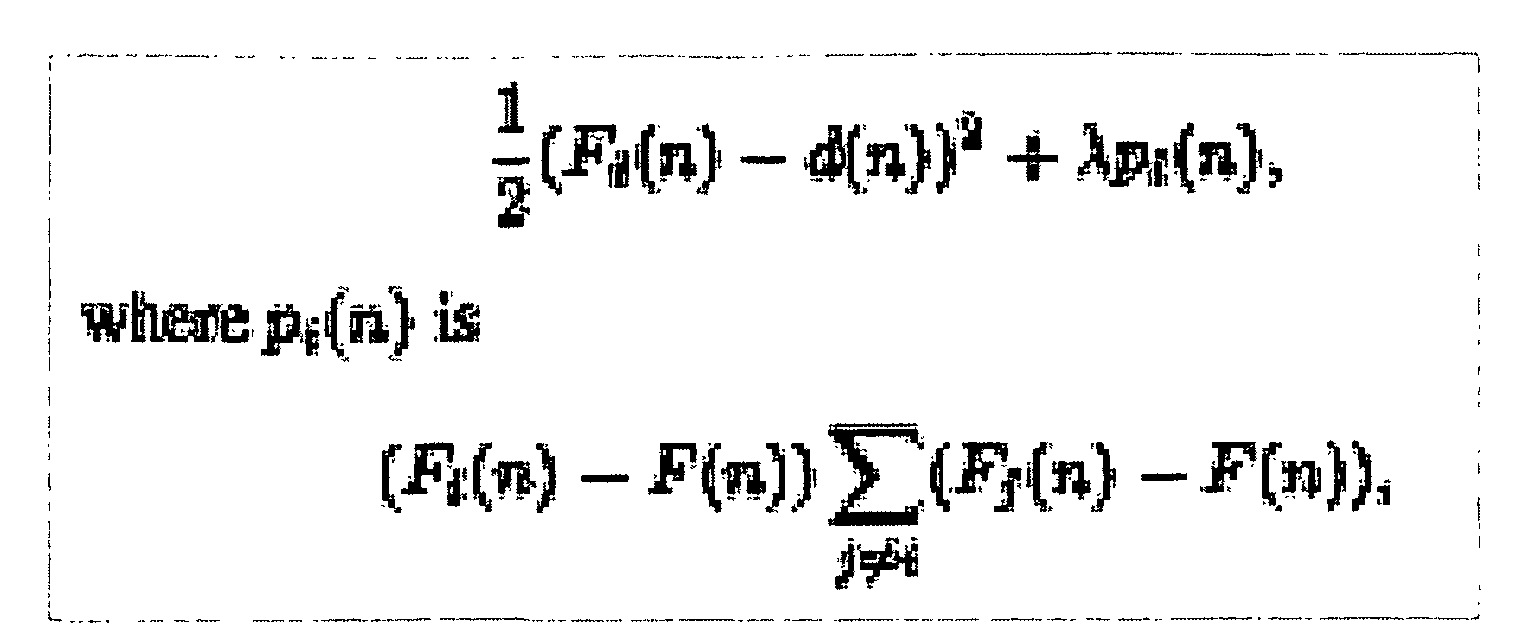
- the error function is a combination of the standard mean squared error and the negative correlation term:
- F i (n) is the output of network i on pattern n and d(n) is the desired response for that pattern.
- a method for automatically extracting features from images comprising the following steps:
- the measurement of the activation of the relevant output node with and without the hidden node can be used as the contribution to activation algorithm.
- the measurement of the correlation between input and output can be used as the contribution to activation algorithm.
- An co-evolutionary algorithm can be used as the contribution to activation algorithm.
- the neural system can consist of one single or multi-layer neural network.
- the neural system can consist of an ensemble of single or multi-layer neural networks.
- the neural system can consist of an ensemble of single or multi-layer neural networks and that the ensemble of neural networks is trained using a combination of mean-squared error and negative correlation learning.
- the invention proposes a method for nonlinear feature extraction based on neural network ensembles.
- the method consists of the following three steps which are visualized in Figure 1.
- the first step is to train an ensemble of neural networks on a particular pattern recognition task using training data and one of the ensemble training methods mentioned above.
- the ensemble training ensures a higher degree of diversity in the internal representations of the ensemble of networks, compared to independent training.
- This first step generates a diverse neural network ensemble with differing hidden node substructures.
- the hidden nodes of all networks in the ensemble are evaluated according to their contribution to the correct classification performance of the ensemble.
- the optimally contributing nodes are selected from the networks and are used as independent substructures for non-linear feature extraction.
- Step three therefore consists of assembling this set of optimal feature extracting nodes (detectors) parallely to obtain a feature representation with high dimension reduction of the input.
- This dimensionally reduced representation of the patterns can be used for building a new classifier with improved performance and generalization.
- Figure 2 visualizes in greater detail the above step 2 and thus the selection process for optimal nodes and their application as feature-detecting units for a standard k-Nearest Neighbour (k-NN) classifier.
- the k-NN classifier can be replaced by any other classification architecture. Subsets of networks and hidden nodes that may be redundant are selectively pruned. In this way the input dimensionality for the k-NN classifier can be reduced.
- the pruning occurs at step 2, as illustrated in the above Figure 1, after an ensemble of neural networks is trained with training data. The following algorithm is applied:
- one or more candidate networks are identified that may be useful for correct classification - usually the networks with lowest MSE on instances of this class are chosen. This has the effect of pruning away any networks which have an adverse effect on the overall ensemble performance.
- Next hidden nodes within this set of candidates are identified that contribute most to the ensemble performance - termed the contribution to activation. This is done by noting the activation of the relevant output node, with and without each hidden node. The nodes which cause the largest change in activation are selected as useful for classification.
- a subset of the hidden nodes from various networks in the ensemble is selected.
- Another alternative approach is to allow a co-evolutionary algorithm to identify nodes.
- the dataset used is based on the first 20 objects from the COIL-100 database.
- the input to the hierarchy is the original grayscale image data, 128 by 128 pixels.
- the first stage of processing applies Gabor filters at four orientations, followed by spatial pooling, producing four images of 16 by 16 pixels - a vector of length 1024, the 'C1' data.
- the second stage applies the technique of sparse invariant feature decomposition, producing fifty 8 by 8 images, so a vector of length 3200 - this is the 'C2' data.
- This is then used in a classification technique such as k-Nearest Neighbour.
- This architecture demonstrated very good performance, attributed to the feature detectors being localized to particular portions of the image.
- the disadvantage lies in the large amount of time spent on design and tuning of various parameters, including the connection patterns and size of localised fields. A large portion of the design step can be removed by automatically encouraging specialisation to features within the image.
- a classification on our re-representation from the C1 data and comparison with the same classification technique on the C2 data has been performed.
- the C1 data was rescaled to be between 0 and 1.
- Each object has 72 views at rotations of 5 degrees - 4 views were used for training, and 68 for testing.
- a standard backpropagation with a learning rate of 0.1 was used. Training was stopped when the reduction in MSE was less than 10 -5 , over the previous 25 iterations. Departing from random initial weights 100 trials of each experiment were performed.
- the first set-up was a single MLP, where the number of hidden nodes was varied, which is labelled "SingleNet”.
- the second was an ensemble of 3 networks, and again the number of hidden nodes per network was varied, which is labelled “Smallscale”.
- the third was an ensemble of networks each with 30 hidden nodes, where the number of networks was varied, which is labelled "Largescale”.
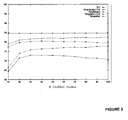
- Figure 3 shows a comparison between testing performance on single networks and ensemble networks and on the hidden node extraction architecture for single networks and ensemble networks which is the subject of the present invention (name ending FEX (for feature extraction) in the figure), varying the number of hidden nodes per network.
- the features extracted from the "SmallScale" ensemble (100 hidden nodes in each of 3 nets) obtained 82.5% (over 100 trials).
- Feature extraction from a single network with 90 hidden nodes obtained 77.5%, while using an ensemble with 3 nets each with 30 hidden nodes obtained 81.6% - clearly showing the advantage of extracting hidden nodes from an ensemble rather than a single network.
Landscapes
- Engineering & Computer Science (AREA)
- Theoretical Computer Science (AREA)
- Physics & Mathematics (AREA)
- General Physics & Mathematics (AREA)
- Artificial Intelligence (AREA)
- Computing Systems (AREA)
- Evolutionary Computation (AREA)
- General Health & Medical Sciences (AREA)
- Health & Medical Sciences (AREA)
- Software Systems (AREA)
- Life Sciences & Earth Sciences (AREA)
- General Engineering & Computer Science (AREA)
- Mathematical Physics (AREA)
- Molecular Biology (AREA)
- Data Mining & Analysis (AREA)
- Biomedical Technology (AREA)
- Biophysics (AREA)
- Computational Linguistics (AREA)
- Computer Vision & Pattern Recognition (AREA)
- Databases & Information Systems (AREA)
- Multimedia (AREA)
- Medical Informatics (AREA)
- Image Analysis (AREA)
- Information Retrieval, Db Structures And Fs Structures Therefor (AREA)
Abstract
Description
- training a neural system to achieve a low classification rate on a set of pre-defined images,
- extracting the hidden nodes from all hidden layers of the trained neural systems to represent features of the images, and
- applying a statistical classifier to this set of extracted features to correctly classify the images.
- training a neural system to achieve a low classification rate on a set of pre-defined images,
- extracting the hidden nodes from all hidden layers of the trained neural systems to represent features of the images,
- pruning the hidden nodes by a method a set forth before and an appropriate contribution to activation algorithm, and
- applying a statistical classifier to this set of extracted features to correctly classify the images.
- Figure 1
- illustrates schematically the steps for a nonlinear feature extraction according to the present invention,
- Figure 2
- visualizes on of the steps of Figure 1 in greater detail, i.e. the selection process for optimal nodes and their application as feature-detecting, and
- Figure 3
- shows a comparison between testing performance on single networks and ensemble networks and on the hidden node extraction architecture for single networks and ensemble networks which is the subject of this invention, varying the number of hidden nodes per network.
Claims (12)
- A method for automatically extracting features from images, the method comprising the following steps:training a neural system to achieve a low classification rate on a set of pre-defined images,extracting the hidden nodes from all hidden layers of the trained neural systems to represent features of the images, andapplying a statistical classifier to this set of extracted features to correctly classify the images.
- Method for automatically extracting features from images, the method comprising the following steps:training a neural system to achieve a low classification rate on a set of pre-defined images,extracting the hidden nodes from all hidden layers of the trained neural systems to represent features of the images,pruning the hidden nodes by means of a method according to claim 1 and an appropriate contribution to activation algorithm, andapplying a statistical classifier to this set of extracted features to correctly classify the images.
- Method according to claim 2,
characterized in that
the following contribution-to-activation algorithm is used:measure the activation of the relevant output node with and without the hidden node. - Method according to claim 2,
characterized in that
the following contribution-to-activation algorithm is used:measure the correlation between input and output. - Method according to claim 2,
characterized in that
a co-evolutionary algorithm is used as contribution-to-activation algorithm. - Method according to anyone of the preceding claims,
characterized in that
the neural system consists of one single or multi-layer neural network. - Method according to claim 6,
characterized in that
the neural system consists of an ensemble of single or multi-layer neural networks. - Method according to anyone of the preceding claims,
characterized in that
the neural system consists of an ensemble of single or multi-layer neural networks and that the ensemble of neural networks is trained using a combination of mean-squared error and negative correlation learning. - Computer program product,
implementing a method according to anyone of the preceding claims when running on a computing device. - Recording medium,
having recorded thereon a product according to claim 9. - A system for automatically extracting features from images, the system comprising:means for training a neural system to achieve a low classification rate on a set of pre-defined images,means for extracting the hidden nodes from all hidden layers of the trained neural systems to represent features of the images, andmeans for applying a statistical classifier to this set of extracted features to correctly classify the images.
- A system for automatically extracting features from images, the system comprising:means for training a neural system to achieve a low classification rate on a set of pre-defined images,means for extracting the hidden nodes from all hidden layers of the trained neural systems to represent features of the images,means for pruning the hidden nodes for example by executing a method according to claim 1 and an appropriate contribution to activation algorithm, andmeans for applying a statistical classifier to this set of extracted features to correctly classify the images.
Priority Applications (1)
| Application Number | Priority Date | Filing Date | Title |
|---|---|---|---|
| EP02018068A EP1378855B1 (en) | 2002-07-05 | 2002-08-13 | Exploiting ensemble diversity for automatic feature extraction |
Applications Claiming Priority (3)
| Application Number | Priority Date | Filing Date | Title |
|---|---|---|---|
| EP02015105 | 2002-07-05 | ||
| EP02015105 | 2002-07-05 | ||
| EP02018068A EP1378855B1 (en) | 2002-07-05 | 2002-08-13 | Exploiting ensemble diversity for automatic feature extraction |
Publications (3)
| Publication Number | Publication Date |
|---|---|
| EP1378855A2 true EP1378855A2 (en) | 2004-01-07 |
| EP1378855A3 EP1378855A3 (en) | 2006-05-10 |
| EP1378855B1 EP1378855B1 (en) | 2007-10-17 |
Family
ID=29720810
Family Applications (1)
| Application Number | Title | Priority Date | Filing Date |
|---|---|---|---|
| EP02018068A Expired - Lifetime EP1378855B1 (en) | 2002-07-05 | 2002-08-13 | Exploiting ensemble diversity for automatic feature extraction |
Country Status (1)
| Country | Link |
|---|---|
| EP (1) | EP1378855B1 (en) |
Cited By (8)
| Publication number | Priority date | Publication date | Assignee | Title |
|---|---|---|---|---|
| US8065992B2 (en) | 2008-01-22 | 2011-11-29 | Bayerische Motoren Werke Aktiengesellschaft | Valve arrangement for an exhaust gas recirculation device |
| EP2574958A1 (en) * | 2011-09-28 | 2013-04-03 | Honda Research Institute Europe GmbH | Road-terrain detection method and system for driver assistance systems |
| EP3065085A1 (en) * | 2015-03-04 | 2016-09-07 | Accenture Global Services Limited | Digital image processing using convolutional neural networks |
| US10204146B2 (en) | 2016-02-09 | 2019-02-12 | Ca, Inc. | Automatic natural language processing based data extraction |
| US10635934B2 (en) | 2017-09-19 | 2020-04-28 | Ramot At Tel-Aviv University Ltd. | Method and system for image content recognition |
| CN111860826A (en) * | 2016-11-17 | 2020-10-30 | 北京图森智途科技有限公司 | Image data processing method and device for low computing power processing equipment |
| US10832162B2 (en) | 2016-09-08 | 2020-11-10 | International Business Machines Corporation | Model based data processing |
| US11200263B2 (en) | 2017-01-17 | 2021-12-14 | International Business Machines Corporation | Automatic feature extraction from a relational database |
Families Citing this family (4)
| Publication number | Priority date | Publication date | Assignee | Title |
|---|---|---|---|---|
| CN108053025B (en) * | 2017-12-08 | 2020-01-24 | 合肥工业大学 | Multi-column neural network medical image analysis method and device |
| CN110913229B (en) * | 2018-09-18 | 2021-10-15 | 腾讯科技(深圳)有限公司 | RNN-based decoder hidden state determination method, device and storage medium |
| CN109740652B (en) * | 2018-12-24 | 2020-12-11 | 深圳大学 | A kind of pathological image classification method and computer equipment |
| CN109685653A (en) * | 2019-01-21 | 2019-04-26 | 北京工业大学 | A method of fusion deepness belief network and the monitoring of the credit risk of isolated forest algorithm |
Family Cites Families (3)
| Publication number | Priority date | Publication date | Assignee | Title |
|---|---|---|---|---|
| JP3329806B2 (en) * | 1990-11-09 | 2002-09-30 | 株式会社日立製作所 | Neural network construction device |
| US5926804A (en) * | 1994-07-01 | 1999-07-20 | The Board Of Governors For Higher Education, State Of Rhode Island And Providence Plantations | Discriminant neural networks |
| DE10048308B4 (en) * | 2000-09-29 | 2010-04-29 | Diehl Bgt Defence Gmbh & Co. Kg | Method and device for classifying objects from input image data present as a pixel pattern |
-
2002
- 2002-08-13 EP EP02018068A patent/EP1378855B1/en not_active Expired - Lifetime
Cited By (11)
| Publication number | Priority date | Publication date | Assignee | Title |
|---|---|---|---|---|
| US8065992B2 (en) | 2008-01-22 | 2011-11-29 | Bayerische Motoren Werke Aktiengesellschaft | Valve arrangement for an exhaust gas recirculation device |
| EP2574958A1 (en) * | 2011-09-28 | 2013-04-03 | Honda Research Institute Europe GmbH | Road-terrain detection method and system for driver assistance systems |
| US9435885B2 (en) | 2011-09-28 | 2016-09-06 | Honda Research Institute Europe Gmbh | Road-terrain detection method and system for driver assistance systems |
| EP3065085A1 (en) * | 2015-03-04 | 2016-09-07 | Accenture Global Services Limited | Digital image processing using convolutional neural networks |
| US9524450B2 (en) | 2015-03-04 | 2016-12-20 | Accenture Global Services Limited | Digital image processing using convolutional neural networks |
| US10204146B2 (en) | 2016-02-09 | 2019-02-12 | Ca, Inc. | Automatic natural language processing based data extraction |
| US10832162B2 (en) | 2016-09-08 | 2020-11-10 | International Business Machines Corporation | Model based data processing |
| CN111860826A (en) * | 2016-11-17 | 2020-10-30 | 北京图森智途科技有限公司 | Image data processing method and device for low computing power processing equipment |
| US11200263B2 (en) | 2017-01-17 | 2021-12-14 | International Business Machines Corporation | Automatic feature extraction from a relational database |
| US11645311B2 (en) | 2017-01-17 | 2023-05-09 | International Business Machines Corporation | Automatic feature extraction from a relational database |
| US10635934B2 (en) | 2017-09-19 | 2020-04-28 | Ramot At Tel-Aviv University Ltd. | Method and system for image content recognition |
Also Published As
| Publication number | Publication date |
|---|---|
| EP1378855A3 (en) | 2006-05-10 |
| EP1378855B1 (en) | 2007-10-17 |
Similar Documents
| Publication | Publication Date | Title |
|---|---|---|
| Tzanakou | Supervised and unsupervised pattern recognition: feature extraction and computational intelligence | |
| JP3520048B2 (en) | Visualization and self-organization of multidimensional data by equalized orthogonal mapping | |
| Zakaria et al. | Artificial neural network: a brief overview | |
| Zaknich | Neural networks for intelligent signal processing | |
| CN110705525A (en) | A method and device for diagnosing faults of rolling bearings | |
| US20040002928A1 (en) | Pattern recognition method for reducing classification errors | |
| EP1378855B1 (en) | Exploiting ensemble diversity for automatic feature extraction | |
| US20060013475A1 (en) | Computer vision system and method employing illumination invariant neural networks | |
| Cirrincione et al. | The on-line curvilinear component analysis (onCCA) for real-time data reduction | |
| CN118759862A (en) | High-precision linear guide positioning system and method based on artificial intelligence | |
| She et al. | Design and analysis of a novel quantum-classical hybrid neural network for environmental sound classification | |
| WO1991002323A1 (en) | Adaptive network for classifying time-varying data | |
| Larsen | Introduction to artificial neural networks | |
| Budiman et al. | Adaptive convolutional ELM for concept drift handling in online stream data | |
| Abdallah et al. | Facial-expression recognition based on a low-dimensional temporal feature space | |
| Gopalapillai et al. | Classification of robotic data using artificial neural network | |
| Zhai et al. | Applying extreme learning machine to plant species identification | |
| Murata et al. | Learning and recognition of multiple fluctuating temporal patterns using S-CTRNN | |
| Morabbi et al. | Partial derivative regularized knowledge transformation for deep neural networks generalization | |
| Ciocoiu | Hybrid feedforward neural networks for solving classification problems | |
| Brown et al. | Exploiting ensemble diversity for automatic feature extraction | |
| Das et al. | Human gait recognition using deep neural networks | |
| Rasanen | Generating hyperdimensional distributed representations from continuous-valued multivariate sensory input | |
| Sapkal et al. | Analysis of classification by supervised and unsupervised learning | |
| Ghosh et al. | Classification of spatiotemporal patterns with applications to recognition of sonar sequences |
Legal Events
| Date | Code | Title | Description |
|---|---|---|---|
| PUAI | Public reference made under article 153(3) epc to a published international application that has entered the european phase |
Free format text: ORIGINAL CODE: 0009012 |
|
| AK | Designated contracting states |
Kind code of ref document: A2 Designated state(s): AT BE BG CH CY CZ DE DK EE ES FI FR GB GR IE IT LI LU MC NL PT SE SK TR |
|
| AX | Request for extension of the european patent |
Extension state: AL LT LV MK RO SI |
|
| PUAL | Search report despatched |
Free format text: ORIGINAL CODE: 0009013 |
|
| RIC1 | Information provided on ipc code assigned before grant |
Ipc: G06N 3/08 20060101ALI20060307BHEP Ipc: G06K 9/62 20060101AFI20031031BHEP |
|
| AK | Designated contracting states |
Kind code of ref document: A3 Designated state(s): AT BE BG CH CY CZ DE DK EE ES FI FR GB GR IE IT LI LU MC NL PT SE SK TR |
|
| AX | Request for extension of the european patent |
Extension state: AL LT LV MK RO SI |
|
| 17P | Request for examination filed |
Effective date: 20060601 |
|
| 17Q | First examination report despatched |
Effective date: 20060705 |
|
| 17Q | First examination report despatched |
Effective date: 20060705 |
|
| 17Q | First examination report despatched |
Effective date: 20060705 |
|
| AKX | Designation fees paid |
Designated state(s): DE FR GB |
|
| GRAP | Despatch of communication of intention to grant a patent |
Free format text: ORIGINAL CODE: EPIDOSNIGR1 |
|
| GRAS | Grant fee paid |
Free format text: ORIGINAL CODE: EPIDOSNIGR3 |
|
| GRAA | (expected) grant |
Free format text: ORIGINAL CODE: 0009210 |
|
| AK | Designated contracting states |
Kind code of ref document: B1 Designated state(s): DE FR GB |
|
| REG | Reference to a national code |
Ref country code: GB Ref legal event code: FG4D |
|
| REF | Corresponds to: |
Ref document number: 60223007 Country of ref document: DE Date of ref document: 20071129 Kind code of ref document: P |
|
| ET | Fr: translation filed | ||
| PLBE | No opposition filed within time limit |
Free format text: ORIGINAL CODE: 0009261 |
|
| STAA | Information on the status of an ep patent application or granted ep patent |
Free format text: STATUS: NO OPPOSITION FILED WITHIN TIME LIMIT |
|
| 26N | No opposition filed |
Effective date: 20080718 |
|
| PGFP | Annual fee paid to national office [announced via postgrant information from national office to epo] |
Ref country code: FR Payment date: 20100901 Year of fee payment: 9 |
|
| PGFP | Annual fee paid to national office [announced via postgrant information from national office to epo] |
Ref country code: GB Payment date: 20100823 Year of fee payment: 9 |
|
| PGFP | Annual fee paid to national office [announced via postgrant information from national office to epo] |
Ref country code: DE Payment date: 20101029 Year of fee payment: 9 |
|
| GBPC | Gb: european patent ceased through non-payment of renewal fee |
Effective date: 20110813 |
|
| REG | Reference to a national code |
Ref country code: FR Ref legal event code: ST Effective date: 20120430 |
|
| REG | Reference to a national code |
Ref country code: DE Ref legal event code: R119 Ref document number: 60223007 Country of ref document: DE Effective date: 20120301 |
|
| PG25 | Lapsed in a contracting state [announced via postgrant information from national office to epo] |
Ref country code: GB Free format text: LAPSE BECAUSE OF NON-PAYMENT OF DUE FEES Effective date: 20110813 Ref country code: FR Free format text: LAPSE BECAUSE OF NON-PAYMENT OF DUE FEES Effective date: 20110831 |
|
| PG25 | Lapsed in a contracting state [announced via postgrant information from national office to epo] |
Ref country code: DE Free format text: LAPSE BECAUSE OF NON-PAYMENT OF DUE FEES Effective date: 20120301 |