EP1378604A2 - Method for controlling the pressure in a multi-level press - Google Patents
Method for controlling the pressure in a multi-level press Download PDFInfo
- Publication number
- EP1378604A2 EP1378604A2 EP03445084A EP03445084A EP1378604A2 EP 1378604 A2 EP1378604 A2 EP 1378604A2 EP 03445084 A EP03445084 A EP 03445084A EP 03445084 A EP03445084 A EP 03445084A EP 1378604 A2 EP1378604 A2 EP 1378604A2
- Authority
- EP
- European Patent Office
- Prior art keywords
- pressure
- breathing cycle
- pressing
- during
- period
- Prior art date
- Legal status (The legal status is an assumption and is not a legal conclusion. Google has not performed a legal analysis and makes no representation as to the accuracy of the status listed.)
- Withdrawn
Links
Images

Classifications
-
- D—TEXTILES; PAPER
- D21—PAPER-MAKING; PRODUCTION OF CELLULOSE
- D21J—FIBREBOARD; MANUFACTURE OF ARTICLES FROM CELLULOSIC FIBROUS SUSPENSIONS OR FROM PAPIER-MACHE
- D21J1/00—Fibreboard
- D21J1/04—Pressing
Definitions
- the present invention relates to a method and device for controlling the pressure in pressing cellulose-based boards where at least one board initially and lastly during the period of time of said pressing is subjected to a high pressure compared to the pressure of an intermediate period.
- presses are used to squeeze the present material together, and separate the liquid or water from the material, which then is made into hardboards. This is taking place in presses which subject the material to pressuring, and supply heat to the material in order to separate water from the material.
- so called multi-opening presses has been developed to be able to press several boards simultaneously.
- Multi-opening presses comprise a frame with several press tables, between which the cellulose-based boards in relation to one another are put on top of each other, separated by the press tables.
- All these press tables are connected to one another in such way that by pressure on a top piece placed above all press tables, and on a lower piece placed below all press tables, all press tables are pressed together and therefore also the intermediate cellulose-based boards by the tables placed above and below, respectively.
- the multi-opening presses have been used for a long time in the industry for production of cellulose-based hardboards, e.g. so called MasoniteTM Boards.
- the Swedish patent SE 7 603 538-5 discloses a multi-opening press, but first-hand is a vertically adjustable material feeding and press bed feeding out device designed for a multi-opening press for the production of boards presented.
- Swedish patent SE 8 502 937-9 presents a multi-opening press, but first-hand is a device for multi-opening presses disclosed, which by a feeding lift by means of a feeding device simultaneously transfers an amount of conveying plates loaded with pressing material to the press, and after the pressing operation transfers them away from there by means of an extractor to a feeding out lift.
- the prior art principle of pressing of cellulose-based boards has been used for many decades without any significant changes or improvements of the pressing diagram, which the pressing operation follows.
- the principles of a standard pressing diagram includes a rapid closing of the multi-opening press and a sharp increase of the pressure to achieve maximum squeeze out of water from the cellulose-based boards. After this relatively short initial high-pressure period a drying period follows at a considerably lower pressure compared to the initial high-pressure, and also heat is supplied. The object of these measures during the drying period is to remove remaining damp in the form of water vapour from the boards. In some presses, lastly the boards are also subjected to a high-pressure to consolidate the physical board properties.
- the present invention is based upon the insight that there is a physical limitation of the water vapour to freely leave the intrinsic of the board, resulting in an unnecessarily long drying time period of the board.
- the object of the present invention is to make the production of cellulose-based boards more efficient, preferably in a multi-opening press, by way of suitable pressuring during the drying period, and thus decreasing the time period of the same and in this way enabling a more rapid production rate of the method in accordance with the preamble of claim 1.
- the present inventors' solution of the problem mentioned above is to provide a method and a device providing a radical change in the pressing procedure by replacing the prior art method comprising a drying period with a relatively constant low pressure by a method for controlling the pressure in pressing said cellulose-based boards where at least one board initially and lastly during the period of time of said pressing is subjected to a high pressure compared to the pressure of the intermediate drying period, during the drying period the board being subjected to at least one breathing cycle, during which breathing cycle first the pressure is decreased to a lower pressure compared to the initial high pressure, and then is increased to a higher pressure compared to the lower pressure of the breathing cycle, and subsequent to the breathing cycle, to a lower pressure compared to the higher pressure of the breathing cycle.
- the lower pressure of the breathing cycle is below the pressure used during the drying period in prior art methods, and preferably is adapted to the temperature level reached within the board at this time.
- This lower pressure allows free escape of generated vapour.
- Increasing the pressing pressure after this initial relatively short low-pressure period results in a more efficient transmission of heat to the board and promotes to give the board its properties. The expected result is a shortened pressing process enabling a considerable increase in production rate to limited investment costs.
- the higher pressure of a breathing cycle is lower than the said initial high pressure.
- the board is subjected to several breathing cycles, two, for example, or several breathing cycles. Every breathing cycle comprises a low-pressure period followed by a high-pressure period. This further makes the separation of damp in form of water vapour and other gases from the board more efficient.
- the higher pressure of a breathing cycle is higher than the higher pressure of a preceding breathing cycle, and it is yet more advantageous if also the lower pressure of the breathing cycle is higher compared to the lower pressure of a preceding breathing cycle.
- the lower pressure of each breathing cycle is in the interval of 1 to 30 % of the said initial high pressure, and the higher pressure of a breathing cycle is in the interval of 2 to 10 times higher than the lower pressure of the same breathing cycle.
- the method is executed in a pressing being hydraulically controlled, as, inter alia, the hydraulically controlled pressing is the most common pressing within the field of technology.
- the method is used in a multi-opening press.
- the multi-opening press has the advantage to be able to simultaneously press several boards and enables an efficient breathing and thus an increased production rate.
- a device for pressing cellulose-based boards, which comprises a control device arranged to control the pressure in pressing the boards, where at least one board initially and lastly during the period of time of said pressing is subjected to a high pressure compared to the pressure of the intermediate period, the intermediate period being called drying period. Further, during the drying period the control device is arranged to subject the board to at least one breathing cycle during which the pressure first is decreased to a lower pressure compared to the initial high pressure and subsequently is increased to a higher pressure compared to the lower pressure of the breathing cycle, and subsequent to the breathing cycle, to a lower pressure compared to the higher pressure of the breathing cycle.
- the present invention introduce totally new ways of reasoning regarding the pressing technology of prior art and to fully execute the present invention in prior art presses, these presses need to be adapted by a suitable, modified controlling equipment. This is due to the practical electromechanical limitations of the hydraulically controlling system of prior art presses.
- an advantage shown in both laboratory and in experiments in factory, due a shortening in the pressing process, is that the surface of the boards becomes lighter and more evenly coloured.
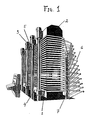
- Fig. 1 shows an embodiment of a multi-opening press with 25 levels or press tables 1.
- the press is set up on a frame, and is terminated by a top piece 2 placed above all press tables.
- the frame and top piece 2 are interconnected by way of columns 3 at the longitudinal side of the press, and under the pile of press tables 1, there is a lower piece 4.
- the pressing pressure is produced by press cylinders provided with pistons 5, to which the lower piece 4 is connected.
- the press tables 1 comprises of 60 mm, approximately, thick steel plates provided with longitudinal canals for vapour and hot water.
- the canal system is such that an even distribution of heat is provided over the press table.
- On the backside of the press there is a pipe system 6, one end of each pipe of the system being connected to one press table for inlet and outlet of water or vapour and the other end of each pipe being connected to a vertical pipe 7, which supply vapour and hot water or drain off condensed vapour or cooled hot water.
- Each part of the press has solid dimensions to be able to work at high pressures.
- Pressing of hardboards, preferably 3,2 mm thick hardboards, according to prior art pressing technology shown in Fig. 2 goes on for between 300 seconds and 400 seconds. This period of time is dependent upon the sort of wood raw material and pressing temperature.
- a high initial specific surface pressure 4 between 45 and 55 Bar during 30 to 60 seconds, approximately, in order to reach maximum mechanical squeeze out of liquid.
- a low-pressure period 5 called drying period, during which the boards are subjected to a low surface pressure, whereby damp is separated from the board in the form of water vapour.
- this low-pressure period 5 the boards are subjected to a specific surface pressure between 10 and 14 Bar, and this low-pressure period 5 goes on for 220 to 240 seconds, approximately. Lastly, the boards are subjected to a final high surface pressure 6 between 30 and 40 Bar during 40 to 60 seconds, approximately. Subsequently, the pressed boards are fed out of the multi-opening press.
- Fig. 2 shows a curve 2 of a pressure diagram, which an embodiment of the present invention follows.
- the boards are subjected to an initial high specific surface pressure 4 of 50 Bar, approximately, during 40 seconds, approximately.
- the boards are subjected to a first breathing cycle 7, during which the surface pressure is decreased and kept on a lower level, the boards being subjected to a lower specific surface pressure between 2 and 4 Bar during 2 to 10 seconds, approximately, and then is increased and kept on a higher pressure level, the boards being subjected to a higher specific surface pressure between 22 and 25 Bar during 40 seconds, approximately.
- a second breathing cycle 8 follows, during which the boards are subjected to a lower surface pressure between 5 and 10 Bar during 5 to 10 seconds, approximately and subsequently subjected to a higher surface pressure between 32 and 36 Bar during 40 seconds, approximately. Subsequently, the surface pressure is decreased to 12 Bar, approximately, and lastly the boards are subjected to a final high pressure 9 between 45 and 50 Bar during 50 seconds, approximately, and thereafter the pressed boards are fed out of the multi-opening press. This pressing goes on for about 290 seconds.
- Fig. 2 illustrates a curve 3 of a pressure diagram, which an embodiment of the present invention follows.
- the boards are subjected to an initial high specific surface pressure 4 of 50 Bar, approximately, during 30 seconds, approximately.
- the boards are subjected to a first breathing cycle 10, during which the surface pressure is decreased and kept on a lower pressure level, whereby the boards are subjected to a lower surface pressure of 2 Bar, approximately, during 5 seconds, approximately, and then is increased to and kept on a higher pressure level, whereby the boards are subjected to a higher pressure of between 12 and 14 Bar, approximately, during 45 seconds, approximately.
- a second breathing cycle 11 follows, during which the surface pressure first is decreased, without pressure level keeping, to a lower surface pressure of about 7 Bar and subsequently increased to and kept on a higher surface pressure between 22 and 24 Bar during 45 seconds, approximately. Thereafter, an additional pressure decrease without pressure level keeping to a pressure level on 10 Bar, approximately, is provided, and lastly the boards are subjected to a final high surface pressure 12 between 45 and 50 Bar during 60 seconds, approximately, after which the boards are fed out of the multi-opening press. This pressing goes on for about 300 seconds.
- the surface pressure on the boards is in general between 0 and 60 Bar, and the pressing process of boards, of 3,2 mm thick boards, for example, goes on for a period of time of about 270 to 320 seconds.
- These intervals are not limiting to the present invention, but the periods of time of the pressing process could be shortened or extended, and in some cases, even the upper level of said pressure intervals can be increased.
Landscapes
- Dry Formation Of Fiberboard And The Like (AREA)
- Moulding By Coating Moulds (AREA)
- Casting Or Compression Moulding Of Plastics Or The Like (AREA)
- Paper (AREA)
- Chemical And Physical Treatments For Wood And The Like (AREA)
- Drying Of Solid Materials (AREA)
Abstract
Description
Claims (10)
- Method for controlling the pressure in pressing cellulose-based boards where at least one board initially and lastly during said period of time of the pressing is subjected to a high pressure compared to the pressure of an intermediate period, the intermediate period being called drying period, characterized in that during the drying period the board is subjected to at least one breathing cycle, during which the pressure first is decreased to a lower pressure compared to the initial high pressure, and subsequently is increased to a higher pressure compared to the lower pressure of the breathing cycle, and subsequent to the breathing cycle, to a lower pressure compared to the higher pressure of the breathing cycle.
- Method according to claim 1, characterized in that the higher pressure of a breathing cycle is lower than said initial high pressure.
- Method according to claim 1 or 2, characterized in that during the drying period the board is subjected to several breathing cycles.
- Method according to claim 3, characterized in that the higher pressure of a breathing cycle is higher than the higher pressure of a preceding breathing cycle.
- Method according to claim 3 or 4, characterized in that the lower pressure of a breathing cycle is higher compared to the lower pressure of a preceding breathing cycle.
- Method according to any of the previous claims, characterized in that the lower pressure of each breathing cycle is in the interval of 1-30 % of said initial high pressure, and that the higher pressure of a breathing cycle is in the interval of 2-10 times higher than the lower pressure of the same breathing cycle.
- Method according to any of the previous claims, characterized in that said pressing is a hydraulically controlled pressing.
- Method according to any of the previous claims, characterized in that the pressing takes place in a multi-opening press, in which several boards simultaneously are pressed.
- Device for pressing cellulose-based boards, which comprises a control device arranged to control the pressure in pressing the boards, where at least one board initially and lastly during the period of time of the pressing is subjected to a high pressure compared to the pressure of the intermediate period, the intermediate period being called drying period, characterized in that during the drying period, the control device is arranged to subject the board to at least one breathing cycle during which the pressure first is decreased to a lower pressure compared to the initial high pressure and subsequently is increased to a higher pressure compared to the lower pressure of the breathing cycle, and subsequent to the breathing cycle, to a lower pressure compared to the higher pressure of the breathing cycle.
- Device for pressing according to claim 9, characterized in that the control device is arranged to accomplish a pressing operation according to any of the claims 1 to 8.
Applications Claiming Priority (2)
| Application Number | Priority Date | Filing Date | Title |
|---|---|---|---|
| SE0202099 | 2002-07-04 | ||
| SE0202099A SE523006C2 (en) | 2002-07-04 | 2002-07-04 | Method and apparatus for pressure control in multi-stage pressing |
Publications (2)
| Publication Number | Publication Date |
|---|---|
| EP1378604A2 true EP1378604A2 (en) | 2004-01-07 |
| EP1378604A3 EP1378604A3 (en) | 2005-10-19 |
Family
ID=20288439
Family Applications (1)
| Application Number | Title | Priority Date | Filing Date |
|---|---|---|---|
| EP03445084A Withdrawn EP1378604A3 (en) | 2002-07-04 | 2003-06-30 | Method for controlling the pressure in a multi-level press |
Country Status (2)
| Country | Link |
|---|---|
| EP (1) | EP1378604A3 (en) |
| SE (1) | SE523006C2 (en) |
Family Cites Families (1)
| Publication number | Priority date | Publication date | Assignee | Title |
|---|---|---|---|---|
| DE2455818A1 (en) * | 1974-11-26 | 1976-08-12 | Becker & Van Huellen | PROCESS FOR MANUFACTURING FIBER BOARDS BY THE WET PROCESS IN A HOT PRESS |
-
2002
- 2002-07-04 SE SE0202099A patent/SE523006C2/en not_active IP Right Cessation
-
2003
- 2003-06-30 EP EP03445084A patent/EP1378604A3/en not_active Withdrawn
Also Published As
| Publication number | Publication date |
|---|---|
| SE523006C2 (en) | 2004-03-23 |
| SE0202099L (en) | 2004-01-05 |
| SE0202099D0 (en) | 2002-07-04 |
| EP1378604A3 (en) | 2005-10-19 |
Similar Documents
| Publication | Publication Date | Title |
|---|---|---|
| AU718115B2 (en) | Method and device for the extrusion of wood fibre board | |
| RU2068339C1 (en) | Device and method for continuous manufacture of wood particle boards | |
| US20020036046A1 (en) | Method of manufacturing chipboards, fibre boards and the like boards | |
| SE504580C2 (en) | Process and plant for continuous manufacture of chipboard, fiberboard and the like | |
| MD1488B2 (en) | Method for control and regulation of a press compressive force carrying out separation of liquid and solid phases | |
| US4525935A (en) | Method for dewatering items of washed laundry | |
| CA2265872A1 (en) | Method and apparatus for pulping with controlled heating to improve delignification and pulp strength | |
| NO137932B (en) | PROCEDURES FOR HEAT PRESSING OF SHEETS OF MATERIALS CONTAINING LIGNOCELLULOSIS | |
| AU707679B2 (en) | Apparatus for reducing the water content of water-containing brown coal | |
| US6533890B1 (en) | Method and steam press for the production of boards of ligneous material | |
| SE504221C2 (en) | Process for making lignocellulosic slices | |
| DD291790A5 (en) | METHOD FOR PRODUCING LIGNOCELLULOSE-CONTAINING FIBROUS FOR THE MANUFACTURE OF FIBER PLATES AFTER DRYING PROCESS | |
| JP4787432B2 (en) | Method of consolidation of wood | |
| JP2000153103A (en) | Filter press device and sludge dewatering method | |
| US1844861A (en) | Process for the manufacture of vegetable fiber products | |
| JP2700543B2 (en) | Thermal pressure control method for multi-stage press | |
| CN105256666A (en) | high density fiberboard production on-line water pressurizing device | |
| JP2700544B2 (en) | Thermal pressure control method for multi-stage press | |
| CN108177217A (en) | A kind of cabinet-wood bending apparatus | |
| CN108943269B (en) | Method and equipment for dyeing pressure-absorbing wood | |
| DE69011086D1 (en) | MACHINE FOR PRESSING GRAPES. | |
| CN106417438B (en) | A kind of full-automatic pressure surface blanking machine | |
| CN113748004A (en) | Method and apparatus for pre-hot pressing a mat of material | |
| DE327661C (en) | Process for dewatering and drying damp goods, especially cardboard | |
| CN211640329U (en) | Hot air steam penetration preheating device for medium density fiberboard blank |
Legal Events
| Date | Code | Title | Description |
|---|---|---|---|
| PUAI | Public reference made under article 153(3) epc to a published international application that has entered the european phase |
Free format text: ORIGINAL CODE: 0009012 |
|
| AK | Designated contracting states |
Kind code of ref document: A2 Designated state(s): AT BE BG CH CY CZ DE DK EE ES FI FR GB GR HU IE IT LI LU MC NL PT RO SE SI SK TR |
|
| AX | Request for extension of the european patent |
Extension state: AL LT LV MK |
|
| PUAL | Search report despatched |
Free format text: ORIGINAL CODE: 0009013 |
|
| AK | Designated contracting states |
Kind code of ref document: A3 Designated state(s): AT BE BG CH CY CZ DE DK EE ES FI FR GB GR HU IE IT LI LU MC NL PT RO SE SI SK TR |
|
| AX | Request for extension of the european patent |
Extension state: AL LT LV MK |
|
| 17P | Request for examination filed |
Effective date: 20060419 |
|
| AKX | Designation fees paid |
Designated state(s): AT BE BG CH CY CZ DE DK EE ES FI FR GB GR HU IE IT LI LU MC NL PT RO SE SI SK TR |
|
| STAA | Information on the status of an ep patent application or granted ep patent |
Free format text: STATUS: THE APPLICATION IS DEEMED TO BE WITHDRAWN |
|
| 18D | Application deemed to be withdrawn |
Effective date: 20080103 |