EP1378586A1 - Zinc phosphate-containing conditioning agent for phosphate conversion-treatment of steel plate and corresponding product - Google Patents
Zinc phosphate-containing conditioning agent for phosphate conversion-treatment of steel plate and corresponding product Download PDFInfo
- Publication number
- EP1378586A1 EP1378586A1 EP03013178A EP03013178A EP1378586A1 EP 1378586 A1 EP1378586 A1 EP 1378586A1 EP 03013178 A EP03013178 A EP 03013178A EP 03013178 A EP03013178 A EP 03013178A EP 1378586 A1 EP1378586 A1 EP 1378586A1
- Authority
- EP
- European Patent Office
- Prior art keywords
- zinc phosphate
- phosphate
- surface conditioning
- conditioning agent
- dispersion
- Prior art date
- Legal status (The legal status is an assumption and is not a legal conclusion. Google has not performed a legal analysis and makes no representation as to the accuracy of the status listed.)
- Granted
Links
Classifications
-
- C—CHEMISTRY; METALLURGY
- C23—COATING METALLIC MATERIAL; COATING MATERIAL WITH METALLIC MATERIAL; CHEMICAL SURFACE TREATMENT; DIFFUSION TREATMENT OF METALLIC MATERIAL; COATING BY VACUUM EVAPORATION, BY SPUTTERING, BY ION IMPLANTATION OR BY CHEMICAL VAPOUR DEPOSITION, IN GENERAL; INHIBITING CORROSION OF METALLIC MATERIAL OR INCRUSTATION IN GENERAL
- C23C—COATING METALLIC MATERIAL; COATING MATERIAL WITH METALLIC MATERIAL; SURFACE TREATMENT OF METALLIC MATERIAL BY DIFFUSION INTO THE SURFACE, BY CHEMICAL CONVERSION OR SUBSTITUTION; COATING BY VACUUM EVAPORATION, BY SPUTTERING, BY ION IMPLANTATION OR BY CHEMICAL VAPOUR DEPOSITION, IN GENERAL
- C23C22/00—Chemical surface treatment of metallic material by reaction of the surface with a reactive liquid, leaving reaction products of surface material in the coating, e.g. conversion coatings, passivation of metals
- C23C22/78—Pretreatment of the material to be coated
Definitions
- the present invention relates to a surface conditioning agent to be used for pretreatment for zinc phosphate conversion treatment of a metallic material.
- Automobile bodies, electric appliances, etc. are prepared by forming metallic materials such as steel plates or zinc-plated steel plates into shaped metal products, followed by painting and assembling. Painting of such shaped metal products is carried out via various steps such as degreasing, surface conditioning, conversion treatment and electropainting.
- the surface conditioning treatment is a treatment applied for such a purpose that in the subsequent step of phosphate conversion treatment, a coating film made of crystals of a phosphate will be formed uniformly, quickly and with a high density over the entire metal surface.
- a metallic material is immersed in a surface conditioning bath to let crystal nuclei of a phosphate form on the metal surface.
- a titanium phosphate colloid is formed on the metal surface, so that by this colloid, a conversion coating will be formed well on the metal surface in the conversion treatment.
- JP-A-9-249978 discloses a high durability surface conditioning agent which is an aqueous solution having a pH of from 8.5 to 10.0, wherein titanium ions are from 1 to 50 ppm, phosphate radical ions are from 50 to 1,000 ppm, tripolyphosphate radical ions are from 50 to 400 ppm or from 20 to 1,500 ppm, and the value of (weight of tripolyphosphate radical ions)/(weight of titanium ions) is from 10 to 100.
- titanium phosphate colloids proposed as surface conditioning agents, have a nature such that they tend to undergo dissolution or coagulation as the time passes, and they are in the form of a powder which is inconvenient in handling.
- JP-A-2000-96256 discloses a surface conditioning treatment solution containing bivalent or trivalent metal phosphate particles and a monosaccharide or polysaccharide as an accelerator component.
- a surface conditioning treatment solution is poor in stability and has a problem such that the treating property is not fully satisfactory against an aluminum alloy, against a pocket portion of a component having a complex structure or against a steel plate to be hardly conversion treated, such as a black-skin steel plate.
- the present inventors have conducted an extensive study in view of the above problems. As a result, they have found it possible to obtain a conversion steel plate having an excellent surface state by employing, as a surface conditioning agent, one having zinc phosphate dispersed in a specific state, and have arrived at the present invention.
- the present invention provides:
- the zinc phosphate-containing surface conditioning agent of the present invention is one which deposits a zinc phosphate colloid on a metal surface of e.g. iron, zinc or aluminum type and is one which accelerates formation of a zinc phosphate coating with the above colloid serving as crystal nuclei in the subsequent zinc phosphate conversion treatment step, to let a good zinc phosphate coating form.
- the surface conditioning agent of the present invention contains zinc phosphate.
- zinc phosphate is one represented by Zn 3 (PO 4 ) 2 and is usually a colorless crystallizable solid, but a commercial product in a powder form is available.
- zinc sulfate and a dilute solution of disodium hydrogen phosphate may be mixed and heated in a molar ratio of 3:2, whereby a tetrahydrate of zinc phosphate will be formed as a crystallizable precipitate. Otherwise, a tetrahydrate of zinc phosphate may be obtained by reacting a dilute phosphoric acid aqueous solution with zinc oxide or zinc carbonate. Crystals of the tetrahydrate are of rhombic system, and there are three types of transformation. When heated, it becomes a dihydrate at 100°C, a monohydrate at 190°C and an anhydrate at 250°C.
- Zinc phosphate in the present invention may be either a tetrahydrate, a dihydrate, a monohydrate or an anhydride, but usually a tetrahydrate which is readily available, may be used as it is.
- zinc phosphate one subjected to various surface treatment may be employed.
- it may be one surface-treated with e.g. a silane coupling agent, rosin, a silicone compound or a metal alkoxide such as silicon alkoxide or aluminum alkoxide.
- the form of zinc phosphate is also not particularly limited. Its commercial product is usually in a white powder form. However, the form of the powder may be any form such as a fine particulate form, a plate form or a scaly form.
- the particle size is also not particularly limited, but it is usually a powder having an average particle size of about a few ⁇ m. It is particularly preferred to use one commercially available as an antirust pigment such as a product having the buffering function increased by treatment to impart basicity. As described hereinafter, in the present invention, it is possible to prepare a stable dispersion having zinc phosphate finely dispersed, whereby a constant surface treatment effect can be obtained irrespective of the primary particle size or the form of the powder.
- zinc phosphate as described above is preliminarily formed into a dispersion, so that it is used in a finely dispersed state.
- the method for preparing an aqueous dispersion having zinc phosphate dispersed in an aqueous medium is not particularly limited. However, it is preferred to mix zinc phosphate into a dispersion medium such as water or an organic solvent and carry out pulverization in a wet system in the presence of a dispersant.
- a dispersion medium such as water or an organic solvent
- an aqueous medium containing at least 80 wt% of water may be mentioned.
- various organic solvents may be employed, but it is advisable to control the content of the organic solvent at a low level, preferably at most 10 wt%, more preferably at most 5 wt% in the aqueous medium.
- the dispersion may be one which contains no dispersion medium other than water.
- the water-soluble organic solvent is not particularly limited.
- it may be an alcohol solvent such as methanol, isopropanol, ethylene glycol or ethylene glycol monopropyl ether, a hydrocarbon solvent such as hexane, heptane, xylene, toluene, cyclohexane or naphtha, a ketone solvent such as methyl isobutyl ketone, methyl ethyl ketone, isophorone or acetophenone, an amide solvent such as dimethyl acetamide or methyl pyrrolidone, or an ester solvent such as ethyl acetate, isobutyl acetate, octyl acetate, ethylene glycol monomethyl ether acetate, or diethylene glycol monomethyl ether acetate.
- an alcohol solvent such as methanol, isopropanol, ethylene glycol or ethylene glycol monopropyl ether
- a hydrocarbon solvent
- Such organic solvents may be used alone or in combination as a mixture of two or more of them.
- pulverization in a wet system may be carried out in a dispersion medium other than an aqueous medium, followed by substitution of the solvent to obtain the aqueous dispersion.
- a dispersant may be employed.
- a dispersant is not particularly limited, and for example, a polymer dispersant, a surfactant or a coupling agent may be used.
- a natural polymer may be mentioned, and its specific examples include a protein such as hide glue, gelatin, casein or albumin, a natural rubber such as gum arabic or tragacanth gum, a glucoxide such as saponin, alginic acid, an alginic acid derivative such as alginic acid propylene glycol ester, alginic acid triethanolamine or ammonium alginate, and a cellulose derivative such as methyl cellulose, carboxymethyl cellulose, hydroxyethyl cellulose or ethylhydroxy cellulose.
- a protein such as hide glue, gelatin, casein or albumin
- a natural rubber such as gum arabic or tragacanth gum
- a glucoxide such as saponin
- alginic acid an alginic acid derivative such as alginic acid propylene glycol ester, alginic acid triethanolamine or ammonium alginate
- a cellulose derivative such as methyl cellulose, carboxymethyl
- Such dispersants may be used alone or in combination as a mixture of two or more of them. Among them, it is particularly preferred to use methyl cellulose, or more preferred to use carboxymethyl cellulose, hydroxyethyl cellulose or the like.
- a synthetic polymer may be mentioned. Its specific examples include a polyamine resin, a polycarboxylic acid resin, a polyolefin resin, a polyester resin, a polyurethane resin, a polyvinyl alcohol, a polyvinyl pyrrolidone, an acrylic resin such as a polyacrylic acid resin, an acrylic acid/acrylonitrile copolymer, a potassium acrylate/acrylonitrile copolymer, a vinyl acetate/acrylate copolymer or an acrylic acid/acrylate copolymer, a styrene/acrylic acid resin such as a styrene/acrylic acid copolymer, a styrene/methacrylic acid copolymer, a styrene/methacrylic acid/acrylate copolymer, a styrene/ ⁇ -methyl styrene/acrylic acid copolymer or
- polymer dispersants may be used alone or in combination as a mixture of two or more of them.
- a polyamine resin a polycarboxylic acid resin, a polyester resin, a polyurethane resin, a polyvinyl alcohol, a polyvinyl pyrrolidone, a styrene/acrylic acid resin, a polyacrylic acid resin, or a styrene/maleic acid copolymer.
- UNISENCE CP-102 manufactured by Senka Company
- KZ-125K manufactured by Senka Company
- AJISPER PB821 manufactured by Ajinomoto Co., Inc.
- SOLSPERSE 24000GR manufactured by Zinneka Company
- SOLSPERSE 32550 manufactured by Zinneka Company
- Disperbyk 190 manufactured by BYK-Chemie Japan KK
- EFKA-4046 manufactured by Wilbur-Ellis Company
- Disperbyk 161 manufactured by BYK-Chemie Japan KK
- Disperbyk 163 manufactured by BYK-Chemie Japan KK
- Disperbyk 165 manufactured by BYK-Chemie Japan KK
- a nonionic surfactant such as a polyoxyethylene alkyl ether, a polyoxyalkylene alkyl ether, a polyoxyethylene derivative, an oxyethyleneoxypropylene block copolymer, a sorbitan fatty acid ester, a polyoxyethylene sorbitan fatty acid ester, a polyoxyethylene sorbitol fatty acid ester, a glycerol fatty acid ester, a polyoxyethylene fatty acid ester, a polyoxyethylene alkylamine, an alkylalkanodeamide, nonylphenol, an alkylnonylphenol, a polyoxyalkylene glycol, an alkylamine oxide, acetylene diol, a polyoxyethylene nonyl phenyl ether, a silicon surfactant such as a polyoxyethylene alkyl phenyl ether-modified silicone, or a fluorinated surfactant having at least
- the surfactant may be a cationic surfactant such as an alkyltrimethylammonium salt such as lauryl trimethylammonium chloride, cetyltrimethylammonium bromide or stearyltrimethylammonium chloride, an alkyldimethylbenzylammonium salt such as stearyldimethylbenzylammonium chloride, benzalconium chloride or lauryldimethylbenzylammonium chloride, or a phosphoric acid amine salt.
- an alkyltrimethylammonium salt such as lauryl trimethylammonium chloride, cetyltrimethylammonium bromide or stearyltrimethylammonium chloride
- an alkyldimethylbenzylammonium salt such as stearyldimethylbenzylammonium chloride, benzalconium chloride or lauryldimethylbenzylammonium chloride
- a phosphoric acid amine salt such as an alkyltrimethylammoni
- the surfactant may be an anionic surfactant such as a fatty acid salt, an alkylsulfuric acid ester salt, an alkyl ether sulfuric acid ester salt, an alkylbenzene sulfonate, an alkylnaphthalene sulfonate, an alkylsulfosuccinate, an alkyldiphenylether disulfonate, a polybisphenol sulfonate, an alkyl phosphate, a polyoxyethyl alkylsulfuric acid ester salt, a polyoxyethyl alkylallylsulfuric acid ester salt, an ⁇ -olefin sulfonate, a methyltaurine acid salt, a polyasparaginate, an ethercarboxylate, a naphthalene sulfonic acid formalin condensate, or a polyoxyethylene alkyl phosphoric acid ester.
- anionic surfactant such as
- surfactants may be used alone or in combination as a mixture of two or more of them.
- a polyoxyethylene alkyl phosphoric acid ester Phosphanol RS-610 (manufactured by Toho Chemical Industry Co, Ltd.) or Disperbyk 180 (manufactured by BYK-Chemie Japan KK) may be mentioned as a preferred example, and as a phosphoric acid amine salt, SN-DISPERSANT 2060 (manufactured by San Nopco Limited) may be mentioned as a preferred example.
- the anionic surfactant to be used here, or an anionic resin among the above-mentioned polymer dispersants, may be used as neutralized by ammonia or an amine neutralizing agent.
- an amine neutralizing agent diethylamine (DEA), triethylamine (TEA), monoethanolamine (META), diethanolamine (DETA), triethanolamine (TETA), dimethylethanolamine (DMEA), diethylethanolamine (DEEA), isopropylethanolamine (IPEA), diisopropanolamine (DIPA), 2-amino-2-methylpropanol (AMP), 2-(dimethylamino)-2-methylpropanol (DMAMP), morpholine (MOR), N-methylmorpholine (NMM) or N-ethylmorpholine (NEM) may, for example, be mentioned.
- Such neutralizing agents may be used alone or in combination as a mixture of two or more of them. Among them, it is particularly preferred to use 2-amino-2-methylpropanol (AMP).
- AMP 2-amino-2-methylpropanol
- the surfactant may be an amphoteric surfactant such as an alanine type, an imidazolium betaine type, an aminopropyl betaine type or an aminodipropionate.
- a coupling agent such as a silane type coupling agent, an aluminum type coupling agent, a titanium type coupling agent or a zirconium type coupling agent.
- These coupling agents may be used alone or in combination as a mixture of two or more of them. Among them, it is particularly preferred to use a silane type coupling agent.
- a polyoxyethylenealkyl phosphoric acid ester may be used.
- dispersants may be used alone or in combination as a mixture of two or more of them.
- the amount of zinc phosphate to be incorporated is usually from 0.5 to 50 wt% in the dispersant. If it is less than 0.5 wt%, the content of zinc phosphate is too small, whereby the effect of the surface conditioning agent obtainable by means of the dispersion will be inadequate. On the other hand, if it exceeds 50 wt%, it tends to be difficult to obtain a uniform fine particle size distribution by pulverization in a wet system, or it tends to be difficult to form a finely dispersed state. It is particularly preferably from 1 to 50 wt%.
- the amount of the dispersant to be incorporated is within a range of from 0.1 to 50 wt%, preferably from 0.5 to 20 wt%, in the dispersion. If the amount is less than 0.1 wt%, the dispersibility may not be sufficient, and if it exceeds 50 wt%, the dispersibility may tend to be poor due to an interaction among excess dispersants, and even if the dispersibility is sufficient, such is economically disadvantageous.
- zinc phosphate is finely dispersed in a dispersion medium.
- the degree of dispersion at that time is preferably such that the average dispersed diameter is at most 3 ⁇ m.
- D 50 volume 50% diameter
- D 50 volume 50% diameter
- a method to obtain a dispersion in which zinc phosphate is finely dispersed with an average particle size of at most 3 ⁇ m is not particularly limited.
- from 0.5 to 50 wt% of zinc phosphate and from 0.1 to 50 wt% of a dispersant are permitted to be present in a dispersing medium, followed by pulverization in a wet system.
- the method for pulverization in a wet system is not particularly limited, and a common method for pulverization in a wet system may be employed.
- D 90 volume 90% diameter
- D 50 and D 90 are particle sizes at points of 50% and 90%, respectively, in an accumulative curve of particle sizes, when the accumulative curve is obtained based on the particle size distribution in the dispersion, taking the total volume of particles as 100%.
- D 50 and D 90 can automatically be measured by using a particle size measuring apparatus such as a laser Doppler system particle size analyzer ("Microtrack UPA 150", manufactured by Nikkiso Co., Ltd.).
- the average value of dispersed diameters of zinc phosphate in the aqueous medium can be adjusted to be at most 3 ⁇ m, whereby an aqueous dispersion which is excellent in stability and which has an excellent performance as a surface conditioning agent, can be obtained.
- the average value of the dispersed diameters can be usually adjusted to be a desired level within a range of from 0.01 to 3 ⁇ m.
- the process of the present invention By preparing an aqueous dispersion by the process of the present invention as described above, even zinc phosphate exceeding 3 ⁇ m can be dispersed in a liquid with a dispersed diameter of at most 3 ⁇ m.
- the primary particle sizes of a pigment can be reduced by carrying out pulverization in a wet system in accordance with the above-described process.
- the average value of the dispersed diameters in the aqueous dispersion can be made to be at most 3 ⁇ m, further at most 1 ⁇ m, still further at most 0.2 ⁇ m.
- the average value of the dispersed diameter of zinc phosphate in the liquid can be adjusted within a range of at most 3 ⁇ m depending upon the particular purpose, and it is an aqueous dispersion which is excellent in the dispersion stability and which has an excellent performance as a surface conditioning agent.
- the proportion of coarse particles shown as particles having particle sizes exceeding D 90 can be reduced, whereby it is possible to obtain a dispersion having a sharp distribution of dispersed diameters, wherein D 90 as the dispersed diameter distribution is at most 4 ⁇ m, further, at most 2.6 ⁇ m, still further at most 0.3 ⁇ m and particles having large dispersed diameters are suppressed. Accordingly, it is considered that zinc phosphate is dispersed with fine dispersed diameters, and the dispersed state is extremely stable.
- the dispersed diameters of zinc phosphate in the dispersion can be obtained by measuring the particle size distribution by means of a laser Doppler system particle size analyzer.
- the aqueous dispersion of the present invention can be obtained as an aqueous dispersion having a high concentration wherein zinc phosphate is incorporated in an amount of at most 10 wt%, further at least 20 wt%, still further at least 30 wt%. Accordingly, it is possible to readily prepare a surface conditioning agent which can provide high performance.
- an aqueous dispersion having zinc phosphate finely dispersed in an aqueous medium is preliminarily prepared, and an aqueous medium is optionally added to obtain a surface conditioning agent. In this manner, a constantly finely dispersed state can be accomplished.
- the zinc phosphate surface conditioning agent of the present invention contains from 600 to 20,000 ppm of zinc phosphate. If zinc phosphate is less than 600 ppm, a phosphate which will be crystal nuclei, tends to be inadequate. On the other hand, even if it exceeds 20,000 ppm, no further effect beyond the desired effect can be obtained, and such will be uneconomical. It is particularly preferably from 50 ppm to 1,000 ppm.
- a thickener may be added as the case requires, in order to further improve the stability.
- a thickener may, for example, be an inorganic thickener such as white clay, talc, clay, diatomaceous earth, calcium carbonate, barium sulfate, titanium oxide, alumina white, silica, kaolin, mica or aluminum hydroxide, an organic thickener such as a polyacrylate, a polyurethane, a polyester, a polyethylene, a polypropylene, a polyvinyl chloride, a polyvinylidene chloride, a polystyrene, a polysiloxane, a thickening polysaccharide, a phenol resin, an epoxy resin or a benzoguanamine resin, or a thickener made of such a polymer.
- an inorganic thickener such as white clay, talc, clay, diatomaceous earth, calcium carbonate, barium sulfate, titanium oxide, a
- thickeners may be used alone or in combination of as a mixture of two or more of them.
- the type, the amount, etc. may suitably be selected. Usually, it is added in an amount of from 0.01 to 10 wt%, preferably from 0.1 to 5 wt%, in the dispersion.
- a defoaming agent may be used for the purpose of suppressing foaming during the operation, and an antiseptic or mildew proofing agent may be employed for the antiseptic or mildew proofing purpose of the dispersion.
- an antiseptic or mildew proofing agent may be employed for the antiseptic or mildew proofing purpose of the dispersion.
- the type, amount, etc. may suitably be selected.
- the zinc phosphate surface conditioning agent of the present invention has a pH of from 3 to 11. If the pH is less than 3, the pH in the conversion bath in the subsequent step tends to be low, whereby formation of the conversion coating will be hindered. On the other hand, if the pH exceeds 11, the phosphate fine particles tend to be soluble and unstable. Further, such will influence the subsequent step.
- the pH is preferably from 7 to 10.
- an alkali salt such as soda ash may further be added for the purpose of stabilizing fine particles of zinc phosphate and forming fine conversion coating in the subsequent step of phosphate conversion coating treatment.
- Surface conditioning treatment of various metal materials can be carried out by using the surface conditioning agent of the present invention as described above.
- the method for the surface conditioning treatment is not limited, and a known method which is commonly used for contacting the surface conditioning agent with a metal surface, may optionally be employed.
- a metal material may be immersed in the zinc phosphate-containing surface conditioning agent of the present invention as described above, and then the zinc phosphate conversion treatment is carried out to produce a zinc phosphate conversion treated steel plate.
- a metal material is immersed in a surfaceconditioning bath, followed by a phosphate conversion treatment.
- the contact time of the surface conditioning agent with the metal surface or the temperature of the surface conditioning agent is also not particularly limited, and a known method may be employed.
- the metallic material to be treated is also not particularly limited. Namely, the agent is applicable to various materials which are commonly subjected to phosphate conversion treatment, such as iron steel, a zinc-plated steel plate, aluminum or an aluminum alloy, and a magnesium alloy.
- the surface conditioning agent of the present invention may be used for a degreasing and surface treating step, whereby a step of washing with water after the degreasing treatment, can be omitted.
- a known inorganic alkali builder, organic builder, surfactant, etc. may be added in order to increase the cleaning power.
- a known chelating agent or a condensed phosphate may, for example, be added.
- a metallic material may be immersed in the zinc phosphate-containing surface conditioning agent of the present invention as described above, followed by zinc phosphate conversion treatment and further by electropainting to produce a painted steel plate.
- the phosphate conversion treating method is not particularly limited, and various known methods, such as dipping treatment, spraying treatment and electrolytic treatment, may be used. A plurality of them may be used in combination.
- the phosphate coating to be precipitated is not particularly limited so long as it is a phosphate such as zinc phosphate, iron phosphate, manganese phosphate or zinc calcium phosphate.
- paint is carried out.
- electropainting is common.
- the paint to be used for the painting is not particularly limited.
- Various paints which are commonly used for painting of phosphate conversion treated steelplates may be mentioned, such as an epoxy melamine paint, a cationic electrodeposition paint, a polyester type intermediate coating paint and a polyester type top coating paint.
- a known method may be employed such that after the conversion treatment, a cleaning step is carried out prior to painting.
- a zinc phosphate dispersion was prepared by the following method.
- wet pulverization was carried out by means of a dynomill pulverizer (alkali glass beads of 1 mm in diameter), and the particle size distribution was measured by means of a laser Doppler system particle size analyzer ("Microtrack UPA 150", manufactured by Nikkiso Co., Ltd.), whereby D 50 (the average particle size of dispersed particles) and D 90 were monitored, to obtain a dispersion having a D 50 of 0.49 ⁇ m and a D 90 of 1.40 ⁇ m.
- a laser Doppler system particle size analyzer (“Microtrack UPA 150", manufactured by Nikkiso Co., Ltd.
- xanthan gum was further added as a thickener, followed by stirring.
- a zinc phosphate dispersion was prepared by the following method.
- wet system pulverization was carried out by means of a dynomill pulverizer (alkali glass beads of 1 mm in diameter), and the particle size distribution was measured by means of a laser Doppler system particle size analyzer ("Microtrack UPA 150", manufactured by Nikkiso Co., Ltd.), whereby D 50 and D 90 were monitored, to obtain a dispersion having a D 50 of 0.49 ⁇ m and a D 90 of 1.36 ⁇ m.
- xanthan gum was further added as a thickener, followed by stirring.
- Example 1 100 parts by weight of the same commercially available zinc phosphate as used in Example 1, was mixed to 142.3 parts by weight of water. Then, as a dispersant, 5 parts by weight of "Phosphanol RS-610" (manufactured by Toho Chemical Industry Co, Ltd.) being a polyoxyethylene alkyl phosphoric acid ester as a commercially available anionic surfactant, was added. Further, as a neutralizing agent, 1 part by weight of AMP, and as a thickener, 0.3 part by weight of xanthan gum, were added, followed by stirring. After the stirring, wet system pulverization was carried out by means of a dynomill pulverizer (alkali glass beads of 1 mm in diameter). In the pulverization step, no monitoring of the average particle size and D 90 was carried out.
- a dispersant 5 parts by weight of "Phosphanol RS-610" (manufactured by Toho Chemical Industry Co, Ltd.) being
- This dispersion was subjected to particle size distribution measurement by means of a laser Doppler system particle size analyzer ("Microtrack UPA 150", manufactured by Nikkiso Co., Ltd.), whereby D 50 (average diameter of dispersed particles) was 4 ⁇ m, and D 90 was 5 ⁇ m.
- D 50 average diameter of dispersed particles
- Evaluation methods 1. Stability of the surface conditioning liquid
- the surface conditioning liquids of Examples 1 and 2 were set in a constant temperature vessel of 50°C, and an accelerated test for stability with time was carried out, whereby even upon expiration of one month, no precipitation or no viscosity increase was observed, and also no change in the particle size distribution was observed. Thus, these surface conditioning liquids were found to be excellent in stability. 2. Conversion property of the zinc phosphate coating
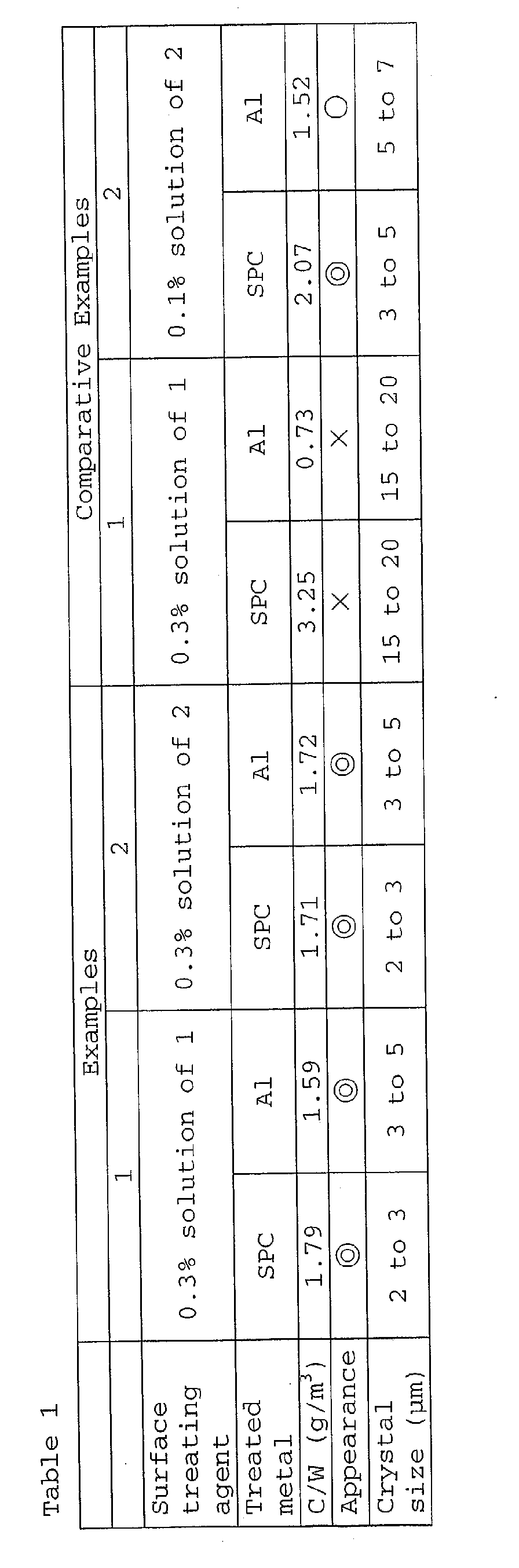
- the weight of the obtained test plate is represented by 1 ⁇ (g), and the weight after peeling the conversion coating from the test plate by the following method is represented by 2 ⁇ (g). Their difference (1 ⁇ -2 ⁇ ) (g) was divided by the surface area of the test plate to obtain this value. The results are shown in Table 1.
- the zinc phosphate-containing surface conditioning agent of the present invention has good stability in a liquid state as compared with conventional surface conditioning agents, whereby in the next step i.e. the zinc phosphate conversion coating step, a uniform dense zinc phosphate conversion coating free from irregularities, can be obtained.
Landscapes
- Chemical & Material Sciences (AREA)
- General Chemical & Material Sciences (AREA)
- Chemical Kinetics & Catalysis (AREA)
- Engineering & Computer Science (AREA)
- Materials Engineering (AREA)
- Mechanical Engineering (AREA)
- Metallurgy (AREA)
- Organic Chemistry (AREA)
- Chemical Treatment Of Metals (AREA)
Abstract
Description
- 1. Stability of the surface conditioning liquid The surface conditioning liquids of Examples 1 and 2 were set in a constant temperature vessel of 50°C, and an accelerated test for stability with time was carried out, whereby even upon expiration of one month, no precipitation or no viscosity increase was observed, and also no change in the particle size distribution was observed. Thus, these surface conditioning liquids were found to be excellent in stability.
- 2. Conversion property of the zinc phosphate coating
Claims (4)
- A zinc phosphate-containing surface conditioning agent to be used for surface conditioning as pretreatment for zinc phosphate conversion coating of a metallic material, which contains from 500 to 20,000 ppm of zinc phosphate and which has a pH of from 3 to 11, wherein said zinc phosphate has an average particle size of at most 3 µm and D90 of at most 4 µm.
- A process for producing a phosphate conversiontreated steel plate, which comprises immersing a metallic material in the zinc phosphate-containing surface conditioning agent as defined in Claim 1, followed by phosphate conversion treatment.
- A process for producing a painted steel plate, which comprises immersing a metallic material in the zinc phosphate-containing surface conditioning agent as defined in Claim 1, followed by phosphate conversion treatment and further by painting.
- A zinc phosphate dispersion to be used for preparation of a zinc phosphate-containing surface conditioning agent to be used for surface conditioning as pretreatment for zinc phosphate conversion coating of a metallic material, which contains from 0.5 to 50 wt% of zinc phosphate and which has a pH of from 3 to 11, wherein said zinc phosphate has an average particle size of at most 3 µm and D90 of at most 4 µm.
Applications Claiming Priority (2)
| Application Number | Priority Date | Filing Date | Title |
|---|---|---|---|
| JP2002172373 | 2002-06-13 | ||
| JP2002172373 | 2002-06-13 |
Publications (2)
| Publication Number | Publication Date |
|---|---|
| EP1378586A1 true EP1378586A1 (en) | 2004-01-07 |
| EP1378586B1 EP1378586B1 (en) | 2007-02-14 |
Family
ID=29720196
Family Applications (1)
| Application Number | Title | Priority Date | Filing Date |
|---|---|---|---|
| EP03013178A Revoked EP1378586B1 (en) | 2002-06-13 | 2003-06-11 | Zinc phosphate-containing conditioning agent for phosphate conversion-treatment of steel plate and corresponding product |
Country Status (6)
| Country | Link |
|---|---|
| US (1) | US20040011429A1 (en) |
| EP (1) | EP1378586B1 (en) |
| KR (1) | KR20030096065A (en) |
| CN (1) | CN100430518C (en) |
| AT (1) | ATE353987T1 (en) |
| DE (1) | DE60311708D1 (en) |
Cited By (16)
| Publication number | Priority date | Publication date | Assignee | Title |
|---|---|---|---|---|
| EP1566465A1 (en) | 2004-02-20 | 2005-08-24 | Nippon Paint Co., Ltd. | Concentrated solution for preparing a surface conditioner, surface conditioner and method of surface conditioning |
| EP1566466A1 (en) | 2004-02-20 | 2005-08-24 | Nippon Paint Co., Ltd. | Surface conditioner and method of surface conditioning |
| JP2005264326A (en) * | 2004-02-20 | 2005-09-29 | Nippon Paint Co Ltd | Surface conditioning agent and surface conditioning method |
| JP2005264327A (en) * | 2004-02-20 | 2005-09-29 | Nippon Paint Co Ltd | Concentrated liquid for preparing surface conditioner, surface conditioner, and surface conditioning method |
| WO2007117043A1 (en) * | 2006-04-07 | 2007-10-18 | Nippon Paint Co., Ltd. | Surface conditioning composition, method for producing the same, and surface conditioning method |
| WO2007117044A1 (en) | 2006-04-07 | 2007-10-18 | Nippon Paint Co., Ltd. | Surface conditioning composition, method for producing the same, and surface conditioning method |
| EP1930473A4 (en) * | 2005-08-19 | 2009-06-24 | Nippon Paint Co Ltd | SURFACE CONDITIONING COMPOSITION AND METHOD FOR PRODUCING THE SAME, AND SURFACE CONDITIONING METHOD |
| EP1930474A4 (en) * | 2005-08-19 | 2009-06-24 | Nippon Paint Co Ltd | SURFACE CONDITIONING COMPOSITION, METHOD OF MANUFACTURING THE SAME, AND SURFACE CONDITIONING METHOD |
| EP1930475A4 (en) * | 2005-08-19 | 2009-07-29 | Nippon Paint Co Ltd | SURFACE CONDITIONING COMPOSITION, METHOD OF MANUFACTURING THE SAME, AND SURFACE CONDITIONING METHOD |
| DE102008017523A1 (en) * | 2008-03-20 | 2009-09-24 | Henkel Ag & Co. Kgaa | Optimized electrocoating of assembled and partially pre-phosphated components |
| US8043531B2 (en) | 2005-07-29 | 2011-10-25 | Nippon Paint Co., Ltd. | Surface conditioner and surface conditioning method |
| WO2015035124A1 (en) * | 2013-09-05 | 2015-03-12 | Ppg Industries Ohio, Inc. | Activating rinse and method for treating a metal substrate |
| WO2019238573A1 (en) * | 2018-06-11 | 2019-12-19 | Henkel Ag & Co. Kgaa | Aqueous dispersion for activating a metal surface, and method for the phosphatisation thereof |
| US11518960B2 (en) | 2016-08-24 | 2022-12-06 | Ppg Industries Ohio, Inc. | Alkaline molybdenum cation and phosphonate-containing cleaning composition |
| CZ309976B6 (en) * | 2022-10-31 | 2024-03-27 | České vysoké učení technické v Praze | A method of pre-treatment of the surface of steel components |
| US12312694B2 (en) | 2018-08-17 | 2025-05-27 | Jfe Steel Corporation | Production method for treatment solution for forming insulating coating, production method for steel sheet having insulating coating, and production apparatus for treatment solution for forming insulating coating |
Families Citing this family (22)
| Publication number | Priority date | Publication date | Assignee | Title |
|---|---|---|---|---|
| US20060042726A1 (en) * | 2004-09-02 | 2006-03-02 | General Electric Company | Non-chrome passivation of steel |
| US20060113005A1 (en) * | 2004-11-30 | 2006-06-01 | Honda Motor Co., Ltd | Method for surface treatment of aluminum alloy |
| JP4645470B2 (en) * | 2006-02-20 | 2011-03-09 | 住友金属工業株式会社 | Zinc-based plated steel sheet with excellent lubricity and adhesion and method for producing the same |
| EP1988189B1 (en) * | 2006-02-20 | 2014-03-12 | Nippon Steel & Sumitomo Metal Corporation | Process for producing hot-dip galvanized steel sheet with zinc phosphate coat |
| CN101092693B (en) * | 2007-07-03 | 2010-05-19 | 启东尤希路化学工业有限公司 | Anti-macular, eco-friendly wet leveling fluid |
| JP5462467B2 (en) * | 2008-10-31 | 2014-04-02 | 日本パーカライジング株式会社 | Chemical treatment solution for metal material and treatment method |
| JP5313027B2 (en) * | 2009-04-20 | 2013-10-09 | ブリヂストンスポーツ株式会社 | Golf club shaft |
| WO2013118735A1 (en) | 2012-02-06 | 2013-08-15 | 株式会社Dnpファインケミカル | Pigment dispersion liquid for inkjet inks, active energy beam-curable inkjet ink, and print |
| DE102014105226A1 (en) | 2014-04-11 | 2015-10-15 | Thyssenkrupp Ag | Method for activating metal surfaces to be phosphated, preferably galvanized sheet steel |
| EP3207003B1 (en) * | 2014-10-15 | 2023-11-15 | Liquid Fertiliser PTY Ltd. | Stable aqueous dispersions of zinc phosphates |
| US11643370B2 (en) | 2014-10-15 | 2023-05-09 | Liquid Fertiliser Pty Ltd | Stable aqueous dispersions of zinc phosphates |
| EP3396020B1 (en) | 2015-12-25 | 2021-04-07 | Nihon Parkerizing Co., Ltd. | Surface-conditioning agent, as well as magnesium member or magnesium alloy material with film, and manufacturing method therefor |
| CN106380900A (en) * | 2016-08-31 | 2017-02-08 | 立邦涂料(重庆)化工有限公司 | Liquid surface adjusting agent and preparing method thereof |
| CN106521475B (en) * | 2016-11-11 | 2020-04-21 | 武汉钢铁有限公司 | Liquid surface regulator for coating and preparation method thereof |
| CN107841742A (en) * | 2017-11-20 | 2018-03-27 | 湖南金裕环保科技有限公司 | Efficient liquid surface conditioner, its preparation method and application method |
| CN107937901B (en) * | 2017-11-28 | 2019-12-06 | 武汉钢铁有限公司 | Liquid surface regulator capable of improving film-forming performance of phosphating film and preparation method thereof |
| CN108251830B (en) * | 2018-02-02 | 2020-09-08 | 上海耀岩化学品有限公司 | Surface conditioner containing manganese phosphate |
| MX2022003250A (en) | 2019-09-19 | 2022-04-27 | Henkel Ag & Co Kgaa | LIGHT-CURING (MET)ACRYLATE COMPOSITIONS. |
| WO2021055869A1 (en) | 2019-09-19 | 2021-03-25 | Henkel IP & Holding GmbH | Photocurable (meth)acrylate compositions |
| KR102349154B1 (en) * | 2019-12-17 | 2022-01-10 | 주식회사 포스코 | CONVERSION COATING COMPOSITION FOR Zn-Al-Mg ALLOY PLATED STEEL SHEET AND Zn-Al-Mg ALLOY PLATED STEEL SHEET |
| CN113174592B (en) * | 2021-04-20 | 2021-12-03 | 北京科技大学 | Preparation and application of coating for improving biocompatibility of medical zinc/zinc alloy surface |
| CN115960592B (en) * | 2021-10-08 | 2024-03-22 | 中国石油化工股份有限公司 | Foaming agent composition for thermal recovery plugging of thickened oil and preparation method and application thereof |
Citations (4)
| Publication number | Priority date | Publication date | Assignee | Title |
|---|---|---|---|---|
| US3395052A (en) * | 1963-09-30 | 1968-07-30 | Zawata Iron & Steel Co Ltd | Pretreating process for phosphatetreating steel sheets and plated steel sheets |
| WO2001012341A1 (en) * | 1999-08-16 | 2001-02-22 | Henkel Corporation | Process for forming a phosphate conversion coating on metal |
| US6214132B1 (en) * | 1997-03-07 | 2001-04-10 | Henkel Corporation | Conditioning metal surfaces prior to phosphate conversion coating |
| US6361623B1 (en) * | 1997-06-13 | 2002-03-26 | Henkel Corporation | Method for phosphatizing iron and steel |
Family Cites Families (3)
| Publication number | Priority date | Publication date | Assignee | Title |
|---|---|---|---|---|
| ES2006347A6 (en) * | 1988-03-03 | 1989-04-16 | Colores Hispania | A corrosion inhibiting pigment and a process for the manufacturing thereof. |
| JP3451334B2 (en) * | 1997-03-07 | 2003-09-29 | 日本パーカライジング株式会社 | Pretreatment liquid for surface conditioning before phosphate conversion treatment of metal and surface conditioning method |
| US6478860B1 (en) * | 1998-07-21 | 2002-11-12 | Henkel Corporation | Conditioning metal surfaces before phosphating them |
-
2003
- 2003-06-11 AT AT03013178T patent/ATE353987T1/en not_active IP Right Cessation
- 2003-06-11 EP EP03013178A patent/EP1378586B1/en not_active Revoked
- 2003-06-11 DE DE60311708T patent/DE60311708D1/en not_active Expired - Lifetime
- 2003-06-12 KR KR10-2003-0038011A patent/KR20030096065A/en not_active Withdrawn
- 2003-06-12 US US10/459,575 patent/US20040011429A1/en not_active Abandoned
- 2003-06-13 CN CNB031430287A patent/CN100430518C/en not_active Expired - Lifetime
Patent Citations (4)
| Publication number | Priority date | Publication date | Assignee | Title |
|---|---|---|---|---|
| US3395052A (en) * | 1963-09-30 | 1968-07-30 | Zawata Iron & Steel Co Ltd | Pretreating process for phosphatetreating steel sheets and plated steel sheets |
| US6214132B1 (en) * | 1997-03-07 | 2001-04-10 | Henkel Corporation | Conditioning metal surfaces prior to phosphate conversion coating |
| US6361623B1 (en) * | 1997-06-13 | 2002-03-26 | Henkel Corporation | Method for phosphatizing iron and steel |
| WO2001012341A1 (en) * | 1999-08-16 | 2001-02-22 | Henkel Corporation | Process for forming a phosphate conversion coating on metal |
Non-Patent Citations (2)
| Title |
|---|
| MIZNO H: "phosphate treatment of steel sheet and galvanized steel", CHEMICAL ABSTRACTS + INDEXES, AMERICAN CHEMICAL SOCIETY. COLUMBUS, US, vol. 84, no. 22, 31 May 1976 (1976-05-31), pages 239, XP002135087, ISSN: 0009-2258 * |
| SORKIN G N: "Possibility of activating a metal surface in a suspension of sludge from zinc phosphate baths", CHEMICAL ABSTRACTS + INDEXES, AMERICAN CHEMICAL SOCIETY. COLUMBUS, US, vol. 96, no. 24, 14 June 1982 (1982-06-14), pages 265, XP002135088, ISSN: 0009-2258 * |
Cited By (30)
| Publication number | Priority date | Publication date | Assignee | Title |
|---|---|---|---|---|
| EP1566465A1 (en) | 2004-02-20 | 2005-08-24 | Nippon Paint Co., Ltd. | Concentrated solution for preparing a surface conditioner, surface conditioner and method of surface conditioning |
| EP1566466A1 (en) | 2004-02-20 | 2005-08-24 | Nippon Paint Co., Ltd. | Surface conditioner and method of surface conditioning |
| JP2005264326A (en) * | 2004-02-20 | 2005-09-29 | Nippon Paint Co Ltd | Surface conditioning agent and surface conditioning method |
| JP2005264327A (en) * | 2004-02-20 | 2005-09-29 | Nippon Paint Co Ltd | Concentrated liquid for preparing surface conditioner, surface conditioner, and surface conditioning method |
| US7208054B2 (en) | 2004-02-20 | 2007-04-24 | Nippon Paint Co., Ltd. | Concentrated solution for preparing a surface conditioner, surface conditioner and method of surface conditioning |
| US7767111B2 (en) | 2004-02-20 | 2010-08-03 | Nippon Paint Co., Ltd. | Surface conditioner and method of surface conditioning |
| US8043531B2 (en) | 2005-07-29 | 2011-10-25 | Nippon Paint Co., Ltd. | Surface conditioner and surface conditioning method |
| EP1930473A4 (en) * | 2005-08-19 | 2009-06-24 | Nippon Paint Co Ltd | SURFACE CONDITIONING COMPOSITION AND METHOD FOR PRODUCING THE SAME, AND SURFACE CONDITIONING METHOD |
| EP1930474A4 (en) * | 2005-08-19 | 2009-06-24 | Nippon Paint Co Ltd | SURFACE CONDITIONING COMPOSITION, METHOD OF MANUFACTURING THE SAME, AND SURFACE CONDITIONING METHOD |
| EP1930475A4 (en) * | 2005-08-19 | 2009-07-29 | Nippon Paint Co Ltd | SURFACE CONDITIONING COMPOSITION, METHOD OF MANUFACTURING THE SAME, AND SURFACE CONDITIONING METHOD |
| AU2006280671B2 (en) * | 2005-08-19 | 2011-01-20 | Nippon Paint Co., Ltd. | Surface-conditioning composition, method for production thereof, and surface conditioning method |
| WO2007117044A1 (en) | 2006-04-07 | 2007-10-18 | Nippon Paint Co., Ltd. | Surface conditioning composition, method for producing the same, and surface conditioning method |
| WO2007117043A1 (en) * | 2006-04-07 | 2007-10-18 | Nippon Paint Co., Ltd. | Surface conditioning composition, method for producing the same, and surface conditioning method |
| US10072338B2 (en) | 2006-04-07 | 2018-09-11 | Chemetall Gmbh | Surface conditioning composition, method for producing the same, and surface conditioning method |
| US9096935B2 (en) | 2006-04-07 | 2015-08-04 | Chemetall Gmbh | Surface conditioning composition, method for producing the same, and surface conditioning method |
| DE102008017523A1 (en) * | 2008-03-20 | 2009-09-24 | Henkel Ag & Co. Kgaa | Optimized electrocoating of assembled and partially pre-phosphated components |
| WO2009115485A1 (en) * | 2008-03-20 | 2009-09-24 | Henkel Ag & Co. Kgaa | Optimized electrocoating of assembled and partly prephosphated components |
| CN105518181A (en) * | 2013-09-05 | 2016-04-20 | Ppg工业俄亥俄公司 | Activation lotion and method for treating metal substrates |
| US9255332B2 (en) | 2013-09-05 | 2016-02-09 | Ppg Industries Ohio, Inc. | Activating rinse and method for treating a substrate |
| RU2634527C2 (en) * | 2013-09-05 | 2017-10-31 | Ппг Индастриз Огайо, Инк. | Activating washing fluid and method for processing metal substrate |
| WO2015035124A1 (en) * | 2013-09-05 | 2015-03-12 | Ppg Industries Ohio, Inc. | Activating rinse and method for treating a metal substrate |
| EP3851555A1 (en) * | 2013-09-05 | 2021-07-21 | PPG Industries Ohio, Inc. | Activating rinse and method for treating a metal substrate |
| CN115011958A (en) * | 2013-09-05 | 2022-09-06 | Ppg工业俄亥俄公司 | Activating rinse and method for treating metal substrates |
| US11518960B2 (en) | 2016-08-24 | 2022-12-06 | Ppg Industries Ohio, Inc. | Alkaline molybdenum cation and phosphonate-containing cleaning composition |
| WO2019238573A1 (en) * | 2018-06-11 | 2019-12-19 | Henkel Ag & Co. Kgaa | Aqueous dispersion for activating a metal surface, and method for the phosphatisation thereof |
| EP3802915B1 (en) | 2018-06-11 | 2024-11-20 | Henkel AG & Co. KGaA | Aqueous dispersion for activating a metal surface and method for its phosphating |
| US12203172B2 (en) | 2018-06-11 | 2025-01-21 | Henkel Ag & Co. Kgaa | Aqueous dispersion for activating a metal surface and method for the phosphating thereof |
| US12312694B2 (en) | 2018-08-17 | 2025-05-27 | Jfe Steel Corporation | Production method for treatment solution for forming insulating coating, production method for steel sheet having insulating coating, and production apparatus for treatment solution for forming insulating coating |
| CZ309976B6 (en) * | 2022-10-31 | 2024-03-27 | České vysoké učení technické v Praze | A method of pre-treatment of the surface of steel components |
| EP4368748A1 (en) * | 2022-10-31 | 2024-05-15 | Ceske vysoke uceni technicke v Praze | Method of surface pre-treatment of steel components |
Also Published As
| Publication number | Publication date |
|---|---|
| EP1378586B1 (en) | 2007-02-14 |
| CN100430518C (en) | 2008-11-05 |
| CN1470672A (en) | 2004-01-28 |
| US20040011429A1 (en) | 2004-01-22 |
| DE60311708D1 (en) | 2007-03-29 |
| ATE353987T1 (en) | 2007-03-15 |
| KR20030096065A (en) | 2003-12-24 |
Similar Documents
| Publication | Publication Date | Title |
|---|---|---|
| EP1378586B1 (en) | Zinc phosphate-containing conditioning agent for phosphate conversion-treatment of steel plate and corresponding product | |
| EP1566466B1 (en) | Surface conditioner and method of surface conditioning | |
| AU2002220566B8 (en) | Method for pretreating and coating metal surfaces, prior to forming, with a paint-like coating and use of substrates so coated | |
| JP4357527B2 (en) | Nitrogen-containing polymer for metal surface treatment | |
| US7063735B2 (en) | Coating composition | |
| KR20050114219A (en) | Polymers containing carboxylate for the treatment of metallic surfaces | |
| JP3864148B2 (en) | Zinc phosphate-containing surface conditioner, phosphate chemical conversion steel sheet and coated steel sheet, and zinc phosphate dispersion | |
| GB2041987A (en) | Phosphating solution for treating metals | |
| JPH01123080A (en) | Zinc phosphate type film treatment method and solution, and replenishing agent | |
| UA44742C2 (en) | COATING COMPOSITION, PACKAGING, COATING BASE, METHOD OF OBTAINING THE BASIS AND METHOD OF OBTAINING COMPOSITION OF COATING | |
| CN103619757B (en) | Coating composition based on zirconium and coating process | |
| AU2014315120B2 (en) | Activating rinse and method for treating a metal substrate | |
| US4170671A (en) | Method for treatment of metal surface | |
| SE458206B (en) | SET TO CREATE A CHEMICAL CONVERSION COATING OF YEARS AND / OR ZINC SURFACES, AND Aqueous, Acidic Zinc Phosphate Solution | |
| CN1312214C (en) | Polymers containing carboxylate for the treatment of metallic surfaces | |
| EP1230033A1 (en) | Process for forming a phosphate conversion coating on metal | |
| WO2004063414A2 (en) | A coating composition | |
| CA2594899A1 (en) | Stable, non-chrome, thin-film organic passivates | |
| GB1583103A (en) | Method for the treatment of metal surfaces | |
| US4201592A (en) | Plating-inhibitor for partially plating steel plate with molten metal | |
| WO2007067972A1 (en) | Process of coating metals prior to cold forming | |
| US5470613A (en) | Composition and method of forming a black no-rinse conversion coating on metal surfaces | |
| JP2003013263A (en) | Anti-rust pigment dispersion, method for producing the same, and anti-rust paint | |
| Sankaranarayanan et al. | Influence of hexadecyl dithiocarbamate on phosphate surface chemical conversion coatings on mild steel | |
| JP2003012996A (en) | Anti-rust pigment dispersion, method for producing the same, and anti-rust paint |
Legal Events
| Date | Code | Title | Description |
|---|---|---|---|
| PUAI | Public reference made under article 153(3) epc to a published international application that has entered the european phase |
Free format text: ORIGINAL CODE: 0009012 |
|
| AK | Designated contracting states |
Kind code of ref document: A1 Designated state(s): AT BE BG CH CY CZ DE DK EE ES FI FR GB GR HU IE IT LI LU MC NL PT RO SE SI SK TR |
|
| AX | Request for extension of the european patent |
Extension state: AL LT LV MK |
|
| 17P | Request for examination filed |
Effective date: 20040130 |
|
| AKX | Designation fees paid |
Designated state(s): AT BE BG CH CY CZ DE DK EE ES FI FR GB GR HU IE IT LI LU MC NL PT RO SE SI SK TR |
|
| 17Q | First examination report despatched |
Effective date: 20050201 |
|
| GRAP | Despatch of communication of intention to grant a patent |
Free format text: ORIGINAL CODE: EPIDOSNIGR1 |
|
| GRAS | Grant fee paid |
Free format text: ORIGINAL CODE: EPIDOSNIGR3 |
|
| GRAA | (expected) grant |
Free format text: ORIGINAL CODE: 0009210 |
|
| AK | Designated contracting states |
Kind code of ref document: B1 Designated state(s): AT BE BG CH CY CZ DE DK EE ES FI FR GB GR HU IE IT LI LU MC NL PT RO SE SI SK TR |
|
| PG25 | Lapsed in a contracting state [announced via postgrant information from national office to epo] |
Ref country code: SI Free format text: LAPSE BECAUSE OF FAILURE TO SUBMIT A TRANSLATION OF THE DESCRIPTION OR TO PAY THE FEE WITHIN THE PRESCRIBED TIME-LIMIT Effective date: 20070214 Ref country code: NL Free format text: LAPSE BECAUSE OF FAILURE TO SUBMIT A TRANSLATION OF THE DESCRIPTION OR TO PAY THE FEE WITHIN THE PRESCRIBED TIME-LIMIT Effective date: 20070214 Ref country code: AT Free format text: LAPSE BECAUSE OF FAILURE TO SUBMIT A TRANSLATION OF THE DESCRIPTION OR TO PAY THE FEE WITHIN THE PRESCRIBED TIME-LIMIT Effective date: 20070214 Ref country code: DK Free format text: LAPSE BECAUSE OF FAILURE TO SUBMIT A TRANSLATION OF THE DESCRIPTION OR TO PAY THE FEE WITHIN THE PRESCRIBED TIME-LIMIT Effective date: 20070214 Ref country code: BE Free format text: LAPSE BECAUSE OF FAILURE TO SUBMIT A TRANSLATION OF THE DESCRIPTION OR TO PAY THE FEE WITHIN THE PRESCRIBED TIME-LIMIT Effective date: 20070214 Ref country code: CH Free format text: LAPSE BECAUSE OF FAILURE TO SUBMIT A TRANSLATION OF THE DESCRIPTION OR TO PAY THE FEE WITHIN THE PRESCRIBED TIME-LIMIT Effective date: 20070214 Ref country code: LI Free format text: LAPSE BECAUSE OF FAILURE TO SUBMIT A TRANSLATION OF THE DESCRIPTION OR TO PAY THE FEE WITHIN THE PRESCRIBED TIME-LIMIT Effective date: 20070214 Ref country code: FI Free format text: LAPSE BECAUSE OF FAILURE TO SUBMIT A TRANSLATION OF THE DESCRIPTION OR TO PAY THE FEE WITHIN THE PRESCRIBED TIME-LIMIT Effective date: 20070214 |
|
| REG | Reference to a national code |
Ref country code: GB Ref legal event code: FG4D |
|
| REG | Reference to a national code |
Ref country code: CH Ref legal event code: EP |
|
| REF | Corresponds to: |
Ref document number: 60311708 Country of ref document: DE Date of ref document: 20070329 Kind code of ref document: P |
|
| REG | Reference to a national code |
Ref country code: IE Ref legal event code: FG4D |
|
| PG25 | Lapsed in a contracting state [announced via postgrant information from national office to epo] |
Ref country code: SE Free format text: LAPSE BECAUSE OF FAILURE TO SUBMIT A TRANSLATION OF THE DESCRIPTION OR TO PAY THE FEE WITHIN THE PRESCRIBED TIME-LIMIT Effective date: 20070514 |
|
| PG25 | Lapsed in a contracting state [announced via postgrant information from national office to epo] |
Ref country code: BG Free format text: LAPSE BECAUSE OF EXPIRATION OF PROTECTION Effective date: 20070515 |
|
| PG25 | Lapsed in a contracting state [announced via postgrant information from national office to epo] |
Ref country code: ES Free format text: LAPSE BECAUSE OF FAILURE TO SUBMIT A TRANSLATION OF THE DESCRIPTION OR TO PAY THE FEE WITHIN THE PRESCRIBED TIME-LIMIT Effective date: 20070525 |
|
| PG25 | Lapsed in a contracting state [announced via postgrant information from national office to epo] |
Ref country code: PT Free format text: LAPSE BECAUSE OF FAILURE TO SUBMIT A TRANSLATION OF THE DESCRIPTION OR TO PAY THE FEE WITHIN THE PRESCRIBED TIME-LIMIT Effective date: 20070716 |
|
| NLV1 | Nl: lapsed or annulled due to failure to fulfill the requirements of art. 29p and 29m of the patents act | ||
| REG | Reference to a national code |
Ref country code: CH Ref legal event code: PL |
|
| EN | Fr: translation not filed | ||
| PLBI | Opposition filed |
Free format text: ORIGINAL CODE: 0009260 |
|
| PLAB | Opposition data, opponent's data or that of the opponent's representative modified |
Free format text: ORIGINAL CODE: 0009299OPPO |
|
| PG25 | Lapsed in a contracting state [announced via postgrant information from national office to epo] |
Ref country code: SK Free format text: LAPSE BECAUSE OF FAILURE TO SUBMIT A TRANSLATION OF THE DESCRIPTION OR TO PAY THE FEE WITHIN THE PRESCRIBED TIME-LIMIT Effective date: 20070214 |
|
| PLAX | Notice of opposition and request to file observation + time limit sent |
Free format text: ORIGINAL CODE: EPIDOSNOBS2 |
|
| 26 | Opposition filed |
Opponent name: HENKEL KGAA Effective date: 20071112 |
|
| R26 | Opposition filed (corrected) |
Opponent name: HENKEL KGAA Effective date: 20071112 |
|
| PG25 | Lapsed in a contracting state [announced via postgrant information from national office to epo] |
Ref country code: RO Free format text: LAPSE BECAUSE OF FAILURE TO SUBMIT A TRANSLATION OF THE DESCRIPTION OR TO PAY THE FEE WITHIN THE PRESCRIBED TIME-LIMIT Effective date: 20070214 |
|
| PG25 | Lapsed in a contracting state [announced via postgrant information from national office to epo] |
Ref country code: DE Free format text: LAPSE BECAUSE OF FAILURE TO SUBMIT A TRANSLATION OF THE DESCRIPTION OR TO PAY THE FEE WITHIN THE PRESCRIBED TIME-LIMIT Effective date: 20070515 Ref country code: MC Free format text: LAPSE BECAUSE OF NON-PAYMENT OF DUE FEES Effective date: 20070630 |
|
| PLBB | Reply of patent proprietor to notice(s) of opposition received |
Free format text: ORIGINAL CODE: EPIDOSNOBS3 |
|
| PG25 | Lapsed in a contracting state [announced via postgrant information from national office to epo] |
Ref country code: GR Free format text: LAPSE BECAUSE OF FAILURE TO SUBMIT A TRANSLATION OF THE DESCRIPTION OR TO PAY THE FEE WITHIN THE PRESCRIBED TIME-LIMIT Effective date: 20070515 Ref country code: IT Free format text: LAPSE BECAUSE OF FAILURE TO SUBMIT A TRANSLATION OF THE DESCRIPTION OR TO PAY THE FEE WITHIN THE PRESCRIBED TIME-LIMIT Effective date: 20070214 Ref country code: FR Free format text: LAPSE BECAUSE OF FAILURE TO SUBMIT A TRANSLATION OF THE DESCRIPTION OR TO PAY THE FEE WITHIN THE PRESCRIBED TIME-LIMIT Effective date: 20071005 |
|
| PLAB | Opposition data, opponent's data or that of the opponent's representative modified |
Free format text: ORIGINAL CODE: 0009299OPPO |
|
| PG25 | Lapsed in a contracting state [announced via postgrant information from national office to epo] |
Ref country code: IE Free format text: LAPSE BECAUSE OF NON-PAYMENT OF DUE FEES Effective date: 20070611 |
|
| R26 | Opposition filed (corrected) |
Opponent name: HENKEL AG & CO. KGAA Effective date: 20071112 |
|
| PGFP | Annual fee paid to national office [announced via postgrant information from national office to epo] |
Ref country code: CZ Payment date: 20080509 Year of fee payment: 6 |
|
| PG25 | Lapsed in a contracting state [announced via postgrant information from national office to epo] |
Ref country code: FR Free format text: LAPSE BECAUSE OF FAILURE TO SUBMIT A TRANSLATION OF THE DESCRIPTION OR TO PAY THE FEE WITHIN THE PRESCRIBED TIME-LIMIT Effective date: 20070214 |
|
| PGFP | Annual fee paid to national office [announced via postgrant information from national office to epo] |
Ref country code: GB Payment date: 20080611 Year of fee payment: 6 |
|
| PG25 | Lapsed in a contracting state [announced via postgrant information from national office to epo] |
Ref country code: EE Free format text: LAPSE BECAUSE OF FAILURE TO SUBMIT A TRANSLATION OF THE DESCRIPTION OR TO PAY THE FEE WITHIN THE PRESCRIBED TIME-LIMIT Effective date: 20070214 |
|
| PG25 | Lapsed in a contracting state [announced via postgrant information from national office to epo] |
Ref country code: CY Free format text: LAPSE BECAUSE OF FAILURE TO SUBMIT A TRANSLATION OF THE DESCRIPTION OR TO PAY THE FEE WITHIN THE PRESCRIBED TIME-LIMIT Effective date: 20070214 |
|
| PG25 | Lapsed in a contracting state [announced via postgrant information from national office to epo] |
Ref country code: LU Free format text: LAPSE BECAUSE OF NON-PAYMENT OF DUE FEES Effective date: 20070611 |
|
| PG25 | Lapsed in a contracting state [announced via postgrant information from national office to epo] |
Ref country code: HU Free format text: LAPSE BECAUSE OF FAILURE TO SUBMIT A TRANSLATION OF THE DESCRIPTION OR TO PAY THE FEE WITHIN THE PRESCRIBED TIME-LIMIT Effective date: 20070815 Ref country code: TR Free format text: LAPSE BECAUSE OF FAILURE TO SUBMIT A TRANSLATION OF THE DESCRIPTION OR TO PAY THE FEE WITHIN THE PRESCRIBED TIME-LIMIT Effective date: 20070214 |
|
| RDAF | Communication despatched that patent is revoked |
Free format text: ORIGINAL CODE: EPIDOSNREV1 |
|
| PG25 | Lapsed in a contracting state [announced via postgrant information from national office to epo] |
Ref country code: CZ Free format text: LAPSE BECAUSE OF NON-PAYMENT OF DUE FEES Effective date: 20090611 |
|
| RDAG | Patent revoked |
Free format text: ORIGINAL CODE: 0009271 |
|
| STAA | Information on the status of an ep patent application or granted ep patent |
Free format text: STATUS: PATENT REVOKED |
|
| GBPC | Gb: european patent ceased through non-payment of renewal fee |
Effective date: 20090611 |
|
| 27W | Patent revoked |
Effective date: 20091023 |
|
| PG25 | Lapsed in a contracting state [announced via postgrant information from national office to epo] |
Ref country code: GB Free format text: LAPSE BECAUSE OF NON-PAYMENT OF DUE FEES Effective date: 20090611 |