[Technical Field]
The present invention relates to a method of detecting
inorganic phosphoric acids or pyrophosphates. Further, the
present invention relates to a method of simply detecting a
targeted nucleic acid in a sample with high sensitivity through
the detection described above, and in particular, a method for
discriminating a SNP.
[Background Art]
In recent years, techniques relating to gene information
have been actively developed. In a medical field, therapies
of diseases at the molecular level have been enabled by analyses
of a gene relating to the disease. Further, tailor made medical
cares corresponding to every patient has been also enabled by
gene diagnosis. In a pharmaceutical field, protein molecules
such as antibodies and hormones have been specified using gene
information, and utilized as a medicament. Also in
agricultural or food fields, many products in which gene
information is utilized have been manufactured.
Among such gene information, genetic polymorphisms are
particularly important. Similarly to variations of our faces
and body types, considerable part of the gene information also
varies each person to person. Among the differences in such
gene information, an alteration of the base sequence that is
present in a frequency of 1% or greater of the population is
referred to as a genetic polymorphism. Such genetic
polymorphism is mentioned as relating to causes of various
diseases, constitution, drug responsiveness, adverse
reactions by drugs, and the like as well as facial appearance
of each person. Currently, relationships between the genetic
polymorphisms and diseases have been rapidly investigated.
Among the genetic polymorphisms, SNP (Single Nucleotide
Polymorphism) has been particularly attracted the attention
in recent years. SNP refers to a genetic polymorphism
involving a difference in single base alone in the base sequence
of gene information. SNP is referred to as existing in human
genomic DNA by 2 to 3 million, and is readily utilized as a
marker of a genetic polymorphism. Thus, the application
thereof to the clinical field has been expected. At present,
as related techniques to SNPs, development of typing techniques
of SNPs in which a base is discriminated of the SNP site has
been performed, in addition to studies on identification of
a SNP site in a genome and on relationships between SNPs and
diseases, and the like.
In general, as a means to discriminate the difference
in a base sequence of a DNA, Sanger's (dideoxy) method, DNA
tip method or the like has been used. In Sanger's method, SNP
typing is executed through the amplification of a region to
be analyzed of a human gene by a PCR (polymerase chain reaction)
method followed by sequencing through reading the base sequence
of a desired position to directly determine the base sequence.
In the DNA tip method, a PCR product of a cDNA or an
oligonucleotide probe having 15 to 20 bases is immobilized on
a substrate, and thereto is hybridized a sample DNA which had
been labeled with fluorescence. By strictly controlling the
hybridization condition such as temperature and the like, SNP
is detected on the basis of the difference of affinity between
a probe and the sample DNA, i.e., by the difference in
fluorescent intensities.
Moreover, in an attempt to allow for large scale SNP
typing, JP-T (the term "JP-T" as used herein means a published
Japanese translation of PCT Patent Application) No. 10-510982
(TaqMan PCR method) and JP-T No. 2001-518805 (Invader method)
and the like have been disclosed. Diagrammic illustration of
the method disclosed in JP-T No. 10-510982 is shown in Fig.
1. In JP-T No. 10-510982, an oligonucleotide probe is provided
which includes a fluorescent molecule and a quencher molecule
capable of quenching the fluorescence of the fluorescent
molecule. An oligonucleotide probe is used which includes a
reporter molecule - quencher molecule pair which is to be
specifically annealed in a "downstream region" (i.e., in an
extending direction of the primer binding site) of a target
polynucleotide. These quencher molecule and reporter
molecule are arranged close enough with each other.
Accordingly, when the reporter molecule is thereby excited,
this excitation state energy is constantly transmitted to the
quencher molecule in a nonradioactive fashion. Thus, the
energy is quenched in a nonradioactive fashion, or emitted at
the frequency which is different from the luminescent frequency
of the reporter molecule. The probe is annealed with a template
during the chain extension by DNA polymerase, and this probe
is then digested by 5' → 3' exonuclease of the polymerase. As
a consequence of digestion of the probe, this reporter molecule
is effectively separated from the quencher molecule.
Accordingly, the quencher molecule can no longer get close
enough to the reporter molecule such that it can quench the
fluorescence of the reporter molecule. Therefore, the more
the probe is digested upon amplification, number of the
reporter molecules in the solution is increased, resulting in
increase of number of nonquenching reporter molecules, thereby
the fluorescent signal increasingly enhanced.
JP-T No. 2001-518805 discloses a method of detecting the
presence of a target nucleic acid molecule. Diagrammic
illustration of this method is shown in Fig. 2. A method is
disclosed which comprises providing: a structure-specific
nuclease, a source of a first target nucleic acid, said first
target nucleic acid having a first region, a second region
and a third region, wherein said first region is located
adjacent to and downstream from said second region and wherein
said second region is located adjacent to and downstream from
said third region; a first oligonucleotide having a 5' portion
and a 3' portion wherein said 5' portion of said first
oligonucleotide contains a sequence complementary to said
second region of said first target nucleic acid and wherein
said 3' portion of said first oligonucleotide contains a
sequence complementary to said third region of said first
target nucleic acid; a second oligonucleotide having a 5'
portion and a 3' portion wherein said 5' portion of said second
oligonucleotide contains a sequence complementary to said
first region of said first target nucleic acid and wherein said
3' portion of said second oligonucleotide contains a sequence
complementary to said second region of said first target
nucleic acid; a source of a second target nucleic acid, said
second target nucleic acid having a first region, a second
region and a third region, wherein said first region is located
adjacent to and downstream from said second region and wherein
said second region is located adjacent to and downstream from
said third region; a third oligonucleotide having a 5' portion
and a 3' portion wherein said 5' portion of said third
oligonucleotide contains a sequence complementary to said
second region of said second target nucleic acid and wherein
said 3' portion of said third oligonucleotide contains a
sequence complementary to said third region of said second
target nucleic acid; generating a first cleavage structure
wherein at least said 3' portion of said first oligonucleotide
is annealed to said first target nucleic acid and wherein at
least 5' portion of said second oligonucleotide is annealed
to said first target nucleic acid and wherein cleavage of said
first cleavage structure occurs via said structure-specific
nuclease thereby cleaving said first oligonucleotide to
generate a fourth oligonucleotide, said fourth
oligonucleotide having a 5' portion and a 3' portion wherein
said 5' portion of said fourth oligonucleotide contains a
sequence complementary to said first region of said second
target nucleic acid and wherein said 3' portion of said fourth
oligonucleotide contains a sequence complementary to said
second region of said second target nucleic acid; generating
a second cleavage structure wherein at least said 3' portion
of said third oligonucleotide is annealed to said second target
nucleic acid and wherein at least said 5' portion of said fourth
oligonucleotide is annealed to said second target nucleic acid
and wherein cleavage of said second cleavage structure occurs
to generate a fifth oligonucleotide, said fifth
oligonucleotide having a 3' hydroxyl group; and detecting said
fifth oligonucleotide.
However, any of these methods uses fluorescent labeling
for the probe, therefore, reagents and the like become very
expensive, and a light source for laser irradiation or the like
is required for detecting fluorescence, leading to size
enlargement of the equipment for the measurement. Accordingly,
there still exist many problems taking into account of the use
for clinical applications in medical institutions.
To the contrary, as a new method of determining a DNA
base sequence, JP-T No. 2001-506864 discloses a method in which
a pyrophosphate, which is generated concurrent with an
extension reaction of a DNA is converted into ATP (adenosine
triphosphate), and luminescence by luciferin is detected on
the basis of the action of luciferase using the ATP as a
substrate. Diagrammic illustration of this method is shown
in Fig. 3. Provided is method wherein an extension primer,
which hybridizes to a sample DNA immediately adjacent to the
target position is provided and the sample DNA and extension
primer are subjected to a polymerase reaction in the presence
of a deoxynucleotide or dideoxynucleotide whereby the
deoxynucleotide or dideoxynucleotide will only become
incorporated and release a pyrophosphate (PPi) if it is
complementary to the base in the target position, any release
of the PPi being detected enzymatically, different
deoxynucleotides or dideoxynucleotides being added either to
separate aliquouts of sample-primer mixture or successively
to an aliquot of the same sample-primer mixture and subjected
to the polymerase reaction to indicate which deoxynucleotide
or dideoxynucleotide is incorporated, characterized in that,
a PPi-detecting enzyme is included during the polymerase
reaction step, and that deoxyadenosine triphosphate (dATP) or
a dATP analog is used capable of acting as a substrate for
polymerase but not capable of acting as a substrate for said
PPi-detecting enzyme, instead of dATP or dideoxyadenosine
triphosphate (ddATP). In JP-T No. 2001-506864, there is
disclosed a method which advantageously permits a large scale
unelectrophoretic solid phase DNA sequencing, thereby making
successive determination of time-dependent progress of a
polymerization reaction possible.
However, also in this method, a large scale equipment
is required because detection by luminescence with luciferase
and the like is required, which was not suitable as a simplified
system for use in bed side at a hospital or use in drug supply.
In JP-A No. 63-49100, a method of measuring an inorganic
phosphoric acid is disclosed. According to this method, a
reaction including three steps involving an inorganic
phosphoric acid is utilized, and finally, oxidized
nicotinamide adenine dinucleotide (NAD+) is reduced to give
NADH, or oxidized nicotinamide adenine dinucleotide phosphate
(NADP+) is reduced to give NADPH. Amount of thus resulting
NAD(P)H is measured by ultraviolet absorption method or the
like. Because a reaction including three steps is used in this
method, many elementary steps of the reaction are involved.
Therefore, it is complicated to establish the reaction
condition for allowing the entire elementary steps proceed.
Further, it is not necessarily possible to predetermine an
efficient condition. Moreover, it is required that
comparatively large-scale equipment for the measurement such
as spectrophotometer is used. Thus, there also existed
problems involving lack of simpleness.
Moreover, similarly to the method described in the above
JP-A No. 63-49100, a method of detecting a targeted sample is
described in International Patent Publication pamphlet WO
00/04378 utilizing the reduction of a coenzyme NAD(P)+
concurrent with a reaction of the targeted sample. However,
since the targeted sample for detection therein is
L-phenylalanine, such a method is not applicable to the
detection of presence of a target nucleic acid molecule.
[Disclosure of the Invention]
An object of the present invention to solve the
conventional problems as described hereinabove. Thus, the
present invention provides a method of detecting an inorganic
phosphoric acid, a pyrophosphate and a nucleic acid by a rapid
and simple process, which enables detection with high
sensitivity. Also, the present invention provides a SNP
typing method which can put large quantity of SNP typing into
practice with high sensitivity and at a low cost.
The present invention provides a method of detecting an
inorganic phosphoric acid, which method comprises: a step of
subjecting a sample to a measurement system including
glyceraldehyde-3-phosphate, oxidized nicotinamide adenine
dinucleotide or oxidized nicotinamide adenine dinucleotide
phosphate, glyceraldehyde phosphate dehydrogenase, and an
electron mediator; and a step of measuring a current value in
the measurement system, wherein the current value indicates
the concentration of the inorganic phosphoric acid in the
sample.
In one embodiment, the electron mediator is at least one
selected from the group consisting of a ferricyanide,
1,2-naphthoquinone-4-sulfonate, 2,6-dichlorophenol
indophenol, dimethylbenzoquinone,
1-methoxy-5-methylphenazinium sulfate, methylene blue,
gallocyanine, thionine, phenazine methosulfate, and Meldola
Blue.
In one embodiment, the measurement system further
includes diaphorase.
In one embodiment, the measurement system further
includes adenosine diphosphate and phosphoglycerate kinase.
Further, the present invention provides a method of
detecting a pyrophosphate, which method comprises: a step of
converting the pyrophosphate in a sample into an inorganic
phosphoric acid; a step of subjecting the sample to a
measurement system including glyceraldehyde-3-phosphate,
oxidized nicotinamide adenine dinucleotide or oxidized
nicotinamide adenine dinucleotide phosphate, glyceraldehyde
phosphate dehydrogenase, and an electron mediator; and a step
of measuring a current value in the measurement system, wherein
the current value indicates the concentration of pyrophosphate
in the sample.
In one embodiment, the aforementioned conversion of the
pyrophosphate into an inorganic phosphoric acid is conducted
using pyrophosphatase.
Moreover, the present invention provides a method of
detecting a nucleic acid, which method comprises: a step of
subjecting a sample to a reaction system including a DNA probe
having a complementary sequence to the sequence of the above
nucleic acid, DNA polymerase and a deoxynucleotide, and
allowing extension of the above DNA probe whereby a
pyrophosphate produced concurrent with the extension reaction
of the above DNA probe; a step of converting the pyrophosphate
produced in the sample into an inorganic phosphoric acid; a
step of subjecting the sample to a measurement system including
glyceraldehyde-3-phosphate, oxidized nicotinamide adenine
dinucleotide or oxidized nicotinamide adenine dinucleotide
phosphate, glyceraldehyde phosphate dehydrogenase, and an
electron mediator; and a step of measuring a current value in
the measurement system, wherein the current value indicates
the concentration of the nucleic acid having a specified
sequence in the sample.
In one embodiment, the extension reaction of the
aforementioned DNA probe is a PCR reaction.
Furthermore, the present invention provides a method of
typing a SNP sequence of a DNA, which method comprises: a step
of subjecting a sample to a reaction system including a DNA
probe having a complementary sequence to the sequence of the
above DNA and having a SNP site, DNA polymerase and a
deoxynucleotide, and allowing extension of the above DNA probe
whereby a pyrophosphate produced concurrent with the extension
reaction of the above DNA probe; a step of converting the
pyrophosphate produced in the sample into an inorganic
phosphoric acid; a step of subjecting the sample to a
measurement system including glyceraldehyde-3-phosphate,
oxidized nicotinamide adenine dinucleotide or oxidized
nicotinamide adenine dinucleotide phosphate, glyceraldehyde
phosphate dehydrogenase, and an electron mediator; and a step
of measuring a current value in the measurement system, wherein
the current value indicates the presence of the DNA having a
specified sequence in the sample.
In one embodiment, the extension reaction of the
aforementioned DNA probe is a PCR reaction.
[Brief Description of the Drawings]
Fig. 1 is a diagrammic illustration showing a process
of SNP typing by TaqMan PCR method.
Fig. 2 is a diagrammic illustration showing a process
of SNP typing by Invader method.
Fig. 3 is a diagrammic illustration showing a process
of SNP typing by a pyrosequencing method.
Fig. 4 is a schematic drawing illustrating production
of pyrophosphate through the use of a SNP site matched probe.
Fig. 5 is a schematic drawing illustrating an aspect
through the use of a SNP site mismatched probe.
Fig. 6 is a graph showing the reaction time of detection
of phosphoric acid in Example 1.
Fig. 7 is a graph showing a relationship between the
concentration of phosphoric acid and the current value in
Example 1.
Fig. 8 is a graph showing a relationship between the
concentration of pyrophosphate and the current value in Example
3.
Fig. 9 is a schematic drawing illustrating an
illustrative system of the measurement equipment for measuring
the current value.
Fig. 10 is a graph showing the reaction time of detection
of pyrophosphate in Example 6.
Fig. 11 is a graph showing a relationship between the
concentration of pyrophosphate and the current value in Example
6.
[Best Mode for Carrying Out the Invention]
Embodiments of the present invention are explained
below.
(Embodiment 1)
In accordance with the embodiment 1 of the present
invention, quantitative detection of an inorganic phosphoric
acid is carried out in a simple manner using an enzymatic
reaction. The embodiment 1 of the present invention relates
to a method of detecting an inorganic phosphoric acid, which
method comprises: a step of subjecting a sample to a measurement
system including glyceraldehyde-3-phosphate, oxidized
nicotinamide adenine dinucleotide (NAD+) or oxidized
nicotinamide adenine dinucleotide phosphate (NADP+) ,
glyceraldehyde phosphate dehydrogenase, and an electron
mediator; and a step of measuring a current value in this
measurement system. The "measurement system" herein refers
to a series of reactions as a whole involving in a mechanism
relating to the detection of an inorganic phosphoric acid, and
a field where such a series of reactions are executed. In the
"measurement system", there exist components required for
carrying out such a series of reactions. The "measurement
system" can be usually provided in a solution form in which
the aforementioned components are dissolved in an appropriate
solvent (e.g., a buffer such as Tris-HCl buffer).
Glyceraldehyde phosphate dehydrogenase refers to an enzyme
that oxidatively phosphorylates glyceraldehyde-3-phosphate
with NAD+ or NADP+ as a coenzyme. This enzyme may be also
referred to herein as glyceraldehyde-3-phosphate
dehydrogenase.
The embodiment 1 of the present invention is explained
with reference to the reaction formula (I) through reaction
formula (IV) .
First, as represented by the reaction formula (I), an
inorganic phosphoric acid is subjected to a catalytic action
of glyceraldehyde-3-phosphate dehydrogenase and NAD(P)+
together with glyceraldehyde-3-phosphate thereby converted
into 1,3-bisphosphoglycerate. At the same time, NAD(P)+ is
reduced to give NAD(P)H.
Reaction formula (I)
inorganic phosphoric acid + glyceraldehyde-3-phosphate
+ NAD(P)+ 1,3-bisphosphoglycerate + NAD(P)H + H+
Next, by way of electron transfer from NAD ( P) H produced
in the reaction represented by the reaction formula (I), as
represented by the reaction formula (II), an oxidized form of
the electron mediator (Med(Ox) in the reaction formula (II))
is reduced to give a reduced form (Med(Re) in the reaction
formula (II)). At the same time, NAD ( P) H is oxidized to give
NAD(P)+.
Reaction formula (II)
NAD(P)H + Med(Ox) NAD(P)++ Med(Re)
This reaction proceeds spontaneously when an appropriate
electron mediator is used. The appropriate electron mediator
may be such an electron mediator that the oxidized form thereof
causes an oxidation reduction reaction with NAD(P)H, and the
reduced form thereby produced is electrochemically oxidized
at a working electrode to which electric potential of a certain
level or greater is applied. Examples of the electron mediator
which may be used in this embodiment include potassium
ferricyanide, thionine, 1-methoxy-5-methylphenazinium
methylsulfate, 2,6-dimethyl-P-benzoquinone, potassium
1,2-naphthoquinone-4-sulfonate, Meldola Blue, gallocyanine,
methylene blue, indigo carmine,
anthraquinone-1,5-disulfonate, safranine and the like.
However, the electron mediator is not limited thereto as long
as the oxidized form thereof causes an oxidation reduction
reaction with NAD(P)H, and the reduced form thereby produced
is electrochemically oxidized at a working electrode to which
electric potential of a certain level or greater is applied.
An enzyme which catalyzes the reaction represented by the
reaction formula (II) can be also used for promoting the
progress of the reaction. Examples of such an enzyme include
diaphorase.
Finally, as represented by the reaction formula (III),
the reduced form of the electron mediator which was produced
as a result of the reaction represented by the reaction formula
(II) is electrochemically oxidized at a working electrode to
which electric potential of a certain level or greater is
applied.
Reaction formula (III)
Med(Re) Med(Ox) + e-
This oxidation results in release of en electron, and
such release of an electron can be indicated as a current value.
Measurement of such a current value can be performed using a
general electrochemical detector.
More specifically, the measurement of the
electrochemical oxidation can be performed using a measurement
equipment system shown in Fig. 9. This measurement equipment
system is configured as follows. In the figure, 6 denotes a
glass cell having a stirrer 7 placed therein, which is fixed
on a stirrer machine 13. The glass cell 6 is equipped with
a measurement electrode 9, a counter electrode 10 and a
reference electrode 11 with an electrode fixing device 8. The
measurement electrode 9 is composed of a gold electrode, and
the counter electrode 10 is composed of a platinum wire,
respectively. The reference electrode 11 is composed of a
silver/ silver chloride electrode, with a silver wire having
a coating of silver chloride and a saturated KCl solution being
connected to the glass cell via porous glass. These electrodes
are respectively connected to an electrochemical measurement
system 14 having a potentiostat, a function generator and the
like integrated thereinto to effect control and data recording
by a personal computer 15.
A reaction solution 12 is filled in the aforementioned
glass cell 6, and the reaction solution 12 is agitated by the
stirrer 7. When the electric potential of a certain level or
greater in comparison with the reference electrode 11 is
applied to the measurement electrode 9 using the
electrochemical measurement system 14, the mediator in the
reaction solution is oxidized. Thus, release of an electron
resulting from this oxidation causes the current between the
measurement electrode 9 and the counter electrode 10. The
aforementioned electric potential varies depending on the
mediator type. Higher electric potential than the oxidation
reduction potential of the mediator type may be applied to the
measurement electrode 9. For example, when potassium
ferricyanide is used as a mediator, the electric potential of
approximately + 500 mV in comparison with the reference
electrode 11 is applied to the measurement electrode 9. The
current value hereby can be measured using the electrochemical
measurement system 14.
Because the current value depends upon the presence of
initially existing inorganic phosphoric acid, the inorganic
phosphoric acid can be detected on the basis of this oxidation
current value.
In the reaction formula (II) , NAD (P) H is consumed through
the reduction of the electron mediator leading to the
production of NAD(P)+. Therefore, the reaction represented by
the reaction formula (I) is promoted in a direction to produce
1,3-bisphosphoglycerate and NAD(P)H. In other words, in
accordance with this embodiment, the electron mediator is not
only responsible for the measurement of the current value
corresponding to the concentration of an inorganic phosphoric
acid through being oxidized but also is responsible for the
detection of the concentration of an inorganic phosphoric acid
with high sensitivity.
In addition, as described above, en elementary process
in which the inorganic phosphoric acid is involved is limited
only to one step represented by the reaction formula (I) in
this embodiment. Accordingly, it is easy to control the
elementary process to allow for efficient progress.
The method of detection using a series of reactions
represented by the reaction formula (I) to reaction formula
(III) as demonstrated above enables qualitative detection of
an inorganic phosphoric acid by an electrochemical process.
Furthermore, because thus resulting current value depends on
the amount of the initially existing inorganic phosphoric acid,
such detection shall be quantitative.
In accordance with this embodiment, as represented by
the reaction formula (I), an inorganic phosphoric acid,
glyceraldehyde-3-phosphate and NAD(P)+ react first, and
consequently, 1,3-bisphosphoglycerate and NAD(P)H are
produced. This reaction is an endergonic reaction. To the
contrary, as represented by the reaction formula (IV), there
exists a reaction in which 1,3-bisphosphoglycerate is
subjected to a reaction by a catalytic action of
phosphoglycerate kinase together with adenosine diphosphate
(ADP) to produce 3-phosphoglycerate and adenosine
triphosphate (ATP). In order to allow for progress of this
reaction, Mg2+ may also be added. Mg2+ may be added in any form
as long as it can be present in a state which permits
participation to the reaction in the reaction system.
Magnesium chloride may be preferably used. The concentration
to be added may be 10 mM when each reaction substrate is added
in an amount of 1 mM. This reaction is an exergonic reaction.
Therefore, by conjugating the reaction represented by this
reaction formula (IV) in this embodiment, equilibrium of the
reaction represented by the reaction formula (I) may be shifted
so that 1,3-bisphosphoglycerate and NAD(P)H are produced in
a larger amount.
Reaction formula (IV)
1,3-bisphosphoglycerate + ADP
Mg2+
3-phosphoglycerate + ATP
As described above, for achieving detection of an
inorganic phosphoric acid in a subject sample in accordance
with this embodiment requires that the measurement system
includes glyceraldehyde-3-phosphate, oxidized nicotinamide
adenine dinucleotide or oxidized nicotinamide adenine
dinucleotide phosphate, glyceraldehyde-3-phosphate
dehydrogenase, and an electron mediator. This measurement
system may also include diaphorase, thereby allowing for
promotion of the reaction represented by the reaction formula
(II). Also, this measurement system may include adenosine
diphosphate and phosphoglycerate kinase as needed. The
adenosine diphosphate and phosphoglycerate kinase act as
represented by the reaction formula (IV) in this measurement
system, and may promote the detection of the inorganic
phosphoric acid.
The measurement system may be a reaction solution
including each of the aforementioned components with an
appropriate concentration. As is clear from the reaction
formula (I) to reaction formula (IV), when
glyceraldehyde-3-phosphate, oxidized nicotinamide adenine
dinucleotide or oxidized nicotinamide adenine dinucleotide
phosphate, and an electron mediator, and adenosine diphosphate
are included, the adenosine diphosphate may be included in the
reaction solution such that final concentration thereof
becomes substantially identical. Enzymes such as
glyceraldehyde-3-phosphate dehydrogenase, diaphorase and
phosphoglycerate kinase may be included at an appropriate
concentration to allow for progress of the reaction. Such a
concentration may be 0. 5 to 1, 000 unit/ml, preferably 1 to 100
unit/ml, and most preferably 5 to 50 unit/ml when each reactive
substance is added at a final concentration of about 1 mM, for
example. For the purpose of detecting an inorganic phosphoric
acid quantitatively, the sample is added to the reaction
solution described above to cause the reactions as represented
by the reaction formula (I) to reaction formula (III) (and
reaction formula (IV)) . Thus, the current value generated by
these reactions can be measured.
(Embodiment 2)
In accordance with the embodiment 2 of the present
invention, simple quantitative detection of a pyrophosphate
is carried out using an enzymatic reaction.
The embodiment 2 of the present invention is explained
with reference to the reaction formula (V).
First, as represented by the reaction formula (V), a
pyrophosphate (PPi in the reaction formula (V)) is hydrolyzed
to give an inorganic phosphoric acid (Pi in the reaction formula
(V))·
Reaction formula (V)
PPi + H2O 2Pi
This hydrolysis reaction may be carried out by raising
the reaction temperature to reach a high temperature, and may
be carried out using pyrophosphatase which is an enzyme that
catalyzes this reaction.
Next, the pyrophosphate can be quantitatively detected
through detecting the inorganic phosphoric acid produced by
the reaction represented by the reaction formula (V) in a
similar manner to the embodiment 1.
In accordance with this embodiment, it is not
necessary to perform the reaction represented by the reaction
formula (V) separately from the reaction for detecting the
inorganic phosphoric acid demonstrated in the embodiment 1.
Therefore, in order to detect a pyrophosphate in a subject
sample, pyrophosphatase may be further included in the
measurement system for detecting an inorganic phosphoric acid
as explained for the embodiment 1 described above. For example,
in order to detect a pyrophosphate in a subject sample, a
reaction solution can be used including pyrophosphatase at an
appropriate concentration in addition to the aforementioned
each component included in the measurement system for detecting
an inorganic phosphoric acid. This pyrophosphatase may also
be included at an appropriate concentration to allow for
progress of the reaction. The concentration of this
pyrophosphatase may be 0.001 to 1, 000 unit/ml, preferably 0.01
to 100 unit/ml, and most preferably 0.1 to 1 unit/ml when each
reactive substance is added at a final concentration of about
1 mM, for example. For the purpose of detecting the
pyrophosphate quantitatively, the sample is added to the
reaction solution described above to cause the reactions as
represented by the reaction formula (V) and the reaction
formula (I) through reaction formula (III) (and reaction
formula (IV)). Thus, the current value generated by these
reactions can be measured.
(Embodiment 3)
In accordance with the embodiment 3 of the present
invention, a method of detecting a DNA having a specified
sequence with high sensitivity is carried out.
In this embodiment, a sample is first subjected to a
reaction system including a DNA probe having a complementary
sequence to the sequence of a targeted DNA, DNA polymerase and
a deoxynucleotide. The "reaction system" herein refers to a
series of nucleic acid extension reactions as explained below,
and a field where such reactions are executed. In the "reaction
system", there exist components required for carrying out such
a series of reactions. The "reaction system" can be usually
provided in a solution form in which the aforementioned
components are dissolved in an appropriate solvent (e.g.,
Tris-HCl buffer, any buffer which may be generally used in a
nucleic acid extension reaction or a nucleic acid amplification
reaction (buffers included in commercially available kits may
be involved)). The DNA polymerase may be optional DNA
polymerase which is commercially available, or can be prepared
by a person skilled in this art. Preferably, Taq polymerase
may be used, but not limited thereto. The deoxynucleotide
may be each deoxynucleoside triphosphate (also referred to as
dNTP: including deoxycytosine triphosphate, deoxyguanine
triphosphate, deoxyadenine triphosphate, and deoxythymidine
triphosphate), which is a substance that is generally used as
a precursor for DNA synthesis. Accordingly, extension of a
DNA probe is allowed, thereby producing a pyrophosphate
concurrent with this extension reaction of the DNA probe. This
reaction is explained with reference to the reaction formula
(VI) .
When this DNA probe is hybridized to a targeted DNA,
extension is executed by the DNA polymerase which is present
in the reaction system through incorporating therein one
deoxynucleotide (dNTP in the reaction formula (VI)) in the
reaction system to produce one molecule of the pyrophosphate.
Reaction formula (VI)
DNA(n) +dNTP DNA(n+1) + PPi
In the reaction formula (VI), the subscripts n and n+1
represent number of bases of the DNA probe. Therefore, the
reaction formula (VI) represents that the DNA probe having n
bases were extended to have n+1 bases by this reaction. Thus
produced pyrophosphate is degraded into an inorganic
phosphoric acid similarly to the embodiment 2 followed by
detection of the inorganic phosphoric acid similarly to the
embodiment 1. Accordingly, detection of a DNA having a
specified sequence in a sample is enabled.
The DNA probe used in this embodiment is designed such
that it has a complementary sequence to the sequence of the
targeted DNA for detection. When this DNA probe is hybridized
to the sequence of the targeted DNA for detection, it serves
as a primer for extension of the DNA probe. Therefore, the
length of the DNA probe is long enough to serve as a primer
for the extension reaction. For example it may be at least
10 bases, at least 12 bases, at least 15 bases, at least 20
bases, at least 30 bases, at least 40 bases, and at least 50
bases in length. Taking into account of capability of
conducting sufficient hybridization and primer extension, and
feasibility of the preparation thereof, it is preferably 15
to 50 bases in length. The DNA probe used in the method of
the present invention may have any length as long as it
specifically hybridizes to the targeted DNA for detection, and
serves as a primer for extension of the DNA probe.
For specific hybridization of the DNA probe to the
targeted DNA in a sample and for serving as a primer, when the
sequence to be detected is known, the DNA probe may be designed
so that it has a sequence which is completely complementary
to this sequence, i . e . , a sequence that accurately corresponds
to bases in the sequence (A-T or C-G pair) . When there exists
no DNA having the targeted specified sequence in a sample,
hybridization to the DNA probe does not occur, as a matter of
course. Therefore, by using this reaction system, presence
of a sequence which is completely complementary to this DNA
probe can be detected regardless of whether or not the sequence
to be detected is known.
Although the hybridization and extension reaction may
be preferably carried out under an essentially similar
condition to that in the following Example 4, it may be
performed under an arbitrary condition in which hybridization
of a DNA, and the extension reaction of a DNA to a primer and
a deoxynucleotide by an action of DNA polymerase are performed.
Hybridization of a DNA probe to a targeted DNA may be performed
by a method which is described in a text for experiments such
as for example, Sambrook et al., (1989) Molecular Cloning: A
Laboratory Manual, Second Edition, Vol. 1 to 3, Cold Spring
Harbor Laboratory or the like, and such a method is known to
persons skilled in this art. Typically, the hybridization
condition for the temperature may be usually predetermined by
calculating Tm value through adding 2°C to a sum obtained on
the basis of A-T pairs (2°C per A-T pair) and G-C pairs (4°C
per G-C pair) followed by subtracting approximately 5°C from
the Tm value. In accordance with the embodiment of present
invention, because high specificity is desired, the
hybridization may be conducted at 50 to 60°C for about 1 second.
Conditions of the extension reaction by the polymerase may be
predetermined in light of conditions in which this enzyme
suitable reacts. When Taq polymerase is employed, the
reaction may be performed at 70 to 74°C. Time period for the
reaction may be approximately from 10 seconds to 3 minutes.
Amount of the DNA probe, polymerase and deoxynucleotide
which may be included in the reaction system may be determined
ad libitum by a person skilled in this art.
In addition, as represented by the reaction formula (VI),
each extension with one deoxynucleotide produces each one
pyrophosphate. Therefore, when both lengths (bases) of the
DNA having the targeted specified sequence and the DNA probe
are known, quantitative detection of the DNA having the
targeted specified sequence is possible.
Moreover, by substituting the reaction represented by
the reaction formula (VI) for the reaction of a nucleic acid
amplification reaction such as PCR or the like, the amount of
the DNA having the targeted specified sequence in a sample can
be increased dramatically. Method for the PCR amplification
is known in this art (PCR Technology: Principles and
Applications for DNA Amplification, HA Erlich Ed., Freeman
Press, New York, NY (1992); PCR Protocols: A Guide to Methods
and Applications, Innis, Gelfland, Snisky, and White Ed.,
Academic Press, San Diego, CA (1990); Mattila et al., (1991)
Nucleic Acids Res. 19: 4967; Eckert, K. A. and Kunkel, T. A.
(1991) PCR Methods and Applications 1: 17; PCR, McPherson,
Quirkes, and Taylor, IRL Press, Oxford). By using a nucleic
acid amplification reaction such as PCR or the like, detection
of a trace amount of a DNA is also enabled.
Although a method of detecting a DNA having a specified
sequence with high sensitivity was demonstrated in this
embodiment, it is possible to detect also an RNA having a
specified sequence by a similar method.
(Embodiment 4)
In accordance with the embodiment 4 of the present
invention, a method of rapidly typing a SNP of a DNA in a
measurement system is performed.
The embodiment 4 of the present invention is explained
with reference to Fig. 4 and Fig. 5. Fig. 4 shows a reaction
system in which SNP sites are matched between a targeted DNA
for detection and a DNA probe. Fig. 5 shows a reaction system
in which SNP sites are mismatched between a targeted DNA for
detection and a DNA probe. In Fig. 4 and Fig. 5, 1 denotes
a DNA probe, 2 denotes a DNA having a targeted specified
sequence, 3a denotes a matched SNP site, 3b denotes a mismatched
SNP site, 4 denotes DNA polymerase, and 5 denotes dNTP.
In this embodiment, a sample is first subjected to a
reaction system including a DNA probe having a complementary
sequence to the sequence of a targeted DNA and the 3' end thereof
being a SNP site, DNA polymerase and a deoxynucleotide.
Accordingly, the DNA probe is extended where a pyrophosphate
is produced concurrent with this extension reaction of the DNA
probe.
The DNA probe used in this embodiment is designed so that
it is complementary to the targeted sequence, and the 3' end
thereof being a SNP site. In this embodiment, the DNA probe
may be similarly designed to the above embodiment 3 except that
the 3' end is a SNP site. The DNA polymerase and the
deoxynucleotide used in this embodiment may be similar to those
which may be used in the above embodiment 3. Conditions for
the hybridization and extension employed in this embodiment
may be also similar to those which may be employed in the above
embodiment 3.
When base sequences of the targeted DNA in the sample
and the DNA probe are completely complementary including the
SNP site, the DNA probe hybridizes to the targeted DNA, and
serves as a primer for additional extension of the probe. In
this instance, as shown in Fig. 4, extension of the DNA probe
is executed with one deoxynucleotide by DNA polymerase which
is present in the reaction system to produce one molecule of
the pyrophosphate. To the contrary, when base sequences of
the targeted DNA in the sample and the DNA probe are not
complementary in the SNP site, even though complementarity is
found in other part, the DNA probe does not serve as a primer
for the extension of the probe because the 3' end of the DNA
probe is mismatched, although hybridization to the targeted
DNA can be carried out. In this instance, as shown in Fig.
5, the reaction represented by the reaction formula (VI) does
not occur even though DNA polymerase and a required
deoxynucleotide are present in the reaction system, and thus
a pyrophosphate is not produced.
Accordingly, the DNA having the targeted specified
sequence in the sample and the DNA probe can be discriminated
as completely matched including the SNP site, through
degradation of the pyrophosphate in the sample following the
extension reaction of the nucleic acid into an inorganic
phosphoric acid in a similar manner to the embodiment 2, and
then detecting the inorganic phosphoric acid similarly to the
embodiment 1. When at most 4 kinds of probes are used having
different kinds of bases in their SNP sites, it is possible
to perform typing of a SNP of a DNA having a specified sequence
in a sample for the 4 kinds of bases.
Additionally, when the kind of the base in the SNP site
is known, such 4 kinds of probes are not necessarily required
for typing, as a matter of course.
In this embodiment, a DNA probe with the 3' end being
a SNP site was used, however, typing of a SNP of a DNA can be
also performed even though a DNA probe having a SNP site at
any base other than the 3' end is used.
The term "sample" which may be used in the present
invention refers to any sample which can finally include an
inorganic phosphoric acid. In the embodiment 2, the sample
may include a pyrophosphate which is converted into an
inorganic phosphoric acid; and in the embodiments 3 and 4, the
sample may include a DNA for the production of a pyrophosphate
to be converted into an inorganic phosphoric acid by an
extension reaction. In particular, in the method of detecting
a DNA (Embodiment 3 or 4), the "sample" may be derived from
an arbitrary subject analyte which may contain a targeted DNA.
Such a subject analyte may be any one of suffered cells, tissues,
organs or blood from a disease when the targeted DNA may relate
to the disease. As a matter of course, the method of the present
invention is not limited to clinical applications, but can be
used in all fields. Thus, such subject analyte may be any one
of cells, tissues, organs or blood in which the targeted DNA
is expressed or the presence thereof has been proven. The DNA
can be extracted from such a subject analyte using a
conventional process such as a phenol extraction process or
alcohol precipitation. Purity of a DNA may exert an influence
on the efficiency of the reaction, and procedures for the
purification of a DNA are also known to persons skilled in this
art.
As is explained hereinabove, quantitative detection of
an inorganic phosphoric acid in a sample with high sensitivity
using an electrochemical process is enabled by including
glyceraldehyde-3-phosphate, oxidized nicotinamide adenine
dinucleotide or oxidized nicotinamide adenine dinucleotide
phosphate, glyceraldehyde-3-phosphate dehydrogenase and an
electron mediator, and diaphorase as needed in a measurement
system, according to the present invention. Furthermore, by
including adenosine diphosphate and phosphoglycerate kinase
in the aforementioned measurement system, more rapid
measurement is enabled.
In addition, degradation of a pyrophosphate into an
inorganic phosphoric acid using pyrophosphatase allows for
quantitative measurement with high sensitivity and at a high
speed using the method as described above.
Moreover, according to the present invention, presence
of a targeted nucleic acid can be quantitatively determined
by measuring a pyrophosphate produced concurrent with the
extension reaction of a nucleic acid. Furthermore,
determination of a base in a SNP site of a targeted nucleic
acid can be performed with high sensitivity and at a high speed.
Hence, according to the present invention, typing of a
SNP of a targeted nucleic acid in a simple and rapid manner
is enabled without labeling the targeted nucleic acid in a
sample.
EXAMPLES
Detection of an inorganic phosphoric acid, detection of
a pyrophosphate, detection of a DNA, and typing of a SNP
according to the present invention are more specifically
explained below. The present invention is not limited to the
following examples. Materials, reagents and the like used in
the Examples are available from any commercial source unless
otherwise specified.
(Example 1)
A reaction solution was prepared by the following
procedure. In 100 mM Tris-HCl buffer were dissolved 1.8 µl
of 282 mM glyceraldehyde-3-phosphate (final concentration: 1
mM) , 10 µl of 50 mM oxidized nicotinamide adenine dinucleotide
(final concentration: 1 mM), 10 µl of 1 unit/µl
glyceraldehyde-3-phosphate dehydrogenase (final
concentration: 20 unit/ml) , 10 µl of 1 unit/µl diaphorase
(final concentration: 20 unit/ml) and 10 µl of 50 mM potassium
ferricyanide (final concentration: 1 mM). The mixture was
adjusted to the pH of 7.5 and the total volume of 500 µl. To
this reaction solution was added 1 µl of 50 mM phosphoric acid
(final concentration: 0.1 mM). This reaction solution was
subjected to a measurement equipment system configured as shown
in Fig. 9. This measurement equipment system has the following
configuration. A glass cell 6 having a stirrer 7 placed therein
was fixed on a stirrer machine 13. The glass cell 6 was equipped
with a measurement electrode 9, a counter electrode 10 and a
reference electrode 11 with an electrode fixing device 8. The
measurement electrode 9 was composed of a gold electrode, and
the counter electrode 10 was composed of a platinum wire,
respectively. The reference electrode 11 was composed of a
silver/ silver chloride electrode, with a silver wire having
a coating of silver chloride and a saturated KCl solution being
connected to the glass cell via porous glass. These electrodes
were respectively connected to an electrochemical measurement
system (manufactured by Hokuto Denko Corporation, in the figure,
denoted by 14) to effect control and data recording by a
personal computer 15. The aforementioned reaction solution
was filled in the glass cell 6 described above. This reaction
solution was agitated by the stirrer 7. Using the
electrochemical measurement system, the electric potential of
+ 500 mV in comparison with the reference electrode 11 was
applied to the measurement electrode 9. The mediator in the
reaction solution was thereby oxidized, and thus, release of
an electron resulting from this oxidation caused the current
between the measurement electrode 9 and the counter electrode
10. The caused current value was measured using the
electrochemical measurement system. Alteration of the
current value is illustrated in Fig. 6. In Fig. 6, the current
I (µA) is indicated by the longitudinal axis, and time t (sec)
is indicated by the horizontal axis. From Fig. 6, it was
revealed that this reaction reached to a steady level in about
100 seconds. Next, the current value after 100 seconds passed
is illustrated in Fig. 7 when the amount of the phosphoric acid
was varied. In Fig. 7, the absolute value of the current value
(pA) is indicated by the longitudinal axis; the concentration
of phosphoric acid (µM) is indicated by the horizontal axis;
and the current value at each phosphoric acid concentration
is depicted by a black circle. As shown in Fig. 7, the current
value after 100 seconds passed exhibited a favorable linear
relationship with the amount of the phosphoric acid as added.
(Example 2)
A reaction solution was prepared by the following
procedure. In 100 mM Tris-HCl buffer were dissolved 1.8 µl
of 282 mM glyceraldehyde-3-phosphate (final concentration: 1
mM) , 10 µl of 50 mM oxidized nicotinamide adenine dinucleotide
(final concentration: 1 mM), 10 µl of 1 unit/µl
glyceraldehyde-3-phosphate dehydrogenase (final
concentration: 20 unit/ml) , 10 µl of 50 mM adenine diphosphate
(final concentration: 1 mM) and 10 µl of 1 unit/µl
phosphoglycerate kinase (final concentration: 20unit/ml), 10
µl of 1 unit/µl diaphorase (final concentration: 20 unit/ml) ,
10 µl of 50 mM potassium ferricyanide (final concentration:
1 mM) and 10 µl of 50 mM magnesium chloride (final
concentration: 10 mM) . The mixture was adjusted to the pH of
7.5 and the total volume of 500 µl. To thus prepared reaction
solution was added 1 µl of 50 mM phosphoric acid (final
concentration: 0.1 mM), then the current value was measured
similarly to Example 1. In this Example, the reaction reached
to a steady level in about 60 seconds. Hence, it was
ascertained that the reaction was promoted by adding adenosine
diphosphate and phosphoglycerate kinase.
(Example 3)
A reaction solution was prepared by the following
procedure. In 100 mM Tris-HCl buffer were dissolved 10 µl of
1 unit/µl pyrophosphatase (final concentration: 20 unit/ml),
1.8 µl of 282 mM glyceraldehyde-3-phosphate (final
concentration: 1 mM), 10 µl of 50 mM oxidized nicotinamide
adenine dinucleotide (final concentration: 1 mM), 10 µl of 1
unit/µl glyceraldehyde-3-phosphate dehydrogenase (final
concentration: 20 unit/ml), 10 µl of 1 unit/µl diaphorase
(final concentration: 20 unit/ml) and 10 µl of 50 mM potassium
ferricyanide (final concentration: 1 mM). The mixture was
adjusted to the pH of 7.5 and the total volume of 500 µl. To
thus prepared reaction solution was added 1 µl of 50 mM
pyrophosphate (final concentration: 0.1 mM), then the current
value after 100 seconds passed was measured similarly to
Example 1 (results not shown). The current value after 100
seconds passed when the amount of pyrophosphate was varied is
illustrated in Fig. 8. In Fig. 8, the absolute value of the
current value (pA) is indicated by the longitudinal axis; the
concentration of pyrophosphate (µM) is indicated by the
horizontal axis; and the current value at each pyrophosphate
concentration is depicted by a black circle. As shown in Fig.
8, the current value exhibited a favorable linear relationship
for the concentration of the pyrophosphate as added.
(Example 4)
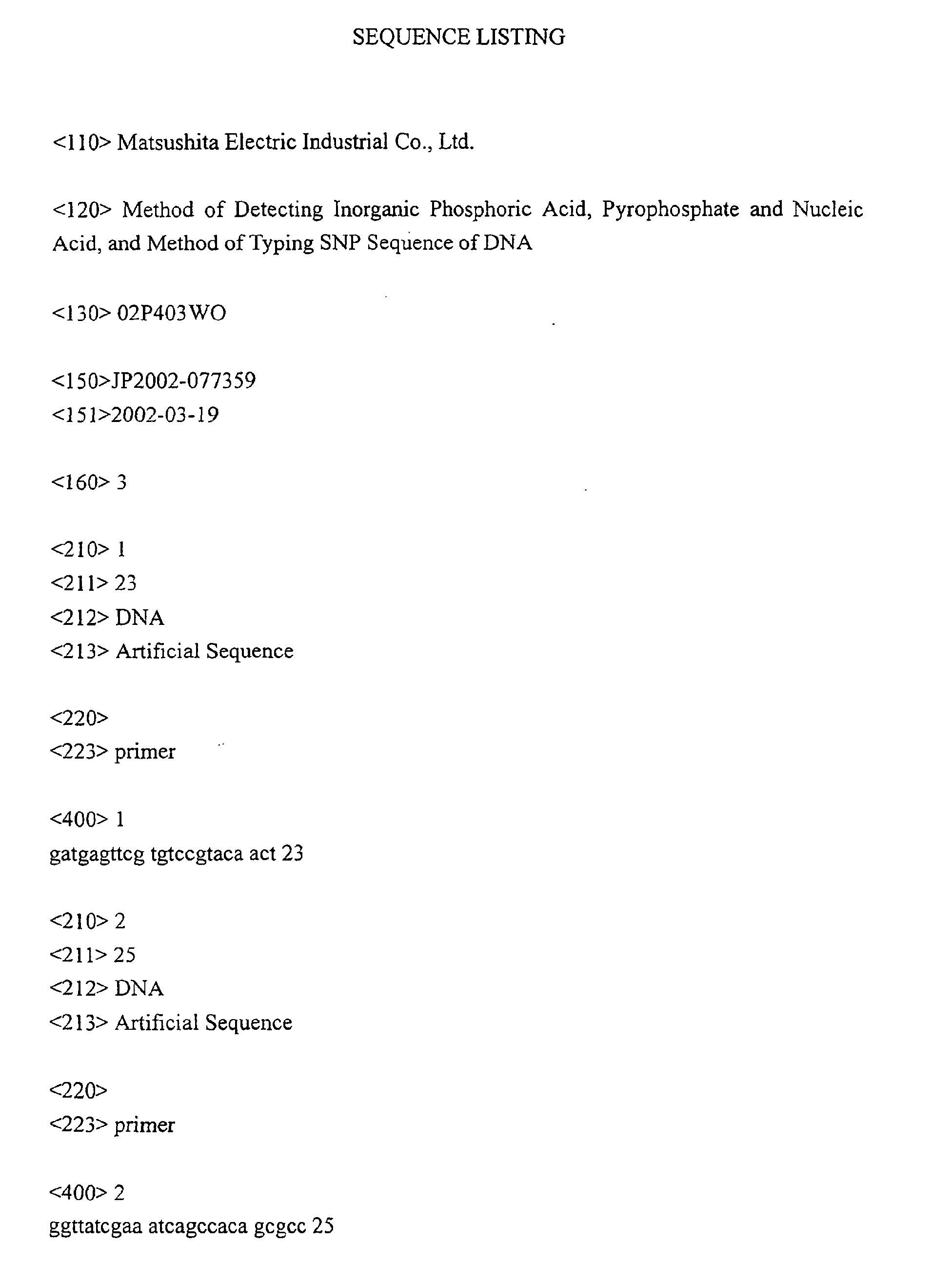
For a sample, which was referred to as
sample 1, with
Control Template (λDNA) (manufactured by TaKaRa Shuzo Co.,
Ltd.) added to its measurement system; or for a sample, which
was referred to as
sample 2, without the addition, a PCR
reaction was carried out. Experiments were conducted using
λDNA as a template, and as primers, Control Primer 1
(5'-GATGAGTTCGTGTCCGTACAACT-3' (SEQ ID NO:1)) and Primer 3
(5'-GGTTATCGAAATCAGCCACAGCGCC-3' ( SEQ ID NO: 2)) of TaKaRa PCR
Amplification Kit (manufactured by TaKaRa Shuzo Co. , Ltd. ) (for
use in amplification of 500 bp). After adding 0.5 µl of 2.5
unit/µl TaKaRa Z-Taq™, 5 µl of 10 x Z-Taq™ Buffer, 4 µl of
2.5 mM each dNTP Mixture, each 0.5 µl of 20 pmol/
µl Primer 1
and
Primer 3 to the
sample 1 and the
sample 2 respectively,
1 µl of 1 µg/ml λDNA was added only to the
sample 1. Then
distilled water was added to the
sample 1 and the
sample 2
respectively to give the total volume of 50 µl. The PCR
reaction was carried out with 30 cycles of: 98°C for 1 sec,
55°C for 1 sec, and 72°C for 10 sec. To the reaction solution
prepared in Example 3 (prior to adding pyrophosphate) was added
1 µl of the solution in which the PCR reaction was completed
and the current value after 100 seconds passed was measure,
similarly to Example 1. Results are shown in Table 1.
| | Sample 1 | Sample2 |
| Current value | 552 nA | 21 nA |
As for the sample 1 with λDNA added as a template,
oxidation current of potassium ferricyanide was observed
according to the progress of the enzymatic reaction beginning
with pyrophosphate produced upon the progress of the PCR
reaction. However, as for the sample 2, the PCR reaction did
not proceed, and thus, the current was not observed.
(Example 5)
Control Template (λDNA) (supra) was added to a
measurement system, and a PCR reaction was carried out.
Experiments were conducted using λDNA as a template, and for
a
sample 1, Control Primer 1 (5'-GATGAGTTCGTGTCCGTACAACT-3'
(SEQ ID NO: 1)) and Primer 3 (5'-GGTTATCGAAATCAGCCACAGCGCC-3'
(SEQ ID NO: 2)); and for the
sample 2, modified Primer 1'
(5'-GATGAGTTCGTGTCCGTACAACA-3' (SEQ ID NO: 3)) and
Primer 3
of TaKaRa PCR Amplification Kit (manufactured by TaKaRa Shuzo
Co., Ltd.) (for use in amplification of 500 bp) were used as
primers. After adding 0.5 µl of 2.5 unit/µl TaKaRa Z-Taq™,
5 µl of 10 x Z-Taq™ Buffer, 4 µl of 2.5 mM each dNTP Mixture,
and to the
sample 1, each 0.5 µl of 20 pmol/
µl Primer 1 and
Primer 3; and to the
sample 2, each 0.5 µl of 20 pmol/µl Primer
1' and
Primer 3, respectively, thereto were added 1 µl of 1
µg/mlλDNA and distilled water, respectively, to give the total
volume of 50 µl. The PCR reaction was carried out with 30 cycles
of: 98°C for 1 sec, 55°C for 1 sec, and 72°C for 10 sec. To
the reaction solution prepared in Example 3 (prior to adding
pyrophosphate) was added 1 µl of the solution in which the PCR
reaction was completed, and the current value after 100 seconds
passed was measured similarly to Example 1. Results are shown
in Table 2.
| | Sample 1 | Sample2 |
| Current value | 468 nA | 83 nA |
As for the sample 1 in which Primer 1 and Primer 3 as
primers were used which were completely complementary to the
base sequence of λDNA which was a template, oxidation current
of potassium ferricyanide was observed according to the
progress of the enzymatic reaction beginning with
pyrophosphate produced upon the progress of the PCR reaction.
However, as for the sample 2, because the 3' terminal end of
Primer 1' is not complementary to the base sequence of λDNA
which was a template, only an extension reaction by Primer 3
was executed with the template λDNA as a template, without
progress of the amplification reaction by PCR. Accordingly,
scarcely any current was observed.
(Example 6)
A reaction solution was prepared by the following
procedure. In 50 mM Tricine-NaOH buffer were dissolved 50 µl
of 1 mM pyrophosphate (final concentration: 100 µM) 17.5 µl
of 30 mM glyceraldehyde-3-phosphate (final concentration: 1
mM) , 50 µl of 10 mM oxidized nicotinamide adenine dinucleotide
(final concentration: 1 mM), 50 µl of 10 mM potassium
ferricyanide (final concentration: 1 mM), 8.0 µl of 100 mM
magnesium chloride (final concentration: 1.6 mM), 5 µl of 1
unit/µl diaphorase (final concentration: 10 unit/ml) and 1 µl
of 0.2 unit/µl pyrophosphatase (final concentration: 0.4
unit/ml). The mixture was adjusted to the pH of 8.8 and the
total volume of 480 µl.
While measuring the current value similarly to Example
1, to thus prepared reaction solution was added 20 µl of 0.8
unit/µl glyceraldehyde-3-phosphate dehydrogenase (final
concentration: 32 unit/ml) after 60 seconds passed since the
measurement was started. Furthermore, the current value was
similarly measured which was observed when the aforementioned
pyrophosphate of 1 mM was changed to 0.8 mM (final
concentration: 80 µM), 0.6 mM (final concentration: 60 µM),
0.4 mM (final concentration: 40 µM) and 0.2 mM (final
concentration: 20 µM), respectively. Alteration of thus
obtained current value is illustrated in Fig. 10. In Fig. 10,
the current I (µA) is indicated by the longitudinal axis, and
time t (sec) is indicated by the horizontal axis. From Fig.
10, it was revealed that this reaction reached to a steady level
in about 100 seconds after initiating the reaction (about 160
seconds from the initiation of the measurement).
Next, the current value after 100 seconds passed is
illustrated in Fig. 11 when the amount of the pyrophosphate
was varied. In Fig. 11, the absolute value of the current value
(µA) is indicated by the longitudinal axis; final concentration
of pyrophosphate (µM) is indicated by the horizontal axis; and
the current value at each pyrophosphate concentration is
depicted by a black circle. As shown in Fig. 11, the current
value after 100 seconds passed exhibited a favorable linear
relationship with the amount of pyrophosphate added.
When data shown in Fig. 11 obtained by this Example is
compared with data shown in Fig. 8 obtained by Example 3, it
is proven that a pyrophosphate is detected with higher
sensitivity according to this Example. Therefore, detection
of a pyrophosphate with higher sensitivity can be accomplished
under the condition employed in this Example than the condition
employed in Example 3.
According to the present invention, quantitative
detection of an inorganic phosphoric acid in a sample with high
sensitivity at a high speed is provided in which an
electrochemical process is used. Furthermore, by converting
a pyrophosphate into an inorganic phosphoric acid,
quantitative measurement of the pyrophosphate with high
sensitivity at a high speed is provided. Additionally,
according to the present invention, by measuring a
pyrophosphate which is produced concurrent with an extension
reaction of a nucleic acid, presence of a targeted nucleic acid
can be quantitatively measured. Furthermore, determination
of a base in a SNP site of a targeted nucleic acid can be executed
with high sensitivity at a high speed.
[Industrial Applicability]
As described hereinabove, the present invention is
useful in applications to clinical use, drug discovery use,
and phylogenetic systematics.