EP1378285A2 - Gas separation using membranes formed from blends of perfluorinated polymers - Google Patents
Gas separation using membranes formed from blends of perfluorinated polymers Download PDFInfo
- Publication number
- EP1378285A2 EP1378285A2 EP03014840A EP03014840A EP1378285A2 EP 1378285 A2 EP1378285 A2 EP 1378285A2 EP 03014840 A EP03014840 A EP 03014840A EP 03014840 A EP03014840 A EP 03014840A EP 1378285 A2 EP1378285 A2 EP 1378285A2
- Authority
- EP
- European Patent Office
- Prior art keywords
- membrane
- dioxole
- difluoro
- trifluoromethyl
- tetrafluoroethylene
- Prior art date
- Legal status (The legal status is an assumption and is not a legal conclusion. Google has not performed a legal analysis and makes no representation as to the accuracy of the status listed.)
- Granted
Links
Classifications
-
- B—PERFORMING OPERATIONS; TRANSPORTING
- B01—PHYSICAL OR CHEMICAL PROCESSES OR APPARATUS IN GENERAL
- B01D—SEPARATION
- B01D53/00—Separation of gases or vapours; Recovering vapours of volatile solvents from gases; Chemical or biological purification of waste gases, e.g. engine exhaust gases, smoke, fumes, flue gases, aerosols
- B01D53/22—Separation of gases or vapours; Recovering vapours of volatile solvents from gases; Chemical or biological purification of waste gases, e.g. engine exhaust gases, smoke, fumes, flue gases, aerosols by diffusion
- B01D53/228—Separation of gases or vapours; Recovering vapours of volatile solvents from gases; Chemical or biological purification of waste gases, e.g. engine exhaust gases, smoke, fumes, flue gases, aerosols by diffusion characterised by specific membranes
-
- B—PERFORMING OPERATIONS; TRANSPORTING
- B01—PHYSICAL OR CHEMICAL PROCESSES OR APPARATUS IN GENERAL
- B01D—SEPARATION
- B01D71/00—Semi-permeable membranes for separation processes or apparatus characterised by the material; Manufacturing processes specially adapted therefor
- B01D71/06—Organic material
- B01D71/44—Polymers obtained by reactions only involving carbon-to-carbon unsaturated bonds, not provided for in a single one of groups B01D71/26-B01D71/42
-
- B—PERFORMING OPERATIONS; TRANSPORTING
- B01—PHYSICAL OR CHEMICAL PROCESSES OR APPARATUS IN GENERAL
- B01D—SEPARATION
- B01D71/00—Semi-permeable membranes for separation processes or apparatus characterised by the material; Manufacturing processes specially adapted therefor
- B01D71/06—Organic material
- B01D71/76—Macromolecular material not specifically provided for in a single one of groups B01D71/08 - B01D71/74
-
- B—PERFORMING OPERATIONS; TRANSPORTING
- B01—PHYSICAL OR CHEMICAL PROCESSES OR APPARATUS IN GENERAL
- B01D—SEPARATION
- B01D71/00—Semi-permeable membranes for separation processes or apparatus characterised by the material; Manufacturing processes specially adapted therefor
- B01D71/06—Organic material
- B01D71/30—Polyalkenyl halides
- B01D71/32—Polyalkenyl halides containing fluorine atoms
Definitions
- the instant invention relates to gas separation membranes and to a process utilizing such membranes.
- the membranes of the present invention are prepared from blends of perfluorinated polymers.
- the polymer blend membranes exhibit improved gas separation properties compared to component polymers forming the blend.
- European Patent application 1,163,949A2 discloses the preparation of improved composite gas separation membranes from soluble perfluoropolymers, such as BDD and tetrafluoroethylene (TFE) copolymers, and 2,2,4-trifluoro-5-trifluoromethoxy-1,3-dioxide (TTD) and tetrafluoroethylene (TFE) copolymers. These polymers are commercially available under the tradenames Teflon® AF and Hyflon®.
- US Patent 6,406,517 to D.L. Avery and P.V. Shanbhag discloses preparation of permeable membranes from a perfluoropolymer wherein the gas separation selectivity can be increased by blending the perfluoropolymer with a non-polymeric fluorinated adjuvant.
- Preferred non-polymeric adjuvants have molecular weights below about 10,000 g/mole, and specifically cited adjuvants have molecular weights of 650 and 1200-2400 g/mole.
- European Patent Applications 969,025, to P. Maccone, et al., and 1,057,521, to V. Arcella et al. disclose the preparation of non-porous and porous membranes prepared from amorphous perfluorinated polymers.
- Membrane processes for separation of hydrocarbon vapors from air and other gas mixtures containing hydrocarbon vapor are known in the art.
- US Patent 4,553,983 discloses a membrane process for recovering and concentrating organic vapors, including hydrocarbon vapors, from a feed stream of air. The process utilizes a membrane that comprises a microporous support membrane coated with a thin layer of silicone rubber. The organic vapor which has been preferentially concentrated through the membrane is further compressed and condensed to recover the vapor as a liquid.
- US Patent 5,089,033 describes a two-step process employing a similar type of membrane for separating hydrocarbons from air, specific mention being made of petroleum product vapors. In both of these processes, the hydrocarbon vapor passes preferentially through the membrane from the high pressure side to the low pressure side, thereby removing the vapor from the air feed stream.
- the present invention provides for improved gas separation membranes that are fabricated from blends of two or more perfluorinated polymers, such as a BDD based polymers blended with TTD based polymers.
- the membranes exhibit superior gas separation properties, and are extremely useful in gas separation processes where the feed gas streams contain H 2 , N 2 , O 2 , CH 4 , CO, CO 2 , C 3 H 8 or higher molecular weight hydrocarbon vapors, by virtue of the high permeability and selectivity exhibited by membranes made form these blends.
- the present invention also provides for methods to fabricate such blend membranes.
- the inventors have found, unexpectedly, that the blends of a first copolymer, preferably 2,2-bis(trifluoromethyl)-4,5-difluoro-1,3-dioxole (BDD) and tetrafluoroethylene (TFE), with a second copolymer selected from a number of soluble perfluorinated polymers, such as copolymers of 2,2,4-trifluoro-5-trifluoromethoxy-1,3-dioxole with tretafluoroethylene, exhibit superior combinations of gas separation and permeation properties.
- Such blends are extremely useful for gas separation applications, such as the generation of oxygen and nitrogen enriched air, natural gas sweetening, and in particular for separation of volatile organic compounds (VOC) from air and other gases.
- Polymer blends can be divided into miscible, homogeneous blends and heterogeneous blends. Miscible homogeneous blends are often referred to as polymer alloys.
- a typical example of polymer alloy is the blends of poly(phenylene oxide), PPO, and polystyrene, PS. Most polymer blends, however, are heterogeneous with one polymer phase dispersed in another polymer phase.
- the gas permeability coefficient, P when plotted semilogarithmically versus the blend composition in terms of volume fraction, ⁇ , often shows a linear relationship when the blends are miscible, as discussed by H. B. Hopfenberg, and D. R. Paul, in "Polymer Blends", Volume 1, D. R. Paul and S. Newman, Eds., Academic Press, New York, 1978, Chapter 10.
- a number of theoretical models, including the Maxwell model have been used to predict permeation properties of heterogeneous polymer blends. These models can be found in the following articles: J. A. Barrie and J. B.
- the blends of BDD based polymers with other soluble perfluorinated polymers, such as TTD based polymers exhibited gas transport properties that neither can be predicted by the existing models nor can be anticipated from the existing art.
- the gas transport properties of membranes formed from such blends are superior to the gas transport properties of each component polymer for a number of gas separation applications.
- a polymer blend comprising 80% by weight of a BDD based polymer, e.g. Teflon® AF 1600, and 20% by weight or TTD based polymer, e.g.
- Hyflon® AD60X exhibits a separation factor of 31.5 for nitrogen/propane separation at 30°C, while Teflon® AF1600 exhibits a separation factor of 21.4, and Hyflon® AD60X exhibits a separation factor of 27.3 for nitrogen/propane separation.
- the mechanism that leads to the unexpected behavior is not completely understood and the inventors do not wish to be bound by the specific mechanism.
- the blends are miscible alloys and the synergistic effect of blending may be potentially attributed to the strong polymer-polymer interaction between the perfluorinated polymers.
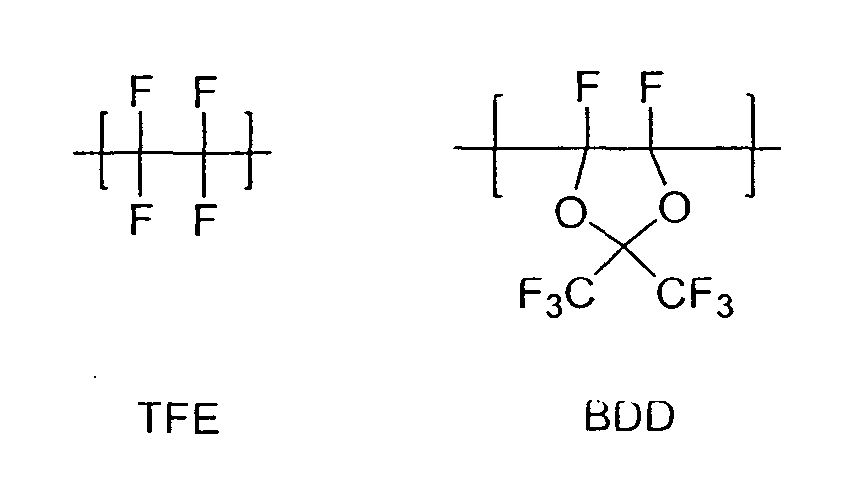
- the preferred 2,2-bis(trifluoromethyl)-4,5-difluoro-1,3-dioxole BDD based polymers are random copolymers of BDD and TFE .
- the preparation of such copolymers is described in US Patent Nos. 4,754,009 to E. N. Squire and 5,646,223 to W. Navarrini, et al..
- copolymers typically contain 30-95 mole percent of the BDD component.
- Preferable copolymers are available commercially from DuPont under the trade name Teflon® AF and contain 50-90 mole percent of the BDD component.
- Teflon® AF a commerciallymer that contains 50-90 mole percent of the BDD component.
- other BDD based compositions and copolymers can be employed.
- the TFE and BDD repeat units are:
- the preferred soluble perfluorinated polymers that form blends with BDD based polymers are selected from polymers or copolymers of 2,2,4-trifluoro-5-trifluoromethoxy-1,3-dioxole (TTD) and polymers prepared from highly fluorinated alkyl ether monomers, especially those polymerizable into cyclic ether repeat units with five or six member ring structures. It is also noted that the blend could also comprise two different BDD based copolymers, or two or more BDD copolymers plus the preferred soluble perfluorinated polymers noted above.
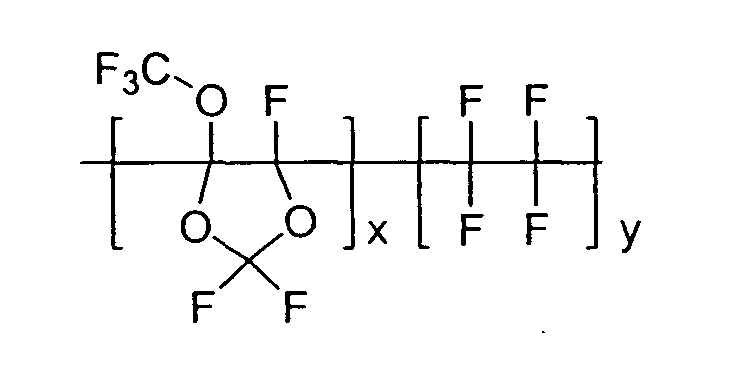
- TTD 2,2,4-trifluoro-5-trifluoromethoxy-1,3-dioxole
- the preferred copolymers have a TTD/TFE ratio of 60/40 (commercially available from Ausimont as Hyflon® AD 60X) and a TTD/TFE ratio of 80/20 (commercially available from Ausimont as Hyflon® AD 80X), or a mixture of these copolymers.
- Alternative preferred soluble perfluorinated polymers that form blends with BDD based polymers, are polymers prepared from highly fluorinated alkyl ether monomers, especially those polymerizable into polymers containing cyclic ether repeat units with five or six members in the ring.
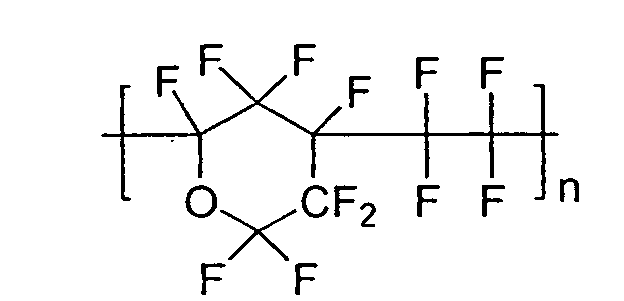
- the most preferred material of this type has the structure: where n is a positive integer.
- These polymers are available commercially from Asahi Glass Company under the trade name of Cytop®.
- the blends of the present invention contain 1 to 98% by weight of a BDD/TFE copolymer.
- the blends Preferably contain from 20 to 95 % by weight of BDD/TFE copolymer Teflon® AF, and most preferably contain from 40 to 80% by weight of BDD/TFE copolymer Teflon® AF.
- the proportion of BDD and TFE units in the BDD/TFE copolymer may vary (as discussed above), and a blend of BDD/TFE copolymers each with different proportions of BDD and TFE units can also be utilized.
- Preferred BDD/TFE copolymers are Teflon® AF1600 or Teflon® AF2400 manufactured by DuPont.
- the compositions of the present invention comprise blends of the Teflon® AF series polymers with at least one additional soluble perfluorinated polymer. In some embodiments, two or more soluble perfluorinated polymers may be employed.
- the blends of this invention typically exhibit a single glass transition temperature of an alloy, rather than two glass transition temperatures corresponding to that of each of the component polymers, which is typical of a heterogeneous blend.
- a single glass transition temperature of 124°C was measured for 50/50 (by weight) blend of Teflon® AF1600 polymer with Hyflon® AD60X polymer.
- the glass transition temperature of each of the Teflon® AF1600 and the Hyflon® AD60X was measured as 162°C and 104°C, respectively.
- the polymer blends of this invention are formed by dissolving the individual blend components in a common solvent, and then evaporating the solvent to form the blend of solid polymers.
- Perfluorinated and quasi-perfluorinated solvents are preferred solvents to form these solutions.
- Suitable solvents include, but are not limited to, perfluoro (alkylamines), commercially available as FluorinertTM FC-40 from 3M, perfluorotetrahydrofurans, commercially available as FluorinertTM FC-75 from 3M, and perfluoropolyethers, commercially available as Galden® HT90, Galden® HT110 and Galden® HT-135 from Ausimont.
- the membranes of the present invention are preferably fabricated into a composite membrane configuration, comprised of a perfluorinated polymer blend layer superimposed onto a porous support, such that the perfluorinated polymer blend provides the desired gas separation properties and the porous substrate provides the mechanical support.
- the porous substrate can be formed from organic or inorganic materials.
- suitable materials which can be employed to prepare the substrate include polysulfone, polyethersulfone, polyetherimide, polyvinylidenedifluoride, polyacrylonitrile, polyimides, polytetrafluoroethylene, polyphenylene oxide, polyolefins, such as polyethylene and polypropylene, and cellulose and its derivatives, such as cellulose acetates and ethylcellulose. Combinations of polymers including polymer blends, copolymers, terpolymers and others can also be used.
- the porous substrate is fabricated from an engineering polymeric material having a glass transition temperature above 90°C. More preferably, the porous substrate is fabricated from an engineering polymeric material having a glass transition temperature above 150°C.
- the porous support can be in a flat sheet or in a hollow fiber configuration.
- Suitable techniques for preparing the porous hollow fiber substrates include wet spinning, dry spinning, dry-wet spinning, and other methods known in the art. Techniques useful in preparing porous substrates are described, for example, by I. Cabasso in "Hollow Fiber Membranes", Kirk Othmer Encyclopedia Chem. Tech., Vol. 12, page 492-517 (1980).
- the substrate is prepared by a dry-wet spinning process such as disclosed in US Patents 5,181,940 and 5,871,680.
- Substrates with a high level of surface porosity are preferred. In one embodiment the ratio of the area occupied by surface pores to the total surface area is greater than 1 x 10 -2 . Substrates with surface pore diameter below 500 ⁇ and a narrow surface pore size distribution are further preferred.
- composite perfluorinated polymer blend membranes can be carried out by any method known in the art, such as dip coating.
- the composite membranes are prepared by a dip-coating method as disclosed in European Patent Application 1,163,949.
- a thin coating of the perfluorinated polymer blend layer is preferred.
- the coating layer is less than about 1 ⁇ m thick, preferably less than about 0.5 ⁇ m thick.
- Particularly preferred are coatings that have a thickness of about 500 angstroms and below.
- the membranes and processes of the present invention are useful for numerous gas separation applications. Specific examples include, but are not limited to, separation of oxygen from air; separation of nitrogen, oxygen, air, argon, or hydrogen from organic hydrocarbon vapors; separation of methane from propane or higher molecular weight hydrocarbons; separation of carbon dioxide from hydrocarbons; separation of light olefins from other organic vapors; and separation of isomers from one another.
- Organic hydrocarbon vapors include low boiling organic compounds, such as C 3+ hydrocarbons, ketones, alcohols, and the like.
- the gas transport properties of the flat sheet blend membranes were determined by the following procedure.
- the membrane was sandwiched between two aluminum foils exposing a circular membrane area of 2.54 cm in diameter.
- the membrane was placed into a permeation cell and the perimeter of the foil was sealed with epoxy resin.
- the downstream side of the cell was evacuated up to 2x10 -2 mmHg and the feed gas introduced from the upstream side.
- the pressure of the permeate gas on the downstream side was measured using a MKS-Baratron pressure transducer.
- the gas transport properties of the composite membranes were measured at 25°C by constructing small membrane modules with membrane area of about 100 cm 2 .
- the gas permeation rates were determined utilizing pure gases.
- Teflon® AF 1600 was obtained by casting a solution of Teflon® AF 1600 polymer (Du Pont) in FluorinertTM-75 solvent (3% by weight) on a clean glass plate. The solvent was evaporated under dry nitrogen. The film was released from the plate and dried under vacuum at 100 ° C for 7 days. Gas transport properties of the film are listed in Tables 1 and 2.
- Hyflon® AD60X was prepared by a procedure similar to that described in Example 1 except Hyflon® AD60X (Ausimont) was used instead of Teflon® AF. Gas transport properties of this film are listed in Tables 1 and 2.
- Teflon® AF 2400 A flat sheet film of Teflon® AF 2400 was obtained by casting a solution of Teflon® AF 2400 polymer (Du Pont) in FluorinertTM -75 solvent (3% by weight) on a clean glass plate. After evaporating the solvent, the film was released from the plate and dried under vacuum at 100°C for 7 days. Gas transport properties of the film are listed in Tables 3 and 4.
- the composite membrane of Teflon® AF 1600 was fabricated with a solution of Teflon® AF 1600 polymer (Du Pont) in FluorinertTM -75 solvent.
- the polymer concentration in the coating solution was 0.75g/100cc.
- Water-saturated polyethersulfone hollow fibers were partially pre-dried by passing them through a drying oven maintained at 160 °C.
- the pre-dried polyethersulfone hollow fibers were coated by passing the fibers through a coating solution, followed by drying in a second drying oven and then collecting the coated fibers on a winder.
- the thus prepared composite hollow fibers were constructed into separation modules and tested for gas permeation performance at 25 ° C with pure gases.
- the feed pressure of the gas was around 2.3 bar, except for propane which was 1.6 bar.
- the pressure normalized flux and gas separation factors are listed in Table 5.
- Composite membranes were prepared by coating porous polyether sulfone hollow fibers with a solution of a blend of Teflon® AF 1600 polymer and Hyflon® AD60X polymers in FluorinertTM-75 solvent. The total polymer concentration in the coating solution was 0.75g/100 cc. The weight fractions of Teflon® AF 1600 polymer and Hyflon® AD60X polymers used are listed in Table 5.
- the water saturated porous polyethersulfone hollow fibers were partially pre-dried by passing through a drying oven maintained at 160 °C.
- the partially pre-dried polyether sulfone hollow fibers were coated by transporting the fibers through a coating solution, followed by drying in a second drying oven and then collecting the coated hollow fibers on a winder.
- the composite hollow fibers were constructed into separation modules and tested for gas permeation performances with pure gases at 25 °C.
- the feed pressures of the gases were around 2.3 bar, except for the propane which was 1.6 bar.
- the pressure normalized flux and gas separation factors are listed in Table 5.
- the composite membrane of Hyflon® AD60X was fabricated by a procedure similar to that of Example 9, except that a coating solution containing only Hyflon® AD60X in the FluorinertTM -75 solvent was used.
- the pure gas permeation properties of this composite membrane are listed in Table 5.
Landscapes
- Chemical & Material Sciences (AREA)
- Chemical Kinetics & Catalysis (AREA)
- Engineering & Computer Science (AREA)
- Analytical Chemistry (AREA)
- General Chemical & Material Sciences (AREA)
- Oil, Petroleum & Natural Gas (AREA)
- Separation Using Semi-Permeable Membranes (AREA)
Abstract
Description

The membranes of the present invention are preferably fabricated into a composite membrane configuration, comprised of a perfluorinated polymer blend layer superimposed onto a porous support, such that the perfluorinated polymer blend provides the desired gas separation properties and the porous substrate provides the mechanical support.
| Gas transport properties of Teflon® AF 1600, Hyflon® AD60X and their blends | |||||||
| Example | AF1600 (w%) | AD60X (w%) | P(He) | P(O2) | P(N2) | P(C3H8) | P(CH4) |
| 1 | 100 | 0 | 1131 | 217 | 79 | 3.7 | 41 |
| 2 | 80 | 20 | 1013 | 179 | 63 | 2.0 | 31 |
| 3 | 60 | 40 | 696 | 112 | 39 | 1.3 | 19 |
| 4 | 40 | 60 | 591 | 88 | 30 | 0.83 | 14 |
| 5 | 20 | 80 | 480 | 61 | 20 | 0.42 | 8.6 |
| 6 | 0 | 100 | 441 | 56 | 18 | 0.66 | 8.2 |
| Ideal gas separation factors for Teflon® AF 1600, Hyflon® AD60X and their blends | ||||
| Example No | AF1600 (w%) | AD60X | P(O2)/P(N2) | P(N2)/P(C3H8) |
| 1 | 100 | 0 | 2.7 | 21.4 |
| 2 | 80 | 20 | 2.8 | 31.5 |
| 3 | 60 | 40 | 2.9 | 30.0 |
| 4 | 40 | 60 | 2.9 | 36.1 |
| 5 | 20 | 80 | 3.1 | 47.6 |
| 6 | 0 | 100 | 3.1 | 27.3 |
| Gas transport properties of Teflon® AF 2400 and its blend with Hyflon® AD 60X. | |||||||
| Example No | AF2400 (w%) | P(He) | P(O2) | P(N2) | P(C3H8) | P(CH4) | P(CO2) |
| 7 | 100 | 2516 | 842 | 397 | 44.1 | 276 | 2103 |
| 8 | 80 | 2072 | 496 | 199 | 14.9 | 116 | 1150 |
| Ideal gas separation factors for Teflon® AF 2400 and its blend with Hyflon® AD60X | ||||
| Example No | AF1600 (w%) | P(O2)/P(N2) | P(N2)/P(C3H8) | P(CO2)/P(CH4) |
| 7 | 100 | 2.1 | 9.0 | 7.6 |
| 8 | 80 | 2.5 | 13.4 | 9.9 |
| Pure gas pressure normalized Flux () | Selectivity | ||||||
| Example No | Weight Fraction of AF 1600 | Weight Fraction of AD60X | O2 | N2 | C3H8 | α(O2/N2) | α(N2/C3H8) |
| 9 | 100 | 0 | 1235 | 547 | 46 | 2.3 | 12.1 |
| 10 | 75 | 25 | 983 | 437 | 21 | 2.3 | 21.1 |
| 11 | 50 | 50 | 762 | 288 | 13 | 2.6 | 22.6 |
| 12 | 25 | 75 | 518 | 215 | 29 | 2.4 | 7.4 |
| 13 | 0 | 100 | 666 | 503 | 360 | 1.3 | 1.4 |
Claims (37)
- A process for separating a fast gas from a mixture of gases comprising the steps of a) bringing the gaseous mixture into contact with a feed side of a gas separation membrane, b) providing a partial pressure differential between the feed side of the membrane and a permeate side of the membrane, such that a portion of said gas mixture permeates through the membrane, c) collecting a portion of said gas mixture as permeate gas wherein said permeate gas is enriched in the fast gas component, and d) collecting a portion of said gas mixture as a non-permeate gas wherein said non-permeate gas is depleted in said fast gas component, and wherein said gas separation membrane has a selective layer comprised of a blend of a copolymer of 2,2-bis(trifluoromethyl)-4,5-difluoro-1,3-dioxole based polymer with a soluble perfluorinated polymer selected from the group consisting of perfluoromethoxydioxole based polymers and perfluorocyclic ether based polymers.
- The process of claim 1 wherein said 2,2-bis(trifluoromethyl)-4,5-difluoro-1,3-dioxole based polymer is a random copolymer with tetrafluoroethylene, wherein the 2,2-bis(trifluoromethyl)-4,5-difluoro-1,3-dioxole content is in the range of 50 to 90 mole percent .
- The process of claim 1 wherein said 2,2-bis(trifluoromethyl)-4,5-difluoro-1,3-dioxole based polymer is a mixture of copolymers, each of the component copolymers of the mixture having a different ratio of 2,2-bis(trifluoromethyl)-4,5-difluoro-1,3-dioxole to tetrafluoroethylene.
- The process of claim 2 wherein said copolymer of 2,2-bis(trifluoromethyl)-4,5-difluoro-1,3-dioxole and tetrafluoroethylene includes at least one copolymer selected from the group of copolymers commercially known under the tradenames Teflon® AF1600 and Teflon® AF 2400.
- The process of claim 2 wherein said blend comprises 20 to 95 % by weight of the copolymer of 2,2-bis(trifluoromethyl)-4,5-difluoro-1,3-dioxole and tetrafluoroethylene.
- The process of claim 2 wherein said blend comprises 40 to 80 % by weight of the copolymer of 2,2-bis(trifluoromethyl)-4,5-difluoro-1,3-dioxole and tetrafluoroethylene.
- The process of claim 1 wherein said perfluoromethoxydioxole based polymer has the formula:where x and y represent the relative proportions of the dioxole and tetrafluoroethylene blocks such that x + y = 1.

- The process of claim 7 wherein said perfluoromethoxydioxole based polymer is one or more copolymers each having a different ratio of 2,2,4-trifluoro-5-trifluoromethoxy-1,3-dioxide to tetrafluoroethylene.
- The process of claim 7 wherein said perfluoromethoxydioxole based polymer is a copolymer selected from the group of copolymers having a 60/40 ratio and a 80/20 ratio of 2,2,4-trifluoro-5-trifluoromethoxy-1,3-dioxide to tetrafluoroethylene.
- The process of claim 1 wherein said perfluorocyclic ether based polymer has the formula:where n is an integer,

- The process of claim 1 wherein said gaseous mixture contains a gas chosen from hydrogen, helium, nitrogen, oxygen, argon, carbon dioxide or volatile hydrocarbon vapor.
- The process of claim 1 wherein said gas separation membrane is a composite membrane.
- The process of claim 1 wherein said gaseous mixture is air containing volatile organic hydrocarbons.
- The process of claim 1 wherein said gaseous mixture is air and said fast component is oxygen.
- The process of claim 1 wherein said gaseous mixture contains hydrogen.
- The process of claim 1 wherein said gaseous mixture contains carbon dioxide.
- The process of claim 1 wherein said gaseous mixture contains methane.
- The process of claim 1 wherein said gaseous mixture contains hydrocarbons with three or more carbon atoms.
- A composite membrane comprising a porous support and a separation layer superimposed thereon wherein said separation layer is formed from a blend of a copolymer of 2,2-bis(trifluoromethyl)-4,5-difluoro-1,3-dioxole and tetrafluoroethylene with a soluble perfluorinated polymer selected from the group consisting of perfluoromethoxydioxole based polymers and perfluorocyclic ether based polymers.
- The membrane of claim 19 wherein said copolymer of 2,2-bis(trifluoromethyl)-4,5-difluoro-1,3-dioxole and tetrafluoroethylene is a random copolymer with 2,2-bis(trifluoromethyl)-4,5-difluoro-1,3-dioxole content in the range of 30 to 90 mole percent.
- The membrane of claim 19 wherein said copolymer of 2,2-bis(trifluoromethyl)-4,5-difluoro-1,3-dioxole and tetrafluoroethylene includes at least one copolymer selected from the group of copolymers commercially known under the tradenames Teflon® AF1600 and Teflon® AF 2400.
- The membrane of claim 19 wherein said perfluoromethoxydioxole based polymer has the formula:where x and y represent the relative proportions of the dioxole and tetrafluoroethylene blocks such that x + y = 1.
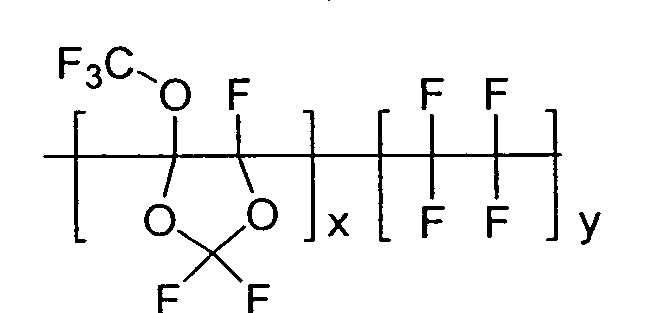
- The membrane of claim 22 wherein said perfluoromethoxydioxole based polymer is a copolymer selected from the group of copolymers commercially known under the tradenames Hyflon® AD60 and Hyflon® AD80.
- The membrane of claim 19 wherein said pertluorocyclic ether based polymer has the formula:where n is an integer.
- The membrane of claim 19 wherein said porous support is made from polysulfone.
- The membrane of claim 19 wherein said porous support is made from polyether sulfone.
- The membrane of claim 19 wherein said porous support is made from polyetherimide.
- The membrane of claim 19 wherein said porous support is made from polypropylene.
- The membrane of claim 19 wherein said porous support is made of poly(vinylidene fluoride).
- The membrane of claim 19 wherein said porous support is made of polytetrafluoro ethylene.
- A composition comprising a blend of a copolymer of 2,2-bis(trifluoromethyl)-4,5-difluoro-1,3-dioxole and tetrafluoroethylene with a soluble perfluorinated polymer selected from the group consisting of perfluoromethoxydioxole based polymers and perfluorocyclic ether based polymers.
- The composition of claim 31 wherein said copolymer of 2,2-bis(trifluoromethyl)-4,5-difluoro-1,3-dioxole and tetrafluoroethylene is a random copolymer with 2,2-bis(trifluoromethyl)-4,5-difluoro-1,3-dioxole content in the range of 30 to 90 mole percent.
- The composition of claim 31 wherein said copolymer of 2,2-bis(trifluoromethyl)-4,5-difluoro-1,3-dioxole and tetrafluoroethylene includes at least one copolymer selected from the group of copolymers commercially known under the tradenames Teflon® AF1600 and Teflon® AF 2400.
- The composition of claim 31 wherein said perfluoromethoxydioxole based polymer has the formula:where x and y represent the relative proportions of the dioxole and tetrafluoroethylene blocks such that x + y = 1.

- The composition of claim 31 wherein said perfluorocyclic ether based polymer has the formula:where n is an integer.

- The composition of claim 31 wherein said blend comprises 20 to 95 % by weight of the copolymer of 2,2-bis(trifluoromethyl)-4,5-difluoro-1,3-dioxole and tetrafluoroethylene.
- The composition of claim 36 wherein said blend comprises 40 to 80 % by weight of the copolymer of 2,2-bis(trifluoromethyl)-4,5-difluoro-1,3-dioxole and tetrafluoroethylene.
Applications Claiming Priority (2)
| Application Number | Priority Date | Filing Date | Title |
|---|---|---|---|
| US187124 | 2002-07-01 | ||
| US10/187,124 US6723152B2 (en) | 2002-07-01 | 2002-07-01 | Gas separation using membranes formed from blends of perfluorinated polymers |
Publications (3)
| Publication Number | Publication Date |
|---|---|
| EP1378285A2 true EP1378285A2 (en) | 2004-01-07 |
| EP1378285A3 EP1378285A3 (en) | 2005-03-23 |
| EP1378285B1 EP1378285B1 (en) | 2009-04-08 |
Family
ID=29720412
Family Applications (1)
| Application Number | Title | Priority Date | Filing Date |
|---|---|---|---|
| EP03014840A Expired - Lifetime EP1378285B1 (en) | 2002-07-01 | 2003-06-30 | Gas separation using membranes formed from blends of perfluorinated polymers |
Country Status (4)
| Country | Link |
|---|---|
| US (1) | US6723152B2 (en) |
| EP (1) | EP1378285B1 (en) |
| BR (1) | BR0302110A (en) |
| DE (1) | DE60327021D1 (en) |
Cited By (2)
| Publication number | Priority date | Publication date | Assignee | Title |
|---|---|---|---|---|
| GB2483245A (en) * | 2010-09-01 | 2012-03-07 | Doosan Power Systems Ltd | Polymer membrane for carbon capture |
| EP2570469A1 (en) * | 2011-09-15 | 2013-03-20 | United Technologies Corporation | Fuel fractionation using membrane distillation |
Families Citing this family (26)
| Publication number | Priority date | Publication date | Assignee | Title |
|---|---|---|---|---|
| US6896717B2 (en) * | 2002-07-05 | 2005-05-24 | Membrane Technology And Research, Inc. | Gas separation using coated membranes |
| ITMI20030774A1 (en) * | 2003-04-15 | 2004-10-16 | Solvay Solexis Spa | FLUORINATED POLYMERS. |
| US8070859B2 (en) * | 2004-02-25 | 2011-12-06 | Membrane Technology And Research, Inc. | Method for producing a non-porous membrane |
| KR101162403B1 (en) * | 2006-04-28 | 2012-07-04 | 아사히 가세이 케미칼즈 가부시키가이샤 | Gas separation membrane |
| US20080035574A1 (en) * | 2006-08-08 | 2008-02-14 | Sabottke Craig Y | Membrane Barrier films and method of use |
| WO2008055051A2 (en) * | 2006-10-27 | 2008-05-08 | Cms Technologies Holdings Inc. | Removal of water and methanol from fluids |
| US8496831B2 (en) * | 2007-08-30 | 2013-07-30 | Membrane Technology And Research, Inc. | Dehydration processes using membranes with hydrophobic coating |
| US8002874B2 (en) * | 2007-03-06 | 2011-08-23 | Membrane Technology And Research, Inc. | Liquid-phase and vapor-phase dehydration of organic/water solutions |
| JP2011502049A (en) * | 2007-11-05 | 2011-01-20 | シーオー2 シーアールシー・テクノロジーズ・プロプライエタリー・リミテッド | Gas separation membrane and method for producing the same |
| WO2010080753A1 (en) * | 2009-01-07 | 2010-07-15 | Cms Technologies Holdings, Inc. | Separations with highly selective fluoropolymer membranes |
| US8540804B2 (en) | 2010-11-01 | 2013-09-24 | Saudi Arabian Oil Company | Sour gas and acid natural gas separation membrane process by pre removal of dissolved elemental sulfur for plugging prevention |
| US20130014643A1 (en) * | 2011-07-13 | 2013-01-17 | Membrane Technology And Research, Inc. | Fuel gas conditioning process using glassy polymer membranes |
| US9221730B2 (en) * | 2011-07-13 | 2015-12-29 | Membrane Technology And Research, Inc. | Fuel gas conditioning process using glassy polymer membranes |
| US9381449B2 (en) | 2013-06-06 | 2016-07-05 | Idex Health & Science Llc | Carbon nanotube composite membrane |
| US9403121B2 (en) | 2013-06-06 | 2016-08-02 | Idex Health & Science, Llc | Carbon nanotube composite membrane |
| RU2606613C2 (en) * | 2015-01-23 | 2017-01-10 | Федеральное государственное бюджетное учреждение науки Ордена Трудового Красного Знамени Институт нефтехимического синтеза им. А.В. Топчиева Российской академии наук (ИНХС РАН) | Based on poly(hexafluoropropylene) membrane and method of gases separating using it |
| CN109791117B (en) * | 2016-09-21 | 2022-09-20 | 盛思锐股份公司 | Gas sensor |
| US11007484B2 (en) | 2017-08-28 | 2021-05-18 | Air Liquide Advanced Technologies U.S. Llc | Dead end membrane gas separation process |
| US11058998B2 (en) * | 2018-08-27 | 2021-07-13 | Compact Membrane Systems Inc. | Isomer separation with highly fluorinated polymer membranes |
| WO2020132656A1 (en) | 2018-12-22 | 2020-06-25 | Air Liquide Advanced Technologies U.S. Llc | Composite hollow fiber membranes for jet fuel de-oxygenation |
| WO2021076194A1 (en) * | 2019-10-15 | 2021-04-22 | Exostat Medical, Inc. | Carbon dioxide sensor |
| US12115001B2 (en) | 2019-10-15 | 2024-10-15 | Exostat Medical, Inc. | Tissue perfusion sensor and placement device |
| JP7349885B2 (en) * | 2019-10-31 | 2023-09-25 | 旭化成株式会社 | gas separation membrane |
| CN115066290A (en) * | 2020-02-06 | 2022-09-16 | 新加坡国立大学 | Composite membrane and preparation method thereof |
| CN114984773B (en) * | 2022-06-29 | 2023-09-01 | 江苏久膜高科技股份有限公司 | Oil gas recovery composite membrane and preparation method thereof |
| CN118022550B (en) * | 2023-11-23 | 2024-09-24 | 麦博睿新材料科技(重庆)有限公司 | High-bubble-point polyethersulfone microfiltration membrane and preparation method thereof |
Family Cites Families (29)
| Publication number | Priority date | Publication date | Assignee | Title |
|---|---|---|---|---|
| US128956A (en) * | 1872-07-16 | Improvement in water and liquor coolers | ||
| US3978030A (en) * | 1973-08-01 | 1976-08-31 | E. I. Du Pont De Nemours And Company | Polymers of fluorinated dioxoles |
| US4754009A (en) | 1981-08-20 | 1988-06-28 | E. I. Du Pont De Nemours And Company | Amorphous copolymers of perfluoro-2,2-dimethyl-1,3-dioxole |
| US4565855A (en) | 1981-09-28 | 1986-01-21 | E. I. Du Pont De Nemours And Company | Polymers of dioxolanes |
| US4553983A (en) | 1984-07-31 | 1985-11-19 | Membrane Technology And Research, Inc. | Process for recovering organic vapors from air |
| US4910276A (en) | 1987-08-14 | 1990-03-20 | Asahi Glass Company, Ltd. | Cyclic polymerization |
| CA2055446C (en) | 1989-06-15 | 2000-08-29 | Stuart Marshall Nemser | Perfluorodioxole membranes |
| DE69033734T2 (en) | 1989-11-07 | 2001-08-30 | Membrane Technology And Research, Inc. | METHOD FOR RECOVERY OF CONDENSIBLE COMPONENTS FROM GAS FLOWS |
| US5147417A (en) | 1990-06-13 | 1992-09-15 | Du Pont Canada Inc. | Air-intake system for mobile engines |
| US5181940A (en) | 1991-08-01 | 1993-01-26 | Union Carbide Industrial Gases Technology Corporation | Hollow fiber membranes |
| US5238471A (en) * | 1992-10-14 | 1993-08-24 | E. I. Du Pont De Nemours And Company | Spray-applied fluoropolymer films for gas separation membranes |
| US5288304A (en) * | 1993-03-30 | 1994-02-22 | The University Of Texas System | Composite carbon fluid separation membranes |
| IT1264662B1 (en) | 1993-07-05 | 1996-10-04 | Ausimont Spa | PERFLURODIOSSOLS THEIR HOMOPOLYMERS AND COPOLYMERS AND THEIR USE FOR THE COATING OF ELECTRIC CABLES |
| US5917137A (en) * | 1993-10-19 | 1999-06-29 | L'air Liquide, Societe Anonyme Pour L'etude Et L'exploitation Des Procedes Georges Claude | Gas separation membranes of blends of polyethersulfones with aromatic polyimides |
| EP0649675B1 (en) | 1993-10-20 | 2001-12-19 | L'air Liquide, Societe Anonyme Pour L'etude Et L'exploitation Des Procedes Georges Claude | Treatment of gas separation membranes with inert solvent |
| EP0750937A3 (en) | 1995-06-30 | 1997-10-15 | Praxair Technology Inc | Method and apparatus for spinning hollow fiber membranes |
| US6293996B1 (en) | 1997-03-07 | 2001-09-25 | Vapor Systems Technologies, Inc. | Fuel storage system with vent filter assembly |
| US5985002A (en) | 1997-03-07 | 1999-11-16 | Vapor Systems Technologies, Inc. | Fuel storage system with vent filter assembly |
| US5922791A (en) * | 1997-12-19 | 1999-07-13 | L'air Liquide Societe Anonyme Pour L'etude Et L'exploitation Des Procedes Georges Claude | Polymer blend membranes with improved mechanical properties |
| ITMI981506A1 (en) | 1998-06-30 | 1999-12-30 | Ausimont Spa | AMORPHOUS FLUOROPOLYMER MANUFACTURES |
| IT1312320B1 (en) | 1999-05-25 | 2002-04-15 | Ausimont Spa | (PER) FLUORINATED AMORPHOUS POLYMER MEMBRANES. |
| US6316684B1 (en) | 1999-09-01 | 2001-11-13 | Membrane Technology And Research, Inc. | Filled superglassy membrane |
| US6361582B1 (en) | 2000-05-19 | 2002-03-26 | Membrane Technology And Research, Inc. | Gas separation using C3+ hydrocarbon-resistant membranes |
| US6361583B1 (en) | 2000-05-19 | 2002-03-26 | Membrane Technology And Research, Inc. | Gas separation using organic-vapor-resistant membranes |
| US6540813B2 (en) | 2000-06-13 | 2003-04-01 | Praxair Technology, Inc. | Method of preparing composite gas separation membranes from perfluoropolymers |
| DE10030643C1 (en) * | 2000-06-29 | 2002-02-07 | Geesthacht Gkss Forschung | Process for high pressure gas separation |
| US6406517B1 (en) | 2000-09-08 | 2002-06-18 | Cms Technology Holdings, Inc. | Designed selectivity gas permeable membranes |
| GB2367136A (en) * | 2000-09-21 | 2002-03-27 | Draegerwerk Ag | Electrochemical gas sensor with membrane of specified copolymer |
| US20030128956A1 (en) | 2002-01-08 | 2003-07-10 | Photon-X, Inc. | Optical polymer blends with adjustable refractive index and optical waveguides using same |
-
2002
- 2002-07-01 US US10/187,124 patent/US6723152B2/en not_active Expired - Fee Related
-
2003
- 2003-06-30 DE DE60327021T patent/DE60327021D1/en not_active Expired - Fee Related
- 2003-06-30 EP EP03014840A patent/EP1378285B1/en not_active Expired - Lifetime
- 2003-06-30 BR BR0302110-6A patent/BR0302110A/en active Search and Examination
Cited By (4)
| Publication number | Priority date | Publication date | Assignee | Title |
|---|---|---|---|---|
| GB2483245A (en) * | 2010-09-01 | 2012-03-07 | Doosan Power Systems Ltd | Polymer membrane for carbon capture |
| EP2570469A1 (en) * | 2011-09-15 | 2013-03-20 | United Technologies Corporation | Fuel fractionation using membrane distillation |
| US8603300B2 (en) | 2011-09-15 | 2013-12-10 | United Technologies Corporation | Fuel fractionation using membrane distillation |
| US9541000B2 (en) | 2011-09-15 | 2017-01-10 | United Technologies Corporation | Fuel fractionation using membrane distillation |
Also Published As
| Publication number | Publication date |
|---|---|
| US6723152B2 (en) | 2004-04-20 |
| BR0302110A (en) | 2004-09-08 |
| DE60327021D1 (en) | 2009-05-20 |
| EP1378285B1 (en) | 2009-04-08 |
| EP1378285A3 (en) | 2005-03-23 |
| US20040003714A1 (en) | 2004-01-08 |
Similar Documents
| Publication | Publication Date | Title |
|---|---|---|
| US6723152B2 (en) | Gas separation using membranes formed from blends of perfluorinated polymers | |
| US6579341B2 (en) | Nitrogen gas separation using organic-vapor-resistant membranes | |
| US20090277837A1 (en) | Fluoropolymer Coated Membranes | |
| EP3104959B1 (en) | Gas separation membranes based on perfluorinated polymers | |
| Pinnau et al. | Gas and vapor transport properties of amorphous perfluorinated copolymer membranes based on 2, 2-bistrifluoromethyl-4, 5-difluoro-1, 3-dioxole/tetrafluoroethylene | |
| US6361582B1 (en) | Gas separation using C3+ hydrocarbon-resistant membranes | |
| US7410525B1 (en) | Mixed matrix membranes incorporating microporous polymers as fillers | |
| US6572680B2 (en) | Carbon dioxide gas separation using organic-vapor-resistant membranes | |
| EP3307422B1 (en) | Amorphous fluorinated copolymer gas separation membranes | |
| US10569218B2 (en) | Multiple membrane separation process using glassy polymeric membrane and rubbery polymeric membrane | |
| US9636632B2 (en) | Gas separation membranes based on fluorinated and perfluorinated polymers | |
| US20130146538A1 (en) | Blend polymeric membranes comprising tetrazole-functionalized polymer of intrinsic microporosity and polyethylene glycol | |
| Golubev et al. | High free volume polymers for pervaporation | |
| WO2018093488A1 (en) | High selectivity chemically cross-linked rubbery membranes and their use for separations | |
| CA1294093C (en) | Polyphosphazene fluid separation membranes | |
| US20210291120A1 (en) | Multi-layer composite gas separation membranes, methods for preparation, and use | |
| US20040000231A1 (en) | Composite gas separation membranes from perfluoropolymers | |
| Brunetti et al. | Si‐Containing Polymers in Membrane Gas Separation | |
| CA3058381A1 (en) | Rubbery polymeric membranes for separation | |
| EP3288668B1 (en) | Gas separation process based on fluorinated and perfluorinated polymer membrane | |
| US11058998B2 (en) | Isomer separation with highly fluorinated polymer membranes | |
| Lee et al. | Gas permeation properties in a composite mesoporous alumina ceramic membrane | |
| Nakagawa | Gas separation and pervaporation | |
| KR102457839B1 (en) | Preparation mehtod for separation membrane and separation membrane prepared thereof | |
| Tasselli et al. | Novel composite hollow fibre gas separation membranes with high selectivity and improved solvent resistance |
Legal Events
| Date | Code | Title | Description |
|---|---|---|---|
| PUAI | Public reference made under article 153(3) epc to a published international application that has entered the european phase |
Free format text: ORIGINAL CODE: 0009012 |
|
| AK | Designated contracting states |
Kind code of ref document: A2 Designated state(s): AT BE BG CH CY CZ DE DK EE ES FI FR GB GR HU IE IT LI LU MC NL PT RO SE SI SK TR |
|
| AX | Request for extension of the european patent |
Extension state: AL LT LV MK |
|
| PUAL | Search report despatched |
Free format text: ORIGINAL CODE: 0009013 |
|
| AK | Designated contracting states |
Kind code of ref document: A3 Designated state(s): AT BE BG CH CY CZ DE DK EE ES FI FR GB GR HU IE IT LI LU MC NL PT RO SE SI SK TR |
|
| AX | Request for extension of the european patent |
Extension state: AL LT LV MK |
|
| RIC1 | Information provided on ipc code assigned before grant |
Ipc: 7B 01D 69/12 B Ipc: 7B 01D 71/44 B Ipc: 7B 01D 71/32 B Ipc: 7B 01D 53/22 A |
|
| RAP1 | Party data changed (applicant data changed or rights of an application transferred) |
Owner name: L'AIR LIQUIDE, SOCIETE ANONYME AE DIRECTOIRE ET CO |
|
| 17P | Request for examination filed |
Effective date: 20050923 |
|
| AKX | Designation fees paid |
Designated state(s): DE ES FR GB IT |
|
| RAP1 | Party data changed (applicant data changed or rights of an application transferred) |
Owner name: L'AIR LIQUIDE, SOCIETE ANONYME POUR L'ETUDE ET L'E |
|
| RAP1 | Party data changed (applicant data changed or rights of an application transferred) |
Owner name: L'AIR LIQUIDE, SOCIETE ANONYME POUR L'ETUDE ET L'E |
|
| 17Q | First examination report despatched |
Effective date: 20071024 |
|
| GRAP | Despatch of communication of intention to grant a patent |
Free format text: ORIGINAL CODE: EPIDOSNIGR1 |
|
| GRAS | Grant fee paid |
Free format text: ORIGINAL CODE: EPIDOSNIGR3 |
|
| GRAA | (expected) grant |
Free format text: ORIGINAL CODE: 0009210 |
|
| AK | Designated contracting states |
Kind code of ref document: B1 Designated state(s): DE ES FR GB IT |
|
| REG | Reference to a national code |
Ref country code: GB Ref legal event code: FG4D |
|
| REF | Corresponds to: |
Ref document number: 60327021 Country of ref document: DE Date of ref document: 20090520 Kind code of ref document: P |
|
| PGFP | Annual fee paid to national office [announced via postgrant information from national office to epo] |
Ref country code: IT Payment date: 20090626 Year of fee payment: 7 Ref country code: FR Payment date: 20090615 Year of fee payment: 7 |
|
| PG25 | Lapsed in a contracting state [announced via postgrant information from national office to epo] |
Ref country code: ES Free format text: LAPSE BECAUSE OF FAILURE TO SUBMIT A TRANSLATION OF THE DESCRIPTION OR TO PAY THE FEE WITHIN THE PRESCRIBED TIME-LIMIT Effective date: 20090719 |
|
| PGFP | Annual fee paid to national office [announced via postgrant information from national office to epo] |
Ref country code: GB Payment date: 20090618 Year of fee payment: 7 Ref country code: DE Payment date: 20090622 Year of fee payment: 7 |
|
| PLBE | No opposition filed within time limit |
Free format text: ORIGINAL CODE: 0009261 |
|
| STAA | Information on the status of an ep patent application or granted ep patent |
Free format text: STATUS: NO OPPOSITION FILED WITHIN TIME LIMIT |
|
| 26N | No opposition filed |
Effective date: 20100111 |
|
| GBPC | Gb: european patent ceased through non-payment of renewal fee |
Effective date: 20100630 |
|
| REG | Reference to a national code |
Ref country code: FR Ref legal event code: ST Effective date: 20110228 |
|
| PG25 | Lapsed in a contracting state [announced via postgrant information from national office to epo] |
Ref country code: IT Free format text: LAPSE BECAUSE OF NON-PAYMENT OF DUE FEES Effective date: 20100630 |
|
| PG25 | Lapsed in a contracting state [announced via postgrant information from national office to epo] |
Ref country code: DE Free format text: LAPSE BECAUSE OF NON-PAYMENT OF DUE FEES Effective date: 20110101 |
|
| PG25 | Lapsed in a contracting state [announced via postgrant information from national office to epo] |
Ref country code: FR Free format text: LAPSE BECAUSE OF NON-PAYMENT OF DUE FEES Effective date: 20100630 |
|
| PG25 | Lapsed in a contracting state [announced via postgrant information from national office to epo] |
Ref country code: GB Free format text: LAPSE BECAUSE OF NON-PAYMENT OF DUE FEES Effective date: 20100630 |