EP1377641B1 - Azo dyes - Google Patents
Azo dyes Download PDFInfo
- Publication number
- EP1377641B1 EP1377641B1 EP02713161A EP02713161A EP1377641B1 EP 1377641 B1 EP1377641 B1 EP 1377641B1 EP 02713161 A EP02713161 A EP 02713161A EP 02713161 A EP02713161 A EP 02713161A EP 1377641 B1 EP1377641 B1 EP 1377641B1
- Authority
- EP
- European Patent Office
- Prior art keywords
- formula
- mixtures
- printing
- dyestuff
- water
- Prior art date
- Legal status (The legal status is an assumption and is not a legal conclusion. Google has not performed a legal analysis and makes no representation as to the accuracy of the status listed.)
- Expired - Lifetime
Links
- 239000000987 azo dye Substances 0.000 title 1
- 239000000463 material Substances 0.000 claims abstract description 15
- 238000004519 manufacturing process Methods 0.000 claims abstract description 3
- 239000000203 mixture Substances 0.000 claims description 61
- 239000000975 dye Substances 0.000 claims description 44
- 238000007639 printing Methods 0.000 claims description 35
- 238000000034 method Methods 0.000 claims description 25
- 238000004043 dyeing Methods 0.000 claims description 16
- -1 phenoxyethyl Chemical group 0.000 claims description 14
- 230000002209 hydrophobic effect Effects 0.000 claims description 11
- 239000000835 fiber Substances 0.000 claims description 9
- 238000007641 inkjet printing Methods 0.000 claims description 9
- 125000004178 (C1-C4) alkyl group Chemical group 0.000 claims description 7
- 239000012943 hotmelt Substances 0.000 claims description 6
- 125000006526 (C1-C2) alkyl group Chemical group 0.000 claims description 4
- 125000003903 2-propenyl group Chemical group [H]C([*])([H])C([H])=C([H])[H] 0.000 claims description 4
- 125000001494 2-propynyl group Chemical group [H]C#CC([H])([H])* 0.000 claims description 4
- 150000001412 amines Chemical class 0.000 claims description 4
- 125000001797 benzyl group Chemical group [H]C1=C([H])C([H])=C(C([H])=C1[H])C([H])([H])* 0.000 claims description 4
- 125000001495 ethyl group Chemical group [H]C([H])([H])C([H])([H])* 0.000 claims description 4
- 125000001424 substituent group Chemical group 0.000 claims description 3
- 239000011368 organic material Substances 0.000 claims 2
- 239000000976 ink Substances 0.000 description 38
- XLYOFNOQVPJJNP-UHFFFAOYSA-N water Substances O XLYOFNOQVPJJNP-UHFFFAOYSA-N 0.000 description 23
- 239000003960 organic solvent Substances 0.000 description 19
- QTBSBXVTEAMEQO-UHFFFAOYSA-N Acetic acid Chemical compound CC(O)=O QTBSBXVTEAMEQO-UHFFFAOYSA-N 0.000 description 17
- 239000002609 medium Substances 0.000 description 14
- 229920000728 polyester Polymers 0.000 description 13
- MTHSVFCYNBDYFN-UHFFFAOYSA-N diethylene glycol Chemical compound OCCOCCO MTHSVFCYNBDYFN-UHFFFAOYSA-N 0.000 description 12
- 239000004744 fabric Substances 0.000 description 12
- 238000006193 diazotization reaction Methods 0.000 description 10
- 239000002270 dispersing agent Substances 0.000 description 10
- 239000000243 solution Substances 0.000 description 10
- 239000004753 textile Substances 0.000 description 10
- RTZKZFJDLAIYFH-UHFFFAOYSA-N Diethyl ether Chemical compound CCOCC RTZKZFJDLAIYFH-UHFFFAOYSA-N 0.000 description 9
- LYCAIKOWRPUZTN-UHFFFAOYSA-N Ethylene glycol Chemical compound OCCO LYCAIKOWRPUZTN-UHFFFAOYSA-N 0.000 description 9
- WSFSSNUMVMOOMR-UHFFFAOYSA-N Formaldehyde Chemical compound O=C WSFSSNUMVMOOMR-UHFFFAOYSA-N 0.000 description 9
- 239000000758 substrate Substances 0.000 description 9
- NBIIXXVUZAFLBC-UHFFFAOYSA-N Phosphoric acid Chemical compound OP(O)(O)=O NBIIXXVUZAFLBC-UHFFFAOYSA-N 0.000 description 8
- LPXPTNMVRIOKMN-UHFFFAOYSA-M sodium nitrite Chemical compound [Na+].[O-]N=O LPXPTNMVRIOKMN-UHFFFAOYSA-M 0.000 description 8
- 239000002904 solvent Substances 0.000 description 8
- ZMXDDKWLCZADIW-UHFFFAOYSA-N N,N-Dimethylformamide Chemical compound CN(C)C=O ZMXDDKWLCZADIW-UHFFFAOYSA-N 0.000 description 7
- 239000002253 acid Substances 0.000 description 7
- 239000003795 chemical substances by application Substances 0.000 description 7
- 230000008878 coupling Effects 0.000 description 7
- 238000010168 coupling process Methods 0.000 description 7
- 238000005859 coupling reaction Methods 0.000 description 7
- 150000002009 diols Chemical class 0.000 description 7
- 238000002844 melting Methods 0.000 description 7
- 239000002562 thickening agent Substances 0.000 description 7
- ZWEHNKRNPOVVGH-UHFFFAOYSA-N 2-Butanone Chemical compound CCC(C)=O ZWEHNKRNPOVVGH-UHFFFAOYSA-N 0.000 description 6
- LFQSCWFLJHTTHZ-UHFFFAOYSA-N Ethanol Chemical compound CCO LFQSCWFLJHTTHZ-UHFFFAOYSA-N 0.000 description 6
- PEDCQBHIVMGVHV-UHFFFAOYSA-N Glycerine Chemical compound OCC(O)CO PEDCQBHIVMGVHV-UHFFFAOYSA-N 0.000 description 6
- QAOWNCQODCNURD-UHFFFAOYSA-N Sulfuric acid Chemical compound OS(O)(=O)=O QAOWNCQODCNURD-UHFFFAOYSA-N 0.000 description 6
- 229960000583 acetic acid Drugs 0.000 description 6
- 239000007787 solid Substances 0.000 description 6
- 150000001875 compounds Chemical class 0.000 description 5
- 229940043375 1,5-pentanediol Drugs 0.000 description 4
- VEXZGXHMUGYJMC-UHFFFAOYSA-N Hydrochloric acid Chemical compound Cl VEXZGXHMUGYJMC-UHFFFAOYSA-N 0.000 description 4
- SECXISVLQFMRJM-UHFFFAOYSA-N N-Methylpyrrolidone Chemical compound CN1CCCC1=O SECXISVLQFMRJM-UHFFFAOYSA-N 0.000 description 4
- KKEYFWRCBNTPAC-UHFFFAOYSA-N Terephthalic acid Chemical compound OC(=O)C1=CC=C(C(O)=O)C=C1 KKEYFWRCBNTPAC-UHFFFAOYSA-N 0.000 description 4
- 239000000654 additive Substances 0.000 description 4
- 235000010443 alginic acid Nutrition 0.000 description 4
- 229920000615 alginic acid Polymers 0.000 description 4
- 229910000147 aluminium phosphate Inorganic materials 0.000 description 4
- 229920003086 cellulose ether Polymers 0.000 description 4
- JBKVHLHDHHXQEQ-UHFFFAOYSA-N epsilon-caprolactam Chemical compound O=C1CCCCCN1 JBKVHLHDHHXQEQ-UHFFFAOYSA-N 0.000 description 4
- 239000002657 fibrous material Substances 0.000 description 4
- 239000007788 liquid Substances 0.000 description 4
- 230000008018 melting Effects 0.000 description 4
- BDAGIHXWWSANSR-UHFFFAOYSA-N methanoic acid Natural products OC=O BDAGIHXWWSANSR-UHFFFAOYSA-N 0.000 description 4
- 238000002360 preparation method Methods 0.000 description 4
- 235000010288 sodium nitrite Nutrition 0.000 description 4
- CSCPPACGZOOCGX-UHFFFAOYSA-N Acetone Chemical compound CC(C)=O CSCPPACGZOOCGX-UHFFFAOYSA-N 0.000 description 3
- XEKOWRVHYACXOJ-UHFFFAOYSA-N Ethyl acetate Chemical compound CCOC(C)=O XEKOWRVHYACXOJ-UHFFFAOYSA-N 0.000 description 3
- OKKJLVBELUTLKV-UHFFFAOYSA-N Methanol Chemical compound OC OKKJLVBELUTLKV-UHFFFAOYSA-N 0.000 description 3
- ALQSHHUCVQOPAS-UHFFFAOYSA-N Pentane-1,5-diol Chemical compound OCCCCCO ALQSHHUCVQOPAS-UHFFFAOYSA-N 0.000 description 3
- 235000010627 Phaseolus vulgaris Nutrition 0.000 description 3
- 244000046052 Phaseolus vulgaris Species 0.000 description 3
- DNIAPMSPPWPWGF-UHFFFAOYSA-N Propylene glycol Chemical compound CC(O)CO DNIAPMSPPWPWGF-UHFFFAOYSA-N 0.000 description 3
- VMHLLURERBWHNL-UHFFFAOYSA-M Sodium acetate Chemical compound [Na+].CC([O-])=O VMHLLURERBWHNL-UHFFFAOYSA-M 0.000 description 3
- HEMHJVSKTPXQMS-UHFFFAOYSA-M Sodium hydroxide Chemical compound [OH-].[Na+] HEMHJVSKTPXQMS-UHFFFAOYSA-M 0.000 description 3
- 150000007513 acids Chemical class 0.000 description 3
- 125000003118 aryl group Chemical group 0.000 description 3
- POJOORKDYOPQLS-UHFFFAOYSA-L barium(2+) 5-chloro-2-[(2-hydroxynaphthalen-1-yl)diazenyl]-4-methylbenzenesulfonate Chemical compound [Ba+2].C1=C(Cl)C(C)=CC(N=NC=2C3=CC=CC=C3C=CC=2O)=C1S([O-])(=O)=O.C1=C(Cl)C(C)=CC(N=NC=2C3=CC=CC=C3C=CC=2O)=C1S([O-])(=O)=O POJOORKDYOPQLS-UHFFFAOYSA-L 0.000 description 3
- 229910021538 borax Inorganic materials 0.000 description 3
- 239000000872 buffer Substances 0.000 description 3
- 125000004432 carbon atom Chemical group C* 0.000 description 3
- 239000012954 diazonium Substances 0.000 description 3
- 239000006185 dispersion Substances 0.000 description 3
- 238000001035 drying Methods 0.000 description 3
- 239000004033 plastic Substances 0.000 description 3
- 229920003023 plastic Polymers 0.000 description 3
- BDERNNFJNOPAEC-UHFFFAOYSA-N propan-1-ol Chemical compound CCCO BDERNNFJNOPAEC-UHFFFAOYSA-N 0.000 description 3
- HNJBEVLQSNELDL-UHFFFAOYSA-N pyrrolidin-2-one Chemical compound O=C1CCCN1 HNJBEVLQSNELDL-UHFFFAOYSA-N 0.000 description 3
- 239000001632 sodium acetate Substances 0.000 description 3
- 235000017281 sodium acetate Nutrition 0.000 description 3
- 235000010339 sodium tetraborate Nutrition 0.000 description 3
- 238000000859 sublimation Methods 0.000 description 3
- 230000008022 sublimation Effects 0.000 description 3
- 229920002994 synthetic fiber Polymers 0.000 description 3
- YODZTKMDCQEPHD-UHFFFAOYSA-N thiodiglycol Chemical compound OCCSCCO YODZTKMDCQEPHD-UHFFFAOYSA-N 0.000 description 3
- 229950006389 thiodiglycol Drugs 0.000 description 3
- 239000003021 water soluble solvent Substances 0.000 description 3
- ZFPGARUNNKGOBB-UHFFFAOYSA-N 1-Ethyl-2-pyrrolidinone Chemical compound CCN1CCCC1=O ZFPGARUNNKGOBB-UHFFFAOYSA-N 0.000 description 2
- SBASXUCJHJRPEV-UHFFFAOYSA-N 2-(2-methoxyethoxy)ethanol Chemical compound COCCOCCO SBASXUCJHJRPEV-UHFFFAOYSA-N 0.000 description 2
- SVTBMSDMJJWYQN-UHFFFAOYSA-N 2-methylpentane-2,4-diol Chemical compound CC(O)CC(C)(C)O SVTBMSDMJJWYQN-UHFFFAOYSA-N 0.000 description 2
- OSWFIVFLDKOXQC-UHFFFAOYSA-N 4-(3-methoxyphenyl)aniline Chemical compound COC1=CC=CC(C=2C=CC(N)=CC=2)=C1 OSWFIVFLDKOXQC-UHFFFAOYSA-N 0.000 description 2
- RXQNKKRGJJRMKD-UHFFFAOYSA-N 5-bromo-2-methylaniline Chemical compound CC1=CC=C(Br)C=C1N RXQNKKRGJJRMKD-UHFFFAOYSA-N 0.000 description 2
- LSNNMFCWUKXFEE-UHFFFAOYSA-M Bisulfite Chemical compound OS([O-])=O LSNNMFCWUKXFEE-UHFFFAOYSA-M 0.000 description 2
- 229920002284 Cellulose triacetate Polymers 0.000 description 2
- YMWUJEATGCHHMB-UHFFFAOYSA-N Dichloromethane Chemical compound ClCCl YMWUJEATGCHHMB-UHFFFAOYSA-N 0.000 description 2
- 229920001479 Hydroxyethyl methyl cellulose Polymers 0.000 description 2
- KFZMGEQAYNKOFK-UHFFFAOYSA-N Isopropanol Chemical compound CC(C)O KFZMGEQAYNKOFK-UHFFFAOYSA-N 0.000 description 2
- 229920001732 Lignosulfonate Polymers 0.000 description 2
- LRHPLDYGYMQRHN-UHFFFAOYSA-N N-Butanol Chemical compound CCCCO LRHPLDYGYMQRHN-UHFFFAOYSA-N 0.000 description 2
- AMQJEAYHLZJPGS-UHFFFAOYSA-N N-Pentanol Chemical compound CCCCCO AMQJEAYHLZJPGS-UHFFFAOYSA-N 0.000 description 2
- 239000004952 Polyamide Substances 0.000 description 2
- CDBYLPFSWZWCQE-UHFFFAOYSA-L Sodium Carbonate Chemical compound [Na+].[Na+].[O-]C([O-])=O CDBYLPFSWZWCQE-UHFFFAOYSA-L 0.000 description 2
- DKGAVHZHDRPRBM-UHFFFAOYSA-N Tert-Butanol Chemical compound CC(C)(C)O DKGAVHZHDRPRBM-UHFFFAOYSA-N 0.000 description 2
- WYURNTSHIVDZCO-UHFFFAOYSA-N Tetrahydrofuran Chemical compound C1CCOC1 WYURNTSHIVDZCO-UHFFFAOYSA-N 0.000 description 2
- NNLVGZFZQQXQNW-ADJNRHBOSA-N [(2r,3r,4s,5r,6s)-4,5-diacetyloxy-3-[(2s,3r,4s,5r,6r)-3,4,5-triacetyloxy-6-(acetyloxymethyl)oxan-2-yl]oxy-6-[(2r,3r,4s,5r,6s)-4,5,6-triacetyloxy-2-(acetyloxymethyl)oxan-3-yl]oxyoxan-2-yl]methyl acetate Chemical compound O([C@@H]1O[C@@H]([C@H]([C@H](OC(C)=O)[C@H]1OC(C)=O)O[C@H]1[C@@H]([C@@H](OC(C)=O)[C@H](OC(C)=O)[C@@H](COC(C)=O)O1)OC(C)=O)COC(=O)C)[C@@H]1[C@@H](COC(C)=O)O[C@@H](OC(C)=O)[C@H](OC(C)=O)[C@H]1OC(C)=O NNLVGZFZQQXQNW-ADJNRHBOSA-N 0.000 description 2
- VJMAITQRABEEKP-UHFFFAOYSA-N [6-(phenylmethoxymethyl)-1,4-dioxan-2-yl]methyl acetate Chemical compound O1C(COC(=O)C)COCC1COCC1=CC=CC=C1 VJMAITQRABEEKP-UHFFFAOYSA-N 0.000 description 2
- 229910052783 alkali metal Inorganic materials 0.000 description 2
- BFNBIHQBYMNNAN-UHFFFAOYSA-N ammonium sulfate Chemical compound N.N.OS(O)(=O)=O BFNBIHQBYMNNAN-UHFFFAOYSA-N 0.000 description 2
- 229910052921 ammonium sulfate Inorganic materials 0.000 description 2
- 235000011130 ammonium sulphate Nutrition 0.000 description 2
- 125000000129 anionic group Chemical group 0.000 description 2
- 239000007864 aqueous solution Substances 0.000 description 2
- BTANRVKWQNVYAZ-UHFFFAOYSA-N butan-2-ol Chemical compound CCC(C)O BTANRVKWQNVYAZ-UHFFFAOYSA-N 0.000 description 2
- 238000006243 chemical reaction Methods 0.000 description 2
- 238000010924 continuous production Methods 0.000 description 2
- 150000003950 cyclic amides Chemical class 0.000 description 2
- HPXRVTGHNJAIIH-UHFFFAOYSA-N cyclohexanol Chemical compound OC1CCCCC1 HPXRVTGHNJAIIH-UHFFFAOYSA-N 0.000 description 2
- JHIVVAPYMSGYDF-UHFFFAOYSA-N cyclohexanone Chemical compound O=C1CCCCC1 JHIVVAPYMSGYDF-UHFFFAOYSA-N 0.000 description 2
- SWXVUIWOUIDPGS-UHFFFAOYSA-N diacetone alcohol Chemical compound CC(=O)CC(C)(C)O SWXVUIWOUIDPGS-UHFFFAOYSA-N 0.000 description 2
- 150000001989 diazonium salts Chemical class 0.000 description 2
- XBDQKXXYIPTUBI-UHFFFAOYSA-N dimethylselenoniopropionate Natural products CCC(O)=O XBDQKXXYIPTUBI-UHFFFAOYSA-N 0.000 description 2
- 239000000986 disperse dye Substances 0.000 description 2
- 150000002170 ethers Chemical class 0.000 description 2
- 235000019253 formic acid Nutrition 0.000 description 2
- 238000009472 formulation Methods 0.000 description 2
- 239000012362 glacial acetic acid Substances 0.000 description 2
- 239000001866 hydroxypropyl methyl cellulose Substances 0.000 description 2
- 229920003088 hydroxypropyl methyl cellulose Polymers 0.000 description 2
- UFVKGYZPFZQRLF-UHFFFAOYSA-N hydroxypropyl methyl cellulose Chemical group OC1C(O)C(OC)OC(CO)C1OC1C(O)C(O)C(OC2C(C(O)C(OC3C(C(O)C(O)C(CO)O3)O)C(CO)O2)O)C(CO)O1 UFVKGYZPFZQRLF-UHFFFAOYSA-N 0.000 description 2
- 235000010979 hydroxypropyl methyl cellulose Nutrition 0.000 description 2
- 150000002576 ketones Chemical class 0.000 description 2
- 238000003801 milling Methods 0.000 description 2
- 239000002985 plastic film Substances 0.000 description 2
- 229920006255 plastic film Polymers 0.000 description 2
- 239000002798 polar solvent Substances 0.000 description 2
- 229920002647 polyamide Polymers 0.000 description 2
- 239000012429 reaction media Substances 0.000 description 2
- 150000003839 salts Chemical class 0.000 description 2
- JVBXVOWTABLYPX-UHFFFAOYSA-L sodium dithionite Chemical compound [Na+].[Na+].[O-]S(=O)S([O-])=O JVBXVOWTABLYPX-UHFFFAOYSA-L 0.000 description 2
- 239000004328 sodium tetraborate Substances 0.000 description 2
- 239000008399 tap water Substances 0.000 description 2
- 235000020679 tap water Nutrition 0.000 description 2
- ZIBGPFATKBEMQZ-UHFFFAOYSA-N triethylene glycol Chemical compound OCCOCCOCCO ZIBGPFATKBEMQZ-UHFFFAOYSA-N 0.000 description 2
- JLGLQAWTXXGVEM-UHFFFAOYSA-N triethylene glycol monomethyl ether Chemical compound COCCOCCOCCO JLGLQAWTXXGVEM-UHFFFAOYSA-N 0.000 description 2
- PAPBSGBWRJIAAV-UHFFFAOYSA-N ε-Caprolactone Chemical compound O=C1CCCCCO1 PAPBSGBWRJIAAV-UHFFFAOYSA-N 0.000 description 2
- PUPZLCDOIYMWBV-UHFFFAOYSA-N (+/-)-1,3-Butanediol Chemical compound CC(O)CCO PUPZLCDOIYMWBV-UHFFFAOYSA-N 0.000 description 1
- ZWVMLYRJXORSEP-UHFFFAOYSA-N 1,2,6-Hexanetriol Chemical compound OCCCCC(O)CO ZWVMLYRJXORSEP-UHFFFAOYSA-N 0.000 description 1
- CYSGHNMQYZDMIA-UHFFFAOYSA-N 1,3-Dimethyl-2-imidazolidinon Chemical compound CN1CCN(C)C1=O CYSGHNMQYZDMIA-UHFFFAOYSA-N 0.000 description 1
- RYHBNJHYFVUHQT-UHFFFAOYSA-N 1,4-Dioxane Chemical compound C1COCCO1 RYHBNJHYFVUHQT-UHFFFAOYSA-N 0.000 description 1
- IXPNQXFRVYWDDI-UHFFFAOYSA-N 1-methyl-2,4-dioxo-1,3-diazinane-5-carboximidamide Chemical compound CN1CC(C(N)=N)C(=O)NC1=O IXPNQXFRVYWDDI-UHFFFAOYSA-N 0.000 description 1
- SMZOUWXMTYCWNB-UHFFFAOYSA-N 2-(2-methoxy-5-methylphenyl)ethanamine Chemical compound COC1=CC=C(C)C=C1CCN SMZOUWXMTYCWNB-UHFFFAOYSA-N 0.000 description 1
- DOPJTDJKZNWLRB-UHFFFAOYSA-N 2-Amino-5-nitrophenol Chemical compound NC1=CC=C([N+]([O-])=O)C=C1O DOPJTDJKZNWLRB-UHFFFAOYSA-N 0.000 description 1
- XNWFRZJHXBZDAG-UHFFFAOYSA-N 2-METHOXYETHANOL Chemical compound COCCO XNWFRZJHXBZDAG-UHFFFAOYSA-N 0.000 description 1
- PETRWTHZSKVLRE-UHFFFAOYSA-N 2-Methoxy-4-methylphenol Chemical class COC1=CC(C)=CC=C1O PETRWTHZSKVLRE-UHFFFAOYSA-N 0.000 description 1
- NIXOWILDQLNWCW-UHFFFAOYSA-N 2-Propenoic acid Natural products OC(=O)C=C NIXOWILDQLNWCW-UHFFFAOYSA-N 0.000 description 1
- WFSMVVDJSNMRAR-UHFFFAOYSA-N 2-[2-(2-ethoxyethoxy)ethoxy]ethanol Chemical compound CCOCCOCCOCCO WFSMVVDJSNMRAR-UHFFFAOYSA-N 0.000 description 1
- GCYHRYNSUGLLMA-UHFFFAOYSA-N 2-prop-2-enoxyethanol Chemical compound OCCOCC=C GCYHRYNSUGLLMA-UHFFFAOYSA-N 0.000 description 1
- QTBSBXVTEAMEQO-UHFFFAOYSA-M Acetate Chemical compound CC([O-])=O QTBSBXVTEAMEQO-UHFFFAOYSA-M 0.000 description 1
- USFZMSVCRYTOJT-UHFFFAOYSA-N Ammonium acetate Chemical compound N.CC(O)=O USFZMSVCRYTOJT-UHFFFAOYSA-N 0.000 description 1
- 239000005695 Ammonium acetate Substances 0.000 description 1
- BTBUEUYNUDRHOZ-UHFFFAOYSA-N Borate Chemical compound [O-]B([O-])[O-] BTBUEUYNUDRHOZ-UHFFFAOYSA-N 0.000 description 1
- 0 CC(Nc1cccc(N(*)*)c1)=O Chemical compound CC(Nc1cccc(N(*)*)c1)=O 0.000 description 1
- KRKNYBCHXYNGOX-UHFFFAOYSA-K Citrate Chemical compound [O-]C(=O)CC(O)(CC([O-])=O)C([O-])=O KRKNYBCHXYNGOX-UHFFFAOYSA-K 0.000 description 1
- IAZDPXIOMUYVGZ-UHFFFAOYSA-N Dimethylsulphoxide Chemical compound CS(C)=O IAZDPXIOMUYVGZ-UHFFFAOYSA-N 0.000 description 1
- IAYPIBMASNFSPL-UHFFFAOYSA-N Ethylene oxide Chemical compound C1CO1 IAYPIBMASNFSPL-UHFFFAOYSA-N 0.000 description 1
- PLDUPXSUYLZYBN-UHFFFAOYSA-N Fluphenazine Chemical compound C1CN(CCO)CCN1CCCN1C2=CC(C(F)(F)F)=CC=C2SC2=CC=CC=C21 PLDUPXSUYLZYBN-UHFFFAOYSA-N 0.000 description 1
- 229920000663 Hydroxyethyl cellulose Polymers 0.000 description 1
- 239000004354 Hydroxyethyl cellulose Substances 0.000 description 1
- 229930194542 Keto Natural products 0.000 description 1
- 229920001410 Microfiber Polymers 0.000 description 1
- FXHOOIRPVKKKFG-UHFFFAOYSA-N N,N-Dimethylacetamide Chemical compound CN(C)C(C)=O FXHOOIRPVKKKFG-UHFFFAOYSA-N 0.000 description 1
- IOVCWXUNBOPUCH-UHFFFAOYSA-N Nitrous acid Chemical compound ON=O IOVCWXUNBOPUCH-UHFFFAOYSA-N 0.000 description 1
- YGYAWVDWMABLBF-UHFFFAOYSA-N Phosgene Chemical compound ClC(Cl)=O YGYAWVDWMABLBF-UHFFFAOYSA-N 0.000 description 1
- 239000002202 Polyethylene glycol Substances 0.000 description 1
- GOOHAUXETOMSMM-UHFFFAOYSA-N Propylene oxide Chemical compound CC1CO1 GOOHAUXETOMSMM-UHFFFAOYSA-N 0.000 description 1
- PMZURENOXWZQFD-UHFFFAOYSA-L Sodium Sulfate Chemical compound [Na+].[Na+].[O-]S([O-])(=O)=O PMZURENOXWZQFD-UHFFFAOYSA-L 0.000 description 1
- YIMQCDZDWXUDCA-UHFFFAOYSA-N [4-(hydroxymethyl)cyclohexyl]methanol Chemical compound OCC1CCC(CO)CC1 YIMQCDZDWXUDCA-UHFFFAOYSA-N 0.000 description 1
- 239000006096 absorbing agent Substances 0.000 description 1
- 150000001298 alcohols Chemical class 0.000 description 1
- 150000001338 aliphatic hydrocarbons Chemical class 0.000 description 1
- 150000001340 alkali metals Chemical class 0.000 description 1
- 150000001408 amides Chemical class 0.000 description 1
- 235000019257 ammonium acetate Nutrition 0.000 description 1
- 229940043376 ammonium acetate Drugs 0.000 description 1
- 239000003963 antioxidant agent Substances 0.000 description 1
- 239000012736 aqueous medium Substances 0.000 description 1
- 238000009835 boiling Methods 0.000 description 1
- 229920002678 cellulose Polymers 0.000 description 1
- 239000001913 cellulose Substances 0.000 description 1
- 239000003638 chemical reducing agent Substances 0.000 description 1
- 150000008280 chlorinated hydrocarbons Chemical class 0.000 description 1
- 230000015271 coagulation Effects 0.000 description 1
- 238000005345 coagulation Methods 0.000 description 1
- 238000012505 colouration Methods 0.000 description 1
- 238000001816 cooling Methods 0.000 description 1
- 229920001577 copolymer Polymers 0.000 description 1
- 238000005260 corrosion Methods 0.000 description 1
- 230000007797 corrosion Effects 0.000 description 1
- 125000004122 cyclic group Chemical group 0.000 description 1
- XCIXKGXIYUWCLL-UHFFFAOYSA-N cyclopentanol Chemical compound OC1CCCC1 XCIXKGXIYUWCLL-UHFFFAOYSA-N 0.000 description 1
- 239000002274 desiccant Substances 0.000 description 1
- XXJWXESWEXIICW-UHFFFAOYSA-N diethylene glycol monoethyl ether Chemical compound CCOCCOCCO XXJWXESWEXIICW-UHFFFAOYSA-N 0.000 description 1
- 229960001760 dimethyl sulfoxide Drugs 0.000 description 1
- BNIILDVGGAEEIG-UHFFFAOYSA-L disodium hydrogen phosphate Chemical compound [Na+].[Na+].OP([O-])([O-])=O BNIILDVGGAEEIG-UHFFFAOYSA-L 0.000 description 1
- UQGFMSUEHSUPRD-UHFFFAOYSA-N disodium;3,7-dioxido-2,4,6,8,9-pentaoxa-1,3,5,7-tetraborabicyclo[3.3.1]nonane Chemical compound [Na+].[Na+].O1B([O-])OB2OB([O-])OB1O2 UQGFMSUEHSUPRD-UHFFFAOYSA-N 0.000 description 1
- 238000005516 engineering process Methods 0.000 description 1
- 150000002148 esters Chemical class 0.000 description 1
- 229920001249 ethyl cellulose Polymers 0.000 description 1
- 229940093476 ethylene glycol Drugs 0.000 description 1
- 229960001374 fluphenazine decanoate Drugs 0.000 description 1
- 239000011521 glass Substances 0.000 description 1
- 150000002334 glycols Chemical class 0.000 description 1
- 229940093915 gynecological organic acid Drugs 0.000 description 1
- 238000009998 heat setting Methods 0.000 description 1
- 238000010438 heat treatment Methods 0.000 description 1
- 229940051250 hexylene glycol Drugs 0.000 description 1
- 235000019447 hydroxyethyl cellulose Nutrition 0.000 description 1
- 238000003384 imaging method Methods 0.000 description 1
- 230000003116 impacting effect Effects 0.000 description 1
- 239000004615 ingredient Substances 0.000 description 1
- 239000003112 inhibitor Substances 0.000 description 1
- 229910052500 inorganic mineral Inorganic materials 0.000 description 1
- 239000002563 ionic surfactant Substances 0.000 description 1
- 150000002500 ions Chemical class 0.000 description 1
- 239000004611 light stabiliser Substances 0.000 description 1
- 229920005610 lignin Polymers 0.000 description 1
- 150000004668 long chain fatty acids Chemical class 0.000 description 1
- 229910052751 metal Inorganic materials 0.000 description 1
- 239000002184 metal Substances 0.000 description 1
- 229920000609 methyl cellulose Polymers 0.000 description 1
- 239000001923 methylcellulose Substances 0.000 description 1
- 229920003087 methylethyl cellulose Polymers 0.000 description 1
- 239000003658 microfiber Substances 0.000 description 1
- 238000013508 migration Methods 0.000 description 1
- 239000011707 mineral Substances 0.000 description 1
- 235000010755 mineral Nutrition 0.000 description 1
- YNGRGHODNDCZCC-UHFFFAOYSA-N nitro hydrogen sulfate Chemical compound OS(=O)(=O)O[N+]([O-])=O YNGRGHODNDCZCC-UHFFFAOYSA-N 0.000 description 1
- 239000002736 nonionic surfactant Substances 0.000 description 1
- 230000003287 optical effect Effects 0.000 description 1
- 150000007524 organic acids Chemical class 0.000 description 1
- 235000005985 organic acids Nutrition 0.000 description 1
- 239000002245 particle Substances 0.000 description 1
- 230000035515 penetration Effects 0.000 description 1
- WCVRQHFDJLLWFE-UHFFFAOYSA-N pentane-1,2-diol Chemical compound CCCC(O)CO WCVRQHFDJLLWFE-UHFFFAOYSA-N 0.000 description 1
- 239000004014 plasticizer Substances 0.000 description 1
- 229920000233 poly(alkylene oxides) Polymers 0.000 description 1
- 239000004417 polycarbonate Substances 0.000 description 1
- 229920000515 polycarbonate Polymers 0.000 description 1
- 229920001223 polyethylene glycol Polymers 0.000 description 1
- 229920000642 polymer Polymers 0.000 description 1
- 229920001451 polypropylene glycol Polymers 0.000 description 1
- 239000004800 polyvinyl chloride Substances 0.000 description 1
- 229920000915 polyvinyl chloride Polymers 0.000 description 1
- 239000000843 powder Substances 0.000 description 1
- 238000001556 precipitation Methods 0.000 description 1
- 235000019260 propionic acid Nutrition 0.000 description 1
- IUVKMZGDUIUOCP-BTNSXGMBSA-N quinbolone Chemical compound O([C@H]1CC[C@H]2[C@H]3[C@@H]([C@]4(C=CC(=O)C=C4CC3)C)CC[C@@]21C)C1=CCCC1 IUVKMZGDUIUOCP-BTNSXGMBSA-N 0.000 description 1
- 239000011347 resin Substances 0.000 description 1
- 229920005989 resin Polymers 0.000 description 1
- 239000000661 sodium alginate Substances 0.000 description 1
- 235000010413 sodium alginate Nutrition 0.000 description 1
- 229940005550 sodium alginate Drugs 0.000 description 1
- 229910000029 sodium carbonate Inorganic materials 0.000 description 1
- 239000001509 sodium citrate Substances 0.000 description 1
- NLJMYIDDQXHKNR-UHFFFAOYSA-K sodium citrate Chemical compound O.O.[Na+].[Na+].[Na+].[O-]C(=O)CC(O)(CC([O-])=O)C([O-])=O NLJMYIDDQXHKNR-UHFFFAOYSA-K 0.000 description 1
- 235000011083 sodium citrates Nutrition 0.000 description 1
- 229910052938 sodium sulfate Inorganic materials 0.000 description 1
- 235000011152 sodium sulphate Nutrition 0.000 description 1
- 238000001694 spray drying Methods 0.000 description 1
- 238000003756 stirring Methods 0.000 description 1
- 238000003860 storage Methods 0.000 description 1
- 239000000126 substance Substances 0.000 description 1
- IIACRCGMVDHOTQ-UHFFFAOYSA-N sulfamic acid Chemical compound NS(O)(=O)=O IIACRCGMVDHOTQ-UHFFFAOYSA-N 0.000 description 1
- HXJUTPCZVOIRIF-UHFFFAOYSA-N sulfolane Chemical compound O=S1(=O)CCCC1 HXJUTPCZVOIRIF-UHFFFAOYSA-N 0.000 description 1
- 150000003456 sulfonamides Chemical class 0.000 description 1
- 230000008961 swelling Effects 0.000 description 1
- 239000004758 synthetic textile Substances 0.000 description 1
- YLQBMQCUIZJEEH-UHFFFAOYSA-N tetrahydrofuran Natural products C=1C=COC=1 YLQBMQCUIZJEEH-UHFFFAOYSA-N 0.000 description 1
- 238000010023 transfer printing Methods 0.000 description 1
- 150000004072 triols Chemical class 0.000 description 1
- BSVBQGMMJUBVOD-UHFFFAOYSA-N trisodium borate Chemical compound [Na+].[Na+].[Na+].[O-]B([O-])[O-] BSVBQGMMJUBVOD-UHFFFAOYSA-N 0.000 description 1
- 239000004034 viscosity adjusting agent Substances 0.000 description 1
- 239000003799 water insoluble solvent Substances 0.000 description 1
- 239000001993 wax Substances 0.000 description 1
- 239000000080 wetting agent Substances 0.000 description 1
Classifications
-
- C—CHEMISTRY; METALLURGY
- C09—DYES; PAINTS; POLISHES; NATURAL RESINS; ADHESIVES; COMPOSITIONS NOT OTHERWISE PROVIDED FOR; APPLICATIONS OF MATERIALS NOT OTHERWISE PROVIDED FOR
- C09B—ORGANIC DYES OR CLOSELY-RELATED COMPOUNDS FOR PRODUCING DYES, e.g. PIGMENTS; MORDANTS; LAKES
- C09B29/00—Monoazo dyes prepared by diazotising and coupling
- C09B29/24—Monoazo dyes prepared by diazotising and coupling from coupling components containing both hydroxyl and amino directing groups
- C09B29/26—Amino phenols
-
- C—CHEMISTRY; METALLURGY
- C09—DYES; PAINTS; POLISHES; NATURAL RESINS; ADHESIVES; COMPOSITIONS NOT OTHERWISE PROVIDED FOR; APPLICATIONS OF MATERIALS NOT OTHERWISE PROVIDED FOR
- C09B—ORGANIC DYES OR CLOSELY-RELATED COMPOUNDS FOR PRODUCING DYES, e.g. PIGMENTS; MORDANTS; LAKES
- C09B29/00—Monoazo dyes prepared by diazotising and coupling
- C09B29/06—Monoazo dyes prepared by diazotising and coupling from coupling components containing amino as the only directing group
- C09B29/08—Amino benzenes
- C09B29/0805—Amino benzenes free of acid groups
- C09B29/0807—Amino benzenes free of acid groups characterised by the amino group
- C09B29/0809—Amino benzenes free of acid groups characterised by the amino group substituted amino group
- C09B29/0811—Amino benzenes free of acid groups characterised by the amino group substituted amino group further substituted alkylamino, alkenylamino, alkynylamino, cycloalkylamino aralkylamino or arylamino
- C09B29/0823—Amino benzenes free of acid groups characterised by the amino group substituted amino group further substituted alkylamino, alkenylamino, alkynylamino, cycloalkylamino aralkylamino or arylamino substituted by CN
- C09B29/0825—Amino benzenes free of acid groups characterised by the amino group substituted amino group further substituted alkylamino, alkenylamino, alkynylamino, cycloalkylamino aralkylamino or arylamino substituted by CN having N(-alkenylene-CN/-alkynylene-CN)(-aliphatic residue-CN)
-
- C—CHEMISTRY; METALLURGY
- C09—DYES; PAINTS; POLISHES; NATURAL RESINS; ADHESIVES; COMPOSITIONS NOT OTHERWISE PROVIDED FOR; APPLICATIONS OF MATERIALS NOT OTHERWISE PROVIDED FOR
- C09B—ORGANIC DYES OR CLOSELY-RELATED COMPOUNDS FOR PRODUCING DYES, e.g. PIGMENTS; MORDANTS; LAKES
- C09B29/00—Monoazo dyes prepared by diazotising and coupling
- C09B29/02—Monoazo dyes prepared by diazotising and coupling from diazotised o-amino-hydroxy compounds
-
- C—CHEMISTRY; METALLURGY
- C09—DYES; PAINTS; POLISHES; NATURAL RESINS; ADHESIVES; COMPOSITIONS NOT OTHERWISE PROVIDED FOR; APPLICATIONS OF MATERIALS NOT OTHERWISE PROVIDED FOR
- C09B—ORGANIC DYES OR CLOSELY-RELATED COMPOUNDS FOR PRODUCING DYES, e.g. PIGMENTS; MORDANTS; LAKES
- C09B29/00—Monoazo dyes prepared by diazotising and coupling
- C09B29/06—Monoazo dyes prepared by diazotising and coupling from coupling components containing amino as the only directing group
- C09B29/08—Amino benzenes
- C09B29/0805—Amino benzenes free of acid groups
- C09B29/0807—Amino benzenes free of acid groups characterised by the amino group
- C09B29/0809—Amino benzenes free of acid groups characterised by the amino group substituted amino group
-
- C—CHEMISTRY; METALLURGY
- C09—DYES; PAINTS; POLISHES; NATURAL RESINS; ADHESIVES; COMPOSITIONS NOT OTHERWISE PROVIDED FOR; APPLICATIONS OF MATERIALS NOT OTHERWISE PROVIDED FOR
- C09B—ORGANIC DYES OR CLOSELY-RELATED COMPOUNDS FOR PRODUCING DYES, e.g. PIGMENTS; MORDANTS; LAKES
- C09B43/00—Preparation of azo dyes from other azo compounds
- C09B43/40—Preparation of azo dyes from other azo compounds by substituting hetero atoms by radicals containing other hetero atoms
- C09B43/42—Preparation of azo dyes from other azo compounds by substituting hetero atoms by radicals containing other hetero atoms by substituting radicals containing hetero atoms for —CN radicals
-
- Y—GENERAL TAGGING OF NEW TECHNOLOGICAL DEVELOPMENTS; GENERAL TAGGING OF CROSS-SECTIONAL TECHNOLOGIES SPANNING OVER SEVERAL SECTIONS OF THE IPC; TECHNICAL SUBJECTS COVERED BY FORMER USPC CROSS-REFERENCE ART COLLECTIONS [XRACs] AND DIGESTS
- Y10—TECHNICAL SUBJECTS COVERED BY FORMER USPC
- Y10S—TECHNICAL SUBJECTS COVERED BY FORMER USPC CROSS-REFERENCE ART COLLECTIONS [XRACs] AND DIGESTS
- Y10S8/00—Bleaching and dyeing; fluid treatment and chemical modification of textiles and fibers
- Y10S8/92—Synthetic fiber dyeing
- Y10S8/922—Polyester fiber
Definitions
- the present invention relates to novel disperse dyes, to their preparation, and to the use thereof for dyeing and printing regenerated or synthetic hydrophobic materials and/or blends comprising regenerated or synthetic hydrophobic materials.
- GB 2058115 A describes disperse o-hydroxyazo dyestuffs useful for the colouration of synthetic textile materials
- the present invention relates to novel dyestuffs of formula (I)
- novel compounds as well as mixtures thereof are very useful disperse dyestuffs.
- Diazotization and coupling are effected by generally known processes.
- the diazotization is carried out, for example using sodium nitrite in acid aqueous medium.
- the diazotization can also be carried out using other diazotization agents, for example nitrosulfuric acid.
- An additional acid may be present in the reaction medium during diazotization, for example phosphoric acid, sulfuric acid, acetic acid, propionic acid, hydrochloric acid or mixtures of these acids, e.g. mixtures of phosphoric acid, and acetic acid.
- Diazotization is conveniently carried out within the temperature range of from -10 to 10°C, preferably from 0°C to 5°C.
- Coupling of the diazotized compound of formula (II) to the coupling component of formula (III) is carried out in known manner, for example in acid, aqueous or aqueous-organic medium, preferably within the temperature range from 0°C to 50°C, more preferably from 20°C to 40°C.
- Acid used are, for example hydrochloric acid, acetic acid, sulfuric acid or phosphoric acid.
- diazotization and coupling can be carried out in the same reaction medium.
- Alkali metal nitrites such as, for example, sodium nitrite, in solid form or as an aqueous solution, or in nitrosylsulfuric acid are employed as the nitrosating agents.
- the preparation of the diazonium ion, typically through the reaction with excess nitrous acid or the like such as nitrosyl sulfuric acid at low temperature to form the electrophilic ion Aryl-N 2 + is disclosed in the literature e.g. Advanced Organic Chemistry, Fieser&Fieser, pages 736-740 or Organische Chemie, K.Peter C.Vollhardt, pages 1154-1157, 1. Auflage 1988.
- the new dyestuffs of formula (I) as well as mixtures thereof can be used for dyeing and printing semisynthetic and, preferably, synthetic hydrophobic fiber materials, especially textile materials. Textile materials consisting of blended fabrics containing such semisynthetic hydrophobic fiber materials can also be dyed or printed by means of the dyes of this invention.
- Suitable semisynthetic textile materials are mainly cellulose-21 ⁇ 2 acetate, cellulose triacetate polyamides and high molecular weight polyesters as well as mixtures thereof with cellulose.
- Synthetic hydrophobic textile materials consist mainly of linear aromatic polyester, for example of those consisting of terephthalic acid and glycols, in particular ethylene glycol or condensate of terephthalic acid and 1,4-bis(hydroxymethyl)cyclohexane; of polycarbonates, e.g. those consisting of ⁇ , ⁇ -dimethyl-4,4'-dihydroxydiphenylmethane and phosgene, and of fibers based on polyvinyl chloride and polyamide.
- the hydrophobic synthetic materials can be in the form of sheet-like or thread-like structures, and can be processed, for example, to yarns or woven, knitted or looped textile fabrics.
- the novel dyes are also suitable for dyeing hydrophobic synthetic material in the form of micro fibers.
- the new dyestuffs according to formula (I) are applied to the textile materials by known dyeing or printing methods, e.g. those described in French patent application No. 1.445.371.
- polyester fiber materials are dyed from an aqueous dispersion by the exhaust process in the presence of customary anionic or non-ionic dispersants and in the presence or absence of customary swelling agents (carrier) in the temperature range from 65°C to 140°C.
- Cellulose-21 ⁇ 2-acetate is preferably dyed at a temperature from 65°C to 85°C and cellulose triacetate at temperatures up to 115°C.
- the novel dyes are suitable for dyeing by the thermosol process, for the exhaust process, the continuous process and for printing as for modem imaging processes, e.g. thermo-transfer printing, ink-jet printing, hot melt inkjet printing or by conventional printing processes.
- thermosol process the exhaust process and the continuous process are well known dyeing processes and are described for example in M. Peter and H.K. Rouette: "Grundlagen der Textilveredelung; Handbuch der Technologie, Maschinen", 13 th revised Edition, 1989, Deutscher fraverlag GmbH, Frankfurt am Main, Germany, ISBN 3-87150-277-4; wherein the following pages are of special interest: pages 460-461, 482-495, 556-566 and 574-587.
- droplets of the ink are sprayed from a nozzle onto a substrate in a controlled manner.
- the continuous inkjet method and the drop-on-demand method are employed predominantly for this purpose.
- the droplets are produced continuously and droplets not needed for printing are diverted into a collecting vessel and recycled.
- droplets are generated and printed as desired, i.e. droplets are only generated when this is necessary for printing.
- the droplets may be generated for example by means of a piezo inkjet head or by means of thermal energy (bubble jet).
- solid hot melt inks are loaded in a printer capable of melting the ink in the inkjet printer head, ejecting the liquid ink which quickly resolidifies upon impacting a substrate.
- Conventional hot melt inkjet printers operate with a printing head and inkjet temperature of about 120 to about 150°C. At those temperatures, the solid ink is melted to a low viscosity liquid, generally about 8 to 25 cP when measured at jetting temperature.
- inks or pastes can be applied by raised type (e.g. letter press, flexographic), from a planar surface (lithographic), from a recessed surface (intaglio) or through a stencil (silk screen). Different methods of application and different substrates require different properties in the ink.
- the dyeings are carried out from an aqueous liquor by the exhaust process, and the liquor ration can be chosen from a wide range, for example from 1:4 to 1:100, preferably from 1:6 to 1:50.
- the dyeing time is from 20 to 90 minutes, preferably from 30 to 60 minutes.
- the dye liquors can additionally comprise other additives, for example dyeing auxiliaries, dispersants, wetting agents and antifoams.
- the liquor may also comprise mineral acids, such as sulfuric acid or phosphoric acid, or conveniently also organic acids, for example formic acid or acetic acid and/or salts, such as ammonium acetate, ammonium sulfate or sodium sulfate.
- mineral acids such as sulfuric acid or phosphoric acid
- organic acids for example formic acid or acetic acid and/or salts, such as ammonium acetate, ammonium sulfate or sodium sulfate.
- salts such as ammonium acetate, ammonium sulfate or sodium sulfate.
- the acids mainly serve to adjust the pH of the dye liquors which is preferably in the range from 4 to 5.
- the disperse dyes are usually present in the dye liquors in the form of a fine dispersion.
- Suitable dispersants for the preparation of this dispersion are e.g. anionic dispersants, such as aromatic sulfonic acid/formaldehyde condensates, sulfonated creosol oil/formaldehyde condensates, lignin sulfonates or copolymers of acrylic acid derivates, preferably aromatic sulfonic acid/formaldehyde condensates or lignin sulfonated, or nonionic dispersants based on polyalkylene oxides obtainable, for examples, by polyaddition reaction from ethylene oxide or propylene oxide.
- Suitable inks or pastes comprise a) at least one dye of the formula (I) or mixtures of compounds of the formula (I), b) water or a medium including a mixture of water and an organic solvent, an anhydrous organic solvent or a solid having a low melting point, and c) optionally further additives.
- the inks or pastes preferably include a total amount of dyes of the above formula (I) which is in the range from 1 to 35% by weight, especially in the range from 2 to 35% by weight, preferably in the range from 2 to 30% by weight, more preferably in the range from 2.5 to 20% by weight, based on the total weight of the ink or paste.
- the inks include 99-65% by weight, especially 98-65% by weight, preferably 98-70% by weight, more preferably 97.5-80% by weight, of an abovementioned medium b), which includes water or a mixture of water and an organic solvent, an anhydrous organic solvent or a solid having a low melting point.
- the dye of formulae (I) or mixtures thereof are preferably completely dissolved in this medium.
- the dye of formulae (I) or mixtures thereof have a solubility of not less than 2.5% by weight in this medium b) 0 at 20°C.
- the ink composition of the invention is used for printing papery substrates or hydrophobic substrates made of acetate-, polyester-, polyamide-, polyacrylnitrile-, polyvinylchloride- or polyurethane- polymers and blends thereof, the inks are preferably used together with the following compositions.
- the weight ratio of water to organic solvent is preferably in the range from 99:1 to 1:99, more preferably in the range from 99:1 to 50:50, particularly preferably in the range from 95:5 to 80:20. It is preferable for the organic solvent which is included in the mixture with water to be a water-soluble solvent or a mixture of various water-soluble solvents.
- Preferred water-soluble organic solvents are C 1-6 -alcohols, preferably methanol, ethanol, n-propanol, isopropanol, n-butanol, sec-butanol, tert-butanol, n-pentanol, cyclopentanol and cyclohexanol; linear amides, preferably dimethylformamide or dimethylacetamide; ketones and keto alcohols, preferably acetone, methyl ethyl ketone, cyclohexanone and 4-hydroxy-4-methyl-2-pentanone; water-miscible ethers, preferably tetrahydrofuran and dioxane; diols, preferably diols possessing 2 to 12 carbon atoms, e.g.
- 1,5-pentanediol ethylene glycol, propylene glycol, butylene glycol, pentylene glycol, hexylene glycol, thiodiglycol and oligo- and poly-alkylene glycols, preferably diethylene glycol, triethylene glycol, polyethylene glycol and polypropylene glycol; triols, preferably glycerol and 1,2,6-hexanetriol; mono-C 1-4 -alkyl ethers of diols, preferably mono-C 1-4 -alkyl ethers of diols possessing 2 to 12 carbon atoms, particularly preferably 2-methoxyethanol, 2-(2-methoxyethoxy)ethanol, 2-(2-ethoxyethoxy)ethanol, 2-[2-(2-methoxyethoxy)ethoxy]ethanol, 2-[2-(2-ethoxyethoxy)ethoxy]ethanol and ethylene glycol monoallyl ether; cyclic amides, preferably 2-pyrrolidone, N
- the medium as per b) includes water and at least 2 or more, more preferably 2 to 8, water-soluble organic solvents.
- Particularly preferred water-soluble solvents are cyclic amides, particularly 2-pyrrolidone, N-methylpyrrolidone and N-ethylpyrrolidone; diols, preferably 1,5-pentanediol, ethylene glycol, thiodiglycol, diethylene glycol and triethylene glycol; and mono-C 1-4 -alkyl and di-C 1-4 -alkyl ethers of diols, more preferably mono-C 1-4 -alkyl ethers of diols possessing 2 to 12 carbon atoms, particularly preferably 2-[2-(2-methoxyethoxy)ethoxy]ethanol.
- a preferred medium as per b) includes:
- the medium as per b) includes an anhydrous (i.e. less than 1% by weight of water) organic solvent
- this solvent will have a boiling point of 30 to 200°C, more preferably of 40-150°C, particularly preferably of 50-125°C.
- the organic solvent can be water-insoluble, water-soluble or mixtures of such solvents.
- Preferred water-soluble organic solvents are all above-described water-soluble organic solvents and mixtures thereof.
- Preferred water-insoluble solvents include inter alia aliphatic hydrocarbons; esters, preferably ethyl acetate; chlorinated hydrocarbons, preferably CH 2 Cl 2 ; and ethers, preferably diethyl ether; and mixtures thereof.
- the liquid medium as per b) includes a water-insoluble organic solvent, it is preferable to add a polar solvent to increase the solubility of the dye in the liquid medium.
- polar solvents examples include C 1-4 -alcohols, preferably ethanol or propanol; ketones, preferably methyl ethyl ketone.
- the anhydrous organic solvent can consist of a single solvent or a mixture of 2 or more different solvents. When it is a mixture of different solvents, a mixture including 2 to 5 different anhydrous solvents is preferred. This makes it possible to provide a medium as per b) which permits good control of the drying properties and of the stability of the ink composition in storage. Ink compositions including an anhydrous organic solvent or mixtures thereof are of particular interest when rapid drying times are required and especially when they are used for prints on hydrophobic and non-absorbing substrates, such as plastic, metal and glass.
- Preferred low-melting media have a melting point of 60 to 140°C.
- Useful low-melting solids include long-chain fatty acids or alcohols, preferably those having a C 18-24 -carbon chain, and sulphonamides.
- Conventional low-melting ink vehicles generally include various proportions of waxes, resins, plasticizers, tackifiers, viscosity modifiers and antioxidants.
- the ink composition and the printing pastes of the invention may further include as auxiliaries additional components which are normally used in inkjet inks or printing pastes, for example buffers, viscosity improvers, surface tension improvers, fixation accelerants, biozides, corrosion inhibitors, levelling agents, drying agents, humefactants, ink penetration additives, light stabilisers, UV absorbers, optical brighteners, coagulation reducers, ionic or nonionic surfactants and conducting salts.
- auxiliaries are preferably added in an amount of 0-5% by weight to inks.
- To printing pastes up to 70% by weight, especially up to 60% by weight, preferably up to 55% by weight, based on the total weight of the printing paste.
- the dyes used have to be purified clean. This can be done with commonly known purifying methods.
- compositions of the invention are used for printing textile fibre materials, preference is given to using the following compositions.
- useful additives besides the solvents including water, are synthetic thickener, natural thickener or modified natural thikeners which may include water-soluble nonionic cellulose ethers, alginates or bean gum ether. All, the water-soluble nonionic cellulose ethers, the alginates and the bean gum ether, are used as thickeners to adjust the ink to a certain viscosity.
- Useful water-soluble nonionic cellulose ethers include for example methyl-, ethyl-, hydroxyethyl-, methylhydroxyethyl-, hydroxypropyl- or hydroxypropylmethylcellulose. Preference is given to methylcellulose or in particular hydroxyethylcellulose.
- Cellulose ethers are customarily used in the ink in an amount of 0.01 to 2% by weight, especially 0.01 to 1% by weight, preferably 0.01 to 0.5% by weight, based on the total weight of the ink.
- Useful alginates include in particular alkali metal alginates, preferably sodium alginate. These are customarily used in the ink in an amount of 0.01 to 2% by weight, especially 0.01 to 1% by weight, preferably 0.01 to 0.5% by weight, based on the total weight of the ink.
- Printing pastes include up to 70% by weight thickening agents, preferably up to 55% by weight thickening agents. In printing pastes the thickening agents are used in an amount of 3 to 70% by weight, especially 5 to 60% by weight, preferably 7 to 55% by weight, based on the total weight of the printing paste.
- the inks may further include buffer substances, for example acetate, phospate, borax, borate or citrate.
- buffer substances for example acetate, phospate, borax, borate or citrate.
- examples are sodium acetate, di-sodium hydrogen phosphate, sodium borate, sodium tetraborate and sodium citrate.
- the dyeings or printings thus obtained have good all-round fastness; particularly noticeable are the thermo-migration fastness, thermo-fixation-, and pleating fastness, as well as the excellent wet fastness.
- the precipitated dyestuff is filtered off, washed with water and dried in the vacuum at 60°C.
- the isolated dyestuff of formula (V) has a ⁇ max of 519 nm (in DMF) and dyes polyester in red shades with good fastnesses.
- the diazotization is done analogously as in Example 1. Coupling: A solution of 33.6 parts of a mixture of 1-[N,N-di-(2'-acetoxyethyl)-amino]-3-acetylaminobenzene and 1-[(N-acetoxyethyl-N-propionyloxyethyl)-amino]-3-acetylamino-benzene in 100 parts glacial acetic acid is added continuously to the diazonium salt solution, followed by an addition of 300 parts water. Afterwards the temperature of the solution is increased to 30°C and the pH value is adjusted to 2 by addition of sodium acetate. The solution is stirred for 24 hours at 30°C.
- the precipitated dyestuff is filtered off, washed with water and dried in the vacuum at 60°C.
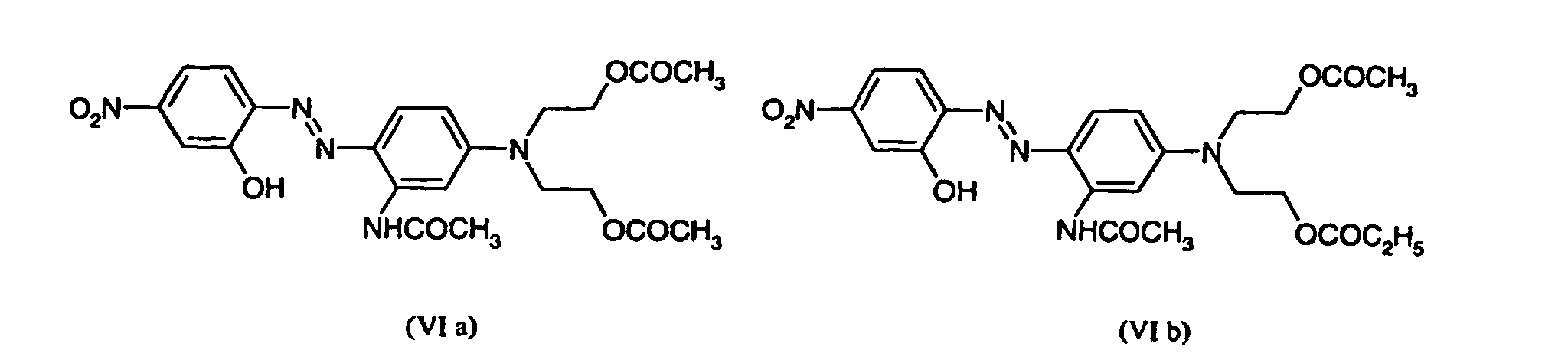
- the isolated dyestuff is mixture of the compounds of formula (VIa) and (VIb) with a ⁇ max of 519 nm (in DMF), which dyes polyester in red shades with good fastnesses.
- 17.5 parts of the dyestuff according to example 1 in the form of the moist presscake are wet-ground by a known method with 32.5 parts of a commercial dispersing agent based on lignin sulfonates, and pulverized to a powder.
- 1.2 parts of this dye preparation are added to 2000 parts of demineralized water of 70°C, which contains 40 parts of ammonium sulfate; the pH value of the dye bath is set at 5 with 85% formic acid.
- 100 parts of washed polyester fiber fabric are placed in this dye bath, the container is closed, heated to 130°C over the course of 20 minutes, and dyeing continues for a further 60 minutes at this temperature.
- the polyester fiber fabric After cooling, the polyester fiber fabric is removed from the dye bath, rinsed, soaped and cleaned by reduction with sodium hydrosulfite in the usual way. After thermo-fixation (180°C, 30 sec), a brilliant red dyeing is obtained with very good all-round fastness, especially fastness to light and sublimation, in particular excellent wet fastness.
- the dyestuffs of examples 2 to 9 may be used in analogous manner, and dyeings with very good all-round fastness are obtained.
- Dyeing polyester yarn can be carried out analogously with examples 2 - 9.
- Example 2 2.5 parts of the dyestuff obtained in Example 1 are dissolved with stirring at 25°C in a mixture of 20 parts diethyleneglycol and 77.5 parts water to obtain a printing ink suitable for ink jet printing.
- the dyestuffs of Examples 2 to 9 or dyestuff mixtures of Examples 1 to 9 can also be used in a manner analogous to that described in Application Example B.
- a printing paste according to the invention consists of 500g of a thickener (bean gum ether e.g. Indalca TM), 10g of a fixation accelerant (e.g. Printogen HDN TM), 10g of a levelling agent (e.g. Sandogen CN TM), 10g of a buffer and dispersant system for dyeing (eg. Sandacid PB TM; 1:2) and 10g of a dye of example 1 and adding water up to 1000g.
- a thickener bean gum ether e.g. Indalca TM
- 10g of a fixation accelerant e.g. Printogen HDN TM
- a levelling agent e.g. Sandogen CN TM
- 10g of a buffer and dispersant system for dyeing eg. Sandacid PB TM; 1:2
- Indalca was purchased from Cesalpinia S.p.A, Italy
- This printing paste is used for printing papery substrates, textile fibre materials and plastic films and plastic transparencies.
- the dyestuffs of Examples 2 to 9 or dyestuff mixtures of Examples 1 to 9 can also be used in a manner analogous to that described in Application Example C.
- a polyester Interlock fabric was printed with a conventional printing machine using the printing paste of the APPLICATION EXAMPLE C.
- the resulting printed fabric is dried for 3 minutes at 110°C and then treated with hot steam for 7 minutes at 175°C.
- the fabric was rinsed with cold tap water for 5 minutes, and then rinsed for 5 minutes with demineralised water.
- the so treated fabric was reductively cleansed in a bath comprising 4g/l Na 2 CO 3 , 2 g/l hydrosulfite sodium salt (85%) and 1 g/l Lyogen DFT TM (Trademark of Clariant AG, Muttenz, Switzerland). Further rinsing for 15 minutes with tap water was followed by a final drying step. This leaves a polyester fabric with a brilliant red print with very good all-round fastness, especially fastness to light and sublimation, in particular excellent wet fastness.
- the dyestuffs of Examples 2 to 9 or dyestuff mixtures of Examples 1 to 9 can also be used in a manner analogous to that described in Application Example D.
- the ink jet printing composition is preferably prepared by heating the medium to 40°C and then adding a dye of the example 1. The mixture is stirred until the dyes are dissolved. The composition is then cooled down to room temperature and the further ingredients are added.
- the dyestuffs of Examples 2 to 9 or dyestuff mixtures of Examples 1 to 9 can also be used in a manner analogous to that described in Application Example E.
- a polyester Interlock fabric was ink jet printed using the printing ink of the APPLICATION EXAMPLE E .
- the printed fabric was treated analougusly to the post printing treatment of APPLICATION EXAMPLE D . This leaves a polyester fabric with a brilliant red print with very good all-round fastness, especially fastness to light and sublimation, in particular excellent wet fastness.
- the dyestuffs of Examples 2 to 9 or dyestuff mixtures of Examples 1 to 9 can also be used in a manner analogous to that described in Application Example F.
Landscapes
- Organic Chemistry (AREA)
- Chemical & Material Sciences (AREA)
- Inks, Pencil-Leads, Or Crayons (AREA)
- Coloring (AREA)
- Ink Jet Recording Methods And Recording Media Thereof (AREA)
- Ink Jet (AREA)
- Plural Heterocyclic Compounds (AREA)
- Liquid Crystal Substances (AREA)
- Organic Low-Molecular-Weight Compounds And Preparation Thereof (AREA)
- Surgical Instruments (AREA)
- Materials For Photolithography (AREA)
- Nitrogen Condensed Heterocyclic Rings (AREA)
- Steroid Compounds (AREA)
- Pharmaceuticals Containing Other Organic And Inorganic Compounds (AREA)
Abstract
Description

- R1
- signifies -CH3; -C2H5; allyl; benzyl; propargyl; -C2H4CN; C2H4OCO-C1-2-alkyl; -C1-3-alkylene-COO-C2H4-N-phthalimid or -C2H4-COO-R5,
- R2
- signifies H, -CH3, -CH2CH3, -C2H4OCO-C1-2-alkyl or -C2H4-COO-R5,
wherein- R5
- signifies C1-4-alkyl; C1-2-alkoxyethyl; allyl; benzyl; propargyl; phenoxyethyl or tetrahydrofurfuryl-2, and

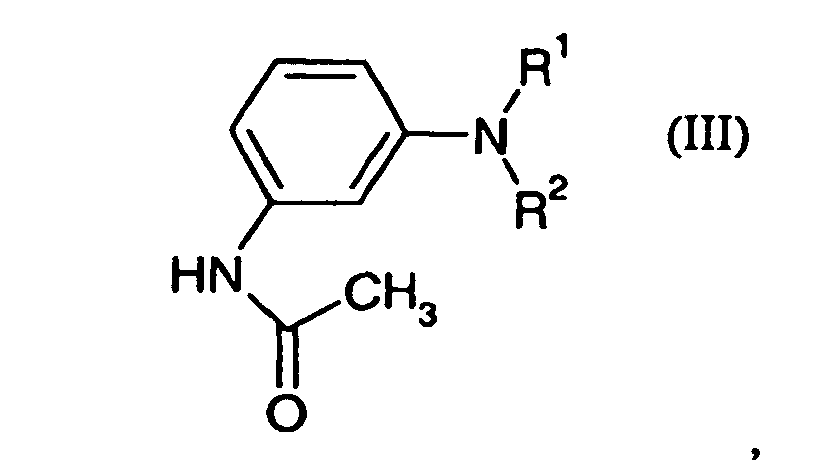
The diazotization is carried out, for example using sodium nitrite in acid aqueous medium. The diazotization can also be carried out using other diazotization agents, for example nitrosulfuric acid. An additional acid may be present in the reaction medium during diazotization, for example phosphoric acid, sulfuric acid, acetic acid, propionic acid, hydrochloric acid or mixtures of these acids, e.g. mixtures of phosphoric acid, and acetic acid. Diazotization is conveniently carried out within the temperature range of from -10 to 10°C, preferably from 0°C to 5°C.
Coupling of the diazotized compound of formula (II) to the coupling component of formula (III) is carried out in known manner, for example in acid, aqueous or aqueous-organic medium, preferably within the temperature range from 0°C to 50°C, more preferably from 20°C to 40°C. Acid used are, for example hydrochloric acid, acetic acid, sulfuric acid or phosphoric acid. For example diazotization and coupling can be carried out in the same reaction medium.
The preparation of the diazonium ion, typically through the reaction with excess nitrous acid or the like such as nitrosyl sulfuric acid at low temperature to form the electrophilic ion Aryl-N2 + is disclosed in the literature e.g. Advanced Organic Chemistry, Fieser&Fieser, pages 736-740 or Organische Chemie, K.Peter C.Vollhardt, pages 1154-1157, 1.Auflage 1988.
Typically, polyester fiber materials are dyed from an aqueous dispersion by the exhaust process in the presence of customary anionic or non-ionic dispersants and in the presence or absence of customary swelling agents (carrier) in the temperature range from 65°C to 140°C.
Cellulose-2½-acetate is preferably dyed at a temperature from 65°C to 85°C and cellulose triacetate at temperatures up to 115°C.
The novel dyes are suitable for dyeing by the thermosol process, for the exhaust process, the continuous process and for printing as for modem imaging processes, e.g. thermo-transfer printing, ink-jet printing, hot melt inkjet printing or by conventional printing processes.
The dyeing time is from 20 to 90 minutes, preferably from 30 to 60 minutes.
The dye liquors can additionally comprise other additives, for example dyeing auxiliaries, dispersants, wetting agents and antifoams.
Suitable inks or pastes comprise a) at least one dye of the formula (I) or mixtures of compounds of the formula (I), b) water or a medium including a mixture of water and an organic solvent, an anhydrous organic solvent or a solid having a low melting point, and c) optionally further additives.
The inks include 99-65% by weight, especially 98-65% by weight, preferably 98-70% by weight, more preferably 97.5-80% by weight, of an abovementioned medium b), which includes water or a mixture of water and an organic solvent, an anhydrous organic solvent or a solid having a low melting point.
Preferably the dye of formulae (I) or mixtures thereof have a solubility of not less than 2.5% by weight in this medium b) 0 at 20°C.
When the ink composition of the invention is used for printing papery substrates or hydrophobic substrates made of acetate-, polyester-, polyamide-, polyacrylnitrile-, polyvinylchloride- or polyurethane- polymers and blends thereof, the inks are preferably used together with the following compositions.
When the medium is a mixture of water and an organic solvent, the weight ratio of water to organic solvent is preferably in the range from 99:1 to 1:99, more preferably in the range from 99:1 to 50:50, particularly preferably in the range from 95:5 to 80:20.
It is preferable for the organic solvent which is included in the mixture with water to be a water-soluble solvent or a mixture of various water-soluble solvents. Preferred water-soluble organic solvents are C1-6-alcohols, preferably methanol, ethanol, n-propanol, isopropanol, n-butanol, sec-butanol, tert-butanol, n-pentanol, cyclopentanol and cyclohexanol; linear amides, preferably dimethylformamide or dimethylacetamide; ketones and keto alcohols, preferably acetone, methyl ethyl ketone, cyclohexanone and 4-hydroxy-4-methyl-2-pentanone; water-miscible ethers, preferably tetrahydrofuran and dioxane; diols, preferably diols possessing 2 to 12 carbon atoms, e.g. 1,5-pentanediol, ethylene glycol, propylene glycol, butylene glycol, pentylene glycol, hexylene glycol, thiodiglycol and oligo- and poly-alkylene glycols, preferably diethylene glycol, triethylene glycol, polyethylene glycol and polypropylene glycol; triols, preferably glycerol and 1,2,6-hexanetriol; mono-C1-4-alkyl ethers of diols, preferably mono-C1-4-alkyl ethers of diols possessing 2 to 12 carbon atoms, particularly preferably 2-methoxyethanol, 2-(2-methoxyethoxy)ethanol, 2-(2-ethoxyethoxy)ethanol, 2-[2-(2-methoxyethoxy)ethoxy]ethanol, 2-[2-(2-ethoxyethoxy)ethoxy]ethanol and ethylene glycol monoallyl ether; cyclic amides, preferably 2-pyrrolidone, N-methyl-2-pyrrolidone, N-ethyl-2-pyrrolidone, caprolactam and 1,3-dimethylimidazolidone; cyclic esters, preferably caprolactone; sulphoxides, preferably dimethyl sulphoxide and sulpholane.
In a preferred composition, the medium as per b) includes water and at least 2 or more, more preferably 2 to 8, water-soluble organic solvents.
Particularly preferred water-soluble solvents are cyclic amides, particularly 2-pyrrolidone, N-methylpyrrolidone and N-ethylpyrrolidone; diols, preferably 1,5-pentanediol, ethylene glycol, thiodiglycol, diethylene glycol and triethylene glycol; and mono-C1-4-alkyl and di-C1-4-alkyl ethers of diols, more preferably mono-C1-4-alkyl ethers of diols possessing 2 to 12 carbon atoms, particularly preferably 2-[2-(2-methoxyethoxy)ethoxy]ethanol.
Preferred water-insoluble solvents include inter alia aliphatic hydrocarbons; esters, preferably ethyl acetate; chlorinated hydrocarbons, preferably CH2Cl2; and ethers, preferably diethyl ether; and mixtures thereof.
When the liquid medium as per b) includes a water-insoluble organic solvent, it is preferable to add a polar solvent to increase the solubility of the dye in the liquid medium.
Examples of such polar solvents are C1-4-alcohols, preferably ethanol or propanol; ketones, preferably methyl ethyl ketone.
The anhydrous organic solvent can consist of a single solvent or a mixture of 2 or more different solvents.
When it is a mixture of different solvents, a mixture including 2 to 5 different anhydrous solvents is preferred. This makes it possible to provide a medium as per b) which permits good control of the drying properties and of the stability of the ink composition in storage.
Ink compositions including an anhydrous organic solvent or mixtures thereof are of particular interest when rapid drying times are required and especially when they are used for prints on hydrophobic and non-absorbing substrates, such as plastic, metal and glass.
These auxiliaries are preferably added in an amount of 0-5% by weight to inks. To printing pastes up to 70% by weight, especially up to 60% by weight, preferably up to 55% by weight, based on the total weight of the printing paste.
Useful water-soluble nonionic cellulose ethers include for example methyl-, ethyl-, hydroxyethyl-, methylhydroxyethyl-, hydroxypropyl- or hydroxypropylmethylcellulose. Preference is given to methylcellulose or in particular hydroxyethylcellulose. Cellulose ethers are customarily used in the ink in an amount of 0.01 to 2% by weight, especially 0.01 to 1% by weight, preferably 0.01 to 0.5% by weight, based on the total weight of the ink.
Useful alginates include in particular alkali metal alginates, preferably sodium alginate. These are customarily used in the ink in an amount of 0.01 to 2% by weight, especially 0.01 to 1% by weight, preferably 0.01 to 0.5% by weight, based on the total weight of the ink.
Printing pastes include up to 70% by weight thickening agents, preferably up to 55% by weight thickening agents. In printing pastes the thickening agents are used in an amount of 3 to 70% by weight, especially 5 to 60% by weight, preferably 7 to 55% by weight, based on the total weight of the printing paste.
Preference is given to ink compositions having a surface tension of 15-73 mN/m, especially 20-65 mN/m, particularly preferably 30-50 mN/m.
Preference is given to ink compositions having a conductivity of 0.1-100 mS/cm, especially 0.5-70 mS/cm, particularly preferably 1.0-60 mS/cm.
The inks may further include buffer substances, for example acetate, phospate, borax, borate or citrate. Examples are sodium acetate, di-sodium hydrogen phosphate, sodium borate, sodium tetraborate and sodium citrate.
solution is increased to 30°C and the pH value is adjusted to 2 by addition of sodium acetate. The solution is stirred for 24 hours at 30°C.
The isolated dyestuff of formula (V)

Coupling: A solution of 33.6 parts of a mixture of 1-[N,N-di-(2'-acetoxyethyl)-amino]-3-acetylaminobenzene and 1-[(N-acetoxyethyl-N-propionyloxyethyl)-amino]-3-acetylamino-benzene in 100 parts glacial acetic acid is added continuously to the diazonium salt solution, followed by an addition of 300 parts water. Afterwards the temperature of the solution is increased to 30°C and the pH value is adjusted to 2 by addition of sodium acetate. The solution is stirred for 24 hours at 30°C.
The precipitated dyestuff is filtered off, washed with water and dried in the vacuum at 60°C.
The isolated dyestuff is mixture of the compounds of formula (VIa) and (VIb)

| 500g | of a thickener (bean gum ether e.g. Indalca ™), |
| 10g | of a fixation accelerant (e.g. Printogen HDN ™), |
| 10g | of a levelling agent (e.g. Sandogen CN ™), |
| 10g | of a buffer and dispersant system for dyeing (eg. Sandacid PB ™; 1:2) and |
| 10g | of a dye of example 1 |
(Indalca was purchased from Cesalpinia S.p.A, Italy; Sandogen, Printogen and Sandacid are a trademarks of Clariant AG, Muttenz/Switzerland.)
- 6 parts
- of the dye of example 1,
- 20 parts
- of glycerol and
- 74 parts
- of water.
Claims (7)
- Dyestuff according to formula (I), wherein
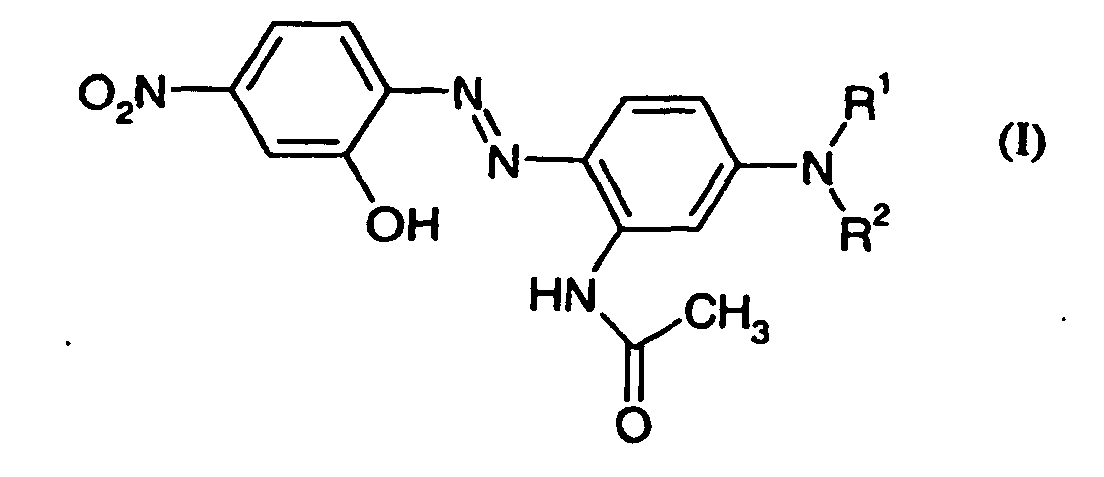
- R1
- signifies -CH3; -C2H5; allyl; benzyl; propargyl; -C2H4CN; C2H4OCO-C1-2-alkyl; -C1-3-alkylene-COO-C2H4-N-phthalimid or -C2H4-COO-R5,
- R2
- signifies H, -CH3, -CH2CH3, -C2H4OCO-C1-2-alkyl or -C2H4-COO-R5,
wherein- R5
- signifies C1-4-alkyl; C1-2-alkoxyethyl; allyl; benzyl; propargyl; phenoxyethyl or tetrahydrofurfuryl-2, and
- Process for the production of a dyestuff of formula (I), according to a claim 1, characterized in that a diazotized amine of formula (II)wherein all substituents have the meanings given in claim 1,

is coupled with an amine of formula (III)wherein all substituents have the meanings given in claim 1.
- Use of a disperse dyestuff of formula (I) or mixtures thereof, according to claim 1 for dyeing or printing fibers or threads or materials produced therefrom, which comprise, fully or semi-synthetic, hydrophobic, organic materials.
- Use of a disperse dyestuff of formula (I) or mixtures thereof, according to claim 1 for the inkjet printing process or hot melt inkjet process.
- Composition comprising a dyestuff of formula (1) or mixtures thereof according to claim 1.
- Composition according to claim 5 wherein the composition is a printing paste or a printing ink or a inkjet printing ink or a hot melt inkjet printing ink.
- Fibers or threads or materials produced thereof, which comprise fully or semi-synthetic, hydrophobic, organic materials which has been dyed or printed with a dyestuff of formula (I) or mixtures thereof, as claimed in claim 1.
Priority Applications (1)
| Application Number | Priority Date | Filing Date | Title |
|---|---|---|---|
| EP04014451A EP1466947B1 (en) | 2001-04-03 | 2002-04-02 | AZO compound |
Applications Claiming Priority (3)
| Application Number | Priority Date | Filing Date | Title |
|---|---|---|---|
| GBGB0108318.7A GB0108318D0 (en) | 2001-04-03 | 2001-04-03 | Organic compounds |
| GB0108318 | 2001-04-03 | ||
| PCT/IB2002/001118 WO2002081572A1 (en) | 2001-04-03 | 2002-04-02 | Azo dyes |
Related Child Applications (1)
| Application Number | Title | Priority Date | Filing Date |
|---|---|---|---|
| EP04014451A Division EP1466947B1 (en) | 2001-04-03 | 2002-04-02 | AZO compound |
Publications (2)
| Publication Number | Publication Date |
|---|---|
| EP1377641A1 EP1377641A1 (en) | 2004-01-07 |
| EP1377641B1 true EP1377641B1 (en) | 2005-09-07 |
Family
ID=9912148
Family Applications (2)
| Application Number | Title | Priority Date | Filing Date |
|---|---|---|---|
| EP02713161A Expired - Lifetime EP1377641B1 (en) | 2001-04-03 | 2002-04-02 | Azo dyes |
| EP04014451A Expired - Lifetime EP1466947B1 (en) | 2001-04-03 | 2002-04-02 | AZO compound |
Family Applications After (1)
| Application Number | Title | Priority Date | Filing Date |
|---|---|---|---|
| EP04014451A Expired - Lifetime EP1466947B1 (en) | 2001-04-03 | 2002-04-02 | AZO compound |
Country Status (11)
| Country | Link |
|---|---|
| US (2) | US7101983B2 (en) |
| EP (2) | EP1377641B1 (en) |
| JP (2) | JP4339596B2 (en) |
| KR (1) | KR100816240B1 (en) |
| CN (2) | CN1244640C (en) |
| AT (2) | ATE381596T1 (en) |
| DE (2) | DE60206030T2 (en) |
| ES (2) | ES2247307T3 (en) |
| GB (1) | GB0108318D0 (en) |
| PT (1) | PT1466947E (en) |
| WO (1) | WO2002081572A1 (en) |
Families Citing this family (20)
| Publication number | Priority date | Publication date | Assignee | Title |
|---|---|---|---|---|
| GB0108318D0 (en) * | 2001-04-03 | 2001-05-23 | Clariant Int Ltd | Organic compounds |
| PL376070A1 (en) * | 2002-12-20 | 2005-12-12 | Clariant Finance (Bvi) Limited | Dye compositions for dyeing or printing fibrous cellulose acetate products |
| JP2005264021A (en) * | 2004-03-19 | 2005-09-29 | Konica Minolta Holdings Inc | Ink for inkjet and inkjet recording method |
| TW200628556A (en) * | 2004-12-10 | 2006-08-16 | Clariant Int Ltd | Azo compounds |
| CN1317449C (en) * | 2005-06-07 | 2007-05-23 | 浙江闰土股份有限公司 | White discharge cationic black dye for dyeing and printing |
| GB0622473D0 (en) * | 2006-11-10 | 2006-12-20 | Dystar Textilfarben Gmbh & Co | Disperse azo dyestuffs |
| KR100910170B1 (en) * | 2007-11-01 | 2009-07-30 | 경북대학교 산학협력단 | Dyes for Polypropylene Fibers |
| KR101300673B1 (en) * | 2011-04-07 | 2013-08-28 | (주) 인우 코퍼레이션 | Nonaqueous fluid marker having N-benzyl-N-ethylaniline and Preparing method thereof |
| JPWO2013047386A1 (en) * | 2011-09-30 | 2015-03-26 | 富士フイルム株式会社 | Aqueous coloring composition for textile printing, textile printing method, and fabric |
| CN102702788A (en) * | 2012-05-31 | 2012-10-03 | 江苏之江化工有限公司 | Dispersed azo dye mixture |
| EP2995653A1 (en) * | 2014-09-15 | 2016-03-16 | DyStar Colours Distribution GmbH | High wet-fast disperse dyes and mixtures thereof |
| CN104559287B (en) * | 2014-12-29 | 2017-02-22 | 浙江龙盛集团股份有限公司 | Disperse dye compound as well as preparation method and application thereof |
| CN106566282B (en) * | 2016-10-12 | 2019-03-08 | 浙江龙盛集团股份有限公司 | A kind of high fastness disperse dye composition and dye preparations |
| CN106977975B (en) * | 2017-04-24 | 2019-09-24 | 苏州科法曼化学有限公司 | Azo dispersion dyes compound and its synthetic method and tint applications |
| CN107043551B (en) * | 2017-05-31 | 2019-12-13 | 蓬莱嘉信染料化工股份有限公司 | Orange-red disperse dye compound, dye composition, and preparation method and application thereof |
| KR102132370B1 (en) * | 2018-03-13 | 2020-08-05 | 주식회사 지씨에스 | Apparatus for Managing Skin, Driving Method of Apparatus for Managing Skin, and Computer Readable Recording Medium |
| EP3715424A1 (en) | 2019-03-27 | 2020-09-30 | DyStar Colours Distribution GmbH | High wet fast disperse dye mixtures of n-[4-(5-thiocyanato-2,4-dinitro-phenylazo)-phenyl]-amine derivatives and n-[4-(4-nitro-phenylazo)-phenyl]-amine derivatives |
| EP3715423B1 (en) | 2019-03-27 | 2022-05-11 | DyStar Colours Distribution GmbH | High wet fast disperse dye mixtures of n-[4-(5-fluoro-2,4-dinitro-phenylazo)-phenyl]-amine derivatives and n-[4-(4-nitro-phenylazo)-phenyl]-amine derivatives |
| WO2021107253A1 (en) * | 2019-11-29 | 2021-06-03 | (주)라쉬반코리아 | Natural fiber preprocessing agent for sublimation transfer |
| CN113234331B (en) * | 2021-04-06 | 2022-10-25 | 杭州福莱蒽特股份有限公司 | a blue disperse dye |
Family Cites Families (17)
| Publication number | Priority date | Publication date | Assignee | Title |
|---|---|---|---|---|
| FR1445371A (en) | 1964-08-28 | 1966-07-08 | Sandoz Sa | Mono-Azo Series Dispersion Dyes, Manufacturing Processes and Applications |
| JPS449758B1 (en) * | 1966-08-17 | 1969-05-07 | ||
| JPS4817858B1 (en) * | 1970-12-26 | 1973-06-01 | ||
| GB2058115B (en) * | 1979-08-16 | 1983-03-16 | Ici Ltd | Disperse azo dyestuffs |
| US4626284A (en) * | 1983-10-08 | 1986-12-02 | Mitsubishi Chemical Industries Ltd. | Recording liquid |
| GB8421551D0 (en) * | 1984-08-24 | 1984-09-26 | Ici Plc | Water-soluble dye |
| ES2032594T3 (en) * | 1987-02-27 | 1993-02-16 | Ciba-Geigy Ag | PROCEDURE TO IMPROVE THE PHOTOCHEMICAL STABILITY OF DYES ON POLYESTER FIBER MATERIALS. (RESERVATION OF ART. 167.2 CPE). |
| PL148432B2 (en) * | 1987-12-03 | 1989-10-31 | Agent for dyeing polyester fibre to black colour | |
| US4963189A (en) * | 1989-08-24 | 1990-10-16 | Hewlett-Packard Company | Waterfast ink formulations with a novel series of anionic dyes containing two or more carboxyl groups |
| US5062892A (en) | 1989-10-27 | 1991-11-05 | Hewlett-Packard Company | Ink additives for improved ink-jet performance |
| US5061404A (en) * | 1989-12-26 | 1991-10-29 | Allied-Signal Inc. | Electro-optical materials and light modulator devices containing same |
| US5186865A (en) * | 1989-12-26 | 1993-02-16 | Allied-Signal Inc. | Electro-optical materials and light modulator devices containing same |
| GB9219418D0 (en) * | 1992-09-14 | 1992-10-28 | Ici Plc | Disperse dyes |
| JPH06329930A (en) * | 1993-05-06 | 1994-11-29 | Ciba Geigy Ag | Azo dye |
| DE4419622A1 (en) * | 1994-06-03 | 1995-12-07 | Cassella Ag | Monoazo dyes, their production and use |
| DE19636380A1 (en) * | 1996-09-09 | 1998-03-12 | Dystar Textilfarben Gmbh & Co | Disperse dye mixtures |
| GB0108318D0 (en) | 2001-04-03 | 2001-05-23 | Clariant Int Ltd | Organic compounds |
-
2001
- 2001-04-03 GB GBGB0108318.7A patent/GB0108318D0/en not_active Ceased
-
2002
- 2002-04-02 JP JP2002579944A patent/JP4339596B2/en not_active Expired - Fee Related
- 2002-04-02 CN CNB028078675A patent/CN1244640C/en not_active Expired - Fee Related
- 2002-04-02 ES ES02713161T patent/ES2247307T3/en not_active Expired - Lifetime
- 2002-04-02 WO PCT/IB2002/001118 patent/WO2002081572A1/en not_active Ceased
- 2002-04-02 DE DE60206030T patent/DE60206030T2/en not_active Expired - Lifetime
- 2002-04-02 ES ES04014451T patent/ES2295732T3/en not_active Expired - Lifetime
- 2002-04-02 CN CNB2005101135806A patent/CN100352863C/en not_active Expired - Fee Related
- 2002-04-02 DE DE60224225T patent/DE60224225T2/en not_active Expired - Lifetime
- 2002-04-02 EP EP02713161A patent/EP1377641B1/en not_active Expired - Lifetime
- 2002-04-02 PT PT04014451T patent/PT1466947E/en unknown
- 2002-04-02 EP EP04014451A patent/EP1466947B1/en not_active Expired - Lifetime
- 2002-04-02 AT AT04014451T patent/ATE381596T1/en not_active IP Right Cessation
- 2002-04-02 AT AT02713161T patent/ATE304035T1/en not_active IP Right Cessation
- 2002-04-02 KR KR1020037011815A patent/KR100816240B1/en not_active Expired - Fee Related
- 2002-04-02 US US10/473,783 patent/US7101983B2/en not_active Expired - Lifetime
-
2006
- 2006-07-21 US US11/490,902 patent/US7301013B2/en not_active Expired - Lifetime
-
2009
- 2009-02-12 JP JP2009030519A patent/JP5133916B2/en not_active Expired - Fee Related
Also Published As
| Publication number | Publication date |
|---|---|
| US20060258854A1 (en) | 2006-11-16 |
| ES2247307T3 (en) | 2006-03-01 |
| DE60206030D1 (en) | 2005-10-13 |
| US20040143108A1 (en) | 2004-07-22 |
| DE60224225D1 (en) | 2008-01-31 |
| DE60206030T2 (en) | 2006-07-13 |
| KR20030093229A (en) | 2003-12-06 |
| PT1466947E (en) | 2008-02-08 |
| DE60224225T2 (en) | 2008-05-08 |
| US7101983B2 (en) | 2006-09-05 |
| CN1244640C (en) | 2006-03-08 |
| GB0108318D0 (en) | 2001-05-23 |
| EP1377641A1 (en) | 2004-01-07 |
| CN100352863C (en) | 2007-12-05 |
| JP4339596B2 (en) | 2009-10-07 |
| EP1466947A1 (en) | 2004-10-13 |
| US7301013B2 (en) | 2007-11-27 |
| JP5133916B2 (en) | 2013-01-30 |
| CN1754919A (en) | 2006-04-05 |
| WO2002081572A1 (en) | 2002-10-17 |
| KR100816240B1 (en) | 2008-03-21 |
| ATE381596T1 (en) | 2008-01-15 |
| ATE304035T1 (en) | 2005-09-15 |
| JP2004534110A (en) | 2004-11-11 |
| JP2009197228A (en) | 2009-09-03 |
| CN1500124A (en) | 2004-05-26 |
| EP1466947B1 (en) | 2007-12-19 |
| ES2295732T3 (en) | 2008-04-16 |
Similar Documents
| Publication | Publication Date | Title |
|---|---|---|
| JP5133916B2 (en) | Azo compounds | |
| WO2008049758A2 (en) | Disperse dyes, their preparation and their use | |
| CN101896554A (en) | Azo dyes for dyeing and printing hydrophobic materials | |
| EP1556444B1 (en) | Azo compounds | |
| EP1824932B1 (en) | Azo compounds | |
| EP1411089A1 (en) | Azo compounds | |
| HK1115407A (en) | Azo compounds | |
| KR20250151491A (en) | A novel class of disperse azo dyes, their preparation method and their uses | |
| HK1107112A (en) | Azo compounds | |
| HK1084144B (en) | Azo compounds |
Legal Events
| Date | Code | Title | Description |
|---|---|---|---|
| PUAI | Public reference made under article 153(3) epc to a published international application that has entered the european phase |
Free format text: ORIGINAL CODE: 0009012 |
|
| 17P | Request for examination filed |
Effective date: 20031103 |
|
| AK | Designated contracting states |
Kind code of ref document: A1 Designated state(s): AT BE CH CY DE DK ES FI FR GB GR IE IT LI LU MC NL PT SE TR |
|
| 17Q | First examination report despatched |
Effective date: 20040209 |
|
| RIN1 | Information on inventor provided before grant (corrected) |
Inventor name: GOEKE, KNUT Inventor name: EICH, OLIVER Inventor name: EGLI, ROBERT |
|
| GRAP | Despatch of communication of intention to grant a patent |
Free format text: ORIGINAL CODE: EPIDOSNIGR1 |
|
| GRAS | Grant fee paid |
Free format text: ORIGINAL CODE: EPIDOSNIGR3 |
|
| GRAA | (expected) grant |
Free format text: ORIGINAL CODE: 0009210 |
|
| AK | Designated contracting states |
Kind code of ref document: B1 Designated state(s): AT BE CH CY DE DK ES FI FR GB GR IE IT LI LU MC NL PT SE TR |
|
| PG25 | Lapsed in a contracting state [announced via postgrant information from national office to epo] |
Ref country code: BE Free format text: LAPSE BECAUSE OF FAILURE TO SUBMIT A TRANSLATION OF THE DESCRIPTION OR TO PAY THE FEE WITHIN THE PRESCRIBED TIME-LIMIT Effective date: 20050907 Ref country code: NL Free format text: LAPSE BECAUSE OF FAILURE TO SUBMIT A TRANSLATION OF THE DESCRIPTION OR TO PAY THE FEE WITHIN THE PRESCRIBED TIME-LIMIT Effective date: 20050907 Ref country code: FI Free format text: LAPSE BECAUSE OF FAILURE TO SUBMIT A TRANSLATION OF THE DESCRIPTION OR TO PAY THE FEE WITHIN THE PRESCRIBED TIME-LIMIT Effective date: 20050907 Ref country code: AT Free format text: LAPSE BECAUSE OF FAILURE TO SUBMIT A TRANSLATION OF THE DESCRIPTION OR TO PAY THE FEE WITHIN THE PRESCRIBED TIME-LIMIT Effective date: 20050907 |
|
| REG | Reference to a national code |
Ref country code: GB Ref legal event code: FG4D |
|
| REG | Reference to a national code |
Ref country code: CH Ref legal event code: EP |
|
| REG | Reference to a national code |
Ref country code: CH Ref legal event code: NV Representative=s name: CLARIANT INTERNATIONAL LTD. |
|
| REG | Reference to a national code |
Ref country code: IE Ref legal event code: FG4D |
|
| REF | Corresponds to: |
Ref document number: 60206030 Country of ref document: DE Date of ref document: 20051013 Kind code of ref document: P |
|
| PG25 | Lapsed in a contracting state [announced via postgrant information from national office to epo] |
Ref country code: SE Free format text: LAPSE BECAUSE OF FAILURE TO SUBMIT A TRANSLATION OF THE DESCRIPTION OR TO PAY THE FEE WITHIN THE PRESCRIBED TIME-LIMIT Effective date: 20051207 Ref country code: DK Free format text: LAPSE BECAUSE OF FAILURE TO SUBMIT A TRANSLATION OF THE DESCRIPTION OR TO PAY THE FEE WITHIN THE PRESCRIBED TIME-LIMIT Effective date: 20051207 |
|
| REG | Reference to a national code |
Ref country code: GR Ref legal event code: EP Ref document number: 20050403345 Country of ref document: GR |
|
| PG25 | Lapsed in a contracting state [announced via postgrant information from national office to epo] |
Ref country code: PT Free format text: LAPSE BECAUSE OF FAILURE TO SUBMIT A TRANSLATION OF THE DESCRIPTION OR TO PAY THE FEE WITHIN THE PRESCRIBED TIME-LIMIT Effective date: 20060207 |
|
| NLV1 | Nl: lapsed or annulled due to failure to fulfill the requirements of art. 29p and 29m of the patents act | ||
| REG | Reference to a national code |
Ref country code: ES Ref legal event code: FG2A Ref document number: 2247307 Country of ref document: ES Kind code of ref document: T3 |
|
| PG25 | Lapsed in a contracting state [announced via postgrant information from national office to epo] |
Ref country code: IE Free format text: LAPSE BECAUSE OF NON-PAYMENT OF DUE FEES Effective date: 20060403 |
|
| ET | Fr: translation filed | ||
| PG25 | Lapsed in a contracting state [announced via postgrant information from national office to epo] |
Ref country code: MC Free format text: LAPSE BECAUSE OF NON-PAYMENT OF DUE FEES Effective date: 20060430 |
|
| PLBE | No opposition filed within time limit |
Free format text: ORIGINAL CODE: 0009261 |
|
| STAA | Information on the status of an ep patent application or granted ep patent |
Free format text: STATUS: NO OPPOSITION FILED WITHIN TIME LIMIT |
|
| 26N | No opposition filed |
Effective date: 20060608 |
|
| REG | Reference to a national code |
Ref country code: IE Ref legal event code: MM4A |
|
| PG25 | Lapsed in a contracting state [announced via postgrant information from national office to epo] |
Ref country code: LU Free format text: LAPSE BECAUSE OF NON-PAYMENT OF DUE FEES Effective date: 20060402 Ref country code: TR Free format text: LAPSE BECAUSE OF FAILURE TO SUBMIT A TRANSLATION OF THE DESCRIPTION OR TO PAY THE FEE WITHIN THE PRESCRIBED TIME-LIMIT Effective date: 20050907 |
|
| PG25 | Lapsed in a contracting state [announced via postgrant information from national office to epo] |
Ref country code: CY Free format text: LAPSE BECAUSE OF FAILURE TO SUBMIT A TRANSLATION OF THE DESCRIPTION OR TO PAY THE FEE WITHIN THE PRESCRIBED TIME-LIMIT Effective date: 20050907 |
|
| REG | Reference to a national code |
Ref country code: DE Ref legal event code: R082 Ref document number: 60206030 Country of ref document: DE Representative=s name: WALLINGER RICKER SCHLOTTER TOSTMANN PATENT- UN, DE |
|
| REG | Reference to a national code |
Ref country code: FR Ref legal event code: PLFP Year of fee payment: 14 |
|
| PGFP | Annual fee paid to national office [announced via postgrant information from national office to epo] |
Ref country code: CH Payment date: 20150427 Year of fee payment: 14 |
|
| PGFP | Annual fee paid to national office [announced via postgrant information from national office to epo] |
Ref country code: GR Payment date: 20150428 Year of fee payment: 14 |
|
| REG | Reference to a national code |
Ref country code: FR Ref legal event code: TP Owner name: ARCHROMA IP GMBH, CH Effective date: 20160708 |
|
| REG | Reference to a national code |
Ref country code: DE Ref legal event code: R119 Ref document number: 60206030 Country of ref document: DE |
|
| REG | Reference to a national code |
Ref country code: CH Ref legal event code: PL |
|
| GBPC | Gb: european patent ceased through non-payment of renewal fee |
Effective date: 20160402 |
|
| REG | Reference to a national code |
Ref country code: FR Ref legal event code: ST Effective date: 20161230 |
|
| PG25 | Lapsed in a contracting state [announced via postgrant information from national office to epo] |
Ref country code: DE Free format text: LAPSE BECAUSE OF NON-PAYMENT OF DUE FEES Effective date: 20161101 Ref country code: GB Free format text: LAPSE BECAUSE OF NON-PAYMENT OF DUE FEES Effective date: 20160402 Ref country code: CH Free format text: LAPSE BECAUSE OF NON-PAYMENT OF DUE FEES Effective date: 20160430 Ref country code: FR Free format text: LAPSE BECAUSE OF NON-PAYMENT OF DUE FEES Effective date: 20160502 Ref country code: LI Free format text: LAPSE BECAUSE OF NON-PAYMENT OF DUE FEES Effective date: 20160430 |
|
| REG | Reference to a national code |
Ref country code: GR Ref legal event code: ML Ref document number: 20050403345 Country of ref document: GR Effective date: 20161104 |
|
| PG25 | Lapsed in a contracting state [announced via postgrant information from national office to epo] |
Ref country code: GR Free format text: LAPSE BECAUSE OF NON-PAYMENT OF DUE FEES Effective date: 20161104 Ref country code: IT Free format text: LAPSE BECAUSE OF NON-PAYMENT OF DUE FEES Effective date: 20160402 |
|
| REG | Reference to a national code |
Ref country code: FR Ref legal event code: PLFP Year of fee payment: 15 |
|
| REG | Reference to a national code |
Ref country code: GB Ref legal event code: S28 Free format text: APPLICATION FILED |
|
| REG | Reference to a national code |
Ref country code: DE Ref legal event code: R073 Ref document number: 60206030 Country of ref document: DE |
|
| REG | Reference to a national code |
Ref country code: FR Ref legal event code: RN Effective date: 20170419 |
|
| REG | Reference to a national code |
Ref country code: GB Ref legal event code: 732E Free format text: REGISTERED BETWEEN 20170629 AND 20170705 |
|
| REG | Reference to a national code |
Ref country code: DE Ref legal event code: R074 Ref document number: 60206030 Country of ref document: DE |
|
| REG | Reference to a national code |
Ref country code: GB Ref legal event code: S28 Free format text: RESTORATION ALLOWED Effective date: 20170719 |
|
| REG | Reference to a national code |
Ref country code: FR Ref legal event code: FC Effective date: 20170724 |
|
| REG | Reference to a national code |
Ref country code: FR Ref legal event code: PLFP Year of fee payment: 16 |
|
| PG25 | Lapsed in a contracting state [announced via postgrant information from national office to epo] |
Ref country code: FR Free format text: LAPSE BECAUSE OF NON-PAYMENT OF DUE FEES Effective date: 20160502 Ref country code: DE Free format text: LAPSE BECAUSE OF NON-PAYMENT OF DUE FEES Effective date: 20161101 |
|
| PGRI | Patent reinstated in contracting state [announced from national office to epo] |
Ref country code: DE Effective date: 20170724 Ref country code: FR Effective date: 20170724 |
|
| REG | Reference to a national code |
Ref country code: FR Ref legal event code: PLFP Year of fee payment: 17 |
|
| PG25 | Lapsed in a contracting state [announced via postgrant information from national office to epo] |
Ref country code: IT Free format text: LAPSE BECAUSE OF NON-PAYMENT OF DUE FEES Effective date: 20160402 |
|
| PGRI | Patent reinstated in contracting state [announced from national office to epo] |
Ref country code: IT Effective date: 20200108 |
|
| PGFP | Annual fee paid to national office [announced via postgrant information from national office to epo] |
Ref country code: FR Payment date: 20200429 Year of fee payment: 19 Ref country code: ES Payment date: 20200511 Year of fee payment: 19 |
|
| PGFP | Annual fee paid to national office [announced via postgrant information from national office to epo] |
Ref country code: IT Payment date: 20200424 Year of fee payment: 19 Ref country code: GB Payment date: 20200429 Year of fee payment: 19 |
|
| PGFP | Annual fee paid to national office [announced via postgrant information from national office to epo] |
Ref country code: DE Payment date: 20200629 Year of fee payment: 19 |
|
| REG | Reference to a national code |
Ref country code: DE Ref legal event code: R119 Ref document number: 60206030 Country of ref document: DE |
|
| GBPC | Gb: european patent ceased through non-payment of renewal fee |
Effective date: 20210402 |
|
| PG25 | Lapsed in a contracting state [announced via postgrant information from national office to epo] |
Ref country code: DE Free format text: LAPSE BECAUSE OF NON-PAYMENT OF DUE FEES Effective date: 20211103 Ref country code: FR Free format text: LAPSE BECAUSE OF NON-PAYMENT OF DUE FEES Effective date: 20210430 Ref country code: GB Free format text: LAPSE BECAUSE OF NON-PAYMENT OF DUE FEES Effective date: 20210402 |
|
| REG | Reference to a national code |
Ref country code: ES Ref legal event code: FD2A Effective date: 20220629 |
|
| PG25 | Lapsed in a contracting state [announced via postgrant information from national office to epo] |
Ref country code: ES Free format text: LAPSE BECAUSE OF NON-PAYMENT OF DUE FEES Effective date: 20210403 |
|
| PG25 | Lapsed in a contracting state [announced via postgrant information from national office to epo] |
Ref country code: IT Free format text: LAPSE BECAUSE OF NON-PAYMENT OF DUE FEES Effective date: 20210430 |