EP1376926A1 - Method and device for data broadcasting in third generation networks - Google Patents
Method and device for data broadcasting in third generation networks Download PDFInfo
- Publication number
- EP1376926A1 EP1376926A1 EP02291586A EP02291586A EP1376926A1 EP 1376926 A1 EP1376926 A1 EP 1376926A1 EP 02291586 A EP02291586 A EP 02291586A EP 02291586 A EP02291586 A EP 02291586A EP 1376926 A1 EP1376926 A1 EP 1376926A1
- Authority
- EP
- European Patent Office
- Prior art keywords
- network
- broadcast
- serving node
- connection
- mbms
- Prior art date
- Legal status (The legal status is an assumption and is not a legal conclusion. Google has not performed a legal analysis and makes no representation as to the accuracy of the status listed.)
- Granted
Links
- 238000000034 method Methods 0.000 title claims description 62
- 230000011664 signaling Effects 0.000 claims abstract description 11
- 101000583175 Homo sapiens Prolactin-inducible protein Proteins 0.000 claims 1
- 101000898291 Nicotiana tabacum Catalase isozyme 1 Proteins 0.000 claims 1
- 102100030350 Prolactin-inducible protein Human genes 0.000 claims 1
- 101000979255 Sus scrofa Neurolysin, mitochondrial Proteins 0.000 claims 1
- 230000008569 process Effects 0.000 description 13
- 230000004913 activation Effects 0.000 description 11
- 230000000977 initiatory effect Effects 0.000 description 4
- 239000000284 extract Substances 0.000 description 3
- 230000004044 response Effects 0.000 description 3
- 101100086716 Caenorhabditis elegans ran-3 gene Proteins 0.000 description 2
- 238000010586 diagram Methods 0.000 description 2
- 230000006870 function Effects 0.000 description 2
- 238000012423 maintenance Methods 0.000 description 2
- 230000005540 biological transmission Effects 0.000 description 1
- 230000007774 longterm Effects 0.000 description 1
- 230000005641 tunneling Effects 0.000 description 1
Images


Classifications
-
- H—ELECTRICITY
- H04—ELECTRIC COMMUNICATION TECHNIQUE
- H04L—TRANSMISSION OF DIGITAL INFORMATION, e.g. TELEGRAPHIC COMMUNICATION
- H04L12/00—Data switching networks
- H04L12/02—Details
- H04L12/16—Arrangements for providing special services to substations
- H04L12/18—Arrangements for providing special services to substations for broadcast or conference, e.g. multicast
- H04L12/189—Arrangements for providing special services to substations for broadcast or conference, e.g. multicast in combination with wireless systems
-
- H—ELECTRICITY
- H04—ELECTRIC COMMUNICATION TECHNIQUE
- H04W—WIRELESS COMMUNICATION NETWORKS
- H04W72/00—Local resource management
- H04W72/30—Resource management for broadcast services
-
- H—ELECTRICITY
- H04—ELECTRIC COMMUNICATION TECHNIQUE
- H04W—WIRELESS COMMUNICATION NETWORKS
- H04W76/00—Connection management
- H04W76/10—Connection setup
-
- H—ELECTRICITY
- H04—ELECTRIC COMMUNICATION TECHNIQUE
- H04W—WIRELESS COMMUNICATION NETWORKS
- H04W80/00—Wireless network protocols or protocol adaptations to wireless operation
- H04W80/04—Network layer protocols, e.g. mobile IP [Internet Protocol]
-
- H—ELECTRICITY
- H04—ELECTRIC COMMUNICATION TECHNIQUE
- H04W—WIRELESS COMMUNICATION NETWORKS
- H04W84/00—Network topologies
- H04W84/02—Hierarchically pre-organised networks, e.g. paging networks, cellular networks, WLAN [Wireless Local Area Network] or WLL [Wireless Local Loop]
- H04W84/04—Large scale networks; Deep hierarchical networks
Definitions
- the present invention relates to telecommunication networks, and more particularly to data broadcasting and multicasting in networks such as GPRS and UMTS networks.
- third generation (3G) networks such as UMTS networks (which use the GPRS network transport capabilities with additional functionalities)
- 3G networks such as UMTS networks (which use the GPRS network transport capabilities with additional functionalities)
- UMTS networks which use the GPRS network transport capabilities with additional functionalities
- MBMS multimedia broadcast multicast service
- BM-SC broadcast multicast service centre
- a "MBMS multicast service (or mode)" is a service in which a user requests or activates his participation in both home and roaming situations for sending multimedia data to several users.
- the multicast mode transmits the "source MBMS data" to the only cells of the multicast group or area in which at least one user equipment, such as a mobile telephone, has joined the multicast group.
- point-to-point radio channel or point-to-multipoint radio channel may be used.
- a "MBMS broadcast service (or mode)" is a network initiated service that allows the network to send multimedia service data (or content) to users localized in a chosen geographical area (or broadcast area) in order said users enable or disable said multimedia service.
- the broadcast mode transmits the source MBMS data in all the cells of a specified broadcast area without knowing the user equipments that are localized in this area.
- the BM-SC does not know the user equipment or its location for the MBMS broadcast, but it knows that the radio access network (or RAN) of the telecommunication network might, at least, know the user equipment.
- the MBMS service does not know that the user equipment is receiving broadcast data, and the network elements involved in the data transport might be aware that the user equipment is receiving the data.
- a point-to-multipoint radio channel must always be used at the radio interface of all cells.
- multimedia data are provided in a "point-to-multipoint" way, or in other words multimedia data are transmitted from a single source entity (or network equipment) to multiple user equipments, such as mobile telephones.
- 3G networks comprise a core network including at least one service serving node (or SSN) connected to a radio access network (RAN) including radio network controllers (or RNCs) linked to emission/reception base station, such as Node-B in case of UMTS network, and controlling the radio resources and therefore the cells in which user equipments are localized.
- SSN service serving node
- RAN radio access network
- RNCs radio network controllers
- Node-B in case of UMTS network
- the network specialists have developed complex solutions. This is more especially true in the broadcast mode for which the core network has to keep track of the cell locations of the user equipments.
- the SSNs need to be aware of the cell topology of the radio access network (RAN).
- RAN radio access network
- either the BM-SC needs to provide the proper SSN for cell topology or the proper SSN is aware of the cell topology through Operation, Administration and Maintenance (or OAM) operations, and the proper SSN had to send the required cell topology through dedicated messages to the RAN in order the broadcast be accomplish.
- OAM Operation, Administration and Maintenance
- storing and handling of cell topology (or knowledge) in the core network is very costly in terms of CPU power and storage capacity.
- the object of this invention is therefore to overcome all or part of the aforementioned drawbacks.
- a radio access network or RAN
- RAN radio access network
- MBMS multimedia broadcast multicast context
- the MBMS context is a special type of packet data protocol (or PDP) context or context information that is stored in the network elements, such as GGSN (or "gateway network serving node"), SSN (or SGSN), RNC and user equipment, that represent the link that said user equipment has with the GGSN, also named "session of a user equipment”. All the network elements that have PDP context information relative to a certain user equipment know through this information how to route data packets, for example coming from/to the Internet, from GGSN to user equipment and vice versa. So, MBMS context or information represents all the routing information that are stored in the network entities (or elements), including the user equipment. Consequently, the MBMS service is the transport (or bearer) service that incorporates notably MBMS context(s), shared tunnels between network entities, shared radio channels and the BM-SC.
- GGSN packet data protocol
- SSN or SGSN
- RNC Radio Network Controller
- This method notably comprises the steps of:
- the broadcast multicast service server undertakes directly to activate a requested service to broadcast in a chosen cell in a similar way as user equipment does in multicast mode whereby existing messages are reused. Consequently, the transport of data to broadcast is done in a similar way as data to multicast. This allows to reuse point-to-point functionalities and messages and also the same functionalities and messages as those proposed for MBMS multicast, which notably eases implementation.
- the radio access network comprises radio network controllers (or RNC) each connected to a base station to define cells in which user equipments are localized
- the core network comprises at least one service serving node (or SSN), such as a service GPRS serving Node (or SGSN), linked to the radio network controllers and at least one gateway serving node, such as a gateway GPRS serving node (or GGSN), linked to the service serving node
- the first connection is preferably established between the broadcast multicast service server (BM-SC) and each radio network controller (RNC) that controls at least one cell included in the broadcast area and that is named "chosen radio network controller".
- BM-SC broadcast multicast service server
- RNC radio network controller
- the second connection is established between the service serving node and each "chosen radio network controller”.
- the third request is send from the broadcast multicast service server over the first connection via the "chosen radio network controller" and further over the second connection to the service serving node.
- the method according to the invention may include additional characteristics considered separately or combined and notably :
- the invention also relates to a broadcast multicast service server (or centre) for a telecommunication network comprising a radio access network (or RAN) defining cells in which user equipments, such as mobile telephones, are localized, and a core network linked to this radio access network and adapted to establish a multimedia broadcast multicast context (or MBMS) for the user equipments located in the cells.
- a broadcast multicast service server or centre
- a telecommunication network comprising a radio access network (or RAN) defining cells in which user equipments, such as mobile telephones, are localized, and a core network linked to this radio access network and adapted to establish a multimedia broadcast multicast context (or MBMS) for the user equipments located in the cells.
- RAN radio access network
- MBMS multimedia broadcast multicast context
- This server notably comprises :
- the invention also relates to a radio network controller (RNC) for a radio access network of a telecommunication network, this radio network controller being linkable to a core network of the telecommunication network adapted to establish a multimedia broadcast multicast service context for user equipments, and comprising :
- the invention also relates to a telecommunication network, such as a UMTS or GPRS network, which comprises
- the invention may be advantageously implemented with a first connection such as TCP/IP, IPsec, UDP/IP or ATM connection, and more particularly when the second and third requests are send through the first and second connections according to a protocol such as RANAP (or "Radio Access Network Application Protocol") or SABP (or "Service Area Broadcast Protocol”) or else all similar protocols used in 3G networks or 2G networks, such as GSM network.
- RANAP Radio Access Network Application Protocol
- SABP Service Area Broadcast Protocol
- Fig. 1 in order to describe a telecommunication network according to the invention, in a non-limiting embodiment.
- the telecommunication network TN is preferably adapted to mobile telephony. It is preferably a third generation (3G) network, and more preferably a UMTS network. But it could be another type of network such as a GPRS network (2,5G). UMTS network is well known by those skilled in the art, so it will not be described in detail.
- this network TN comprises a core network 1 linked to a radio access network (or RAN) 2.
- the core network 1 comprises a gateway serving node 3, such as a GGSN, linked to at least one service serving node 4, such as a SGSN.
- the GGSN 3 is linked to only one service serving node 4, but it could be link to a plurality of such service serving nodes.
- the radio access network 2 comprises a plurality of j radio network controllers (or RNCs) 5-j, each linked to at least one base station 6-j to define one or more telecommunication cells. Moreover each RNC 5-j is linked to the service serving node 4. In the example illustrated in figure 1 there are only two RNCs 5-1 and 5-2 linked to the service serving node 4.
- a base station 6-j which is named Node-B in case of a UMTS network, can establish a connection with a user equipment 7-k (or mobile telephone) when it is localized inside its emission/reception coverage area.
- the telecommunication network TN also comprises a service centre 8 dedicated to broadcast and multicast services.
- a service centre 8 dedicated to broadcast and multicast services.
- data multicast and broadcast services are available through a multimedia broadcast multicast service or MBMS.
- the main goal of MBMS is to optimize transport of multimedia data in both the core network 1 and the radio access network (RAN) 2 of the UMTS network for broadcast and multicast services.
- the multimedia data are in principle sent only once on every link established between "boxes" in the path extending from the MBMS data source to a user.
- data coming from a broadcast multicast service centre or server 9 are sent only once on every link involving the service, for example a GTP tunnel, between the BM-SC 9 and the GGSN 3, then between the GGSN 3 and the SGSN 4 and finally between the RNC 5-j and the user equipment 7.
- MBMS foresees two modes of operation : a broadcast mode and a multicast mode.
- the MBMS multicast mode is a service in which a user requests or activates its participation. The user can request from the network its participation in both home and roaming situations for sending multimedia data to several users.
- the MBMS broadcast mode is a network initiated service.
- the network sends multimedia service data (or content) to users localized in a chosen geographical area (for example one or more cells), in order said users enable or disable said multimedia service.
- BM-SC broadcast multicast service centre
- This BM-SC 9 is settled in the service centre 8. As it will be described below, the BM-SC 9 is arranged to establish specific connection with the gateway serving node (GGSN) 3 and the RNCs 5-j either directly or via a cell broadcast server 10, also named "cell broadcast centre” (or CBC).
- GGSN gateway serving node
- RNCs 5-j either directly or via a cell broadcast server 10, also named "cell broadcast centre” (or CBC).
- the service centre 8 may also comprise a second server (or content server) 11 for storing information and especially MBMS data, linked to the gateway serving node (GGSN) 3 and to the BM-SC 9.
- GGSN gateway serving node
- the content server 11 belongs to the mobile network operator.
- the telecommunication network TN comprises a "content provider centre” 12 equipped with a content provider broadcast service server 13, linked to BM-SC 9, and at least one content provider server 14, which usually belongs to a third person, linked to the gateway serving node (GGSN) 3 via one or two border routers 15.
- GGSN gateway serving node
- the core network 1 needs to keep track of the cell location of each user equipment 7.
- the BM-SC 3 needs to provide the proper SGSN 4 for cell topology or the proper SGSN 4 is aware of the cell topology through Operation and Maintenance (or OAM) operations and must send the required cell topology through dedicated messages to the RAN 3 in order the broadcast be accomplished.
- OAM Operation and Maintenance
- the BM-SC 9 is arranged in order to operate as a user equipment 7 when requesting MBMS service (de-)activation to the proper service serving node (SGSN) 4. So, the well known procedure used for MBMS multicast mode can also be used for MBMS broadcast mode. It means that BM-SC 9 will request the transmission of MBMS broadcast data in chosen cell(s), which will only be known by the RAN 3 and the BM-SC itself, and the transport of MBMS data will be done in a similar way as in MBMS multicast mode. So it becomes possible to reuse point-to-point functionalities and messages, which notably eases implementation of the MBMS architecture.
- the BM-SC 9 when it receives a broadcasting request, it establishes a (first) connection with the RNC(s) 5-j that control(s) the cell(s) in which the broadcast must be performed for signalling with the SGSN 4 associated to this RNS 5-j.
- the broadcasting request can be internal or external. It may be a MBMS request accompanied with the data to broadcast or only data to broadcast.
- This broadcasting request and/or the data to broadcast can come from different MBMS data sources, such as the content server 11 which usually belongs to the mobile network operator (internal request), or the content provider broadcast service server 13 (external request), or else the content provider server 14 (external request). So, when the broadcasting request comprises the data to broadcast, the BM-SC 9 stores them in a memory 18 before establishing the first connection.
- This first connection is managed by a connection modulus 16 of the BM-SC, and is preferably of the TCP/IP type, but it may be also of the IPsec type or UDP/IP type or else based on ATM technology.
- This first connection may be provided directly between the BM-SC 9 and the proper RNC 5-j or via the cell broadcast centre (CBC) 10. Every existing signalling method may be used for signalling between the BM-SC 9 and the RNC 5-j and between the RNC 5-j and the SGSN 4. It could be for example the RANAP protocol (TS25.413) or the SABP protocol (TS25.419) or else all similar protocols used in 3G networks or 2G networks, such as GSM networks.
- the connection modulus 16 of the BM-SC constitutes an interface that supports the chosen signalling protocol.
- the BM-SC 9 must activate (or initiate) a MBMS broadcast service.
- the proper SGSN 4 that serves the RNC(s) 5-j that control(s) the chosen cell(s) (or broadcast area). So, it begins with an attachment procedure to the proper SGSN 4 via the established first connection and a direct transfer mode link .
- This attachment procedure is initiated by a requesting modulus 17 of the BM-SC 9 and managed by said requesting modulus 17 and a first forwarding modulus 19 of each RNC 5-j.
- the first forwarding modulus 19 forwards the initiation of the attachment procedure i.e. the second request, to the SGSN4.
- the SGSN4 receives this initiation of the attachment procedure and establishes the second connection between the RNC(s) 5-j and itself.
- the attachment procedure is followed by a context activation based on a request by the BM-SC 9 of settlement (or activation) of a MBMS context by the proper SGSN 4, via the established first connection and a second connection established with the proper SGSN 4 by the first forwarding modulus 19 upon reception of said attachment request.
- This context activation is initiated by the requesting modulus 17 of the BM-SC 9 and managed by said requesting modulus 17 and a second forwarding modulus 20 of each RNC 5-j. More precisely this second forwarding modulus 20 is arranged to forward the MBMS context request to the proper SGSN 4 when it is received by its RNC 5-j.
- connection modulus 16 the requesting modulus 17, and the first 19 and second 20 forwarding modulus are preferably software modulus, respectively, but they may be also respectively made of electronic circuit(s) or hardware modulus, or a combination of hardware and software modulus.
- the settlement of MBMS context is based i) on establishment of MBMS bearers, such as GTP tunnels (or "GPRS Tunneling Protocol” tunnels), between the proper service serving node (SGSN) 4 and the gateway serving node (GGSN) 3, and ii) exchange of service membership join messages between the GGSN 3 and the BM-SC 9 to establish a bearer path in between.
- MBMS bearers such as GTP tunnels (or "GPRS Tunneling Protocol” tunnels)
- the BM-SC 9 can request the initiation of the MBMS service. It results in establishment of MBMS bearers, such as GTP tunnels, between the proper SGSN 4 and the RNC(s) 5-j and between the RNC(s) 5-j and the user equipments 7 localized in the cell(s) it (they) control(s), for data transport.
- MBMS bearers between the SGSN 4 and the RNC(s) 5-j are usually named "GTP tunnels"
- a MBMS bearer between a RNC 5-j and a user equipment 7 is usually named "radio bearer”.
- the requesting modulus 17 of the BM-SC 9 may also be arranged to deal with common coverage area between two or more chosen cells. This may occur in the presence of layered cell coverage with basic and umbrella cells, for example provided by a satellite broadcast system.
- the requesting modulus 17 can select the most appropriated cell(s) according to one or more chosen criterions (or target area requirement(s)).
- the chosen criterion(s) may be permanent one(s).
- a criterion is preferably made of data transmitted to the broadcast multicast service server 9 and coming from the same MBMS data source (13 or 14) that the data to broadcast.
- a criterion is preferably chosen in a non-limiting group comprising at least broadcasting cost, level priority and congestion status.
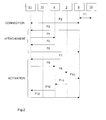
- a process starts, for example, when the content provider broadcast service server 13 sends to the BM-SC 9 a MBMS request for broadcasting data in one or several cells controlled by one or several RNCs 5-j and/or data to broadcast in one or several cells controlled by one or several RNCs 5-j (arrow F1).
- the broadcasting request and/or the data to broadcast may come from different MBMS data sources.
- a long term service announcement may precede this sending of MBMS request and/or data to broadcast. This announcement may be based on a http message, an e-mail message, a SMS message, a web-page or a SAP message, for example, send by the BM-SC 9 to the chosen user equipments 7.
- connection modulus 16 of the BM-SC 9 establishes a first connection with the RNC(s) 5-j that controls the cell(s) designated in the MBMS request and/or data received.
- This first connection is established either directly between the BM-SC 9 and the proper RNC 5-j or via the cell broadcast centre (CBC) 10.
- CBC cell broadcast centre
- the first connection is preferably of the TCP/IP type.
- the designated RNC(s) 5-j preferably perform(s) proxy function.
- the process follows with an attachment procedure (materialized by arrows F3 to F6).
- the requesting modulus 17 of the BM-SC 9 sends an attachment request to each designated RNC(s) 5-j via the established first connection (arrow F3).
- the attachment request specifies a temporary identifier such as the temporary mobile group(s) IMSI (or TMGI).
- each designated RNC 5-j "proxies" the attachment request to its associated service serving node (SGSN) 4, via a direct transfer mode link (arrow F4).
- the service serving node (SGSN) 4 establishes the second connection.
- the forwarding of the attachment request to said proper SGSN 4 is managed by the first forwarding modulus 19 of the RNC(s) 5-j; and the establishment of the second connection between the proper SGSN 4 and the RNC 5-j is managed by the proper SGSN4.
- the attachment When the attachment is accepted by the SGSN 4, it sends to the BM-SC 9 an attachment accept message specifying the temporary identifier (TMGI), via the designated RNC 5-j (arrows F5 and F6).
- TMGI temporary identifier
- the exchange of request and message between the BM-SC 9 and the RNC 5-j and between the RNC 5-j and the proper SGSN 4, via the established connection and link (or first and second connections), is based on a signalling method that uses preferably the RANAP protocol (TS25.413).
- the process follows with a context activation procedure (materialized by arrows F7 to F13).
- the requesting modulus 17 of the BM-SC 9 sends an activation MBMS context request to the proper SGSN 4 via each designated RNC(s) 5-j (arrows F7 and F8 i.e. the third request). More precisely, the activation MBMS context request is received in the RNC 5-j and forwarded by its second forwarding modulus 20 to the proper SGSN 4 via the second connection (or link).
- this request specifies an IP multicast address, a MBMS APN identifier (or "Access Point Identifier”) and a NSAPI identifier (or "Network layer Service Access Point Identifier”), both known to BM-SC 9 through OAM operations.
- the APN is an identifier that identifies a type of service such as MBMS.
- GGSN 3 that supports this service
- the NSAPI is an identifier that allows a user equipment 7 to recognize a PDP/MBMS context.
- the designated RNC(s) 5-j preferably perform(s) proxy function.
- the proper SGSN 4 Upon reception of this request, the proper SGSN 4 sends a creation MBMS context request to the GGSN 3 based on the received APN identifier, in order it creates a MBMS context and establishes a MBMS bearer (preferably a GTP tunnel) with said SGSN 4 (arrow F9).
- a creation MBMS context request to the GGSN 3 based on the received APN identifier, in order it creates a MBMS context and establishes a MBMS bearer (preferably a GTP tunnel) with said SGSN 4 (arrow F9).
- this GGSN 3 sends a MBMS service join message to the BM-SC 9 in order to setup a bearer path in between allowing the GGSN 3 to join the MBMS session provided by said BM-SC 9 (arrow F10). Then the GGSN 3 sends a creation MBMS context response to the SGSN 4 to confirm the establishment of the GTP tunnel (or MBMS bearer) in between (arrow F11).
- the SGSN 4 Upon reception of this response the SGSN 4 sends an activation MBMS context accept message to the BM-SC 9, preferably specifying the TMGI and NSAPI identifier for acknowledgement recognition, via the established link between itself and the designated RNC(s) 5-j (arrow F12) and the established connection between the RNC(s) 5-j and the BM-SC 9 (arrow F13).
- a data transfer process may be initiated on request of the BM-SC 9.
- a non-limiting example of this data transfer process is illustrated in details in figure 3.
- the process starts when the content provider broadcast service server 13 sends to the BM-SC 9 a MBMS request for broadcasting data in one or several cells controlled by one or several RNCs 5-j and/or data to broadcast in one or several cells controlled by one or several RNCs 5-j (arrow F'1).
- the process follows with a (re-)connection procedure (arrow F'2).
- the connection modulus 16 of the BM-SC 9 (re-)establishes a connection with the RNC(s) 5-j that control(s) the cell(s) designated in the MBMS request or data received.
- the process follows with a service request procedure (materialized by arrows F'3 and F'4).
- the requesting modulus 17 of the BM-SC 9 sends a service request to the designated RNC(s) 5-j, preferably specifying the relevant TMGI and RAI (or "Routing Area Identifier"; it indicates to the SGSN 4 which RNC(s) is (are) involved in the service), and the identifiers of the chosen cell(s) (arrow F'3).
- the RNC(s) 5-j proxy the service request to its associated service serving node (SGSN) 4, via the link (arrow F'4), specifying the TMGI, RAI and cell identifier(s).
- the process preferably follows with a service accept procedure (materialized by arrows F'a and F'b in figure 2).
- the service serving node (SGSN) 4 sends a service accept to the designated RNC(s) 5-j, preferably specifying the relevant TMGI (arrow F'a).
- the RNC(s) 5-j proxy the service request to the requesting modulus 17 of the BM-SC 9, via the link (arrow F'b), specifying the TMGI.
- the process follows with a MBMS radio access bearer establishment procedure (materialized by arrows F'5 to F'7 and "B-EST").
- the proper SGSN 4 sends a radio access bearer assignment request to the designated RNC(s) 5-j preferably specifying the NSAPI, the RABID(s) (or “Radio Access Bearer Identifier(s)”), TEID(s) (or “Tunnel Endpoint Identifier”), a QoS (or "Quality of Service”), the cell identifier(s) and its SGSN IP address (arrow F'5).
- the TEID is used in the GTP protocol to identify a MBMS context.
- each designated RNC 5-j sends a notification, preferably through RRC ("Radio Resource Control"), to the user equipments 7 localized in the cells specified in the radio access bearer assignment request in order said user equipments decide to receive or not the proposed service (arrow F'6).
- RRC Radio Resource Control
- the RRC is a protocol used to talk to the user equipment 7 and to send the user equipment system information, such as the radio channel to listen to.
- each RNC 5-j sends MBMS radio access bearer assignment response messages to the proper SGSN 4 to finalize the radio access bearer (RAB) establishment in between (arrow F'7).
- RAB radio access bearer
- a data transfer procedure can begin (materialized by arrows F'8 to F'11 and "TRAN").
- Different transfer paths may be envisaged according to the MBMS data source.
- the requesting modulus 17 of the BM-SC 9 extracts the MBMS data to broadcast (or MBMS PDP PDU (PDP stands for "Packet Data Protocol” and PDU stands for "Packet Data Unit”)), from the MBMS data source and sends them to the GGSN 3, through an IP protocol, via the bearer path previously established (arrow F'8).
- PDP PDU Packet Data Protocol
- PDU Packet Data Unit
- the GGSN 3 sends the MBMS PDP PDU to the SGSN 4 via the established GTP tunnel (arrow F'9), and the SGSN 4 sends the received MBMS PDP PDU to the RNC(s) 5-j via the established GTP tunnel (arrow F'9).
- the RNC(s) 5-j sends the received MBMS PDP PDU, via the established radio access bearers and preferably through PDCP (or "Packet Data Control Protocol"), to the user equipments 7 localized in the cell it controls and having accepted the service (arrow F'11).
- PDCP Packet Data Control Protocol
- the requesting modulus 17 of the BM-SC 9 send a message designating the content provider server 14 to the GGSN 3 in order it extracts the MBMS data to broadcast (or MBMS PDP PDU) from said server 14, preferably through an IP protocol. Then the GGSN 3 sends the MBMS PDP PDU to the SGSN 4 via the established GTP tunnel (arrow F'9), and the SGSN 4 sends the received MBMS PDP PDU to the RNC(s) 5-j via the established GTP tunnel (arrow F'9).
- the RNC(s) 5-j sends the received MBMS PDP PDU, via the established radio access bearers and preferably through PDCP (or "Packet Data Control Protocol"), to the user equipments 7 localized in the cell it controls and having accepted the service (arrow F'11).
- PDCP Packet Data Control Protocol
- the BM-SC 9 can send a message to the source in order it transmits its data to broadcast to the GGSN 3.
- the invention also relates to a method (or process) of transmitting data between networks equipments in a telecommunication network comprising a radio access network (RAN) 2 defining cells in which user equipments 7 are localized, and a core network 1 linked to this radio access network 2 and adapted to establish a multimedia broadcast multicast context (MBMS) for the user equipments 7 located in the cells.
- RAN radio access network
- MBMS multimedia broadcast multicast context
- This method can be implemented by means of the telecommunication network TN and the broadcast multicast service server (BM-SC) 9 above-described.
- the main and optional functionalities and sub-functionalities provided by the steps or procedures of this method being approximately identical with those provided by the means that constitute the telecommunication network and the broadcast multicast service server, only the steps that implement the main functionalities of the method according to the invention will be resumed hereafter.
- This method notably comprises the steps of:
- the cell knowledge is centralized in the broadcast multicast service centre (BM-SC) which ensures that the service serving node 4 does not have to be aware of the cell topology of the radio access network (RAN), and therefore that the key principle of the 3G network architecture, and especially UMTS architecture, is maintained. So, costly extra storage, handling of cell topology and OAM operations by the service serving node can be avoided.
- BM-SC broadcast multicast service centre
- a telecommunication network comprising a core network including only one gateway serving node linked to only one service serving node.
- the invention also applies to a telecommunication network comprising a core network including only one gateway serving node linked to several service serving nodes, or to a core network including several gateway serving nodes linked to one or several service serving nodes.
- this telecommunication network could be a 2,5G telecommunication network of the GPRS type.
- the invention also applies i) to wireless local area networks (or WLANs) that are connected to a 3G telecommunication network, and ii) to a fixed IP network, in which a connection can be established with a router connected to a local area network (or LAN).
- a box of the BM-SC type could ask the router to join a multicast/broadcast session, in order this router, after receiving the multicast/broadcast data, forwards or sends them in the LAN.
Landscapes
- Engineering & Computer Science (AREA)
- Computer Networks & Wireless Communication (AREA)
- Signal Processing (AREA)
- Mobile Radio Communication Systems (AREA)
- Circuits Of Receivers In General (AREA)
- Two-Way Televisions, Distribution Of Moving Picture Or The Like (AREA)
Abstract
Description
- transmitting a first (internal or external) request for broadcasting data to user equipments localized in a broadcast area defined by at least one of the cells, to a broadcast multicast service server or centre (BM-SC) of the telecommunication network,
- establishing a first connection between the broadcast multicast service server and the radio access network,
- sending a second request from the broadcast multicast service server to the core network, via the radio access network, to establish a second connection between the radio access network and the core network for signalling in between,
- sending a third request, from the broadcast multicast service server to the core network, via the first and second connections, for establishment of a MBMS context, in order to activate (or initiate) a broadcast service for broadcasting the data to the user equipments localized in the broadcast area.
- a MBMS context part between the gateway serving node and the service serving node is preferably set up upon reception of said third request. This MBMS context part is advantageously a bearer path, such as a GTP tunnel; and
- furthermore the gateway serving node preferably sets up, upon set up of the above mentioned MBMS context part, a MBMS bearer between the gateway serving node and the broadcast multicast service server; this MBMS bearer being advantageously a bearer path, such as a TCP/IP session or an UDP/IP session;
- it can comprise, after the MBMS context part establishment and the bearer path establishment, an exchange of dedicated messages between the broadcast multicast service server, the radio network controllers and the service serving node, via the first and second connections, at least some of the dedicated messages comprising at least cell identifiers for designating each cell of the broadcast area in which data need to be broadcasted, in order to establish MBMS bearers for transporting the data to broadcast. In this case the MBMS bearers preferably comprise first MBMS bearer(s) between the service serving node and each of the radio network controllers and second MBMS bearers between each of the chosen radio network controllers and each user equipment localized in the cell it controls;
- the data to broadcast may be transported from the broadcast multicast service server, or from a content provider in the service center or in the content provider center via the broadcast multicast service server, to the user equipments, this via the gateway serving node, the service serving node and the chosen radio network controllers; or alternatively from a content provider server to the user equipments, via the gateway serving node, the service serving node and the chosen radio network controllers;
- the first MBMS bearers or the MBMS context part are preferably chosen in a group comprising GTP tunnels (or "GPRS Tunnelling Protocol" tunnels) and IP tunnelling protocol tunnels;
- at least one of the MBMS bearers, MBMS context part or said bearer path can be shared to transport the data up to the user equipment.
- connecting means arranged, when receiving a first request for broadcasting data to user equipments localized in a broadcast area defined by at least one of said cells, to establish a first connection with the radio access network, and
- requesting means arranged, when the first connection is established, to send a second request to the core network, via the radio access network, to the core network in order this core network establishes a second connection with the radio access network for signalling with it, and, when the second connection is established, to send a third request to the core network, via the first and second connections, for establishment of a MBMS context, in order to activate a broadcast service for broadcasting the data to said user equipments localized in the broadcast area.
- It has to be remarked that this second request might be forwarded from the radio access network to the core network over a direct transfer mode link already established for other purposes. Hereafter the second connection is established between both i.e. the core network and the access network, by the core network. This second connection is especially dedicated to a 'user'. This 'user' is in this situation, according to the present invention, the broadcast service server.
- The broadcast multicast service server according to the invention may include additional characteristics considered separately or combined and notably:
- the first connection is preferably established between the connection means and each chosen RNC that controls one cell included in the broadcast area, and the second connection is preferably established between the service serving node and each "chosen radio network controller". Furthermore the third request is send from the requesting means of the broadcast multicast service server over the first connection via the "chosen radio network controller" and further over the second connection to the service serving node; and
- a MBMS context part between the gateway serving node and the service serving node is preferably set up upon reception of said third request. This MBMS context part is advantageously a bearer path, such as a GTP tunnel; and
- upon set up of a MBMS context part, a MBMS bearer is preferably set up between the gateway serving node and the connection means of the broadcast multicast service server, this MBMS bearer being advantageously a bearer path, such as a TCP/IP session or an UDP/IP session;
- after the MBMS context part establishment and the bearer path establishment, the requesting means can be arrange to exchange dedicated messages including at least cell identifiers for designating each cell of the broadcast area in which data need to be broadcasted with the radio network controllers and the service serving node, via the first and second connections, in order to establish MBMS bearers for transporting the data to broadcast. In this case the MBMS bearers preferably comprise first MBMS bearer(s) between the service serving node and each of the radio network controllers and second MBMS bearers between each of the chosen radio network controllers and each user equipment localized in the cell it controls;
- at least one of the MBMS bearers, MBMS context parts or said bearer paths can be shared to transport the data up to the user equipment;
- the requesting means can be arranged to transmit received data to broadcast to the gateway serving node, in order these data be transported up to the user equipments via the service serving node and the chosen RNCs;
- the requesting means of this broadcast multicast service server may be arranged, when at least two cells of the broadcast area have a coverage area at least partly identical, to select between these cells the most appropriated according to at least one chosen criterion. This chosen criterion could be made out of data transmitted to the broadcast multicast service server and coming from the same source as the data to be broadcasted. Such a source may be, for example, a content provider server. Moreover, this criterion is preferably chosen in a group comprising at least broadcasting cost, level priority and congestion status.
- Fig. 1 schematically illustrates a telecommunication network according to the invention,
- Fig. 2 is a diagram illustrating an example of procedure of service or context activation for MBMS broadcast mode,
- Fig. 3 is a diagram illustrating an example of procedure of setup of MBMS data transfer at service initiation.
- transmitting a first (internal or external) request for broadcasting data to
user equipments 7 localized in a broadcast area defined by at least one of the cells, to a broadcast multicast service server or centre (BM-SC) 9 of the telecommunication network TN, - establishing a first connection between the broadcast
multicast service server 9 and theradio access network 2, - sending a second request from the broadcast
multicast service server 9 to thecore network 1, via theradio access network 2, to establish a second connection between thecore network 1 and theradio access network 2 for signalling in between, - sending a third request, from the broadcast
multicast service server 9 to thecore network 1, via the first and second connections, for establishment of a MBMS context, in order to activate (or initiate) a broadcast service for broadcasting the data to theuser equipments 7 localized in the broadcast area.
Claims (26)
- A method of transmitting data between network equipments in a telecommunication network comprising a radio access network (2) defining cells in which user equipments (7) are localized and a core network (1) linked to said radio access network and adapted to establish a multimedia broadcast multicast context, named "MBMS context", for said user equipments (7) located in said cells, characterized in that it comprises the steps of:transmitting a first request for broadcasting data to user equipments (7) localized in a broadcast area defined by at least one of said cells, to a broadcast multicast service server (9) of said telecommunication network,establishing a first connection between said broadcast multicast service server (9) and said radio access network (2),sending a second request from said broadcast multicast service server (9) to said core network (1), via said radio access network (2), to establish a second connection between said radio access network (2) and said core network (1) for signalling in between,sending a third request, from said broadcast multicast service server (9) to said core network (1), via said first and second connections, for establishment of a MBMS context, in order to activate a broadcast service for broadcasting said data to said user equipments (7) localized in said broadcast area.
- Method according to claim 1, wherein said radio access network (2) comprises radio network controllers (5-j) each connected to a base station (6) to define said cells, and said core network (1) comprises at least one service serving node (4) linked to said radio network controllers (5-j) and at least one gateway serving node (3) linked to said service serving node (4), wherein said first connection is established between said broadcast multicast service server (9) and each radio network controller (5-j) controlling a cell included in said broadcast area and named "chosen radio network controller (5-j)", and wherein said second connection is established between said service serving node (4) and each said "chosen radio network controller (5-j)", whereby said third request is send from said broadcast multicast service server (9) over said first connection via said "chosen radio network controller (5-j)" and further over said second connection to said service serving node (4).
- Method according to claim 2, where by said service serving node (4), upon reception of said third request, sets up an MBMS context part between said gateway serving node (3) and said service serving node (4).
- Method according to claim 3, wherein said gateway serving node (3) sets up, upon set up of said MBMS context part, a bearer path between said gateway serving node (3) and said broadcast multicast service server (9).
- Method according to one of claims 2 to 4, wherein it comprises, after said MBMS context part set up and said bearer path set up an exchange of dedicated messages between said broadcast multicast service server (9), said radio network controllers (5-j) and said service serving node (4), via said first and second connections, at least some of said dedicated messages comprising at least cell identifiers for designating each cell of said broadcast area in which data need to be broadcasted, in order to establish MBMS bearers for transporting said data to broadcast.
- Method according to claim 5, wherein said MBMS bearers comprise first MBMS bearer(s) between said service serving node (4) and each of said chosen radio network controllers (5-j) and second MBMS bearers between each of said chosen radio network controllers (5-j) and each user equipment (7) localized in the cell it controls.
- Method according to one of claims 5 and 6, wherein said data to broadcast are transported from said broadcast multicast service server (9) to said user equipments (7) via said gateway serving node (3), said service serving node (4) and said chosen radio network controllers (5-j).
- Method according to one of claims 5 and 6, wherein said data to broadcast are transported from a content provider server (14) to said user equipments (7) via said gateway serving node (3), said service serving node (4) and said chosen radio network controllers (5-j).
- Method according to one of claims 6 to 8, wherein anyone of said first MBMS bearers and said MBMS context parts, is chosen in a group comprising GTP tunnels and IP tunnels.
- Method according to one of claims 5 to 9, wherein at least anyone of said MBMS bearers, MBMS context parts and said bearer paths, is shared for broadcasting said data to said user equipment (7).
- Broadcast multicast service server (9) for a telecommunication network comprising a radio access network (2) defining cells in which user equipments (7) are localized and a core network (1) linked to said radio access network and adapted to establish a multimedia broadcast multicast context for said user equipments (7) located in said cells, characterized in that it comprises i) connecting means (16) arranged, when receiving a first request for broadcasting data to user equipments (7) localized in a broadcast area defined by at least one of said cells, to establish a first connection with said radio access network (2), and ii) requesting means (17) arranged, when said first connection is established, to send a second request to said core network (1), via said radio access network (2), in order said core network (1) establishes a second connection with said radio access network (2)for signalling with it, and, when said second connection is established, to send a third request to said core network (1), via said first and second connections, for establishment of a MBMS context, in order to activate a broadcast service for broadcasting said data to said user equipments (7) localized in said broadcast area.
- Broadcast multicast service server (9) according to claim 11, wherein said radio access network (2) comprises radio network controllers (5-j) each connected to a base station (6) to define said cells, and said core network (1) comprises at least one service serving node (4) linked to said radio network controllers (5-j) and at least one gateway serving node (3) linked to said service serving node (4), wherein said first connection is established between said connection means (16) and each radio network controller (5-j) controlling a cell included in said broadcast area and named "chosen radio network controller (5-j)", and wherein said second connection is established between said service serving node (4) and each said "chosen radio network controller (5-j)", whereby said third request is send from said requesting means (17) over said first connection via said "chosen radio network controller (5-j)" and further over said second connection to said service serving node (4).
- Broadcast multicast service server (9) according to claim 12, wherein, upon reception of said third request, said service serving node (4) sets up an MBMS context part between said gateway serving node (3) and said service serving node (4).
- Broadcast multicast service server (9) according to claim 13, wherein upon set up of said MBMS context part, said gateway serving node (3) sets up a bearer path between said gateway serving node (3) and said connection means (16).
- Broadcast multicast service server (9) according to one of claims 12 to 14, wherein said requesting means (17) is arranged, after said MBMS context set up and said bearer path set up, to exchange dedicated messages including at least cell identifiers for designating each cell of said broadcast area in which data need to be broadcasted with said radio network controllers (5-j) and said service serving node (4), via said first and second connections, in order MBMS bearers be established for transporting said data to broadcast.
- Broadcast multicast service server (9) according to claim 15, wherein said requesting means (17) is arranged to transmit received data to broadcast to said gateway serving node (3), in order said data be transported up to said user equipments (7) via said service serving node (4) and said chosen radio network controllers (5-j).
- Broadcast multicast service server (9) according to one of claims 11 to 16, wherein said requesting means (17) is arranged, when at least two cells of said broadcast area have a coverage area at least partly identical, to select between said cells the most appropriated cell(s) according to at least one chosen criterion.
- Broadcast multicast service server (9) according to claim 17, wherein said chosen criterion is made of data transmitted to said server (9) and coming from a same source that said data to broadcast.
- Broadcast multicast service server (9) according to one of claims 17 and 18, wherein said criterion is chosen in a group comprising at least broadcasting cost, level priority and congestion status.
- Radio network controller (5-j) for a radio access network (2) of a telecommunication network (TN), said radio network controller being linkable to a core network (1) of said telecommunication network (TN) adapted to establish a multimedia broadcast multicast context for user equipments (7), characterized in that it comprises :i) first forwarding means (19) arranged to receive a second request sent by a broadcast multicast service server (9) according to one of claims 11 to 19 on a first connection; and arranged to forward said second request to a service serving node (4) in said core network in order to enable said service serving node(4) to establish a second connection with said radio network controller (5-j), andii) second forwarding means (20) arranged to receive a third request send by said broadcast multicast service server (9) and to forward said third request to said service serving node (4).
- Telecommunication network (TN) comprising a radio access network (2) defining cells in which user equipments (7) are localized and a core network (1) linked to said radio access network and adapted to establish a multimedia broadcast multicast context for said user equipments (7) located in said cells, characterized in that it comprises at least one broadcast multicast service server (9) according to one of claims 11 to 19.
- Telecommunication network (TN) according to claim 21, characterized in that said radio access network (2) comprises at least one radio network controller (5-j) according to claim 20.
- Telecommunication network (TN) according to claim 22, characterized in that said broadcast multicast service server (9) is linked through a first connection to said radio network controller (5-j), via a cell broadcast centre (10).
- Telecommunication network (TN) according to one of claims 21 to 23, characterized in that it is chosen in a group comprising GPRS network and UMTS network.
- Use of the method, broadcast multicast service server (9), radio network controller (5-j) and telecommunication network (TN) according to one of claims 1 to 24, wherein said first connection is chosen in a group comprising TCP/IP, IPsec, UDP/IP, Transport Layer Security TLS and ATM connection.
- Use according to claim 25, wherein said second and third requests are send through said first and second connections according to a protocol chosen in a group comprising RANAP and SABP.
Priority Applications (5)
| Application Number | Priority Date | Filing Date | Title |
|---|---|---|---|
| DE60218992T DE60218992T2 (en) | 2002-06-25 | 2002-06-25 | Method and apparatus for data broadcasting in third generation networks |
| AT02291586T ATE357785T1 (en) | 2002-06-25 | 2002-06-25 | METHOD AND DEVICE FOR DATA BROADCASTING IN THIRD-GENERATION NETWORKS |
| EP02291586A EP1376926B1 (en) | 2002-06-25 | 2002-06-25 | Method and device for data broadcasting in third generation networks |
| US10/601,857 US6996410B2 (en) | 2002-06-25 | 2003-06-24 | Method and broadcast multicast service server for data broadcasting in third generation networks |
| CN031478387A CN1482777B (en) | 2002-06-25 | 2003-06-25 | Method and broadcast multicast service server for data broadcast in third generation network |
Applications Claiming Priority (1)
| Application Number | Priority Date | Filing Date | Title |
|---|---|---|---|
| EP02291586A EP1376926B1 (en) | 2002-06-25 | 2002-06-25 | Method and device for data broadcasting in third generation networks |
Publications (2)
| Publication Number | Publication Date |
|---|---|
| EP1376926A1 true EP1376926A1 (en) | 2004-01-02 |
| EP1376926B1 EP1376926B1 (en) | 2007-03-21 |
Family
ID=29716952
Family Applications (1)
| Application Number | Title | Priority Date | Filing Date |
|---|---|---|---|
| EP02291586A Expired - Lifetime EP1376926B1 (en) | 2002-06-25 | 2002-06-25 | Method and device for data broadcasting in third generation networks |
Country Status (5)
| Country | Link |
|---|---|
| US (1) | US6996410B2 (en) |
| EP (1) | EP1376926B1 (en) |
| CN (1) | CN1482777B (en) |
| AT (1) | ATE357785T1 (en) |
| DE (1) | DE60218992T2 (en) |
Cited By (6)
| Publication number | Priority date | Publication date | Assignee | Title |
|---|---|---|---|---|
| WO2005088904A1 (en) * | 2004-03-15 | 2005-09-22 | Samsung Electronics Co., Ltd. | Method for maximizing gain of received signal in a multimedia broadcast/multicast service system |
| WO2005101737A1 (en) * | 2004-04-14 | 2005-10-27 | Huawei Technologies Co., Ltd. | A method of starting the session of multimedia broadcast multicast service |
| WO2006048305A1 (en) | 2004-11-04 | 2006-05-11 | Telefonaktiebolaget L M Ericsson (Publ) | Nsapi allocation for mbms |
| EP1841129A1 (en) * | 2006-03-31 | 2007-10-03 | Matsushita Electric Industrial Co., Ltd. | Mobile terminal controlled service delivery selection for multicast services |
| EP1850604A1 (en) * | 2006-04-24 | 2007-10-31 | Alcatel Lucent | Control device for delivering mobile network broadcast-service data to mobile users |
| US8325641B2 (en) | 2004-09-30 | 2012-12-04 | Huawei Technologies Co., Ltd | Method and apparatus for service identifying and routing in multimedia broadcast/multicast service system |
Families Citing this family (79)
| Publication number | Priority date | Publication date | Assignee | Title |
|---|---|---|---|---|
| US6360100B1 (en) * | 1998-09-22 | 2002-03-19 | Qualcomm Incorporated | Method for robust handoff in wireless communication system |
| US7738407B2 (en) | 2001-08-03 | 2010-06-15 | At&T Intellectual Property Ii, L.P. | Method and apparatus for delivering IPP2T (IP-push-to-talk) wireless LAN mobile radio service |
| US7307963B2 (en) | 2001-08-03 | 2007-12-11 | At&T Corp. | Architecture and method for using IEEE 802.11-like wireless LAN system to emulate private land mobile radio system (PLMRS) radio service |
| EP1320215A1 (en) * | 2001-12-13 | 2003-06-18 | TELEFONAKTIEBOLAGET LM ERICSSON (publ) | Method and device for broadcast in point-to-point networks |
| CN101730180A (en) * | 2002-10-18 | 2010-06-09 | 卡耐特无线有限公司 | Apparatus and method for extending the coverage area of a licensed wireless communication system |
| US7606190B2 (en) | 2002-10-18 | 2009-10-20 | Kineto Wireless, Inc. | Apparatus and messages for interworking between unlicensed access network and GPRS network for data services |
| KR20040061705A (en) * | 2002-12-31 | 2004-07-07 | 삼성전자주식회사 | Method for transmitting the paging message of multimedia broadcast/multicast service in mobile communication system |
| SE0300047D0 (en) * | 2003-01-08 | 2003-01-08 | Ericsson Telefon Ab L M | MBMS in UTRAN |
| US7668541B2 (en) | 2003-01-31 | 2010-02-23 | Qualcomm Incorporated | Enhanced techniques for using core based nodes for state transfer |
| US6862446B2 (en) * | 2003-01-31 | 2005-03-01 | Flarion Technologies, Inc. | Methods and apparatus for the utilization of core based nodes for state transfer |
| KR20050013451A (en) * | 2003-07-28 | 2005-02-04 | 삼성전자주식회사 | Apparatus and method for determining soft handover in a cdma mobile communication system providing mbms service |
| KR100996051B1 (en) * | 2003-08-14 | 2010-11-22 | 삼성전자주식회사 | Method of transmitting and receiving control information in a mobile communication system supporting a multimedia broadcasting service |
| GB0407902D0 (en) | 2003-08-15 | 2004-05-12 | Koninkl Philips Electronics Nv | Feedback signalling for multicast data transmission |
| US10225696B2 (en) | 2003-08-15 | 2019-03-05 | Koninklijke Philips N.V. | Feedback signaling for multicast data transmission |
| GB0321423D0 (en) * | 2003-09-12 | 2003-10-15 | Ericsson Telefon Ab L M | Method and apparatus for providing a multimedia service |
| ATE376338T1 (en) * | 2003-09-29 | 2007-11-15 | Nokia Siemens Networks Gmbh | SENDING INFORMATION (NACK) FROM A SUBSCRIBER TERMINAL REGARDING THE RECEIPT OF A DATA BLOCK IN A POINT-TO-MULTIPOINT RADIO TRANSMISSION SYSTEM |
| KR100689390B1 (en) * | 2003-10-02 | 2007-03-02 | 삼성전자주식회사 | Method of transmitting and receiving service validity information of multimedia broadcasting / multicast service |
| KR101055047B1 (en) * | 2004-01-09 | 2011-08-05 | 엘지전자 주식회사 | Method and apparatus for establishing wireless link between mobile terminal and wireless network of wireless mobile terminal |
| KR100678055B1 (en) * | 2004-02-12 | 2007-02-01 | 삼성전자주식회사 | How to Resume Header Restoration in Multimedia Broadcasting / Multicast Service System |
| CN100391299C (en) * | 2004-03-19 | 2008-05-28 | 华为技术有限公司 | A method of establishing a business connection |
| US7423986B2 (en) * | 2004-03-26 | 2008-09-09 | Cisco Technology, Inc. | Providing a multicast service in a communication network |
| US20050243721A1 (en) * | 2004-04-29 | 2005-11-03 | Zhijun Cai | Method and apparatus for controlling access to a multimedia broadcast/multicast service |
| US7415241B2 (en) * | 2004-06-02 | 2008-08-19 | Motorola, Inc. | Method and apparatus for regulating a delivery of a broadcast-multicast service in a packet data communication system |
| KR100872008B1 (en) * | 2004-06-02 | 2008-12-05 | 모토로라 인코포레이티드 | Method and apparatus for controlling transmission of broadcast-multicast service in packet data communication system |
| DE202004009774U1 (en) * | 2004-06-22 | 2004-09-16 | Siemens Ag | Control arrangement for point-to-multipoint subscriber services in a mobile radio network |
| KR100632506B1 (en) * | 2004-07-12 | 2006-10-09 | 엘지전자 주식회사 | Mobile phone with broadcast display function and control method |
| CN1268089C (en) * | 2004-07-26 | 2006-08-02 | 华为技术有限公司 | Method for multi-media broadcasting/grouped player service data transmission |
| CN100337496C (en) * | 2004-08-02 | 2007-09-12 | 华为技术有限公司 | Method for transmitting service area broadcast protocol indication message |
| FI20041075A0 (en) * | 2004-08-12 | 2004-08-12 | Nokia Corp | Sending information to a group of reception devices |
| US7940746B2 (en) | 2004-08-24 | 2011-05-10 | Comcast Cable Holdings, Llc | Method and system for locating a voice over internet protocol (VoIP) device connected to a network |
| DE602005012817D1 (en) * | 2004-09-30 | 2009-04-02 | Huawei Tech Co Ltd | PROCESS SYSTEM FOR REALIZING COMMUNICATION |
| EP1805948B1 (en) * | 2004-10-19 | 2011-12-07 | Telefonaktiebolaget LM Ericsson (publ) | Sgsn and ggsn integration |
| DE602004004148T2 (en) * | 2004-10-21 | 2007-10-11 | Alcatel Lucent | A method of providing an MBMS service in a wireless communication system |
| KR101119100B1 (en) * | 2005-01-03 | 2012-03-16 | 엘지전자 주식회사 | Method for Transmitting and Receivng Data Blocks |
| EP1834426A4 (en) * | 2005-01-05 | 2012-11-07 | Lg Electronics Inc | Managing channel configuration information in a wireless communication system |
| US7558870B2 (en) * | 2005-02-22 | 2009-07-07 | Alcatel Lucent | Multimedia content delivery system |
| CN100355316C (en) * | 2005-03-26 | 2007-12-12 | 华为技术有限公司 | Implementation method of broadcast multicast area management in wireless communication system |
| WO2006136203A1 (en) * | 2005-06-21 | 2006-12-28 | Telefonaktiebolaget Lm Ericsson (Publ) | Provision of multimedia broadcast/multicast service (mbms) for roaming subscribe rs |
| CN1925480B (en) * | 2005-08-30 | 2010-05-12 | 上海贝尔阿尔卡特股份有限公司 | Internet Protocol Multimedia Subsystem Service Support Method, Entity and Network |
| US7970425B2 (en) * | 2005-08-30 | 2011-06-28 | Alcatel-Lucent Usa Inc. | Push-to-talk group call system using CDMA 1x-EVDO cellular network |
| US9078084B2 (en) | 2005-12-22 | 2015-07-07 | Qualcomm Incorporated | Method and apparatus for end node assisted neighbor discovery |
| US8983468B2 (en) | 2005-12-22 | 2015-03-17 | Qualcomm Incorporated | Communications methods and apparatus using physical attachment point identifiers |
| US8982835B2 (en) * | 2005-09-19 | 2015-03-17 | Qualcomm Incorporated | Provision of a move indication to a resource requester |
| US8982778B2 (en) | 2005-09-19 | 2015-03-17 | Qualcomm Incorporated | Packet routing in a wireless communications environment |
| US9736752B2 (en) | 2005-12-22 | 2017-08-15 | Qualcomm Incorporated | Communications methods and apparatus using physical attachment point identifiers which support dual communications links |
| US9066344B2 (en) | 2005-09-19 | 2015-06-23 | Qualcomm Incorporated | State synchronization of access routers |
| US8509799B2 (en) * | 2005-09-19 | 2013-08-13 | Qualcomm Incorporated | Provision of QoS treatment based upon multiple requests |
| US20070086371A1 (en) * | 2005-10-17 | 2007-04-19 | Telefonaktiebolaget Lm Ericsson | Controlled multi-user packet detection for a wireless packet data channel |
| CN100401768C (en) * | 2005-11-14 | 2008-07-09 | 华为技术有限公司 | A broadcast service admission method carried on auxiliary common control physical channel |
| KR100996087B1 (en) * | 2005-11-24 | 2010-11-22 | 삼성전자주식회사 | Method and apparatus for initiating communication for using common channel in mobile communication system |
| EP1811736A1 (en) * | 2006-01-18 | 2007-07-25 | Matsushita Electric Industrial Co., Ltd. | Providing service data of a bidirectional service (IMS, e.g. PoC, conference) by using a downlink multicast service (e.g. MBMS) |
| CN100428860C (en) * | 2006-02-14 | 2008-10-22 | 华为技术有限公司 | A method for linking multimedia broadcast/multicast services |
| US9083355B2 (en) | 2006-02-24 | 2015-07-14 | Qualcomm Incorporated | Method and apparatus for end node assisted neighbor discovery |
| EP1838034A1 (en) * | 2006-03-24 | 2007-09-26 | Matsushita Electric Industrial Co., Ltd. | Inter-domain group-communications |
| US7945251B2 (en) * | 2006-03-27 | 2011-05-17 | Sony Ericsson Mobile Communications Ab | Locating a service device for a portable communication device |
| US8165086B2 (en) | 2006-04-18 | 2012-04-24 | Kineto Wireless, Inc. | Method of providing improved integrated communication system data service |
| CN101043252B (en) * | 2006-04-23 | 2012-11-21 | 华为技术有限公司 | Method and system for transmitting MBMS mechanism based IMS service |
| CN101064676B (en) * | 2006-04-29 | 2010-09-22 | 摩托罗拉公司 | Method and system for establishing a point-to-multipoint communication environment |
| CN101047607A (en) * | 2006-06-01 | 2007-10-03 | 华为技术有限公司 | System and method for implementing multicast service |
| US20080039086A1 (en) * | 2006-07-14 | 2008-02-14 | Gallagher Michael D | Generic Access to the Iu Interface |
| US7852817B2 (en) * | 2006-07-14 | 2010-12-14 | Kineto Wireless, Inc. | Generic access to the Iu interface |
| US7912004B2 (en) * | 2006-07-14 | 2011-03-22 | Kineto Wireless, Inc. | Generic access to the Iu interface |
| US20080076425A1 (en) | 2006-09-22 | 2008-03-27 | Amit Khetawat | Method and apparatus for resource management |
| CN100499866C (en) * | 2006-07-14 | 2009-06-10 | 华为技术有限公司 | Method and system for supplying sufficient LAI/RAI for switch-in points in universal mobile communication system |
| CN101496311B (en) | 2006-07-24 | 2013-06-12 | Lg电子株式会社 | Point to point radio bearers for a broadcasting service |
| US9155008B2 (en) | 2007-03-26 | 2015-10-06 | Qualcomm Incorporated | Apparatus and method of performing a handoff in a communication network |
| US8830818B2 (en) | 2007-06-07 | 2014-09-09 | Qualcomm Incorporated | Forward handover under radio link failure |
| US9094173B2 (en) | 2007-06-25 | 2015-07-28 | Qualcomm Incorporated | Recovery from handoff error due to false detection of handoff completion signal at access terminal |
| US8478331B1 (en) | 2007-10-23 | 2013-07-02 | Clearwire Ip Holdings Llc | Method and system for transmitting streaming media content to wireless subscriber stations |
| CN101252496B (en) * | 2008-04-01 | 2011-03-16 | 北京创毅视讯科技有限公司 | Multimedia network transmission system, terminal and method |
| EP3352413B1 (en) * | 2009-07-17 | 2019-08-14 | Koninklijke KPN N.V. | Information transmission in a machine-to-machine telecommunications network |
| US8599768B2 (en) * | 2009-08-24 | 2013-12-03 | Intel Corporation | Distributing group size indications to mobile stations |
| WO2011025876A1 (en) * | 2009-08-27 | 2011-03-03 | Interdigital Patent Holdings, Inc. | Method and apparatus for solving limited addressing space in machine-to-machine (m2m) environments |
| US8615241B2 (en) | 2010-04-09 | 2013-12-24 | Qualcomm Incorporated | Methods and apparatus for facilitating robust forward handover in long term evolution (LTE) communication systems |
| WO2012050368A2 (en) * | 2010-10-12 | 2012-04-19 | Samsung Electronics Co., Ltd. | Method and apparatus of communicating machine type communication data over an iu interface in a universal mobile telecommunications system |
| US9491735B2 (en) * | 2010-12-19 | 2016-11-08 | Motorola Solutions, Inc. | System and method in a communication network of dynamically assigning a multimedia broadcast/multicast service bearer to a multicast channel |
| CN106341904A (en) * | 2015-07-06 | 2017-01-18 | 中兴通讯股份有限公司 | Method and device for establishing and controlling Radio link (RL) |
| US9680924B2 (en) | 2015-09-11 | 2017-06-13 | At&T Intellectual Property I, L.P. | System and method for resource selection during group communication broadcast |
| CN111448808B (en) | 2018-01-03 | 2022-09-02 | 康维达无线有限责任公司 | Multicast and broadcast services in 5G networks for IoT applications |
Family Cites Families (1)
| Publication number | Priority date | Publication date | Assignee | Title |
|---|---|---|---|---|
| CN1192574C (en) * | 2002-01-30 | 2005-03-09 | 华为技术有限公司 | Controlled group broadcasting system and its realizing method |
-
2002
- 2002-06-25 EP EP02291586A patent/EP1376926B1/en not_active Expired - Lifetime
- 2002-06-25 DE DE60218992T patent/DE60218992T2/en not_active Expired - Lifetime
- 2002-06-25 AT AT02291586T patent/ATE357785T1/en not_active IP Right Cessation
-
2003
- 2003-06-24 US US10/601,857 patent/US6996410B2/en not_active Expired - Lifetime
- 2003-06-25 CN CN031478387A patent/CN1482777B/en not_active Expired - Fee Related
Non-Patent Citations (1)
| Title |
|---|
| "3rd Generation Partnership Project; Technical Specification Group Services and System Aspects; Multimedia Broadcast/Multicast Service; Architecture and Functional Description (Release 6) (3GPP TR 23.846 0.4.0)", INTERNET ARTICLE, January 2002 (2002-01-01), XP002223634 * |
Cited By (12)
| Publication number | Priority date | Publication date | Assignee | Title |
|---|---|---|---|---|
| WO2005088904A1 (en) * | 2004-03-15 | 2005-09-22 | Samsung Electronics Co., Ltd. | Method for maximizing gain of received signal in a multimedia broadcast/multicast service system |
| US7283815B2 (en) | 2004-03-15 | 2007-10-16 | Samsung Electronics Co., Ltd. | Method for maximizing gain of received signal in a multimedia broadcast/multicast service system |
| WO2005101737A1 (en) * | 2004-04-14 | 2005-10-27 | Huawei Technologies Co., Ltd. | A method of starting the session of multimedia broadcast multicast service |
| US8325641B2 (en) | 2004-09-30 | 2012-12-04 | Huawei Technologies Co., Ltd | Method and apparatus for service identifying and routing in multimedia broadcast/multicast service system |
| WO2006048305A1 (en) | 2004-11-04 | 2006-05-11 | Telefonaktiebolaget L M Ericsson (Publ) | Nsapi allocation for mbms |
| JP2008519515A (en) * | 2004-11-04 | 2008-06-05 | テレフオンアクチーボラゲット エル エム エリクソン(パブル) | NSAPI allocation for MBMS |
| EP1968331A1 (en) | 2004-11-04 | 2008-09-10 | Telefonaktiebolaget LM Ericsson (publ) | NSAPI Allocation for MBMS |
| JP2011155649A (en) * | 2004-11-04 | 2011-08-11 | Telefon Ab L M Ericsson | Nsapi allocation for mbm |
| JP4824694B2 (en) * | 2004-11-04 | 2011-11-30 | テレフオンアクチーボラゲット エル エム エリクソン(パブル) | NSAPI allocation for MBMS |
| EP1841129A1 (en) * | 2006-03-31 | 2007-10-03 | Matsushita Electric Industrial Co., Ltd. | Mobile terminal controlled service delivery selection for multicast services |
| WO2007112801A1 (en) * | 2006-03-31 | 2007-10-11 | Matsushita Electric Industrial Co., Ltd. | Mobile terminal controlled service delivery selection for multicast services |
| EP1850604A1 (en) * | 2006-04-24 | 2007-10-31 | Alcatel Lucent | Control device for delivering mobile network broadcast-service data to mobile users |
Also Published As
| Publication number | Publication date |
|---|---|
| CN1482777B (en) | 2010-04-07 |
| ATE357785T1 (en) | 2007-04-15 |
| US6996410B2 (en) | 2006-02-07 |
| DE60218992D1 (en) | 2007-05-03 |
| US20040087319A1 (en) | 2004-05-06 |
| CN1482777A (en) | 2004-03-17 |
| DE60218992T2 (en) | 2007-11-29 |
| EP1376926B1 (en) | 2007-03-21 |
Similar Documents
| Publication | Publication Date | Title |
|---|---|---|
| EP1376926B1 (en) | Method and device for data broadcasting in third generation networks | |
| EP3694234B1 (en) | Communication system, communication method and device thereof | |
| EP1440537B1 (en) | Multicast support in packet switched wireless networks | |
| US8656029B2 (en) | Multicast session setup in networks by determining a multicast session parameter based on a pre-existing unicast session parameter | |
| US7680109B2 (en) | Mobile multipoint service | |
| US10506554B2 (en) | Communication system | |
| US7369541B2 (en) | Multicast in a point-to point oriented packet-switched telecommunication network | |
| EP1568181B1 (en) | METHOD FOR ESTABLISHING A SIGNALING BEARER CONNECTION ON Iu INTERFACE FOR MBMS | |
| KR100827136B1 (en) | How to set up signaling connection in mobile communication system | |
| US8406765B2 (en) | Efficient provision of a multicast service by switching between multicast services in a mobile communication system | |
| US8355353B2 (en) | Efficient multicast service data provision in a mobile communication system | |
| CN101743768B (en) | Method for reducing control signaling in handover situations | |
| CN101141688A (en) | Channel multicast address generation method and delivery method | |
| JP2013138485A (en) | Mobile communication system, core network, base station, terminal, and multicast data distribution method | |
| KR20120076444A (en) | System for chatting service using embms and control method for user equipment, ebm-sc and service provider server of the system for chatting service using embms | |
| WO2008154796A1 (en) | A method and an equipment for controlling the transmission of the multicast data packets in the base station and the gateway of the wimax system | |
| WO2015144196A1 (en) | Solution for critical communication security based on mbms security | |
| EP1303150B1 (en) | A mechanism for point-to-multipoint communication | |
| KR100934708B1 (en) | System and method for supporting multicast broadcasting service in communication system | |
| CN101400035A (en) | Method for supporting reinforced broadcast service data reception | |
| KR20090082079A (en) | Apparatus and method for data path setting for broadcasting service in cellular network |
Legal Events
| Date | Code | Title | Description |
|---|---|---|---|
| PUAI | Public reference made under article 153(3) epc to a published international application that has entered the european phase |
Free format text: ORIGINAL CODE: 0009012 |
|
| AK | Designated contracting states |
Kind code of ref document: A1 Designated state(s): AT BE CH CY DE DK ES FI FR GB GR IE IT LI LU MC NL PT SE TR |
|
| AX | Request for extension of the european patent |
Extension state: AL LT LV MK RO SI |
|
| 17P | Request for examination filed |
Effective date: 20040702 |
|
| AKX | Designation fees paid |
Designated state(s): AT BE CH CY DE DK ES FI FR GB GR IE IT LI LU MC NL PT SE TR |
|
| 17Q | First examination report despatched |
Effective date: 20040901 |
|
| GRAP | Despatch of communication of intention to grant a patent |
Free format text: ORIGINAL CODE: EPIDOSNIGR1 |
|
| RIC1 | Information provided on ipc code assigned before grant |
Ipc: H04Q 7/30 20060101ALI20060908BHEP Ipc: H04Q 7/22 20060101ALI20060908BHEP Ipc: H04L 12/18 20060101AFI20060908BHEP |
|
| GRAS | Grant fee paid |
Free format text: ORIGINAL CODE: EPIDOSNIGR3 |
|
| GRAA | (expected) grant |
Free format text: ORIGINAL CODE: 0009210 |
|
| AK | Designated contracting states |
Kind code of ref document: B1 Designated state(s): AT BE CH CY DE DK ES FI FR GB GR IE IT LI LU MC NL PT SE TR |
|
| PG25 | Lapsed in a contracting state [announced via postgrant information from national office to epo] |
Ref country code: LI Free format text: LAPSE BECAUSE OF FAILURE TO SUBMIT A TRANSLATION OF THE DESCRIPTION OR TO PAY THE FEE WITHIN THE PRESCRIBED TIME-LIMIT Effective date: 20070321 Ref country code: FI Free format text: LAPSE BECAUSE OF FAILURE TO SUBMIT A TRANSLATION OF THE DESCRIPTION OR TO PAY THE FEE WITHIN THE PRESCRIBED TIME-LIMIT Effective date: 20070321 Ref country code: NL Free format text: LAPSE BECAUSE OF FAILURE TO SUBMIT A TRANSLATION OF THE DESCRIPTION OR TO PAY THE FEE WITHIN THE PRESCRIBED TIME-LIMIT Effective date: 20070321 Ref country code: CH Free format text: LAPSE BECAUSE OF FAILURE TO SUBMIT A TRANSLATION OF THE DESCRIPTION OR TO PAY THE FEE WITHIN THE PRESCRIBED TIME-LIMIT Effective date: 20070321 Ref country code: AT Free format text: LAPSE BECAUSE OF FAILURE TO SUBMIT A TRANSLATION OF THE DESCRIPTION OR TO PAY THE FEE WITHIN THE PRESCRIBED TIME-LIMIT Effective date: 20070321 Ref country code: BE Free format text: LAPSE BECAUSE OF FAILURE TO SUBMIT A TRANSLATION OF THE DESCRIPTION OR TO PAY THE FEE WITHIN THE PRESCRIBED TIME-LIMIT Effective date: 20070321 |
|
| REG | Reference to a national code |
Ref country code: GB Ref legal event code: FG4D |
|
| RAP2 | Party data changed (patent owner data changed or rights of a patent transferred) |
Owner name: ALCATEL LUCENT |
|
| REG | Reference to a national code |
Ref country code: CH Ref legal event code: EP |
|
| REF | Corresponds to: |
Ref document number: 60218992 Country of ref document: DE Date of ref document: 20070503 Kind code of ref document: P |
|
| REG | Reference to a national code |
Ref country code: IE Ref legal event code: FG4D |
|
| NLT2 | Nl: modifications (of names), taken from the european patent patent bulletin |
Owner name: ALCATEL LUCENT Effective date: 20070404 |
|
| PG25 | Lapsed in a contracting state [announced via postgrant information from national office to epo] |
Ref country code: SE Free format text: LAPSE BECAUSE OF FAILURE TO SUBMIT A TRANSLATION OF THE DESCRIPTION OR TO PAY THE FEE WITHIN THE PRESCRIBED TIME-LIMIT Effective date: 20070621 |
|
| PG25 | Lapsed in a contracting state [announced via postgrant information from national office to epo] |
Ref country code: ES Free format text: LAPSE BECAUSE OF FAILURE TO SUBMIT A TRANSLATION OF THE DESCRIPTION OR TO PAY THE FEE WITHIN THE PRESCRIBED TIME-LIMIT Effective date: 20070702 |
|
| PG25 | Lapsed in a contracting state [announced via postgrant information from national office to epo] |
Ref country code: PT Free format text: LAPSE BECAUSE OF FAILURE TO SUBMIT A TRANSLATION OF THE DESCRIPTION OR TO PAY THE FEE WITHIN THE PRESCRIBED TIME-LIMIT Effective date: 20070821 |
|
| ET | Fr: translation filed | ||
| REG | Reference to a national code |
Ref country code: CH Ref legal event code: PL |
|
| NLV1 | Nl: lapsed or annulled due to failure to fulfill the requirements of art. 29p and 29m of the patents act | ||
| PLBE | No opposition filed within time limit |
Free format text: ORIGINAL CODE: 0009261 |
|
| STAA | Information on the status of an ep patent application or granted ep patent |
Free format text: STATUS: NO OPPOSITION FILED WITHIN TIME LIMIT |
|
| PG25 | Lapsed in a contracting state [announced via postgrant information from national office to epo] |
Ref country code: DK Free format text: LAPSE BECAUSE OF FAILURE TO SUBMIT A TRANSLATION OF THE DESCRIPTION OR TO PAY THE FEE WITHIN THE PRESCRIBED TIME-LIMIT Effective date: 20070321 Ref country code: MC Free format text: LAPSE BECAUSE OF NON-PAYMENT OF DUE FEES Effective date: 20070630 |
|
| 26N | No opposition filed |
Effective date: 20071227 |
|
| PG25 | Lapsed in a contracting state [announced via postgrant information from national office to epo] |
Ref country code: IT Free format text: LAPSE BECAUSE OF FAILURE TO SUBMIT A TRANSLATION OF THE DESCRIPTION OR TO PAY THE FEE WITHIN THE PRESCRIBED TIME-LIMIT Effective date: 20070321 Ref country code: GR Free format text: LAPSE BECAUSE OF FAILURE TO SUBMIT A TRANSLATION OF THE DESCRIPTION OR TO PAY THE FEE WITHIN THE PRESCRIBED TIME-LIMIT Effective date: 20070622 |
|
| PG25 | Lapsed in a contracting state [announced via postgrant information from national office to epo] |
Ref country code: IE Free format text: LAPSE BECAUSE OF NON-PAYMENT OF DUE FEES Effective date: 20070625 |
|
| PG25 | Lapsed in a contracting state [announced via postgrant information from national office to epo] |
Ref country code: CY Free format text: LAPSE BECAUSE OF FAILURE TO SUBMIT A TRANSLATION OF THE DESCRIPTION OR TO PAY THE FEE WITHIN THE PRESCRIBED TIME-LIMIT Effective date: 20070321 |
|
| PG25 | Lapsed in a contracting state [announced via postgrant information from national office to epo] |
Ref country code: LU Free format text: LAPSE BECAUSE OF NON-PAYMENT OF DUE FEES Effective date: 20070625 |
|
| PG25 | Lapsed in a contracting state [announced via postgrant information from national office to epo] |
Ref country code: TR Free format text: LAPSE BECAUSE OF FAILURE TO SUBMIT A TRANSLATION OF THE DESCRIPTION OR TO PAY THE FEE WITHIN THE PRESCRIBED TIME-LIMIT Effective date: 20070321 |
|
| REG | Reference to a national code |
Ref country code: GB Ref legal event code: 732E Free format text: REGISTERED BETWEEN 20130926 AND 20131002 |
|
| REG | Reference to a national code |
Ref country code: FR Ref legal event code: GC Effective date: 20140717 |
|
| REG | Reference to a national code |
Ref country code: FR Ref legal event code: RG Effective date: 20141016 |
|
| REG | Reference to a national code |
Ref country code: FR Ref legal event code: PLFP Year of fee payment: 14 |
|
| REG | Reference to a national code |
Ref country code: FR Ref legal event code: CA Effective date: 20150521 |
|
| REG | Reference to a national code |
Ref country code: FR Ref legal event code: CA Effective date: 20150521 |
|
| REG | Reference to a national code |
Ref country code: FR Ref legal event code: PLFP Year of fee payment: 15 |
|
| REG | Reference to a national code |
Ref country code: FR Ref legal event code: PLFP Year of fee payment: 16 |
|
| REG | Reference to a national code |
Ref country code: FR Ref legal event code: PLFP Year of fee payment: 17 |
|
| REG | Reference to a national code |
Ref country code: GB Ref legal event code: 732E Free format text: REGISTERED BETWEEN 20190429 AND 20190502 |
|
| REG | Reference to a national code |
Ref country code: DE Ref legal event code: R082 Ref document number: 60218992 Country of ref document: DE Representative=s name: MENZIETTI WETZEL, DE Ref country code: DE Ref legal event code: R081 Ref document number: 60218992 Country of ref document: DE Owner name: PROVENANCE ASSET GROUP LLC, PITTSFORD, US Free format text: FORMER OWNER: ALCATEL LUCENT, PARIS, FR |
|
| PGFP | Annual fee paid to national office [announced via postgrant information from national office to epo] |
Ref country code: FR Payment date: 20200629 Year of fee payment: 19 Ref country code: DE Payment date: 20200601 Year of fee payment: 19 |
|
| PGFP | Annual fee paid to national office [announced via postgrant information from national office to epo] |
Ref country code: GB Payment date: 20210630 Year of fee payment: 20 |
|
| REG | Reference to a national code |
Ref country code: DE Ref legal event code: R119 Ref document number: 60218992 Country of ref document: DE |
|
| PG25 | Lapsed in a contracting state [announced via postgrant information from national office to epo] |
Ref country code: DE Free format text: LAPSE BECAUSE OF NON-PAYMENT OF DUE FEES Effective date: 20220101 |
|
| PG25 | Lapsed in a contracting state [announced via postgrant information from national office to epo] |
Ref country code: FR Free format text: LAPSE BECAUSE OF NON-PAYMENT OF DUE FEES Effective date: 20210630 |
|
| REG | Reference to a national code |
Ref country code: GB Ref legal event code: PE20 Expiry date: 20220624 |
|
| PG25 | Lapsed in a contracting state [announced via postgrant information from national office to epo] |
Ref country code: GB Free format text: LAPSE BECAUSE OF EXPIRATION OF PROTECTION Effective date: 20220624 |