EP1376728A2 - Solid oxide fuel cell as auxiliary power source installation in transport aircraft - Google Patents
Solid oxide fuel cell as auxiliary power source installation in transport aircraft Download PDFInfo
- Publication number
- EP1376728A2 EP1376728A2 EP03076810A EP03076810A EP1376728A2 EP 1376728 A2 EP1376728 A2 EP 1376728A2 EP 03076810 A EP03076810 A EP 03076810A EP 03076810 A EP03076810 A EP 03076810A EP 1376728 A2 EP1376728 A2 EP 1376728A2
- Authority
- EP
- European Patent Office
- Prior art keywords
- fuel
- solid oxide
- aircraft
- fuel cell
- providing
- Prior art date
- Legal status (The legal status is an assumption and is not a legal conclusion. Google has not performed a legal analysis and makes no representation as to the accuracy of the status listed.)
- Granted
Links
Images


Classifications
-
- H—ELECTRICITY
- H01—ELECTRIC ELEMENTS
- H01M—PROCESSES OR MEANS, e.g. BATTERIES, FOR THE DIRECT CONVERSION OF CHEMICAL ENERGY INTO ELECTRICAL ENERGY
- H01M8/00—Fuel cells; Manufacture thereof
- H01M8/10—Fuel cells with solid electrolytes
- H01M8/12—Fuel cells with solid electrolytes operating at high temperature, e.g. with stabilised ZrO2 electrolyte
-
- B—PERFORMING OPERATIONS; TRANSPORTING
- B64—AIRCRAFT; AVIATION; COSMONAUTICS
- B64D—EQUIPMENT FOR FITTING IN OR TO AIRCRAFT; FLIGHT SUITS; PARACHUTES; ARRANGEMENT OR MOUNTING OF POWER PLANTS OR PROPULSION TRANSMISSIONS IN AIRCRAFT
- B64D41/00—Power installations for auxiliary purposes
-
- H—ELECTRICITY
- H01—ELECTRIC ELEMENTS
- H01M—PROCESSES OR MEANS, e.g. BATTERIES, FOR THE DIRECT CONVERSION OF CHEMICAL ENERGY INTO ELECTRICAL ENERGY
- H01M8/00—Fuel cells; Manufacture thereof
-
- B—PERFORMING OPERATIONS; TRANSPORTING
- B64—AIRCRAFT; AVIATION; COSMONAUTICS
- B64D—EQUIPMENT FOR FITTING IN OR TO AIRCRAFT; FLIGHT SUITS; PARACHUTES; ARRANGEMENT OR MOUNTING OF POWER PLANTS OR PROPULSION TRANSMISSIONS IN AIRCRAFT
- B64D41/00—Power installations for auxiliary purposes
- B64D2041/005—Fuel cells
-
- H—ELECTRICITY
- H01—ELECTRIC ELEMENTS
- H01M—PROCESSES OR MEANS, e.g. BATTERIES, FOR THE DIRECT CONVERSION OF CHEMICAL ENERGY INTO ELECTRICAL ENERGY
- H01M2250/00—Fuel cells for particular applications; Specific features of fuel cell system
- H01M2250/20—Fuel cells in motive systems, e.g. vehicle, ship, plane
-
- H—ELECTRICITY
- H01—ELECTRIC ELEMENTS
- H01M—PROCESSES OR MEANS, e.g. BATTERIES, FOR THE DIRECT CONVERSION OF CHEMICAL ENERGY INTO ELECTRICAL ENERGY
- H01M8/00—Fuel cells; Manufacture thereof
- H01M8/06—Combination of fuel cells with means for production of reactants or for treatment of residues
- H01M8/0606—Combination of fuel cells with means for production of reactants or for treatment of residues with means for production of gaseous reactants
- H01M8/0612—Combination of fuel cells with means for production of reactants or for treatment of residues with means for production of gaseous reactants from carbon-containing material
-
- Y—GENERAL TAGGING OF NEW TECHNOLOGICAL DEVELOPMENTS; GENERAL TAGGING OF CROSS-SECTIONAL TECHNOLOGIES SPANNING OVER SEVERAL SECTIONS OF THE IPC; TECHNICAL SUBJECTS COVERED BY FORMER USPC CROSS-REFERENCE ART COLLECTIONS [XRACs] AND DIGESTS
- Y02—TECHNOLOGIES OR APPLICATIONS FOR MITIGATION OR ADAPTATION AGAINST CLIMATE CHANGE
- Y02E—REDUCTION OF GREENHOUSE GAS [GHG] EMISSIONS, RELATED TO ENERGY GENERATION, TRANSMISSION OR DISTRIBUTION
- Y02E60/00—Enabling technologies; Technologies with a potential or indirect contribution to GHG emissions mitigation
- Y02E60/30—Hydrogen technology
- Y02E60/50—Fuel cells
-
- Y—GENERAL TAGGING OF NEW TECHNOLOGICAL DEVELOPMENTS; GENERAL TAGGING OF CROSS-SECTIONAL TECHNOLOGIES SPANNING OVER SEVERAL SECTIONS OF THE IPC; TECHNICAL SUBJECTS COVERED BY FORMER USPC CROSS-REFERENCE ART COLLECTIONS [XRACs] AND DIGESTS
- Y02—TECHNOLOGIES OR APPLICATIONS FOR MITIGATION OR ADAPTATION AGAINST CLIMATE CHANGE
- Y02T—CLIMATE CHANGE MITIGATION TECHNOLOGIES RELATED TO TRANSPORTATION
- Y02T90/00—Enabling technologies or technologies with a potential or indirect contribution to GHG emissions mitigation
- Y02T90/40—Application of hydrogen technology to transportation, e.g. using fuel cells
Definitions
- the present invention relates to an auxiliary power unit for an aircraft, and particularly relates to an auxiliary power unit utilizing fuel cells for an aircraft.
- the auxiliary power unit provides electricity in addition to, or supplementary to, the power produced by the engine generators.
- the APUs use gas turbine engines, similar to those of the engine, although smaller.
- An APU turbine is, therefore, limited in efficiency and creates gaseous emissions similar to the engines.
- the emissions of the APU at the airport are relatively high when compared to the engines.
- the APU reduces the overall fuel efficiency of the aircraft by converting jet fuel to electricity through internal combustion. Turbine APUs also reduce fuel efficiency of the aircraft.
- Turbine APUs also create high levels of noise exterior to the aircraft. This requires ground crew to use extra hearing protection even when the engines of the aircraft are not running. This is generally because the turbine APUs are run at the airport to power aircraft systems prior to take off.
- Aircraft engines may be reduced in size and increased in efficiency by removing the need for the engines to provide compressed air and electricity to the aircraft.
- the present invention relates to an auxiliary power unit (APU) for an aircraft.
- the auxiliary power unit utilizing solid oxide fuel cells, creates electricity through the migration of oxygen ions.
- the solid oxide electrolytes of the fuel cells provide for reformed fuel to cause oxygen migration across the electrolyte.
- the auxiliary power unit utilizing solid oxide fuel cells, can power systems of the aircraft and produce water for use in the aircraft.
- the auxiliary power unit can provide all of the electricity to the aircraft allowing for more efficient aircraft engine design and a decrease in aircraft engine size.
- a first preferred embodiment of the present invention provides an aircraft comprising a fuselage, wherein the fuselage comprises a cabin defining a volume of air including oxygen, and an engine for powering the aircraft in flight.
- a fuel supply provides fuel to the engine.
- Electronic components are arranged in the aircraft to control a plurality of functions of the aircraft.
- a power unit comprising a fuel cell, including a solid electrolyte provides a first source of electricity for the electronic components. The fuel supply supplies the fuel to the power unit so that the power unit produces electricity.
- a second preferred embodiment of the present invention provides an auxiliary power unit for an aircraft.
- the auxiliary power unit comprises a solid oxide fuel cell including a solid oxide electrolyte.
- a fuel supply supplies fuel to the auxiliary power unit.
- a fuel reformer reforms the fuel from the fuel supply to constituent elements comprising carbon monoxide and molecular hydrogen for use in the solid oxide fuel cell.
- An air supply system provides an oxidizer, wherein oxidizer is oxygen to the solid oxide fuel cell.
- a turbine powered by the solid oxide fuel cell is adapted to provide power to the oxygen supply system.
- the solid oxide fuel cell is adapted to allow the transport of oxygen ions from the oxygen supply system to combine with the reformed fuel to produce electricity.
- the present invention also provides for a method of providing power to an aircraft.
- the method involves providing a solid oxide fuel cell comprising a solid oxide electrolyte, providing a fuel to the solid oxide fuel cell, and providing an oxidizer to the solid oxide fuel cell. Electricity is produced by passing the oxidizer through the solid oxide electrolyte.
- the method also involves powering a reclamation system with thermal energy from the solid oxide fuel cell to provide the oxidizer to the solid oxide fuel cell.
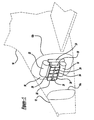
- Figure 1 is a schematic view of an auxiliary power unit according to the present invention placed in the tail section of an aircraft;
- Figure 2 is a diagrammatic view of an auxiliary power unit placed in an aircraft including electrical transmission lines to various aircraft portions;
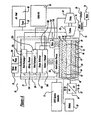
- Figure 3 is a schematic view of a simplified auxiliary power unit including fuel stacks according to a first embodiment of the present invention.
- Figure 4 is detailed schematic view of an auxiliary power unit as illustrated in Figure 3.
- auxiliary power unit 10 for an aircraft 12 is shown.
- the auxiliary power unit (APU) 10 utilizes fuel cells and is generally included in a tail section 14 of the aircraft 12. More particularly, the APU 10 is generally placed within an envelope defined by a first cross-sectional area 16a and a second cross-sectional area 16b within the tail section 14.
- the APU 10 utilizing fuel cells, generally includes a water sump 18, a recirculation plenum 20 and a heat exchanger complex 22. These surround a fuel cell stack 24 which is abutted by air manifolds 26 and intermingled with fuel manifolds 28. These portions generally define the APU 10 and will be discussed in greater detail herein.
- the APU 10 is placed within the aircraft 12 to provide auxiliary power to the aircraft 12 and its electronic components.
- the APU 10 is generally placed within a tail section 14 of the aircraft 12.
- the APU 10 provides electricity to either charge a battery 30 or to power various electronic components through a direct current (DC) power unit 32.
- the APU 10 output may be converted to an alternating current (AC) with an AC converter 34.
- the electricity is transmitted to electrical components through transmission lines 35.
- the electronic components include an electric starter 36 for an engine 38 to assist in initial start-up.
- Other electronic components include avionics such as those to control the wing flaps 40.
- Power can also be routed to gear lift motors 48 to power a gear lift 50 to raise and lower a landing gear 51. Also electricity can be routed to environmental control systems 52 to power the environmental systems, such as air conditioning and air recirculation subsystems. Therefore, the APU 10 can provide power to all subsystems of the aircraft 12 which require electricity through the electrical transmission lines 35, while unneeded power is stored in the battery 30 until it is required.
- a generator 42 is implemented and powered by the engines 38. Power can then be diverted from the generator 42 and controlled by AC regulator 44, or DC power can be provided with a DC unit 46.
- the starter 36 and the generator 42 may be the same component depending upon whether the single component is driving or being driven by the engine 38.
- the APU 10 can be designed in such a way as to provide all electrical power necessary for powering all the electrical subsystems on the aircraft 12. With the appropriate APU 10, generators 42, which use part of the power provided by the engines 38 to create additional electricity, may not be necessary for normal flight.
- the APU 10 preferably includes planar solid oxide fuel cell stacks (SOFC) 24.
- SOFC solid oxide fuel cell stacks
- the SOFCs 24 utilize a hydrocarbon fuel and oxygen to produce electricity.
- the SOFCs 24 are completely solid state with no moving mechanical parts and do not require pure hydrogen to produce electricity, as do some other fuel cell technologies.
- the electricity can be communicated directly as DC power or converted to AC with the AC converter 34, alternatively electricity can be stored in the battery 30.
- a voltage stepper may also be provided to regulate the electricity produced by the APU 10.
- An integrated fuel processor and air preheat system (processor system) 56 is provided to first process and reform a fuel from a fuel supply 58 which is pumped to the processor system 56 with a fuel pump 59, and preheat air before they enter the SOFCs 24.
- the SOFCs 24 also operate optimally only under pressure higher than ambient. This excess energy is provided through waste energy line 60 to a turbine 62.
- the turbine 62 powers a compressor 64 to compress air from the cabin 66 to provide compressed air to the processor system 56. It is understood that air contains oxygen; therefore the compressor also supplies oxygen to the processor system and the SOFC 24.
- the reformed fuel is provided to the SOFCs 24 through a reformed fuel line 68 while the air is provided through a compressed air line 70.
- An SOFC system controller 72 controls the operation of the APU 10. In particular, the SOFC system controller 72 can control the amount of fuel or air being provided to the SOFC 24 so that an efficient production of energy is created.
- the turbine 62 powered by the waste energy through the waste energy line 60, can also power other systems.
- the turbine 10 can power a water separator 74. Exhaust from the APU 10 is provided to the water separator 74 through an exhaust line 76.
- the exhaust from the APU 10 includes combustion materials from the SOFC 24, which is essentially combustion products from the hydrocarbon fuel and the cabin air, which are essentially carbon dioxide and water. Therefore, the water separator 74 can separate the water to provide it to a water container 78. Therefore, even though the APU 10 may not be 100% efficient in producing electricity, a greater operational or overall efficiency can be achieved by using the excess heat energy and exhaust from the APU 10 to power the turbine 62 to separate water from the exhaust, which may be used on the aircraft 12.
- the APU 10 is shown in greater detail.
- the APU 10 may be enclosed in a pressure vessel 79.
- the pressure vessel 79 encloses at least the SOFCs 24 and the processor system 56.
- the pressure vessel 79 decreases the chance of gas leakage due to pressure differentials during operation.
- the pressure vessel 79 reduces the mechanical strength requirements of both the SOFC 24 and the processor system 56 for installation into an aircraft 12.
- the SOFC 24 includes a plurality of a planar solid oxide fuel cell 80, nevertheless only one is illustrated for clarity. Although only planar solid oxide fuel cells 80 are described herein, it will be understood the SOFC 24 may be in any appropriate arrangement.
- Each fuel cell 80 may be surrounded by a barrier 82 which is impermeable to the oxidizer and fuel which are provided to the fuel cell 80. This creates discrete fuel cells 80 which may be placed in series.
- Each fuel cell 80 also includes a solid oxide layer 90 with a reformed fuel layer 92 adjacent the solid oxide layer 90 and an oxidizer layer 94 adjacent the solid oxide layer 90, but opposite the reformed fuel layer 92.
- the solid oxide layer 90 provides a physical barrier between the reformed fuel layer 92 and the oxidizer layer 94.
- the solid oxide layer 90 also performs the function of an electrolyte in the fuel cell 80.
- a first electrode 96 which is generally porous, is disposed adjacent one side of the solid oxide layer 90, for example in the fuel layer 92.
- a second electrode 98 also generally porous, is disposed adjacent a second side of the solid oxide layer 90, for example in the oxidizer layer 94.
- the first and second electrodes 96 and 98 are porous and span the space between the barrier 82 and the solid oxide layer 90. In this way the oxidizer layer 94 and the fuel layer 92 flow through the respective electrodes 96 and 98.
- the solid oxide layer 90 may be any appropriate solid electrolyte such as a metal oxide.
- a metal oxide is zirconium oxide that has been doped with a rare earth metal.
- exemplary rare earth metals include yttrium, scandium, or cerium.
- Other exemplary metal oxides also include calcium oxide. It is preferred to have the dopant comprise between about 5% and about 20% by weight of the solid oxide layer 90. It will be understood, however, that any appropriate solid oxide may be used in the SOFC 24.
- the SOFC 24 may contain any number of solid oxide layers 90 and a limited number is illustrated simply for clarity. A plurality of the fuel cells 80 are placed adjacent one another to form the SOFC 24. It will also be understood that the configuration of the SOFC 24 may compromise any appropriate configuration to provide the APU 10.
- the reformed fuel is reformed in the processor system 56 to break the fuel into substantially carbon monoxide, H 2 , or hydrogen atoms which are components of hydrocarbon fuels.
- the processor system 56 is described herein using steam, it will be understood that other reformation systems may be used.
- an auto thermal, thermal decomposition, or partial oxidation techniques may also be used to reform the fuel for the APU 10.
- the constituents of the reformed fuel are the fuel for the SOFC 24 and are present in the fuel layer 92.
- the oxidizer layer 94 includes air from the cabin 66 that has been compressed to concentrate the oxygen present in air in the cabin 66. The oxygen in the air is the oxidizer in oxidizer layer 94.
- oxidizer layer 94 allows the oxygen ions present in the oxidizer layer 94 to transport through the solid oxide layer 90 to combine with the fuel in the fuel layer 92.
- the migration of oxygen ions across the solid oxide layer 90 produces, by creating an electrical potential, electricity.
- the potential is created between the two electrodes 96, 98 in the fuel cell 80.
- the oxygen combines with carbon monoxide, H + , or H 2 to form CO 2 and H 2 O.
- the heat exchanger complex 22, in the processor system 56, may further include a first heat exchanger 22a and a second heat exchanger 22b.
- a recirculation plenum 20 is also diagrammatically shown to illustrate the capability of the APU 10 to reuse resources such as water or air.
- the water sump 18 provides water to the system. Water provided in the water sump 18 may either come from the water supply 78, from the water separator 74, or from an onboard water supply.
- a jet pump 100 pumps water from the water sump 18 into the processor system 56.
- the first heat exchanger 22a heats the water and jet fuel to bring them up to the temperature necessary to vaporize the liquid mixture into gaseous form.
- the second heat exchanger 22b further heats the steam and jet fuel mixture before entry into the mixing plenum 104.
- the mixing plenum 104 allows for a remix of the steam and jet fuel mixture from the first heat exchanger 22a to the second heat exchanger 22b ensuring that a proper mix has been accomplished before entry into the steam reformer 102. This helps to prevent fuel coking at too high of a temperature and to ensure that enough steam is produced to prevent fuel coking.
- the steam reformer 102 breaks the fuel into simpler molecular components to provide the proper components to the SOFCs 24.
- a preheater 106 provides additional energy to the steam reformer 102 and to the second heat exchanger 22b to ensure that the water is converted to steam for use in the steam reformer 102. Additionally, fuel and air may be transferred between the recirculation plenum 20 and the preheater 106 to allow for an initial heat up of the SOFCs 24 for initial start-up.
- a valve 110 controls the flow of reformed fuel through the reformed fuel line 108 and air through an air line 112.
- the valve 110 is controlled by the SOFC system controller 72 to create the proper mix of fuel and air in the SOFC 24 to ensure the most efficient power production.
- the SOFCs 24 work most efficiently when they are between about 600 °C and 1000 (°C) (about 1112° F and about 1832° F). Therefore, if the SOFCs 24 have cooled due to not being operated or because of a cool environment, they are most efficient after being first heated.
- the preheater 106 assists in heating the SOFCs 24 to ensure that they reach the optimal operating temperature quickly. Fuel is supplied to the preheater 106 from the fuel supply 58 to be used to heat the water for use in the steam reformer 102. Therefore, the fuel and oxygen may also be heated before entering the SOFC 24.
- the solid oxide fuel cells 80 are preferred for aircraft because fuel cells 80 do not require pure hydrogen for proper operation.
- the reformed jet fuel from the jet fuel supply 58 which is already provided on an aircraft 12, can be used to provide the hydrogen and carbon monoxide to cause the migration of oxygen ions across the solid oxide layer 90.
- the APU 10 allows for the recirculation and re-use of cabin air from the cabin 66 to provide the oxygen for the SOFCs 24. Again, rather than providing a pure oxygen source, compressed air from the cabin 66 or reformed water may be used to provide the oxygen source for the SOFCs 24.
- the turbine 62 of the APU 10 is part of a reclamation system.
- the reclamation system allows for the reuse of waste thermal energy produced by the APU 10 to power a turbine to reform exhaust produced by the APU 10.
- the turbine 62 powers the compressor 64 to convert the exhaust into usable water.
- the exhaust of the APU 10 using SOFCs 24 generally consists substantially only of H 2 O and CO 2 . Therefore, the H 2 O may be separated, with the water separator 74 and stored in the water container 78, to provide water for use in the aircraft 12.
- the water can be used for other uses in the aircraft 12 such as general humidity control in the environment control systems 52 and other gray water uses.
- An SOFC 24 is theoretically approximately 45-55% efficient. Due to certain inefficiencies and other physical constraints, however, the APU 10 is generally approximately 30-40% efficient. It is this waste thermal energy which provides the energy required to power the turbine 62 to power the compressor 64.
- the turbine 62 is an expansion turbine which uses hot gases to expand through turbine blades to spin the blades. This provides kinetic energy for things such as powering the compressor 64.
- the aircraft 12 where the APU 10 only provides a portion of the electricity to the aircraft 12, especially when the aircraft 12 is on the ground, can be provided.
- the engines 38 may power a generator 42 to provide electricity necessary for the aircraft 12.
- the APU 10 can charge the battery 30 to provide additional power for later use.
- the APU 10 can also be designed to provide all the electricity at all times so that the engines 38 never need to provide electricity to the aircraft 12. In this way, the engines 38 can be decreased in size and increased in efficiency since they will not need to power generators 42 to provide electricity. Therefore, the overall efficiency of the components of the aircraft 12 can be increased by using the APU 10 to provide all the electricity necessary to power the electrical subsystems of the aircraft 12.
- the processor system 56 could be integrated further into the SOFCs 24. Therefore, rather than having separate components separated physically from the SOFCs 24, the processor system 56 can be designed so that it is interspersed with the SOFCs 24. Furthermore, the size or number of SOFCs 24 can be augmented depending upon the amount of electricity required for a particular application.
- the mixture of the fuel in the SOFC 24 may include between about 2-3% excess fuel to resist corrosion of the electrodes 96 and 98.
- the SOFC 24 is preferably pressurized to a pressure between about 20 and about 30 psi to increase efficiency of the SOFCs 24.
- the air from the cabin 66, which is compressed by the compressor 64, may both pressurize and cool the SOFCs 24.
- the greatest electrical density is formed on the SOFC 24 when the pressure is between about 20 psi and about 30 psi. Therefore, not only does the air provided by the compressor provide oxygen to the oxidizer layer 94, it also cools the SOFCs 24 by pulling air through the heat exchangers 97, 98. This air can also be used to pressurize the SOFCs 24 to increase the electrical density of the SOFCs 24.
- the solid oxide layers 90 may be formed from any appropriate material such as those that are doped with calcium oxide and scandium oxide.
- the solid oxide layer 90 provides the electrolyte that ions of oxygen may transfer through.
- the solid oxide layer 90 also separates the reformed fuel layer 92 from the oxidizer layer 94. Therefore, the oxygen ions must cross through the solid oxide layer 90, thereby creating a charge differential and the flow of electricity.
- SOFC 24 has been described herein, it will be understood that various other fuel cells may be used. Generally, a fuel cell causes the migration of an oxidizer, such as oxygen ions, across an electrolyte to produce electricity.
- Other possible fuel cells include PEM fuel cells which require hydrogen ions as the fuel source alone and carbon must be scrubbed from the fuel before entering the fuel layer 92.
- the APU 10 of the present invention thus provides an efficient and quiet source of electricity to the aircraft 12.
- the APU 10 is entirely solid state. Therefore, the APU 10 will not produce any vibrations or noise to disturb the passengers in the cabin 66.
- the APU 10, using SOFCs 24, is theoretically approximately between about 30 and about 60 percent efficient. Even though physical and mechanical constraints presently provide APUs 10 which are generally between about 30 and about 40 percent efficient. Turbines are generally between about 20 and about 30 percent efficient. Therefore, the APU 10, according to the present invention, provides electricity to the aircraft 12 at an increased efficiency of between about 10 and about 20 percent. This increases overall fuel efficiency of the aircraft 12 and provides a cleaner source of electricity to the aircraft 1
- the APU 10 also assists in decreasing undesirable emissions such as nitrous oxide emissions. Because nitrous oxides are generally produced at elevated temperatures, generally above 1500° C, substantial amounts of nitrous oxides are not produced in the APU 10. This is because the SOFC 24 operates at a temperature generally below about 1400° C. Therefore, nitrous oxide emissions are substantially eliminated and much below the emissions of gas turbine power units.
Landscapes
- Engineering & Computer Science (AREA)
- Life Sciences & Earth Sciences (AREA)
- Manufacturing & Machinery (AREA)
- Sustainable Development (AREA)
- Sustainable Energy (AREA)
- Chemical & Material Sciences (AREA)
- Chemical Kinetics & Catalysis (AREA)
- Electrochemistry (AREA)
- General Chemical & Material Sciences (AREA)
- Aviation & Aerospace Engineering (AREA)
- Fuel Cell (AREA)
- Catalysts (AREA)
Abstract
Description
Claims (26)
- An aircraft comprising:wherein said fuel supply supplies said fuel to said power unit so that said power unit provides a first source of electricity for said electronic components.a fuselage comprising a cabin;an engine for powering the aircraft;a fuel supply to provide fuel to said engine;an electronic component disposed in the aircraft to control or operate at least one function of the aircraft;a power unit comprising a fuel cell; and
- The aircraft of claim 1 further comprises:wherein said fuel cell includes a solid oxide; anda fuel reformer to reform said fuel into constituents of said fuel comprising carbon monoxide or hydrogen;a compressor to compress a portion of a volume of air in said cabin to provide oxygen to said fuel cell;
wherein said reformed fuel is supplied to a first side of said solid oxide electrolyte and said oxygen is supplied to said second side of said solid oxide electrolyte. - The aircraft of claim 2, further comprising:wherein said reclamation turbine powers said compressor.a reclamation turbine which is powered by thermal energy produced by said fuel cell; and
- The aircraft of claim 2 or 3, further comprising:wherein said fuel reformer and said air preheater are positioned adjacent said fuel cell.an air preheater to heat said portion of said air before said air provides said oxygen to said fuel cell; and
- The aircraft of claim 4, wherein said air preheater heats said portion of said air to between about 600 oC and about 1000 oC; and
wherein said compressor compresses air adjacent said fuel cell stack to a pressure between about 20 pounds per square inch and about 30 pounds per square inch. - The aircraft of any of claims 1-5, further comprising a generator which is powered by said engine to provide a second source of electricity for said electronic components.
- The aircraft of any of claims 1-6, wherein said solid oxide electrolyte is permeable to oxygen ions.
- The aircraft of any of claims 1-7, wherein said solid oxide electrolyte comprises a rare earth metal doped zirconium oxide, wherein said rate earth metal is between about 2% and about 15% by weight of said solid oxide.
- The aircraft of any of claims 1-8, further comprising:wherein an electrical charge collected on either said first or said second electrode is adapted to provide said first source of electricity.a first electrode adjacent said first side;a second electrode adjacent said second side; and
- The aircraft of claim 9, wherein said first electrode is adjacent the reformed fuel supplied to said power unit and performs the function of a cathode to collect a negative charge.
- The aircraft of any of claims 1-10, further comprising a plurality of said fuel cells to form a fuel cell stack wherein each fuel cell includes:wherein said solid oxide selectively separates said fuel layer and said oxygen layer.a fuel layer; andan oxygen layer;
- An auxiliary power supply unit for an aircraft comprising:wherein said fuel cell is adapted to allow the transport of said oxidizer from said oxidizer supply system to combine with said reformed fuel to produce electricity for use on said aircraft.a fuel cell including a solid oxide electrolyte;a fuel supply to supply a fuel to the auxiliary power unit;a fuel reformer to reform said fuel to constituent elements comprising carbon monoxide and hydrogen for use in said fuel cell;an oxidizer supply system to provide an oxidizer to said fuel cell;a turbine powered by said fuel cell adapted to provide power to said oxidizer supply system; and
- The auxiliary electricity supply unit of claim 12, wherein said reformed fuel is supplied to a first side of said solid oxide electrolyte and said oxidizer is supplied to a second side of said solid oxide electrolyte.
- The auxiliary electricity supply unit of Claim 13, wherein said solid oxide electrolyte provides a temporary mechanical barrier between said reformed fuel and said oxidizer; and
wherein said solid oxide electrolyte is permeable to said oxidizer. - The auxiliary electricity supply unit of claim 12,13 or 14 wherein said oxidizer supply system comprises:wherein said turbine powers said compressor.a compressor to provide compressed air including said oxidizer to said solid oxide fuel cell;a heater to provide thermal energy to the compressed air;a supply line which operably interconnects said compressor and said solid oxide fuel cell; and
- The auxiliary electricity supply unit of any of claims 12-15, wherein said fuel comprises a hydrocarbon.
- The auxiliary electricity supply unit of any of claims 12-16, wherein said fuel reformer breaks said fuel into its constituent particles including carbon monoxide, atomic hydrogen, or hydrogen molecules.
- The auxiliary electricity supply unit of any of claims 12-17, further comprising:wherein an electrical charge is collected on said first or said second electrode to provide said electricity.a first electrode adjacent a first side of said solid oxide electrolyte;a second electrode adjacent a second side of said solid oxide electrolyte; and
- The auxiliary power supply unit of any of claims 12-18, wherein said solid oxide fuel cell produces an exhaust and said exhaust powers said turbine.
- A method of providing electricity to an aircraft comprising:providing a fuel cell comprising a solid oxide electrolyte;providing a fuel to said fuel cell;providing an oxidizer to said fuel cell;producing electricity by passing said oxidizer through said solid oxide electrolyte; andpowering a reclamation system with energy from said fuel cell to provide at least a portion of said oxidizer to said fuel cell.
- The method of claim 20, wherein said fuel cell comprises a solid oxide fuel cell and providing said fuel cell includes providing a solid oxide fuel cell stack including a plurality of said solid oxide fuel cells.
- The method of claim 20 or 21, wherein providing said solid oxide electrolyte includes:providing a metal oxide electrolyte that is permeable to oxygen ions;placing a first electrode on a first side of said solid oxide electrolyte;placing a second electrode on a second side of said solid oxide electrolyte; andallowing oxygen ions to travel across said solid oxide electrolyte to create an electromotive force.
- The method of claim 20,21 or 22 wherein providing fuel includes:providing a hydrocarbon fuel reformer;providing a hydrocarbon to said hydrocarbon fuel reformer having molecules comprising between about three carbon atoms and about twelve carbon atoms;providing steam to said hydrocarbon fuel reformer; andbreaking apart said hydrocarbon molecules to reformed particles including up to about three carbon atoms or up to about two hydrogen atoms.
- The method of any of claims 20-23, wherein providing said oxidizer comprises:providing a volume of air including oxygen;compressing said volume of air; andproviding said compressed air to said solid oxide fuel cell.
- The method of any of claims 20-24, wherein powering said reclamation system includes:providing an expansion turbine;providing a compressor;powering said compressor with said expansion turbine; andcompressing a volume of air with said compressor.
- The method of claim 20, wherein powering said reclamation system includes:providing an exhaust conversion system;providing an expansion turbine;powering said exhaust conversion system with said expansion turbine;providing exhaust from said solid oxide fuel cell to said exhaust conversion system; andconverting a portion of said exhaust to water.
Applications Claiming Priority (2)
| Application Number | Priority Date | Filing Date | Title |
|---|---|---|---|
| US10/177,427 US6641084B1 (en) | 2002-06-21 | 2002-06-21 | Solid oxide fuel cell as auxiliary power source installation in transport aircraft |
| US177427 | 2002-06-21 |
Publications (3)
| Publication Number | Publication Date |
|---|---|
| EP1376728A2 true EP1376728A2 (en) | 2004-01-02 |
| EP1376728A3 EP1376728A3 (en) | 2006-11-15 |
| EP1376728B1 EP1376728B1 (en) | 2019-04-03 |
Family
ID=29270068
Family Applications (1)
| Application Number | Title | Priority Date | Filing Date |
|---|---|---|---|
| EP03076810.5A Expired - Lifetime EP1376728B1 (en) | 2002-06-21 | 2003-06-11 | Solid oxide fuel cell as auxiliary power source installation in transport aircraft |
Country Status (3)
| Country | Link |
|---|---|
| US (1) | US6641084B1 (en) |
| EP (1) | EP1376728B1 (en) |
| CA (1) | CA2427448C (en) |
Cited By (3)
| Publication number | Priority date | Publication date | Assignee | Title |
|---|---|---|---|---|
| RU2653055C1 (en) * | 2016-11-30 | 2018-05-07 | Общество с ограниченной ответственностью "Газпром трансгаз Томск" (ООО "Газпром трансгаз Томск") | Power supply plant based on solid oxide fuel cells |
| US10214417B2 (en) | 2016-02-25 | 2019-02-26 | Ge Aviation Systems Llc | Solid hydrogen reaction system and method of liberation of hydrogen gas |
| CN110608108A (en) * | 2018-06-14 | 2019-12-24 | 哈尔滨工业大学 | Turboless jet engine integrated with solid oxide fuel cell |
Families Citing this family (75)
| Publication number | Priority date | Publication date | Assignee | Title |
|---|---|---|---|---|
| US20050130011A1 (en) * | 2003-10-31 | 2005-06-16 | Burgess Stephen F. | Fuel cell system |
| US7422810B2 (en) * | 2004-01-22 | 2008-09-09 | Bloom Energy Corporation | High temperature fuel cell system and method of operating same |
| DE502005005374D1 (en) * | 2004-05-28 | 2008-10-30 | Airbus Gmbh | An electrochemical reactor for aircraft and method for operating the electrochemical reactor |
| US7185538B2 (en) * | 2004-11-12 | 2007-03-06 | Honeywell International Inc. | Methods and systems for sensing air vehicle airspeed |
| DE102004058430B4 (en) * | 2004-12-03 | 2010-07-29 | Airbus Deutschland Gmbh | Power supply system for an aircraft, aircraft and method for powering an aircraft |
| GB0502608D0 (en) * | 2005-02-09 | 2005-03-16 | Rolls Royce Plc | A fuel processor |
| US7547002B2 (en) | 2005-04-15 | 2009-06-16 | Delavan Inc | Integrated fuel injection and mixing systems for fuel reformers and methods of using the same |
| US7380749B2 (en) * | 2005-04-21 | 2008-06-03 | The Boeing Company | Combined fuel cell aircraft auxiliary power unit and environmental control system |
| DE102005046729B4 (en) * | 2005-09-29 | 2012-01-05 | Airbus Operations Gmbh | Energy supply system for the supply of aircraft systems |
| WO2007050881A1 (en) * | 2005-10-27 | 2007-05-03 | Parker Hannifin Corporation | Subterranean fuel cell system |
| US7766251B2 (en) * | 2005-12-22 | 2010-08-03 | Delavan Inc | Fuel injection and mixing systems and methods of using the same |
| US20070158500A1 (en) * | 2006-01-06 | 2007-07-12 | Ion America Corporation | Solid oxide fuel cell system for aircraft power, heat, water, and oxygen generation |
| US7659015B2 (en) | 2006-01-20 | 2010-02-09 | Airbus Deutschland Gmbh | Combined fuel cell system |
| US8074895B2 (en) * | 2006-04-12 | 2011-12-13 | Delavan Inc | Fuel injection and mixing systems having piezoelectric elements and methods of using the same |
| FR2902760B1 (en) * | 2006-06-27 | 2009-05-15 | Turbomeca | AIRCRAFT POWER GENERATING SYSTEM USING FUEL CELL |
| FR2902759B1 (en) * | 2006-06-27 | 2008-10-24 | Turbomeca | AIRCRAFT POWER GENERATING SYSTEM USING FUEL CELL |
| US7966830B2 (en) * | 2006-06-29 | 2011-06-28 | The Boeing Company | Fuel cell/combustor systems and methods for aircraft and other applications |
| US7870717B2 (en) * | 2006-09-14 | 2011-01-18 | Honeywell International Inc. | Advanced hydrogen auxiliary power unit |
| US8394552B2 (en) * | 2006-09-19 | 2013-03-12 | Hamilton Sundstrand Corporation | Jet fuel based high pressure solid oxide fuel cell system |
| DE102007017820A1 (en) * | 2007-01-16 | 2008-08-07 | Liebherr-Aerospace Lindenberg Gmbh | Power supply system for use in aircraft, has active energy storage i.e. super capacitor, staying in connection with loads and connected such that loads are temporarily supplied with power from active energy storage |
| US8846255B2 (en) * | 2007-04-20 | 2014-09-30 | Honeywell International Inc. | Fuel cells used to supplement power sources for aircraft equipment |
| US20100021778A1 (en) * | 2008-07-25 | 2010-01-28 | Lynntech, Inc. | Fuel cell emergency power system |
| US8298722B2 (en) * | 2009-01-07 | 2012-10-30 | National Taiwan University Of Science And Technology | Fuel cell and fabricating method thereof |
| US8727270B2 (en) * | 2010-11-16 | 2014-05-20 | Rolls-Royce Corporation | Aircraft, propulsion system, and system for taxiing an aircraft |
| US8690099B2 (en) | 2010-11-16 | 2014-04-08 | Rolls-Royce Corporation | Aircraft and propulsion system |
| US8684304B2 (en) * | 2010-11-16 | 2014-04-01 | Rolls-Royce Corporation | Aircraft, propulsion system, and system for taxiing an aircraft |
| JP6109529B2 (en) * | 2012-10-31 | 2017-04-05 | 三菱日立パワーシステムズ株式会社 | Power generation system |
| GB201219922D0 (en) * | 2012-11-06 | 2012-12-19 | Rolls Royce Plc | Method of controlling an aircraft electrical power generation system |
| FR3000469B1 (en) * | 2013-01-03 | 2014-12-19 | Microturbo | METHOD FOR MANAGING THE ELECTRIC POWER SUPPLY NETWORK OF AN AIRCRAFT |
| US10408133B2 (en) * | 2014-10-03 | 2019-09-10 | Pratt & Whitney Canada Corp. | Accessory drive system for a gas turbine engine |
| US10059435B2 (en) * | 2014-12-04 | 2018-08-28 | Parker-Hannifin Corporation | Low drag skin heat exchanger |
| US10224556B2 (en) * | 2015-12-15 | 2019-03-05 | Hamilton Sundstrand Corporation | Integrated fuel cell aircraft pressurization and cooling system |
| GB2556061B (en) | 2016-11-16 | 2019-07-24 | Ge Aviat Systems Ltd | Power source for an aircraft |
| US10978723B2 (en) * | 2018-09-05 | 2021-04-13 | Honeywell International Inc. | Fuel cell secondary power and thermal management systems |
| US11738881B2 (en) * | 2019-10-21 | 2023-08-29 | Hamilton Sundstrand Corporation | Auxiliary power unit systems |
| CN113728479A (en) * | 2019-11-05 | 2021-11-30 | 康明斯企业有限责任公司 | Fuel cell power module and air handling system that enable robust exhaust energy extraction for high altitude operation |
| US11511872B2 (en) * | 2020-03-27 | 2022-11-29 | Raytheon Technologies Corporation | Hydrogen propulsion systems for aircraft |
| NO346132B1 (en) * | 2020-08-28 | 2022-03-14 | Univ I Tromsoe Norges Arktiske Univ | Fuel cell powered turbine-less jet engine. |
| US12212025B2 (en) | 2020-10-22 | 2025-01-28 | Ohmium International, Inc. | Aircraft electrical power supply system and method of supplying electrical power in an aircraft |
| EP4222055A4 (en) | 2020-11-03 | 2024-11-13 | Clear Ascent Corp. | Systems and methods for propulsion |
| US11724815B2 (en) * | 2021-01-15 | 2023-08-15 | The Boeing Company | Hybrid electric hydrogen fuel cell engine |
| US11628745B2 (en) | 2021-02-05 | 2023-04-18 | Beta Air, Llc | Apparatus for a ground-based battery management for an electric aircraft |
| US11686222B2 (en) | 2021-07-28 | 2023-06-27 | Pratt & Whitney Canada Corp. | Aircraft engine with hydrogen fuel system |
| US12202616B2 (en) | 2021-11-04 | 2025-01-21 | General Electric Company | Relight of a propulsion system with a fuel cell |
| US12037952B2 (en) | 2022-01-04 | 2024-07-16 | General Electric Company | Systems and methods for providing output products to a combustion chamber of a gas turbine engine |
| US11719441B2 (en) | 2022-01-04 | 2023-08-08 | General Electric Company | Systems and methods for providing output products to a combustion chamber of a gas turbine engine |
| US11794912B2 (en) | 2022-01-04 | 2023-10-24 | General Electric Company | Systems and methods for reducing emissions with a fuel cell |
| US11933216B2 (en) | 2022-01-04 | 2024-03-19 | General Electric Company | Systems and methods for providing output products to a combustion chamber of a gas turbine engine |
| US12123361B2 (en) | 2022-01-04 | 2024-10-22 | General Electric Company | Systems and methods for providing output products to a combustion chamber of a gas turbine engine |
| US11970282B2 (en) | 2022-01-05 | 2024-04-30 | General Electric Company | Aircraft thrust management with a fuel cell |
| US12034298B2 (en) | 2022-01-10 | 2024-07-09 | General Electric Company | Power source for an aircraft |
| US12074350B2 (en) | 2022-01-21 | 2024-08-27 | General Electric Company | Solid oxide fuel cell assembly |
| US12351329B2 (en) | 2022-01-21 | 2025-07-08 | General Electric Company | Systems and method of operating a fuel cell assembly |
| US12037124B2 (en) | 2022-01-21 | 2024-07-16 | General Electric Company | Systems and method of operating a fuel cell assembly |
| US11804607B2 (en) | 2022-01-21 | 2023-10-31 | General Electric Company | Cooling of a fuel cell assembly |
| US12573647B2 (en) | 2022-01-21 | 2026-03-10 | General Electric Company | Solid oxide fuel cell assembly |
| US11967743B2 (en) | 2022-02-21 | 2024-04-23 | General Electric Company | Modular fuel cell assembly |
| US12170390B2 (en) | 2022-02-21 | 2024-12-17 | General Electric Company | Systems and method of operating a fuel cell assembly, a gas turbine engine, or both |
| US12129789B2 (en) | 2022-02-21 | 2024-10-29 | General Electric Company | Systems and method of operating a fuel cell assembly, a gas turbine engine, or both |
| US12025061B2 (en) | 2022-04-04 | 2024-07-02 | General Electric Company | Gas turbine engine with fuel cell assembly |
| US12428164B2 (en) | 2022-05-16 | 2025-09-30 | General Electric Company | Environmental control system having a fuel cell assembly |
| US12412914B2 (en) | 2022-05-16 | 2025-09-09 | General Electric Company | Environmental control system having a fuel cell assembly |
| US12043406B2 (en) | 2022-05-27 | 2024-07-23 | General Electric Company | Method of operating a fuel cell assembly for an aircraft |
| US11817700B1 (en) | 2022-07-20 | 2023-11-14 | General Electric Company | Decentralized electrical power allocation system |
| US12301002B2 (en) | 2022-08-26 | 2025-05-13 | General Electric Company | Power dispatch control system for multiple power generation sources |
| US12567595B2 (en) | 2022-11-10 | 2026-03-03 | General Electric Company | Gas turbine combustion section having an integrated fuel cell assembly |
| US12240613B2 (en) | 2022-11-10 | 2025-03-04 | General Electric Company | Gas turbine combustion section having an integrated fuel cell assembly |
| US12078350B2 (en) | 2022-11-10 | 2024-09-03 | General Electric Company | Gas turbine combustion section having an integrated fuel cell assembly |
| US11923586B1 (en) | 2022-11-10 | 2024-03-05 | General Electric Company | Gas turbine combustion section having an integrated fuel cell assembly |
| US11859820B1 (en) | 2022-11-10 | 2024-01-02 | General Electric Company | Gas turbine combustion section having an integrated fuel cell assembly |
| US12573649B2 (en) | 2023-02-02 | 2026-03-10 | Hamilton Sundstrand Corporation | Oxidizing agents for emergency power units |
| CN118532263A (en) | 2023-02-23 | 2024-08-23 | 通用电气公司 | Gas turbine engine and fuel cell components |
| CN118532265A (en) | 2023-02-23 | 2024-08-23 | 通用电气公司 | Gas turbine engine and fuel cell components |
| CN118532266A (en) | 2023-02-23 | 2024-08-23 | 通用电气公司 | Gas turbine engine and fuel cell components |
| US12012892B1 (en) * | 2023-05-19 | 2024-06-18 | Rtx Corporation | Water separator for turbine engine |
Family Cites Families (11)
| Publication number | Priority date | Publication date | Assignee | Title |
|---|---|---|---|---|
| DE3832471A1 (en) | 1988-09-23 | 1990-03-29 | Siemens Ag | DISTRIBUTION OF GAS FROM THE ELECTROLYTE CONTAINER FROM H (DOWN ARROW) 2 (DOWN ARROW) / O (DOWN ARROW) 2 (DOWN ARROW) FUEL CELL BATTERIES |
| DE4001684A1 (en) | 1990-01-22 | 1991-07-25 | Merck Patent Gmbh | Hybrid electric traction system - comprises electric motor, accumulator and high temp. fuel cell with mixed conductor electrodes |
| US5340664A (en) * | 1993-09-29 | 1994-08-23 | Ceramatec, Inc. | Thermally integrated heat exchange system for solid oxide electrolyte systems |
| US5413879A (en) * | 1994-02-08 | 1995-05-09 | Westinghouse Electric Corporation | Integrated gas turbine solid oxide fuel cell system |
| GB9415436D0 (en) | 1994-07-30 | 1994-09-21 | Provost Michael J | Auxiliary gas turbine engines |
| US5858568A (en) * | 1996-09-19 | 1999-01-12 | Ztek Corporation | Fuel cell power supply system |
| DE19821952C2 (en) | 1998-05-15 | 2000-07-27 | Dbb Fuel Cell Engines Gmbh | Power supply unit on board an aircraft |
| GB9813757D0 (en) * | 1998-06-25 | 1998-08-26 | Gec Marconi Aerospace Limited | Integral fuel cell |
| DE19911018C1 (en) * | 1999-03-12 | 2000-08-31 | Daimler Chrysler Ag | Unit for supplying auxiliary power to aircraft includes a gas turbine with a combustion chamber, a blower, a turbine coupled to a compressor to generate compressed air and a fuel cell to generate electrical energy. |
| US6255010B1 (en) | 1999-07-19 | 2001-07-03 | Siemens Westinghouse Power Corporation | Single module pressurized fuel cell turbine generator system |
| US6485852B1 (en) * | 2000-01-07 | 2002-11-26 | Delphi Technologies, Inc. | Integrated fuel reformation and thermal management system for solid oxide fuel cell systems |
-
2002
- 2002-06-21 US US10/177,427 patent/US6641084B1/en not_active Expired - Lifetime
-
2003
- 2003-04-30 CA CA002427448A patent/CA2427448C/en not_active Expired - Lifetime
- 2003-06-11 EP EP03076810.5A patent/EP1376728B1/en not_active Expired - Lifetime
Cited By (4)
| Publication number | Priority date | Publication date | Assignee | Title |
|---|---|---|---|---|
| US10214417B2 (en) | 2016-02-25 | 2019-02-26 | Ge Aviation Systems Llc | Solid hydrogen reaction system and method of liberation of hydrogen gas |
| US10822232B2 (en) | 2016-02-25 | 2020-11-03 | Ge Aviation Systems Llc | Solid hydrogen reaction system and method of liberation of hydrogen gas |
| RU2653055C1 (en) * | 2016-11-30 | 2018-05-07 | Общество с ограниченной ответственностью "Газпром трансгаз Томск" (ООО "Газпром трансгаз Томск") | Power supply plant based on solid oxide fuel cells |
| CN110608108A (en) * | 2018-06-14 | 2019-12-24 | 哈尔滨工业大学 | Turboless jet engine integrated with solid oxide fuel cell |
Also Published As
| Publication number | Publication date |
|---|---|
| US6641084B1 (en) | 2003-11-04 |
| CA2427448C (en) | 2007-09-25 |
| EP1376728A3 (en) | 2006-11-15 |
| CA2427448A1 (en) | 2003-12-21 |
| EP1376728B1 (en) | 2019-04-03 |
Similar Documents
| Publication | Publication Date | Title |
|---|---|---|
| US6641084B1 (en) | Solid oxide fuel cell as auxiliary power source installation in transport aircraft | |
| US7380749B2 (en) | Combined fuel cell aircraft auxiliary power unit and environmental control system | |
| Collins et al. | All-electric commercial aviation with solid oxide fuel cell-gas turbine-battery hybrids | |
| US8623566B2 (en) | Aircraft fuel cell system | |
| US6834831B2 (en) | Hybrid solid oxide fuel cell aircraft auxiliary power unit | |
| CN108069040B (en) | Electric power source for aircraft | |
| US6296957B1 (en) | Energy supply unit on board an aircraft | |
| US9118054B2 (en) | Jet fuel based high pressure solid oxide fuel cell system | |
| US10622653B2 (en) | High power density solid oxide fuel cell steam reforming system and process for electrical generation | |
| US7986052B2 (en) | Power generation system for an aircraft using a fuel cell | |
| RU2405720C2 (en) | System and method of aircraft power supply | |
| EP4273379A1 (en) | Hydrogen energy conversion system | |
| US8640439B2 (en) | Hybrid drive for an aircraft | |
| CN104852067B (en) | Airplane power generation system based on fuel cell | |
| Wu et al. | Fuel cell applications on more electrical aircraft | |
| CN119451892A (en) | Aircraft propulsion system and method | |
| CN204558589U (en) | Based on the aircraft generating system of fuel cell | |
| JP4538899B2 (en) | Explosion-proof device for fuel supply | |
| Kriewall et al. | Assessment of Reformer Concepts for the Propulsion System of an Electric Regional Aircraft Powered by Chemically Bound Hydrogen |
Legal Events
| Date | Code | Title | Description |
|---|---|---|---|
| PUAI | Public reference made under article 153(3) epc to a published international application that has entered the european phase |
Free format text: ORIGINAL CODE: 0009012 |
|
| AK | Designated contracting states |
Kind code of ref document: A2 Designated state(s): AT BE BG CH CY CZ DE DK EE ES FI FR GB GR HU IE IT LI LU MC NL PT RO SE SI SK TR |
|
| AX | Request for extension of the european patent |
Extension state: AL LT LV MK |
|
| PUAL | Search report despatched |
Free format text: ORIGINAL CODE: 0009013 |
|
| AK | Designated contracting states |
Kind code of ref document: A3 Designated state(s): AT BE BG CH CY CZ DE DK EE ES FI FR GB GR HU IE IT LI LU MC NL PT RO SE SI SK TR |
|
| AX | Request for extension of the european patent |
Extension state: AL LT LV MK |
|
| RIC1 | Information provided on ipc code assigned before grant |
Ipc: B64D 41/00 20060101ALI20061006BHEP Ipc: H01M 8/00 20060101ALI20061006BHEP Ipc: H01M 8/12 20060101AFI20031106BHEP |
|
| 17P | Request for examination filed |
Effective date: 20070514 |
|
| AKX | Designation fees paid |
Designated state(s): AT BE BG CH CY CZ DE DK EE ES FI FR GB GR HU IE IT LI LU MC NL PT RO SE SI SK TR |
|
| 17Q | First examination report despatched |
Effective date: 20110927 |
|
| STAA | Information on the status of an ep patent application or granted ep patent |
Free format text: STATUS: EXAMINATION IS IN PROGRESS |
|
| GRAP | Despatch of communication of intention to grant a patent |
Free format text: ORIGINAL CODE: EPIDOSNIGR1 |
|
| STAA | Information on the status of an ep patent application or granted ep patent |
Free format text: STATUS: GRANT OF PATENT IS INTENDED |
|
| RIC1 | Information provided on ipc code assigned before grant |
Ipc: B64D 41/00 19680901ALI20180517BHEP Ipc: H01M 8/12 19740701AFI20180517BHEP Ipc: H01M 8/0612 20160101ALN20180517BHEP Ipc: H01M 8/00 19740701ALI20180517BHEP |
|
| RIC1 | Information provided on ipc code assigned before grant |
Ipc: H01M 8/0612 20160101ALN20180523BHEP Ipc: B64D 41/00 19680901ALI20180523BHEP Ipc: H01M 8/12 19740701AFI20180523BHEP Ipc: H01M 8/00 19740701ALI20180523BHEP |
|
| INTG | Intention to grant announced |
Effective date: 20180606 |
|
| GRAS | Grant fee paid |
Free format text: ORIGINAL CODE: EPIDOSNIGR3 |
|
| GRAJ | Information related to disapproval of communication of intention to grant by the applicant or resumption of examination proceedings by the epo deleted |
Free format text: ORIGINAL CODE: EPIDOSDIGR1 |
|
| GRAL | Information related to payment of fee for publishing/printing deleted |
Free format text: ORIGINAL CODE: EPIDOSDIGR3 |
|
| STAA | Information on the status of an ep patent application or granted ep patent |
Free format text: STATUS: EXAMINATION IS IN PROGRESS |
|
| GRAP | Despatch of communication of intention to grant a patent |
Free format text: ORIGINAL CODE: EPIDOSNIGR1 |
|
| STAA | Information on the status of an ep patent application or granted ep patent |
Free format text: STATUS: GRANT OF PATENT IS INTENDED |
|
| INTC | Intention to grant announced (deleted) | ||
| INTG | Intention to grant announced |
Effective date: 20181108 |
|
| RIC1 | Information provided on ipc code assigned before grant |
Ipc: H01M 8/00 19740701ALI20181030BHEP Ipc: H01M 8/0612 20040102ALN20181030BHEP Ipc: H01M 8/12 19740701AFI20181030BHEP Ipc: B64D 41/00 19680901ALI20181030BHEP |
|
| RIC1 | Information provided on ipc code assigned before grant |
Ipc: H01M 8/00 20160101ALI20181030BHEP Ipc: H01M 8/0612 20160101ALN20181030BHEP Ipc: H01M 8/12 20160101AFI20181030BHEP Ipc: B64D 41/00 20060101ALI20181030BHEP |
|
| RIC1 | Information provided on ipc code assigned before grant |
Ipc: H01M 8/0612 20160101ALN20181030BHEP Ipc: H01M 8/12 20160101AFI20181030BHEP Ipc: H01M 8/00 20160101ALI20181030BHEP Ipc: B64D 41/00 20060101ALI20181030BHEP |
|
| GRAA | (expected) grant |
Free format text: ORIGINAL CODE: 0009210 |
|
| STAA | Information on the status of an ep patent application or granted ep patent |
Free format text: STATUS: THE PATENT HAS BEEN GRANTED |
|
| AK | Designated contracting states |
Kind code of ref document: B1 Designated state(s): AT BE BG CH CY CZ DE DK EE ES FI FR GB GR HU IE IT LI LU MC NL PT RO SE SI SK TR |
|
| REG | Reference to a national code |
Ref country code: GB Ref legal event code: FG4D |
|
| REG | Reference to a national code |
Ref country code: CH Ref legal event code: EP Ref country code: AT Ref legal event code: REF Ref document number: 1116876 Country of ref document: AT Kind code of ref document: T Effective date: 20190415 |
|
| REG | Reference to a national code |
Ref country code: DE Ref legal event code: R096 Ref document number: 60351909 Country of ref document: DE |
|
| REG | Reference to a national code |
Ref country code: IE Ref legal event code: FG4D |
|
| REG | Reference to a national code |
Ref country code: NL Ref legal event code: MP Effective date: 20190403 |
|
| REG | Reference to a national code |
Ref country code: AT Ref legal event code: MK05 Ref document number: 1116876 Country of ref document: AT Kind code of ref document: T Effective date: 20190403 |
|
| PG25 | Lapsed in a contracting state [announced via postgrant information from national office to epo] |
Ref country code: NL Free format text: LAPSE BECAUSE OF FAILURE TO SUBMIT A TRANSLATION OF THE DESCRIPTION OR TO PAY THE FEE WITHIN THE PRESCRIBED TIME-LIMIT Effective date: 20190403 |
|
| PG25 | Lapsed in a contracting state [announced via postgrant information from national office to epo] |
Ref country code: PT Free format text: LAPSE BECAUSE OF FAILURE TO SUBMIT A TRANSLATION OF THE DESCRIPTION OR TO PAY THE FEE WITHIN THE PRESCRIBED TIME-LIMIT Effective date: 20190803 Ref country code: CZ Free format text: LAPSE BECAUSE OF FAILURE TO SUBMIT A TRANSLATION OF THE DESCRIPTION OR TO PAY THE FEE WITHIN THE PRESCRIBED TIME-LIMIT Effective date: 20190403 Ref country code: ES Free format text: LAPSE BECAUSE OF FAILURE TO SUBMIT A TRANSLATION OF THE DESCRIPTION OR TO PAY THE FEE WITHIN THE PRESCRIBED TIME-LIMIT Effective date: 20190403 Ref country code: FI Free format text: LAPSE BECAUSE OF FAILURE TO SUBMIT A TRANSLATION OF THE DESCRIPTION OR TO PAY THE FEE WITHIN THE PRESCRIBED TIME-LIMIT Effective date: 20190403 Ref country code: SE Free format text: LAPSE BECAUSE OF FAILURE TO SUBMIT A TRANSLATION OF THE DESCRIPTION OR TO PAY THE FEE WITHIN THE PRESCRIBED TIME-LIMIT Effective date: 20190403 |
|
| PG25 | Lapsed in a contracting state [announced via postgrant information from national office to epo] |
Ref country code: GR Free format text: LAPSE BECAUSE OF FAILURE TO SUBMIT A TRANSLATION OF THE DESCRIPTION OR TO PAY THE FEE WITHIN THE PRESCRIBED TIME-LIMIT Effective date: 20190704 Ref country code: BG Free format text: LAPSE BECAUSE OF FAILURE TO SUBMIT A TRANSLATION OF THE DESCRIPTION OR TO PAY THE FEE WITHIN THE PRESCRIBED TIME-LIMIT Effective date: 20190703 |
|
| PG25 | Lapsed in a contracting state [announced via postgrant information from national office to epo] |
Ref country code: AT Free format text: LAPSE BECAUSE OF FAILURE TO SUBMIT A TRANSLATION OF THE DESCRIPTION OR TO PAY THE FEE WITHIN THE PRESCRIBED TIME-LIMIT Effective date: 20190403 |
|
| REG | Reference to a national code |
Ref country code: DE Ref legal event code: R097 Ref document number: 60351909 Country of ref document: DE |
|
| PG25 | Lapsed in a contracting state [announced via postgrant information from national office to epo] |
Ref country code: MC Free format text: LAPSE BECAUSE OF FAILURE TO SUBMIT A TRANSLATION OF THE DESCRIPTION OR TO PAY THE FEE WITHIN THE PRESCRIBED TIME-LIMIT Effective date: 20190403 Ref country code: SK Free format text: LAPSE BECAUSE OF FAILURE TO SUBMIT A TRANSLATION OF THE DESCRIPTION OR TO PAY THE FEE WITHIN THE PRESCRIBED TIME-LIMIT Effective date: 20190403 Ref country code: RO Free format text: LAPSE BECAUSE OF FAILURE TO SUBMIT A TRANSLATION OF THE DESCRIPTION OR TO PAY THE FEE WITHIN THE PRESCRIBED TIME-LIMIT Effective date: 20190403 Ref country code: DK Free format text: LAPSE BECAUSE OF FAILURE TO SUBMIT A TRANSLATION OF THE DESCRIPTION OR TO PAY THE FEE WITHIN THE PRESCRIBED TIME-LIMIT Effective date: 20190403 Ref country code: EE Free format text: LAPSE BECAUSE OF FAILURE TO SUBMIT A TRANSLATION OF THE DESCRIPTION OR TO PAY THE FEE WITHIN THE PRESCRIBED TIME-LIMIT Effective date: 20190403 |
|
| REG | Reference to a national code |
Ref country code: CH Ref legal event code: PL |
|
| PLBE | No opposition filed within time limit |
Free format text: ORIGINAL CODE: 0009261 |
|
| STAA | Information on the status of an ep patent application or granted ep patent |
Free format text: STATUS: NO OPPOSITION FILED WITHIN TIME LIMIT |
|
| PG25 | Lapsed in a contracting state [announced via postgrant information from national office to epo] |
Ref country code: IT Free format text: LAPSE BECAUSE OF FAILURE TO SUBMIT A TRANSLATION OF THE DESCRIPTION OR TO PAY THE FEE WITHIN THE PRESCRIBED TIME-LIMIT Effective date: 20190403 |
|
| 26N | No opposition filed |
Effective date: 20200106 |
|
| REG | Reference to a national code |
Ref country code: BE Ref legal event code: MM Effective date: 20190630 |
|
| PG25 | Lapsed in a contracting state [announced via postgrant information from national office to epo] |
Ref country code: TR Free format text: LAPSE BECAUSE OF FAILURE TO SUBMIT A TRANSLATION OF THE DESCRIPTION OR TO PAY THE FEE WITHIN THE PRESCRIBED TIME-LIMIT Effective date: 20190403 |
|
| PG25 | Lapsed in a contracting state [announced via postgrant information from national office to epo] |
Ref country code: IE Free format text: LAPSE BECAUSE OF NON-PAYMENT OF DUE FEES Effective date: 20190611 |
|
| PG25 | Lapsed in a contracting state [announced via postgrant information from national office to epo] |
Ref country code: LU Free format text: LAPSE BECAUSE OF NON-PAYMENT OF DUE FEES Effective date: 20190611 Ref country code: BE Free format text: LAPSE BECAUSE OF NON-PAYMENT OF DUE FEES Effective date: 20190630 Ref country code: SI Free format text: LAPSE BECAUSE OF FAILURE TO SUBMIT A TRANSLATION OF THE DESCRIPTION OR TO PAY THE FEE WITHIN THE PRESCRIBED TIME-LIMIT Effective date: 20190403 Ref country code: LI Free format text: LAPSE BECAUSE OF NON-PAYMENT OF DUE FEES Effective date: 20190630 Ref country code: CH Free format text: LAPSE BECAUSE OF NON-PAYMENT OF DUE FEES Effective date: 20190630 |
|
| PG25 | Lapsed in a contracting state [announced via postgrant information from national office to epo] |
Ref country code: CY Free format text: LAPSE BECAUSE OF FAILURE TO SUBMIT A TRANSLATION OF THE DESCRIPTION OR TO PAY THE FEE WITHIN THE PRESCRIBED TIME-LIMIT Effective date: 20190403 |
|
| PG25 | Lapsed in a contracting state [announced via postgrant information from national office to epo] |
Ref country code: HU Free format text: LAPSE BECAUSE OF FAILURE TO SUBMIT A TRANSLATION OF THE DESCRIPTION OR TO PAY THE FEE WITHIN THE PRESCRIBED TIME-LIMIT; INVALID AB INITIO Effective date: 20030611 |
|
| PGFP | Annual fee paid to national office [announced via postgrant information from national office to epo] |
Ref country code: GB Payment date: 20220628 Year of fee payment: 20 |
|
| PGFP | Annual fee paid to national office [announced via postgrant information from national office to epo] |
Ref country code: FR Payment date: 20220627 Year of fee payment: 20 |
|
| PGFP | Annual fee paid to national office [announced via postgrant information from national office to epo] |
Ref country code: DE Payment date: 20220629 Year of fee payment: 20 |
|
| REG | Reference to a national code |
Ref country code: DE Ref legal event code: R071 Ref document number: 60351909 Country of ref document: DE |
|
| P01 | Opt-out of the competence of the unified patent court (upc) registered |
Effective date: 20230503 |
|
| REG | Reference to a national code |
Ref country code: GB Ref legal event code: PE20 Expiry date: 20230610 |
|
| PG25 | Lapsed in a contracting state [announced via postgrant information from national office to epo] |
Ref country code: GB Free format text: LAPSE BECAUSE OF EXPIRATION OF PROTECTION Effective date: 20230610 |