EP1376412A1 - Autonomous experimental design optimization - Google Patents
Autonomous experimental design optimization Download PDFInfo
- Publication number
- EP1376412A1 EP1376412A1 EP02013826A EP02013826A EP1376412A1 EP 1376412 A1 EP1376412 A1 EP 1376412A1 EP 02013826 A EP02013826 A EP 02013826A EP 02013826 A EP02013826 A EP 02013826A EP 1376412 A1 EP1376412 A1 EP 1376412A1
- Authority
- EP
- European Patent Office
- Prior art keywords
- optimization
- design
- experimental
- parameters
- surface structure
- Prior art date
- Legal status (The legal status is an assumption and is not a legal conclusion. Google has not performed a legal analysis and makes no representation as to the accuracy of the status listed.)
- Granted
Links
Images


Classifications
-
- G—PHYSICS
- G06—COMPUTING OR CALCULATING; COUNTING
- G06F—ELECTRIC DIGITAL DATA PROCESSING
- G06F30/00—Computer-aided design [CAD]
- G06F30/10—Geometric CAD
- G06F30/15—Vehicle, aircraft or watercraft design
-
- G—PHYSICS
- G06—COMPUTING OR CALCULATING; COUNTING
- G06F—ELECTRIC DIGITAL DATA PROCESSING
- G06F2111/00—Details relating to CAD techniques
- G06F2111/06—Multi-objective optimisation, e.g. Pareto optimisation using simulated annealing [SA], ant colony algorithms or genetic algorithms [GA]
-
- G—PHYSICS
- G06—COMPUTING OR CALCULATING; COUNTING
- G06F—ELECTRIC DIGITAL DATA PROCESSING
- G06F2111/00—Details relating to CAD techniques
- G06F2111/10—Numerical modelling
-
- Y—GENERAL TAGGING OF NEW TECHNOLOGICAL DEVELOPMENTS; GENERAL TAGGING OF CROSS-SECTIONAL TECHNOLOGIES SPANNING OVER SEVERAL SECTIONS OF THE IPC; TECHNICAL SUBJECTS COVERED BY FORMER USPC CROSS-REFERENCE ART COLLECTIONS [XRACs] AND DIGESTS
- Y02—TECHNOLOGIES OR APPLICATIONS FOR MITIGATION OR ADAPTATION AGAINST CLIMATE CHANGE
- Y02T—CLIMATE CHANGE MITIGATION TECHNOLOGIES RELATED TO TRANSPORTATION
- Y02T90/00—Enabling technologies or technologies with a potential or indirect contribution to GHG emissions mitigation
Definitions
- the underlying invention generally relates to the optimization of aerodynamic and hydrodynamic designs, in particular to methods for an iterative (non-deterministic) optimization of hydrodynamic and/or aerodynamic surfaces f.e. of aircrafts, ships and/or road vehicles, a computer software program for implementing such a method as well as to systems for optimizing said surfaces.
- the invention proposes a closed-loop combination of an optimization algorithm running on a computing device and an experimental hardware set-up that allows to automatically change the surface properties of the applied material.
- CFD Computational Fluid Dynamics
- ANNs are an important tool in soft computing that can advantageously be applied to solve a plurality of problems.
- the original purpose of an ANN is to simulate a biological neural system (e.g. a brain).
- a biological neural system e.g. a brain
- neural network models have been developed, which can be applied to function approximation, classification, control tasks, etc..
- An important issue that is closely related to ANNs is learning. Thereby, learning theory in ANNs has large overlap with that in Machine Learning (ML), Bayesian Theory and statistics.
- GMs gradient-based methods
- These methods are efficient and the optimum obtained from these methods will be a global one, if the objective and constraints are differentiable and convex. Consequently, this approach has been widely used for many design problems including wing design, nozzle design, supersonic wing-body design, and more complex aircraft configurations.
- the quality landscape for an aerodynamic design problem is usually multimodal.
- GMs to find a global optimum, the optimization process has to be started repeatedly from a number of initial points and then checked for consistency of the obtained optima. In this sense, GMs are neither efficient nor robust for design optimisation.
- the gradient information which is needed by GMs must be numerically estimated. This process can be computationally expensive and in general it is not very robust against noise.
- EAs Evolutionary Algorithms
- a biological population evolves over generations to adapt to its environment by means of selection, recombination and mutation.
- Such a population consists of a number of individuals composed of chromosomes, that are in turn composed of genes. These genes encode the parameters that need to be optimised for a given problem.
- an EA is used for structure optimization, the parameters that describe said structure are encoded in said chromosomes. To eliminate unfavorable modifications and to proceed with modifications which increase the overall quality of the underlying population, a selection operation is used.
- EAs Evolutionary Algorithms
- objective function information fitting values
- derivatives or other auxiliary knowledge - auxiliary knowledge -
- EAs have been enjoying an increasing popularity in the field of numerical optimization for practical engineering applications in recent years.
- EAs have been applied to aeronautical problems in several ways, including parametric and conceptual design of an aircraft, preliminary design of turbines, topological design of non-planar airfoils and aerodynamic optimization based on CFD.
- EAs When EAs are applied to optimization problems, individuals, genes and fitness values usually correspond to a design candidate, a number of design variables and an objective function value, respectively.
- One of the key features of EAs is that these algorithms search the design space population based, instead of moving from a single point like GMs do.
- the global optimum can be found, for most EAs theoretically even with probability one.
- Other advantages such as robustness, efficiency, suitability to parallel computing and simplicity make them particular useful candidates for a combination with CFD methods.
- the number of parameters (design variables) and the way in which the parameters describe the structure or surface, f.e. B-splines, Polygons or alternative codings, are usually called the representation or the encoding of the design in evolutionary algorithms.
- the proposed solution according to the underlying invention is basically dedicated to the use of optimization methods for design parameters of aerodynamic and/or hydrodynamic surfaces.
- the invention presents a method for the optimization of specific structures (and not only of a single parameter) of surfaces e.g. of aircrafts, ships and/or road vehicles, a computer software program for executing such a method and a system for optimizing said surface structures.
- a hybrid approach is proposed which encompasses a combination of an optimization algorithm, thereby realizing a closed loop for an autonomous experimental optimization, and an experimental hardware set-up which can be used for modifying the (three-dimensional) surface of an aerodynamic or hydrodynamic body by automatically altering specific surface properties of the applied material.
- the method can start with the overall shape and proceed via more detailed modifications in local surface areas.
- the model, structure, shape or design to be optimized is described by parameter sets that comprise different object parameters.
- the number of parameters and the way in which they describe the design is called the representation.
- the parameter set furthermore comprises at least one strategy parameter representing the step size of the mutation (e.g. the variance of the normal distribution of associated object parameters).
- ANNs ANNs and evolutionary computing methods
- the approximation strength of ANN can be combined with experimental and CFD based evaluation methods of the design candidates to speed up the optimisation process which in turn is based on evolutionary algorithms to be able to search the quality landscape globally.
- the invention refers to a method for the optimization of surface structures which comprises the steps of optimizing parameters of at least one (virtual) surface structure, adjusting the surface structure of an experimental set-up according to the optimized parameters, measuring dynamic properties of the adjusted experimental surface structure, and feeding measured results back as quality values for the next cycle of the optimizing step.
- a method for a hierarchical design optimization is proposed, wherein in addition to the values of the parameters, the representation of the design and correspondingly the experimental set-up can be adapted (mutated) during the optimization process.
- the invention refers to the usage of a method according to anyone of the preceding claims for the optimization of road vehicle surfaces.
- the invention pertains to a computer software program which implements the optimizing step of a method according to anyone of the preceding claims.
- a system for the optimization of surface structures which comprises a computing device for calculating optimized parameters of at least one (virtual) surface structure, an experimental set-up for measuring dynamic properties of a specific surface structure, and an interface for feeding calculated parameters from the computing device to the experimental set-up and for feeding measured results back to the computing device as quality values for the next cycle of the optimizing step.
- the autonomous experimental optimization can be combined with a hierarchical design optimization approach.
- Surface properties of the applied materials 202 are autonomously changed in an experimental set-up 200.
- their fluid dynamics and/or other properties are measured and fed back to the computing device (client) 102 that hosts the optimization algorithm.
- the computing device and the experimental set-up are connected with each other by means of an interface to thus form a closed-loop.
- Step #6 Process Termination: In case the best solution has already been found, the optimization process P1 is stopped; otherwise steps #2, #3, #4 and #5 are repeated.
Landscapes
- Engineering & Computer Science (AREA)
- Physics & Mathematics (AREA)
- Geometry (AREA)
- General Physics & Mathematics (AREA)
- Theoretical Computer Science (AREA)
- Aviation & Aerospace Engineering (AREA)
- Computational Mathematics (AREA)
- Mathematical Analysis (AREA)
- Mathematical Optimization (AREA)
- Pure & Applied Mathematics (AREA)
- Computer Hardware Design (AREA)
- Evolutionary Computation (AREA)
- General Engineering & Computer Science (AREA)
- Automation & Control Theory (AREA)
- Management, Administration, Business Operations System, And Electronic Commerce (AREA)
Abstract
Description
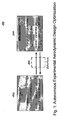
- Fig. 1
- presents an overview diagram showing the principle of the autonomous experimental aerodynamic design optimization technique,
- Fig. 2
- presents an experimental hardware set-up with devices for altering the surface structure of the design,
- Fig. 3
- exhibits a 3D diagram which shows a discontinuous (discrete) representation of a surface with an example of a virtual block definition,
- Fig. 4
- exhibits a 3D diagram which shows a continuous (smooth) representation of a surface with underlying pistons and a flexible surface material,
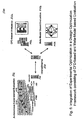
- Fig. 5
- illustrates the integration of the experimental optimization process in a design optimization framework consisting of a CFD-based and meta model based evaluation, and
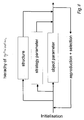
- Fig. 6
- shows a technology for implementing a hierarchical design optimization using evolutionary algorithms (known from EP 01 104 723.0).
- Method #1: The
surface 202 consists of a flexible material, whose shape is controlled by a two-dimensional array ofpistons 204 that vary in length and in the force which they exert on thesurface 202. Examples are shown in Fig. 4 and for the complete set-up in a 2D scenario in Fig. 2. Instead of thepistons 204 being directly connected to saidsurface 202, indirect methods, e.g. where the force on thesurface 202 is exerted by magnets, are also conceivable. - Method #2: The
surface 202 is filled with a material which can be used to alter its shape. Pockets of possibly variable size can be filled with a liquid (e.g. water or oil) or a gas. By varying the pressure of the liquid the shape of thesurface 202 changes, which is basically similar to an inflatable mattress. Again, the pressure is controlled via thecomputer 102, and necessary containers can be hidden inside the design (e.g. the cockpit in the case of a racing car). - Method #3: The material of the
surface 202 is of such a kind that its shape can directly be controlled e.g. with the aid of electrical currents of varying strength. In this case, the electrical field or direction/strength of the electrical current has to be varied in such a way that the desired shape can be produced. E.g. materials with a memory of their shape and with varying stiffness (according to electrical fields) can be used.
- Hierarchical design optimization:
The term "hierarchical design optimization" encompasses
different aspects. Generally, the optimization can be
carried out on different hierarchical levels as f.e.
regarding the range (fine/rough optimization), time scale
and/or the representation of the design and the
experimental set-up.Generally not only the parameter values, but also the
representation of the design as well as the corresponding
experimental set-up characteristics can be modified
("mutated" in case an evolutionary algorithm is used for
the optimization). The modification of the representation
can be achieved in the experimental set-up by different
methods, which are described below.Reference is also made to Figure 6 showing the application
of the above hierarchical design optimization principle in
the case of evolutionary algorithms. According to this
technique the representation as well as the strategy and/or
object parameters are mutated. This technique as such is
known from the prior application EP 1 104 723 "Strategy
parameter adaptation in evolution strategies" in the name
of the same applicant as the present application, the
disclosure of which is hereby incorporated by reference.Another aspect of the hierarchical design optimization of
the present invention refers to the combination of an
optimization algorithm, e.g. an evolution strategy, and an
experimental set-
up 200 of the surface alterations that allows to change surfaces starting with the overall shape and proceeding via more detailed changes in local surface areas. Since the design optimization problem in principle is a very high-dimensional one, adequate measures have to be taken to decompose the problem. Only in this way the optimization of fine details in local areas can be combined with overall changes of the shape. In the context of the proposed solutions for the alteration of the shape, a hierarchical two-dimensional array ofpistons 204 with variable lengths (looking like a 3D grid) can be envisioned. Thereby, a number of pistons 204 (or in the discrete case cuboids 301) are used for the overall shape control during the initial phase of the experimental design optimization, whereas thedevices 206a+b controlling the detailed shape are subsequently added in later optimization phases according to appropriate measures. Alternatively, blocks 302 ofpistons 204 orcuboids 301 may define (virtual)larger blocks 302 while simultaneously being controlled; the size of theseblocks 302 is reduced in later optimization phases. Additionally or alternatively the position ofpistons 204 can be mutated during the optimization process. Therefore, the term "virtual" block, structure or design refers to the arrangement of sub-blocks or in general sub-structures which are controlled in such a way that they behave as one solid block or structure. Whether each sub-block/structure is adapted individually or as a virtual block/structure is controlled by the changes in the representation.Equally conceivable is a hierarchical set-up 200 for other shape control scenarios. In case of fluid-filled pockets, again (virtual) blocks of pockets can be defined for a simultaneous control. In addition, pocket walls can be designed in such a way that they are variable and can be moved by simple mechanical procedures to modify the representation. For magnetic or electric field based control, the area of influence of these devices can also be adapted. This leads not just to a hierarchical experimental set-up 200 but also to one where the overlap between different magnetic control units is altered.Generally, the mutation rates of the optimization with different hierarchical levels are set such that the mutation rate is the lower the higher the hierarchical level. F.e. the mutation rate of the representation is usually set to be lower (slower) than the mutation rate of the values of the parameters. According to the invention therefore different hierarchical levels of optimization can be performed.Optimization: The optimization algorithm can run on anycomputer 103 and/or 103a+b connected in one way or the other to thecomputer 102 which controls the experimental set-up 200. It is even conceivable that the optimization algorithm uses the experimental set-up 200 only as one particular method for evaluating the quality of designs. This method is combined e.g. with a CFD solver and meta models like ANNs or response surface models. In these cases, the computer 103b might belong to a computer cluster which is physically remote from the experimental hardware set-up 200. Thereby, thecomputer 103 which hosts said optimization algorithm is in contact with thecomputer 102 which controls the experimental set-up 200, e.g. via any corporate network (intranet) or asecured Internet connection 504. The results of the experimental optimization can directly be combined with other methods due to its autonomy. The interaction between and the control of the different evaluation methods can be taken from Fig. 5. The results of the experimental optimization can in turn be used to update and improve the model fidelity, e.g. in neural networks by using online learning. In the scope of the underlying invention, the focus is on using EAs as optimization tools due to their robustness and reliability even for complex problems. However, in principle the proposed methods can be combined with any optimization algorithm that does only need the quality of different designs for the optimization; examples are Simulated Annealing and Tabu Search (Tabu search is an iterative procedure designed for the solution of optimization problems, see f.e. J. W. Barnes, M. Laguna and F. Glover, "Intelligent Scheduling Systems", D. E. Brown and W. T. Scherer (Eds.), Kluwer Academic Publishers, pp. 101-127 (1995). Simulated annealing is a Monte Carlo approach for minimizing such multivariate functions).
- Step #1 (Process Initialization): A population of specific
parameter vectors (possibly of varying length and
representations) is stored within the EA running on a
computer 102. For instance, the parameter vectors may describe the position of pistons 204 (or blocks thereof for the hierarchical case) or, alternatively, the strength of magnets altering thesurface 202 of a design consisting of a flexible (magnetic) material that is subject to the fluid dynamics (FD) tests in thewind tunnel 104 as depicted in Fig. 2. - Step #2 (Set-Up Adjustment P2): The parameter set mentioned
above is autonomously sent to the
unit 206a that controls thepistons 204 or magnets, which results in a newly formedsurface 202 of the underlying design to be optimized. - Step #3 (Measurement P3 and Feedback P4): The FD properties
of the new design (or results of these properties like down
pressure, etc.) are tested and then autonomously sent back
to the
computer 102. - Step #4 (Looping): Steps #2 and #3 are repeated until all parameter vectors in the population have been tested and the quality values of their corresponding designs have been determined.
- Step #5 (Optimization Process P1): The EA running on the
computer 102 uses the quality values to select the best parameter vectors for the parent population of the next generation. Additionally, the resolution of the 2D array ofpistons 204 may be adapted in a hierarchical manner. For this purpose, a variable length representation for EAs has to be used. The next generation of parameter vectors is created by applying the usual evolutionary variation operators like mutation and recombination.
Thereby, the front wing of said racing car is given by a stiff but
A major issue is the development of a new aerodynamic design for a transonic compressor cascade - a series of airfoil layers consisting of rotor and stator blades found within the gas turbines that power jet-propelled aircraft, which is essentially a fluid dynamics optimization problem: Thereby, the streaming conditions around the fixed "stator" blades, and the rotor blades determine the efficiency of the whole turbine.
| Depicted Features and their Corresponding Reference Signs | |
| No. | Feature |
| 100 | overview diagram showing the principle of the autonomous experimental aerodynamic design optimization technique according to the underlying invention |
| 101 | interface between the computer 102 and the wind tunnel 104 |
| 102 | client PC needed for the selection process according to the evolution strategy and the calculation of optimized parameter sets according to the underlying optimization algorithm |
| 103 | first application server connected to the client PC via the Internet 504 or any corporate network (Intranet), which hosts the optimization algorithm according to the underlying invention |
| 103a | second application server connected to said first application server 103, which is needed for the CFD-based evaluation 502a according to said optimization algorithm |
| 103b | third application server connected to said first application server 103, which is needed for the meta-model based evaluation 502b according to said optimization algorithm |
| 104 | wind tunnel needed for the experimental evaluation, which is used to change the underlying design surface of aircrafts and/or road vehicles and to measure their fluid dynamics, air resistance index, and the noise |
| 200 | detailed view of the experimental hardware set-up according to the underlying invention showing the piston devices 204 needed for altering the flexible surface material 202 of the design |
| 202 | flexible (magnetic) surface material of the design altered by a number of variable pistons (or magnets) 204 |
| 204 | variable piston devices (or magnets) needed for altering the flexible surface material 202 of the design |
| 206a | piston control unit |
| 206b | measurement control unit |
| 300 | 3D diagram showing a discontinuous (discrete) representation of a surface 202 with an example of a virtual block definition 302 |
| 301 | rectangular parallelepipeds (cuboids) serving as adjustment elements which are used for a modification and aerodynamic optimization of a discontinuous (discrete) surface 300 |
| 302 | virtual block consisting of four cuboids 301 having the same length and the same cross-sectional area |
| 400 | 3D diagram showing a continuous (smooth) representation of a surface 202 with underlying pistons and a flexible surface material |
| 500 | integration of the experimental optimization process in a design optimization framework consisting of a CFD-based and meta-model based evaluation according to the underlying invention |
| 502 | autonomous experimental evaluation of the parameter sets |
| 502a | CFD-based evaluation as a first part of the hybrid optimization algorithm according to the underlying invention |
| 502b | meta-model based evaluation as a second part of said optimization algorithm |
| 504 | Internet or any corporate network (Intranet) |
| P1 | phase #1: optimizing parameters of at least one virtual surface structure 202 |
| P2 | phase #2: adjusting the surface structure 202 of an experimental set-up 200 according to the optimized parameters |
| P3 | phase #3: measuring dynamic properties of the adjusted experimental surface structure 202 |
| P4 | phase #4: feeding back the measurement results as quality values for the next cycle of the optimizing step |
Claims (21)
- Method for the optimization of surface structures (202), the method comprising the following steps (P1, P2, P3, P4):optimizing (P1) parameters of at least one surface structure (202),automatically adjusting (P2) the structure (202) of the surface of an experimental set-up (200) according to the optimized parameters,measuring (P3) properties of the adjusted experimental surface structure (202), andfeeding back (P4) the measurement results as quality values for the next cycle of the optimizing step.
- Method for a hierarchical design optimization, the method comprising the following steps (P1, P2, P3, P4):characterized in thatoptimizing (P1) the values of parameters, the parameters being the representation of least one design (202),automatically adjusting (P2) the design (202) of an experimental set-up (200) according to the optimized parameters,measuring (P3) dynamic properties of the adjusted experimental design (202), andfeeding back (P4) the measurement results as quality values for the next cycle of the optimizing step,
furthermore the representation of the design and correspondingly the experimental set-up are adapted during the optimization process. - Method according to claim 2,
characterized in that
the optimization of the representation of the design and the experimental set-up is carried out on a larger time scale than the optimization of the values of the parameters and the corresponding adjustement of the experimental set-up. - Method according to claim 2 or 3,
characterized in that
the step of optimizing the representation of the design and the experimental set-up involves the step of changing the number of parameters. - Method according to anyone of the preceding claims,
characterized in that
the optimization step (P1) is implemented by means of an Evolutionary Algorithm. - Method according to anyone of claims 1 to 4,
characterized in that
the optimization step (P1) is implemented by means of a Simulation Annealing or Tabu Search algorithm. - Method according to anyone of the preceding claims,
characterized in that the surface structure (202) is discontinuous. - Method according to anyone of the claims 1 to 6,
characterized in that the surface structure (202) is smooth. - Method according to anyone of the preceding claims,
characterized in that
the surface structure (202) to be optimized is superimposed to another predefined surface structure (202). - Method according to anyone of the preceding claims,
characterized in that
additional quality values are evaluated with a computational fluid dynamics solver and/or a meta model. - Use of a method according to anyone of the preceding claims for the optimization (P1) of road vehicle surfaces (202).
- Computer software program,
characterized in that
it implements the optimizing step (P1) of a method according to anyone of the preceding claims. - System for the optimization (P1) of surface structures (202), the system comprising:a computing device (102) for calculating optimized parameters of at least one surface structure (202),an experimental set-up (200) for measuring dynamic properties of an experimental surface structure (202), andan interface (101) for feeding calculated parameters from. the computing device (102) to the experimental set-up (200) and for feeding measured results back to the computing device (102) as quality values for the next cycle of the optimizing step (P1).
- System for a hierarchical design optimization, the system comprising:characterized in thata computing device for optimizing (P1) the values of parameters, the parameters representing at least one design (202),an interface for automatically adjusting (P2) the design (202) of an experimental set-up (200) according to the optimized parameters, andmeans for measuring (P3) properties of the adjusted experimental design (202),
the computing device and the experimental set-up are adapted to mutate the representation of the design and correspondingly the experimental set-up, respectively, during the optimization process. - System according to claim 13 or 14,
characterized in that
the computing device (102) implements an Evolutionary Algorithm. - System according to claim 13 or 14,
characterized in that
the computing device (102) implements a Tabu Search or Simulation Annealing algorithm. - System according to anyone of claims 13 to 16,
characterized by
means for automatically adjusting the surface structure (202) according to the supplied calculated parameters. - System according to anyone of claims 13 to 17,
characterized in that
the surface structure (202) is discontinuous. - System according to anyone of claims 13 to 17,
characterized in that
the surface structure (202) is smooth. - System according to anyone of the claims 13 to 19,
characterized in that
the surface structure (202) to be optimized is superimposed to another predefined surface structure (202). - System according to anyone of claims 13 to 20,
characterized by
additional computing devices (102) for evaluating quality values by means of a computational fluid dynamics solver and/or a meta model.
Priority Applications (4)
| Application Number | Priority Date | Filing Date | Title |
|---|---|---|---|
| DE60233312T DE60233312D1 (en) | 2002-06-21 | 2002-06-21 | Autonomous and experimental design optimization |
| EP02013826A EP1376412B1 (en) | 2002-06-21 | 2002-06-21 | Autonomous experimental design optimization |
| US10/456,179 US7831418B1 (en) | 2002-06-21 | 2003-06-05 | Autonomous experimental design optimization |
| JP2003171166A JP4533601B2 (en) | 2002-06-21 | 2003-06-16 | Design optimization method |
Applications Claiming Priority (1)
| Application Number | Priority Date | Filing Date | Title |
|---|---|---|---|
| EP02013826A EP1376412B1 (en) | 2002-06-21 | 2002-06-21 | Autonomous experimental design optimization |
Publications (2)
| Publication Number | Publication Date |
|---|---|
| EP1376412A1 true EP1376412A1 (en) | 2004-01-02 |
| EP1376412B1 EP1376412B1 (en) | 2009-08-12 |
Family
ID=29716817
Family Applications (1)
| Application Number | Title | Priority Date | Filing Date |
|---|---|---|---|
| EP02013826A Expired - Lifetime EP1376412B1 (en) | 2002-06-21 | 2002-06-21 | Autonomous experimental design optimization |
Country Status (4)
| Country | Link |
|---|---|
| US (1) | US7831418B1 (en) |
| EP (1) | EP1376412B1 (en) |
| JP (1) | JP4533601B2 (en) |
| DE (1) | DE60233312D1 (en) |
Cited By (1)
| Publication number | Priority date | Publication date | Assignee | Title |
|---|---|---|---|---|
| CN114414197A (en) * | 2022-03-28 | 2022-04-29 | 中国空气动力研究与发展中心设备设计与测试技术研究所 | Variable Mach number spray pipe of flexible wallboard of prebending |
Families Citing this family (22)
| Publication number | Priority date | Publication date | Assignee | Title |
|---|---|---|---|---|
| JP4643586B2 (en) * | 2004-11-01 | 2011-03-02 | 富士通株式会社 | Optimal design management device, optimal design calculation system, optimal design management method, optimal design management program |
| US20080262467A1 (en) * | 2005-02-16 | 2008-10-23 | Humphrey Joseph A C | Blood Flow Bypass Catheters and Methods for the Delivery of Medium to the Vasculature and Body Ducts |
| JP4386456B2 (en) | 2007-05-30 | 2009-12-16 | インターナショナル・ビジネス・マシーンズ・コーポレーション | System, program and method for determining processing order of processes |
| GB0811942D0 (en) * | 2008-07-01 | 2008-07-30 | Airbus Uk Ltd | Method of designing a structure |
| JP5565289B2 (en) * | 2010-12-08 | 2014-08-06 | 富士通株式会社 | SEARCH PROGRAM, SEARCH METHOD, AND SEARCH PROCESSING DEVICE |
| US8457939B2 (en) | 2010-12-30 | 2013-06-04 | Aerion Corporation | Generating inviscid and viscous fluid-flow simulations over an aircraft surface using a fluid-flow mesh |
| US8437990B2 (en) | 2011-03-11 | 2013-05-07 | Aerion Corporation | Generating a simulated fluid flow over an aircraft surface using anisotropic diffusion |
| US8538738B2 (en) | 2011-03-22 | 2013-09-17 | Aerion Corporation | Predicting transition from laminar to turbulent flow over a surface |
| US8892408B2 (en) | 2011-03-23 | 2014-11-18 | Aerion Corporation | Generating inviscid and viscous fluid flow simulations over a surface using a quasi-simultaneous technique |
| US10360318B2 (en) * | 2014-09-22 | 2019-07-23 | Pratt & Whitney Canada Corp. | System and method for multi-domain graphical modeling |
| DE102015101228A1 (en) * | 2015-01-28 | 2016-07-28 | Dr. Ing. H.C. F. Porsche Aktiengesellschaft | Method and arrangement for modeling an aerodynamically effective outer contour of a component model in a wind tunnel |
| US9633165B1 (en) * | 2015-12-23 | 2017-04-25 | Exa Corporation | Composite design direction |
| AU2017270086B2 (en) * | 2016-05-24 | 2023-03-30 | Divergent Technologies, Inc. | Systems and methods for additive manufacturing of transport structures |
| US11379627B2 (en) * | 2017-03-31 | 2022-07-05 | The Boeing Company | Vehicular liquid container design and manufacture |
| EP3561701B1 (en) * | 2018-04-23 | 2022-07-20 | Siemens Aktiengesellschaft | Method and device for determining a physical form, method for producing a calculation device, calculation device and use of the calculation device |
| US11544425B2 (en) | 2019-04-12 | 2023-01-03 | Cnh Industrial America Llc | Systems and methods for expediting design of physical components through use of computationally efficient virtual simulations |
| US11295046B2 (en) | 2019-04-12 | 2022-04-05 | Cnh Industrial America Llc | Systems and methods for expediting design of physical components through use of computationally efficient virtual simulations |
| US11604906B2 (en) * | 2019-09-17 | 2023-03-14 | Dassault Systemes Simulia Corp. | System and method for crashworthiness analytics in design |
| DE102019128313B3 (en) * | 2019-10-21 | 2021-03-25 | Dr. Ing. H.C. F. Porsche Aktiengesellschaft | Vehicle model, system and method for the aerodynamic outer skin design of a motor vehicle in a wind tunnel |
| DE102019130707B4 (en) * | 2019-11-14 | 2021-07-22 | Dr. Ing. H.C. F. Porsche Aktiengesellschaft | Aerodynamic model for a wind tunnel |
| JP7496497B2 (en) * | 2020-08-27 | 2024-06-07 | パナソニックIpマネジメント株式会社 | Information processing method, program, and information processing device |
| DE102021133525A1 (en) | 2021-12-16 | 2023-06-22 | Dr. Ing. H.C. F. Porsche Aktiengesellschaft | Method and apparatus for assisting a designer |
Citations (1)
| Publication number | Priority date | Publication date | Assignee | Title |
|---|---|---|---|---|
| EP1235180A1 (en) * | 2001-02-26 | 2002-08-28 | Honda R&D Europe (Deutschland) GmbH | Parameter adaptation in evolution strategies |
Family Cites Families (8)
| Publication number | Priority date | Publication date | Assignee | Title |
|---|---|---|---|---|
| US3914990A (en) * | 1974-07-18 | 1975-10-28 | Us Army | Dynamic terrain simulator |
| US5374011A (en) * | 1991-11-13 | 1994-12-20 | Massachusetts Institute Of Technology | Multivariable adaptive surface control |
| US5510995A (en) * | 1993-08-13 | 1996-04-23 | Iowa State University Research Foundation, Inc. | Sculptured surface synthesis based on functional design constraints |
| JPH09325949A (en) | 1996-06-04 | 1997-12-16 | Nissan Motor Co Ltd | Method for optimizing genetic algorithm and system for analyzing genetic algorithm |
| JP3881428B2 (en) * | 1997-07-11 | 2007-02-14 | 本田技研工業株式会社 | Object shape determination method |
| US6419187B1 (en) * | 1997-09-30 | 2002-07-16 | Deutsches Zentrum Fur Luft-Und Raumfahrt E.V. | Profile |
| US5887828A (en) * | 1997-11-13 | 1999-03-30 | Northrop Grumman Corporation | Seamless mission adaptive control surface |
| EP1489532A3 (en) * | 1998-09-07 | 2006-03-08 | Bridgestone Corporation | Method of estimating tire performance |
-
2002
- 2002-06-21 EP EP02013826A patent/EP1376412B1/en not_active Expired - Lifetime
- 2002-06-21 DE DE60233312T patent/DE60233312D1/en not_active Expired - Lifetime
-
2003
- 2003-06-05 US US10/456,179 patent/US7831418B1/en not_active Expired - Fee Related
- 2003-06-16 JP JP2003171166A patent/JP4533601B2/en not_active Expired - Fee Related
Patent Citations (1)
| Publication number | Priority date | Publication date | Assignee | Title |
|---|---|---|---|---|
| EP1235180A1 (en) * | 2001-02-26 | 2002-08-28 | Honda R&D Europe (Deutschland) GmbH | Parameter adaptation in evolution strategies |
Non-Patent Citations (10)
| Title |
|---|
| F. SBALZARINI ET AL.: "Proceedings of the Genetic and Evolutionary Computation Conference (GECCO-2001", 2001, MORGAN KAUFMANN PUBLISHERS, article "Evolution Strategies for Computational and Experimental Fluid Dynamics Applications" |
| J. C. OTTO; D. LANDMAN; A. T. PATERA: "A Surrogate Approach to the Experimental Optimization of Multi-Element Airfoils", MULTI-DISCIPLINARY OPTIMIZATION BRANCH, NASA LANGLEY RESEARCH CENTER MARCH, 1996, REPORT RTR 505-59-53-08, March 1996 (1996-03-01), Retrieved from the Internet <URL:WWW address: http://fmad-www.larc.nasa.gov/ mdob/MDOB/hilites/hl.96/Surrogates-3.96.html> |
| JACOB J D ET AL: "Aerodynamic Flow Control Using Adaptive Surfaces", PROCEEDINGS OF THE ASME 17TH BIENNIAL CONFERENCE ON MECHANICAL VIBRATION AND NOISE, SYMPOSIUM ON STRUCTRONICS, MECHATRONICS, AND SMART MATERIALS, September 1999 (1999-09-01), Las Vegas, Nevada, XP002214534 * |
| JACOB J D: "On the Fluid Dynamics of Adaptive Airfoils", PROCEEDINGS OF THE 1998 ASME INTERNATIONAL MECHANICAL ENGINEERING CONGRESS AND EXPOSITION, November 1998 (1998-11-01), Anaheim, CA, XP002214532 * |
| KODIYALAM S ET AL: "Multidisciplinary Design Optimization - Some Formal Methods, Framework Requirements, and Application to Vehicle Design", INT. J. VEHICLE DESIGN (SPECIAL ISSUE), 2001, pages 3 - 22, XP002214741 * |
| MUYL F ET AL: "Hybrid method for aerodynamic shape optimization in automotive industry", (ABSTRACT SUBMITTED FOR) THE PROCEEDINGS OF THE CONFERENCE FOR APPLIED MATHEMATICS FOR INDUSTRIAL FLOW PROBLEMS - AMIF 2002, October 2001 (2001-10-01), Lisbon, XP002214685, Retrieved from the Internet <URL:http://www.dma.ens.fr/~ldumas/Lisbon02.pdf> [retrieved on 20020925] * |
| OLHOFER ET AL.: "Adaptive encoding for aerodynamic shape optimization using evolution strategies", PROCEEDINGS OF THE 2001 CONGRESS ON EVOLUTIONARY COMPUTATION, IEEE, vol. 1, 27 May 2001 (2001-05-27), pages 576 - 583 |
| OLHOFER M ET AL: "Adaptive encoding for aerodynamic shape optimization using evolution strategies", PROCEEDINGS OF THE 2001 CONGRESS ON EVOLUTIONARY COMPUTATION (IEEE CAT. NO.01TH8546), PROCEEDINGS OF THE 2001 CONGRESS ON EVOLUTIONARY COMPUTATION, SEOUL, SOUTH KOREA, 27-30 MAY 2001, 2001, Piscataway, NJ, USA, IEEE, USA, pages 576 - 583 vol. 1, XP002214533, ISBN: 0-7803-6657-3 * |
| SASAKI D ET AL: "Aerodynamic shape optimization of supersonic wings by adaptive range multiobjective genetic algorithms", EVOLUTIONARY MULTI-CRITERION OPTIMIZATION. FIRST INTERNATIONAL CONFERENCE, EMO 2001. PROCEEDINGS (LECTURE NOTES IN COMPUTER SCIENCE VOL.1993), EVOLUTIONARY MULTI-CRITERION OPTIMIZATION. FIRST INTERNATIONAL CONFERENCE, EMO 2001, ZURICH, SWITZERLAND, 7, 2001, Berlin, Germany, Springer-Verlag, Germany, pages 639 - 652, XP002214536, ISBN: 3-540-41745-1 * |
| SBALZARINI I F ET AL: "Evolution Strategies for Computational and Experimental Fluid Dynamic Applications", PROCEEDINGS OF THE GENETIC AND EVOLUTIONARY COMPUTATION CONFERENCE ({GECCO}-2001), - 7 November 2001 (2001-11-07), pages 1064 - 1071, XP002214535 * |
Cited By (1)
| Publication number | Priority date | Publication date | Assignee | Title |
|---|---|---|---|---|
| CN114414197A (en) * | 2022-03-28 | 2022-04-29 | 中国空气动力研究与发展中心设备设计与测试技术研究所 | Variable Mach number spray pipe of flexible wallboard of prebending |
Also Published As
| Publication number | Publication date |
|---|---|
| US20100305925A1 (en) | 2010-12-02 |
| JP2004030661A (en) | 2004-01-29 |
| DE60233312D1 (en) | 2009-09-24 |
| EP1376412B1 (en) | 2009-08-12 |
| US7831418B1 (en) | 2010-11-09 |
| JP4533601B2 (en) | 2010-09-01 |
Similar Documents
| Publication | Publication Date | Title |
|---|---|---|
| EP1376412B1 (en) | Autonomous experimental design optimization | |
| KR20230065343A (en) | Physical Environment Simulation Using Mesh Representation and Graph Neural Networks | |
| EP4258158A1 (en) | Optimization of a design using a physics solver integrated with a neural network | |
| US20060058985A1 (en) | Adjoint-based design variable adaptation | |
| CN112363517A (en) | Formation control method for underwater glider | |
| Quagliarella et al. | Viscous single and multicomponent airfoil design with genetic algorithms | |
| Pehlivanoglu | Efficient accelerators for PSO in an inverse design of multi-element airfoils | |
| CN121816577A (en) | Electric drive unit simulation | |
| Lam et al. | Coupled aerostructural design optimization using the kriging model and integrated multiobjective optimization algorithm | |
| CN120255322A (en) | An efficient motion control method for multi-degree-of-freedom bionic pectoral fins | |
| Cai et al. | Active learning neural c-space signed distance fields for reduced deformable self-collision | |
| Liu et al. | Asynchronous parallel reinforcement learning for optimizing propulsive performance in fin ray control | |
| Epstein et al. | Constrained aerodynamic optimization of three-dimensional wings driven by Navier-Stokes computations | |
| CN120121059B (en) | A path planning and tracking control method for unmanned aerial vehicle | |
| Freitas et al. | High precision trajectory planning on freeform surfaces for robotic manipulators | |
| Deodhar et al. | Experimentally infused plant and controller optimization using iterative design of experiments—theoretical framework and airborne wind energy case study | |
| Yang et al. | Simultaneous optimization of curvature and curvature variation for tool path generation in high-speed milling of corners | |
| Duvall et al. | Flow-Field Emulation and Shape Optimization of Compressor Airfoils Using Design-Variable Hypernetworks | |
| Renner | Genetic algorithms in computer-aided design | |
| Sales et al. | Toolpath Generation for Additive Manufacturing Considering Structural Performance | |
| Qi et al. | A NURBS-based hull surface modification method for hydrodynamic optimization | |
| CN121279067B (en) | A Smart Integrated Design Method for Product Structure Based on Neural Network Reparameterization | |
| Menon et al. | Optimisation-based flight control law clearance | |
| Sóbester | Concise airfoil representation via case-based knowledge capture | |
| Rout et al. | Airfoil Shape Optimization using Deep Q-Network |
Legal Events
| Date | Code | Title | Description |
|---|---|---|---|
| PUAI | Public reference made under article 153(3) epc to a published international application that has entered the european phase |
Free format text: ORIGINAL CODE: 0009012 |
|
| AK | Designated contracting states |
Kind code of ref document: A1 Designated state(s): AT BE CH CY DE DK ES FI FR GB GR IE IT LI LU MC NL PT SE TR |
|
| AX | Request for extension of the european patent |
Extension state: AL LT LV MK RO SI |
|
| 17P | Request for examination filed |
Effective date: 20040504 |
|
| 17Q | First examination report despatched |
Effective date: 20040603 |
|
| AKX | Designation fees paid |
Designated state(s): DE FR GB IT |
|
| 17Q | First examination report despatched |
Effective date: 20040603 |
|
| GRAP | Despatch of communication of intention to grant a patent |
Free format text: ORIGINAL CODE: EPIDOSNIGR1 |
|
| GRAS | Grant fee paid |
Free format text: ORIGINAL CODE: EPIDOSNIGR3 |
|
| GRAA | (expected) grant |
Free format text: ORIGINAL CODE: 0009210 |
|
| AK | Designated contracting states |
Kind code of ref document: B1 Designated state(s): DE FR GB IT |
|
| REG | Reference to a national code |
Ref country code: GB Ref legal event code: FG4D |
|
| REF | Corresponds to: |
Ref document number: 60233312 Country of ref document: DE Date of ref document: 20090924 Kind code of ref document: P |
|
| PLBE | No opposition filed within time limit |
Free format text: ORIGINAL CODE: 0009261 |
|
| STAA | Information on the status of an ep patent application or granted ep patent |
Free format text: STATUS: NO OPPOSITION FILED WITHIN TIME LIMIT |
|
| 26N | No opposition filed |
Effective date: 20100517 |
|
| PG25 | Lapsed in a contracting state [announced via postgrant information from national office to epo] |
Ref country code: IT Free format text: LAPSE BECAUSE OF FAILURE TO SUBMIT A TRANSLATION OF THE DESCRIPTION OR TO PAY THE FEE WITHIN THE PRESCRIBED TIME-LIMIT Effective date: 20090812 |
|
| PGFP | Annual fee paid to national office [announced via postgrant information from national office to epo] |
Ref country code: GB Payment date: 20130620 Year of fee payment: 12 |
|
| PGFP | Annual fee paid to national office [announced via postgrant information from national office to epo] |
Ref country code: FR Payment date: 20130703 Year of fee payment: 12 |
|
| PGFP | Annual fee paid to national office [announced via postgrant information from national office to epo] |
Ref country code: DE Payment date: 20130829 Year of fee payment: 12 |
|
| REG | Reference to a national code |
Ref country code: DE Ref legal event code: R084 Ref document number: 60233312 Country of ref document: DE Effective date: 20140711 |
|
| REG | Reference to a national code |
Ref country code: DE Ref legal event code: R119 Ref document number: 60233312 Country of ref document: DE |
|
| GBPC | Gb: european patent ceased through non-payment of renewal fee |
Effective date: 20140621 |
|
| REG | Reference to a national code |
Ref country code: DE Ref legal event code: R119 Ref document number: 60233312 Country of ref document: DE Effective date: 20150101 |
|
| REG | Reference to a national code |
Ref country code: FR Ref legal event code: ST Effective date: 20150227 |
|
| PG25 | Lapsed in a contracting state [announced via postgrant information from national office to epo] |
Ref country code: DE Free format text: LAPSE BECAUSE OF NON-PAYMENT OF DUE FEES Effective date: 20150101 |
|
| PG25 | Lapsed in a contracting state [announced via postgrant information from national office to epo] |
Ref country code: GB Free format text: LAPSE BECAUSE OF NON-PAYMENT OF DUE FEES Effective date: 20140621 Ref country code: FR Free format text: LAPSE BECAUSE OF NON-PAYMENT OF DUE FEES Effective date: 20140630 |