EP1376401A2 - Method and system for creation and use of webs of linked documents - Google Patents
Method and system for creation and use of webs of linked documents Download PDFInfo
- Publication number
- EP1376401A2 EP1376401A2 EP03013393A EP03013393A EP1376401A2 EP 1376401 A2 EP1376401 A2 EP 1376401A2 EP 03013393 A EP03013393 A EP 03013393A EP 03013393 A EP03013393 A EP 03013393A EP 1376401 A2 EP1376401 A2 EP 1376401A2
- Authority
- EP
- European Patent Office
- Prior art keywords
- files
- macro
- file
- data processing
- processing system
- Prior art date
- Legal status (The legal status is an assumption and is not a legal conclusion. Google has not performed a legal analysis and makes no representation as to the accuracy of the status listed.)
- Granted
Links
Images





Classifications
-
- G—PHYSICS
- G06—COMPUTING OR CALCULATING; COUNTING
- G06F—ELECTRIC DIGITAL DATA PROCESSING
- G06F16/00—Information retrieval; Database structures therefor; File system structures therefor
- G06F16/90—Details of database functions independent of the retrieved data types
- G06F16/93—Document management systems
- G06F16/94—Hypermedia
Definitions
- the present invention relates to linked information retrieval. More particularly it relates to a method and system for creating links between files that define documents (i.e. formatted data) and for using such links to enable a flow of information among such files.
- PC personal computer
- HTML HyperText Markup Language
- the method includes: storing a file, the file including a document and being linked to a macro, on a data processing system, the data processing system having an operating system; the operating system controlling the data processing system to execute the macro in response to a predetermined trigger event; and the macro controlling the data processing system to inspect other files and link selected ones of the other files to the stored file in accordance with predetermined criteria.
- the macro is stored centrally, either on the data processing system or on a network, and the stored file is linked to the macro by a pointer.
- the macro is incorporated in the stored file.
- the predetermined criteria are derived in accordance with values of predetermined data elements of the document.
- At least one of the other files includes keywords and the macro controls the data processing system to inspect the keywords and list those files where the keywords meet the predetermined criteria.
- the selected ones of the other files are selected from the listed files after inspection of the other files' full contents in accordance with the predetermined criteria.
- the selected ones of the other files consist of the listed files.
- the selected ones of the other files are selected from the other files after inspection of the other files' full contents in accordance with the predetermined criteria.
- At least one of the other files comprises self-describing data organized in a manner that can be interpreted by the macro.
- the operating system includes a virtual machine and the macro is expressed in executable code for the virtual machine.
- the trigger event is the changing, deleting or moving of an existing file on the data processing system.
- the trigger event is the creation or input of a new file on the data processing system.
- Non-volatile media includes, for example, optical or magnetic disks.
- Volatile media includes dynamic memory.
- Transmission media includes coaxial cables, copper wire and fiber optics. Transmission media can also take the form of acoustic or light waves, such as those generated during radio wave and infrared data communications.
- FIG 1 shows a schematic block diagram of a data processing system for managing networks of linked documents (sometimes hereinafter “Rheodocs”) in accordance with an embodiment of the present invention.
- Figure 2 shows a data structure for Rheodocs.
- Figure 3 shows a schematic block diagram of a data processing system for managing networks of linked documents in accordance with another embodiment of the present invention.
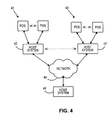
- Figure 4 shows a network of Rheodoc systems implementing an application of Rheodocs.
- Figure 5 shows a flow diagram of the operation of one of a host system in managing a credit card Rheodoc.
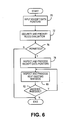
- Figure 6 shows a flow diagram of the operation of one of a home system in managing a credit card Rheodoc.
- Figure 7 shows a more detailed flow diagram of the operation of a system to determine if an input data file is a Rheodoc.
- Figure 8 shows a more detailed flow diagram of the operation of a system to execute existing Rheodocs.
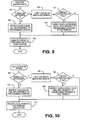
- FIG 9 shows a more detailed flow diagram of the operation of a system in carrying out steps of a Rheodoc process (hereinafter sometimes "macro").
- Figure 10 shows a more detailed flow diagram of the operation of a system in carrying out steps of another macro.
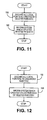
- Figures 11 and 12 show a flow diagram of a process for deleting a Rheodoc.
- FIG. 1 shows Rheodoc system 10, which is a data processing system for managing Rheodocs.
- Rheodoc refers to a file that defines both a document (i.e. structured data) and an associated process which identifies and links to other files of interest, which can be other Rheodocs to form systems of linked files and enable flows of information among such linked files. (Note that the combining form "rheo" means flow.)
- the associated process is implemented by a program (sometimes hereinafter “macro") that is linked to the file.
- System 10 includes Processing Unit 12, Memory 14, Local Storage 16 and Rheodoc File Storage 20.
- Memory 14 stores program code for controlling processing unit 12 to manage Rheodocs and for carrying other applications, file pointers to Rheodoc files on system 10, a list of event triggers which initiate execution of the macros.
- memory 14 will also store a byte code engine, or virtual machine, to execute macros, as will be described further below.
- a byte code engine, or virtual machine is an application on an actual data processing system that responds to the machine code for, and, emulates the operation of, a different system, which typically does not exist in physical form. Such virtual machine code is referred to as "byte code" by those skilled in the art.
- Local Store 16 stores byte code for Rheodoc macros and variable data. Variable data is temporarily stored data including intermediate results, history and audit data.
- Rheodoc File Store 20 stores Rheodocs as files that comprise a document and linking data linking the file to the byte code and variable data.
- the linking data are pointers.
- the pointers link to Local Store 16.
- the pointers link to Network Store 26 through Network 22.
- FIG. 2 shows a preferred Rheodoc file structure.
- the Rheodoc includes content 29, macro linking data 31, and volatile linking data 33.
- the content includes descriptors 29-1 describing the data structure in a conventional self descriptive data format, optional keywords 29- 2, full content inspection enable flag 29-3, and data 29-4.
- Files having content 29 only can be linked by Rheodoc macros but, of course, cannot link other files.
- FIG 3 shows another embodiment of the present invention.
- Processing Unit 12 and Memory 14 are substantially as described with respect to Figure 1 above.
- Rheodoc File Store 30 store files where the documents, byte code and variable data are linked directly in each Rheodoc file.
- macros as byte code is preferred as efficiently providing compatibility across various types of systems, it should be noted that any convenient form of implementation is within the contemplation of the present invention. For example, if Rheodocs are used on only a single type of system the macros can be implemented in the machine language of that type system; or the macros can be written in a high level language and compiled as the Rheodocs are installed.)
- FIG. 4 shows a network of Rheodoc systems implementing an exemplary application of Rheodocs: linking credit card receipt information to an expense report template.
- Pluralities 40 of point of sale systems (hereinafter sometimes "POS's") communicate with corresponding ones of a plurality of host systems 42.
- Host systems 42 communicate over network 44 with home system 48.
- POS's point of sale systems
- Host systems 42 and home system 48 are Rheodoc systems.
- Systems 42 manage "credit card” Rheodocs that inspect and identify files that contain receipt information for particular credit card transactions and send a file of linking data to home system 48.
- the linking data can be pointers to files containing relevant receipt information or can be the relevant information abstracted from the identified files.
- Rheodoc macros will only provide access to the portions of identified files that contain relevant information.
- Home system 48 manages an expense report Rheodoc, which includes an expense report template document, and which links the linking data files received from host systems 42 to the expense report template. When an expense report application is opened the receipt information is transferred to the template.
- host system and “home system” as used herein are not intended to connote any particular architectural differences between systems 42 and system 48 or imply that network 44 is hierarchal; but only to indicate the roles played by these systems in the preferred embodiment described.
- systems 42 and 48 comprise a peer-to-peer network and can have other functions in other applications.
- FIG. 5 shows a flow diagram of the operation of one of host systems 42 to manage a credit card Rheodoc.
- a credit card is modified so as to constitute a Rheodoc by the incorporation of a pointer to a Credit Card Rheodoc macro along with conventional credit card information such as card number and expiration date.
- system 42 responds to a trigger event, here the input of transaction data and a pointer to a Credit Card Rheodoc macro from one of POS's 40, to update and process its receipt files, as will be described further below.
- system 42 evaluates security and priority rules to decide if execution is permitted. These rules typically determine whether the execution of this macro is allowed, in the general case, by the system.
- step 56 if execution is permitted, system 42 goes to step 58 to inspect and process the transaction data and update the receipt files, as will be described further below. Otherwise system 42 exits and waits for another trigger event. Then at step 60 system 42 inspects and processes the next existing Rheodoc, as will be described further below. That is the Rheodoc next in priority in the class of Rheodocs whose execution is permitted at step 52. At step 62 system 42 determined if execution of another Rheodoc is permitted and, if so returns to step 60 and otherwise exits to wait for the next trigger event.
- system 42 When the receipt files are opened for updating at step 58 another trigger event occurs and, at step 61, system 42 responds.
- system 42 evaluates security and priority rules to decide if execution is permitted. These rules typically determine whether the specific executing macro is allowed to access this file at this time.
- system 42 goes to step 67 to inspect and process the receipt file data and send a pointer to the receipt file data of interest to home system 48, as will be described further below. Otherwise system 42 exits and waits for another trigger event.
- system 42 inspects and processes the next existing Rheodoc, as will be described further below. That is the Rheodoc next in priority in the class of Rheodocs whose execution is permitted at step 63.
- system 42 determined if execution of another Rheodoc is permitted and, if so returns to step 69 and otherwise exits to wait for the next trigger event.
- FIG. 6 shows a flow diagram of the operation of home system 48 to manage a credit card Rheodoc.
- system 48 responds to a trigger event, here the input of pointers to receipt data to initiate execution of the expense Rheodoc, as will be described further below.
- system 48 evaluates security and priority rules to decide if execution is permitted.
- step 76 if execution is permitted, system 48 goes to step 78 to inspect and process the receipt data pointer file, as will be described further below. Otherwise system 48 exits and waits for another trigger event.
- system 48 inspects and processes the next existing Rheodoc, as will be described further below. That is the Rheodoc next in priority in the class of Rheodocs whose execution is permitted at step 82.
- system 48 determined if execution of another Rheodoc is permitted and, if so returns to step 80 and otherwise exits to wait for the next trigger event.
- trigger events are the input of data, i.e. the creation or updating of an input data file
- other events can be defined as triggers for the execution of the same or different classes of Rheodocs.
- Such events include, but are not limited to: opening a file to read, write, or execute; closing a file; copying a file; and Rheodoc macro-to-Rheodoc macro messages.
- Figure 7 shows a more detailed flow diagram of the operation of systems 42 and 48 in executing steps 58 and 67, and 78 respectively to determine if the input data file is a Rheodoc. Note that in other embodiments of the present invention priority and security rules may not permit of the possibility that files that initiate some or all trigger events are Rheodocs.
- the system inspects the input data file, i.e. the input receipt data file for systems 42 and the linking data file for system 48 for the presence of an associated macro, i.e. actual code in the file, or for pointers to such a macro.
- the system determines if a pointer is present, at step 94 if the system is able to fetch a macro over network 22 (shown in Fig.
- step 98 if a macro is present on network store 26. If the result of all these steps is positive then at step 100 the system fetches the macro and at step 102 executes it, as will be described further below and at step 104 posts abstracted keywords that can have been incorporated in the file. (By posting the abstracted keywords, herein is meant that the keywords in this Rheodoc are sent to all other Rheodocs on the system.
- step 106 determines if a macro is directly present in the file and, if so goes to step 102 to execute it and then to step 104, and otherwise goes directly to step 104.
- the present invention provides a capability to retrieve the most current update of a macro over network 22 if one is available and, otherwise if it is not possible to retrieve a macro over network 22, to execute the macro present in the Rheodoc as a "second best" alternative.
- Figure 8 shows a more detailed flow diagram of the operation of systems 42 and 48 in executing steps 60 and 80 respectively to execute existing Rheodocs.
- the system inspects the next existing Rheodoc for the presence of an associated macro, i.e. actual code in the file, or for pointers to such a macro.
- the system determines if a pointer is present, at step 114 if the system is able to fetch a macro over network 22 (shown in Fig. 1), and at step 118 if a macro is present on network store 26. If the result of all these steps is positive then at step 120 the system fetches the macro and at step 122 executes it, as will be described further below. If the result at any of steps 112, 114 or 118 is negative then the system goes to step 126 to determine if a macro is directly present in the file and, if so goes to step 122 to execute it.
- Figure 9 shows a more detailed flow diagram of the operation of systems 42 at step 102 in carrying out steps of a macro.
- system 42 determines if files are to be inspected for keywords. Keywords are preselected words, phrases, or other data items that at least partially identify files incorporated in those files. Rheodoc files may limit the files exposed to a Rheodoc macro by only considering files containing keywords specified by the macro. If files are to be inspected, at step 142 system 42 lists those files whose keywords match predetermined criteria incorporated in the macro. At step 144 system 42 determines if the listed files are to be inspected in full.
- the full content of listed files is inspected at 146 for those files which enable full content inspection (for reasons of security full content inspection may be prohibited for some files) and at 150 system 42 sends a file of pointers to identified files: i.e. listed files which match the full content criteria and listed files which do not enable full content inspection, to home system 48. Otherwise, at step 150 system 42 (i.e. the macro running on system 42) sends pointers to all listed files to home system 48. If files are not to be inspected for keywords, at 152 system 42 inspects the full content of all files and at 150 sends a file of pointers to identified files whose content matches the criteria.
- macros will simply send pointers of files with matching keywords. The benefit of this is to reduce the time and resources to identify files to be processed by the Rheodocs macro. In other applications, the macro will further qualify files that match the keyword criteria (that is to say that not all files that match the keyword criteria will be of interest, so the macro will need look through the full contents to see if the information is of interest). In still other applications, where it is not possible to determine if files can be limited by keyword and all files will need to be inspected in full. In this manner, in the preferred embodiment described above, macros which are executed in response to input of transaction data to one of host systems 42 can act as "scouts" for home system 48; identifying only files which are of interest to system 48.
- Such macros can be structured to only identify receipt files which evidence spending patterns that fall outside predetermined limits, such as restaurant receipts that exceed certain amounts. Decisions made among these various applications allow the macro designer to make tradeoffs between using computer time and resources to inspect each file and send a smaller number of pointers over the network, or to use less computer resources and send more pointers over the network at the expense of network resources.
- Figure 10 shows a more detailed flow diagram of the operation of systems 48 at step 122 in carrying out steps a macro.
- system 48 determines if files are to be inspected for keywords. Keywords are preselected words, phrases, or other data items that at least partially identify files incorporated in those files. If so at step 162 system 48 lists those files whose keywords match predetermined criteria incorporated in the macro.
- system 48 determines if the listed files are to be inspected in full. If so, the full content of listed files is inspected at 166 for those files which enable full content inspection and at 170 system 48 creates local pointers to identified files: i.e. listed files which match the full content criteria and listed files which do not enable full content inspection, to home system 48.
- system 48 creates local pointers to all listed files to home system 48. If files are not to be inspected for keywords, at 172 system 48 inspects the full content of all files and at 150 creates local pointers to identified files whose content matches the criteria.
- Macro criteria can be predetermined but preferably are paramatized.
- an expense report template in the expense report Rheodoc will typically include fields defining persons, projects, date ranges, etc.
- criteria values can be derived from these fields in the Rheodoc document and specific instances of expense reports generated using data from files linked to the template by the Rheodoc macro using these parameters.
- fields in a Rheodoc may be stored in an XML (eXtensible Markup Language) format.
- XML eXtensible Markup Language
- XML is a well known technology that provides a flexible way to create "self-describing data", and to share both the format and the data on the World Wide Web, intranets, and elsewhere.
- FIGs 11 and 12 show the process for deleting a Rheodoc.
- a Rhedoc is deleted on a host system all local pointers created by that Rheodoc are deleted at step 190 and the home system that originated the deleted Rheodoc is informed at step 192.
- the home system responds to the information as a trigger event and calls one or more related Rheodocs that delete any local pointers to the deleted Rheodoc they may have created at step 196.
- the called Rheodocs inform the systems which created them of the deleted Rheodoc. This allows other Rheodocs that were interested in the deleted Rheodoc to clean up their pointers.
- the macro that discovered and sent the file pointers to the home system will send the fact that file has been deleted to the home system to clean up the home system's local pointers.
- Rheodocs include pointers to centrally stored macros that are stored on a network.
- centrally stored macros can be stored on local storage as described above with respect to Figure 1.
- Central storage of macros is preferred to having macros actually present in the Rheodocs since centrally stored macros can be shared and are easier to maintain.
- the introduction of a Rheodoc to a system causes the system to be extended to perform "safe actions" on behalf of the creator of the Rheodoc.
- the mere input of the document by a system causes the system to perform services on the behalf of the input document's owner.
- input of a Credit Card Rheodoc triggers a macro to update receipt files with current transaction data, opening of these receipt files for updating in turn triggers a macro which sends pointers to a home system, and receipt of these pointers triggers yet another macro which inspects the receipt files in accordance with predetermined criteria.
Landscapes
- Engineering & Computer Science (AREA)
- Databases & Information Systems (AREA)
- Theoretical Computer Science (AREA)
- Business, Economics & Management (AREA)
- General Business, Economics & Management (AREA)
- Data Mining & Analysis (AREA)
- Physics & Mathematics (AREA)
- General Engineering & Computer Science (AREA)
- General Physics & Mathematics (AREA)
- Information Retrieval, Db Structures And Fs Structures Therefor (AREA)
- Document Processing Apparatus (AREA)
Abstract
Description
Otherwise
Claims (20)
- A method for creating a system of linked documents, said method comprising the steps of:a) storing a file, said file including a document and being linked to a macro, on a data processing system, said data processing system having an operating system;b) said operating system controlling said data processing system to execute said macro in response to a predetermined trigger event; andc) said macro controlling said data processing system to inspect other files and link selected ones of said other files to said stored file in accordance with predetermined criteria.
- A method as described in claim 1 where said predetermined criteria are derived in accordance with values of predetermined data elements of said document.
- A method as described in claim 1 where at least one of said other files includes keywords and said macro controls said data processing system to inspect said keywords and list said one of said other files if said keywords meet said predetermined criteria.
- A method as described in claim 3 where said selected ones of said other files are selected from said listed files after inspection of said other files' full contents in accordance with said predetermined criteria.
- A method as described in claim 3 where said selected ones of said other files consist of said listed files.
- A method as described in claim 1 where said selected ones of said other files are selected from said other files after inspection of said other files' full contents in accordance with said predetermined criteria.
- A method as described in claim 1 where at least one of said other files comprises self-describing data organized in a manner that can be interpreted by said macro.
- A method as described in claim 1 where said operating system includes a virtual machine and said macro is expressed in executable code for said virtual machine.
- A method as described in claim 1 where said trigger event is the changing, deleting, or moving of an existing file on said data processing system.
- A method as described in claim 1 where said trigger event is the creation or input of a new file on said data processing system.
- A method as described in claim 10 where said new file is linked to a new file macro, said new file macro controlling said data processing system to inspect existing files and link selected ones of said existing files to said new file in accordance with predetermined criteria and said operating system is further responsive to said trigger event to control said data processing system to execute said new file macro.
- A method for creating a system of linked documents on a network, said network including a home data processing system communicating with a host data processing system, said method comprising the steps of:a) storing a first file, said first file including a document and being linked to a first macro, on said home system, said home system having a home operating system;b) said home operating system controlling said home system to execute said first macro in response to a first trigger event; andc) said first macro controlling said home system to inspect other home system files and link selected ones of said other home system files to said first file in accordance with predetermined criteria;d) storing a second file, said second file including a second document and being linked to a second macro, on said host system, said host system having a host operating system;e) said host operating system controlling said host system to execute said second macro in response to a second trigger event; andf) said second macro controlling said host system to inspect other host system files and link selected ones of said other host system files to said first file in accordance with said predetermined criteria.
- A method as described in claim 12 where said second macro links said selected other host system files to said first file by sending a file of linking data to said home system and said first trigger event is input of said file of linking data to said home system.
- A method as described in claim 12 where said predetermined criteria are derived in accordance with values of predetermined data elements of said document in said first file.
- A method as described in claim 12 where at least one of said other host files includes keywords and said second macro controls said host system to inspect said keywords and list said one of said other host files if said keywords meet said predetermined criteria.
- A method as described in claim 12 where at least one of said other host files comprises self-describing data organized in a manner that can be interpreted by said second macro.
- A method as described in claim 12 where said host operating system includes a virtual machine and said second macro is expressed in executable code for said virtual machine.
- A data processing system, said data processing system storing a file, said file including a document and being linked to a macro said data processing system, said data processing system being programmed to:a) execute said macro in response to a predetermined trigger event; andb) respond to said macro to inspect other files and link selected ones of said other files to said stored file in accordance with predetermined criteria.
- A data processing system as described in claim 18 where said predetermined criteria are derived in accordance with values of predetermined data elements of said document.
- A computer readable medium carrying a file, said file including a document and a macro, said macro comprising at least one instruction for controlling a data processing system to inspect other files and link selected ones of said other files to said carried file in accordance with predetermined criteria.
Applications Claiming Priority (2)
| Application Number | Priority Date | Filing Date | Title |
|---|---|---|---|
| US176248 | 1988-03-31 | ||
| US10/176,248 US20030236921A1 (en) | 2002-06-19 | 2002-06-19 | Method and system for creation and use of webs of linked documents |
Publications (3)
| Publication Number | Publication Date |
|---|---|
| EP1376401A2 true EP1376401A2 (en) | 2004-01-02 |
| EP1376401A3 EP1376401A3 (en) | 2004-08-18 |
| EP1376401B1 EP1376401B1 (en) | 2009-09-30 |
Family
ID=29717837
Family Applications (1)
| Application Number | Title | Priority Date | Filing Date |
|---|---|---|---|
| EP03013393A Expired - Lifetime EP1376401B1 (en) | 2002-06-19 | 2003-06-18 | Method and system for creation and use of webs of linked documents |
Country Status (3)
| Country | Link |
|---|---|
| US (1) | US20030236921A1 (en) |
| EP (1) | EP1376401B1 (en) |
| DE (1) | DE60329438D1 (en) |
Families Citing this family (6)
| Publication number | Priority date | Publication date | Assignee | Title |
|---|---|---|---|---|
| US20050273201A1 (en) * | 2004-06-06 | 2005-12-08 | Zukowski Deborra J | Method and system for deployment of sensors |
| US7673244B2 (en) | 2004-06-06 | 2010-03-02 | Pitney Bowes Inc. | Responsive environment sensor systems with delayed activation |
| GB2427048A (en) | 2005-06-09 | 2006-12-13 | Avecho Group Ltd | Detection of unwanted code or data in electronic mail |
| US9729513B2 (en) | 2007-11-08 | 2017-08-08 | Glasswall (Ip) Limited | Using multiple layers of policy management to manage risk |
| US8489544B2 (en) * | 2007-06-04 | 2013-07-16 | John P. Ford | System and method for prioritization and display of aggregated data |
| US8826304B2 (en) * | 2009-08-13 | 2014-09-02 | Google Inc. | Virtual object indirection in a hosted computer environment |
Family Cites Families (3)
| Publication number | Priority date | Publication date | Assignee | Title |
|---|---|---|---|---|
| US6240429B1 (en) * | 1998-08-31 | 2001-05-29 | Xerox Corporation | Using attached properties to provide document services |
| US6263121B1 (en) * | 1998-09-16 | 2001-07-17 | Canon Kabushiki Kaisha | Archival and retrieval of similar documents |
| US6549916B1 (en) * | 1999-08-05 | 2003-04-15 | Oracle Corporation | Event notification system tied to a file system |
-
2002
- 2002-06-19 US US10/176,248 patent/US20030236921A1/en not_active Abandoned
-
2003
- 2003-06-18 DE DE60329438T patent/DE60329438D1/en not_active Expired - Lifetime
- 2003-06-18 EP EP03013393A patent/EP1376401B1/en not_active Expired - Lifetime
Also Published As
| Publication number | Publication date |
|---|---|
| DE60329438D1 (en) | 2009-11-12 |
| EP1376401A3 (en) | 2004-08-18 |
| US20030236921A1 (en) | 2003-12-25 |
| EP1376401B1 (en) | 2009-09-30 |
Similar Documents
| Publication | Publication Date | Title |
|---|---|---|
| Nogueira et al. | A hybrid iterated local search heuristic for the maximum weight independent set problem | |
| US5999942A (en) | Method and apparatus for enforcement of behavior of application processing systems without modifying application processing systems | |
| US5499365A (en) | System and method for controlling versions of objects in an object oriented computing environment | |
| US8561100B2 (en) | Using xpath and ontology engine in authorization control of assets and resources | |
| US7954052B2 (en) | Method for processing a web page for display in a wiki environment | |
| CN101114299B (en) | Method for programmatically hiding and displaying wiki page layout sections, data processing system | |
| RU2342698C2 (en) | System and method, designed for sending messages to program | |
| AU2004216596B2 (en) | Programming interface for licensing | |
| KR101219856B1 (en) | Automated data organization | |
| US20080040661A1 (en) | Method for inheriting a Wiki page layout for a Wiki page | |
| US20080010341A1 (en) | Processing model of an application wiki | |
| US20080010387A1 (en) | Method for defining a Wiki page layout using a Wiki page | |
| US20080010609A1 (en) | Method for extending the capabilities of a Wiki environment | |
| US20030135523A1 (en) | Method of using cache to determine the visibility to a remote database client of a plurality of database transactions | |
| US20080010338A1 (en) | Method and apparatus for client and server interaction | |
| JP5490010B2 (en) | Method, system and computer program for storing information using descriptive logical file system | |
| US20050144198A1 (en) | Versions and workspaces in an object repository | |
| US20200133441A1 (en) | Team knowledge sharing | |
| US20080065769A1 (en) | Method and apparatus for argument detection for event firing | |
| US7607125B2 (en) | Programming language support for integrating undo and exception handling | |
| Jagadish et al. | Managing conflicts between rules | |
| EP1376401B1 (en) | Method and system for creation and use of webs of linked documents | |
| US8055652B1 (en) | Dynamic modification of Xpath queries | |
| US7433875B2 (en) | Web store events | |
| US20080010388A1 (en) | Method and apparatus for server wiring model |
Legal Events
| Date | Code | Title | Description |
|---|---|---|---|
| PUAI | Public reference made under article 153(3) epc to a published international application that has entered the european phase |
Free format text: ORIGINAL CODE: 0009012 |
|
| AK | Designated contracting states |
Kind code of ref document: A2 Designated state(s): AT BE BG CH CY CZ DE DK EE ES FI FR GB GR HU IE IT LI LU MC NL PT RO SE SI SK TR |
|
| AX | Request for extension of the european patent |
Extension state: AL LT LV MK |
|
| PUAL | Search report despatched |
Free format text: ORIGINAL CODE: 0009013 |
|
| AK | Designated contracting states |
Kind code of ref document: A3 Designated state(s): AT BE BG CH CY CZ DE DK EE ES FI FR GB GR HU IE IT LI LU MC NL PT RO SE SI SK TR |
|
| AX | Request for extension of the european patent |
Extension state: AL LT LV MK |
|
| 17P | Request for examination filed |
Effective date: 20050112 |
|
| AKX | Designation fees paid |
Designated state(s): DE FR GB |
|
| RBV | Designated contracting states (corrected) |
Designated state(s): DE FR GB |
|
| 17Q | First examination report despatched |
Effective date: 20050802 |
|
| GRAP | Despatch of communication of intention to grant a patent |
Free format text: ORIGINAL CODE: EPIDOSNIGR1 |
|
| GRAS | Grant fee paid |
Free format text: ORIGINAL CODE: EPIDOSNIGR3 |
|
| GRAA | (expected) grant |
Free format text: ORIGINAL CODE: 0009210 |
|
| AK | Designated contracting states |
Kind code of ref document: B1 Designated state(s): DE FR GB |
|
| REG | Reference to a national code |
Ref country code: GB Ref legal event code: FG4D |
|
| REF | Corresponds to: |
Ref document number: 60329438 Country of ref document: DE Date of ref document: 20091112 Kind code of ref document: P |
|
| PLBE | No opposition filed within time limit |
Free format text: ORIGINAL CODE: 0009261 |
|
| STAA | Information on the status of an ep patent application or granted ep patent |
Free format text: STATUS: NO OPPOSITION FILED WITHIN TIME LIMIT |
|
| 26N | No opposition filed |
Effective date: 20100701 |
|
| REG | Reference to a national code |
Ref country code: FR Ref legal event code: PLFP Year of fee payment: 14 |
|
| REG | Reference to a national code |
Ref country code: FR Ref legal event code: PLFP Year of fee payment: 15 |
|
| PGFP | Annual fee paid to national office [announced via postgrant information from national office to epo] |
Ref country code: GB Payment date: 20170627 Year of fee payment: 15 Ref country code: FR Payment date: 20170627 Year of fee payment: 15 |
|
| PGFP | Annual fee paid to national office [announced via postgrant information from national office to epo] |
Ref country code: DE Payment date: 20170628 Year of fee payment: 15 |
|
| REG | Reference to a national code |
Ref country code: DE Ref legal event code: R079 Ref document number: 60329438 Country of ref document: DE Free format text: PREVIOUS MAIN CLASS: G06F0017300000 Ipc: G06F0016000000 |
|
| REG | Reference to a national code |
Ref country code: DE Ref legal event code: R119 Ref document number: 60329438 Country of ref document: DE |
|
| GBPC | Gb: european patent ceased through non-payment of renewal fee |
Effective date: 20180618 |
|
| PG25 | Lapsed in a contracting state [announced via postgrant information from national office to epo] |
Ref country code: FR Free format text: LAPSE BECAUSE OF NON-PAYMENT OF DUE FEES Effective date: 20180630 Ref country code: DE Free format text: LAPSE BECAUSE OF NON-PAYMENT OF DUE FEES Effective date: 20190101 Ref country code: GB Free format text: LAPSE BECAUSE OF NON-PAYMENT OF DUE FEES Effective date: 20180618 |