EP1376380A1 - Procedure for computing the Choleski decomposition in a parallel multiprocessor system - Google Patents
Procedure for computing the Choleski decomposition in a parallel multiprocessor system Download PDFInfo
- Publication number
- EP1376380A1 EP1376380A1 EP02013112A EP02013112A EP1376380A1 EP 1376380 A1 EP1376380 A1 EP 1376380A1 EP 02013112 A EP02013112 A EP 02013112A EP 02013112 A EP02013112 A EP 02013112A EP 1376380 A1 EP1376380 A1 EP 1376380A1
- Authority
- EP
- European Patent Office
- Prior art keywords
- processor
- entries
- row
- matrix
- column
- Prior art date
- Legal status (The legal status is an assumption and is not a legal conclusion. Google has not performed a legal analysis and makes no representation as to the accuracy of the status listed.)
- Withdrawn
Links
Images

Classifications
-
- G—PHYSICS
- G06—COMPUTING OR CALCULATING; COUNTING
- G06F—ELECTRIC DIGITAL DATA PROCESSING
- G06F17/00—Digital computing or data processing equipment or methods, specially adapted for specific functions
- G06F17/10—Complex mathematical operations
- G06F17/16—Matrix or vector computation, e.g. matrix-matrix or matrix-vector multiplication, matrix factorization
Definitions
- the invention relates to a procedure for computing the Cholesky decomposition in a parallel multi-processor system.
- Such a decomposition is called 'Cholesky decomposition'.
- the Cholesky decomposition enables and simplifies processing tasks that involve hermitian, positive definite matrices considerably. Examples are signal processing procedures, in particular multi-channel procedures such as in modern radar and communication systems.
- Cholesky decomposition is generally one step in a sequence of sub-processing procedures within some bigger processing task.
- the associated computational load is such that requires the utilisation of multi-processor is required.
- the whole computation process can usually be decomposed into sub-tasks some of which can be implemented in a straightforward manner in such a way that the processors work fully in a parallel manner.
- Such a fully parallel implementation is not feasible for the Cholesky decomposition. It is known from the computation rule for the entries of the Cholesky factors L, that all computed output values of the different steps are required by subsequent processing steps at some later instance. Hence a full parallel assignment to different processing units of a multi-processor system in the sense that each processor unit computes some assigned part of the final result fully independently of the results of the other units is not feasible.
- One object of the invention is, that the available processors in the multi-processor system are utilised in an effective way. Another object of the invention is, that throughout the computation process, the workload for the processor modules is balanced. Further, another object of the invention is to optimise the data exchange between the processor modules.
- the process comprises the following steps:
- the Cholesky decomposition is computed in a column-by-column manner, i.e. each new column is computed based on the entries of the previous columns.
- C ji is the corresponding value of the original matrix C
- ⁇ i,i-1 ⁇ is the length of the row vector consisting of the already determined i-1 values of the i th row.
- the processor module to which the computation of row i is assigned will have one assigned row less to take care of once the entries of column i are completed.
- the entries of a certain row number j assigned to some processor module, have to be made available to the other processor modules at the iteration step when the entries of column number i are computed.
- Each processor module p computes the entries of column i for its assigned rows j according to eqn. (1).
- the counter of the column to be calculated is incremented by one. If the counter j is greater than the dimension L of the underlying covariance matrix to be Cholesky decomposed the process will stop. Otherwise this processor module assigned to row j stores the values of row j for access by the other processor modules.
- the following step is the above decribed computation step of the entries of the given column.
- the computation of a Cholesky decomposition can be performed faster than on a system with a powerful single processor.
- performing the computation of a Cholesky decomposition on a multi processor system consisting of 11 processors the Cholesky decomposition of a covariance matrix of size 240 x 240 can be accomplished with a latency time less then 3 ms. This is a factor 5-10 times faster than the implementation on a powerful single processor competing for the same application.
Landscapes
- Engineering & Computer Science (AREA)
- Physics & Mathematics (AREA)
- General Physics & Mathematics (AREA)
- Mathematical Physics (AREA)
- Pure & Applied Mathematics (AREA)
- Mathematical Analysis (AREA)
- Mathematical Optimization (AREA)
- Computational Mathematics (AREA)
- Data Mining & Analysis (AREA)
- Theoretical Computer Science (AREA)
- Computing Systems (AREA)
- Algebra (AREA)
- Databases & Information Systems (AREA)
- Software Systems (AREA)
- General Engineering & Computer Science (AREA)
- Multi Processors (AREA)
Abstract
- the computation is performed in a parallel multi-processor system comprising a number P of processor modules;
- each processor module p computes the entries of a set R of rows of the lower triagonal matrix with R=L/P, whereby a given row j is assigned to a processor module p such that j = p + (r-1)·P with r=1,...,R and p=1,...,P;
- the entries of the lower triagonal matrix are obtained by means of an iteration process over the columns i, with i=1,...,L, whereby in each iteration step each processor module computes the entries of column i for its assigned rows R;
- with beginning an iteration step for computing the entries of column i with i≤L, the processor module to which the computation of row number i is assigned to stores its values of row i for access by the other processor modules.
Description
- The invention relates to a procedure for computing the Cholesky decomposition in a parallel multi-processor system.
- Hermitian, positive definite matrices can be factored into the product of a lower and an upper triagonal matrix such that the upper triangular factor is the hermitian conjugate of the lower factor:
- The same holds for real symmetric matrices for which the hermitian conjugate operation H has to be replaced by the transpose operation T.
- Such a decomposition is called 'Cholesky decomposition'.
- The Cholesky decomposition enables and simplifies processing tasks that involve hermitian, positive definite matrices considerably. Examples are signal processing procedures, in particular multi-channel procedures such as in modern radar and communication systems.
- In modern multi-channel radar systems, adaptive filter procedures such as Space-Time-Adaptive Processing (STAP) are. As extended signal bandwidth and operational tasks for such system result in increased dimensions of the related data structures and hence of the size of the associated data covariance matrices, there is a fast growing computational load related to such procedures and hence a need for simplifications in order to lower the load. One way to reduce this load is a suitable decomposition of the covariance matrix. In "Real-time STAP techniques", Electronic & Communication Engineering Jornal, February 1999, pp. 13- 24, A. Farina and L. Timmoneri suggest, that the Cholesky decomposition is an attractive way to decompose such matrices.
- So far, the only known implementation schemes for the Cholesky decomposition are based on single processor architectures, an approach which for high matrix dimensions requires a considerably big single processor which is not available, too expensive or too big. On the other, Cholesky decomposition is generally one step in a sequence of sub-processing procedures within some bigger processing task.
- In many applications in signal and data processing, the associated computational load is such that requires the utilisation of multi-processor is required. The whole computation process can usually be decomposed into sub-tasks some of which can be implemented in a straightforward manner in such a way that the processors work fully in a parallel manner. Such a fully parallel implementation is not feasible for the Cholesky decomposition. It is known from the computation rule for the entries of the Cholesky factors L, that all computed output values of the different steps are required by subsequent processing steps at some later instance. Hence a full parallel assignment to different processing units of a multi-processor system in the sense that each processor unit computes some assigned part of the final result fully independently of the results of the other units is not feasible.
- Nevertheless, a procedure is needed to utilise a multi-processing architecture for the computation of the Cholesky decomposition and to avoid the need for a powerful single processor in addition to the multi-processor system which is already available.
- One object of the invention is, that the available processors in the multi-processor system are utilised in an effective way. Another object of the invention is, that throughout the computation process, the workload for the processor modules is balanced. Further, another object of the invention is to optimise the data exchange between the processor modules.
- These goals are achieved by the invention decribed below. In particular, the goal is achieved by the disclosed procedure for computing the Cholesky decomposition in a parallel multi-processor system comprising a number P of processor modules, whereby the process comprises the following steps:
- each processor module p computes the entries of a set R of of pre-assigned rows of the lower triagonal matrix factor with R=L/P, whereby a given row j is assigned to a processor module p such that j = p+(r -1) · P with r=1,...,R and p=1,...,P and L being the dimension of the matrix;
- the entries of the lower triagonal matrix are obtained by means of an iteration process over the columns i, with i=1,...,L, whereby in each iteration step each processor module computes the entries of column i for its assigned rows R;
- with beginning an iteration step for computing the entries of column i with i≤L, the processor module to which the computation of row number i is assigned to stores its values of row i for access by the other processor modules.
- According to the invention, the Cholesky decomposition is computed in a column-by-column manner, i.e. each new column is computed based on the entries of the previous columns. This can be seen from an expression for the computation of entry aji which is given bywhere Cji is the corresponding value of the original matrix C and ∥αi,i-1∥ is the length of the row vector consisting of the already determined i-1 values of the ith row.

- The expression for the computation of entry aji (equation 1) is, up to a constant, given by
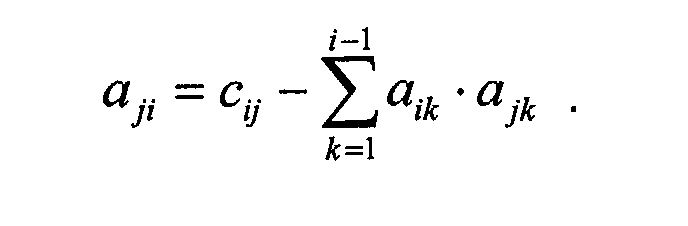
- This requires (i-1) complex multiplications and (i-2)+1=i-1 complex additions and hence altogether 6 (i -1)+ 2 · (i - 1) = 8 ·i - 8 floating operations. This is the load for a single entry of column i. For this column, the determination of (L-i) entries and hence for the whole of this column with number i, (L-i)·(8·i-8)=8·(L-i)·(i-1)=8·[(L +1)·i-i 2 -L] floating operations is required. The total number of operations for the Cholesky decomposition of a LxL matrix is obtained by adding up these numbers for all of the L columns resulting infloating operations which, for big L, can be approximated by the cubic term 4 / 3· L 3.

- The fact that this figure grows with the cube of the matrix dimension indicates that multi-processor solutions are required for real-time implementation.
- In order to achieve a balanced partitioning of the processing load among a number P of processor modules over the whole processing period, according to the invention a pre-assignment of the computation of a set of rows to each processor module is defined. This should be done in such a way that at each step (=column), all processors are involved. According to the invention each of the processor modules has to compute the row entries for a number R = L / P of rows.
- Due to the (lower) triangular shape of the Cholesky factor, for each column i, only the row entries with indices i,...,L have to be determined. This means that the processor module to which the computation of row i is assigned will have one assigned row less to take care of once the entries of column i are completed. According to the invention the assignment of a given row to a processor module is such that j = p + (r -1) · P with r=1,...,R and p=1,...,P.
- The following table shows in detail the associated row numbers for a given processor module:
Processor Module Associated row numbers 1 1, 1+P,..., 1+(R-1)P 2 2, 2+P,..., 2+(R-1 )P P-1 (P-1), (P-1)+P,...,(P-1)+(R-1)P P P, P+P,...,P+(R-1)P=RP=L operations. The total number of operations flops(p) for processor number p is obtained by summing the last expression over all values j=p+(r-1)·p with r=1,...,P:

- This expression indicates that the processing load is well balanced between the P processor modules.
- Concerning the data tansfer between the processor modules, according to the invention with the beginning of the iteration step for computing the entries of column i with i≤L, the processor module to which the computation of row number i is assigned stores its values of row i for access by the other processor modules.
- In other words, according to the formulae for the computation of the entries of the Cholesky factor (eqn.(1)), the entries of a certain row number j, assigned to some processor module, have to be made available to the other processor modules at the iteration step when the entries of column number i are computed. This means that this processor unit has to transfer the computed values of row i at the end of the (i-1)th including the ith (=diagonal) value which is the length of the row vector consisting of the (i-1) already computed values of the ith row.
- This implies that at the end of each iteration step (=column) i, the processor module to which the computation of row number (i+1) is assigned to has to transfer all its (i+1) values for availability to the other processor modules for the computation of the values of column number (i+1).
- The figure shows a flow chart of the procedure for computing the Cholesky decomposition by means of an iteration process starting with calculation of the entries of column i=1. Each processor module p computes the entries of column i for its assigned rows j according to eqn. (1). In the next step the counter of the column to be calculated is incremented by one. If the counter j is greater than the dimension L of the underlying covariance matrix to be Cholesky decomposed the process will stop. Otherwise this processor module assigned to row j stores the values of row j for access by the other processor modules. The following step is the above decribed computation step of the entries of the given column.
- With the resulting Cholesky factors of the Cholesky decomposition a simple and efficient subsequent processing is possible. With the process according to the invention a semi-parallel implementation of the Cholesky decomposition on a multi-processor system is possible. Other advantages are:
- Utilisation of a multi-processor architecture which is required for other processing sub-tasks within the same overall task. Known procedures require an additional single processor unit which has to be very powerful in order to meet the requirements of modern systems in terms of maximal allowable latencies.
- Balanced workload between the processor units throughout the whole computation process.
- Data exchange is performed in an effective manner with minimal waiting time.
- Procedure does not require special data transfer or storage features.
- By applying a procedure according to the invention the computation of a Cholesky decomposition can be performed faster than on a system with a powerful single processor. For example, performing the computation of a Cholesky decomposition on a multi processor system consisting of 11 processors the Cholesky decomposition of a covariance matrix of size 240 x 240 can be accomplished with a latency time less then 3 ms. This is a factor 5-10 times faster than the implementation on a powerful single processor competing for the same application.
Claims (2)
- A procedure for computing the Cholesky decomposition of a positive definite matrix into a product of a lower and an upper triagonal matrix having a dimension of L in a multi-channel procedure, wherein :the computation is performed in a parallel multi-processor system comprising a number P of processor modules;each processor module p computes the entries of a set R of rows of the lower triagonal matrix with R=L/P, whereby a given row j is assigned to a processor module p such that j=p+(r-1)·P with r=1,...,R and p=1,...,P;the entries of the lower triagonal matrix are obtained by means of an iteration process over the columns i, with i=1,...,L, whereby in each iteration step each processor module computes the entries of column i for its assigned rows R;with beginning an iteration step for computing the entries of column i with i≤L, the processor module to which the computation of row number i is assigned to stores its values of row i for access by the other processor modules.
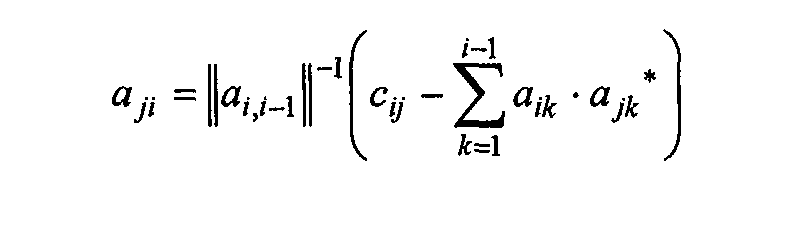
- Procedure according to claim 1, wherein the computation of entry aji of column i and row j is given bywith Cij being the corresponding value of the original matrix to be Cholesky decomposed, ∥αi,i-1∥-1 being the length of the vector consisting of the already determined i-1 values of the ith row and ajk* denotes the complex conjugation.
Priority Applications (2)
| Application Number | Priority Date | Filing Date | Title |
|---|---|---|---|
| EP02013112A EP1376380A1 (en) | 2002-06-14 | 2002-06-14 | Procedure for computing the Choleski decomposition in a parallel multiprocessor system |
| US10/461,867 US7219119B2 (en) | 2002-06-14 | 2003-06-16 | Procedure for computing the Cholesky decomposition in a parallel multiprocessor system |
Applications Claiming Priority (1)
| Application Number | Priority Date | Filing Date | Title |
|---|---|---|---|
| EP02013112A EP1376380A1 (en) | 2002-06-14 | 2002-06-14 | Procedure for computing the Choleski decomposition in a parallel multiprocessor system |
Publications (1)
| Publication Number | Publication Date |
|---|---|
| EP1376380A1 true EP1376380A1 (en) | 2004-01-02 |
Family
ID=29716767
Family Applications (1)
| Application Number | Title | Priority Date | Filing Date |
|---|---|---|---|
| EP02013112A Withdrawn EP1376380A1 (en) | 2002-06-14 | 2002-06-14 | Procedure for computing the Choleski decomposition in a parallel multiprocessor system |
Country Status (2)
| Country | Link |
|---|---|
| US (1) | US7219119B2 (en) |
| EP (1) | EP1376380A1 (en) |
Families Citing this family (6)
| Publication number | Priority date | Publication date | Assignee | Title |
|---|---|---|---|---|
| US7849126B1 (en) * | 2006-03-06 | 2010-12-07 | Intellectual Property Systems, LLC | System and method for fast matrix factorization |
| JP5240196B2 (en) * | 2007-07-12 | 2013-07-17 | 富士通株式会社 | Calculation apparatus, calculation method, and calculation program |
| US8307021B1 (en) * | 2008-02-25 | 2012-11-06 | Altera Corporation | Hardware architecture and scheduling for high performance solution to cholesky decomposition |
| US8782115B1 (en) | 2008-04-18 | 2014-07-15 | Altera Corporation | Hardware architecture and scheduling for high performance and low resource solution for QR decomposition |
| CN104216866B (en) * | 2013-05-31 | 2018-01-23 | 深圳市海思半导体有限公司 | A kind of data processing equipment |
| CN120873346B (en) * | 2025-07-18 | 2026-07-17 | 上海立芯软件科技有限公司 | Power supply network structure weakness detection method based on multi-diagonal block matrix decomposition |
Family Cites Families (7)
| Publication number | Priority date | Publication date | Assignee | Title |
|---|---|---|---|---|
| CA2076293A1 (en) * | 1991-10-11 | 1993-04-12 | Prathima Agrawal | Multiprocessor computer for solving sets of equations |
| US5442569A (en) * | 1993-06-23 | 1995-08-15 | Oceanautes Inc. | Method and apparatus for system characterization and analysis using finite element methods |
| US5841473A (en) * | 1996-07-26 | 1998-11-24 | Software For Image Compression, N.V. | Image sequence compression and decompression |
| JP3391262B2 (en) * | 1998-05-11 | 2003-03-31 | 日本電気株式会社 | Symbol calculation system and method, and parallel circuit simulation system |
| US6397236B1 (en) * | 1999-05-21 | 2002-05-28 | Sun Microsystems, Inc. | Hybrid technique for performing a column modification operation in a sparse symmetric direct matrix solver |
| US6205533B1 (en) * | 1999-08-12 | 2001-03-20 | Norman H. Margolus | Mechanism for efficient data access and communication in parallel computations on an emulated spatial lattice |
| JP3639206B2 (en) * | 2000-11-24 | 2005-04-20 | 富士通株式会社 | Parallel matrix processing method and recording medium in shared memory type scalar parallel computer |
-
2002
- 2002-06-14 EP EP02013112A patent/EP1376380A1/en not_active Withdrawn
-
2003
- 2003-06-16 US US10/461,867 patent/US7219119B2/en not_active Expired - Fee Related
Non-Patent Citations (5)
| Title |
|---|
| CHU P -Y P ET AL: "Parallel looping algorithms for Cholesky decomposition", PROCEEDINGS OF THE IASTED INTERNATIONAL CONFERENCE. PARALLEL AND DISTRIBUTED COMPUTING AND SYSTEMS, PROCEEDINGS OF PDCS'01. PARALLEL AND DISTRIBUTED COMPUTING AND SYSTEMS, ANAHEIM, CA, USA, 21-24 AUG. 2001, 2001, Anaheim, CA, USA, ACTA Press, USA, pages 419 - 424, XP008009169, ISBN: 0-88986-307-5 * |
| DONGARRA J. ET AL: "A collection of parallel linear equations routines for the Denelcor HEP", PARALLEL COMPUTING, vol. 1, 1984, pages 133 - 142, XP009088745 * |
| GEORGE A. ET AL: "Parallel Cholesky Factorization on a Shared-Memory Multiprocessor", LINEAR ALGEBRA AND ITS APPLICATIONS, vol. 77, 1986, pages 165 - 187, XP009088743 * |
| ROTHBERG E ET AL: "EFFICIENT PARALLEL SPARSE CHOLESKY FACTORIZATION", PROCEEDINGS OF THE SIAM CONFERENCE ON PARALLEL PROCESSING FOR SCIENTIFIC COMPUTING, XX, XX, 1995, pages 407 - 412, XP008009170 * |
| ZHENG D ET AL: "PARALLEL CHOLESKY METHOD ON MIMD WITH SHARED MEMORY", COMPUTERS AND STRUCTURES, PERGAMON PRESS, GB, vol. 56, no. 1, 3 July 1995 (1995-07-03), pages 25 - 38, XP001112991, ISSN: 0045-7949 * |
Also Published As
| Publication number | Publication date |
|---|---|
| US20040034475A1 (en) | 2004-02-19 |
| US7219119B2 (en) | 2007-05-15 |
Similar Documents
| Publication | Publication Date | Title |
|---|---|---|
| Cybenko et al. | Computing the minimum eigenvalue of a symmetric positive definite Toeplitz matrix | |
| US4823299A (en) | Systolic VLSI array for implementing the Kalman filter algorithm | |
| EP0902375B1 (en) | Apparatus for fast Fourier transform | |
| US4821224A (en) | Method and apparatus for processing multi-dimensional data to obtain a Fourier transform | |
| WO2023098256A1 (en) | Neural network operation method and apparatus, chip, electronic device and storage medium | |
| Cham et al. | An order-16 integer cosine transform | |
| CN112395549A (en) | Reconfigurable matrix multiplication accelerating system for matrix multiplication intensive algorithm | |
| US7219119B2 (en) | Procedure for computing the Cholesky decomposition in a parallel multiprocessor system | |
| Speiser et al. | A review of signal processing with systolic arrays | |
| JPH06502265A (en) | Calculation circuit device for matrix operations in signal processing | |
| KR20070060074A (en) | Method and apparatus for implementing fast orthogonal transform of variable size | |
| CN112748898B (en) | Complex vector computing device and computing method | |
| US4811259A (en) | Limited shift signal processing system and method | |
| CN117332809A (en) | Neural network inference chips, methods and terminal equipment | |
| Gallivan et al. | High-performance architectures for adaptive filtering based on the Gram-Schmidt algorithm | |
| US20030212728A1 (en) | Method and system to perform complex number multiplications and calculations | |
| Wu et al. | Architectural approach to alternate low-level primitive structures (ALPS) for acoustic signal processing | |
| Swartzlander et al. | Fast transform processor implementation | |
| RU2838831C1 (en) | Matrix computation device | |
| Wyrzykowski | Processor arrays for matrix triangularisation with partial pivoting | |
| Jenkins et al. | Variable word length DSP using serial-by-modulus residue arithmetic | |
| Rabinkin et al. | Adaptive array beamforming with fixed-point arithmetic matrix inversion using Givens rotations | |
| Gotze et al. | VLSI-suited orthogonal solution of systems of linear equations | |
| Wyrzykowski et al. | Systolic-type implementation of matrix computations based on the Faddeev algorithm | |
| JP3542184B2 (en) | Linear calculation method |
Legal Events
| Date | Code | Title | Description |
|---|---|---|---|
| PUAI | Public reference made under article 153(3) epc to a published international application that has entered the european phase |
Free format text: ORIGINAL CODE: 0009012 |
|
| AK | Designated contracting states |
Kind code of ref document: A1 Designated state(s): AT BE CH CY DE DK ES FI FR GB GR IE IT LI LU MC NL PT SE TR |
|
| AX | Request for extension of the european patent |
Extension state: AL LT LV MK RO SI |
|
| 17P | Request for examination filed |
Effective date: 20040506 |
|
| AKX | Designation fees paid |
Designated state(s): AT BE CH CY DE DK ES FI FR GB GR IE IT LI LU MC NL PT SE TR |
|
| 17Q | First examination report despatched |
Effective date: 20061215 |
|
| STAA | Information on the status of an ep patent application or granted ep patent |
Free format text: STATUS: THE APPLICATION IS DEEMED TO BE WITHDRAWN |
|
| 18D | Application deemed to be withdrawn |
Effective date: 20080118 |