EP1376334A2 - Information processing apparatus - Google Patents
Information processing apparatus Download PDFInfo
- Publication number
- EP1376334A2 EP1376334A2 EP03005648A EP03005648A EP1376334A2 EP 1376334 A2 EP1376334 A2 EP 1376334A2 EP 03005648 A EP03005648 A EP 03005648A EP 03005648 A EP03005648 A EP 03005648A EP 1376334 A2 EP1376334 A2 EP 1376334A2
- Authority
- EP
- European Patent Office
- Prior art keywords
- display
- sub
- program
- application program
- information
- Prior art date
- Legal status (The legal status is an assumption and is not a legal conclusion. Google has not performed a legal analysis and makes no representation as to the accuracy of the status listed.)
- Withdrawn
Links
Images





Classifications
-
- G—PHYSICS
- G06—COMPUTING OR CALCULATING; COUNTING
- G06F—ELECTRIC DIGITAL DATA PROCESSING
- G06F9/00—Arrangements for program control, e.g. control units
- G06F9/06—Arrangements for program control, e.g. control units using stored programs, i.e. using an internal store of processing equipment to receive or retain programs
- G06F9/46—Multiprogramming arrangements
- G06F9/52—Program synchronisation; Mutual exclusion, e.g. by means of semaphores
- G06F9/526—Mutual exclusion algorithms
-
- G—PHYSICS
- G06—COMPUTING OR CALCULATING; COUNTING
- G06F—ELECTRIC DIGITAL DATA PROCESSING
- G06F2209/00—Indexing scheme relating to G06F9/00
- G06F2209/52—Indexing scheme relating to G06F9/52
- G06F2209/522—Manager
Definitions
- the present invention relates to an information processing apparatus which comprises a sub-display in addition to a main display and, more particularly, to an information processing apparatus that runs a plurality of application programs that use the sub-display.
- Jpn. Pat. Appln. KOKAI Publication No. 2000-339097 discloses an information processing apparatus which comprises a sub-display having a tablet function. According to this information processing apparatus, a technique for making a clock display and inputting an image on the sub-display is disclosed.
- the present invention has been made in consideration of the above situation, and provides an information processing apparatus, which can display information on a sub-display on the basis of a pre-set condition.
- Embodiments of the present invention provide an information processing apparatus comprising a main display and a sub-display separate from the main display.
- the information processing apparatus further includes a processor programmed for granting a right to use the sub-display to a first application program, among a plurality of application programs, which first outputs a request to use the sub-display.
- the processor is further programmed for displaying information managed by the first application program on the sub-display.
- the processor is further programmed for preventing a second application program, among the plurality of application programs, from using the sub-display while the first application program has the right to use the sub-display.
- the processor is further programmed for detecting an active one of the plurality of application programs displaying on the sub-display ones of the second information items associated with ones of the first information items related to the active one of the plurality of application programs.
- FIGS. 1 and 2 A preferred embodiment of the present invention will be described hereinafter with reference to the accompanying drawings.
- the arrangement of an information processing apparatus according to an embodiment of the present invention will be explained first with reference to FIGS. 1 and 2. Assume that the information processing apparatus is implemented as a notebook type personal computer.
- FIG. 1 is a front view of the computer of the present invention when a display unit is open.
- This computer comprises a computer main body 11 and display unit 12.
- a display panel 121 is built in the display unit 12.
- Display panel 121 may be, for example, an LCD display panel.
- the display panel 121 is a main display device used as a display monitor of this computer.
- the display unit 12 is attached to the computer main body 11 to be pivotally moveable between opened and closed positions.
- the computer main body 11 has a low-profile, box-shaped housing.
- a keyboard 111, touch pad 112, left and right buttons 113a and 113b, and the like are arranged on the upper surface of the housing.
- a power button 114 used to turn on/off the power supply of this computer is arranged on the back side of the upper surface of the computer main body 11. Furthermore, a plurality of operation buttons 115 and sub-display 116 are arranged on the front side of the upper surface of the computer main body 11.
- Sub-display 116 may be, for example, a liquid crystal display (LCD).
- the plurality of operation buttons 115 are external input hardware buttons, and are used as dedicated buttons to start a specific program, to control audio playback, and the like.
- the sub-display 116 is a sub-display device provided to display various kinds of status of this computer.
- the sub-display 116 can display various kinds of system status such as connection/disconnection of an external AC power supply, access to a hard disk drive, and the like in addition to information that indicates the audio playback state.
- the keyboard 111, touch pad 112, and left and right buttons 113a and 113b are covered by the display unit 12, but the plurality of operation buttons 115 and sub-display 116 remain externally exposed.
- the user can operate the plurality of operation buttons 115 and can watch the display on the sub-display 116 while the display unit 12 is closed.
- FIG. 2 shows the system arrangement of this computer.
- this computer comprises a CPU 201, host bridge 202, main memory 203, graphics controller 204, communication device 205, PCI-ISA bridge 206, I/O controller 207, hard disk drive (HDD) 208, CD-ROM drive 209, BIOS-ROM 210, embedded controller/keyboard controller IC (EC/KBC) 211, power supply controller 213, and the like.
- the CPU 201 is provided to control the operation of this computer.
- the CPU 201 executes an operating system and application program/utility program, which are loaded from the hard disk drive (HDD) 208 onto the main memory 203.
- the CPU 201 also executes a BIOS stored in the BIOS-ROM 210.
- the host bridge 202 is a bridge device that connects the local bus of the CPU 201 and a PCI bus 1 for bi-directional communication.
- the graphics controller 204 controls the display panel 121 used as a display monitor of this computer.
- the communication device 205 is one of PCI devices, and is used to establish connection to a computer network such as the Internet and the like.
- the I/O controller 207 is also one of PCI devices, and incorporates an IDE controller and the like, which are used to control the hard disk drive (HDD) 208 and CD-ROM drive 209.
- the PCI-ISA bridge 206 is a bridge device that connects the PCI bus 1 and an ISA bus 2 for bi-directional communication. Also, the PCI-ISA bridge 206 incorporates various system devices such as a system timer, DMA controller, interrupt controller, and the like, in addition to a real time clock (RTC) 206a.
- the real time clock (RTC) 206a is a timepiece module that measures time, and manages time information such as year, month, day, day of the week, hour, minute, second, and the like. Time information of the real time clock (RTC) 206a is used as a reference date and time managed by the operating system.
- the real time clock (RTC) 206a runs all the time by its own battery.
- the BIOS-ROM 210 stores the BIOS. This BIOS is a program for controlling hardware components in this system.
- the BIOS includes a function of reading time information from the real time clock (RTC) 206a, a function of controlling the embedded controller/keyboard controller IC (EC/KBC) 211 to correct the time to be displayed on the sub-display 116, and the like.
- RTC real time clock
- EC/KBC embedded controller/keyboard controller IC
- the embedded controller/keyboard controller IC (EC/KBC) 211 is a 1-chip microcomputer which integrates an embedded controller (EC) for power management and a keyboard controller (KBC) that controls the keyboard 111.
- the embedded controller/keyboard controller IC (EC/KBC) 211 has a function of turning on/off the power supply of this computer in response to an operation on the power button 114 in collaboration with the power supply controller 213.
- the embedded controller/keyboard controller IC (EC/KBC) 211 includes an LCD control unit 221 that controls display on the sub-LCD 116, a counter 222 for sequentially generating a time value to be displayed on the sub-display 116 by counting up time information set by the BIOS or the like, as functional units used to display time information on the sub-display 116.
- the embedded controller/keyboard controller IC (EC/KBC) 211 and sub-display 116 receive the operation power supply all the time, and a clock can always be displayed on the sub-display 116 even when the power supply of this computer is OFF.
- EC/KBC embedded controller/keyboard controller IC
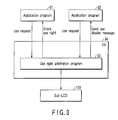
- FIG. 3 is a view for explaining the operation of the personal computer according to an embodiment of the present invention.
- a use right arbitration program 33 resides on an OS (Operating System) 34, and implements a process according to embodiments of the present invention. More specifically, by predetermined methods, the use right arbitration program 33 gives and manages priority order to the application programs 31 and 32 for displaying information on the sub-display 116.
- OS Operating System
- a first method preferentially selects an application program that first uses the sub-display 116.
- a second method preferentially selects a currently active application program. Embodiments of these two methods will be explained in detail below.
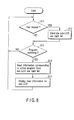
- FIG. 4 is a flow chart for explaining an exemplary embodiment of the first method of preferentially selecting an application program for displaying information on the sub-display 116. It will be understood by persons skilled in the art that other suitable embodiments of the first method are possible.
- an application program outputs a use request (i.e., a request to use the sub-display 116) (S1) it is determined whether that use request is the first use request (S2). This determination is made possible, for example, by granting and maintaining "first requestor" status for an application which first issues a request for the use right and is granted the use right. The application may maintain this status until the status is cancelled, for example by a request from the application to cancel its first requestor status (see S7) .
- step S2 If it is determined in step S2 that the use request from an application is the first use request (i.e., no application currently has first requestor status), the application program which output the use request is granted the use right (i.e., the right to use the sub-display 116) and gains first requestor status (S3).
- step S2 If it is determined in step S2 that the use request is not the first use request (i.e., first requestor status has already been granted to another application), or if the use right is granted in step S3, it is determined whether the application program which output the use request has the use right (i.e., has first requestor status)(S4). If it is determined in step S4 that the application program does not have the use right, a use disable message is sent to the application program which output the use request (S5). Thus, the application program receiving the use disable message is prevented from using the sub-display 116.
- step S4 determines whether the application program has the use right (i.e., the application program has first requestor status)
- information managed by the application program which output the use request is written to the sub-display 116 (S6).
- step S7 it is determined in step S7 if a use right cancel request (i.e., a request to cancel first requestor status) from the application program which has the use right is detected. If the use right cancel request is detected, first requestor status and the use right is canceled (S8), and the flow returns to step 31. If it is determined in step S7 that no cancel request is detected, the flow also returns to step 31.
- the display on the sub-display 116 can be preferentially assigned to the application program which first outputs a use request for the sub-display 116.
- the application program 31 is a CD player program and the application program 32 is a wordprocessor program. Further assume that a window for each of these application programs is displayed on the display panel 121 (the main display), the CD player program window being the currently active window. Also, assume that the CD player program was the first to request the use right and was granted the use right. In this case, information that pertains to the CD player program is displayed on the sub-display 116.
- the window of the wordprocessor program becomes the active window on the main display.
- the information that pertains to the CD player program continues to be displayed on the sub-display 116. This is because the CD player program was first granted the use right and has not yet requested that the use right be cancelled. Thus, the CD player program maintains the first requestor status. Therefore, if the wordprocessor program requested the use right for the sub-display 116, a message indicating that the sub-display 116 cannot be used by the wordprocessor program would be sent to the wordprocessor program and it would be prevented from using the sub-display 116.
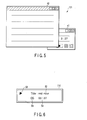
- FIG. 5 illustrates the example discussed above.
- Window 41 of the CD player program (application program 31) is hidden behind a window 42 of the wordprocessor program (application program 32) displayed on the display panel 121.
- information that pertains to the CD player can be displayed on the sub-display 116, as shown in FIG. 6.
- reference numeral 51 in FIG. 6 denotes an icon which indicates the current state, i.e., that playback is in progress.
- Reference numeral 52 denotes the title name of a CD, whose playback is underway; 53, a track number; and 54, the elapsed time of a song.
- the application program which first outputs the use request is granted the use right, and information that pertains to this application program can be displayed on the sub-display 116. Therefore, when the user is doing a job such as a document input job while listening to some music, he or she can confirm song information or the like on the sub-display 116.
- FIG. 7 shows an exemplary embodiment of the second method of preferentially selecting an application program for displaying information on the sub-display 116. It will be understood by persons skilled in the art that other suitable embodiments of the second method are possible.
- a use right arbitration program 61 is a resident program of an OS 60 and comprises an active program detector 62, use right list read unit 63, sub-display write unit 64, and use right list generator 65.
- the active program detector 62 detects an active one of a plurality of running application programs.
- the use right list read unit 63 reads out sub-display information items associated with the active application program detected by the active program detector 62, and outputs the readout information to the sub-display write unit 64.
- the sub-display write unit 64 writes the sub-display information items output from the use right list read unit 63 to the sub-display 116.
- the use right list generator 65 Upon receiving a use request from one of the plurality of running application programs, the use right list generator 65 stores application program information items related to the application program which output the use request, such as, but not limited to, the application program's name. The use right list generator 65 also stores associated sub-display information items (i.e., information items which are related to the application program that outputs the use request and which information items are to be displayed on sub-display 116). According to one embodiment of the present invention, the application program information items and the sub-display information items are stored as a use right list 66 in the form of a data structure, such as, but not limited to, a data table, as shown in FIG. 7.
- step S11 It is determined whether a use request from a running application program is detected (S11). If it is determined in step S11 that the use request is detected, a sub-display use right list is generated and stored in a memory such as, but not limited to, main memory 203.
- the generated sub-display use right list includes application program information items related to the application program which output the use request such as, but not limited to, the application program's name.
- the generated sub-display use right list further includes sub-display information items which are associated with the application program which output the use request and which information items are to be displayed on the sub-display 116.
- the sub-display use right list may be stored such that the application program information items and the associated sub-display information items are stored in correspondence with each other, i.e., are associated with each other in a memory such as, but not limited to, main memory 203.
- step S11 If it is determined in step S11 that no use request is detected, or after the sub-display use right list is generated in step S12, it is determined by a program switching program whether the running application programs are switched (i.e., whether or not a different one of the plurality of running application programs has become the currently active application program) (S13).
- step S13 If it is determined in step S13 that no application program switching is done, the flow returns to step S11. On the other hand, if it is determined in step S13 that program switching is done (i.e., there is a new currently active application program), sub-display information items associated with the new currently active application program is read out from the sub-display use right list (S14). The read out sub-display information items are written to the sub-display (S15), and the flow returns to step S11.
- sub-display information items from the sub-display use right list assumes that the sub-display information items for a new currently active application program that are read out were earlier stored in memory as a part of the sub-display use right list. If this is not the case, for example if the new currently active application program has just started to run, the sub-display information items for the new currently active application program would first be stored in memory as a part of the sub-display use right list, as described above, before being read out.
- FIG. 9 illustrates an embodiment of the second method discussed above. Referring to the left side of FIG. 9, it is shown that window 81 on the main display is that of a CD player program that is currently active. Window 82 on the main display is that of an inactive wordprocessor program. Referring to the top of FIG. 10, it is shown that in this case the sub-display 116 displays information associated with the currently active CD player program.
- the wordprocessor program is switched to the new currently active application program while the CD player program becomes inactive.
- the sub-display 116 now displays information associated with the new currently active wordprocessor program in place of the information associated with the now inactive CD player program.
- the application program which uses the sub-display can be dynamically switched in response to switching of running application programs.
- the number of such application programs is not limited to one.
- the present invention is not limited to the aforementioned embodiments, and various modifications may be made without departing from the scope of the invention when it is practiced.
- the respective embodiments may be combined as needed as much as possible, and combined effects can be obtained in such case.
- the embodiments include inventions of various stages, and various inventions can be extracted by appropriately combining a plurality of required constituent elements disclosed in this application. For example, when the invention is extracted by omitting some required constituent elements from all the required constituent elements in the embodiments, the extracted elements are compensated for by the state-of-the-art technique upon practicing the extracted invention.
Landscapes
- Engineering & Computer Science (AREA)
- Software Systems (AREA)
- Theoretical Computer Science (AREA)
- Physics & Mathematics (AREA)
- General Engineering & Computer Science (AREA)
- General Physics & Mathematics (AREA)
- Digital Computer Display Output (AREA)
- User Interface Of Digital Computer (AREA)
Abstract
An information processing apparatus which has
means (33) for granting an application program which
outputs a use request of a sub-display, of a plurality
of application programs (31, 32) that use a
sub-display, a use right, and means (33) for sending a
message indicating that the sub-display cannot be used
in response to a use request for the sub-display from a
program other than the application program granted the
use right.
Description
The present invention relates to an information
processing apparatus which comprises a sub-display in
addition to a main display and, more particularly, to
an information processing apparatus that runs a
plurality of application programs that use the
sub-display.
In recent years, an information processing
apparatus which has a sub-display in addition to a main
display has been developed. In such information
processing apparatus, information different from that
to be displayed on the main display is displayed on the
sub-display, thus improving the operability of the
information processing apparatus.
For example, Jpn. Pat. Appln. KOKAI Publication
No. 2000-339097 discloses an information processing
apparatus which comprises a sub-display having a tablet
function. According to this information processing
apparatus, a technique for making a clock display and
inputting an image on the sub-display is disclosed.
However, when a plurality of application programs
that use the sub-display run on the conventional
information processing apparatus, and information used
by one of these application programs is displayed on
the sub-display, an operation for switching the
application programs that use the sub-display is
required.
The present invention has been made in
consideration of the above situation, and provides an
information processing apparatus, which can display
information on a sub-display on the basis of a pre-set
condition.
Embodiments of the present invention provide an
information processing apparatus comprising a main
display and a sub-display separate from the main
display. The information processing apparatus further
includes a processor programmed for granting a right to
use the sub-display to a first application program,
among a plurality of application programs, which first
outputs a request to use the sub-display. The
processor is further programmed for displaying
information managed by the first application program on
the sub-display. The processor is further programmed
for preventing a second application program, among the
plurality of application programs, from using the sub-display
while the first application program has the
right to use the sub-display.
Further embodiments of the present invention
provide an information processing apparatus comprising
a main display and a sub-display separate from the main
display. The information processing apparatus further
comprises a processor programmed for generating a data
structure, the data structure including a plurality of
first information items, each related to individual
ones of a plurality of running application programs.
The data structure further includes a plurality of
second information items for display on the
sub-display, ones of the plurality of second
information items being associated in the data
structure with ones of the plurality of first
information items.
The processor is further programmed for detecting
an active one of the plurality of application programs
displaying on the sub-display ones of the second
information items associated with ones of the first
information items related to the active one of the
plurality of application programs.
This summary of the invention does not necessarily
describe all necessary features so that the invention
may also be a sub-combination of these described
features.
The invention can be more fully understood from
the following detailed description when taken in
conjunction with the accompanying drawings, in which:
A preferred embodiment of the present invention
will be described hereinafter with reference to the
accompanying drawings. The arrangement of an
information processing apparatus according to an
embodiment of the present invention will be explained
first with reference to FIGS. 1 and 2. Assume that the
information processing apparatus is implemented as a
notebook type personal computer.
FIG. 1 is a front view of the computer of the
present invention when a display unit is open. This
computer comprises a computer main body 11 and display
unit 12. A display panel 121 is built in the display
unit 12. Display panel 121 may be, for example, an LCD
display panel. The display panel 121 is a main display
device used as a display monitor of this computer. The
display unit 12 is attached to the computer main body
11 to be pivotally moveable between opened and closed
positions. The computer main body 11 has a
low-profile, box-shaped housing. A keyboard 111, touch
pad 112, left and right buttons 113a and 113b, and the
like are arranged on the upper surface of the housing.
A power button 114 used to turn on/off the power
supply of this computer is arranged on the back side of
the upper surface of the computer main body 11.
Furthermore, a plurality of operation buttons 115 and
sub-display 116 are arranged on the front side of the
upper surface of the computer main body 11.
Sub-display 116 may be, for example, a liquid crystal
display (LCD).
The plurality of operation buttons 115 are
external input hardware buttons, and are used as
dedicated buttons to start a specific program, to
control audio playback, and the like. The sub-display
116 is a sub-display device provided to display various
kinds of status of this computer. The sub-display 116
can display various kinds of system status such as
connection/disconnection of an external AC power
supply, access to a hard disk drive, and the like in
addition to information that indicates the audio
playback state.
When the display unit 12 is closed, the keyboard
111, touch pad 112, and left and right buttons 113a and
113b are covered by the display unit 12, but the
plurality of operation buttons 115 and sub-display 116
remain externally exposed. As a result, the user can
operate the plurality of operation buttons 115 and can
watch the display on the sub-display 116 while the
display unit 12 is closed.
FIG. 2 shows the system arrangement of this
computer. As shown in FIG. 2, this computer comprises
a CPU 201, host bridge 202, main memory 203, graphics
controller 204, communication device 205, PCI-ISA
bridge 206, I/O controller 207, hard disk drive (HDD)
208, CD-ROM drive 209, BIOS-ROM 210, embedded
controller/keyboard controller IC (EC/KBC) 211, power
supply controller 213, and the like.
The CPU 201 is provided to control the operation
of this computer. The CPU 201 executes an operating
system and application program/utility program, which
are loaded from the hard disk drive (HDD) 208 onto the
main memory 203. The CPU 201 also executes a BIOS
stored in the BIOS-ROM 210.
The host bridge 202 is a bridge device that
connects the local bus of the CPU 201 and a PCI bus 1
for bi-directional communication. The graphics
controller 204 controls the display panel 121 used as a
display monitor of this computer. The communication
device 205 is one of PCI devices, and is used to
establish connection to a computer network such as the
Internet and the like. The I/O controller 207 is also
one of PCI devices, and incorporates an IDE controller
and the like, which are used to control the hard disk
drive (HDD) 208 and CD-ROM drive 209.
The PCI-ISA bridge 206 is a bridge device that
connects the PCI bus 1 and an ISA bus 2 for bi-directional
communication. Also, the PCI-ISA bridge
206 incorporates various system devices such as a
system timer, DMA controller, interrupt controller, and
the like, in addition to a real time clock (RTC) 206a.
The real time clock (RTC) 206a is a timepiece module
that measures time, and manages time information such
as year, month, day, day of the week, hour, minute,
second, and the like. Time information of the real
time clock (RTC) 206a is used as a reference date and
time managed by the operating system. The real time
clock (RTC) 206a runs all the time by its own battery.
The BIOS-ROM 210 stores the BIOS. This BIOS is a
program for controlling hardware components in this
system. The BIOS includes a function of reading time
information from the real time clock (RTC) 206a, a
function of controlling the embedded controller/keyboard
controller IC (EC/KBC) 211 to correct the time
to be displayed on the sub-display 116, and the like.
The embedded controller/keyboard controller IC
(EC/KBC) 211 is a 1-chip microcomputer which integrates
an embedded controller (EC) for power management and a
keyboard controller (KBC) that controls the keyboard
111. The embedded controller/keyboard controller IC
(EC/KBC) 211 has a function of turning on/off the power
supply of this computer in response to an operation on
the power button 114 in collaboration with the power
supply controller 213. Furthermore, in this
embodiment, the embedded controller/keyboard controller
IC (EC/KBC) 211 includes an LCD control unit 221 that
controls display on the sub-LCD 116, a counter 222 for
sequentially generating a time value to be displayed on
the sub-display 116 by counting up time information set
by the BIOS or the like, as functional units used to
display time information on the sub-display 116.
The embedded controller/keyboard controller IC
(EC/KBC) 211 and sub-display 116 receive the operation
power supply all the time, and a clock can always be
displayed on the sub-display 116 even when the power
supply of this computer is OFF.
FIG. 3 is a view for explaining the operation of
the personal computer according to an embodiment of the
present invention.
Referring to FIG. 3, application programs 31 and
32 use the sub-display 116. A use right arbitration
program 33 resides on an OS (Operating System) 34, and
implements a process according to embodiments of the
present invention. More specifically, by predetermined
methods, the use right arbitration program 33 gives
and manages priority order to the application
programs 31 and 32 for displaying information on the
sub-display 116.
Various methods of giving priority order may be
used. According to embodiments of the present
invention, a first method preferentially selects an
application program that first uses the sub-display
116. A second method preferentially selects a
currently active application program. Embodiments of
these two methods will be explained in detail below.
FIG. 4 is a flow chart for explaining an exemplary
embodiment of the first method of preferentially
selecting an application program for displaying
information on the sub-display 116. It will be
understood by persons skilled in the art that other
suitable embodiments of the first method are possible.
As shown in FIG. 4, according to the example
embodiment, if an application program outputs a use
request (i.e., a request to use the sub-display 116)
(S1) it is determined whether that use request is the
first use request (S2). This determination is made
possible, for example, by granting and maintaining
"first requestor" status for an application which first
issues a request for the use right and is granted the
use right. The application may maintain this status
until the status is cancelled, for example by a request
from the application to cancel its first requestor
status (see S7) .
If it is determined in step S2 that the use
request from an application is the first use request
(i.e., no application currently has first requestor
status), the application program which output the use
request is granted the use right (i.e., the right to
use the sub-display 116) and gains first requestor
status (S3).
If it is determined in step S2 that the use
request is not the first use request (i.e., first
requestor status has already been granted to another
application), or if the use right is granted in step
S3, it is determined whether the application program
which output the use request has the use right (i.e.,
has first requestor status)(S4). If it is determined
in step S4 that the application program does not have
the use right, a use disable message is sent to the
application program which output the use request (S5).
Thus, the application program receiving the use disable
message is prevented from using the sub-display 116.
On the other hand, if it is determined in step S4
that the application program has the use right (i.e.,
the application program has first requestor status),
information managed by the application program which
output the use request is written to the sub-display
116 (S6). After that, it is determined in step S7 if a
use right cancel request (i.e., a request to cancel
first requestor status) from the application program
which has the use right is detected. If the use right
cancel request is detected, first requestor status and
the use right is canceled (S8), and the flow returns to
step 31. If it is determined in step S7 that no cancel
request is detected, the flow also returns to step 31.
With this exemplary method, the display on the
sub-display 116 can be preferentially assigned to the
application program which first outputs a use request
for the sub-display 116.
This process will be further explained using the
example shown in FIG. 3. In a state wherein neither of
the application programs are granted the use right
(i.e., neither has first requestor status), when the
application program 31 is started and outputs a use
request for the sub-display 16 (i.e., outputs the first
use request for the sub-display 16), the use right
arbitration program 33 grants the application program
31 the use right for the sub-display 116 and
application program 31 has first requestor status.
After that, when the application program 32 is
started and outputs a use request, since the
application program 31 has already been granted the use
right and has first requestor status, a message
indicating that the sub-display 116 cannot be used is
sent to the application program 32 and the application
program 32 is prevented from using the sub-display 116.
For example, assume the application program 31 is
a CD player program and the application program 32 is a
wordprocessor program. Further assume that a window
for each of these application programs is displayed on
the display panel 121 (the main display), the CD player
program window being the currently active window.
Also, assume that the CD player program was the first
to request the use right and was granted the use right.
In this case, information that pertains to the CD
player program is displayed on the sub-display 116.
Continuing with the present example, assume now
that the window of the wordprocessor program becomes
the active window on the main display. In this case,
according to the present embodiment, even though the
window of the wordprocessor program is the currently
active window on the main display, the information that
pertains to the CD player program continues to be
displayed on the sub-display 116. This is because the
CD player program was first granted the use right and
has not yet requested that the use right be cancelled.
Thus, the CD player program maintains the first
requestor status. Therefore, if the wordprocessor
program requested the use right for the sub-display
116, a message indicating that the sub-display 116
cannot be used by the wordprocessor program would be
sent to the wordprocessor program and it would be
prevented from using the sub-display 116.
FIG. 5 illustrates the example discussed above.
Window 41 of the CD player program (application program
31) is hidden behind a window 42 of the wordprocessor
program (application program 32) displayed on the
display panel 121. By starting the CD player program
first, information that pertains to the CD player can
be displayed on the sub-display 116, as shown in
FIG. 6. Note that reference numeral 51 in FIG. 6
denotes an icon which indicates the current state,
i.e., that playback is in progress. Reference numeral
52 denotes the title name of a CD, whose playback is
underway; 53, a track number; and 54, the elapsed time
of a song.
Therefore, according to embodiments of this
method, even when the application is not active, the
application program which first outputs the use request
is granted the use right, and information that pertains
to this application program can be displayed on the
sub-display 116. Therefore, when the user is doing a
job such as a document input job while listening to
some music, he or she can confirm song information or
the like on the sub-display 116.
FIG. 7 shows an exemplary embodiment of the second
method of preferentially selecting an application
program for displaying information on the sub-display
116. It will be understood by persons skilled in the
art that other suitable embodiments of the second
method are possible.
As shown in FIG. 7, a use right arbitration
program 61 is a resident program of an OS 60 and
comprises an active program detector 62, use right list
read unit 63, sub-display write unit 64, and use right
list generator 65. The active program detector 62
detects an active one of a plurality of running
application programs. The use right list read unit 63
reads out sub-display information items associated with
the active application program detected by the active
program detector 62, and outputs the readout
information to the sub-display write unit 64. The sub-display
write unit 64 writes the sub-display
information items output from the use right list read
unit 63 to the sub-display 116.
Upon receiving a use request from one of the
plurality of running application programs, the use
right list generator 65 stores application program
information items related to the application program
which output the use request, such as, but not limited
to, the application program's name. The use right list
generator 65 also stores associated sub-display
information items (i.e., information items which are
related to the application program that outputs the use
request and which information items are to be displayed
on sub-display 116). According to one embodiment of
the present invention, the application program
information items and the sub-display information items
are stored as a use right list 66 in the form of a data
structure, such as, but not limited to, a data table,
as shown in FIG. 7.
The operation of the information processing
apparatus when an active application program is
preferentially selected for displaying information on
the sub-display 116, according to embodiments of the
present invention, will be explained further below with
reference to the flow chart of FIG. 8.
It is determined whether a use request from a
running application program is detected (S11). If it
is determined in step S11 that the use request is
detected, a sub-display use right list is generated and
stored in a memory such as, but not limited to, main
memory 203.
The generated sub-display use right list includes
application program information items related to the
application program which output the use request such
as, but not limited to, the application program's name.
The generated sub-display use right list further
includes sub-display information items which are
associated with the application program which output
the use request and which information items are to be
displayed on the sub-display 116. The sub-display use
right list may be stored such that the application
program information items and the associated sub-display
information items are stored in correspondence
with each other, i.e., are associated with each
other in a memory such as, but not limited to, main
memory 203.
If it is determined in step S11 that no use
request is detected, or after the sub-display use right
list is generated in step S12, it is determined by a
program switching program whether the running
application programs are switched (i.e., whether or not
a different one of the plurality of running application
programs has become the currently active application
program) (S13).
If it is determined in step S13 that no
application program switching is done, the flow returns
to step S11. On the other hand, if it is determined in
step S13 that program switching is done (i.e., there is
a new currently active application program), sub-display
information items associated with the new
currently active application program is read out from
the sub-display use right list (S14). The read out
sub-display information items are written to the sub-display
(S15), and the flow returns to step S11.
The above-described read out of sub-display
information items from the sub-display use right list
assumes that the sub-display information items for a
new currently active application program that are read
out were earlier stored in memory as a part of the sub-display
use right list. If this is not the case, for
example if the new currently active application program
has just started to run, the sub-display information
items for the new currently active application program
would first be stored in memory as a part of the sub-display
use right list, as described above, before
being read out.
FIG. 9 illustrates an embodiment of the second
method discussed above. Referring to the left side of
FIG. 9, it is shown that window 81 on the main display
is that of a CD player program that is currently
active. Window 82 on the main display is that of an
inactive wordprocessor program. Referring to the top
of FIG. 10, it is shown that in this case the sub-display
116 displays information associated with the
currently active CD player program.
Continuing with the present example and referring
to the right side of FIG. 9, it is shown that the
wordprocessor program is switched to the new currently
active application program while the CD player program
becomes inactive. Referring to the bottom of FIG. 10,
it is shown that in this case the sub-display 116 now
displays information associated with the new currently
active wordprocessor program in place of the
information associated with the now inactive CD player
program.
According to this method, the application program
which uses the sub-display can be dynamically switched
in response to switching of running application
programs. In this manner, the number of such
application programs is not limited to one.
Note that the present invention is not limited
to the aforementioned embodiments, and various
modifications may be made without departing from the
scope of the invention when it is practiced. The
respective embodiments may be combined as needed as
much as possible, and combined effects can be obtained
in such case. Furthermore, the embodiments include
inventions of various stages, and various inventions
can be extracted by appropriately combining a plurality
of required constituent elements disclosed in this
application. For example, when the invention is
extracted by omitting some required constituent
elements from all the required constituent elements in
the embodiments, the extracted elements are compensated
for by the state-of-the-art technique upon practicing
the extracted invention.
Claims (7)
- An information processing apparatus characterized by comprising:a first means (121) for displaying information;a second means (116) for displaying information, the second means being separate from the first means;means (33) for granting a right to use the second means to a first software program, among a plurality of software programs, which first outputs a request to use the second means;means (33, 34) for displaying information managed by the first software program on the second means; andmeans (33) for preventing a second software program, among the plurality of software programs, from using the second means while the first software program has the right to use the second means.
- The apparatus according to claim 1, characterized in that the second software program is prevented from using the second means by receiving a message indicating that the second means cannot be used.
- The apparatus according to claim 2, characterized in that the message is received in response to a request from the second software program to use the second means.
- The apparatus according to claim 1, characterized by further comprising means for canceling the right to use the second means granted to the first software program.
- The apparatus according to claim 4, characterized in that the right to use the second means is cancelled in response to a request to cancel the right to use the second means.
- The apparatus according to claim 5, characterized in that the request to cancel the right to use the second means is sent from the first software program.
- An information processing apparatus characterized by comprising:a first means for displaying information;a second means for displaying information, the second means being separate from the first means;means for generating, for a plurality of running software programs, a data structure, the data structure including:a plurality of first information items, each related to individual ones of the plurality of software programs; anda plurality of second information items for display on the second means, ones of the plurality of second information items being associated in the data structure with ones of the plurality of first information items;means for detecting an active one of the plurality of software programs; andmeans for displaying on the second means ones of the second information items associated with ones of the first information items related to the active one of the plurality of software programs.
Applications Claiming Priority (2)
| Application Number | Priority Date | Filing Date | Title |
|---|---|---|---|
| JP2002159989A JP2004005213A (en) | 2002-05-31 | 2002-05-31 | Information processing equipment |
| JP2002159989 | 2002-05-31 |
Publications (1)
| Publication Number | Publication Date |
|---|---|
| EP1376334A2 true EP1376334A2 (en) | 2004-01-02 |
Family
ID=29561596
Family Applications (1)
| Application Number | Title | Priority Date | Filing Date |
|---|---|---|---|
| EP03005648A Withdrawn EP1376334A2 (en) | 2002-05-31 | 2003-03-12 | Information processing apparatus |
Country Status (3)
| Country | Link |
|---|---|
| US (1) | US20030222911A1 (en) |
| EP (1) | EP1376334A2 (en) |
| JP (1) | JP2004005213A (en) |
Families Citing this family (4)
| Publication number | Priority date | Publication date | Assignee | Title |
|---|---|---|---|---|
| US7925715B2 (en) * | 2005-03-14 | 2011-04-12 | Qualcomm Incorporated | Apparatus and methods for service programming of a wireless device on a wireless communications network |
| US8555201B2 (en) * | 2008-06-05 | 2013-10-08 | Qualcomm Incorporated | Wireless communication device having deterministic control of foreground access of the user interface |
| WO2015039000A1 (en) * | 2013-09-13 | 2015-03-19 | Qualcomm Incorporated | Wireless communication device having deterministic control of foreground access of the user interface |
| JP7212716B2 (en) * | 2021-05-25 | 2023-01-25 | レノボ・シンガポール・プライベート・リミテッド | Information processing device, management system, and management method |
Family Cites Families (6)
| Publication number | Priority date | Publication date | Assignee | Title |
|---|---|---|---|---|
| US6212577B1 (en) * | 1993-03-03 | 2001-04-03 | Apple Computer, Inc. | Method and apparatus for improved interaction with an application program according to data types and actions performed by the application program |
| US6314501B1 (en) * | 1998-07-23 | 2001-11-06 | Unisys Corporation | Computer system and method for operating multiple operating systems in different partitions of the computer system and for allowing the different partitions to communicate with one another through shared memory |
| US6489954B1 (en) * | 1998-10-13 | 2002-12-03 | Prophet Financial Systems, Inc. | System and method for permitting a software routine having restricted local access to utilize remote resources to generate locally usable data structure |
| US7093122B1 (en) * | 1999-01-22 | 2006-08-15 | Sun Microsystems, Inc. | Techniques for permitting access across a context barrier in a small footprint device using shared object interfaces |
| US6405203B1 (en) * | 1999-04-21 | 2002-06-11 | Research Investment Network, Inc. | Method and program product for preventing unauthorized users from using the content of an electronic storage medium |
| US7100195B1 (en) * | 1999-07-30 | 2006-08-29 | Accenture Llp | Managing user information on an e-commerce system |
-
2002
- 2002-05-31 JP JP2002159989A patent/JP2004005213A/en active Pending
-
2003
- 2003-03-12 EP EP03005648A patent/EP1376334A2/en not_active Withdrawn
- 2003-04-04 US US10/406,848 patent/US20030222911A1/en not_active Abandoned
Also Published As
| Publication number | Publication date |
|---|---|
| US20030222911A1 (en) | 2003-12-04 |
| JP2004005213A (en) | 2004-01-08 |
Similar Documents
| Publication | Publication Date | Title |
|---|---|---|
| US6116767A (en) | Displaying audio disk track number in portable computer system | |
| US7823090B2 (en) | Information-processing apparatus and clock information display control method for use in the apparatus | |
| JP2009110428A (en) | Information processing apparatus and control method | |
| US7278112B2 (en) | Portable information apparatus | |
| US8683234B2 (en) | Device state control method and information processing apparatus | |
| US20070204181A1 (en) | Information processing apparatus and power consumption method | |
| JP2009288430A (en) | Information processing apparatus | |
| JP2011138218A (en) | Electronic apparatus | |
| US8326875B2 (en) | Apparatus for processing information and a method for setting environment thereof | |
| US7003658B2 (en) | Method for user setup of memory throttling register in north bridge via BIOS to save power | |
| US20030222911A1 (en) | Information processing apparatus | |
| US7752481B2 (en) | Information processing apparatus and resume control method | |
| US20070180284A1 (en) | Electronic device and operation control method | |
| JP2007233504A (en) | Information processing apparatus and light projection control method | |
| JP2011096132A (en) | Information processing apparatus and display control method | |
| KR100337604B1 (en) | Computer system having display device for displaying system state information and control method thereof | |
| JP2009134626A (en) | Information processing apparatus and method for starting information processing apparatus | |
| TW546584B (en) | Help display method | |
| JP2004110456A (en) | Information processing apparatus and display control method | |
| US20040017352A1 (en) | Information processing apparatus and function assignment method for pointing device | |
| US20060282601A1 (en) | Information processing apparatus and power-saving controlling method | |
| JP2009070275A (en) | Apparatus having display function of television broadcast and method of displaying menu screen in the apparatus | |
| JP2007299033A (en) | Information processing apparatus and operation guidance information display method | |
| JP2003316562A (en) | Information processing device and display control method of sub-display device | |
| JP2009211170A (en) | Information processor and start control method |
Legal Events
| Date | Code | Title | Description |
|---|---|---|---|
| PUAI | Public reference made under article 153(3) epc to a published international application that has entered the european phase |
Free format text: ORIGINAL CODE: 0009012 |
|
| 17P | Request for examination filed |
Effective date: 20030312 |
|
| AK | Designated contracting states |
Kind code of ref document: A2 Designated state(s): AT BE BG CH CY CZ DE DK EE ES FI FR GB GR HU IE IT LI LU MC NL PT RO SE SI SK TR |
|
| AX | Request for extension of the european patent |
Extension state: AL LT LV MK |
|
| STAA | Information on the status of an ep patent application or granted ep patent |
Free format text: STATUS: THE APPLICATION HAS BEEN WITHDRAWN |
|
| 18W | Application withdrawn |
Effective date: 20070306 |