EP1376110A1 - Test method for measuring the heat transfer - Google Patents
Test method for measuring the heat transfer Download PDFInfo
- Publication number
- EP1376110A1 EP1376110A1 EP02014455A EP02014455A EP1376110A1 EP 1376110 A1 EP1376110 A1 EP 1376110A1 EP 02014455 A EP02014455 A EP 02014455A EP 02014455 A EP02014455 A EP 02014455A EP 1376110 A1 EP1376110 A1 EP 1376110A1
- Authority
- EP
- European Patent Office
- Prior art keywords
- heat transfer
- distribution
- temperature
- chamber
- heating element
- Prior art date
- Legal status (The legal status is an assumption and is not a legal conclusion. Google has not performed a legal analysis and makes no representation as to the accuracy of the status listed.)
- Ceased
Links
- 238000012546 transfer Methods 0.000 title claims abstract description 15
- 238000010998 test method Methods 0.000 title claims abstract description 6
- 238000009826 distribution Methods 0.000 claims abstract description 22
- 238000010438 heat treatment Methods 0.000 claims abstract description 21
- 239000011888 foil Substances 0.000 claims abstract description 20
- 239000007789 gas Substances 0.000 claims abstract description 12
- 239000000835 fiber Substances 0.000 claims abstract description 5
- 230000008859 change Effects 0.000 claims abstract description 4
- 239000000112 cooling gas Substances 0.000 claims abstract description 4
- 239000012530 fluid Substances 0.000 claims abstract description 4
- 239000012809 cooling fluid Substances 0.000 claims abstract 2
- 238000000034 method Methods 0.000 claims description 16
- 239000004973 liquid crystal related substance Substances 0.000 claims description 3
- 230000003595 spectral effect Effects 0.000 claims description 2
- 238000012360 testing method Methods 0.000 description 13
- 238000010791 quenching Methods 0.000 description 10
- 230000000171 quenching effect Effects 0.000 description 7
- 238000001816 cooling Methods 0.000 description 5
- 238000005259 measurement Methods 0.000 description 5
- 230000000007 visual effect Effects 0.000 description 4
- 238000009529 body temperature measurement Methods 0.000 description 3
- 230000001052 transient effect Effects 0.000 description 3
- 238000000576 coating method Methods 0.000 description 2
- 238000013461 design Methods 0.000 description 2
- 230000004907 flux Effects 0.000 description 2
- 230000005355 Hall effect Effects 0.000 description 1
- 230000006399 behavior Effects 0.000 description 1
- 239000003086 colorant Substances 0.000 description 1
- 239000002826 coolant Substances 0.000 description 1
- 230000001066 destructive effect Effects 0.000 description 1
- 230000000694 effects Effects 0.000 description 1
- 230000005611 electricity Effects 0.000 description 1
- 238000002474 experimental method Methods 0.000 description 1
- 238000005286 illumination Methods 0.000 description 1
- 239000012212 insulator Substances 0.000 description 1
- 230000001788 irregular Effects 0.000 description 1
- 238000009533 lab test Methods 0.000 description 1
- 238000011005 laboratory method Methods 0.000 description 1
- 238000004519 manufacturing process Methods 0.000 description 1
- 239000000463 material Substances 0.000 description 1
- 238000012067 mathematical method Methods 0.000 description 1
- 239000002184 metal Substances 0.000 description 1
- 229920003023 plastic Polymers 0.000 description 1
- 238000002360 preparation method Methods 0.000 description 1
- 230000005855 radiation Effects 0.000 description 1
- 230000004044 response Effects 0.000 description 1
- 239000000523 sample Substances 0.000 description 1
- 230000035945 sensitivity Effects 0.000 description 1
- 238000004809 thin layer chromatography Methods 0.000 description 1
- 238000012549 training Methods 0.000 description 1
Images
Classifications
-
- G—PHYSICS
- G01—MEASURING; TESTING
- G01N—INVESTIGATING OR ANALYSING MATERIALS BY DETERMINING THEIR CHEMICAL OR PHYSICAL PROPERTIES
- G01N25/00—Investigating or analyzing materials by the use of thermal means
- G01N25/18—Investigating or analyzing materials by the use of thermal means by investigating thermal conductivity
Definitions
- the invention relates to a test method for measuring the distribution of the heat transfer or the uniformity of the change of temperature of one or more test objects heated or cooled by a gas stream in a furnace or in a chamber.
- thermocouple or resistance thermometer measurement by infrared temperature measurements or by the use of crayons which shift colour.
- the thermocouples have to be mounted at several places at the surface or below the surface. In the latter case, holes must be drilled into the object and the thermocouples are then to be mounted inside these holes. Many thermocouples are needed if a good indication of the surface temperature is required. Infrared temperature measurement can give detailed temperature distributions only when very expensive instruments are used, and they are very susceptible to effects of the radiation from other surfaces in the system.
- crayons gives only qualitative information on surface temperature distributions. Neither technique is able to accurately determine transient behaviours.
- thermochromic liquid crystal (TLC) coatings to evaluate both temperature and heat transfer coefficients by using different visual image sensing techniques combined with mathematical modelling in application of quenching in gas.
- the test object in this article is a cylinder.
- the outer surfaces were coated with TLCs.
- the cylinder was heated by heating foils from inside.
- the test object was placed in a test chamber, a camera was directed to the object and then a cooling gas stream was started. The camera took pictures and registered the temperature distributions and their changes. From that the distribution of the heat transfer coefficients has been calculated. Heating by electrical current or by foils from the inside of the object is possible only for special test objects, not for normal objects to be quenched. Only hollow objects can be heated from inside. So there is a need to propose a new heating for objects with arbitrary or irregular forms, which are not hollow. It is an object of the invention to propose a better heating to allow testing of objects with any arbitrary form.
- the object of the invention is attained by using thin heating elements, heater foils or conductive colours on the surface of the test object.
- the complete surface temperature distribution is obtained in one single measurement. Compared to other techniques the new technique is less complicated, requires less preparations and is cheaper.
- the method is non destructive and can be applied to real, industrial parts and objects, which need not to be hollow.
- the method can be used both as a laboratory test and method for measuring surface temperature distributions on parts processed in industrial processes.
- the method can be used to optimize quenching conditions like gas pressure, velocity, charge design, cooling chamber design and arrangement of coolant flow set up (inlets- and outlets, gas nozzle configurations etc.) for reaching required cooling rate and uniformity.
- quenching conditions like gas pressure, velocity, charge design, cooling chamber design and arrangement of coolant flow set up (inlets- and outlets, gas nozzle configurations etc.) for reaching required cooling rate and uniformity.
- the temperature of the gas before and after quenching or heating can be measured and give additional information.
- the method exhibits a colour field as a function of the surface temperature, with high sensitivity, of about 0,1 °C.
- Quick visual observation of the object can, with some training, indicate the extent of temperature uniformity of the object.
- Software that automatically plots and prints the measured temperature fields has been developed.
- the technique can be used also in measuring cooling or heating uniformity on quench chambers and furnaces.
- With the invention there can be established the best quenching configurations for specific parts with respect to required hardness and distortions of the parts.
- manufacturers of heating or cooling chambers of any type can be supported to built better chambers with relatively uniform heat and temperature distributions.
- Real or build probes which are coated with the heating element of the invention can be used to determine whether the quenching rate is fast enough.
- the surveillance of the heat distribution can be made by cameras in the visible spectral range.
- the test objects or the heating foils are covered with thermochromic liquid crystals. These elements sustain temperatures up to 120 °C.
- thermochromic liquid crystals For measurements in higher temperature ranges there can be used a camera which is working in the infrared range. In this range it is not necessary to coat the objects with a special colour.
- the objects are sending out IR-radiation by themselves.
- the strip foil is a very thin flat metal wire (12 micrometer) circuit encased in a thin insulator, the whole foil being very flexible. Powered by electricity, it produces a uniform heat flux. Measurement of its surface temperature distribution by TLC or other techniques such as IR, and measurement of the surrounding cooling temperature, allow the determination of the distribution of the surface heat transfer coefficients.
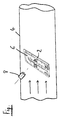
- the figure shows an test object 2 which is to be cooled in a chamber 4.
- the gas stream is indicated by the three arrows.
- the test object 2 is heated by a heater foil 6, adhering on the object 2.
- a video camera 8 is mounted for observing the surface of the test object. After connecting the heating foil 6 to a source of electric energy and heating the heating foil and the test object 2, a cooling gas stream is started.
- the video camera 8 is taking pictures or a film, registering the temperature fields and their changes. From this material a known mathematical method can calculate the distribution of the heat transfer coefficients.
Landscapes
- Physics & Mathematics (AREA)
- Health & Medical Sciences (AREA)
- Life Sciences & Earth Sciences (AREA)
- Chemical & Material Sciences (AREA)
- Analytical Chemistry (AREA)
- Biochemistry (AREA)
- General Health & Medical Sciences (AREA)
- General Physics & Mathematics (AREA)
- Immunology (AREA)
- Pathology (AREA)
- Radiation Pyrometers (AREA)
- Investigating Or Analyzing Materials Using Thermal Means (AREA)
Abstract
- applying a thin heating element (heater foil (6) or a conducting colour on the surface of the object (2)
- placing the object into the chamber (4)
- directing a camera (8) or a fibre optic to the object (2)
- connecting the heating element with a source of electric energy
- starting the cooling gas or fluid stream
- taking pictures or a film, registering the temperature fields and the changes and
- calculating the distribution of the heat transfer coefficients.
Description
- The invention relates to a test method for measuring the distribution of the heat transfer or the uniformity of the change of temperature of one or more test objects heated or cooled by a gas stream in a furnace or in a chamber.
- Surface temperature distribution of objects being cooled or heated in a fluid has up to now been determined by thermocouple or resistance thermometer measurement, by infrared temperature measurements or by the use of crayons which shift colour. The thermocouples have to be mounted at several places at the surface or below the surface. In the latter case, holes must be drilled into the object and the thermocouples are then to be mounted inside these holes. Many thermocouples are needed if a good indication of the surface temperature is required. Infrared temperature measurement can give detailed temperature distributions only when very expensive instruments are used, and they are very susceptible to effects of the radiation from other surfaces in the system. The use of crayons gives only qualitative information on surface temperature distributions. Neither technique is able to accurately determine transient behaviours.
- In the article: Roland Wiberg, Barbro Muhammad-Klingmann, Jerome Ferrari, and Noam Lior, "Use of thermochromic coatings for the experimental determination of the distribution of heat transfer coefficients in gas-cooled quenching", Proc. 5th ASM Heat Transfer and Surface Engineering Conference in Europe, Eds. E.J. Mittemeijer and J. Grosch, ASM International, pp.. 275-286, Gothenburg, Sweden, 7-9 June 2000, it is proposed to use thermochromic liquid crystal (TLC) coatings to evaluate both temperature and heat transfer coefficients by using different visual image sensing techniques combined with mathematical modelling in application of quenching in gas.
- The test object in this article is a cylinder. The outer surfaces were coated with TLCs. The cylinder was heated by heating foils from inside. The test object was placed in a test chamber, a camera was directed to the object and then a cooling gas stream was started. The camera took pictures and registered the temperature distributions and their changes. From that the distribution of the heat transfer coefficients has been calculated. Heating by electrical current or by foils from the inside of the object is possible only for special test objects, not for normal objects to be quenched. Only hollow objects can be heated from inside. So there is a need to propose a new heating for objects with arbitrary or irregular forms, which are not hollow. It is an object of the invention to propose a better heating to allow testing of objects with any arbitrary form.
- The object of the invention is attained by using thin heating elements, heater foils or conductive colours on the surface of the test object.
- It is another object of the invention to find a new application of the developed techniques beside the quenching.
- This object is attained by the use of the test methods of claim 2 for heating in furnaces.
- With the invention it is possible to measure relatively simply and inexpensively the instantaneous steady or transient surface temperature and heat transfer coefficient distributions of objects cooled or heated in a transparent fluid, i.e. in a gas.
- The invention has the following advantages:
- The complete surface temperature distribution is obtained in one single measurement. Compared to other techniques the new technique is less complicated, requires less preparations and is cheaper.
- The method is non destructive and can be applied to real, industrial parts and objects, which need not to be hollow. The method can be used both as a laboratory test and method for measuring surface temperature distributions on parts processed in industrial processes.
- The method can be used to optimize quenching conditions like gas pressure, velocity, charge design, cooling chamber design and arrangement of coolant flow set up (inlets- and outlets, gas nozzle configurations etc.) for reaching required cooling rate and uniformity.
The temperature of the gas before and after quenching or heating can be measured and give additional information. - The method exhibits a colour field as a function of the surface temperature, with high sensitivity, of about 0,1 °C. Quick visual observation of the object can, with some training, indicate the extent of temperature uniformity of the object. Software that automatically plots and prints the measured temperature fields has been developed.
- The technique can be used also in measuring cooling or heating uniformity on quench chambers and furnaces. Employing devices like fibreoptics, it can also be used in vessels which have no windows for visual access. With the invention there can be established the best quenching configurations for specific parts with respect to required hardness and distortions of the parts. Similarly, manufacturers of heating or cooling chambers of any type can be supported to built better chambers with relatively uniform heat and temperature distributions.
- Applying the invention to parts to be quenched and then subjecting them to steady or transient gas streams at different velocities and directions, till the combinations of conditions which gives the desired temperature uniformity is obtained. The quencher can then quench parts at these conditions. The experiment can be conducted in a very simple transparent plastic "wind tunnel" or in the quencher's quench chamber using a window, a fibre optic cable, or a internal video camera (the temperatures can remain low).
- Real or build probes which are coated with the heating element of the invention can be used to determine whether the quenching rate is fast enough.
- The surveillance of the heat distribution can be made by cameras in the visible spectral range. In this case the test objects or the heating foils are covered with thermochromic liquid crystals. These elements sustain temperatures up to 120 °C. For measurements in higher temperature ranges there can be used a camera which is working in the infrared range. In this range it is not necessary to coat the objects with a special colour. The objects are sending out IR-radiation by themselves.
- If in a real chamber there is no visual access, it is possible to place a video camera in the chambers or to look with fibre optics and an illumination into the chamber.
- It has some advantages to use an strip foil heater. The strip foil is a very thin flat metal wire (12 micrometer) circuit encased in a thin insulator, the whole foil being very flexible. Powered by electricity, it produces a uniform heat flux. Measurement of its surface temperature distribution by TLC or other techniques such as IR, and measurement of the surrounding cooling temperature, allow the determination of the distribution of the surface heat transfer coefficients.
- The advantages compared to conventional foils are:
- 1. More uniform heat flux distribution over the surface, because the current is forced the same over the whole surface (one may assume no electromagnetic Hall effect as in the whole foils).
- 2. The surface of the body do not need to be flat. It is possible to apply the foils to round cylinders and they can be applied also to other surface shapes, while a conventional foil needs a rectangular surface to work.
- 3. Higher voltage supply can be used, which reduces the current and therefore, the dimensions of the cables, power supply, etc.
- 4. The foil can be used also on large models.
- 5. The surface temperature differences over the surface to be measured are with this method large and, therefore, easy measurable. The prototype foil works up to 400 °C, which may make it suitable for temperature measurements using IR and TLC techniques.
- 6. The fast time response of the thin foil (less than 1 minute for a test) allows high productivity.
-
- More details of the invention will be clear by description of a best mode of the invention with one figure.
- The figure shows an test object 2 which is to be cooled in a chamber 4. The gas stream is indicated by the three arrows. The test object 2 is heated by a heater foil 6, adhering on the object 2. In the chamber 4 a
video camera 8 is mounted for observing the surface of the test object. After connecting the heating foil 6 to a source of electric energy and heating the heating foil and the test object 2, a cooling gas stream is started. Thevideo camera 8 is taking pictures or a film, registering the temperature fields and their changes. From this material a known mathematical method can calculate the distribution of the heat transfer coefficients.
Claims (5)
- Test method for measuring the distribution of heat transfer and the uniformity of the change of temperature of one or more objects (2) cooled or quenched by a gas or a fluid stream in a chamber (4) byapplying a thin heating element (heater foil (6) or a conducting colour) on the surface of the object (2)placing the object into the chamber (4)directing a camera (8) or a fibre optic to the object (2)connecting the heating element with a source of electric energystarting the cooling gas or fluid streamtaking pictures or a film, registering the temperature fields and the changes andcalculating the distribution of the heat transfer coefficients.
- Test method for measuring the distribution of heat transfer and the uniformity of the change of temperature of one or more objects (2) heated by a gas stream in a furnace byplacing the object into a chamberdirecting a camera or a fibre optic to the objectstarting the heating gas streamtaking pictures or a film, registering the temperature fields and their changescalculating the distribution of the heat transfer coefficients.
- Method according to claim 1 or claim 2, whereby the heating element and/or the surface of the object is covered by thermochromic liquid crystals (TLC) and the camera is working in the visible spectral range.
- Method according to claim 1 or claim 2, whereby the camera is working in the IR-range.
- Method according to one of the preceding claims, whereby the heating element is a strip foil heater.
Priority Applications (1)
| Application Number | Priority Date | Filing Date | Title |
|---|---|---|---|
| EP02014455A EP1376110A1 (en) | 2002-06-28 | 2002-06-28 | Test method for measuring the heat transfer |
Applications Claiming Priority (1)
| Application Number | Priority Date | Filing Date | Title |
|---|---|---|---|
| EP02014455A EP1376110A1 (en) | 2002-06-28 | 2002-06-28 | Test method for measuring the heat transfer |
Publications (1)
| Publication Number | Publication Date |
|---|---|
| EP1376110A1 true EP1376110A1 (en) | 2004-01-02 |
Family
ID=29716871
Family Applications (1)
| Application Number | Title | Priority Date | Filing Date |
|---|---|---|---|
| EP02014455A Ceased EP1376110A1 (en) | 2002-06-28 | 2002-06-28 | Test method for measuring the heat transfer |
Country Status (1)
| Country | Link |
|---|---|
| EP (1) | EP1376110A1 (en) |
Cited By (1)
| Publication number | Priority date | Publication date | Assignee | Title |
|---|---|---|---|---|
| CN113720573A (en) * | 2021-08-30 | 2021-11-30 | 中国空气动力研究与发展中心设备设计与测试技术研究所 | Wind tunnel cold leakage monitoring system based on vision and distributed optical fiber combined temperature measurement |
Citations (3)
| Publication number | Priority date | Publication date | Assignee | Title |
|---|---|---|---|---|
| US5067977A (en) * | 1991-02-05 | 1991-11-26 | Libbey-Owens-Ford Co. | Method and apparatus for measuring the efficiency of cooling devices |
| US5223958A (en) * | 1988-12-30 | 1993-06-29 | Hyperdesign, Inc. | Heat activated amusement device employing microencapsulated thermochromic liquid crystal |
| US5526148A (en) * | 1994-08-02 | 1996-06-11 | Moffat; Robert J. | Apparatus and method for full-field calibration of color response to temperature of thermochromic liquid crystals |
-
2002
- 2002-06-28 EP EP02014455A patent/EP1376110A1/en not_active Ceased
Patent Citations (3)
| Publication number | Priority date | Publication date | Assignee | Title |
|---|---|---|---|---|
| US5223958A (en) * | 1988-12-30 | 1993-06-29 | Hyperdesign, Inc. | Heat activated amusement device employing microencapsulated thermochromic liquid crystal |
| US5067977A (en) * | 1991-02-05 | 1991-11-26 | Libbey-Owens-Ford Co. | Method and apparatus for measuring the efficiency of cooling devices |
| US5526148A (en) * | 1994-08-02 | 1996-06-11 | Moffat; Robert J. | Apparatus and method for full-field calibration of color response to temperature of thermochromic liquid crystals |
Cited By (2)
| Publication number | Priority date | Publication date | Assignee | Title |
|---|---|---|---|---|
| CN113720573A (en) * | 2021-08-30 | 2021-11-30 | 中国空气动力研究与发展中心设备设计与测试技术研究所 | Wind tunnel cold leakage monitoring system based on vision and distributed optical fiber combined temperature measurement |
| CN113720573B (en) * | 2021-08-30 | 2023-08-18 | 中国空气动力研究与发展中心设备设计与测试技术研究所 | Wind tunnel cold leakage monitoring system based on vision and distributed optical fiber combined temperature measurement |
Similar Documents
| Publication | Publication Date | Title |
|---|---|---|
| CN102042993B (en) | A measurement system for normal spectral emissivity of high temperature materials | |
| CN113483900B (en) | Measurement method of infrared radiation aluminum alloy plate temperature field based on blackbody point online calibration | |
| Michalski et al. | Comparison of two surface temperature measurement using thermocouples and infrared camera | |
| Lin et al. | A transient liquid crystal method using a 3-D inverse transient conduction scheme | |
| Trelewicz et al. | High-temperature calibration of direct write heat flux sensors from 25° C to 860° C using the in-cavity radiation method | |
| US5217304A (en) | Electrical network method for the thermal or structural characterization of a conducting material sample or structure | |
| Förster et al. | A novel surface-integrated spray-on thermocouple for heat transfer measurements | |
| CN203629720U (en) | Thermal paint temperature detection device | |
| Nagayama et al. | Global heat flux measurement using temperature-sensitive paint in high-enthalpy shock tunnel HIEST | |
| Piasecka et al. | Comparison of two methods for contactless surface temperature measurement | |
| CN120538707B (en) | Post-processing type multipurpose measuring sensor and measuring method based on calibration integral equation method | |
| US5165794A (en) | Method for the thermal characterization, visualization, and integrity evaluation of conducting material samples or complex structures | |
| Wu et al. | Optical noninvasive temperature measurement of molten melts in metallurgical process: a review | |
| Pelińska-Olko | Emissivity measurement of black paint using the calorimetric method | |
| Neely et al. | Transient response of thermal paints for use on short-duration hypersonic flight tests | |
| Jeziorek et al. | Temperature measurements using thermal sensitive paint | |
| Bynum et al. | Measurement and mapping of aerodynamic heating in VKF tunnel B with an infrared camera | |
| Dittrich et al. | Measuring the specific heat of metals by cooling | |
| Rusby | Introduction to temperature measurement. | |
| McIntosh et al. | Emissivity considerations for thermographic fieldwork: why table values don't work | |
| John et al. | Emissivity Measurement Using Heat Flux Method at Cryogenic Temperatures | |
| Kang et al. | TEG Heat Sink Heat Exchange Performance Evaluation and Validation Utilizing Thermographic Phosphor | |
| Ghorbani-Tari et al. | On liquid crystal thermography for determination of the heat transfer coefficient in rectangular ducts | |
| O'Sullivan Jr et al. | Theory and apparatus for measurement of emissivity for radiative cooling of hypersonic aircraft with data for Inconel and Inconel X | |
| Linda et al. | Analysis of rapid temperature changes of the object with higher thermal constant |
Legal Events
| Date | Code | Title | Description |
|---|---|---|---|
| PUAI | Public reference made under article 153(3) epc to a published international application that has entered the european phase |
Free format text: ORIGINAL CODE: 0009012 |
|
| AK | Designated contracting states |
Kind code of ref document: A1 Designated state(s): AT BE CH CY DE DK ES FI FR GB GR IE IT LI LU MC NL PT SE TR |
|
| AX | Request for extension of the european patent |
Extension state: AL LT LV MK RO SI |
|
| 17P | Request for examination filed |
Effective date: 20040630 |
|
| AKX | Designation fees paid |
Designated state(s): AT BE CH CY DE DK ES FI FR GB GR IE IT LI LU MC NL PT SE TR |
|
| 17Q | First examination report despatched |
Effective date: 20070315 |
|
| STAA | Information on the status of an ep patent application or granted ep patent |
Free format text: STATUS: THE APPLICATION HAS BEEN REFUSED |
|
| 18R | Application refused |
Effective date: 20070430 |