The present invention is related to a method for removing impurities from products
derived from oxidation of ortho-dialkylaromatic compounds. In one embodiment the
present invention is related to a method for removing impurities from products
derived from oxidation of ortho-dimethylbenzenes. In another particular embodiment
the present invention is related to a method for removing impurities from products
derived from oxidation of halogenated ortho-dialkylbenzenes, and particularly from
oxidation of halogenated ortho-dimethylbenzenes.
Aromatic ortho-dicarboxylic acids and their corresponding anhydrides are often
produced by oxidation of ortho-dialkylaromatic compounds. A particular example is
the well-known process for producing phthalic acid and phthalic anhydride by
oxidation of ortho-xylene in the presence of a catalyst and oxygen source. Efficient
processes for the production of halophthalic acid and halophthalic anhydride, such as
chlorophthalic acid and chlorophthalic anhydride, via liquid-phase oxidation of halo-o-xylene
using catalysts and an oxygen source have been recently described, for
example in copending, commonly owned application Serial No. 09/718,124, filed
November 20, 2000. In the preparation of chlorophthalic acid and chlorophthalic
anhydride via liquid-phase oxidation, high first-pass yields are very important because
intermediate products are difficult and expensive to separate from the product. When
a mixture of 3-chloro-o-xylene and 4-chloro-o-xylene serves as starting material for
the oxidation, the major impurities may comprise any of four chlorophthalides, or
four chloro-toluic acids which may result from incomplete oxidation of the substrate.
In the case of over oxidation one may obtain isomers of chlorobenzoic acid from
decarboxylation or phthalic acid from dechlorination of the product, chlorophthalic
acid. A problem is that neither conventional distillation nor recrystallization allows
for a clean separation of the anhydrides from the phthalide or carboxylic acid
impurities.
Elimination of impurities from oxidation product mixtures of ortho-dialkylaromatic
compounds has in the past often relied on improving the oxidation process conditions
to prevent impurity formation. U.S. Patent No. 4,436,922 teaches a process for
conversion of impurities to desired products in a reoxidation process. Post-oxidation
removal of impurities has been described in U.S. Patent No. 4,165,324 wherein
residual phthalide impurity is removed by treatment of an oxidation reaction mixture
with alkali metal salts at high temperature. These approaches are deficient in that there
is loss in yield, increase in color and increase in cost associated with the energy
required to effect the reaction.
Extractions of liquid phase oxidation reaction mixtures have been described as a way
to remove the metal catalyst components. Such extractions are usually done while the
product is primarily insoluble in the aqueous phase as taught in U.S. Patent No.
5,449,820. U.S. Patent No. 5,770,764 utilizes aqueous solubility by employing
trialkylamines to make the corresponding salts of oxidation products, followed by
purifying the salts and recovering the acids.
Accordingly, there remains a need for an inexpensive and efficient method for
removing organic impurities from products derived from oxidation of ortho-dialkylaromatic
compounds. In particular, there is a need for a method for removing
organic impurities from oxidation products comprising halophthalic acids and/or
halophthalic anhydrides.
The present inventors have discovered a method for removing impurities from
products derived from oxidation of an ortho-dialkylaromatic compound which
comprises at least one step selected from the group consisting of extraction of an
aqueous solution comprising aromatic dicarboxylic acid product with an organic
solvent and extraction of an organic solution comprising aromatic anhydride product
with an aqueous bicarbonate solution for a time period insufficient to allow hydrolysis
of anhydride to acid.
Various other features, aspects, and advantages of the present invention will become
more apparent with reference to the following description and appended clauses.
In various embodiments products derived from oxidation of ortho-dialkylaromatic
compounds comprise those derived from oxidation of substituted or unsubstituted
xylene, or substituted or unsubstituted dimethylnaphthalene. Typical substituents,
when present, on xylene or dimethylnaphthalene comprise alkyl or halo substituents.
In some embodiments said products are those derived from oxidation of monohalo-ortho-xylene,
in one particular embodiment from oxidation of 4-halo-ortho-xylene,
and in other particular embodiments from oxidation of 4-fluoro- or 4-chloro-ortho-xylene.
In another embodiment products are derived from oxidation of a mixture
comprising 4-halo- and 3-halo-ortho-xylene, in some particular embodiments a
mixture of 4-fluoro- and 3-fluoro-ortho-xylene and in other particular embodiments a
mixture of 4-chloro- and 3-chloro-ortho-xylene. When 3-halo-ortho-xylene is present
in a substrate for oxidation, it comprises in some embodiments about 0.001-35 molar
percent, in other embodiments about 0.001-15 molar percent, in other embodiments
about 0.01-12 molar percent, and in still other embodiments about 0.1-10 molar
percent of total substrate.
In yet another embodiment products derived from oxidation of ortho-dialkylaromatic
compounds comprise those derived from oxidation of at least one halo-ortho-xylene
as described above, optionally in the presence of at least one halotoluic acid, in one
embodiment at least one chlorotoluic acid (also known as chloro methylbenzoic acid),
in another embodiment either (a) 4-chloro-2-methyl benzoic acid or (b) 5-chloro-2-methylbenzoic
acid or (c) a mixture thereof, and in still another embodiment a mixture
of either or both of (a) and (b) with either (d) 4-halo-ortho-xylene, or (e) a mixture of
4-halo- and 3-halo-ortho-xylene.
In still another embodiment products derived from oxidation of ortho-dialkylaromatic
compounds comprise those derived from oxidation of a mixture of ortho-xylene with
halo-ortho-xylene, in one embodiment either with (d) 4-halo-ortho-xylene, or with (e)
a mixture of 4-halo- and 3-halo-ortho-xylene, or with at least one halotoluic acid, such
as chlorotoluic acid, or with a mixture of halotoluic acid with either (d) 4-halo-ortho-xylene,
or (e) a mixture of 4-halo- and 3-halo-ortho-xylene. When ortho-xylene is
present in a substrate for oxidation, it typically comprises in one embodiment about
0.001-100 molar percent, in another embodiment about 0.001-10 molar percent and in
still another embodiment about 0.01-1 molar percent of total substrate. In a particular
embodiment products derived from oxidation of ortho-dialkylaromatic compounds
comprise those derived from oxidation of 4-chloro-ortho-xylene, optionally in
combination with at least one of 3-chloro-ortho-xylene, ortho-xylene, or chlorotoluic
acid.
In various embodiments ortho-dialkylaromatic oxidation products comprise those
obtained by oxidation of at least one of and sometimes both the two aromatic ortho-alkyl
groups. In some embodiments ortho-dialkylaromatic oxidation products
comprise those obtained by oxidation of at least one of and sometimes both of two
aromatic ortho-methyl groups. In various embodiments the oxidation products
comprise at least one of a substituted or unsubstituted aromatic ortho-dicarboxylic
acid, or a substituted or unsubstituted aromatic anhydride derived from the
corresponding aromatic ortho-dicarboxylic acid. In some particular embodiments the
oxidation products comprise at least one of phthalic acid, phthalic anhydride,
halotoluic acid, halophthalic acid, halophthalic anhydride, or mixtures thereof. In still
other particular embodiments the oxidation products comprise at least one of phthalic
acid, phthalic anhydride, chlorotoluic acid, 3-chlorophthalic acid, 3-chlorophthalic
anhydride, 4-chlorophthalic acid, 4-chlorophthalic anhydride, or mixtures thereof. In
other particular embodiments the oxidation products comprise at least one of
chlorotoluic acid, chlorophthalic acid, or chlorophthalic anhydride. It is to be
understood that product mixtures initially comprising halophthalic acid may be
dehydrated to form a product mixture comprising in some embodiments up to 100
mole % (based on halophthalic acid) of halophthalic anhydride. It is also to be
understood that product mixtures initially comprising halophthalic anhydride may be
hydrated to form a product mixture comprising in some embodiments up to 100 mole
% (based on halophthalic anhydride) of halophthalic acid. In a particular embodiment
the products comprise chlorotoluic acid and 4-chlorophthalic acid, optionally with 4-chlorophthalic
anhydride. In another particular embodiment the products comprise
chlorotoluic acids and a mixture of 3-chloro- and 4-chlorophthalic acid optionally
with 3-chloro- and 4-chlorophthalic anhydride. When ortho-xylene is present in the
oxidation substrate, then phthalic acid, optionally with phthalic anhydride and/or
toluic acid may be present in the oxidation products.
The products derived from oxidation of ortho-dialkylaromatic compounds may
comprise at least one solvent, which in some embodiments comprises a lower
aliphatic carboxylic acid. Illustrative examples of lower aliphatic carboxylic acids,
include, but are not limited to, acetic acid, propionic acid, butanoic acid, pentanoic
acid, or hexanoic acid. Acetic acid is present in some embodiments. In some
embodiments the said products are stripped to dryness to remove essentially all
volatile materials, including, but not limited to, solvent before treatment by a method
disclosed in various embodiments of the present invention.
In various embodiments the products derived from oxidation of ortho-dialkylaromatic
compounds may further comprise at least one metal catalyst. The at least one metal
catalyst typically comprises a metal compound with a metal selected from the group
consisting of cobalt, manganese, vanadium, copper, molybdenum, and iron, and
mixtures thereof. In some embodiments, a metal compound is a salt of the metal and
in particular embodiments an acetate or acetylacetonate of the metal. Illustrative
metal compounds include, but are not limited to, cobalt dibromide hexahydrate, cobalt
dichloride, cobalt (II) acetate, cobalt (II) acetylacetonate, cobalt (III) acetylacetonate,
cobalt (II) hexafluoroacetylacetonate, cobalt (II) picolinate, manganese (III) acetate,
manganese (II) acetate, manganese (II) hexafluoroacetylacetonate trihydrate,
manganese (III) acetylacetonate, manganese (II) acetylacetonate, manganese
dichloride tetrahydrate, manganese dibromide, manganese (II) picolinate, manganese
(III) picolinate, manganese (III) bromide acetylacetonate, vanadyl (IV) acetate
(VO[OC(O)CH3]2), vanadyl (IV) acetylacetonate, copper (I) acetate, molybdenyl (VI)
acetylacetonate (MoO2[C5H7O2]), iron (II) acetate, and hydrates, and anhydrous
compounds, and mixtures thereof. In some particular embodiments metal catalysts
include mixtures of cobalt (II) bromide hexahydrate with either cobalt (II) picolinate,
manganese (II) bromide, manganese (II) chloride tetrahydrate, manganese (III)
bromide acetylacetonate, manganese (II) acetate, manganese (III) acetate dihydrate,
manganese (II) acetylacetonate, manganese (III) acetylacetonate, or manganese (II)
hexafluoroacetylacetonate trihydrate; mixtures of cobalt (II) acetate with manganese
(III) acetate or manganese (II) bromide; and ternary mixtures of cobalt (II) acetate with
manganese (III) acetate and manganese (II) bromide; or of cobalt (II) acetate with
manganese (III) acetate and cobalt(II) bromide; or of cobalt (II) acetate with
manganese (III) acetate and iron (II) bromide; or of cobalt (II) acetate with manganese
(III) acetate and either copper (I) bromide or copper (II) bromide. It is to be
understood that reaction products of any of the above catalysts may also be present in
products derived from oxidation of ortho-dialkylaromatic compounds in certain
embodiments. Said reaction products may be readily identified by those skilled in the
art and comprise any that may arise under the reaction conditions employed to prepare
the products derived from oxidation of ortho-dialkylaromatic compounds.
When at least one metal catalyst or reaction product thereof is present, the molar ratio
of the at least one metal catalyst to the ortho-dialkylaromatic oxidation product or
mixture of oxidation products is in one embodiment in a range of about 1 : 20-600, in
another embodiment in a range of about 1:50-300, and in still another embodiment in
a range of about 1:80-250. In some particular embodiments the molar ratio of the at
least one metal catalyst to the ortho-dialkylaromatic oxidation product or mixture of
oxidation products is about 1:200.
In various embodiments the products derived from oxidation of ortho-dialkylaromatic
compounds may further comprise at least one promoter. Suitable promoters include,
but are not limited to,
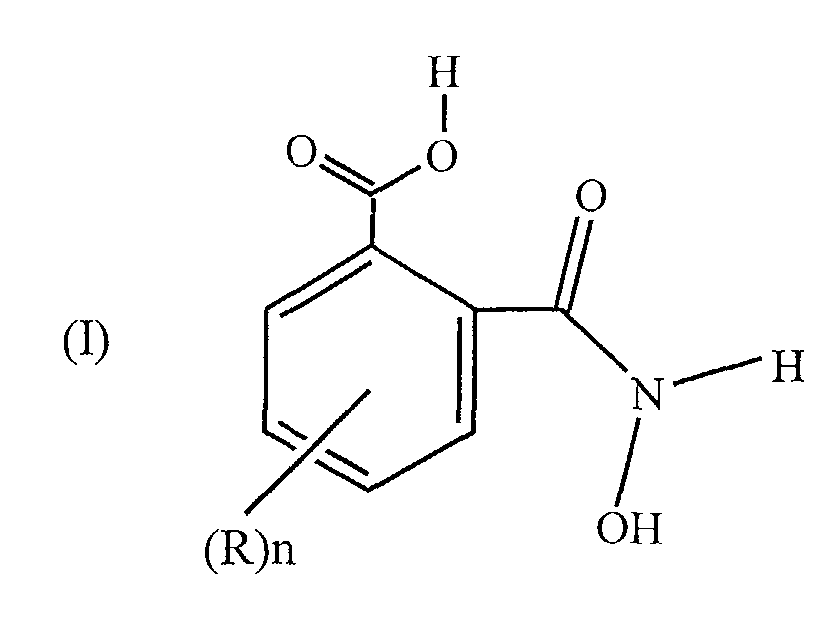
In various embodiments hydroxamic acids include, but are not limited to,
unsubstituted 2-carboxyphenylhydroxamic acid, 4-chloro-2-carboxyphenylhydroxamic
acid, 3-chloro-2-carboxyphenylhydroxamic acids, and
dichloro-2-carboxyphenylhydroxamic acid. In various embodiments arylaldehydes
include, but are not limited to, alkylchlorobenzaldehydes such as 3-chloro-2-methylbenzaldehyde,
4-chloro-2-methylbenzaldehyde, and dichloro-2-methylbenzaldehyde.
In various embodiments onium halides include, but are not
limited to, tetraalkylammonium bromides such as tetraethylammonium bromide and
tetrabutylammonium bromide. In various embodiments guanidinium halides include
hexaethylguanidinium chloride and hexaethylguanidinium bromide. In various
embodiments an alkali metal halide is sodium bromide. In some particular
embodiments of the invention promoters are N-hydroxyphthalimide and 4-chloro-N-hydroxyphthalimide.
The term "alkyl" as used in the various embodiments of the present invention is
intended to designate both normal alkyl, branched alkyl, aralkyl, and cycloalkyl
radicals. In various embodiments normal and branched alkyl radicals are those
containing from 1 to about 30 carbon atoms, and include as illustrative non-limiting
examples methyl, ethyl, n-propyl, isopropyl, n-butyl, sec-butyl, tertiary-butyl, pentyl,
neopentyl, hexyl, heptyl, octyl, nonyl, decyl, undecyl and dodecyl. In various
embodiments cycloalkyl radicals represented are those containing from 3 to about 12
ring carbon atoms. Some illustrative non-limiting examples of these cycloalkyl
radicals include cyclobutyl, cyclopentyl, cyclohexyl, methylcyclohexyl, and
cycloheptyl. In various embodiments aralkyl radicals are those containing from 7 to
about 14 carbon atoms; these include, but are not limited to, benzyl, phenylbutyl,
phenylpropyl, and phenylethyl. In various embodiments aryl radicals used in the
various embodiments of the present invention are those containing from 6 to 12 ring
carbon atoms. Some illustrative non-limiting examples of these aryl radicals include
phenyl, biphenyl, and naphthyl. Halogen radicals used in some embodiments of the
present invention are fluorine, chlorine and bromine.
In some embodiments the amount of promoter, when present, may have a value in one
embodiment in a range between about 0.01 mole % and about 20 mole %, in another
embodiment between about 0.1 mole % and about 12 mole %, and in still another
embodiment between about 0.4 mole % and about 10 mole %, based on ortho-dialkylaromatic
oxidation product or mixture of oxidation products.
In the context of the present invention removal of an impurity from products derived
from oxidation of ortho-dialkylaromatic compounds is sometimes referred to as
purification, and a resulting product may be referred to as purified. It should be
understood that purification may not necessarily imply that all types of impurity are
removed from an oxidation product or that all of a particular impurity is removed
from an oxidation product. It should also be understood that, although products in the
plural are sometimes referred to in connection with products derived from oxidation
of ortho-dialkylaromatic compounds, said products may consist essentially of a single
oxidation product or may comprise more than one oxidation product.
In one embodiment of the present invention products derived from oxidation of an
ortho-dialkylaromatic compound are purified by a process which comprises extraction
of an aqueous solution comprising dicarboxylic acid product with an organic solvent.
At least one extraction is performed although in some embodiments more than one
extraction may be performed. In a particular embodiment impurities removed by
extraction with organic solvent comprise at least one phthalide. In the present context
the term phthalide includes substituted or unsubstituted monocyclic and polycyclic
phthalides, including but is not limited to, substituted or unsubstituted monocyclic or
polycyclic phthalides of either formulas (III), (IV), (V) or (VI), or positional isomers
thereof;
In some particular embodiments phthalides are substituted with at least one halogen
substituent. In other particular embodiments phthalides are substituted with at least
one chloro substituent.
In other particular embodiments an ortho-dialkylaromatic compound comprises at
least one halo-ortho-xylene and impurities removed by extraction with organic solvent
comprise at least one halophthalide. In other particular embodiments a halo-ortho-xylene
comprises at least one chloro-ortho-xylene and impurities removed by
extraction with organic solvent comprise at least one chlorophthalide.
In one embodiment of the invention at least one extraction may be done directly on a
mixture comprising volatile materials such as solvent and products derived from
oxidation of an ortho-dialkylaromatic compound. Soluble impurities comprising
phthalides are taken into organic solvent while the desired aromatic ortho-dicarboxylic
acids are retained in the aqueous phase. In a particular embodiment
soluble impurities comprising chlorophthalides are taken into organic solvent while
desired chlorophthalic acids are retained in the aqueous phase. In another
embodiment the mixture comprising products derived from oxidation of an ortho-dialkylaromatic
compound may be evaporated to dryness under reduced pressure with
heating, for example to remove volatile materials such as solvent, if present.
Essentially all or at least a portion of volatile materials may be removed in this step.
In one embodiment essentially all volatile materials are removed from the mixture,
which means that no more liquid condensate can be collected from the mixture heated
under reduced pressure. In order to ensure that any anhydrides formed during this
evaporation step are reconverted to the aromatic ortho-dicarboxylic acids, the solid
residue or slurry from evaporation is typically exposed to a solution comprising water
at a convenient temperature, followed by extraction of aqueous phase with an organic
solvent. In particular embodiments the solid residue or slurry from evaporation is
typically exposed to a solution comprising water for a time and at a temperature
sufficient to convert essentially all anhydride, if present, to dicarboxylic acid. The
presence of anhydride in the mixture can readily be determined without undue
experimentation using analytical methods known to those skilled in the art. In one
particular embodiment the solid residue from evaporation may be exposed to water at
a temperature of at least about 50°C, followed by extraction of the aqueous phase with
organic solvent. If anhydrides are present in the mixture, it has been found that they
will typically be extracted with impurities such as phthalides into organic solvent
resulting in a loss in yield of oxidation products.
In various embodiments products derived from oxidation of an ortho-dialkylaromatic
compound and comprising aromatic dicarboxylic acid are present in an aqueous phase
in one embodiment at a level of greater than about 5 wt.%, in another embodiment at a
level of greater than about 10 wt.%, in another embodiment at a level of greater than
about 15 wt.%, in another embodiment at a level of greater than about 20 wt.%, in
another embodiment at a level of greater than about 25 wt.%, in another embodiment
at a level of greater than about 30 wt.%, and in still another embodiment at a level of
greater than about 35 wt.%, based on the weight of the entire aqueous phase. In some
particular embodiments products derived from oxidation of an ortho-dialkylaromatic
compound and comprising aromatic dicarboxylic acid are present in an aqueous phase
at a level in a range of between about 18 wt.% and about 26 wt.%, based on the
weight of the entire aqueous phase.
Organic solvents which may be used in an extraction include aromatic solvents such
as benzene, substituted benzenes, alkylbenzenes, toluene, xylene, halogenated
benzenes, chlorobenzene, dichlorobenzene, halogenated alkylbenzenes, chlorotoluene,
chloroxylene, 3-chloro-ortho-xylene, 4-chloro-ortho-xylene, alkoxybenzenes, anisole,
halogenated alkoxybenzenes, and mixtures of aromatic solvents. Extraction with
organic solvent may be performed at a convenient temperature between about ambient
temperature and about the boiling point of water. In some embodiments extraction
with organic solvent is performed at a temperature in a range of between about
ambient temperature and about 80°C. In other embodiments extraction with organic
solvent is performed at a temperature in a range of between about ambient
temperature and about 65°C.
In one embodiment the efficacy of a solvent extraction may be measured by the
distribution coefficient, K, which is the mole fraction of specified solute in the organic
solvent phase compared to the mole fraction of specified solute in the aqueous phase.
In some particular embodiments an organic solvent is employed such that the value of
the distribution coefficient, K, for phthalide in a product mixture comprising at least
one phthalic acid is greater than 1. In other particular embodiments an organic solvent
is employed such that the value of the distribution coefficient, K, for chlorophthalide
in a product mixture comprising at least one chlorophthalic acid is greater than 1. In
various particular embodiments an organic solvent is employed such that the value of
the distribution coefficient, K, for chlorophthalide is in one embodiment in a range of
between about 1.1 and about 5, and in another embodiment in a range of between
about 1.1 and about 4. In a particular embodiment the distribution coefficient is
measured for 4-chlorophthalide with water and various organic solvents such as
toluene and xylene.
Another factor for measuring the efficacy of a solvent extraction is the selectivity
factor, β, which compares the ratio of two components of interest in one phase to the
ratio of the same two components in the other phase. In a particular embodiment the
selectivity factor is measured for 4-chlorophthalide in relation to chlorophthalic acids
in both water and organic solvent.
When the products derived from oxidation of ortho-dialkylaromatic compounds
comprise chlorophthalic acids, values of K are in the range of about 1.5-2.5 for
toluene, xylene and o-dichlorobenzene when the original concentrations of
chlorophthalic acids are about 20 wt.% and chlorophthalide concentration is about
0.6% based on the weight of the entire mixture. This means there is a preference for
solubility of chlorophthalide in the organic solvent. However, the selectivity numbers
for chlorophthalic acids and chlorophthalide are in the 4000-5000 range for toluene
and xylene while closer to 500 for o-dichlorobenzene reflecting a low solubility of the
chlorophthalic acids in toluene and xylene, and increased solubility in o-dichlorobenzene.
When levels of acetic acid ranged from 0-35 wt.% based on the weight of the water,
the values for K for chlorophthalic acids and chlorophthalide at 22 wt.% solids are
also in the range of about 1.7-2.6, but the selectivity numbers decrease for toluene
from 4000 at 0 wt.% acetic acid to about 400 at 18 wt.% acetic acid consistent with an
increased solubility in toluene due to a partitioning of the acetic acid.
In various embodiments of the invention the amount of phthalide remaining after
extraction with organic solvent of products derived from oxidation of ortho-dialkylaromatic
compounds may be less than about 10 wt.% of the phthalide originally
present. In particular embodiments the amount of halophthalide remaining after
extraction with organic solvent of products derived from oxidation of halo-ortho-dialkylaromatic
compounds may be less than about 10 wt.% of the halophthalide
originally present. In other particular embodiments the amount of chlorophthalide
remaining after extraction with organic solvent of products derived from oxidation of
chloro-ortho-xylene may be in one embodiment less than about 10 wt.% of the
chlorophthalide originally present, in another embodiment less than about 5 wt.% of
the chlorophthalide originally present, and in still another embodiment less than about
2 wt.% of the chlorophthalide originally present. In other particular embodiments the
amount of chlorophthalide remaining after extraction with organic solvent of products
derived from oxidation of chloro-ortho-xylene may be undetectable using an
appropriate analytical method. In such cases essentially all chlorophthalide has been
removed. Appropriate analytical methods include those known in the art and are
readily determined without undue experimentation. In particular embodiments
appropriate analytical methods include at least one of gas chromatography, liquid
chromatography, or nuclear magnetic resonance spectroscopy.
In another embodiment of the present invention products derived from oxidation of an
ortho-dialkylaromatic compound are purified by a process which comprises extraction
of an organic solution comprising aromatic anhydride product with an aqueous
bicarbonate solution for a time period insufficient to allow hydrolysis of anhydride to
acid. At least one extraction is performed although in some embodiments more than
one extraction may be performed. In a particular embodiment impurities removed by
extraction with aqueous bicarbonate solution comprise a substituted or unsubstituted
aromatic mono-carboxylic acid. In another particular embodiment impurities removed
by extraction with aqueous bicarbonate solution comprise at least one halo-aromatic
mono-carboxylic acid. In other particular embodiments an ortho-dialkylaromatic
compound comprises at least one halo-ortho-xylene and impurities removed by
extraction with aqueous bicarbonate solution comprise halo-benzoic acid. In other
particular embodiments a halo-ortho-xylene comprises at least one chloro-ortho-xylene
and impurities removed by extraction with aqueous bicarbonate solution
comprise chlorobenzoic acid. In embodiments wherein at least one halo-aromatic
mono-alkyl-mono-carboxylic acid is present in an oxidation reaction mixture
comprising aromatic anhydride product, then this species will constitute an impurity
and will also be removed by extraction with aqueous bicarbonate solution. An
illustrative example of a halo-aromatic mono-alkyl-mono-carboxylic acid is
chlorotoluic acid.
In various embodiments the aqueous bicarbonate solution comprises an alkali metal
bicarbonate. In particular embodiments the aqueous bicarbonate solution comprises at
least one of sodium bicarbonate or potassium bicarbonate.
The concentration of bicarbonate in aqueous solution may be between about 0.05
wt.% (based on the total weight of the solution) and about the concentration at which
the aqueous solution is saturated with bicarbonate at the temperature of extraction. In
some particular embodiments the concentration of sodium bicarbonate in aqueous
solution is in a range of in one embodiment between about 0.1 wt.% and about 10
wt.%, and in another embodiment between about 1 wt.% and about 6 wt.%, based on
the total weight of the solution.
The products derived from oxidation of an ortho-dialkylaromatic compound are
present in an organic solvent before extraction with aqueous bicarbonate solution.
Suitable organic solvents include those in which the products derived from oxidation
of an ortho-dialkylaromatic compound are substantially soluble at the temperature of
extraction. Suitable solvents comprise aromatic solvents such as benzene, substituted
benzenes, alkylbenzenes, toluene, xylene, halogenated benzenes, chlorobenzene,
dichlorobenzene, halogenated alkylbenzenes, chlorotoluene, chloroxylene, 3-chloro-ortho-xylene,
4-chloro-ortho-xylene, alkoxybenzenes, anisole, halogenated
alkoxybenzenes, and mixtures of aromatic solvents.
In various embodiments products derived from oxidation of an ortho-dialkylaromatic
compound and comprising aromatic anhydride are present in an organic solvent in one
embodiment at a level of greater than about 5 wt.%, in another embodiment at a level
of greater than about 10 wt.%, in another embodiment at a level of greater than about
15 wt.%, in another embodiment at a level of greater than about 20 wt.%, in another
embodiment at a level of greater than about 25 wt.%, in another embodiment at a level
of greater than about 30 wt.%, and in still another embodiment at a level of greater
than about 35 wt.%, based on the weight of the entire organic phase.
In some embodiments both aromatic dicarboxylic acid and the corresponding
anhydride are present in an oxidation reaction mixture. In such embodiments it is
desirable to convert any aromatic dicarboxylic acid to the corresponding anhydride
before extraction with aqueous bicarbonate solution. Conversion of aromatic
dicarboxylic acid to the corresponding anhydride may be performed by any known
dehydration method. The presence of aromatic dicarboxylic acid in the mixture can
readily be determined without undue experimentation using analytical methods known
to those skilled in the art.
The molar amount of bicarbonate in aqueous solution is in some embodiments such
that all acidic impurities may be removed by extraction of an organic phase
comprising anhydride products derived from oxidation of an ortho-dialkylaromatic
compound. The level of acidic impurities can readily be determined by standard
methods known to those skilled in the art without undue experimentation. In a
particular embodiment the molar amount of sodium bicarbonate in aqueous solution is
at least equal to the molar amount of acidic species in an organic solution of anhydride
products derived from oxidation of an ortho-dialkylaromatic compound. In another
embodiment the molar amount of sodium bicarbonate in aqueous solution is in excess
of the molar amount of acidic species in an organic solution of anhydride products
derived from oxidation of an ortho-dialkylaromatic compound. In another particular
embodiment the molar amount of sodium bicarbonate in aqueous solution is at least
equal to the molar amount of aromatic mono-carboxylic acid impurities in an organic
solution of anhydride products derived from oxidation of an ortho-dialkylaromatic
compound. In another particular embodiment the molar amount of sodium
bicarbonate in aqueous solution is in excess of the molar amount of aromatic mono-carboxylic
acid impurities in an organic solution of anhydride products derived from
oxidation of an ortho-dialkylaromatic compound. In another particular embodiment
the molar amount of sodium bicarbonate in aqueous solution is in a range of 3-10
equivalents compared to the molar amount of aromatic mono-carboxylic acid
impurities in an organic solution of anhydride products derived from oxidation of an
ortho-dialkylaromatic compound.
Extraction with aqueous bicarbonate solution may be performed at a convenient
temperature. In some embodiments said temperature is below ambient temperature.
In other embodiments said temperature is in a range of between about ambient
temperature and about the boiling point of water. In some embodiments extraction
with aqueous bicarbonate solution is performed at a temperature in a range of between
about ambient temperature and about 80°C. In other embodiments extraction with
aqueous bicarbonate solution is performed at a temperature in a range of between
about ambient temperature and about 65°C. In still other embodiments extraction
with aqueous bicarbonate solution is performed at a temperature in a range of between
about ambient temperature and about 40°C.
The amount of time for an extraction with aqueous bicarbonate solution is such that
aromatic anhydride is not significantly hydrolyzed to aromatic ortho-dicarboxylic
acid. In particular embodiments the amount of time for an extraction with aqueous
bicarbonate solution is such that in one embodiment less than about 10 mole % of
anhydride is hydrolyzed to aromatic ortho-dicarboxylic acid, in another embodiment
less than about 5 mole % of anhydride is hydrolyzed to aromatic ortho-dicarboxylic
acid, in another embodiment less than about 2 mole % of anhydride is hydrolyzed to
aromatic ortho-dicarboxylic acid, and in still another embodiment less than about 1
mole % of anhydride is hydrolyzed to aromatic ortho-dicarboxylic acid. In some
embodiments the amount of time for an extraction with aqueous bicarbonate solution
is such that aromatic ortho-dicarboxylic acid may be undetectable using an appropriate
analytical method. In such cases essentially no aromatic anhydride has been
hydrolyzed to aromatic ortho-dicarboxylic acid. Appropriate analytical methods
include those known in the art and are readily determined without undue
experimentation. In particular embodiments appropriate analytical methods include at
least one of gas chromatography, liquid chromatography, or nuclear magnetic
resonance spectroscopy. Those skilled in the art will realize that the amount of time
for an extraction with aqueous bicarbonate solution such that little or essentially no
anhydride is hydrolyzed to aromatic ortho-dicarboxylic acid may depend on the
temperature of extraction, the mode of mixing the aqueous and organic phases, the
relative volume of aqueous and organic phases, the total volume of aqueous and
organic phases, the concentration of bicarbonate in the aqueous phase and of oxidation
products in the organic phase, and the phase separation time among other factors.
Under any conditions, said amount of time can be readily determined by those skilled
in the art without undue experimentation. In various embodiments the amount of time
for an extraction with aqueous bicarbonate solution is in one embodiment less than
about 30 minutes, in another embodiment less than about 25 minutes, in another
embodiment less than about 20 minutes, in another embodiment less than about 15
minutes, in another embodiment less than about 10 minutes, and in still another
embodiment less than about 5 minutes.
In some embodiments wherein extraction is performed on an organic solution
comprising chloro aromatic anhydride and chloro-mono-carboxylic acid impurity
derived from oxidation of a chloro-ortho-dialkylaromatic compound, it has been found
that an extraction time of longer than a certain time results in all chloro-mono-carboxylic
acid which had been initially extracted into the aqueous phase returning to
the organic phase from which it was extracted. Although the invention is in no way
limited by theory of operation, it is believed that after a certain time chloro aromatic
anhydride may hydrolyze to chloro aromatic dicarboxylic acid which is a stronger acid
than chloro-mono-carboxylic acid and which reprotonates chloro-mono-carboxylate in
the aqueous phase to regenerate the organic soluble chloro-mono-carboxylic acid with
concomitant removal of a portion of chloro aromatic dicarboxylic acid to the aqueous
phase. Following extraction with aqueous bicarbonate solution the organic solution
may be washed with water, if so desired.
In one embodiment of the invention impurities are removed from products derived
from oxidation of ortho-dialkylaromatic compounds by a method which comprises
both extraction of an aqueous solution comprising aromatic dicarboxylic acid product
with an organic solvent and extraction of an organic solution comprising aromatic
anhydride product with an aqueous bicarbonate solution for a time period insufficient
to allow hydrolysis of anhydride to acid.
The process of the present invention in its various embodiments may be performed in
batch mode or semi-continuous mode or continuous mode. Any extraction method
known in the art may be employed. Following removal of impurities by processes as
described herein, the products derived from oxidation of ortho-dialkylaromatic
compounds may be either subjected to further purification processes, and/or used in
solution, and/or isolated by conventional means, such as by using isolation processes
comprising one or more steps of distillation, extraction, or drying. In addition any
aromatic ortho-diacid may be converted to the corresponding anhydride by
dehydration, or any aromatic ortho- anhydride may be converted to the corresponding
diacid by hydration, if so desired. Aromatic dicarboxylic acids and aromatic
anhydrides may also be converted to other derivatives such as, but not limited to,
esters, amides or imides, if so desired. In another embodiment the impurities removed
from the oxidation products using a process of the present invention are recycled into
a further oxidation process to increase conversion to oxidation products. For
example, in one embodiment phthalides removed from the oxidation products are
recycled into a further oxidation process to increase conversion to diacid and/or
anhydride oxidation products.
In various embodiments when the purified product comprises halophthalic anhydrides
(or halophthalic acids which may be converted to halophthalic anhydrides), they may
be used in processes to make various types of aromatic polyethers, particularly
aromatic polyetherimides. In one embodiment a purified product comprising 4-chlorophthalic
anhydride (or a mixture thereof with 3-chlorophthalic anhydride) may
be reacted with at least one diamine to prepare bis(chlorophthalimide) compounds
which can serve as monomer for polyetherimide synthesis. For example,
polyetherimides are conveniently prepared by the reaction of salts of
dihydroxyaromatic compounds, such as a bisphenol A disodium salt, with
bis(halophthalimides) as illustrated by 1,3-bis[N-(4-chlorophthalimido)]benzene,
which has the structure.
According to US Patents 5,229,482 and 5,830,974, the preparation of aromatic
polyethers may be conducted in solution in relatively non-polar solvents, using a
phase transfer catalyst which is substantially stable under the temperature conditions
employed. Solvents disclosed in 5,229,482 include o-dichlorobenzene,
dichlorotoluene, 1,2,4-trichlorobenzene and diphenyl sulfone. In 5,830,974,
monoalkoxybenzenes such as anisole, diphenylether, or phenetole are employed.
Solvents of the same types may be used for the preparation of bis(halophthalimide)
intermediates, particularly bis(chlorophthalimide) intermediates, for polyetherimides.
Without further elaboration, it is believed that one skilled in the art can, using the
description herein, utilize the present invention to its fullest extent. The following
examples are included to provide additional guidance to those skilled in the art in
practicing the clauseed invention. The examples provided are merely representative
of the work that contributes to the teaching of the present application. Accordingly,
these examples are not intended to limit the invention, as defined in the appended
clauses, in any manner.
EXAMPLE 1
A 35 wt.% solution of crude chlorophthalic acid in water was prepared by adding
appropriate amounts of 4- and 3-chlorophthalic anhydride (70/30 isomer ratio) along
with a mixture of about 3 wt.% (based on crude chlorophthalic anhydride) of synthetic
4- and 7-chlorophthalide (produced by reduction of 3-chlorophthalic anhydride). This
mixture was stirred at approximately 60°C for 2 hours after which all of the
chlorophthalic anhydride had hydrolyzed to chlorophthalic acid as shown by gas
chromatographic (GC) analysis which showed no anhydride in the extracted organic
phase. A number of vials were prepared each containing 5 milliliters (ml.) of an
aqueous phase comprising a certain concentration of crude chlorophthalic acid (5
wt.% to 35 wt.%, based on the weight of the entire aqueous phase and, optionally,
acetic acid (0 wt.% to 36 wt.%, based on the weight of the entire aqueous phase).
Each vial was then treated with 5 ml. of either toluene, o-dichlorobenzene (ODCB), or
ortho-xylene. The vials were then shaken vigorously in a mechanical shaker for 50
minutes at a specified temperature (22°C, 42°C, or 60°C). The phases were allowed to
separate over several hours (actual phase separation occurred much quicker than this)
and then each phase was sampled using a pipette. No stable emulsions were observed
under the conditions which were examined. The organic phase was analyzed directly
by GC (using biphenyl internal standard, following silylation of the product mixture),
while for the aqueous phase, water was evaporated and solid residue was redissolved
in organic solvent before GC analysis. The analytical data were used to calculate an
equilibrium constant, K, which represented the ratio of chlorophthalides mass fraction
in the organic phase to that in the aqueous phase. The analytical data were also used to
calculate a selectivity constant, beta, which represented the quotient of [(wt. fraction
of chlorophthalides in xylene)/(wt fraction of chlorophthalic acids in xylene)] divided
by the quotient of [(wt fraction of chlorophthalides in water)/(wt fraction of
chlorophthalic acids in water)]. The data in Table 1 show results of extractions
performed at 22°C with no acetic acid present.
| Wt.% of chlorophthalic acid in aqueous phase | K values | beta values |
| | toluene | xylene | ODCB | toluene | xylene | ODCB |
| 5.5 | -- | -- | 1.1 | -- | -- | 400 |
| 6 | 1.8 | -- | -- | 800 | -- | -- |
| 12 | 2.6 | 2.5 | 1.8 | 2500 | 3500 | 800 |
| 23 | 2.5 | 1.8 | 2.2 | 3900 | 4700 | 300 |
| 35 | 1.7 | 1.3 | 1.4 | 3400 | 4200 | 260 |
The data show that there is a dependence of K on initial chlorophthalic acid
concentration, and that xylene and toluene have a much higher selectivity for
chlorophthalides over 3 and 4-chlorophthalic acids than does ODCB under these
conditions.
EXAMPLE 2
The procedure of Example 1 was repeated except that extractions were performed at
22 wt.% initial chlorophthalic acid concentration at 22°C in the presence of different
levels of acetic acid. The data are shown in Table 2.
| Wt. % of acetic acid in initial aqueous phase | K values | beta values |
| | toluene | ODCB | toluene | ODCB |
| 9 | -- | 2.3 | -- | 200 |
| 17 | 2.5 | 2.2 | 400 | 200 |
| 26 | 2.2 | 1.9 | 150 | 100 |
| 35 | -- | 1.7 | -- | 100 |
| 36 | 1.9 | -- | 100 | -- |
The data show that the addition of increasing amounts of acetic acid decreases both K
and beta values when toluene or ODCB are used as extractants under these conditions.
Similar trends were observed when xylene was used as the extraction solvent at both
30°C and 60°C.
EXAMPLE 3
The procedure of Example 1 was repeated except that extractions were performed at
different wt.% initial chlorophthalic acid concentration at 60°C with no acetic acid
| Wt.% of chlorophthalic acid in aqueous phase | K values | beta values |
| | toluene | ODCB | toluene | ODCB |
| 22 | 3.5 | 2.8 | 1800 | 800 |
| 35 | 2.0 | 1.7 | 1400 | 800 |
The data show that under these conditions K values for extraction increase with
increasing temperature in the absence of acetic acid when toluene or ODCB are used
as extractants, while selectivity increases or decreases depending upon extraction
solvent. When either xylene or 4-chloro-o-xylene was used as extraction solvent at
30°C, both the K values and the selectivity values were similar and decreased with
increasing level of chlorophthalic acid in the aqueous phase. Similar trends were
observed when xylene was used as extraction solvent at 60°C, and in addition the K
values and selectivity values were lower than those obtained at 30°C.
EXAMPLE 4
The procedure of Example 1 was repeated except that extractions were performed at
22 wt.% initial chlorophthalic acid concentration at 60°C in the presence of different
levels of acetic acid. The data are shown in Table 4.
| Wt.% of acetic acid in initial aqueous phase | K values | beta values |
| | toluene | ODCB | toluene | ODCB |
| 10 | 3.3 | 3.1 | 900 | 600 |
| 19 | 2.9 | 2.5 | 300 | 300 |
| 29 | 2.4 | 2.3 | 150 | 150 |
| 37 | -- | 1.7 | -- | 100 |
| 38 | 1.6 | -- | 50 | -- |
The data show that K values for extraction increase with increasing temperature in the
presence of acetic acid when toluene or ODCB are used as extractants under these
conditions, while selectivity increases or decreases depending upon extraction solvent.
EXAMPLE 5
Other experiments were carried out on actual oxidation mixtures from reactions of 3-and
4-chloroxylene with oxygen in acetic acid in the presence of a catalyst. In some
cases the catalyst components were removed by precipitation, for example with oxalic
acid, but the low levels of metals present in those samples still containing catalyst
components did not affect the solubility characteristics of the organic species. At least
a portion of oxidation reaction mixture was distilled in vacuo to remove acetic acid,
leaving a solid residue which was dissolved in water. The extraction of a 30 wt.%
aqueous solution of 3- and 4-chloroxylene oxidation mixture was carried out with
xylene. Six extractions were made starting with 130 kilograms (kg.) of solution
extracting the aqueous phase with 155 kg. of xylene. At the beginning the temperature
was approximately 35°C, and later was raised to 40°C to prevent the crystallization of
chlorophthalic acid. The results of extraction are shown in Table 5. Unless noted, the
values in the table represent relative percentages in the composition of the designated
components (total percentage equals 100%).
| Extraction number | Watery phase amount obtained (kg.) | 3-chloro-PA | 4-chloro-PA | 5-chlorophthalide | 4-chlorophthalide | Low boiling point fraction | High boiling point fraction |
| 0 | 130 | 29.2 | 65.4 | 1.02 | 2.97 | 0.63 | 0.82 |
| 1 | 140.5 | 30.5 | 67.5 | 0.31 | 0.67 | 0.8 | 0.21 |
| 2 | 132.4 | 31 | 68 | 0.11 | 0.19 | 0.61 | 0.12 |
| 3 | 132.2 | 30.9 | 68.5 | 0.03 | 0.04 | 0.41 | 0.11 |
| 4 | 129.2 | 30.8 | 68.5 | 0.02 | <0.01 | 0.62 | 0.09 |
| 5 | 127.1 | 30.9 | 68.1 | <0.01 | <0.01 | 0.85 | 0.09 |
| 6 | 121 | 30.8 | 68.1 | <0.01 | <0.01 | 1.07 | 0.06 |
The effective purity of chlorophthalic anhydrides increased from 94.6% to 98.9% as a
result of the extractions.
EXAMPLE 6
A 4.98 g. sample of an oxidation solution in acetic acid from the oxidation of 3- and
4-chloroxylene was combined with 12 ml. of ODCB and 11 ml. of water and mixed.
The ODCB phase was analyzed directly without removal of solvent and the water
phase was analyzed after stripping solvent and redissolving in tetrahydrofuran. The
water phase contained about 1.5 g. of solid. The analytical results are shown in Table
6.
| GC analysis after silylation | 4-Cl phthalide | 4-Cl phthalic acid | 3-Cl phthalic acid |
| ODCB phase | 11.1% | 70.8% | 18.1% |
| Water phase | 0.2% | 70.8% | 29.0% |
A 45.85 g sample of an oxidation mixture in acetic acid from the oxidation of 3- and
4-chloroxylene in the presence of a catalyst composition comprising cobalt and
manganese was treated with 0.143 g. of oxalic acid dihydrate and brought to reflux for
30 minutes (this process removed about 90% of the cobalt and >50% of the
manganese by precipitation as the oxalate salts). The solution was then passed
through a glass frit under vacuum. The remainder of the solvent was removed by
evaporation (down to 16.2 g.) and distillation (down to 14.0 g. residue). The
remaining light yellow solid was combined with 60 ml. of water and 40 ml. of
toluene, and mixed. There was some emulsion layer which was treated in a second
wash with an additional 15 ml. each of water and toluene. The solvent was removed
by evaporation of each fraction to leave 10.6 g. in the water fraction and 2.7 g. in the
toluene fraction. The fractions were analyzed by GC. The analytical results are shown
in Table 7.
| GC analysis | 4-ClPA | 4-Cl phthalide | 3-ClPA* | 4-Cl phthalic acid | 3-Cl phthalic acid |
| Water phase | -- | 0.1% | -- | 72.6% | 27.3% |
| Toluene phase | 48.0% | 2.0% | 29.1% | 14.1% | 6.8% |
| Water phase from 2nd extraction | -- | 0.1% | -- | 64.0% | 36.0% |
The solid from the toluene phase was then immersed in 50 ml. of water overnight at
50°C. It was then extracted with toluene to generate 2.4 g. of almost white solid from
the water phase and 0.2 g. from the toluene phase. Data from analyses of the water
phase from the second extraction are shown in the table. The net result was about 13
g. of chlorophthalic acids and 0.2 g. of the impurity-rich phase.
EXAMPLE 8
Individual samples of chlorophthalic anhydride (ClPA) in ODCB (20% solids)
containing about 0.8% (area ratio from HPLC analysis) of chlorobenzoic acid (ClBA)
were extracted at room temperature with 10 molar equivalents of sodium bicarbonate
as a 5% aqueous solution. As the data in Table 8 indicate (samples 1-6 at 1.5-15
minutes contact time), complete extraction of ClBA was obtained at contact times of
less than 20 minutes. At a contact time of 20 minutes (sample 6) traces of ClBA were
detected in the organic layer. At a contact time of 30 minutes ( sample 7), the organic
layer showed the presence of ClBA at a level equivalent to that present in the starting
impure material.
| Sample | Contact Time (min.) | ClBA in organic phase by HPLC |
| Impure ClPA | 0 | Present at ~ 0.8% |
| 1 | 1.5 | ND |
| 2 | 3 | ND |
| 3 | 5 | ND |
| 4 | 10 | ND |
| 5 | 15 | ND |
| 6 | 20 | Traces of ClBA regenerated |
| 7 | 30 | Present at ~ 0.8% |
An extraction procedure similar to that of Example 8 was performed on a 25 kg.
sample of an oxidation reaction mixture comprising 4-chlorophthalic anhydride and
chlorobenzoic acid in 100 kg. ODCB. The bicarbonate solution comprised 700 grams
sodium bicarbonate in 25 kg. deionized water. The phases were mixed for 3 minutes,
allowed to separate, and the organic layer removed. The organic layer was then
washed with 25 kg. deionized water for 1.5 minutes. The phases were allowed to
separate and the organic layer removed. No chlorobenzoic acid could be detected in
the organic layer. The organic layer was diluted with 20 kg. ODCB and dried by
azeotropic distillation with removal of 20 kg. condensate. The purified product
comprising 4-chlorophthalic anhydride was used to prepare a polyetherimide.
While the invention has been illustrated and described in typical embodiments, it is
not intended to be limited to the details shown, since various modifications and
substitutions can be made without departing in any way from the spirit of the present
invention. As such, further modifications and equivalents of the invention herein
disclosed may occur to persons skilled in the art using no more than routine
experimentation, and all such modifications and equivalents are believed to be within
the scope of the invention as defined by the following clauses. All Patents cited
herein are incorporated herein by reference.
For completeness, various aspects of the invention are set out in the following
numbered clauses: