EP1374816A2 - Water-absorbent structure and process for making the same - Google Patents
Water-absorbent structure and process for making the same Download PDFInfo
- Publication number
- EP1374816A2 EP1374816A2 EP03253950A EP03253950A EP1374816A2 EP 1374816 A2 EP1374816 A2 EP 1374816A2 EP 03253950 A EP03253950 A EP 03253950A EP 03253950 A EP03253950 A EP 03253950A EP 1374816 A2 EP1374816 A2 EP 1374816A2
- Authority
- EP
- European Patent Office
- Prior art keywords
- water
- assembly
- holes
- absorbent structure
- thermoplastic synthetic
- Prior art date
- Legal status (The legal status is an assumption and is not a legal conclusion. Google has not performed a legal analysis and makes no representation as to the accuracy of the status listed.)
- Granted
Links
Images



Classifications
-
- A—HUMAN NECESSITIES
- A61—MEDICAL OR VETERINARY SCIENCE; HYGIENE
- A61F—FILTERS IMPLANTABLE INTO BLOOD VESSELS; PROSTHESES; DEVICES PROVIDING PATENCY TO, OR PREVENTING COLLAPSING OF, TUBULAR STRUCTURES OF THE BODY, e.g. STENTS; ORTHOPAEDIC, NURSING OR CONTRACEPTIVE DEVICES; FOMENTATION; TREATMENT OR PROTECTION OF EYES OR EARS; BANDAGES, DRESSINGS OR ABSORBENT PADS; FIRST-AID KITS
- A61F13/00—Bandages or dressings; Absorbent pads
- A61F13/15—Absorbent pads, e.g. sanitary towels, swabs or tampons for external or internal application to the body; Supporting or fastening means therefor; Tampon applicators
- A61F13/53—Absorbent pads, e.g. sanitary towels, swabs or tampons for external or internal application to the body; Supporting or fastening means therefor; Tampon applicators characterised by the absorbing medium
- A61F13/531—Absorbent pads, e.g. sanitary towels, swabs or tampons for external or internal application to the body; Supporting or fastening means therefor; Tampon applicators characterised by the absorbing medium having a homogeneous composition through the thickness of the pad
- A61F13/532—Absorbent pads, e.g. sanitary towels, swabs or tampons for external or internal application to the body; Supporting or fastening means therefor; Tampon applicators characterised by the absorbing medium having a homogeneous composition through the thickness of the pad inhomogeneous in the plane of the pad
-
- A—HUMAN NECESSITIES
- A61—MEDICAL OR VETERINARY SCIENCE; HYGIENE
- A61F—FILTERS IMPLANTABLE INTO BLOOD VESSELS; PROSTHESES; DEVICES PROVIDING PATENCY TO, OR PREVENTING COLLAPSING OF, TUBULAR STRUCTURES OF THE BODY, e.g. STENTS; ORTHOPAEDIC, NURSING OR CONTRACEPTIVE DEVICES; FOMENTATION; TREATMENT OR PROTECTION OF EYES OR EARS; BANDAGES, DRESSINGS OR ABSORBENT PADS; FIRST-AID KITS
- A61F13/00—Bandages or dressings; Absorbent pads
-
- A—HUMAN NECESSITIES
- A61—MEDICAL OR VETERINARY SCIENCE; HYGIENE
- A61F—FILTERS IMPLANTABLE INTO BLOOD VESSELS; PROSTHESES; DEVICES PROVIDING PATENCY TO, OR PREVENTING COLLAPSING OF, TUBULAR STRUCTURES OF THE BODY, e.g. STENTS; ORTHOPAEDIC, NURSING OR CONTRACEPTIVE DEVICES; FOMENTATION; TREATMENT OR PROTECTION OF EYES OR EARS; BANDAGES, DRESSINGS OR ABSORBENT PADS; FIRST-AID KITS
- A61F13/00—Bandages or dressings; Absorbent pads
- A61F13/15—Absorbent pads, e.g. sanitary towels, swabs or tampons for external or internal application to the body; Supporting or fastening means therefor; Tampon applicators
- A61F13/53—Absorbent pads, e.g. sanitary towels, swabs or tampons for external or internal application to the body; Supporting or fastening means therefor; Tampon applicators characterised by the absorbing medium
- A61F13/534—Absorbent pads, e.g. sanitary towels, swabs or tampons for external or internal application to the body; Supporting or fastening means therefor; Tampon applicators characterised by the absorbing medium having an inhomogeneous composition through the thickness of the pad
-
- Y—GENERAL TAGGING OF NEW TECHNOLOGICAL DEVELOPMENTS; GENERAL TAGGING OF CROSS-SECTIONAL TECHNOLOGIES SPANNING OVER SEVERAL SECTIONS OF THE IPC; TECHNICAL SUBJECTS COVERED BY FORMER USPC CROSS-REFERENCE ART COLLECTIONS [XRACs] AND DIGESTS
- Y10—TECHNICAL SUBJECTS COVERED BY FORMER USPC
- Y10T—TECHNICAL SUBJECTS COVERED BY FORMER US CLASSIFICATION
- Y10T156/00—Adhesive bonding and miscellaneous chemical manufacture
- Y10T156/10—Methods of surface bonding and/or assembly therefor
- Y10T156/1002—Methods of surface bonding and/or assembly therefor with permanent bending or reshaping or surface deformation of self sustaining lamina
- Y10T156/1005—Methods of surface bonding and/or assembly therefor with permanent bending or reshaping or surface deformation of self sustaining lamina by inward collapsing of portion of hollow body
-
- Y—GENERAL TAGGING OF NEW TECHNOLOGICAL DEVELOPMENTS; GENERAL TAGGING OF CROSS-SECTIONAL TECHNOLOGIES SPANNING OVER SEVERAL SECTIONS OF THE IPC; TECHNICAL SUBJECTS COVERED BY FORMER USPC CROSS-REFERENCE ART COLLECTIONS [XRACs] AND DIGESTS
- Y10—TECHNICAL SUBJECTS COVERED BY FORMER USPC
- Y10T—TECHNICAL SUBJECTS COVERED BY FORMER US CLASSIFICATION
- Y10T156/00—Adhesive bonding and miscellaneous chemical manufacture
- Y10T156/10—Methods of surface bonding and/or assembly therefor
- Y10T156/1002—Methods of surface bonding and/or assembly therefor with permanent bending or reshaping or surface deformation of self sustaining lamina
- Y10T156/1043—Subsequent to assembly
-
- Y—GENERAL TAGGING OF NEW TECHNOLOGICAL DEVELOPMENTS; GENERAL TAGGING OF CROSS-SECTIONAL TECHNOLOGIES SPANNING OVER SEVERAL SECTIONS OF THE IPC; TECHNICAL SUBJECTS COVERED BY FORMER USPC CROSS-REFERENCE ART COLLECTIONS [XRACs] AND DIGESTS
- Y10—TECHNICAL SUBJECTS COVERED BY FORMER USPC
- Y10T—TECHNICAL SUBJECTS COVERED BY FORMER US CLASSIFICATION
- Y10T428/00—Stock material or miscellaneous articles
- Y10T428/13—Hollow or container type article [e.g., tube, vase, etc.]
- Y10T428/1303—Paper containing [e.g., paperboard, cardboard, fiberboard, etc.]
-
- Y—GENERAL TAGGING OF NEW TECHNOLOGICAL DEVELOPMENTS; GENERAL TAGGING OF CROSS-SECTIONAL TECHNOLOGIES SPANNING OVER SEVERAL SECTIONS OF THE IPC; TECHNICAL SUBJECTS COVERED BY FORMER USPC CROSS-REFERENCE ART COLLECTIONS [XRACs] AND DIGESTS
- Y10—TECHNICAL SUBJECTS COVERED BY FORMER USPC
- Y10T—TECHNICAL SUBJECTS COVERED BY FORMER US CLASSIFICATION
- Y10T428/00—Stock material or miscellaneous articles
- Y10T428/23—Sheet including cover or casing
- Y10T428/234—Sheet including cover or casing including elements cooperating to form cells
-
- Y—GENERAL TAGGING OF NEW TECHNOLOGICAL DEVELOPMENTS; GENERAL TAGGING OF CROSS-SECTIONAL TECHNOLOGIES SPANNING OVER SEVERAL SECTIONS OF THE IPC; TECHNICAL SUBJECTS COVERED BY FORMER USPC CROSS-REFERENCE ART COLLECTIONS [XRACs] AND DIGESTS
- Y10—TECHNICAL SUBJECTS COVERED BY FORMER USPC
- Y10T—TECHNICAL SUBJECTS COVERED BY FORMER US CLASSIFICATION
- Y10T428/00—Stock material or miscellaneous articles
- Y10T428/23—Sheet including cover or casing
- Y10T428/234—Sheet including cover or casing including elements cooperating to form cells
- Y10T428/236—Honeycomb type cells extend perpendicularly to nonthickness layer
-
- Y—GENERAL TAGGING OF NEW TECHNOLOGICAL DEVELOPMENTS; GENERAL TAGGING OF CROSS-SECTIONAL TECHNOLOGIES SPANNING OVER SEVERAL SECTIONS OF THE IPC; TECHNICAL SUBJECTS COVERED BY FORMER USPC CROSS-REFERENCE ART COLLECTIONS [XRACs] AND DIGESTS
- Y10—TECHNICAL SUBJECTS COVERED BY FORMER USPC
- Y10T—TECHNICAL SUBJECTS COVERED BY FORMER US CLASSIFICATION
- Y10T428/00—Stock material or miscellaneous articles
- Y10T428/24—Structurally defined web or sheet [e.g., overall dimension, etc.]
- Y10T428/24149—Honeycomb-like
-
- Y—GENERAL TAGGING OF NEW TECHNOLOGICAL DEVELOPMENTS; GENERAL TAGGING OF CROSS-SECTIONAL TECHNOLOGIES SPANNING OVER SEVERAL SECTIONS OF THE IPC; TECHNICAL SUBJECTS COVERED BY FORMER USPC CROSS-REFERENCE ART COLLECTIONS [XRACs] AND DIGESTS
- Y10—TECHNICAL SUBJECTS COVERED BY FORMER USPC
- Y10T—TECHNICAL SUBJECTS COVERED BY FORMER US CLASSIFICATION
- Y10T428/00—Stock material or miscellaneous articles
- Y10T428/24—Structurally defined web or sheet [e.g., overall dimension, etc.]
- Y10T428/24174—Structurally defined web or sheet [e.g., overall dimension, etc.] including sheet or component perpendicular to plane of web or sheet
-
- Y—GENERAL TAGGING OF NEW TECHNOLOGICAL DEVELOPMENTS; GENERAL TAGGING OF CROSS-SECTIONAL TECHNOLOGIES SPANNING OVER SEVERAL SECTIONS OF THE IPC; TECHNICAL SUBJECTS COVERED BY FORMER USPC CROSS-REFERENCE ART COLLECTIONS [XRACs] AND DIGESTS
- Y10—TECHNICAL SUBJECTS COVERED BY FORMER USPC
- Y10T—TECHNICAL SUBJECTS COVERED BY FORMER US CLASSIFICATION
- Y10T428/00—Stock material or miscellaneous articles
- Y10T428/24—Structurally defined web or sheet [e.g., overall dimension, etc.]
- Y10T428/24479—Structurally defined web or sheet [e.g., overall dimension, etc.] including variation in thickness
- Y10T428/24496—Foamed or cellular component
-
- Y—GENERAL TAGGING OF NEW TECHNOLOGICAL DEVELOPMENTS; GENERAL TAGGING OF CROSS-SECTIONAL TECHNOLOGIES SPANNING OVER SEVERAL SECTIONS OF THE IPC; TECHNICAL SUBJECTS COVERED BY FORMER USPC CROSS-REFERENCE ART COLLECTIONS [XRACs] AND DIGESTS
- Y10—TECHNICAL SUBJECTS COVERED BY FORMER USPC
- Y10T—TECHNICAL SUBJECTS COVERED BY FORMER US CLASSIFICATION
- Y10T428/00—Stock material or miscellaneous articles
- Y10T428/249921—Web or sheet containing structurally defined element or component
- Y10T428/249953—Composite having voids in a component [e.g., porous, cellular, etc.]
- Y10T428/249962—Void-containing component has a continuous matrix of fibers only [e.g., porous paper, etc.]
Definitions
- the present invention relates to a water-absorbent structure for various articles requiring a water-absorbing property such as a disposable diaper, a sanitary napkin and disposable wipes and also to a process for making the same.
- U.S. Patent No. 4,500,315 discloses a disposable superthin water-absorbent article.
- This article comprises a first layer, a second layer and an intermediate layer disposed between these first and second layers.
- the first layer comprises, in turn, a synthetic fibrous web and a plurality of super-absorbent polymer particles distributed in this web.
- the second layer is a wad formed by intertwined cellulose fibers or the like contributing to a liquid diffusibility.
- the intermediate layer also is formed by intertwined cellulose fibers or the like partially contacting with the polymer particles of the first layer.
- This article is compressed in its thickness direction so as to have a thickness less than half of the thickness before compressed and restores a thickness corresponding to at least 75% of its initial thickness before compressed as the article absorbs liquid such as bodily discharges.
- Japanese Patent Application Publication No. 1990-74254A discloses an absorbent pad used in the absorbent article.
- This absorbent pad comprises a mixture of heat-weldable crimped fibers, fluff pulp and water-absorbent polymer particles.
- the crimped fibers are heat-welded together to form three-dimensional web formation presenting a mat-like appearance.
- the absorbent pad is obtained by compressing the fluff pulp and polymer particles in a wetted state together with the crimped fibers and then drying the assembly.
- the absorbent pad is free from a state of compression as the fluff pulp and the polymer particles absorb water sufficiently to become soft and thereupon the absorbent pad restores its initial mat-like state. After restoration of the initial mat-like state, the crimped fibers become easily deformable and, in consequence, the absorbent pad acquires a compressive elasticity.
- the polymer particles are filled and held in interstices of the fibers. If it is desired to avoid falling off of the polymer particles from the absorbent article or pad, the fiber interstices must be as narrow as possible. As a result, the fiber interstices are choked up as the polymer particles absorb water and swell and a breathability of the absorbent article or pad may be remarkably deteriorated.
- It is an object of the present invention to provide a water-absorbent structure comprising a thermoplastic synthetic fiber assembly containing a water-absorbent material improved so that a desired breathability of the structure is maintained even when super-absorbent polymer contained in the structure absorb water and swell.
- a water-absorbent structure According to a first aspect of the invention, there is provided a water-absorbent structure, according to a second aspect of the invention, there is provided a process for making the structure.
- the first aspect of the present invention relates to a water-absorbent structure
- a water-absorbent structure comprising a panel-shaped assembly of thermoplastic synthetic fibers having upper and lower surfaces extending in parallel to each other, cellulose-based fibers and super-absorbent polymer adapted to be swollen as the polymer absorbs water both contained in the assembly of the thermoplastic synthetic fibers served as a water-absorbing materials in which at least one of the upper and lower surfaces is wrapped with water-pervious sheets.
- the assembly is in the form of a honeycomb construction adapted to be elastically compressed in a thickness direction and has a plurality of through-holes extending parallel to one another in a direction parallel to the upper and lower surfaces, each of the through-holes has a cross-sectional dimension larger than any one of interstices of the thermoplastic synthetic fibers in the assembly.
- the assembly is normally kept in a state compressed in the thickness direction with the through-holes being flattened and adapted to be elastically swollen in the thickness direction so that the flattened through-holes are restored to the initial cross-sectional shape thereof as the super-absorbent polymer absorbs water and is swollen.
- the invention on the first aspect includes the following embodiments.
- the super-absorbent polymer is provided in particulate or fibrous form.
- the assembly comprises a plurality of honeycomb thin leaves placed upon one another in a transverse direction in which the through-holes extend, each of the honeycomb thin leaves have a width of 3 to 30mm as measured in the transverse direction.
- the through-holes in each pair of the thin leaves adjacent to each other are at least partially connected.
- thermoplastic synthetic fibers are of crimped-type.
- the assembly, the cellulose-based fibers and the super-absorbent polymer are mixed at a ratio of 5 - 80wt% : 5 - 60wt% : 10 - 80wt%.
- a cross-sectional shape of the through-hole is a substantially rectangle and one of diagonals of the rectangle is substantially in coincidence with the thickness direction.
- the assembly includes at least two through-holes aligned in the thickness direction.
- the second aspect of the invention relates to a process for making a water-absorbent structure comprising a panel-shaped assembly of thermoplastic synthetic fibers having upper and lower surfaces extending in parallel to each other, cellulose-based fibers and super-absorbent polymer adapted to be swollen after absorption of water both contained in the assembly of the thermoplastic synthetic fibers served as water-absorbing materials in which at least one of the upper and lower surfaces is wrapped with water-pervious sheets.
- the assembly is in the form of a honeycomb construction adapted to be elastically compressed in a thickness direction and has a plurality of through-holes extending parallel to one another in a direction parallel to the upper and lower surfaces, each of the through-holes has a cross-sectional dimension larger than any one of interstices of the thermoplastic synthetic fibers in the assembly.
- the process comprises steps of compressing the assembly in the thickness direction while the water absorbing materials are in a wetted condition so that the through-holes are flattened, drying the water absorbing materials so as to maintain the assembly in a compressed state and wrapping at least one of the upper and lower surfaces with the water-pervious sheets before or after the step of compressing.
- the invention on its second aspect includes the following embodiments.
- the super-absorbent polymer is provided in particulate or fibrous form.
- the process further comprises steps of feeding a mixture of the thermoplastic synthetic fibers, the cellulose-based fibers and the super-absorbent polymer into a molding die and welding the thermoplastic synthetic fibers at crossways thereof within the molding die under heating to obtain the assembly.
- the assembly includes at least two through-holes aligned in the thickness direction.
- a water-absorbent structure 1 shown in Fig. 1 in a perspective view comprises a panel-like core 2 and cover sheets 3 for the core 2.
- the cover sheets 3 are indicated by imaginary lines.
- the core 2 comprises a mixture of thermoplastic synthetic fibers 4, super-absorbent polymer particles 6 and fluff pulp 7 compressed together and has an upper surface 8, a lower surface 9 and a peripheral side surface 11.
- the sheets 3 cover the core 2 on its upper, lower and side surfaces 8, 9, 11 to prevent the core 2 from getting out of its shape and simultaneously to prevent the polymer particles 6 and the fluff pulp 7 from falling off out of the core 2.
- the sheets 3 are water-pervious at least in a region covering the upper surface 8 of the core 2 and water-pervious or water-impervious in a region covering the lower surface 9 and the side surface 11 of the core 2.
- the core 2 is entirely covered with a pair of water-pervious cover sheets 3.
- Fig. 2A is a perspective view showing a stock panel 22 and stock sheets 23 used for the water-absorbent structure 1
- Fig. 2B is a scale-enlarged diagram illustrating a part of Fig. 2A.
- the stock sheets 23 are indicated by imaginary lines.
- the stock panel 22 is of a honeycomb structure in which an assembly of the thermoplastic synthetic fibers 4, the polymer particles 6 and the fluff pulp 7 both scattered in the assembly of fibers form partition walls 26 and define a plurality of through-holes 27.
- the stock panel 22 has in addition to upper and lower surfaces 28, 29 extending in parallel to each other, side surfaces 31.
- each of ups and downs extends in a direction indicated by an arrow Y orthogonal to the direction X.
- the side surfaces 31 include a pair of side surfaces 31a on which ups and downs are repeated in a direction Z orthogonal to the direction X as well as to the direction Y and a pair of side surfaces 31b on which the through-holes 27 are exposed.
- the through-holes 27 extend parallel to one another in a direction parallel to the upper and lower surfaces 28, 29 between these upper and lower surfaces 28, 29. Ends of the respective through-holes 27 are exposed in the side surfaces 31b.
- the through-holes 27 are arranged between the upper and lower surfaces 28, 29 so that at least two through-holes 27 are aligned in the direction Z. While a cross-sectional shape of the through-hole 27 in the stock panel 22 is not specified, a preferred shape thereof is a parallelogram defined by a pair of diagonals 30a, 30b as seen in Fig. 2B.
- the diagonal 30a one of these two diagonals, extends in the direction X preferably at an angle A of 15 to 45°, more preferably of 30 to 45° with respect to a pair of opposite sides of the parallelogram and the other diagonal 30b extends in the direction Z, i.e., between the upper and lower surfaces 28, 29.
- the stock panel 22 preferably has a basis weight in a range of 300 to 3,000 g/m 2 , of which the thermoplastic synthetic fibers 4 occupy 5 to 80 wt%, the super-absorbent polymer particles 6 occupy 10 to 80 wt% and the fluff pulp 7 occupies 5 to 60 wt%.
- thermoplastic synthetic fibers 4 constituting the stock panel 22 are intertwined and/or heat-welded together to form a fibrous assembly having a three-dimensional web formation, the polymer particles 6 and the fluff pulp 7 are scattered in interstices 32 of the fibers 4. These interstices 32 are significantly smaller than the through-holes 27.
- the thermoplastic synthetic fibers 4 have a fineness in a range of 1 to 20 dtx and may be selected from the group including short fibers, long fibers, conjugated fibers or crimped conjugated fibers of material which is water-resistant to retain its elasticity, for example, polyethylene, polypropylene, nylon or polyester.
- the through-holes 27 in the stock panel 22 are dimensioned so that the through-holes 27 may occupy 10 to 90% of an area on each of the side surfaces 31b and each of the through-holes 27 may have an open area sufficiently large to contain therein at least in order of 10 interstices 32 of the fibers 4.
- the stock sheet 23 may be formed by a tissue paper, a nonwoven fabric, a perforated plastic film or the like when it should be water-pervious and may be formed by a water-repellent nonwoven or woven fabric, a plastic film or the like when it should be water-impervious.
- the stock panel 22 formed in this manner is subjected independently or together with the stock sheets 23 to water spray until a moisture-content of the polymer particles 6 reaches 5 to 20wt%.
- the stock panel 22 is compressed in its thickness direction, i.e., the direction Z to a thickness at which the through-holes 27 are flattened and then dried in a compressed state.
- the compression elastically deforms the assembly of the thermoplastic synthetic fibers 4 having the three-dimensional web formation so that the component fibers 4 may come close to one another.
- thermoplastic synthetic fibers 4 lying adjacent to one another are bonded to one another primarily under an adhesive force of the polymer particles 6 softened in a jelly-like state and mechanical intertwining with the fluff pulp 7.
- these thermoplastic synthetic fibers 4 When the polymer particles 6 and the fluff pulp 7 are dried, these thermoplastic synthetic fibers 4, the polymer particles 6 and the fluff pulp 7 integrally become rigid and are kept in a compressed state.
- the stock panel 22 is wrapped with the stock sheets 23 and the stock panel 22 having been wrapped with the stock sheets 23 will be integrated with the stock panel 22 after compressed.
- the stock panel 22 integrated with the stock sheets 23 in this manner forms the water-absorbent structure 1 of Fig. 1.
- each of the through-holes 27 has a rectangular, more preferably parallelogrammic cross-section in which one diagonal 30b of two diagonals 30 extends in the direction Z, each of the partition walls 26 obliquely extends with respect to the direction Z and is substantially flattened in the direction Z as the stock panel 22 is compressed in the direction Z.
- the partition walls 26 are never buckled even under a compressive force in the direction Z because the partition walls 26 does not extend in the direction Z.
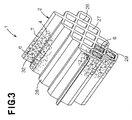
- Fig. 3 is a perspective view showing the water-absorbent structure 1 after the absorption of water.
- the cover sheets 3 are not illustrated and only the core 2 is illustrated.
- the water-absorbent structure 1 is adapted to absorb an amount of water permeating through the cover sheets 3 thereinto by the polymer particles 6 and the fluff pulp 7.
- the polymer particles 6 are swollen and softened as these particles 6 absorb water and the fluff pulp 7 also is softened as it absorbs water. Consequently the thermoplastic synthetic fibers 4 are now free from immobilization by these polymer particles 6 and the fluff pulp 7.
- the fibers 4 having been elastically deformed in the compressed core 2 are now able to move so as to be restored to the state prior to compression and swelling of the polymer particles 6 scattered in the interstices of the fibers 4 enhances enlargement of the interstices 32 to the initial state prior to compression.
- the partition walls 26 having been deformed to flatten the through-holes 27 can elastically move so as to restore the through-holes 27 to the initial shape in the stock panel 22.
- a relatively large amount of the polymer particles 6 may be distributed along respective crossways of the partition walls 26 and in the vicinity of these crossways to promote the partition walls 26 to rise from the collapsed state and to extend obliquely with respect to the direction Z as these particles 6 absorb water and swell.
- the core 2 swells toward its upper and lower surfaces 28, 29, i.e., in the direction Z as illustrated in Fig. 3 and the assembly of the thermoplastic synthetic fibers 4 restores its honeycomb construction illustrated in Fig. 2.
- a variation in the thickness thereof between before and after water-absorption depends on its variation due to swelling of the polymer particles 6 and its variation due to restoration of the honeycomb construction.
- the partition walls 26 forming the stock panel 22 and the through-holes 27 reappear as seen in Fig. 2.
- the polymer particles 6 are swollen and a part of them are inside the through-holes 27 out of the partition walls 26 in a swollen state.
- the through-holes 27 have a sufficient large cross-sectional dimension to prevent the through-holes 27 from being clogged up by the swollen polymer particles 6.
- a plurality of through-holes 27 extend parallel to one another in the direction parallel to the upper and lower surfaces 28, 29.
- the through-holes 27 Even if the interstices 32 of the thermoplastic synthetic fibers 4 in the core 2 are filled with the swollen polymer particles 6, the water-absorbent structure 1 maintains a high breathability. Even if the initial water absorption by the water-absorbent structure 1 causes the polymer particles 6 to form a gel block, the amount of water permeating thereafter into the water-absorbent structure 1 can spread via the through-holes 27 downward as well as laterally into the core 2 and can be absorbed by the polymer particles 6 even at the corners of the core 2.
- the water-absorbent structure 1 in the state as shown in Fig. 1 can be elastically compressed in its thickness direction so that the partition walls 26 themselves reduce the interstices 32 of the fibers 4 and the structure 1 as a whole can be elastically compressed so as to flatten the through-holes 27.
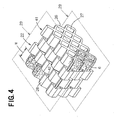
- Fig. 2 is a perspective view showing the stock panel 22 and the stock sheets 23 constituting the water-absorbent structure 1 in a manner different from the manner shown in Fig. 2.
- the stock sheets 23 are indicated by imaginary lines.
- a plurality of honeycomb thin leaves 41 having the same composition and construction as the stock panel 22 of Fig. 2 are used.
- Each of the thin leaves 41 has the partition walls 26 and a plurality of through-holes 27 defined by these partition walls 26 and preferably has a width W of 5 to 50mm in the direction in which the through-holes 27 extend.
- Fig. 5 is a partially cutaway perspective view showing a molding die 50 used to obtain the stock panel 22 as illustrated in Figs. 2 and 4.
- the molding die 50 comprises a box-like container 51 and a plurality of square pins 52 rising from within the container 51.
- the thermoplastic synthetic fibers 4, the super-absorbent polymer particles 6 and the fluff pulp 7 are mixed in a predetermined proportion and fed under the effect of air stream into the container 51. Then the container 51 is heated or the mixture including the fibers is subjected to hot air blast so that the thermoplastic synthetic fibers 4 are welded one another at cross-points thereof to form the three-dimensional web formation and at the same time to scatter the polymer particles 6 and the fluff pulp 7 in this web formation.
- thermoplastic synthetic fibers 4 may be taken out from the molding die 50 to obtain the stock panel 22 of Fig. 2, which has the through-holes 27 having the shapes corresponding to the pins 52.
- thermoplastic synthetic fibers 4 having a length of 5 to 50mm, more preferably of 5 to 30mm may be used to obtain the stock panel 22 in which the fiber orientation is relatively simple, the fibers 4, the polymer particles 6 and the fluff pulp 7 are rather uniformly mixed with one another.
- the super-absorbent polymer particles 6 may be replaced by a fibrous super-absorbent polymer. It is also possible to use a tissue paper as the stock sheets 23 serving to wrap the stock panel 22 and to cover this tissue paper with a nonwoven fabric or a perforated plastic film from above.
- the upper surface 28 and/or the lower surface 29 of the stock panel 22 may be flat instead of those repeating ups and downs.
- the water-absorbent structure 1 according to the invention may be directly used as water-absorbent product such as a wet wipes or a water-absorbent material or a part thereof used in a disposable wearing article for absorption and containment of body fluids such as a disposable diaper or a sanitary napkin.
- the water-absorbent structure according to this invention is in the form of honeycomb construction in which the fibrous assembly containing the super-absorbent polymer scattered therein and normally in a compressed state.
- the honeycomb construction is restored as the super-absorbent polymer is swollen and softened after absorption of water. This feature allows the water-absorbent structure to maintain the desired breathability and the compressive elasticity.
Landscapes
- Health & Medical Sciences (AREA)
- General Health & Medical Sciences (AREA)
- Veterinary Medicine (AREA)
- Biomedical Technology (AREA)
- Heart & Thoracic Surgery (AREA)
- Vascular Medicine (AREA)
- Life Sciences & Earth Sciences (AREA)
- Engineering & Computer Science (AREA)
- Public Health (AREA)
- Animal Behavior & Ethology (AREA)
- Epidemiology (AREA)
- Laminated Bodies (AREA)
- Absorbent Articles And Supports Therefor (AREA)
- Nonwoven Fabrics (AREA)
- Orthopedics, Nursing, And Contraception (AREA)
- Solid-Sorbent Or Filter-Aiding Compositions (AREA)
Abstract
Description
Claims (12)
- A water-absorbent structure comprising a panel-shaped assembly of thermoplastic synthetic fibers having upper and lower surfaces extending in parallel to each other, cellulose-based fibers and super-absorbent polymer adapted to be swollen after absorption of water both contained in said assembly of said thermoplastic synthetic fibers served as water-absorbing materials wherein at least one of said upper and lower surfaces is wrapped with water-pervious sheet, said water-absorbent structure further comprising:said assembly being in the form of a honeycomb construction adapted to be elastically compressed in a thickness direction and having a plurality of through-holes extending parallel to one another in a direction parallel to said upper and lower surfaces, each of said through-holes having a cross-sectional dimension larger than any one of interstices of said thermoplastic synthetic fibers in said assembly, wherein said assembly is normally kept in a state compressed in said thickness direction with said through-holes being flattened and adapted to be elastically swollen in said thickness direction so that said flattened through-holes are restored to the initial cross-sectional shape thereof as said super-absorbent polymer absorbs water and is swollen.
- The water-absorbent structure according to Claim 1, wherein said super-absorbent polymer is provided in particulate or fibrous form.
- The water-absorbent structure according to Claim 1, wherein said assembly comprises a plurality of honeycomb thin leaves placed upon one another in a transverse direction in which said through-holes extend, each of said honeycomb thin leaves have a width of 3 to 30mm as measured in said transverse direction.
- The water-absorbent structure according to Claim 3, wherein said through-holes in each pair of thin leaves adjacent to each other are at least partially connected.
- The water-absorbent structure according to Claim 1, wherein said thermoplastic synthetic fibers are of crimped-type.
- The water-absorbent structure according to Claim 1, wherein said assembly, said cellulose-based fibers and said super-absorbent polymer are mixed at a ratio of 5 - 80wt% : 5 - 60wt% : 10 - 80wt%.
- The water-absorbent structure according to Claim 1, wherein a cross-sectional shape of said through-hole is a substantially rectangle and one of diagonals of said rectangle is substantially in coincidence with said thickness direction.
- The water-absorbent structure according to Claim 1, wherein said assembly includes at least two said through-holes aligned in said thickness direction.
- Process for making a water-absorbent structure comprising a panel-shaped assembly of thermoplastic synthetic fibers having upper and lower surfaces extending in parallel to each other, cellulose-based fibers and super-absorbent polymer adapted to be swollen after absorption of water both contained in said assembly of said thermoplastic synthetic fibers served as water-absorbing materials wherein at least one of said upper and lower surfaces is wrapped with water-pervious sheets, said process being characterized by:said assembly is in the form of a honeycomb construction adapted to be elastically compressed in a thickness direction and having a plurality of through-holes extending parallel to one another in a direction parallel to said upper and lower surfaces, each of said through-holes has a cross-sectional dimension larger than any one of interstices of said thermoplastic synthetic fibers in said assembly, said process comprises the steps of:compressing said assembly in said thickness direction while said water absorbing materials are in a wetted condition so that said through-holes are flattened;drying said water absorbing materials so as to maintain said assembly in a compressed state; andwrapping at least one of said upper and lower surfaces with said water-pervious sheets before or after said step of compressing.
- The process according to Claim 9, wherein said super-absorbent polymer is provided in particulate or fibrous form.
- The process according to Claim 9, wherein said process further comprises the steps of feeding a mixture of said thermoplastic synthetic fibers, said cellulose-based fibers and said super-absorbent polymer into a molding die and welding said thermoplastic synthetic fibers at crossways thereof within said molding die under heating to obtain said assembly.
- The process according to Claim 9, wherein said assembly includes at least two said through-holes aligned in said thickness direction.
Applications Claiming Priority (2)
| Application Number | Priority Date | Filing Date | Title |
|---|---|---|---|
| JP2002185058A JP3875595B2 (en) | 2002-06-25 | 2002-06-25 | Water-absorbing structure and method for producing the same |
| JP2002185058 | 2002-06-25 |
Publications (3)
| Publication Number | Publication Date |
|---|---|
| EP1374816A2 true EP1374816A2 (en) | 2004-01-02 |
| EP1374816A3 EP1374816A3 (en) | 2004-10-13 |
| EP1374816B1 EP1374816B1 (en) | 2006-08-09 |
Family
ID=29717594
Family Applications (1)
| Application Number | Title | Priority Date | Filing Date |
|---|---|---|---|
| EP20030253950 Expired - Lifetime EP1374816B1 (en) | 2002-06-25 | 2003-06-23 | Water-absorbent structure and process for making the same |
Country Status (9)
| Country | Link |
|---|---|
| US (2) | US7135215B2 (en) |
| EP (1) | EP1374816B1 (en) |
| JP (1) | JP3875595B2 (en) |
| KR (1) | KR100848061B1 (en) |
| CN (1) | CN100396262C (en) |
| AT (1) | ATE335453T1 (en) |
| DE (1) | DE60307375T2 (en) |
| ES (1) | ES2266733T3 (en) |
| TW (1) | TW584555B (en) |
Cited By (2)
| Publication number | Priority date | Publication date | Assignee | Title |
|---|---|---|---|---|
| WO2009008788A1 (en) * | 2007-07-06 | 2009-01-15 | Sca Hygiene Products Ab | Absorbent structure |
| US9707311B2 (en) | 2007-08-03 | 2017-07-18 | BSN medical, GmbH | Wound care article having an absorbent shell |
Families Citing this family (13)
| Publication number | Priority date | Publication date | Assignee | Title |
|---|---|---|---|---|
| US7780643B2 (en) * | 2003-12-30 | 2010-08-24 | Sca Hygiene Products Ab | Absorbent article having X-shaped shaping element |
| US7772456B2 (en) * | 2004-06-30 | 2010-08-10 | Kimberly-Clark Worldwide, Inc. | Stretchable absorbent composite with low superaborbent shake-out |
| JP4480688B2 (en) * | 2005-03-23 | 2010-06-16 | 花王株式会社 | Absorbent articles |
| US20070225782A1 (en) * | 2005-09-15 | 2007-09-27 | John Taylor | Body cooling device |
| DE102008061536A1 (en) | 2008-12-03 | 2010-06-10 | Aesculap Ag | Medical-technical absorbent body, in particular for the removal of wound fluids from human and / or animal body cavities |
| US8628837B2 (en) | 2011-11-14 | 2014-01-14 | Empire Technology Development Llc | Composite and methods of making and using the same |
| BR112014015098A8 (en) * | 2011-12-23 | 2017-07-04 | Sca Hygiene Prod Ab | fibrous sheet material with two or more layers containing superabsorbent to produce it |
| KR101730786B1 (en) | 2014-04-30 | 2017-04-27 | 킴벌리-클라크 월드와이드, 인크. | Absorbent article including a fluid distributing structure |
| JP5933637B2 (en) * | 2014-06-30 | 2016-06-15 | ユニ・チャーム株式会社 | Absorber for body fluid absorbent article |
| CN107582243A (en) * | 2016-07-07 | 2018-01-16 | 叶正瑜 | A kind of breast pad with novel absorbing layer |
| CN107726035B (en) * | 2017-10-31 | 2020-05-22 | 西安交通大学 | An accordion honeycomb structure |
| USD956377S1 (en) | 2018-06-26 | 2022-06-28 | The Procter & Gamble Company | Sponge |
| CN110833483A (en) * | 2019-12-06 | 2020-02-25 | 沙洲职业工学院 | A tampon that prevents blood clots from accumulating |
Family Cites Families (11)
| Publication number | Priority date | Publication date | Assignee | Title |
|---|---|---|---|---|
| US4500315A (en) * | 1982-11-08 | 1985-02-19 | Personal Products Company | Superthin absorbent product |
| JPH0638814B2 (en) * | 1988-09-08 | 1994-05-25 | ユニ・チャーム株式会社 | Absorbent body for absorbent article and manufacturing method thereof |
| US5098423A (en) * | 1988-10-27 | 1992-03-24 | Mcneil-Ppc, Inc. | Low bulk disposable diaper |
| US5277854A (en) * | 1991-06-06 | 1994-01-11 | Hunt John F | Methods and apparatus for making grids from fibers |
| ES2144601T3 (en) * | 1993-11-17 | 2000-06-16 | Procter & Gamble | PROCESS TO PRODUCE ABSORBENT STRUCTURES. |
| US5643238A (en) * | 1995-09-29 | 1997-07-01 | Paragon Trade Brands, Inc. | Absorbent core structure comprised of storage and acquisition cells |
| GB9703427D0 (en) * | 1997-02-19 | 1997-04-09 | Venturi Ivo A | A disposable towel |
| JP3196933B2 (en) * | 1999-09-29 | 2001-08-06 | 株式会社日本吸収体技術研究所 | Water-absorbing composite surface-coated with fibrous hot melt, method for producing the same, and absorbent article |
| JP3681320B2 (en) * | 2000-03-31 | 2005-08-10 | ユニ・チャーム株式会社 | Body fluid absorbent article |
| US20030104748A1 (en) * | 2001-12-03 | 2003-06-05 | Brown Kurtis Lee | Helically crimped, shaped, single polymer fibers and articles made therefrom |
| US7799968B2 (en) * | 2001-12-21 | 2010-09-21 | Kimberly-Clark Worldwide, Inc. | Sponge-like pad comprising paper layers and method of manufacture |
-
2002
- 2002-06-25 JP JP2002185058A patent/JP3875595B2/en not_active Expired - Fee Related
-
2003
- 2003-06-23 AT AT03253950T patent/ATE335453T1/en not_active IP Right Cessation
- 2003-06-23 ES ES03253950T patent/ES2266733T3/en not_active Expired - Lifetime
- 2003-06-23 DE DE2003607375 patent/DE60307375T2/en not_active Expired - Lifetime
- 2003-06-23 EP EP20030253950 patent/EP1374816B1/en not_active Expired - Lifetime
- 2003-06-24 US US10/602,960 patent/US7135215B2/en not_active Expired - Fee Related
- 2003-06-24 KR KR1020030040930A patent/KR100848061B1/en not_active Expired - Fee Related
- 2003-06-24 TW TW92117163A patent/TW584555B/en not_active IP Right Cessation
- 2003-06-25 CN CNB03149076XA patent/CN100396262C/en not_active Expired - Fee Related
-
2006
- 2006-08-22 US US11/507,785 patent/US7560002B2/en not_active Expired - Fee Related
Cited By (2)
| Publication number | Priority date | Publication date | Assignee | Title |
|---|---|---|---|---|
| WO2009008788A1 (en) * | 2007-07-06 | 2009-01-15 | Sca Hygiene Products Ab | Absorbent structure |
| US9707311B2 (en) | 2007-08-03 | 2017-07-18 | BSN medical, GmbH | Wound care article having an absorbent shell |
Also Published As
| Publication number | Publication date |
|---|---|
| TW200403043A (en) | 2004-03-01 |
| US7135215B2 (en) | 2006-11-14 |
| EP1374816A3 (en) | 2004-10-13 |
| US20040013847A1 (en) | 2004-01-22 |
| JP2004025604A (en) | 2004-01-29 |
| DE60307375T2 (en) | 2007-08-23 |
| DE60307375D1 (en) | 2006-09-21 |
| EP1374816B1 (en) | 2006-08-09 |
| JP3875595B2 (en) | 2007-01-31 |
| ATE335453T1 (en) | 2006-09-15 |
| KR100848061B1 (en) | 2008-07-23 |
| CN1468589A (en) | 2004-01-21 |
| US7560002B2 (en) | 2009-07-14 |
| KR20040002648A (en) | 2004-01-07 |
| TW584555B (en) | 2004-04-21 |
| ES2266733T3 (en) | 2007-03-01 |
| US20060280900A1 (en) | 2006-12-14 |
| CN100396262C (en) | 2008-06-25 |
Similar Documents
| Publication | Publication Date | Title |
|---|---|---|
| EP1374816B1 (en) | Water-absorbent structure and process for making the same | |
| US4381783A (en) | Absorbent article | |
| USRE32957E (en) | Absorbent article | |
| RU2238761C2 (en) | Absorption article having covering nonwoven-material layer comprising zone with three-dimensional profile | |
| US6162961A (en) | Absorbent article | |
| KR960006058B1 (en) | High density absorbent members, absorbent cores and absorbent products, including absorbent bands of low density and low basis weight | |
| US5891119A (en) | Absorptive article | |
| KR100322309B1 (en) | Absorbent member with low density and low basis weight capture band | |
| CN1736355B (en) | Absorbent article | |
| RU2754248C1 (en) | Absorbent product | |
| JPH024705B2 (en) | ||
| KR20000022310A (en) | Absorbent bodies in absorbent articles having improved liquid acquisition properties | |
| EP0512016A1 (en) | Hygienic absorbent products | |
| JPH08503396A (en) | Method of manufacturing absorbent structure and absorbent article comprising absorbent structure manufactured by this method | |
| WO2017150358A1 (en) | Disposable diaper | |
| JP2017153587A5 (en) | ||
| PL172682B1 (en) | Multiple layer non-woven fabric and moisture absorbing hygenic product incorporating it | |
| CN114206289A (en) | Absorbent article | |
| JPH0956748A (en) | Absorbent article | |
| EP4129260B1 (en) | Absorbent article | |
| US6146568A (en) | Method of making an absorbent member | |
| CN114206287B (en) | Absorbent article | |
| JP2021153716A5 (en) | ||
| JP3505868B2 (en) | Absorbent articles | |
| CN114206291A (en) | Absorbent article |
Legal Events
| Date | Code | Title | Description |
|---|---|---|---|
| PUAI | Public reference made under article 153(3) epc to a published international application that has entered the european phase |
Free format text: ORIGINAL CODE: 0009012 |
|
| AK | Designated contracting states |
Kind code of ref document: A2 Designated state(s): AT BE BG CH CY CZ DE DK EE ES FI FR GB GR HU IE IT LI LU MC NL PT RO SE SI SK TR |
|
| AX | Request for extension of the european patent |
Extension state: AL LT LV MK |
|
| RAP1 | Party data changed (applicant data changed or rights of an application transferred) |
Owner name: UNI-CHARM CORPORATION |
|
| PUAL | Search report despatched |
Free format text: ORIGINAL CODE: 0009013 |
|
| AK | Designated contracting states |
Kind code of ref document: A3 Designated state(s): AT BE BG CH CY CZ DE DK EE ES FI FR GB GR HU IE IT LI LU MC NL PT RO SE SI SK TR |
|
| AX | Request for extension of the european patent |
Extension state: AL LT LV MK |
|
| 17P | Request for examination filed |
Effective date: 20050307 |
|
| AKX | Designation fees paid |
Designated state(s): AT BE BG CH CY CZ DE DK EE ES FI FR GB GR HU IE IT LI LU MC NL PT RO SE SI SK TR |
|
| GRAP | Despatch of communication of intention to grant a patent |
Free format text: ORIGINAL CODE: EPIDOSNIGR1 |
|
| GRAS | Grant fee paid |
Free format text: ORIGINAL CODE: EPIDOSNIGR3 |
|
| GRAA | (expected) grant |
Free format text: ORIGINAL CODE: 0009210 |
|
| AK | Designated contracting states |
Kind code of ref document: B1 Designated state(s): AT BE BG CH CY CZ DE DK EE ES FI FR GB GR HU IE IT LI LU MC NL PT RO SE SI SK TR |
|
| PG25 | Lapsed in a contracting state [announced via postgrant information from national office to epo] |
Ref country code: IT Free format text: LAPSE BECAUSE OF FAILURE TO SUBMIT A TRANSLATION OF THE DESCRIPTION OR TO PAY THE FEE WITHIN THE PRESCRIBED TIME-LIMIT;WARNING: LAPSES OF ITALIAN PATENTS WITH EFFECTIVE DATE BEFORE 2007 MAY HAVE OCCURRED AT ANY TIME BEFORE 2007. THE CORRECT EFFECTIVE DATE MAY BE DIFFERENT FROM THE ONE RECORDED. Effective date: 20060809 Ref country code: CH Free format text: LAPSE BECAUSE OF FAILURE TO SUBMIT A TRANSLATION OF THE DESCRIPTION OR TO PAY THE FEE WITHIN THE PRESCRIBED TIME-LIMIT Effective date: 20060809 Ref country code: AT Free format text: LAPSE BECAUSE OF FAILURE TO SUBMIT A TRANSLATION OF THE DESCRIPTION OR TO PAY THE FEE WITHIN THE PRESCRIBED TIME-LIMIT Effective date: 20060809 Ref country code: CZ Free format text: LAPSE BECAUSE OF FAILURE TO SUBMIT A TRANSLATION OF THE DESCRIPTION OR TO PAY THE FEE WITHIN THE PRESCRIBED TIME-LIMIT Effective date: 20060809 Ref country code: RO Free format text: LAPSE BECAUSE OF FAILURE TO SUBMIT A TRANSLATION OF THE DESCRIPTION OR TO PAY THE FEE WITHIN THE PRESCRIBED TIME-LIMIT Effective date: 20060809 Ref country code: LI Free format text: LAPSE BECAUSE OF FAILURE TO SUBMIT A TRANSLATION OF THE DESCRIPTION OR TO PAY THE FEE WITHIN THE PRESCRIBED TIME-LIMIT Effective date: 20060809 Ref country code: FI Free format text: LAPSE BECAUSE OF FAILURE TO SUBMIT A TRANSLATION OF THE DESCRIPTION OR TO PAY THE FEE WITHIN THE PRESCRIBED TIME-LIMIT Effective date: 20060809 Ref country code: SK Free format text: LAPSE BECAUSE OF FAILURE TO SUBMIT A TRANSLATION OF THE DESCRIPTION OR TO PAY THE FEE WITHIN THE PRESCRIBED TIME-LIMIT Effective date: 20060809 Ref country code: SI Free format text: LAPSE BECAUSE OF FAILURE TO SUBMIT A TRANSLATION OF THE DESCRIPTION OR TO PAY THE FEE WITHIN THE PRESCRIBED TIME-LIMIT Effective date: 20060809 |
|
| REG | Reference to a national code |
Ref country code: GB Ref legal event code: FG4D |
|
| REG | Reference to a national code |
Ref country code: CH Ref legal event code: EP |
|
| REG | Reference to a national code |
Ref country code: IE Ref legal event code: FG4D |
|
| REF | Corresponds to: |
Ref document number: 60307375 Country of ref document: DE Date of ref document: 20060921 Kind code of ref document: P |
|
| REG | Reference to a national code |
Ref country code: SE Ref legal event code: TRGR |
|
| PG25 | Lapsed in a contracting state [announced via postgrant information from national office to epo] |
Ref country code: BG Free format text: LAPSE BECAUSE OF FAILURE TO SUBMIT A TRANSLATION OF THE DESCRIPTION OR TO PAY THE FEE WITHIN THE PRESCRIBED TIME-LIMIT Effective date: 20061109 Ref country code: DK Free format text: LAPSE BECAUSE OF FAILURE TO SUBMIT A TRANSLATION OF THE DESCRIPTION OR TO PAY THE FEE WITHIN THE PRESCRIBED TIME-LIMIT Effective date: 20061109 |
|
| PG25 | Lapsed in a contracting state [announced via postgrant information from national office to epo] |
Ref country code: PT Free format text: LAPSE BECAUSE OF FAILURE TO SUBMIT A TRANSLATION OF THE DESCRIPTION OR TO PAY THE FEE WITHIN THE PRESCRIBED TIME-LIMIT Effective date: 20070109 |
|
| REG | Reference to a national code |
Ref country code: CH Ref legal event code: PL |
|
| REG | Reference to a national code |
Ref country code: ES Ref legal event code: FG2A Ref document number: 2266733 Country of ref document: ES Kind code of ref document: T3 |
|
| ET | Fr: translation filed | ||
| PLBE | No opposition filed within time limit |
Free format text: ORIGINAL CODE: 0009261 |
|
| STAA | Information on the status of an ep patent application or granted ep patent |
Free format text: STATUS: NO OPPOSITION FILED WITHIN TIME LIMIT |
|
| 26N | No opposition filed |
Effective date: 20070510 |
|
| PG25 | Lapsed in a contracting state [announced via postgrant information from national office to epo] |
Ref country code: MC Free format text: LAPSE BECAUSE OF NON-PAYMENT OF DUE FEES Effective date: 20070630 |
|
| PG25 | Lapsed in a contracting state [announced via postgrant information from national office to epo] |
Ref country code: GR Free format text: LAPSE BECAUSE OF FAILURE TO SUBMIT A TRANSLATION OF THE DESCRIPTION OR TO PAY THE FEE WITHIN THE PRESCRIBED TIME-LIMIT Effective date: 20061110 |
|
| PG25 | Lapsed in a contracting state [announced via postgrant information from national office to epo] |
Ref country code: IE Free format text: LAPSE BECAUSE OF NON-PAYMENT OF DUE FEES Effective date: 20070625 |
|
| PG25 | Lapsed in a contracting state [announced via postgrant information from national office to epo] |
Ref country code: EE Free format text: LAPSE BECAUSE OF FAILURE TO SUBMIT A TRANSLATION OF THE DESCRIPTION OR TO PAY THE FEE WITHIN THE PRESCRIBED TIME-LIMIT Effective date: 20060809 |
|
| PG25 | Lapsed in a contracting state [announced via postgrant information from national office to epo] |
Ref country code: CY Free format text: LAPSE BECAUSE OF FAILURE TO SUBMIT A TRANSLATION OF THE DESCRIPTION OR TO PAY THE FEE WITHIN THE PRESCRIBED TIME-LIMIT Effective date: 20060809 Ref country code: LU Free format text: LAPSE BECAUSE OF NON-PAYMENT OF DUE FEES Effective date: 20070623 |
|
| PG25 | Lapsed in a contracting state [announced via postgrant information from national office to epo] |
Ref country code: HU Free format text: LAPSE BECAUSE OF FAILURE TO SUBMIT A TRANSLATION OF THE DESCRIPTION OR TO PAY THE FEE WITHIN THE PRESCRIBED TIME-LIMIT Effective date: 20070210 Ref country code: TR Free format text: LAPSE BECAUSE OF FAILURE TO SUBMIT A TRANSLATION OF THE DESCRIPTION OR TO PAY THE FEE WITHIN THE PRESCRIBED TIME-LIMIT Effective date: 20060809 |
|
| PGFP | Annual fee paid to national office [announced via postgrant information from national office to epo] |
Ref country code: ES Payment date: 20120621 Year of fee payment: 10 |
|
| PGFP | Annual fee paid to national office [announced via postgrant information from national office to epo] |
Ref country code: GB Payment date: 20130619 Year of fee payment: 11 Ref country code: DE Payment date: 20130619 Year of fee payment: 11 Ref country code: SE Payment date: 20130612 Year of fee payment: 11 |
|
| PGFP | Annual fee paid to national office [announced via postgrant information from national office to epo] |
Ref country code: FR Payment date: 20130624 Year of fee payment: 11 Ref country code: NL Payment date: 20130615 Year of fee payment: 11 Ref country code: IT Payment date: 20130618 Year of fee payment: 11 |
|
| PGFP | Annual fee paid to national office [announced via postgrant information from national office to epo] |
Ref country code: BE Payment date: 20130614 Year of fee payment: 11 |
|
| REG | Reference to a national code |
Ref country code: DE Ref legal event code: R119 Ref document number: 60307375 Country of ref document: DE |
|
| REG | Reference to a national code |
Ref country code: NL Ref legal event code: V1 Effective date: 20150101 |
|
| PG25 | Lapsed in a contracting state [announced via postgrant information from national office to epo] |
Ref country code: SE Free format text: LAPSE BECAUSE OF NON-PAYMENT OF DUE FEES Effective date: 20140624 |
|
| REG | Reference to a national code |
Ref country code: SE Ref legal event code: EUG |
|
| GBPC | Gb: european patent ceased through non-payment of renewal fee |
Effective date: 20140623 |
|
| REG | Reference to a national code |
Ref country code: DE Ref legal event code: R119 Ref document number: 60307375 Country of ref document: DE Effective date: 20150101 |
|
| REG | Reference to a national code |
Ref country code: FR Ref legal event code: ST Effective date: 20150227 |
|
| PG25 | Lapsed in a contracting state [announced via postgrant information from national office to epo] |
Ref country code: NL Free format text: LAPSE BECAUSE OF NON-PAYMENT OF DUE FEES Effective date: 20150101 |
|
| PG25 | Lapsed in a contracting state [announced via postgrant information from national office to epo] |
Ref country code: DE Free format text: LAPSE BECAUSE OF NON-PAYMENT OF DUE FEES Effective date: 20150101 Ref country code: IT Free format text: LAPSE BECAUSE OF NON-PAYMENT OF DUE FEES Effective date: 20140623 |
|
| PG25 | Lapsed in a contracting state [announced via postgrant information from national office to epo] |
Ref country code: FR Free format text: LAPSE BECAUSE OF NON-PAYMENT OF DUE FEES Effective date: 20140630 Ref country code: GB Free format text: LAPSE BECAUSE OF NON-PAYMENT OF DUE FEES Effective date: 20140623 |
|
| REG | Reference to a national code |
Ref country code: ES Ref legal event code: FD2A Effective date: 20150724 |
|
| PG25 | Lapsed in a contracting state [announced via postgrant information from national office to epo] |
Ref country code: ES Free format text: LAPSE BECAUSE OF NON-PAYMENT OF DUE FEES Effective date: 20140624 |
|
| PG25 | Lapsed in a contracting state [announced via postgrant information from national office to epo] |
Ref country code: BE Free format text: LAPSE BECAUSE OF NON-PAYMENT OF DUE FEES Effective date: 20140630 |