EP1374207B1 - Cavitated labels for use with cold glue - Google Patents
Cavitated labels for use with cold glue Download PDFInfo
- Publication number
- EP1374207B1 EP1374207B1 EP02707441A EP02707441A EP1374207B1 EP 1374207 B1 EP1374207 B1 EP 1374207B1 EP 02707441 A EP02707441 A EP 02707441A EP 02707441 A EP02707441 A EP 02707441A EP 1374207 B1 EP1374207 B1 EP 1374207B1
- Authority
- EP
- European Patent Office
- Prior art keywords
- skin layer
- thermoplastic
- label
- label according
- layer
- Prior art date
- Legal status (The legal status is an assumption and is not a legal conclusion. Google has not performed a legal analysis and makes no representation as to the accuracy of the status listed.)
- Revoked
Links
Images
Classifications
-
- G—PHYSICS
- G09—EDUCATION; CRYPTOGRAPHY; DISPLAY; ADVERTISING; SEALS
- G09F—DISPLAYING; ADVERTISING; SIGNS; LABELS OR NAME-PLATES; SEALS
- G09F3/00—Labels, tag tickets, or similar identification or indication means; Seals; Postage or like stamps
- G09F3/02—Forms or constructions
-
- B—PERFORMING OPERATIONS; TRANSPORTING
- B32—LAYERED PRODUCTS
- B32B—LAYERED PRODUCTS, i.e. PRODUCTS BUILT-UP OF STRATA OF FLAT OR NON-FLAT, e.g. CELLULAR OR HONEYCOMB, FORM
- B32B27/00—Layered products comprising a layer of synthetic resin
- B32B27/32—Layered products comprising a layer of synthetic resin comprising polyolefins
-
- B—PERFORMING OPERATIONS; TRANSPORTING
- B32—LAYERED PRODUCTS
- B32B—LAYERED PRODUCTS, i.e. PRODUCTS BUILT-UP OF STRATA OF FLAT OR NON-FLAT, e.g. CELLULAR OR HONEYCOMB, FORM
- B32B3/00—Layered products comprising a layer with external or internal discontinuities or unevennesses, or a layer of non-planar shape; Layered products comprising a layer having particular features of form
- B32B3/26—Layered products comprising a layer with external or internal discontinuities or unevennesses, or a layer of non-planar shape; Layered products comprising a layer having particular features of form characterised by a particular shape of the outline of the cross-section of a continuous layer; characterised by a layer with cavities or internal voids ; characterised by an apertured layer
-
- G—PHYSICS
- G09—EDUCATION; CRYPTOGRAPHY; DISPLAY; ADVERTISING; SEALS
- G09F—DISPLAYING; ADVERTISING; SIGNS; LABELS OR NAME-PLATES; SEALS
- G09F3/00—Labels, tag tickets, or similar identification or indication means; Seals; Postage or like stamps
- G09F3/04—Labels, tag tickets, or similar identification or indication means; Seals; Postage or like stamps to be fastened or secured by the material of the label itself, e.g. by thermo-adhesion
-
- G—PHYSICS
- G09—EDUCATION; CRYPTOGRAPHY; DISPLAY; ADVERTISING; SEALS
- G09F—DISPLAYING; ADVERTISING; SIGNS; LABELS OR NAME-PLATES; SEALS
- G09F3/00—Labels, tag tickets, or similar identification or indication means; Seals; Postage or like stamps
- G09F3/02—Forms or constructions
- G09F2003/0257—Multilayer
-
- Y—GENERAL TAGGING OF NEW TECHNOLOGICAL DEVELOPMENTS; GENERAL TAGGING OF CROSS-SECTIONAL TECHNOLOGIES SPANNING OVER SEVERAL SECTIONS OF THE IPC; TECHNICAL SUBJECTS COVERED BY FORMER USPC CROSS-REFERENCE ART COLLECTIONS [XRACs] AND DIGESTS
- Y10—TECHNICAL SUBJECTS COVERED BY FORMER USPC
- Y10T—TECHNICAL SUBJECTS COVERED BY FORMER US CLASSIFICATION
- Y10T428/00—Stock material or miscellaneous articles
- Y10T428/13—Hollow or container type article [e.g., tube, vase, etc.]
Definitions
- labeling may be silk screen imprinted on the container surface in a designated label-receiving area, and/or on non-designated surface area concurrently with barrier coating of the designated area.
- a gas-blocking clear ink barrier layer may be silk screened over the silk screen imprinting, and then the label applied over the gas-blocking layer of clear ink when dry.
- the label may be "peelable" for customer rebate return without thereby altering the labeling information remaining on the container.
- the pre-printed label may be a replicate of the label-covered imprinting so that the "trade dress" need not be altered by the peelable label, and so that the container surface area available for permanent labeling is maximized.
- the label 10 can be transparent or opaque.
- the label 10 is white opaque.
- this provides an excellent contrasting background for printed material applied to the second side 106 of the core layer 14 or to the surface (not shown) of the second skin layer (not shown) of the label 10.
- Another embodiment has a metal coating applied to the second skin layer (not shown).
- the microspheres can be conveniently prepared in a master batch of, e.g., polybutylene terephthalate, micro dispersed in molten form in molten polypropylene. This combination is then coextruded with a first skin layer 12 and a second skin layer (not shown) so as to have two skin layers on opposite surfaces of the core 14 comprising a combination of the materials. In one embodiment, thereafter, this arrangement is biaxially oriented at a temperature and to a degree to form a strata of opacifying closed cell voids of dimensions X, Y and Z. Dimensions X and Y are major dimensions and dimension Z is a minor dimension at least generally corresponding to the diameter of the microspheres.
Landscapes
- Physics & Mathematics (AREA)
- General Physics & Mathematics (AREA)
- Engineering & Computer Science (AREA)
- Theoretical Computer Science (AREA)
- Laminated Bodies (AREA)
- Details Of Rigid Or Semi-Rigid Containers (AREA)
- Adhesive Tapes (AREA)
- Thermotherapy And Cooling Therapy Devices (AREA)
Abstract
Description
- This invention relates to labels generally, and more specifically but without limitation to die cut or patch labels for use with cold glue, and to films for making such labels. In one aspect the invention relates to the use of such labels on substrates, where the label forms a destruct bond with the substrate such that the label delaminates. In another aspect, the invention relates to such labels which possess the beneficial properties of the known thermoplastic labels, but which exhibit improved initial adhesion and destruct bonding such as delamination.
- In many label applications, it is desirable that the label stock from which the labels are cut be a film of polymeric material rather than paper. Polymeric film can provide one or more of the following properties lacking in paper, such as durability, strength, water resistance, curl resistance, abrasion resistance, gloss, transparency and other properties. Obviously, the polymeric material must meet the practical requirements of commercial manufacture and use. Material costs must be competitive. The film must be formable by a suitable commercial process such as cast film extrusion or blown film extrusion, requiring that the molten film material be flowable to the correct degree to accomplish proper film formation. The formed film must be capable of hot-stretching without deleterious effect, since it is generally advantageous to hot-stretch and anneal the formed film, so as to orient the film and impart a stiffness to the film that is different in machine and cross directions. The film must have a printable face and be die-cuttable and matrix-strippable when used in a pressure-sensitive label construction.
- In the die cut, cold glue label applications, there are certain other desired characteristics. Cold glues are widely used as an economical alternative to wrap around or pressure sensitive labels. Cold glue labels must be capable of providing a means for drying the adhesive and providing good initial adhesion, while not exhibiting visual defects.
- Olefin blends have been found in many respects to be a preferred material to meet the demands of polymeric die-cut label manufacture. The relatively low cost of the olefinic resins, and their high strength allowing for low caliper film, tend to minimize overall material cost. Hot-stretched polypropylene and/or polyethylene provides stiffness in the machine direction even at relatively low-caliper thicknesses for adequate print registration and dispensing while providing sufficiently low tensile modulus and particularly sufficiently high elongation in the cross direction to allow good conformability.
- Olefin blends have been found useful to produce, on an economical basis, printable 88.9 µm (3.5 mil)(caliper measured) coextruded labels die-cut from biaxially hot-stretched film that are durable, strong and water-resistant, and that generally have good structural and surface properties and performance characteristics. Biaxial stretching also makes an important contribution to performance by creating substantial differentials between machine direction (MD) and cross direction (CD) stiffnesses, tensile moduli, elongations, and other properties.
- Paper labels have been used in the art in conjunction with a cold glue adhesive for application to glass and plastic containers. The paper labels exhibit good initial adhesion, adhesive drying, and destruct bonds.
- U.S. Patent No. 4,060,168 discloses a label assembly that includes a strip or web of backing material with a series of printed labels arranged in serial order. The backing material includes a die cut portion opposed to the label, which remains adhered to the label upon application of the label to a container. The cut portion may include printing and serves as a promotional item with improved pilfer resistance.
- U.S. Patent No. 5,061,334 discloses a high speed labeling machine and method for transferring labels to articles such as cans. The labeling machine includes a device for supplying articles to be labeled, a label transfer wheel provided with individual groups of closely spaced vacuum holddown ports to enable a succession of closely spaced labels to be supported by the transfer wheel and carried by the transfer wheel to the articles, and a pressure severing device for releasing the label from a carrier stock for subsequent transfer from a transfer wheel to the article to be labeled. Sprocket holes are utilized to align very precisely a label; such labels may be die cut on the printing press and retained on the carrier by pinpoint attachments or they may be die cut as the label is advanced. In one particular embodiment, single layer label tapes with release agent on one surface and a pressure sensitive adhesive on the other surface provide added advantages of smaller spool sizes and faster speeds. Single layer label tapes also make tamper-evident packaging very versatile and advantageous. Another aspect disclosed in this patent is the significantly improved economics by reducing the number of layers to one instead of two for normal pressure sensitive labels as well as by eliminating the cost and problems associated with using glue applicators with many types of labeling products.
- U.S. Patent No. 5,174,852 discloses a method for attaching labels to containers where the labels are removed from a stack by rolling contact with an adhesive surface coated with a cold glue. Additionally, prior to termination of the removing step, localized hot glue coating is applied to the foremost label in the stack. After the label has thus been coated with cold glue and hot glue, it is peeled off the adhesive surface and pressed into contact of its glue-coated backside with a container. The provision that the hot glue coating is applied to the label while it is still held in the magazine ensures that the shape and position of the hot glue coating is fully independent of the speed of the labeling operation.
- U.S. Patent No. 5,288,548 discloses a multilayer label stock structure comprising a label stock of polypropylene film having on one side thereof a highly printable blend of (A) alkaline acrylate copolymer and (B) an interpolymer of an alkyl acrylate, an alkyl methacrylate and an alkyl acrylate acid.
- U.S. Patent No. 5,486,253 discloses a method of labeling containers utilizing a labeler having a multiple port vacuum drum. The multiple port vacuum drum has a first cavity which is supplied with one level of vacuum suitable for picking up label segments from a cutter with limited tension. The vacuum drum has a second cavity, which is supplied with another, higher level of vacuum suitable for firmly griping the label segments as an adhesive or the like is applied to the label segment. The second cavity may be further divided into a-label application segment with lower vacuum pressure. The cutter drum has an arcuate cavity to which vacuum is supplied at the end first contacting the labeling material web with reduced vacuum being provided at the label cut off point and label release point.
- U.S. Patent No. 5,897,722 discloses a process for applying labels to articles by first adhering a limited portion of the label to the article and subsequently making additional portions of the label adhesive so that they will adhere to the article after the label is affixed to the article. The leading and trailing edges of the label may be bonded to the article or each other to affix the label to a container or other such article. The portions of the label between the leading and trailing edges may be either provided with an adhesive agent that is in a non-adhesive state or be formed from a label material which is not normally adhesive but can be rendered adhesive through an additional process step. For example, coated polyethylene film can be applied to a container by means of a hot melt adhesive and then subsequently heated to a temperature at which the polyethylene material becomes adhesive causing it to stick to the container. Other labeling materials can be printed with an adhesive that remains substantially non-adhesive until heated or activated by means of radiation, application of a chemical activating agent or by application of mechanical force.
- U.S. Patent No. 6,083,342 discloses a system and method for rapidly labeling a blow-molded hollow container made of a plastic composition subject to out-gassing after de-molding. Otherwise, conventional high speed silk screen labeling technology and processing is employed shortly after container fabrication de-molding in order to accurately deposit a continuous liquid layer of conventional silk screen ink over an external container surface area designated for application thereon of a self-adhering pre-printed label. The label is rapidly and accurately transfer applied over the silk screen coated area immediately after the same has dried, and even while out-gassing is still occurring from the de-molded to container. However, the protective ink barrier coating prevents formation of bubbles beneath the label. Those gases in the container wall resident beneath the label-affixed area can then nevertheless out-gas by migrating out of the container internal wall surface. Also, labeling may be silk screen imprinted on the container surface in a designated label-receiving area, and/or on non-designated surface area concurrently with barrier coating of the designated area. A gas-blocking clear ink barrier layer may be silk screened over the silk screen imprinting, and then the label applied over the gas-blocking layer of clear ink when dry. The label may be "peelable" for customer rebate return without thereby altering the labeling information remaining on the container. The pre-printed label may be a replicate of the label-covered imprinting so that the "trade dress" need not be altered by the peelable label, and so that the container surface area available for permanent labeling is maximized.
- U.S. Patent No. 6,139,935 discloses an oxygen-absorbing label consisting of a base sheet, adhesive on the base sheet for securing the base sheet to an internal surface of a container, an oxygen-absorbing composition on the base sheet, and a cover sheet secured to the base sheet to confine the oxygen-absorbing composition there between. The cover sheet being fabricated of material which will permit oxygen to pass there through but will not stain due to the oxidation of the oxygen-absorbing composition or due to contact with materials in the container. A plurality of the foregoing labels are mounted on a web to be used with conventional labeling equipment.
- A thermoplastic label for use with a cold glue adhesive is disclosed herein. The label comprises a first skin layer comprising a thermoplastic and a first cavitating agent wherein the first skin layer has a first side and a second side, and the first skin layer is cavitated wherein the first side of the first skin layer is adapted to be used in contact with a cold glue adhesive. The first cavitating agent comprises at least 25% by weight of the first skin layer. The thermoplastic is polypropylene. The label has either a first skin layer thickness of at least 7.6 µm (0.3 mil) or the first skin layer comprises at least 15% by weight of the thermoplastic label.
- Also disclosed herein is a process comprising providing a label as previously described, applying a cold glue adhesive to the label and applying the label to a container. A container comprising the label previously described is also disclosed herein.
- Advantages of the thermoplastic label include one or more of the following:
- 1. A label that can be used with cold glue.
- 2. A label that exhibits good initial adhesion when used with a cold glue.
- 3. A label that exhibits destruct bonds when used with a cold glue.
- 4. A label that exhibits delamination when used with a cold glue.
- 5. A label that is an economical alternative to wrap around or pressure sensitive labels.
- 6. A label that exhibits the properties of durability, strength, water resistance, abrasion resistance, gloss, transparency and/or other properties.
-
-
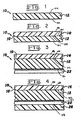
- FIG. 1 is a cross-sectional view of a thermoplastic label constructed in accordance with the present invention and comprising a first skin layer as previously described.
- FIG. 2 is a cross-sectional view of the thermoplastic label of FIG. 1, with a core layer added.
- FIG. 3 is a cross-sectional view of the thermoplastic label of FIG. 2, with a cold glue applied to the first skin layer.
- FIG. 4 is a cross-sectional view of the label shown in FIG. 3, as attached to a container.
-
- Referring now to the accompanying figures 1-4, the present invention is illustrated in its various aspects.
- Referring to Figure 1,
thermoplastic label 10 comprises afirst skin layer 12 comprising a thermoplastic and a first cavitating agent. Thefirst skin layer 12 has afirst side 101 and asecond side 102 and is cavitated. The first cavitating agent comprises at least 35% by weight of thefirst skin layer 12 , and the thermoplastic is polypropylene. Thefirst skin layer 12 has a thickness of at least 7.6 µm (0.3 mil) or comprises at least 15% by weight of thethermoplastic label 10. - In one embodiment the polypropylene of the
first skin layer 12 is a homopolymer polypropylene. Suitable polypropylenes can include a standard film grade isotactic polypropylene or a high crystalline polypropylene. - In another embodiment the first cavitating agent is calcium carbonate comprising 25 percent or more by weight of the first skin layer. In another embodiment the calcium carbonate comprises 35 percent or more by weight of the first skin layer. In another embodiment the calcium carbonate comprises 50 percent or more by weight of the first skin layer.
- In another embodiment the
first side 101 of thefirst skin layer 12 has holes formed by the cavitating agent. In another embodiment, the median particle size of the cavitating agent is 1.4 microns. In another embodiment, the median particle size of the cavitating agent is 3.2 microns. In another embodiment, the median particle size of the cavitating agent is at least 1.4 microns. In another embodiment the median particle size of the cavitating agent is at least 3.2 microns. - Possible first cavitating agents include polyamides, polybutylene terephthalate, polyesters, acetals, acrylic resins, nylons, solid preformed glass spheres, hollow preformed glass spheres, metal beads, metal spheres, ceramic spheres, calcium carbonate, and mixtures thereof.
- In one embodiment the
label 10 has thickness from 25.4-254 µm (1 mil. to 10 mils). In another embodiment, thelabel 10 has thickness from 76.2-127 µm (3 mils. to 5 mils). In another embodiment, thelabel 10 is uniaxially oriented In another embodiment, thelabel 10 is biaxially oriented. - In one embodiment the
first skin layer 12 of thethermoplastic label 10 comprises at least 15 percent by weight of thethermoplastic label 10. In another embodiment thefirst skin layer 12 comprises at least 30 percent by weight of thethermoplastic label 10. - Referring now to figure 2 is a cross sectional view of the
thermoplastic label 10 of figure 1 with acore layer 14 added. Thethermoplastic label 10 has afirst skin layer 12 having afirst side 101 and a second side 102 acore layer 14 having afirst side 104 and asecond side 106 and aninterface 16 between thefirst skin layer 12 and thecore layer 14 where the interface is the connection of thesecond side 102 of thefirst skin layer 12 and thefirst side 104 of thecore layer 14. - In one embodiment the
core layer 14 comprises polypropylene and a second cavitating agent. The second cavitating agent can be one of the following: polyamides, polybutylene terephthalate, polyesters, acetals, acrylic resins, solid preformed glass spheres, hollow preformed glass spheres, metal beads, metal spheres, ceramic spheres, calcium carbonate, COC's, and mixtures thereof. COC's (cyclic olefin polymers and cyclic olefin copolymers) are described in U.S. Patent No. 6,048,608 issued to Peet, et al; . In another embodiment thecore layer 14 is not cavitated. In another embodiment, the polypropylene of thecore layer 14 is either isotactic or high crystalline polypropylene. - In one embodiment the
core layer 14 comprises polyethylene and a second cavitating agent. The second cavitating agent maybe one of the following: polyamides, polybutylene terephthalate, polyesters, acetals, acrylic resins, solid preformed glass spheres, hollow preformed glass spheres, metal beads, metal spheres, ceramic spheres, calcium carbonate, COC's, and mixtures thereof. In another embodiment thecore layer 14 is not cavitated. In another embodiment, the polyethylene of thecore layer 14 is high-density polyethylene. - In another embodiment a second skin layer (not shown) is added to the
thermoplastic label 10 that is adjacent to thecore layer 14 and is adjacent to thesecond side 106 of thecore layer 14. In one embodiment, the second skin layer (not shown) comprises any polyolefin. Suitable polyolefins for the second skin layer include polyethylene, polypropylene, polybutylene, polyolefin copolymers, and mixtures thereof. - In another embodiment a primer is added to the second skin layer (not shown). In another embodiment, the second skin layer (not shown) has a metal or coating layer applied. U.S. Patents 6,077,602; 6,013,353; 5,981,079; 5,972,496; 6,074,762; 6,025,059; and 5,888,648 disclose the use of coatings and/or metal layers on a film. In one embodiment, suitable coatings may include PVdC's or acrylics which serve to boost gloss, enhance machineability, and / or enhance ink adhesion; suitable metals may include aluminum.
- Referring now to figure 3 is a cross sectional view of the
thermoplastic label 10 of figure 2 with acold glue 22 applied to thefirst side 101 of thefirst skin layer 12. Cold glues generally consist of solid base materials in combination with water. In one embodiment, thecold glue 22 is an aqueous solution of a natural adhesive (e.g. casein). In another embodiment, thecold glue 22 is an aqueous solution of a resin (e.g. PVA, EVA). Cold glues are widely used as an economical alternative to wrap around or pressure sensitive labels. Some cold glues are a colloidal suspension of various proteinaceous materials in water and are derived by boiling animal hides, tendons, or bones which are high in collagen. Alternatively, a cold glue can be derived from vegetables (e.g. starch, dextrin). Some cold glue are based on synthetic materials (resins). (Suitable cold glues include HB Fuller WB 5020, National Starch Cycloflex 14-200A, AABBITT 712-150, and Henkel 10-7026; the aforementioned list of cold glues are trademarks of HB Fuller, National Starch, AABBITT, and Henkel respectively.) - Referring now to figure 4 is a cross sectional view of the
label 10 shown in figure 3 as attached to a container 26. - The container 26 has a
surface 108 which is adjacent to theglue 22 applied to thefirst side 101 of thefirst skin layer 12 of thelabel 10. Suitable materials for the container 26 include glass, ceramics, thermoplastics, or other materials. - In another embodiment a conventional filler and pigment such as titanium dioxide may be added to the
core layer 14 and may be desirable for printing or graphic reproduction purposes. Generally, from an economic viewpoint at least, it has not been considered to be of any particular advantage to use more than about 10 percent by weight of titanium dioxide to achieve a white label suitable for printing. Greater amounts could be added for greater opacity so long as there is no undue interference with achieving the desired properties of thethermoplastic label 10. - The
label 10 can be transparent or opaque. In one embodiment thelabel 10 is white opaque. For the opaque version, this provides an excellent contrasting background for printed material applied to thesecond side 106 of thecore layer 14 or to the surface (not shown) of the second skin layer (not shown) of thelabel 10. In one embodiment is a transparentpolypropylene core layer 14 which has a coextrudedfirst skin layer 12 and second skin layer (not shown). Another embodiment has a metal coating applied to the second skin layer (not shown). - Another embodiment has a
core layer 14 comprising an opaque core material that is an oriented polypropylene structure cavitated in a special way so as to produce a pearlescent opaque appearance. A material of this type is described in U.S. Patent No. 4,377,616 issued to Ashcraft, et al. In accordance with this patent, the process of preparing the opaque film structure is as follows: a major proportion of a first thermoplastic material, example polypropylene, is mixed with a minor proportion of second material of a higher melting point or of a higher glass transition temperature than the first material. This mixture is heated to a temperature of at least above the melting point of the first material. Thereafter, the second material is uniformly dispersed throughout the molten first material in the form of microspheres. The microspheres can be conveniently prepared in a master batch of, e.g., polybutylene terephthalate, micro dispersed in molten form in molten polypropylene. This combination is then coextruded with afirst skin layer 12 and a second skin layer (not shown) so as to have two skin layers on opposite surfaces of the core 14 comprising a combination of the materials. In one embodiment, thereafter, this arrangement is biaxially oriented at a temperature and to a degree to form a strata of opacifying closed cell voids of dimensions X, Y and Z. Dimensions X and Y are major dimensions and dimension Z is a minor dimension at least generally corresponding to the diameter of the microspheres. In another embodiment, this arrangement is uniaxially oriented at a temperature and to a degree to form a strata of opacifying closed cells voids of dimensions X, Y, and Z. Dimension X is major dimension and dimensions Y and Z are minor dimensions at least generally corresponding to the diameter of the microspheres. In some cases, it may be advantageous to include inorganic filler materials therein, for example, to promote the roughness of the surface of the skin. - Another embodiment has a
core layer 14 comprising an opaque core material that is an oriented polypropylene structure that is cavitated by using COC's (cyclic olefin polymers and cyclic olefin copolymers). COC's are described in U.S. Patent No. 6,048,608 issued to Peet, et al. - Another embodiment has a
core layer 14 comprising an opaque core material that is a polyethylene structure that contains calcium carbonate. - Another embodiment of the
thermoplastic label 10 has a tie layer (not shown) adjacent to thesecond side 102 of thefirst skin layer 12 and also adjacent to thefirst side 104 of thecore layer 14. The tie layer (not shown) is between thefirst skin layer 12 and thecore layer 14 in theinterface 16. In another embodiment the tie layer (not shown) is a mixture of the materials of thefirst skin layer 12 and thecore layer 14. - In another embodiment, the
first skin layer 12 can delaminate from thethermoplastic label 10. In one embodiment, when thelabel 10 is removed from the container 26, thefirst skin layer 12 of thelabel 10 and theglue 22 remain attached to the container 26. This means that thefirst skin layer 12 has delaminated from the adjacent layers of thelabel 10. -
- 1. Acetals - A polymer or copolymer obtained by polymerization of formaldehyde and CH2, and possibly other compounds
- 2. Acrylic Resins - A polymer or copolymer of acrylic acid, methacrylic acid, esters of these acids, or acrylonitrile
- 3. Biaxially Oriented - stretched in the machine direction, the direction of the feed, and in the transverse direction, perpendicular to the feed
- 4. Calcium Carbonate - Same as aragonite, oyster shells, calcite, chalk, limestone, or marble. (Chemical formula is CaCO3.)
- 5. Cavitated - Formation of gas chambers in a layer of a film after being subjected to tension
- 6. Cavitating Agent - A material that is incompatible with the base material of a film material and has a higher melting point or glass transition temperature
- 7. Ceramic Spheres - A small sphere produced predominately from silicates
- 8. Coating - A layer applied to an outside surface of the film
- 9. Cold Glue - Adhesives used for container labeling and in particular water based adhesives, which consist of the solids base material (e.g. starch, PVA, latex, etc) in combination with water. Can be protein derived, vegetable, mineral, or synthetic.
- 10. Comprising - Made up of at least the named components (can also include other unnamed components)
- 11. Container - Any vessel constructed of glass, plastics, or ceramics
- 12. Film - A thin material from about 10 to about 100 microns thick
- 13. Glass Spheres - A small sphere produced predominately from silica, soda ash, and lime
- 14. Homopolymer Polypropylene - A high polymer derived from the single monomer propylene
- 15. HCPP - highly crystalline homopolymer polypropylene.
- 16. Metal Beads - A small rounded piece of metal
- 17. Metal Spheres - A small sphere of metal
- 18. Nylons - A material selected from the family of polyamide polymers characterized by the presence of the amide group -CONH
- 19. Polyamides - A polymer in which amide linkages (-CONH-) occur along the polymer chain
- 20. Polybutylene Terephthalate - A thermoplastic polymer derived from 1,4-butanediol
- 21. Polyesters - A polycondensation product of dicarboxylic acids with dihydroxy alcohols
- 22. Polypropylene - A polymer of propylene
- 23. Thermoplastic - A high polymer that softens when exposed to heat and returns to its original condition when cooled to room temperature
- 24. Thermoplastic Label - a label designed to be used on the outside of a package
- 25. Thickness - a caliper thickness reading
- 26. Uniaxially Oriented - stretched in only one direction, either machine, in the direction of the feed, or in the transverse direction, in the direction perpendicular to the feed direction
- 27. Initial adhesion - when a label does not move from its applied desired position under stress (by pushing with hand or from stress applied for example by a bottling line), immediately after application
- 28. Tack up - another term for initial adhesion
- 29. Delamination - internal separation of a plastic film. Usually, separation of layers within a coextruded plastic film.
- 30. Fiber tear - when a paper label exhibits destruct bonds with a substrate. Loosely used in conjunction with plastic labels to mean delamination.
-
- The following structures were produced. The thickness of the structures was about 50.8 µm (2 mils), and the thickness of the cavitated skin layer was about 7.6 µm (0.3 mils).Examples 1 & 2: These structures were adhered to a glass container with a water-based cold glue. The structure in example 1 exhibited good initial tack up and fiber tear (delamination) after just 1 hour aging. A test was developed to measure the initial tack up which consisted of applying the label to the container with a cold glue and attempting to manually slide the label across the container. If the label was able to lock into position, then it exhibited good initial tack up, if the label was able to slide easily over the container, then it exhibited poor initial tack up. The structure in example 2 did not exhibit fiber tear, even after 24 hours. A visual test was developed to measure fiber tear. A label was applied with cold glue and cured for two weeks in a cold room at 3.3°C (38° F). After the two week period, the label was peeled off the container and it was determined how much of the label delaminated and remained on the container with the cold glue. If more than 50% of the label delaminated and remained on the container, then the label exhibited good fiber tear, if less than 50% of the label remained on the container, then the label exhibited poor fiber tear. In general, fiber tear indicates good tack up, which is a very important property. In these examples, the CaCO3 used had a median particle size of 1.4 microns. The PP was Exxon 4612, the PBT was Ticona 1300A, and the CaCO3 was Omyacarb FT; the aforementioned list of materials are trademarks of ExxonMobil, Ticona, and Omyacarb, respectively.

SEM pictures of the two structures show that the structure in example 1 was highly cavitated, with many layers and good separation between layers, and that the surface of the film had "holes". It is hypothesized that the "holes" allow the water to enter the cavitated skin, aiding the drying of the adhesive. It is further hypothesized that the "holes" create an anchor spot for the adhesive. The structure in example 2 is not very cavitated and the surface does not have any holes.
Example 3: The structure in example 1 was reproduced, except that the PP skin with 50% CaCO3 was replaced with a HDPE skin with 50% CaCO3 (Schulman FCA-6080-HD with blend of Equistar M6060, the aforementioned materials are trademarks). This structure failed to exhibit fiber tear. SEM pictures show no cavitation or "holes" on the surface, probably because the process temperatures required to orient the PP were beyond the melting point of the HDPE. This indicates that the cavitation, and not just the presence of an absorbant material, is required. This sample used a CaCO3 with a median particle size of 3.2 microns.
Several additional structures were produced. The skin composition and results are shown below. In all cases, a homopolymer PP layer was on the other surface of the core.Example Skin Intermediate Layer Core Results 4 Homopolymer PP with 25% CaCO3 (∼30% of structure) NA Cavitated Core (PP + PBT) Good initial adhesion. Fiber tear. 5 Homopolymer PP with 35% CaCO3 (∼30% of structure) NA Cavitated Core (PP + PBT) Good initial adhesion. Fiber tear. 6 HDPE (3-5% of structure) Homopolymer PP with 35% CaCO3 (∼30% of structure) Cavitated Core (PP + PBT) Did not adhere as well. No fiber tear. 7 Homopolymer PP with 35% CaCO3 (∼30% of structure) NA Homopolym er PP with 25% CaCO3 Good initial adhesion. Fiber tear. 
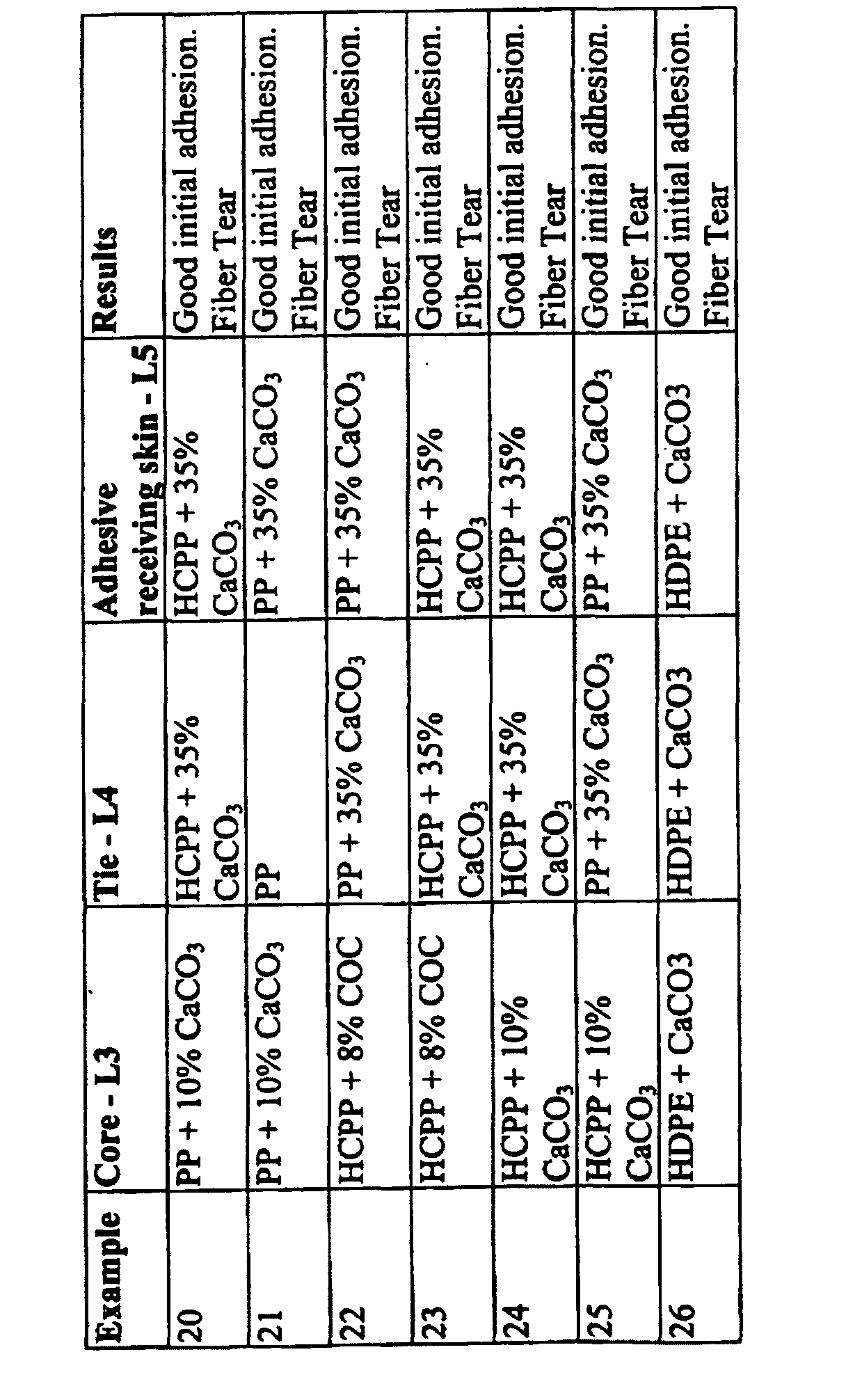
- The PP was Exxon 4612 or Fina 3371. The HCPP was Amoco 9117. The PBT was Ticona 1300A. The COC was Ticona Topas 6017. Ampacet's Pearl 70 was the PP-CaCO3 masterbatch. The HDPE was Exxon 7845, the HDPE-CaCO3 masterbatch was Ampacet M-6211; the aforementioned materials are trademarks of ExxonMobil, Fina, BP Amoco, Ticona, Ampacet, ExxonMobil, and Ampacet, respectively.
- For the PP based structures, all print skins (L1) are PP, or co- or terpolymers of PP (i.e. EP copolymer, EPB terpolymer), and all tie layers (L2) are a homopolymer PP. The print and tie layers are not shown in the example, but identified as L1 and L2.
- For the PE based structure, the print skin (L1) and the tie layer (L2) are PE. The print and tie layers are not shown in the example, but identified as L1 and L2.
- Core (L3), tie (L4), and adhesive receiving layers (L5) are cavitated.
- HB Fuller WB 5020
National Starch Cycloflex 14-200A
AABBITT 712-150
Henkel 10-7026
The aforementioned cold glues are
trademarks of HB Fuller, National
Starch, AABBITT, and Henkel,
respectively.
Claims (27)
- A thermoplastic label for use with a cold glue adhesive comprising a first skin layer comprising a thermoplastic and a first cavitating agent wherein the first skin layer has a first side and a second side, and the first skin layer is cavitated wherein the first side of the first skin layer is adapted to be used in contact with a cold glue adhesive, wherein the first cavitating agent comprises at least 25% by weight of the first skin layer, and wherein the thermoplastic is polypropylene and wherein (a) the first skin layer has a thickness of at least 7.6 µm (0.3 mil) or (b) the first skin layer comprises at least 15% by weight of the thermoplastic label.
- The thermoplastic label according to claim 1 having a thickness of 76-254 µm (3-10 mil).
- The thermoplastic label of claim 2 having a thickness of 76-127 µm (3-5 mil).
- The thermoplastic label according to any of the previous claims wherein the first skin layer comprises at least 15% by weight of the thermoplastic label.
- The thermoplastic label according to claim 4 wherein the first skin layer comprises at least 30% by weight of the thermoplastic label.
- The thermoplastic label according to any of the previous claims further comprising a cold glue adhesive on the first side of the first skin layer.
- The thermoplastic label according to any of the previous claims further comprising a core layer having a first side and a second side and the first side of the core layer is adjacent to the second side of the first skin layer.
- The thermoplastic label according to claim 7 wherein the core layer comprises polyethylene or polypropylene.
- The thermoplastic label according to claims 7 or 8 further comprising a second skin layer having a first side and a second side wherein the first side of the second skin layer is adjacent to the second side of the core layer.
- The thermoplastic label according to claim 9 wherein the second skin layer comprises a polyolefin.
- The thermoplastic label according to claim 10 wherein the second skin layer comprises a polyolefin selected from polyethylene, polypropylene, polybutylene, polyolefin copolymers and mixtures thereof.
- The thermoplastic label according to any of claims 7-11 further comprising a tie layer having a first side and a second side and the first side of the tie layer is adjacent to the second side of the first skin layer and the second side of the tie layer is adjacent to the core layer.
- The thermoplastic label according to claim 12 wherein the tie layer comprises polypropylene.
- The thermoplastic label of claim 13 wherein the tie layer has a thickness of at least 7.6 microns (0.3 mil).
- The thermoplastic label according to any of the previous claims further comprising a coating layer or metal layer on the second side of the second skin layer.
- The thermoplastic label according to any of claims 7-15 wherein the core layer comprises a second cavitating agent.
- The thermoplastic label according to any of the previous claims wherein the first cavitating agent and/or second cavitating agent is selected from the group consisting of polyamides, polybutylene terephthalate, polyesters, acetals, acrylic resins, nylons, solid preformed glass spheres, hollow preformed glass spheres, metal beads, metal spheres, ceramic spheres, calcium carbonate, cyclic olefin polymers, cyclic olefin copolymers, and mixtures thereof.
- The thermoplastic label of claim 17 wherein the first cavitating agent and/or second cavitating agent comprises calcium carbonate.
- The thermoplastic label according to any of the previous claims wherein the label is biaxially oriented.
- The thermoplastic label according to any of the previous claims wherein the first cavitating agent comprises at least 50% by weight of the first skin layer.
- The thermoplastic label according to any of the previous claims wherein the thermoplastic of the first skin layer is polypropylene comprising polypropylene homopolymer.
- The thermoplastic label according to any of the preceding claims wherein the first skin layer comprises holes in at least the first surface of the first skin layer to allow water from the cold glue adhesive to enter the cavitated first skin layer, aiding drying of a cold glue adhesive.
- A process comprising: providing a label according to any of the previous claims, applying a cold glue adhesive to the first side of the cavitated first skin layer, and applying the label to a container.
- A process comprising providing a label according to any of claims 6-22 and applying the label to the container.
- An article of manufacture comprising the label according to any of claims 1-22.
- The use of a label according to any of claims 1-22 with a cold glue adhesive to apply the thermoplastic label to a container.
- The process according to claims 23 or 24, the article according to claim 25, or use according to claim 26 wherein the container is a vessel constructed of glass, plastic, or ceramic.
Priority Applications (1)
| Application Number | Priority Date | Filing Date | Title |
|---|---|---|---|
| EP04026783A EP1505558A3 (en) | 2001-01-26 | 2002-01-11 | Cavitated labels for use with cold glue |
Applications Claiming Priority (3)
| Application Number | Priority Date | Filing Date | Title |
|---|---|---|---|
| US09/770,960 US20020146520A1 (en) | 2001-01-26 | 2001-01-26 | Cavitated labels for use with cold glue |
| US770960 | 2001-01-26 | ||
| PCT/US2002/000773 WO2002059860A2 (en) | 2001-01-26 | 2002-01-11 | Cavitated labels for use with cold glue |
Related Child Applications (1)
| Application Number | Title | Priority Date | Filing Date |
|---|---|---|---|
| EP04026783A Division EP1505558A3 (en) | 2001-01-26 | 2002-01-11 | Cavitated labels for use with cold glue |
Publications (2)
| Publication Number | Publication Date |
|---|---|
| EP1374207A2 EP1374207A2 (en) | 2004-01-02 |
| EP1374207B1 true EP1374207B1 (en) | 2004-11-17 |
Family
ID=25090237
Family Applications (2)
| Application Number | Title | Priority Date | Filing Date |
|---|---|---|---|
| EP04026783A Withdrawn EP1505558A3 (en) | 2001-01-26 | 2002-01-11 | Cavitated labels for use with cold glue |
| EP02707441A Revoked EP1374207B1 (en) | 2001-01-26 | 2002-01-11 | Cavitated labels for use with cold glue |
Family Applications Before (1)
| Application Number | Title | Priority Date | Filing Date |
|---|---|---|---|
| EP04026783A Withdrawn EP1505558A3 (en) | 2001-01-26 | 2002-01-11 | Cavitated labels for use with cold glue |
Country Status (8)
| Country | Link |
|---|---|
| US (1) | US20020146520A1 (en) |
| EP (2) | EP1505558A3 (en) |
| JP (1) | JP2004523787A (en) |
| AT (1) | ATE282875T1 (en) |
| CA (1) | CA2434130A1 (en) |
| DE (1) | DE60201981T2 (en) |
| ES (1) | ES2229098T3 (en) |
| WO (1) | WO2002059860A2 (en) |
Families Citing this family (19)
| Publication number | Priority date | Publication date | Assignee | Title |
|---|---|---|---|---|
| MXPA02007666A (en) | 2000-02-08 | 2004-08-23 | Applied Extrusion Technologies | Metallizable white opaque film, metallized films made therefrom and labels made from metallized films. |
| US7288304B2 (en) * | 2002-03-15 | 2007-10-30 | Exxonmobil Oil Corporation | Metallized patch labels |
| ATE396472T1 (en) | 2002-06-26 | 2008-06-15 | Avery Dennison Corp | LENGTH-ORIENTED POLYMERIC FILMS |
| US6787217B2 (en) * | 2002-10-29 | 2004-09-07 | Exxonmobil Oil Corporation | Thermoplastic film label composite with a printable, untreated, cavitated surface |
| US6844041B2 (en) | 2002-12-27 | 2005-01-18 | Exxonmobil Oil Corporation | Clear polymeric label including delaminatable mask layer |
| WO2004060647A1 (en) | 2002-12-27 | 2004-07-22 | Exxonmobil Oil Corporation | Film for labels that are removable |
| US6939602B2 (en) * | 2002-12-31 | 2005-09-06 | Exxonmobil Oil Corporation | Coating for the adhesive-receiving surface of polymeric labels |
| US7399509B2 (en) | 2003-12-23 | 2008-07-15 | Kari Virtanen | Thin polyethylene pressure sensitive labels |
| US20080233405A1 (en) * | 2004-01-24 | 2008-09-25 | Dronzek Jr Peter J | Techniques For Labeling of Plastic, Glass or Metal Containers or Surfaces With Polymeric Labels Employing an Activated Hydrophilic |
| BRPI0711963B1 (en) | 2006-06-14 | 2019-09-17 | Avery Dennison Corporation | COMFORTABLE AND HIGHLESS MACHINE DIRECTED ORIENTATION LABELS AND LABELS, AND PREPARATION PROCESSES |
| US9636895B2 (en) * | 2006-06-20 | 2017-05-02 | Avery Dennison Corporation | Multilayered polymeric film for hot melt adhesive labeling and label stock and label thereof |
| WO2010059448A1 (en) * | 2008-11-24 | 2010-05-27 | Exxonmobil Oil Corporation | Cavitated polymeric films |
| US8591110B2 (en) * | 2009-11-25 | 2013-11-26 | Exopack, Llc | Bags having adhesive drying structures and related methods |
| WO2011129964A1 (en) | 2010-04-12 | 2011-10-20 | Exxonmobil Oil Corporation | Coating for polymeric labels |
| US9676532B2 (en) | 2012-08-15 | 2017-06-13 | Avery Dennison Corporation | Packaging reclosure label for high alcohol content products |
| US11459488B2 (en) | 2014-06-02 | 2022-10-04 | Avery Dennison Corporation | Films with enhanced scuff resistance, clarity, and conformability |
| WO2021011576A1 (en) * | 2019-07-17 | 2021-01-21 | Jindal Films Americas Llc | Heat-stable biaxially oriented polypropylene films |
| CA3212675A1 (en) * | 2021-03-05 | 2022-09-09 | Avery Dennison Corporation | Multilayer polyolefin films and methods for their production |
| WO2026015375A1 (en) | 2024-07-08 | 2026-01-15 | Innovia Films America, Inc. | Film |
Family Cites Families (11)
| Publication number | Priority date | Publication date | Assignee | Title |
|---|---|---|---|---|
| DE3434298A1 (en) * | 1984-09-19 | 1986-03-27 | Hoechst Ag, 6230 Frankfurt | TRANSFER METALIZING FILM |
| US4701369A (en) * | 1986-04-23 | 1987-10-20 | Mobil Oil Corporation | Opaque polymer film laminate having an absorbent surface |
| US4931327A (en) * | 1989-06-14 | 1990-06-05 | Mobil Oil Corporation | White opaque opp film for tamper evident package |
| US4965123A (en) * | 1989-12-29 | 1990-10-23 | Mobil Oil Corporation | Opaque oriented polymeric film structure and method of preparing same |
| US5288548A (en) * | 1992-07-31 | 1994-02-22 | Mobil Oil Corporation | Label face stock |
| DE4306963A1 (en) * | 1993-03-05 | 1994-09-08 | Wolff Walsrode Ag | White-opaque barrier film with excellent flatness |
| DE4443411A1 (en) * | 1994-12-07 | 1996-06-13 | Hoechst Ag | Sealable, white-opaque, biaxially oriented polypropylene multilayer film, process for its preparation and its use |
| US5888640A (en) * | 1997-07-09 | 1999-03-30 | Mobil Oil Corporation | Metallized uniaxially shrinkable biaxially oriented polypropylene film |
| US6458469B1 (en) * | 1999-07-08 | 2002-10-01 | Exxonmobil Chemical Company | Multilayer oriented films with metallocene catalyzed polyethylene skin layer |
| US6517664B1 (en) * | 2000-01-10 | 2003-02-11 | Process Resources Corporation | Techniques for labeling of plastic, glass or metal containers or surfaces with polymeric labels |
| US6787217B2 (en) * | 2002-10-29 | 2004-09-07 | Exxonmobil Oil Corporation | Thermoplastic film label composite with a printable, untreated, cavitated surface |
-
2001
- 2001-01-26 US US09/770,960 patent/US20020146520A1/en not_active Abandoned
-
2002
- 2002-01-11 EP EP04026783A patent/EP1505558A3/en not_active Withdrawn
- 2002-01-11 WO PCT/US2002/000773 patent/WO2002059860A2/en not_active Ceased
- 2002-01-11 EP EP02707441A patent/EP1374207B1/en not_active Revoked
- 2002-01-11 AT AT02707441T patent/ATE282875T1/en not_active IP Right Cessation
- 2002-01-11 DE DE60201981T patent/DE60201981T2/en not_active Expired - Fee Related
- 2002-01-11 ES ES02707441T patent/ES2229098T3/en not_active Expired - Lifetime
- 2002-01-11 CA CA002434130A patent/CA2434130A1/en not_active Abandoned
- 2002-01-11 JP JP2002560110A patent/JP2004523787A/en active Pending
Also Published As
| Publication number | Publication date |
|---|---|
| DE60201981D1 (en) | 2004-12-23 |
| ATE282875T1 (en) | 2004-12-15 |
| DE60201981T2 (en) | 2006-03-02 |
| CA2434130A1 (en) | 2002-08-01 |
| JP2004523787A (en) | 2004-08-05 |
| EP1505558A3 (en) | 2006-05-10 |
| EP1374207A2 (en) | 2004-01-02 |
| WO2002059860A3 (en) | 2003-10-09 |
| ES2229098T3 (en) | 2005-04-16 |
| US20020146520A1 (en) | 2002-10-10 |
| EP1505558A2 (en) | 2005-02-09 |
| WO2002059860A2 (en) | 2002-08-01 |
Similar Documents
| Publication | Publication Date | Title |
|---|---|---|
| EP1505558A2 (en) | Cavitated labels for use with cold glue | |
| US5288548A (en) | Label face stock | |
| US6641914B2 (en) | HDPE label film | |
| US8349429B2 (en) | Films for labels that are removable | |
| US6844041B2 (en) | Clear polymeric label including delaminatable mask layer | |
| US5194324A (en) | High gloss label face stock | |
| US6706342B2 (en) | Polymeric labels | |
| US7288304B2 (en) | Metallized patch labels | |
| US20040007319A1 (en) | Cold seal adhesive-receptive, tamper evident untreated cavitated film | |
| US20030172559A1 (en) | Metallized patch labels | |
| AU722889B2 (en) | Voided uniaxially oriented films | |
| AU2002241848A1 (en) | Cavitated labels for use with cold glue | |
| JP4868936B2 (en) | High-brightness label, container attached with the label, and manufacturing method thereof | |
| JP2003073634A (en) | Adhesive sheet |
Legal Events
| Date | Code | Title | Description |
|---|---|---|---|
| PUAI | Public reference made under article 153(3) epc to a published international application that has entered the european phase |
Free format text: ORIGINAL CODE: 0009012 |
|
| 17P | Request for examination filed |
Effective date: 20030801 |
|
| AK | Designated contracting states |
Kind code of ref document: A2 Designated state(s): AT BE CH CY DE DK ES FI FR GB GR IE IT LI LU MC NL PT SE TR |
|
| AX | Request for extension of the european patent |
Extension state: AL LT LV MK RO SI |
|
| GRAP | Despatch of communication of intention to grant a patent |
Free format text: ORIGINAL CODE: EPIDOSNIGR1 |
|
| GRAS | Grant fee paid |
Free format text: ORIGINAL CODE: EPIDOSNIGR3 |
|
| GRAA | (expected) grant |
Free format text: ORIGINAL CODE: 0009210 |
|
| AK | Designated contracting states |
Kind code of ref document: B1 Designated state(s): AT BE CH CY DE DK ES FI FR GB GR IE IT LI LU MC NL PT SE TR |
|
| PG25 | Lapsed in a contracting state [announced via postgrant information from national office to epo] |
Ref country code: TR Free format text: LAPSE BECAUSE OF FAILURE TO SUBMIT A TRANSLATION OF THE DESCRIPTION OR TO PAY THE FEE WITHIN THE PRESCRIBED TIME-LIMIT Effective date: 20041117 Ref country code: LI Free format text: LAPSE BECAUSE OF FAILURE TO SUBMIT A TRANSLATION OF THE DESCRIPTION OR TO PAY THE FEE WITHIN THE PRESCRIBED TIME-LIMIT Effective date: 20041117 Ref country code: FI Free format text: LAPSE BECAUSE OF FAILURE TO SUBMIT A TRANSLATION OF THE DESCRIPTION OR TO PAY THE FEE WITHIN THE PRESCRIBED TIME-LIMIT Effective date: 20041117 Ref country code: CH Free format text: LAPSE BECAUSE OF FAILURE TO SUBMIT A TRANSLATION OF THE DESCRIPTION OR TO PAY THE FEE WITHIN THE PRESCRIBED TIME-LIMIT Effective date: 20041117 Ref country code: AT Free format text: LAPSE BECAUSE OF FAILURE TO SUBMIT A TRANSLATION OF THE DESCRIPTION OR TO PAY THE FEE WITHIN THE PRESCRIBED TIME-LIMIT Effective date: 20041117 |
|
| REG | Reference to a national code |
Ref country code: GB Ref legal event code: FG4D |
|
| REG | Reference to a national code |
Ref country code: CH Ref legal event code: EP |
|
| REG | Reference to a national code |
Ref country code: IE Ref legal event code: FG4D |
|
| REF | Corresponds to: |
Ref document number: 60201981 Country of ref document: DE Date of ref document: 20041223 Kind code of ref document: P |
|
| PGFP | Annual fee paid to national office [announced via postgrant information from national office to epo] |
Ref country code: FR Payment date: 20050105 Year of fee payment: 4 |
|
| PG25 | Lapsed in a contracting state [announced via postgrant information from national office to epo] |
Ref country code: LU Free format text: LAPSE BECAUSE OF NON-PAYMENT OF DUE FEES Effective date: 20050111 Ref country code: IE Free format text: LAPSE BECAUSE OF NON-PAYMENT OF DUE FEES Effective date: 20050111 Ref country code: CY Free format text: LAPSE BECAUSE OF FAILURE TO SUBMIT A TRANSLATION OF THE DESCRIPTION OR TO PAY THE FEE WITHIN THE PRESCRIBED TIME-LIMIT Effective date: 20050111 |
|
| PGFP | Annual fee paid to national office [announced via postgrant information from national office to epo] |
Ref country code: ES Payment date: 20050120 Year of fee payment: 4 |
|
| PGFP | Annual fee paid to national office [announced via postgrant information from national office to epo] |
Ref country code: BE Payment date: 20050127 Year of fee payment: 4 |
|
| PG25 | Lapsed in a contracting state [announced via postgrant information from national office to epo] |
Ref country code: MC Free format text: LAPSE BECAUSE OF NON-PAYMENT OF DUE FEES Effective date: 20050131 |
|
| PGFP | Annual fee paid to national office [announced via postgrant information from national office to epo] |
Ref country code: DE Payment date: 20050131 Year of fee payment: 4 |
|
| PG25 | Lapsed in a contracting state [announced via postgrant information from national office to epo] |
Ref country code: SE Free format text: LAPSE BECAUSE OF FAILURE TO SUBMIT A TRANSLATION OF THE DESCRIPTION OR TO PAY THE FEE WITHIN THE PRESCRIBED TIME-LIMIT Effective date: 20050217 Ref country code: GR Free format text: LAPSE BECAUSE OF FAILURE TO SUBMIT A TRANSLATION OF THE DESCRIPTION OR TO PAY THE FEE WITHIN THE PRESCRIBED TIME-LIMIT Effective date: 20050217 Ref country code: DK Free format text: LAPSE BECAUSE OF FAILURE TO SUBMIT A TRANSLATION OF THE DESCRIPTION OR TO PAY THE FEE WITHIN THE PRESCRIBED TIME-LIMIT Effective date: 20050217 |
|
| REG | Reference to a national code |
Ref country code: ES Ref legal event code: FG2A Ref document number: 2229098 Country of ref document: ES Kind code of ref document: T3 |
|
| REG | Reference to a national code |
Ref country code: CH Ref legal event code: PL |
|
| PLBI | Opposition filed |
Free format text: ORIGINAL CODE: 0009260 |
|
| PLAX | Notice of opposition and request to file observation + time limit sent |
Free format text: ORIGINAL CODE: EPIDOSNOBS2 |
|
| 26 | Opposition filed |
Opponent name: YUPO CORPORATION Effective date: 20050812 |
|
| ET | Fr: translation filed | ||
| REG | Reference to a national code |
Ref country code: IE Ref legal event code: MM4A |
|
| NLR1 | Nl: opposition has been filed with the epo |
Opponent name: YUPO CORPORATION |
|
| PG25 | Lapsed in a contracting state [announced via postgrant information from national office to epo] |
Ref country code: GB Free format text: LAPSE BECAUSE OF NON-PAYMENT OF DUE FEES Effective date: 20060111 |
|
| PGFP | Annual fee paid to national office [announced via postgrant information from national office to epo] |
Ref country code: IT Payment date: 20060131 Year of fee payment: 5 |
|
| RDAF | Communication despatched that patent is revoked |
Free format text: ORIGINAL CODE: EPIDOSNREV1 |
|
| RDAG | Patent revoked |
Free format text: ORIGINAL CODE: 0009271 |
|
| STAA | Information on the status of an ep patent application or granted ep patent |
Free format text: STATUS: PATENT REVOKED |
|
| GBPC | Gb: european patent ceased through non-payment of renewal fee |
Effective date: 20060111 |
|
| NLV4 | Nl: lapsed or anulled due to non-payment of the annual fee |
Effective date: 20060801 |
|
| 27W | Patent revoked |
Effective date: 20060527 |
|
| PG25 | Lapsed in a contracting state [announced via postgrant information from national office to epo] |
Ref country code: PT Free format text: LAPSE BECAUSE OF NON-PAYMENT OF DUE FEES Effective date: 20050417 |