EP1372360A1 - Organic photoluminescent polymers with improved stability - Google Patents
Organic photoluminescent polymers with improved stability Download PDFInfo
- Publication number
- EP1372360A1 EP1372360A1 EP03253437A EP03253437A EP1372360A1 EP 1372360 A1 EP1372360 A1 EP 1372360A1 EP 03253437 A EP03253437 A EP 03253437A EP 03253437 A EP03253437 A EP 03253437A EP 1372360 A1 EP1372360 A1 EP 1372360A1
- Authority
- EP
- European Patent Office
- Prior art keywords
- luminescent polymer
- deuterium
- polymer according
- luminescent
- active layer
- Prior art date
- Legal status (The legal status is an assumption and is not a legal conclusion. Google has not performed a legal analysis and makes no representation as to the accuracy of the status listed.)
- Granted
Links
Images


Classifications
-
- H—ELECTRICITY
- H05—ELECTRIC TECHNIQUES NOT OTHERWISE PROVIDED FOR
- H05B—ELECTRIC HEATING; ELECTRIC LIGHT SOURCES NOT OTHERWISE PROVIDED FOR; CIRCUIT ARRANGEMENTS FOR ELECTRIC LIGHT SOURCES, IN GENERAL
- H05B33/00—Electroluminescent light sources
- H05B33/12—Light sources with substantially two-dimensional [2D] radiating surfaces
- H05B33/14—Light sources with substantially two-dimensional [2D] radiating surfaces characterised by the chemical or physical composition or the arrangement of the electroluminescent material, or by the simultaneous addition of the electroluminescent material in or onto the light source
-
- C—CHEMISTRY; METALLURGY
- C08—ORGANIC MACROMOLECULAR COMPOUNDS; THEIR PREPARATION OR CHEMICAL WORKING-UP; COMPOSITIONS BASED THEREON
- C08G—MACROMOLECULAR COMPOUNDS OBTAINED OTHERWISE THAN BY REACTIONS ONLY INVOLVING UNSATURATED CARBON-TO-CARBON BONDS
- C08G61/00—Macromolecular compounds obtained by reactions forming a carbon-to-carbon link in the main chain of the macromolecule
- C08G61/02—Macromolecular compounds containing only carbon atoms in the main chain of the macromolecule, e.g. polyxylylenes
-
- C—CHEMISTRY; METALLURGY
- C09—DYES; PAINTS; POLISHES; NATURAL RESINS; ADHESIVES; COMPOSITIONS NOT OTHERWISE PROVIDED FOR; APPLICATIONS OF MATERIALS NOT OTHERWISE PROVIDED FOR
- C09K—MATERIALS FOR MISCELLANEOUS APPLICATIONS, NOT PROVIDED FOR ELSEWHERE
- C09K11/00—Luminescent materials, e.g. electroluminescent or chemiluminescent
- C09K11/06—Luminescent materials, e.g. electroluminescent or chemiluminescent containing organic luminescent materials
-
- H—ELECTRICITY
- H10—SEMICONDUCTOR DEVICES; ELECTRIC SOLID-STATE DEVICES NOT OTHERWISE PROVIDED FOR
- H10K—ORGANIC ELECTRIC SOLID-STATE DEVICES
- H10K85/00—Organic materials used in the body or electrodes of devices covered by this subclass
- H10K85/10—Organic polymers or oligomers
- H10K85/111—Organic polymers or oligomers comprising aromatic, heteroaromatic, or aryl chains, e.g. polyaniline, polyphenylene or polyphenylene vinylene
- H10K85/114—Poly-phenylenevinylene; Derivatives thereof
-
- C—CHEMISTRY; METALLURGY
- C09—DYES; PAINTS; POLISHES; NATURAL RESINS; ADHESIVES; COMPOSITIONS NOT OTHERWISE PROVIDED FOR; APPLICATIONS OF MATERIALS NOT OTHERWISE PROVIDED FOR
- C09K—MATERIALS FOR MISCELLANEOUS APPLICATIONS, NOT PROVIDED FOR ELSEWHERE
- C09K2211/00—Chemical nature of organic luminescent or tenebrescent compounds
- C09K2211/14—Macromolecular compounds
- C09K2211/1408—Carbocyclic compounds
- C09K2211/1416—Condensed systems
-
- C—CHEMISTRY; METALLURGY
- C09—DYES; PAINTS; POLISHES; NATURAL RESINS; ADHESIVES; COMPOSITIONS NOT OTHERWISE PROVIDED FOR; APPLICATIONS OF MATERIALS NOT OTHERWISE PROVIDED FOR
- C09K—MATERIALS FOR MISCELLANEOUS APPLICATIONS, NOT PROVIDED FOR ELSEWHERE
- C09K2211/00—Chemical nature of organic luminescent or tenebrescent compounds
- C09K2211/14—Macromolecular compounds
- C09K2211/1408—Carbocyclic compounds
- C09K2211/1425—Non-condensed systems
-
- C—CHEMISTRY; METALLURGY
- C09—DYES; PAINTS; POLISHES; NATURAL RESINS; ADHESIVES; COMPOSITIONS NOT OTHERWISE PROVIDED FOR; APPLICATIONS OF MATERIALS NOT OTHERWISE PROVIDED FOR
- C09K—MATERIALS FOR MISCELLANEOUS APPLICATIONS, NOT PROVIDED FOR ELSEWHERE
- C09K2211/00—Chemical nature of organic luminescent or tenebrescent compounds
- C09K2211/14—Macromolecular compounds
- C09K2211/1441—Heterocyclic
- C09K2211/1466—Heterocyclic containing nitrogen as the only heteroatom
-
- H—ELECTRICITY
- H10—SEMICONDUCTOR DEVICES; ELECTRIC SOLID-STATE DEVICES NOT OTHERWISE PROVIDED FOR
- H10K—ORGANIC ELECTRIC SOLID-STATE DEVICES
- H10K30/00—Organic devices sensitive to infrared radiation, light, electromagnetic radiation of shorter wavelength or corpuscular radiation
-
- H—ELECTRICITY
- H10—SEMICONDUCTOR DEVICES; ELECTRIC SOLID-STATE DEVICES NOT OTHERWISE PROVIDED FOR
- H10K—ORGANIC ELECTRIC SOLID-STATE DEVICES
- H10K30/00—Organic devices sensitive to infrared radiation, light, electromagnetic radiation of shorter wavelength or corpuscular radiation
- H10K30/50—Photovoltaic [PV] devices
-
- H—ELECTRICITY
- H10—SEMICONDUCTOR DEVICES; ELECTRIC SOLID-STATE DEVICES NOT OTHERWISE PROVIDED FOR
- H10K—ORGANIC ELECTRIC SOLID-STATE DEVICES
- H10K50/00—Organic light-emitting devices
- H10K50/10—OLEDs or polymer light-emitting diodes [PLED]
- H10K50/11—OLEDs or polymer light-emitting diodes [PLED] characterised by the electroluminescent [EL] layers
-
- Y—GENERAL TAGGING OF NEW TECHNOLOGICAL DEVELOPMENTS; GENERAL TAGGING OF CROSS-SECTIONAL TECHNOLOGIES SPANNING OVER SEVERAL SECTIONS OF THE IPC; TECHNICAL SUBJECTS COVERED BY FORMER USPC CROSS-REFERENCE ART COLLECTIONS [XRACs] AND DIGESTS
- Y02—TECHNOLOGIES OR APPLICATIONS FOR MITIGATION OR ADAPTATION AGAINST CLIMATE CHANGE
- Y02E—REDUCTION OF GREENHOUSE GAS [GHG] EMISSIONS, RELATED TO ENERGY GENERATION, TRANSMISSION OR DISTRIBUTION
- Y02E10/00—Energy generation through renewable energy sources
- Y02E10/50—Photovoltaic [PV] energy
- Y02E10/549—Organic PV cells
-
- Y—GENERAL TAGGING OF NEW TECHNOLOGICAL DEVELOPMENTS; GENERAL TAGGING OF CROSS-SECTIONAL TECHNOLOGIES SPANNING OVER SEVERAL SECTIONS OF THE IPC; TECHNICAL SUBJECTS COVERED BY FORMER USPC CROSS-REFERENCE ART COLLECTIONS [XRACs] AND DIGESTS
- Y02—TECHNOLOGIES OR APPLICATIONS FOR MITIGATION OR ADAPTATION AGAINST CLIMATE CHANGE
- Y02P—CLIMATE CHANGE MITIGATION TECHNOLOGIES IN THE PRODUCTION OR PROCESSING OF GOODS
- Y02P70/00—Climate change mitigation technologies in the production process for final industrial or consumer products
- Y02P70/50—Manufacturing or production processes characterised by the final manufactured product
-
- Y—GENERAL TAGGING OF NEW TECHNOLOGICAL DEVELOPMENTS; GENERAL TAGGING OF CROSS-SECTIONAL TECHNOLOGIES SPANNING OVER SEVERAL SECTIONS OF THE IPC; TECHNICAL SUBJECTS COVERED BY FORMER USPC CROSS-REFERENCE ART COLLECTIONS [XRACs] AND DIGESTS
- Y10—TECHNICAL SUBJECTS COVERED BY FORMER USPC
- Y10S—TECHNICAL SUBJECTS COVERED BY FORMER USPC CROSS-REFERENCE ART COLLECTIONS [XRACs] AND DIGESTS
- Y10S428/00—Stock material or miscellaneous articles
- Y10S428/917—Electroluminescent
Definitions
- a polymer thin film of PEDOT (Baytron®) is formed by spin-coating an aqueous solution of PEDOT on a pre-coated ITO glass substrate (1.5x1.0 inch, resistivity less than 50 ohm/in 2 ) at 2000 rpm and at room temperature for a spin-time of 1.5 minutes.
- the thin film of PEDOT is used as a hole injection layer.
Landscapes
- Chemical & Material Sciences (AREA)
- Engineering & Computer Science (AREA)
- Materials Engineering (AREA)
- Organic Chemistry (AREA)
- Health & Medical Sciences (AREA)
- Chemical Kinetics & Catalysis (AREA)
- Medicinal Chemistry (AREA)
- Polymers & Plastics (AREA)
- Electroluminescent Light Sources (AREA)
- Polyoxymethylene Polymers And Polymers With Carbon-To-Carbon Bonds (AREA)
- Lasers (AREA)
- Organic Low-Molecular-Weight Compounds And Preparation Thereof (AREA)
Abstract

Description
- The present invention relates to luminescent polymers suitable for use in organic light-emitting devices (OLEDs), organic solid-state lasers, photovoltaic cells, and electrochromic displays. The invention further relates to a method of producing the luminescent polymers, and of producing OLEDs, organic solid state lasers, photovoltaic cells and electrochromic displays employing such luminescent polymers in an active layer.
- Conjugated polymer semi-conductors have attracted attention for optoelectronic applications that traditionally have been the domains of inorganic semi-conductors. The structural flexibility, the very low cost for processing, and the flexible thin film features of conjugated polymers make organic semi-conductive polymer devices competitive with the inorganic semiconductors. Most conjugated polymers are highly luminescent, and they have attracted great attention in light-emitting device applications and for use in organic solid-state lasers.
- Recent improvements in performance characteristics of organic/polymer LEDs have led to renewed interest in organic lasers. Laser emission in general relies on two key ingredients: first, the active material must exhibit strong stimulated emission. Second, there has to be an optical feedback mechanism. The first requirement is fulfilled for a variety of state-of the-art conjugated polymers. The observation of gain narrowing via amplification of spontaneous emission (ASE) in planar conjugated polymer wave guides has proven that conjugated polymers can exhibit high optical gain comparable to the best inorganic semiconductor laser materials.( M. D. McGehee and A. Heeger, Adv. Mater., 2000, 12(22), 1655-1668). The second important condition for lasing, namely an optical feedback, has to be accomplished by a suitable resonator geometry which is dependent on physical device configuration. Recent realization of the first organic solid state injection laser pumped by electrical charge injection reveals that the current is at the level of more than 1000 A/cm2 for an electrically pumped organic solid state laser.(J.H. Schon, et al, Science, 2000, 278, 599-601). This is considerably much more than a normal OLED which is operated at a level of 10-100 mA/cm2 (for a brightness between 100-1000 cd/m2). The prospect of compact electrically pumped polymer lasers using their semi-conductor properties is exciting. However, there is indeed a need to develop highly luminescent and highly stabilized polymers.
- Luminescent conjugated polymers are generally known in the art and include substituted and unsubstituted poly(phenylene vinylene)s and polyphenylenes. They are widely used in active layers which can be incorporated into a variety of OLED, organic solid-state laser, photovoltaic cell and electrochromic display structures. For all the above applications, polymers are either subject to electrical field, charge injection, or light irradiation conditions. Besides having the luminescence property, the other key parameter for these applications is the stability of the material under conditions of use, including high UV irradiation and high currents. Thus, the materials must maintain a high level of photoluminescent properties in use, as well as maintain their structural integrity.
- Efforts to use these conjugated polymers commercially have focused on improving stability. It has been found that stability can be improved by the introduction of highly hindered aromatic rings, such as diphenyl-substituted poly(phenylene vinylene)s and phenyl-substituted poly(phenylene vinylene)s.(USP 5,945,502). Even with these improvements, however, stability is still unsatisfactory for use under certain conditions including high UV irradiation and high currents, both of which are normal conditions in OLEDs, organic solid state lasers, photovoltaic cells, and electrochromic displays.
- It is an object of the present invention to provide luminescent polymers with improved stability, particularly against UV irradiation and high currents, and suitable for use in organic solid state lasers, OLEDs, photovoltaic cells, and electrochromic displays.
- Accordingly, in one aspect the invention is a poly(phenylene vinylene) with a highly sterically hindered aromatic or heteroaromatic ring substitution on the phenylene portion, and deuterium substitution on the vinylene portion, as shown in the following structure:wherein Ar1 and Ar2 are aromatic or heteroaromatic rings, such as phenyl, biphenyl, fluorene, thiophene, pyridyl, or their substituted aromatic or heteroaromatic rings with or without deuterium. R1 and R2 are independently each selected from the group consisting of hydrogen, deuterium, substituted or unsubstituted alkyl, alkoxyl, aryl and heteroaryl, or halogen such as chlorine, fluorine, bromine etc. D represents deuterium, and n is an integer greater than 3.

- In preferred embodiments, R1 and R2 are the same and are selected from the group consisting of substituted or unsubstituted alkyl, alkoxyl, aryl and heteroaryl.
Most preferably, Ar1 and Ar2 are phenyl or pyridyl or substituted phenyl or pyridyl. - In particularly preferred embodiments, the luminescent polymers are:

- In the above formulas X, Y=F, Cl, Br, CN, NO2, OR1, SR1, phenyl, pyridyl, thiophene R1, R2=H, alkyl (1-20), alkoxyl (1-20), F, Cl, Br.
- The above-described luminescent polymers exhibit good stability, particularly under UV irradiation and high current injection. The polymers are soluble, with well-controlled microstructure and, as a consequence, are suitable for formation into the active layer of OLEDs, organic solid state lasers, photovoltaic cells and electrochromic displays. Preferred embodiments are particularly well-suited for formation of such layers by solution processing, such as spin-coating and printing processes.
- In a further aspect, the present invention is an organic light emitting device, an organic solid state laser, and a method for producing such devices, comprising a transparent electrode; a cathode; and an active layer containing a luminescent polymer having the structure of formula (I).
- In a still further aspect, the present invention is a photovoltaic cell, and a method for producing such a cell, comprising an active layer containing a luminescent polymer having the structure of formula (I).
- In another aspect, the present invention is an electrochromic display, and a method for producing such a display, comprising an active layer containing a luminescent polymer having the structure of formula (I).
- In a related aspect, the invention is a method of making a luminescent polymer having a structure as set out in formula (I), comprising the steps of deuteration of the monomers, and the 1,6-dehalogenation polymerization reaction.
- This brief summary has been provided so that the nature of the invention may be understood quickly. A more complete understanding of-the invention can be obtained by reference to the following detailed description of the preferred embodiments thereof in connection with the attached drawings.
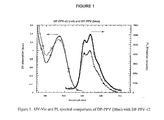
- Fig. 1 is a graphical comparison of the UV- visible and photoluminescent spectral characteristics of DP-PPV (Blue) with DP-PPV-d2 (Red).
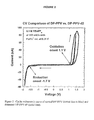
- Fig. 2 is a graph showing the cyclic voltametric curve of normal DP-PPV and deuterated DP-PPV-d2.
- Fig. 3 is an illustration of a UV irradiation experiment set-up.
- Fig. 4 is a three-dimensional illustration of a DP-PPV-d2 polymer.
- Fig. 5 is a schematic diagram of an organic solid state laser (OSL) device showing the pump beam focused onto the surface of the polymer film.
- The present invention provides conjugated luminescent polymers or copolymers which present better stability against current and against UV light irradiation. Amongst various conjugated polymers, poly(phenylene vinylene) (PPV) and its derivatives remain as the most important conjugated polymers for the use in opto-electronic applications. This is because PPVs can be molecularly engineered to provide various derivatives with different emissive colors, such as red, green, yellow and bluish green, by changing the side substituted groups of the polymer. PPVs with extremely high molecular weight can also be easily achieved (with Mw higher than 106 ). Many applications of conjugated PPVs in the area of photovoltaic cells, light-emitting devices, electrochromic displays, and organic lasing etc, have been reported. For almost all the above applications, the paramount important requirement is the improvement of material stability.
- Di-phenyl substituted poly(phenylene vinylene) has been developed as a good green luminescent polymer. It has a better stability against photo-irradiation than some other derivatives, such as 2-methoxy-5-(2'-ethyl-hexyl)-poly(1,4-phenylenevinylene) (MEH-PPV).
- In order to further enhance the stability of the vinyl bonds along the conjugated polymer chain, deuterium substituted polymer has been explored. The difference between hydrogen and deuterium has fairly small chemical effects; however, there are important physical effects because of the mass difference between the isotopes, with deuterium having double the mass of hydrogen. It is known that the C-D bond is shorter than the C-H as a result of anharmonicity of the bond stretching potential. This means the carbon-deuterium chemical bond is stronger, more stable, and reacts more slowly than the carbon-hydrogen chemical bond, so that the deuterium organic system has better thermal stability, and a longer lifetime in opto-electronic devices. Deuterium is found to act as an apparent electron-donating inductive substituent relative to hydrogen. The isotope effects may be applied in the design of new luminescent material with enhanced charge-injection ability.
- Various PPV-based luminescent materials containing deuterium have been prepared to investigate their suitability for use in OLEDs.
- Synthesis of a soluble green luminescent diphenyl-substituted PPV with deuterium substitution has been carried out as described in
Scheme 1.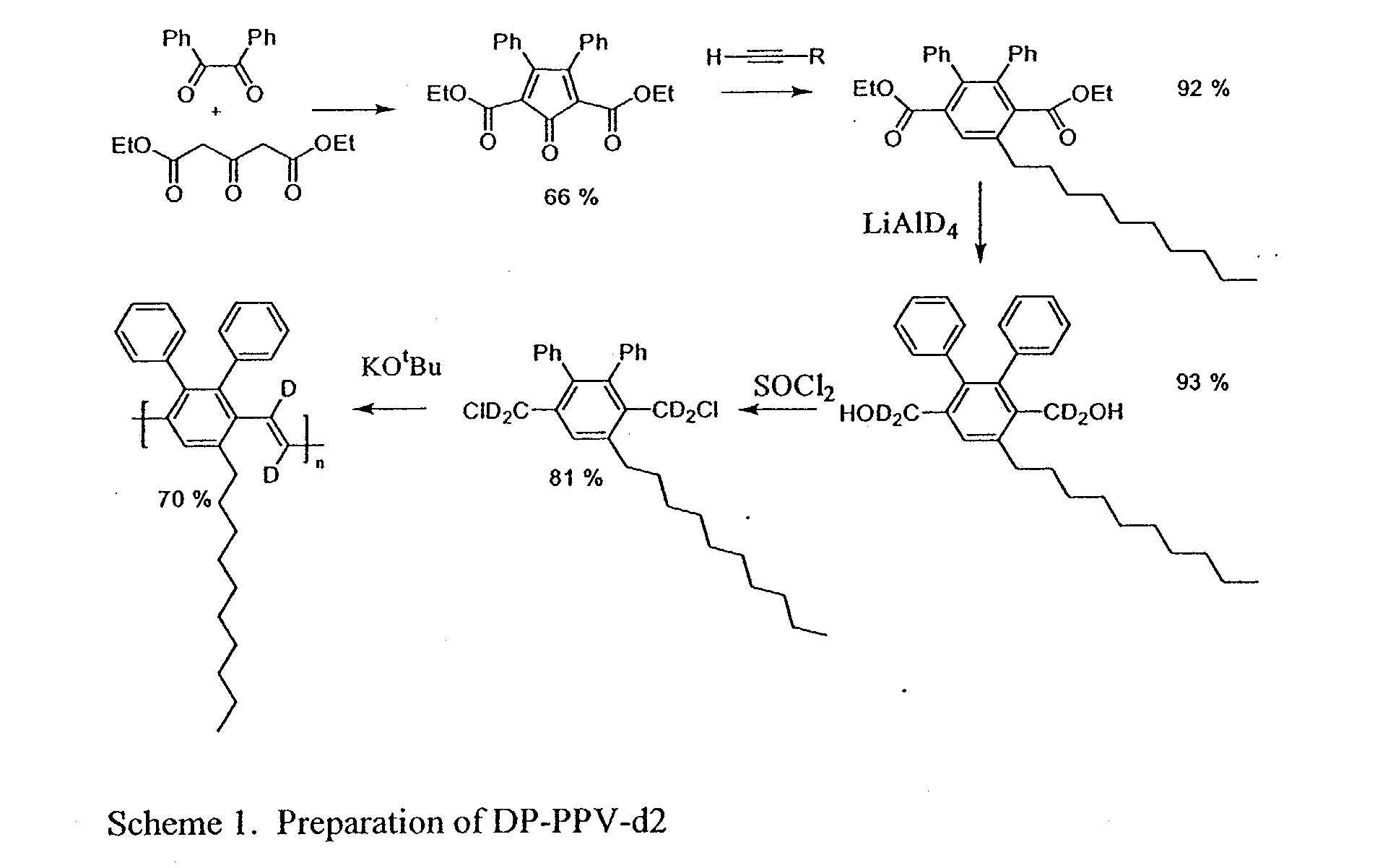
- The deuterium reaction mechanism is illustrated in
Scheme 2. As is shown, it is possible to obtain the deuterium DP-PPV with the readily available starting material LiAlD4.
- The resulting polymer has a melting point around 285 °C. Due to the diphenyl steric effect, combined with the stabilization effect of deuterium, the green luminescent DP-PPV-d2 has a better stability against light irradiation and against thermal curing than the non-deuterated polymer.
- The three dimensional features of a DP-PPV-d2 polymer are illustrated in Fig. 4.
- Compared with the normal DP-PPV, the duterated DP-PPV-d2 has similar optical and electronic absorption properties, as can be seen from Figure 1.
- From a cyclic voltametric analysis, the band gap of the polymer can be estimated as, Eg= 2.8 eV; and the energy level for the highest occupied molecular orbitals (HOMO) being =5.9 eV, and for the lowest occupied molecular orbitals being (LUMO) = 3.1 eV. The reduction position and the cyclic voltametric features for both normal DP-PPV and DP-PPV-d2 are similar. However, the oxidation position and features of the two polymers are different, as illustrated in Figure 2.
The deuterated DP-PPV-d2 shows a better hole injection as indicated by the larger oxidation peak area in Figure 2. - A DP-PPV polymer sample and a DP-PPV-d2 polymer sample were coated on quartz glass substrates respectively, and subjected to UV irradiation under nitrogen as illustrated in Figure 3.
- After 100 minutes UV irradiation (290 W, 366 nm) under nitrogen atmosphere, the normal DP-PPV sample showed photoluminescence of 80% of its original intensity due to photo-degradation. The DP-PPV-d2 deuterium sample, however, showed 95% of its original photoluminescence intensity.
- A solution of a DP-PPV-d2 polymer (where X = Y = H, R1=H and R2 = C10H21 (40 mg dissolved in 2 mL chloroform) is prepared and filtered through a filter with a pore size of less than 0.45 microns. A polymer thin film of PEDOT (Baytron®) is formed by spin-coating an aqueous solution of PEDOT on a pre-coated ITO glass substrate (1.5x1.0 inch, resistivity less than 50 ohm/in2) at 2000 rpm and at room temperature for a spin-time of 1.5 minutes. The thin film of PEDOT is used as a hole injection layer. The deuterium polymer is spin-coated on top of the PEDOT film by similar spin-coating techniques to form an emissive layer. The emissive layer has a uniform thickness of about 100 nm. A layer of calcium, with a thickness of 60 nm, is deposited on top of the polymer film by vacuum thermal evaporation at a rate of 0.2-2.2 nm/sec. A layer of A1 with a thickness of 150 nm is deposited on top of the Ca layer at a rate of 2.2-12 nm/sec.
The formed OILED device ITO/PEDOT/DP-PPV-d2/Ca-A1 is encapsulated by gluing a cover glass substrate on top of the aluminum cathode. The metal evaporation and encapsulation of the device are carried out in a dry box under an argon atmosphere. Stable and uniform green light emission is achieved at a forward bias of 5 volts. - For comparison, a similar device of ITO/PEDOT/DP-PPV/Ca-Al was also fabricated using a normal DP-PPV (without deuterium, where X=Y=H, R1=H and R2=C10H21) as the emissive layer. Green electroluminescence can be observed at a forward bias of 4 volts, but after 2 weeks storage the "normal" DP-PPV polymer produced less stable light emission than the deuterium containing polymer.
- Luminescent polymers according to the present invention can be used in optically pumped laser devices. Optically pumped laser devices can be made having a variety of structures, including the following:
- 1. A vertical microcavity - luminescent polymer layer using a polymer according to the present invention can be coated onto a commercially available Diffraction Bragg Resonance (DBR) mirror. A silver mirror is then deposited on top of the polymer layer;
- 2. A polymer selected from among the polymers of the present invention can be coated in the shape of a disk, ring or sphere onto a plate or rod-shaped material, as known in the art. Such materials include aluminum and copper;
- 3. An in-plane Fabry-Perot polymer is selected from among those of the present invention and is coated on a cladding material. The cladding has a higher index of refraction than the polymer, but an index of refraction less than about 1.8. Such cladding materials are selected to be resistant to typical organic solvents and polymers. Examples of such materials include TiO2 and SiO2. The cladding materials are usually coated onto semiconductor materials, such as Si or InP by known sputtering deposition techniques; and
- 4. A distributed feedback (DFB) polymer selected from among the polymers of the present invention is coated on top of a specially designed distributed feedback plate, which is typically an insulator material such as rubber or ceramics, etc. Such a feedback plate is designed to have periodic modulation of either the refractive index or the gain coefficient.
-
- The above mentioned devices can be pumped by a laser source with wavelengths of 300-550 nm. Various laser sources within these wavelengths are commercially available. For instance, one can employ a frequency doubled output of a regeneratively amplified femtosecond (fs) Ti:sapphire laser. This laser source can product a pulse duration of less than 150 fs at a wavelength of 400 nm with a pulse energy of 0.1 nJ to 5000 nJ. The pump beam is focused onto a spot with a diameter of approximately 20-2000 µm, more preferably around 200 µm.
- A polished InP substrate is pre-coated with a 2-µm-thick layer of SiO2 (deposited by plasma enhanced chemical vapor deposition). The polymer (DP-PPV-d) is coated on the surface (100) of the SiO2 by spin coating. The polymer film (refractive index n=1.8) forms a slab optical wave guide with the SiO2 cladding layer (n=1.46) on one side, and air (n=1) on the other. The thickness of the organic film was chosen in order to form a single mode slab wave guide confining the optical field in the gain region. The OSL is optically pumped with 500 ps pulses generated at a 50 Hz repetition rate by a nitrogen laser at lambda=337 nm. The pump beam was focused onto a 50-um-wide stripe on the surface of the organic film forming the gain region. At pump level above threshold (4nJ), a well defined green laser beam is clearly observed emerging from the edges of the film (Figure 5).
- An organic laser device can also be constructed in accordance with the present invention. Such a device would have a cathode with a low work function of less than 4.5 eV and an anode with a higher work function of more than 4.8 eV, together with an active layer containing a luminescent polymer according to the present invention.
Claims (14)
- A luminescent polymer having a structurewherein Ar1 and Ar2 are aromatic or heteroaromatic rings, and R1 and R2 are independently each selected from the group consisting of hydrogen, deuterium, substituted or unsubstituted alkyl, alkoxyl, aryl and heteroaryl, or halogen;

wherein D represents deuterium; and
wherein n is an integer greater than 3. - The luminescent polymer according to claim 1, wherein Ar1 and Ar2 are phenyl, biphenyl, fluorine, thiophene, pyridyl, or their substituted aromatic or heteroaromatic rings with or without deuterium
- The luminescent polymer according to claim 1, wherein R1 and R2 are the same and are selected from the group consisting of substituted or unsubstituled alkyl, alkoxyl, aryl and heteroaryl.
- The luminescent polymer according to claim 3, wherein Ar1 and Ar2 arc phenyl or pyridyl or substituted phenyl or pyridyl.
- The luminescent polymer according to claim 1, selected from the group consisting of:where X and Y are selected from the group consisting of F, Cl, Br, CN, NO2, OR1, SR1, phenyl, pyridyl or thiophene; and R1, R2 may be H, alkyl C1-C20, C1-C20 alkoxyl, F, Cl or Br.

- An organic light emitting device comprising:(a) a transparent electrode;(b) a cathode; and(c) an active layer containing the luminescent polymer according to any one of claims 1-5.
- An optically pumped laser device comprising:(a) a substrate coated with a cladding layer having an index of refraction less than about 1.8;(b) a luminescent polymer according to any one of claims 1-5 coated on top of the substrate; and(c) a laser pumping light with a wavelength between about 300 µm and 550 nm.
- An organic laser device comprising:(a) a cathode with a low work function of less than 4.5 eV;(b) an anode with a higher work function of more than 4.8 eV; and(c) an active layer containing a luminescent polymer according to any one of claims 1-5.
- A method for making the organic light emitting device of claim 6 comprising the step of placing the luminescent polymer as the emissive layer between two electrodes.
- A photovoltaic cell comprising an active layer containing a luminescent polymer according to any one of claims 1-5.
- A method for making the photovoltaic cell of claim 10 comprising the step of placing the luminescent polymer as the active layer between two electrodes.
- An electrochromic display device comprising an active layer containing a luminescent polymer according to any one of claims 1-5.
- A method for making the electrochromic display device of claim 12 comprising the step of placing the luminescent polymer as the active layer between two electrodes.
- A method of making a luminescent polymer according to any one of claims 1-5 comprising the steps of using LiAlD4 as the deuterium source to include deuterium on a vinyl group of the polymer.
Applications Claiming Priority (2)
| Application Number | Priority Date | Filing Date | Title |
|---|---|---|---|
| US160057 | 2002-06-04 | ||
| US10/160,057 US6936355B2 (en) | 2002-06-04 | 2002-06-04 | Organic photoluminescent polymers with improved stability |
Publications (2)
| Publication Number | Publication Date |
|---|---|
| EP1372360A1 true EP1372360A1 (en) | 2003-12-17 |
| EP1372360B1 EP1372360B1 (en) | 2005-02-16 |
Family
ID=29583082
Family Applications (1)
| Application Number | Title | Priority Date | Filing Date |
|---|---|---|---|
| EP03253437A Expired - Lifetime EP1372360B1 (en) | 2002-06-04 | 2003-06-02 | Organic photoluminescent polymers with improved stability |
Country Status (4)
| Country | Link |
|---|---|
| US (1) | US6936355B2 (en) |
| EP (1) | EP1372360B1 (en) |
| JP (1) | JP3715978B2 (en) |
| DE (1) | DE60300324T2 (en) |
Cited By (2)
| Publication number | Priority date | Publication date | Assignee | Title |
|---|---|---|---|---|
| EP1683573A1 (en) * | 2005-01-25 | 2006-07-26 | Varian B.V. | Chromatography columns |
| US8410270B2 (en) | 2008-06-10 | 2013-04-02 | Basf Se | Transition metal complexes and use thereof in organic light-emitting diodes V |
Families Citing this family (21)
| Publication number | Priority date | Publication date | Assignee | Title |
|---|---|---|---|---|
| DE10318096A1 (en) * | 2003-04-17 | 2004-11-11 | Covion Organic Semiconductors Gmbh | Process for molecular weight control in the synthesis of poly (arylenevinylenes) |
| US7351358B2 (en) | 2004-03-17 | 2008-04-01 | E.I. Du Pont De Nemours And Company | Water dispersible polypyrroles made with polymeric acid colloids for electronics applications |
| EP1812493A4 (en) * | 2004-11-01 | 2008-12-31 | Agency Science Tech & Res | LIGHT-EMITTING POLY (ARYLENEVINYLENE) AND POLY (HETEROARYLENVINYLENE) POLYMER AND LIGHT-EMITTING POLYMER DEVICES |
| US7609376B2 (en) * | 2005-01-05 | 2009-10-27 | Hewlett-Packard Development Company, L.P. | Method and apparatus for pixel display and SERS analysis |
| JP2006332034A (en) * | 2005-04-28 | 2006-12-07 | Semiconductor Energy Lab Co Ltd | LIGHT EMITTING ELEMENT MATERIAL EVALUATION METHOD AND MANUFACTURING METHOD, LIGHT EMITTING ELEMENT MANUFACTURING METHOD, LIGHT EMITTING ELEMENT, LIGHT EMITTING DEVICE HAVING LIGHT EMITTING ELEMENT, ELECTRONIC DEVICE |
| JP4761867B2 (en) * | 2005-07-26 | 2011-08-31 | 株式会社東芝 | Optical sensor chip |
| US7667230B2 (en) * | 2006-03-31 | 2010-02-23 | 3M Innovative Properties Company | Electronic devices containing acene-thiophene copolymers |
| US20080191172A1 (en) | 2006-12-29 | 2008-08-14 | Che-Hsiung Hsu | High work-function and high conductivity compositions of electrically conducting polymers |
| KR101068224B1 (en) * | 2008-02-05 | 2011-09-28 | 에스에프씨 주식회사 | Anthracene Derivatives and Organic Electroluminescent Devices Comprising the Same |
| KR101359701B1 (en) * | 2008-12-05 | 2014-02-11 | 엘지디스플레이 주식회사 | Blue color fluorescent material and Organic electroluminescent device using the same |
| WO2010087841A1 (en) | 2009-01-30 | 2010-08-05 | Hewlett-Packard Development Company | Block copolymers and block copolymer nanoparticle compositions |
| US8785004B2 (en) | 2009-01-30 | 2014-07-22 | Hewlett-Packard Development Company, L.P. | UV light-emissive fluorene-based copolymers |
| US8759818B2 (en) * | 2009-02-27 | 2014-06-24 | E I Du Pont De Nemours And Company | Deuterated compounds for electronic applications |
| WO2010114583A1 (en) | 2009-04-03 | 2010-10-07 | E. I. Du Pont De Nemours And Company | Electroactive materials |
| WO2011037828A2 (en) * | 2009-09-22 | 2011-03-31 | University Of Utah Research Foundation | Device comprising deuterated organic interlayer |
| WO2011040939A1 (en) | 2009-09-29 | 2011-04-07 | E. I. Du Pont De Nemours And Company | Deuterated compounds for luminescent applications |
| TW201114771A (en) | 2009-10-29 | 2011-05-01 | Du Pont | Deuterated compounds for electronic applications |
| US8282861B2 (en) * | 2009-12-21 | 2012-10-09 | Che-Hsiung Hsu | Electrically conductive polymer compositions |
| JP5727038B2 (en) | 2010-12-20 | 2015-06-03 | イー・アイ・デュポン・ドウ・ヌムール・アンド・カンパニーE.I.Du Pont De Nemours And Company | Compositions for electronic technology applications |
| US10276763B2 (en) * | 2016-10-04 | 2019-04-30 | Lumileds Llc | Light emitting device with phase changing off state white material and methods of manufacture |
| US20220384733A1 (en) * | 2019-11-29 | 2022-12-01 | Lg Chem, Ltd. | Organic light emitting device |
Citations (1)
| Publication number | Priority date | Publication date | Assignee | Title |
|---|---|---|---|---|
| WO2002047440A1 (en) * | 2000-12-07 | 2002-06-13 | Canon Kabushiki Kaisha | Deuterated semiconducting organic compounds used for opto-electronic devices |
Family Cites Families (10)
| Publication number | Priority date | Publication date | Assignee | Title |
|---|---|---|---|---|
| US5064572A (en) | 1987-09-22 | 1991-11-12 | Agency Of Industrial Science And Technology | Poly (long-chain nuclear substituted phenylene vinylene), precursor therefor and highly conductive composition thereof |
| US5408109A (en) | 1991-02-27 | 1995-04-18 | The Regents Of The University Of California | Visible light emitting diodes fabricated from soluble semiconducting polymers |
| GB9215928D0 (en) | 1992-07-27 | 1992-09-09 | Cambridge Display Tech Ltd | Manufacture of electroluminescent devices |
| US5670603A (en) | 1993-03-08 | 1997-09-23 | Alliedsignal Inc. | Polymers exhibiting nonlinear optical properties |
| US5504323A (en) | 1993-12-07 | 1996-04-02 | The Regents Of The University Of California | Dual function conducting polymer diodes |
| US5558904A (en) | 1994-07-08 | 1996-09-24 | Xerox Corporation | Electroluminescent devices containing a conjugated polymer obtained via halogen precursor route chemistry |
| DE69724107T2 (en) | 1996-03-04 | 2004-06-24 | DuPont Displays, Inc., Santa Barbara | POLYFLUORENE AS MATERIALS FOR PHOTOLUMINESCENCE AND ELECTROLUMINESCENCE |
| US5966393A (en) | 1996-12-13 | 1999-10-12 | The Regents Of The University Of California | Hybrid light-emitting sources for efficient and cost effective white lighting and for full-color applications |
| GB2328212B (en) | 1997-08-12 | 2000-11-29 | Samsung Display Devices Co Ltd | Organic electroluminescent polymer for light emitting diode |
| US5945502A (en) | 1997-11-13 | 1999-08-31 | Xerox Corporation | Electroluminescent polymer compositions and processes thereof |
-
2002
- 2002-06-04 US US10/160,057 patent/US6936355B2/en not_active Expired - Fee Related
-
2003
- 2003-06-02 DE DE60300324T patent/DE60300324T2/en not_active Expired - Lifetime
- 2003-06-02 EP EP03253437A patent/EP1372360B1/en not_active Expired - Lifetime
- 2003-06-04 JP JP2003159921A patent/JP3715978B2/en not_active Expired - Fee Related
Patent Citations (1)
| Publication number | Priority date | Publication date | Assignee | Title |
|---|---|---|---|---|
| WO2002047440A1 (en) * | 2000-12-07 | 2002-06-13 | Canon Kabushiki Kaisha | Deuterated semiconducting organic compounds used for opto-electronic devices |
Non-Patent Citations (5)
| Title |
|---|
| HALLS J J M ET AL: "EXCITON DIFFUSION AND DISSOCIATION IN A POLY(P-PHENYLENEVINYLENE)/C60 HETEROJUNCTION PHOTOVOLTAIC CELL", APPLIED PHYSICS LETTERS, AMERICAN INSTITUTE OF PHYSICS. NEW YORK, US, vol. 68, no. 22, 27 May 1996 (1996-05-27), pages 3120 - 3122, XP000599510, ISSN: 0003-6951 * |
| J.H. SIMPSON ET AL.: "Solid-state 2H quadrupole echo NMR characterisation of vinylene-deuterated poly(p-phynylenevinylene) films", MACROMOLECULES, vol. 25, 1992, pages 3068 - 3074, XP002254212 * |
| JOON LEE G ET AL: "Mechanism of one- and two-photon absorption induced photoluminescence in PPV type, electroluminescent polymer", OPTICS COMMUNICATIONS, NORTH-HOLLAND PUBLISHING CO. AMSTERDAM, NL, vol. 203, no. 1-2, 1 March 2002 (2002-03-01), pages 151 - 157, XP004343757, ISSN: 0030-4018 * |
| M.D. MCGEHEE, A.J. HEEGER: "Semiconducting (conjugated) polymers as material for solid-state lasers", ADVANCED MATERIALS, vol. 12, no. 22, 2000, pages 1655 - 1668, XP002254213 * |
| RUGHOOPUTH S D ET AL: "Polymers for electronics and communications", AFRICON, 1999 IEEE CAPE TOWN, SOUTH AFRICA 28 SEPT.-1 OCT. 1999, PISCATAWAY, NJ, USA,IEEE, US, 28 September 1999 (1999-09-28), pages 55 - 60, XP010367170, ISBN: 0-7803-5546-6 * |
Cited By (4)
| Publication number | Priority date | Publication date | Assignee | Title |
|---|---|---|---|---|
| EP1683573A1 (en) * | 2005-01-25 | 2006-07-26 | Varian B.V. | Chromatography columns |
| US9034186B2 (en) | 2005-01-25 | 2015-05-19 | Agilent Technologies, Inc. | Chromatography columns |
| US8410270B2 (en) | 2008-06-10 | 2013-04-02 | Basf Se | Transition metal complexes and use thereof in organic light-emitting diodes V |
| US8592586B2 (en) | 2008-06-10 | 2013-11-26 | Basf Se | Transition metal complexes and use thereof in organic light-emitting diodes V |
Also Published As
| Publication number | Publication date |
|---|---|
| JP2004099868A (en) | 2004-04-02 |
| DE60300324D1 (en) | 2005-03-24 |
| JP3715978B2 (en) | 2005-11-16 |
| DE60300324T2 (en) | 2006-01-12 |
| EP1372360B1 (en) | 2005-02-16 |
| US6936355B2 (en) | 2005-08-30 |
| US20030227001A1 (en) | 2003-12-11 |
Similar Documents
| Publication | Publication Date | Title |
|---|---|---|
| EP1372360B1 (en) | Organic photoluminescent polymers with improved stability | |
| Kallinger et al. | A flexible conjugated polymer laser | |
| Oyama et al. | Design strategy for robust organic semiconductor laser dyes | |
| Pogantsch et al. | Polyfluorenes with dendron side chains as the active materials for polymer light‐emitting devices | |
| EP0544771B1 (en) | Patterning of semiconductive polymers | |
| Kido et al. | Organo lanthanide metal complexes for electroluminescent materials | |
| KR101176237B1 (en) | - White-emitting copolymers their preparation and use | |
| Remmers et al. | The optical, electronic, and electroluminescent properties of novel poly (p-phenylene)-related polymers | |
| JP3747686B2 (en) | Polymer phosphor and polymer light emitting device using the same | |
| Cacialli | Organic semiconductors for the new millennium | |
| Sun et al. | Green electroluminescent emission from substituted polyacetylenes | |
| Brouwer et al. | Optical properties of single crystals and vacuum-deposited thin films of a substituted oligo (p-phenylene vinylene) | |
| KR20130112601A (en) | Polymer blend, organic light emitting diodes using the same and method for controlling charge mobility of the emitting layer of thereof | |
| US20220231481A1 (en) | Electrically driven organic semiconductor laser diode, and method for producing same | |
| Liu et al. | Synthesis and characterization of quinoline-based copolymers for light emitting diodes | |
| Chen et al. | Novel light‐emitting polymers containing donor and acceptor architectures | |
| Hagen | Enhanced luminous efficiency and brightness using DNA electron blocking layers in bio-organic light emitting diodes | |
| Neumann et al. | Layered assemblies and electroluminescence in poly (arylenevinylene)‐type conjugated polymers | |
| Leising et al. | Electroluminescence and photoluminescence of conjugated polymers and oligomers | |
| Kajii et al. | Improved Characteristics of Fluorene‐Type Polymer Light‐Emitting Devices Based on Multilayer Formation from Polymers and Solution‐Processable Wide‐Bandgap Inorganic Copper (I) Thiocyanate with p‐Type Conduction and High Refractive Index | |
| KR100406463B1 (en) | Organic light-emitting device using composition of bis(10-hydroxybenzoquinolinato)beryllium and bis(2-methyl-8-hydroxyquinolinato) beryllium as light-emitting material | |
| JP2004253371A (en) | Organic electroluminescence device | |
| JP2021529234A (en) | Phosphorescent compounds | |
| Blumstengel et al. | Concentration Dependence of Photoluminescence and Electroluminescence in 2, 5 Bis [2'-(4”-Hydroxyhexanol Benzyl)-l'-Ethyl] 3, 4-Dibutyl Thiophenes | |
| Friend et al. | Conducting polymers in microelectronic devices |
Legal Events
| Date | Code | Title | Description |
|---|---|---|---|
| PUAI | Public reference made under article 153(3) epc to a published international application that has entered the european phase |
Free format text: ORIGINAL CODE: 0009012 |
|
| AK | Designated contracting states |
Kind code of ref document: A1 Designated state(s): AT BE BG CH CY CZ DE DK EE ES FI FR GB GR HU IE IT LI LU MC NL PT RO SE SI SK TR |
|
| AX | Request for extension of the european patent |
Extension state: AL LT LV MK |
|
| GRAP | Despatch of communication of intention to grant a patent |
Free format text: ORIGINAL CODE: EPIDOSNIGR1 |
|
| 17P | Request for examination filed |
Effective date: 20040510 |
|
| AKX | Designation fees paid |
Designated state(s): DE GB |
|
| GRAS | Grant fee paid |
Free format text: ORIGINAL CODE: EPIDOSNIGR3 |
|
| GRAA | (expected) grant |
Free format text: ORIGINAL CODE: 0009210 |
|
| AK | Designated contracting states |
Kind code of ref document: B1 Designated state(s): DE GB |
|
| REG | Reference to a national code |
Ref country code: GB Ref legal event code: FG4D |
|
| REG | Reference to a national code |
Ref country code: IE Ref legal event code: FG4D |
|
| REF | Corresponds to: |
Ref document number: 60300324 Country of ref document: DE Date of ref document: 20050324 Kind code of ref document: P |
|
| PLBE | No opposition filed within time limit |
Free format text: ORIGINAL CODE: 0009261 |
|
| STAA | Information on the status of an ep patent application or granted ep patent |
Free format text: STATUS: NO OPPOSITION FILED WITHIN TIME LIMIT |
|
| 26N | No opposition filed |
Effective date: 20051117 |
|
| GBPC | Gb: european patent ceased through non-payment of renewal fee |
Effective date: 20070602 |
|
| PG25 | Lapsed in a contracting state [announced via postgrant information from national office to epo] |
Ref country code: GB Free format text: LAPSE BECAUSE OF NON-PAYMENT OF DUE FEES Effective date: 20070602 |
|
| PGFP | Annual fee paid to national office [announced via postgrant information from national office to epo] |
Ref country code: DE Payment date: 20120630 Year of fee payment: 10 |
|
| REG | Reference to a national code |
Ref country code: DE Ref legal event code: R119 Ref document number: 60300324 Country of ref document: DE Effective date: 20140101 |
|
| PG25 | Lapsed in a contracting state [announced via postgrant information from national office to epo] |
Ref country code: DE Free format text: LAPSE BECAUSE OF NON-PAYMENT OF DUE FEES Effective date: 20140101 |