EP1372107A1 - Optimal solution search device, device for controlling controlled object by optimizing algorithm, and optimal solution search program - Google Patents
Optimal solution search device, device for controlling controlled object by optimizing algorithm, and optimal solution search program Download PDFInfo
- Publication number
- EP1372107A1 EP1372107A1 EP02710510A EP02710510A EP1372107A1 EP 1372107 A1 EP1372107 A1 EP 1372107A1 EP 02710510 A EP02710510 A EP 02710510A EP 02710510 A EP02710510 A EP 02710510A EP 1372107 A1 EP1372107 A1 EP 1372107A1
- Authority
- EP
- European Patent Office
- Prior art keywords
- evaluation
- evaluation function
- individuals
- output
- control
- Prior art date
- Legal status (The legal status is an assumption and is not a legal conclusion. Google has not performed a legal analysis and makes no representation as to the accuracy of the status listed.)
- Withdrawn
Links
Images



Classifications
-
- F—MECHANICAL ENGINEERING; LIGHTING; HEATING; WEAPONS; BLASTING
- F02—COMBUSTION ENGINES; HOT-GAS OR COMBUSTION-PRODUCT ENGINE PLANTS
- F02D—CONTROLLING COMBUSTION ENGINES
- F02D41/00—Electrical control of supply of combustible mixture or its constituents
- F02D41/02—Circuit arrangements for generating control signals
- F02D41/14—Introducing closed-loop corrections
- F02D41/1401—Introducing closed-loop corrections characterised by the control or regulation method
- F02D41/1405—Neural network control
-
- F—MECHANICAL ENGINEERING; LIGHTING; HEATING; WEAPONS; BLASTING
- F02—COMBUSTION ENGINES; HOT-GAS OR COMBUSTION-PRODUCT ENGINE PLANTS
- F02D—CONTROLLING COMBUSTION ENGINES
- F02D41/00—Electrical control of supply of combustible mixture or its constituents
- F02D41/02—Circuit arrangements for generating control signals
- F02D41/14—Introducing closed-loop corrections
- F02D41/1401—Introducing closed-loop corrections characterised by the control or regulation method
-
- G—PHYSICS
- G05—CONTROLLING; REGULATING
- G05B—CONTROL OR REGULATING SYSTEMS IN GENERAL; FUNCTIONAL ELEMENTS OF SUCH SYSTEMS; MONITORING OR TESTING ARRANGEMENTS FOR SUCH SYSTEMS OR ELEMENTS
- G05B13/00—Adaptive control systems, i.e. systems automatically adjusting themselves to have a performance which is optimum according to some preassigned criterion
- G05B13/02—Adaptive control systems, i.e. systems automatically adjusting themselves to have a performance which is optimum according to some preassigned criterion electric
- G05B13/0265—Adaptive control systems, i.e. systems automatically adjusting themselves to have a performance which is optimum according to some preassigned criterion electric the criterion being a learning criterion
-
- G—PHYSICS
- G05—CONTROLLING; REGULATING
- G05B—CONTROL OR REGULATING SYSTEMS IN GENERAL; FUNCTIONAL ELEMENTS OF SUCH SYSTEMS; MONITORING OR TESTING ARRANGEMENTS FOR SUCH SYSTEMS OR ELEMENTS
- G05B13/00—Adaptive control systems, i.e. systems automatically adjusting themselves to have a performance which is optimum according to some preassigned criterion
- G05B13/02—Adaptive control systems, i.e. systems automatically adjusting themselves to have a performance which is optimum according to some preassigned criterion electric
- G05B13/0265—Adaptive control systems, i.e. systems automatically adjusting themselves to have a performance which is optimum according to some preassigned criterion electric the criterion being a learning criterion
- G05B13/027—Adaptive control systems, i.e. systems automatically adjusting themselves to have a performance which is optimum according to some preassigned criterion electric the criterion being a learning criterion using neural networks only
-
- F—MECHANICAL ENGINEERING; LIGHTING; HEATING; WEAPONS; BLASTING
- F02—COMBUSTION ENGINES; HOT-GAS OR COMBUSTION-PRODUCT ENGINE PLANTS
- F02D—CONTROLLING COMBUSTION ENGINES
- F02D41/00—Electrical control of supply of combustible mixture or its constituents
- F02D41/02—Circuit arrangements for generating control signals
- F02D41/14—Introducing closed-loop corrections
- F02D41/1401—Introducing closed-loop corrections characterised by the control or regulation method
- F02D41/1406—Introducing closed-loop corrections characterised by the control or regulation method with use of a optimisation method, e.g. iteration
-
- G—PHYSICS
- G05—CONTROLLING; REGULATING
- G05B—CONTROL OR REGULATING SYSTEMS IN GENERAL; FUNCTIONAL ELEMENTS OF SUCH SYSTEMS; MONITORING OR TESTING ARRANGEMENTS FOR SUCH SYSTEMS OR ELEMENTS
- G05B2219/00—Program-control systems
- G05B2219/30—Nc systems
- G05B2219/32—Operator till task planning
- G05B2219/32028—Electronic catalog, to select material, resources, make lists with prices
-
- G—PHYSICS
- G05—CONTROLLING; REGULATING
- G05B—CONTROL OR REGULATING SYSTEMS IN GENERAL; FUNCTIONAL ELEMENTS OF SUCH SYSTEMS; MONITORING OR TESTING ARRANGEMENTS FOR SUCH SYSTEMS OR ELEMENTS
- G05B2219/00—Program-control systems
- G05B2219/30—Nc systems
- G05B2219/32—Operator till task planning
- G05B2219/32393—Host and central distribution control between storage and cells
Definitions
- the present invention relates to a device and program which search for an optimal solution of evaluation function using an optimizing algorithm and, more particularly, to an optimal solution search device, algorithm-based optimizing controller, and optimal solution search program which can search for an optimal solution in line with user requirements with reduced time requirements for optimization.
- the characteristics of the products to be controlled are decided so as to suit as wide a range of users as possible by taking tastes and usage patterns of target users who are expected to use the products into consideration in the development and design phases.
- tastes and usage patterns of target users since the user who will use the above-mentioned products have their own individuality and vary widely in tastes, it is practically impossible to provide characteristics which will satisfy all the users even if the products are developed and designed by taking the tastes of the target users into consideration as described above.
- methods are followed which change control characteristics in such a way as to satisfy users by estimating tastes and usage patterns of the users after sales using optimizing algorithms such as a GA.
- an autonomous evaluation method or interactiveevaluation method the former optimizes control characteristics by autonomously evaluating digitalized control results based on predetermined evaluation criteria and the latter optimizes control characteristics interactively by presenting control results to the user.
- Theautonomousevaluation method which makesevaluation based on predetermined evaluation criteria, can optimize control characteristics in a relatively short period of time, but is not suitable if evaluation criteria according to which optimal values correspond to user tastes vary with the user.
- the interactive evaluation method is suitable for cases in which evaluation criteria according to which optimal values correspond to user tastes vary with the user.
- the present invention has been made in view of such prior art problems yet to be solved. Its object is to provide an optimal solution search device, algorithm-based optimizing controller, and optimal solution search program which can search for an optimal solution in line with user requirements with reduced time requirements for optimization.
- the present invention as defined in claim 1 provides an optimal solution search device which searches for an optimal solution of an evaluation function by repeatedly evaluating output from the evaluation function using an optimizing algorithm, characterized in that searches based on the optimizing algorithm are carried out using a combination of interactive evaluation method evaluating the output from the evaluation function based on interaction with a user and autonomous evaluation method evaluating the output from the evaluation function based on predetermined evaluation criteria.
- the invention set forth in claim 1 can be used, for example, to optimize control characteristics of a controlled object.
- the invention is not limited to that, and it is applicable to various problems to which optimizing algorithms are applied conventionally. This is also true of an optimal solution search program set forth in claim 12.
- the invention set forth in claim 1 can use an evolutionary optimizing algorithm such as GA, GP (Genetic Progress), or ES (evolutional Stratage). Alternatively, it can use an optimizing algorithm by means of local calculations or an optimizing algorithm by means of reinforcement learning. This is also true of an algorithm-based optimizing controller set forth in claim 3 as well as the optimal solution search program set forth in claim 12.
- the optimal solution search device set forth in claim 1 comprises: storage means for storing the output from the evaluation function; evaluation value calculation means for calculating the output from the evaluation function as evaluation value and storing it in the storage means; and evaluation input means for inputting evaluation made by the user, and the interactive evaluation method performs evaluation based on entries made through the evaluation input means and the autonomous evaluation method performs evaluation based on the evaluation value stored in the storage means.
- the evaluation value calculation means calculates the output from the evaluation function as evaluation value and stores the calculated evaluation value in the storage means.
- interactive evaluation method performs evaluation based on the inputted evaluation.
- autonomous evaluation method performs evaluation based on the evaluation value stored in the storage means. In this way, as the output from the evaluation function are evaluated repeatedly through the combination of the autonomous evaluation method and interactive evaluation method, an optimal solution of the evaluation function is searched for by the optimizing algorithm.
- the storage means stores evaluation value by every available means at all times. It may store evaluation value in advance or store evaluation value received from outside during the operation of this device instead of prestoring them. This is also true of an algorithm-based optimizing controller set forth in claim 4.
- the present invention as defined in claim 3 provides an algorithm-based optimizing controller which optimizes control characteristics of a control systemby searching for an optimal solution of an evaluation function using an optimizing algorithm while repeatedly evaluating output from the evaluation function which receives input of control coefficients that affect control characteristics of the control system for controlling characteristics of a controlled object and outputs the control characteristics, characterized in that searches based on the optimizing algorithm are carried out using a combination of interactive evaluation method evaluating the output from the evaluation function based on interaction with a user and autonomous evaluation method evaluating the output from the evaluation function based on predetermined evaluation criteria.
- the algorithm-based optimizing controller set forth in claim 3 comprises: storage means for storing the output from the evaluation function; evaluation value calculation means for calculating the output from the evaluation function as evaluation value and storing it in the storage means; and evaluation input means for inputting evaluation made by the user, and the interactive evaluation method performs evaluation based on entries made through the evaluation input means and the autonomous evaluationmethodperforms evaluation based on the evaluation values stored in the storage means.
- the evaluation value calculation means calculates the output from the evaluation function as evaluation value and stores the calculated evaluation value in the storage means.
- interactive evaluation method performs evaluation based on content of the inputted evaluation.
- autonomous evaluation method performs evaluation based on the evaluation value stored in the storage means. In this way, as the output from the evaluation function are evaluated repeatedly through the combination of the autonomous evaluation method and interactive evaluation method, an optimal solution of the evaluation function is searched for by the optimizing algorithm.
- the algorithm-based optimizing controller set forth in claim 3 or 4 comprises: a first control system for controlling a first characteristic of the controlled obj ect; and a second control system for controlling a second characteristic of the controlled object, and: the first control system searches for an optimal solution of a first evaluation function using the optimizing algorithm while repeatedly evaluating, by the interactive evaluation method, the output from the first evaluation function which receives input of control coefficients that affect control characteristics of the first control system and outputs the control characteristics, and the second control system searches for an optimal solution of a second evaluation function using the optimizing algorithm while repeatedly evaluating, by the autonomous evaluation method, the output from the second evaluation function such that the output from the first evaluation function will be within a predetermined range based on the output from the first evaluation function determined from the optimal solution found in the optimizationof the first control system using the second evaluation function which receives input of control coefficients that affect control characteristics of the second control system and outputs the control characteristics as well as using the first evaluation function.
- the first control system searches for an optimal solution of the first evaluation function using the optimizing algorithm while the output from the first evaluation function are evaluated repeatedly by the interactive evaluation method.
- the second control system searches for an optimal solution of the second evaluation function while the output from the second evaluation function are evaluated repeatedly by the autonomous evaluation method such that the output from the first evaluation function will be within a predetermined range based on the output from the firstevaluationfunction determinedfromthe optimal solution found in the optimization of the first control system.
- the algorithm-based optimizing controller set forth in claim 3 or 4 comprises: a first control system for controlling a first characteristic of the controlled obj ect; and a second control system for controlling a second characteristic of the controlled object, and: the first control system searches for an optimal solution of the first evaluation function using the optimizing algorithm while repeatedly evaluating, by the autonomous evaluation method, the output from the first evaluation function which receives input of control coefficients that affect control characteristics of the first control system and outputs the control characteristics, and the second control system searches for an optimal solution of a second evaluation function using the optimizing algorithm while repeatedly evaluating, by the interactive evaluation method, the output from the second evaluation function such that the output from the first evaluation function will be within a predetermined range based on the output from the first evaluation function determined from the optimal solution found in the optimizationof the first control systemusing the second evaluation function which receives input of control coefficients that affect control characteristics of the second control system and outputs the control characteristics as well as using the first evaluation function.
- the first control system searches for an optimal solution of the first evaluation function using the optimizing algorithm while the output from the first evaluation function are evaluated repeatedly by the autonomous evaluation method.
- the second control system searches for an optimal solution of the second evaluation function while the output from the second evaluation function are evaluated repeatedly by the interactive evaluation method such that the output from the first evaluation function will be within a predetermined range based on the output from the first evaluation function determined from the optimal solution found in the optimization of the first control system.
- the controlled object is an engine; and what undergoes the interactive evaluation among the outputs from the first evaluation function and the second evaluation function is responsivity determined by a rate of change in rotational speed of the engine and a rate of change in throttle opening while what undergoes the autonomous evaluation among the outputs from the first evaluation function and the second evaluation function is fuel consumption of the engine.
- response characteristics are optimized through the repetition of interactive evaluation method in relation to the first evaluation function or second evaluation function, whichever undergoes the interactive evaluation while the fuel consumption of the engine is optimized through the repetition of autonomous evaluation method in relation to the first evaluation function or second evaluation function, whichever undergoes the autonomous evaluation.
- the optimizing algorithm comprises individuals information manipulation means which virtually generates a population consisting of a set of a plurality of individuals, generates individuals information about each of the individuals by likening it to genetic information, assigns said control coefficient to the individuals information, and performs information manipulations on the individuals information byimitating gene manipulations, evaluation value calculation means which calculates evaluation value of the individuals, and individuals selection means which screen the individuals based on the evaluation value calculated by the evaluation value calculation means; and the optimizing algorithm is an evolutionary optimizing algorithm which moves processing one generation ahead after going through at least one genetic manipulation by the individuals information manipulation means and one individuals selection by the individuals selection means.
- the individuals information manipulation means performs information manipulations on the individuals information by imitating gene manipulations
- the evaluation value calculation means calculates evaluation value
- the individuals selection means screen the individuals based on the calculated evaluation value. Processing moves one generation ahead after going through at least one genetic manipulation by the individuals information manipulation means and one individuals selection by the individuals selection means.
- the controlled object is an engine; and fuel injection quantity of the engine, a transient amount of correction for use to correct the fuel injection quantity in transient state of the engine, and a correction value to the fuel injection quantity or a correction value to the transient amount of correction are assigned to the individuals information as the control coefficients.
- fuel injection quantity of the engine a transient amount of correction, and a correction value to the fuel injection quantity or a correction value to the transient amount of correction are determined in such a way that high evaluation value can be expected as the population evolves.
- the controlled obj ect is an engine; the fuel inj ection quantity of the engine, the transient amount of correction for use to correct the fuel injection quantity in transient state of the engine, and the correction value to the fuel injection quantity or the correction value to the transient amount of correction are generated by neural networks; and coupling coefficients of synapses in the neural networks are assigned to the individuals information as the control coefficients.
- fuel injection quantity of the engine a transient amount of correction, and a correction value to the fuel injection quantity or a correction value to the transient amount of correction are generated by neural networks and the coupling coefficients of synapses in the neural networks are determined in such a way that high evaluation value can be expected as the population evolves.
- the controlled object is an electric motor; and what undergoes the interactive evaluation among the outputs from the first evaluation function and the second evaluation function is a speed change rate of the electric motor while what undergoes the autonomous evaluation among the outputs from the first evaluation function and the second evaluation function is power consumption of the electric motor.
- the speed change characteristics of the electric motor is optimized through the repetition of interactive evaluation method in relation to the first evaluation functionor second evaluation function, whichever undergoes the interactive evaluation while the power consumption characteristics of the engine is optimized through the repetition of autonomous evaluation method in relation to the first evaluation function or second evaluation function, whichever undergoes the autonomous evaluation.
- the present invention as defined in claim 12 provides an optimal solution search program which is a computer-executable program for searching for an optimal solution of an evaluation function by repeatedly evaluating output from the evaluation function using an optimizing algorithm, characterized in that the program makes the computer carry out searches based on the optimizing algorithm using a combination of interactive evaluation method evaluating the output from the evaluation function based on interaction with a user and autonomous evaluation method evaluating the output from the evaluation function based on predetermined evaluation criteria.
- Figures 1 to 12 are diagrams showing an optimal solution search device, algorithm-based optimizing controller, and optimal solution search program according to the present invention.
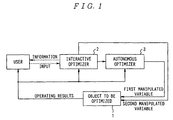
- Figure 1 is a diagram showing the basic concept of the present invention.
- the present invention comprises an object to be optimized 1, an interactive optimizer 2 which determines a first manipulated variable of the object to be optimized 1 by an evolutionary optimizing algorithm and outputs it while evaluating the object to be optimized 1 by interactive evaluation method, and an autonomous optimizer 3 which determines a second manipulated variable of the obj ect to be optimized 1 by the evolutionary optimizing algorithm and outputs it while evaluating the object to be optimized 1 by autonomous evaluation method, as shown in Figure 1.
- the interactive optimizer 2 determines the first manipulated variable by GA so as to optimize operating characteristics of the object to be optimized 1 based on operating results of the object to be optimized 1 and outputs the determined first manipulated variable to the object to be optimized 1.
- the autonomous optimizer 3 determines the second manipulated variable by the GA so as to optimize operating characteristics of the object to be optimized 1 based on operating results of the object to be optimized 1 and outputs the determined second manipulated variable to the object to be optimized 1.
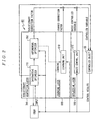
- Figure 2 is a block diagram showing the basic configuration of the present invention.
- the present invention comprises a controlled object 50 and a controller 60 which controls a controlled variable of the controlled object 50 based on control results of the controlled object 50, as shown in Figure 2.
- the controller 60 consists of three control layers: a reflective layer 500, learning layer 600, and evolutionary adaptation layer 700. It receives control results from the controlled object 50, determines a basic controlled variable in the reflective layer 500 and determines a correction factor for the basic controlled variable in the learning layer 600 and evolutionary adaptation layer 700 based on the received control results, and then determines a final controlled variable based on the basic controlled variable and correction factor. Configurations of the reflective layer 500, learning layer 600, and evolutionary adaptation layer 700 will be described in detail below.
- the reflective layer 500 comprises a basic control unit 510 which defines relationship between the basic controlled variable and control results using formulas, maps, neural networks, fuzzy rules, subsumption architecture, etc.
- the basic control unit 510 receives control results from the controlled object 50 and determines and outputs the basic controlled variable based on the received control results.
- the subsumption architecture is known as behavior-based artificial intelligence which performs parallel processing.
- the evolutionary adaptation layer 700 consists of an interactive optimizer 710 which optimizes the control characteristics of the controlled object 50 by repeating evaluation performed by interactive evaluation method using the evolutionary optimizing algorithm and an autonomous optimizer 750 which optimizes the control characteristics of the controlled object 50 by repeating evaluation performed by autonomous evaluation method.
- the interactive optimizer 710 has at least one control module which outputs a controlled variable of the controlled object 50 based on control results. It is configured to optimize the control module using GA by repeating evaluation performed by interactive evaluation method which consists in evaluating the control characteristics of the controlled object 50 based on interaction with the user.
- the GA virtually generates a population consisting of a set of a plurality of individuals and prepares individuals information about each of the individuals by likening it to genetic information. Control coefficients for constructing the control module are assigned to the individuals information.
- the population evolves as processing moves a predetermined number of generations ahead after going through at least one genetic manipulation which consists in performing information manipulation on the individuals information by imitating a gene manipulation and one individuals selection which is made to screen the individuals based on evaluation value of the individuals.
- a control module built on the individuals information about the individual that has the highest evaluation value will be referred to as an "optimal control module.”
- a control module is a unit for performing a group of control operations in a control system.
- the autonomous optimizer 750 has at least one control module which outputs an evolutionary correction factor for correcting the basic controlled variable received from the reflective layer 500 in line with user requirements based on control results. It is configured to optimize the control module using the GA. After constructing an optimal control module, the autonomous optimizer 750 establishes the optimal control module as its control module, performs control using the evolutionary correction factor for correcting the basic controlled variable received from the reflective layer 500, and makes the learning layer 600 learn information about the optimal control module. When the learning layer 600 has learned information about the optimal control module, the autonomous optimizer 750 returns its output to "1" and subsequently operates according to instructions from the user. Thus, the control module of the autonomous optimizer 750 performs control only during an evolution simulation and during learning.
- the learning layer 600 comprises a learning unit 610 which has two neural networks switchable between learning and control.
- the learning unit 610 learns from the evolutionary adaptation layer 700 the relationship between input and output of the optimal control module using one of the neural networks (learning) while performing control with the other neural network (controlling).
- learning the neural network which finished learning starts control using the control module obtained by learning
- the neural network which was performing control starts to function as a learning neural network.
- the neural networks in the learning layer 600 are set to output "1" in initial state. Therefore, in initial state, control is performed by the reflective layer 500 and evolutionary adaptation layer 700.
- the controlling neural network is configured to receive control results from the controlled object 50 and output a learned correction factor for correcting the basic controlled variable received from the reflective layer 500, based on the received control results. This configuration applies similarly to the controlling neural network.
- the controller 60 calculates the controlled variable by adding the learned correction factor received from the learning layer 600 and the evolutionary correction factor received from the evolutionary adaptation layer 700 andmultiplying the basic controlled variable received from the reflective layer 500 by the sum. Then, the controller 60 outputs the calculated controlled variable to the controlled object 50.
- This embodiment applies the optimal solution search device, algorithm-based optimizing controller, and optimal solution search program according to the present invention to a case in which a combination of interactive evaluation method and autonomous evaluation method is repeated using GA to optimize fuel consumption characteristics and response characteristics of an engine 10 for the user as shown in Figure 3.
- Figure 3 is a block diagram showing the configuration of the engine control system to which the present invention is applied.
- the engine control system comprises the engine 10, an electronic throttle 12 which regulates the amount of intake air to cylinders, various sensors 20 which detect operating conditions of the engine 10 and electronic throttle 12 and output various information (hereinafter referred collectively as operation information) about operating conditions of the engine 10, and a controller 30 which controls the fuel injection quantity of the engine 10 based on operation information from the various sensors 20.
- the various sensors 20 detect the operating conditions of the engine 10 and electronic throttle 12 and driving state of the vehicle and output the rotational speed of the engine 10, throttle opening, rate of change in throttle opening, distance pulse, and fuel injection quantity as operation information, based on the detection results.
- the controller 30 consists of three control layers: a reflective layer 100, learning layer 200, and evolutionary adaptation layer 300. It receives the operation information from the various sensors 20, determines a basic injection quantity in the reflective layer 100 and determines a correction factor for the basic injection quantity in the learning layer 200 and evolutionary adaptation layer 300 based on the received operation information, and then determines final fuel injection quantity based on the basic injection quantity and correction factor. Configuration of the reflective layer 100, learning layer 200, and evolutionary adaptation layer 300 will be described in detail below.
- the reflective layer 100 comprises a basic control unit 110 which defines relationship of the basic inj ection quantity and a transient correction factor with the operation informationusing formulas, maps, neural networks, fuzzy rules, subsumption architecture, etc.
- the basic control unit 110 receives operation information from the various sensors 20 and determines and outputs the basic injection quantity and transient correction factor based on the received operation information.
- the evolutionary adaptation layer 300 consists of an interactive optimizer 310 which optimizes the control characteristics (response characteristics) of the electronic throttle 12 by repeating evaluation performed by interactive evaluation method using the GA and an autonomous optimizer 350 which optimizes the control characteristics of the engine 10 by repeating evaluation performed by autonomous evaluation method.
- the interactive optimizer 310 has at least one control module which outputs valve opening of the electronic throttle 12 based on the operation information. It is configured to optimize the control module using the GA by repeating evaluation performed by interactive evaluation method which consists in evaluating the responsivity based on interaction with the user.
- the autonomous optimizer 350 has at least one control module which outputs correction factors (hereinafter, the correction factor for correcting the basic injection quantity will be referred to as an evolutionary correction factor while the correction factor for correcting the transient correction factor will be referred to as an evolutionary transient correction factor) for correcting the basic injection quantity and transient correction factor received from the reflective layer 100 in line with user requirements based on the operation information. It is configured to optimize the control module using the GA. After constructing an optimal control module, the autonomous optimizer 350 establishes the optimal control module as its control module, performs control using the evolutionary correction factor for correcting the basic injection quantity received from the reflective layer 100 and the evolutionary transient correction factor for correcting the transient correction factor received from the reflective layer 100, and makes the learning layer 200 learn information about the optimal control module. When the learning layer 200 has learned information about the optimal control module, the autonomous optimizer 350 returns its output to "1" and subsequently operates according to instructions from the user. Thus, the control module of the autonomous optimizer 350 performs control only during an evolution simulation and during learning.
- correction factors
- the learning layer 200 comprises a learning unit 210 which has two neural networks switchable between learning and control .
- the learning unit 210 learns from the evolutionary adaptation layer 300 the relationship between input and output of the optimal control module using one of the neural networks (learning) while performing control with the other neural network (controlling).
- learning the neural network which finished learning starts control using the control module obtained by learning
- the neural network which was performing control starts to function as a learning neural network.
- the neural networks in the learning layer 200 are set to output "1" in initial state. Therefore, in initial state, control is performed by the reflective layer 100 and evolutionary adaptation layer 300.
- the controlling neural network further comprises two neural networks although not shown particularly. One of them is configured to receive throttle opening and engine speed as operation information from the various sensors 20 and output the correction factor (hereinafter this correction factor will be referred to as a learned correction factor) for correcting the basic injection quantity received from the reflective layer 100 based on the received information.
- the other neural network is configured to receive the rate of change in the throttle opening and the engine speed as operation information from the various sensors 20 and output the correction factor (hereinafter this correction factor will be referred to as a learned transient correction factor) for correcting the transient correction factor received from the reflective layer 100 based on the received information. This configuration applies similarly to the learning neural network.
- the controller 30 produces a first product by adding the learned correction factor received from the learning layer 200 and the evolutionary correction factor received from the evolutionary adaptation layer 300 and multiplying the basic injection quantity received from the reflective layer 100 by the sum. Also, it produces a second product by adding the learned transient correction factor received from the learning layer 200 and the evolutionary transient correction factor received from the evolutionary adaptation layer 300 and multiplying the transient correction factor received from the reflective layer 100 by the sum. Then, it calculates the fuel injection quantity by multiplying the first product by the second product, and outputs the calculated fuel injection quantity to the engine 10.
- Figure 4 is a block diagram showing the configuration of the interactive optimizer 310.
- the interactive optimizer 310 comprises an interface 320 which handles input and output from/to the user, evolutionary adaptation manager 330 which optimizes the control characteristics of the engine 10 by conducting a GA-based evolution simulation, and evaluation unit 340whichcalculates GA's evaluation value of individuals.
- the interface 320 comprises a display 322 which displays the evaluation value of individuals during evolution simulations and an input unit 324 which allows the user to enter evaluation.
- the display 312 displays the evaluation value (responsivity described later) of individuals in each generation and the user enters an evaluation through the input unit 314 based on body sensations such as ride sensations.
- the evaluation unit 340 consists of a responsivity calculator 342 which calculates responsivity based on operation information.
- the responsivity calculator 342 receives the throttle opening and engine speed as the operation information, calculates the rate of change in the engine speed and the rate of change in the throttle opening, calculates responsivity by dividing the rate of change in the engine speed by the rate of change in the throttle opening, and outputs the calculated responsivity as the GA's evaluation value of individuals to the evolutionary adaptation manager 330.
- the evolutionary adaptation manager 330 has a control module 332.
- the control module 332 defines relationship between throttle opening and valve opening based on two control coefficients SP 1 and SP 2 which represent static characteristics of the throttle opening and valve opening as well as on two control coefficients DR (first-order lag element) and AG (inexact differential element) which represent dynamic characteristics of the throttle opening and valve opening, receives the throttle opening as operation information, determines the valve opening based on the received throttle opening, and outputs it to the electronic throttle 12.
- the two control coefficients SP 1 and SP 2 which represent static characteristics and two control coefficients DR and AG which represent dynamic characteristics are assigned to GA's individuals information about individuals. Specifically, they are assigned as shown in Figure 5.
- Figure 5 is a diagram showing a data structure of the individuals information.
- the GA's individuals information about individuals contains the two control coefficients SP 1 and SP 2 in high order part to represent static characteristics, and two control coefficients DR and AG in low order part to represent dynamic characteristics. For example, if one control coefficient consists of 16 bits of data, the individuals information contains 64 bits of data in total. Random numbers are used as initial individuals information generated for each individual when starting an evolution simulation. To ensure responsivity to a certain extent, it is desirable to limit the range of random numbers. In other words, random numbers should not be generated in such ranges where the responsivity would be degraded.
- Figure 6 is a flowchart of processes performed by the evolutionary adaptation manager 330.
- the GA gives random initial values to each individual and arranges the individuals in search spaces, applies genetic manipulations known as crossover and mutation to each generation, propagate or select the individuals according to evaluation value of the individuals, and thereby obtains a set of individuals of the next generation.
- the GA is intended to approach an optimal solution asymptotically by repeating such generation changes. Now, crossover, mutation, and selection which are genetic manipulations will be described below.
- Crossover is a manipulation which involves designating at least two individuals as parents, changing part of the individuals information about the parent individuals, and thereby generating one or more individuals that will become descendants.
- a mutation is a manipulation which changes a specific part of individuals information about individuals at a predetermined probability. It increases variety within the population. Specifically, this manipulation inverts a specific bit in individuals information. For example, if the individuals information about a certain individual is "000111" and a mutation occurs on the third digit, an individual with individuals information "001111" is obtained.
- Selection is a manipulation which preserves better individuals in a population for the next generation according to the evaluation value of individuals.
- a selection method known as roulette selection each individual is selected at a probability proportional to its evaluation value. For example, if the evaluation value of individuals with individuals information "000000,” “111011,” “110111,” “010111” are “8,” “4,” “2,” and “2,” respectively, the probabilities that these individuals will be selected are “8/16,” “4/16,” “2/16,” and “2/16,” respectively.
- the evolutionary adaptation manager 330 selects individuals based on user selections.
- the evolutionary adaptation manager 330 goes to Step S100, where it judges whether an evolution start instruction, which is an instruction to start an evolution simulation, is received from the input unit 322. If it is judged that an evolution start instruction is received (Yes) , the evolutionary adaptation manager 330 goes to Step S102. Otherwise (No) , the evolutionary adaptation manager 330 waits at Step S100 until an evolution start instruction is received.
- an evolution start instruction which is an instruction to start an evolution simulation
- the evolutionary adaptation manager 330 virtually generates a population consisting of a set of a predetermined number (e. g., nine) of individuals and prepares individuals information about each of the individuals.
- the two control coefficients SP 1 and SP 2 which represent static characteristics and two control coefficients DR andAG which represent dynamic characteristics are assigned to the individuals information on each individual. Random numbers are used for the individuals information on each individual.
- the individuals information about each individual is stored and managed in a storage unit such as a RAM.
- the evolutionary adaptation manager 330 goes to Step S104, where it reads the individuals information about the headmost individual. Then, the evolutionary adaptation manager 330 goes to Step S106, where it constructs a control module 332 based on the individuals information read out and starts controlling the electronic throttle 12 using the constructed control module 332.
- the evolutionary adaptation manager 330 goes to Step S108, where it acquires responsivity from the evaluation unit 340. It constructs a control module 332 based on the individuals information and starts controlling the electronic throttle 12 using the constructed control module 332.
- the evolutionary adaptation manager 330 uses the acquired responsivity as an evaluation value of the individual. The higher the evaluation value, the more excellent the individual can be regarded as in the GA-based evolution simulation.
- Step S110 judges whether all the individuals in the population have gone through Steps S106 to S108. If it is judged that all the individuals have gone through the steps (Yes) , the evolutionary adaptation manager 330 goes to Step S112.
- Step S112 the evolutionary adaptation manager 330 displays the responsivity of each individual as its evaluation value on the display 324.
- the evolutionary adaptation manager 330 goes to Step S114, where it allows the user to enter evaluation via the input unit 322.
- control enters an evaluation mode.
- the evaluation mode when the user selects individuals with desired characteristics by looking at the evaluation displayed on the display 324, the evolutionary adaptation manager 330 constructs a control module 332 based on the individuals information about the individual selected by the user, establishes it temporarily, and performs control using the constructed control module 332 . This allows the user to evaluate each individual displayed on the display 324 by comparing its characteristics with ride sensations during driving.
- the user switches control to a screening mode to screen the individuals in the population in Step S116.
- the user switches to the screeningmode in the input unit 322, selects individuals with desired characteristics from the population with reference to the display screen, and erases the other individuals leaving the selected individuals.
- Step S118 the evolutionary adaptation manager 330 selects two parent individuals, by using random numbers, from among the individuals selected by the user, and then generates two child individuals by crossing over the parents individuals. By repeating this process five times, the evolutionary adaptation manager 330 generates a population consisting of nine child individuals (the tenth child individual is discarded).
- a two-point crossover process or normally distributed crossover process may be used, for example.
- the normally distributed crossover process is the process of generating child individuals according to a normal distribution rotationally symmetric with respect to an axis joining parents individuals using individuals information expressed in real numbers.
- the component along the main axis joining the parents individuals is proportional to the distance between the parents individuals while the component along another axis is proportional to the distance between a straight line joining the parents individuals and a third parent individual sampled from the population.
- This crossover method has the advantage that properties of parents are readily inherited by child individuals.
- the evolutionary adaptation manager 330 goes to Step S120, where it performs a mutation process to cause mutations to individuals based on the GA. Then, it goes to Step S122, where it judges, based on information from the input unit 322, whether characteristics satisfactory to the user have been obtained. If it is judged that characteristics satisfactory to the user have not been obtained (No), the evolutionary adaptation manager 330 goes to Step S124 and judges whether the number of generation changes has reached a predetermined number. If it is judged that the predetermined number has been reached (Yes), the evolutionary adaptation manager 330 goes to Step S126.
- Step S126 the evolutionary adaptation manager 330 outputs an evolution start request to the autonomous optimizer 350 to start an evolution simulation. Then, the evolutionary adaptation manager 330 goes to Step S128, where it extracts the individual with the highest evaluation value from the population and using the evaluation value of the extracted individual as responsivity, it outputs a predetermined range around the responsivity as an accepted range of the responsivity to the autonomous optimizer 350. This ends the sequence of processes and the evolutionary adaptation manager 330 returns to the original process.
- Step S124 if it is judged in Step S124 that the number of generation changes is less than the predetermined number (Yes), the evolutionary adaptation manager 330 goes to Step S104.
- Step S122 if it is judged in Step S122 that characteristics satisfactory to the user have been obtained (Yes), the evolutionary adaptation manager 330 goes to Step S126.
- Step S110 if it is judged in Step S110 that not all the individuals in the population have gone through the Steps S106 to S108 (No) , the evolutionary adaptation manager 330 goes to Step S130, where it reads the individuals information about the next individual in the population. Then, it goes to Step S106.
- Figure 7 is a block diagram showing the configuration of the autonomous optimizer 350.
- the autonomous optimizer 350 comprises an evolutionary adaptation manager 360 which optimizes the control characteristics of the engine 10 by conducting a GA-based evolution simulation, and evaluation unit 370 which calculates GA' s evaluation value of individuals.
- the evaluation unit 370 comprises a fuel consumption calculator 372 which calculates the fuel consumption of the engine 10 based on fuel inj ection quantity and distance pulses, and responsivity calculator 374 which calculates responsivity based on throttle opening and engine speed.
- the fuel consumption calculator 372 receives the fuel injection quantity and distance pulses as operation information and calculates the fuel consumption by adding injection quantity each time a distance pulse is input, i.e., every predetermined distance of driving, and outputs the calculated fuel consumption to the evolutionary adaptation manager 360 as a GA's first evaluation value of individuals.
- the responsivity calculator 374 receives the throttle opening and engine speed as operation information, calculates the rate of change in the engine speed and the rate of change in the throttle opening,calculatesresponsivity by dividing the rate of change in the engine speed by the rate of change in the throttle opening, and outputs the calculated responsivity as a GA's second evaluation value of individuals to the evolutionary adaptation manager 360.
- the evolutionary adaptation manager 360 comprises a control module 362.
- the control module 362 comprises two neural networks.
- One of the neural networks 362a is configured to receive throttle opening and engine speed as operation information from the various sensors 20 and output an evolutionary correction factor based on the received information.
- the other neural network 362b is configured to receive the rate of change in the throttle opening and the engine speed as operation information from the various sensors 20 and output an evolutionary transient correction factor based on the received information.
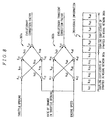
- Coupling coefficients of synapses in the neural networks 362a and 362b are assigned to the GA's individuals information about individuals. Specifically, it is assigned as shown in Figure 8.
- Figure 8 is a diagram showing configurations of the neural networks 362a and 362b and a data structure of individuals information.
- the neural network 362a consists of five perceptrons: an input layer f i1 which receives throttle opening, an input layer f i2 which receives engine speed, intermediate layers f h1 and f h2 which receive outputs of the input layers f i1 and f i2 , an output layer f o1 which receives outputs of the intermediate layers f h1 and f h2 and outputs an evolutionary correction factor.
- the input layer f i1 and intermediate layer f h1 are coupled by a synapse with a coupling coefficient k f1
- the input layer f i2 and intermediate layer f h1 are coupled by a synapse with a coupling coefficient k f2
- the intermediate layer f h1 and output layer f o1 are coupled by a synapse with a coupling coefficient k f3
- the input layer f i1 and intermediate layer f h2 are coupled by a synapse with a coupling coefficient k f4
- the input layer f i2 and intermediate layer f h2 are coupled by a synapse with a coupling coefficient k f5
- the intermediate layer f h2 and output layer f o2 are coupled by a synapse with a coupling coefficient k f6 .
- the neural network 362b consists of five perceptrons: an input layer a i1 which receives throttle opening, an input layer a i2 which receives engine speed, intermediate layers a h1 and a h2 which receive outputs of the input layers a i1 and a i2 , an output layer a o1 which receives outputs of the intermediate layers a h1 and a h2 and outputs an evolutionary transient correction factor.
- the input layer a i1 and intermediate layer a h1 are coupled by a synapse with a coupling coefficient k a1
- the input layer a i2 and intermediate layer a h1 are coupled by a synapse with a coupling coefficient k a2
- the intermediate layer a h1 and output layer a o1 are coupled by a synapse with a coupling coefficient k a3
- the input layer a i1 and intermediate layer a h2 are coupled by a synapse with a coupling coefficient k a4
- the input layer a i2 and intermediate layer a h2 are coupled by a synapse with a coupling coefficient k a5
- the intermediate layer a h2 and output layer a o2 are coupled by a synapse with a coupling coefficient k a6 .
- the GA's individuals information about individuals contains the coupling coefficients k f1 to k f6 of synapses in high order part and the coupling coefficients k a1 to k a6 of synapses in low order part. For example, if one coupling coefficient consists of 8 bits of data, the individuals information contains 96 bits of data in total. Random numbers are used as initial individuals information generated for each individual when starting an evolution simulation. To ensure responsivity to a certain extent, it is desirable to limit the range of random numbers. In other words, random numbers should not be generated in such ranges where the responsivity would be degraded.
- Figure 9 is a flowchart of processes performed by the evolutionary adaptation manager 360.
- the processes shown in the flowchart of Figure 9 are executed by a CPU according to a program, for example, read out of a ROM.
- the evolutionary adaptation manager 360 goes to Step S200, where it judges whether an evolution start request is received fromthe interactive optimizer 310. If it is judged that an evolution start request is received (Yes), the evolutionary adaptation manager 360 goes to Step S202. Otherwise (No), the evolutionary adaptation manager 360 waits at Step S200 until an evolution start request is entered.
- Step S202 the evolutionary adaptation manager 360 receives the accepted range of responsivity from the interactive optimizer 310. Then, it goes to Step S204, where it virtually generates a population consisting of a set of apredeterminednumber (e.g., nine) ofindividualsandprepares individuals information about each of the individuals. Coupling coefficients of synapses in the neural networks 362a and 362b are assigned to the individuals information. Random numbers are used for the individuals information on each individual. By generating one individual with all the digits in its individuals information set to "0," it is possible to keep response performance during the evolution process above the level before the evolution. Incidentally, the individuals information about each individual is stored and managed in a storage unit such as a RAM.
- a storage unit such as a RAM.
- the evolutionary adaptation manager 360 goes to Step S210, where it acquires fuel consumption and responsivity from the evaluation unit 370. It constructs a control module 362 based on the individuals informationandstarts controlling the engine 10 using the constructed control module 362.
- the evolutionary adaptation manager 360 uses the acquired fuel consumption and responsivity as evaluation value of the individual. The higher the evaluation value, the more excellent the individual can be regarded as in the GA-based evolution simulation, where high evaluation value means low fuel consumption in the case of the first evaluation value, and high responsivity in the case of the second evaluation value.
- Step S212 the evolutionary adaptation manager 360 goes to Step S212, where it judges whether all the individuals in the population have gone through Steps S208 to S210. If it is judged that all the individuals have gone through the steps (Yes), the evolutionary adaptation manager 360 goes to Step S214.
- Step S214 the evolutionary adaptation manager 360 judges for each individual whether the second evaluation value, i.e., the responsivity, falls within the accepted range specified in Step S202. If it is judged that the responsivity does not fall within the accepted range (No), the evolutionary adaptation manager 360 goes to Step S216, where it eliminates the individual. Then, the evolutionary adaptation manager 360 goes to Step S218.
- the second evaluation value i.e., the responsivity
- Step S2128 the evolutionary adaptation manager 360 judges whether all the individuals in the population have gone through Steps S208 to S210. If it is judged that all the individuals have gone through the steps (Yes) , the evolutionary adaptation manager 360 goes to Step S220. Otherwise (No), it goes to Step S214.
- Step S220 a population whose responsivity falls within the accepted range is formed as a result of Steps S214 to S218. However, if a predetermined number (e.g., a half) or more of the individuals have not been eliminated, a selection process is carried out further to reduce the total number of individuals to half or less of the original number by screening individuals. Regarding selection processes, in addition to the roulette selection described above, preferential selection of the elite, simple elimination of the less fit, etc. are available.
- the evolutionary adaptation manager 360 goes to Step S222, where it performs a crossover process to cross over individuals based on the GA. Then, it goes to Step S224, where it performs a mutation process to cause mutations to individuals based on the GA. Then, it goes to Step S226, where it judges whether the number of generation changes has reached apredeterminednumber. If it is judged that the predetermined number has been reached (Yes), the evolutionary adaptation manager 360 goes to Step S228.
- Step S228, the evolutionary adaptation manager 360 extracts the individual with the highest evaluation value from the population, constructs an optimal control module based on the individuals information about the extracted individual, and establishes the optimal control module as the control module 362. Then, it goes to Step S230, where it makes the learning layer 200 learn the relationship between input and output of the control module 362. Then, it goes to Step S232, where it sets the output of the control module 362 to "1.” This ends the sequence of processes and the evolutionary adaptation manager 360 returns to the original process.
- Step S226 if it is judged in Step S226 that the number of generation changes is less than the predetermined number (Yes), the evolutionary adaptation manager 360 goes to Step S206.
- Step S212 if it is judged in Step S212 that not all the individuals in the population have gone through the Steps S208 to S210 (No), the evolutionary adaptation manager 360 goes to Step S234, where it reads the individuals information about the next individual in the population. Then, it goes to Step S208.
- the interactive optimizer 310 Upon receiving the evolution start instruction from the user, the interactive optimizer 310 generates a population consisting of nine individuals through Steps S100 to S102 and prepares individuals information about each of the individuals.
- the control coefficients SP 1 and SP 2 which represent static characteristics and two control coefficients DR andAG which represent dynamic characteristics are assigned to the individuals information on each individual.
- an evolution simulation of the first generation is started.
- the individuals information about the headmost individual is read out in Step S104.
- a control module 332 is constructed based on the individuals information read out and the electronic throttle 12 is controlled using the constructed control module 332 for a while.
- responsivity is acquired from the evaluation unit 340.
- the responsivity of each individual is displayed as its evaluation value on the display 324 in Step 112.
- the user selects some individuals from the population with desired characteristics. After the user selects individuals, the other individuals are erased leaving the selected individuals in Step S116, to screen the individuals in the population.
- Steps S118 and S120 respectively.
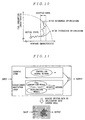
- evolution simulations are repeated in a similar manner until characteristics satisfactory to the user are obtained or the number of generation changes reaches a .. predetermined number. Consequently, the response characteristics are optimized for the user as shown in Figure 10.
- the point located near the center of the accepted range corresponds to the optimized characteristics.
- Figure 10 is a diagram showing an order of optimizing the control characteristics of the engine 10 and electronic throttle 12.
- Steps S126 and S1208 an evolution start request is output to the autonomous optimizer 350, the individual with the highest evaluation value is extracted from the population, and using the evaluation value of the extracted individual as responsivity, a predetermined range around the responsivity is output as an accepted range of the responsivity to the autonomous optimizer 350.
- Steps S200 and S204 When an evolution start request is input in the autonomous optimizer 350, in Steps S200 and S204, the accepted range of responsivity is received, a population consisting of nine individuals is generated, and individuals information about each of the individuals are prepared. Coupling coefficients of synapses in the neural networks 362a and 362b are assigned to the individuals information.
- Step S206 and S208 the individuals information about the headmost individual is read out, a control module 362 is constructed based on the individuals information read out, and the engine 10 is controlled using the constructed control module 362 for a while.
- Step S210 fuel consumption and responsivity are acquired from the evaluation unit 370.
- Step S214 it is judged in Step S214 whether the second evaluation value, i.e., the responsivity, of each individual falls within the accepted range specified in Step S202. Then, the individuals whose responsivity falls outside the accepted range are eliminated in Step S216. Consequently, the individuals whose responsivity falls within the accepted range are allowed to survive as candidates for parent individuals that will produce individuals of the next generation.
- the second evaluation value i.e., the responsivity
- Steps S220 to S224 This ends the evolution simulation of the first generation. Subsequently, evolution simulations are repeated in a similar manner until the number of generation changes reaches a predetermined number. Consequently, the fuel consumption characteristics are optimized autonomously so that the responsivity will fall within the accepted range as shown in Figure 10 .
- the point located on the maximal curve (wavy line) of the fuel consumption characteristics and response characteristics and located within the accepted range corresponds to the optimized characteristics.
- Step S2208 the individual with the highest evaluation value is extracted from the population, an optimal control module is constructed based on the individuals information about the extracted individual, and the optimal control module is established as the control module 362.
- Step S230 the learning layer 200 is made to learn the relationship between input and output of the control module 362 .
- input information such as actual engine speed obtained by the optimal control module is controlled using the evolutionary correction factor and evolutionary transient correction factor.
- the autonomous optimizer 350 starts to perform control using the evolutionary correction factor and evolutionary transient correction factor
- the learning neural network in the learning layer 200 learns the relationship between input and output of the control module 362 as well as the relationship between input and output of the controlling neural network in the learning layer 200 . Meanwhile, the output from the autonomous optimizer 350 is produced based on the individual with the highest evaluation value obtained previously, and thus control rules do not vary with time.
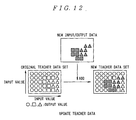
- the input/output between the autonomous optimizer 350 and the controlling neural network in the learning layer 200 is averaged over a certain time and the result is used as input/output data in updating a teacher data set.
- a teacher data set For example, if average engine speed is 5000 rpm, average throttle opening is 20, average intake air temperature is 28°C, average atmospheric pressure is 1013 hPa when averaged over one second, these data are added to the output from the autonomous optimizer 350 and output from the controlling neural network in the learning layer 200 during the same period and the results are used as input/output data (see Figure 11). This input/output data is added to old teacher data to obtain a new teacher data set.
- old teacher data within a certain Euclidean distance from new data in the teacher data set is deleted.
- the outputs for all input data are set to "1."
- the learning layer 200 learns the coupling coefficients of synapses in the learning neural network based on the updated teacher data set. The coupling coefficients are learned until the difference between actual control output and virtual control output becomes equal to or lower than a threshold, where the virtual control output is obtained from the output of the learning neural network which is learning and the basic injection quantity and transient correction factor received from the reflective layer 100.
- the learning neural network switches to a controlling neural network and the previous controlling neural network switches to a learning neural network.
- the learning layer 200 determines and outputs the learned correction factor and learned transient correction factor using the new controlling neural network.
- the output of the control module 362 is set to "1" and control is passed to the learning layer 200 and reflective layer 100.
- the initial value of controlling neural network in the learning layer 200 is set such that the output will always be “1.” This allows control to be performed only by the reflective layer 100 and autonomous optimizer 350 in the initial state.
- this embodiment comprises the interactive optimizer 310 which controls response characteristics and the autonomous optimizer 350 which controls fuel consumption characteristics, in which the interactive optimizer 310 searches for an optimal solutionof the responsivity calculator 342 using the GA while repeatedly evaluating, interactively, the responsivity outputted from the responsivity calculator 342 which receives control coefficients that affect the control characteristics of the interactive optimizer 310 and outputs the responsivity, and the autonomous optimizer 350 searches for an optimal solution of the fuel consumption calculator 372 using the GA while repeatedly evaluating, autonomously, the fuel consumption outputted from the fuel consumption calculator 372 such that the responsivity will be within a predetermined range based on the responsivity determined from the optimal solution found in the optimization of the interactive optimizer 310 using the fuel consumption calculator 372 which receives control coefficients that affect the control characteristics of the autonomous optimizer 350 and outputs the fuel consumption.
- response characteristics can be optimized for the user and fuel consumption characteristics can be optimized according to predetermined evaluation criteria.
- the correction factor for the fuel inj ection quantity of the engine 10 or correction factor for the transient correction factor is generated by the neural networks 362a and 362b. Coupling coefficients of synapses in the neural networks 362a and 362b are assigned to individuals information.
- the GA corresponds to the optimizing algorithm described in any of claims 1, 3 to 5, 7, 8, 10, and 12 or the evolutionary optimizing algorithm described in claim 8.
- the coupling coefficients of synapses in the neural networks 362a and 362b correspond to the control coefficients described in claim 3, 5, 8, or 10.
- the RAM corresponds to the storage means described in claim 2 or 4.
- the evaluation units 340 and 370 correspond to the evaluation value calculation means described in claim 2, 4, or 8.
- the input unit 322 corresponds to the evaluation input means described in claim 2 or 4.
- the engine 10 and electronic throttle 12 correspond to the controlled object described in any of claims 3 to 5, 7, 8, or 10.
- the interactive optimizer 310 corresponds to the first control system described in claim 5
- the autonomous optimizer 350 corresponds to the second control system described in claim 5
- the responsivity calculator 342 corresponds to the first evaluation function described in claim 5 or 7
- the fuel consumption calculator 372 corresponds to the second evaluation function described in claim 5 or 7.
- Steps S118, S120, S222, and S224 correspond to individuals information manipulation means described in claim 8 while Steps S116, and S214 to S220 correspond to the individuals selection means described in claim 8.
- the response characteristics are optimized by repeating evaluation performed by interactive evaluation method, the accepted range of responsivity is set, and then the fuel consumption characteristics are optimized by repeating evaluation performed by autonomous evaluation method so that the responsivity will fall within the accepted range, but this is not restrictive, and it is also possible to optimize the fuel consumption characteristics by repeating evaluation performed by autonomous evaluation method before setting an accepted range of the fuel consumption characteristics and optimizing the response characteristics by repeating evaluation performed by interactive evaluation method so that the fuel consumption will fall within the accepted range.
- these operations may be performed bit by bit alternately or may be performed concurrently.
- the object controlled by the controller 30 is the engine 10, but this is not restrictive and any object may be controlled by the controller 30.
- the controller 30 may also be applied to damping characteristics of car suspensions or seat, assisting characteristics of an auxiliary power unit in a bicycle or wheelchair equipped with an electric motor or engine asauxiliarypower, ormotioncharacteristics (briskmovements or slow movements) of a personal robot.
- fuel injection quantity is used as control output in this embodiment, when the engine 10 is a controlled object, other possible control outputs include duration of injection, ignition timing, intake valve timing, electronic throttle opening, valve lift, exhaust valve timing, and intake/exhaust control valve timing.
- the intake control valve is a valve installed in the intake pipe to control tumble and swirl while the exhaust control valve is a valve installed in the exhaust pipe to control exhaust pulsation.
- hierarchical neural networks are used for the learning layer 200 in this embodiment, this is not restrictive and, for example, a CMAC may be used for a control system in the learning layer 200.
- the advantages of using a CMAC include excellent capability for additional learning, high learning speed, etc.
- the correction factor for the fuel injection quantity of the engine 10 or correction factor for the transient correction factor is generated by the neural networks 362a and 362b and coupling coefficients of synapses in the neural networks 362a and 362b are assigned to individuals information, this is not restrictive and the correction factor for the fuel injection quantityof the engine 10 or correction factor for the transient correction factor may be assigned directly to the individuals information.
- the correction factor for the fuel injection quantity of the engine 10 or correction factor for the transient correction factor is generated by the neural networks 362a and 362b
- this is not restrictive and the fuel injection quantity of the engine 10, transient correction factor, correction factor for the fuel injection quantity, or correction factor for the transient correction factor may be generated by the neural networks 362a and 362b.
- the GA is used to optimize the fuel consumption characteristics and response characteristics of the engine 10
- this is not restrictive and an evolutionary algorithm such as a GP or ES may also be used.
- programs prestored in a ROM are executed to perform the processes in the flowcharts of Figures 6 and 9, this is not restrictive and programs for these procedures may be read into a RAM from a recording medium before execution.
- the recordingmedium heremaybe a semiconductor recording medium such as a RAM or ROM; magnetic recording medium such as an FD or HD; optically readable recording medium such as a CD, CDV, LD, or DVD; magneto-optical recording medium such as an MO.
- a semiconductor recording medium such as a RAM or ROM
- magnetic recording medium such as an FD or HD
- optically readable recording medium such as a CD, CDV, LD, or DVD
- magneto-optical recording medium such as an MO.
- it may be any recording medium regardless of whether it is electronic, magnetic, or optical as long as it is computer-readable.
- the optimal solution search device described in claim 1 or 2 of the present invention has the advantage of being able to search for an optimal solution in line with user requirements with relatively reduced time requirements for optimization.
- the algorithm-based optimizing controller described in claim 3 or 11 of the present invention has the advantage of being able to search for an optimal solution in line with user requirements with relatively reduced time requirements for optimization.
- the algorithm-based optimizing controller described in claim 5 of the present invention has the advantage that after the first control system completes optimization, the second control system can carry out optimization relatively quickly without sacrificing the optimal evaluation value of the first evaluation function so much.
- the algorithm-based optimizing controller described in claim 6 of the present invention has the advantage that the first control system can carry out optimization relatively quickly and that after the first control system completes optimization, the second control system can carry out optimization without sacrificing the optimal evaluation value of the first evaluation function so much.
- the algorithm-based optimizing controller described in claim 7 of the present invention has the advantage that among the control characteristics of the engine, response characteristics can be optimized for the user and fuel consumption characteristics can be optimized according to predetermined evaluation criteria.
- the algorithm-based optimizing controller described in claim 9 of the present invention has the advantage of being able to determine fuel inj ection quantity, a transient correction factor, a correction factor for the fuel injection quantity, or a correction factor for the transient correction factor in such a way that high evaluation value can be expected.
- the algorithm-based optimizing controller described in claim 10 of the present invention has the advantage of being able to determine coupling coefficients of synapses in neural networks in such a way that high evaluation value can be expected.
- the algorithm-based optimizing controller described in claim 11 of the present invention has the advantage that among the control characteristics of an electric motor, speed change characteristics can be optimized for the user and power consumption characteristics can be optimized according to predetermined evaluation criteria.
- the optimal solution search program described in claim 12 has the same advantage as that of the optimal solution search device disclosed in claim 1.
Landscapes
- Engineering & Computer Science (AREA)
- Artificial Intelligence (AREA)
- Evolutionary Computation (AREA)
- Chemical & Material Sciences (AREA)
- Combustion & Propulsion (AREA)
- Mechanical Engineering (AREA)
- General Engineering & Computer Science (AREA)
- Health & Medical Sciences (AREA)
- Computer Vision & Pattern Recognition (AREA)
- Medical Informatics (AREA)
- Software Systems (AREA)
- Physics & Mathematics (AREA)
- General Physics & Mathematics (AREA)
- Automation & Control Theory (AREA)
- Feedback Control In General (AREA)
- Combined Controls Of Internal Combustion Engines (AREA)
- Electrical Control Of Air Or Fuel Supplied To Internal-Combustion Engine (AREA)
Abstract
To provide an algorithm-based optimizing controller
which can search for an optimal solution in line with user
requirements with reduced time requirements for optimization.
An interactive optimizer 310 searches for an optimal
solution of a responsivity calculator 342 using a GA while
repeatedly evaluating, interactively, responsivity outputted
from the responsivity calculator 342 which receives control
coefficients that affect control characteristics of the
interactive optimizer 310 and outputs the responsivity. An
autonomous optimizer 350 searches for an optimal solution of
a fuel consumption calculator 372 using the GAwhile repeatedly
evaluating, autonomously, fuel consumption outputted from the
fuel consumption calculator 372 such that the responsivity
will be within a predetermined range based on the responsivity
determined from the optimal solution found in the optimization
of the interactive optimizer 310 using the fuel consumption
calculator 372 which receives control coefficients that affect
control characteristics of the autonomous optimizer 350 and
outputs the fuel consumption.
Description
The present invention relates to a device and program
which search for an optimal solution of evaluation function
using an optimizing algorithm and, more particularly, to an
optimal solution search device, algorithm-based optimizing
controller, and optimal solution search program which can
search for an optimal solution in line with user requirements
with reduced time requirements for optimization.
Conventionally, when controlling characteristics of
products such as vehicles or household electric appliances,
the characteristics of the products to be controlled are
decided so as to suit as wide a range of users as possible
by taking tastes and usage patterns of target users who are
expected to use the products into consideration in the
development and design phases. However, since the user who
will use the above-mentioned products have their own
individuality and vary widely in tastes, it is practically
impossible to provide characteristics which will satisfy all
the users even if the products are developed and designed by
taking the tastes of the target users into consideration as
described above. To solve this problem, methods are followed
which change control characteristics in such a way as to satisfy
users by estimating tastes and usage patterns of the users
after sales using optimizing algorithms such as a GA.
To optimize control characteristics using an optimizing
algorithm, either an autonomous evaluation method or
interactiveevaluation methodis adopted: the former optimizes
control characteristics by autonomously evaluating
digitalized control results based on predetermined evaluation
criteria and the latter optimizes control characteristics
interactively by presenting control results to the user.
Theautonomousevaluation method,which makesevaluation
based on predetermined evaluation criteria, can optimize
control characteristics in a relatively short period of time,
but is not suitable if evaluation criteria according to which
optimal values correspond to user tastes vary with the user.
In contrast, the interactive evaluation method is suitable
for cases in which evaluation criteria according to which
optimal values correspond to user tastes vary with the user.
However, it is not possible to get many evaluation from the
user in a short period of time. Thus, it takes a relatively
long time to optimize, for example, all the control
characteristics of a vehicle when this method is used alone.
The present invention has been made in view of such prior
art problems yet to be solved. Its object is to provide an
optimal solution search device, algorithm-based optimizing
controller, and optimal solution search program which can
search for an optimal solution in line with user requirements
with reduced time requirements for optimization.
To achieve the above object, the present invention as
defined in claim 1 provides an optimal solution search device
which searches for an optimal solution of an evaluation
function by repeatedly evaluating output from the evaluation
function using an optimizing algorithm, characterized in that
searches based on the optimizing algorithm are carried out
using a combination of interactive evaluation method
evaluating the output from the evaluation function based on
interaction with a user and autonomous evaluation method
evaluating the output from the evaluation function based on
predetermined evaluation criteria.
With this configuration, as the output from the evaluation
function are evaluated repeatedly through the combination of
the autonomous evaluation method and interactive evaluation
method, an optimal solution of the evaluation function is
searched for by the optimizing algorithm.
The invention set forth in claim 1 can be used, for example,
to optimize control characteristics of a controlled object.
However, the invention is not limited to that, and it is
applicable to various problems to which optimizing algorithms
are applied conventionally. This is also true of an optimal
solution search program set forth in claim 12.
Also, as the optimizing algorithm, the invention set forth
in claim 1 can use an evolutionary optimizing algorithm such
as GA, GP (Genetic Progress), or ES (evolutional Stratage).
Alternatively, it can use an optimizing algorithm by means
of local calculations or an optimizing algorithm by means of
reinforcement learning. This is also true of an
algorithm-based optimizing controller set forth in claim 3
as well as the optimal solution search program set forth in
claim 12.
According to claim 2 of the present invention, the optimal
solution search device set forth in claim 1 comprises: storage
means for storing the output from the evaluation function;
evaluation value calculation means for calculating the output
from the evaluation function as evaluation value and storing
it in the storage means; and evaluation input means for
inputting evaluation made by the user, and the interactive
evaluation method performs evaluation based on entries made
through the evaluation input means and the autonomous
evaluation method performs evaluation based on the evaluation
value stored in the storage means.
With this configuration, the evaluation value
calculation means calculates the output from the evaluation
function as evaluation value and stores the calculated
evaluation value in the storage means. As the user inputs
evaluation on the evaluation value, interactive evaluation
method performs evaluation based on the inputted evaluation.
On the other hand, autonomous evaluation method performs
evaluation based on the evaluation value stored in the storage
means. In this way, as the output from the evaluation function
are evaluated repeatedly through the combination of the
autonomous evaluation method and interactive evaluation
method, an optimal solution of the evaluation function is
searched for by the optimizing algorithm.
The storage means stores evaluation value by every
available means at all times. It may store evaluation value
in advance or store evaluation value received from outside
during the operation of this device instead of prestoring them.
This is also true of an algorithm-based optimizing controller
set forth in claim 4.
On the other hand, to achieve the above obj ect, the present
invention as defined in claim 3 provides an algorithm-based
optimizing controller which optimizes control
characteristics of a control systemby searching for an optimal
solution of an evaluation function using an optimizing
algorithm while repeatedly evaluating output from the
evaluation function which receives input of control
coefficients that affect control characteristics of the
control system for controlling characteristics of a controlled
object and outputs the control characteristics, characterized
in that searches based on the optimizing algorithm are carried
out using a combination of interactive evaluation method
evaluating the output from the evaluation function based on
interaction with a user and autonomous evaluation method
evaluating the output from the evaluation function based on
predetermined evaluation criteria.
With this configuration, as the output from the evaluation
function are evaluated repeatedly through the combination of
the autonomous evaluation method and interactive evaluation
method, an optimal solution of the evaluation function is
searched for by the optimizing algorithm. When the searches
are complete, the control system operates based on the control
coefficient searched for as the optimal solution, thereby
optimizing the control characteristics of the control system.
According to claim 4 of the present invention, the
algorithm-based optimizing controller set forth in claim 3
comprises: storage means for storing the output from the
evaluation function; evaluation value calculation means for
calculating the output from the evaluation function as
evaluation value and storing it in the storage means; and
evaluation input means for inputting evaluation made by the
user, and the interactive evaluation method performs
evaluation based on entries made through the evaluation input
means and the autonomous evaluationmethodperforms evaluation
based on the evaluation values stored in the storage means.
With this configuration, the evaluation value
calculation means calculates the output from the evaluation
function as evaluation value and stores the calculated
evaluation value in the storage means. As the user inputs
evaluation on the evaluation value, interactive evaluation
method performs evaluation based on content of the inputted
evaluation. On the other hand, autonomous evaluation method
performs evaluation based on the evaluation value stored in
the storage means. In this way, as the output from the
evaluation function are evaluated repeatedly through the
combination of the autonomous evaluation method and
interactive evaluation method, an optimal solution of the
evaluation function is searched for by the optimizing
algorithm.
According to claim 5 of the present invention, the
algorithm-based optimizing controller set forth in claim 3
or 4 comprises: a first control system for controlling a first
characteristic of the controlled obj ect; and a second control
system for controlling a second characteristic of the
controlled object, and: the first control system searches for
an optimal solution of a first evaluation function using the
optimizing algorithm while repeatedly evaluating, by the
interactive evaluation method, the output from the first
evaluation function which receives input of control
coefficients that affect control characteristics of the first
control system and outputs the control characteristics, and
the second control system searches for an optimal solution
of a second evaluation function using the optimizing algorithm
while repeatedly evaluating, by the autonomous evaluation
method, the output from the second evaluation function such
that the output from the first evaluation function will be
within a predetermined range based on the output from the first
evaluation function determined from the optimal solution found
in the optimizationof the first control system using the second
evaluation function which receives input of control
coefficients that affect control characteristics of the second
control system and outputs the control characteristics as well
as using the first evaluation function.
With this configuration, the first control system
searches for an optimal solution of the first evaluation
function using the optimizing algorithm while the output from
the first evaluation function are evaluated repeatedly by the
interactive evaluation method. The second control system
searches for an optimal solution of the second evaluation
function while the output from the second evaluation function
are evaluated repeatedly by the autonomous evaluation method
such that the output from the first evaluation function will
be within a predetermined range based on the output from the
firstevaluationfunction determinedfromthe optimal solution
found in the optimization of the first control system.
According to claim 6 of the present invention, the
algorithm-based optimizing controller set forth in claim 3
or 4 comprises: a first control system for controlling a first
characteristic of the controlled obj ect; and a second control
system for controlling a second characteristic of the
controlled object, and: the first control system searches for
an optimal solution of the first evaluation function using
the optimizing algorithm while repeatedly evaluating, by the
autonomous evaluation method, the output from the first
evaluation function which receives input of control
coefficients that affect control characteristics of the first
control system and outputs the control characteristics, and
the second control system searches for an optimal solution
of a second evaluation function using the optimizing algorithm
while repeatedly evaluating, by the interactive evaluation
method, the output from the second evaluation function such
that the output from the first evaluation function will be
within a predetermined range based on the output from the first
evaluation function determined from the optimal solution found
in the optimizationof the first control systemusing the second
evaluation function which receives input of control
coefficients that affect control characteristics of the second
control system and outputs the control characteristics as well
as using the first evaluation function.
With this configuration, the first control system
searches for an optimal solution of the first evaluation
function using the optimizing algorithm while the output from
the first evaluation function are evaluated repeatedly by the
autonomous evaluation method. The second control system
searches for an optimal solution of the second evaluation
function while the output from the second evaluation function
are evaluated repeatedly by the interactive evaluation method
such that the output from the first evaluation function will
be within a predetermined range based on the output from the
first evaluation function determined from the optimal solution
found in the optimization of the first control system.
According to claim 7 of the present invention, in the
algorithm-based optimizing controller set forth in claim 5
or 6, the controlled object is an engine; and what undergoes
the interactive evaluation among the outputs from the first
evaluation function and the second evaluation function is
responsivity determined by a rate of change in rotational speed
of the engine and a rate of change in throttle opening while
what undergoes the autonomous evaluation among the outputs
from the first evaluation function and the second evaluation
function is fuel consumption of the engine.
With this configuration, response characteristics are
optimized through the repetition of interactive evaluation
method in relation to the first evaluation function or second
evaluation function, whichever undergoes the interactive
evaluation while the fuel consumption of the engine is
optimized through the repetition of autonomous evaluation
method in relation to the first evaluation function or second
evaluation function, whichever undergoes the autonomous
evaluation.
According to claim 8 of the present invention, in the
algorithm-based optimizing controller set forth in any of
claims 5 to 7, the optimizing algorithm comprises individuals
information manipulation means which virtually generates a
population consisting of a set of a plurality of individuals,
generates individuals information about each of the
individuals by likening it to genetic information, assigns
said control coefficient to the individuals information, and
performs information manipulations on the individuals
information byimitating gene manipulations, evaluation value
calculation means which calculates evaluation value of the
individuals, and individuals selection means which screen the
individuals based on the evaluation value calculated by the
evaluation value calculation means; and the optimizing
algorithm is an evolutionary optimizing algorithm which moves
processing one generation ahead after going through at least
one genetic manipulation by the individuals information
manipulation means and one individuals selection by the
individuals selection means.
With this configuration, the individuals information
manipulation meansperforms information manipulations on the
individuals information by imitating gene manipulations, the
evaluation value calculation means calculates evaluation
value, and the individuals selection means screen the
individuals based on the calculated evaluation value.
Processing moves one generation ahead after going through at
least one genetic manipulation by the individuals information
manipulation means and one individuals selection by the
individuals selection means.
According to claim 9 of the present invention, in the
algorithm-based optimizing controller set forth in claim 8,
the controlled object is an engine; and fuel injection quantity
of the engine, a transient amount of correction for use to
correct the fuel injection quantity in transient state of the
engine, and a correction value to the fuel injection quantity
or a correction value to the transient amount of correction
are assigned to the individuals information as the control
coefficients.
With this configuration, fuel injection quantity of the
engine, a transient amount of correction, and a correction
value to the fuel injection quantity or a correction value
to the transient amount of correction are determined in such
a way that high evaluation value can be expected as the
population evolves.
According to claim 10 of the present invention, in the
algorithm-based optimizing controller set forth in claim 8,
the controlled obj ect is an engine; the fuel inj ection quantity
of the engine, the transient amount of correction for use to
correct the fuel injection quantity in transient state of the
engine, and the correction value to the fuel injection quantity
or the correction value to the transient amount of correction
are generated by neural networks; and coupling coefficients
of synapses in the neural networks are assigned to the
individuals information as the control coefficients.
With this configuration, fuel injection quantity of the
engine, a transient amount of correction, and a correction
value to the fuel injection quantity or a correction value
to the transient amount of correction are generated by neural
networks and the coupling coefficients of synapses in the
neural networks are determined in such a way that high
evaluation value can be expected as the population evolves.
According to claim 11 of the present invention, in the
algorithm-based optimizing controller set forth in claim 5
or 6, the controlled object is an electric motor; and what
undergoes the interactive evaluation among the outputs from
the first evaluation function and the second evaluation
function is a speed change rate of the electric motor while
what undergoes the autonomous evaluation among the outputs
from the first evaluation function and the second evaluation
function is power consumption of the electric motor.
With this configuration, the speed change
characteristics of the electric motor is optimized through
the repetition of interactive evaluation method in relation
to the first evaluation functionor second evaluation function,
whichever undergoes the interactive evaluation while the power
consumption characteristics of the engine is optimized through
the repetition of autonomous evaluation method in relation
to the first evaluation function or second evaluation function,
whichever undergoes the autonomous evaluation.
On the other hand, to achieve the above obj ect, the present
invention as defined in claim 12 provides an optimal solution
search program which is a computer-executable program for
searching for an optimal solution of an evaluation function
by repeatedly evaluating output from the evaluation function
using an optimizing algorithm, characterized in that the
program makes the computer carry out searches based on the
optimizing algorithm using a combination of interactive
evaluation method evaluating the output from the evaluation
function based on interaction with a user and autonomous
evaluation method evaluating the output from the evaluation
function based on predetermined evaluation criteria.
With this configuration, the program running on a computer
has an effect equivalent to that of the optimal solution search
device disclosed in claim 1.
An embodiment of the present invention will be described
below with reference to the drawings. Figures 1 to 12 are
diagrams showing an optimal solution search device,
algorithm-based optimizing controller, and optimal solution
search program according to the present invention.
First, a basic concept of the present invention will be
described with reference to Figure 1. Figure 1 is a diagram
showing the basic concept of the present invention.
In its basic configuration, the present invention
comprises an object to be optimized 1, an interactive optimizer
2 which determines a first manipulated variable of the object
to be optimized 1 by an evolutionary optimizing algorithm and
outputs it while evaluating the object to be optimized 1 by
interactive evaluation method, and an autonomous optimizer
3 which determines a second manipulated variable of the obj ect
to be optimized 1 by the evolutionary optimizing algorithm
and outputs it while evaluating the object to be optimized
1 by autonomous evaluation method, as shown in Figure 1.
The interactive optimizer 2 determines the first
manipulated variable by GA so as to optimize operating
characteristics of the object to be optimized 1 based on
operating results of the object to be optimized 1 and outputs
the determined first manipulated variable to the object to
be optimized 1.
The autonomous optimizer 3 determines the second
manipulated variable by the GA so as to optimize operating
characteristics of the object to be optimized 1 based on
operating results of the object to be optimized 1 and outputs
the determined second manipulated variable to the object to
be optimized 1.
Next, a basic configuration of the present invention will
be described with reference to Figure 2. Figure 2 is a block
diagram showing the basic configuration of the present
invention.
In its basic configuration, the present invention
comprises a controlled object 50 and a controller 60 which
controls a controlled variable of the controlled object 50
based on control results of the controlled object 50, as shown
in Figure 2.
The controller 60 consists of three control layers: a
reflective layer 500, learning layer 600, and evolutionary
adaptation layer 700. It receives control results from the
controlled object 50, determines a basic controlled variable
in the reflective layer 500 and determines a correction factor
for the basic controlled variable in the learning layer 600
and evolutionary adaptation layer 700 based on the received
control results, and then determines a final controlled
variable based on the basic controlled variable and correction
factor. Configurations of the reflective layer 500, learning
layer 600, and evolutionary adaptation layer 700 will be
described in detail below.
The reflective layer 500 comprises a basic control unit
510 which defines relationship between the basic controlled
variable and control results using formulas, maps, neural
networks, fuzzy rules, subsumption architecture, etc. The
basic control unit 510 receives control results from the
controlled object 50 and determines and outputs the basic
controlled variable based on the received control results.
Incidentally, the subsumption architecture is known as
behavior-based artificial intelligence which performs
parallel processing.
The evolutionary adaptation layer 700 consists of an
interactive optimizer 710 which optimizes the control
characteristics of the controlled object 50 by repeating
evaluation performed by interactive evaluation method using
the evolutionary optimizing algorithm and an autonomous
optimizer 750 which optimizes the control characteristics of
the controlled object 50 by repeating evaluation performed
by autonomous evaluation method.
The interactive optimizer 710 has at least one control
module which outputs a controlled variable of the controlled
object 50 based on control results. It is configured to
optimize the control module using GA by repeating evaluation
performed by interactive evaluation method which consists in
evaluating the control characteristics of the controlled
object 50 based on interaction with the user. The GAvirtually
generates a population consisting of a set of a plurality of
individuals and prepares individuals information about each
of the individuals by likening it to genetic information.
Control coefficients for constructing the control module are
assigned to the individuals information. The population
evolves as processing moves a predetermined number of
generations ahead after going through at least one genetic
manipulation which consists in performing information
manipulation on the individuals information by imitating a
gene manipulation and one individuals selection which is made
to screen the individuals based on evaluation value of the
individuals. Hereinafter, a control module built on the
individuals information about the individual that has the
highest evaluation value will be referred to as an "optimal
control module." Incidentally, a control module is a unit
for performing a group of control operations in a control
system.
The autonomous optimizer 750 has at least one control
module which outputs an evolutionary correction factor for
correcting the basic controlled variable received from the
reflective layer 500 in line with user requirements based on
control results. It is configured to optimize the control
module using the GA. After constructing an optimal control
module, the autonomous optimizer 750 establishes the optimal
control module as its control module, performs control using
the evolutionary correction factor for correcting the basic
controlled variable received from the reflective layer 500,
and makes the learning layer 600 learn information about the
optimal control module. When the learning layer 600 has
learned information about the optimal control module, the
autonomous optimizer 750 returns its output to "1" and
subsequently operates according to instructions from the user.
Thus, the control module of the autonomous optimizer 750
performs control only during an evolution simulation and during
learning.
The learning layer 600 comprises a learning unit 610 which
has two neural networks switchable between learning and control.
The learning unit 610 learns from the evolutionary adaptation
layer 700 the relationship between input and output of the
optimal control module using one of the neural networks
(learning) while performing control with the other neural
network (controlling). When the learning neural network
finishes learning, the learning neural network and the
controlling neural network change their places: the neural
network which finished learning starts control using the
control module obtained by learning and the neural network
which was performing control starts to function as a learning
neural network. The neural networks in the learning layer
600 are set to output "1" in initial state. Therefore, in
initial state, control is performed by the reflective layer
500 and evolutionary adaptation layer 700.
The controlling neural network is configured to receive
control results from the controlled object 50 and output a
learned correction factor for correcting the basic controlled
variable received from the reflective layer 500, based on the
received control results. This configuration applies
similarly to the controlling neural network.
The controller 60 calculates the controlled variable by
adding the learned correction factor received from the learning
layer 600 and the evolutionary correction factor received from
the evolutionary adaptation layer 700 andmultiplying the basic
controlled variable received from the reflective layer 500
by the sum. Then, the controller 60 outputs the calculated
controlled variable to the controlled object 50.
A more concrete embodiment of the present invention will
be described below.
This embodiment applies the optimal solution search
device, algorithm-based optimizing controller, and optimal
solution search program according to the present invention
to a case in which a combination of interactive evaluation
method and autonomous evaluation method is repeated using GA
to optimize fuel consumption characteristics and response
characteristics of an engine 10 for the user as shown in Figure
3.
First, a configuration of an engine control system to
which the present invention is applied will be described with
reference to Figure 3. Figure 3 is a block diagram showing
the configuration of the engine control system to which the
present invention is applied.
As shown in Figure 3, the engine control system comprises
the engine 10, an electronic throttle 12 which regulates the
amount of intake air to cylinders, various sensors 20 which
detect operating conditions of the engine 10 and electronic
throttle 12 and output various information (hereinafter
referred collectively as operation information) about
operating conditions of the engine 10, and a controller 30
which controls the fuel injection quantity of the engine 10
based on operation information from the various sensors 20.
The various sensors 20 detect the operating conditions
of the engine 10 and electronic throttle 12 and driving state
of the vehicle and output the rotational speed of the engine
10, throttle opening, rate of change in throttle opening,
distance pulse, and fuel injection quantity as operation
information, based on the detection results.
The controller 30 consists of three control layers: a
reflective layer 100, learning layer 200, and evolutionary
adaptation layer 300. It receives the operation information
from the various sensors 20, determines a basic injection
quantity in the reflective layer 100 and determines a
correction factor for the basic injection quantity in the
learning layer 200 and evolutionary adaptation layer 300 based
on the received operation information, and then determines
final fuel injection quantity based on the basic injection
quantity and correction factor. Configuration of the
reflective layer 100, learning layer 200, and evolutionary
adaptation layer 300 will be described in detail below.
The reflective layer 100 comprises a basic control unit
110 which defines relationship of the basic inj ection quantity
and a transient correction factor with the operation
informationusing formulas, maps, neural networks, fuzzy rules,
subsumption architecture, etc. The basic control unit 110
receives operation information from the various sensors 20
and determines and outputs the basic injection quantity and
transient correction factor based on the received operation
information.
The evolutionary adaptation layer 300 consists of an
interactive optimizer 310 which optimizes the control
characteristics (response characteristics) of the electronic
throttle 12 by repeating evaluation performed by interactive
evaluation method using the GA and an autonomous optimizer
350 which optimizes the control characteristics of the engine
10 by repeating evaluation performed by autonomous evaluation
method.
The interactive optimizer 310 has at least one control
module which outputs valve opening of the electronic throttle
12 based on the operation information. It is configured to
optimize the control module using the GA by repeating
evaluation performed by interactive evaluation method which
consists in evaluating the responsivity based on interaction
with the user.
The autonomous optimizer 350 has at least one control
module which outputs correction factors (hereinafter, the
correction factor for correcting the basic injection quantity
will be referred to as an evolutionary correction factor while
the correction factor for correcting the transient correction
factor will be referred to as an evolutionary transient
correction factor) for correcting the basic injection quantity
and transient correction factor received from the reflective
layer 100 in line with user requirements based on the operation
information. It is configured to optimize the control module
using the GA. After constructing an optimal control module,
the autonomous optimizer 350 establishes the optimal control
module as its control module, performs control using the
evolutionary correction factor for correcting the basic
injection quantity received from the reflective layer 100 and
the evolutionary transient correction factor for correcting
the transient correction factor received from the reflective
layer 100, and makes the learning layer 200 learn information
about the optimal control module. When the learning layer
200 has learned information about the optimal control module,
the autonomous optimizer 350 returns its output to "1" and
subsequently operates according to instructions from the user.
Thus, the control module of the autonomous optimizer 350
performs control only during an evolution simulation and during
learning.
The learning layer 200 comprises a learning unit 210 which
has two neural networks switchable between learning and control .
The learning unit 210 learns from the evolutionary adaptation
layer 300 the relationship between input and output of the
optimal control module using one of the neural networks
(learning) while performing control with the other neural
network (controlling). When the learning neural network
finishes learning, the learning neural network and the
controlling neural network change their places: the neural
network which finished learning starts control using the
control module obtained by learning and the neural network
which was performing control starts to function as a learning
neural network. The neural networks in the learning layer
200 are set to output "1" in initial state. Therefore, in
initial state, control is performed by the reflective layer
100 and evolutionary adaptation layer 300.
The controlling neural network further comprises two
neural networks although not shown particularly. One of them
is configured to receive throttle opening and engine speed
as operation information from the various sensors 20 and output
the correction factor (hereinafter this correction factor will
be referred to as a learned correction factor) for correcting
the basic injection quantity received from the reflective layer
100 based on the received information. The other neural
network is configured to receive the rate of change in the
throttle opening and the engine speed as operation information
from the various sensors 20 and output the correction factor
(hereinafter this correction factor will be referred to as
a learned transient correction factor) for correcting the
transient correction factor received from the reflective layer
100 based on the received information. This configuration
applies similarly to the learning neural network.
The controller 30 produces a first product by adding the
learned correction factor received from the learning layer
200 and the evolutionary correction factor received from the
evolutionary adaptation layer 300 and multiplying the basic
injection quantity received from the reflective layer 100 by
the sum. Also, it produces a second product by adding the
learned transient correction factor received from the learning
layer 200 and the evolutionary transient correction factor
received from the evolutionary adaptation layer 300 and
multiplying the transient correction factor received from the
reflective layer 100 by the sum. Then, it calculates the fuel
injection quantity by multiplying the first product by the
second product, and outputs the calculated fuel injection
quantity to the engine 10.
Next, configuration of the interactive optimizer 310 will
be described with reference to Figure 4. Figure 4 is a block
diagram showing the configuration of the interactive optimizer
310.
As shown in Figure 4, the interactive optimizer 310
comprises an interface 320 which handles input and output
from/to the user, evolutionary adaptation manager 330 which
optimizes the control characteristics of the engine 10 by
conducting a GA-based evolution simulation, and evaluation
unit 340whichcalculates GA's evaluation value of individuals.
The interface 320 comprises a display 322 which displays
the evaluation value of individuals during evolution
simulations and an input unit 324 which allows the user to
enter evaluation. During evolution simulations using the GA,
the display 312 displays the evaluation value (responsivity
described later) of individuals in each generation and the
user enters an evaluation through the input unit 314 based
on body sensations such as ride sensations.
The evaluation unit 340 consists of a responsivity
calculator 342 which calculates responsivity based on
operation information. The responsivity calculator 342
receives the throttle opening and engine speed as the operation
information, calculates the rate of change in the engine speed
and the rate of change in the throttle opening, calculates
responsivity by dividing the rate of change in the engine speed
by the rate of change in the throttle opening, and outputs
the calculated responsivity as the GA's evaluation value of
individuals to the evolutionary adaptation manager 330.
The evolutionary adaptation manager 330 has a control
module 332. The control module 332 defines relationship
between throttle opening and valve opening based on two control
coefficients SP1 and SP2 which represent static characteristics
of the throttle opening and valve opening as well as on two
control coefficients DR (first-order lag element) and AG
(inexact differential element) which represent dynamic
characteristics of the throttle opening and valve opening,
receives the throttle opening as operation information,
determines the valve opening based on the received throttle
opening, and outputs it to the electronic throttle 12.
The two control coefficients SP1 and SP2 which represent
static characteristics and two control coefficients DR and
AG which represent dynamic characteristics are assigned to
GA's individuals information about individuals.
Specifically, they are assigned as shown in Figure 5. Figure
5 is a diagram showing a data structure of the individuals
information.
The GA's individuals information about individuals
contains the two control coefficients SP1 and SP2 in high order
part to represent static characteristics, and two control
coefficients DR and AG in low order part to represent dynamic
characteristics. For example, if one control coefficient
consists of 16 bits of data, the individuals information
contains 64 bits of data in total. Random numbers are used
as initial individuals information generated for each
individual when starting an evolution simulation. To ensure
responsivity to a certain extent, it is desirable to limit
the range of random numbers. In other words, random numbers
should not be generated in such ranges where the responsivity
would be degraded.
Next, processes carried out by the evolutionary
adaptation manager 330 will be described in detail with
reference to Figure 6. Figure 6 is a flowchart of processes
performed by the evolutionary adaptation manager 330.
The GA gives random initial values to each individual
and arranges the individuals in search spaces, applies genetic
manipulations known as crossover and mutation to each
generation, propagate or select the individuals according to
evaluation value of the individuals, and thereby obtains a
set of individuals of the next generation. The GA is intended
to approach an optimal solution asymptotically by repeating
such generation changes. Now, crossover, mutation, and
selection which are genetic manipulations will be described
below.
Crossover is a manipulation which involves designating
at least two individuals as parents, changing part of the
individuals information about the parent individuals, and
thereby generating one or more individuals that will become
descendants. By combining better part of the individuals
information on one individual and better part of the
individuals information on another individual, it will be
possible to obtain an individual with a higher evaluation value.
For example, when generating two descendants by using two
individuals as parents, if the individuals information on one
of the parent individuals is "000110" and the individuals
information on the other parent individual is "110111," by
crossing over the two at the third place, it is possible to
obtain a descendant that has individuals information "000111"
and a descendant that has individuals information "110110."
A mutation is a manipulation which changes a specific
part of individuals information about individuals at a
predetermined probability. It increases variety within the
population. Specifically, this manipulation inverts a
specific bit in individuals information. For example, if the
individuals information about a certain individual is "000111"
and a mutation occurs on the third digit, an individual with
individuals information "001111" is obtained.
Selection is a manipulation which preserves better
individuals in a population for the next generation according
to the evaluation value of individuals. According to a
selection method known as roulette selection, each individual
is selected at a probability proportional to its evaluation
value. For example, if the evaluation value of individuals
with individuals information "000000," "111011," "110111,"
"010111" are "8," "4," "2," and "2," respectively, the
probabilities that these individuals will be selected are
"8/16," "4/16," "2/16," and "2/16," respectively. Thus, on
average, in this population, the number of individuals with
the individuals information "000000" will increase to two,
the number of individuals with the individuals information
"111011" will remain at one, and either the individual with
the individuals information "110111" or the individual with
the individuals information "010111" will remain in the next
generation. However, the evolutionary adaptation manager 330
selects individuals based on user selections.
With the above in mind, the processes carried out by the
evolutionary adaptation manager 330 will be described. The
processes shown in the flowchart of Figure 6 are executed by
a CPU according to a program, for example, read out of a ROM.
First, the evolutionary adaptation manager 330 goes to
Step S100, where it judges whether an evolution start
instruction, which is an instruction to start an evolution
simulation, is received from the input unit 322. If it is
judged that an evolution start instruction is received (Yes) ,
the evolutionary adaptation manager 330 goes to Step S102.
Otherwise (No) , the evolutionary adaptation manager 330 waits
at Step S100 until an evolution start instruction is received.
In Step S102, the evolutionary adaptation manager 330
virtually generates a population consisting of a set of a
predetermined number (e. g., nine) of individuals and prepares
individuals information about each of the individuals. In
this case, the two control coefficients SP1 and SP2 which
represent static characteristics and two control coefficients
DR andAG which represent dynamic characteristics are assigned
to the individuals information on each individual. Random
numbers are used for the individuals information on each
individual. By generating one individual with all the digits
in its individuals information set to "0," it is possible to
keep response performance during the evolution process above
the level before the evolution. Incidentally, the
individuals information about each individual is stored and
managed in a storage unit such as a RAM.
Next, the evolutionary adaptation manager 330 goes to
Step S104, where it reads the individuals information about
the headmost individual. Then, the evolutionary adaptation
manager 330 goes to Step S106, where it constructs a control
module 332 based on the individuals information read out and
starts controlling the electronic throttle 12 using the
constructed control module 332.
Next, the evolutionary adaptation manager 330 goes to
Step S108, where it acquires responsivity from the evaluation
unit 340. It constructs a control module 332 based on the
individuals information and starts controlling the electronic
throttle 12 using the constructed control module 332. The
evolutionary adaptation manager 330 uses the acquired
responsivity as an evaluation value of the individual. The
higher the evaluation value, the more excellent the individual
can be regarded as in the GA-based evolution simulation.
Next, the evolutionary adaptation manager 330 goes to
Step S110, where it judges whether all the individuals in the
population have gone through Steps S106 to S108. If it is
judged that all the individuals have gone through the steps
(Yes) , the evolutionary adaptation manager 330 goes to Step
S112.
In Step S112, the evolutionary adaptation manager 330
displays the responsivity of each individual as its evaluation
value on the display 324. The evolutionary adaptation manager
330 goes to Step S114, where it allows the user to enter
evaluation via the input unit 322. When the evaluations of
all the individuals in the population have been displayed,
control enters an evaluation mode. In the evaluation mode,
when the user selects individuals with desired characteristics
by looking at the evaluation displayed on the display 324,
the evolutionary adaptation manager 330 constructs a control
module 332 based on the individuals information about the
individual selected by the user, establishes it temporarily,
and performs control using the constructed control module 332 .
This allows the user to evaluate each individual displayed
on the display 324 by comparing its characteristics with ride
sensations during driving. After evaluating the individuals
based on the evaluation on the display 324 and ride sensations
during driving, the user switches control to a screening mode
to screen the individuals in the population in Step S116. To
screen the individuals in the population, the user switches
to the screeningmode in the input unit 322, selects individuals
with desired characteristics from the population with
reference to the display screen, and erases the other
individuals leaving the selected individuals.
Next, the evolutionary adaptation manager 330 goes to
Step S118, where it performs a crossover process to cross over
individuals based on the GA. Specifically, in Step S118, the
evolutionary adaptation manager 330 selects two parent
individuals, by using random numbers, from among the
individuals selected by the user, and then generates two child
individuals by crossing over the parents individuals. By
repeating this process five times, the evolutionary adaptation
manager 330 generates a population consisting of nine child
individuals (the tenth child individual is discarded).
Besides the one-point crossover process described above, a
two-point crossover process or normally distributed crossover
process may be used, for example. The normally distributed
crossover process is the process of generating child
individuals according to a normal distribution rotationally
symmetric with respect to an axis joining parents individuals
using individuals information expressed in real numbers.
Regarding the standard deviation of the normal distribution,
the component along the main axis joining the parents
individuals is proportional to the distance between the parents
individuals while the component along another axis is
proportional to the distance between a straight line joining
the parents individuals and a third parent individual sampled
from the population. This crossover method has the advantage
that properties of parents are readily inherited by child
individuals.
Next, the evolutionary adaptation manager 330 goes to
Step S120, where it performs a mutation process to cause
mutations to individuals based on the GA. Then, it goes to
Step S122, where it judges, based on information from the input
unit 322, whether characteristics satisfactory to the user
have been obtained. If it is judged that characteristics
satisfactory to the user have not been obtained (No), the
evolutionary adaptation manager 330 goes to Step S124 and
judges whether the number of generation changes has reached
a predetermined number. If it is judged that the predetermined
number has been reached (Yes), the evolutionary adaptation
manager 330 goes to Step S126.
In Step S126, the evolutionary adaptation manager 330
outputs an evolution start request to the autonomous optimizer
350 to start an evolution simulation. Then, the evolutionary
adaptation manager 330 goes to Step S128, where it extracts
the individual with the highest evaluation value from the
population and using the evaluation value of the extracted
individual as responsivity, it outputs a predetermined range
around the responsivity as an accepted range of the
responsivity to the autonomous optimizer 350. This ends the
sequence of processes and the evolutionary adaptation manager
330 returns to the original process.
On the other hand, if it is judged in Step S124 that the
number of generation changes is less than the predetermined
number (Yes), the evolutionary adaptation manager 330 goes
to Step S104.
On the other hand, if it is judged in Step S122 that
characteristics satisfactory to the user have been obtained
(Yes), the evolutionary adaptation manager 330 goes to Step
S126.
On the other hand, if it is judged in Step S110 that not
all the individuals in the population have gone through the
Steps S106 to S108 (No) , the evolutionary adaptation manager
330 goes to Step S130, where it reads the individuals
information about the next individual in the population. Then,
it goes to Step S106.
Next, a configuration of the autonomous optimizer 350
will be described with reference to Figure 7. Figure 7 is
a block diagram showing the configuration of the autonomous
optimizer 350.
As shown in Figure 7, the autonomous optimizer 350
comprises an evolutionary adaptation manager 360 which
optimizes the control characteristics of the engine 10 by
conducting a GA-based evolution simulation, and evaluation
unit 370 which calculates GA' s evaluation value of individuals.
The evaluation unit 370 comprises a fuel consumption
calculator 372 which calculates the fuel consumption of the
engine 10 based on fuel inj ection quantity and distance pulses,
and responsivity calculator 374 which calculates responsivity
based on throttle opening and engine speed.
The fuel consumption calculator 372 receives the fuel
injection quantity and distance pulses as operation
information and calculates the fuel consumption by adding
injection quantity each time a distance pulse is input, i.e.,
every predetermined distance of driving, and outputs the
calculated fuel consumption to the evolutionary adaptation
manager 360 as a GA's first evaluation value of individuals.
The responsivity calculator 374 receives the throttle opening
and engine speed as operation information, calculates the rate
of change in the engine speed and the rate of change in the
throttle opening,calculatesresponsivity by dividing the rate
of change in the engine speed by the rate of change in the
throttle opening, and outputs the calculated responsivity as
a GA's second evaluation value of individuals to the
evolutionary adaptation manager 360.
The evolutionary adaptation manager 360 comprises a
control module 362. The control module 362 comprises two
neural networks. One of the neural networks 362a is configured
to receive throttle opening and engine speed as operation
information from the various sensors 20 and output an
evolutionary correction factor based on the received
information. The other neural network 362b is configured to
receive the rate of change in the throttle opening and the
engine speed as operation information from the various sensors
20 and output an evolutionary transient correction factor based
on the received information.
Coupling coefficients of synapses in the neural networks
362a and 362b are assigned to the GA's individuals information
about individuals. Specifically, it is assigned as shown in
Figure 8. Figure 8 is a diagram showing configurations of
the neural networks 362a and 362b and a data structure of
individuals information.
The neural network 362a consists of five perceptrons:
an input layer fi1 which receives throttle opening, an input
layer fi2 which receives engine speed, intermediate layers
fh1 and fh2 which receive outputs of the input layers fi1 and
fi2, an output layer fo1 which receives outputs of the
intermediate layers fh1 and fh2 and outputs an evolutionary
correction factor. The input layer fi1 and intermediate layer
fh1 are coupled by a synapse with a coupling coefficient kf1,
the input layer fi2 and intermediate layer fh1 are coupled by
a synapse with a coupling coefficient kf2, the intermediate
layer fh1 and output layer fo1 are coupled by a synapse with
a coupling coefficient kf3, the input layer fi1 and intermediate
layer fh2 are coupled by a synapse with a coupling coefficient
kf4, the input layer fi2 and intermediate layer fh2 are coupled
by a synapse with a coupling coefficient kf5, and the
intermediate layer fh2 and output layer fo2 are coupled by a
synapse with a coupling coefficient kf6.
The neural network 362b consists of five perceptrons:
an input layer ai1 which receives throttle opening, an input
layer ai2 which receives engine speed, intermediate layers
ah1 and ah2 which receive outputs of the input layers ai1 and
ai2, an output layer ao1 which receives outputs of the
intermediate layers ah1 and ah2 and outputs an evolutionary
transient correction factor. The input layer ai1 and
intermediate layer ah1 are coupled by a synapse with a coupling
coefficient ka1, the input layer ai2 and intermediate layer
ah1 are coupled by a synapse with a coupling coefficient ka2,
the intermediate layer ah1 and output layer ao1 are coupled
by a synapse with a coupling coefficient ka3, the input layer
ai1 and intermediate layer ah2 are coupled by a synapse with
a coupling coefficient ka4, the input layer ai2 and intermediate
layer ah2 are coupled by a synapse with a coupling coefficient
ka5, and the intermediate layer ah2 and output layer ao2 are
coupled by a synapse with a coupling coefficient ka6.
The GA's individuals information about individuals
contains the coupling coefficients kf1 to kf6 of synapses in
high order part and the coupling coefficients ka1 to ka6 of
synapses in low order part. For example, if one coupling
coefficient consists of 8 bits of data, the individuals
information contains 96 bits of data in total. Random numbers
are used as initial individuals information generated for each
individual when starting an evolution simulation. To ensure
responsivity to a certain extent, it is desirable to limit
the range of random numbers. In other words, random numbers
should not be generated in such ranges where the responsivity
would be degraded.
Next, processes carried out by the evolutionary
adaptation manager 360 will be described in detail with
reference to Figure 9. Figure 9 is a flowchart of processes
performed by the evolutionary adaptation manager 360. The
processes shown in the flowchart of Figure 9 are executed by
a CPU according to a program, for example, read out of a ROM.
First, the evolutionary adaptation manager 360 goes to
Step S200, where it judges whether an evolution start request
is received fromthe interactive optimizer 310. If it is judged
that an evolution start request is received (Yes), the
evolutionary adaptation manager 360 goes to Step S202.
Otherwise (No), the evolutionary adaptation manager 360 waits
at Step S200 until an evolution start request is entered.
In Step S202, the evolutionary adaptation manager 360
receives the accepted range of responsivity from the
interactive optimizer 310. Then, it goes to Step S204, where
it virtually generates a population consisting of a set of
apredeterminednumber (e.g., nine) ofindividualsandprepares
individuals information about each of the individuals.
Coupling coefficients of synapses in the neural networks 362a
and 362b are assigned to the individuals information. Random
numbers are used for the individuals information on each
individual. By generating one individual with all the digits
in its individuals information set to "0," it is possible to
keep response performance during the evolution process above
the level before the evolution. Incidentally, the
individuals information about each individual is stored and
managed in a storage unit such as a RAM.
Next, the evolutionary adaptation manager 360 goes to
Step S206, where it reads the individuals information about
the headmost individual. Then, the evolutionary adaptation
manager 360 goes to Step S208, where it constructs a control
module 362 by determining connections in the neural networks
362a and 362b based on the individuals information read out
and starts controlling the engine 10 using the constructed
control module 362. In so doing, the evolutionary adaptation
manager 360 inputs the throttle opening, the rate of change
in the throttle opening and engine speed outputted by the
autonomous optimizer 350 into the neural networks 362a and
362b and linearly transforms the output of the neural networks
362a and 362b according to Equation (1) below. The input
information of the throttle opening, the rate of change of
the throttle opening, and the engine speed are used in a
normalized form respectively. In Equation (1) below, Y is
an evolutionary correction factor or evolutionary transient
correction factor, x is the output of the neural networks 362a
and 362b, and G is a predetermined gain.
Y = 2 × Gx - G
In this way, by linearly transforming the output x of
the neural networks 362a and 362b, it is possible to prevent
the evolutionary correction factor or evolutionary transient
correction factor outputted by the autonomous optimizer 350
from having inordinately large values, make the evolution
simulation proceed slowly as a whole, and prevent engine 10
behavior from varying greatly in evaluation and the evolution
simulation.
Next, the evolutionary adaptation manager 360 goes to
Step S210, where it acquires fuel consumption and responsivity
from the evaluation unit 370. It constructs a control module
362 based on the individuals informationandstarts controlling
the engine 10 using the constructed control module 362. The
evolutionary adaptation manager 360 uses the acquired fuel
consumption and responsivity as evaluation value of the
individual. The higher the evaluation value, the more
excellent the individual can be regarded as in the GA-based
evolution simulation, where high evaluation value means low
fuel consumption in the case of the first evaluation value,
and high responsivity in the case of the second evaluation
value.
Next, the evolutionary adaptation manager 360 goes to
Step S212, where it judges whether all the individuals in the
population have gone through Steps S208 to S210. If it is
judged that all the individuals have gone through the steps
(Yes), the evolutionary adaptation manager 360 goes to Step
S214.
In Step S214, the evolutionary adaptation manager 360
judges for each individual whether the second evaluation value,
i.e., the responsivity, falls within the accepted range
specified in Step S202. If it is judged that the responsivity
does not fall within the accepted range (No), the evolutionary
adaptation manager 360 goes to Step S216, where it eliminates
the individual. Then, the evolutionary adaptation manager
360 goes to Step S218.
In Step S218, the evolutionary adaptation manager 360
judges whether all the individuals in the population have gone
through Steps S208 to S210. If it is judged that all the
individuals have gone through the steps (Yes) , the evolutionary
adaptation manager 360 goes to Step S220. Otherwise (No),
it goes to Step S214.
In Step S220, a population whose responsivity falls within
the accepted range is formed as a result of Steps S214 to S218.
However, if a predetermined number (e.g., a half) or more of
the individuals have not been eliminated, a selection process
is carried out further to reduce the total number of individuals
to half or less of the original number by screening individuals.
Regarding selection processes, in addition to the roulette
selection described above, preferential selection of the elite,
simple elimination of the less fit, etc. are available.
Next, the evolutionary adaptation manager 360 goes to
Step S222, where it performs a crossover process to cross over
individuals based on the GA. Then, it goes to Step S224, where
it performs a mutation process to cause mutations to
individuals based on the GA. Then, it goes to Step S226, where
it judges whether the number of generation changes has reached
apredeterminednumber. If it is judged that the predetermined
number has been reached (Yes), the evolutionary adaptation
manager 360 goes to Step S228.
In Step S228, the evolutionary adaptation manager 360
extracts the individual with the highest evaluation value from
the population, constructs an optimal control module based
on the individuals information about the extracted individual,
and establishes the optimal control module as the control
module 362. Then, it goes to Step S230, where it makes the
learning layer 200 learn the relationship between input and
output of the control module 362. Then, it goes to Step S232,
where it sets the output of the control module 362 to "1."
This ends the sequence of processes and the evolutionary
adaptation manager 360 returns to the original process.
On the other hand, if it is judged in Step S226 that the
number of generation changes is less than the predetermined
number (Yes), the evolutionary adaptation manager 360 goes
to Step S206.
On the other hand, if it is judged in Step S212 that not
all the individuals in the population have gone through the
Steps S208 to S210 (No), the evolutionary adaptation manager
360 goes to Step S234, where it reads the individuals
information about the next individual in the population. Then,
it goes to Step S208.
Next, operation of the above embodiment will be described
with reference to drawings.
To optimize the engine 10 and electronic throttle 12 for
the user, first the user enters an evolution start instruction
in the input unit 322.
Upon receiving the evolution start instruction from the
user, the interactive optimizer 310 generates a population
consisting of nine individuals through Steps S100 to S102 and
prepares individuals information about each of the individuals.
In this case, the control coefficients SP1 and SP2 which
represent static characteristics and two control coefficients
DR andAG which represent dynamic characteristics are assigned
to the individuals information on each individual.
After the population is generated, an evolution
simulation of the first generation is started. In the
evolution simulation of the first generation, first the
individuals information about the headmost individual is read
out in Step S104. A control module 332 is constructed based
on the individuals information read out and the electronic
throttle 12 is controlled using the constructed control module
332 for a while. In Step S108, responsivity is acquired from
the evaluation unit 340.
When all the individuals in the population have gone
through Steps S106 to S108 in a similarmanner, the responsivity
of each individual is displayed as its evaluation value on
the display 324 in Step 112. With reference to the evaluation
of individuals displayed on the display 324, the user selects
some individuals from the population with desired
characteristics. After the user selects individuals, the
other individuals are erased leaving the selected individuals
in Step S116, to screen the individuals in the population.
Next, a crossover process and mutation process are
performed in Steps S118 and S120, respectively. This ends
the evolution simulation of the first generation.
Subsequently, evolution simulations are repeated in a similar
manner until characteristics satisfactory to the user are
obtained or the number of generation changes reaches a ..
predetermined number. Consequently, the response
characteristics are optimized for the user as shown in Figure
10. In the example of Figure 10, the point located near the
center of the accepted range corresponds to the optimized
characteristics. Figure 10 is a diagram showing an order of
optimizing the control characteristics of the engine 10 and
electronic throttle 12.
When evolution simulations are completed, in Steps S126
and S128, an evolution start request is output to the autonomous
optimizer 350, the individual with the highest evaluation value
is extracted from the population, and using the evaluation
value of the extracted individual as responsivity, a
predetermined range around the responsivity is output as an
accepted range of the responsivity to the autonomous optimizer
350.
When an evolution start request is input in the autonomous
optimizer 350, in Steps S200 and S204, the accepted range of
responsivity is received, a population consisting of nine
individuals is generated, and individuals information about
each of the individuals are prepared. Coupling coefficients
of synapses in the neural networks 362a and 362b are assigned
to the individuals information.
After the population is generated, an evolution
simulation of the first generation is started. In the
evolution simulation of the first generation, first in Steps
S206 and S208, the individuals information about the headmost
individual is read out, a control module 362 is constructed
based on the individuals information read out, and the engine
10 is controlled using the constructed control module 362 for
a while. In Step S210, fuel consumption and responsivity are
acquired from the evaluation unit 370.
When all the individuals in the population have gone
through Steps S208 to S210 in a similar manner, it is judged
in Step S214 whether the second evaluation value, i.e., the
responsivity, of each individual falls within the accepted
range specified in Step S202. Then, the individuals whose
responsivity falls outside the accepted range are eliminated
in Step S216. Consequently, the individuals whose
responsivity falls within the accepted range are allowed to
survive as candidates for parent individuals that will produce
individuals of the next generation.
Next, selection, crossover, and mutation processes are
performed in Steps S220 to S224. This ends the evolution
simulation of the first generation. Subsequently, evolution
simulations are repeated in a similar manner until the number
of generation changes reaches a predetermined number.
Consequently, the fuel consumption characteristics are
optimized autonomously so that the responsivity will fall
within the accepted range as shown in Figure 10 . In the example
of Figure 10, the point located on the maximal curve (wavy
line) of the fuel consumption characteristics and response
characteristics and located within the accepted range
corresponds to the optimized characteristics.
When evolution simulations are completed, in Step S228,
the individual with the highest evaluation value is extracted
from the population, an optimal control module is constructed
based on the individuals information about the extracted
individual, and the optimal control module is established as
the control module 362.
Next, in Step S230, the learning layer 200 is made to
learn the relationship between input and output of the control
module 362 . In this learning, input information such as actual
engine speed obtained by the optimal control module is
controlled using the evolutionary correction factor and
evolutionary transient correction factor. When the
autonomous optimizer 350 starts to perform control using the
evolutionary correction factor and evolutionary transient
correction factor, the learning neural network in the learning
layer 200 learns the relationship between input and output
of the control module 362 as well as the relationship between
input and output of the controlling neural network in the
learning layer 200 . Meanwhile, the output from the autonomous
optimizer 350 is produced based on the individual with the
highest evaluation value obtained previously, and thus control
rules do not vary with time. In the learning described above,
the input/output between the autonomous optimizer 350 and the
controlling neural network in the learning layer 200 is
averaged over a certain time and the result is used as
input/output data in updating a teacher data set. For example,
if average engine speed is 5000 rpm, average throttle opening
is 20, average intake air temperature is 28°C, average
atmospheric pressure is 1013 hPa when averaged over one second,
these data are added to the output from the autonomous optimizer
350 and output from the controlling neural network in the
learning layer 200 during the same period and the results are
used as input/output data (see Figure 11). This input/output
data is added to old teacher data to obtain a new teacher data
set. In so doing, old teacher data within a certain Euclidean
distance from new data in the teacher data set is deleted.
This is shown in Figure 12. As initial values of teacher data
set, the outputs for all input data are set to "1." The learning
layer 200 learns the coupling coefficients of synapses in the
learning neural network based on the updated teacher data set.
The coupling coefficients are learned until the difference
between actual control output and virtual control output
becomes equal to or lower than a threshold, where the virtual
control output is obtained from the output of the learning
neural network which is learning and the basic injection
quantity and transient correction factor received from the
reflective layer 100. When this learning is finished, the
learning neural network switches to a controlling neural
network and the previous controlling neural network switches
to a learning neural network. Then, the learning layer 200
determines and outputs the learned correction factor and
learned transient correction factor using the new controlling
neural network. In Step 5232, the output of the control module
362 is set to "1" and control is passed to the learning layer
200 and reflective layer 100. The initial value of controlling
neural network in the learning layer 200 is set such that the
output will always be "1." This allows control to be performed
only by the reflective layer 100 and autonomous optimizer 350
in the initial state.
Thus, this embodiment comprises the interactive
optimizer 310 which controls response characteristics and the
autonomous optimizer 350 which controls fuel consumption
characteristics, in which the interactive optimizer 310
searches for an optimal solutionof the responsivity calculator
342 using the GA while repeatedly evaluating, interactively,
the responsivity outputted from the responsivity calculator
342 which receives control coefficients that affect the control
characteristics of the interactive optimizer 310 and outputs
the responsivity, and the autonomous optimizer 350 searches
for an optimal solution of the fuel consumption calculator
372 using the GA while repeatedly evaluating, autonomously,
the fuel consumption outputted from the fuel consumption
calculator 372 such that the responsivity will be within a
predetermined range based on the responsivity determined from
the optimal solution found in the optimization of the
interactive optimizer 310 using the fuel consumption
calculator 372 which receives control coefficients that affect
the control characteristics of the autonomous optimizer 350
and outputs the fuel consumption.
This makes it possible to searchforacontrol coefficients
which will provide responsivity more in line with user
requirements with relatively reduced time requirements for
optimization. Especially, after the interactive optimizer
310 completes optimization, the autonomous optimizer 350 can
carry out optimization relatively quickly without sacrificing
responsivity so much.
Furthermore, according to this embodiment, what is
evaluated by the interactive optimizer 310 is responsivity
and what is evaluated by the autonomous optimizer 350 is fuel
consumption.
Consequently, among the control characteristics of the
engine 10, response characteristics can be optimized for the
user and fuel consumption characteristics can be optimized
according to predetermined evaluation criteria.
Furthermore, according to this embodiment, the
correction factor for the fuel inj ection quantity of the engine
10 or correction factor for the transient correction factor
is generated by the neural networks 362a and 362b. Coupling
coefficients of synapses in the neural networks 362a and 362b
are assigned to individuals information.
This makes it possible to determine coupling coefficients
of synapses in the neural networks 362a and 362b in such a
way that high evaluation value can be expected.
In the above embodiments, the GA corresponds to the
optimizing algorithm described in any of claims 1, 3 to 5,
7, 8, 10, and 12 or the evolutionary optimizing algorithm
described in claim 8. The coupling coefficients of synapses
in the neural networks 362a and 362b correspond to the control
coefficients described in claim 3, 5, 8, or 10. The RAM
corresponds to the storage means described in claim 2 or 4.
The evaluation units 340 and 370 correspond to the evaluation
value calculation means described in claim 2, 4, or 8. The
input unit 322 corresponds to the evaluation input means
described in claim 2 or 4. The engine 10 and electronic
throttle 12 correspond to the controlled object described in
any of claims 3 to 5, 7, 8, or 10.
Also, in the above embodiments, the interactive optimizer
310 corresponds to the first control system described in claim
5, the autonomous optimizer 350 corresponds to the second
control system described in claim 5, the responsivity
calculator 342 corresponds to the first evaluation function
described in claim 5 or 7, and the fuel consumption calculator
372 corresponds to the second evaluation function described
in claim 5 or 7. Also, Steps S118, S120, S222, and S224
correspond to individuals information manipulation means
described in claim 8 while Steps S116, and S214 to S220
correspond to the individuals selection means described in
claim 8.
Incidentally, in the above embodiments, the response
characteristics are optimized by repeating evaluation
performed by interactive evaluation method, the accepted range
of responsivity is set, and then the fuel consumption
characteristics are optimized by repeating evaluation
performed by autonomous evaluation method so that the
responsivity will fall within the accepted range, but this
is not restrictive, and it is also possible to optimize the
fuel consumption characteristics by repeating evaluation
performed by autonomous evaluation method before setting an
accepted range of the fuel consumption characteristics and
optimizing the response characteristics by repeating
evaluation performed by interactive evaluation method so that
the fuel consumption will fall within the accepted range. Of
course, there is no need to stick to these orders, and these
operations may be performed bit by bit alternately or may be
performed concurrently.
Also, in one of the above embodiments, the object
controlled by the controller 30 is the engine 10, but this
is not restrictive and any object may be controlled by the
controller 30. For example, the controller 30 may also be
applied to damping characteristics of car suspensions or seat,
assisting characteristics of an auxiliary power unit in a
bicycle or wheelchair equipped with an electric motor or engine
asauxiliarypower, ormotioncharacteristics (briskmovements
or slow movements) of a personal robot.
Also, although fuel injection quantity is used as control
output in this embodiment, when the engine 10 is a controlled
object, other possible control outputs include duration of
injection, ignition timing, intake valve timing, electronic
throttle opening, valve lift, exhaust valve timing, and
intake/exhaust control valve timing. The intake control
valve is a valve installed in the intake pipe to control tumble
and swirl while the exhaust control valve is a valve installed
in the exhaust pipe to control exhaust pulsation.
Also, although hierarchical neural networks are used for
the learning layer 200 in this embodiment, this is not
restrictive and, for example, a CMAC may be used for a control
system in the learning layer 200. The advantages of using
a CMAC include excellent capability for additional learning,
high learning speed, etc.
Also, although in the above embodiments, the correction
factor for the fuel injection quantity of the engine 10 or
correction factor for the transient correction factor is
generated by the neural networks 362a and 362b and coupling
coefficients of synapses in the neural networks 362a and 362b
are assigned to individuals information, this is not
restrictive and the correction factor for the fuel injection
quantityof the engine 10 or correction factor for the transient
correction factor may be assigned directly to the individuals
information.
This will make it possible to determine the correction
factor for the fuel injection quantity of the engine 10 or
correction factor for the transient correction factor in such
a way that high evaluation value can be expected.
Also, although in the above embodiments, the correction
factor for the fuel injection quantity of the engine 10 or
correction factor for the transient correction factor is
generated by the neural networks 362a and 362b, this is not
restrictive and the fuel injection quantity of the engine 10,
transient correction factor, correction factor for the fuel
injection quantity, or correction factor for the transient
correction factor may be generated by the neural networks 362a
and 362b. This also applies to the configuration in which
they are calculated directly without involving the neural
networks 362a and 362b.
Also, although in the above embodiments, the GA is used
to optimize the fuel consumption characteristics and response
characteristics of the engine 10, this is not restrictive and
an evolutionary algorithm such as a GP or ES may also be used.
Also, although in the above embodiments, programs
prestored in a ROM are executed to perform the processes in
the flowcharts of Figures 6 and 9, this is not restrictive
and programs for these procedures may be read into a RAM from
a recording medium before execution.
The recordingmediumheremaybe a semiconductor recording
medium such as a RAM or ROM; magnetic recording medium such
as an FD or HD; optically readable recording medium such as
a CD, CDV, LD, or DVD; magneto-optical recording medium such
as an MO. In other words, it may be any recording medium
regardless of whether it is electronic, magnetic, or optical
as long as it is computer-readable.
As described above, the optimal solution search device
described in claim 1 or 2 of the present invention has the
advantage of being able to search for an optimal solution in
line with user requirements with relatively reduced time
requirements for optimization.
Also, the algorithm-based optimizing controller
described in claim 3 or 11 of the present invention has the
advantage of being able to search for an optimal solution in
line with user requirements with relatively reduced time
requirements for optimization.
Furthermore, the algorithm-based optimizing controller
described in claim 5 of the present invention has the advantage
that after the first control system completes optimization,
the second control system can carry out optimization relatively
quickly without sacrificing the optimal evaluation value of
the first evaluation function so much.
Furthermore, the algorithm-based optimizing controller
described in claim 6 of the present invention has the advantage
that the first control system can carry out optimization
relatively quickly and that after the first control system
completes optimization, the second control system can carry
out optimization without sacrificing the optimal evaluation
value of the first evaluation function so much.
Furthermore, the algorithm-based optimizing controller
described in claim 7 of the present invention has the advantage
that among the control characteristics of the engine, response
characteristics can be optimized for the user and fuel
consumption characteristics can be optimized according to
predetermined evaluation criteria.
Furthermore, the algorithm-based optimizing controller
described in claim 9 of the present invention has the advantage
of being able to determine fuel inj ection quantity, a transient
correction factor, a correction factor for the fuel injection
quantity, or a correction factor for the transient correction
factor in such a way that high evaluation value can be expected.
Furthermore, the algorithm-based optimizing controller
described in claim 10 of the present invention has the advantage
of being able to determine coupling coefficients of synapses
in neural networks in such a way that high evaluation value
can be expected.
Furthermore, the algorithm-based optimizing controller
described in claim 11 of the present invention has the advantage
that among the control characteristics of an electric motor,
speed change characteristics can be optimized for the user
and power consumption characteristics can be optimized
according to predetermined evaluation criteria.
On the other hand, the optimal solution search program
described in claim 12 has the same advantage as that of the
optimal solution search device disclosed in claim 1.
Claims (12)
- An optimal solution search device which searches for an optimal solution of an evaluation function by repeatedly evaluating output from the evaluation function using an optimizing algorithm, characterized in that
searches based on the optimizing algorithm are carried out using a combination of interactive evaluation method evaluating the output from the evaluation function based on interaction with a user and autonomous evaluation method evaluating the output from the evaluation function based on predetermined evaluation criteria. - The optimal solution search device according to claim 1, wherein the device comprises: storage means for storing the output from the evaluation function; evaluation value calculation means for calculating the output from the evaluation function as evaluation value and storing it in the storage means; and evaluation input means for inputting evaluation made by the user,
and the interactive evaluation method performs evaluation based on entries made through the evaluation input means and the autonomous evaluation method per forms evaluation based on the evaluation value stored in the storage means. - An algorithm-based optimizing controller which optimizes control characteristics of a control system by searching for an optimal solution of an evaluation function using an optimizing algorithm while repeatedly evaluating output from the evaluation function which receives input of control coefficients that affect control characteristics of the control system for controlling characteristics of a controlled object and outputs the control characteristics, characterized in that:searches based on the optimizing algorithm are carried out using a combination of interactive evaluation method evaluating the output from the evaluation function based on interaction with a user and autonomous evaluation method evaluating the output from the evaluation function based on predetermined evaluation criteria.
- The algorithm-based optimizing controller according to claim 3, wherein the controller comprises: storage means for storing the output from the evaluation function; evaluation value calculation means for calculating the output from the evaluation function as evaluation value and storing it in the storage means; and evaluation input means for inputting evaluation made by the user,
and the interactive evaluation method performs evaluation based on entries made through the evaluation input means and theautonomousevaluation method performs evaluation based on the evaluation value stored in the storage means. - The algorithm-based optimizing controller according to claim 3 or 4, wherein the controller comprises: a first control system for controlling a first characteristic of the controlled object; and a second control system for controlling a second characteristic of the controlled object,
and: the first control system searches for an optimal solution of a first evaluation function using the optimizing algorithm while repeatedly evaluating, by the interactive evaluation method, the output from the first evaluation function which receives input of control coefficients that affect control characteristics of the first control system and outputs the control characteristics, and
the second control system searches for an optimal solution of a second evaluation function using the optimizing algorithm while repeatedly evaluating, by the autonomous evaluation method, the output from the second evaluation function such that the output from the first evaluation function will be within a predetermined range based on the output from the first evaluation function determined from the optimal solution found in the optimization of the first control system using the second evaluation function which receives input of control coefficients that affect control characteristics of the second control system and outputs the control characteristics as well as using the first evaluation function. - The algorithm-based optimizing controller according to claim 3 or 4, wherein the controller comprises: a first control system for controlling afirst characteristic of the controlled object; and a second control system for controlling a second characteristic of the controlled object,
and: the first control system searches for an optimal solution of the first evaluation function using the optimizing algorithm while repeatedly evaluating, by the autonomous evaluation method, the output from the first evaluation function which receives input of control coefficients that affect control characteristics of the first control system and outputs the control characteristics, and
the second control system searches for an optimal solution of a second evaluation function using the optimizing algorithm while repeatedly evaluating, by the interactive evaluation method, the output from the second evaluation function such that the output from the first evaluation function will be within a predetermined range based on the output from the first evaluation function determined from theoptimalsolution found in the optimization of the first control system using the second evaluation function which receives input of control coefficients that affect control characteristics of the second control system and outputs the control characteristics as well as using the first evaluation function. - The algorithm-based optimizing controller according to claim 5 or 6, wherein:the controlled object is an engine; andwhat undergoes the interactive evaluation among the outputs from the first evaluation function and the second evaluation function is responsivity determined by a rate of change in rotational speed of the engine and a rate of change in throttle opening while what undergoes the autonomous evaluation among the outputs from the first evaluation function and the second evaluation function is fuel consumption of the engine.
- The algorithm-based optimizing controller according to any of claims 5 to 7, wherein: the optimizing algorithm comprises individuals information manipulation means which virtually generates a population consisting of a set of a plurality of individuals, generates individuals information about each of the individuals by likening it to genetic information assigns said control coefficient to the individuals information, and performs information manipulations on the individuals information by imitating genetic manipulations, evaluation value calculation means which calculates evaluation value of the individuals, and individualsselection means which screen the individuals based on the evaluation value calculated by the evaluation value calculation means; and the optimizing algorithm is an evolutionary optimizing algorithm which moves processing one generation ahead after going through at least one genetic manipulation by the individuals information manipulation means and one individuals selection by the individuals selection means.
- The algorithm-based optimizing controller according to claim 8, wherein:the controlled object is an engine; andfuel injection quantity of the engine, a transient amount of correction for use to correct the fuel injection quantity in transient state of the engine, and a correction value to the fuel injection quantity or a correction value to the transient amount of correction are assigned to the individuals information as the control coefficients.
- The algorithm-based optimizing controller according to claim 8, wherein:the controlled object is an engine;fuel injection quantity of the engine, a transient amount of correction for use to correct the fuel injection quantity in transient state of the engine, and a correction value to the fuel injection quantity or a correction value to the transient amount of correction are generated by neural networks; andcoupling coefficients of synapses in the neural networks are assigned to the individuals information as the control coefficients.
- The algorithm-based optimizing controller according to claim 5 or 6, wherein:the controlled object is an electric motor; andwhat undergoes the interactive evaluation among the outputs from the first evaluation function and the second evaluation function is a speed change rate of the electric motor while what undergoes the autonomous evaluation among the outputs from the first evaluation function and the second evaluation function is power consumption of the electric motor.
- An optimal solution search program which is a computer-executable program for searching for an optimal solution of an evaluation function by repeatedly evaluating output from the evaluation function using an optimizing algorithm, characterized in that:the program makes the computer carry out searches based on the optimizing algorithm using a combination of interactive evaluation method evaluating the output from the evaluation function based on interaction with a user and autonomous evaluation method evaluating the output from the evaluation function based on predetermined evaluation criteria.
Applications Claiming Priority (3)
| Application Number | Priority Date | Filing Date | Title |
|---|---|---|---|
| JP2001049342 | 2001-02-23 | ||
| JP2001049342A JP2002251597A (en) | 2001-02-23 | 2001-02-23 | Optimum solution search device, control device of control target by optimization algorithm, and optimum solution search program |
| PCT/JP2002/000932 WO2002069257A1 (en) | 2001-02-23 | 2002-02-05 | Optimal solution search device, device for controlling controlled object by optimizing algorithm, and optimal solution search program |
Publications (2)
| Publication Number | Publication Date |
|---|---|
| EP1372107A1 true EP1372107A1 (en) | 2003-12-17 |
| EP1372107A4 EP1372107A4 (en) | 2006-03-08 |
Family
ID=18910457
Family Applications (1)
| Application Number | Title | Priority Date | Filing Date |
|---|---|---|---|
| EP02710510A Withdrawn EP1372107A4 (en) | 2001-02-23 | 2002-02-05 | Optimal solution search device, device for controlling controlled object by optimizing algorithm, and optimal solution search program |
Country Status (4)
| Country | Link |
|---|---|
| US (1) | US7062333B2 (en) |
| EP (1) | EP1372107A4 (en) |
| JP (1) | JP2002251597A (en) |
| WO (1) | WO2002069257A1 (en) |
Cited By (2)
| Publication number | Priority date | Publication date | Assignee | Title |
|---|---|---|---|---|
| US7062333B2 (en) * | 2001-02-23 | 2006-06-13 | Yamaha Hatsudoki Kabushiki Kaisha | Optimal solution search device, device for controlling controlled object by optimizing algorithm, and optimal solution search program |
| WO2010021840A3 (en) * | 2008-08-22 | 2010-06-24 | Alstom Technology Ltd | Fluidized bed combustion optimization tool and method thereof |
Families Citing this family (27)
| Publication number | Priority date | Publication date | Assignee | Title |
|---|---|---|---|---|
| US7035834B2 (en) * | 2002-05-15 | 2006-04-25 | Caterpillar Inc. | Engine control system using a cascaded neural network |
| DE10354322B4 (en) * | 2003-11-20 | 2022-06-09 | Bayerische Motoren Werke Aktiengesellschaft | Method and system for determining the driving situation |
| JP2005271824A (en) * | 2004-03-25 | 2005-10-06 | Mitsubishi Fuso Truck & Bus Corp | Vehicular behavior control device |
| EP1907825A2 (en) * | 2005-07-25 | 2008-04-09 | Duke University | Methods, systems, and computer program products for optimization of probes for spectroscopic measurement in turbid media |
| US7291934B2 (en) * | 2005-08-30 | 2007-11-06 | Caterpillar Inc. | Machine with an electrical system |
| JP4561652B2 (en) * | 2006-03-01 | 2010-10-13 | 株式会社デンソー | Control device for internal combustion engine |
| EP2001352A4 (en) * | 2006-03-17 | 2010-04-07 | Univ Duke | MODEL OF FLUORESCENCE IN A DISORDER MEDIUM BASED ON THE MONTE CARLO METHOD AND SYSTEMS FOR USING THE SAME TO DETERMINE THE INTRINSIC FLUORESCENCE OF A DISORDER MEDIUM |
| US7751039B2 (en) * | 2006-03-30 | 2010-07-06 | Duke University | Optical assay system for intraoperative assessment of tumor margins |
| US20080270091A1 (en) * | 2007-02-23 | 2008-10-30 | Nirmala Ramanujam | Scaling method for fast monte carlo simulation of diffuse reflectance spectra from multi-layered turbid media and methods and systems for using same to determine optical properties of multi-layered turbid medium from measured diffuse reflectance |
| KR101399199B1 (en) * | 2007-07-16 | 2014-05-27 | 삼성전자주식회사 | Method for configuring genetic code in software robot |
| EP2194878A2 (en) * | 2007-09-27 | 2010-06-16 | Duke University | Optical assay system with a multi-probe imaging array |
| US9820655B2 (en) * | 2007-09-28 | 2017-11-21 | Duke University | Systems and methods for spectral analysis of a tissue mass using an instrument, an optical probe, and a Monte Carlo or a diffusion algorithm |
| WO2010042249A2 (en) * | 2008-04-24 | 2010-04-15 | Duke University | A diffuse reflectance spectroscopy device for quantifying tissue absorption and scattering |
| US8483949B2 (en) | 2009-04-13 | 2013-07-09 | Toyota Jidosha Kabushiki Kaisha | Running pattern calculating apparatus and running pattern calculating method |
| JP4821879B2 (en) * | 2009-04-13 | 2011-11-24 | トヨタ自動車株式会社 | Traveling locus calculation device and traveling locus calculation method |
| DE112009005242B4 (en) * | 2009-09-18 | 2015-02-12 | Honda Motor Co., Ltd. | Control system for an internal combustion engine |
| JP5377655B2 (en) * | 2009-09-18 | 2013-12-25 | 本田技研工業株式会社 | Control device for internal combustion engine |
| JP6857332B2 (en) * | 2018-03-13 | 2021-04-14 | オムロン株式会社 | Arithmetic logic unit, arithmetic method, and its program |
| JP6702380B2 (en) * | 2018-09-14 | 2020-06-03 | トヨタ自動車株式会社 | Control device for internal combustion engine |
| JP6593560B1 (en) * | 2019-02-15 | 2019-10-23 | トヨタ自動車株式会社 | Internal combustion engine misfire detection device, internal combustion engine misfire detection system, data analysis device, and internal combustion engine control device |
| US10947919B1 (en) | 2019-08-26 | 2021-03-16 | Caterpillar Inc. | Fuel injection control using a neural network |
| US11603111B2 (en) * | 2019-10-18 | 2023-03-14 | Toyota Jidosha Kabushiki Kaisha | Vehicle controller, vehicle control system, and learning device for vehicle |
| JP7205503B2 (en) | 2020-01-22 | 2023-01-17 | トヨタ自動車株式会社 | Control device for internal combustion engine |
| JP7222366B2 (en) * | 2020-01-27 | 2023-02-15 | トヨタ自動車株式会社 | Control device for internal combustion engine |
| JP7359011B2 (en) | 2020-02-05 | 2023-10-11 | トヨタ自動車株式会社 | Internal combustion engine control device |
| EP4557195A4 (en) | 2022-07-15 | 2025-10-22 | Panasonic Ip Man Co Ltd | INFORMATION PROCESSING METHOD, PROGRAM AND INFORMATION PROCESSING TERMINAL |
| CN115166449B (en) * | 2022-08-11 | 2024-07-23 | 云南电网有限责任公司电力科学研究院 | Method and system for evaluating performance of zinc oxide valve plates |
Family Cites Families (11)
| Publication number | Priority date | Publication date | Assignee | Title |
|---|---|---|---|---|
| US5418858A (en) * | 1994-07-11 | 1995-05-23 | Cooper Tire & Rubber Company | Method and apparatus for intelligent active and semi-active vibration control |
| US5877954A (en) * | 1996-05-03 | 1999-03-02 | Aspen Technology, Inc. | Hybrid linear-neural network process control |
| US5933345A (en) * | 1996-05-06 | 1999-08-03 | Pavilion Technologies, Inc. | Method and apparatus for dynamic and steady state modeling over a desired path between two end points |
| US6381504B1 (en) * | 1996-05-06 | 2002-04-30 | Pavilion Technologies, Inc. | Method for optimizing a plant with multiple inputs |
| US6032139A (en) * | 1996-09-27 | 2000-02-29 | Yamaha Hatsudoki Kabushiki Kaisha | Electronic controller using genetic evolution techniques suitable for controlling a motor |
| JP3825845B2 (en) * | 1996-09-27 | 2006-09-27 | ヤマハ発動機株式会社 | Evolutionary control method |
| US5963458A (en) * | 1997-07-29 | 1999-10-05 | Siemens Building Technologies, Inc. | Digital controller for a cooling and heating plant having near-optimal global set point control strategy |
| JP2000020103A (en) * | 1998-07-02 | 2000-01-21 | Yamaha Motor Co Ltd | Genetic algorithm evaluation method |
| US6549815B1 (en) * | 1999-03-02 | 2003-04-15 | Yamaha Hatsudoki Kabushiki Kaisha | Method and apparatus for optimizing overall characteristics of device, using heuristic method |
| JP2000276206A (en) | 1999-03-24 | 2000-10-06 | Yamaha Motor Co Ltd | Method and apparatus for optimizing overall characteristics |
| JP2002251597A (en) * | 2001-02-23 | 2002-09-06 | Yamaha Motor Co Ltd | Optimum solution search device, control device of control target by optimization algorithm, and optimum solution search program |
-
2001
- 2001-02-23 JP JP2001049342A patent/JP2002251597A/en active Pending
-
2002
- 2002-02-05 EP EP02710510A patent/EP1372107A4/en not_active Withdrawn
- 2002-02-05 US US10/467,872 patent/US7062333B2/en not_active Expired - Fee Related
- 2002-02-05 WO PCT/JP2002/000932 patent/WO2002069257A1/en not_active Ceased
Cited By (2)
| Publication number | Priority date | Publication date | Assignee | Title |
|---|---|---|---|---|
| US7062333B2 (en) * | 2001-02-23 | 2006-06-13 | Yamaha Hatsudoki Kabushiki Kaisha | Optimal solution search device, device for controlling controlled object by optimizing algorithm, and optimal solution search program |
| WO2010021840A3 (en) * | 2008-08-22 | 2010-06-24 | Alstom Technology Ltd | Fluidized bed combustion optimization tool and method thereof |
Also Published As
| Publication number | Publication date |
|---|---|
| EP1372107A4 (en) | 2006-03-08 |
| US20040078095A1 (en) | 2004-04-22 |
| JP2002251597A (en) | 2002-09-06 |
| WO2002069257A1 (en) | 2002-09-06 |
| US7062333B2 (en) | 2006-06-13 |
Similar Documents
| Publication | Publication Date | Title |
|---|---|---|
| US7062333B2 (en) | Optimal solution search device, device for controlling controlled object by optimizing algorithm, and optimal solution search program | |
| JP3825845B2 (en) | Evolutionary control method | |
| US6032139A (en) | Electronic controller using genetic evolution techniques suitable for controlling a motor | |
| CN113830097B (en) | Vehicle, model learning system and server | |
| US6721647B1 (en) | Method for evaluation of a genetic algorithm | |
| US6314412B1 (en) | Evolutionary control of machine based on user's preference inferred from user's operation | |
| US6324529B1 (en) | Evolutionary controlling system | |
| CN108803609B (en) | Partially observable decision-making method for autonomous driving based on constrained online programming | |
| CN121457756B (en) | Method for predicting interaction track of right-turn vehicles and pedestrians at intersection and computer equipment | |
| CN111507499B (en) | Construction method, test method, device and system of forecasting model | |
| Jin et al. | Hybrid action based reinforcement learning for multi-objective compatible autonomous driving | |
| CN117455082A (en) | Interest point-driven tourist route generation method based on enhanced hypergraph network | |
| CN115009291A (en) | A decision-making method and system for autonomous driving assistance based on network evolution replay buffer | |
| CN119091651B (en) | A Smart Control Method for Traffic Lights Based on Deep Reinforcement Learning | |
| JP2000339005A (en) | Optimization control method and control device for control target | |
| CN115424429B (en) | ECO-CACC control method and system based on deep reinforcement learning | |
| JP2002245434A (en) | Optimal solution search device by evolutionary method, control device of control target by evolutionary method, and optimal solution search program by evolutionary method | |
| CN118753318A (en) | A method and device for predicting driving trajectory of intelligent vehicle | |
| JP2002251599A (en) | Optimal solution search device by evolutionary method, control device of control target by evolutionary method, and optimal solution search program by evolutionary method | |
| Dell’Orco et al. | Simulation of users decision in transport mode choice using neuro-fuzzy approach | |
| CN118052278A (en) | Method, device, equipment and storage medium for knowledge reasoning | |
| CN121658730B (en) | Intelligent logistics POI recommendation method based on semantic knowledge distillation and interpretability | |
| CN121069797B (en) | A cooperative control method for unmanned vehicles based on gated hypergraph neural networks | |
| CN119889064B (en) | Multi-intersection traffic signal control method based on multi-agent adaptive coordination | |
| CN120808466B (en) | Management system and method for dynamic highway charging |
Legal Events
| Date | Code | Title | Description |
|---|---|---|---|
| PUAI | Public reference made under article 153(3) epc to a published international application that has entered the european phase |
Free format text: ORIGINAL CODE: 0009012 |
|
| 17P | Request for examination filed |
Effective date: 20030910 |
|
| AK | Designated contracting states |
Kind code of ref document: A1 Designated state(s): AT BE CH CY DE DK ES FI FR GB GR IE IT LI LU MC NL PT SE TR |
|
| A4 | Supplementary search report drawn up and despatched |
Effective date: 20060120 |
|
| STAA | Information on the status of an ep patent application or granted ep patent |
Free format text: STATUS: THE APPLICATION IS DEEMED TO BE WITHDRAWN |
|
| 18D | Application deemed to be withdrawn |
Effective date: 20060419 |