EP1372062A2 - Printable shelf label having a liquid crystal display - Google Patents
Printable shelf label having a liquid crystal display Download PDFInfo
- Publication number
- EP1372062A2 EP1372062A2 EP03076472A EP03076472A EP1372062A2 EP 1372062 A2 EP1372062 A2 EP 1372062A2 EP 03076472 A EP03076472 A EP 03076472A EP 03076472 A EP03076472 A EP 03076472A EP 1372062 A2 EP1372062 A2 EP 1372062A2
- Authority
- EP
- European Patent Office
- Prior art keywords
- display
- conductors
- label
- display element
- support
- Prior art date
- Legal status (The legal status is an assumption and is not a legal conclusion. Google has not performed a legal analysis and makes no representation as to the accuracy of the status listed.)
- Withdrawn
Links
- 239000004973 liquid crystal related substance Substances 0.000 title description 4
- 239000004020 conductor Substances 0.000 claims abstract description 42
- 239000000853 adhesive Substances 0.000 claims abstract description 38
- 230000001070 adhesive effect Effects 0.000 claims abstract description 38
- 229920000642 polymer Polymers 0.000 claims abstract description 26
- 239000000758 substrate Substances 0.000 claims abstract description 20
- 230000005684 electric field Effects 0.000 claims abstract description 18
- 239000000463 material Substances 0.000 claims abstract description 18
- 230000003068 static effect Effects 0.000 claims abstract description 12
- 230000003287 optical effect Effects 0.000 claims abstract description 6
- 238000004519 manufacturing process Methods 0.000 claims abstract 2
- 239000002390 adhesive tape Substances 0.000 description 1
- 238000002347 injection Methods 0.000 description 1
- 239000007924 injection Substances 0.000 description 1
Images







Classifications
-
- G—PHYSICS
- G09—EDUCATION; CRYPTOGRAPHY; DISPLAY; ADVERTISING; SEALS
- G09F—DISPLAYING; ADVERTISING; SIGNS; LABELS OR NAME-PLATES; SEALS
- G09F9/00—Indicating arrangements for variable information in which the information is built-up on a support by selection or combination of individual elements
- G09F9/30—Indicating arrangements for variable information in which the information is built-up on a support by selection or combination of individual elements in which the desired character or characters are formed by combining individual elements
-
- Y—GENERAL TAGGING OF NEW TECHNOLOGICAL DEVELOPMENTS; GENERAL TAGGING OF CROSS-SECTIONAL TECHNOLOGIES SPANNING OVER SEVERAL SECTIONS OF THE IPC; TECHNICAL SUBJECTS COVERED BY FORMER USPC CROSS-REFERENCE ART COLLECTIONS [XRACs] AND DIGESTS
- Y10—TECHNICAL SUBJECTS COVERED BY FORMER USPC
- Y10T—TECHNICAL SUBJECTS COVERED BY FORMER US CLASSIFICATION
- Y10T428/00—Stock material or miscellaneous articles
- Y10T428/14—Layer or component removable to expose adhesive
- Y10T428/1486—Ornamental, decorative, pattern, or indicia
Definitions
- the present invention relates to a printable label having a flexible display with front electrical contacts to the display.
- US 5,751,257, issued May 12, 1998 and US 6,253,190 issued June 26, 2001 to Sutherland show a system including a programmable shelf tag having a bistable liquid crystal display for displaying price data and a Universal Product Code (UPC) bar code, wherein the information programmed in the display remains on the display in the absence of power.
- the shelf tag has a set of synchronizing indicators and corresponding electrical contacts on the front side of the display.
- the shelf tag is constructed by forming patterned conductive character elements on top and bottom substrates and sandwiching a polymer stabilized liquid crystal between the patterned character elements.
- the shelf tag is programmable with a hand-held device that is connected to a central computer that contains inventory and price information.
- the hand held device can be used to scan the synchronizing indicators to identify the location of the electrical contacts, and supplies the electrical contacts with electrical signals to write appropriate information on the shelf tag.
- the hand held device is used to first read the UPC bar code on the shelf tag. If a price needs to be updated, the hand held device is then used to write the appropriate price information into the tag.
- shelf tags generally include other static information such as a human readable description of the product, unit identification (e.g. per oz. or per 100 sheets).
- unit identification e.g. per oz. or per 100 sheets.
- a programmable shelf tag that includes a display element having a single flexible transparent substrate, one or more first transparent conductors located on the substrate, a layer of polymer dispersed material located over the first conductor(s), the polymer dispersed material being responsive to an applied electric field for displaying information and having first and second optical states that are both stable in the absence of an electrical field, one or more second conductors located over the polymer dispersed layer for applying the electric field to the polymer dispersed material between the first and second conductors and a plurality of display contacts located on the backside of the display for making electrical connection to the first and second conductors of the display;
- the display element is mounted substrate side down in a window formed in a web of adhesive backed print medium having a die cut area around the display element to form an adhesive label that includes the display element; printing static information on the label of the print medium;
- a support for mounting the adhesive label includes a plurality of support contacts having first conductive portions for providing contact to the conductors of
- the present invention allows a completed sheet with displays attached to be sold to retail outlets. Retailers can buy the completed sheet and supports, print the static information on the sheet, detach the printed labels from the sheet and affix them to the support. When a price changes, the display on the label can readily be updated, leaving the static information unchanged.
- Fig. 1 shows a shelf tag 10 comprised of one or more displays 15 constructed by forming patterned conductive character elements 20 on top and bottom substrates and sandwiched polymer stabilized liquid crystals between patterned character elements 20 .
- the displays 15 can be made as shown in USSN 10/134,185, filed April 29, 2002 by Stephenson et al., which is incorporated herein by reference.
- Shelf tag 10 has one or more perforated windows 18 to allow character elements 20 on displays 15 to be viewed from the front printable side 25 of a shelf tag 10 .
- Printable surface 25 allows the addition of static readable information such as bar code and item description to be applied via printing means, one of which is an inkjet printer.
- Fig. 3 shows a shelf tag 10 having an adhesive backing 30 to allow attachment to a support as well as attachment of a display 15 to the back side of the shelf tag 10 .
- Display 15 being attached to adhesive backing 30 provides exposed electrically conductive display contacts 40 on display 15 to face the rear of the shelf tag 10 .
- Figs. 4 and 5 show a plurality of shelf tags 10 originating on a printable media sheet 45 .
- Perforated windows 18 are cut through the printable surface 25 and the adhesive backer liner 50 .
- the plurality of shelf tags 10 are die cut through the printable media 25 only.
- Fig. 6 shows the reverse side of sheet 45 with the area around the perforated windows 18 being die cut through the backer liner 50 only, allowing a peel off segment 55 of the backer liner 50 to expose adhesive 30 for displays 15 to be attached.
- Figs. 7 and 8 refer to the obverse and reverse sides respectively of sheet 45 showing completed shelf tag 10 with displays 15 in place and attached to adhesive backing 30 .
- Fig. 1 shows a completed tag 10 with displays 15 , singulated from printable sheet 45 and backer liner 50 .
- Fig. 9 details a frontal perspective view of a support 35 with a plurality of conductive strips 60 inset within the support 35 .
- an injection molded support 35 has conductive strips 60 molded within it.
- the support 35 defines a recess 65 for aligning the shelf tag 10 onto the support 35 with the proper positioning so that the display contacts 40 form electrical connection with conductive strips 60 .
- the support 35 also provides a clearance recess 70 for receiving the displays 15 , allowing the shelf tag 10 to adhere flatly onto support 35 in recess 65 .
- Fig. 10 shows a front view of support 35 with conductive strips 60 and strips of anisotropic conductive adhesive tape 75 with backer liner 80 applied over the conductive strips 60 .
- the anisotropic conductive adhesive 75 is exposed to mate with the conductive contacts 40 of display 15 as the shelf tag 10 is applied to support 35 .
- the conductive adhesive 75 being adhered to the conductive contacts 40 on display 15 as well as adhered to the conductive strips 60 provides electrical contact between the conductive character elements 20 on display 15 and the conductive strips 60 .
- Fig. 11 illustrates a completed shelf tag assembly 85 .
- the contact strips 60 are exposed to the front of support 35 to electronically program the changeable characters 20 on display 15 .
- Fig. 12 shows a rear perspective view of an attachment bracket 90 to an existing shelf tag rail system.
- Fig. 13 details an exploded section view from Fig. 11, showing the elements of the assembly prior to attachment;
- Fig. 14 shows a section view from Fig. 11 with all components in place.
Landscapes
- Physics & Mathematics (AREA)
- General Physics & Mathematics (AREA)
- Engineering & Computer Science (AREA)
- Theoretical Computer Science (AREA)
- Liquid Crystal (AREA)
- Display Racks (AREA)
- Credit Cards Or The Like (AREA)
Abstract
A method of making a programmable shelf tag, comprising the
steps of: a) providing a display element having a single flexible transparent
substrate, one or more first transparent conductors located on the substrate, a layer
of polymer dispersed material located over the first conductor(s), the polymer
dispersed material being responsive to an applied electric field for displaying
information and having first and second optical states that are both stable in the
absence of an electrical field, one or more second conductors located over the
polymer dispersed layer for applying the electric field to the polymer dispersed
material between the first and second conductors and a plurality of display
contacts located on the backside of the display for making electrical connection to
the first and second conductors of the display; mounting the display element
substrate side down in a window formed in a web of adhesive backed print
medium having a die cut area around the display element to form an adhesive
label that includes the display element; printing static information on the label of
the print medium; providing a support for mounting the adhesive label, the
support including a plurality of support contacts having first conductive portions
for providing contact to the conductors of the display element and a second
conductive portions in an area outside the adhesive label for making electrical
contact with the display from the front of the display element, the support
including a layer of conductive adhesive over the first conductive portions of the
support contacts; and attaching the adhesive label to the support such that the
display contacts are in electrical contact with the support contacts via the
conductive adhesive, whereby the first and second conductors are electrically
addressable from the front side of the display assembly.
Description
- The present invention relates to a printable label having a flexible display with front electrical contacts to the display.
- US 5,751,257, issued May 12, 1998 and US 6,253,190 issued June 26, 2001 to Sutherland show a system including a programmable shelf tag having a bistable liquid crystal display for displaying price data and a Universal Product Code (UPC) bar code, wherein the information programmed in the display remains on the display in the absence of power. The shelf tag has a set of synchronizing indicators and corresponding electrical contacts on the front side of the display. The shelf tag is constructed by forming patterned conductive character elements on top and bottom substrates and sandwiching a polymer stabilized liquid crystal between the patterned character elements.
- The shelf tag is programmable with a hand-held device that is connected to a central computer that contains inventory and price information. The hand held device can be used to scan the synchronizing indicators to identify the location of the electrical contacts, and supplies the electrical contacts with electrical signals to write appropriate information on the shelf tag. For inventory control and price updates, the hand held device is used to first read the UPC bar code on the shelf tag. If a price needs to be updated, the hand held device is then used to write the appropriate price information into the tag.
- One problem with the system as described by Sutherland is that including the UPC as a writable element on the shelf tag significantly increases the complexity and cost of the shelf tag. The resolution needed to produce UPC information requires 113 modules of data, and therefore a corresponding number of contacts on the front of the display. Generally, the UPC bar code for a product is static and does not change for the life of the product.
- Another problem is that shelf tags generally include other static information such as a human readable description of the product, unit identification (e.g. per oz. or per 100 sheets). The addition of this extra static information in writable form on the shelf tag would complicate the display structure of the tag to the point of impracticality.
- There is a need therefore for an improved shelf tag that avoids the problems noted above.
- The need is met according to the present invention by making a programmable shelf tag that includes a display element having a single flexible transparent substrate, one or more first transparent conductors located on the substrate, a layer of polymer dispersed material located over the first conductor(s), the polymer dispersed material being responsive to an applied electric field for displaying information and having first and second optical states that are both stable in the absence of an electrical field, one or more second conductors located over the polymer dispersed layer for applying the electric field to the polymer dispersed material between the first and second conductors and a plurality of display contacts located on the backside of the display for making electrical connection to the first and second conductors of the display; the display element is mounted substrate side down in a window formed in a web of adhesive backed print medium having a die cut area around the display element to form an adhesive label that includes the display element; printing static information on the label of the print medium; a support for mounting the adhesive label includes a plurality of support contacts having first conductive portions for providing contact to the conductors of the display element and second conductive portions in an area outside the adhesive label for making electrical contact with the display from the front of the display element, the support includes a layer of conductive adhesive over the first conductive portions of the support contacts. The adhesive label is attached to the support such that the display contacts are in electrical contact with the support contacts via the conductive adhesive, whereby the first and second conductors are electrically addressable from the front side of the display assembly.
- The present invention allows a completed sheet with displays attached to be sold to retail outlets. Retailers can buy the completed sheet and supports, print the static information on the sheet, detach the printed labels from the sheet and affix them to the support. When a price changes, the display on the label can readily be updated, leaving the static information unchanged.
- Fig. 1 is a perspective front view of a shelf tag with displays attached from behind;
- Fig. 2 is a front view of a seven segment display with display contacts on the reverse side;
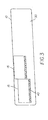
- Fig. 3 is a perspective of the reverse (adhesive) side of a shelf tag with the displays attached;
- Fig. 4 is a front view of a printable sheet with individual die cut labels positioned in an array with perforated windows through the sheet and a backer for the displays to show through;
- Fig. 5 is a rear view of the printable sheet of Fig. 4, showing the adhesive backer liner with perforated windows for the display to show through as well as a die cut insert in the liner which, when peeled off, exposes adhesive for the display to be adhered;
- Fig. 6 is an exploded perspective view of the rear of a printable sheet showing the backer liner insert removed and the displays ready to be adhered;
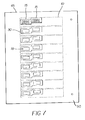
- Fig. 7 is a rear view of printable sheet with adhesive backer liner with the displays in place in the opening of the backer liner;
- Fig. 8 is a front view of a printable sheet showing an array of die cut labels with displays showing through the perforated openings;
- Fig. 9 is a front perspective view of a support with conductive strips inset into the surface and recesses for the shelf tag and displays;
- Fig. 10 is a perspective view of the front of a support having conductive strips inset into the surface with anisotropically conductive tape strips with adhesive backer liner positioned over the conductive strips;
- Fig. 11 is a perspective front view of a completed shelf tag assembly with conductive strips exposed along the bottom rim of the support available for electrical contacting to make changes to the display characters;
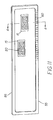
- Fig. 12 is a back perspective view of a shelf tag having a bracket for attaching the shelf tag to an existing shelf tag rail system;
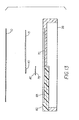
- Fig. 13 is an exploded section view taken along section line A-A in Fig. 11 showing the shelf tag assembly; and
- Fig. 14 is a section view taken along section line A-A in Fig. 11 showing the completed shelf tag assembly.
-
- Fig. 1 shows a
shelf tag 10 comprised of one ormore displays 15 constructed by forming patternedconductive character elements 20 on top and bottom substrates and sandwiched polymer stabilized liquid crystals between patternedcharacter elements 20. Thedisplays 15 can be made as shown in USSN 10/134,185, filed April 29, 2002 by Stephenson et al., which is incorporated herein by reference. -
Shelf tag 10 has one or moreperforated windows 18 to allowcharacter elements 20 ondisplays 15 to be viewed from the frontprintable side 25 of ashelf tag 10.Printable surface 25 allows the addition of static readable information such as bar code and item description to be applied via printing means, one of which is an inkjet printer. - Fig. 3 shows a
shelf tag 10 having anadhesive backing 30 to allow attachment to a support as well as attachment of adisplay 15 to the back side of theshelf tag 10.Display 15 being attached toadhesive backing 30 provides exposed electricallyconductive display contacts 40 ondisplay 15 to face the rear of theshelf tag 10. - Figs. 4 and 5 show a plurality of
shelf tags 10 originating on aprintable media sheet 45.Perforated windows 18 are cut through theprintable surface 25 and theadhesive backer liner 50. The plurality ofshelf tags 10 are die cut through theprintable media 25 only. Fig. 6 shows the reverse side ofsheet 45 with the area around theperforated windows 18 being die cut through thebacker liner 50 only, allowing a peel offsegment 55 of thebacker liner 50 to expose adhesive 30 fordisplays 15 to be attached. - Figs. 7 and 8 refer to the obverse and reverse sides respectively of
sheet 45 showing completedshelf tag 10 withdisplays 15 in place and attached toadhesive backing 30. Fig. 1 shows a completedtag 10 withdisplays 15, singulated fromprintable sheet 45 andbacker liner 50. - Fig. 9 details a frontal perspective view of a
support 35 with a plurality ofconductive strips 60 inset within thesupport 35. In one embodiment, an injection moldedsupport 35 hasconductive strips 60 molded within it. Thesupport 35 defines arecess 65 for aligning theshelf tag 10 onto thesupport 35 with the proper positioning so that the display contacts 40 form electrical connection withconductive strips 60. Thesupport 35 also provides aclearance recess 70 for receiving thedisplays 15, allowing theshelf tag 10 to adhere flatly ontosupport 35 inrecess 65. - Fig. 10 shows a front view of
support 35 withconductive strips 60 and strips of anisotropic conductiveadhesive tape 75 withbacker liner 80 applied over theconductive strips 60. Once thebacker liner 80 is removed, the anisotropicconductive adhesive 75 is exposed to mate with theconductive contacts 40 ofdisplay 15 as theshelf tag 10 is applied to support 35. Theconductive adhesive 75 being adhered to theconductive contacts 40 ondisplay 15 as well as adhered to theconductive strips 60 provides electrical contact between theconductive character elements 20 ondisplay 15 and theconductive strips 60. - Fig. 11 illustrates a completed
shelf tag assembly 85. Thecontact strips 60 are exposed to the front ofsupport 35 to electronically program thechangeable characters 20 ondisplay 15. - Fig. 12 shows a rear perspective view of an
attachment bracket 90 to an existing shelf tag rail system. - Fig. 13 details an exploded section view from Fig. 11, showing the elements of the assembly prior to attachment; and
- Fig. 14 shows a section view from Fig. 11 with all components in place.
Claims (4)
- A method of making a programmable shelf tag, comprising the steps of:a) providing a display element having a single flexible transparent substrate, one or more first transparent conductors located on the substrate, a layer of polymer dispersed material located over the first conductor(s), the polymer dispersed material being responsive to an applied electric field for displaying information and having first and second optical states that are both stable in the absence of an electrical field, one or more second conductors located over the polymer dispersed layer for applying the electric field to the polymer dispersed material between the first and second conductors and a plurality of display contacts located on the backside of the display for making electrical connection to the first and second conductors of the display;b) mounting the display element substrate side down in a window formed in a web of adhesive backed print medium having a die cut area around the display element to form an adhesive label that includes the display element;c) printing static information on the label of the print medium;d) providing a support for mounting the adhesive label, the support including a plurality of support contacts having first conductive portions for providing contact to the conductors of the display element and second conductive portions in an area outside the adhesive label for making electrical contact with the display from the front of the display element, the support including a layer of conductive adhesive over the first conductive portions of the support contacts; ande) attaching the adhesive label to the support such that the display contacts are in electrical contact with the support contacts via the conductive adhesive, whereby the first and second conductors are electrically addressable from the front side of the display assembly.
- A programmable shelf tag label, comprising:a) a display element having a single flexible transparent substrate, one or more first transparent conductors located on the substrate, a layer of polymer dispersed material located over the first conductor(s), the polymer dispersed material being responsive to an applied electric field for displaying information and having first and second optical states that are both stable in the absence of an electrical field, one or more second conductors located over the polymer dispersed layer for applying the electric field to the polymer dispersed material between the first and second conductors and a plurality of display contacts located on the backside of the display for making electrical connection to the first and second conductors of the display; andb) a sheet of adhesive print medium having a die cut label area, and defining a window in the label area, the display element being mounted substrate side down in the window, and including a releasable backing layer, whereby static information can be printed on the label and the printed label can be removed from the backing layer and attached to a support having contacts for making electrical connection to the conductors of the display element.
- A support for receiving a programmable shelf tag label that includes a display element having a single flexible transparent substrate, one or more first transparent conductors located on the substrate, a layer of polymer dispersed material located over the first conductor(s), the polymer dispersed material being responsive to an applied electric field for displaying information and having first and second optical states that are both stable in the absence of an electrical field, one or more second conductors located over the polymer dispersed layer for applying the electric field to the polymer dispersed material between the first and second conductors and a plurality of display contacts located on the backside of the display for making electrical connection to the first and second conductors of the display, and a sheet of adhesive print medium having a die cut label area, and defining a window in the label area, the display element being mounted substrate side down in the window, and including a releasable backing layer, whereby static information can be printed on the label and the printed label can be removed from the backing layer and attached to the support, the support comprising:a) a body having a surface for receiving the programmable shelf tag, the body defining alignment features for precisely locating the tag on the surface;b) contacts on the body having exposed portions on the surface and located with respect to the alignment feature for making electrical connection to the first and second conductors of the display element and exposed portions that extend beyond the display element, whereby the first and second conductors are electrically addressable from the front side of the shelf tag label; andc) conductive adhesive located over the exposed portions of the contacts on the receiving surface.
- A display tag assembly, comprising:a) programmable label, having:i) a display element having a single flexible transparent substrate, one or more first transparent conductors located on the substrate, a layer of polymer dispersed material located over the first conductor(s), the polymer dispersed material being responsive to an applied electric field for displaying information and having first and second optical states that are both stable in the absence of an electrical field, one or more second conductors located over the polymer dispersed layer for applying the electric field to the polymer dispersed material between the first and second conductors and a plurality of display contacts located on the backside of the display for making electrical connection to the first and second conductors of the display; andii) a sheet of adhesive print medium having a die cut label area, and defining a window in the label area, the display element being mounted substrate side down in the window, and including a releasable backing layer, whereby static information can be printed on the label and the printed label can be removed from the backing layer and attached to a support having contacts for making electrical connection to the conductors of the display element; andb) a support for receiving the label having:i) a body having a surface for receiving the label, the body defining alignment features for precisely locating the label on the surface;ii) contacts on the body having exposed portions on the surface and located with respect to the alignment feature for making electrical connection to the first and second conductors of the display element and exposed portions that extend beyond the display element, whereby the first and second conductors are electrically addressable from the front side of the display tag assembly; andiii) conductive adhesive located over the exposed portions of the contacts on the receiving surface.
Applications Claiming Priority (2)
| Application Number | Priority Date | Filing Date | Title |
|---|---|---|---|
| US10/158,655 US6637650B1 (en) | 2002-05-30 | 2002-05-30 | Printable shelf label having a liquid crystal display |
| US158655 | 2002-05-30 |
Publications (1)
| Publication Number | Publication Date |
|---|---|
| EP1372062A2 true EP1372062A2 (en) | 2003-12-17 |
Family
ID=29249915
Family Applications (1)
| Application Number | Title | Priority Date | Filing Date |
|---|---|---|---|
| EP03076472A Withdrawn EP1372062A2 (en) | 2002-05-30 | 2003-05-19 | Printable shelf label having a liquid crystal display |
Country Status (5)
| Country | Link |
|---|---|
| US (1) | US6637650B1 (en) |
| EP (1) | EP1372062A2 (en) |
| JP (1) | JP2004046111A (en) |
| CN (1) | CN1462021A (en) |
| AU (1) | AU2003204484A1 (en) |
Families Citing this family (10)
| Publication number | Priority date | Publication date | Assignee | Title |
|---|---|---|---|---|
| US6731221B1 (en) * | 1999-12-20 | 2004-05-04 | Intel Corporation | Electrically modifiable product labeling |
| US7584888B2 (en) * | 2002-06-04 | 2009-09-08 | Industrial Technology Research Institute | Item tag with liquid crystal display and image |
| US6908033B2 (en) * | 2002-06-25 | 2005-06-21 | Eastman Kodak Company | Hand-held programmer for programmable liquid crystal display |
| ATE505032T1 (en) * | 2003-09-03 | 2011-04-15 | Visible Tech Knowledgy Inc | ELECTRONICALLY UPDATE LABEL AND DISPLAY |
| US7210623B2 (en) * | 2004-03-08 | 2007-05-01 | Eastman Kodak Company | Printable shelf label |
| US20050262934A1 (en) * | 2004-05-25 | 2005-12-01 | Sensfab Pte Ltd | Tyre pressure monitoring sensor |
| US20080108491A1 (en) * | 2007-02-01 | 2008-05-08 | Mike Wilkinson | Method of manufacturing a supplemental label |
| US20080095963A1 (en) * | 2007-02-06 | 2008-04-24 | Vestcom New Century Llc | Supplemental label |
| US8261477B1 (en) | 2008-05-07 | 2012-09-11 | Vestcom New Century Llc | Label |
| CN107735808A (en) * | 2015-05-04 | 2018-02-23 | 日升研发控股有限责任公司 | System and method for controlling a shelf display unit and for graphically presenting information on a shelf display unit |
Family Cites Families (4)
| Publication number | Priority date | Publication date | Assignee | Title |
|---|---|---|---|---|
| US5111196A (en) | 1987-03-23 | 1992-05-05 | Esl, Inc. | Electronic information display module and connector therefor |
| US5751257A (en) | 1995-04-28 | 1998-05-12 | Teletransactions, Inc. | Programmable shelf tag and method for changing and updating shelf tag information |
| US6269342B1 (en) * | 1995-04-28 | 2001-07-31 | Telxon Corporation | Programmable shelf tag system |
| US6217966B1 (en) * | 1999-02-26 | 2001-04-17 | Ncr Corporation | Desensitized price label |
-
2002
- 2002-05-30 US US10/158,655 patent/US6637650B1/en not_active Expired - Lifetime
-
2003
- 2003-05-13 JP JP2003134167A patent/JP2004046111A/en active Pending
- 2003-05-19 EP EP03076472A patent/EP1372062A2/en not_active Withdrawn
- 2003-05-28 CN CN03138186.3A patent/CN1462021A/en active Pending
- 2003-05-29 AU AU2003204484A patent/AU2003204484A1/en not_active Abandoned
Also Published As
| Publication number | Publication date |
|---|---|
| CN1462021A (en) | 2003-12-17 |
| AU2003204484A1 (en) | 2004-01-08 |
| JP2004046111A (en) | 2004-02-12 |
| US6637650B1 (en) | 2003-10-28 |
Similar Documents
| Publication | Publication Date | Title |
|---|---|---|
| US7210623B2 (en) | Printable shelf label | |
| US7584888B2 (en) | Item tag with liquid crystal display and image | |
| JP4937931B2 (en) | Information display update device | |
| US6897763B2 (en) | Retail signage management system | |
| US8810525B2 (en) | Electronic information displays | |
| US5051870A (en) | Electronic socket attachment method and identification system | |
| US6637650B1 (en) | Printable shelf label having a liquid crystal display | |
| CN103119615A (en) | retail item display | |
| US7009524B2 (en) | Shelf talker having short and long term information | |
| US7104448B2 (en) | Docking station for writing to electronically writable display | |
| JP5600308B2 (en) | Information display medium | |
| US6908033B2 (en) | Hand-held programmer for programmable liquid crystal display | |
| US7167167B2 (en) | Write head for a display tag having a liquid crystal display | |
| WO2005116733A2 (en) | Electronic signage | |
| EP1124215B1 (en) | Assembly method for an electronic price label | |
| CA2751933A1 (en) | Retail shelf edge label media sheet | |
| WO2007117450A2 (en) | Retail shelf edge label media sheet | |
| US7755610B2 (en) | Writing device for bistable material with improved flexible material alignment features | |
| JP2021092643A (en) | Rf tag label and rf tag label continuous body | |
| JP3667552B2 (en) | Set of card issuing members | |
| KR101642082B1 (en) | electronic information label with static display region |
Legal Events
| Date | Code | Title | Description |
|---|---|---|---|
| PUAI | Public reference made under article 153(3) epc to a published international application that has entered the european phase |
Free format text: ORIGINAL CODE: 0009012 |
|
| AK | Designated contracting states |
Kind code of ref document: A2 Designated state(s): AT BE BG CH CY CZ DE DK EE ES FI FR GB GR HU IE IT LI LU MC NL PT RO SE SI SK TR |
|
| AX | Request for extension of the european patent |
Extension state: AL LT LV MK |
|
| STAA | Information on the status of an ep patent application or granted ep patent |
Free format text: STATUS: THE APPLICATION IS DEEMED TO BE WITHDRAWN |
|
| 18D | Application deemed to be withdrawn |
Effective date: 20061201 |