EP1371628A2 - Production process for hydroxyalkyl (meth)acrylate - Google Patents
Production process for hydroxyalkyl (meth)acrylate Download PDFInfo
- Publication number
- EP1371628A2 EP1371628A2 EP03010929A EP03010929A EP1371628A2 EP 1371628 A2 EP1371628 A2 EP 1371628A2 EP 03010929 A EP03010929 A EP 03010929A EP 03010929 A EP03010929 A EP 03010929A EP 1371628 A2 EP1371628 A2 EP 1371628A2
- Authority
- EP
- European Patent Office
- Prior art keywords
- reaction
- meth
- acrylic acid
- amount
- catalyst
- Prior art date
- Legal status (The legal status is an assumption and is not a legal conclusion. Google has not performed a legal analysis and makes no representation as to the accuracy of the status listed.)
- Granted
Links
- 238000004519 manufacturing process Methods 0.000 title claims abstract description 50
- NIXOWILDQLNWCW-UHFFFAOYSA-M Acrylate Chemical compound [O-]C(=O)C=C NIXOWILDQLNWCW-UHFFFAOYSA-M 0.000 title claims abstract description 39
- 125000002768 hydroxyalkyl group Chemical group 0.000 title claims abstract description 20
- 238000006243 chemical reaction Methods 0.000 claims abstract description 170
- CERQOIWHTDAKMF-UHFFFAOYSA-N Methacrylic acid Chemical compound CC(=C)C(O)=O CERQOIWHTDAKMF-UHFFFAOYSA-N 0.000 claims abstract description 98
- 239000003054 catalyst Substances 0.000 claims abstract description 80
- 125000002947 alkylene group Chemical group 0.000 claims abstract description 70
- LYCAIKOWRPUZTN-UHFFFAOYSA-N Ethylene glycol Chemical compound OCCO LYCAIKOWRPUZTN-UHFFFAOYSA-N 0.000 abstract description 21
- WGCNASOHLSPBMP-UHFFFAOYSA-N hydroxyacetaldehyde Natural products OCC=O WGCNASOHLSPBMP-UHFFFAOYSA-N 0.000 abstract description 13
- 239000012295 chemical reaction liquid Substances 0.000 description 52
- SMZOUWXMTYCWNB-UHFFFAOYSA-N 2-(2-methoxy-5-methylphenyl)ethanamine Chemical compound COC1=CC=C(C)C=C1CCN SMZOUWXMTYCWNB-UHFFFAOYSA-N 0.000 description 42
- NIXOWILDQLNWCW-UHFFFAOYSA-N 2-Propenoic acid Natural products OC(=O)C=C NIXOWILDQLNWCW-UHFFFAOYSA-N 0.000 description 42
- 150000001875 compounds Chemical class 0.000 description 35
- IAYPIBMASNFSPL-UHFFFAOYSA-N Ethylene oxide Chemical compound C1CO1 IAYPIBMASNFSPL-UHFFFAOYSA-N 0.000 description 32
- WYYQVWLEPYFFLP-UHFFFAOYSA-K chromium(3+);triacetate Chemical compound [Cr+3].CC([O-])=O.CC([O-])=O.CC([O-])=O WYYQVWLEPYFFLP-UHFFFAOYSA-K 0.000 description 23
- 239000000047 product Substances 0.000 description 22
- 230000003247 decreasing effect Effects 0.000 description 20
- -1 alkylene glycol Chemical compound 0.000 description 19
- 230000002349 favourable effect Effects 0.000 description 18
- 239000003112 inhibitor Substances 0.000 description 17
- OMIGHNLMNHATMP-UHFFFAOYSA-N 2-hydroxyethyl prop-2-enoate Chemical compound OCCOC(=O)C=C OMIGHNLMNHATMP-UHFFFAOYSA-N 0.000 description 15
- 238000004587 chromatography analysis Methods 0.000 description 14
- 238000006116 polymerization reaction Methods 0.000 description 14
- 239000002994 raw material Substances 0.000 description 12
- WJFKNYWRSNBZNX-UHFFFAOYSA-N 10H-phenothiazine Chemical compound C1=CC=C2NC3=CC=CC=C3SC2=C1 WJFKNYWRSNBZNX-UHFFFAOYSA-N 0.000 description 11
- 239000012535 impurity Substances 0.000 description 11
- 238000000034 method Methods 0.000 description 11
- RWXMAAYKJDQVTF-UHFFFAOYSA-N 2-(2-hydroxyethoxy)ethyl prop-2-enoate Chemical compound OCCOCCOC(=O)C=C RWXMAAYKJDQVTF-UHFFFAOYSA-N 0.000 description 10
- HXDLWJWIAHWIKI-UHFFFAOYSA-N 2-hydroxyethyl acetate Chemical compound CC(=O)OCCO HXDLWJWIAHWIKI-UHFFFAOYSA-N 0.000 description 10
- KUDUQBURMYMBIJ-UHFFFAOYSA-N 2-prop-2-enoyloxyethyl prop-2-enoate Chemical compound C=CC(=O)OCCOC(=O)C=C KUDUQBURMYMBIJ-UHFFFAOYSA-N 0.000 description 10
- 229950000688 phenothiazine Drugs 0.000 description 10
- IJGRMHOSHXDMSA-UHFFFAOYSA-N Atomic nitrogen Chemical group N#N IJGRMHOSHXDMSA-UHFFFAOYSA-N 0.000 description 9
- 125000004429 atom Chemical group 0.000 description 9
- 229910001873 dinitrogen Inorganic materials 0.000 description 9
- 239000000463 material Substances 0.000 description 9
- 229910052751 metal Inorganic materials 0.000 description 9
- 239000002184 metal Substances 0.000 description 9
- 239000003957 anion exchange resin Substances 0.000 description 7
- 239000011651 chromium Substances 0.000 description 6
- 238000000746 purification Methods 0.000 description 6
- 239000010936 titanium Substances 0.000 description 6
- 150000005690 diesters Chemical class 0.000 description 5
- 239000007789 gas Substances 0.000 description 5
- 239000011521 glass Substances 0.000 description 5
- 230000035484 reaction time Effects 0.000 description 5
- 238000005292 vacuum distillation Methods 0.000 description 5
- 229920002818 (Hydroxyethyl)methacrylate Polymers 0.000 description 4
- OLQFXOWPTQTLDP-UHFFFAOYSA-N 2-(2-hydroxyethoxy)ethyl 2-methylprop-2-enoate Chemical compound CC(=C)C(=O)OCCOCCO OLQFXOWPTQTLDP-UHFFFAOYSA-N 0.000 description 4
- DBCAQXHNJOFNGC-UHFFFAOYSA-N 4-bromo-1,1,1-trifluorobutane Chemical compound FC(F)(F)CCCBr DBCAQXHNJOFNGC-UHFFFAOYSA-N 0.000 description 4
- WOBHKFSMXKNTIM-UHFFFAOYSA-N Hydroxyethyl methacrylate Chemical compound CC(=C)C(=O)OCCO WOBHKFSMXKNTIM-UHFFFAOYSA-N 0.000 description 4
- XEEYBQQBJWHFJM-UHFFFAOYSA-N Iron Chemical class [Fe] XEEYBQQBJWHFJM-UHFFFAOYSA-N 0.000 description 4
- 230000032683 aging Effects 0.000 description 4
- 238000004821 distillation Methods 0.000 description 4
- 230000000694 effects Effects 0.000 description 4
- STVZJERGLQHEKB-UHFFFAOYSA-N ethylene glycol dimethacrylate Substances CC(=C)C(=O)OCCOC(=O)C(C)=C STVZJERGLQHEKB-UHFFFAOYSA-N 0.000 description 4
- 125000000524 functional group Chemical group 0.000 description 4
- 239000002815 homogeneous catalyst Substances 0.000 description 4
- 229910052746 lanthanum Inorganic materials 0.000 description 4
- FZLIPJUXYLNCLC-UHFFFAOYSA-N lanthanum atom Chemical compound [La] FZLIPJUXYLNCLC-UHFFFAOYSA-N 0.000 description 4
- 125000001453 quaternary ammonium group Chemical group 0.000 description 4
- 125000001302 tertiary amino group Chemical group 0.000 description 4
- ARCGXLSVLAOJQL-UHFFFAOYSA-N trimellitic acid Chemical compound OC(=O)C1=CC=C(C(O)=O)C(C(O)=O)=C1 ARCGXLSVLAOJQL-UHFFFAOYSA-N 0.000 description 4
- 229910052727 yttrium Inorganic materials 0.000 description 4
- VWQVUPCCIRVNHF-UHFFFAOYSA-N yttrium atom Chemical compound [Y] VWQVUPCCIRVNHF-UHFFFAOYSA-N 0.000 description 4
- 229910052684 Cerium Inorganic materials 0.000 description 3
- VYZAMTAEIAYCRO-UHFFFAOYSA-N Chromium Chemical compound [Cr] VYZAMTAEIAYCRO-UHFFFAOYSA-N 0.000 description 3
- PEDCQBHIVMGVHV-UHFFFAOYSA-N Glycerine Chemical compound OCC(O)CO PEDCQBHIVMGVHV-UHFFFAOYSA-N 0.000 description 3
- OFOBLEOULBTSOW-UHFFFAOYSA-N Malonic acid Chemical compound OC(=O)CC(O)=O OFOBLEOULBTSOW-UHFFFAOYSA-N 0.000 description 3
- CERQOIWHTDAKMF-UHFFFAOYSA-M Methacrylate Chemical compound CC(=C)C([O-])=O CERQOIWHTDAKMF-UHFFFAOYSA-M 0.000 description 3
- ZOKXTWBITQBERF-UHFFFAOYSA-N Molybdenum Chemical compound [Mo] ZOKXTWBITQBERF-UHFFFAOYSA-N 0.000 description 3
- MUBZPKHOEPUJKR-UHFFFAOYSA-N Oxalic acid Chemical compound OC(=O)C(O)=O MUBZPKHOEPUJKR-UHFFFAOYSA-N 0.000 description 3
- OAICVXFJPJFONN-UHFFFAOYSA-N Phosphorus Chemical compound [P] OAICVXFJPJFONN-UHFFFAOYSA-N 0.000 description 3
- JUJWROOIHBZHMG-UHFFFAOYSA-N Pyridine Chemical compound C1=CC=NC=C1 JUJWROOIHBZHMG-UHFFFAOYSA-N 0.000 description 3
- RTAQQCXQSZGOHL-UHFFFAOYSA-N Titanium Chemical compound [Ti] RTAQQCXQSZGOHL-UHFFFAOYSA-N 0.000 description 3
- YXFVVABEGXRONW-UHFFFAOYSA-N Toluene Chemical compound CC1=CC=CC=C1 YXFVVABEGXRONW-UHFFFAOYSA-N 0.000 description 3
- 229910052782 aluminium Inorganic materials 0.000 description 3
- XAGFODPZIPBFFR-UHFFFAOYSA-N aluminium Chemical compound [Al] XAGFODPZIPBFFR-UHFFFAOYSA-N 0.000 description 3
- 239000006227 byproduct Substances 0.000 description 3
- GWXLDORMOJMVQZ-UHFFFAOYSA-N cerium Chemical compound [Ce] GWXLDORMOJMVQZ-UHFFFAOYSA-N 0.000 description 3
- 229910052804 chromium Inorganic materials 0.000 description 3
- MTHSVFCYNBDYFN-UHFFFAOYSA-N diethylene glycol Chemical compound OCCOCCO MTHSVFCYNBDYFN-UHFFFAOYSA-N 0.000 description 3
- 229910052750 molybdenum Inorganic materials 0.000 description 3
- 239000011733 molybdenum Substances 0.000 description 3
- 229910052698 phosphorus Inorganic materials 0.000 description 3
- 239000011574 phosphorus Substances 0.000 description 3
- JUJWROOIHBZHMG-UHFFFAOYSA-O pyridinium Chemical group C1=CC=[NH+]C=C1 JUJWROOIHBZHMG-UHFFFAOYSA-O 0.000 description 3
- 150000003839 salts Chemical group 0.000 description 3
- 239000002904 solvent Substances 0.000 description 3
- 229910052719 titanium Inorganic materials 0.000 description 3
- WFKWXMTUELFFGS-UHFFFAOYSA-N tungsten Chemical compound [W] WFKWXMTUELFFGS-UHFFFAOYSA-N 0.000 description 3
- 229910052721 tungsten Inorganic materials 0.000 description 3
- 239000010937 tungsten Substances 0.000 description 3
- POILWHVDKZOXJZ-ARJAWSKDSA-M (z)-4-oxopent-2-en-2-olate Chemical compound C\C([O-])=C\C(C)=O POILWHVDKZOXJZ-ARJAWSKDSA-M 0.000 description 2
- VZCYOOQTPOCHFL-OWOJBTEDSA-N Fumaric acid Chemical compound OC(=O)\C=C\C(O)=O VZCYOOQTPOCHFL-OWOJBTEDSA-N 0.000 description 2
- QIGBRXMKCJKVMJ-UHFFFAOYSA-N Hydroquinone Chemical compound OC1=CC=C(O)C=C1 QIGBRXMKCJKVMJ-UHFFFAOYSA-N 0.000 description 2
- IMNFDUFMRHMDMM-UHFFFAOYSA-N N-Heptane Chemical compound CCCCCCC IMNFDUFMRHMDMM-UHFFFAOYSA-N 0.000 description 2
- GOOHAUXETOMSMM-UHFFFAOYSA-N Propylene oxide Chemical compound CC1CO1 GOOHAUXETOMSMM-UHFFFAOYSA-N 0.000 description 2
- KKEYFWRCBNTPAC-UHFFFAOYSA-N Terephthalic acid Chemical compound OC(=O)C1=CC=C(C(O)=O)C=C1 KKEYFWRCBNTPAC-UHFFFAOYSA-N 0.000 description 2
- YRKCREAYFQTBPV-UHFFFAOYSA-N acetylacetone Chemical compound CC(=O)CC(C)=O YRKCREAYFQTBPV-UHFFFAOYSA-N 0.000 description 2
- WNLRTRBMVRJNCN-UHFFFAOYSA-N adipic acid Chemical compound OC(=O)CCCCC(O)=O WNLRTRBMVRJNCN-UHFFFAOYSA-N 0.000 description 2
- VSCWAEJMTAWNJL-UHFFFAOYSA-K aluminium trichloride Chemical compound Cl[Al](Cl)Cl VSCWAEJMTAWNJL-UHFFFAOYSA-K 0.000 description 2
- GGNQRNBDZQJCCN-UHFFFAOYSA-N benzene-1,2,4-triol Chemical compound OC1=CC=C(O)C(O)=C1 GGNQRNBDZQJCCN-UHFFFAOYSA-N 0.000 description 2
- WPYMKLBDIGXBTP-UHFFFAOYSA-N benzoic acid Chemical compound OC(=O)C1=CC=CC=C1 WPYMKLBDIGXBTP-UHFFFAOYSA-N 0.000 description 2
- 125000004432 carbon atom Chemical group C* 0.000 description 2
- YCIMNLLNPGFGHC-UHFFFAOYSA-N catechol Chemical compound OC1=CC=CC=C1O YCIMNLLNPGFGHC-UHFFFAOYSA-N 0.000 description 2
- HSJPMRKMPBAUAU-UHFFFAOYSA-N cerium(3+);trinitrate Chemical compound [Ce+3].[O-][N+]([O-])=O.[O-][N+]([O-])=O.[O-][N+]([O-])=O HSJPMRKMPBAUAU-UHFFFAOYSA-N 0.000 description 2
- 238000009795 derivation Methods 0.000 description 2
- 238000004880 explosion Methods 0.000 description 2
- NWVVVBRKAWDGAB-UHFFFAOYSA-N hydroquinone methyl ether Natural products COC1=CC=C(O)C=C1 NWVVVBRKAWDGAB-UHFFFAOYSA-N 0.000 description 2
- QQVIHTHCMHWDBS-UHFFFAOYSA-N isophthalic acid Chemical compound OC(=O)C1=CC=CC(C(O)=O)=C1 QQVIHTHCMHWDBS-UHFFFAOYSA-N 0.000 description 2
- GPSDUZXPYCFOSQ-UHFFFAOYSA-N m-toluic acid Chemical compound CC1=CC=CC(C(O)=O)=C1 GPSDUZXPYCFOSQ-UHFFFAOYSA-N 0.000 description 2
- 238000002156 mixing Methods 0.000 description 2
- WWZKQHOCKIZLMA-UHFFFAOYSA-N octanoic acid Chemical compound CCCCCCCC(O)=O WWZKQHOCKIZLMA-UHFFFAOYSA-N 0.000 description 2
- LPNBBFKOUUSUDB-UHFFFAOYSA-N p-toluic acid Chemical compound CC1=CC=C(C(O)=O)C=C1 LPNBBFKOUUSUDB-UHFFFAOYSA-N 0.000 description 2
- 150000004714 phosphonium salts Chemical group 0.000 description 2
- XNGIFLGASWRNHJ-UHFFFAOYSA-N phthalic acid Chemical compound OC(=O)C1=CC=CC=C1C(O)=O XNGIFLGASWRNHJ-UHFFFAOYSA-N 0.000 description 2
- WQGWDDDVZFFDIG-UHFFFAOYSA-N pyrogallol Chemical compound OC1=CC=CC(O)=C1O WQGWDDDVZFFDIG-UHFFFAOYSA-N 0.000 description 2
- CYIDZMCFTVVTJO-UHFFFAOYSA-N pyromellitic acid Chemical compound OC(=O)C1=CC(C(O)=O)=C(C(O)=O)C=C1C(O)=O CYIDZMCFTVVTJO-UHFFFAOYSA-N 0.000 description 2
- YGSDEFSMJLZEOE-UHFFFAOYSA-N salicylic acid Chemical compound OC(=O)C1=CC=CC=C1O YGSDEFSMJLZEOE-UHFFFAOYSA-N 0.000 description 2
- CXMXRPHRNRROMY-UHFFFAOYSA-N sebacic acid Chemical compound OC(=O)CCCCCCCCC(O)=O CXMXRPHRNRROMY-UHFFFAOYSA-N 0.000 description 2
- VSZWPYCFIRKVQL-UHFFFAOYSA-N selanylidenegallium;selenium Chemical class [Se].[Se]=[Ga].[Se]=[Ga] VSZWPYCFIRKVQL-UHFFFAOYSA-N 0.000 description 2
- 238000004904 shortening Methods 0.000 description 2
- QDZRBIRIPNZRSG-UHFFFAOYSA-N titanium nitrate Chemical compound [O-][N+](=O)O[Ti](O[N+]([O-])=O)(O[N+]([O-])=O)O[N+]([O-])=O QDZRBIRIPNZRSG-UHFFFAOYSA-N 0.000 description 2
- VXUYXOFXAQZZMF-UHFFFAOYSA-N titanium(IV) isopropoxide Chemical compound CC(C)O[Ti](OC(C)C)(OC(C)C)OC(C)C VXUYXOFXAQZZMF-UHFFFAOYSA-N 0.000 description 2
- CNHDIAIOKMXOLK-UHFFFAOYSA-N toluquinol Chemical compound CC1=CC(O)=CC=C1O CNHDIAIOKMXOLK-UHFFFAOYSA-N 0.000 description 2
- VZCYOOQTPOCHFL-UHFFFAOYSA-N trans-butenedioic acid Natural products OC(=O)C=CC(O)=O VZCYOOQTPOCHFL-UHFFFAOYSA-N 0.000 description 2
- YWWDBCBWQNCYNR-UHFFFAOYSA-N trimethylphosphine Chemical compound CP(C)C YWWDBCBWQNCYNR-UHFFFAOYSA-N 0.000 description 2
- RIOQSEWOXXDEQQ-UHFFFAOYSA-N triphenylphosphine Chemical compound C1=CC=CC=C1P(C=1C=CC=CC=1)C1=CC=CC=C1 RIOQSEWOXXDEQQ-UHFFFAOYSA-N 0.000 description 2
- LEONUFNNVUYDNQ-UHFFFAOYSA-N vanadium atom Chemical class [V] LEONUFNNVUYDNQ-UHFFFAOYSA-N 0.000 description 2
- OERNJTNJEZOPIA-UHFFFAOYSA-N zirconium nitrate Chemical compound [Zr+4].[O-][N+]([O-])=O.[O-][N+]([O-])=O.[O-][N+]([O-])=O.[O-][N+]([O-])=O OERNJTNJEZOPIA-UHFFFAOYSA-N 0.000 description 2
- BNGXYYYYKUGPPF-UHFFFAOYSA-M (3-methylphenyl)methyl-triphenylphosphanium;chloride Chemical compound [Cl-].CC1=CC=CC(C[P+](C=2C=CC=CC=2)(C=2C=CC=CC=2)C=2C=CC=CC=2)=C1 BNGXYYYYKUGPPF-UHFFFAOYSA-M 0.000 description 1
- MFWFDRBPQDXFRC-LNTINUHCSA-N (z)-4-hydroxypent-3-en-2-one;vanadium Chemical compound [V].C\C(O)=C\C(C)=O.C\C(O)=C\C(C)=O.C\C(O)=C\C(C)=O MFWFDRBPQDXFRC-LNTINUHCSA-N 0.000 description 1
- YOBOXHGSEJBUPB-MTOQALJVSA-N (z)-4-hydroxypent-3-en-2-one;zirconium Chemical compound [Zr].C\C(O)=C\C(C)=O.C\C(O)=C\C(C)=O.C\C(O)=C\C(C)=O.C\C(O)=C\C(C)=O YOBOXHGSEJBUPB-MTOQALJVSA-N 0.000 description 1
- ZWVMLYRJXORSEP-UHFFFAOYSA-N 1,2,6-Hexanetriol Chemical compound OCCCCC(O)CO ZWVMLYRJXORSEP-UHFFFAOYSA-N 0.000 description 1
- QFMZQPDHXULLKC-UHFFFAOYSA-N 1,2-bis(diphenylphosphino)ethane Chemical compound C=1C=CC=CC=1P(C=1C=CC=CC=1)CCP(C=1C=CC=CC=1)C1=CC=CC=C1 QFMZQPDHXULLKC-UHFFFAOYSA-N 0.000 description 1
- VETPHHXZEJAYOB-UHFFFAOYSA-N 1-n,4-n-dinaphthalen-2-ylbenzene-1,4-diamine Chemical compound C1=CC=CC2=CC(NC=3C=CC(NC=4C=C5C=CC=CC5=CC=4)=CC=3)=CC=C21 VETPHHXZEJAYOB-UHFFFAOYSA-N 0.000 description 1
- LSYXXLMBRSSBGS-UHFFFAOYSA-N 2,4,6-tris(hydroxymethyl)phenol Chemical compound OCC1=CC(CO)=C(O)C(CO)=C1 LSYXXLMBRSSBGS-UHFFFAOYSA-N 0.000 description 1
- HOPGWDUYWPMYFB-UHFFFAOYSA-N 2,4-bis(hydroxymethyl)phenol Chemical compound OCC1=CC=C(O)C(CO)=C1 HOPGWDUYWPMYFB-UHFFFAOYSA-N 0.000 description 1
- OPLCSTZDXXUYDU-UHFFFAOYSA-N 2,4-dimethyl-6-tert-butylphenol Chemical compound CC1=CC(C)=C(O)C(C(C)(C)C)=C1 OPLCSTZDXXUYDU-UHFFFAOYSA-N 0.000 description 1
- JZODKRWQWUWGCD-UHFFFAOYSA-N 2,5-di-tert-butylbenzene-1,4-diol Chemical compound CC(C)(C)C1=CC(O)=C(C(C)(C)C)C=C1O JZODKRWQWUWGCD-UHFFFAOYSA-N 0.000 description 1
- JFGVTUJBHHZRAB-UHFFFAOYSA-N 2,6-Di-tert-butyl-1,4-benzenediol Chemical compound CC(C)(C)C1=CC(O)=CC(C(C)(C)C)=C1O JFGVTUJBHHZRAB-UHFFFAOYSA-N 0.000 description 1
- FALRKNHUBBKYCC-UHFFFAOYSA-N 2-(chloromethyl)pyridine-3-carbonitrile Chemical compound ClCC1=NC=CC=C1C#N FALRKNHUBBKYCC-UHFFFAOYSA-N 0.000 description 1
- TXBCBTDQIULDIA-UHFFFAOYSA-N 2-[[3-hydroxy-2,2-bis(hydroxymethyl)propoxy]methyl]-2-(hydroxymethyl)propane-1,3-diol Chemical compound OCC(CO)(CO)COCC(CO)(CO)CO TXBCBTDQIULDIA-UHFFFAOYSA-N 0.000 description 1
- RLHGFJMGWQXPBW-UHFFFAOYSA-N 2-hydroxy-3-(1h-imidazol-5-ylmethyl)benzamide Chemical compound NC(=O)C1=CC=CC(CC=2NC=NC=2)=C1O RLHGFJMGWQXPBW-UHFFFAOYSA-N 0.000 description 1
- ZTMADXFOCUXMJE-UHFFFAOYSA-N 2-methylbenzene-1,3-diol Chemical compound CC1=C(O)C=CC=C1O ZTMADXFOCUXMJE-UHFFFAOYSA-N 0.000 description 1
- QTWJRLJHJPIABL-UHFFFAOYSA-N 2-methylphenol;3-methylphenol;4-methylphenol Chemical compound CC1=CC=C(O)C=C1.CC1=CC=CC(O)=C1.CC1=CC=CC=C1O QTWJRLJHJPIABL-UHFFFAOYSA-N 0.000 description 1
- KKYUFBMDPYPHAV-UHFFFAOYSA-J 2-methylprop-2-enoate molybdenum(4+) Chemical compound C(C(=C)C)(=O)[O-].[Mo+4].C(C(=C)C)(=O)[O-].C(C(=C)C)(=O)[O-].C(C(=C)C)(=O)[O-] KKYUFBMDPYPHAV-UHFFFAOYSA-J 0.000 description 1
- OZEJSNMTATYGKV-UHFFFAOYSA-J 2-methylprop-2-enoate;titanium(4+) Chemical compound [Ti+4].CC(=C)C([O-])=O.CC(=C)C([O-])=O.CC(=C)C([O-])=O.CC(=C)C([O-])=O OZEJSNMTATYGKV-UHFFFAOYSA-J 0.000 description 1
- NJYYAYDDFDIBHK-UHFFFAOYSA-K 2-methylprop-2-enoate;yttrium(3+) Chemical compound [Y+3].CC(=C)C([O-])=O.CC(=C)C([O-])=O.CC(=C)C([O-])=O NJYYAYDDFDIBHK-UHFFFAOYSA-K 0.000 description 1
- TUPMGGHTDIFOMI-UHFFFAOYSA-J 2-methylprop-2-enoate;zirconium(4+) Chemical compound [Zr+4].CC(=C)C([O-])=O.CC(=C)C([O-])=O.CC(=C)C([O-])=O.CC(=C)C([O-])=O TUPMGGHTDIFOMI-UHFFFAOYSA-J 0.000 description 1
- OBOSXEWFRARQPU-UHFFFAOYSA-N 2-n,2-n-dimethylpyridine-2,5-diamine Chemical compound CN(C)C1=CC=C(N)C=N1 OBOSXEWFRARQPU-UHFFFAOYSA-N 0.000 description 1
- KWYJDIUEHHCHCZ-UHFFFAOYSA-N 3-[2-[bis(2-carboxyethyl)amino]ethyl-(2-carboxyethyl)amino]propanoic acid Chemical compound OC(=O)CCN(CCC(O)=O)CCN(CCC(O)=O)CCC(O)=O KWYJDIUEHHCHCZ-UHFFFAOYSA-N 0.000 description 1
- XBIUWALDKXACEA-UHFFFAOYSA-N 3-[bis(2,4-dioxopentan-3-yl)alumanyl]pentane-2,4-dione Chemical compound CC(=O)C(C(C)=O)[Al](C(C(C)=O)C(C)=O)C(C(C)=O)C(C)=O XBIUWALDKXACEA-UHFFFAOYSA-N 0.000 description 1
- UIGULSHPWYAWSA-UHFFFAOYSA-N 3-amino-4-[(2-methylpropan-2-yl)oxy]-4-oxobutanoic acid;hydrochloride Chemical compound Cl.CC(C)(C)OC(=O)C(N)CC(O)=O UIGULSHPWYAWSA-UHFFFAOYSA-N 0.000 description 1
- DOUBAFNWVFAWEC-UHFFFAOYSA-N 3-hydroxypropyl acetate Chemical compound CC(=O)OCCCO DOUBAFNWVFAWEC-UHFFFAOYSA-N 0.000 description 1
- JIGUICYYOYEXFS-UHFFFAOYSA-N 3-tert-butylbenzene-1,2-diol Chemical compound CC(C)(C)C1=CC=CC(O)=C1O JIGUICYYOYEXFS-UHFFFAOYSA-N 0.000 description 1
- UZFMOKQJFYMBGY-UHFFFAOYSA-N 4-hydroxy-TEMPO Chemical group CC1(C)CC(O)CC(C)(C)N1[O] UZFMOKQJFYMBGY-UHFFFAOYSA-N 0.000 description 1
- NGDQQLAVJWUYSF-UHFFFAOYSA-N 4-methyl-2-phenyl-1,3-thiazole-5-sulfonyl chloride Chemical compound S1C(S(Cl)(=O)=O)=C(C)N=C1C1=CC=CC=C1 NGDQQLAVJWUYSF-UHFFFAOYSA-N 0.000 description 1
- ZZMVLMVFYMGSMY-UHFFFAOYSA-N 4-n-(4-methylpentan-2-yl)-1-n-phenylbenzene-1,4-diamine Chemical compound C1=CC(NC(C)CC(C)C)=CC=C1NC1=CC=CC=C1 ZZMVLMVFYMGSMY-UHFFFAOYSA-N 0.000 description 1
- JQTYAZKTBXWQOM-UHFFFAOYSA-N 4-n-octan-2-yl-1-n-phenylbenzene-1,4-diamine Chemical compound C1=CC(NC(C)CCCCCC)=CC=C1NC1=CC=CC=C1 JQTYAZKTBXWQOM-UHFFFAOYSA-N 0.000 description 1
- DUFCMRCMPHIFTR-UHFFFAOYSA-N 5-(dimethylsulfamoyl)-2-methylfuran-3-carboxylic acid Chemical compound CN(C)S(=O)(=O)C1=CC(C(O)=O)=C(C)O1 DUFCMRCMPHIFTR-UHFFFAOYSA-N 0.000 description 1
- 239000005711 Benzoic acid Substances 0.000 description 1
- HBVDULVBCSHCGM-UHFFFAOYSA-J C(C(=C)C)(=O)[O-].[W+4].C(C(=C)C)(=O)[O-].C(C(=C)C)(=O)[O-].C(C(=C)C)(=O)[O-] Chemical compound C(C(=C)C)(=O)[O-].[W+4].C(C(=C)C)(=O)[O-].C(C(=C)C)(=O)[O-].C(C(=C)C)(=O)[O-] HBVDULVBCSHCGM-UHFFFAOYSA-J 0.000 description 1
- BKZHHAHOYUDRDP-UHFFFAOYSA-J C(C=C)(=O)[O-].[Mo+4].C(C=C)(=O)[O-].C(C=C)(=O)[O-].C(C=C)(=O)[O-] Chemical compound C(C=C)(=O)[O-].[Mo+4].C(C=C)(=O)[O-].C(C=C)(=O)[O-].C(C=C)(=O)[O-] BKZHHAHOYUDRDP-UHFFFAOYSA-J 0.000 description 1
- ZYPNNTNOCNZMLU-UHFFFAOYSA-J C(C=C)(=O)[O-].[W+4].C(C=C)(=O)[O-].C(C=C)(=O)[O-].C(C=C)(=O)[O-] Chemical compound C(C=C)(=O)[O-].[W+4].C(C=C)(=O)[O-].C(C=C)(=O)[O-].C(C=C)(=O)[O-] ZYPNNTNOCNZMLU-UHFFFAOYSA-J 0.000 description 1
- 229910021555 Chromium Chloride Inorganic materials 0.000 description 1
- RYGMFSIKBFXOCR-UHFFFAOYSA-N Copper Chemical compound [Cu] RYGMFSIKBFXOCR-UHFFFAOYSA-N 0.000 description 1
- FCKYPQBAHLOOJQ-UHFFFAOYSA-N Cyclohexane-1,2-diaminetetraacetic acid Chemical compound OC(=O)CN(CC(O)=O)C1CCCCC1N(CC(O)=O)CC(O)=O FCKYPQBAHLOOJQ-UHFFFAOYSA-N 0.000 description 1
- FBPFZTCFMRRESA-KVTDHHQDSA-N D-Mannitol Chemical compound OC[C@@H](O)[C@@H](O)[C@H](O)[C@H](O)CO FBPFZTCFMRRESA-KVTDHHQDSA-N 0.000 description 1
- KCXVZYZYPLLWCC-UHFFFAOYSA-N EDTA Chemical compound OC(=O)CN(CC(O)=O)CCN(CC(O)=O)CC(O)=O KCXVZYZYPLLWCC-UHFFFAOYSA-N 0.000 description 1
- 229930195725 Mannitol Natural products 0.000 description 1
- UTGQNNCQYDRXCH-UHFFFAOYSA-N N,N'-diphenyl-1,4-phenylenediamine Chemical compound C=1C=C(NC=2C=CC=CC=2)C=CC=1NC1=CC=CC=C1 UTGQNNCQYDRXCH-UHFFFAOYSA-N 0.000 description 1
- OUBMGJOQLXMSNT-UHFFFAOYSA-N N-isopropyl-N'-phenyl-p-phenylenediamine Chemical compound C1=CC(NC(C)C)=CC=C1NC1=CC=CC=C1 OUBMGJOQLXMSNT-UHFFFAOYSA-N 0.000 description 1
- CTQNGGLPUBDAKN-UHFFFAOYSA-N O-Xylene Chemical compound CC1=CC=CC=C1C CTQNGGLPUBDAKN-UHFFFAOYSA-N 0.000 description 1
- JPYHHZQJCSQRJY-UHFFFAOYSA-N Phloroglucinol Natural products CCC=CCC=CCC=CCC=CCCCCC(=O)C1=C(O)C=C(O)C=C1O JPYHHZQJCSQRJY-UHFFFAOYSA-N 0.000 description 1
- LGRFSURHDFAFJT-UHFFFAOYSA-N Phthalic anhydride Natural products C1=CC=C2C(=O)OC(=O)C2=C1 LGRFSURHDFAFJT-UHFFFAOYSA-N 0.000 description 1
- 229920002125 Sokalan® Polymers 0.000 description 1
- KDYFGRWQOYBRFD-UHFFFAOYSA-N Succinic acid Natural products OC(=O)CCC(O)=O KDYFGRWQOYBRFD-UHFFFAOYSA-N 0.000 description 1
- QYTDEUPAUMOIOP-UHFFFAOYSA-N TEMPO Chemical group CC1(C)CCCC(C)(C)N1[O] QYTDEUPAUMOIOP-UHFFFAOYSA-N 0.000 description 1
- BGNXCDMCOKJUMV-UHFFFAOYSA-N Tert-Butylhydroquinone Chemical compound CC(C)(C)C1=CC(O)=CC=C1O BGNXCDMCOKJUMV-UHFFFAOYSA-N 0.000 description 1
- WYURNTSHIVDZCO-UHFFFAOYSA-N Tetrahydrofuran Chemical compound C1CCOC1 WYURNTSHIVDZCO-UHFFFAOYSA-N 0.000 description 1
- ZJCCRDAZUWHFQH-UHFFFAOYSA-N Trimethylolpropane Chemical compound CCC(CO)(CO)CO ZJCCRDAZUWHFQH-UHFFFAOYSA-N 0.000 description 1
- 229910021550 Vanadium Chloride Inorganic materials 0.000 description 1
- TVXBFESIOXBWNM-UHFFFAOYSA-N Xylitol Natural products OCCC(O)C(O)C(O)CCO TVXBFESIOXBWNM-UHFFFAOYSA-N 0.000 description 1
- GXADIQDREGLBTO-UHFFFAOYSA-K [La+3].CC(=C)C([O-])=O.CC(=C)C([O-])=O.CC(=C)C([O-])=O Chemical compound [La+3].CC(=C)C([O-])=O.CC(=C)C([O-])=O.CC(=C)C([O-])=O GXADIQDREGLBTO-UHFFFAOYSA-K 0.000 description 1
- HEQFQEPIGODFME-UHFFFAOYSA-I [V+5].CC(=C)C([O-])=O.CC(=C)C([O-])=O.CC(=C)C([O-])=O.CC(=C)C([O-])=O.CC(=C)C([O-])=O Chemical compound [V+5].CC(=C)C([O-])=O.CC(=C)C([O-])=O.CC(=C)C([O-])=O.CC(=C)C([O-])=O.CC(=C)C([O-])=O HEQFQEPIGODFME-UHFFFAOYSA-I 0.000 description 1
- IZFMXFOSUNMFKG-UHFFFAOYSA-I [V+5].[O-]C(=O)C=C.[O-]C(=O)C=C.[O-]C(=O)C=C.[O-]C(=O)C=C.[O-]C(=O)C=C Chemical compound [V+5].[O-]C(=O)C=C.[O-]C(=O)C=C.[O-]C(=O)C=C.[O-]C(=O)C=C.[O-]C(=O)C=C IZFMXFOSUNMFKG-UHFFFAOYSA-I 0.000 description 1
- HDYRYUINDGQKMC-UHFFFAOYSA-M acetyloxyaluminum;dihydrate Chemical compound O.O.CC(=O)O[Al] HDYRYUINDGQKMC-UHFFFAOYSA-M 0.000 description 1
- 239000002253 acid Substances 0.000 description 1
- 150000001252 acrylic acid derivatives Chemical class 0.000 description 1
- 239000001361 adipic acid Substances 0.000 description 1
- 235000011037 adipic acid Nutrition 0.000 description 1
- OBETXYAYXDNJHR-UHFFFAOYSA-N alpha-ethylcaproic acid Natural products CCCCC(CC)C(O)=O OBETXYAYXDNJHR-UHFFFAOYSA-N 0.000 description 1
- SMZOGRDCAXLAAR-UHFFFAOYSA-N aluminium isopropoxide Chemical compound [Al+3].CC(C)[O-].CC(C)[O-].CC(C)[O-] SMZOGRDCAXLAAR-UHFFFAOYSA-N 0.000 description 1
- DIZPMCHEQGEION-UHFFFAOYSA-H aluminium sulfate (anhydrous) Chemical compound [Al+3].[Al+3].[O-]S([O-])(=O)=O.[O-]S([O-])(=O)=O.[O-]S([O-])(=O)=O DIZPMCHEQGEION-UHFFFAOYSA-H 0.000 description 1
- JPUHCPXFQIXLMW-UHFFFAOYSA-N aluminium triethoxide Chemical compound CCO[Al](OCC)OCC JPUHCPXFQIXLMW-UHFFFAOYSA-N 0.000 description 1
- 229940009827 aluminum acetate Drugs 0.000 description 1
- LIQDVINWFSWENU-UHFFFAOYSA-K aluminum;prop-2-enoate Chemical compound [Al+3].[O-]C(=O)C=C.[O-]C(=O)C=C.[O-]C(=O)C=C LIQDVINWFSWENU-UHFFFAOYSA-K 0.000 description 1
- 125000003277 amino group Chemical group 0.000 description 1
- UYQMSQMCIYSXOW-UHFFFAOYSA-N benzene-1,2,4,5-tetrol Chemical compound OC1=CC(O)=C(O)C=C1O UYQMSQMCIYSXOW-UHFFFAOYSA-N 0.000 description 1
- HFACYLZERDEVSX-UHFFFAOYSA-N benzidine Chemical compound C1=CC(N)=CC=C1C1=CC=C(N)C=C1 HFACYLZERDEVSX-UHFFFAOYSA-N 0.000 description 1
- 235000010233 benzoic acid Nutrition 0.000 description 1
- BSDOQSMQCZQLDV-UHFFFAOYSA-N butan-1-olate;zirconium(4+) Chemical compound [Zr+4].CCCC[O-].CCCC[O-].CCCC[O-].CCCC[O-] BSDOQSMQCZQLDV-UHFFFAOYSA-N 0.000 description 1
- LOGBRYZYTBQBTB-UHFFFAOYSA-N butane-1,2,4-tricarboxylic acid Chemical compound OC(=O)CCC(C(O)=O)CC(O)=O LOGBRYZYTBQBTB-UHFFFAOYSA-N 0.000 description 1
- KDYFGRWQOYBRFD-NUQCWPJISA-N butanedioic acid Chemical compound O[14C](=O)CC[14C](O)=O KDYFGRWQOYBRFD-NUQCWPJISA-N 0.000 description 1
- JHIWVOJDXOSYLW-UHFFFAOYSA-N butyl 2,2-difluorocyclopropane-1-carboxylate Chemical compound CCCCOC(=O)C1CC1(F)F JHIWVOJDXOSYLW-UHFFFAOYSA-N 0.000 description 1
- 150000001244 carboxylic acid anhydrides Chemical class 0.000 description 1
- 150000001735 carboxylic acids Chemical class 0.000 description 1
- 230000003197 catalytic effect Effects 0.000 description 1
- PYPNFSVOZBISQN-LNTINUHCSA-K cerium acetylacetonate Chemical compound [Ce+3].C\C([O-])=C\C(C)=O.C\C([O-])=C\C(C)=O.C\C([O-])=C\C(C)=O PYPNFSVOZBISQN-LNTINUHCSA-K 0.000 description 1
- VYLVYHXQOHJDJL-UHFFFAOYSA-K cerium trichloride Chemical compound Cl[Ce](Cl)Cl VYLVYHXQOHJDJL-UHFFFAOYSA-K 0.000 description 1
- BYKZKTSWXOVONE-UHFFFAOYSA-K cerium(3+) 2-methylprop-2-enoate Chemical compound [Ce+3].CC(=C)C([O-])=O.CC(=C)C([O-])=O.CC(=C)C([O-])=O BYKZKTSWXOVONE-UHFFFAOYSA-K 0.000 description 1
- ZLHYQQUHFATESX-UHFFFAOYSA-K cerium(3+);prop-2-enoate Chemical compound [Ce+3].[O-]C(=O)C=C.[O-]C(=O)C=C.[O-]C(=O)C=C ZLHYQQUHFATESX-UHFFFAOYSA-K 0.000 description 1
- VGBWDOLBWVJTRZ-UHFFFAOYSA-K cerium(3+);triacetate Chemical compound [Ce+3].CC([O-])=O.CC([O-])=O.CC([O-])=O VGBWDOLBWVJTRZ-UHFFFAOYSA-K 0.000 description 1
- OZECDDHOAMNMQI-UHFFFAOYSA-H cerium(3+);trisulfate Chemical compound [Ce+3].[Ce+3].[O-]S([O-])(=O)=O.[O-]S([O-])(=O)=O.[O-]S([O-])(=O)=O OZECDDHOAMNMQI-UHFFFAOYSA-H 0.000 description 1
- 239000002738 chelating agent Substances 0.000 description 1
- 150000001845 chromium compounds Chemical class 0.000 description 1
- QSWDMMVNRMROPK-UHFFFAOYSA-K chromium(3+) trichloride Chemical compound [Cl-].[Cl-].[Cl-].[Cr+3] QSWDMMVNRMROPK-UHFFFAOYSA-K 0.000 description 1
- FYDNFZPPZJDFRY-UHFFFAOYSA-K chromium(3+);2-methylprop-2-enoate Chemical compound [Cr+3].CC(=C)C([O-])=O.CC(=C)C([O-])=O.CC(=C)C([O-])=O FYDNFZPPZJDFRY-UHFFFAOYSA-K 0.000 description 1
- ZERPFAGRHQYZRR-UHFFFAOYSA-K chromium(3+);n,n-dibutylcarbamodithioate Chemical compound [Cr+3].CCCCN(C([S-])=S)CCCC.CCCCN(C([S-])=S)CCCC.CCCCN(C([S-])=S)CCCC ZERPFAGRHQYZRR-UHFFFAOYSA-K 0.000 description 1
- UUGMOKORBVIWMB-UHFFFAOYSA-K chromium(3+);prop-2-enoate Chemical compound [Cr+3].[O-]C(=O)C=C.[O-]C(=O)C=C.[O-]C(=O)C=C UUGMOKORBVIWMB-UHFFFAOYSA-K 0.000 description 1
- QOWZHEWZFLTYQP-UHFFFAOYSA-K chromium(3+);triformate Chemical compound [Cr+3].[O-]C=O.[O-]C=O.[O-]C=O QOWZHEWZFLTYQP-UHFFFAOYSA-K 0.000 description 1
- XEHUIDSUOAGHBW-UHFFFAOYSA-N chromium;pentane-2,4-dione Chemical compound [Cr].CC(=O)CC(C)=O.CC(=O)CC(C)=O.CC(=O)CC(C)=O XEHUIDSUOAGHBW-UHFFFAOYSA-N 0.000 description 1
- 230000000052 comparative effect Effects 0.000 description 1
- 208000012839 conversion disease Diseases 0.000 description 1
- 238000001816 cooling Methods 0.000 description 1
- 230000010485 coping Effects 0.000 description 1
- 229910052802 copper Inorganic materials 0.000 description 1
- 239000010949 copper Substances 0.000 description 1
- IXPUJMULXNNEHS-UHFFFAOYSA-L copper;n,n-dibutylcarbamodithioate Chemical compound [Cu+2].CCCCN(C([S-])=S)CCCC.CCCCN(C([S-])=S)CCCC IXPUJMULXNNEHS-UHFFFAOYSA-L 0.000 description 1
- OBBCYCYCTJQCCK-UHFFFAOYSA-L copper;n,n-diethylcarbamodithioate Chemical compound [Cu+2].CCN(CC)C([S-])=S.CCN(CC)C([S-])=S OBBCYCYCTJQCCK-UHFFFAOYSA-L 0.000 description 1
- ZOUQIAGHKFLHIA-UHFFFAOYSA-L copper;n,n-dimethylcarbamodithioate Chemical compound [Cu+2].CN(C)C([S-])=S.CN(C)C([S-])=S ZOUQIAGHKFLHIA-UHFFFAOYSA-L 0.000 description 1
- 229930003836 cresol Natural products 0.000 description 1
- GDEBSAWXIHEMNF-UHFFFAOYSA-O cupferron Chemical compound [NH4+].O=NN([O-])C1=CC=CC=C1 GDEBSAWXIHEMNF-UHFFFAOYSA-O 0.000 description 1
- LMBWSYZSUOEYSN-UHFFFAOYSA-N diethyldithiocarbamic acid Chemical compound CCN(CC)C(S)=S LMBWSYZSUOEYSN-UHFFFAOYSA-N 0.000 description 1
- 238000004090 dissolution Methods 0.000 description 1
- XSIFJEWKWAUDGS-UHFFFAOYSA-N dodecane-1,6,7,12-tetracarboxylic acid Chemical compound OC(=O)CCCCCC(C(O)=O)C(C(O)=O)CCCCCC(O)=O XSIFJEWKWAUDGS-UHFFFAOYSA-N 0.000 description 1
- 230000002708 enhancing effect Effects 0.000 description 1
- 230000007613 environmental effect Effects 0.000 description 1
- 239000001530 fumaric acid Substances 0.000 description 1
- ANSXAPJVJOKRDJ-UHFFFAOYSA-N furo[3,4-f][2]benzofuran-1,3,5,7-tetrone Chemical compound C1=C2C(=O)OC(=O)C2=CC2=C1C(=O)OC2=O ANSXAPJVJOKRDJ-UHFFFAOYSA-N 0.000 description 1
- 239000002638 heterogeneous catalyst Substances 0.000 description 1
- YSARBTHSZMNCIB-UHFFFAOYSA-N hexane-1,3,6-tricarboxylic acid Chemical compound OC(=O)CCCC(C(O)=O)CCC(O)=O YSARBTHSZMNCIB-UHFFFAOYSA-N 0.000 description 1
- TZQPAZWGRJYTLN-UHFFFAOYSA-N hexane-2,3,4,5-tetrol Chemical compound CC(O)C(O)C(O)C(C)O TZQPAZWGRJYTLN-UHFFFAOYSA-N 0.000 description 1
- NBZBKCUXIYYUSX-UHFFFAOYSA-N iminodiacetic acid Chemical compound OC(=O)CNCC(O)=O NBZBKCUXIYYUSX-UHFFFAOYSA-N 0.000 description 1
- 239000011261 inert gas Substances 0.000 description 1
- 229910052742 iron Inorganic materials 0.000 description 1
- FBAFATDZDUQKNH-UHFFFAOYSA-M iron chloride Chemical compound [Cl-].[Fe] FBAFATDZDUQKNH-UHFFFAOYSA-M 0.000 description 1
- ZWZHJDRBENYHMK-UHFFFAOYSA-L iron(2+);2-methylprop-2-enoate Chemical compound [Fe+2].CC(=C)C([O-])=O.CC(=C)C([O-])=O ZWZHJDRBENYHMK-UHFFFAOYSA-L 0.000 description 1
- PQQAOTNUALRVTE-UHFFFAOYSA-L iron(2+);diformate Chemical compound [Fe+2].[O-]C=O.[O-]C=O PQQAOTNUALRVTE-UHFFFAOYSA-L 0.000 description 1
- GNOZLGOOOBMHRC-UHFFFAOYSA-L iron(2+);prop-2-enoate Chemical compound [Fe+2].[O-]C(=O)C=C.[O-]C(=O)C=C GNOZLGOOOBMHRC-UHFFFAOYSA-L 0.000 description 1
- PVFSDGKDKFSOTB-UHFFFAOYSA-K iron(3+);triacetate Chemical compound [Fe+3].CC([O-])=O.CC([O-])=O.CC([O-])=O PVFSDGKDKFSOTB-UHFFFAOYSA-K 0.000 description 1
- YDRWMJVCBFAGBY-UHFFFAOYSA-K lanthanum(3+);prop-2-enoate Chemical compound [La+3].[O-]C(=O)C=C.[O-]C(=O)C=C.[O-]C(=O)C=C YDRWMJVCBFAGBY-UHFFFAOYSA-K 0.000 description 1
- JLRJWBUSTKIQQH-UHFFFAOYSA-K lanthanum(3+);triacetate Chemical compound [La+3].CC([O-])=O.CC([O-])=O.CC([O-])=O JLRJWBUSTKIQQH-UHFFFAOYSA-K 0.000 description 1
- FYDKNKUEBJQCCN-UHFFFAOYSA-N lanthanum(3+);trinitrate Chemical compound [La+3].[O-][N+]([O-])=O.[O-][N+]([O-])=O.[O-][N+]([O-])=O FYDKNKUEBJQCCN-UHFFFAOYSA-N 0.000 description 1
- VQEHIYWBGOJJDM-UHFFFAOYSA-H lanthanum(3+);trisulfate Chemical compound [La+3].[La+3].[O-]S([O-])(=O)=O.[O-]S([O-])(=O)=O.[O-]S([O-])(=O)=O VQEHIYWBGOJJDM-UHFFFAOYSA-H 0.000 description 1
- ICAKDTKJOYSXGC-UHFFFAOYSA-K lanthanum(iii) chloride Chemical compound Cl[La](Cl)Cl ICAKDTKJOYSXGC-UHFFFAOYSA-K 0.000 description 1
- VZCYOOQTPOCHFL-UPHRSURJSA-N maleic acid Chemical compound OC(=O)\C=C/C(O)=O VZCYOOQTPOCHFL-UPHRSURJSA-N 0.000 description 1
- 239000011976 maleic acid Substances 0.000 description 1
- FPYJFEHAWHCUMM-UHFFFAOYSA-N maleic anhydride Chemical compound O=C1OC(=O)C=C1 FPYJFEHAWHCUMM-UHFFFAOYSA-N 0.000 description 1
- 239000000594 mannitol Substances 0.000 description 1
- 235000010355 mannitol Nutrition 0.000 description 1
- HEBKCHPVOIAQTA-UHFFFAOYSA-N meso ribitol Natural products OCC(O)C(O)C(O)CO HEBKCHPVOIAQTA-UHFFFAOYSA-N 0.000 description 1
- 229910021645 metal ion Inorganic materials 0.000 description 1
- ZEIWWVGGEOHESL-UHFFFAOYSA-N methanol;titanium Chemical compound [Ti].OC.OC.OC.OC ZEIWWVGGEOHESL-UHFFFAOYSA-N 0.000 description 1
- 238000012986 modification Methods 0.000 description 1
- 230000004048 modification Effects 0.000 description 1
- TXCOQXKFOPSCPZ-UHFFFAOYSA-J molybdenum(4+);tetraacetate Chemical compound [Mo+4].CC([O-])=O.CC([O-])=O.CC([O-])=O.CC([O-])=O TXCOQXKFOPSCPZ-UHFFFAOYSA-J 0.000 description 1
- PDKHNCYLMVRIFV-UHFFFAOYSA-H molybdenum;hexachloride Chemical compound [Cl-].[Cl-].[Cl-].[Cl-].[Cl-].[Cl-].[Mo] PDKHNCYLMVRIFV-UHFFFAOYSA-H 0.000 description 1
- NFSAPTWLWWYADB-UHFFFAOYSA-N n,n-dimethyl-1-phenylethane-1,2-diamine Chemical compound CN(C)C(CN)C1=CC=CC=C1 NFSAPTWLWWYADB-UHFFFAOYSA-N 0.000 description 1
- YSRFBCIGFNFMPS-UHFFFAOYSA-N naphthalene-1,3,5,7-tetracarboxylic acid Chemical compound C1=C(C(O)=O)C=C(C(O)=O)C2=CC(C(=O)O)=CC(C(O)=O)=C21 YSRFBCIGFNFMPS-UHFFFAOYSA-N 0.000 description 1
- OLAPPGSPBNVTRF-UHFFFAOYSA-N naphthalene-1,4,5,8-tetracarboxylic acid Chemical compound C1=CC(C(O)=O)=C2C(C(=O)O)=CC=C(C(O)=O)C2=C1C(O)=O OLAPPGSPBNVTRF-UHFFFAOYSA-N 0.000 description 1
- RXOHFPCZGPKIRD-UHFFFAOYSA-N naphthalene-2,6-dicarboxylic acid Chemical compound C1=C(C(O)=O)C=CC2=CC(C(=O)O)=CC=C21 RXOHFPCZGPKIRD-UHFFFAOYSA-N 0.000 description 1
- UJVRJBAUJYZFIX-UHFFFAOYSA-N nitric acid;oxozirconium Chemical compound [Zr]=O.O[N+]([O-])=O.O[N+]([O-])=O UJVRJBAUJYZFIX-UHFFFAOYSA-N 0.000 description 1
- MGFYIUFZLHCRTH-UHFFFAOYSA-N nitrilotriacetic acid Chemical compound OC(=O)CN(CC(O)=O)CC(O)=O MGFYIUFZLHCRTH-UHFFFAOYSA-N 0.000 description 1
- ZWLPBLYKEWSWPD-UHFFFAOYSA-N o-toluic acid Chemical compound CC1=CC=CC=C1C(O)=O ZWLPBLYKEWSWPD-UHFFFAOYSA-N 0.000 description 1
- TVMXDCGIABBOFY-UHFFFAOYSA-N octane Chemical compound CCCCCCCC TVMXDCGIABBOFY-UHFFFAOYSA-N 0.000 description 1
- 235000006408 oxalic acid Nutrition 0.000 description 1
- PFPYHYZFFJJQFD-UHFFFAOYSA-N oxalic anhydride Chemical compound O=C1OC1=O PFPYHYZFFJJQFD-UHFFFAOYSA-N 0.000 description 1
- DCKVFVYPWDKYDN-UHFFFAOYSA-L oxygen(2-);titanium(4+);sulfate Chemical compound [O-2].[Ti+4].[O-]S([O-])(=O)=O DCKVFVYPWDKYDN-UHFFFAOYSA-L 0.000 description 1
- LYTNHSCLZRMKON-UHFFFAOYSA-L oxygen(2-);zirconium(4+);diacetate Chemical compound [O-2].[Zr+4].CC([O-])=O.CC([O-])=O LYTNHSCLZRMKON-UHFFFAOYSA-L 0.000 description 1
- 150000004989 p-phenylenediamines Chemical class 0.000 description 1
- FJKROLUGYXJWQN-UHFFFAOYSA-N papa-hydroxy-benzoic acid Natural products OC(=O)C1=CC=C(O)C=C1 FJKROLUGYXJWQN-UHFFFAOYSA-N 0.000 description 1
- RPESBQCJGHJMTK-UHFFFAOYSA-I pentachlorovanadium Chemical compound [Cl-].[Cl-].[Cl-].[Cl-].[Cl-].[V+5] RPESBQCJGHJMTK-UHFFFAOYSA-I 0.000 description 1
- WXZMFSXDPGVJKK-UHFFFAOYSA-N pentaerythritol Chemical compound OCC(CO)(CO)CO WXZMFSXDPGVJKK-UHFFFAOYSA-N 0.000 description 1
- HVNWRBWNOPYOER-UHFFFAOYSA-N pentane-1,2,3,4-tetracarboxylic acid Chemical compound OC(=O)C(C)C(C(O)=O)C(C(O)=O)CC(O)=O HVNWRBWNOPYOER-UHFFFAOYSA-N 0.000 description 1
- 150000002989 phenols Chemical class 0.000 description 1
- QCDYQQDYXPDABM-UHFFFAOYSA-N phloroglucinol Chemical compound OC1=CC(O)=CC(O)=C1 QCDYQQDYXPDABM-UHFFFAOYSA-N 0.000 description 1
- OJMIONKXNSYLSR-UHFFFAOYSA-N phosphorous acid Chemical compound OP(O)O OJMIONKXNSYLSR-UHFFFAOYSA-N 0.000 description 1
- 239000000843 powder Substances 0.000 description 1
- YRWWCNGKZLMTPH-UHFFFAOYSA-J prop-2-enoate;titanium(4+) Chemical compound [Ti+4].[O-]C(=O)C=C.[O-]C(=O)C=C.[O-]C(=O)C=C.[O-]C(=O)C=C YRWWCNGKZLMTPH-UHFFFAOYSA-J 0.000 description 1
- VAMRHWVLDBVOOR-UHFFFAOYSA-K prop-2-enoate;yttrium(3+) Chemical compound [Y+3].[O-]C(=O)C=C.[O-]C(=O)C=C.[O-]C(=O)C=C VAMRHWVLDBVOOR-UHFFFAOYSA-K 0.000 description 1
- CXNQUHPJUJGOHC-UHFFFAOYSA-J prop-2-enoate;zirconium(4+) Chemical compound [Zr+4].[O-]C(=O)C=C.[O-]C(=O)C=C.[O-]C(=O)C=C.[O-]C(=O)C=C CXNQUHPJUJGOHC-UHFFFAOYSA-J 0.000 description 1
- HKJYVRJHDIPMQB-UHFFFAOYSA-N propan-1-olate;titanium(4+) Chemical compound CCCO[Ti](OCCC)(OCCC)OCCC HKJYVRJHDIPMQB-UHFFFAOYSA-N 0.000 description 1
- XPGAWFIWCWKDDL-UHFFFAOYSA-N propan-1-olate;zirconium(4+) Chemical compound [Zr+4].CCC[O-].CCC[O-].CCC[O-].CCC[O-] XPGAWFIWCWKDDL-UHFFFAOYSA-N 0.000 description 1
- UMJSCPRVCHMLSP-UHFFFAOYSA-N pyridine Natural products COC1=CC=CN=C1 UMJSCPRVCHMLSP-UHFFFAOYSA-N 0.000 description 1
- 229940079877 pyrogallol Drugs 0.000 description 1
- MCJGNVYPOGVAJF-UHFFFAOYSA-N quinolin-8-ol Chemical compound C1=CN=C2C(O)=CC=CC2=C1 MCJGNVYPOGVAJF-UHFFFAOYSA-N 0.000 description 1
- 238000011084 recovery Methods 0.000 description 1
- 238000004064 recycling Methods 0.000 description 1
- 239000011347 resin Substances 0.000 description 1
- 229920005989 resin Polymers 0.000 description 1
- GHMLBKRAJCXXBS-UHFFFAOYSA-N resorcinol Chemical compound OC1=CC=CC(O)=C1 GHMLBKRAJCXXBS-UHFFFAOYSA-N 0.000 description 1
- 229960001755 resorcinol Drugs 0.000 description 1
- 229960004889 salicylic acid Drugs 0.000 description 1
- KIEOKOFEPABQKJ-UHFFFAOYSA-N sodium dichromate Chemical compound [Na+].[Na+].[O-][Cr](=O)(=O)O[Cr]([O-])(=O)=O KIEOKOFEPABQKJ-UHFFFAOYSA-N 0.000 description 1
- 229940014800 succinic anhydride Drugs 0.000 description 1
- 150000005846 sugar alcohols Polymers 0.000 description 1
- 230000002195 synergetic effect Effects 0.000 description 1
- 239000004250 tert-Butylhydroquinone Substances 0.000 description 1
- 235000019281 tert-butylhydroquinone Nutrition 0.000 description 1
- YOUIDGQAIILFBW-UHFFFAOYSA-J tetrachlorotungsten Chemical compound Cl[W](Cl)(Cl)Cl YOUIDGQAIILFBW-UHFFFAOYSA-J 0.000 description 1
- HQHCYKULIHKCEB-UHFFFAOYSA-N tetradecanedioic acid Chemical compound OC(=O)CCCCCCCCCCCCC(O)=O HQHCYKULIHKCEB-UHFFFAOYSA-N 0.000 description 1
- JMXKSZRRTHPKDL-UHFFFAOYSA-N titanium ethoxide Chemical compound [Ti+4].CC[O-].CC[O-].CC[O-].CC[O-] JMXKSZRRTHPKDL-UHFFFAOYSA-N 0.000 description 1
- 229910000348 titanium sulfate Inorganic materials 0.000 description 1
- XJDNKRIXUMDJCW-UHFFFAOYSA-J titanium tetrachloride Chemical compound Cl[Ti](Cl)(Cl)Cl XJDNKRIXUMDJCW-UHFFFAOYSA-J 0.000 description 1
- 125000005270 trialkylamine group Chemical group 0.000 description 1
- TUQOTMZNTHZOKS-UHFFFAOYSA-N tributylphosphine Chemical compound CCCCP(CCCC)CCCC TUQOTMZNTHZOKS-UHFFFAOYSA-N 0.000 description 1
- SRPWOOOHEPICQU-UHFFFAOYSA-N trimellitic anhydride Chemical compound OC(=O)C1=CC=C2C(=O)OC(=O)C2=C1 SRPWOOOHEPICQU-UHFFFAOYSA-N 0.000 description 1
- RMZAYIKUYWXQPB-UHFFFAOYSA-N trioctylphosphane Chemical compound CCCCCCCCP(CCCCCCCC)CCCCCCCC RMZAYIKUYWXQPB-UHFFFAOYSA-N 0.000 description 1
- COIOYMYWGDAQPM-UHFFFAOYSA-N tris(2-methylphenyl)phosphane Chemical compound CC1=CC=CC=C1P(C=1C(=CC=CC=1)C)C1=CC=CC=C1C COIOYMYWGDAQPM-UHFFFAOYSA-N 0.000 description 1
- 229910052720 vanadium Inorganic materials 0.000 description 1
- 239000008096 xylene Substances 0.000 description 1
- 239000000811 xylitol Substances 0.000 description 1
- 235000010447 xylitol Nutrition 0.000 description 1
- HEBKCHPVOIAQTA-SCDXWVJYSA-N xylitol Chemical compound OC[C@H](O)[C@@H](O)[C@H](O)CO HEBKCHPVOIAQTA-SCDXWVJYSA-N 0.000 description 1
- 229960002675 xylitol Drugs 0.000 description 1
- 229910000347 yttrium sulfate Inorganic materials 0.000 description 1
- RTAYJOCWVUTQHB-UHFFFAOYSA-H yttrium(3+);trisulfate Chemical compound [Y+3].[Y+3].[O-]S([O-])(=O)=O.[O-]S([O-])(=O)=O.[O-]S([O-])(=O)=O RTAYJOCWVUTQHB-UHFFFAOYSA-H 0.000 description 1
- DUNKXUFBGCUVQW-UHFFFAOYSA-J zirconium tetrachloride Chemical compound Cl[Zr](Cl)(Cl)Cl DUNKXUFBGCUVQW-UHFFFAOYSA-J 0.000 description 1
- ZXAUZSQITFJWPS-UHFFFAOYSA-J zirconium(4+);disulfate Chemical compound [Zr+4].[O-]S([O-])(=O)=O.[O-]S([O-])(=O)=O ZXAUZSQITFJWPS-UHFFFAOYSA-J 0.000 description 1
- IPCAPQRVQMIMAN-UHFFFAOYSA-L zirconyl chloride Chemical compound Cl[Zr](Cl)=O IPCAPQRVQMIMAN-UHFFFAOYSA-L 0.000 description 1
Classifications
-
- C—CHEMISTRY; METALLURGY
- C07—ORGANIC CHEMISTRY
- C07C—ACYCLIC OR CARBOCYCLIC COMPOUNDS
- C07C67/00—Preparation of carboxylic acid esters
- C07C67/24—Preparation of carboxylic acid esters by reacting carboxylic acids or derivatives thereof with a carbon-to-oxygen ether bond, e.g. acetal, tetrahydrofuran
- C07C67/26—Preparation of carboxylic acid esters by reacting carboxylic acids or derivatives thereof with a carbon-to-oxygen ether bond, e.g. acetal, tetrahydrofuran with an oxirane ring
Definitions
- the present invention relates to a production process for a hydroxyalkyl (meth)acrylate, which comprises the step of carrying out a reaction between (meth)acrylic acid and an alkylene oxide in the presence of a catalyst.
- the (meth)acrylic acid has higher catalyst-dissolving ability than the alkylene oxide; and, if the alkylene oxide is initially charged alone into the reaction vessel and then heated, there is involved a danger of explosion, and therefore special facilities for coping with this danger are needed.
- Even in the former process that involves the step of charging the reaction vessel with the (meth)acrylic acid and the alkylene oxide along with the catalyst in a lump to thus carry out their reaction, it is actually a conventional procedure to charge the (meth)acrylic acid earlier than the alkylene oxide.
- alkylene oxide's diaddition product which is an alkylene oxide's diaddition product and may hereinafter be referred to simply as "alkylene oxide's diaddition product"
- alkylene oxide's diaddition product tends to be by-produced as an impurity, therefore the resultant product is so low in purity as to be bad in quality.
- the alkylene oxide's diaddition product as by-produced can be removed in the distillation step after the reaction step.
- an object of the present invention is to provide a novel production process for a hydroxyalkyl (meth)acrylate, in which it is possible that: in a batch reaction system, the amount of the hydroxyalkyl (meth)acrylate (which is the objective product) as produced is kept nearly on the same level as conventional and further, at the same time, there is suppressed the side production of the alkylene oxide's diaddition product that lowers the purity of the product to thus give a bad influence upon its quality.
- the present inventors diligently studied to solve the above-mentioned problems. As a result, they have found out that: if, when the batch reaction between the (meth)acrylic acid and the alkylene oxide (which are raw materials) is carried out, it is arranged that the reaction should be initiated in such a manner that the concentration of the catalyst relative to the (meth)acrylic acid is more than a specific value, then the side production of the alkylene oxide's diaddition product (which is an impurity) can be suppressed much more than conventional. In addition, they have further confirmed that the amount of the objective product as produced by such a production process is on the same level as of conventional batch reaction systems.
- the present inventors have completed the present invention by confirming that the production process as mentioned above could solve the aforementioned problems at a stroke.
- a production process for a hydroxyalkyl (meth)acrylate comprises the step of carrying out a batch reaction between (meth)acrylic acid and an alkylene oxide in the presence of a catalyst in order to produce the hydroxyalkyl (meth)acrylate; with the production process being characterized by arranging that the reaction should be initiated in a state of a catalyst concentration of more than 1, wherein the catalyst concentration is defined as the amount of the catalyst as used relative to the integrated amount of the (meth)acrylic acid as supplied and is assumed to be 1 in terms of the amount of the entire catalyst to be used relative to the amount of the entire (meth)acrylic acid to be supplied.
- the (meth)acrylic acid and the alkylene oxide (which are raw reaction materials) are first caused to react with each other in the presence of the catalyst.
- the conversion of this reaction is frequently less than 100 %, and therefore it is common that such as unreacted (meth)acrylic acid and unreacted alkylene oxide remain in the resultant reaction liquid at the end of the reaction.
- the above reaction liquid is led to the step for removing such as these unreacted raw materials from the reaction liquid.
- the purification is carried out by such as distillation, thus obtaining the objective hydroxyalkyl (meth)acrylate.
- the present invention production process is a production process comprising the step of carrying out batchwise a reaction (carrying out a batch reaction) between the (meth)acrylic acid and the alkylene oxide (which are raw reaction materials) in the presence of the catalyst in order to obtain the hydroxyalkyl (meth)acrylate.
- this production process is characterized by arranging that the reaction between the (meth)acrylic acid and the alkylene oxide should be initiated in a state of a catalyst concentration of more than 1 (in other words, the reaction system should be in a state where the catalyst concentration is more than 1 at the beginning of the reaction), wherein the "catalyst concentration” is defined as the ratio of the integrated amount of the catalyst as used and added relative to the integrated amount of the (meth)acrylic acid as supplied and further is assumed to be 1 in terms of a value determined as the ratio of the amount of the entire catalyst to be used to the amount of the entire (meth)acrylic acid to be supplied.
- the catalyst when there have been satisfied the following requirements that: 1 ⁇ the catalyst should be present; 2 ⁇ the temperature should not be lower than a predetermined temperature (specifically, 40 °C); and 3 ⁇ there should coexist both raw reaction materials above; the reaction begins and, if at least one of 1 ⁇ to 3 ⁇ above is lacked, then the reaction does not occur. Therefore, the beginning of the reaction in the present invention means a point of time when the above-mentioned lacked requirement becomes satisfied, and it is important in the present invention to arrange that the catalyst concentration, as determined from the integrated amount of the (meth)acrylic acid and the integrated amount of the catalyst as used which have been added (charged) by this point of time of the beginning of the reaction, should be more than 1.
- the above beginning of the reaction is, for specific example, as follows: if the reaction system temperature is not lower than 40 °C at a point of time when both raw reaction materials above have been added (supplied), then the above beginning of the reaction means this point of time; and, if the reaction system temperature is lower than 40 °C at the point of time when both raw reaction materials above have been added (supplied), then the above beginning of the reaction means a point of time when the reaction system temperature has reached not lower than 40 °C due to such as the subsequent rise of the temperature; and, if at least a portion of each of both raw reaction materials above is initially charged, then the above beginning of the reaction means a point of time when the reaction system temperature has reached not lower than 40 °C due to such as the subsequent rise of the temperature.
- the end of the reaction in the present invention means a point of time when the acid content of the reaction liquid has decreased to not more than 0.5 weight % after the above beginning of the reaction.
- the catalyst concentration after the beginning of the reaction is defined as the ratio of the integrated amount of the catalyst as used and added by any point of time of from the above beginning of the reaction to the above end of the reaction to the integrated amount of the (meth)acrylic acid as, for example, supplied to the reaction system by this point of time.
- the reaction should be initiated with the reaction system being put in a state where the catalyst concentration is more than 1, favorably in the range of 1.1 to 20, more favorably 1.2 to 10.
- the catalyst concentration is not more than 1 at the beginning of the reaction, there is a possibility that the aforementioned problems cannot be solved.
- the conditions of supplying the raw materials are set so that the supply of the amount of the entire (meth)acrylic acid to be supplied will be completed at the same time as or after the completion of the supply of the amount of the entire alkylene oxide to be supplied.
- the amount of the alkylene oxide is favorably in the range of 1.0 to 10 mols, more favorably 1.0 to 5.0 mols, still more favorably 1.0 to 3.0 mols, particularly favorably 1.0 to 2.0 mols, per 1 mol of the (meth)acrylic acid.
- the amount of the alkylene oxide is smaller than 1.0 mol per 1 mol of the (meth)acrylic acid, there is a possibility that: the reaction may not run, therefore the present invention characteristic production process cannot be carried out.
- the amount of the alkylene oxide is larger than 10 mols per 1 mol of the (meth)acrylic acid, there is a possibility that: such as the step of recovering the alkylene oxide may be needed and therefore inflict an economical loss.
- the alkylene oxide usable in the present invention production process is favorably an alkylene oxide having 2 to 6 carbon atoms, more favorably 2 to 4 carbon atoms.
- examples thereof include ethylene oxide, propylene oxide, and butylene oxide.
- the ethylene oxide and the propylene oxide are favorable.
- the (meth)acrylic acid usable in the present invention means acrylic acid and/or methacrylic acid.
- the "(meth)acrylate” portion of these compounds' names is defined as having two meanings of "acrylate” and "methacrylate", in detail, as follows: when the above (meth)acrylic acid (which is a raw material) is acrylic acid, the "(meth)acrylate” is defined as meaning "acrylate” in derivation from the acrylic acid; and, when the above (meth)acrylic acid (which is a raw material) is methacrylic acid, the "(meth)acrylate” is defined as meaning "methacrylate” in derivation from the methacrylic acid.
- the batch reaction between the (meth)acrylic acid and the alkylene oxide in the presence of the catalyst in the present invention production process can be carried out in such a manner that the conditions and procedures other than the above characteristics of the present invention are based on processes as commonly used for this kind of reaction or on processes similar thereto.
- the reaction is usually initiated by adding the raw alkylene oxide into where the raw (meth)acrylic acid has been charged.
- a portion of the amount of the entire raw (meth)acrylic acid to be supplied is initially charged in the present invention, it is permitted that: a portion of the amount of the entire raw alkylene oxide to be supplied is also charged together, and then the reaction is initiated.
- the above addition of the alkylene oxide may be either lump-sum addition or gradual addition, but is favorably the gradual addition, namely, continuous and/or intermittent addition (which may hereinafter be referred to as “continuous addition” and “intermittent addition” respectively). Then, as is often carried out in this kind of reaction, it is also possible that: the reaction is continued still after the addition of the amount of the entire raw alkylene oxide to be supplied has been completed, thus carrying out what is called aging to complete the reaction.
- the above gradual addition means a mode which is not what is called lump-sum addition such that the amount of the entire alkylene oxide to be supplied is all at once added to a reaction vessel.
- the continuous addition means gradual addition such that the material is continuously added little by little
- the intermittent addition means gradual addition such that the material is pulsewise or intermittently added divisionally into any number of times, for example, the material is intermittently added divisionally into two or three times.
- the continuous addition may be run with the addition rate kept constant until the end of the addition, or may be run with the addition rate changed at least once on the way, or may be run while the rate itself is varied continuously and arbitrarily.
- the mode for the continuous addition is not especially limited. In the case of changing the rate at least once on the way, it is favorable to reduce the rate from that before the change to that after the change.
- the catalyst As mentioned below, in the present invention production process, it is permitted as to the catalyst as used either that its entirety to be used is charged at the beginning of the reaction, or that: only a portion of it is charged at the beginning of the reaction and then the rest is appropriately additionally used.
- a portion of the entire raw (meth)acrylic acid to be supplied should initially be charged before the beginning of the reaction and/or supplied at the beginning of the reaction.
- the aforementioned total amount is favorably not larger than 90 weight %, more favorably in the range of 5 to 90 weight %, still more favorably 10 to 75 weight %, particularly favorably 20 to 50 weight %, relative to the amount of the entire (meth)acrylic acid to be supplied (in the case where the entire catalyst to be used is charged not later than the beginning of the reaction) or relative to a predetermined amount of (meth)acrylic acid (i.e. "amount of entire (meth)acrylic acid to be supplied x (amount of a portion of entire catalyst to be used)/(amount of entire catalyst to be used)”) (in the case where only a portion of the entire catalyst to be used is charged not later than the beginning of the reaction).
- the catalyst concentration relative to the above total amount can be set to be relatively high, and there are satisfied the conditions of the catalyst concentration (the state where the catalyst concentration is more than 1) at the beginning of the reaction, which conditions are characteristics of the present invention production process. Therefore, the aforementioned object can easily be achieved. In addition, there can further be obtained effects such as the increase of the reaction rate and the enhancement of the productivity.
- the reaction is, as aforementioned, initiated in a manner such that a portion of the amount of the entire raw (meth)acrylic acid to be supplied is initially charged.
- a portion of the amount of the entire raw alkylene oxide to be supplied is first charged together with the above initially charged portion of the (meth)acrylic acid to thereby initiate the reaction, or is added (supplied) to the above initially charged portion of the (meth)acrylic acid by the lump-sum addition or gradual addition to thereby initiate the reaction.
- the amount of the alkylene oxide as added is favorably in the range of 0.8 to 2.0, more favorably 0.8 to 1.5, still more favorably 0.9 to 1.5, particularly favorably 1.0 to 1.3, in terms of molar ratio to the amount of the (meth)acrylic acid as initially charged.
- the above molar ratio is less than 0.8, there is a possibility that an alkylene glycol di(meth)acrylate (which is a diester) may be by-produced.
- the dialkylene glycol mono(meth)acrylate which is the alkylene oxide's diaddition product
- the amount of the alkylene oxide as added (supplied) so as to be in the above molar ratio range is favorably set appropriately by beforehand reckoning it from the amount of the (meth)acrylic acid as initially charged, and may be regarded as reaching the above molar ratio range at a stage when the addition of the above set amount as added has been completed.
- the alkylene oxide as added may have ordinary temperature or may beforehand be heated to the below-mentioned desirable reaction temperature.
- the time to complete the addition is favorably within 5 hours, more favorably in the range of 0.01 to 5 hours, still more favorably 0.1 to 5 hours, from the beginning of the reaction.
- the alkylene glycol di(meth)acrylate which is a diester
- the initially added portion of the amount of the entire alkylene oxide to be supplied is charged together with the initially charged portion of the (meth)acrylic acid to thus carry out the reaction, it is favorable that the residual raw (meth)acrylic acid and the residual raw alkylene oxide are added thereto at a point of time when 0.01 to 5 hours (more favorably 0.1 to 5 hours) have passed since the beginning of the reaction.
- the dialkylene glycol mono(meth)acrylate which is the alkylene oxide's diaddition product
- the amount of the alkylene oxide as added is favorably set to be in the range of 0.8 to 2.0, more favorably 0.8 to 1.5, still more favorably 0.9 to 1.5, in terms of molar ratio to the amount of the (meth)acrylic acid as added.
- the above molar ratio is less than 0.8, there is a possibility that the alkylene glycol di(meth)acrylate (which is a diester) may be by-produced.
- dialkylene glycol mono(meth)acrylate which is the alkylene oxide's diaddition product
- the dialkylene glycol mono(meth)acrylate which is the alkylene oxide's diaddition product
- the residual raw (meth)acrylic acid and the residual raw alkylene oxide may be added from their respective different addition lines, or they may be added after having beforehand been mixed together by using such as piping, a line mixer, or a mixing tank before being added to the reactor, therefore there is no especial limitation.
- the molar ratio of the (meth)acrylic acid in the reaction liquid is excessive in the neighborhood of a place to which the (meth)acrylic acid is added, therefore it is favorable that the above raw materials are added after having beforehand been mixed together by using such as piping before being added (to the reactor).
- the residual raw (meth)acrylic acid and the residual raw alkylene oxide may be added under ordinary temperature or after having beforehand been heated to the below-mentioned desirable reaction temperature.
- the addition (supplying) time is favorably in the range of 0.1 to 5 hours, more favorably 0.1 to 4 hours, still more favorably 0.1 to 3 hours.
- the above addition (supplying) time is shorter than 0.1 hour, there is a possibility that there may be economical disadvantages such that the quantity of the reaction heat as generated per hour is so large that the heat exchanger for cooling must be enlarged.
- the addition (supplying) time is longer than 5 hours, there is a possibility that the productivity may be low.
- catalysts including at least one member selected from the group consisting of: chromium (Cr) compounds, iron (Fe) compounds, yttrium (Y) compounds, lanthanum (La) compounds, cerium (Ce) compounds, tungsten (W) compounds, zirconium (Zr) compounds, titanium (Ti) compounds, vanadium (V) compounds, phosphorus (P) compounds, aluminum (Al) compounds, molybdenum (Mo) compounds, and amine compounds; and homogeneous catalysts are more favorable.
- the chromium (Cr) compound there is no especial limitation on the chromium (Cr) compound if it is a compound containing a chromium (Cr) atom in its molecule and is soluble in the aforementioned reaction liquid.
- Specific examples thereof include chromium chloride, chromium acetylacetonate, chromium formate, chromium acetate, chromium acrylate, chromium methacrylate, sodium bichromate, and chromium dibutyldithiocarbamate.
- iron (Fe) compound there is no especial limitation on the iron (Fe) compound if it is a compound containing an iron (Fe) atom in its molecule and is soluble in the aforementioned reaction liquid.
- specific examples thereof include iron powders, iron chloride, iron formate, iron acetate, iron acrylate, and iron methacrylate.
- yttrium (Y) compound there is no especial limitation on the yttrium (Y) compound if it is a compound containing an yttrium (Y) atom in its molecule and is soluble in the aforementioned reaction liquid.
- Y yttrium
- Specific examples thereof include yttrium acetylacetonate, yttrium chloride, yttrium acetate, yttrium nitrate, yttrium sulfate, yttrium acrylate, and yttrium methacrylate.
- the lanthanum (La) compound there is no especial limitation on the lanthanum (La) compound if it is a compound containing a lanthanum (La) atom in its molecule and is soluble in the aforementioned reaction liquid.
- Specific examples thereof include lanthanum acetylacetonate, lanthanum chloride, lanthanum acetate, lanthanum nitrate, lanthanum sulfate, lanthanum acrylate, and lanthanum methacrylate.
- cerium (Ce) compound there is no especial limitation on the cerium (Ce) compound if it is a compound containing a cerium (Ce) atom in its molecule and is soluble in the aforementioned reaction liquid. Specific examples thereof include cerium acetylacetonate, cerium chloride, cerium acetate, cerium nitrate, cerium sulfate, cerium acrylate, and cerium methacrylate.
- the tungsten (W) compound there is no especial limitation on the tungsten (W) compound if it is a compound containing a tungsten (W) atom in its molecule and is soluble in the aforementioned reaction liquid. Specific examples thereof include tungsten chloride, tungsten acrylate, and tungsten methacrylate.
- zirconium (Zr) compound there is no especial limitation on the zirconium (Zr) compound if it is a compound containing a zirconium (Zr) atom in its molecule and is soluble in the aforementioned reaction liquid.
- specific examples thereof include zirconium acetylacetonate, zirconium chloride, zirconium acetate, zirconium nitrate, zirconium sulfate, zirconium acrylate, zirconium methacrylate, zirconium butoxide, zirconium propoxide, zirconyl chloride, zirconyl acetate, zirconyl nitrate, zirconyl acrylate, and zirconyl methacrylate.
- titanium (Ti) compound there is no especial limitation on the titanium (Ti) compound if it is a compound containing a titanium (Ti) atom in its molecule and is soluble in the aforementioned reaction liquid.
- Specific examples thereof include titanium chloride, titanium nitrate, titanium sulfate, titanium methoxide, titanium ethoxide, titanium propoxide, titanium isopropoxide, titanium acrylate, and titanium methacrylate.
- vanadium (V) compound there is no especial limitation on the vanadium (V) compound if it is a compound containing a vanadium (V) atom in its molecule and is soluble in the aforementioned reaction liquid. Specific examples thereof include vanadium acetylacetonate, vanadium chloride, vanadium naphthenate, vanadium acrylate, and vanadium methacrylate.
- the phosphorus (P) compound if it is a compound containing a phosphorus (P) atom in its molecule and is soluble in the aforementioned reaction liquid.
- specific examples thereof include: alkylphosphines, such as trimethylphosphine, tributylphosphine, trioctylphosphine, triphenylphosphine, tritolylphosphine, and 1,2-bis(diphenylphosphine)ethane; and their quaternary phosphonium salts such as (meth)acrylate salts.
- the aluminum (Al) compound there is no especial limitation on the aluminum (Al) compound if it is a compound containing an aluminum (Al) atom in its molecule and is soluble in the aforementioned reaction liquid.
- Specific examples thereof include aluminum acetylacetonate, aluminum chloride, aluminum acetate, aluminum nitrate, aluminum sulfate, aluminum ethoxide, aluminum isopropoxide, aluminum acrylate, and aluminum methacrylate.
- molybdenum (Mo) compound there is no especial limitation on the molybdenum (Mo) compound if it is a compound containing a molybdenum (Mo) atom in its molecule and is soluble in the aforementioned reaction liquid.
- molybdenum chloride molybdenum acetate
- molybdenum acrylate molybdenum methacrylate.
- the amine compound if it is a compound containing an amine functional group in its molecule.
- Specific examples thereof include: homogeneous amine compounds, such as trialkylamines, cyclic amines (e.g. pyridine), and their quaternary salts; and heterogeneous amine compounds, such as basic anion-exchange resins containing at least one kind of basic functional group (e.g. a tertiary amino group, a quaternary ammonium group, and a pyridinium group).
- the amine compound is favorably the basic anion-exchange resin containing at least one kind of basic functional group (e.g.
- a tertiary amino group, a quaternary ammonium group, and a pyridinium group is more favorably a basic anion-exchange resin containing at least one kind of functional group selected from the group consisting of tertiary amino groups, quaternary ammonium groups, and pyridinium groups.
- this amount is favorably in the range of 0.001 to 10 mol %, more favorably 0.005 to 5 mol %, still more favorably 0.01 to 3 mol %, relative to the amount of the entire raw (meth)acrylic acid to be supplied.
- the amount is smaller than 0.001 mol %, there is a possibility that: the reaction rate may be too slow, therefore the reaction time may be so long as to result in low productivity.
- the amount is larger than 10 mol %, there is a possibility that the reaction selectivity of the by-product may be high.
- the amount of the entire catalyst to be used is beforehand added (charged) to the reaction vessel before the beginning of the reaction.
- the catalyst concentration as referred to in the present invention can be set to be in the aforementioned range at the beginning of the reaction, then the amount of the catalyst as initially added (i.e. the amount of the charged catalyst at the beginning of the reaction) is not limited to the amount of the entire catalyst to be used, but may be a portion thereof. In this case, the residual portion may be supplied on the way of the progress of the reaction.
- the homogeneous catalyst in the case of the homogeneous catalyst, it may be charged or supplied into the reaction vessel after having beforehand been dissolved into either of both raw materials and, for example, it may be charged or added and supplied into the reaction vessel together with the raw (meth)acrylic acid after having been dissolved into the raw (meth)acrylic acid in a dissolution tank different from the reaction vessel.
- this amount is favorably in the range of 5 to 80 weight %, more favorably 10 to 70 weight %, relative to the amount of the entire raw (meth)acrylic acid to be supplied.
- a polymerization inhibitor can be added to the reaction liquid, if necessary.
- the polymerization inhibitor there is no especial limitation on the polymerization inhibitor, and any one is usable if it is a polymerization inhibitor as commonly industrially used. Specific examples thereof include: phenol compounds, such as hydroquinone, methylhydroquinone, tert-butylhydroquinone, 2,6-di-tert-butylhydroquinone, 2,5-di-tert-butylhydroquinone, 2,4-dimethyl-6-tert-butylphenol, and hydroquinone monomethyl ether; p-phenylenediamines, such as N-isopropyl-N'-phenyl-p-phenylenediamine, N-( 1,3 -dimethylbutyl)-N'-phenyl-p-phenylenediamine, N-(1-methylheptyl)-N' -phenyl-p-phenylened
- the amount of the above polymerization inhibitor as added is favorably in the range of 0.0001 to 1 weight %, more favorably 0.001 to 0.5 weight %, relative to the amount of the entire raw (meth)acrylic acid to be supplied.
- the temperature of the reaction between the (meth)acrylic acid and the alkylene oxide is usually set in the range of favorably 40 to 120 °C, more favorably 50 to 120 °C, still more favorably 50 to 110 °C, particularly favorably 50 to 100 °C.
- the reaction rate is too slow, and the gas concentration of the unreacted alkylene oxide in a gas phase is therefore so high that there is a danger of explosion. Therefore, for ensuring the safety, it is necessary to dilute the gas phase portion with an inert gas to thereby lower the gas concentration of the alkylene oxide in the gas phase, so the procedure is complicated.
- the reaction can be carried out at a higher temperature than conventional, and it is therefore possible to shorten the reaction time and to enhance the productivity.
- the reaction temperature is favorably higher than the above-mentioned upper limit of the favorable reaction temperature by not less than 3 °C, more favorably by 3 to 50 °C, still more favorably by 10 to 40 °C.
- the reaction temperature is higher than the above-mentioned upper limit of the favorable reaction temperature by less than 3 °C, there is a case where the effects of shortening the reaction time and enhancing the productivity are not obtained so much.
- reaction temperature is higher than the above-mentioned upper limit of the favorable reaction temperature by more than 50 °C, there is a possibility that: even if the shortening of the reaction time and the enhancement of the productivity can be achieved, the reaction liquid may polymerize to cause clogging of the piping, therefore resulting in low productivity.
- the same results can be obtained even if the amount of the catalyst as used is reduced to smaller than conventional, and further the side production of impurities derived from the catalyst can also be reduced, therefore it is possible to save the cost and to have consideration for environmental aspects.
- impurities derived from the catalyst there is no especial limitation on the above impurities derived from the catalyst.
- specific examples thereof include hydroxyalkyl acetates (e.g. hydroxyethyl acetate and hydroxypropyl acetate) in the case of using the chromium acetate as the catalyst.
- a diester-formation inhibitor may be added in order to inhibit the side production of the diester (specifically, alkylene glycol di(meth)acrylate) that can be an impurity other than the above alkylene oxide's diaddition product.
- the above diester-formation inhibitor may be added appropriately in lots if necessary.
- the diester-formation inhibitor include at least one compound selected from the group consisting of: carboxylic acids and carboxylic anhydrides, such as oxalic acid, oxalic anhydride, malonic acid, succinic acid, succinic anhydride, fumaric acid, maleic acid, maleic anhydride, salicylic acid, octanoic acid, adipic acid, sebacic acid, tetradecanedicarboxylic acid, 1,2,4-butanetricarboxylic acid, 1,3,6-hexanetricarboxylic acid, 1,2,3,4-butanetetracarboxylic acid, 1,2,3,4-pentanetetracarboxylic acid, 1,6,7,12-dodecanetetracarboxylic acid, benzoic acid, o-toluic acid, m-toluic acid, p-toluic acid, phthalic acid, phthalic anhydride, isophthalic acid, terephthalic acid,
- the reaction may be carried out in a solvent for the purpose of such as mildly running the reaction.
- a solvent for the purpose of such as mildly running the reaction.
- the solvent are, for example, conventional solvents such as toluene, xylene, heptane, and octane.
- the pressure inside the system during the reaction may be set appropriately for kinds and mixing ratios of raw materials used, but usually a pressurized state is favorable.
- a metal-ion-containing homogeneous metal catalyst e.g. a metal salt and a metallic complex
- an anion-exchange resin basic anion-exchange resin containing at least one kind of basic functional group (e.g.
- the homogeneous metal catalyst can be recovered by causing the anion-exchange resin to adsorb the homogeneous metal catalyst with the progress of the reaction (in detail, the homogeneous metal catalyst can be adsorbed when the concentration of the (meth)acrylic acid has decreased to 0.10 % near the end of the aging reaction).
- the adsorbed homogeneous metal catalyst can be freed by bringing the raw (meth)acrylic acid into contact with the anion-exchange resin (having adsorbed the homogeneous metal catalyst) before the next reaction, so that the homogeneous metal catalyst can be recycled.
- the reaction system temperature has hitherto been further raised (e.g. in the aging step) after the end of the supply of the raw (meth)acrylic acid and the raw alkylene oxide.
- it is favorable to drop the above reaction system temperature because, if it is impossible to find out the end point of the reaction, resulting in too much progress of the reaction, then there is a possibility that the amount of the forming diester (which is a by-product) may increase to deactivate the catalyst.
- the present invention production process can provide a novel production process for a hydroxyalkyl (meth)acrylate, in which it is possible that: in a batch reaction system, the amount of the hydroxyalkyl (meth)acrylate (which is the objective product) as produced is kept nearly on the same level as conventional and further, at the same time, there is suppressed the side production of the alkylene oxide's diaddition product (dialkylene glycol mono(meth)acrylate) that lowers the purity of the product to thus give a bad influence upon its quality.
- the alkylene oxide's diaddition product dialkylene glycol mono(meth)acrylate
- Ethylene oxide was supplied at 90 g/h for 0.75 hour (67.5 g), and then acrylic acid and ethylene oxide were supplied at 140 g/h and 90 g/h, respectively, both for 2.25 hours (acrylic acid 315 g, ethylene oxide 202.5 g), while 80 °C was kept to carry out a reaction.
- the reaction temperature was kept constant at 80 °C to continue the reaction till the unreacted acrylic acid decreased to 0.10 weight %.
- the unreacted acrylic acid decreased to 0.10 weight %, so the reaction liquid was cooled.
- a gas-chromatographic analysis of the resultant reaction liquid showed a hydroxyethyl acrylate concentration of 93 weight %, a diethylene glycol monoacrylate concentration of 6.3 weight %, an ethylene glycol diacrylate concentration of 0.3 weight %, and a hydroxyethyl acetate concentration of 0.5 weight %.
- the resultant reaction liquid was transferred into a glass round-bottom flask of 1 L in capacity, and then this flask was set to a vacuum distillation apparatus to carry out purification under a vacuum of 2 to 10 hPa while the reaction liquid was caused to bubble with air at 10 mL/min and heated in the internal temperature range of 60 to 100 °C, thus obtaining hydroxyethyl acrylate from the reaction liquid in a distillate yield of 88 weight %.
- a gas-chromatographic analysis of the resultant hydroxyethyl acrylate showed its purity of 97.5 weight % and a diethylene glycol monoacrylate (impurity) content of 2.0 weight %.
- Ethylene oxide was supplied at 90 g/h for 1.5 hours (135 g), and then acrylic acid and ethylene oxide were supplied at 140 g/h and 90 g/h, respectively, both for 1.5 hours (acrylic acid 210 g, ethylene oxide 135 g), while 80 °C was kept to carry out a reaction.
- the reaction temperature was kept constant at 80 °C to continue the reaction till the unreacted acrylic acid decreased to 0.10 weight %.
- the unreacted acrylic acid decreased to 0.10 weight %, so the reaction liquid was cooled.
- a gas-chromatographic analysis of the resultant reaction liquid showed a hydroxyethyl acrylate concentration of 92 weight %, a diethylene glycol monoacrylate concentration of 6.6 weight %, an ethylene glycol diacrylate concentration of 0.3 weight %, and a hydroxyethyl acetate concentration of 0.5 weight %.
- the resultant reaction liquid was transferred into a glass round-bottom flask of 1 L in capacity, and then this flask was set to a vacuum distillation apparatus to carry out purification under a vacuum of 2 to 10 hPa while the reaction liquid was caused to bubble with air at 10 mL/min and heated in the internal temperature range of 60 to 100 °C, thus obtaining hydroxyethyl acrylate from the reaction liquid in a distillate yield of 86 weight %.
- a gas-chromatographic analysis of the resultant hydroxyethyl acrylate showed its purity of 97.5 weight % and a diethylene glycol monoacrylate (impurity) content of 2.0 weight %.
- Ethylene oxide was supplied at 90 g/h for 2.25 hours (202.5 g), and then acrylic acid and ethylene oxide were supplied at 140 g/h and 90 g/h, respectively, both for 0.75 hour (acrylic acid 105 g, ethylene oxide 67.5 g), while 80 °C was kept to carry out a reaction.
- the reaction temperature was kept constant at 80 °C to continue the reaction till the unreacted acrylic acid decreased to 0.10 weight %.
- the unreacted acrylic acid decreased to 0.10 weight %, so the reaction liquid was cooled.
- a gas-chromatographic analysis of the resultant reaction liquid showed a hydroxyethyl acrylate concentration of 92 weight %, a diethylene glycol monoacrylate concentration of 7.1 weight %, an ethylene glycol diacrylate concentration of 0.3 weight %, and a hydroxyethyl acetate concentration of 0.5 weight %.
- the resultant reaction liquid was transferred into a glass round-bottom flask of 1 L in capacity, and then this flask was set to a vacuum distillation apparatus to carry out purification under a vacuum of 2 to 10 hPa while the reaction liquid was caused to bubble with air at 10 mL/min and heated in the internal temperature range of 60 to 100 °C, thus obtaining hydroxyethyl acrylate from the reaction liquid in a distillate yield of 83 weight %.
- a gas-chromatographic analysis of the resultant hydroxyethyl acrylate showed its purity of 97.5 weight % and a diethylene glycol monoacrylate (impurity) content of 2.0 weight %.
- Ethylene oxide was supplied at 90 g/h for 0.75 hour (67.5 g), and then acrylic acid and ethylene oxide were supplied at 140 g/h and 90 g/h, respectively, both for 2.25 hours (acrylic acid 315 g, ethylene oxide 202.5 g), while 90 °C was kept to carry out a reaction.
- the reaction temperature was kept constant at 90 °C to continue the reaction till the unreacted acrylic acid decreased to 0.10 weight %.
- the unreacted acrylic acid decreased to 0.10 weight %, so the reaction liquid was cooled.
- a gas-chromatographic analysis of the resultant reaction liquid showed a hydroxyethyl acrylate concentration of 93 weight %, a diethylene glycol monoacrylate concentration of 5.9 weight %, an ethylene glycol diacrylate concentration of 0.4 weight %, and a hydroxyethyl acetate concentration of 0.5 weight %.
- the resultant reaction liquid was transferred into a glass round-bottom flask of 1 L in capacity, and then this flask was set to a vacuum distillation apparatus to carry out purification under a vacuum of 2 to 10 hPa while the reaction liquid was caused to bubble with air at 10 mL/min and heated in the internal temperature range of 60 to 100 °C, thus obtaining hydroxyethyl acrylate from the reaction liquid in a distillate yield of 91 weight %.
- a gas-chromatographic analysis of the resultant hydroxyethyl acrylate showed its purity of 97.5 weight % and a diethylene glycol monoacrylate (impurity) content of 2.0 weight %.
- the resultant reaction liquid was transferred into a glass round-bottom flask of 1 L in capacity, and then this flask was set to a vacuum distillation apparatus to carry out purification under a vacuum of 2 to 10 hPa while the reaction liquid was caused to bubble with air at 10 mL/min and heated in the internal temperature range of 60 to 100 °C, thus obtaining hydroxyethyl acrylate from the reaction liquid in a distillate yield of 81 weight %.
- a gas-chromatographic analysis of the resultant hydroxyethyl acrylate showed its purity of 97.5 weight % and a diethylene glycol monoacrylate (impurity) content of 2.0 weight %.
- Ethylene oxide was supplied at 80 g/h for 0.75 hour (60.2 g), and then methacrylic acid and ethylene oxide were supplied at 149 g/h and 80 g/h, respectively, both for 2.25 hours (methacrylic acid 336 g, ethylene oxide 180.5 g), while 90 °C was kept to carry out a reaction.
- the reaction temperature was kept constant at 90 °C to continue the reaction till the unreacted methacrylic acid decreased to 0.10 weight %.
- the unreacted methacrylic acid decreased to 0.10 weight %, so the reaction liquid was cooled.
- a gas-chromatographic analysis of the resultant reaction liquid showed a hydroxyethyl methacrylate concentration of 95 weight %, a diethylene glycol monomethacrylate concentration of 3.5 weight %, an ethylene glycol dimethacrylate concentration of 0.1 weight %, and a hydroxyethyl acetate concentration of 0.12 weight %. These results are shown in Table 2.
- Ethylene oxide was supplied at 80 g/h for 1.5 hours (120 g), and then methacrylic acid and ethylene oxide were supplied at 149 g/h and 80 g/h, respectively, both for 1.5 hours (methacrylic acid 224 g, ethylene oxide 120 g), while 90 °C was kept to carry out a reaction.
- the reaction temperature was kept constant at 90 °C to continue the reaction till the unreacted methacrylic acid decreased to 0.10 weight %.
- the unreacted methacrylic acid decreased to 0.10 weight %, so the reaction liquid was cooled.
- a gas-chromatographic analysis of the resultant reaction liquid showed a hydroxyethyl methacrylate concentration of 95 weight %, a diethylene glycol monomethacrylate concentration of 3.5 weight %, an ethylene glycol dimethacrylate concentration of 0.1 weight %, and a hydroxyethyl acetate concentration of 0.16 weight %.
- Ethylene oxide was supplied at 80 g/h for 3.0 hours (240 g), while 90 °C was kept to carry out a reaction.
- the reaction temperature was kept constant at 90 °C to continue the reaction till the unreacted methacrylic acid decreased to 0.10 weight %.
- the unreacted methacrylic acid decreased to 0.10 weight %, so the reaction liquid was cooled.
- a gas-chromatographic analysis of the resultant reaction liquid showed a hydroxyethyl methacrylate concentration of 95 weight %, a diethylene glycol monomethacrylate concentration of 3.6 weight %, an ethylene glycol dimethacrylate concentration of 0.1 weight %, and a hydroxyethyl acetate concentration of 0.21 weight %.
- Ethylene oxide was supplied at 80 g/h for 3.0 hours (240 g), while 90 °C was kept to carry out a reaction.
- reaction temperature was kept constant at 90 °C to continue the reaction till the unreacted methacrylic acid decreased to 0.10 weight %.
- the unreacted methacrylic acid decreased to 0.10 weight %, so the reaction liquid was cooled.
- a gas-chromatographic analysis of the resultant reaction liquid showed a hydroxyethyl methacrylate concentration of 93 weight %, a diethylene glycol monomethacrylate concentration of 5.8 weight %, an ethylene glycol dimethacrylate concentration of 0.2 weight %, and a hydroxyethyl acetate concentration of 0.12 weight %.
Landscapes
- Chemical & Material Sciences (AREA)
- Organic Chemistry (AREA)
- Organic Low-Molecular-Weight Compounds And Preparation Thereof (AREA)
- Low-Molecular Organic Synthesis Reactions Using Catalysts (AREA)
Abstract
Description
N,N'-diphenyl-p-phenylenediamine, and N,N'-di-2-naphthyl-p-phenylenediamine; amine compounds, such as thiodiphenylamine and phenothiazine; copper dialkyldithiocarbamates, such as copper dibutyldithiocarbamate, copper diethyldithiocarbamate, and copper dimethyldithiocarbamate; and N-oxyl compounds, such as 2,2,4,4-tetramethylazetidine-1-oxyl, 2,2-dimethyl-4,4-dipropylazetidine-1-oxyl, 2,2,5,5-tetramethylpyrrolidine-1-oxyl, 2,2,5,5-tetramethyl-3-oxopyrrolidine-1-oxyl, 2,2,6,6-tetramethylpiperidine-1-oxyl, 4-hydroxy-2,2,6,6-tetramethylpiperidine-1-oxyl,
6-aza-7,7-dimethyl-spiro(4,5)decane-6-oxyl,
2,2,6,6-tetramethyl-4-acetoxypiperidine- 1-oxyl,
2,2,6,6-tetramethyl-4-benzoyloxypiperidine-1-oxyl, and 4,4',4"-tris-(2,2,6,6-tetramethylpiperidine-1-oxyl) phosphite. These polymerization inhibitors may be used either alone respectively or in combinations with each other.

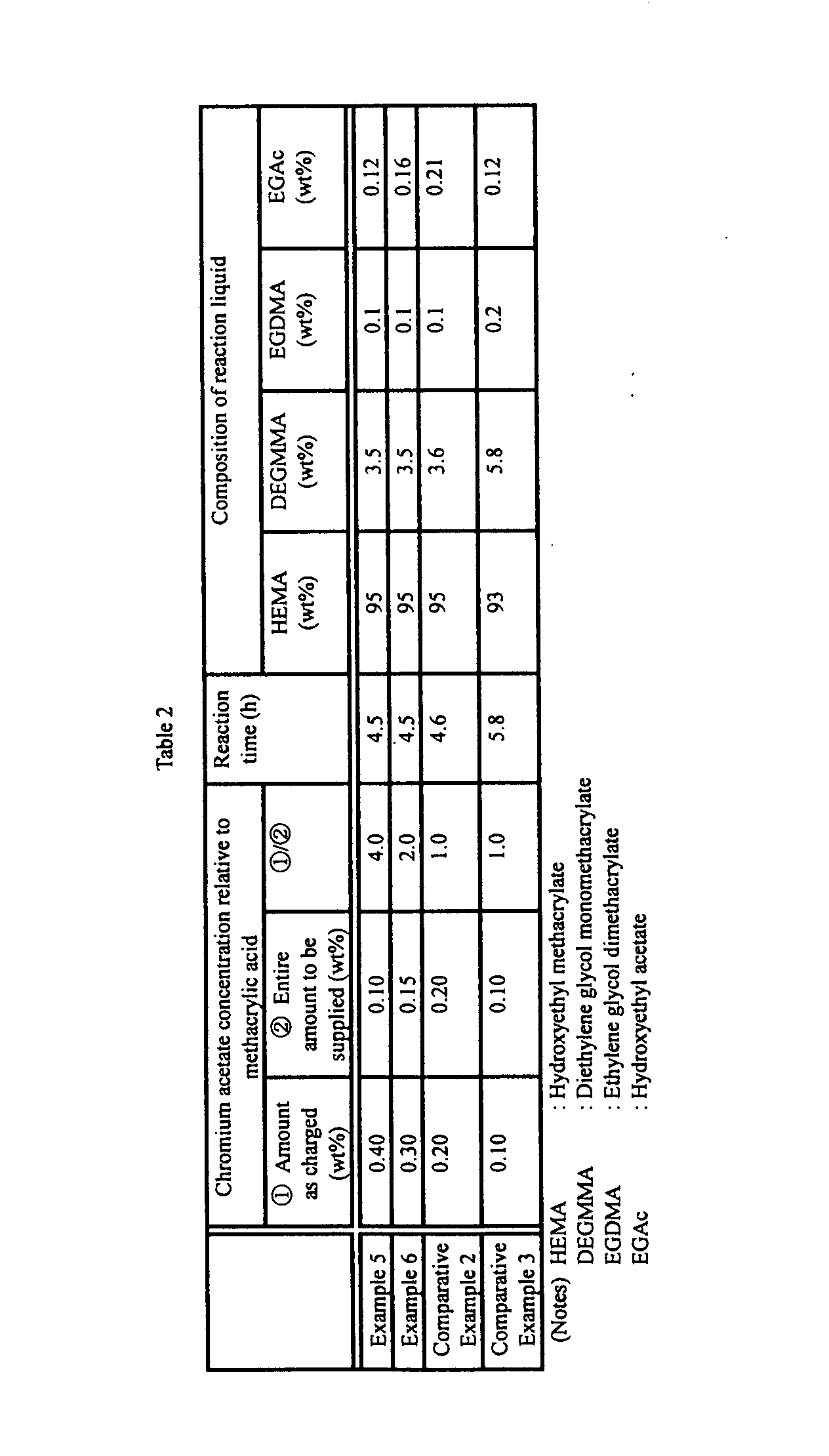
Claims (1)
- A production process for a hydroxyalkyl (meth)acrylate, which comprises the step of carrying out a batch reaction between (meth)acrylic acid and an alkylene oxide in the presence of a catalyst in order to produce the hydroxyalkyl (meth)acrylate;with the production process being characterized by arranging that the reaction should be initiated in a state of a catalyst concentration of more than 1, wherein the catalyst concentration is defined as the amount of the catalyst as used relative to the integrated amount of the (meth)acrylic acid as supplied and is assumed to be 1 in terms of the amount of the entire catalyst to be used relative to the amount of the entire (meth)acrylic acid to be supplied.
Applications Claiming Priority (2)
| Application Number | Priority Date | Filing Date | Title |
|---|---|---|---|
| JP2002170515A JP3907532B2 (en) | 2002-06-11 | 2002-06-11 | Method for producing hydroxyalkyl (meth) acrylate |
| JP2002170515 | 2002-06-11 |
Publications (3)
| Publication Number | Publication Date |
|---|---|
| EP1371628A2 true EP1371628A2 (en) | 2003-12-17 |
| EP1371628A3 EP1371628A3 (en) | 2004-02-11 |
| EP1371628B1 EP1371628B1 (en) | 2011-12-28 |
Family
ID=29561760
Family Applications (1)
| Application Number | Title | Priority Date | Filing Date |
|---|---|---|---|
| EP03010929A Expired - Lifetime EP1371628B1 (en) | 2002-06-11 | 2003-05-15 | Production process for hydroxyalkyl (meth)acrylate |
Country Status (4)
| Country | Link |
|---|---|
| US (1) | US7045651B2 (en) |
| EP (1) | EP1371628B1 (en) |
| JP (1) | JP3907532B2 (en) |
| CN (1) | CN1332927C (en) |
Cited By (2)
| Publication number | Priority date | Publication date | Assignee | Title |
|---|---|---|---|---|
| WO2005115964A3 (en) * | 2004-05-26 | 2006-05-18 | Mexeo | A method for catalytic oxyethylation |
| EP2899180A4 (en) * | 2012-09-24 | 2016-05-25 | Nippon Catalytic Chem Ind | HYDROXYALKYL ACRYLATE AND PROCESS FOR PRODUCING THE SAME |
Families Citing this family (7)
| Publication number | Priority date | Publication date | Assignee | Title |
|---|---|---|---|---|
| EP1775279B1 (en) | 2004-08-06 | 2011-11-30 | Nippon Shokubai Co., Ltd. | Processes for producing hydroxyalkyl (meth)acrylate |
| ES2708085T3 (en) * | 2008-06-13 | 2019-04-08 | Ceres Ip Co Ltd | Method for the deposition of ceramic films |
| US20150126767A1 (en) * | 2012-05-31 | 2015-05-07 | Nippon Shokubai Co., Ltd. | Hydroxyalkyl (meth)acrylate and method for producing same |
| CN104119227A (en) * | 2013-04-27 | 2014-10-29 | 复旦大学 | Method for performing esterification reaction on carboxylic acid and ethylene oxide compound |
| CN107074724A (en) * | 2014-10-22 | 2017-08-18 | 陶氏环球技术有限责任公司 | Preparation of sorbate |
| CN110922330B (en) * | 2019-11-22 | 2022-08-26 | 广东新华粤石化集团股份公司 | Preparation method of hydroxyethyl acrylate |
| CN113735707B (en) * | 2021-10-18 | 2023-06-13 | 浙江皇马科技股份有限公司 | Synthesis method of (methyl) acrylic acid alkyl ester |
Citations (1)
| Publication number | Priority date | Publication date | Assignee | Title |
|---|---|---|---|---|
| US3399229A (en) | 1965-04-03 | 1968-08-27 | Cassella Farbwerke Mainkur Ag | Process for the production of hydroxyalkyl esters of the alpha, beta-unsaturated carboxylic acids |
Family Cites Families (15)
| Publication number | Priority date | Publication date | Assignee | Title |
|---|---|---|---|---|
| US198403A (en) * | 1877-12-18 | Improvement in apparatus for carbonating beverages | ||
| DE1147938B (en) | 1959-04-30 | 1963-05-02 | Roehm & Haas Gmbh | Production of AEthane-1, 2-diol and propane-1, 2-diol monoacrylate and monomethacrylate |
| GB1195485A (en) * | 1968-03-09 | 1970-06-17 | Bp Chem Int Ltd | Production of Esters |
| US3875211A (en) * | 1973-01-22 | 1975-04-01 | Alcolac Inc | Process for preparing 2-hydroxyalkylacrylates and 2-hydroxyalkylmethacrylates |
| US4017429A (en) * | 1973-08-17 | 1977-04-12 | Aerojet-General Corporation | Preparation of 2-hydroxyalkyl esters |
| US4404395A (en) * | 1980-04-02 | 1983-09-13 | Ici Americas Inc. | Acrylate production |
| US4365081A (en) * | 1980-05-20 | 1982-12-21 | Nippon Shokubai Kagaku Kogyo Co. Ltd. | Process for producing 2-hydroxyalkyl acrylates or methacrylates |
| US4910329A (en) * | 1989-01-11 | 1990-03-20 | Rohm And Haas Company | Process for preparing hydroxyalkyl esters |
| JP3274618B2 (en) | 1997-02-28 | 2002-04-15 | 株式会社日本触媒 | Method for producing hydroxyalkyl (meth) acrylate |
| JP4634582B2 (en) | 1999-08-16 | 2011-02-16 | 株式会社日本触媒 | Method for producing hydroxyalkyl ester |
| US6414182B1 (en) | 1999-08-16 | 2002-07-02 | Nippon Shokubai Co., Ltd. | Production process for hydroxyalkyl ester |
| EP1134212B1 (en) * | 2000-03-13 | 2004-04-28 | Nippon Shokubai Co., Ltd. | Production process for hydroxyalkyl(meth)acrylate |
| US6465681B2 (en) | 2000-12-26 | 2002-10-15 | Nippon Shokubai Co., Ltd. | Production process for hydroxyalkyl (meth)acrylate |
| JP5143325B2 (en) | 2001-08-17 | 2013-02-13 | 株式会社日本触媒 | Method for producing hydroxyalkyl (meth) acrylate |
| WO2002076919A1 (en) | 2001-03-26 | 2002-10-03 | Nippon Shokubai Co., Ltd. | Method of reaction with soluble metallic catalyst and anion-exchange resin, method of recovering the soluble metallic catalyst, and method of recycling |
-
2002
- 2002-06-11 JP JP2002170515A patent/JP3907532B2/en not_active Expired - Fee Related
-
2003
- 2003-05-12 US US10/435,992 patent/US7045651B2/en not_active Expired - Lifetime
- 2003-05-15 EP EP03010929A patent/EP1371628B1/en not_active Expired - Lifetime
- 2003-06-11 CN CNB031425208A patent/CN1332927C/en not_active Expired - Lifetime
Patent Citations (1)
| Publication number | Priority date | Publication date | Assignee | Title |
|---|---|---|---|---|
| US3399229A (en) | 1965-04-03 | 1968-08-27 | Cassella Farbwerke Mainkur Ag | Process for the production of hydroxyalkyl esters of the alpha, beta-unsaturated carboxylic acids |
Cited By (2)
| Publication number | Priority date | Publication date | Assignee | Title |
|---|---|---|---|---|
| WO2005115964A3 (en) * | 2004-05-26 | 2006-05-18 | Mexeo | A method for catalytic oxyethylation |
| EP2899180A4 (en) * | 2012-09-24 | 2016-05-25 | Nippon Catalytic Chem Ind | HYDROXYALKYL ACRYLATE AND PROCESS FOR PRODUCING THE SAME |
Also Published As
| Publication number | Publication date |
|---|---|
| CN1332927C (en) | 2007-08-22 |
| US20030229243A1 (en) | 2003-12-11 |
| CN1468836A (en) | 2004-01-21 |
| US7045651B2 (en) | 2006-05-16 |
| EP1371628B1 (en) | 2011-12-28 |
| JP3907532B2 (en) | 2007-04-18 |
| EP1371628A3 (en) | 2004-02-11 |
| JP2004010602A (en) | 2004-01-15 |
Similar Documents
| Publication | Publication Date | Title |
|---|---|---|
| US7045651B2 (en) | Production process for hydroxyalkyl (meth) acrylate | |
| US6984751B2 (en) | Production process for hydroxyalkyl (meth) acrylate | |
| EP1371629B1 (en) | Process for the preparation of hydroxyalkyl(meth)acrylate | |
| EP1344764B1 (en) | Process for the inhibition of polymerization of (meth)acrylate esters | |
| EP1775279B1 (en) | Processes for producing hydroxyalkyl (meth)acrylate | |
| US6465681B2 (en) | Production process for hydroxyalkyl (meth)acrylate | |
| EP1219588B1 (en) | Production process for hydroxyalkyl (meth)acrylate | |
| WO2014046261A1 (en) | Hydroxyalkyl acrylate and method for producing same | |
| JP5143325B2 (en) | Method for producing hydroxyalkyl (meth) acrylate | |
| JP5073278B2 (en) | Method for producing hydroxyalkyl (meth) acrylate | |
| JP4564226B2 (en) | Method for producing hydroxyalkyl (meth) acrylate | |
| JP5089964B2 (en) | Method and system for producing hydroxyalkyl (meth) acrylate | |
| JP4772997B2 (en) | Method for producing hydroxyalkyl (meth) acrylate | |
| JP4235056B2 (en) | Method for producing hydroxyalkyl (meth) acrylate | |
| EP1191013B1 (en) | Method for stopping a production process for hydroxyalkyl esters | |
| JP4767787B2 (en) | Method for producing hydroxyalkyl (meth) acrylate | |
| US20020091283A1 (en) | Production process for hydroxylalkyl (meth)acrylate | |
| JP4327012B2 (en) | Chromium-based catalyst recovery method | |
| JP4676901B2 (en) | Catalyst for producing hydroxyalkylcarboxylate and method for producing hydroxyalkylcarboxylate using the same | |
| JP2004182634A (en) | Method for manufacturing hydroxyalkyl (meth)acrylate |
Legal Events
| Date | Code | Title | Description |
|---|---|---|---|
| PUAI | Public reference made under article 153(3) epc to a published international application that has entered the european phase |
Free format text: ORIGINAL CODE: 0009012 |
|
| AK | Designated contracting states |
Kind code of ref document: A2 Designated state(s): AT BE BG CH CY CZ DE DK EE ES FI FR GB GR HU IE IT LI LU MC NL PT RO SE SI SK TR |
|
| AX | Request for extension of the european patent |
Extension state: AL LT LV MK |
|
| PUAL | Search report despatched |
Free format text: ORIGINAL CODE: 0009013 |
|
| AK | Designated contracting states |
Kind code of ref document: A3 Designated state(s): AT BE BG CH CY CZ DE DK EE ES FI FR GB GR HU IE IT LI LU MC NL PT RO SE SI SK TR |
|
| AX | Request for extension of the european patent |
Extension state: AL LT LV MK |
|
| RIC1 | Information provided on ipc code assigned before grant |
Ipc: 7C 07C 69/54 A Ipc: 7C 07C 67/26 B |
|
| 17P | Request for examination filed |
Effective date: 20040714 |
|
| AKX | Designation fees paid |
Designated state(s): DE GB |
|
| 17Q | First examination report despatched |
Effective date: 20070629 |
|
| GRAP | Despatch of communication of intention to grant a patent |
Free format text: ORIGINAL CODE: EPIDOSNIGR1 |
|
| RIN1 | Information on inventor provided before grant (corrected) |
Inventor name: ISHIDA, TOKUMASA Inventor name: UEMURA, MASAHIRO |
|
| GRAS | Grant fee paid |
Free format text: ORIGINAL CODE: EPIDOSNIGR3 |
|
| GRAA | (expected) grant |
Free format text: ORIGINAL CODE: 0009210 |
|
| AK | Designated contracting states |
Kind code of ref document: B1 Designated state(s): DE GB |
|
| REG | Reference to a national code |
Ref country code: GB Ref legal event code: FG4D |
|
| REG | Reference to a national code |
Ref country code: DE Ref legal event code: R096 Ref document number: 60339526 Country of ref document: DE Effective date: 20120301 |
|
| PLBE | No opposition filed within time limit |
Free format text: ORIGINAL CODE: 0009261 |
|
| STAA | Information on the status of an ep patent application or granted ep patent |
Free format text: STATUS: NO OPPOSITION FILED WITHIN TIME LIMIT |
|
| 26N | No opposition filed |
Effective date: 20121001 |
|
| REG | Reference to a national code |
Ref country code: DE Ref legal event code: R097 Ref document number: 60339526 Country of ref document: DE Effective date: 20121001 |
|
| PGFP | Annual fee paid to national office [announced via postgrant information from national office to epo] |
Ref country code: GB Payment date: 20220401 Year of fee payment: 20 Ref country code: DE Payment date: 20220329 Year of fee payment: 20 |
|
| REG | Reference to a national code |
Ref country code: DE Ref legal event code: R071 Ref document number: 60339526 Country of ref document: DE |
|
| REG | Reference to a national code |
Ref country code: GB Ref legal event code: PE20 Expiry date: 20230514 |
|
| PG25 | Lapsed in a contracting state [announced via postgrant information from national office to epo] |
Ref country code: GB Free format text: LAPSE BECAUSE OF EXPIRATION OF PROTECTION Effective date: 20230514 |