EP1371609A1 - A microporous crystalline zeolite material (itq-20) and a production method thereof - Google Patents
A microporous crystalline zeolite material (itq-20) and a production method thereof Download PDFInfo
- Publication number
- EP1371609A1 EP1371609A1 EP02710880A EP02710880A EP1371609A1 EP 1371609 A1 EP1371609 A1 EP 1371609A1 EP 02710880 A EP02710880 A EP 02710880A EP 02710880 A EP02710880 A EP 02710880A EP 1371609 A1 EP1371609 A1 EP 1371609A1
- Authority
- EP
- European Patent Office
- Prior art keywords
- process according
- group
- precursor
- suspension
- solution
- Prior art date
- Legal status (The legal status is an assumption and is not a legal conclusion. Google has not performed a legal analysis and makes no representation as to the accuracy of the status listed.)
- Withdrawn
Links
- 239000010457 zeolite Substances 0.000 title abstract 2
- 238000004519 manufacturing process Methods 0.000 title 1
- VYPSYNLAJGMNEJ-UHFFFAOYSA-N Silicium dioxide Chemical compound O=[Si]=O VYPSYNLAJGMNEJ-UHFFFAOYSA-N 0.000 claims abstract description 51
- 239000000463 material Substances 0.000 claims abstract description 46
- 238000000034 method Methods 0.000 claims abstract description 35
- 239000000377 silicon dioxide Substances 0.000 claims abstract description 24
- 239000007787 solid Substances 0.000 claims abstract description 23
- 239000002243 precursor Substances 0.000 claims abstract description 21
- 239000000725 suspension Substances 0.000 claims abstract description 21
- 229910052681 coesite Inorganic materials 0.000 claims abstract description 19
- 229910052906 cristobalite Inorganic materials 0.000 claims abstract description 19
- 229910052682 stishovite Inorganic materials 0.000 claims abstract description 19
- 229910052905 tridymite Inorganic materials 0.000 claims abstract description 19
- 230000008961 swelling Effects 0.000 claims abstract description 16
- 239000011541 reaction mixture Substances 0.000 claims abstract description 14
- 229910052782 aluminium Inorganic materials 0.000 claims abstract description 7
- 229910052796 boron Inorganic materials 0.000 claims abstract description 7
- 229910052804 chromium Inorganic materials 0.000 claims abstract description 7
- 229910052733 gallium Inorganic materials 0.000 claims abstract description 7
- 229910052732 germanium Inorganic materials 0.000 claims abstract description 7
- 229910052718 tin Inorganic materials 0.000 claims abstract description 7
- 229910052719 titanium Inorganic materials 0.000 claims abstract description 7
- 229910052720 vanadium Inorganic materials 0.000 claims abstract description 7
- 150000001767 cationic compounds Chemical class 0.000 claims abstract description 6
- 229910052729 chemical element Inorganic materials 0.000 claims abstract description 6
- 229910001411 inorganic cation Inorganic materials 0.000 claims abstract description 6
- 229910052742 iron Inorganic materials 0.000 claims abstract description 6
- 230000003647 oxidation Effects 0.000 claims abstract description 6
- 238000007254 oxidation reaction Methods 0.000 claims abstract description 6
- 238000001354 calcination Methods 0.000 claims abstract description 5
- 125000002091 cationic group Chemical group 0.000 claims abstract description 3
- XLYOFNOQVPJJNP-UHFFFAOYSA-N water Substances O XLYOFNOQVPJJNP-UHFFFAOYSA-N 0.000 claims description 18
- 239000002178 crystalline material Substances 0.000 claims description 11
- 238000003756 stirring Methods 0.000 claims description 8
- 238000002604 ultrasonography Methods 0.000 claims description 7
- 150000002892 organic cations Chemical class 0.000 claims description 6
- OSBSFAARYOCBHB-UHFFFAOYSA-N tetrapropylammonium Chemical compound CCC[N+](CCC)(CCC)CCC OSBSFAARYOCBHB-UHFFFAOYSA-N 0.000 claims description 6
- 230000032798 delamination Effects 0.000 claims description 5
- 238000002425 crystallisation Methods 0.000 claims description 4
- 230000008025 crystallization Effects 0.000 claims description 4
- 238000010438 heat treatment Methods 0.000 claims description 4
- WJLUBOLDZCQZEV-UHFFFAOYSA-M hexadecyl(trimethyl)azanium;hydroxide Chemical compound [OH-].CCCCCCCCCCCCCCCC[N+](C)(C)C WJLUBOLDZCQZEV-UHFFFAOYSA-M 0.000 claims description 4
- XLYOFNOQVPJJNP-UHFFFAOYSA-M hydroxide Chemical compound [OH-] XLYOFNOQVPJJNP-UHFFFAOYSA-M 0.000 claims description 4
- 239000000203 mixture Substances 0.000 claims description 4
- 238000000926 separation method Methods 0.000 claims description 4
- 238000002441 X-ray diffraction Methods 0.000 claims description 3
- 238000005189 flocculation Methods 0.000 claims description 3
- 230000016615 flocculation Effects 0.000 claims description 3
- 238000004108 freeze drying Methods 0.000 claims description 3
- 150000003839 salts Chemical class 0.000 claims description 3
- VEXZGXHMUGYJMC-UHFFFAOYSA-M Chloride anion Chemical compound [Cl-] VEXZGXHMUGYJMC-UHFFFAOYSA-M 0.000 claims description 2
- 125000005210 alkyl ammonium group Chemical group 0.000 claims description 2
- 150000004679 hydroxides Chemical class 0.000 claims description 2
- 238000010907 mechanical stirring Methods 0.000 claims description 2
- 239000010815 organic waste Substances 0.000 claims description 2
- 238000002336 sorption--desorption measurement Methods 0.000 claims description 2
- 238000001694 spray drying Methods 0.000 claims description 2
- YBMRDBCBODYGJE-UHFFFAOYSA-N germanium dioxide Chemical compound O=[Ge]=O YBMRDBCBODYGJE-UHFFFAOYSA-N 0.000 claims 2
- ASRSBXRMOCLKQC-UHFFFAOYSA-N 2-(4-chloro-2-methylphenoxy)-n-methoxyacetamide Chemical compound CONC(=O)COC1=CC=C(Cl)C=C1C ASRSBXRMOCLKQC-UHFFFAOYSA-N 0.000 claims 1
- 125000004432 carbon atom Chemical group C* 0.000 claims 1
- 150000004820 halides Chemical class 0.000 claims 1
- WMFOQBRAJBCJND-UHFFFAOYSA-M Lithium hydroxide Chemical compound [Li+].[OH-] WMFOQBRAJBCJND-UHFFFAOYSA-M 0.000 description 6
- IJGRMHOSHXDMSA-UHFFFAOYSA-N Atomic nitrogen Chemical compound N#N IJGRMHOSHXDMSA-UHFFFAOYSA-N 0.000 description 4
- 230000015572 biosynthetic process Effects 0.000 description 4
- 238000002360 preparation method Methods 0.000 description 4
- VEXZGXHMUGYJMC-UHFFFAOYSA-N Hydrochloric acid Chemical compound Cl VEXZGXHMUGYJMC-UHFFFAOYSA-N 0.000 description 3
- 239000003054 catalyst Substances 0.000 description 3
- 150000001768 cations Chemical class 0.000 description 3
- 239000012973 diazabicyclooctane Substances 0.000 description 3
- 229910052744 lithium Inorganic materials 0.000 description 3
- 229910052751 metal Inorganic materials 0.000 description 3
- 239000002184 metal Substances 0.000 description 3
- 229910052700 potassium Inorganic materials 0.000 description 3
- 229910052708 sodium Inorganic materials 0.000 description 3
- 239000011734 sodium Substances 0.000 description 3
- 238000003786 synthesis reaction Methods 0.000 description 3
- -1 transition metal sulfides Chemical class 0.000 description 3
- IMNIMPAHZVJRPE-UHFFFAOYSA-N triethylenediamine Chemical compound C1CN2CCN1CC2 IMNIMPAHZVJRPE-UHFFFAOYSA-N 0.000 description 3
- UFHFLCQGNIYNRP-UHFFFAOYSA-N Hydrogen Chemical compound [H][H] UFHFLCQGNIYNRP-UHFFFAOYSA-N 0.000 description 2
- BOTDANWDWHJENH-UHFFFAOYSA-N Tetraethyl orthosilicate Chemical compound CCO[Si](OCC)(OCC)OCC BOTDANWDWHJENH-UHFFFAOYSA-N 0.000 description 2
- 150000001335 aliphatic alkanes Chemical class 0.000 description 2
- 229910052784 alkaline earth metal Inorganic materials 0.000 description 2
- 150000001342 alkaline earth metals Chemical class 0.000 description 2
- 238000005119 centrifugation Methods 0.000 description 2
- 238000006243 chemical reaction Methods 0.000 description 2
- 239000003795 chemical substances by application Substances 0.000 description 2
- 238000005336 cracking Methods 0.000 description 2
- 238000010586 diagram Methods 0.000 description 2
- 239000012153 distilled water Substances 0.000 description 2
- 238000001035 drying Methods 0.000 description 2
- 238000001914 filtration Methods 0.000 description 2
- 229910052739 hydrogen Inorganic materials 0.000 description 2
- 239000001257 hydrogen Substances 0.000 description 2
- 238000009830 intercalation Methods 0.000 description 2
- 230000002687 intercalation Effects 0.000 description 2
- 238000006317 isomerization reaction Methods 0.000 description 2
- 239000007788 liquid Substances 0.000 description 2
- 239000007791 liquid phase Substances 0.000 description 2
- 229910052757 nitrogen Inorganic materials 0.000 description 2
- 150000002894 organic compounds Chemical class 0.000 description 2
- 235000012239 silicon dioxide Nutrition 0.000 description 2
- 238000005406 washing Methods 0.000 description 2
- OUXCBPLFCPMLQZ-WOPPDYDQSA-N 4-amino-1-[(2r,3s,4s,5r)-4-hydroxy-5-(hydroxymethyl)-3-methyloxolan-2-yl]-5-iodopyrimidin-2-one Chemical compound C[C@H]1[C@H](O)[C@@H](CO)O[C@H]1N1C(=O)N=C(N)C(I)=C1 OUXCBPLFCPMLQZ-WOPPDYDQSA-N 0.000 description 1
- 229910002012 Aerosil® Inorganic materials 0.000 description 1
- OKTJSMMVPCPJKN-UHFFFAOYSA-N Carbon Chemical compound [C] OKTJSMMVPCPJKN-UHFFFAOYSA-N 0.000 description 1
- 239000004215 Carbon black (E152) Substances 0.000 description 1
- MBHNWCYEGXQEIT-UHFFFAOYSA-N Fluphenazine hydrochloride Chemical compound Cl.Cl.C1CN(CCO)CCN1CCCN1C2=CC(C(F)(F)F)=CC=C2SC2=CC=CC=C21 MBHNWCYEGXQEIT-UHFFFAOYSA-N 0.000 description 1
- DGAQECJNVWCQMB-PUAWFVPOSA-M Ilexoside XXIX Chemical compound C[C@@H]1CC[C@@]2(CC[C@@]3(C(=CC[C@H]4[C@]3(CC[C@@H]5[C@@]4(CC[C@@H](C5(C)C)OS(=O)(=O)[O-])C)C)[C@@H]2[C@]1(C)O)C)C(=O)O[C@H]6[C@@H]([C@H]([C@@H]([C@H](O6)CO)O)O)O.[Na+] DGAQECJNVWCQMB-PUAWFVPOSA-M 0.000 description 1
- 239000002841 Lewis acid Substances 0.000 description 1
- WHXSMMKQMYFTQS-UHFFFAOYSA-N Lithium Chemical compound [Li] WHXSMMKQMYFTQS-UHFFFAOYSA-N 0.000 description 1
- 239000012901 Milli-Q water Substances 0.000 description 1
- GRYLNZFGIOXLOG-UHFFFAOYSA-N Nitric acid Chemical compound O[N+]([O-])=O GRYLNZFGIOXLOG-UHFFFAOYSA-N 0.000 description 1
- 229910019142 PO4 Inorganic materials 0.000 description 1
- ZLMJMSJWJFRBEC-UHFFFAOYSA-N Potassium Chemical compound [K] ZLMJMSJWJFRBEC-UHFFFAOYSA-N 0.000 description 1
- ZJDGKLAPAYNDQU-UHFFFAOYSA-J [Zr+4].[O-]P([O-])=O.[O-]P([O-])=O Chemical class [Zr+4].[O-]P([O-])=O.[O-]P([O-])=O ZJDGKLAPAYNDQU-UHFFFAOYSA-J 0.000 description 1
- PNEYBMLMFCGWSK-UHFFFAOYSA-N aluminium oxide Inorganic materials [O-2].[O-2].[O-2].[Al+3].[Al+3] PNEYBMLMFCGWSK-UHFFFAOYSA-N 0.000 description 1
- 239000007900 aqueous suspension Substances 0.000 description 1
- 229910052799 carbon Inorganic materials 0.000 description 1
- 150000001875 compounds Chemical class 0.000 description 1
- 229910052593 corundum Inorganic materials 0.000 description 1
- GUJOJGAPFQRJSV-UHFFFAOYSA-N dialuminum;dioxosilane;oxygen(2-);hydrate Chemical compound O.[O-2].[O-2].[O-2].[Al+3].[Al+3].O=[Si]=O.O=[Si]=O.O=[Si]=O.O=[Si]=O GUJOJGAPFQRJSV-UHFFFAOYSA-N 0.000 description 1
- GDVKFRBCXAPAQJ-UHFFFAOYSA-A dialuminum;hexamagnesium;carbonate;hexadecahydroxide Chemical compound [OH-].[OH-].[OH-].[OH-].[OH-].[OH-].[OH-].[OH-].[OH-].[OH-].[OH-].[OH-].[OH-].[OH-].[OH-].[OH-].[Mg+2].[Mg+2].[Mg+2].[Mg+2].[Mg+2].[Mg+2].[Al+3].[Al+3].[O-]C([O-])=O GDVKFRBCXAPAQJ-UHFFFAOYSA-A 0.000 description 1
- HNPSIPDUKPIQMN-UHFFFAOYSA-N dioxosilane;oxo(oxoalumanyloxy)alumane Chemical compound O=[Si]=O.O=[Al]O[Al]=O HNPSIPDUKPIQMN-UHFFFAOYSA-N 0.000 description 1
- 230000009881 electrostatic interaction Effects 0.000 description 1
- 230000003311 flocculating effect Effects 0.000 description 1
- 239000010439 graphite Substances 0.000 description 1
- 229910002804 graphite Inorganic materials 0.000 description 1
- 229930195733 hydrocarbon Natural products 0.000 description 1
- 150000002430 hydrocarbons Chemical class 0.000 description 1
- 229910001701 hydrotalcite Inorganic materials 0.000 description 1
- 229960001545 hydrotalcite Drugs 0.000 description 1
- 239000012535 impurity Substances 0.000 description 1
- 239000002648 laminated material Substances 0.000 description 1
- 150000007517 lewis acids Chemical class 0.000 description 1
- GLXDVVHUTZTUQK-UHFFFAOYSA-M lithium;hydroxide;hydrate Chemical compound [Li+].O.[OH-] GLXDVVHUTZTUQK-UHFFFAOYSA-M 0.000 description 1
- 239000012229 microporous material Substances 0.000 description 1
- 229910017604 nitric acid Inorganic materials 0.000 description 1
- 239000012071 phase Substances 0.000 description 1
- 235000021317 phosphate Nutrition 0.000 description 1
- 150000003013 phosphoric acid derivatives Chemical class 0.000 description 1
- 239000011591 potassium Substances 0.000 description 1
- 238000010992 reflux Methods 0.000 description 1
- 125000005624 silicic acid group Chemical class 0.000 description 1
- 239000007790 solid phase Substances 0.000 description 1
- 238000001179 sorption measurement Methods 0.000 description 1
- 229910052723 transition metal Inorganic materials 0.000 description 1
- 229910001845 yogo sapphire Inorganic materials 0.000 description 1
Images


Classifications
-
- C—CHEMISTRY; METALLURGY
- C01—INORGANIC CHEMISTRY
- C01B—NON-METALLIC ELEMENTS; COMPOUNDS THEREOF; METALLOIDS OR COMPOUNDS THEREOF NOT COVERED BY SUBCLASS C01C
- C01B39/00—Compounds having molecular sieve and base-exchange properties, e.g. crystalline zeolites; Their preparation; After-treatment, e.g. ion-exchange or dealumination
- C01B39/02—Crystalline aluminosilicate zeolites; Isomorphous compounds thereof; Direct preparation thereof; Preparation thereof starting from a reaction mixture containing a crystalline zeolite of another type, or from preformed reactants; After-treatment thereof
- C01B39/04—Crystalline aluminosilicate zeolites; Isomorphous compounds thereof; Direct preparation thereof; Preparation thereof starting from a reaction mixture containing a crystalline zeolite of another type, or from preformed reactants; After-treatment thereof using at least one organic template directing agent, e.g. an ionic quaternary ammonium compound or an aminated compound
-
- B—PERFORMING OPERATIONS; TRANSPORTING
- B01—PHYSICAL OR CHEMICAL PROCESSES OR APPARATUS IN GENERAL
- B01J—CHEMICAL OR PHYSICAL PROCESSES, e.g. CATALYSIS OR COLLOID CHEMISTRY; THEIR RELEVANT APPARATUS
- B01J29/00—Catalysts comprising molecular sieves
- B01J29/03—Catalysts comprising molecular sieves not having base-exchange properties
- B01J29/035—Microporous crystalline materials not having base exchange properties, such as silica polymorphs, e.g. silicalites
-
- B—PERFORMING OPERATIONS; TRANSPORTING
- B01—PHYSICAL OR CHEMICAL PROCESSES OR APPARATUS IN GENERAL
- B01J—CHEMICAL OR PHYSICAL PROCESSES, e.g. CATALYSIS OR COLLOID CHEMISTRY; THEIR RELEVANT APPARATUS
- B01J29/00—Catalysts comprising molecular sieves
- B01J29/04—Catalysts comprising molecular sieves having base-exchange properties, e.g. crystalline zeolites
-
- B—PERFORMING OPERATIONS; TRANSPORTING
- B01—PHYSICAL OR CHEMICAL PROCESSES OR APPARATUS IN GENERAL
- B01J—CHEMICAL OR PHYSICAL PROCESSES, e.g. CATALYSIS OR COLLOID CHEMISTRY; THEIR RELEVANT APPARATUS
- B01J29/00—Catalysts comprising molecular sieves
- B01J29/04—Catalysts comprising molecular sieves having base-exchange properties, e.g. crystalline zeolites
- B01J29/06—Crystalline aluminosilicate zeolites; Isomorphous compounds thereof
- B01J29/70—Crystalline aluminosilicate zeolites; Isomorphous compounds thereof of types characterised by their specific structure not provided for in groups B01J29/08 - B01J29/65
-
- C—CHEMISTRY; METALLURGY
- C01—INORGANIC CHEMISTRY
- C01B—NON-METALLIC ELEMENTS; COMPOUNDS THEREOF; METALLOIDS OR COMPOUNDS THEREOF NOT COVERED BY SUBCLASS C01C
- C01B33/00—Silicon; Compounds thereof
- C01B33/20—Silicates
- C01B33/36—Silicates having base-exchange properties but not having molecular sieve properties
- C01B33/38—Layered base-exchange silicates, e.g. clays, micas or alkali metal silicates of kenyaite or magadiite type
-
- C—CHEMISTRY; METALLURGY
- C01—INORGANIC CHEMISTRY
- C01B—NON-METALLIC ELEMENTS; COMPOUNDS THEREOF; METALLOIDS OR COMPOUNDS THEREOF NOT COVERED BY SUBCLASS C01C
- C01B37/00—Compounds having molecular sieve properties but not having base-exchange properties
- C01B37/02—Crystalline silica-polymorphs, e.g. silicalites dealuminated aluminosilicate zeolites
-
- C—CHEMISTRY; METALLURGY
- C01—INORGANIC CHEMISTRY
- C01B—NON-METALLIC ELEMENTS; COMPOUNDS THEREOF; METALLOIDS OR COMPOUNDS THEREOF NOT COVERED BY SUBCLASS C01C
- C01B39/00—Compounds having molecular sieve and base-exchange properties, e.g. crystalline zeolites; Their preparation; After-treatment, e.g. ion-exchange or dealumination
- C01B39/02—Crystalline aluminosilicate zeolites; Isomorphous compounds thereof; Direct preparation thereof; Preparation thereof starting from a reaction mixture containing a crystalline zeolite of another type, or from preformed reactants; After-treatment thereof
- C01B39/46—Other types characterised by their X-ray diffraction pattern and their defined composition
- C01B39/48—Other types characterised by their X-ray diffraction pattern and their defined composition using at least one organic template directing agent
Definitions
- the present invention belongs to the sector of microporous zeolitic materials, particularly to synthetic delaminated zeolitic materials and more specifically to catalysts corresponding to such materials.
- the first object of the present invention is a microporous crystalline material useful as a catalyst in hydrocarbon cracking reactions, alkane isomerization, dewaxing and isodewaxing of paraffins.
- a second object of the invention is a method for the preparation of the microporous zeolitic material and the most suitable conditions for synthesis thereof.
- Laminar materials such as clays, phosphates and zirconium phosphonates, hydrotalcite type hydroxycarbonates, silicic acids (kanemite, magadite, etc.), transition metal sulfides, graphite, laminar hydroxides and others are capable of swelling in the presence of water and/or suitable interlaminar cations.
- the individual sheets of these materials are kept together by means of weak bonds of the hydrogen type bond and/or electrostatic interactions. These bonds are easily broken when the intercalation force or the solvatation energy of the cations is greater than the interlaminar attraction forces.
- the present invention refers to a microporous crystalline material of zeolitic nature with a high external surface and a crystalline structure, capable of support Brönsted and Lewis acids.
- This new material is obtained from a laminar precursor that is subsequently transformed by means of a process that involves delamination of the laminar material.
- the material is useful in reactions such as dewaxing and isodewaxing of paraffins, cracking and alkane isomerization.
- microporous crystalline material of zeolitic nature (also identified as ITQ-20 in the text of the present specification) is characterized in that it has in a state calcinated at temperatures between 300°C and 800°C and in an anhydrous state an X-ray diffreactio pattern with basal spacings and intensities summarized in the following table: d( ⁇ ) (I/IO)*100 32.82 ⁇ 0.02 vs 11.97 ⁇ 0.03 w 10.05+0.04 w 9.39 ⁇ 0.06 m 7.05 ⁇ 0.05 w 6.93 ⁇ 0.02 w 6.56 ⁇ 0.05 w 5.64 ⁇ 0.07 w 4.77 ⁇ 0.08 w 4.27 ⁇ 0.04 w 3.98 ⁇ 0.08 w 3.89 ⁇ 0.08 w 3.72 ⁇ 0.03 w 3.53 ⁇ 0.05 w 3.46 ⁇ 0.07 w 3.34 ⁇ 0.06 w 2.90 ⁇ 0.08 w wherein w is a weak relative intensity between 0 and 20%; m is an average relative intensity between 20 & 40%; s is an average relative intensity between 40
- the material is also characterized in that it has the empirical formula x(M 1/n XO 2 ) : yYO 2 : ( 1-y)SiO 2 wherein x has a value less than 0.2, preferably less than 0.1, and more preferably less than 0.02, and it may have the value 0; y has a value less than 0.1, preferably less than 0.05, and more preferably less than 0.02; M is at least one +n charge inorganic cation, that may be an alkaline metal or alkaline earth metals, such as for example Na, K, Li, or hydrogen; X is at least one chemical element with a +3 oxidation state, preferably selected from the group consisting of Al, Ga, B, Cr and Fe; Y is at least one chemical element with a +4 oxidation state, preferably selected from the group consisting of Ge, Ti, Sn and V.
- x has a value less than 0.2, preferably less than 0.1, and more preferably less than 0.02,
- the material ITQ-20 preferably has specific surface characteristics, measured by N 2 adsorption-desorption, of an external surface of at least 100 m 2 g -1 , and preferably with more than 400 m 2 g -1 . It is thermally stable up to temperatures of some 800°C.
- the material ITQ-20 can be synthesized by means of a process that comprises the steps specified hereinafter.
- a precusor is prepared in a first step by subjecting to heating, with or without stirring, at a temperature between 100 and 225°C, preferably between 125 and 200°C, a reaction mixture that contains water and a SiO 2 source, that preferably has, in order to enhance the formation of the final material ITQ-19 without the presence of liquid phases considered as impurities, at least 30% of solid silica, such as for example AEROSIL, LUDOX, ULTRASIL, HISIL or tetraethylorthosilicate (TEOS), optionally a source of at least another tetravalent element Y preferably selected from the group consisting of Ge, Ti, V and Sn, optionally a source of at least another trivalent element X preferably selected from selected from the group consisting of Al, B, Ga, Fe and Cr, an organic cation 1-methyl-1,4-diazabicyclo[2,2,2] octane as a structure directing agent, and optionally an inorganic cation
- the reaction mixture has a composition, in terms of molar ratios of oxides, comprised between the ranges:
- reaction mixture based on its empirical formula is the following: rROH : aM 1/n OH : xX 2 O 3 : yYO 2 :(1-y)SiO 2 : zH 2 O
- the reaction mixture is, in terms of moles of oxide per mole of silica, the following: (0.1-1)ROH:0-0.05)m 1/n OH:0.0025-0.335)Al 2 O 3 :SiO 2:z H 2 O wherein M has the above-cited meaning, R is an organic cation that acts as a structure directing agent, and z is a value of 0 to 100, preferably 1-50.
- Adding the trivalent element or trivalent elements and/or tetravalent elements can be done prior to the heating of the reaction mixture or in a intermediate phase during heating.
- an amount of crystalline material preferably with the characteristics of the material ITQ-19, as crystallization promoter, can be added to the reaction mixture.
- the amount of this promoter material is comprised between 0.01 to 15%, preferably 0.05 to 5% by weight referred to the total amount of silica added.
- the first step normally has a duration of between 1 and 30 days, preferably 2 to 15 days and it normally proves to be a white solid.
- the precursor has an X-ray diffraction pattern with basal spacings and relative intensities corresponding to those indicated on the following table: d ( ⁇ ) (I/IO) *100 d( ⁇ ) (I/IO) *100 11.22 ⁇ 0.02 vs 3.60 ⁇ 0.08 s 10.10 ⁇ 0.03 w 3.52 ⁇ 0.05 vs 8.81 ⁇ 0.05 w 3.42 ⁇ 0.06 s 7.05 ⁇ 0.01 w 3.36 ⁇ 0.04 s 6.30 ⁇ 0.01 m 3.32 ⁇ 0.05 w 5.60 ⁇ 0.02 w 3.30 ⁇ 0.01 w 5.28 ⁇ 0.05 s 3.14 ⁇ 0.07 w 4.98 ⁇ 0.06 s 3.10 ⁇ 0.02 w 4.72 ⁇ 0.01 w 3.09 ⁇ 0.03 w 4.38 ⁇ 0.02 s 3.01 ⁇ 0.01 w 4.21 ⁇ 0.02 s 2.81 ⁇ 0.04 w 3.90 ⁇ 0.03 w 2.61 ⁇ 0.04 w 3.83 ⁇ 0.08 m 3.51 ⁇ 0.05 w 3.73 ⁇ 0.07 m 2.48 ⁇ 0.09 w wherein
- the precursor is subjected to swelling in a swelling solution in order to obtain a swollen laminar material.
- the swelling solution contains organic molecules that are intercalated in order to produce separation of sheets of the precursor.
- organic molecules preferably have a proton acceptor group and a hydrocarbonaceous chain and they may be selected among alkylammonium molecules with a number of carbons between 4 and 24, preferably between 16 and 19.
- a suitable organic molecule is cetyltrimetylammonium chloride (CTMA + ).
- Swelling is produced in view of the fact that the precursor is exchanged and/or intercalated with the organic compound that keep the laminae of the swollen laminated material very separate in such a way that the attraction forces that keep said sheets separate are substantially reduced, although said forces should not be reduced so that in this second stage delamination is produced.
- the same comprises:
- this may comprise:
- the swollen laminar material is washed and dried in order to obtain a dry swollen solid.
- the washing is thoroughly carried out in water and the drying is preferably carried out temperatures lower than 300° C, more preferably at lower temperatures.
- the dry swollen solid has a characteristic X-ray diffractogram taking into account the organic compound intercalated between the sheets.
- said diffractogram shows the basal spacings and relative intensities corresponding to those shown in the following table:
- the dry swollen solid is subjected to at least partial delamination in water in order to obtain a suspension that contains at least a partially delaminated material.
- This fourth stage can be carried out, for example, by first preparing an aqueous suspension of the dry swollen solid, with a water/dry swollen solid ratio by weight of preferably between 4 and 200 and more specifically 10 and 100. Afterwards, the suspension is subjected to controlled stirring, by means of at least a technique selected from among mechanical stirring, ultrasound, spray drying, lyophilization and combinations thereof.
- stirring is carried out by a ultrasound or mechanical technique during 5 seconds and 20 hours, preferably between 5 minutes and 10 hours.
- the stirred suspension, that is later filtered and washed normally has the appearance of a gel due to the presence of small zeolite particles produced during delamination.
- the at least partially delaminated material is separated from the suspension by means of already known techniques, such as for example filtration and/or centrifugation.
- this can be included in the suspension that contains the at least partially delaminated material which is subjected to flocculation in order to improve the filtration and/or centrifugation characteristics.
- flocculating materials such as HAc, HCl or HNO 3 may be added.
- organic wastes are removed from the at least partially delaminated material by means of treatment selected from among cationic exchange, calcination, or combinations thereof. Calcination can be done in an air flow, at a temperature between 300°C and 800°C, preferably between 400°C and 600°C, for at least 3 hours.
- the resulting material has an X-ray diffractogram corresponding to the values indicated in table 1.
- figure 1 is a diffractogram of a typical precursor PREITQ-19 resulting from the first stage of the process for preparation of the material ITQ-20
- figure 2 is a diffractogram of a typical sample of a typical swollen laminar material resulting from the third stage of the process for preparation of the material ITQ-20
- figure 3 is a diffractogram of a typical sample of a typical delaminated material resulting from the fifth stage of the process for preparation of the material ITQ-20
- figure 4 is a diffractogram of a typical sample of a typical material ITQ-20.
- a purely siliceous laminar precursor PREITQ-19 is described in this first example.
- the synthesis gel was prepared using: lithium hydroxide (Fisher), monomethylated 1-methyl-1,4-diazabicyclo[2,2,2]octane hydroxide (DABCO) and an aqueous silica solution (30% by weight) (HS-30 Dupont, Aldrich.).
- the gel is introduced in autoclaves and left for 7 days at 175°C with a stirring speed of 60 rpm.
- the samples are filtered and washed with distilled water until the pH of the washing water is ⁇ 9. Drying is done afterwards in order to obtain the laminar precursor PREITQ-19, whose X-ray diffractogram coincides with the one of Figure 1.
- CTMA cetyltrimetylammonium
- the suspension was kept at reflux for 16 hours at 80°C and then was thoroughly washed with water and the liquids were separated from the solids.
- the swollen laminar precursor obtained has a diffractogram that coincides with Figure 2, whose spacing values d hkl and relative intensities are those given in Table 4.
- Example 1 The process used in example 1 was repeated with the exception that the suspension obtained after treatment with ultrasound was acidified with 6N HCl in order to facilitate flocculation of the suspended solid, before separation of the liquid phase from the solid phase.
- Example 2 The same process of Example 1 is described but with a final treatment, prior to calcination, of lyophilization of the resulting gel and subsequent roasting.
- Example 2 describes the process used in Example 1, substituting the ultrasound process by a constant stirring system, using a Cowles type stirrer for 1 hour and at 1,840 rpm.
- the laminar oxide obtained had a diffraction diagram that basically coincides with the one of Figure 4.
Landscapes
- Chemical & Material Sciences (AREA)
- Organic Chemistry (AREA)
- Life Sciences & Earth Sciences (AREA)
- General Life Sciences & Earth Sciences (AREA)
- Geology (AREA)
- Engineering & Computer Science (AREA)
- Chemical Kinetics & Catalysis (AREA)
- Materials Engineering (AREA)
- Inorganic Chemistry (AREA)
- Crystallography & Structural Chemistry (AREA)
- Silicates, Zeolites, And Molecular Sieves (AREA)
Abstract
Description
- The present invention belongs to the sector of microporous zeolitic materials, particularly to synthetic delaminated zeolitic materials and more specifically to catalysts corresponding to such materials.
- The first object of the present invention is a microporous crystalline material useful as a catalyst in hydrocarbon cracking reactions, alkane isomerization, dewaxing and isodewaxing of paraffins.
- A second object of the invention is a method for the preparation of the microporous zeolitic material and the most suitable conditions for synthesis thereof.
- Laminar materials such as clays, phosphates and zirconium phosphonates, hydrotalcite type hydroxycarbonates, silicic acids (kanemite, magadite, etc.), transition metal sulfides, graphite, laminar hydroxides and others are capable of swelling in the presence of water and/or suitable interlaminar cations. The individual sheets of these materials are kept together by means of weak bonds of the hydrogen type bond and/or electrostatic interactions. These bonds are easily broken when the intercalation force or the solvatation energy of the cations is greater than the interlaminar attraction forces. This is the case, for example, of sodium montmorillonite that swells up to interlaminar distances greater than 10nm, in the presence of an excess of water. The interest of the swollen materials is to make the interlaminar space accessible to reactive molecules, and consequently, the inside surface, considerably increasing the accessible active surface of the catalyst. When the material intercalated between the sheets of the mixed oxide is removed by roasting, the swollen laminar compound collapses, recovering the original interlaminar distance.
- Several processes have been developed in order to prevent interlaminar collapse. One of them consists of intercalation, by interlaminar exchange or cation solvatation of polar molecules with very long hydrocarbonaceous chains that give rise to very large distances of separation between sheets. Under these conditions, the interlaminar attraction forces are very weak, and a subsequent treatment, for example with ultrasound or stirring may manage to definitively separate the sheets from one another.
- The present invention refers to a microporous crystalline material of zeolitic nature with a high external surface and a crystalline structure, capable of support Brönsted and Lewis acids.
- This new material is obtained from a laminar precursor that is subsequently transformed by means of a process that involves delamination of the laminar material. The material is useful in reactions such as dewaxing and isodewaxing of paraffins, cracking and alkane isomerization.
- The microporous crystalline material of zeolitic nature (also identified as ITQ-20 in the text of the present specification) is characterized in that
it has in a state calcinated at temperatures between 300°C and 800°C and in an anhydrous state an X-ray diffreactio pattern with basal spacings and intensities summarized in the following table:d(Å) (I/IO)*100 32.82±0.02 vs 11.97±0.03 w 10.05+0.04 w 9.39±0.06 m 7.05±0.05 w 6.93±0.02 w 6.56±0.05 w 5.64±0.07 w 4.77±0.08 w 4.27±0.04 w 3.98±0.08 w 3.89±0.08 w 3.72±0.03 w 3.53±0.05 w 3.46±0.07 w 3.34±0.06 w 2.90±0.08 w
w is a weak relative intensity between 0 and 20%;
m is an average relative intensity between 20 & 40%;
s is an average relative intensity between 40 and 60%;
vs is an average relative intensity between 60 and 100%. - On the other hand, the material is also characterized in that it has the empirical formula
x has a value less than 0.2, preferably less than 0.1, and more preferably less than 0.02, and it may have thevalue 0;
y has a value less than 0.1, preferably less than 0.05, and more preferably less than 0.02;
M is at least one +n charge inorganic cation, that may be an alkaline metal or alkaline earth metals, such as for example Na, K, Li, or hydrogen;
X is at least one chemical element with a +3 oxidation state, preferably selected from the group consisting of Al, Ga, B, Cr and Fe;
Y is at least one chemical element with a +4 oxidation state, preferably selected from the group consisting of Ge, Ti, Sn and V. - The material ITQ-20 preferably has specific surface characteristics, measured by N2 adsorption-desorption, of an external surface of at least 100 m2g-1, and preferably with more than 400 m2g-1. It is thermally stable up to temperatures of some 800°C.
- Resulting values obtained when the BET equation is applied to the nitrogen adsorption isotherm values, to the temperature of liquid nitrogen, to a series of samples whose X-ray diffractograms have basal spacing values and relative intensities corresponding to table 1 above, are summarized on the following table:
Sample SBET (m2g-1) SMIC (m2g-1) SEXT (m2g-1) VTOT (cm3g-1) VMIC (cm3g-1) VBJH (cm3g-1) ITQ-20 571 123 448 0.0470 0.0562 0.2012 - In accordance with the invention, the material ITQ-20 can be synthesized by means of a process that comprises the steps specified hereinafter.
- A precusor is prepared in a first step by subjecting to heating, with or without stirring, at a temperature between 100 and 225°C, preferably between 125 and 200°C, a reaction mixture that contains water and
a SiO2 source, that preferably has, in order to enhance the formation of the final material ITQ-19 without the presence of liquid phases considered as impurities, at least 30% of solid silica, such as for example AEROSIL, LUDOX, ULTRASIL, HISIL or tetraethylorthosilicate (TEOS),
optionally a source of at least another tetravalent element Y preferably selected from the group consisting of Ge, Ti, V and Sn,
optionally a source of at least another trivalent element X preferably selected from selected from the group consisting of Al, B, Ga, Fe and Cr,
an organic cation 1-methyl-1,4-diazabicyclo[2,2,2] octane as a structure directing agent, and
optionally an inorganic cation, preferably a source of alkaline metal such as for example an oxide, hydroxide or salt of lithium, sodium or potassium,
until crystallization of the reaction mixture is achieved. - The reaction mixture has a composition, in terms of molar ratios of oxides, comprised between the ranges:
- ROH/SiO2=0.01-1.0, preferably 0.1-1.0,
- M1/nOH/SiO2=0-1.0, preferably 0-0.2,
- X2O3/SiO2=0-0.1, preferably 0-05, and more preferably 0-0.01,
- YO2/(YO2+SiO2) less than 1, preferably less than 0.1,
- H2O/SiO2=0-100, preferably 1-50, wherein
-
- The definition of the reaction mixture based on its empirical formula is the following:
wherein
r = 0.01-1.0, preferably 0.1-1.0
a = 0-1.0, preferably 0-0.2
x = 0-0.1, preferably 0-0.5, and more preferably 0-0.01
y is less than 1, preferably less than 0.1
z = 0-100, preferably 1-50. - In one embodiment, the reaction mixture is, in terms of moles of oxide per mole of silica, the following: (0.1-1)ROH:0-0.05)m1/nOH:0.0025-0.335)Al2O3:SiO2:zH2O wherein
M has the above-cited meaning,
R is an organic cation that acts as a structure directing agent, and
z is a value of 0 to 100, preferably 1-50. - Adding the trivalent element or trivalent elements and/or tetravalent elements can be done prior to the heating of the reaction mixture or in a intermediate phase during heating.
- Optionally, an amount of crystalline material, preferably with the characteristics of the material ITQ-19, as crystallization promoter, can be added to the reaction mixture. The amount of this promoter material is comprised between 0.01 to 15%, preferably 0.05 to 5% by weight referred to the total amount of silica added.
- The first step normally has a duration of between 1 and 30 days, preferably 2 to 15 days and it normally proves to be a white solid.
- Typically, the precursor has an X-ray diffraction pattern with basal spacings and relative intensities corresponding to those indicated on the following table:
d (Å) (I/IO) *100 d(Å) (I/IO) *100 11.22±0.02 vs 3.60±0.08 s 10.10±0.03 w 3.52±0.05 vs 8.81±0.05 w 3.42±0.06 s 7.05±0.01 w 3.36±0.04 s 6.30±0.01 m 3.32±0.05 w 5.60±0.02 w 3.30±0.01 w 5.28±0.05 s 3.14±0.07 w 4.98±0.06 s 3.10±0.02 w 4.72±0.01 w 3.09±0.03 w 4.38±0.02 s 3.01±0.01 w 4.21±0.02 s 2.81±0.04 w 3.90±0.03 w 2.61±0.04 w 3.83±0.08 m 3.51±0.05 w 3.73±0.07 m 2.48±0.09 w
w is a weak relative intensity between 0 and 20%;
m is an average relative intensity between 20 & 40%;
s is an average relative intensity between 40 and 60%;
vs is an average relative intensity between 60 and 100%. - In a second stage of the process, the precursor is subjected to swelling in a swelling solution in order to obtain a swollen laminar material. The swelling solution contains organic molecules that are intercalated in order to produce separation of sheets of the precursor. Such organic molecules preferably have a proton acceptor group and a hydrocarbonaceous chain and they may be selected among alkylammonium molecules with a number of carbons between 4 and 24, preferably between 16 and 19. A suitable organic molecule is cetyltrimetylammonium chloride (CTMA+).
- Swelling is produced in view of the fact that the precursor is exchanged and/or intercalated with the organic compound that keep the laminae of the swollen laminated material very separate in such a way that the attraction forces that keep said sheets separate are substantially reduced, although said forces should not be reduced so that in this second stage delamination is produced.
- In accordance with the invention, in a first embodiment of the swelling solution, the same comprises:
- a suspension of the solid suspended precursor between 10 up to 50% by weight;
- a cetyltrimethylammonium hydroxide solution (OH-, Br-) between 10 up to 50% by weight;
- a tetrapropylammonium solution (TPA+) (OH-, Br-) betweem 20 up to 60% by weight.
-
- As an example of the swelling solution according to this first embodiment, this may comprise:
- a suspension of the solid precursor up to 20% by weight;
- a cetyltrimetylammonium hydroxide solution (OH-,Br-) up to 29% by weight;
- a tetrapropylammonium solution (OH-, Br-) up to 40% by weight;
- with a weight ratio of precursor suspension : cetyltrimethylammonium hydroxide (OH-, Br-) solution : tetrapropylammonium (OH-, Br-) solution of 27:105:33.
-
- In a third stage of the process according to the invention, the swollen laminar material is washed and dried in order to obtain a dry swollen solid. Preferably, the washing is thoroughly carried out in water and the drying is preferably carried out temperatures lower than 300° C, more preferably at lower temperatures.
- The dry swollen solid has a characteristic X-ray diffractogram taking into account the organic compound intercalated between the sheets. Typically, said diffractogram shows the basal spacings and relative intensities corresponding to those shown in the following table:
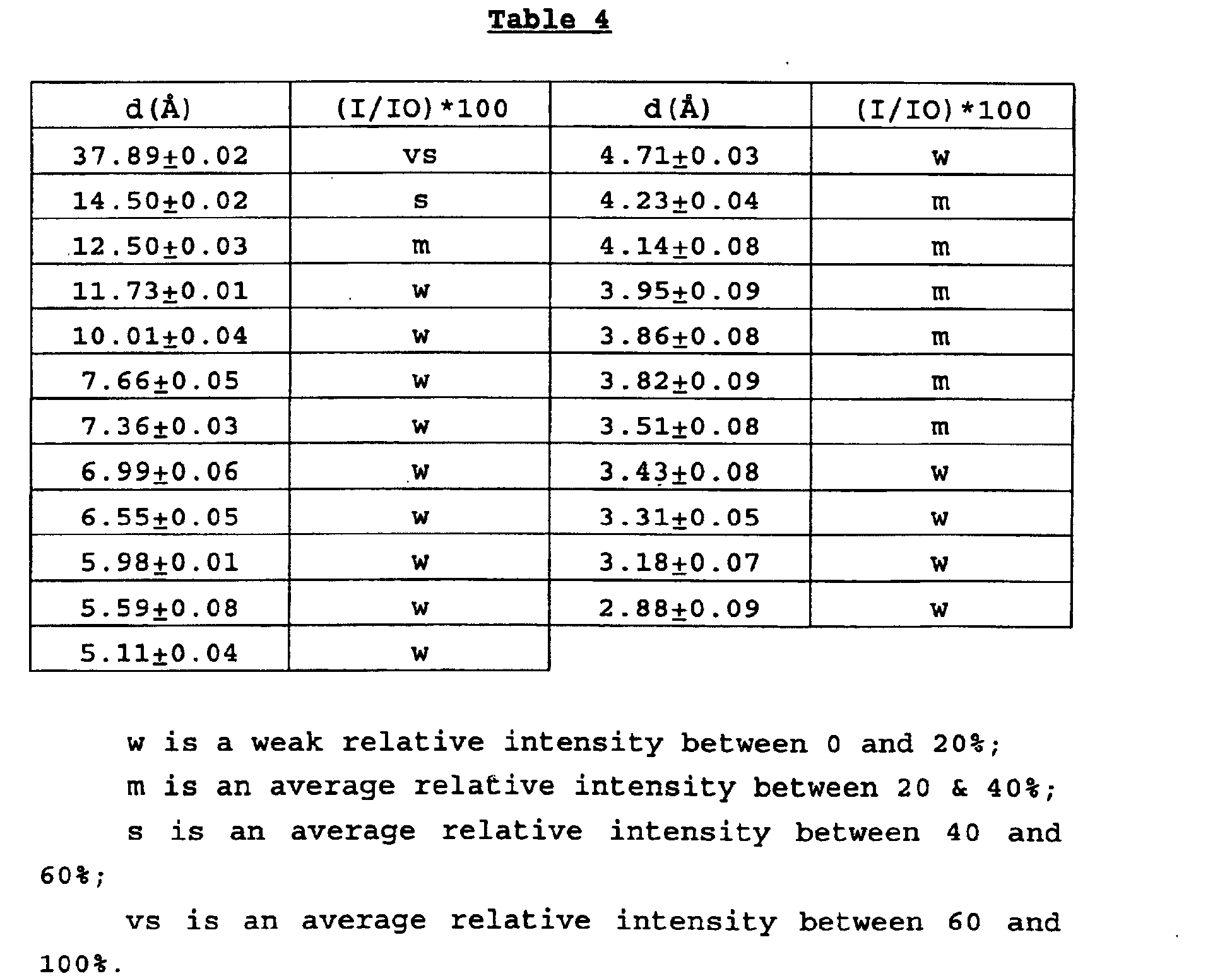
- In a fourth stage of the process according to the invention, the dry swollen solid is subjected to at least partial delamination in water in order to obtain a suspension that contains at least a partially delaminated material.
- This fourth stage can be carried out, for example, by first preparing an aqueous suspension of the dry swollen solid, with a water/dry swollen solid ratio by weight of preferably between 4 and 200 and more specifically 10 and 100. Afterwards, the suspension is subjected to controlled stirring, by means of at least a technique selected from among mechanical stirring, ultrasound, spray drying, lyophilization and combinations thereof.
- Normally, stirring is carried out by a ultrasound or mechanical technique during 5 seconds and 20 hours, preferably between 5 minutes and 10 hours. The stirred suspension, that is later filtered and washed normally has the appearance of a gel due to the presence of small zeolite particles produced during delamination.
- In a fifth stage the at least partially delaminated material is separated from the suspension by means of already known techniques, such as for example filtration and/or centrifugation. In this stage, this can be included in the suspension that contains the at least partially delaminated material which is subjected to flocculation in order to improve the filtration and/or centrifugation characteristics. For this purpose, flocculating materials such as HAc, HCl or HNO3 may be added.
- In a sixth final stage, organic wastes are removed from the at least partially delaminated material by means of treatment selected from among cationic exchange, calcination, or combinations thereof. Calcination can be done in an air flow, at a temperature between 300°C and 800°C, preferably between 400°C and 600°C, for at least 3 hours. The resulting material has an X-ray diffractogram corresponding to the values indicated in table 1.
- As an integral part of the present specification, some drawings are attached hereto, wherein
figure 1 is a diffractogram of a typical precursor PREITQ-19 resulting from the first stage of the process for preparation of the material ITQ-20;
figure 2 is a diffractogram of a typical sample of a typical swollen laminar material resulting from the third stage of the process for preparation of the material ITQ-20;
figure 3 is a diffractogram of a typical sample of a typical delaminated material resulting from the fifth stage of the process for preparation of the material ITQ-20; and
figure 4 is a diffractogram of a typical sample of a typical material ITQ-20. - Some examples of the embodiment of the invention will be described hereinafter.
- A purely siliceous laminar precursor PREITQ-19 is described in this first example. The synthesis gel was prepared using: lithium hydroxide (Fisher), monomethylated 1-methyl-1,4-diazabicyclo[2,2,2]octane hydroxide (DABCO) and an aqueous silica solution (30% by weight) (HS-30 Dupont, Aldrich.).
- 0.175 g. LiOH.H2O, 108.18 g. DABCO-Me-OH (0.5 M) and 16.667 g. SiO2 (30% by weight) are mixed and stirred vigorously in a thermostatic bath at 50°C until the 52.151 g. of water present in the mixture evaporate. Hence, we obtain a synthesis gel with the following molar composition:
- 0.05 LiOH : 0.65 R-=H : 1 SiO2 : 40 H2O (Methylated R=DABCO).
- Afterwards, the gel is introduced in autoclaves and left for 7 days at 175°C with a stirring speed of 60 rpm.
- After this treatment, the samples are filtered and washed with distilled water until the pH of the washing water is <9. Drying is done afterwards in order to obtain the laminar precursor PREITQ-19, whose X-ray diffractogram coincides with the one of Figure 1.
- The material obtained was exchanged with cetyltrimetylammonium (CTMA) according to the following process: 3 g. of a sample PREITQ-19 were suspended in a solution that contained 12 g. of milli-Q water, 60 g. of CTMA+ (OH-Br-) (29% by weight) and 18 g. of TPA+ (OH-Br- ).
- The suspension was kept at reflux for 16 hours at 80°C and then was thoroughly washed with water and the liquids were separated from the solids. The swollen laminar precursor obtained has a diffractogram that coincides with Figure 2, whose spacing values dhkl and relative intensities are those given in Table 4.
- 600 ml of water distilled under constant stirring were added to the material obtained. Then, the suspension was treated with ultrasound at a frequency of 50Hz and a power of 50 watts for 1 hour, after which the gelled suspension was centrifuged and dried at 100°C. The dry sample was calcinated at 540°C for 7 hours giving rise to the microporous material ITQ-20 of the type claimed in this patent with an X-ray diffractogram coincide with the one of Figure 4 and with some spacings dhkl like those of Table 1.
- The process used in example 1 was repeated with the exception that the suspension obtained after treatment with ultrasound was acidified with 6N HCl in order to facilitate flocculation of the suspended solid, before separation of the liquid phase from the solid phase.
- Once the solid obtained has been calcinated, it has a diffraction diagram like the one of Figure 4 with relative intensities corresponding to those of Table 1.
- The same process of Example 1 is described but with a final treatment, prior to calcination, of lyophilization of the resulting gel and subsequent roasting.
- This example describes the process used in Example 1, substituting the ultrasound process by a constant stirring system, using a Cowles type stirrer for 1 hour and at 1,840 rpm. The suspension obtained was acidified with 6N HCl (pH=2), washed with distilled water and centrifuged several times until a final pH higher than 6 has been obtained. Once dried and calcinated at 540°C, the laminar oxide obtained had a diffraction diagram that basically coincides with the one of Figure 4.
M is at least a +n charge inorganic cation, that may be an alkaline metal or alkaline earth metal, such as for example Na, K, Li;
X is at least a trivalent element preferably selected from the group consisting of Al, B, Ga, Fe and Cr;
Y is at least a trivalent element preferably selected from the group consisting of Ge, Ti, Sn and V;
R is an organic cation, preferably 1-methyl-1,4-diazabicyclo[2,2,2]octane (DABCO), which may be added in hydroxide form and another salt to the reaction mixture.
Claims (20)
- A microporous crystalline material of zeolitic nature, characterized in that the material has, in a anhydrous state calcinated at temperatures between 300°C and 800°C, an X-ray diffraction pattern according to
d(Å) (I/IO) *100 32.82±0.02 vs 11.97±0.03 w 10.05±0.04 w 9.39±0.06 m 7.05±0.05 w 6.93±0.02 w 6.56±0.05 w 5.64±0.07 w 4.77±0.08 w 4.27±0.04 w 3.98±0.08 w 3.89±0.08 w 3.72±0.03 w 3.53±0.05 w 3.46±0.07 w 3.34±0.06 w 2.90±0.08 w
w is a weak relative intensity between 0 and 20%;
m is an average relative intensity between 20 & 40%;
s is an average relative intensity between 40 and 60%;
vs is an average relative intensity between 60 and 100%
and in that it has an empirical formula
x has a value less than 0.2;
y has a value less than 0.1:
M is at least one +n charge inorganic cation,
X is at least one chemical element with a +3 oxidation state, preferably selected from the group consisting of Al, Ga, B, Cr and Fe;
Y is at least one chemical element with a +4 oxidation state, preferably selected from the group consisting of Ge, Ti, Sn and V. - A crystalline material according to claim 1, characterized in that
x has a value less than 0.1, preferably less than 0.02,
y has a value less than 0.05, preferably less than 0.02. - A crystalline material according to any of claims 1 and 2, characterized in that x has the value of 0.
- A crystalline material according to any of claims 1 and 2, characterized in that M is H.
- A crystalline material according to any of claims 1 to 4, characterized in that it has specific surface characteristics measured by N2 adsorption-desorption, with an external surface of at least 100 m2g- 1, and preferably with more than 400 m2g-1.
- A process to synthesize the crystalline material of any of claims 1 to 5, characterized in that it comprises
a first step wherein a precursor is prepared by subjecting to heating, with or without stirring, at a temperature between 100 and 225°C, preferably between 125 and 200°C, a reaction mixture that contains
a SiO2 source,
optionally a GeO2 source,
optionally a source of at least another tetravalent element Y preferably selected from the group consisting of Ge, Ti, V and Sn,
optionally a source of at least another trivalent element X preferably selected from the group consisting of Al, B, Ga, Fe and Cr,
an organic cation 1-methyl-1,4-diazabicyclo[2,2,2] octane,
and water,
wherein the reaction mixture has a composition, in terms of molar ratios of oxides, comprised in the ranges of
ROH/SiO2=0.01-1.0, preferably 0.1-1.0,
M1/nOH/SiO2=0-1.0, preferably 0-0.2,
X2O3/SiO2=0-0.1, preferably 0-05, and more preferably 0-0.01,
YO2/(YO2+SiO2) less than 1, preferably less than 0.1,
H2O/SiO2=0-100, preferably 1-50,
wherein
M is at least a +n charge inorganic cation;
X is at least a trivalent element preferably selected from the group consisting of Al, B, Ga. Fe and Cr;
Y is at least a trivalent element preferably selected from the group consisting of Ge, Ti, Sn and V;
R is an organic cation, preferably 1-methyl-1,4-diazabicyclo[2,2,2]octane
until crystallization of the reaction mixture is achieved;
a second stage wherein the precursor is subjected to swelling in a swelling solution in order to obtain a swollen laminar material;
a third stage wherein the swollen laminar material is washed and dried in order to obtain a dry swollen solid;
a fourth stage wherein the dry swollen solid is subjected to at least partial delamination in water in order to obtain a suspension that contains a material at least partially delaminated;
a fifth stage wherein the material at least partially delaminated is separated from the suspension;
a sixth stage wherein the organic wastes are removed from the at least partially delaminated material, by means of a treatment selected from the group consisting of cationic exchange, calcination and combinations thereof. - A process according to claim 6, characterized in that the organic cation 1-methyl-1,4-diazabicyclo[2,2,2] octane is added in the form of a hydroxide and another salt, preferably halide, to the reaction mixture.
- A process according to claim 6 or 7, characterized in that an amount of crystalline material, preferably with the characteristics of the material of one of the claims 1 to 4, as the crystallization promoter is added to the reaction mixture, said amount being comprised between 0.01 to 15%, preferably 0.05 to 5% by weight referred to the total silica added.
- A process according to one of claims 6 to 8, characterized in that the precursor has an X-ray diffractogram that comprises values corresponding to
d(Å) (I/IO)*100 d(Å) (I/IO)*100 11.22±0.02 vs 3.60±0.08 s 10.10±0.03 w 3.52±0.05 vs 8.81±0.05 w 3.42±0.06 s 7.05±0.01 w 3.36±0.04 s 6.30±0.01 m 3.32±0.05 w 5.60±0.02 w 3.30±0.01 w 5.28±0.05 s 3.14±0.07 w 4.98±0.06 s 3.10±0.02 w 4.72±0.01 w 3.09+0.03 w 4.38±0.02 s 3.01±0.01 w 4.21±0.02 s 2.81±0.04 w 3.90±0.03 w 2.61±0.04 w 3.83±0.08 m 3.51±0.05 w 3.73±0.07 m 2.48±0.09 w
w is a weak relative intensity between 0 and 20%;
m is an average relative intensity between 20 & 40%;
s is an average relative intensity between 40 and 60%;
vs is an average relative intensity between 60 and 100%. - A process according to claim 6, wherein the swelling solution with which the dry swollen solid is obtained, contains organic molecules that are intercalated in order to produce a separation of sheets of the precursor.
- A process according to claim 10, characterized in that the organic molecules used in the swelling solution with which the dry swollen solid is obtained are selected between molecules that have a proton acceptor group and a hydrocarbonaceous chain.
- A process according to claim 10 or 11, characterized in that the organic molecules used in the swelling solution with which the dry swollen solid is obtained are selected from among alkylammonium molecules, with a number of carbon atoms between 4 and 24, preferably between 16 and 19.
- A process according to claim 10, 11 or 12, characterized in that the organic molecules used in the swelling solution with which the dry swollen solid is obtained are molecules of cetyltrimetylammonium chloride (CTMA+).
- A process according to claim 6, 10, 11, 12 or 13 characterized in that the swelling solution comprises
a suspension of the precursor in a solid suspension between 10 and up to 50% by weight;
a cetyltrimethylammonium hydroxide solution (OH-, Br-) between 10 up to 50% by weight;
a tetrapropylammonium solution (TPA+) (OH-, Br-) between 20 up to 60% by weight. - A process according to claim 6, 10, 11, 13 or 14, characterized in that the swelling solution comprises
a suspension of the solid precursor up to 20% by weight;
a cetyltrimetylammonium hydroxide solution (OH-,Br-) up to 29% by weight;
a tetrapropylammonium solution (OH-, Br-) up to 40% by weight;
with a weight ratio of precursor suspension : cetyltrimethylammonium hydroxide (OH-, Br-) solution : tetrapropylammonium (OH-, Br-) solution of 27:105:33. - A process according to claim 13, 14 or 15, characterized in that the dry swollen solid has X-ray diffraction values corresponding to.


- A process according to claim 6, characterized in that the fourth step is carried out at least by means of a technique selected from the group consisting of mechanical stirring, ultrasound, spray-drying, lyophilization and combinations thereof'.
- A process according to claim 6, characterized in that the suspension that contains the at least partially delaminated material is subjected to flocculation.
- A process according to claim 6, characterized in that, in the sixth stage, the at least partially delaminated material is calcinated in an air flow, at a temperature between 300°C and 800°C for at least 3 hours.
- A process according to claim 19, characterized in that the temperature is between 400°C and 600°C.
Applications Claiming Priority (3)
| Application Number | Priority Date | Filing Date | Title |
|---|---|---|---|
| ES200100267A ES2190722B1 (en) | 2001-01-30 | 2001-01-30 | MICROPOROUS CRYSTAL MATERIAL OF NATURE ZEOLITICA (ITQ-20) AND ITS PROCEDURE OF OBTAINING. |
| ES200100267 | 2001-01-30 | ||
| PCT/ES2002/000042 WO2002060816A1 (en) | 2001-01-30 | 2002-01-30 | A microporous crystalline zeolite material (itq-20) and a production method thereof |
Publications (1)
| Publication Number | Publication Date |
|---|---|
| EP1371609A1 true EP1371609A1 (en) | 2003-12-17 |
Family
ID=8496635
Family Applications (1)
| Application Number | Title | Priority Date | Filing Date |
|---|---|---|---|
| EP02710880A Withdrawn EP1371609A1 (en) | 2001-01-30 | 2002-01-30 | A microporous crystalline zeolite material (itq-20) and a production method thereof |
Country Status (6)
| Country | Link |
|---|---|
| US (1) | US7008611B2 (en) |
| EP (1) | EP1371609A1 (en) |
| JP (1) | JP2004520258A (en) |
| CA (1) | CA2436546A1 (en) |
| ES (1) | ES2190722B1 (en) |
| WO (1) | WO2002060816A1 (en) |
Cited By (1)
| Publication number | Priority date | Publication date | Assignee | Title |
|---|---|---|---|---|
| WO2005115660A1 (en) * | 2004-05-19 | 2005-12-08 | Metakon Gmbh | Method for treating a metal melt |
Families Citing this family (3)
| Publication number | Priority date | Publication date | Assignee | Title |
|---|---|---|---|---|
| CN100575458C (en) * | 2003-09-23 | 2009-12-30 | 环球油品公司 | Crystalline aluminosilicates: UZM-13, UZM-17, UZM-19 and UZM-25 |
| ES2246704B1 (en) * | 2004-05-28 | 2007-06-16 | Universidad Politecnica De Valencia | ZEOLITA ITQ-30. |
| US7867474B2 (en) * | 2004-09-20 | 2011-01-11 | Uop Llc | Crystalline aluminosilicates: UZM-13, UZM-17, UZM-19 and UZM-25 |
Family Cites Families (6)
| Publication number | Priority date | Publication date | Assignee | Title |
|---|---|---|---|---|
| US3459676A (en) * | 1966-06-14 | 1969-08-05 | Mobil Oil Corp | Synthetic zeolite and method for preparing the same |
| US3692470A (en) * | 1969-10-09 | 1972-09-19 | Mobil Oil Corp | Crystalline zeolite zsm-10 |
| US4954325A (en) * | 1986-07-29 | 1990-09-04 | Mobil Oil Corp. | Composition of synthetic porous crystalline material, its synthesis and use |
| US5278115A (en) * | 1992-05-04 | 1994-01-11 | Mobil Oil Corp. | Method for preparing a pillared layered oxide material |
| US5284643A (en) * | 1992-12-10 | 1994-02-08 | Mobil Oil Corp. | Gallium-containing zeolite MCM-22 |
| ES2124154B1 (en) * | 1995-11-08 | 1999-12-01 | Univ Politecnica De Valencia C | PREPARATION METHOD AND CATALYTIC PROPERTIES OF A MICROPOROUS SOLID WITH HIGH EXTERNAL SURFACE. |
-
2001
- 2001-01-30 ES ES200100267A patent/ES2190722B1/en not_active Expired - Fee Related
-
2002
- 2002-01-30 EP EP02710880A patent/EP1371609A1/en not_active Withdrawn
- 2002-01-30 WO PCT/ES2002/000042 patent/WO2002060816A1/en not_active Ceased
- 2002-01-30 JP JP2002560974A patent/JP2004520258A/en active Pending
- 2002-01-30 CA CA002436546A patent/CA2436546A1/en not_active Abandoned
-
2003
- 2003-07-30 US US10/630,366 patent/US7008611B2/en not_active Expired - Fee Related
Non-Patent Citations (1)
| Title |
|---|
| See references of WO02060816A1 * |
Cited By (1)
| Publication number | Priority date | Publication date | Assignee | Title |
|---|---|---|---|---|
| WO2005115660A1 (en) * | 2004-05-19 | 2005-12-08 | Metakon Gmbh | Method for treating a metal melt |
Also Published As
| Publication number | Publication date |
|---|---|
| JP2004520258A (en) | 2004-07-08 |
| CA2436546A1 (en) | 2002-08-08 |
| WO2002060816A1 (en) | 2002-08-08 |
| ES2190722B1 (en) | 2004-10-01 |
| US7008611B2 (en) | 2006-03-07 |
| US20040063569A1 (en) | 2004-04-01 |
| ES2190722A1 (en) | 2003-08-01 |
Similar Documents
| Publication | Publication Date | Title |
|---|---|---|
| US5800800A (en) | Crystalline inorganic oxide compositions prepared by neutral templating route | |
| BE1016877A6 (en) | New organic-inorganic hybrid (metal)silicate having sequential structure containing silyl units useful as molecular sieves, adsorbents and in catalysis, electronics, sensors and nanotechnology fields | |
| JP2005510345A (en) | Catalyst-containing microporous zeolite in a mesoporous support and method for making the same | |
| KR102773805B1 (en) | Method for synthesizing very high purity AFX-structured zeolites in the presence of organic nitrogen-containing structuring agents | |
| JP4227805B2 (en) | Zeolite ITQ-16 | |
| JP4677069B2 (en) | Method for producing small zeotype crystals | |
| WO1997033830A1 (en) | Synthesis of zeolite and zeotypes isomorphous with zeolite beta | |
| Ko et al. | New route for synthesizing Mn-silicalite-1 | |
| JPS6177618A (en) | Iron-containing silicate with the crystal structure of ZSM-5, its production method, and its use in hydrocarbon conversion reactions | |
| US7008611B2 (en) | Microporous crystalline zeolite material (ITQ-20) and production method thereof | |
| US6896869B2 (en) | Microporous crystalline material (ITQ-17), method for the preparation thereof and its use in processes for separating and transforming organic compounds | |
| EP1211224B1 (en) | Microporous acidic oxide with catalytic properties itq-18 | |
| EP1364913A1 (en) | Synthesis of zeolite itq-16 in an alkaline medium | |
| EP1043274B1 (en) | Zeolithe itq-5 | |
| JP7050793B2 (en) | Molecular Sheaves SSZ-109, its synthesis and use | |
| US7029651B2 (en) | Microporous crystalline material (ITQ-19) with laminar characteristics, preparation method and use thereof as a catalyst in the catalytic conversion of organic compounds | |
| CN112188927A (en) | Method for preparing high-purity AFX structure zeolite by using nitrogen-containing organic structuring agent | |
| Sampieri et al. | Washing effect on the synthesis of silica-pillared clays | |
| HARUN | One-shot of the hydrothermal route for synthesis of zeolite LTA using kaolin | |
| CN103313789B (en) | Promote to peel off new oxide material and the synthesis of gained by fluorine/cl anion | |
| JPH02149418A (en) | Crystalline silicate sintered body and production thereof | |
| CA2286010A1 (en) | Synthesis of large pore zeolites and zeotypes | |
| Li et al. | Hierarchically core/shell-structured TS-1 with multiple mesopores for highly | |
| CN103313789A (en) | Novel oxide material and synthesis by fluoride/chloride anion promoted exfoliation |
Legal Events
| Date | Code | Title | Description |
|---|---|---|---|
| PUAI | Public reference made under article 153(3) epc to a published international application that has entered the european phase |
Free format text: ORIGINAL CODE: 0009012 |
|
| 17P | Request for examination filed |
Effective date: 20030827 |
|
| AK | Designated contracting states |
Kind code of ref document: A1 Designated state(s): AT BE CH CY DE DK ES FI FR GB GR IE IT LI LU MC NL PT SE TR |
|
| AX | Request for extension of the european patent |
Extension state: AL LT LV MK RO SI |
|
| RIN1 | Information on inventor provided before grant (corrected) |
Inventor name: FORNES SEGUI, VICENTE Inventor name: DIAZ MORALES, URBANO C/O UNIVERSIDAD POLITECNICA Inventor name: CORMA CANOS, AVELINO |
|
| RIN1 | Information on inventor provided before grant (corrected) |
Inventor name: FORNES SEGUI, VICENTE Inventor name: DIAZ MORALES, URBANOINST. DE TECNOLOGIA QUIMICA Inventor name: CORMA CANOS, AVELINO |
|
| STAA | Information on the status of an ep patent application or granted ep patent |
Free format text: STATUS: THE APPLICATION HAS BEEN WITHDRAWN |
|
| 18W | Application withdrawn |
Effective date: 20090211 |