EP1370983B1 - Image retrieval using distance measure - Google Patents
Image retrieval using distance measure Download PDFInfo
- Publication number
- EP1370983B1 EP1370983B1 EP02705990A EP02705990A EP1370983B1 EP 1370983 B1 EP1370983 B1 EP 1370983B1 EP 02705990 A EP02705990 A EP 02705990A EP 02705990 A EP02705990 A EP 02705990A EP 1370983 B1 EP1370983 B1 EP 1370983B1
- Authority
- EP
- European Patent Office
- Prior art keywords
- image
- euler
- images
- vector
- variance
- Prior art date
- Legal status (The legal status is an assumption and is not a legal conclusion. Google has not performed a legal analysis and makes no representation as to the accuracy of the status listed.)
- Expired - Lifetime
Links
Images




Classifications
-
- G—PHYSICS
- G06—COMPUTING OR CALCULATING; COUNTING
- G06F—ELECTRIC DIGITAL DATA PROCESSING
- G06F16/00—Information retrieval; Database structures therefor; File system structures therefor
- G06F16/50—Information retrieval; Database structures therefor; File system structures therefor of still image data
- G06F16/58—Retrieval characterised by using metadata, e.g. metadata not derived from the content or metadata generated manually
- G06F16/583—Retrieval characterised by using metadata, e.g. metadata not derived from the content or metadata generated manually using metadata automatically derived from the content
- G06F16/5838—Retrieval characterised by using metadata, e.g. metadata not derived from the content or metadata generated manually using metadata automatically derived from the content using colour
-
- Y—GENERAL TAGGING OF NEW TECHNOLOGICAL DEVELOPMENTS; GENERAL TAGGING OF CROSS-SECTIONAL TECHNOLOGIES SPANNING OVER SEVERAL SECTIONS OF THE IPC; TECHNICAL SUBJECTS COVERED BY FORMER USPC CROSS-REFERENCE ART COLLECTIONS [XRACs] AND DIGESTS
- Y10—TECHNICAL SUBJECTS COVERED BY FORMER USPC
- Y10S—TECHNICAL SUBJECTS COVERED BY FORMER USPC CROSS-REFERENCE ART COLLECTIONS [XRACs] AND DIGESTS
- Y10S707/00—Data processing: database and file management or data structures
- Y10S707/99931—Database or file accessing
- Y10S707/99933—Query processing, i.e. searching
- Y10S707/99936—Pattern matching access
Definitions
- This invention relates to image processing and, more particularly, to the characterization of images.
- Image processing refers to the analysis and manipulation of images using a computer.
- the discipline encompasses a wide array of techniques, including pattern recognition and other image analysis, compression and encoding, such as image transmission, and image construction, to name but a few examples.
- Image processing is used in diverse fields such as astronomy, medicine, military operations, communications, geology, meteorology and so on.
- images may be characterized so that a computer or other processor-based system may also " see " the image or, for example, distinguish the image from other images. Identifying the moment, entropy, center of mass, orientation, or other histogram-based features is one approach to image characterization. Structural and syntactic features of the image may serve as characteristic parameters. Geometric indicia, such as perimeter, area, eccentricity, or Euler number, may numerically identify the image.
- Image transformations may include translation, rotation, scaling, shearing, compression, inclusion of noise, and so on.
- image searching may be an important tool. Different characteristics of the images, used for image searching, may have widely varying results, however. This type of image searching is known as content-based image retrieval.
- One technique for retrieving images from a database of images is to associate each image with a certain number of features. Using feature vectors, each image, represented by its feature values, is mapped to a point in an n-dimensional feature space, where there are n features identified. A similarity query is then used to retrieve the images lying in a neighborhood close to the query image.
- the precision of obtaining the image may be offset by the size of the image database and the time to calculate the various features involved in the similarity query.
- Kato et al. describe in "A handwritten character recognition system using directional element feature and asymmetric Mahalanobis distance", IEEE transactions on pattern analysis and machine intelligence, IEEE Inc. New York, US, vol. 21, no.3, 1999-03, pages 258-262 , a recognition system for chinese or japanese characters.
- a directional feature vector of a query character image is calculated by extracting information about its contours and dot orientation and compared with the directional feature vectors of character images stored in a database. First, a rough classification using the city block distance is performed, which singles out a few candidates from the great number of possible characters. Afterwards, a fine classification based on an asymmetric Mahalanobis distance is carried out.
- Kato et al. disclose in "A handwritten character recognition system using modified Mahalanobis distance", Systems&computers in Japan, Scripta technical journals, New York, US, vol.28, no.1, 1997, pages 46-54 , a system similar to that described in the last paragraph in an earlier stage of development. Comparative measurements are performed to find out the best distance function for character recognition. For the chosen circumstances, the Mahalanobis distance proves to be the best evaluation function.
- Kapoor et al. provide in "New techniques for exact and approximate dynamic closest-point problems", Proceedings of the tenth annual symposium on computational geometry, Stony Brook, NY, USA, 6-8 June 1994, pages 165-174 , a theoretical basis for new techniques for solving closest-point problems using range trees.
- Flickner et al. propose in "Query by image and video content: The QBIC system" Computer, IEEE Computer Society, Long Beach, CA, US, vol.28, no. 9, 1995-09-01, pages 23-32 , a system which allows image queries on large databases.
- the images are described by certain characteristic features derived from colours, textures, shapes etc. which are stored in a database.
- the query image features can be compared with the stored features of the example images by means of distance functions.
- Niblack et al. explain the last-mentioned system in "The QBIC project: Qerying images by content using color, texture, and shape", Proceedings of the Spie, Spie, Bellingham, VA, US, vol. 1908, 1993, pages 173-187 , in more detail and identifies the distance functions used for comparing the images. Depending on the chosen features, either the Euclidean distance or edge matching algorithms are applied.
- US-A-6104833 again discloses a character recognition apparatus.
- a query pattern and different prototype characters are each characterised by two predetermined features.
- the Euler number of an image may be used to determine if an image is a candidate to match a query.
- the distance between the feature vectors is calculated, for example using the city block distance function, and it is therefrom decided which character is represented by the query pattern.
- Dey et al. provide in "A fast algorithm for computing the Euler number of an image and its VLSI implementation", Thirteenth international conference on VLSI design, IEEE, 2000-01-03, to 2000-01-07, pages 330-335 , an algorithm for computing the Euler number of a binary image.
- US-A-5642431 describes a system for detecting human faces in images. It includes a processor which determines a distance metric between a preprocessed query image and different prototype images.
- the distance metric may contain two components, one based on a Mahalanobis distance, the other based on a Euclidean distance.
- the invention solves this problem by a method, system and computer program according to the independent claims.
- the dependent claims refer to preferred embodiments of the invention.
- each image may be characterized to distinguish it from the other images.
- the image may be characterized numerically.
- each binary image of a database of binary images may be assigned an Euler number.
- An Euler number of a binary image is the difference between the number of connected components (objects) in the image and the number of holes in the image.
- the Euler number is a topological feature of the binary image.
- the Euler number remains invariant under translation, rotation, scaling and rubber-sheet transformation of the binary image.
- a binary image 16 may be represented in an N ⁇ M pixel matrix 20, in which an object pixel 12 is shaded, to indicate a binary value of 1, while a background pixel 12 is unshaded, to indicate a binary value of 0, as depicted in Figure 1.
- N ⁇ M pixel matrix 20 Within the N ⁇ M pixel matrix 20, a connected component is a set of object pixels such that any object pixel 12 in the set is in the eight (or four) neighborhood of at least one object pixel 12 of the same set. Both a 4-neighborhood 14 and an 8-neighborhood 18 are depicted in Figure 2.
- a hole is defined as a set of background pixels, such that any background pixel in the set is in the 4 (or eight) neighborhood of at least one background pixel of the same set and this entire set of background pixels is enclosed by a connected component.
- a run of the i th column (or row) of the pixel matrix 20 is defined to be a maximal sequence of consecutive ones in the i th column (or row). Two runs appearing in two adjacent columns (rows) each are said to be neighboring if at least one pixel of a run is in the eight (or four) neighborhood of a pixel of the other run.
- the binary image 16 consists of a single row (column) i
- the binary image, I may be divided into partial images, I i .
- E ⁇ I i - 1 ⁇ I i O i
- O i the number of neighboring runs between two consecutive rows (columns), e.g., the (i-1) th and the i th rows (columns).
- the Euler number for binary images may be extended to gray-tone images.
- a gray-tone image 36 may be represented in an N ⁇ M matrix in which each element 22 is an integer between 0 and 255 decimal denoting the intensity of the corresponding pixel.
- the intensity value of each element may be represented by an 8-bit binary vector (b 7 , b 6 , b 5 , b 4 , b 3 , b 2 , b 1 , b 0 ).
- the gray-tone image 36 thus comprises eight bit planes, or eight distinct binary images.
- the hypothetical gray-tone image 36 includes three 8-bit pixels 22a, 22b, and 22c, each of which represents a distinct intensity value, as shown.
- the first four most significant bit planes (b 7 , b 6 , b 5 , and b 4 ) of the 8-bit binary vector are retained.
- four binary images are retained.
- the four binary images 18a-18d are depicted, representing the four most significant bit planes of the gray-tone image 36 of Figure 3.
- An Euler number may be computed for each binary image 18a-18d.
- the four-bit binary vector (b 7 , b 6 , b 5 , b 4 ), is converted to its corresponding reflected gray code vector (g 7 , g 6 , g 5 , g 4 ), in which:
- the Euler vector, ⁇ K of the original gray-tone image, K is a 4-tuple (E 7 , E 6 , E 5 , E 4 ), where E i is the Euler number of the partial binary image, g i , formed by the i th bit plane, 4 ⁇ i ⁇ 7, corresponding to the reflected gray code representation of intensity values.
- an Euler vector for a gray-tone image may be calculated by considering the four most significant binary bit planes of the image, converting the 4-bit binary vector to its corresponding reflected gray code, and computing the Euler number for each reflected gray code representation.
- the elements of the Euler vector have, in some cases, a decreasing order of importance. That is, element E 7 is most significant in characterizing the image, next is E 6 , and so on. Further, the ranges and the variances of various elements of the Euler vector widely differ. In such an environment, the Mahalanobis distance may be adopted to provide a measure that captures the similarity and dissimilarity of properties for features of a set of images.
- the Euler number E i may thus characterize a binary image.
- an Euler vector ⁇ i including four Euler numbers, E 7 , E 6 , E 5 , and E 4 , may characterize a gray-tone image.
- Each Euler number E i may be described as a "feature" of the gray-tone image, according to one embodiment.
- Euler vector characterization may form a basis for image retrieval.
- an Euler vector, ⁇ K describes features for each gray-tone image, K, in an image database.
- a new image, q having features defined by Euler vector ⁇ q , is to be retrieved from the image database.
- the newly received image, q may be compared to each of the images in the image database. Once a match is found, image retrieval is complete.
- Distance measurement may be performed between scalars, such as numbers, but also may be performed between vectors. Where an image is described using a vector, the distance between the vector and a second image having its own vector may be computed. Accordingly, the distance between the two images may be computed.
- a distance measure between the query image 30q and other images in the database may be taken.
- One distance measure is known as a Mahalanobis distance measure.
- the Mahalanobis distance measure calculates the "distance" between the query image 30q and the other images in the database, then ranks the distance results. The smallest distance result is the "match.”
- a system 100 includes a processor 80, an image database 40 and a Mahalanobis distance measure 60.
- the image database 40 includes multiple images 30, in which each has an associated Euler vector, ⁇ K .
- the Mahalanobis distance measure 60 receives each of the images 30 from the image database 40, and compares them to a query image 30q, which includes its own Euler vector, ⁇ q .
- the Mahalanobis distance measure 60 is a software program, executable by the processor 80, for performing Mahalanobis distance measurements between the query image 30q and one or more images 30 from the image database 40.
- a result table 50 includes distance calculations as between the query image 30q and one or more images 30 in the image database 40.
- the distance results are ranked according to their size.
- the first (or last) entry in the result table 50 is the "match" of the distance calculation.
- Each of the images 30 in the image database 40 may be classified or described according to the Euler vector, ⁇ K .
- the elements of the Euler vector, or Euler numbers, E 7 , E 6 , E 5 , and E 4 represent features of the gray-tone image 30 they classify. Conventionally, distance measures between two vectors may be used to capture the "Closeness" of the two vectors.
- the Euclidean distance does not provide a very good distance measure.
- the elements of the vector have a decreasing level of importance. That is, E 7 is more important in characterizing the gray-tone image 30 than E 6 ; E 6 is more important in characterizing the image 30 than E 5 ; and so on.
- the ranges and the variances of the elements (E 7 , E 6 , E 5 , and E 4 ) of the vector widely differ in their magnitudes.
- the Mahalanobis distance may provide a better measure than the Euclidean distance for capturing the similarity/dissimilarity properties between the images 30 of the database 40.
- ( x - y )' is a (1 ⁇ n) matrix
- M VC -1 is an (n x n) matrix
- ( x - y ) is an (n ⁇ 1) matrix; hence their product is a scalar.
- the variance-covariance matrix of x is also known as a dispersion matrix.
- the variance-covariance matrix, M VC may be computed.
- the variance-covariance matrix, M VC for a database of images 30, is computed according to one embodiment.
- the image database 40 includes images 30 in which each image 30 K has an associated Euler vector, ⁇ K .
- Each Euler vector, ⁇ K includes Euler numbers E K7 , E K6 , E K5 , and E K4 , which constitute "features" of the image 30 K .
- the variance-covariance matrix may be computed for all the images 30 of the database 40. Subsequently, a query image 30q may be received by the system 100, as depicted in Figure 6. Once the variance-covariance matrix, M VC , is calculated, image queries may quickly retrieved desired images.
- each image 30 in the database 40 may be correlated.
- the measure of the correlation between any two features is reflected in the covariance equation, defined above.
- the covariance between features of the images 30 is calculated (block 206).
- the variance-covariance matrix M VC may be computed according to one embodiment (block 208).
- the Mahalanobis distance may be measured between a query image 30q and one or more images 30 in the image database 40.
- the Mahalanobis distance is computed according to the flow diagram of Figure 8 (block 302). First, a difference between two vectors is calculated. Each vector includes feature information for a given image 30. For example, where the Mahalanobis distance is sought between the query image 30q and the image 30a of the image database 40, the difference between the Euler vectors ⁇ q and ⁇ a is calculated.
- the inverse of the variance-covariance matrix, M VC , or M VC -1 is calculated (block 304).
- the inverse of the matrix M VC is calculated according to known principles.
- the Mahalanobis distance may be calculated (block 306).
- the Mahalanobis distance measure 60 ranks the distance calculations in order from smallest to largest. Accordingly, the first entry into the result table 50 is the closest match for the query image 30q. In one embodiment, using the Euler vector as the representative image feature and the Mahalanobis distance as the closeness measure, the desired image is found to lie at minimum distance. noisysy and compressed versions of the query image 30q have next higher rank in the result table 50.
- the various features used to characterize the images 30 may not be equally important for retrieval.
- the elements of the variance-covariance matrix, M vc may be multiplied by a suitable weight factor according to the importance of the corresponding feature.
- computing the distance from the query image 30q to all other images 30 in the database 40 may take substantial time.
- ranking and, in turn, retrieval may be undesirably slow.
- multi-dimensional search techniques may be employed to retrieve a subset of images lying in the neighborhood of the query image 30q in the feature space. Ranking according to the proposed distance measure may then be performed on this subset only.
- a sequential search of the database may occur, a hash table may be used and binary search techniques may be employed, as examples.
- a binary tree is a data structure used for storage, removal, and searching of items in a data set. With respect to the images 30 in the image database 40, it is desirable to find the image 30 that is similar to the query image 30q without searching all j of the images in the database 40.
- a multi-dimensional search tree is thus used for storing the images 30.
- the multi-dimensional search tree permits efficient retrieval of the images 30.
- images are stored in the binary tree at random. Sometimes, however, the data is not inserted into the binary tree in random order. The performance of a binary search, therefore, may be less than optimal.
- the binary tree may be "rebalanced" after each insertion or deletion of data. During rebalancing operations, the nodes of the binary tree are rearranged using rotations. Typically, these rotations minimize the height of the binary tree.
- AVL tree named for its creators Adelson-Velskii and Landis.
- rebalancing ensures that, for each node in the AVL tree, the difference in height between its subtrees, known as a balance factor, is not greater than 1.
- a four-dimensional range tree 62 is used as a data structure for storing the Euler vectors, ⁇ K , associated with each image 30 in the database 40.
- the range tree 62 is four-dimensional because the Euler vector includes four features, Euler numbers E 7 , E 6 , E 5 , and E 4 .
- the range tree 62 specifies a particular node.
- the Mahalanobis distance measure 60 is performed between the query image 30q and only these images lying at the node, rather than on all images 30 of the range tree 62. The results may be ranked in descending order, such that the first distance value points to the matched image 30.
Landscapes
- Engineering & Computer Science (AREA)
- Library & Information Science (AREA)
- Theoretical Computer Science (AREA)
- General Physics & Mathematics (AREA)
- Physics & Mathematics (AREA)
- General Engineering & Computer Science (AREA)
- Databases & Information Systems (AREA)
- Data Mining & Analysis (AREA)
- Information Retrieval, Db Structures And Fs Structures Therefor (AREA)
- Image Analysis (AREA)
- Processing Or Creating Images (AREA)
- Magnetic Resonance Imaging Apparatus (AREA)
- Apparatus For Radiation Diagnosis (AREA)
- Measurement Of Optical Distance (AREA)
- Length Measuring Devices By Optical Means (AREA)
Abstract
Description
- This invention relates to image processing and, more particularly, to the characterization of images.
- Image processing refers to the analysis and manipulation of images using a computer. The discipline encompasses a wide array of techniques, including pattern recognition and other image analysis, compression and encoding, such as image transmission, and image construction, to name but a few examples. Image processing is used in diverse fields such as astronomy, medicine, military operations, communications, geology, meteorology and so on.
- Although visual in nature, images may be characterized so that a computer or other processor-based system may also "see" the image or, for example, distinguish the image from other images. Identifying the moment, entropy, center of mass, orientation, or other histogram-based features is one approach to image characterization. Structural and syntactic features of the image may serve as characteristic parameters. Geometric indicia, such as perimeter, area, eccentricity, or Euler number, may numerically identify the image.
- Because images are often perturbed, such as during transmission, the characteristic parameters of the image are ideally invariant following transformations. Image transformations may include translation, rotation, scaling, shearing, compression, inclusion of noise, and so on.
- Particularly in the emerging domain of Internet technology, image searching may be an important tool. Different characteristics of the images, used for image searching, may have widely varying results, however. This type of image searching is known as content-based image retrieval.
- One technique for retrieving images from a database of images is to associate each image with a certain number of features. Using feature vectors, each image, represented by its feature values, is mapped to a point in an n-dimensional feature space, where there are n features identified. A similarity query is then used to retrieve the images lying in a neighborhood close to the query image.
- In executing these similarity queries, the precision of obtaining the image may be offset by the size of the image database and the time to calculate the various features involved in the similarity query.
- Kato et al. describe in "A handwritten character recognition system using directional element feature and asymmetric Mahalanobis distance", IEEE transactions on pattern analysis and machine intelligence, IEEE Inc. New York, US, vol. 21, no.3, 1999-03, pages 258-262, a recognition system for chinese or japanese characters. A directional feature vector of a query character image is calculated by extracting information about its contours and dot orientation and compared with the directional feature vectors of character images stored in a database. First, a rough classification using the city block distance is performed, which singles out a few candidates from the great number of possible characters. Afterwards, a fine classification based on an asymmetric Mahalanobis distance is carried out.
- Further, Kato et al. disclose in "A handwritten character recognition system using modified Mahalanobis distance", Systems&computers in Japan, Scripta technical journals, New York, US, vol.28, no.1, 1997, pages 46-54, a system similar to that described in the last paragraph in an earlier stage of development. Comparative measurements are performed to find out the best distance function for character recognition. For the chosen circumstances, the Mahalanobis distance proves to be the best evaluation function.
- Kapoor et al. provide in "New techniques for exact and approximate dynamic closest-point problems", Proceedings of the tenth annual symposium on computational geometry, Stony Brook, NY, USA, 6-8 June 1994, pages 165-174, a theoretical basis for new techniques for solving closest-point problems using range trees.
- Flickner et al. propose in "Query by image and video content: The QBIC system" Computer, IEEE Computer Society, Long Beach, CA, US, vol.28, no. 9, 1995-09-01, pages 23-32, a system which allows image queries on large databases. The images are described by certain characteristic features derived from colours, textures, shapes etc. which are stored in a database. The query image features can be compared with the stored features of the example images by means of distance functions.
- Niblack et al. explain the last-mentioned system in "The QBIC project: Qerying images by content using color, texture, and shape", Proceedings of the Spie, Spie, Bellingham, VA, US, vol. 1908, 1993, pages 173-187, in more detail and identifies the distance functions used for comparing the images. Depending on the chosen features, either the Euclidean distance or edge matching algorithms are applied.
- De Maesschalck et al. examine and interpret the Mahalanobis distance in relation to the Euclidean distance in "The Mahalanobis distance", Chemometrics and intelligent laboratory systems, Elsevier Science Publishers, Amsterdam, NL, vol.50, 2000-01, pages 1-18.
-
US-A-6104833 again discloses a character recognition apparatus. A query pattern and different prototype characters are each characterised by two predetermined features. In some cases, the Euler number of an image may be used to determine if an image is a candidate to match a query. The distance between the feature vectors is calculated, for example using the city block distance function, and it is therefrom decided which character is represented by the query pattern. - Dey et al. provide in "A fast algorithm for computing the Euler number of an image and its VLSI implementation", Thirteenth international conference on VLSI design, IEEE, 2000-01-03, to 2000-01-07, pages 330-335, an algorithm for computing the Euler number of a binary image.
-
US-A-5642431 describes a system for detecting human faces in images. It includes a processor which determines a distance metric between a preprocessed query image and different prototype images. The distance metric may contain two components, one based on a Mahalanobis distance, the other based on a Euclidean distance. - Thus, there is a continuing need for optimizing image retrieval methods.
- The invention solves this problem by a method, system and computer program according to the independent claims. The dependent claims refer to preferred embodiments of the invention.
-
- Figure 1 is a block diagram of a binary image according to one embodiment of the invention;
- Figure 2 is a block diagram of a 4- and 8-neighborhood according to one embodiment of the invention;
- Figure 3 is a block diagram of a gray-tone image according to one embodiment of the invention;
- Figures 4A through 4D are binary images of the gray-tone image of Figure 3 according to one embodiment of the invention;
- Figures 5A through 5D are reflected gray code representations of the gray-tone image of Figure 3 according to one embodiment of the invention;
- Figure 6 is a block diagram of a system according to one embodiment of the invention;
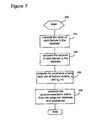
- Figure 7 is a flow diagram for calculating a variance-covariance matrix for plural images of the system of Figure 6 according to one embodiment of the invention; and
- Figure 8 is a flow diagram for calculating the Mahalanobis distance between a query image and plural images of the system of Figure 6 according to one embodiment of the invention.
- To retrieve an image from a database of images, each image may be characterized to distinguish it from the other images. For example, the image may be characterized numerically.
- For example, each binary image of a database of binary images may be assigned an Euler number. An Euler number of a binary image is the difference between the number of connected components (objects) in the image and the number of holes in the image.
- The Euler number is a topological feature of the binary image. The Euler number remains invariant under translation, rotation, scaling and rubber-sheet transformation of the binary image.
- A
binary image 16 may be represented in an N ×M pixel matrix 20, in which anobject pixel 12 is shaded, to indicate a binary value of 1, while abackground pixel 12 is unshaded, to indicate a binary value of 0, as depicted in Figure 1. Within the N ×M pixel matrix 20, a connected component is a set of object pixels such that anyobject pixel 12 in the set is in the eight (or four) neighborhood of at least oneobject pixel 12 of the same set. Both a 4-neighborhood 14 and an 8-neighborhood 18 are depicted in Figure 2. - In addition to connected components in the binary image, in one embodiment, a hole is defined as a set of background pixels, such that any background pixel in the set is in the 4 (or eight) neighborhood of at least one background pixel of the same set and this entire set of background pixels is enclosed by a connected component.
- A run of the ith column (or row) of the
pixel matrix 20 is defined to be a maximal sequence of consecutive ones in the ith column (or row). Two runs appearing in two adjacent columns (rows) each are said to be neighboring if at least one pixel of a run is in the eight (or four) neighborhood of a pixel of the other run. - If the
binary image 16, known as I, consists of a single row (column) i, the Euler number E(I) of theimage 16 is the same as the number of runs, denoted as R(i), of theimage 16, as shown by the following formula:
However, where thebinary image 16 consists of multiple rows (columns), the binary image, I, may be divided into partial images, Ii. Further, the Euler number of the entire image can be found using the following relations:
and
where Oi equals the number of neighboring runs between two consecutive rows (columns), e.g., the (i-1)th and the ith rows (columns). - According to one embodiment, the Euler number of a binary image is defined as the difference between the sum of the number of runs for all rows (columns) and the sum of the neighboring runs between all consecutive pairs of rows (columns) of the N x M pixel matrix. Stated mathematically:

where IN=I denotes the entire image. Thus, by knowing the number of runs and the number of neighboring runs in the binary image, I, the Euler number, E(I) may be computed. - The Euler number for binary images may be extended to gray-tone images. For example, as depicted in Figure 3, a gray-
tone image 36 may be represented in an N × M matrix in which eachelement 22 is an integer between 0 and 255 decimal denoting the intensity of the corresponding pixel. The intensity value of each element may be represented by an 8-bit binary vector (b7, b6, b5, b4, b3, b2, b1, b0). The gray-tone image 36 thus comprises eight bit planes, or eight distinct binary images. - The hypothetical gray-
tone image 36 includes three 8-bit pixels - In one embodiment, the first four most significant bit planes (b7, b6, b5, and b4) of the 8-bit binary vector are retained. In essence, four binary images are retained. In Figures 4A-4D, the four
binary images 18a-18d are depicted, representing the four most significant bit planes of the gray-tone image 36 of Figure 3. An Euler number may be computed for eachbinary image 18a-18d. - In one embodiment, before computing the Euler number for each
binary image 18, the four-bit binary vector (b7, b6, b5, b4), is converted to its corresponding reflected gray code vector (g7, g6, g5, g4), in which: - g7=b7
- g6 = b7 ⊕ b6
- g5 = b6 ⊕ b5
- g4 = b5 ⊕ b4
- Accordingly, in one embodiment, the Euler vector, ξK of the original gray-tone image, K, is a 4-tuple (E7, E6, E5, E4), where Ei is the Euler number of the partial binary image, gi, formed by the ith bit plane, 4 ≤ i ≤ 7, corresponding to the reflected gray code representation of intensity values.
- Thus, in addition to calculating an Euler number for a binary image, an Euler vector for a gray-tone image may be calculated by considering the four most significant binary bit planes of the image, converting the 4-bit binary vector to its corresponding reflected gray code, and computing the Euler number for each reflected gray code representation.
- In characterizing gray-tone images using Euler vectors, the elements of the Euler vector have, in some cases, a decreasing order of importance. That is, element E7 is most significant in characterizing the image, next is E6, and so on. Further, the ranges and the variances of various elements of the Euler vector widely differ. In such an environment, the Mahalanobis distance may be adopted to provide a measure that captures the similarity and dissimilarity of properties for features of a set of images.
- The Euler number Ei, may thus characterize a binary image. By extension, an Euler vector ξi, including four Euler numbers, E7, E6, E5, and E4, may characterize a gray-tone image. Each Euler number Ei, may be described as a "feature" of the gray-tone image, according to one embodiment. In one embodiment, Euler vector characterization may form a basis for image retrieval.
- Suppose an Euler vector, ξK, describes features for each gray-tone image, K, in an image database. A new image, q, having features defined by Euler vector ξq, is to be retrieved from the image database. The newly received image, q, may be compared to each of the images in the image database. Once a match is found, image retrieval is complete.
- One way to compare two things is to measure a distance between them. Distance measurement may be performed between scalars, such as numbers, but also may be performed between vectors. Where an image is described using a vector, the distance between the vector and a second image having its own vector may be computed. Accordingly, the distance between the two images may be computed.
- Suppose the query image 30q is not found in the
image database 40. Rather than comparing for an exact match, in one embodiment, a distance measure between the query image 30q and other images in the database may be taken. One distance measure is known as a Mahalanobis distance measure. The Mahalanobis distance measure calculates the "distance" between the query image 30q and the other images in the database, then ranks the distance results. The smallest distance result is the "match." - The Mahalanobis distance measure operation is depicted in Figure 6, according to one embodiment. A
system 100 includes aprocessor 80, animage database 40 and aMahalanobis distance measure 60. Theimage database 40 includes multiple images 30, in which each has an associated Euler vector, ξK. TheMahalanobis distance measure 60 receives each of the images 30 from theimage database 40, and compares them to a query image 30q, which includes its own Euler vector, ξq. In one embodiment, theMahalanobis distance measure 60 is a software program, executable by theprocessor 80, for performing Mahalanobis distance measurements between the query image 30q and one or more images 30 from theimage database 40. - A result table 50, according to one embodiment, includes distance calculations as between the query image 30q and one or more images 30 in the
image database 40. In one embodiment, the distance results are ranked according to their size. Thus, the first (or last) entry in the result table 50 is the "match" of the distance calculation. - Each of the images 30 in the
image database 40 may be classified or described according to the Euler vector, ξK. The elements of the Euler vector, or Euler numbers, E7, E6, E5, and E4, represent features of the gray-tone image 30 they classify. Conventionally, distance measures between two vectors may be used to capture the "Closeness" of the two vectors. For example, the Euclidean distance between vectors x and y, where x has four elements, x1, x2, x3, and x4 and y likewise has four elements, y1, y2, y3, and y4 is given by the following equation:
- For some phenomena, the Euclidean distance does not provide a very good distance measure. Recall that when characterizing gray-tone images by an Euler vector, the elements of the vector have a decreasing level of importance. That is, E7 is more important in characterizing the gray-tone image 30 than E6; E6 is more important in characterizing the image 30 than E5; and so on.
- Further, the ranges and the variances of the elements (E7, E6, E5, and E4) of the vector widely differ in their magnitudes. In such an environment, the Mahalanobis distance may provide a better measure than the Euclidean distance for capturing the similarity/dissimilarity properties between the images 30 of the
database 40. - The Mahalanobis distance between two vectors, x and y, may be derived from the following equation:

where ' represents matrix transposition. MVC is the variance-covariance matrix formed by the image feature vectors: x' = (x1, x2, ..., xN) and y'= (y1, y2, ..., yN). Here, (x - y)' is a (1 × n) matrix, MVC -1 is an (n x n) matrix, and (x - y) is an (n × 1) matrix; hence their product is a scalar. - The variance-covariance matrix of x, denoted as MVC, is an N × N matrix given by:

Note that MVC(i, j) = MVC(j, i). The variance-covariance matrix of x is also known as a dispersion matrix. - To compute the variance-covariance matrix of image feature vectors, both the variance and the covariance are computed. The variance of a feature, xi, is defined as:

where L is the number of the observations of the variable (feature) xi. - The features of a gray-tone image may also be correlated. The measure of the correlation between any two features is known as covariance. Covariance is defined as follows:

- Once the variance and covariance values are determined, the variance-covariance matrix, MVC, may be computed. The variance-covariance matrix, MVC, looks like:
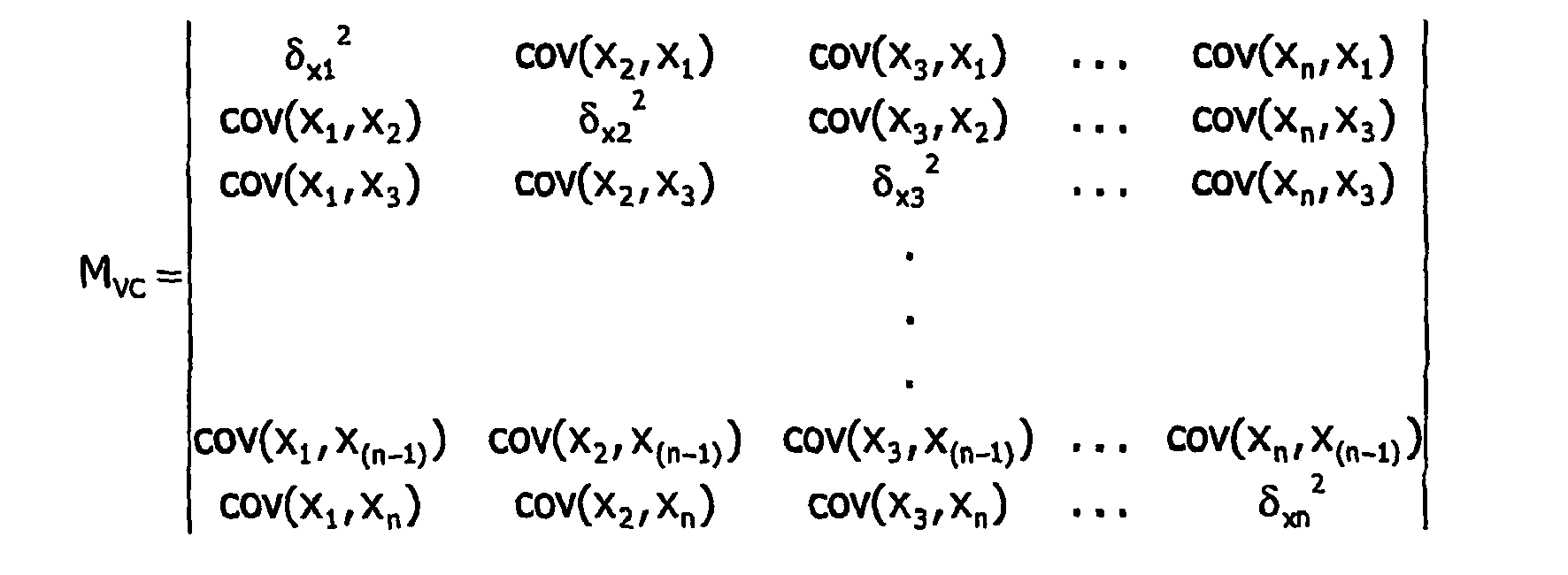
- In Figure 7, the variance-covariance matrix, MVC, for a database of images 30, is computed according to one embodiment. To illustrate, assume the
image database 40 includes images 30 in which each image 30K has an associated Euler vector, ξK. Each Euler vector, ξK includes Euler numbers EK7, EK6, EK5, and EK4, which constitute "features" of the image 30K. - The variance-covariance matrix may be computed for all the images 30 of the
database 40. Subsequently, a query image 30q may be received by thesystem 100, as depicted in Figure 6. Once the variance-covariance matrix, MVC, is calculated, image queries may quickly retrieved desired images. - In one embodiment, the
Mahalanobis distance measure 60 computes the mean (or average) of each feature of the image database 40 (block 202). Because the Euler vector, ξK, includes four features, Euler numbers E7-E4, four mean calculations are computed, as follows:


where j is the number of images in theimage database 40. - The features of each image 30 in the
database 40 may be correlated. The measure of the correlation between any two features is reflected in the covariance equation, defined above. Accordingly, in one embodiment, the covariance between features of the images 30 is calculated (block 206). For example, in the illustrateddatabase 40, the following covariance equations may be computed:


The covariance is computed as between Euler numbers E7 and E6, E7 and E5, E7 and E4, E6 and E5, E6 and E4, and E5 and E4. The covariance is associative. Thus, cov(E7, E6)=cov(E6, E7), and so on. - Now that the variance and covariance are known for the features E7, E6, E5, and E4 of the
image database 40, the variance-covariance matrix MVC may be computed according to one embodiment (block 208). For a database of images characterized using Euler vectors, ξK, the variance-covariance matrix Mvc looks like:
Computation of the variance-covariance matrix, according to Figure 7, is thus complete. - Once the variance-covariance matrix, MVC, is known, the Mahalanobis distance may be measured between a query image 30q and one or more images 30 in the
image database 40. - In one embodiment, the Mahalanobis distance is computed according to the flow diagram of Figure 8 (block 302). First, a difference between two vectors is calculated. Each vector includes feature information for a given image 30. For example, where the Mahalanobis distance is sought between the query image 30q and the
image 30a of theimage database 40, the difference between the Euler vectors ξq and ξa is calculated. The difference between ξq and ξa is:
Likewise, the transpose (ξq - ξa)' is as follows:
- Additionally, to compute the Mahalanobis distance between image 30q and any of the images 30 in the
image database 40, the inverse of the variance-covariance matrix, MVC, or MVC -1, is calculated (block 304). The inverse of the matrix MVC is calculated according to known principles. - From these operations, the Mahalanobis distance may be calculated (block 306). For example, using the query image 30q, the Mahalanobis distance may be calculated between the query image 30q and one or more of the images 30 in the
image database 40, as follows:

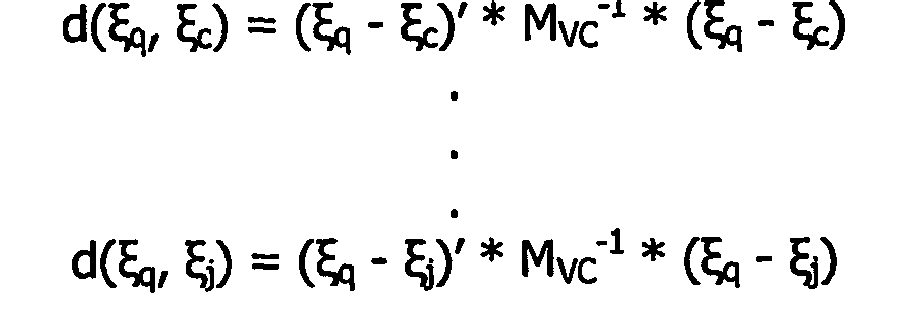
- In one embodiment, the
Mahalanobis distance measure 60 ranks the distance calculations in order from smallest to largest. Accordingly, the first entry into the result table 50 is the closest match for the query image 30q. In one embodiment, using the Euler vector as the representative image feature and the Mahalanobis distance as the closeness measure, the desired image is found to lie at minimum distance. Noisy and compressed versions of the query image 30q have next higher rank in the result table 50. - In some embodiments, the various features used to characterize the images 30 may not be equally important for retrieval. In such a case the elements of the variance-covariance matrix, Mvc, may be multiplied by a suitable weight factor according to the importance of the corresponding feature.
- For very large databases, computing the distance from the query image 30q to all other images 30 in the
database 40 may take substantial time. Thus, ranking and, in turn, retrieval, may be undesirably slow. To obviate the problem, multi-dimensional search techniques may be employed to retrieve a subset of images lying in the neighborhood of the query image 30q in the feature space. Ranking according to the proposed distance measure may then be performed on this subset only. - There are many techniques available for finding an item in a database. A sequential search of the database may occur, a hash table may be used and binary search techniques may be employed, as examples. A binary tree is a data structure used for storage, removal, and searching of items in a data set. With respect to the images 30 in the
image database 40, it is desirable to find the image 30 that is similar to the query image 30q without searching all j of the images in thedatabase 40. - In one embodiment, a multi-dimensional search tree is thus used for storing the images 30. The multi-dimensional search tree permits efficient retrieval of the images 30.
- In one embodiment, images are stored in the binary tree at random. Sometimes, however, the data is not inserted into the binary tree in random order. The performance of a binary search, therefore, may be less than optimal. The binary tree may be "rebalanced" after each insertion or deletion of data. During rebalancing operations, the nodes of the binary tree are rearranged using rotations. Typically, these rotations minimize the height of the binary tree.
- One type of binary tree is known as an AVL tree (named for its creators Adelson-Velskii and Landis). In this particular form of binary tree, rebalancing ensures that, for each node in the AVL tree, the difference in height between its subtrees, known as a balance factor, is not greater than 1.
- In one embodiment, a four-
dimensional range tree 62, as depicted in Figure 6, is used as a data structure for storing the Euler vectors, ξK, associated with each image 30 in thedatabase 40. Therange tree 62 is four-dimensional because the Euler vector includes four features, Euler numbers E7, E6, E5, and E4. Using the Euler vector, ξq, for the query image 30q, therange tree 62 specifies a particular node. In one embodiment, theMahalanobis distance measure 60 is performed between the query image 30q and only these images lying at the node, rather than on all images 30 of therange tree 62. The results may be ranked in descending order, such that the first distance value points to the matched image 30. - While the present invention has been described with respect to a limited number of embodiments, those skilled in the art will appreciate numerous modifications and variations therefrom. It is intended that the appended claims cover all such modifications and variations as fall within the scope of this present invention.
Claims (19)
- A computer-implemented method for similarity-based image retrieval comprising the following steps:characterising a plurality of gray-tone images (30) included in a database (40) using Euler vectors which are calculated by considering the most significant binary bit planes of the gray-tone images, wherein the elements of the Euler vectors are Euler numbers;receiving a query image (30q) including its own characterising Euler vector;computing a Mahalanobis distance between the query image (30q) and said plurality of images (30) from the image database (40) using the characterising Euler vectors; andretrieving the image from the database (40) which has the smallest of said computed distances as match for the received query image (30q).
- The method of claim 1, wherein computing a Mahalanobis distance between the query image (30q) and said plurality of images (30) from the image database (40) further comprises:constructing a variance-covariance matrix using the Euler vectors of the plurality of images (30);selecting a first image from the plurality of images (30), the first image comprising the Euler vector; andcomputing the Mahalanobis distance between the first image and the query image (30q) using the variance-covariance matrix.
- The method of claim 2, wherein constructing a variance-covariance matrix using the Euler vectors of the plurality of images (30) further comprises:computing the mean of an Euler vector element of the plurality of images (30);computing the variance of the Euler vector element of the plurality of images (30); andcomputing the covariance between a pair of Euler vector elements of the plurality of images (30).
- The method of claim 3, further comprising:constructing the variance-covariance matrix from the computed variances and covariances.
- The method of claim 2, wherein computing the Mahalanobis distance between the first image and the query image using the variance-covariance matrix further comprises:calculating the difference between the Euler vector characterising the first image and the Euler vector characterising the query image to produce a difference vector.
- The method of claim 5, further comprising:multiplying the difference vector by an inverse of the variance-covariance matrix to produce an intermediate result; andmultiplying the intermediate result by an inverse of the difference vector.
- The method of claim 6, further comprising:storing the Euler vectors of the plurality of images (30) in a range tree (62).
- A system (100) comprising:a processor (80);an image database (40) including plural gray-tone images (30), each of the images (30) characterised using an Euler vector which is calculated by considering the most significant binary bit planes of the gray-tone image (30), wherein the elements of the Euler vector are Euler numbers; anda machine-readable storage (70) medium comprising:a software program that if executed by the processor (80), is effective to receive a query image (30q) including its own characterising Euler vector, to compute a Mahalanobis distance between the query image (30q) and said plural images (30) from the database (40) using the characterising Euler vectors, and to retrieve the image from the database (40) which has the smallest of said computed distances as match for the received query image (30q).
- The system (100) of claim 8, wherein the software program, if executed by the processor (80), is effective to:construct a variance-covariance matrix using the Euler vectors of the plural images (30) in the image database (40) .
- The system (100) of claim 9, wherein the software program further computes the Mahalanobis distance by:computing the mean of one or more Euler vector elements of the plural images (30);computing the variance of one or more Euler vector elements of the plural images (30); andcomputing the covariance between pairs of Euler vector elements of the plural images (30).
- The system (100) of one of claims 8 to 10, wherein the software program further computes the Mahalanobis distance by:calculating a difference between the Euler vector characterising a first image and the Euler vector characterising a query image to produce a difference vector; andcalculating an inverse of the difference vector.
- The system (100) of claim 11, wherein the software program further computes the Mahalanobis distance by:multiplying the difference vector and an inverse of the variance-covariance matrix to produce an intermediate result; andmultiplying the intermediate result by an inverse of the difference vector.
- A computer program for similarity-based image retrieval storing instructions to enable a processor-based system (100) to:characterise a plurality of gray-tone images (30) included in a database (40) using Euler vectors which are calculated by considering the most significant binary bit planes pf the gray-tone images (30), wherein the elements of the Euler vectors are Euler numbers;receive a query image (30q) including its own characterising Euler vector;compute a Mahalanobis distance between the query image (30q) and said plurality of images (30) from the image database (40) using the characterising Euler vectors; andretrieve the image from the database (40) which has the smallest of said computed distances as match for the received query image (30q).
- Computer program of claim 13, further storing instructions to enable a processor-based system (100) to:construct a variance-covariance matrix using the Euler vectors of the plurality of images (30);select a first image from the plurality of images (30), the first image comprising the Euler vector; andcompute the Mahalanobis distance between the first image and the query image (30q) using the variance-covariance matrix.
- The computer program of claim 14, further storing instructions to enable a processor-based system (100) to:compute the mean of an Euler vector element of the plurality of images (30);compute the variance of the Euler vector element of the plurality of images (30); andcompute the covariance between a pair of Euler vector elements of the plurality of images (30).
- The computer program of claim 15, further storing instructions to enable a processor-based system (100) to:construct the variance-covariance matrix from the computed variance and covariance.
- The computer program of claim 16, further storing instructions to enable a processor-based system (100) to:calculate the difference between the Euler vector characterising the first image and the Euler vector characterising the query image (30q) to produce a difference vector.
- The computer program of claim 17, further storing instructions to enable a processor-based system (100) to:multiply the difference vector by an inverse of the variance-covariance matrix to produce an intermediate result; andmultiply the intermediate result by an inverse of the difference vector.
- The computer program of claim 18, further storing instructions to enable a processor-based system (100) to:store the Euler vectors of the plurality of images (30) in a range tree (62).
Applications Claiming Priority (3)
| Application Number | Priority Date | Filing Date | Title |
|---|---|---|---|
| US817000 | 2001-03-23 | ||
| US09/817,000 US6681060B2 (en) | 2001-03-23 | 2001-03-23 | Image retrieval using distance measure |
| PCT/US2002/002278 WO2002077870A2 (en) | 2001-03-23 | 2002-01-25 | Image retrieval using distance measure |
Publications (2)
| Publication Number | Publication Date |
|---|---|
| EP1370983A2 EP1370983A2 (en) | 2003-12-17 |
| EP1370983B1 true EP1370983B1 (en) | 2007-07-11 |
Family
ID=25222133
Family Applications (1)
| Application Number | Title | Priority Date | Filing Date |
|---|---|---|---|
| EP02705990A Expired - Lifetime EP1370983B1 (en) | 2001-03-23 | 2002-01-25 | Image retrieval using distance measure |
Country Status (9)
| Country | Link |
|---|---|
| US (1) | US6681060B2 (en) |
| EP (1) | EP1370983B1 (en) |
| JP (2) | JP2004532458A (en) |
| KR (1) | KR100545477B1 (en) |
| CN (1) | CN1267840C (en) |
| AT (1) | ATE366963T1 (en) |
| DE (1) | DE60221109T2 (en) |
| TW (1) | TWI223779B (en) |
| WO (1) | WO2002077870A2 (en) |
Families Citing this family (50)
| Publication number | Priority date | Publication date | Assignee | Title |
|---|---|---|---|---|
| US6636167B1 (en) * | 2000-10-31 | 2003-10-21 | Intel Corporation | Method of generating Huffman code length information |
| US6563439B1 (en) * | 2000-10-31 | 2003-05-13 | Intel Corporation | Method of performing Huffman decoding |
| US7266545B2 (en) * | 2001-08-07 | 2007-09-04 | International Business Machines Corporation | Methods and apparatus for indexing in a database and for retrieving data from a database in accordance with queries using example sets |
| US7133563B2 (en) * | 2002-10-31 | 2006-11-07 | Microsoft Corporation | Passive embedded interaction code |
| US7502507B2 (en) | 2002-10-31 | 2009-03-10 | Microsoft Corporation | Active embedded interaction code |
| US7009594B2 (en) | 2002-10-31 | 2006-03-07 | Microsoft Corporation | Universal computing device |
| US7430497B2 (en) | 2002-10-31 | 2008-09-30 | Microsoft Corporation | Statistical model for global localization |
| US7116840B2 (en) | 2002-10-31 | 2006-10-03 | Microsoft Corporation | Decoding and error correction in 2-D arrays |
| US20040101156A1 (en) * | 2002-11-22 | 2004-05-27 | Dhiraj Kacker | Image ranking for imaging products and services |
| US7274831B2 (en) | 2003-04-03 | 2007-09-25 | Microsoft Corporation | High quality anti-aliasing |
| US7583842B2 (en) | 2004-01-06 | 2009-09-01 | Microsoft Corporation | Enhanced approach of m-array decoding and error correction |
| US7263224B2 (en) | 2004-01-16 | 2007-08-28 | Microsoft Corporation | Strokes localization by m-array decoding and fast image matching |
| JP2006040085A (en) * | 2004-07-29 | 2006-02-09 | Sony Corp | Information processing apparatus and method, recording medium, and program |
| JP2006119723A (en) * | 2004-10-19 | 2006-05-11 | Canon Inc | Image processing apparatus and image processing method |
| US7607076B2 (en) | 2005-02-18 | 2009-10-20 | Microsoft Corporation | Embedded interaction code document |
| US7599560B2 (en) | 2005-04-22 | 2009-10-06 | Microsoft Corporation | Embedded interaction code recognition |
| US7580576B2 (en) | 2005-06-02 | 2009-08-25 | Microsoft Corporation | Stroke localization and binding to electronic document |
| US7619607B2 (en) | 2005-06-30 | 2009-11-17 | Microsoft Corporation | Embedding a pattern design onto a liquid crystal display |
| US7622182B2 (en) | 2005-08-17 | 2009-11-24 | Microsoft Corporation | Embedded interaction code enabled display |
| US7801893B2 (en) * | 2005-09-30 | 2010-09-21 | Iac Search & Media, Inc. | Similarity detection and clustering of images |
| US8120658B2 (en) * | 2006-01-19 | 2012-02-21 | Qualcomm Incorporated | Hand jitter reduction system for cameras |
| US7970239B2 (en) | 2006-01-19 | 2011-06-28 | Qualcomm Incorporated | Hand jitter reduction compensating for rotational motion |
| US8019179B2 (en) * | 2006-01-19 | 2011-09-13 | Qualcomm Incorporated | Hand jitter reduction for compensating for linear displacement |
| CN100433016C (en) * | 2006-09-08 | 2008-11-12 | 北京工业大学 | Image retrieval method based on information mutation |
| CN101216858B (en) * | 2008-01-14 | 2011-12-07 | 浙江大学 | Division type Similarity transmission data clustering method |
| US20090216755A1 (en) * | 2008-02-21 | 2009-08-27 | Einav Itamar | Indexing Method For Multimedia Feature Vectors Using Locality Sensitive Hashing |
| US8442278B2 (en) * | 2008-02-28 | 2013-05-14 | Honeywell International Inc. | Covariance based face association |
| US20110282897A1 (en) * | 2008-06-06 | 2011-11-17 | Agency For Science, Technology And Research | Method and system for maintaining a database of reference images |
| US10210179B2 (en) * | 2008-11-18 | 2019-02-19 | Excalibur Ip, Llc | Dynamic feature weighting |
| US8577909B1 (en) | 2009-05-15 | 2013-11-05 | Google Inc. | Query translation using bilingual search refinements |
| US8577910B1 (en) | 2009-05-15 | 2013-11-05 | Google Inc. | Selecting relevant languages for query translation |
| US8572109B1 (en) | 2009-05-15 | 2013-10-29 | Google Inc. | Query translation quality confidence |
| US8538957B1 (en) * | 2009-06-03 | 2013-09-17 | Google Inc. | Validating translations using visual similarity between visual media search results |
| KR20110064197A (en) | 2009-12-07 | 2011-06-15 | 삼성전자주식회사 | Object Recognition System and Object Recognition Method |
| JP5552981B2 (en) * | 2010-09-15 | 2014-07-16 | 株式会社リコー | Index method, search method, and storage medium thereof |
| SG189840A1 (en) | 2010-10-19 | 2013-06-28 | 3M Innovative Properties Co | Computer-aided assignment of ratings to digital samples of a manufactured web product |
| JP5912125B2 (en) | 2010-11-12 | 2016-04-27 | スリーエム イノベイティブ プロパティズ カンパニー | Fast processing and detection of inhomogeneities in web-based materials |
| TWI403697B (en) * | 2010-12-16 | 2013-08-01 | Univ Nat Taipei Technology | Distance measuring system by single image capture apparatus and method thereof |
| US20120158953A1 (en) * | 2010-12-21 | 2012-06-21 | Raytheon Bbn Technologies Corp. | Systems and methods for monitoring and mitigating information leaks |
| CN102253995B (en) * | 2011-07-08 | 2013-05-29 | 盛乐信息技术(上海)有限公司 | A method and system for realizing image search by using location information |
| CN102262736B (en) * | 2011-07-21 | 2012-11-21 | 西北工业大学 | Method for classifying and identifying spatial target images |
| KR101255729B1 (en) * | 2011-08-03 | 2013-04-18 | 부산대학교 산학협력단 | Method on Sub Image Retrieval Using Local Alignment |
| US20130044927A1 (en) * | 2011-08-15 | 2013-02-21 | Ian Poole | Image processing method and system |
| CN102819582B (en) * | 2012-07-26 | 2014-10-08 | 华数传媒网络有限公司 | Quick searching method for mass images |
| US8942515B1 (en) * | 2012-10-26 | 2015-01-27 | Lida Huang | Method and apparatus for image retrieval |
| US20140324879A1 (en) * | 2013-04-27 | 2014-10-30 | DataFission Corporation | Content based search engine for processing unstructured digital data |
| GB2553775A (en) * | 2016-09-09 | 2018-03-21 | Snell Advanced Media Ltd | Method and apparatus for ordering images |
| KR101715782B1 (en) * | 2016-10-06 | 2017-03-13 | 삼성전자주식회사 | Object recognition system and method the same |
| US11848100B2 (en) | 2019-10-18 | 2023-12-19 | Merative Us L.P. | Automatic clinical report generation |
| US11681747B2 (en) * | 2019-11-25 | 2023-06-20 | Gracenote, Inc. | Methods and apparatus to generate recommendations based on attribute vectors |
Citations (1)
| Publication number | Priority date | Publication date | Assignee | Title |
|---|---|---|---|---|
| US5642431A (en) * | 1995-06-07 | 1997-06-24 | Massachusetts Institute Of Technology | Network-based system and method for detection of faces and the like |
Family Cites Families (7)
| Publication number | Priority date | Publication date | Assignee | Title |
|---|---|---|---|---|
| JP2880383B2 (en) * | 1993-10-06 | 1999-04-05 | 川崎重工業株式会社 | Pattern recognition apparatus and method |
| JPH0863581A (en) * | 1994-06-17 | 1996-03-08 | Fujitsu Ltd | External environment recognition device |
| US6104833A (en) | 1996-01-09 | 2000-08-15 | Fujitsu Limited | Pattern recognizing apparatus and method |
| US5933823A (en) * | 1996-03-01 | 1999-08-03 | Ricoh Company Limited | Image database browsing and query using texture analysis |
| JPH10293814A (en) * | 1997-04-17 | 1998-11-04 | Ricoh Co Ltd | Character recognition method and recording medium |
| JPH11175534A (en) * | 1997-12-08 | 1999-07-02 | Hitachi Ltd | Image search method and apparatus and search service using the same |
| US6345274B1 (en) * | 1998-06-29 | 2002-02-05 | Eastman Kodak Company | Method and computer program product for subjective image content similarity-based retrieval |
-
2001
- 2001-03-23 US US09/817,000 patent/US6681060B2/en not_active Expired - Fee Related
-
2002
- 2002-01-25 CN CNB02807131XA patent/CN1267840C/en not_active Expired - Fee Related
- 2002-01-25 EP EP02705990A patent/EP1370983B1/en not_active Expired - Lifetime
- 2002-01-25 KR KR1020037012332A patent/KR100545477B1/en not_active Expired - Fee Related
- 2002-01-25 JP JP2002575842A patent/JP2004532458A/en not_active Withdrawn
- 2002-01-25 DE DE60221109T patent/DE60221109T2/en not_active Expired - Lifetime
- 2002-01-25 WO PCT/US2002/002278 patent/WO2002077870A2/en not_active Ceased
- 2002-01-25 AT AT02705990T patent/ATE366963T1/en not_active IP Right Cessation
- 2002-03-22 TW TW091105625A patent/TWI223779B/en not_active IP Right Cessation
-
2007
- 2007-03-30 JP JP2007092860A patent/JP4388095B2/en not_active Expired - Fee Related
Patent Citations (1)
| Publication number | Priority date | Publication date | Assignee | Title |
|---|---|---|---|---|
| US5642431A (en) * | 1995-06-07 | 1997-06-24 | Massachusetts Institute Of Technology | Network-based system and method for detection of faces and the like |
Non-Patent Citations (1)
| Title |
|---|
| DEY S. ET AL: "A fast algorithm for computing the Euler number of an image and its VLSI implementation", THIRTEENTH INTERNATIONAL CONFERENCE ON VLSI DESIGN, IEEE, 3 January 2000 (2000-01-03), INDIA, pages 330 - 335, XP010365888 * |
Also Published As
| Publication number | Publication date |
|---|---|
| CN1267840C (en) | 2006-08-02 |
| EP1370983A2 (en) | 2003-12-17 |
| TWI223779B (en) | 2004-11-11 |
| US20020164075A1 (en) | 2002-11-07 |
| ATE366963T1 (en) | 2007-08-15 |
| HK1060634A1 (en) | 2004-08-13 |
| WO2002077870A2 (en) | 2002-10-03 |
| DE60221109D1 (en) | 2007-08-23 |
| US6681060B2 (en) | 2004-01-20 |
| DE60221109T2 (en) | 2008-03-13 |
| JP4388095B2 (en) | 2009-12-24 |
| KR20040005895A (en) | 2004-01-16 |
| JP2007249981A (en) | 2007-09-27 |
| WO2002077870A3 (en) | 2003-03-20 |
| JP2004532458A (en) | 2004-10-21 |
| KR100545477B1 (en) | 2006-01-24 |
| CN1498381A (en) | 2004-05-19 |
Similar Documents
| Publication | Publication Date | Title |
|---|---|---|
| US6681060B2 (en) | Image retrieval using distance measure | |
| US8117183B2 (en) | Accurate content-based indexing and retrieval system | |
| CA2819925C (en) | Method and device for finding nearest neighbor | |
| US6611609B1 (en) | Method of tracking changes in a multi-dimensional data structure | |
| Ramachandran et al. | Evaluation of dimensionality reduction techniques for big data | |
| Kane et al. | Multivariate time series representation and similarity search using pca | |
| Krzanowski | Orthogonal canonical variates for discrimination and classification | |
| Wang et al. | SpecVAT: Enhanced visual cluster analysis | |
| Kovács et al. | Vizualization of fuzzy clustering results by modified sammon mapping | |
| Almeida et al. | SIFT applied to CBIR | |
| Wang et al. | CNN and transformer hybrid network for hyperspectral image classification | |
| Deselaers et al. | Clustering visually similar images to improve image search engines | |
| HK1060634B (en) | Image retrieval using distance measure | |
| Flarence et al. | Hyper spectral image classification using spectral and spatial dimension reduction | |
| Uehara et al. | A computer-aided visual exploration system for knowledge discovery from images | |
| Shereena et al. | Comparative study of dimensionality reduction techniques using PCA and LDA for content based image retrieval | |
| Irtaza et al. | Correlated networks for content based image retrieval | |
| Laarhoven | Polytopes, lattices, and spherical codes for the nearest neighbor problem | |
| Soltanizadeh et al. | A New Shape Retrieval Method Using the Group Delay of The Fourier Descriptors | |
| Lu et al. | Image retrieval using dimensionality reduction | |
| Barakbah et al. | An image search system with analytical functions for 3D color vector quantization and cluster-based shape and structure features | |
| Sedghi | Indexing of shape images based on complementary composited features | |
| Kohonen et al. | Co-occurrence matrix and self-organizing map-based query from spectral image database | |
| Li et al. | Kernel GBDA for relevance feedback in image retrieval | |
| Bordeaux et al. | Image retrieval based on local grey-level invariants |
Legal Events
| Date | Code | Title | Description |
|---|---|---|---|
| PUAI | Public reference made under article 153(3) epc to a published international application that has entered the european phase |
Free format text: ORIGINAL CODE: 0009012 |
|
| 17P | Request for examination filed |
Effective date: 20030828 |
|
| AK | Designated contracting states |
Kind code of ref document: A2 Designated state(s): AT BE CH CY DE DK ES FI FR GB GR IE IT LI LU MC NL PT SE TR |
|
| AX | Request for extension of the european patent |
Extension state: AL LT LV MK RO SI |
|
| REG | Reference to a national code |
Ref country code: HK Ref legal event code: DE Ref document number: 1060634 Country of ref document: HK |
|
| 17Q | First examination report despatched |
Effective date: 20040929 |
|
| 17Q | First examination report despatched |
Effective date: 20040929 |
|
| GRAP | Despatch of communication of intention to grant a patent |
Free format text: ORIGINAL CODE: EPIDOSNIGR1 |
|
| GRAS | Grant fee paid |
Free format text: ORIGINAL CODE: EPIDOSNIGR3 |
|
| GRAA | (expected) grant |
Free format text: ORIGINAL CODE: 0009210 |
|
| AK | Designated contracting states |
Kind code of ref document: B1 Designated state(s): AT BE CH CY DE DK ES FI FR GB GR IE IT LI LU MC NL PT SE TR |
|
| REG | Reference to a national code |
Ref country code: GB Ref legal event code: FG4D |
|
| REG | Reference to a national code |
Ref country code: CH Ref legal event code: EP |
|
| REF | Corresponds to: |
Ref document number: 60221109 Country of ref document: DE Date of ref document: 20070823 Kind code of ref document: P |
|
| REG | Reference to a national code |
Ref country code: HK Ref legal event code: GR Ref document number: 1060634 Country of ref document: HK |
|
| REG | Reference to a national code |
Ref country code: IE Ref legal event code: FG4D |
|
| PG25 | Lapsed in a contracting state [announced via postgrant information from national office to epo] |
Ref country code: PT Free format text: LAPSE BECAUSE OF FAILURE TO SUBMIT A TRANSLATION OF THE DESCRIPTION OR TO PAY THE FEE WITHIN THE PRESCRIBED TIME-LIMIT Effective date: 20071211 Ref country code: NL Free format text: LAPSE BECAUSE OF FAILURE TO SUBMIT A TRANSLATION OF THE DESCRIPTION OR TO PAY THE FEE WITHIN THE PRESCRIBED TIME-LIMIT Effective date: 20070711 Ref country code: FI Free format text: LAPSE BECAUSE OF FAILURE TO SUBMIT A TRANSLATION OF THE DESCRIPTION OR TO PAY THE FEE WITHIN THE PRESCRIBED TIME-LIMIT Effective date: 20070711 Ref country code: ES Free format text: LAPSE BECAUSE OF FAILURE TO SUBMIT A TRANSLATION OF THE DESCRIPTION OR TO PAY THE FEE WITHIN THE PRESCRIBED TIME-LIMIT Effective date: 20071022 |
|
| REG | Reference to a national code |
Ref country code: CH Ref legal event code: PL |
|
| NLV1 | Nl: lapsed or annulled due to failure to fulfill the requirements of art. 29p and 29m of the patents act | ||
| PG25 | Lapsed in a contracting state [announced via postgrant information from national office to epo] |
Ref country code: AT Free format text: LAPSE BECAUSE OF FAILURE TO SUBMIT A TRANSLATION OF THE DESCRIPTION OR TO PAY THE FEE WITHIN THE PRESCRIBED TIME-LIMIT Effective date: 20070711 Ref country code: LI Free format text: LAPSE BECAUSE OF FAILURE TO SUBMIT A TRANSLATION OF THE DESCRIPTION OR TO PAY THE FEE WITHIN THE PRESCRIBED TIME-LIMIT Effective date: 20070711 Ref country code: CH Free format text: LAPSE BECAUSE OF FAILURE TO SUBMIT A TRANSLATION OF THE DESCRIPTION OR TO PAY THE FEE WITHIN THE PRESCRIBED TIME-LIMIT Effective date: 20070711 |
|
| EN | Fr: translation not filed | ||
| PG25 | Lapsed in a contracting state [announced via postgrant information from national office to epo] |
Ref country code: BE Free format text: LAPSE BECAUSE OF FAILURE TO SUBMIT A TRANSLATION OF THE DESCRIPTION OR TO PAY THE FEE WITHIN THE PRESCRIBED TIME-LIMIT Effective date: 20070711 |
|
| PG25 | Lapsed in a contracting state [announced via postgrant information from national office to epo] |
Ref country code: GR Free format text: LAPSE BECAUSE OF FAILURE TO SUBMIT A TRANSLATION OF THE DESCRIPTION OR TO PAY THE FEE WITHIN THE PRESCRIBED TIME-LIMIT Effective date: 20071012 Ref country code: DK Free format text: LAPSE BECAUSE OF FAILURE TO SUBMIT A TRANSLATION OF THE DESCRIPTION OR TO PAY THE FEE WITHIN THE PRESCRIBED TIME-LIMIT Effective date: 20070711 |
|
| PLBE | No opposition filed within time limit |
Free format text: ORIGINAL CODE: 0009261 |
|
| STAA | Information on the status of an ep patent application or granted ep patent |
Free format text: STATUS: NO OPPOSITION FILED WITHIN TIME LIMIT |
|
| 26N | No opposition filed |
Effective date: 20080414 |
|
| PG25 | Lapsed in a contracting state [announced via postgrant information from national office to epo] |
Ref country code: SE Free format text: LAPSE BECAUSE OF FAILURE TO SUBMIT A TRANSLATION OF THE DESCRIPTION OR TO PAY THE FEE WITHIN THE PRESCRIBED TIME-LIMIT Effective date: 20071011 |
|
| PG25 | Lapsed in a contracting state [announced via postgrant information from national office to epo] |
Ref country code: FR Free format text: LAPSE BECAUSE OF FAILURE TO SUBMIT A TRANSLATION OF THE DESCRIPTION OR TO PAY THE FEE WITHIN THE PRESCRIBED TIME-LIMIT Effective date: 20080307 |
|
| PG25 | Lapsed in a contracting state [announced via postgrant information from national office to epo] |
Ref country code: MC Free format text: LAPSE BECAUSE OF NON-PAYMENT OF DUE FEES Effective date: 20080131 |
|
| GBPC | Gb: european patent ceased through non-payment of renewal fee |
Effective date: 20080125 |
|
| PG25 | Lapsed in a contracting state [announced via postgrant information from national office to epo] |
Ref country code: GB Free format text: LAPSE BECAUSE OF NON-PAYMENT OF DUE FEES Effective date: 20080125 |
|
| PG25 | Lapsed in a contracting state [announced via postgrant information from national office to epo] |
Ref country code: IE Free format text: LAPSE BECAUSE OF NON-PAYMENT OF DUE FEES Effective date: 20080125 |
|
| PG25 | Lapsed in a contracting state [announced via postgrant information from national office to epo] |
Ref country code: CY Free format text: LAPSE BECAUSE OF FAILURE TO SUBMIT A TRANSLATION OF THE DESCRIPTION OR TO PAY THE FEE WITHIN THE PRESCRIBED TIME-LIMIT Effective date: 20070711 |
|
| PG25 | Lapsed in a contracting state [announced via postgrant information from national office to epo] |
Ref country code: LU Free format text: LAPSE BECAUSE OF NON-PAYMENT OF DUE FEES Effective date: 20080125 |
|
| PG25 | Lapsed in a contracting state [announced via postgrant information from national office to epo] |
Ref country code: TR Free format text: LAPSE BECAUSE OF FAILURE TO SUBMIT A TRANSLATION OF THE DESCRIPTION OR TO PAY THE FEE WITHIN THE PRESCRIBED TIME-LIMIT Effective date: 20070711 |
|
| PG25 | Lapsed in a contracting state [announced via postgrant information from national office to epo] |
Ref country code: IT Free format text: LAPSE BECAUSE OF NON-PAYMENT OF DUE FEES Effective date: 20080131 |
|
| PGFP | Annual fee paid to national office [announced via postgrant information from national office to epo] |
Ref country code: DE Payment date: 20170117 Year of fee payment: 16 |
|
| REG | Reference to a national code |
Ref country code: DE Ref legal event code: R119 Ref document number: 60221109 Country of ref document: DE |
|
| PG25 | Lapsed in a contracting state [announced via postgrant information from national office to epo] |
Ref country code: DE Free format text: LAPSE BECAUSE OF NON-PAYMENT OF DUE FEES Effective date: 20180801 |