EP1370011A2 - Method for determining power offset of High Speed Downlink Packet Access (HSDPA)in an asynchronous CDMA mobile communication system - Google Patents
Method for determining power offset of High Speed Downlink Packet Access (HSDPA)in an asynchronous CDMA mobile communication system Download PDFInfo
- Publication number
- EP1370011A2 EP1370011A2 EP20030010614 EP03010614A EP1370011A2 EP 1370011 A2 EP1370011 A2 EP 1370011A2 EP 20030010614 EP20030010614 EP 20030010614 EP 03010614 A EP03010614 A EP 03010614A EP 1370011 A2 EP1370011 A2 EP 1370011A2
- Authority
- EP
- European Patent Office
- Prior art keywords
- power
- node
- drnc
- transmitting
- message
- Prior art date
- Legal status (The legal status is an assumption and is not a legal conclusion. Google has not performed a legal analysis and makes no representation as to the accuracy of the status listed.)
- Granted
Links
Images




Classifications
-
- H—ELECTRICITY
- H04—ELECTRIC COMMUNICATION TECHNIQUE
- H04W—WIRELESS COMMUNICATION NETWORKS
- H04W52/00—Power management, e.g. Transmission Power Control [TPC] or power classes
- H04W52/04—Transmission power control [TPC]
- H04W52/06—TPC algorithms
- H04W52/14—Separate analysis of uplink or downlink
-
- H—ELECTRICITY
- H04—ELECTRIC COMMUNICATION TECHNIQUE
- H04W—WIRELESS COMMUNICATION NETWORKS
- H04W52/00—Power management, e.g. Transmission Power Control [TPC] or power classes
- H04W52/04—Transmission power control [TPC]
- H04W52/30—Transmission power control [TPC] using constraints in the total amount of available transmission power
-
- H—ELECTRICITY
- H04—ELECTRIC COMMUNICATION TECHNIQUE
- H04W—WIRELESS COMMUNICATION NETWORKS
- H04W52/00—Power management, e.g. Transmission Power Control [TPC] or power classes
- H04W52/04—Transmission power control [TPC]
- H04W52/30—Transmission power control [TPC] using constraints in the total amount of available transmission power
- H04W52/34—TPC management, i.e. sharing limited amount of power among users or channels or data types, e.g. cell loading
-
- H—ELECTRICITY
- H04—ELECTRIC COMMUNICATION TECHNIQUE
- H04W—WIRELESS COMMUNICATION NETWORKS
- H04W52/00—Power management, e.g. Transmission Power Control [TPC] or power classes
- H04W52/04—Transmission power control [TPC]
- H04W52/38—TPC being performed in particular situations
- H04W52/40—TPC being performed in particular situations during macro-diversity or soft handoff
-
- H—ELECTRICITY
- H04—ELECTRIC COMMUNICATION TECHNIQUE
- H04W—WIRELESS COMMUNICATION NETWORKS
- H04W52/00—Power management, e.g. Transmission Power Control [TPC] or power classes
- H04W52/04—Transmission power control [TPC]
- H04W52/38—TPC being performed in particular situations
- H04W52/50—TPC being performed in particular situations at the moment of starting communication in a multiple access environment
-
- H—ELECTRICITY
- H04—ELECTRIC COMMUNICATION TECHNIQUE
- H04L—TRANSMISSION OF DIGITAL INFORMATION, e.g. TELEGRAPHIC COMMUNICATION
- H04L1/00—Arrangements for detecting or preventing errors in the information received
- H04L1/12—Arrangements for detecting or preventing errors in the information received by using return channel
- H04L1/16—Arrangements for detecting or preventing errors in the information received by using return channel in which the return channel carries supervisory signals, e.g. repetition request signals
- H04L1/18—Automatic repetition systems, e.g. Van Duuren systems
- H04L1/1867—Arrangements specially adapted for the transmitter end
- H04L1/1896—ARQ related signaling
-
- H—ELECTRICITY
- H04—ELECTRIC COMMUNICATION TECHNIQUE
- H04W—WIRELESS COMMUNICATION NETWORKS
- H04W52/00—Power management, e.g. Transmission Power Control [TPC] or power classes
- H04W52/04—Transmission power control [TPC]
- H04W52/06—TPC algorithms
- H04W52/16—Deriving transmission power values from another channel
Definitions
- the present invention relates generally to a downlink packet communication method in a code division multiple access (hereinafter referred to as "CDMA") mobile communication system employing high speed downlink packet access (hereinafter referred to as "HSDPA”), and in particular, to a method for assigning power of a high speed physical downlink shared channel (hereinafter referred to as "HS-PDSCH").
- CDMA code division multiple access
- HSDPA high speed downlink packet access
- HS-PDSCH high speed physical downlink shared channel
- the mobile communication system has evolved from an early circuit-based mobile communication system, chiefly supporting a voice service, into a high-speed, high-quality packet-based mobile communication system supporting a data service and a multimedia service.
- a 3 rd generation mobile communication system is divided into an asynchronous 3GPP (3 rd Generation Partnership Project) system and a synchronous 3GPP2 (3 rd Generation Partnership Project 2) system, and standardization for the 3 rd generation mobile communication system is currently being conducted for a high-speed, high-quality radio packet data service.
- standardization for HSDPA is being conducted in 3GPP
- standardization for 1xEV-DV (Evolution-Data and Voice) is being carried out in 3GPP2.
- the standardization is being performed to find a solution for providing a high-speed, high-quality radio packet data service of 2Mbps or higher in a 3 rd generation mobile communication system.
- a 4 th generation mobile communication system is attempting to provide a high-speed, high-quality multimedia service of a much higher data rate.
- FIG. 1 schematically illustrates a cell provided in an asynchronous CDMA mobile communication system.
- a Node B 101 communicates with user equipments (UEs) 104, 106, and 108 over downlink and uplink channels set up therebetween.
- Downlink physical channels used in HSDPA are divided into a dedicated physical channel, which is exclusively used by one UE and common channels, such as a common pilot channel (CPICH), a primary common control channel (P-CCCH), a secondary common control channel (S-CCCH), a high speed physical downlink shared channel (HS-PDSCH), and a high speed shared control channel (HS-SCCH).
- CPICH common pilot channel
- P-CCCH primary common control channel
- S-CCCH secondary common control channel
- HS-PDSCH high speed physical downlink shared channel
- HS-SCCH high speed shared control channel
- the Node B 101 transmits the above-stated downlink physical channels.
- reference numerals 103, 105, 107, and 109 represent the downlink physical channels with arrows according to their types.
- reference numeral 103 represents common channels, such as a common pilot channel, a primary common control channel, a secondary common control channel, and other indication channels.
- the Node B 101 assigns power so that signals on the common channels can arrive at up to a boundary of the cell, and then transmits the common channel signals to the UEs 104, 106, and 108 at the assigned power. This is because all UEs exiting in the cell should be able to receive the common channels.
- the common channels to which power was assigned the by the Node B is scarcely changed with the passage of time.
- Reference numerals 105 and 107 represent dedicated physical channels among the downlink physical channels.
- An arrow shown by the reference numeral 105 represents a dedicated physical channel for communication with the UE 104
- an arrow shown by reference numeral 107 represents a dedicated physical channel for communication with the UE 106.
- the dedicated physical channel is assigned optimum power so that only the UE in communication can receive the dedicated physical channel. Therefore, as illustrated in FIG. 1, the UE 106 located at a relatively farther distance from the Node B 101 as compared with the UE 104 should be assigned higher power for its dedicated physical channel.
- the dedicated physical channels continuously undergo power control. As the dedicated physical channels are simply created or released, transmission power assigned to the dedicated physical channels are changed with the passage of time.
- the UE 108 represents a UE receiving an HSDPA service.
- reference numeral 109 denotes a high speed physical downlink shared channel or a high speed shared control channel.
- the UE 108 receives the high speed physical downlink shared channel or high speed shared control channel 109. Even in the high speed physical downlink shared channel, as the number of UEs or a required service may undergo a change with the passage of time, transmission power assigned thereto is changed.
- Node B 101 assigns the total power for a dedicated physical channel and HSDPA within the range of remaining power minus the power assigned to the common channel from the total available transmission power.
- the assigned total HSDPA power is determined by a controlling RNC (Radio Network Controller, hereinafter referred to as "CRNC") according to circumstances.
- the CRNC changes the total HSDPA power according to a change in conditions.
- the CRNC can inform a Node B of the time-varying total HSDPA power through a Physical Shared Channel Reconfiguration Request message, i.e., an NBAP (Node B Application Part) message.
- the NBAP message represents the total HSDPA power with an information element (hereinafter referred to as "IE") called "HS-PDSCH and HS-SCCH Total Power.”
- IE information element
- FIG. 2 is a graph illustrating a time-varying ratio of a total transmission power used by the Node B 101.
- a horizontal axis shown by reference numeral 201 indicates a change in time
- a vertical axis shown by reference numeral 202 indicates power assigned to channels in a Node B.
- a value shown by reference numeral 207 indicates the total transmission power available for the Node B.
- Reference numeral 203 indicates power assigned to a common pilot channel
- reference numeral 204 indicates power assigned to other common channels such as a primary common control channel and a secondary common control channel. Commonly, the power 203 and the power 204 are scarcely changed with the passage of time.
- a power assignment ratio for the common channels shown by the reference numerals 203 and 204 can undergo a change according to a characteristic of a cell. That is, a ratio of power 203 and 204 assigned to the common channel to the total Node B power 207 can be changed according to a radius of the cell or a geographical environment.
- Node B power minus the power assigned to the common channel must be assigned for a dedicated physical channel and an HSDPA service.
- reference numeral 205 denotes power assigned to a dedicated physical channel
- reference numeral 206 indicates power assigned for an HSDPA service.
- the power 205 assigned to the dedicated physical channel is non-poriodically changed according to a condition of the Node B, as shown by reference numerals 210, 211, and 212.
- FIGs. 3 and 4 illustrate structures of an uplink channel and a downlink channel used for an HSDPA service, respectively.
- FIG. 3 illustrates a structure of a high speed dedicated physical control channel (hereinafter referred to as "HS-DPCCH”), i.e., an uplink channel used for an HSDPA service.
- HS-DPCCH high speed dedicated physical control channel
- an HS-DPCCH includes a plurality of subframes 301. Assuming that one radio frame 302 with a length of 10ms is comprised of 5 subframes, each subframe has a length of 2ms. One subframe is comprised of 3 time slots. Of the 3 time slots, a first time slot 303 is assigned for transmission of an ACK/NAK signal for HARQ (Hybrid Automatic Repeat reQuest), and the other 2 time slots 304 are assigned for a channel quality indicator (hereinafter referred to as "CQI").
- HARQ Hybrid Automatic Repeat reQuest
- the CQI is determined by a UE, and used to indicate quality of the HS-PDSCH.
- the UE measures a signal-to-interference ratio (hereinafter referred to as "SIR") of a CPICH, and determines the CQI by estimating an SIR of the HS-PDSCH depending on a ratio of reception power of the CPICH to reception power of the HS-PDSCH. Therefore, the UE must previously have information on the SIR of the CPICH and a ratio of reception power of the CPICH to reception power of the HS-PDSCH, in order to determine the CQI.
- the SIR of the CPICH can be measured in the UE.
- the ratio of reception power of the CPICH to reception power of the HS-PDSCH is identical to a ratio of transmission power of the CPICH to transmission power of the HS-PDSCH.
- the ratio of reception power of the CPICH to reception power of the HS-PDSCH or the ratio of transmission power of the CPICH to transmission power of the HS-PDSCH will be referred to as an "HS-PDSCH power offset.”
- CPICH power indicates either transmission power of CPICH or reception power of CPICH
- HS-PDSCH power indicates either transmission power of HS-PDSCH or reception power of HS-PDSCH.
- the HS-PDSCH power should also be interpreted as transmission power of HS-PDSCH.
- the CPICH power has a different value according to a characteristic of a cell.
- power assigned for HSDPA is also changed with the passage of time. Therefore, the HS-PDSCH power offset is also not a fixed value, but a value changeable according to the type of a cell, timing condition, and power of a common channel.
- FIG. 4 illustrates a structure of a downlink channel used for an HSDPA service.
- reference numeral 410 represents a structure of HS-SCCH
- reference numeral 420 represents a structure of HS-PDSCH.
- a subframe has a length of 2ms, and is comprised of 3 time slots.
- transmission of a subframe is started at a time when transmission of a third time slot in the HS-SCCH is started.
- a UE transmits CQI measured by a CPICH to a Node B over an HS-PDSCH.
- CQI and HS-PDSCH power offset to be applied to HS-PDSCH may be generated.
- the Node B and the UE must previously have information on the HS-PDSCH power offset.
- an object of the present invention to provide a method for accurately determining power assigned to a high speed physical downlink shared channel in a Node B and a UE, in order to increase performance of a mobile communication system.
- DRNC Drift RNC
- DRNC drift radio network controller
- the method comprises sending a radio link setup request from the SRNC to the DRNC; transmitting a radio link setup request message with the power offset information from the DRNC to the Node B; transmitting a radio link setup response message with the power offset information from the DRNC to the SRNC; and transmitting the power offset information from the SRNC to the UE.
- DRNC drift radio network controller
- the method comprises sending a radio link reconfiguration prepare request from the SRNC to the DRNC; transmitting a radio link reconfiguration prepare message with the power offset information, from the DRNC to the Node B; transmitting a radio link reconfiguration 5 ready message with the power offset information, from the DRNC to the SRNC; and transmitting a radio bearer reconfiguration request message with the power offset information, from the SRNC to the UE.
- DRNC drift radio network controller
- SRNC serving radio network controller
- the method comprises sending a radio link setup request from the SRNC to the DRNC; transmitting a physical shared channel reconfiguration request message with the total power assigned for an HSDPA (High Speed Downlink Packet Access) service, from the DRNC to the Node B; transmitting a response message for the physical shared channel reconfiguration request message, from the Node B to the DRNC; transmitting a radio link setup request message with HSDPA service-related information, from the DRNC to the Node B; determining, by the Node B, the power offset information considering the total power assigned for the HSDPA service, and transmitting a response message with the power offset information to the DRNC in response to the radio link setup request message; transmitting a radio link setup response message with the power offset information, from the DRNC to the SRNC; and transmitting the power offset information from the SRNC to the UE.
- HSDPA High Speed Downlink Packet Access
- DRNC drift radio network controller
- SRNC serving radio network controller
- the method comprises sending a radio link reconfiguration prepare message from the SRNC to the DRNC; transmitting a physical shared channel reconfiguration request message with the total power assigned for an HSDPA (High Speed Downlink Packet Access) service, from the DRNC to the Node B; transmitting a response message for the physical shared channel reconfiguration request message, from the Node B to the DRNC; transmitting a radio link reconfiguration prepare message with HSDPA service-related information, from the DRNC to the Node B; determining, by the Node B, the power offset information considering the total power assigned for the HSDPA service, and transmitting a response message for the radio link reconfiguration prepare message along with the power offset information, to the DRNC; transmitting a radio link reconfiguration prepare message with the power offset information, from the DRNC to the SRNC; and transmitting a radio bearer reconfiguration request message with the power offset information, from the SRNC to the UE.
- HSDPA High Speed Downlink Packet Access
- DRNC drift radio network controller
- the method comprises determining the power offset information considering a ratio of power assigned to a common pilot channel to power assigned to the high speed physical downlink shared channel; transmitting an NBAP (Node B Application Part) message with the power offset information to the Node B; and transmitting an RNSAP (Radio Network System Application Part) message with the power offset information to the SRNC; wherein the SRNC transmits an RRC (Radio Resource Control) message with the power offset information to the UE.
- NBAP Node B Application Part
- RNSAP Radio Network System Application Part
- DRNC drift radio network controller
- SRNC serving radio network controller
- the method comprises receiving information on the total power assigned for an HSDPA (High Speed Downlink Packet Access) service from the DRNC through an NBAP (Node B Application Part) message; determining the power offset information considering a ratio of power assigned to the high speed physical downlink shared channel, determined based on the information on the total power assigned for the HSDPA service, to power assigned to a common pilot channel; and transmitting an NBAP message with the power offset information to the DRNC; wherein the DRNC transmits an RNSAP (Radio Network System Application Part) message with the power offset information to the SRNC, and the SRNC transmits an RRC (Radio Resource Control) message with the power offset information to the UE.
- HSDPA High Speed Downlink Packet Access
- NBAP Node B Application Part
- the present invention will provide a method for determining an HS-PDSCH power offset for an HSDPA service and a method for enabling a Node B and a UE to share the determined HS-PDSCH power offset through signal processing.
- an HS-PDSCH power offset is determined by a CRNC that controls a Node B that transmits the HS-PDSCH.
- a description will be made of a method for transmitting by the CRNC the HS-PDSCH power offset to a Node B through an NBAP message, and delivering the HS-PDSCH power offset to a UE through an RNSAP (Radio Network System Application Part) or RRC (Radio Resource Control) message.
- RNSAP Radio Network System Application Part
- RRC Radio Resource Control
- the CRNC determines power to be assigned to an HSDPA service within the range of the total power available in the Node B. That is, the CRNC determines the total transmission power that HS-SCCH and HS-PDSCH can use, and then keeps the information.
- the present invention aims at determining the HS-PDSCH power offset using power to be assigned to the HSDPA service, i.e., the maximum transmission power of HS-SCCH and HS-PDSCH, possessed by the CRNC.
- an HS-PDSCH power offset determined by the CRNC is defined as a function of maximum transmission power information of an HS-SCCH and an HS-PDSCH, already determined by the CRNC.
- the HS-PDSCH power offset is set based on information possessed by the CRNC, such as the maximum transmission power value of HS-SCCH and HS-PDSCH, CPICH transmission power in the Node B, and the total number of HS-PDSCH codes used by the Node B.
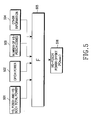
- FIG. 5 illustrates a block for determining an HS-PDSCH power offset according to an embodiment of the present invention.
- reference numerals 501, 502, 503, and 504 each represent parameters for determining the HS-PDSCH power offset.
- the parameters are information possessed by the CRNC.
- the reference numeral 501 indicates information on the total power assigned for an HSDPA service in a Node B.
- the reference numeral 502 denotes power information of CPICH transmitted from the Node B.
- the reference numeral 503 indicates a total number of codes used for HS-PDSCH, and the reference numeral 504 represents information possessed by the other CRNCs.
- an HS-PDSCH power offset 506 can be obtained through a particular function 505.
- the HS-PDSCH power offset can be determined by Equation (1).
- Power hsdsch indicates power per HS-PDSCH code
- Max HSDPA Total power indicates the maximum total transmission power assigned for an HSDPA service.
- Max HS-SCCH power indicates the maximum transmission power assigned to HS-SCCH
- N denotes the total number of codes used for HS-PDSCH.
- Power cpick represents transmission power assigned to CPICH
- PO hsdsch represents an HS-PDSCH power offset per code. That is, the PO hsdsch 506 is determined by choosing a function which is in proportion to the Max HSDPA Total power information 501 and in inverse proportion to the Power cpich information 502 and the total number 503 of codes used for the HS-PDSCH.
- the HS-PDSCH reference power offset determination block described in conjunction with FIG. 5 is included in a CRNC.
- the HS-PDSCH power offset information determined in the way stated above must be transmitted to a Node B and UE.
- PIGs. 6 and 7 illustrate procedures for delivering an HS-PDSCH power offset determined by the CRNC to a Node B and a UE.
- an "RNSAP message” is used between RNCs
- an "NBAP message” is used between a DRNC and a Node B
- an "RRC message” is used between the Node B and a UE.
- FIG. 6 illustrates a signaling procedure for delivering HS-PDSCH power offset information in a mobile communication system according to an embodiment of the present invention.
- a Node B 602 is connected to a DRNC 603 via an lub
- the DRNC 603 is connected to an SRNC (Serving RNC) 604 via an lur.
- the DRNC 603 serves as a CRNC of the Node B 602.
- the SRNC 604 sends a Radio Link Setup Request message 610 requesting setup of a radio link, to the DRNC 603.
- the Radio Link Setup Request message 610 includes HSDPA-related information to be exchanged between a UE 601 and the Node B 602.
- the HSDPA-related information includes HS-DSCH information and HS-PDSCH RL ID (Radio Link Identifier).
- the DRNC 603 (or a CRNC) acquires the HSDPA-related information by analyzing the RNSAP message 610.
- the DRNC 603 transmits the acquired HSDPA-related information and additional information possessed by the DRNC 603 to the Node B 602 through a Radio Link Setup Request message 611 requesting setup of a radio link.
- Information contained in the NBAP message 611 includes HS-DSCH information, HS-PDSCH RL ID, and HS-DSCH-RN.
- the DRNC (or CRNC) 603 can send a determined HS-PDSCH power offset. If the HS-PDSCH power offset is defined as PO hsdsch , a PO hsdsch IE can be included in an HS-DSCH Information IE. Table 1 below shows the HS-DSCH Information IE.
- the PO hsdsch represents the HS-PDSCH power offset information.
- IE type and reference of the PO hsdsch IE is determined according to a possible value of HS-PDSCH power offset information. In this embodiment, it is assumed that a value of 3 to 15 is used for the IE type and reference of the PO hsdsch IE.
- the PO hsdsch information is assumed to be power offset information of an HS-PDSCH using one code.
- the PO hsdsch information may be defined as a power offset of all HS-PDSCHs used by one Node B. In this case, the Node B must inform the UE of the number of codes used for the HS-PDSCHs.
- the PO hsdsch information is transmitted to the Node B 602 through the Radio Link Setup Request message 611.
- the Node B 602 Upon receiving the NBAP message 611, the Node B 602 sends a Radio Link Setup Response message 612 to the DRNC 603, acknowledging the receipt of the Radio Link Setup Request message 611.
- the DRNC 603 then transmits a Radio Link Setup Response message 613 to the SRNC 604, using the Radio Link Setup Request message 611 and information possessed by the DRNC 603.
- the RNSAP message 613 includes an HS-DSCH Information Response IE, and the HS-DSCH Information Response IE has the determined PO hsdsch information.
- Table 2 shows detailed information of the HS-DSCH Information Response IE.
- PO hsdsch included in the HS-DSCH Information Response IE is the same information as PO hsdsch in the HS-DSCH Information IE included in the NBAP message 611.
- the SRNC 604 Upon receiving the RNSAP message 613, the SRNC 604 generates a Radio Bearer Setup message 614 requesting setup of a radio bearer, using the RNSAP message 613 and other information, and then transmits the generated Radio Bearer Setup message 614 to the UE 601.
- the RRC message 614 also includes PO hsdsch information transmitted from the DRNC (or CRNC) 603 through the RNSAP message 613.
- the UE 601 as it receives the RRC message 614, can receive the PO hsdsch information determined by the DRNC 603.
- the UE 601 Upon receiving the Radio Bearer Setup message 614, the UE 601 sends a Radio Bearer Setup Complete message 615 indicating completed setup of a radio bearer to the SRNC 604, thereby informing the SRNC 604 that it can receive an HSDPA service.
- the UE 601 and the Node B 602 share the HS-PDSCH power offset information. Therefore, an operation of determining CQI by a UE, and an operation of receiving by a Node B the CQI and then transmitting HS-DSCH depending on the received CQI is effectively performed.
- the messages represented by a bold arrow indicate the signals over which the PO hsdsch information is transmitted.
- FIG. 7 illustrates another signaling procedure for delivering HS-PDSCH power offset information in a mobile communication system according to an embodiment of the present invention. That is, FIG. 7 illustrates a signaling procedure when a UE 701 initiates an HSDPA service during communication with a Node B 702 over a dedicated channel, or when the setup must be changed during the HSDPA service.
- an SRNC 704 transmits a Radio Link Reconfiguration Prepare message 710 requesting preparation for radio link reconfiguration, to a DRNC 703, thereby providing the DRNC 703 with information related to an HSDPA to be serviced.
- the DRNC 703 (or a CRNC in this embodiment) determines HS-PDSCH power offset information through the block described in conjunction with FIG. 5. Thereafter, the DRNC 703 generates a Radio Link Reconfiguration Prepare message 711 including information received through the RNSAP message 710 and other information, and transmits the generated Radio Link Reconfiguration Prepare message 711 to a Node B 702, thereby requesting reconfiguration of a radio link.
- the NBAP message 711 includes PO hsdsch information, the HS-PDSCH power offset information.
- the PO hsdsch information is included in HS-DSCH Information to Add IE, when an HSDPA service is added.
- the PO hsdsch information is included in HS-DSCH Information to modify IE.
- the HS-DSCH Information to Add IE is identical in structure to the HS-DSCH FDD Information IE included in the NBAP message 611, described in conjunction with FIG. 6.
- the HS-DSCH Information to modify IE is formed as illustrated in Table 3, and is identical in format of the PO hsdsch information included therein to the HS-DSCH FDD Information IE.
- the Node B 702 receiving the NBAP message 711, acquires PO hsdsch information included in the received NBAP message 711, and sends a Radio Link Reconfiguration Ready message 712 indicating completed preparation for radio link reconfiguration to the DRNC 703.
- the DRNC 703 Upon receiving the NBAP message 712, the DRNC 703 transmits a Radio Link Reconfiguration Ready message 713 indicating completed preparation for radio link reconfiguration to the SRNC 704.
- the PO hsdsch information is transmitted through the RNSAP message 713.
- an HS-DSCH FDD Information Response IE in the Radio Link Setup Response message of FIG. 6 is used, A detailed structure of the HS-DSCH FDD Information Response IE has been described with reference to FIG. 6.
- the SRNC 704 Upon receiving the RNSAP message 713, the SRNC 704 sends a Radio Link Reconfiguration Commit message 714 committing reconfiguration of a radio link, to the DRNC 703, The DRNC 703 then sends a Radio Link Reconfiguration Commit message 715 committing reconfiguration of a radio link, to the Node B 702, thereby enabling the Node B 702 to perform a radio link reconfiguration process.
- the SRNC 704 sends the PO hsdsch information to the UE 701 through a Radio Bearer Reconfiguration message 716 requesting reconfiguration of a radio bearer.
- the UE 701 Upon receiving the RRC message 716, the UE 701 reconfigures a radio bearer through a radio bearer reconfiguration procedure. If the radio bearer reconfiguration is completed, the UE 701 sends a Radio Bearer Reconfiguration Complete message 717 indicting completed reconfiguration of a radio bearer to the SNC 704, completing the signaling procedure of FIG. 7.
- messages represented by a bold arrow indicate the signals over which the PO hsdsch information is transmitted.
- the PO hsdsch information is subject to change.
- the Node B updates the PO hsdsch information. If the PO hsdsch information is changed, the Node B can simply identify the changed PO hsdsch information. However, a process of providing the changed PO hsdsch information to the UEs that were previously receiving the HSDPA service from the Node B is additionally required. For this, there are two possible methods. In a first method, the UE may use the existing PO hsdsch information. In a second method, the Node B can provide the PO hsdsch information to all UEs currently in service through the message handling process of the radio link reconfiguration procedure described in conjunction with FIG. 7.
- the HS-PDSCH power offset is determined by a Node B that transmits the HS-PDSCH.
- the Node B determines an HS-PDSCH power offset, using HSDPA power information received from a CRNC through an NBAP message.
- a description will be made of a method in which the Node B re-transmits the HS-PDSCH power offset to an SRNC through an NBAP message and an RNSAP message, and the SRNC re-transmits the HS-PDSCH power offset to a UE through an RRC message.
- a CRNC determines the total power to be assigned for an HSDPA service within the range of the total power of a Node B. That is, the CRNC determines the maximum transmission power that HS-SCCH and HS-PDSCH can use, and then stores the information.
- the present invention is characterized in that the CRNC provides a Node B with information on the total power to be assigned for an HSDPA service, i.e., information on the maximum transmission power of HS-SCCH and HS-PDSCH, and the Node B then determines the HS-PDSCH power offset based on the total power information assigned for the HSDPA service.
- an HS-PDSCH power offset is defined as a function of maximum transmission power information of HS-SCCH and HS-PDSCH, already determined by the CRNC. That is, the HS-PDSCH power offset is set based on information possessed by the CRNC, such as the maximum transmission power value of HS-SCCH and HS-PDSCH. received from the CRNC through an NBAP message, CPICH transmission power in the Node B, and the total number of HS-PDSCH codes used by the Node B.
- FIG. 8 illustrates a process of determining, by a Node B, an HS-PDSCH power offset in a mobile communication system according to another embodiment of the present invention. Specifically, FIG. 8 is a block diagram for determining the HS-PDSCH power offset.
- reference numerals 801, 802, 803, and 804 each represent parameters for determining the HS-PDSCH power offset.
- the parameters are information possessed by the CRNC.
- the maximum transmission power of HS-SCCH and HS-PDSCH, represented by the reference numeral 801 is information that the Node B received from a CRNC through a Physical Shared Channel Reconfiguration Request message 810.
- the other parameters represented by the reference numerals 802, 803 and 804 are information possessed by the Node B.
- the reference numeral 801 indicates information on the total power assigned for an HSDPA service in a Node B in service.
- the reference numeral 802 denotes power information of CPICH transmitted from the Node B.
- the reference numeral 803 indicates the total number of codes available for HS-PDSCH, and the reference numeral 804 represents information possessed by the other CRNCs.
- an HS-PDSCH power offset 806 can be calculated through a particular function 805.
- Power hsdsch indicates power per HS-PDSCH code
- Max HSDPA Total power indicates the maximum total transmission power assigned for an HSDPA service.
- Max HS-SCCH power indicates the maximum transmission power assigned to HS-SCCH
- N denotes the total number of codes used for HS-PDSCH.
- Power cpich represents transmission power assigned to CPICH
- PO hsdsch represents an HS-PDSCH power offset per code. That is, the PO hsdsch 806 is determined by choosing a function in proportion to the Max HSDPA Total power information 801 and in inverse proportion to the Power cpich information 802 and a total number 803 of codes used for the HS-PDSCH.
- the HS-PDSCH reference power offset determination block described in conjunction with FIG. 8 is included in a Node B.
- the Node B after determining an HS-PDSCH power offset, the Node B must transmit information on the HS-PDSCH power offset to a UE.
- FIGs, 9 and 10 illustrate examples of procedures for delivering an HS-PDSCH power offset determined by the Node B to a UE.
- an "RNSAP message” is used between RNCs
- an "NBAP message” is used between a DRNC and a Node B
- an "RRC message” is used between the Node B and a UE.
- FIG. 9 illustrates an example of a signaling procedure for delivering HS-PDSCH power offset information in a mobile communication system according to another embodiment of the present invention.
- a Node B 902 is connected to a DRNC 903 via an lub
- the DRNC 903 is connected to an SRNC 904 via an lur.
- the DRNC 903 serves as a CRNC of the Node B 902.
- the SRNC 904 sends a Radio Link Setup Request message 910 requesting setup of a radio link, to the DRNC 903.
- the Radio Link Setup Request message 910 includes an HSDPA-related IE, HS-DSCH-related information to be exchanged between a UE 901 and the Node B 902.
- the HSDPA-related information includes HS-DSCH information and HS-PDSCH RL ID.
- the DRNC 903 (or a CRNC) delivers maximum transmission power information of HS-SCCH and HS-PDSCH to the Node B 902 through a Physical Shared Channel Reconfiguration Request message 920 requesting reconfiguration of a physical shared channel.
- the Node B 902 Upon receiving the NBAP message 920, the Node B 902 stores information included in the Physical Shared Channel Reconfiguration Request message 920, and then transmits a Physical Shared Channel Reconfiguration Response message 921 to the DRNC 903.
- the NBAP messages 920 and 921 can be transmitted after the SRNC 904 transmitted an RNSAP message of the Radio Link Setup Request message 910 to the DRNC 903, or can be exchanged on occasion between the DRNC 903 and the Node B 902 according to a condition of the DRNC 903.
- the Physical Shared Channel Reconfiguration Request message 920 includes an HS-PDSCH and HS-SCCH Total Power IE, and the HS-PDSCH and HS-SCCH Total Power IE becomes the maximum transmission power information of HS-SCCH and HS-PDSCH described in conjunction with FIG. 8. That is, the Node B 902 has the maximum transmission power information of HS-SCCH and HS-PDSCH.
- the DRNC 903 after receiving the RNSAP message 910, acquires HSDPA-related information by analyzing the RNSAP message 910, and then transmits the acquired information and additional information possessed by the DRNC 903 to the Node B 902 through a Radio Link Setup Request message 911 requesting setup of a radio link.
- An HSDPA-related IE included in the NBAP message 911 includes HS-DSCH Information, HS-PDSCH RL ID, and HS-DSCH-RN.
- the Node B 902 If the HSDPA-related information is delivered to the Node B 902 through the Radio Link Setup Request message 911, the Node B 902 generates HS-PDSCH power offset information. That is, since the Node B 902 has information on each of the reference numerals 801, 802, 803, and 804, it can generate the HS-PDSCH power offset information 806. Thus, the Node B 902 starts an operation of delivering the generated HS-PDSCH power offset information to the UE 901.
- the Node B 902 Upon receiving the NBAP message 911, the Node B 902 sends a Radio Link Setup Response message 912 to the DRNC 903 in response to the NBAP message 911.
- the Node B 902 can transmit the determined HS-PDSCH power offset value along with the NBAP message 912. If the HS-PDSCH power offset is defined as PO hsdsch , a PO hsdsch IE can be included in an HS-DSCH Information IE. Table 4 below shows an HS-DSCH Information IE included in the Radio Link Setup Response message 912.
- the PO hsdsch an IE included in the last row, represents the HS-PDSCH power offset information.
- the IE type and reference of the PO hsdsch IE is determined according to a possible value of the HS-PDSCH power offset information. In this embodiment, it is assumed that a value of 3 to 15 is used for the IE type and reference of the PO hsdsch IE.
- the PO hsdsch information is assumed to be power offset information of HS-PDSCH using one code.
- the PO hsdsch information can also be defined as a power offset of all HS-PDSCHs used by one Node B. In this case, the Node B must inform the UE of the number of codes used for the HS-PDSCHs.
- the DRNC 903 sends a Radio Link Setup Response message 913 to the SRNC 904, using information included in the Radio Link Setup Response message 912. Because the DRNC 903 has received the PO hsdsch information through the Radio Link Setup Response message 912, the RNSAP message 913 includes an HS-DSCH Information Response IE, so the DRNC 903 can transmit the PO hsdsch information to the SRNC 904 along with the HS-DSCH Information Response IE. Detailed information on the HS-DSCH Information Response IE is identical to the format described in conjunction with the first embodiment.
- the PO hsdsch included in the HS-DSCH Information Response IE is the same information as PO hsdsch in the HS-DSCH Information IE included in the NBAP message 911.
- the SRNC 904 Upon receiving the RNSAP message 913, the SRNC 904 generates a Radio Bearer Setup message 914 requesting setup of a radio bearer, using the RNSAP message 913 and other information, and transmits the generated Radio Bearer Setup message 914 to the UE 901.
- the RRC message 914 also includes PO hsdsch information transmitted from the DRNC (or CRNC) 903 to the SRNC 904 through the RNSAP message 913.
- the UE 901 as it receives the RRC message 914, can receive the PO hsdsch information determined by the Node B 902.
- the UE 901 Upon receiving the Radio Bearer Setup message 914, the UE 901 performs a procedure for setup of a radio bearer and then sends a Radio Bearer Setup Complete message 915 indicating completed setup of a radio bearer to the SRNC 904, thereby informing the SRNC 904 that it can receive an HSDPA service.
- the UE 901 and the Node B 902 share the HS-PDSCH power offset information. Therefore, an operation of determining CQI by a UE, and an operation of receiving by a Node B the CQI and then transmitting HS-DSCH depending on the received CQI can be smoothly performed.
- the messages 912, 913, and 914 represented by a bold arrow are the signals transmitting the PO h hsdsch information.
- FIG. 10 illustrates another signaling procedure for delivering HS-PDSCH power offset information in a mobile communication system according to another embodiment of the present invention. That is, FIG. 10 illustrates a signaling procedure when a UE 1001 initiates an HSDPA service during communication with a Node B 1002 over a dedicated channel, or when the setup must be changed during the HSDPA service.
- an SRNC 1004 transmits a Radio Link Reconfiguration Prepare message 1010 requesting preparation for radio link reconfiguration, to a DRNC 1003, thereby providing the DRNC 1003 with information related to an HSDPA to be serviced.
- the DRNC 1003 (or a CRNC) transmits maximum transmission power information of an HS-SCCH and an HS-PDSCH to a Node B 1002 through a Physical Shared Channel Reconfiguration Request message 1020 requesting reconfiguration of a physical shared channel.
- the Node B 1002 Upon receiving the NBAP message 1020, the Node B 1002 stores information included in the Physical Shared Channel Reconfiguration Request message 1020, and then transmits a Physical Shared Channel Reconfiguration Response message 1021 to the DRNC 1003.
- the NBAP messages 1020 and 1021 can be transmitted after the SRNC 1004 transmitted an RNSAP message of the Radio Link Reconfiguration Prepare message 1010 to the DRNC 1003, or can be exchanged on occasion between the DRNC 1003 and the Node B 1002 according to a condition of the DRNC 1003.
- the Physical Shared Channel Reconfiguration Request message 1020 includes an HS-PDSCH and HS-SCCH Total Power IE, and the HS-PDSCH and HS-SCCH Total Power IE becomes the maximum transmission power information 801 of HS-SCCH and HS-PDSCH. That is, the Node B 1002 has the maximum transmission power information of HS-SCCH and HS-PDSCH.
- the DRNC 1003 that received the Radio Link Reconfiguration Prepare message 1010 generates a Radio Link Reconfiguration Prepare message 1011 for preparation for reconfiguration of a radio link, using information received through the RNSAP message 1010 and other information, and then transmits the generated Radio Link Reconfiguration Prepare message 1011 to the Node B 1002.
- An HSDPA-related IE included in the NBAP message 1011 includes HS-DSCH Information, HS-PDSCH RL ID, and HS-DSCH-RN.
- the Node B 1002 If the HSDPA-related information is delivered to the Node B 1002 through the Radio Link Reconfiguration Prepare message 1011, the Node B 1002 generates HS-PDSCH power offset information. That is, since the Node B 1002 has information on each of the reference numerals 801, 802, 803, and 804 of FIG. 8, it can generate the HS-PDSCH power offset information 806. Thus, the Node B 1002 starts an operation of delivering the generated HS-PDSCH power offset information to the UE 1001.
- the Node B 1002 receiving the NBAP message 1011, acquires HSDPA-related information included in the received NBAP message 1011, and sends a Radio Link Reconfiguration Ready message 1012 indicating completed preparation for a radio link reconfiguration to the DRNC 1003, in response to the NBAP message 1011.
- the NBAP message 1012 is transmitted along with PO hsdsch information, HS-PDSCH power offset information determined by the Node B 1002.
- the PO hsdsch information is included in an HS-DSHC Information Response IE in the Radio Link Reconfiguration Ready message 1012 before being transmitted.
- the HS-DSHC Information Response IE is identical in structure to the IE described in conjunction with FIG. 9.
- the DRNC 1003 Upon receiving the NBAP message 1012, the DRNC 1003 stores PO hsdsch information included in the NBAP 1012. The DRNC 1003 transmits the stored PO hsdsch information to the SRNC 1004 through a Radio Link Reconfiguration Ready message 1013 indicating completed preparation for radio link reconfiguration.
- a Radio Link Reconfiguration Ready message 1013 indicating completed preparation for radio link reconfiguration.
- an HS-DSCH FDD Information Response IE in the Radio Link Setup Response message illustrated in FIG. 6 is used.
- a detailed structure of the HS-DSCH FDD Information Response IE has been described with reference to FIG. 6.
- the SRNC 1004 Upon receiving the RNSAP message 1013, the SRNC 1004 sends a Radio Link Reconfiguration Commit message 1014 committing reconfiguration of a radio link, to the DRNC 1003. The DRNC 1003 then sends a Radio Link Reconfiguration Commit message 1015 to the Node B 1002, thereby enabling the Node B 1002 to perform a radio link reconfiguration process.
- the SRNC 1004 sends the PO hsdsch information to the UE 1001 through a Radio Bearer Reconfiguration message 1016 requesting reconfiguration of a radio bearer.
- a Radio Bearer Reconfiguration message 1016 requesting reconfiguration of a radio bearer.
- the UE 1001 Upon receiving the RRC message 1016, the UE 1001 performs a procedure for reconfiguring a radio bearer. Thereafter, the UE 1001 sends a Radio Bearer Reconfiguration Complete message 1017 indicting completed reconfiguration of a radio bearer to the SNC 1004 in response to the RRC message 1016, completing the signaling procedure of FIG. 10.
- messages 1012, 1013, and 1016 represented by a bold arrow indicates the signals over which the PO hsdsch information is transmitted.
- the PO hsdsch information is subject to change.
- the Node B 1002 Each time a new UE desiring to receive a service is added to the Node B or the UE 1001 that was receiving a service is reset, the Node B 1002 updates the PO hsdsch information. If the PO hsdsch information is changed, the Node B 1002 can simply identify the changed PO hsdsch information. However, a process of providing the changed PO hsdsch information to the UEs 1001 that were previously receiving the HSDPA service from the Node B 1002 is additionally required. In this case, there are two possible methods. In a first method, the UE 1001 can use the existing PO hsdsch information. In a second method, the Node B 1002 can provide the PO hsdsch information to all UE 1001 currently in service through the message handling process of the radio link reconfiguration procedure described in conjunction with FIG. 10.
- a Node B determines power assigned to each HS-PDSCH, so that the Node B and a UE can accurately determine power to be assigned to an HS-PDSCH, contributing to an increase in entire performance of the HSDPA system.
Landscapes
- Engineering & Computer Science (AREA)
- Computer Networks & Wireless Communication (AREA)
- Signal Processing (AREA)
- Mobile Radio Communication Systems (AREA)
Abstract
Description
- This application claims priority under 35 U.S.C. § 119 to an application entitled "Method for Determining Power Offset of HS-PDSCH in an Asynchronous CDMA Mobile Communication System and Signaling Method Therefor" filed in the Korean Intellectual Property Office on May 11, 2002 and assigned Serial No. 2002-26055, the contents of which are incorporated herein by reference.
- The present invention relates generally to a downlink packet communication method in a code division multiple access (hereinafter referred to as "CDMA") mobile communication system employing high speed downlink packet access (hereinafter referred to as "HSDPA"), and in particular, to a method for assigning power of a high speed physical downlink shared channel (hereinafter referred to as "HS-PDSCH").
- The mobile communication system has evolved from an early circuit-based mobile communication system, chiefly supporting a voice service, into a high-speed, high-quality packet-based mobile communication system supporting a data service and a multimedia service. A 3rd generation mobile communication system is divided into an asynchronous 3GPP (3rd Generation Partnership Project) system and a synchronous 3GPP2 (3rd Generation Partnership Project 2) system, and standardization for the 3rd generation mobile communication system is currently being conducted for a high-speed, high-quality radio packet data service. For example, standardization for HSDPA is being conducted in 3GPP, while standardization for 1xEV-DV (Evolution-Data and Voice) is being carried out in 3GPP2. The standardization is being performed to find a solution for providing a high-speed, high-quality radio packet data service of 2Mbps or higher in a 3rd generation mobile communication system. A 4th generation mobile communication system is attempting to provide a high-speed, high-quality multimedia service of a much higher data rate.
- FIG. 1 schematically illustrates a cell provided in an asynchronous CDMA mobile communication system. Referring to FIG. 1, a
Node B 101 communicates with user equipments (UEs) 104, 106, and 108 over downlink and uplink channels set up therebetween. Downlink physical channels used in HSDPA are divided into a dedicated physical channel, which is exclusively used by one UE and common channels, such as a common pilot channel (CPICH), a primary common control channel (P-CCCH), a secondary common control channel (S-CCCH), a high speed physical downlink shared channel (HS-PDSCH), and a high speed shared control channel (HS-SCCH). - The
Node B 101 transmits the above-stated downlink physical channels. In FIG. 1,reference numerals reference numeral 103 represents common channels, such as a common pilot channel, a primary common control channel, a secondary common control channel, and other indication channels. TheNode B 101 assigns power so that signals on the common channels can arrive at up to a boundary of the cell, and then transmits the common channel signals to the UEs 104, 106, and 108 at the assigned power. This is because all UEs exiting in the cell should be able to receive the common channels. The common channels to which power was assigned the by the Node B is scarcely changed with the passage of time. -
Reference numerals reference numeral 105 represents a dedicated physical channel for communication with the UE 104, while an arrow shown byreference numeral 107 represents a dedicated physical channel for communication with the UE 106. The dedicated physical channel is assigned optimum power so that only the UE in communication can receive the dedicated physical channel. Therefore, as illustrated in FIG. 1, the UE 106 located at a relatively farther distance from theNode B 101 as compared with the UE 104 should be assigned higher power for its dedicated physical channel. The dedicated physical channels continuously undergo power control. As the dedicated physical channels are simply created or released, transmission power assigned to the dedicated physical channels are changed with the passage of time. - The UE 108 represents a UE receiving an HSDPA service. In FIG. 1,
reference numeral 109 denotes a high speed physical downlink shared channel or a high speed shared control channel. The UE 108 receives the high speed physical downlink shared channel or high speed sharedcontrol channel 109. Even in the high speed physical downlink shared channel, as the number of UEs or a required service may undergo a change with the passage of time, transmission power assigned thereto is changed. - For these reasons, Node B 101 assigns the total power for a dedicated physical channel and HSDPA within the range of remaining power minus the power assigned to the common channel from the total available transmission power. The assigned total HSDPA power is determined by a controlling RNC (Radio Network Controller, hereinafter referred to as "CRNC") according to circumstances. The CRNC changes the total HSDPA power according to a change in conditions. The CRNC can inform a Node B of the time-varying total HSDPA power through a Physical Shared Channel Reconfiguration Request message, i.e., an NBAP (Node B Application Part) message. The NBAP message represents the total HSDPA power with an information element (hereinafter referred to as "IE") called "HS-PDSCH and HS-SCCH Total Power."
- FIG. 2 is a graph illustrating a time-varying ratio of a total transmission power used by the
Node B 101. In FIG. 2, a horizontal axis shown byreference numeral 201 indicates a change in time, and a vertical axis shown byreference numeral 202 indicates power assigned to channels in a Node B. A value shown byreference numeral 207 indicates the total transmission power available for the NodeB. Reference numeral 203 indicates power assigned to a common pilot channel, andreference numeral 204 indicates power assigned to other common channels such as a primary common control channel and a secondary common control channel. Commonly, thepower 203 and thepower 204 are scarcely changed with the passage of time. However, a power assignment ratio for the common channels shown by thereference numerals power Node B power 207 can be changed according to a radius of the cell or a geographical environment. - However, Node B power minus the power assigned to the common channel must be assigned for a dedicated physical channel and an HSDPA service. In FIG. 2,
reference numeral 205 denotes power assigned to a dedicated physical channel, whilereference numeral 206 indicates power assigned for an HSDPA service. Thepower 205 assigned to the dedicated physical channel is non-poriodically changed according to a condition of the Node B, as shown byreference numerals - FIGs. 3 and 4 illustrate structures of an uplink channel and a downlink channel used for an HSDPA service, respectively. Specifically, FIG. 3 illustrates a structure of a high speed dedicated physical control channel (hereinafter referred to as "HS-DPCCH"), i.e., an uplink channel used for an HSDPA service.
- Referring to FIG. 3, an HS-DPCCH includes a plurality of
subframes 301. Assuming that oneradio frame 302 with a length of 10ms is comprised of 5 subframes, each subframe has a length of 2ms. One subframe is comprised of 3 time slots. Of the 3 time slots, afirst time slot 303 is assigned for transmission of an ACK/NAK signal for HARQ (Hybrid Automatic Repeat reQuest), and the other 2time slots 304 are assigned for a channel quality indicator (hereinafter referred to as "CQI"). - The CQI is determined by a UE, and used to indicate quality of the HS-PDSCH. The UE measures a signal-to-interference ratio (hereinafter referred to as "SIR") of a CPICH, and determines the CQI by estimating an SIR of the HS-PDSCH depending on a ratio of reception power of the CPICH to reception power of the HS-PDSCH. Therefore, the UE must previously have information on the SIR of the CPICH and a ratio of reception power of the CPICH to reception power of the HS-PDSCH, in order to determine the CQI. The SIR of the CPICH can be measured in the UE. The ratio of reception power of the CPICH to reception power of the HS-PDSCH is identical to a ratio of transmission power of the CPICH to transmission power of the HS-PDSCH. Herein, the ratio of reception power of the CPICH to reception power of the HS-PDSCH or the ratio of transmission power of the CPICH to transmission power of the HS-PDSCH will be referred to as an "HS-PDSCH power offset." For convenience, the term "CPICH power" used herein indicates either transmission power of CPICH or reception power of CPICH, and the term "HS-PDSCH power" indicates either transmission power of HS-PDSCH or reception power of HS-PDSCH. However, it should be noted that when the CPICH power is construed as transmission power of the CPICH, the HS-PDSCH power should also be interpreted as transmission power of HS-PDSCH. The CPICH power has a different value according to a characteristic of a cell. In addition, as shown by
reference numeral 206 of FIG. 2, power assigned for HSDPA is also changed with the passage of time. Therefore, the HS-PDSCH power offset is also not a fixed value, but a value changeable according to the type of a cell, timing condition, and power of a common channel. - FIG. 4 illustrates a structure of a downlink channel used for an HSDPA service. In FIG. 4,
reference numeral 410 represents a structure of HS-SCCH, andreference numeral 420 represents a structure of HS-PDSCH. In the HS-SCCH 410 and the HS-PDSCH 420, a subframe has a length of 2ms, and is comprised of 3 time slots. In the HS-PDSCH, transmission of a subframe is started at a time when transmission of a third time slot in the HS-SCCH is started. - As described in conjunction with FIGs. 3 and 4, a UE transmits CQI measured by a CPICH to a Node B over an HS-PDSCH. At this moment, as the CQI is determined by the CPICH, CQI and HS-PDSCH power offset to be applied to HS-PDSCH may be generated. In order to solve this problem, it is necessary to newly define a correct CQI by reflecting an HS-PDSCH power offset in the CQI determined by the CPICH. In addition, the Node B and the UE must previously have information on the HS-PDSCH power offset.
- Therefore, it is necessary to newly define a scheme for determining the HS-PDSCH power offset and signal processing procedures for sharing the HS-PDSCH power offset in a mobile communication system.
- It is, therefore, an object of the present invention to provide a method for accurately determining power assigned to a high speed physical downlink shared channel in a Node B and a UE, in order to increase performance of a mobile communication system.
- It is another object of the present invention to provide a method for determining power assigned to each of high speed physical downlink shared channels in a mobile communication system.
- It is further another object of the present invention to provide a method for determining a power offset assigned to each of high speed physical downlink shared channels in a mobile communication system.
- It is yet another object of the present invention to provide a method for signaling a power offset of a high speed physical downlink shared channel between a Node B, an RNC, and a UE.
- It is still another object of the present invention to provide a method for compensating channel quality measured by a common pilot channel based on a power offset, and using the compensated power offset as a channel quality indicator for a high speed physical downlink shared channel.
- It is still another object of the present invention to provide a method for determining by a DRNC (Drift RNC) a power offset considering a difference between transmission power of a common pilot channel and transmission power of a high speed physical downlink shared channel.
- It is still another object of the present invention to provide a method for determining by a Node B a power offset considering a difference between transmission power of a common pilot channel and transmission power of a high speed physical downlink shared channel.
- It is still another object of the present invention to provide a signaling method for transmitting a power offset determined by a DRNC to a Node B and a UE.
- It is still another object of the present invention to provide a signaling method for transmitting a power offset determined by a Node B to a UE.
- In accordance with a first aspect of the present invention, there is provided a method for transmitting predetermined power offset information on a high speed physical downlink shared channel in a drift radio network controller (DRNC) to achieve excellent channel performance indication between a user equipment (UE) existing within a cell and a Node B, in a system including the Node B, the DRNC connected to the Node B, for managing resource information for communication with UEs existing within the cell occupied by the Node B, and a serving radio network controller (SRNC) connected to the DRNC, for transmitting a control message to the UEs. The method comprises sending a radio link setup request from the SRNC to the DRNC; transmitting a radio link setup request message with the power offset information from the DRNC to the Node B; transmitting a radio link setup response message with the power offset information from the DRNC to the SRNC; and transmitting the power offset information from the SRNC to the UE.
- In accordance with a second aspect of the present invention, there is provided a method for transmitting predetermined power offset information on a high speed physical downlink shared channel in a drift radio network controller (DRNC) to achieve excellent channel performance indication between a user equipment (UE) existing in a cell and a Node B, in a system including the Node B, the DRNC connected to the Node B, for managing resource information for communication with UEs existing within the cell occupied by the Node B, and a serving radio network controller (SRNC) connected to the DRNC, for transmitting a control message to the UEs. The method comprises sending a radio link reconfiguration prepare request from the SRNC to the DRNC; transmitting a radio link reconfiguration prepare message with the power offset information, from the DRNC to the Node B; transmitting a radio link reconfiguration 5 ready message with the power offset information, from the DRNC to the SRNC; and transmitting a radio bearer reconfiguration request message with the power offset information, from the SRNC to the UE.
- In accordance with a third aspect of the present invention, there is provided a method for transmitting power offset information on a high speed physical downlink shared channel in a Node B to achieve excellent channel performance indication between a user equipment (UB) existing in a cell and the Node B, in a system including the Node B, a drift radio network controller (DRNC) connected to the Node B, for managing resource information for communication with UEs existing within the cell occupied by the Node B, and a serving radio network controller (SRNC) connected to the DRNC, for transmitting a control message to the UEs. The method comprises sending a radio link setup request from the SRNC to the DRNC; transmitting a physical shared channel reconfiguration request message with the total power assigned for an HSDPA (High Speed Downlink Packet Access) service, from the DRNC to the Node B; transmitting a response message for the physical shared channel reconfiguration request message, from the Node B to the DRNC; transmitting a radio link setup request message with HSDPA service-related information, from the DRNC to the Node B; determining, by the Node B, the power offset information considering the total power assigned for the HSDPA service, and transmitting a response message with the power offset information to the DRNC in response to the radio link setup request message; transmitting a radio link setup response message with the power offset information, from the DRNC to the SRNC; and transmitting the power offset information from the SRNC to the UE.
- In accordance with a fourth aspect of the present invention, there is provided a method for transmitting power offset information on a high speed physical downlink shared channel in a Node B to achieve excellent channel performance indication between a user equipment (UE) existing in a cell and the Node B, in a system including the Node B, a drift radio network controller (DRNC) connected to the Node B, for managing resource information for communication with UEs existing within the cell occupied by the Node B, and a serving radio network controller (SRNC) connected to the DRNC, for transmitting a control message to the UEs. The method comprises sending a radio link reconfiguration prepare message from the SRNC to the DRNC; transmitting a physical shared channel reconfiguration request message with the total power assigned for an HSDPA (High Speed Downlink Packet Access) service, from the DRNC to the Node B; transmitting a response message for the physical shared channel reconfiguration request message, from the Node B to the DRNC; transmitting a radio link reconfiguration prepare message with HSDPA service-related information, from the DRNC to the Node B; determining, by the Node B, the power offset information considering the total power assigned for the HSDPA service, and transmitting a response message for the radio link reconfiguration prepare message along with the power offset information, to the DRNC; transmitting a radio link reconfiguration prepare message with the power offset information, from the DRNC to the SRNC; and transmitting a radio bearer reconfiguration request message with the power offset information, from the SRNC to the UE.
- In accordance with a fifth aspect of the present invention, there is provided a method for transmitting power offset information on a high speed physical downlink shared channel in a drift radio network controller (DRNC) to achieve excellent channel performance indication between a user equipment (UE) existing in a cell and a Node B, in a system including the Node B, the DRNC connected to the Node B, for managing resource information for communication with UEs existing within the cell occupied by the Node B, and a serving radio network controller (SRNC) connected to the DRNC, for transmitting a control message to the UEs. The method comprises determining the power offset information considering a ratio of power assigned to a common pilot channel to power assigned to the high speed physical downlink shared channel; transmitting an NBAP (Node B Application Part) message with the power offset information to the Node B; and transmitting an RNSAP (Radio Network System Application Part) message with the power offset information to the SRNC; wherein the SRNC transmits an RRC (Radio Resource Control) message with the power offset information to the UE.
- In accordance with a sixth aspect of the present invention, there is provided a method for transmitting power offset information on a high speed physical downlink shared channel in a Node B to achieve excellent channel performance indication between a user equipment (UE) existing in a cell and the Node B, in a system including the Node B, a drift radio network controller (DRNC) connected to the Node B, for managing resource information for communication with UEs existing within the cell occupied by the Node B, and a serving radio network controller (SRNC) connected to the DRNC, for transmitting a control message to the UEs. The method comprises receiving information on the total power assigned for an HSDPA (High Speed Downlink Packet Access) service from the DRNC through an NBAP (Node B Application Part) message; determining the power offset information considering a ratio of power assigned to the high speed physical downlink shared channel, determined based on the information on the total power assigned for the HSDPA service, to power assigned to a common pilot channel; and transmitting an NBAP message with the power offset information to the DRNC; wherein the DRNC transmits an RNSAP (Radio Network System Application Part) message with the power offset information to the SRNC, and the SRNC transmits an RRC (Radio Resource Control) message with the power offset information to the UE.
- The above and other objects, features, and advantages of the present invention will become more apparent from the following detailed description when taken in conjunction with the accompanying drawings in which:
- FIG. 1 illustrates channels used within a cell of a conventional mobile communication system;
- FIG. 2 illustrates Node B power assigned to respective channels within a cell of a conventional mobile communication system;
- FIG. 3 illustrates a structure of an uplink channel supporting HSDPA in a conventional mobile communication system;
- FIG. 4 illustrates a structure of downlink channels supporting HSDPA in a conventional mobile communication system;
- FIG. 5 illustrates a process of determining an HS-PDSCH power offset by a CRNC according to an embodiment of the present invention;
- FIG. 6 illustrates an example of a signaling procedure for delivering HS-PDSCH power offset information in a mobile communication system according to an embodiment of the present invention;
- FIG. 7 illustrates another example of a signaling procedure for delivering HS-PDSCH power offset information in a mobile communication system according to an embodiment of the present invention;
- FIG. 8 illustrates a process of determining, by a Node B, an HS-PDSCH power offset in a mobile communication system according to another embodiment of the present invention;
- FIG. 9 illustrates an example of a signaling procedure for delivering HS-PDSCH power offset information in a mobile communication system according to another embodiment of the present invention; and
- FIG. 10 illustrates another example of a signaling procedure for delivering HS-PDSCH power offset information in a mobile communication system according to another embodiment of the present invention.
-
- Several preferred embodiments of the present invention will now be described in detail hereinbelow with reference to the annexed drawings. In the drawings, the same or similar elements are denoted by the same reference numerals even though they are depicted in different drawings. In the following description, a detailed description of known functions and configurations incorporated herein has been omitted for conciseness.
- In the following description, the present invention will provide a method for determining an HS-PDSCH power offset for an HSDPA service and a method for enabling a Node B and a UE to share the determined HS-PDSCH power offset through signal processing.
- In a first embodiment of the present invention, an HS-PDSCH power offset is determined by a CRNC that controls a Node B that transmits the HS-PDSCH. A description will be made of a method for transmitting by the CRNC the HS-PDSCH power offset to a Node B through an NBAP message, and delivering the HS-PDSCH power offset to a UE through an RNSAP (Radio Network System Application Part) or RRC (Radio Resource Control) message.
- As described in conjunction with the prior art (FIGS. 1-4), the CRNC determines power to be assigned to an HSDPA service within the range of the total power available in the Node B. That is, the CRNC determines the total transmission power that HS-SCCH and HS-PDSCH can use, and then keeps the information. The present invention aims at determining the HS-PDSCH power offset using power to be assigned to the HSDPA service, i.e., the maximum transmission power of HS-SCCH and HS-PDSCH, possessed by the CRNC. In this embodiment, an HS-PDSCH power offset determined by the CRNC is defined as a function of maximum transmission power information of an HS-SCCH and an HS-PDSCH, already determined by the CRNC. That is, the HS-PDSCH power offset is set based on information possessed by the CRNC, such as the maximum transmission power value of HS-SCCH and HS-PDSCH, CPICH transmission power in the Node B, and the total number of HS-PDSCH codes used by the Node B.
- FIG. 5 illustrates a block for determining an HS-PDSCH power offset according to an embodiment of the present invention. Referring to FIG. 5,
reference numerals reference numeral 501 indicates information on the total power assigned for an HSDPA service in a Node B. Thereference numeral 502 denotes power information of CPICH transmitted from the Node B. Thereference numeral 503 indicates a total number of codes used for HS-PDSCH, and thereference numeral 504 represents information possessed by the other CRNCs. Based on the parameters, an HS-PDSCH power offset 506 can be obtained through aparticular function 505. For example, the HS-PDSCH power offset can be determined by Equation (1). - In Equation (1), Powerhsdsch indicates power per HS-PDSCH code, and Max HSDPA Total power indicates the maximum total transmission power assigned for an HSDPA service. Further, Max HS-SCCH power indicates the maximum transmission power assigned to HS-SCCH, and N denotes the total number of codes used for HS-PDSCH. In addition, Powercpick represents transmission power assigned to CPICH, and POhsdsch represents an HS-PDSCH power offset per code. That is, the
PO hsdsch 506 is determined by choosing a function which is in proportion to the Max HSDPATotal power information 501 and in inverse proportion to the Powercpich information 502 and thetotal number 503 of codes used for the HS-PDSCH. - In the embodiment, the HS-PDSCH reference power offset determination block described in conjunction with FIG. 5 is included in a CRNC.
- The HS-PDSCH power offset information determined in the way stated above must be transmitted to a Node B and UE.
- PIGs. 6 and 7 illustrate procedures for delivering an HS-PDSCH power offset determined by the CRNC to a Node B and a UE. In the following description made with reference to FIGs. 6 and 7, an "RNSAP message" is used between RNCs, an "NBAP message" is used between a DRNC and a Node B, and an "RRC message" is used between the Node B and a UE.
- FIG. 6 illustrates a signaling procedure for delivering HS-PDSCH power offset information in a mobile communication system according to an embodiment of the present invention. As illustrated in FIG. 6, a
Node B 602 is connected to aDRNC 603 via an lub, and theDRNC 603 is connected to an SRNC (Serving RNC) 604 via an lur. In addition, theDRNC 603 serves as a CRNC of theNode B 602. - Referring to FIG. 6, the
SRNC 604 sends a Radio LinkSetup Request message 610 requesting setup of a radio link, to theDRNC 603. The Radio LinkSetup Request message 610 includes HSDPA-related information to be exchanged between aUE 601 and theNode B 602. The HSDPA-related information includes HS-DSCH information and HS-PDSCH RL ID (Radio Link Identifier). Upon receiving theRNSAP message 610, the DRNC 603 (or a CRNC) acquires the HSDPA-related information by analyzing theRNSAP message 610. TheDRNC 603 transmits the acquired HSDPA-related information and additional information possessed by theDRNC 603 to theNode B 602 through a Radio LinkSetup Request message 611 requesting setup of a radio link. Information contained in theNBAP message 611 includes HS-DSCH information, HS-PDSCH RL ID, and HS-DSCH-RN. Through theNBAP message 611, the DRNC (or CRNC) 603 can send a determined HS-PDSCH power offset. If the HS-PDSCH power offset is defined as POhsdsch , a POhsdsch IE can be included in an HS-DSCH Information IE. Table 1 below shows the HS-DSCH Information IE. The POhsdsch , an IE included in the last row, represents the HS-PDSCH power offset information. IE type and reference of the POhsdsch IE is determined according to a possible value of HS-PDSCH power offset information. In this embodiment, it is assumed that a value of 3 to 15 is used for the IE type and reference of the POhsdsch IE. Also, the POhsdsch information is assumed to be power offset information of an HS-PDSCH using one code. Alternatively, the POhsdsch information may be defined as a power offset of all HS-PDSCHs used by one Node B. In this case, the Node B must inform the UE of the number of codes used for the HS-PDSCHs.

- As described above, the POhsdsch information is transmitted to the
Node B 602 through the Radio LinkSetup Request message 611. Upon receiving theNBAP message 611, theNode B 602 sends a Radio LinkSetup Response message 612 to theDRNC 603, acknowledging the receipt of the Radio LinkSetup Request message 611. TheDRNC 603 then transmits a Radio LinkSetup Response message 613 to theSRNC 604, using the Radio LinkSetup Request message 611 and information possessed by theDRNC 603. TheRNSAP message 613 includes an HS-DSCH Information Response IE, and the HS-DSCH Information Response IE has the determined POhsdsch information. Table 2 below shows detailed information of the HS-DSCH Information Response IE. In Table 2, POhsdsch included in the HS-DSCH Information Response IE is the same information as POhsdsch in the HS-DSCH Information IE included in theNBAP message 611.
- Upon receiving the
RNSAP message 613, theSRNC 604 generates a RadioBearer Setup message 614 requesting setup of a radio bearer, using theRNSAP message 613 and other information, and then transmits the generated RadioBearer Setup message 614 to theUE 601. TheRRC message 614 also includes POhsdsch information transmitted from the DRNC (or CRNC) 603 through theRNSAP message 613. TheUE 601, as it receives theRRC message 614, can receive the POhsdsch information determined by theDRNC 603. - Upon receiving the Radio
Bearer Setup message 614, theUE 601 sends a Radio Bearer SetupComplete message 615 indicating completed setup of a radio bearer to theSRNC 604, thereby informing theSRNC 604 that it can receive an HSDPA service. As a result, theUE 601 and theNode B 602 share the HS-PDSCH power offset information. Therefore, an operation of determining CQI by a UE, and an operation of receiving by a Node B the CQI and then transmitting HS-DSCH depending on the received CQI is effectively performed. - In the signaling procedure of FIG. 6, the messages represented by a bold arrow indicate the signals over which the POhsdsch information is transmitted.
- FIG. 7 illustrates another signaling procedure for delivering HS-PDSCH power offset information in a mobile communication system according to an embodiment of the present invention. That is, FIG. 7 illustrates a signaling procedure when a
UE 701 initiates an HSDPA service during communication with aNode B 702 over a dedicated channel, or when the setup must be changed during the HSDPA service. - Referring to FIG. 7, an
SRNC 704 transmits a Radio Link Reconfiguration Prepare message 710 requesting preparation for radio link reconfiguration, to aDRNC 703, thereby providing theDRNC 703 with information related to an HSDPA to be serviced. The DRNC 703 (or a CRNC in this embodiment) determines HS-PDSCH power offset information through the block described in conjunction with FIG. 5. Thereafter, theDRNC 703 generates a Radio LinkReconfiguration Prepare message 711 including information received through the RNSAP message 710 and other information, and transmits the generated Radio LinkReconfiguration Prepare message 711 to aNode B 702, thereby requesting reconfiguration of a radio link. TheNBAP message 711 includes POhsdsch information, the HS-PDSCH power offset information. The POhsdsch information is included in HS-DSCH Information to Add IE, when an HSDPA service is added. However, when setup of an HSDPA service is modified, the POhsdsch information is included in HS-DSCH Information to modify IE. The HS-DSCH Information to Add IE is identical in structure to the HS-DSCH FDD Information IE included in theNBAP message 611, described in conjunction with FIG. 6. On the contrary, the HS-DSCH Information to modify IE is formed as illustrated in Table 3, and is identical in format of the POhsdsch information included therein to the HS-DSCH FDD Information IE.
- The
Node B 702, receiving theNBAP message 711, acquires POhsdsch information included in the receivedNBAP message 711, and sends a Radio Link ReconfigurationReady message 712 indicating completed preparation for radio link reconfiguration to theDRNC 703. Upon receiving theNBAP message 712, theDRNC 703 transmits a Radio Link ReconfigurationReady message 713 indicating completed preparation for radio link reconfiguration to theSRNC 704. The POhsdsch information is transmitted through theRNSAP message 713. For an IE including the POhsdsch information, an HS-DSCH FDD Information Response IE in the Radio Link Setup Response message of FIG. 6 is used, A detailed structure of the HS-DSCH FDD Information Response IE has been described with reference to FIG. 6. - Upon receiving the
RNSAP message 713, theSRNC 704 sends a Radio Link Reconfiguration Commitmessage 714 committing reconfiguration of a radio link, to theDRNC 703, TheDRNC 703 then sends a Radio Link Reconfiguration Commitmessage 715 committing reconfiguration of a radio link, to theNode B 702, thereby enabling theNode B 702 to perform a radio link reconfiguration process. - The
SRNC 704 sends the POhsdsch information to theUE 701 through a Radio Bearer Reconfiguration message 716 requesting reconfiguration of a radio bearer. Upon receiving the RRC message 716, theUE 701 reconfigures a radio bearer through a radio bearer reconfiguration procedure. If the radio bearer reconfiguration is completed, theUE 701 sends a Radio Bearer Reconfiguration Complete message 717 indicting completed reconfiguration of a radio bearer to theSNC 704, completing the signaling procedure of FIG. 7. - Also, in the signaling procedure described in conjunction with FIG. 7, messages represented by a bold arrow indicate the signals over which the POhsdsch information is transmitted.
- In this embodiment, in some cases, the POhsdsch information, though not frequently, is subject to change. Each time a new UE desiring to receive a service is added to the Node B or a UE that was receiving a service is reset, the Node B updates the POhsdsch information. If the POhsdsch information is changed, the Node B can simply identify the changed POhsdsch information. However, a process of providing the changed POhsdsch information to the UEs that were previously receiving the HSDPA service from the Node B is additionally required. For this, there are two possible methods. In a first method, the UE may use the existing POhsdsch information. In a second method, the Node B can provide the POhsdsch information to all UEs currently in service through the message handling process of the radio link reconfiguration procedure described in conjunction with FIG. 7.
- In a second embodiment of the present invention, it is assumed that the HS-PDSCH power offset is determined by a Node B that transmits the HS-PDSCH. The Node B determines an HS-PDSCH power offset, using HSDPA power information received from a CRNC through an NBAP message. A description will be made of a method in which the Node B re-transmits the HS-PDSCH power offset to an SRNC through an NBAP message and an RNSAP message, and the SRNC re-transmits the HS-PDSCH power offset to a UE through an RRC message.
- Commonly, a CRNC determines the total power to be assigned for an HSDPA service within the range of the total power of a Node B. That is, the CRNC determines the maximum transmission power that HS-SCCH and HS-PDSCH can use, and then stores the information. The present invention is characterized in that the CRNC provides a Node B with information on the total power to be assigned for an HSDPA service, i.e., information on the maximum transmission power of HS-SCCH and HS-PDSCH, and the Node B then determines the HS-PDSCH power offset based on the total power information assigned for the HSDPA service. In this embodiment, an HS-PDSCH power offset is defined as a function of maximum transmission power information of HS-SCCH and HS-PDSCH, already determined by the CRNC. That is, the HS-PDSCH power offset is set based on information possessed by the CRNC, such as the maximum transmission power value of HS-SCCH and HS-PDSCH. received from the CRNC through an NBAP message, CPICH transmission power in the Node B, and the total number of HS-PDSCH codes used by the Node B.
- FIG. 8 illustrates a process of determining, by a Node B, an HS-PDSCH power offset in a mobile communication system according to another embodiment of the present invention. Specifically, FIG. 8 is a block diagram for determining the HS-PDSCH power offset.
- Referring to FIG. 8,
reference numerals reference numeral 801, is information that the Node B received from a CRNC through a Physical Shared ChannelReconfiguration Request message 810. The other parameters represented by thereference numerals reference numeral 801 indicates information on the total power assigned for an HSDPA service in a Node B in service. Thereference numeral 802 denotes power information of CPICH transmitted from the Node B. Thereference numeral 803 indicates the total number of codes available for HS-PDSCH, and thereference numeral 804 represents information possessed by the other CRNCs. Based on the parameters, an HS-PDSCH power offset 806 can be calculated through aparticular function 805. For example, the HS-PDSCH power offset can be determined by Equation (2). - In Equation (2), Powerhsdsch indicates power per HS-PDSCH code, and Max HSDPA Total power indicates the maximum total transmission power assigned for an HSDPA service. Further, Max HS-SCCH power indicates the maximum transmission power assigned to HS-SCCH, and N denotes the total number of codes used for HS-PDSCH. In addition, Powercpich represents transmission power assigned to CPICH, and POhsdsch represents an HS-PDSCH power offset per code. That is, the
PO hsdsch 806 is determined by choosing a function in proportion to the Max HSDPATotal power information 801 and in inverse proportion to the Powercpich information 802 and atotal number 803 of codes used for the HS-PDSCH. - In the second embodiment of the present invention, the HS-PDSCH reference power offset determination block described in conjunction with FIG. 8 is included in a Node B. In the process illustrated in FIG. 8, after determining an HS-PDSCH power offset, the Node B must transmit information on the HS-PDSCH power offset to a UE.
- FIGs, 9 and 10 illustrate examples of procedures for delivering an HS-PDSCH power offset determined by the Node B to a UE. In the following description made with reference to FIGs. 9 and 10, an "RNSAP message" is used between RNCs, an "NBAP message" is used between a DRNC and a Node B, and an "RRC message" is used between the Node B and a UE.
- FIG. 9 illustrates an example of a signaling procedure for delivering HS-PDSCH power offset information in a mobile communication system according to another embodiment of the present invention. As illustrated in FIG. 9, a
Node B 902 is connected to aDRNC 903 via an lub, and theDRNC 903 is connected to anSRNC 904 via an lur. In addition, theDRNC 903 serves as a CRNC of theNode B 902. - Referring to FIG. 9, the
SRNC 904 sends a Radio LinkSetup Request message 910 requesting setup of a radio link, to theDRNC 903. The Radio LinkSetup Request message 910 includes an HSDPA-related IE, HS-DSCH-related information to be exchanged between aUE 901 and theNode B 902. The HSDPA-related information includes HS-DSCH information and HS-PDSCH RL ID. Upon receiving theRNSAP message 910, the DRNC 903 (or a CRNC) delivers maximum transmission power information of HS-SCCH and HS-PDSCH to theNode B 902 through a Physical Shared Channel Reconfiguration Request message 920 requesting reconfiguration of a physical shared channel. Upon receiving the NBAP message 920, theNode B 902 stores information included in the Physical Shared Channel Reconfiguration Request message 920, and then transmits a Physical Shared ChannelReconfiguration Response message 921 to theDRNC 903. TheNBAP messages 920 and 921 can be transmitted after theSRNC 904 transmitted an RNSAP message of the Radio LinkSetup Request message 910 to theDRNC 903, or can be exchanged on occasion between theDRNC 903 and theNode B 902 according to a condition of theDRNC 903. - The Physical Shared Channel Reconfiguration Request message 920 includes an HS-PDSCH and HS-SCCH Total Power IE, and the HS-PDSCH and HS-SCCH Total Power IE becomes the maximum transmission power information of HS-SCCH and HS-PDSCH described in conjunction with FIG. 8. That is, the
Node B 902 has the maximum transmission power information of HS-SCCH and HS-PDSCH. - The
DRNC 903, after receiving theRNSAP message 910, acquires HSDPA-related information by analyzing theRNSAP message 910, and then transmits the acquired information and additional information possessed by theDRNC 903 to theNode B 902 through a Radio LinkSetup Request message 911 requesting setup of a radio link. An HSDPA-related IE included in theNBAP message 911 includes HS-DSCH Information, HS-PDSCH RL ID, and HS-DSCH-RN. - If the HSDPA-related information is delivered to the
Node B 902 through the Radio LinkSetup Request message 911, theNode B 902 generates HS-PDSCH power offset information. That is, since theNode B 902 has information on each of thereference numerals information 806. Thus, theNode B 902 starts an operation of delivering the generated HS-PDSCH power offset information to theUE 901. - Upon receiving the
NBAP message 911, theNode B 902 sends a Radio LinkSetup Response message 912 to theDRNC 903 in response to theNBAP message 911. TheNode B 902 can transmit the determined HS-PDSCH power offset value along with theNBAP message 912. If the HS-PDSCH power offset is defined as POhsdsch , a POhsdsch IE can be included in an HS-DSCH Information IE. Table 4 below shows an HS-DSCH Information IE included in the Radio LinkSetup Response message 912. The POhsdsch , an IE included in the last row, represents the HS-PDSCH power offset information. IE type and reference of the POhsdsch IE is determined according to a possible value of the HS-PDSCH power offset information. In this embodiment, it is assumed that a value of 3 to 15 is used for the IE type and reference of the POhsdsch IE. Also, the POhsdsch information is assumed to be power offset information of HS-PDSCH using one code. Alternatively, the POhsdsch information can also be defined as a power offset of all HS-PDSCHs used by one Node B. In this case, the Node B must inform the UE of the number of codes used for the HS-PDSCHs.
- The
DRNC 903 sends a Radio LinkSetup Response message 913 to theSRNC 904, using information included in the Radio LinkSetup Response message 912. Because theDRNC 903 has received the POhsdsch information through the Radio LinkSetup Response message 912, theRNSAP message 913 includes an HS-DSCH Information Response IE, so theDRNC 903 can transmit the POhsdsch information to theSRNC 904 along with the HS-DSCH Information Response IE. Detailed information on the HS-DSCH Information Response IE is identical to the format described in conjunction with the first embodiment. The POhsdsch included in the HS-DSCH Information Response IE is the same information as POhsdsch in the HS-DSCH Information IE included in theNBAP message 911. - Upon receiving the
RNSAP message 913, theSRNC 904 generates a RadioBearer Setup message 914 requesting setup of a radio bearer, using theRNSAP message 913 and other information, and transmits the generated RadioBearer Setup message 914 to theUE 901. TheRRC message 914 also includes POhsdsch information transmitted from the DRNC (or CRNC) 903 to theSRNC 904 through theRNSAP message 913. TheUE 901, as it receives theRRC message 914, can receive the POhsdsch information determined by theNode B 902. - Upon receiving the Radio
Bearer Setup message 914, theUE 901 performs a procedure for setup of a radio bearer and then sends a Radio Bearer SetupComplete message 915 indicating completed setup of a radio bearer to theSRNC 904, thereby informing theSRNC 904 that it can receive an HSDPA service. As a result, theUE 901 and theNode B 902 share the HS-PDSCH power offset information. Therefore, an operation of determining CQI by a UE, and an operation of receiving by a Node B the CQI and then transmitting HS-DSCH depending on the received CQI can be smoothly performed. - In the signaling procedure of FIG. 9, the
messages - FIG. 10 illustrates another signaling procedure for delivering HS-PDSCH power offset information in a mobile communication system according to another embodiment of the present invention. That is, FIG. 10 illustrates a signaling procedure when a
UE 1001 initiates an HSDPA service during communication with aNode B 1002 over a dedicated channel, or when the setup must be changed during the HSDPA service. - Referring to FIG. 10, an
SRNC 1004 transmits a Radio LinkReconfiguration Prepare message 1010 requesting preparation for radio link reconfiguration, to aDRNC 1003, thereby providing theDRNC 1003 with information related to an HSDPA to be serviced. Upon receiving theRNSAP message 1010, the DRNC 1003 (or a CRNC) transmits maximum transmission power information of an HS-SCCH and an HS-PDSCH to aNode B 1002 through a Physical Shared ChannelReconfiguration Request message 1020 requesting reconfiguration of a physical shared channel. Upon receiving theNBAP message 1020, theNode B 1002 stores information included in the Physical Shared ChannelReconfiguration Request message 1020, and then transmits a Physical Shared ChannelReconfiguration Response message 1021 to theDRNC 1003. TheNBAP messages SRNC 1004 transmitted an RNSAP message of the Radio LinkReconfiguration Prepare message 1010 to theDRNC 1003, or can be exchanged on occasion between theDRNC 1003 and theNode B 1002 according to a condition of theDRNC 1003. - The Physical Shared Channel
Reconfiguration Request message 1020 includes an HS-PDSCH and HS-SCCH Total Power IE, and the HS-PDSCH and HS-SCCH Total Power IE becomes the maximumtransmission power information 801 of HS-SCCH and HS-PDSCH. That is, theNode B 1002 has the maximum transmission power information of HS-SCCH and HS-PDSCH. - The
DRNC 1003 that received the Radio LinkReconfiguration Prepare message 1010, generates a Radio LinkReconfiguration Prepare message 1011 for preparation for reconfiguration of a radio link, using information received through theRNSAP message 1010 and other information, and then transmits the generated Radio LinkReconfiguration Prepare message 1011 to theNode B 1002. An HSDPA-related IE included in theNBAP message 1011 includes HS-DSCH Information, HS-PDSCH RL ID, and HS-DSCH-RN. - If the HSDPA-related information is delivered to the
Node B 1002 through the Radio LinkReconfiguration Prepare message 1011, theNode B 1002 generates HS-PDSCH power offset information. That is, since theNode B 1002 has information on each of thereference numerals information 806. Thus, theNode B 1002 starts an operation of delivering the generated HS-PDSCH power offset information to theUE 1001. - The
Node B 1002, receiving theNBAP message 1011, acquires HSDPA-related information included in the receivedNBAP message 1011, and sends a Radio LinkReconfiguration Ready message 1012 indicating completed preparation for a radio link reconfiguration to theDRNC 1003, in response to theNBAP message 1011. TheNBAP message 1012 is transmitted along with POhsdsch information, HS-PDSCH power offset information determined by theNode B 1002. The POhsdsch information is included in an HS-DSHC Information Response IE in the Radio LinkReconfiguration Ready message 1012 before being transmitted. The HS-DSHC Information Response IE is identical in structure to the IE described in conjunction with FIG. 9. - Upon receiving the
NBAP message 1012, theDRNC 1003 stores POhsdsch information included in theNBAP 1012. TheDRNC 1003 transmits the stored POhsdsch information to theSRNC 1004 through a Radio LinkReconfiguration Ready message 1013 indicating completed preparation for radio link reconfiguration. For an IE including the POhsdsch information, an HS-DSCH FDD Information Response IE in the Radio Link Setup Response message illustrated in FIG. 6 is used. A detailed structure of the HS-DSCH FDD Information Response IE has been described with reference to FIG. 6. - Upon receiving the
RNSAP message 1013, theSRNC 1004 sends a Radio Link Reconfiguration Commitmessage 1014 committing reconfiguration of a radio link, to theDRNC 1003. TheDRNC 1003 then sends a Radio Link Reconfiguration Commitmessage 1015 to theNode B 1002, thereby enabling theNode B 1002 to perform a radio link reconfiguration process. - The
SRNC 1004 sends the POhsdsch information to theUE 1001 through a Radio Bearer Reconfiguration message 1016 requesting reconfiguration of a radio bearer. Upon receiving the RRC message 1016, theUE 1001 performs a procedure for reconfiguring a radio bearer. Thereafter, theUE 1001 sends a Radio Bearer Reconfiguration Complete message 1017 indicting completed reconfiguration of a radio bearer to theSNC 1004 in response to the RRC message 1016, completing the signaling procedure of FIG. 10. - Also, in the signaling procedure described in conjunction with FIG. 10,
messages - In this embodiment, in some cases, the POhsdsch information, though not frequently, is subject to change. Each time a new UE desiring to receive a service is added to the Node B or the
UE 1001 that was receiving a service is reset, theNode B 1002 updates the POhsdsch information. If the POhsdsch information is changed, theNode B 1002 can simply identify the changed POhsdsch information. However, a process of providing the changed POhsdsch information to theUEs 1001 that were previously receiving the HSDPA service from theNode B 1002 is additionally required. In this case, there are two possible methods. In a first method, theUE 1001 can use the existing POhsdsch information. In a second method, theNode B 1002 can provide the POhsdsch information to allUE 1001 currently in service through the message handling process of the radio link reconfiguration procedure described in conjunction with FIG. 10. - As described above, in an HSDPA system, a Node B determines power assigned to each HS-PDSCH, so that the Node B and a UE can accurately determine power to be assigned to an HS-PDSCH, contributing to an increase in entire performance of the HSDPA system.
- While the invention has been shown and described with reference to certain preferred embodiments thereof, it will be understood by those skilled in the art that various changes in form and details may be made therein without departing from the spirit and scope of the invention as defined by the appended claims.
Claims (20)
- A method for transmitting predetermined power offset information on a high speed physical downlink shared channel in a drift radio network controller (DRNC) to achieve excellent channel performance indication between a user equipment (UE) located within a cell and a Node B, in a system including the Node B, the DRNC connected to the Node Bfor managing resource information for communication with UEs located within the cell occupied by the Node B, and a serving radio network controller (SRNC) connected to the DRNC for transmitting a control message to the UEs, the method comprising the steps of:sending a radio link setup request from the SRNC to the DRNC;transmitting a radio link setup request message including the predetermined power offset information from the DRNC to the Node B;transmitting a radio link setup response message including the predetermined power offset information from the DRNC to the SRNC; andtransmitting the predetermined power offset information from the SRNC to the UE.
- The method of claim 1, wherein the radio link setup response message is transmitted after the predetermined power offset information is received from the Node B.
- The method of claim 1, wherein the predetermined power offset information is determined considering a ratio of power assigned to a common pilot channel to power assigned to the high speed physical downlink shared channel.
- The method of claim 3, wherein the predetermined power offset information POhsdsch is determined by
- The method of claim 1, wherein the SRNC transmits the predetermined power offset information when a radio bearer to the UE is set up.
- A method for transmitting predetermined power offset information on a high speed physical downlink shared channel in a drift radio network controller (DRNC) to achieve excellent channel performance indication between a user equipment (UE) located in a cell and a Node B in a system including the Node B, the DRNC connected to the Node B, for managing resource information for communication with UEs located within the cell occupied by the Node B, and a serving radio network controller (SRNC) connected to the DRNC for transmitting a control message to the UEs, the method comprising the steps of:sending a radio link reconfiguration prepare request from the SRNC to the DRNC;transmitting a radio link reconfiguration prepare message with the predetermined power offset information, from the DRNC to the Node B;transmitting a radio link reconfiguration ready message with the predetermined power offset information, from the DRNC to the SRNC; andtransmitting a radio bearer reconfiguration request message with the predetermined power offset information, from the SRNC to the UE.
- The method of claim 6, wherein the radio link reconfiguration prepare message from the DRNC to the SRNC is transmitted after a radio link reconfiguration prepare message is received from the Node B.
- The method of claim 6, further comprising the steps of:upon receiving the radio link reconfiguration prepare message, transmitting, by the SRNC, a radio link reconfiguration commit message to the DRNC; andtransmitting, by the DRNC, a radio link reconfiguration commit message to the Node B in response to the radio link reconfiguration commit message received from the SRNC.
- The method of claim 6, wherein the predetermined power offset information is determined considering a ratio of power assigned to a common pilot channel to power assigned to the high speed physical downlink shared channel.
- The method of claim 9, wherein the predetermined power offset information POhsdsch is determined by
- A method for transmitting power offset information on a high speed physical downlink shared channel in a Node B to achieve excellent channel performance indication between a user equipment (UE) located in a cell and the Node B, in a system including the Node B a drift radio network controller (DRNC) connected to the Node B, for managing resource information for communication with UEs located within the cell occupied by the Node B, and a serving radio network controller (SRNC) connected to the DRNC for transmitting a control message to the UEs, the method comprising the steps of:sending a radio link setup request from the SRNC to the DRNC;transmitting a physical shared channel reconfiguration request message including a total power assigned for an HSDPA (High Speed Downlink Packet Access) service, from the DRNC to the Node B;transmitting a response message for the physical shared channel reconfiguration request message, from the Node B to the DRNC;transmitting a radio link setup request message including HSDPA service-related information, from the DRNC to the Node B;determining, by the Node B, the power offset information considering the total power assigned for the HSDPA service, and transmitting a response message including the power offset information to the DRNC in response to the radio link setup request message;transmitting a radio link setup response message including the power offset information, from the DRNC to the SRNC; andtransmitting the power offset information from the SRNC to the UE.
- The method of claim 11, wherein the power offset information POhsdsch is determined by
- The method of claim 11, wherein the SRNC transmits the power offset information when a radio bearer to the UE is set up.
- A method for transmitting power offset information on a high speed physical downlink shared channel in a Node B to achieve excellent channel performance indication between a user equipment (UE) located in a cell and the Node B, in a system including the Node B a drift radio network controller (DRNC) connected to the Node B, for managing resource information for communication with UEs located within the cell occupied by the Node B, and a serving radio network controller (SRNC) connected to the DRNC for transmitting a control message to the UEs, the method comprising the steps of:sending a radio link reconfiguration prepare message from the SRNC to the DRNC;transmitting a physical shared channel reconfiguration request message including total power assigned for an HSDPA (High Speed Downlink Packet Access) service, from the DRNC to the Node B;transmitting a response message for the physical shared channel reconfiguration request message, from the Node B to the DRNC;transmitting a radio link reconfiguration prepare message including HSDPA service-related information, from the DRNC to the Node B;determining, by the Node B, the power offset information considering the total power assigned for the HSDPA service, and transmitting a response message for the radio link reconfiguration prepare message along with the power offset information, to the DRNC;transmitting a radio link reconfiguration prepare message including the power offset information, from the DRNC to the SRNC; andtransmitting a radio bearer reconfiguration request message including the power offset information, from the SRNC to the UE.
- The method of claim 14, further comprising the steps of:upon receiving the radio link reconfiguration prepare message, transmitting by the SRNC a radio link reconfiguration commit message to the DRNC; andtransmitting by the DRNC a radio link reconfiguration commit message to the Node B in response to the radio link reconfiguration commit message received from the SRNC.
- The method of claim 14, wherein the power offset information POhsdsch is determined by
- A method for transmitting power offset information on a high speed physical downlink shared channel in a drift radio network controller (DRNC) to achieve excellent channel performance indication between a user equipment (UE) located in a cell and a Node B, in a system including the Node B, the DRNC connected to the Node B for managing resource information for communication with UEs located within the cell occupied by the Node B, and a serving radio network controller (SRNC) connected to the DRNC for transmitting a control message to the UEs, the method comprising the steps of:wherein the SRNC transmits an RRC (Radio Resource Control) message including the power offset information to the UE.determining the power offset information considering a ratio of power assigned to a common pilot channel to power assigned to the high speed physical downlink shared channel;transmitting an NBAP (Node B Application Part) message including the power offset information to the Node B; andtransmitting an RNSAP (Radio Network System Application Part) message including the power offset information to the SRNC;
- The method of claim 17, wherein the power offset information POhsdsch is determined by
- A method for transmitting power offset information on a high speed physical downlink shared channel in a Node B to achieve excellent channel performance indication between a user equipment (UE) located in a cell and the Node B, in a system including the Node B, a drift radio network controller (DRNC) connected to the Node B for managing resource information for communication with UEs located within the cell occupied by the Node B, and a serving radio network controller (SRNC) connected to the DRNC for transmitting a control message to the UEs, the method comprising the steps of:wherein the DRNC transmits an RNSAP (Radio Network System Application Part) message including the power offset information to the SRNC, and the SRNC transmits an RRC (Radio Resource Control) message including the power offset information to the UE.receiving information on a total power assigned for an HSDPA (High Speed Downlink Packet Access) service from the DRNC through an NBAP (Node B Application Part) message;determining the power offset information considering a ratio of power assigned to the high speed physical downlink shared channel, determined based on the information on the total power assigned for the HSDPA service, to power assigned to a common pilot channel; andtransmitting an NBAP message including the power offset information to the DRNC;
- The method of claim 19, wherein the power offset information POhsdsch is determined by
Applications Claiming Priority (2)
| Application Number | Priority Date | Filing Date | Title |
|---|---|---|---|
| KR20020026055A KR100891816B1 (en) | 2002-05-11 | 2002-05-11 | A method of transmitting power offset information of high speed forward physical shared channel in asynchronous code division multiple access mobile communication system |
| KR2002026055 | 2002-05-11 |
Publications (3)
| Publication Number | Publication Date |
|---|---|
| EP1370011A2 true EP1370011A2 (en) | 2003-12-10 |
| EP1370011A3 EP1370011A3 (en) | 2004-02-25 |
| EP1370011B1 EP1370011B1 (en) | 2006-03-15 |
Family
ID=36217546
Family Applications (1)
| Application Number | Title | Priority Date | Filing Date |
|---|---|---|---|
| EP20030010614 Expired - Lifetime EP1370011B1 (en) | 2002-05-11 | 2003-05-12 | Method for determining power offset of High Speed Downlink Packet Access (HSDPA) in an asynchronous CDMA mobile communication system |
Country Status (8)
| Country | Link |
|---|---|
| US (1) | US7209456B2 (en) |
| EP (1) | EP1370011B1 (en) |
| JP (1) | JP3734482B2 (en) |
| KR (1) | KR100891816B1 (en) |
| CN (2) | CN103281766B (en) |
| AU (1) | AU2003204166B2 (en) |
| DE (1) | DE60303977T2 (en) |
| RU (1) | RU2253947C2 (en) |
Cited By (8)
| Publication number | Priority date | Publication date | Assignee | Title |
|---|---|---|---|---|
| WO2005079101A1 (en) * | 2004-02-11 | 2005-08-25 | Telefonaktiebolaget Lm Ericsson (Publ) | Mobility handling |
| GB2413039A (en) * | 2004-03-24 | 2005-10-12 | Nec Corp | Apparatus and method for power control of HS-DSCH by adding a power offset to the transmission power of DPCH in a HSPDA communication system. |
| WO2006065183A1 (en) * | 2004-12-17 | 2006-06-22 | Telefonaktiebolaget Lm Ericsson (Publ) | Power link margin for high-speed downlink packet access |
| CN100426696C (en) * | 2005-01-30 | 2008-10-15 | 中兴通讯股份有限公司 | Down link power balancing method under macro diversity status |
| CN101175015B (en) * | 2006-11-01 | 2010-12-08 | 中兴通讯股份有限公司 | Method and device for using high-speed downlink packet access feature |
| CN101147417B (en) * | 2005-03-24 | 2010-12-15 | 日本电气株式会社 | CDMA-based mobile terminal, CDMA-based mobile communication method and communication quality estimation method |
| US8228855B2 (en) | 2008-03-24 | 2012-07-24 | Qualcomm Incorporated | Uplink power headroom definition for E-DCH in CELL—FACH |
| EP2487823A4 (en) * | 2009-10-10 | 2014-01-22 | Zte Corp | METHOD AND DEVICE FOR OBTAINING HYBRID AUTOMATIC REPEAT REQUEST INFORMATION FROM COMMON CONTROL CHANNEL |
Families Citing this family (60)
| Publication number | Priority date | Publication date | Assignee | Title |
|---|---|---|---|---|
| ES2518221T3 (en) | 2001-08-21 | 2014-11-04 | Core Wireless Licensing S.à.r.l. | Data transmission of a communications network |
| ES2524440T3 (en) * | 2002-05-09 | 2014-12-09 | Core Wireless Licensing S.à.r.l. | HSDPA CQI, ACK and NACK power offset known on a node B and on the SRNC |
| SG155044A1 (en) | 2002-06-27 | 2009-09-30 | Interdigital Tech Corp | Radio network controller exchange of equipment information |
| CA2807352C (en) * | 2003-03-26 | 2016-08-16 | Interdigital Technology Corporation | Wireless communication method and apparatus for providing high speed downlink packet access services |
| JP2004343524A (en) * | 2003-05-16 | 2004-12-02 | Mitsubishi Electric Corp | Base station, mobile station, communication system and communication method |
| US8018902B2 (en) * | 2003-06-06 | 2011-09-13 | Telefonaktiebolaget L M Ericsson (Publ) | Methods and apparatus for channel quality indicator determination |
| JP4024725B2 (en) * | 2003-07-18 | 2007-12-19 | 株式会社東芝 | Mobile communication system, radio control station of same system, base station of same system, mobile station of same system, and parameter determination method of parallel combination spread spectrum method |
| US7627336B2 (en) * | 2003-12-22 | 2009-12-01 | Telefonaktiebolaget L M Ericsson (Publ) | Power control for high speed packet data transmission |
| WO2005112296A2 (en) | 2004-04-29 | 2005-11-24 | Interdigital Technology Corporation | Wireless communication method and system for configuring radio access bearers for enhanced uplink services |
| TWI469565B (en) * | 2004-05-07 | 2015-01-11 | Interdigital Tech Corp | Wireless communication method for configuring cells with enhanced uplink services |
| KR100921272B1 (en) * | 2004-06-17 | 2009-10-09 | 닛본 덴끼 가부시끼가이샤 | Transmission Power Control Method for Uplink Packet Data Transmission |
| CN100372429C (en) * | 2004-07-02 | 2008-02-27 | 华为技术有限公司 | A method for power allocation of downlink physical channels in HSDPA system |
| JP4432645B2 (en) * | 2004-07-02 | 2010-03-17 | 富士通株式会社 | Communication device, wireless communication system |
| JP4403906B2 (en) * | 2004-07-22 | 2010-01-27 | 富士通株式会社 | Communication device, mobile station |
| JP2006179965A (en) * | 2004-10-25 | 2006-07-06 | Nec Corp | Radio network control method, radio communication system, and base station controller |
| US20060146756A1 (en) * | 2004-12-30 | 2006-07-06 | Fan Wang | Downlink resource allocation for time offset downlink packets |
| KR100983277B1 (en) * | 2005-02-15 | 2010-09-24 | 엘지전자 주식회사 | How to transmit / receive multimedia broadcasting / multicast service |
| US20060252446A1 (en) * | 2005-05-06 | 2006-11-09 | Interdigital Technology Corporation | Method and apparatus for setting a power limit for high speed downlink packet access services |
| CN101213801B (en) * | 2005-05-27 | 2012-12-12 | 诺基亚公司 | Expanded signalling capability for network element, user equipment and system |
| US8965440B2 (en) * | 2005-05-31 | 2015-02-24 | Alcatel Lucent | Method of estimating a current channel condition in a wireless communications network |
| US7817604B2 (en) * | 2005-06-13 | 2010-10-19 | Telefonaktiebolaget L M Ericsson (Publ) | Shared control channel detection strategies |
| JP4361115B2 (en) * | 2005-07-05 | 2009-11-11 | 富士通株式会社 | Reception quality calculation method, reception quality calculation device, and communication device |
| CN101233698B (en) * | 2005-07-26 | 2012-10-03 | 日本电气株式会社 | Method for Measuring Channel Quality in Closed-Loop Transmit Diversity Communication System |
| US7403745B2 (en) * | 2005-08-02 | 2008-07-22 | Lucent Technologies Inc. | Channel quality predictor and method of estimating a channel condition in a wireless communications network |
| JP4592547B2 (en) * | 2005-08-24 | 2010-12-01 | 株式会社エヌ・ティ・ティ・ドコモ | Transmission power control method and mobile communication system |
| JP4592545B2 (en) * | 2005-08-24 | 2010-12-01 | 株式会社エヌ・ティ・ティ・ドコモ | Transmission power control method and mobile communication system |
| US7756543B2 (en) * | 2005-09-09 | 2010-07-13 | Telefonaktiebolaget Lm Ericsson (Publ) | High speed shared radio channel transmit power control |
| JP4734337B2 (en) | 2005-09-30 | 2011-07-27 | パナソニック株式会社 | Radio transmission apparatus and radio transmission method |
| CN101094166B (en) * | 2006-06-21 | 2012-05-16 | 中兴通讯股份有限公司 | A method for allocating wireless resources for multi-carrier high-speed downlink packet access |
| US8422456B2 (en) | 2006-02-07 | 2013-04-16 | Nec Corporation | Mobile communication system, radio base station controller, and relocation method |
| CN101473674B (en) | 2006-04-27 | 2013-09-25 | 三菱电机株式会社 | Base station device, base station upper device and communication system |
| BRPI0711181A2 (en) * | 2006-05-01 | 2011-08-23 | Ntt Docomo Inc | Mobile station, base station, and communication control method |
| MX2009004605A (en) * | 2006-11-01 | 2009-05-15 | Qualcomm Inc | Multiplexing of control and data with varying power offsets in a sc-fdma system. |
| US8825099B2 (en) | 2007-01-09 | 2014-09-02 | Qualcomm Incorporated | CQI reporting for MIMO transmission in a wireless communication system |
| KR101194433B1 (en) * | 2007-01-12 | 2012-10-24 | 콸콤 인코포레이티드 | Signaling of power information for mimo transmission in a wireless communication system |
| US8837337B2 (en) * | 2007-01-12 | 2014-09-16 | Qualcomm Incorporated | Signaling of power information for MIMO transmission in a wireless communication system |
| CN101247147B (en) * | 2007-02-13 | 2012-12-19 | 中兴通讯股份有限公司 | Power control method of physical channel mapped by high speed descending sharing channel |
| CN101247146B (en) * | 2007-02-13 | 2012-09-26 | 中兴通讯股份有限公司 | Power control method of physical channel mapped by high speed descending sharing channel |
| CN101247546B (en) * | 2007-02-13 | 2011-11-30 | 中兴通讯股份有限公司 | Power control method of physical channel mapped by high speed descending sharing channel |
| US7957757B2 (en) * | 2007-07-05 | 2011-06-07 | Qualcomm Incorporated | Open loop power offset update |
| KR100904533B1 (en) | 2008-01-11 | 2009-06-25 | 엘지전자 주식회사 | Transmission timing adjustment method, continuous packet transmission method and mobile communication terminal |
| US20090180456A1 (en) * | 2008-01-15 | 2009-07-16 | Khoi Ly | Method and system for adaptive quantization steps for hs-scch decoding using average cqi |
| US8009604B2 (en) * | 2008-01-31 | 2011-08-30 | Telefonaktiebolaget Lm Ericsson (Publ) | Transmission-compensated radio channel quality |
| JP4937152B2 (en) * | 2008-02-01 | 2012-05-23 | 株式会社エヌ・ティ・ティ・ドコモ | Mobile communication method, mobile communication system, and radio base station |
| CN101841922B (en) | 2009-03-16 | 2015-01-28 | 中兴通讯股份有限公司 | Method and terminal for selecting random accessing resource |
| MY161646A (en) * | 2009-10-02 | 2017-04-28 | Interdigital Patent Holdings Inc | Power control for devices having multiple antennas |
| WO2011109943A1 (en) * | 2010-03-12 | 2011-09-15 | Qualcomm Incorporated | Method and apparatus for managing uplink interference |
| CN102884826A (en) * | 2010-03-12 | 2013-01-16 | 高通股份有限公司 | Method and apparatus for managing uplink interference |
| CN103081375B (en) * | 2010-08-24 | 2016-04-27 | 瑞典爱立信有限公司 | Apparatus and method for HSPA WCDMA uplink pilot |
| CN102469471B (en) * | 2010-11-05 | 2015-06-03 | 中兴通讯股份有限公司 | Method and system for calculating total receiving power of high speed physical downlink shared channel (HS-PDSCH) |
| CN102469588A (en) * | 2010-11-05 | 2012-05-23 | 中兴通讯股份有限公司 | Method for transmitting MIMO auxiliary common pilot channel power offset and apparatus thereof |
| CN102547958A (en) | 2010-12-10 | 2012-07-04 | 中兴通讯股份有限公司 | Power offset information transmission method of auxiliary common pilot channel and wireless network controller |
| CN102761357B (en) * | 2011-04-29 | 2016-06-08 | 华为技术有限公司 | Up-link launches the transmission method of diversity, Apparatus and system |
| CN102217343A (en) | 2011-04-29 | 2011-10-12 | 华为技术有限公司 | Transmission method, apparatus and system for uplink transmission diversity |
| US9237464B2 (en) | 2012-01-21 | 2016-01-12 | Huawei Technologies Co., Ltd. | Transmission method, apparatus, and system for uplink transmit diversity |
| US10075923B2 (en) * | 2013-11-28 | 2018-09-11 | Telefonaktiebolaget Lm Ericsson (Publ) | Network node and method for determining downlink transmission power for a downlink shared channel |
| US11611939B2 (en) | 2015-05-13 | 2023-03-21 | Apple Inc. | Techniques for determining power offsets of a physical downlink shared channel |
| CN106455064A (en) * | 2015-08-05 | 2017-02-22 | 夏普株式会社 | Power information indication method, power information acquisition method, base station, and user equipment |
| KR102549780B1 (en) | 2016-06-16 | 2023-06-30 | 삼성전자주식회사 | Apparatus and method for controlling uplink power in a wireless communication system |
| WO2020200490A1 (en) * | 2019-04-01 | 2020-10-08 | Telefonaktiebolaget Lm Ericsson (Publ) | User level monitoring of hsdpa radio channel quality |
Family Cites Families (18)
| Publication number | Priority date | Publication date | Assignee | Title |
|---|---|---|---|---|
| US6157668A (en) * | 1993-10-28 | 2000-12-05 | Qualcomm Inc. | Method and apparatus for reducing the average transmit power of a base station |
| US6708041B1 (en) * | 1997-12-15 | 2004-03-16 | Telefonaktiebolaget Lm (Publ) | Base station transmit power control in a CDMA cellular telephone system |
| JP3286247B2 (en) * | 1998-05-08 | 2002-05-27 | 松下電器産業株式会社 | Wireless communication system |
| KR20000013751A (en) * | 1998-08-12 | 2000-03-06 | 서평원 | Transmitting electric power control method of mobile station when handed off is generated in cdma system |
| EP1067730A1 (en) * | 1999-07-02 | 2001-01-10 | Alcatel | Determining the transmission quality of a radio channel |
| ATE210905T1 (en) * | 1999-08-16 | 2001-12-15 | Cit Alcatel | METHOD FOR REPORTING TRANSMIT POWER IN A VARIABLE BIT RATE RADIO COMMUNICATIONS SYSTEM |
| EP1081977A1 (en) * | 1999-08-31 | 2001-03-07 | TELEFONAKTIEBOLAGET L M ERICSSON (publ) | Subscriber station, network control means and method for triggering inter-frequency measurements in a mobile communication system |
| US6628958B1 (en) * | 1999-09-15 | 2003-09-30 | Lucent Technologies Inc. | Method for adjusting the transmit power level during soft handoff in wireless communication systems |
| GB9923207D0 (en) * | 1999-10-01 | 1999-12-08 | Lucent Technologies Inc | Power offset assignment for the physical control channel in universal mobile telecommunications systems (UMTS) |
| JP2001111464A (en) | 1999-10-08 | 2001-04-20 | Matsushita Electric Ind Co Ltd | Base station device and method for radio transmission |
| US6823193B1 (en) * | 2000-02-28 | 2004-11-23 | Telefonaktiebolaget Lm Ericsson (Publ) | Downlink transmit power synchronization during diversity communication with a mobile station |
| CN1173492C (en) * | 2000-03-10 | 2004-10-27 | 三星电子株式会社 | Power control apparatus and method in wireless communication system |
| US6473624B1 (en) * | 2000-03-21 | 2002-10-29 | Telefonaktiebolaget Lm Ericsson (Publ) | Determining a reference power level for diversity handover base stations |
| CN1172463C (en) * | 2000-06-12 | 2004-10-20 | 三星电子株式会社 | Method for allocating uplink random access channel in code division multiple access mobile communication system |
| AU2002358319B2 (en) * | 2001-11-16 | 2005-12-22 | Lg Electronics Inc. | Method for transmitting power control information for HS-SCCH in mobile communication system |
| US20030147370A1 (en) * | 2002-02-05 | 2003-08-07 | Chih-Hsiang Wu | Inter Node B serving HS-DSCH cell change mechanism in a high speed wireless communication system |
| KR100832117B1 (en) * | 2002-02-17 | 2008-05-27 | 삼성전자주식회사 | Apparatus and method for transmitting and receiving reverse transmission power offset information in mobile communication system using high speed forward packet access method |
| US7127267B2 (en) * | 2002-12-02 | 2006-10-24 | Nortel Networks Limited | Enhanced forward link power control during soft hand-off |
-
2002
- 2002-05-11 KR KR20020026055A patent/KR100891816B1/en not_active Expired - Fee Related
-
2003
- 2003-05-11 CN CN201310064742.6A patent/CN103281766B/en not_active Expired - Fee Related
- 2003-05-11 CN CN031472303A patent/CN1462124B/en not_active Expired - Fee Related
- 2003-05-12 EP EP20030010614 patent/EP1370011B1/en not_active Expired - Lifetime
- 2003-05-12 RU RU2003113778A patent/RU2253947C2/en active
- 2003-05-12 DE DE2003603977 patent/DE60303977T2/en not_active Expired - Lifetime
- 2003-05-12 JP JP2003133724A patent/JP3734482B2/en not_active Expired - Fee Related
- 2003-05-12 AU AU2003204166A patent/AU2003204166B2/en not_active Ceased
- 2003-05-12 US US10/436,720 patent/US7209456B2/en not_active Expired - Lifetime
Non-Patent Citations (4)
| Title |
|---|
| "ETSI TS 125 331 v5.0.0 (2002-03) Universal Mobile Telecommunications System (UMTS); Radio Ressource Control (RRC) protocol specification (3GPP TS 25.331 version 5.0.0 Release 5)" UNIVERSAL MOBILE TELECOMMUNICATIONS SYSTEM (UMTS); RADIO RESSOURCE CONTROL (RRC) PROTOCOL SPECIFICATION, XP002253276 * |
| "ETSI TS 125 423 v4.4.0 (2002-03) Universal Mobile Telecommunications System (UMTS); UTRAN Iur Interface RNSAP Signalling (3GPP TS 25.423 version 4.4.0 Release 4)" UTRAN IUR INTERFACE RNSAP SIGNALLING, XP002253273 * |
| "ETSI TS 125 433 v5.0.0 (2002-03) Universal Mobile Telecommunications System (UMTS); UTRAN Iub Interface NBAP signalling (3GPP TS 25.433 version 5.0.0 Release 5)" UTRAN IUB INTERFACE NBAP SIGNALLING, XP002253274 * |
| "UNIVERSAL MOBILE TELECOMMUNICATIONS SYSTEM (UMTS);PHYSICAL LAYER PROCEDURES(FDD) (3GPP TS 25.214 VERSION 3.4.0 RELEASE 1999)" ETSI TS 125 214 V3.4.0, XX, XX, September 2000 (2000-09), pages 1-48, XP002166612 * |
Cited By (10)
| Publication number | Priority date | Publication date | Assignee | Title |
|---|---|---|---|---|
| WO2005079101A1 (en) * | 2004-02-11 | 2005-08-25 | Telefonaktiebolaget Lm Ericsson (Publ) | Mobility handling |
| GB2413039A (en) * | 2004-03-24 | 2005-10-12 | Nec Corp | Apparatus and method for power control of HS-DSCH by adding a power offset to the transmission power of DPCH in a HSPDA communication system. |
| GB2413039B (en) * | 2004-03-24 | 2007-01-10 | Nec Corp | Apparatus and method for power control of HS-DSCH by adding a power offset to the transmission power of DPCH in a HSPDA communication system. |
| WO2006065183A1 (en) * | 2004-12-17 | 2006-06-22 | Telefonaktiebolaget Lm Ericsson (Publ) | Power link margin for high-speed downlink packet access |
| CN100426696C (en) * | 2005-01-30 | 2008-10-15 | 中兴通讯股份有限公司 | Down link power balancing method under macro diversity status |
| CN101147417B (en) * | 2005-03-24 | 2010-12-15 | 日本电气株式会社 | CDMA-based mobile terminal, CDMA-based mobile communication method and communication quality estimation method |
| CN101175015B (en) * | 2006-11-01 | 2010-12-08 | 中兴通讯股份有限公司 | Method and device for using high-speed downlink packet access feature |
| US8228855B2 (en) | 2008-03-24 | 2012-07-24 | Qualcomm Incorporated | Uplink power headroom definition for E-DCH in CELL—FACH |
| USRE47110E1 (en) | 2008-03-24 | 2018-10-30 | Qualcomm Incorporated | Uplink power headroom definition for E-DCH in CELL_FACH |
| EP2487823A4 (en) * | 2009-10-10 | 2014-01-22 | Zte Corp | METHOD AND DEVICE FOR OBTAINING HYBRID AUTOMATIC REPEAT REQUEST INFORMATION FROM COMMON CONTROL CHANNEL |
Also Published As
| Publication number | Publication date |
|---|---|
| CN1462124A (en) | 2003-12-17 |
| AU2003204166B2 (en) | 2005-04-21 |
| EP1370011B1 (en) | 2006-03-15 |
| AU2003204166A1 (en) | 2004-01-22 |
| US20040001472A1 (en) | 2004-01-01 |
| KR100891816B1 (en) | 2009-04-07 |
| RU2253947C2 (en) | 2005-06-10 |
| CN103281766A (en) | 2013-09-04 |
| US7209456B2 (en) | 2007-04-24 |
| JP2004040778A (en) | 2004-02-05 |
| DE60303977D1 (en) | 2006-05-11 |
| JP3734482B2 (en) | 2006-01-11 |
| CN103281766B (en) | 2016-04-13 |
| DE60303977T2 (en) | 2006-08-17 |
| CN1462124B (en) | 2013-03-27 |
| EP1370011A3 (en) | 2004-02-25 |
| KR20030088544A (en) | 2003-11-20 |
Similar Documents
| Publication | Publication Date | Title |
|---|---|---|
| EP1370011A2 (en) | Method for determining power offset of High Speed Downlink Packet Access (HSDPA)in an asynchronous CDMA mobile communication system | |
| EP2846592B1 (en) | HSDPA CQI, ACK, NACK power offset known in node B and in SRNC | |
| KR101059913B1 (en) | Individual and group identifiers for user equipment in wireless systems with a shared transport channel | |
| US7822044B2 (en) | Radio link parameter updating method in mobile communication system | |
| US7916689B2 (en) | Method and apparatus for transmitting/receiving information using random access procedure in mobile communication system | |
| US7372842B2 (en) | Apparatus and method for minimizing a non-transmittable period due to a compressed mode in a mobile communication system supporting HSDPA | |
| TWI389510B (en) | Wireless communication method and device for reporting traffic measurement information to support enhanced uplink data transmission | |
| US20040198369A1 (en) | Method for determining data rate of user equipment supporting EUDCH service | |
| EP1773075A2 (en) | Fast cell selection method and apparatus for high speed downlink packet access system | |
| US8693360B2 (en) | Method and arrangement for a communication network for performing handover decisions | |
| US7447515B2 (en) | Apparatus and method for transmitting control information in a mobile communication system | |
| RU2420040C2 (en) | Improvement of srb along hs-dsch in process of cell replacement | |
| KR101467399B1 (en) | Wireless resource allocation system and method according to terminal location |
Legal Events
| Date | Code | Title | Description |
|---|---|---|---|
| PUAI | Public reference made under article 153(3) epc to a published international application that has entered the european phase |
Free format text: ORIGINAL CODE: 0009012 |
|
| 17P | Request for examination filed |
Effective date: 20030512 |
|
| AK | Designated contracting states |
Kind code of ref document: A2 Designated state(s): AT BE BG CH CY CZ DE DK EE ES FI FR GB GR HU IE IT LI LU MC NL PT RO SE SI SK TR |
|
| AX | Request for extension of the european patent |
Extension state: AL LT LV MK |
|
| PUAL | Search report despatched |
Free format text: ORIGINAL CODE: 0009013 |
|
| RTI1 | Title (correction) |
Free format text: METHOD FOR DETERMINING POWER OFFSET OF HIGH SPEED DOWNLINK PACKET ACCESS (HSDPA) IN AN ASYNCHRONOUS CDMA MOBILE COMMUNICA |
|
| AK | Designated contracting states |
Kind code of ref document: A3 Designated state(s): AT BE BG CH CY CZ DE DK EE ES FI FR GB GR HU IE IT LI LU MC NL PT RO SE SI SK TR |
|
| AX | Request for extension of the european patent |
Extension state: AL LT LV MK |
|
| 17Q | First examination report despatched |
Effective date: 20040728 |
|
| AKX | Designation fees paid |
Designated state(s): DE FI FR GB IT SE |
|
| GRAP | Despatch of communication of intention to grant a patent |
Free format text: ORIGINAL CODE: EPIDOSNIGR1 |
|
| GRAS | Grant fee paid |
Free format text: ORIGINAL CODE: EPIDOSNIGR3 |
|
| GRAA | (expected) grant |
Free format text: ORIGINAL CODE: 0009210 |
|
| AK | Designated contracting states |
Kind code of ref document: B1 Designated state(s): DE FI FR GB IT SE |
|
| REG | Reference to a national code |
Ref country code: GB Ref legal event code: FG4D |
|
| REF | Corresponds to: |
Ref document number: 60303977 Country of ref document: DE Date of ref document: 20060511 Kind code of ref document: P |
|
| REG | Reference to a national code |
Ref country code: SE Ref legal event code: TRGR |
|
| ET | Fr: translation filed | ||
| PLBE | No opposition filed within time limit |
Free format text: ORIGINAL CODE: 0009261 |
|
| STAA | Information on the status of an ep patent application or granted ep patent |
Free format text: STATUS: NO OPPOSITION FILED WITHIN TIME LIMIT |
|
| 26N | No opposition filed |
Effective date: 20061218 |
|
| REG | Reference to a national code |
Ref country code: FR Ref legal event code: PLFP Year of fee payment: 14 |
|
| REG | Reference to a national code |
Ref country code: FR Ref legal event code: PLFP Year of fee payment: 15 |
|
| REG | Reference to a national code |
Ref country code: FR Ref legal event code: PLFP Year of fee payment: 16 |
|
| PGFP | Annual fee paid to national office [announced via postgrant information from national office to epo] |
Ref country code: DE Payment date: 20200421 Year of fee payment: 18 Ref country code: FR Payment date: 20200423 Year of fee payment: 18 Ref country code: FI Payment date: 20200421 Year of fee payment: 18 |
|
| PGFP | Annual fee paid to national office [announced via postgrant information from national office to epo] |
Ref country code: SE Payment date: 20200422 Year of fee payment: 18 Ref country code: IT Payment date: 20200511 Year of fee payment: 18 Ref country code: GB Payment date: 20200423 Year of fee payment: 18 |
|
| REG | Reference to a national code |
Ref country code: DE Ref legal event code: R119 Ref document number: 60303977 Country of ref document: DE |
|
| REG | Reference to a national code |
Ref country code: FI Ref legal event code: MAE |
|
| REG | Reference to a national code |
Ref country code: SE Ref legal event code: EUG |
|
| GBPC | Gb: european patent ceased through non-payment of renewal fee |
Effective date: 20210512 |
|
| PG25 | Lapsed in a contracting state [announced via postgrant information from national office to epo] |
Ref country code: SE Free format text: LAPSE BECAUSE OF NON-PAYMENT OF DUE FEES Effective date: 20210513 Ref country code: FI Free format text: LAPSE BECAUSE OF NON-PAYMENT OF DUE FEES Effective date: 20210512 |
|
| PG25 | Lapsed in a contracting state [announced via postgrant information from national office to epo] |
Ref country code: GB Free format text: LAPSE BECAUSE OF NON-PAYMENT OF DUE FEES Effective date: 20210512 Ref country code: DE Free format text: LAPSE BECAUSE OF NON-PAYMENT OF DUE FEES Effective date: 20211201 |
|
| PG25 | Lapsed in a contracting state [announced via postgrant information from national office to epo] |
Ref country code: FR Free format text: LAPSE BECAUSE OF NON-PAYMENT OF DUE FEES Effective date: 20210531 |
|
| PG25 | Lapsed in a contracting state [announced via postgrant information from national office to epo] |
Ref country code: IT Free format text: LAPSE BECAUSE OF NON-PAYMENT OF DUE FEES Effective date: 20200512 |
|
| PG25 | Lapsed in a contracting state [announced via postgrant information from national office to epo] |
Ref country code: IT Free format text: LAPSE BECAUSE OF NON-PAYMENT OF DUE FEES Effective date: 20210512 |