EP1369703A2 - Irregular pulse repetition time (PRT) deconvolution method and systems, Doppler and clutter processing - Google Patents
Irregular pulse repetition time (PRT) deconvolution method and systems, Doppler and clutter processing Download PDFInfo
- Publication number
- EP1369703A2 EP1369703A2 EP03101597A EP03101597A EP1369703A2 EP 1369703 A2 EP1369703 A2 EP 1369703A2 EP 03101597 A EP03101597 A EP 03101597A EP 03101597 A EP03101597 A EP 03101597A EP 1369703 A2 EP1369703 A2 EP 1369703A2
- Authority
- EP
- European Patent Office
- Prior art keywords
- clutter
- mean
- spectra
- deconvolution
- dft
- Prior art date
- Legal status (The legal status is an assumption and is not a legal conclusion. Google has not performed a legal analysis and makes no representation as to the accuracy of the status listed.)
- Granted
Links
Images


Classifications
-
- G—PHYSICS
- G01—MEASURING; TESTING
- G01S—RADIO DIRECTION-FINDING; RADIO NAVIGATION; DETERMINING DISTANCE OR VELOCITY BY USE OF RADIO WAVES; LOCATING OR PRESENCE-DETECTING BY USE OF THE REFLECTION OR RERADIATION OF RADIO WAVES; ANALOGOUS ARRANGEMENTS USING OTHER WAVES
- G01S7/00—Details of systems according to groups G01S13/00, G01S15/00, G01S17/00
- G01S7/02—Details of systems according to groups G01S13/00, G01S15/00, G01S17/00 of systems according to group G01S13/00
- G01S7/41—Details of systems according to groups G01S13/00, G01S15/00, G01S17/00 of systems according to group G01S13/00 using analysis of echo signal for target characterisation; Target signature; Target cross-section
- G01S7/414—Discriminating targets with respect to background clutter
-
- G—PHYSICS
- G01—MEASURING; TESTING
- G01S—RADIO DIRECTION-FINDING; RADIO NAVIGATION; DETERMINING DISTANCE OR VELOCITY BY USE OF RADIO WAVES; LOCATING OR PRESENCE-DETECTING BY USE OF THE REFLECTION OR RERADIATION OF RADIO WAVES; ANALOGOUS ARRANGEMENTS USING OTHER WAVES
- G01S13/00—Systems using the reflection or reradiation of radio waves, e.g. radar systems; Analogous systems using reflection or reradiation of waves whose nature or wavelength is irrelevant or unspecified
- G01S13/02—Systems using reflection of radio waves, e.g. primary radar systems; Analogous systems
- G01S13/06—Systems determining position data of a target
- G01S13/08—Systems for measuring distance only
- G01S13/10—Systems for measuring distance only using transmission of interrupted, pulse modulated waves
- G01S13/22—Systems for measuring distance only using transmission of interrupted, pulse modulated waves using irregular pulse repetition frequency
- G01S13/225—Systems for measuring distance only using transmission of interrupted, pulse modulated waves using irregular pulse repetition frequency with cyclic repetition of a non-uniform pulse sequence, e.g. staggered PRF
-
- G—PHYSICS
- G01—MEASURING; TESTING
- G01S—RADIO DIRECTION-FINDING; RADIO NAVIGATION; DETERMINING DISTANCE OR VELOCITY BY USE OF RADIO WAVES; LOCATING OR PRESENCE-DETECTING BY USE OF THE REFLECTION OR RERADIATION OF RADIO WAVES; ANALOGOUS ARRANGEMENTS USING OTHER WAVES
- G01S13/00—Systems using the reflection or reradiation of radio waves, e.g. radar systems; Analogous systems using reflection or reradiation of waves whose nature or wavelength is irrelevant or unspecified
- G01S13/02—Systems using reflection of radio waves, e.g. primary radar systems; Analogous systems
- G01S13/50—Systems of measurement based on relative movement of target
- G01S13/52—Discriminating between fixed and moving objects or between objects moving at different speeds
- G01S13/522—Discriminating between fixed and moving objects or between objects moving at different speeds using transmissions of interrupted pulse modulated waves
- G01S13/524—Discriminating between fixed and moving objects or between objects moving at different speeds using transmissions of interrupted pulse modulated waves based upon the phase or frequency shift resulting from movement of objects, with reference to the transmitted signals, e.g. coherent MTi
-
- G—PHYSICS
- G01—MEASURING; TESTING
- G01S—RADIO DIRECTION-FINDING; RADIO NAVIGATION; DETERMINING DISTANCE OR VELOCITY BY USE OF RADIO WAVES; LOCATING OR PRESENCE-DETECTING BY USE OF THE REFLECTION OR RERADIATION OF RADIO WAVES; ANALOGOUS ARRANGEMENTS USING OTHER WAVES
- G01S7/00—Details of systems according to groups G01S13/00, G01S15/00, G01S17/00
- G01S7/02—Details of systems according to groups G01S13/00, G01S15/00, G01S17/00 of systems according to group G01S13/00
- G01S7/28—Details of pulse systems
- G01S7/285—Receivers
- G01S7/288—Coherent receivers
Definitions
- This invention relates to radar signal processing.
- this invention concerns Doppler processing and clutter filtering on irregular Pulse Repetition Time (PRT) sampled signal.
- PRT Pulse Repetition Time
- Doppler processing uses discrete Fourier transform (DFT) on regularly sampled signals because the pulse repetition time is constant within a burst. So, such conventional processing using discrete Fourier transform (DFT) is not applicable to irregular Pulse Repetition Time (PRT) sampled signal.
- Irregular Pulse Repetition Time is usually meant to prevent blind speeds (velocity ambiguity), the jammers from locking on the radar 's Pulse Repetition Time (PRT), and also to solve Doppler ambiguities.
- Current work on irregular sampling is mostly motivated by image processing. Efficient algorithms based on frame operations have been developed as "Efficient numerical methods in non-uniform sampling theory" written by Feichtinger, H.G.
- This invention solves the above-mentioned drawbacks, in particular solving the velocity ambiguity and filtering any type of clutter, providing a deconvolution method which filter any kind of clutter even varying clutter like sea clutter, rain clutter...
- An object of this invention is a deconvolution method of irregular pulse repetition time sampled signal x(t m ), which comprises the following steps:
- the computation in the steps of subtraction [S5] and deconvolution [S6] is adjusted to the clutter type by the clutter spectra given by step [S3].
- a further object of this invention is deconvolution system of irregular pulse repetition time sampled signal x(t m ), which comprises:
- Another object of this invention is the use of such deconvolution method in radar system.
- a further object to this invention is the use of such deconvolution method as clutter filtering, in particular as sea clutter filtering.
- Irregular sampling has not been used as widely as uniform sampling because the time and frequency analyses of irregular samples are rather involved.
- Random sampling usually involves random numbers added to regular sampling times.
- the DFT-based power spectrum of random samples consists of the power spectrum of signal plus additive uncorrelated noise. For example, even with a noise-free signal sampled at the Nyquist sampling rate, the output signal-to-noise ratio could be 1 only.
- Deterministic irregular sampling involves repeating periodically the same sequence of K irregular intervals with the mean sampling interval T s .
- ⁇ t n ( t ) is a Lagrange interpolation function.
- Basis functions can also be frames, i.e. bases whose orthogonality is not required. The frame conditions are much weaker and more useful for practical purpose.
- the Lomb-Scargle periodogram (LSP) is the classical DFT-based periodogram corrected by preserving the statistical behaviour and time-translation invariance. If the samples are irregular, the Lomb-Scargle periodogram (LSP) on multirate samples reveals the deterministic pattern as shown by Figure 1d.
- the wavelet transform of x(t) is given as X( ⁇ , ⁇ ) with a wavelet shifted by ⁇ and scaled by ⁇ .
- the spectrum is represented by
- the wavelet transform is more robust, but its frequency resolution is very poor as shown by Figure 1c. In general, wavelet transform is not applicable because radar echoes are periodic signals and, thus, wavelets can hardly serve as their convenient basis functions.
- the NSSL magnitude deconvolution is used for the ground radar Doppler processing of interlaced sampling scheme.
- an NSSL sampling set ⁇ t m ⁇ is multirate with rate K and the mean interval T K .
- x in the vector form
- C is a Toeplitz matrix whose row vectors are cyclically shifted dft( c ). Since C is singular and, thus not invertible, the NSSL idea is to use the magnitudes instead. It is applicable only if there are no complex additions in the product C ⁇ dft ( x ). This condition implies the bandwidth of x , but it is not a constraint for most radar.
- contains L replicas of the spectrum
- the deconvolution gives the strongest replica, i.e. the signal spectrum
- Figure 1a NSSL method is comparable with NUHAG method ( Figure 1b) for multirate samples.
- NSSL method enables solving the radar problems of Doppler ambiguity and ground clutter filtering. Unfortunately, the NSSL method is applicable only for ground radar applications.
- the filter according to the invention is adapted to the particular clutter type of the environment in which the signal is transmitted, e.g. sea clutter as shown by Figures 2 and 3. Any kind of clutter can be estimated.
- a set ⁇ i ⁇ is then centred at an integer corresponding to the mean Doppler as shown by Figures 3a and 3b for, respectively, land clutter and sea clutter.
- 1, a L ⁇ [ d 2 d 3 ...
- the integer interval i ⁇ [- l , J ] is unknown.
- the clutters are assumed to have a Gaussian shape and the received signals to be complex exponentials.
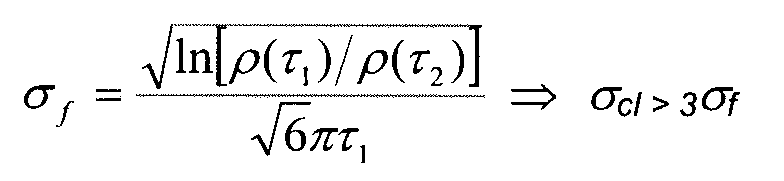
- the Gaussian shape implies that the spectrum width ⁇ cl can be estimated from the correlation coefficients ⁇ ( ⁇ ) at the first two lags, as follows:
- the clutter spectrum ⁇ cl of three times ⁇ f from the mean frequency to the left and to the right implies 99,7% of the spectrum.
- ⁇ cl is a compromise between taking as much as possible of clutter spectra and leaving as much as possible signal spectra, and as such it should be treated as adaptive to a particular radar echo.
- the deconvolution method according to the invention is illustrated by Figure 3. This method can be summarised by the following steps:
- the spectrum dft( c ) can also be computed and its L non-zero components found in step S2.
- the amplitudes of the clutter spectra can be estimated in step S4. So, the convolution operations can be reduced, based on the L non-zero spectral components between the steps S5 and S6. In other embodiments, these second and third embodiments can be combined.
- are deconvolved [S6].
- the deconvolution method according to the invention is illustrated in Figures 4a, 4b, 4c, 4d and 4e when the multirate sampling contains five non-zero spectral components as shown by Figure 4a which modulate the input signal of Figure 4d containing the noise-free target echo of Figure 4b and non-random sea clutter of Figure 4c. All these spectra are given in dB in function of normalised Doppler.
- the power spectral density (psd) of the sea clutter is assumed to be Gaussian shaped.
- the clutter filtering and deconvolution result in the frequency contents of the target echo as shown by Figure 4e.
- This deconvolution method in any of its embodiments is applied in radar system by a deconvolution system, which comprises:
- the deconvolution method according to the invention works better if the normalised Doppler frequency is adjusted to frequency 1,28. Changing the sampling frequency can do it.
- One advantage of the deconvolution method according to the invention is that it works above the Nyquist frequencies and offers filtering method for any kind of clutter, in particular: any "varying" clutter as sea clutter or rain clutter, but also non varying clutter as land clutter.
- another application to the proposed method and filter may be "rain” clutter filtering, or even any clutter filtering (for "varying” and “not varying” clutter). So, it allows the use of this clutter filter in any kind of radar whatever the environment is. This because clutter filtering according to the invention is possible for clutter whose spectral lines are not necessarily centred at zero.
- such deconvolution system may be used to deconvolve any kind of irregular sampled signal not only radar one.
Landscapes
- Engineering & Computer Science (AREA)
- Radar, Positioning & Navigation (AREA)
- Remote Sensing (AREA)
- Computer Networks & Wireless Communication (AREA)
- Physics & Mathematics (AREA)
- General Physics & Mathematics (AREA)
- Radar Systems Or Details Thereof (AREA)
- Polysaccharides And Polysaccharide Derivatives (AREA)
- Saccharide Compounds (AREA)
- Ultra Sonic Daignosis Equipment (AREA)
- Detergent Compositions (AREA)
Abstract
- [S1] conversion of the irregular samples x(tm ) to regular samples r(iTε );
- [S2] computation of the spectrum dft(r) of these regular samples;
- [S3] isolation of the clutter spectra in dft(r) by assuming clutter spreads over more than a few range gates;
- [S4] estimation of the clutter spectral lines from the mean and the width of the isolated clutter spectra;
- [S5] subtraction of the estimated clutter spectra from the total spectrum dft(r);
- [S6] deconvolution of the remaining spectra.
Description
Irregular Pulse Repetition Time (PRT) is usually meant to prevent blind speeds (velocity ambiguity), the jammers from locking on the radar 's Pulse Repetition Time (PRT), and also to solve Doppler ambiguities.
Current work on irregular sampling is mostly motivated by image processing. Efficient algorithms based on frame operations have been developed as "Efficient numerical methods in non-uniform sampling theory" written by Feichtinger, H.G. and al in Numerische Mathematik 69 (NUHAG). Wavelet transform in digital filter banks as "Multirate systems and filter banks" written by Vaidyanathan, P.P. Prentice-Hall Publishers (1993) illustrates efficient 1 D applications with irregular samples obtained by integer decimation or expansion of uniform samples.
In Doppler radar signal processing, Pulse Repetition Time (PRT) staggering has been studied, but with emphasis on the Fourier analysis, rather than on solving the irregular-sampling problem.
- [S1] conversion of the irregular samples x(tm) to regular samples r(iTε);
- [S2] computation of the spectrum dft(r) of these regular samples;
- [S3] isolation of the clutter spectra in dft(r) by assuming clutter spreads over more than a few range gates;
- [S4] estimation of the clutter spectral lines from the mean and the width of the isolated clutter spectra;
- [S5] subtraction of the estimated clutter spectra from the total spectrum dft(r);
- [S6] deconvolution of the remaining spectra.
- Mean for converting the irregular samples x(tm) to regular samples r(iTε);
- Mean for computing the spectrum dft(r) of these regular samples;
- Mean for isolating the clutter spectra in dft(r) by assuming clutter spreads over more than a few range gates;
- Mean for estimating the clutter spectral lines from the mean and the width of the isolated clutter spectra;
- Mean for subtracting the estimated clutter spectra from the total spectrum dft(r);
- Mean for deconvolving of the remaining spectra.
- Figure 1a, 1b, 1c and 1d, Spectra obtained from irregular Pulse Repetition Time (PRT) sampled signal with four different prior art techniques: respectively, NSSL, NUHAG, wavelet and LSP methods,
- Figure 2a and 2b, Clutter of, respectively, land and sea given by NSSL,
- Figure 3, Flow chart of significant steps in the method to filter clutter according to the invention.
- Figure 4a, 4b, 4c, 4d and 4e, Illustration of the method
according to the invention, respectively, by spectra of the used irregular
sampling, the simulated signal, the simulated sea clutter, the clutter filter
input and output for a signal which is a noise-free complex exponential at
frequency 1.2, and a Gaussian-shaped sea clutter with mean and
bandwidth corresponding to
sea state 5 when PRF and RF would be respectively 1 kHz and 1 GHz, - Figure 5a, 5b, 5c, 5d and 5e, Illustration of the method
according to the invention applied to target echo and sea clutter from
Figure 4 with added Gaussian noise and Weibull-distributed amplitude,
respectively, by spectra of the used irregular sampling, the simulated
signal, the simulated sea clutter, the clutter filter input and output for a
signal which is a complex exponential at frequency 1.28, a Gaussian-shaped
sea clutter with mean and bandwidth corresponding to
sea state 5 when PRF and RF would be respectively 1kHz and 1 GHz, and a target frequency at 1.28.
Deterministic irregular sampling involves repeating periodically the same sequence of K irregular intervals with the mean sampling interval Ts. The sampling is usually called interlaced when K=2, and multirate or bunch when K has an arbitrary length. Since such a sampling set contains K regular sampling sets, DFT gives K peaks (per one frequency component of a signal) within the range limited by the
Thus, the irregular samples x(tm) are converted to the zero-padded samples r(iTε ) being product of a sampling scheme ci, ci = δ(iTε -tm), and the regular samples x(iTε). Based on this relation: r = diag(c).x (in the vector form), the spectrum of x , can be derived as follows:
The spectrum |dft(r)| contains L replicas of the spectrum |dft(x)| that are weighted by coefficient from |dft(c)| , in a frequency range which is L/K times wider than the mean sampling frequency fs. The deconvolution gives the strongest replica, i.e. the signal spectrum |dft(x)|.
As shown by Figure 1a, NSSL method is comparable with NUHAG method (Figure 1b) for multirate samples. Furthermore, NSSL method enables solving the radar problems of Doppler ambiguity and ground clutter filtering. Unfortunately, the NSSL method is applicable only for ground radar applications.
In track radar, where expected Dopplers are reasonably known, the signal spectra supported by NSSL may suffice. Namely, using the magnitudes in
The range of unambiguous frequencies may expand limitlessly, but clutter filtering becomes more involved with increasing complexity of the sampling.
Any kind of clutter can be estimated. A set {i} is then centred at an integer corresponding to the mean Doppler as shown by Figures 3a and 3b for, respectively, land clutter and sea clutter.
In general, the amplitudes gcl(i, k) of the i-th clutter spectral component, fi ∈ Bcl, i ∈ [-I, J] repeated at the k-th non-zero-line of the code spectrum, k = 1, L, can be estimated as follows:

In general, the integer interval i ∈ [-l, J] is unknown. For estimating the clutter spectral lines, fi ∈ Bcl , by using the correlation, the clutters are assumed to have a Gaussian shape and the received signals to be complex exponentials.
The Gaussian shape implies that the spectrum width σcl can be estimated from the correlation coefficients ρ(τ) at the first two lags, as follows:
The mean Doppler frequency


This deconvolution method in any of its embodiments is applied in radar system by a deconvolution system, which comprises:
- A mean for converting the irregular samples x(tm ) to regular samples r(iTε );
- A mean for computing the spectrum dft(r) of these regular samples;
- A mean for isolating the clutter spectra in dft(r) by assuming clutter spreads over more than a few range gates;
- A mean for estimating the clutter spectral lines from the mean and the width of the isolated clutter spectra;
- A mean for subtracting the estimated clutter spectra from the total spectrum dft(r);
- A mean for deconvolving of the remaining spectra.
Claims (13)
- Deconvolution method of irregular pulse repetition time sampled signal x(tm) wherein it comprises the following steps:[S1] conversion of the irregular samples x(tm) to regular samples r(iTε );[S2] computation of the spectrum dft(r) of these regular samples;[S3] isolation of the clutter spectra in dft(r) by assuming clutter spreads over more than a few range gates;[S4] estimation of the clutter spectral lines from the mean and the width of the isolated clutter spectra;[S5] subtraction of the estimated clutter spectra from the total spectrum dft(r);[S6] deconvolution of the remaining spectra.
- Deconvolution method according to the preceding claim wherein, in the steps of subtraction [S5] and deconvolution [S6], the computation are adjusted to the clutter type by the clutter spectra given by step [S3].
- Deconvolution method according to the any of the preceding claims wherein step [S2] comprises also the following sub-steps:Computation of the sampling scheme spectrum dft(c)Search of its L non-zero components.
- Deconvolution method according to the preceding claim wherein the convolution operations in the steps of subtraction [S5] and deconvolution [S6] are reduced based on the L non-zero spectral components.
- Deconvolution method according to the any of the preceding claims wherein step [S4] comprises also the amplitudes of the clutter spectra estimation.
- Deconvolution system of irregular pulse repetition time sampled signal x(tm) wherein it comprises:Mean for converting the irregular samples x(tm) to regular samples r(iTε );Mean for computing the spectrum dft(r) of these regular samples;Mean for isolating the clutter spectra in dft(r) by assuming clutter spreads over more than a few range gates;Mean for estimating the clutter spectral lines from the mean and the width of the isolated clutter spectra;Mean for subtracting the estimated clutter spectra from the total spectrum dft(r);Mean for deconvolving of the remaining spectra.
- Deconvolution system according to the preceding claim wherein the computation in the mean for subtracting and the mean for deconvolving are adjusted to the clutter type by the clutter spectra given by the mean for isolating.
- Deconvolution system according to the any of claims 6 or 7 wherein the mean for computing:Computes the sampling scheme spectrum dft(c) andSearches its L non-zero components.
- Deconvolution system according to the preceding claim wherein the convolution operations in the mean for subtracting and the mean for deconvolving are reduced based on the L non-zero spectral components.
- Deconvolution system according to the any of claims 6 to 8 wherein the mean for estimating estimates also the amplitudes of the clutter spectra.
- Use of the deconvolution method according to claim 1 in radar system.
- Use of the deconvolution method according to claim 1 as clutter filtering.
- Use of the deconvolution method according to the preceding claim as sea clutter filtering.
Applications Claiming Priority (2)
| Application Number | Priority Date | Filing Date | Title |
|---|---|---|---|
| NL1020763A NL1020763C2 (en) | 2002-06-05 | 2002-06-05 | Method and system for deconvolving a signal sampled with an irregular PRT, and its application possibilities. |
| NL1020763 | 2002-06-05 |
Publications (3)
| Publication Number | Publication Date |
|---|---|
| EP1369703A2 true EP1369703A2 (en) | 2003-12-10 |
| EP1369703A3 EP1369703A3 (en) | 2005-01-05 |
| EP1369703B1 EP1369703B1 (en) | 2010-02-17 |
Family
ID=29546434
Family Applications (1)
| Application Number | Title | Priority Date | Filing Date |
|---|---|---|---|
| EP03101597A Expired - Lifetime EP1369703B1 (en) | 2002-06-05 | 2003-06-02 | Irregular pulse repetition time (PRT) deconvolution method and systems, Doppler and clutter processing |
Country Status (11)
| Country | Link |
|---|---|
| US (1) | US6803876B2 (en) |
| EP (1) | EP1369703B1 (en) |
| JP (1) | JP2004037457A (en) |
| KR (1) | KR100966060B1 (en) |
| AT (1) | ATE458204T1 (en) |
| CA (1) | CA2431094C (en) |
| DE (1) | DE60331277D1 (en) |
| ES (1) | ES2340672T3 (en) |
| IL (1) | IL156293A (en) |
| NL (1) | NL1020763C2 (en) |
| ZA (1) | ZA200304397B (en) |
Cited By (7)
| Publication number | Priority date | Publication date | Assignee | Title |
|---|---|---|---|---|
| US6803876B2 (en) * | 2002-06-05 | 2004-10-12 | Thales Nederland B.V. | Irregular PRT deconvolution method and systems, and its uses |
| US7583222B2 (en) | 2005-08-26 | 2009-09-01 | Vaisala Oyj | Method for using pulse compression in weather radar |
| US7589666B2 (en) * | 2004-12-30 | 2009-09-15 | Vaisala, Inc. | System and method for processing data in weather radar |
| EP2821809A1 (en) * | 2013-07-05 | 2015-01-07 | Thales | Method for detecting at least one target by pulse-Doppler radar with unambiguous measurement of radial velocity and pulse-Doppler radar for implementing such a method |
| EP3144695A1 (en) * | 2015-09-17 | 2017-03-22 | Airbus DS Electronics and Border Security GmbH | Device and method for measuring position and velocity of an object |
| CN109001703A (en) * | 2018-08-10 | 2018-12-14 | 南京信息工程大学 | A kind of sea clutter denoising method based on the processing of wavelet packet multi-threshold |
| CN110161491A (en) * | 2019-06-28 | 2019-08-23 | 电子科技大学 | A kind of ranging and respiratory rate estimation method for faint life entity |
Families Citing this family (11)
| Publication number | Priority date | Publication date | Assignee | Title |
|---|---|---|---|---|
| US6937185B1 (en) * | 2003-08-14 | 2005-08-30 | Lockheed Martin Corporation | Rain versus target discrimination for doppler radars |
| US6861974B1 (en) * | 2003-10-16 | 2005-03-01 | Lockheed Martin Corporation | Clutter normalization by adaptation of transmit waveform |
| JP2006250934A (en) * | 2005-03-08 | 2006-09-21 | Synthesys Research Inc | Method and device for measuring duty cycle |
| PL2614384T3 (en) | 2010-09-08 | 2016-09-30 | Radar system and methods of controlling a radar system and the provision of a range-doppler target image signature | |
| JP2013142775A (en) * | 2012-01-11 | 2013-07-22 | Sony Corp | Display device, electronic apparatus, displaying method, and program |
| CN102608597B (en) * | 2012-03-19 | 2014-07-23 | 西安电子科技大学 | Method for imaging actual aperture foresight on basis of incomplete data deconvolution |
| JP7171583B2 (en) * | 2017-01-16 | 2022-11-15 | コーニンクレッカ フィリップス エヌ ヴェ | System and method for ultrafast imaging |
| CN109597060B (en) * | 2018-12-07 | 2021-06-25 | 北京敏视达雷达有限公司 | Radar speed measurement method and device |
| CN110146891A (en) * | 2019-01-17 | 2019-08-20 | 西安电子科技大学 | Single-channel Staggered Synthetic Aperture Radar Imaging Method Based on Blind Spot Data Recovery |
| CN115327504B (en) * | 2022-07-04 | 2024-05-10 | 中国电波传播研究所(中国电子科技集团公司第二十二研究所) | A typeless prediction method for sea clutter amplitude distribution based on measurement condition parameters |
| CN116774177B (en) * | 2023-05-28 | 2026-01-09 | 西北工业大学 | A clutter suppression method based on clutter spectral parameter estimation and its application. |
Family Cites Families (5)
| Publication number | Priority date | Publication date | Assignee | Title |
|---|---|---|---|---|
| US4400700A (en) * | 1981-06-08 | 1983-08-23 | The United States Of America As Represented By The Secretary Of The Army | Doppler frequency analysis of radar signals |
| US4737788A (en) * | 1985-04-04 | 1988-04-12 | Motorola, Inc. | Helicopter obstacle detector |
| US5376940A (en) * | 1985-12-19 | 1994-12-27 | Hughes Aircraft Company | Helicopter recognition radar processor |
| US6081221A (en) * | 1998-08-27 | 2000-06-27 | Zrnic; Dusan S. | Signal processing and systematic phase coding for mitigation of range and velocity ambiguities in Doppler weather radars |
| NL1020763C2 (en) * | 2002-06-05 | 2003-12-08 | Thales Nederland Bv | Method and system for deconvolving a signal sampled with an irregular PRT, and its application possibilities. |
-
2002
- 2002-06-05 NL NL1020763A patent/NL1020763C2/en not_active IP Right Cessation
-
2003
- 2003-06-02 EP EP03101597A patent/EP1369703B1/en not_active Expired - Lifetime
- 2003-06-02 DE DE60331277T patent/DE60331277D1/en not_active Expired - Lifetime
- 2003-06-02 AT AT03101597T patent/ATE458204T1/en not_active IP Right Cessation
- 2003-06-02 ES ES03101597T patent/ES2340672T3/en not_active Expired - Lifetime
- 2003-06-03 IL IL156293A patent/IL156293A/en not_active IP Right Cessation
- 2003-06-04 US US10/453,892 patent/US6803876B2/en not_active Expired - Fee Related
- 2003-06-04 KR KR1020030036063A patent/KR100966060B1/en not_active Expired - Fee Related
- 2003-06-04 CA CA2431094A patent/CA2431094C/en not_active Expired - Fee Related
- 2003-06-05 ZA ZA200304397A patent/ZA200304397B/en unknown
- 2003-06-05 JP JP2003160947A patent/JP2004037457A/en active Pending
Cited By (9)
| Publication number | Priority date | Publication date | Assignee | Title |
|---|---|---|---|---|
| US6803876B2 (en) * | 2002-06-05 | 2004-10-12 | Thales Nederland B.V. | Irregular PRT deconvolution method and systems, and its uses |
| US7589666B2 (en) * | 2004-12-30 | 2009-09-15 | Vaisala, Inc. | System and method for processing data in weather radar |
| US7583222B2 (en) | 2005-08-26 | 2009-09-01 | Vaisala Oyj | Method for using pulse compression in weather radar |
| EP2821809A1 (en) * | 2013-07-05 | 2015-01-07 | Thales | Method for detecting at least one target by pulse-Doppler radar with unambiguous measurement of radial velocity and pulse-Doppler radar for implementing such a method |
| FR3008191A1 (en) * | 2013-07-05 | 2015-01-09 | Thales Sa | METHOD FOR DETECTING AT LEAST ONE PULSE DOPPLER RADAR TARGET WITH NON-AMBIGED RADIAL SPEED MEASUREMENT AND DOPPLER PULSE RADAR FOR IMPLEMENTING SUCH A METHOD |
| EP3144695A1 (en) * | 2015-09-17 | 2017-03-22 | Airbus DS Electronics and Border Security GmbH | Device and method for measuring position and velocity of an object |
| CN109001703A (en) * | 2018-08-10 | 2018-12-14 | 南京信息工程大学 | A kind of sea clutter denoising method based on the processing of wavelet packet multi-threshold |
| CN110161491A (en) * | 2019-06-28 | 2019-08-23 | 电子科技大学 | A kind of ranging and respiratory rate estimation method for faint life entity |
| CN110161491B (en) * | 2019-06-28 | 2021-01-12 | 电子科技大学 | Ranging and respiratory frequency estimation method for weak life body |
Also Published As
| Publication number | Publication date |
|---|---|
| ATE458204T1 (en) | 2010-03-15 |
| IL156293A (en) | 2008-12-29 |
| IL156293A0 (en) | 2004-01-04 |
| JP2004037457A (en) | 2004-02-05 |
| US20040056794A1 (en) | 2004-03-25 |
| KR20030094116A (en) | 2003-12-11 |
| NL1020763C2 (en) | 2003-12-08 |
| EP1369703B1 (en) | 2010-02-17 |
| DE60331277D1 (en) | 2010-04-01 |
| US6803876B2 (en) | 2004-10-12 |
| ZA200304397B (en) | 2004-02-13 |
| CA2431094A1 (en) | 2003-12-05 |
| CA2431094C (en) | 2011-07-26 |
| EP1369703A3 (en) | 2005-01-05 |
| ES2340672T3 (en) | 2010-06-08 |
| KR100966060B1 (en) | 2010-06-28 |
Similar Documents
| Publication | Publication Date | Title |
|---|---|---|
| EP1369703B1 (en) | Irregular pulse repetition time (PRT) deconvolution method and systems, Doppler and clutter processing | |
| JP2005530164A (en) | Method for suppressing interference in an object detection system | |
| US5805107A (en) | Cost-effective method for determining a pulse response of a high-resolution, band-limited radar channel | |
| CN113376601B (en) | Frequency agile radar sidelobe suppression method based on CLEAN algorithm | |
| Zhang et al. | Joint delay and Doppler shift estimation for multiple targets using exponential ambiguity function | |
| Pinilla et al. | Phase retrieval for radar waveform design | |
| CN119861351B (en) | Intra-pulse stepping LFM signal design and intermittent sampling forwarding interference resisting processing method based on inter-pulse parameter agility | |
| EP1418441B1 (en) | Agile PRT Deconvolution method and systems, and its uses | |
| Lin et al. | New techniques for radar coherent range ambiguity resolution | |
| Dwyer | Range and Doppler information from fourth-order spectra | |
| Youssef et al. | A novel framework for combining multiple radar waveforms using time compression overlap-add | |
| CN115586507B (en) | A MIMO radar waveform design method to suppress velocity ambiguity | |
| Herr et al. | Efficient Range-Doppler MMSE Estimation for Pulse Agile Radar | |
| Liang et al. | A Biphase Code Sidelobe Suppression Method Based on the CLEAN Algorithm | |
| Rodriguez et al. | A simple clutter suppression approach for OFDM-based passive radar exploiting reciprocal filter | |
| Rasool et al. | Efficient pulse-Doppler processing and ambiguity functions of nonuniform coherent pulse trains | |
| Pribic | Radar irregular sampling | |
| Uppala et al. | Spectrum estimation of moderately overspread radar targets using aperiodic transmitter coding | |
| CN109061596B (en) | Frequency modulation discontinuous continuous wave radar stray frequency spectrum elimination method based on subspace analysis | |
| Pribic | Doppler processing on Irregular PRT | |
| Weaver | Frequency domain processing of ultra-wideband signals | |
| CN116915561B (en) | BPSK signal FRI sampling and break point parameter estimation method | |
| Dash et al. | Time frequency analysis of OFDM-LFM waveforms for multistatic airborne radar | |
| Foreman | Application of the CLEAN detector to low signal to noise ratio targets | |
| US20230204753A1 (en) | Method, System and Apparatus for Generating an Optimal Signal in Radar and Communication Systems |
Legal Events
| Date | Code | Title | Description |
|---|---|---|---|
| PUAI | Public reference made under article 153(3) epc to a published international application that has entered the european phase |
Free format text: ORIGINAL CODE: 0009012 |
|
| AK | Designated contracting states |
Kind code of ref document: A2 Designated state(s): AT BE BG CH CY CZ DE DK EE ES FI FR GB GR HU IE IT LI LU MC NL PT RO SE SI SK TR |
|
| AX | Request for extension of the european patent |
Extension state: AL LT LV MK |
|
| PUAL | Search report despatched |
Free format text: ORIGINAL CODE: 0009013 |
|
| AK | Designated contracting states |
Kind code of ref document: A3 Designated state(s): AT BE BG CH CY CZ DE DK EE ES FI FR GB GR HU IE IT LI LU MC NL PT RO SE SI SK TR |
|
| AX | Request for extension of the european patent |
Extension state: AL LT LV MK |
|
| RIC1 | Information provided on ipc code assigned before grant |
Ipc: 7G 01S 13/22 A Ipc: 7G 01S 7/41 B Ipc: 7G 01S 13/524 B |
|
| 17P | Request for examination filed |
Effective date: 20050621 |
|
| AKX | Designation fees paid |
Designated state(s): AT BE BG CH CY CZ DE DK EE ES FI FR GB GR HU IE IT LI LU MC NL PT RO SE SI SK TR |
|
| 17Q | First examination report despatched |
Effective date: 20070510 |
|
| GRAP | Despatch of communication of intention to grant a patent |
Free format text: ORIGINAL CODE: EPIDOSNIGR1 |
|
| GRAS | Grant fee paid |
Free format text: ORIGINAL CODE: EPIDOSNIGR3 |
|
| GRAA | (expected) grant |
Free format text: ORIGINAL CODE: 0009210 |
|
| AK | Designated contracting states |
Kind code of ref document: B1 Designated state(s): AT BE BG CH CY CZ DE DK EE ES FI FR GB GR HU IE IT LI LU MC NL PT RO SE SI SK TR |
|
| REG | Reference to a national code |
Ref country code: GB Ref legal event code: FG4D |
|
| REG | Reference to a national code |
Ref country code: CH Ref legal event code: EP |
|
| REG | Reference to a national code |
Ref country code: IE Ref legal event code: FG4D |
|
| REF | Corresponds to: |
Ref document number: 60331277 Country of ref document: DE Date of ref document: 20100401 Kind code of ref document: P |
|
| REG | Reference to a national code |
Ref country code: SE Ref legal event code: TRGR |
|
| REG | Reference to a national code |
Ref country code: NL Ref legal event code: T3 |
|
| REG | Reference to a national code |
Ref country code: ES Ref legal event code: FG2A Ref document number: 2340672 Country of ref document: ES Kind code of ref document: T3 |
|
| PG25 | Lapsed in a contracting state [announced via postgrant information from national office to epo] |
Ref country code: PT Free format text: LAPSE BECAUSE OF FAILURE TO SUBMIT A TRANSLATION OF THE DESCRIPTION OR TO PAY THE FEE WITHIN THE PRESCRIBED TIME-LIMIT Effective date: 20100617 |
|
| PG25 | Lapsed in a contracting state [announced via postgrant information from national office to epo] |
Ref country code: SI Free format text: LAPSE BECAUSE OF FAILURE TO SUBMIT A TRANSLATION OF THE DESCRIPTION OR TO PAY THE FEE WITHIN THE PRESCRIBED TIME-LIMIT Effective date: 20100217 Ref country code: AT Free format text: LAPSE BECAUSE OF FAILURE TO SUBMIT A TRANSLATION OF THE DESCRIPTION OR TO PAY THE FEE WITHIN THE PRESCRIBED TIME-LIMIT Effective date: 20100217 Ref country code: FI Free format text: LAPSE BECAUSE OF FAILURE TO SUBMIT A TRANSLATION OF THE DESCRIPTION OR TO PAY THE FEE WITHIN THE PRESCRIBED TIME-LIMIT Effective date: 20100217 |
|
| PG25 | Lapsed in a contracting state [announced via postgrant information from national office to epo] |
Ref country code: CY Free format text: LAPSE BECAUSE OF FAILURE TO SUBMIT A TRANSLATION OF THE DESCRIPTION OR TO PAY THE FEE WITHIN THE PRESCRIBED TIME-LIMIT Effective date: 20100217 Ref country code: BE Free format text: LAPSE BECAUSE OF FAILURE TO SUBMIT A TRANSLATION OF THE DESCRIPTION OR TO PAY THE FEE WITHIN THE PRESCRIBED TIME-LIMIT Effective date: 20100217 Ref country code: RO Free format text: LAPSE BECAUSE OF FAILURE TO SUBMIT A TRANSLATION OF THE DESCRIPTION OR TO PAY THE FEE WITHIN THE PRESCRIBED TIME-LIMIT Effective date: 20100217 Ref country code: GR Free format text: LAPSE BECAUSE OF FAILURE TO SUBMIT A TRANSLATION OF THE DESCRIPTION OR TO PAY THE FEE WITHIN THE PRESCRIBED TIME-LIMIT Effective date: 20100518 Ref country code: EE Free format text: LAPSE BECAUSE OF FAILURE TO SUBMIT A TRANSLATION OF THE DESCRIPTION OR TO PAY THE FEE WITHIN THE PRESCRIBED TIME-LIMIT Effective date: 20100217 |
|
| PG25 | Lapsed in a contracting state [announced via postgrant information from national office to epo] |
Ref country code: CZ Free format text: LAPSE BECAUSE OF FAILURE TO SUBMIT A TRANSLATION OF THE DESCRIPTION OR TO PAY THE FEE WITHIN THE PRESCRIBED TIME-LIMIT Effective date: 20100217 Ref country code: SK Free format text: LAPSE BECAUSE OF FAILURE TO SUBMIT A TRANSLATION OF THE DESCRIPTION OR TO PAY THE FEE WITHIN THE PRESCRIBED TIME-LIMIT Effective date: 20100217 Ref country code: BG Free format text: LAPSE BECAUSE OF FAILURE TO SUBMIT A TRANSLATION OF THE DESCRIPTION OR TO PAY THE FEE WITHIN THE PRESCRIBED TIME-LIMIT Effective date: 20100517 |
|
| PLBE | No opposition filed within time limit |
Free format text: ORIGINAL CODE: 0009261 |
|
| STAA | Information on the status of an ep patent application or granted ep patent |
Free format text: STATUS: NO OPPOSITION FILED WITHIN TIME LIMIT |
|
| 26N | No opposition filed |
Effective date: 20101118 |
|
| PG25 | Lapsed in a contracting state [announced via postgrant information from national office to epo] |
Ref country code: MC Free format text: LAPSE BECAUSE OF NON-PAYMENT OF DUE FEES Effective date: 20100630 Ref country code: DK Free format text: LAPSE BECAUSE OF FAILURE TO SUBMIT A TRANSLATION OF THE DESCRIPTION OR TO PAY THE FEE WITHIN THE PRESCRIBED TIME-LIMIT Effective date: 20100217 |
|
| PG25 | Lapsed in a contracting state [announced via postgrant information from national office to epo] |
Ref country code: IE Free format text: LAPSE BECAUSE OF NON-PAYMENT OF DUE FEES Effective date: 20100602 |
|
| PG25 | Lapsed in a contracting state [announced via postgrant information from national office to epo] |
Ref country code: HU Free format text: LAPSE BECAUSE OF FAILURE TO SUBMIT A TRANSLATION OF THE DESCRIPTION OR TO PAY THE FEE WITHIN THE PRESCRIBED TIME-LIMIT Effective date: 20100818 Ref country code: LU Free format text: LAPSE BECAUSE OF NON-PAYMENT OF DUE FEES Effective date: 20100602 |
|
| PG25 | Lapsed in a contracting state [announced via postgrant information from national office to epo] |
Ref country code: TR Free format text: LAPSE BECAUSE OF FAILURE TO SUBMIT A TRANSLATION OF THE DESCRIPTION OR TO PAY THE FEE WITHIN THE PRESCRIBED TIME-LIMIT Effective date: 20100217 |
|
| REG | Reference to a national code |
Ref country code: FR Ref legal event code: PLFP Year of fee payment: 13 |
|
| PGFP | Annual fee paid to national office [announced via postgrant information from national office to epo] |
Ref country code: ES Payment date: 20150527 Year of fee payment: 13 Ref country code: GB Payment date: 20150527 Year of fee payment: 13 Ref country code: DE Payment date: 20150527 Year of fee payment: 13 Ref country code: CH Payment date: 20150612 Year of fee payment: 13 Ref country code: SE Payment date: 20150611 Year of fee payment: 13 |
|
| PGFP | Annual fee paid to national office [announced via postgrant information from national office to epo] |
Ref country code: NL Payment date: 20150609 Year of fee payment: 13 Ref country code: FR Payment date: 20150608 Year of fee payment: 13 |
|
| PGFP | Annual fee paid to national office [announced via postgrant information from national office to epo] |
Ref country code: IT Payment date: 20150625 Year of fee payment: 13 |
|
| REG | Reference to a national code |
Ref country code: DE Ref legal event code: R119 Ref document number: 60331277 Country of ref document: DE |
|
| REG | Reference to a national code |
Ref country code: SE Ref legal event code: EUG Ref country code: CH Ref legal event code: PL |
|
| REG | Reference to a national code |
Ref country code: NL Ref legal event code: MM Effective date: 20160701 |
|
| PG25 | Lapsed in a contracting state [announced via postgrant information from national office to epo] |
Ref country code: SE Free format text: LAPSE BECAUSE OF NON-PAYMENT OF DUE FEES Effective date: 20160603 |
|
| GBPC | Gb: european patent ceased through non-payment of renewal fee |
Effective date: 20160602 |
|
| REG | Reference to a national code |
Ref country code: FR Ref legal event code: ST Effective date: 20170228 |
|
| PG25 | Lapsed in a contracting state [announced via postgrant information from national office to epo] |
Ref country code: FR Free format text: LAPSE BECAUSE OF NON-PAYMENT OF DUE FEES Effective date: 20160630 Ref country code: DE Free format text: LAPSE BECAUSE OF NON-PAYMENT OF DUE FEES Effective date: 20170103 Ref country code: CH Free format text: LAPSE BECAUSE OF NON-PAYMENT OF DUE FEES Effective date: 20160630 Ref country code: LI Free format text: LAPSE BECAUSE OF NON-PAYMENT OF DUE FEES Effective date: 20160630 |
|
| PG25 | Lapsed in a contracting state [announced via postgrant information from national office to epo] |
Ref country code: NL Free format text: LAPSE BECAUSE OF NON-PAYMENT OF DUE FEES Effective date: 20160701 Ref country code: GB Free format text: LAPSE BECAUSE OF NON-PAYMENT OF DUE FEES Effective date: 20160602 |
|
| PG25 | Lapsed in a contracting state [announced via postgrant information from national office to epo] |
Ref country code: IT Free format text: LAPSE BECAUSE OF NON-PAYMENT OF DUE FEES Effective date: 20160602 |
|
| PG25 | Lapsed in a contracting state [announced via postgrant information from national office to epo] |
Ref country code: ES Free format text: LAPSE BECAUSE OF NON-PAYMENT OF DUE FEES Effective date: 20160603 |
|
| REG | Reference to a national code |
Ref country code: ES Ref legal event code: FD2A Effective date: 20181203 |