EP1367562A2 - Method and apparatus for audio data communication with non-audio area detection - Google Patents
Method and apparatus for audio data communication with non-audio area detection Download PDFInfo
- Publication number
- EP1367562A2 EP1367562A2 EP03010604A EP03010604A EP1367562A2 EP 1367562 A2 EP1367562 A2 EP 1367562A2 EP 03010604 A EP03010604 A EP 03010604A EP 03010604 A EP03010604 A EP 03010604A EP 1367562 A2 EP1367562 A2 EP 1367562A2
- Authority
- EP
- European Patent Office
- Prior art keywords
- audio
- audio data
- data
- receiver
- communication
- Prior art date
- Legal status (The legal status is an assumption and is not a legal conclusion. Google has not performed a legal analysis and makes no representation as to the accuracy of the status listed.)
- Withdrawn
Links
Images

Classifications
-
- H—ELECTRICITY
- H04—ELECTRIC COMMUNICATION TECHNIQUE
- H04M—TELEPHONIC COMMUNICATION
- H04M1/00—Substation equipment, e.g. for use by subscribers
- H04M1/60—Substation equipment, e.g. for use by subscribers including speech amplifiers
- H04M1/6033—Substation equipment, e.g. for use by subscribers including speech amplifiers for providing handsfree use or a loudspeaker mode in telephone sets
- H04M1/6041—Portable telephones adapted for handsfree use
- H04M1/6058—Portable telephones adapted for handsfree use involving the use of a headset accessory device connected to the portable telephone
- H04M1/6066—Portable telephones adapted for handsfree use involving the use of a headset accessory device connected to the portable telephone including a wireless connection
-
- H—ELECTRICITY
- H04—ELECTRIC COMMUNICATION TECHNIQUE
- H04W—WIRELESS COMMUNICATION NETWORKS
- H04W52/00—Power management, e.g. Transmission Power Control [TPC] or power classes
- H04W52/02—Power saving arrangements
- H04W52/0209—Power saving arrangements in terminal devices
- H04W52/0261—Power saving arrangements in terminal devices managing power supply demand, e.g. depending on battery level
- H04W52/0274—Power saving arrangements in terminal devices managing power supply demand, e.g. depending on battery level by switching on or off the equipment or parts thereof
-
- G—PHYSICS
- G10—MUSICAL INSTRUMENTS; ACOUSTICS
- G10L—SPEECH ANALYSIS TECHNIQUES OR SPEECH SYNTHESIS; SPEECH RECOGNITION; SPEECH OR VOICE PROCESSING TECHNIQUES; SPEECH OR AUDIO CODING OR DECODING
- G10L25/00—Speech or voice analysis techniques not restricted to a single one of groups G10L15/00 - G10L21/00
- G10L25/78—Detection of presence or absence of voice signals
- G10L2025/783—Detection of presence or absence of voice signals based on threshold decision
-
- H—ELECTRICITY
- H04—ELECTRIC COMMUNICATION TECHNIQUE
- H04M—TELEPHONIC COMMUNICATION
- H04M1/00—Substation equipment, e.g. for use by subscribers
- H04M1/72—Mobile telephones; Cordless telephones, i.e. devices for establishing wireless links to base stations without route selection
- H04M1/724—User interfaces specially adapted for cordless or mobile telephones
- H04M1/72403—User interfaces specially adapted for cordless or mobile telephones with means for local support of applications that increase the functionality
- H04M1/72409—User interfaces specially adapted for cordless or mobile telephones with means for local support of applications that increase the functionality by interfacing with external accessories
- H04M1/72412—User interfaces specially adapted for cordless or mobile telephones with means for local support of applications that increase the functionality by interfacing with external accessories using two-way short-range wireless interfaces
-
- H—ELECTRICITY
- H04—ELECTRIC COMMUNICATION TECHNIQUE
- H04M—TELEPHONIC COMMUNICATION
- H04M2250/00—Details of telephonic subscriber devices
- H04M2250/02—Details of telephonic subscriber devices including a Bluetooth® interface
-
- Y—GENERAL TAGGING OF NEW TECHNOLOGICAL DEVELOPMENTS; GENERAL TAGGING OF CROSS-SECTIONAL TECHNOLOGIES SPANNING OVER SEVERAL SECTIONS OF THE IPC; TECHNICAL SUBJECTS COVERED BY FORMER USPC CROSS-REFERENCE ART COLLECTIONS [XRACs] AND DIGESTS
- Y02—TECHNOLOGIES OR APPLICATIONS FOR MITIGATION OR ADAPTATION AGAINST CLIMATE CHANGE
- Y02D—CLIMATE CHANGE MITIGATION TECHNOLOGIES IN INFORMATION AND COMMUNICATION TECHNOLOGIES [ICT], I.E. INFORMATION AND COMMUNICATION TECHNOLOGIES AIMING AT THE REDUCTION OF THEIR OWN ENERGY USE
- Y02D30/00—Reducing energy consumption in communication networks
- Y02D30/70—Reducing energy consumption in communication networks in wireless communication networks
Definitions
- the present invention generally relates to audio data communication apparatuses, and more particularly pertains to a communication control method for controlling transmission of audio data in a non-audio data area.
- wireless audio communication is provided between, for example, a mobile phone or a mobile audio gateway device (hereinafter referred to as an AG device) and a headset device (hereinafter referred to as an HS device).
- AG device mobile phone or a mobile audio gateway device
- HS device headset device
- ACL asynchronous connection-less
- SCO synchronous connection-oriented
- the ACL link is an asynchronous connection method without previously selecting a radio band. According to the ACL link, if data includes an error, retransmission is carried out to ensure data integrity.
- the SCO link is a synchronous connection method for previously selecting a predetermined radio band and conducting communication at predetermined intervals. The SCO link is particularly used for communication such as real-time audio data communication. The foregoing wireless audio communication can be realized using the SCO link.
- audio data communication is performed by the radio communication system using the SCO link
- audio data is transferred from, for example, an AG device to an HS device at predetermined intervals. If communication with the SCO link is established, audio data is successively transferred.
- non-audio state a state without any sound of a predetermined level or higher
- silent State a state without any sound of a predetermined level or higher
- no-audible state a state without any sound of a predetermined level or higher
- data includes audio data in a non-audio area (non-audio data area)
- the data transfer operation is continued as it is.
- power consumption of the useless data transfer operation is not negligible.
- a non-audio period (non-audio data area) is detected from audio data and the level of radio transmission power in non-audio data transmission is lower than that in audio data transmission.
- the power consumption cannot always be reduced effectively by merely reducing the radio transmission power level in response to the detection of the non-audio period.
- the frequency of switching control of the power level is high, resulting in a deterioration in the efficiency of communication.
- an audio data communication apparatus and method for disconnecting a communication connection to interrupt transmission of audio data when a non-audio area is generated for a predetermined time during audio data communication are provided.
- the audio data communication apparatus includes: a data communication unit which transmits data including audio data and non-audio data to a receiver, with which a communication connection is established; a non-audio detection unit which detects a non-audio data area in the data; and a communication control unit which effects such control that, when the non-audio detection unit detects a non-audio data area having a predetermined amount of data, the communication connection with the receiver is disconnected for a period corresponding to the transmission period of the non-audio data area.
- FIG. 1 is a block diagram showing an essential part of an audio data communication system according to the present embodiment.
- a short-range radio data communication system (based on, for example, the Bluetooth standard) comprises an audio gateway (AG) device 1 and a headset (HS) device 2. Audio data communication is performed between the AG device 1 and the HS device 2.
- AG audio gateway
- HS headset
- the AG device 1 comprises a radio communication unit 10, an audio input unit 11, a communication control unit 12, and a non-audio detection unit 13.
- the radio communication unit 10 and the communication control unit 12 operate as a radio data communication function.
- the audio input unit 11 is connected to a recording medium 3 such as an IC memory or a disk recording medium.
- the audio input unit 11 receives audio signals (including music data comprising PCM signals) from the medium 3.
- the audio input unit 11 has a function of converting the audio signal into audio data in a predetermined digital format. Further, the audio input unit 11 includes a buffer 50 which temporarily stores the converted audio data in the digital format (refer to FIG. 5).
- the radio communication unit 10 transmits the audio data (including a non-audio data area serving as a non-audio interval, which will be described later) stored in the buffer 50 of the audio input unit 11 to the HS device 2 serving as a communication destination under control through the communication control unit 12.
- the non-audio detection unit 13 detects a non-audio data area from the audio data stored in the buffer 50 of the audio input unit 11.
- the non-audio detection unit 13 notifies the communication control unit 12 of the detection result.
- the non-audio detection unit 13 has a function of discriminating between an audio data area and the non-audio data area on the basis of an audio signal level of audio data.
- the non-audio detection unit 13 includes a microprocessor (CPU) which allows software to execute a process of, for example, discriminating between the audio data area and the non-audio area.
- the audio input unit 11 can be connected to not only the recording medium 3 but also an audio output device such as a mobile phone.
- the audio input unit 11 can also receive an audio signal and a music signal from the audio output device.
- the AG device 1 serves as a transmitter and the HS device 2 functions as a receiver.
- the HS device 2 comprises a radio communication unit 20 for communicating with the radio communication unit 10 of the AG device 1 by radio, an audio output unit 21, and a communication control unit 22.
- the audio output unit 21 converts audio data received by the radio communication unit 20 into an analog audio signal and generally generates the signal to a speaker.
- the radio communication unit 20 and the communication control unit 22 operate as a radio data communication function based on the same radio communication standards (for instance, the Bluetooth standard) as that of the AG device 1.
- the AG device 1 transmits an ACL link establishment request to the HS device 2.
- an ACL link is established between the AG device 1 and the HS device 2.
- the AG device 1 transmits a call command to the HS device 2 through the ACL link.
- the HS device 2 transmits an acknowledgement (ACK) in response to the command.
- ACK acknowledgement
- the AG device 1 When receiving the acknowledgement, the AG device 1 generates an SCO link establishment request to the HS device 2. Consequently, the SCO link is established, thus starting to transfer audio data from the AG device 1 to the HS device 2.
- the AG device 1 when receiving a disconnection request from the HS device 2, the AG device 1 generates an SCO link disconnection request. Consequently, the SCO link is disconnected, thus interrupting the communication of audio data between the AG device 1 and the HS device 2.
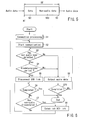
- a communication connection processing of establishing the ACL link and the SCO link between the AG device 1 and the HS device 2 is executed (step S1).
- the AG device 1 converts an audio signal supplied from the recording medium 3 into audio data and then starts communication with the HS device 2, the communication including transfer of the audio data (step S2).
- the audio input unit 11 stores the audio data converted in the predetermined digital data format into the FIFO buffer 50.
- the audio input unit 11 sequentially transfers data from the buffer 50 to the radio communication unit 10.
- the non-audio detection unit 13 detects the non-audio data area (non-audio data 500) in the audio data input to the buffer 50 (step S3). In other words, the non-audio detection unit 13 discriminates between the audio data area and the non-audio data area of the audio data to be stored in the buffer 50.
- the communication control unit 12 controls the radio communication unit 10 to transmit useful audio data, transferred from the audio input unit 11, to the HS device 2 (step S9, if NO in step S3).
- the communication control unit 12 terminates the communication operation (step S10).
- the non-audio detection unit 13 detects the non-audio data area from the audio data at predetermined timing (NT) and the non-audio data area continues for a predetermined period, the non-audio detection unit 13 notifies the communication control unit 12 of the detection (YES in step S4).
- the predetermined period corresponds to a predetermined proportion of the amount of non-audio data 500 to the capacity (BT) of the buffer 50.
- BT capacity
- a data area 501 is shown subsequent to the non-audio data area 500.
- the communication control unit 12 In response to the information from the non-audio detection unit 13, the communication control unit 12 allows the radio communication unit 10 to disconnect the SCO link in accordance with the procedure shown in FIG. 3 (step S5). Thus, the transfer of audio data from the AG device 1 to the HS device 2 is interrupted. As a matter of course, while the SCO link is being disconnected, audio reproduction is suspended in the HS device 2.
- the non-audio detection unit 13 notifies the communication control unit 12 that the non-audio data disappears (YES in steps S6 and S7). Consequently, as shown in FIG. 4, the communication control unit 12 re-establishes the SCO link between the AG device 1 and the HS device 2 (step S8). Therefore, the transfer of audio data from the AG device 1 to the HS device 2 is restarted. Thus, audio reproduction is restarted in the HS device 2.
- the present system during the transfer of audio data from the AG device 1 (transmitter) to the HS device 2 (receiver) with radio communication, if a non-audio data area is generated in audio data, a communication connection corresponding to, for example, the establishment of the SCO link is disconnected. Therefore, since the transfer of the non-audio data area is stopped for a non-audio period in the audio data communication, useless data transfer can be avoided. Thus, the power consumption of the useless data transfer can be cut.
- the communication connection when the non-audio data area continues for a predetermined period (the predetermined amount of data), the communication connection is disconnected. Accordingly, if a relatively short-time non-audio data area is often generated, the communication connection is held as it is. Therefore, it is possible to avoid a case where the disconnection of the communication connection and the establishment thereof are frequently performed, resulting in deterioration of the communication efficiency.
- the present invention is effectively used for audio communication in an audio gateway device or a mobile phone using a battery having a limited capacity. Since the deterioration of the communication efficiency can be minimized, the present invention can be effectively used for real-time audio communication.
- the communication control unit 12 of the AG device 1 controls to switch the disconnection and the establishment of the SCO link in accordance with the detection result supplied from the non-audio detection unit 13.
- the communication control unit 12 controls so that the head of a restarted audio output is not cut or the audio reproduction is not delayed.
- the audio data communication between the AG device 1 and the HS device 2 has been described.
- the present invention is not limited to the case.
- the present invention can also be applied to audio communication between personal computers and mobile phones.
- the application of the radio communication standards based on the Bluetooth standard have been described.
- the present invention is not limited to the case. Other communication standards can be used.
- a communication connection is disconnected to interrupt the audio data communication operation. Consequently, power consumption in the communication operation for the non-audio period can be cut.
- the communication connection is maintained, thus preventing deterioration of the communication efficiency. Therefore, in the audio data communication, useless data transfer for the non-audio period can be avoided, deterioration of the communication efficiency can be prevented, and power consumption can be effectively reduced in the communication operation.
Landscapes
- Engineering & Computer Science (AREA)
- Computer Networks & Wireless Communication (AREA)
- Signal Processing (AREA)
- Communication Control (AREA)
- Mobile Radio Communication Systems (AREA)
Abstract
Description
Claims (16)
- An audio data communication apparatus characterized by comprising:a data communication unit (10) which transmits data including audio data and non-audio data to a receiver (2), with which a communication connection is established;a non-audio detection unit (13) which detects a non-audio data area in the data; anda communication control unit (12) which effects such control that, when the non-audio detection unit (13) detects a non-audio data area having a predetermined amount of data, the communication connection with the receiver (2) is disconnected for a period corresponding to the transmission period of the non-audio data area.
- The apparatus according to claim 1, characterized in that
the communication control unit (12) effects such control that when an area of data to be transmitted by the data communication unit (10) changes from a non-audio data area to an audio data area, the communication connection with the receiver (2) is reestablished. - The apparatus according to claim 1, characterized in that
the communication control unit (12) executes to establish or disestablish a radio communication connection according to a predetermined radio communication protocol between the data communication unit (10) and the receiver (2). - The apparatus according to claim 1, characterized by further comprising:an audio input unit (11) which converts an externally-supplied audio signal into audio data in a predetermined digital data format, whereinthe data communication unit (10) transmits the audio data transmitted from the audio input unit (11) to the receiver (2) with which the communication connection is established.
- The apparatus according to claim 1, characterized by further comprising:a buffer (50) which temporarily stores the data to be transmitted, whereinwhen the amount of data corresponding to a non-audio data area in the data stored in the buffer (50) exceeds a predetermined reference value, the non-audio detection unit (13) notifies the communication control unit (12) of the detection of the non-audio data area.
- The apparatus according to claim 2, characterized by further comprising:a buffer (50) which temporarily stores the data to be transmitted, whereinwhen the data stored in the buffer (50) changes from a non-audio data area to an audio data area, the non-audio detection unit (13) notifies the communication control unit (12) of the disappearance of the non-audio data area.
- The apparatus according to claim 1, characterized by further comprising:an audio input unit (11) which converts an externally-supplied audio signal into audio data in a predetermined digital data format and which includes a buffer (50) which temporarily stores the audio data, whereinthe data communication unit (10) receives the audio data stored in the buffer (50) from the audio input unit (11) and then transmits the audio data to the receiver (2) with which the communication connection is established.
- The apparatus according to claim 1, characterized by further comprising:an audio input unit (11) which is connected to a recording medium (3) wherein audio signals can be stored and which converts an audio signal supplied from the recording medium (3) into audio data in a predetermined digital data format, whereinthe data communication unit (10) transmits the audio data generated to the audio input unit (11) to the receiver (2) with which the communication connection is established.
- The apparatus according to claim 1, characterized by further comprising:an audio input unit (11) which is connected to a recording medium (3) wherein audio signals are stored and which converts an audio signal supplied from the recording medium (3) into audio data in a predetermined digital data format, whereinthe data communication unit (10) transmits the audio data generated by the audio input unit (11) to the receiver (2) which is included in an audio reproduction device and with which the communication connection is established.
- A method of controlling audio data communication between a transmitter (1) and a receiver (2), the method characterized by comprising:establishing a radio communication connection between the transmitter (1) and the receiver (2) on the basis of a predetermined communication protocol; (S1)detecting a non-audio data area having a predetermined amount of data from data including audio data and non-audio data when the transmitter (1) transmits the audio data to the receiver (2); (S3) anddisconnecting the radio communication connection between the transmitter (1) and the receiver (2) for a period corresponding to the transmission period of the detected non-audio data area. (S5)
- The method according to claim 10, characterized by further comprising:in the transmitter (1), re-establishing the radio communication connection between the transmitter (1) and the receiver (2) when the area of data changes from the detected non-audio data area to an audio data area. (S7, S8)
- The method according to claim 10, characterized by further comprising:in the transmitter (1), converting an externally-supplied audio signal into audio data in a predetermined digital data format; andtransmitting the audio data to the receiver (2) with which the radio communication connection is established. (S9)
- The method according to claim 10, characterized by further comprising:in the transmitter (1), temporarily storing the data in a buffer (50); anddetecting a non-audio data area when the amount of data corresponding to the non-audio data area in the data stored in the buffer (50) exceeds a predetermined reference value. (S3)
- The method according to claim 10, characterized by further comprising:in the transmitter (1), temporarily storing the data in a buffer (50); andre-establishing the radio communication connection with the receiver (2) when the area of data stored in the buffer (50) changes from the detected non-audio data area to an audio data area. (S7, S8)
- The method according to claim 10, characterized by further comprising:in the transmitter (1), converting an externally-supplied audio signal into audio data in a predetermined digital data format and then storing the audio data in a buffer (50); andtransmitting the audio data stored in the buffer (50) to the receiver (2) with which the radio communication connection is established.
- The method according to claim 10, characterized by further comprising:connecting the transmitter (1) to a recording medium (3) wherein audio signals are stored and converting an audio signal supplied from the recording medium (3) into a predetermined digital data format; andtransmitting the audio data to the receiver (2) with which the communication connection is established.
Applications Claiming Priority (2)
| Application Number | Priority Date | Filing Date | Title |
|---|---|---|---|
| JP2002157740A JP3561261B2 (en) | 2002-05-30 | 2002-05-30 | Data communication device and communication control method |
| JP2002157740 | 2002-05-30 |
Publications (2)
| Publication Number | Publication Date |
|---|---|
| EP1367562A2 true EP1367562A2 (en) | 2003-12-03 |
| EP1367562A3 EP1367562A3 (en) | 2004-02-04 |
Family
ID=29417232
Family Applications (1)
| Application Number | Title | Priority Date | Filing Date |
|---|---|---|---|
| EP03010604A Withdrawn EP1367562A3 (en) | 2002-05-30 | 2003-05-12 | Method and apparatus for audio data communication with non-audio area detection |
Country Status (3)
| Country | Link |
|---|---|
| US (1) | US20030224778A1 (en) |
| EP (1) | EP1367562A3 (en) |
| JP (1) | JP3561261B2 (en) |
Cited By (2)
| Publication number | Priority date | Publication date | Assignee | Title |
|---|---|---|---|---|
| GB2410155A (en) * | 2003-12-18 | 2005-07-20 | Honda Motor Co Ltd | Controlling wireless headset links depending on presence or absence of relay terminal |
| WO2009027573A1 (en) * | 2007-08-31 | 2009-03-05 | Savox Communications Oy Ab (Ltd) | A method and an arrangement for reducing power consumption of a communication device |
Families Citing this family (2)
| Publication number | Priority date | Publication date | Assignee | Title |
|---|---|---|---|---|
| US8224286B2 (en) * | 2007-03-30 | 2012-07-17 | Savox Communications Oy Ab (Ltd) | Radio communication device |
| JP6319722B2 (en) * | 2014-02-19 | 2018-05-09 | アルプス電気株式会社 | Hands-free equipment |
Family Cites Families (4)
| Publication number | Priority date | Publication date | Assignee | Title |
|---|---|---|---|---|
| JPH05160773A (en) * | 1991-12-03 | 1993-06-25 | Toshiba Corp | Voice communication equipment |
| US5722086A (en) * | 1996-02-20 | 1998-02-24 | Motorola, Inc. | Method and apparatus for reducing power consumption in a communications system |
| GB2312360B (en) * | 1996-04-12 | 2001-01-24 | Olympus Optical Co | Voice signal coding apparatus |
| FI116643B (en) * | 1999-11-15 | 2006-01-13 | Nokia Corp | noise Attenuation |
-
2002
- 2002-05-30 JP JP2002157740A patent/JP3561261B2/en not_active Expired - Fee Related
-
2003
- 2003-05-12 EP EP03010604A patent/EP1367562A3/en not_active Withdrawn
- 2003-05-22 US US10/443,032 patent/US20030224778A1/en not_active Abandoned
Non-Patent Citations (1)
| Title |
|---|
| HAARTSEN J.: "Bluetooth the universal radio interface for ad hoc, wireless connectivity", ERICCSON REVIEW, no. 3, 1998, XP000783249 * |
Cited By (4)
| Publication number | Priority date | Publication date | Assignee | Title |
|---|---|---|---|---|
| GB2410155A (en) * | 2003-12-18 | 2005-07-20 | Honda Motor Co Ltd | Controlling wireless headset links depending on presence or absence of relay terminal |
| US7218957B2 (en) | 2003-12-18 | 2007-05-15 | Honda Motor Co., Ltd. | Bluetooth terminal |
| GB2410155B (en) * | 2003-12-18 | 2008-09-03 | Honda Motor Co Ltd | Bluetooth terminal |
| WO2009027573A1 (en) * | 2007-08-31 | 2009-03-05 | Savox Communications Oy Ab (Ltd) | A method and an arrangement for reducing power consumption of a communication device |
Also Published As
| Publication number | Publication date |
|---|---|
| EP1367562A3 (en) | 2004-02-04 |
| US20030224778A1 (en) | 2003-12-04 |
| JP2004007057A (en) | 2004-01-08 |
| JP3561261B2 (en) | 2004-09-02 |
Similar Documents
| Publication | Publication Date | Title |
|---|---|---|
| CN108718467B (en) | Voice data transmission method, wireless headset and TWS headset | |
| CN101110875B (en) | Apparatus for preventing loss of portable telephone using a bluetooth communication protocol and control method thereof | |
| US7031734B2 (en) | System and method for confirming short message service (SMS) message reception in mobile communication terminal | |
| JP3223887B2 (en) | Wireless communication device | |
| US20040063452A1 (en) | Electronic apparatus and method of switching connection destination of the same | |
| CN111601290B (en) | Bluetooth sound box, earphone, bluetooth audio playing device, bluetooth sound box system and Bluetooth audio switching method | |
| US7031656B2 (en) | Hands-free telephone conversation system and relay device in hands-free telephone conversation system | |
| JP3262526B2 (en) | Telephone equipment | |
| JP2001268211A (en) | Hands-free device for telephone | |
| US20030224778A1 (en) | Method and apparatus for audio data communication with non-audio area detection | |
| JP2002033824A (en) | Mobile communication apparatus | |
| US7277676B2 (en) | Portable telephone device and external adapter connected by a short-range wireless link | |
| JP2005094442A (en) | Wireless communication device and sound information transmission device | |
| JP2004007148A (en) | Image transmission device | |
| WO2005050433A1 (en) | Analog signal i/o system utilizing network circuit | |
| US7551600B2 (en) | Telephone terminal, call system, internet terminal and terminal control program | |
| JPH0661935A (en) | Digital cordless key telephone system | |
| JP3191595B2 (en) | Transmission / reception control method for wireless telephone system | |
| JP2000174693A (en) | Wireless communication system | |
| JPH066429A (en) | Cordless telephone set enabling room monitor | |
| JP2002135195A (en) | Wireless communication device, control method therefor, wireless communication system, and medium | |
| JPH08163627A (en) | Cordless telephone system | |
| JP2000183962A (en) | Voice conversation apparatus and method | |
| JP3254668B2 (en) | Cordless telephone with answering machine function | |
| WO2021208864A1 (en) | Sound channel management method, system, and mobile terminal |
Legal Events
| Date | Code | Title | Description |
|---|---|---|---|
| PUAI | Public reference made under article 153(3) epc to a published international application that has entered the european phase |
Free format text: ORIGINAL CODE: 0009012 |
|
| 17P | Request for examination filed |
Effective date: 20030512 |
|
| AK | Designated contracting states |
Kind code of ref document: A2 Designated state(s): AT BE BG CH CY CZ DE DK EE ES FI FR GB GR HU IE IT LI LU MC NL PT RO SE SI SK TR |
|
| AX | Request for extension of the european patent |
Extension state: AL LT LV MK |
|
| PUAL | Search report despatched |
Free format text: ORIGINAL CODE: 0009013 |
|
| AK | Designated contracting states |
Kind code of ref document: A3 Designated state(s): AT BE BG CH CY CZ DE DK EE ES FI FR GB GR HU IE IT LI LU MC NL PT RO SE SI SK TR |
|
| AX | Request for extension of the european patent |
Extension state: AL LT LV MK |
|
| RIC1 | Information provided on ipc code assigned before grant |
Ipc: 7H 04B 1/46 B Ipc: 7H 04L 12/64 B Ipc: 7G 10L 11/02 A |
|
| 17Q | First examination report despatched |
Effective date: 20040402 |
|
| AKX | Designation fees paid |
Designated state(s): DE FR GB |
|
| STAA | Information on the status of an ep patent application or granted ep patent |
Free format text: STATUS: THE APPLICATION IS DEEMED TO BE WITHDRAWN |
|
| 18D | Application deemed to be withdrawn |
Effective date: 20050228 |