EP1367131A1 - Method of producing beta-carotene by means of mixed culture fermentation using (+) and (-) strains of blakeslea trispora - Google Patents
Method of producing beta-carotene by means of mixed culture fermentation using (+) and (-) strains of blakeslea trispora Download PDFInfo
- Publication number
- EP1367131A1 EP1367131A1 EP03708284A EP03708284A EP1367131A1 EP 1367131 A1 EP1367131 A1 EP 1367131A1 EP 03708284 A EP03708284 A EP 03708284A EP 03708284 A EP03708284 A EP 03708284A EP 1367131 A1 EP1367131 A1 EP 1367131A1
- Authority
- EP
- European Patent Office
- Prior art keywords
- carotene
- trispora
- strains
- hours
- fermentation
- Prior art date
- Legal status (The legal status is an assumption and is not a legal conclusion. Google has not performed a legal analysis and makes no representation as to the accuracy of the status listed.)
- Granted
Links
Images


Classifications
-
- C—CHEMISTRY; METALLURGY
- C12—BIOCHEMISTRY; BEER; SPIRITS; WINE; VINEGAR; MICROBIOLOGY; ENZYMOLOGY; MUTATION OR GENETIC ENGINEERING
- C12P—FERMENTATION OR ENZYME-USING PROCESSES TO SYNTHESISE A DESIRED CHEMICAL COMPOUND OR COMPOSITION OR TO SEPARATE OPTICAL ISOMERS FROM A RACEMIC MIXTURE
- C12P23/00—Preparation of compounds containing a cyclohexene ring having an unsaturated side chain containing at least ten carbon atoms bound by conjugated double bonds, e.g. carotenes
Definitions
- the present invention describes methods of selecting (+) and (-) strains of Blakeslea trispora that are overproducers of ⁇ -carotene and a new method of fermentation of the said strains that makes it possible to obtain stabilized preparations of ⁇ -carotene for direct application in the foodstuffs and pharmaceuticals fields.
- the carotenoids are pigments of isoprenoid nature that are synthesized by certain bacteria, fungi and photosynthetic organisms. They can be divided into two types: (i) pure hydrocarbons called carotenes, including compounds such as ⁇ -carotene, ⁇ -carotene, ⁇ -carotene or lycopene and (ii) molecules called xanthophylls, which contain oxygen in various forms (hydroxyl groups, epoxy groups, etc.), including astaxanthin, zeaxanthin, capsanthin, cantaxanthin, lutein, etc. All these compounds play an important role in the human diet, as antioxidants (prevention of cancer and other diseases) and as precursors of vitamin A.
- ⁇ -Carotene is a carotenoid whose chemical synthesis has been known since 1956. It has a molecular weight of 536.9 and a molecule (C 40 H 56 ) with eleven conjugated double bonds. Its color is reddish violet in the crystalline state, yellowish orange in oily solution and orange in aqueous dispersion. Synthetic ⁇ -carotene has the all-trans isomeric configuration, whereas ⁇ -carotene from various natural sources has a variety of forms: all-trans, mono-cis, di-cis and poly -cis.
- the production of carotenoids by microbial biosynthesis is a classic example of competition between chemical and biological processes. Advantages of the biotechnological processes include, among others, the possibility of obtaining, in a simple way, the carotenoids of more complex structure, as well as the conformational isomers that only occur naturally.
- the industrial biotechnological processes for production of ⁇ -carotene, competing with chemical synthesis are based on the use of the alga Dunaliella salina and the fungus B. trispora.
- the production process with B. trispora involves carrying out a mixed fermentation of the (+) and (-) strains to achieve a maximum yield of ⁇ -carotene.
- ⁇ -Carotene is produced by both the (+) strain and the (-) strain, being metabolized by both to retinal and subsequently to 4-dihydrotrisporol.
- the (+) strain utilizes the 4-dihydrotrisporol as substrate for forming dihydro-trisporic acid and its methyl ester (methyl-4-dihydro-trisporate).
- the (-) strain metabolizes the 4-dihydrotrisporol to trisporol.
- At least three enzymes are necessary for the said biosynthesis: (i) phytoene synthase, which joins together two molecules of geranylgeranyl pyrophosphate to form phytoene, (ii) phytoene dehydrogenase, which introduces four double bonds into the phytoene molecule to synthesize lycopene, and (iii) lycopene cyclase, which, using lycopene as substrate, forms the rings located at the two ends of the ⁇ -carotene molecule. It was concluded on the basis of analysis of mutants of B . trispora that the biosynthetic pathway of ⁇ -carotene in this fungus is similar to that described for P .
- One of the systems used in industrial microbiology for selecting strains is based on flow cytometry. With this technique it is possible to select subpopulations of mutants from a heterogeneous population. To achieve this, non-destructive methods are used, such as measurement of fluorescence and of the scattering of light. Isolation of the mutants is effected by means of an accessory connected to the cytometer ("Sort") that permits cell sorting and separation. Selection of subpopulations is based on measurement of particular parameters that are related directly or indirectly to the yield. Flow cytometry is particularly useful for biological samples whose product of interest is autofluorescent.
- ⁇ -carotene is not actually a fluorescent molecule, when it is excited with an argon laser at a wavelength of 488 nm, as it returns from the excited state to its base state the energy loss gives rise to a process of radiation transfer which is detected at a wavelength above 600 nm. This property permits the direct selection of the mutants of interest.
- Patent US 5422247 claims the production of 3.5 to 7 g/l of ⁇ -carotene using selected strains of B. trispora in specific fermentation conditions.
- the present patent describes new methods of selection of strains and improved conditions of fermentation that make it possible to produce 9 g/l of ⁇ -carotene.
- the present invention describes a series of methods for obtaining high yields of ⁇ -carotene with the fungus B. trispora.
- the invention consists of (i) the design of methods for the production and selection of mutants of B. trispora that are overproducers of ⁇ -carotene and (ii) the development of improved conditions of fermentation.
- B. trispora is a fungus that is of considerable industrial importance for the biotechnological production of ⁇ -carotene. In fact, this process proves to be competitive with the synthetic method used industrially at present.
- the concentration of spores in the suspension was about 10 6 spores/ml.
- the method of mutation with EMS consisted of incubating 10 6 spores/ml in a 3% EMS solution in 0.1 M sodium phosphate buffer pH 7.0 at room temperature for 60 minutes, achieving mortality rates of around 99%.
- the mutated spores were washed three times with 0.1% Triton X-100 and centrifuged at 3000 rpm at 15°C for 2 minutes.
- the method of mutation with NTG consisted of incubating 10 6 spores/ml in a solution that contained 250 ⁇ g/ml of NTG and 0.1 M sodium citrate buffer pH 5.0 at room temperature for 30 minutes, achieving mortality rates of around 95%.
- the mutated spores were washed three times with 0.1% Triton X-100 and centrifuged at 3000 rpm at 15°C for 2 minutes. Petri dishes containing Sutter IV solid medium supplemented with 0.1% Triton X-100 were seeded with the mutated spores and incubated at 25°C for 4 days to obtain isolated colonies.
- the strategies employed for selecting B. trispora (-) strains that are overproducers of ⁇ -carotene were as follows: (i) use of the cell selection technique based on fluorescence (FACS, fluorescent activated cell sorting), (ii) the lower yield of ⁇ -carotene and other carotenoids and (iii) the color intensity of the colony.
- FACS fluorescence
- the mutated spores were grown on PDA medium, were washed with 0.1% Triton X-100 and were analyzed in a flow cytometer combined with a cell sorter and separator ("FACSort", Fluorescent Activated Cell Sorting) .
- ⁇ -carotene is not actually a fluorescent molecule, when it is excited with an argon laser at 488 nm it emits fluorescent radiation that is detected at a wavelength above 600 nm. In this way, the autofluorescence detected is proportional to the content of ⁇ -carotene in the spore.
- ⁇ -carotene-producing mutants as a function of their lower yield of ⁇ -carotene and other carotenoids was effected in the following way: the subpopulation of mutants with higher level of autofluorescence isolated by means of FACSort was fermented in liquid medium with the aim of determining the yields of ⁇ -carotene in mixed culture. Once fermentation had ended, ⁇ -carotene and other carotenoids were quantified by HPLC.
- mutants were selected that exhibited (i) a higher yield of ⁇ -carotene and (ii) a lower yield of ⁇ -carotene and other carotenoids.
- VKPM F-744 (-) strain we selected the strains CMA1 (-), CMA2 (-), CMA3 (-) and CMA4 (-) (Scheme 2).
- CM carotene minus (-)
- CP carotene plus (+).
- A is the parent of B
- B is the parent of C
- C etc.
- the number given after the letters corresponds to the number of the mutant.
- CMA1 (-) signifies that it is a carotene-producing strain (C), minus (M), parent of CMB and mutant number 1.
- CMA1 (-), CMA2 (-), CMA3 (-) and CMA4 (-) correspond to mutants 1, 2, 3 and 4 of one and the same generation.
- ⁇ -carotene-producing mutants as a function of the color intensity of the colony was carried out in the following way: the mutated spores of the CMA1 (-) strain were seeded on dishes of YEPDA solid medium and, once grown, those colonies that had a deeper yellowish-orange color than the CMA1 (-) parent strain were selected. In this way, 2 colonies with a deep yellowish-orange color were isolated, designated CMB1 (-) and CMB2 (-).
- the (+) and (-) strains of B. trispora selected on solid medium were fermented in a flask with the aim of determining the yield of ⁇ -carotene in liquid medium and mixed culture. For this, separate flasks of inoculum of the (+) and (-) strains were grown and then a mixed fermentation of the two strains was carried out in the flask. Once fermentation had ended (around 6 days), the mycelium of B. trispora was lysed by vortex agitation, the ⁇ -carotene was extracted with organic solvents (e.g. acetone) and its concentration and purity were determined by HPLC. The yields obtained varied between 6.0 and 7.0 g/l.
- organic solvents e.g. acetone
- the selected strains were cultivated in pilot-plant fermenters for the purpose of determining the yield of ⁇ -carotene. For this, they were grown separately in flasks, transferred separately to intermediate growing tanks and finally they were fermented together. The fermentation was incubated for 100-140 hours.
- the mean yields of ⁇ -carotene obtained in a series of different fermentations were 7.2 g/l for the CPA1 (+) / CMA3 (-) strains and 6.8 g/l for the CPA1 (+) / CMB2 (-) strains.
- a mutagenic method was developed for the (+) and (-) strains of B. trispora, for which the following were analyzed: (i) various types of mutagenic agents, (ii) concentration of the mutagen, (iii) concentration of spores, (iv) incubation pH, and (v) treatment time.
- EMS ethylmethane sulphonate
- NTG N-methyl-N'-nitro-N-nitrosoguanidine
- the suspensions of spores to be mutated were obtained from slants with YpSs medium, which has the following composition: yeast extract 4 g/l, soluble starch 15 g/l, K 2 HPO 4 1 g/l, MgSO 4 ⁇ 7H 2 O 0.5 g/l and agar 15 g/l, at a final pH of 5.8.
- the spores were resuspended by adding 10 ml of a 0.1% solution of Triton X-100 to each slant.
- the mycelium residues were removed by filtration through a nylon filter with pore size of 20 ⁇ m.
- the concentration of spores in the suspension was about 10 6 spores/ml.
- the method of mutation with EMS consisted of incubating 10 6 spores/ml in a solution of EMS at 3% in 0.1 M sodium phosphate buffer pH 7.0 at room temperature for 60 minutes, achieving mortality rates of around 99%.
- the mutated spores were washed three times with 0.1% Triton X-100, centrifuging at 15°C and 3000 rpm for 2 minutes.
- the method of mutation with NTG consisted of incubating 10 6 spores/ml in a solution that contained 250 ⁇ g/ml of NTG and 0.1 M sodium citrate buffer pH 5.0 at room temperature for 30 minutes, achieving mortality rates of around 95%.
- the mutated spores were washed three times with 0.1% Triton X-100, centrifuging at 15°C and 3000 rpm for 2 minutes.
- the mutated spores were used for seeding Petri dishes that contained Sutter IV solid medium supplemented with 0.1% Triton X-100.
- the composition per liter of the Sutter IV medium is as follows: 40 g glucose, 4 g L-asparagine, 10 g KH 2 PO 4 , 40 ml of solution of trace elements 50x, and 30 g of agar.
- the solution of trace elements 50x is made up of: 25 g/l of MgSO 4 ⁇ 7H 2 O, 1.82 g/l of CaCl 2 2H 2 O, 0.05 g/l of thiamine, 0.1 g/l of citric acid, 0.075 g/l of Fe(NO 3 ) 3 ⁇ 9H 2 O, 0.05 g/l of ZnSO 4 ⁇ 7H 2 O, 0.17 g/l of MnSO 4 ⁇ H 2 O, 0.025 g/l of CuSO 4 ⁇ 5H 2 O and 0.025 g/l of NaMoO 4 ⁇ 2H 2 O.
- the seeded dishes were incubated at 25°C for 4 days to obtain isolated colonies.
- This example describes strategies for selecting ⁇ -carotene-overproducing strains of B. trispora (-) based on (i) use of the cell selection technique based on fluorescence (FACS, fluorescent activated cell sorting), (ii) lower yield of ⁇ -carotene and other carotenoids and (iii) the color intensity of the colony.
- FACS fluorescence
- ⁇ -carotene and other carotenoids iii
- ⁇ -carotene-producing mutants by means of FACS was carried out starting from spores mutated with EMS as described in example 1.
- the mutated spores were seeded on PDA solid medium and were incubated at 25°C for 7 days. At the end of this time, the spores were collected by centrifugation and were washed twice with a 0.1% solution of Triton X-100. Each dish was suspended in a final volume of 1 ml.
- the mutant spores of B. trispora were analyzed by flow cytometry in a FACSort instrument (Becton Dickinson).
- Excitation was effected with an argon laser at 488 nm, evaluating the following parameters: forward scattering (FSC), side scattering (SSC) and fluorescence emission starting from 600 nm (by using the FL3 detector).
- FSC forward scattering
- SSC side scattering
- fluorescence emission starting from 600 nm (by using the FL3 detector).
- Mutants that are overproducers of ⁇ -carotene were selected by purification of the subpopulation of spores that possessed the highest levels of autofluorescence in the FL3 detector. The spores isolated in this way were seeded on PDA medium with the aim of obtaining isolated colonies. The yield of each of the colonies was analyzed by flask fermentation in mixed culture with the B. trispora CPA1 (+) strain as described in example 4.
- mutants that are overproducers of ⁇ -carotene as a function of the color intensity of the colony was carried out as follows: the CMA1 (-) strain was submitted to mutagenesis as described in example 1. The mutated spores were seeded on dishes of YEPDA solid medium (bacto-peptone 20 g/l, yeast extract 10 g/l, glucose 20 g/l and agar 20 g/l, at a final pH of 6.0), incubated at 25°C for 24 hours and then at 20°C for 48-72 hours. Finally, those colonies were selected that possessed a deeper yellowish-orange color than the CMA1 (-) parent strain.
- YEPDA solid medium bacto-peptone 20 g/l, yeast extract 10 g/l, glucose 20 g/l and agar 20 g/l
- CMB1 (-) and CMB2 (-) which might be overproducers of ⁇ -carotene.
- the yield level of the B. trispora strains CMA1 (-), CMA2 (-), CMA3 (-), CMA4 (-), CMB1 (-) and CMB2 (-) was then analyzed in mixed culture with the CPA1 (+) strain on liquid medium as described in examples 4, 5, 6 and 7.
- Scheme 2 shows the phylogeny of the strains of B. trispora (-) used in the present invention.
- trispora strain CPA1 (+) was selected, and this gave rise to a higher yield of ⁇ -carotene in mixed solid cultures with a series of (-) strains.
- the yield of the B. trispora strain CPA1 (+) was then analyzed in mixed culture in a liquid medium as described in examples 4, 5, 6 and 7.
- Scheme 3 shows the phylogeny of the B . trispora (+) strains used in the present invention.
- the (+) and (-) strains of B. trispora selected as described in examples 1, 2 and 3 were fermented in a flask with the aim of determining the level of production of ⁇ -carotene in a liquid medium and mixed culture.
- an inoculum medium was prepared with the following composition per liter: 23 g of soya flour, 47 g of maize flour, 0.5 g of KH 2 PO 4 and 0.002 g of thiamine hydrochloride. The pH was adjusted to 6.3.
- the (+) strain was seeded in 500-ml flasks containing 67 ml of medium at the rate of 10 3 spores per ml.
- the (- ) strain was seeded in 500-ml flasks containing 100 ml of medium at a rate of 10 4 spores per ml. Both types of inoculum were incubated at 25°C and 250 rpm for 44 hours.
- the fermentation medium has the following composition per liter: 44 g of soya flour, 19 g of maize flour, 10 g of orange flour, 0.5 g of KH 2 PO 4 , 0.28 g of isoniazid, 0.002 g of thiamine hydrochloride, 10 g of lecithin and 100 g of vegetable oil.
- the pH was adjusted to 6.3.
- the medium was distributed in 250-ml Erlenmeyer flasks, at the rate of 20 ml per flask.
- the flasks containing the fermentation medium were inoculated with 10% of a mixture of the (+) and (-) strains in the ratio 1/10.
- the flasks were incubated at 25°C and 250 rpm and, at 48 hours, ⁇ -ionone was added at a rate of 1 ml per liter of culture medium.
- ⁇ -ionone was added at a rate of 1 ml per liter of culture medium.
- a mixture of fermentation medium and methylene chloride / methanol (1/1) was prepared.
- Mixing with the solvent caused lysis of the mycelium of B . trispora, thus releasing the intracellular ⁇ -carotene.
- the ⁇ -carotene was extracted in the organic phase and was then diluted in acetone. The concentration and purity of the ⁇ -carotene were determined using reversed-phase HPLC.
- the B. trispora strains CMA1 (-), CMA2 (-), CMA3 (-), CMB1 (-) and CMB2 (-), selected as described in examples 2, 3 and 4, were cultivated in pilot-stage fermenters together with the CPA1 (+) strain for the purpose of determining the yield of ⁇ -carotene.
- an inoculum medium was prepared with the following composition per liter: 23 g of soya flour, 47 g of maize flour, 0.5 g of KH 2 PO 4 , 0.002 g of thiamine hydrochloride. The pH was adjusted to 6.3.
- the (+) and (-) strains were seeded separately in 2000-ml flasks containing 500 ml of medium and were incubated at 25°C and 250 rpm for 44-48 hours.
- Each of the strains was transferred at 0.1% to a vegetative growing tank containing a culture medium with the following composition per liter: 29 g of Pharmamedia, 47 g of maize flour, 0.5 g of KH 2 PO 4 , 0.002 g of thiamine hydrochloride and 1 g of antifoaming agent, and its pH was adjusted to 6.0.
- the (+) strain was incubated at 25-27°C with aeration of 0.66 v/v/m (volume/volume/minute) and the (-) strain at 27-29°C with aeration of 1.5 v/v/m.
- the (+) and (-) strains were mixed in the ratio 1/10, and 10% of the mixture was used for seeding the fermentation medium, which had the following composition per liter: 50 g of soya flour, 25 g of maize flour, 15 g of orange flour, 0.5 g of KH 2 PO 4 , 0.28 g of isoniazid, 0.002 g of thiamine hydrochloride, 10 g of soya lecithin, 80 g of vegetable oil and 0.175 g of antifoaming agent, with initial pH adjusted to 5.9.
- the fermentation was incubated for 120-140 hours at a temperature of 25-28°C with stirring varying between 150 and 250 rpm and aeration of 1-1.5 v/v/m.
- the pH was controlled with ammonia or phosphoric acid.
- 10 g of a 10% solution of ⁇ -ionone in vegetable oil was added per liter of fermentation medium.
- 10 g of a 10% solution of ethoxyquin in vegetable oil was added per liter of fermentation medium.
- the concentration and purity of the ⁇ -carotene at the end of fermentation were evaluated as described in example 4. The results obtained are shown in Fig. 2.
- the average yield of ⁇ -carotene obtained in a series of different fermentations of the CPA1 (+) and CMA3 (-) strains was 7.2 g/l in the fermenter that proceeded from inocula incubated for 48 hours and 7.7 g/l when the inocula had been incubated for 46 hours.
- the yield of the CPA1 (+) and CMB2 (-) strains was 6.8 g/l in the fermenter that proceeded from inocula incubated for 48 hours and 7.1 g/l when the inocula had been incubated for 46 hours.
- the CPA1 (+) and CMA3 (-) strains selected as described in examples 2, 3 and 4, were cultivated in a pilot-stage fermenter with the aim of determining the yield of ⁇ -carotene.
- the fermentation conditions inocula, vegetative growing tanks and fermenter) were as described in example 5, but with a different program of addition of ⁇ -ionone.
- the program of addition of ⁇ -ionone established in example 5 consisted of supplying, between the 40th and 50th hours of fermentation, 10 g of a 10% solution of ⁇ -ionone in vegetable oil per liter of fermentation medium.
- 10 g of a 10% solution of ⁇ -ionone in vegetable oil per liter of fermentation medium between the 40th and 50th hours of fermentation, a further 10 g per liter between the 60 and 70th hours of fermentation and another 5 g per liter between the 100th and 105th hours of fermentation.
- the concentration and purity of the ⁇ -carotene at the end of fermentation were evaluated as described in example 4.
- the average yield of ⁇ -carotene obtained in a series of different fermentations of the CPA1 (+) and CMA3 (-) strains was 7.2 g/l using the program of addition of ⁇ -ionone described in example 5 and 8.7 g/l with the improved program described in the present example.
- strains of B. trispora CPA1 (+) and VKPM F-744 (-), selected as described in examples 2 and 3, were cultivated in a pilot-stage fermenter with the aim of determining the yield of ⁇ -carotene.
- the fermentation conditions inocula, intermediate growing tanks and fermenter) were as described in example 5, but increasing the quantity of oxygen dissolved in the fermentation medium by injection of oxygen.
- Standard fermentation (without extra addition of oxygen) was carried out with a pattern of stirring varying between 150 and 250 rpm and aeration of 1-1.5 v/v/m.
- the same conditions were employed except that the air entering the fermenter had been enriched with oxygen by connecting to bottles of pure oxygen. In this way the oxygen content of the air was increased from 21% to 24.5%.
- Oxygen supplementation was carried out between the 40th and 70th hours of fermentation. The average concentration of oxygen dissolved in the fermentation medium in the conditions with oxygen supplementation reached values of 49%, whereas this value was 34% without addition of oxygen.
- the concentration and purity of the ⁇ -carotene at the end of fermentation were evaluated as described in example 4.
- the average yield of ⁇ -carotene obtained in a series of different fermentations of the CPA1 (+) and VKPM F-744 (-) strains was 6.7 g/l without addition of oxygen and 7.1 g/l when oxygen was injected. This demonstrates that it is possible to increase the yield of ⁇ -carotene by supplying extra oxygen at those moments during fermentation when the concentration of oxygen dissolved in the fermentation medium is at its minimum. Applying this technology to the fermentation conditions established in example 6 for the CPA1 (+) and CMA3 (-) strains, yields greater than 9 g/l were obtained (Fig. 3).
Landscapes
- Organic Chemistry (AREA)
- Chemical & Material Sciences (AREA)
- Engineering & Computer Science (AREA)
- Life Sciences & Earth Sciences (AREA)
- Zoology (AREA)
- Wood Science & Technology (AREA)
- Health & Medical Sciences (AREA)
- General Engineering & Computer Science (AREA)
- General Chemical & Material Sciences (AREA)
- Chemical Kinetics & Catalysis (AREA)
- Biotechnology (AREA)
- Biochemistry (AREA)
- Bioinformatics & Cheminformatics (AREA)
- Microbiology (AREA)
- General Health & Medical Sciences (AREA)
- Genetics & Genomics (AREA)
- Preparation Of Compounds By Using Micro-Organisms (AREA)
- Coloring Foods And Improving Nutritive Qualities (AREA)
- Micro-Organisms Or Cultivation Processes Thereof (AREA)
- Medicines Containing Plant Substances (AREA)
Abstract
Description
- The present invention describes methods of selecting (+) and (-) strains of Blakeslea trispora that are overproducers of β-carotene and a new method of fermentation of the said strains that makes it possible to obtain stabilized preparations of β-carotene for direct application in the foodstuffs and pharmaceuticals fields.
- The carotenoids are pigments of isoprenoid nature that are synthesized by certain bacteria, fungi and photosynthetic organisms. They can be divided into two types: (i) pure hydrocarbons called carotenes, including compounds such as β-carotene, α-carotene, ϒ-carotene or lycopene and (ii) molecules called xanthophylls, which contain oxygen in various forms (hydroxyl groups, epoxy groups, etc.), including astaxanthin, zeaxanthin, capsanthin, cantaxanthin, lutein, etc. All these compounds play an important role in the human diet, as antioxidants (prevention of cancer and other diseases) and as precursors of vitamin A. Owing to their beneficial effects on health and their attractive colors, the carotenoids are of considerable commercial importance as colorants and food additives [Ninet L. and Renaut J. (1979) In: Peppler HJ., Perlman D. (eds). Microbial Technology, 2nd Edition, Vol. 1, Academic Press, NY, pp. 529-544].
- β-Carotene is a carotenoid whose chemical synthesis has been known since 1956. It has a molecular weight of 536.9 and a molecule (C40H56) with eleven conjugated double bonds. Its color is reddish violet in the crystalline state, yellowish orange in oily solution and orange in aqueous dispersion. Synthetic β-carotene has the all-trans isomeric configuration, whereas β-carotene from various natural sources has a variety of forms: all-trans, mono-cis, di-cis and poly-cis.
- The production of carotenoids by microbial biosynthesis is a classic example of competition between chemical and biological processes. Advantages of the biotechnological processes include, among others, the possibility of obtaining, in a simple way, the carotenoids of more complex structure, as well as the conformational isomers that only occur naturally. The industrial biotechnological processes for production of β-carotene, competing with chemical synthesis, are based on the use of the alga Dunaliella salina and the fungus B. trispora. The production process with B. trispora involves carrying out a mixed fermentation of the (+) and (-) strains to achieve a maximum yield of β-carotene. The increase in yield of carotenoids in mixed cultures is related to the production of a family of acid compounds called factor β or trisporic acids [WO 00/77234, Caglioti L. et al. (1966) Tetrahedron Supplement 7: 175-187]. β-Carotene is produced by both the (+) strain and the (-) strain, being metabolized by both to retinal and subsequently to 4-dihydrotrisporol. The (+) strain utilizes the 4-dihydrotrisporol as substrate for forming dihydro-trisporic acid and its methyl ester (methyl-4-dihydro-trisporate). For its part, the (-) strain metabolizes the 4-dihydrotrisporol to trisporol. Finally, the methyl-4-dihydrotrisporate is converted to trisporic acid by the (-) strain and the trisporol is converted to trisporic acid by the (+) strain. This description of the biosynthesis of the trisporic acids is a simplification, since during the process many co-metabolites are generated, some of which are common to both strains (+) and (-), but others are specific to one of them. The relative quantities of these co-metabolites vary depending on the strains.
- The biosynthetic pathway of β-carotene (Scheme 1) has been described in fungi that are related phylogenetically to B. trispora such as Phycomyces blakesleeanus and Mucor circinelloides [Arrach N. et al. (2001) Proceedings of the National Academy of Sciences USA 98: 1687-1692; Velayos A. et al. (2000) European Journal of Biochemistry 267: 5509-5519]. At least three enzymes are necessary for the said biosynthesis: (i) phytoene synthase, which joins together two molecules of geranylgeranyl pyrophosphate to form phytoene, (ii) phytoene dehydrogenase, which introduces four double bonds into the phytoene molecule to synthesize lycopene, and (iii) lycopene cyclase, which, using lycopene as substrate, forms the rings located at the two ends of the β-carotene molecule. It was concluded on the basis of analysis of mutants of B. trispora that the biosynthetic pathway of β-carotene in this fungus is similar to that described for P. blakesleeanus [Metha B.J. and Cerdá-Olmedo E. (1995) Applied Microbiology and Biotechnology 42: 836-838]. In the case of P. blakesleeanus, the yellow color of its mycelium can be altered by mutation, giving rise to strains with mycelium colored red, white or various shades of yellow. The red mutants accumulate lycopene, whereas the white ones lack production of carotenoids or accumulate phytoene.
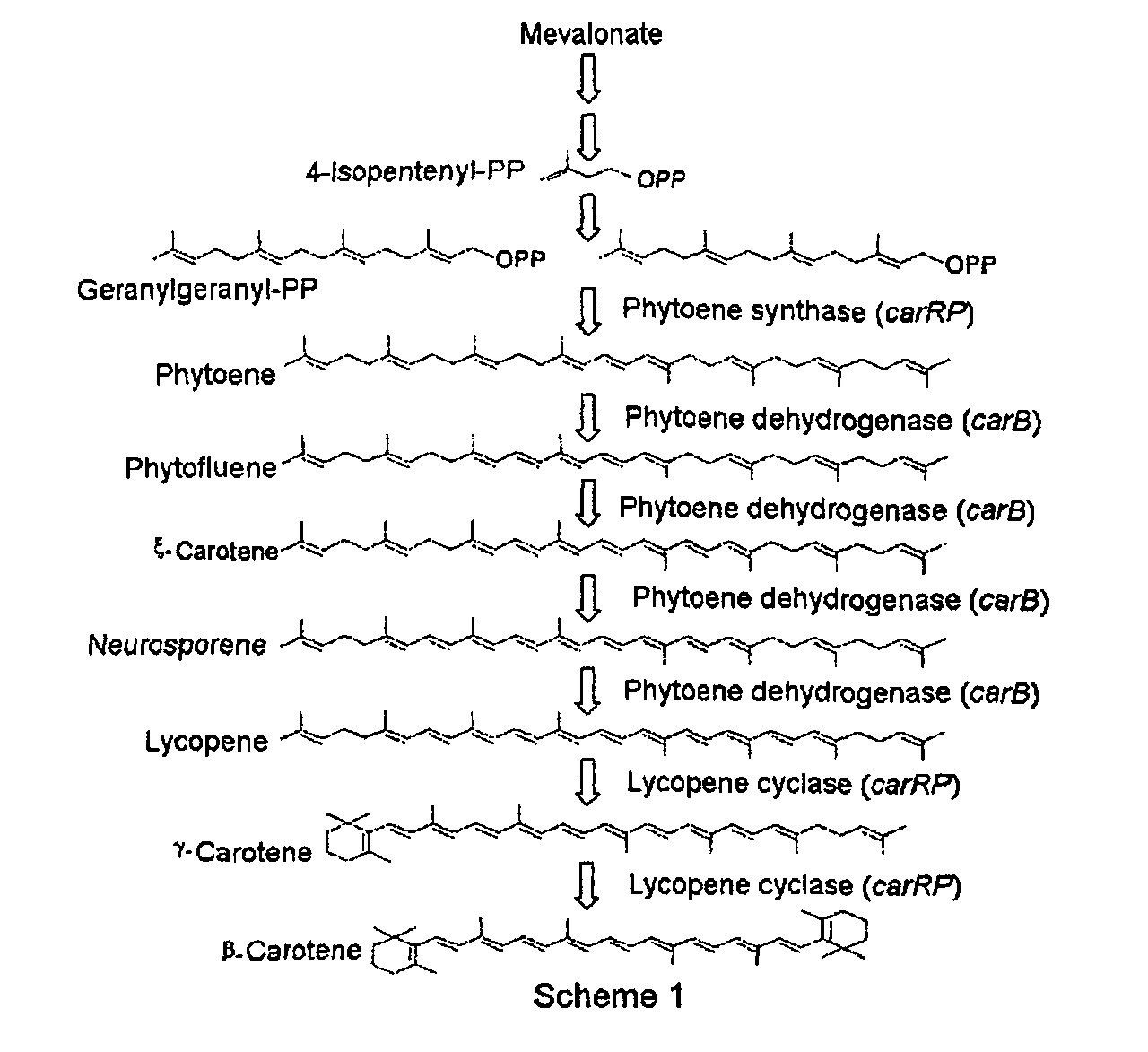
- One of the systems used in industrial microbiology for selecting strains is based on flow cytometry. With this technique it is possible to select subpopulations of mutants from a heterogeneous population. To achieve this, non-destructive methods are used, such as measurement of fluorescence and of the scattering of light. Isolation of the mutants is effected by means of an accessory connected to the cytometer ("Sort") that permits cell sorting and separation. Selection of subpopulations is based on measurement of particular parameters that are related directly or indirectly to the yield. Flow cytometry is particularly useful for biological samples whose product of interest is autofluorescent. Although β-carotene is not actually a fluorescent molecule, when it is excited with an argon laser at a wavelength of 488 nm, as it returns from the excited state to its base state the energy loss gives rise to a process of radiation transfer which is detected at a wavelength above 600 nm. This property permits the direct selection of the mutants of interest.
- The production of β-carotene by fermentation of B. trispora is described in patents US 3522146, SU 1592327, RU 2053301 and US 5422247. Patent US 5422247 claims the production of 3.5 to 7 g/l of β-carotene using selected strains of B. trispora in specific fermentation conditions. The present patent describes new methods of selection of strains and improved conditions of fermentation that make it possible to produce 9 g/l of β-carotene.
- The present invention describes a series of methods for obtaining high yields of β-carotene with the fungus B. trispora. The invention consists of (i) the design of methods for the production and selection of mutants of B. trispora that are overproducers of β-carotene and (ii) the development of improved conditions of fermentation. B. trispora is a fungus that is of considerable industrial importance for the biotechnological production of β-carotene. In fact, this process proves to be competitive with the synthetic method used industrially at present.
- With the aim of obtaining strains that are overproducers of β-carotene, in the first place a mutagenic method was developed for the (+) and (-) strains of B. trispora with the mutagenic agents ethylmethane sulphonate (EMS) and N-methyl-N'-nitro-N-nitrosoguanidine (NTG). The suspensions of spores for mutation were obtained from slants with YpSs medium. The spores were resuspended by adding 10 ml of a solution of Triton X-100 at 0.1% to each slant. The mycelium residues were removed by filtration through a nylon filter with a pore size of 20 µm. The concentration of spores in the suspension was about 106 spores/ml. The method of mutation with EMS consisted of incubating 106 spores/ml in a 3% EMS solution in 0.1 M sodium phosphate buffer pH 7.0 at room temperature for 60 minutes, achieving mortality rates of around 99%. The mutated spores were washed three times with 0.1% Triton X-100 and centrifuged at 3000 rpm at 15°C for 2 minutes. The method of mutation with NTG consisted of incubating 106 spores/ml in a solution that contained 250 µg/ml of NTG and 0.1 M sodium citrate buffer pH 5.0 at room temperature for 30 minutes, achieving mortality rates of around 95%. The mutated spores were washed three times with 0.1% Triton X-100 and centrifuged at 3000 rpm at 15°C for 2 minutes. Petri dishes containing Sutter IV solid medium supplemented with 0.1% Triton X-100 were seeded with the mutated spores and incubated at 25°C for 4 days to obtain isolated colonies.
- The strategies employed for selecting B. trispora (-) strains that are overproducers of β-carotene were as follows: (i) use of the cell selection technique based on fluorescence (FACS, fluorescent activated cell sorting), (ii) the lower yield of γ-carotene and other carotenoids and (iii) the color intensity of the colony. For selecting β-carotene-producing mutants using FACS, the mutated spores were grown on PDA medium, were washed with 0.1% Triton X-100 and were analyzed in a flow cytometer combined with a cell sorter and separator ("FACSort", Fluorescent Activated Cell Sorting) . Using this technique, it is possible to select the subpopulation of mutants with the highest levels of autofluorescence. Although β-carotene is not actually a fluorescent molecule, when it is excited with an argon laser at 488 nm it emits fluorescent radiation that is detected at a wavelength above 600 nm. In this way, the autofluorescence detected is proportional to the content of β-carotene in the spore.
- The selected spores were seeded on PDA medium (Difco) and were incubated at 25°C, observing that the mutants that are overproducers of β-carotene became a deep orange in color. Selection of β-carotene-producing mutants as a function of their lower yield of γ-carotene and other carotenoids was effected in the following way: the subpopulation of mutants with higher level of autofluorescence isolated by means of FACSort was fermented in liquid medium with the aim of determining the yields of β-carotene in mixed culture. Once fermentation had ended, β-carotene and other carotenoids were quantified by HPLC. In this way, mutants were selected that exhibited (i) a higher yield of β-carotene and (ii) a lower yield of γ-carotene and other carotenoids. Applying both methods with the VKPM F-744 (-) strain, we selected the strains CMA1 (-), CMA2 (-), CMA3 (-) and CMA4 (-) (Scheme 2).

-
Scheme 2. Phylogeny of the strains of B. trispora (-) obtained from B. trispora VKPM F-208 (-) using methods of mutation and selection. UV ultraviolet, SN natural selection, NTG N-methyl-N'-nitro-N-nitrosoguanidine, EMS ethylmethane sulphonate, FACS fluorescent activated cell sorting. - The following system of symbols was used for designating the strains selected: CM = carotene minus (-), CP = carotene plus (+). The relation between parent generations follows alphabetical order: A is the parent of B, B is the parent of C, etc. The number given after the letters corresponds to the number of the mutant. For example, the designation CMA1 (-) signifies that it is a carotene-producing strain (C), minus (M), parent of CMB and
mutant number 1. In the same way, CMA1 (-), CMA2 (-), CMA3 (-) and CMA4 (-) correspond tomutants - Selection of β-carotene-producing mutants as a function of the color intensity of the colony was carried out in the following way: the mutated spores of the CMA1 (-) strain were seeded on dishes of YEPDA solid medium and, once grown, those colonies that had a deeper yellowish-orange color than the CMA1 (-) parent strain were selected. In this way, 2 colonies with a deep yellowish-orange color were isolated, designated CMB1 (-) and CMB2 (-).
- Selection of β-carotene-overproducing mutants of B. trispora (+) was effected by growing mutated spores on Petri dishes containing Sutter IV solid medium. Next, a portion from each of the colonies was transferred to a dish of PDA on which B. trispora (-) had been seeded previously. The yield of β-carotene on solid medium was estimated as a function of the color intensity in the zone of intersection of the colony of the (+) strain with that of the (-) strain. In this way, the strain B. trispora CPA1 (+) was selected (Scheme 3), which gave rise to a higher yield of β-carotene in mixed solid cultures with a series of (-) strains. The yield of the B. trispora CPA1 (+) strain was then analyzed in mixed culture on liquid medium.

-
Scheme 3. Phylogeny of the strains of B. trispora (+) obtained from B. trispora VKPM F-117 (+) using methods of mutation and selection. UV ultraviolet, SN natural selection, NTG N-methyl-N'-nitro-N-nitrosoguanidine, EMS ethylmethane-sulphonate. - The (+) and (-) strains of B. trispora selected on solid medium were fermented in a flask with the aim of determining the yield of β-carotene in liquid medium and mixed culture. For this, separate flasks of inoculum of the (+) and (-) strains were grown and then a mixed fermentation of the two strains was carried out in the flask. Once fermentation had ended (around 6 days), the mycelium of B. trispora was lysed by vortex agitation, the β-carotene was extracted with organic solvents (e.g. acetone) and its concentration and purity were determined by HPLC. The yields obtained varied between 6.0 and 7.0 g/l.
- The selected strains were cultivated in pilot-plant fermenters for the purpose of determining the yield of β-carotene. For this, they were grown separately in flasks, transferred separately to intermediate growing tanks and finally they were fermented together. The fermentation was incubated for 100-140 hours. The mean yields of β-carotene obtained in a series of different fermentations were 7.2 g/l for the CPA1 (+) / CMA3 (-) strains and 6.8 g/l for the CPA1 (+) / CMB2 (-) strains. When, in the fermentation of the CPA1 (+) / CMA3 (-) strains, the age of the inocula was reduced from 48 to 46 hours, it was found that its yield had increased to 7.7 g/l. Similarly, when in the fermentation of the CPA1 (+) / CMB2 (-) strains the age of the inocula was reduced from 48 to 46 hours, it was found that its yield had increased to 7.1 g/l. Next, we succeeded in increasing the yield of β-carotene from the CPA1 (+) / CMA3 (-) strains by establishing an optimum program of addition of β-ionone. In this way, yields were attained in the range of 8.7 g/l. Finally, a fermentation system with oxygen injection was developed, and this made it possible (i) to increase the yield of β-carotene up to at least 9 g/l in fermentations of the CPA1 (+) / CMA3 (-) strains and (ii) to reduce the accumulation of γ-carotene and other carotenoids.
- The strains of Blakeslea trispora have been deposited, in accordance with the provisions of the Treaty of Budapest, in the Russian National Collection of Industrial Microorganisms (VKPM), GNII Genetika,
Dorozhny Proezd 1, Moscow 113545 (Russia), with the following numbers and dates: VKPM F-117 on 21.12.1979, VKPM F-208 on 20.12.1979, VKPM F-551 on 19.11.1992, VKPM F-674 on 19.11.1992, VKPM F-726 on 21.01.1997, VKPM F-727 on 21.01.1997, VKPM F-736 on 07.10.1997, VKPM F-741 on 28.01.1998, VKPM F-744 on 28.01.1998 and VKPM F-816 on 13.12.2000. - The following examples describe the present invention in detail and without limitation.
- Firstly a mutagenic method was developed for the (+) and (-) strains of B. trispora, for which the following were analyzed: (i) various types of mutagenic agents, (ii) concentration of the mutagen, (iii) concentration of spores, (iv) incubation pH, and (v) treatment time. In this way, ethylmethane sulphonate (EMS) and N-methyl-N'-nitro-N-nitrosoguanidine (NTG) were selected as mutagenic agents.
- The suspensions of spores to be mutated were obtained from slants with YpSs medium, which has the following composition: yeast extract 4 g/l, soluble starch 15 g/l, K2HPO4 1 g/l, MgSO4·7H2O 0.5 g/l and agar 15 g/l, at a final pH of 5.8. The spores were resuspended by adding 10 ml of a 0.1% solution of Triton X-100 to each slant. The mycelium residues were removed by filtration through a nylon filter with pore size of 20 µm. The concentration of spores in the suspension was about 106 spores/ml.
- The method of mutation with EMS consisted of incubating 106 spores/ml in a solution of EMS at 3% in 0.1 M sodium phosphate buffer pH 7.0 at room temperature for 60 minutes, achieving mortality rates of around 99%. The mutated spores were washed three times with 0.1% Triton X-100, centrifuging at 15°C and 3000 rpm for 2 minutes.
- The method of mutation with NTG consisted of incubating 106 spores/ml in a solution that contained 250 µg/ml of NTG and 0.1 M sodium citrate buffer pH 5.0 at room temperature for 30 minutes, achieving mortality rates of around 95%. The mutated spores were washed three times with 0.1% Triton X-100, centrifuging at 15°C and 3000 rpm for 2 minutes.
- The mutated spores were used for seeding Petri dishes that contained Sutter IV solid medium supplemented with 0.1% Triton X-100. The composition per liter of the Sutter IV medium is as follows: 40 g glucose, 4 g L-asparagine, 10 g KH2PO4, 40 ml of solution of trace elements 50x, and 30 g of agar. The solution of trace elements 50x is made up of: 25 g/l of MgSO4·7H2O, 1.82 g/l of CaCl2 2H2O, 0.05 g/l of thiamine, 0.1 g/l of citric acid, 0.075 g/l of Fe(NO3)3·9H2O, 0.05 g/l of ZnSO4·7H2O, 0.17 g/l of MnSO4·H2O, 0.025 g/l of CuSO4·5H2O and 0.025 g/l of NaMoO4·2H2O. The seeded dishes were incubated at 25°C for 4 days to obtain isolated colonies.
- This example describes strategies for selecting β-carotene-overproducing strains of B. trispora (-) based on (i) use of the cell selection technique based on fluorescence (FACS, fluorescent activated cell sorting), (ii) lower yield of γ-carotene and other carotenoids and (iii) the color intensity of the colony. The phylogeny of the B. trispora (-) strains used in the present invention is shown in
Scheme 2. - Selection of β-carotene-producing mutants by means of FACS was carried out starting from spores mutated with EMS as described in example 1. The mutated spores were seeded on PDA solid medium and were incubated at 25°C for 7 days. At the end of this time, the spores were collected by centrifugation and were washed twice with a 0.1% solution of Triton X-100. Each dish was suspended in a final volume of 1 ml. The mutant spores of B. trispora were analyzed by flow cytometry in a FACSort instrument (Becton Dickinson). Excitation was effected with an argon laser at 488 nm, evaluating the following parameters: forward scattering (FSC), side scattering (SSC) and fluorescence emission starting from 600 nm (by using the FL3 detector). Mutants that are overproducers of β-carotene were selected by purification of the subpopulation of spores that possessed the highest levels of autofluorescence in the FL3 detector. The spores isolated in this way were seeded on PDA medium with the aim of obtaining isolated colonies. The yield of each of the colonies was analyzed by flask fermentation in mixed culture with the B. trispora CPA1 (+) strain as described in example 4. The results obtained with 10 mutant colonies were as follows: 5 colonies (50%) displayed a significant increase in β-carotene yield relative to the B. trispora VKPM F-744 (-) parent strain, 30% of the colonies displayed yields similar to the parent strain and the remaining 20% produced smaller quantities than the parent strain (Fig. 1). Of the 5 mutants that had an increased yield of β-carotene (CMA1 (-), CMA2 (-), CMA3 (-), CMA4 (-) and F9 (-)), only one of them (F9 (-)) had higher levels of γ-carotene and other carotenoids, and was therefore discarded. The strain with the highest purity and yield of β-carotene was CMA1 (-), and it was therefore selected as the parent strain of the next cycle of mutation (Scheme 2).
- Selection of mutants that are overproducers of β-carotene as a function of the color intensity of the colony was carried out as follows: the CMA1 (-) strain was submitted to mutagenesis as described in example 1. The mutated spores were seeded on dishes of YEPDA solid medium (bacto-peptone 20 g/l, yeast extract 10 g/l, glucose 20 g/l and agar 20 g/l, at a final pH of 6.0), incubated at 25°C for 24 hours and then at 20°C for 48-72 hours. Finally, those colonies were selected that possessed a deeper yellowish-orange color than the CMA1 (-) parent strain. In this
way 2 colonies with deep orange color were isolated, designated CMB1 (-) and CMB2 (-), which might be overproducers of β-carotene. The yield level of the B. trispora strains CMA1 (-), CMA2 (-), CMA3 (-), CMA4 (-), CMB1 (-) and CMB2 (-) was then analyzed in mixed culture with the CPA1 (+) strain on liquid medium as described in examples 4, 5, 6 and 7.Scheme 2 shows the phylogeny of the strains of B. trispora (-) used in the present invention. - Selection of β-carotene-overproducing mutants of B. trispora (+) was effected using mutated spores as described in example 1. These spores were seeded on Petri dishes that contained Sutter IV solid medium and were incubated at 25°C for 7 days to obtain isolated colonies. Next, a portion from each of the colonies was transferred to a dish of PDA medium on which B. trispora (-) had been seeded previously. The distance between the seeding points of the (+) and (-) strains must be approximately 2 cm. The yield of β-carotene in solid medium is estimated from the intensity of coloration in the zone of intersection of the colony of the (+) strain with that of the (-) strain. In this way the B. trispora strain CPA1 (+) was selected, and this gave rise to a higher yield of β-carotene in mixed solid cultures with a series of (-) strains. The yield of the B. trispora strain CPA1 (+) was then analyzed in mixed culture in a liquid medium as described in examples 4, 5, 6 and 7.
Scheme 3 shows the phylogeny of the B. trispora (+) strains used in the present invention. - The (+) and (-) strains of B. trispora selected as described in examples 1, 2 and 3 were fermented in a flask with the aim of determining the level of production of β-carotene in a liquid medium and mixed culture. For this, an inoculum medium was prepared with the following composition per liter: 23 g of soya flour, 47 g of maize flour, 0.5 g of KH2PO4 and 0.002 g of thiamine hydrochloride. The pH was adjusted to 6.3. The (+) strain was seeded in 500-ml flasks containing 67 ml of medium at the rate of 103 spores per ml. The (- ) strain was seeded in 500-ml flasks containing 100 ml of medium at a rate of 104 spores per ml. Both types of inoculum were incubated at 25°C and 250 rpm for 44 hours.
- The fermentation medium has the following composition per liter: 44 g of soya flour, 19 g of maize flour, 10 g of orange flour, 0.5 g of KH2PO4, 0.28 g of isoniazid, 0.002 g of thiamine hydrochloride, 10 g of lecithin and 100 g of vegetable oil. The pH was adjusted to 6.3. The medium was distributed in 250-ml Erlenmeyer flasks, at the rate of 20 ml per flask. The flasks containing the fermentation medium were inoculated with 10% of a mixture of the (+) and (-) strains in the
ratio 1/10. The flasks were incubated at 25°C and 250 rpm and, at 48 hours, β-ionone was added at a rate of 1 ml per liter of culture medium. At the end of fermentation (6 days), a mixture of fermentation medium and methylene chloride / methanol (1/1) was prepared. Mixing with the solvent caused lysis of the mycelium of B. trispora, thus releasing the intracellular β-carotene. The β-carotene was extracted in the organic phase and was then diluted in acetone. The concentration and purity of the β-carotene were determined using reversed-phase HPLC. - The yields obtained in mixed fermentations of the CPA1 (+) strains with the CMA1 (-), CMA2 (-), CMA3 (-), CMA4 (-), CMB1 (-) and CMB2 (-) strains varied between 6.0 and 7.0 g/l (Fig. 1).
- The B. trispora strains CMA1 (-), CMA2 (-), CMA3 (-), CMB1 (-) and CMB2 (-), selected as described in examples 2, 3 and 4, were cultivated in pilot-stage fermenters together with the CPA1 (+) strain for the purpose of determining the yield of β-carotene. For this, an inoculum medium was prepared with the following composition per liter: 23 g of soya flour, 47 g of maize flour, 0.5 g of KH2PO4, 0.002 g of thiamine hydrochloride. The pH was adjusted to 6.3. The (+) and (-) strains were seeded separately in 2000-ml flasks containing 500 ml of medium and were incubated at 25°C and 250 rpm for 44-48 hours.
- Each of the strains was transferred at 0.1% to a vegetative growing tank containing a culture medium with the following composition per liter: 29 g of Pharmamedia, 47 g of maize flour, 0.5 g of KH2PO4, 0.002 g of thiamine hydrochloride and 1 g of antifoaming agent, and its pH was adjusted to 6.0. The (+) strain was incubated at 25-27°C with aeration of 0.66 v/v/m (volume/volume/minute) and the (-) strain at 27-29°C with aeration of 1.5 v/v/m. These differences in the incubation conditions give rise to differences in growth of the two strains, so that at the time of mixing in the fermenter the physiological state is suitable for achieving a maximum yield.
- After incubating for 46 h, the (+) and (-) strains were mixed in the
ratio 1/10, and 10% of the mixture was used for seeding the fermentation medium, which had the following composition per liter: 50 g of soya flour, 25 g of maize flour, 15 g of orange flour, 0.5 g of KH2PO4, 0.28 g of isoniazid, 0.002 g of thiamine hydrochloride, 10 g of soya lecithin, 80 g of vegetable oil and 0.175 g of antifoaming agent, with initial pH adjusted to 5.9. The fermentation was incubated for 120-140 hours at a temperature of 25-28°C with stirring varying between 150 and 250 rpm and aeration of 1-1.5 v/v/m. The pH was controlled with ammonia or phosphoric acid. Between the 40th and 50th hours of fermentation, 10 g of a 10% solution of β-ionone in vegetable oil was added per liter of fermentation medium. Similarly, between the 70th and 80th hours of fermentation, 10 g of a 10% solution of ethoxyquin in vegetable oil was added per liter of fermentation medium. - The concentration and purity of the β-carotene at the end of fermentation were evaluated as described in example 4. The results obtained are shown in Fig. 2. The average yield of β-carotene obtained in a series of different fermentations of the CPA1 (+) and CMA3 (-) strains was 7.2 g/l in the fermenter that proceeded from inocula incubated for 48 hours and 7.7 g/l when the inocula had been incubated for 46 hours. The yield of the CPA1 (+) and CMB2 (-) strains was 6.8 g/l in the fermenter that proceeded from inocula incubated for 48 hours and 7.1 g/l when the inocula had been incubated for 46 hours. This means that a decrease of 2 hours in the incubation time of the inoculum increased the yield of β-carotene by around 5-7%. This example clearly demonstrates how the yield of β-carotene is influenced by (i) the incubation time and (ii) the growing conditions established for each of the two strains.
- The CPA1 (+) and CMA3 (-) strains, selected as described in examples 2, 3 and 4, were cultivated in a pilot-stage fermenter with the aim of determining the yield of β-carotene. The fermentation conditions (inocula, vegetative growing tanks and fermenter) were as described in example 5, but with a different program of addition of β-ionone.
- The program of addition of β-ionone established in example 5 consisted of supplying, between the 40th and 50th hours of fermentation, 10 g of a 10% solution of β-ionone in vegetable oil per liter of fermentation medium. In this case a new series of programs of addition was analyzed, obtaining the following improved results: 10 g of a 10% solution of β-ionone in vegetable oil per liter of fermentation medium between the 40th and 50th hours of fermentation, a further 10 g per liter between the 60 and 70th hours of fermentation and another 5 g per liter between the 100th and 105th hours of fermentation.
- The concentration and purity of the β-carotene at the end of fermentation were evaluated as described in example 4. The average yield of β-carotene obtained in a series of different fermentations of the CPA1 (+) and CMA3 (-) strains was 7.2 g/l using the program of addition of β-ionone described in example 5 and 8.7 g/l with the improved program described in the present example. These results confirm that there is a close relation between the program of addition of β-ionone and the yield of β-carotene.
- The strains of B. trispora CPA1 (+) and VKPM F-744 (-), selected as described in examples 2 and 3, were cultivated in a pilot-stage fermenter with the aim of determining the yield of β-carotene. The fermentation conditions (inocula, intermediate growing tanks and fermenter) were as described in example 5, but increasing the quantity of oxygen dissolved in the fermentation medium by injection of oxygen.
- Standard fermentation (without extra addition of oxygen) was carried out with a pattern of stirring varying between 150 and 250 rpm and aeration of 1-1.5 v/v/m. In the case of fermentation with oxygen injection, the same conditions were employed except that the air entering the fermenter had been enriched with oxygen by connecting to bottles of pure oxygen. In this way the oxygen content of the air was increased from 21% to 24.5%. Oxygen supplementation was carried out between the 40th and 70th hours of fermentation. The average concentration of oxygen dissolved in the fermentation medium in the conditions with oxygen supplementation reached values of 49%, whereas this value was 34% without addition of oxygen.
- The concentration and purity of the β-carotene at the end of fermentation were evaluated as described in example 4. The average yield of β-carotene obtained in a series of different fermentations of the CPA1 (+) and VKPM F-744 (-) strains was 6.7 g/l without addition of oxygen and 7.1 g/l when oxygen was injected. This demonstrates that it is possible to increase the yield of β-carotene by supplying extra oxygen at those moments during fermentation when the concentration of oxygen dissolved in the fermentation medium is at its minimum. Applying this technology to the fermentation conditions established in example 6 for the CPA1 (+) and CMA3 (-) strains, yields greater than 9 g/l were obtained (Fig. 3).
- In addition, oxygen enrichment of the air entering the fermenter gave rise to a decrease in the yield of other unwanted carotenoids such as γ-carotene and β-zeacarotene. The average yield of γ-carotene (as a percentage relative to β-carotene) in the series of experiments previously described was 1.8% without oxygen injection and 1.2% with injection of oxygen. Moreover, the values for β-zeacarotene were 1.0% without oxygen injection and only 0.5% when oxygen was injected. It is concluded on the basis of these results that there is a close relation between oxygenation of the culture and (i) the increase in β-carotene yield and (ii) the decrease in levels of γ-carotene and β-zeacarotene.
-
- Fig. 1. Production of β-carotene by mixed flask fermentation of the CPA1 (+) strain of B. trispora with a series of (-) strains of B. trispora. Ordinate: g/l; Abscissa: F1, F2, etc., mutants selected with the FACsort system, from which CMA1, CMA2, CMA3 and CMA4 were chosen after flask fermentation (example 2). L25 (-) corresponds to VKPM F-744 (-).
- Fig. 2. Production of β-carotene by mixed fermentation of the CPA1 (+) strain of B. trispora with a series of (-) strains of B. trispora in a fermenter. Ordinate: % relative to the yield of L25 (-). L25 (-) corresponds to VKPM F-744 (-).
- Fig. 3. Production of β-carotene by mixed fermentation of the strains CPA1 (+) /L25 (-) and CPA1 (+) /CMA3 (-) in a fermenter without direct injection of oxygen (standard) or using direct injection of oxygen. Ordinate: g/l. L25 (-) corresponds to VKPM F-744 (-).
-
Claims (15)
- A method of production of β-carotene by fermentation with mixed cultures of (+) and (-) strains of B. trispora, characterized in that it consists of fermentations in which the age of the vegetative growth stages of the strains is controlled, both of the inoculum and of the primary cultures, β-ionone is added and, optionally, oxygen during the fermentation process.
- A method according to claim 1, characterized in that strains of B. trispora (-), mutants or transformants derived therefrom, which produce β-carotene, preferably those described in Scheme 2, are used together with the (+) strains.
- A method according to claim 1, characterized in that strains of B. trispora (+), mutants or transformants derived therefrom, which produce β-carotene, preferably those described in Scheme 3, are used together with the (-) strains.
- A method according to any one of the claims 1 to 3, characterized in that cultures whose incubation time prior to seeding is between 42 and 50 hours, preferably 46 hours, are used as the inoculum.
- A method according to any one of the claims 1 to 4, characterized in that cultures whose incubation time prior to seeding is between 35 and 55 hours, preferably between 44 and 48 hours, are employed as primary vegetatives.
- A method according to any one of the claims 1 to 5, characterized in that β-ionone is added in accordance with an automatic program from the 40th hour to the 105th hour of fermentation, during at least 3 cycles preferably between the 40th and 50th hours, 60th and 70th hours and 100th and 105th hours.
- A method according to claim 6, characterized in that the addition is of at least 10 g of a 10% solution of β-ionone in vegetable oil per liter of fermentation medium in each of the two first cycles considered and at least 5 g of the said solution per liter of fermentation medium in the third.
- A method according to any one of the claims 1 to 7, characterized in that oxygen is added from the start until the end of fermentation, preferably between the 40th and 70th hours.
- A method according to claim 8, where the average values of oxygen dissolved in the fermentation medium are maintained between 35% and 60% relative to the initial oxygen, preferably 50%.
- A method according to any one of the claims 1 to 9, characterized in that:(a) inocula of the (+) strain of B. trispora are seeded with a range of 800-1000 spores/ml.(b) inocula of the (-) strain of B. trispora are seeded with a range of 10 000 - 60 000 spores/ml.(c) the inocula of the (+) and (-) strains of B. trispora are cultivated for about 46 hours at 25°C.(d) primary culture phases of the (+) strain of B. trispora are seeded with about 0.1% (v/v) of the inoculum phase.(e) primary culture phases of the (-) strain of B. trispora are seeded with about 0.1% (v/v) of the inoculum phase.(f) the primary phases of the (+) strain of B. trispora are cultivated for about 44-48 hours at 26°C.(g) the primary phases of the (-) strain of B. trispora are cultivated for about 44-48 hours at 28°C.(h) the primary phases of the (+) and (-) strains of B. trispora are mixed in an approximate ratio of 1 (+) / 10 (-) (v/v).(i) each fermenter is seeded with 10% (v/v) of the mixture of the (+) and (-) strains of B. trispora described in paragraph h.(j) the mixed culture is incubated for 5-6 days at 26°C.
- A method according to any one of the claims 1 to 7, characterized in that a minimum of 6-8.7 g/l of β-carotene is produced in 5-6 days.
- A method according to claim 10, characterized in that at least 100 mg of β-carotene is produced per gram of dry weight of mycelium in 5-6 days.
- A method according to claim 10, characterized in that a minimum of 9 g/l of β-carotene is produced in 5-6 days, with addition of oxygen.
- A method according to claims 10 and 13, characterized in that levels of γ-carotene are produced that are below 1.2% of the β-carotene produced.
- A method according to claims 10 and 13, characterized in that levels of β-zeacarotene are produced that are below 0.5% of the β-carotene produced.
Applications Claiming Priority (3)
| Application Number | Priority Date | Filing Date | Title |
|---|---|---|---|
| ES200200202 | 2002-01-29 | ||
| ES200200202A ES2195766B1 (en) | 2002-01-29 | 2002-01-29 | BETA-CAROTENE PRODUCTION PROCEDURE FOR FERMENTATION IN MIXED CULTURE USING BLAPESLEA TRISPORA (+) 4 (-). |
| PCT/ES2003/000047 WO2003064673A1 (en) | 2002-01-29 | 2003-01-29 | Method of producing $g(b)-carotene by means of mixed culture fermentation using (+) and (-) strains of blakeslea trispora |
Publications (2)
| Publication Number | Publication Date |
|---|---|
| EP1367131A1 true EP1367131A1 (en) | 2003-12-03 |
| EP1367131B1 EP1367131B1 (en) | 2009-06-17 |
Family
ID=27635982
Family Applications (1)
| Application Number | Title | Priority Date | Filing Date |
|---|---|---|---|
| EP03708284A Expired - Lifetime EP1367131B1 (en) | 2002-01-29 | 2003-01-29 | Method of producing beta-carotene by means of mixed culture fermentation using (+) and (-) strains of blakeslea trispora |
Country Status (8)
| Country | Link |
|---|---|
| US (1) | US7252965B2 (en) |
| EP (1) | EP1367131B1 (en) |
| JP (1) | JP4290559B2 (en) |
| AT (1) | ATE434052T1 (en) |
| DE (1) | DE60327967D1 (en) |
| DK (1) | DK1367131T3 (en) |
| ES (2) | ES2195766B1 (en) |
| WO (1) | WO2003064673A1 (en) |
Cited By (8)
| Publication number | Priority date | Publication date | Assignee | Title |
|---|---|---|---|---|
| WO2005030976A2 (en) | 2003-09-26 | 2005-04-07 | Biosynergy Gmbh | Method for producing a carotinoid-containing biomass |
| WO2008108674A1 (en) | 2007-03-08 | 2008-09-12 | Biotrend - Inovação E Engenharia Em Biotecnologia, Sa | Production op high- purity carotenoids by fermenting selected bacterial strains |
| US7851199B2 (en) | 2005-03-18 | 2010-12-14 | Microbia, Inc. | Production of carotenoids in oleaginous yeast and fungi |
| EP2712928A4 (en) * | 2011-05-20 | 2014-04-02 | Zhejiang Med Xinchang Pharm | PROCESS FOR THE PRODUCTION OF NATURAL CARBOHYDRATE BY FERMENTATION AND ITS APPLICATIONS |
| US8691555B2 (en) | 2006-09-28 | 2014-04-08 | Dsm Ip Assests B.V. | Production of carotenoids in oleaginous yeast and fungi |
| DE102014208876A1 (en) | 2014-05-12 | 2015-11-12 | Hochschule Anhalt | Process for the preparation of carotenoids by submerged fermentation with mixed cultures of (+) and (-) strains of the fungus Blakeslea trispora |
| WO2021019101A1 (en) | 2019-08-01 | 2021-02-04 | Dsm Ip Assets B.V. | Beta-carotene fermentation method |
| WO2022090547A1 (en) | 2020-10-30 | 2022-05-05 | Dsm Ip Assets B.V. | Production of carotenoids by fermentation |
Families Citing this family (4)
| Publication number | Priority date | Publication date | Assignee | Title |
|---|---|---|---|---|
| US9682932B2 (en) | 2010-05-17 | 2017-06-20 | Dynadis Biotech India Private Limited | Process for production of high purity beta-carotene and lycopene crystals from fungal biomass |
| CN107937469B (en) * | 2018-01-11 | 2020-08-11 | 嘉必优生物技术(武汉)股份有限公司 | A kind of fermentation method and application of B. trispora to produce carotenoid |
| CN111690541B (en) * | 2019-03-13 | 2023-04-25 | 浙江创新生物有限公司 | Paired natural beta-carotene high-yield strain, and preparation method and application thereof |
| CN112029811A (en) * | 2020-07-29 | 2020-12-04 | 济宁学院 | A kind of method for improving the yield of β-carotene produced by fermentation of B. trispora |
Family Cites Families (5)
| Publication number | Priority date | Publication date | Assignee | Title |
|---|---|---|---|---|
| FR1371272A (en) * | 1963-07-16 | 1964-09-04 | Rhone Poulenc Sa | Beta-carotene production process |
| US5328845A (en) * | 1992-03-27 | 1994-07-12 | Universal Foods Corporation | Fungal negative microorganism capable of producing high levels of beta-carotene |
| IL104736A0 (en) * | 1992-03-27 | 1993-06-10 | Zeagen Inc | Method for producing beta-carotene using a fungal mated culture |
| CN1079001A (en) * | 1992-04-03 | 1993-12-01 | 吉斯特·布罗卡迪斯公司 | Intersexual heterozygous phycomyces |
| ES2168971B1 (en) * | 2000-07-19 | 2003-11-01 | Antibioticos Sau | BETA-CAROTENE PRODUCTION PROCEDURE. |
-
2002
- 2002-01-29 ES ES200200202A patent/ES2195766B1/en not_active Expired - Fee Related
-
2003
- 2003-01-23 US US10/469,190 patent/US7252965B2/en not_active Expired - Lifetime
- 2003-01-29 DE DE60327967T patent/DE60327967D1/en not_active Expired - Lifetime
- 2003-01-29 JP JP2003564264A patent/JP4290559B2/en not_active Expired - Lifetime
- 2003-01-29 DK DK03708284T patent/DK1367131T3/en active
- 2003-01-29 WO PCT/ES2003/000047 patent/WO2003064673A1/en not_active Ceased
- 2003-01-29 ES ES03708284T patent/ES2327911T3/en not_active Expired - Lifetime
- 2003-01-29 AT AT03708284T patent/ATE434052T1/en not_active IP Right Cessation
- 2003-01-29 EP EP03708284A patent/EP1367131B1/en not_active Expired - Lifetime
Non-Patent Citations (1)
| Title |
|---|
| See references of WO03064673A1 * |
Cited By (15)
| Publication number | Priority date | Publication date | Assignee | Title |
|---|---|---|---|---|
| WO2005030976A3 (en) * | 2003-09-26 | 2005-09-29 | Knoell Hans Forschung Ev | Method for producing a carotinoid-containing biomass |
| WO2005030976A2 (en) | 2003-09-26 | 2005-04-07 | Biosynergy Gmbh | Method for producing a carotinoid-containing biomass |
| US7851199B2 (en) | 2005-03-18 | 2010-12-14 | Microbia, Inc. | Production of carotenoids in oleaginous yeast and fungi |
| US9909130B2 (en) | 2005-03-18 | 2018-03-06 | Dsm Ip Assets B.V. | Production of carotenoids in oleaginous yeast and fungi |
| US9297031B2 (en) | 2006-09-28 | 2016-03-29 | Dsm Ip Assets B.V. | Production of carotenoids in oleaginous yeast and fungi |
| US8691555B2 (en) | 2006-09-28 | 2014-04-08 | Dsm Ip Assests B.V. | Production of carotenoids in oleaginous yeast and fungi |
| US20100145116A1 (en) * | 2007-03-08 | 2010-06-10 | Frederik Van Keulen | Production of High-Purity Carotenoids by Fermenting Selected Bacterial Strains |
| WO2008108674A1 (en) | 2007-03-08 | 2008-09-12 | Biotrend - Inovação E Engenharia Em Biotecnologia, Sa | Production op high- purity carotenoids by fermenting selected bacterial strains |
| EP2712928A4 (en) * | 2011-05-20 | 2014-04-02 | Zhejiang Med Xinchang Pharm | PROCESS FOR THE PRODUCTION OF NATURAL CARBOHYDRATE BY FERMENTATION AND ITS APPLICATIONS |
| DE102014208876A1 (en) | 2014-05-12 | 2015-11-12 | Hochschule Anhalt | Process for the preparation of carotenoids by submerged fermentation with mixed cultures of (+) and (-) strains of the fungus Blakeslea trispora |
| WO2015173236A1 (en) * | 2014-05-12 | 2015-11-19 | Hochschule Anhalt | Process for preparing carotenoids by submerged fermentation with mixed cultures of (+) and (-) strains of the fungus blakeslea trispora |
| DE102014208876B4 (en) | 2014-05-12 | 2018-10-31 | Jäckering Research GmbH | Process for the preparation of carotenoids by submerged fermentation with mixed cultures of (+) and (-) strains of the fungus Blakeslea trispora |
| WO2021019101A1 (en) | 2019-08-01 | 2021-02-04 | Dsm Ip Assets B.V. | Beta-carotene fermentation method |
| US12270065B2 (en) | 2019-08-01 | 2025-04-08 | Dsm Ip Assets B.V. | Methods for improving titer and purity of beta carotene fermentation in Blakeslea trispora (beta-carotene fermentation method) |
| WO2022090547A1 (en) | 2020-10-30 | 2022-05-05 | Dsm Ip Assets B.V. | Production of carotenoids by fermentation |
Also Published As
| Publication number | Publication date |
|---|---|
| WO2003064673A1 (en) | 2003-08-07 |
| US20040152154A1 (en) | 2004-08-05 |
| ATE434052T1 (en) | 2009-07-15 |
| EP1367131B1 (en) | 2009-06-17 |
| DE60327967D1 (en) | 2009-07-30 |
| US7252965B2 (en) | 2007-08-07 |
| DK1367131T3 (en) | 2009-10-05 |
| JP4290559B2 (en) | 2009-07-08 |
| ES2327911T3 (en) | 2009-11-05 |
| ES2195766B1 (en) | 2005-04-01 |
| ES2195766A1 (en) | 2003-12-01 |
| JP2005515786A (en) | 2005-06-02 |
Similar Documents
| Publication | Publication Date | Title |
|---|---|---|
| US8911966B2 (en) | Efficient astaxanthin production strains derived from Haematococcus pluvialis | |
| Johnson et al. | Astaxanthin from microbial sources | |
| EP1471151B1 (en) | Improved method of production of lycopene by the fermentation of selected strains of blakeslea trispora. | |
| AU778626B2 (en) | Process for producing carotenoid pigments | |
| EP1367131B1 (en) | Method of producing beta-carotene by means of mixed culture fermentation using (+) and (-) strains of blakeslea trispora | |
| AU2004274750B2 (en) | Process for producing carotenoid compound | |
| JPH06237759A (en) | Mutant of phaffia rhodozyma, production of beta-carotene and use of biomass containing high beta-carotene | |
| US8361743B2 (en) | Biological production of zeaxanthin and carotenoid biosynthesis control | |
| Iturriaga et al. | Structure and function of the genes involved in the biosynthesis of carotenoids in the mucorales | |
| EP1995325A1 (en) | Efficient astaxanthin production strains derived from Haematococcus pluvialis | |
| CN111690541B (en) | Paired natural beta-carotene high-yield strain, and preparation method and application thereof | |
| JP2005087099A (en) | Process for producing β-carotene | |
| WO2004001057A1 (en) | Process for producing carotenoids | |
| JPH05219983A (en) | Zeaxanthin production method | |
| KR20050021993A (en) | Process for producing carotenoids |
Legal Events
| Date | Code | Title | Description |
|---|---|---|---|
| PUAI | Public reference made under article 153(3) epc to a published international application that has entered the european phase |
Free format text: ORIGINAL CODE: 0009012 |
|
| 17P | Request for examination filed |
Effective date: 20030909 |
|
| AK | Designated contracting states |
Kind code of ref document: A1 Designated state(s): AT BE BG CH CY CZ DE DK EE ES FI FR GB GR HU IE IT LI LU MC NL |
|
| AX | Request for extension of the european patent |
Extension state: AL LT LV MK RO |
|
| RBV | Designated contracting states (corrected) |
Designated state(s): AT BE BG CH CY CZ DE DK EE ES FI FR GB GR HU IE IT LI LU MC NL PT SE SI SK TR |
|
| 17Q | First examination report despatched |
Effective date: 20061227 |
|
| GRAP | Despatch of communication of intention to grant a patent |
Free format text: ORIGINAL CODE: EPIDOSNIGR1 |
|
| GRAS | Grant fee paid |
Free format text: ORIGINAL CODE: EPIDOSNIGR3 |
|
| GRAA | (expected) grant |
Free format text: ORIGINAL CODE: 0009210 |
|
| AK | Designated contracting states |
Kind code of ref document: B1 Designated state(s): AT BE BG CH CY CZ DE DK EE ES FI FR GB GR HU IE IT LI LU MC NL PT SE SI SK TR |
|
| AX | Request for extension of the european patent |
Extension state: AL LT LV MK RO |
|
| REG | Reference to a national code |
Ref country code: GB Ref legal event code: FG4D |
|
| REG | Reference to a national code |
Ref country code: CH Ref legal event code: EP |
|
| REG | Reference to a national code |
Ref country code: IE Ref legal event code: FG4D |
|
| REF | Corresponds to: |
Ref document number: 60327967 Country of ref document: DE Date of ref document: 20090730 Kind code of ref document: P |
|
| REG | Reference to a national code |
Ref country code: DK Ref legal event code: T3 |
|
| REG | Reference to a national code |
Ref country code: CH Ref legal event code: NV Representative=s name: PATENTANWAELTE SCHAAD, BALASS, MENZL & PARTNER AG |
|
| PG25 | Lapsed in a contracting state [announced via postgrant information from national office to epo] |
Ref country code: FI Free format text: LAPSE BECAUSE OF FAILURE TO SUBMIT A TRANSLATION OF THE DESCRIPTION OR TO PAY THE FEE WITHIN THE PRESCRIBED TIME-LIMIT Effective date: 20090617 Ref country code: AT Free format text: LAPSE BECAUSE OF FAILURE TO SUBMIT A TRANSLATION OF THE DESCRIPTION OR TO PAY THE FEE WITHIN THE PRESCRIBED TIME-LIMIT Effective date: 20090617 |
|
| REG | Reference to a national code |
Ref country code: ES Ref legal event code: FG2A Ref document number: 2327911 Country of ref document: ES Kind code of ref document: T3 |
|
| LTIE | Lt: invalidation of european patent or patent extension |
Effective date: 20090617 |
|
| PG25 | Lapsed in a contracting state [announced via postgrant information from national office to epo] |
Ref country code: SI Free format text: LAPSE BECAUSE OF FAILURE TO SUBMIT A TRANSLATION OF THE DESCRIPTION OR TO PAY THE FEE WITHIN THE PRESCRIBED TIME-LIMIT Effective date: 20090617 Ref country code: SE Free format text: LAPSE BECAUSE OF FAILURE TO SUBMIT A TRANSLATION OF THE DESCRIPTION OR TO PAY THE FEE WITHIN THE PRESCRIBED TIME-LIMIT Effective date: 20090917 |
|
| PG25 | Lapsed in a contracting state [announced via postgrant information from national office to epo] |
Ref country code: CZ Free format text: LAPSE BECAUSE OF FAILURE TO SUBMIT A TRANSLATION OF THE DESCRIPTION OR TO PAY THE FEE WITHIN THE PRESCRIBED TIME-LIMIT Effective date: 20090617 Ref country code: EE Free format text: LAPSE BECAUSE OF FAILURE TO SUBMIT A TRANSLATION OF THE DESCRIPTION OR TO PAY THE FEE WITHIN THE PRESCRIBED TIME-LIMIT Effective date: 20090617 |
|
| PG25 | Lapsed in a contracting state [announced via postgrant information from national office to epo] |
Ref country code: BE Free format text: LAPSE BECAUSE OF FAILURE TO SUBMIT A TRANSLATION OF THE DESCRIPTION OR TO PAY THE FEE WITHIN THE PRESCRIBED TIME-LIMIT Effective date: 20090617 Ref country code: SK Free format text: LAPSE BECAUSE OF FAILURE TO SUBMIT A TRANSLATION OF THE DESCRIPTION OR TO PAY THE FEE WITHIN THE PRESCRIBED TIME-LIMIT Effective date: 20090617 |
|
| PG25 | Lapsed in a contracting state [announced via postgrant information from national office to epo] |
Ref country code: BG Free format text: LAPSE BECAUSE OF FAILURE TO SUBMIT A TRANSLATION OF THE DESCRIPTION OR TO PAY THE FEE WITHIN THE PRESCRIBED TIME-LIMIT Effective date: 20090917 |
|
| PLBE | No opposition filed within time limit |
Free format text: ORIGINAL CODE: 0009261 |
|
| STAA | Information on the status of an ep patent application or granted ep patent |
Free format text: STATUS: NO OPPOSITION FILED WITHIN TIME LIMIT |
|
| 26N | No opposition filed |
Effective date: 20100318 |
|
| PG25 | Lapsed in a contracting state [announced via postgrant information from national office to epo] |
Ref country code: MC Free format text: LAPSE BECAUSE OF NON-PAYMENT OF DUE FEES Effective date: 20100131 |
|
| PG25 | Lapsed in a contracting state [announced via postgrant information from national office to epo] |
Ref country code: GR Free format text: LAPSE BECAUSE OF FAILURE TO SUBMIT A TRANSLATION OF THE DESCRIPTION OR TO PAY THE FEE WITHIN THE PRESCRIBED TIME-LIMIT Effective date: 20090918 |
|
| PG25 | Lapsed in a contracting state [announced via postgrant information from national office to epo] |
Ref country code: IE Free format text: LAPSE BECAUSE OF NON-PAYMENT OF DUE FEES Effective date: 20100129 |
|
| PG25 | Lapsed in a contracting state [announced via postgrant information from national office to epo] |
Ref country code: CY Free format text: LAPSE BECAUSE OF FAILURE TO SUBMIT A TRANSLATION OF THE DESCRIPTION OR TO PAY THE FEE WITHIN THE PRESCRIBED TIME-LIMIT Effective date: 20090617 |
|
| PG25 | Lapsed in a contracting state [announced via postgrant information from national office to epo] |
Ref country code: LU Free format text: LAPSE BECAUSE OF NON-PAYMENT OF DUE FEES Effective date: 20100129 Ref country code: HU Free format text: LAPSE BECAUSE OF FAILURE TO SUBMIT A TRANSLATION OF THE DESCRIPTION OR TO PAY THE FEE WITHIN THE PRESCRIBED TIME-LIMIT Effective date: 20091218 Ref country code: PT Free format text: LAPSE BECAUSE OF FAILURE TO SUBMIT A TRANSLATION OF THE DESCRIPTION OR TO PAY THE FEE WITHIN THE PRESCRIBED TIME-LIMIT Effective date: 20091117 |
|
| PG25 | Lapsed in a contracting state [announced via postgrant information from national office to epo] |
Ref country code: TR Free format text: LAPSE BECAUSE OF FAILURE TO SUBMIT A TRANSLATION OF THE DESCRIPTION OR TO PAY THE FEE WITHIN THE PRESCRIBED TIME-LIMIT Effective date: 20090617 |
|
| REG | Reference to a national code |
Ref country code: ES Ref legal event code: PC2A Owner name: DSM IP ASSETS B.V. Effective date: 20130430 |
|
| REG | Reference to a national code |
Ref country code: CH Ref legal event code: PUE Owner name: DSM IP ASSETS B.V., NL Free format text: FORMER OWNER: VITATENE S.A., ES Ref country code: CH Ref legal event code: PCOW Free format text: NEW ADDRESS: PASEO INGERIERO SAENZ DE MIERA 50, 24009 LEON (ES) |
|
| REG | Reference to a national code |
Ref country code: NL Ref legal event code: SD Effective date: 20130913 |
|
| REG | Reference to a national code |
Ref country code: DE Ref legal event code: R082 Ref document number: 60327967 Country of ref document: DE Representative=s name: HEUMANN, JUERGEN, DE |
|
| REG | Reference to a national code |
Ref country code: FR Ref legal event code: TP Owner name: DSM IP ASSETS B.V., NL Effective date: 20130930 Ref country code: FR Ref legal event code: CA Effective date: 20130930 |
|
| REG | Reference to a national code |
Ref country code: DE Ref legal event code: R081 Ref document number: 60327967 Country of ref document: DE Owner name: DSM IP ASSETS B.V., NL Free format text: FORMER OWNER: VITATENE, S.A., LEON, ES Effective date: 20131014 Ref country code: DE Ref legal event code: R082 Ref document number: 60327967 Country of ref document: DE Representative=s name: HEUMANN, JUERGEN, DE Effective date: 20131014 |
|
| REG | Reference to a national code |
Ref country code: GB Ref legal event code: 732E Free format text: REGISTERED BETWEEN 20140717 AND 20140723 |
|
| REG | Reference to a national code |
Ref country code: FR Ref legal event code: PLFP Year of fee payment: 14 |
|
| REG | Reference to a national code |
Ref country code: FR Ref legal event code: PLFP Year of fee payment: 15 |
|
| REG | Reference to a national code |
Ref country code: FR Ref legal event code: PLFP Year of fee payment: 16 |
|
| PGFP | Annual fee paid to national office [announced via postgrant information from national office to epo] |
Ref country code: FR Payment date: 20201210 Year of fee payment: 19 |
|
| PGFP | Annual fee paid to national office [announced via postgrant information from national office to epo] |
Ref country code: CH Payment date: 20210113 Year of fee payment: 19 Ref country code: IT Payment date: 20201211 Year of fee payment: 19 Ref country code: NL Payment date: 20210113 Year of fee payment: 19 |
|
| PGFP | Annual fee paid to national office [announced via postgrant information from national office to epo] |
Ref country code: ES Payment date: 20210208 Year of fee payment: 19 Ref country code: GB Payment date: 20210120 Year of fee payment: 19 Ref country code: DK Payment date: 20210111 Year of fee payment: 19 Ref country code: DE Payment date: 20210119 Year of fee payment: 19 |
|
| REG | Reference to a national code |
Ref country code: DE Ref legal event code: R119 Ref document number: 60327967 Country of ref document: DE |
|
| REG | Reference to a national code |
Ref country code: DK Ref legal event code: EBP Effective date: 20220131 |
|
| REG | Reference to a national code |
Ref country code: CH Ref legal event code: PL |
|
| REG | Reference to a national code |
Ref country code: NL Ref legal event code: MM Effective date: 20220201 |
|
| GBPC | Gb: european patent ceased through non-payment of renewal fee |
Effective date: 20220129 |
|
| PG25 | Lapsed in a contracting state [announced via postgrant information from national office to epo] |
Ref country code: NL Free format text: LAPSE BECAUSE OF NON-PAYMENT OF DUE FEES Effective date: 20220201 Ref country code: GB Free format text: LAPSE BECAUSE OF NON-PAYMENT OF DUE FEES Effective date: 20220129 Ref country code: DE Free format text: LAPSE BECAUSE OF NON-PAYMENT OF DUE FEES Effective date: 20220802 |
|
| PG25 | Lapsed in a contracting state [announced via postgrant information from national office to epo] |
Ref country code: FR Free format text: LAPSE BECAUSE OF NON-PAYMENT OF DUE FEES Effective date: 20220131 |
|
| PG25 | Lapsed in a contracting state [announced via postgrant information from national office to epo] |
Ref country code: LI Free format text: LAPSE BECAUSE OF NON-PAYMENT OF DUE FEES Effective date: 20220131 Ref country code: CH Free format text: LAPSE BECAUSE OF NON-PAYMENT OF DUE FEES Effective date: 20220131 |
|
| PG25 | Lapsed in a contracting state [announced via postgrant information from national office to epo] |
Ref country code: IT Free format text: LAPSE BECAUSE OF NON-PAYMENT OF DUE FEES Effective date: 20220129 Ref country code: DK Free format text: LAPSE BECAUSE OF NON-PAYMENT OF DUE FEES Effective date: 20220131 |
|
| REG | Reference to a national code |
Ref country code: ES Ref legal event code: FD2A Effective date: 20230303 |
|
| PG25 | Lapsed in a contracting state [announced via postgrant information from national office to epo] |
Ref country code: ES Free format text: LAPSE BECAUSE OF NON-PAYMENT OF DUE FEES Effective date: 20220130 |