EP1367121A2 - Process for immobilizing polypeptides via the carboxyl group of the C-terminus - Google Patents
Process for immobilizing polypeptides via the carboxyl group of the C-terminus Download PDFInfo
- Publication number
- EP1367121A2 EP1367121A2 EP03253252A EP03253252A EP1367121A2 EP 1367121 A2 EP1367121 A2 EP 1367121A2 EP 03253252 A EP03253252 A EP 03253252A EP 03253252 A EP03253252 A EP 03253252A EP 1367121 A2 EP1367121 A2 EP 1367121A2
- Authority
- EP
- European Patent Office
- Prior art keywords
- protein
- general formula
- immobilization
- represented
- immobilized
- Prior art date
- Legal status (The legal status is an assumption and is not a legal conclusion. Google has not performed a legal analysis and makes no representation as to the accuracy of the status listed.)
- Granted
Links
Images


Classifications
-
- C—CHEMISTRY; METALLURGY
- C07—ORGANIC CHEMISTRY
- C07K—PEPTIDES
- C07K17/00—Carrier-bound or immobilised peptides; Preparation thereof
- C07K17/02—Peptides being immobilised on, or in, an organic carrier
- C07K17/06—Peptides being immobilised on, or in, an organic carrier attached to the carrier via a bridging agent
-
- C—CHEMISTRY; METALLURGY
- C07—ORGANIC CHEMISTRY
- C07K—PEPTIDES
- C07K14/00—Peptides having more than 20 amino acids; Gastrins; Somatostatins; Melanotropins; Derivatives thereof
- C07K14/001—Peptides having more than 20 amino acids; Gastrins; Somatostatins; Melanotropins; Derivatives thereof by chemical synthesis
Definitions
- the present invention relates to an immobilized protein.
- the present invention further relates to an orientation-controlled immobilized protein. More specifically, the present invention relates to effective production of an immobilized protein that is immobilized only at the carboxy terminus. Further, the present invention relates to a process for producing a protein array having an immobilized protein with a controlled orientation while being arrayed on a carrier for immobilization (a substrate or a basal plate).
- a cysteine residue has an SH group as a functional group, and disulfidation, alkylation, acylation, etc. are known as the reactions of the SH group. Utilization of these reactions enables the immobilization of proteins via a side chain of the cysteine residue.
- a lysine residue has an amino group as a side chain. This amino group can form an amide bond with a carboxyl group using carbodiimide.
- aspartic acid and glutamic acid have carboxyl groups, and thus, they can form an amide bond with a primary amine using carbodiimide.
- the immobilization reaction utilizing a functional group of a side chain has some problems. That is to say, for example, the reaction relies on the amino acid sequence of a protein, the immobilized site cannot be specified since a protein contains several amino acids of the same kind, and the possibility of immobilization at several sites cannot be eliminated.
- reaction formula (a) NH 2 -R-CO-NH-CH(CH 2 -SCN)-CO-X + NH 2 -B ⁇ NH 2 -R-CO-NH-B (wherein R represents a chain of arbitrary amino acid residues, X represents OH, an arbitrary amino acid residue, or a chain of arbitrary amino acid residues, and NH 2 -B represents an arbitrary primary amine compound).
- This amide bond formation reaction occurs competitively with the reaction between the cleavage reaction of a peptide chain represented by reaction formula (b): NH 2 -R-CO-NH-CH(CH 2 -SCN)-CO-X + H 2 O ⁇ NH 2 -R-COOH + Z (wherein R represents a chain of arbitrary amino acid residues, X represents OH, an arbitrary amino acid residue, or a chain of arbitrary amino acid residues, and Z represents a 2-immothiazoline-4-carboxylyl derivative of X) (see G. R. Jacobson, M. H. Schaffer, G. R. Stark, T. C. Vanaman, J.
- reaction fonnula (c): NH 2 -R-CO-NH-CH(CH 2 -SCN)CO-X ⁇ NH 2 -R-CO-NH-C(CH 2 )-CO-X (wherein R represents a chain of an arbitrary amino acid residue, and X represents OH, an arbitrary amino acid residue, or a chain of an arbitrary amino acid residue).
- reaction formula (a) has an advantage, that is, a protein can bind via one location at the carboxy terminus and via a main chain, the problem of immobilization yield was an issue of concern.
- An object of the present invention is to provide a process for binding a protein to a carrier by controlling its orientation and a protein binding carrier comprising a protein bound to the carrier while its orientation is controlled. More specifically, the present invention provides a process for binding a protein to a carrier by controlling its orientation utilizing the amide bond formation reaction via cyanocysteine, wherein a protein, which is prepared by fusing a protein containing a cysteine residue having a sulfhydryl group to a protein to be immobilized, is allowed to be adsorbed on a carrier for immobilization, the sulfhydryl group is cyanated using a cyanating reagent, and the protein of interest is then immobilized.
- the present invention enables the protein to be previously arrayed and adsorbed on the carrier utilizing, for example, the principle of ink jet printers. Accordingly, it is an object of the present invention to provide a process for obtaining a protein array by binding a protein to a carrier by controlling its orientation and a protein array comprising a protein immobilized thereon while its orientation is controlled.
- the present inventors have conducted concentrated studies regarding a process for binding a protein to a carrier for immobilization while maintaining the functionality of the protein. As a result, they have found that a protein can be effectively bound to a carrier for immobilization while its orientation is controlled by preparing a protein, which is prepared by binding a peptide sequence having a sulfhydryl group and a negative charge around the neutral region to the protein to be immobilized, adsorbing the protein onto the carrier for immobilization, and cyanating the sulfhydryl group. This has led to the completion of the present invention.
- the present invention provides the following:
- a protein can be effectively immobilized on a carrier while maintaining the activity thereof.
- Proteins to be immobilized are not limited, and various proteins can be immobilized depending on the use.
- an enzyme can be immobilized to produce an enzyme reactor, a specific intermolecular interaction of the immobilized protein can be utilized to produce a carrier for separation, or a specific antigen or antibody can be immobilized to produce a carrier for diagnosis, which comprises the antigen or antibody immobilized thereon and utilizes an antigen-antibody reaction.
- an arbitrary protein can be immobilized to produce an analysis tool for proteomics, etc.
- immobilization is defined as the fixation of a substance by binding it to a carrier for immobilization. This includes binding caused by a covalent bond, binding caused by electrostatic interaction which does not result from a covalent bond, and the like.
- the former condition is referred to as "adsorption” or “adsorptive immobilization” in the following description.
- a protein represented by general formula (2): NH 2 -R 1 -CO-NH-R 2 -CO-NH-CH(CH 2 -SH)-CO-NH-R 3 -COOH should be first prepared in order to immobilize the protein represented by general formula (1): NH 2 -R 1 -COOH.
- R 1 and R 2 represent arbitrary amino acid sequences and R 3 represents a chain of an arbitrary amino acid residue, which has a strong negative charge around the neutral region and can acidify the isoelectric point of NH 2 -R 1 -CO-NH-R 2 -CO-NH-CH(CH 2 -SH)-CO-NH-R 3 -COOH.
- R 2 is a linker peptide between a protein to be immobilized, which is represented by general formula (1), and a carrier.
- R 2 is arbitrary and the type and the number of amino acids are not limited.
- R 2 is preferably (Gly) x , wherein x is from 1 to 30 , preferably from 2 to 20, for example from 2 to 10 or for example 2, 3, 4 or 5.
- Gly-Gly-Gly-Gly can be used.
- a gene encoding a protein represented by general formula (1) is bound to a gene encoding a peptide sequence represented by general formula (5): NH 2 -R 2 -CO-NH-CH(CH 2 -SH)-CO-NH-R 3 -COOH (wherein R 2 and R 3 are as defined above ) to prepare a gene encoding a fusion protein represented bu general formula (2): NH 2 -R 1 -CO-NH-R 2 -CO-NH-CH(CH 2 -SH)-CO-NH-R 3 -COOH.
- the resulting gene is allowed to express itself in a host organism such as E. coli , and the expressed protein is then separated and purified. Thus, a protein of interest can be obtained.
- Such a fusion protein can be prepared utilizing conventional techniques (see, for example, M. Iwakura et al., J. Biochem, 111:37-45 (1992)).
- the fusion protein can be also prepared by combining a technique of genetic engineering and a conventional technique of protein synthesis, or by a technique of protein synthesis alone.
- R 3 is preferably a sequence containing many aspartic acids or glutamic acids.
- the isoelectric point of the protein depends on the type and number of the amino acids that constitute the protein. For example, when the protein contains many basic amino acids such as lysine or arginine, quantities of aspartic acids or glutamic acids should be large enough to exceed the total number of basic amino acids.
- the isoelectric point of the protein can be easily deduced by calculation by those skilled in the art.
- a sequence may be designed to contain may aspartic acids or glutamic acids, thereby setting the isoelectric point of the substance represented by general formula (2) between 4 and 5.
- R 3 may be a negatively charged amino acid sequence comprising Ala(Asp) y or Ala(Glu) y , wherein y is from 1 to 30, preferably from 2 to 20, for example from 2 to 10 or for example 2, 3, 4, 5 or 6.
- the thus obtained protein represented by general formula (2) is immobilized adsorptively on a carrier for immobilization.
- a carrier for immobilization Any insoluble carrier having primary amino groups can be used as the carrier for immobilizations represented by general formula (3): NH 2 -Y used in the present invention.
- Any form of carrier for immobilizations, such as gel, bead, particulate, or plate carriers can be used.
- Examples of commercially available carriers having primary amino groups that can be used include Amino-Cellulofine (available from SEIKAGAKU CORPORATION), AF-Amino-Toyopearl (available from TOSOH), EAH-Sepharose 4B and Lysine-Sepharose 4B (available from Amersham Pharmacia), AffiGel 102 (available from BioRad), and Porous 20 NH (available from Boehringer Mannheim).
- a silane compound having a primary amine e.g., 3-aminopropylmethoxysilane
- the resultant can be used as a carrier.
- a protein having a sulfhydryl group represented by general formula (2), i.e., NH 2 -R 1 -CO-NH-R 2 -CO-NH-CH(CH 2 -SH)-CO-NH-R 3 -COOH, and a carrier for immobilization represented by general formula (3), i.e., NH 2 -Y, can be reacted under neutral to weak alkaline conditions (pH 7 to 10) at room temperature. Under weak alkaline reaction conditions, the protein represented by general formula (2) has a negative charge, the carrier for immobilization represented by general formula (3) has a positive charge, and they are bound adsorptively to each other by the electrostatic interaction.
- this reaction can be utilized as a capture reaction for the amide bond forming reaction represented by the reaction formula (a) as presented above. Since this electrostatic interaction depends on the salt concentration in a solvent, preferably, a solvent to be used has as low a salt concentration as possible. For example, a 10 mM phosphate buffer (pH 7 to 9) can be used, although any salt concentration may be adopted as long as the electrostatic interaction is suitably carried out.
- any solution can be used as a solution for the adsorption reaction as long as the solution is a solvent that can assure the electrostatic interaction, that can dissolve the protein represented by general formula (2), and that can adjust the pH level.
- various buffers such as a phosphate buffer or a borate buffer, and alcohols such as methanol or ethanol, dimethylformamide, dimethyl sulfoxide, or the like can be used.
- any temperature range may be adopted without causing difficulties as long as the solvent used is not frozen or boiled and the protein represented by general formula (2) does not aggregate as a result of denaturation.
- the protein represented by general formula (2) is bound adsorptively to the carrier represented by general formula (3): NH 2 -Y via the electrostatic interaction in the aforementioned step.
- the strength of the bond can be varied depending on changes in salt concentration and the like.
- the protein represented by general formula (6): NH 2 -R 1 -CONH-R 2 -CO-NH-CH(CH 2 -SH)-CO-NH-R 3 -COOH(-)--(+)NH 2 -Y (wherein (-)--(+) represents a state of being bound adsorptively via an ionic bond) that is adsorbed on the carrier for immobilization can be used for various applications.
- a carrier for immobilization can be used as an enzyme reactor.
- gel, particulate, or bead-like substances are used as carriers for immobilizations, these substances can be effectively used as enzyme reactors by, for example, putting them into a suitable support such as a column.
- a protein is a specific antigen or antibody, it can be used as a device for diagnosis utilizing an antigen-antibody reaction.
- a protein adsorbed on the carrier for immobilization represented by general formula (2) can be easily desorbed by treating it with a highly concentrated salt solution such as 1M KCl, and can be recovered as NH 2 -R 1 -CONH-R 2 -CO-NH-CH(CH 2 -SH)-CO-NH-R 3 -COOH.
- the use of this property enables the recovery of a specific substance by adsorbing and immobilizing a protein that can interact with a specific substance on a carrier; bringing the protein into contact with a solution containing the specific substance, and then desorbing the adsorbed immobilized protein from the carrier, thereby recovering the specific substance in a state that is bound to the adsorbed and immobilized protein.
- the substance can be then separated from the protein, thereby obtaining the substance in isolation.
- a protein and a substance that can interact with each other may be used, such as an antibody and an antigen, a ligand and a receptor, a protein and another protein such as an enzyme and a substrate, or a protein and a non-protein.
- the utilization of this technique enables efficient concentration and separation of a specific substance.
- cyanation of a protein that is bound adsorptively to a carrier for immobilization represented by general formula (6): NH 2 -R 1 -CONH-R 2 -CO-NH-CH(CH 2 -SH)-CO-NH-R 3 -COOH(-)--(+)NH 2 -Y in the following manner allows the protein to more strongly bind covalently to a carrier. Thus, a stable protein-carrier for immobilization can be obtained.
- the carrier having a protein immobilized adsorptively thereon represented by general formula (6) can be used as an intermediate for producing an immobilized protein having a strongly immobilized protein by covalent bond represented by general formula (4): NH 2 -R 1 -CO-NH-R 2 -CO-NH-Y.
- the protein represented by general formula (2) is immobilized adsorptively on a carrier for immobilization to perform cyanation.
- an immobilized protein that is immobilized by a covalent bond on the carrier for immobilization represented by general formula (4) can be prepared.
- a sulfhydryl group of a cysteine residue in a linker peptide chain which was introduced into a protein sequence adsorbed on the carrier for immobilization, is cyanated, and binding occurs between amino acid residues immediately before the cyanated cysteine residue.
- Cyanation can be performed using a cyanating reagent.
- a simple process generally utilizes 2-nitro-5-thiocyanobennzoic acid (NTCB) (see Y. Degani, A. Ptchornik, Biochemistry, 13,1-11 (1974)) or 1-cyano-4-dimethylaminopyridinium tetrafluoroborate (CDAP) as a cyanating reagent.
- NTCB 2-nitro-5-thiocyanobennzoic acid
- CDAP 1-cyano-4-dimethylaminopyridinium tetrafluoroborate
- Cyanation of the SH group can be carried out also in accordance with the process described in the literature (see J. Wood & Catsipoolas, J. Biol. Chem. 233, 2887 (1963)). Cyanation using a cyanating reagent may be carried out after the adsorptive immobilization of the protein represented by general formula (2): NH 2 -R 1 -CO-NH-R 2 -CO-NH-CH(CH 2 -SH)-CO-NH-R 3 -COOH on the carrier for immobilization. Alternatively, it may be carried out simultaneously with the adsorptive immobilization. In the case of the latter, the protein represented by general formula (2) and a cyanating reagent may be simultaneously applied to the carrier for immobilization.
- the reaction involving cyanocysteine used in the present invention can cause hydrolysis as a side reaction. All the reaction products that are generated by such a possible side reaction dissolve in a solvent, and thus, side reaction products can be removed by washing the carrier for immobilization with a suitable solvent after the reaction. Accordingly, all the immobilized proteins prepared by immobilization according to the present invention are represented by general formula (4): NH 2 -R 1 -CO-NH-R 2 -CO-NH-Y (wherein R 1 , R 2 , and Y are as defined above) and bound to the carrier for immobilization via one location at the carboxy terminus of the protein of interest.
- a characteristic of the thus obtained immobilized protein is that a carboxy terminus is bound to a carrier via only one location. This can effectively exhibit functions of the protein. For example, when an enzyme protein having a catalytic function is used as an immobilized protein, the catalytic function is lost once the protein is denatured by raising temperature or adding a denaturing agent.
- the immobilized enzyme prepared by the immobilization process according to the present invention can fully regain its functions by removing denaturing conditions.
- the protein represented by general formula (1) can be immobilized at a high efficiency of at least 80%, and almost 100% of functions of the immobilized protein can be sustained.
- the protein can be stably and strongly immobilized on the carrier for immobilization.
- a protein to be immobilized is an enzyme
- a carrier for immobilization can be used as an enzyme reactor.
- gel, particulate, or bead-like substances are used as carriers for immobilization, these substances can be efficiently used as enzyme reactors by, for example, putting them into suitable supports such as columns.
- a protein is a specific antigen or antibody, it can be used as a device for diagnosis and the like that utilize the antigen-antibody reaction.
- the amino group in a carrier having a primary amino group represented by general formula (3): NH 2 -Y that was not used for immobilization can be masked using a low molecular weight peptide having a sequence represented by general formula (2).
- a peptide comprising a sequence of alanine-cysteine-aspartic acid is chemically synthesized as the low molecular weight peptide corresponding to general formula (2), and the alanine-cysteine-aspartic acid is again immobilized adsorptively on the immobilized protein carrier represented by general formula (4): NH 2 -R 1 -CO-NH-R 2 -CO-NH-Y, followed by cyanation.
- an alanine residue can be bound to the unreacted primary amine.
- the process for immobilizing a protein of the present invention can be used to produce a protein array by immobilizing a protein on a substrate or basal plate (hereinafter referred to as a "substrate") while arraying the protein.
- a protein array comprises at least one protein being arrayed and immobilized on a substrate such as glass, a nylon membrane, etc. at high density. It is also referred to as a "protein chip.” Proteins are immobilized at an extremely high density in the protein array, and thus, a small amount of protein should be immobilized efficiently with its orientation being controlled. Accordingly, the process according to the present invention wherein a protein can be immobilized with its orientation being controlled in a highly efficient manner is suitable for producing a protein array.
- a protein having a sulfhydryl group represented by general formula (2): NH 2 -R 1 -CONH-R 2 -CO-NH-CH(CH 2 -SH)-CO-NH-R 3 -COOH is first arrayed and adsorbed on a sheet carrier for immobilization (substrate) represented by general formula (4): NH 2 -Y.
- a substrate for immobilizing a protein that is used for producing a protein array is not limited. Any substrate can be used as long as the substrate is a sheet onto which the NH 2 group has been introduced.
- the aforementioned carrier, a nylon membrane, a glass plate, etc. to which an amino group has been introduced in the aforementioned manner can be used as a carrier.
- any arraying process can be used without limitation, as long as a protein solution can be arrayed on a substrate at high density.
- an arrayer that spots a protein solution on a substrate may be used.
- the arrayer that spots a protein solution may use various means such as a pin, quill pen, ink jet, capillary, or pin and ring, and any process may be adopted.
- a picking robot may be used.
- the protein array generally immobilizes the protein solution on a substrate by dot-spotting. As described below, for example, a protein solution can be immobilized in line by an ink jet system.
- a protein array when one or more proteins are arrayed on a substrate, it is referred to as a protein array, regardless of its shape.
- the protein having a sulfhydryl group represented by general formula (2): NH 2 -R 1 -CONH-R 2 -CO-NH-CH(CH 2 -SH)-CO-NH-R 3 -COOH is arrayed on the substrate for immobilization represented by general formula (4): NH 2 -Y under neutral to weak alkaline conditions (pH 7 to 10) by various processes such as those mentioned above.
- a protein array comprising the protein R 1 adsorbed on a substrate by a formula NH 2 -R 1 -CONH-R 2 -CO-NH-CH(CH 2 -SH)-CO-NH-R 3 -COOH(-)--(+)-NH 2 -Y (wherein (-)--(+) represents a bond by adsorption via an ionic bond) can be obtained.
- the adsorbed protein represented by this formula can be treated with a cyanating reagent to obtain a protein array comprising the protein R 1 represented by a formula NH 2 -R 1 -CO-NH-R 2 -CO-NH-Y arrayed and immobilized on a substrate via a covalent bond.
- Cyanation can be carried out with the addition of a cyanating agent to the surface of the substrate having a protein adsorbed thereon.
- cyanation can be carried out by, for example, immersing a whole substrate having a protein adsorbed thereon in a cyanating agent.
- a protein is allowed to adsorb by the aforementioned arraying means, and a cyanating reagent may be then applied to the substrate on the portion having a protein adsorbed thereon by a similar arraying means.
- a protein is adsorbed and arrayed on a substrate with a constant dot pattern using a pin, and a cyanating reagent solution instead of a protein is spotted using a pin in such a manner that the cyanating agent is superposed on a protein.
- a protein represented by general formula (2): NH 2 -R 1 -CONH-R 2 -CO-NH-CH(CH 2 -SH)-CO-NH-R 3 -COOH and a cyanating agent may be simultaneously applied to the substrate for immobilization.
- Arraying by the ink jet system is hereafter described in detail as one example of arraying.
- the protein of the present invention can be immobilized utilizing inkjet printing techniques, thereby producing a protein array.
- the protein represented by general formula (2): NH 2 -R 1 -CO-NH-R 2 -CO-NH-CH(CH 2 -SH)-CO-NH-R 3 -COOH is immobilized adsorptively on a suitable substrate having an amino group introduced therein represented by NH 2 -Y by ink jet printing techniques. Subsequently, a sulfhydryl group of the cysteine residue in the protein is cyanated to convert it into a cyanocysteine residue.
- a protein array having the immobilized protein represented by general formula (4): NH 2 -R 1 -CO-NH-R 2 CO-NH-Y can be produced.
- Ink jet printers used in printing are classified according to their ink ejection systems.
- One type is a piezo system, in which an element (piezo element), which is deformed by the application of voltage, is used, an ink storage space in the head is reduced by the deformation, and inks are ejected by this pressure.
- Another type is a thermal ink jet system, in which a heater in the nozzle is heated to generate foams, and inks are pushed out by these foams.
- Either type of printer can be used for the immobilization according to the present invention.
- a piezo system printer is preferable when denaturation of proteins by heat is taken into consideration.
- Commercially available printers can be used as ink jet printers, and examples thereof include ink jet printers of the EPSON PM Series.
- the protein solution represented by general formula (2) may be filled into a ink cartridge of a printer and then installed in the printer.
- Printing patterns of the printer can be freely determined with the use of a suitable software such as a drawing software.
- a line pattern may be adopted, which immobilizes the protein solution in line or a dot pattern as an arbitrary number of dots in a given area.
- the amount of the protein solution discharged during a single operation can be freely determined.
- the protein solution may be immobilized in line with a width of several dozen ⁇ m to several hundred ⁇ m. If the amount and the rate of discharge are suitably determined, the protein solution can be immobilized with a line pattern having an arbitrary width within the determined range.
- a drop of protein solution is discharged relative to a dot, and a protein can be immobilized as a dot of a circle having a diameter of several ⁇ m to several hundred ⁇ m.
- patterning at the time of printing can be adjusted to form a rectangular dot measuring several ⁇ m to several hundred ⁇ m per side.
- the amount and the rate of discharging the protein solution may be suitably determined depending on a desired dot pattern.
- the protein represented by general formula (2) is immobilized adsorptively on a substrate and treated with a cyanating agent, thereby obtaining the substrate for immobilization having the protein represented by general formula (4) immobilized adsorptively thereon.
- Cyanation can be carried out by treating a whole substrate having the protein represented by general formula (2) immobilized adsorptively thereon with a cyanating reagent.
- a cyanating reagent may be added to the whole surface of the substrate, or the whole substrate may be immersed in the cyanating reagent.
- a cyanating reagent may be applied to the carrier on its portion having a protein immobilized thereon after the adsorptive immobilization of the protein represented by general formula (2) using an ink jet printer on the carrier.
- a cartridge is replaced with one filled with a cyanating reagent, and a cyanating reagent may be applied in the same pattern as with the adsorptive immobilization of the protein.
- a protein solution and a cyanating reagent may be filled into separate tanks of a cartridge having several tanks, and the protein and the cyanating reagent may be continuously or simultaneously discharged in a single operation.
- the protein represented by general formula (2) is cyanated, the protein represented by general formula: NH 2 -R 1 -CO-NH-CH(CH 2 -SCN)-CO-NH-R 2 -COOH is produced, and the protein is then discharged on a carrier by means of an ink jet printer.
- the immobilized protein represented by general formula: NH 2 -R 1 -CO-NH-Y can be produced.
- This process has an advantage, i.e., procedures preceding the cyanation can be carried out beforehand. Timing of cyanation may be suitably determined depending on, for example, the amount of the protein to be immobilized.
- the protein that is arrayed and immobilized using ink jet printing techniques and the like can be evaluated in terms of its immobilization pattern and status using an electron microscope, an electrochemical microscope, or other means.
- immobilization was carried out using a dihydrofolate reductase, a xylanase, a fusion protein of xylanase-dihydrofolate reductase, and various fluorescent proteins. All the proteins that were used for the immobilization were prepared as follows.
- a gene encoding the amino acid sequence of the protein corresponding to general formula (1) was obtained, a gene encoding an amino acid sequence prepared by binding 8 to 10 amino acid sequences on the carboxy terminal side to the amino acid sequence represented by general formula (5) was chemically synthesized, the resulting gene was chemically synthesized with a portion of a gene encoding 8 to 10 amino acid sequences on the amino terminal side of the protein represented by general formula (1), and the resultant was used as a primer for PCR and amplified by PCR.
- a gene encoding the amino acid sequence corresponding to general formula (2) was prepared, the gene was incorporated into an expression vector, and then expressed in E. coli , followed by separation and purification.
- Those skilled in the art can easily produce the protein represented by general formula (2) that is subjected to the immobilization according to the present invention if they can obtain a gene encoding the protein represented by general formula (1).
- proteins that were used as those corresponding to general formula (1) were a dihydrofolate reductase (amino acids 1 to 159 in SEQ ID NO: 9), a xylanase (amino acids 1 to 185 in SEQ ID NO: 10), a fusion protein of xylanase-dihydrofolate reductase (amino acids 1 to 348 in SEQ ID NO: 11), and fluorescent proteins exhibiting various types of fluorescence (four types, SEQ ID NOs: 1, 3, 5, and 7).
- Each of the full-length sequences of SEQ ID NOs: 9, 10, and 11 corresponds to the protein represented by general formula (2).
- genes encoding a dihydrofolate reductase, a xylanase, and a fusion protein of xylanase-dihydrofolate reductase those produced by Iwakura (one of the present inventors) were used.
- fluorescent proteins commercially available ones were used. Fluorescent proteins emitting green fluorescence (GFP) (SEQ ID NO: 1) and blue fluorescence (BFP) (SEQ ID NO: 3) were purchased from Quantum, and genes encoding fluorescent proteins emitting yellow fluorescence (YFP) (SEQ ID NO: 5) and red fluorescence (DsRed) (SEQ ID NO: 7) were purchased from Clontech. It should be clearly noted that the present invention is not limited by processes for obtaining genes.
- GFP green fluorescent protein
- SEQ ID NO: 1 A green fluorescent protein (GFP) (SEQ ID NO: 1) was used as the protein corresponding to general formula (1) NH 2 -R 1 -COOH to produce a protein to be immobilized (SEQ ID NO: 2) corresponding to general formula (2). Thus, conditions for the immobilization reaction, etc. were examined.
- the fusion protein was immobilized using Amino-Cellulofine (purchased from SEIKAGAKU CORPORATION), and Amino-Toyopearl (purchased from TOSOH) was used as a primary amine carrier.
- Immobilization was carried out in the following manner.
- Each protein had previously been dialyzed with a 10 mM phosphate buffer (pH 8.0) containing a 1000-fold amount of 5 mM ethylenediaminetetraacetic acid (EDTA) three times or more, and the dialyzed protein sample was diluted with a buffer, which was the same as the one used in the dialysis. Thus, protein samples at various concentrations were prepared.
- a 10 mM phosphate buffer pH 8.0
- EDTA ethylenediaminetetraacetic acid
- the thus prepared protein to be immobilized (50 ⁇ l) was mixed with 50 ⁇ l of Amino-Cellulofine (amine content: 20 ⁇ moles NH 2 /ml) or Amino-Toyopearl (primary amine content: 130 ⁇ moles NH 2 /ml), and the mixture was mildly stirred at room temperature for at least 2 hours. Thereafter, the mixture was centrifuged at 1000 rpm for several seconds to submerge the carrier, the supernatant was taken out, and the fluorescence intensity was measured. This value was compared with the fluorescence intensity of the protein sample that was first inputted to determine the rate of successfully adsorbed proteins.
- Amino-Cellulofine amine content: 20 ⁇ moles NH 2 /ml
- Amino-Toyopearl primary amine content: 130 ⁇ moles NH 2 /ml
- the amount of the inputted proteins is not more than 100 nmoles per ml of a carrier, all the inputted proteins (100%) were immobilized adsorptively on the carrier.
- the proteins that were immobilized adsorptively in this state could be completely released from the carrier by treatment with a 10 mM phosphate buffer (pH 8.0) containing 1M KCI. This strongly suggests that the immobilization at this phase depends on the ion interactions between the positive charge of the primary amine of the carrier and the negative charge of polyaspartic acid, which was introduced into the protein to be immobilized.
- the SH group of cysteine of the adsorbed protein was cyanated by suspending the carrier comprising the protein adsorptively immobilized thereon in a 10 mM phosphate buffer (pH 7.0) containing 5 mM EDTA, adding 2-nitro-5-thiocyanobenzoic acid (NTCB) to a final concentration of 5 mM, and allowing the reaction to proceed at room temperature for 4 hours. Thereafter, centrifugation was carried out at 1000 rpm for several seconds, the carrier was submerged, and the supernatant was removed, followed by suspension in a 10 mM phosphate buffer (pH 7.0). This procedure was repeated 5 times to eliminate NTCB, etc.
- NTCB 2-nitro-5-thiocyanobenzoic acid
- the cyanated adsorptively immobilized protein was centrifuged at 1000 rpm for several seconds, the carrier was submerged, the supernatant was removed, and the protein was suspended in a 10 mM borate buffer (pH 9.5) containing 5 mM EDTA, followed by mild stirring at room temperature for at least 24 hours. Thus, the immobilization reaction was carried out. Thereafter, centrifugation was carried out at 1000 rpm for several seconds, the carrier was submerged, and the supernatant was removed, followed by suspension in a 10 mM phosphate buffer (pH 8.0) containing 1M KCl. This procedure was repeated 5 times to eliminate a side reaction product of the immobilization.
- the immobilized protein represented by general formula (4) the orientation of which is controlled, and which has the main chain at the carboxy terminus of the protein bound thereto via an amide bond, was obtained.
- the correlation between the amount of the inputted protein and the amount of the immobilized protein was investigated in the following manner.
- Reaction of a dihydrofolate reductase, a xylanase, and a fusion protein of dihydrofolate reductase-xylanase were monitored by measuring the fluorescence emission spectra in the ultraviolet regions (excited at 290 nm), and reactions of various fluorescent proteins were monitored by measuring the fluorescence emission spectra in the visible regions of the proteins.
- the fluorescence emission spectrum was measured using a spectrofluorophotometer (FP-750, JASCO).
- the protein fluorescence in the solution was measured at 25°C by dissolving the fluorescent protein in 3 ml of 10 mM phosphate buffer (pH 8.0) and placing the protein solution in a cuvette for the fluorescence measurement.
- the fluorescence emission spectrum of the fluorescent protein bound to the carrier was measured while constantly stirring the carrier in a cuvette under the same conditions as those pertaining when the measurement of the protein in the solution was conducted.
- the spectrum of the fluorescent protein shifts toward the long wavelength side by being adsorptively or covalently bound to the carrier. Accordingly, the ratio of adsorptive immobilization in the adsorption process (the ratio (B/A) of the amount of the adsorptively immobilized protein (B) relative to the amount of the inputted protein (A)) and the ratio of immobilization in the immobilization process (the ratio (E/D) of the amount of the finally immobilized protein (E) relative to the amount of the adsorptively immobilized protein (D)) were separately determined. The ratio of the finally immobilized protein relative to the inputted protein is represented by (B/A) x (E/D), using the determined values.
- the fluorescence emission spectrum was measured using a suspension of a carrier having a protein immobilized thereon.
- the background which was derived from a carrier having no protein immobilized thereon, was corrected. This corrected value was used for measuring D and E.
- Fig. 1 is a diagram showing the correlation between the amount of the inputted protein and the total amount of the immobilized protein, wherein a white circle indicates Amino-Cellulofine and a black circle indicates Amino-Toyopearl.
- a white circle indicates Amino-Cellulofine
- a black circle indicates Amino-Toyopearl.
- Fig. 2 is a diagram showing the correlation between the amount of the inputted protein and the ratio (%) of the immobilized protein, wherein a white circle indicates Amino-Cellulofine and a black circle indicates Amino-Toyopearl.
- the ratio of the immobilized protein was approximately constant at about 80%. If the amount exceeded the aforementioned range, the yield factor of the immobilization gradually deteriorated.
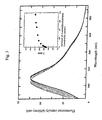
- Fig. 3 is a diagram showing the fluorescence emission spectrum of a green fluorescent protein immobilized on Amino-Cellulofine.
- the diagram that is inserted in Fig. 3 shows the correlation between the amount of the immobilized protein and the wavelength ( ⁇ max) exhibiting the maximal fluorescence intensity.
- the fluorescence emission spectrum of a green fluorescent protein immobilized on Amino-Cellulofine was predisposed to shift toward the long wavelength side as the amount of immobilization per carrier increased.
- This dependence of the fluorescence emission spectrum on the amount of the immobilized protein exhibits biphase, i.e., it is considered to reflect the effect obtained by a decrease in an average distance between immobilized proteins and the effect obtained by a decrease in the degree of freedom in the movement of the protein immobilized at a high density.
- the immobilized green fluorescent protein exhibits a fluorescence emission spectrum caused by the fluorescent resonance energy transfer (FRET) as the amount of immobilization per unit of catalyst increases. This indicates that the protein is immobilized in an orientation-controlled manner, and immobilization at high density with a controlled orientation can be achieved.
- FRET fluorescent resonance energy transfer
- Immobilization was carried out in two ways, i.e., a conventional process wherein a green fluorescent protein is cyanated before being adsorbed on the carrier for immobilization, and the process of the present invention wherein the protein to be immobilized represented by general formula (2) is adsorbed on the carrier for immobilization, followed by cyanation.
- a conventional process wherein a green fluorescent protein is cyanated before being adsorbed on the carrier for immobilization
- the process of the present invention wherein the protein to be immobilized represented by general formula (2) is adsorbed on the carrier for immobilization, followed by cyanation.
- a process of cyanating before adsorption was carried out in the following manner according to the process described in Japanese Patent No. 3047020.
- NTCB 2-nitro-5-thiocyanobenzoic acid
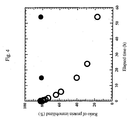
- Fig. 4 is a diagram showing the correlation between the length of time of standing after cyanation and the ratio of the protein immobilized when immobilization was carried out using a previously cyanated green fluorescent protein.
- a white circle indicates a result obtained when a previously cyanated green fluorescent protein was used and a black circle indicates a result of the process according to the present invention.
- a dihydrofolate reductase (SEQ ID NO: 9), a xylanase (SEQ ID NO: 10), a fusion protein of xylanase-dihydrofolate reductase (SEQ ID NO: 11), a green fluorescent protein (GFP) (SEQ ID NO: 2), a blue fluorescent protein (BFP) (SEQ ID NO: 4), a yellow fluorescent protein (YFP) (SEQ ID NO: 6), and a red fluorescent protein variant (DsRed) (SEQ ID NO: 8) were used as the proteins represented by general formula (1), and Amino-Cellulofine was used as a carrier for immobilization to perform immobilization by the process according to the present invention. The immobilization efficiency was then measured.
- the sequence identification numbers indicate amino acid sequences of the proteins corresponding to general formula (5), wherein each protein was fused with a protein having a sulfhydryl group.
- the aforementioned protein was immobilized using Amino-Cellulofine as a carrier in the same manner as described in Example 1.
- Table 1 shows the maximal immobilization efficiency for each of the proteins.
- Amino-Cellulofine Proteins to be immobilized Maximal ratio of immobilized protein (%) Dihydrofolate reductase > 75 Xylanase > 75 Fusion protein of xylanase-dihydrofolate reductase > 75 GFP 81.4 BFP 88.2 YFP 76.2 DsRed 90.4
- Table 2 shows the maximal immobilization efficiency for each of the carriers. Measurement using GFP Kind of carrier for immobilization Maximal ratio of immobilized protein (%) Amino-Cellulofine 81.4 Amino-Toyopearl 82.9 AffiGel 102 82.8 EAH-Sepharose 4B 66.5 Porous 20 NH 76.8 Except for Amino-Cellulofine and Amino-Toyopearl, values were obtained under conditions of up to 10 nmole/ml of carrier.
- a protein can be immobilized in high yiled with its orientation being controlled.
- a protein can be immobilized more effectively by the method of the present invention, compared to the conventional method wherein a protein is adsorbed on a carrier for immobilization after being cyanated.
- the method of the present invention which utilizes an ink jet printer can immobilize a large amount of various proteins within a short period of time, and thus, a protein array can be efficiently produced.
Landscapes
- Chemical & Material Sciences (AREA)
- Organic Chemistry (AREA)
- Health & Medical Sciences (AREA)
- Proteomics, Peptides & Aminoacids (AREA)
- Life Sciences & Earth Sciences (AREA)
- Biochemistry (AREA)
- Biophysics (AREA)
- General Health & Medical Sciences (AREA)
- Genetics & Genomics (AREA)
- Medicinal Chemistry (AREA)
- Molecular Biology (AREA)
- Gastroenterology & Hepatology (AREA)
- General Chemical & Material Sciences (AREA)
- Chemical Kinetics & Catalysis (AREA)
- Peptides Or Proteins (AREA)
- Immobilizing And Processing Of Enzymes And Microorganisms (AREA)
Abstract
a sulfhydryl group of the cysteine residue in the protein represented by general formula (2) that is absorbed on the carrier for immobilization represented by general formula (3) is cyanated using a cyanating reagent to convert it into a cyanocysteine residue,
thereby producing an immobilized protein represented by general formula (4):
Description
- The present invention relates to an immobilized protein. The present invention further relates to an orientation-controlled immobilized protein. More specifically, the present invention relates to effective production of an immobilized protein that is immobilized only at the carboxy terminus. Further, the present invention relates to a process for producing a protein array having an immobilized protein with a controlled orientation while being arrayed on a carrier for immobilization (a substrate or a basal plate).
- It has been heretofore attempted to use a soluble protein as an immobilized protein by binding it with, for example, an insoluble carrier such as agarose gel. Examples of such attempts are the development of an immobilized enzyme prepared by binding an enzyme protein to an insoluble carrier and the production of an enzyme reactor utilizing the same.
- In immobilizing enzymes, chemical binding to an insoluble carrier has been mainly carried out by utilizing the reactivity of the amino acid side chain, which constitutes a protein. For example, a cysteine residue has an SH group as a functional group, and disulfidation, alkylation, acylation, etc. are known as the reactions of the SH group. Utilization of these reactions enables the immobilization of proteins via a side chain of the cysteine residue. A lysine residue has an amino group as a side chain. This amino group can form an amide bond with a carboxyl group using carbodiimide. Similarly, aspartic acid and glutamic acid have carboxyl groups, and thus, they can form an amide bond with a primary amine using carbodiimide. However, the immobilization reaction utilizing a functional group of a side chain has some problems. That is to say, for example, the reaction relies on the amino acid sequence of a protein, the immobilized site cannot be specified since a protein contains several amino acids of the same kind, and the possibility of immobilization at several sites cannot be eliminated.
- In order to solve the aforementioned problems, a reaction for immobilizing the protein via a carboxyl group of the carboxy terminus of the protein utilizing the amino bond forming reaction via a cyanocysteine residue was developed (see JP Patent Publication (Kokai) No. 10-45798), and a means for binding a protein via one location at the carboxy terminus and via a main chain was developed (see Japanese Patent No. 3047020). Binding of a protein via one location at the carboxy terminus and via a main chain enhanced the reversibility of denaturation and brought advantages, such as the ability to produce an immobilized enzyme that enables heat sterilization of an immobilized protein.
- The amide bond forming reaction via a cyanocysteine residue, however, is represented by reaction formula (a): NH2-R-CO-NH-CH(CH2-SCN)-CO-X + NH2-B → NH2-R-CO-NH-B (wherein R represents a chain of arbitrary amino acid residues, X represents OH, an arbitrary amino acid residue, or a chain of arbitrary amino acid residues, and NH2-B represents an arbitrary primary amine compound).
- This amide bond formation reaction occurs competitively with the reaction between the cleavage reaction of a peptide chain represented by reaction formula (b): NH2-R-CO-NH-CH(CH2-SCN)-CO-X + H2O → NH2-R-COOH + Z (wherein R represents a chain of arbitrary amino acid residues, X represents OH, an arbitrary amino acid residue, or a chain of arbitrary amino acid residues, and Z represents a 2-immothiazoline-4-carboxylyl derivative of X) (see G. R. Jacobson, M. H. Schaffer, G. R. Stark, T. C. Vanaman, J. Biological Chemistry, 248, 6583-6591 (1973)) and a reaction in which a thiocyano group is eliminated and a cyanocysteine residue is converted into dehydroalanine in the β-elimination reaction (see Y. Degani, A. Patchornik, Biochemistry, 13,1-11 (1974)) represented by reaction fonnula (c): NH2-R-CO-NH-CH(CH2-SCN)CO-X → NH2-R-CO-NH-C(CH2)-CO-X (wherein R represents a chain of an arbitrary amino acid residue, and X represents OH, an arbitrary amino acid residue, or a chain of an arbitrary amino acid residue). Thus, a problem occurred in terms of reaction yield. Specifically, while protein immobilization using reaction formula (a) has an advantage, that is, a protein can bind via one location at the carboxy terminus and via a main chain, the problem of immobilization yield was an issue of concern.
- In order to solve this problem, a process has been developed in which a peptide, which has on its carboxy terminus a peptide sequence having a cyanocysteine residue and a negative charge around the neutral region, and a protein to be immobilized are allowed to react with a carrier for immobilization having a primary amine, thereby effectively producing an immobilized protein (see Japanese Patent No. 3047020).
- However, in the case of an immobilization reaction wherein a cysteine residue in a linker peptide chain is previously cyanated followed by adsorption via the ion interaction between the peptide sequence exhibiting a negative charge that was introduced in the linker peptide chain and a base plate, the cleavage reaction by cyanated cysteine and the side reaction of dihydroalanine generation are increased with the elapse of time after the formation of cyanated cysteine. This deteriorated the immobilization reaction efficiency. Further, it was impossible to produce homogenous enzyme reactors.
- An object of the present invention is to provide a process for binding a protein to a carrier by controlling its orientation and a protein binding carrier comprising a protein bound to the carrier while its orientation is controlled. More specifically, the present invention provides a process for binding a protein to a carrier by controlling its orientation utilizing the amide bond formation reaction via cyanocysteine, wherein a protein, which is prepared by fusing a protein containing a cysteine residue having a sulfhydryl group to a protein to be immobilized, is allowed to be adsorbed on a carrier for immobilization, the sulfhydryl group is cyanated using a cyanating reagent, and the protein of interest is then immobilized. Further, the present invention enables the protein to be previously arrayed and adsorbed on the carrier utilizing, for example, the principle of ink jet printers. Accordingly, it is an object of the present invention to provide a process for obtaining a protein array by binding a protein to a carrier by controlling its orientation and a protein array comprising a protein immobilized thereon while its orientation is controlled.
- The present inventors have conducted concentrated studies regarding a process for binding a protein to a carrier for immobilization while maintaining the functionality of the protein. As a result, they have found that a protein can be effectively bound to a carrier for immobilization while its orientation is controlled by preparing a protein, which is prepared by binding a peptide sequence having a sulfhydryl group and a negative charge around the neutral region to the protein to be immobilized, adsorbing the protein onto the carrier for immobilization, and cyanating the sulfhydryl group. This has led to the completion of the present invention.
- More specifically, the present invention provides the following:
- [1] a carrier comprising a protein immobilized adsorptively thereon, said protein having a
sulfhydryl group represented by general formula (6):
- [2] the carrier for immobilization according to [1] above wherein the carrier represented by general formula (6) is represented by NH2-R1-CONH-R2-CO-NH-CH(CH2-SH)-CO-NH-CH(CH3)-CO-[NH-CH(CH2-COOH)-CO]n-OH(-)--(+)NH2-Y wherein R1 and R2 represent arbitrary amino acid sequences, n is a natural number, and (-)--(+) represents a state of the adsorptive bond via an ionic bond;
- [3] the carrier for immobilization according to [1] or [2] above wherein R2 is polyglycine;
- [4] the carrier for immobilization according to any one of [1] to [3] above wherein R1 is an enzyme;
- [5] a process for immobilizing on a carrier for immobilization a protein represented by
general formula (1):
a sulfhydryl group of the cysteine residue in the protein represented by general formula (2) that is adsorbed on the carrier for immobilization represented by general formula (3) is cyanated using a cyanating reagent to convert it into a cyanocysteine residue,
thereby producing an immobilized protein represented by general formula (4): - [6] the process for producing an immobilized protein according to [5] above, wherein the
protein represented by general formula (2) has a sulfhydryl group represented by
- [7] the process for producing an immobilized protein according to [5] or [6] above, wherein R2 in the protein represented by general formula (2) is polyglycine;
- [8] the process for producing an immobilized protein according to any one of [5] to [7] above, wherein R1 in the protein represented by general formula (2) is an enzyme;
- [9] a process for producing a protein array by immobilizing on a substrate for
immobilization a protein represented by general formula (1):
a sulfhydryl group of the cysteine residue in the protein represented by general formula (2) that is adsorbed on the substrate for immobilization represented by general formula (3) is cyanated using a cyanating reagent to convert it into a cyanocysteine residue,
thereby producing a protein array having an immobilized protein represented by general formula (4): - [10] the process for producing a protein array according to [9] above, wherein the process for adsorbing the protein on a substrate for immobilization while arraying is carried out by an ink jet system;
- [11] the process for producing a protein array according to [10] above, wherein a cyanating reagent, which cyanates a sulfhydryl group of the cysteine residue, is allowed to act using an ink jet printer;
- [12] a process for producing a protein array by immobilizing on a substrate for
immobilization a protein represented by general formula (1):
- [13] the process for producing a protein array according to [12] above, wherein the process for adsorbing the protein on a substrate for immobilization while arraying is carried out by an ink jet system;
- [14] the process for producing a protein array according to any one of [9] to [11] above, wherein the protein represented by general formula (2) has a sulfhydryl group represented by NH2-R1-CONH-R2-CO-NH-CH(CH2-SH)-CO-NH-CH(CH3)-CO-[NH-CH(CH2-COOH)-CO]n-OH wherein R1 and R2 represent arbitrary amino acid sequences and n is a natural number;
- [15] a protein array having a protein arrayed adsorptively thereon, said protein having a
sulfhydryl group represented by general formula (6):
- [16] a protein array comprising an arrayed protein immobilized thereon represented by
general formula (4):
-
-
- Fig. 1 is a diagram showing the correlation between the amount of the inputted protein and the total amount of the immobilized protein.
- Fig. 2 is a diagram showing the correlation between the amount of the inputted protein and the ratio (%) of the immobilized protein.
- Fig. 3 is a diagram showing the fluorescence emission spectrum of a green fluorescent protein that is immobilized on Amino-Cellulofine.
- Fig. 4 is a diagram showing the correlation between a length of time of standing after cyanation and the ratio of the immobilized protein when immobilization was carried out using a previously cyanated green fluorescent protein.
-
- The present invention is hereafter described in detail.
- According to the process of immobilizing an orientation-controlled protein of the present invention, a protein can be effectively immobilized on a carrier while maintaining the activity thereof. Proteins to be immobilized are not limited, and various proteins can be immobilized depending on the use. For example, an enzyme can be immobilized to produce an enzyme reactor, a specific intermolecular interaction of the immobilized protein can be utilized to produce a carrier for separation, or a specific antigen or antibody can be immobilized to produce a carrier for diagnosis, which comprises the antigen or antibody immobilized thereon and utilizes an antigen-antibody reaction. Also, an arbitrary protein can be immobilized to produce an analysis tool for proteomics, etc.
- In the present invention, the term "immobilization" is defined as the fixation of a substance by binding it to a carrier for immobilization. This includes binding caused by a covalent bond, binding caused by electrostatic interaction which does not result from a covalent bond, and the like. In order to distinguish the state where a substance is immobilized adsorptively on a carrier from the state where a substance is immobilized by covalent bond, the former condition is referred to as "adsorption" or "adsorptive immobilization" in the following description.
- In order to implement the present invention, a protein represented by general formula (2): NH2-R1-CO-NH-R2-CO-NH-CH(CH2-SH)-CO-NH-R3-COOH should be first prepared in order to immobilize the protein represented by general formula (1): NH2-R1-COOH. In these general formulae, R1 and R2 represent arbitrary amino acid sequences and R3 represents a chain of an arbitrary amino acid residue, which has a strong negative charge around the neutral region and can acidify the isoelectric point of NH2-R1-CO-NH-R2-CO-NH-CH(CH2-SH)-CO-NH-R3-COOH. R2 is a linker peptide between a protein to be immobilized, which is represented by general formula (1), and a carrier. R2 is arbitrary and the type and the number of amino acids are not limited. R2 is preferably (Gly)x, wherein x is from 1 to 30 , preferably from 2 to 20, for example from 2 to 10 or for example 2, 3, 4 or 5. For example, Gly-Gly-Gly-Gly can be used. A gene encoding a protein represented by general formula (1) is bound to a gene encoding a peptide sequence represented by general formula (5): NH2-R2-CO-NH-CH(CH2-SH)-CO-NH-R3-COOH (wherein R2 and R3 are as defined above ) to prepare a gene encoding a fusion protein represented bu general formula (2): NH2-R1-CO-NH-R2-CO-NH-CH(CH2-SH)-CO-NH-R3-COOH. The resulting gene is allowed to express itself in a host organism such as E. coli, and the expressed protein is then separated and purified. Thus, a protein of interest can be obtained. Such a fusion protein can be prepared utilizing conventional techniques (see, for example, M. Iwakura et al., J. Biochem, 111:37-45 (1992)). Alternatively, the fusion protein can be also prepared by combining a technique of genetic engineering and a conventional technique of protein synthesis, or by a technique of protein synthesis alone.
- In general formulae (2) and (5), R3 is preferably a sequence containing many aspartic acids or glutamic acids. The isoelectric point of the protein depends on the type and number of the amino acids that constitute the protein. For example, when the protein contains many basic amino acids such as lysine or arginine, quantities of aspartic acids or glutamic acids should be large enough to exceed the total number of basic amino acids. The isoelectric point of the protein can be easily deduced by calculation by those skilled in the art. Preferably, a sequence may be designed to contain may aspartic acids or glutamic acids, thereby setting the isoelectric point of the substance represented by general formula (2) between 4 and 5.
- An example of a suitable sequence is alanyl-polyaspartic acid. This is because the substitution of the amino acid subsequent to cyanocysteine with alanine can induce easy amide bond forming reactions via a cyanocysteine residue, and because a carboxyl group of aspartic acid is the most acidic in the amino acid side chain. R3 may be a negatively charged amino acid sequence comprising Ala(Asp)y or Ala(Glu)y, wherein y is from 1 to 30, preferably from 2 to 20, for example from 2 to 10 or for example 2, 3, 4, 5 or 6.
- The thus obtained protein represented by general formula (2) is immobilized adsorptively on a carrier for immobilization. Any insoluble carrier having primary amino groups can be used as the carrier for immobilizations represented by general formula (3): NH2-Y used in the present invention. Any form of carrier for immobilizations, such as gel, bead, particulate, or plate carriers can be used. Examples of commercially available carriers having primary amino groups that can be used include Amino-Cellulofine (available from SEIKAGAKU CORPORATION), AF-Amino-Toyopearl (available from TOSOH), EAH-Sepharose 4B and Lysine-Sepharose 4B (available from Amersham Pharmacia), AffiGel 102 (available from BioRad), and Porous 20 NH (available from Boehringer Mannheim). Also, a silane compound having a primary amine (e.g., 3-aminopropylmethoxysilane) is used to introduce the primary amine onto glass beads, glass plates, and the like, and the resultant can be used as a carrier.
- A protein having a sulfhydryl group represented by general formula (2), i.e., NH2-R1-CO-NH-R2-CO-NH-CH(CH2-SH)-CO-NH-R3-COOH, and a carrier for immobilization represented by general formula (3), i.e., NH2-Y, can be reacted under neutral to weak alkaline conditions (pH 7 to 10) at room temperature. Under weak alkaline reaction conditions, the protein represented by general formula (2) has a negative charge, the carrier for immobilization represented by general formula (3) has a positive charge, and they are bound adsorptively to each other by the electrostatic interaction. Thus, this reaction can be utilized as a capture reaction for the amide bond forming reaction represented by the reaction formula (a) as presented above. Since this electrostatic interaction depends on the salt concentration in a solvent, preferably, a solvent to be used has as low a salt concentration as possible. For example, a 10 mM phosphate buffer (pH 7 to 9) can be used, although any salt concentration may be adopted as long as the electrostatic interaction is suitably carried out.
- Accordingly, any solution can be used as a solution for the adsorption reaction as long as the solution is a solvent that can assure the electrostatic interaction, that can dissolve the protein represented by general formula (2), and that can adjust the pH level. In addition to various buffers such as a phosphate buffer or a borate buffer, and alcohols such as methanol or ethanol, dimethylformamide, dimethyl sulfoxide, or the like can be used. Although high reaction efficiency can be yielded at room temperature, any temperature range may be adopted without causing difficulties as long as the solvent used is not frozen or boiled and the protein represented by general formula (2) does not aggregate as a result of denaturation.
- The protein represented by general formula (2) is bound adsorptively to the carrier represented by general formula (3): NH2-Y via the electrostatic interaction in the aforementioned step. The strength of the bond can be varied depending on changes in salt concentration and the like. As long as the strong bond can be maintained, the protein represented by general formula (6): NH2-R1-CONH-R2-CO-NH-CH(CH2-SH)-CO-NH-R3-COOH(-)--(+)NH2-Y (wherein (-)--(+) represents a state of being bound adsorptively via an ionic bond) that is adsorbed on the carrier for immobilization can be used for various applications. For example, if a protein is an enzyme, a carrier for immobilization can be used as an enzyme reactor. When gel, particulate, or bead-like substances are used as carriers for immobilizations, these substances can be effectively used as enzyme reactors by, for example, putting them into a suitable support such as a column. If a protein is a specific antigen or antibody, it can be used as a device for diagnosis utilizing an antigen-antibody reaction. A protein adsorbed on the carrier for immobilization represented by general formula (2) can be easily desorbed by treating it with a highly concentrated salt solution such as 1M KCl, and can be recovered as NH2-R1-CONH-R2-CO-NH-CH(CH2-SH)-CO-NH-R3-COOH. The use of this property enables the recovery of a specific substance by adsorbing and immobilizing a protein that can interact with a specific substance on a carrier; bringing the protein into contact with a solution containing the specific substance, and then desorbing the adsorbed immobilized protein from the carrier, thereby recovering the specific substance in a state that is bound to the adsorbed and immobilized protein. The substance can be then separated from the protein, thereby obtaining the substance in isolation. Any combination of a protein and a substance that can interact with each other may be used, such as an antibody and an antigen, a ligand and a receptor, a protein and another protein such as an enzyme and a substrate, or a protein and a non-protein. The utilization of this technique enables efficient concentration and separation of a specific substance. Further, cyanation of a protein that is bound adsorptively to a carrier for immobilization represented by general formula (6): NH2-R1-CONH-R2-CO-NH-CH(CH2-SH)-CO-NH-R3-COOH(-)--(+)NH2-Y in the following manner allows the protein to more strongly bind covalently to a carrier. Thus, a stable protein-carrier for immobilization can be obtained. Specifically, the carrier having a protein immobilized adsorptively thereon represented by general formula (6) can be used as an intermediate for producing an immobilized protein having a strongly immobilized protein by covalent bond represented by general formula (4): NH2-R1-CO-NH-R2-CO-NH-Y.
- The protein represented by general formula (2) is immobilized adsorptively on a carrier for immobilization to perform cyanation. Thus, an immobilized protein that is immobilized by a covalent bond on the carrier for immobilization represented by general formula (4) can be prepared. In this case, a sulfhydryl group of a cysteine residue in a linker peptide chain, which was introduced into a protein sequence adsorbed on the carrier for immobilization, is cyanated, and binding occurs between amino acid residues immediately before the cyanated cysteine residue.
- Cyanation can be performed using a cyanating reagent. A simple process generally utilizes 2-nitro-5-thiocyanobennzoic acid (NTCB) (see Y. Degani, A. Ptchornik, Biochemistry, 13,1-11 (1974)) or 1-cyano-4-dimethylaminopyridinium tetrafluoroborate (CDAP) as a cyanating reagent. Commercially available NTCB and CDAP can be used. Cyanation using NTCB can be efficiently carried out at pH levels between 7 and 9, and the reaction efficiency can be investigated based on an increase in the absorbance at 412 nm of free thionitrobenzoic acid (the molecular extinction coefficient = 13,600 M1cm-1). Cyanation of the SH group can be carried out also in accordance with the process described in the literature (see J. Wood & Catsipoolas, J. Biol. Chem. 233, 2887 (1963)). Cyanation using a cyanating reagent may be carried out after the adsorptive immobilization of the protein represented by general formula (2): NH2-R1-CO-NH-R2-CO-NH-CH(CH2-SH)-CO-NH-R3-COOH on the carrier for immobilization. Alternatively, it may be carried out simultaneously with the adsorptive immobilization. In the case of the latter, the protein represented by general formula (2) and a cyanating reagent may be simultaneously applied to the carrier for immobilization.
- The reaction involving cyanocysteine used in the present invention can cause hydrolysis as a side reaction. All the reaction products that are generated by such a possible side reaction dissolve in a solvent, and thus, side reaction products can be removed by washing the carrier for immobilization with a suitable solvent after the reaction. Accordingly, all the immobilized proteins prepared by immobilization according to the present invention are represented by general formula (4): NH2-R1-CO-NH-R2-CO-NH-Y (wherein R1, R2, and Y are as defined above) and bound to the carrier for immobilization via one location at the carboxy terminus of the protein of interest.
- A characteristic of the thus obtained immobilized protein is that a carboxy terminus is bound to a carrier via only one location. This can effectively exhibit functions of the protein. For example, when an enzyme protein having a catalytic function is used as an immobilized protein, the catalytic function is lost once the protein is denatured by raising temperature or adding a denaturing agent. The immobilized enzyme prepared by the immobilization process according to the present invention can fully regain its functions by removing denaturing conditions.
- In accordance with the process according to the present invention, the protein represented by general formula (1) can be immobilized at a high efficiency of at least 80%, and almost 100% of functions of the immobilized protein can be sustained. By this process, the protein can be stably and strongly immobilized on the carrier for immobilization. If a protein to be immobilized is an enzyme, a carrier for immobilization can be used as an enzyme reactor. When gel, particulate, or bead-like substances are used as carriers for immobilization, these substances can be efficiently used as enzyme reactors by, for example, putting them into suitable supports such as columns. When a protein is a specific antigen or antibody, it can be used as a device for diagnosis and the like that utilize the antigen-antibody reaction.
- The amino group in a carrier having a primary amino group represented by general formula (3): NH2-Y that was not used for immobilization can be masked using a low molecular weight peptide having a sequence represented by general formula (2). For example, a peptide comprising a sequence of alanine-cysteine-aspartic acid is chemically synthesized as the low molecular weight peptide corresponding to general formula (2), and the alanine-cysteine-aspartic acid is again immobilized adsorptively on the immobilized protein carrier represented by general formula (4): NH2-R1-CO-NH-R2-CO-NH-Y, followed by cyanation. Thus, an alanine residue can be bound to the unreacted primary amine.
- A summary of processes for immobilizing a protein according to the present invention is hereafter provided.
- Adding a sequence for immobilization by gene modification of a protein to be immobilized
- Obtaining a modified protein (expression, separation, purification)
- Adsorbing on a primary amine carrier via ion interactions
- Cyanating the SH group of cysteine of adsorbed protein
- Immobilizing by peptide bond forming reaction via cyanocysteine
- Desorbing an unimmobilized protein from a carrier
- Masking a free primary amine in a carrier
- Obtaining an orientation-controlled immobilized protein
-
- Among these, processes of adsorbing on a primary amine carrier via ion interactions and cyanating the SH group of cysteine of the adsorbed protein are important for the production of a protein array that is hereafter described in detail.
- The process for immobilizing a protein of the present invention can be used to produce a protein array by immobilizing a protein on a substrate or basal plate (hereinafter referred to as a "substrate") while arraying the protein. In the present invention, a protein array comprises at least one protein being arrayed and immobilized on a substrate such as glass, a nylon membrane, etc. at high density. It is also referred to as a "protein chip." Proteins are immobilized at an extremely high density in the protein array, and thus, a small amount of protein should be immobilized efficiently with its orientation being controlled. Accordingly, the process according to the present invention wherein a protein can be immobilized with its orientation being controlled in a highly efficient manner is suitable for producing a protein array.
- In order to immobilize the protein while arraying it by the process according to the present invention, a protein having a sulfhydryl group represented by general formula (2): NH2-R1-CONH-R2-CO-NH-CH(CH2-SH)-CO-NH-R3-COOH is first arrayed and adsorbed on a sheet carrier for immobilization (substrate) represented by general formula (4): NH2-Y. A substrate for immobilizing a protein that is used for producing a protein array is not limited. Any substrate can be used as long as the substrate is a sheet onto which the NH2 group has been introduced. The aforementioned carrier, a nylon membrane, a glass plate, etc. to which an amino group has been introduced in the aforementioned manner can be used as a carrier.
- Any arraying process can be used without limitation, as long as a protein solution can be arrayed on a substrate at high density. For example, an arrayer that spots a protein solution on a substrate may be used. The arrayer that spots a protein solution may use various means such as a pin, quill pen, ink jet, capillary, or pin and ring, and any process may be adopted. Alternatively, a picking robot may be used. The protein array generally immobilizes the protein solution on a substrate by dot-spotting. As described below, for example, a protein solution can be immobilized in line by an ink jet system. In the present invention, when one or more proteins are arrayed on a substrate, it is referred to as a protein array, regardless of its shape.
- The protein having a sulfhydryl group represented by general formula (2): NH2-R1-CONH-R2-CO-NH-CH(CH2-SH)-CO-NH-R3-COOH is arrayed on the substrate for immobilization represented by general formula (4): NH2-Y under neutral to weak alkaline conditions (pH 7 to 10) by various processes such as those mentioned above. Thus, a protein array comprising the protein R1 adsorbed on a substrate by a formula NH2-R1-CONH-R2-CO-NH-CH(CH2-SH)-CO-NH-R3-COOH(-)--(+)-NH2-Y (wherein (-)--(+) represents a bond by adsorption via an ionic bond) can be obtained. Further, the adsorbed protein represented by this formula can be treated with a cyanating reagent to obtain a protein array comprising the protein R1 represented by a formula NH2-R1-CO-NH-R2-CO-NH-Y arrayed and immobilized on a substrate via a covalent bond. Cyanation can be carried out with the addition of a cyanating agent to the surface of the substrate having a protein adsorbed thereon. Alternatively, cyanation can be carried out by, for example, immersing a whole substrate having a protein adsorbed thereon in a cyanating agent. Also, a protein is allowed to adsorb by the aforementioned arraying means, and a cyanating reagent may be then applied to the substrate on the portion having a protein adsorbed thereon by a similar arraying means. For example, a protein is adsorbed and arrayed on a substrate with a constant dot pattern using a pin, and a cyanating reagent solution instead of a protein is spotted using a pin in such a manner that the cyanating agent is superposed on a protein. This generates cyanation, and the protein is thereby immobilized. A protein represented by general formula (2): NH2-R1-CONH-R2-CO-NH-CH(CH2-SH)-CO-NH-R3-COOH and a cyanating agent may be simultaneously applied to the substrate for immobilization.
- Arraying by the ink jet system is hereafter described in detail as one example of arraying.
- The protein of the present invention can be immobilized utilizing inkjet printing techniques, thereby producing a protein array.
- During the step of immobilizing the protein of the present invention, the protein represented by general formula (2): NH2-R1-CO-NH-R2-CO-NH-CH(CH2-SH)-CO-NH-R3-COOH is immobilized adsorptively on a suitable substrate having an amino group introduced therein represented by NH2-Y by ink jet printing techniques. Subsequently, a sulfhydryl group of the cysteine residue in the protein is cyanated to convert it into a cyanocysteine residue. Thus, a protein array having the immobilized protein represented by general formula (4): NH2-R1-CO-NH-R2CO-NH-Y can be produced.
- Ink jet printers used in printing are classified according to their ink ejection systems. One type is a piezo system, in which an element (piezo element), which is deformed by the application of voltage, is used, an ink storage space in the head is reduced by the deformation, and inks are ejected by this pressure. Another type is a thermal ink jet system, in which a heater in the nozzle is heated to generate foams, and inks are pushed out by these foams. Either type of printer can be used for the immobilization according to the present invention. A piezo system printer is preferable when denaturation of proteins by heat is taken into consideration. Commercially available printers can be used as ink jet printers, and examples thereof include ink jet printers of the EPSON PM Series.
- The protein solution represented by general formula (2) may be filled into a ink cartridge of a printer and then installed in the printer. Printing patterns of the printer can be freely determined with the use of a suitable software such as a drawing software. A line pattern may be adopted, which immobilizes the protein solution in line or a dot pattern as an arbitrary number of dots in a given area. Also, the amount of the protein solution discharged during a single operation can be freely determined. For example, when the line pattern is adopted, the protein solution may be immobilized in line with a width of several dozen µm to several hundred µm. If the amount and the rate of discharge are suitably determined, the protein solution can be immobilized with a line pattern having an arbitrary width within the determined range. When the dot pattern is adopted, a drop of protein solution is discharged relative to a dot, and a protein can be immobilized as a dot of a circle having a diameter of several µm to several hundred µm. Alternatively, patterning at the time of printing can be adjusted to form a rectangular dot measuring several µm to several hundred µm per side. In this case, the amount and the rate of discharging the protein solution may be suitably determined depending on a desired dot pattern.
- Thus, the protein represented by general formula (2) is immobilized adsorptively on a substrate and treated with a cyanating agent, thereby obtaining the substrate for immobilization having the protein represented by general formula (4) immobilized adsorptively thereon. Cyanation can be carried out by treating a whole substrate having the protein represented by general formula (2) immobilized adsorptively thereon with a cyanating reagent. In this case, a cyanating reagent may be added to the whole surface of the substrate, or the whole substrate may be immersed in the cyanating reagent. Alternatively, a cyanating reagent may be applied to the carrier on its portion having a protein immobilized thereon after the adsorptive immobilization of the protein represented by general formula (2) using an ink jet printer on the carrier. In this case, after the adsorptive immobilization of the protein, a cartridge is replaced with one filled with a cyanating reagent, and a cyanating reagent may be applied in the same pattern as with the adsorptive immobilization of the protein. Or, a protein solution and a cyanating reagent may be filled into separate tanks of a cartridge having several tanks, and the protein and the cyanating reagent may be continuously or simultaneously discharged in a single operation.
- Further, the protein represented by general formula (2) is cyanated, the protein represented by general formula: NH2-R1-CO-NH-CH(CH2-SCN)-CO-NH-R2-COOH is produced, and the protein is then discharged on a carrier by means of an ink jet printer. In this way, the immobilized protein represented by general formula: NH2-R1-CO-NH-Y can be produced. This process has an advantage, i.e., procedures preceding the cyanation can be carried out beforehand. Timing of cyanation may be suitably determined depending on, for example, the amount of the protein to be immobilized.
- The protein that is arrayed and immobilized using ink jet printing techniques and the like can be evaluated in terms of its immobilization pattern and status using an electron microscope, an electrochemical microscope, or other means.
- The present invention is hereafter described with reference to the following examples, although the technical scope of the present invention is not limited to these examples.
- In the present examples, immobilization was carried out using a dihydrofolate reductase, a xylanase, a fusion protein of xylanase-dihydrofolate reductase, and various fluorescent proteins. All the proteins that were used for the immobilization were prepared as follows. A gene encoding the amino acid sequence of the protein corresponding to general formula (1) was obtained, a gene encoding an amino acid sequence prepared by binding 8 to 10 amino acid sequences on the carboxy terminal side to the amino acid sequence represented by general formula (5) was chemically synthesized, the resulting gene was chemically synthesized with a portion of a
gene encoding 8 to 10 amino acid sequences on the amino terminal side of the protein represented by general formula (1), and the resultant was used as a primer for PCR and amplified by PCR. Thus, a gene encoding the amino acid sequence corresponding to general formula (2) was prepared, the gene was incorporated into an expression vector, and then expressed in E. coli, followed by separation and purification. Those skilled in the art can easily produce the protein represented by general formula (2) that is subjected to the immobilization according to the present invention if they can obtain a gene encoding the protein represented by general formula (1). - In the present examples, proteins that were used as those corresponding to general formula (1) were a dihydrofolate reductase (
amino acids 1 to 159 in SEQ ID NO: 9), a xylanase (amino acids 1 to 185 in SEQ ID NO: 10), a fusion protein of xylanase-dihydrofolate reductase (amino acids 1 to 348 in SEQ ID NO: 11), and fluorescent proteins exhibiting various types of fluorescence (four types, SEQ ID NOs: 1, 3, 5, and 7). Each of the full-length sequences of SEQ ID NOs: 9, 10, and 11 corresponds to the protein represented by general formula (2). Regarding genes encoding a dihydrofolate reductase, a xylanase, and a fusion protein of xylanase-dihydrofolate reductase, those produced by Iwakura (one of the present inventors) were used. Regarding fluorescent proteins, commercially available ones were used. Fluorescent proteins emitting green fluorescence (GFP) (SEQ ID NO: 1) and blue fluorescence (BFP) (SEQ ID NO: 3) were purchased from Quantum, and genes encoding fluorescent proteins emitting yellow fluorescence (YFP) (SEQ ID NO: 5) and red fluorescence (DsRed) (SEQ ID NO: 7) were purchased from Clontech. It should be clearly noted that the present invention is not limited by processes for obtaining genes. - A green fluorescent protein (GFP) (SEQ ID NO: 1) was used as the protein corresponding to general formula (1) NH2-R1-COOH to produce a protein to be immobilized (SEQ ID NO: 2) corresponding to general formula (2). Thus, conditions for the immobilization reaction, etc. were examined.
- The fusion protein was immobilized using Amino-Cellulofine (purchased from SEIKAGAKU CORPORATION), and Amino-Toyopearl (purchased from TOSOH) was used as a primary amine carrier.
- Immobilization was carried out in the following manner.
- Each protein had previously been dialyzed with a 10 mM phosphate buffer (pH 8.0) containing a 1000-fold amount of 5 mM ethylenediaminetetraacetic acid (EDTA) three times or more, and the dialyzed protein sample was diluted with a buffer, which was the same as the one used in the dialysis. Thus, protein samples at various concentrations were prepared.
- The thus prepared protein to be immobilized (50 µl) was mixed with 50 µl of Amino-Cellulofine (amine content: 20 µmoles NH2/ml) or Amino-Toyopearl (primary amine content: 130 µmoles NH2/ml), and the mixture was mildly stirred at room temperature for at least 2 hours. Thereafter, the mixture was centrifuged at 1000 rpm for several seconds to submerge the carrier, the supernatant was taken out, and the fluorescence intensity was measured. This value was compared with the fluorescence intensity of the protein sample that was first inputted to determine the rate of successfully adsorbed proteins. When the amount of the inputted proteins is not more than 100 nmoles per ml of a carrier, all the inputted proteins (100%) were immobilized adsorptively on the carrier. The proteins that were immobilized adsorptively in this state could be completely released from the carrier by treatment with a 10 mM phosphate buffer (pH 8.0) containing 1M KCI. This strongly suggests that the immobilization at this phase depends on the ion interactions between the positive charge of the primary amine of the carrier and the negative charge of polyaspartic acid, which was introduced into the protein to be immobilized.
- The SH group of cysteine of the adsorbed protein was cyanated by suspending the carrier comprising the protein adsorptively immobilized thereon in a 10 mM phosphate buffer (pH 7.0) containing 5 mM EDTA, adding 2-nitro-5-thiocyanobenzoic acid (NTCB) to a final concentration of 5 mM, and allowing the reaction to proceed at room temperature for 4 hours. Thereafter, centrifugation was carried out at 1000 rpm for several seconds, the carrier was submerged, and the supernatant was removed, followed by suspension in a 10 mM phosphate buffer (pH 7.0). This procedure was repeated 5 times to eliminate NTCB, etc.
- The cyanated adsorptively immobilized protein was centrifuged at 1000 rpm for several seconds, the carrier was submerged, the supernatant was removed, and the protein was suspended in a 10 mM borate buffer (pH 9.5) containing 5 mM EDTA, followed by mild stirring at room temperature for at least 24 hours. Thus, the immobilization reaction was carried out. Thereafter, centrifugation was carried out at 1000 rpm for several seconds, the carrier was submerged, and the supernatant was removed, followed by suspension in a 10 mM phosphate buffer (pH 8.0) containing 1M KCl. This procedure was repeated 5 times to eliminate a side reaction product of the immobilization.
- Through the above procedure, the immobilized protein represented by general formula (4), the orientation of which is controlled, and which has the main chain at the carboxy terminus of the protein bound thereto via an amide bond, was obtained.
- Similar results were obtained by performing cyanation under the same conditions, except for the use of 1-cyano-4-dimethylaminopyridinium tetrafluoroborate (CDAP) as a cyanating reagent instead of NTCB.
- The correlation between the amount of the inputted protein and the amount of the immobilized protein was investigated in the following manner.
- Reaction of a dihydrofolate reductase, a xylanase, and a fusion protein of dihydrofolate reductase-xylanase were monitored by measuring the fluorescence emission spectra in the ultraviolet regions (excited at 290 nm), and reactions of various fluorescent proteins were monitored by measuring the fluorescence emission spectra in the visible regions of the proteins.
- The fluorescence emission spectrum was measured using a spectrofluorophotometer (FP-750, JASCO). The protein fluorescence in the solution was measured at 25°C by dissolving the fluorescent protein in 3 ml of 10 mM phosphate buffer (pH 8.0) and placing the protein solution in a cuvette for the fluorescence measurement. The fluorescence emission spectrum of the fluorescent protein bound to the carrier was measured while constantly stirring the carrier in a cuvette under the same conditions as those pertaining when the measurement of the protein in the solution was conducted.
- The spectrum of the fluorescent protein shifts toward the long wavelength side by being adsorptively or covalently bound to the carrier. Accordingly, the ratio of adsorptive immobilization in the adsorption process (the ratio (B/A) of the amount of the adsorptively immobilized protein (B) relative to the amount of the inputted protein (A)) and the ratio of immobilization in the immobilization process (the ratio (E/D) of the amount of the finally immobilized protein (E) relative to the amount of the adsorptively immobilized protein (D)) were separately determined. The ratio of the finally immobilized protein relative to the inputted protein is represented by (B/A) x (E/D), using the determined values. Since the fluorescence emission spectrum shifts in the process of adsorptive immobilization, the fluorescence emission spectrum in the inputted protein solution and the fluorescence emission spectrum of the supernatant after the adsorption reaction were measured, the amount of the protein remaining unadsorbed (this is designated as "C") was measured, and the value of B above was determined by calculating as B = A - C and used in the measurement of the ratio of adsorptive immobilization in the process of adsorptive immobilization. The fluorescence emission spectrum was measured using a suspension of a carrier having a protein immobilized thereon. The background, which was derived from a carrier having no protein immobilized thereon, was corrected. This corrected value was used for measuring D and E.
- The results are shown in Figs. 1 to 3.
- Fig. 1 is a diagram showing the correlation between the amount of the inputted protein and the total amount of the immobilized protein, wherein a white circle indicates Amino-Cellulofine and a black circle indicates Amino-Toyopearl. As shown in the drawing, when the amount of the inputted protein was up to about 400 nmoles per ml of the carrier, the amount of the immobilized protein increased in a manner approximately proportional to the amount of the inputted protein. If the amount exceeded the aforementioned range, the immobilization peaked out.
- Fig. 2 is a diagram showing the correlation between the amount of the inputted protein and the ratio (%) of the immobilized protein, wherein a white circle indicates Amino-Cellulofine and a black circle indicates Amino-Toyopearl. As shown in the drawing, when the amount of the inputted protein was not more than about 100 nmoles per ml of the carrier, the ratio of the immobilized protein was approximately constant at about 80%. If the amount exceeded the aforementioned range, the yield factor of the immobilization gradually deteriorated.
- Fig. 3 is a diagram showing the fluorescence emission spectrum of a green fluorescent protein immobilized on Amino-Cellulofine. The diagram that is inserted in Fig. 3 shows the correlation between the amount of the immobilized protein and the wavelength (λmax) exhibiting the maximal fluorescence intensity. The fluorescence emission spectrum of a green fluorescent protein immobilized on Amino-Cellulofine was predisposed to shift toward the long wavelength side as the amount of immobilization per carrier increased. This dependence of the fluorescence emission spectrum on the amount of the immobilized protein exhibits biphase, i.e., it is considered to reflect the effect obtained by a decrease in an average distance between immobilized proteins and the effect obtained by a decrease in the degree of freedom in the movement of the protein immobilized at a high density.
- The immobilized green fluorescent protein exhibits a fluorescence emission spectrum caused by the fluorescent resonance energy transfer (FRET) as the amount of immobilization per unit of catalyst increases. This indicates that the protein is immobilized in an orientation-controlled manner, and immobilization at high density with a controlled orientation can be achieved.
- Comparison of functionalities between the immobilized protein obtained by cyanation after adsorption on a carrier and the immobilized protein obtained by cyanation followed by adsorption on a carrier
- Immobilization was carried out in two ways, i.e., a conventional process wherein a green fluorescent protein is cyanated before being adsorbed on the carrier for immobilization, and the process of the present invention wherein the protein to be immobilized represented by general formula (2) is adsorbed on the carrier for immobilization, followed by cyanation. Thus, the efficiencies of immobilization for the both processes were compared and evaluated.
- A process of cyanating before adsorption was carried out in the following manner according to the process described in Japanese Patent No. 3047020.
- In a 0.1M tris hydrochloride buffer (pH 7.4) containing 5 mM ethylenediaminetetraacetic acid (EDTA), a fivefold amount of 2-nitro-5-thiocyanobenzoic acid (NTCB) was added to the green fluorescent protein, and the reaction was allowed to proceed at room temperature for 4 hours. Thus, cyanation was carried out. Based on an increase in the absorbance of free thionitrobenzoic acid at 412 nm (a molecular extinction coefficient of 13,600 M1cm1), it was confirmed that the cysteine residue was approximately quantitatively cyanated. Unreacted NTCB and thionitrobenzoic acid were removed from the cyanation reaction solution by gel filtration using the Sephadex G-50 column. A 10 mM borate buffer (pH 9.5) containing 5 mM EDTA was used as an eluent. The cyanated protein sample in this state was used in the immobilization reaction.
- The correlation between the amount of the inputted protein and the amount of the immobilized protein was investigated in the same manner as the process described in Example 1.
- The results are shown in Fig. 4.
- Fig. 4 is a diagram showing the correlation between the length of time of standing after cyanation and the ratio of the protein immobilized when immobilization was carried out using a previously cyanated green fluorescent protein. In Fig. 4, a white circle indicates a result obtained when a previously cyanated green fluorescent protein was used and a black circle indicates a result of the process according to the present invention.
- In a process for improving the efficiency of immobilization wherein a cysteine residue in a linker peptide chain has been previously cyanated, and the adsorption is then realized via the ion interaction between a peptide sequence exhibiting a negative charge that was introduced into the linker peptide chain and a substrate, i.e., in a conventional process, a cleavage reaction by cyanated cysteine and a side reaction of a dihydroalanine producing reaction increase with the elapse of time after the formation of cyanated cysteine. Thus, the efficiency of the immobilization deteriorates. In accordance with the process of the present invention, however, this deterioration in efficiency can be completely prevented.
- A dihydrofolate reductase (SEQ ID NO: 9), a xylanase (SEQ ID NO: 10), a fusion protein of xylanase-dihydrofolate reductase (SEQ ID NO: 11), a green fluorescent protein (GFP) (SEQ ID NO: 2), a blue fluorescent protein (BFP) (SEQ ID NO: 4), a yellow fluorescent protein (YFP) (SEQ ID NO: 6), and a red fluorescent protein variant (DsRed) (SEQ ID NO: 8) were used as the proteins represented by general formula (1), and Amino-Cellulofine was used as a carrier for immobilization to perform immobilization by the process according to the present invention. The immobilization efficiency was then measured. The sequence identification numbers indicate amino acid sequences of the proteins corresponding to general formula (5), wherein each protein was fused with a protein having a sulfhydryl group.
- The aforementioned protein was immobilized using Amino-Cellulofine as a carrier in the same manner as described in Example 1.
- Table 1 shows the maximal immobilization efficiency for each of the proteins.
Amino-Cellulofine Proteins to be immobilized Maximal ratio of immobilized protein (%) Dihydrofolate reductase > 75 Xylanase > 75 Fusion protein of xylanase-dihydrofolate reductase > 75 GFP 81.4 BFP 88.2 YFP 76.2 DsRed 90.4 - Values widely vary per measurement because of the conditions of up to 10 nmoles/ml of carrier except for the case of GFP, and because of the fluorescence measurement at the ultraviolet region except for fluorescent proteins. However, values exceeding 75% were obtained for all measurements.
- Commercially available bead carriers for immobilization, Amino-Cellulofine, Amino-Toyopearl, AH Sepharose, and Polyallylamine Beads were used as carriers for immobilization, and a green fluorescent protein (GFP) was used as a protein to be immobilized to perform immobilization. Immobilization was carried out in the same manner as described in Example 1. The ratio of immobilization was investigated in the same manner as described in Example 1.
- Table 2 shows the maximal immobilization efficiency for each of the carriers.
Measurement using GFP Kind of carrier for immobilization Maximal ratio of immobilized protein (%) Amino-Cellulofine 81.4 Amino-Toyopearl 82.9 AffiGel 10282.8 EAH-Sepharose 4B 66.5 Porous 20 NH 76.8 - The results shown in Table 2 indicate that the protein can be immobilized on any carrier, as long as the carrier has a primary amine.
- According to a process for immobilizing a protein of the present invention, a protein can be immobilized in high yiled with its orientation being controlled. As shown in Example 2, a protein can be immobilized more effectively by the method of the present invention, compared to the conventional method wherein a protein is adsorbed on a carrier for immobilization after being cyanated.
- Further, the method of the present invention which utilizes an ink jet printer can immobilize a large amount of various proteins within a short period of time, and thus, a protein array can be efficiently produced.


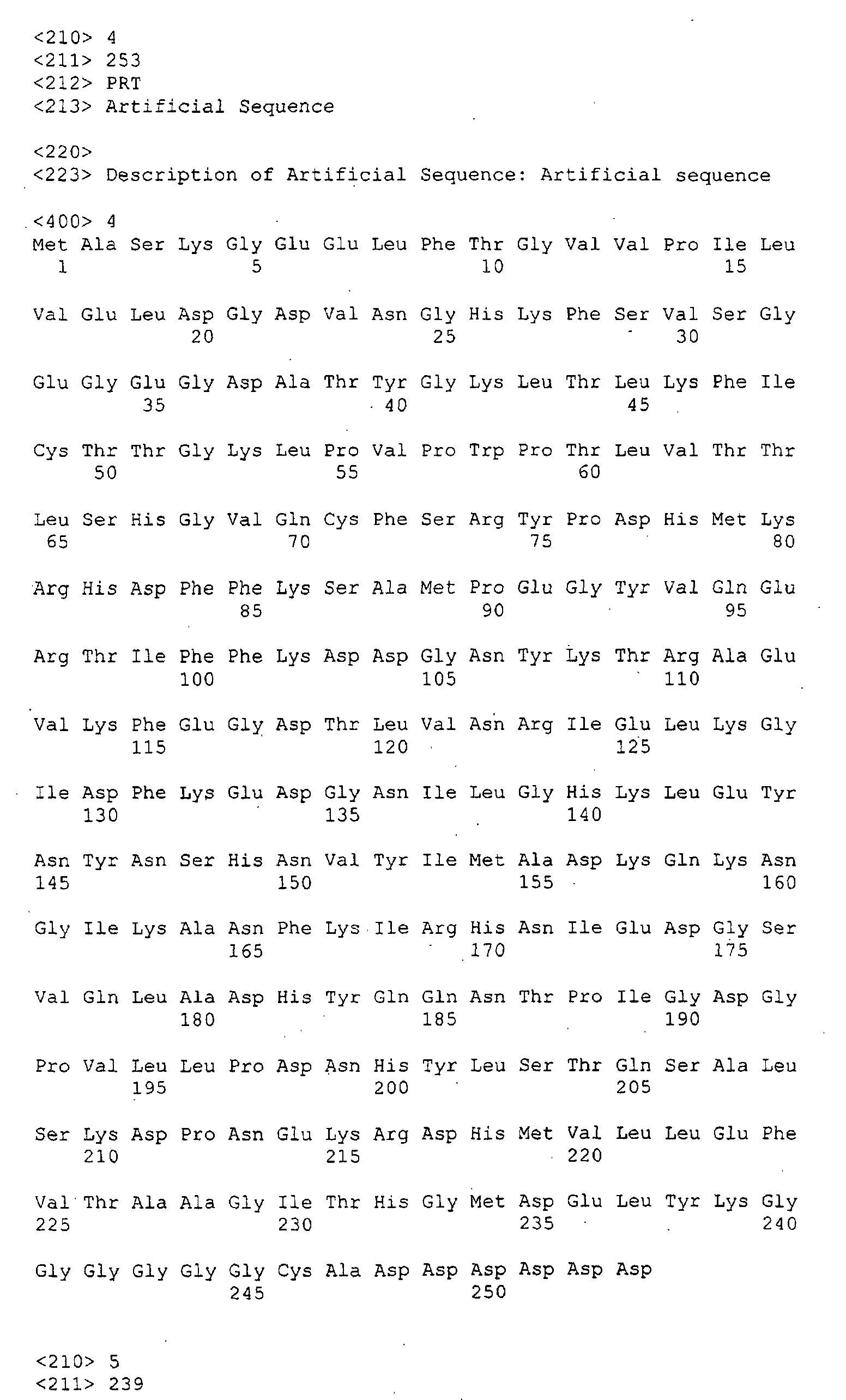


Claims (16)
- A carrier comprising a protein immobilized adsorptively thereon, said protein having a sulfhydryl group represented by general formula (6):
- The carrier for immobilization according to claim 1 wherein the carrier represented by general formula (6) is represented by NH2-R1-CONH-R2-CO-NH-CH(CH2-SH)-CO-NH-CH(CH3)-CO-[NH-CH(CH2-COOH)-CO]n-OH(-)--(+)NH2-Y wherein R1 and R2 represent arbitrary amino acid sequences, n is a natural number, and (-)--(+) represents a state of the adsorptive bond via an ionic bond.
- The carrier for immobilization according to claim 1 or 2 wherein R2 is polyglycine.
- The carrier for immobilization according to any one of claims 1 to 3 wherein R1 is an enzyme.
- A process for immobilizing on a carrier for immobilization a protein represented by general formula (1):
a sulfhydryl group of the cysteine residue in the protein represented by general formula (2) that is adsorbed on the carrier for immobilization represented by general formula (3) is cyanated using a cyanating reagent to convert it into a cyanocysteine residue,
thereby producing an immobilized protein represented by general formula (4): - The process for producing an immobilized protein according to claim 5, wherein the protein represented by general formula (2) has a sulfhydryl group represented by NH2-R1-CONH-R2-CO-NH-CH(CH2-SH)-CO-NH-CH(CH3)-CO-[NH-CH(CH2-COOH)-CO]n-OH wherein R1 and R2 represent arbitrary amino acid sequences and n is a natural number.
- The process for producing an immobilized protein according to claim 5 or 6, wherein R2 in the protein represented by general formula (2) is polyglycine.
- The process for producing an immobilized protein according to any one of claims 5 to 7, wherein R1 in the protein represented by general formula (2) is an enzyme.
- A process for producing a protein array by immobilizing on a substrate for immobilization a protein represented by general formula (1):
a sulfhydryl group of the cysteine residue in the protein represented by general formula (2) that is adsorbed on the carrier for immobilization represented by general formula (3) is cyanated using a cyanating reagent to convert it into a cyanocysteine residue,
thereby producing a protein array having an immobilized protein represented by general formula (4): - The process for producing a protein array according to claim 9, wherein the process for adsorbing the protein on a substrate for immobilization while arraying is carried out by an ink jet system.
- The process for producing a protein array according to claim 10, wherein a cyanating reagent, which cyanates a sulfhydryl group of the cysteine residue, is allowed to act using an ink jet printer.
- A process for producing a protein array by immobilizing on a substrate for immobilization a protein represented by general formula (1):
- The process for producing a protein array according to claim 12, wherein the process for adsorbing the protein on a substrate for immobilization while arraying is carried out by an ink jet system.
- The process for producing a protein array according to any one of claim 9 to 11, wherein the protein represented by general formula (2) has a sulfhydryl group represented by NH2-R1-CONH-R2-CO-NH-CH(CH2-SH)-CO-NH-CH(CH3)-CO-[NH-CH(CH2-COOH)-CO]n-OH wherein R1 and R2 represent arbitrary amino acid sequences and n is a natural number.
- A protein array having a protein arrayed adsorptively thereon, said protein having a sulfhydryl group represented by general formula (6):
- A protein array comprising an arrayed protein immobilized thereon represented by general formula (4):
Applications Claiming Priority (2)
| Application Number | Priority Date | Filing Date | Title |
|---|---|---|---|
| JP2002148950A JP3740529B2 (en) | 2002-05-23 | 2002-05-23 | Method for immobilizing protein with controlled orientation and method for aligning and immobilizing protein using the same |
| JP2002148950 | 2002-05-23 |
Publications (3)
| Publication Number | Publication Date |
|---|---|
| EP1367121A2 true EP1367121A2 (en) | 2003-12-03 |
| EP1367121A3 EP1367121A3 (en) | 2003-12-17 |
| EP1367121B1 EP1367121B1 (en) | 2010-05-19 |
Family
ID=29417127
Family Applications (1)
| Application Number | Title | Priority Date | Filing Date |
|---|---|---|---|
| EP03253252A Expired - Lifetime EP1367121B1 (en) | 2002-05-23 | 2003-05-23 | Process for immobilizing polypeptides via the carboxyl group of the C-terminus |
Country Status (4)
| Country | Link |
|---|---|
| US (2) | US20040014242A1 (en) |
| EP (1) | EP1367121B1 (en) |
| JP (1) | JP3740529B2 (en) |
| DE (1) | DE60332579D1 (en) |
Cited By (2)
| Publication number | Priority date | Publication date | Assignee | Title |
|---|---|---|---|---|
| CN102998444A (en) * | 2012-07-15 | 2013-03-27 | 潍坊医学院 | Stereotactic fixing method of IgG antibody on surface of polystyrene carrier |
| EP2862879A4 (en) * | 2012-06-14 | 2016-03-30 | ANTIBODY PURIFICATION MEDIUM, METHOD FOR MANUFACTURING THE SAME, AND APPLICATION THEREOF |
Families Citing this family (10)
| Publication number | Priority date | Publication date | Assignee | Title |
|---|---|---|---|---|
| JP4051444B2 (en) * | 2003-04-10 | 2008-02-27 | 独立行政法人産業技術総合研究所 | Immobilized protein and method for producing the same |
| JP2005112827A (en) * | 2003-10-10 | 2005-04-28 | National Institute Of Advanced Industrial & Technology | Antibody affinity carrier |
| JP4528951B2 (en) * | 2004-12-03 | 2010-08-25 | 独立行政法人産業技術総合研究所 | Protein array detection and analysis system |
| JP5004165B2 (en) * | 2006-10-10 | 2012-08-22 | 独立行政法人産業技術総合研究所 | Protein suitable for protein orientation control immobilization |
| JP2008266221A (en) * | 2007-04-20 | 2008-11-06 | National Institute Of Advanced Industrial & Technology | Immobilized protein with orientation-controlled immobilization at one amino terminus |
| ATE519113T1 (en) * | 2007-09-20 | 2011-08-15 | Univ Arizona | IMMOBILIZATION OF A UNIT IN A PARTICULAR ORIENTATION ON A SUPPORT MATERIAL |
| JP4922341B2 (en) * | 2009-05-14 | 2012-04-25 | シャープ株式会社 | Target recognition molecule and method for immobilizing the target recognition molecule |
| JP2011137651A (en) * | 2009-12-25 | 2011-07-14 | Sharp Corp | Target recognition molecule and method for immobilizing the same |
| EP3037938A4 (en) * | 2013-08-22 | 2017-05-10 | Samsung Electronics Co., Ltd. | Application execution method by display device and display device thereof |
| JP7081763B2 (en) | 2017-05-12 | 2022-06-07 | 国立大学法人広島大学 | Cancer diagnostic device |
Family Cites Families (5)
| Publication number | Priority date | Publication date | Assignee | Title |
|---|---|---|---|---|
| US3925157A (en) * | 1972-07-12 | 1975-12-09 | Pfizer | Immobilized enzymes |
| JP2517861B2 (en) * | 1991-11-18 | 1996-07-24 | 工業技術院長 | Method for producing immobilized enzyme |
| JP3788828B2 (en) * | 1996-08-01 | 2006-06-21 | 独立行政法人産業技術総合研究所 | Novel synthesis method of peptide |
| JP2990271B1 (en) * | 1998-10-06 | 1999-12-13 | 工業技術院長 | Immobilized protein, method for producing immobilized protein, and method for denaturing immobilized protein |
| JP3047020B1 (en) * | 1999-02-26 | 2000-05-29 | 工業技術院長 | Method for producing immobilized protein |
-
2002
- 2002-05-23 JP JP2002148950A patent/JP3740529B2/en not_active Expired - Lifetime
-
2003
- 2003-05-21 US US10/442,148 patent/US20040014242A1/en not_active Abandoned
- 2003-05-23 DE DE60332579T patent/DE60332579D1/en not_active Expired - Lifetime
- 2003-05-23 EP EP03253252A patent/EP1367121B1/en not_active Expired - Lifetime
-
2007
- 2007-06-05 US US11/758,629 patent/US20090011958A1/en not_active Abandoned
Non-Patent Citations (5)
| Title |
|---|
| DATABASE WPI Section Ch, Week 199615 Derwent Publications Ltd., London, GB; Class C12,Page 10, AN 1996-145943 XP002256967 -& JP 08 033485 A (AGENCY OF IND SCI & TECHNOLOGY) 6 February 1996 (1996-02-06) * |
| DATABASE WPI Section Ch, Week 199817 Derwent Publications Ltd., London, GB; Class C07,Page 7, AN 1998-189301 XP002256968 -& JP 10 045798 A (AGENCY OF IND SCI & TECHNOLOGY) 17 February 1998 (1998-02-17) * |
| DATABASE WPI Section Ch, Week 200031 Derwent Publications Ltd., London, GB; Class C07,Page 10, AN 2000-056223 XP002256966 -& JP 2000 119300 A (AGENCY OF IND SCI & TECHNOLOGY) 25 April 2000 (2000-04-25) * |
| DATABASE WPI Section Ch, Week 200051 Derwent Publications Ltd., London, GB; Class C07,Page 15, AN 2000-444747 XP002256965 -& JP 2000 247999 A (AGENCY OF IND SCIENCE & TECHNOLOGY) 12 September 2000 (2000-09-12) * |
| IWAKURA MASAHIRO ET AL: "Immobilization of dihydrofolate reductase by engineered cysteine residue attached to its C-terminal end" JOURNAL OF BIOCHEMISTRY (TOKYO), vol. 114, no. 3, 1993, pages 339-343, XP009018698 ISSN: 0021-924X * |
Cited By (3)
| Publication number | Priority date | Publication date | Assignee | Title |
|---|---|---|---|---|
| EP2862879A4 (en) * | 2012-06-14 | 2016-03-30 | ANTIBODY PURIFICATION MEDIUM, METHOD FOR MANUFACTURING THE SAME, AND APPLICATION THEREOF | |
| CN102998444A (en) * | 2012-07-15 | 2013-03-27 | 潍坊医学院 | Stereotactic fixing method of IgG antibody on surface of polystyrene carrier |
| CN102998444B (en) * | 2012-07-15 | 2014-08-06 | 潍坊医学院 | Stereotactic fixing method of IgG antibody on surface of polystyrene carrier |
Also Published As
| Publication number | Publication date |
|---|---|
| EP1367121A3 (en) | 2003-12-17 |
| US20090011958A1 (en) | 2009-01-08 |
| JP3740529B2 (en) | 2006-02-01 |
| US20040014242A1 (en) | 2004-01-22 |
| JP2003344396A (en) | 2003-12-03 |
| EP1367121B1 (en) | 2010-05-19 |
| DE60332579D1 (en) | 2010-07-01 |
Similar Documents
| Publication | Publication Date | Title |
|---|---|---|
| US20090011958A1 (en) | Process for immobilizing orientation-controlled protein and process for arraying and immobilizing protein using the same | |
| US20240302380A1 (en) | Single molecule peptide sequencing | |
| KR102567902B1 (en) | Modified Cleivases, Their Uses and Related Kits | |
| CA2413857A1 (en) | Pd-l2 molecules: pd-1 ligands and uses therefor | |
| US20220091130A1 (en) | Single molecule peptide sequencing | |
| US20110184147A1 (en) | Enzyme substrate for labeling of protein | |
| NO301233B1 (en) | Process for preparing a set of polymers, apparatus for preparing a plurality of polymers according to the method and substrate for screening of compounds for biological activity | |
| JP4006523B2 (en) | Protein array and production method thereof | |
| WO2002046395A1 (en) | C-terminal modified protein and process for producing the same, modifying agent and translation template to be used in produfing c-terminal modified protein, and method of detecting protein interaction with the use of c-termial modified protein | |
| CN1668925B (en) | Probe carrier and method for producing the same | |
| WO2008016221A1 (en) | Cysteine-tagged staphylococcal protein g variant | |
| JP3937020B2 (en) | Surface plasmon resonance antibody array sensor fabrication substrate and fabrication method thereof | |
| JP2011514972A (en) | Surface adhesive | |
| US7972827B2 (en) | Photoswitchable method for the ordered attachment of proteins to surfaces | |
| KR100877187B1 (en) | Diagnostic protein chip comprising protein nanoparticles linked to disease marker epitopes and ultra-sensitive detection methods thereof | |
| JP2000119300A (en) | Immobilized protein, its production and denaturing treatment of immobilized protein | |
| CN102498123A (en) | Improved screening of biopolymers | |
| JP2007225586A (en) | Protein immobilization method | |
| Cristóbal Lecina et al. | Functionalized oxide biosensor interfaces for in-situ, acid-modulated peptide synthesis | |
| WO2004081567A1 (en) | Organic substance immobilizing chip and its use | |
| US20100099831A1 (en) | Solid phase immobilized trifunctional linker | |
| JP4051444B2 (en) | Immobilized protein and method for producing the same | |
| CN101221185A (en) | A biosensor for detecting human beta interferon and its special polypeptide | |
| Gradinaru | Wednesday, March 9, 2011 615a | |
| KR20060003494A (en) | High-throughput activity assay of anthrax lethal element using immunofluorescence |
Legal Events
| Date | Code | Title | Description |
|---|---|---|---|
| PUAI | Public reference made under article 153(3) epc to a published international application that has entered the european phase |
Free format text: ORIGINAL CODE: 0009012 |
|
| PUAL | Search report despatched |
Free format text: ORIGINAL CODE: 0009013 |
|
| AK | Designated contracting states |
Kind code of ref document: A2 Designated state(s): AT BE BG CH CY CZ DE DK EE ES FI FR GB GR HU IE IT LI LU MC NL PT RO SE SI SK TR |
|
| AX | Request for extension of the european patent |
Extension state: AL LT LV MK |
|
| AK | Designated contracting states |
Kind code of ref document: A3 Designated state(s): AT BE BG CH CY CZ DE DK EE ES FI FR GB GR HU IE IT LI LU MC NL PT RO SE SI SK TR |
|
| AX | Request for extension of the european patent |
Extension state: AL LT LV MK |
|
| 17P | Request for examination filed |
Effective date: 20040617 |
|
| AKX | Designation fees paid |
Designated state(s): DE FR GB SE |
|
| 17Q | First examination report despatched |
Effective date: 20070910 |
|
| GRAP | Despatch of communication of intention to grant a patent |
Free format text: ORIGINAL CODE: EPIDOSNIGR1 |
|
| GRAS | Grant fee paid |
Free format text: ORIGINAL CODE: EPIDOSNIGR3 |
|
| GRAA | (expected) grant |
Free format text: ORIGINAL CODE: 0009210 |
|
| AK | Designated contracting states |
Kind code of ref document: B1 Designated state(s): DE FR GB SE |
|
| REG | Reference to a national code |
Ref country code: GB Ref legal event code: FG4D |
|
| REF | Corresponds to: |
Ref document number: 60332579 Country of ref document: DE Date of ref document: 20100701 Kind code of ref document: P |
|
| REG | Reference to a national code |
Ref country code: SE Ref legal event code: TRGR |
|
| PLBE | No opposition filed within time limit |
Free format text: ORIGINAL CODE: 0009261 |
|
| STAA | Information on the status of an ep patent application or granted ep patent |
Free format text: STATUS: NO OPPOSITION FILED WITHIN TIME LIMIT |
|
| 26N | No opposition filed |
Effective date: 20110222 |
|
| REG | Reference to a national code |
Ref country code: DE Ref legal event code: R097 Ref document number: 60332579 Country of ref document: DE Effective date: 20110221 |
|
| REG | Reference to a national code |
Ref country code: FR Ref legal event code: PLFP Year of fee payment: 14 |
|
| REG | Reference to a national code |
Ref country code: FR Ref legal event code: PLFP Year of fee payment: 15 |
|
| REG | Reference to a national code |
Ref country code: FR Ref legal event code: PLFP Year of fee payment: 16 |
|
| PGFP | Annual fee paid to national office [announced via postgrant information from national office to epo] |
Ref country code: GB Payment date: 20220321 Year of fee payment: 20 |
|
| PGFP | Annual fee paid to national office [announced via postgrant information from national office to epo] |
Ref country code: SE Payment date: 20220322 Year of fee payment: 20 Ref country code: FR Payment date: 20220325 Year of fee payment: 20 |
|
| PGFP | Annual fee paid to national office [announced via postgrant information from national office to epo] |
Ref country code: DE Payment date: 20220321 Year of fee payment: 20 |
|
| REG | Reference to a national code |
Ref country code: DE Ref legal event code: R071 Ref document number: 60332579 Country of ref document: DE |
|
| REG | Reference to a national code |
Ref country code: GB Ref legal event code: PE20 Expiry date: 20230522 |
|
| REG | Reference to a national code |
Ref country code: SE Ref legal event code: EUG |
|
| PG25 | Lapsed in a contracting state [announced via postgrant information from national office to epo] |
Ref country code: GB Free format text: LAPSE BECAUSE OF EXPIRATION OF PROTECTION Effective date: 20230522 |