EP1367049A1 - Cyanothioacetamide derivative and process for producing the same - Google Patents
Cyanothioacetamide derivative and process for producing the same Download PDFInfo
- Publication number
- EP1367049A1 EP1367049A1 EP02711425A EP02711425A EP1367049A1 EP 1367049 A1 EP1367049 A1 EP 1367049A1 EP 02711425 A EP02711425 A EP 02711425A EP 02711425 A EP02711425 A EP 02711425A EP 1367049 A1 EP1367049 A1 EP 1367049A1
- Authority
- EP
- European Patent Office
- Prior art keywords
- formula
- compound
- carbons
- cyanothioacetamide
- producing
- Prior art date
- Legal status (The legal status is an assumption and is not a legal conclusion. Google has not performed a legal analysis and makes no representation as to the accuracy of the status listed.)
- Withdrawn
Links
- 238000000034 method Methods 0.000 title claims abstract description 23
- BHPYMZQTCPRLNR-UHFFFAOYSA-N 2-cyanoethanethioamide Chemical class NC(=S)CC#N BHPYMZQTCPRLNR-UHFFFAOYSA-N 0.000 title claims description 8
- 150000001875 compounds Chemical class 0.000 claims abstract description 37
- -1 thioacetamide compound Chemical class 0.000 claims abstract description 23
- DLFVBJFMPXGRIB-UHFFFAOYSA-N thioacetamide Natural products CC(N)=O DLFVBJFMPXGRIB-UHFFFAOYSA-N 0.000 claims abstract description 11
- 238000002360 preparation method Methods 0.000 claims description 15
- YUKQRDCYNOVPGJ-UHFFFAOYSA-N thioacetamide Chemical compound CC(N)=S YUKQRDCYNOVPGJ-UHFFFAOYSA-N 0.000 claims description 14
- 229910052736 halogen Inorganic materials 0.000 claims description 12
- 150000002367 halogens Chemical class 0.000 claims description 10
- 125000001997 phenyl group Chemical group [H]C1=C([H])C([H])=C(*)C([H])=C1[H] 0.000 claims description 9
- 125000003545 alkoxy group Chemical group 0.000 claims description 7
- 125000000217 alkyl group Chemical group 0.000 claims description 7
- 125000000449 nitro group Chemical group [O-][N+](*)=O 0.000 claims description 5
- 125000000951 phenoxy group Chemical group [H]C1=C([H])C([H])=C(O*)C([H])=C1[H] 0.000 claims description 5
- 125000004093 cyano group Chemical group *C#N 0.000 claims description 3
- 125000001188 haloalkyl group Chemical group 0.000 claims description 3
- 125000005843 halogen group Chemical group 0.000 claims 2
- 125000003236 benzoyl group Chemical group [H]C1=C([H])C([H])=C(C([H])=C1[H])C(*)=O 0.000 claims 1
- CUONGYYJJVDODC-UHFFFAOYSA-N malononitrile Chemical compound N#CCC#N CUONGYYJJVDODC-UHFFFAOYSA-N 0.000 claims 1
- 239000003905 agrochemical Substances 0.000 abstract description 4
- 239000003814 drug Substances 0.000 abstract description 4
- 239000002917 insecticide Substances 0.000 abstract description 4
- 230000000895 acaricidal effect Effects 0.000 abstract description 2
- 239000000642 acaricide Substances 0.000 abstract description 2
- 150000008360 acrylonitriles Chemical class 0.000 abstract description 2
- 239000004480 active ingredient Substances 0.000 abstract description 2
- 229940079593 drug Drugs 0.000 abstract 1
- YXFVVABEGXRONW-UHFFFAOYSA-N Toluene Chemical compound CC1=CC=CC=C1 YXFVVABEGXRONW-UHFFFAOYSA-N 0.000 description 18
- 238000006243 chemical reaction Methods 0.000 description 18
- QTBSBXVTEAMEQO-UHFFFAOYSA-N Acetic acid Chemical compound CC(O)=O QTBSBXVTEAMEQO-UHFFFAOYSA-N 0.000 description 15
- ZMXDDKWLCZADIW-UHFFFAOYSA-N N,N-Dimethylformamide Chemical compound CN(C)C=O ZMXDDKWLCZADIW-UHFFFAOYSA-N 0.000 description 15
- RTZKZFJDLAIYFH-UHFFFAOYSA-N Diethyl ether Chemical compound CCOCC RTZKZFJDLAIYFH-UHFFFAOYSA-N 0.000 description 13
- 239000000243 solution Substances 0.000 description 13
- XEKOWRVHYACXOJ-UHFFFAOYSA-N Ethyl acetate Chemical compound CCOC(C)=O XEKOWRVHYACXOJ-UHFFFAOYSA-N 0.000 description 12
- VEXZGXHMUGYJMC-UHFFFAOYSA-N Hydrochloric acid Chemical compound Cl VEXZGXHMUGYJMC-UHFFFAOYSA-N 0.000 description 11
- LFQSCWFLJHTTHZ-UHFFFAOYSA-N Ethanol Chemical compound CCO LFQSCWFLJHTTHZ-UHFFFAOYSA-N 0.000 description 8
- 239000002904 solvent Substances 0.000 description 8
- WEVYAHXRMPXWCK-UHFFFAOYSA-N Acetonitrile Chemical compound CC#N WEVYAHXRMPXWCK-UHFFFAOYSA-N 0.000 description 6
- UHOVQNZJYSORNB-UHFFFAOYSA-N Benzene Chemical compound C1=CC=CC=C1 UHOVQNZJYSORNB-UHFFFAOYSA-N 0.000 description 6
- ZAMOUSCENKQFHK-UHFFFAOYSA-N Chlorine atom Chemical compound [Cl] ZAMOUSCENKQFHK-UHFFFAOYSA-N 0.000 description 6
- KFZMGEQAYNKOFK-UHFFFAOYSA-N Isopropanol Chemical compound CC(C)O KFZMGEQAYNKOFK-UHFFFAOYSA-N 0.000 description 6
- ZMANZCXQSJIPKH-UHFFFAOYSA-N Triethylamine Chemical compound CCN(CC)CC ZMANZCXQSJIPKH-UHFFFAOYSA-N 0.000 description 6
- 229910052801 chlorine Inorganic materials 0.000 description 6
- 239000000460 chlorine Substances 0.000 description 6
- 235000019441 ethanol Nutrition 0.000 description 6
- 0 *CC(c1ccccc1)=O Chemical compound *CC(c1ccccc1)=O 0.000 description 5
- PXGOKWXKJXAPGV-UHFFFAOYSA-N Fluorine Chemical compound FF PXGOKWXKJXAPGV-UHFFFAOYSA-N 0.000 description 5
- 239000013078 crystal Substances 0.000 description 5
- 125000001495 ethyl group Chemical group [H]C([H])([H])C([H])([H])* 0.000 description 5
- 229910052731 fluorine Inorganic materials 0.000 description 5
- 239000011737 fluorine Substances 0.000 description 5
- 125000002496 methyl group Chemical group [H]C([H])([H])* 0.000 description 5
- WEBATPUPGACTCN-UHFFFAOYSA-N 2-[2-(trifluoromethyl)benzoyl]propanedinitrile Chemical compound FC(F)(F)C1=CC=CC=C1C(=O)C(C#N)C#N WEBATPUPGACTCN-UHFFFAOYSA-N 0.000 description 4
- WKBOTKDWSSQWDR-UHFFFAOYSA-N Bromine atom Chemical compound [Br] WKBOTKDWSSQWDR-UHFFFAOYSA-N 0.000 description 4
- 150000007933 aliphatic carboxylic acids Chemical class 0.000 description 4
- GDTBXPJZTBHREO-UHFFFAOYSA-N bromine Substances BrBr GDTBXPJZTBHREO-UHFFFAOYSA-N 0.000 description 4
- 229910052794 bromium Inorganic materials 0.000 description 4
- 229940093499 ethyl acetate Drugs 0.000 description 4
- 235000019439 ethyl acetate Nutrition 0.000 description 4
- 239000000543 intermediate Substances 0.000 description 4
- 238000002844 melting Methods 0.000 description 4
- 230000008018 melting Effects 0.000 description 4
- BDERNNFJNOPAEC-UHFFFAOYSA-N propan-1-ol Chemical compound CCCO BDERNNFJNOPAEC-UHFFFAOYSA-N 0.000 description 4
- RYHBNJHYFVUHQT-UHFFFAOYSA-N 1,4-Dioxane Chemical compound C1COCCO1 RYHBNJHYFVUHQT-UHFFFAOYSA-N 0.000 description 3
- ZCYVEMRRCGMTRW-UHFFFAOYSA-N 7553-56-2 Chemical compound [I] ZCYVEMRRCGMTRW-UHFFFAOYSA-N 0.000 description 3
- CSNNHWWHGAXBCP-UHFFFAOYSA-L Magnesium sulfate Chemical compound [Mg+2].[O-][S+2]([O-])([O-])[O-] CSNNHWWHGAXBCP-UHFFFAOYSA-L 0.000 description 3
- OKKJLVBELUTLKV-UHFFFAOYSA-N Methanol Chemical compound OC OKKJLVBELUTLKV-UHFFFAOYSA-N 0.000 description 3
- LRHPLDYGYMQRHN-UHFFFAOYSA-N N-Butanol Chemical compound CCCCO LRHPLDYGYMQRHN-UHFFFAOYSA-N 0.000 description 3
- 239000003377 acid catalyst Substances 0.000 description 3
- JFDZBHWFFUWGJE-UHFFFAOYSA-N benzonitrile Chemical compound N#CC1=CC=CC=C1 JFDZBHWFFUWGJE-UHFFFAOYSA-N 0.000 description 3
- 239000012267 brine Substances 0.000 description 3
- 230000000052 comparative effect Effects 0.000 description 3
- 239000012433 hydrogen halide Substances 0.000 description 3
- 229910000039 hydrogen halide Inorganic materials 0.000 description 3
- 229910052740 iodine Inorganic materials 0.000 description 3
- 239000011630 iodine Substances 0.000 description 3
- 125000001449 isopropyl group Chemical group [H]C([H])([H])C([H])(*)C([H])([H])[H] 0.000 description 3
- KJIFKLIQANRMOU-UHFFFAOYSA-N oxidanium;4-methylbenzenesulfonate Chemical compound O.CC1=CC=C(S(O)(=O)=O)C=C1 KJIFKLIQANRMOU-UHFFFAOYSA-N 0.000 description 3
- HPALAKNZSZLMCH-UHFFFAOYSA-M sodium;chloride;hydrate Chemical compound O.[Na+].[Cl-] HPALAKNZSZLMCH-UHFFFAOYSA-M 0.000 description 3
- 238000003756 stirring Methods 0.000 description 3
- 125000000999 tert-butyl group Chemical group [H]C([H])([H])C(*)(C([H])([H])[H])C([H])([H])[H] 0.000 description 3
- XLYOFNOQVPJJNP-UHFFFAOYSA-N water Substances O XLYOFNOQVPJJNP-UHFFFAOYSA-N 0.000 description 3
- 125000004191 (C1-C6) alkoxy group Chemical group 0.000 description 2
- 125000004169 (C1-C6) alkyl group Chemical group 0.000 description 2
- SKHNCTAETIDHKP-UHFFFAOYSA-N 2-[4-(2,6-difluorophenyl)-1,3-thiazol-2-yl]-3-oxo-3-[2-(trifluoromethyl)phenyl]propanenitrile Chemical compound FC1=CC=CC(F)=C1C1=CSC(C(C#N)C(=O)C=2C(=CC=CC=2)C(F)(F)F)=N1 SKHNCTAETIDHKP-UHFFFAOYSA-N 0.000 description 2
- TYILDUOIQJLXMU-UHFFFAOYSA-N 2-benzoylpropanedinitrile Chemical compound N#CC(C#N)C(=O)C1=CC=CC=C1 TYILDUOIQJLXMU-UHFFFAOYSA-N 0.000 description 2
- HEDRZPFGACZZDS-UHFFFAOYSA-N Chloroform Chemical compound ClC(Cl)Cl HEDRZPFGACZZDS-UHFFFAOYSA-N 0.000 description 2
- XTHFKEDIFFGKHM-UHFFFAOYSA-N Dimethoxyethane Chemical compound COCCOC XTHFKEDIFFGKHM-UHFFFAOYSA-N 0.000 description 2
- CTQNGGLPUBDAKN-UHFFFAOYSA-N O-Xylene Chemical compound CC1=CC=CC=C1C CTQNGGLPUBDAKN-UHFFFAOYSA-N 0.000 description 2
- UIIMBOGNXHQVGW-UHFFFAOYSA-M Sodium bicarbonate Chemical compound [Na+].OC([O-])=O UIIMBOGNXHQVGW-UHFFFAOYSA-M 0.000 description 2
- DKGAVHZHDRPRBM-UHFFFAOYSA-N Tert-Butanol Chemical compound CC(C)(C)O DKGAVHZHDRPRBM-UHFFFAOYSA-N 0.000 description 2
- WYURNTSHIVDZCO-UHFFFAOYSA-N Tetrahydrofuran Chemical compound C1CCOC1 WYURNTSHIVDZCO-UHFFFAOYSA-N 0.000 description 2
- 150000001298 alcohols Chemical class 0.000 description 2
- 239000003513 alkali Substances 0.000 description 2
- 150000004945 aromatic hydrocarbons Chemical class 0.000 description 2
- 238000009835 boiling Methods 0.000 description 2
- 125000004218 chloromethyl group Chemical group [H]C([H])(Cl)* 0.000 description 2
- XBDQKXXYIPTUBI-UHFFFAOYSA-N dimethylselenoniopropionate Natural products CCC(O)=O XBDQKXXYIPTUBI-UHFFFAOYSA-N 0.000 description 2
- 150000002170 ethers Chemical class 0.000 description 2
- 239000000706 filtrate Substances 0.000 description 2
- 238000001914 filtration Methods 0.000 description 2
- ZXEKIIBDNHEJCQ-UHFFFAOYSA-N isobutanol Chemical compound CC(C)CO ZXEKIIBDNHEJCQ-UHFFFAOYSA-N 0.000 description 2
- 125000000959 isobutyl group Chemical group [H]C([H])([H])C([H])(C([H])([H])[H])C([H])([H])* 0.000 description 2
- 125000003253 isopropoxy group Chemical group [H]C([H])([H])C([H])(O*)C([H])([H])[H] 0.000 description 2
- 238000004519 manufacturing process Methods 0.000 description 2
- VLKZOEOYAKHREP-UHFFFAOYSA-N n-Hexane Chemical compound CCCCCC VLKZOEOYAKHREP-UHFFFAOYSA-N 0.000 description 2
- 125000004108 n-butyl group Chemical group [H]C([H])([H])C([H])([H])C([H])([H])C([H])([H])* 0.000 description 2
- 125000004123 n-propyl group Chemical group [H]C([H])([H])C([H])([H])C([H])([H])* 0.000 description 2
- 150000002825 nitriles Chemical class 0.000 description 2
- 125000006340 pentafluoro ethyl group Chemical group FC(F)(F)C(F)(F)* 0.000 description 2
- 239000000047 product Substances 0.000 description 2
- 239000011541 reaction mixture Substances 0.000 description 2
- 125000002914 sec-butyl group Chemical group [H]C([H])([H])C([H])([H])C([H])(*)C([H])([H])[H] 0.000 description 2
- 239000007858 starting material Substances 0.000 description 2
- 125000001424 substituent group Chemical group 0.000 description 2
- JOXIMZWYDAKGHI-UHFFFAOYSA-N toluene-4-sulfonic acid Chemical compound CC1=CC=C(S(O)(=O)=O)C=C1 JOXIMZWYDAKGHI-UHFFFAOYSA-N 0.000 description 2
- 125000002023 trifluoromethyl group Chemical group FC(F)(F)* 0.000 description 2
- 239000008096 xylene Substances 0.000 description 2
- 125000000171 (C1-C6) haloalkyl group Chemical group 0.000 description 1
- 125000000453 2,2,2-trichloroethyl group Chemical group [H]C([H])(*)C(Cl)(Cl)Cl 0.000 description 1
- 125000004206 2,2,2-trifluoroethyl group Chemical group [H]C([H])(*)C(F)(F)F 0.000 description 1
- JBZXWNWJIIYHGY-UHFFFAOYSA-N 2-(4-chlorobenzoyl)propanedinitrile Chemical compound ClC1=CC=C(C(=O)C(C#N)C#N)C=C1 JBZXWNWJIIYHGY-UHFFFAOYSA-N 0.000 description 1
- BFGUXCOLDRHVOR-UHFFFAOYSA-N 2-(4-methylbenzoyl)propanedinitrile Chemical compound CC1=CC=C(C(=O)C(C#N)C#N)C=C1 BFGUXCOLDRHVOR-UHFFFAOYSA-N 0.000 description 1
- ODYBHNZOYUYDFH-UHFFFAOYSA-N 3-oxo-2-(1,3-thiazol-2-yl)propanenitrile Chemical class O=CC(C#N)C1=NC=CS1 ODYBHNZOYUYDFH-UHFFFAOYSA-N 0.000 description 1
- GEWKRYKLTJVNQS-UHFFFAOYSA-N 3-oxo-3-phenyl-2-(1,3-thiazol-2-yl)propanenitrile Chemical class C=1C=CC=CC=1C(=O)C(C#N)C1=NC=CS1 GEWKRYKLTJVNQS-UHFFFAOYSA-N 0.000 description 1
- CAPOTAOIZSCZRZ-UHFFFAOYSA-N BCC(C1OC1)C(C(CC=C1)F)C1F Chemical compound BCC(C1OC1)C(C(CC=C1)F)C1F CAPOTAOIZSCZRZ-UHFFFAOYSA-N 0.000 description 1
- LDDJKPNAKOXBEA-UHFFFAOYSA-N CCC(C)C(C(C(c1c(C(F)(F)F)cccc1)=O)C#N)=S Chemical compound CCC(C)C(C(C(c1c(C(F)(F)F)cccc1)=O)C#N)=S LDDJKPNAKOXBEA-UHFFFAOYSA-N 0.000 description 1
- ZCQWOFVYLHDMMC-UHFFFAOYSA-N Oxazole Chemical class C1=COC=N1 ZCQWOFVYLHDMMC-UHFFFAOYSA-N 0.000 description 1
- VYPSYNLAJGMNEJ-UHFFFAOYSA-N Silicium dioxide Chemical compound O=[Si]=O VYPSYNLAJGMNEJ-UHFFFAOYSA-N 0.000 description 1
- 239000002253 acid Substances 0.000 description 1
- 239000002585 base Substances 0.000 description 1
- 230000004071 biological effect Effects 0.000 description 1
- 125000005997 bromomethyl group Chemical group 0.000 description 1
- 125000000484 butyl group Chemical group [H]C([*])([H])C([H])([H])C([H])([H])C([H])([H])[H] 0.000 description 1
- 125000002915 carbonyl group Chemical group [*:2]C([*:1])=O 0.000 description 1
- 239000003054 catalyst Substances 0.000 description 1
- 239000007810 chemical reaction solvent Substances 0.000 description 1
- 125000004772 dichloromethyl group Chemical group [H]C(Cl)(Cl)* 0.000 description 1
- 125000001028 difluoromethyl group Chemical group [H]C(F)(F)* 0.000 description 1
- AEOCXXJPGCBFJA-UHFFFAOYSA-N ethionamide Chemical compound CCC1=CC(C(N)=S)=CC=N1 AEOCXXJPGCBFJA-UHFFFAOYSA-N 0.000 description 1
- 125000001301 ethoxy group Chemical group [H]C([H])([H])C([H])([H])O* 0.000 description 1
- DQYBDCGIPTYXML-UHFFFAOYSA-N ethoxyethane;hydrate Chemical compound O.CCOCC DQYBDCGIPTYXML-UHFFFAOYSA-N 0.000 description 1
- 125000004216 fluoromethyl group Chemical group [H]C([H])(F)* 0.000 description 1
- 239000007789 gas Substances 0.000 description 1
- 125000004051 hexyl group Chemical group [H]C([H])([H])C([H])([H])C([H])([H])C([H])([H])C([H])([H])C([H])([H])* 0.000 description 1
- IXCSERBJSXMMFS-UHFFFAOYSA-N hydrogen chloride Substances Cl.Cl IXCSERBJSXMMFS-UHFFFAOYSA-N 0.000 description 1
- 229910000041 hydrogen chloride Inorganic materials 0.000 description 1
- 239000005457 ice water Substances 0.000 description 1
- 150000007529 inorganic bases Chemical class 0.000 description 1
- 229940035429 isobutyl alcohol Drugs 0.000 description 1
- 125000000956 methoxy group Chemical group [H]C([H])([H])O* 0.000 description 1
- 239000012046 mixed solvent Substances 0.000 description 1
- 125000001280 n-hexyl group Chemical group C(CCCCC)* 0.000 description 1
- 125000000740 n-pentyl group Chemical group [H]C([H])([H])C([H])([H])C([H])([H])C([H])([H])C([H])([H])* 0.000 description 1
- 150000002826 nitrites Chemical class 0.000 description 1
- 150000007530 organic bases Chemical class 0.000 description 1
- 239000003960 organic solvent Substances 0.000 description 1
- 125000001147 pentyl group Chemical group C(CCCC)* 0.000 description 1
- 235000019260 propionic acid Nutrition 0.000 description 1
- 125000001436 propyl group Chemical group [H]C([*])([H])C([H])([H])C([H])([H])[H] 0.000 description 1
- IUVKMZGDUIUOCP-BTNSXGMBSA-N quinbolone Chemical compound O([C@H]1CC[C@H]2[C@H]3[C@@H]([C@]4(C=CC(=O)C=C4CC3)C)CC[C@@]21C)C1=CCCC1 IUVKMZGDUIUOCP-BTNSXGMBSA-N 0.000 description 1
- 239000000741 silica gel Substances 0.000 description 1
- 229910002027 silica gel Inorganic materials 0.000 description 1
- 238000010898 silica gel chromatography Methods 0.000 description 1
- 235000017557 sodium bicarbonate Nutrition 0.000 description 1
- 229910000030 sodium bicarbonate Inorganic materials 0.000 description 1
- 150000003460 sulfonic acids Chemical class 0.000 description 1
- 239000000725 suspension Substances 0.000 description 1
- 230000002194 synthesizing effect Effects 0.000 description 1
- YLQBMQCUIZJEEH-UHFFFAOYSA-N tetrahydrofuran Natural products C=1C=COC=1 YLQBMQCUIZJEEH-UHFFFAOYSA-N 0.000 description 1
- 125000003866 trichloromethyl group Chemical group ClC(Cl)(Cl)* 0.000 description 1
- 125000004205 trifluoroethyl group Chemical group [H]C([H])(*)C(F)(F)F 0.000 description 1
- 238000010626 work up procedure Methods 0.000 description 1
Classifications
-
- C—CHEMISTRY; METALLURGY
- C07—ORGANIC CHEMISTRY
- C07D—HETEROCYCLIC COMPOUNDS
- C07D277/00—Heterocyclic compounds containing 1,3-thiazole or hydrogenated 1,3-thiazole rings
- C07D277/02—Heterocyclic compounds containing 1,3-thiazole or hydrogenated 1,3-thiazole rings not condensed with other rings
- C07D277/20—Heterocyclic compounds containing 1,3-thiazole or hydrogenated 1,3-thiazole rings not condensed with other rings having two or three double bonds between ring members or between ring members and non-ring members
- C07D277/22—Heterocyclic compounds containing 1,3-thiazole or hydrogenated 1,3-thiazole rings not condensed with other rings having two or three double bonds between ring members or between ring members and non-ring members with only hydrogen atoms, hydrocarbon or substituted hydrocarbon radicals, directly attached to ring carbon atoms
- C07D277/30—Radicals substituted by carbon atoms having three bonds to hetero atoms with at the most one bond to halogen, e.g. ester or nitrile radicals
-
- C—CHEMISTRY; METALLURGY
- C07—ORGANIC CHEMISTRY
- C07C—ACYCLIC OR CARBOCYCLIC COMPOUNDS
- C07C327/00—Thiocarboxylic acids
- C07C327/38—Amides of thiocarboxylic acids
- C07C327/40—Amides of thiocarboxylic acids having carbon atoms of thiocarboxamide groups bound to hydrogen atoms or to acyclic carbon atoms
- C07C327/44—Amides of thiocarboxylic acids having carbon atoms of thiocarboxamide groups bound to hydrogen atoms or to acyclic carbon atoms to carbon atoms of an unsaturated carbon skeleton
Definitions
- the present invention relates to thioacetamide compounds useful as intermediates for producing acrylonitrile derivatives that are active ingredients for medicine and agricultural chemicals, particularly for insecticides and acaricides, to processes for producing the compounds, and to processes for the preparation of 3-oxo-2-(2-thiazolyl)-propanenitrile compounds from the said compounds.
- N-substituted-á-aroyl-á-cyano-thioacetamides are used as starting materials for synthesizing 1,3-oxazoles [Z. Chem., 19 ,251 (1979)].
- N-unsubstituted compounds, that is, benzoyl-substituted cyanothioacetamides, of the present invention are not described.
- a known method for thioamidating nitriles with thioacetamide is that a simple nitrile compound is reacted with thioacetamide in dimethylformamide in the presence of hydrochloric acid to give the corresponding thioamide [J. Am. Chem. Soc., 82 , 2656 (1960)]. No examples of using compounds with carbonyl groups that are easily sulfurized, such as those of the present invention, are described.
- This process produces the target compound in relatively high yield, but is disadvantageous in industrial mass production because cyanothioacetamide used as a starting material is expensive.
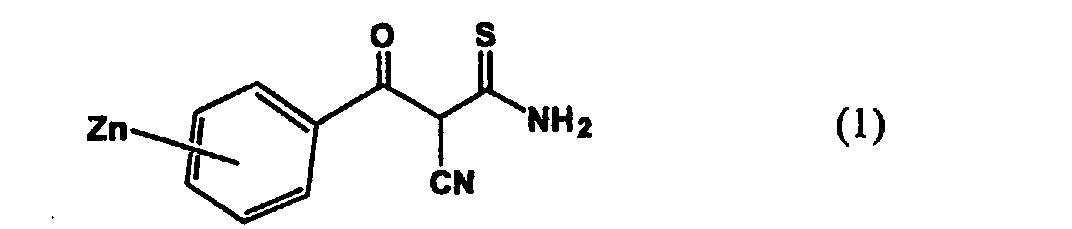
- the present invention firstly relates to a novel compound represented by Formula (1) (wherein, Z is nitro, cyano, halogen, alkyl having 1 to 6 carbons, haloalkyl having 1 to 6 carbons, alkoxy having 1 to 6 carbons, optionally substituted phenyl or optionally substituted phenoxy; and n is 0 or an integer of 1 to 5).
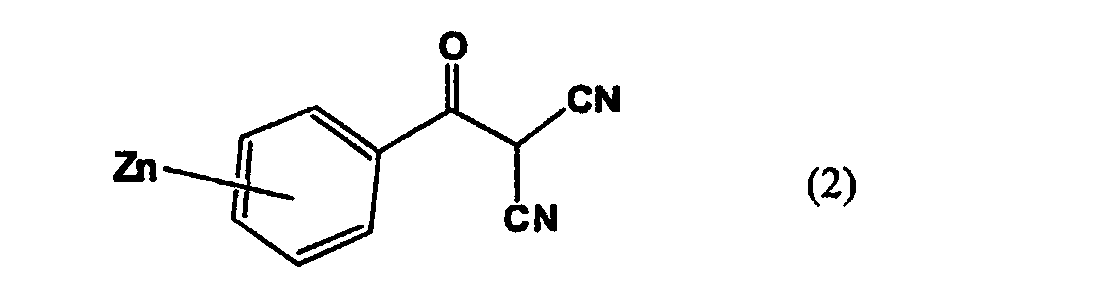
- the present invention relates to a process for producing the compound of Formula (1) characterized in that a benzoylmalononitrile represented by Formula (2) (wherein, Z and n are as defined above) is reacted with thioacetamide represented by Formula CH 3 CSNH 2 in the presence of an acid.
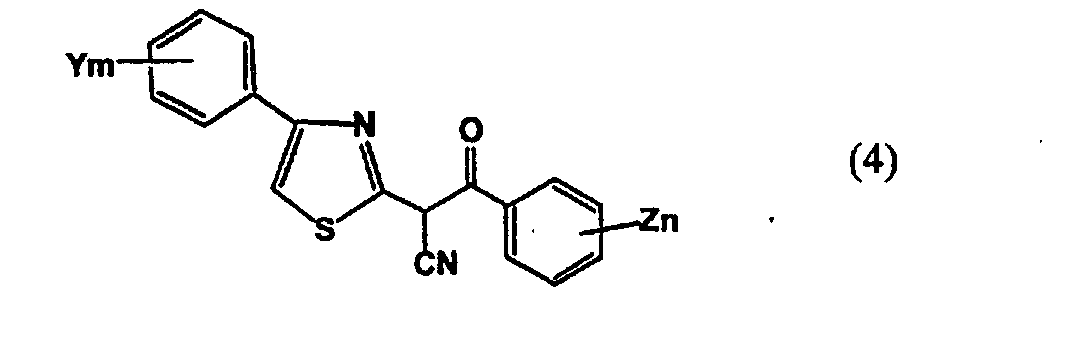
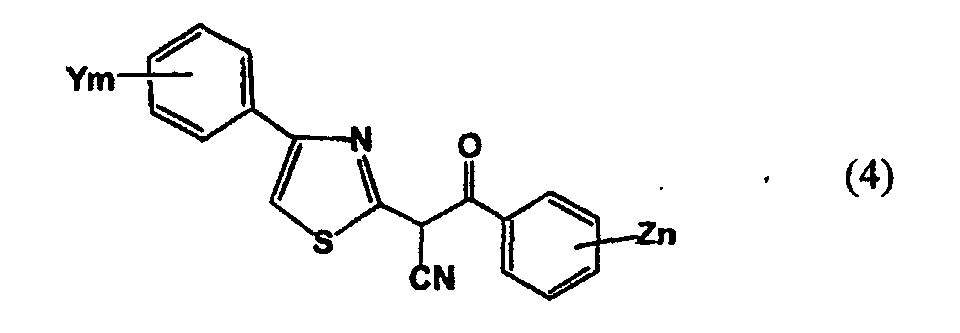
- a process for the preparation of a compound represented by Formula (4) (wherein, Y is halogen, alkyl having 1 to 6 carbons, alkoxy having 1 to 6 carbons or optionally substituted phenyl; m is 0 or an integer of 1 to 5; and Z and n are as defined above) characterized in that a compound of Formula (1) is reacted with a phenacyl halide represented by Formula (3) (wherein, X is halogen, and Y and m are as defined above).
- Z is cyano; nitro; halogen such as fluorine, chlorine or bromine; alkyl having 1 to 6 carbons such as methyl, ethyl, propyl, isopropyl, butyl, sec-butyl, isobutyl, t-butyl, pentyl or its isomer, or hexyl or its isomer; haloalkyl having 1 to 6 carbons such as chloromethyl, fluoromethyl, bromomethyl, dichloromethyl, difluoromethyl, dibromomethyl, trichloromethyl, trifluoromethyl, tribromomethyl, 2,2,2-trichloroethyl, 2,2,2-trifluoroethyl or pentafluoroethyl; alkoxy having 1 to 6 carbons such as methoxy, ethoxy, propoxy, isopropoxy, butoxy, sec-butoxy, isobutoxy or t-butoxy;
- the compound of Formula (1) can be produced by reaction of a compound of Formula (2) with thioacetamide.
- solvents used for the reaction include aromatic hydrocarbons such as benzene, toluene and xylene; ethers such as dioxane; nitriles such as acetonitrile; alcohols such as n-propyl alcohol, isopropyl alcohol and ethyl alcohol; and aliphatic carboxylic acids such as acetic acid and propionic acid. It is preferable to use an acid catalyst when a solvent other than a solvent of aliphatic carboxylic acid type is used.
- Suitable acid catalysts for use include sulfonic acids such as p-toluenesulfonic acid, and aliphatic carboxylic acids such as acetic acid.
- sulfonic acids such as p-toluenesulfonic acid
- aliphatic carboxylic acids such as acetic acid.
- An acid catalyst is not required if an aliphatic carboxylic acid, such as acetic acid, is used as a solvent.
- a reaction temperature suitable for the reaction system can be arbitrarily chosen. It usually ranges from room temperature to the boiling point of a solvent used. The reaction is usually completed in 1 hour to 24 hours.
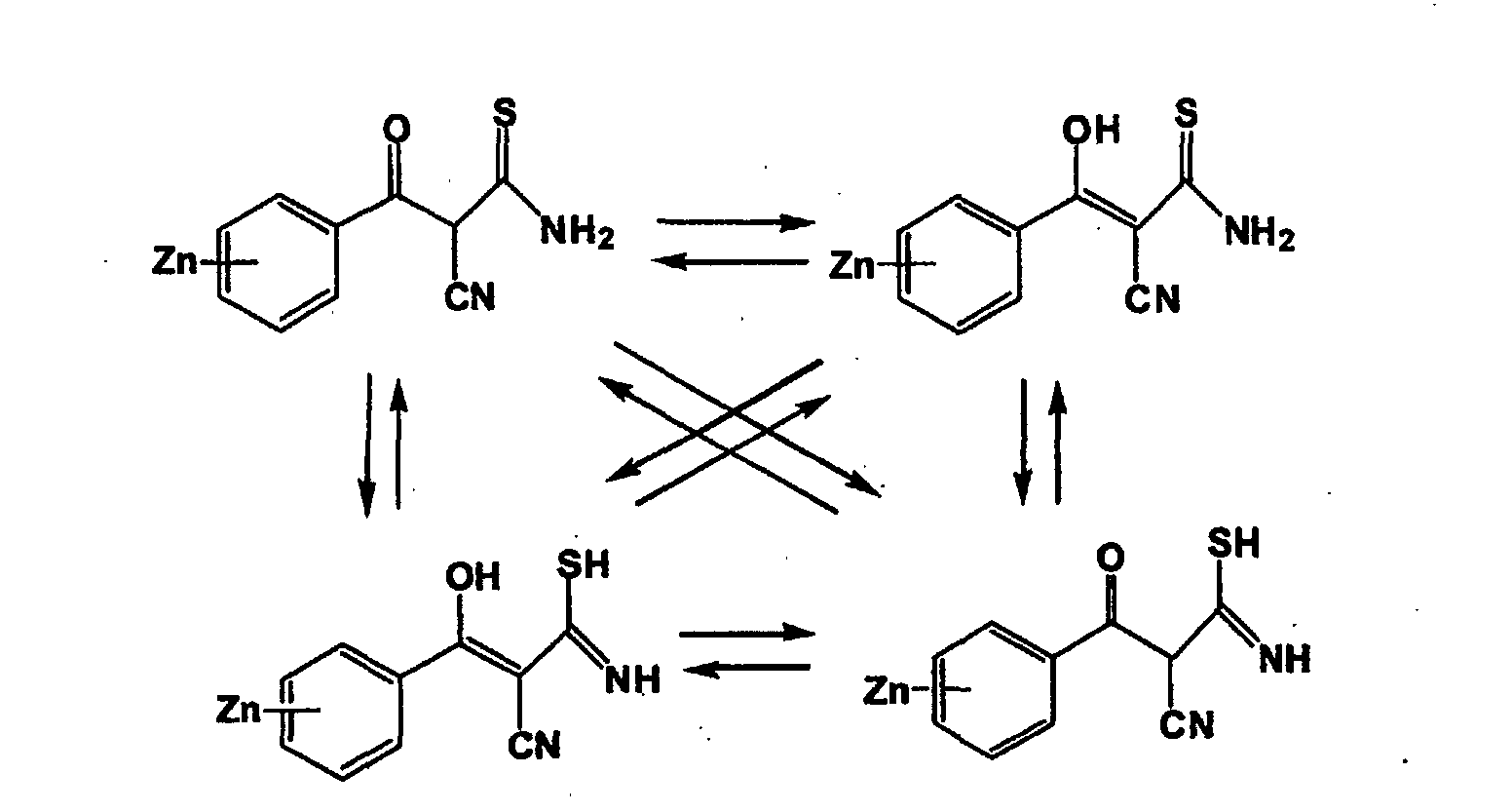
- the compound of Formula (1) may have tautomers shown in the following equation. These isomers are all covered by the present invention.
- Y is halogen such as fluorine, chlorine, bromine or iodine; C 1-6 alkyl such as methyl, ethyl, n-propyl, isopropyl, n-butyl, sec-butyl, isobutyl, t-butyl, n-pentyl or its isomer, or n-hexyl or its isomer; C 1-6 alkoxy such as methoxy, ethoxy, n-propoxy, isopropoxy, n-butoxy, sec-butoxy, isobutoxy or t-butoxy; or optionally substituted phenyl.
- m is 0 or an integer of 1 to 5.
- Y When m is 2 or larger, Y may be the same or different.
- substituents on the phenyl or phenoxy group include halogen such as fluorine, chlorine, bromine and iodine; C 1-6 alkyl such as methyl, ethyl, n-propyl, isopropyl, n-butyl and t-butyl; C 1-6 haloalkyl such as chloromethyl, trifluoromethyl, trifluoroethyl and pentafluoroethyl; and C 1-6 alkoxy such as methoxy and ethoxy.
- the said phenyl or phenoxy group may have two or more, the same or different, substituents at arbitrary positions of the benzene ring.
- X is halogen such as chlorine, bromine or iodine.
- the reaction is carried out by stirring an organic solvent solution (or suspension) of compounds of Formula (1) and (3) at a specified temperature for a fixed period of time.
- An amount of a compound of Formula (3) used usually ranges from 0.5 to 5 mole equivalents, preferably 1 to 3 mole equivalents, to a mole of a compound of Formula (1).
- suitable solvents for use include alcohols such as methyl alcohol, ethyl alcohol, n-propyl alcohol, isopropyl alcohol, n-butyl alcohol, isobutyl alcohol and t-butyl alcohol; ethers such as diethyl ether, tetrahydrofuran, dioxane and 1,2-dimethoxyethane; nitrites such as acetonitrile and benzonitrile; and aromatic hydrocarbons such as benzene, toluene and xylene. These can be used alone or as a mixed solvent of two or more.
- alcohols such as methyl alcohol, ethyl alcohol, n-propyl alcohol, isopropyl alcohol, n-butyl alcohol, isobutyl alcohol and t-butyl alcohol
- ethers such as diethyl ether, tetrahydrofuran, dioxane and 1,2-dimethoxyethane
- nitrites
- a reaction temperature is usually in a range of room temperature to the boiling point of a solvent used.
- hydrogen halide is generated in the reaction system while the reaction proceeds.
- a base that captures the generated hydrogen halide is not always required to be present in the reaction system.
- an organic base such as triethylamine or an inorganic base such as sodium hydrogen carbonate can be used to remove (neutralize) hydrogen halide.
- the compound of Formula (4) may have, for example, tautomers shown in the following equation. These are all covered by the present invention.
- Example 1 The same method describe d in Example 1 was carried out by using DMF instead of toluene. The solution was heated at 100 C with stirring for 6 hours to give the target compound in yield of about 20 to 30%.
- the á-benzoyl-substituted-á-cyanothioacetamides of the present invention are useful as intermediates for producing agricultural chemicals and medicine, particularly valuable as intermediates for the preparation of the insecticides disclosed in WO 00/17174.
- the production processes of the present invention produce, advantageously at an industrial scale, á-benzoyl-substituted-á-cyanothioacetamides and also 3-oxo-2-(2-thiazolyl)-3-phenylpropanenitrile compounds that are intermediates for producing the insecticides disclosed in WO 00/17174.
Landscapes
- Chemical & Material Sciences (AREA)
- Organic Chemistry (AREA)
- Thiazole And Isothizaole Compounds (AREA)
- Organic Low-Molecular-Weight Compounds And Preparation Thereof (AREA)
Abstract
A thioacetamide compound represented by the formula (1) (1)
which is useful as an intermediate for an acrylonitrile derivative serving as an
active ingredient for medicines and agricultural chemicals, especially insecticides/acaricides;
a process for producing the compound; and a process for producing
a 3-oxo-2-(2-thiazolyl)propanenitrile compound, characterized by reacting
the compound represented by the formula (1) with phenacyl halide.
Description
- The present invention relates to thioacetamide compounds useful as intermediates for producing acrylonitrile derivatives that are active ingredients for medicine and agricultural chemicals, particularly for insecticides and acaricides, to processes for producing the compounds, and to processes for the preparation of 3-oxo-2-(2-thiazolyl)-propanenitrile compounds from the said compounds.
- As for thioacetamide compounds analogous to the compounds of the present invention, N-substituted-á-aroyl-á-cyano-thioacetamides are used as starting materials for synthesizing 1,3-oxazoles [Z. Chem., 19,251 (1979)]. However, N-unsubstituted compounds, that is, benzoyl-substituted cyanothioacetamides, of the present invention are not described.
- A known method for thioamidating nitriles with thioacetamide is that a simple nitrile compound is reacted with thioacetamide in dimethylformamide in the presence of hydrochloric acid to give the corresponding thioamide [J. Am. Chem. Soc., 82, 2656 (1960)]. No examples of using compounds with carbonyl groups that are easily sulfurized, such as those of the present invention, are described.
- As for a process for producing 3-oxo-2-(2-thiazolyl)propanenitriles of the present invention, a method represented by the following reaction scheme is disclosed in EP 189960, WO 00/17174 and others.

- It is a process that cyanothioacetamide is reacted with a phenacyl halide to derive to a 2-cyanomethylthiazole compound, which is then benzoylated with a benzoyl halide to give the target compound.
- This process produces the target compound in relatively high yield, but is disadvantageous in industrial mass production because cyanothioacetamide used as a starting material is expensive.
- It is an object of the present invention to provide compounds that are expected to have biological activities useful in the fields of agricultural chemicals and medicine, and industrially advantageous processes for producing the same.
- The inventors carried out reactions of benzoylmalononitrile with thioacetamide according to the method described in the aforementioned paper, with the products in low yields (Comparative Examples 1 and 2). Studies of the reactions in more detail have revealed that a target compound can be produced in high yield if reaction solvents and types of catalysts are properly selected to use, without using dimethylformamide (DMF) and hydrochloric acid, as is the case of the method described above.
- The present invention firstly relates to a novel compound represented by Formula (1)(wherein, Z is nitro, cyano, halogen, alkyl having 1 to 6 carbons, haloalkyl having 1 to 6 carbons, alkoxy having 1 to 6 carbons, optionally substituted phenyl or optionally substituted phenoxy; and n is 0 or an integer of 1 to 5).
- Secondly, the present invention relates to a process for producing the compound of Formula (1) characterized in that a benzoylmalononitrile represented by Formula (2)(wherein, Z and n are as defined above) is reacted with thioacetamide represented by Formula CH3CSNH2 in the presence of an acid.
- Thirdly, it relates to a process for the preparation of a compound represented by Formula (4)(wherein, Y is halogen, alkyl having 1 to 6 carbons, alkoxy having 1 to 6 carbons or optionally substituted phenyl; m is 0 or an integer of 1 to 5; and Z and n are as defined above) characterized in that a compound of Formula (1) is reacted with a phenacyl halide represented by Formula (3)
 (wherein, X is halogen, and Y and m are as defined above).
- The present invention is described in detail.
- In the compounds of Formula (1) of the present invention, Z is cyano; nitro; halogen such as fluorine, chlorine or bromine; alkyl having 1 to 6 carbons such as methyl, ethyl, propyl, isopropyl, butyl, sec-butyl, isobutyl, t-butyl, pentyl or its isomer, or hexyl or its isomer; haloalkyl having 1 to 6 carbons such as chloromethyl, fluoromethyl, bromomethyl, dichloromethyl, difluoromethyl, dibromomethyl, trichloromethyl, trifluoromethyl, tribromomethyl, 2,2,2-trichloroethyl, 2,2,2-trifluoroethyl or pentafluoroethyl; alkoxy having 1 to 6 carbons such as methoxy, ethoxy, propoxy, isopropoxy, butoxy, sec-butoxy, isobutoxy or t-butoxy; phenyl optionally substituted with nitro, halogen such as fluorine and chlorine, alkyl having 1 to 6 carbons such as methyl and ethyl, or alkoxy having 1 to 6 carbons such as methoxy, ethoxy and isopropoxy; or phenoxy optionally substituted with nitro, halogen such as fluorine and chlorine, alkyl having 1 to 6 carbons such as methyl and ethyl, or alkoxy having 1 to 6 carbons such as methoxy, ethoxy and isopropoxy. n is 0 or an integer of 1 to 5. When n is 2 or more, Z may be the same or different.
- The compound of Formula (1) can be produced by reaction of a compound of Formula (2) with thioacetamide.
- Examples of solvents used for the reaction include aromatic hydrocarbons such as benzene, toluene and xylene; ethers such as dioxane; nitriles such as acetonitrile; alcohols such as n-propyl alcohol, isopropyl alcohol and ethyl alcohol; and aliphatic carboxylic acids such as acetic acid and propionic acid. It is preferable to use an acid catalyst when a solvent other than a solvent of aliphatic carboxylic acid type is used.
- Examples of suitable acid catalysts for use include sulfonic acids such as p-toluenesulfonic acid, and aliphatic carboxylic acids such as acetic acid. An acid catalyst is not required if an aliphatic carboxylic acid, such as acetic acid, is used as a solvent.
- A reaction temperature suitable for the reaction system can be arbitrarily chosen. It usually ranges from room temperature to the boiling point of a solvent used. The reaction is usually completed in 1 hour to 24 hours.
- The compound of Formula (1) may have tautomers shown in the following equation. These isomers are all covered by the present invention.
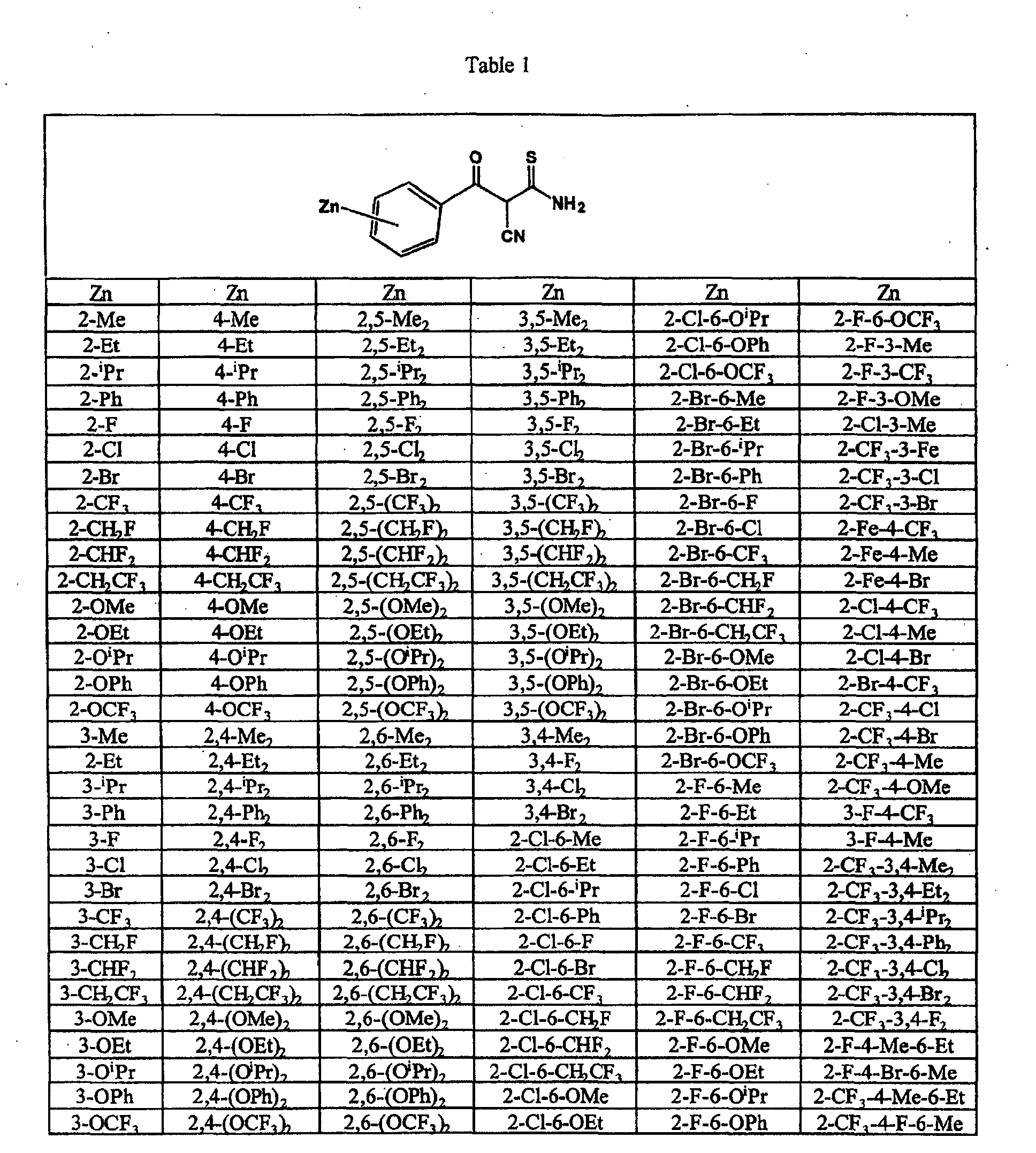
- Actual examples of the compounds of the present invention are shown in Table 1.
- In the following are described processes for the preparation of benzoyl-substituted cyanomethylthiazoles (4) by that benzoyl-substituted cyanothioacetamide compounds of Formula (1) of the present invention that are produced according to the method described above are reacted with phenacyl halides of Formula (3).
- In Formula (3), Y is halogen such as fluorine, chlorine, bromine or iodine; C1-6 alkyl such as methyl, ethyl, n-propyl, isopropyl, n-butyl, sec-butyl, isobutyl, t-butyl, n-pentyl or its isomer, or n-hexyl or its isomer; C1-6 alkoxy such as methoxy, ethoxy, n-propoxy, isopropoxy, n-butoxy, sec-butoxy, isobutoxy or t-butoxy; or optionally substituted phenyl. m is 0 or an integer of 1 to 5. When m is 2 or larger, Y may be the same or different. Examples of substituents on the phenyl or phenoxy group include halogen such as fluorine, chlorine, bromine and iodine; C1-6 alkyl such as methyl, ethyl, n-propyl, isopropyl, n-butyl and t-butyl; C1-6 haloalkyl such as chloromethyl, trifluoromethyl, trifluoroethyl and pentafluoroethyl; and C1-6 alkoxy such as methoxy and ethoxy. The said phenyl or phenoxy group may have two or more, the same or different, substituents at arbitrary positions of the benzene ring.
- X is halogen such as chlorine, bromine or iodine.
- The reaction is carried out by stirring an organic solvent solution (or suspension) of compounds of Formula (1) and (3) at a specified temperature for a fixed period of time.
- An amount of a compound of Formula (3) used usually ranges from 0.5 to 5 mole equivalents, preferably 1 to 3 mole equivalents, to a mole of a compound of Formula (1).
- Examples of suitable solvents for use include alcohols such as methyl alcohol, ethyl alcohol, n-propyl alcohol, isopropyl alcohol, n-butyl alcohol, isobutyl alcohol and t-butyl alcohol; ethers such as diethyl ether, tetrahydrofuran, dioxane and 1,2-dimethoxyethane; nitrites such as acetonitrile and benzonitrile; and aromatic hydrocarbons such as benzene, toluene and xylene. These can be used alone or as a mixed solvent of two or more.
- A reaction temperature is usually in a range of room temperature to the boiling point of a solvent used.
- In the present invention, hydrogen halide is generated in the reaction system while the reaction proceeds. A base that captures the generated hydrogen halide is not always required to be present in the reaction system. However, if necessary, an organic base such as triethylamine or an inorganic base such as sodium hydrogen carbonate can be used to remove (neutralize) hydrogen halide.
- Upon the completion of the reaction, ordinary work-up gives the target compound of Formula (4).
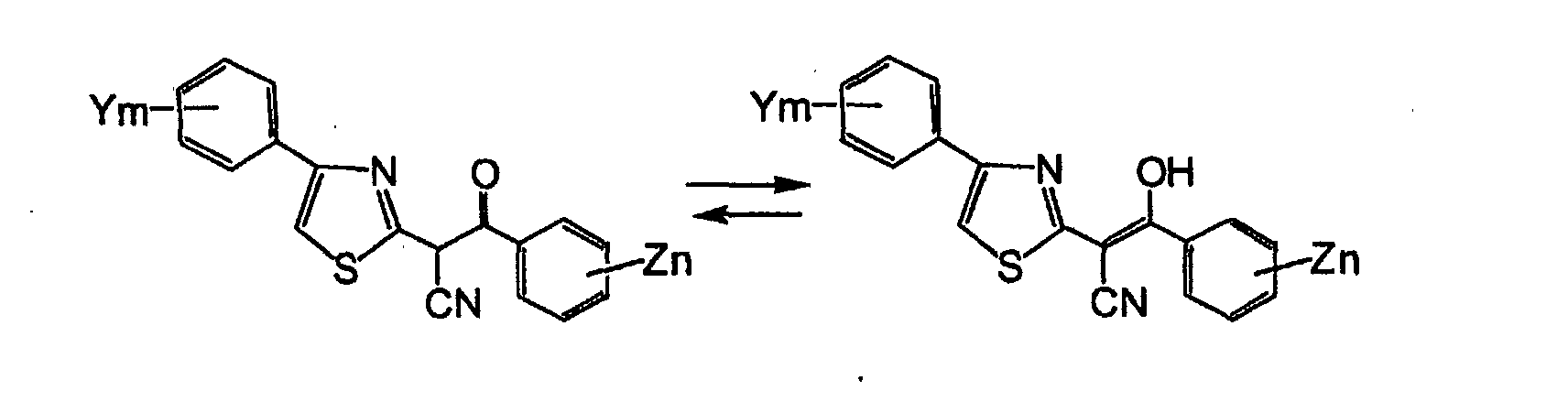
- The compound of Formula (4) may have, for example, tautomers shown in the following equation. These are all covered by the present invention.
- The present invention is described in detail in reference to Examples, but not limited to the following process examples.
-

- 5g of 2-trifluoromethylbenzoylmalononitrile, 1.73g of thioacetamide and 0.5g of p-toluenesulfonic acid hydrate were dissolved in 50 ml of toluene. The resulting solution was refluxed for 1.5 hours. The reaction mixture was cooled to room temperature and poured into 100 ml of water. The toluene layer was separated. A 1N aqueous alkali was added to the toluene layer to stir well. The aqueous layer was separated and adjusted to pH = 1 with hydrochloric acid. The deposited crystals were separated by filtration and dried to give 4.85g of the target compound as crystals. Yield: 84.9%. Melting point: 103 to 105 C
- 3g of 2-trifluoromethylbenzoylmalononitrile and 0.95g of thioacetamide were dissolved in 10 ml of acetic acid. The resulting solution was refluxed for an hour. Acetic acid was distilled out from the reaction solution under reduced pressure. The obtained residue was poured into 50 ml of water and diethyl ether was added. The ether layer was separated, washed with brine, dried over anhydrous magnesium sulfate, and filtered. The filtrate was concentrated under reduced pressure. The obtained crude crystals were purified to give 0.4g of the target compound. Yield: 70.0%.
- 0.3g of 2-trifluoromethylbenzoylmalononitrile, 0.1g of thioacetamide and 0.1g of p-toluenesulfonic acid monohydrate were dissolved in 3 ml of dioxane. The resulting solution was refluxed for 1.5 hours. The reaction mixture was cooled to room temperature and poured into aqueous alkali, and chloroform was added. The aqueous layer was separated and adjusted to pH = 1. The deposited crystals were separated by filtration and dried to give 0.28g of the target compound as crystals. Yield: 81.6%.
-

- The preparation of this compound was carried out in the same method as described in Example 1 except that 4-chlorobenzoylmalononitrile was used. Yield: 85%. Melting point: 208 to 210 C (decomposed).
-

- The preparation of this compound was carried out in the same method as described in Example 1 except that 4-methylbenzoylmalononitrile was used. Yield: 61%. Melting point: 181 to 183 C.
-

- Hydrogen chloride gas was blown into a solution of 3g of 2-trifluoromethylbenzoylmalononitrile and 0.95g of thioacetamide in 10 ml of DMF at 100 C for 30 minutes. The reaction solution was poured into 50 ml of ice-water, and extracted with 100 ml of diethyl ether. The ether layer was washed with brine, dried over anhydrous magnesium sulfate and filtered. The filtrate was concentrated under reduced pressure. The obtained residue was dissolved in a solvent of n-hexane and ethyl acetate (4:1), and purified through a silica gel short column to give 1.5g of the target compound. Yield: 43.8%.
- The same method describe d in Example 1 was carried out by using DMF instead of toluene. The solution was heated at 100 C with stirring for 6 hours to give the target compound in yield of about 20 to 30%.
-
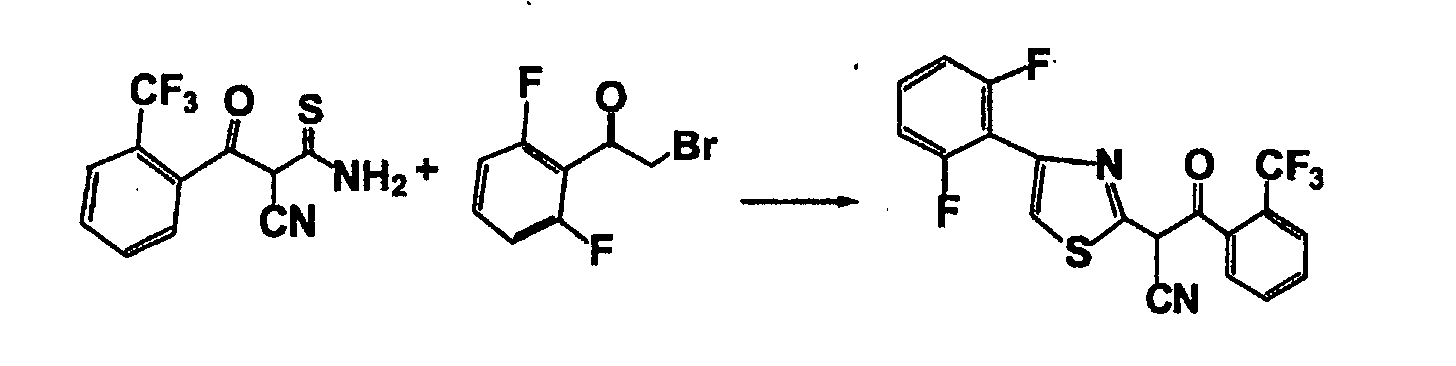
- 0.6g (2.2 mmoles) of á-(2-trifluoromethylbenzoyl)cyanothioacetamide was dissolved in 5 ml of ethyl alcohol, and 0.5g (2.1 mmoles) of á-bromo-2,6-difluoroacetophenone was dropped at room temperature. The resulting solution was stirred at room temperature for 2 hours and at 50 C for 7 hours. The reaction solution was cooled to room temperature, poured into aqueous hydrochloric acid, and extracted with ethyl acetate. The ethylacetate layer was washed with water and with brine in this order, dehydrated over anhydrous magnesium sulfate and concentrated under reduced pressure. The obtained residue was purified through silica gel chromatography to give 0.55g of the target compound. Yield: 63.2%. Melting point: 186 to 188 C
- 0.6g (2.2 mmoles) of á-(2-trifluoromethylbenzoyl)cyanothioacetamide was dissolved in 5 ml of ethyl alcohol, and 0.23g (2.2 mmoles) of triethylamine was added at room temperature The resulting solution was stirred for 15 minutes. Into the resulting solution was dropped 0.5g (2.1 mmoles) of á-bromo-2,6-difluoroacetophenone at room temperature (exothermic), and stirred for 2 hours. The reaction solution was poured into cold aqueous hydrochloric acid, and extracted with ethyl acetate. The obtained product was purified in the same way as that used in Example 6 to give 0.81g of the target compound. Yield: 93.3%.
- As described above, the á-benzoyl-substituted-á-cyanothioacetamides of the present invention are useful as intermediates for producing agricultural chemicals and medicine, particularly valuable as intermediates for the preparation of the insecticides disclosed in WO 00/17174.
- The production processes of the present invention produce, advantageously at an industrial scale, á-benzoyl-substituted-á-cyanothioacetamides and also 3-oxo-2-(2-thiazolyl)-3-phenylpropanenitrile compounds that are intermediates for producing the insecticides disclosed in WO 00/17174.
Claims (3)
- A compound represented by Formula (1)(wherein, Z is nitro, cyano, halogen, alkyl having 1 to 6 carbons, haloalkyl having 1 to 6 carbons, alkoxy having 1 to 6 carbons, optionally substituted phenyl or optionally substituted phenoxy; and n is 0 or an integer of 1 to 5).

- A process for producing the benzoyl-substituted cyanothioacetamide derivatives of Formula (1)(wherein, Z and n are as defined above) characterized in that a malononitrile whose benzoyl group is substituted and represented by Formula (2)
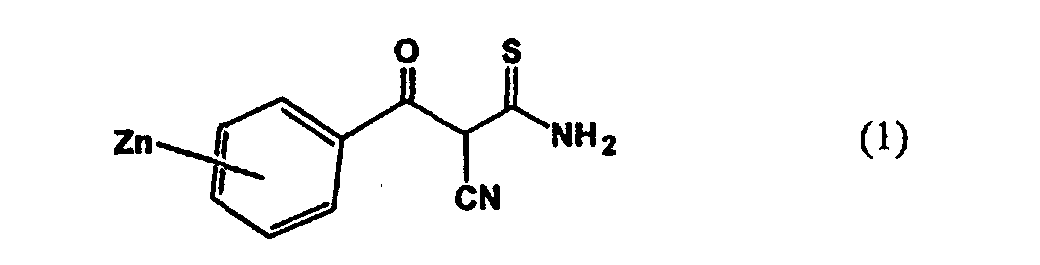 (wherein, Z and n are as defined in Claim 1) is reacted with thioacetamide represented by Formula CH3CSNH2.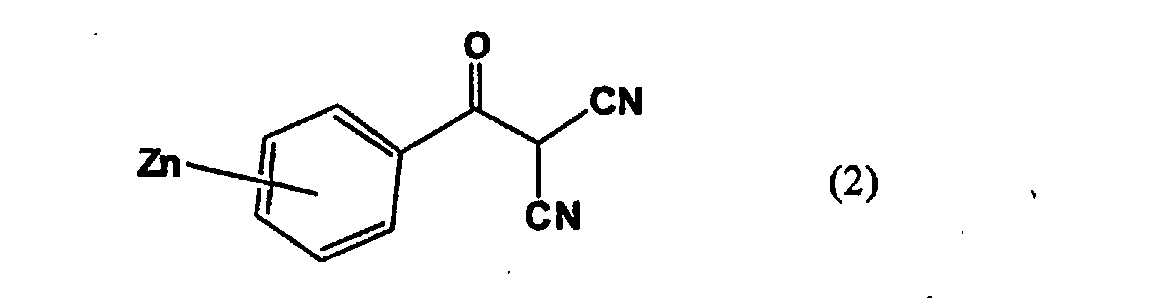
- A process for the preparation of a compound represented by Formula (4)(wherein, Y is halogen, alkyl having 1 to 6 carbons, alkoxy having 1 to 6 carbons or optionally substituted phenyl; m is 0 or an integer of 1 to 5; and Z and n are as defined above) characterized in that a compound of Formula (1)
 (wherein, Z and n are as defined above) is reacted with a phenacyl halide represented by Formula (3)
 (wherein, X is halogen, and Y and m are as defined above).
Applications Claiming Priority (5)
| Application Number | Priority Date | Filing Date | Title |
|---|---|---|---|
| JP2001034839 | 2001-02-13 | ||
| JP2001034839 | 2001-02-13 | ||
| JP2001106924 | 2001-04-05 | ||
| JP2001106924 | 2001-04-05 | ||
| PCT/JP2002/001099 WO2002064554A1 (en) | 2001-02-13 | 2002-02-08 | Cyanothioacetamide derivative and process for producing the same |
Publications (1)
| Publication Number | Publication Date |
|---|---|
| EP1367049A1 true EP1367049A1 (en) | 2003-12-03 |
Family
ID=26609283
Family Applications (1)
| Application Number | Title | Priority Date | Filing Date |
|---|---|---|---|
| EP02711425A Withdrawn EP1367049A1 (en) | 2001-02-13 | 2002-02-08 | Cyanothioacetamide derivative and process for producing the same |
Country Status (6)
| Country | Link |
|---|---|
| US (1) | US20040059122A1 (en) |
| EP (1) | EP1367049A1 (en) |
| JP (1) | JPWO2002064554A1 (en) |
| KR (1) | KR20040007446A (en) |
| CN (1) | CN1489577A (en) |
| WO (1) | WO2002064554A1 (en) |
Families Citing this family (1)
| Publication number | Priority date | Publication date | Assignee | Title |
|---|---|---|---|---|
| CN103113260B (en) * | 2013-03-13 | 2014-11-05 | 南通市纳百园化工有限公司 | Method for recycling cyanoacetamide in mother liquor |
Family Cites Families (3)
| Publication number | Priority date | Publication date | Assignee | Title |
|---|---|---|---|---|
| US4626543A (en) * | 1985-02-01 | 1986-12-02 | Shell Oil Company | Insecticidal 2,6-difluorobenzoyl derivatives of 4-substituted-1,3-thiazole-2-acetonitriles |
| US5415981A (en) * | 1992-03-31 | 1995-05-16 | Eastman Kodak Company | Photographic silver halide color materials |
| CA2341722A1 (en) * | 1998-09-17 | 2000-03-30 | Hidemitsu Takahashi | Thiazolylcinnamonitriles and pest controlling agents |
-
2002
- 2002-02-08 KR KR10-2003-7010650A patent/KR20040007446A/en not_active Ceased
- 2002-02-08 WO PCT/JP2002/001099 patent/WO2002064554A1/en not_active Ceased
- 2002-02-08 US US10/466,815 patent/US20040059122A1/en not_active Abandoned
- 2002-02-08 CN CNA028043715A patent/CN1489577A/en active Pending
- 2002-02-08 JP JP2002564487A patent/JPWO2002064554A1/en not_active Withdrawn
- 2002-02-08 EP EP02711425A patent/EP1367049A1/en not_active Withdrawn
Non-Patent Citations (1)
| Title |
|---|
| See references of WO02064554A1 * |
Also Published As
| Publication number | Publication date |
|---|---|
| CN1489577A (en) | 2004-04-14 |
| WO2002064554A1 (en) | 2002-08-22 |
| US20040059122A1 (en) | 2004-03-25 |
| KR20040007446A (en) | 2004-01-24 |
| JPWO2002064554A1 (en) | 2004-06-10 |
Similar Documents
| Publication | Publication Date | Title |
|---|---|---|
| JPH06779B2 (en) | Thiazolidione derivative and pharmaceutical composition comprising the same | |
| JPH04234864A (en) | Production of 2-chlorothiazoles | |
| JP3393891B2 (en) | Method for producing imidazoles | |
| KR100423188B1 (en) | Process for preparing 1,4-dihydropyridine compounds | |
| JP2008510745A (en) | Method for producing biphenylamines | |
| KR960001913B1 (en) | Process for the preparation of 3-cyano-4-aryl-pyrroles | |
| JP2682705B2 (en) | A method for producing a 2,6-dichlorophenylaminobenzeneacetic acid derivative and a diphenylamine derivative. | |
| JPH10139770A (en) | Method for producing 2- (3-cyanophenyl) thiazole derivative | |
| JP3440196B2 (en) | Method for producing thiobenzamide derivative | |
| JPH06199759A (en) | Preparation of phenylacetic acid derivative | |
| US20040059122A1 (en) | Cyanothioacetamide derivative and process for producing the same | |
| KR20040039430A (en) | Process for producing (2-nitrophenyl)acetonitrile derivative and intermediate therefor | |
| KR101308227B1 (en) | Method for producing nicotinic acid derivative or salt thereof | |
| JP4336913B2 (en) | Method for producing amide derivative | |
| CN100389110C (en) | A kind of method for preparing aromatic ring substituted isoxazoline compounds | |
| JP6256469B2 (en) | Process for the preparation of spiro [2.5] octane-5,7-dione | |
| JP2801647B2 (en) | Method for producing 6-fluorochromone-2-carboxylic acid derivative | |
| JP4075357B2 (en) | 4,5-disubstituted-1,2,3-triazole and process for producing the same | |
| JPH05112564A (en) | Phenylthiazole derivative | |
| JPWO2007122806A1 (en) | 2-alkenyl-3-aminothiophene derivative and method for producing the same | |
| JP4194984B2 (en) | Phenylnaphthylimidazole compound | |
| JP4172931B2 (en) | Process for producing 1-alkyl-5-hydroxypyrazole | |
| JPH0114915B2 (en) | ||
| JP2000191554A (en) | Production of acrylic acid derivative having functional group having high reaction activity | |
| JPWO2001087864A1 (en) | Thiazolyl ethanone compound and method for producing the same |
Legal Events
| Date | Code | Title | Description |
|---|---|---|---|
| PUAI | Public reference made under article 153(3) epc to a published international application that has entered the european phase |
Free format text: ORIGINAL CODE: 0009012 |
|
| 17P | Request for examination filed |
Effective date: 20030822 |
|
| AK | Designated contracting states |
Kind code of ref document: A1 Designated state(s): AT BE CH CY DE DK ES FI FR GB GR IE IT LI LU MC NL PT SE TR |
|
| AX | Request for extension of the european patent |
Extension state: AL LT LV MK RO SI |
|
| STAA | Information on the status of an ep patent application or granted ep patent |
Free format text: STATUS: THE APPLICATION IS DEEMED TO BE WITHDRAWN |
|
| 18D | Application deemed to be withdrawn |
Effective date: 20050829 |