EP1366997A2 - Combined package and holder for paper towels - Google Patents
Combined package and holder for paper towels Download PDFInfo
- Publication number
- EP1366997A2 EP1366997A2 EP03076565A EP03076565A EP1366997A2 EP 1366997 A2 EP1366997 A2 EP 1366997A2 EP 03076565 A EP03076565 A EP 03076565A EP 03076565 A EP03076565 A EP 03076565A EP 1366997 A2 EP1366997 A2 EP 1366997A2
- Authority
- EP
- European Patent Office
- Prior art keywords
- container
- container part
- folded
- triangular
- towels
- Prior art date
- Legal status (The legal status is an assumption and is not a legal conclusion. Google has not performed a legal analysis and makes no representation as to the accuracy of the status listed.)
- Withdrawn
Links
Images



Classifications
-
- B—PERFORMING OPERATIONS; TRANSPORTING
- B65—CONVEYING; PACKING; STORING; HANDLING THIN OR FILAMENTARY MATERIAL
- B65D—CONTAINERS FOR STORAGE OR TRANSPORT OF ARTICLES OR MATERIALS, e.g. BAGS, BARRELS, BOTTLES, BOXES, CANS, CARTONS, CRATES, DRUMS, JARS, TANKS, HOPPERS, FORWARDING CONTAINERS; ACCESSORIES, CLOSURES, OR FITTINGS THEREFOR; PACKAGING ELEMENTS; PACKAGES
- B65D5/00—Rigid or semi-rigid containers of polygonal cross-section, e.g. boxes, cartons or trays, formed by folding or erecting one or more blanks made of paper
- B65D5/42—Details of containers or of foldable or erectable container blanks
- B65D5/44—Integral, inserted or attached portions forming internal or external fittings
- B65D5/52—External stands or display elements for contents
- B65D5/5253—Containers initially closed but folded about a central axis to display the contents in two or more cells
-
- B—PERFORMING OPERATIONS; TRANSPORTING
- B65—CONVEYING; PACKING; STORING; HANDLING THIN OR FILAMENTARY MATERIAL
- B65D—CONTAINERS FOR STORAGE OR TRANSPORT OF ARTICLES OR MATERIALS, e.g. BAGS, BARRELS, BOTTLES, BOXES, CANS, CARTONS, CRATES, DRUMS, JARS, TANKS, HOPPERS, FORWARDING CONTAINERS; ACCESSORIES, CLOSURES, OR FITTINGS THEREFOR; PACKAGING ELEMENTS; PACKAGES
- B65D5/00—Rigid or semi-rigid containers of polygonal cross-section, e.g. boxes, cartons or trays, formed by folding or erecting one or more blanks made of paper
- B65D5/42—Details of containers or of foldable or erectable container blanks
- B65D5/64—Lids
- B65D5/66—Hinged lids
Definitions
- the invention relates to a container that consists of a combined package and holder for triangular-folded towels, such as various types of table napkin, kitchen paper or other absorbent material.
- the container comprises a first container part that has a closed end with two flat delimiting surfaces set at right angles, and an open end for inserting and removing the folded towels.
- absorbent paper in the form of table napkins that are packed in a rectangular carton with a flat rectangular bottom surface and four rectangular side surfaces is already known.
- the napkins are accordingly square or rectangular in shape and are folded in such a way that they are still square or rectangular after they have been folded.
- the individual napkins are arranged in the package in the form of a stack of a plurality of folded napkins. Such a stack has two flat rectangular surfaces formed of the first and the last napkin in the stack, and four essentially flat rectangular surfaces formed of the edges of the folded and stacked napkins.
- the known packages are intended to be used as both holder and dispenser for the packed napkins and for this purpose they are designed with a sufficiently large bottom surface in order to be able to be stood or laid on, for example, a table.
- the carton has an open end from which the napkins can be removed from the carton.
- the napkins are usually placed in the package with one of the edge surfaces of the stack of napkins resting against the bottom surface of the package and with the opposite edge surface of the stack of napkins exposed at the open end of the package.
- the known table napkin containers have several disadvantages. For example, for reasons of hygiene, it is necessary to provide the container with some type of seal during transportation and storage of the container. This is usually carried out by the whole container being enclosed in an outer covering, for example of plastic film or cellophane. The outer covering must be removed before the container can be used as a napkin dispenser. Plastic coverings and the like are often difficult to tear open, and it can easily happen that the napkins in the container are damaged or fall out while the container is being handled. In addition, the outer covering must be thrown away, which constitutes an extra task that can be perceived as annoying.
- the table napkin containers are used in order to provide individual napkins in a convenient and aesthetically pleasing way, for example on the dining table at home, in restaurants, on picnics, etc.
- the greatest problem with the known containers is, however, that they cannot be closed after the removal of a required number of napkins from the container. This leads to the napkins becoming soiled after a while, in spite of the fact that they are unused.
- the outer napkins in the stack of napkins can collapse and be bent down over the side edges of the container, if these are not as high as the napkins. This happens in particular if the napkins are exposed to humid air.
- Another problem is that when there are only a few napkins left in the napkin container, these have a tendency to sink to the bottom of the container and form a difficult to reach, unattractive crumpled heap. For both aesthetic and functional reasons, this is particularly unsuitable, as the napkins become crumpled and, in addition, it is almost impossible to remove individual napkins from the package.
- An additional problem is that coloured napkins have a tendency to fade if they are exposed to daylight, which looks rather unattractive. As the napkins in the known containers usually deteriorate in both shape and appearance as the container is emptied, this frequently leads to napkin containers being thrown away before they have been emptied of their contents.
- a container of the type described by way of introduction is provided for folded towels, which holder essentially avoids the disadvantages associated with previously known containers of this type.
- a container according to the invention is characterized in particular in that the folded towels are folded into a triangle and have a folded edge and a right-angled corner opposite to the folded edge, and in that at least one second container part, which has a closed end with two flat delimiting surfaces set at an angle to each other and two triangular side surfaces and an open end, is connected to the first container part by means of a hinged joint, and in that by pivoting the first container part and the second container part around the hinged joint, the container can be caused to change between two positions, where the first position is a closed position, the packaging position, in which the triangular-folded towels are enclosed within the container parts, and the second position is an open position, the dispensing position, in which the triangular-folded towels are inserted in the first container part with the right-angled corner arranged between the flat delimiting surfaces that are at right angles to each other at the closed end and with the folded edge exposed at the open end of the first container part.
- the triangular shape of the folded towels which is reflected in the shape of the container/dispenser, provides a package according to the invention with very great stability both during transportation and storage of the package, and during use.
- the triangular folding also means that the towels have less of a tendency to collapse and lose their shape than is the case with conventionally-folded square or rectangular towels.
- the triangular shape is visually appealing and gives the package a neat and attractive appearance when it is opened and the contents are exposed for removal from the package.
- the container 100 shown in Figures 1 and 2 contains two stacks 101, 102 of towels 103 folded into triangles.
- the triangular-folded towels can, for example, be absorbent towels of paper or non-woven material, such as kitchen paper, paper handkerchiefs, table napkins or the like.
- the towels 103 are originally normal square towels and are folded one or more times so that they are the shape of a right-angled triangle with the right-angled corner 104 opposite a folded edge 105.
- the container 100 is the shape of a cube which is divided diagonally into two identically-shaped halves, which form a first container part 106 and a second container part 107.
- Each container part 106, 107 has a closed end 108 and an open end 109, a first and a second rectangular bottom surface 110, 111 at right angles to each other being joined along a bottom line 112 at the closed end 108.
- the container parts 106, 107 have a longitudinal direction, I, which is parallel to the bottom line 112, a height direction, h, at right angles to the longitudinal direction I, and a transverse direction, b, at right angles to the longitudinal direction I.
- An essentially triangular side surface 114, 115 delimits the respective container part 106, 107 in the longitudinal direction, the side surfaces 114, 115 having a right-angled corner 116 at the bottom line 112 and an opposite edge 117 at the open end 109 of the container part 106, 107. Together with the edges 118 of the bottom surfaces 110, 111 opposite to the bottom line 112, the edges 117 opposite to the right-angled corner 116 of the side surfaces 114, 115 define the edge of the opening 120 at the open end of the container part.
- a stack of triangular-folded towels is inserted in each container part in such a way that the triangular-folded towels are arranged between the bottom surfaces with the right-angled corners of the towels 103 facing towards the bottom line and with the folded edges 105 facing towards the opening in the container part.
- the stacks 101, 102 are essentially the same shape as the container parts 106, 107 and are such a size that they are completely enclosed in the respective container part 106, 107.
- the container in the figures can be manufactured of any material that is suitable for the purpose.
- the container is designed to be disposable, it is, however, preferable to manufacture the container of a cheap and easily-available material such as cardboard, pasteboard or rigid plastic film.
- Containers made of pasteboard or cardboard can advantageously be treated to enable them to withstand moisture and breakage better. Such treatment can, for example, be carried out by applying a coating of lacquer, plastic or wax. It is also possible to injection mould a plastic package according to the invention. Such a package is suitable for repeated use.
- the container parts 106, 107 are permanently attached to each other along an edge 118 at the opening 120 in each container part 106, 107.
- the attachment is arranged at an edge 118 on a bottom surface 110 of each container part 106, 107.
- the attachment is carried out by a hinged joint 121, with the container 100 being able to assume two stable positions by pivoting around the joint 121.
- the first position which is shown in Figure 1, is a packaging position, where the container parts 106, 107 are closed together with the open ends 109 in contact with each other.
- both the stacks 101, 102 of triangular-folded towels 103 are completed enclosed within the container parts 106, 107, which together form the shape of a parallelepiped.
- the second position is shown in Figure 2 and is a dispensing position, where the open ends 109 of the container parts 106, 107 are moved apart.
- the first bottom surfaces 110 of the container parts alongside the hinged joint 121 are brought into contact with each other, whereby the second bottom surfaces 111 arranged at right angles to the first bottom surfaces 110 form a continuous supporting surface 122 on which the container 100 can be stood.
- the two stacks 101, 102 of triangular-folded towels 103 are exposed at the open ends of the container parts 106, 107, with the folded edges 105 able to be taken hold of at the openings 120 in the container parts 106, 107.
- stop edges 124 are arranged at the end edges of the supporting surface 122, that is at the edges 118 of the second bottom surfaces 111 located at the openings 120 in the container parts 106, 107.
- the stop edges 124 should not be so high that they obstruct the removal of the folded towels and should preferably not extend to more than half the height of the standing container.
- a stop device can alternatively be arranged in the form of a strap or a wire positioned at a short distance from the edge 118 of the bottom surface 111. In order to obtain the desired effect of preventing sliding, the stop device should not be positioned higher than corresponding to half the height of the container part 106, 107.
- curved cut-outs 125 are arranged in the side surfaces of the container parts 106, 107 and extend from the edge 117 of the opening 120 in the container part 106, 107 a little way in towards the right-angled corner 116 of the respective side surface 114, 115.
- the cut-outs 125 can, of course, be other shapes than the shape shown. Thus, for example, rectangular, triangular, semi-circular cut-outs, etc, can be used.
- the cut-outs 125 can be arranged in only one side surface 114, 115 on each container part 106, 107, but are preferably arranged in both side surfaces 114, 115 of the container parts 106, 107. If the container is provided with stop devices positioned relatively centrally over the openings in the container parts, the positioning of the cut-outs must, of course, be made to accommodate these stop devices.
- the cut-outs 125 can be covered, so that towels 103 enclosed in the container are completely protected against being affected by the surroundings. This can, for example, be achieved by the cut-outs 125 being delimited by perforations or being only partially punched out of the container material, so that they can easily be released or folded out from the container when this is to be used.
- the cut-outs 125 can be covered by a removable tape, or the whole container can be enclosed in an outer covering, for example of plastic or cellophane.
- the container 100 can remain in its packaging position, particularly before the container 100 is first opened.
- this also serves, of course, as a means for holding the container together.
- Other means for holding the container together are tape, glue, hook and loop fastening, press-fasteners and the like.
- the means for holding the container together In order to be able to close the container 100 and keep it in the closed position after the first (and subsequent) time it is opened, it is preferable for the means for holding the container together to be resealable, that is the means for holding the container together can be opened and closed repeatedly.
- the container 100 is provided with a means for holding the container together in the form of a closing tab 126 arranged on the edge 118 opposite the hinged joint 121 on one container part 106 and a slot 127 arranged in the corresponding edge 118 of the second container part 107.
- a closing tab 126 arranged on the edge 118 opposite the hinged joint 121 on one container part 106 and a slot 127 arranged in the corresponding edge 118 of the second container part 107.
- the closing tab 126 is inserted into the slot 127 and thereby keeps the container 100 in the packaging position by mechanical means. Opening and closing of the container can be carried out repeatedly and the container 100 can be kept in the packaging position between periods of use in a secure and hygienic way.
- the holder 300 shown in Figures 3 and 4 contains only one stack 301 of triangular-folded towels 303.
- the container 300 is a triangular shape.
- the container is formed of three container parts, with a primary container part 306 and two secondary container parts 307', 307".
- the primary container part 306 is in the shape of a cube with a closed end 308 and an open end 309, a first and a second rectangular bottom surface 310, 311 at right angles to each other being joined along a bottom line 312 at the closed end 308.
- the primary container part 306 has, as has the rest of the container 300, a longitudinal direction, I, which is parallel to the bottom line 312, a height direction, h, at right angles to the longitudinal direction I and diagonal to the corner 316 between the first bottom surface 310 and the second bottom surface 311, and a transverse direction, b, at right angles to the longitudinal direction and the height direction.
- the longitudinal direction thus means the extent of the container in the direction in which the triangular-folded towels are stacked.
- the height direction, h refers to the extent of the container above a base on which the holder is located in the dispensing position.
- Square side surfaces 314 delimit the first container part 306 in the longitudinal direction, the side surfaces 314 having a right-angled corner 316 at the bottom line 312 and two free edges 317 set at right angles to each other at the open end 309 of the container part 306. Together with the edges 318 of the bottom surfaces 310, 311 opposite the bottom line, the free edges 317 of the side surfaces 314 define the edge of the opening 320 at the open end 309 of the primary container part 306.
- the stack 301 of triangular-folded towels 303 is inserted in the primary container part 306 in such a way that the triangular-folded towels 303 are arranged between the bottom surfaces 310, 311 with the right-angled corners 304 of the towels 303 facing the bottom line 312 and with the folded edges 305 facing the opening 320 in the container part 306.
- the stack 301 of towels 303 is essentially the same shape as the container 300 and is such a size that it is completely enclosed in the container 300 when the container is closed. It is also important that the triangular-folded towels 303 are a size that does not geometrically prevent the container being opened and closed.
- the secondary container parts 307', 307" are a triangular shape, with two rectangular bottom surfaces 310', 311'; 310", 311" arranged at an angle of 45° to each other along a bottom line 312'; 312" and with two triangular side surfaces 315'; 315".
- the secondary container parts 307', 307" are together the same size as the primary container part 306.
- the secondary container parts 307', 307" have a closed end 308', 308" at the bottom line 312', 312" and an open end 309', 309" with an opening 320', 320" which is a rectangular shape with the edges of the opening being formed by the free edges of the side surfaces 315'; 315" and the bottom surfaces 310', 311', 310", 311".
- the container parts 306, 307', 307" are attached to each other along an edge 318 at the opening 320, 320', 320" in each container part 306, 307', 307".
- the attachments consist of hinged joints 321', 321", with the container being able to assume at least three stable positions by pivoting around one or both of the joints 321', 321".
- the first position which is shown in Figure 3, is the packaging position, where all the three container parts 306, 307', 307" are closed together, with the open ends 309, 309', 309" towards each other.
- the stack 301 of triangular-folded towels 303 is completely enclosed within the container parts 306, 307', 307", which together form a triangular shape with two triangular side surfaces and with three rectangular bottom surfaces, two equal-sized bottom surfaces being arranged at right angles to each other and the third bottom surface being arranged between the equal-sized bottom surfaces at an angle of 45° to these.
- the second position is shown in Figure 4 and is a dispensing position, where the open ends 309, 309', 309" of all three container parts 306, 307', 307" are moved apart and the bottom lines 312, 312', 312" of the container parts are moved together.
- first bottom surfaces 310', 310" on each secondary container part 307', 307" located at the respective hinged joint 321', 321" are brought into contact with the corresponding bottom surface 310 on the primary container part 306, whereby the second bottom surfaces 311', 311" on the secondary container parts 307', 307" arranged at an angle of 45° to the first bottom surfaces 310', 310" form a continuous supporting surface 322 on which the container 300 can be stood.
- the stack 301 of folded towels 303 is thus exposed at the open end 309 of the primary container part 306, with the folded edges 305 and the pointed corner of the towels 303 easy to take hold of.
- the third stable position that can be assumed by the container in Figure 3 is a second dispensing position.
- the second dispensing position is identical to that shown in Figure 6 as far as function and appearance are concerned.
- only one of the secondary container parts 307' has been folded back along the hinged joint 321', so that the stack 301 of folded towels 303 is exposed with only a pointed corner projecting from the primary container part 306.
- the container 300 stands on a supporting surface formed of a bottom surface 311 of the primary container part 306 and a bottom surface 310" of the closed secondary container part 307".
- the container 300 it is desirable for the container 300 to be able to remain in its packaging position, particularly before the container is first opened. As there are no cut-outs or holes in the container, this does not normally need to be enclosed in an outer covering.
- the container 300 is provided with a means for closure in the form of a removable tape 325 which holds together the two secondary container parts 307', 307" and which is removed when the container 300 is to be opened for the first time.
- the container When the container is in use, it can be stored in a stable way in a closed position if it is left standing, for example, in the position shown in Figure 3. Alternatively, the container can be stood on the large side surface formed by the second bottom surfaces 311', 311" opposite to the right-angled corner. If the container is to be moved between periods of use, it is, however, preferable for it to be provided with a resealable means for closure that prevents the container being opened accidentally while it is being moved.
- Figures 5 and 6 show a container 500 that can be perceived as a simplified variant of the container shown in Figures 3 and 4.
- the container 500 has a packaging position that appears to be almost identical to the packaging position shown in Figure 3.
- the difference between the container 500 shown in Figures 5 and 6 and the container 300 described in connection with Figures 3 and 4 is that the container 500 in Figures 5 and 6 has only one secondary container part 507 and a primary container part 506, with the primary container part 506 having a shape and size corresponding to a combination of the primary container part 306 and the one secondary container part 307" in the container shown in Figures 3 and 4.
- the container 500 in Figures 5 and 6 has a relatively large and stable primary container part 506, which provides a lot of support to the stack 501 of folded towels 503 inserted in the container.
- the container 500 has a small triangular "lid", formed by the secondary container part 507.
- the triangular lid can easily be pivoted open around the hinged joint 521 and it thereby exposes the folded towels 503 at a pointed corner of the stack 501 of towels.
- the triangular shape of the secondary container part 507 that is the same as the shape of the stack of folded towels, makes it possible to open the container part easily, without the secondary container part 507 coming into contact with the towels 503. This means that the risk is minimal of damaging the towels in the container when it is opened.
- the stack 501 of towels 503 is given maximal support by the container and the risk of deformation or collapse of the stack 501 is almost non-existent.
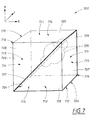
- the container 700 shown in Figures 7 and 8 has great similarities to the container 100 shown in Figure 1.
- the container 700 in its packaging position, is the shape of a parallelepiped which is divided diagonally into two identically-shaped halves which form a first container part 706 and a second container part 707.
- each container part 706, 707 has, in addition, a closed end 708 and an open end 709, with a first and a second rectangular bottom surface 710, 711 at right angles to each other being attached along a bottom line 712 at the closed end 708.
- the container parts In the dispensing position, the container parts have a longitudinal direction which is parallel to the bottom line, a height direction at right angles to the longitudinal direction and parallel to the first bottom surface 710, and a transverse direction at right angles to the longitudinal direction and parallel to the second bottom surface 711.
- An essentially triangular side surface 714, 715 delimits the respective container part 706, 707 in the longitudinal direction, the side surfaces 714, 715 having a right-angled corner 716 at the bottom line 712 and an opposite edge 717 at the open end 709 of the container part.
- edges 718 of the bottom surfaces 710, 711 opposite to the bottom line 712 together with the edges 718 of the bottom surfaces 710, 711 opposite to the bottom line 712, the edges 717 opposite to the right-angled corner 716 of the side surfaces 714, 715 define the edge of the opening 720 at the open ends 709 of the container parts 706, 707.
- a stack 701, 702 of triangular-folded towels 703 is inserted into each container part 706, 707 with the triangular-folded towels 703 arranged between the bottom surfaces 710, 711 and with the right-angled corners 704 of the towels 703 facing towards the bottom line 712 and with the folded edges 705 facing towards the opening 720 in the container parts 706, 707.
- the stacks 701, 702 are essentially the same shape as the container parts 706, 707 and are of such a size that they are completely enclosed in the respective container part 706, 707.
- the container parts 706, 707 are attached to each other along an edge at the opening in each container part 706, 707.
- the attachment is arranged at the edge 717 of a side surface 714, 715 of each container part 706, 707 opposite to the right-angled corner 716.
- the attachment consists of a hinged joint 721, whereby the container 700 can assume two stable positions by pivoting around the joint 721.
- the first position which is shown in Figure 7, is as already mentioned a packaging position in which the container parts 706, 707 are brought together with the open ends 709 towards each other.
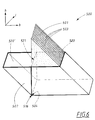
- the second position is shown in Figure 8 and is a dispensing position, in which the open ends 709 of the container parts 706, 707 are moved apart.
- the first triangular side surfaces 714, 715 of the container parts 706, 707 located alongside the hinged joint 721 are brought into contact with each other, whereby the pairs of bottom surfaces 710, 711 in the longitudinal direction form continuous supporting surfaces 722 on which the container 700 can be stood.
- the container is symmetrical in the dispensing position in relation to the combined bottom line 712 of the two container parts 706, 707, it does not matter which supporting surface 722 is selected when the container is placed, for example, on a table.
- stop edges 727 are arranged along the edges 718 of the supporting surfaces 722, at the openings 720 in the container parts 706, 707.
- cut-outs 725 are arranged in the exposed side surfaces 714, 715 of the container parts 706, 707, which cut-outs extend from the edge 717 of the opening 720 in the container part 706, 707 a little way in towards the right-angled corner 716 of the respective side surface 714, 715.
- the cut-outs 725 can, of course, be a different shape to that shown in Figure 8.
- the size of the containers can, of course, be varied, depending upon the area of use and the size of the folded towels, and upon the number of towels in the packed stacks.
Landscapes
- Engineering & Computer Science (AREA)
- Mechanical Engineering (AREA)
- Stackable Containers (AREA)
- Packaging Of Annular Or Rod-Shaped Articles, Wearing Apparel, Cassettes, Or The Like (AREA)
- Cartons (AREA)
- Containers And Packaging Bodies Having A Special Means To Remove Contents (AREA)
Abstract
Description
- Figure 1
- shows a rectangular container for folded towels, viewed in the packaging position,
- Figure 2
- shows the container in Figure 1, viewed in the dispensing position,
- Figure 3
- shows a triangular container for folded towels, viewed in the packaging position,
- Figure 4
- shows the container in Figure 3, viewed in the dispensing position,
- Figure 5
- shows a triangular container for folded towels, according to an alternative embodiment and viewed in the packaging position,
- Figure 6
- shows the container in Figure 5, viewed in the dispensing position,
- Figure 7
- shows a rectangular container for folded towels, according to an alternative embodiment and viewed in the packaging position, and
- Figure 8
- shows the container in Figure 7, viewed in the dispensing position.
Claims (14)
- Container (100) for a stack (101) of folded towels (103), the container (100) comprising a first container part (106), the first container part (106) having a closed end (108) with two flat delimiting surfaces (110, 111) at right angles to each other and an open end (109), characterized in that the folded towels (103) are folded into triangles and have a folded edge (105) and a right-angled corner (104) opposite to the folded edge (105) and in that at least one second container part (107), having a closed end (108) with two flat rectangular delimiting surfaces (110, 111) at an angle to each other and two triangular side surfaces (115) and an open end (109), is attached to the first container part (106) by means of a hinged joint (121), and in that by pivoting the first container part (106) and the second container part (107) around the hinged joint (121), the container (100) can be caused to change between two positions in which the first position is a closed position, the packaging position, in which the triangular-folded towels (103) are enclosed within the container parts (106, 107), and the second position is an open position, the dispensing position, in which the triangular-folded towels (103) are inserted in the first container part (106) with the right-angled corner (104) arranged between the flat delimiting surfaces (110, 111) at the closed end (108) that are at right angles to each other and with the folded edge (105) exposed at the open end (109) of the first container part (106).
- Container according to Claim 1, in which the container (100) is designed to contain a first stack (101) of triangular-folded towels (103) in the first container part (106) and a second stack (102) of triangular-folded towels (103) in the second container part (107), the closed end (108) of the second container part (107) having two flat delimiting surfaces (110, 111) at right angles to each other and the second stack (102) of triangular-folded towels (103) being inserted in the second container part (107) with the right-angled corner (104) arranged between the flat delimiting surfaces (110, 111) at right angles to each other at the closed end (108) of the second container part (107) and with the first stack (101) of triangular-folded towels (103) and the second stack (102) of triangular-folded towels (103) enclosed within the first container part (106) and the second container part (107) when the container (100) is in the packaging position and with the folded edges (105) of the triangular-folded towels (103) exposed at the open ends (109) of the container parts (106, 107) when the container (100) is in the dispensing position.
- Container according to Claim 2, the container being the shape of a parallelepiped in the packaging position, and the first container part (106) and the second container part (107) constituting equal-sized halves of the container (100) and each having two rectangular delimiting surfaces or bottom surfaces (110, 111) at right angles to each other and two essentially triangular side surfaces (114, 115), so that the container is a triangular shape in the dispensing position.
- Container according to any one of the preceding claims, the hinged joint (121; 321; 521) being arranged between a delimiting surface (110, 111; 310, 311; 510, 511) on each container part (106, 107; 306, 307', 307"; 506, 507).
- Container according to any one of Claims 1-3, the hinged joint (721) being arranged between a side surface (714, 715) on each container part.
- Container according to Claim 4 or 5, a cut-out (125; 725) being arranged in at least one triangular side surface (114, 115; 714, 715) of each container part (106, 107; 706, 707), which cut-out (125; 725) extends from the open end (109; 709) of the container part (106, 107; 706, 707) towards the closed end (108; 708).
- Container according to Claim 1, the first container part (306) being the shape of a parallelepiped with two rectangular delimiting surfaces (310, 311) arranged at right angles to each other and two square side surfaces (314) which together form the closed end (308) of the container part (306), and a second container part (307') and a third container part (307") being attached by means of a hinged joint (321', 321") along an edge (318) of each bottom surface (310, 311) of the first container part (306), the second container part (307') and the third container part (307") each comprising two rectangular bottom surfaces (310', 311'; 310", 311") and two triangular side surfaces (315', 315"), and in addition the container (300) being a triangular shape in both the packaging position and the dispensing position.
- Container according to any one of the preceding claims, the hinged joint consisting of a fold line in the container material.
- Container according to any one of Claims 1-7, the hinged joint consisting of a hinge device produced separately from the rest of the container, for example a tape or a moulded plastic hinge.
- Container according to any one of the preceding claims, the container comprising means for closing it again, such as resealable tape, hook and loop fastening, a closing tab that is inserted in a slot, or a hook and eye fastening.
- Container according to any one of the preceding claims, the towels (103; 303; 503; 703) being folded sheets of kitchen paper.
- Container according to any one of the preceding claims, the towels (103; 303; 503; 703) being folded paper handkerchiefs.
- Container according to any one of the preceding claims, the towels (103; 303; 503; 703) being table napkins.
- Container according to any one of the preceding claims, the container having a transparent indicator of the degree of fullness.
Applications Claiming Priority (2)
| Application Number | Priority Date | Filing Date | Title |
|---|---|---|---|
| SE0201642 | 2002-05-31 | ||
| SE0201642A SE522169C2 (en) | 2002-05-31 | 2002-05-31 | Combined packaging and holder for cloth |
Publications (2)
| Publication Number | Publication Date |
|---|---|
| EP1366997A2 true EP1366997A2 (en) | 2003-12-03 |
| EP1366997A3 EP1366997A3 (en) | 2004-04-21 |
Family
ID=20288025
Family Applications (1)
| Application Number | Title | Priority Date | Filing Date |
|---|---|---|---|
| EP03076565A Withdrawn EP1366997A3 (en) | 2002-05-31 | 2003-05-26 | Combined package and holder for paper towels |
Country Status (2)
| Country | Link |
|---|---|
| EP (1) | EP1366997A3 (en) |
| SE (1) | SE522169C2 (en) |
Cited By (2)
| Publication number | Priority date | Publication date | Assignee | Title |
|---|---|---|---|---|
| WO2007044456A1 (en) * | 2005-10-05 | 2007-04-19 | Eveready Battery Company, Inc. | Fold back top package |
| CN113501190A (en) * | 2021-07-30 | 2021-10-15 | 湖北京华彩印有限公司 | Three-dimensional triangular structure combination formula multifunctional box |
Families Citing this family (1)
| Publication number | Priority date | Publication date | Assignee | Title |
|---|---|---|---|---|
| CN109229980B (en) * | 2018-08-10 | 2020-03-27 | 武威腾宇物流中心有限公司 | Freight container |
Family Cites Families (7)
| Publication number | Priority date | Publication date | Assignee | Title |
|---|---|---|---|---|
| US1686862A (en) * | 1924-11-19 | 1928-10-09 | Tissue Company | Napkin package |
| US1730816A (en) * | 1927-11-14 | 1929-10-08 | George R Grigg | Shipping case |
| DE1293673B (en) * | 1967-03-10 | 1969-04-24 | Pa. Bremshey & Co., 5650 Solingen-Ohligs | Containers for shipping and displaying household appliances |
| DE8305558U1 (en) * | 1983-02-26 | 1983-12-15 | Vereinigte Papierwerke Schickedanz & Co, 8500 Nürnberg | Handkerchief box |
| IT214670Z2 (en) * | 1988-01-08 | 1990-05-28 | Mira Lanza Spa | SEALABLE PACKAGE, WITH TILTING LID, FOR THE CONTAINMENT AND ORDERED DISTRIBUTION OF NAPKINS AND PAPER TISSUES |
| FR2662147B1 (en) * | 1990-05-16 | 1992-09-04 | Ancenis Sa Laiterie Val | CHEESE BOX. |
| FR2786161B1 (en) * | 1998-11-23 | 2000-12-29 | Michel Helin | PACKAGING BOX COMPRISING TWO ARTICULATED PARTS ON ONE ANOTHER WITH BOX OPENING BRAKE |
-
2002
- 2002-05-31 SE SE0201642A patent/SE522169C2/en not_active IP Right Cessation
-
2003
- 2003-05-26 EP EP03076565A patent/EP1366997A3/en not_active Withdrawn
Cited By (4)
| Publication number | Priority date | Publication date | Assignee | Title |
|---|---|---|---|---|
| WO2007044456A1 (en) * | 2005-10-05 | 2007-04-19 | Eveready Battery Company, Inc. | Fold back top package |
| US7571813B2 (en) | 2005-10-05 | 2009-08-11 | Eveready Battery Company, Inc. | Fold back top package |
| CN113501190A (en) * | 2021-07-30 | 2021-10-15 | 湖北京华彩印有限公司 | Three-dimensional triangular structure combination formula multifunctional box |
| CN113501190B (en) * | 2021-07-30 | 2022-06-07 | 湖北京华彩印有限公司 | Three-dimensional triangular structure combination formula multifunctional box |
Also Published As
| Publication number | Publication date |
|---|---|
| SE522169C2 (en) | 2004-01-20 |
| SE0201642L (en) | 2003-12-01 |
| EP1366997A3 (en) | 2004-04-21 |
| SE0201642D0 (en) | 2002-05-31 |
Similar Documents
| Publication | Publication Date | Title |
|---|---|---|
| US11338978B2 (en) | Bag in box container | |
| US9586743B2 (en) | Hanging bag | |
| US6588652B2 (en) | Food tray with condiment compartment | |
| RU2557501C2 (en) | Supply device | |
| US5190200A (en) | Biodegradable dental floss container | |
| US2915218A (en) | Container and receptacle for tissues | |
| US20110036749A1 (en) | Storage, transport and display system | |
| KR20000064398A (en) | Display box for holding individual items | |
| US20110315576A1 (en) | Package of tissues | |
| US20070007158A1 (en) | Packaging for a plurality of individual products packed in individual packagings | |
| WO2006000242A1 (en) | Dispensing element, container and dispensing system | |
| US20050061702A1 (en) | Napkin holder | |
| KR200407624Y1 (en) | Food packaging | |
| SE522169C2 (en) | Combined packaging and holder for cloth | |
| WO2011160675A1 (en) | Consumer package |
Legal Events
| Date | Code | Title | Description |
|---|---|---|---|
| PUAI | Public reference made under article 153(3) epc to a published international application that has entered the european phase |
Free format text: ORIGINAL CODE: 0009012 |
|
| AK | Designated contracting states |
Kind code of ref document: A2 Designated state(s): AT BE BG CH CY CZ DE DK EE ES FI FR GB GR HU IE IT LI LU MC NL PT RO SE SI SK TR |
|
| AX | Request for extension of the european patent |
Extension state: AL LT LV MK |
|
| PUAL | Search report despatched |
Free format text: ORIGINAL CODE: 0009013 |
|
| AK | Designated contracting states |
Kind code of ref document: A3 Designated state(s): AT BE BG CH CY CZ DE DK EE ES FI FR GB GR HU IE IT LI LU MC NL PT RO SE SI SK TR |
|
| AX | Request for extension of the european patent |
Extension state: AL LT LV MK |
|
| 17P | Request for examination filed |
Effective date: 20041013 |
|
| AKX | Designation fees paid |
Designated state(s): AT BE BG CH CY CZ DE DK EE ES FI FR GB GR HU IE IT LI LU MC NL PT RO SE SI SK TR |
|
| STAA | Information on the status of an ep patent application or granted ep patent |
Free format text: STATUS: THE APPLICATION IS DEEMED TO BE WITHDRAWN |
|
| 18D | Application deemed to be withdrawn |
Effective date: 20051101 |