EP1366961A1 - Vehicle seat occupant retaining system - Google Patents
Vehicle seat occupant retaining system Download PDFInfo
- Publication number
- EP1366961A1 EP1366961A1 EP03012302A EP03012302A EP1366961A1 EP 1366961 A1 EP1366961 A1 EP 1366961A1 EP 03012302 A EP03012302 A EP 03012302A EP 03012302 A EP03012302 A EP 03012302A EP 1366961 A1 EP1366961 A1 EP 1366961A1
- Authority
- EP
- European Patent Office
- Prior art keywords
- seat
- vehicle
- occupant
- control means
- pretensioning
- Prior art date
- Legal status (The legal status is an assumption and is not a legal conclusion. Google has not performed a legal analysis and makes no representation as to the accuracy of the status listed.)
- Granted
Links
Images
Classifications
-
- B—PERFORMING OPERATIONS; TRANSPORTING
- B60—VEHICLES IN GENERAL
- B60R—VEHICLES, VEHICLE FITTINGS, OR VEHICLE PARTS, NOT OTHERWISE PROVIDED FOR
- B60R21/00—Arrangements or fittings on vehicles for protecting or preventing injuries to occupants or pedestrians in case of accidents or other traffic risks
- B60R21/01—Electrical circuits for triggering passive safety arrangements, e.g. airbags, safety belt tighteners, in case of vehicle accidents or impending vehicle accidents
- B60R21/013—Electrical circuits for triggering passive safety arrangements, e.g. airbags, safety belt tighteners, in case of vehicle accidents or impending vehicle accidents including means for detecting collisions, impending collisions or roll-over
-
- B—PERFORMING OPERATIONS; TRANSPORTING
- B60—VEHICLES IN GENERAL
- B60R—VEHICLES, VEHICLE FITTINGS, OR VEHICLE PARTS, NOT OTHERWISE PROVIDED FOR
- B60R21/00—Arrangements or fittings on vehicles for protecting or preventing injuries to occupants or pedestrians in case of accidents or other traffic risks
- B60R21/01—Electrical circuits for triggering passive safety arrangements, e.g. airbags, safety belt tighteners, in case of vehicle accidents or impending vehicle accidents
- B60R21/015—Electrical circuits for triggering passive safety arrangements, e.g. airbags, safety belt tighteners, in case of vehicle accidents or impending vehicle accidents including means for detecting the presence or position of passengers, passenger seats or child seats, and the related safety parameters therefor, e.g. speed or timing of airbag inflation in relation to occupant position or seat belt use
- B60R21/01512—Passenger detection systems
-
- B—PERFORMING OPERATIONS; TRANSPORTING
- B60—VEHICLES IN GENERAL
- B60R—VEHICLES, VEHICLE FITTINGS, OR VEHICLE PARTS, NOT OTHERWISE PROVIDED FOR
- B60R21/00—Arrangements or fittings on vehicles for protecting or preventing injuries to occupants or pedestrians in case of accidents or other traffic risks
- B60R2021/0002—Type of accident
- B60R2021/0023—Offset collision
-
- B—PERFORMING OPERATIONS; TRANSPORTING
- B60—VEHICLES IN GENERAL
- B60R—VEHICLES, VEHICLE FITTINGS, OR VEHICLE PARTS, NOT OTHERWISE PROVIDED FOR
- B60R21/00—Arrangements or fittings on vehicles for protecting or preventing injuries to occupants or pedestrians in case of accidents or other traffic risks
- B60R2021/003—Arrangements or fittings on vehicles for protecting or preventing injuries to occupants or pedestrians in case of accidents or other traffic risks characterised by occupant or pedestian
- B60R2021/0039—Body parts of the occupant or pedestrian affected by the accident
- B60R2021/0051—Knees
-
- B—PERFORMING OPERATIONS; TRANSPORTING
- B60—VEHICLES IN GENERAL
- B60R—VEHICLES, VEHICLE FITTINGS, OR VEHICLE PARTS, NOT OTHERWISE PROVIDED FOR
- B60R21/00—Arrangements or fittings on vehicles for protecting or preventing injuries to occupants or pedestrians in case of accidents or other traffic risks
- B60R21/01—Electrical circuits for triggering passive safety arrangements, e.g. airbags, safety belt tighteners, in case of vehicle accidents or impending vehicle accidents
- B60R2021/01204—Actuation parameters of safety arrangents
- B60R2021/01211—Expansion of air bags
- B60R2021/01218—Expansion of air bags control of expansion speed
-
- B—PERFORMING OPERATIONS; TRANSPORTING
- B60—VEHICLES IN GENERAL
- B60R—VEHICLES, VEHICLE FITTINGS, OR VEHICLE PARTS, NOT OTHERWISE PROVIDED FOR
- B60R21/00—Arrangements or fittings on vehicles for protecting or preventing injuries to occupants or pedestrians in case of accidents or other traffic risks
- B60R21/01—Electrical circuits for triggering passive safety arrangements, e.g. airbags, safety belt tighteners, in case of vehicle accidents or impending vehicle accidents
- B60R2021/01204—Actuation parameters of safety arrangents
- B60R2021/01211—Expansion of air bags
- B60R2021/01225—Expansion of air bags control of expansion volume
-
- B—PERFORMING OPERATIONS; TRANSPORTING
- B60—VEHICLES IN GENERAL
- B60R—VEHICLES, VEHICLE FITTINGS, OR VEHICLE PARTS, NOT OTHERWISE PROVIDED FOR
- B60R21/00—Arrangements or fittings on vehicles for protecting or preventing injuries to occupants or pedestrians in case of accidents or other traffic risks
- B60R21/01—Electrical circuits for triggering passive safety arrangements, e.g. airbags, safety belt tighteners, in case of vehicle accidents or impending vehicle accidents
- B60R21/013—Electrical circuits for triggering passive safety arrangements, e.g. airbags, safety belt tighteners, in case of vehicle accidents or impending vehicle accidents including means for detecting collisions, impending collisions or roll-over
- B60R21/0134—Electrical circuits for triggering passive safety arrangements, e.g. airbags, safety belt tighteners, in case of vehicle accidents or impending vehicle accidents including means for detecting collisions, impending collisions or roll-over responsive to imminent contact with an obstacle, e.g. using radar systems
-
- B—PERFORMING OPERATIONS; TRANSPORTING
- B60—VEHICLES IN GENERAL
- B60R—VEHICLES, VEHICLE FITTINGS, OR VEHICLE PARTS, NOT OTHERWISE PROVIDED FOR
- B60R21/00—Arrangements or fittings on vehicles for protecting or preventing injuries to occupants or pedestrians in case of accidents or other traffic risks
- B60R21/01—Electrical circuits for triggering passive safety arrangements, e.g. airbags, safety belt tighteners, in case of vehicle accidents or impending vehicle accidents
- B60R21/015—Electrical circuits for triggering passive safety arrangements, e.g. airbags, safety belt tighteners, in case of vehicle accidents or impending vehicle accidents including means for detecting the presence or position of passengers, passenger seats or child seats, and the related safety parameters therefor, e.g. speed or timing of airbag inflation in relation to occupant position or seat belt use
- B60R21/01512—Passenger detection systems
- B60R21/01544—Passenger detection systems detecting seat belt parameters, e.g. length, tension or height-adjustment
- B60R21/01548—Passenger detection systems detecting seat belt parameters, e.g. length, tension or height-adjustment sensing the amount of belt winded on retractor
-
- B—PERFORMING OPERATIONS; TRANSPORTING
- B60—VEHICLES IN GENERAL
- B60R—VEHICLES, VEHICLE FITTINGS, OR VEHICLE PARTS, NOT OTHERWISE PROVIDED FOR
- B60R21/00—Arrangements or fittings on vehicles for protecting or preventing injuries to occupants or pedestrians in case of accidents or other traffic risks
- B60R21/02—Occupant safety arrangements or fittings, e.g. crash pads
- B60R21/16—Inflatable occupant restraints or confinements designed to inflate upon impact or impending impact, e.g. air bags
- B60R21/20—Arrangements for storing inflatable members in their non-use or deflated condition; Arrangement or mounting of air bag modules or components
- B60R21/205—Arrangements for storing inflatable members in their non-use or deflated condition; Arrangement or mounting of air bag modules or components in dashboards
- B60R21/206—Arrangements for storing inflatable members in their non-use or deflated condition; Arrangement or mounting of air bag modules or components in dashboards in the lower part of dashboards, e.g. for protecting the knees
Definitions
- the present invention relates to a vehicle seat occupant retaining system.
- Retaining systems comprising an airbag device and a retaining device featuring a seat-belt, and which are fitted to a front (driving/passenger) seat of a vehicle.
- airbag devices which inflate bags of different capacities to provide protection according to the degree of impact of the vehicle, and which may also comprise a gas generator for providing different gas flows, each with a specific flow rate curve.
- Seat-belts are also known featuring tensioning devices for reducing the useful length of the belt simultaneously with activation of the airbag device.
- Known devices of the above type provide for a high degree of protection by regulating performance on the basis of various detected impact characteristics, but normally fail to take into account the physical characteristics and/or location inside the passenger compartment of the vehicle of the vehicle seat occupant.
- a retaining system for retaining an occupant of a seat of a vehicle, wherein at least one airbag type retaining device and one seat-belt type retaining device cooperate with the seat of the vehicle;
- the retaining system comprising electronic control means comprising:
- Operation of the airbag device and the seat-belt is thus regulated according to the physical characteristics and/or location inside the passenger compartment of the vehicle of the occupant of the seat.
- the airbag device and seat-belt are regulated beforehand on the basis of impending-impact characteristics.
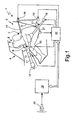
- Number 1 in Figure 1 indicates as a whole a retaining system for retaining an occupant 2 of a seat 3 of a vehicle 4, and substantially comprising an airbag type first retaining device 5, and a seat-belt type second retaining device 6.
- retaining system 1 is shown fitted to the front driving seat 3, but may obviously also be fitted to the front passenger seat or to any other seat of any other vehicle.
- seat 3 moves longitudinally to conform with inertial movement of vehicle 4 during impact.
- retaining device 5 of known type, is installed in the body of steering wheel 7 of vehicle 4, and is a two-bag type, i.e. comprising a first and a second bag 8 of different capacities, e.g. 45 and 60 litres.
- Retaining device 5 is also connected to a four-level gas generator 9 for providing gas flows with respective first, second, third, and fourth flow rate curves.
- auxiliary airbag type retaining device ( knee-bag ) 10 may also be provided beneath steering wheel 7 to protect the knees of occupant 2 of seat 3. More specifically, auxiliary retaining device 10 is preferably a one-bag type. i.e. comprising one bag of, say, 12-litre capacity, and is inflated by an auxiliary gas generator 13.
- Steering wheel 7 is fitted to a steering column 11 fitted with an axial collapse device 12 set to a predetermined collapse load, e.g. 1200 N.
- Retaining device 6 comprises a seat-belt 14, in turn comprising a known electric pretensioning device 15 on the shoulder portion; a first explosive pretensioning device 16 fitted to the point of attachment of seat-belt 14 to the vehicle body; and a second explosive pretensioning device 17 fitted to the buckle to which seat-belt 14 is connected.
- Seat-belt 14 also comprises a load limiting device 18 for limiting the load on the drivers shoulder to a predetermined maximum value in the event of impact, and which provides for three different load levels: low, medium, high, e.g. 2000, 2055, 2200 N respectively.
- Retaining system 1 cooperates with a known impact predicting/detecting device 19, which comprises a number of sensors 20, e.g. proximity sensors, radar sensors, etc. (shown schematically), and which provides for determining impending impact between vehicle 4, equipped with retaining system 1, and a fixed or moving obstacle.
- a known impact predicting/detecting device 19 which comprises a number of sensors 20, e.g. proximity sensors, radar sensors, etc. (shown schematically), and which provides for determining impending impact between vehicle 4, equipped with retaining system 1, and a fixed or moving obstacle.
- Impact predicting/detecting device 19 generates at least the following output signals:
- Retaining system 1 also comprises sensors 21 for detecting data indicating the physical characteristics and/or location inside the passenger compartment of vehicle 4 of occupant 2 of seat 3.
- sensors 21 detect the percentile of occupant 2 of seat 3, but may obviously detect data, other than the percentile, of occupant 2 of seat 3, e.g. the height of occupant 2 of seat 3, or the occupants position with respect to the dashboard of the vehicle.
- the data indicating the physical characteristics and/or location inside the passenger compartment of vehicle 4 of occupant 2 of seat 3 may be entered personally by occupant 2 of seat 3, e.g. by inserting into a card reader a card, e.g. a microprocessor card (a sort of electronic identity card) on which the data is recorded permanently, or vehicle 4 may be equipped with a system for reading the data on the card automatically by radio.
- a card e.g. a microprocessor card (a sort of electronic identity card) on which the data is recorded permanently
- vehicle 4 may be equipped with a system for reading the data on the card automatically by radio.
- Retaining devices 5 and 6 are controlled by an electronic central control unit 22 communicating with impact predicting/detecting device 19 and operating according to the present invention to control retaining device 5, electric pretensioning device 15, and explosive pretensioning devices 16 and 17.
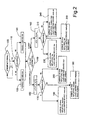
- FIG. 2 shows the control operations performed according to the present invention.
- a block 100 checks the presence of a preimpact signal, i.e. whether vehicle 4 equipped with retaining system 1 is nearing and will inevitably collide with an obstacle.
- block 100 In the event of a negative response, block 100 remains on standby; conversely, block 100 goes on to a block 110 which determines and stores the percentile PC of occupant 2 of seat 3.
- block 110 goes on to a block 120, which sets the travel of electric pretensioning device 15 to a first value C1 of, say, 100 mm.
- block 110 goes on to a block 130, which sets the travel of electric pretensioning device 15 to a second value C2 higher than first value C1 and of, say, 140 mm.
- Blocks 120 and 130 are both followed by a block 140, which checks the status of the pre-set signal. More specifically, if a non-aligned impact mode is determined, block 140 goes on to a block 150; conversely, if an aligned impact mode is determined, block 140 goes on to a block 160.
- Block 150 acquires the estimated crash time T CRASH information, and establishes an ignition time T ACC1 of explosive pretensioning devices 16 and 17, which precedes crash time T CRASH by a first time interval ⁇ T1 (e.g. of 11.19 ms).
- Block 160 acquires the estimated crash time T CRASH information, and establishes an ignition time T ACC2 of explosive pretensioning devices 16 and 17, which precedes crash time T CRASH by a second time interval ⁇ T2 (e.g. of 4.7 ms). Second time interval ⁇ T2 is shorter than first time interval ⁇ T1, so that, in the event of aligned impact, explosive pretensioning devices 16 and 17 are ignited sooner than in the event of non-aligned impact.
- Second time interval ⁇ T2 is shorter than first time interval ⁇ T1, so that, in the event of aligned impact, explosive pretensioning devices 16 and 17 are ignited sooner than in the event of non-aligned impact.
- Block 150 is followed by a block 170, which again determines the value of percentile PC; more specifically:
- Block 180 activates retaining system 1 according to a first operating mode, in which:
- Block 190 activates retaining system 1 according to a second operating mode, in which:
- Block 200 activates retaining system 1 according to a third operating mode, in which:
- Block 160 is followed by a block 210, which again determines the value of percentile PC; more specifically:
- Block 220 activates retaining system 1 according to a fourth operating mode, in which:
- Block 230 activates retaining system 1 according to a fifth operating mode, in which:
- Block 240 activates retaining system 1 according to a sixth operating mode, in which:
Landscapes
- Engineering & Computer Science (AREA)
- Mechanical Engineering (AREA)
- Air Bags (AREA)
Abstract
Description
- acquisition means for acquiring a quantity indicating the physical characteristics and/or location inside the passenger compartment of the vehicle of the occupant of the seat;
- assessment means for predicting the impact mode of the vehicle with a fixed or moving obstacle; and
- control means for acting on said airbag type retaining device and said seat-belt type retaining device on the basis of signals generated by said acquisition means and said assessment means.
- a preimpact or precrash signal indicating vehicle 4, equipped with retaining system 1, is nearing and will inevitably collide with an obstacle;
- an impact signal indicating the estimated crash time TCRASH at which the vehicle is expected to impact the obstacle; and
- a pre-set signal indicating the predicted impact mode, and which, in particular, may indicate an aligned impact mode, in which practically the whole front portion of vehicle 4 collides with the obstacle, and a non-aligned impact mode, in which only part of the front portion of vehicle 4 collides with the obstacle.
- if percentile PC is close to a low value (5 in
the example shown),
block 170 goes on to ablock 180; - if percentile PC is close to an intermediate
value (50 in the example shown),
block 170 goes on to ablock 190; and - if percentile PC is close to a high value (95 in
the example shown),
block 170 goes on to ablock 200.
- the smaller-capacity (45-litre)
bag 8 is inflated; -
gas generator 9 supplies gas at an intermediate flow rate; and -
load limiting device 18 provides for a medium load value.
- the smaller-capacity (45-litre)
bag 8 is inflated; -
gas generator 9 supplies gas at an intermediate flow rate; -
auxiliary retaining device 10 is activated; and -
load limiting device 18 provides for a medium load value.
- the smaller-capacity (45-litre)
bag 8 is inflated; -
gas generator 9 supplies gas at a high flow rate; -
auxiliary retaining device 10 is activated; and -
load limiting device 18 provides for a high load value.
- if percentile PC is close to a low value (5 in
the example shown), block 210 goes on to a
block 220; - if percentile PC is close to an intermediate
value (50 in the example shown), block 210 goes on to a
block 230; and - if percentile PC is close to a high value (95 in
the example shown), block 210 goes on to a
block 240.
- the smaller-capacity (45-litre)
bag 8 is inflated; -
gas generator 9 supplies gas at a low flow rate; and - load limiting
device 18 provides for a low load value.
- the smaller-capacity (45-litre)
bag 8 is inflated; -
gas generator 9 supplies gas at a low flow rate; -
auxiliary retaining device 10 is activated; and - load limiting
device 18 provides for a medium load value.
- the larger-capacity (60-litre)
bag 8 is inflated; -
gas generator 9 supplies gas at a medium-high flow rate; -
auxiliary retaining device 10 is activated; and - load limiting
device 18 provides for a medium load value.
Claims (11)
- A retaining system (1) for retaining an occupant (2) of a seat (3) of a vehicle (4), wherein at least one airbag type retaining device (5) and one seat-belt type retaining device (6) cooperate with the seat (3) of the vehicle (4); the retaining system (1) comprising electronic control means (22) comprising:acquisition means (100, 21) for acquiring a quantity indicating the physical characteristics and/or location inside the passenger compartment of the vehicle (4) of the occupant (2) of the seat (3);assessment means (140, 19) for predicting the impact mode of the vehicle (4) with a fixed or moving obstacle; andcontrol means (120, 130, 150, 160, 180, 190, 200, 220, 230, 240) for acting on said airbag type retaining device (5) and said seat-belt type retaining device (6) on the basis of signals generated by said acquisition means (100, 21) and said assessment means (140, 19).
- A system as claimed in Claim 1, wherein said acquisition means (100, 21) determine by measurement the physical characteristics and/or location inside the passenger compartment of the vehicle (4) of the occupant (2) of the seat (3).
- A system as claimed in Claim 1, wherein said acquisition means (100, 21) determine the physical characteristics and/or location inside the passenger compartment of the vehicle (4) of the occupant (2) of the seat (3) by means of data entered personally by the occupant (2) of the seat (3).
- A system as claimed in any one of the foregoing Claims, wherein said acquisition means (100, 21) determine the percentile (PC) of the occupant (2) of the seat (3).
- A system as claimed in Claim 4, wherein said control means (120, 130) receive information relative to said percentile (PC); said control means (120, 130) regulating, on the basis of the information received, the travel of at least one pretensioning device (15) associated with a seat-belt (14).
- A system as claimed in Claim 5, wherein said control means (120, 130) set a first travel value (C1) of said pretensioning device (15) when said percentile (PC) falls within a first range of values; said control means (120, 130) setting a second travel value (C2) of said pretensioning device (15) when said percentile (PC) falls within a second range of values.
- A system as claimed in any one of the foregoing Claims, wherein said assessment means (140, 19) determine:an aligned impact mode wherein practically the whole front portion of the vehicle (4) collides with said obstacle; anda non-aligned impact mode wherein part of the front portion of the vehicle (4) collides with said obstacle.
- A system as claimed in claim 7, wherein, on the basis of the impact mode determined, said control means (120, 130) regulate the ignition time (150, 160) of explosive pretensioning means (16, 17) associated with said seat-belt (14).
- A system as claimed in Claim 8, wherein, if a non-aligned impact mode is determined, said control means (120, 130) establish an ignition time TACC1 of said explosive pretensioning means (16, 17), which precedes the predicted crash time TCRASH by a first predetermined time interval ΔT1; if an aligned impact mode is determined, said control means (120, 130) establish an ignition time TACC2 of said explosive pretensioning means (16, 17), which precedes the predicted crash time TCRASH by a second predetermined time interval ΔT2; said second interval being shorter than said first interval.
- A system as claimed in any one of the foregoing Claims, wherein said acquisition means (100, 21) regulate:the capacity of a bag (8) of said airbag type retaining device (5); and/orthe flow rate of the gas supplied to said bag (8) on the basis of the type determined.
- A system as claimed in Claim 10, wherein said seat-belt type retaining device (6) has at least one load limiting device (18) providing for different load levels; said control means (120, 130) regulating the load provided by said load limiting device (18) on the basis of the physical characteristics and/or location inside the passenger compartment of the vehicle (4) of the occupant (2) of the seat (3).
Applications Claiming Priority (2)
| Application Number | Priority Date | Filing Date | Title |
|---|---|---|---|
| ITTO20020458 | 2002-05-29 | ||
| IT2002TO000458A ITTO20020458A1 (en) | 2002-05-29 | 2002-05-29 | RETENTION SYSTEM FOR A VEHICLE SEAT OCCUPANT. |
Publications (2)
| Publication Number | Publication Date |
|---|---|
| EP1366961A1 true EP1366961A1 (en) | 2003-12-03 |
| EP1366961B1 EP1366961B1 (en) | 2006-07-26 |
Family
ID=27639125
Family Applications (1)
| Application Number | Title | Priority Date | Filing Date |
|---|---|---|---|
| EP03012302A Expired - Lifetime EP1366961B1 (en) | 2002-05-29 | 2003-05-28 | Vehicle seat occupant retaining system |
Country Status (4)
| Country | Link |
|---|---|
| EP (1) | EP1366961B1 (en) |
| DE (1) | DE60306988T2 (en) |
| ES (1) | ES2268221T3 (en) |
| IT (1) | ITTO20020458A1 (en) |
Cited By (1)
| Publication number | Priority date | Publication date | Assignee | Title |
|---|---|---|---|---|
| CN114136660A (en) * | 2021-12-02 | 2022-03-04 | 上海夕田科技有限公司 | Automobile intelligent driving auxiliary emergency braking device test system |
Citations (5)
| Publication number | Priority date | Publication date | Assignee | Title |
|---|---|---|---|---|
| US5718451A (en) * | 1996-02-26 | 1998-02-17 | Automotive Systems Laboratory, Inc. | Integrated vehicle occupant energy management system and method |
| DE19844149A1 (en) * | 1997-09-25 | 1999-04-01 | Mazda Motor | Airbag system as extended retention system for safety belt arrangements |
| US6082764A (en) * | 1997-07-01 | 2000-07-04 | Mitsubishi Denki Kabushiki Kaisha | Vehicle occupant restraining system |
| DE19960644A1 (en) * | 1999-12-16 | 2001-06-28 | Siemens Restraint System Gmbh | Adjustable restraint system for motor vehicles |
| US6256565B1 (en) * | 1999-06-08 | 2001-07-03 | Takata Corporation | Vehicle safety system |
-
2002
- 2002-05-29 IT IT2002TO000458A patent/ITTO20020458A1/en unknown
-
2003
- 2003-05-28 DE DE60306988T patent/DE60306988T2/en not_active Expired - Lifetime
- 2003-05-28 ES ES03012302T patent/ES2268221T3/en not_active Expired - Lifetime
- 2003-05-28 EP EP03012302A patent/EP1366961B1/en not_active Expired - Lifetime
Patent Citations (5)
| Publication number | Priority date | Publication date | Assignee | Title |
|---|---|---|---|---|
| US5718451A (en) * | 1996-02-26 | 1998-02-17 | Automotive Systems Laboratory, Inc. | Integrated vehicle occupant energy management system and method |
| US6082764A (en) * | 1997-07-01 | 2000-07-04 | Mitsubishi Denki Kabushiki Kaisha | Vehicle occupant restraining system |
| DE19844149A1 (en) * | 1997-09-25 | 1999-04-01 | Mazda Motor | Airbag system as extended retention system for safety belt arrangements |
| US6256565B1 (en) * | 1999-06-08 | 2001-07-03 | Takata Corporation | Vehicle safety system |
| DE19960644A1 (en) * | 1999-12-16 | 2001-06-28 | Siemens Restraint System Gmbh | Adjustable restraint system for motor vehicles |
Non-Patent Citations (1)
| Title |
|---|
| BILLEN K: "Occupant Classification System for Smart Restraint Systems", SAE PAPER 1999-01-0761, XX, XX, January 1999 (1999-01-01), pages 33 - 38, XP002184965 * |
Cited By (2)
| Publication number | Priority date | Publication date | Assignee | Title |
|---|---|---|---|---|
| CN114136660A (en) * | 2021-12-02 | 2022-03-04 | 上海夕田科技有限公司 | Automobile intelligent driving auxiliary emergency braking device test system |
| CN114136660B (en) * | 2021-12-02 | 2024-03-19 | 上海夕田科技有限公司 | Automobile intelligent driving auxiliary emergency braking device testing system |
Also Published As
| Publication number | Publication date |
|---|---|
| ITTO20020458A1 (en) | 2003-12-01 |
| DE60306988T2 (en) | 2007-08-30 |
| ITTO20020458A0 (en) | 2002-05-29 |
| ES2268221T3 (en) | 2007-03-16 |
| DE60306988D1 (en) | 2006-09-07 |
| EP1366961B1 (en) | 2006-07-26 |
Similar Documents
| Publication | Publication Date | Title |
|---|---|---|
| US7543677B2 (en) | Object detection system, protection system, and vehicle | |
| US7055639B2 (en) | Occupant detection system for vehicle | |
| US6390498B1 (en) | Configuration for triggering restraining devices in a motor vehicle | |
| US8095274B2 (en) | Device and method for protecting a vehicle occupant in a motor vehicle | |
| US7162343B2 (en) | Intelligent vehicle rollover detection methods and systems | |
| US6915196B2 (en) | Method for operating a vehicle crash safety system in a vehicle having a pre-crash sensing system and countermeasure systems | |
| EP0982199A1 (en) | Actuation controller for air bag device | |
| US6196579B1 (en) | Rear impact occupant protection system | |
| US6804595B1 (en) | Controller for occupant restraint system | |
| US9409535B2 (en) | Control device for occupant protection device | |
| CN114379492B (en) | Vehicle and control method thereof | |
| US20040182627A1 (en) | Vehicle impact sensor using both accelerometer and pressure sensing for side impact detection | |
| EP1208021B1 (en) | Controller for occupant restraint system | |
| EP1026052B1 (en) | Activating control of a vehicle passenger restraint system | |
| US7207410B2 (en) | Apparatus and method for enhanced impact sensing | |
| EP1619083B1 (en) | A method and system for detecting vehicle rollover events | |
| US6218738B1 (en) | Ignition control method in passive safety device for vehicle | |
| US6879897B2 (en) | Method and system for achieving constant average impact deceleration independent of vehicle load | |
| US9751483B2 (en) | Control device for occupant protection device | |
| US20080040003A1 (en) | Safety System for Vehicle Occupants | |
| US7134521B2 (en) | System for activating passenger-protecting device mounted on automotive vehicle | |
| EP1366961B1 (en) | Vehicle seat occupant retaining system | |
| JP3968671B2 (en) | Airbag system for vehicles | |
| US7501942B2 (en) | Device for triggering restraint means | |
| KR102368598B1 (en) | System and method for vehicle airbag control |
Legal Events
| Date | Code | Title | Description |
|---|---|---|---|
| PUAI | Public reference made under article 153(3) epc to a published international application that has entered the european phase |
Free format text: ORIGINAL CODE: 0009012 |
|
| AK | Designated contracting states |
Kind code of ref document: A1 Designated state(s): AT BE BG CH CY CZ DE DK EE ES FI FR GB GR HU IE IT LI LU MC NL PT RO SE SI SK TR |
|
| AX | Request for extension of the european patent |
Extension state: AL LT LV MK |
|
| RIN1 | Information on inventor provided before grant (corrected) |
Inventor name: SOLINAS, MARIA RITA,C/O C.R.F. SOCIETA' Inventor name: GRIOTTO, GABRIELLA,C/O C.R.F. SOCIETA' CONSORTILE Inventor name: PUPPINI, ROBERTO,C/O C.R.F. SOCIETA' CONSORTILE Inventor name: GOBETTO, ENRICO,C/O C.R.F. SOCIETA' CONSORTILE |
|
| 17P | Request for examination filed |
Effective date: 20040526 |
|
| AKX | Designation fees paid |
Designated state(s): DE ES FR GB IT SE |
|
| 17Q | First examination report despatched |
Effective date: 20040723 |
|
| GRAP | Despatch of communication of intention to grant a patent |
Free format text: ORIGINAL CODE: EPIDOSNIGR1 |
|
| GRAS | Grant fee paid |
Free format text: ORIGINAL CODE: EPIDOSNIGR3 |
|
| GRAA | (expected) grant |
Free format text: ORIGINAL CODE: 0009210 |
|
| AK | Designated contracting states |
Kind code of ref document: B1 Designated state(s): DE ES FR GB IT SE |
|
| PG25 | Lapsed in a contracting state [announced via postgrant information from national office to epo] |
Ref country code: IT Free format text: LAPSE BECAUSE OF FAILURE TO SUBMIT A TRANSLATION OF THE DESCRIPTION OR TO PAY THE FEE WITHIN THE PRESCRIBED TIME-LIMIT;WARNING: LAPSES OF ITALIAN PATENTS WITH EFFECTIVE DATE BEFORE 2007 MAY HAVE OCCURRED AT ANY TIME BEFORE 2007. THE CORRECT EFFECTIVE DATE MAY BE DIFFERENT FROM THE ONE RECORDED. Effective date: 20060726 |
|
| REG | Reference to a national code |
Ref country code: GB Ref legal event code: FG4D |
|
| REF | Corresponds to: |
Ref document number: 60306988 Country of ref document: DE Date of ref document: 20060907 Kind code of ref document: P |
|
| REG | Reference to a national code |
Ref country code: SE Ref legal event code: TRGR |
|
| ET | Fr: translation filed | ||
| REG | Reference to a national code |
Ref country code: ES Ref legal event code: FG2A Ref document number: 2268221 Country of ref document: ES Kind code of ref document: T3 |
|
| PLBE | No opposition filed within time limit |
Free format text: ORIGINAL CODE: 0009261 |
|
| STAA | Information on the status of an ep patent application or granted ep patent |
Free format text: STATUS: NO OPPOSITION FILED WITHIN TIME LIMIT |
|
| 26N | No opposition filed |
Effective date: 20070427 |
|
| PGFP | Annual fee paid to national office [announced via postgrant information from national office to epo] |
Ref country code: ES Payment date: 20080530 Year of fee payment: 6 |
|
| PGFP | Annual fee paid to national office [announced via postgrant information from national office to epo] |
Ref country code: SE Payment date: 20080512 Year of fee payment: 6 |
|
| PGFP | Annual fee paid to national office [announced via postgrant information from national office to epo] |
Ref country code: GB Payment date: 20080527 Year of fee payment: 6 |
|
| GBPC | Gb: european patent ceased through non-payment of renewal fee |
Effective date: 20090528 |
|
| PG25 | Lapsed in a contracting state [announced via postgrant information from national office to epo] |
Ref country code: GB Free format text: LAPSE BECAUSE OF NON-PAYMENT OF DUE FEES Effective date: 20090528 |
|
| REG | Reference to a national code |
Ref country code: ES Ref legal event code: FD2A Effective date: 20090529 |
|
| PG25 | Lapsed in a contracting state [announced via postgrant information from national office to epo] |
Ref country code: ES Free format text: LAPSE BECAUSE OF NON-PAYMENT OF DUE FEES Effective date: 20090529 |
|
| PG25 | Lapsed in a contracting state [announced via postgrant information from national office to epo] |
Ref country code: SE Free format text: LAPSE BECAUSE OF NON-PAYMENT OF DUE FEES Effective date: 20090529 |
|
| REG | Reference to a national code |
Ref country code: FR Ref legal event code: PLFP Year of fee payment: 13 |
|
| REG | Reference to a national code |
Ref country code: FR Ref legal event code: PLFP Year of fee payment: 14 |
|
| REG | Reference to a national code |
Ref country code: FR Ref legal event code: PLFP Year of fee payment: 15 |
|
| REG | Reference to a national code |
Ref country code: FR Ref legal event code: PLFP Year of fee payment: 16 |
|
| PGFP | Annual fee paid to national office [announced via postgrant information from national office to epo] |
Ref country code: DE Payment date: 20190531 Year of fee payment: 17 |
|
| PGFP | Annual fee paid to national office [announced via postgrant information from national office to epo] |
Ref country code: FR Payment date: 20190528 Year of fee payment: 17 |
|
| REG | Reference to a national code |
Ref country code: DE Ref legal event code: R119 Ref document number: 60306988 Country of ref document: DE |
|
| PG25 | Lapsed in a contracting state [announced via postgrant information from national office to epo] |
Ref country code: FR Free format text: LAPSE BECAUSE OF NON-PAYMENT OF DUE FEES Effective date: 20200531 |
|
| PG25 | Lapsed in a contracting state [announced via postgrant information from national office to epo] |
Ref country code: DE Free format text: LAPSE BECAUSE OF NON-PAYMENT OF DUE FEES Effective date: 20201201 |
|
| PGFP | Annual fee paid to national office [announced via postgrant information from national office to epo] |
Ref country code: IT Payment date: 20210513 Year of fee payment: 19 |
|
| PG25 | Lapsed in a contracting state [announced via postgrant information from national office to epo] |
Ref country code: IT Free format text: LAPSE BECAUSE OF NON-PAYMENT OF DUE FEES Effective date: 20220528 |