EP1365591A2 - Bitstream transcoding method - Google Patents
Bitstream transcoding method Download PDFInfo
- Publication number
- EP1365591A2 EP1365591A2 EP03010691A EP03010691A EP1365591A2 EP 1365591 A2 EP1365591 A2 EP 1365591A2 EP 03010691 A EP03010691 A EP 03010691A EP 03010691 A EP03010691 A EP 03010691A EP 1365591 A2 EP1365591 A2 EP 1365591A2
- Authority
- EP
- European Patent Office
- Prior art keywords
- bitstream
- format
- decoder
- preprocessor
- decoding
- Prior art date
- Legal status (The legal status is an assumption and is not a legal conclusion. Google has not performed a legal analysis and makes no representation as to the accuracy of the status listed.)
- Withdrawn
Links
- 238000000034 method Methods 0.000 title claims abstract description 17
- 230000006837 decompression Effects 0.000 claims abstract description 17
- 239000000872 buffer Substances 0.000 claims description 10
- 238000012545 processing Methods 0.000 abstract description 6
- 238000010586 diagram Methods 0.000 description 13
- 238000007906 compression Methods 0.000 description 7
- 230000006835 compression Effects 0.000 description 7
- 230000008901 benefit Effects 0.000 description 6
- 238000004891 communication Methods 0.000 description 6
- 230000005540 biological transmission Effects 0.000 description 4
- 238000007781 pre-processing Methods 0.000 description 4
- 238000013461 design Methods 0.000 description 3
- 238000009499 grossing Methods 0.000 description 3
- 230000008569 process Effects 0.000 description 2
- 230000002123 temporal effect Effects 0.000 description 2
- 230000003044 adaptive effect Effects 0.000 description 1
- 238000013459 approach Methods 0.000 description 1
- 230000009286 beneficial effect Effects 0.000 description 1
- 238000006243 chemical reaction Methods 0.000 description 1
- 230000000295 complement effect Effects 0.000 description 1
- 238000013144 data compression Methods 0.000 description 1
- 239000000463 material Substances 0.000 description 1
- 238000012986 modification Methods 0.000 description 1
- 230000004048 modification Effects 0.000 description 1
- 239000013307 optical fiber Substances 0.000 description 1
- 230000008520 organization Effects 0.000 description 1
- 238000013139 quantization Methods 0.000 description 1
- 230000003068 static effect Effects 0.000 description 1
- 230000009466 transformation Effects 0.000 description 1
Images


Classifications
-
- H—ELECTRICITY
- H04—ELECTRIC COMMUNICATION TECHNIQUE
- H04N—PICTORIAL COMMUNICATION, e.g. TELEVISION
- H04N19/00—Methods or arrangements for coding, decoding, compressing or decompressing digital video signals
- H04N19/90—Methods or arrangements for coding, decoding, compressing or decompressing digital video signals using coding techniques not provided for in groups H04N19/10-H04N19/85, e.g. fractals
-
- H—ELECTRICITY
- H04—ELECTRIC COMMUNICATION TECHNIQUE
- H04N—PICTORIAL COMMUNICATION, e.g. TELEVISION
- H04N19/00—Methods or arrangements for coding, decoding, compressing or decompressing digital video signals
- H04N19/10—Methods or arrangements for coding, decoding, compressing or decompressing digital video signals using adaptive coding
- H04N19/102—Methods or arrangements for coding, decoding, compressing or decompressing digital video signals using adaptive coding characterised by the element, parameter or selection affected or controlled by the adaptive coding
- H04N19/13—Adaptive entropy coding, e.g. adaptive variable length coding [AVLC] or context adaptive binary arithmetic coding [CABAC]
-
- H—ELECTRICITY
- H04—ELECTRIC COMMUNICATION TECHNIQUE
- H04N—PICTORIAL COMMUNICATION, e.g. TELEVISION
- H04N19/00—Methods or arrangements for coding, decoding, compressing or decompressing digital video signals
- H04N19/10—Methods or arrangements for coding, decoding, compressing or decompressing digital video signals using adaptive coding
- H04N19/169—Methods or arrangements for coding, decoding, compressing or decompressing digital video signals using adaptive coding characterised by the coding unit, i.e. the structural portion or semantic portion of the video signal being the object or the subject of the adaptive coding
- H04N19/17—Methods or arrangements for coding, decoding, compressing or decompressing digital video signals using adaptive coding characterised by the coding unit, i.e. the structural portion or semantic portion of the video signal being the object or the subject of the adaptive coding the unit being an image region, e.g. an object
- H04N19/174—Methods or arrangements for coding, decoding, compressing or decompressing digital video signals using adaptive coding characterised by the coding unit, i.e. the structural portion or semantic portion of the video signal being the object or the subject of the adaptive coding the unit being an image region, e.g. an object the region being a slice, e.g. a line of blocks or a group of blocks
-
- H—ELECTRICITY
- H04—ELECTRIC COMMUNICATION TECHNIQUE
- H04N—PICTORIAL COMMUNICATION, e.g. TELEVISION
- H04N19/00—Methods or arrangements for coding, decoding, compressing or decompressing digital video signals
- H04N19/40—Methods or arrangements for coding, decoding, compressing or decompressing digital video signals using video transcoding, i.e. partial or full decoding of a coded input stream followed by re-encoding of the decoded output stream
-
- H—ELECTRICITY
- H04—ELECTRIC COMMUNICATION TECHNIQUE
- H04N—PICTORIAL COMMUNICATION, e.g. TELEVISION
- H04N19/00—Methods or arrangements for coding, decoding, compressing or decompressing digital video signals
- H04N19/60—Methods or arrangements for coding, decoding, compressing or decompressing digital video signals using transform coding
- H04N19/61—Methods or arrangements for coding, decoding, compressing or decompressing digital video signals using transform coding in combination with predictive coding
-
- H—ELECTRICITY
- H04—ELECTRIC COMMUNICATION TECHNIQUE
- H04N—PICTORIAL COMMUNICATION, e.g. TELEVISION
- H04N19/00—Methods or arrangements for coding, decoding, compressing or decompressing digital video signals
- H04N19/70—Methods or arrangements for coding, decoding, compressing or decompressing digital video signals characterised by syntax aspects related to video coding, e.g. related to compression standards
-
- H—ELECTRICITY
- H04—ELECTRIC COMMUNICATION TECHNIQUE
- H04N—PICTORIAL COMMUNICATION, e.g. TELEVISION
- H04N19/00—Methods or arrangements for coding, decoding, compressing or decompressing digital video signals
- H04N19/85—Methods or arrangements for coding, decoding, compressing or decompressing digital video signals using pre-processing or post-processing specially adapted for video compression
Definitions
- the present invention is related to digital video, and more particularly to a system and method for transcoding an entropy-coded bitstream.
- a video sequence includes a series of images represented by frames.
- the frames comprise two-dimensional grids of pixels.
- An exemplary video sequence such as a video sequence in accordance with the ITU-656 standard, includes 30 720x480 pixel frames per second. The foregoing results in a bit rate of approximately 165 Mbps for a video sequence.
- Multiple video sequences are transmitted together on a communication medium such as a coaxial cable, for example, using a multiple access scheme.
- the multiple access scheme can include, for example, frequency division multiple access (FDMA), or time division multiple access (TDMA).
- FDMA frequency division multiple access
- TDMA time division multiple access
- each video sequence is associated with a particular channel. As the number of video sequences which are transmitted increases, the bandwidth requirements for the communication medium are further increased.
- AVC Advanced Video Coding
- the AVC standard uses a number of techniques to compress video streams, such as motion-based compensation to reduce temporal redundancy.
- the AVC standard encodes each frame using three main picture types - intra-coded pictures (I-pictures), inter-coded pictures (P-pictures), and Bi-predictive (B-pictures).
- I-pictures are coded without reference to other pictures and can provide access points to the coded sequence where decoding can begin, but are coded with only moderate compression.
- P-pictures are coded more efficiently using motion compensation prediction of each block of sample values from some previously decoded picture selected by the encoder.
- B-pictures provide the highest degree of compression but require a higher degree of memory access capability in the decoding process, as each block of sample values in a B-picture may be predicted using a weighted average of two blocks of motion-compensated sample values.
- Motion-based compensation results in varying degrees of compression for the pictures forming the video sequence.
- the pictures are encoded by varying amounts of data. For example, I-pictures tend to require the largest amount of bits for encoding, while B-pictures require the least amount of bits for encoding.
- the AVC proposed standard includes specifications for encoding various syntax elements using either variable length codes or arithmetic coding.
- Variable length coding and arithmetic coding are referred to as entropy coding.
- Entropy coding takes advantage of the probabilities of the various values that the data can take. In general, the most common values are encoded using the least number of bits, while the rarest values are encoded using the highest number of bits. The foregoing causes substantial variance in the number of bits which are used to encode each picture.
- uniform length frames e.g., 720x480 pixels
- each picture must be decoded in uniform lengths of time, to at least some degree. Therefore, pictures with a large number of bits require a much higher decoding rate than the average decoding rate which can be inferred from the transmission bit rate and the display bit rate.
- the peak decoding rate required for displaying video sequences in real time can be as high as 750-1000 Mbps even if the transmitted video data rate is much lower, such as 1 to 10 Mbps.
- a system, method, and apparatus for transcoding an entropy coded bitstream is presented herein.
- the entropy coded bitstream is preprocessed by a preprocessor and transcoded to a format that is less complex to decode.
- a video decoder a video decompression engine is used to provide decoded frames at a constant rate.
- the frames are encoded as pictures with widely varying amounts of data in a bitstream.
- a preprocessor transcodes the bitstream to provide the same information in a different format. The different format is preferably simpler for decoding.
- FIGURE 1 there is illustrated a block diagram of an exemplary transmission system for providing a video sequence 105 to a display unit 110 over a communication medium 125.
- a video sequence 105 includes a series of images represented by frames. The frames comprise two-dimensional grids of pixels.
- An exemplary video sequence 105 such as a video sequence in accordance with ITU-R Bt.601, includes 30 720x480 pixel frames per second.
- the communication medium 125 may comprise either a point-to-point link or a network of links, or any combination thereof.
- the network of links may include either a broadcast network, a switched network, or a packet switched network, such as the internet, or any combination thereof.
- the links may include, for example, a coaxial cable, an Ethernet connection, a Digital Subscriber Loop (DSL), an optical fiber, a satellite/radio link, or a phone line.
- DSL Digital Subscriber Loop
- an encoder 140 receives the video sequence 105 and encodes the video sequence 105 pursuant to the AVC standard.
- the AVC standard is described in the JVT Final Committee Draft (FCD), which is incorporated by reference herein, in its entirety.
- the video sequence 105 is represented by a bitstream 142 comprising a series of data packets.
- the bitstream of data packets 142 are transmitted over the communication channel 125 and received by a decoder 145.
- the decoder 145 decodes the bitstream 142, providing video sequence 105' which is imperceptibly different from video sequence 105 to the human eye.
- the video sequence 105' is provided for display to the display unit 110.
- a video sequence 105 comprises frames 205(l)...205(n) representing instantaneous time intervals.
- a frame 205 is a two-dimensional grid of pixels, wherein each pixel in the grid corresponds to a particular spatial location of the image at the particular time interval.
- the frames 205 can comprise two fields, wherein the fields are associated with adjacent time intervals.
- the frames 205(1)....205(n) are encoded using algorithms taking advantage of both spatial redundancy and/or temporal redundancy, thereby resulting in a video elementary stream.
- the algorithms taking advantage of spatial redundancy utilize discrete 4x4 transformation, and quantization, to reduce the amount of data required to code each picture.
- the frames 205(1)...205(n) are encoded in data structures referred to in the AVC Standard as pictures 210(1)...210(n). Each picture 210(x) is associated with a particular frame 205(x), wherein the picture 210(x) comprises the encoded data representing the frame 205(x).
- the AVC standard encodes each frame using three main picture types - intra-coded pictures (I-pictures), inter-coded pictures (P-pictures), and Bi-predictive (B-pictures).
- I-pictures are coded without reference to other pictures and can provide access points to the coded sequence where decoding can begin, but are coded with only moderate compression.
- P-pictures are coded more efficiently using motion compensation prediction of each block of sample values from some previously decoded picture selected by the encoder.
- B-pictures provide the highest degree of compression but require a higher degree of memory access capability in the decoding process, as each block of sample values in a B-picture may be predicted using a weighted average of two blocks of motion-compensated sample values.
- Motion-based compensation results in varying degrees of compression for the pictures forming the video sequence.
- the pictures are encoded by varying amounts of data. For example, I-pictures tend to require the largest amount of bits for encoding, while B-pictures require the least amount of bits for encoding.
- Entropy coding takes advantage of the probabilities of the various values that the data can take. In general, the most common values are encoded using the least number of bits, while the rarest values are encoded using the highest number of bits. Entropy coding is also used to encode the video sequence. The foregoing adds additional variance in the number of bits which are used to encode each picture 210.
- Modern entropy coding methods such as those used in AVC including arithmetic coding (CABAC) and context adaptive variable length coding (CAVLC), are also complex to decode, compared to simpler variable length coding specifications such as the format specified in MPEG-2 and compared with fixed length coding formats.
- CABAC arithmetic coding
- CAVLC context adaptive variable length coding
- the pictures 210 are packetized as part of a bitstream known as a video elementary stream. Additional headers are placed on the video elementary stream, thereby resulting in a bitstream known as a transport stream.
- uniform length reconstructed frames 205 are displayed at a constant rate.
- each picture 210 is decoded in uniform lengths of time, to at least some degree. Therefore, pictures 210 with a large number of bits generally utilize a much higher decoding rate than the average decoding rate which can be inferred from the transmission bit rate and the display bit rate.
- the peak decoding rate required for decoding and displaying video sequences in real time can be as high as 750-1000 Mbps.
- the present invention proposes alleviation of the foregoing peak decoding rate by preprocessing the bitstream 142, prior to the point where decoding is in synchronization with the display device 110.
- the bitstream 142 is preprocessed by a preprocessor and transcoded to a format that is less complex to decode.
- a video decoder 145 a video decompression engine is used to provide decoded frames 205 at a constant rate.
- the frames are encoded as pictures with widely varying amounts of data in a bitstream.
- the preprocessor parses the bitstream 142 and creates a transcoded bitstream 142' that provides the same information in a different format.
- the different format is preferably simpler for decoding.
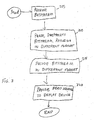
- bitstream 142 comprising pictures 210 encoded using entropy coding, such as one of the coding formats prescribed in the AVC standard, is received.
- the bit stream can be encoded using the CABAC or CAVLC formats specified in the AVC Final Committee Draft standard, or alternatively the bit stream may be encoded using an entropy coding method specified by another standard or non-standard format.
- the bitstream is parsed and preprocessed.
- the preprocessing transcodes the bitstream 142 into a format that is simpler to decode and that has smoother peak decoding requirements.
- the simpler format can include a non-entropy coding scheme, or an entropy coding scheme.
- the bitstream 142 can be decoded according to the syntax and semantics specified in the standard that applies to the bitstream 142.
- the arithmetic coding format in AVC called CABAC
- CABAC has a complete specification in the standard (i.e. the MPEG AVC FCD, referenced above) that explains how to decode bitstreams 142 that are compliant with the standard.
- the result of such decoding is a sequence of syntax elements that are specified in the standard.
- Each syntax element in the bitstream 142 is parsed from the bitstream and has a range of possible values. Each value corresponds to a code number, and each code number corresponds to a variable length code, according to the design of the coding system in one preferred embodiment. For each syntax element parsed from the input, a corresponding code word is produced.
- UVLC Universal VLC
- Working Draft 2 of JVT An example of an output format is the UVLC (Universal VLC) format specified in Working Draft 2 of JVT. It may be advantageous to follow a format sometimes called "exponential golomb codes", wherein each variable length code consists of a prefix followed by an information field.
- the prefix consists of a string of "0's” followed by a single "1", for example, and the information field has a length determined by the length of the prefix, typically one less than the length of the prefix, and each code maps to a code number.
- the range of values that the syntax element may take on is mapped to a range of code numbers. This is essentially what is specified in the now-obsolete Working Draft 2 of JVT.
- bitstream 142 can be transcoded to provide the same information in a different format, wherein each syntax element is represented by the variable length code and wherein the length of each code is a number of 8-bit bytes.
- each syntax element is represented by the variable length code and wherein the length of each code is a number of 8-bit bytes.
- values in the range of (-127, +127) can be represented by an 8 bit 2's complement signed number, while the value of -128 can signal that one or more following bytes signal an extension of the range of values.
- bitstream 142 can be transcoded to provide the same information in a different format wherein each syntax element in the bitstream 142 is represented by a fixed length code. It is well known in the art how to design fixed length codes to represent information. For example, a syntax element whose range of values spans no more than -2048 to +2047 can conveniently be represented by a fixed length 12-bit signed number. The number of bits allocated to each syntax element can be the same for all syntax elements, or they can vary between syntax elements, while having the same length to all instances of a given syntax element.
- the transcoded bitstream 142' is decoded, thereby generating a video sequence 105', in synchronization with a display device 110.
- the transcoded bitstream 142' is easier to decode in synchronization with the display device 110 because the transcoded bitstream is formatted with a simpler encoding scheme during 310.
- the video sequence 105' can then be provided to the display device 110 (320).
- FIGURE 4 there is illustrated a block diagram of an exemplary decoder 405 in accordance with an embodiment of the present invention.
- the decoder 405 receives and decompresses a bitstream 142, thereby resulting in a video sequence 105'.
- the bitstream 142 comprises pictures 210 encoded using entropy coding, such as the CABAC coding format prescribed in the AVC standard, is received.
- entropy coding such as the CABAC coding format prescribed in the AVC standard
- the bitstream can be encoded using the CAVLC formats specified in the AVC standard, or another entropy coding format specified by another standard or non-standard video format.
- the video sequence 105 comprises frames which are provided to, and in synchronization with, a display device 110.
- the video sequence 105 is provided to the display device 110 by a video decompression engine 435 within the decoder 405.
- the video decompression engine 435 decompresses the video data in synchronization with a display unit 110.
- the bitstream 142 is received at rates which may vary from 1-20 Mbps in a typical application.
- each picture 210 of the bitstream 142 comprises widely varying amounts of data.
- Pictures 210 with a large number of bits require a much higher decoding rate than the average decoding rate which can be inferred from the transmission bit rate and the display bit rate.
- the entropy coded bitstream 147 is preprocessed and transcoded to a format that is less complex to decode and that has a smoother and lower peak decoding requirement.
- the bitstream 142 is received by a system layer processor 410.
- the system layer processor 410 parses the system layer, extracting the video elementary stream and any system layer information that may be necessary for decoding and display.
- the output of the system layer processor is a bitstream 142 comprising video elementary stream data.
- the bitstream can be written to a smoothing buffer 420.
- the smoothing buffer 420 may be implemented as a Static Random Access Memory (SRAM) on-chip or as a region of Dynamic Random Access Memory (DRAM) off-chip, or other memory design.
- SRAM Static Random Access Memory
- DRAM Dynamic Random Access Memory
- a preprocessor 425 transcodes the bitstream 142, thereby resulting in a transcoded bitstream 142' that provides the same information as bitstream 142 in a different format.
- the transcoded bitstream 142' is preferably in a format which is easier to decode and is stored in a compressed data buffer 430.
- the video decompression engine 435 receives the transcoded bitstream 142' by reading the compressed data buffer 430.
- the video decompression engine 435 decompresses the transcoded bitstream 142', thereby generating video sequence 105'.
- the video sequence 105' is perceptually similar to the original video sequence 105 because the second bitstream contains the same information as the first bitstream.
- the video decompression engine 435 generates the video sequence 105' in synchronization with the display unit 110.
- the video decompression engine 435 is able to decompress the transcoded bitstream 142' to generate the video sequence 105' in synchronization with the display unit 110 because the transcoded bitstream 142' is encoded in a format which is simpler to decode.
- the decoder can also include buffers and other devices common in video decoders. Details of such devices are well known and are omitted for the sake of clarity.
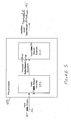
- FIGURE 5 there is illustrated a block diagram of an exemplary preprocessor 425 for transcoding an input bitstream 142, thereby resulting in a transcoded bitstream 142'.
- the input bitstream 142 can comprise for example, entropy-coded video data such as described in the AVC standard.
- the transcoded bitstream 142' is preferably encoded in a simpler format requiring a lower peak decoding processing capability for display of the video data therein in real time.
- the preprocessor 425 comprises an input bitstream decoder 505 and an input bitstream encoder 510.
- the input bitstream decoder 505 receives bitstream 142 and decodes each entropy coded syntax element, thereby generating a decoded set of syntax elements.
- the input bitstream decoder 505 provides the decoded bitstream syntax elements to the input bitstream encoder 510.
- the input bitstream encoder 510 recovers the value of each syntax element in the decoded bitstream of syntax elements and encodes each syntax element in a second format. The foregoing results in a transcoded bitstream 142'.
- the input bitstream encoder 510 outputs the transcoded bitstream 142' and preferably writes the transcoded bitstream 142' into memory such as the compressed data buffer 430.
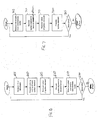
- the bitstream 142 is received by the preprocessor 425 at the input bitstream decoder 505.
- the input bitstream decoder 505 decodes an entropy-coded syntax element.
- the value of the syntax element is recovered by the input bitstream encoder 510.
- the input bitstream encoder 510 encodes the syntax element in the second format at 620.
- the preprocessor 425 writes the encoded syntax element with the second format to the compressed data buffer 430. If there is more data in the bitstream at 630, step 605-625 are repeated until the bitstream 142 is finished.
- the video decompression engine 435 receives the transcoded bitstream 142' from the compressed data buffer 430.
- the video decompression engine decodes a syntax element in the transcoded bitstream 142'. The value of the syntax element is recovered at 715 and processed at 720. If at 725, there is more data in the transcoded bitstream 142', steps 705-720 are repeated until there is no more data in the second bitstream.
- the foregoing significantly alleviates the processing requirements of decoders.
- the video decompression engine can more easily generate a video sequence in real-time because the video sequence has a lower peak decoding rate. Accordingly, the processing requirements for the video decompression engine are reduced.
Landscapes
- Engineering & Computer Science (AREA)
- Multimedia (AREA)
- Signal Processing (AREA)
- Compression Or Coding Systems Of Tv Signals (AREA)
Abstract
Description
Claims (21)
- A decoder for decoding a bitstream that was encoded using a first format, said decoder comprising:a preprocessor for transcoding the bitstream using a second format; anda decompression engine for decoding the transcoded bitstream.
- The decoder of claim 1, further comprising:a system layer processor for receiving the bitstream.
- The decoder of claim 1, further comprising:a compressed data buffer for storing the transcoded bitstream.
- The decoder of claim 1, wherein the bitstream is encoded with an entropy code.
- The decoder of claim 1, wherein the bitstream is encoded using CABAC.
- The decoder of claim 1, wherein the bitstream is encoded using Advanced Video Coding.
- The decoder of claim 1, wherein the preprocessor transcodes the bitstream with a variable length code.
- The decoder of claim 1, wherein the preprocessor transcodes the bitstream with an exponential golomb code.
- A preprocessor for transcoding a bitstream from a first format to a second format, said transcoder comprising:an input bitstream decoder for decoding syntax elements from the bitstream; andan output bitstream encoder for encoding values obtained from decoding of the syntax elements with the second format.
- The preprocessor of claim 9, wherein the first format comprises an entropy code.
- The preprocessor of claim 9, wherein the first format comprises Advanced Video Coding.
- The preprocessor of claim 9, wherein the second format comprises a variable length code.
- The preprocessor of claim 9, wherein the second format comprises a exponential golomb code.
- The preprocessor of claim 9, wherein the second format comprises a fixed length code.
- A method for decoding a bitstream that was encoded in a first format, said method comprising:receiving the bitstream encoded with the first format;transcoding the bitstream into a second format, wherein the transcoded bitstream represents the same information as the bitstream encoded with the first format; anddecoding the transcoded bitstream, thereby resulting in a plurality of frames;displaying the plurality of frames.
- The method of claim 15, wherein the first format is an entropy code.
- The method of claim 16, wherein the first format uses CABAC.
- The method of claim 17, wherein the first format is Advanced Video Coding.
- The method of claim 15, wherein the second format is a variable length code.
- The method of claim 15, wherein the second format is an exponential golomb code.
- The method of claim 15, wherein transcoding comprises:decoding a syntax element from the bitstream; andencoding values obtained from the syntax element with the second format.
Applications Claiming Priority (4)
| Application Number | Priority Date | Filing Date | Title |
|---|---|---|---|
| US273515 | 1994-07-11 | ||
| US38052002P | 2002-05-14 | 2002-05-14 | |
| US380520P | 2002-05-14 | ||
| US10/273,515 US7469012B2 (en) | 2002-05-14 | 2002-10-18 | System and method for transcoding entropy-coded bitstreams |
Publications (2)
| Publication Number | Publication Date |
|---|---|
| EP1365591A2 true EP1365591A2 (en) | 2003-11-26 |
| EP1365591A3 EP1365591A3 (en) | 2004-12-15 |
Family
ID=29406475
Family Applications (1)
| Application Number | Title | Priority Date | Filing Date |
|---|---|---|---|
| EP03010691A Withdrawn EP1365591A3 (en) | 2002-05-14 | 2003-05-13 | Bitstream transcoding method |
Country Status (2)
| Country | Link |
|---|---|
| US (2) | US7469012B2 (en) |
| EP (1) | EP1365591A3 (en) |
Cited By (5)
| Publication number | Priority date | Publication date | Assignee | Title |
|---|---|---|---|---|
| WO2005109898A1 (en) * | 2004-05-04 | 2005-11-17 | Qualcomm Incorporated | Method and apparatus for weighted prediction in predictive frames |
| EP1746834A2 (en) * | 2005-07-21 | 2007-01-24 | Broadcom Corporation | Systems, methods, and apparatus for trick mode |
| GB2434049A (en) * | 2005-12-07 | 2007-07-11 | Imagination Tech Ltd | Rate smoothing a context based adaptive entropy decoding scheme using a FIFO |
| EP1545133A3 (en) * | 2003-12-18 | 2009-09-09 | Lsi Logic Corporation | Low complexity transcoding between video streams using different entropy coding |
| WO2012019138A1 (en) * | 2010-08-06 | 2012-02-09 | Qualcomm Incorporated | Two-stage entropy decoding |
Families Citing this family (41)
| Publication number | Priority date | Publication date | Assignee | Title |
|---|---|---|---|---|
| US7469012B2 (en) * | 2002-05-14 | 2008-12-23 | Broadcom Corporation | System and method for transcoding entropy-coded bitstreams |
| US7472151B2 (en) * | 2003-06-20 | 2008-12-30 | Broadcom Corporation | System and method for accelerating arithmetic decoding of video data |
| JP4403737B2 (en) * | 2003-08-12 | 2010-01-27 | 株式会社日立製作所 | Signal processing apparatus and imaging apparatus using the same |
| US7433815B2 (en) * | 2003-09-10 | 2008-10-07 | Dilithium Networks Pty Ltd. | Method and apparatus for voice transcoding between variable rate coders |
| JP4470431B2 (en) * | 2003-10-01 | 2010-06-02 | ソニー株式会社 | Data processing apparatus and method |
| US7646814B2 (en) * | 2003-12-18 | 2010-01-12 | Lsi Corporation | Low complexity transcoding between videostreams using different entropy coding |
| US20050259747A1 (en) * | 2004-05-21 | 2005-11-24 | Broadcom Advanced Compression Group, Llc | Context adaptive binary arithmetic code decoder for decoding macroblock adaptive field/frame coded video data |
| US7742544B2 (en) * | 2004-05-21 | 2010-06-22 | Broadcom Corporation | System and method for efficient CABAC clock |
| EP1800487B1 (en) | 2004-10-13 | 2012-07-11 | Electronics and Telecommunications Research Institute | Method and apparatus for encoding/decoding point sequences on laser binary representation |
| CN102892001A (en) * | 2004-11-09 | 2013-01-23 | 松下电器产业株式会社 | Two step arithmetic decoding with conversion into an intermediate format |
| US20060168637A1 (en) * | 2005-01-25 | 2006-07-27 | Collaboration Properties, Inc. | Multiple-channel codec and transcoder environment for gateway, MCU, broadcast and video storage applications |
| US8311111B2 (en) | 2008-09-11 | 2012-11-13 | Google Inc. | System and method for decoding using parallel processing |
| US10133956B2 (en) * | 2009-03-13 | 2018-11-20 | Nec Corporation | Image signature extraction device |
| US8292951B2 (en) * | 2010-04-29 | 2012-10-23 | Medtronic Vascular, Inc. | Tethered pop up branch structure stent graft and method |
| WO2012050832A1 (en) | 2010-09-28 | 2012-04-19 | Google Inc. | Systems and methods utilizing efficient video compression techniques for providing static image data |
| EP2606648A1 (en) | 2010-10-05 | 2013-06-26 | General instrument Corporation | Coding and decoding utilizing adaptive context model selection with zigzag scan |
| US9532059B2 (en) | 2010-10-05 | 2016-12-27 | Google Technology Holdings LLC | Method and apparatus for spatial scalability for video coding |
| US8938001B1 (en) | 2011-04-05 | 2015-01-20 | Google Inc. | Apparatus and method for coding using combinations |
| US8989256B2 (en) | 2011-05-25 | 2015-03-24 | Google Inc. | Method and apparatus for using segmentation-based coding of prediction information |
| US8891616B1 (en) | 2011-07-27 | 2014-11-18 | Google Inc. | Method and apparatus for entropy encoding based on encoding cost |
| US9247257B1 (en) | 2011-11-30 | 2016-01-26 | Google Inc. | Segmentation based entropy encoding and decoding |
| US9100657B1 (en) | 2011-12-07 | 2015-08-04 | Google Inc. | Encoding time management in parallel real-time video encoding |
| US9094681B1 (en) | 2012-02-28 | 2015-07-28 | Google Inc. | Adaptive segmentation |
| US11039138B1 (en) | 2012-03-08 | 2021-06-15 | Google Llc | Adaptive coding of prediction modes using probability distributions |
| US9781447B1 (en) | 2012-06-21 | 2017-10-03 | Google Inc. | Correlation based inter-plane prediction encoding and decoding |
| US9774856B1 (en) | 2012-07-02 | 2017-09-26 | Google Inc. | Adaptive stochastic entropy coding |
| US9344720B2 (en) * | 2012-08-07 | 2016-05-17 | Apple Inc. | Entropy coding techniques and protocol to support parallel processing with low latency |
| US9167268B1 (en) | 2012-08-09 | 2015-10-20 | Google Inc. | Second-order orthogonal spatial intra prediction |
| US9332276B1 (en) | 2012-08-09 | 2016-05-03 | Google Inc. | Variable-sized super block based direct prediction mode |
| US9380298B1 (en) | 2012-08-10 | 2016-06-28 | Google Inc. | Object-based intra-prediction |
| US9344742B2 (en) | 2012-08-10 | 2016-05-17 | Google Inc. | Transform-domain intra prediction |
| US9369732B2 (en) | 2012-10-08 | 2016-06-14 | Google Inc. | Lossless intra-prediction video coding |
| US9628790B1 (en) | 2013-01-03 | 2017-04-18 | Google Inc. | Adaptive composite intra prediction for image and video compression |
| US9509998B1 (en) | 2013-04-04 | 2016-11-29 | Google Inc. | Conditional predictive multi-symbol run-length coding |
| US11425395B2 (en) | 2013-08-20 | 2022-08-23 | Google Llc | Encoding and decoding using tiling |
| US9392288B2 (en) | 2013-10-17 | 2016-07-12 | Google Inc. | Video coding using scatter-based scan tables |
| US9179151B2 (en) | 2013-10-18 | 2015-11-03 | Google Inc. | Spatial proximity context entropy coding |
| KR102077239B1 (en) * | 2015-07-02 | 2020-02-13 | 삼성전자주식회사 | Method and apparatus for multimedia data encryption and decryption |
| US9794574B2 (en) | 2016-01-11 | 2017-10-17 | Google Inc. | Adaptive tile data size coding for video and image compression |
| US10542258B2 (en) | 2016-01-25 | 2020-01-21 | Google Llc | Tile copying for video compression |
| JP6977422B2 (en) * | 2017-09-13 | 2021-12-08 | 株式会社Jvcケンウッド | Transcoding device, transcoding method and transcoding program |
Citations (2)
| Publication number | Priority date | Publication date | Assignee | Title |
|---|---|---|---|---|
| US5808570A (en) * | 1996-06-28 | 1998-09-15 | Philips Electronics North America Corp. | Device and method for pair-match Huffman transcoding and high-performance variable length decoder with two-word bit stream segmentation which utilizes the same |
| US6028635A (en) * | 1996-12-03 | 2000-02-22 | Stmicroelectronics, Inc. | Reducing the memory required for decompression by storing compressed information using DCT based techniques |
Family Cites Families (33)
| Publication number | Priority date | Publication date | Assignee | Title |
|---|---|---|---|---|
| JP2723660B2 (en) * | 1990-08-06 | 1998-03-09 | 松下電器産業株式会社 | Orthogonal transformer |
| GB2260428B (en) * | 1991-10-11 | 1995-03-08 | Sony Broadcast & Communication | Data Formatter |
| AU685444B2 (en) * | 1993-03-26 | 1998-01-22 | British Telecommunications Public Limited Company | A transcoder |
| JP3085024B2 (en) | 1993-06-01 | 2000-09-04 | 松下電器産業株式会社 | Image recompressor and image recording device |
| US5537440A (en) * | 1994-01-07 | 1996-07-16 | Motorola, Inc. | Efficient transcoding device and method |
| KR100186915B1 (en) * | 1994-07-13 | 1999-05-01 | 모리시다 요이치 | Digital coding/decoding apparatus using variable length codes |
| US5708732A (en) * | 1996-03-06 | 1998-01-13 | Hewlett-Packard Company | Fast DCT domain downsampling and inverse motion compensation |
| DE69730965T2 (en) * | 1996-07-15 | 2006-02-23 | Snell & Wilcox Ltd. | VIDEO COMPRESSION |
| GB2318246B (en) * | 1996-10-09 | 2000-11-15 | Sony Uk Ltd | Processing digitally encoded signals |
| KR100510208B1 (en) | 1996-12-18 | 2005-08-26 | 톰슨 콘슈머 일렉트로닉스, 인코포레이티드 | A multiple format video signal processor |
| KR100273110B1 (en) * | 1997-02-26 | 2000-12-01 | 윤종용 | Decoder of moving picture experts group system and management method thereof |
| JPH11275592A (en) * | 1998-01-22 | 1999-10-08 | Victor Co Of Japan Ltd | Video code string conversion apparatus and method |
| GB2339101B (en) * | 1998-06-25 | 2002-09-18 | Sony Uk Ltd | Processing of compressed video signals using picture motion vectors |
| JP2001036844A (en) | 1999-07-16 | 2001-02-09 | Nec Corp | Image quality checking device, image quality checking method, and recording medium storing the program |
| US6795506B1 (en) * | 1999-10-05 | 2004-09-21 | Cisco Technology, Inc. | Methods and apparatus for efficient scheduling and multiplexing |
| JP2001145113A (en) * | 1999-11-17 | 2001-05-25 | Sony Corp | Image information conversion apparatus and method |
| JP4378824B2 (en) * | 2000-02-22 | 2009-12-09 | ソニー株式会社 | Image processing apparatus and method |
| US7146053B1 (en) * | 2000-05-10 | 2006-12-05 | International Business Machines Corporation | Reordering of compressed data |
| US6847735B2 (en) * | 2000-06-07 | 2005-01-25 | Canon Kabushiki Kaisha | Image processing system, image processing apparatus, image input apparatus, image output apparatus and method, and storage medium |
| US6647061B1 (en) * | 2000-06-09 | 2003-11-11 | General Instrument Corporation | Video size conversion and transcoding from MPEG-2 to MPEG-4 |
| US7039116B1 (en) * | 2000-11-07 | 2006-05-02 | Cisco Technology, Inc. | Methods and apparatus for embedding and format conversion of compressed video data |
| JP4524908B2 (en) * | 2000-11-08 | 2010-08-18 | 日本電気株式会社 | Moving image editing method, moving image editing apparatus, and storage medium storing moving image editing program |
| KR100433516B1 (en) * | 2000-12-08 | 2004-05-31 | 삼성전자주식회사 | Transcoding method |
| EP1231793A1 (en) * | 2001-02-09 | 2002-08-14 | STMicroelectronics S.r.l. | A process for changing the syntax, resolution and bitrate of MPEG bitstreams, a system and a computer program product therefor |
| US7173947B1 (en) * | 2001-11-28 | 2007-02-06 | Cisco Technology, Inc. | Methods and apparatus to evaluate statistical remultiplexer performance |
| US7277587B2 (en) * | 2002-04-26 | 2007-10-02 | Sharp Laboratories Of America, Inc. | System and method for lossless video coding |
| US7469012B2 (en) * | 2002-05-14 | 2008-12-23 | Broadcom Corporation | System and method for transcoding entropy-coded bitstreams |
| US7305036B2 (en) * | 2002-05-14 | 2007-12-04 | Broadcom Corporation | System and method for entropy code preprocessing |
| US7769088B2 (en) * | 2003-05-28 | 2010-08-03 | Broadcom Corporation | Context adaptive binary arithmetic code decoding engine |
| US7472151B2 (en) * | 2003-06-20 | 2008-12-30 | Broadcom Corporation | System and method for accelerating arithmetic decoding of video data |
| FR2857811A1 (en) * | 2003-07-16 | 2005-01-21 | St Microelectronics Sa | Compressed audio/video data flow encrypting method for wireless transmission system, involves encrypting part of packet bits of audio or video data that are defined by two consecutive timing marks, by random pseudo flow |
| US20050259747A1 (en) * | 2004-05-21 | 2005-11-24 | Broadcom Advanced Compression Group, Llc | Context adaptive binary arithmetic code decoder for decoding macroblock adaptive field/frame coded video data |
| EP1800487B1 (en) * | 2004-10-13 | 2012-07-11 | Electronics and Telecommunications Research Institute | Method and apparatus for encoding/decoding point sequences on laser binary representation |
-
2002
- 2002-10-18 US US10/273,515 patent/US7469012B2/en not_active Expired - Lifetime
-
2003
- 2003-05-13 EP EP03010691A patent/EP1365591A3/en not_active Withdrawn
-
2008
- 2008-10-15 US US12/251,988 patent/US9762932B2/en not_active Expired - Fee Related
Patent Citations (2)
| Publication number | Priority date | Publication date | Assignee | Title |
|---|---|---|---|---|
| US5808570A (en) * | 1996-06-28 | 1998-09-15 | Philips Electronics North America Corp. | Device and method for pair-match Huffman transcoding and high-performance variable length decoder with two-word bit stream segmentation which utilizes the same |
| US6028635A (en) * | 1996-12-03 | 2000-02-22 | Stmicroelectronics, Inc. | Reducing the memory required for decompression by storing compressed information using DCT based techniques |
Non-Patent Citations (4)
| Title |
|---|
| "H.264/MPEG-4 AVC Video Compression Tutorial", 1 January 2003 (2003-01-01), pages 8PP, XP055259024, Retrieved from the Internet <URL:http://web.cs.ucla.edu/classes/fall03/cs218/paper/H.264_MPEG4_Tutorial.pdf> [retrieved on 20160316] * |
| SOSTAWA B ET AL: "TRANSCODING OF MPEG-2 VIDEO BITSTREAMS IN THE FREQUENCY DOMAIN", ITG FACHBERICHTE, VDE VERLAG, BERLIN, DE, no. 156, 27 September 1999 (1999-09-27), pages 197 - 202, XP008015184, ISSN: 0932-6022 * |
| THOMAS WIEGAND, ET AL.: "OVERVIEW OF THE H.264/AVC VIDEO CODING STANDARD", IEEE TRANSACTIONS ON CIRCUITS AND SYSTEMS FOR VIDEO TECHNOLOGY, 1 July 2003 (2003-07-01), pages 1 - 19, XP055259016, Retrieved from the Internet <URL:http://654lab.webstarts.com/uploads/csvt_overview.pdf> [retrieved on 20160316] * |
| THOMAS WIEGAND: "DRAFT ISO/IEC 14496-10 : 2002 (E)", 3. JVT MEETING; 60. MPEG MEETING; 06-05-2002 - 10-05-2002; FAIRFAX,US; (JOINT VIDEO TEAM OF ISO/IEC JTC1/SC29/WG11 AND ITU-T SG.16 ),, no. JVT-C167, 10 May 2002 (2002-05-10), XP030005278, ISSN: 0000-0442 * |
Cited By (11)
| Publication number | Priority date | Publication date | Assignee | Title |
|---|---|---|---|---|
| EP1545133A3 (en) * | 2003-12-18 | 2009-09-09 | Lsi Logic Corporation | Low complexity transcoding between video streams using different entropy coding |
| WO2005109898A1 (en) * | 2004-05-04 | 2005-11-17 | Qualcomm Incorporated | Method and apparatus for weighted prediction in predictive frames |
| EP2230852A3 (en) * | 2004-05-04 | 2011-12-28 | Qualcomm Incorporated | Method and apparatus for weighted prediction in predictive frames |
| CN1981535B (en) * | 2004-05-04 | 2012-05-30 | 高通股份有限公司 | Method and apparatus for weighted prediction in predictive frames |
| US8731054B2 (en) | 2004-05-04 | 2014-05-20 | Qualcomm Incorporated | Method and apparatus for weighted prediction in predictive frames |
| EP1746834A2 (en) * | 2005-07-21 | 2007-01-24 | Broadcom Corporation | Systems, methods, and apparatus for trick mode |
| GB2434049A (en) * | 2005-12-07 | 2007-07-11 | Imagination Tech Ltd | Rate smoothing a context based adaptive entropy decoding scheme using a FIFO |
| GB2434049B (en) * | 2005-12-07 | 2010-07-14 | Imagination Tech Ltd | Decoding Data |
| US7796065B2 (en) | 2005-12-07 | 2010-09-14 | Imagination Technologies Limited | Method of decoding data and apparatus therefor |
| WO2012019138A1 (en) * | 2010-08-06 | 2012-02-09 | Qualcomm Incorporated | Two-stage entropy decoding |
| US8755444B2 (en) | 2010-08-06 | 2014-06-17 | Qualcomm Incorporated | Two-stage entropy decoding |
Also Published As
| Publication number | Publication date |
|---|---|
| US20030215018A1 (en) | 2003-11-20 |
| US9762932B2 (en) | 2017-09-12 |
| EP1365591A3 (en) | 2004-12-15 |
| US7469012B2 (en) | 2008-12-23 |
| US20090129481A1 (en) | 2009-05-21 |
Similar Documents
| Publication | Publication Date | Title |
|---|---|---|
| US9762932B2 (en) | System and method for transcoding entropy-coded bitstreams | |
| US7305036B2 (en) | System and method for entropy code preprocessing | |
| KR100253931B1 (en) | Method and apparatus for decoding digital image sequence | |
| US6075554A (en) | Progressive still frame mode | |
| CN1137584C (en) | Image element processor for memory management system using recompression | |
| JP5206706B2 (en) | Encoding apparatus and method | |
| US6744387B2 (en) | Method and system for symbol binarization | |
| US7472151B2 (en) | System and method for accelerating arithmetic decoding of video data | |
| US6226328B1 (en) | Transcoding apparatus for digital video networking | |
| US6215824B1 (en) | Transcoding method for digital video networking | |
| US20040136457A1 (en) | Method and system for supercompression of compressed digital video | |
| US20030138045A1 (en) | Video decoder with scalable architecture | |
| JP2005526457A (en) | Video transcoder | |
| JP2007166625A (en) | Video data encoding apparatus, video data encoding method, video data decoding apparatus, and video data decoding method | |
| JP2002152727A (en) | Image information conversion apparatus and image information conversion method | |
| CN101904172A (en) | VLC method and apparatus | |
| US7379498B2 (en) | Reconstructing a compressed still image by transformation to a compressed moving picture image | |
| JP2005260935A (en) | Method and apparatus for increasing average image refresh rate in a compressed video bitstream | |
| US20050063461A1 (en) | H.263/MPEG video encoder for efficiently controlling bit rates and method of controlling the same | |
| CN1191719C (en) | Memory efficient compression apparatus and quantizer in an image processing system | |
| KR100312421B1 (en) | A conversion method of the compressed moving video on the video communication system | |
| US6040875A (en) | Method to compensate for a fade in a digital video input sequence | |
| CN101411203A (en) | Adaptive encoder-assisted frame rate up conversion | |
| JP2001346207A (en) | Image information conversion apparatus and method | |
| WO2006061734A2 (en) | A method and apparatus for processing video streams |
Legal Events
| Date | Code | Title | Description |
|---|---|---|---|
| PUAI | Public reference made under article 153(3) epc to a published international application that has entered the european phase |
Free format text: ORIGINAL CODE: 0009012 |
|
| AK | Designated contracting states |
Kind code of ref document: A2 Designated state(s): AT BE BG CH CY CZ DE DK EE ES FI FR GB GR HU IE IT LI LU MC NL PT RO SE SI SK TR |
|
| AX | Request for extension of the european patent |
Extension state: AL LT LV MK |
|
| PUAL | Search report despatched |
Free format text: ORIGINAL CODE: 0009013 |
|
| AK | Designated contracting states |
Kind code of ref document: A3 Designated state(s): AT BE BG CH CY CZ DE DK EE ES FI FR GB GR HU IE IT LI LU MC NL PT RO SE SI SK TR |
|
| AX | Request for extension of the european patent |
Extension state: AL LT LV MK |
|
| 17P | Request for examination filed |
Effective date: 20050615 |
|
| AKX | Designation fees paid |
Designated state(s): DE FR GB |
|
| RAP1 | Party data changed (applicant data changed or rights of an application transferred) |
Owner name: BROADCOM CORPORATION |
|
| 17Q | First examination report despatched |
Effective date: 20110218 |
|
| STAA | Information on the status of an ep patent application or granted ep patent |
Free format text: STATUS: THE APPLICATION IS DEEMED TO BE WITHDRAWN |
|
| 18D | Application deemed to be withdrawn |
Effective date: 20160830 |