EP1365568A1 - Method and system for tunneling wideband audio through the PSTN - Google Patents
Method and system for tunneling wideband audio through the PSTN Download PDFInfo
- Publication number
- EP1365568A1 EP1365568A1 EP03011332A EP03011332A EP1365568A1 EP 1365568 A1 EP1365568 A1 EP 1365568A1 EP 03011332 A EP03011332 A EP 03011332A EP 03011332 A EP03011332 A EP 03011332A EP 1365568 A1 EP1365568 A1 EP 1365568A1
- Authority
- EP
- European Patent Office
- Prior art keywords
- audio signal
- compressed
- wideband audio
- data stream
- wideband
- Prior art date
- Legal status (The legal status is an assumption and is not a legal conclusion. Google has not performed a legal analysis and makes no representation as to the accuracy of the status listed.)
- Withdrawn
Links
Images


Classifications
-
- H—ELECTRICITY
- H04—ELECTRIC COMMUNICATION TECHNIQUE
- H04L—TRANSMISSION OF DIGITAL INFORMATION, e.g. TELEGRAPHIC COMMUNICATION
- H04L69/00—Network arrangements, protocols or services independent of the application payload and not provided for in the other groups of this subclass
- H04L69/04—Protocols for data compression, e.g. ROHC
-
- G—PHYSICS
- G10—MUSICAL INSTRUMENTS; ACOUSTICS
- G10L—SPEECH ANALYSIS TECHNIQUES OR SPEECH SYNTHESIS; SPEECH RECOGNITION; SPEECH OR VOICE PROCESSING TECHNIQUES; SPEECH OR AUDIO CODING OR DECODING
- G10L19/00—Speech or audio signals analysis-synthesis techniques for redundancy reduction, e.g. in vocoders; Coding or decoding of speech or audio signals, using source filter models or psychoacoustic analysis
- G10L19/04—Speech or audio signals analysis-synthesis techniques for redundancy reduction, e.g. in vocoders; Coding or decoding of speech or audio signals, using source filter models or psychoacoustic analysis using predictive techniques
- G10L19/16—Vocoder architecture
- G10L19/173—Transcoding, i.e. converting between two coded representations avoiding cascaded coding-decoding
-
- H—ELECTRICITY
- H04—ELECTRIC COMMUNICATION TECHNIQUE
- H04M—TELEPHONIC COMMUNICATION
- H04M7/00—Arrangements for interconnection between switching centres
- H04M7/12—Arrangements for interconnection between switching centres for working between exchanges having different types of switching equipment, e.g. power-driven and step by step or decimal and non-decimal
- H04M7/1205—Arrangements for interconnection between switching centres for working between exchanges having different types of switching equipment, e.g. power-driven and step by step or decimal and non-decimal where the types of switching equipement comprises PSTN/ISDN equipment and switching equipment of networks other than PSTN/ISDN, e.g. Internet Protocol networks
- H04M7/124—Arrangements for interconnection between switching centres for working between exchanges having different types of switching equipment, e.g. power-driven and step by step or decimal and non-decimal where the types of switching equipement comprises PSTN/ISDN equipment and switching equipment of networks other than PSTN/ISDN, e.g. Internet Protocol networks where PSTN/ISDN interconnects two networks other than PSTN/ISDN
-
- H—ELECTRICITY
- H04—ELECTRIC COMMUNICATION TECHNIQUE
- H04M—TELEPHONIC COMMUNICATION
- H04M7/00—Arrangements for interconnection between switching centres
- H04M7/006—Networks other than PSTN/ISDN providing telephone service, e.g. Voice over Internet Protocol (VoIP), including next generation networks with a packet-switched transport layer
Definitions
- the present invention relates generally to telephony systems.
- Wideband speech compression where "wideband” represents audio signals sampled at greater than 8 kHz sampling rates, for example, can be characterized as “better than toll quality voice,” or “better voice quality than the Public Switched Telephone Network (PSTN).”
- PSTN Public Switched Telephone Network
- wideband compressed speech can be carried directly between the two endpoints, for example, between two IP telephones engaged in a voice call.
- calls are routed through the traditional PSTN use narrowband data links intended for carrying narrowband telephony.
- Such routing requires a conversion of the compressed wideband speech to a narrowband format, such as ITU-T Recommendation G.711 ⁇ -law or A-law coded Pulse Code Modulation (PCM) at 64 kilo-bits per second (kbps), which corresponds to speech sampled at 8 kilo-Hertz (kHz) (that is, 8,000 samples per second), and digitized to 8-bits per sample.
- a data link operating according to such parameters is an example of a narrowband data link.
- the process of converting to the narrowband format typically includes a process referred to as "transcoding.” The improved quality of wideband speech is lost in this process.
- a wideband audio signal is transferred between two communication devices, such as IP telephones or the like, over a PSTN or a PSTN-like data link, without diminishing the wideband characteristics of the wideband audio signal.
- the wideband audio signal is transferred through the PSTN, or over the PSTN-like data link, without a loss in wideband voice quality.
- the first communication device includes an encoder for compressing the wideband audio signal into a compressed wideband audio signal.
- the first communication device transmits the compressed wideband audio signal to a first voice gateway.
- the first voice gateway is coupled to a second voice gateway over the PSTN or PSTN-like data link.
- the data link between the voice gateways is normally used for carrying a narrowband audio signal.
- Each of the voice gateways operates in a transcoder bypass configuration, so as to avoid converting wideband compressed audio signals received thereat into a narrowband audio format usually carried by the data link between the two voice gateways.
- This establishes a tandem link between the two voice gateways.
- the first voice gateway transmits the compressed wideband audio signal to the second voice gateway using this tandem link. This preserves the wideband characteristics of the wideband audio signal as it is transmitted between the voice gateways.
- the second voice gateway forwards the received wideband compressed audio signal to the second communication device.
- the second communication device includes a decoder for decompressing the received compressed wideband audio signal into a wideband audio signal representative of that which was initially encoded at the first communication device.
- a decoder for decompressing the received compressed wideband audio signal into a wideband audio signal representative of that which was initially encoded at the first communication device.
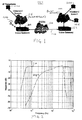
- FIG. 1 is an illustration of an example system for tunneling wideband telephony through the PSTN.
- FIG. 2 is a graphical illustration of some of the spectral differences between narrowband telephone speech and wideband speech.
- FIGs. 3A and 3B are connected block diagrams expanding on the various elements of the system of FIG. 1.
- FIG. 4 is an example method of tunneling wideband telephony that may be implemented across various elements of the system of FIG. 1.
- speech As used herein, the terms “speech,” “audio” and “voice” are used equivalently and interchangeably.
- a speech signal, an audio signal, and a voice signal may all refer to the same signal.
- FIG. 1 is an illustration of an example system 100 for tunneling wideband telephony through the PSTN or through PSTN-like data links.
- System 100 includes various embodiments of the present invention.
- System 100 includes one or more representative communication devices (CDs) 102a-102d each capable of supporting wideband telephony.
- CDs 102 may be full IP telephones, or may include only portions thereof.
- Other examples of a communication device include, but are not limited to, a voice enabled Personal Digital Assistant (PDA), or a computer coupled with an audio headset in a known manner.
- CDs 102 may be wireless communication devices or wired communication devices.
- Communication device (CD) 102a exchanges communication signals with a packet network (PN) 104, either wirelessly or over wires.
- PN packet network
- Packet network 104 exchanges communication signals with a first voice gateway (VG) 108.
- CD 102b exchanges communication signals with VG 108 directly.
- CD 102a is coupled to VG 108 through packet network 104
- CD 102b is coupled to VG 108 directly.
- VG 108 may be a local Private Branch Exchange (PBX).
- PBX Private Branch Exchange
- the communication signals referred to above and below are representative of wideband audio signals.
- the communication signals include compressed wideband audio signals.
- VG 108 and a second VG 122 are both coupled to the PSTN 120.
- System 100 tunnels wideband telephony between voice gateways 108 and 122 through PSTN 120, over one or more narrowband PSTN data links 126, as will be described in further detail below.
- Voice gateway 122 exchanges communication signals with a packet network 130.
- Packet network 130 exchanges communication signals with CDs 102c and 102d.
- Networks 104, 120 and 130 may be part of or include the Internet.
- System 100 supports an exchange of compressed wideband audio packets between communication devices, such as between communication devices 102a or 102b and 102c and 102d, using the above-mentioned wideband tunneling between VGs 108 and 122, and thus, through PSTN 120 in the depicted embodiment.
- “Tunneling” as used herein generally means, but is not limited to, transferring a wideband audio signal (e.g., a compressed wideband audio signal) over a data link, while preserving the wideband frequency characteristics of the wideband audio signal (e.g., a wideband audio frequency passband of the wideband audio signal represented by the compressed wideband audio signal).
- the data link over which the wideband audio signal is transferred or carried is typically one intended for a narrowband audio signal, that is, an audio signal having an audio frequency passband that is less than that of the wideband audio signal.
- PSTN 120 may be replaced with a data link, such as a dedicated data link not linked to the PSTN.
- the data link between VGs 108 and 122 need not actually be part of the PSTN, but should be capable of operating as described in the manner described below.
- FIG. 2 is a graphical illustration of some of the differences between narrowband telephone speech and wideband speech.
- a speech signal is bandpass filtered using an Intermediate Reference System (IRS) frequency weighting or mask, prior to digitization of the speech signal at 8 kHz.
- IRS Intermediate Reference System
- a dashed-line plot 204 represents the IRS mask for conventional telephone-bandwidth speech, taken directly from a transit mask of the ITU-T Recommendation P.48.
- the IRS mask has a narrowband audio frequency passband of approximately 300 to 3400 Hz.
- applying the IRS mask results in a typical audio frequency passband following the mask for narrowband speech.
- digitizing the speech at 8 kHz limits the Nyquist bandwidth of the digitized speech to 4 kHz.
- a solid-line plot 210 represents an example frequency response of wideband speech having a frequency passband from approximately 50-7,000 Hz.
- the IRS frequency weighting described above is not used, and the speech is digitized using a sample rate of greater than 8 kHz, for example, 16 kHz.
- FIGs. 3A and 3B are connected block diagrams expanding on the various elements of system 100. Specifically, example arrangements of CDs 102a and 102c, and VGs 108 and 122, are depicted in FIGs. 3A and 3B. Other arrangements of these elements other than those depicted are contemplated, as would be apparent to one having ordinary skill in the relevant art(s) given the present description.
- an end-to-end communication link or call has been established between endpoint CDs 102a and 102c.
- This call configuration is representative of other call configurations between different CDs 102, for example, between CDs 102b and 102d, or between CDs 102b and 102a.
- the end-to-end communication link depicted in FIGs. 3A and 3B may or may not support wideband tunneling, depending on whether VGs 108 and 122 are configured to support such operation, as will be described in further detail below.
- communication signal flow in a forward direction from CD 102a to CD 102c is substantially the same as communication signal flow in a reverse direction from CD 102c to 102a.
- the ensuing description of communication signal flow in the forward direction shall also suffice for communication signal flow in the reverse direction.
- Each of the elements of system 100 described below have full-duplex communication capability. In alternative arrangements, one or more of these elements may have half-duplex capability only.
- CD 102a includes a transmit or encode path 302a and a receive or decode path 304a.
- a sample clock 306a is provided to each of paths 302a and 304a.
- Transmit path 302a receives an audio signal 308 from a user of CD 102a, for example.
- An analog-to-digital converter (ADC) 310 samples audio signal 308 in accordance with sample clock 306a, to produce a sampled wideband audio signal 312.
- ADC analog-to-digital converter
- ADC 310 samples audio signal 308 at a sample rate greater than 8 kHz (e.g., at 16 kHz), whereby sampled wideband audio signal 312 has a Nyquist bandwidth or frequency passband greater than 4 kHz (e.g., a Nyquist bandwidth of 8 kHz).
- An encoder (E) or signal compressor 314 encodes sampled wideband audio signal 312 into a compressed wideband audio signal 316, while preserving the wideband passband of audio signal 312.
- encoder 314 produces wideband audio signal 316 at a compressed data rate of less than or equal to 64 kbps, such as 32 kbps.
- wideband audio signal 316 represents an audio signal having a sample rate greater than 8 kHz (e.g., 16 kHz), and a compressed data rate of less than or equal to 64 kbps (e.g., 32 kbps).
- Compressed wideband audio signal 316 is typically a packetized signal including a stream of compressed wideband audio data packets.
- Each data packet may include: a header field containing packet header information; a payload field including data bits representing the wideband audio signal in compressed form; and a trailer field including trailer information, such as a Cyclic Redundancy Check (CRC) field or other error correction fields, for example.
- CRC Cyclic Redundancy Check
- CD 102a produces compressed wideband audio signal 316, and transmits this signal to VG 108, through PN 104.
- VG 108 receives signal 316 from PN 104.
- VG 108 includes a transmit path 320a, a receive path 322a, and a controller 324a for controlling the receive and transmit paths over a control interface 327a. Transmit path 320a transmits communication signals to PSTN 120 while receive path 322a receives communication signals from PSTN 120.
- apparatuses 320a, 322a and 324a represent portions (or collectively, a portion) of VG 108 by way of example only, and that VG 108 may include many other elements not important to the present invention, and therefore, not included in the present description.
- apparatuses 320a, 322a and 324 may be used individually or together in other applications, such as in combined data and voice gateways or communication hubs, for example.
- Transmit path 320a includes a transcoder (T) 326 for transcoding signals, and a transcoder bypass (TB) 328 for bypassing transcoder 326.
- Transcoder 326 and transcoder bypass 328 have their respective outputs coupled to a selector 330 for selectively coupling the output of transcoder 326 or the output of transcoder bypass 328 to a data link 126a of PSTN 120.
- selector 330 a combiner, such as an adder, may be used to combine signals produced by transcoder 326 and transcoder bypass 328.
- Controller 324a can configure transmit path 320a to operate in a first configuration, also referred to as a transcoder configuration, wherein transcoder 326 transcodes a received signal, such as signal 316, into a transcoded PCM voice data stream 332.
- controller 324a enables transcoder 326.
- a typical transcoder includes a decoder and/or rate-converter followed by either a ⁇ -law or an A-law converter for generating ⁇ -law or A-law coded PCM voice samples, as would be apparent to one having ordinary skill in the relevant art(s).
- transcoded audio signal 332 is a ⁇ -law or A-law 64 kbps PCM data stream in accordance with ITU-T G.711 and suitable for transmission over a conventional PCM PSTN data link.
- transmit path 320a passes transcoded PCM data stream 332 to data link 126a, for transmission of the data stream through the PSTN.
- data link 126a carries PCM samples of data stream 332 at a data rate of 64 kbps.
- Controller 324a can configure transmit path 320a to operate in a second configuration, also referred to as a transcoder bypass configuration, wherein transcoder bypass 328 bypasses transcoder 326. In other words, controller 324a enables transcoder bypass 328.
- the second configuration is used for tunneling wideband telephony through the PSTN.
- transcoder bypass 328 converts compressed wideband audio signal 316, without transcoding signal 316, into a data stream 334 including the wideband compressed audio.
- Data stream 334 is also referred to herein as wideband compressed audio data stream 334.
- Transcoder bypass 328 transmits non-transcoded data stream 334 to and through PSTN 120 over data link 126a.
- Transcoder bypass 328 can provide the compressed wideband audio data in data stream 334 in any number of data transmission formats, including, a time division multiplex (TDM) data format or a packet data format, for example.
- a signal 335 represents either transcoded signal 332 (e.g., PCM voice samples) or non-transcoded, compressed wideband audio signal 334, depending on whether transmit path 320a is in the first or second configuration, respectively.
- VG 122 includes a transmit path 320b, a receive path 322b and a controller 324b. Elements having like reference numerals but different suffix descriptors "a" or "b" are substantially identical.
- Receive path 322b includes a transcoder 350, a transcoder bypass 352, and a selector 354 having first and second inputs coupled to respective outputs of transcoder 350 and transcoder bypass 352.
- Controller 324b can configure receive path 322b to operate in a first configuration (also referred to as a transcoder configuration), wherein transcoder 350 transcodes a received signal, such as PCM data stream 335 (for example, PCM data stream 332) received from data link 126a, into a transcoded audio signal 356.
- Transcoder 350 performs reverse or complementary operations with respect to transcoder 326, as would be appreciated by one having ordinary skill in the relevant art(s). Thus, transcoder 350 may be considered a "reverse transcoder" with respect to transcoder 326 of transmit path 320a.
- selector 354 transmits audio signal 356 to packet network 130.
- Controller 324b can configure receive path 322b to operate in a second configuration (also referred to as a transcoder bypass configuration) used for tunneling wideband telephony through the PSTN.
- transcoder bypass 352 bypasses transcoder 350.
- transcoder bypass 352 converts, without transcoding, data stream 335 (for example, compressed wideband audio data stream) into a compressed wideband audio signal 358.
- transcoder bypass converts, without transcoding, data stream 335 back into a stream of compressed wideband audio packets, representative of the wideband audio packets of signal 316 discussed in connection with FIG. 3A.
- selector 354 passes or transmits wideband compressed signal 358 to packet network 130.
- a signal 359 represents either transcoded signal 356 or non-transcoded signal 358, depending on whether transmit path 322b is in the first or second configuration, respectively.
- Packet network 130 delivers audio signal 359 (that is, either signal 356 or signal 358) to CD 102c.
- CD 102c includes a receive or decode path 304b and a transmit or encode path 302b.
- a sample clock 306b is provided to both paths 302b and 304b.
- Receive path 304b receives audio signal 359 (assumed to be wideband compressed audio signal 358 for the ensuing description).
- a decoder 360 decodes signal 359 into a decoded or decompressed wideband audio signal 362 representative of sampled wideband audio signal 312 discussed in connection with originating CD 102a.
- a digital-to-analog converter (DAC) 364 converts decoded wideband audio signal 362 into a wideband audio signal 366.
- DAC digital-to-analog converter
- CDs 102 may each include a Broadcom (BCM) BCM1100 Voice Over IP 10/100Base-T CPE Engine, manufactured by Broadcom Corporation of California, USA.
- the BCM1100 Engine includes Broadcom's BroadVoiceTM wideband voice coder (encoder/decoder, also referred to as coder/decoder).
- the encoder or coder portion of the BCM1100 Engine produces 16 kHz sampled (thus, wideband) compressed audio/speech at a compressed data rate of 32 kbps.
- the decoder portion of the BCM1100 Engine decodes or decompresses the compressed audio/speech.
- the BroadVoiceTM coder is described in detail in copending U.S. Non-Provisional Patent Application No. 09/722,077, filed November 27, 2000, entitled “Method and Apparatus for One-Stage and Two-Stage Noise Feedback Coding of Speech and Audio Signals," incorporated herein by reference in its entirety.
- the CDs may produce compressed audio signals in accordance with the ITU-T Recommendation G.722 Wideband Speech Coding Standard.
- Each of VGs 108 and 122 may include a BCM1510 Voice Calisto Platform VoP (Voice Over IP) Solution, manufactured by Broadcom Corporation of California, USA.
- the BCM1510 Solution may be configured in accordance with the description of VGs 108 and 122 provided herein. It is advantageous for the voice compression effected at CD 102a to be significantly less than 64 kbps. The lower the compressed data rate, the higher the available bandwidth for the transmission of overhead information (such as header and trailer packet information, including packet framing and CRC or other error checking information) over the narrowband data link (e.g., over data link 126a operating at 64 kbps).
- overhead information such as header and trailer packet information, including packet framing and CRC or other error checking information
- the Broadcom BroadVoiceTM wideband voice coder provides high quality voice with 16 kHz sampling and 32 kbps compression. Such compression leaves enough "free" bandwidth for packet data to be streamed through the narrowband link at a rate greater than a packetization interval of the packet data.
- the amount of free bandwidth 64 kbps - (32 kbps + overhead data rate, such as the data rate required to transmit header and trailer fields). This advantageously reduces an end-to-end delay because it eliminates or reduces the requirement for a jitter buffer at either of the voice gateways (for example, in VGs 108 and 122). The result is an increase in the speed at which data packets are streamed through the tandem link.
- VGs 108 and 122 may each operate in (i) a transcoding configuration, or (ii) a transcoder bypass configuration for supporting wideband tunneling.
- VGs 108 and 122 each transition between these two configurations in order to support wideband tunneling, as is now described.
- transmit path 320a of VG 108 and receive path 322b of VG 122 are each in their respective first or transcoder configurations. That is, transmit path 320a transcodes compressed wideband audio signal 316 into PCM data stream 332, and receive path 322b reverse transcodes the PCM data stream received from link 126a.
- Such transcoding destroys the wideband audio advantage offered by the compressed wideband audio signals, due to the band limiting effect of transcoding to and from G.711 formatted PCM samples, for example.
- VG 108 and VG 122 negotiate with one another to determine whether each of the VGs has the capability to support wideband tunneling, that is, to exchange compressed wideband audio signals using the transcoder bypass configurations described above.
- One way VGs 108 and 122 negotiate is through in-band signaling, as would be apparent to one having ordinary skill in the relevant art(s).
- the transmit paths and the receive paths of VGs 108 and 122 need to be compatible with the encoder and decoder used in the CDs to which they are respectively coupled.
- transmit path 320a (more specifically, transmit bypass 328) needs to be compatible with encoder 314 of CD 102a; and receive path 322b (more specifically, bypass 352) needs to be compatible with decoder 360 of CD 102c.
- This compatibility may also be determined through in-band signaling.
- VGs are configured for such operation.
- transmit path 320a of VG 108 is configured to operate in the transcoder bypass configuration
- corresponding receive path 322b of VG 122 is configured to operate in the transcoder bypass operation, whereby the VGs exchange compressed wideband audio signals without transcoding of the signals, in the manner described above.
- the process of negotiating between VGs 108 and 122, and of re-configuring the VGs for tunneling operation may be controlled by controllers 324a and 324b.
- FIG. 4 is an example method 400 of tunneling wideband telephony that may be implemented across various elements of system 100.
- An initial step 402 includes producing a compressed wideband audio signal.
- the compressed wideband audio signal has a wideband audio passband.
- CD 102a produces compressed wideband audio signal 316, and transmits the signal to VG 108.
- a next step 404 includes converting, without performing a transcode operation, the compressed wideband audio signal into a compressed wideband audio data stream (that is, a data stream including compressed wideband audio data).
- This step includes bypassing the transcode operation so as to maintain the wideband audio passband.
- transmit path 320a operating in the transcode bypass configuration, converts compressed wideband audio signal 316 into the compressed wideband data stream, without transcoding signal 316.
- a next step 406 includes transmitting the non-transcoded data stream.
- transmit path 320a transmits data stream 334 over 64 kbps data link 126a.
- a next step 408 includes receiving the data stream. For example, receive path 322b of VG 122 receives non-transcoded data stream 334.
- a next step 410 includes converting, without transcoding, the received data stream into a compressed wideband audio signal representative of the compressed wideband audio signal of step 402.
- receive path 322b converts, without transcoding, received data stream 334 into a compressed wideband audio signal 358/359 representative of compressed wideband audio signal 316.
- Received path 322b transmits signal 359 to CD 102c.
- a next step 412 includes decoding or decompressing the compressed wideband audio signal into a decompressed wideband audio signal for delivery to a user, for examiner.
- CD 102c produces wideband audio signal 366 from received signal 358 using a decode and digital-to-analog conversion operation.
- the wideband passband of the wideband audio signal e.g., of signal 312 is preserved or maintained at each step.
- Method 400 includes or combines multiple independent methods performed separately by different elements of system 100.
- steps 402 and 404 together represent a method performed by CD 102a and VG 108, together.
- Step 404 represents another method performed by VG 108.
- Steps 408 and 410 together represent another method performed by VG 122.
- Steps 404-410 together represent another method performed by VGs 108 and 122, together.
- Other methods would be apparent to one having ordinary skill in the relevant art(s) given the present description.
Landscapes
- Engineering & Computer Science (AREA)
- Signal Processing (AREA)
- Computer Networks & Wireless Communication (AREA)
- Computational Linguistics (AREA)
- Health & Medical Sciences (AREA)
- Audiology, Speech & Language Pathology (AREA)
- Human Computer Interaction (AREA)
- Physics & Mathematics (AREA)
- Acoustics & Sound (AREA)
- Multimedia (AREA)
- Computer Security & Cryptography (AREA)
- Telephonic Communication Services (AREA)
Abstract
A system for tunneling wideband telephony, comprises a
communication device configured to produce a compressed wideband audio
signal. The compressed wideband audio signal has (i) an audio frequency
passband greater than that of an 8 kHz sampled audio signal, and (ii) a
compressed data rate that is less than or equal to 64 kbps. The system also
includes an apparatus, such as a voice gateway, coupled to the communication
device and a data link, including a transcoder bypass configured to convert,
without transcoding, the compressed wideband audio signal into a data stream
including wideband compressed audio data for transmission over the data link.
Description
The present invention relates generally to telephony systems.
Improved voice quality, using wideband speech compression is gaining
increasing importance in Internet Protocol (IP) telephony, especially in IP
telephones, where this differentiates from traditional analog or digital
narrowband phones. Wideband speech compression, where "wideband"
represents audio signals sampled at greater than 8 kHz sampling rates, for
example, can be characterized as "better than toll quality voice," or "better
voice quality than the Public Switched Telephone Network (PSTN)."
Within a pure IP environment, wideband compressed speech can be
carried directly between the two endpoints, for example, between two IP
telephones engaged in a voice call. In many situations, however, calls are
routed through the traditional PSTN use narrowband data links intended for
carrying narrowband telephony. Such routing requires a conversion of the
compressed wideband speech to a narrowband format, such as ITU-T
Recommendation G.711 µ-law or A-law coded Pulse Code Modulation (PCM)
at 64 kilo-bits per second (kbps), which corresponds to speech sampled at 8
kilo-Hertz (kHz) (that is, 8,000 samples per second), and digitized to 8-bits per
sample. A data link operating according to such parameters is an example of a
narrowband data link. The process of converting to the narrowband format
typically includes a process referred to as "transcoding." The improved
quality of wideband speech is lost in this process.
In situations where a caller at one endpoint uses a traditional
narrowband telephone, there is little or nothing that can be done because the
narrowband telephone frequency band-limits speech signals. However, there
are a number of situations (and potentially an increasing number) where
callers at both endpoints use IP telephones capable of supporting wideband
telephony, and yet the call is still routed through the PSTN. Examples of this
include cases where the IP telephony infrastructure is immature (e.g., the
billing infrastructure is immature, etc.), and thus the existing PSTN
infrastructure (e.g., a Class 5 switch) is used to provide these important
services. Other reasons may be that the two endpoints are under the control of
different service providers, or managed by different call management
domains. Regardless of the reason, the result is the same: The improved voice
quality of wideband voice compression is disadvantageously lost due to
transmission over narrowband data links.
The present invention overcomes the above-mentioned and other
disadvantages. According to a system embodiment of the present invention, a
wideband audio signal is transferred between two communication devices,
such as IP telephones or the like, over a PSTN or a PSTN-like data link,
without diminishing the wideband characteristics of the wideband audio
signal. In other words, the wideband audio signal is transferred through the
PSTN, or over the PSTN-like data link, without a loss in wideband voice
quality. The first communication device includes an encoder for compressing
the wideband audio signal into a compressed wideband audio signal. The first
communication device transmits the compressed wideband audio signal to a
first voice gateway. The first voice gateway is coupled to a second voice
gateway over the PSTN or PSTN-like data link. The data link between the
voice gateways is normally used for carrying a narrowband audio signal.
Each of the voice gateways operates in a transcoder bypass
configuration, so as to avoid converting wideband compressed audio signals
received thereat into a narrowband audio format usually carried by the data
link between the two voice gateways. This establishes a tandem link between
the two voice gateways. The first voice gateway transmits the compressed
wideband audio signal to the second voice gateway using this tandem link.
This preserves the wideband characteristics of the wideband audio signal as it
is transmitted between the voice gateways. The second voice gateway
forwards the received wideband compressed audio signal to the second
communication device. The second communication device includes a decoder
for decompressing the received compressed wideband audio signal into a
wideband audio signal representative of that which was initially encoded at the
first communication device. Thus "better than PSTN" voice quality may be
achieved, even though the voice call goes through the PSTN, or over a PSTN-like
data link.
Further embodiments, features, and advantages of the present
invention, as well as the structure and operation of the various embodiments of
the present invention, are described in detail below with reference to the
accompanying drawings.
The accompanying drawings, which are incorporated herein and form a
part of the specification, illustrate the present invention and, together with the
description, further serve to explain the principles of the invention and to
enable a person skilled in the pertinent art to make and use the invention. In
the drawings, like reference numbers indicate identical or functionally similar
elements.
FIG. 1 is an illustration of an example system for tunneling wideband
telephony through the PSTN.
FIG. 2 is a graphical illustration of some of the spectral differences
between narrowband telephone speech and wideband speech.
FIGs. 3A and 3B are connected block diagrams expanding on the
various elements of the system of FIG. 1.
FIG. 4 is an example method of tunneling wideband telephony that
may be implemented across various elements of the system of FIG. 1.
As used herein, the terms "speech," "audio" and "voice" are used
equivalently and interchangeably. For example, a speech signal, an audio
signal, and a voice signal may all refer to the same signal.
FIG. 1 is an illustration of an example system 100 for tunneling
wideband telephony through the PSTN or through PSTN-like data links.
System 100 includes various embodiments of the present invention. System
100 includes one or more representative communication devices (CDs) 102a-102d
each capable of supporting wideband telephony. CDs 102 may be full IP
telephones, or may include only portions thereof. Other examples of a
communication device include, but are not limited to, a voice enabled Personal
Digital Assistant (PDA), or a computer coupled with an audio headset in a
known manner. Also, CDs 102 may be wireless communication devices or
wired communication devices. Communication device (CD) 102a exchanges
communication signals with a packet network (PN) 104, either wirelessly or
over wires.
VG 108 and a second VG 122 are both coupled to the PSTN 120.
System 100 tunnels wideband telephony between voice gateways 108 and 122
through PSTN 120, over one or more narrowband PSTN data links 126, as
will be described in further detail below. Voice gateway 122 exchanges
communication signals with a packet network 130. Packet network 130
exchanges communication signals with CDs 102c and 102d. Networks 104,
120 and 130 may be part of or include the Internet. System 100 supports an
exchange of compressed wideband audio packets between communication
devices, such as between communication devices 102a or 102b and 102c and
102d, using the above-mentioned wideband tunneling between VGs 108 and
122, and thus, through PSTN 120 in the depicted embodiment.
"Tunneling" as used herein generally means, but is not limited to,
transferring a wideband audio signal (e.g., a compressed wideband audio
signal) over a data link, while preserving the wideband frequency
characteristics of the wideband audio signal (e.g., a wideband audio frequency
passband of the wideband audio signal represented by the compressed
wideband audio signal). The data link over which the wideband audio signal
is transferred or carried is typically one intended for a narrowband audio
signal, that is, an audio signal having an audio frequency passband that is less
than that of the wideband audio signal. In other arrangements of the present
invention, PSTN 120 may be replaced with a data link, such as a dedicated
data link not linked to the PSTN. In other words, the data link between VGs
108 and 122 need not actually be part of the PSTN, but should be capable of
operating as described in the manner described below.
FIG. 2 is a graphical illustration of some of the differences between
narrowband telephone speech and wideband speech. In conventional
narrowband telephony, typically, a speech signal is bandpass filtered using an
Intermediate Reference System (IRS) frequency weighting or mask, prior to
digitization of the speech signal at 8 kHz. In FIG. 2, a dashed-line plot 204
represents the IRS mask for conventional telephone-bandwidth speech, taken
directly from a transit mask of the ITU-T Recommendation P.48. The IRS
mask has a narrowband audio frequency passband of approximately 300 to
3400 Hz. Thus, applying the IRS mask results in a typical audio frequency
passband following the mask for narrowband speech. Even if the mask is not
applied, digitizing the speech at 8 kHz limits the Nyquist bandwidth of the
digitized speech to 4 kHz.
In contrast, a solid-line plot 210 represents an example frequency
response of wideband speech having a frequency passband from
approximately 50-7,000 Hz. To achieve wideband speech, the IRS frequency
weighting described above is not used, and the speech is digitized using a
sample rate of greater than 8 kHz, for example, 16 kHz.
FIGs. 3A and 3B are connected block diagrams expanding on the
various elements of system 100. Specifically, example arrangements of CDs
102a and 102c, and VGs 108 and 122, are depicted in FIGs. 3A and 3B. Other
arrangements of these elements other than those depicted are contemplated, as
would be apparent to one having ordinary skill in the relevant art(s) given the
present description. In the ensuing description of FIGs. 3A and 3B, it is
assumed an end-to-end communication link or call has been established
between endpoint CDs 102a and 102c. This call configuration is
representative of other call configurations between different CDs 102, for
example, between CDs 102b and 102d, or between CDs 102b and 102a. The
end-to-end communication link depicted in FIGs. 3A and 3B may or may not
support wideband tunneling, depending on whether VGs 108 and 122 are
configured to support such operation, as will be described in further detail
below.
It is also assumed that communication signal flow in a forward
direction from CD 102a to CD 102c is substantially the same as
communication signal flow in a reverse direction from CD 102c to 102a.
Thus, the ensuing description of communication signal flow in the forward
direction shall also suffice for communication signal flow in the reverse
direction. Each of the elements of system 100 described below have full-duplex
communication capability. In alternative arrangements, one or more of
these elements may have half-duplex capability only.
Referring to FIG. 3A, CD 102a includes a transmit or encode path
302a and a receive or decode path 304a. A sample clock 306a is provided to
each of paths 302a and 304a. Transmit path 302a receives an audio signal 308
from a user of CD 102a, for example. An analog-to-digital converter (ADC)
310 samples audio signal 308 in accordance with sample clock 306a, to
produce a sampled wideband audio signal 312. For example, ADC 310
samples audio signal 308 at a sample rate greater than 8 kHz (e.g., at 16 kHz),
whereby sampled wideband audio signal 312 has a Nyquist bandwidth or
frequency passband greater than 4 kHz (e.g., a Nyquist bandwidth of 8 kHz).
An encoder (E) or signal compressor 314 encodes sampled wideband
audio signal 312 into a compressed wideband audio signal 316, while
preserving the wideband passband of audio signal 312. In an embodiment,
encoder 314 produces wideband audio signal 316 at a compressed data rate of
less than or equal to 64 kbps, such as 32 kbps. In this embodiment, wideband
audio signal 316 represents an audio signal having a sample rate greater than 8
kHz (e.g., 16 kHz), and a compressed data rate of less than or equal to 64 kbps
(e.g., 32 kbps). Compressed wideband audio signal 316 is typically a
packetized signal including a stream of compressed wideband audio data
packets. Each data packet may include: a header field containing packet
header information; a payload field including data bits representing the
wideband audio signal in compressed form; and a trailer field including trailer
information, such as a Cyclic Redundancy Check (CRC) field or other error
correction fields, for example.
Transmit path 320a includes a transcoder (T) 326 for transcoding
signals, and a transcoder bypass (TB) 328 for bypassing transcoder 326.
Transcoder 326 and transcoder bypass 328 have their respective outputs
coupled to a selector 330 for selectively coupling the output of transcoder 326
or the output of transcoder bypass 328 to a data link 126a of PSTN 120.
Instead of selector 330, a combiner, such as an adder, may be used to combine
signals produced by transcoder 326 and transcoder bypass 328.
Referring to FIG. 3B, VG 122 includes a transmit path 320b, a receive
path 322b and a controller 324b. Elements having like reference numerals but
different suffix descriptors "a" or "b" are substantially identical. Receive path
322b includes a transcoder 350, a transcoder bypass 352, and a selector 354
having first and second inputs coupled to respective outputs of transcoder 350
and transcoder bypass 352.
Other arrangements of the CDs are possible. For example, the CDs
may produce compressed audio signals in accordance with the ITU-T
Recommendation G.722 Wideband Speech Coding Standard.
Each of VGs 108 and 122 may include a BCM1510 Voice Calisto
Platform VoP (Voice Over IP) Solution, manufactured by Broadcom
Corporation of California, USA. The BCM1510 Solution may be configured
in accordance with the description of VGs 108 and 122 provided herein.
It is advantageous for the voice compression effected at CD 102a to be
significantly less than 64 kbps. The lower the compressed data rate, the higher
the available bandwidth for the transmission of overhead information (such as
header and trailer packet information, including packet framing and CRC or
other error checking information) over the narrowband data link (e.g., over
data link 126a operating at 64 kbps). For example, the Broadcom
BroadVoice™ wideband voice coder provides high quality voice with 16 kHz
sampling and 32 kbps compression. Such compression leaves enough "free"
bandwidth for packet data to be streamed through the narrowband link at a rate
greater than a packetization interval of the packet data. In this example, the
amount of free bandwidth = 64 kbps - (32 kbps + overhead data rate, such as
the data rate required to transmit header and trailer fields). This
advantageously reduces an end-to-end delay because it eliminates or reduces
the requirement for a jitter buffer at either of the voice gateways (for example,
in VGs 108 and 122). The result is an increase in the speed at which data
packets are streamed through the tandem link.
As described above, VGs 108 and 122 may each operate in (i) a
transcoding configuration, or (ii) a transcoder bypass configuration for
supporting wideband tunneling. In a typical call scenario, VGs 108 and 122
each transition between these two configurations in order to support wideband
tunneling, as is now described. Initially, a call is established between endpoint
CDs 102a and 102c. At this time, transmit path 320a of VG 108 and receive
path 322b of VG 122 are each in their respective first or transcoder
configurations. That is, transmit path 320a transcodes compressed wideband
audio signal 316 into PCM data stream 332, and receive path 322b reverse
transcodes the PCM data stream received from link 126a. Such transcoding
destroys the wideband audio advantage offered by the compressed wideband
audio signals, due to the band limiting effect of transcoding to and from G.711
formatted PCM samples, for example.
Next, VG 108 and VG 122 negotiate with one another to determine
whether each of the VGs has the capability to support wideband tunneling,
that is, to exchange compressed wideband audio signals using the transcoder
bypass configurations described above. One way VGs 108 and 122 negotiate
is through in-band signaling, as would be apparent to one having ordinary skill
in the relevant art(s). To support wideband tunneling, in addition to having
transcoder bypass capability, the transmit paths and the receive paths of VGs
108 and 122 need to be compatible with the encoder and decoder used in the
CDs to which they are respectively coupled. For example: transmit path 320a
(more specifically, transmit bypass 328) needs to be compatible with encoder
314 of CD 102a; and receive path 322b (more specifically, bypass 352) needs
to be compatible with decoder 360 of CD 102c. This compatibility may also
be determined through in-band signaling.
If it is determined, through the above-mentioned negotiation, that both
VG 108 and VG 122 can support wideband tunneling, then the VGs are
configured for such operation. For example, transmit path 320a of VG 108 is
configured to operate in the transcoder bypass configuration, and
corresponding receive path 322b of VG 122 is configured to operate in the
transcoder bypass operation, whereby the VGs exchange compressed
wideband audio signals without transcoding of the signals, in the manner
described above. The process of negotiating between VGs 108 and 122, and
of re-configuring the VGs for tunneling operation, may be controlled by
controllers 324a and 324b.
If it is determined that wideband tunneling can not be supported, then
the VGs continue to transfer data packets using the narrowband links (e.g.,
links 126a and 126b carrying PCM formatted data streams).
FIG. 4 is an example method 400 of tunneling wideband telephony that may
be implemented across various elements of system 100. An initial step 402
includes producing a compressed wideband audio signal. The compressed
wideband audio signal has a wideband audio passband. For example, CD
102a produces compressed wideband audio signal 316, and transmits the
signal to VG 108.
A next step 404 includes converting, without performing a transcode
operation, the compressed wideband audio signal into a compressed wideband
audio data stream (that is, a data stream including compressed wideband audio
data). This step includes bypassing the transcode operation so as to maintain
the wideband audio passband. For example, transmit path 320a, operating in
the transcode bypass configuration, converts compressed wideband audio
signal 316 into the compressed wideband data stream, without transcoding
signal 316.
A next step 406 includes transmitting the non-transcoded data stream.
For example, transmit path 320a transmits data stream 334 over 64 kbps data
link 126a.
A next step 408 includes receiving the data stream. For example,
receive path 322b of VG 122 receives non-transcoded data stream 334.
A next step 410 includes converting, without transcoding, the received
data stream into a compressed wideband audio signal representative of the
compressed wideband audio signal of step 402. For example, receive path
322b converts, without transcoding, received data stream 334 into a
compressed wideband audio signal 358/359 representative of compressed
wideband audio signal 316. Received path 322b transmits signal 359 to CD
102c.
A next step 412 includes decoding or decompressing the compressed
wideband audio signal into a decompressed wideband audio signal for delivery
to a user, for examiner. For example, CD 102c produces wideband audio
signal 366 from received signal 358 using a decode and digital-to-analog
conversion operation. In method 400, the wideband passband of the wideband
audio signal (e.g., of signal 312) is preserved or maintained at each step.
Method 400 includes or combines multiple independent methods
performed separately by different elements of system 100. For example, steps
402 and 404 together represent a method performed by CD 102a and VG 108,
together. Step 404 represents another method performed by VG 108. Steps
408 and 410 together represent another method performed by VG 122. Steps
404-410 together represent another method performed by VGs 108 and 122,
together. Other methods would be apparent to one having ordinary skill in the
relevant art(s) given the present description.
While various embodiments of the present invention have been
described above, it should be understood that they have been presented by way
of example, and not limitation. It will be apparent to persons skilled in the
relevant art that various changes in form and detail can be made therein
without departing from the spirit and scope of the invention.
The present invention has been described above with the aid of
functional building blocks and method steps illustrating the performance of
specified functions and relationships thereof. The boundaries of these
functional building blocks and method steps have been arbitrarily defined
herein for the convenience of the description. Alternate boundaries can be
defined so long as the specified functions and relationships thereof are
appropriately performed. Any such alternate boundaries are thus within the
scope and spirit of the claimed invention. One skilled in the art will recognize
that these functional building blocks can be implemented by discrete
components, application specific integrated circuits, processors executing
appropriate software and the like or any combination thereof. Thus, the
breadth and scope of the present invention should not be limited by any of the
above-described exemplary embodiments, but should be defined only in
accordance with the following claims and their equivalents.
Claims (35)
- An apparatus configured to receive a compressed wideband audio signal having (i) an audio frequency passband greater than that of an 8 kHz sampled audio signal, and (ii) a compressed data rate that is less than or equal to 64 kbps, comprising:a transcoder bypass configured to convert, without transcoding, the compressed wideband audio signal into a 64 kbps compressed wideband audio data stream.
- The apparatus of claim 1, further comprising:a transcoder for transcoding a received narrowband audio signal into a transcoded PCM data stream when the transcoder bypass is not configured to convert, without transcoding, the compressed wideband audio signal into the compressed wideband audio data stream.
- The apparatus of claim 2, further comprising:a controller for selectively enabling either the transcoder bypass or the transcoder.
- The apparatus of claim 1, wherein the transcoder bypass is coupled to a data link of the PSTN, and is configured to transmit the compressed wideband audio data stream over the data link.
- The apparatus of claim 1, wherein the apparatus is a portion of a voice gateway.
- The apparatus of claim 1, wherein the compressed wideband audio data stream is one of a TDM data format and a packet data format.
- An apparatus configured to receive a 64 kbps data stream from the PSTN, the PSTN data stream including a compressed wideband audio signal having (i) an audio frequency passband greater than that of an 8 kHz sampled audio signal, and (ii) a compressed data rate that is less than or equal to 64 kbps, the apparatus comprising:a transcoder bypass configured to convert, without transcoding, the received data stream into a compressed wideband audio signal representative of the compressed wideband audio signal represented in the data stream.
- A system for tunneling wideband telephony, comprising:a communication device configured to produce a compressed wideband audio signal, the compressed wideband audio signal having (i) an audio frequency passband greater than that of an 8 kHz sampled audio signal, and (ii) a compressed data rate that is less than or equal to 64 kbps; andan apparatus, coupled to the communication device, including a transcoder bypass configured to convert, without transcoding, the compressed wideband audio signal into a compressed wideband audio data stream.
- The system of claim 8, wherein the transcoder bypass in configured to convert, without transcoding, the compressed wideband audio signal into the compressed wideband audio data stream while maintaining the audio frequency passband of the compressed wideband audio signal.
- The system of claim 8, wherein the apparatus further includes a transcoder for transcoding a narrowband audio signal into a transcoded PCM data stream when the transcoder bypass is not configured to convert, without transcoding, the compressed wideband audio signal into the compressed wideband audio data stream.
- The system of claim 8, wherein the compressed wideband audio data stream has a data rate equal to 64 kbps.
- The system of claim 8, wherein the communication device includes an encoder configured to encode a sampled wideband audio signal into the compressed wideband audio signal, the sampled wideband audio signal having a sample rate greater than 8 kHz.
- The system of claim 11, wherein the communication device further includes an ADC configured to sample an analog audio signal at the sample rate greater than 8 kHz, to produce the sampled wideband audio signal.
- The system of claim 12, further comprising a PSTN data link coupled to the apparatus, wherein the apparatus is configured to transmit the compressed wideband audio data stream over the data link at 64 kbps.
- The system of claim 8, further comprising:a data link coupled to the apparatus, wherein the apparatus is configured to transmit the compressed wideband audio data stream over the data link; anda second apparatus configured to receive the compressed wideband audio data stream from the data link, the second apparatus including a second transcoder bypass configured to convert, without transcoding, the received wideband audio data stream into a compressed wideband audio signal representative of the compressed wideband audio signal from the voice gateway coupled to the encoder.
- The system of claim 8, wherein the apparatus is a portion of a voice gateway.
- A system for tunneling wideband telephony through the PSTN, comprising:a first apparatus configured to receive a first compressed wideband audio signal having (i) an audio frequency passband greater than that of an 8 kHz sampled audio signal, and (ii) a compressed data rate that is less than or equal to 64 kbps, the first apparatus including a first transcoder bypass configured to convert, without transcoding, the first compressed wideband audio signal into a compressed wideband audio data stream for transmission through the PSTN; anda second apparatus configured to receive the compressed wideband audio data stream from the PSTN, the second apparatus including a second transcoder bypass configured to convert, without transcoding, the received compressed wideband audio data stream into a second compressed wideband audio signal representative of the first compressed wideband audio signal.
- The apparatus of claim 17, wherein the first and second apparatuses are respective portions of first and second voice gateways.
- In a voice gateway configured to receive a compressed wideband audio signal having (i) an audio frequency passband greater than that of an 8 kHz sampled audio signal, and (ii) a compressed data rate that is less than or equal to 64 kbps, a method comprising:(a) converting, without transcoding, the compressed wideband audio signal into a 64 kbps compressed wideband audio data stream.
- The method of claim 19, wherein step (a) comprises converting, without transcoding, the compressed wideband audio signal into the compressed wideband audio data stream while maintaining the audio frequency passband of the compressed wideband audio signal.
- The method of claim 19, further comprising:(b) transmitting the compressed wideband audio signal to the PSTN.
- The method of claim 19, wherein step (a) comprises bypassing a transcode operation.
- In a voice gateway configured to receive a 64 kbps data stream from the PSTN, the PSTN data stream representing a compressed wideband audio signal having (i) an audio frequency passband greater than that of an 8 kHz sampled audio signal, and (ii) a compressed data rate that is less than or equal to 64 kbps, a method comprising:converting, without transcoding, the received data stream into a compressed wideband audio signal representative of the compressed wideband audio signal represented in the data stream.
- A method of tunneling wideband telephony, comprising:(a) producing a compressed wideband audio signal having (i) an audio frequency passband greater than that of an 8 kHz sampled audio signal, and (ii) a compressed data rate that is less than or equal to a predetermined data rate; and(b) converting, without transcoding, the compressed wideband audio signal into a compressed wideband audio data stream for transmission at the predetermined data rate.
- The method of claim 24, wherein the predetermined data rate is 64 kbps.
- The method of claim 25, further comprising:(c) transmitting the compressed wideband audio data stream through the PSTN.
- The method of claim 24, wherein step (b) comprises converting, without transcoding, the compressed wideband audio signal into the compressed wideband audio data stream while maintaining the audio frequency passband of the compressed wideband audio signal.
- The method of claim 24, wherein step (b) comprises bypassing a transcoder operation.
- The method of claim 24, further comprising:(c) transmitting the compressed wideband audio data stream through the PSTN;(d) receiving the compressed wideband audio data stream from the PSTN; and(e) converting, without transcoding, the received compressed wideband audio data stream into a compressed wideband audio signal representative of the compressed wideband audio signal produced in step (a).
- The method of claim 24, wherein step (a) comprises:(a)(i) encoding a sampled wideband audio signal into the compressed wideband audio signal, the sampled wideband audio signal having a sample rate greater than 8 kHz.
- The method of claim 30, wherein step (a) further comprises:(a)(ii) sampling an analog audio signal at the sample rate greater than 8 kHz, to produce the sampled wideband audio signal.
- The method of claim 23, wherein the compressed wideband audio signal corresponds to an audio signal sampled at 16 kHz, and has a compressed data rate of 32 kbps.
- A method of tunneling wideband telephony, comprising:(a) producing a compressed wideband audio signal having (i) an audio frequency passband greater than that of an 8 kHz sampled audio signal, and (ii) a compressed data rate that is less than or equal to 64 kbps;(b) transmitting the compressed wideband audio signal;(c) receiving the transmitted compressed wideband audio signal; and(b) converting, without transcoding, the received compressed wideband audio signal into a data stream.
- A method of tunneling wideband telephony through the PSTN, comprising:(a) receiving a first compressed wideband audio signal having (i) an audio frequency passband greater than that of an 8 kHz sampled audio signal, and (ii) a compressed data rate that is less than or equal to 64 kbps; and(b) converting, without transcoding, the first compressed wideband audio signal into a data stream;(c) transmitting the data stream through the PSTN;(d) receiving the data stream from the PSTN; and(e) converting, without transcoding, the received data stream into a second compressed wideband audio signal representative of the first compressed wideband audio signal.
- The method of claim 34, further comprising maintaining the audio frequency passband throughout steps (b), (c), (d) and (e).
Applications Claiming Priority (4)
| Application Number | Priority Date | Filing Date | Title |
|---|---|---|---|
| US38208602P | 2002-05-22 | 2002-05-22 | |
| US382086P | 2002-05-22 | ||
| US10/300,897 US7522586B2 (en) | 2002-05-22 | 2002-11-21 | Method and system for tunneling wideband telephony through the PSTN |
| US300897 | 2002-11-21 |
Publications (1)
| Publication Number | Publication Date |
|---|---|
| EP1365568A1 true EP1365568A1 (en) | 2003-11-26 |
Family
ID=29406515
Family Applications (1)
| Application Number | Title | Priority Date | Filing Date |
|---|---|---|---|
| EP03011332A Withdrawn EP1365568A1 (en) | 2002-05-22 | 2003-05-19 | Method and system for tunneling wideband audio through the PSTN |
Country Status (2)
| Country | Link |
|---|---|
| US (1) | US7522586B2 (en) |
| EP (1) | EP1365568A1 (en) |
Cited By (3)
| Publication number | Priority date | Publication date | Assignee | Title |
|---|---|---|---|---|
| WO2005067270A1 (en) * | 2003-12-11 | 2005-07-21 | France Telecom | Advanced system for telephoning via a digital system |
| WO2006063618A1 (en) * | 2004-12-15 | 2006-06-22 | Telefonaktiebolaget Lm Ericsson (Publ) | Method and device for encoding mode changing of encoded data streams |
| WO2011070035A1 (en) * | 2009-12-08 | 2011-06-16 | Skype Limited | Selective filtering for digital transmission when analogue speech has to be recreated |
Families Citing this family (9)
| Publication number | Priority date | Publication date | Assignee | Title |
|---|---|---|---|---|
| WO2003003770A1 (en) * | 2001-06-26 | 2003-01-09 | Nokia Corporation | Method for transcoding audio signals, transcoder, network element, wireless communications network and communications system |
| PL368182A1 (en) * | 2002-09-11 | 2005-03-21 | Siemens Aktiengesellschaft | Method and device for modifying connections in a data compression-based communications system |
| US7542465B2 (en) * | 2003-03-28 | 2009-06-02 | Broadcom Corporation | Optimization of decoder instance memory consumed by the jitter control module |
| US7619995B1 (en) * | 2003-07-18 | 2009-11-17 | Nortel Networks Limited | Transcoders and mixers for voice-over-IP conferencing |
| US8571019B1 (en) * | 2004-08-23 | 2013-10-29 | Rockstar Consortium Us Lp | In-band address tunneling |
| US20070237176A1 (en) * | 2006-03-30 | 2007-10-11 | Sbc Knowledge Ventures L.P. | System and method for enhancing data speed over communication lines |
| US8335684B2 (en) * | 2006-07-12 | 2012-12-18 | Broadcom Corporation | Interchangeable noise feedback coding and code excited linear prediction encoders |
| US8582557B2 (en) * | 2007-04-04 | 2013-11-12 | Cisco Technology, Inc. | Fax relay tunneling |
| US11295726B2 (en) * | 2019-04-08 | 2022-04-05 | International Business Machines Corporation | Synthetic narrowband data generation for narrowband automatic speech recognition systems |
Citations (5)
| Publication number | Priority date | Publication date | Assignee | Title |
|---|---|---|---|---|
| US5768308A (en) * | 1994-12-19 | 1998-06-16 | Northern Telecom Limited | System for TDMA mobile-to-mobile VSELP codec bypass |
| US5793810A (en) * | 1995-03-07 | 1998-08-11 | Hyundai Electronics Co., Ltd. | Method of bypassing vocoders in digital mobile communication system |
| EP1061753A2 (en) * | 1999-06-18 | 2000-12-20 | Nortel Networks Limited | Audio transcoder mode switching depending on the input signal characteristics |
| EP1069738A1 (en) * | 1999-07-16 | 2001-01-17 | Alcatel | A gateway comprising transcoding means |
| US20010038686A1 (en) * | 1995-04-10 | 2001-11-08 | Larry Hinderks | Method and apparatus for transmitting coded audio signals through a transmission channel with limited bandwidth |
Family Cites Families (9)
| Publication number | Priority date | Publication date | Assignee | Title |
|---|---|---|---|---|
| DE69430872T2 (en) * | 1993-12-16 | 2003-02-20 | Voice Compression Technologies Inc., Boston | SYSTEM AND METHOD FOR VOICE COMPRESSION |
| US5892811A (en) * | 1995-12-04 | 1999-04-06 | Motorola, Inc. | Radio telecommunication network and method for unobtrusive call interception via transcoder bypass |
| US6172974B1 (en) * | 1997-10-31 | 2001-01-09 | Nortel Networks Limited | Network element having tandem free operation capabilities |
| FI106232B (en) * | 1998-05-19 | 2000-12-15 | Nokia Networks Oy | Dissemination of an audio / video signal in a variable bit rate packet network |
| GB2351889B (en) * | 1999-07-06 | 2003-12-17 | Ericsson Telefon Ab L M | Speech band expansion |
| US6904094B1 (en) * | 2000-09-20 | 2005-06-07 | General Instrument Corporation | Processing mode selection for channels in a video multi-processor system |
| US6615169B1 (en) * | 2000-10-18 | 2003-09-02 | Nokia Corporation | High frequency enhancement layer coding in wideband speech codec |
| JP3449353B2 (en) * | 2000-12-13 | 2003-09-22 | 日本電気株式会社 | Communication system and transcoder alignment method |
| US7130280B2 (en) * | 2002-01-30 | 2006-10-31 | Lucent Technologies Inc. | Enhanced call service packet data terminal |
-
2002
- 2002-11-21 US US10/300,897 patent/US7522586B2/en not_active Expired - Fee Related
-
2003
- 2003-05-19 EP EP03011332A patent/EP1365568A1/en not_active Withdrawn
Patent Citations (5)
| Publication number | Priority date | Publication date | Assignee | Title |
|---|---|---|---|---|
| US5768308A (en) * | 1994-12-19 | 1998-06-16 | Northern Telecom Limited | System for TDMA mobile-to-mobile VSELP codec bypass |
| US5793810A (en) * | 1995-03-07 | 1998-08-11 | Hyundai Electronics Co., Ltd. | Method of bypassing vocoders in digital mobile communication system |
| US20010038686A1 (en) * | 1995-04-10 | 2001-11-08 | Larry Hinderks | Method and apparatus for transmitting coded audio signals through a transmission channel with limited bandwidth |
| EP1061753A2 (en) * | 1999-06-18 | 2000-12-20 | Nortel Networks Limited | Audio transcoder mode switching depending on the input signal characteristics |
| EP1069738A1 (en) * | 1999-07-16 | 2001-01-17 | Alcatel | A gateway comprising transcoding means |
Cited By (4)
| Publication number | Priority date | Publication date | Assignee | Title |
|---|---|---|---|---|
| WO2005067270A1 (en) * | 2003-12-11 | 2005-07-21 | France Telecom | Advanced system for telephoning via a digital system |
| WO2006063618A1 (en) * | 2004-12-15 | 2006-06-22 | Telefonaktiebolaget Lm Ericsson (Publ) | Method and device for encoding mode changing of encoded data streams |
| WO2011070035A1 (en) * | 2009-12-08 | 2011-06-16 | Skype Limited | Selective filtering for digital transmission when analogue speech has to be recreated |
| GB2476042B (en) * | 2009-12-08 | 2016-03-23 | Skype | Selective filtering for digital transmission when analogue speech has to be recreated |
Also Published As
| Publication number | Publication date |
|---|---|
| US7522586B2 (en) | 2009-04-21 |
| US20030219009A1 (en) | 2003-11-27 |
Similar Documents
| Publication | Publication Date | Title |
|---|---|---|
| EP1076466B1 (en) | Method for optimizing mobile wireless communications routed across plural interconnected networks | |
| US6603774B1 (en) | Signaling and handling method for proxy transcoding of encoded voice packets in packet telephony applications | |
| EP1074125B1 (en) | Alternating speech and data transmission in digital communications systems | |
| US7978688B2 (en) | System and method for converting packet payload size | |
| US6138022A (en) | Cellular communication network with vocoder sharing feature | |
| US6725191B2 (en) | Method and apparatus for transmitting voice over internet | |
| JP4362261B2 (en) | Speech code control method | |
| US7522586B2 (en) | Method and system for tunneling wideband telephony through the PSTN | |
| CN1552164A (en) | Method for transcoding audio signals, transcoder, network element, wireless communication network and communication system | |
| JP2003521132A (en) | Method and apparatus for voice packet communication | |
| JP3887651B2 (en) | Data transmission in multirate networks. | |
| US7626976B2 (en) | DSL access system negotiating a voice codec type to be used between two systems | |
| US7257114B1 (en) | Method for transmitting calls over packet network | |
| CN100579105C (en) | Method and device for data stream processing | |
| US7813378B2 (en) | Wideband-narrowband telecommunication | |
| CN1653515A (en) | Transcoding of speech in a packet network environment | |
| CN1298184C (en) | Bandwidth Efficient Transmission of Compressed Voice | |
| AU756634B2 (en) | Alternating speech and data transmission in digital communications systems | |
| KR20040011989A (en) | method for adapting different protocols, and system for the same | |
| WO2001024549A2 (en) | Voice over pcm technique providing compatibility between pcm data and lower rate vocoder data | |
| JPH10150450A (en) | Multimedia communication system and multimedia communication method |
Legal Events
| Date | Code | Title | Description |
|---|---|---|---|
| PUAI | Public reference made under article 153(3) epc to a published international application that has entered the european phase |
Free format text: ORIGINAL CODE: 0009012 |
|
| AK | Designated contracting states |
Kind code of ref document: A1 Designated state(s): AT BE BG CH CY CZ DE DK EE ES FI FR GB GR HU IE IT LI LU MC NL PT RO SE SI SK TR |
|
| AX | Request for extension of the european patent |
Extension state: AL LT LV MK |
|
| AKX | Designation fees paid | ||
| REG | Reference to a national code |
Ref country code: DE Ref legal event code: 8566 |
|
| STAA | Information on the status of an ep patent application or granted ep patent |
Free format text: STATUS: THE APPLICATION IS DEEMED TO BE WITHDRAWN |
|
| 18D | Application deemed to be withdrawn |
Effective date: 20040527 |