EP1364959B1 - Crystal of pyrimidine nucleoside derivative - Google Patents
Crystal of pyrimidine nucleoside derivative Download PDFInfo
- Publication number
- EP1364959B1 EP1364959B1 EP02711347A EP02711347A EP1364959B1 EP 1364959 B1 EP1364959 B1 EP 1364959B1 EP 02711347 A EP02711347 A EP 02711347A EP 02711347 A EP02711347 A EP 02711347A EP 1364959 B1 EP1364959 B1 EP 1364959B1
- Authority
- EP
- European Patent Office
- Prior art keywords
- compound
- crystalline form
- formula
- crystal
- angstroms
- Prior art date
- Legal status (The legal status is an assumption and is not a legal conclusion. Google has not performed a legal analysis and makes no representation as to the accuracy of the status listed.)
- Expired - Lifetime
Links
- 150000003833 nucleoside derivatives Chemical class 0.000 title abstract description 4
- 239000002718 pyrimidine nucleoside Substances 0.000 title abstract description 4
- 239000013078 crystal Substances 0.000 title description 42
- 150000001875 compounds Chemical class 0.000 claims abstract description 52
- 239000000843 powder Substances 0.000 claims description 22
- 238000000034 method Methods 0.000 claims description 19
- RYGMFSIKBFXOCR-UHFFFAOYSA-N Copper Chemical compound [Cu] RYGMFSIKBFXOCR-UHFFFAOYSA-N 0.000 claims description 16
- 229910052802 copper Inorganic materials 0.000 claims description 16
- 239000010949 copper Substances 0.000 claims description 16
- 238000002441 X-ray diffraction Methods 0.000 claims description 12
- 230000002265 prevention Effects 0.000 claims description 9
- 206010028980 Neoplasm Diseases 0.000 claims description 8
- 239000007787 solid Substances 0.000 claims description 8
- 239000008194 pharmaceutical composition Substances 0.000 claims description 7
- 239000003814 drug Substances 0.000 claims description 6
- 241001465754 Metazoa Species 0.000 claims description 5
- 239000004480 active ingredient Substances 0.000 claims description 3
- 238000002360 preparation method Methods 0.000 claims description 3
- 230000000259 anti-tumor effect Effects 0.000 abstract description 4
- 230000000694 effects Effects 0.000 abstract description 3
- XLYOFNOQVPJJNP-UHFFFAOYSA-N water Substances O XLYOFNOQVPJJNP-UHFFFAOYSA-N 0.000 description 18
- XBDQKXXYIPTUBI-UHFFFAOYSA-M Propionate Chemical compound CCC([O-])=O XBDQKXXYIPTUBI-UHFFFAOYSA-M 0.000 description 16
- RTZKZFJDLAIYFH-UHFFFAOYSA-N Diethyl ether Chemical compound CCOCC RTZKZFJDLAIYFH-UHFFFAOYSA-N 0.000 description 15
- KXKVLQRXCPHEJC-UHFFFAOYSA-N acetic acid trimethyl ester Natural products COC(C)=O KXKVLQRXCPHEJC-UHFFFAOYSA-N 0.000 description 15
- 239000002904 solvent Substances 0.000 description 15
- 239000000203 mixture Substances 0.000 description 14
- LFQSCWFLJHTTHZ-UHFFFAOYSA-N Ethanol Chemical compound CCO LFQSCWFLJHTTHZ-UHFFFAOYSA-N 0.000 description 13
- WEVYAHXRMPXWCK-UHFFFAOYSA-N Acetonitrile Chemical compound CC#N WEVYAHXRMPXWCK-UHFFFAOYSA-N 0.000 description 12
- CSCPPACGZOOCGX-UHFFFAOYSA-N Acetone Chemical compound CC(C)=O CSCPPACGZOOCGX-UHFFFAOYSA-N 0.000 description 9
- XEKOWRVHYACXOJ-UHFFFAOYSA-N Ethyl acetate Chemical compound CCOC(C)=O XEKOWRVHYACXOJ-UHFFFAOYSA-N 0.000 description 9
- 238000001816 cooling Methods 0.000 description 7
- 238000001914 filtration Methods 0.000 description 7
- 238000003756 stirring Methods 0.000 description 7
- ZWEHNKRNPOVVGH-UHFFFAOYSA-N 2-Butanone Chemical compound CCC(C)=O ZWEHNKRNPOVVGH-UHFFFAOYSA-N 0.000 description 6
- KFZMGEQAYNKOFK-UHFFFAOYSA-N Isopropanol Chemical compound CC(C)O KFZMGEQAYNKOFK-UHFFFAOYSA-N 0.000 description 6
- YXFVVABEGXRONW-UHFFFAOYSA-N Toluene Chemical compound CC1=CC=CC=C1 YXFVVABEGXRONW-UHFFFAOYSA-N 0.000 description 6
- 239000003795 chemical substances by application Substances 0.000 description 6
- 239000000546 pharmaceutical excipient Substances 0.000 description 6
- 150000003839 salts Chemical class 0.000 description 6
- 238000000634 powder X-ray diffraction Methods 0.000 description 5
- WYURNTSHIVDZCO-UHFFFAOYSA-N Tetrahydrofuran Chemical compound C1CCOC1 WYURNTSHIVDZCO-UHFFFAOYSA-N 0.000 description 4
- TZIHFWKZFHZASV-UHFFFAOYSA-N methyl formate Chemical compound COC=O TZIHFWKZFHZASV-UHFFFAOYSA-N 0.000 description 4
- 238000000746 purification Methods 0.000 description 4
- QTBSBXVTEAMEQO-UHFFFAOYSA-N Acetic acid Chemical compound CC(O)=O QTBSBXVTEAMEQO-UHFFFAOYSA-N 0.000 description 3
- WFDIJRYMOXRFFG-UHFFFAOYSA-N Acetic anhydride Chemical compound CC(=O)OC(C)=O WFDIJRYMOXRFFG-UHFFFAOYSA-N 0.000 description 3
- 229920002134 Carboxymethyl cellulose Polymers 0.000 description 3
- YMWUJEATGCHHMB-UHFFFAOYSA-N Dichloromethane Chemical compound ClCCl YMWUJEATGCHHMB-UHFFFAOYSA-N 0.000 description 3
- LYCAIKOWRPUZTN-UHFFFAOYSA-N Ethylene glycol Chemical compound OCCO LYCAIKOWRPUZTN-UHFFFAOYSA-N 0.000 description 3
- 229920000881 Modified starch Polymers 0.000 description 3
- ZMXDDKWLCZADIW-UHFFFAOYSA-N N,N-Dimethylformamide Chemical compound CN(C)C=O ZMXDDKWLCZADIW-UHFFFAOYSA-N 0.000 description 3
- 239000001913 cellulose Substances 0.000 description 3
- 229920002678 cellulose Polymers 0.000 description 3
- -1 corrigents Substances 0.000 description 3
- 150000002148 esters Chemical class 0.000 description 3
- 150000002576 ketones Chemical class 0.000 description 3
- 235000019426 modified starch Nutrition 0.000 description 3
- VLKZOEOYAKHREP-UHFFFAOYSA-N n-Hexane Chemical compound CCCCCC VLKZOEOYAKHREP-UHFFFAOYSA-N 0.000 description 3
- 150000002825 nitriles Chemical class 0.000 description 3
- 239000012299 nitrogen atmosphere Substances 0.000 description 3
- 238000001953 recrystallisation Methods 0.000 description 3
- RMAQACBXLXPBSY-UHFFFAOYSA-N silicic acid Chemical compound O[Si](O)(O)O RMAQACBXLXPBSY-UHFFFAOYSA-N 0.000 description 3
- 239000011734 sodium Substances 0.000 description 3
- 229910052708 sodium Inorganic materials 0.000 description 3
- 238000013112 stability test Methods 0.000 description 3
- 239000000725 suspension Substances 0.000 description 3
- 238000012360 testing method Methods 0.000 description 3
- GUBGYTABKSRVRQ-XLOQQCSPSA-N Alpha-Lactose Chemical compound O[C@@H]1[C@@H](O)[C@@H](O)[C@@H](CO)O[C@H]1O[C@@H]1[C@@H](CO)O[C@H](O)[C@H](O)[C@H]1O GUBGYTABKSRVRQ-XLOQQCSPSA-N 0.000 description 2
- VTYYLEPIZMXCLO-UHFFFAOYSA-L Calcium carbonate Chemical compound [Ca+2].[O-]C([O-])=O VTYYLEPIZMXCLO-UHFFFAOYSA-L 0.000 description 2
- HEDRZPFGACZZDS-UHFFFAOYSA-N Chloroform Chemical compound ClC(Cl)Cl HEDRZPFGACZZDS-UHFFFAOYSA-N 0.000 description 2
- VZCYOOQTPOCHFL-OWOJBTEDSA-N Fumaric acid Chemical compound OC(=O)\C=C\C(O)=O VZCYOOQTPOCHFL-OWOJBTEDSA-N 0.000 description 2
- DGAQECJNVWCQMB-PUAWFVPOSA-M Ilexoside XXIX Chemical compound C[C@@H]1CC[C@@]2(CC[C@@]3(C(=CC[C@H]4[C@]3(CC[C@@H]5[C@@]4(CC[C@@H](C5(C)C)OS(=O)(=O)[O-])C)C)[C@@H]2[C@]1(C)O)C)C(=O)O[C@H]6[C@@H]([C@H]([C@@H]([C@H](O6)CO)O)O)O.[Na+] DGAQECJNVWCQMB-PUAWFVPOSA-M 0.000 description 2
- GUBGYTABKSRVRQ-QKKXKWKRSA-N Lactose Natural products OC[C@H]1O[C@@H](O[C@H]2[C@H](O)[C@@H](O)C(O)O[C@@H]2CO)[C@H](O)[C@@H](O)[C@H]1O GUBGYTABKSRVRQ-QKKXKWKRSA-N 0.000 description 2
- CTQNGGLPUBDAKN-UHFFFAOYSA-N O-Xylene Chemical compound CC1=CC=CC=C1C CTQNGGLPUBDAKN-UHFFFAOYSA-N 0.000 description 2
- ISWSIDIOOBJBQZ-UHFFFAOYSA-N Phenol Chemical compound OC1=CC=CC=C1 ISWSIDIOOBJBQZ-UHFFFAOYSA-N 0.000 description 2
- VYPSYNLAJGMNEJ-UHFFFAOYSA-N Silicium dioxide Chemical compound O=[Si]=O VYPSYNLAJGMNEJ-UHFFFAOYSA-N 0.000 description 2
- 238000010521 absorption reaction Methods 0.000 description 2
- WNLRTRBMVRJNCN-UHFFFAOYSA-N adipic acid Chemical compound OC(=O)CCCCC(O)=O WNLRTRBMVRJNCN-UHFFFAOYSA-N 0.000 description 2
- 150000004945 aromatic hydrocarbons Chemical class 0.000 description 2
- 239000012298 atmosphere Substances 0.000 description 2
- 239000011230 binding agent Substances 0.000 description 2
- OSGAYBCDTDRGGQ-UHFFFAOYSA-L calcium sulfate Chemical compound [Ca+2].[O-]S([O-])(=O)=O OSGAYBCDTDRGGQ-UHFFFAOYSA-L 0.000 description 2
- 125000003178 carboxy group Chemical group [H]OC(*)=O 0.000 description 2
- 239000001768 carboxy methyl cellulose Substances 0.000 description 2
- 235000010948 carboxy methyl cellulose Nutrition 0.000 description 2
- 239000008112 carboxymethyl-cellulose Substances 0.000 description 2
- 238000006243 chemical reaction Methods 0.000 description 2
- OSASVXMJTNOKOY-UHFFFAOYSA-N chlorobutanol Chemical compound CC(C)(O)C(Cl)(Cl)Cl OSASVXMJTNOKOY-UHFFFAOYSA-N 0.000 description 2
- 238000002425 crystallisation Methods 0.000 description 2
- 230000008025 crystallization Effects 0.000 description 2
- 239000003085 diluting agent Substances 0.000 description 2
- WBJINCZRORDGAQ-UHFFFAOYSA-N formic acid ethyl ester Natural products CCOC=O WBJINCZRORDGAQ-UHFFFAOYSA-N 0.000 description 2
- 238000009472 formulation Methods 0.000 description 2
- 238000004128 high performance liquid chromatography Methods 0.000 description 2
- 230000000977 initiatory effect Effects 0.000 description 2
- 239000008101 lactose Substances 0.000 description 2
- 239000000314 lubricant Substances 0.000 description 2
- HQKMJHAJHXVSDF-UHFFFAOYSA-L magnesium stearate Chemical compound [Mg+2].CCCCCCCCCCCCCCCCCC([O-])=O.CCCCCCCCCCCCCCCCCC([O-])=O HQKMJHAJHXVSDF-UHFFFAOYSA-L 0.000 description 2
- QIQXTHQIDYTFRH-UHFFFAOYSA-N octadecanoic acid Chemical compound CCCCCCCCCCCCCCCCCC(O)=O QIQXTHQIDYTFRH-UHFFFAOYSA-N 0.000 description 2
- 239000001267 polyvinylpyrrolidone Substances 0.000 description 2
- 229920000036 polyvinylpyrrolidone Polymers 0.000 description 2
- 235000013855 polyvinylpyrrolidone Nutrition 0.000 description 2
- 238000001556 precipitation Methods 0.000 description 2
- 235000012239 silicon dioxide Nutrition 0.000 description 2
- 239000012453 solvate Substances 0.000 description 2
- 239000003381 stabilizer Substances 0.000 description 2
- 208000024891 symptom Diseases 0.000 description 2
- YLQBMQCUIZJEEH-UHFFFAOYSA-N tetrahydrofuran Natural products C=1C=COC=1 YLQBMQCUIZJEEH-UHFFFAOYSA-N 0.000 description 2
- 239000008096 xylene Substances 0.000 description 2
- QTWJRLJHJPIABL-UHFFFAOYSA-N 2-methylphenol;3-methylphenol;4-methylphenol Chemical compound CC1=CC=C(O)C=C1.CC1=CC=CC(O)=C1.CC1=CC=CC=C1O QTWJRLJHJPIABL-UHFFFAOYSA-N 0.000 description 1
- 229940090248 4-hydroxybenzoic acid Drugs 0.000 description 1
- OYPRJOBELJOOCE-UHFFFAOYSA-N Calcium Chemical compound [Ca] OYPRJOBELJOOCE-UHFFFAOYSA-N 0.000 description 1
- UXVMQQNJUSDDNG-UHFFFAOYSA-L Calcium chloride Chemical compound [Cl-].[Cl-].[Ca+2] UXVMQQNJUSDDNG-UHFFFAOYSA-L 0.000 description 1
- 229920002261 Corn starch Polymers 0.000 description 1
- 229920002785 Croscarmellose sodium Polymers 0.000 description 1
- FBPFZTCFMRRESA-FSIIMWSLSA-N D-Glucitol Natural products OC[C@H](O)[C@H](O)[C@@H](O)[C@H](O)CO FBPFZTCFMRRESA-FSIIMWSLSA-N 0.000 description 1
- FBPFZTCFMRRESA-KVTDHHQDSA-N D-Mannitol Chemical compound OC[C@@H](O)[C@@H](O)[C@H](O)[C@H](O)CO FBPFZTCFMRRESA-KVTDHHQDSA-N 0.000 description 1
- FBPFZTCFMRRESA-JGWLITMVSA-N D-glucitol Chemical compound OC[C@H](O)[C@@H](O)[C@H](O)[C@H](O)CO FBPFZTCFMRRESA-JGWLITMVSA-N 0.000 description 1
- 229920002307 Dextran Polymers 0.000 description 1
- 239000004375 Dextrin Substances 0.000 description 1
- 229920001353 Dextrin Polymers 0.000 description 1
- ZAFNJMIOTHYJRJ-UHFFFAOYSA-N Diisopropyl ether Chemical compound CC(C)OC(C)C ZAFNJMIOTHYJRJ-UHFFFAOYSA-N 0.000 description 1
- 108010010803 Gelatin Proteins 0.000 description 1
- WQZGKKKJIJFFOK-GASJEMHNSA-N Glucose Natural products OC[C@H]1OC(O)[C@H](O)[C@@H](O)[C@@H]1O WQZGKKKJIJFFOK-GASJEMHNSA-N 0.000 description 1
- ROHFNLRQFUQHCH-YFKPBYRVSA-N L-leucine Chemical compound CC(C)C[C@H](N)C(O)=O ROHFNLRQFUQHCH-YFKPBYRVSA-N 0.000 description 1
- 240000007472 Leucaena leucocephala Species 0.000 description 1
- 235000010643 Leucaena leucocephala Nutrition 0.000 description 1
- ROHFNLRQFUQHCH-UHFFFAOYSA-N Leucine Natural products CC(C)CC(N)C(O)=O ROHFNLRQFUQHCH-UHFFFAOYSA-N 0.000 description 1
- 229930195725 Mannitol Natural products 0.000 description 1
- 239000004368 Modified starch Substances 0.000 description 1
- 239000004373 Pullulan Substances 0.000 description 1
- 229920001218 Pullulan Polymers 0.000 description 1
- PMZURENOXWZQFD-UHFFFAOYSA-L Sodium Sulfate Chemical compound [Na+].[Na+].[O-]S([O-])(=O)=O PMZURENOXWZQFD-UHFFFAOYSA-L 0.000 description 1
- DBMJMQXJHONAFJ-UHFFFAOYSA-M Sodium laurylsulphate Chemical compound [Na+].CCCCCCCCCCCCOS([O-])(=O)=O DBMJMQXJHONAFJ-UHFFFAOYSA-M 0.000 description 1
- 229920002472 Starch Polymers 0.000 description 1
- 235000021355 Stearic acid Nutrition 0.000 description 1
- CZMRCDWAGMRECN-UGDNZRGBSA-N Sucrose Chemical compound O[C@H]1[C@H](O)[C@@H](CO)O[C@@]1(CO)O[C@@H]1[C@H](O)[C@@H](O)[C@H](O)[C@@H](CO)O1 CZMRCDWAGMRECN-UGDNZRGBSA-N 0.000 description 1
- 229930006000 Sucrose Natural products 0.000 description 1
- QAOWNCQODCNURD-UHFFFAOYSA-L Sulfate Chemical compound [O-]S([O-])(=O)=O QAOWNCQODCNURD-UHFFFAOYSA-L 0.000 description 1
- YKTSYUJCYHOUJP-UHFFFAOYSA-N [O--].[Al+3].[Al+3].[O-][Si]([O-])([O-])[O-] Chemical compound [O--].[Al+3].[Al+3].[O-][Si]([O-])([O-])[O-] YKTSYUJCYHOUJP-UHFFFAOYSA-N 0.000 description 1
- 239000002253 acid Substances 0.000 description 1
- 239000000654 additive Substances 0.000 description 1
- 239000001361 adipic acid Substances 0.000 description 1
- 235000011037 adipic acid Nutrition 0.000 description 1
- 150000001298 alcohols Chemical class 0.000 description 1
- 150000001338 aliphatic hydrocarbons Chemical class 0.000 description 1
- WMGSQTMJHBYJMQ-UHFFFAOYSA-N aluminum;magnesium;silicate Chemical compound [Mg+2].[Al+3].[O-][Si]([O-])([O-])[O-] WMGSQTMJHBYJMQ-UHFFFAOYSA-N 0.000 description 1
- 150000001408 amides Chemical class 0.000 description 1
- 235000013871 bee wax Nutrition 0.000 description 1
- 239000012166 beeswax Substances 0.000 description 1
- 229960000686 benzalkonium chloride Drugs 0.000 description 1
- CADWTSSKOVRVJC-UHFFFAOYSA-N benzyl(dimethyl)azanium;chloride Chemical compound [Cl-].C[NH+](C)CC1=CC=CC=C1 CADWTSSKOVRVJC-UHFFFAOYSA-N 0.000 description 1
- WQZGKKKJIJFFOK-VFUOTHLCSA-N beta-D-glucose Chemical compound OC[C@H]1O[C@@H](O)[C@H](O)[C@@H](O)[C@@H]1O WQZGKKKJIJFFOK-VFUOTHLCSA-N 0.000 description 1
- 230000037396 body weight Effects 0.000 description 1
- KGBXLFKZBHKPEV-UHFFFAOYSA-N boric acid Chemical compound OB(O)O KGBXLFKZBHKPEV-UHFFFAOYSA-N 0.000 description 1
- 239000004327 boric acid Substances 0.000 description 1
- 239000011575 calcium Substances 0.000 description 1
- 229910052791 calcium Inorganic materials 0.000 description 1
- 235000001465 calcium Nutrition 0.000 description 1
- 229910000019 calcium carbonate Inorganic materials 0.000 description 1
- 239000001110 calcium chloride Substances 0.000 description 1
- 229910001628 calcium chloride Inorganic materials 0.000 description 1
- 239000001506 calcium phosphate Substances 0.000 description 1
- 229910000389 calcium phosphate Inorganic materials 0.000 description 1
- 235000011010 calcium phosphates Nutrition 0.000 description 1
- CJZGTCYPCWQAJB-UHFFFAOYSA-L calcium stearate Chemical compound [Ca+2].CCCCCCCCCCCCCCCCCC([O-])=O.CCCCCCCCCCCCCCCCCC([O-])=O CJZGTCYPCWQAJB-UHFFFAOYSA-L 0.000 description 1
- 235000013539 calcium stearate Nutrition 0.000 description 1
- 239000008116 calcium stearate Substances 0.000 description 1
- 239000002775 capsule Substances 0.000 description 1
- 150000004649 carbonic acid derivatives Chemical class 0.000 description 1
- 229950008138 carmellose Drugs 0.000 description 1
- 238000005119 centrifugation Methods 0.000 description 1
- 229960004926 chlorobutanol Drugs 0.000 description 1
- 239000008119 colloidal silica Substances 0.000 description 1
- 239000008120 corn starch Substances 0.000 description 1
- 229930003836 cresol Natural products 0.000 description 1
- 239000001767 crosslinked sodium carboxy methyl cellulose Substances 0.000 description 1
- 238000010908 decantation Methods 0.000 description 1
- 230000003247 decreasing effect Effects 0.000 description 1
- 239000002274 desiccant Substances 0.000 description 1
- 238000001514 detection method Methods 0.000 description 1
- 235000019425 dextrin Nutrition 0.000 description 1
- 201000010099 disease Diseases 0.000 description 1
- 208000037265 diseases, disorders, signs and symptoms Diseases 0.000 description 1
- 238000004090 dissolution Methods 0.000 description 1
- MOTZDAYCYVMXPC-UHFFFAOYSA-N dodecyl hydrogen sulfate Chemical compound CCCCCCCCCCCCOS(O)(=O)=O MOTZDAYCYVMXPC-UHFFFAOYSA-N 0.000 description 1
- 229940043264 dodecyl sulfate Drugs 0.000 description 1
- 239000002552 dosage form Substances 0.000 description 1
- BEFDCLMNVWHSGT-UHFFFAOYSA-N ethenylcyclopentane Chemical compound C=CC1CCCC1 BEFDCLMNVWHSGT-UHFFFAOYSA-N 0.000 description 1
- 239000000796 flavoring agent Substances 0.000 description 1
- 235000013355 food flavoring agent Nutrition 0.000 description 1
- 239000001530 fumaric acid Substances 0.000 description 1
- 239000008273 gelatin Substances 0.000 description 1
- 229920000159 gelatin Polymers 0.000 description 1
- 235000019322 gelatine Nutrition 0.000 description 1
- 235000011852 gelatine desserts Nutrition 0.000 description 1
- 239000008103 glucose Substances 0.000 description 1
- 239000008187 granular material Substances 0.000 description 1
- 150000008282 halocarbons Chemical class 0.000 description 1
- 150000004677 hydrates Chemical class 0.000 description 1
- WGCNASOHLSPBMP-UHFFFAOYSA-N hydroxyacetaldehyde Natural products OCC=O WGCNASOHLSPBMP-UHFFFAOYSA-N 0.000 description 1
- 239000001866 hydroxypropyl methyl cellulose Substances 0.000 description 1
- 235000010979 hydroxypropyl methyl cellulose Nutrition 0.000 description 1
- 229920003088 hydroxypropyl methyl cellulose Polymers 0.000 description 1
- UFVKGYZPFZQRLF-UHFFFAOYSA-N hydroxypropyl methyl cellulose Chemical compound OC1C(O)C(OC)OC(CO)C1OC1C(O)C(O)C(OC2C(C(O)C(OC3C(C(O)C(O)C(CO)O3)O)C(CO)O2)O)C(CO)O1 UFVKGYZPFZQRLF-UHFFFAOYSA-N 0.000 description 1
- 238000007689 inspection Methods 0.000 description 1
- 229940031703 low substituted hydroxypropyl cellulose Drugs 0.000 description 1
- 229960003511 macrogol Drugs 0.000 description 1
- 229940037627 magnesium lauryl sulfate Drugs 0.000 description 1
- 235000019359 magnesium stearate Nutrition 0.000 description 1
- HBNDBUATLJAUQM-UHFFFAOYSA-L magnesium;dodecyl sulfate Chemical compound [Mg+2].CCCCCCCCCCCCOS([O-])(=O)=O.CCCCCCCCCCCCOS([O-])(=O)=O HBNDBUATLJAUQM-UHFFFAOYSA-L 0.000 description 1
- 239000000594 mannitol Substances 0.000 description 1
- 235000010355 mannitol Nutrition 0.000 description 1
- 230000001404 mediated effect Effects 0.000 description 1
- 230000002503 metabolic effect Effects 0.000 description 1
- 229910052751 metal Inorganic materials 0.000 description 1
- 239000002184 metal Substances 0.000 description 1
- OQCDKBAXFALNLD-UHFFFAOYSA-N octadecanoic acid Natural products CCCCCCCC(C)CCCCCCCCC(O)=O OQCDKBAXFALNLD-UHFFFAOYSA-N 0.000 description 1
- 238000010979 pH adjustment Methods 0.000 description 1
- FJKROLUGYXJWQN-UHFFFAOYSA-N papa-hydroxy-benzoic acid Natural products OC(=O)C1=CC=C(O)C=C1 FJKROLUGYXJWQN-UHFFFAOYSA-N 0.000 description 1
- 238000007911 parenteral administration Methods 0.000 description 1
- 150000002989 phenols Chemical class 0.000 description 1
- WVDDGKGOMKODPV-ZQBYOMGUSA-N phenyl(114C)methanol Chemical compound O[14CH2]C1=CC=CC=C1 WVDDGKGOMKODPV-ZQBYOMGUSA-N 0.000 description 1
- 150000003013 phosphoric acid derivatives Chemical class 0.000 description 1
- 229920001592 potato starch Polymers 0.000 description 1
- 235000019423 pullulan Nutrition 0.000 description 1
- 238000005070 sampling Methods 0.000 description 1
- 239000000741 silica gel Substances 0.000 description 1
- 229910002027 silica gel Inorganic materials 0.000 description 1
- 150000004760 silicates Chemical class 0.000 description 1
- NGHMEZWZOZEZOH-UHFFFAOYSA-N silicic acid;hydrate Chemical compound O.O[Si](O)(O)O NGHMEZWZOZEZOH-UHFFFAOYSA-N 0.000 description 1
- 239000002002 slurry Substances 0.000 description 1
- WXMKPNITSTVMEF-UHFFFAOYSA-M sodium benzoate Chemical compound [Na+].[O-]C(=O)C1=CC=CC=C1 WXMKPNITSTVMEF-UHFFFAOYSA-M 0.000 description 1
- 239000004299 sodium benzoate Substances 0.000 description 1
- 235000010234 sodium benzoate Nutrition 0.000 description 1
- 235000019333 sodium laurylsulphate Nutrition 0.000 description 1
- 229910052938 sodium sulfate Inorganic materials 0.000 description 1
- 235000011152 sodium sulphate Nutrition 0.000 description 1
- 239000004334 sorbic acid Substances 0.000 description 1
- 235000010199 sorbic acid Nutrition 0.000 description 1
- 229940075582 sorbic acid Drugs 0.000 description 1
- 239000000600 sorbitol Substances 0.000 description 1
- 239000012177 spermaceti Substances 0.000 description 1
- 229940084106 spermaceti Drugs 0.000 description 1
- 239000008107 starch Substances 0.000 description 1
- 239000008117 stearic acid Substances 0.000 description 1
- 230000000638 stimulation Effects 0.000 description 1
- 239000000126 substance Substances 0.000 description 1
- 239000005720 sucrose Substances 0.000 description 1
- 150000003467 sulfuric acid derivatives Chemical class 0.000 description 1
- 239000000375 suspending agent Substances 0.000 description 1
- 239000003826 tablet Substances 0.000 description 1
- 239000000454 talc Substances 0.000 description 1
- 229910052623 talc Inorganic materials 0.000 description 1
- RTKIYNMVFMVABJ-UHFFFAOYSA-L thimerosal Chemical compound [Na+].CC[Hg]SC1=CC=CC=C1C([O-])=O RTKIYNMVFMVABJ-UHFFFAOYSA-L 0.000 description 1
- 229940033663 thimerosal Drugs 0.000 description 1
- VZCYOOQTPOCHFL-UHFFFAOYSA-N trans-butenedioic acid Natural products OC(=O)C=CC(O)=O VZCYOOQTPOCHFL-UHFFFAOYSA-N 0.000 description 1
- 230000009466 transformation Effects 0.000 description 1
- QORWJWZARLRLPR-UHFFFAOYSA-H tricalcium bis(phosphate) Chemical compound [Ca+2].[Ca+2].[Ca+2].[O-]P([O-])([O-])=O.[O-]P([O-])([O-])=O QORWJWZARLRLPR-UHFFFAOYSA-H 0.000 description 1
- 238000005406 washing Methods 0.000 description 1
- 239000001993 wax Substances 0.000 description 1
Images

Classifications
-
- C—CHEMISTRY; METALLURGY
- C07—ORGANIC CHEMISTRY
- C07H—SUGARS; DERIVATIVES THEREOF; NUCLEOSIDES; NUCLEOTIDES; NUCLEIC ACIDS
- C07H19/00—Compounds containing a hetero ring sharing one ring hetero atom with a saccharide radical; Nucleosides; Mononucleotides; Anhydro-derivatives thereof
- C07H19/02—Compounds containing a hetero ring sharing one ring hetero atom with a saccharide radical; Nucleosides; Mononucleotides; Anhydro-derivatives thereof sharing nitrogen
- C07H19/04—Heterocyclic radicals containing only nitrogen atoms as ring hetero atom
- C07H19/06—Pyrimidine radicals
-
- A—HUMAN NECESSITIES
- A61—MEDICAL OR VETERINARY SCIENCE; HYGIENE
- A61P—SPECIFIC THERAPEUTIC ACTIVITY OF CHEMICAL COMPOUNDS OR MEDICINAL PREPARATIONS
- A61P35/00—Antineoplastic agents
Definitions
- the present invention relates to crystalline forms of a pyrimidine nucleoside derivative which exhibit excellent anti-tumour activity; to a pharmaceutical composition (preferably an anti-tumour agent) containing said crystalline form as an active ingredient; to the use of said crystalline form in the preparation of said pharmaceutical composition; and to a method for prevention or treatment of disease (preferably tumour) which comprises administering to a warm blooded animal (preferably a human) in need of such prevention or treatment a pharmacologically effective amount of said crystalline form.
- a pharmaceutical composition preferably an anti-tumour agent
- the pyrimidine nucleoside derivative of formula (I) has been disclosed in the specification of Japanese Patent No. 2569251.
- the compound of formula (I) exhibits excellent anti-tumour activity and is expected to become an agent for treatment or prevention of tumours.
- the inventors have studied the stability and the like of the Compound of formula (I) and have succeeded in obtaining specific crystalline forms of the Compound of formula (I). These crystalline forms have remarkably better storage stability and ease of handling than the crystalline form of the Compound of formula (I) as obtained in example 1 disclosed in the specification of Japanese Patent No. 2569251. These crystalline forms exhibit an excellent pharmacokinetic profile such as oral absorption and the like and are, therefore, practically useful medicaments.
- the crystalline forms of the Compound of formula (I) of the present invention are solids which have a regular repeated arrangement of atoms (or groups of atoms) in a three-dimensional structure.
- the crystalline forms are different from an amorphous solid that has no regular arrangement of atoms in a three-dimensional structure.
- the present invention encompasses individual crystalline forms and mixtures of two or more of said crystalline forms.
- Crystalline forms of Compound (I) of the present invention comprise:
- the compound of formula (I) can be prepared according to a similar procedure to that described in the specification of Japanese Patent No. 2569251.
- the crystalline forms of the Compound of formula (I) according to the present invention can be obtained from a supersaturated solution.
- the supersaturated solution can be prepared through dissolution of the Compound of formula (I) in an appropriate solvent, pH adjustment of said solution, concentration of said solution, cooling said solution, addition of a solvent in which the Compound of formula (I) is slightly soluble to a solution of the Compound of formula (I) in a solvent in which the Compound of formula (I) is readily soluble, or the like.
- a suspension of a crystal or amorphous solid of the Compound of formula (I) in an appropriate solvent is converted into a slurry and then is stirred to transform alternate crystal (solvent-mediated transformation).
- precipitation of the crystals takes place spontaneously in the reaction vessel or it can be started or accelerated by addition of a crystalline seed, by mechanical stimulation such as through use of ultrasonic waves or by stretching the inside of the reaction vessel.
- Precipitated crystals can be collected by filtration, centrifugation or decantation methods. Isolated crystals may be washed with an appropriate solvent.
- the washing solvent can include, for example, water; an alcohol such as ethanol, isopropanol; a ketone such as acetone; an ester such as methyl formate, ethyl formate, methyl acetate, ethyl acetate; an aromatic hydrocarbon such as toluene, xylene; a nitrile such as acetonitrile; an ether such as diethyl ether, tetrahydrofuran, or a mixture thereof.
- methyl acetate which contains water or is anhydrous is used.
- Isolated crystals can be dried between 10 and 100°C, preferably between 30 and 50°C until the weight of said crystals becomes constant, if necessary, in the presence of a drying agent such as silica gel or calcium chloride and under reduced pressure.
- a drying agent such as silica gel or calcium chloride and under reduced pressure.
- Dried crystals may absorb water under condition of 20 to 90% relative humidity and between 10 and 30°C, preferably 50 to 80% relative humidity and between 20 and 30°C until the weight of said crystals becomes constant.
- Crystals thus obtained can be further purified by recrystallization or slurry-purification.
- the recrystallization is accomplished by techniques known to those skilled in the art such as (1) cooling method : the Compound of formula (I) or a pharmacologically acceptable salt is dissolved in a hot solvent and then the resulting solution is cooled, (2) concentration method : a solution of the Compound of formula (I) or a pharmacologically acceptable salt thereof is concentrated, (3) precipitation method : a solvent in which the Compound of formula (I) or a pharmacologically acceptable salt thereof is slightly soluble is added to a solution of the Compound of formula (I) or a pharmacologically acceptable salt thereof in a solvent in which the Compound of formula (I) or a pharmacologically acceptable salt is readily soluble.
- the slurry-purification comprises collection of crystals which are obtained by stirring a suspension of a certain compound in an appropriate solvent.
- the solvent employed in slurry-purification of the Compound of formula (I) includes, for example, a ketone such as acetone, methyl ethyl ketone; an ester such as methyl acetate, ethyl acetate; a nitrile such as acetonitrile; a halogenated hydrocarbon such as methylene chloride, chloroform; an aromatic hydrocarbon such as toluene, xylene; an alcohol such as ethanol, isopropanol; an ether such as diethyl ether, tetrahydrofuran; an amide such as N,N-dimethylformamide; water; an aliphatic hydrocarbon such as hexane; an ether such as diisopropyl ether, diethyl ether; or the like and a mixture thereof.
- a ketone such as acetone, methyl ethyl ketone
- an ester such as methyl acetate, eth
- a ketone such as acetone, methyl ethyl ketone; an ester such as methyl formate, ethyl formate, methyl acetate, ethyl acetate; a nitrile such as acetonitrile; an alcohol such as ethanol, isopropanol and these solvents containing water is used, and more preferably methyl acetate which contains water or is anhydrous.
- Crystals obtained by recrystallization and slurry-purification are also isolated by similar techniques to those described hereinbefore.
- compositions according to the present invention can be in unit dosage form such as tablets, capsules, granules, powders, suspensions, troches or the like for oral or parenteral administration.
- compositions can be prepared in a known manner by using additives such as excipients, binding agents, disintegrating agents, lubricating agents, stabilizing agents, corrigents, suspending agents and diluents.
- an excipient includes a sugar derivative such as lactose, sucrose, glucose, mannitol, or sorbitol; a starch derivative such as corn starch, potato starch, ⁇ -starch, dextrin, carboxy methylstarch; a cellulose derivative such as crystalline cellulose, low-substituted hydroxypropylcellulose, hydroxypropylmethylcellulose, carboxymethylcellulose, calcium carboxymethylcellulose, internal-cross-linked sodium carboxymethylcellulose; acacia; dextran; pullulan; a silicate derivative such as light silicic acid anhydride, synthetic aluminum silicate, magnesium aluminate metasilicate; a phosphate derivative such as calcium phosphate; a carbonate derivative such as calcium carbonate; a sulfate derivative such as calcium sulfate; or the like.
- a sugar derivative such as lactose, sucrose, glucose, mannitol, or sorbitol
- a starch derivative such as corn star
- An example of a binding agent includes an excipient described hereinbefore; gelatin; polyvinylpyrrolidone; macrogol; or the like.
- An example of a disintegrating agent includes an excipient described hereinbefore, a chemically modified starch or cellulose derivative such as sodium cross-carmellose, sodium carboxymethylstarch, cross-linked polyvinylpyrrolidone or the like.
- An example of a lubricating agent includes talc; stearic acid; a metal stearate derivative such as calcium stearate, magnesium stearate; colloidal silica; veegum; a wax such as beeswax or spermaceti; boric acid; a glycol; a carboxy acid derivative such as fumaric acid, adipic acid; a sodium carboxylate such as sodium benzoate; a sulfate such as sodium sulfate; leucine; a lauryl sulfate such as sodium lauryl sulfate, or magnesium lauryl sulfate; a silicic acid derivative such as silicic acid anhydride, silicic acid hydrate; a starch derivative described above as an excipient; or the like.
- An example of a stabilizing agent includes a para-hydroxybenzoic acid ester derivative such as methylparabene, propylparabene; an alcohol derivative such as chlorobutanol, benzyl alcohol, phenetyl alcohol; benzalkonium chloride; a phenol derivative such as phenol, cresol; thimerosal; acetic anhydride; sorbic acid; or the like.
- An example of a corrigent includes a sweetening, souring, and flavoring agents or the like all of which are ordinarily used.
- the dose of the crystalline form of the comound of formula (I) of the present invention will depend on such factors as symptom, body weight and age of the patient.
- a suitable dosage level is 0.1 mg (preferably 1 mg) per day to 100 mg (preferably 50 mg) per day.
- the crystalline form of the compound of formula (I) of the present invention can be administered as either a single unit dosage, or if desired, the dosage may be divided into convenient subunits administered at one to several times throughout the day depending on the symptoms of the patient.
- crystals B, C and D of the present invention prepared in Examples 1, 2 and 4, respectively and the powder (Powder A) of compound of general formula (I) described in Example 1 (1d) of the Japanese Patent No. 2569251 were used as reference. These compounds were placed in stoppered vessels separately and stored at 60°C under a nitrogen atmosphere for 17 days, and the content of these compounds was measured on 5, 10 and 17 days after the initiation of the storage.
- the content of these compounds was determined quantitatively with high performance liquid chromatography (HPLC), and the rate of the remaining compounds (%) was calculated by the content of Compound (I) determined at each sampling point based on the initial content (100%) determined immediately before the storage.
- a powder is prepared so that said powder contains the compound prepared in Example 1 (40% (W/W)) and lactose (60%(W/W)).
- the crystalline forms of this invention have remarkably better storage stability and ease of handling than the prior art powder of the Compound of formula (I) disclosed in Japanese Patent No. 2569251. Said crystalline forms exhibit excellent metabolic disposition such as oral absorption and the like and are, therefore, useful medicaments (preferably as agents for treatment or prevention of tumours).
- each powder X ray diffraction pattern indicates the diffraction intensity in units of counts/second(cps) and the horizontal axis indicates the diffraction angle as the value 2 ⁇ .
Landscapes
- Chemical & Material Sciences (AREA)
- Organic Chemistry (AREA)
- Health & Medical Sciences (AREA)
- General Health & Medical Sciences (AREA)
- Life Sciences & Earth Sciences (AREA)
- Biotechnology (AREA)
- Engineering & Computer Science (AREA)
- Molecular Biology (AREA)
- Genetics & Genomics (AREA)
- Biochemistry (AREA)
- General Chemical & Material Sciences (AREA)
- Public Health (AREA)
- Veterinary Medicine (AREA)
- Nuclear Medicine, Radiotherapy & Molecular Imaging (AREA)
- Animal Behavior & Ethology (AREA)
- Chemical Kinetics & Catalysis (AREA)
- Medicinal Chemistry (AREA)
- Pharmacology & Pharmacy (AREA)
- Pharmaceuticals Containing Other Organic And Inorganic Compounds (AREA)
- Saccharide Compounds (AREA)
- Plural Heterocyclic Compounds (AREA)
- Enzymes And Modification Thereof (AREA)
- Medicines Containing Material From Animals Or Micro-Organisms (AREA)
Abstract
Description
- The present invention relates to crystalline forms of a pyrimidine nucleoside derivative which exhibit excellent anti-tumour activity; to a pharmaceutical composition (preferably an anti-tumour agent) containing said crystalline form as an active ingredient; to the use of said crystalline form in the preparation of said pharmaceutical composition; and to a method for prevention or treatment of disease (preferably tumour) which comprises administering to a warm blooded animal (preferably a human) in need of such prevention or treatment a pharmacologically effective amount of said crystalline form.
- The pyrimidine nucleoside derivative of formula (I) has been disclosed in the specification of Japanese Patent No. 2569251. The compound of formula (I) exhibits excellent anti-tumour activity and is expected to become an agent for treatment or prevention of tumours. To make the Compound of formula (I) more practical for use as a medicament, better storage stability, ease of handling and the like is required.
- The inventors have studied the stability and the like of the Compound of formula (I) and have succeeded in obtaining specific crystalline forms of the Compound of formula (I). These crystalline forms have remarkably better storage stability and ease of handling than the crystalline form of the Compound of formula (I) as obtained in example 1 disclosed in the specification of Japanese Patent No. 2569251. These crystalline forms exhibit an excellent pharmacokinetic profile such as oral absorption and the like and are, therefore, practically useful medicaments.
- According to the invention there is provided:
- (1) a crystalline form of a compound of formula (I)or a hydrate thereof:

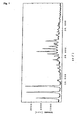
- (2) a crystalline form of a compound of formula (I) wherein said crystalline form has main peaks at lattice distances of 19.36, 12.87, 9.63, 4.70, 4.64, 4.28, 4.10, 3.92, 3.77 and 3.48 angstroms determined by X-ray diffraction by the powder method using the copper Kα ray (wavelength λ=1.54 angstroms),
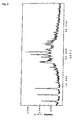
- (3) a crystalline form of a compound of formula (I) wherein said crystalline form has main peaks at lattice distances of 19.62, 13.06, 9.82, 4.72, 4.63, 4.56, 4.15, 3.98, 3.93, 3.82, 3.45 and 3.40 angstroms determined by X-ray diffraction by the powder method using the copper Kα ray (wavelength λ=1.54 angstroms),
- (4) a crystalline form of a compound of formula (I) wherein said crystalline form has peaks at lattice distances of 22.52, 5.17, 4.60, 4.28, and 3.87 angstroms determined by X-ray diffraction by the powder method using the copper Kα ray (wavelength λ=1.54 angstroms),
- (5) a solid pharmaceutical composition containing a crystalline form according to any one of (1) to (4) as an active ingredient,
- (6) a pharmaceutical composition according to (5) for prevention or treatment of tumours,
- (7) the use of a crystalline form according to any one of (1) to (4) in the preparation of a solid medicament for the prevention or treatment of tumours in a warm-blooded animal,
- (8) use according to (7) wherein said warm-blooded animal is a human.
- The crystalline forms of the Compound of formula (I) of the present invention are solids which have a regular repeated arrangement of atoms (or groups of atoms) in a three-dimensional structure. The crystalline forms are different from an amorphous solid that has no regular arrangement of atoms in a three-dimensional structure.
- Different plural crystalline forms (polymorphism) of the same compound can be produced depending upon the crystallization conditions used. These different crystalline forms have different three-dimensional structures and have different physicochemical properties.
- The present invention encompasses individual crystalline forms and mixtures of two or more of said crystalline forms.
- Crystalline forms of Compound (I) of the present invention comprise:
- a crystal having main peaks at lattice distances of d=19.53, 13.03, 9.75, 4.17, 4.00, 3.82, 3.68 and 3.41 angstrom determined by X-ray diffraction by the powder method using the copper Kα ray (wavelength λ=1.54 angstrom) wherein the main peaks have relative diffraction intensities greater than 36 based on the
relative intensity 100 of the peak at lattice distance d=9.75 angstrom;
(In addition, the lattice distance d can be calculated on the basis of the equation of 2dsinθ=nλ (n=1).) - a crystal having main peaks at lattice distances of d=19.36, 12.87, 9.63, 4.70, 4.64, 4.28, 4.10, 3.92, 3.77 and 3.48 angstrom determined by X-ray diffraction by the powder method using the copper Kα ray (wavelength λ=1.54 angstrom) wherein the main peaks have relative diffraction intensities greater than 53 based on the
relative intensity 100 of the peak at lattice distance d=3.92 angstrom; - a crystal having main peaks at lattice distances of d=19.62, 13.06, 9.82, 4.72, 4.63, 4.56, 4.15, 3.98, 3.93, 3.82, 3.45 and 3.40 angstrom determined by X-ray diffraction by the powder method using the copper Kα ray (wavelength λ=1.54 angstrom) wherein the main peaks have relative diffraction intensities greater than 30 based on the
relative intensity 100 of the peak at lattice distance d=4.56 angstrom; and - a crystal having peaks at lattice distances of d=22.52, 5.17, 4.60, 4.28, and 3.87 angstrom determined by X-ray diffraction by the powder method using the copper Kα ray (wavelength λ=1.54 angstrom) wherein the main peaks have relative diffraction intensities greater than 36 based on the
relative intensity 100 of the peak at lattice distance d=22.52 angstrom. - When the crystalline forms of the Compound of formula (I) are allowed to stand so that they are open to the atmosphere or are mixed with water or a solvent, they may absorb water or a solvent to form a hydrate or solvate. The present invention encompasses these hydrates and solvates
- The compound of formula (I) can be prepared according to a similar procedure to that described in the specification of Japanese Patent No. 2569251.
- The crystalline forms of the Compound of formula (I) according to the present invention can be obtained from a supersaturated solution. The supersaturated solution can be prepared through dissolution of the Compound of formula (I) in an appropriate solvent, pH adjustment of said solution, concentration of said solution, cooling said solution, addition of a solvent in which the Compound of formula (I) is slightly soluble to a solution of the Compound of formula (I) in a solvent in which the Compound of formula (I) is readily soluble, or the like.
- A suspension of a crystal or amorphous solid of the Compound of formula (I) in an appropriate solvent is converted into a slurry and then is stirred to transform alternate crystal (solvent-mediated transformation).
- In addition, precipitation of the crystals takes place spontaneously in the reaction vessel or it can be started or accelerated by addition of a crystalline seed, by mechanical stimulation such as through use of ultrasonic waves or by stretching the inside of the reaction vessel.
- The temperature for crystallization of Compound (I) or a pharmacologically acceptable salt thereof is usually in the range between 0 and 60°C, preferably between 5 and 45°C.
- Precipitated crystals can be collected by filtration, centrifugation or decantation methods. Isolated crystals may be washed with an appropriate solvent. The washing solvent can include, for example, water; an alcohol such as ethanol, isopropanol; a ketone such as acetone; an ester such as methyl formate, ethyl formate, methyl acetate, ethyl acetate; an aromatic hydrocarbon such as toluene, xylene; a nitrile such as acetonitrile; an ether such as diethyl ether, tetrahydrofuran, or a mixture thereof. Preferably methyl acetate which contains water or is anhydrous is used.
- Isolated crystals can be dried between 10 and 100°C, preferably between 30 and 50°C until the weight of said crystals becomes constant, if necessary, in the presence of a drying agent such as silica gel or calcium chloride and under reduced pressure.
- Dried crystals may absorb water under condition of 20 to 90% relative humidity and between 10 and 30°C, preferably 50 to 80% relative humidity and between 20 and 30°C until the weight of said crystals becomes constant.
- Crystals thus obtained can be further purified by recrystallization or slurry-purification.
- The recrystallization is accomplished by techniques known to those skilled in the art such as (1) cooling method : the Compound of formula (I) or a pharmacologically acceptable salt is dissolved in a hot solvent and then the resulting solution is cooled, (2) concentration method : a solution of the Compound of formula (I) or a pharmacologically acceptable salt thereof is concentrated, (3) precipitation method : a solvent in which the Compound of formula (I) or a pharmacologically acceptable salt thereof is slightly soluble is added to a solution of the Compound of formula (I) or a pharmacologically acceptable salt thereof in a solvent in which the Compound of formula (I) or a pharmacologically acceptable salt is readily soluble.
- The slurry-purification comprises collection of crystals which are obtained by stirring a suspension of a certain compound in an appropriate solvent.
- The solvent employed in slurry-purification of the Compound of formula (I) includes, for example, a ketone such as acetone, methyl ethyl ketone; an ester such as methyl acetate, ethyl acetate; a nitrile such as acetonitrile; a halogenated hydrocarbon such as methylene chloride, chloroform; an aromatic hydrocarbon such as toluene, xylene; an alcohol such as ethanol, isopropanol; an ether such as diethyl ether, tetrahydrofuran; an amide such as N,N-dimethylformamide; water; an aliphatic hydrocarbon such as hexane; an ether such as diisopropyl ether, diethyl ether; or the like and a mixture thereof. Preferably a ketone such as acetone, methyl ethyl ketone; an ester such as methyl formate, ethyl formate, methyl acetate, ethyl acetate; a nitrile such as acetonitrile; an alcohol such as ethanol, isopropanol and these solvents containing water is used, and more preferably methyl acetate which contains water or is anhydrous.
- Crystals obtained by recrystallization and slurry-purification are also isolated by similar techniques to those described hereinbefore.
- When the crystalline forms of the Compound of formula (I) of the present invention are used as a solid medicament preferably as an agent for treatment or prevention of tumours, said crystalline forms can be administered alone or as a mixture of said crystalline form with an appropriate pharmacologically acceptable excipient(s), and/or diluent(s). Compositions according to the present invention can be in unit dosage form such as tablets, capsules, granules, powders, suspensions, troches or the like for oral or parenteral administration.
- The pharmaceutical compositions can be prepared in a known manner by using additives such as excipients, binding agents, disintegrating agents, lubricating agents, stabilizing agents, corrigents, suspending agents and diluents.
- An example of an excipient includes a sugar derivative such as lactose, sucrose, glucose, mannitol, or sorbitol; a starch derivative such as corn starch, potato starch, α-starch, dextrin, carboxy methylstarch; a cellulose derivative such as crystalline cellulose, low-substituted hydroxypropylcellulose, hydroxypropylmethylcellulose, carboxymethylcellulose, calcium carboxymethylcellulose, internal-cross-linked sodium carboxymethylcellulose; acacia; dextran; pullulan; a silicate derivative such as light silicic acid anhydride, synthetic aluminum silicate, magnesium aluminate metasilicate; a phosphate derivative such as calcium phosphate; a carbonate derivative such as calcium carbonate; a sulfate derivative such as calcium sulfate; or the like.
- An example of a binding agent includes an excipient described hereinbefore; gelatin; polyvinylpyrrolidone; macrogol; or the like.
- An example of a disintegrating agent includes an excipient described hereinbefore, a chemically modified starch or cellulose derivative such as sodium cross-carmellose, sodium carboxymethylstarch, cross-linked polyvinylpyrrolidone or the like.
- An example of a lubricating agent includes talc; stearic acid; a metal stearate derivative such as calcium stearate, magnesium stearate; colloidal silica; veegum; a wax such as beeswax or spermaceti; boric acid; a glycol; a carboxy acid derivative such as fumaric acid, adipic acid; a sodium carboxylate such as sodium benzoate; a sulfate such as sodium sulfate; leucine; a lauryl sulfate such as sodium lauryl sulfate, or magnesium lauryl sulfate; a silicic acid derivative such as silicic acid anhydride, silicic acid hydrate; a starch derivative described above as an excipient; or the like.
- An example of a stabilizing agent includes a para-hydroxybenzoic acid ester derivative such as methylparabene, propylparabene; an alcohol derivative such as chlorobutanol, benzyl alcohol, phenetyl alcohol; benzalkonium chloride; a phenol derivative such as phenol, cresol; thimerosal; acetic anhydride; sorbic acid; or the like.
- An example of a corrigent includes a sweetening, souring, and flavoring agents or the like all of which are ordinarily used.
- The dose of the crystalline form of the comound of formula (I) of the present invention will depend on such factors as symptom, body weight and age of the patient. A suitable dosage level is 0.1 mg (preferably 1 mg) per day to 100 mg (preferably 50 mg) per day. The crystalline form of the compound of formula (I) of the present invention can be administered as either a single unit dosage, or if desired, the dosage may be divided into convenient subunits administered at one to several times throughout the day depending on the symptoms of the patient.
- The present invention is further described by Examples. Test examples and Formulation examples.
-
- (a) To 2'-cyano-2'-deoxy-N4-palmitoyl-1-β-D-arabinofuranosylcytosine (30 g), which is the compound described in Example 1 (1d) of the Japanese Patent No. 2569251, was added methyl acetate containing water at 2.5 vol % (300 ml), and the resulting mixture was heated up to approximately 55°C to prepare a clear solution. Subsequently, the solution was cooled to 5°C at a rate of approximately 0.5°C per minute. Upon cooling to about 45°C in the course of the cooling, plate crystals were separated out of solution. After stirring furthermore at 5°C for 20 min, the separated crystals were collected by filtration and washed with methyl acetate containing water at 2.5 vol % (30 ml) to afford the desired crystal B (28.78 g, purity 97.9 %) in a 96.0 % [N/N] yield.
- (b) To 2'-cyano-2'-deoxy-N4-palmitoyl-1-β-D-arabinofuranosylcytosine (8.7 kg), which is the compound described in Example 1 (1d) of the Japanese Patent No. 2569251, was added methyl acetate containing water at 1.9 vol % (80 L), and the resulting mixture was stirred at approximately 23°C for 1.5 hr. The separated crystals were collected by filtration, washed with methyl acetate containing water at 1.9 vol % (20 L) and dried to afford the desired crystal B (7.7 kg, purity 97.3 %) in a 90.1 % [N/N] yield.
-
- (a) To 2'-cyano-2'-deoxy-N4-palmitoyl-1-β-D-arabinofuranosylcytosine (30 g), which is the compound described in Example 1 (1d) of the Japanese Patent No. 2569251, was added methyl acetate containing water at 4 vol % (600 ml), and the resulting mixture was heated up to approximately 50°C to prepare a clear solution. Subsequently, the solution was cooled to 40°C at a rate of approximately 0.5°C per minute and stirred. In the course of the stirring, crystal B was first separated out of solution and then transformed gradually into needle-like crystals. After stirring furthermore at 40°C for 60 min, the solution was cooled to 25°C at a rate of approximately 0.5°C per minute. After stirring at 25°C for 60 min, the separated crystals were collected by filtration and washed with methyl acetate containing water at 4 vol % (30 ml) to afford the desired crystal C (23.74 g, purity 98.5 %) in a 79.7 % [N/N] yield.
- (b) To 2'-cyano-2'-deoxy-N4-palmitoyl-1-β-D-arabinofuranosylcytosine (60 g), which is the compound described in Example 1 (1d) of the Japanese Patent No. 2569251, was added methyl acetate containing water at 2.5 vol %(600 ml), and the resulting mixture was stirred at about 23°C for 2 hr and then cooled to 12°C at a rate of approximately 0.5°C per minute. After stirring at 12°C for 1 hr, the separated crystals were collected by filtration, washed with methyl acetate containing water at 2.5 vol % (180 ml) and dried to afford the desired crystal C (55.1 g, purity 94.5 %) in a 89.6 % [N/N] yield.
-
- 1) The dried crystal C was kept standing for about 20 min under an atmosphere moistened to more than 45% humidity to afford the desired crystal C(I).
- 2) To the dried crystal C was added water to an amount which corresponds to about 33 wt% of the used crystal, and the resulting mixture was kneaded for 3 min to afford the desired crystal C(I).
-
- (a) To 2'-cyano-2'-deoxy-N4-palmitoyl-1-β-D-arabinofuranosylcytosine (10.0 g), which is the compound described in Example 1 (1d) of the Japanese Patent No. 2569251, was added anhydrous methyl acetate (400 ml), and the resulting mixture was heated up to approximately 60°C to prepare a clear solution. Subsequently, the solution was cooled to 25°C at a rate of approximately 0.5°C per minute. Upon cooling to about 43°C in the course of the cooling, crystals were separated out of solution. After cooling to 25°C, the separated crystals were collected by filtration to afford the desired crystal D (8.8 g, 88.4 % yield).
- (b) To 2'-cyano-2'-deoxy-N4-palmitoyl-1-β-D-arabinofuranosylcytosine (50 g), which is the compound described in Example 1 (1d) of the Japanese Patent No. 2569251, was added methyl acetate (1500 ml), and the resulting mixture was heated up to approximately 50°C and stirred at about 50°C for 1 hr. Subsequently, the solution was cooled to 40°C at a rate of approximately 0.5°C per minute. After stirring at 40°C for 30 min, the separated crystals were collected by filtration and dried to afford the desired crystal D (37.0 g, purity 99.2 %) in a 74.2 % [N/N] yield.
- In the stability test, crystals B, C and D of the present invention prepared in Examples 1, 2 and 4, respectively and the powder (Powder A) of compound of general formula (I) described in Example 1 (1d) of the Japanese Patent No. 2569251 were used as reference. These compounds were placed in stoppered vessels separately and stored at 60°C under a nitrogen atmosphere for 17 days, and the content of these compounds was measured on 5, 10 and 17 days after the initiation of the storage.
- The content of these compounds was determined quantitatively with high performance liquid chromatography (HPLC), and the rate of the remaining compounds (%) was calculated by the content of Compound (I) determined at each sampling point based on the initial content (100%) determined immediately before the storage.
- The operating conditions of HPLC were as follows:
- Column:
- L-column ODS (4.6 mm x 250 mm)
(Chemicals Inspection and Testing Institute) - Mobile
- Acetonitrile:water:acetic acid = 750:250:1
- phase:
- Flow rate:
- 1.0 ml/min
- Detection
- wavelength:
- 249 nm
- Column
- temperature:
- 40°C
- Based on the results summarized in Table 1, the stability of the prior art powder (powder A) of the compound of formula (I) at 60°C under a nitrogen atmosphere was extremely low, and the residual rate decreased to 62.5% after storage for 17 days. By contrast, the residual rates of crystals B and C prepared in Example 1 and 2, respectively, under the same storage conditions were 100 % each and that of the crystal D prepared in Example 4 was 98.4 %, demonstrating that the stability of crystals of the present invention is extremely high.
- A powder is prepared so that said powder contains the compound prepared in Example 1 (40% (W/W)) and lactose (60%(W/W)).
- The crystalline forms of this invention have remarkably better storage stability and ease of handling than the prior art powder of the Compound of formula (I) disclosed in Japanese Patent No. 2569251. Said crystalline forms exhibit excellent metabolic disposition such as oral absorption and the like and are, therefore, useful medicaments (preferably as agents for treatment or prevention of tumours).
- Figure 1 is a powder X ray diffraction pattern of the crystalline product prepared in Example 1, the diffraction pattern of which is obtained by irradiation of the crystalline product using the copper Kα ray (wavelength λ=1.54 angstrom).
- Figure 2 is a powder X ray diffraction pattern of the crystalline product prepared in Example 2, the diffraction pattern of which is obtained by irradiation of the crystalline product using the copper Kα ray (wavelength λ=1.54 angstrom).
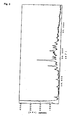
- Figure 3 is a powder X ray diffraction pattern of the crystalline product prepared in Example 3, the diffraction pattern of which is obtained by irradiation of the crystalline product using the copper Kα ray (wavelength λ=1.54 angstrom).
- Figure 4 is a powder X ray diffraction pattern of the crystalline product prepared in Example 4, the diffraction pattern of which is obtained by irradiation of the crystalline product using the copper Kα ray (wavelength λ=1.54 angstrom).
- In addition, in these figures the vertical axis of each powder X ray diffraction pattern indicates the diffraction intensity in units of counts/second(cps) and the horizontal axis indicates the diffraction angle as the value 2θ.
| Stability of each compound at 60°C under a nitrogen atmosphere (Residual rate) | |||
| Compound | Days after the initiation of stability test | ||
| 5 | 10 days | 17 days | |
| Powder A | 92.7% | 78.6% | 62.5% |
| Crystal B prepared in Example 1 | 101.0% | 100.3% | 100.4% |
| Crystal C prepared in Example 2 | 101.0% | 100.4% | 100.1% |
| Crystal D prepared in Example 4 | 99.9% | 98.3% | 98.4% |
Claims (8)
- A crystalline form of a compound of formula (I) or a hydrate thereof:

- A crystalline form of a compound of formula (I):

- A crystalline form of a compound of formula (I) :

- A crystalline form of a compound of formula (I):

- A solid pharmaceutical composition containing a crystalline form according to any one of claims 1 to 4 as an active ingredient.
- A pharmaceutical composition according to claim 5, for the prevention or treatment of tumours.
- Use of a crystalline form according to any one of claims 1 to 5 in the preparation of a solid medicament for the prevention or treatment of tumours in a warm-blooded animal.
- Use according to claim 7, wherein said warm-blooded animal is a human.
Applications Claiming Priority (3)
| Application Number | Priority Date | Filing Date | Title |
|---|---|---|---|
| JP2001033128 | 2001-02-09 | ||
| JP2001033128 | 2001-02-09 | ||
| PCT/JP2002/000986 WO2002064609A1 (en) | 2001-02-09 | 2002-02-06 | Crystal of pyrimidine nucleoside derivative |
Publications (3)
| Publication Number | Publication Date |
|---|---|
| EP1364959A1 EP1364959A1 (en) | 2003-11-26 |
| EP1364959A4 EP1364959A4 (en) | 2004-03-24 |
| EP1364959B1 true EP1364959B1 (en) | 2007-05-09 |
Family
ID=18896929
Family Applications (1)
| Application Number | Title | Priority Date | Filing Date |
|---|---|---|---|
| EP02711347A Expired - Lifetime EP1364959B1 (en) | 2001-02-09 | 2002-02-06 | Crystal of pyrimidine nucleoside derivative |
Country Status (21)
| Country | Link |
|---|---|
| EP (1) | EP1364959B1 (en) |
| JP (2) | JP3748536B2 (en) |
| KR (1) | KR100679904B1 (en) |
| CN (1) | CN100408591C (en) |
| AT (1) | ATE361929T1 (en) |
| AU (1) | AU2002230164B2 (en) |
| BR (2) | BR0207102A (en) |
| CA (1) | CA2437994C (en) |
| CY (1) | CY1106685T1 (en) |
| CZ (1) | CZ303241B6 (en) |
| DE (1) | DE60220024T2 (en) |
| DK (1) | DK1364959T3 (en) |
| ES (1) | ES2286237T3 (en) |
| HU (1) | HU229294B1 (en) |
| IL (2) | IL157216A0 (en) |
| MX (1) | MXPA03007123A (en) |
| NZ (1) | NZ527393A (en) |
| PT (1) | PT1364959E (en) |
| RU (1) | RU2256666C2 (en) |
| WO (1) | WO2002064609A1 (en) |
| ZA (1) | ZA200306121B (en) |
Cited By (3)
| Publication number | Priority date | Publication date | Assignee | Title |
|---|---|---|---|---|
| US8349792B2 (en) | 2006-12-19 | 2013-01-08 | Cyclacel Limited | Combination comprising CNDAC (2′-cyano-2′-deoxy-N4-palmitoyl-1-beta-D-arabinofuranosyl-cytosine) and a cytotoxic agent |
| US8530445B2 (en) | 2008-06-09 | 2013-09-10 | Cyclacel Limited | Combinations of sapacitabine or CNDAC with DNA methyltransferase inhibitors such as decitabine and procaine |
| US10226478B2 (en) | 2011-04-14 | 2019-03-12 | Cyclacel Limited | Dosage regimen for sapacitabine and decitabine in combination for treating acute myeloid leukemia |
Families Citing this family (9)
| Publication number | Priority date | Publication date | Assignee | Title |
|---|---|---|---|---|
| US6876554B1 (en) | 1999-09-02 | 2005-04-05 | Ibiden Co., Ltd. | Printing wiring board and method of producing the same and capacitor to be contained in printed wiring board |
| EP1139705B1 (en) | 1999-09-02 | 2006-11-22 | Ibiden Co., Ltd. | Printed wiring board and method of producing the same |
| GB0526419D0 (en) | 2005-12-23 | 2006-02-08 | Cyclacel Ltd | Formulation |
| JP5066737B2 (en) * | 2007-04-06 | 2012-11-07 | 大鵬薬品工業株式会社 | Antitumor agent for continuous intravenous administration containing cytidine derivative |
| US8124593B2 (en) | 2007-11-05 | 2012-02-28 | Cyclacel Limited | Methods of treatment using sapacitabine |
| GB0808357D0 (en) * | 2008-05-08 | 2008-06-18 | Cyclacel Ltd | Process |
| JP6317319B2 (en) | 2012-03-15 | 2018-04-25 | セルジーン シーエーアール エルエルシー | Solid forms of epidermal growth factor receptor kinase inhibitors |
| KR102629310B1 (en) * | 2015-03-09 | 2024-01-24 | 더블유.알. 그레이스 앤드 캄파니-콘. | Crystal form of nicotinamide riboside |
| CN112020363A (en) | 2017-12-22 | 2020-12-01 | 益力舒健康公司 | Crystalline forms of nicotinamide riboside chloride |
Family Cites Families (2)
| Publication number | Priority date | Publication date | Assignee | Title |
|---|---|---|---|---|
| JP2559917B2 (en) * | 1990-06-15 | 1996-12-04 | 三共株式会社 | Pyrimidine nucleoside derivative |
| RU2085557C1 (en) * | 1991-09-30 | 1997-07-27 | Санкио Компани Лимитед | Pyrimidine nucleoside derivatives or their pharmaceutically acceptable salts and method of their synthesis |
-
2002
- 2002-02-04 JP JP2002026232A patent/JP3748536B2/en not_active Expired - Lifetime
- 2002-02-06 DK DK02711347T patent/DK1364959T3/en active
- 2002-02-06 CN CNB028079337A patent/CN100408591C/en not_active Expired - Lifetime
- 2002-02-06 WO PCT/JP2002/000986 patent/WO2002064609A1/en not_active Ceased
- 2002-02-06 NZ NZ527393A patent/NZ527393A/en not_active IP Right Cessation
- 2002-02-06 IL IL15721602A patent/IL157216A0/en active IP Right Grant
- 2002-02-06 CA CA2437994A patent/CA2437994C/en not_active Expired - Lifetime
- 2002-02-06 AT AT02711347T patent/ATE361929T1/en active
- 2002-02-06 ES ES02711347T patent/ES2286237T3/en not_active Expired - Lifetime
- 2002-02-06 RU RU2003124648/04A patent/RU2256666C2/en active
- 2002-02-06 DE DE60220024T patent/DE60220024T2/en not_active Expired - Lifetime
- 2002-02-06 PT PT02711347T patent/PT1364959E/en unknown
- 2002-02-06 CZ CZ20032111A patent/CZ303241B6/en not_active IP Right Cessation
- 2002-02-06 EP EP02711347A patent/EP1364959B1/en not_active Expired - Lifetime
- 2002-02-06 MX MXPA03007123A patent/MXPA03007123A/en active IP Right Grant
- 2002-02-06 AU AU2002230164A patent/AU2002230164B2/en not_active Expired
- 2002-02-06 BR BR0207102-9A patent/BR0207102A/en not_active Application Discontinuation
- 2002-02-06 BR BRPI0207102A patent/BRPI0207102A8/en unknown
- 2002-02-06 KR KR1020037010308A patent/KR100679904B1/en not_active Expired - Lifetime
- 2002-02-06 HU HU0303159A patent/HU229294B1/en unknown
-
2003
- 2003-08-04 IL IL157216A patent/IL157216A/en unknown
- 2003-08-07 ZA ZA2003/06121A patent/ZA200306121B/en unknown
-
2005
- 2005-08-09 JP JP2005230800A patent/JP4356998B2/en not_active Expired - Lifetime
-
2007
- 2007-07-02 CY CY20071100860T patent/CY1106685T1/en unknown
Cited By (4)
| Publication number | Priority date | Publication date | Assignee | Title |
|---|---|---|---|---|
| US8349792B2 (en) | 2006-12-19 | 2013-01-08 | Cyclacel Limited | Combination comprising CNDAC (2′-cyano-2′-deoxy-N4-palmitoyl-1-beta-D-arabinofuranosyl-cytosine) and a cytotoxic agent |
| US8530445B2 (en) | 2008-06-09 | 2013-09-10 | Cyclacel Limited | Combinations of sapacitabine or CNDAC with DNA methyltransferase inhibitors such as decitabine and procaine |
| US8975239B2 (en) | 2008-06-09 | 2015-03-10 | Cyclacel Limited | Combinations of sapacitabine or CNDAC with DNA methyltransferase inhibitors such as decitabine and procaine |
| US10226478B2 (en) | 2011-04-14 | 2019-03-12 | Cyclacel Limited | Dosage regimen for sapacitabine and decitabine in combination for treating acute myeloid leukemia |
Also Published As
Similar Documents
| Publication | Publication Date | Title |
|---|---|---|
| CN114206878B (en) | Wu Pati Ni crystal form and preparation method and application thereof | |
| EP4328226A1 (en) | Tolebrutinib crystal form, amorphous form, preparation method therefor and use thereof | |
| WO2023064519A1 (en) | Solid state forms of elacestrant and processes for preparation thereof | |
| US6908906B2 (en) | Crystalline forms of pyrimidine nucleoside derivative | |
| AU2002230164B2 (en) | Crystal of pyrimidine nucleoside derivative | |
| US20230167156A1 (en) | Solid state forms of voclosporin | |
| EP3160951B1 (en) | Crystalline forms of ferric maltol | |
| WO2022242740A1 (en) | Tolebrutinib salt and crystal form thereof, preparation method therefor, pharmaceutical composition thereof, and use thereof | |
| EP1277750B1 (en) | Hydrates and crystals of a neuraminic acid compound | |
| WO2022253261A1 (en) | Hydrate crystal form of lazertinib methanesulfonate, preparation method therefor and use thereof | |
| HK1233619A1 (en) | Crystalline forms of ferric maltol | |
| HK1233619B (en) | Crystalline forms of ferric maltol | |
| JP2007297332A (en) | Crystal of benzamidine derivative |
Legal Events
| Date | Code | Title | Description |
|---|---|---|---|
| PUAI | Public reference made under article 153(3) epc to a published international application that has entered the european phase |
Free format text: ORIGINAL CODE: 0009012 |
|
| 17P | Request for examination filed |
Effective date: 20030806 |
|
| AK | Designated contracting states |
Kind code of ref document: A1 Designated state(s): AT BE CH CY DE DK ES FI FR GB GR IE IT LI LU MC NL PT SE TR |
|
| A4 | Supplementary search report drawn up and despatched |
Effective date: 20040210 |
|
| RIC1 | Information provided on ipc code assigned before grant |
Ipc: 7C 07H 19/09 A Ipc: 7A 61K 31/712 B |
|
| 17Q | First examination report despatched |
Effective date: 20040405 |
|
| GRAP | Despatch of communication of intention to grant a patent |
Free format text: ORIGINAL CODE: EPIDOSNIGR1 |
|
| GRAS | Grant fee paid |
Free format text: ORIGINAL CODE: EPIDOSNIGR3 |
|
| GRAA | (expected) grant |
Free format text: ORIGINAL CODE: 0009210 |
|
| AK | Designated contracting states |
Kind code of ref document: B1 Designated state(s): AT BE CH CY DE DK ES FI FR GB GR IE IT LI LU MC NL PT SE TR |
|
| REG | Reference to a national code |
Ref country code: GB Ref legal event code: FG4D |
|
| REG | Reference to a national code |
Ref country code: CH Ref legal event code: EP Ref country code: CH Ref legal event code: NV Representative=s name: A. BRAUN, BRAUN, HERITIER, ESCHMANN AG PATENTANWAE |
|
| REG | Reference to a national code |
Ref country code: IE Ref legal event code: FG4D |
|
| REF | Corresponds to: |
Ref document number: 60220024 Country of ref document: DE Date of ref document: 20070621 Kind code of ref document: P |
|
| REG | Reference to a national code |
Ref country code: GR Ref legal event code: EP Ref document number: 20070401551 Country of ref document: GR |
|
| REG | Reference to a national code |
Ref country code: SE Ref legal event code: TRGR |
|
| REG | Reference to a national code |
Ref country code: PT Ref legal event code: SC4A Free format text: AVAILABILITY OF NATIONAL TRANSLATION Effective date: 20070710 |
|
| ET | Fr: translation filed | ||
| REG | Reference to a national code |
Ref country code: ES Ref legal event code: FG2A Ref document number: 2286237 Country of ref document: ES Kind code of ref document: T3 |
|
| PLBE | No opposition filed within time limit |
Free format text: ORIGINAL CODE: 0009261 |
|
| STAA | Information on the status of an ep patent application or granted ep patent |
Free format text: STATUS: NO OPPOSITION FILED WITHIN TIME LIMIT |
|
| 26N | No opposition filed |
Effective date: 20080212 |
|
| REG | Reference to a national code |
Ref country code: CH Ref legal event code: PFA Owner name: SANKYO COMPANY, LIMITED Free format text: SANKYO COMPANY, LIMITED#5-1, NIHONBASHI HONCHO 3-CHOME, CHUO-KU#TOKYO 103-8426 (JP) -TRANSFER TO- SANKYO COMPANY, LIMITED#5-1, NIHONBASHI HONCHO 3-CHOME, CHUO-KU#TOKYO 103-8426 (JP) |
|
| REG | Reference to a national code |
Ref country code: CH Ref legal event code: PCAR Free format text: NEW ADDRESS: HOLBEINSTRASSE 36-38, 4051 BASEL (CH) |
|
| REG | Reference to a national code |
Ref country code: FR Ref legal event code: PLFP Year of fee payment: 15 |
|
| REG | Reference to a national code |
Ref country code: FR Ref legal event code: PLFP Year of fee payment: 16 |
|
| REG | Reference to a national code |
Ref country code: FR Ref legal event code: PLFP Year of fee payment: 17 |
|
| PGFP | Annual fee paid to national office [announced via postgrant information from national office to epo] |
Ref country code: LU Payment date: 20210125 Year of fee payment: 20 |
|
| PGFP | Annual fee paid to national office [announced via postgrant information from national office to epo] |
Ref country code: NL Payment date: 20210113 Year of fee payment: 20 Ref country code: PT Payment date: 20210204 Year of fee payment: 20 Ref country code: MC Payment date: 20210126 Year of fee payment: 20 Ref country code: FI Payment date: 20210209 Year of fee payment: 20 Ref country code: CY Payment date: 20210105 Year of fee payment: 20 Ref country code: FR Payment date: 20210113 Year of fee payment: 20 Ref country code: CH Payment date: 20210217 Year of fee payment: 20 Ref country code: GR Payment date: 20210112 Year of fee payment: 20 Ref country code: IE Payment date: 20210209 Year of fee payment: 20 |
|
| PGFP | Annual fee paid to national office [announced via postgrant information from national office to epo] |
Ref country code: BE Payment date: 20210114 Year of fee payment: 20 Ref country code: AT Payment date: 20210125 Year of fee payment: 20 Ref country code: DE Payment date: 20210126 Year of fee payment: 20 Ref country code: SE Payment date: 20210210 Year of fee payment: 20 Ref country code: TR Payment date: 20210204 Year of fee payment: 20 Ref country code: ES Payment date: 20210308 Year of fee payment: 20 Ref country code: GB Payment date: 20210127 Year of fee payment: 20 Ref country code: DK Payment date: 20210210 Year of fee payment: 20 |
|
| PGFP | Annual fee paid to national office [announced via postgrant information from national office to epo] |
Ref country code: IT Payment date: 20210112 Year of fee payment: 20 |
|
| REG | Reference to a national code |
Ref country code: DK Ref legal event code: EUP Expiry date: 20220206 |
|
| REG | Reference to a national code |
Ref country code: NL Ref legal event code: MK Effective date: 20220205 |
|
| REG | Reference to a national code |
Ref country code: CH Ref legal event code: PL |
|
| REG | Reference to a national code |
Ref country code: GB Ref legal event code: PE20 Expiry date: 20220205 |
|
| REG | Reference to a national code |
Ref country code: BE Ref legal event code: MK Effective date: 20220206 |
|
| REG | Reference to a national code |
Ref country code: AT Ref legal event code: MK07 Ref document number: 361929 Country of ref document: AT Kind code of ref document: T Effective date: 20220206 |
|
| REG | Reference to a national code |
Ref country code: FI Ref legal event code: MAE |
|
| REG | Reference to a national code |
Ref country code: SE Ref legal event code: EUG |
|
| REG | Reference to a national code |
Ref country code: IE Ref legal event code: MK9A |
|
| PG25 | Lapsed in a contracting state [announced via postgrant information from national office to epo] |
Ref country code: IE Free format text: LAPSE BECAUSE OF EXPIRATION OF PROTECTION Effective date: 20220206 Ref country code: GB Free format text: LAPSE BECAUSE OF EXPIRATION OF PROTECTION Effective date: 20220205 |
|
| REG | Reference to a national code |
Ref country code: ES Ref legal event code: FD2A Effective date: 20220526 |
|
| PG25 | Lapsed in a contracting state [announced via postgrant information from national office to epo] |
Ref country code: PT Free format text: LAPSE BECAUSE OF EXPIRATION OF PROTECTION Effective date: 20220216 |
|
| PG25 | Lapsed in a contracting state [announced via postgrant information from national office to epo] |
Ref country code: ES Free format text: LAPSE BECAUSE OF EXPIRATION OF PROTECTION Effective date: 20220207 |