EP1364951A1 - Pest controllers - Google Patents
Pest controllers Download PDFInfo
- Publication number
- EP1364951A1 EP1364951A1 EP02710434A EP02710434A EP1364951A1 EP 1364951 A1 EP1364951 A1 EP 1364951A1 EP 02710434 A EP02710434 A EP 02710434A EP 02710434 A EP02710434 A EP 02710434A EP 1364951 A1 EP1364951 A1 EP 1364951A1
- Authority
- EP
- European Patent Office
- Prior art keywords
- compound
- formula
- halogen atom
- optionally substituted
- hydroxyl
- Prior art date
- Legal status (The legal status is an assumption and is not a legal conclusion. Google has not performed a legal analysis and makes no representation as to the accuracy of the status listed.)
- Granted
Links
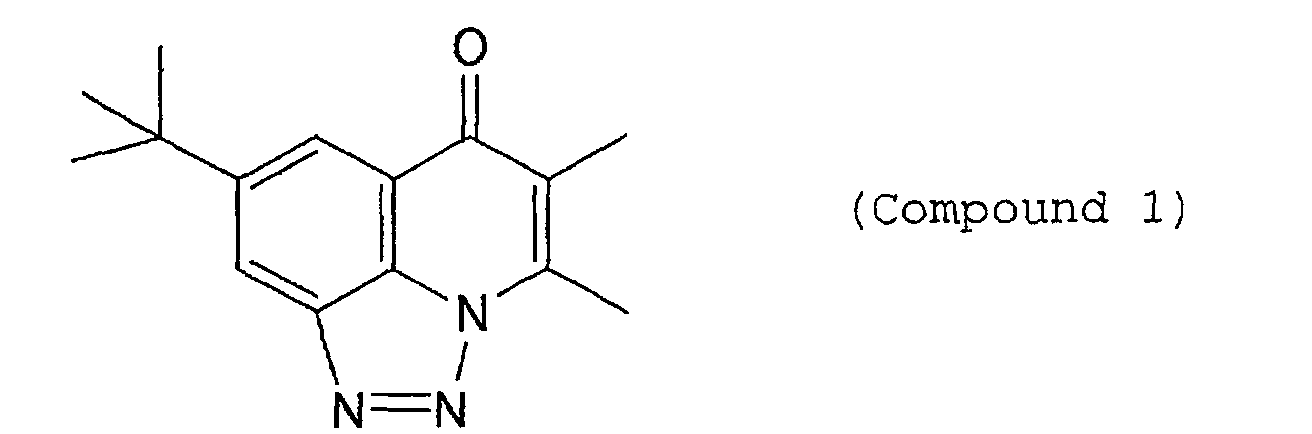
- 0 Cc(c(*)c1C(C(*)=C2*)=O)c(*)c3c1[n]2nn3 Chemical compound Cc(c(*)c1C(C(*)=C2*)=O)c(*)c3c1[n]2nn3 0.000 description 2
- NIWYOXWOTSBUIC-UHFFFAOYSA-N CCC([n]1nnc2cc(C(C)(C)C)cc3c12)=C(C)C3=O Chemical compound CCC([n]1nnc2cc(C(C)(C)C)cc3c12)=C(C)C3=O NIWYOXWOTSBUIC-UHFFFAOYSA-N 0.000 description 1
Classifications
-
- C—CHEMISTRY; METALLURGY
- C07—ORGANIC CHEMISTRY
- C07D—HETEROCYCLIC COMPOUNDS
- C07D471/00—Heterocyclic compounds containing nitrogen atoms as the only ring hetero atoms in the condensed system, at least one ring being a six-membered ring with one nitrogen atom, not provided for by groups C07D451/00 - C07D463/00
- C07D471/02—Heterocyclic compounds containing nitrogen atoms as the only ring hetero atoms in the condensed system, at least one ring being a six-membered ring with one nitrogen atom, not provided for by groups C07D451/00 - C07D463/00 in which the condensed system contains two hetero rings
- C07D471/06—Peri-condensed systems
-
- A—HUMAN NECESSITIES
- A01—AGRICULTURE; FORESTRY; ANIMAL HUSBANDRY; HUNTING; TRAPPING; FISHING
- A01N—PRESERVATION OF BODIES OF HUMANS OR ANIMALS OR PLANTS OR PARTS THEREOF; BIOCIDES, e.g. AS DISINFECTANTS, AS PESTICIDES OR AS HERBICIDES; PEST REPELLANTS OR ATTRACTANTS; PLANT GROWTH REGULATORS
- A01N43/00—Biocides, pest repellants or attractants, or plant growth regulators containing heterocyclic compounds
- A01N43/90—Biocides, pest repellants or attractants, or plant growth regulators containing heterocyclic compounds having two or more relevant hetero rings, condensed among themselves or with a common carbocyclic ring system
Definitions
- the present invention relates to a novel triazoquinolone derivative, a process for producing the same, and a harmful organism control agent comprising said derivative as an active ingredient.
- the present inventors have now found that triazoquinolone derivatives having a specific structure possess excellent harmful organism control effect.
- the present invention has been made based on such finding.
- an object of the present invention is to provide a harmful organism control agent which possesses excellent control effect against harmful organisms and can be used safely.
- a harmful organism control agent comprising as an active ingredient at least one of the above compounds or salts thereof.
- the compounds according to the present invention are compounds of formula (1) (triazoquinolone derivatives) or salts thereof.
- the compounds of formula (1) or salts thereof possess excellent harmful organism control effect and can be used with high safety.
- safety means that there is little or no toxicity against organisms, other than harmful organisms as control objects, for example, plants as application objects, humans who apply the compound, and animals and vegetables, fishes, birds, beneficial insects and the like which live around the application objects.
- R 1 which may be the same or different, represent(s) a halogen atom; straight chain, branched chain, or cyclic C1 - 6 alkyl optionally substituted by a halogen atom or hydroxyl; C1 - 6 alkoxy optionally substituted by a halogen atom or hydroxyl; or nitro.
- n is an integer of 0 (zero) to 3, preferably 1 or 2.
- halogen atom as used herein means a fluorine, chlorine, bromine, or iodine atom, preferably a fluorine, chlorine, or bromine atom.
- alkyl may be in any of straight chain, branched chain, and cyclic forms.
- the alkyl typically has 1 to 6 carbon atoms.
- the “alkyl” is optionally substituted by a halogen atom or hydroxyl.
- the "alkyl” may be methyl, ethyl, propyl, butyl, pentyl, or hexyl and preferably represents methyl, trifluoromethyl, ethyl, n-propyl, isopropyl, n-butyl, s-butyl, t-butyl, isobutyl, n-pentyl, isopentyl, neopentyl, or cyclohexyl.
- alkoxy may be in any of straight chain and branched chain forms.
- the alkoxy typically represents 1 to 6 carbon atoms.
- the “alkoxy” is optionally substituted by a halogen atom or hydroxyl.
- the “alkoxy” may be, for example, methoxy, ethoxy, propoxy, or butoxy and preferably represents methoxy, trifluoromethoxy, or ethoxy.
- formula (1) may be represented as formula (1').
- R 2 and R 3 are as defined in formula (1).
- R 11 , R 12 , and R 13 corresponding to R 1 in formula (1) may be defined as follows.
- R 11 , R 12 , and R 13 each independently represent a hydrogen atom; a halogen atom; straight chain, branched chain, or cyclic C1 - 6 alkyl optionally substituted by a halogen atom or hydroxyl; C1 - 6 alkoxy optionally substituted by a halogen atom or hydroxyl; or nitro.
- R 11 represents a hydrogen atom; a halogen atom; C1 - 4 alkyl optionally substituted by a halogen atom; C1 - 4 alkoxy optionally substituted by a halogen atom; or nitro. More preferably, R 11 represents a hydrogen atom.
- R 12 preferably represents a hydrogen atom; a halogen atom; straight chain, branched chain, or cyclic C1 - 6 alkyl optionally substituted by a halogen atom; straight chain, branched chain, or cyclic C1 - 6 alkoxy optionally substituted by a halogen atom; or nitro. More preferably, R 12 represents a hydrogen atom, a chlorine atom, methyl, isopropyl, t-butyl, isobutyl, neopentyl, trifluoromethoxy, or nitro.
- R 13 preferably represents a hydrogen atom; a halogen atom; straight chain, branched chain, or cyclic C1 - 6 alkyl optionally substituted by a halogen atom; straight chain, branched chain, or cyclic C1 - 6 alkoxy optionally substituted by a halogen atom; or nitro. More preferably, R 13 represents a hydrogen atom, a chlorine atom, or methoxy.
- R 2 represents a hydrogen atom; a halogen atom; or straight chain, branched chain, or cyclic C1 - 4 alkyl optionally substituted by a halogen atom or hydroxyl.
- alkyl may be in any of straight chain, branched chain, and cyclic forms.
- the alkyl typically has 1 to 4 carbon atoms.
- the "alkyl” is optionally substituted by a halogen atom or hydroxyl. Therefore, the “alkyl” may be methyl, ethyl, propyl, or butyl and preferably represents methyl, trifluoromethyl, ethyl, n-propyl, isopropyl, n-butyl, s-butyl, t-butyl, or isobutyl.
- R 3 represents a hydrogen atom; a halogen atom; or straight chain, branched chain, or cyclic C1 - 12 alkyl optionally substituted by a halogen atom or hydroxyl.
- R 3 represents a hydrogen atom or straight chain, branched chain, or cyclic C1 - 8 alkyl optionally substituted by a halogen atom.
- alkyl may be in any of straight chain, branched chain, and cyclic forms.
- the “alkyl” typically has 1 to 12 carbon atoms, preferably 1 to 8 carbon atoms.
- the “alkyl” is optionally substituted by a halogen atom or hydroxyl. Therefore, the “alkyl” may represent methyl, ethyl, propyl, butyl, pentyl, hexyl, heptyl, octyl, nonyl, decyl, undecyl, or dodecyl.
- the "alkyl” represents methyl, trifluoromethyl, ethyl, n-propyl, isopropyl, n-butyl, s-butyl, t-butyl, isobutyl, n-pentyl, isopentyl, neopentyl, cyclohexyl, n-heptyl, or n-octyl.
- R 2 and R 3 may represent respective independent groups.
- R 2 and R 3 together may represent -(CH 2 ) m -wherein m is an integer of 3 or 4. Accordingly, R 2 and R 3 together may form a five- or six-membered ring.
- the compounds of formula (1) may form any "salt" without particular limitation, and examples of salts include salts, which are generally usable in agricultural and horiticultural fields, such as hydrochloric acid salts, nitric acid salts, phosphoric acid salts, and acetic acid salts.
- the compounds of formula (1) may also take the form of hydrates or solvates.
- the type of solvent, which forms the solvate is not particularly limited, and examples of preferred solvents include alcohols such as methanol, ethanol, and isopropanol, and ethers such as tetrahydrofuran. Accordingly, in the present invention, such hydrates and solvates are also embraced in the compounds of formula (1).
- the compounds of formula (1) according to the present invention may be synthesized by any appropriate process regarding the formation of a bond or the introduction of a substituent.
- a compound of formula (1) can be produced according to the following scheme. wherein R 1 , n, R 2 , and R 3 are each as defined in formula (1).
- the compound of formula (1) is produced by first nitrating a compound of formula (2) to give a compound of formula (3), reducing the compound of formula (3) to give a compound of formula (4), and diazotizing the compound of formula (4).
- the compound of formula (2) (quinolone derivative) is first provided.
- the compound of formula (2) may be provided from any source without particular limitation.
- the compound of formula (2) may be synthesized by using a substituted aniline, which is commercially available or has been prepared by a conventional method, as a starting compound by a conventional method, for example, a method described in J. Am. Chem. Soc., 70, 2402 (1948) and Tetrahedron Lett., 27, 5323 (1986).
- Nitrating agents usable herein include, for example, mixed acids (nitric acid- sulfuric acid), fuming nitric acid, potassium nitrate, nitronium trifluoromethanesulfonate, nitromethane tetrafluoroborate, and acetyl nitrate.
- the compound of formula (4) as an amine compound can be prepared by reducing the nitro group in the compound of formula (3). More specifically, the compound of formula (4) may be prepared by catalytically reducing the nitro group in the compound of formula (3) at -20 to 120°C, preferably 10 to 100°C, in an alcohol or an ether (for example, methanol, ethanol, or dioxane) as a solvent. Alternatively, the compound of formula (4) may be prepared by reducing the nitro group in the compound of formula (3) at -20 to 120°C, preferably 10 to 100°C, in a solvent such as hydrochloric acid or acetic acid in the presence of iron, tin, zinc or the like or in the presence of Raney nickel or the like.
- a solvent such as hydrochloric acid or acetic acid
- the compound of formula (1) can be prepared by reacting the compound of formula (4) with sodium nitrite at -20 to 20°C preferably under ice cooling in an acidic solvent, preferably hydrochloric acid, sulfuric acid, or glacial acetic acid, to diazotize the compound of formula (4).
- an acidic solvent preferably hydrochloric acid, sulfuric acid, or glacial acetic acid
- the compounds of formula (1) possess excellent control effect against harmful organisms. Therefore, the compounds of formula (1) may be used as harmful organism control agents.
- a harmful organism control agent comprising as an active ingredient at least one of the compounds of formula (1) or salts thereof.
- insects refers to pest insects or pathogenic fungi, which often or possibly damage agriculture, human life, and the health of humans, and examples thereof include agricultural pest insects, sanitary pest insects, stored grain vermin, clothing pests, house pest insects, and plant pathogenic fungi.
- pest insects belonging to Lepidoptera for example, Spodoptera litura, Mamestra brassicae L., Pseudaletia separata (Walker), green caterpillar, Plutella xylostella, and Spodoptera exigua (Hubncr); pest insects belonging to Hemiptera, for example, Myzus persicae, Aphis gossypii Glover, Laodelphax striatellus (Fallen), Nephotettix cincticeps (Uhler), Nilaparvata lugens (Stal), and Sogatella furcifera; pest insects belonging to Coleoptera, for example, Lissorhoptrus oryzophilus, Callosobruchus chinensis (Linne), and Tenebrio molitor; Acari, for example, Tetranychus urticae Koch, Tetranychus cinnabarinus, Tetranychus
- plant pathogenic fungi examples include powdery mildew of curcurbits, downy mildew, anthracnose, gray mold, wheat leaf rust, powdery mildew of barley and wheat, and rice blast.
- control of harmful organisms includes the prevention of propagation of harmful organisms, not to mention the killing or reduction of harmful organisms, the suppression of growth of harmful organisms, or the removal of harmful organisms from object plant bodies.
- comprising "at least one” means that one of the compounds of formula (1) or salts thereof or two or more of the compounds of formula (1) or salts thereof according to the present invention may be contained.
- composition comprising as an active ingredient
- a carrier according to the formulation is additionally incorporated and the case where other chemical agents usable in combination with the compound of the present invention are additionally incorporated, not to mention the case where the compound of the present invention as such is used without the addition of any other ingredient.
- the compound of formula (1) when used as an active ingredient of a control agent for harmful organisms, the compound of formula (1) as such may be used.
- the compound of formula (1) may be mixed with suitable solid carriers, liquid carriers, gaseous carriers, surfactants, dispersants and/or other adjuvants for formulations, to prepare any suitable formulation, such as emulsifiable concentrates, liquid formulations, suspension, wettable powder, dust, granules, oil solutions, aerosols, or floables.
- Solid carriers usable herein include, for example, talc, bentonite, clay, kaolin, diatomaceous earth, vermiculite, white carbon, and calcium carbonate.
- liquid carriers include: alcohols, such as methanol, n-hexanol, and ethylene glycol; ketones, such as acetone, methyl ethyl ketone, and cyclohexanone; aliphatic hydrocarbons, such as n-hexane, kerosine, and kerosene; aromatic hydrocarbons, such as toluene, xylene, and methylnaphthalene; ethers, such as diethyl ether, dioxane, and tetrahydrofuran; esters, such as ethyl acetate; nitriles, such as acetonitrile and isobutyronitrile; acid amides, such as dimethylformamide and dimethylacetamide; vegetable oils, such as soy bean oil and cotton seed oil; dimethylsulfoxide; and water.
- alcohols such as methanol, n-hexanol, and ethylene glycol
- ketones such as ace
- Gaseous carriers include, for example, LPG, air, nitrogen, carbon dioxide, and dimethyl ether.
- Surfactants or dispersants usable, for example, for emulsifying, dispersing, or spreading the compound of formula (1) include, for example, alkylsulfonic esters, alkyl(aryl)sulfonic acid salts, polyoxyalkylene alkyl(aryl) ethers, polyhydric alcohol esters, and lignin sulfonic acid salts.
- Adjuvants usable for improving the properties of formulations include, for example, carboxymethylcellulose, gum arabic, polyethylene glycol, and calcium stearate.
- At least two members may be selected from the above group of carriers, group of surfactants, group of dispersants, and group of adjuvants (the selected members may belong to the same group or different groups) and used in combination.
- the content of the compound of formula (1) or salt thereof in the control agent for harmful organisms may be properly varied by taking into consideration formulations, application methods and application environment of the control agent and other conditions.
- the content of the compound of formula (1) is generally 1 to 75% by weight when the control agent is an emulsifiable concentrate; generally 0.3 to 25% by weight when the control agent is dust; generally 1 to 90% by weight when the control agent is wettable powder; and generally 0.5 to 90% by weight when the control agent is granules.
- control agent for harmful organisms is generally used as such or after dilution.
- Embodiments of use of the control agent for harmful organisms according to the present invention include, for example, application to plant per se (application to stems and leaves, spraying, misting, atomizing, granule application, application to water surface or the like), application to soil (admixing with soil, drench, application to side stripes or the like), application to surface (coating, dressing, covering or the like), application to seedling boxes, application to field water (application to water surface or application to regular field), seed treatment, and immersion poison baiting.
- a method for controlling a harmful organism comprising the step of treating a plant, which has been damaged by a harmful organism or has a fear of being damaged by a harmful organism, with the compound of formula (1) or a salt thereof.
- the control agent for harmful organisms according to the present invention may be applied in an amount which may properly vary depending upon, for example, the form of the control agent, application method, the purpose of use, application time, application place, application environment, type of harmful organisms, the state of damage by harmful organisms, and the growth state of plant.
- the amount of the control agent in terms of the amount of the active ingredient is 100 to 5,000 g, preferably 100 to 3,000 g, per hectare.
- control agent for harmful organisms may be used as a mixture, for example, with other bactericides, insecticides, miticides, herbicides, plant growth-regulating agents, or fertilizers.
- 6-t-Butylhydroquinolin-4-one (1.00 g) was dissolved in concentrated sulfuric acid (5 ml) to prepare a solution. Concentrated nitric acid (1 ml) was added dropwise to the solution under ice cooling, and the mixture was stirred at the same temperature for 30 min. After the completion of the reaction, the reaction solution was poured into ice water, and the mixture was neutralized with a 10% aqueous sodium hydroxide solution. The resultant precipitate was collected by suction filtration. Next, the collected precipitate was washed with water and was thoroughly dried in a desiccator to give 6-t-butyl-8-nitrohydroquinolin-4-one (953 mg).
- the compound 6-t-butyl-8-nitrohydroquinolin-4-one thus obtained was dissolved in tetrahydrofuran (30 ml). To the solution was added 10% palladium-carbon (95 mg). The mixture was stirred under a hydrogen gas stream at room temperature for one hr. After the completion of the reaction, the reaction solution was subjected to suction filtration through Hyflo. The filtrate was evaporated in vacuo. The residue was dissolved in water (1 ml) and concentrated hydrochloric acid (0.5 ml). Sodium nitrite (200 mg) was added to the solution under ice cooling. The mixture was stirred for one hr while gradually raising the temperature of the mixture to room temperature.
- 6-t-Butyl-2-ethyl-3-methylhydroquinolin-4-one (1.00 g) was dissolved in concentrated sulfuric acid (5 ml) to prepare a solution.
- Concentrated nitric acid (1 ml) was added dropwise to the solution under ice cooling, and the mixture was stirred at the same temperature for 30 min.
- the reaction solution was poured into ice water, and the mixture was neutralized with a 10% aqueous sodium hydroxide solution and was then extracted with ethyl acetate.
- the organic layer was washed with a saturated aqueous sodium hydrogencarbonate solution and saturated brine and was then dried over anhydrous sodium sulfate.
- 6-s-Butyl-2,3-dimethylhydroquinolin-4-one (1.00 g) was dissolved in concentrated sulfuric acid (4 ml) to prepare a solution.
- Concentrated nitric acid (1 ml) was added dropwise to the solution under ice cooling, and the mixture was stirred at the same temperature for 30 min.
- the reaction solution was poured into ice water, and the mixture was neutralized with a 10% aqueous sodium hydroxide solution and was then extracted with ethyl acetate.
- the organic layer was washed with a saturated aqueous sodium hydrogencarbonate solution and saturated brine and was then dried over anhydrous sodium sulfate.
- 6-s-Butyl-2-trifluoromethylhydroquinolin-4-one (1.00 g) was dissolved in concentrated sulfuric acid (4 ml) to prepare a solution.
- Concentrated nitric acid (1 ml) was added dropwise to the solution under ice cooling, and the mixture was stirred at the same temperature for one hr.
- the reaction solution was poured into ice water, and the mixture was neutralized with a 10% aqueous sodium hydroxide solution and was then extracted with ethyl acetate.
- the organic layer was washed with a saturated aqueous sodium hydrogencarbonate solution and saturated brine and was then dried over anhydrous sodium sulfate.
- 6-t-Butyl-3-chloro-2-methylhydroquinolin-4-one (2.00 g) was dissolved in concentrated sulfuric acid (10 ml) to prepare a solution.
- Concentrated nitric acid (2 ml) was added dropwise to the solution under ice cooling, and the mixture was stirred at the same temperature for 1.5 hr.
- the reaction solution was poured into ice water, and the mixture was neutralized with a 10% aqueous sodium hydroxide solution and was then extracted with ethyl acetate.
- the organic layer was washed with a saturated aqueous sodium hydrogencarbonate solution and saturated brine and was then dried over anhydrous sodium sulfate.
- Harmful organism control agents were produced by the following methods from compound 1 synthesized above.
- Harmful organism control agent 1 Wettable powder
- Compound 1 25 wt.% Clay 30 wt.% Diatomaceous earth 35 wt.% Calcium lignin sulfonate 3 wt.% Polyoxyethylene alkylaryl ether 7 wt.%
- Compound 1 2 wt.% Clay 60 wt.% Talc 37 wt.% Calcium stearate 1 wt.%
- Harmful organism control agent 3 Emulsifiable concentrate
- Compound 1 5 wt.% Bentonite 40 wt.% Talc 53 wt.% Calcium lignin sulfonate 2 wt.%
- a kidney leaf disk having a diameter of 2 cm was placed on agar. Ten female adult mites of Tetranychus cinnabarinus were released on the kidney leaf disk. The mites were allowed to oviposit in a chamber kept at a constant temperature (25°C) for 24 hr. The female adult mites were then removed from the kidney leaf disk.
- the compound of the present invention which had been diluted to a concentration of 100 ppm by the addition of a spreader (Tween 20), was spread over the kidney leaf disk by means of a spray gun.
- the test system was observed for hatching of eggs and survival or death of larval mites and nymphs, and the unhatching rate of eggs and the death rate of larval mites/nymphs were calculated based on the observation results. The sum of the unhatching rate of eggs and the death rate of larval mites/nymphs was determined as the total death rate.
- the following compounds had an activity of not less than 80% in terms of total death rate: Compounds 1, 12, 16, 17, 18, and 20.
- a cabbage leaf disk having a diameter of 5 cm was placed in a plastic cup.
- the compound of the present invention which had been diluted to a concentration of 100 ppm by the addition of a spreader (Tween 20), was spread over the cabbage leaf disk by means of a spray gun, and the cabbage leaf disk was then air dried.
- Ten larvae at the second instar of Plutella xylostella were released in the cup.
- the cup was then lidded, and the larvae were reared in a chamber at a constant temperature (25°C).
- the following compounds had an activity of not less than 80% in terms of death rate: Compounds 1, 4, 12, 13, 16, 18, 20, 25, and 30.
- a cabbage leaf disk having a diameter of 5 cm was placed in a plastic cup.
- the compound of the present invention which had been diluted to a concentration of 100 ppm by the addition of a spreader (Tween 20), was spread over the cabbage leaf disk by means of a spray gun, and the cabbage leaf disk was then air dried.
- Five larvae at the third instar of Spodoptera litura were released in the cup.
- the cup was then lidded, and the larvae were reared in a chamber at a constant temperature (25°C).
- the following compounds had an activity of not less than 80% in terms of death rate: Compounds 1, 12, 16, 18, 20, 25, and 30.
- a cabbage leaf disk having a diameter of 5 cm was placed in a plastic cup.
- the compound of the present invention which had been diluted to a concentration of 100 ppm by the addition of a spreader (Tween 20), was spread over the cabbage leaf disk by means of a spray gun, and the cabbage leaf disk was then air dried.
- Ten larvae at the first instar of Myzus persicae were released in the cup.
- the cup was then lidded, and the larvae were reared in a chamber at a constant temperature (25°C).
- the following compounds had an activity of not less than 80% in terms of death rate: Compounds 1, 3, 4, 12, 13, 16, and 18.
- a potting compost (an equivalent of a commercially available product) was placed in plastic pots, and seed cucumber (variety: Su-yo) was inoculated into potting compost in the pots.
- the seed cucumber was cultivated for about 10 days to provide young cucumber plants in which seed leaves had been fully developed.
- the cucumber plants were used as sample plants.
- the compound of the present invention which had been diluted to a concentration of 200 ppm by the addition of a spreader (Neoesterin), was applied in an amount of 5 ml per 3 pots by means of a spray gun and was air dried.
- the disease developed area of the seed leaf was measured and is indexed according to the following criteria to judge the state of disease development.
- State of disease development in seed leaf Disease development index No lesion 0 A few lesions 1 Disease developed area of less than quarter of leaf area 2 Disease developed area of quarter to less than half of leaf area 3 Disease developed area of half to less than three quarters of leaf area 4 Disease developed area of not less than three quarters of leaf area 5
- a potting compost (an equivalent of a commercially available product) was placed in plastic pots, and seed rice (variety: Jukkoku) was inoculated into potting compost in the pots.
- the seed rice was cultivated for about 15 days to provide young rice plants in which the fourth leaf had been fully developed.
- the rice plants were used as sample plants.
- the compound of the present invention which had been diluted to a concentration of 100 ppm by the addition of a spreader (Neoesterin), was applied in an amount of 10 ml per 3 pots by means of a spray gun and air dried.
- a conidial suspension (1 x 10 6 to 5 x 10 6 spores/ml) prepared from conidia collected from a Petri dish, in which Pyricularia oryza had been previously cultivated, was spray inoculated homogeneously into the pots, and the pots were left to stand in a moist chamber of 25°C for 24 hr. Thereafter, the pots were transferred to an environment control room kept at 20°C at night and at 25°C in the daytime to induce the disease.
Landscapes
- Chemical & Material Sciences (AREA)
- Organic Chemistry (AREA)
- Life Sciences & Earth Sciences (AREA)
- Dentistry (AREA)
- Wood Science & Technology (AREA)
- Plant Pathology (AREA)
- Health & Medical Sciences (AREA)
- Engineering & Computer Science (AREA)
- Agronomy & Crop Science (AREA)
- General Health & Medical Sciences (AREA)
- Pest Control & Pesticides (AREA)
- Zoology (AREA)
- Environmental Sciences (AREA)
- Agricultural Chemicals And Associated Chemicals (AREA)
- Nitrogen Condensed Heterocyclic Rings (AREA)
- Plural Heterocyclic Compounds (AREA)
- Pharmaceuticals Containing Other Organic And Inorganic Compounds (AREA)
Abstract

Description


- R1, which may be the same or different, represent(s) a halogen atom; straight chain, branched chain, or cyclic C1 - 6 alkyl optionally substituted by a halogen atom or hydroxyl; C1 - 6 alkoxy optionally substituted by a halogen atom or hydroxyl; or nitro,
- n is an integer of 0 (zero) to 3,
- R2 represents a hydrogen atom; a halogen atom; or straight chain, branched chain, or cyclic C1 - 4 alkyl optionally substituted by a halogen atom or hydroxyl, and
- R3 represents a hydrogen atom; a halogen atom; or straight chain, branched chain, or cyclic C1 - 12 alkyl optionally substituted by a halogen atom or hydroxyl, or
- R2 and R3 together may represent -(CH2)m- wherein m
is an integer of 3 or 4,
to give a compound of formula (3)wherein R1, n, R2, and R3 are as defined in formula (2) ;
reducing the compound of formula (3) to give a compound of formula (4)wherein R1, n, R2, and R3 are as defined in formula (2); and
diazotizing the compound of formula (4) to give the compound of formula (1).


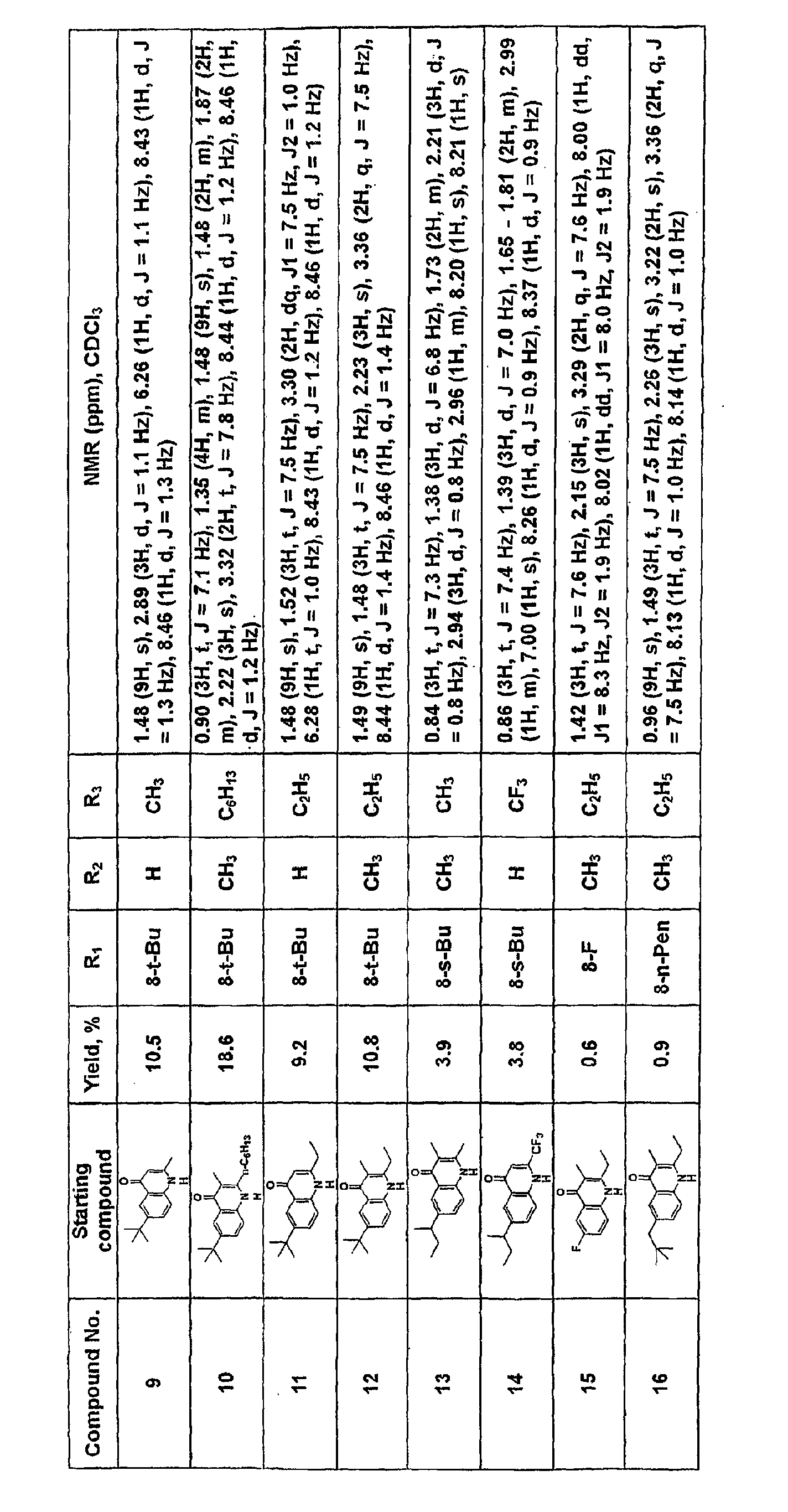
1H-NMR data of the compound thus obtained are shown in Table 1.
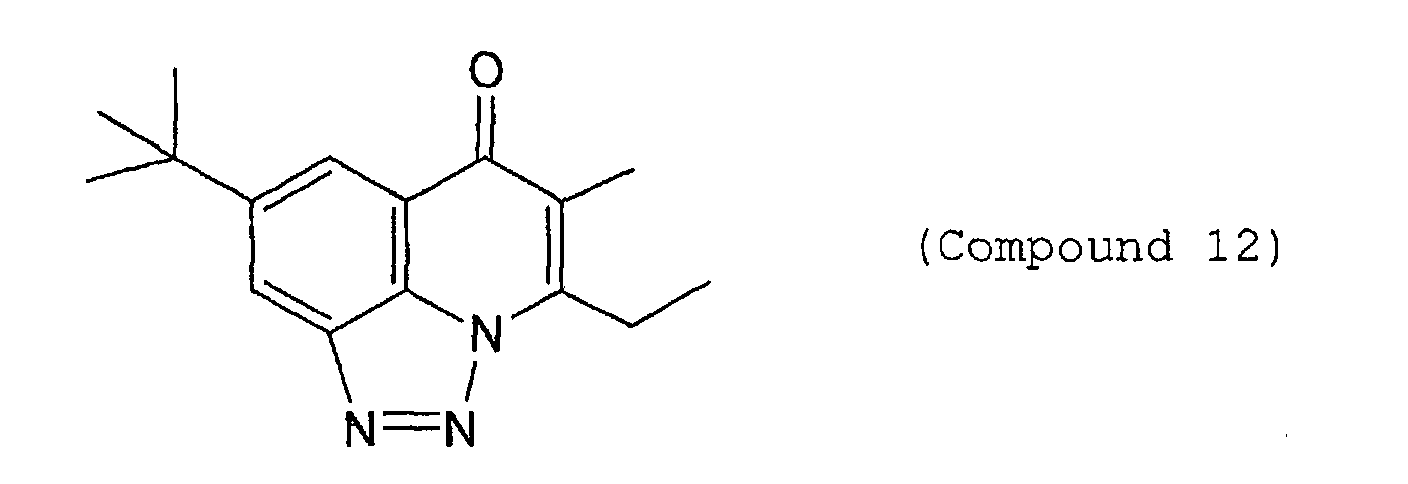
1H-NMR data of the compound thus obtained are shown in Table 1.

1H-NMR data of the compound thus obtained are shown in Table 1.

1H-NMR data of the compound thus obtained are shown in Table 1.

1H-NMR data of the compound thus obtained are shown in Table 1.



| Compound of invention (compound 1) | 25 wt.% |
| Clay | 30 wt.% |
| Diatomaceous earth | 35 wt.% |
| Calcium lignin sulfonate | 3 wt.% |
| Polyoxyethylene alkylaryl ether | 7 wt.% |
| Compound of invention (compound 1) | 2 wt.% |
| Clay | 60 wt.% |
| Talc | 37 wt.% |
| Calcium stearate | 1 wt.% |
| Compound of invention (compound 1) | 20 wt.% |
| N,N-Dimethylformamide | 20 wt.% |
| Xylene | 50 wt.% |
| Polyoxyethylene alkylaryl ether | 10 wt.% |
| Compound of invention (compound 1) | 5 wt.% |
| Bentonite | 40 wt.% |
| Talc | 53 wt.% |
| Calcium lignin sulfonate | 2 wt.% |
Compounds 1, 12, 16, 17, 18, and 20.
Compounds 1, 4, 12, 13, 16, 18, 20, 25, and 30.
Compounds 1, 12, 16, 18, 20, 25, and 30.
Compounds 1, 3, 4, 12, 13, 16, and 18.
| State of disease development in seed leaf | Disease development index |
| No lesion | 0 |
| A few lesions | 1 |
| Disease developed area of less than quarter of leaf area | 2 |
| Disease developed area of quarter to less than half of leaf area | 3 |
| Disease developed area of half to less than three quarters of leaf area | 4 |
| Disease developed area of not less than three quarters of leaf area | 5 |
Compounds 1, 9, 11, 12, 13, 14, 17, 18, 20, 21, 25, and 30.
Compounds 1, 2, 14, and 26.
Claims (7)
- A compound of formula (1) or a salt thereof:wherein
 R1, which may be the same or different, represent(s) a halogen atom; straight chain, branched chain, or cyclic C1 - 6 alkyl optionally substituted by a halogen atom or hydroxyl; C1 - 6 alkoxy optionally substituted by a halogen atom or hydroxyl; or nitro,n is an integer of 0 (zero) to 3,R2 represents a hydrogen atom; a halogen atom; or straight chain, branched chain, or cyclic C1 - 4 alkyl optionally substituted by a halogen atom or hydroxyl, andR3 represents a hydrogen atom; a halogen atom; or straight chain, branched chain, or cyclic C1 - 12 alkyl optionally substituted by a halogen atom or hydroxyl, orR2 and R3 together may represent -(CH2)m- wherein m is an integer of 3 or 4.
 - The compound of formula (1) according to claim 1 or a salt thereof, wherein formula (1) is represented as formula (1')wherein
 R11 represents a hydrogen atom, andR12 and R13 each independently represent a hydrogen atom; a halogen atom; straight chain, branched chain, or cyclic C1 - 6 alkyl optionally substituted by a halogen atom; straight chain, branched chain, or cyclic C1 - 6 alkoxy optionally substituted by a halogen atom; or nitro.
 - The compound of formula (1) according to claim 1 or a salt thereof, for the control of harmful organisms.
- A process for producing the compound of formula (1) according to claim 1, said process comprising the steps of:whereinnitrating a compound of formula (2)
 R1, which may be the same or different, represent(s) a halogen atom; straight chain, branched chain, or cyclic C1 - 6 alkyl optionally substituted by a halogen atom or hydroxyl; C1 - 6 alkoxy optionally substituted by a halogen atom or hydroxyl; or nitro,n is an integer of 0 (zero) to 3,R2 represents a hydrogen atom; a halogen atom; or straight chain, branched chain, or cyclic C1 - 4 alkyl optionally substituted by a halogen atom or hydroxyl, andR3 represents a hydrogen atom; a halogen atom; or straight chain, branched chain, or cyclic C1 - 12 alkyl optionally substituted by a halogen atom or hydroxyl, orR2 and R3 together may represent -(CH2)m- wherein m is an integer of 3 or 4,
to give a compound of formula (3)wherein R1, n, R2, and R3 are as defined in formula (2) ;
reducing the compound of formula (3) to give a compound of formula (4)wherein R1, n, R2, and R3 are as defined in formula (2) ; and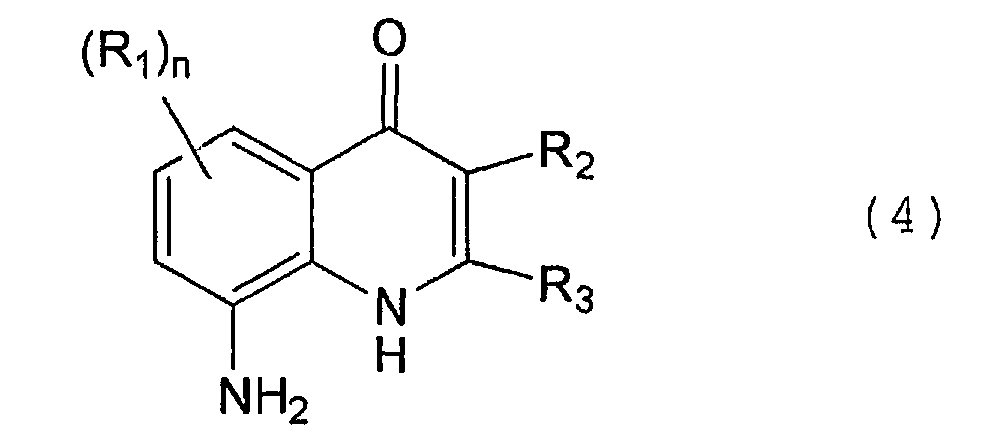
diazotizing the compound of formula (4) to give the compound of formula (1). - A harmful organism control agent comprising as an active ingredient at least one of compounds according to claim 1 or salts thereof.
- A method for controlling a harmful organism, comprising the step of treating a plant, which has been damaged by a harmful organism or has a fear of being damaged by a harmful organism, with the compound according to claim 1 or a salt thereof.
- Use of the compound according to claim 1 or a salt thereof, for the manufacture of a harmful organism control agent.
Applications Claiming Priority (3)
| Application Number | Priority Date | Filing Date | Title |
|---|---|---|---|
| JP2001000668 | 2001-01-31 | ||
| JP2001022668 | 2001-01-31 | ||
| PCT/JP2002/000788 WO2002060901A1 (en) | 2001-01-31 | 2002-01-31 | Pest controllers |
Publications (3)
| Publication Number | Publication Date |
|---|---|
| EP1364951A1 true EP1364951A1 (en) | 2003-11-26 |
| EP1364951A4 EP1364951A4 (en) | 2005-08-10 |
| EP1364951B1 EP1364951B1 (en) | 2012-05-02 |
Family
ID=18888049
Family Applications (1)
| Application Number | Title | Priority Date | Filing Date |
|---|---|---|---|
| EP02710434A Expired - Lifetime EP1364951B1 (en) | 2001-01-31 | 2002-01-31 | Triazoquinolone derivatives as pest controllers |
Country Status (6)
| Country | Link |
|---|---|
| US (1) | US7144843B2 (en) |
| EP (1) | EP1364951B1 (en) |
| JP (1) | JP4180377B2 (en) |
| AT (1) | ATE556075T1 (en) |
| ES (1) | ES2387265T3 (en) |
| WO (1) | WO2002060901A1 (en) |
Families Citing this family (1)
| Publication number | Priority date | Publication date | Assignee | Title |
|---|---|---|---|---|
| KR101032150B1 (en) * | 2008-10-28 | 2011-05-03 | 한국화학연구원 | Composition for the control of pine ash nematode disease containing antibacterial agent as an active ingredient and use thereof |
Family Cites Families (6)
| Publication number | Priority date | Publication date | Assignee | Title |
|---|---|---|---|---|
| GB1394373A (en) * | 1972-05-17 | 1975-05-14 | Pfizer Ltd | Control of plant diseases |
| US4008325A (en) * | 1972-05-17 | 1977-02-15 | Pfizer Inc. | Control of rice blast disease employing certain pyrido compounds |
| JPS5857435B2 (en) | 1978-10-04 | 1983-12-20 | 大塚製薬株式会社 | Imidazo[4,5,1↓-ij]quinoline↓-5↓-carboxylic acid derivative |
| JPH0559052A (en) | 1990-08-09 | 1993-03-09 | Wakunaga Pharmaceut Co Ltd | New cyclic compound or its salt and antimicrobial agent containing the same compound or salt |
| US5508289A (en) * | 1994-03-14 | 1996-04-16 | The United States America As Represented By The Department Of Health And Human Services | Bis-acridone chemotherapeutic derivatives |
| ATE211471T1 (en) * | 1996-04-12 | 2002-01-15 | Us Gov Health & Human Serv | ACRIDONE DERIVATIVES AS ANTINEOPLASTIC AND ANTIRETROVIRAL AGENTS |
-
2002
- 2002-01-31 US US10/470,722 patent/US7144843B2/en not_active Expired - Fee Related
- 2002-01-31 WO PCT/JP2002/000788 patent/WO2002060901A1/en not_active Ceased
- 2002-01-31 JP JP2002561469A patent/JP4180377B2/en not_active Expired - Fee Related
- 2002-01-31 AT AT02710434T patent/ATE556075T1/en active
- 2002-01-31 EP EP02710434A patent/EP1364951B1/en not_active Expired - Lifetime
- 2002-01-31 ES ES02710434T patent/ES2387265T3/en not_active Expired - Lifetime
Also Published As
| Publication number | Publication date |
|---|---|
| ES2387265T3 (en) | 2012-09-19 |
| EP1364951A4 (en) | 2005-08-10 |
| WO2002060901A1 (en) | 2002-08-08 |
| EP1364951B1 (en) | 2012-05-02 |
| JP4180377B2 (en) | 2008-11-12 |
| US20040067852A1 (en) | 2004-04-08 |
| JPWO2002060901A1 (en) | 2004-06-03 |
| ATE556075T1 (en) | 2012-05-15 |
| US7144843B2 (en) | 2006-12-05 |
Similar Documents
| Publication | Publication Date | Title |
|---|---|---|
| KR960002556B1 (en) | Imidazole Compounds and Bactericidal Compositions for Control of Harmful Organisms Containing the Same | |
| KR100956277B1 (en) | Aromatic ether compound, preparation method thereof and use thereof | |
| KR870000806B1 (en) | Process for preparing substituted propargyloxy acetonitrile derivative | |
| EP0891975A1 (en) | Pyrazoles and agricultural chemicals containing them as active ingredients | |
| JPH1053583A (en) | Pyrazole compounds and fungicides, insecticidal and acaricides containing the same as active ingredients | |
| CN111303048B (en) | A kind of pyrimidine guanidine compound and its preparation method and application | |
| US7144843B2 (en) | Pest controllers | |
| EP0238997B1 (en) | Agricultural-horticultural fungicide | |
| US4596801A (en) | 4H-3,1-benzoxazine derivatives, process for producing the same and agricultural or horticultural fungicide containing the same | |
| US4405743A (en) | Pyrazolylpyrimidine derivatives | |
| EP0340828A1 (en) | 5-Fluoromethyl-1,2,4-triazolo(1,5-a)-pyrimidine-2-sulfonamides, process for their preparation and compositions for their use as herbicides | |
| CN116265460B (en) | Thiazole methyl pyridine amine compound and preparation method and application thereof | |
| JP2673848B2 (en) | Alkylaminopyrimidine derivatives, their preparation and pesticides | |
| KR0146504B1 (en) | Azoleamide derivatives | |
| KR800000306B1 (en) | Method for preparing dihydro tetrazolo [1, 5-a] quinazoline derivatives | |
| KR790001857B1 (en) | Method for preparing urea derivative | |
| JP2000103784A (en) | 5-Alkoxypyrazole-3-carboxamide derivatives and pesticides containing the same as an active ingredient | |
| AU2014215937A1 (en) | Succinimide compound | |
| CN118206527A (en) | N-pyridine ethyl pyrimidine amine compound | |
| JPWO2001000568A1 (en) | Hydrazone derivatives and pest control agents | |
| JPH09278775A (en) | Pyrazole compounds and insecticides, acaricides and fungicides containing the same as active ingredients | |
| JPH1053582A (en) | Pyrazole compounds and fungicides and insecticides containing them as active ingredients | |
| JPS6115065B2 (en) | ||
| JPS6039324B2 (en) | Disinfectants, insecticides and acaricides | |
| JPS58152871A (en) | Quinazoline derivative, its preparation and agent for controlling noxious life |
Legal Events
| Date | Code | Title | Description |
|---|---|---|---|
| PUAI | Public reference made under article 153(3) epc to a published international application that has entered the european phase |
Free format text: ORIGINAL CODE: 0009012 |
|
| 17P | Request for examination filed |
Effective date: 20030821 |
|
| AK | Designated contracting states |
Kind code of ref document: A1 Designated state(s): AT BE CH CY DE DK ES FI FR GB GR IE IT LI LU MC NL PT SE TR |
|
| RIC1 | Information provided on ipc code assigned before grant |
Ipc: 7C 07D 221:00 J Ipc: 7C 07D 471/06 J Ipc: 7A 01N 43/90 B Ipc: 7C 07D 471/06 A Ipc: 7C 07D 249:00 J |
|
| A4 | Supplementary search report drawn up and despatched |
Effective date: 20050628 |
|
| RTI1 | Title (correction) |
Free format text: TRIAZOQUINOLONE DERIVATIVES AS PEST CONTROLLERS |
|
| 17Q | First examination report despatched |
Effective date: 20090925 |
|
| GRAP | Despatch of communication of intention to grant a patent |
Free format text: ORIGINAL CODE: EPIDOSNIGR1 |
|
| GRAS | Grant fee paid |
Free format text: ORIGINAL CODE: EPIDOSNIGR3 |
|
| GRAA | (expected) grant |
Free format text: ORIGINAL CODE: 0009210 |
|
| RAP1 | Party data changed (applicant data changed or rights of an application transferred) |
Owner name: MEIJI SEIKA PHARMA CO., LTD. |
|
| AK | Designated contracting states |
Kind code of ref document: B1 Designated state(s): AT BE CH CY DE DK ES FI FR GB GR IE IT LI LU MC NL PT SE TR |
|
| REG | Reference to a national code |
Ref country code: GB Ref legal event code: FG4D |
|
| REG | Reference to a national code |
Ref country code: AT Ref legal event code: REF Ref document number: 556075 Country of ref document: AT Kind code of ref document: T Effective date: 20120515 Ref country code: CH Ref legal event code: EP |
|
| REG | Reference to a national code |
Ref country code: IE Ref legal event code: FG4D |
|
| REG | Reference to a national code |
Ref country code: DE Ref legal event code: R082 Ref document number: 60242799 Country of ref document: DE Representative=s name: MUELLER-BORE & PARTNER PATENTANWAELTE PARTG MB, DE Ref country code: DE Ref legal event code: R082 Ref document number: 60242799 Country of ref document: DE Representative=s name: MUELLER-BORE & PARTNER PATENTANWAELTE, EUROPEA, DE |
|
| REG | Reference to a national code |
Ref country code: DE Ref legal event code: R096 Ref document number: 60242799 Country of ref document: DE Effective date: 20120705 |
|
| REG | Reference to a national code |
Ref country code: NL Ref legal event code: VDEP Effective date: 20120502 |
|
| REG | Reference to a national code |
Ref country code: ES Ref legal event code: FG2A Ref document number: 2387265 Country of ref document: ES Kind code of ref document: T3 Effective date: 20120919 |
|
| PG25 | Lapsed in a contracting state [announced via postgrant information from national office to epo] |
Ref country code: CY Free format text: LAPSE BECAUSE OF FAILURE TO SUBMIT A TRANSLATION OF THE DESCRIPTION OR TO PAY THE FEE WITHIN THE PRESCRIBED TIME-LIMIT Effective date: 20120502 Ref country code: FI Free format text: LAPSE BECAUSE OF FAILURE TO SUBMIT A TRANSLATION OF THE DESCRIPTION OR TO PAY THE FEE WITHIN THE PRESCRIBED TIME-LIMIT Effective date: 20120502 Ref country code: SE Free format text: LAPSE BECAUSE OF FAILURE TO SUBMIT A TRANSLATION OF THE DESCRIPTION OR TO PAY THE FEE WITHIN THE PRESCRIBED TIME-LIMIT Effective date: 20120502 |
|
| REG | Reference to a national code |
Ref country code: AT Ref legal event code: MK05 Ref document number: 556075 Country of ref document: AT Kind code of ref document: T Effective date: 20120502 |
|
| PG25 | Lapsed in a contracting state [announced via postgrant information from national office to epo] |
Ref country code: GR Free format text: LAPSE BECAUSE OF FAILURE TO SUBMIT A TRANSLATION OF THE DESCRIPTION OR TO PAY THE FEE WITHIN THE PRESCRIBED TIME-LIMIT Effective date: 20120803 Ref country code: PT Free format text: LAPSE BECAUSE OF FAILURE TO SUBMIT A TRANSLATION OF THE DESCRIPTION OR TO PAY THE FEE WITHIN THE PRESCRIBED TIME-LIMIT Effective date: 20120903 |
|
| PG25 | Lapsed in a contracting state [announced via postgrant information from national office to epo] |
Ref country code: BE Free format text: LAPSE BECAUSE OF FAILURE TO SUBMIT A TRANSLATION OF THE DESCRIPTION OR TO PAY THE FEE WITHIN THE PRESCRIBED TIME-LIMIT Effective date: 20120502 |
|
| PG25 | Lapsed in a contracting state [announced via postgrant information from national office to epo] |
Ref country code: AT Free format text: LAPSE BECAUSE OF FAILURE TO SUBMIT A TRANSLATION OF THE DESCRIPTION OR TO PAY THE FEE WITHIN THE PRESCRIBED TIME-LIMIT Effective date: 20120502 Ref country code: NL Free format text: LAPSE BECAUSE OF FAILURE TO SUBMIT A TRANSLATION OF THE DESCRIPTION OR TO PAY THE FEE WITHIN THE PRESCRIBED TIME-LIMIT Effective date: 20120502 Ref country code: DK Free format text: LAPSE BECAUSE OF FAILURE TO SUBMIT A TRANSLATION OF THE DESCRIPTION OR TO PAY THE FEE WITHIN THE PRESCRIBED TIME-LIMIT Effective date: 20120502 |
|
| PLBE | No opposition filed within time limit |
Free format text: ORIGINAL CODE: 0009261 |
|
| STAA | Information on the status of an ep patent application or granted ep patent |
Free format text: STATUS: NO OPPOSITION FILED WITHIN TIME LIMIT |
|
| 26N | No opposition filed |
Effective date: 20130205 |
|
| REG | Reference to a national code |
Ref country code: DE Ref legal event code: R097 Ref document number: 60242799 Country of ref document: DE Effective date: 20130205 |
|
| PG25 | Lapsed in a contracting state [announced via postgrant information from national office to epo] |
Ref country code: MC Free format text: LAPSE BECAUSE OF NON-PAYMENT OF DUE FEES Effective date: 20130131 |
|
| REG | Reference to a national code |
Ref country code: CH Ref legal event code: PL |
|
| REG | Reference to a national code |
Ref country code: IE Ref legal event code: MM4A |
|
| PG25 | Lapsed in a contracting state [announced via postgrant information from national office to epo] |
Ref country code: CH Free format text: LAPSE BECAUSE OF NON-PAYMENT OF DUE FEES Effective date: 20130131 Ref country code: LI Free format text: LAPSE BECAUSE OF NON-PAYMENT OF DUE FEES Effective date: 20130131 |
|
| PG25 | Lapsed in a contracting state [announced via postgrant information from national office to epo] |
Ref country code: IE Free format text: LAPSE BECAUSE OF NON-PAYMENT OF DUE FEES Effective date: 20130131 |
|
| PGFP | Annual fee paid to national office [announced via postgrant information from national office to epo] |
Ref country code: ES Payment date: 20131211 Year of fee payment: 13 Ref country code: FR Payment date: 20131209 Year of fee payment: 13 |
|
| PGFP | Annual fee paid to national office [announced via postgrant information from national office to epo] |
Ref country code: DE Payment date: 20140128 Year of fee payment: 13 |
|
| PGFP | Annual fee paid to national office [announced via postgrant information from national office to epo] |
Ref country code: IT Payment date: 20140113 Year of fee payment: 13 |
|
| PGFP | Annual fee paid to national office [announced via postgrant information from national office to epo] |
Ref country code: GB Payment date: 20140129 Year of fee payment: 13 |
|
| PG25 | Lapsed in a contracting state [announced via postgrant information from national office to epo] |
Ref country code: TR Free format text: LAPSE BECAUSE OF FAILURE TO SUBMIT A TRANSLATION OF THE DESCRIPTION OR TO PAY THE FEE WITHIN THE PRESCRIBED TIME-LIMIT Effective date: 20120502 |
|
| PG25 | Lapsed in a contracting state [announced via postgrant information from national office to epo] |
Ref country code: LU Free format text: LAPSE BECAUSE OF NON-PAYMENT OF DUE FEES Effective date: 20130131 |
|
| REG | Reference to a national code |
Ref country code: DE Ref legal event code: R119 Ref document number: 60242799 Country of ref document: DE |
|
| GBPC | Gb: european patent ceased through non-payment of renewal fee |
Effective date: 20150131 |
|
| PG25 | Lapsed in a contracting state [announced via postgrant information from national office to epo] |
Ref country code: DE Free format text: LAPSE BECAUSE OF NON-PAYMENT OF DUE FEES Effective date: 20150801 Ref country code: GB Free format text: LAPSE BECAUSE OF NON-PAYMENT OF DUE FEES Effective date: 20150131 |
|
| REG | Reference to a national code |
Ref country code: FR Ref legal event code: ST Effective date: 20150930 |
|
| PG25 | Lapsed in a contracting state [announced via postgrant information from national office to epo] |
Ref country code: FR Free format text: LAPSE BECAUSE OF NON-PAYMENT OF DUE FEES Effective date: 20150202 |
|
| PG25 | Lapsed in a contracting state [announced via postgrant information from national office to epo] |
Ref country code: IT Free format text: LAPSE BECAUSE OF NON-PAYMENT OF DUE FEES Effective date: 20150131 |
|
| REG | Reference to a national code |
Ref country code: ES Ref legal event code: FD2A Effective date: 20160226 |
|
| PG25 | Lapsed in a contracting state [announced via postgrant information from national office to epo] |
Ref country code: ES Free format text: LAPSE BECAUSE OF NON-PAYMENT OF DUE FEES Effective date: 20150201 |