EP1364932A1 - Process for the preparation of enantiomerically enriched compounds - Google Patents
Process for the preparation of enantiomerically enriched compounds Download PDFInfo
- Publication number
- EP1364932A1 EP1364932A1 EP02100556A EP02100556A EP1364932A1 EP 1364932 A1 EP1364932 A1 EP 1364932A1 EP 02100556 A EP02100556 A EP 02100556A EP 02100556 A EP02100556 A EP 02100556A EP 1364932 A1 EP1364932 A1 EP 1364932A1
- Authority
- EP
- European Patent Office
- Prior art keywords
- group
- formula
- atoms
- represent
- alkyl
- Prior art date
- Legal status (The legal status is an assumption and is not a legal conclusion. Google has not performed a legal analysis and makes no representation as to the accuracy of the status listed.)
- Withdrawn
Links
- 0 CC*([C@@](C)*)*1Oc(ccc2c3cccc2)c3-c(c(cccc2)c2cc2)c2O1 Chemical compound CC*([C@@](C)*)*1Oc(ccc2c3cccc2)c3-c(c(cccc2)c2cc2)c2O1 0.000 description 5
- NZCPWTVFKFPAGS-NCRNUEESSA-N CC(C)(O[C@H]12)O[C@H]1C(c1ccccc1)(c1ccccc1)OP(N(Cc1ccccc1)Cc1ccccc1)OC2(c1ccccc1)c1ccccc1 Chemical compound CC(C)(O[C@H]12)O[C@H]1C(c1ccccc1)(c1ccccc1)OP(N(Cc1ccccc1)Cc1ccccc1)OC2(c1ccccc1)c1ccccc1 NZCPWTVFKFPAGS-NCRNUEESSA-N 0.000 description 1
- OUUKUZKJDQYHNQ-MVIVZTSGSA-N CNP(O[C@H]12)OC1C(Oc1ccccc1)OC1[C@@H]2OC(c2ccccc2)OC1 Chemical compound CNP(O[C@H]12)OC1C(Oc1ccccc1)OC1[C@@H]2OC(c2ccccc2)OC1 OUUKUZKJDQYHNQ-MVIVZTSGSA-N 0.000 description 1
Classifications
-
- C—CHEMISTRY; METALLURGY
- C07—ORGANIC CHEMISTRY
- C07B—GENERAL METHODS OF ORGANIC CHEMISTRY; APPARATUS THEREFOR
- C07B53/00—Asymmetric syntheses
-
- C—CHEMISTRY; METALLURGY
- C07—ORGANIC CHEMISTRY
- C07F—ACYCLIC, CARBOCYCLIC OR HETEROCYCLIC COMPOUNDS CONTAINING ELEMENTS OTHER THAN CARBON, HYDROGEN, HALOGEN, OXYGEN, NITROGEN, SULFUR, SELENIUM OR TELLURIUM
- C07F15/00—Compounds containing elements of Groups 8, 9, 10 or 18 of the Periodic Table
- C07F15/0006—Compounds containing elements of Groups 8, 9, 10 or 18 of the Periodic Table compounds of the platinum group
- C07F15/0073—Rhodium compounds
Definitions
- the invention relates to a process for the preparation of enantiomerically enriched compounds with formula Ar - C(R 1 ) - C(R 2 )- Z
- Ar represents an (hetero)aryl group
- R 1 and R 2 each independently, represent H, an alkyl, (hetero)aryl, dialkyl-amino, amido, thioether, alkoxy or aryloxy group with the proviso that not both R 1 and R 2 represent H, or R 1 and R 2 , or R 1 and Z or R 2 and Z form together with the C-atoms to which they are bound a (hetero)alkyl or (hetero)alkenyl ring with, for instance, 2-20 C-atoms and Z represents an electron withdrawing group, in which process a boronic acid derivate of formula Ar - B(OR 3 )OR 4 or its anhydride, wherein Ar is the same as described above and R 3 and R 4 , each independently, represent H or an alkyl group
- Rhodium catalyzed asymmetric 1,4 addition of organoboronic acids to olefins is described by Hayashi in Synlett 2001, No. Sl, 879-887, wherein use is made of Binap as enantiomerically enriched ligand, and by M. Reetz in Org. Lett., 2001, 3, 4083-4085 wherein use is made of BINOL-based diphosphonites.
- a drawback of the known process is that the reaction is rather slow and thus a higher reaction temperature and/or a longer reaction time is required.
- the present invention now provides a process for the asymmetric arylation of olefinic unsaturated compounds with higher reaction rate.
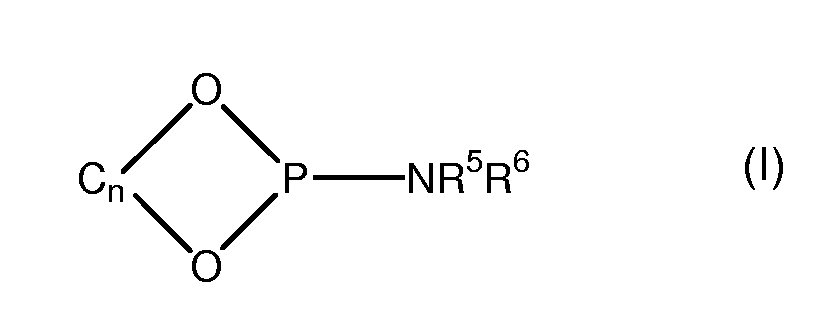
- ligand L an enantiomerically enriched ligand having the formula (I) where C n together with the two O-atoms and the P-atom forms a substituted or non-substituted ring with 2-6 C-atoms, R 5 and R 6 each independently stand for H, an optionally substituted alkyl, aryl, alkaryl or aralkyl group, or represent the group with formula (II) wherein C n 1 may have the same meanings as given for C n throughout the whole specification and B represents a bridging group or R 5 and R 6 may form a heterocyclic ring together with the N-atom to which they are bound.
- the enantiomerically enriched ligands may thus be mono-, bi or tridentate ligands. Preferably monodentate ligands are used when arylated products with high ee are aimed at.
- An additional advantage of the process of the present invention is that as a rule the ligands L can be simply prepared in one or two steps from commercially available starting materials.
- enantiomerically enriched compounds can be obtained with an ee of > 60%, in particular > 80%, more in particular > 95%.
- the alkyl, aryl, aralkyl and alkaryl groups in R 5 and R 6 preferably have 1-20 C-atoms and can optionally be substituted with, for instance, one or more keto, hydroxy, alkoxy, nitrile or carboxylic ester groups, or halogens.
- R 5 and R 6 each independently represent an alkyl group, for instance an alkyl group with 1-6 C-atoms, in particular 1-3 C-atoms, most preferably R 5 and R 6 represent a methyl group.
- R 5 and/or R 6 may be part of a polymeric backbone.
- the bridging group B may be for example CO, an alkylene, alkenylene, arylene, naphtalene or heteroarylene group, or a combination thereof, with, for instance, 1-20 C-atoms, preferably 1-8 C-atoms.
- the alkylene, alkenylene, arylene, naphtalene or heteroarylene group may contain one or more heteroatoms, for instance N, O, P or S, and/or be substituted with one or more substituents that are inert in the reaction system.
- Suitable substituents, having preferable 0 - 60 C-atoms are for instance alkyl, aryl, alkoxy, keto, aryloxy, ester, ether, nitrile, amido or carbamate groups.
- Each pair of substituents may form together with the C-atoms to which they are bound, a 4-8 membered ring which may be fused with other rings.
- Suitable examples of B are CO, oxalyl, maleyl, succinyl, 1,2-ethylene, 1,2-propylene, 1,3-propylene, 1,4-butylene, 1,2-cyclopropylidene, 1,2-cyclobutylidene, 1,3-cyclobutylidene, 1,2 cyclopentylidene, 2,3-norbornylidene, 2,5-norbornylidene, ortho-, meta- or para -phenylene, 1,2 furylidene, -(CH 2 CH 2 O CH 2 CH 2 )-, esters of lysine or ornithine.
- the bridging group may be chiral or non-chiral.
- the transition metal catalyst used according to the invention comprises a transition metal chosen from the group consisting of Cu and group 8, 9 and 10 of the Periodic Table, according to the new IUPAC notation as represented in the Table given in the cover of the Handbook of Chemistry and Physics, 70 th Edition, CRC Press, 1989-1990, for instance Rh, Ru, Ir, Pt, Pd or Cu, preferably Rh or Ir.
- the catalyst according to the invention may consist of a preformed complex or may be prepared in situ.
- a suitable catalyst may be prepared for instance by combining the enantiomerically enriched ligand with a catalyst precursor.
- the catalyst precursor may be for instance in the form of a metal, or a salt, a complex or a cluster of the metal, or oligomeric or polymeric forms of the metal or the salt, complex or cluster thereof.
- the catalyst precursor is a complex, for instance represented by the formula MX a S b , wherein a and b each independently are between and including 0-5.
- Suitable ligands S are olefins, for example maleic anhydride or ethylene; dienes, for example 1,5-cyclooctadiene, 1,3-butadiene and 2,5-norbornadiene; aromatics, for example benzene, hexamethyl benzene, cymene and cumene, eta-5 coordinated cyclopentadienyl ligands, for example cyclopentadienyl and pentamethyl-cyclopentadienyl; or CO, or a solvent, for instance acrylonitrile.
- olefins for example maleic anhydride or ethylene
- dienes for example 1,5-cyclooctadiene, 1,3-butadiene and 2,5-norbornadiene
- aromatics for example benzene, hexamethyl benzene, cymene and cumene, eta-5 coordinated cyclopentadienyl ligands
- the counter ion X may be an anion or a cation.
- suitable anions are Cl, Br, I, OAc, BF 4, PF 6 , SbF 6 , ClO 4 , p-toluene sulphonate, benzene phosphonate, tetra-pentafluorophenylborate, or, preferably, optionally substituted acetylacetonate (acac).
- X is a cation.
- suitable cations are alkaline metals, for example Li, Na or K, alkaline earth metals such as Mg or Ca, or ammonium, or alkyl-substituted ammonium.
- the catalyst may be formed in situ by adding the enantiomerically enriched ligand to a solution of a catalyst precursor.
- the catalyst precursor and the enantiomerically enriched ligand are stirred together in solution for a certain period that may range from a few minutes to several hours, for instance 5 to 30 minutes, before contacting with the reactants. In general 10-20 minutes will be sufficient. It is also possible to combine the catalyst precursor and the chiral ligand.
- the solvent is removed by evaporation or by filtration. Subsequently the residue may be dissolved in the same or a different solvent.
- the catalyst may optionally be added in dimeric form, with the dimeric form subsequently wholly or partly changing in situ into the monomeric form.
- the amount of enantiomerically enriched monodentate ligand to be added for example may range from 0.5 to 5, preferably from 2 to 4, equivalents relative to the metal.
- the amount of enantiomerically enriched bi- or tridentate ligand to be added for example may range from 0.25 to 2, preferably from 0.6 to 1.2.
- Preferably a small excess of optically active ligand is applied relative to the desired amount of optically active ligand in the catalyst.
- the optimum ratio of optically active ligand to metal in the catalyst may differ per optically active ligand and per metal and can readily be determined by means of experiments. It may be advantageous to adjust the oxidation state of the catalyst by adding a reducing agent, such as NaBH 4 , Zn or a Grignard reagent.
- preformed complexes are [RhL 2 (acac)], Rh(COD)L 2 BF 4 , RuL 2 (OAc) 2 , RuL 2 Br 2 , Ru(methylallyl) 2 L 2 , Ru(eta-6-benzene)L 2 Br 2 , Ru(eta-5-cyclopentadienyl)L 2 Cl, RuLSCl 2 , Ru(1,2-diphenyl-1,2-diaminoethane)LCl 2 , IrL 2 (CH 3 OH) 2 PF 6 , Ir(COD)L 2 BF 4 , CuL 3 I.
- the ligand is bidentate L 2 becomes L in these preformed complexes.
- Specifically preferred catalysts are the catalysts comprising a transition metal M, an enantiomerically enriched ligand L, an extra ligand S and a counterion X wherein M is Rh, S is (C 2 H 4 ) 2 , X is acetylacetonate and L is a ligand with formula I where C n together with the two O-atoms and the P-atom forms a substituted or non-substituted ring with 2-6 C-atoms, R 5 and R 6 each independently stand for H, an optionally substituted alkyl, aryl, alkaryl or aralkyl group, or represent the group with formula (II) wherein C n 1 may have the same meanings as given for C n and B represents a bridging group, or R 5 and R 6 may form a heterocyclic ring together with the N-atom to which they are bound.
- the invention therefore, also relates to such catalysts.
- C n and/or R 5 and/or R 6 are chiral or are part of a chiral entity.
- C n preferably represents a chiral substituted C 4 chain (chain with 4 optionally substituted C-atoms), of predominantly one configuration, for example with an enantiomeric excess larger than 95%, in particular larger than 99%, more in particular larger than 99.5%.
- C n may be substituted with one or more substituents that are inert in the reaction system. Suitable substituents preferably have 0-60 C-atoms.
- substituents for C n are, for instance alkyl, aryl, alkoxy, aryloxy, (unsaturated) ester, ether, nitrile, nitro,amido or carbamate groups, CF 3 or halogens.
- Each pair of substituents may form together with the C-atom(s) to which they are bound, a 4-8 membered ring which may be fused with other rings.
- C n together with the two O-atoms and the P-atom forms a 7-membered ring with 4 C-atoms which 2 by 2 form part of an (hetero)aryl group or a naphthyl group.
- suitable enantiomerically enriched ligands according to the invention are
- Such ligands with formula (I) can simply be prepared as described for example in Houben-Weyl Methoden der Organischen Chemie Band XII / 2. Organische phosphorharmen . G. Thieme Verlag, Stuttgart, 1964, Section 2 (4th ed.), pp. 99-105.
- Suitable catalysts for the latter reaction are ammonium chloride, tetrazole or benzimidazoliumtriflate.
- HO-C n -OH are chiral bisnaphtols for example (R)- or ( S )- 1,1'-bi-(2-naphthol), chiral bisphenols for example (R)- or ( S )- 6,6'-dimethoxy-2,2'-bisphenol, diols, for example (R,R)- or ( S,S )-2,2-dimethyl-1,3-dioxolane-4,5-bis-(1,1-diphenyl)methanol (TADDOL), or ( S,R ) or ( R,S )-indane-1,2-diol; 1,2-diols and 1,3-diols based on sugars, for example diols having the formula:
- R 1 R 2 NH examples are benzyl amine, dibenzyl amine, diisopropyl amine, (R)- or ( S )-1-methyl-benzyl amine, piperidine, morpholine, ( R,R ) - or ( S,S )-bis-(1 -methylbenzyl)amine.
- a second preferred preparation is based on the reaction of an HO-C n -OH compound with PCl 3 , with subsequent reaction with R 5 R 6 NH, preferably in the presence of a base, for example Et 3 N, and in the presence of a solvent, for example toluene.
- a base for example Et 3 N
- a solvent for example toluene.
- Examples of HO-C n -OH are in principle the same as mentioned above in relation to the first preferred preparation.
- R 5 R 6 NH are ammonia, benzyl amine, dibenzyl amine, diisopropyl amine, (R)- or ( S )-1-methyl-benzyl amine, piperidine, morpholine, ( R,R )- or ( S,S )-bis-(1-methylbenzyl)amine.
- the bi- or tridentate ligands of the invention may be prepared in similar fashion, by replacing the amine R 5 R 6 NH with a bridged diamine compound (R 6 )HN-B-NH(R 6 ). It is also possible to prepare non-symmetrical bidentate phosphoramidite ligands. This can be accomplished by reacting a group (R 6 )NH-BNH(R 6 ) first with 1 equivalent of After this reaction the remaining amino group is reacted with 1 equivalent of The invention also relates to the preparation of the enantiomerically enriched ligands of formula I.
- R 1 and R 2 are: hydrogen, alkyl groups, for example methyl, ethyl, isopropyl, butyl; (hetero)aryl groups, for example phenyl, 4-biphenyl, 1-napthyl, 2-naphthyl, 2-furyl, 3-furyl, 2-indenyl, 2-indolinyl or 2-quinolinyl; disubstituted amine groups for example dimethylamino, dibenzylamino, methylbenzylamino, methylanilinyl, N -piperidinyl or N -pyrrolyl, or N -pyrrolidinyl or N -morpholinyl; amide groups, for example aminocarbonyl, ethylaminocarbonyl, dimethylaminocarbonyl or benzylaminocarbonyl; thioether groups for example methylmercapto, benzylmercapto, phenylmercapto; alkoxy
- R 1 and/or R 2 are optionally substituted with one or more substituents that are inert in the reaction system. Suitable substituents preferably have 0-60 C-atoms. Examples of such substituents for R 1 and R 2 are for example halogens; alkyl groups with for instance 1-10 C-atoms, aryl groups with for example 1-10 C-atoms, for instance phenyl, alkoxygroups with for instance 1-10 C-atoms, aryloxygroups with for instance 6-10 C-atoms, (unsaturated) ester, ether, nitrile, nitro, amido or catbamate groups, and Z represents an electron withdrawing group.
- substituents for R 1 and R 2 are for example halogens; alkyl groups with for instance 1-10 C-atoms, aryl groups with for example 1-10 C-atoms, for instance phenyl, alkoxygroups with for instance 1-10 C-atoms, aryloxygroups with for instance 6-10 C-atoms,
- Z are ester groups for example a methoxycarbonyl, ethoxycarbonyl, isopropoxycarbonyl, benzyloxycarbonyl, phenoxycarbonyl or a 2-methoxyethoxycarbonyl group; amide groups for example aminocarbonyl, ethylaminocarbonyl, dimethylaminocarbonyl or benzylaminocarbonyl; acyl groups, for example acetyl, propionyl, benzoyl, 1-naphthoyl, 2-naphthoyl, 2-picolyl, 4-phenylbenzoyl, 4-nitrobenzoyl or m-fluorobenzoyl; a nitro group or a nitrile or a phosphonate ester, for example dietyl phosphonate or dibenzylphosphonate, sulfoxides for example methylsulfinyl or phenylsulfinyl; a sulfone
- substrates are Z and E isomers of 2- and/or 3-substituted acrylate esters, for example methyl methacrylate, propyl 2-pentenoate, butyl crotonate, ethyl itaconate or butyl cinnamate; alpha-beta-unsaturated lactones, for example as delta 2-butenolactone or epsilon 2-pentenolactone; cyclic anhydrides, for example maleic anhydride or 2-methyl maleic anhydride; alpha-beta unsaturated amides, for example crotylamide or cinnamide, or alpha-beta unsaturated lactams, for example N -benzyl 5,6-dihydro-2- (1 H )-pyridinone or 5,6-dihydro-2- (1 H )-pyridinone, nitro-olefins, for example 2-nitro-propene or 1-nitro-cyclohexene; alpha
- the arylating agent is a boronic acid derivate of formula Ar - B(OR 3 )OR 4 or its anhydride, wherein R 3 and R 4 , each independently, represent H or an alkyl group with for instance 1-6 C-atoms, for example methyl, ethyl, propyl or together with the BO 2 form a ring with for instance 1-6 C-atoms, in which case R 3 R 4 may represent, for instance, ethylene, propylene or 2,3-dimethyl 2,3-butylene.
- Ar represents an (hetero) aryl group with, for instance, 3-20 C-atoms, preferably 4-10 C-atoms.
- Ar phenyl, ( o-, m- or p- ) nitro-phenyl, ( o-, m- or p- ) chlorophenyl, ( o-, m- or p- ) tolyl, ( o-, m- or p- ) trifluoromethyl-phenyl, ( o-, m- or p- ) anisyl, ( o-, m- or p- ) hydroxyphenyl, ( o-, m- or p- ) cyano-phenyl, ( o-, m- or p- ) methoxycarbonyl-phenyl, xylyl, mesityl, 1-naphthyl, 2-naphthyl, 6-methoxynaphthyl, phenanthryl, anthracyl, (2-, 3-,or 4-) pyridyl, (2-, 3-, 4-,
- the aryl boronic derivative (or its anhydride) is prepared from ArMgBr, wherein Ar is as defined above, and a boron ester with formula B(OR) 3 , wherein R represents an alkyl group, preferably with 1-6 C-atoms, in particular methyl.
- R represents an alkyl group, preferably with 1-6 C-atoms, in particular methyl.
- the process according to the invention can also suitably be used in the preparation of an optically active compound, starting from (a mixture of the enantiomers of an) olefin, that contains a chiral centre elsewhere in the molecule and with preferably one of the two enantiomers being arylated.
- arylation reaction use is preferably made of a molar ratio of metal present in the catalyst to substrate of between 1:10 and 1:1,000,000, in particular between 1:50 and 1:100,000.
- the ratio boronic acid to olefinic unsaturated compound may vary between wide limits, for instance between 0.8 and 10, preferably between 1.0 and 5.
- the arylation reaction allows for a relatively low ratio boronic acid to olefinic unsaturated compound. Preferably a ratio between 1 and 2 equivalents boronic acid to olefinic unsaturated compound.
- the temperature at which the asymmetric arylation reaction is carried out is generally a compromise between reaction velocity and enantioselectivity, and preferably lies between 0 and 140°C, in particular between 20 and 100°C.
- the asymmetric arylation reaction is preferably carried out with oxygen being excluded.
- the substrates and solvents do not contain any oxygen, peroxides or other oxidizing substances.
- solvent use can be made of: alcohols, for instance methanol ethanol or isopropanol; esters for instance ethylacetate or butyl acetate; amides for instance DMF, NMP or DMA; ethers, for instance diethyl ether, terahydrofuran, DME, or dioxane; ketones, for instance acetone, butanone or cyclohexanone, aromatic hydrocarbons, for instance toluene, halogenated hydrocarbons, for instance chlorobenzene or water.
- a phase transfer agent for instance sodium dodecyl sulfate.
- the solubility of the catalyst in water can be increased by providing the ligand with polar groups, for instance carboxylate or sulfonate salts. It usually is beneficial to add a small amount of water to the other solvents, preferably in an amount of one or more equivalents, more preferably 1-20 equivalents, with respect to the amount of boronic acid. Good results are obtained when a water/dioxane mixture was used with a dioxane/water ratio between 5:1 and 20:1. It is also possible to carry out the arylation reaction in ionic liquids as described in T. Welton, Chem. Rev., 99, 2071-2083 (1999), so that isolation of the product is simplified.
- polar groups for instance carboxylate or sulfonate salts.
- the solubility of the ligand in the ionic liquid can be increased by providing the ligand with polar groups such as carboxylate salts.
- the arylation reaction can also very suitably be carried out without a solvent; in this case water needs to be added as described above. If the substrate and/or the product hardly dissolves in the solvent the asymmetric arylation can also be performed as a slurry. If the product forms a slurry, its isolation is very much simplified.
- Suitable bases are nitrogen bases for instance triethylamine, substituted or non-substituted pyridines and mineral bases for example NaHCO 3 , K 2 CO 3 , KOtBu or Cs 2 CO 3 .
- Example 1 was repeated using ligand 2, 28 and 30, respectively, the results are listed in table 1.
- Rh(nbd)BF 4 was used as a catalyst precursor 3-Phenyl-cyclohexanone was obtained with an ee of 80% and with 13% yield.
- Example 1 was repeated now using different arylboronic acids. The results are listed in Table 3.
- Example 1 was repeated with other olefinic substrates. The results are listed in Table 4.
- Example 1 was repeated with the ligands reported by Hayashi (BINAP) and with the ligand reported by Reetz (Phosphonite). The rate of the three reactions is depicted graphically in Figure 1. From this it is clear that under the same conditions according to the invention a much faster reaction is obtained.
Landscapes
- Chemical & Material Sciences (AREA)
- Organic Chemistry (AREA)
- Organic Low-Molecular-Weight Compounds And Preparation Thereof (AREA)
- Catalysts (AREA)
- Low-Molecular Organic Synthesis Reactions Using Catalysts (AREA)
Abstract
Process for the preparation of enantiomerically enriched compounds
with formula Ar - C(R1) - C(R2) - Z wherein Ar represents an optionally substituted
(hetero)aryl group, R1 and R2, each independen tly, represent H, an alkyl, (hetero)aryl,
dialkylamino, amido, thioether, alkoxy or aryloxy group with the proviso that not both R1
and R2 represent H, or R1 and R2 form together with the C-atoms to which they are
bound a (hetero)alkyl or (hetero) alkenyl ring and Z represents an electron withdrawing
group, in which process a boronic acid derivate of formula Ar - B(OR3)OR4 or its
anhydride, wherein Ar is as described above and R3 and R4, each independently,
represent H or an alkyl group, is reacted with an olefinic unsaturated compound with
formula R2 - C = C - (R1)Z, wherein R1, R2 and Z are as described above, in the
presence of a transition metal catalyst comprising a transition metal chosen from Cu and
group VIII of the Periodic Table and an enantiomerically enriched ligand L, having the
formula (I) where Cn together with the two O-atoms and the P-atom forms a substituted
or non-substituted ring with 2-6 C-atoms, R5 and R6 each independently stand for H, an
optionally substituted alkyl, aryl, alkaryl or aralkyl group, or represent the group with
formula (II) wherein Cn 1 may have the same meanings as given for Cn and B represents
a bridging group, or R5 and R6 may form a heterocyclic ring together with the N-atom to
which they are bound.
Description
- The invention relates to a process for the preparation of enantiomerically enriched compounds with formula Ar - C(R1) - C(R2)- Z wherein Ar represents an (hetero)aryl group, R1 and R2, each independently, represent H, an alkyl, (hetero)aryl, dialkyl-amino, amido, thioether, alkoxy or aryloxy group with the proviso that not both R1 and R2 represent H, or R1 and R2, or R1 and Z or R2 and Z form together with the C-atoms to which they are bound a (hetero)alkyl or (hetero)alkenyl ring with, for instance, 2-20 C-atoms and Z represents an electron withdrawing group, in which process a boronic acid derivate of formula Ar - B(OR3)OR4 or its anhydride, wherein Ar is the same as described above and R3 and R4, each independently, represent H or an alkyl group with, for instance, 1-6 C-atoms, is reacted with an olefinic unsaturated compound with formula R1 - C = C - (R2) Z, wherein R1, R2 and Z are the same as described above, in the presence of a transition metal catalyst comprising a transition metal chosen from the group consisting of Cu and groups 8, 9 and 10 of the Periodic Table and an enantiomerically enriched ligand L..
- Rhodium catalyzed asymmetric 1,4 addition of organoboronic acids to olefins is described by Hayashi in Synlett 2001, No. Sl, 879-887, wherein use is made of Binap as enantiomerically enriched ligand, and by M. Reetz in Org. Lett., 2001, 3, 4083-4085 wherein use is made of BINOL-based diphosphonites.
- A drawback of the known process is that the reaction is rather slow and thus a higher reaction temperature and/or a longer reaction time is required.
- The present invention now provides a process for the asymmetric arylation of olefinic unsaturated compounds with higher reaction rate.
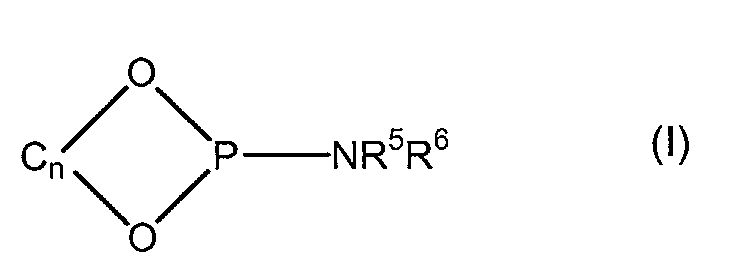
- This is reached according to the invention by using as the ligand L an enantiomerically enriched ligand having the formula (I)where Cn together with the two O-atoms and the P-atom forms a substituted or non-substituted ring with 2-6 C-atoms, R5 and R6 each independently stand for H, an optionally substituted alkyl, aryl, alkaryl or aralkyl group, or represent the group with formula (II)
 wherein Cn 1 may have the same meanings as given for Cn throughout the whole specification and B represents a bridging group or R5 and R6 may form a heterocyclic ring together with the N-atom to which they are bound. The enantiomerically enriched ligands may thus be mono-, bi or tridentate ligands. Preferably monodentate ligands are used when arylated products with high ee are aimed at.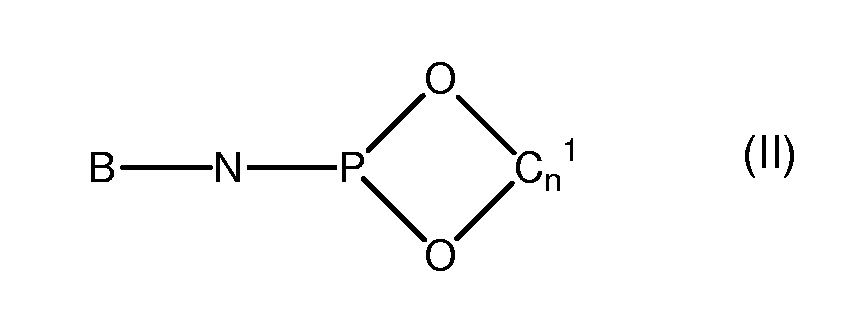
- An additional advantage of the process of the present invention is that as a rule the ligands L can be simply prepared in one or two steps from commercially available starting materials.
- Using a catalyst according to the invention in the asymmetric arylation of an olefinic unsaturated compound, enantiomerically enriched compounds can be obtained with an ee of > 60%, in particular > 80%, more in particular > 95%.
- The alkyl, aryl, aralkyl and alkaryl groups in R5 and R6 preferably have 1-20 C-atoms and can optionally be substituted with, for instance, one or more keto, hydroxy, alkoxy, nitrile or carboxylic ester groups, or halogens. Preferably R5 and R6 each independently represent an alkyl group, for instance an alkyl group with 1-6 C-atoms, in particular 1-3 C-atoms, most preferably R5 and R6 represent a methyl group. R5 and/or R6 may be part of a polymeric backbone.
- The bridging group B may be for example CO, an alkylene, alkenylene, arylene, naphtalene or heteroarylene group, or a combination thereof, with, for instance, 1-20 C-atoms, preferably 1-8 C-atoms. The alkylene, alkenylene, arylene, naphtalene or heteroarylene group may contain one or more heteroatoms, for instance N, O, P or S, and/or be substituted with one or more substituents that are inert in the reaction system. Suitable substituents, having preferable 0 - 60 C-atoms, are for instance alkyl, aryl, alkoxy, keto, aryloxy, ester, ether, nitrile, amido or carbamate groups. Each pair of substituents may form together with the C-atoms to which they are bound, a 4-8 membered ring which may be fused with other rings. Suitable examples of B are CO, oxalyl, maleyl, succinyl, 1,2-ethylene, 1,2-propylene, 1,3-propylene, 1,4-butylene, 1,2-cyclopropylidene, 1,2-cyclobutylidene, 1,3-cyclobutylidene, 1,2 cyclopentylidene, 2,3-norbornylidene, 2,5-norbornylidene, ortho-, meta- or para-phenylene, 1,2 furylidene, -(CH2 CH2O CH2 CH2)-, esters of lysine or ornithine. The bridging group may be chiral or non-chiral.
- The transition metal catalyst used according to the invention comprises a transition metal chosen from the group consisting of Cu and group 8, 9 and 10 of the Periodic Table, according to the new IUPAC notation as represented in the Table given in the cover of the Handbook of Chemistry and Physics, 70th Edition, CRC Press, 1989-1990, for instance Rh, Ru, Ir, Pt, Pd or Cu, preferably Rh or Ir. The catalyst according to the invention may consist of a preformed complex or may be prepared in situ. A suitable catalyst may be prepared for instance by combining the enantiomerically enriched ligand with a catalyst precursor.
- The catalyst precursor may be for instance in the form of a metal, or a salt, a complex or a cluster of the metal, or oligomeric or polymeric forms of the metal or the salt, complex or cluster thereof. Preferably, the catalyst precursor is a complex, for instance represented by the formula MXaSb, wherein a and b each independently are between and including 0-5.
- S represents an extra ligand which may be present or not and which may be chiral or non chiral. Suitable ligands S are olefins, for example maleic anhydride or ethylene; dienes, for example 1,5-cyclooctadiene, 1,3-butadiene and 2,5-norbornadiene; aromatics, for example benzene, hexamethyl benzene, cymene and cumene, eta-5 coordinated cyclopentadienyl ligands, for example cyclopentadienyl and pentamethyl-cyclopentadienyl; or CO, or a solvent, for instance acrylonitrile.
- The counter ion X may be an anion or a cation. Examples of suitable anions are Cl, Br, I, OAc, BF4, PF6, SbF6, ClO4, p-toluene sulphonate, benzene phosphonate, tetra-pentafluorophenylborate, or, preferably, optionally substituted acetylacetonate (acac). If the catalyst is anionic, X is a cation. Examples of suitable cations are alkaline metals, for example Li, Na or K, alkaline earth metals such as Mg or Ca, or ammonium, or alkyl-substituted ammonium.
- The catalyst may be formed in situ by adding the enantiomerically enriched ligand to a solution of a catalyst precursor. Preferably, the catalyst precursor and the enantiomerically enriched ligand are stirred together in solution for a certain period that may range from a few minutes to several hours, for instance 5 to 30 minutes, before contacting with the reactants. In general 10-20 minutes will be sufficient. It is also possible to combine the catalyst precursor and the chiral ligand. Next, after stirring for a certain period, the solvent is removed by evaporation or by filtration. Subsequently the residue may be dissolved in the same or a different solvent. The catalyst may optionally be added in dimeric form, with the dimeric form subsequently wholly or partly changing in situ into the monomeric form.
- The amount of enantiomerically enriched monodentate ligand to be added for example may range from 0.5 to 5, preferably from 2 to 4, equivalents relative to the metal. The amount of enantiomerically enriched bi- or tridentate ligand to be added for example may range from 0.25 to 2, preferably from 0.6 to 1.2. Preferably a small excess of optically active ligand is applied relative to the desired amount of optically active ligand in the catalyst. The optimum ratio of optically active ligand to metal in the catalyst may differ per optically active ligand and per metal and can readily be determined by means of experiments. It may be advantageous to adjust the oxidation state of the catalyst by adding a reducing agent, such as NaBH4, Zn or a Grignard reagent.
- Examples of suitable catalyst precursors, which together with the chiral ligand form the catalyst, are (acac = acetylacetonate, COD = 1,5 cyclooctadiene; COE = cyclooctene, nbd = norbornadiene L = ligand I of the invention, S = a ligand as defined above, n=0-12): [Rh(acac)(C2H4)2], [Rh(acac)(COE)2], [Rh (COD)Cl]2, [Rh(COD)(MeCN)2]BF4, [Rh(COD)2]BF4, (Rh(nbd)2]BF4, [Rh(acac)(CO)2], [Rh(nbd)2]ClO4, Ir(acac)(CO)2, [Ir(COD)Cl]2, [Ir(COD)2]X (X = BF4, PF6, ClO4, SbF6, CF3SO3, B(C6F5)4), [Ru(COD)Cl2]n, [Ru(Cymene)Cl2]2, Ni(acac)2.nH2O, Ni(COD)2, Pd(OAc)2, Pd(PhCN)2Cl2, PtCl2, Pt(acac)2, Pt(COD)Cl2, Cul, CuOTf, Cu(OAc)2, Cu(CH3CN)4PF6, Cu(acac)2.nH2O, Cu(CF3COCHCOCF3)2.nH2O, Co(OAc)2.nH2O, Co(acac)2,
- Examples of preformed complexes are [RhL2(acac)], Rh(COD)L2BF4, RuL2(OAc)2, RuL2Br2, Ru(methylallyl)2L2, Ru(eta-6-benzene)L2Br2, Ru(eta-5-cyclopentadienyl)L2Cl, RuLSCl2, Ru(1,2-diphenyl-1,2-diaminoethane)LCl2, IrL2(CH3OH)2PF6, Ir(COD)L2BF4, CuL3I. In case the ligand is bidentate L2 becomes L in these preformed complexes.
- Specifically preferred catalysts are the catalysts comprising a transition metal M, an enantiomerically enriched ligand L, an extra ligand S and a counterion X wherein M is Rh, S is (C2H4)2, X is acetylacetonate and L is a ligand with formula Iwhere Cn together with the two O-atoms and the P-atom forms a substituted or non-substituted ring with 2-6 C-atoms, R5 and R6 each independently stand for H, an optionally substituted alkyl, aryl, alkaryl or aralkyl group, or represent the group with formula (II)
 wherein Cn 1 may have the same meanings as given for Cn and B represents a bridging group, or R5 and R6 may form a heterocyclic ring together with the N-atom to which they are bound. The invention, therefore, also relates to such catalysts.
- In the enantiomerically enriched ligand L of formula (I) Cn and/or R5 and/or R6 are chiral or are part of a chiral entity. Cn preferably represents a chiral substituted C4 chain (chain with 4 optionally substituted C-atoms), of predominantly one configuration, for example with an enantiomeric excess larger than 95%, in particular larger than 99%, more in particular larger than 99.5%. Cn may be substituted with one or more substituents that are inert in the reaction system. Suitable substituents preferably have 0-60 C-atoms. Examples of such substituents for Cn are, for instance alkyl, aryl, alkoxy, aryloxy, (unsaturated) ester, ether, nitrile, nitro,amido or carbamate groups, CF3 or halogens. Each pair of substituents may form together with the C-atom(s) to which they are bound, a 4-8 membered ring which may be fused with other rings. Preferably Cn together with the two O-atoms and the P-atom forms a 7-membered ring with 4 C-atoms which 2 by 2 form part of an (hetero)aryl group or a naphthyl group. Examples of suitable enantiomerically enriched ligands according to the invention are


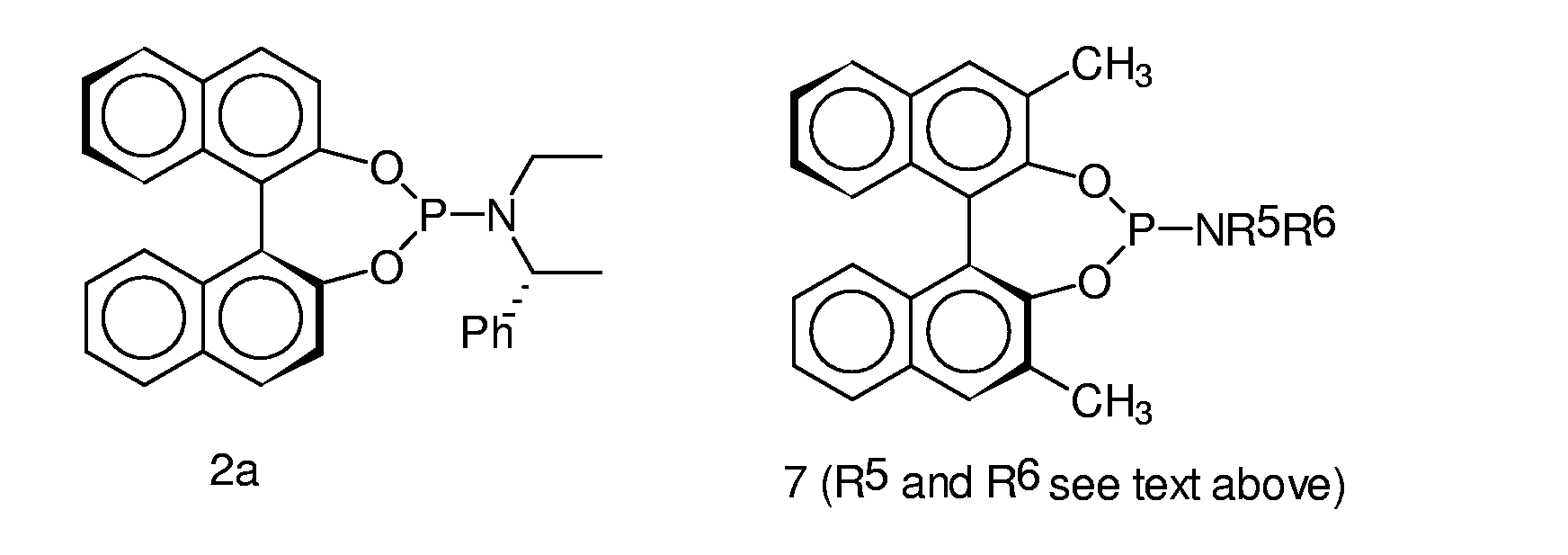
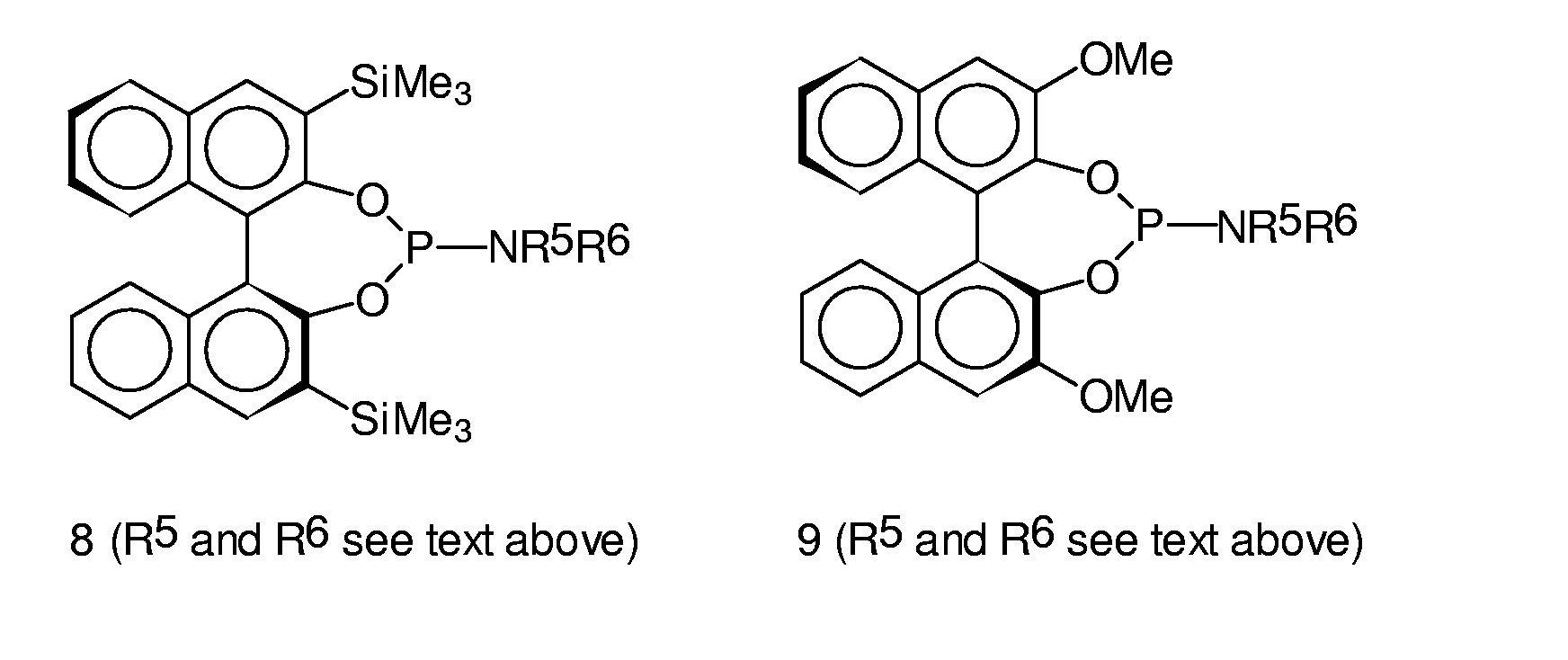
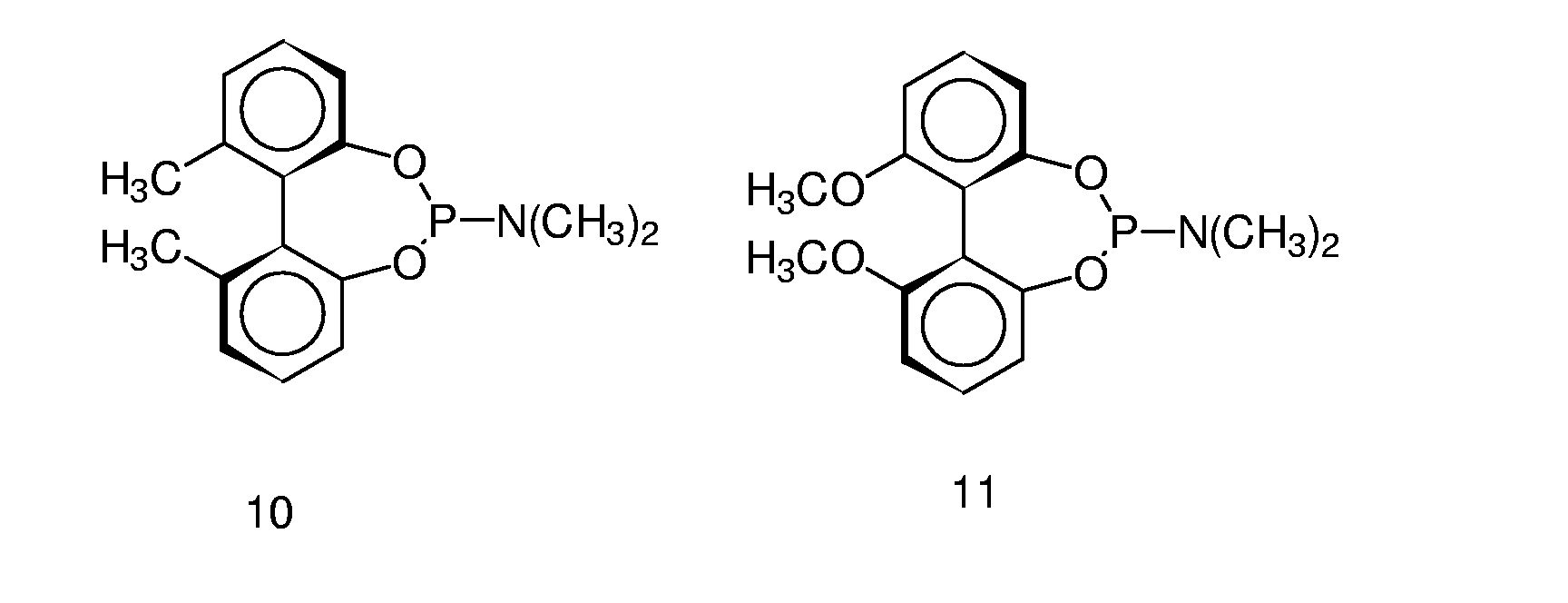
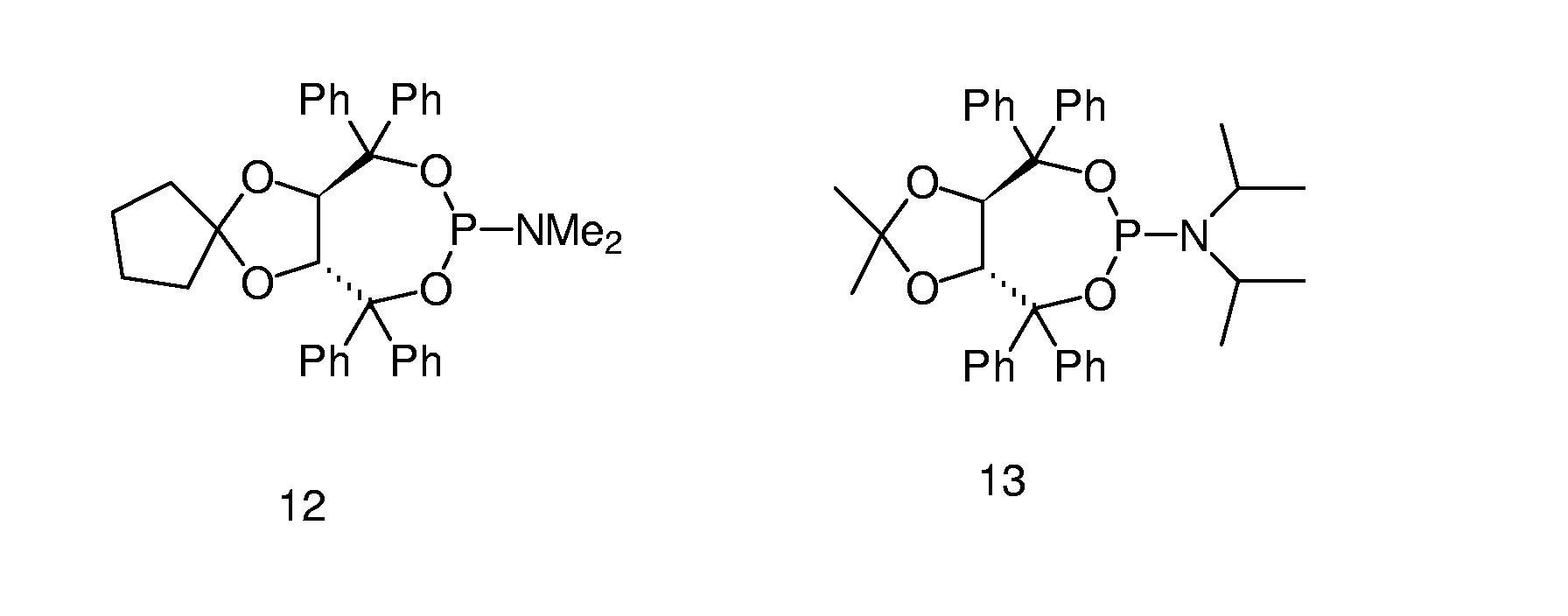
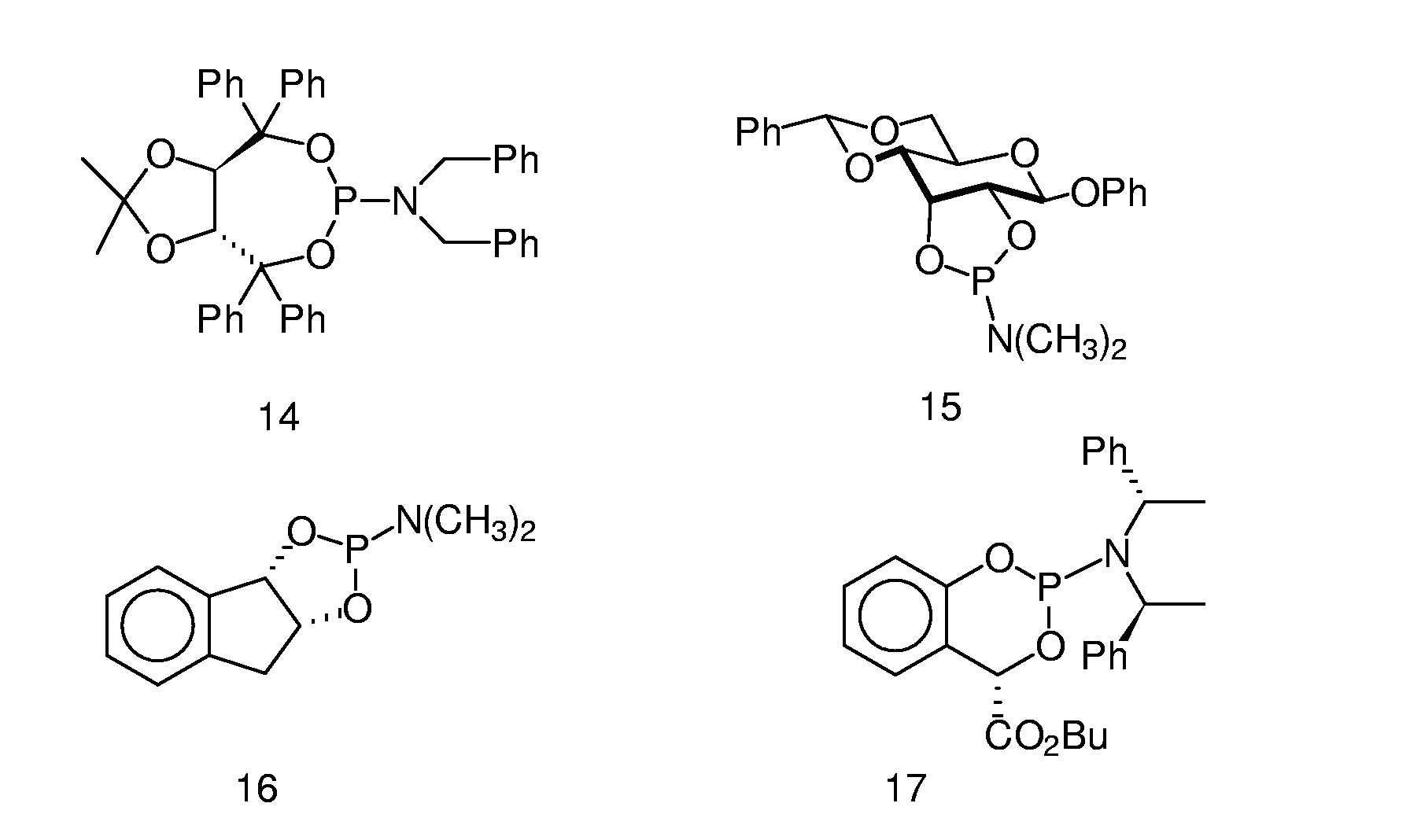
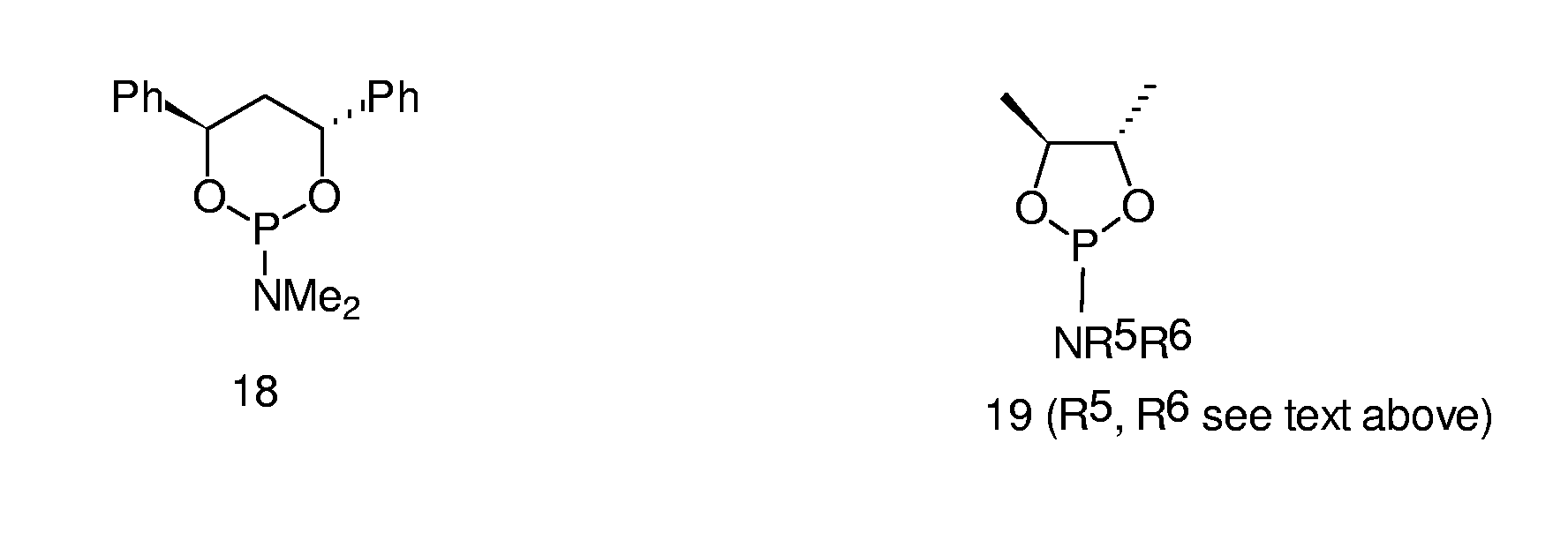


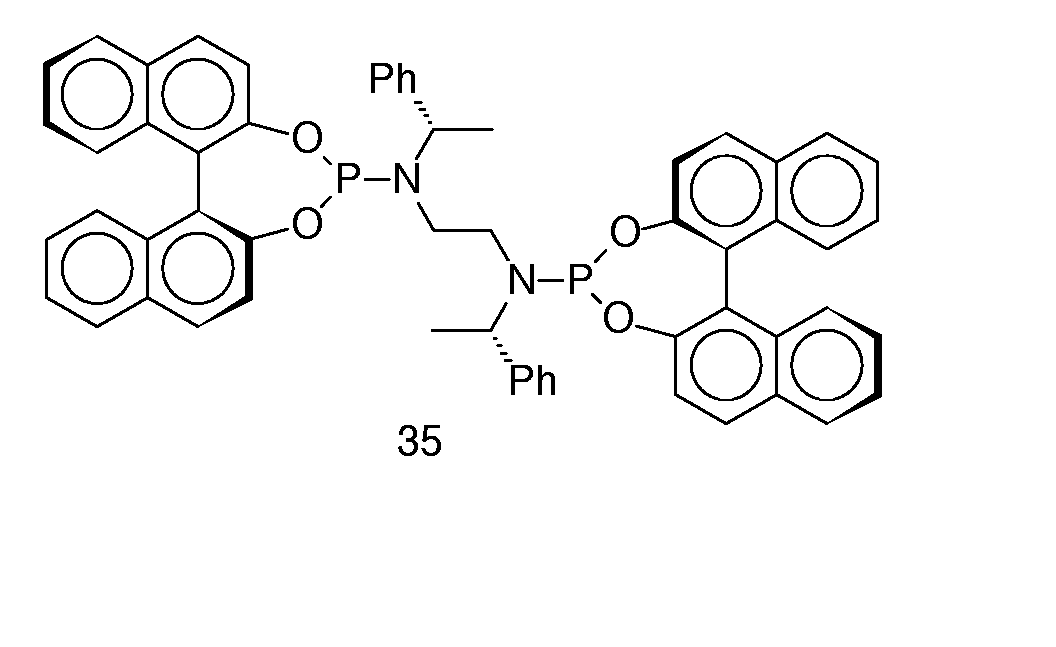
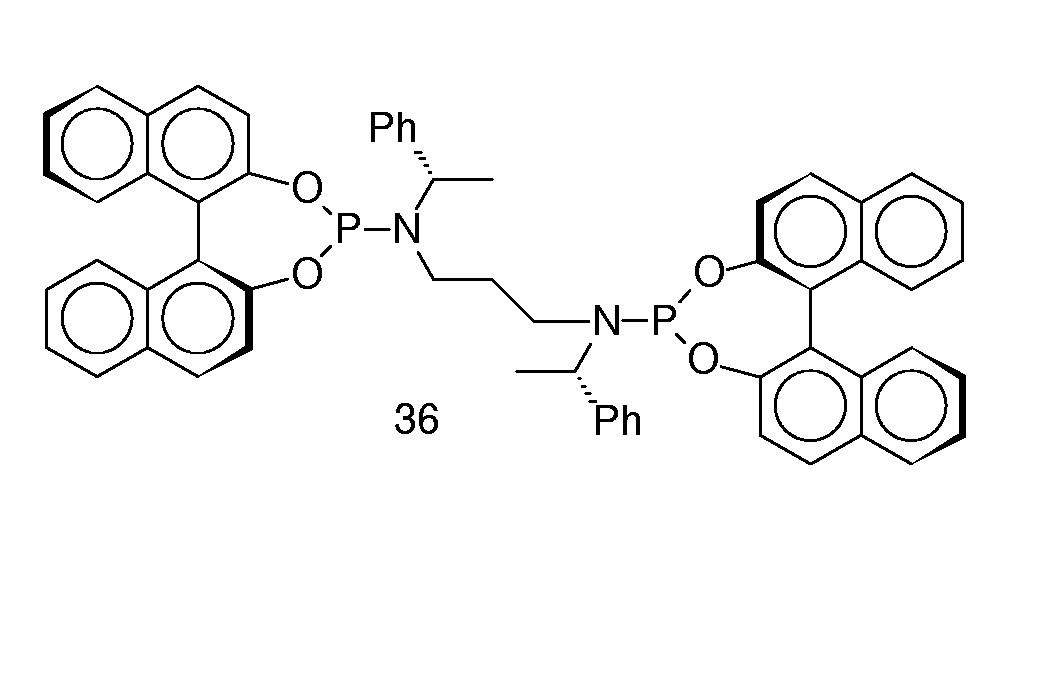

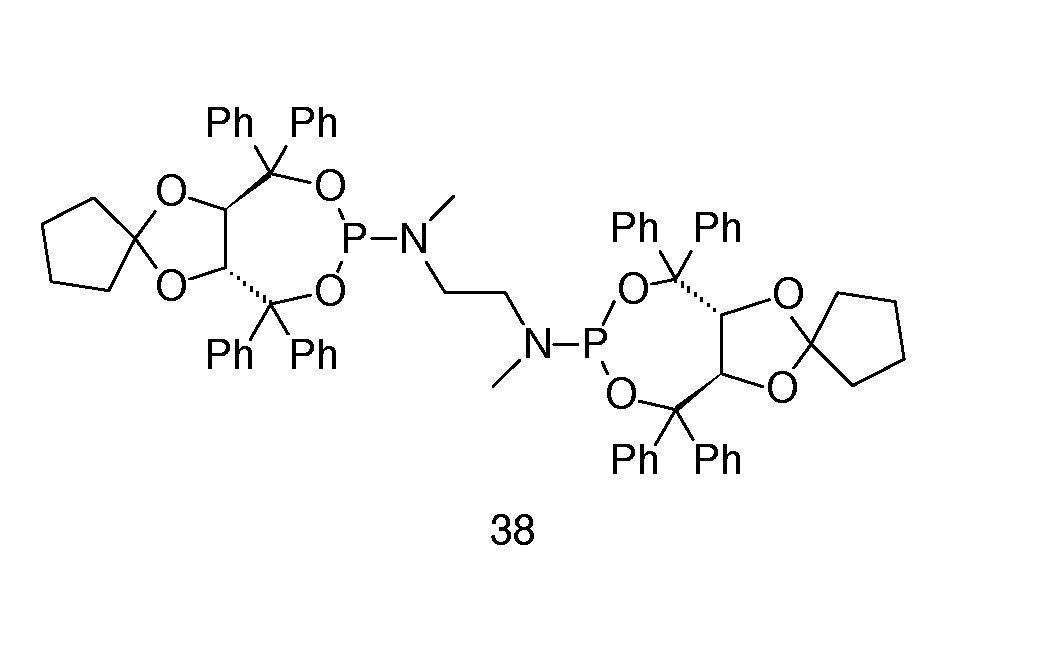
- It will be understood that where one enantiomer is represented, the other enantiomer is similarly applicable.
- Such ligands with formula (I) can simply be prepared as described for example in Houben-Weyl Methoden der Organischen Chemie Band XII/2. Organische phosphorverbindungen. G. Thieme Verlag, Stuttgart, 1964, Teil 2 (4th ed.), pp. 99-105. A preferred preparation method is based on the reaction of an HO-Cn-OH compound with P(NMe2)3 or P(NEt2)3 (Me = methyl, Et = ethyl), with subsequent reaction with R5R6NH, preferably in a solvent having a boiling point > 80 °C, for example toluene. Examples of suitable catalysts for the latter reaction are ammonium chloride, tetrazole or benzimidazoliumtriflate. Examples of HO-Cn-OH are chiral bisnaphtols for example (R)- or (S)- 1,1'-bi-(2-naphthol), chiral bisphenols for example (R)- or (S)- 6,6'-dimethoxy-2,2'-bisphenol, diols, for example (R,R)- or (S,S)-2,2-dimethyl-1,3-dioxolane-4,5-bis-(1,1-diphenyl)methanol (TADDOL), or (S,R) or (R,S)-indane-1,2-diol; 1,2-diols and 1,3-diols based on sugars, for example diols having the formula:

- Examples of R1R2NH are benzyl amine, dibenzyl amine, diisopropyl amine, (R)- or (S)-1-methyl-benzyl amine, piperidine, morpholine, (R,R)- or (S,S)-bis-(1 -methylbenzyl)amine.
- A second preferred preparation is based on the reaction of an HO-Cn-OH compound with PCl3, with subsequent reaction with R5R6NH, preferably in the presence of a base, for example Et3N, and in the presence of a solvent, for example toluene. Examples of HO-Cn-OH are in principle the same as mentioned above in relation to the first preferred preparation. Examples of R5R6NH are ammonia, benzyl amine, dibenzyl amine, diisopropyl amine, (R)- or (S)-1-methyl-benzyl amine, piperidine, morpholine, (R,R)- or (S,S)-bis-(1-methylbenzyl)amine.
- The bi- or tridentate ligands of the invention may be prepared in similar fashion, by replacing the amine R5R6NH with a bridged diamine compound (R6)HN-B-NH(R6). It is also possible to prepare non-symmetrical bidentate phosphoramidite ligands. This can be accomplished by reacting a group (R6)NH-BNH(R6) first with 1 equivalent ofAfter this reaction the remaining amino group is reacted with 1 equivalent of
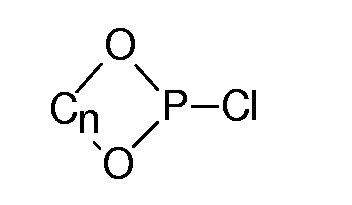 The invention also relates to the preparation of the enantiomerically enriched ligands of formula I.
- Suitable substrates for the asymmetric arylation reaction are unsaturated compound with formula R1 - C =C - (R2)Z, wherein R1 and R2, each independently, represent H, an alkyl, (hetero)aryl, dialkylamino, amido, alkoxy, aryloxy or thioether group with, for instance 1-20 C-atoms (including any substituents) with the proviso that not both R1 and R2 represent H, or R1 and R2 form together with the C-atoms to which they are bound a (hetero)alkyl or (hetero)alkenyl ring with, for instance, 2-20 C-atoms including any substituents, or R1 and Z, or R2 and Z form together with the C-atom(s) to which they are bound a ring, preferably a 5-12 membered ring, for instance a cyclic ketone, a lactone or a lactam. Examples of R1 and R2 are: hydrogen, alkyl groups, for example methyl, ethyl, isopropyl, butyl; (hetero)aryl groups, for example phenyl, 4-biphenyl, 1-napthyl, 2-naphthyl, 2-furyl, 3-furyl, 2-indenyl, 2-indolinyl or 2-quinolinyl; disubstituted amine groups for example dimethylamino, dibenzylamino, methylbenzylamino, methylanilinyl, N-piperidinyl or N-pyrrolyl, or N-pyrrolidinyl or N-morpholinyl; amide groups, for example aminocarbonyl, ethylaminocarbonyl, dimethylaminocarbonyl or benzylaminocarbonyl; thioether groups for example methylmercapto, benzylmercapto, phenylmercapto; alkoxy groups, for example methoxy, ethoxy, benzyloxy; or (hetero)aryloxy groups for example phenoxy, 2-fluorophenoxy or 2-furanyloxy. R1 and/or R2 are optionally substituted with one or more substituents that are inert in the reaction system. Suitable substituents preferably have 0-60 C-atoms. Examples of such substituents for R1 and R2 are for example halogens; alkyl groups with for instance 1-10 C-atoms, aryl groups with for example 1-10 C-atoms, for instance phenyl, alkoxygroups with for instance 1-10 C-atoms, aryloxygroups with for instance 6-10 C-atoms, (unsaturated) ester, ether, nitrile, nitro, amido or catbamate groups, and Z represents an electron withdrawing group. Suitable examples of Z are ester groups for example a methoxycarbonyl, ethoxycarbonyl, isopropoxycarbonyl, benzyloxycarbonyl, phenoxycarbonyl or a 2-methoxyethoxycarbonyl group; amide groups for example aminocarbonyl, ethylaminocarbonyl, dimethylaminocarbonyl or benzylaminocarbonyl; acyl groups, for example acetyl, propionyl, benzoyl, 1-naphthoyl, 2-naphthoyl, 2-picolyl, 4-phenylbenzoyl, 4-nitrobenzoyl or m-fluorobenzoyl; a nitro group or a nitrile or a phosphonate ester, for example dietyl phosphonate or dibenzylphosphonate, sulfoxides for example methylsulfinyl or phenylsulfinyl; a sulfone, for example methylsulfonyl or phenylsulfonyl, 2-naphthylsulfonyl or 2-furylsulfonyl. It is understood that all the above mentioned groups may carry further substituents.
- Examples of substrates are Z and E isomers of 2- and/or 3-substituted acrylate esters, for example methyl methacrylate, propyl 2-pentenoate, butyl crotonate, ethyl itaconate or butyl cinnamate; alpha-beta-unsaturated lactones, for example as delta 2-butenolactone or epsilon 2-pentenolactone; cyclic anhydrides, for example maleic anhydride or 2-methyl maleic anhydride; alpha-beta unsaturated amides, for example crotylamide or cinnamide, or alpha-beta unsaturated lactams, for example N-benzyl 5,6-dihydro-2- (1H)-pyridinone or 5,6-dihydro-2- (1H)-pyridinone, nitro-olefins, for example 2-nitro-propene or 1-nitro-cyclohexene; alpha-beta unsaturated ketones, for example methyl vinyl ketone, 3-nonen-2-one or 5-methyl-3-hexen-2-one, cyclic enones, for example 2-cyclopentenone, 2-cyclohexenone, 2-cycloheptenone or 5,6-dihydro-4 (1H)-pyridinone; alpha beta unsaturated nitriles, for example crotonitrile or methacrylonitrile or 2-cyanocyclopentene, alpha-beta unsaturated phosphonates, for example diethyl 1-propenephosphonate or dimethyl 1-cyclohexenephosphonate; 1,2-dehydro amino acid derivatives, for example methyl 2-acetamido-acrylate, ethyl 2-N-benzyloxycarbamoyl-cinnamate.or ethyl 3-acetamidocinnamate.
- The arylating agent is a boronic acid derivate of formula Ar - B(OR3)OR4 or its anhydride, wherein R3 and R4, each independently, represent H or an alkyl group with for instance 1-6 C-atoms, for example methyl, ethyl, propyl or together with the BO2 form a ring with for instance 1-6 C-atoms, in which case R3R4 may represent, for instance, ethylene, propylene or 2,3-dimethyl 2,3-butylene. Ar represents an (hetero) aryl group with, for instance, 3-20 C-atoms, preferably 4-10 C-atoms. Suitable examples of Ar are phenyl, (o-, m- or p-) nitro-phenyl, (o-, m- or p-) chlorophenyl, (o-, m- or p-) tolyl, (o-, m- or p-) trifluoromethyl-phenyl, (o-, m- or p-) anisyl, (o-, m- or p-) hydroxyphenyl, (o-, m- or p-) cyano-phenyl, (o-, m- or p-) methoxycarbonyl-phenyl, xylyl, mesityl, 1-naphthyl, 2-naphthyl, 6-methoxynaphthyl, phenanthryl, anthracyl, (2-, 3-,or 4-) pyridyl, (2-, 3-, 4-, 5-, 6-, 7- or 8-,) quinolyl, (1-, 3-, 4-, 5-, 6-, 7- or 8-,) isoquinolyl, 2- or 3-furyl, 2- or 3-thienyl, 2- or 3-pyrrolyl, (2-, 3-, 4-, 5-, 6-, or 7-,) indolyl. It is understood that all these aryl groups may be substituted with one or more substituents.
- The preparation of the aromatic boronic acids is described by R. Köster in "Houben-Weyl Methoden der Organischen Chemie" Vol 13/3a, R Köster ed., Georg Thieme Verlag, Stuttgart, 1982, p 489-852.
A particular convenient method is to react an aromatic halide such as ArCI or ArBr with Mg turnings to prepare the Grignard reagent. Addition of a boronic ester such as B(OMe)3 and hydrolysis with water after the Grignard has fully reacted with the boronic ester will furnish the aromatic boronic acids in good yield. Purification is by crystallization from a suitable solvent. - In a preferred embodiment of the invention the aryl boronic derivative (or its anhydride) is prepared from ArMgBr, wherein Ar is as defined above, and a boron ester with formula B(OR)3, wherein R represents an alkyl group, preferably with 1-6 C-atoms, in particular methyl. Preferably the boronic acid derivative obtained is subsequently in the same pot, without purification or isolation subjected to the reaction with the olefinic unsaturated compound with formula R2-C=C-(R1)Z, according to the invention.
- The process according to the invention can also suitably be used in the preparation of an optically active compound, starting from (a mixture of the enantiomers of an) olefin, that contains a chiral centre elsewhere in the molecule and with preferably one of the two enantiomers being arylated.
- In the arylation reaction use is preferably made of a molar ratio of metal present in the catalyst to substrate of between 1:10 and 1:1,000,000, in particular between 1:50 and 1:100,000. The ratio boronic acid to olefinic unsaturated compound may vary between wide limits, for instance between 0.8 and 10, preferably between 1.0 and 5. The arylation reaction allows for a relatively low ratio boronic acid to olefinic unsaturated compound. Preferably a ratio between 1 and 2 equivalents boronic acid to olefinic unsaturated compound.
- The temperature at which the asymmetric arylation reaction is carried out is generally a compromise between reaction velocity and enantioselectivity, and preferably lies between 0 and 140°C, in particular between 20 and 100°C. The asymmetric arylation reaction is preferably carried out with oxygen being excluded. Preferably the substrates and solvents do not contain any oxygen, peroxides or other oxidizing substances.
- As solvent use can be made of: alcohols, for instance methanol ethanol or isopropanol; esters for instance ethylacetate or butyl acetate; amides for instance DMF, NMP or DMA; ethers, for instance diethyl ether, terahydrofuran, DME, or dioxane; ketones, for instance acetone, butanone or cyclohexanone, aromatic hydrocarbons, for instance toluene, halogenated hydrocarbons, for instance chlorobenzene or water. In case water is used as solvent it may be beneficial to add a phase transfer agent, for instance sodium dodecyl sulfate. If desired the solubility of the catalyst in water can be increased by providing the ligand with polar groups, for instance carboxylate or sulfonate salts. It usually is beneficial to add a small amount of water to the other solvents, preferably in an amount of one or more equivalents, more preferably 1-20 equivalents, with respect to the amount of boronic acid. Good results are obtained when a water/dioxane mixture was used with a dioxane/water ratio between 5:1 and 20:1. It is also possible to carry out the arylation reaction in ionic liquids as described in T. Welton, Chem. Rev., 99, 2071-2083 (1999), so that isolation of the product is simplified. If necessary the solubility of the ligand in the ionic liquid can be increased by providing the ligand with polar groups such as carboxylate salts. If the substrate is a liquid, the arylation reaction can also very suitably be carried out without a solvent; in this case water needs to be added as described above. If the substrate and/or the product hardly dissolves in the solvent the asymmetric arylation can also be performed as a slurry. If the product forms a slurry, its isolation is very much simplified.
- The asymmetric arylation reaction will sometimes also be accelerated by adding a base. Suitable bases are nitrogen bases for instance triethylamine, substituted or non-substituted pyridines and mineral bases for example NaHCO3, K2CO3, KOtBu or Cs2CO3.
- The invention will be elucidated with reference to the following examples, without however being restricted by these.
- A Schlenk tube under Argon was charged with Rh(acac)(C2H4)2 (3.1 mg 12µmol), enantiopure ligand 1(2.5 equiv) and 1 mL of dry dioxane. This was stirred at ambient temperature for 10 min. 2-Cyclohexenone (0.4 mmol), 2 mmol of PhB(OH)2 and 0.1 ml of H2O was added and the mixture was then stirred at 100°C for 5h, cooled to room temperature. 5 ml of sat. NaHCO3 was added and the mixture was extracted with EtOAc or diethylether (2x 5 ml). The organic layers were dried on Na2SO4 and the solvents were evaporated. 2 ml of Heptane/isopropylalcohol(IPA) 90/10 was added and the solution was filtered over a short SiO2 column. The resulting solution was analysed by NMR and HPLC or GC.
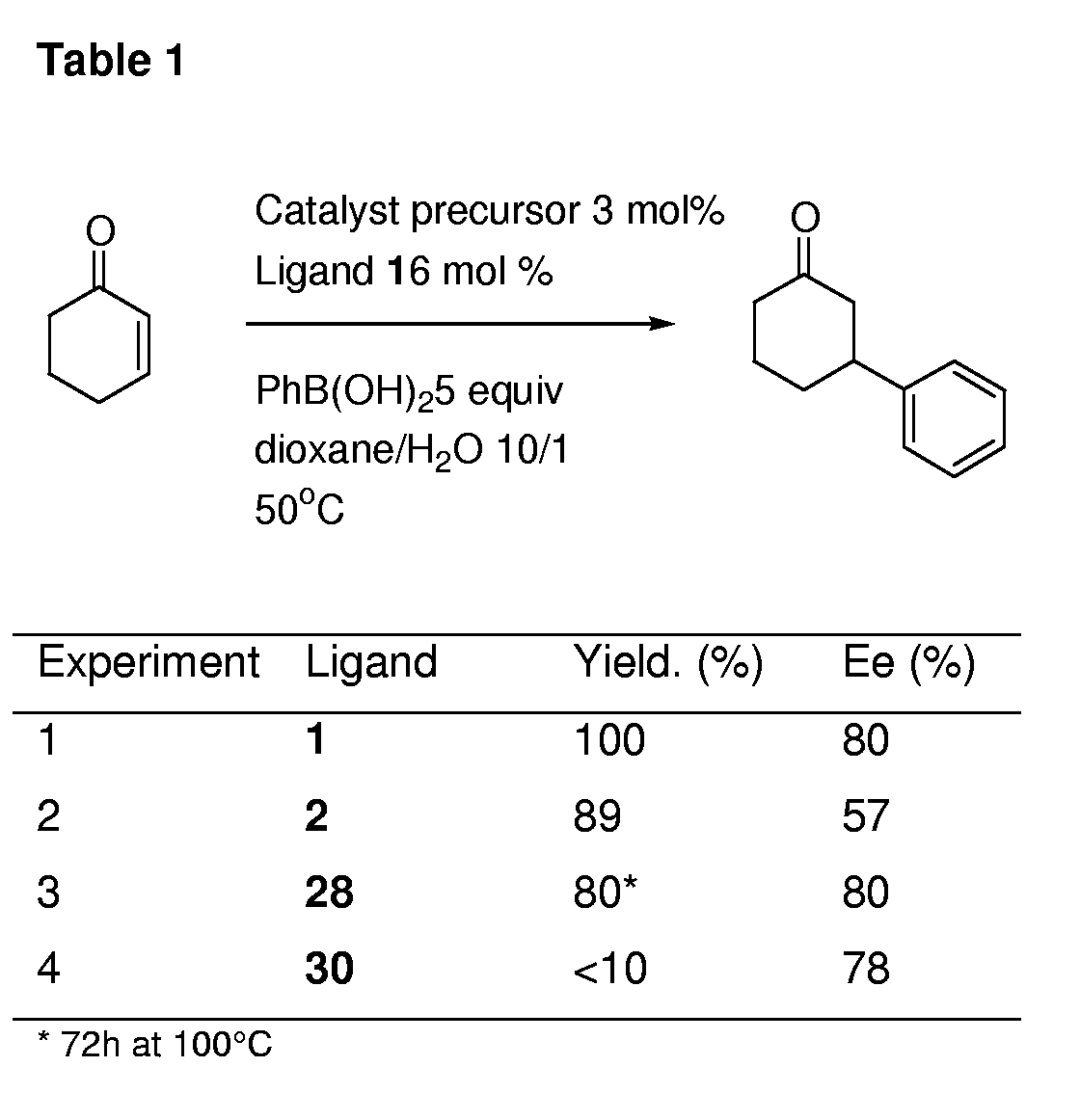
- Example 1 was repeated using ligand 2, 28 and 30, respectively, the results are listed in table 1.
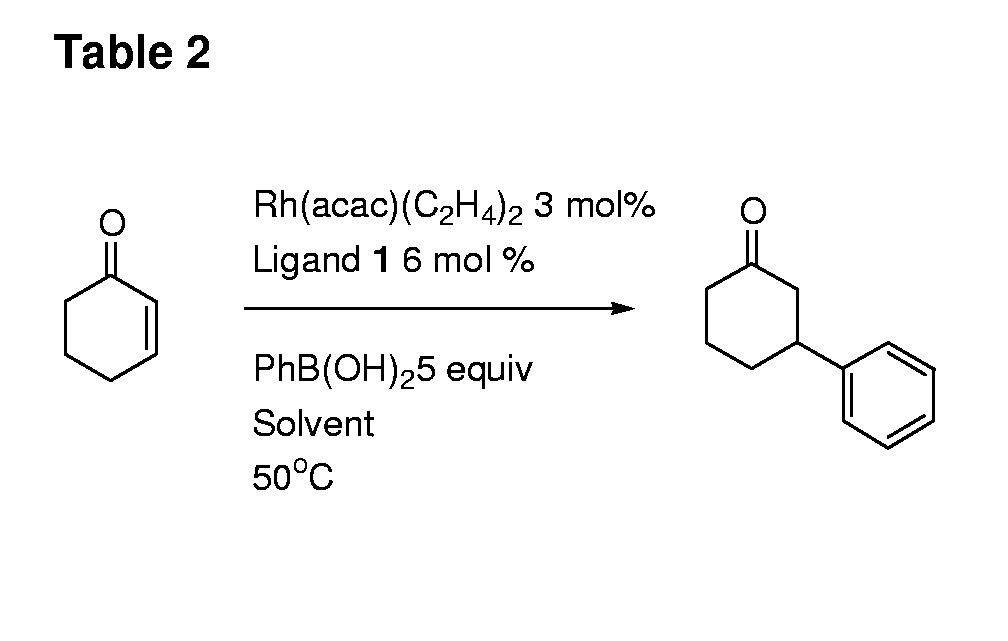
- In examples 5-11 the same procedure was followed as in Example 1, but the solvents were changed. Results are listed in Table 2.
 The values within parentheses were obtained when a ligand rhodium ratio of 2.5 was used.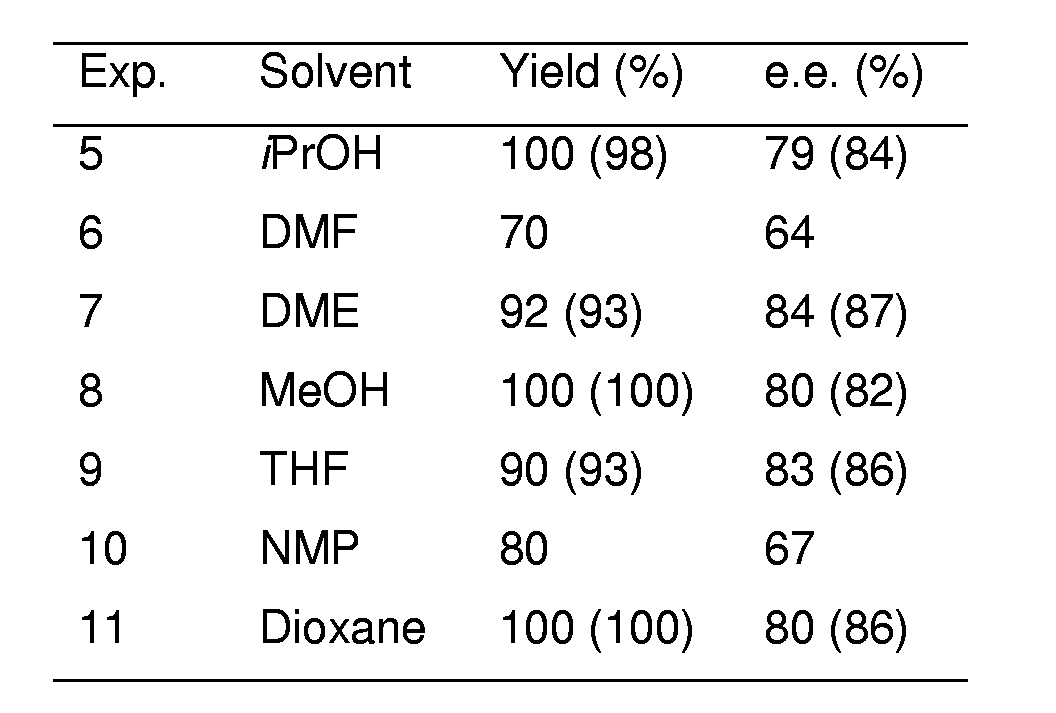
- The same conditions were applied as in example 1 except that Rh(nbd)BF4 was used as a catalyst precursor 3-Phenyl-cyclohexanone was obtained with an ee of 80% and with 13% yield.
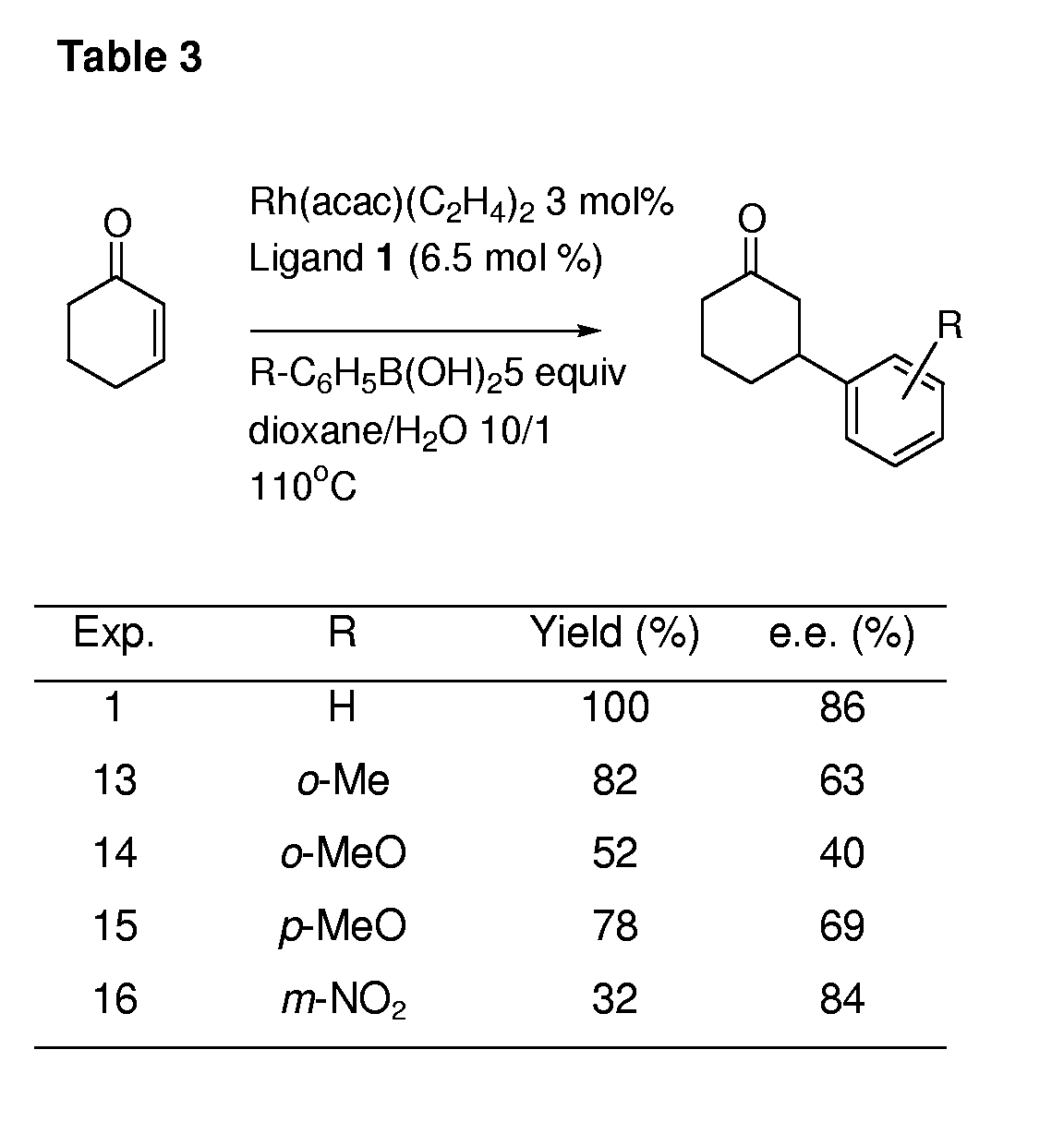
- Example 1 was repeated now using different arylboronic acids. The results are listed in Table 3.
- Example 1 was repeated with other olefinic substrates. The results are listed in Table 4.

- The experiment as described in Example 1 was repeated but using ligand 22 (R5 and R6 are both Me). After 1 h complete conversion was obtained. The e.e. of the 3-phenylcyclohexanone was 88%.
- This experiment was conducted in a similar fashion as experiment 1. In it we used 2.00 g (21 mmol) of cyclohexenone, 1.2 equivalents of PhB(OH)2, 0.6 mol% of an in situ generated catalyst from Rh(acac)(C2H4)2 and 1.5 mol% of MonoPhos. Complete conversion was achieved at 100 °C after 1 h. The product was isolated in 92% yield and had an e.e. of 85%.
- This experiment shows that because of the high rate of the reaction a much lower PhB(OH)2 / olefin ratio can be used than in the work of Hayashi et al. where 5 equivalents are used.
- For comparison, Example 1 was repeated with the ligands reported by Hayashi (BINAP) and with the ligand reported by Reetz (Phosphonite). The rate of the three reactions is depicted graphically in Figure 1. From this it is clear that under the same conditions according to the invention a much faster reaction is obtained.

Claims (12)
- Process for the preparation of enantiomerically enriched compounds with formula Ar - C(R1) - C(R2) - Z wherein Ar represents an optionally substituted (hetero)aryl group, R1 and R2, each independently, represent H, an alkyl, (hetero)aryl, dialkylamino, amido, thioether, alkoxy or aryloxy group with the proviso that not both R1 and R2 represent H, or R1 and R2 form together with the C-atoms to which they are bound a (hetero)alkyl or (hetero) alkenyl ring and Z represents an electron withdrawing group, in which process a boronic acid derivate of formula Ar - B(OR3)OR4 or its anhydride, wherein Ar is the same as described above and R3 and R4, each independently, represent H or an alkyl group, is reacted with an olefinic unsaturated compound with formula R2 - C = C - (R1)Z, wherein R1, R2 and Z are the same as described above, in the presence of a transition metal catalyst comprising a transition metal chosen from the group consisting of Cu and group VIII of the Periodic Table and an enantiomerically enriched ligand L, characterized in that L is an enantiomerically enriched ligand having the formula (I)where Cn together with the two O-atoms and the P-atom forms a substituted or non-substituted ring with 2-6 C-atoms, R5 and R6 each independently stand for H, an optionally substituted alkyl, aryl, alkaryl or aralkyl group, or represent the group with formula (II)
 wherein Cn 1 may have the same meanings as given for Cn and B represents a bridging group, or R5 and R6 may form a heterocyclic ring together with the N-atom to which they are bound.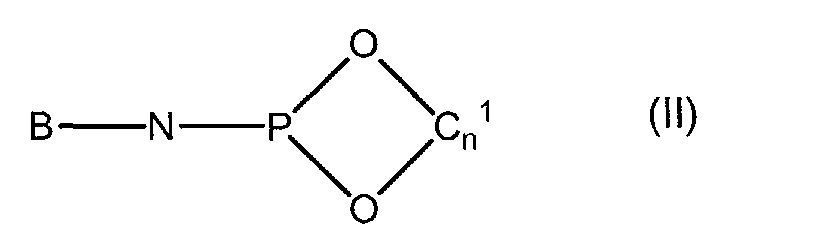
- Process according to claim 1, wherein the transition metal is Rh.
- Process according to claim 2, wherein the transition metal catalyst is prepared using Rh (H2C = CH2)2 acetylacetonate as a catalyst precursor.
- Process according to any one of claims 1-3 where Cn stands for a chiral C4 chain that substantially has one particular configuration.
- Process according to claim 4, where Cn together with the two O-atoms and the P-atom forms a ring with 4 C-atoms which 2 by 2 form part of an aryl group or a naphthyl group.
- Process according to any one of claims 1-5 wherein R5 and R6 each independently represent an alkyl group.
- Process according to claim 6 wherein R5 and R6 both represent a methyl group.
- Process according to any one of claims 1-7 in which the reaction is carried out in the presence of a mixture of dioxane and water.
- Process according to any one of claims 1-7 in which the reaction is carried out in the presence of an ionic liquid.
- Process according to any one of claims 1-9 in which the catalyst is prepared in situ.
- Process according to any one of claims 1-10, wherein first ArMgBr, wherein Ar is as defined above, and a boron ester or B(OR)3, wherein R represents an alkyl group are reacted to form the boronic acid derivative, and wherein subsequently, without intermediate purification or isolation, the boronic acid derivative is subjected to reaction with the olefinic unsaturated compound with formula R2-C=C-(R1)Z.
- Catalyst comprising a transition metal M, an enantiomerically enriched ligand L, an extra ligand S and a counterion X wherein M is Rh, S is (C2H4)2, X is acetylacetonate and L is a ligand with formula Iwhere Cn together with the two O-atoms and the P-atom forms a substituted or non-substituted ring with 2-6 C-atoms, R5 and R6 each independently stand for H, an optionally substituted alkyl, aryl, alkaryl or aralkyl group, or represent the group with formula (II)
 wherein Cn 1 may have the same meanings as given for Cn and B represents a bridging group, or R5 and R6 may form a heterocyclic ring together with the N-atom to which they are bound.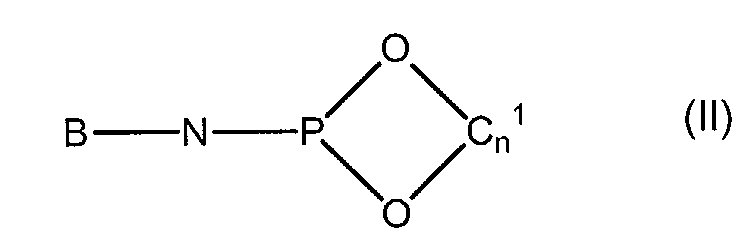
Priority Applications (11)
| Application Number | Priority Date | Filing Date | Title |
|---|---|---|---|
| EP02100556A EP1364932A1 (en) | 2002-05-23 | 2002-05-23 | Process for the preparation of enantiomerically enriched compounds |
| CA002486546A CA2486546A1 (en) | 2002-05-23 | 2003-03-20 | Process for the preparation of enantiomerically enriched compounds |
| DE60321335T DE60321335D1 (en) | 2002-05-23 | 2003-03-20 | PROCESS FOR PREPARING ENANTIOMERINE CLEANED COMPOUNDS |
| CNB038117371A CN100497271C (en) | 2002-05-23 | 2003-03-20 | Process for the preparation of enantiomerically enriched compounds |
| AU2003225408A AU2003225408A1 (en) | 2002-05-23 | 2003-03-20 | Process for the preparation of enantiomerically enriched compounds |
| PCT/NL2003/000211 WO2003099745A1 (en) | 2002-05-23 | 2003-03-20 | Process for the preparation of enantiomerically enriched compounds |
| AT03755060T ATE396962T1 (en) | 2002-05-23 | 2003-03-20 | METHOD FOR PRODUCING ENANTIOMER-PURIFIED COMPOUNDS |
| EP03755060A EP1506148B1 (en) | 2002-05-23 | 2003-03-20 | Process for the preparation of enantiomerically enriched compounds |
| US10/515,195 US20050245756A1 (en) | 2002-05-23 | 2003-03-20 | Process for the preparation of enantiomerically enriched compounds |
| ES03755060T ES2306886T3 (en) | 2002-05-23 | 2003-03-20 | PROCESS FOR THE PREPARATION OF ENANTIOMERICALLY ENRICHED COMPOUNDS. |
| US12/114,716 US20080275274A1 (en) | 2002-05-23 | 2008-05-02 | Process for the preparation of enantiomerically enriched compounds |
Applications Claiming Priority (1)
| Application Number | Priority Date | Filing Date | Title |
|---|---|---|---|
| EP02100556A EP1364932A1 (en) | 2002-05-23 | 2002-05-23 | Process for the preparation of enantiomerically enriched compounds |
Publications (1)
| Publication Number | Publication Date |
|---|---|
| EP1364932A1 true EP1364932A1 (en) | 2003-11-26 |
Family
ID=29286204
Family Applications (2)
| Application Number | Title | Priority Date | Filing Date |
|---|---|---|---|
| EP02100556A Withdrawn EP1364932A1 (en) | 2002-05-23 | 2002-05-23 | Process for the preparation of enantiomerically enriched compounds |
| EP03755060A Expired - Lifetime EP1506148B1 (en) | 2002-05-23 | 2003-03-20 | Process for the preparation of enantiomerically enriched compounds |
Family Applications After (1)
| Application Number | Title | Priority Date | Filing Date |
|---|---|---|---|
| EP03755060A Expired - Lifetime EP1506148B1 (en) | 2002-05-23 | 2003-03-20 | Process for the preparation of enantiomerically enriched compounds |
Country Status (9)
| Country | Link |
|---|---|
| US (2) | US20050245756A1 (en) |
| EP (2) | EP1364932A1 (en) |
| CN (1) | CN100497271C (en) |
| AT (1) | ATE396962T1 (en) |
| AU (1) | AU2003225408A1 (en) |
| CA (1) | CA2486546A1 (en) |
| DE (1) | DE60321335D1 (en) |
| ES (1) | ES2306886T3 (en) |
| WO (1) | WO2003099745A1 (en) |
Cited By (1)
| Publication number | Priority date | Publication date | Assignee | Title |
|---|---|---|---|---|
| US7863443B2 (en) | 2007-08-22 | 2011-01-04 | Sumitomo Chemical Company, Limited | Phosphoramidite ligand and production method of allylic amine using the same |
Families Citing this family (2)
| Publication number | Priority date | Publication date | Assignee | Title |
|---|---|---|---|---|
| EP1364932A1 (en) * | 2002-05-23 | 2003-11-26 | DSM IP Assets B.V. | Process for the preparation of enantiomerically enriched compounds |
| US9090545B2 (en) | 2011-10-14 | 2015-07-28 | Isis Innovation Limited | Asymmetric synthesis of organic compounds |
Family Cites Families (3)
| Publication number | Priority date | Publication date | Assignee | Title |
|---|---|---|---|---|
| US5482596A (en) * | 1994-01-27 | 1996-01-09 | Albemarle Corporation | Mixed ligand catalyst for preparing aryl-substituted aliphatic carboxylic esters |
| NL1015655C2 (en) * | 2000-07-07 | 2002-01-08 | Dsm Nv | Catalyst for asymmetric hydrogenation. |
| EP1364932A1 (en) * | 2002-05-23 | 2003-11-26 | DSM IP Assets B.V. | Process for the preparation of enantiomerically enriched compounds |
-
2002
- 2002-05-23 EP EP02100556A patent/EP1364932A1/en not_active Withdrawn
-
2003
- 2003-03-20 CN CNB038117371A patent/CN100497271C/en not_active Expired - Fee Related
- 2003-03-20 AT AT03755060T patent/ATE396962T1/en not_active IP Right Cessation
- 2003-03-20 EP EP03755060A patent/EP1506148B1/en not_active Expired - Lifetime
- 2003-03-20 WO PCT/NL2003/000211 patent/WO2003099745A1/en not_active Ceased
- 2003-03-20 CA CA002486546A patent/CA2486546A1/en not_active Abandoned
- 2003-03-20 AU AU2003225408A patent/AU2003225408A1/en not_active Abandoned
- 2003-03-20 DE DE60321335T patent/DE60321335D1/en not_active Expired - Lifetime
- 2003-03-20 ES ES03755060T patent/ES2306886T3/en not_active Expired - Lifetime
- 2003-03-20 US US10/515,195 patent/US20050245756A1/en not_active Abandoned
-
2008
- 2008-05-02 US US12/114,716 patent/US20080275274A1/en not_active Abandoned
Non-Patent Citations (3)
| Title |
|---|
| BEN L. FERINGA ET AL.: "Highly Enantioselective Catalytic Conjugate Addition and Tandem Conjugate Addition - Aldol Reactions of Organozinc Reagents", ANGEW. CHEM. INT. ED., vol. 36, no. 23, 1997, pages 2620 - 3, XP002217464 * |
| MANFRED T. REETZ ET AL.: "BINOL-Based Diphosphinites as Ligands in the Asymmetric Rh-Catalyzed Conjugate Addition of Arylboronic Acids", ORGANIC LETTERS, vol. 3, no. 25, 16 November 2001 (2001-11-16), pages 4083 - 5, XP002217462 * |
| TAMIO HAYASHI: "Rhodium-Catalyzed Asymmetric 1,4-Addition of Organoboronic Acids and Their Derivatives to Electron Deficient Olefins", SYNLETT 2001, vol. SI, 2001, pages 879 - 87, XP002217463 * |
Cited By (1)
| Publication number | Priority date | Publication date | Assignee | Title |
|---|---|---|---|---|
| US7863443B2 (en) | 2007-08-22 | 2011-01-04 | Sumitomo Chemical Company, Limited | Phosphoramidite ligand and production method of allylic amine using the same |
Also Published As
| Publication number | Publication date |
|---|---|
| ES2306886T3 (en) | 2008-11-16 |
| AU2003225408A1 (en) | 2003-12-12 |
| DE60321335D1 (en) | 2008-07-10 |
| US20080275274A1 (en) | 2008-11-06 |
| US20050245756A1 (en) | 2005-11-03 |
| CN1656047A (en) | 2005-08-17 |
| ATE396962T1 (en) | 2008-06-15 |
| EP1506148A1 (en) | 2005-02-16 |
| CA2486546A1 (en) | 2003-12-04 |
| WO2003099745A1 (en) | 2003-12-04 |
| EP1506148B1 (en) | 2008-05-28 |
| CN100497271C (en) | 2009-06-10 |
Similar Documents
| Publication | Publication Date | Title |
|---|---|---|
| JP4264418B2 (en) | Ruthenium complexes as (preliminary) catalysts for metathesis reactions | |
| Faller et al. | Chiral poisoning: a novel strategy for asymmetric catalysis | |
| US7105702B2 (en) | P-chiral phospholanes and phosphocyclic compounds and their use in asymmetric catalytic reactions | |
| ES2271043T3 (en) | ASYMMETRIC HYDROGENATION (TRANSFER) CATALYST. | |
| James et al. | Catalytic decarbonylation, hydroacylation, and resolution of racemic pent-4-enals using chiral bis (di-tertiary-phosphine) complexes of rhodium (I) | |
| US7153809B2 (en) | P-chiral phospholanes and phosphocyclic compounds and their use in asymmetric catalytic reactions | |
| JP2003522162A (en) | Chiral ferrocene phosphines and their use in asymmetric catalysis | |
| Widhalm et al. | Chiral ferrocene derivatives containing a 2, 2′-bridged binaphthyl moiety | |
| CN109718851B (en) | Chiral quaternary phosphonium salt phase transfer catalyst and preparation method and application thereof | |
| WO2001000581A1 (en) | Ligands based on chiral 2-amino-2'-hydroxy-1,1'-binaphthyl and related frameworks for asymmetric catalysis | |
| US20080275274A1 (en) | Process for the preparation of enantiomerically enriched compounds | |
| JP4397528B2 (en) | Chiral ligands for asymmetric catalysts | |
| JP5275335B2 (en) | Method for producing optically active cyanohydrin derivative | |
| CN103429567A (en) | Process for preparing chiral amino acids | |
| CN117586310B (en) | Nickel-catalyzed C(sp3)-H bond asymmetric cyclization promoted by a binaphthylamine-derived chiral phosphooxy ligand | |
| WO2004024684A2 (en) | Enantioselective amination and etherification | |
| US5952527A (en) | Chiral aminophosphines | |
| JPH08319258A (en) | Production of asymmetric compound by using metallic complex | |
| Bonini et al. | Cyclopenta [b] thiophene-alkyloxazolines: new nitrogen–sulfur hybrid ligands and their use in asymmetric palladium-catalyzed allylic alkylation | |
| JPH10251281A (en) | Amidophosphine phosphite compound | |
| EP1844061A1 (en) | Metallocene-based phosphorus chiral phosphines | |
| US8013171B2 (en) | Axially asymmetric ester compound and production method thereof | |
| JP2000515426A (en) | Ruthenium catalyst and its use in asymmetric hydrogenation of weakly coordinating substrates | |
| CN109851634B (en) | Chiral monophosphine ligand Yu-Phos and preparation method and application of full configuration thereof | |
| CN1353718A (en) | Novel ligands for chiral catalysis |
Legal Events
| Date | Code | Title | Description |
|---|---|---|---|
| PUAI | Public reference made under article 153(3) epc to a published international application that has entered the european phase |
Free format text: ORIGINAL CODE: 0009012 |
|
| AK | Designated contracting states |
Kind code of ref document: A1 Designated state(s): AT BE CH CY DE DK ES FI FR GB GR IE IT LI LU MC NL PT SE TR |
|
| AX | Request for extension of the european patent |
Extension state: AL LT LV MK RO SI |
|
| STAA | Information on the status of an ep patent application or granted ep patent |
Free format text: STATUS: THE APPLICATION HAS BEEN WITHDRAWN |
|
| 18W | Application withdrawn |
Effective date: 20031215 |