EP1364808A2 - Magenta donor element for thermal transfer - Google Patents
Magenta donor element for thermal transfer Download PDFInfo
- Publication number
- EP1364808A2 EP1364808A2 EP03076407A EP03076407A EP1364808A2 EP 1364808 A2 EP1364808 A2 EP 1364808A2 EP 03076407 A EP03076407 A EP 03076407A EP 03076407 A EP03076407 A EP 03076407A EP 1364808 A2 EP1364808 A2 EP 1364808A2
- Authority
- EP
- European Patent Office
- Prior art keywords
- group
- carbon atoms
- dye
- alkyl
- atoms
- Prior art date
- Legal status (The legal status is an assumption and is not a legal conclusion. Google has not performed a legal analysis and makes no representation as to the accuracy of the status listed.)
- Granted
Links
- 238000012546 transfer Methods 0.000 title claims abstract description 7
- 239000000975 dye Substances 0.000 claims abstract description 77
- 239000001043 yellow dye Substances 0.000 claims abstract description 18
- AJDUTMFFZHIJEM-UHFFFAOYSA-N n-(9,10-dioxoanthracen-1-yl)-4-[4-[[4-[4-[(9,10-dioxoanthracen-1-yl)carbamoyl]phenyl]phenyl]diazenyl]phenyl]benzamide Chemical compound O=C1C2=CC=CC=C2C(=O)C2=C1C=CC=C2NC(=O)C(C=C1)=CC=C1C(C=C1)=CC=C1N=NC(C=C1)=CC=C1C(C=C1)=CC=C1C(=O)NC1=CC=CC2=C1C(=O)C1=CC=CC=C1C2=O AJDUTMFFZHIJEM-UHFFFAOYSA-N 0.000 claims abstract description 11
- 230000001747 exhibiting effect Effects 0.000 claims abstract description 3
- 238000003384 imaging method Methods 0.000 claims abstract description 3
- -1 cyano, carbamoyl Chemical group 0.000 claims description 84
- 125000004432 carbon atom Chemical group C* 0.000 claims description 62
- 125000000217 alkyl group Chemical group 0.000 claims description 42
- 125000003118 aryl group Chemical group 0.000 claims description 29
- 125000003903 2-propenyl group Chemical group [H]C([*])([H])C([H])=C([H])[H] 0.000 claims description 26
- 125000004429 atom Chemical group 0.000 claims description 26
- 125000003545 alkoxy group Chemical group 0.000 claims description 16
- 238000000034 method Methods 0.000 claims description 15
- 125000004093 cyano group Chemical group *C#N 0.000 claims description 9
- 229910052739 hydrogen Inorganic materials 0.000 claims description 9
- 239000001257 hydrogen Substances 0.000 claims description 9
- IJGRMHOSHXDMSA-UHFFFAOYSA-N Atomic nitrogen Chemical compound N#N IJGRMHOSHXDMSA-UHFFFAOYSA-N 0.000 claims description 8
- 125000004435 hydrogen atom Chemical group [H]* 0.000 claims description 8
- 125000000753 cycloalkyl group Chemical group 0.000 claims description 7
- IPZJQDSFZGZEOY-UHFFFAOYSA-N dimethylmethylene Chemical group C[C]C IPZJQDSFZGZEOY-UHFFFAOYSA-N 0.000 claims description 7
- 229910052736 halogen Inorganic materials 0.000 claims description 7
- 150000002367 halogens Chemical class 0.000 claims description 7
- 125000001072 heteroaryl group Chemical group 0.000 claims description 7
- 125000000623 heterocyclic group Chemical group 0.000 claims description 7
- 125000004423 acyloxy group Chemical group 0.000 claims description 6
- 229910052799 carbon Inorganic materials 0.000 claims description 5
- 229910052757 nitrogen Inorganic materials 0.000 claims description 4
- 229910052760 oxygen Inorganic materials 0.000 claims description 4
- 229910052717 sulfur Inorganic materials 0.000 claims description 4
- 125000003341 7 membered heterocyclic group Chemical group 0.000 claims description 3
- OKTJSMMVPCPJKN-UHFFFAOYSA-N Carbon Chemical compound [C] OKTJSMMVPCPJKN-UHFFFAOYSA-N 0.000 claims description 3
- 125000002252 acyl group Chemical group 0.000 claims description 3
- 125000004453 alkoxycarbonyl group Chemical group 0.000 claims description 3
- 125000004104 aryloxy group Chemical group 0.000 claims description 3
- 125000003917 carbamoyl group Chemical group [H]N([H])C(*)=O 0.000 claims description 3
- 125000000472 sulfonyl group Chemical group *S(*)(=O)=O 0.000 claims description 3
- 125000002373 5 membered heterocyclic group Chemical group 0.000 claims description 2
- 125000004070 6 membered heterocyclic group Chemical group 0.000 claims description 2
- 125000001960 7 membered carbocyclic group Chemical group 0.000 claims description 2
- 125000003282 alkyl amino group Chemical group 0.000 claims description 2
- 150000001450 anions Chemical class 0.000 claims description 2
- 125000001769 aryl amino group Chemical group 0.000 claims description 2
- 125000005161 aryl oxy carbonyl group Chemical group 0.000 claims description 2
- 125000002837 carbocyclic group Chemical group 0.000 claims description 2
- HKOOXMFOFWEVGF-UHFFFAOYSA-N phenylhydrazine Chemical group NNC1=CC=CC=C1 HKOOXMFOFWEVGF-UHFFFAOYSA-N 0.000 claims description 2
- CWKRVCXZBAQWSZ-UHFFFAOYSA-N (4-phenyl-1H-pyrazol-5-yl)-(1H-pyrazol-5-yl)diazene Chemical compound N1C=CC(N=NC=2C(=CNN=2)C=2C=CC=CC=2)=N1 CWKRVCXZBAQWSZ-UHFFFAOYSA-N 0.000 claims 1
- 150000001721 carbon Chemical group 0.000 claims 1
- 125000002496 methyl group Chemical group [H]C([H])([H])* 0.000 description 35
- 125000001997 phenyl group Chemical group [H]C1=C([H])C([H])=C(*)C([H])=C1[H] 0.000 description 15
- 125000000484 butyl group Chemical group [H]C([*])([H])C([H])([H])C([H])([H])C([H])([H])[H] 0.000 description 14
- 125000001424 substituent group Chemical group 0.000 description 14
- 125000001449 isopropyl group Chemical group [H]C([H])([H])C([H])(*)C([H])([H])[H] 0.000 description 12
- 239000000203 mixture Substances 0.000 description 11
- 239000000976 ink Substances 0.000 description 10
- 125000000956 methoxy group Chemical group [H]C([H])([H])O* 0.000 description 10
- 238000005259 measurement Methods 0.000 description 9
- 239000003086 colorant Substances 0.000 description 6
- 125000001495 ethyl group Chemical group [H]C([H])([H])C([H])([H])* 0.000 description 6
- 230000003595 spectral effect Effects 0.000 description 6
- 125000001624 naphthyl group Chemical group 0.000 description 5
- 229920002037 poly(vinyl butyral) polymer Polymers 0.000 description 5
- 125000000999 tert-butyl group Chemical group [H]C([H])([H])C(*)(C([H])([H])[H])C([H])([H])[H] 0.000 description 5
- 125000006275 3-bromophenyl group Chemical group [H]C1=C([H])C(Br)=C([H])C(*)=C1[H] 0.000 description 4
- 125000004179 3-chlorophenyl group Chemical group [H]C1=C([H])C(*)=C([H])C(Cl)=C1[H] 0.000 description 4
- 125000004172 4-methoxyphenyl group Chemical group [H]C1=C([H])C(OC([H])([H])[H])=C([H])C([H])=C1* 0.000 description 4
- 125000003178 carboxy group Chemical group [H]OC(*)=O 0.000 description 4
- 238000004737 colorimetric analysis Methods 0.000 description 4
- 125000002887 hydroxy group Chemical group [H]O* 0.000 description 4
- 125000003261 o-tolyl group Chemical group [H]C1=C([H])C(*)=C(C([H])=C1[H])C([H])([H])[H] 0.000 description 4
- 125000001037 p-tolyl group Chemical group [H]C1=C([H])C(=C([H])C([H])=C1*)C([H])([H])[H] 0.000 description 4
- 239000000049 pigment Substances 0.000 description 4
- 125000004974 2-butenyl group Chemical group C(C=CC)* 0.000 description 3
- 125000002941 2-furyl group Chemical group O1C([*])=C([H])C([H])=C1[H] 0.000 description 3
- 125000000175 2-thienyl group Chemical group S1C([*])=C([H])C([H])=C1[H] 0.000 description 3
- 239000011358 absorbing material Substances 0.000 description 3
- RMRFFCXPLWYOOY-UHFFFAOYSA-N allyl radical Chemical compound [CH2]C=C RMRFFCXPLWYOOY-UHFFFAOYSA-N 0.000 description 3
- 239000011230 binding agent Substances 0.000 description 3
- 239000011248 coating agent Substances 0.000 description 3
- 238000000576 coating method Methods 0.000 description 3
- 125000001147 pentyl group Chemical group C(CCCC)* 0.000 description 3
- 229920000139 polyethylene terephthalate Polymers 0.000 description 3
- 239000005020 polyethylene terephthalate Substances 0.000 description 3
- 125000001436 propyl group Chemical group [H]C([*])([H])C([H])([H])C([H])([H])[H] 0.000 description 3
- 125000004105 2-pyridyl group Chemical group N1=C([*])C([H])=C([H])C([H])=C1[H] 0.000 description 2
- NINIDFKCEFEMDL-UHFFFAOYSA-N Sulfur Chemical compound [S] NINIDFKCEFEMDL-UHFFFAOYSA-N 0.000 description 2
- QVGXLLKOCUKJST-UHFFFAOYSA-N atomic oxygen Chemical compound [O] QVGXLLKOCUKJST-UHFFFAOYSA-N 0.000 description 2
- IAQRGUVFOMOMEM-UHFFFAOYSA-N but-2-ene Chemical compound CC=CC IAQRGUVFOMOMEM-UHFFFAOYSA-N 0.000 description 2
- 238000005516 engineering process Methods 0.000 description 2
- 239000000463 material Substances 0.000 description 2
- 239000001301 oxygen Substances 0.000 description 2
- 238000011160 research Methods 0.000 description 2
- 238000000926 separation method Methods 0.000 description 2
- 239000011593 sulfur Substances 0.000 description 2
- 125000004149 thio group Chemical group *S* 0.000 description 2
- 101710171217 30S ribosomal protein S15 Proteins 0.000 description 1
- AJDKZWLPPHJPOJ-UHFFFAOYSA-N C=1C=CC=C(Cl)C=1NN(CC)CC(C=1C=CC=CC=1)NC1=CC=CC=C1 Chemical compound C=1C=CC=C(Cl)C=1NN(CC)CC(C=1C=CC=CC=1)NC1=CC=CC=C1 AJDKZWLPPHJPOJ-UHFFFAOYSA-N 0.000 description 1
- KKUKTXOBAWVSHC-UHFFFAOYSA-N Dimethylphosphate Chemical compound COP(O)(=O)OC KKUKTXOBAWVSHC-UHFFFAOYSA-N 0.000 description 1
- VGGSQFUCUMXWEO-UHFFFAOYSA-N Ethene Chemical compound C=C VGGSQFUCUMXWEO-UHFFFAOYSA-N 0.000 description 1
- 239000005977 Ethylene Substances 0.000 description 1
- UFHFLCQGNIYNRP-UHFFFAOYSA-N Hydrogen Chemical compound [H][H] UFHFLCQGNIYNRP-UHFFFAOYSA-N 0.000 description 1
- 229910019142 PO4 Inorganic materials 0.000 description 1
- XUIMIQQOPSSXEZ-UHFFFAOYSA-N Silicon Chemical compound [Si] XUIMIQQOPSSXEZ-UHFFFAOYSA-N 0.000 description 1
- 229920004482 WACKER® Polymers 0.000 description 1
- 125000002777 acetyl group Chemical group [H]C([H])([H])C(*)=O 0.000 description 1
- 125000003342 alkenyl group Chemical group 0.000 description 1
- 150000001412 amines Chemical class 0.000 description 1
- 125000004397 aminosulfonyl group Chemical group NS(=O)(=O)* 0.000 description 1
- 238000000540 analysis of variance Methods 0.000 description 1
- 238000004458 analytical method Methods 0.000 description 1
- 125000001584 benzyloxycarbonyl group Chemical group C(=O)(OCC1=CC=CC=C1)* 0.000 description 1
- 230000000903 blocking effect Effects 0.000 description 1
- 125000001246 bromo group Chemical group Br* 0.000 description 1
- 125000004744 butyloxycarbonyl group Chemical group 0.000 description 1
- 125000006297 carbonyl amino group Chemical group [H]N([*:2])C([*:1])=O 0.000 description 1
- 125000001309 chloro group Chemical group Cl* 0.000 description 1
- 230000004456 color vision Effects 0.000 description 1
- 230000000052 comparative effect Effects 0.000 description 1
- 150000001875 compounds Chemical class 0.000 description 1
- 125000000113 cyclohexyl group Chemical group [H]C1([H])C([H])([H])C([H])([H])C([H])(*)C([H])([H])C1([H])[H] 0.000 description 1
- 125000004177 diethyl group Chemical group [H]C([H])([H])C([H])([H])* 0.000 description 1
- XNMQEEKYCVKGBD-UHFFFAOYSA-N dimethylacetylene Natural products CC#CC XNMQEEKYCVKGBD-UHFFFAOYSA-N 0.000 description 1
- JRBPAEWTRLWTQC-UHFFFAOYSA-N dodecylamine Chemical compound CCCCCCCCCCCCN JRBPAEWTRLWTQC-UHFFFAOYSA-N 0.000 description 1
- 230000007613 environmental effect Effects 0.000 description 1
- 125000003754 ethoxycarbonyl group Chemical group C(=O)(OCC)* 0.000 description 1
- 238000013401 experimental design Methods 0.000 description 1
- 239000012530 fluid Substances 0.000 description 1
- 125000001153 fluoro group Chemical group F* 0.000 description 1
- 238000010438 heat treatment Methods 0.000 description 1
- 125000005842 heteroatom Chemical group 0.000 description 1
- BHEPBYXIRTUNPN-UHFFFAOYSA-N hydridophosphorus(.) (triplet) Chemical compound [PH] BHEPBYXIRTUNPN-UHFFFAOYSA-N 0.000 description 1
- 125000001165 hydrophobic group Chemical group 0.000 description 1
- 125000001841 imino group Chemical group [H]N=* 0.000 description 1
- 125000006216 methylsulfinyl group Chemical group [H]C([H])([H])S(*)=O 0.000 description 1
- 125000004170 methylsulfonyl group Chemical group [H]C([H])([H])S(*)(=O)=O 0.000 description 1
- 125000001421 myristyl group Chemical group [H]C([*])([H])C([H])([H])C([H])([H])C([H])([H])C([H])([H])C([H])([H])C([H])([H])C([H])([H])C([H])([H])C([H])([H])C([H])([H])C([H])([H])C([H])([H])C([H])([H])[H] 0.000 description 1
- 125000000449 nitro group Chemical group [O-][N+](*)=O 0.000 description 1
- 230000003287 optical effect Effects 0.000 description 1
- 125000001820 oxy group Chemical group [*:1]O[*:2] 0.000 description 1
- 125000006678 phenoxycarbonyl group Chemical group 0.000 description 1
- UYWQUFXKFGHYNT-UHFFFAOYSA-N phenylmethyl ester of formic acid Natural products O=COCC1=CC=CC=C1 UYWQUFXKFGHYNT-UHFFFAOYSA-N 0.000 description 1
- 125000003170 phenylsulfonyl group Chemical group C1(=CC=CC=C1)S(=O)(=O)* 0.000 description 1
- NBIIXXVUZAFLBC-UHFFFAOYSA-K phosphate Chemical compound [O-]P([O-])([O-])=O NBIIXXVUZAFLBC-UHFFFAOYSA-K 0.000 description 1
- 239000010452 phosphate Substances 0.000 description 1
- OJMIONKXNSYLSR-UHFFFAOYSA-N phosphorous acid Chemical compound OP(O)O OJMIONKXNSYLSR-UHFFFAOYSA-N 0.000 description 1
- 238000012545 processing Methods 0.000 description 1
- 125000001453 quaternary ammonium group Chemical group 0.000 description 1
- 230000005855 radiation Effects 0.000 description 1
- 150000003254 radicals Chemical class 0.000 description 1
- 229910052710 silicon Inorganic materials 0.000 description 1
- 239000010703 silicon Substances 0.000 description 1
- 125000004469 siloxy group Chemical group [SiH3]O* 0.000 description 1
- 229910052709 silver Inorganic materials 0.000 description 1
- 239000004332 silver Substances 0.000 description 1
- 230000003381 solubilizing effect Effects 0.000 description 1
- 239000002904 solvent Substances 0.000 description 1
- 238000013179 statistical model Methods 0.000 description 1
- 239000000758 substrate Substances 0.000 description 1
- 125000000475 sulfinyl group Chemical group [*:2]S([*:1])=O 0.000 description 1
- 125000005420 sulfonamido group Chemical group S(=O)(=O)(N*)* 0.000 description 1
- 238000001931 thermography Methods 0.000 description 1
- 125000002088 tosyl group Chemical group [H]C1=C([H])C(=C([H])C([H])=C1C([H])([H])[H])S(*)(=O)=O 0.000 description 1
- ZMANZCXQSJIPKH-UHFFFAOYSA-O triethylammonium ion Chemical compound CC[NH+](CC)CC ZMANZCXQSJIPKH-UHFFFAOYSA-O 0.000 description 1
- 125000002023 trifluoromethyl group Chemical group FC(F)(F)* 0.000 description 1
Classifications
-
- B—PERFORMING OPERATIONS; TRANSPORTING
- B41—PRINTING; LINING MACHINES; TYPEWRITERS; STAMPS
- B41M—PRINTING, DUPLICATING, MARKING, OR COPYING PROCESSES; COLOUR PRINTING
- B41M5/00—Duplicating or marking methods; Sheet materials for use therein
- B41M5/26—Thermography ; Marking by high energetic means, e.g. laser otherwise than by burning, and characterised by the material used
- B41M5/382—Contact thermal transfer or sublimation processes
- B41M5/385—Contact thermal transfer or sublimation processes characterised by the transferable dyes or pigments
- B41M5/3858—Mixtures of dyes, at least one being a dye classifiable in one of groups B41M5/385 - B41M5/39
Definitions
- a thermal transfer proof can be generated by using a thermal print head in place of a diode laser as described in US 4,923,846.
- thermal heads are not capable of generating halftone images of adequate resolution, but can produce high quality continuous tone proof images, which are satisfactory in many instances.
- US 4,923,846 also discloses the choice of mixtures of dyes for use in thermal imaging proofing systems.
- Inkjet is also used as a low cost proofing method as described in US 6,022,440.
- an inkjet proof can be generated using combinations of either dispersed dyes in an aqueous fluid, or dissolved dyes in a solvent based system. US 6,352,330 discloses methods for accomplishing this.
- Ink jet printers can also produce high quality continuous tone proof images, which by virtue of their cost are satisfactory in many instances.
- the dyes are selected on the basis of values for hue error and turbidity.
- Individual magenta dye-donor elements were prepared by coating on a 100 ⁇ m poly(ethylene terephthalate) support a dye layer containing a mixture of a magenta dye, one or more yellow dyes, the infrared-absorbing bis(aminoaryl)polymethine dye as described in US 4,950,639 (column 2 lines 3-68 and column 3 lines 1-3) at 0.046 g/m 2 in a polyvinylbutyral binder (BS18 from Wacker Chemie) at 0.46 g/m 2 .
- BS18 polyvinylbutyral binder
- the Japan Color comparison measurements of the magenta image were made using an X-Rite 938 portable spectrophotometer set for D 50 illuminant and 2° observer angle.
- the SWOP comparison measurements of the magenta image were made using a Gretag SPM100 portable spectrophotometer set for D 50 illuminant and 2° observer angle. All readings were made with black backing behind the samples.
Landscapes
- Physics & Mathematics (AREA)
- Optics & Photonics (AREA)
- Thermal Transfer Or Thermal Recording In General (AREA)
Abstract
Description
- This invention relates to a magenta thermal dye donor element and to a dye combination for better spectral match to target printing inks, comprising a combination of a magenta dye and one or more yellow image dyes which is used to obtain a color proof that accurately represents the hue of a printed color image obtained from a printing press.
- In order to approximate the appearance of continuous tone (photographic) images via ink-on-paper printing, the commercial printing industry relies on the process known as halftone printing. In halftone printing, color density gradations are produced by printing patterns of dots or areas of varying sizes, but of the same color density, instead of varying the color density continuously as is done in photographic printing.
- There is an important commercial need to obtain a color proof image before a printing press run is made. It is desired that the color proof will accurately represent at least the details and color tone scale of the prints obtained from the printing press. In many cases, it is also desirable that the color proof accurately represents the image quality and halftone pattern of the prints obtained on the printing press. In the sequence of operations necessary to produce an ink-printed, full color picture, a proof is also required to check the accuracy of the color separation data from which the final three or more printing plates or cylinders are made. Traditionally, such color separations proofs have involved silver halide light-sensitive systems which require many exposure and processing steps before a final, full color picture is assembled.
- Colorants that are used in the printing industry are insoluble pigments. By virtue of their pigment character, the spectrophotometric curves of the printing inks are often unusually sharp on either the bathochromic or hypsochromic side. This can cause problems in color proofing systems in which dyes, as opposed to pigments, are being used. It is very difficult to match the hue of a given ink using a single dye.
- In US 5,126,760, a process is described for producing a direct digital, halftone color proof of an original image on a dye-receiving element. The proof can then be used to represent a printed color image obtained from a printing press. The process described therein comprises:
- a) generating a set of electrical signals which is representative of the shape and color scale of an original image;
- b) contacting a dye-donor element comprising a support having thereon a dye layer and an infrared-absorbing material with a first dye-receiving element comprising a support having thereon a polymeric, dye image-receiving layer;
- c) using the signals to image-wise heat by means of a diode laser the dye-donor element, thereby transferring a dye image to the first dye-receiving element; and
- d) re-transferring the dye image to a second dye image-receiving element which has the same substrate as the printed color image. In the above process, multiple dye-donors are used to obtain a complete range of colors in the proof. For example, for a full color proof, four colors- cyan, magenta, yellow and black are normally used.
-
- By using the above process, the image dye is transferred by heating the dye-donor containing the infrared-absorbing material with the diode laser to volatilize the dye, the diode laser beam being modulated by the set of signals which is representative of the shape and color of the original image, so that the dye is heated to cause volatilization only in those areas in which its presence is required on the dye-receiving layer to reconstruct the original image.
- Similarly, a thermal transfer proof can be generated by using a thermal print head in place of a diode laser as described in US 4,923,846. Commonly available thermal heads are not capable of generating halftone images of adequate resolution, but can produce high quality continuous tone proof images, which are satisfactory in many instances. US 4,923,846 also discloses the choice of mixtures of dyes for use in thermal imaging proofing systems. Inkjet is also used as a low cost proofing method as described in US 6,022,440. Likewise, an inkjet proof can be generated using combinations of either dispersed dyes in an aqueous fluid, or dissolved dyes in a solvent based system. US 6,352,330 discloses methods for accomplishing this. Ink jet printers can also produce high quality continuous tone proof images, which by virtue of their cost are satisfactory in many instances. The dyes are selected on the basis of values for hue error and turbidity. The Graphic Arts Technical Foundation Research Report No. 38, "Color Material" (58-(5) 293-301, 1985) gives an account of this method.
- An alternative and more precise method for color measurement and analysis uses the concept of uniform color space known as CIELAB, in which a sample is analyzed mathematically in terms of its spectrophotometric curve, the nature of the illuminant under which it is viewed, and the color vision of a standard observer. For a discussion of CIELAB and color measurement, see Principles of Color Technology, 2nd Edition, F.W. Billmeyer, pp. 25-110, Wiley Interscience and Optical Radiation Measurements, Volume 2, F. Grum, pp. 33-145, Academic Press.
- In using CIELAB, colors can be expressed in terms of three parameters: L*, a*, and b*, where L* is a lightness function, and a* and b* define a point in color space. Thus, a plot of a* vs b* values for a color sample can be used to accurately show where that sample lies in color space, i.e., what its hue is. This allows different samples to be compared for hue if they have similar density and L* values.
- In US 5,023,229, a mixture of a magenta dye and a yellow dye is described for color proofing. However, there may be a problem in using this mixture in the U.S. in that an acceptable gray balance is not obtained when overprinted sequentially with certain yellow and cyan thermal transfer dyes. There is another problem with using that mixture in color proofs for Japan, in that the colorimetry is not as good a match to the color standards as one would desire.
- In US 5,866,509, a mixture of two magenta dyes and a yellow dye is described for color proofing. Although this provides a closer match to the SWOP hue and to the Japan Color standards than the mixture used in US 5,023,229, it is still not as good as one would desire.
- In color proofing in the printing industry, it is important to be able to match the proofing ink references provided by the International Prepress Proofing Association. In the United States, these ink references are density patches made with standard 4-color process inks and are known as SWOP® (Specifications Web Offset Publications) color aims. A SWOP certified press sheet In 1995, ANSI CGATS TR 001-1995 was published which is becoming the standard in the United States industry. For additional information on color measurement of inks for web offset proofing, see "Advances in Printing Science and Technology", Proceedings of the 19th International Conference of Printing Research Institutes, Eisenstadt, Austria, June 1987, J.T Ling and R. Warner, p.55.
- It is also desirable to provide proofs which can be used in parts of the world which do not use the SWOP® aims. For example, in Japan, a different standard is used and it would be desirable to provide a closer match to Japan Color. The 2001 Japan Color/Color Sample colorimetry values currently under consideration by the Japan National Committee for ISO/TC130 were used as the color reference.
- It is a problem to be solved to provide dye combinations and thermal dye transfer donors that more accurately reproduce desired target colors.
- The invention provides a thermal dye transfer imaging element comprising a magenta dye donor containing a combination of dyes including a magenta dye and a yellow dye exhibiting an RMS error of less than 0.015. The invention also provides a dye combination and a method of forming an image.
- Embodiments of the invention more accurately reproduce desired target colors.
- It is an object of this invention to minimize the secondary color errors produced by dye combinations by selecting combinations so that the root mean square error of the dye combinations compared to their target aims is not more than a predetermined value. It is yet another object of this invention to provide a mixture of a magenta dye and one or more yellow dyes for color proofing wherein the colorimetry is improved. These objects are obtained as described in the summary of the invention above.
- The root mean square error (or RMS error) here is defined as the summation of the differences between the "aim" spectral curve and the dye combination spectral curve to match it, divided by the number of data points used. It can be written as: RMS error = Σ 380-730 (d aim - d exp)2 / (n) where n = 36 in this case. This has been adapted from statistics texts and a good reference is "Applied Linear Statistical Models: Regression, Analysis of Variance and Experimental Designs" by John Neter, William Wasserman, Michael H. Kutner, second edition, 1985, by Richard D. Irwin, Inc.
- In the broadest embodiment, the invention provides a combination of dyes that best reproduces target colors based on the RMS of the set of dyes. In another embodiment, this invention relates to dye combinations and elements containing them that comprise a magenta dye and a yellow dye. Suitably, the magenta dye is one having the formula I:wherein:
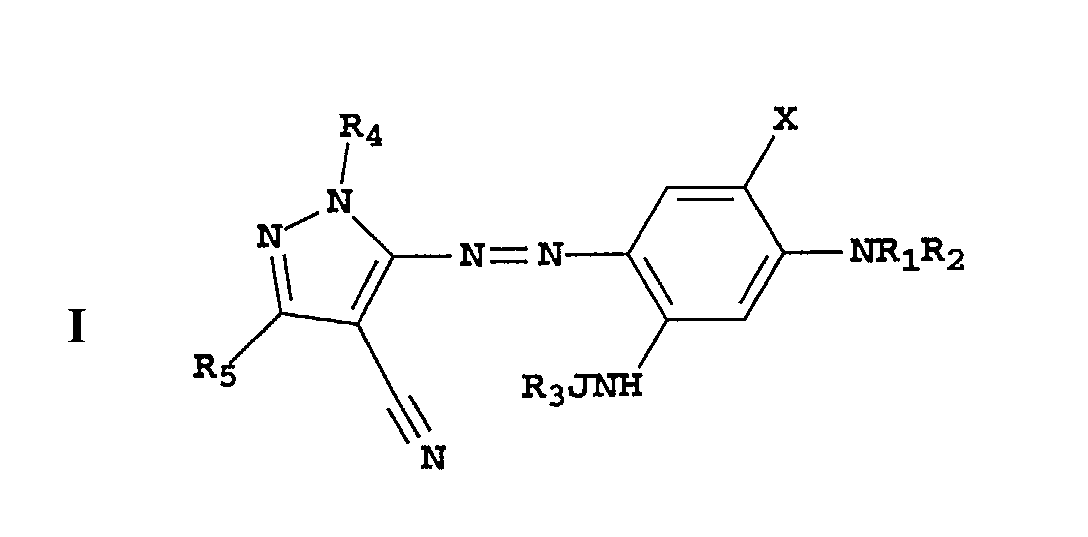
- R1 is an alkyl or allyl group of from 1 to 6 carbon atoms, such as methyl, ethyl, propyl, isopropyl, butyl, pentyl, allyl, but-2-en-1-yl, 1,1-dichloropropen-3-yl, including such alkyl or allyl groups substituted with groups such as hydroxy, acyloxy, alkoxy, aryl, carboxy, carbalkoxy, cyano, acylamido, halogen;
- X is an alkoxy group of from 1 to 4 carbon atoms or represents the atoms when taken together with R2 forms a 5- or 6-membered ring;
- R2 is any of the groups as described for R1 or represents the atoms which when taken together with X forms a 5- or 6-membered ring;
- R3 is an alkyl group of from 1 to 6 carbon atoms such as those listed above for R1, or an aryl group of from 6 to 10 carbon atoms such as phenyl, naphthyl, p-tolyl, m-chlorophenyl, p-methoxyphenyl, m-bromophenyl, and o-tolyl groups;
- J is CO, CO2, SO2, or CONR5;
- R4 is an alkyl or allyl group of from 1 to 6 carbon atoms, such as those listed above for R1, or an aryl group of from 6 to 10 carbon atoms such as those listed above for R3; and
- R5 is hydrogen, an alkyl or allyl group of from 1 to 6 carbon atoms, such as those listed above for R1, or an aryl group of from 6 to 10 carbon atoms such as those listed above for R3.
-
- The yellow dye is suitably at least one of those of formulas II or III:wherein:

- R6 is an alkyl or allyl group of from 1 to 6 carbon atoms, such as methyl, ethyl, propyl, isopropyl, butyl, pentyl, allyl, but-2-en-1-yl, 1,1-dichloropropen-3-yl, or such alkyl or allyl groups substituted with groups such as hydroxy, acyloxy, alkoxy, aryl, carboxy, carbalkoxy, cyano, acylamido, halogen, and phenyl;
- R7 is any of the groups as described for R6, or represents the atoms which when taken together with R8 forms a 5- or 6-membered ring;
- R8 is an alkyl or alkoxy group of from 1 to 6 carbon atoms, or represents the atoms which when taken together with R7 forms a 5- or 6-membered ring group; and
- R9 and R10 are each an alkyl group of 1-6 carbon atoms, or an aryl group of
from 6 to 10 carbon atoms such as phenyl, naphthyl, p-tolyl, m-chlorophenyl,
p-methoxyphenyl, m-bromophenyl, and o-tolyl groups.
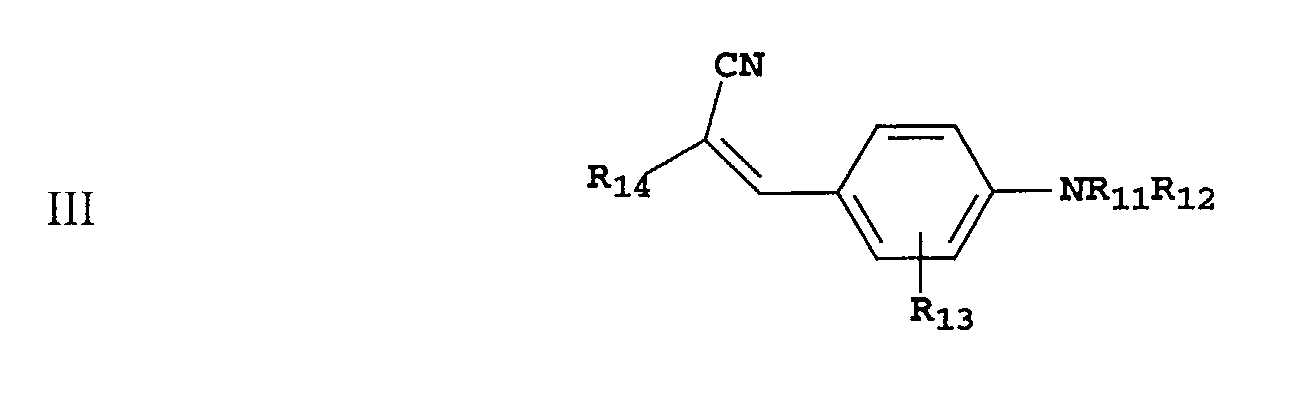 wherein:
- R11 is an alkyl or allyl group of from 1 to 6 carbon atoms, such as methyl, ethyl, propyl, isopropyl, butyl, pentyl, allyl, but-2-en-1-yl, 1,1-dichloropropen-3-yl, or such alkyl or allyl groups substituted with substituents such as hydroxy, acyloxy, alkoxy, aryl, carboxy, carbalkoxy, cyano, acylamido, halogen, and phenyl groups;
- R12 is any of the groups as described for R11, or represents the atoms which when taken together with R13 form a 5- or 6-membered ring group;
- R13 is an alkyl or alkoxy of from 1 to 6 carbon atoms, or represents the atoms which when taken together with R12 form a 5- or 6-membered ring group;
- R14 is cyano, C(O)OR15 or -CONR15R16, where R15 and R16 each independently represents an alkyl group having from 1 to 6 carbon atoms; a cycloalkyl group of from 5 to 7 carbon atoms; an allyl group; an aryl group of from 6 to 10 carbon atoms such as phenyl, naphthyl, p-tolyl, m-chlorophenyl, p-methoxyphenyl, m-bromophenyl, and o-tolyl; or a heteroaryl group of from 5 to 10 atoms, such as 2-thienyl, 2-pyridyl, or 2-furyl.
-
- In some embodiments, the combination can include an additional dye of formula IV:wherein:

- R17, R18, and R19 each independently represents an alkyl group having from 1 to 10 carbon atoms; a cycloalkyl group of from 5 to 7 carbon atoms; an allyl group; an aryl group of from 6 to 10 carbon atoms such as phenyl, naphthyl, p-tolyl, m-chlorophenyl, p-methoxyphenyl, m-bromophenyl,and o-tolyl; or a heteroaryl group of from 5 to 10 atoms, such as 2-thienyl, 2-pyridyl, or 2-furyl;
- X represents C(CH3)2, S, O, or NR17.
-
- In a laser thermal dye donor element, the element includes an IR dye such as one of formula V:wherein:
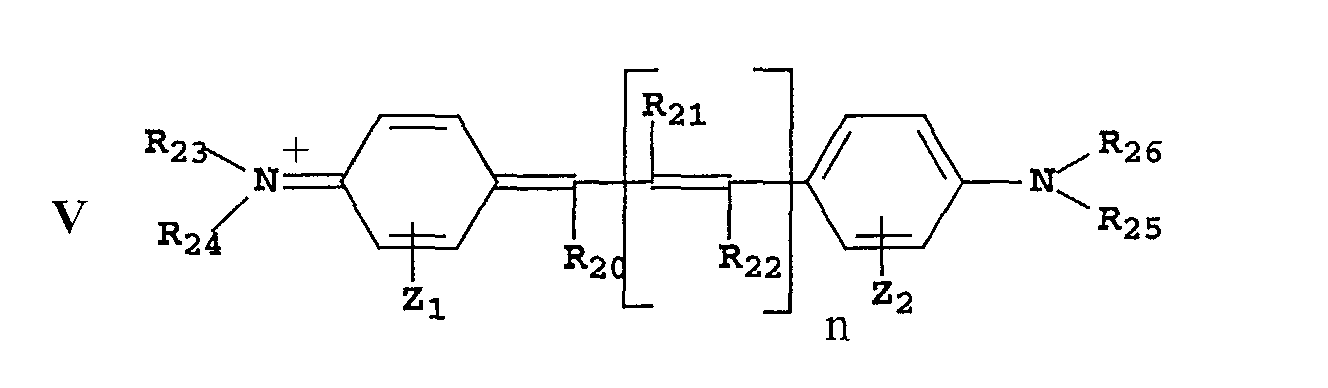
- R20, R21, and R22 each independently represents hydrogen, halogen, cyano, alkoxy, aryloxy, acyloxy, aryloxycarbonyl, alkoxycarbonyl, sulfonyl, carbamoyl, acyl, acylamido, alkylamino, arylamino, or a substituted or unsubstituted alkyl, aryl, or a heteroaryl group; or any two of said R20, R21, and R22 groups may be joined together or with an adjacent aromatic ring to complete a 5- to 7-membered carbocyclic or heterocyclic ring group;
- R23, R24, R25, and R26 each independently represents hydrogen, an alkyl or
cycloalkyl group having from 1 to 6 carbon atoms or an aryl or heteroaryl
group having from 5 to 10 atoms;
or R23, R24, R25, and R26 may be joined together to form a 5- to 7-membered heterocyclic ring;
or R23, R24, R25, and R26 may be joined to the carbon atom of the adjacent aromatic ring at a position ortho to the position of attachment of the anilino nitrogen to form, along with the nitrogen to which they are attached, a 5- or 6-membered heterocyclic ring group; - n is 1 to 5;
- X is a monovalent anion; and
- Z1 and Z2 each independently represents R20 or the atoms necessary to complete a 5- to 7-membered fused carbocyclic or heterocyclic ring.
-
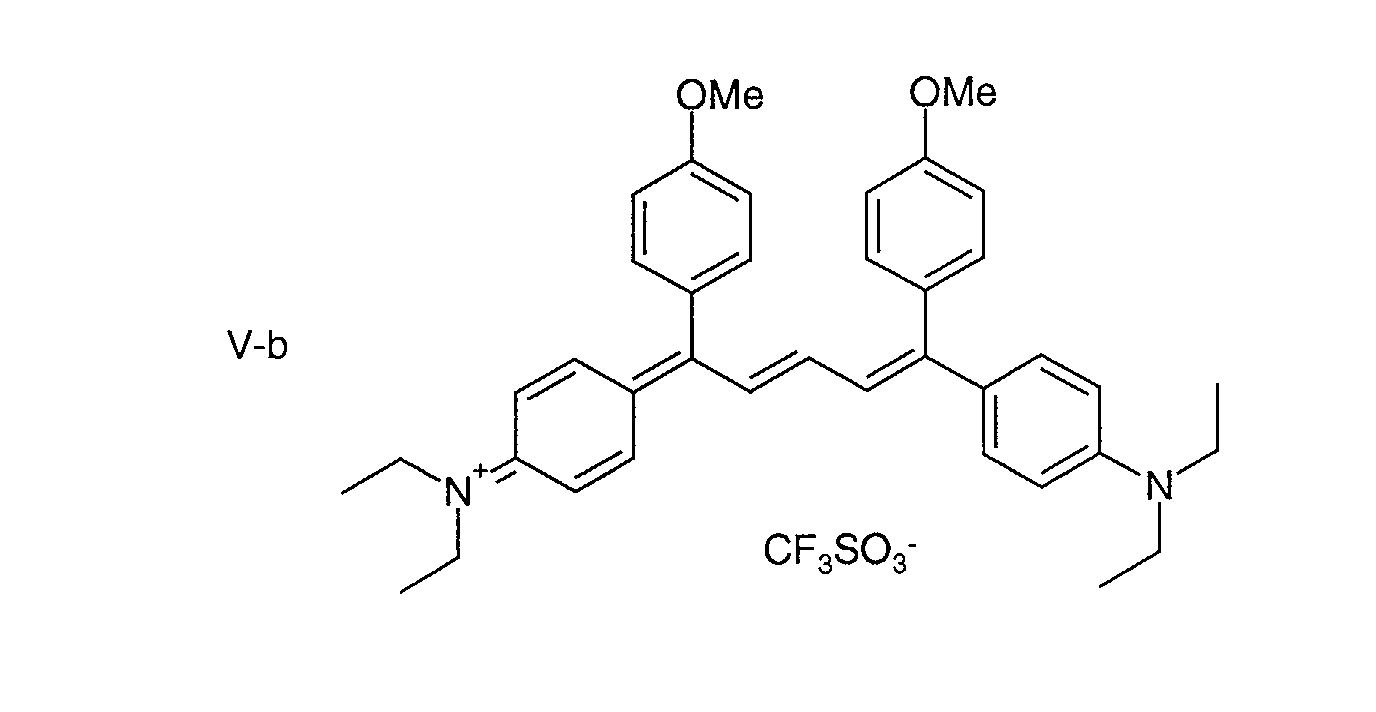
- In a preferred embodiment of the invention either of the following infrared-absorbing dyes are used:

- Useful magenta dyes of structure I included within the scope of the invention are as follows:

Dye R1 R2 R3 R4 R5 X J Ia C2H5 C2H5 CH3 CH2CH(OH)CH3 t-C4H9 OCH3 CO Ib C2H5 C2H5 CH3 CH3 t-C4H9 OCH3 CO Ic C2H5 C2H5 t-C4H9 CH3 CH3 OCH3 CO Id C3H7 C3H7 CH3 CH3 t-C4H9 OCH3 CO Ie C2H5 C2H5 CH3 CH2CH3 t-C4H9 OCH2CH3 SO2 If C2H5 C2H5 C2H5 CH3 CH3 OCH2CH3 CO Ig C2H5 C3H7 CH3 CH3 f-C4H9 OCH3 CO Ih C2H5 C2H5 CH3 CH3 t-C4H9 OCH3 CO2 Ij C2H5 C2H5 C6H5 C3H7 f-C4H9 OCH2CH3 SO2 Ik CH2CH=CH2 CH2CH=CH2 CH3 CH2C6H5 t-C4H9 OCH3 CO Im C3H7 C3H7 C2H5 C2H5 CH3 OC3H7 CO In C3H7 C3H7 C2H5 C2H5 CH3 OC3H7 SO2 Io C2H5 C2H5 CH3 CH2C(O)OC2H5 t-C4H9 OCH3 CO Ip C2H5 C2H5 CH3 CH2C(O)OC3H7 t-C4H9 OCH3 CO 

- The above dyes and synthetic procedures for making these are disclosed in US 3,336,285, GB 1,566,985, DE 2,600,036 and Dyes and Pigments, Vol 3, 81 (1982), the disclosures of which are hereby incorporated by reference.
- Useful yellow dyes within the scope of formula II include the following:

Dye R6 R7 R8 R9 R10 IIa C2H5 C2H5 H C6H5 C2H5 IIb C2H5 -C(CH3)2CH2CH(CH3)- C6H5 C2H5 He CH3 CH3 2-CH3 C6H5 C2H5 IId CH2C6H5 CH2C6H5 H C6H5 C2H5 IIe C2H5 C2H5 H C6H5 C4H9 IIf C2H5 C2H5 H C6H5 CH2CH=CH2 IIg C2H5 C2H5 H C6H5 CH2CH2C(O)OCH3 IIh C2H5 C2H5 H C6H5 CH2C(O)OCH2CH3 - Useful yellow dyes within the scope of formula III include the following:

Dye R11 R12 R13 R14 IIIa C2H5 C2H5 H CN IIIb C2H5 C2H5 2-CH3 CN IIIc CH2C6H5 CH2C6H5 H CN IIId C2H5 -C(CH3)2CH2CH(CH3)- CN IIIe C2H5 CH2C6H5 H CN IIIf C2H5 CH2C6Hs H C(O)NHCH2C6H5 IIIg C2H5 C2H5 H C(O)NHCH2C6H5 IIIh CH2C6H5 CH2C6H5 H C(O)NHCH2C6H5 IIIj CH2C6H5 CH2C6H5 H C(O)N(C2H5)CH2C6H5 IIIk C2H5 C2H5 H C(O)OCH2C6H5 IIIm C2H5 C2H5 H C(O)OCH2CH3 IIIn CH2C6H5 CH2C6H5 H C(O)OCH2CH3 IIIo C2H5 CH2C6H5 H C(O)OCH2CH3 IIIp CH2C(O)OC2H5 CH2C(O)OC2H5 H CN - The above dyes and synthetic procedures for making these are disclosed in US 3,247,211 and US 5,081,101, the disclosure of which are hereby incorporated by reference.
- Useful additional dyes within the scope of formula IV include the following:

Dye R17 R18 K19 X Y IVa C2H5 CH3 C2H5 S C6H4 IVb CH2C6H5 CH3 CH3 S C6H4 IVC C4H9 C2H5 C3H7 C(CH3)2 C6H4 IVd C2H4OCH3 CH3 C4H9 C(CH3)2 C6H4 IVe C4H9 C2H5 C4H9 C(CH3)2 C6H4 IVf C2H4OC2H5 CH3 C2H5, C(CH3)2 C6H4 IVc CH2C6H5 CH3 CH3 C(CH3)2 C6H4 - The above dyes and synthetic procedures for making these are disclosed in JP 53/014734, the disclosure of which is hereby incorporated by reference.
- Useful infrared absorbing materials of structure V are disclosed in U.S. 4,950,639, columns 3-7, the disclosure of which is hereby incorporated. Dyes of structure Va and Vb disclosed above and related structures are also useful.
- Beside the foregoing objectives, it is also desirable for the dye-donor element to be stable to environmental conditions to which it may be subjected to during use.
- Unless otherwise specifically stated, use of the term "group", "substituted" or "substituent" means any group or radical other than hydrogen. Additionally, when reference is made in this application to a compound or group that contains a substitutable hydrogen, it is also intended to encompass not only the unsubstituted form, but also its form further substituted with any substituent group or groups as herein mentioned, so long as the substituent does not destroy properties necessary for the intended utility. Suitably, a substituent group may be halogen or may be bonded to the remainder of the molecule by an atom of carbon, silicon, oxygen, nitrogen, phosphorous, or sulfur. The substituent may be, for example, halogen, such as chloro, bromo or fluoro; nitro; hydroxyl; cyano; carboxyl; or groups which may be further substituted, such as alkyl, including straight or branched chain or cyclic alkyl, such as methyl, trifluoromethyl, ethyl, t-butyl, 3-(2,4-di-t-pentylphenoxy) propyl, cyclohexyl, and tetradecyl; alkenyl, such as ethylene, 2-butene; alkoxy, such as methoxy, ethoxy, propoxy, butoxy, 2-methoxyethoxy, sec-butoxy, hexyloxy, 2-ethylhexyloxy, tetradecyloxy, 2-(2,4-di-t-pentylphenoxy)ethoxy, and 2-dodecyloxyethoxy; aryl such as phenyl, 4-t-butylphenyl, 2,4,6-trimethylphenyl, naphthyl; aryloxy, such as phenoxy, 2-methylphenoxy, alpha- or beta-naphthyloxy, and 4-tolyloxy; carbonamido, such as acetamido, benzamido, butyramido, tetradecanamido, alpha-(2,4-di-t-pentyl-phenoxy)acetamido, alpha-(2,4-di-t-pentylphenoxy)butyramido, alpha-(3-pentadecylphenoxy)-hexanamido, alpha-(4-hydroxy-3-t-butylphenoxy)-tetradecanamido, 2-oxo-pyrrolidin-1-yl, 2-oxo-5-tetradecylpyrrolin-1-yl, N-methyltetradecanamido, N-succinimido, N-phthalimido, 2,5-dioxo-1-oxazolidinyl, 3-dodecyl-2,5-dioxo-1-imidazolyl, and N-acetyl-N-dodecylamino, ethoxycarbonylamino, phenoxycarbonylamino, benzyloxycarbonylamino, hexadecyloxycarbonylamino, 2,4-di-t-butylphenoxycarbonylamino, phenylcarbonylamino, 2,5-(di-t-pentylphenyl)carbonylamino, p-dodecyl-phenylcarbonylamino, p-tolylcarbonylamino, N-methylureido, N,N-dimethylureido, N-methyl-N-dodecylureido, N-hexadecylureido, N,N-dioctadecylureido, N,N-dioctyl-N'-ethylureido, N-phenylureido, N,N-diphenylureido, N-phenyl-N-p-tolylureido, N-(m-hexadecylphenyl)ureido, N,N-(2,5-di-t-pentylphenyl)-N'-ethylureido, and t-butylcarbonamido; sulfonamido, such as methylsulfonamido, benzenesulfonamido, p-tolylsulfonamido, p-dodecylbenzenesulfonamido, N-methyltetradecylsulfonamido, N,N-dipropyl-sulfamoylamino, and hexadecylsulfonamido; sulfamoyl, such as N-methylsulfamoyl, N-ethylsulfamoyl, N,N-dipropylsulfamoyl, N-hexadecylsulfamoyl, N,N-dimethylsulfamoyl; N-[3-(dodecyloxy)propyl]sulfamoyl, N-[4-(2,4-di-t-pentylphenoxy)butyl]sulfamoyl, N-methyl-N-tetradecylsulfamoyl, and N-dodecylsulfamoyl; carbamoyl, such as N-methylcarbamoyl, N,N-dibutylcarbamoyl, N-octadecylcarbamoyl, N-[4-(2,4-di-t-pentylphenoxy)butyl]carbamoyl, N-methyl-N-tetradecylcarbamoyl, and N,N-dioctylcarbamoyl; acyl, such as acetyl, (2,4-di-t-amylphenoxy)acetyl, phenoxycarbonyl, p-dodecyloxyphenoxycarbonyl methoxycarbonyl, butoxycarbonyl, tetradecyloxycarbonyl, ethoxycarbonyl, benzyloxycarbonyl, 3-pentadecyloxycarbonyl, and dodecyloxycarbonyl; sulfonyl, such as methoxysulfonyl, octyloxysulfonyl, tetradecyloxysulfonyl, 2-ethylhexyloxysulfonyl, phenoxysulfonyl, 2,4-di-t-pentylphenoxysulfonyl, methylsulfonyl, octylsulfonyl, 2-ethylhexylsulfonyl, dodecylsulfonyl, hexadecylsulfonyl, phenylsulfonyl, 4-nonylphenylsulfonyl, and p-tolylsulfonyl; sulfonyloxy, such as dodecylsulfonyloxy, and hexadecylsulfonyloxy; sulfinyl, such as methylsulfinyl, octylsulfinyl, 2-ethylhexylsulfinyl, dodecylsulfinyl, hexadecylsulfinyl, phenylsulfinyl, 4-nonylphenylsulfinyl, and p-tolylsulfinyl; thio, such as ethylthio, octylthio, benzylthio, tetradecylthio, 2-(2,4-di-t-pentylphenoxy)ethylthio, phenylthio, 2-butoxy-5-t-octylphenylthio, and p-tolylthio; acyloxy, such as acetyloxy, benzoyloxy, octadecanoyloxy, p-dodecylamidobenzoyloxy, N-phenylcarbamoyloxy, N-ethylcarbamoyloxy, and cyclohexylcarbonyloxy; amine, such as phenylanilino, 2-chloroanilino, diethylamine, dodecylamine; imino, such as 1 (N-phenylimido)ethyl, N-succinimido or 3-benzylhydantoinyl; phosphate, such as dimethylphosphate and ethylbutylphosphate; phosphite, such as diethyl and dihexylphosphite; a heterocyclic group, a heterocyclic oxy group or a heterocyclic thio group, each of which may be substituted and which contain a 3 to 7 membered heterocyclic ring composed of carbon atoms and at least one hetero atom selected from the group consisting of oxygen, nitrogen and sulfur, such as 2-furyl, 2-thienyl, 2-benzimidazolyloxy or 2-benzothiazolyl; quaternary ammonium, such as triethylammonium; and silyloxy, such as trimethylsilyloxy.
- If desired, the substituents may themselves be further substituted one or more times with the described substituent groups. The particular substituents used may be selected by those skilled in the art to attain the desired desirable properties for a specific application and can include, for example, hydrophobic groups, solubilizing groups, blocking groups, and releasing or releasable groups. When a molecule may have two or more substituents, the substituents may be joined together to form a ring such as a fused ring unless otherwise provided. Generally, the above groups and substituents thereof may include those having up to 48 carbon atoms, typically 1 to 36 carbon atoms and usually less than 24 carbon atoms, but greater numbers are possible depending on the particular substituents selected.
- The following examples are provided to illustrate the invention.
- Individual magenta dye-donor elements were prepared by coating on a 100µm poly(ethylene terephthalate) support a dye layer containing a mixture of a magenta dye, one or more yellow dyes, the infrared-absorbing bis(aminoaryl)polymethine dye as described in US 4,950,639 (column 2 lines 3-68 and column 3 lines 1-3) at 0.046 g/m2 in a polyvinylbutyral binder (BS18 from Wacker Chemie) at 0.46 g/m2. The following experimental ratios shown in Table 1 were used in laydowns as listed:
Magenta Dye-Donor Magenta Dye Ia (wt%) Yellow Dye IIIf (wt%) Yellow Dye IIg (wt%) IR Dye Dry Coverage (g/m2) M-1 94.1 5.9 0 IV-b 0.368 M-2 88.6 11.4 0 IV-b 0.379 M-3 85.7 14.3 0 IV-b 0.453 M-4 84.2 15.8 0 IV-b 0.409 M-5 93.9 2.8 3.3 IV-b 0.378 M-6 91.0 5.5 3.4 IV-b 0.390 M-7 93.4 2.8 3.8 IV-b 0.381 M-8 92.8 3.5 3.7 IV-b 0.382 M-9 85.7 14.3 0 IV-b 0.390 M-10 85.7 13.2 1.1 IV-a 0.490 M-11 86.8 7.9 5.3 IV-a 0.393 - Control 1 for comparative purposes was Kodak Approval® Magenta Digital Color Proofing Film, CAT# 8160459.
- An intermediate dye-receiving element, Kodak Approval® Intermediate Color Proofing Film, CAT# 1067560, was used with the above dye-donor elements to print an image. For the monochrome magenta images, the power to the laser array was modulated to produce a continuous tone image of uniform exposure steps of varying density as described in US 4,876,235. After the exposure, the intermediate receiver was laminated to Tokuryo Art (Mitsubishi) paper which had been previously laminated with Kodak Approval® Prelaminate, P01.
- All measurements of the magenta images were made using an X-Rite 938 portable spectrophotometer set for D50 illuminant and 2° observer angle. Readings were made with black backing behind the samples. The CIELAB L* a* b* coordinates reported are interpolated to a Status T density of 1.60.
- The color differences between the samples can be expressed as ΔE, where ΔE is the vector difference in CIELAB color space between the laser thermal generated image and the Japan Color aim.
- Table 2 summarizes the results obtained. The 2001 Japan Color/Color Sample colorimetry values currently under consideration by the Japan National Committee for ISO/TC130 were used as the color reference.
Magenta Dye-Donor L* a* b* ΔE Hue Angle ΔHue Angle Japan 46.6 75.1 -4.4 - 356.6 - Color M-1 46.2 74.8 -3.0 1.2 357.7 1.1 M-2 46.2 75.4 -5.4 1.15 355.9 -0.7 M-3 46.2 75.2 -4.2 0.44 356.8 0.2 M-4 46.3 74.9 -3.4 1.07 357.4 0.8 M-5 46.1 75.6 -3.3 1.32 357.5 0.9 M-6 46.1 75.3 -3.3 1.26 357.5 0.9 M-7 46.1 75.4 -2.7 1.81 358 1.4 M-8 46.1 75.5 -3.3 1.31 357.5 0.9 M-9 46.4 75.5 -4.5 0.39 356.6 0 M-10 46.4 75.5 -3.6 0.93 357.3 0.7 M-11 46.5 76.1 -4.5 1.02 356.6 0 Control 1 47.5 75.2 0.3 4.80 1.1 4.5 - As can be seen by comparison of the control from Table 2, the inventive examples provide a closer match to the Japan Color aims (ΔE) while maintaining a good match in hue angle. A ΔE of 1 is sufficient to provide a just noticeable difference.
- The L* a* b* color match can be achieved with a multitude of dye blends. The best secondary color reproduction, however, was achieved by best matching the spectral characteristics of the targets using the RMS values.
- Individual magenta dye-donor elements were prepared by coating on a 100µm poly(ethylene terephthalate) support a dye layer containing a mixture of a magenta dye, one or more yellow dyes, the infrared-absorbing bis(aminoaryl)polymethine dye as described in US 4,950,639 (column 2 lines 3-68 and column 3 lines 1-3) at 0.054 g/m2 in a polyvinylbutyral binder (Butvar B-72) at 0.463 g/m2. The following experimental ratios shown in Table 1 were used in laydowns as listed:
Magenta Dye-Donor Dye Io (wt%) Dye IIIp (wt%) Dye IIg (wt%) Dry Dye IVd (wt%) IR Dye Cov. (g/m2) M-12 73.5 9.0 8.5 9.0 IV-b 0.506 - An intermediate dye-receiving element, Kodak Approval® Intermediate Color Proofing Film, CAT# 1067560, was used with the above dye-donor element to print an image as in Examples 1-11. After the exposure, the intermediate receiver was laminated to both Tokuryo Art paper which had been previously laminated with Kodak Approval® Prelaminate, P01 and 60# TextWeb ™(Deferient Paper Company) paper which had been previously laminated with Kodak Approval® Prelaminate, P02.
- The Japan Color comparison measurements of the magenta image were made using an X-Rite 938 portable spectrophotometer set for D50 illuminant and 2° observer angle. The SWOP comparison measurements of the magenta image were made using a Gretag SPM100 portable spectrophotometer set for D50 illuminant and 2° observer angle. All readings were made with black backing behind the samples. The CIELAB L* a* b* coordinates reported are interpolated to a Status T density of 1.52 for comparison to the Japan aim and to a Status T density of 1.41 for comparison with a SWOP certified press sheet (00-15-162), and at a 1.30 Status T density for comparison against the publication ANSI-CGATS TR 001 - 1995, which used a comparable lower magenta density.
Magenta Dye-Donor L* a* b* ΔE Hue Angle ΔHue Angle Japan Press Sheet 46.76 75.31 -4.45 - 356.62 - M-12 46.74 74.68 -4.47 0.63 356.57 -0.05 C-2 46.94 72.23 5.42 10.34 364.29 7.67 C-1 48.69 74.56 -0.27 4.7 359.8 3.18 SWOP Certified Press Sheet 00-15-162 46.37 70.16 -1.64 - 358.66 - M-12 46.71 70.45 -1.23 0.61 359.00 0.34 C-2 47.35 69.42 3.47 5.26 362.86 4.20 C-1 49.11 71.31 -2.00 2.99 358.40 -0.26 ANSI CGATS TR001 1995 47.16 68.06 -3.95 - 356.68 - M-12 48.30 68.25 -3.42 1.27 357.13 0.45 C-2 48.95 67.35 0.92 4.59 360.79 4.11 C-1 50.59 69.20 -3.72 3.62 356.93 0.25 - As can be seen by comparison to the controls, the inventive examples show better match to color (small ΔE) while still maintaining good hue angle.
- Individual magenta dye-donor elements were prepared by coating on a 100µm poly(ethylene terephthalate) support a dye layer containing a mixture of a magenta dye, one or more yellow dyes, the infrared-absorbing bis(aminoaryl)polymethine dye as described in US 4,950,639 (column 2 lines 3-68 and column 3 lines 1-3) at 0.054 g/m2 in a polyvinylbutyral binder (Butvar B-72) at 0.463 g/m2. The following experimental ratio shown in Table 5 was used in laydowns as listed:
Magenta Dye-Donor Dye Io (wt%) Dye IIIp (wt%) Dye IIg (wt%) Dye IVd (wt%) IR Dye Dry Cov. (g/m2) M-13 76.2 19.0 4.8 0.0 IV-b 0.452 - An intermediate dye-receiving element, Kodak Approval® Intermediate Color Proofing Film, CAT# 1067560, was used with the above dye-donor element to print an image as in the examples 1 and 2 above. After the exposure, the intermediate receiver was laminated 60# TextWeb ™(Deferient Paper Company) paper which had been previously laminated with Kodak Approval® Prelaminate, P02. The following results were achieved in Table 6:
Magenta Dye-Donor L* a* b* ΔE Hue Angle ΔHue Angle SWOP Certified Press Sheet 00-15-162 46.37 70.16 -1.64 - 358.66 - M-13 45.88 69.70 -1.63 0.67 358.66 0.00 C-2 47.35 69.42 3.47 5.26 362.86 4.20 C-1 49.11 71.31 -2.00 2.99 358.40 -0.26 ANSI CGATS TR001 1995 47.16 68.06 -3.95 - 356.68 - M-13 47.62 67.71 -3.88 0.56 356.72 0.04 C-2 48.95 67.35 0.92 4.59 360.79 4.11 C-1 50.59 69.20 - 3.72 3.62 356.93 0.25 - As can be seen again by comparison to the controls, the inventive examples show better match to color (small ΔE) while still maintaining good hue angle.
- The above cited examples were also compared in terms of RMS Error against the "target" specified color aims, using the earlier defined formula. The results are summarized below in Table 7.
Magenta Examples RMS Error for Japan Color M-1 0.01264 M-2 0.01001 M-3 0.01016 M-4 0.01197 M-5 0.01331 M-6 0.01164 M-7 0.01443 M-8 0.01262 M-12 0.01009 C-1 0.02986 - As can be seen from the data above, examples of the invention display a smaller RMS error which accurately predicts a closer spectral match to the target ink aims.
- A similar comparison was run for the SWOP certified Press Aim in Table 8 below:
Magenta Examples RMS Error for SWOP Certified Press Sheet 00-15-162 M-12 0.00523 M-13 0.01286 C-1 0.01778 - As can be seen from the data above, examples of the invention display a smaller RMS error, thus providing a closer spectral match to the target ink aims.
- The entire contents of the patents and other publications referred to in this specification are incorporated herein by reference.
Claims (12)
- A thermal dye transfer imaging element comprising a magenta dye donor containing a combination of dyes including a magenta dye and a yellow dye exhibiting an RMS error of less than 0.015.
- The element of claim 1 wherein the RMS error is less than 0.008
- The element of claim 1 or 2 wherein the magenta dye is a phenylazopyrazole dye.
- The element of claim 3 wherein the magenta dye is represented by formula I:wherein:
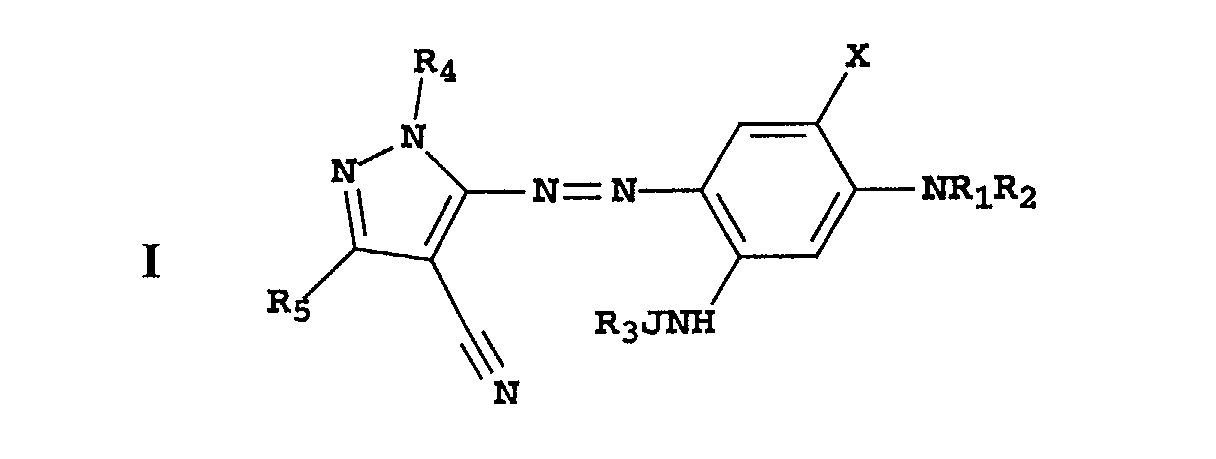 R1 is an alkyl or allyl group of from 1 to 6 carbon atoms;X is an alkoxy group of from 1 to 4 carbon atoms or represents the atoms when taken together with R2 forms a 5- or 6-membered ring group;R2 is any of the groups as described for R1 or represents the atoms which when taken together with X forms a 5- or 6-membered ring group;R3 is an alkyl group of from 1 to 6 carbon atoms or an aryl group of from 6 to 10 carbon;J is selected from the group consisting of CO, CO2, SO2, and CONR5;R4 is an alkyl or allyl group of from 1 to 6 carbon atoms or an aryl group of from 6 to 10 carbon atoms; andR5 is hydrogen, an alkyl or allyl group of from 1 to 6 carbon atoms, or an aryl group of from 6 to 10 carbon atoms.
 - The element of claim 4 wherein the magenta dye is one where each of R1 through R5 is an alkyl group and X is an alkoxy group.
- The element of claim 1 or 2 wherein the yellow dye is a dye of formula III:wherein:
 R1 is an alkyl or allyl group of from 1 to 6 carbon atoms;R12 is any of the groups as described for R11, or represents the atoms which when taken together with R13 form a 5- or 6-membered ring group;R13 is an alkyl or alkoxy of from 1 to 6 carbon atoms, or represents the atoms which when taken together with R12 form a 5- or 6-membered ring group; andR14 is cyano, C(O)OR15, or-CONR15R16, where R15 and R16 each independently represents an alkyl group having from 1 to 6 carbon atoms; a cycloalkyl group of from 5 to 7 carbon atoms; an allyl group; or an aryl group of from 6 to 10 carbon atoms.
 - The element of claim 6 wherein the yellow dye is one where each R1 and R12 is an alkyl group and R14 is a cyano, carbamoyl, or alkoxycarbonyl group.
- The element of claim 1 or 2 further containing a second yellow dye wherein the second yellow dye is a dye of Formula II:wherein:
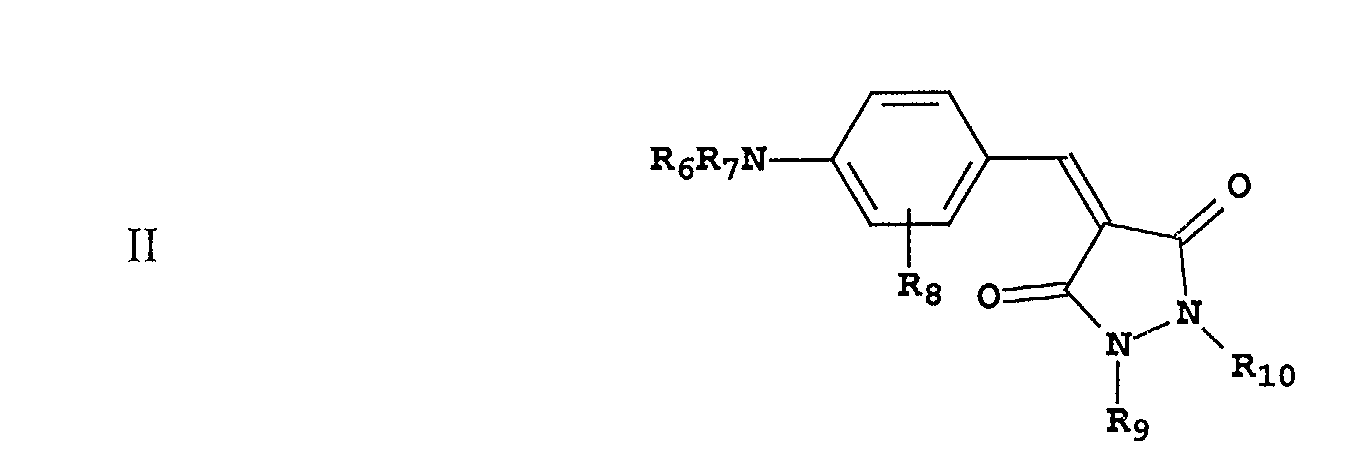 R6 is an alkyl or allyl group of from 1 to 6 carbon atoms;R7 is any of the groups as described for R6, or represents the atoms which when taken together with R8 form a 5- or 6-membered ring group;R8 is an alkyl or alkoxy group of from 1 to 6 carbon atoms, or represents the atoms which when taken together with R7 forms a 5- or 6-membered ring group; andR9 and R10 are each an alkyl group of from 1 to 6 carbon atoms or an aryl group of from 6 to 10 carbon atoms.
 - The element of claim 8 further including an additional dye of formula IV:wherein:
 R17, R18, and R19 each independently represents an alkyl group having from 1 to 10 carbon atoms; a cycloalkyl group of from 5 to 7 carbon atoms; an allyl group; an aryl group of from 6 to 10 carbon atoms; or a heteroaryl group of from 5 to 10 atoms; andX represents C(CH3)2, S, O, or NR17.
 - The element of claim 12 further comprising an IR dye wherein the IR dye is a dye of formula V:wherein:
 R20, R21, and R22 each independently represents hydrogen, halogen, cyano, alkoxy, aryloxy, acyloxy, aryloxycarbonyl, alkoxycarbonyl, sulfonyl, carbamoyl, acyl, acylamido, alkylamino, arylamino, alkyl, aryl, or a heteroaryl group; or any two of said R20, R21, and R22 groups may be joined together or with an adjacent aromatic ring to complete a 5- to 7-membered carbocyclic or heterocyclic ring group;R23, R24, R25, and R26 each independently represents hydrogen, an alkyl or cycloalkyl group having from 1 to 6 carbon atoms or an aryl or heteroaryl group having from 5 to 10 atoms;
or R23, R24, R25, and R26 may be joined together to form a 5- to 7-membered heterocyclic ring;
or R23, R24, R25, and R26 may be joined to the carbon atom of the adjacent aromatic ring at a position ortho to the position of attachment of the anilino nitrogen to form, along with the nitrogen to which they are attached, a 5- or 6-membered heterocyclic ring group;n is 1 to 5;X is a monovalent anion; andZ1 and Z2 each independently represents R20 or the atoms necessary to complete a 5- to 7-membered fused carbocyclic or heterocyclic ring. - The element of claim 1 or 2 in which there are present a magenta and two yellow dyes are represent by formulas I, II, and III, respectively:wherein:
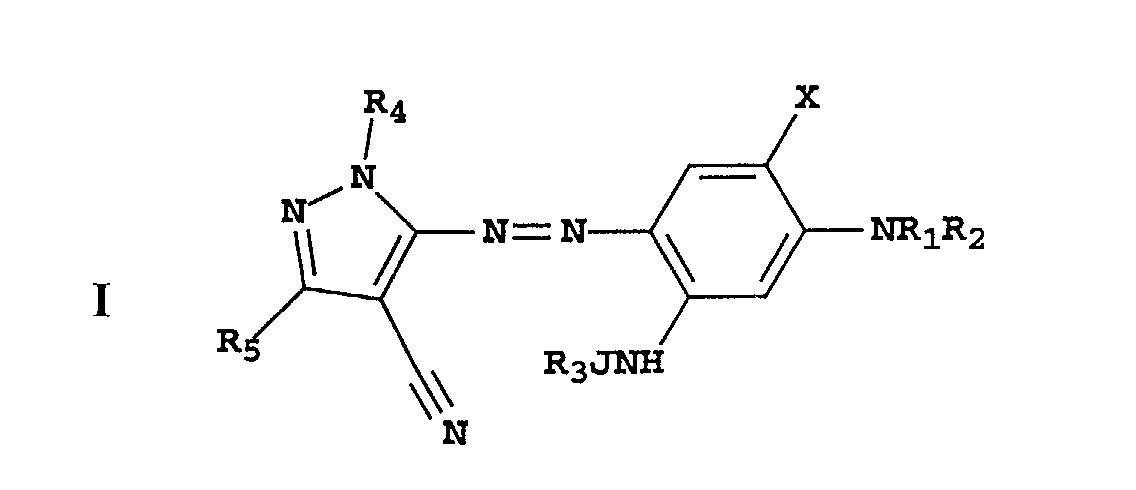 wherein:R1 is an alkyl or allyl group of from 1 to 6 carbon atoms;X is an alkoxy group of from 1 to 4 carbon atoms or represents the atoms when taken together with R2 forms a 5- or 6-membered ring group;R2 is any of the groups as described for R1 or represents the atoms which when taken together with X forms a 5- or 6-membered ring group;R3 is an alkyl group of from 1 to 6 carbon atoms or an aryl group of from 6 to 10 carbon;J is selected from the group consisting of CO, CO2, SO2, and CONR5;R4 is an alkyl or allyl group of from 1 to 6 carbon atoms or an aryl group of from 6 to 10 carbon atoms; andR5 is hydrogen, an alkyl or allyl group of from 1 to 6 carbon atoms, or an aryl group of from 6 to 10 carbon atoms;
 wherein:R6 is an alkyl or allyl group of from 1 to 6 carbon atoms;R7 is any of the groups as described for R6, or represents the atoms which when taken together with R8 form a 5- or 6-membered ring group;R8 is an alkyl or alkoxy group of from 1 to 6 carbon atoms, or represents the atoms which when taken together with R7 forms a 5- or 6-membered ring group; andR9 and R10 are each an alkyl group of from 1 to 6 carbon atoms or an aryl group of from 6 to 10 carbon atoms; and
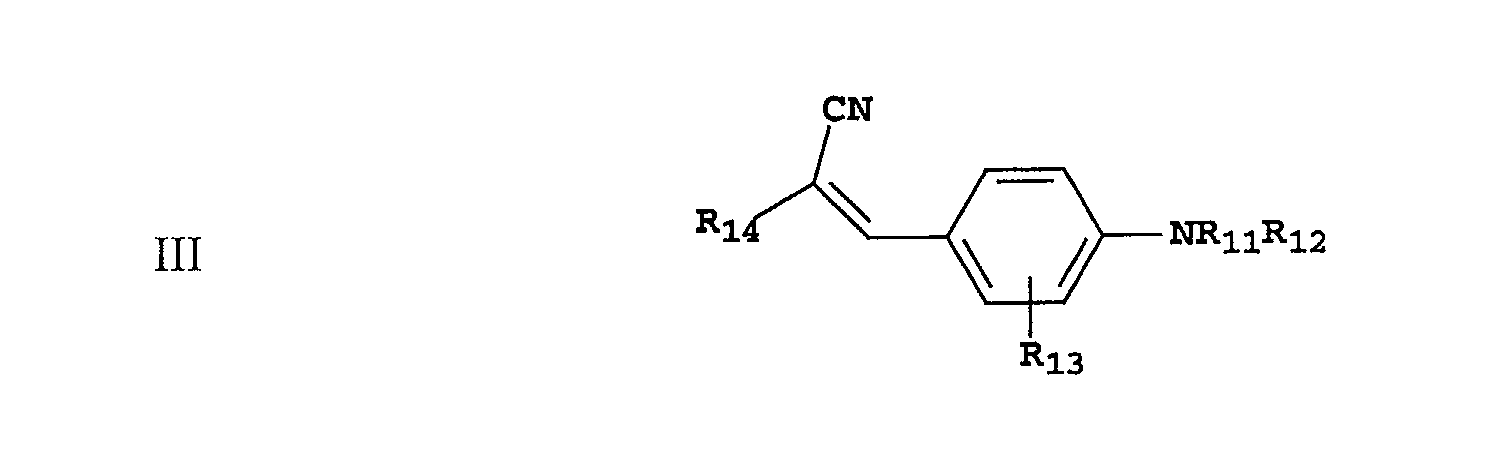 R11 is an alkyl or allyl group of from 1 to 6 carbon atoms;R12 is any of the groups as described for R11, or represents the atoms which when taken together with R13 form a 5- or 6-membered ring group;R13 is an alkyl or alkoxy of from 1 to 6 carbon atoms, or represents the atoms which when taken together with R12 form a 5- or 6-membered ring group; andR14 is cyano, C(O)OR15, or-CONR15R16, where R15 and R16 each independently represents an alkyl group having from 1 to 6 carbon atoms; a cycloalkyl group of from 5 to 7 carbon atoms; an allyl group; or an aryl group of from 6 to 10 carbon atoms.
 - A method of forming an image comprising imagewise transferring a dye from the element of any one of claims 1 or 11 to a receiving element.
Applications Claiming Priority (4)
| Application Number | Priority Date | Filing Date | Title |
|---|---|---|---|
| US10/153,569 US20030228979A1 (en) | 2002-05-22 | 2002-05-22 | Thermal magenta donor and dyes |
| US153569 | 2002-05-22 | ||
| US10/223,123 US6864216B2 (en) | 2002-05-22 | 2002-08-19 | Thermal magenta donor and dyes |
| US223123 | 2002-08-19 |
Publications (3)
| Publication Number | Publication Date |
|---|---|
| EP1364808A2 true EP1364808A2 (en) | 2003-11-26 |
| EP1364808A3 EP1364808A3 (en) | 2004-09-01 |
| EP1364808B1 EP1364808B1 (en) | 2006-05-10 |
Family
ID=29406295
Family Applications (1)
| Application Number | Title | Priority Date | Filing Date |
|---|---|---|---|
| EP03076407A Expired - Lifetime EP1364808B1 (en) | 2002-05-22 | 2003-05-12 | Magenta donor element for thermal transfer |
Country Status (4)
| Country | Link |
|---|---|
| US (1) | US6864216B2 (en) |
| EP (1) | EP1364808B1 (en) |
| JP (1) | JP2003335071A (en) |
| DE (1) | DE60305098T2 (en) |
Cited By (2)
| Publication number | Priority date | Publication date | Assignee | Title |
|---|---|---|---|---|
| EP1982839A1 (en) * | 2007-03-27 | 2008-10-22 | FUJIFILM Corporation | Heat-sensitive transfer image-forming method |
| CN104246061A (en) * | 2012-04-27 | 2014-12-24 | 富士胶片株式会社 | Inkjet printing colored composition, printing method, and fabric |
Families Citing this family (1)
| Publication number | Priority date | Publication date | Assignee | Title |
|---|---|---|---|---|
| CN113316572A (en) * | 2019-04-26 | 2021-08-27 | 株式会社艾迪科 | Polymethine compounds |
Citations (8)
| Publication number | Priority date | Publication date | Assignee | Title |
|---|---|---|---|---|
| DE2600036A1 (en) | 1975-01-13 | 1976-07-15 | Sandoz Ag | ORGANIC COMPOUNDS |
| GB1566985A (en) | 1977-06-16 | 1980-05-08 | Bayer Ag | Process for the preparation of azo dyestuffs |
| US4923846A (en) | 1986-04-30 | 1990-05-08 | Dai Nippon Insatsu Kabushiki Kaisha | Heat transfer sheet for color image formation |
| US5023229A (en) | 1990-10-31 | 1991-06-11 | Eastman Kodak Company | Mixture of dyes for magenta dye donor for thermal color proofing |
| US5126760A (en) | 1990-04-25 | 1992-06-30 | Eastman Kodak Company | Direct digital halftone color proofing involving diode laser imaging |
| US5866509A (en) | 1997-08-29 | 1999-02-02 | Eastman Kodak Company | Magenta dye mixture for thermal color proofing |
| US6022440A (en) | 1997-12-08 | 2000-02-08 | Imation Corp. | Image transfer process for ink-jet generated images |
| US6352330B1 (en) | 2000-03-01 | 2002-03-05 | Eastman Kodak Company | Ink jet plate maker and proofer apparatus and method |
-
2002
- 2002-08-19 US US10/223,123 patent/US6864216B2/en not_active Expired - Fee Related
-
2003
- 2003-05-12 EP EP03076407A patent/EP1364808B1/en not_active Expired - Lifetime
- 2003-05-12 DE DE60305098T patent/DE60305098T2/en not_active Expired - Fee Related
- 2003-05-22 JP JP2003145129A patent/JP2003335071A/en active Pending
Patent Citations (8)
| Publication number | Priority date | Publication date | Assignee | Title |
|---|---|---|---|---|
| DE2600036A1 (en) | 1975-01-13 | 1976-07-15 | Sandoz Ag | ORGANIC COMPOUNDS |
| GB1566985A (en) | 1977-06-16 | 1980-05-08 | Bayer Ag | Process for the preparation of azo dyestuffs |
| US4923846A (en) | 1986-04-30 | 1990-05-08 | Dai Nippon Insatsu Kabushiki Kaisha | Heat transfer sheet for color image formation |
| US5126760A (en) | 1990-04-25 | 1992-06-30 | Eastman Kodak Company | Direct digital halftone color proofing involving diode laser imaging |
| US5023229A (en) | 1990-10-31 | 1991-06-11 | Eastman Kodak Company | Mixture of dyes for magenta dye donor for thermal color proofing |
| US5866509A (en) | 1997-08-29 | 1999-02-02 | Eastman Kodak Company | Magenta dye mixture for thermal color proofing |
| US6022440A (en) | 1997-12-08 | 2000-02-08 | Imation Corp. | Image transfer process for ink-jet generated images |
| US6352330B1 (en) | 2000-03-01 | 2002-03-05 | Eastman Kodak Company | Ink jet plate maker and proofer apparatus and method |
Cited By (3)
| Publication number | Priority date | Publication date | Assignee | Title |
|---|---|---|---|---|
| EP1982839A1 (en) * | 2007-03-27 | 2008-10-22 | FUJIFILM Corporation | Heat-sensitive transfer image-forming method |
| US8012909B2 (en) | 2007-03-27 | 2011-09-06 | Fujifilm Corporation | Heat-sensitive transfer image-forming method |
| CN104246061A (en) * | 2012-04-27 | 2014-12-24 | 富士胶片株式会社 | Inkjet printing colored composition, printing method, and fabric |
Also Published As
| Publication number | Publication date |
|---|---|
| JP2003335071A (en) | 2003-11-25 |
| DE60305098T2 (en) | 2006-12-14 |
| EP1364808B1 (en) | 2006-05-10 |
| US20030232724A1 (en) | 2003-12-18 |
| US6864216B2 (en) | 2005-03-08 |
| EP1364808A3 (en) | 2004-09-01 |
| DE60305098D1 (en) | 2006-06-14 |
Similar Documents
| Publication | Publication Date | Title |
|---|---|---|
| JP4991557B2 (en) | Yellow ink composition for inkjet printing | |
| US4910187A (en) | Heat-sensitive transfer material | |
| JPH0764127B2 (en) | Dye mixtures for cyan dye-donor elements for thermal color proofing | |
| EP1364808B1 (en) | Magenta donor element for thermal transfer | |
| EP1346845B1 (en) | Transferable uv protective image overcoat | |
| US6841514B2 (en) | Thermal transfer imaging element containing infrared bichromophoric colorant | |
| EP1364807B1 (en) | Yellow donor element for thermal transfer | |
| EP1364806B1 (en) | Yellow donor element for thermal transfer, and dyes | |
| US20030228979A1 (en) | Thermal magenta donor and dyes | |
| US6703111B2 (en) | Laser thermal imaging process, dye, and element | |
| JP2001171244A (en) | Orange dye mixture for thermal color proof | |
| US7056375B2 (en) | Solubilized dyes for inks | |
| US7449500B2 (en) | Ink jet ink containing multimetallic polymeric colorants | |
| US5162293A (en) | Thermal transfer recording material | |
| JPH02202562A (en) | Ink for heat transfer |
Legal Events
| Date | Code | Title | Description |
|---|---|---|---|
| PUAI | Public reference made under article 153(3) epc to a published international application that has entered the european phase |
Free format text: ORIGINAL CODE: 0009012 |
|
| AK | Designated contracting states |
Kind code of ref document: A2 Designated state(s): AT BE BG CH CY CZ DE DK EE ES FI FR GB GR HU IE IT LI LU MC NL PT RO SE SI SK TR |
|
| AX | Request for extension of the european patent |
Extension state: AL LT LV MK |
|
| PUAL | Search report despatched |
Free format text: ORIGINAL CODE: 0009013 |
|
| AK | Designated contracting states |
Kind code of ref document: A3 Designated state(s): AT BE BG CH CY CZ DE DK EE ES FI FR GB GR HU IE IT LI LU MC NL PT RO SE SI SK TR |
|
| AX | Request for extension of the european patent |
Extension state: AL LT LV MK |
|
| RIC1 | Information provided on ipc code assigned before grant |
Ipc: 7G 03F 3/10 B Ipc: 7B 41M 5/38 A |
|
| 17P | Request for examination filed |
Effective date: 20050119 |
|
| AKX | Designation fees paid |
Designated state(s): DE GB |
|
| 17Q | First examination report despatched |
Effective date: 20050623 |
|
| RBV | Designated contracting states (corrected) |
Designated state(s): DE GB |
|
| GRAP | Despatch of communication of intention to grant a patent |
Free format text: ORIGINAL CODE: EPIDOSNIGR1 |
|
| RIC1 | Information provided on ipc code assigned before grant |
Ipc: G03F 3/10 19680901ALI20051128BHEP Ipc: B41M 5/382 00000000AFI20051128BHEP |
|
| GRAS | Grant fee paid |
Free format text: ORIGINAL CODE: EPIDOSNIGR3 |
|
| GRAA | (expected) grant |
Free format text: ORIGINAL CODE: 0009210 |
|
| AK | Designated contracting states |
Kind code of ref document: B1 Designated state(s): DE GB |
|
| REG | Reference to a national code |
Ref country code: GB Ref legal event code: FG4D |
|
| REF | Corresponds to: |
Ref document number: 60305098 Country of ref document: DE Date of ref document: 20060614 Kind code of ref document: P |
|
| PLBE | No opposition filed within time limit |
Free format text: ORIGINAL CODE: 0009261 |
|
| STAA | Information on the status of an ep patent application or granted ep patent |
Free format text: STATUS: NO OPPOSITION FILED WITHIN TIME LIMIT |
|
| 26N | No opposition filed |
Effective date: 20070213 |
|
| PGFP | Annual fee paid to national office [announced via postgrant information from national office to epo] |
Ref country code: DE Payment date: 20080530 Year of fee payment: 6 |
|
| PGFP | Annual fee paid to national office [announced via postgrant information from national office to epo] |
Ref country code: GB Payment date: 20080407 Year of fee payment: 6 |
|
| GBPC | Gb: european patent ceased through non-payment of renewal fee |
Effective date: 20090512 |
|
| PG25 | Lapsed in a contracting state [announced via postgrant information from national office to epo] |
Ref country code: GB Free format text: LAPSE BECAUSE OF NON-PAYMENT OF DUE FEES Effective date: 20090512 |
|
| PG25 | Lapsed in a contracting state [announced via postgrant information from national office to epo] |
Ref country code: DE Free format text: LAPSE BECAUSE OF NON-PAYMENT OF DUE FEES Effective date: 20091201 |