EP1363896B1 - Synthesis of beta-lapachone and its intermediates - Google Patents
Synthesis of beta-lapachone and its intermediates Download PDFInfo
- Publication number
- EP1363896B1 EP1363896B1 EP02707586A EP02707586A EP1363896B1 EP 1363896 B1 EP1363896 B1 EP 1363896B1 EP 02707586 A EP02707586 A EP 02707586A EP 02707586 A EP02707586 A EP 02707586A EP 1363896 B1 EP1363896 B1 EP 1363896B1
- Authority
- EP
- European Patent Office
- Prior art keywords
- lapachone
- lapachol
- synthesis
- triethylamine
- beta
- Prior art date
- Legal status (The legal status is an assumption and is not a legal conclusion. Google has not performed a legal analysis and makes no representation as to the accuracy of the status listed.)
- Expired - Lifetime
Links
- CIEYTVIYYGTCCI-UHFFFAOYSA-N CC(C)=CCC(C(c1ccccc1C1=O)=O)=C1O Chemical compound CC(C)=CCC(C(c1ccccc1C1=O)=O)=C1O CIEYTVIYYGTCCI-UHFFFAOYSA-N 0.000 description 1
Images


Classifications
-
- C—CHEMISTRY; METALLURGY
- C07—ORGANIC CHEMISTRY
- C07D—HETEROCYCLIC COMPOUNDS
- C07D311/00—Heterocyclic compounds containing six-membered rings having one oxygen atom as the only hetero atom, condensed with other rings
- C07D311/02—Heterocyclic compounds containing six-membered rings having one oxygen atom as the only hetero atom, condensed with other rings ortho- or peri-condensed with carbocyclic rings or ring systems
- C07D311/78—Ring systems having three or more relevant rings
Definitions
- the present invention is directed to a process for the synthesis of ⁇ -lapachone (Beta-lapachone) and lapachol, the ⁇ -lapachone (Beta-lapachone) intermediate, which are important agents in cancer chemotherapy.
- ⁇ -lapachone has demonstrated significant antineoplastic activity against human cancer cell lines at concentrations typically in the range of 1-10 ⁇ M (IC 50 ). Cytotoxicity has been demonstrated in transformed cell lines derived from patients with promyelocytic leukemia (Planchon et al., Cancer Res. , 55 (1996) 3706), prostate ( Li, C.J., et. al., Cancer Res., 55 (1995) 3712), malignant glioma (Weller, M. et al., Int. J.
- ⁇ -lapachone has been shown to be a DNA repair inhibitor that sensitizes cells to DNA-damaging agents including radiation (Boothman, D.A. et al., Cancer Res, 47 (1987) 5361; Boorstein, R.J., et al., Biochem. Biophys. Conunun., 117 (1983) 30).
- ⁇ -lapachone has also been shown to disrupt DNA replication, causing cell-cycle delays in G1 and/or S phase, inducing either apoptotic or necrotic cell death in a wide variety of human carcinoma cell lines without DNA damage and independent of p53 status (Li, Y.Z. et al (1999); Huang, L. et al.).
- Topoisomerase I is an enzyme that unwinds the DNA that makes up the chromosomes.
- the chromosomes must be unwound in order for the cell to use the genetic information to synthesize proteins; ⁇ -lapachone keeps the chromosomes wound tight, so that the cell cannot make proteins. As a result, the cell stops growing. Because cancer cells are constantly replicating and circumvent many mechanisms that restrict replication in normal cells, they are more vulnerable to topoisomerase inhibition than are normal cells.
- ⁇ -lapachone (3,4-dihydro-2,2-ditnethyl-2H-naphtho[1,2-b]pyran-5,6-dione), a quinone, is derived from lapachol (a naphthoquinone) which can be isolated from the lapacho tree (Tabebuia avellanedae), a member of the catalpa family (Bignoniaceae).
- Lapachol and ⁇ -lapachone have the following chemical structures:
- Method (1) is described in Schaffner-Sabba, K., et al., ⁇ -Lapachone: Synthesis of Derivatives and Activities in Tumor Models, J. Med. Chem., 27, (1984) 990-994, and is known as the potassium salt method.
- Method (2) is described in Sun, J.S. et al., A Preparative Synthesis of Lapachol and Related Naphthoquinones, Tetrahedron Letters , 39 (1998) 8221-8224), and is know as the lithium salt method. Both of these methods require the formation of a metal salt.
- Amaral, A., et al. in The Total Synthesis of ⁇ -lapachone, J.
- the present invention is directed generally to a process for the synthesis of ⁇ -lapachone and its intermediate, lapachol. More specifically, the invention is directed to process for synthesizing ⁇ -lapachone and its intermediates, derivatives and analogs, by a safe and simple process and which produces ⁇ -lapachone in high yield and high quality.
- the process of the present invention teaches a novel method for the synthesis of the ⁇ -lapachone intermediate, lapachol.
- Lapachol is then quantitatively converted to ⁇ -lapachone and purified.
- the process of the present invention eliminates this first step and commences directly with 2-hydroxy-1,4-naphthoquinone to react with 1-bromo-3-methyl-2-butene in the presence of sodium iodide and a weak base such as triethylamine, pyridine, trimethylamine, N,N-diisopropylethylamine, 2,6-lutidine, preferably triethylamine or pyridine, most preferably triethylamine, to form
- ⁇ -lapachone as well as its intermediates, derivatives and analogs thereof (also referred to herein as the "active compounds"), are described in Li, C.J. et al., J. Biol. Chem., 1993.
- the synthesis of ⁇ -lapachone commences with the reaction of 2-hydroxy-1,4-naphthoquinone with 1-bromo-3-methyl-2-butene in the presence of sodium iodide and triethylamine (a weak base) in dimethylsulfoxide (DMSO) to produce lapachol in up to 40% yield, after purification (20g, up to 40% overall yield).
- Lapacbol is then quantitatively converted to ⁇ -lapachone by treatment with sulfuric acid.
- the ⁇ -lapachone is purified by recrystallization from ethanol.
- TLC thin layer chromatography
- NMR nuclear magnetic resonance spectroscopy
- HPLC high pressure liquid chromatography
- the synthetic process for preparing the ⁇ -lapachone intermediate, lapachol commences with the preparation of a reaction mixture comprised of 2-hydroxyl-1,4-napthoquinone, 1-bromo-3-methyl-2-butene, triethylamine (TEA) and dimethylsulfoxide (DMSO).
- This reaction mixture is first stirred at room temperature under a noble gas atmosphere for about one hour.
- the reaction mixture is then heated and subsequently cooled to stop the reaction
- the mixture is then extracted three times with CH 2 Cl 2 (e.g., 500 ml, 300 ml, 200 ml) and the organic phases pooled and successively washed with water, followed by two washings with 5% sodium bicarbonate (NaHCO 3 ) and one washing with 1% sodium chloride (NaCl).
- the organic phase is then dried with sodium sulfate (Na 2 SO 4 ) and the filtrate, after filtration, is evaporated by Rotovap.
- the residue is then dissolved in toluene heated in a water bath at 50 °C and any existing insoluble material is filtered off.
- the resulting toluene solution is then extracted three times with 2 N NaOH (e.g., 800 ml, 300 ml, 200 ml).
- the resulting combined aqueous phase is then neutralized with 220 ml concentrated hydrochloric acid (HCl) and the mixture is extracted three times with toluene (e.g., 500 ml, 300 ml, 300 ml).
- the organic phases are then pooled and any (black) solids existing in the organic phase is removed by filtration.
- the combined organic phase is then washed successively with 1% NaCl, 5% aqueous sodium bicarbonate and 1% aqueous sodium chloride, the resulting organic phase is then dried with sodium sulfate and the resulting filtrate is evaporated by Rotovap to dryness, followed by the addition of isopropanol for co-evaporation to completely remove residual toluene. The residue is then dissolved in isopropanol, heated and then cooled. Pure lapachol is obtained after filtering washing with cold isopropanol and drying under vacuum.
- the synthesis of ⁇ -lapachone from lapachol commences with preparation of a reaction mixture comprised of the pure lapachol (30 g) in 300 ml of sulfuric acid.
- the reaction mixture is stirred at room temperature for 30 minutes and poured into ice water with manual stirring.
- the mixture is then extracted twice with toluene (e.g., 600 ml and 400 ml) to provide a combined organic phase, which is then washed successively with 800 ml of 1% NaCl, 400 ml of 1% NaHCO 3 and 800 ml of 1% NaCl.
- the resulting organic phase is then dried with 50 g Na 2 SO 4 and the solid is filtered off.
- Tolune in the remaining filtrate is then evaporated off by Rotovap and co-evaporated following the addition of ethanol to completely remove residual toluene.
- the residue is then dissolved in either 75% ethanol or absolute ethanol, preferably absolute ethanol, heated in an 80 °C water bath and then filtered and cooled to 4 °C. Pure ⁇ -lapachone is then isolated by filtration and washed with cold 75% ethanol (4 °C 100 ml), dried under vacuum, packed under Argon atmosphere and stored at -20 °C in the dark.
- the mixture is then transferred into a 2,000 ml separatory funnel and extracted three times with methylene chloride (500 ml, 300 ml and 200 ml).
- the organic phases were pooled and washed successively with water (800 ml), 5% aqueous sodium bicarbonate (2 X 800 ml)* and 1% aqueous sodium chloride (800 ml), then dried with sodium sulfate (50 g). After filtration, the filtrate was evaporated to dryness by Rotovap. The residue was dissolved in toluene (1,000 ml) with heating in a 50 °C water bath, and any insoluble material existing was filtered off.
- the warm toluene solution was extracted three times with freshly prepared, warm 2N sodium hydroxide (800 ml, 300 ml and 200 ml).
- the aqueous phases were pooled and neutralized by addition of hydrochloric acid (220 ml) with vigorous manual stirring, then extracted three times with toluene (500 ml, 300 ml and 300 ml).
- the organic phase were pooled and any black solid existing in the organic phases was removed by filtration.
- the combined organic phase was washed successively with 1% aqueous sodium chloride (800 ml), 5% aqueous sodium bicarbonate (500 ml) and 1% aqueous sodium chloride (800 ml), and then dried with sodium sulfate (50 g).
- lapachol (30 g, 0.124 mol) was added in portions slowly over 5 minutes at room temperature while stirring vigorously. After addition, the dark mixture was stirred for an additional 30 min and then poured into ice water (800 g) with manual stirring in a 2,000 ml beaker. The mixture was transferred into a 2,000 ml separatory funnel and extracted twice with toluene (600 ml and 400 ml).
- the toluene phases were pooled and washed successively with 1% aqueous sodium chloride (800 ml), 1% aqueous sodium bicarbonate (400 ml) and 1% aqueous sodium chloride (800 ml), and then dried with sodium sulfate (50 g). After filtration, the filtrate was evaporated to dryness by Rotovap and then ethanol (300 ml) was added for co-evaporation to completely remove residual toluene. The residue was dissolved in 75% ethanol or absolute ethanol, preferably absolute ethanol (ethanol/water, 3:1, 300 ml) with heating in an 80 °C water bath, then was filtered and cooled to 4 °C slowly. Pure ⁇ -lapachone was isolated by filtration, then washed with cold 75% ethanol (4 °C, 100 ml), dried under vacuum, packed under Argon atmosphere and stored at -20 °C in the dark.
- TAA triethylamine
- pyridine may also be used
- strong inorganic bases such as potassium hydroxide or lithium hydroxide as used in prior art lapachol syntheses to trap the acid generated from the reaction between the quinone and bromide compound
Landscapes
- Chemical & Material Sciences (AREA)
- Organic Chemistry (AREA)
- Organic Low-Molecular-Weight Compounds And Preparation Thereof (AREA)
- Pharmaceuticals Containing Other Organic And Inorganic Compounds (AREA)
- Pyrane Compounds (AREA)
- Low-Molecular Organic Synthesis Reactions Using Catalysts (AREA)
- Catalysts (AREA)
- Steroid Compounds (AREA)
Abstract
Description
- The present invention is directed to a process for the synthesis of β-lapachone (Beta-lapachone) and lapachol, the β-lapachone (Beta-lapachone) intermediate, which are important agents in cancer chemotherapy.
- Over 1.22 million new cancer cases will be diagnosed in the U.S. in the year 2001 alone. With more than 563,000 deaths annually, cancer is the second leading cause of death behind heart disease (UBS Warburg "Disease Dynamics: The Cancer Market", Nov. 8, 2000). Surgery and radiotherapy may be curative if the disease is found early, but current drug therapies for metastatic disease are mostly palliative and seldom offer a long-term cure. Even with the new chemotherapies entering the market, improvement in patient survival is measured in months rather than in years, and the need continues for new drugs effective both in combination with existing agents as first line therapy and as second and third line therapies in treatment of resistant tumors.
- As a single agent, β-lapachone has demonstrated significant antineoplastic activity against human cancer cell lines at concentrations typically in the range of 1-10 µM (IC50). Cytotoxicity has been demonstrated in transformed cell lines derived from patients with promyelocytic leukemia (Planchon et al., Cancer Res., 55 (1996) 3706), prostate ( Li, C.J., et. al., Cancer Res., 55 (1995) 3712), malignant glioma (Weller, M. et al., Int. J. Cancer, 73 (1997) 707), hepatoma (Lai, C.C., et al., Histol Histopathol, 13 (1998) 8), colon (Huang, L., et al., Mol Med, 5, (1999) 711), breast (Wuertzberger, S.M., et al., Cancer Res., 58 (1998) 1876), ovarian (Li, C.J, et al., Proc. Natl. Acad. Sci. USA, 96(23) (1999) 13369-74), pancreatic (Li, Y., et al., Mol Med, 6 (2000) 1008; Li, Y.Z., Mol Med, 5 (1999) 232), and multiple myeloma cell lines, including drug-resistant lines (Li, Y., Mol Med, 6 (2000) 1008). No cytotoxic effects were observed on normal fresh or proliferating human PBMC (Li, Y., Mol Med, 6 (2000) 1008).
- β-lapachone has been shown to be a DNA repair inhibitor that sensitizes cells to DNA-damaging agents including radiation (Boothman, D.A. et al., Cancer Res, 47 (1987) 5361; Boorstein, R.J., et al., Biochem. Biophys. Conunun., 117 (1983) 30). β-lapachone has also been shown to disrupt DNA replication, causing cell-cycle delays in G1 and/or S phase, inducing either apoptotic or necrotic cell death in a wide variety of human carcinoma cell lines without DNA damage and independent of p53 status (Li, Y.Z. et al (1999); Huang, L. et al.). Topoisomerase I is an enzyme that unwinds the DNA that makes up the chromosomes. The chromosomes must be unwound in order for the cell to use the genetic information to synthesize proteins; β-lapachone keeps the chromosomes wound tight, so that the cell cannot make proteins. As a result, the cell stops growing. Because cancer cells are constantly replicating and circumvent many mechanisms that restrict replication in normal cells, they are more vulnerable to topoisomerase inhibition than are normal cells.
- β-lapachone (3,4-dihydro-2,2-ditnethyl-2H-naphtho[1,2-b]pyran-5,6-dione), a quinone, is derived from lapachol (a naphthoquinone) which can be isolated from the lapacho tree (Tabebuia avellanedae), a member of the catalpa family (Bignoniaceae). Lapachol and β-lapachone have the following chemical structures:
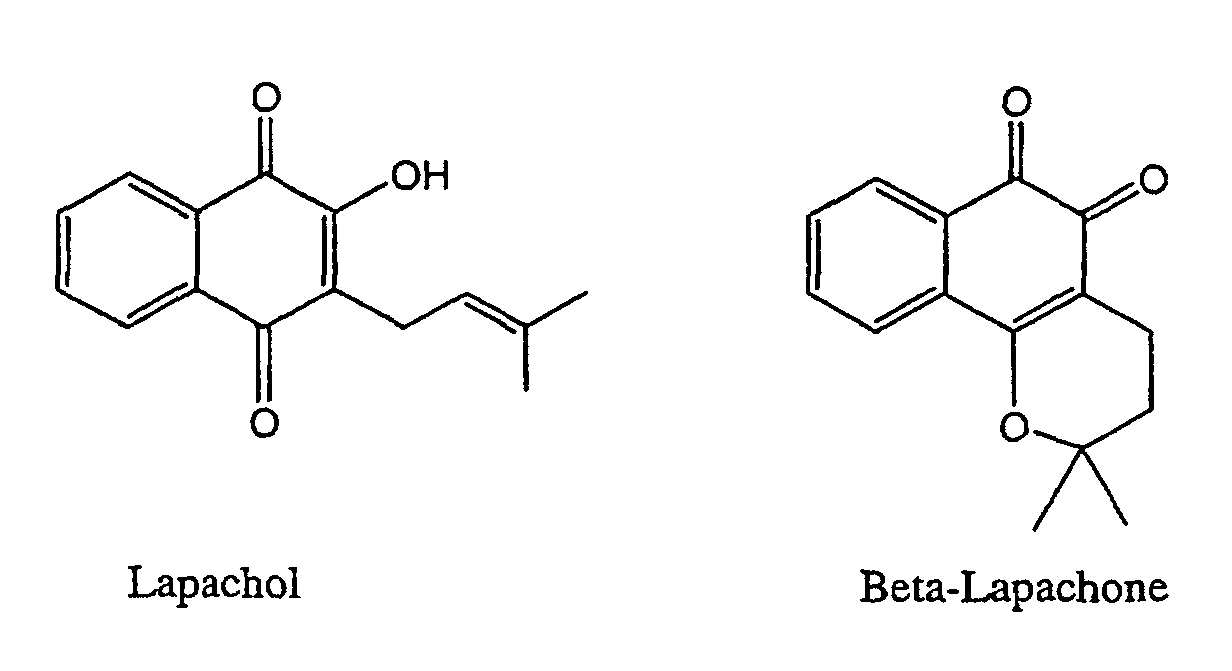
- It is, however, both difficult and time consuming to obtain the necessary large-scale quantities of β-lapachone naturally from the lapacho tree. Although the lapacho tree is nowhere near as rare as the Pacific yew tree, from which paclitaxel (Taxol®) is derived,ensuring a sufficient quality and supply of β-lapachone from natural sources can be problematic. Numerous methods are known in the art for synthesizing β-lapachone. Two related known methods for producing lapachol, an intermediate from which β-lapachone may be synthesized are illustrated in

Scheme 1. - Method (1) is described in Schaffner-Sabba, K., et al., β-Lapachone: Synthesis of Derivatives and Activities in Tumor Models, J. Med. Chem., 27, (1984) 990-994, and is known as the potassium salt method. Method (2) is described in Sun, J.S. et al., A Preparative Synthesis of Lapachol and Related Naphthoquinones, Tetrahedron Letters, 39 (1998) 8221-8224), and is know as the lithium salt method. Both of these methods require the formation of a metal salt. Amaral, A., et al., in The Total Synthesis of β-lapachone, J. Heterocyclic Chem., 29 (1992) 1457-1460, describes the synthesis of β-lapachone α-naphthol in eight steps and results in an overall yield of only 23%. Additionally, in U.S. Pat. No. 5,763,625, lapachol is first converted into 3-bromolapachone, which is then converted in a two-step sequence into 3-hydroxy-β-lapachone.
- These known methods, however, typically provide the product in low yield, require tedious procedures or use explosive chemicals in the synthesis. Accordingly, there is a need for a process for synthesizing β-lapachone and its derivatives which is safe and simple and which produces β-lapachone and its intermediates, analogs and derivatives in high yield and excellent quality.
- The present invention is directed generally to a process for the synthesis of β-lapachone and its intermediate, lapachol. More specifically, the invention is directed to process for synthesizing β-lapachone and its intermediates, derivatives and analogs, by a safe and simple process and which produces β-lapachone in high yield and high quality.
- The process of the present invention teaches a novel method for the synthesis of the β-lapachone intermediate, lapachol. Lapachol is then quantitatively converted to β-lapachone and purified. Unlike the reported methods in which a metal (lithium or potassium) salt of 2-hydroxy-1,4-naphtoquinone was prepared in situ by addition of lithium hydride or separately by addition of potassium hydroxide to the quinone solution as the first step and then reacting the metal salt with bromide compound to form lapachol, the process of the present invention eliminates this first step and commences directly with 2-hydroxy-1,4-naphthoquinone to react with 1-bromo-3-methyl-2-butene in the presence of sodium iodide and a weak base such as triethylamine, pyridine, trimethylamine, N,N-diisopropylethylamine, 2,6-lutidine, preferably triethylamine or pyridine, most preferably triethylamine, to form lapachol, a β-lapachone intermediate from which β-lapachone is subsequently synthesized.
- The above description sets forth rather broadly the more important features of the present invention in order that the detailed description thereof that follows may be understood, and in order that the present contributions to the art may be better appreciated. Other objects and features of the present invention will become apparent from the following detailed description considered in conjunction with the accompanying drawings. It is to be understood, however, that the drawings are designed solely for the purposes of illustration and not as a definition of the limits of the invention, for which reference should be made to the appended claims.
-
- FIG. 1 is a schematic diagram that generally depicts the synthetic process of the present invention for the production of lapachol;
- FIG. 2 is schematic diagram that generally depicts the synthetic process of the present invention for the production of β-lapachone;
- FIG. 3A is an HPLC chromatogram of 2-hydroxy-1,4-naphthoquinone (96.56%) at 252 nm;
- FIG. 3B is an HPLC chromatogram of lapachol (100%) at 252 nm prepared in accordance with the synthesis of the present invention;
- FIG. 3C is an HPLC chromatogram of lapachol sample with 1% of 2-hydroxy-1,4-naphthoquinone (starting material, 0.96%; second impurity peak, 0.55%; lapachol peak, 98.49%);
- FIG. 3D is an HPLC chromatogram at 258 nm of β-lapachone (99.36% β-lapachone, 0.17% unknown peak, 0.47% lapachol); and
- FIG. 3E is an HPLC chromatogram at 258 nm of β-lapachone sample with 1% lapachol (98.70% β-lapachone, 0.37% unknown material, 0.93% lapachol)
-
- β-lapachone, as well as its intermediates, derivatives and analogs thereof (also referred to herein as the "active compounds"), are described in Li, C.J. et al., J. Biol. Chem., 1993. Unlike prior art β-lapachone syntheses as illustrated in
Scheme 1, the synthesis of β-lapachone, in accordance with the present invention and generally illustrated inScheme 2, commences with the reaction of 2-hydroxy-1,4-naphthoquinone with 1-bromo-3-methyl-2-butene in the presence of sodium iodide and triethylamine (a weak base) in dimethylsulfoxide (DMSO) to produce lapachol in up to 40% yield, after purification (20g, up to 40% overall yield). Lapacbol is then quantitatively converted to β-lapachone by treatment with sulfuric acid. The β-lapachone is purified by recrystallization from ethanol.
- Any impurities detected by thin layer chromatography (TLC), nuclear magnetic resonance spectroscopy (NMR) or HPLC (high pressure liquid chromatography) can be removed by addition of repeated crystallization steps.
- With reference to FIG. 1, and discussed in greater detail in the Examples section below, the synthetic process for preparing the β-lapachone intermediate, lapachol, commences with the preparation of a reaction mixture comprised of 2-hydroxyl-1,4-napthoquinone, 1-bromo-3-methyl-2-butene, triethylamine (TEA) and dimethylsulfoxide (DMSO). This reaction mixture is first stirred at room temperature under a noble gas atmosphere for about one hour. The reaction mixture is then heated and subsequently cooled to stop the reaction The mixture is then extracted three times with CH2Cl2 (e.g., 500 ml, 300 ml, 200 ml) and the organic phases pooled and successively washed with water, followed by two washings with 5% sodium bicarbonate (NaHCO3) and one washing with 1% sodium chloride (NaCl). The organic phase is then dried with sodium sulfate (Na2SO4) and the filtrate, after filtration, is evaporated by Rotovap. The residue is then dissolved in toluene heated in a water bath at 50 °C and any existing insoluble material is filtered off. The resulting toluene solution is then extracted three times with 2 N NaOH (e.g., 800 ml, 300 ml, 200 ml). The resulting combined aqueous phase is then neutralized with 220 ml concentrated hydrochloric acid (HCl) and the mixture is extracted three times with toluene (e.g., 500 ml, 300 ml, 300 ml). The organic phases are then pooled and any (black) solids existing in the organic phase is removed by filtration. Once filtered, the combined organic phase is then washed successively with 1% NaCl, 5% aqueous sodium bicarbonate and 1% aqueous sodium chloride, the resulting organic phase is then dried with sodium sulfate and the resulting filtrate is evaporated by Rotovap to dryness, followed by the addition of isopropanol for co-evaporation to completely remove residual toluene. The residue is then dissolved in isopropanol, heated and then cooled. Pure lapachol is obtained after filtering washing with cold isopropanol and drying under vacuum.
- With reference to FIG. 2, and discussed in greater detail in the Examples section below, the synthesis of β-lapachone from lapachol commences with preparation of a reaction mixture comprised of the pure lapachol (30 g) in 300 ml of sulfuric acid. The reaction mixture is stirred at room temperature for 30 minutes and poured into ice water with manual stirring. The mixture is then extracted twice with toluene (e.g., 600 ml and 400 ml) to provide a combined organic phase, which is then washed successively with 800 ml of 1% NaCl, 400 ml of 1% NaHCO3 and 800 ml of 1% NaCl. The resulting organic phase is then dried with 50 g Na2SO4 and the solid is filtered off. Tolune in the remaining filtrate is then evaporated off by Rotovap and co-evaporated following the addition of ethanol to completely remove residual toluene. The residue is then dissolved in either 75% ethanol or absolute ethanol, preferably absolute ethanol, heated in an 80 °C water bath and then filtered and cooled to 4 °C. Pure β-lapachone is then isolated by filtration and washed with cold 75% ethanol (4 °C 100 ml), dried under vacuum, packed under Argon atmosphere and stored at -20 °C in the dark.
- The invention is further defined by reference to the following examples. It will be apparent to those skilled in the art that many modifications, both to the materials and methods, may be practiced without departing from the purpose and interest of the invention.
- Into a dried 2,000 ml round bottomed flask was added 2-hydroxy-1,4-napthoquinone (69.7 g, 0.40 mol), 1-bromo-3-methyl-2-butene (66 g, 0.44 mol), sodium iodide (60 g, 0.4 mol), triethylamine (58.55 ml, 0.42 mol) and dimethylsulfoxide (DMSO), 500 ml. The mixture was stirred vigorously at room temperature under Argon atmosphere for 1 hour, then heated with a heating mantle to 45 °C. After 3-6 hours, at 45 °C with vigorous stirring, the mixture was cooled down in an ice bath, and 800 ml of water was added to stop the reaction. The mixture is then transferred into a 2,000 ml separatory funnel and extracted three times with methylene chloride (500 ml, 300 ml and 200 ml). The organic phases were pooled and washed successively with water (800 ml), 5% aqueous sodium bicarbonate (2 X 800 ml)* and 1% aqueous sodium chloride (800 ml), then dried with sodium sulfate (50 g). After filtration, the filtrate was evaporated to dryness by Rotovap. The residue was dissolved in toluene (1,000 ml) with heating in a 50 °C water bath, and any insoluble material existing was filtered off. The warm toluene solution was extracted three times with freshly prepared, warm 2N sodium hydroxide (800 ml, 300 ml and 200 ml). The aqueous phases were pooled and neutralized by addition of hydrochloric acid (220 ml) with vigorous manual stirring, then extracted three times with toluene (500 ml, 300 ml and 300 ml). The organic phase were pooled and any black solid existing in the organic phases was removed by filtration. The combined organic phase was washed successively with 1% aqueous sodium chloride (800 ml), 5% aqueous sodium bicarbonate (500 ml) and 1% aqueous sodium chloride (800 ml), and then dried with sodium sulfate (50 g). After filtration, the filtrate was evaporated to dryness by Rotovap, then isopropanol (300 ml) was added for co-evaporation to completely remove residual toluene. The residue was dissolved in isopropanol (300 ml) with heating in an 80 °C water bath and then was cooled to 4 °C slowly. Pure lapachol was obtained after filtering, washing with cold isopropanol (4 °C, 50-100 ml) and drying under vacuum.
- During the 5% aqueous sodium bicarbonate extractions, significant amounts of precipitate (2-hydroxy-1,4-naphthoquinone) appeared between aqueous phase and organic phase. The precipitate along with organic layer was separated from aqueous layer for the first extraction, but the precipitate was separated from both aqueous and organic layers for the second extraction, and was transferred into a 500 ml separatory funnel; 5% aqueous sodium bicarbonate (150 ml) and methylene chloride (150 ml) were added into the 50 ml separatory funnel. After shaking, the organic phase was separated and pooled with the major organic phases before extraction with 1% aqueous sodium chloride.
- Into a 1,000 ml beaker containing sulfuric acid (300 ml), lapachol (30 g, 0.124 mol) was added in portions slowly over 5 minutes at room temperature while stirring vigorously. After addition, the dark mixture was stirred for an additional 30 min and then poured into ice water (800 g) with manual stirring in a 2,000 ml beaker. The mixture was transferred into a 2,000 ml separatory funnel and extracted twice with toluene (600 ml and 400 ml). The toluene phases were pooled and washed successively with 1% aqueous sodium chloride (800 ml), 1% aqueous sodium bicarbonate (400 ml) and 1% aqueous sodium chloride (800 ml), and then dried with sodium sulfate (50 g). After filtration, the filtrate was evaporated to dryness by Rotovap and then ethanol (300 ml) was added for co-evaporation to completely remove residual toluene. The residue was dissolved in 75% ethanol or absolute ethanol, preferably absolute ethanol (ethanol/water, 3:1, 300 ml) with heating in an 80 °C water bath, then was filtered and cooled to 4 °C slowly. Pure β-lapachone was isolated by filtration, then washed with cold 75% ethanol (4 °C, 100 ml), dried under vacuum, packed under Argon atmosphere and stored at -20 °C in the dark.
- Routine procedures were used for melting point measurement, HPLC analysis and NMR analysis. Melting point and NMR data reported in literature were used for comparison with obtained data (see Tables 2 and 3 below). For HPLC analysis, a linear gradient from 25% to 75% buffer (methanol/acetonitrile/0.1% phosphoric acid (25:55:20)) in 10 min at a flow rate of 1 ml/min was applied, and the sample was prepared by dissolving lapachol or β-lapachone in methanol at a concentration of 2 mg/ml and then diluting it in methanol/acetonitrile/0.1% phosphoric acid (25:20:55) to 10 µg/ml for 10 to 100 µl injections. Methanol was Fisher Scientific cat # A452-4. Acetonitrile was Fisher Scientific cat # A998sk-4. Phosporic acid was Baker cat # 0260-03. The HPLC column used was a Nova-Pak C18 (5 micron), 3.9 X 150 mm (Waters Part No. WAT086344)., and the HPLC system used was a Beckman 126N Solvent Module/168NM Detector /System Gold.
- In the lapachol synthesis, a weak organic base, triethylamine (TEA) was used (pyridine may also be used) instead of strong inorganic bases such as potassium hydroxide or lithium hydroxide as used in prior art lapachol syntheses to trap the acid generated from the reaction between the quinone and bromide compound ( See Schaffner-Sabba, K., et al., β-Lapachone: Synthesis of Derivatives and Activities in Tumor Models, J. Med. Chem., 27, (1984) 990-994; Sun, J.S. et al., A Preparative Synthesis of Lapachol and Related Naphthoquinones, Tetrahedron Letters, 39 (1998) 8221-8224).
- Observation showed that use of a weak organic base simplified the procedures and enhanced the yield (see
Scheme 1 above and Table 1 below), thus reducing production costs. The second step of the synthesis, conversion of the lapachol to β-lapachone, was shown to be relatively simple and resulted in high yield (more than 90%). The analytical data shown in Table 2 (melting point data for lapachol and β-lapachone) and Table 3 (NMR data for β-lapachone) confirm the identity of the synthesized compounds. HPLC analysis of starting material (2-hydroxy-1,4-naphtoquinone), lapachol and β-lapachone prepared in accordance with the present method are more than 99% pure. See FIGS. 3A-3E.Lapachol Yields with Different Synthesis Methods Potassium Salt Method (Old) Lithium Salt Method (Old) Triethylamine Method (New) Prep. 1 20.3% 27.5% 41.0% Prep. 2 18.2% 35.0% 31.0% Prep. 3 ND 26.6% ND Melting Point Date for Lapachol and β-lapachone Triethylamine Method Reference Value
(from Potassium Salt Method)Lapachol 138-139 °C 136-137°C β-lapachone 153-154°C 153-154°C NMR Data for β-lapachone Triethylamine Method Reference Value
(from Potassium Salt Method)1.47(s, 6-CH3), 1.86(t, J=7, 2H3), 2.58(t, J=7, 2H-4), 7.4-8.2 (m, H-7 to H-10) 1.4(s, 6-CH3), 1.82(t, J=7, 2H3), 2.57(t, J=7, 2H-4), 7.2-8.40 (m, H-7 to H-10)
Claims (13)
- A method for the synthesis of β-lapachone comprising the steps of:a. treating 2-hydroxy-1,4-naphthoquinone with 1-bromo-3-methyl-2-butene in the presence of sodium iodide, dimethylsulfoxide and a weak base to form lapachol;b. reacting the lapachol with sulfuric acid to provide β-lapachone.
- The method according to claim 1, wherein the weak base is selected from the group consisting of triethylamine, pyridine, trimethylamine, N,N-diisopropylethylamine, or 2,6-lutidine.
- The method according to claim 2, wherein the weak base is triethylamine.
- The method according to claim 1, further comprising the step of purifying the β-lapachone by recrystallization with ethanol.
- The method according to claim 4, wherein the recrystallization may be repeated to enhance the purity of said β-lapachone.
- A method for the synthesis of lapachol comprising the step of reacting 2-hydroxy-1,4-naphthoquinone with 1-bromo-3-methyl-2-butene in the presence of sodium iodide, dimethylsulfoxide and a weak base.
- The method according to claim 6, wherein the weak base is selected from the group consisting of triethylamine or pyridine.
- The method according to claim 7, wherein the weak base is triethylamine.
- A method for the synthesis of β-lapachone, the method comprising the steps of:a. synthesizing lapachol according to the method of claim 6;b. converting the lapachol into a β-lapachone product by reacting said lapachol with sulfuric acid; andc. purifying the β-lapachone product via crystallization.
- The method according to claim 9, wherein the weak base is selected from the group consisting of triethylamine or pyridine.
- The method according to claim 10, wherein the weak base is triethylamine.
- A method for the synthesis of β-lapachone comprising the steps of:a. synthesizing a β-lapachone intermediate having the structure:by reacting 2-hydroxy-1,4-naphthoquinone having the structure:
 with 1-bromo-3-methyl-2-butene in the presence of sodium iodide, dimethylsulfoxide and triethylamine.
 b. converting the β-lapachone intermediate into β-lapachone by reacting the β-lapachone intermediate with sulfuric acid; andc. purifying the β-lapachone by crystallizing in ethanol and drying under vacuum.
 - A method for the synthesis of β-lapachone comprising the step of reacting lapachol with sulfuric acid.
Priority Applications (1)
| Application Number | Priority Date | Filing Date | Title |
|---|---|---|---|
| DK02707586T DK1363896T3 (en) | 2002-01-23 | 2002-01-23 | Synthesis of beta-lapachol and intermediates therefore |
Applications Claiming Priority (5)
| Application Number | Priority Date | Filing Date | Title |
|---|---|---|---|
| US26411601P | 2001-01-25 | 2001-01-25 | |
| US264116P | 2001-01-25 | ||
| US09/957,260 US6458974B1 (en) | 2001-01-25 | 2001-09-19 | Synthesis of β-lapachone and its intermediates |
| US957260 | 2001-09-19 | ||
| PCT/US2002/002359 WO2002059103A1 (en) | 2001-01-25 | 2002-01-23 | Synthesis of beta-lapachone and its intermediates |
Publications (2)
| Publication Number | Publication Date |
|---|---|
| EP1363896A1 EP1363896A1 (en) | 2003-11-26 |
| EP1363896B1 true EP1363896B1 (en) | 2004-11-10 |
Family
ID=26950263
Family Applications (1)
| Application Number | Title | Priority Date | Filing Date |
|---|---|---|---|
| EP02707586A Expired - Lifetime EP1363896B1 (en) | 2001-01-25 | 2002-01-23 | Synthesis of beta-lapachone and its intermediates |
Country Status (9)
| Country | Link |
|---|---|
| US (1) | US6458974B1 (en) |
| EP (1) | EP1363896B1 (en) |
| JP (1) | JP4434585B2 (en) |
| AT (1) | ATE282033T1 (en) |
| AU (1) | AU2002241985B2 (en) |
| CA (1) | CA2436125C (en) |
| DE (1) | DE60201890T2 (en) |
| ES (1) | ES2230471T3 (en) |
| WO (1) | WO2002059103A1 (en) |
Families Citing this family (21)
| Publication number | Priority date | Publication date | Assignee | Title |
|---|---|---|---|---|
| US20050222246A1 (en) * | 1999-04-14 | 2005-10-06 | Li Chiang J | Beta-lapachone is a broad spectrum anti-cancer agent |
| US20050192360A1 (en) * | 1999-04-14 | 2005-09-01 | Li Chiang J. | Method of treatment of pancreatic cancer |
| US20050197405A1 (en) * | 2000-11-07 | 2005-09-08 | Li Chiang J. | Treatment of hematologic tumors and cancers with beta-lapachone, a broad spectrum anti-cancer agent |
| US6816571B2 (en) * | 2002-02-06 | 2004-11-09 | L-3 Communications Security And Detection Systems Corporation Delaware | Method and apparatus for transmitting information about a target object between a prescanner and a CT scanner |
| CA2492772A1 (en) * | 2002-07-17 | 2004-01-22 | Chiang J. Li | Activated checkpoint therapy and methods of use thereof |
| AU2003293333A1 (en) * | 2002-12-02 | 2004-06-23 | Arqule, Inc. | Method of treating cancers |
| US20050187288A1 (en) * | 2004-02-20 | 2005-08-25 | Chiang Li | Beta-lapachone and methods of treating cancer |
| EP1729760A2 (en) | 2004-02-20 | 2006-12-13 | Arqule, Inc. | Use of beta-lapachone for the treatment of lung cancer |
| CA2555941A1 (en) | 2004-02-20 | 2005-09-09 | Arqule, Inc. | Use of beta-lapachone for treatment of colon cancer |
| EP1722777A2 (en) | 2004-02-20 | 2006-11-22 | Arqule, Inc. | Use of beta-lapachone for the treatment of pancreatic cancer |
| US20050192247A1 (en) * | 2004-02-23 | 2005-09-01 | Li Chiang J. | Method of treating cancers |
| CA2583700A1 (en) * | 2004-08-11 | 2006-02-23 | Arqule, Inc. | Quinone prodrug compositions and methods of use |
| US8614228B2 (en) * | 2004-08-11 | 2013-12-24 | Arqule, Inc. | Quinone prodrug compositions and methods of use |
| WO2006078503A2 (en) | 2005-01-07 | 2006-07-27 | Arqule, Inc. | Compositions for modulation of parp and methods for screening for same |
| US7790765B2 (en) * | 2007-04-30 | 2010-09-07 | Arqule, Inc. | Hydroxy sulfonate of quinone compounds and their uses |
| CN103239430B (en) * | 2013-05-08 | 2015-01-07 | 首都医科大学 | Application of lapachol in preparation of product for preventing and/or treating spongioblastoma |
| CN105294638A (en) * | 2015-10-30 | 2016-02-03 | 成都科创佳思科技有限公司 | Catalyzed synthesis method of dehydrogenated alpha-lapachol |
| CN110198701A (en) | 2016-11-03 | 2019-09-03 | 瑞派若基恩集团 | Cosmetic composition containing quinone and its topical use on skin and hair |
| US11013673B2 (en) | 2016-11-03 | 2021-05-25 | Repairogen Corp. | Cosmetic compositions containing quinones and their topical use on skin and hair |
| WO2019213494A1 (en) | 2018-05-03 | 2019-11-07 | Repairogen Corp | Cosmetic compositions containing quinones and their topical use on skin and hair |
| CN113372298B (en) * | 2021-05-21 | 2022-04-19 | 温州医科大学 | A kind of preparation method of 2-iodo-3-amino naphthoquinone compound |
Family Cites Families (1)
| Publication number | Priority date | Publication date | Assignee | Title |
|---|---|---|---|---|
| US5824700A (en) * | 1996-02-20 | 1998-10-20 | Wisconsin Alumni Research Foundation | Ortho-quinone derivatives novel synthesis therefor and their use in the inhibition of neoplastic cell growth |
-
2001
- 2001-09-19 US US09/957,260 patent/US6458974B1/en not_active Expired - Lifetime
-
2002
- 2002-01-23 DE DE60201890T patent/DE60201890T2/en not_active Expired - Lifetime
- 2002-01-23 EP EP02707586A patent/EP1363896B1/en not_active Expired - Lifetime
- 2002-01-23 JP JP2002559405A patent/JP4434585B2/en not_active Expired - Fee Related
- 2002-01-23 AU AU2002241985A patent/AU2002241985B2/en not_active Ceased
- 2002-01-23 AT AT02707586T patent/ATE282033T1/en active
- 2002-01-23 ES ES02707586T patent/ES2230471T3/en not_active Expired - Lifetime
- 2002-01-23 WO PCT/US2002/002359 patent/WO2002059103A1/en not_active Ceased
- 2002-01-23 CA CA002436125A patent/CA2436125C/en not_active Expired - Fee Related
Also Published As
| Publication number | Publication date |
|---|---|
| US6458974B1 (en) | 2002-10-01 |
| CA2436125A1 (en) | 2002-08-01 |
| US20020137952A1 (en) | 2002-09-26 |
| DE60201890D1 (en) | 2004-12-16 |
| JP4434585B2 (en) | 2010-03-17 |
| JP2004520378A (en) | 2004-07-08 |
| WO2002059103A9 (en) | 2003-01-03 |
| AU2002241985B2 (en) | 2006-01-19 |
| ATE282033T1 (en) | 2004-11-15 |
| WO2002059103A1 (en) | 2002-08-01 |
| ES2230471T3 (en) | 2005-05-01 |
| CA2436125C (en) | 2009-03-31 |
| DE60201890T2 (en) | 2005-12-08 |
| EP1363896A1 (en) | 2003-11-26 |
Similar Documents
| Publication | Publication Date | Title |
|---|---|---|
| US6458974B1 (en) | Synthesis of β-lapachone and its intermediates | |
| AU2002241985A1 (en) | Synthesis of Beta-Lapachone and its Intermediates | |
| Mathew et al. | Synthesis and evaluation of some water-soluble prodrugs and derivatives of taxol with antitumor activity | |
| US5435991A (en) | Use of persistent heterocyclic free-radicals in magnetic resonance imaging | |
| Tan et al. | Synthesis, DNA binding and cytotoxicity of new pyrazole emodin derivatives | |
| JPH04504845A (en) | Taxol derivatives, their pharmaceutical compositions and preparation methods | |
| Fernandes et al. | Comparative study of polyaromatic and polyheteroaromatic fluorescent photocleavable protecting groups | |
| CN115181112B (en) | Synthesis of 3,4-diketone Derivatives of 6-Bromocyclo-Epimedium Chroman and Its Antitumor Application | |
| Kuder et al. | Synthesis and biological activity of a fluorescent schweinfurthin analogue | |
| CN118320117B (en) | Molecular-based drug delivery system for multicellular organ targeting and in situ release | |
| DE60012750T2 (en) | NEW XANTHON DERIVATIVES, THEIR MANUFACTURE AND THEIR USE AS DRUGS | |
| JPH06744B2 (en) | Antitumor agent | |
| US4772632A (en) | Antineoplastic, system - L specific amino acid nitrogen mustards | |
| US4562176A (en) | Method and composition for treating cancer | |
| US4514330A (en) | Carbon-7-substituted atinomycin D analogue | |
| CN115466173A (en) | Polyprenyl adamantane type benzophenone compound and preparation method and application thereof | |
| CN119661559B (en) | Application of indole alkaloid compound and derivative in preparation of anti-liver cancer drugs | |
| CN120329302B (en) | Pyrimido [2,1-a:4,3-a' ] diisoquinoline compound and preparation method and application thereof | |
| CN118598830B (en) | Oridonin 6, 20-epoxy A ring modified derivative and preparation method and application thereof | |
| WO1993002710A2 (en) | Use of persistent free radicals in magnetic resonance imaging | |
| Davies | A synthesis of 2, 6-diacetyldeuterioporphyrin II dimethyl ester | |
| CA1202028A (en) | Apovincaminol-3',4',5'-trimethoxy-benzoate compounds | |
| CN117820331A (en) | One-step synthesis of podophyllotoxin derivative EP-Q | |
| BR102022005208A2 (en) | OBTAINMENT AND ACTIVATION OF PROPARGYLIC AND ALLYLIC PRODRUGS OF ?- LAPACHONA MEDIATED BY TRANSITION METALS FOR THE TREATMENT OF CANCER | |
| CN104497086B (en) | Androstane-3 β, 5 α, 6 β, 19-tetrol and preparation method and application |
Legal Events
| Date | Code | Title | Description |
|---|---|---|---|
| PUAI | Public reference made under article 153(3) epc to a published international application that has entered the european phase |
Free format text: ORIGINAL CODE: 0009012 |
|
| 17P | Request for examination filed |
Effective date: 20030826 |
|
| AK | Designated contracting states |
Kind code of ref document: A1 Designated state(s): AT BE CH CY DE DK ES FI FR GB GR IE IT LI LU MC NL PT SE TR |
|
| AX | Request for extension of the european patent |
Extension state: AL LT LV MK RO SI |
|
| GRAP | Despatch of communication of intention to grant a patent |
Free format text: ORIGINAL CODE: EPIDOSNIGR1 |
|
| GRAS | Grant fee paid |
Free format text: ORIGINAL CODE: EPIDOSNIGR3 |
|
| GRAA | (expected) grant |
Free format text: ORIGINAL CODE: 0009210 |
|
| RAP1 | Party data changed (applicant data changed or rights of an application transferred) |
Owner name: ARQULE, INC. |
|
| AK | Designated contracting states |
Kind code of ref document: B1 Designated state(s): AT BE CH CY DE DK ES FI FR GB GR IE IT LI LU MC NL PT SE TR |
|
| PG25 | Lapsed in a contracting state [announced via postgrant information from national office to epo] |
Ref country code: FI Free format text: LAPSE BECAUSE OF FAILURE TO SUBMIT A TRANSLATION OF THE DESCRIPTION OR TO PAY THE FEE WITHIN THE PRESCRIBED TIME-LIMIT Effective date: 20041110 Ref country code: TR Free format text: LAPSE BECAUSE OF FAILURE TO SUBMIT A TRANSLATION OF THE DESCRIPTION OR TO PAY THE FEE WITHIN THE PRESCRIBED TIME-LIMIT Effective date: 20041110 |
|
| REG | Reference to a national code |
Ref country code: GB Ref legal event code: FG4D |
|
| REG | Reference to a national code |
Ref country code: CH Ref legal event code: EP |
|
| REG | Reference to a national code |
Ref country code: IE Ref legal event code: FG4D |
|
| REF | Corresponds to: |
Ref document number: 60201890 Country of ref document: DE Date of ref document: 20041216 Kind code of ref document: P |
|
| PG25 | Lapsed in a contracting state [announced via postgrant information from national office to epo] |
Ref country code: CY Free format text: LAPSE BECAUSE OF FAILURE TO SUBMIT A TRANSLATION OF THE DESCRIPTION OR TO PAY THE FEE WITHIN THE PRESCRIBED TIME-LIMIT Effective date: 20050123 Ref country code: LU Free format text: LAPSE BECAUSE OF NON-PAYMENT OF DUE FEES Effective date: 20050123 |
|
| PG25 | Lapsed in a contracting state [announced via postgrant information from national office to epo] |
Ref country code: MC Free format text: LAPSE BECAUSE OF NON-PAYMENT OF DUE FEES Effective date: 20050131 |
|
| REG | Reference to a national code |
Ref country code: CH Ref legal event code: NV Representative=s name: A. BRAUN, BRAUN, HERITIER, ESCHMANN AG PATENTANWAE |
|
| PG25 | Lapsed in a contracting state [announced via postgrant information from national office to epo] |
Ref country code: GR Free format text: LAPSE BECAUSE OF FAILURE TO SUBMIT A TRANSLATION OF THE DESCRIPTION OR TO PAY THE FEE WITHIN THE PRESCRIBED TIME-LIMIT Effective date: 20050210 |
|
| REG | Reference to a national code |
Ref country code: SE Ref legal event code: TRGR |
|
| REG | Reference to a national code |
Ref country code: DK Ref legal event code: T3 |
|
| REG | Reference to a national code |
Ref country code: ES Ref legal event code: FG2A Ref document number: 2230471 Country of ref document: ES Kind code of ref document: T3 |
|
| PLBE | No opposition filed within time limit |
Free format text: ORIGINAL CODE: 0009261 |
|
| STAA | Information on the status of an ep patent application or granted ep patent |
Free format text: STATUS: NO OPPOSITION FILED WITHIN TIME LIMIT |
|
| ET | Fr: translation filed | ||
| 26N | No opposition filed |
Effective date: 20050811 |
|
| PG25 | Lapsed in a contracting state [announced via postgrant information from national office to epo] |
Ref country code: PT Free format text: LAPSE BECAUSE OF NON-PAYMENT OF DUE FEES Effective date: 20050410 |
|
| REG | Reference to a national code |
Ref country code: CH Ref legal event code: PFA Owner name: ARQULE, INC. Free format text: ARQULE, INC.#19, PRESIDENTAL WAY#WOBURN, MA 01801-5140 (US) -TRANSFER TO- ARQULE, INC.#19, PRESIDENTAL WAY#WOBURN, MA 01801-5140 (US) |
|
| BERE | Be: lapsed |
Owner name: *ARQULE INC. Effective date: 20130131 |
|
| BERR | Be: reestablished |
Owner name: *ARQULE INC. Effective date: 20130924 |
|
| PG25 | Lapsed in a contracting state [announced via postgrant information from national office to epo] |
Ref country code: BE Free format text: LAPSE BECAUSE OF NON-PAYMENT OF DUE FEES Effective date: 20130131 |
|
| PGRI | Patent reinstated in contracting state [announced from national office to epo] |
Ref country code: BE Effective date: 20130924 |
|
| REG | Reference to a national code |
Ref country code: CH Ref legal event code: PCAR Free format text: NEW ADDRESS: HOLBEINSTRASSE 36-38, 4051 BASEL (CH) |
|
| REG | Reference to a national code |
Ref country code: FR Ref legal event code: PLFP Year of fee payment: 14 |
|
| PGFP | Annual fee paid to national office [announced via postgrant information from national office to epo] |
Ref country code: NL Payment date: 20150126 Year of fee payment: 14 |
|
| PGFP | Annual fee paid to national office [announced via postgrant information from national office to epo] |
Ref country code: IE Payment date: 20150129 Year of fee payment: 14 Ref country code: IT Payment date: 20150122 Year of fee payment: 14 Ref country code: ES Payment date: 20150126 Year of fee payment: 14 Ref country code: DK Payment date: 20150126 Year of fee payment: 14 Ref country code: CH Payment date: 20150126 Year of fee payment: 14 Ref country code: DE Payment date: 20150128 Year of fee payment: 14 |
|
| PGFP | Annual fee paid to national office [announced via postgrant information from national office to epo] |
Ref country code: GB Payment date: 20150127 Year of fee payment: 14 Ref country code: FR Payment date: 20150119 Year of fee payment: 14 Ref country code: SE Payment date: 20150128 Year of fee payment: 14 Ref country code: AT Payment date: 20150102 Year of fee payment: 14 |
|
| PGFP | Annual fee paid to national office [announced via postgrant information from national office to epo] |
Ref country code: BE Payment date: 20150127 Year of fee payment: 14 |
|
| PG25 | Lapsed in a contracting state [announced via postgrant information from national office to epo] |
Ref country code: BE Free format text: LAPSE BECAUSE OF NON-PAYMENT OF DUE FEES Effective date: 20160131 |
|
| REG | Reference to a national code |
Ref country code: DE Ref legal event code: R119 Ref document number: 60201890 Country of ref document: DE |
|
| REG | Reference to a national code |
Ref country code: DK Ref legal event code: EBP Effective date: 20160131 |
|
| REG | Reference to a national code |
Ref country code: CH Ref legal event code: PL |
|
| REG | Reference to a national code |
Ref country code: AT Ref legal event code: MM01 Ref document number: 282033 Country of ref document: AT Kind code of ref document: T Effective date: 20160123 |
|
| GBPC | Gb: european patent ceased through non-payment of renewal fee |
Effective date: 20160123 |
|
| REG | Reference to a national code |
Ref country code: NL Ref legal event code: MM Effective date: 20160201 |
|
| REG | Reference to a national code |
Ref country code: FR Ref legal event code: ST Effective date: 20160930 |
|
| PG25 | Lapsed in a contracting state [announced via postgrant information from national office to epo] |
Ref country code: GB Free format text: LAPSE BECAUSE OF NON-PAYMENT OF DUE FEES Effective date: 20160123 Ref country code: LI Free format text: LAPSE BECAUSE OF NON-PAYMENT OF DUE FEES Effective date: 20160131 Ref country code: DE Free format text: LAPSE BECAUSE OF NON-PAYMENT OF DUE FEES Effective date: 20160802 Ref country code: CH Free format text: LAPSE BECAUSE OF NON-PAYMENT OF DUE FEES Effective date: 20160131 |
|
| REG | Reference to a national code |
Ref country code: IE Ref legal event code: MM4A |
|
| PG25 | Lapsed in a contracting state [announced via postgrant information from national office to epo] |
Ref country code: NL Free format text: LAPSE BECAUSE OF NON-PAYMENT OF DUE FEES Effective date: 20160201 Ref country code: SE Free format text: LAPSE BECAUSE OF NON-PAYMENT OF DUE FEES Effective date: 20160124 Ref country code: AT Free format text: LAPSE BECAUSE OF NON-PAYMENT OF DUE FEES Effective date: 20160123 Ref country code: FR Free format text: LAPSE BECAUSE OF NON-PAYMENT OF DUE FEES Effective date: 20160201 |
|
| PG25 | Lapsed in a contracting state [announced via postgrant information from national office to epo] |
Ref country code: IT Free format text: LAPSE BECAUSE OF NON-PAYMENT OF DUE FEES Effective date: 20160123 |
|
| PG25 | Lapsed in a contracting state [announced via postgrant information from national office to epo] |
Ref country code: DK Free format text: LAPSE BECAUSE OF NON-PAYMENT OF DUE FEES Effective date: 20160131 Ref country code: IE Free format text: LAPSE BECAUSE OF NON-PAYMENT OF DUE FEES Effective date: 20160123 |
|
| REG | Reference to a national code |
Ref country code: ES Ref legal event code: FD2A Effective date: 20170224 |
|
| PG25 | Lapsed in a contracting state [announced via postgrant information from national office to epo] |
Ref country code: ES Free format text: LAPSE BECAUSE OF NON-PAYMENT OF DUE FEES Effective date: 20160124 |